
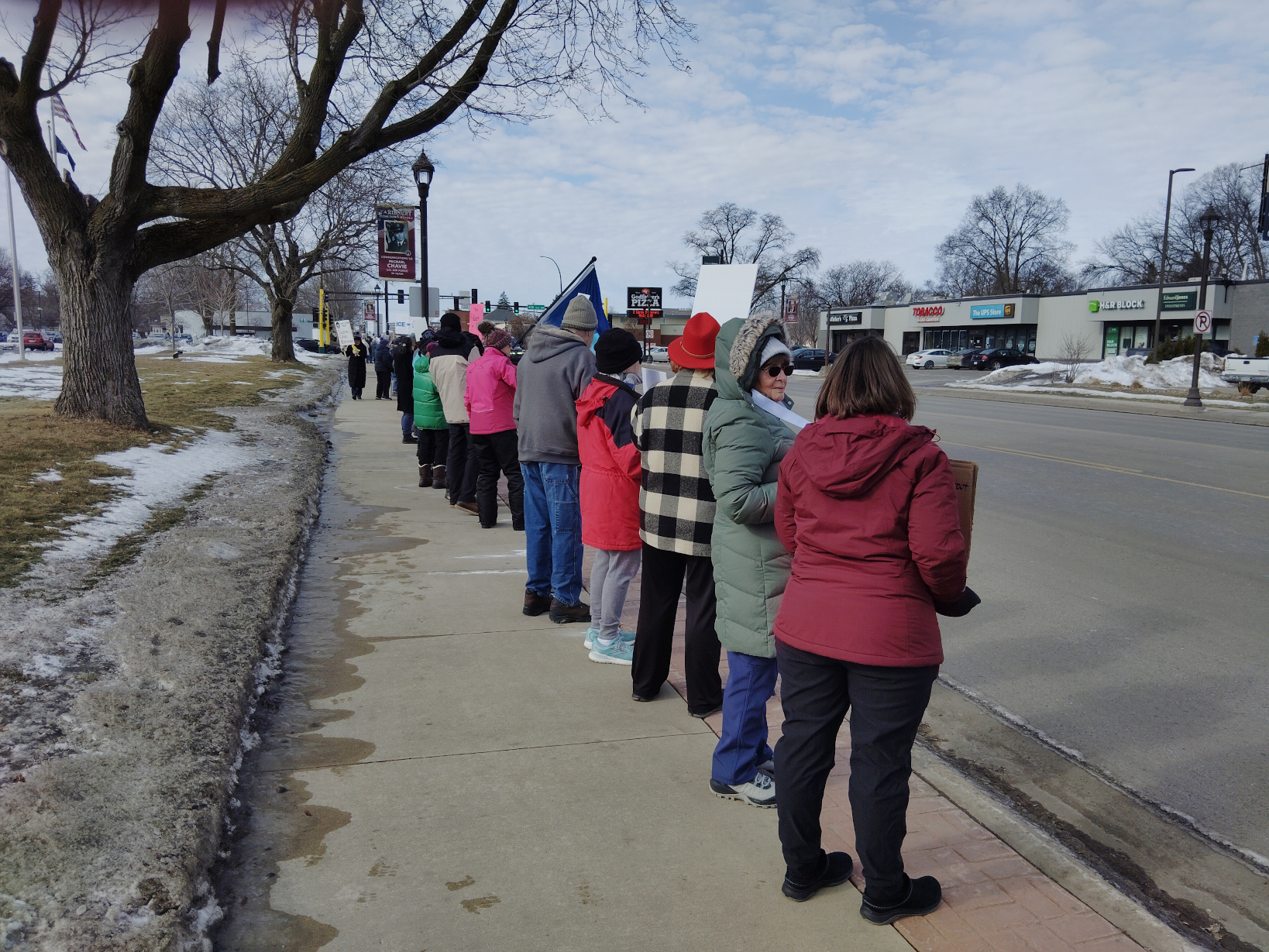
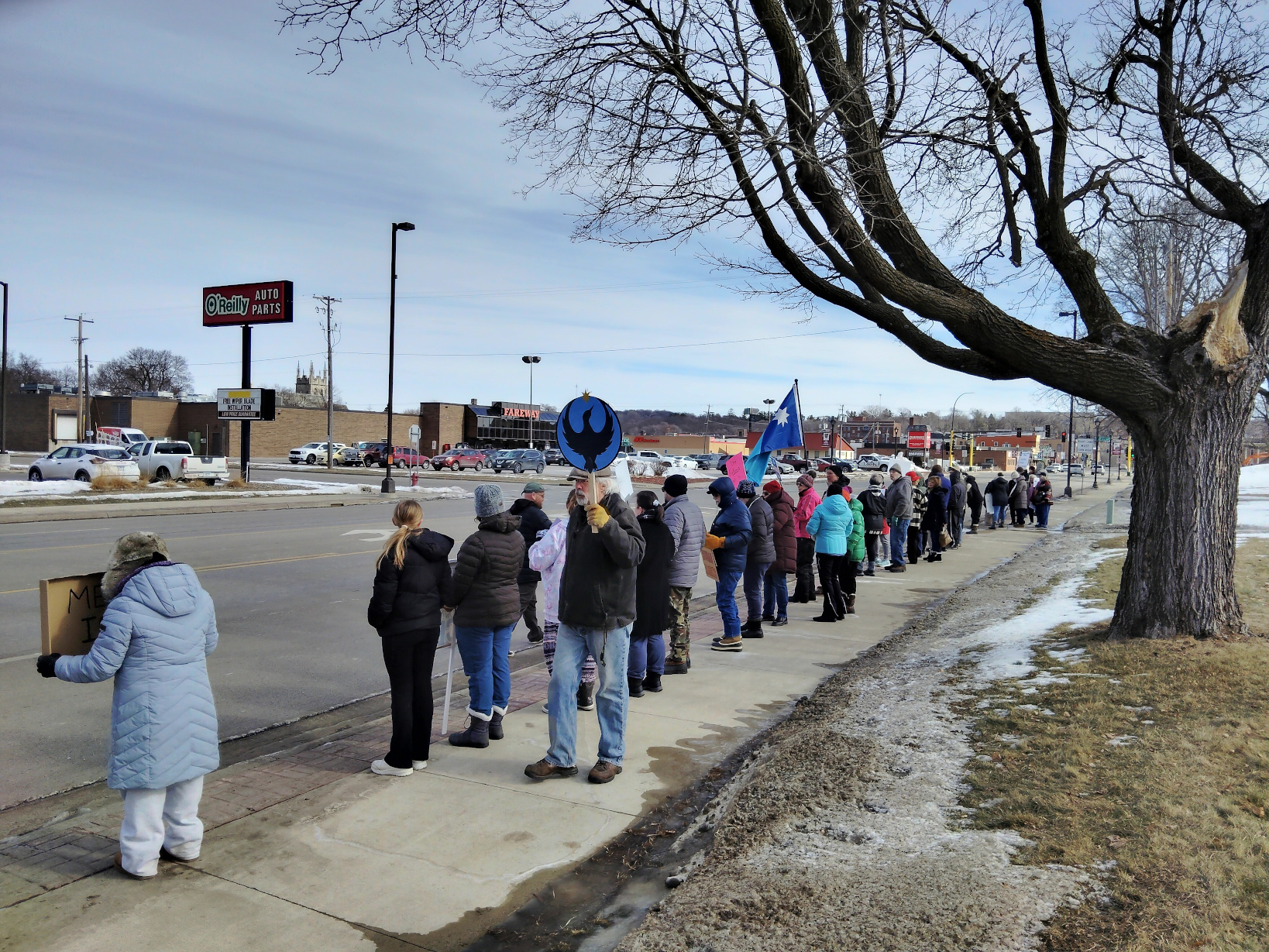
WE PULLED INTO THE PARKING LOT shortly before 11 a.m. Saturday, grabbed our signs from the back of the van and headed to the sidewalk. There Randy and I joined others filtering in to protest by the Rice County government services building along busy Minnesota State Highway 60/Fourth Street in Faribault.
For six Saturday mornings now, people have gathered here to raise their voices against aggressive federal immigration enforcement in Minnesota and against many other policies and directives of the Trump administration negatively affecting our lives (and that of our neighbors) and/or threatening our country. Whatever concerns someone—democracy, Constitutional rights, due process, tariffs, the economy, voting rights, authoritarianism, immigration—those topics are covered in signage and/or in conversations.
Saturday morning we stood some 40 strong in 15-degree temps with a biting wind. That’s about half our usual number. Some of the regulars were missing, but I also saw many new faces.
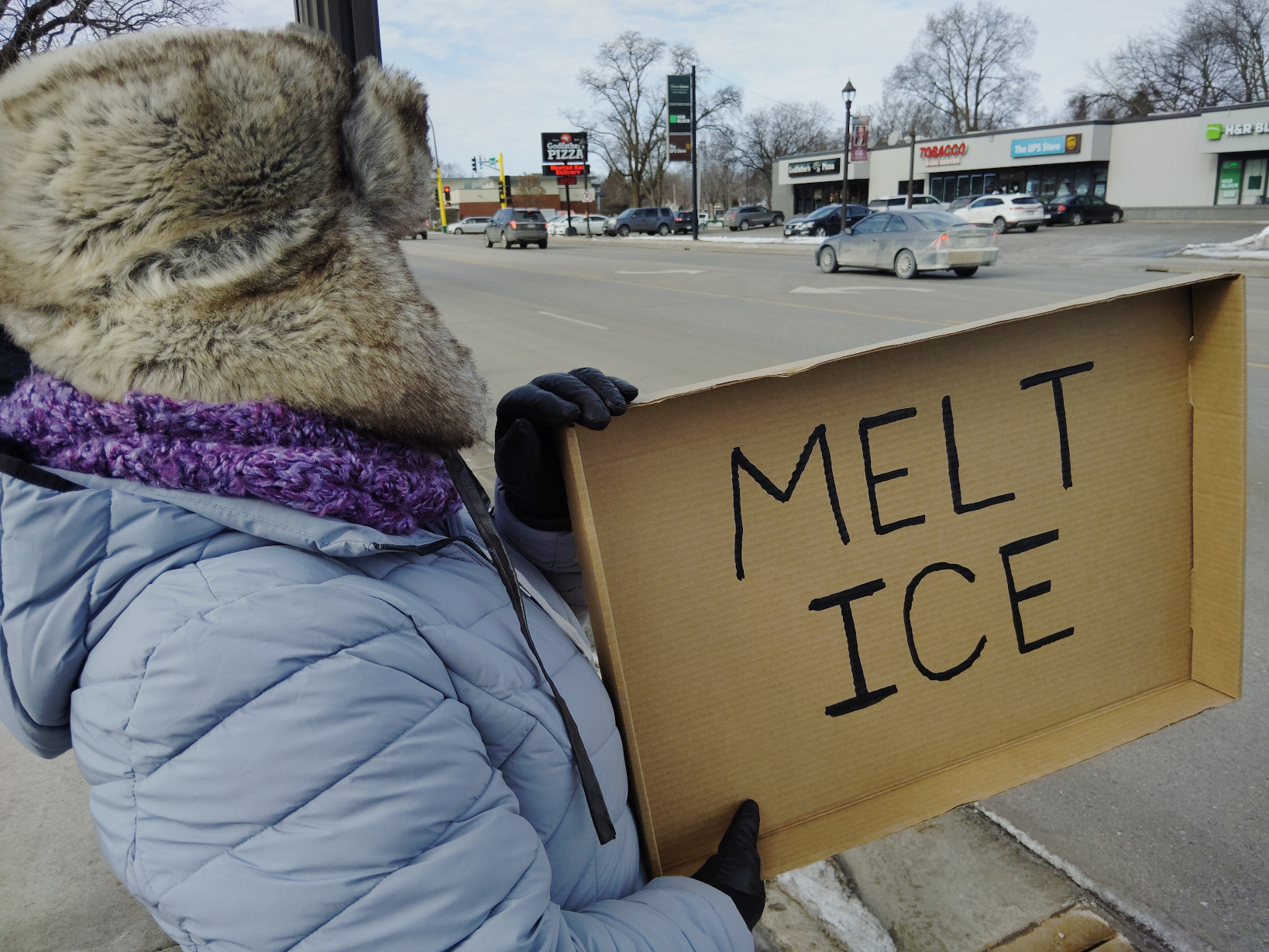
ICE IS STILL HERE
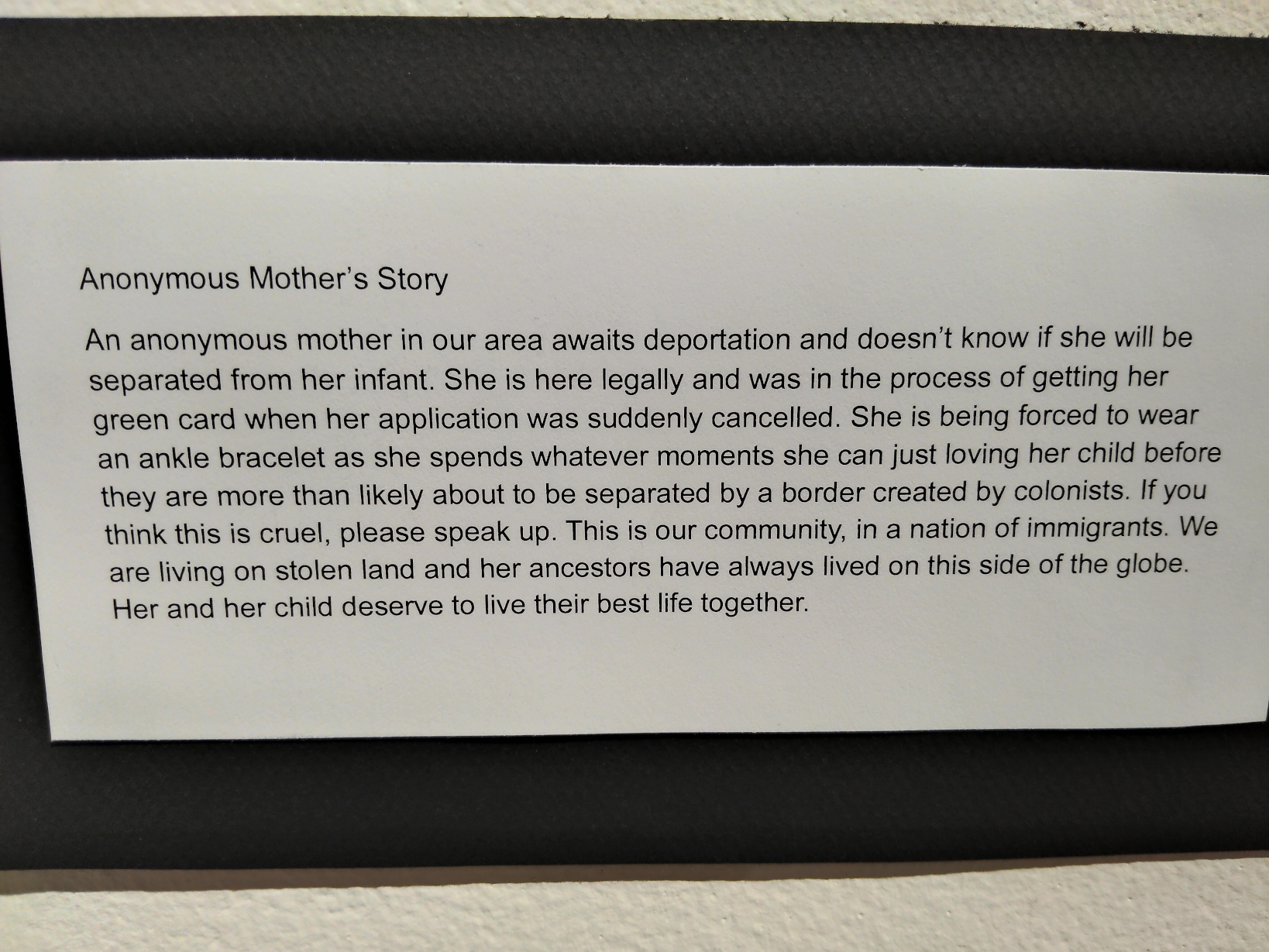
Top on all of our minds remains Operation Metro Surge, the largest mass immigration enforcement effort in the country which saw 3,000 federal agents descend on Minnesota. That includes here in our community, home to many Latinos, Hispanics and Somalis.
Despite the announced drawdown of those agents, ICE activity in Faribault has not decreased since they started working here in early December, according to one protester I questioned on Saturday. He laughed when I inquired, a telling response. He’s a trustworthy source, a boots-on-the-ground individual who is active and informed.
THE PERSONAL & FINANCIAL FALL-OUT
To hear stories of retired teachers giving kids rides to school is simultaneously heartening and heartbreaking. Parents should be driving their children to school or walking them to the bus stop. But, because of ICE, others are doing that while they are sheltered at home, afraid to leave, not working, not going to the grocery store.
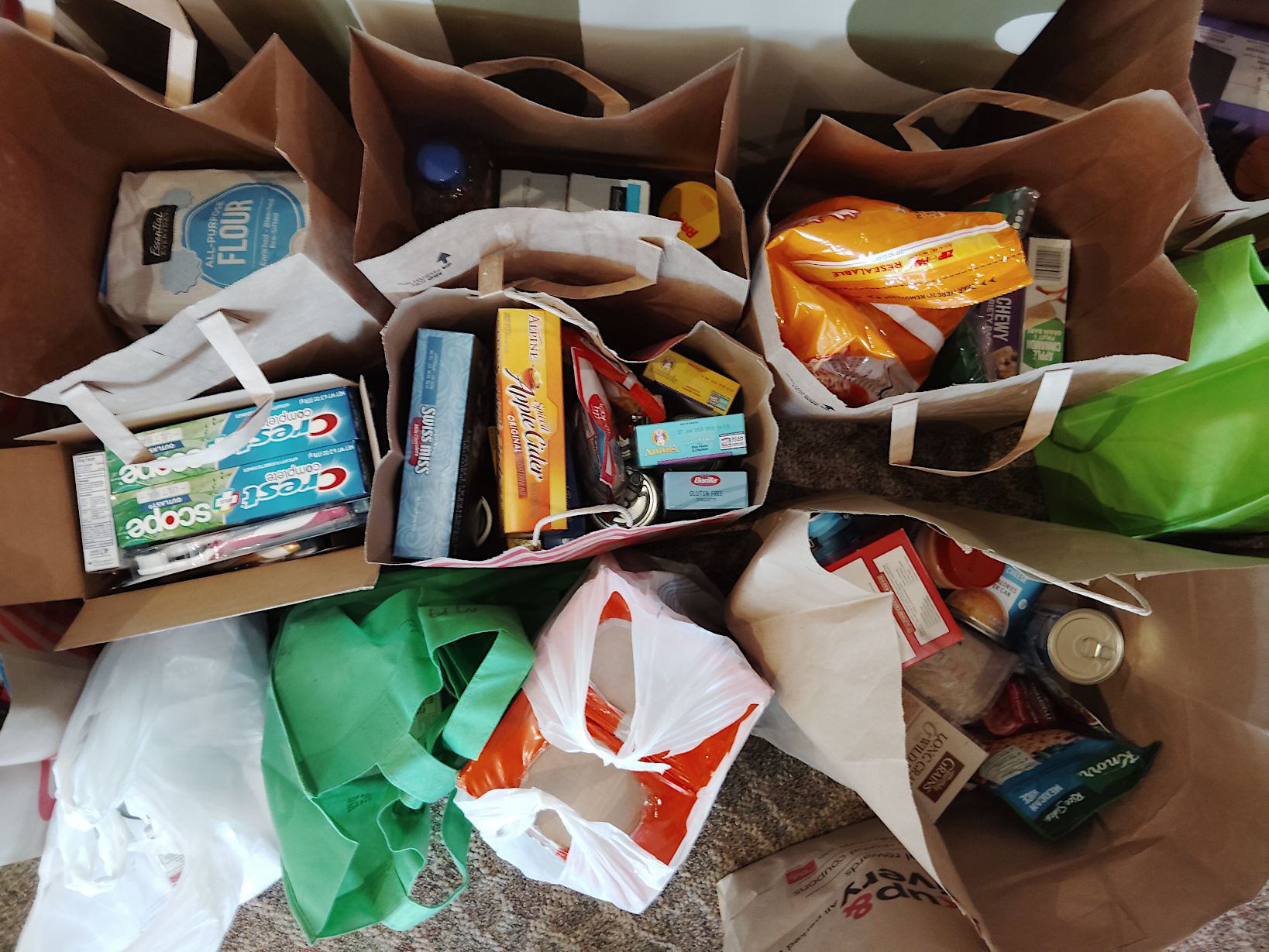
Food shelves have sprung up in schools and in churches, supplementing already existing nonprofit food shelves. The need is great. I recently started volunteering at a local food shelf.
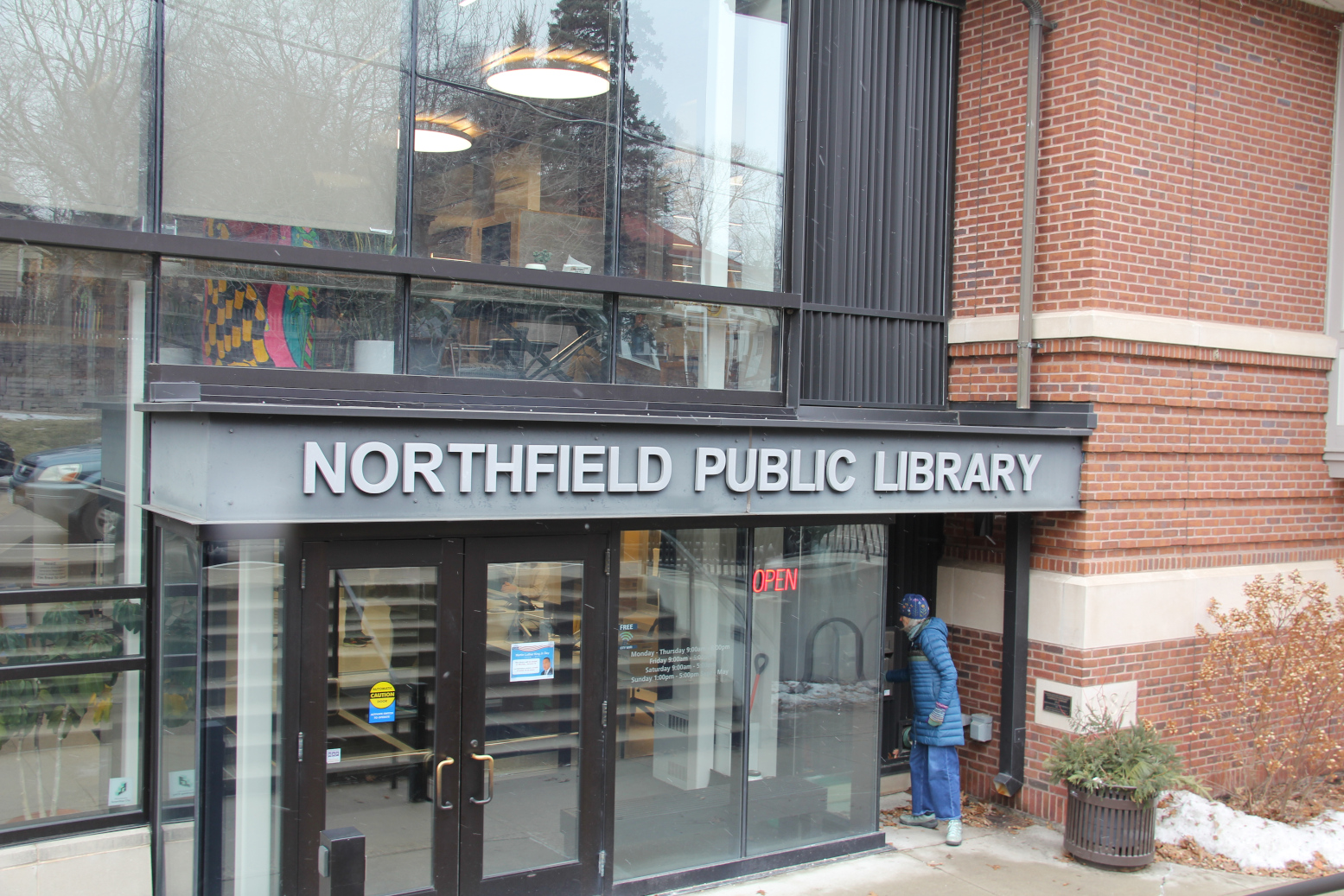
Families unable to pay rent now face eviction. The Faribault City Council last week denied a request from the Faribault Community Action Center for $50,000 in emergency rental assistance. In neighboring Northfield, the city council unanimously approved an identical request from the Northfield Community Action Center.
Faribault is a blue collar community that runs red. Northfield is white collar blue.
REACTIONS TO OUR PROTESTS
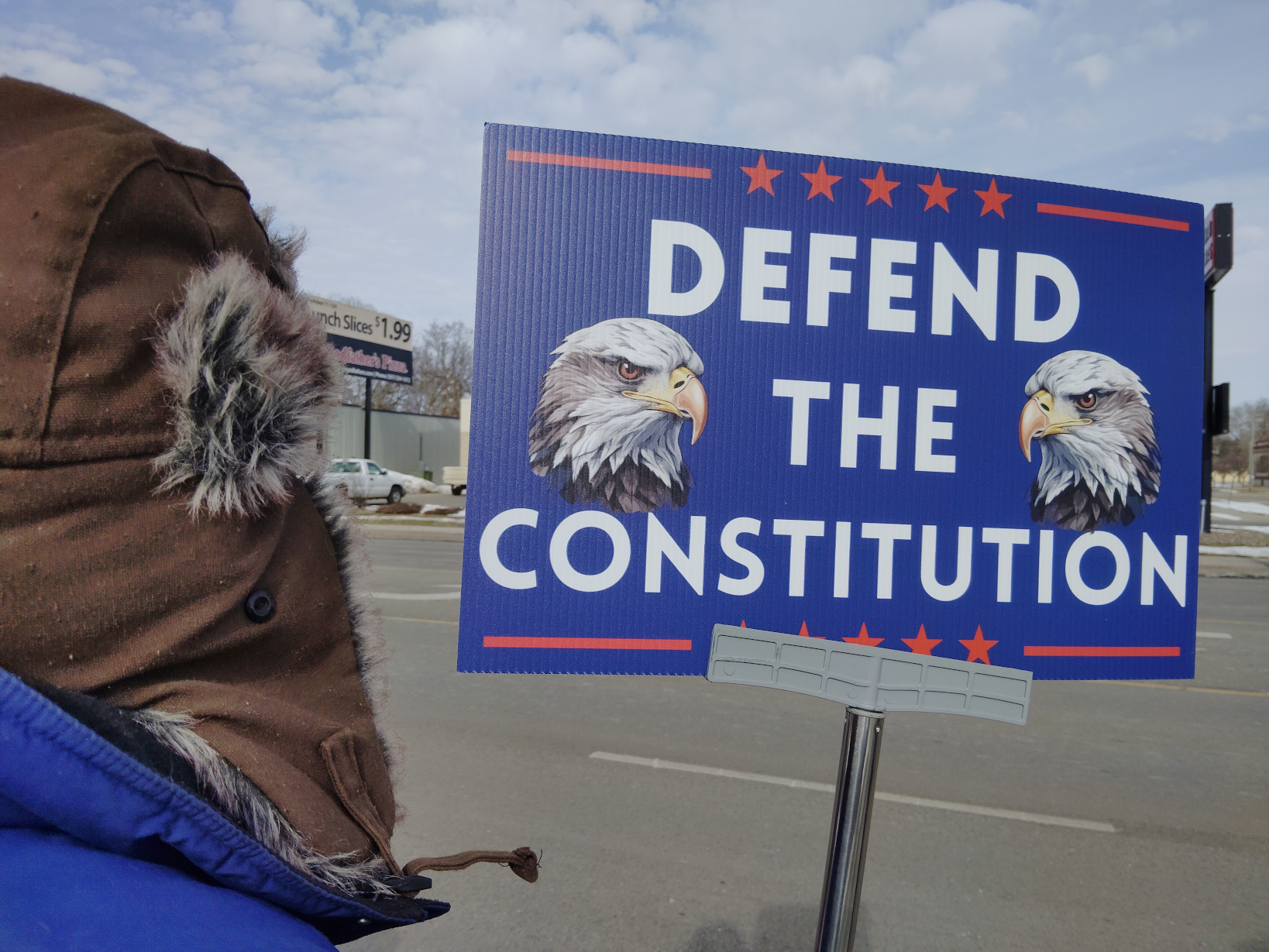
Whenever we protest, we are subjected to profanity, vulgarity and negative behavior from passing motorists among the overwhelmingly positive support. Based on my observations the four past Saturday mornings, the loudest and angriest are white women probably in their forties. I don’t understand the intensity of their angry outbursts. We just smile and wave, figuring we got to them with our messages.
THE STORIES
I like to mingle when I protest. It’s a great opportunity to meet new people, to hear stories. Like that of an elementary school student who returned to classes last week after a two-month absence. Or the first-time protester whose husband, an immigrant, has worked mostly remotely rather than drive to his job in Minneapolis. Or the man who crafted a Rebel Loon (the Minnesota state bird) sign and was protesting for someone who could not be there for fear of ICE.
These are real stories of real people in my community. I may not know the little girl who returned to school or the protester’s husband or the friend of the Rebel Loon guy. But I do know that I care about the people in my community who have lived in, and continue to live in, fear of federal immigration agents regardless of legal status. Residents of my community have been racially profiled, stopped, questioned because they are black or brown, have an accent, dress differently. I have talked to a Hispanic woman, an American citizen, who was stopped by ICE.
This is why I protest in the deep cold of a Minnesota winter, standing beside others with signs, Minnesota state flags and peace flags in a town of 25,000 where protesting exposes you to criticism. It matters to my profiled and targeted neighbors that I am publicly standing up for them. They’ve told me so. I cannot remain silent. We are stronger together. Minnesota Strong.

BREAD BAGS
We protesters brave the cold for those who cannot safely stand here. We wrap scarves around our necks, put on parkas, pull on long johns and ear flapper caps and wool socks and winter boots, sometimes adding foot and hand warmers. Several of us joked about returning next week with bread bags inside our boots for another layer of warmth, a throwback to our childhood days.
By then I’d been outside for an hour, my cheeks slapped red by the wind, my fingers and toes growing numb. But I was laughing, deep belly laughing, at the bread bag stories. It felt good to laugh with these protesters, to find comedic relief in the darkest of times.
© Copyright 2026 Audrey Kletscher Helbling























 Minnesota Prairie Roots
Inside The Land of Plenty under “the king’s” rule January 6, 2026
Tags: commentary, fiction, January 6, king, opinion, stories, The Land of Plenty
ONCE UPON A TIME in The Land of Plenty, the leader of the land ruled like a king. Not a nice king. Not a kind king. But rather a mean-spirited one.
The leader had never been appointed king. It was a title he claimed for himself with oppressive authority. In truth, he’d been voted into his powerful position, not overwhelmingly as he declared, but rather in a close election. That should have been enough to tamp his crowing, rein in his overuse of superfluous adjectives and adverbs, deflate his super-inflated ego and encourage good behavior. But it was not to be.
ONE JANUARY DAY
Rather the self-proclaimed king, who’d been ousted from The Land of Plenty after his first tenure, determined to make up for lost time. Five years earlier, on an early January day, he attempted to retain power when his supporters stormed the castle. He claimed ignorance. Some believed him; many didn’t. Evidence doesn’t lie.
The king’s anger simmered, then boiled over when he returned to the castle feeling vindicated and empowered. A man of vengeance, he sought to punish any who opposed him. On the flip side, he freed those he considered wrongfully shackled. No one would do harm to him or his legion. No one. He was in charge. His decisions held absolute power. Only his voice mattered.
Threats. Intimidation. Cruel and demeaning words. Imprisonment. Deflection. Manipulation. Gaslighting. Conspiracy theories. All fit his mode of ruling. He would make The Land of Plenty great again, whatever that meant.
BROKEN PROMISES
He promised to end wars and claimed he had. He promised to lower prices. He promised to rid the land of strangers and foreigners. That sounded promising to all who supported him. No conflict, only peace. Fewer coins spent on food purchased in the town square marketplace. A strong land unlike any other, without foreigners roaming the streets, taking away jobs, committing crimes and creating chaos (his words).
Except it was the king creating chaos. Doing whatever he pleased. Causing discord. Divisions arose within the kingdom. World conflict increased. Prices spiked as the king imposed new taxes. The ruler of The Land of Plenty was viewed by millions as uncaring, ruthless, self-centered and far worse. Many felt his wrath.
SNATCHED, BANISHED
The king targeted strangers and foreigners who contributed greatly to the economy and success of the kingdom. They toiled in fields, wagon wheel factories, blacksmith shops, bakeries… Some even emptied his golden commode. But to the king, none of that mattered. “Go back to your homeland!” the king screamed. “We don’t want you here!” He decreed that the unwanted should be snatched, grabbed off the streets by his masked henchmen and banished. And so many were.
As the days, weeks, months and then a year passed since the self-proclaimed king resumed his rule, the situation in The Land of Plenty was far from fine. It was, in fact, rather awful, dire, especially for the lowly peasants who labored long hours for every coin. Many realized they’d been duped, led to believe in fairy tale endings. In happily ever after.
And so the story goes with three chapters unwritten, the ending unknown.
© Copyright 2026 Audrey Kletscher Helbling