AS SOMEONE WHO GREW UP with minimal exposure to the arts, I feel not so much deprived as deeply appreciative of creativity. I consider myself an artist—of images and of words. To write and to photograph, oh, the joy.
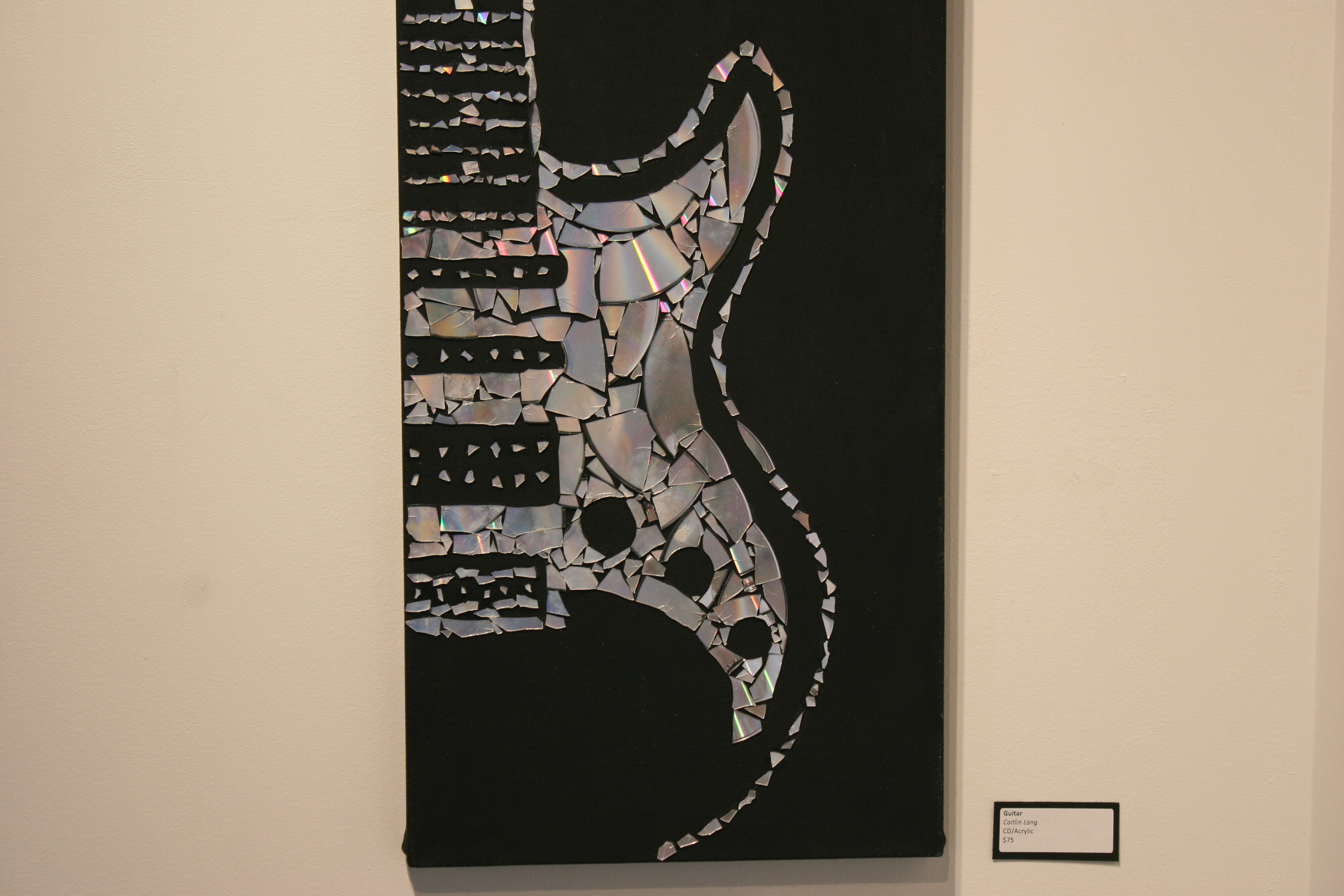
A snippet of an acrylic, “Guitar,” by Caitlin Lang.
I feel gratitude for all the creatives out there who share their talents, whether in published works or performances or art exhibits or whatever in whatever space they choose.
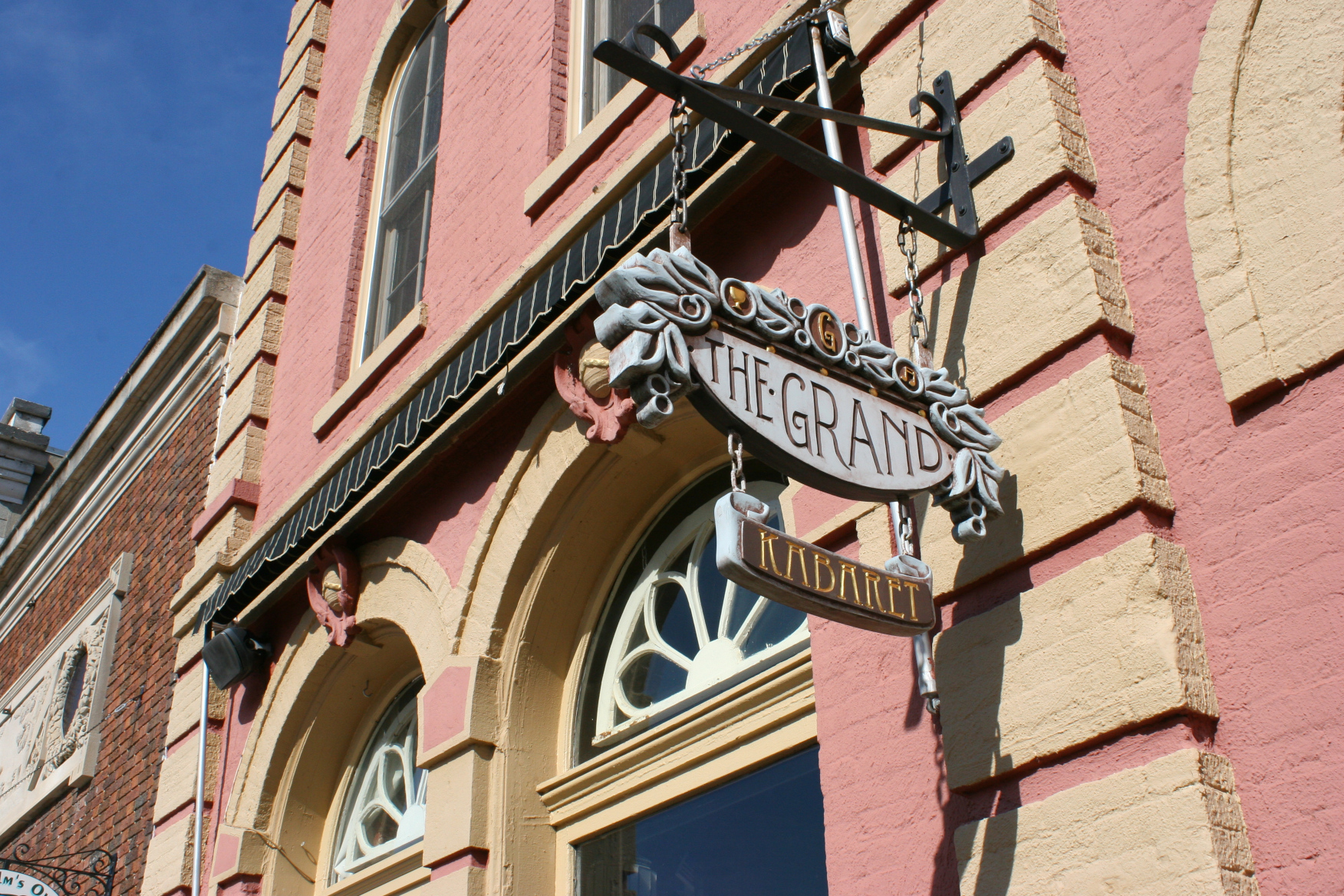
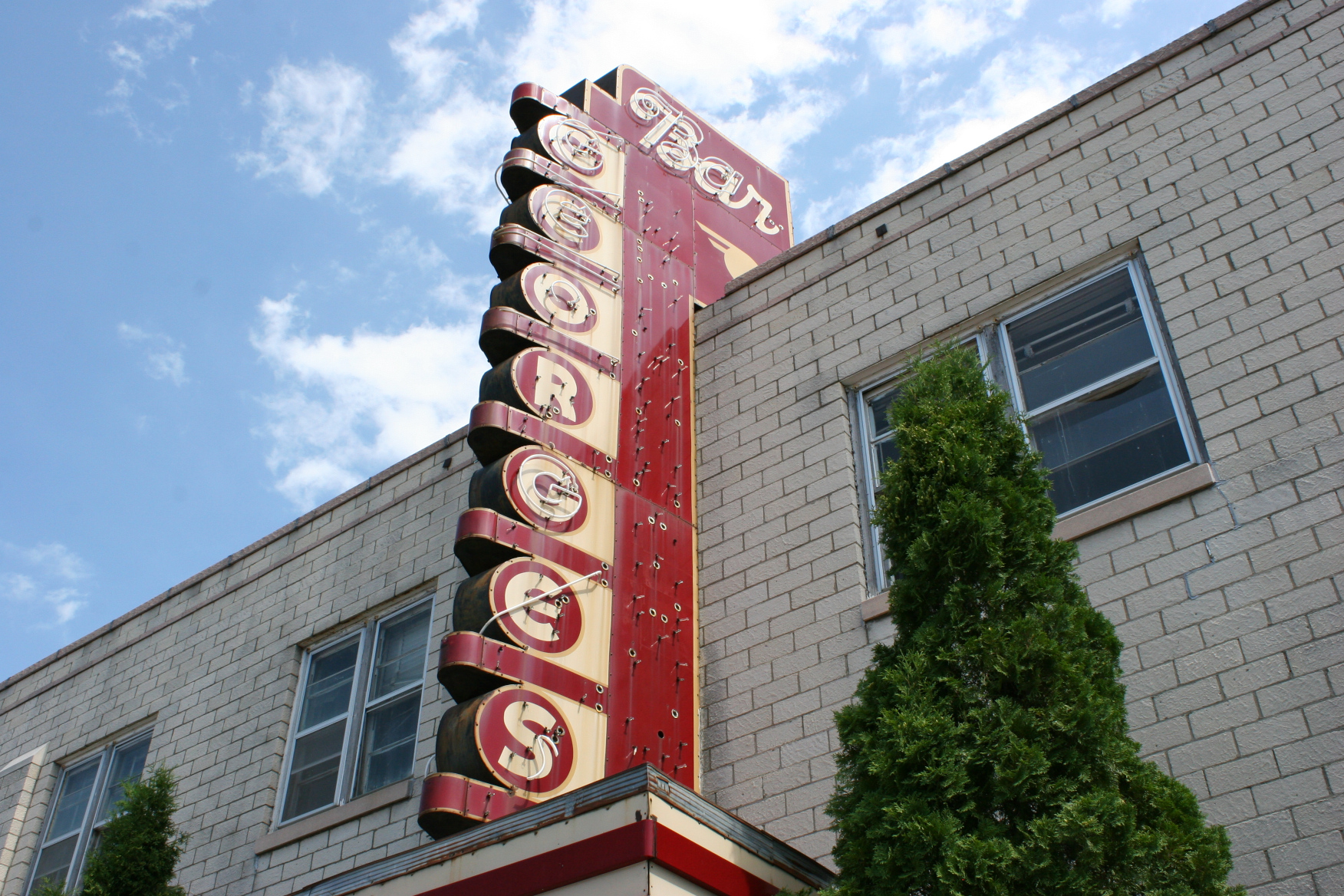
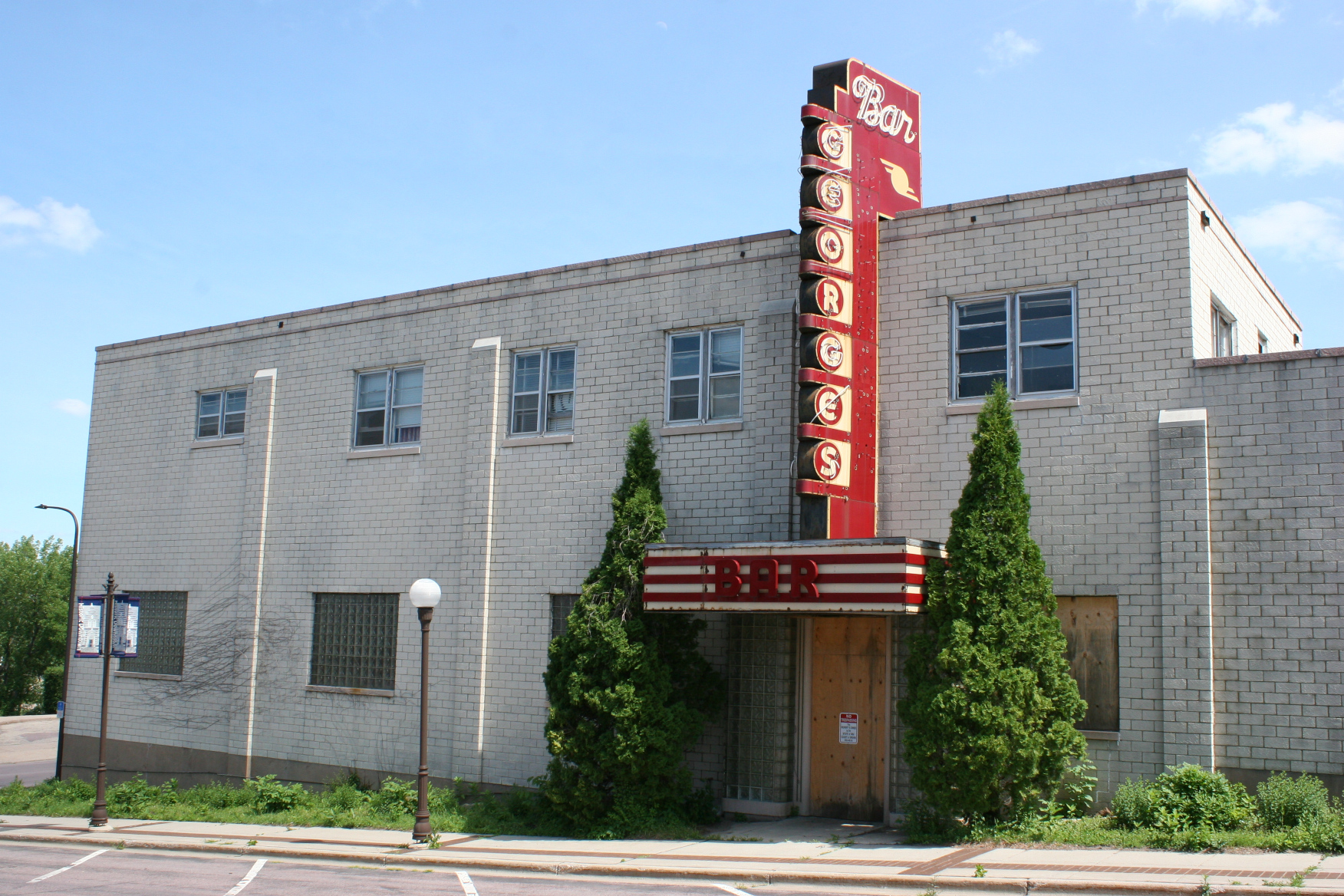
The Grand Center for Arts & Culture in downtown New Ulm.
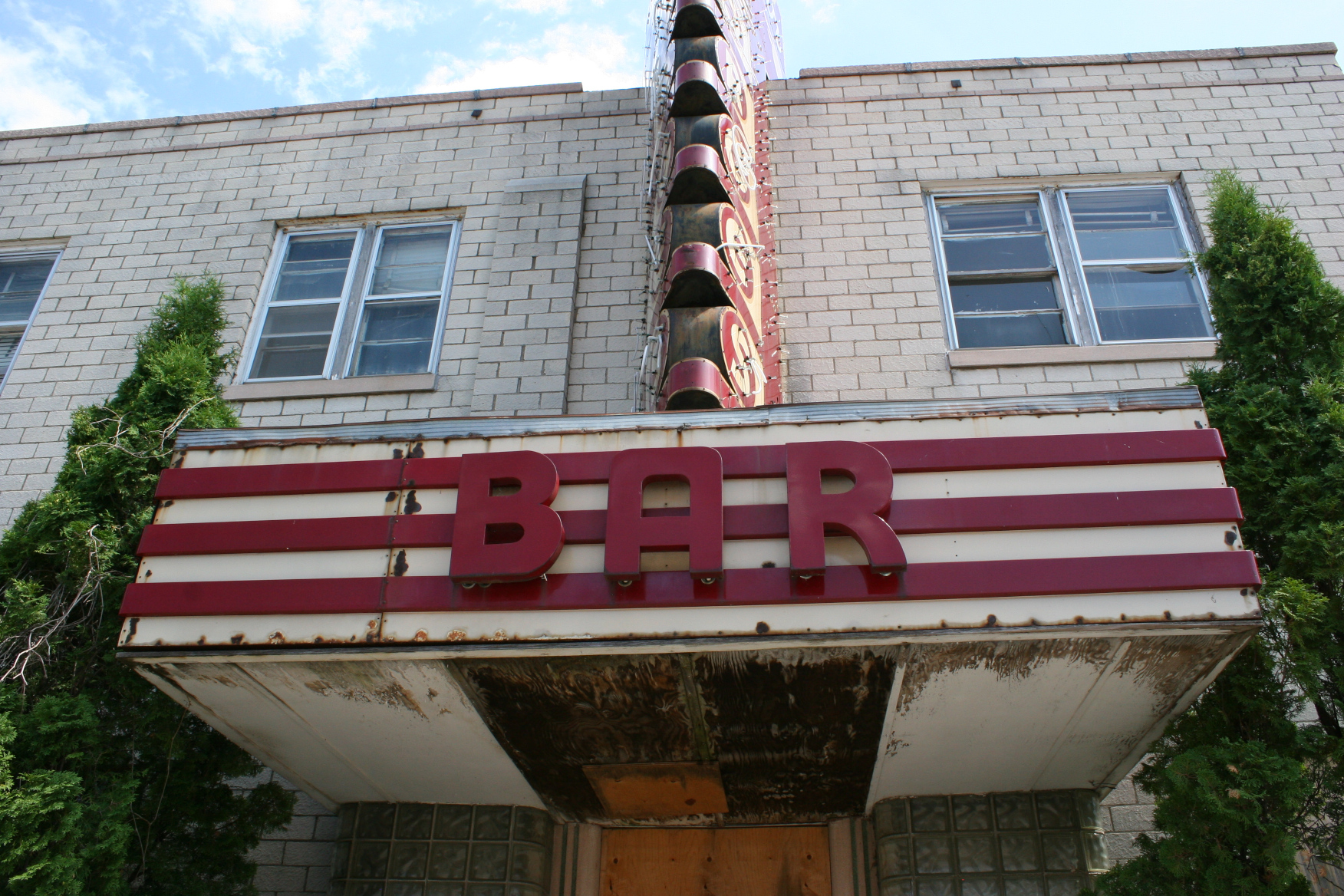
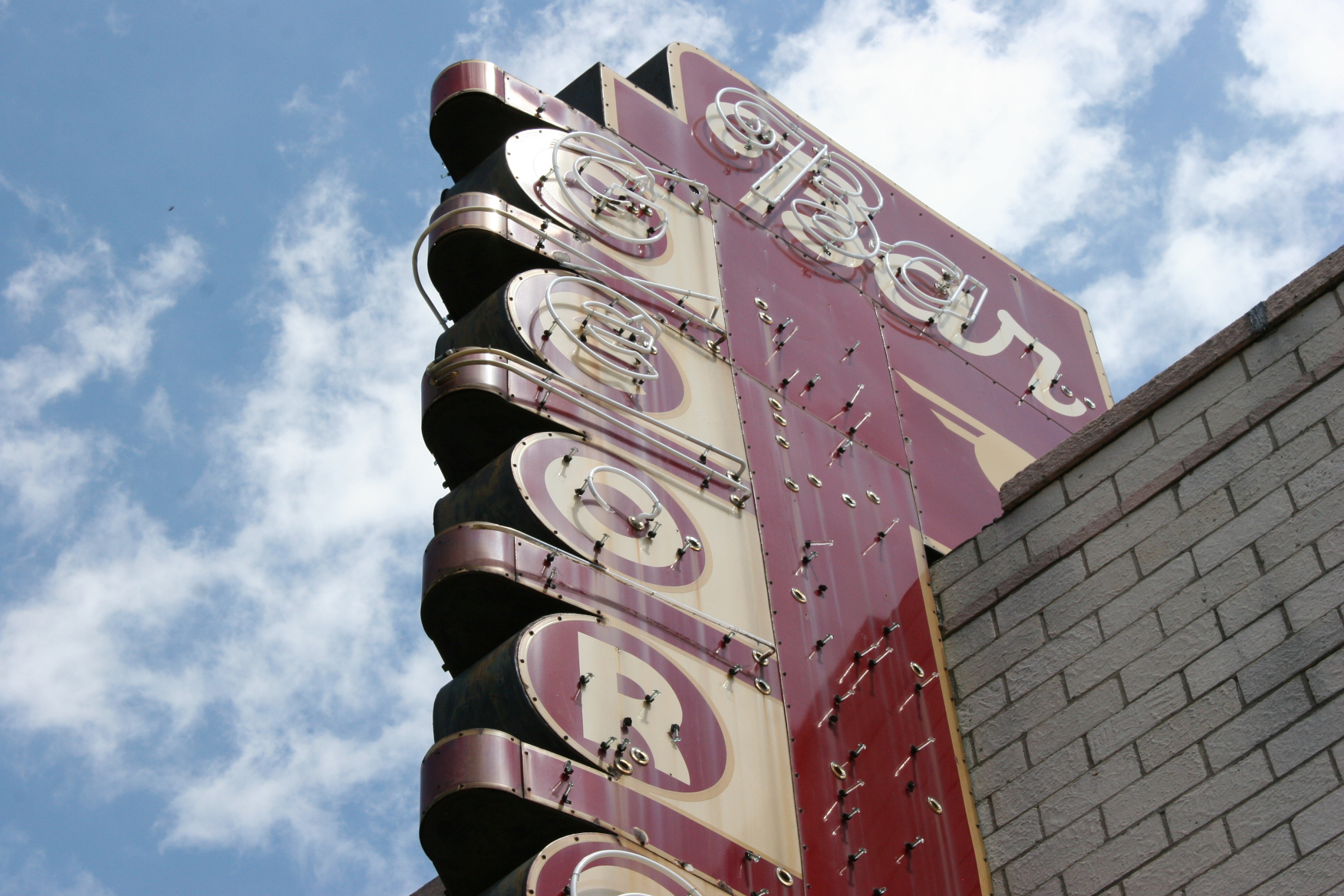
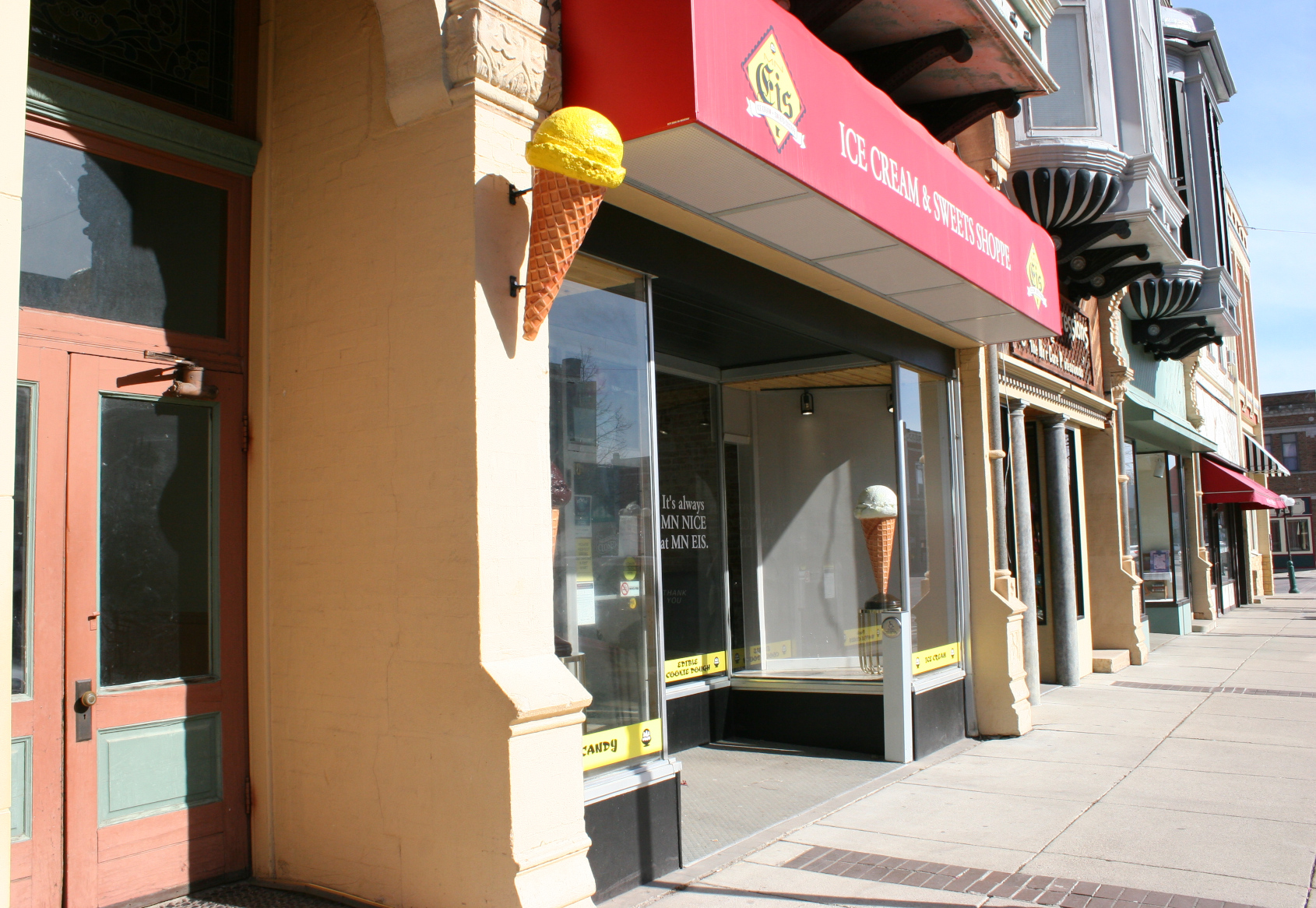
Beautiful signage and architectural details make this building visually appealing.
During a brief Saturday afternoon stop in New Ulm, my first must-see destination was The Grand Center for Arts and Culture, housed in a former historic hotel in the heart of downtown. The building itself drew my interest with its appealing signage and lovely architectural details.
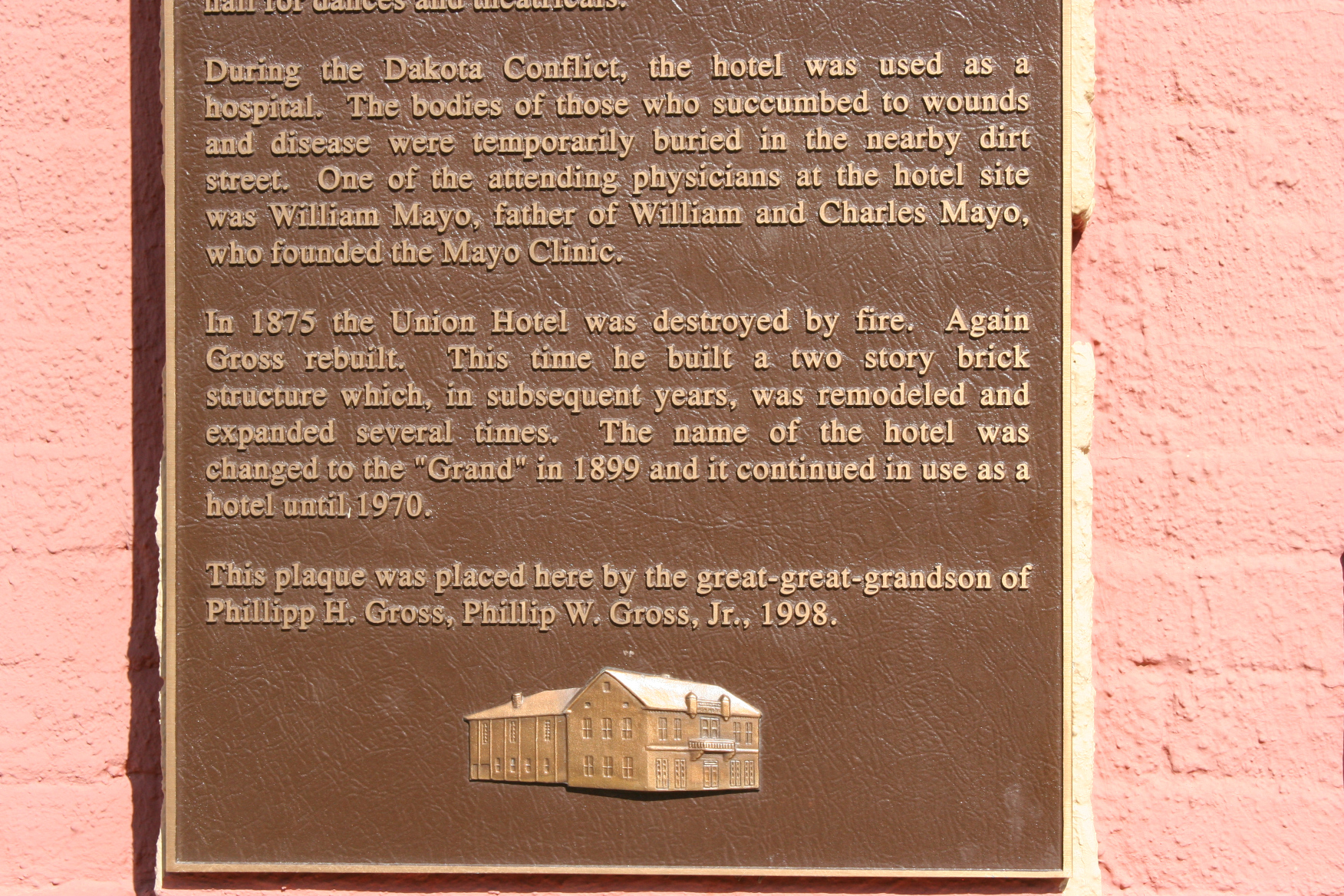
A portion of the historical plaque outlining the history of the former Grand Hotel, now an arts and cultural center in New Ulm.
A front face plaque summarizes its history. You’ll find such historical info throughout this downtown on plaques, benches and even picnic tables. I appreciate the easy access to history.
Outside the front entry to The Grand Center for Arts & Culture in New Ulm.
Inside the arts center, the first floor features a gift shop brimming with great art and, across the hall, The Grand Kabaret, for entertainment/the performing arts. Downstairs, the basement houses Cellar Press, a letterpress and printmaking studio, which I didn’t see (but must).
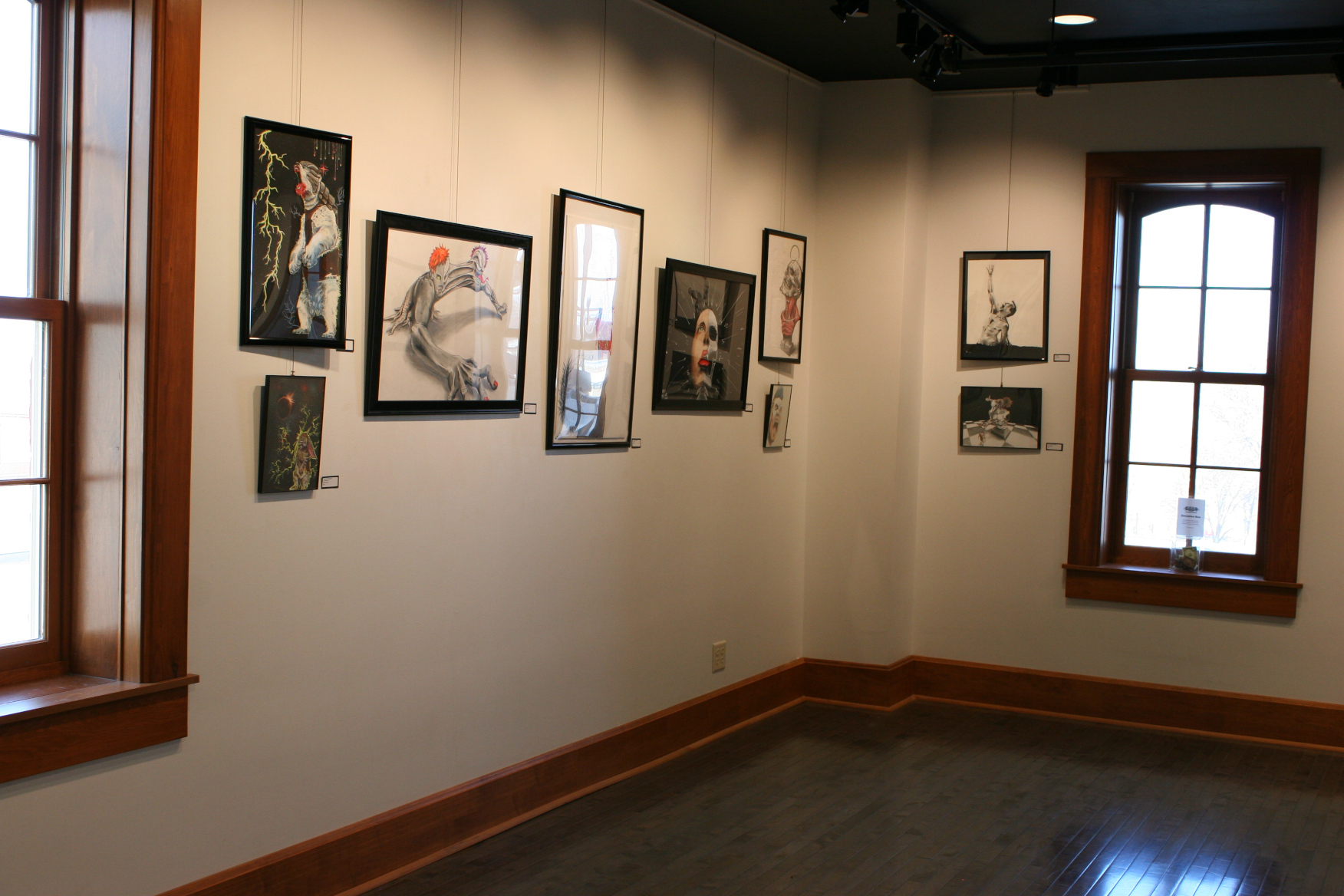
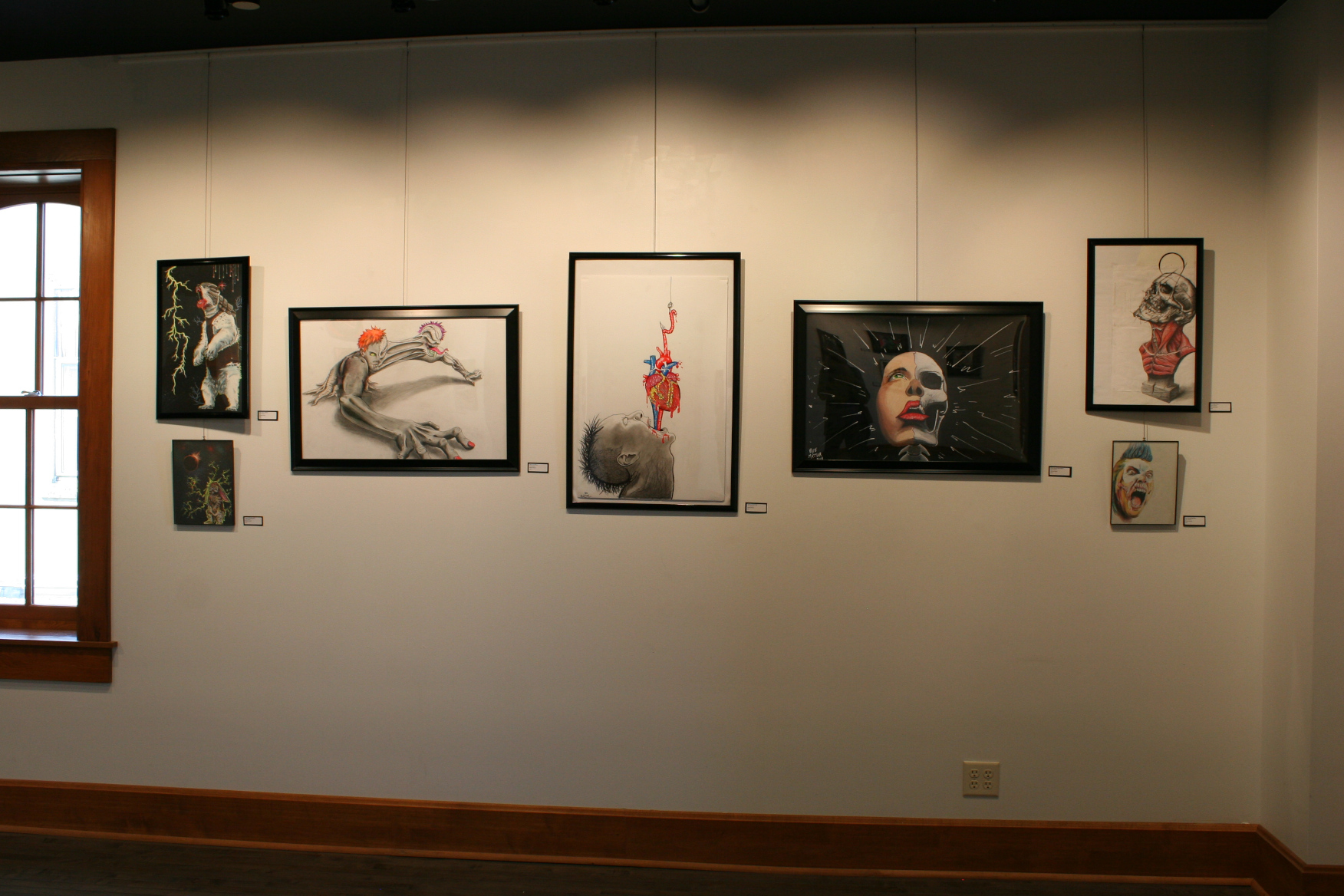
Light floods the gallery, on these walls the art of Sam Matter.
A steep flight of stairs leads to 4 Pillars Gallery and studio space on the second floor. The compact gallery, with abundant natural light flowing into the room, feels intimate, inviting, ideal for showcasing art.
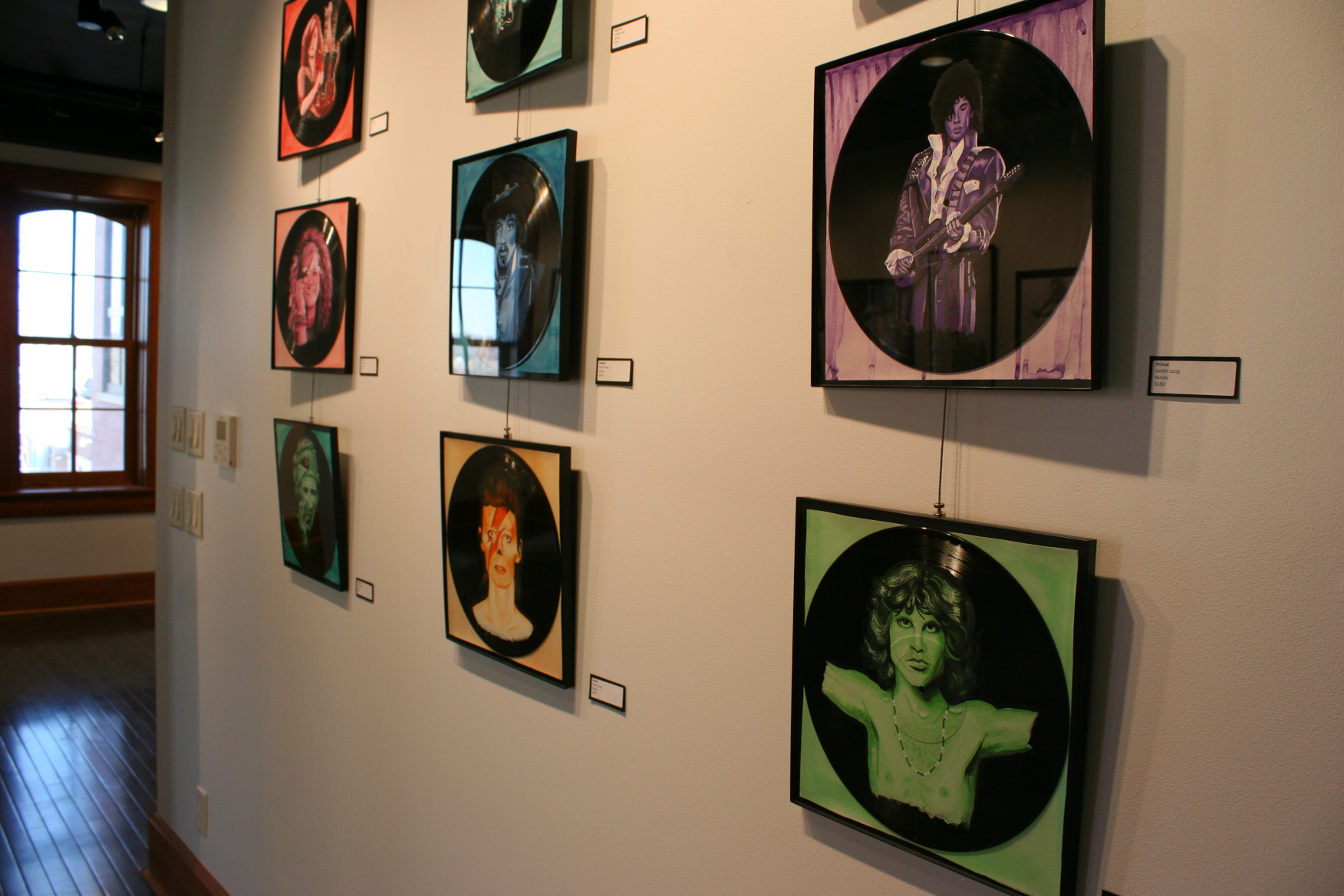
Musician portraits by Caitlin Lang.
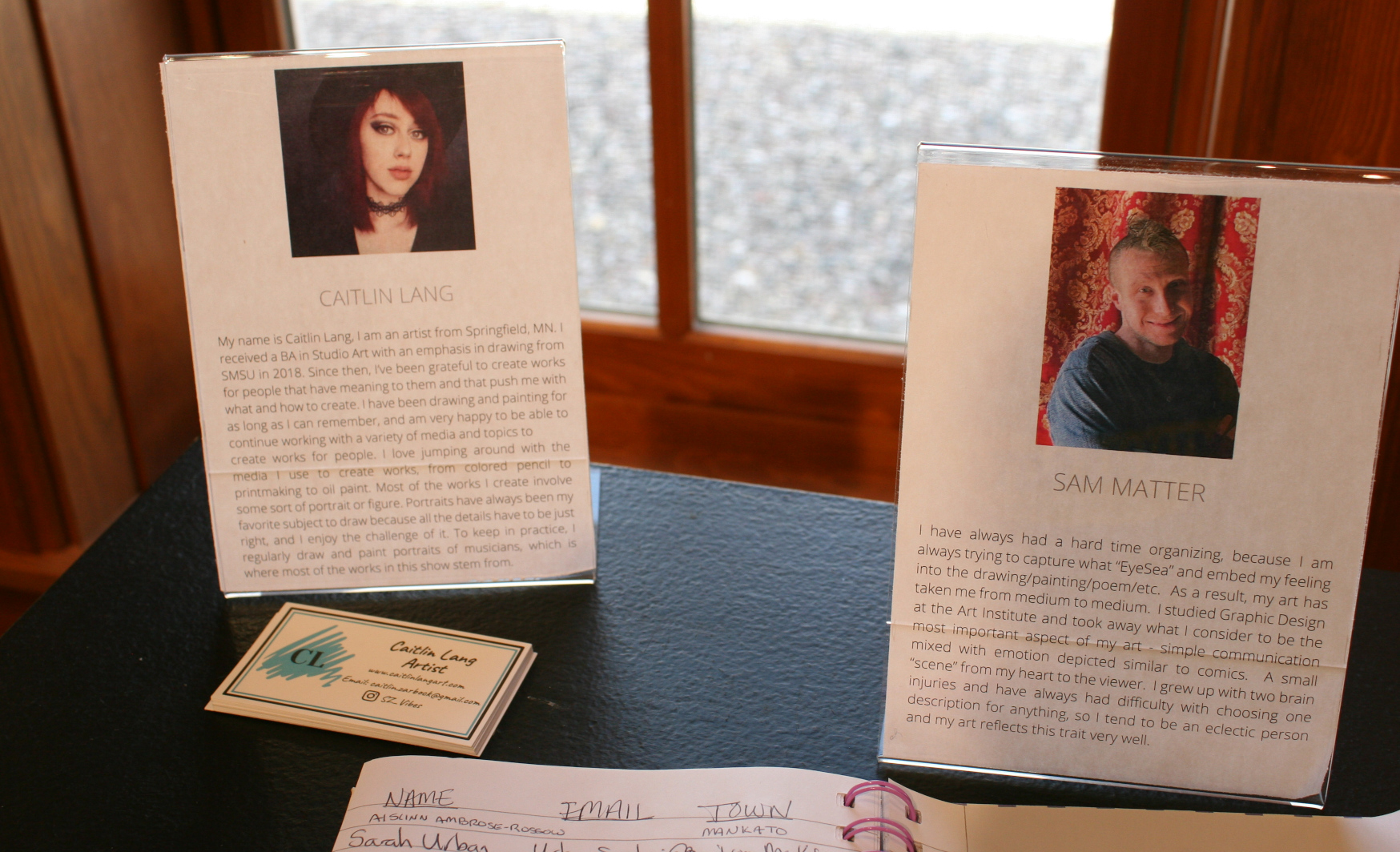
Caitlin Lang of Springfield and Sam Matter of New Ulm are the current featured artists in a joint mixed media exhibit, “Intentionally Accidental.” Their show runs through April 3.
The bios of Caitlin Lang and Sam Matter, along with a guestbook, sit on a table in the gallery.
What a joy to see the work of these two young artists. Lang specializes in portraits and Matter describes his art as “a small scene from my heart to the viewer.” I love that poetic description.
Sam Matter’s art, created from the heart.
And I love this center for arts and culture, a must-see in New Ulm.
#
FYI: The Grand Center for Arts & Cultureis changing its hours starting March 23 and will be open from 11 am – 4 pm Tuesday – Saturday.
#
Please check back for more photos from the arts center.
Belview, located in southwestern Minnesota, some seven miles from my hometown of Vesta.
FOR THOSE OF YOU who’ve followed my Minnesota Prairie Roots blog for awhile, you understand that I value small towns. They are a favorite destination, an escape of sorts back to my rural prairie roots. To a less-populated place, typically rooted in agriculture.
The grain complex in unincorporated Bixby in Aurora Township in Steele County, MN, reflects in the passenger side mirror.
That said, I recognize that my definition of a “small town” may differ from yours. I view small towns as communities with populations of several thousand or less. I would not, for example, consider my city of Faribault to be small. Others would given its population of around 24,000.
A favorite stop (when it’s open) is Rainbow Antiques, Crafts & Junque in Belview. Other attractions in Belview include the historic Odeon Hall, Rock Dell Lutheran Church, rural Belview, and Grandview Valley Winery, to the north of town. Minnesota Prairie Roots file photo August 2011.
What draws me to small towns, to photograph and write about them, beyond my desire to reconnect with rural places and share my finds?
I love this kitschy bar stool atop the City & Country Tavern roof overhang in Morgan in southwestern MN.
It’s discovering nuances of character. It’s connecting with people. It’s the architecture and oddities and so much more. Exploring small towns is like taking a basic sentence and enhancing the main subject with adjectives.
This prairie chicken statue along Interstate 94 in western Minnesota celebrates the real prairie chickens which reside in the Rothsay area. Minnesota Prairie Roots file photo May 2013.
Yet, I realize not everyone appreciates language like I do. All too often, small towns are bypassed or driven through—seemingly not a place that would attract visitors. But I am here to tell you they are worth the detour off the interstate, the destination for a day trip, the stopping on Main Street.
Popular Franke’s Bakery anchors a corner in downtown Montgomery, MN. Minnesota Prairie Roots file photo August 2020.
Montgomery, Minnesota, for example, is one of my favorite nearby small towns. Why? I love going to Franke’s Bakery, a staple in this community for 100-plus years. The bakery specializes in Czech treats, in this self-proclaimed Kolacky Capital of the World. Across the street from the bakery, a mural tells the history of this town. Aged buildings line the main business district, with home-grown shops and eateries and bars. The adjectives enhancing the main subject.
The Montgomery Arts & Heritage Center, right, and Posy Floral, left, along First Street North on the north end of downtown Montgomery, MN. Minnesota Prairie Roots file photo August 2020.
The Montgomery Arts and Cultural Heritage Center and Montgomery Brewing also draw me to this Le Sueur County community. And the signs and architecture.
The good folks of Montgomery have branded their community, tapping into their heritage and then building on that to create a place that attracts visitors. I think potential exists in every small town to do the same. And it starts with recognizing the strengths, the uniqueness, of a community. I know that requires time, money and effort. But, oh, the possibilities.
The community of New Ulm is home to many home-grown restaurants, like the Ulmer Cafe.
I, for one, love small town bakeries, antique shops, thrift stores, art centers and home-grown cafes with meal offerings that are crafted by hand, not pulled from a freezer and heated. I recently saw a sign for Beef Commercials in New Ulm. I haven’t eaten one—roast beef layered between slices of white bread, topped with a dollop of mashed potatoes and smothered in gravy—for years. Had it been meal time and not a pandemic, I may have stopped to indulge in nostalgia.
A thriving grocery store in small town Ellendale, MN.
Now I know every community can’t tap into heritage like New Ulm and Montgomery. But, each place truly possesses potential to attract visitors. In Ellendale, for example, the award-winning Steve’s Meat Market draws meat lovers. I am partial to Lerberg’s Foods and its worn wooden floor, narrow aisles and aged moose head looming over cans of stacked corn.
Outside the local hardware store in the downtown main business district, this heart art shows pride, marketing savvy and identity in Blooming Prairie. This small town is located in southern Steele County, south of Owatonna.
I delight in such discoveries. Kitsch. Identity. A strong sense of place and pride. I hope that, by sharing my thoughts and photos, you, too, will view small towns through a lens of appreciation.
TELL ME: Have you discovered a small town that you just love. I’d like to hear.
PLEASE CHECK BACK as I expand on this post with more photos from some of the communities featured here.
Housed in the former PIX Theatre, Sleepy Eye Brewing & Coffee Company, along US Highway 14 in downtown Sleepy Eye. Minnesota Prairie Roots file photo March 2020.
WHEN I WAS GROWING UP on the southwestern Minnesota prairie in the 60s and 70s, locally sourced meant harvesting vegetables from the garden, dipping milk from the bulk tank and pulling our own farm-raised beef from the freezer. Our farm family of eight was basically food self-sufficient, with the exception of fresh fruit (a rare treat) and staples like flour and sugar.
Information on tables informs customers of locally sourced food. Minnesota Prairie Roots file photo March 2020.
Spent grains from the beer making process go to Fischer’s Sleepy Bison Acres as supplemental food for the bison. Minnesota Prairie Roots file photo March 2020.
More info on the interaction and reliance on the community. Minnesota Prairie Roots file photo March 2020.
With that background, you’ll understand why I appreciate the efforts of businesses like Sleepy Eye Brewing and Sleepy Eye Coffee Company, which work with local farmers to source products. Bison meat. Milk. Honey. Eggs. It’s a win-win for everyone, including customers who value fresh, local and direct farm-to-table.
This is a stunningly beautiful space. Minnesota Prairie Roots file photo March 2020.
The brewery and coffee/bakery/sandwich/salad shop are housed in the historic former PIX Theatre in the heart of downtown Sleepy Eye. My first and only visit happened a year ago, just before COVID-19 changed everything, including my interest in dining out or imbibing at a craft brewery.
A flight served in a movie reel. Minnesota Prairie Roots file photo March 2020.
Some of the beer choices at Sleepy Eye Brewing. Minnesota Prairie Roots file photo March 2020.
Glasses advertise the brewery. Minnesota Prairie Roots file photo March 2020.
But I’ll be back once life returns to normal because I appreciate the former movie house setting, the beer and the small town friendliness. I intend also to sample a homemade sweet treat from the bakery. Or maybe a sandwich or salad.
A view from the balcony window looking over US Highway 14 and Sleepy Eye’s main business district. Minnesota Prairie Roots file photo March 2020.
I love how some small towns are seeing a revival of sorts via businesses like craft breweries. Hometown bakeries also add to the draw.
The restored marquee now advertises “fuel” rather than movies. Minnesota Prairie Roots file photo March 2020.
For someone like me who grew up with home-grown/home-raised food on premises, the current trend of locally sourced brings me full circle back to my roots. That’s 45 miles to the northwest of Sleepy Eye in rural Vesta.
A flight served in a “movie reel” at Sleepy Eye Brewing. Minnesota Prairie Roots file photo March 2020.
UP UNTIL CRAFT BREWERIES OPENED, I wasn’t much of a beer drinker. I’m still not. But I now enjoy the occasional IPA or other locally-brewed beer at a brewery. Yet, it’s about more than appreciating a good beer. For me, it’s also about the setting. The place in which these beers are brewed and served.
Reads Landing Brewing Company in Reads Landing, MN. Minnesota Prairie Roots file photo.
And in southern Minnesota, I’ve discovered some aesthetically pleasing breweries in historic buildings. Montgomery Brewing has come full circle back to its roots, based in a 130-year-old building built to brew beer. At Chapel Brewing in Dundas, the taproom occupies a compact 1880 former chapel along the Cannon River. In neighboring Northfield, Imminent Brewing is stationed in the old National Guard Armory garage. And further to the southeast along the Mississippi River, Reads Landing Brewing occupies an 1870 dry goods store.
Outside Sleepy Eye Brewing and Coffee Company, which once housed the PIX Theatre. Minnesota Prairie Roots file photo March 2020.
Paying homage to the history of this building. Minnesota Prairie Roots file photo March 2020.
How fitting is this, a flight served in a movie reel? Minnesota Prairie Roots file photo March 2020.
Looking up to the balcony of Sleepy Eye Brewing. Minnesota Prairie Roots file photo March 2020.
Overlooking Sleepy Eye Brewing and Coffee Company, (back left) from the balcony. Minnesota Prairie Roots file photo March 2020.
The beer selections… Minnesota Prairie Roots file photo March 2020.
A balcony overlooks the long, narrow room defined by wood and brick and tile and stainless steel and even chandeliers.
The beautifully-restored marquee at Sleepy Eye Brewing and Coffee Company. Minnesota Prairie Roots file photo March 2020.
Outside, the restored marquee adds artistic and historic interest. Eye-catching. Unique. Memorable.
These items also point to the building’s past use as a movie theatre. Minnesota Prairie Roots file photo March 2020.
I haven’t returned to Sleepy Eye Brewing since my first visit a year ago. The pandemic has kept me away from breweries. But once I feel safe and comfortable—perhaps by summer or fall—I’ll revisit some of these home-grown breweries as much for the beer as for the settings. And history.
Twin grain elevators mark the skyline of Sleepy Eye. Minnesota Prairie Roots file photo March 2020.
EXACTLY ONE YEAR AGO, Randy and I rolled into Sleepy Eye, a small ag-based community along U.S. Highway 14 in Brown County in southwestern Minnesota. I lived and worked there briefly as a newspaper reporter decades ago. So I’m familiar with the town, although much has changed. In recent years, we’ve stopped at Sleepy Eye Stained Glass for stained glass. Randy occasionally creates and repairs stained glass art.
But on this stop, we’d just come from neighboring Redwood County, where we saw my mom in the nursing home. We didn’t know it then, but this would be our last in-person visit before COVID-19 closed care center doors to visitors and changed everything.
By the time we reached Sleepy Eye well past the noon hour, I was hungry. It’s a running joke in our family that I need to eat on time or I get crabby. It’s the truth, not a joke.
A side view of the Railway Bar & Grill. Minnesota Prairie Roots file photo March 2020.
Across the street from the bar and grill, train tracks and grain bins. Minnesota Prairie Roots file photo March 2020.
Those beautiful vintage grain elevators… Minnesota Prairie Roots file photo March 2020.
We ended up at The Railway Bar & Grill, appropriately named given its location near the train tracks. Next to the grain elevator. I don’t recall what I ordered other than a sandwich. Nothing memorable, but sustenance.
The condiment holder on our table. These always reveal insights into local tastes. Minnesota Prairie Roots file photo March 2020.
In a pandemic year that’s been especially difficult for bars and restaurants, The Railway apparently struggled. The business—complete with bar, two dining areas, private conference room, an outdoor patio, 12 tappers and more—is now for sale. For $165,000.
A sign posted inside The Railway Bar & Grill shows community involvement. Minnesota Prairie Roots file photo March 2020.
I’m not familiar with dining options in Sleepy Eye. But I know one thing about small towns—cafes and bars and grills are community gathering places. Spots to meet with family and friends. After a ball game. On a Saturday night. To shoot the breeze. To celebrate. To get out of the house on a cold winter evening. To BS over a beer or two. From all indications, The Railway filled that need in Sleepy Eye.
Small houses cram together in the neighborhood by the grain elevators and The Railway Bar & Grill. Minnesota Prairie Roots file photo March 2020.
When Randy and I finished our sandwiches on that early March Saturday afternoon in 2020, I stepped outside to photograph the neighborhood while he paid the bill. I focused my lens on three houses crammed together.
The grain elevators, next to the train tracks in Sleepy Eye, dwarf neighboring buildings. Minnesota Prairie Roots file photo March 2020.
And then I aimed toward the towering grain elevators next to the bar & grill. Vintage elevators always draw my eye for their architectural interest (as cathedrals of the prairie), historical importance and connection to my farming past. Silo style grain storage units will never hold the same appeal as these rectangular grey elevators soaring high above small towns. Too many of these have vanished, including in my hometown of Vesta where a local farmer moved the elevators onto his farm.
A strong message adds to the visual appeal of the Sleepy Eye grain elevators. Minnesota Prairie Roots file photo March 2020.
On this Saturday, I delighted in reconnecting with my rural roots outside The Railway. In my memory, I heard the rumble of a train, saw grain trucks lining up at the elevator, smelled the earthy scent of harvest…
Randy walks through the SILLY ZONE on his way to Garver Feed Mill. Minnesota Prairie Roots file photo September 2020.
IT PROVED A FIRST. A walk through a SILLY WALK ZONE near the Garver Feed Mill in the Atwood Neighborhood of Madison, Wisconsin. I still am uncertain whether the words painted on the sidewalk are intentional art or graffiti.
Leave your money here. Or maybe a stone. Minnesota Prairie Roots file photo September 2020.
But when Randy and I spotted the directive to PUT ALL YOUR MONEY RIGHT HERE with an arrow pointing to a circle, we laughed. And then Randy pulled a quarter from his pocket and deposited it in the circle.
A view of the neighborhood from the son’s apartment balcony. Minnesota Prairie Roots file photo 2020.
There’s still industry in this neighborhood, here Madison-Kipp Corporation. Minnesota Prairie Roots file photo September 2020.
Art photographed through the window of Wine & Design, a ground level business in an apartment complex. Minnesota Prairie Roots file photo September 2020.
I documented the deposit with my camera as I did several other noteworthy scenes from that walk in the neighborhood near our son’s apartment building. Yes, I carry my camera most places when I’m out and about because, when I don’t, I regret leaving it behind.
Lots of pedestrian, bike and vehicle traffic in this neighborhood. Minnesota Prairie Roots file photo September 2020.
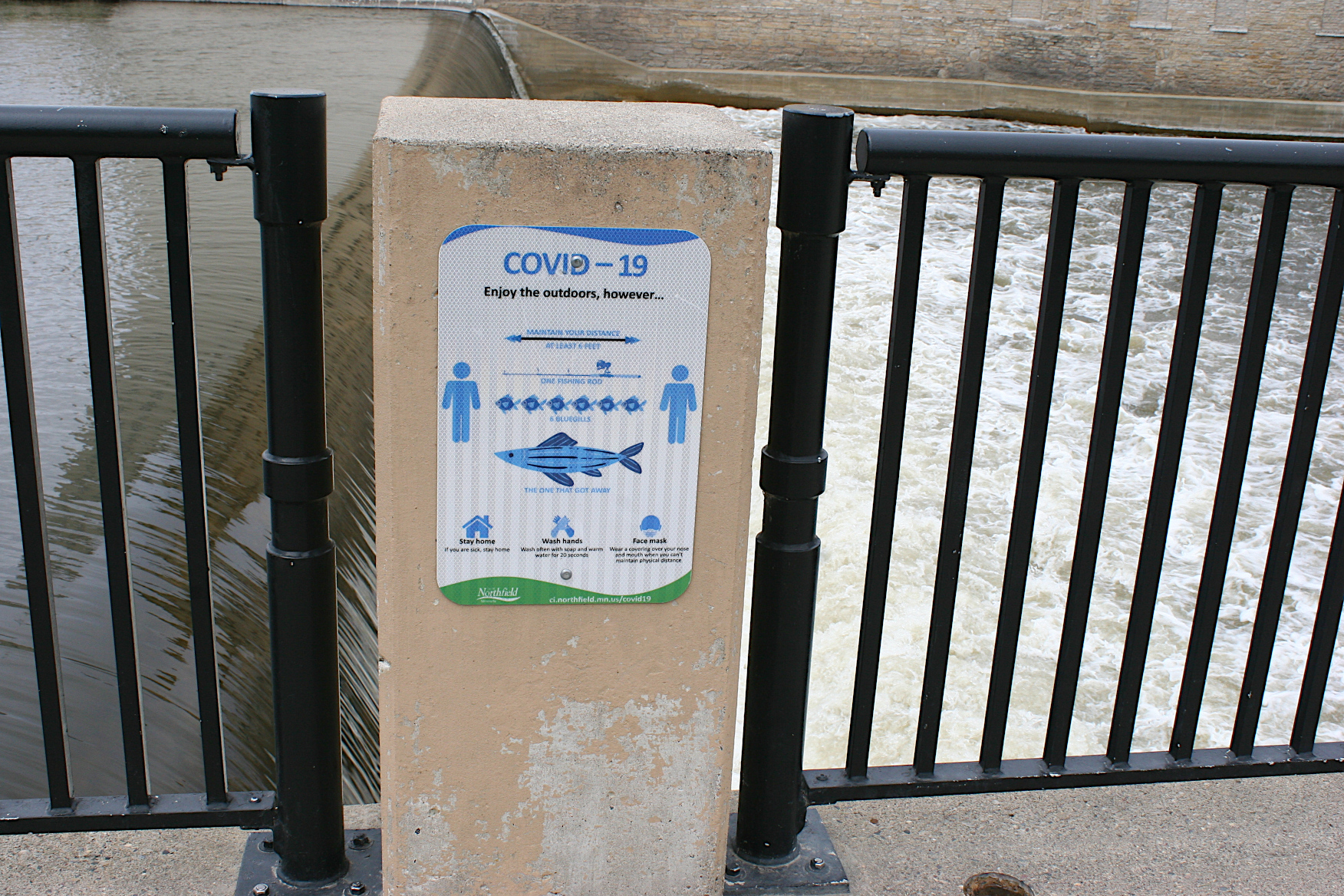
We paused to read this warning sign near the creek. Minnesota Prairie Roots file photo 2020.
Into the woods… Minnesota Prairie Roots file photo September 2020.
One of the aspects I most enjoy about Madison is a deep appreciation for the natural world. Minnesota Prairie Roots file photo September 2020.
During this early September 2020 morning outing, Randy and I came upon a narrow dirt path leading into woods along a creek. A sign warned us of contaminated water, something our son has shared as an industry-related issue on Madison’s East Side. We followed the path for a distance before retracing our steps and crossing the street.
Humor in this sign, if you change the spelling. Minnesota Prairie Roots file photo September 2020.
Randy noticed street signage of DEAD END, Daley Dr, which he found amusing if you change the spelling to Daily. We walked along the dead end street, noting sandbags, a clear indication that the contaminated creek sometimes floods this neighborhood.
You’ll notice many signs in the Atwood Neighborhood addressing current day issues. Minnesota Prairie Roots file photo September 2020.
I noticed, too, the BLACK LIVES MATTER sign posted at a V in the sidewalk. Such signage is common in this area, a clear indication to me that the folks who live on the East Side care about issues and people.
The roadside sign marking the entrance to Garver Feed Mill. Minnesota Prairie Roots file photo September 2020.
After I composed a few photos, we recrossed the busy street, aiming for Garver Feed Mill, a 114-year-old restored complex of buildings that now serves as a community hub for businesses and gatherings. It’s worthy of a solo post. So check back as I focus my camera on this gem in the Atwood Neighborhood of Wisconsin’s capital city.
Buckman, Minnesota. Minnesota Prairie Roots file photo September 2020.
RURAL MINNESOTA. For Randy and me, that represents our upbringing, the place of our roots, the land that is part of our personal geography.
A road grader grades the gravel road near Randy’s childhood farm southeast of Buckman. We pulled off the narrow road to allow the grader to safely pass by our van. Minnesota Prairie Roots file photo September 2020.
A farm place between Buckman and Gilman. Minnesota Prairie Roots file photo September 2020.
In the small town of Gilman. Minnesota Prairie Roots file photo September 2020.
We both grew up on farms, in large families—his three kids larger than mine at nine. We both picked rock—he more than me as Morrison County in central Minnesota sprouts more rocks than Redwood County. We each labored in fields and barns and understood the value of hard work and our importance in the farming operation. Even at a young age. That carries through in our strong work ethics and our strong link to the land.
Pierz, a small town to the north of Buckman and bigger than Buckman, still has a hardware store. Randy attended junior and senior high school in Pierz. Minnesota Prairie Roots file photo September 2020.
As we passed through Pierz, I photographed this updated community gathering spot. Minnesota Prairie Roots file photo September 2020.
Genola, just to the south of Pierz, is home to the Red Rooster. BINGO is big in this part of rural Minnesota as is weekly Bologna Day (as noted in the banner on the building). Minnesota Prairie Roots file photo September 2020.
And, though we left our rural communities at age 17, we still hold dear the small towns—Buckman and Vesta—that were such an important part of our upbringing. Both have changed with familiar businesses long gone. Society changed and locals began driving farther for groceries and other necessities.
A nod to this area’s rich agricultural base outside Sev’s Food & Liquor in Buckman. Minnesota Prairie Roots file photo September 2020.
It’s easy to get caught in the memories, of the back then, of wishing nothing had changed. But it has and it does. And life goes on.
Housed in the old bank building, the Buckman Bank Tavern. Minnesota Prairie Roots file photo September 2020.
Signs on Sev’s in Buckman. Minnesota Prairie Roots file photo September 2020.
Sev’s Food & Liquor along Buckman’s main street. Minnesota Prairie Roots file photo September 2020.
Returning to our hometowns, our home areas, causes me to reflect while simultaneously appreciating that which remains. Cafes and churches and hardware stores. Post offices and bars and grain elevators. These are the community gathering spots that still mark many of Minnesota’s smallest communities, those towns that span only blocks from east to west, north to south.
I often see can collection sites in small towns, like this one in Buckman. They offer insights into a community. Minnesota Prairie Roots file photo September 2020.
On the door of a Buckman bar, a young man remembered. Minnesota Prairie Roots file photo September 2020.
A warning sign posted on a house in Buckman. Minnesota Prairie Roots file photo September 2020.
But more than buildings, people form community. Even in Faribault, where Randy and I have lived since 1982, we’ve found our small town in a city of around 25,000. That’s in our faith family at Trinity Lutheran Church, the “town” that centers our lives. An uncle and I discussed this recently. He lives in Minneapolis. His neighborhood is his community, his small town.
A place to gather outside Sev’s Food & Liquor in Buckman. Minnesota Prairie Roots file photo September 2020.
No matter where you live, whether in rural Minnesota or New York City, the mountains of Idaho or the plains of Nebraska, I hope you’ve found your community and place of joy.
Outside my husband Randy’s home church, St. Michael’s in Buckman. Minnesota Prairie Roots file photo September 2020.
FOR MANY, THE WORD “church” prompts visions of a physical structure, a place where people of faith gather to worship. Certainly, that’s part of the definition. But, even more important, “church” is the people. That’s why, in times of natural disaster or fire or whatever may render a physical building unusable, the “church” continues.
This sign marks a back pew. Minnesota Prairie Roots file photo September 2020.
For 118 years, the faithful have gathered at St. Michael’s Catholic Church in Buckman. Even during COVID-19, Mass happens three mornings a week. On the September weekday Randy and I visited, not a soul was around, giving us ample opportunity to explore this beautiful aged sanctuary.
Book of the Innocents photographed at St. Michael’s. Minnesota Prairie Roots file photo September 2020.
Despite the absence of people, I experienced the presence of those who call St. Michael’s their church home. I saw the human spiritual connection in handwritten prayers recorded in The Book of Innocents.
They left their mark… Minnesota Prairie Roots file photo September 2020.
Upstairs, atop the balcony wall ledge, I noticed initials, names and dates etched in wood. Another human notation, albeit probably not appreciated by all. But the scratchings are part of St. Michael’s history.
A view from the balcony. Minnesota Prairie Roots file photo September 2020.
Stained glass windows abound, this one next to a side altar. Minnesota Prairie Roots file photo September 2020.
The beautiful side altar. Minnesota Prairie Roots file photo September 2020.
As I looked down upon the massive sanctuary defined by stained glass, sculptures, woodcarvings, paintings and other impressive art, I considered the humanity of this place. Baptisms. First Communions. Weddings. Funerals. Events—joyful and sad—which brought/bring people together to celebrate or to mourn. Mass, too, with singing and praying and forgiving and worshiping and growing in faith.
Looking toward the back of the church and the balcony. Minnesota Prairie Roots file photo September 2020.
Generations have gathered here, within these walls, as a faith family.
This stunning cross stands in the center of the main altar. Minnesota Prairie Roots file photo September 2020.
I’ve found comfort and joy here, too, celebrating the marriage of my father-in-law and a sister-in-law and grieving the loss of a brother-in-law and then my mother-in-law 27 years ago. Since then, the church has been restored and a side entry and fellowship hall added, making the building much more accessible.
Spotted on a table in the entry. Minnesota Prairie Roots file photo September 2020.
In the new entry, I paused to read a small sign: PRAYER THE WORLD’S GREATEST WIRELESS CONNECTION. I laughed and thought, so true while simultaneously considering how much the world has changed since the construction of this church in 1903.
Masks are available for worshipers inside the entry. Minnesota Prairie Roots file photo September 2020.
Yet, little has changed. People still define St. Michael’s. They gather here—as they have for generations—within this art rich sanctuary, embracing liturgy steeped in music and tradition, to worship God. And to connect, heart-to-heart, with one another and with their Savior. Even during a global pandemic.
This is the final post in my three-part series on St. Michael’s Catholic Church, Buckman, Minnesota.
St. Michael’s Catholic Church in Buckman. Minnesota Prairie Roots file photo September 2020.
WHEN I STEP INSIDE A CHURCH like St. Michael’s Catholic Church in Buckman in central Minnesota, I feel overwhelmed by the sheer artistic beauty and craftsmanship. I wonder about those who built this massive church in 1903, dedicating it on September 29, St. Michael’s Day. How did they manage to build this 118 years ago without modern equipment? That amazes me.
Looking toward the front of St. Michael’s. Minnesota Prairie Roots file photo September 2020.
Beyond the actual structure, which surely took much muscle, many manpower hours and grit to complete, I wonder about the artists behind the artwork inside. Who crafted the stained glass windows? Who built the altars? Who shaped the statues and painted the angels and built the pews?
A stained glass depiction of Jesus carrying his cross. Minnesota Prairie Roots file photo September 2020.
One of the side altars, right, at St. Michael’s. Minnesota Prairie Roots file photo September 2020.
The Nativity represented in stained glass, left. Minnesota Prairie Roots file photo September 2020.
I am grateful to those faith-focused artists and craftsman who created such beauty here in the middle of Minnesota. A place for farm families (mostly) to gather for Mass. To praise God. To confess their sins. To press their hearts in prayer. To mourn. To celebrate. To grow deeper in their faith.
The Last Supper is depicted on the lower part of the main altar. Simply stunning. Minnesota Prairie Roots file photo September 2020.
The Helbling family made St. Michael’s their church home upon relocating to Minnesota from North Dakota in 1963. My husband, Randy, and his siblings attended elementary school across the street. That school, next to the cemetery, is long gone. My mother-in-law and a brother-in-law are buried here, across Minnesota Highway 25 from the church. So, by marriage, St. Michael’s is now part of my history.
Just look at the emotions sculpted into this art. I see peace, pain, determination… Minnesota Prairie Roots file photo September 2020.
Certainly, I don’t hold the deep emotional connection that comes from years of worshiping within the walls of this rural Minnesota church. But I still hold a deep appreciation for this place which was such a valued part of my in-laws’ lives.
Stained glass windows and sculptures adorn the side walls of St. Michael’s. Minnesota Prairie Roots file photo September 2020.
As a woman of faith—I grew up Lutheran—I value aged churches and art. Religious art is often symbolic, reinforcing Bible truths and stories. It can uplift, comfort, provide peace, bring joy, remind us of our weaknesses and the source of strength and hope. It can center and ground us when we most need to feel centered and grounded.
Massive pipes on the pipe organ in the St. Michael’s balcony. Minnesota Prairie Roots file photo September 2020.
Many times, church art has reinforced my faith, helped me to feel the presence and closeness of God whether in a stained glass window, the words of a familiar hymn or the comfort of a worn wooden pew.
“Pilate condemns Jesus to death” sculpture between two stained glass windows. Minnesota Prairie Roots file photo September 2020.
Inside St. Michael’s, generations of families have gathered. I am grateful for those early settlers who labored to create this sanctuary in the small town of Buckman, Minnesota.
Please check back as I take you inside St. Michael’s for the final post in this three-part series.
IMAGINE, AS A YOUNG BOY, moving nearly 400 miles across the plains of North Dakota east to Minnesota with your family to start a new life. You’ve left behind your grandparents and other extended family, and the comforting familiarity of farm home, church and school. For my husband, that was reality.
St. Michael’s Catholic Church in Buckman. Minnesota Prairie Roots file photo September 2020.
As the Tom and Betty Helbling family settled onto a farm southeast of Buckman in central Minnesota in the early 1960s, Randy found himself adjusting from a one-room country schoolhouse with one teacher to a parochial school with multiple classrooms and teachers. He no longer faced cancellation of recess due to coyotes circling the playground at Chimney Butte School near St. Anthony. Rather, he faced nuns slapping his hands with a ruler or drilling thumbs into his skull, adding to his angst as the new boy in school. And then there was the matter of the frightening statue across the street inside the massive St. Michael’s Catholic Church.

In the center, St. Michael overpowering Satan. Minnesota Prairie Roots file photo September 2020.
Some six months ago, I heard for the first time about Randy’s boyhood fear of the statue which centers the main altar at St. Michael’s, where he attended weekday and Sunday Mass. The statue features a triumphant St. Michael overpowering Satan with a spear. A horrid, crouching other-worldly creature with an open mouth of sharp teeth and equally sharp claws represents Satan. Enough to scare any child looking over adult heads to that altar art. Not even the chain and weapon would be enough to inspire confidence in the Evil One’s captivity.
St. Michael’s stretches long and high. Minnesota Prairie Roots file photo September 2020.
All of that aside, St. Michael’s is a truly beautiful church. Massive in size and vast in art. I’ve come to know it only through marriage as I grew up 145 miles to the south of Buckman and in the Lutheran faith.
“The Nativity” stained glass, one of many similar windows inside St. Michael’s. Minnesota Prairie Roots file photo September 2020.
A stunningly beautiful cross, one of many. Minnesota Prairie Roots file photo September 2020.
Statues on a side altar. Minnesota Prairie Roots file photo September 2020.
I don’t pretend to understand the meaning of all the art which graces this space. But one thing I do understand is that this house of worship excels in craftsmanship and artistry. Each piece of art holds meaning, significance, purpose. From the stained glass windows to the sculptures to the ornate altars.
Looking toward the back of the church and to the balcony. Minnesota Prairie Roots file photo September 2020.
Years have passed since I stepped inside St. Michael’s. So when Randy and I visited his mother’s and brother’s gravesites at the church cemetery last September, we decided to also check out the recently-restored church. I expected locked doors, so often the case now in rural and small town churches. But the doors to an addition were open and we had the place to ourselves. Note that plenty of security cameras film visitors.
My favorite art in St. Michael’s are these angels painted on the ceiling above the altar. Minnesota Prairie Roots file photo September 2020.
My reaction was one of awe as I stood inside the sanctuary with its soaring ceiling, art seemingly everywhere. It’s a photographer’s paradise. An art lover’s dream. A place of peace for the faithful.
A side altar up close. Minnesota Prairie Roots file photo September 2020.
Ornate ceiling details. Minnesota Prairie Roots file photo September 2020.
One of many detailed sculptures. Minnesota Prairie Roots file photo September 2020.
I felt overwhelmed as I moved from one area of the church to the next—attempting to take in all I saw. The whole picture. The details. Oh, the details.
The center altar, with that frightening statue. Minnesota Prairie Roots file photo September 2020.
I stood for a moment, placing myself in Randy’s shoes as that young boy from North Dakota seeing this all for the first time. I locked eyes on the statue of St. Michael towering over Satan, the terrible, horrible creature with the sharp teeth and claws. And I understood Randy’s fear manifested there all those decades ago.
Please check back as I bring you more photos from inside St. Michael’s Catholic Church, Buckman, Minnesota.
Recent Comments