YOU NEVER FORGET. That day. That defining moment when your world stops and panic sears your soul.
My moment occurred six years ago, the morning my then 12-year-old son was struck by a car while crossing the street to his school bus stop within a block of our Faribault home.
May 12, 2006. The day I became all too familiar with the term “hit-and-run driver.”
At approximately 7:40 a.m. a blue 4-door car, possibly a Chevrolet Cavalier or Corsica, struck my boy whose body slammed into the side and/or front of the vehicle, somersaulted through the air and landed alongside the street.
The driver never stopped. Nor has the driver ever been found.
Fortunately my son suffered only minor injuries, although we do not know what the long-term impact will be on his physical health as he ages.
And what about that driver? Why did he/she fail to stop? It is the question which occasionally still haunts me, which early on angered me. It is the question which led me to ask a local philanthropist and the head of the local bus company to contribute money toward a $1,000 reward (which BTW has expired as has the statue of limitations on the hit-and-run).
Why did the driver of the car fail to stop after hitting my child?
I don’t ask myself that question all that often anymore, except around the anniversary date or when I hear of a hit-and-run. Like the case of Amy Senser, wife of former Minnesota Viking Joe Senser, convicted last week in the August 2011 hit-and-run death of Anousone Phanthavong. She was found guilty of leaving the scene of the accident and failure to promptly report an accident, both felonies, and of misdemeanor careless driving.
Ten days after the accident, Amy Senser finally admitted that she was the driver of the vehicle. Senser maintained during her trial, however, that she thought she hit a construction barrel or a pothole around 11 p.m. on that fateful night. Instead, she struck Phanthavong who had pulled to the side of an interstate exit ramp when his car ran out of gas. He was filling the car’s gas tank when he was hit and killed. By a hit-and-run driver. Amy Senser. Who thought she hit a construction barrel or pothole?
Early on in the investigation into my son’s 2006 hit-and-run, local police investigators maintained that the driver of the car fled because he/she had something to hide: driving drunk, driving without a license, driving without insurance, prior conviction…
Six years ago I couldn’t fathom those as “good enough” reasons to drive away from a child you’d just slammed into with your car. I still can’t justify those excuses. As the years have passed and I’ve heard of more and more hit-and-runs, I’ve come to believe the police theory that the driver in my son’s case had something significant to hide.
Yet, I will never, never understand how anyone, in good conscience, can strike someone with their vehicle and then simply drive away. Drive. Away.
#
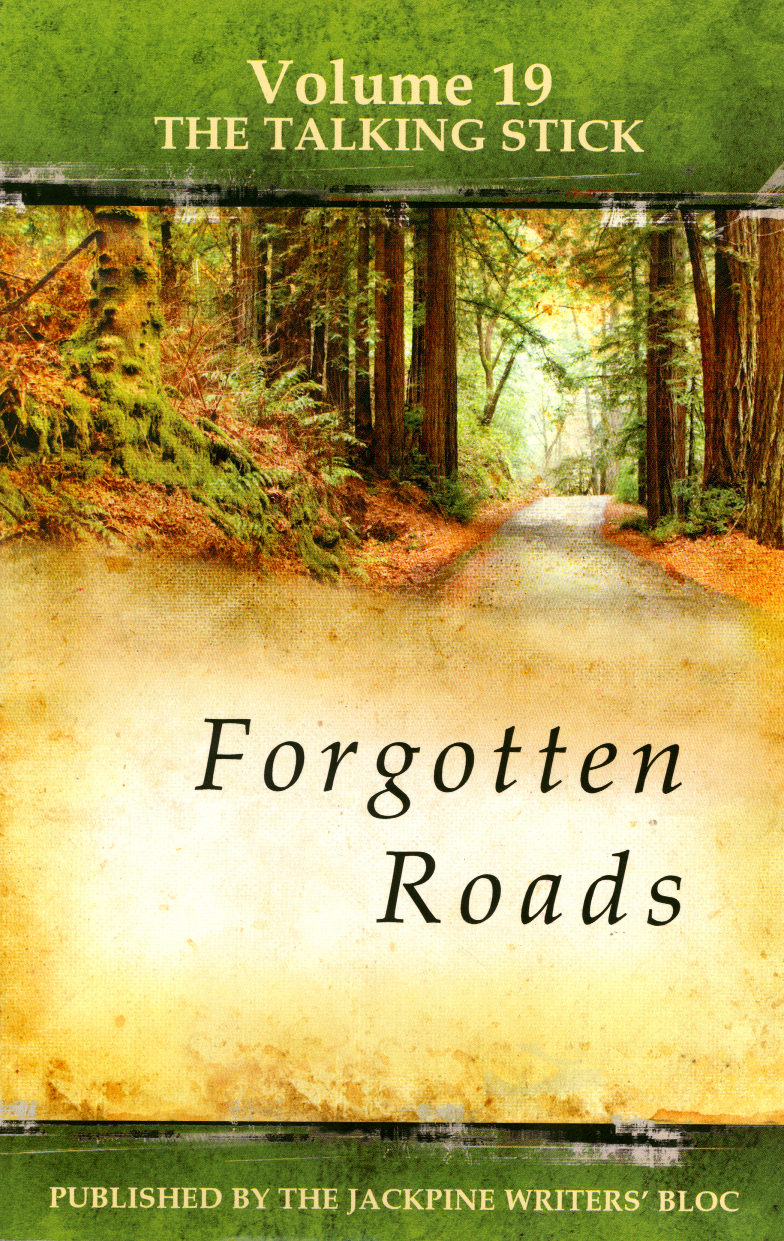
SEVERAL YEARS AFTER my son’s hit-and-run, I wrote a poem about the incident and eventually entered it into The Jackpine Writers’ Bloc annual writing competition. “Hit-and-Run” subsequently earned an honorable mention in poetry and published in 2010 in The Talking Stick, Volume 19, Forgotten Roads. That book title seems so appropriate.
My poem focuses on my emotional reaction, making this poem especially powerful.
#
 Hit-and-Run
In that moment, I know,
as the rivulets of water course down my body,
as I step from the tub
dripping puddles onto the linoleum,
that the sirens wail
for you,
my boy, my only son.
You, who tossed your backpack
over your bony shoulders,
then hurried
toward the street,
toward the bus stop.
While I showered,
you crossed carelessly,
your fragile body bouncing
off the car
you had not seen,
flailing in a somersault,
landing hard on the pavement.
Sirens scream, and I know.
Panic grips,
holds tight my heart,
my very soul,
as I race from the bathroom,
wrapped in a bath towel,
stand immobile,
watching the pulsating red lights
of the police car
angled on the street,
blocking the path to you.
#
ANYONE WITH INFORMATION on the May 12, 2006, hit-and-run case involving my son should contact the Faribault Police Department or Crime Stoppers of Minnesota at 1-800-222-8477. A local investigator told me a year ago that the case remains open and that police will follow up on any tips and leads.
© Copyright 2012 Audrey Kletscher Helbling














 Minnesota Prairie Roots
Yes, Faribault is a diverse community May 3, 2012
Tags: City Pages, comments, diversity, Faribault, Minnesota, thoughts
In this file photo, a Somali family waits to cross a downtown Faribault street.
ON ANY GIVEN DAY, I can drive on a street in Faribault, walk along the sidewalk, glance out my office window or go shopping and see a racial diversity of people.
I can stand in my side yard and look toward the home of an Asian couple. I can glance up the hill and watch two preschoolers, the daughters of a white mother and an African American father, play outside. In my front yard, I can see, several houses down, the Hispanic family that has lived in my neighborhood for years.
Yes, Faribault, population 23,352, is a community of diversity. Thirteen percent of our residents are Hispanic/Latino and another 7.4 percent, black or African American, according to the 2010 U.S. Census. All totaled, about one-fifth of our residents identify themselves as “non-white.”
As my husband would say—and this is not meant at all as derogatory—shopping in at least one local grocery store is like walking into the United Nations. We shop side-by-side with Spanish-speaking Latino families and with Somali women clothed in billowing dresses and head scarves.
Just the other evening, as I entered the local public library, a Sudanese man held the exterior library door open for me while his pre-teen son opened the interior door. It’s been a long time since a young boy held a door for me and I expressed to him my appreciation for his respect and good manners.
The other day, while waiting in the car for my husband to pick up milk at a local convenience store, I observed a cluster of teenaged Somali girls, dressed in head scarves and flowing dresses, move along the sidewalk while, just across the street, a 60-something white woman clad in a jacket resembling an American flag pushed a cart of groceries. It was a unique visual illustrating diversity in Faribault.
Several Latinos lead in singing of Mexico’s national anthem last September during the International Festival at Faribault’s Central Park. Flags represent the birthplace nations of those participating.
The diversity of my community bubbled to the surface Tuesday after I read a comment on City Pages, an online Minneapolis-based information source. A post I published last week about jewelry store thefts in Faribault and elsewhere in Minnesota was linked to in “The Blotter” section as was an article in the Faribault Daily News which identified the jewelry store thieves as “black males.”
Now I don’t want to get into the issue of whether the news reporter should have racially-tagged the suspects. But I was miffed by the first Blotter comment on the blog post.
It looks like “diversity” has now spread to Hastings and Faribault.
That comment was followed by a reply I won’t print here because of the language. But you can read it by clicking here.
So why did the initial diversity comment rile me? Well, I’m tired of over-generalizations that those of us living outside the Twin Cities metro area reside in closed-up communities comprised mostly of Anglo-Americans. We are not just a bunch of white descendants of Scandinavians or Germans or Irish or French… We are racially diverse and growing in diversity.
If you ask the residents of Willmar or Worthington, St. James or Madelia, or many other Minnesota towns, they’ll tell you the same. Latinos, Asians, Somalians, Sudanese and others call outstate Minnesota home.
Diversity spread to Faribault decades ago. Just stroll through my neighborhood.
How diverse is your neighborhood, your small town, your suburb, your city? Let’s hear.
© Copyright 2012 Audrey Kletscher Helbling