Minnesota Prairie Roots

Writing and photography by Audrey Kletscher Helbling

“It Happens Here” events raise awareness about domestic violence in Minnesota March 6, 2017

Filed under: Uncategorized — Audrey Kletscher Helbling @ 5:00 AM
Tags: , , , , , , ,

FROM BEMIDJI IN THE NORTH to Albert Lea near the Iowa border, from the prairie land of Wheaton to the river bluffs of Red Wing and from the small town of Glenwood to sprawling Minneapolis, Minnesotans are coming together on Tuesday. United from rural to urban, communities are breaking the silence. They—survivors, advocates and others—are gathering to say “no more” to domestic violence.
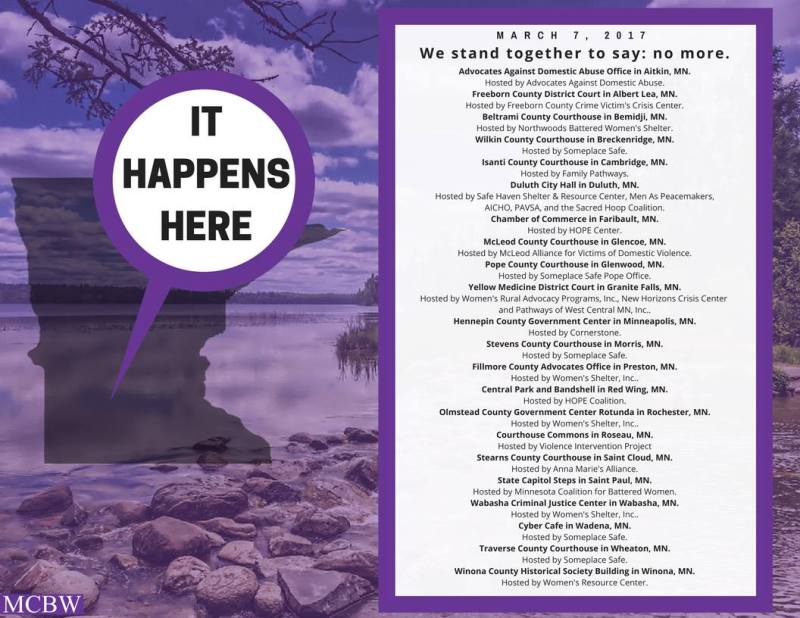
The list of communities participating in the "It Happens Here" event is posted on the Minnesota Coalition for Battered Women Facebook page.

The list of communities participating in the “It Happens Here” event is posted on the Minnesota Coalition for Battered Women Facebook page.

It is part of a statewide effort, “It Happens Here: A Statewide Day to End Domestic Violence.” Events begin at noon (unless otherwise noted), including at the Faribault Area Chamber of Commerce & Tourism office. Chamber staffer Barb Larson was murdered there on December 23, 2016, by her ex-husband. HOPE Center is co-hosting the rally with the Chamber.

Gatherings across Minnesota will focus on the key areas of empathy, refuge, healing and solutions.

That starts with each of us. Individually. We must care about victims of domestic abuse and violence and about those who love them. We must care about the communities affected by domestic violence.

We must support the places that offer refuge to victims. Places likes HOPE Center provide help and hope.

We must encourage healing.

And we must work together to end domestic violence, defined as “a pattern of behavior used to gain or maintain power and control over an intimate partner.” That can take the form of physical, psychological, mental, emotional, spiritual, technological and financial abuse. One in three Minnesota women are victims of domestic violence.

One is one too many.

© Copyright 2017 Audrey Kletscher Helbling


Don’t tell me you’re “fine” when you’re not & other insights March 5, 2017


HOW ARE YOU? I’ve never liked that question, even realizing the underlying kindness that laces those three trite words.

The standard answer of “I’m fine” is expected. The truth most often is not.


ttfa-1024x1024


Now Minneapolis writer Nora McInerny Purmort—who has faced her share of “I’m not fine” days—tackles the “How are you?” question in a podcast series from American Public Media. Terrible, (Thanks for Asking) is a must-listen series in which Nora seeks only honest responses to “How are you?”

I’ve listened to one podcast thus far. “Unbroken” features an interview with sexual assault survivor Sarah Super. It’s an incredible, horrible, powerful and, yes, sometimes graphic, story. But so worth your time for the insights revealed. Sarah is one strong woman. And we can learn so much from her about the importance of speaking up, of being heard and more.

Both she and Nora address the issue of silence. And, yes, I picked that from the interview because silence is all too pervasive. I’m talking the hard, uncomfortable silence that those who have suffered trauma, those who are dealing with health issues, those who are facing unimaginable difficulties and challenges hear. Yes, hear. Silence truly can be deafening.

Sarah cites the reason many friends and loved ones remained silent following her assault: “I didn’t know what to say or do.”

Puh-lease.

“Your silence,” Sarah says, “feels like apathy.” The definition of apathy is lack of interest, enthusiasm or concern. Lack of. Imagine how that feels to your loved one who is hurting. Lack of.

Nora reiterates Sarah’s thoughts: “Silence hurts when you are on the other end of something awful.”

In an interview with National Public Radio about her podcast series, Nora repeats, “The worst thing—and it doesn’t matter if you’re dealing with death, or if you’re dealing with all of these other things that we’ve talked to people about—silence is the worst thing you can hear from people.”

She gets it. Within six weeks, this young woman lost her father to cancer, miscarried and then lost her husband to brain cancer. Since then, Nora has authored the book It’s Okay to Laugh (Crying Is Cool, Too). And now the enlightening podcasts have followed.

What can we learn from all of this? My take-away is this: First, we need to speak up, to end the silence, to really care when we ask someone, “How are you?” And then we need to listen, really listen. That means setting aside our stories, our comments, our whatever, and truly focusing on what the other person is telling us. It’s about them. Not us.

#

CHECK BACK TOMORROW for a way that Minnesota is breaking the silence on an issue that affects all of us, directly or indirectly.

© Copyright 2017 Audrey Kletscher Helbling
 

Faribault renames its airport in honor of WASP, Elizabeth Wall Strohfus March 4, 2017

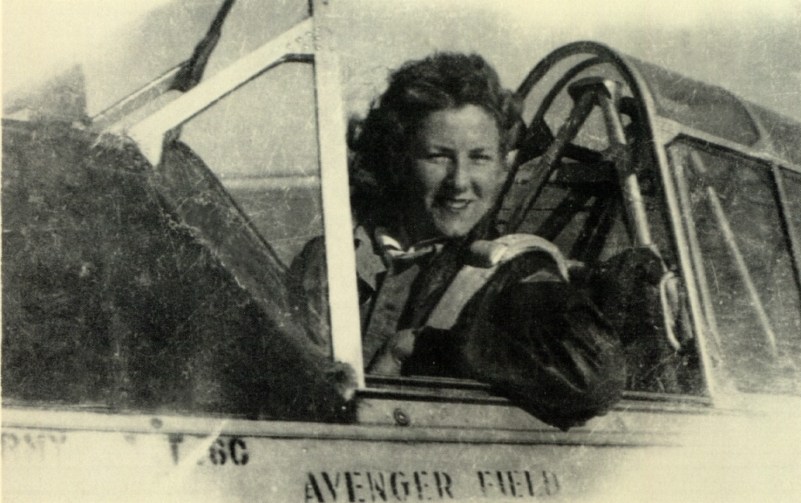
Elizabeth Wall Strohfus, circa 1943, at Avenger Field. (Photo from family archives.)

Elizabeth Wall Strohfus, circa 1943, at Avenger Field. (Photo from family archives.)

ELIZABETH WALL STROHFUS traveled the country for nearly 30 years sharing her story of flying fighters and bombers for the U.S. military during World War II.

She served as a parade grand marshal, participated in panel discussions, talked at schools, visited museums, gave countless interviews. But not until now has she been permanently honored and recognized in her hometown of Faribault. This week the City Council approved a resolution renaming the municipal airport as The Faribault Municipal Airport—Liz Wall Strohfus Field. That resolution will be forwarded to the Federal Aviation Administration for final approval.

What an honor for a woman who faced many challenges (simply for being a woman) before and after becoming a Women’s Airforce Service Pilot. She will be the first WASP to have an airport named after her.

That’s quite an accomplishment for Strohfus, who convinced a local banker to lend her $100 to join The Sky Club at the Faribault airport. The then 22-year-old used her bike as collateral and subsequently proved to the “women don’t fly” banker that he was wrong. She could fly. And fly she did, training at Avenger Field in Sweetwater, Texas, with the first class of WASPs to earn their wings. Strohfus went on to train infantry gunners for battle, teach instrument flying to male cadets and ferry B-17 and AT-6 warbirds around the country.

But when the war ended, the WASPS received no recognition for their service to country. Eventually Strohfus, after retiring as an air traffic controller in the late 1980s, began efforts to correct that. She traveled the country sharing WASP stories in her signature down-to-earth storytelling style. She successfully lobbied for the WASPs to be recognized as active military duty and for burial honors at Arlington National Cemetery. This strong and determined pilot also received the Congressional Medal of Honor.

A book about Elizabeth Strohfus written by her son Patrick Roberts. He accompanied her on speaking engagements around the country.

A book about Elizabeth Strohfus written by her son Patrick Roberts. He accompanied her on speaking engagements around the country.

Yet, despite all the accolades, all the efforts, Liz Stohfus valued one thing above all. “Her favorite thing to do was to encourage kids,” son Art Roberts revealed at the City Council meeting. His mother repeated that in the many interviews she gave, telling youth that, “The sky is not the limit.” They could, like her, do anything.

Elizabeth “Betty” Strohfus Wall died on March 6, 2016, at the age of 96. Although she did not live long enough to see her hometown airport named after her, her legacy will live on in Faribault. In addition to new signage naming Liz Wall Strohfus Field, renowned local woodcarver Ivan Whillock is creating a woodcarving to be placed inside the airport. And Roberts will be donating items belonging to his mother.

It’s a wonderful thing my community, led by the American Association of University Women—Faribault Branch, is doing in honor of Strohfus. She embodies a strong American woman who always believed she could fly.

FYI: To view an interview with Liz Strohfus, check out Faribault Community Television and its 1855—Faribault History documentary series produced by local high school students Logan Ledman and Samuel Temple. This is top-quality professional. Click here.

Of additional interest is this story from the Experimental Aircraft Association in Oshkosh, Wisconsin. Click here.

Click here to read a story about how Strohfus and other WASPs were honored at the University of Wisconsin, Green Bay, via a theatrical production.

Learn more about that play, “Censored on Final Approach” by Phylis Ravel, by clicking here. Perhaps a Faribault-based theatre company or the History Theatre in St. Paul could consider performing that play.

Finally, click here to learn more about the National WASP WWII Museum in Sweetwater, Texas. What an honor this would be to Strohfus’ memory to bring the museum’s traveling exhibit, “The WASP: Untold Story, a Photographic Exhibit,” to Faribault.

© Copyright 2017 Audrey Kletscher Helbling
 

No limit on Minnesota fish fries March 3, 2017

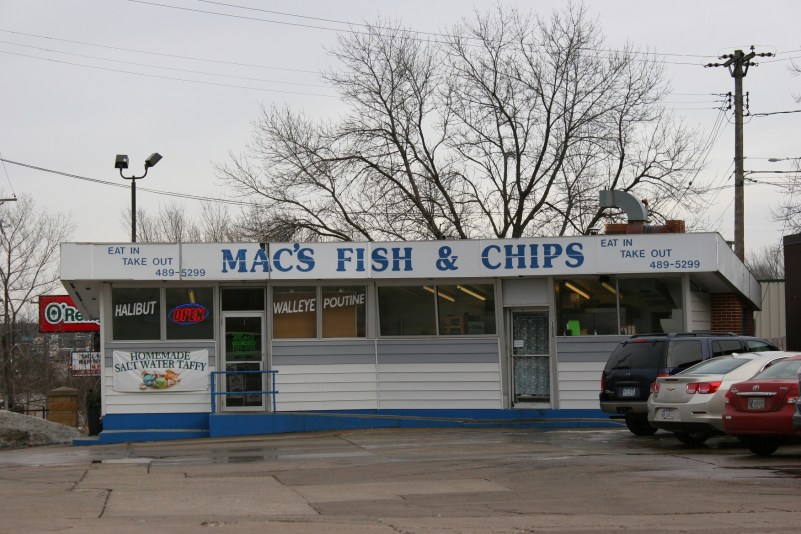
This recent roadside photo I snapped of Mac's Fish & Chips, on the corner of Hamline and Larpenteur in St. Paul, prompted this blog post. Mac serves deep-fried halibut, walleye, cod, shrimp, clams and, yes, chicken, along with a few sides in this former Clark Gas Station building. You can also buy Mac's battered walleye at Target Field in Minneapolis.

This recent roadside photo I snapped of Mac’s Fish & Chips, on the corner of Hamline and Larpenteur in St. Paul, prompted this blog post. Mac’s serves deep-fried halibut, walleye, cod, shrimp, clams and, yes, chicken, along with a few sides in this former Clark Gas Station building. You can also buy Mac’s battered walleye at Target Field in Minneapolis.

IT’S THE SEASON of the Friday Night Fish Fry in Minnesota.

As a life-long Lutheran, I’ve never been part of the Catholic-based tradition of eating fish on Fridays during Lent. But I respect that deep-rooted practice of shunning meat, although I will admit I’ve always considered fish to be meat. Catholics have a different opinion.

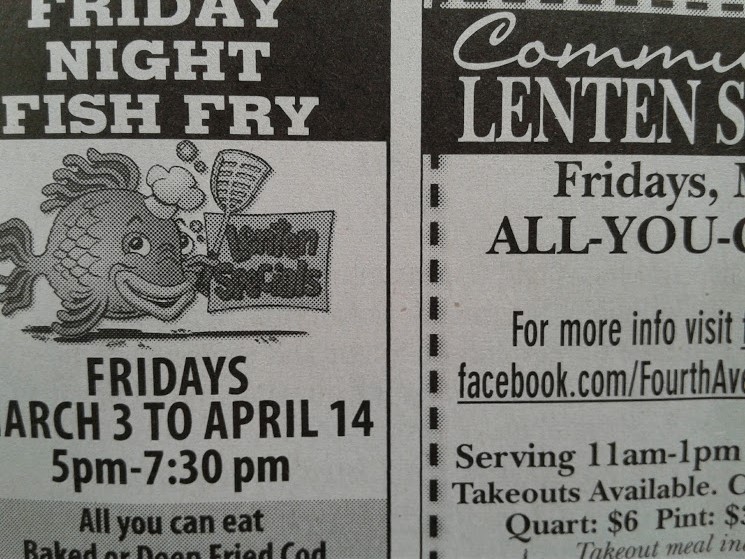
A snippet of two side-by-side ads that published on Thursday in the Faribault Daily News.

A snippet of two side-by-side ads for a Friday Fish Fry and for a Friday Lenten Soup Luncheon that published in the Faribault Daily News.

That aside, the beginning of Lent this week kicks off church and community fish fries, not to mention Friday fish specials at restaurants and Knights of Columbus halls. The Twin Cities-based The Catholic Spirit contacted all of the parishes in the St. Paul-Minneapolis Archdiocese for a list of fish fries and Lenten meals. Ninety-one responded. From Our Lady of the Prairie in Belle Plaine to St. Bridget of Sweden in Lindstrom to St. Albert the Great in Minneapolis, congregations will be serving fish aplenty and accompanying side dishes.

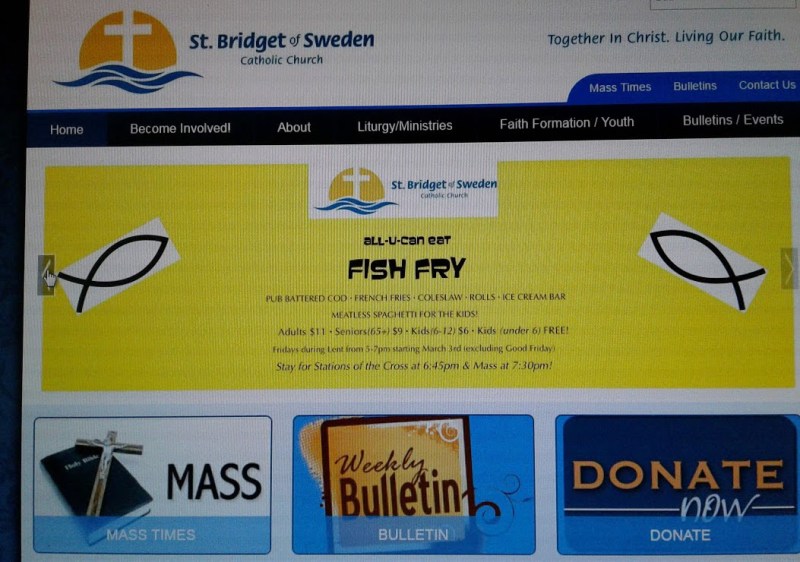
Fish Fry details from the St. Bridget of Sweden website.

Fish Fry details from the St. Bridget of Sweden website.

I’ve dined at enough church dinners—Catholic, Lutheran and otherwise—to know that food prepared by the faithful is often some of the best and tastiest. Perhaps it’s time I tried a fish fry.

TELL ME: Have you dined at a church-hosted fish fry? Where? Here’s your opportunity to recommend a fish fry.

FYI: Click here for the list of fish fries and Lenten meals compiled by The Catholic Spirit.

© Copyright 2017 Audrey Kletscher Helbling

 

Weaving memories and thoughts into a winning water story March 2, 2017

AS SOON AS I READ the first six words of the email—I am so pleased to announce—from Plum Creek Initiative, I knew I had won.

I finished reading the good news, then burst out the kitchen door into the garage. “I won! I won! I won!” I shouted. My husband gave me a questioning look. “I won the contest.”


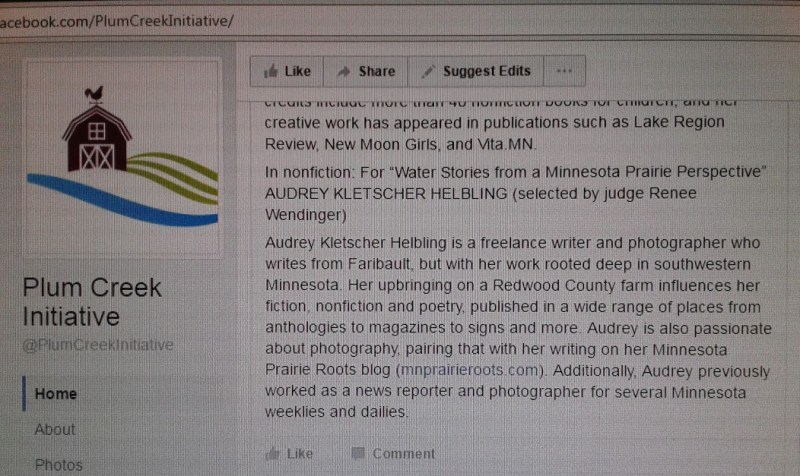
From the Plum Creek Initiative Facebook page.

From the Plum Creek Initiative Facebook page.


And then I explained. My nearly six-page “Water Stories from a Minnesota Prairie Perspective,” was selected as the winning entry in the nonfiction division of a contest sponsored by Plum Creek Initiative and the League of Women Voters. The placing earned me a $250 prize and publication in a New Ulm-based magazine, River Valley Woman.


I photographed these"We Are Water MN" pins in a jar at an exhibit last summer at the Treaty Site History Center in St. Peter.

I photographed these pins in a jar at an exhibit last summer at the Treaty Site History Center in St. Peter. “We Are Water MN,” telling the story of Minnesota water, accompanied a “Water/Ways” exhibit from the Smithsonian Institution’s Museum on Main Street Program. I participated in a “When Water Dreams: A Celebration” by reading my poem, “In which Autumn searches for Water.” Mankato photographer Kay Herbst Helms invited me and other poets to read our water poems, connecting with her photo exhibit, “Water Rights.” Minnesota Prairie Roots file photo 2016.


Tasked to write on the theme of “We are Water,” I tapped into my growing up years for water memories, weaving in my relationship with water and the importance of water. It worked. I felt really good about the story when I submitted it. But when I read that the sponsors were “overwhelmed with the participation and quality of the submissions,” I doubted myself. I shouldn’t have.


The Straight River churns at the Morehouse Park dam in Owatonna.

The Straight River churns at the Morehouse Park dam in Owatonna. Minnesota Prairie Roots file photo 2016.


Here’s what nonfiction judge Renee Wendinger wrote in part about my story: …noted your ability to “retain a balance of idea, craft, and theme resonant to water…[she] reminds us that water is an integral component, making the processes of life possible, a resource we too often take for granted.”

As a writer, I appreciate such specific feedback. This judge, herself a noted author of orphan train fiction and historical nonfiction books, understood and valued my story. That’s reaffirming.


Water rushes over limestone ledges in Wanamingo's Shingle Creek.

Water rushes over limestone ledges in Wanamingo’s Shingle Creek. Minnesota Prairie Roots file photo.


Writing about water proved much easier than I expected. My stories flowed one into the other, including a reference to Plum Creek. I grew up only 20 miles from Walnut Grove, where author Laura Ingalls Wilder lived along the banks of that rural waterway. I’ve waded in that creek to the Ingalls’ dugout site.


The water runs clear in the North Branch of the Zumbro River in Pine Island. Minnesota Prairie Roots file photo.

The water runs clear in the North Branch of the Zumbro River in Pine Island. Minnesota Prairie Roots file photo 2016.


Plum Creek Initiative, a long-term water quality improvement and women’s leadership program focusing on water quality in southern Minnesota, draws its name from Plum Creek. The organization has launched a pilot program in my native Redwood County to address water quality issues. That pleases me.


The Zumbro River in Pine Island. Minnesota Prairie Roots file photo.

The Zumbro River in Pine Island. Minnesota Prairie Roots file photo.


I am pleased, too, with this opportunity to write on the subject of water in a way that will perhaps make a difference. Two North Mankato residents won the other divisions—Holly Ahlbrecht with her fictional “Weaving the Water” (selected by judge Nicole Helget) and Laura K. Murray with a collection of poetry (selected by judge Gwen Westerman).

FYI: Click here to learn more about Plum Creek Initiative. Read the official contest winners’ announcement on the Plum Creek Facebook page.

© Copyright 2017 Audrey Kletscher Helbling
 

How to write an obit 101 from Jim’s family March 1, 2017

Filed under: Uncategorized — Audrey Kletscher Helbling @ 5:00 AM
Tags: , , , , , , , ,

THE OLDER I GET, the more I find myself reading the obituaries published in the Faribault Daily News. And, yes, I’m old school. I still subscribe to a print paper.

I also have education and work experience in journalism, including writing obituaries. It’s one of the first skills I learned in the journalism program at Minnesota State University, Mankato. If you can’t write an obit—and make damn sure the name is spelled correctly—then you best choose another career.

But much has changed since I graduated from MSU in 1978. Newspaper staffers no longer write obits that once published for free. Today obits are paid-for pieces written by survivors of the deceased or penned in advance before death. That allows for creative obits reflecting personalities rather than the straight-forward factual death notices I once composed.

Source: Faribault Daily News

Source: Faribault Daily News

On Tuesday I opened the Faribault paper to find probably the longest obituary I’ve ever seen published. It runs 38 column inches, which takes you from the top of the “Matters of Record” page to the bottom, spanning two columns.

I figured, given the length, that I would find stories and humor therein. I did. I always appreciate humor in an obit. We all need moments of laughter in the midst of grief.

So here, for your entertainment, are some stories from the obit of Faribault resident James Dale Kittlesen, 87, who died on Sunday, February 19:

While at Gustavus, he met his future wife (Karen), of 59 years, although there is confusion as to how this happened…Others blame Karen’s brother Morrie who gave his fellow geology student a bag of brownies and told Jim that his sister Karen had made them especially for him. It became obvious to Jim that Karen knew nothing about the brownies while he was thanking her in the library.

#

In 1991, after 16 years, Jim retired from his position as Director of Business Affairs of the Faribault School District having been hung in effigy only once.

#

In recent years he became a fan of the Minnesota Windchill… After sitting in the bleachers for an entire game he discovered he could barely stand as his back hurt too much. When people would ask about his sore back he would explain it was a “sports injury.”

#

At Trinity he worked with the pie makers where he learned “mad chopping skills.”

#

Recently, while Jim was sitting in his comfy chair, Karen asked, “Is there anything on your bucket list you would have liked to have done?” He replied, “No, not really. I think I’ve done everything I wanted to do.”

#

I never knew Jim. But I feel like I do now after reading his life highlights, stories and quotes.

There’s one more thing Jim’s family wants mourners to know regarding his funeral: Jim will not be wearing a tie so feel free to follow suit.

TELL ME: How do you want your obituary written? Straight forward journalism style? Or a mix of straight facts and stories? How do you want to be remembered?

FYI: Click here to read Jim Kittlesen’s complete obituary published on the Boldt Funeral Home website.