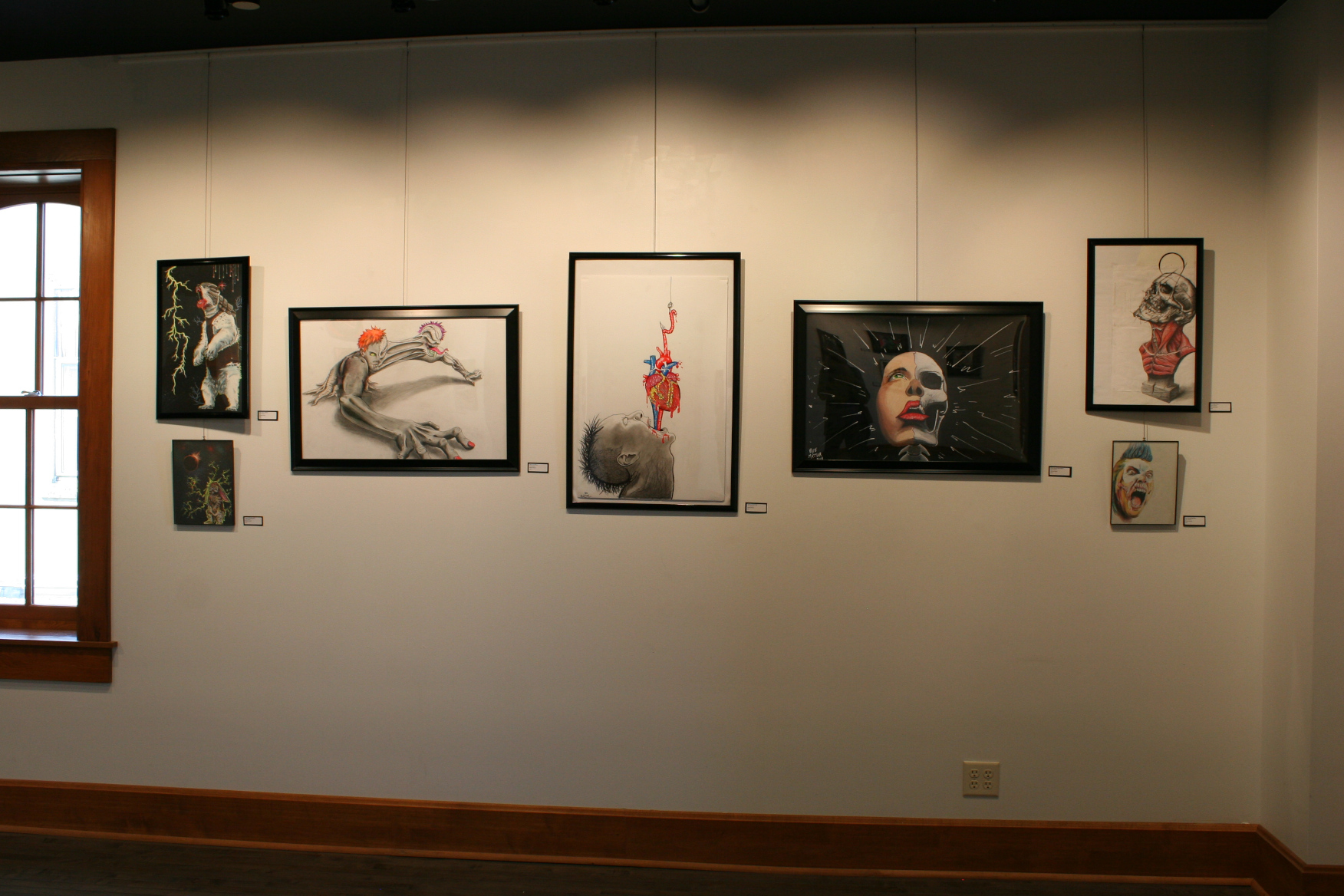
This vivid art by Faribault Middle School seventh grader Levi pops color into the student art exhibit at the Paradise.
THE ALL AREA STUDENT SHOW rates as one of my annual favorite art exhibits at the Paradise Center for the Arts in historic downtown Faribault. I love viewing the creative efforts of students from elementary age through high school. Their talent always impresses me and this year is no exception.
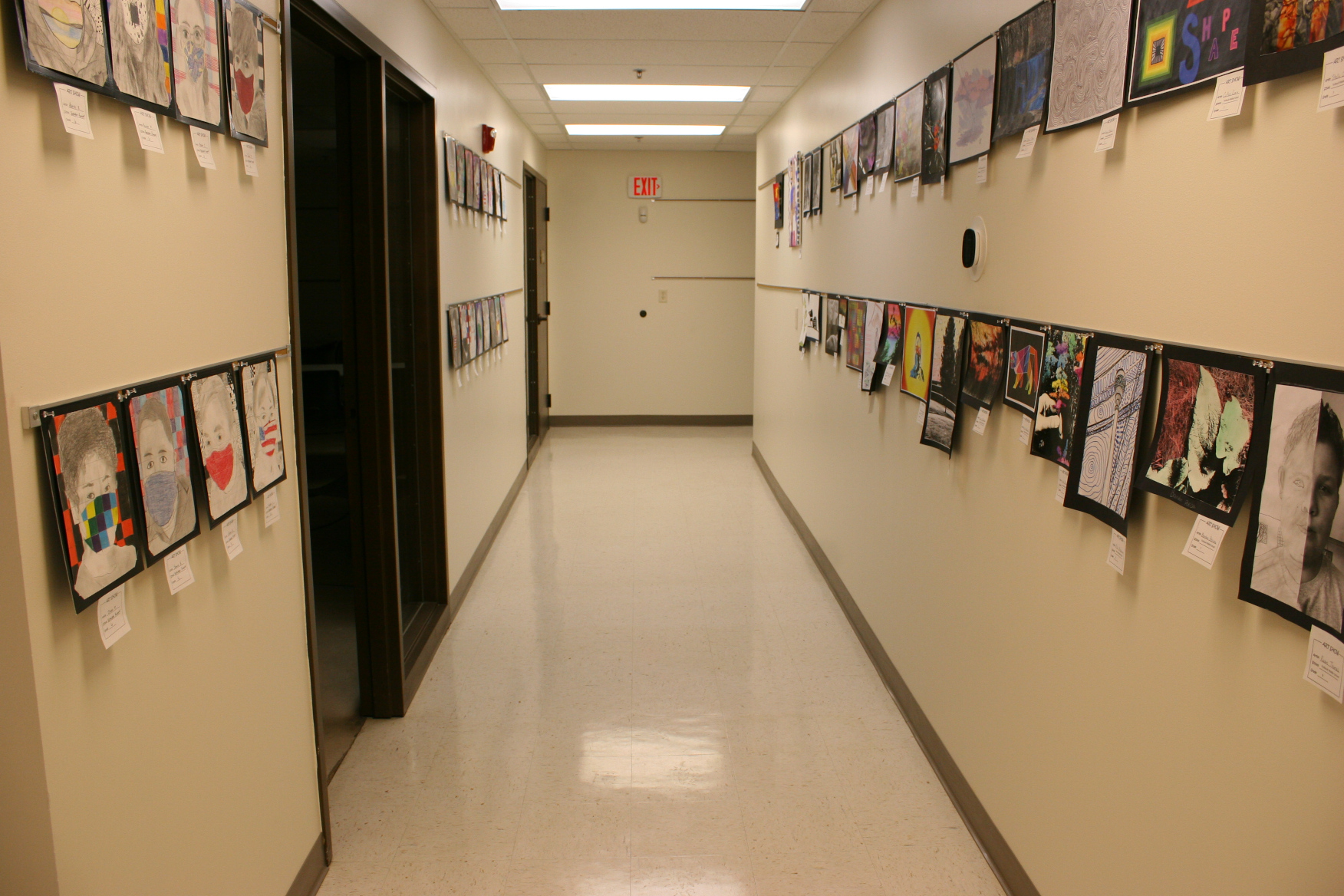
This year’s exhibit is significantly smaller, filling only a single second floor hallway.
But the 2021 show, because of the pandemic and mostly distance learning, is scaled back. Way back. Art lines only a section of one hallway rather than multiple hallways and the walls of the second floor gallery.
Bethlehem Academy sixth grader Diego drew the masked portrait, left, one in a long line of masked portraits by BA students.
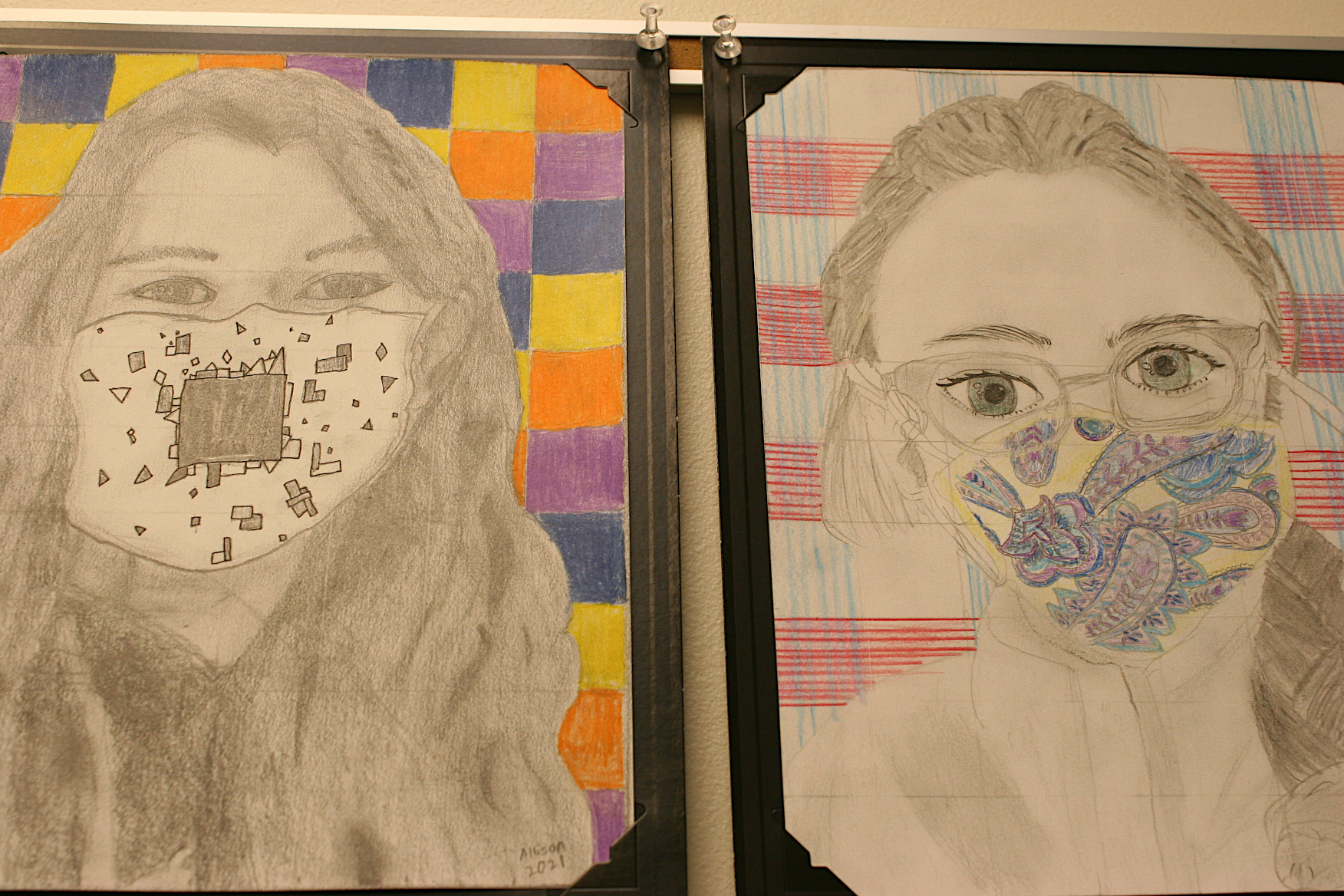
Masked portraits by BA sixth graders, Allison, left, and Megan, right.
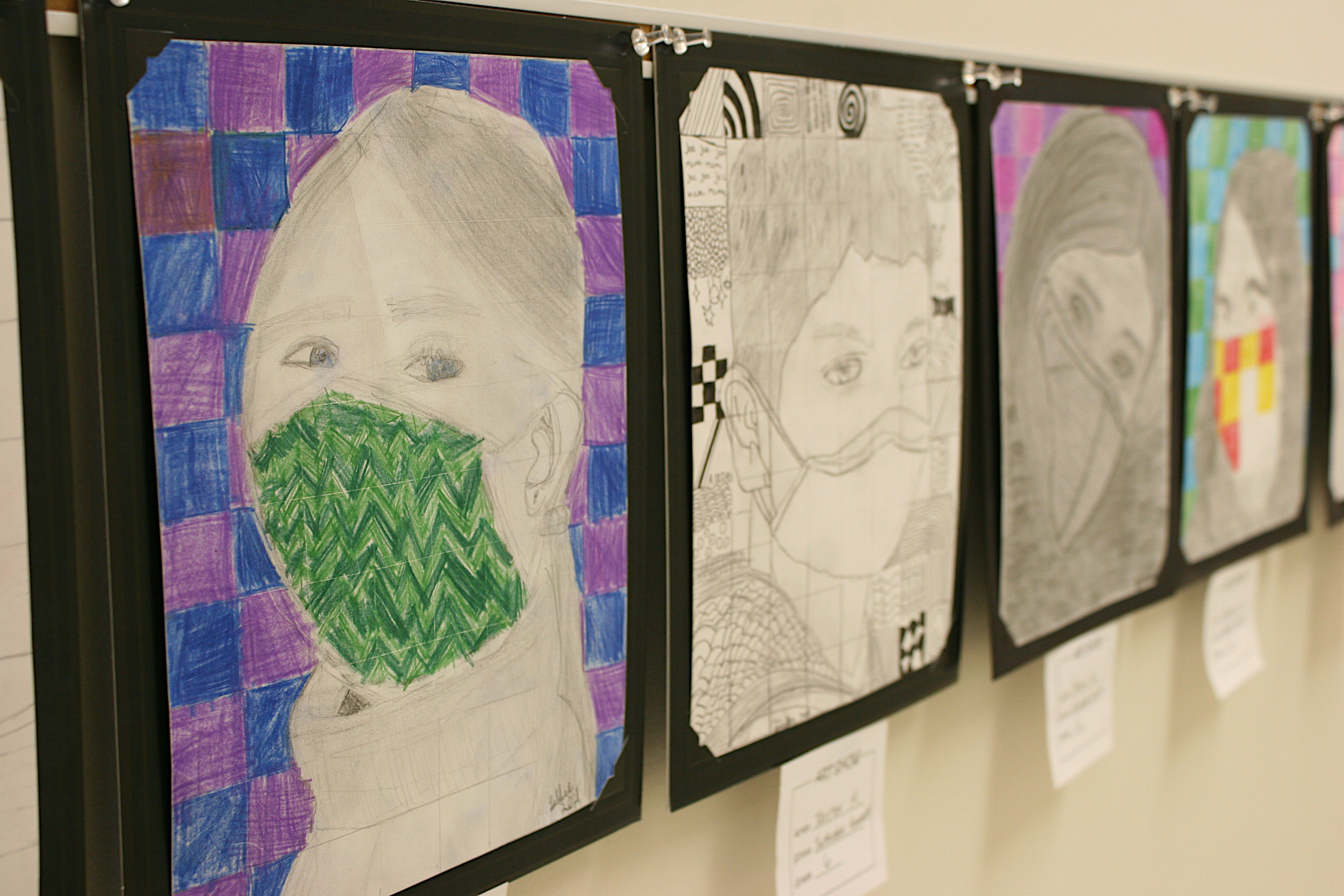
Lillian, from the sixth grade class at BA, created the portrait on the left.
Not only are fewer pieces of art displayed, but the art, too, reflects the pandemic and distance learning. Students from Bethlehem Academy, for example, drew portraits. Of their masked selves.
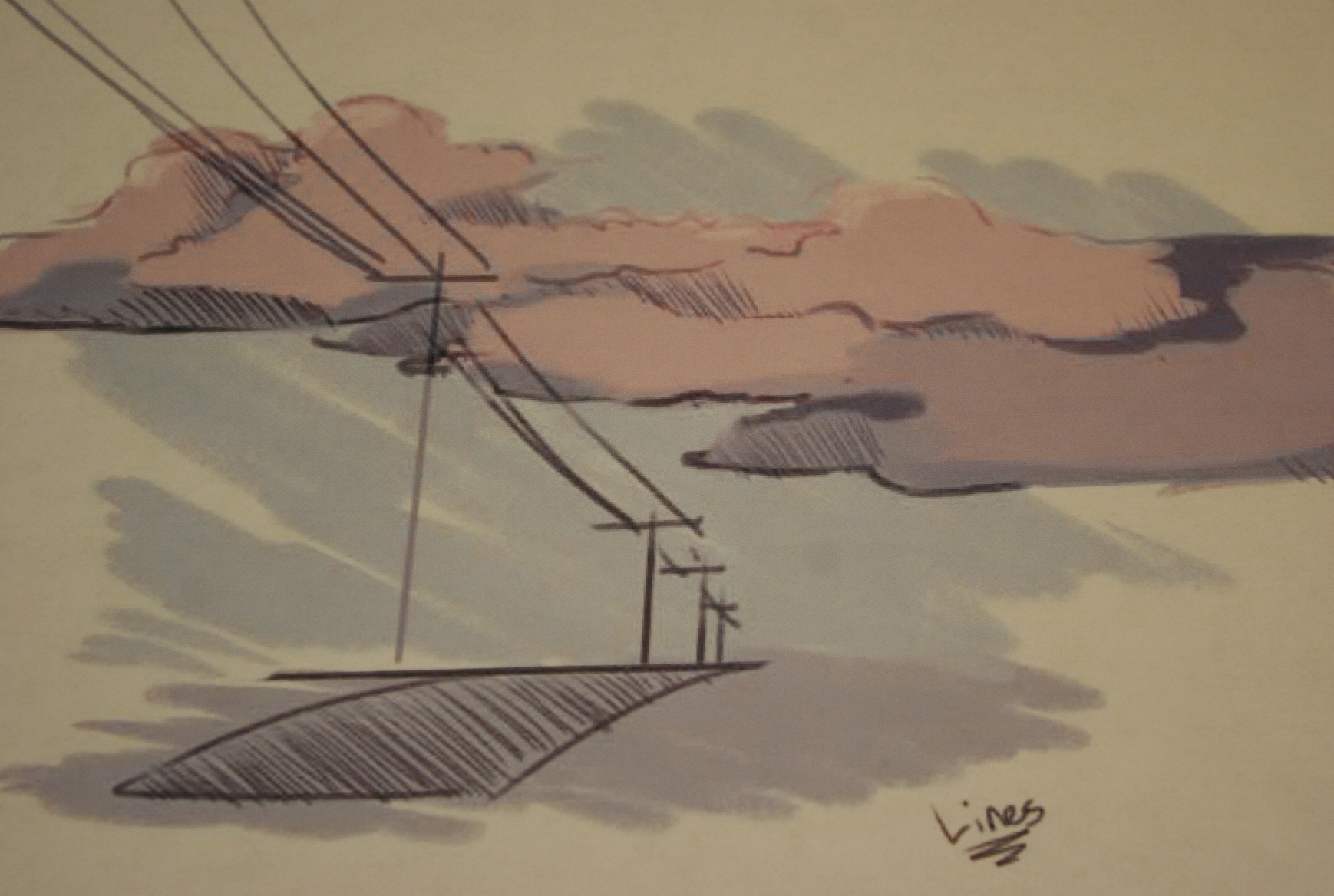
“Lines” by Faribault Middle School eighth grader Aronranrcsy reminds me of the prairie. This is one of my favorites.
I also noticed a lack of copycat art with teachers assigning students to a specific art task and then student after student after student creating the same thing. I observed more creativity and diversity. And I really appreciated that individuality as it allows students to open their artistic wings and soar.
“Color” by Mohamed, Faribault Middle School eighth grader. This just makes me happy.
Paradise Center for the Arts Executive Director Heidi Nelson and I briefly discussed my observations. She agreed that distance learning definitely factored into the artwork, noting that some of the art is computer generated/created.
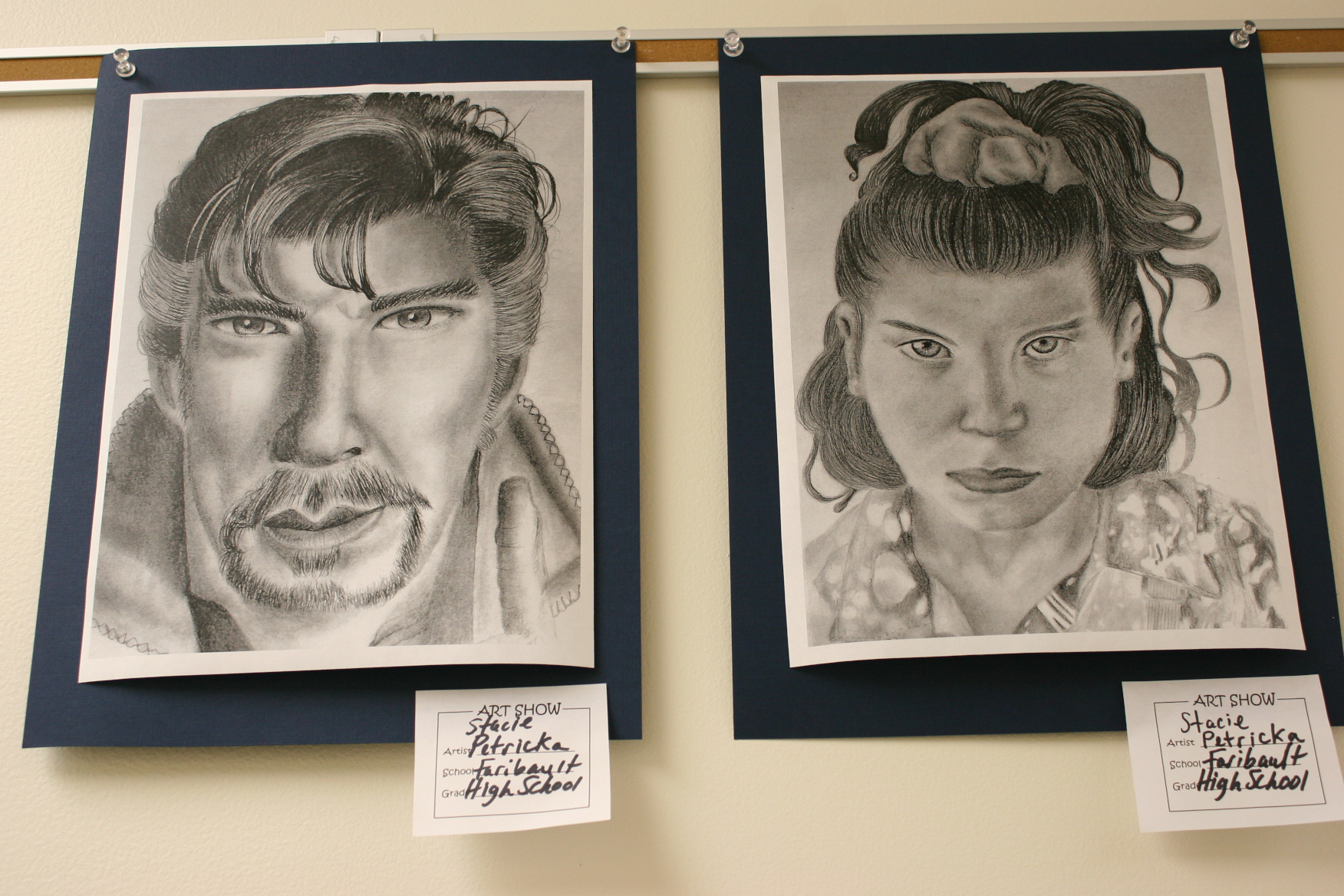
What incredible talent…portraits by Faribault High School student Stacie.
Each work of art is tagged with the artist’s name and school. I’d welcome info on the art medium.
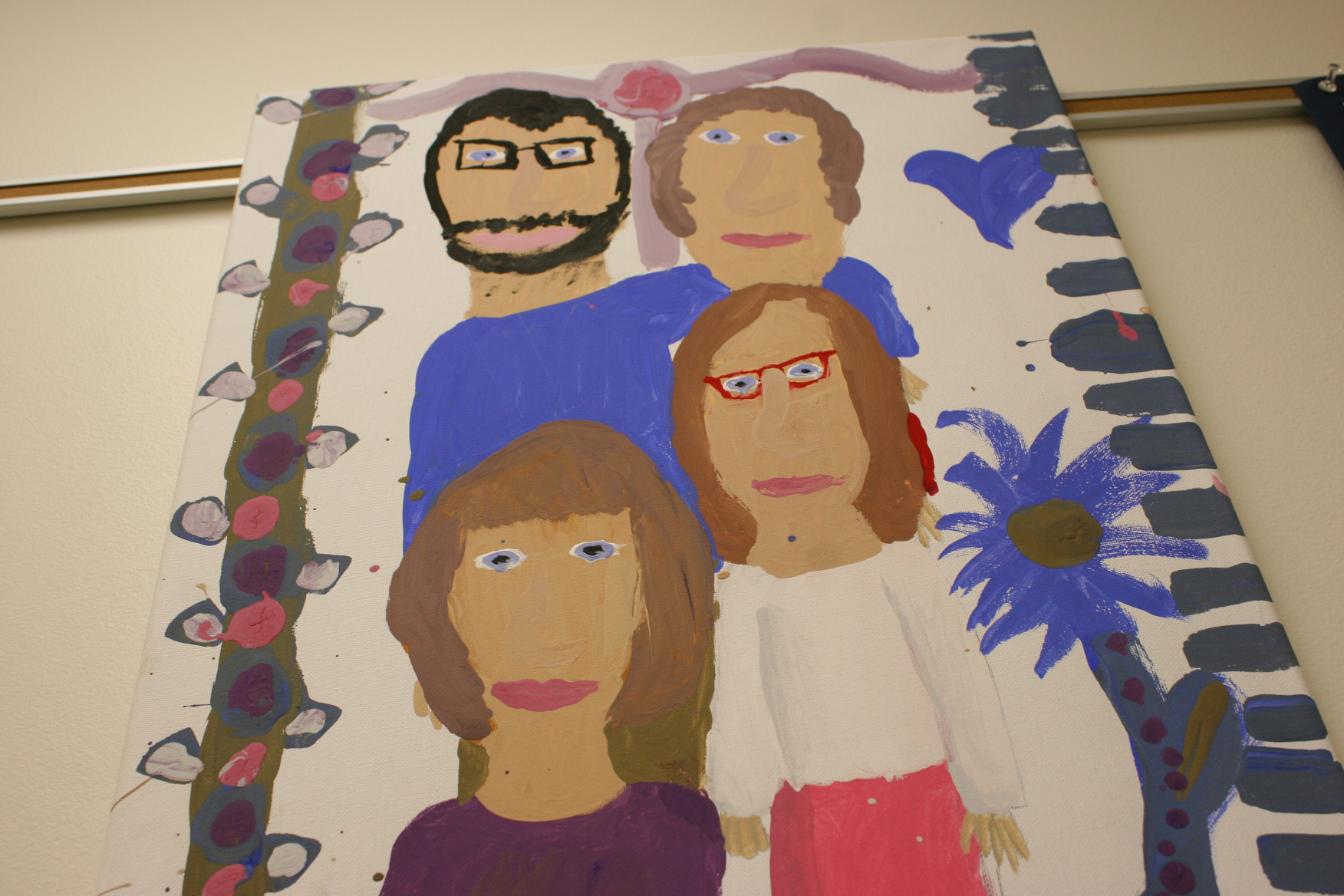
Hazel, a third grader at Bridgewater Elementary School, created this family portrait, which I absolutely love. If we’ve learned one thing during the pandemic, it’s the value of family.
However these students created—whether via a pencil or a brush or a computer or some other method—they share the common denominator of making art. And for that, I feel inspired and grateful.
FYI: The All Area Student Show on the second floor of the PCA continues through April 10. The Paradise Center for the Arts is open from noon – 5 pm Thursday and Friday and from 10 am – 2 pm Saturdays.
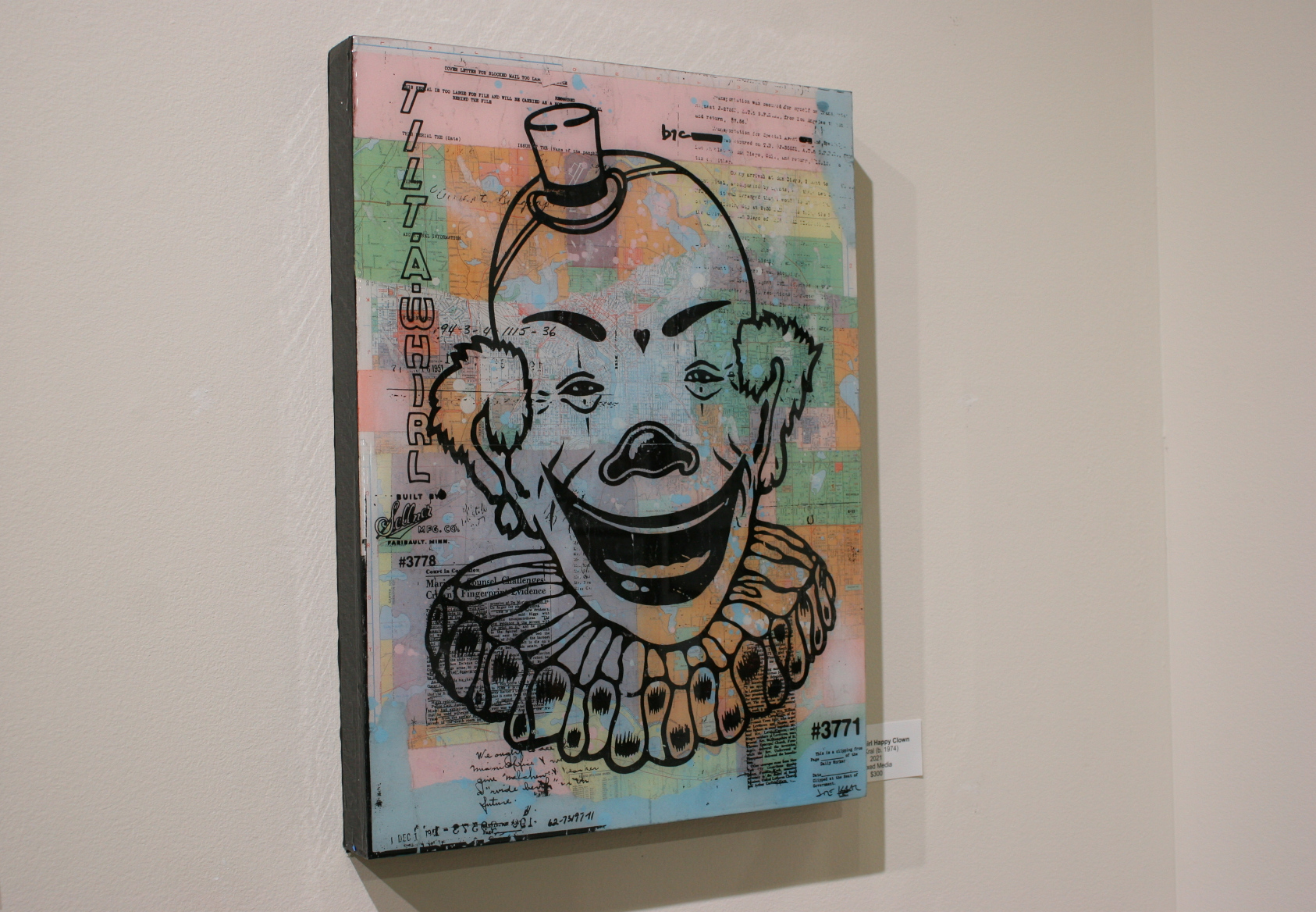
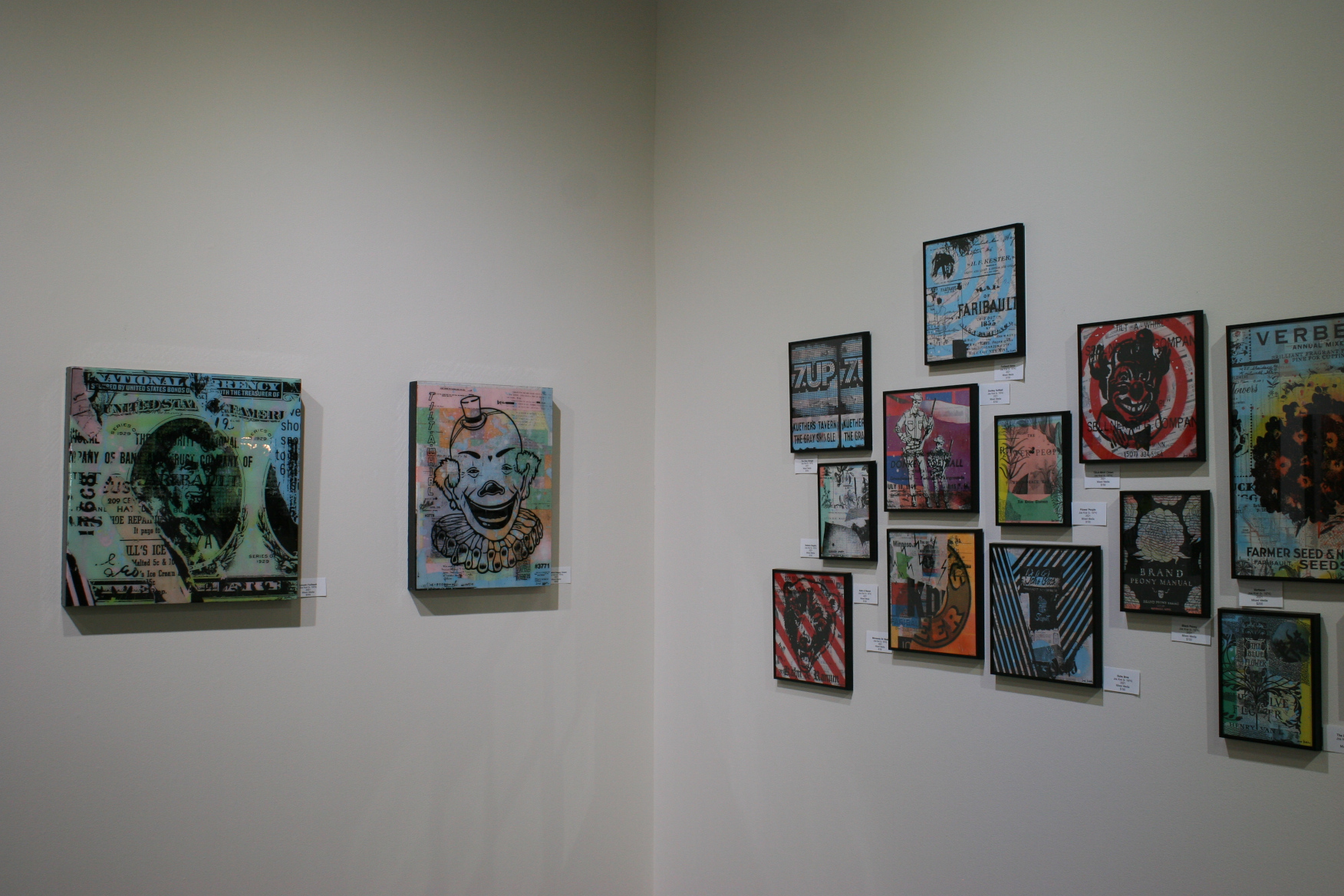
“The Happy Clown.” Kral’s art celebrates the clown graphic used on the Tilt-A-Whirl amusement ride created and made in Faribault, up until recently.
Kral’s signature art highlights Faribault.
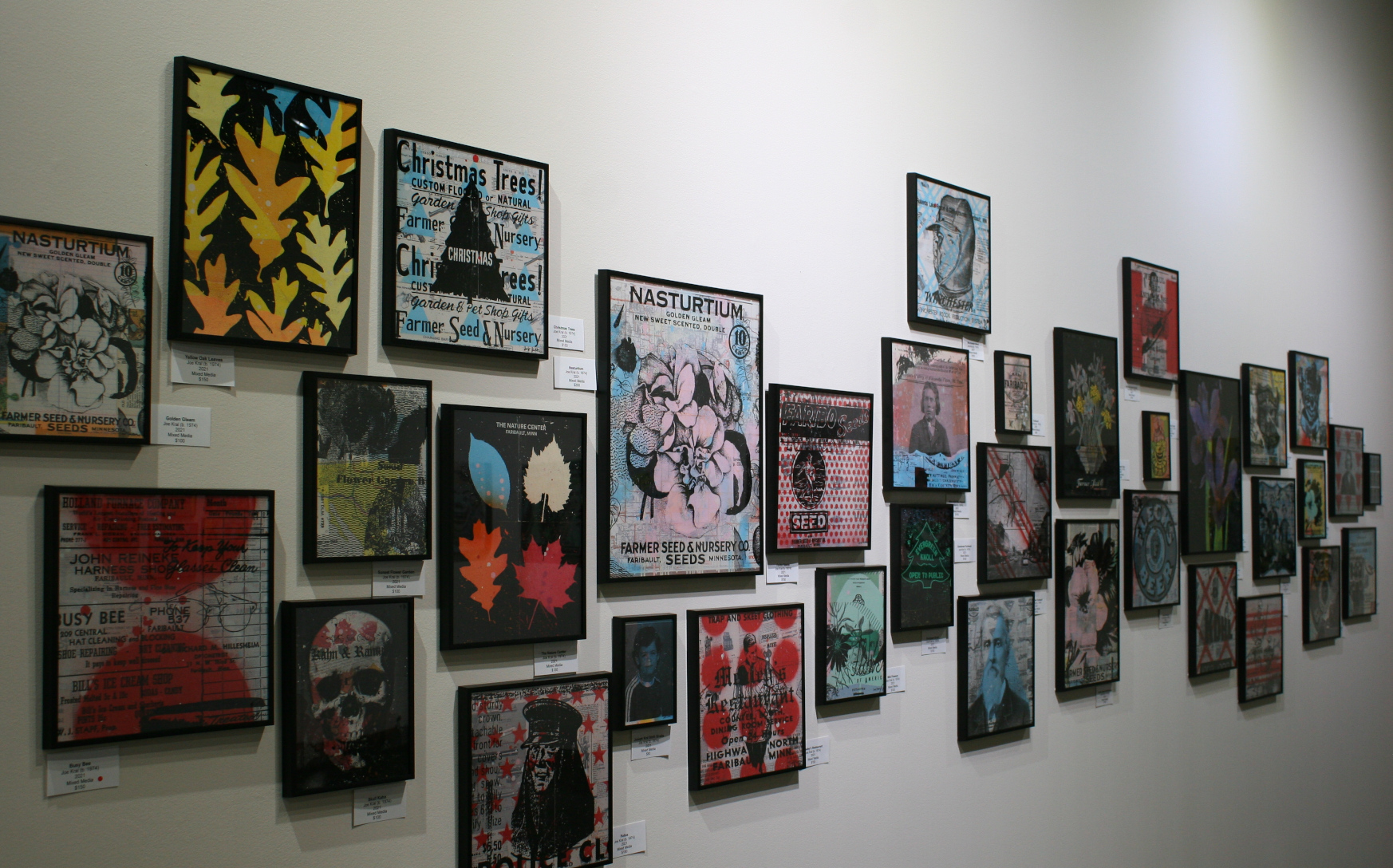
The Minneapolis artist creates mixed media paintings in a signature style that appeals to my love of vintage graphics, fonts, old print ads and nostalgia. Kral sources vintage materials from books, magazines, maps and postcards. He then adds colors and texture with spray paint, stencils and ink, according to information on his website. The results are a visual and creative delight.
The Hardwood General Store building still stands near the King Mill Dam.
Some of the businesses featured in Kral’s art still exist. But most don’t.
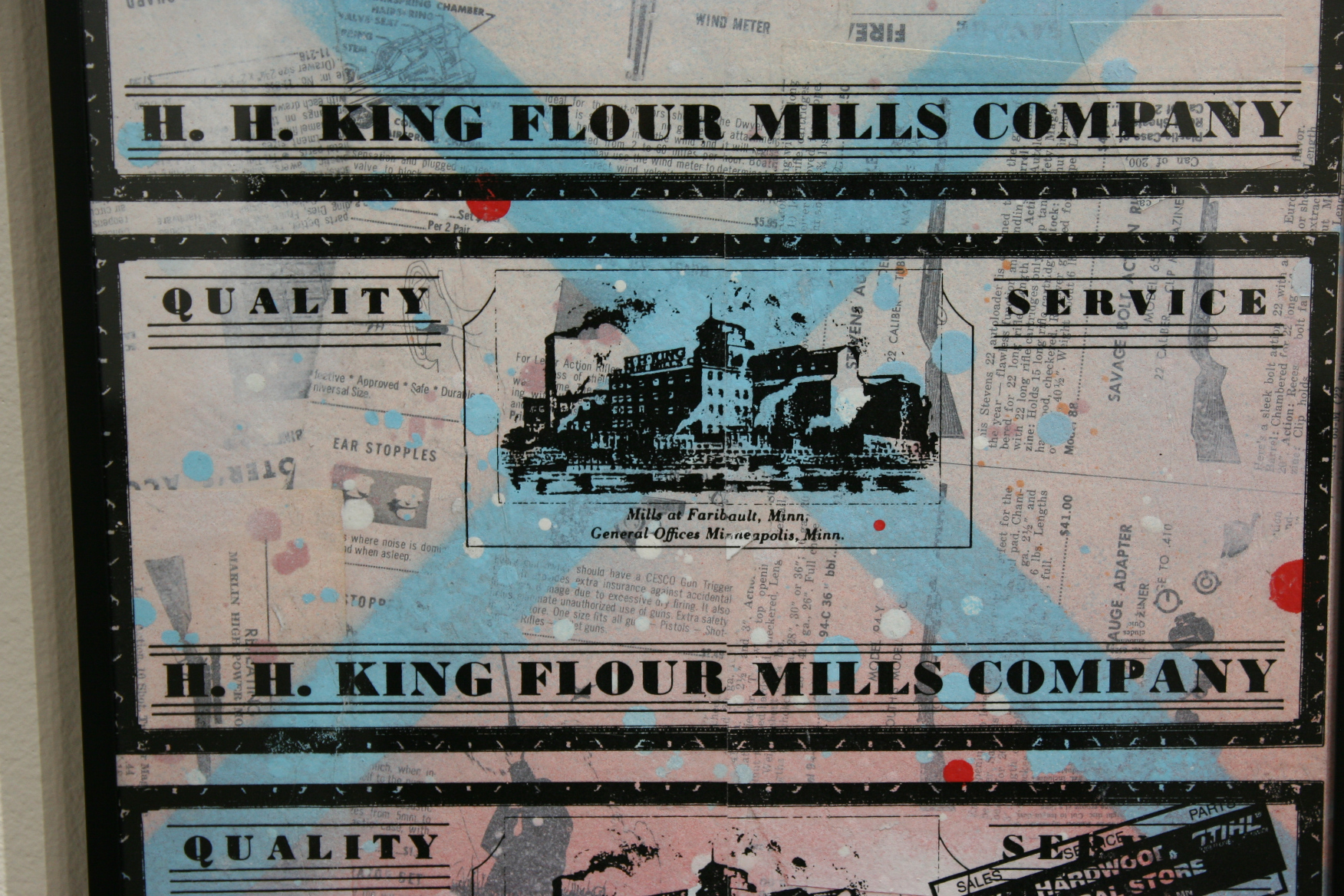
The King Flour Mill was destroyed by fire and is honored here by Kral.
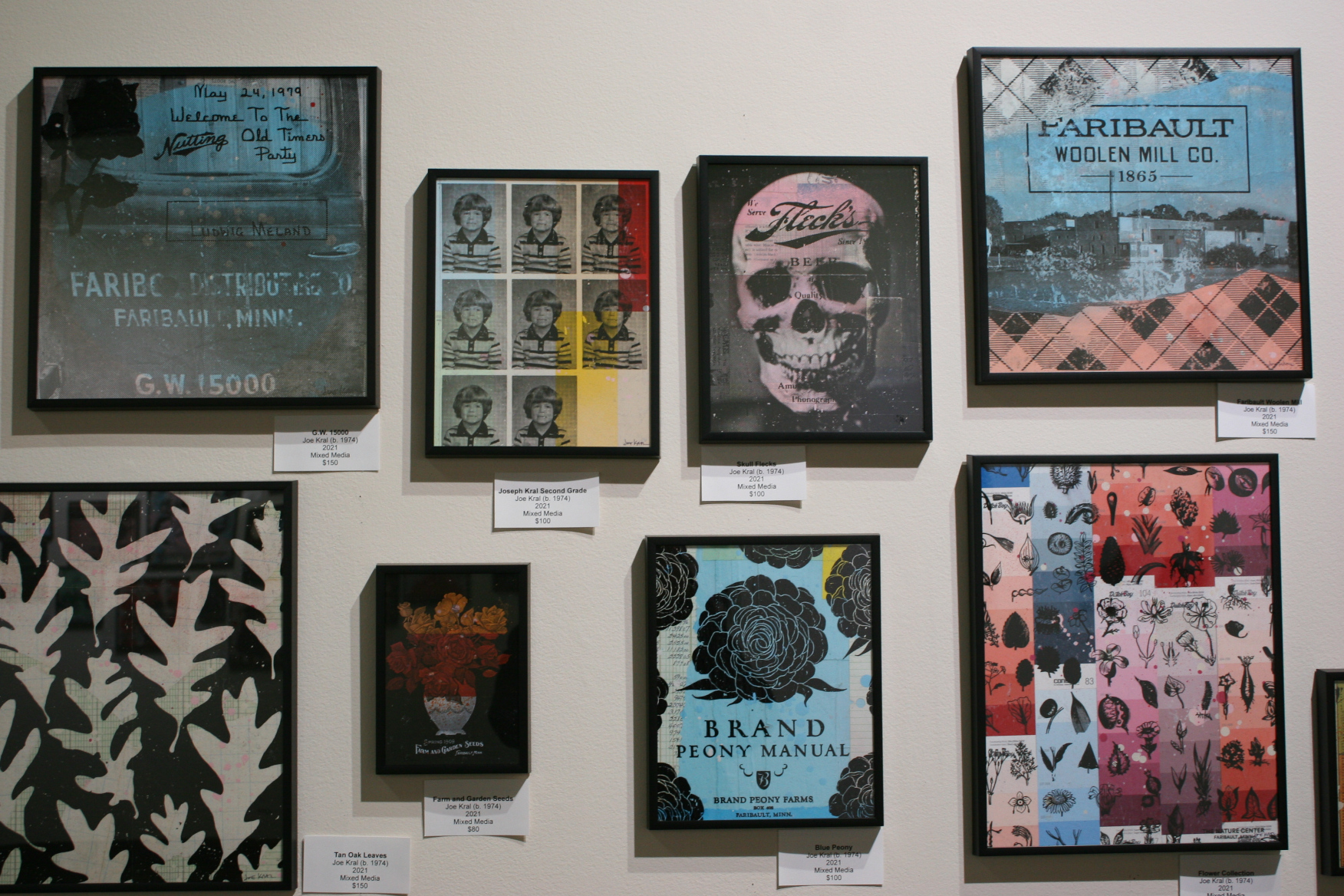
Faribault residents and natives, particularly, will feel like they are walking down memory lane when viewing “My Hometown.” Kral features primarily Faribault businesses. Like Brand Peony Farms, Fleck’s Beer, King Flour Mills, Farmer Seed & Nursery and Tilt-A-Whirl—all gone. But he also includes art on current businesses like the well-known Faribault Woolen Mill and KDHL radio.
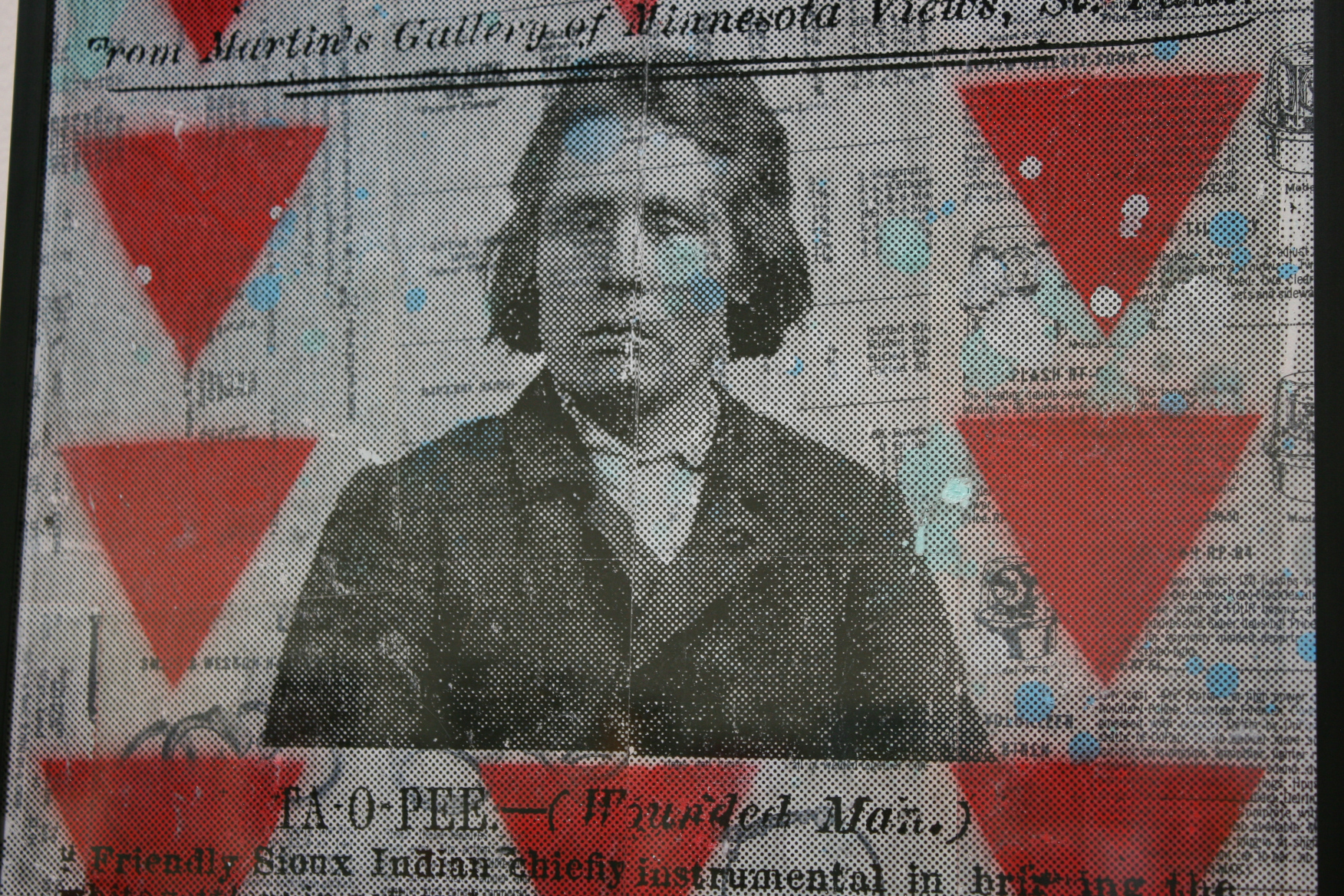
Chief Taopee art created by Kral.
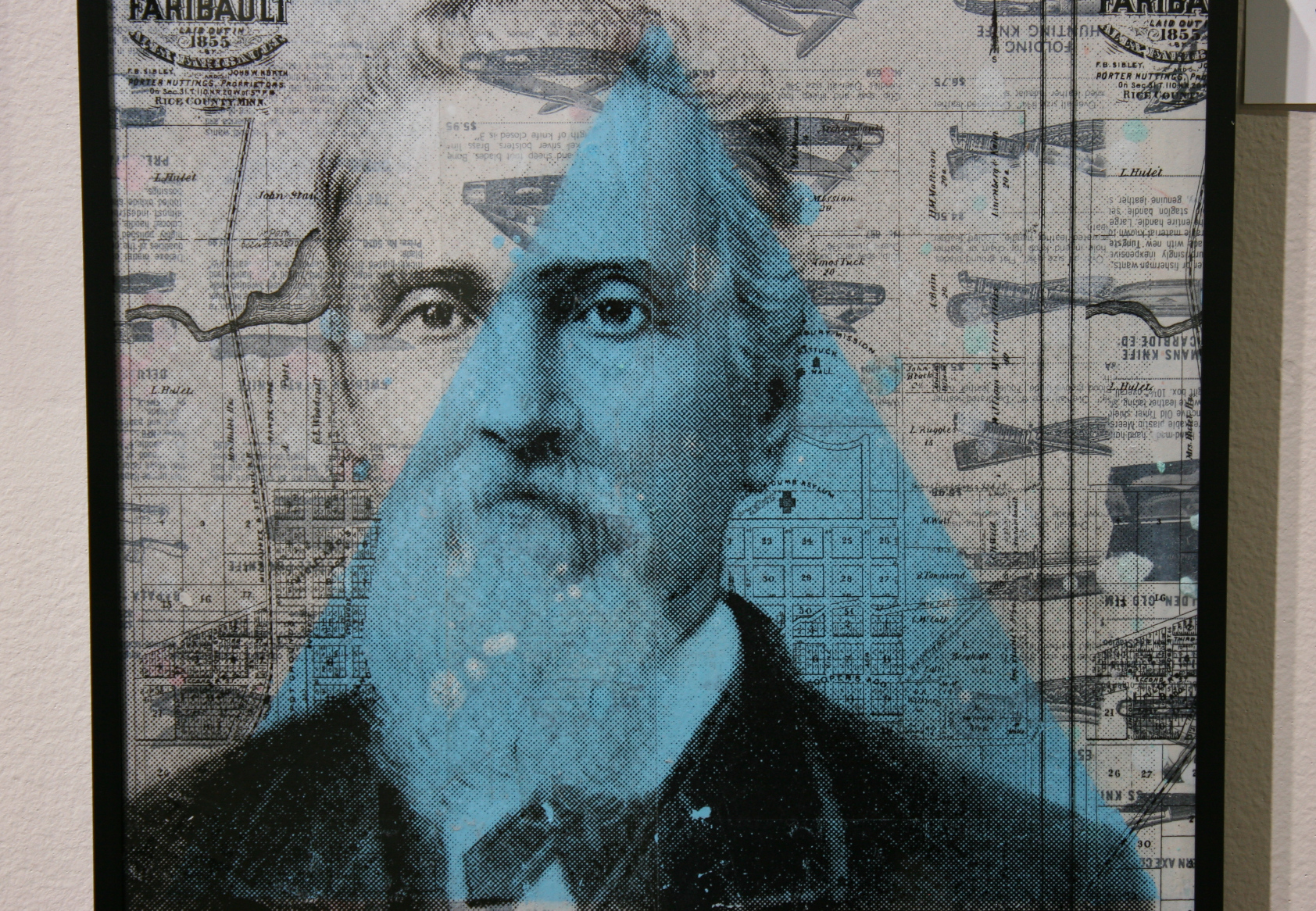
Town founder, Alexander Faribault, portrayed in Kral’s mixed media art.
Two locally important early leaders, Chief Taopee and Alexander Faribault, are also included in Kral’s hometown exhibit.
More of Kral’s art…
With the historic bend of this show, “My Hometown” seems like a good fit also for a history center/museum, which may draw an entirely different audience. This speaks to the diverse appeal of Kral’s art.
Joe Kral, when he was a student at McKinley Elementary School in Faribault.
In his bio, Kral shares that he was raised on skateboarding, BMX, heavy metal and art. I see that influence in his art. And I also see his love for Faribault—which I expect comes from leaving his hometown, reflecting and then appreciating the place that grew him as an individual and as an artist.
Kral’s Brand Peony Farms art recognizes Faribault’s past history as a peony capital. The business no longer exists.
FYI: The Paradise Center for the Arts, 321 Central Avenue N., Faribault, is open from noon – 5 pm Thursday and Friday and from 10 am – 2 pm Saturdays. While at the Paradise, check out the other gallery exhibits. I will feature some of that art in upcoming posts.
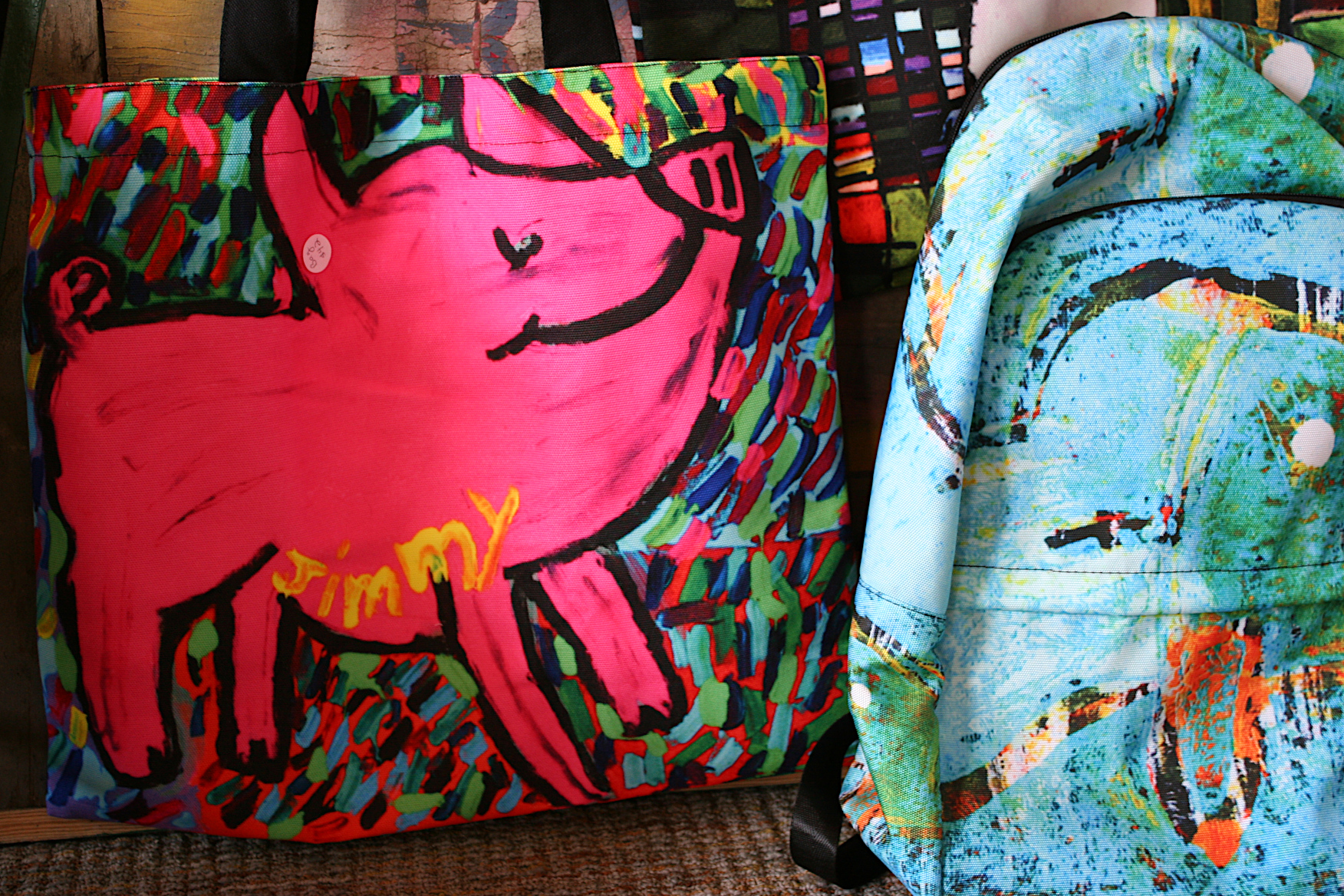
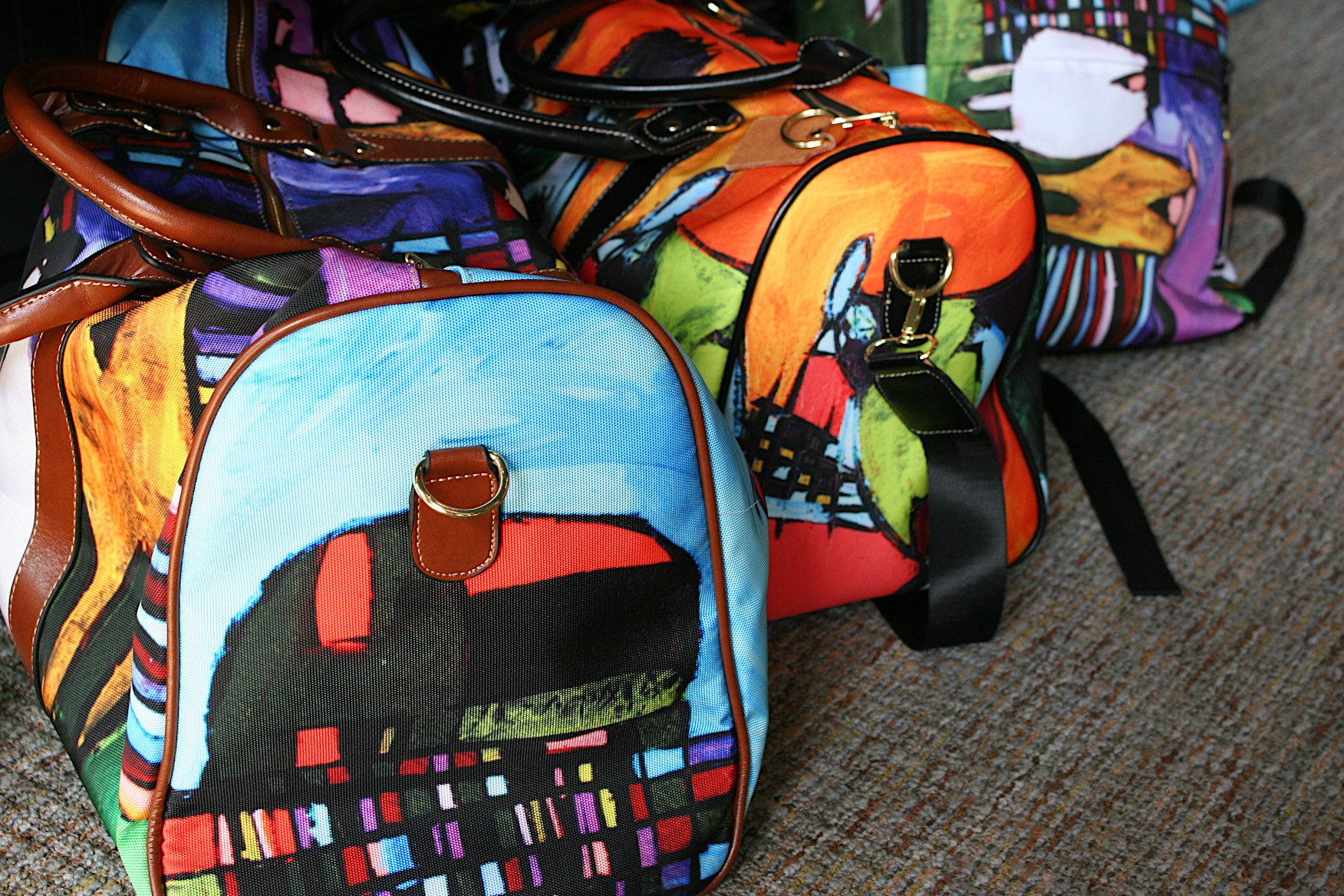
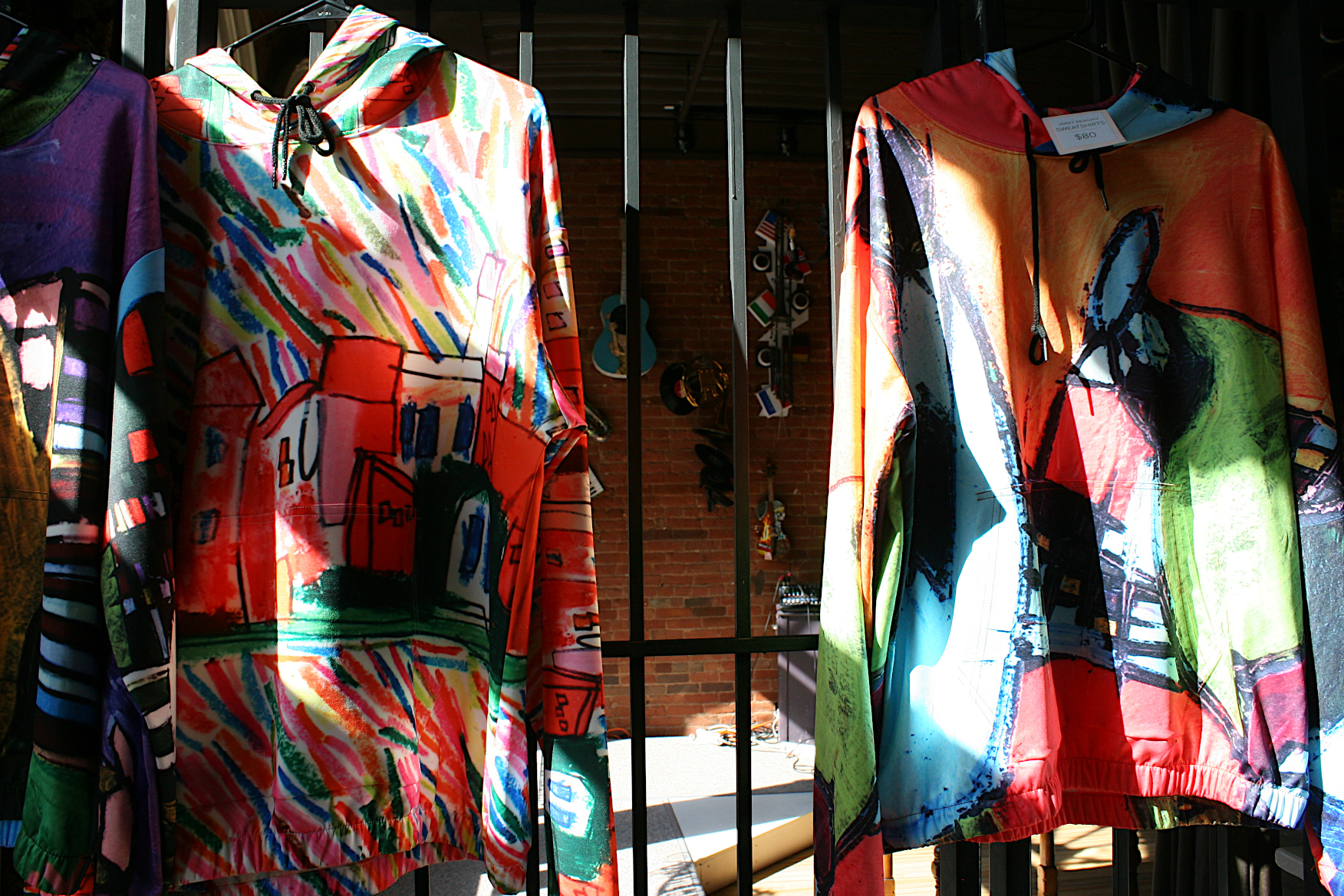
Jimmy Reagan’s art splashes across a tote and backpack for sale in a New Ulm arts center gift shop.
IT WAS THE VIVID COLORS which first caught my eye inside The Grand Artisan Gift Shop in downtown New Ulm. Bold hues flashed, accented by strong lines of color, as if the artist had pulled every crayon from a box of crayons and dashed them across the canvas.
Reagan’s work “offers him a means to illustrate his perspective of the world,” according to a promotional bio I picked up in the gift shop. This young man views life through the lens of autism. He was diagnosed with complex autism as a toddler.
These sweatshirts, with Jimmy’s signature “tick marks” (left), hang in the entrance to The Grand Kabaret, an entertainment space in The Grand.
Since 2009, he has created art and is internationally-recognized. I admire Reagan, who rose to the challenges of his autism to express himself and to communicate. Strong colors, simple images and signature “tick marks” (those short dashes of color) define his art. I, for one, am a fan.
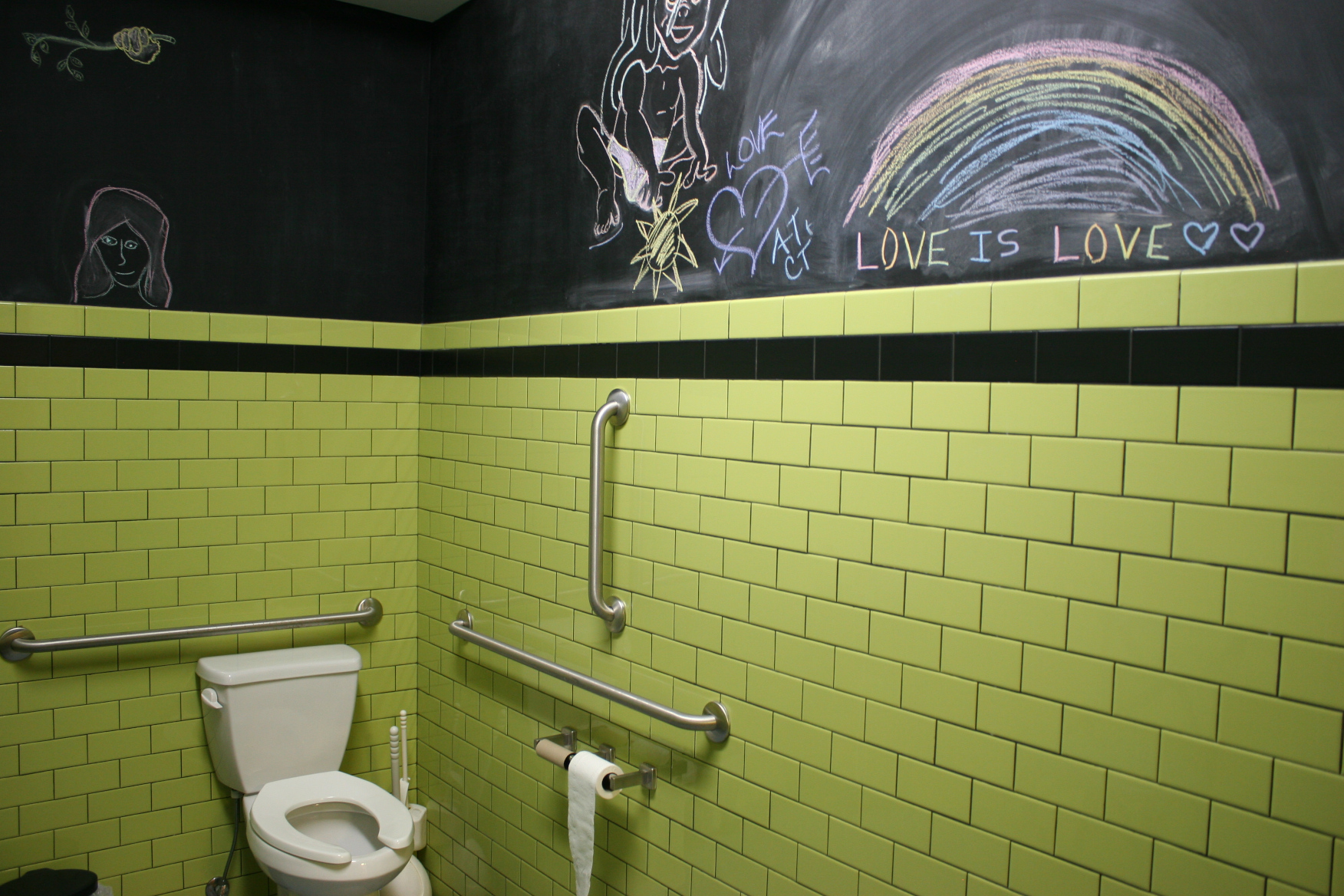
The colorful bathroom with the canvas for chalk art above.
The Grand restroom in New Ulm is not artist-themed, but rather an artistic canvas for anyone who steps inside. The lime green walls first caught my eye as I walked past the bathroom. (As a teen, my bedroom was painted a similar lime green.) And then I noticed the chalk art above the tile and thought, what a great idea. Maybe it’s nothing novel for a public bathroom. But it was to me. And, although I didn’t pick up chalk and add to the black canvas, I photographed it. And that, too, is art.
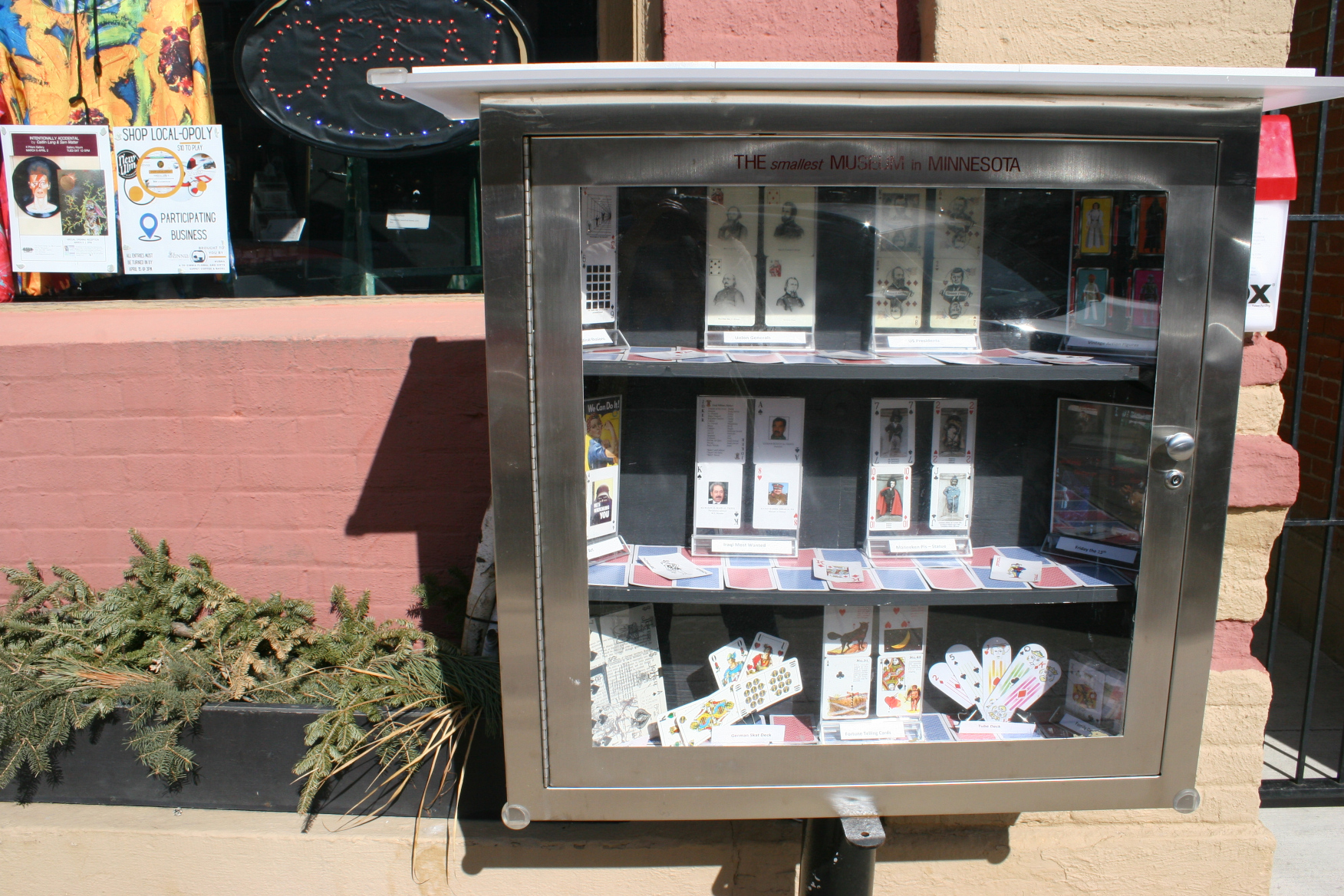
And when I write “small,” I mean “small.” The enclosed box museum measures 31.75 inches wide x 32.75 inches high x 7.5 inches deep. Just enough space for artists, makers, collectors, culture buffs, writers and historians to create a mini exhibit.
A full front view of the museum shows the compact exhibit space.
I love this concept for its uniqueness and also its public accessibility. Posted outside The Grand, this museum is viewable 24/7. Similar museums, the Hoosesagg Museum (Pants Pocket Museum) and The Smallest Museum in St. Paul, inspired the one in New Ulm. The museum also reminds me of Little Free Libraries.
The top shelf showing cards from Clay Schuldt’s collection.
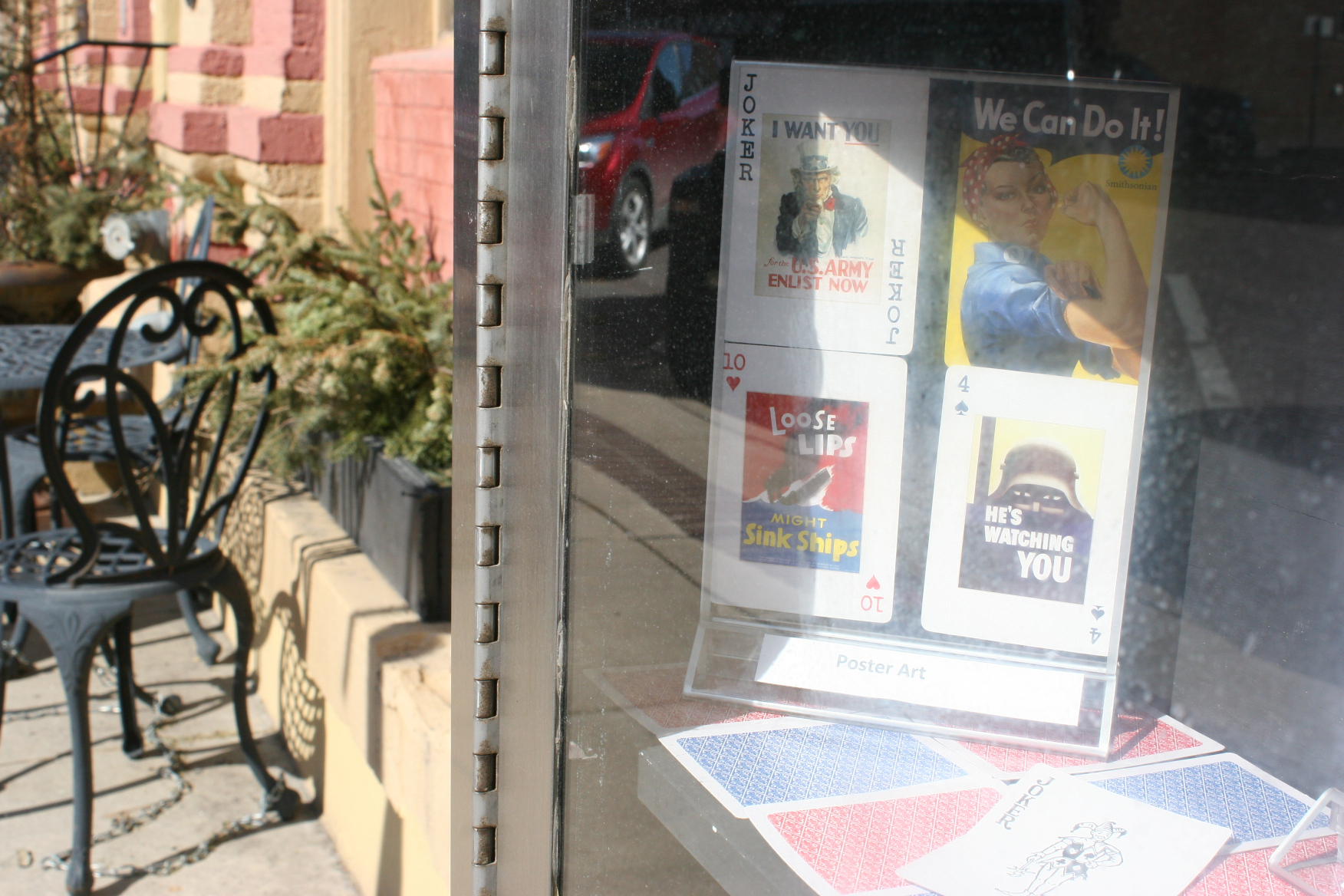
Local Clay Schuldt curated the first exhibit, “The Stacked Deck,” featuring select playing cards from decks in his long-time collection. His card showcase continues through April 23 and includes a take-home informational sheet explaining his exhibit. For Schuldt, these cards are not just for playing games. He views cards through multiple lenses of art, entertainment, history, storytelling, marketing and more.
More cards inside the mini museum.
This is what I love about creativity. Creatives bring their backgrounds, experiences and individual interpretations into their work. While I considered a deck of cards as just that, a deck of cards, Schuldt views them differently. And now, because of his featured collection and insights, I view cards from a wider perspective.
I look forward to seeing more of these mini exhibits outside The Grand. Creatives, collectors, historians and others are invited to submit museum proposals. You can do that by clicking here and then clicking on the PDF link. Guidelines call for applicants to consider how the proposed exhibit relates to the region, audience engagement and simplicity.
Selected artists receive a $50 stipend for a two-month exhibit.
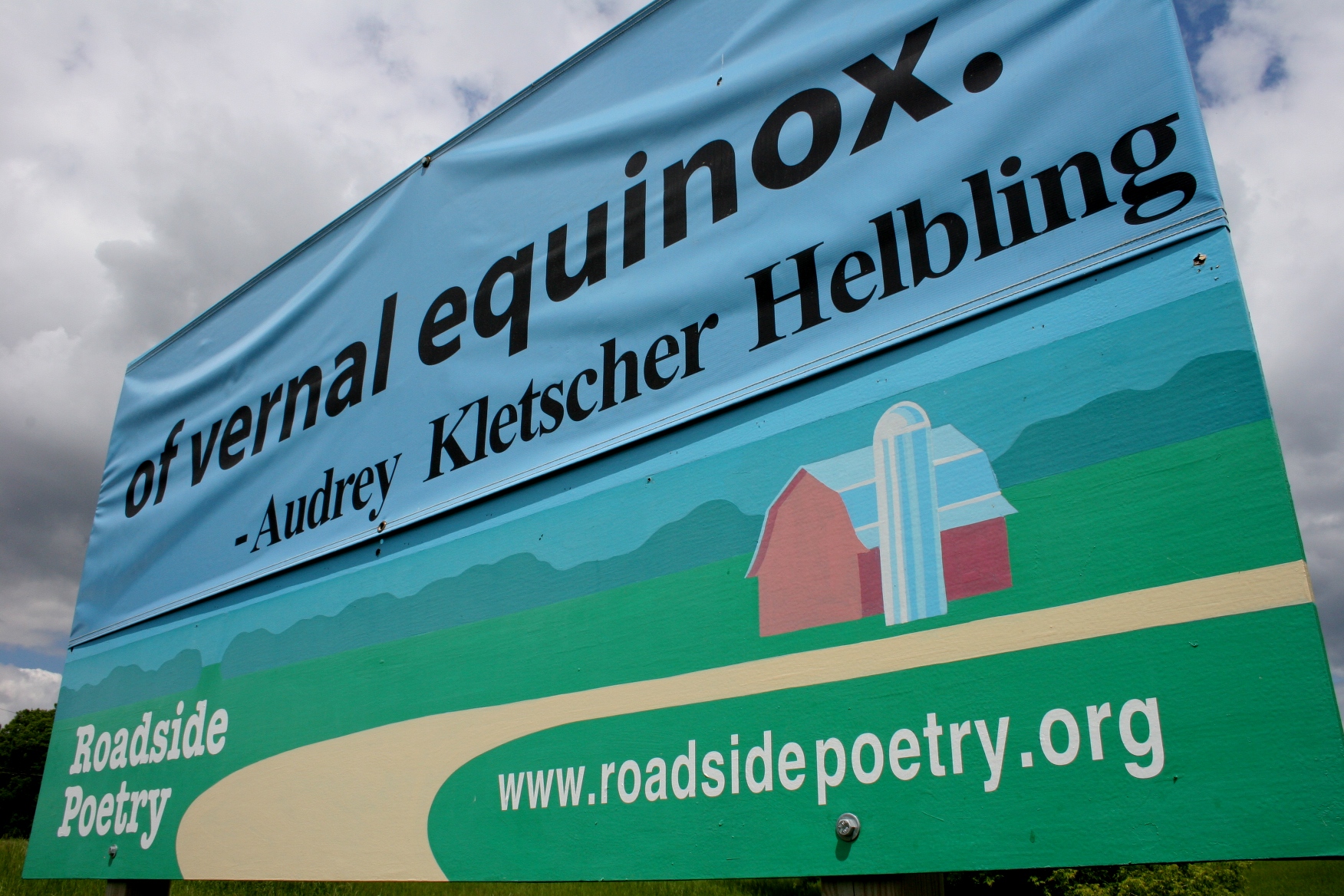
Billboards in my Roadside Poetry Project poem posted in Fergus Falls 10 years ago. Minnesota Prairie Roots file photo June 2011.
THE OFFICIAL ARRIVAL OF SPRING today seems reason to celebrate, especially here in Minnesota, the land of long winters. Or, as my California-raised son-in-law once thought, Almost Canada.
Billboard #2 in my poem. Minnesota Prairie Roots file photo June 2011.
From here on, daylight lengthens. And, after this past pandemic year, I’m thankful for the seasonal transition into more sunlight and resulting warmth and melting of snow. That said, this is still March and in Minnesota that likely means more cold and snowy days.
But, as we ease into spring, I feel a sense of renewal. Warm days with temps in the 50s and near 60, like those predicted for this weekend, are freeing, uplifting and promising.
Billboards #3 and 4. Minnesota Prairie Roots file photo June 2011.
Farmers, I expect, are itching to get into the fields, although it’s way too early for that. I still think like the farm-raised woman I am, connecting seasons to the cycle of planting, growing and harvesting. That will always remain an important part of my identity and continues to influence my writing and photography.
The last of four billboards featuring my Roadside Poetry spring poem. Minnesota Prairie Roots file photo June 2011.
Flash back to 10 years ago and you can read that influence in a poem I penned and submitted to the Roadside Poetry Project. In four lines, each with a 20 character limit, I wrote a spring-themed poem that bannered on four billboards in Fergus Falls. It’s the most unusual spot my poetry has ever published.
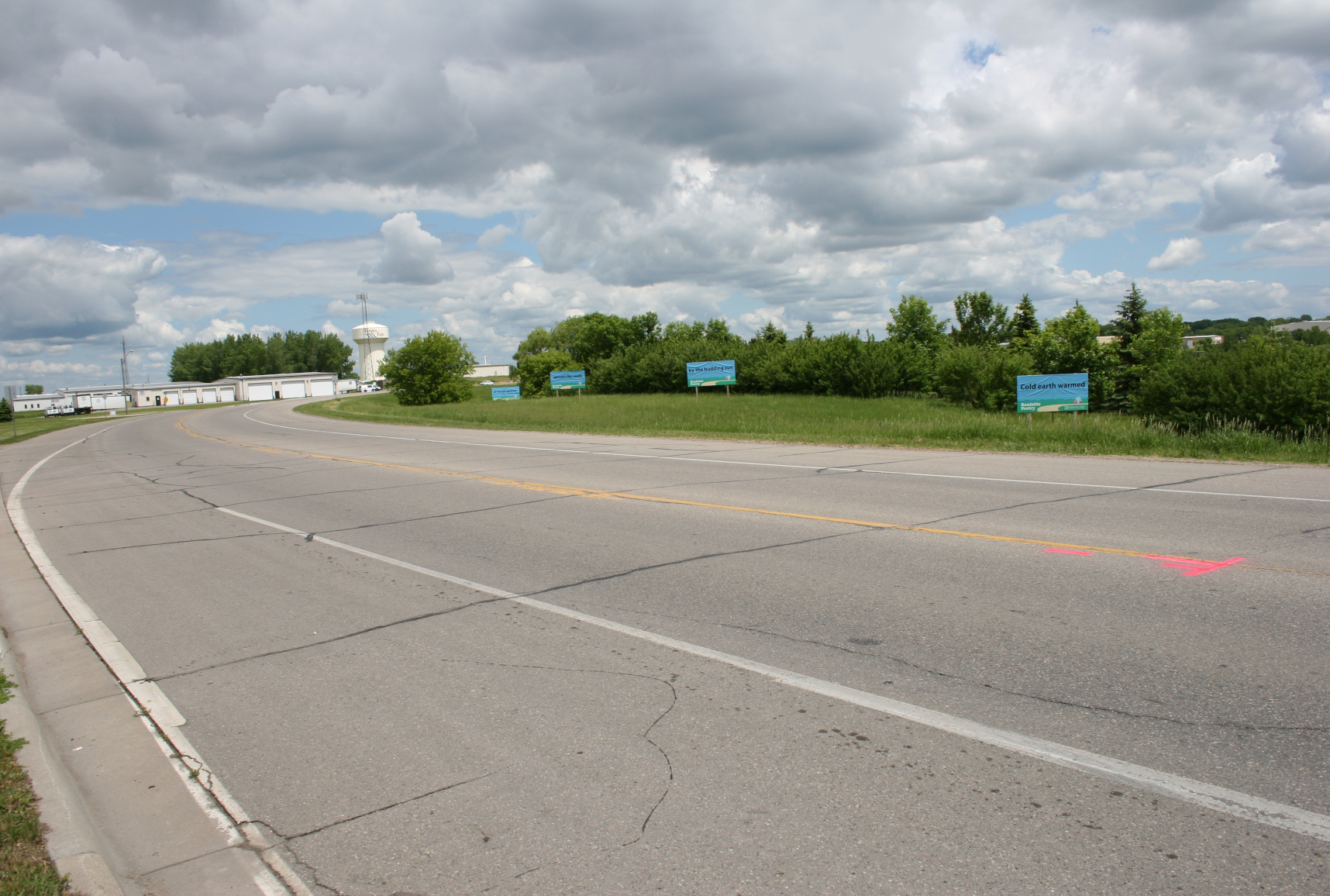
The billboards posted along a road on the edge of Fergus Falls in 2011. Minnesota Prairie Roots file photo June 2011.
Designed “to celebrate the personal pulse of poetry in the landscape,” according to then Project Coordinator Paul Carney, my poem truly fit that mission. I wrote from experience, from a closeness to the land, from a landscape of understanding.
While the Roadside Poetry Project, funded by the Fergus Falls College Foundation, no longer exists, my poem endures in the legacy of my writing. To have written about spring from the perspective of a farmer’s daughter celebrates my rural Minnesota prairie roots. And spring.
AS SOMEONE WHO GREW UP with minimal exposure to the arts, I feel not so much deprived as deeply appreciative of creativity. I consider myself an artist—of images and of words. To write and to photograph, oh, the joy.
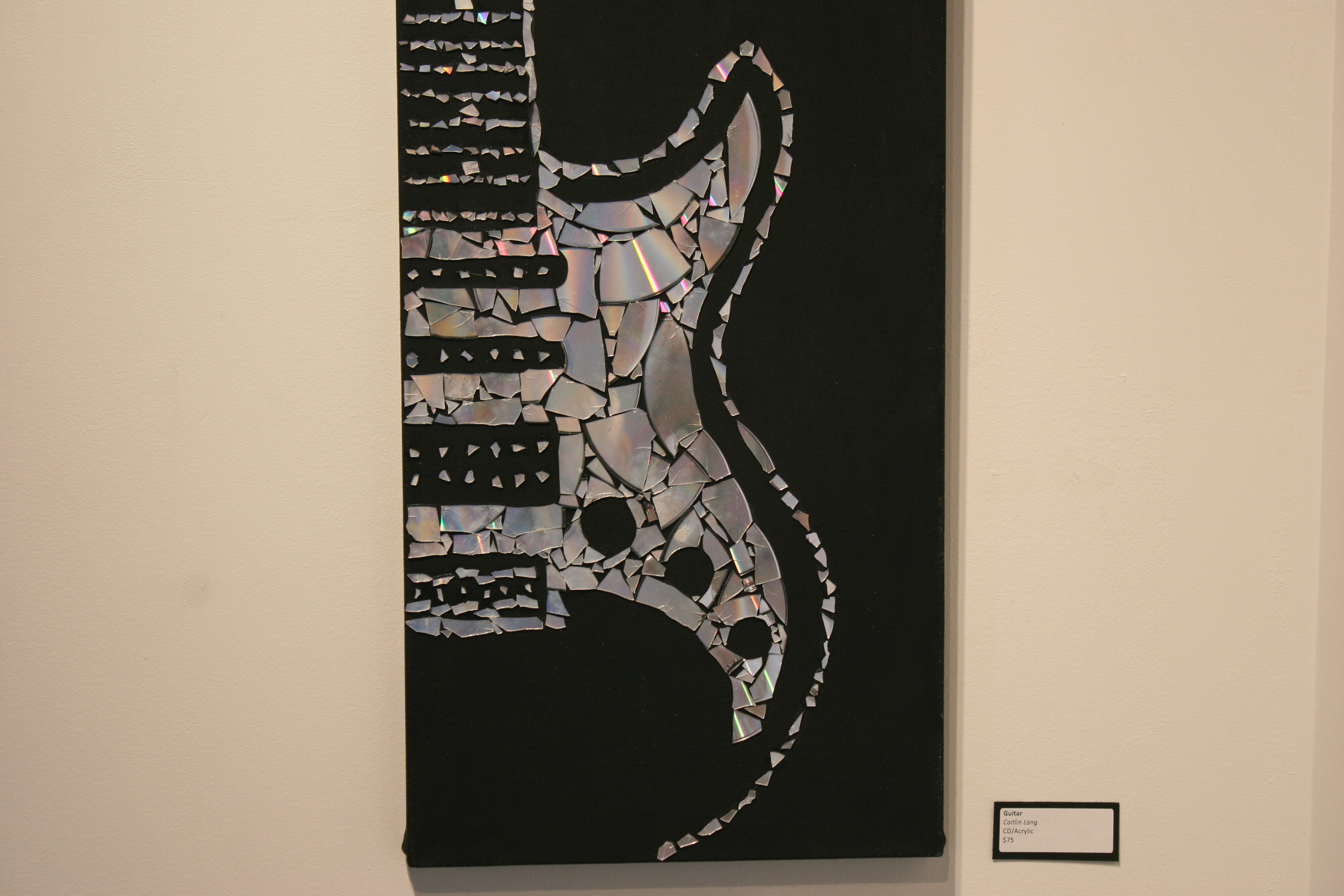
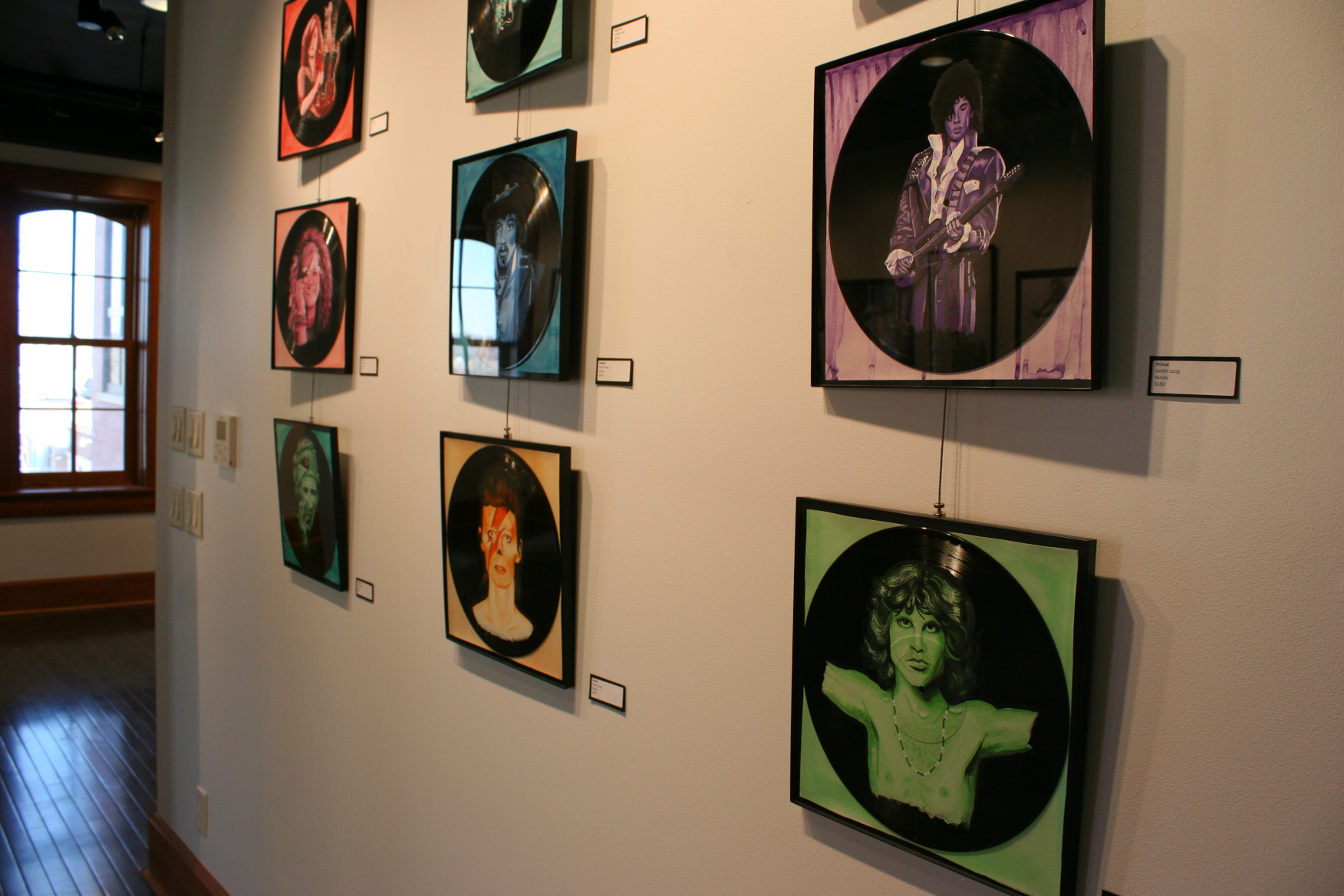
A snippet of an acrylic, “Guitar,” by Caitlin Lang.
I feel gratitude for all the creatives out there who share their talents, whether in published works or performances or art exhibits or whatever in whatever space they choose.
The Grand Center for Arts & Culture in downtown New Ulm.
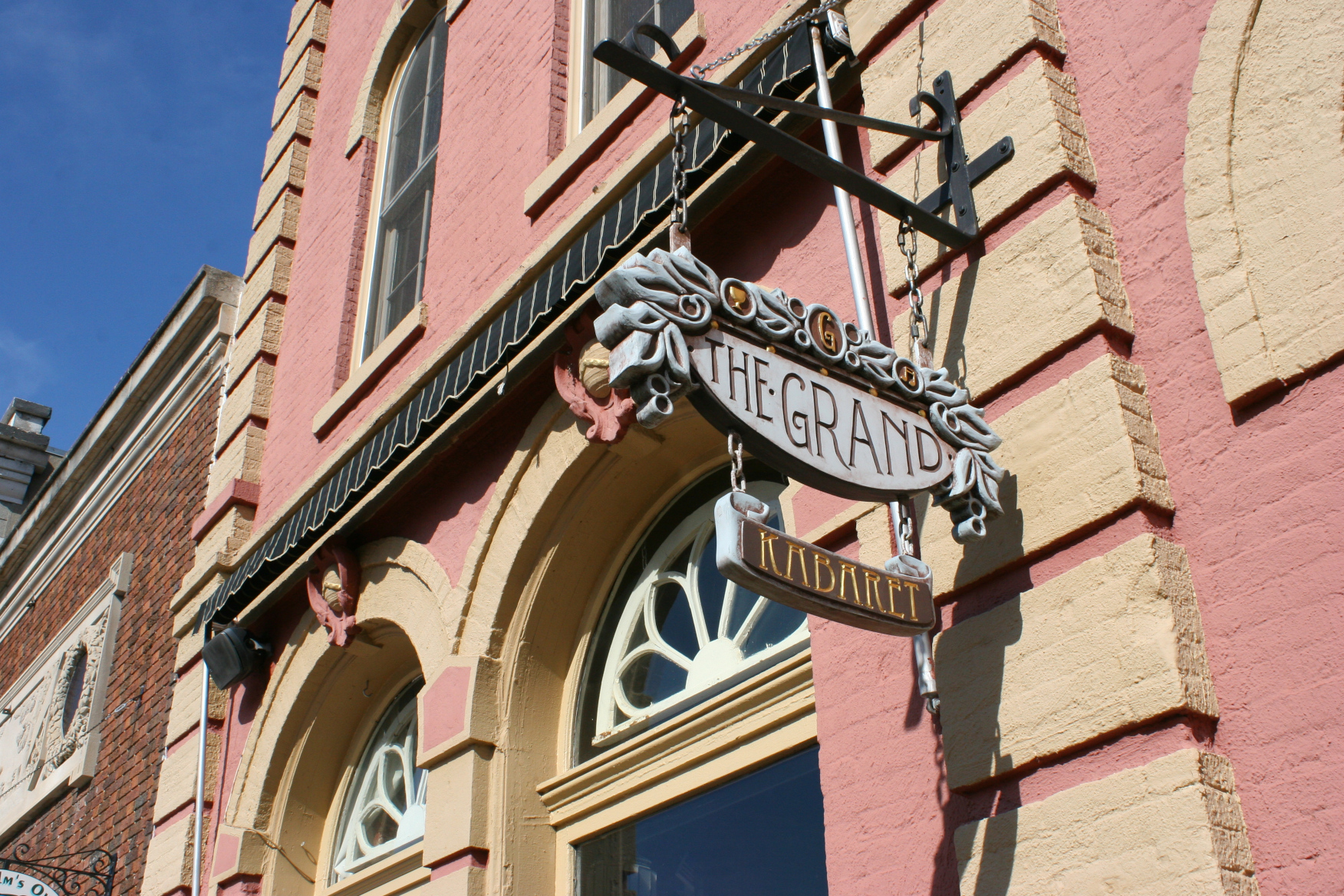
Beautiful signage and architectural details make this building visually appealing.
During a brief Saturday afternoon stop in New Ulm, my first must-see destination was The Grand Center for Arts and Culture, housed in a former historic hotel in the heart of downtown. The building itself drew my interest with its appealing signage and lovely architectural details.
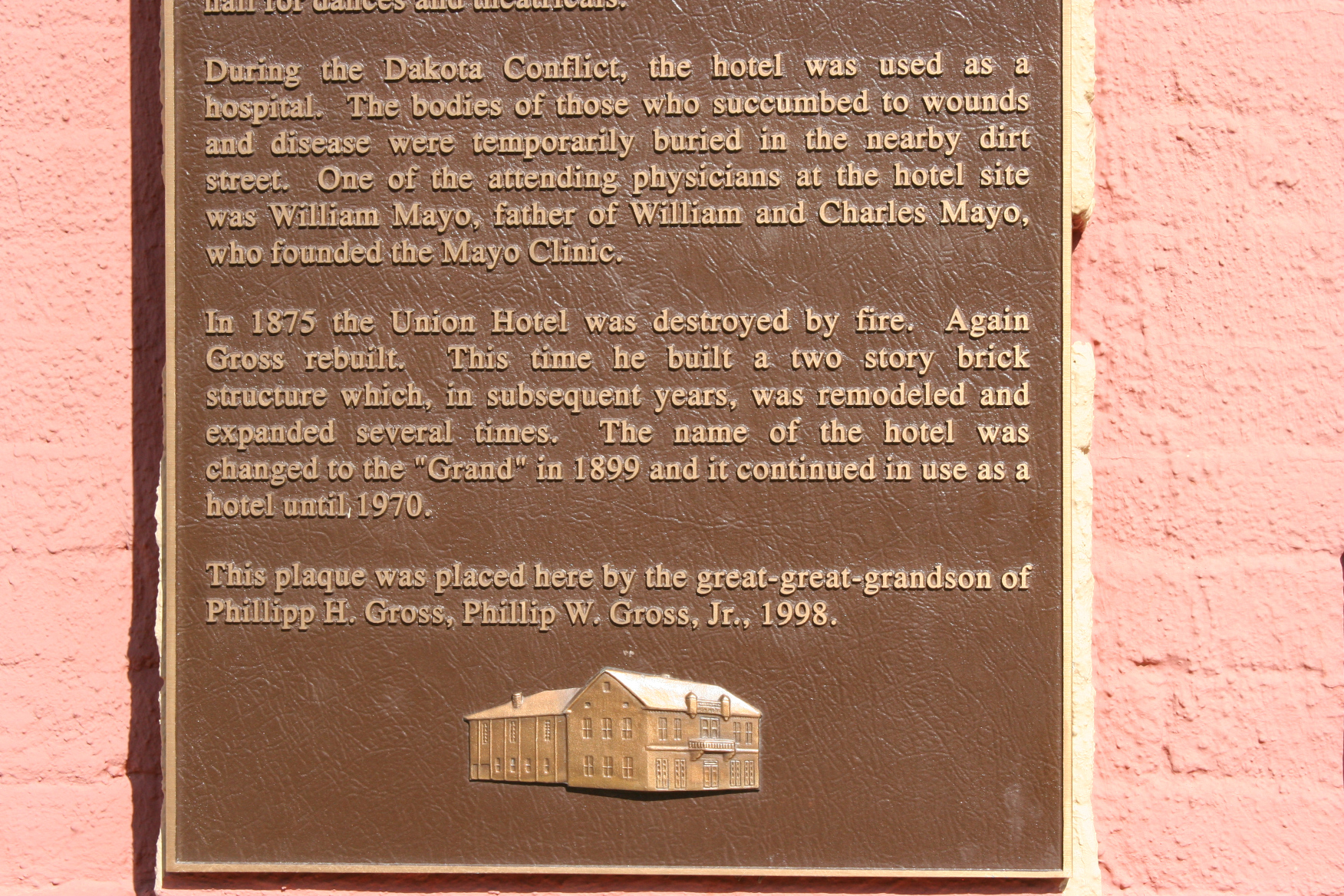
A portion of the historical plaque outlining the history of the former Grand Hotel, now an arts and cultural center in New Ulm.
A front face plaque summarizes its history. You’ll find such historical info throughout this downtown on plaques, benches and even picnic tables. I appreciate the easy access to history.
Outside the front entry to The Grand Center for Arts & Culture in New Ulm.
Inside the arts center, the first floor features a gift shop brimming with great art and, across the hall, The Grand Kabaret, for entertainment/the performing arts. Downstairs, the basement houses Cellar Press, a letterpress and printmaking studio, which I didn’t see (but must).
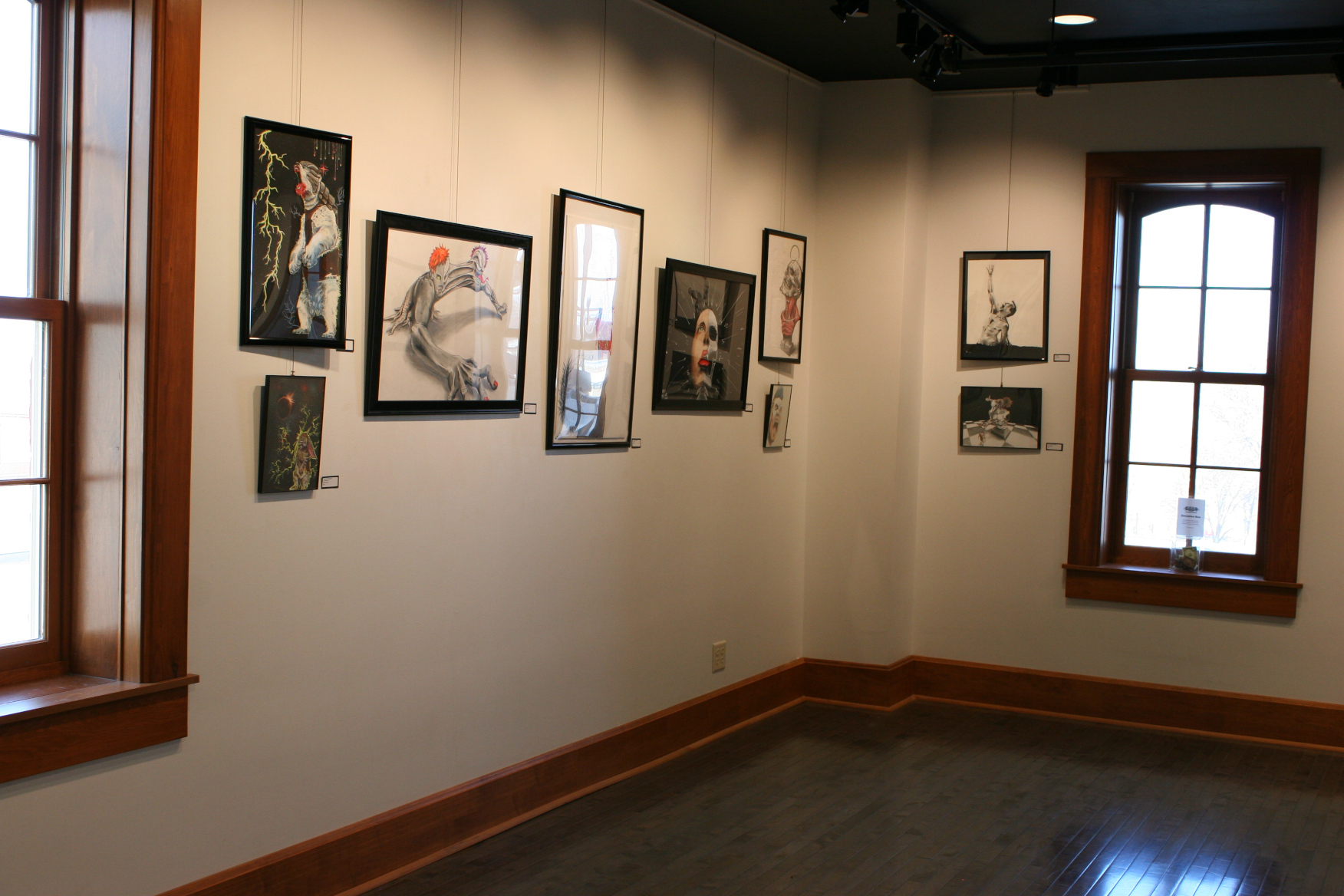
Light floods the gallery, on these walls the art of Sam Matter.
A steep flight of stairs leads to 4 Pillars Gallery and studio space on the second floor. The compact gallery, with abundant natural light flowing into the room, feels intimate, inviting, ideal for showcasing art.
Musician portraits by Caitlin Lang.
Caitlin Lang of Springfield and Sam Matter of New Ulm are the current featured artists in a joint mixed media exhibit, “Intentionally Accidental.” Their show runs through April 3.
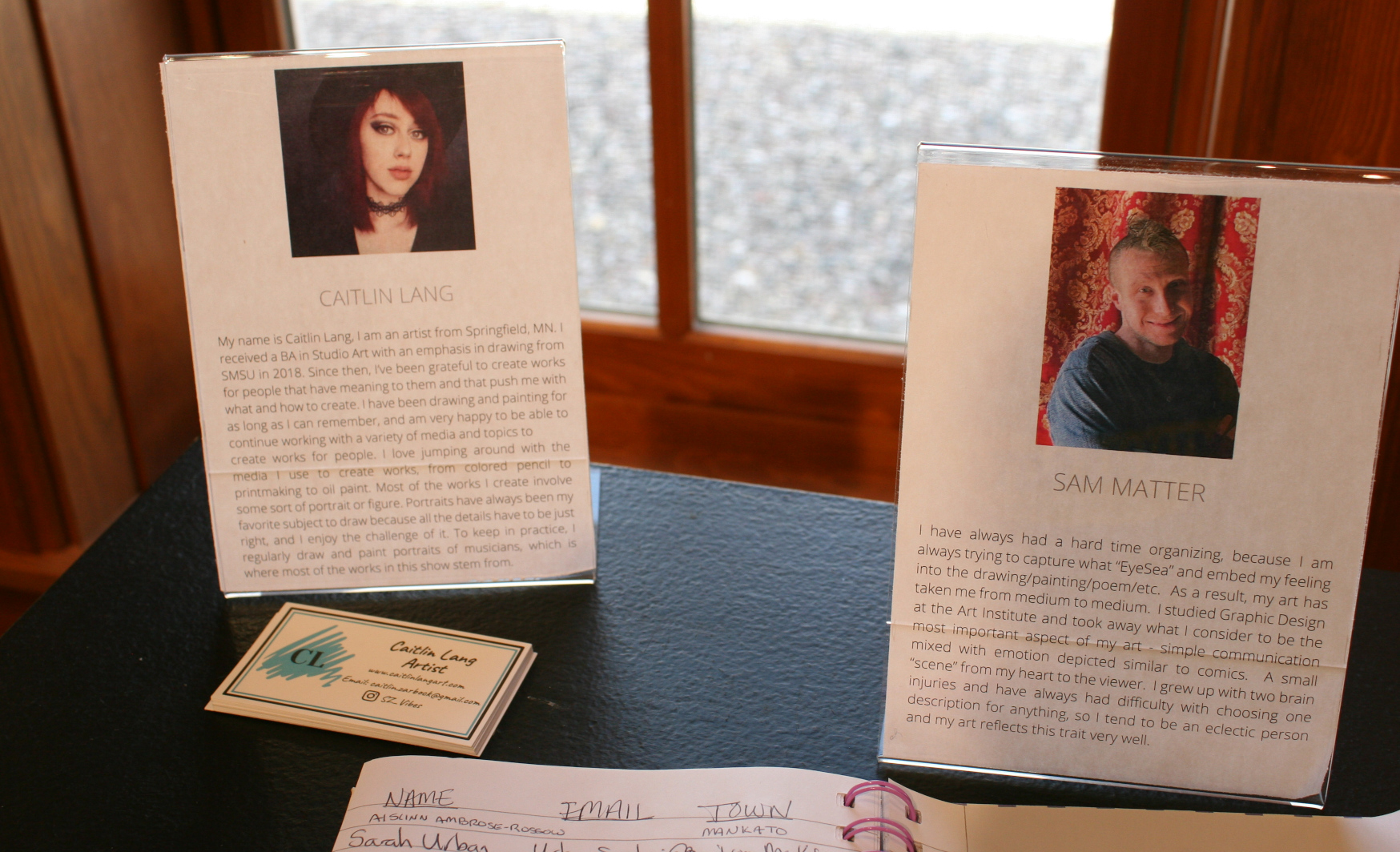
The bios of Caitlin Lang and Sam Matter, along with a guestbook, sit on a table in the gallery.
What a joy to see the work of these two young artists. Lang specializes in portraits and Matter describes his art as “a small scene from my heart to the viewer.” I love that poetic description.
Sam Matter’s art, created from the heart.
And I love this center for arts and culture, a must-see in New Ulm.
#
FYI: The Grand Center for Arts & Cultureis changing its hours starting March 23 and will be open from 11 am – 4 pm Tuesday – Saturday.
#
Please check back for more photos from the arts center.
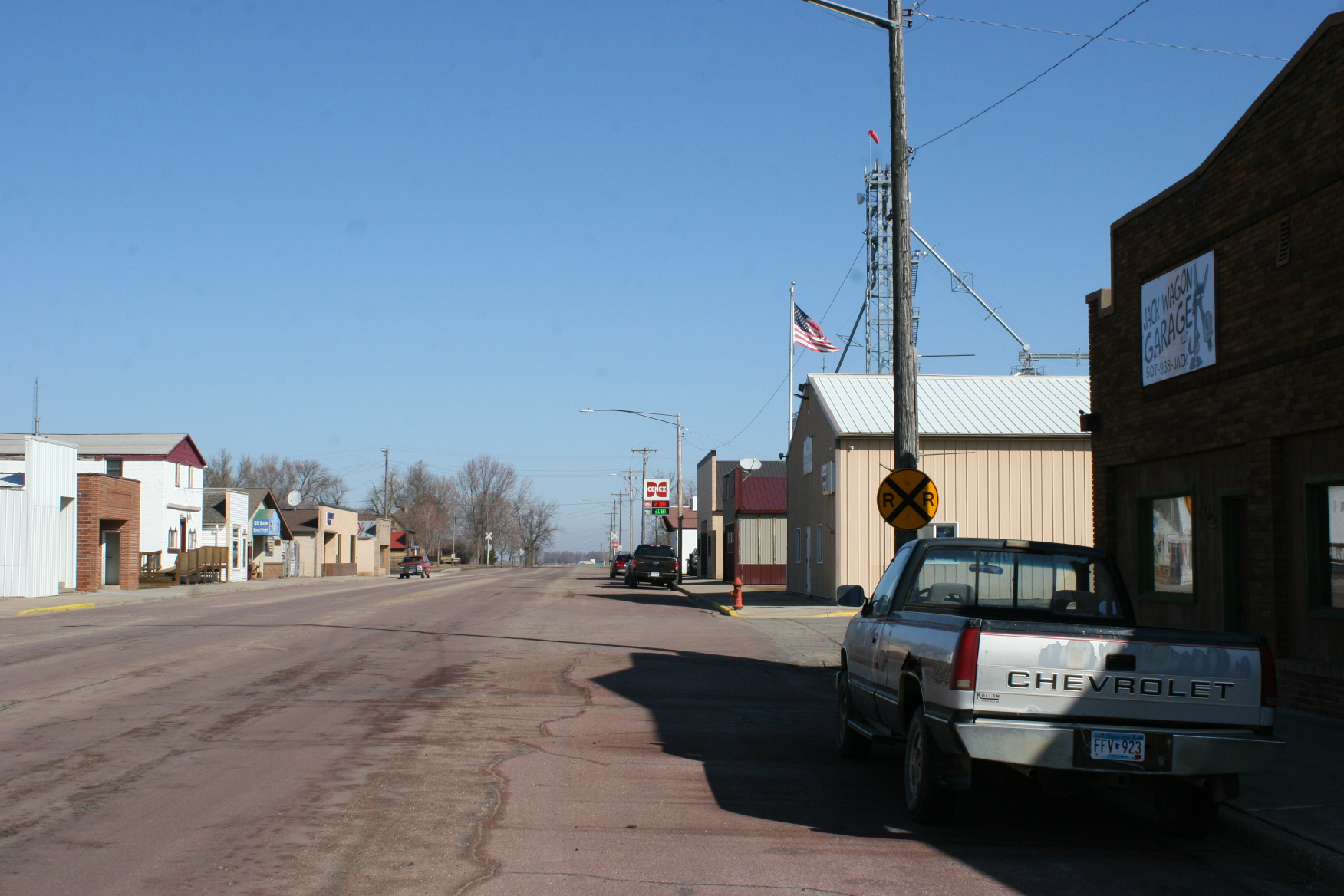
Belview, located in southwestern Minnesota, some seven miles from my hometown of Vesta.
FOR THOSE OF YOU who’ve followed my Minnesota Prairie Roots blog for awhile, you understand that I value small towns. They are a favorite destination, an escape of sorts back to my rural prairie roots. To a less-populated place, typically rooted in agriculture.
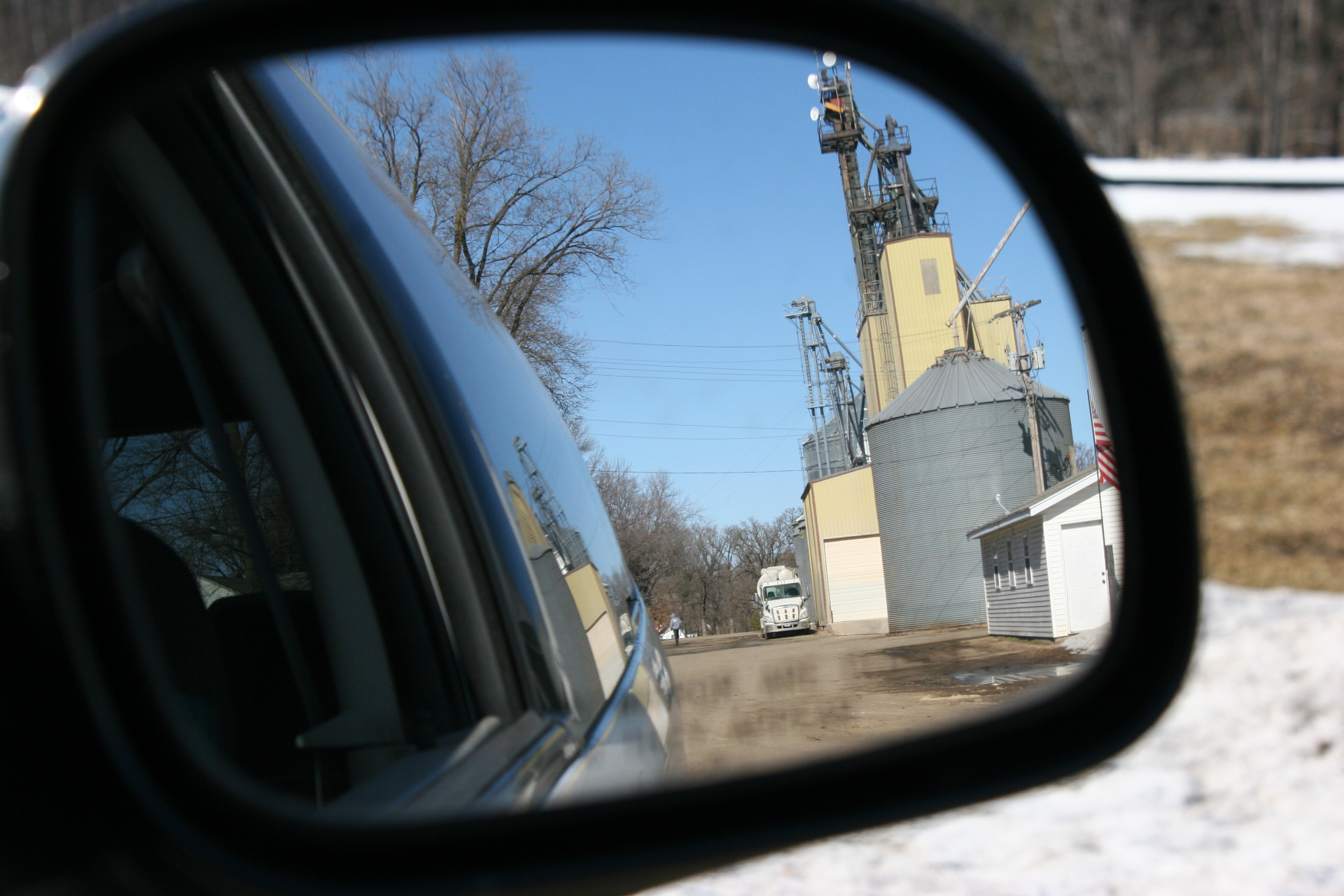
The grain complex in unincorporated Bixby in Aurora Township in Steele County, MN, reflects in the passenger side mirror.
That said, I recognize that my definition of a “small town” may differ from yours. I view small towns as communities with populations of several thousand or less. I would not, for example, consider my city of Faribault to be small. Others would given its population of around 24,000.
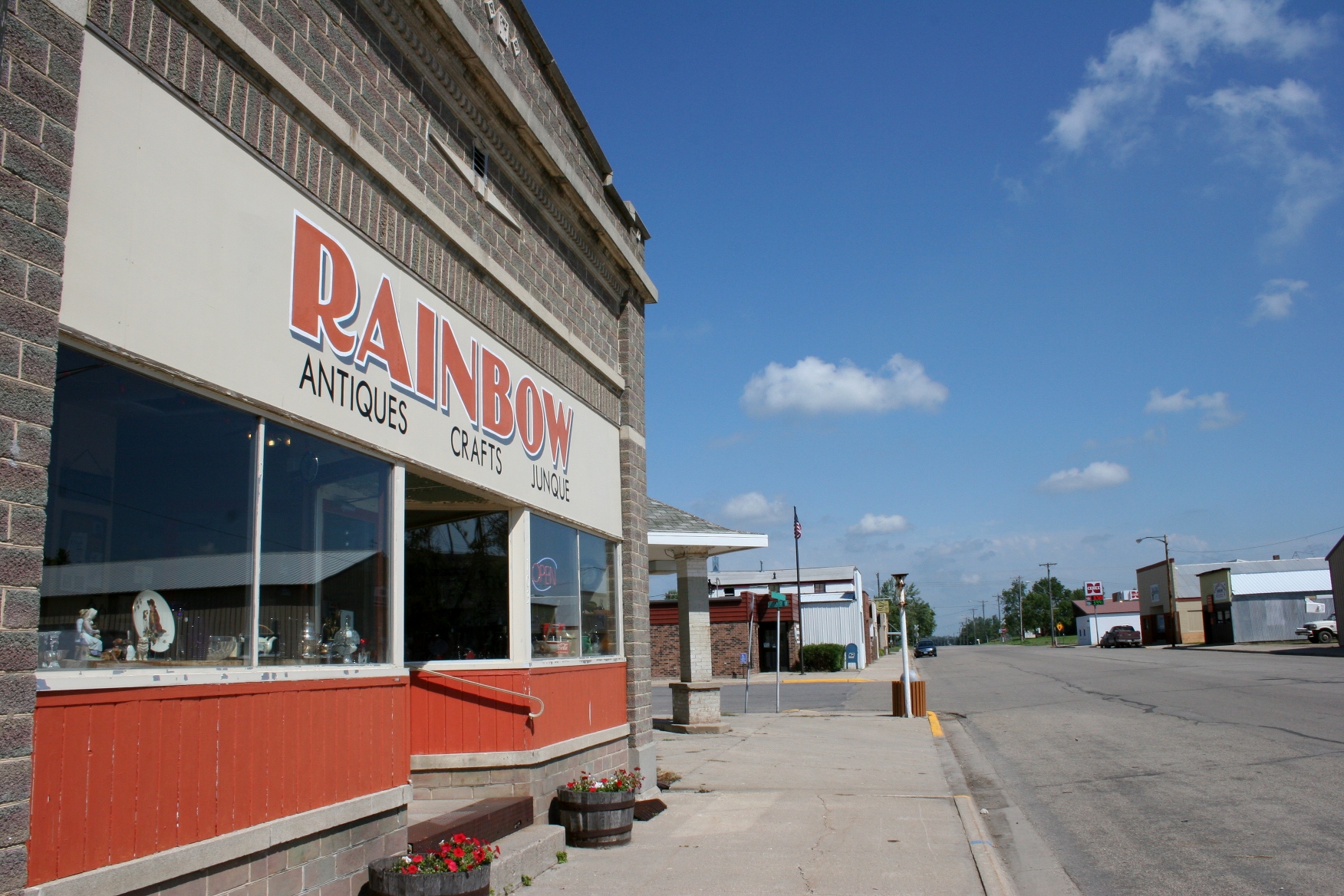
A favorite stop (when it’s open) is Rainbow Antiques, Crafts & Junque in Belview. Other attractions in Belview include the historic Odeon Hall, Rock Dell Lutheran Church, rural Belview, and Grandview Valley Winery, to the north of town. Minnesota Prairie Roots file photo August 2011.
What draws me to small towns, to photograph and write about them, beyond my desire to reconnect with rural places and share my finds?
I love this kitschy bar stool atop the City & Country Tavern roof overhang in Morgan in southwestern MN.
It’s discovering nuances of character. It’s connecting with people. It’s the architecture and oddities and so much more. Exploring small towns is like taking a basic sentence and enhancing the main subject with adjectives.
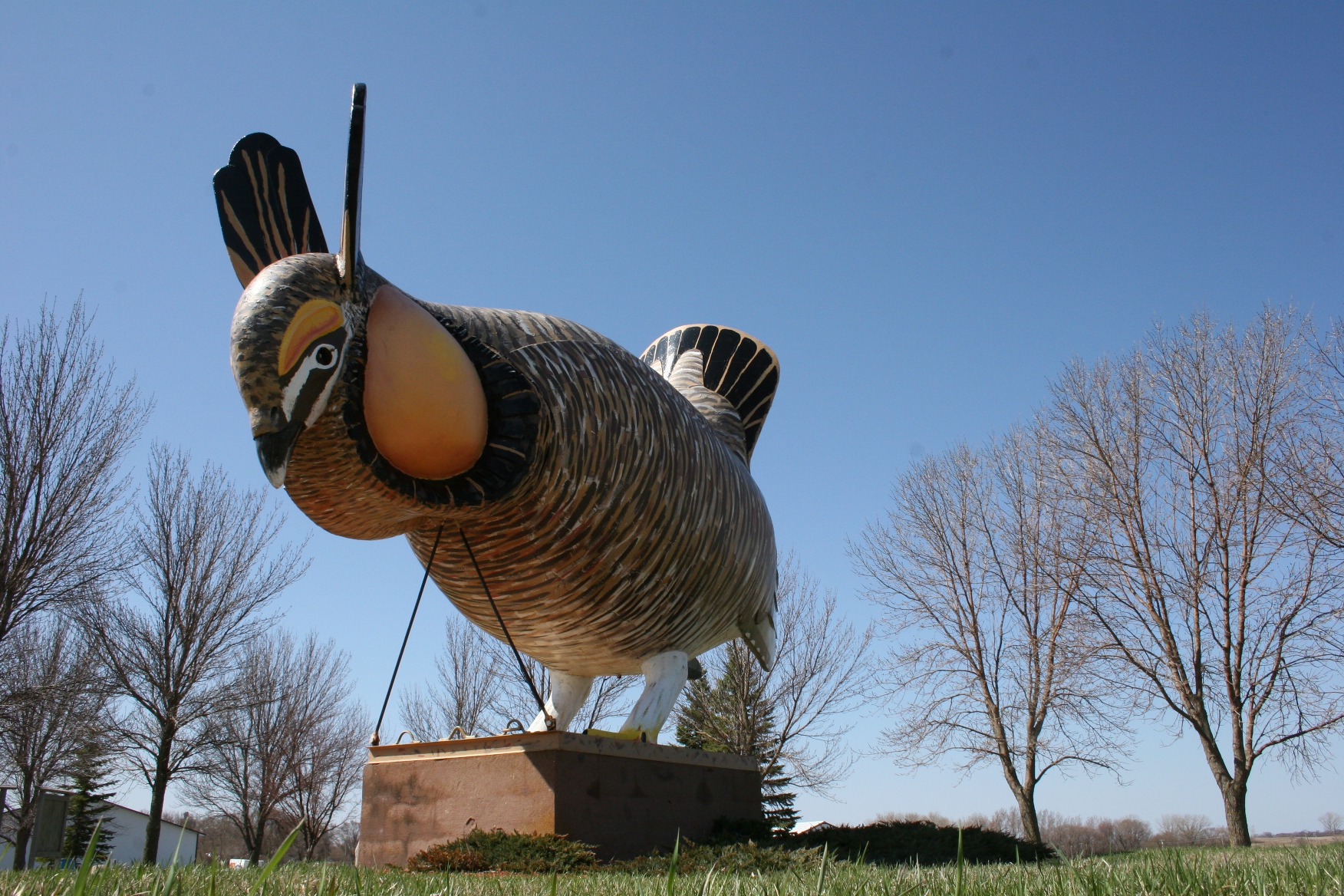
This prairie chicken statue along Interstate 94 in western Minnesota celebrates the real prairie chickens which reside in the Rothsay area. Minnesota Prairie Roots file photo May 2013.
Yet, I realize not everyone appreciates language like I do. All too often, small towns are bypassed or driven through—seemingly not a place that would attract visitors. But I am here to tell you they are worth the detour off the interstate, the destination for a day trip, the stopping on Main Street.
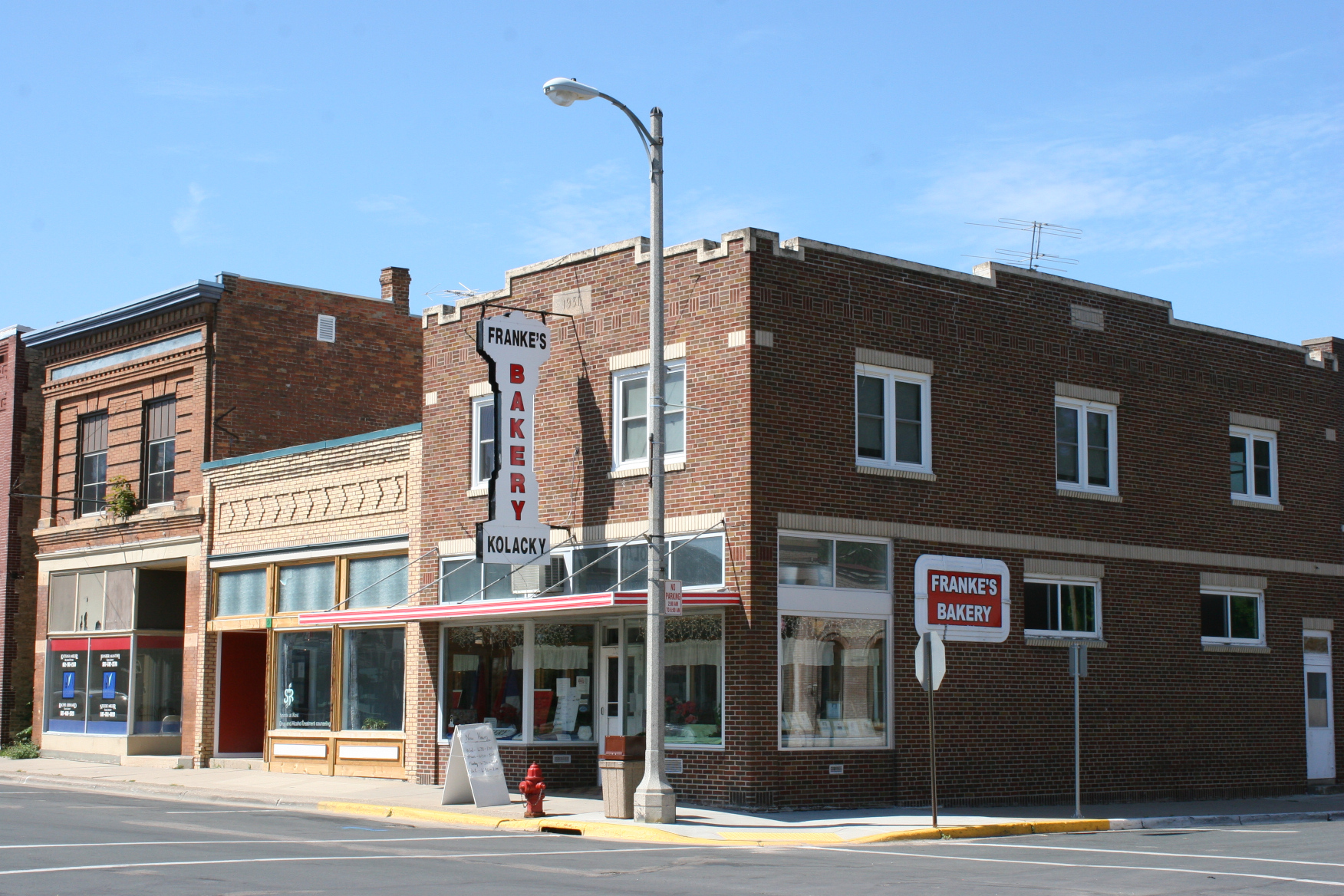
Popular Franke’s Bakery anchors a corner in downtown Montgomery, MN. Minnesota Prairie Roots file photo August 2020.
Montgomery, Minnesota, for example, is one of my favorite nearby small towns. Why? I love going to Franke’s Bakery, a staple in this community for 100-plus years. The bakery specializes in Czech treats, in this self-proclaimed Kolacky Capital of the World. Across the street from the bakery, a mural tells the history of this town. Aged buildings line the main business district, with home-grown shops and eateries and bars. The adjectives enhancing the main subject.
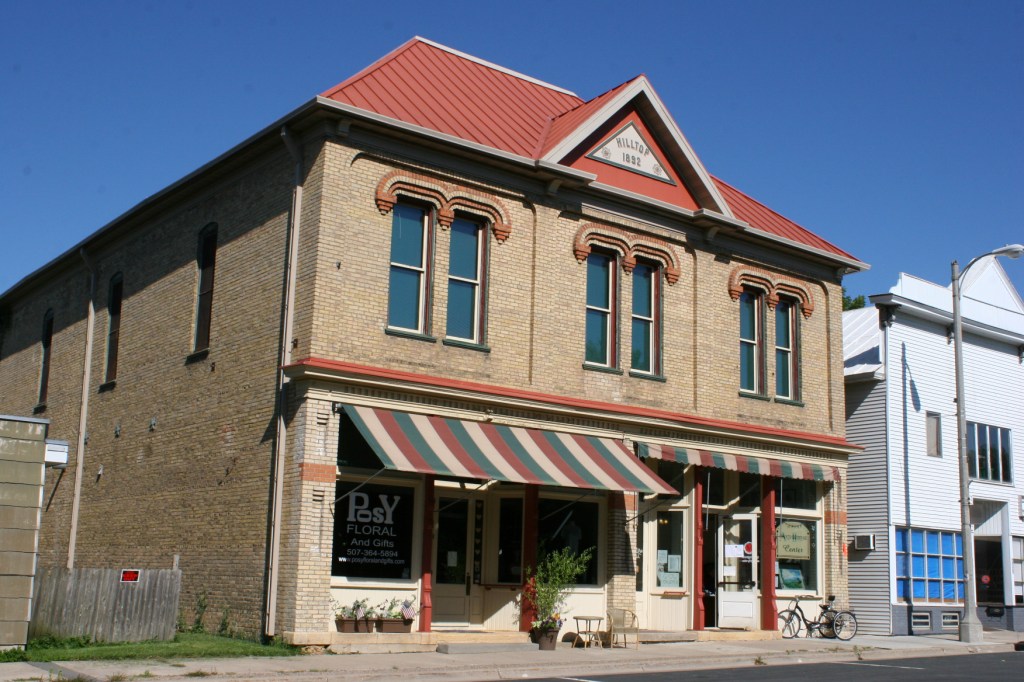
The Montgomery Arts & Heritage Center, right, and Posy Floral, left, along First Street North on the north end of downtown Montgomery, MN. Minnesota Prairie Roots file photo August 2020.
The Montgomery Arts and Cultural Heritage Center and Montgomery Brewing also draw me to this Le Sueur County community. And the signs and architecture.
The good folks of Montgomery have branded their community, tapping into their heritage and then building on that to create a place that attracts visitors. I think potential exists in every small town to do the same. And it starts with recognizing the strengths, the uniqueness, of a community. I know that requires time, money and effort. But, oh, the possibilities.
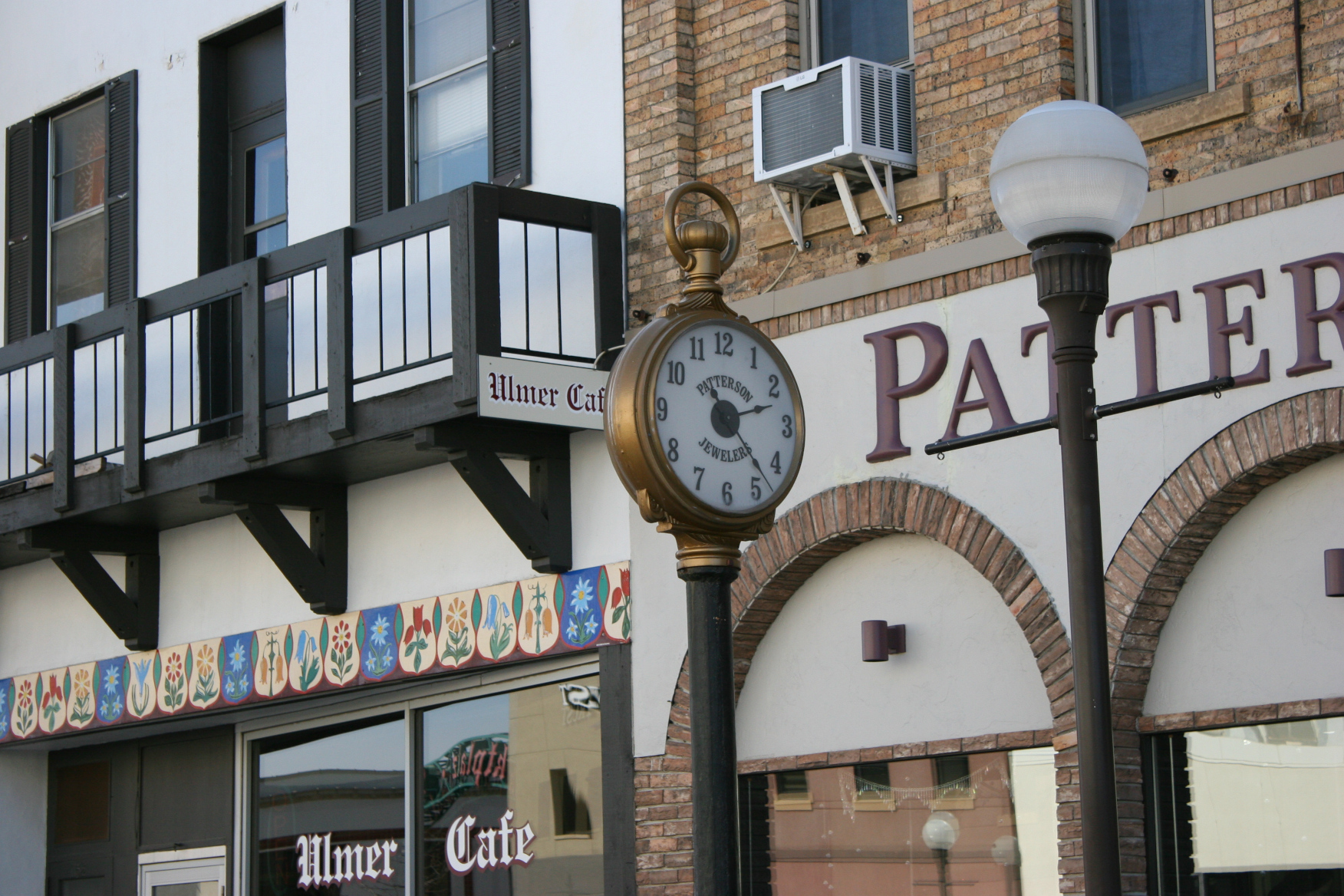
The community of New Ulm is home to many home-grown restaurants, like the Ulmer Cafe.
I, for one, love small town bakeries, antique shops, thrift stores, art centers and home-grown cafes with meal offerings that are crafted by hand, not pulled from a freezer and heated. I recently saw a sign for Beef Commercials in New Ulm. I haven’t eaten one—roast beef layered between slices of white bread, topped with a dollop of mashed potatoes and smothered in gravy—for years. Had it been meal time and not a pandemic, I may have stopped to indulge in nostalgia.
A thriving grocery store in small town Ellendale, MN.
Now I know every community can’t tap into heritage like New Ulm and Montgomery. But, each place truly possesses potential to attract visitors. In Ellendale, for example, the award-winning Steve’s Meat Market draws meat lovers. I am partial to Lerberg’s Foods and its worn wooden floor, narrow aisles and aged moose head looming over cans of stacked corn.
Outside the local hardware store in the downtown main business district, this heart art shows pride, marketing savvy and identity in Blooming Prairie. This small town is located in southern Steele County, south of Owatonna.
I delight in such discoveries. Kitsch. Identity. A strong sense of place and pride. I hope that, by sharing my thoughts and photos, you, too, will view small towns through a lens of appreciation.
TELL ME: Have you discovered a small town that you just love. I’d like to hear.
PLEASE CHECK BACK as I expand on this post with more photos from some of the communities featured here.
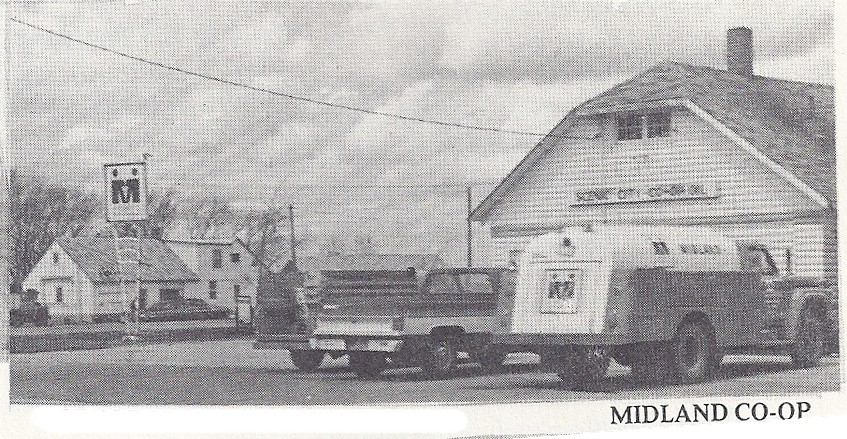
My uncle’s gas station with the fuel delivery truck parked by The Old Log Cabin. Photo from Envisioning a Century, Vesta, 1900-2000. The Miland station and the restaurant across Highway 19 in Vesta no longer exist. Minnesota Prairie Roots file photo.
GROWING UP IN SMALL TOWN Minnesota in the 60s and 70s, I saw local businesses thriving. There were two hardware stores, two grocery stores, a lumberyard, feed mill, grain elevator, bank, restaurants, corner bar, barbershop, several service stations, post office and more in my hometown of Vesta, population 365. But today, the one-block Main Street stands mostly empty, pocked by vacant lots from long-ago torn down buildings. A few businesses remain. The elementary school closed decades ago.
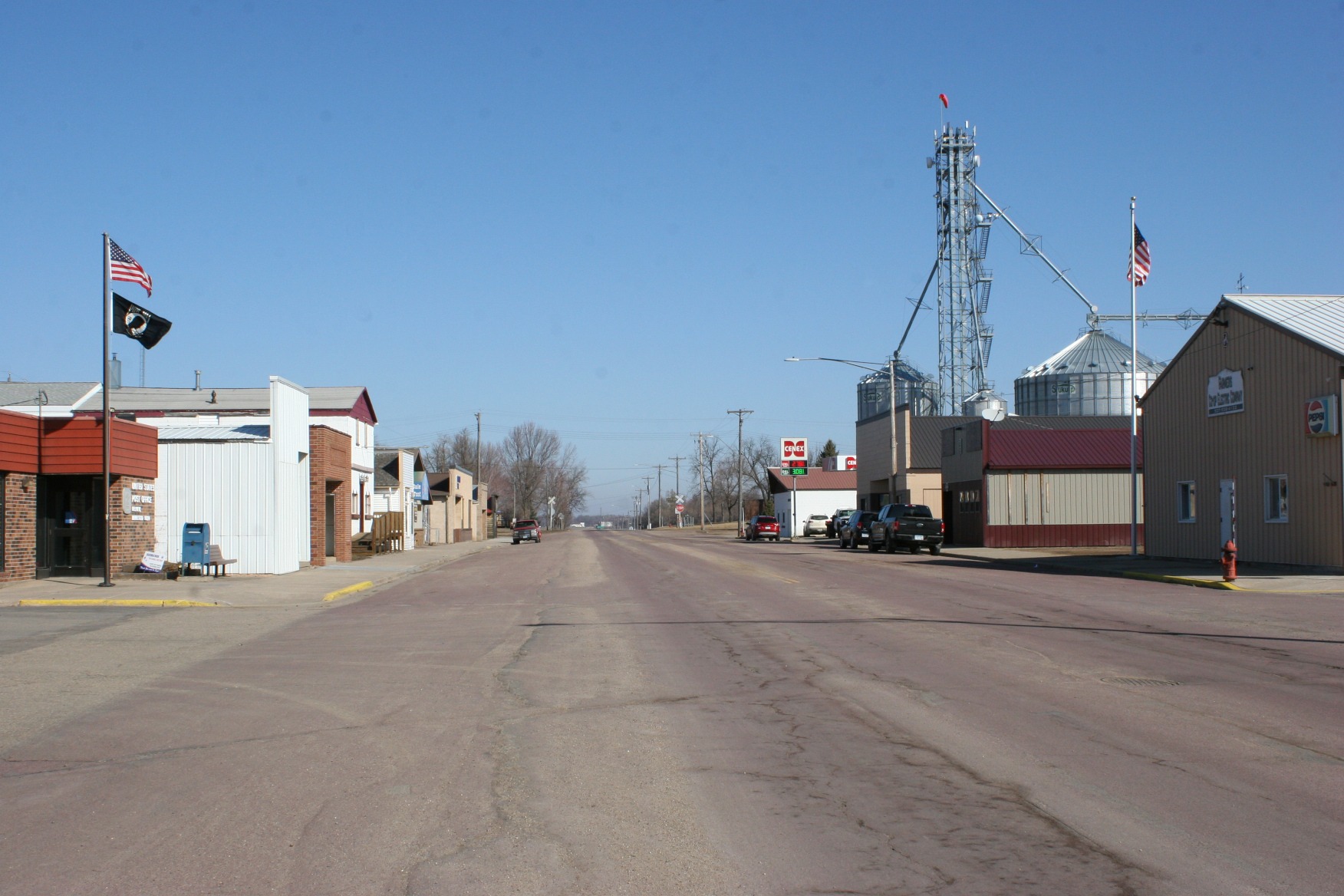
Downtown Belview, Minnesota, photographed last Saturday, March 13, 2021.
In Belview seven miles to the north and east, the story repeats. I recall driving to Belview with my grandma in the early 1970s to shop for fabric so I could sew dresses for her. That dry goods store is long gone. Belview has, like most rural communities, experienced the closure of many businesses as locals headed to regional shopping hubs to shop at Big Box stores and also embraced online shopping.
An historic anchor building in downtown Redwood Falls. Sward Kemp Snyder Drug recently moved out of downtown to the new hospital and clinic on the east edge of Redwood.
Likewise, Redwood Falls, to the east of Belview along Minnesota State Highway 19, has changed considerably. That Redwood County seat and the Lyon County seat of Marshall were our family’s go-to larger towns to shop for clothes, shoes and other necessities when I was growing up on the prairie. Last Saturday when Randy and I stopped in downtown Redwood, I found the streets nearly empty and few businesses open. Nothing like the bustling downtown I remember.
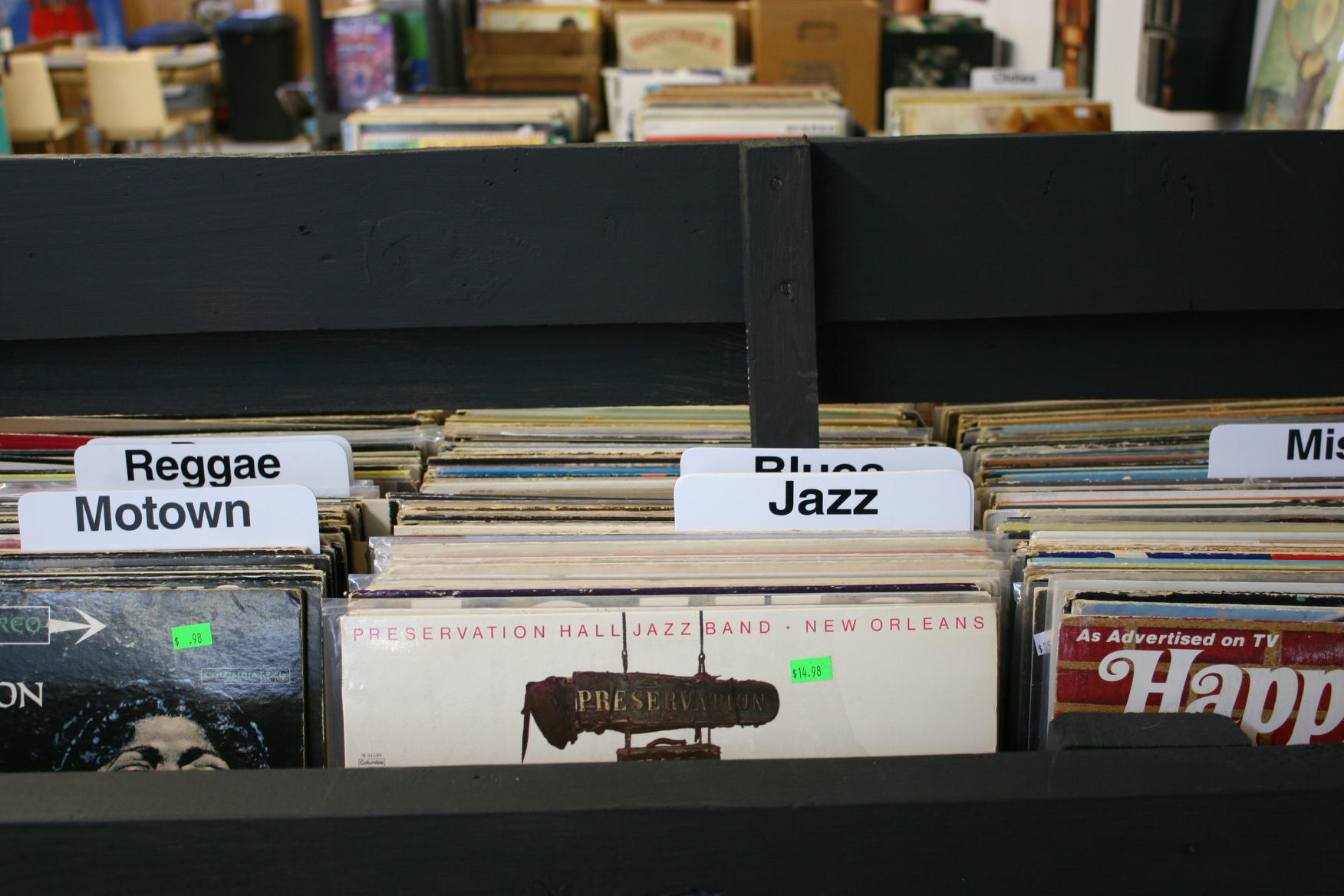
Vintage Vinyl, a newly-opened business in the heart of Redwood Falls.
I can sit here and write about this with nostalgia and sadness, wishing these rural communities remained self-sufficient. But wishes are not reality. And wishing does not change things. Action does.
An overview of Vintage Vinyl, packed with albums plus gaming and trading cards, books, video games, DVDs and VHSs, figurines and more. The tables provide a place for folks to play checkers, etc., and/or just hang out.
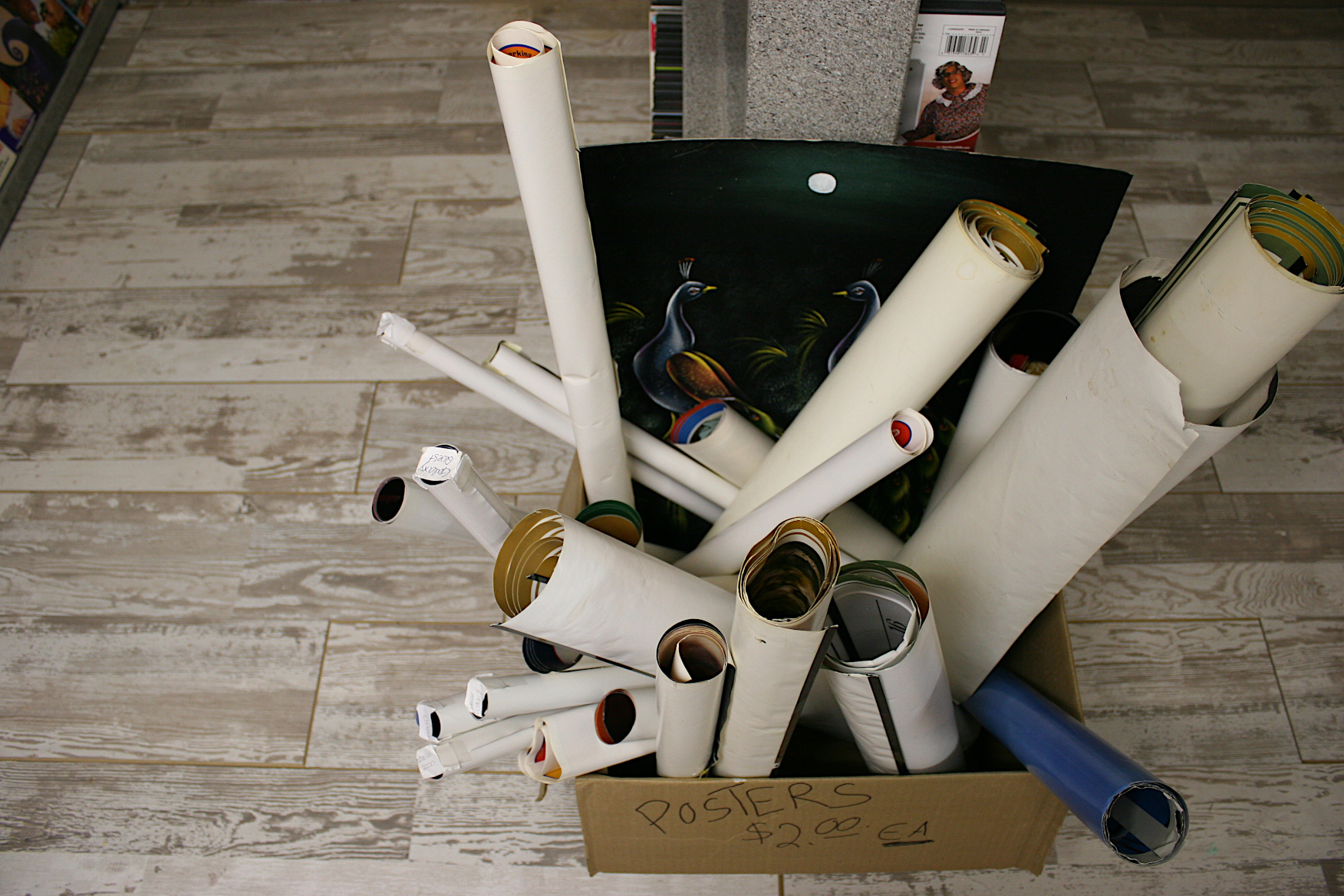
Looking for a poster? You’ll find them in Nate’s shop.
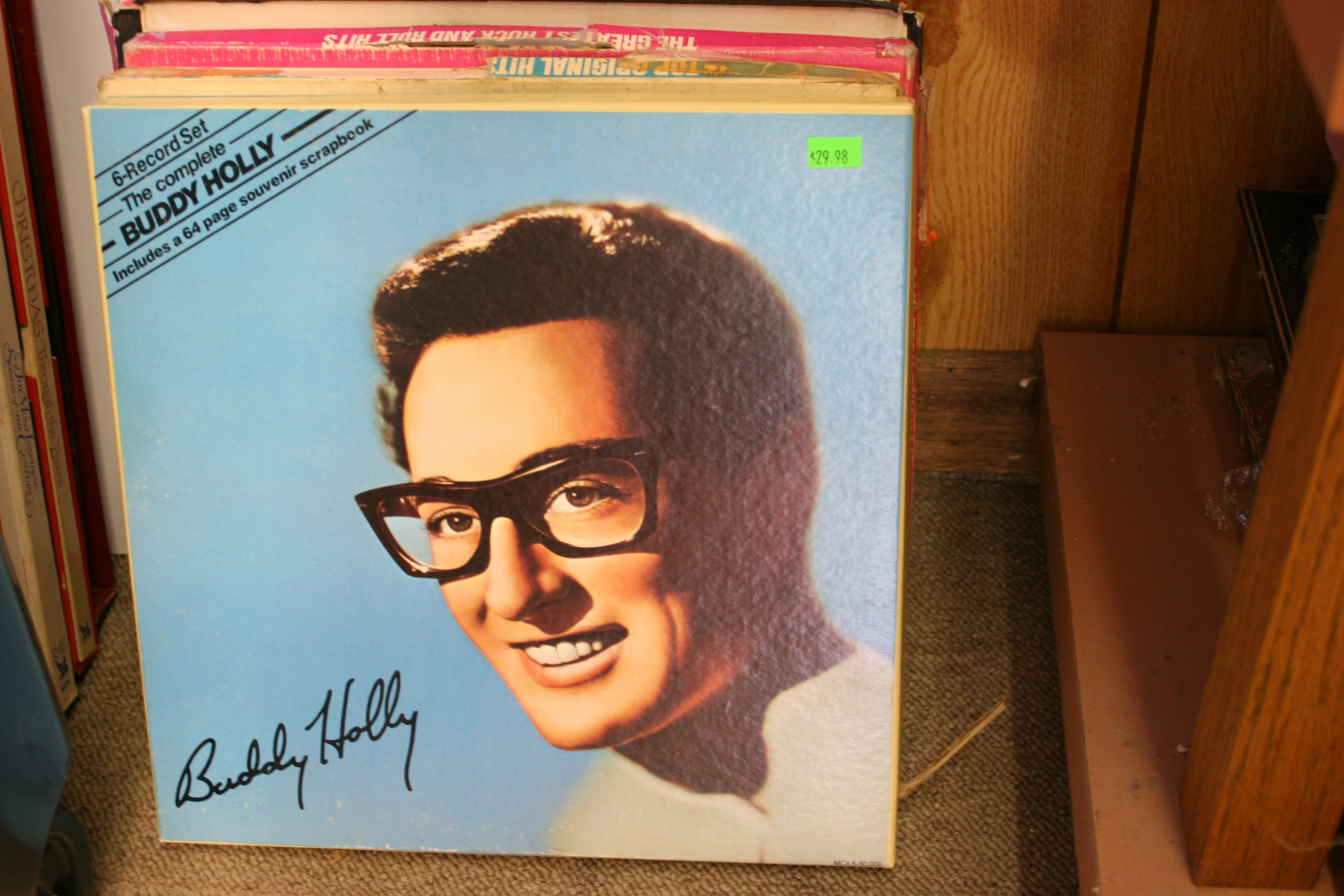
I spotted this Buddy Holly album leaning against the wall on the floor.
In the basement, an array of merchandise.
He’s friendly, outgoing, welcoming. Everything you want in a shopkeeper. But Nate also carries a sense of responsibility, it seems. He recently-returned to his home area after a stint with the military that took him around the world. He could have settled elsewhere. But he chose to return to his roots. (He graduated from nearby Wabasso High School, my alma mater, in 2004.) That says something.
Endless musical options…
We didn’t chat all that long. But my brief conversation with Nate gives me hope. Hope that his positive attitude, his efforts—including purchasing two arcade games—and his drive will ignite a fire of possibilities.
PLEASE CHECK BACK to read my thoughts on small towns and what draws me to them.
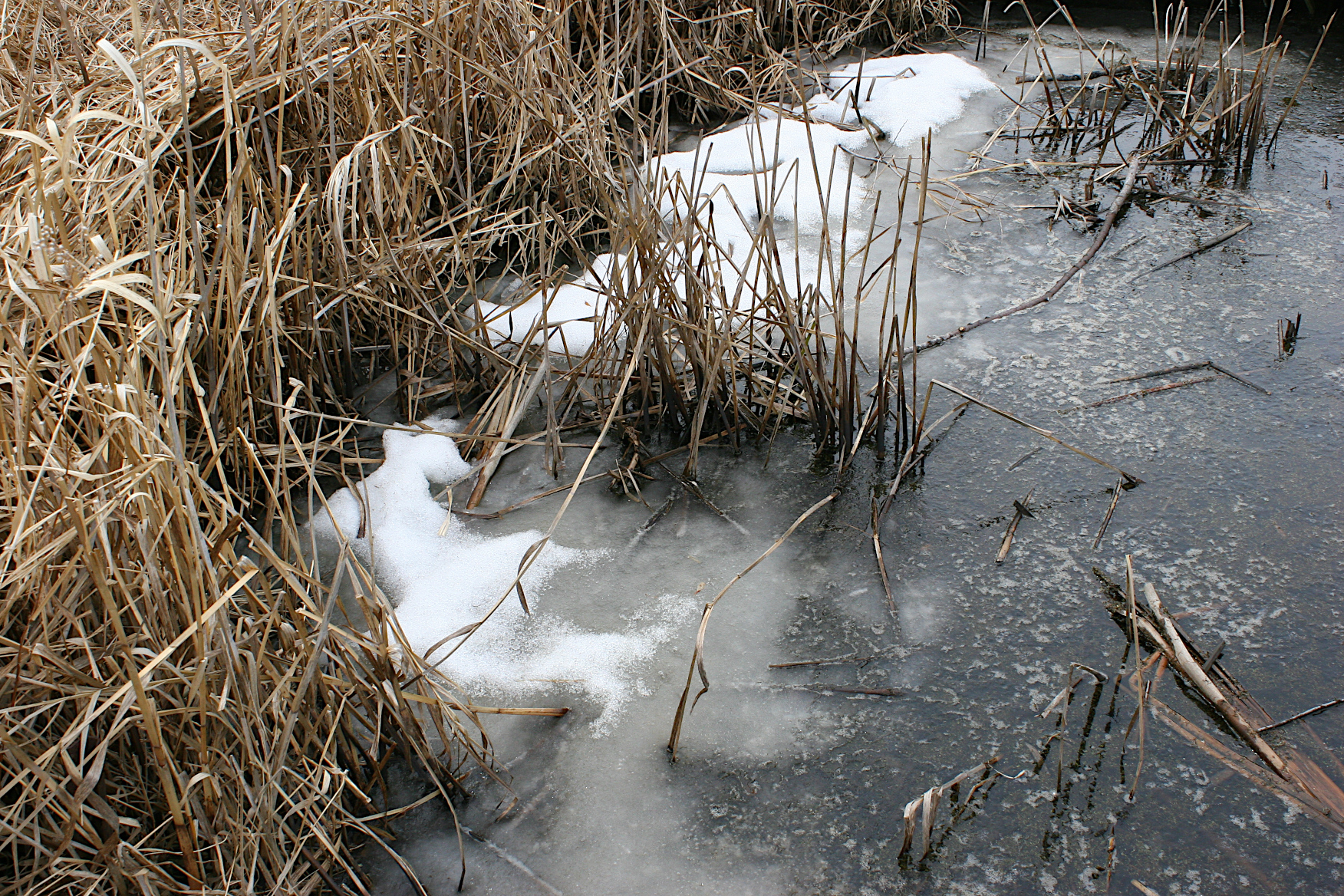
Ice edges a pond Sunday afternoon at River Bend Nature Center in Faribault.
AS I WRITE MONDAY AFTERNOON, snow continues to fall. Steady, for hours and hours. Layering the landscape that, only the day prior, was devoid of snow.
After an especially lovely Saturday of sunshine and 50 some degrees, this return of winter seems like a mean trick of Mother Nature. I rather enjoyed pre-spring. But as a life-long Minnesotan, I expected snow and cold to return. Yet, maybe not with such force, as if the weather has something to prove.
I always carry my camera. And here’s what I found: Natural beauty even in a drab landscape transitioning between seasons.
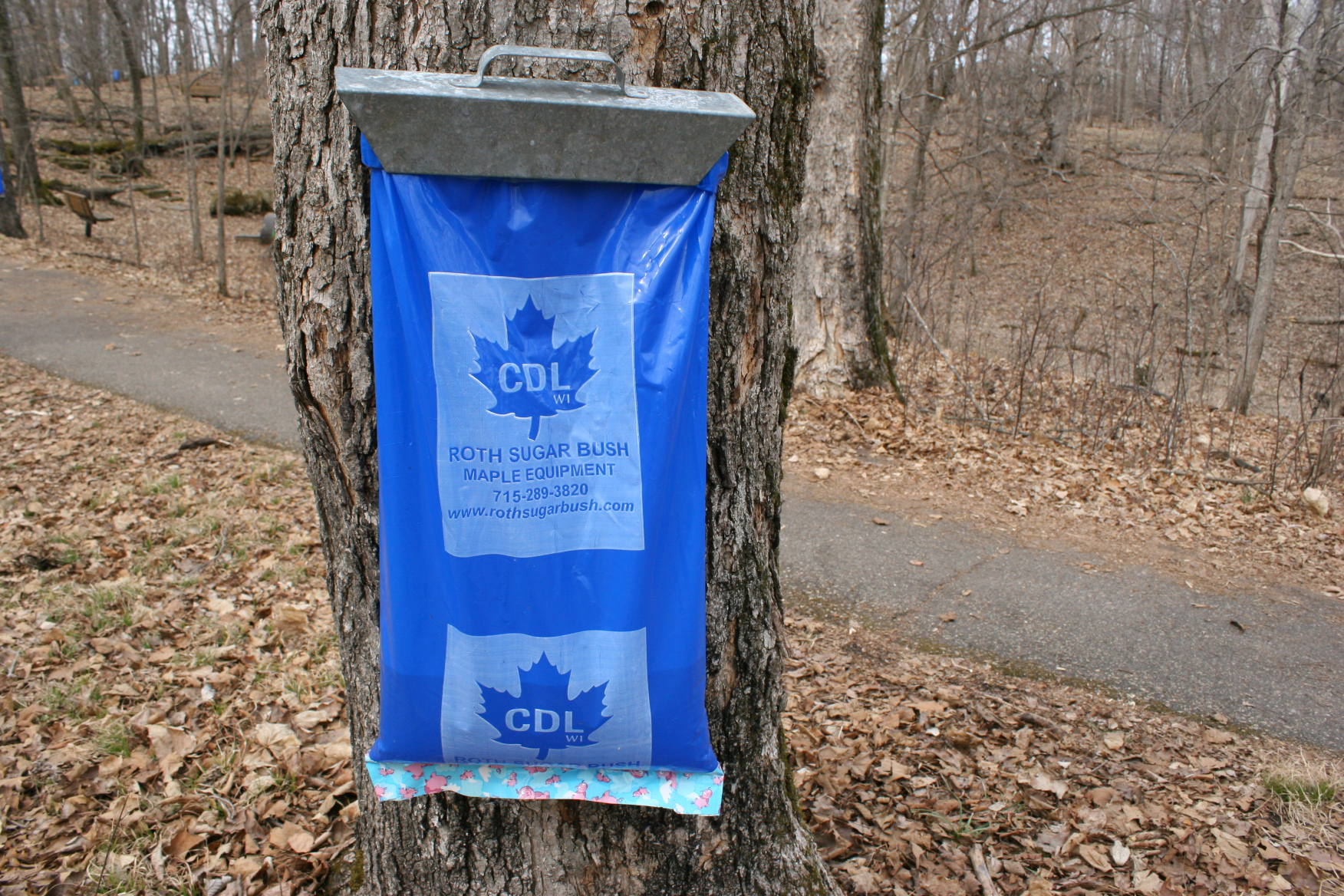
Signs of spring in maple sap collection bags and buckets.
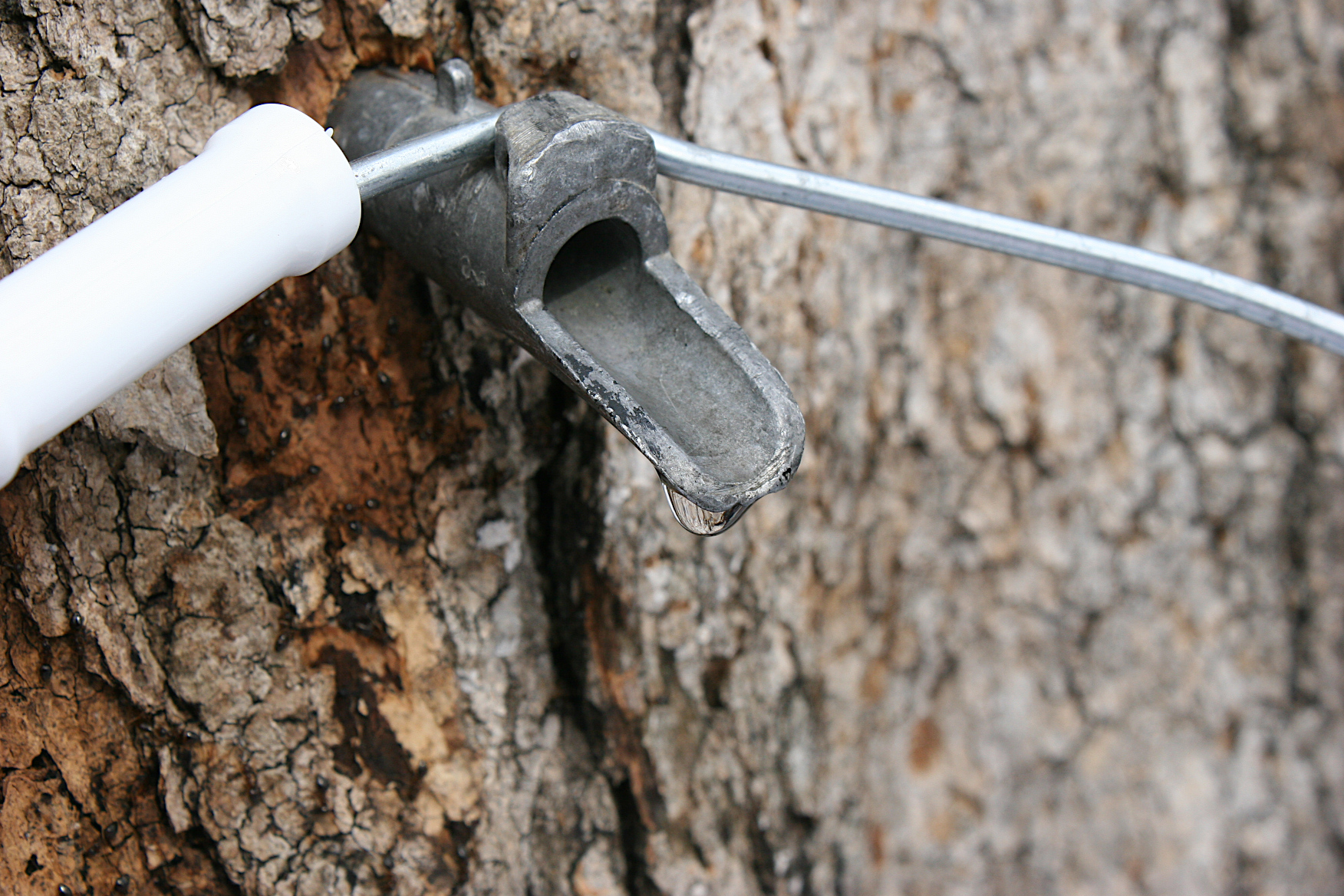
And sap dripping slowly into the containers.
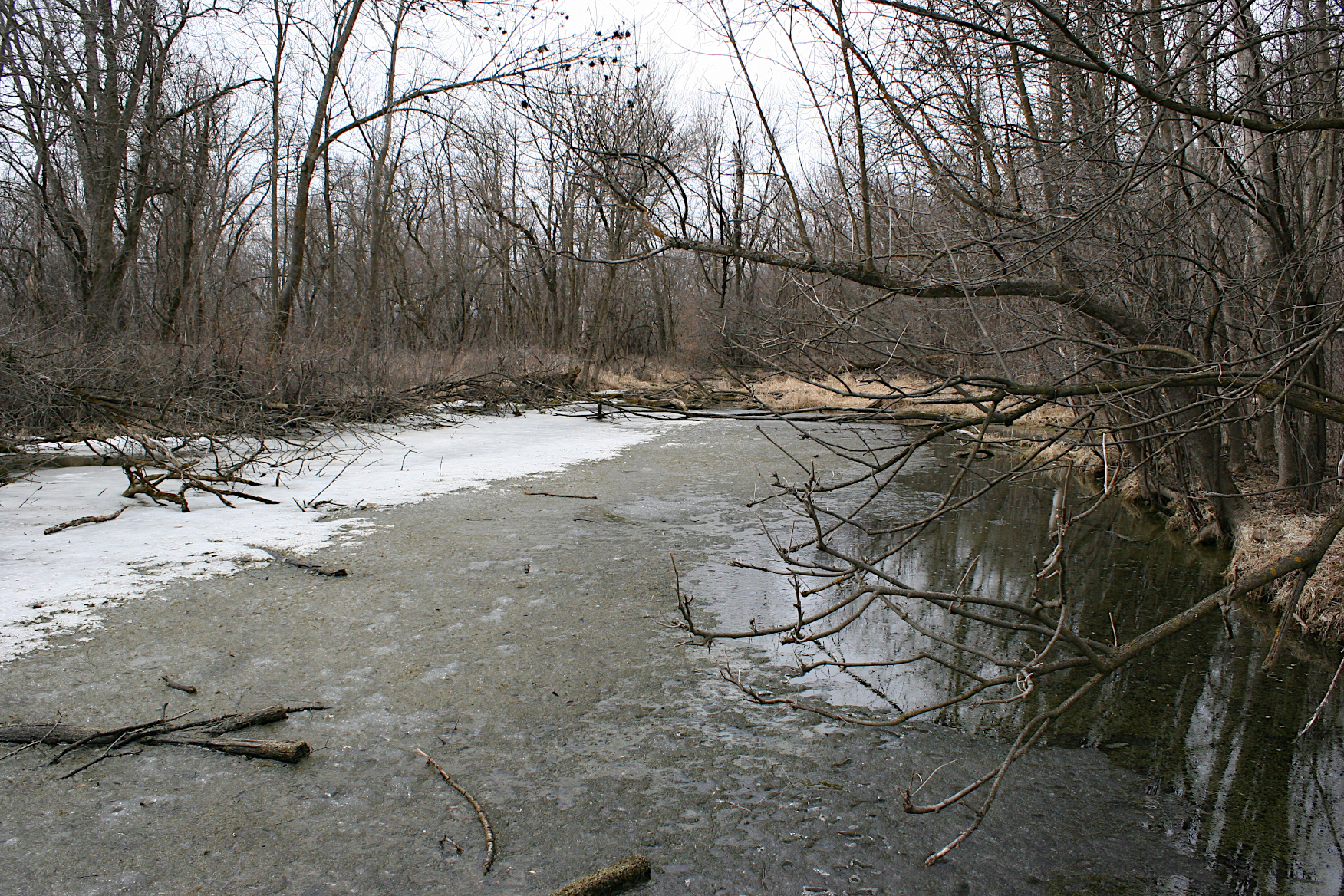
Signs of winter in ice edging the Turtle Pond.
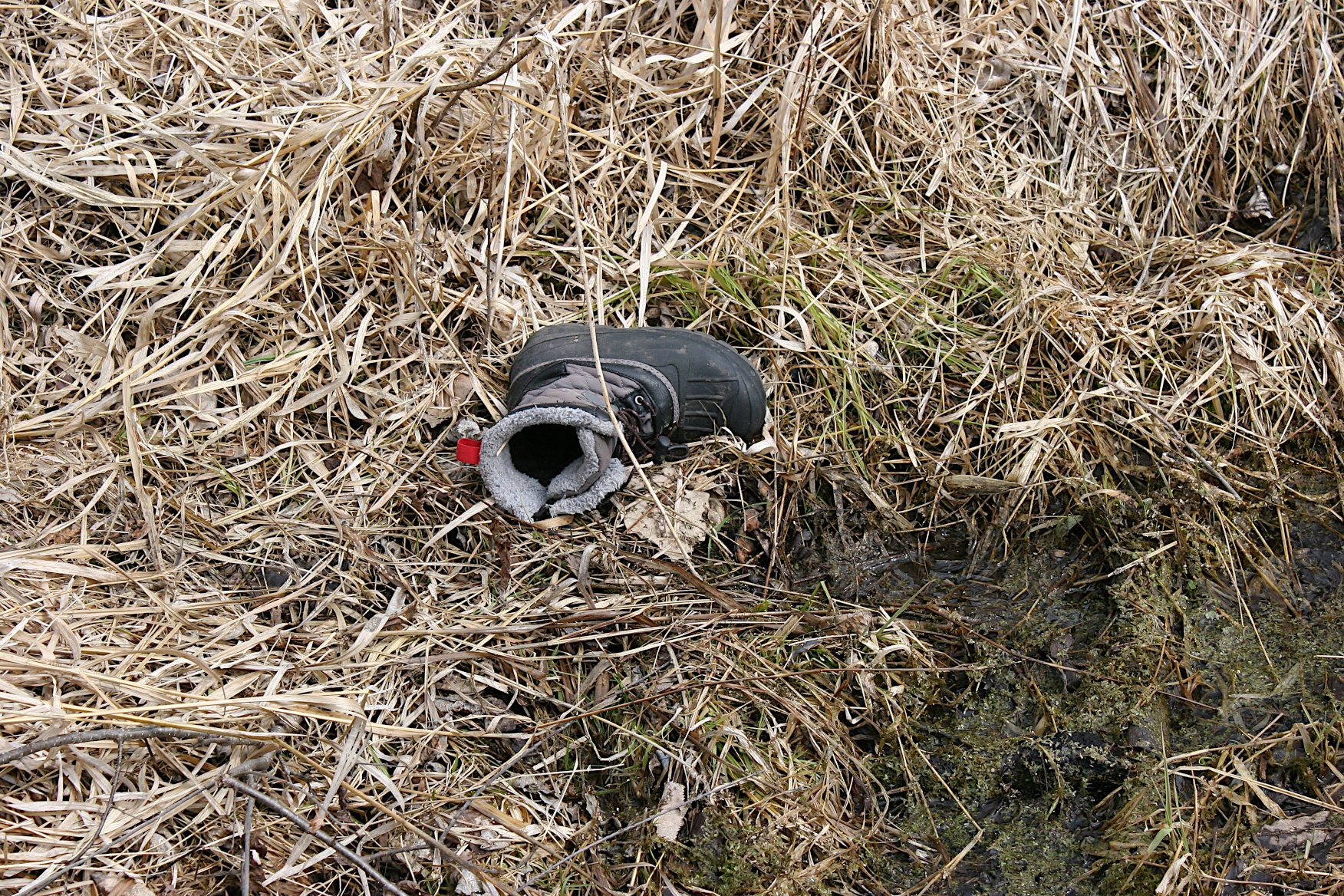
A lone child’s snow boot, which left me wondering how that got lost without anyone noticing.
And the photo I didn’t take of young people clustered along a limestone ledge with their remote control vehicles climbing the layered rock. Limestone was once quarried from this area.
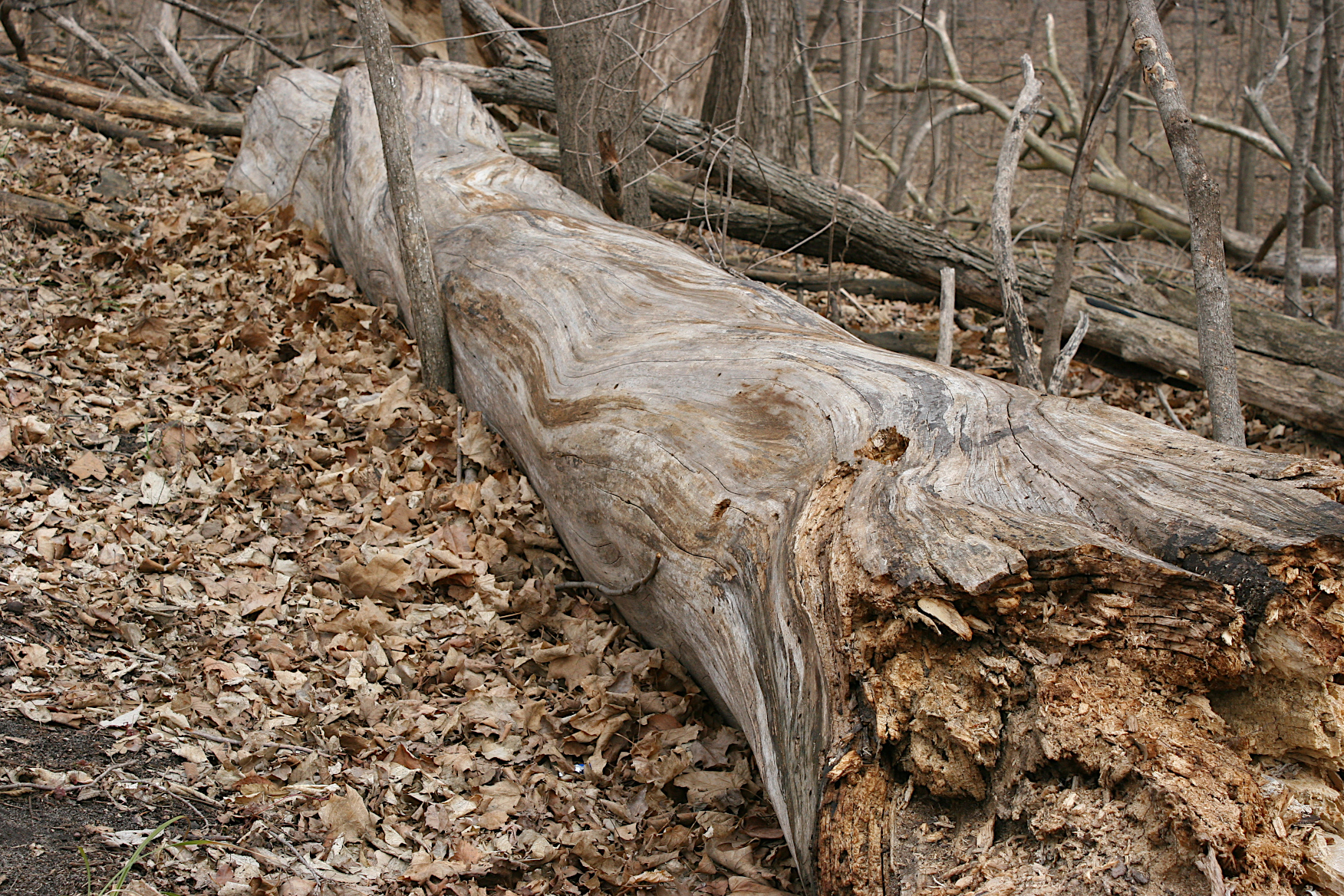
And then the bark-less fallen tree Randy pointed to with shades of brown sweeping like waves lapping at the lakeshore. Artistically beautiful. Poetic.
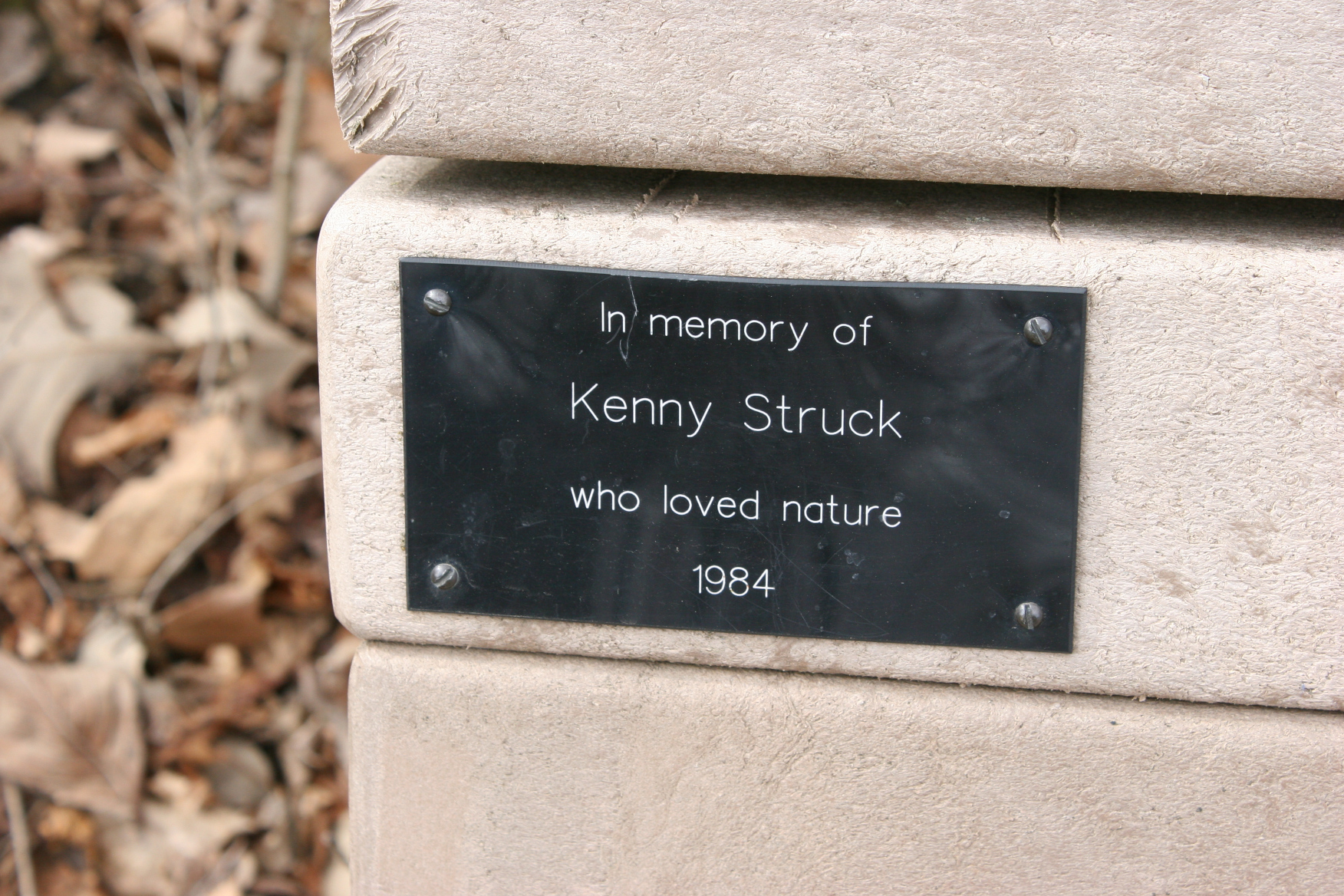
Just like words imprinted upon plaques adhered to memorial benches honoring those who loved this place, this River Bend.
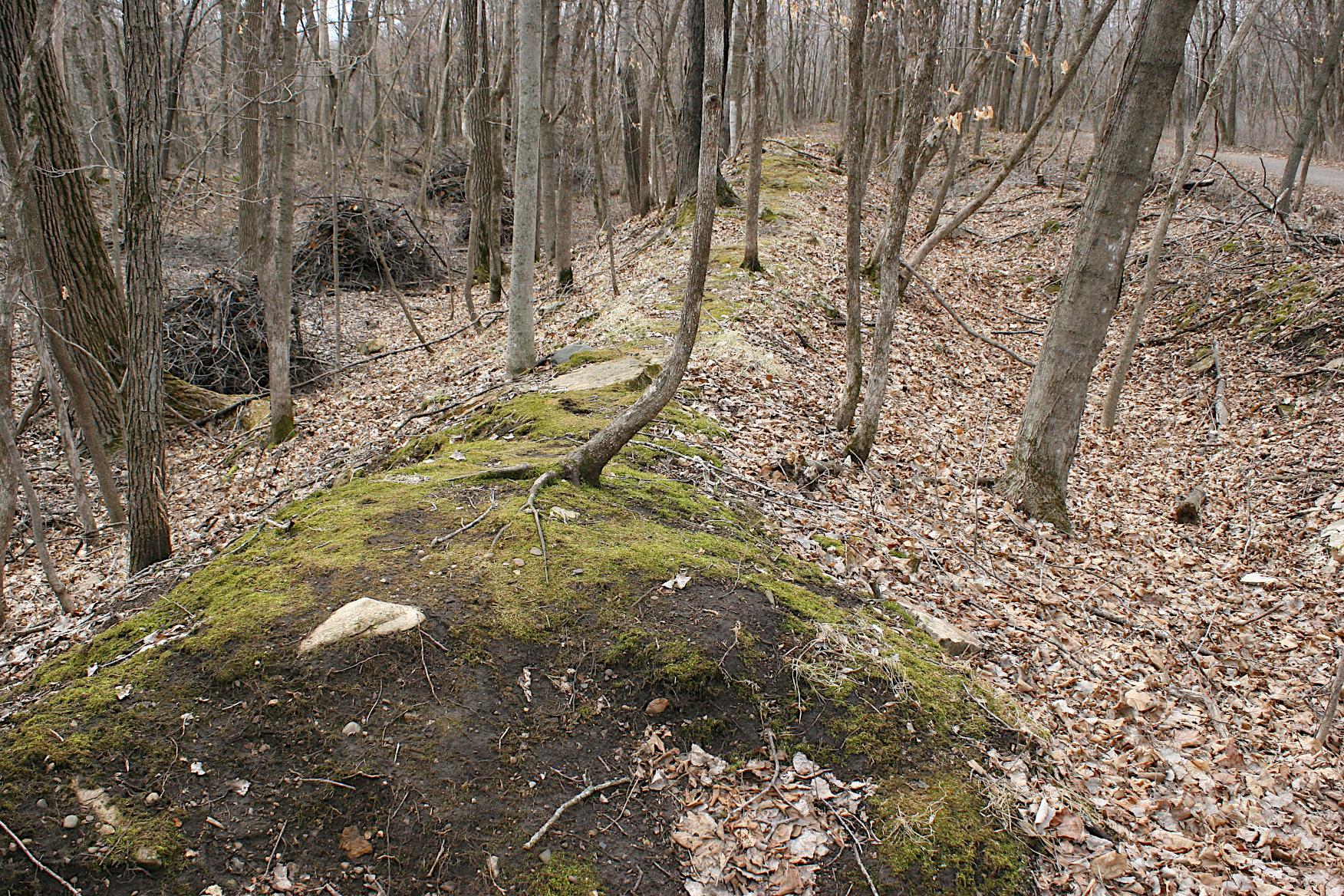
Moss carpeting the ground in a line across a ridge of land in the woods. The only green in a landscape of brown tones.
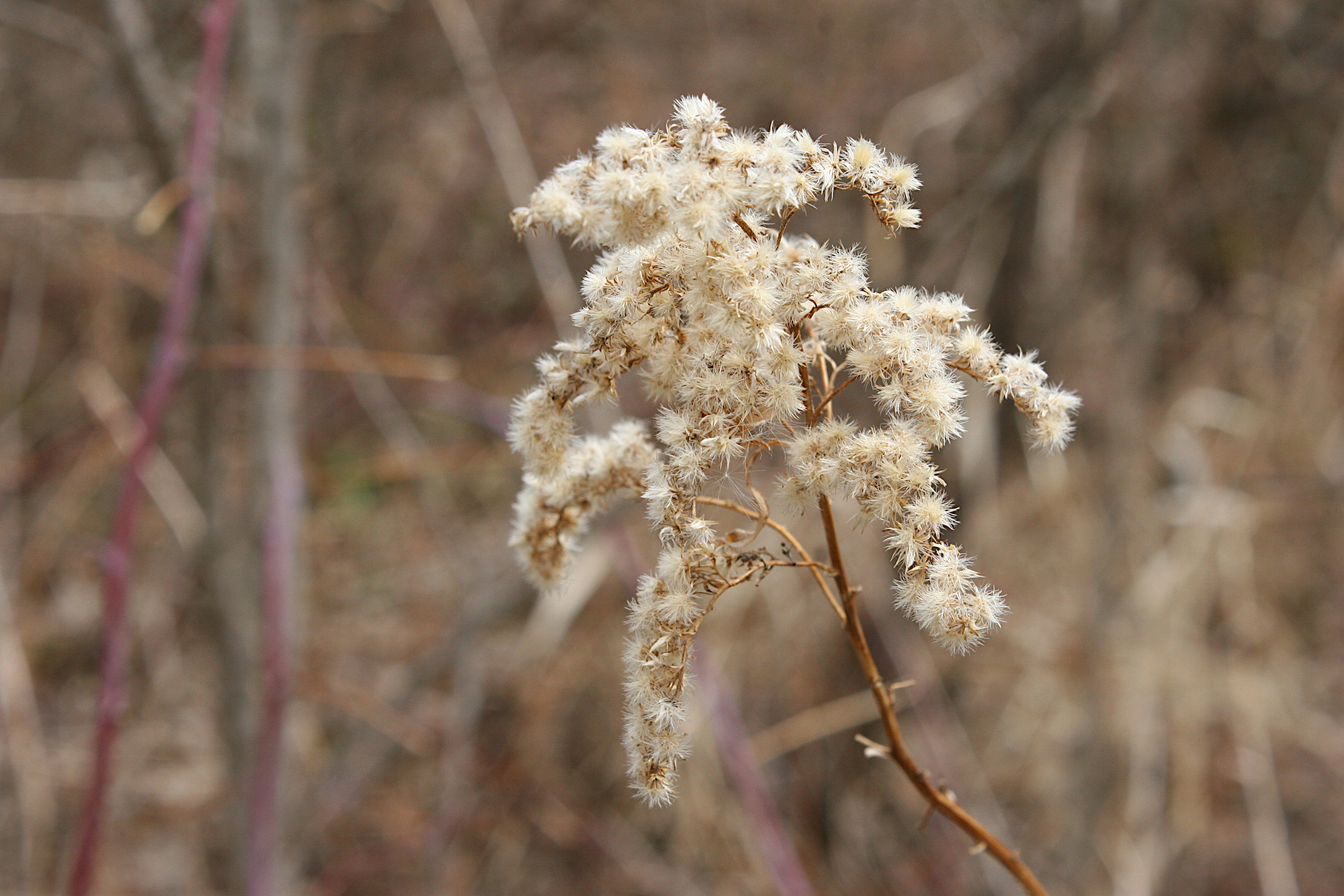
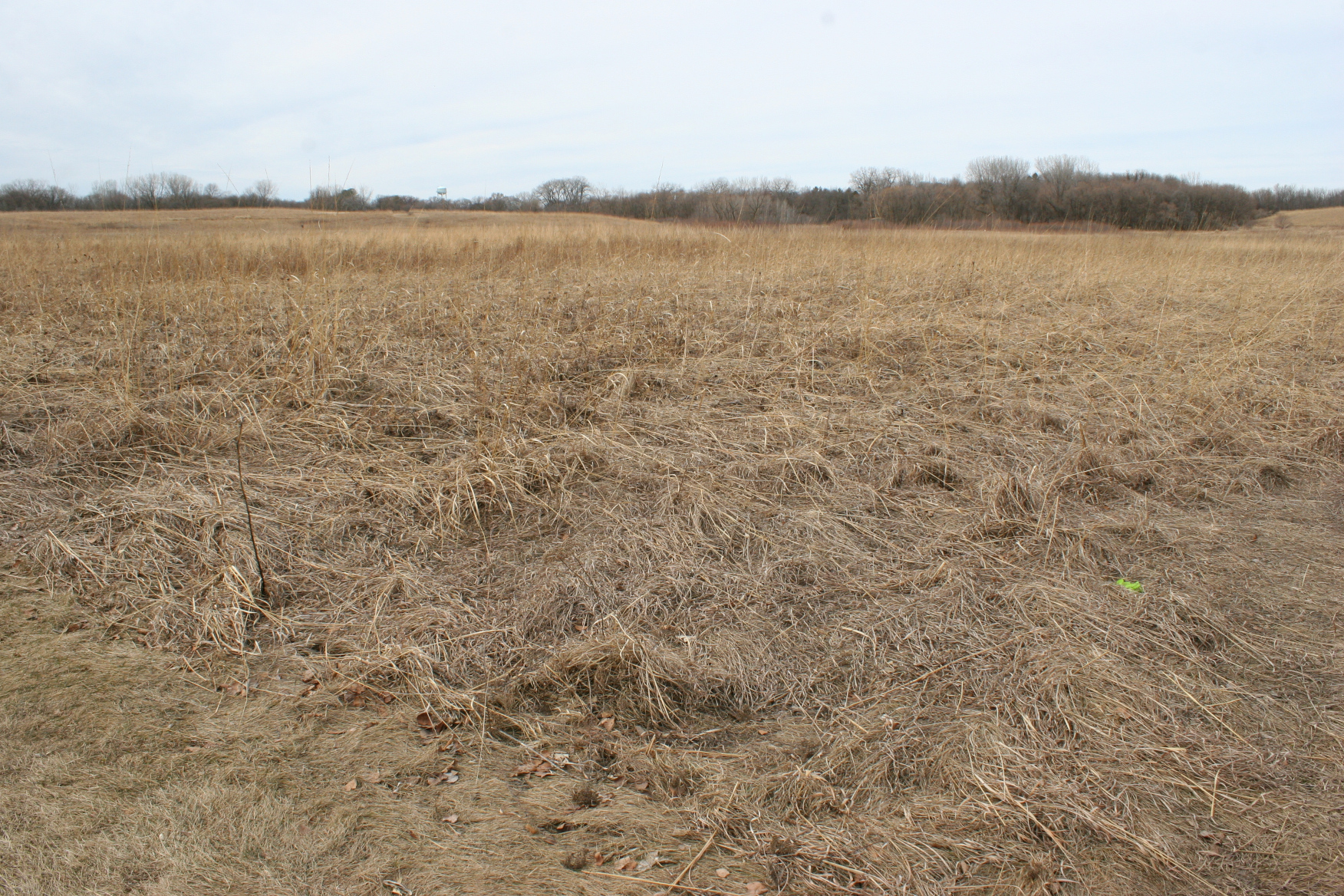
Dried grasses and dried weeds on the prairie. The muted remnants of autumn.
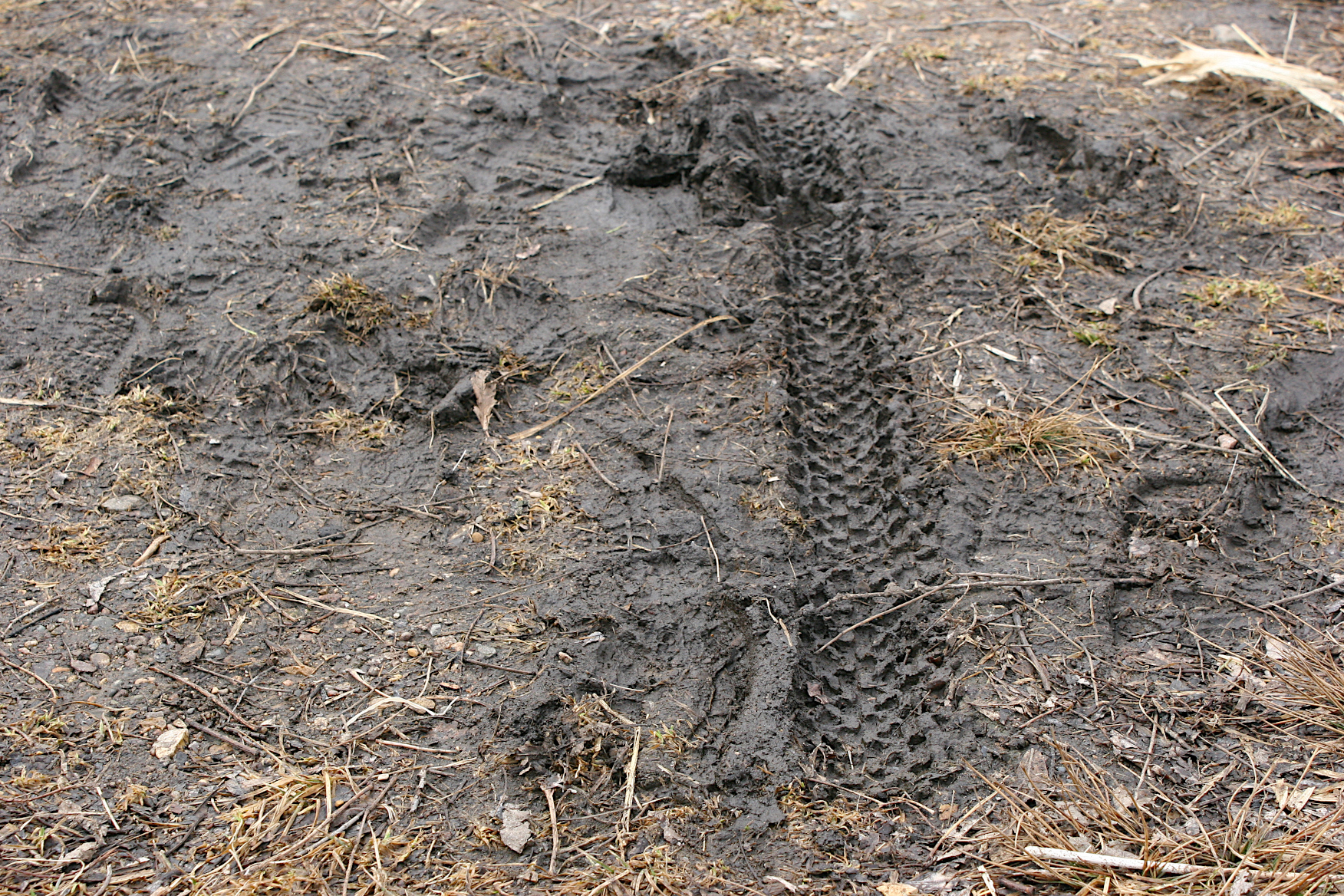
Tracks muddied into the earth.
And birch
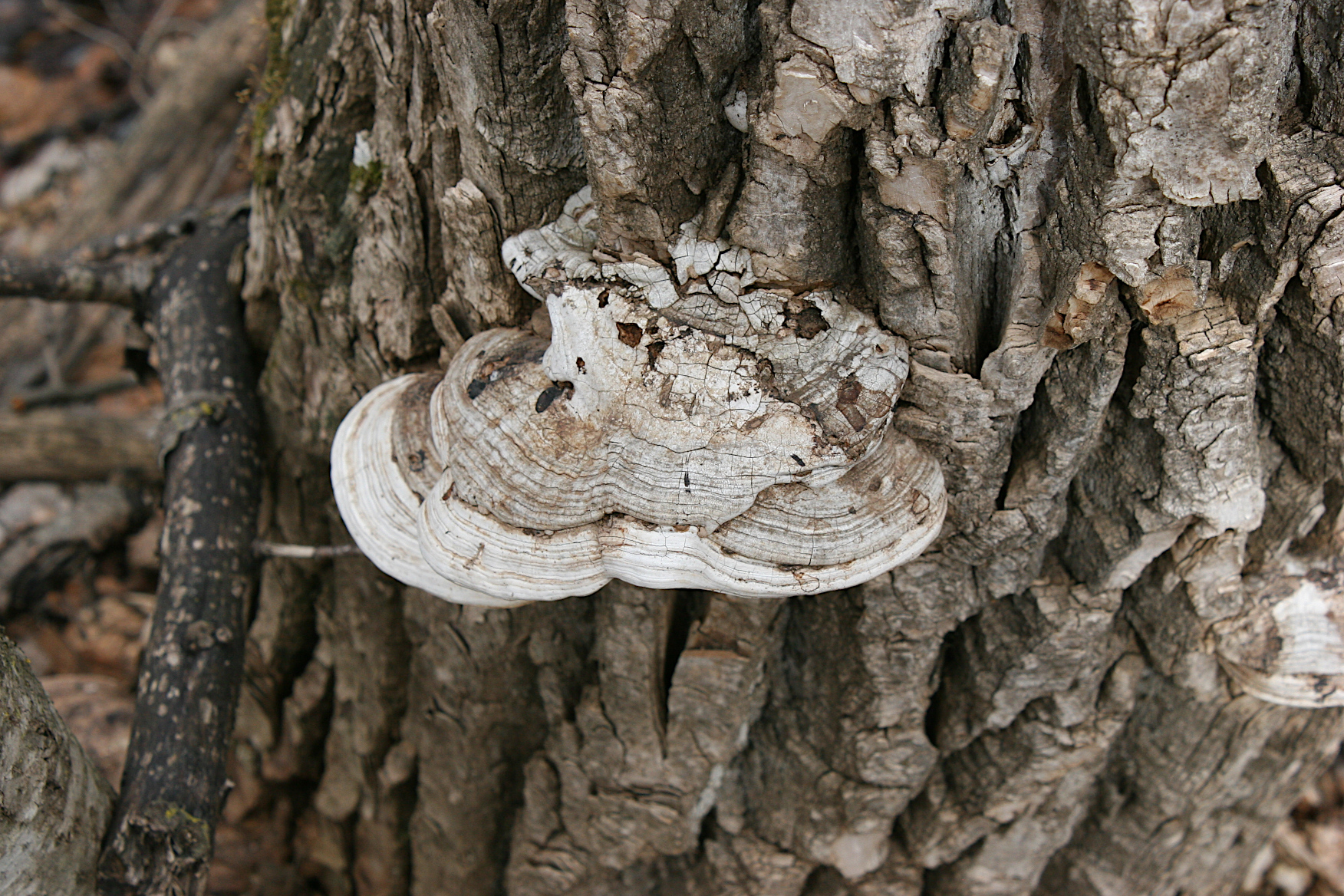
and fungi and all those things you notice if you only take the time to pause. To appreciate the natural world. To step into the woods. To walk the asphalt trails heaved by frost and tree roots. Or to follow the dirt trails that connect soles to ground. Soul to nature.
WE ARRIVED NEARLY A HALF HOUR early in the small southwestern Minnesota community. But I didn’t want to be late for my scheduled 10:30 am visit. So, after a brief tour around Belview and stopping for several photo ops, Randy pulled the van into the parking lot next to the low-slung building adjoining the city park.
I slid the back passenger side door open, camera secured over my shoulder, and grabbed a cloth tote bag from the seat. Inside I’d stashed several family photos, my bible, a devotional and two pictures colored by my nearly 5-year-old granddaughter. Randy eased out a vase of flowers secured in a bucket.
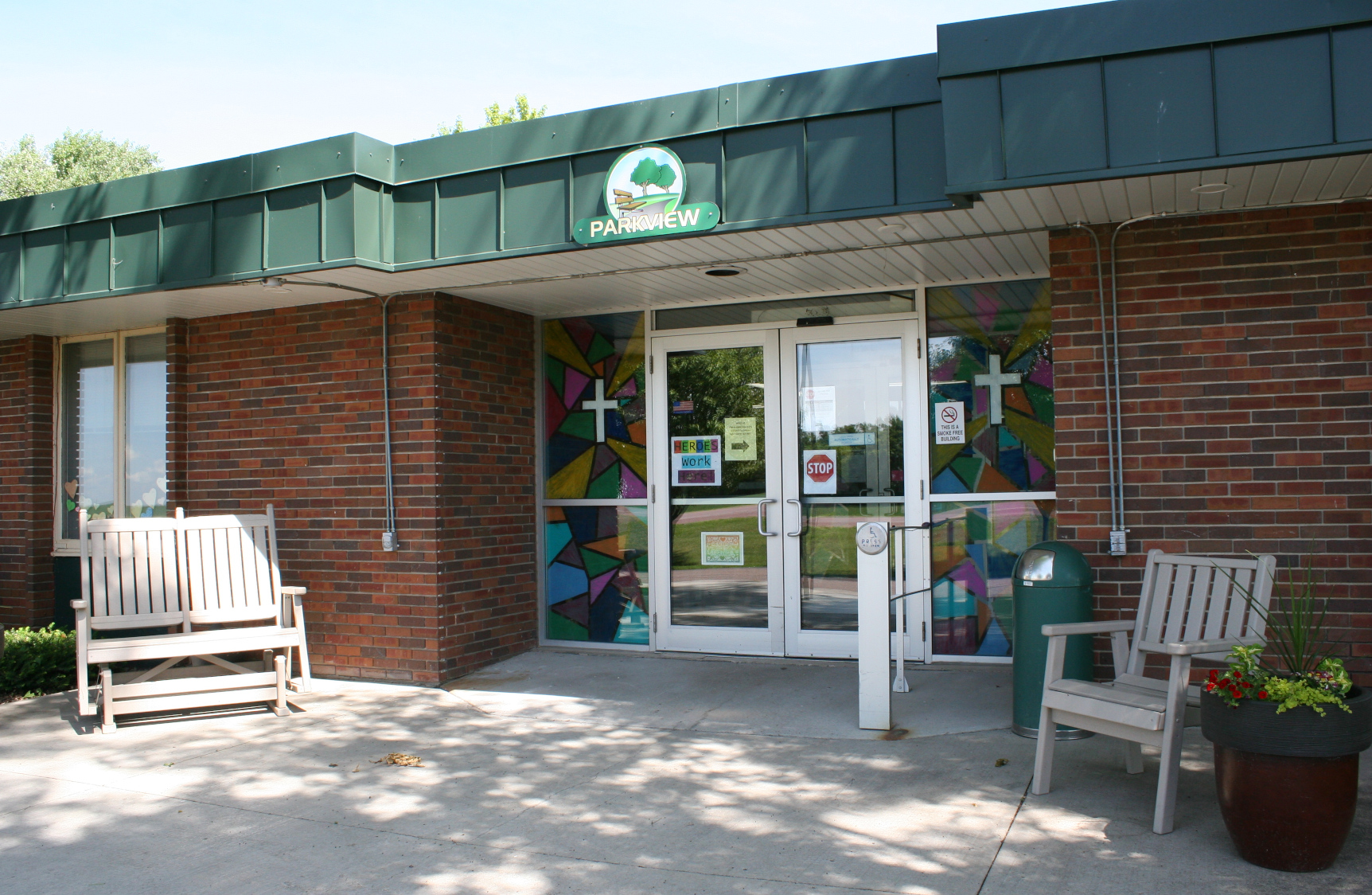
Then we headed across the parking lot on this Saturday morning in March, aiming west a short distance to the front entry. I looked for the doorbell I was told to ring. I pushed the button. We waited, the cold prairie wind sweeping around the care center. I shivered. Randy punched the button again. Peering through the double glass doors, I saw figures at the far end of the hallway. Soon a woman approached and invited us inside. I leaned into the heavy interior door, barely able to push its weight inward.
Once in the building, staff checked us in, took our temps, asked if we were experiencing any symptoms of illness. Apparently I didn’t answer. “If you were, you wouldn’t be here, right?” the young aide prompted. I nodded. Then I grabbed the goggles I was told to take and slipped them over my prescription eyeglasses with some hesitancy.
AN EMOTIONAL MOMENT
That’s when I saw her. My mom. Staff wheeling her across the carpet toward me. A short distance from her room to our designated meeting spot in the day room. In that moment, profound emotions overtook me and I cried. Not uncontrollable crying. But crying that represented a year of separation. One year had passed since I last saw Mom face-to-face. “Are you OK?” a staffer asked with concern.
I was. And I wasn’t. I understood that I needed to pull myself together, that this was not about me and how I felt, but about my mom. My arms ached to reach out and hug her, to hold her hand, to touch her and never let go. To kiss her cheeks.
RECONNECTING
Staff wheeled Mom to the end of a table in the day room. Randy and I were advised to keep a six-foot distance. We knew enough to keep our masks on. A screen provided some privacy. But I was cognizant of people occasionally moving on the other side. Yet, it really didn’t matter. I was here. In the same room with my sweet mom. Randy and I would have 15 minutes with her together before he had to leave and I could move into her room for a compassionate care visit. Mom is in hospice.
Mom’s health is such that conversation with her is one-sided. Us talking. Her listening, if she could hear us over the whir of her oxygen machine. Randy and I talked in raised voices. And when I showed her photos of my grandchildren, her great grandchildren, the skin around her eyes crinkled, indicating a smile beneath her face mask. There were more smiles and moments of connection, of understanding, of recognition. And those were enough to bring me joy. And her, too. I could see it in her reaction.
When Randy told Mom goodbye, she didn’t understand why he had to leave. Mercifully, her cognition and memory are such that she doesn’t comprehend COVID and all that entails, including the reason we haven’t seen her face-to-face in exactly one year.
CURIOUS GEORGE AND GOOD SAMARITANS AND A SMILEY FACE
Mom holds her Curious George.
We moved to her room, me carrying the vase of vivid flowers. Once there, I asked the aide to switch off the Curious George DVD playing on the TV. Mom was already fixated on the cartoon, which she loves. A stack of DVDs featuring the mischievous monkey rested on a table below the television and a stuffed animal Curious George sat on a recliner in the corner. I picked it up and gave it to her and Mom cuddled the monkey on her lap.
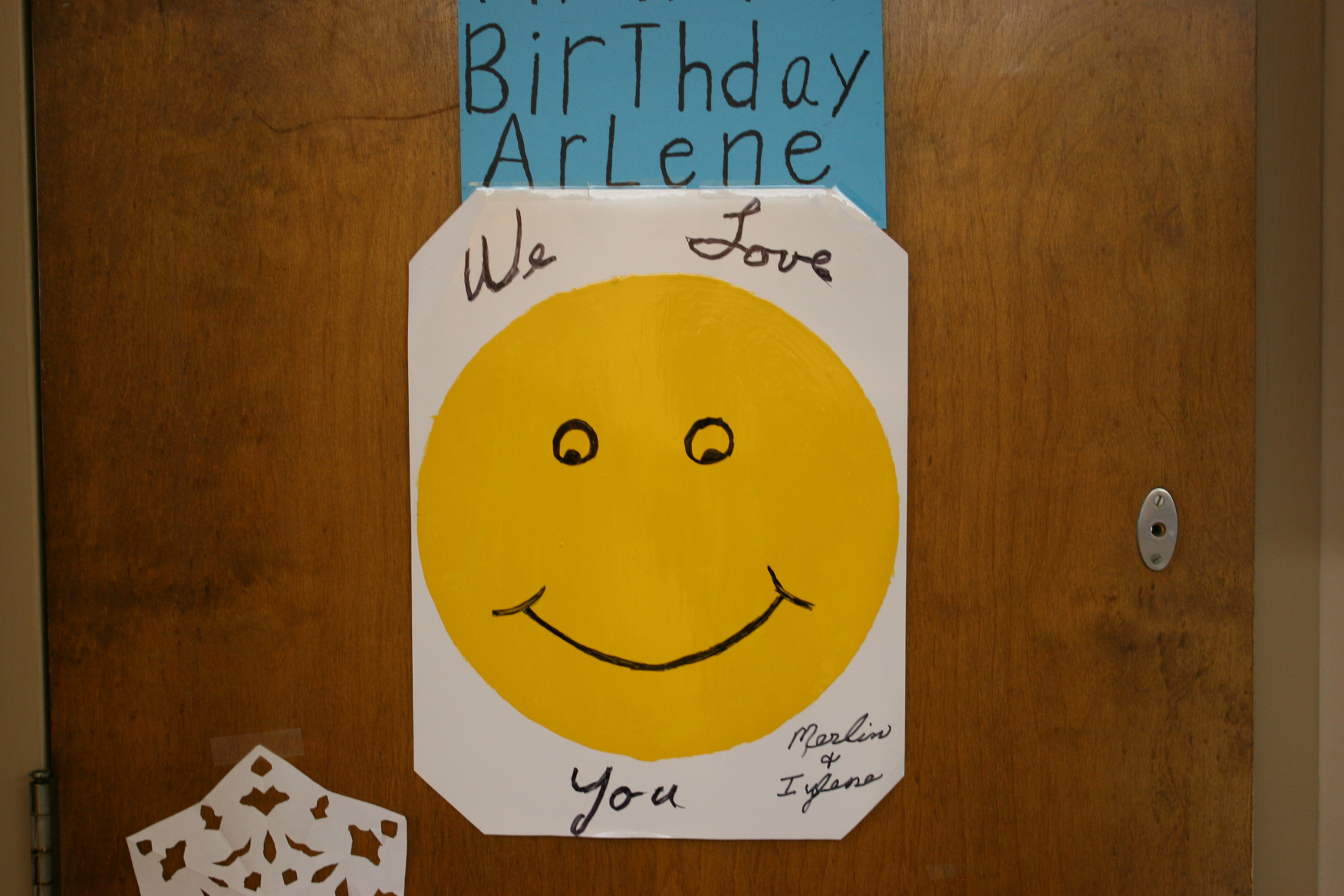
I looked around her room, bulletin boards crammed with family photos. I commented on the picture of Jesus the Good Shepherd that graced her bedroom wall on the farm. And I admired the bright over-sized smiley face posted on the bathroom door and felt gratitude to my aunt and uncle, who live just blocks away, for making this for Mom. Below, I saw a picture of a dog fish colored by my granddaughter in a rainbow of hues.
I talked with Mom about cream cheese roll-out cookies and my older brother sneaking ice cream from the freezer and eating it atop the haystack. She laughed. I talked about how she worked so hard to raise a family of six children and that now it was time for her to rest. Occasionally her eyes fluttered shut and I could tell she was growing tired. I continued to talk on other topics, although I’m uncertain how much she heard or comprehended. Yet, I have to think my mere presence, the sound of my voice, comforted her.
A staffer popped in for a moment, praising Mom for eating her pancake and drinking her juice and milk at breakfast. “Good job, Mom,” I said, feeling like I was the mom and she the child. And, in many ways, that would be accurate.
Soon the staffer returned and handed me a sheet of paper and said Mom might like it if I read some of the information thereon. My eyes landed on a story about Neil Sedaka, then quickly shifted to an article about National Good Samaritan Day on March 13. I scanned the piece, chose tidbits to share about the Good Samaritan parable from the bible. To show kindness. To help others. It seemed fitting for this day, in this small town care center where staff show great compassion. I will always feel grateful to the healthcare workers and other staff who have cared for my mom like a family member.
SAYING GOODBYE
The smiley face poster, from Mom’s in-laws, on the exterior bathroom door.
As time ticked toward 11:30 and lunch and the end of my hour-long allotted visit, I knew I needed to leave. “I have to go. Maybe next time I can take you outside so you can hear the birds, see the trees.” Mom smiled beneath her face mask. “I love you, Mom.” Tears brimmed.
“I love you,” she replied. Her words felt like a hug, a kiss. Bringing us together after a year of separation caused by a pandemic.
In the doorway I stopped, turned for one final look at Mom. “I love you,” I repeated, then crossed the lobby to the staffer monitoring the front door. “I’ll need you to sign out,” she said. By then I was already crying, barely able to find a pen to note my departure time. I thanked her, observed the compassion in her eyes.
Then I walked into the sunshine of an incredibly beautiful Saturday in March in southwestern Minnesota. I turned left toward the parking lot where Randy waited. I opened the van door, swung onto the seat, removed my face mask and then sobbed uncontrollably, shoulders heaving, face in my hands. Emotionally-exhausted.


























 Minnesota Prairie Roots
Recent Comments