This paint-by-number painting was displayed at the 63rd annual Last Supper Drama, performed at St. John’s United Church of Christ, Wheeling Township, rural Faribault, on Palm Sunday. Jean Pederson painted this “The Last Supper” in 1952. (Minnesota Prairie Roots copyrighted photo March 2026)
IMAGINE IF YOU were sitting down to your last meal with dear friends. How would you feel? What would you say to them?
Jesus faced this scenario on Maundy Thursday as he gathered with his 12 disciples for a final Passover meal before his death by crucifixion the next day. Had it been me, I would have been terrified at the thought of such an agonizing death.
Christ showed incredible strength. He managed to continue teaching, loving, forgiving, even as the time of his death approached. He was certainly troubled, as Scripture tells us. I mean, how could he not be bothered, knowing that one of his disciples would betray him, with a kiss of all things? I would feel devastated.
From John 13:34, photographed years ago in downtown Faribault. (Minnesota Prairie Roots copyrighted file photo)
But Jesus is not anyone. He embodies love. And he tells us to love. Correction, he commands his disciples (and us, too) to love each other. He says: A new command I give you: Love one another. As I have loved you, so you must love one another (John 13:34).
As I consider all the division and hatred among us today, I focus on Christ and his example of unconditional love. Throughout his earthly life, Jesus continually showed compassion and care, often to the downtrodden, the outcasts, the lowly. I’m quite certain if he was physically walking on this earth today, he would still be showing such mercy.
He’d also be greatly disappointed, even upset, about the way we sometimes treat each other.
So what’s the point here? Maundy Thursday marks a monumental day for reflection. For change. For striving to follow Christ’s directive to love one another. And that starts with each of us. Today.
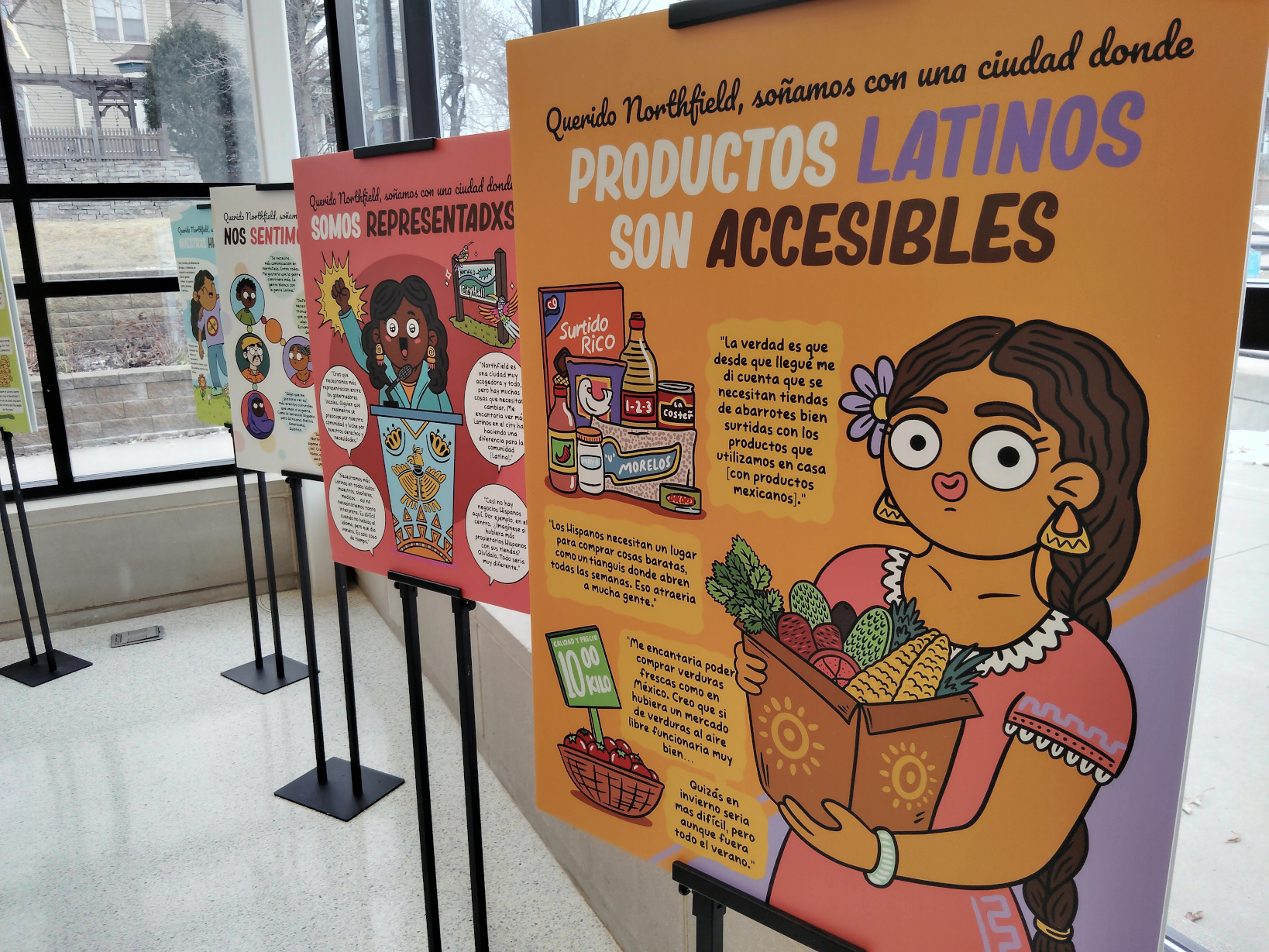
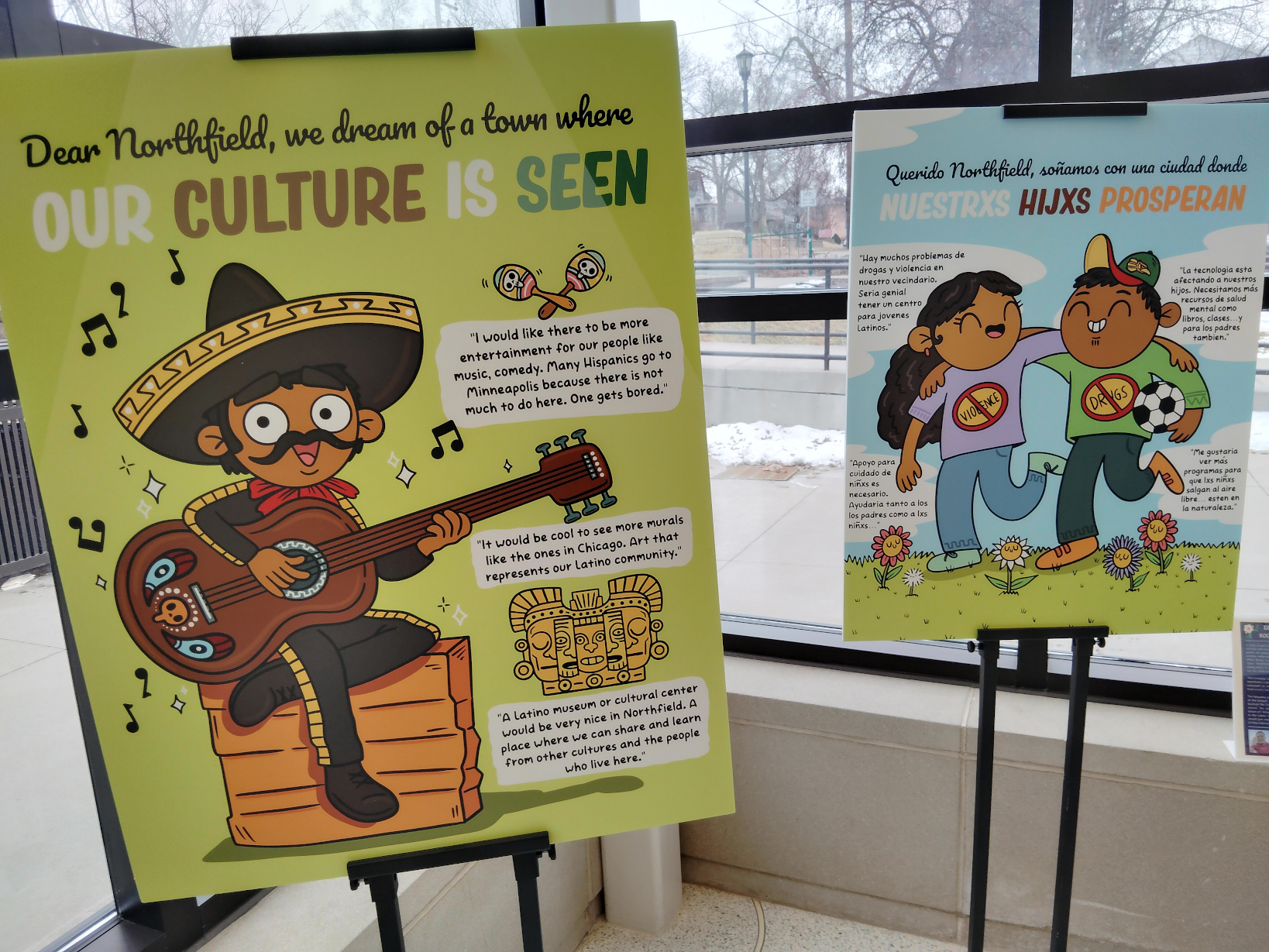
Panels created by Rocky Casillas Aguirre are written in both Spanish and English, on display recently at the Northfield Public Library. (Minnesota Prairie Roots copyrighted photo February 2026)
I APPRECIATE WHEN LEADERS think outside the box, using creative ways to gather and share information.
Take a project in the southern Minnesota riverside college town of Northfield, home to more than 2,000 Latinos, representing some 10 percent of the city’s population. A 2023 city-inspired effort led by a collective of local Latino artists and activists was tasked with developing a connective public art project focused on Latino voices.
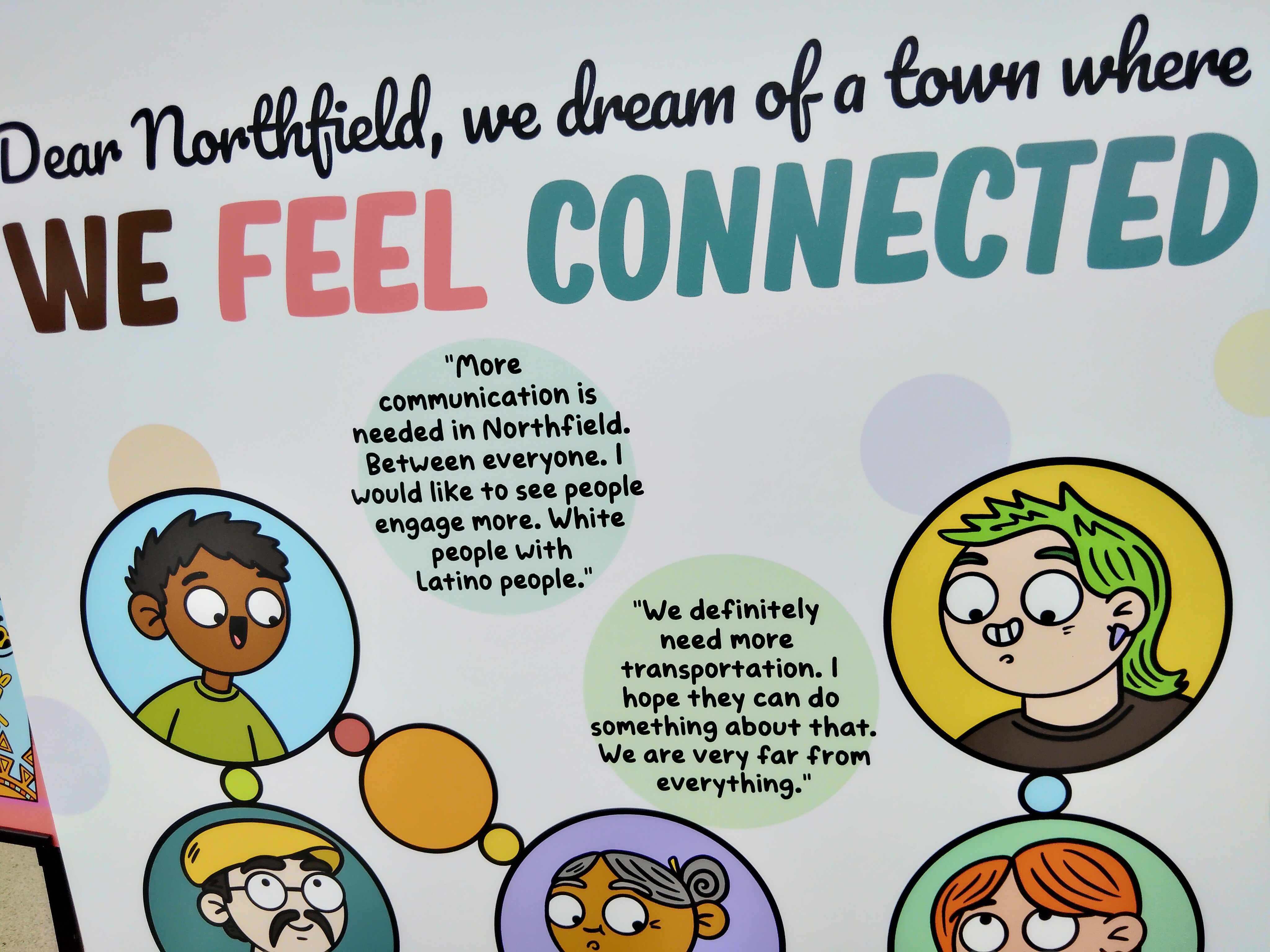
Getting the conversation going…(Minnesota Prairie Roots copyrighted photo February 2026)
Among the results was a poster campaign, “Dear Northfield,” by Latino artist Rocky Casillas Aguirre. He interviewed 100 Latino residents, asking this question: “If you could write a letter to the people who govern our city, what would you tell them?”
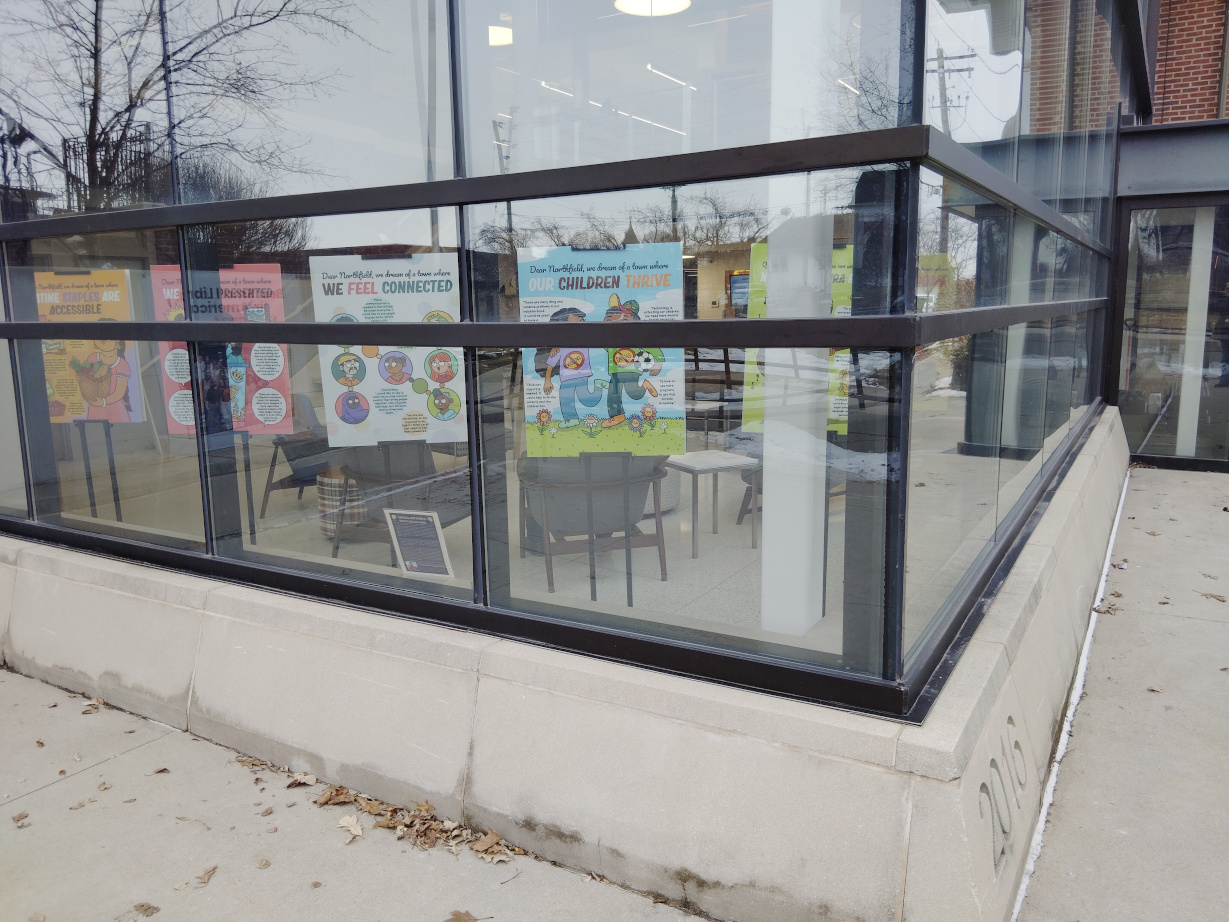
The results are colorful, eye-catching panels that reveal invaluable insights from Northfield’s Latino population. I recently saw six of Aguirre’s art posters displayed in the atrium of the Northfield Public Library, a community gathering spot.
At first glance, the artwork reminds me of illustrations in a children’s picture book or drawings in a cartoon. That’s a signature style of Aguirre, born in Mexico, raised in Northfield and a resident for more than 20 years. His art grabs attention in vivid cultural colors.
But it is the comments on those posters which especially deserve a close look as they address topics like housing, transportation, food, culture, communication and connection.
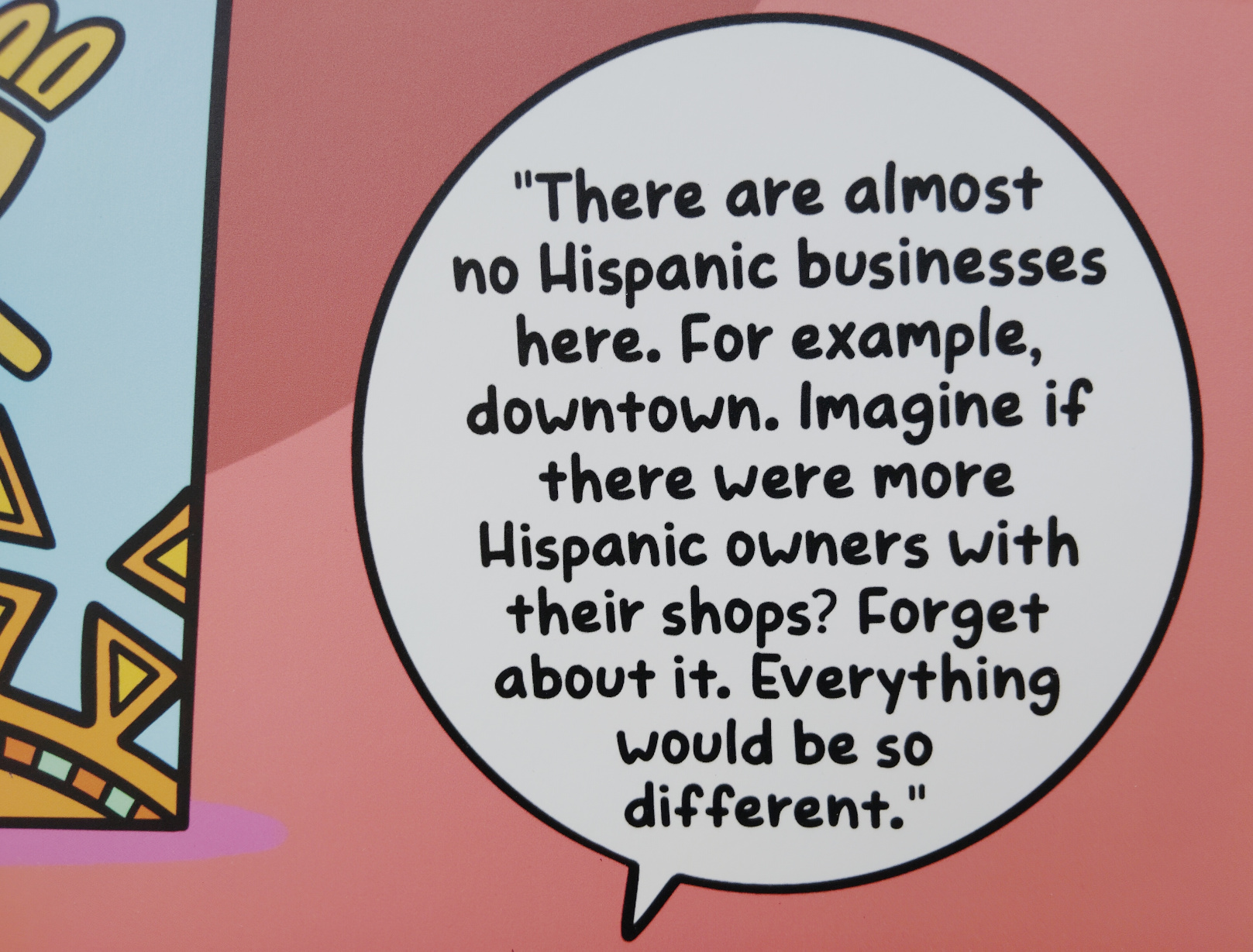
On the topic of local businesses… (Minnesota Prairie Roots copyrighted photo February 2026)
In their own words, Latino residents of Northfield share their thoughts, their concerns, their hopes, their dreams. They wish for Latino businesses downtown, shops where they can buy Mexican-made products, foods familiar and comforting to them.
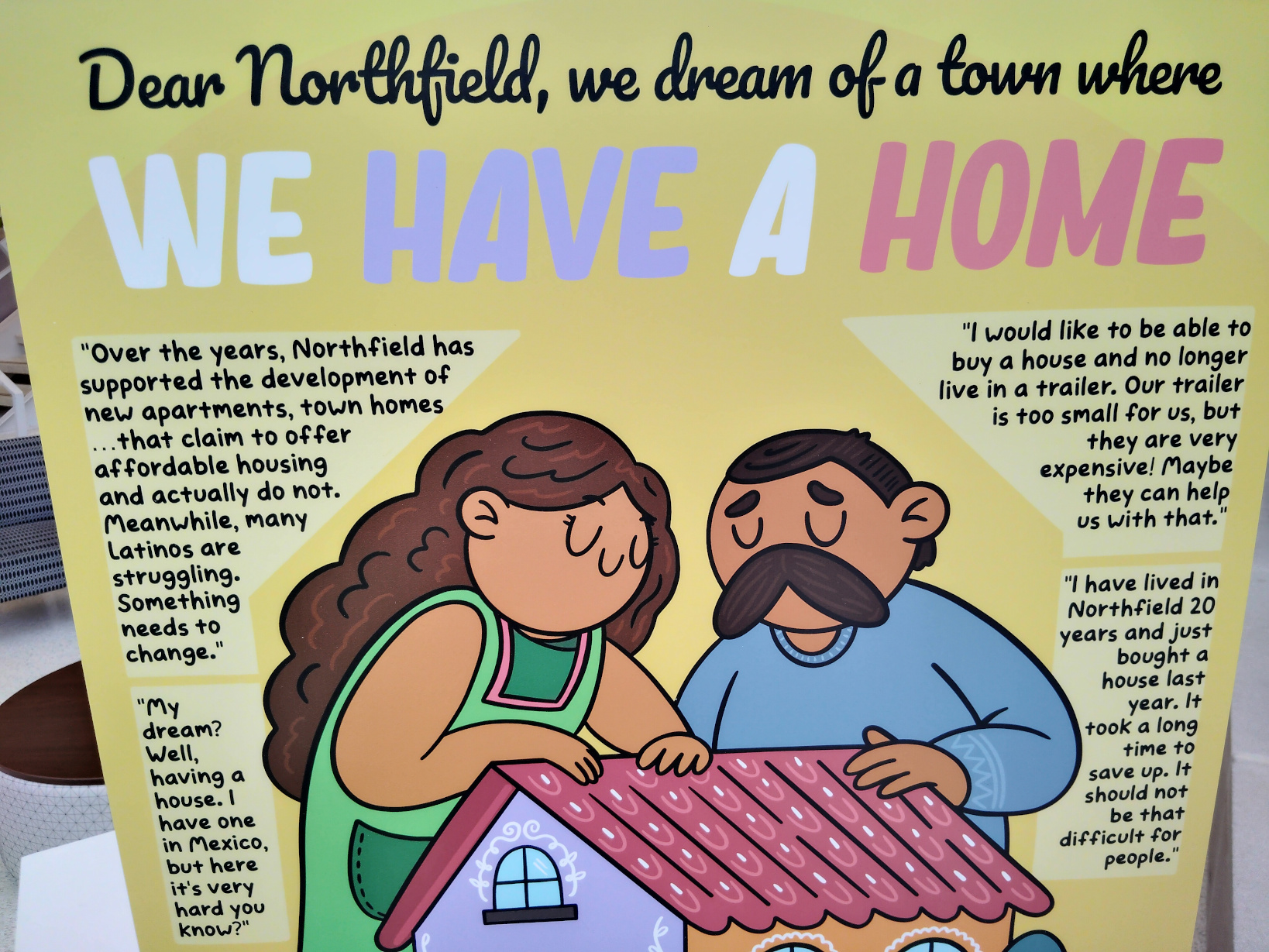
On the topic of housing… (Minnesota Prairie Roots copyrighted photo February 2026)
They want affordable housing, options other than living in trailer houses and apartments.
On the topic of culture and entertainment… (Minnesota Prairie Roots copyrighted photo February 2026)
They want local Latino-based cultural choices in music, entertainment and art, specifically naming murals. That seems doable in Northfield, which has always embraced public art and has multiple murals.
They want more options for youth, like a Latino youth center.
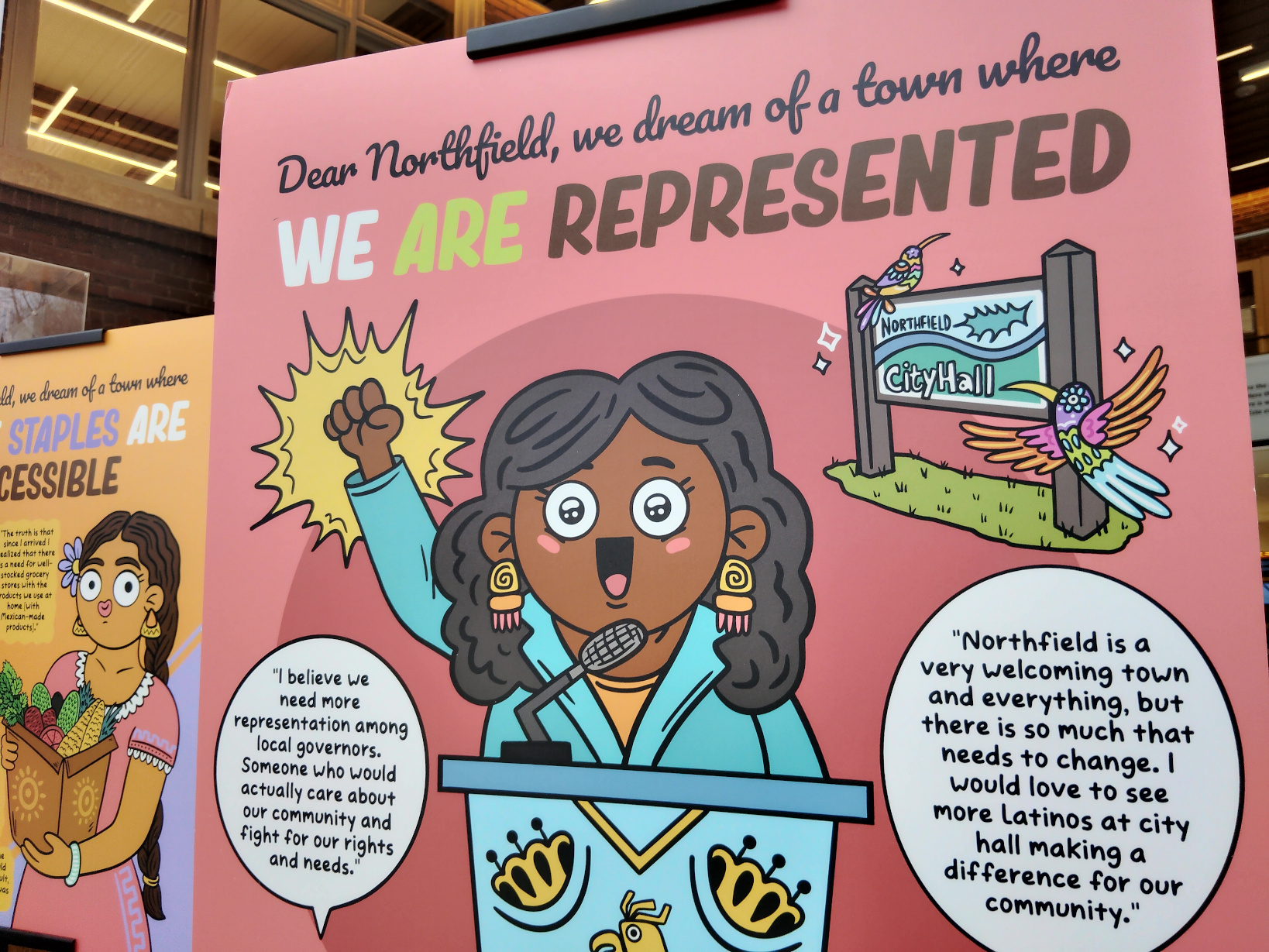
On the topic of representation in local government… (Minnesota Prairie Roots copyrighted photo February 2026)
They want more representation in city government and increased connections and engagement between white people and Latinos.
None of these seem like particularly big asks, although some certainly take time and money to implement. It’s good to get the conversation going.
The panels as viewed from outside the Northfield Public Library. (Minnesota Prairie Roots copyrighted photo February 2026)
I hope other communities follow Northfield’s example and use art as a way to share information that will help build a stronger, better and more culturally-aware and diverse city. A place where everyone can thrive, no matter their color, no matter their language, no matter their culture.
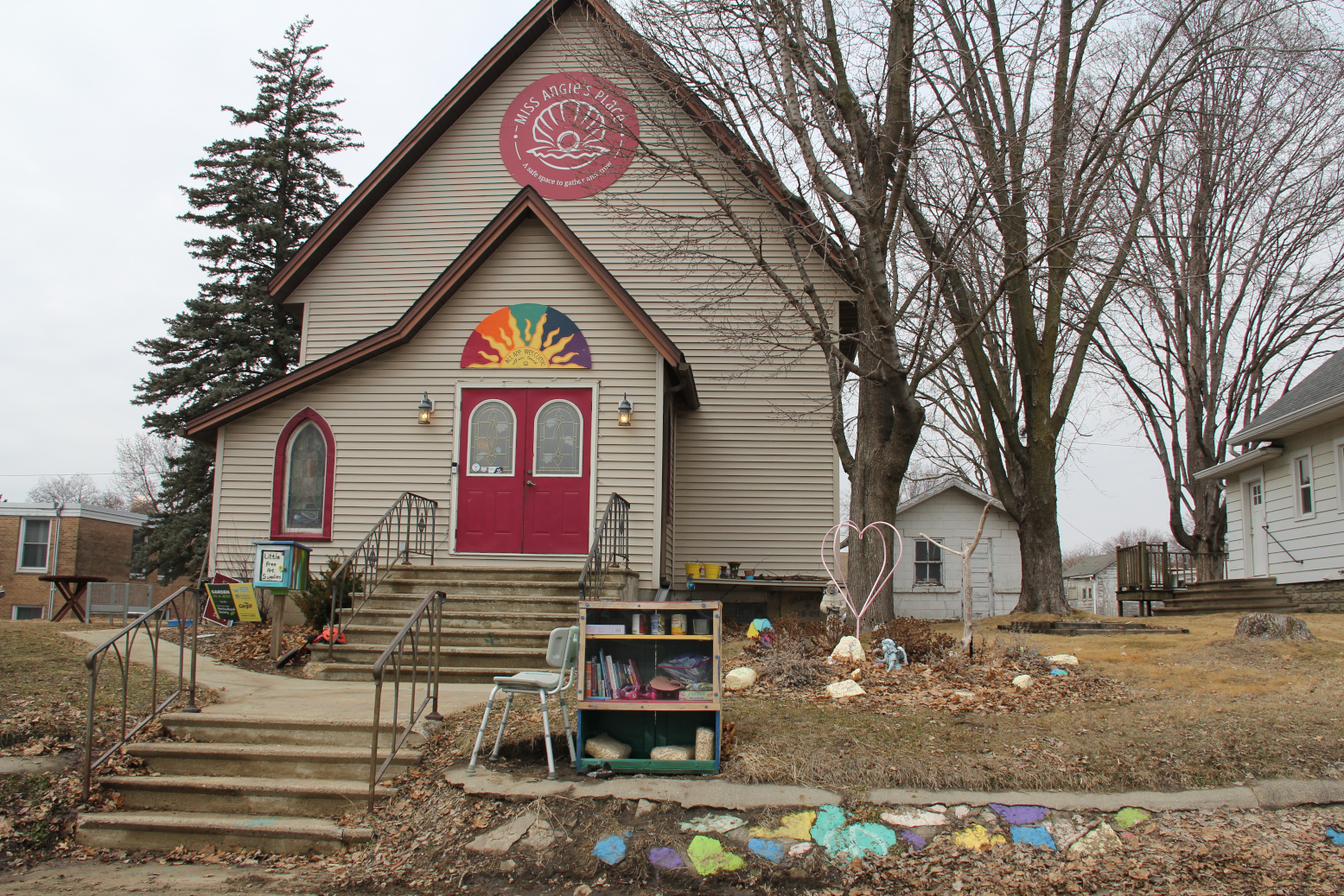
Outside Miss Angie’s Place I found giving shelves, center (filled with books, food, a puzzle and more), free art supplies in a library by the steps and a memorial garden for baby Pearl, right. (Minnesota Prairie Roots copyrighted photo March 2026)
Pulling out of the Kwik Trip convenience store in Pine Island recently, flashes of color caught my eye across the street. “What’s that?” I wondered aloud. I was about to discover Miss Angie’s Place.
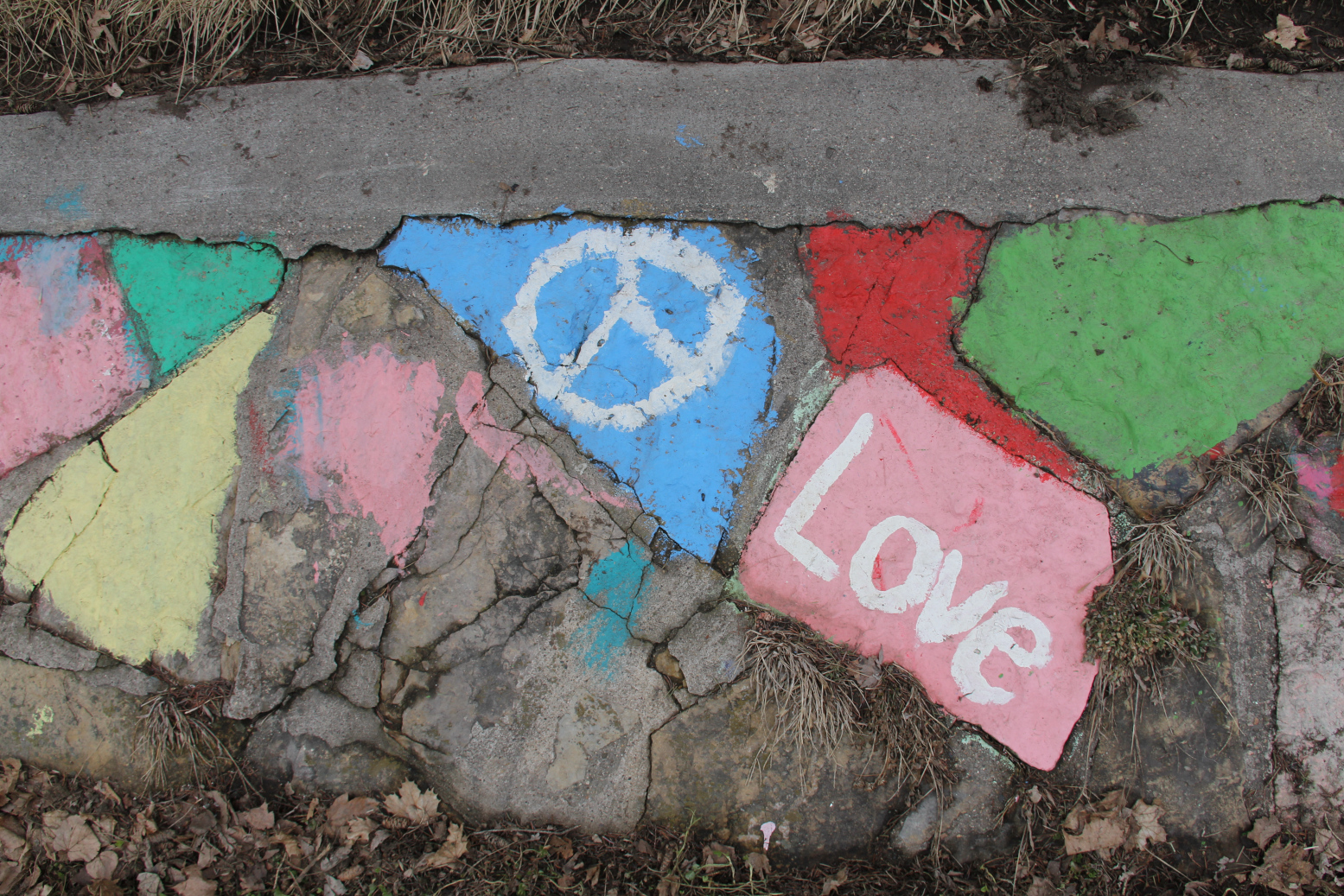
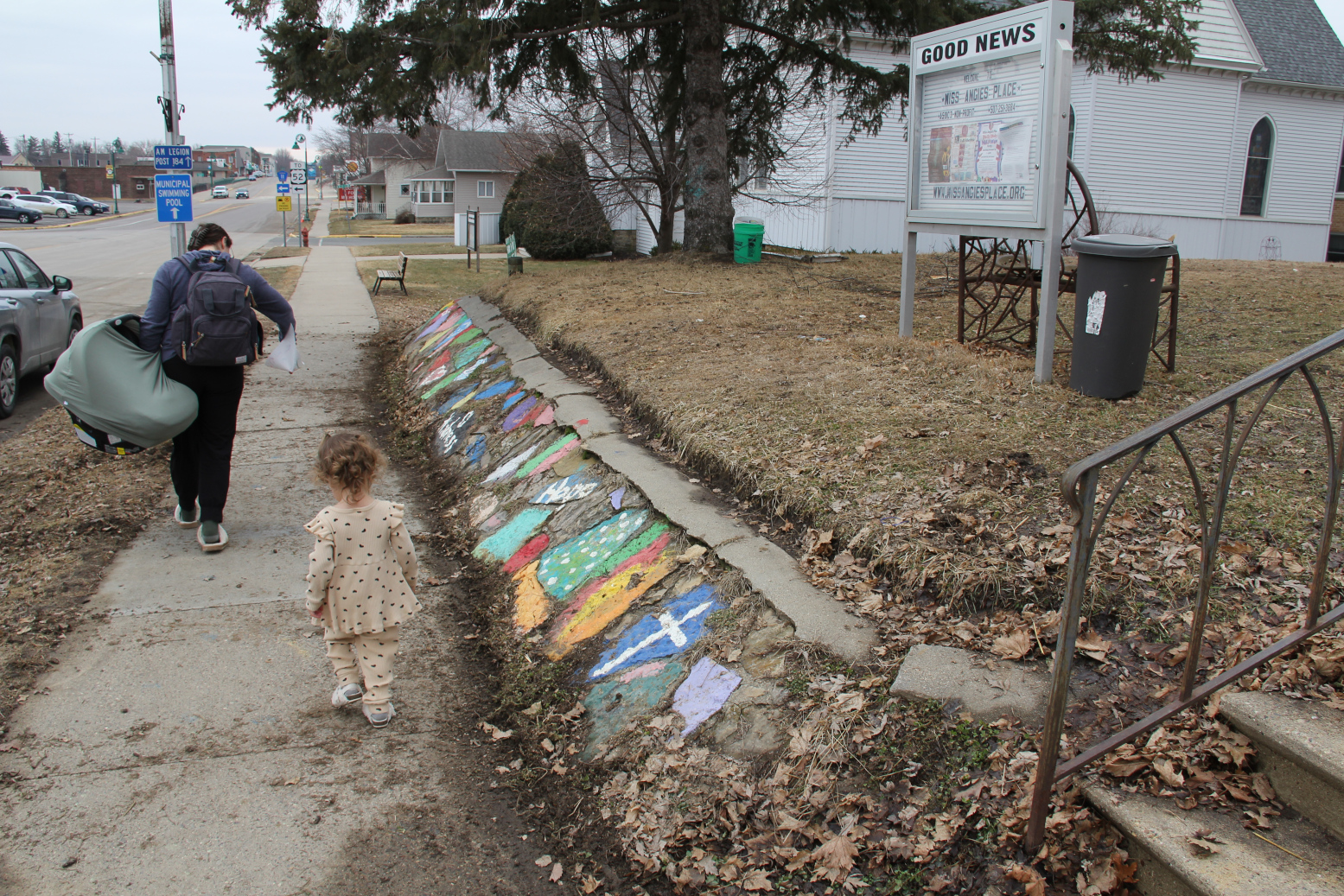
A close-up of the colorful and inspiring retaining wall. (Minnesota Prairie Roots copyrighted photo March 2026)
If not for the colorful painted rock and concrete wall bracing a hillside, I may not have paused to learn more about the nonprofit based in the town’s first church, Grace Episcopal, built in 1874. Good News Evangelical Free Church closed its doors here in 2023, opening the door for Angie Severson to relocate her nonprofit into the vacated building from several blocks away.
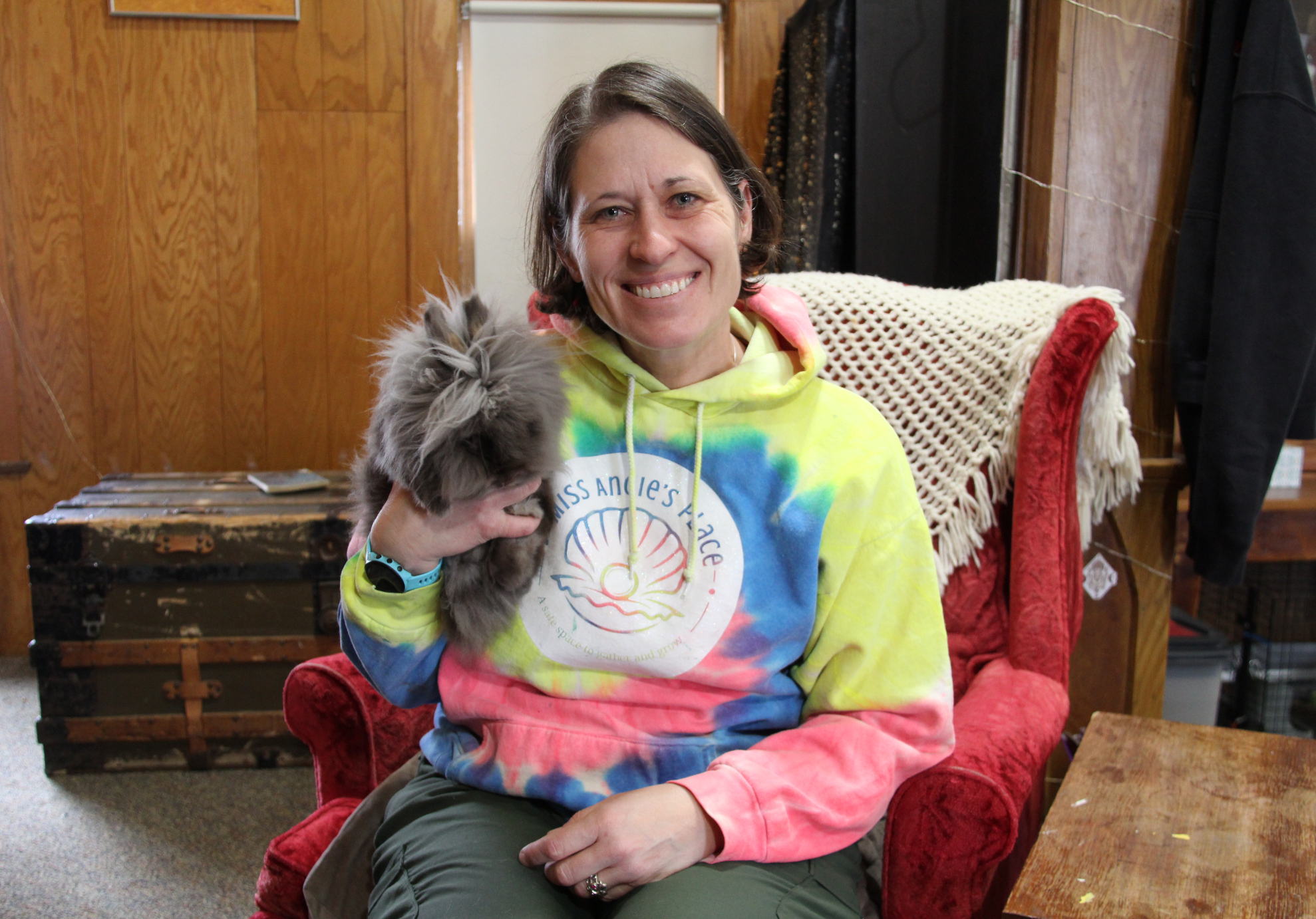
Angie Severson, photographed here with a resident rabbit, founded the nonprofit Miss Angie’s Place in 2021. (Minnesota Prairie Roots copyrighted photo March 2026)
This mother of four daughters and a life-long artist, who has worked as a high school art and business teacher and as a graphic designer, offers “a fun, nurturing and safe space to gather and grow for people of all ages through art, nature, education and well-being.” Those define the four pillars of Miss Angie’s Place.
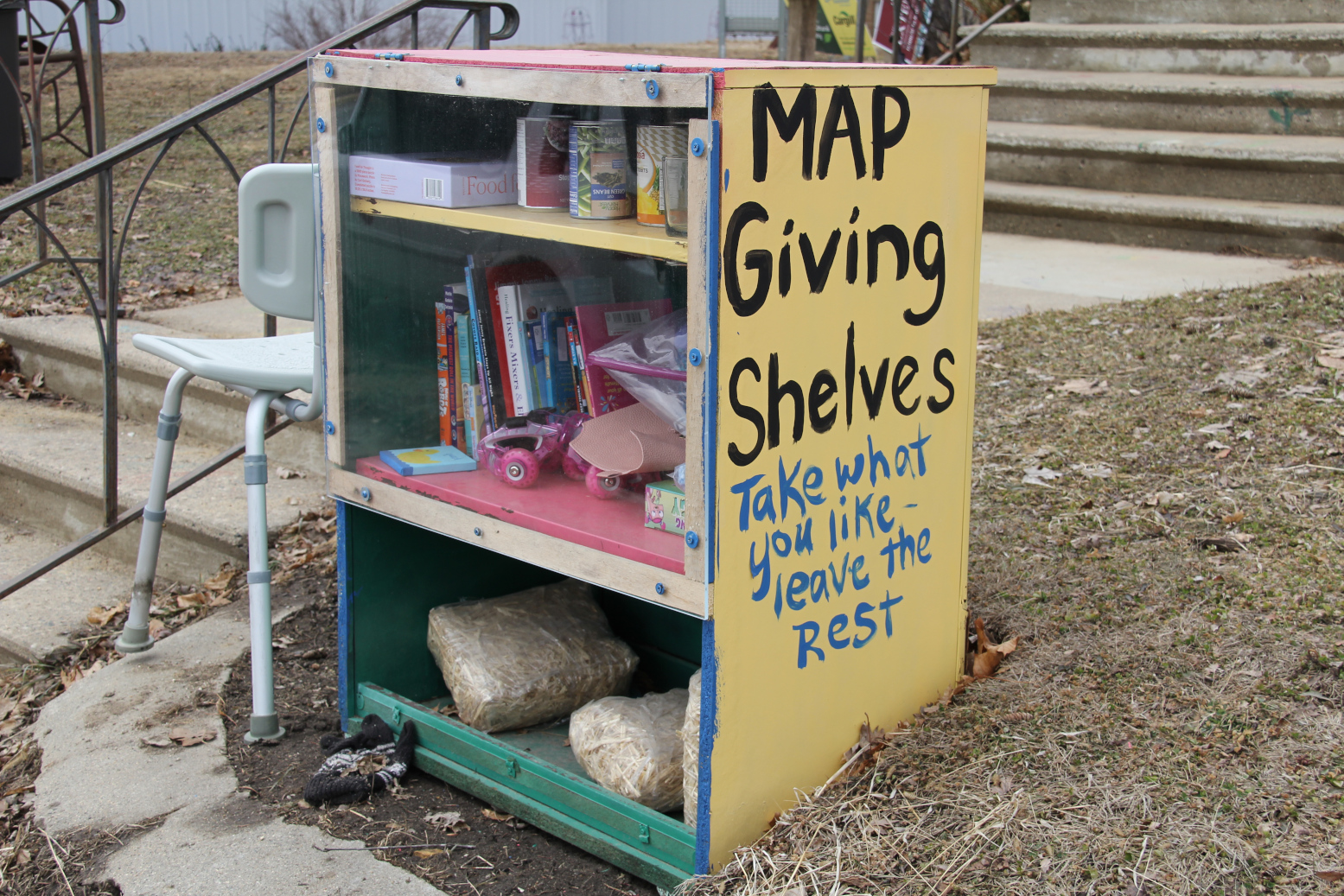
The Giving Shelves outside Miss Angie’s Place. (Minnesota Prairie Roots copyrighted photo March 2026)
That’s exactly what I discovered once I finished exploring outside—looking over the brightly-painted retaining wall with uplifting words, checking out the giving shelves and Little Free Art Supplies Library, and a memorial garden for Angie’s infant daughter, Pearl.
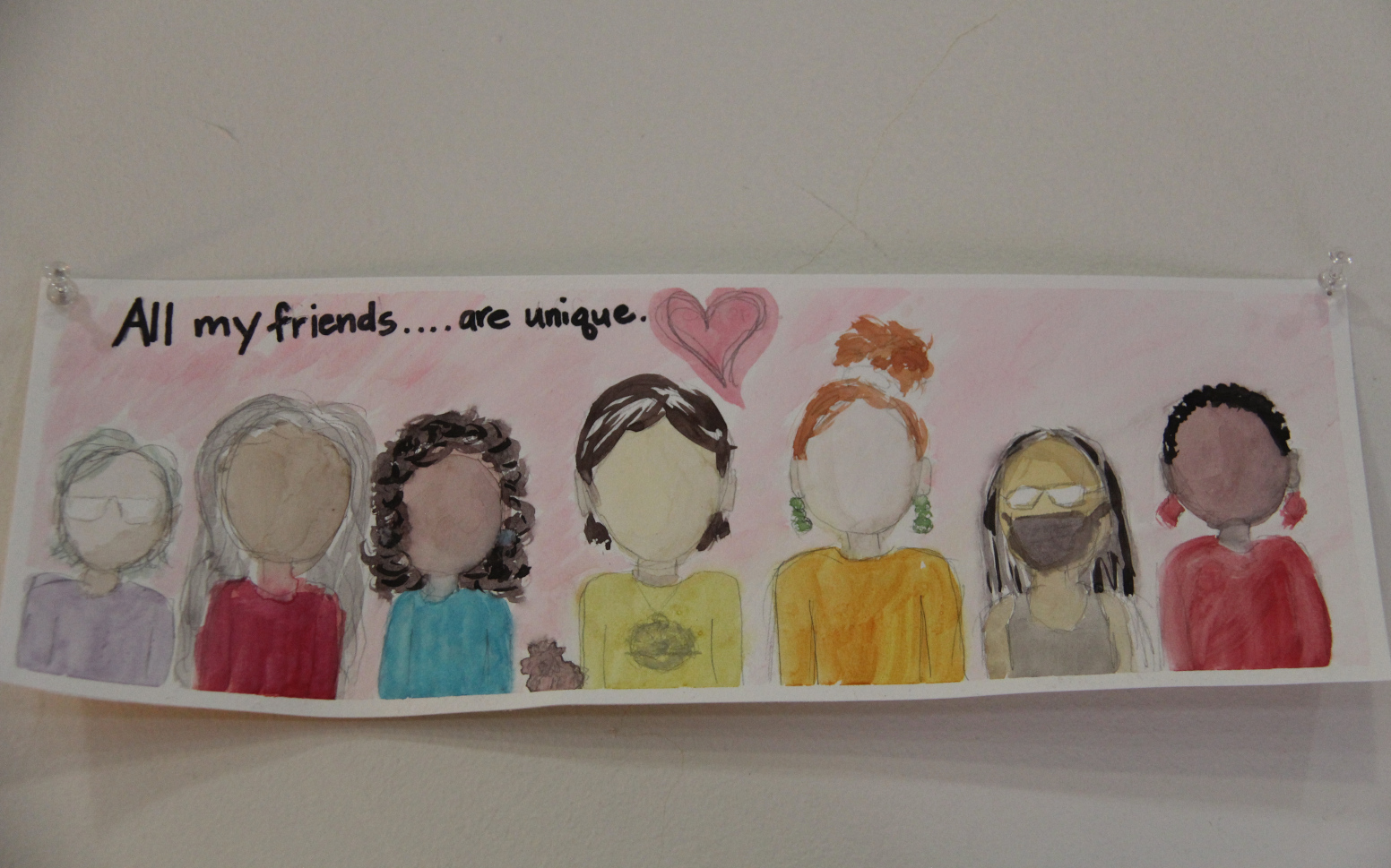
Art posted inside Miss Angie’s Place confirms that all are welcome here. (Minnesota Prairie Roots copyrighted photo March 2026)
I headed up the steps past a kid’s bike and helmet, passing under signage telling me everyone is welcome and loved, before opening a red door to the vestibule.
A youth services librarian, right, led the literacy and playtime on the morning I visited. (Minnesota Prairie Roots copyrighted photo March 2026)
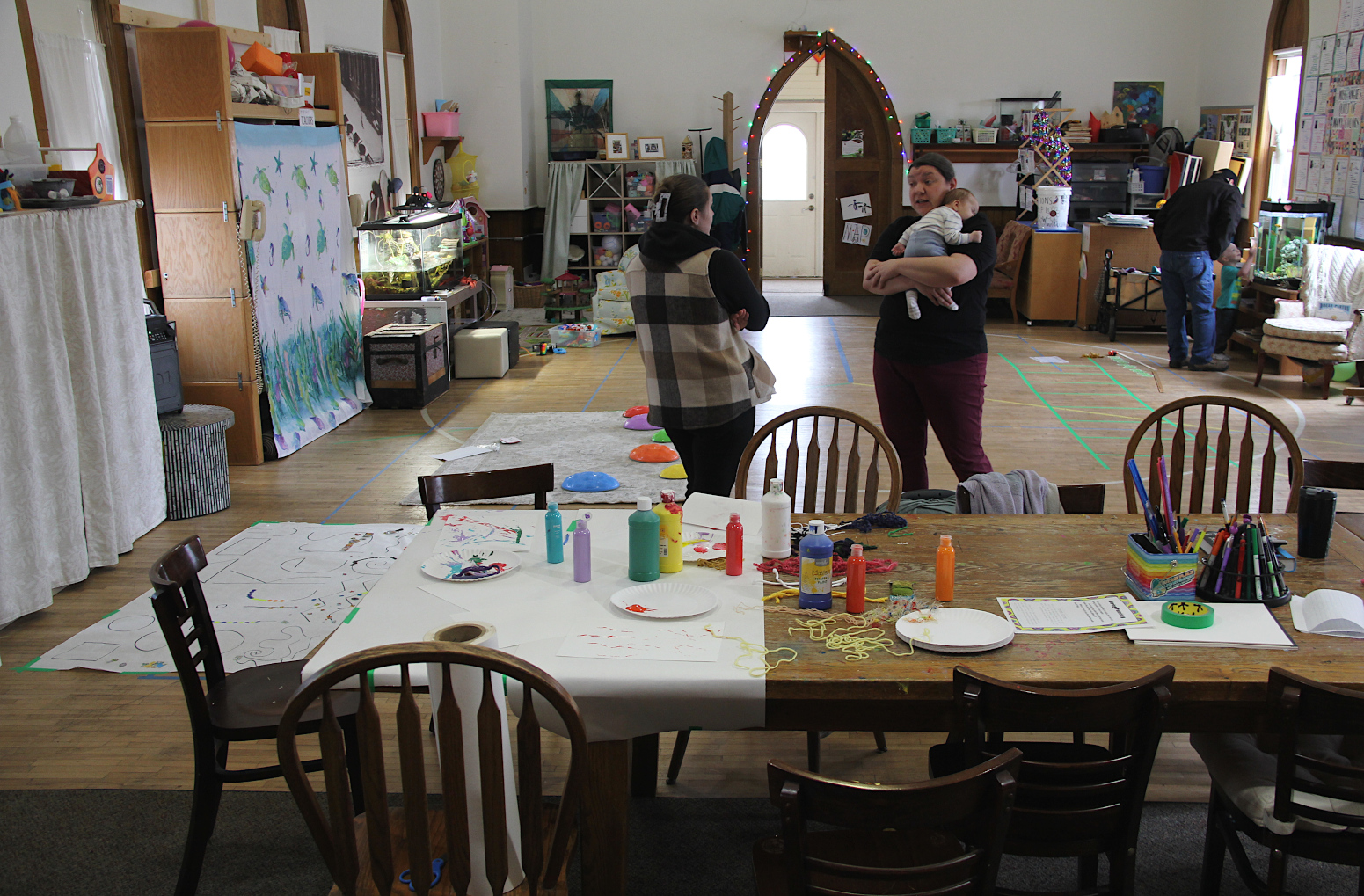
For a moment I simply stood there, still uncertain what I was walking into. I continued on, through an interior doorway into the former sanctuary. Two young mothers and their children were gathered around a table with paint, pipe cleaners and paper plates, clearly in the middle of creating. This, as it turns out, was a free early literacy and playtime with Angie and Heidi Breid, youth services librarian from the Van Horn Public Library.
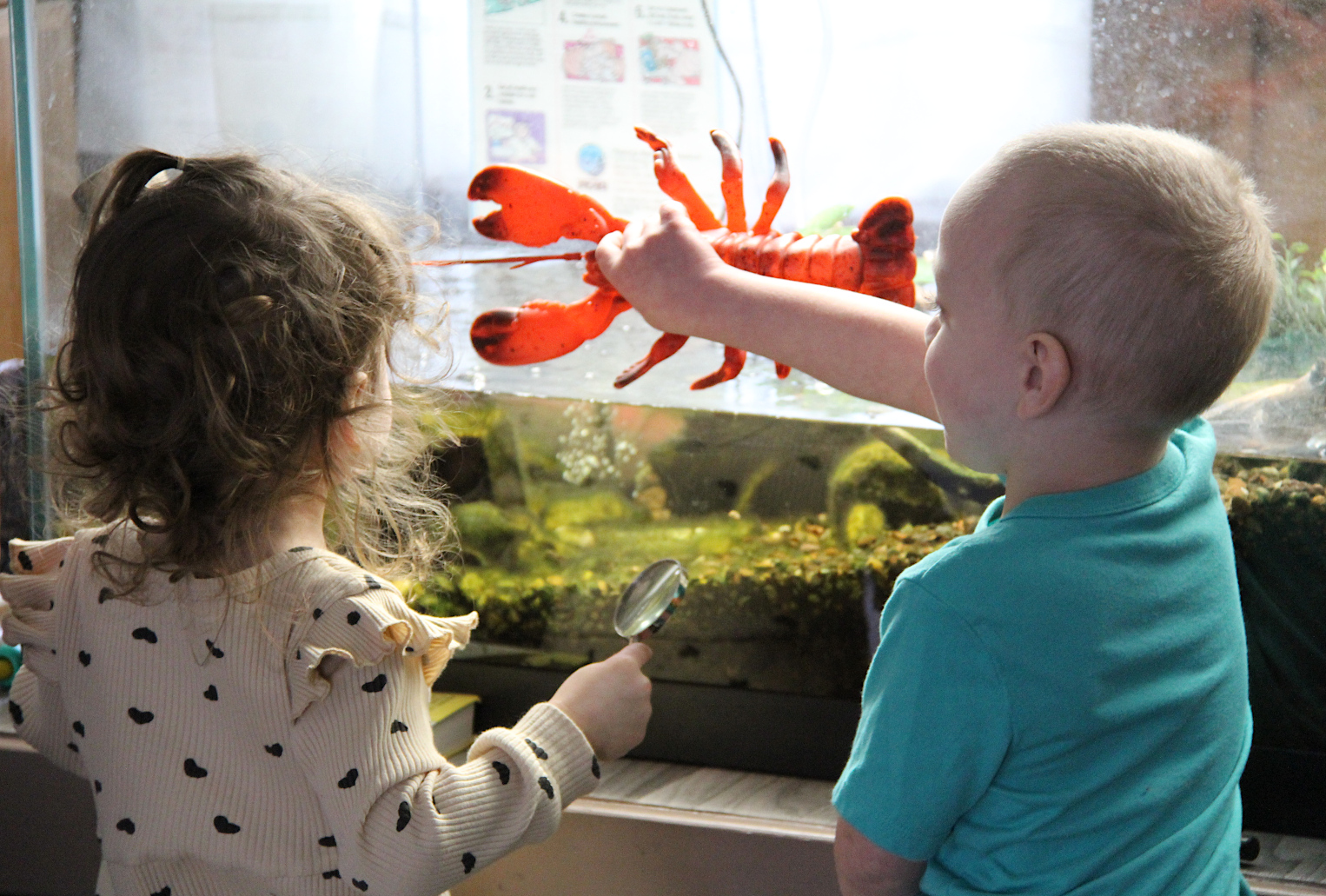
These two preschoolers were fascinated with the aquarium, toy lobster and magnifying glass during playtime. (Minnesota Prairie Roots copyrighted photo March 2026)
One of the moms, mother to a preschooler and a newborn, later shared how she appreciates the opportunity to get out of the house with her kids and connect with others.
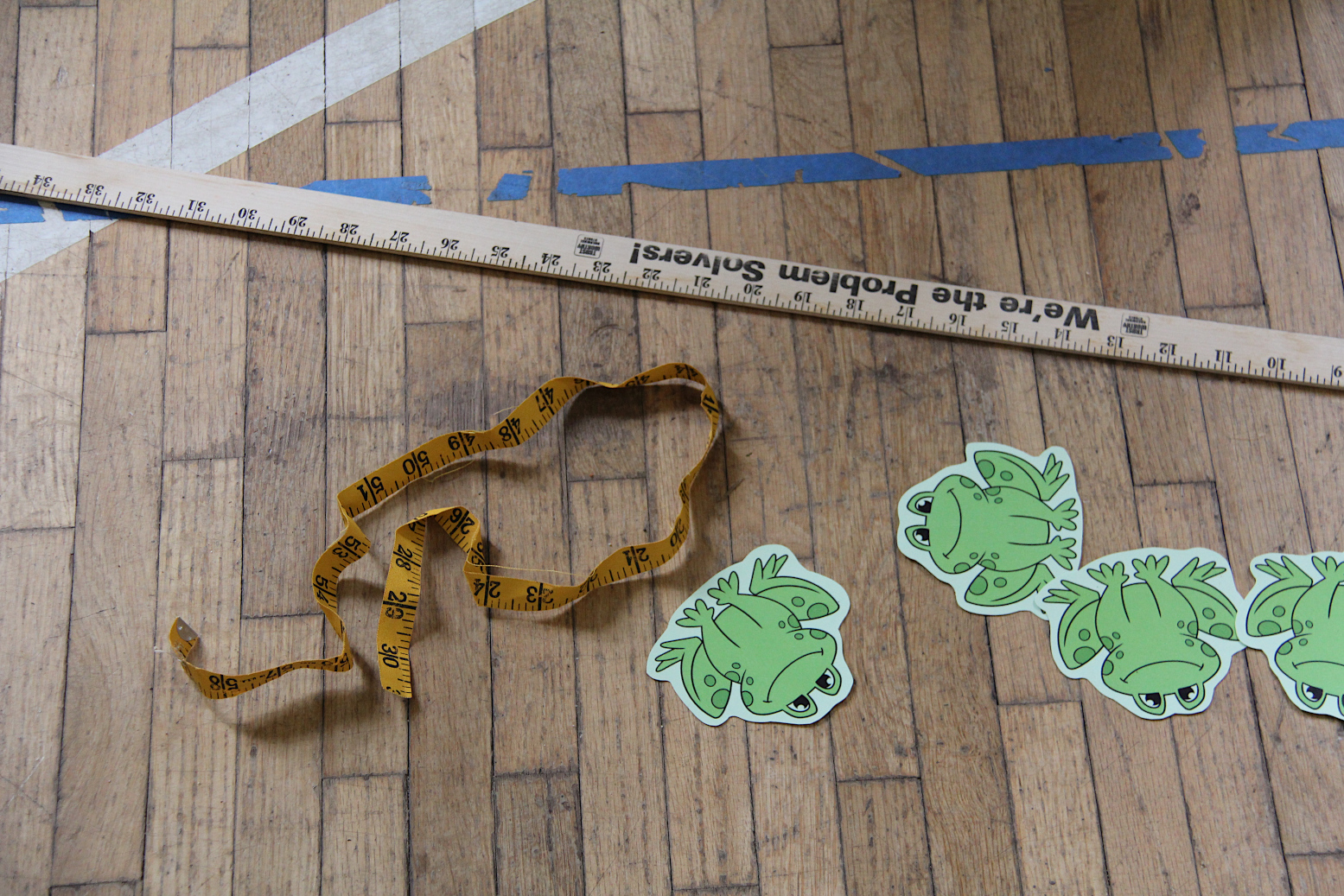
Measuring devices mingle with frogs for play on the aged wooden floor. (Minnesota Prairie Roots copyrighted photo March 2026)
This space, this place, still feels like a sanctuary in many ways as people gather in community. For nearly 150 years, people walked across the well-worn wooden floors, gathering to grieve, to celebrate, to seek sanctuary.
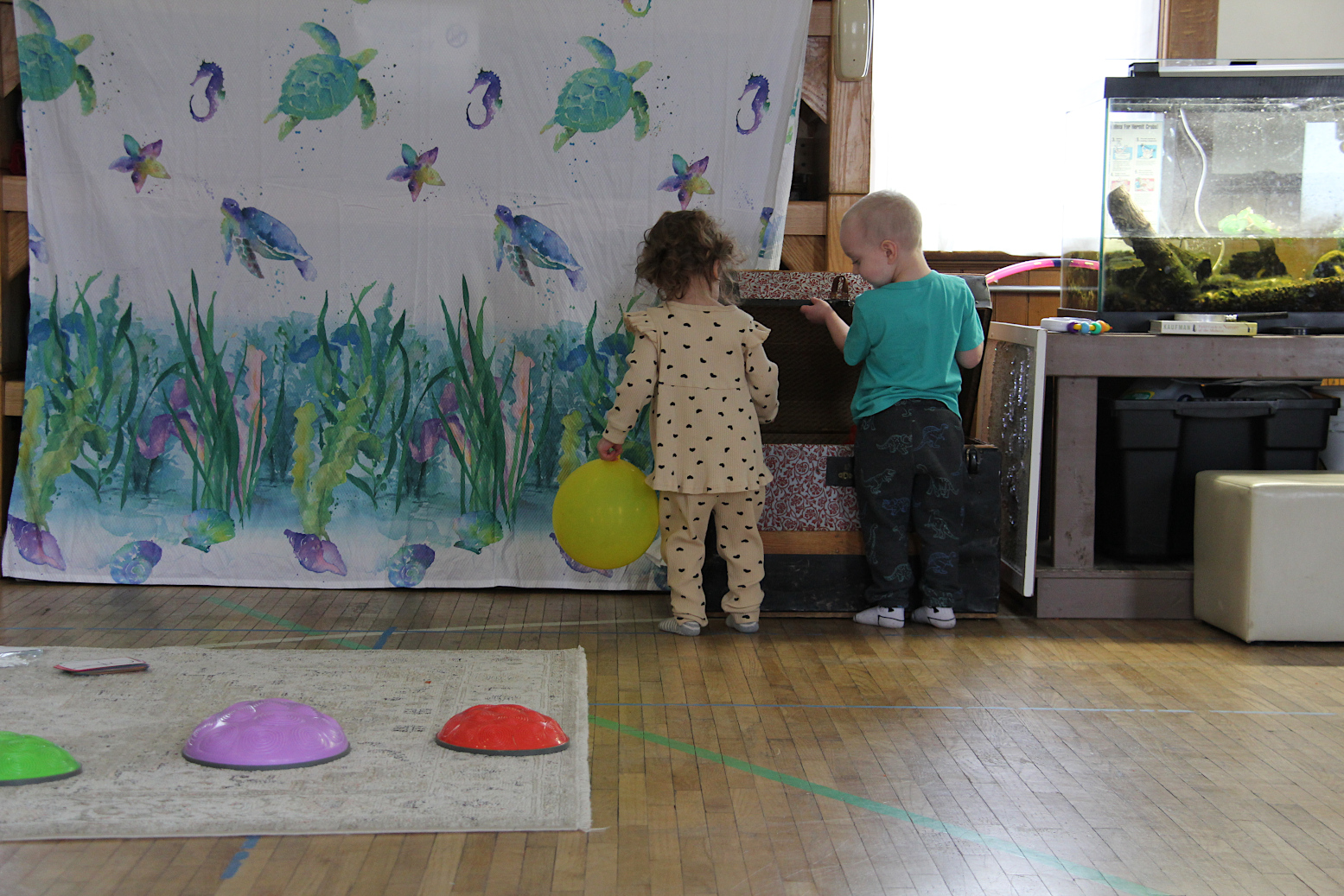
Exploring and playing on a recent Thursday morning. (Minnesota Prairie Roots copyrighted photo March 2026)
It feels right that this former house of worship today offers a safe haven, a sanctuary, for all ages to create, learn, connect, meditate and more. Here young moms come with their littles, school-aged kids create art and explore nature, youth attend summer day camps focused on kindness, gardening, fishing, art and much more. Adults practice yoga and attend wellness retreats.
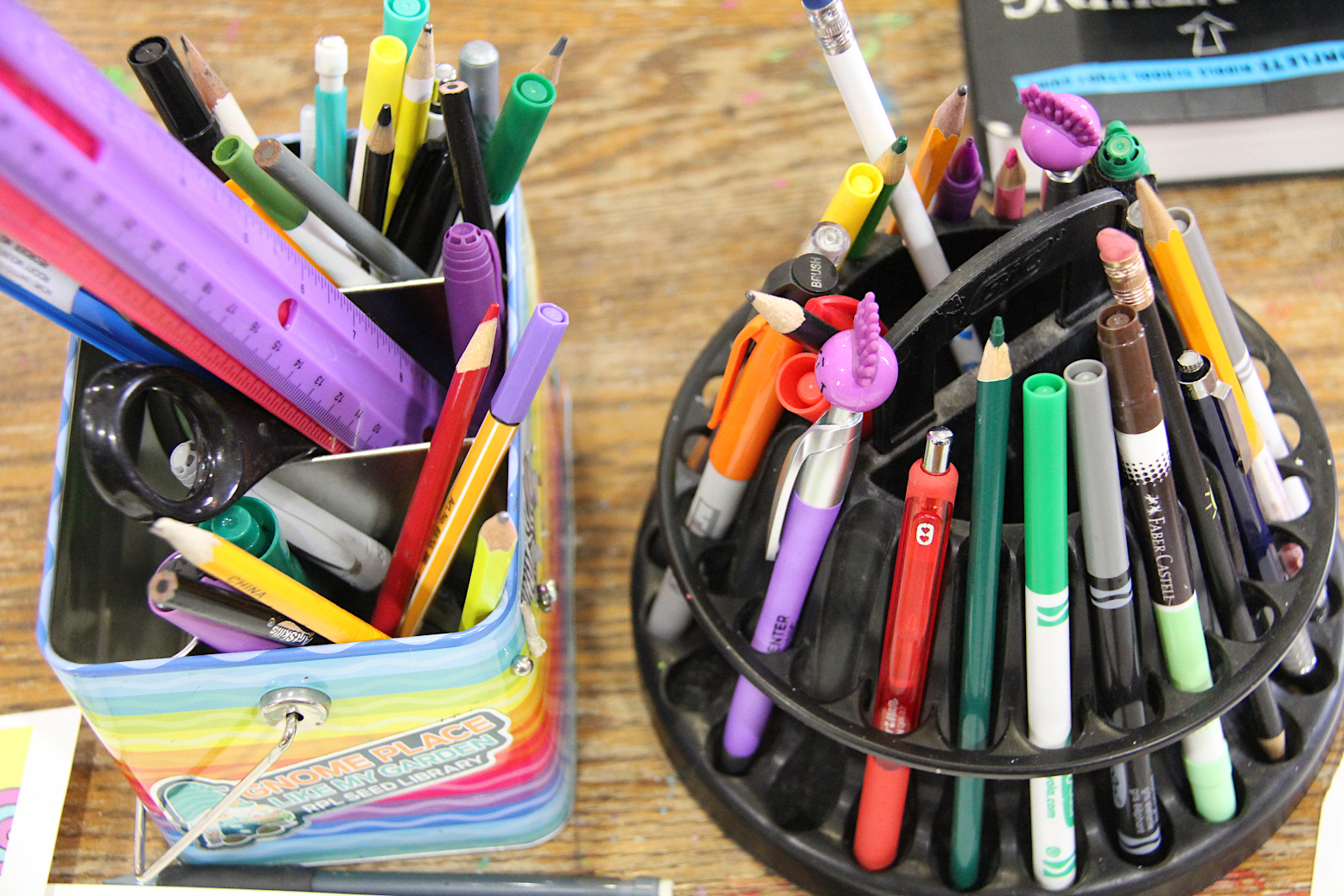
Among the many art supplies available for creating. (Minnesota Prairie Roots copyrighted photo March 2026)
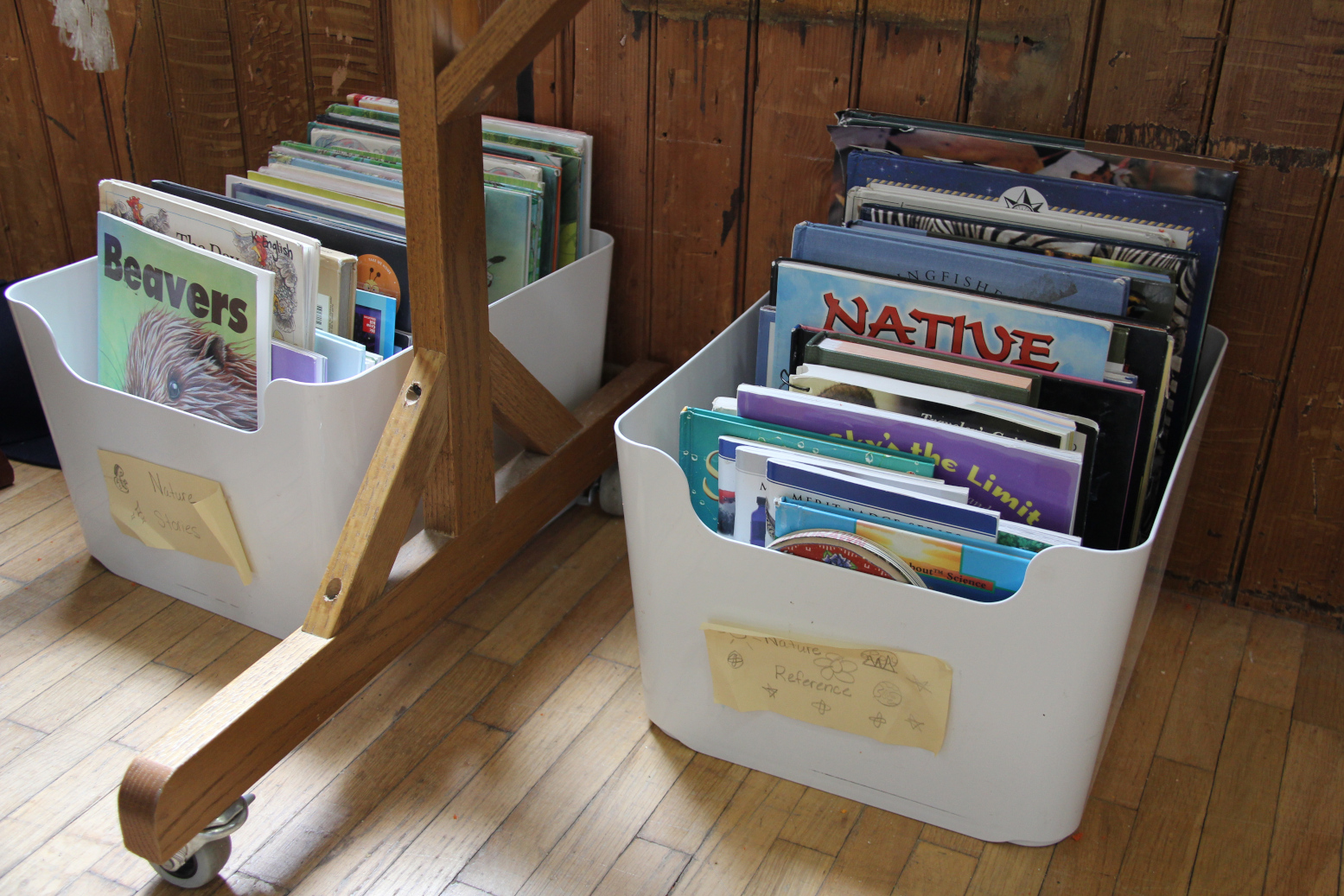
A stash of books I spotted. (Minnesota Prairie Roots copyrighted photo March 2026)
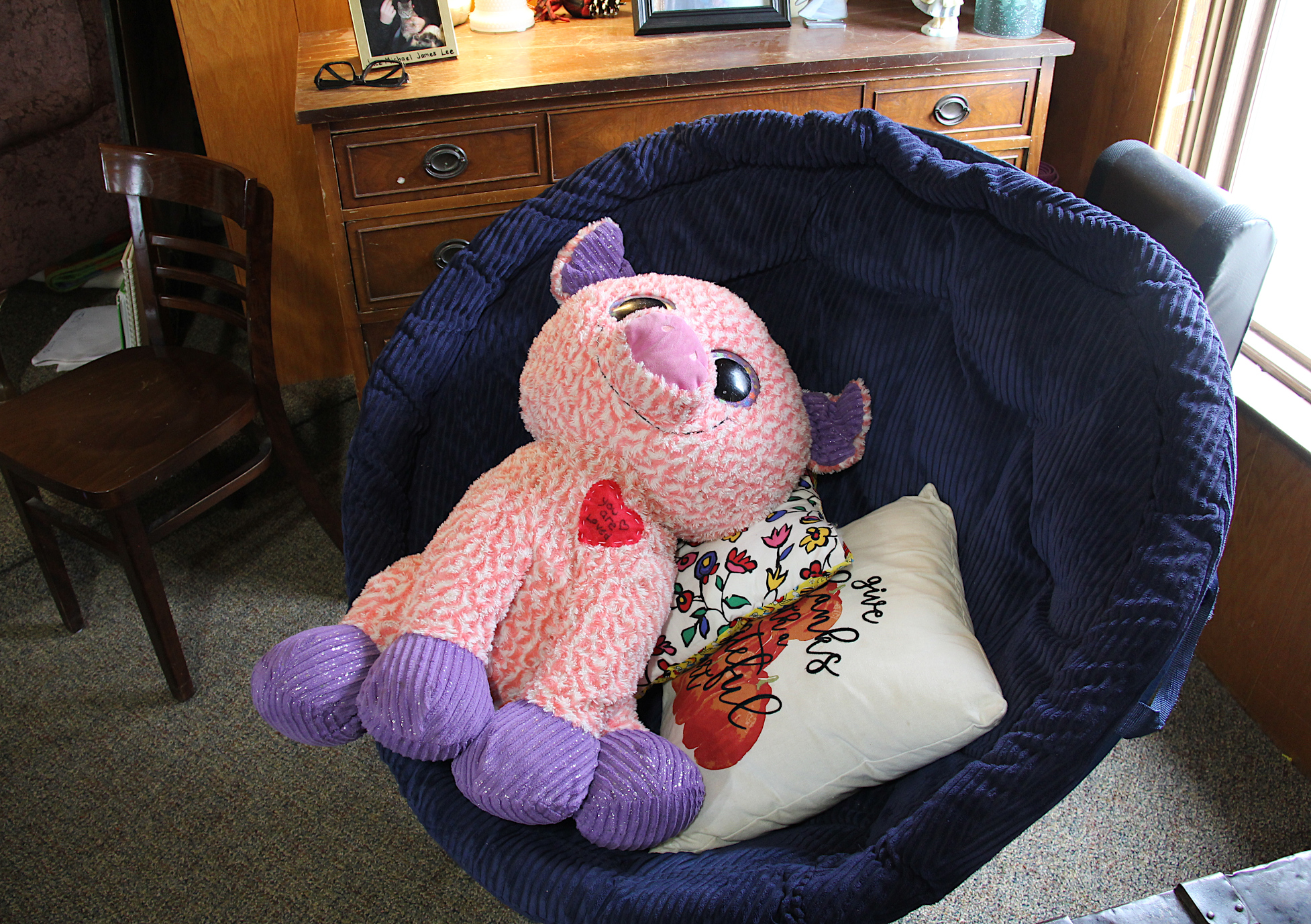
Cozy seating. (Minnesota Prairie Roots copyrighted photo March 2026)
In a short conversation with Angie, I learned of her passion for this place she’s created and filled with art supplies, books, nature finds, toys, aquariums, cozy seating and much more in a truly welcoming, creative and joyful learning environment.
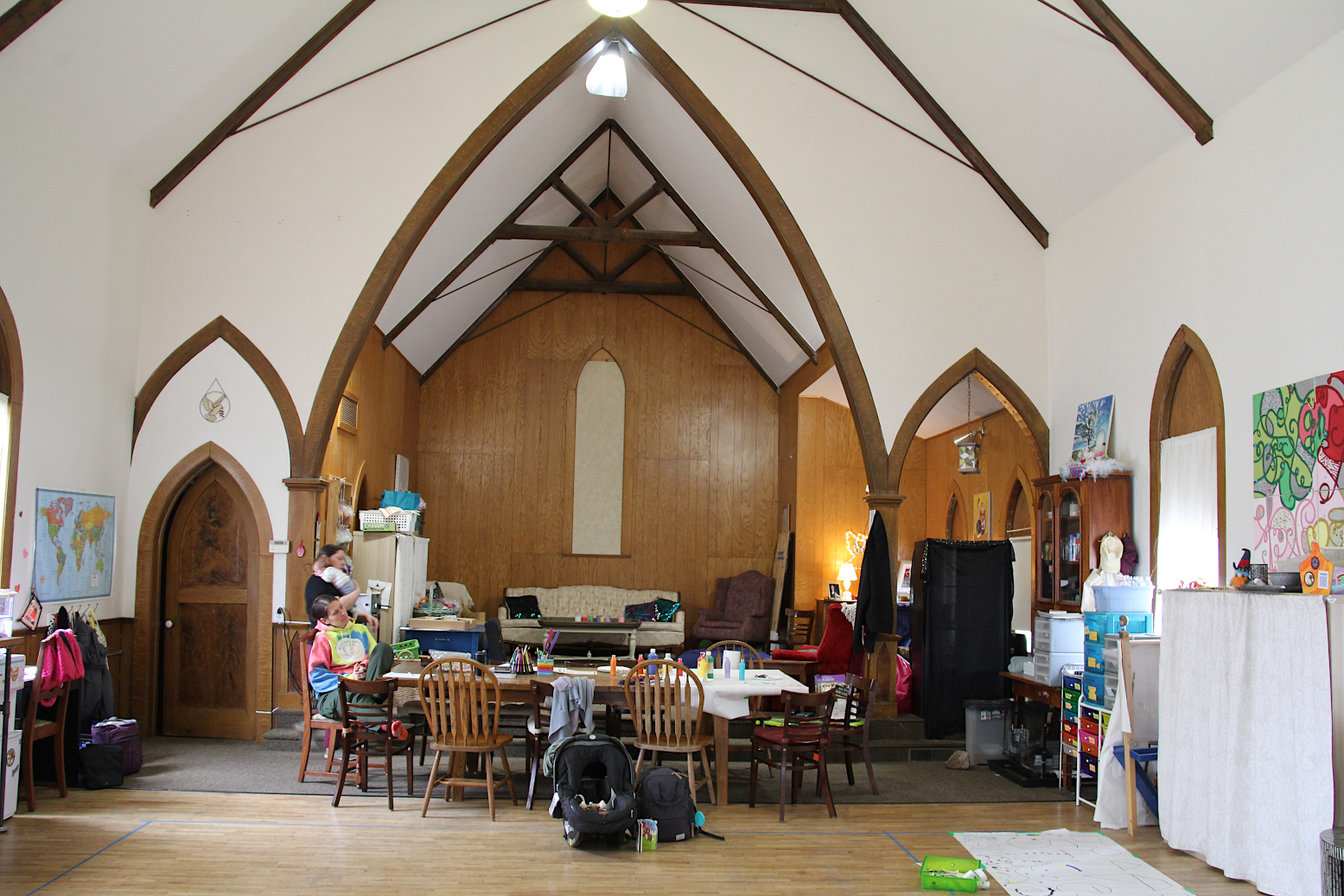
Looking toward the front of the former church, now a spacious space for gathering, creating and more. (Minnesota Prairie Roots copyrighted photo March 2026)
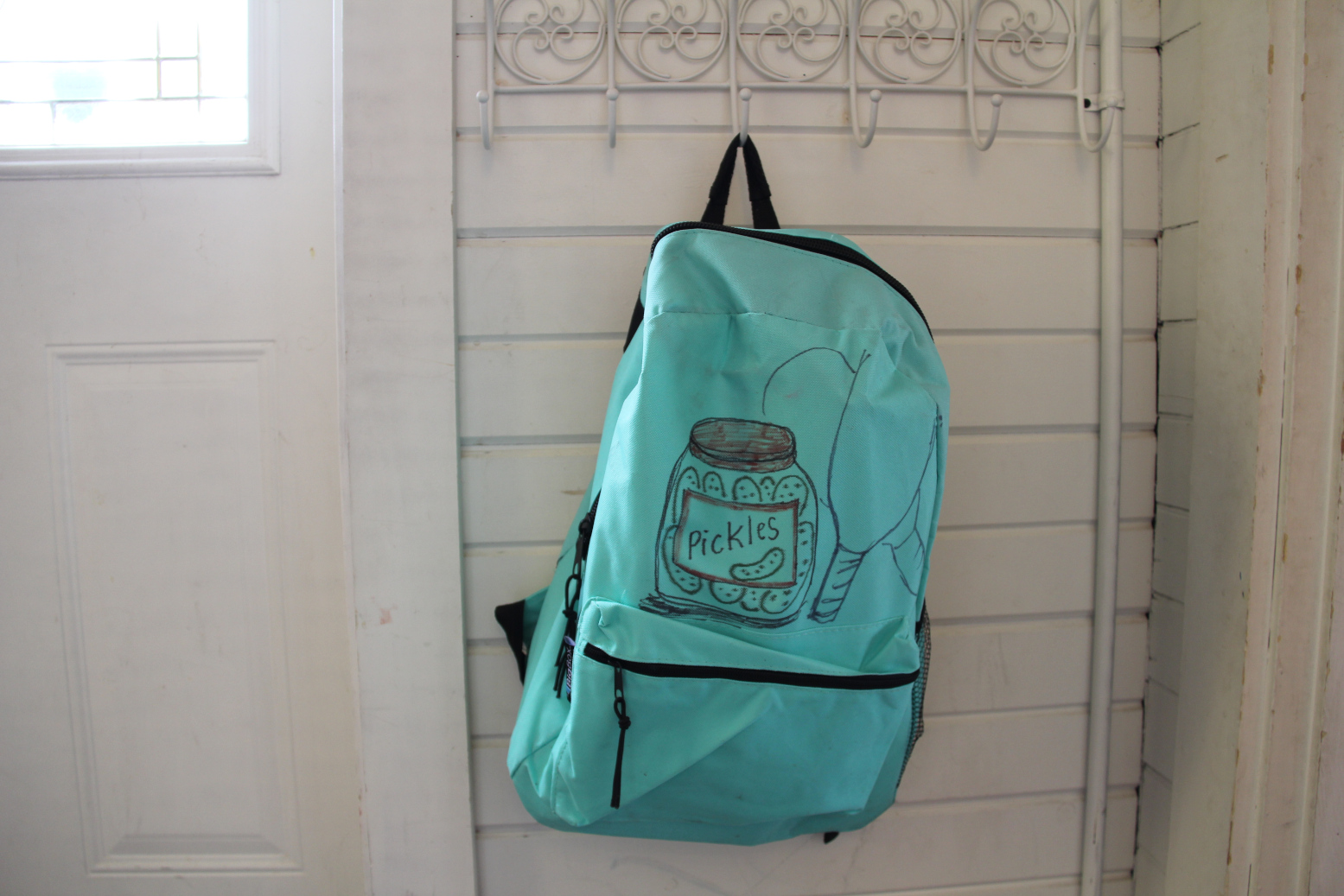
An artsy backpack hangs just inside the front entry door. (Minnesota Prairie Roots copyrighted photo March 2026)
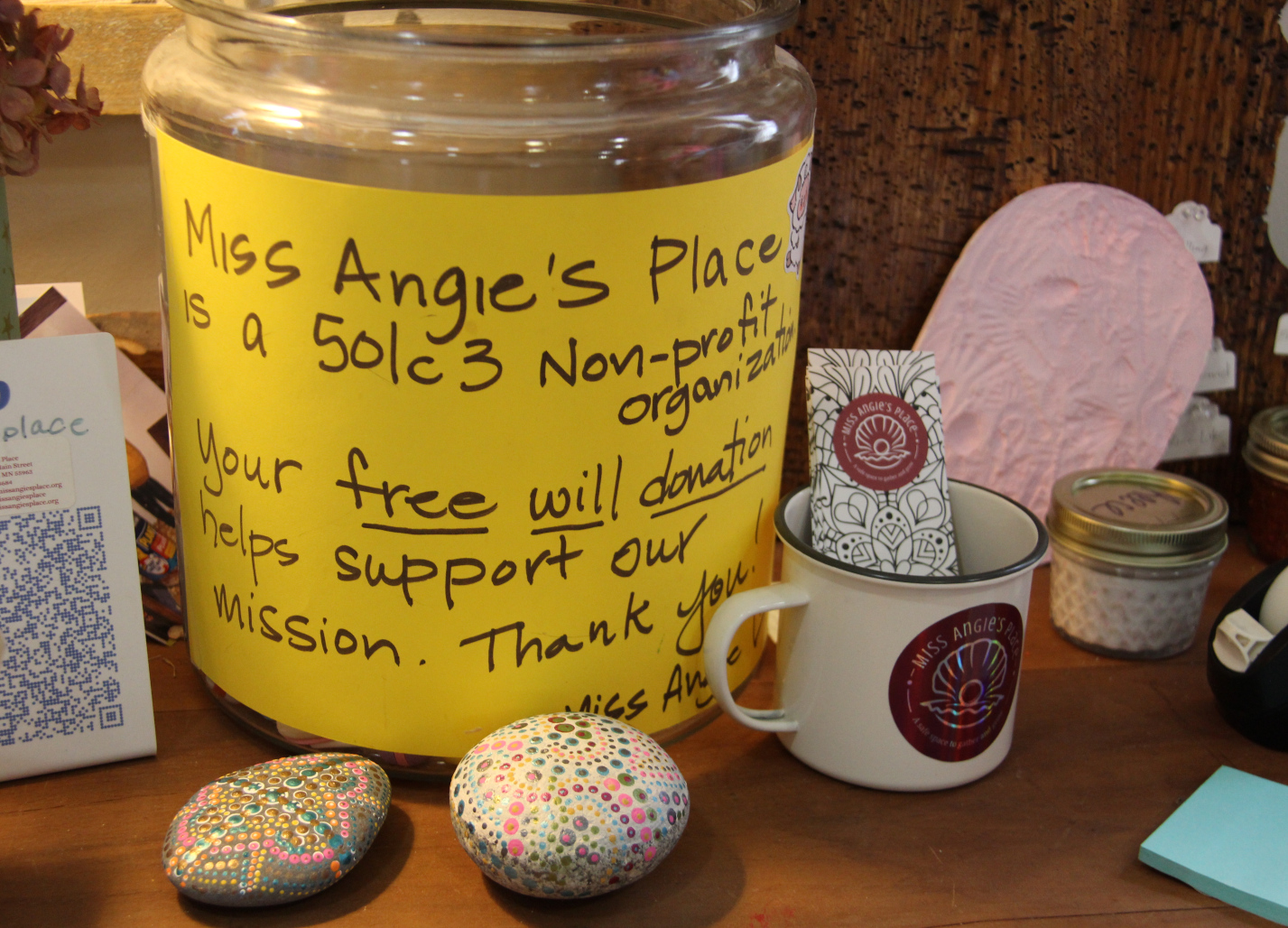
Donation jars and boxes are scattered throughout Miss Angie’s Place to help support the nonprofit. (Minnesota Prairie Roots copyrighted photo March 2026)
When someone does what they love, it shows. From her vibrant tie-dyed sweatshirt, to her engaging smile, to the way Angie cuddled the resident rabbit, she exuded a sense of purpose and joy. I watched her interact with preschoolers, bending to their level, encouraging, connecting.
A mom, her preschooler and infant leave the early literacy and playtime at Miss Angie’s Place. (Minnesota Prairie Roots copyrighted photo March 2026)
Miss Angie’s Place is, indeed, “a fun, nurturing and safe space to gather and grow.” It is the type of place I delight in discovering in small town Minnesota. Unexpected. Connective. Creative. And centered in community.
IF YOU WERE TO COLLECTIVELY consider two upcoming events this week and one current art exhibit in Faribault, you would find a common theme. That would be humanity and how we treat one another.
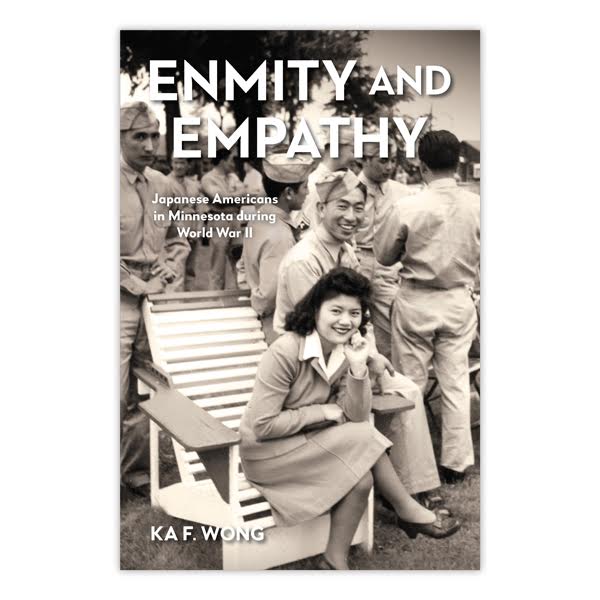
Award nominee or not, this book is assuredly a winner for the depth and volume of information Wong shares about imprisoned Japanese Americans, something unknown to many Americans. My knowledge is limited, so I’m looking forward to this presentation.
In promoting Wong’s talk this Thursday evening, the county historical society shared this in a media release:
Drawing on personal interviews, archival sources, and historical literature, Professor Ka Wongexplores the courageous struggles of trailblazers who left the incarceration camps and rebuilt theirlives in the North Star State. He will share stories of college students pursuing higher education,including the two colleges in Rice County, young men and women training at the MilitaryIntelligence Service Language School at Camp Savage and then Fort Snelling, the US Cadet NurseCorps serving in Rochester hospitals, and entrepreneurial families and individuals in the TwinCities and beyond.
All of this, of course, makes me think of the recent massive federal immigration enforcement in Minnesota. In that operation, many were illegally detained by federal agents, flown out of the state and held without due process in detention camps, where they remain. Others were released, some deported. I expect Wong may address this during his presentation. He can definitely provide historic perspective.
NOTE: Reserve a spot at this talk by calling (507) 332-2121. Space is limited. Admittance is free for RCHS members and $5 for non-members.
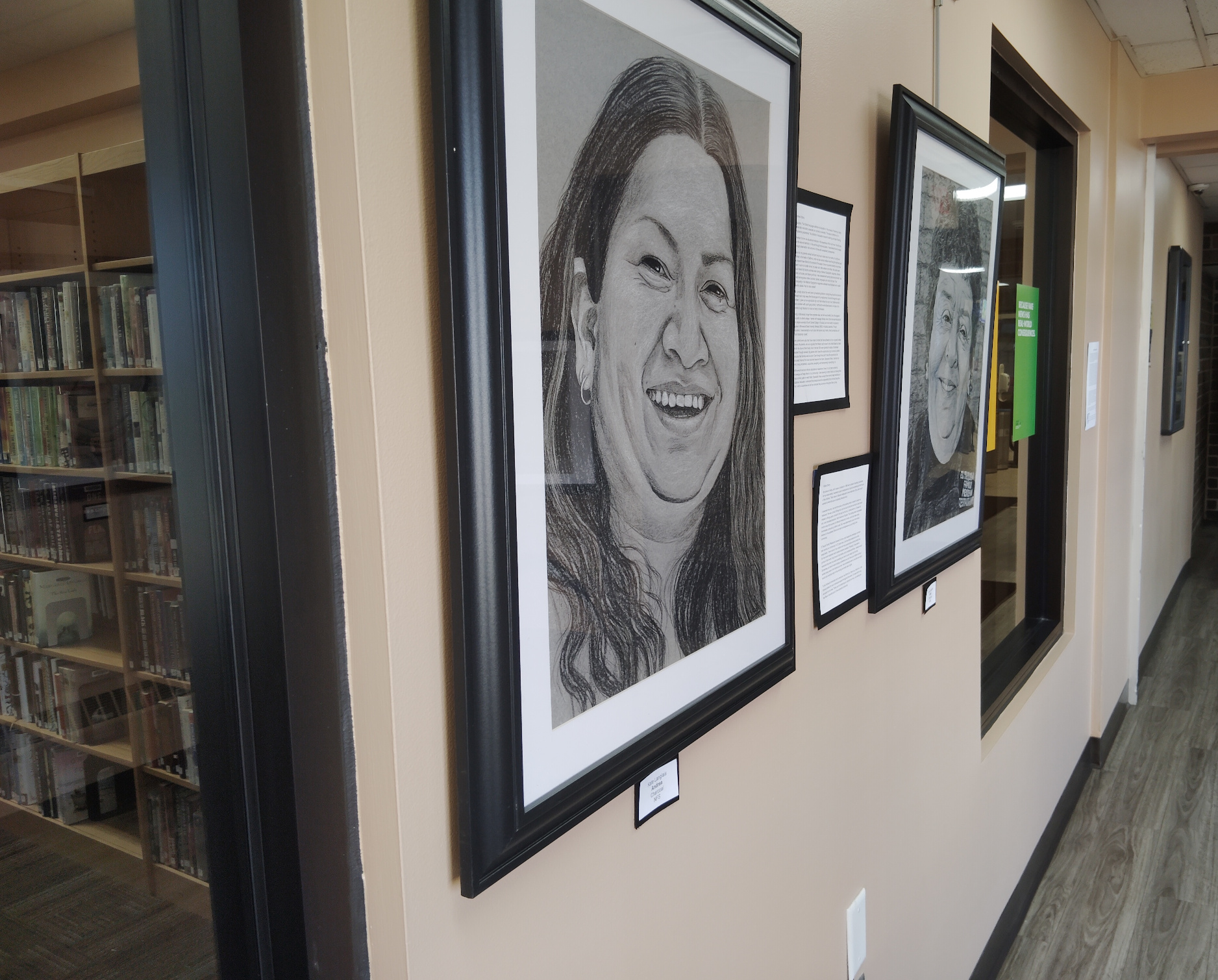
Immigrant portraits line the hall connecting the library, left, to the community center. (Minnesota Prairie Roots copyrighted photo March 2026)
ART EXHIBIT FEATURES IMMIGRANT PORTRAITS
Immigrants are the focus of an exhibit currently showing in the hallway between the Faribault Community Center and Buckham Memorial Library. Faribault artist Kate Langlais shows 13 of her portraits from her “I Am Minnesota” project. These are first and second-generation immigrants.
Four months ago, Langlais’ immigrant portraits filled a spacious gallery at the Paradise Center for the Arts in Faribault. These are selected drawings from that show. She’s also previously shown her artwork in the same space where the 13 portraits now hang.
In my opinion, these portraits should be shared as often as possible in Faribault, which has not always been particularly welcoming to immigrants. I’m certainly not talking everyone, but too many people would rather our newest neighbors from Somalia, Mexico and other countries leave our city. I’ve heard that shouted while protesting ICE operations.
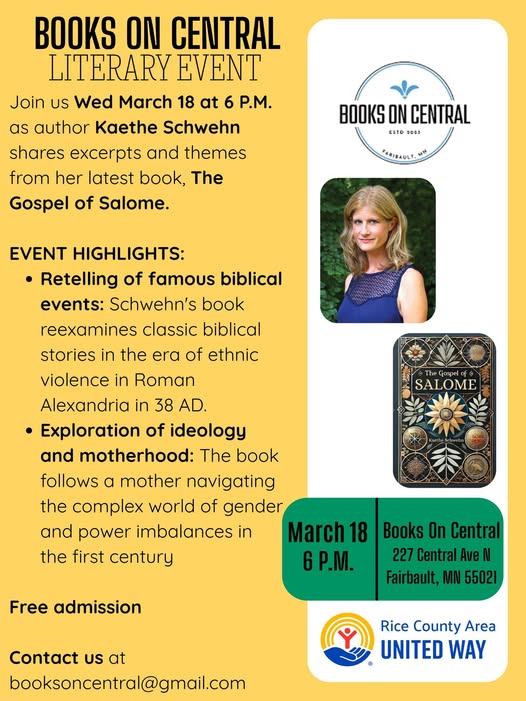
(Promo from the Books on Central Facebook page)
AN AUTHOR TALKS ABOUT THE GOSPEL OF SALOME
Finally, St. Olaf College professor and author Kaethe Schwehn will talk about her newest book, The Gospel of Salome, at 6 p.m. Wednesday, March 18, at Books on Central in Faribault. The historical novel set in Biblical times follows a mother who is navigating a complex world of gender and power imbalances during the First Century. Schwehn will read from her book and talk about some of its themes, examining ideology, motherhood and a poignant argument for love and equality in today’s world, according to pre-event information.
I expect good discussion will follow, as it always does at these free literary events at Books on Central.
There’s a lot to be learned in Faribault this week. I hope locals and others will embrace these three opportunities to grow their knowledge and broaden their perspectives.
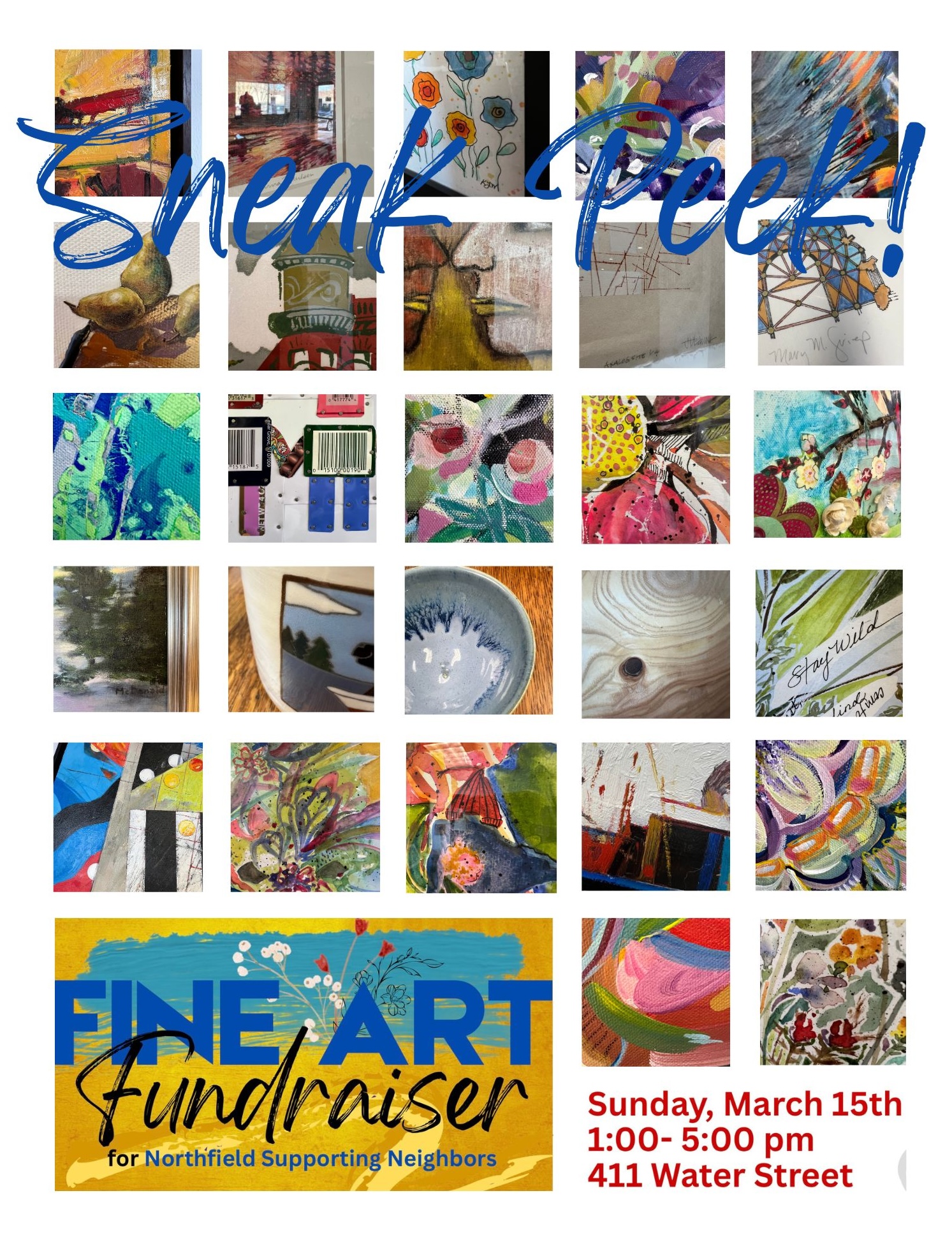
(Promo sourced from the Northfield Arts Guild Facebook page.)
Update: Due to the forecast winter storm/blizzard in Minnesota beginning Saturday, March 14, through Monday, March 16, this event could be subject to cancellation on Sunday. However, hours have already been added from 11 a.m.-4 p.m. on Saturday, March 21.
THE COMMUNITY OF NORTHFIELD is stepping up once again, as it has multiple times in recent months, to help immigrants in need following Operation Metro Surge.
So what exactly is an art swap? It’s a group of artists gathering, creating and passing around artwork, all contributing at the same time. Basically, an artist builds on or adds to an original work of art that’s circulating around the room.
Local artists met for four two-hour sessions in February to create watercolor and acrylic art themed to Banksy’s “Flower Thrower” painting. That piece by the graffiti artist shows a masked man throwing flowers in a form of nonviolent resistance. This seems an appropriate choice given federal immigration enforcement agents wore masks and threw tear gas and other chemical irritants at protesters and resisters in Minnesota. Art has always been a tool of expression.
Now, as nearly all 3,000 federal agents have left the state (about 100 remain), recovery begins. The need is great for monies to fund legal aid, rental assistance, food and other basics among those impacted by ICE. This sale of collaborative art on Sunday is just one more way to help individuals and families who are struggling.
Northfield continues to show, via multiple fundraisers, that it cares deeply about those who call this southern Minnesota community home. They take the directive, “Love thy neighbor as thyself,” and put those words into action, this time with paint and paintbrushes.
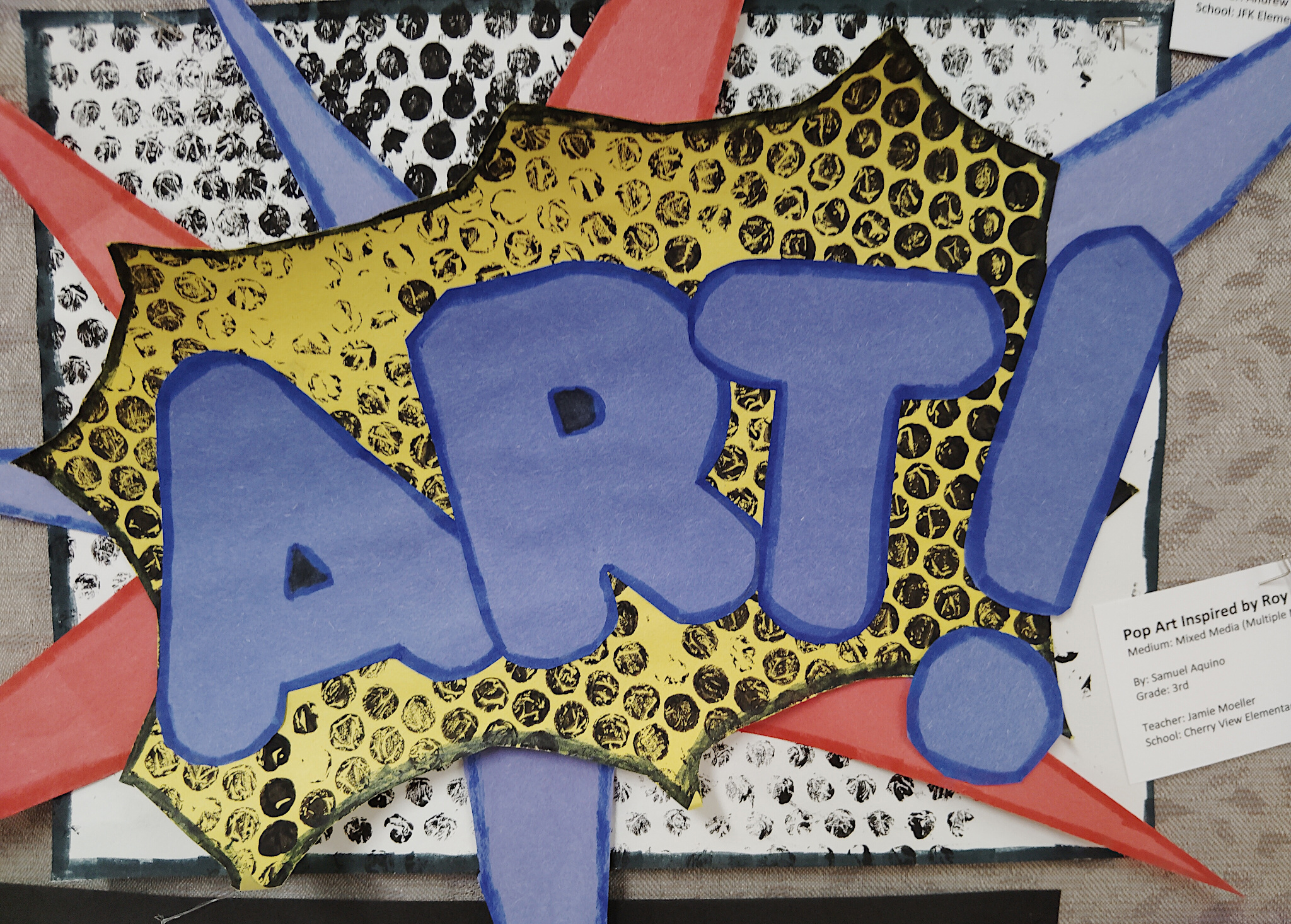
“Pop Art Inspired by Roy Lichtenstein,” mixed media by third grader Samuel Aquino. (Minnesota Prairie Roots copyrighted photo March 2026)
DURING A RECENT OVERNIGHT STAY, my 7-year-old grandson asked me to draw the shape of Minnesota. I declined. He, the boy who drew state and world maps even before entering kindergarten, far exceeds me in his map making skills. Correction. He can draw far better than Grandma in any subject.
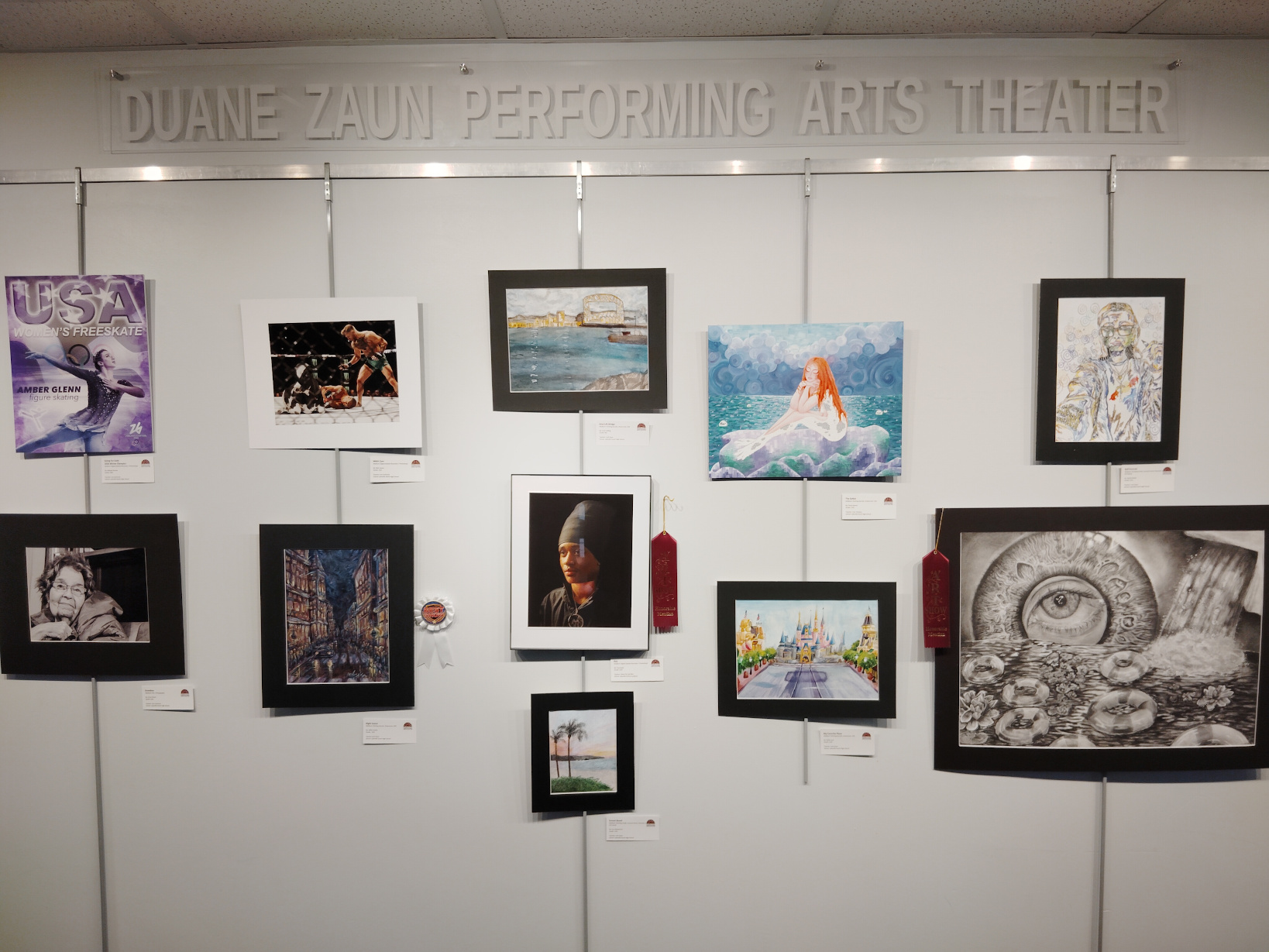
This shows some of the art created by Lakeville High School students. The exhibit is open until March 20. (Minnesota Prairie Roots copyrighted photo March 2026)
But it’s not just Isaac who impresses me with his art. It’s kids in general. I base that on my yearly viewing of student art displayed publicly during National Youth Art Month in March. “The World Needs Art” themes this year’s event. I wholeheartedly agree. We absolutely need art to express ourselves, to share ideas, to learn, to grow, to change, to celebrate.
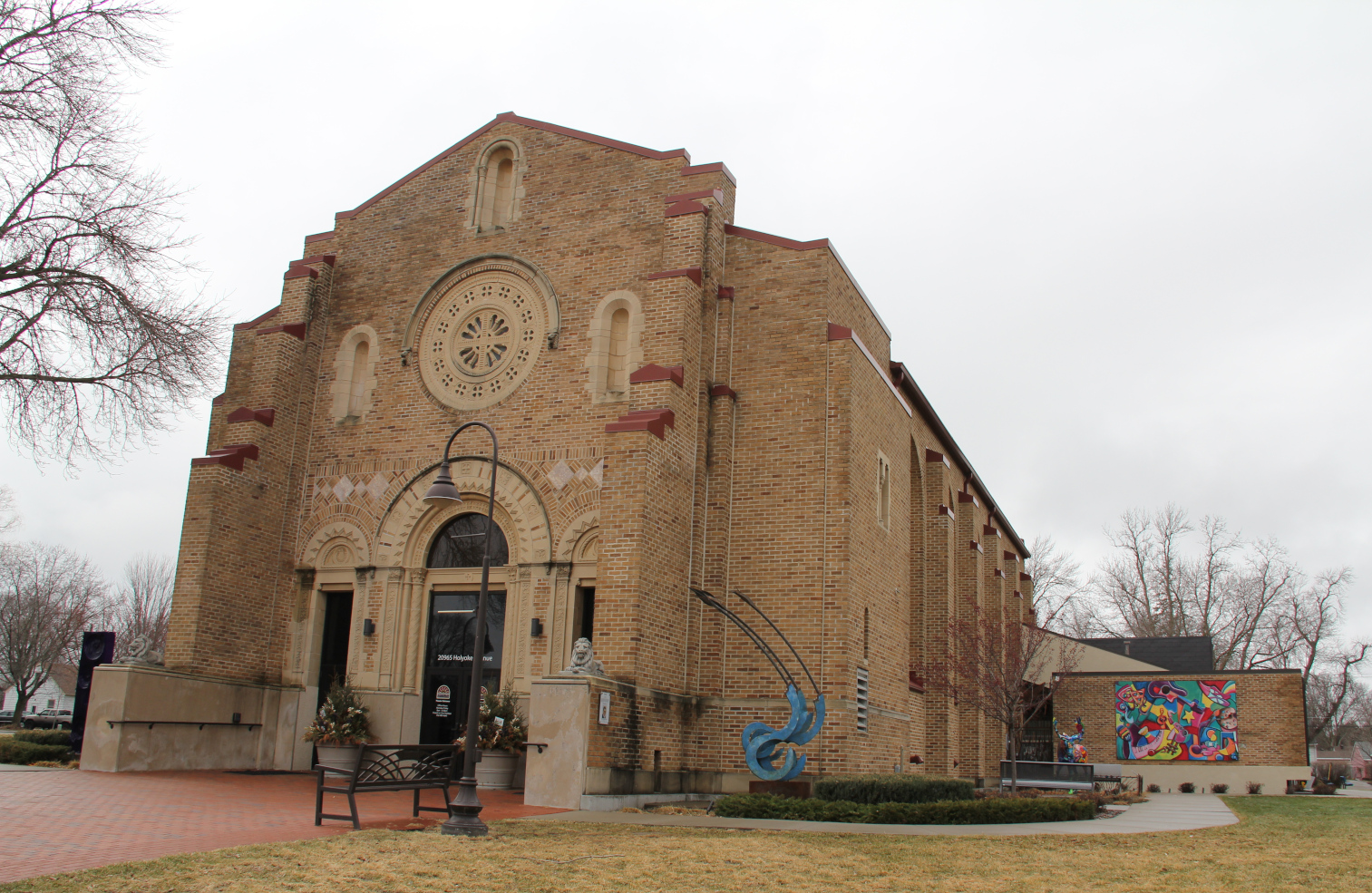
Lakeville High School and Middle School art is displayed in the performing arts center building pictured here. Elementary school art is exhibited in the next door fine arts building.(Minnesota Prairie Roots copyrighted photo March 2026)
This year I toured exhibits of student art at a K-12 show at the Lakeville Area Arts Center. Although my grandson and his sister attend Lakeville schools, their art is not included. Elementary school art is randomly selected for display, my granddaughter said.
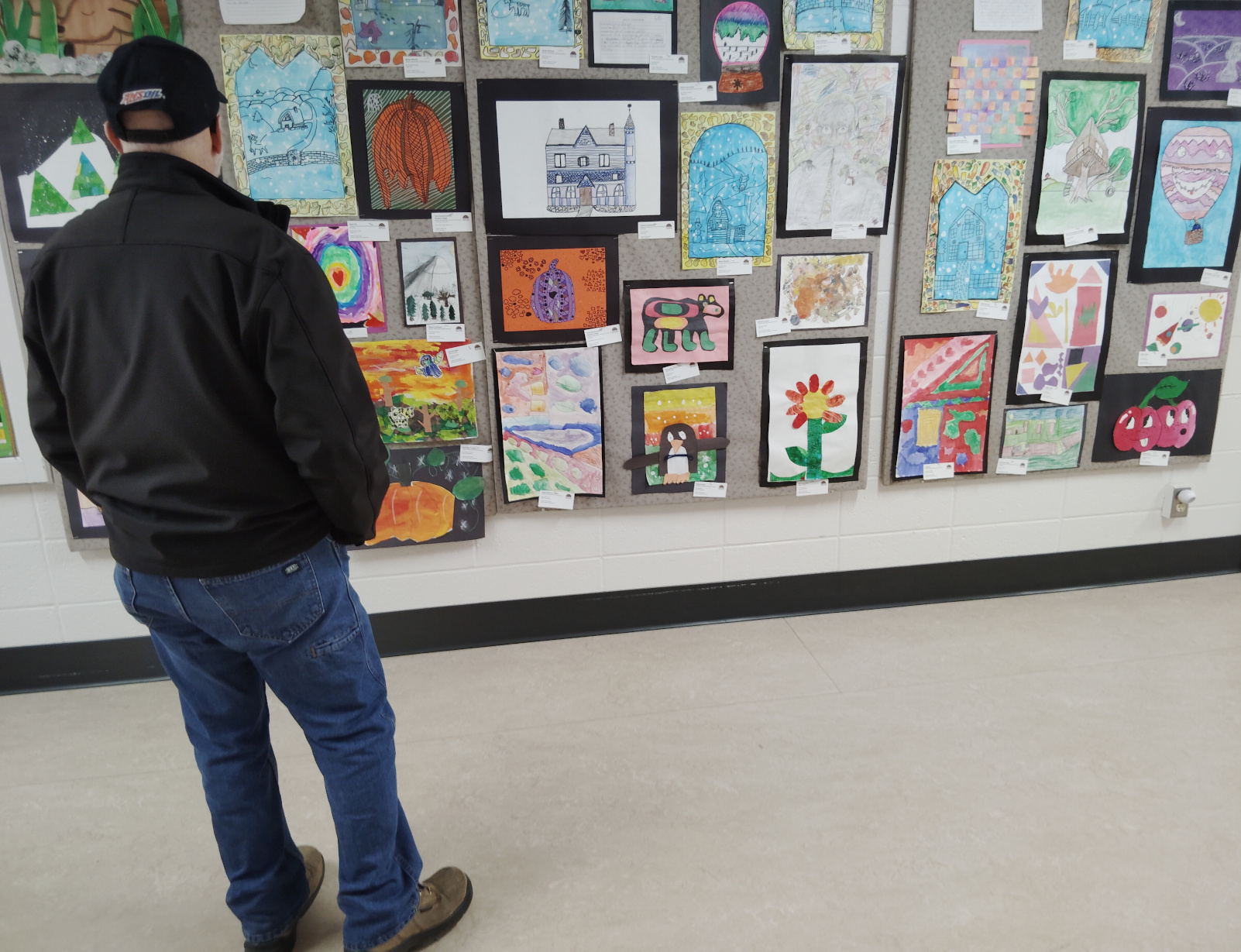
My husband, Randy, looks at elementary school art in a hallway of the fine arts building. (Minnesota Prairie Roots copyrighted photo March 2026)
Perhaps some day I’ll see my grandchildren’s art hung inside the Lakeville Area Arts Center. But for now, I enjoyed the creativity of other kids.
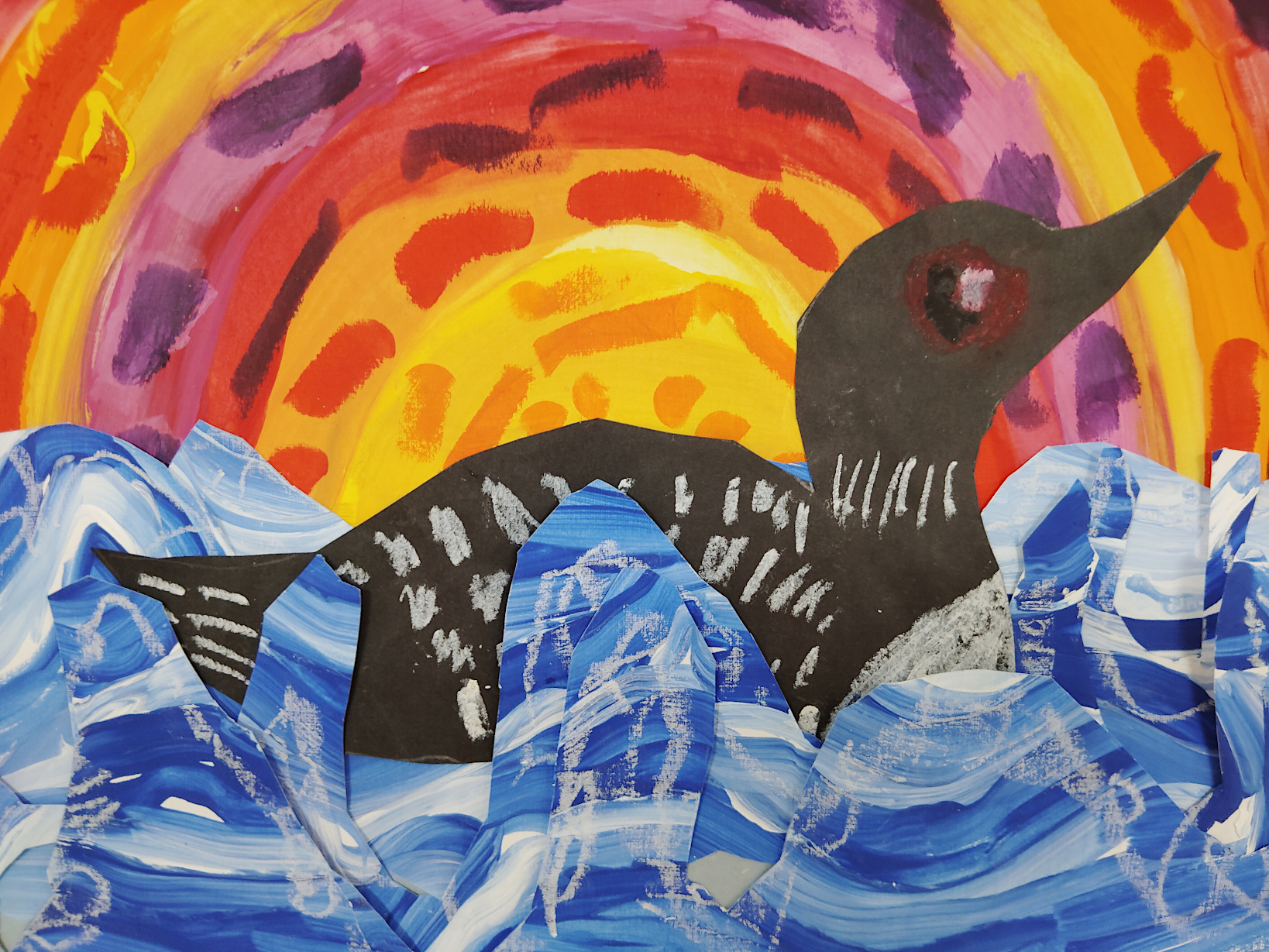
“Loonscape” by Aubrey Bartyzal. (Minnesota Prairie Roots copyrighted photo March 2026)
Take the mixed media “Loonscape” by kindergartner Aubrey Bartyzal, which earned honorable mention at the elementary school level. I could easily envision her rendition of Minnesota’s state bird on a t-shirt, tote bag or note cards. Set against a fiery sun and swimming in bold blue waters, the loon in Aubrey’s scene shouts “Up North at the Cabin.”
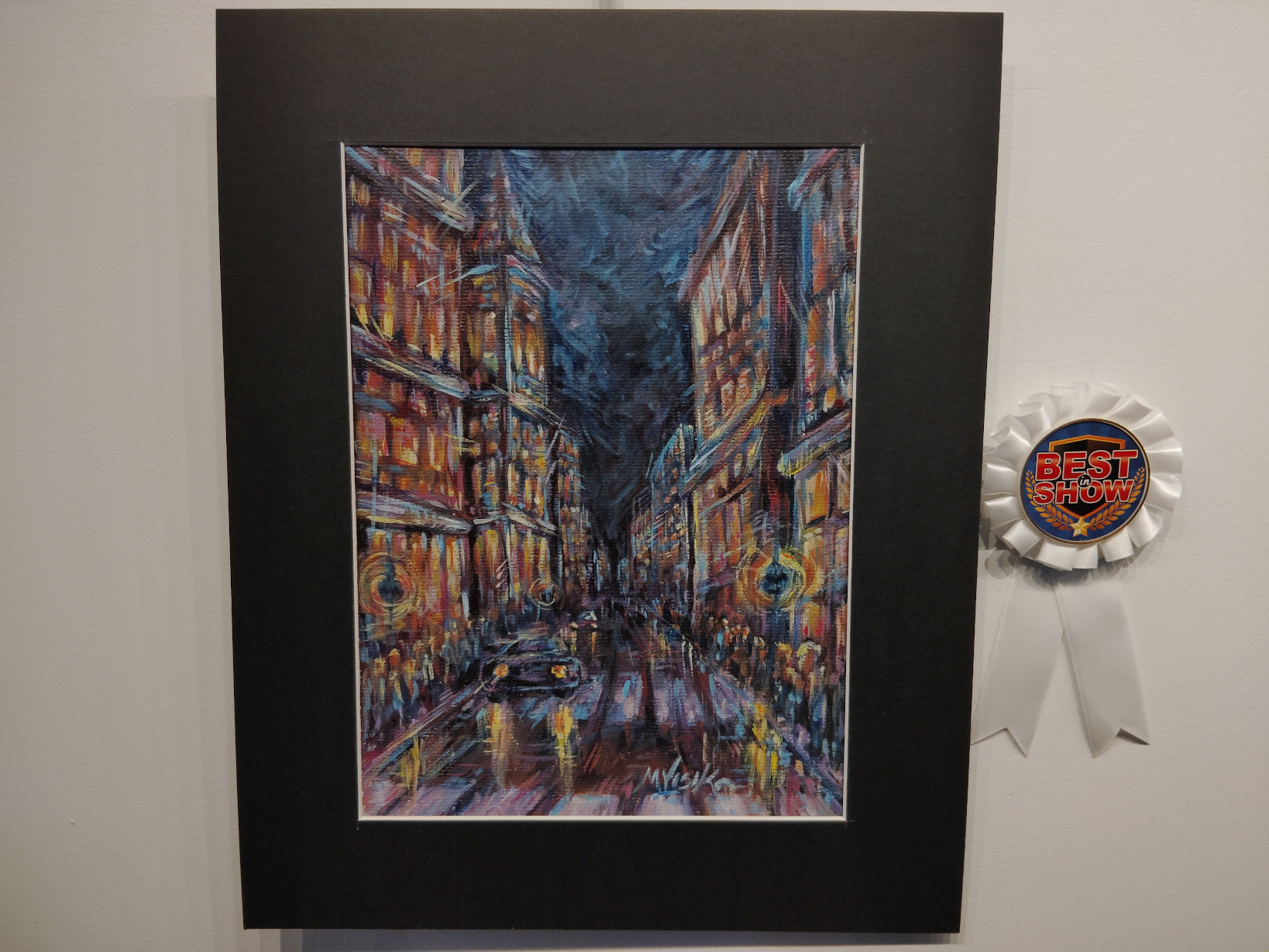
“Night Scene” by Millie Vosika, awarded Best of Show. (Minnesota Prairie Roots copyrighted photo March 2026)
Quite the opposite is high school senior Millie Vosika’s “Night Scene,” depicting a cityscape of towering buildings, a narrow street and a brooding night sky. The acrylic, watercolor and oil painting earned Best of Show and rightfully so. It’s impressive.
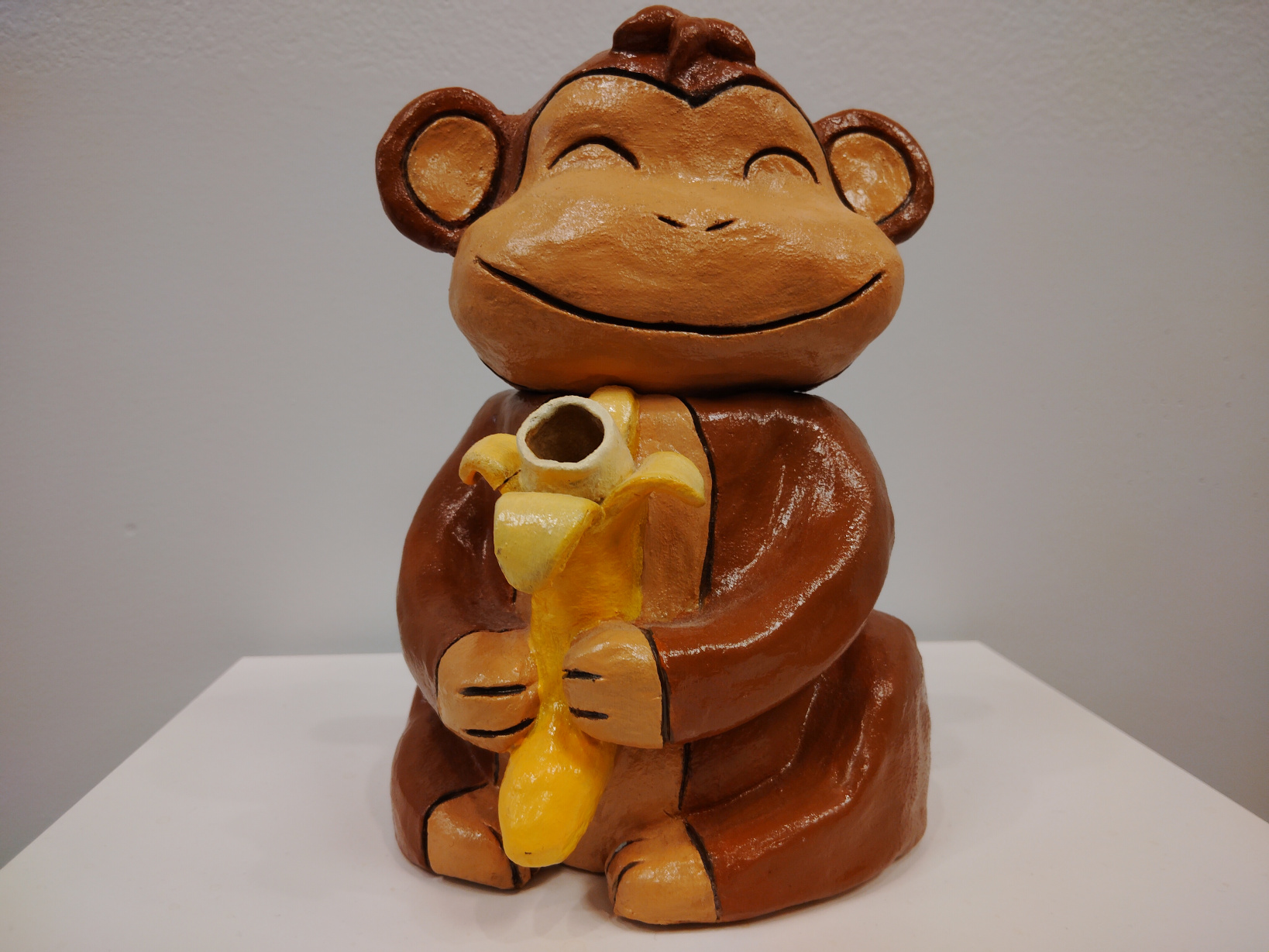
“Monkey Teapot” by Ruby Lyke. (Minnesota Prairie Roots copyrighted photo March 2026)
A ceramic “Monkey Teapot” by junior Ruby Lyke, simply put, made me happy.
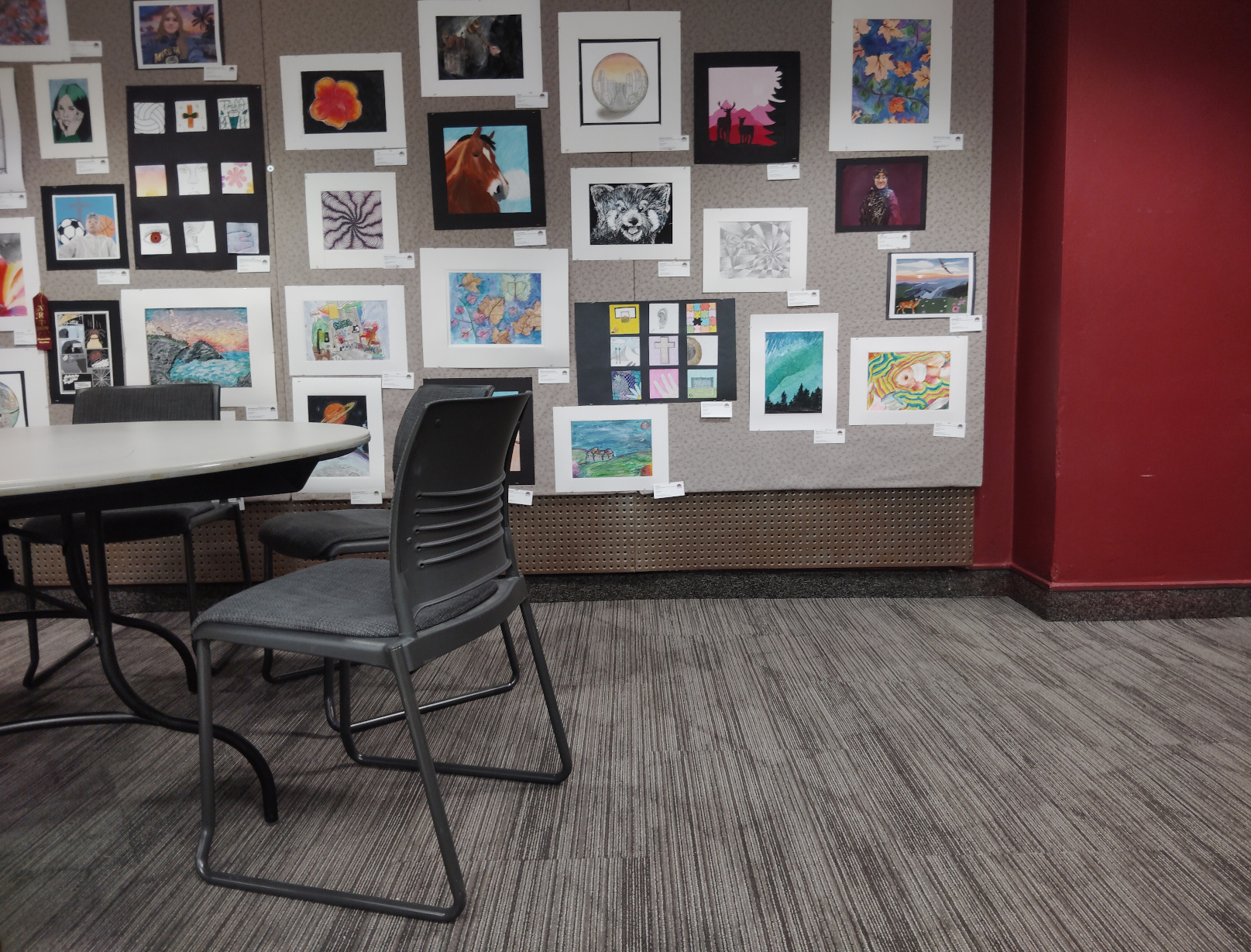
A wall of art by Lakeville Middle School students. (Minnesota Prairie Roots copyrighted photo March 2026)
There’s much to celebrate not only in the actual art itself, but also in the student artists who create and in the teachers who guide them. To foster creativity in a child is, in my opinion, invaluable. I’ve bought markers, reams of paper, construction paper and other art supplies for my young grandson, who, if he’s not solving math equations, is drawing.
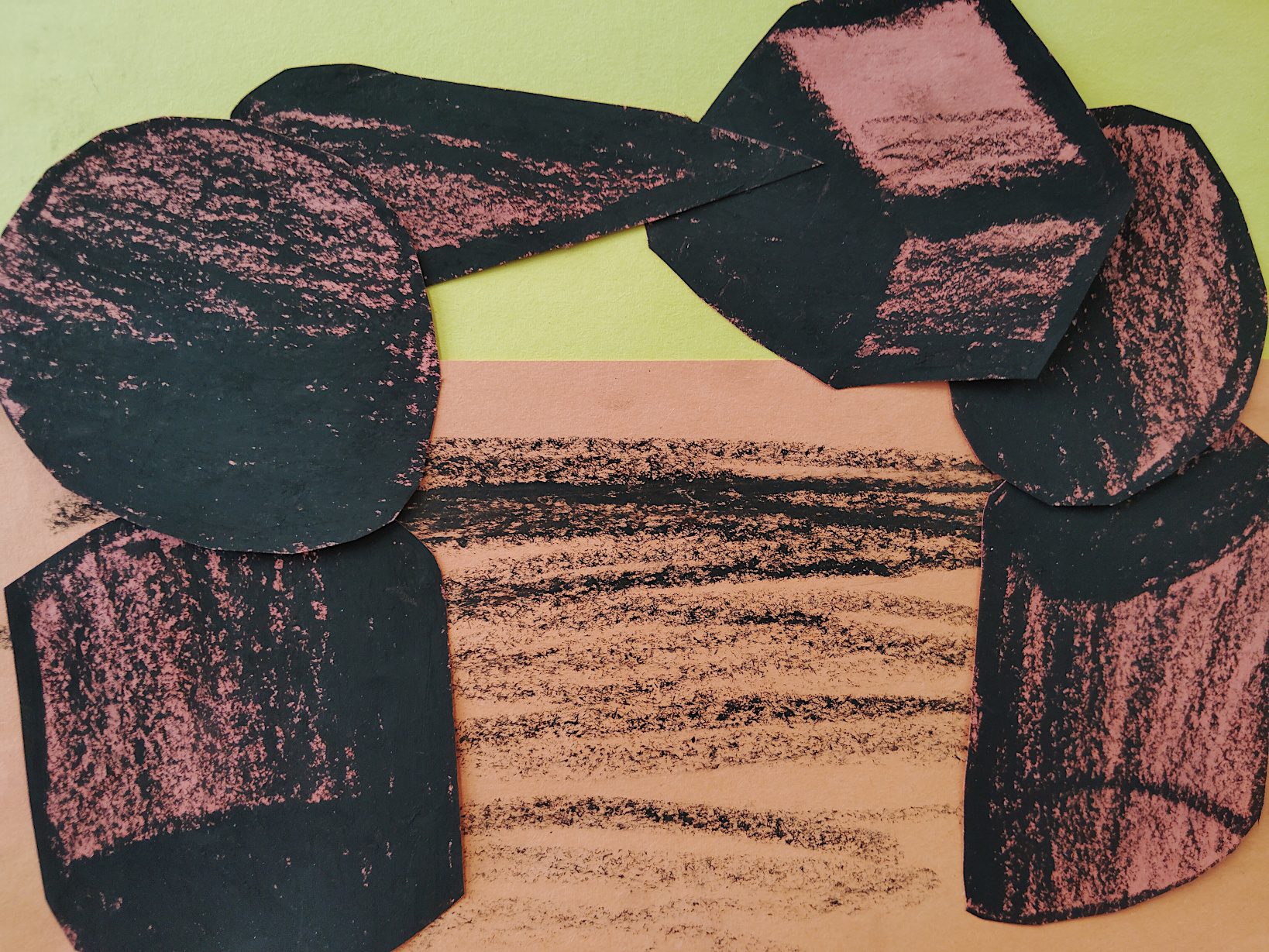
“Geometric Shapes,” a collage by third grader, Remy Espinasse. (Minnesota Prairie Roots copyrighted photo March 2026)
Some of the Lakeville students drew. Others painted. High schoolers used digital tools. A few molded clay. I saw varied art forms displayed.
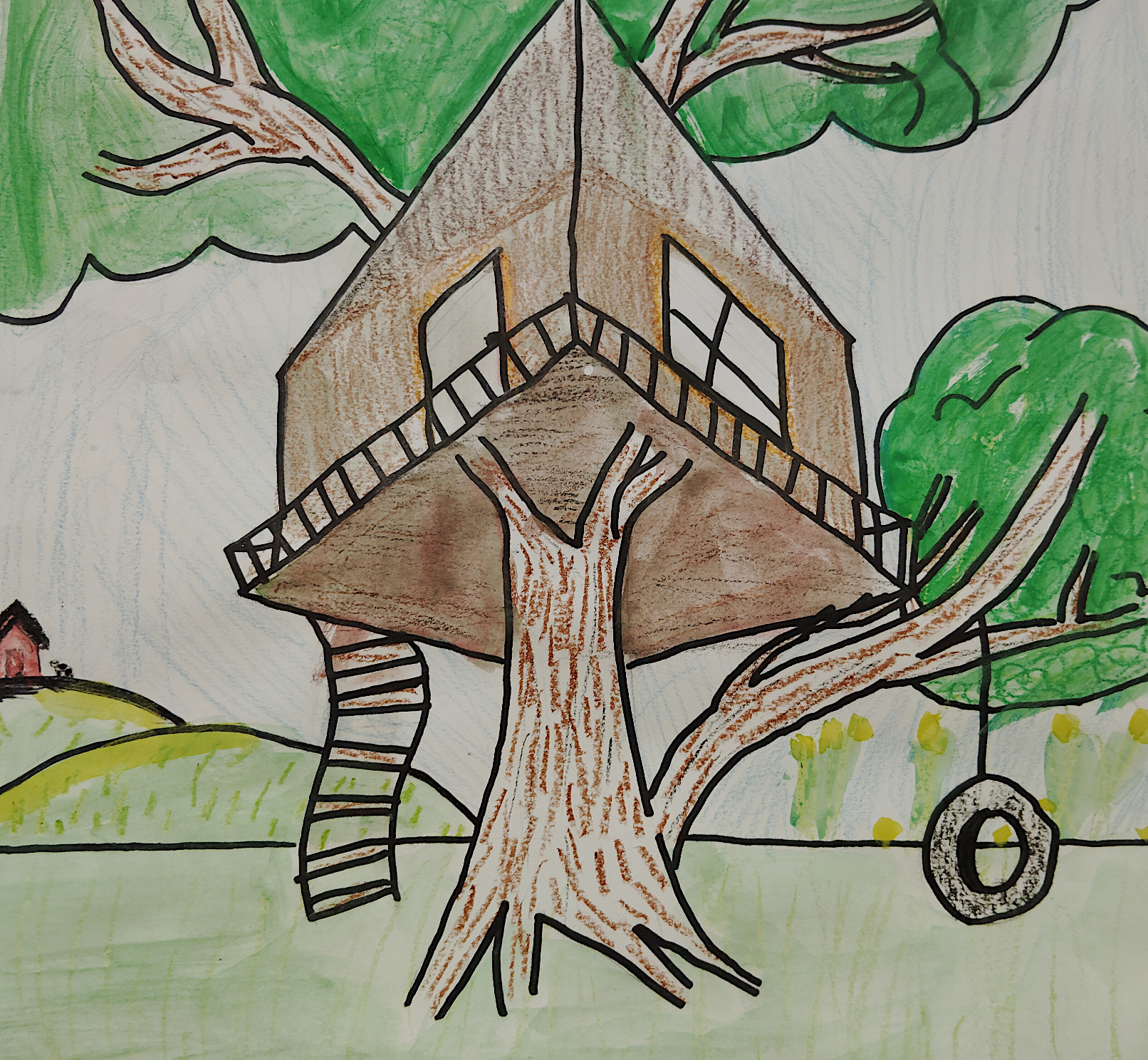
This shows a portion of third grader Avery Rundell’s mixed media “2-Point Perspective Treehouse.” (Minnesota Prairie Roots copyrighted photo March 2026)
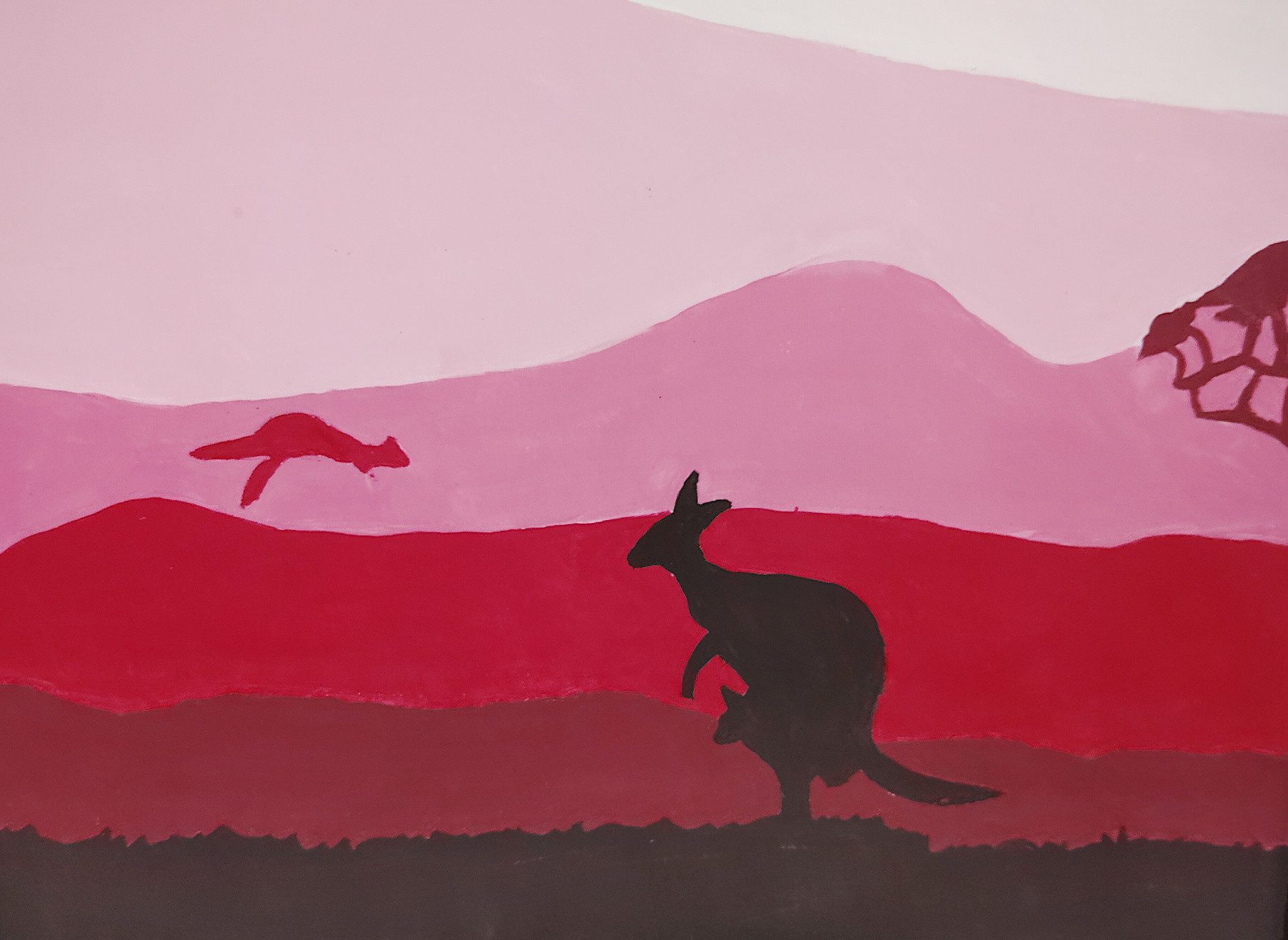
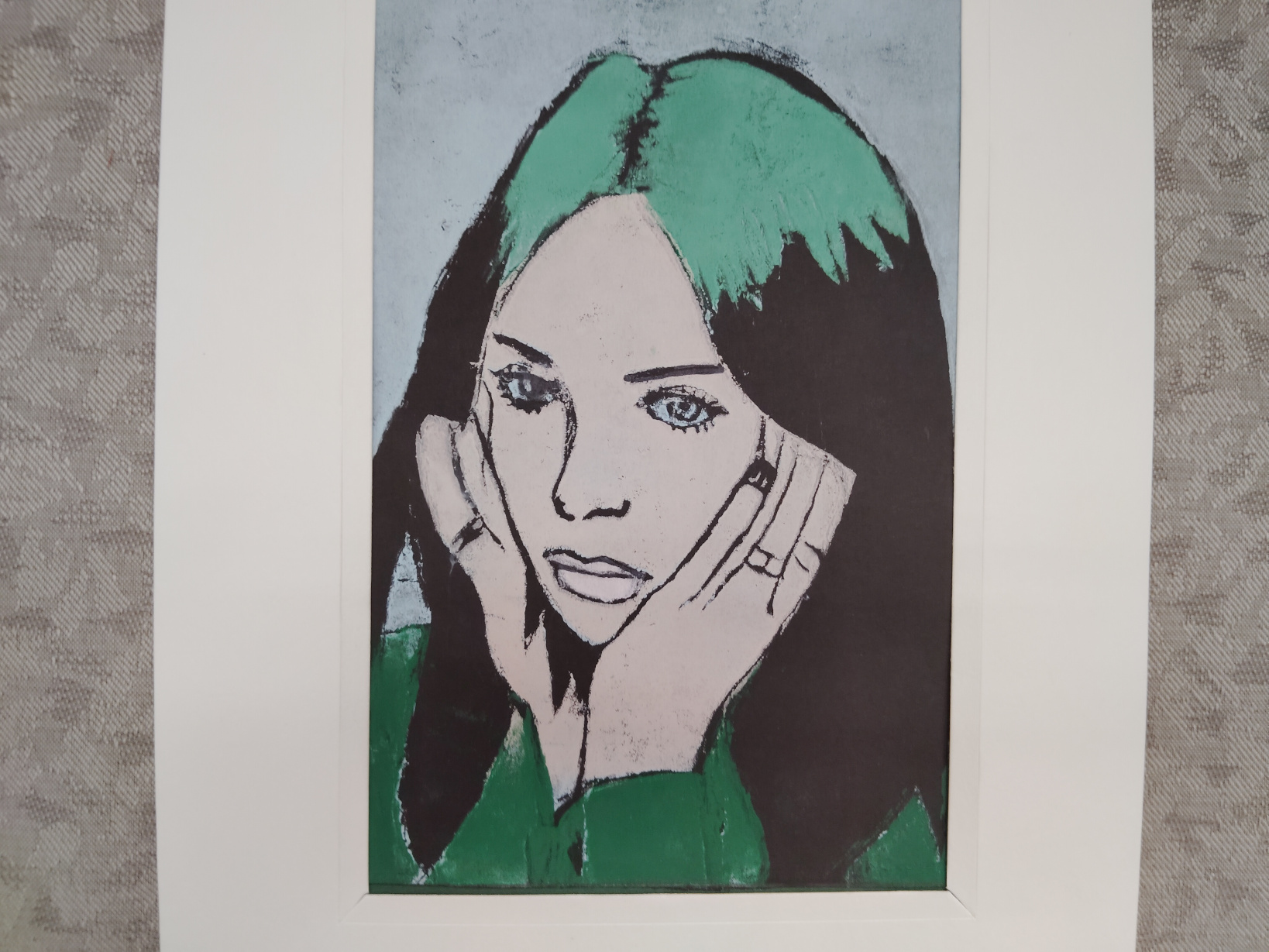
I climbed a treehouse. Went to Australia to see the kangaroos. Saw Billie Eilish. All without leaving Lakeville.
A cropped version of seventh grader Kira Johnson’s mixed media “Crimson Kangaroo.” (Minnesota Prairie Roots copyrighted photo March 2026)
That’s art. It takes you places. Broadens your perspective. Opens doors. The world does, indeed, need art.
“Billie Eilish,” a mixed media portrait by seventh grader Sadie Stevens. (Minnesota Prairie Roots copyrighted photo March 2026)
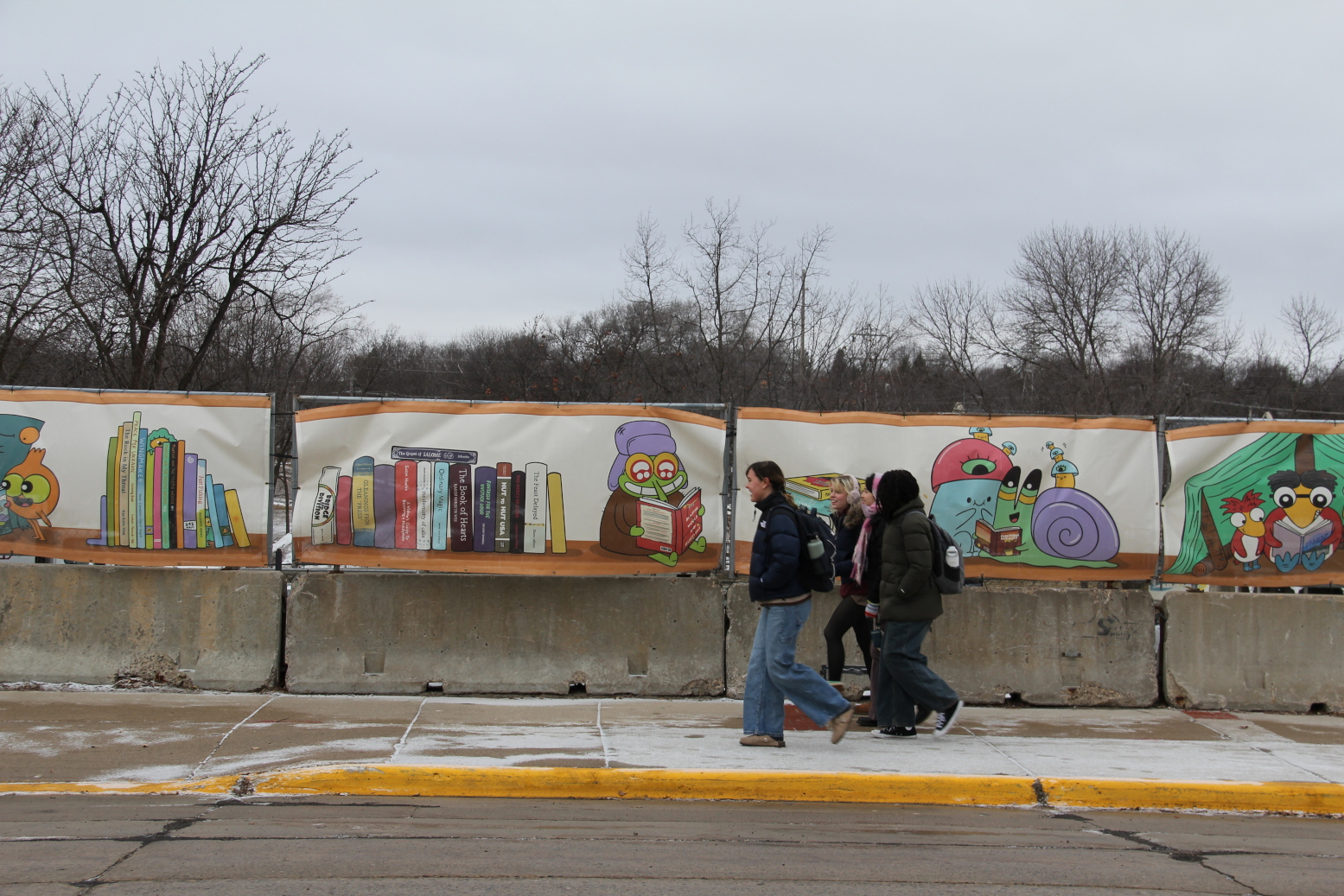
College students walk past a public mural fronting a vacant lot in downtown Northfield. (Minnesota Prairie Roots copyrighted photo January 2026)
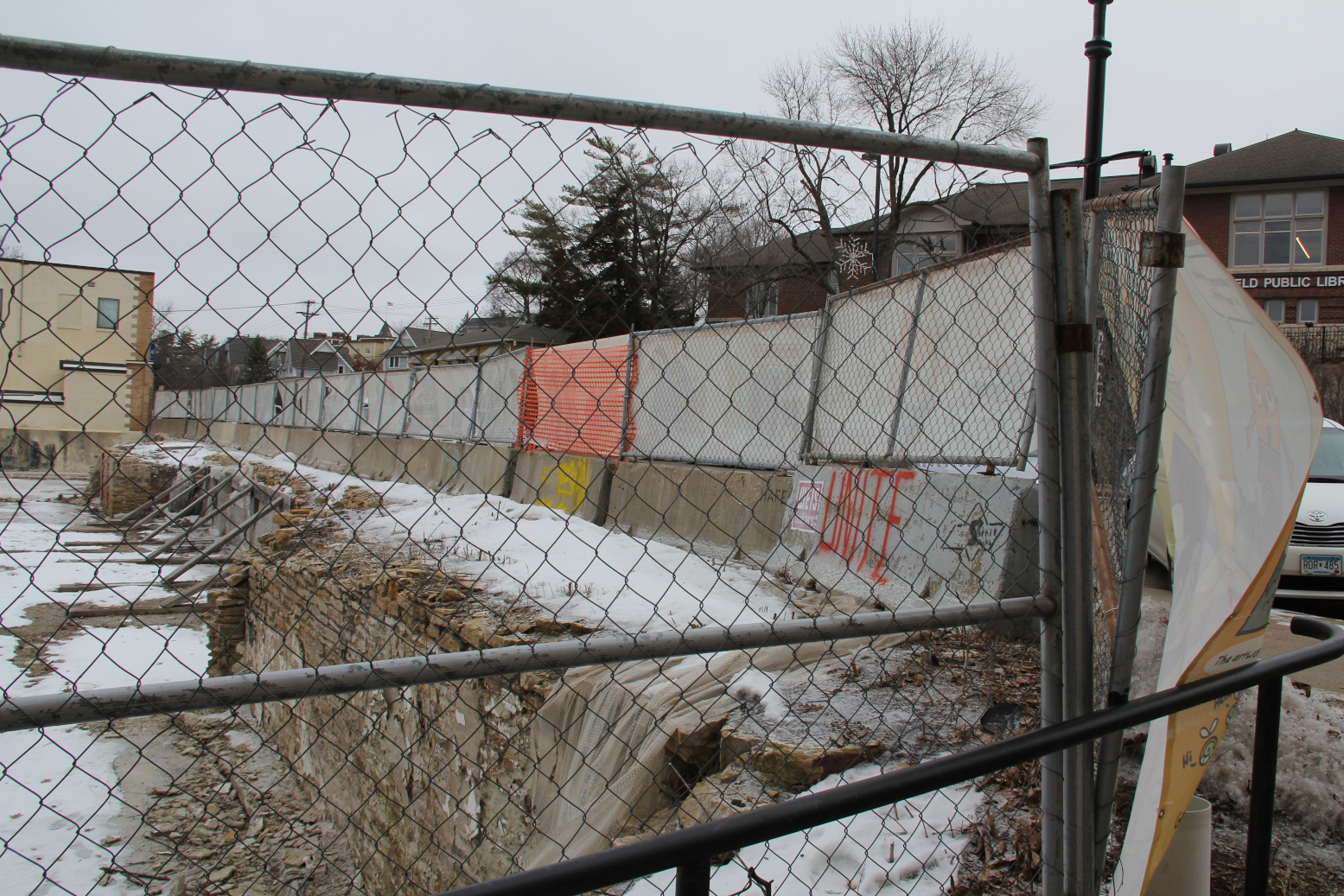
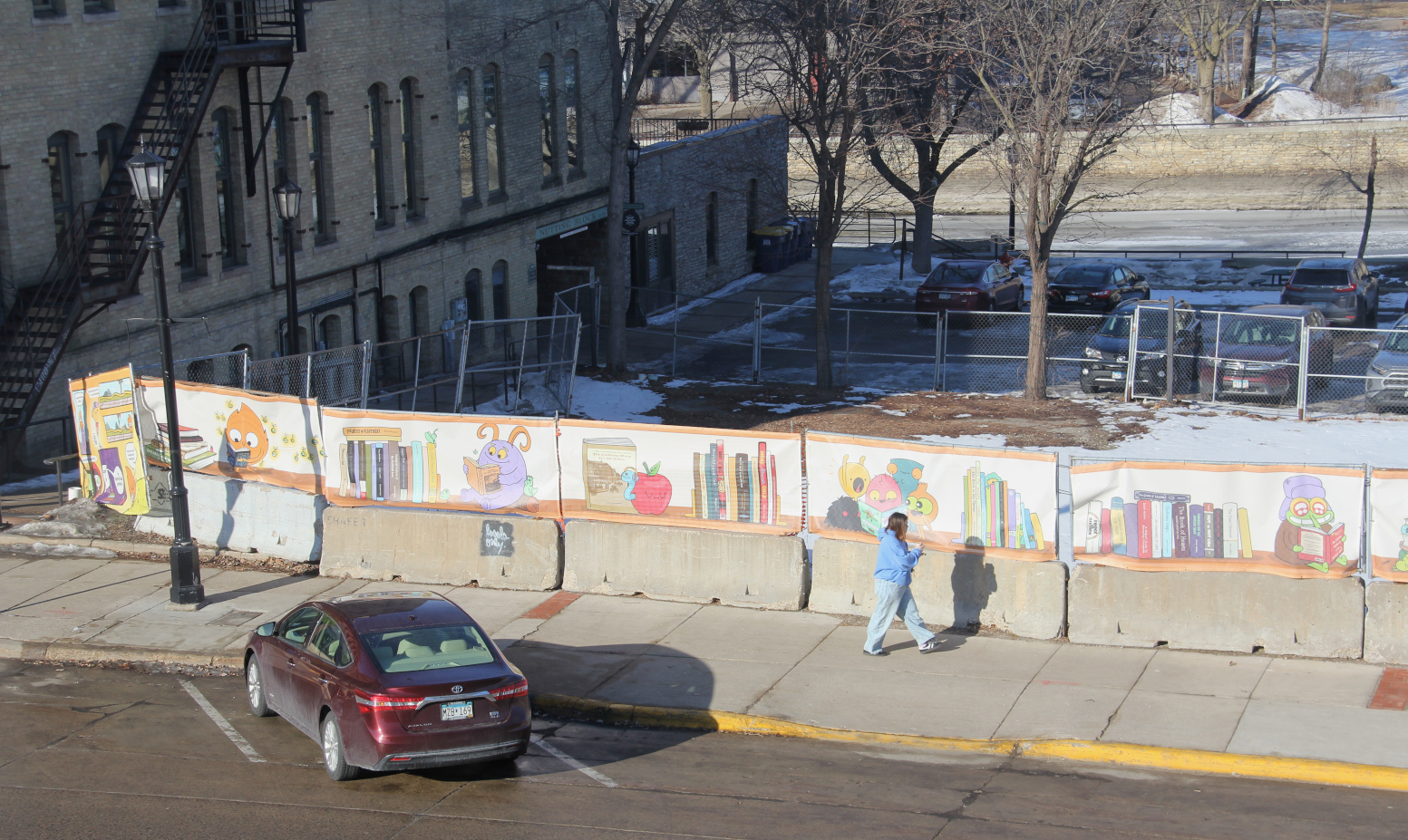
BETWEEN DIVISION STREET and the Cannon River in downtown Northfield across from the public library, an art installment stretches, hiding a fenced, vacant spot of land.
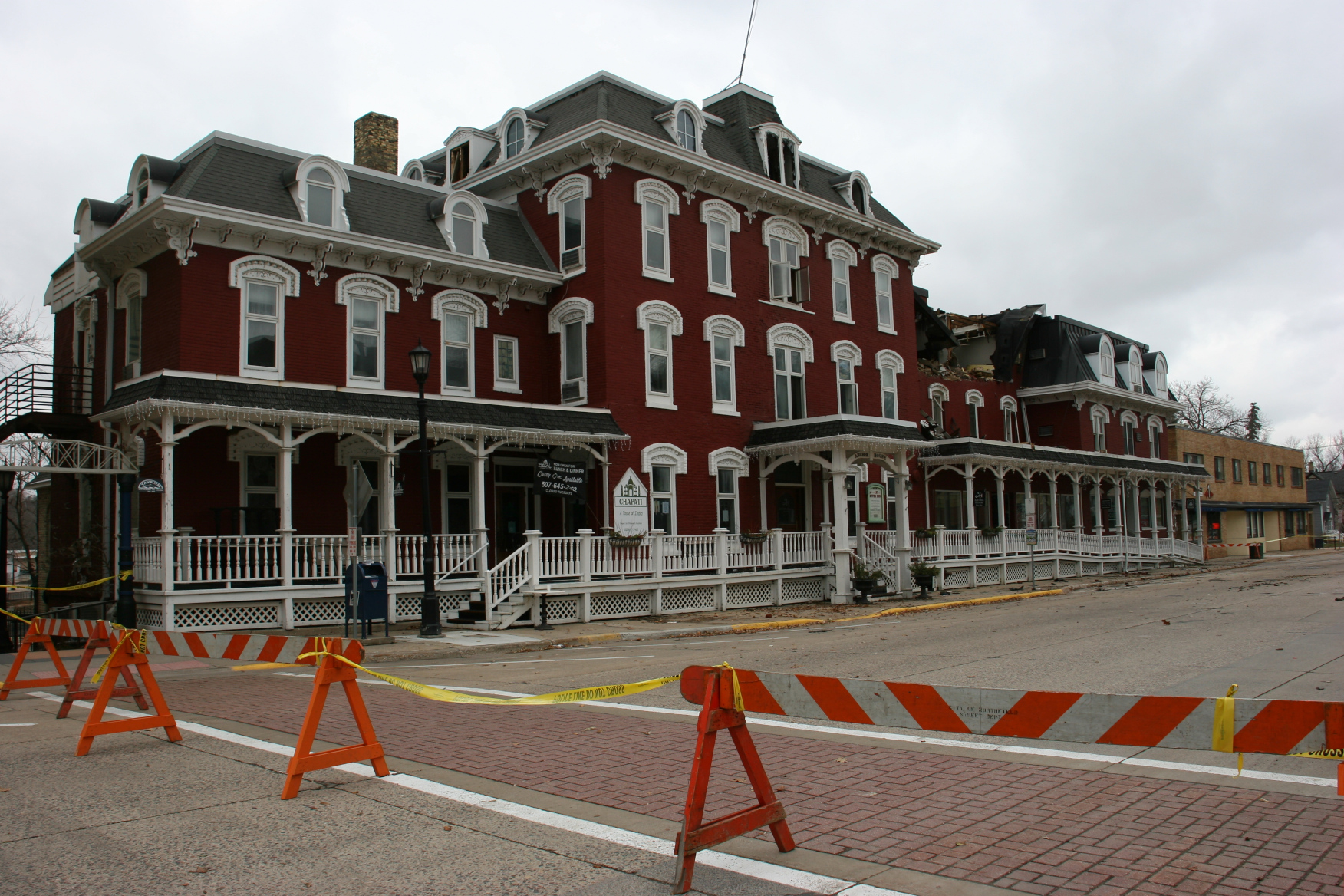
Barricades block entry to the historic Archer House, damaged by a 2020 fire and later demolished. The public art installation covers the length of the hotel. (Minnesota Prairie Roots copyrighted file photo November 2020)
Here the historic Archer House River Inn once stood, a sprawling complex of hotel and businesses until a November 2020 fire severely damaged the building. It was later demolished, leaving a gaping hole in the heart of this thriving southern Minnesota college town.
The back view behind the panels shows the foundation of the Archer House. The Northfield Public Library sits in the background across Division Street. (Minnesota Prairie Roots copyrighted photo January 2026)
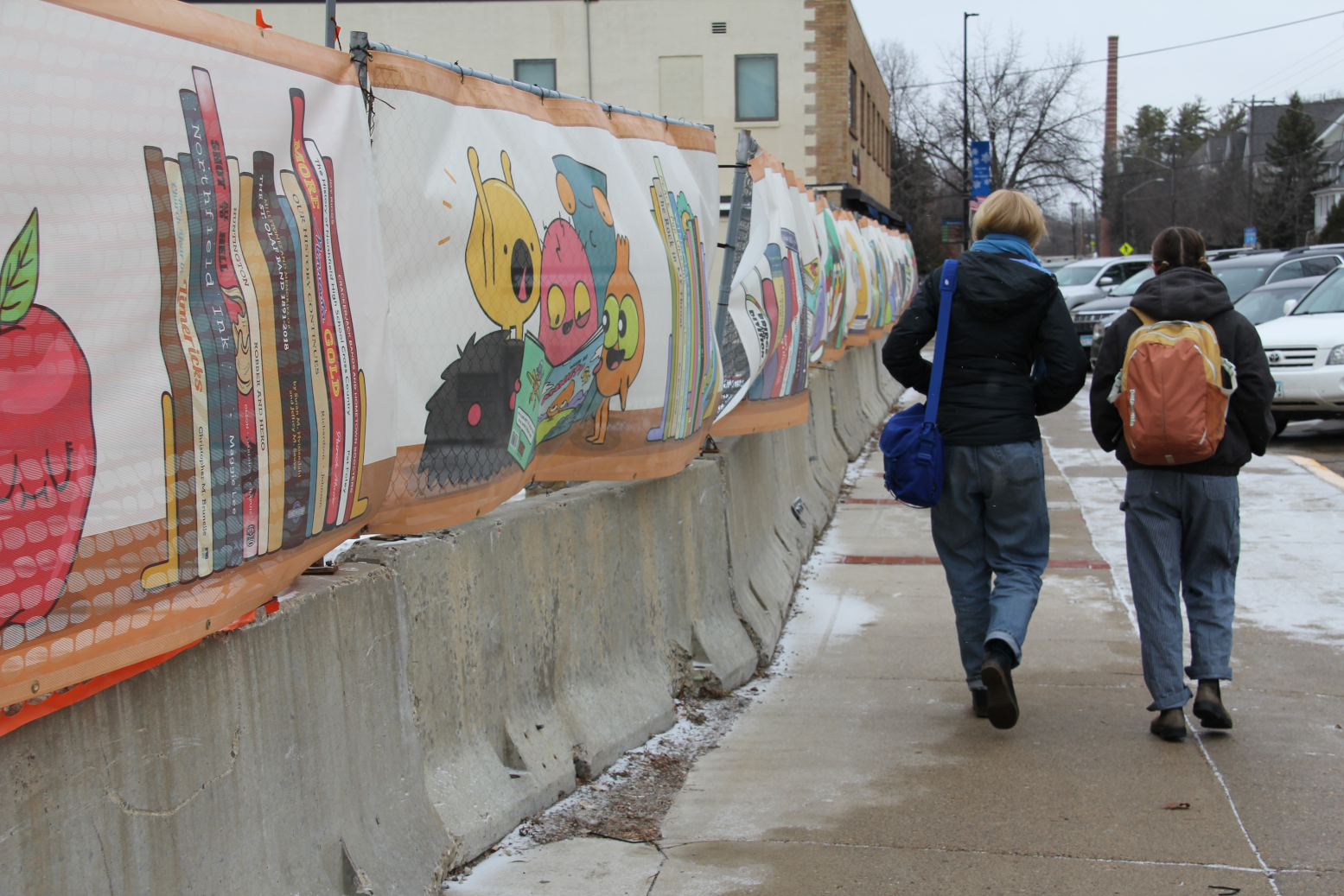
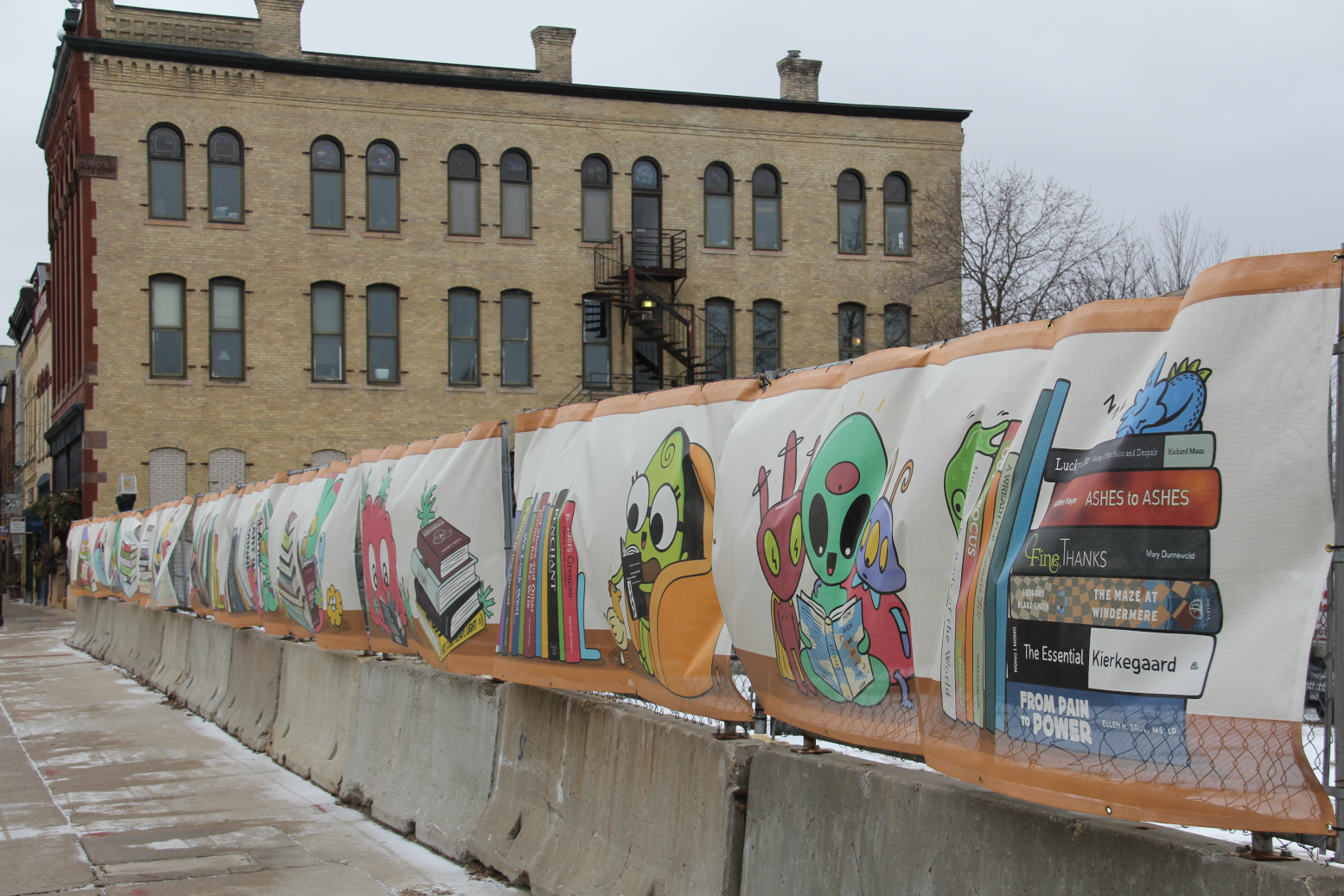
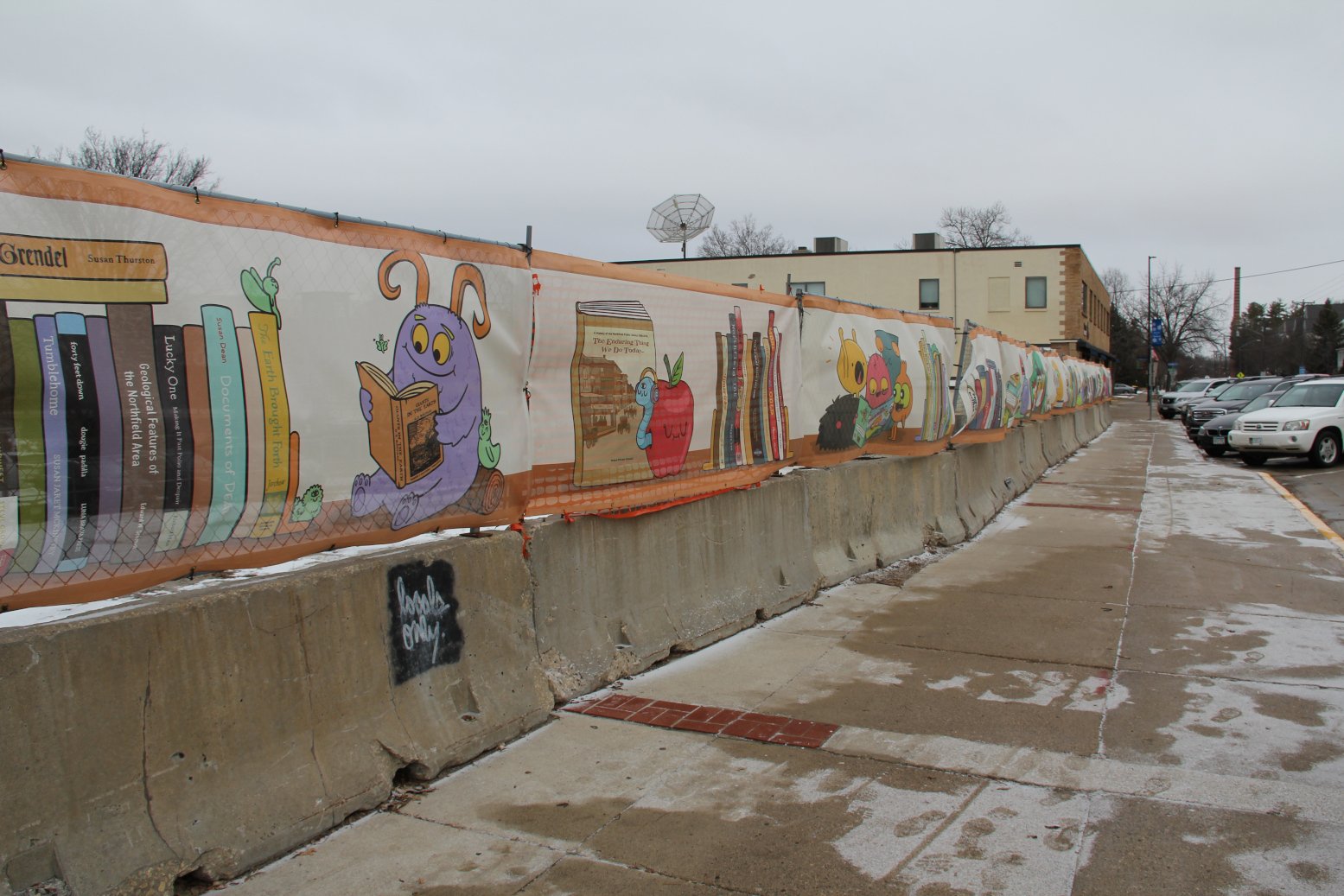
Flash forward years later and a 170-foot long length of 17 individual mesh fabric murals now hang on fencing surrounding foundation remnants and earth. Until the land is developed, this public art installation hides an eyesore and stands as a tribute to the creatives in the Northfield community.
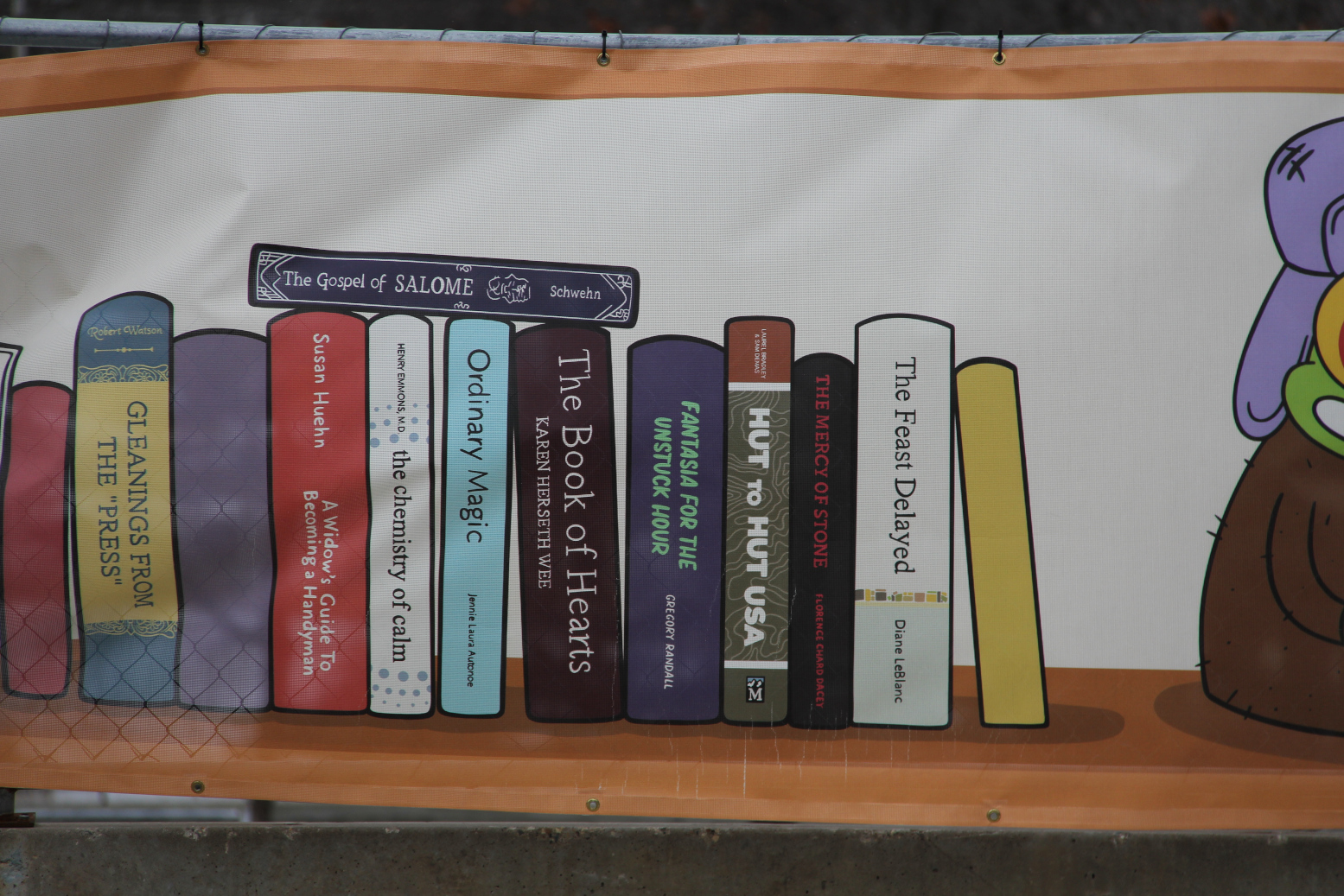
Northfield library staffers compiled a list of books by Northfielders, past and present, to incorporate into the panels. (Minnesota Prairie Roots copyrighted photo January 2026)
As a lover of both art and books, I appreciate this unique community endeavor to create something artistically beautiful and informative.
College students pass by the mural panels while I photograph the installation. (Minnesota Prairie Roots copyrighted photo January 2026)
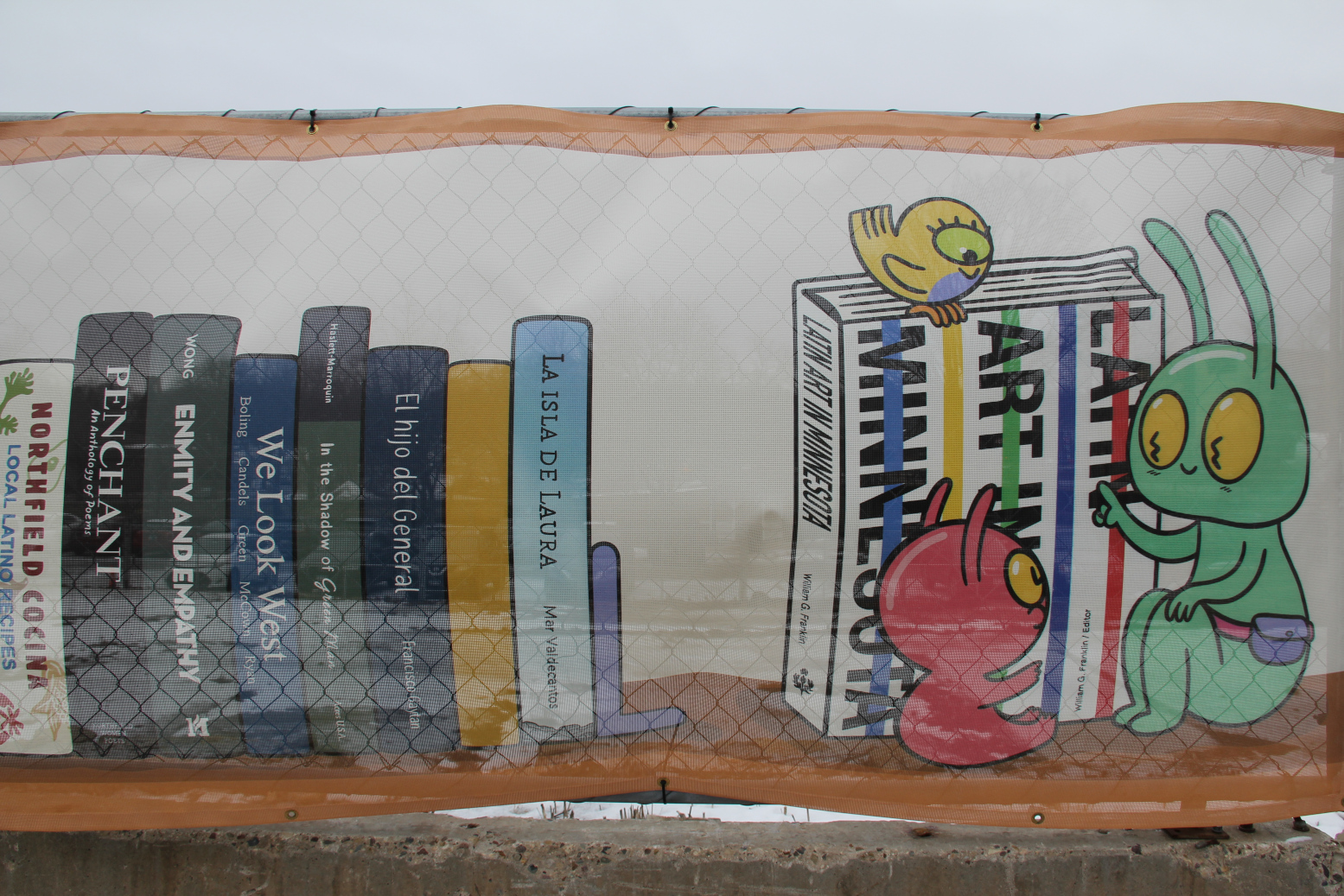
The Northfield Public Library worked with local Latino artist Rocky Casillas Aguirre on the project, which features more than 100 books by Northfield authors showcased on bookshelves printed on fabric. Walking along the mural scanning the titles is almost like walking into the library across the street up the hill and searching for a book.
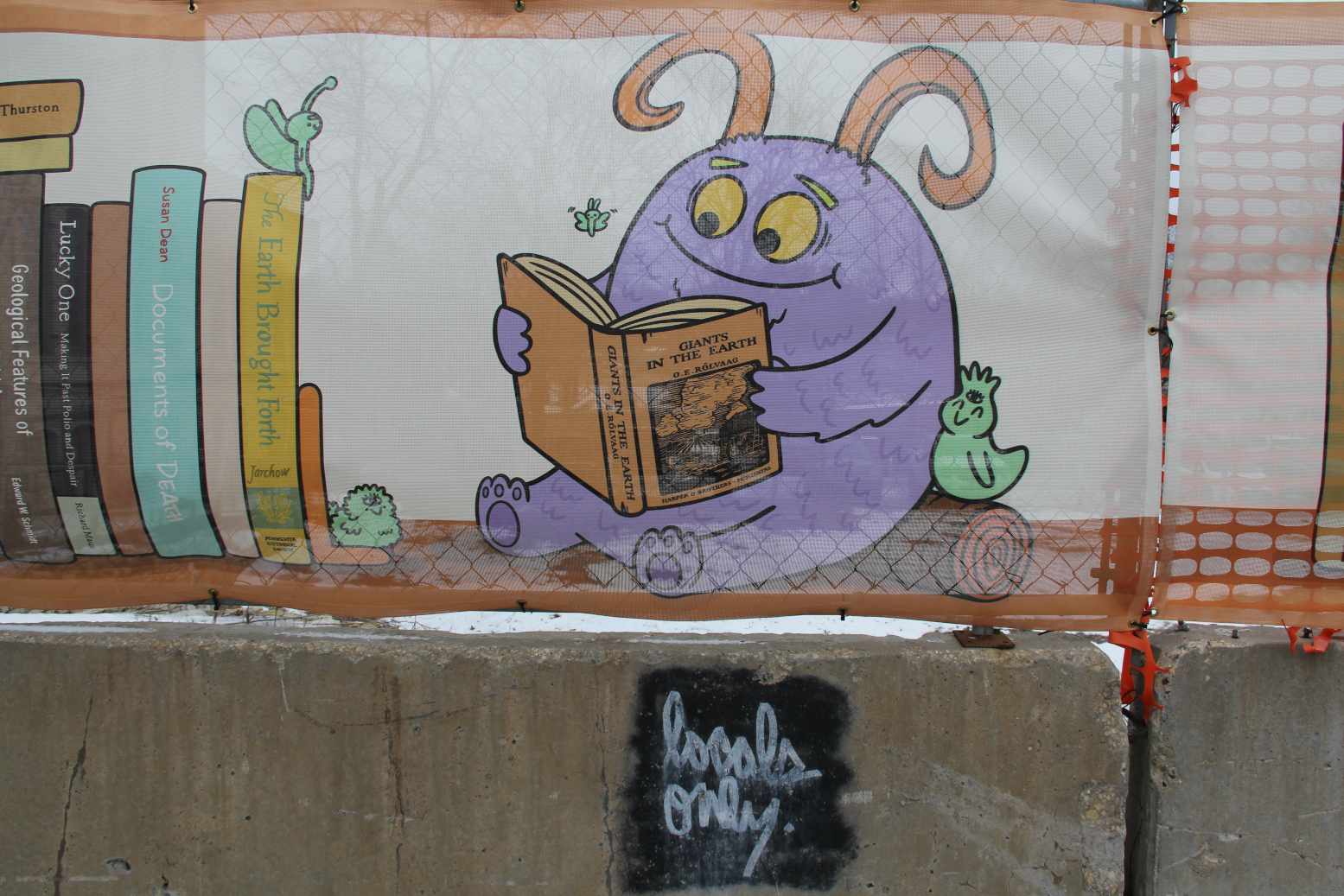
One of Aguirre’s characters reads “Giants in the Earth.” (Minnesota Prairie Roots copyrighted photo January 2026)
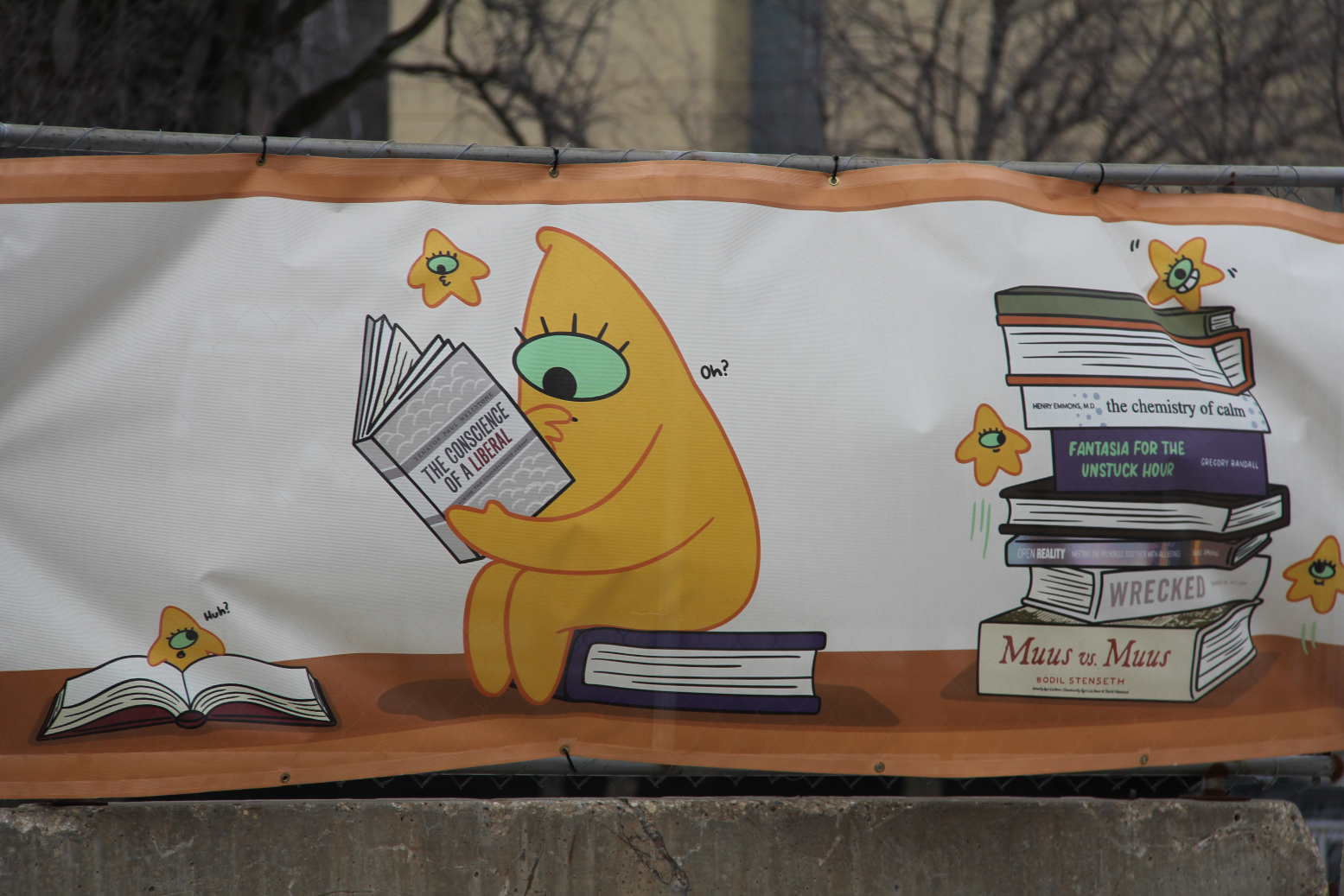
As I followed the installation, photographing and reading book titles, I found books familiar and unfamiliar. Some are widely-known, like Giants in the Earth, a story about Norwegian immigrants homesteading in Dakota Territory during the 19th Century, by Ole E. Rolvaag. Or Minnesota Senator Paul Wellstone’s The Conscience of a Liberal—Reclaiming the Compassionate Agendas. He died in a 2002 plane crash.
Characters created by Rocky Casillas Aguirre mix with books by Northfielders. (Minnesota Prairie Roots copyrighted photo January 2026)
Then there are poetry collections by Northfield poets—Bridge and Division, We Look West… This is a community rich in poets, a city where poems imprint upon concrete in a Sidewalk Poetry project.
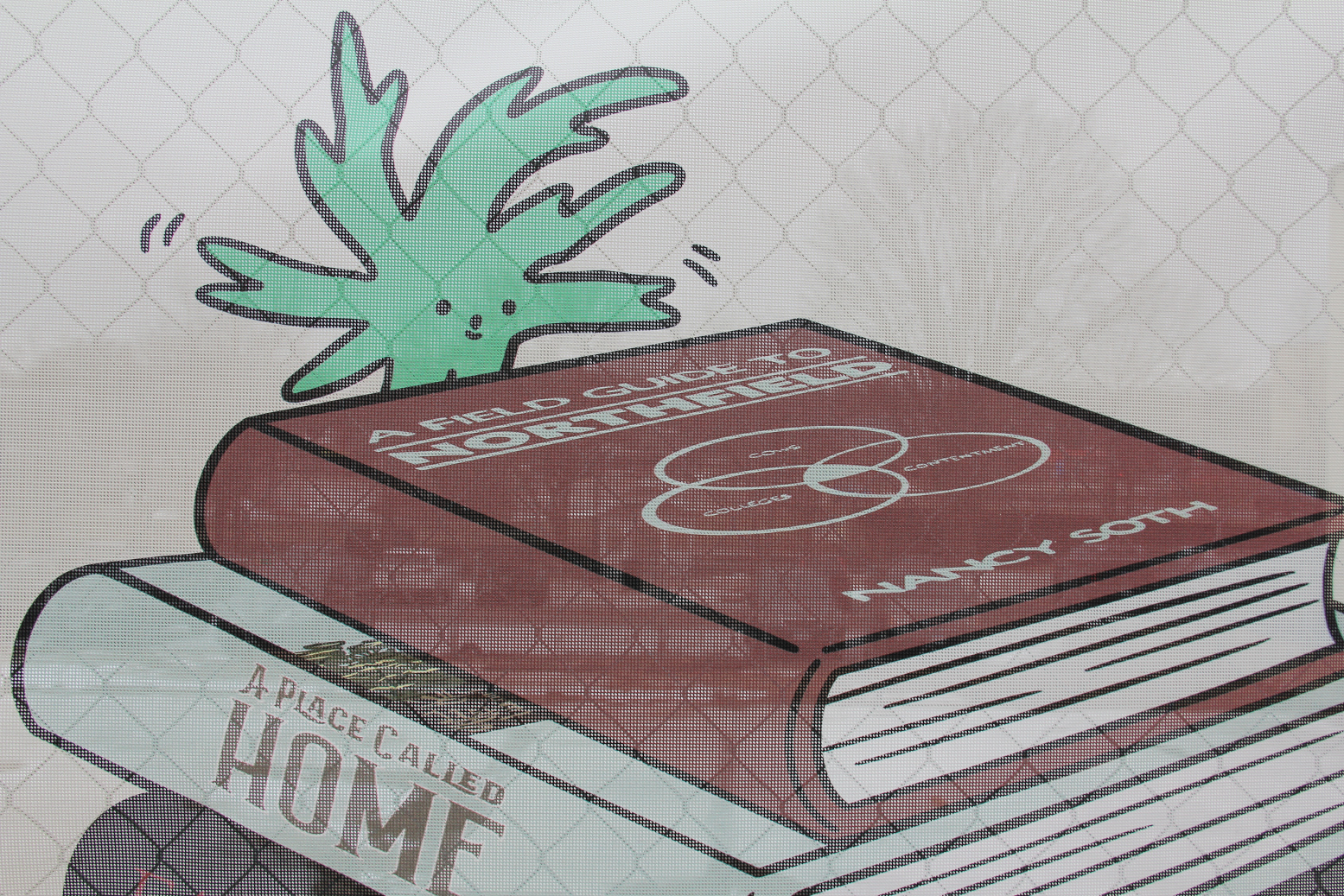
Some of the books by Northfield authors are specifically themed to Northfield. (Minnesota Prairie Roots copyrighted photo January 2026)
Other titles also drew my eye like A Field Guide to Northfield by Nancy Soth, Peace for Ukraine Coloring Book, Northfield Cocina: Local Latino Recipes and many more.
Lots of the artist’s cartoon characters are busy reading books. (Minnesota Prairie Roots copyrighted photo January 2026)
Beyond those 100 plus books featured in the art installation are the colorful characters Aguirre creates for his books, cartoons and stand alone art. They are interspersed among the titles—reading, interacting, resting, adding elements of color and interest.
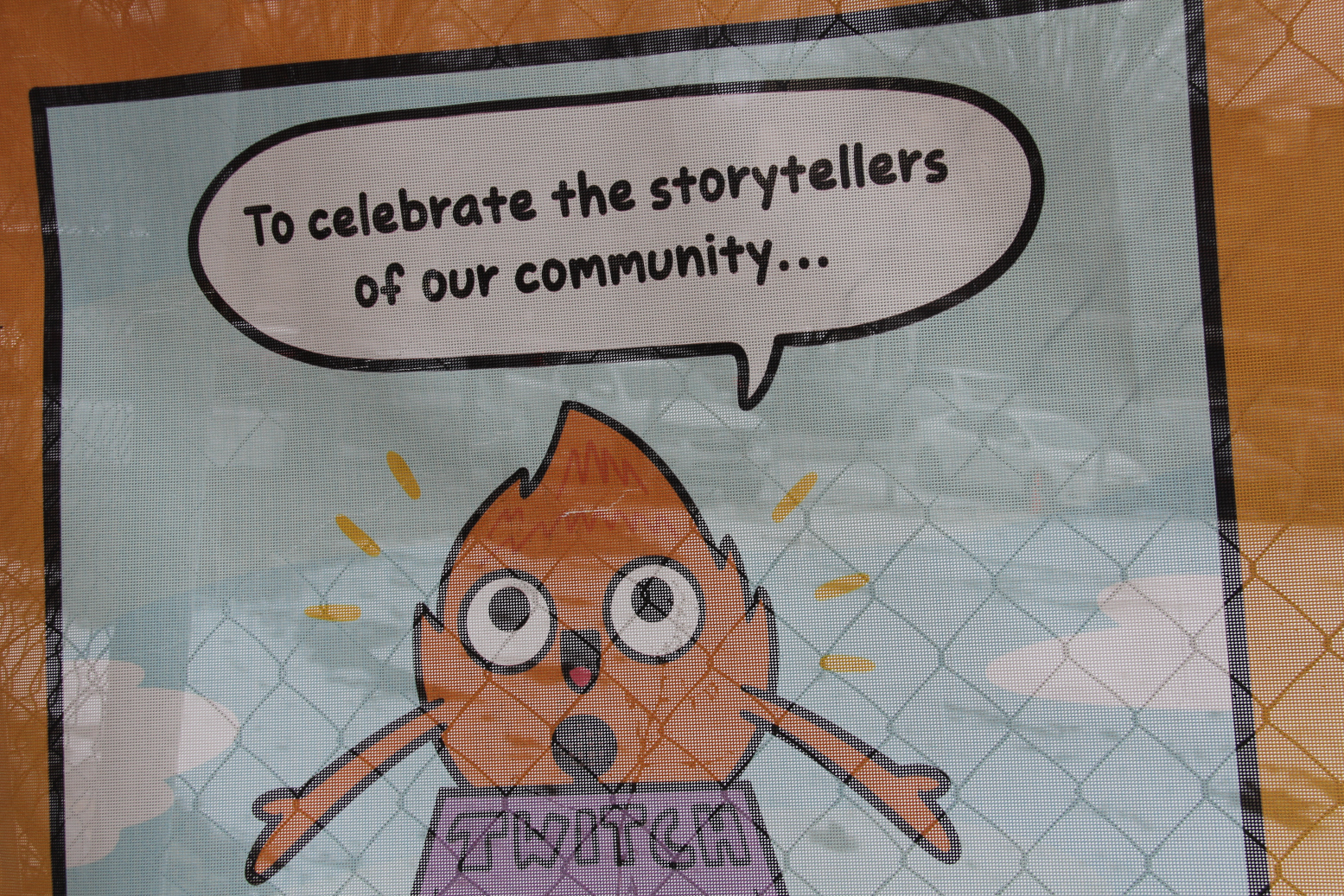
Twitch, a magical campfire created by the artist for his own art, is incorporated into the murals. (Minnesota Prairie Roots copyrighted photo January 2026)
Aguirre, who has dealt with anxiety and depression, focuses his art on raising awareness about mental health, especially among youth. Twitch, a magical campfire, is among the characters he’s created and which can be spotted on the downtown mural.
Another view of the panels, looking south on Division St. (Minnesota Prairie Roots copyrighted
This artist, born in Mexico but raised in Northfield and a resident for more than 20 years, also worked with the local Latino community on another city-supported art project, “Dear Northfield.” He interviewed 100 local Latinos, among the 2,000 who live in the city, to get their insights on topics like housing, food, transportation and more. The result is a series of bi-lingual posters that inform, raise awareness and connect. “Dear Northfield” is currently displayed at the Northfield library.
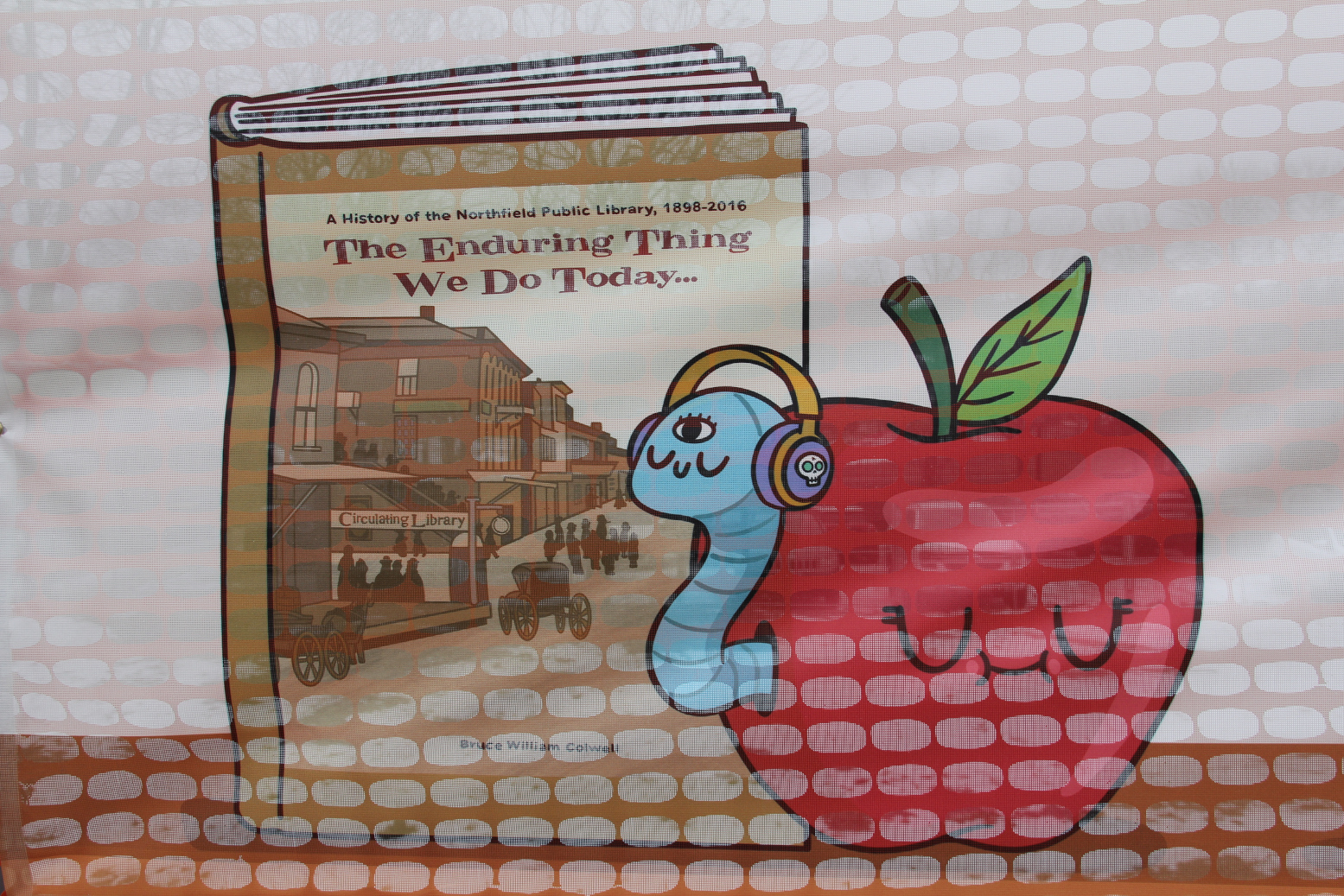
Even the library has its own history book. (Minnesota Prairie Roots copyrighted photo January 2026)
I learned a lot by simply walking along the mural panels attached to fencing at the site of the demolished Archer House. I learned that Northfield has far more authors than I ever imagined. Authors who write in all genres.
Looking at the mural north along Division Street. (Minnesota Prairie Roots copyrighted photo January 2026)
An overview of the art installation photographed through a second floor library window looking down on the Division Street scene. (Minnesota Prairie Roots copyrighted photo February 2026)
I’m excited to see more and learn more. The visual arts are such a gift, whether hung on a fence screening a vacant lot or hung in a gallery inside an arts center. Art holds the power to move us, inform us, enlighten us and, sometimes, even to change us.
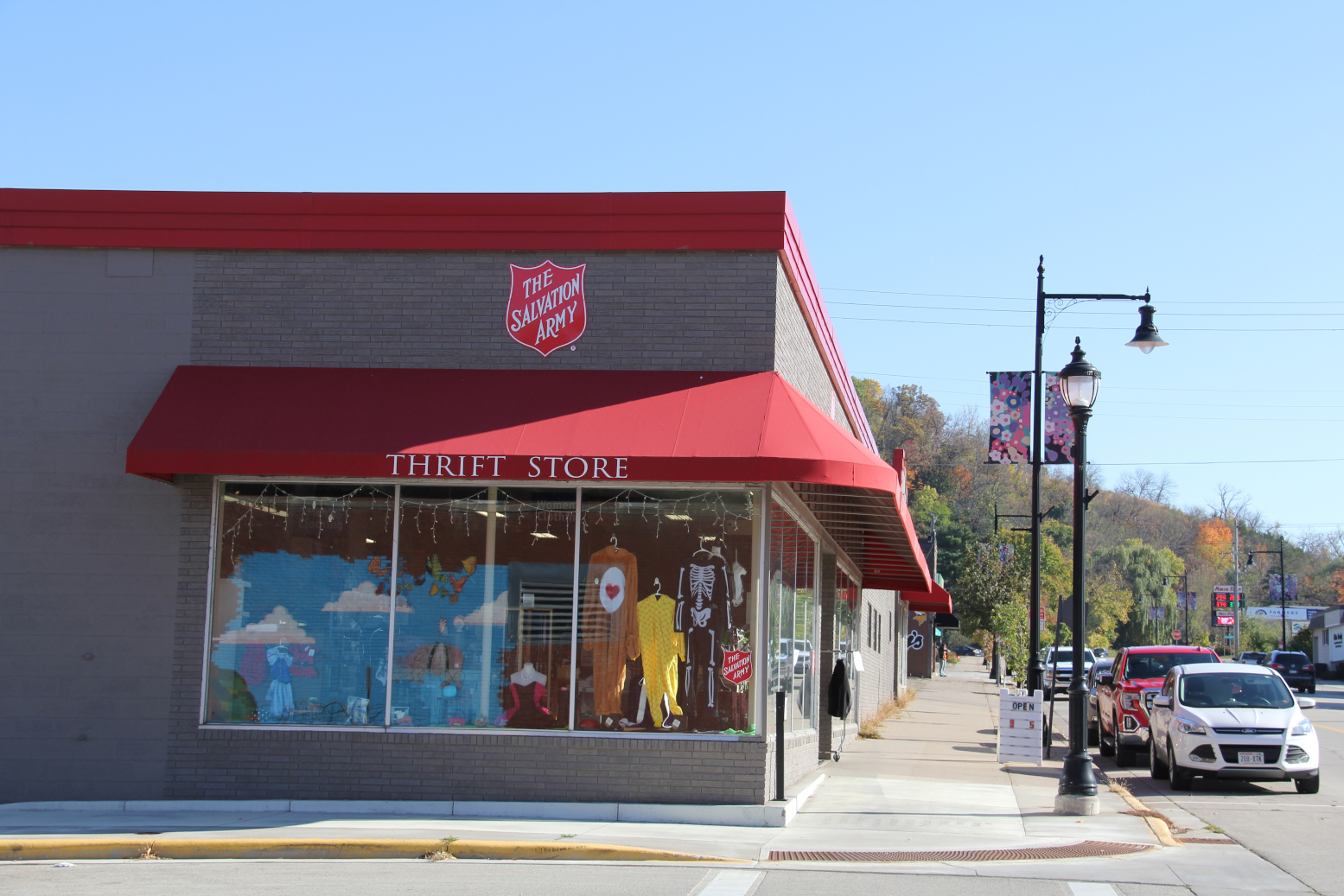
“Stand in the Shadows” public art outside the Salvation Army Thrift Store in Red Wing shares interesting local history. (Minnesota Prairie Roots copyrighted photo October 2025)
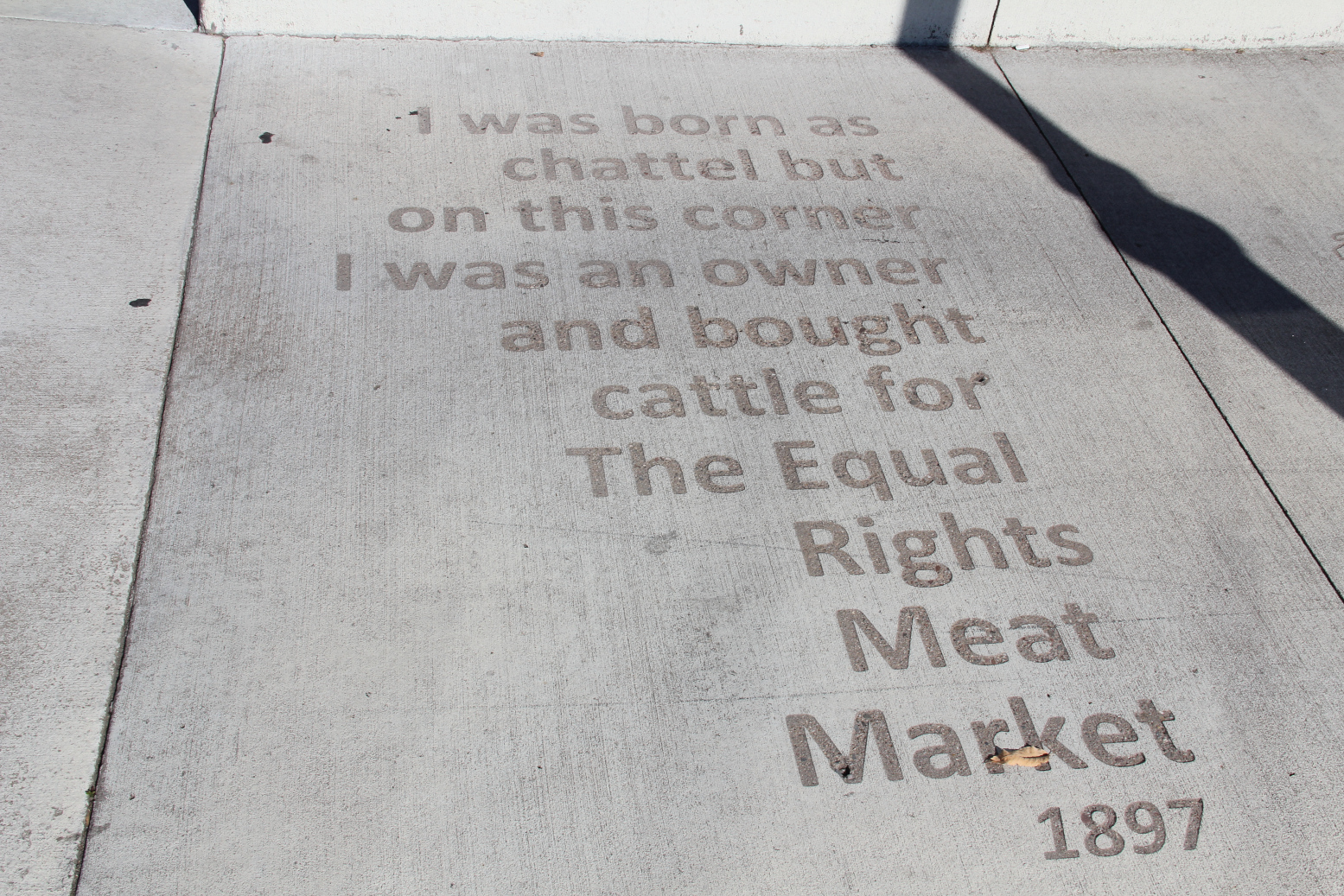
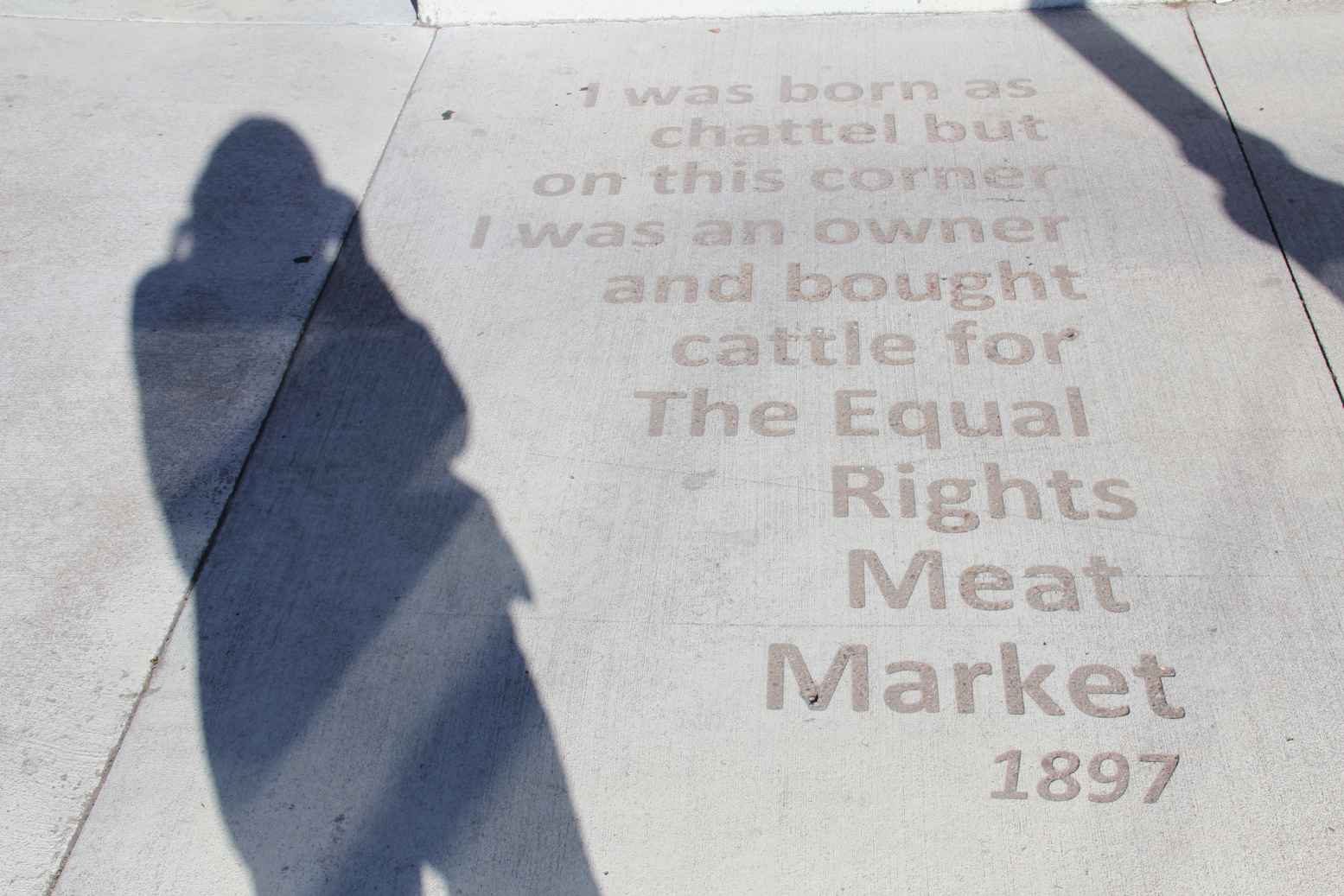
Oh, the things you discover when you least expect it. That can be said for the local history highlighted outside the Red Wing Salvation Army Thrift Store. There, imprinted upon the sidewalk, I found these words: I was born as chattel but on this corner I was an owner and bought cattle for The Equal Rights Meat Market—1897.
The Equal Rights Meat Market once stood at this location. (Minnesota Prairie Roots copyrighted photo October 2025)
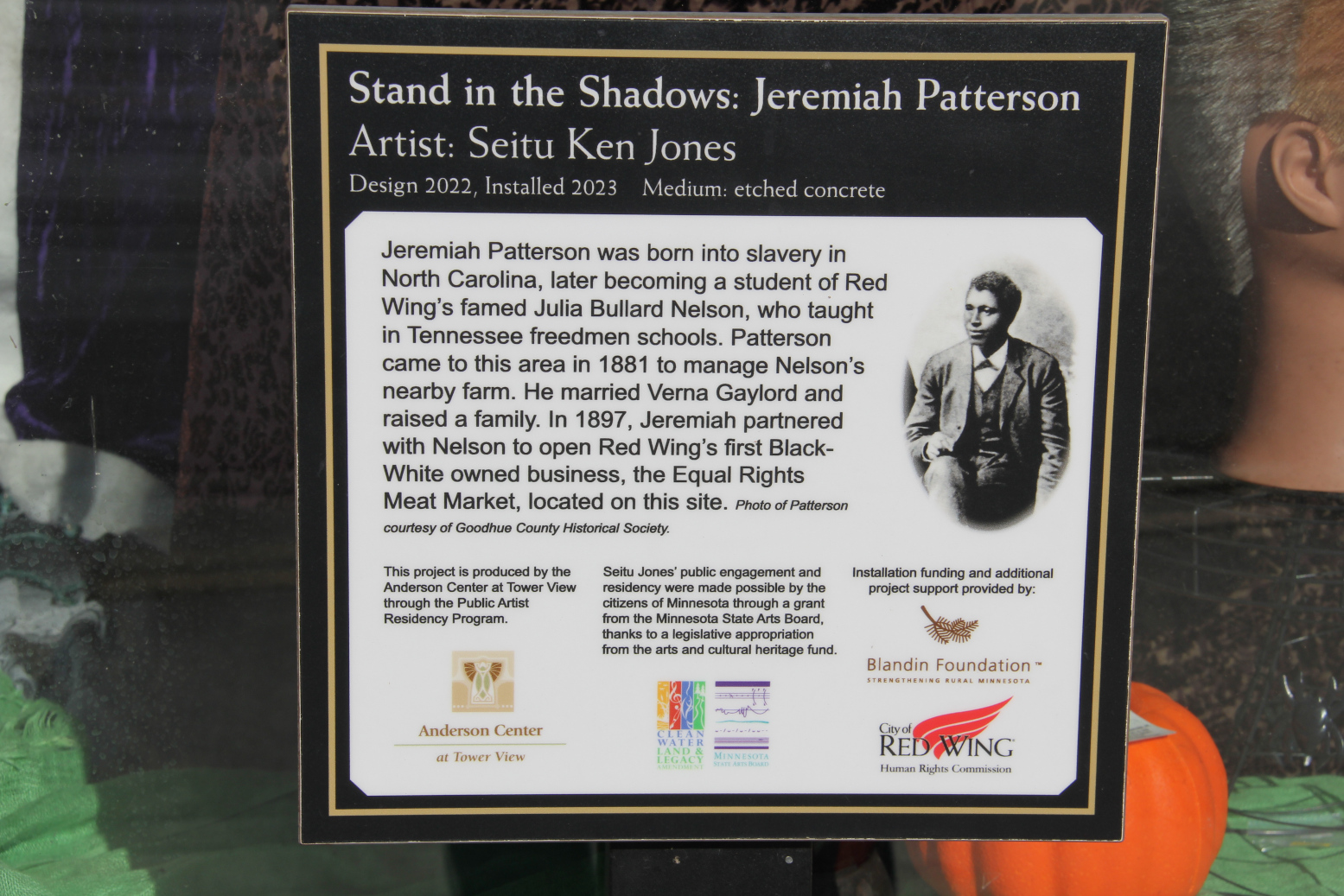
And that’s how I learned about Red Wing’s first Black-white owned business opened in 1897 at the site of the current-day thrift shop on the corner of Plum and Fifth streets. Jeremiah Patterson, born into slavery, and activist Julia Bullard Nelson co-owned the meat market in this Mississippi riverside community in southern Minnesota.
I love when communities pull hidden history out of the archives and publicly share it in creative ways. If not for this “Stand in the Shadows” public arts project, I would have had no idea that the thrift shop I was about to enter stood on the site of The Equal Rights Meat Market.
That name, oh, that name. Equal Rights. It fits. Nelson was a leader in women’s suffrage. For a white woman and a Black man (freed from slavery) to go into business together in the late 19th century, especially in predominantly white rural Minnesota, speaks to their strength, confidence and courage.
But then again, the two forged ahead on multiple fronts. Nelson taught African Americans in government Freedmen Schools down South when that was not necessarily well-received during post Civil War Reconstruction. Patterson was her student. He eventually moved to Minnesota to manage Nelson’s farm south of Red Wing near Belvidere. Patterson would marry a local white woman, Verna Gaylord, in 1886 with the interracial couple having nine children.
A summary of the story behind The Equal Rights Meat Market is showcased at the thrift shop. (Minnesota Prairie Roots copyrighted photo October 2025)
I considered all of this fascinating as I researched information based on that sidewalk message and on a plaque posted outside the Salvation Army thrift store.
Similar historical info and a sidewalk imprint are also located by Red Wing’s St. James Hotel, although I missed seeing that. That poem reads: Bondage and war behind me/Back and forth, trunks and trolley, from train, from steamboat to the St. James Hotel/I landed here, worked and forged a life. This honors another Black man, Joseph Parker, enslaved in Kentucky and later a porter at the hotel. He is the great grandfather of Seitu Ken Jones, a multidisciplinary artist from St. Paul and lead on the “Stand in the Shadows” public art in Red Wing.
As I searched out the backstory, I learned that the Patterson family eventually left Red Wing, after the Ku Klux Klan became active in the area in the early 1920s. It’s an unsavory part of Minnesota history that some would prefer remain hidden. I’d rather know about such hatred than pretend it never happened.
My shadow falls on the sidewalk as I photograph the words. This art also includes a sidewalk silhouette although I don’t recall seeing it. (Minnesota Prairie Roots copyrighted photo October 2025)
On this day in Red Wing outside the Salvation Army Thrift Store, I learned about two strong individuals who owned The Equal Rights Meat Market. Although the business remained open for only a short time, it leaves a legacy of strength and equality in this community.
This public arts project reminds us that history cannot, should not, be erased, rewritten or hidden. Those words—“born as chattel” to “I was an owner and bought cattle for The Equal Rights Meat Market”—need to be imprinted not only upon a sidewalk, but also upon our collective spirits. Especially now. And in recognition of civil rights leader and activist Dr. Martin Luther King Jr, who is honored annually, this year on Monday, January 19.
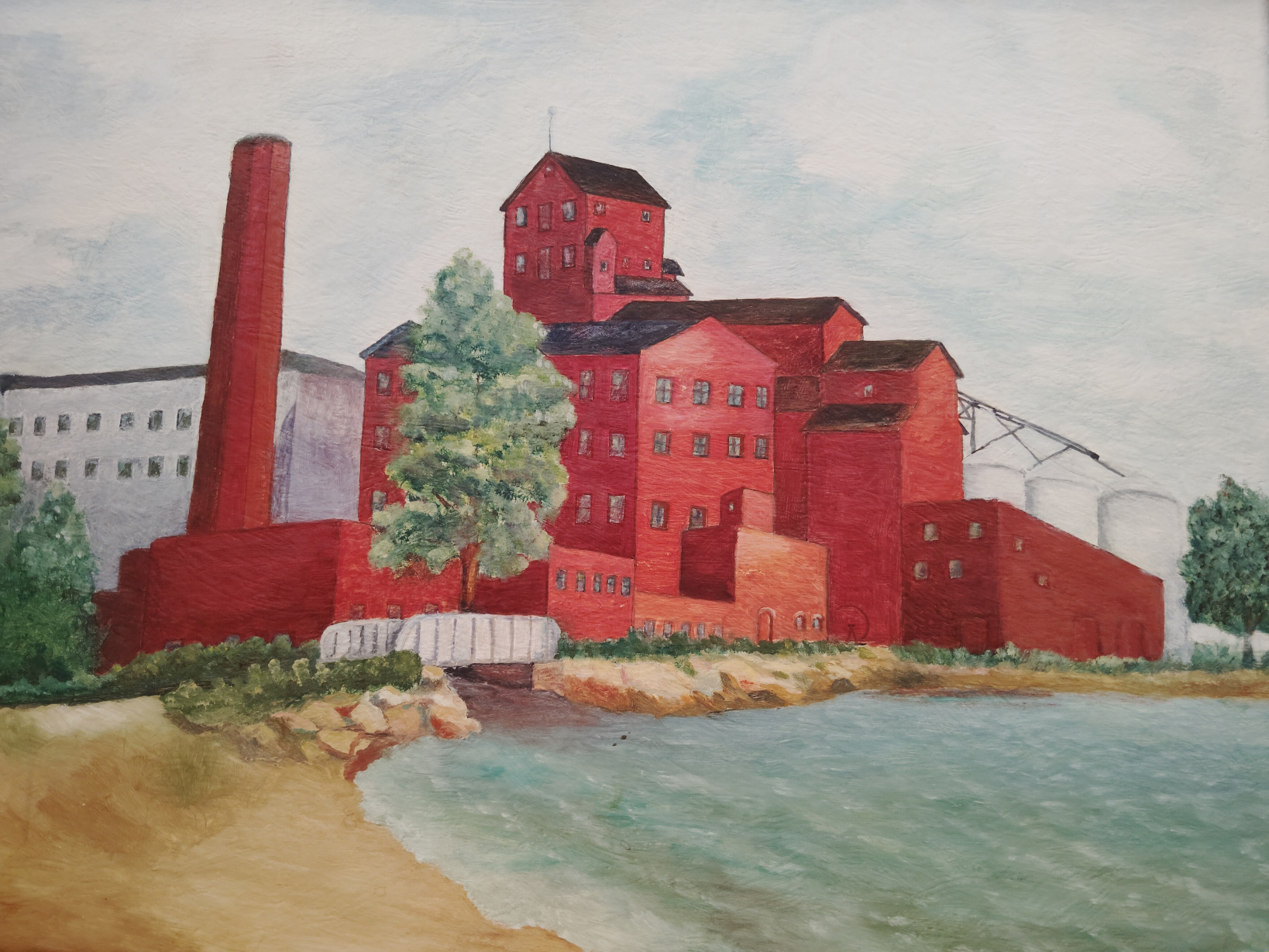
The H.H. King Flour Mill as painted by Faribault artist Maybelle Stark in 1959. This is a photo of a print I own. Stark’s mill painting is included in a new exhibit at the Paradise Center for the Arts. (Minnesota Prairie Roots copyrighted photo January 2026)
THE VISUAL AND PERFORMING ARTS come together under one roof this Friday evening, January 9, at the Paradise Center for the Arts in historic downtown Faribault during an opening gallery reception from 5-7 pm followed by an improv comedy show at 7:30 pm. I’m excited about both. I love art. And I like entertainment that makes me laugh.
The RCHS exhibit in the main gallery kicks off a year-long celebration of the county historical society’s 100th birthday. “From a fantastical creature made of tin to bright, creative pottery and beautiful paintings, this gallery highlights items normally tucked away in storage and spotlights the talents of the Rice County community,” according to a media release from the RCHS.
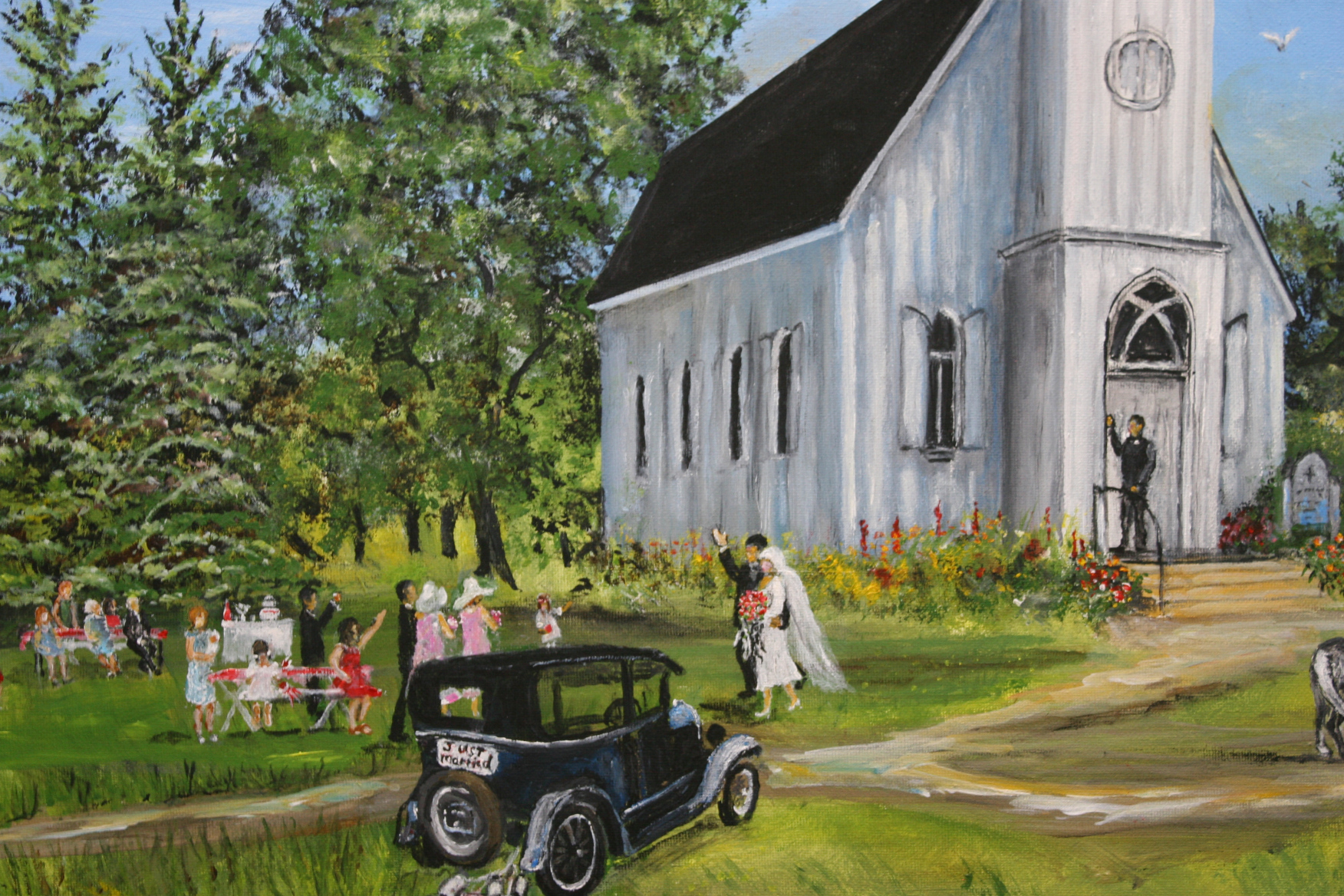
“1938 Church Wedding” by Linda Van Lear is based on The Holy Innocents Church at the Rice County Fairgrounds/Historical Society grounds.The painting was previously shown at the Paradise. (Minnesota Prairie Roots copyrighted file photo August 2020)
Naturally, I wondered about the artists to be featured in the 20 pieces chosen for the Paradise show. They include, among others, Grace McKinstry, Linda Van Lear, Ivan Whillock, Maybelle Stark and Frieda Lord. I’m familiar with all of them except Lord, although I have seen and photographed the art of her granddaughter, Dana Warmington Hanson. Lord and Stark were among the founding members of the Faribault Art Center, which evolved into the Paradise Center for the Arts.
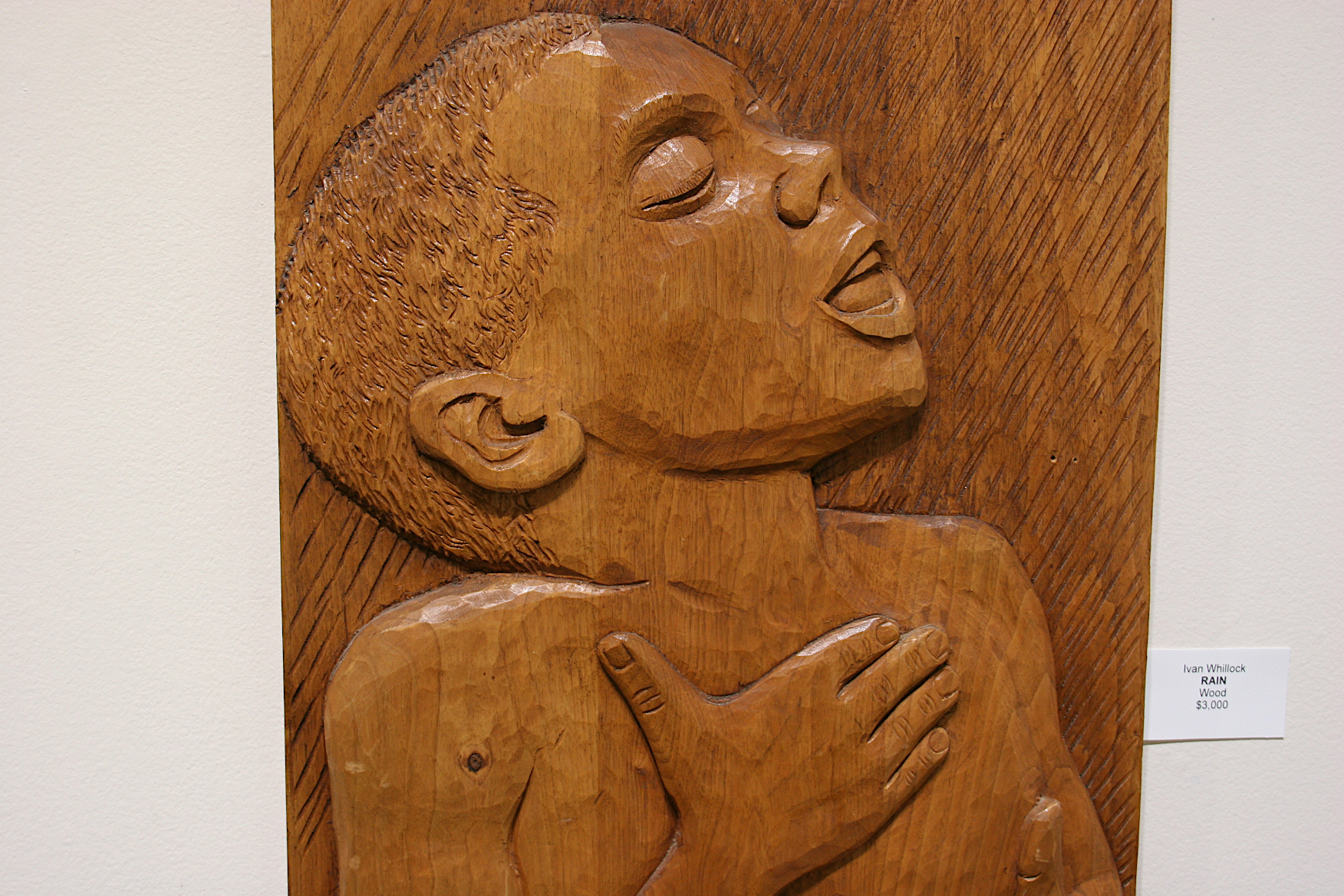
“Rain,” a woodcarving by Ivan Whillock exhibited previously at the Paradise. (Minnesota Prairie Roots copyrighted file photo October 2020)
McKinstry and Whillock are perhaps the best-known in that short list shared with me by the RCHS. Whillock, who has a studio in Faribault, is an internationally-renowned woodcarver and also a painter. McKinstry (she died in 1936) traveled the world in pursuit of creating portraits and landscapes. Her art is featured in the Smithsonian, the Minnesota Historical Society, the Minnesota State Capital and elsewhere worldwide. Locally, the county historical society owns more than 40 pieces of her artwork, the largest collection of McKinstry’s art anywhere.
I own art by one of the artists, Maybelle Stark, whose work is included in the RCHS gallery exhibit. That’s a print of the H.H. King Flour Mill, once located along the Cannon River on Faribault’s west side and destroyed by fire in 1975. Stark painted the scene in 1959 and exhibited it locally the same year. Now that painting is back on public display nearly 70 years later.
All of the art showcased in the Paradise galleries from now through February 21 is sure to draw plenty of interest among those who value creativity. And local history.
Promo for Little Fish Improv. (Sourced online)
And for anyone who also values the performing arts, Little Fish Improv presents improv comedy beginning at 7:30 pm Friday. I’ve seen this group of area comedians perform several times on the Paradise stage. They are a talented bunch who think quickly on their feet (thus the word “improv”) and get their audience engaged and laughing. It seems to me a really challenging art form.
Bonus, this comedy show is a fundraiser with all proceeds benefiting the Paradise Center for the Arts. I feel incredibly fortunate to live in a community with an outstanding arts center and with a deep appreciation for the arts.
At 1 pm Saturday, January 17, Diane Lockerby, pottery instructor at the Paradise, will lead a “Historic Pottery Workshop at the Paradise.” Following her brief talk about pottery and local history, attendees will make a piece of pottery to take home. There is a fee. Space is limited. Click here to register.
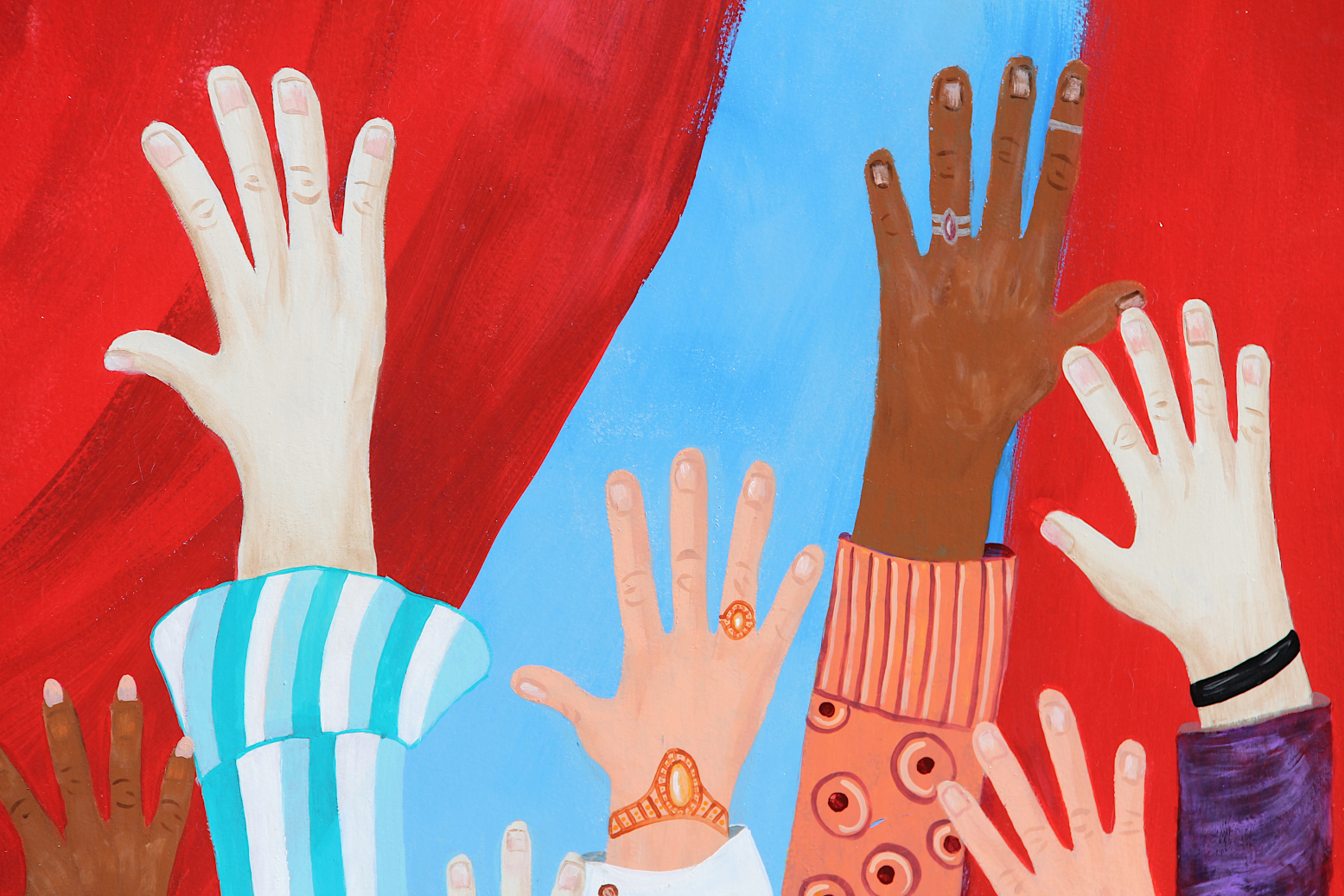
Among the many hands of the Faribault community, painted in a mural. (Minnesota Prairie Roots copyrighted photo September 2025)
WHAT ARE WE without community? The answer: alone.
We, at our very core, need each other. In times of celebration. In times of challenges. Even in times of great division. Without friends, family, neighbors and others, we are but individuals without community.
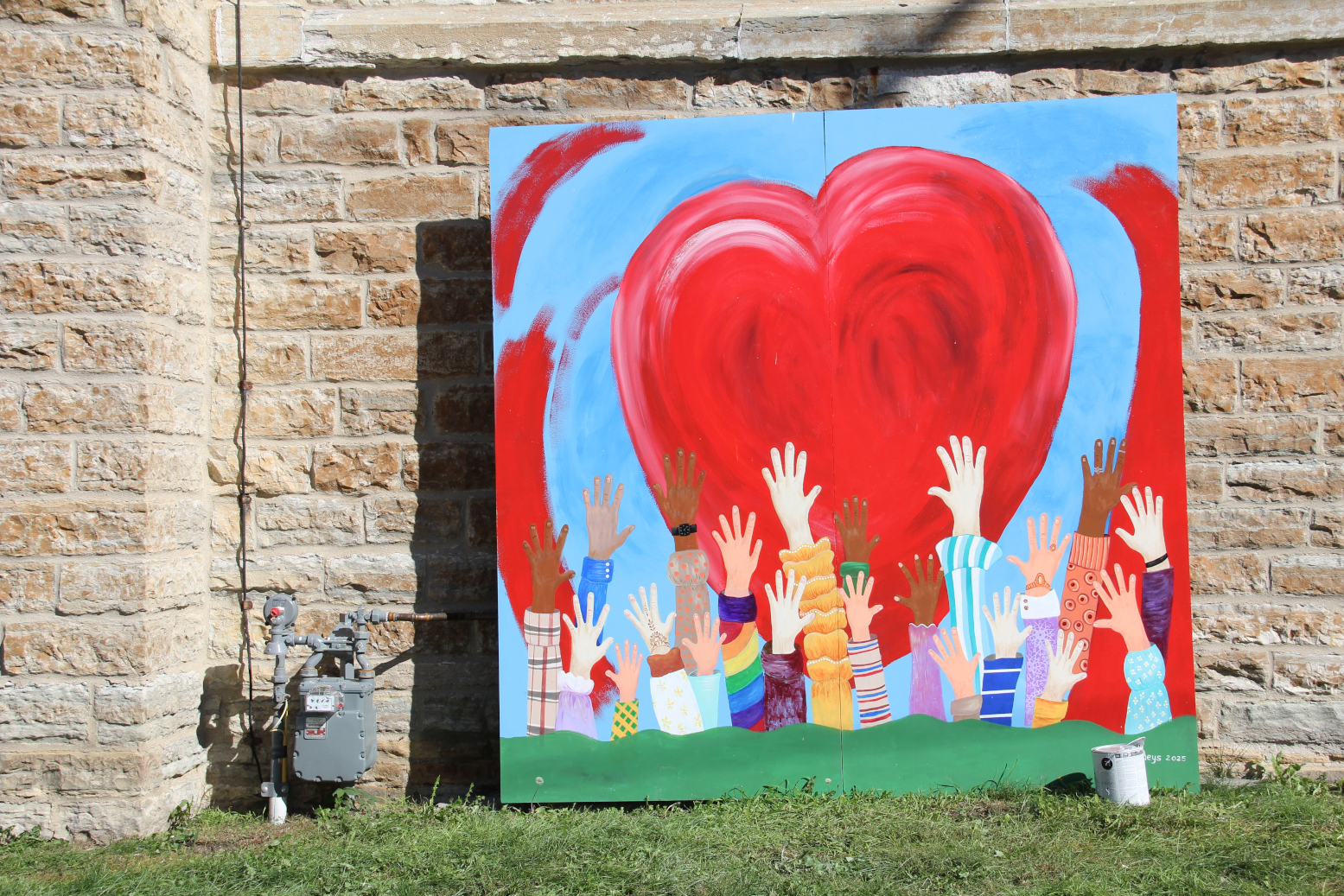
This mural was painted for and placed outside the Congregational Church in Faribault. (Minnesota Prairie Roots copyrighted photo September 2025)
And in Faribault, among the many murals adorning public spaces in the downtown area, one piece of art stands out as representing community. That is a free-standing mural placed on the west side of the Congregational Church of Faribault United Church of Christ this past summer. It seems an appropriate focal point to end 2025 and begin the new year.
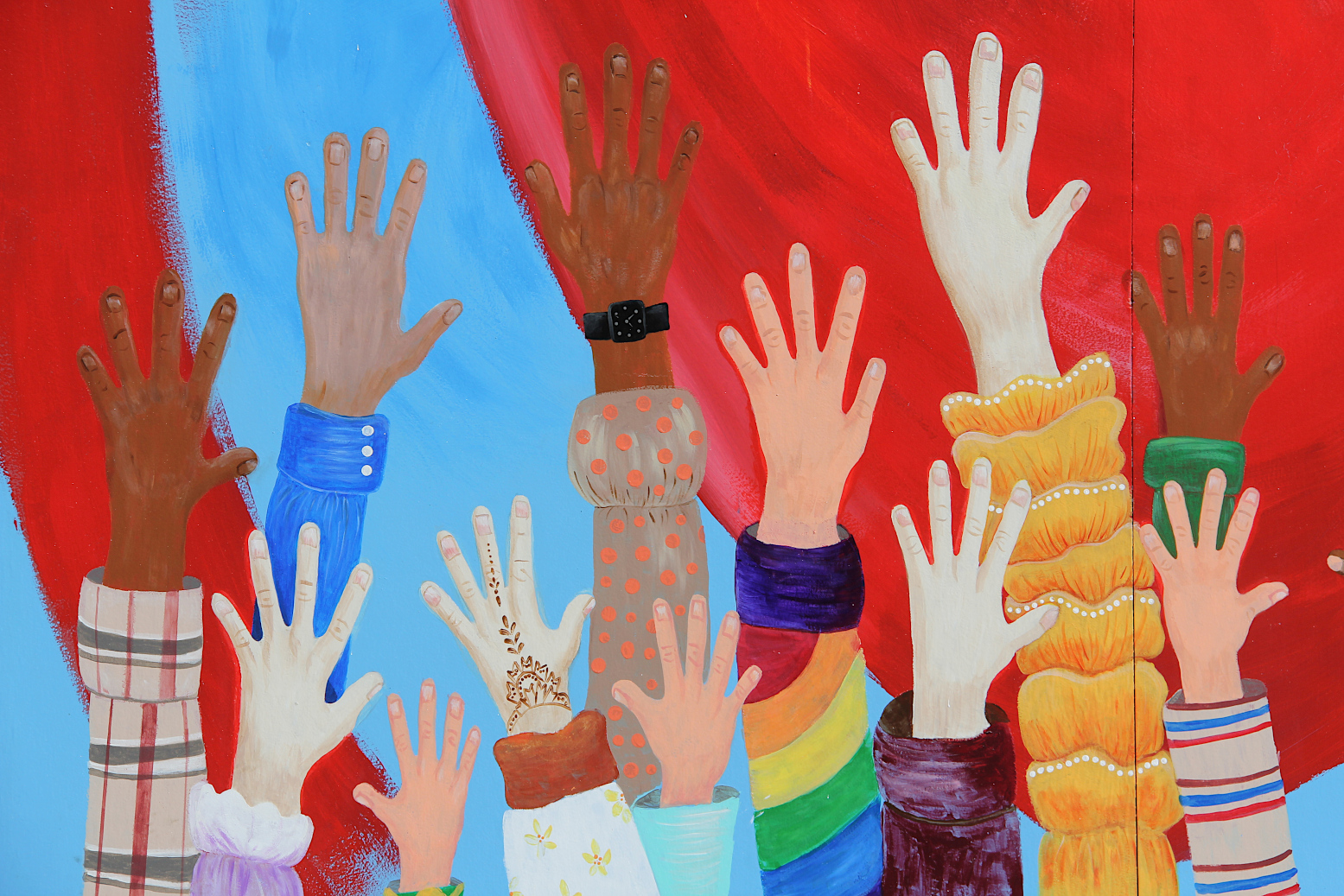
The artwork, created by Shirley Rainey and her son Jason, features outstretched arms rising from the earth against a backdrop red heart and blue sky. “The mural represents the importance of coming together to share burdens and triumphs, while reaching for our highest selves,” Rainey said in an artist’s statement.
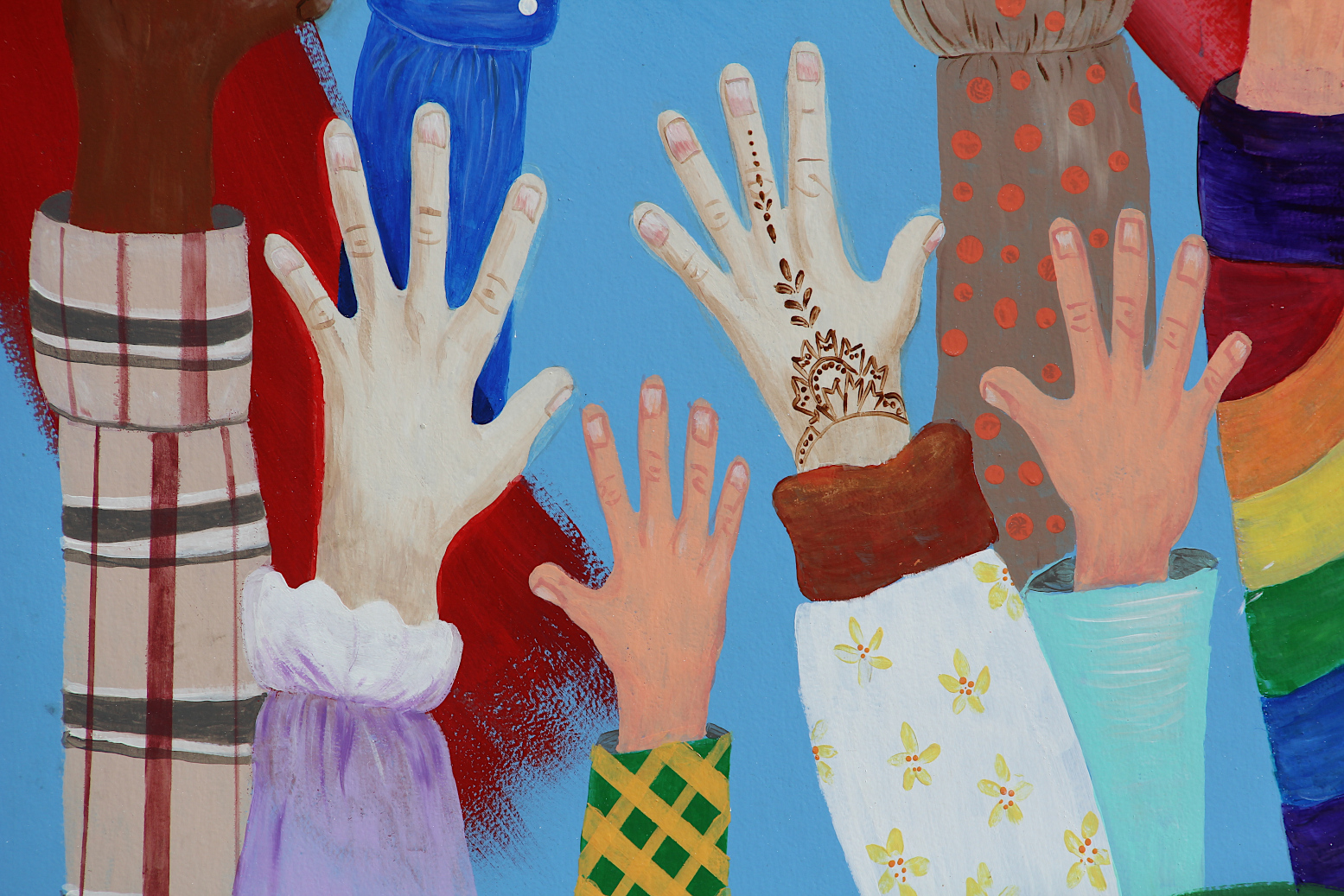
Henna painted on a hand reflects Somali culture. (Minnesota Prairie Roots copyrighted photo September 2025)
I see that in the mural. But I also see a community of diversity. The Raineys show that in assorted skin tones, clothing, hand sizes and even henna painted on a hand. I love that about this art, this intentional, varied depiction of Faribault as it is—gloriously diverse.
That said, I am well aware of the racial tension (and that’s a tamped down word) in my community. I wish it didn’t exist, that we all got along, welcomed and embraced one another. We are, after all, just people who live, love, work, play, laugh, cry… The list of commonalities we share as humans goes on and on. Yes, we are different, too. But differences seen as negative, those we create.
The diverse hands of Faribault, up close, in the new community mural. (Minnesota Prairie Roots copyrighted photo December 2025)
We can learn from that church painting. We can choose to love one another, as portrayed in the over-sized backdrop red heart. We can stand side-by-side and raise our hands to help one another. We can see, in those arms stretched skyward, the possibilities in building community. In that blue sky, we can envision not only our personal dreams, but the dreams of all who call Faribault home.
Faribault is a multi-cultural community, always has been. From early settlement days to today, people have come here from around the world to start anew. Whether French, Irish, German, Scandinavian, Latino, Asian, Sudanese, Somalian or any of many other ethnicities, this place has become home. We can choose to create community or not.
I hope in 2026 that Faribault can build a better, stronger, more unified community which celebrates our commonalities, and our differences.




 Minnesota Prairie Roots
Maundy Thursday reflections April 2, 2026
Tags: art, Christ, commentary, disciples, faith, Holy Week, Jesus, Jesus' betrayal, John 13:34, love one another, Maundy Thursday, paint-by-number, Scripture, The Last Supper
IMAGINE IF YOU were sitting down to your last meal with dear friends. How would you feel? What would you say to them?
Jesus faced this scenario on Maundy Thursday as he gathered with his 12 disciples for a final Passover meal before his death by crucifixion the next day. Had it been me, I would have been terrified at the thought of such an agonizing death.
Christ showed incredible strength. He managed to continue teaching, loving, forgiving, even as the time of his death approached. He was certainly troubled, as Scripture tells us. I mean, how could he not be bothered, knowing that one of his disciples would betray him, with a kiss of all things? I would feel devastated.
But Jesus is not anyone. He embodies love. And he tells us to love. Correction, he commands his disciples (and us, too) to love each other. He says: A new command I give you: Love one another. As I have loved you, so you must love one another (John 13:34).
As I consider all the division and hatred among us today, I focus on Christ and his example of unconditional love. Throughout his earthly life, Jesus continually showed compassion and care, often to the downtrodden, the outcasts, the lowly. I’m quite certain if he was physically walking on this earth today, he would still be showing such mercy.
He’d also be greatly disappointed, even upset, about the way we sometimes treat each other.
So what’s the point here? Maundy Thursday marks a monumental day for reflection. For change. For striving to follow Christ’s directive to love one another. And that starts with each of us. Today.
© Copyright 2026 Audrey Kletscher Helbling