Minnesota Prairie Roots

Writing and photography by Audrey Kletscher Helbling

Award-winning book addresses slavery in compelling stories, haunting art February 21, 2024

I CAN’T IMAGINE a world without books. From the time I was first read to and then learned to read as a young child, I have loved books. From books, I’ve learned, I’ve escaped, I’ve broadened my world well beyond southern Minnesota.

From reading the writing of others, I’ve grown, too, as a writer. Laura Ingalls Wilder, in her Little House books, taught me the importance of detail, of setting, in writing. I grew up on the prairie, some 20 miles from Walnut Grove, once home to the Ingalls family. A grade school teacher read the entire Little House series to me and my classmates. Books have, in many ways, shaped me.

Book cover image sourced online.

But imagine a world without books. That was a reality for slaves in America, denied access to books and to education. I just finished reading Kin: Rooted in Hope, written by Carole Boston Weatherford and illustrated by her son, Jeffery Boston Weatherford. The young adult book, published by Atheneum Books for Young Readers, was named a Coretta Scott King Author Honor Book 2024. It is a book that ought to be read by everyone not only for its insightful poetry-style storytelling, but also for its haunting scratchboard art.

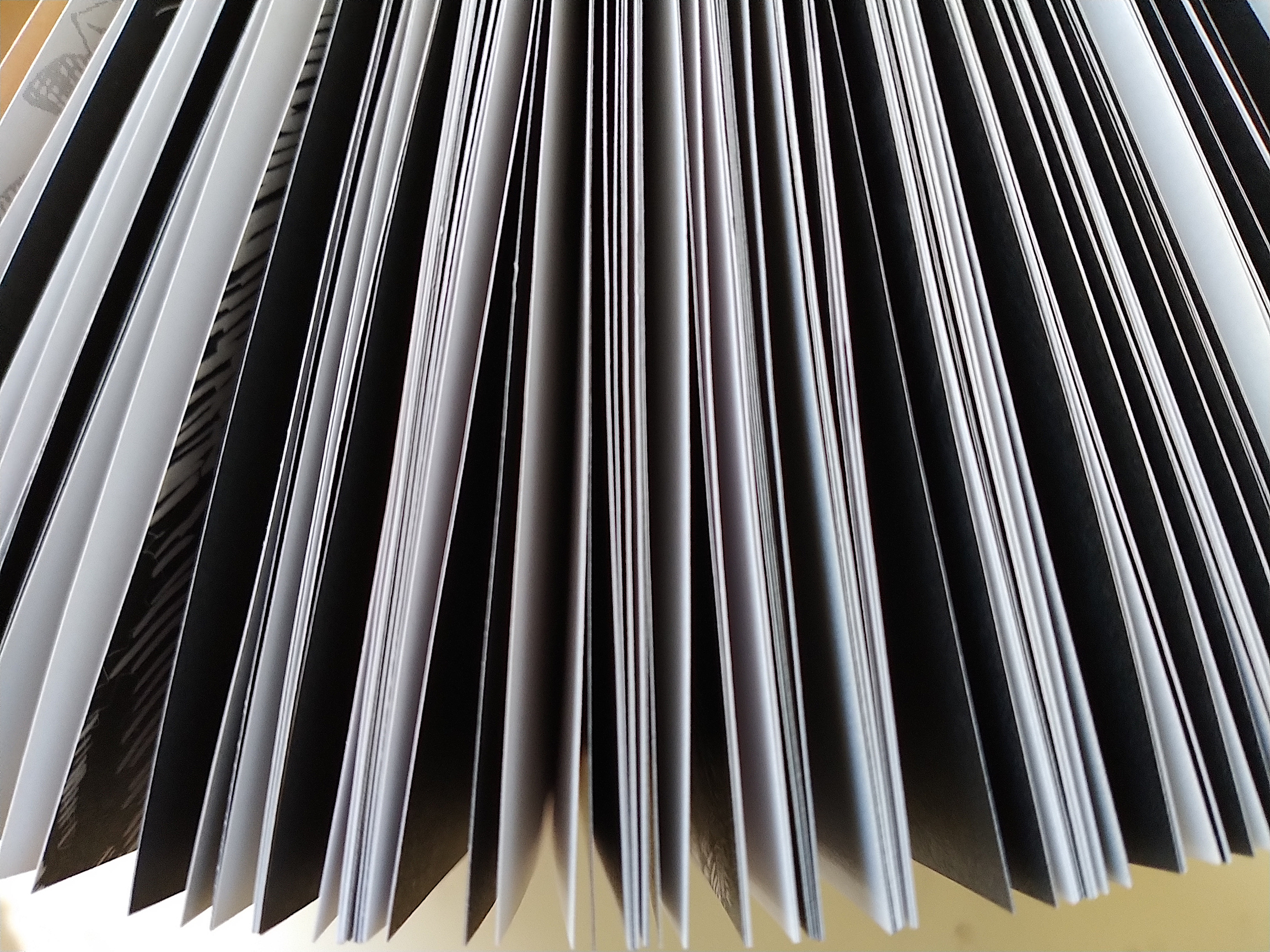
Looking down on the pages of the book with a mix of black and white paper. (Minnesota Prairie Roots copyrighted photo February 2024)

Adding to the overall subliminal effect is the way in which the book is printed. Black words ink white paper. White words imprint black pages. And the artwork is made by etching away black ink to reveal white. This mixed usage of black and white, reinforces the storyline of slavery and slave owners. Black. White.

As I read Kin, which I pulled from a book display for kids and teens at my local library, I was increasingly horrified by what I read. Sure, I’ve read about slavery in history books. But this approach of historical fiction really brought home the ugliness, the abuse, the violence, the awfulness of slavery in a personal way. Fiction rooted in truth.

Children born into slavery. Whippings. An auctioneer’s gavel. Names written on an inventory list along with commodities. Jemmy. Big Jacob. Lyddia. Tom. Walter. Isaac. Mush ladled into a trough. Swimming banned lest an escape to freedom be attempted. And on and on. Atrocities that seem unfathomable to inflict upon individuals chained in Africa, sailed to Maryland, sold, abused, treated like property by wealthy white families.

Photo used for illustration only. (Minnesota Prairie Roots copyrighted file photo)

But in the all of this, threads of kinship, endurance, strength and hope, even defiance, run. Perhaps my favorite line in the book is that of Prissy, a house servant waiting on a dinner guest. He leers at her, making an inappropriate comment. She wants to tell him that she spit in his soup. At this point half way into the book, I applaud her unstated rebellion. As the chapters unfold, so does the move toward freedom for slaves. The author writes of freedom at last and of current day issues (controversial statues in public places, the murder of George Floyd…), all interspersed with a whole lot of history (including historic figures like Frederick Douglass and Harriet Tubman…).

Even though this book is written for young adults, it should be read by older adults, too, who need to hear Prissy’s defiant voice. Author Carole Boston Weatherford gives voice to those who endured slavery, and to those whose family histories trace to enslavement, including her ancestors. Her son’s detailed scratchboard art reinforces the story, the words which wrench the spirit.

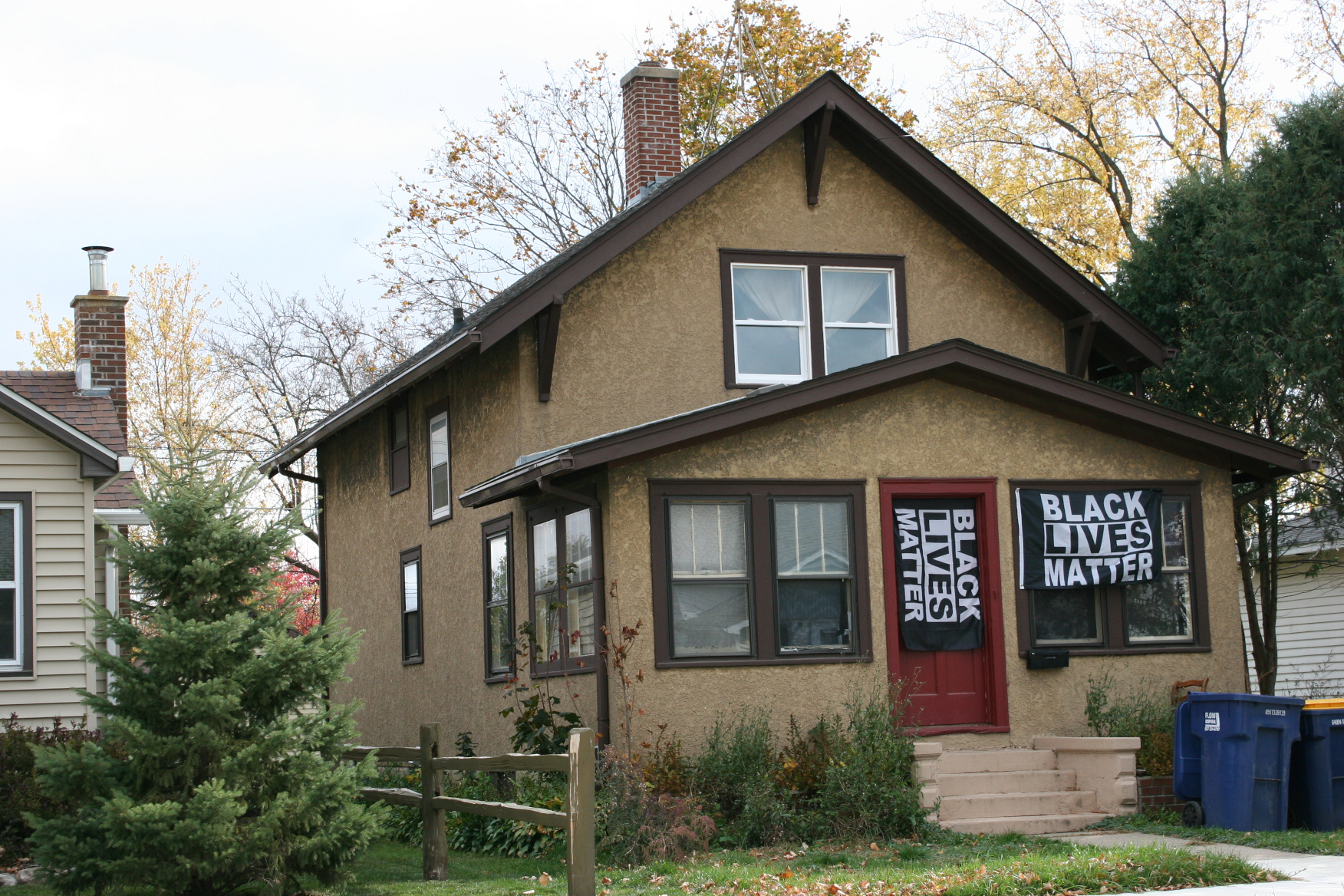
I photographed this scene in 2020 in Kenyon, MN. It remains one of my favorite images of this message given its location in a small town. (Minnesota Prairie Roots copyrighted file photo October 2020)

Kin: Rooted in Hope proves an especially fitting read during February, Black History Month. Through this book of historical fiction, I’ve learned more about a part of U.S. history which is horrendous in every possible way. That humanity can treat humanity so atrociously seems unfathomable…until I consider underlying and outright racist attitudes which continue yet today.

© Copyright 2024 Audrey Kletscher Helbling


The art & sport of ice fishing in Minnesota January 9, 2024

Filed under: Uncategorized — Audrey Kletscher Helbling @ 5:00 AM
Tags: , , , , , , , , ,
Ice fishing themed neon art advertises Grain Belt beer, made by August Schell Brewing Co. in New Ulm, Minnesota. (Minnesota Prairie Roots copyrighted photo January 2024)

IN THE UPSTAIRS ROOM of a small town southern Minnesota bar, I found myself drawn to the neon beer signs decorating the dark walls underscored by corrugated tin. The signs add an element of kitschy art to this space at The R Bar in Randolph where a group gathered for a holiday work party, Randy and I among them.

Ice anglers on Union Lake, rural Faribault, fish in the open on a sunny winter afternoon. (Minnesota Prairie Roots copyrighted file photo)

Next to the slim cooler holding an assortment of mass-produced beers and a few other drinks, I spotted neon signage that is about as Minnesotan as it gets—a bundled up ice fisherman pulling a fish through a hole in the ice, beer beside him.

Ice fishing on the Cannon River near the Faribault Mill. (Minnesota Prairie Roots copyrighted file photo February 2023)

Winter in Minnesota, if this would be a typical winter, finds anglers pulling fish houses onto lakes or sitting on overturned 5-gallon buckets to fish through holes drilled in the ice. But this has not been a usual winter here with temps (before this week) above normal and many lakes remaining open rather than frozen over. Several weeks ago, 122 anglers had to be rescued after ice broke away from the shore on Upper Red Lake in northern Minnesota. Following that, law enforcement officials restricted motorized vehicles from driving onto the lake until the ice consistently thickens to support motor vehicle traffic.

Ice fishing shacks are set up like a mini village on Lake Mazaska west of Faribault in Shieldsville. (Minnesota Prairie Roots copyrighted file photo)

I recognize this all sounds a bit odd to anyone unfamiliar with ice fishing. Vehicles, and we’re not talking just recreational vehicles, we’re talking mostly pick-up trucks, are driven onto the ice as anglers head for the hot fishing spots on our frozen lakes.

I myself engaged in the sport of ice fishing some 40 years ago, pre-children. Randy and I would sit inside his friend Jerry’s small ice shack warmed by a portable heater, play cards, drink beer and drop our lines into holes drilled through the ice. As the hours passed, we watched for our bobbers to tip in the frigid lake water, indicating a bite. I don’t remember catching many fish. But I recall the unsettling noise of cracking ice as Randy drove his Chevy pick-up truck across the icy lake and as we huddled inside the tight ice fishing hut.

The interior of an ice fishing house/camper, photographed several years ago at a sports show in Owatonna. Remove the lids and drop your line into the water on a frozen lake. (Minnesota Prairie Roots copyrighted file photo)

Much has changed through the decades. Fish houses have grown in size to almost mini cabins complete with kitchens and bunks to sleep overnight. This is a serious sport, big business in Minnesota. Of course, for those with more limited resources, tent-like pop-up portable fish houses remain an affordable option as does sitting on a cooler or a bucket under the winter sky.

A pop-up portable fish house at Pawn MN in downtown Faribault. (Minnesota Prairie Roots copyrighted file photo)

I doubt I will ever return to ice fishing. It doesn’t appeal to me like it did those winters, oh, so long ago. And I don’t trust the ice like I did back in the day when I was younger, less prone to considering ice thickness and safety. I’ve lived enough Minnesota winters to believe the warning, “No ice is ever completely safe.”

Drilling a hole in the frozen Cannon River to fish near the Faribault Mill. (Minnesota Prairie Roots copyrighted photo February 2023)

But I still celebrate ice fishing and its importance in Minnesota. It’s a favorite winter pastime/sport, especially for guys who seem intent on bonding over beers. It’s an important part of tradition and of our economy.

And, on this January evening, ice fishing is also an art form. I found it, here in The R Bar, the neon image of an ice fisherman glowing in this space of pool tables, tabletop shuffleboard, dart boards, high-top tables, a shiny wood-grain bar top, and a slim cooler holding Minnesota-made Grain Belt and other beer. This is winter in Minnesota, defined not by the light snow falling outside the bar, but by a neon symbol of fishing through a hole drilled in a frozen lake.

© Copyright 2024 Audrey Kletscher Helbling


Discovering the greeting cards of Artists to Watch December 29, 2023

The thrift shop holiday card that led me to a Minnesota greeting card company. (Minnesota Prairie Roots copyrighted photo December 2023)

IF NOT FOR MY APPRECIATION of thrift shops, I would have missed out on some incredible art. Not art in the usual sense of either original art or a print. Rather, I am referencing greeting card art.

On the second floor of Something For All, a thrift and consignment store in small town Lonsdale, I found several boxes of holiday cards featuring the hand-colored woodcut art of Mary Azarian. Since my high school days of hand-carving a linoleum block into a long forgotten design for a two-week shop class, I’ve loved block print art. And I immediately loved Azarian’s “Moon Gazing” winter scene which reminded me not of her home state of Vermont, but of mine, Minnesota.

That I even spotted the brand new cards among all the merchandise crammed into nooks and crannies of the many-roomed, two-story thrift shop was exceptional in itself. There’s a whole lot to see here. I found the cards on a second pass through, and then only because I looked toward the floor. I snapped up the boxed cards for a few dollars. The 12-pack retails for $19.95.

Found at a garage sale, this card was among boxed holiday cards illustrated by Mia Saine. (Photo by Miranda Boyd)

I bought the cards in October and stashed them with other Christmas cards I’d found at bargain prices. I mail nearly 100 cards, meaning I’m always on the search for deals. I also bought three boxes of African American-themed cards on a hot autumn day at a garage sale blocks from my house. Again, I paid just several dollars. This was a great find not only because of the low cost but mostly because I was excited to find culturally-diverse Christmas cards, these illustrated by Memphis artist Mia Saine. The woman selling the cards shared that she buys pallets of close-out merchandise from Target to resell. I don’t understand how that works. But I didn’t care. I was simply happy to find these and other cards.

Granted, sourcing new Christmas cards from a garage sale and from a thrift shop is rather unusual. But for someone who is budget conscious like me and who also appreciates art, this proved a win-win.

Also a win was flipping the thrift shop-found holiday card to the back to learn the name of the artist—Mary Azarian—and the type and name of the art. I also learned the cards were published by Artists to Watch, a Minneapolis-based greeting card company that collaborates with independent fine artists to create beautiful greeting cards. The company uses recycled content paper, soy-based inks, and prints and packages its cards in Minneapolis. I love the feel of the paper, everything about this product, including the plain Kraft colored packaging.

An example of Adam Turman’s art, featured here on a tunnel mural in Northfield. (Minnesota Prairie Roots copyrighted file photo October 2021)

Scrolling through the Artists to Watch website led me to a whole lot of other artists, many from Minnesota: Duluthians Nick Wroblewski, a printmaker of hand-cut woodblocks, and Ricky Allen and Marian Lansky of The Kenspeckle Letterpress; Minneapolis artists Jennifer Davis and Adam Turman; Betsy Bowen of Grand Marais with her woodcut prints; and Jim Brandenburg, a gifted photographer from my native southwestern Minnesota now living in Ely. The list of creatives is lengthy and I expect other Minnesotans are among Artists to Watch artists.

So this is the story of how a stop at a small town thrift shop in southern Minnesota led me to discover an eco-friendly Minnesota greeting card company which supports independent artists by printing their art. I love everything about this concept.

Plus, I loved “Moon Gazing” by 1999 Caldecott Medal winner Mary Azarian (illustrator of Snowflake Bentley) so much that I kept one holiday card for myself to display as art in my home office. (If only the 11×14 Fine Art Print wasn’t out of stock…)

FYI: Artists to Watch publishes boxed and individual greeting cards, not just for Christmas, but also for other celebrations and occasions. Additional products include notecards, vinyl stickers, stationery, journal sets and more.

© Copyright 2023 Audrey Kletscher Helbling


Highlighting creatives at upcoming events November 16, 2023

Books on Central is housed in the former Dandelet Jewelry, 227 Central Avenue North in downtown Faribault. This photo was taken before the bookshop opened in early October. (Minnesota Prairie Roots copyrighted file photo January 2023)

THIS SEEMS THE SEASON for creatives. At least in my community. Wednesday evening I listened to local writer Larry Gavin read poems and tell stories at Faribault’s new used bookstore, Books on Central. It’s always a delight to listen to this creative and especially so in the former Dandelet Jewelry Store. This cozy space features a grand vintage chandelier, built-in shelves and drawers, and other historic details that make it inviting, charming and unlike any bookshop I’ve ever shopped. Plus, this volunteer-run Rice County Area United Way bookstore boasts an inventory of 8,000 used books for all ages and in all genres.

Among artists selling their art at Holly Days is Julie Fakler, Paradise Center for the Arts executive director. Fakler is known for her animal portraits, these showcased in a previous exhibit. (Minnesota Prairie Roots copyrighted file photo October 2022)

Shopping. This is the season to shop the goods of local creatives. The Paradise Center for the Arts kicks off its Holly Days Sale with an artists’ reception from 5-7 pm this evening, November 16. Twenty artists are selling their art, from pottery to needle felting to stained glass and much more. The sale runs until December 22.

Tis the season of holiday craft sales/bazaars/boutiques. (Minnesota Prairie Roots copyrighted file photo November 2022)

On Saturday, November 18, creatives will vend Christmas items (including porch pots), quilts, wood and metal works, baked goods and more in the Trinity Lutheran Church auditorium along Fourth Street in Faribault. My friend Mandy has been baking up a storm, creating cupcakes, pumpkin-shaped centerpiece cakes and more for the 9 am – 3 pm Holiday Boutique Sale. Trinity youth will sell lunch, snacks and treats.

Also on Saturday, the Faribo West Mall hosts its Fall Bazaar from 10 am-4 pm with crafts, flea market finds and baked goods. A bonus feature is kids’ free craft making from noon to 2 pm.

Now, even before all those one-day shopping options open on Saturday, there are non-shopping creative opportunities. The Faribault High School play, “A Trip to the Moon,” is on stage at 7:30 pm Thursday – Saturday and at 2 pm Sunday. It’s been a while since I attended a FHS play. This one intrigues me since its set in 1969, my coming of age teen years.

Promo courtesy of Jeff Jarvis of Cedar Lake Studio/ The Cathedral of Our Merciful Saviour.

And then there are Irish musicians, coming from the Twin Cities to perform at 7 pm Friday, November 17, at the Cathedral of Our Merciful Saviour across from Central Park near downtown Faribault. Bonnie Drunken Lad, an Irish folk band, is performing as part of the free Merner Concert Series. If you’ve never attended a concert in the historic cathedral, I highly-recommend doing so. The acoustics are outstanding. And you can’t help but feel the history here while sitting on pews once graced by the Dakota people of the region and by early settlers.

An ice cream sundae at Berners’ Ice Cream Parlor in Two Rivers, Wisconsin, home of the ice cream sundae. (Minnesota Prairie Roots copyrighted file photo August 2011)

Finally, but certainly not last in level of creativity—and perhaps most creative—is an event from 1-2 pm Saturday, November 18, at the Cannon Falls Public Library. “Baking Yesteryear” is a free buffet style sampler feast featuring foods of yesteryear. Library staff worked with the Cannon Falls Historical Society to develop a collection of recipes from 1880-1989. People could peruse the recipes and choose a food (s) to make at home for Saturday’s sampler feast. I absolutely love this idea. Teen and Adult Services Librarian Matthew Stelter said his history buff teenage son will be there dressed as a 1930s soda jerk creating flavored sodas and ice cream floats with flavorings and ice cream donated by local CannonBelles Coffee and Ice Cream. Now, if I still fit into my 1970s lime green pants, perhaps I could come bearing banana-laced red Jell-O. Period-fitting dress is encouraged.

All in all, creativity defines the next several days. Food. Art. Music. I am grateful for all the creatives who share their talents with the greater community.

© Copyright 2023 Audrey Kletscher Helbling


In Seaforth: Celebrating books, art & people October 4, 2023

Promo for Saturday’s event, courtesy of Elizabeth Johanneck.

THEY ARE LONG-TIME FRIENDS. Friends who grew up together, who have a history of experiences and stories and of being there for one another. And they are both authors of books rooted in rural Redwood County, the land which shaped and grew them and their enduring friendship.

On Saturday, October 7, Twin Cities resident Elizabeth “Beth” Johanneck, author of If You Can’t Make it to Heaven, at Least Get to Seaforth—The Monica Stories and Then Some, and Granite Falls resident Cynthia “Cindy” Bernardy Lavin, author of the children’s book I Think I’ll Call You Annie: Based Upon a True Story (which Beth illustrated), return to Seaforth, population 77, for a 1-4 pm event sure to draw lots of interest.

The C4th Bar hosts the afternoon activities, which include a meet-and-greet (1-3 pm) with the authors and Monica Pistulka Fischer, prominently featured in Beth’s collection of short stories and art from the Seaforth and Wabasso areas. Books will be available for purchase.

Event promo courtesy of Elizabeth Johanneck.

But there’s much more planned than a book signing and time to chat with the long-time friends. The event also includes a hayride and self-guided tour of St. Mary’s Cemetery just northwest of Seaforth. Attendees can visit the gravesites of locals included in both books.

Image sourced online.

Back at the bar, Cindy, a retired elementary school teacher, will read her book about Seaforth’s most famous pig and offer a pig art project for kids.

The original painting of “Seaforth Main Street,” featured here on the cover of Beth’s book, will be on display at Saturday’s celebration. (Minnesota Prairie Roots copyrighted file photo 2023)

Art is an important part of this celebration as art is an integral part of Beth’s book. Her book includes the only printed collection of selected paintings by her grandfather, Arnold Kramer, dubbed “Minnesota’s Grandpa Moses.” He documented early to mid 1900s rural life and scenes, creating an historical agrarian treasure of some 400 paintings upon his retirement from farming. His original painting, “Seaforth Main Street,” which graces the cover of Beth’s book, will be displayed at Saturday’s celebration.

The C4th Bar is also honoring Kramer and several other Seaforth residents (and one pig) with special drinks: “The Grandpa Moses” for folk artist Arnold Kramer; “The Angie” for business owner Angie Bergen; “The Monica” for Monica Pistulka Fischer; and “The Annie” for Dana and Connie Dittbenner and Annie the Pig. “The Monica” and “The Annie” are non-alcoholic drinks. Hot chocolate and make your own s’mores will also be available.

No event is complete without music. The celebration features the live music of Cowboy Dave Gewerth.

It will be quite an afternoon in Seaforth. I can almost envision the scene of a packed bar, of Beth and Cindy mingling, of glasses raised, of stories shared, of memories made. That’s the thing about small towns, especially—you may leave, but you remain forever connected to the place, the events, the people. Like Beth and Cindy, long-time friends who on Saturday return to their roots to celebrate publication of their books, but, more importantly, Seaforth and its residents.

#

FYI: To purchase If You Can’t Make it to Heaven, at Least Get to Seaforth—The Monica Stories and Then Some, click here. (Also available through Barnes & Noble and independent bookstores, including Chapter Two Bookstore in Redwood Falls.) To read my review of the book, click here.

To purchase I Think I’ll Call You Annie, click here. Also available at independent bookstores and Barnes & Noble.

Disclaimer: I edited and proofed the manuscript for Beth’s book. My poem, “Her Treasure,” is printed in the book as a companion piece. Beth, Cindy and I attended Wabasso High School together, graduating with the class of 1974. Beth and I were also lockermates.

© Copyright 2023 Audrey Kletscher Helbling


“I Am Minnesota” immigrant portraits & stories inspire September 11, 2023

Portraits and stories, including that of Tin Tea owner, Chau, second from right, are featured in the newest “I Am Minnesota” exhibit. (Minnesota Prairie Roots copyrighted photo September 2023)

IN THE CORRIDOR LINKING Buckham Memorial Library and the Faribault Community Center, 13 portraits of immigrants and second-generation immigrants line the walls. They are the work of Faribault artist Kate Langlais in her updated “I Am Minnesota” project.

“Faysel,” who fled the war in Somalia. (Minnesota Prairie Roots copyrighted file photo September 2020)

This is a remarkable and revealing exhibit, which stretches well beyond faces portrayed primarily in black and white charcoal on gray paper. Langlais also includes the stories of those who now call this region home. Those stories hold the challenges and dreams, the successes, the gratitude and more of individuals who have become integral, and important, parts of our communities.

Faysel’s story from Langlais’ 2020 “I Am Minnesota” exhibit. (Minnesota Prairie Roots copyrighted file photo September 2020)

I saw Langlais’ first “I Am Minnesota” exhibit in 2020 at the Paradise Center for the Arts. She includes seven of those 2020 portrait-story pairings in her latest installation along with six new featured individuals. I appreciate her work today as much as I did three years ago.

Kate Langlais at work in her home studio. (Photo courtesy of Kate Langlais, 2022)

In her artist’s statement, Langlais states in part that, “It is an honor to learn about each individual’s hardships and perseverance, as well as the beauty of their hopes and dreams.”

“Hilda,” successful Faribault business owner. (Minnesota Prairie Roots copyrighted photo September 2023)

That includes the hopes and dreams of Hilda, who came to Faribault in 1996 with the goal of opening a family-run restaurant serving authentic Mexican food. Twenty-seven years later, El Tequila Family Mexican Restaurant is still going strong, even expanding to other communities. Hilda overcame a vocal naysayer who doubted such a restaurant could survive, let alone thrive, in Faribault. She proved him wrong and, in her story, expresses gratitude to a supportive community.

Likewise, another woman with a dream, second-generation Vietnamese-American Chau, opened Tin Tea in Northfield in June 2021 at the age of 19 while also a full-time student at St. Olaf College. Her story begins with gratitude to her parents: “My parents’ incredible journey from Vietnam to a new land left an indelible mark on my life. Filled with hardships and unwavering determination, their arrival in a foreign land with nothing but hope and courage inspired me deeply.”

An unidentified “I Am Minnesota” portrait of a woman hangs next to a drawing of Peter. (Minnesota Prairie Roots copyrighted photo September 2023)

To read these stories, to view these portraits, is to witness the strength and determination of individuals like Hilda and Chau. And Peter, an immigrant from the Netherlands who moved with his wife Virginia to Faribault in 2002. Since then, Peter, now a U.S. citizen, has volunteered tirelessly in Faribault, heading up the International Festival, being selected as “Citizen of the Year” (along with Virginia), elected to the City Council, recently named the new Rice County fair manager and more.

Included in Hilda’s portrait is the name of her successful Mexican restaurant, the first in Faribault and now one of several. (Minnesota Prairie Roots copyrighted photo September 2023)

Thirteen faces. Thirteen stories. They are ours to view, to read, to appreciate. For in seeing, we put faces to the word “immigrants.” For in reading, we learn their backstories. And in both, we begin to understand that our newest neighbors and their families overcame much to call this place, this southern Minnesota, home.

FYI: Kate Langlais’ “I Am Minnesota” exhibit will be up until Friday, September 15. A closing reception is slated for 5-7 pm with a free portrait drawing class beginning at 6 pm. Register for the drawing class at Faribault Parks and Recreation.

© Copyright 2023 Audrey Kletscher Helbling


“The Viaduct,” an enduring Faribault landmark August 23, 2023

A side view of a section of Faribault’s historic viaduct. (Minnesota Prairie Roots copyrighted photo August 2023)

ARCHITECTURE, ART AND HISTORY meld on an expansive structure connecting Faribault’s east and west sides.

The viaduct reflects in the Straight River in the early evening light. (Minnesota Prairie Roots copyrighted photo August 2023)

Locally referred to as “The Viaduct,” the continuous concrete rib arch bridge routes pedestrians and traffic along Minnesota State Highway 60 over railroad tracks and the Straight River far below. Three massive reinforced arches distinguish this as a viaduct rather than a bridge.

Piers and under the roadway up close. (Minnesota Prairie Roots copyrighted photo August 2023)

Thousands of times I’ve crossed the viaduct via vehicle in my 41 years living here. But not until recently did I pause to really study the underbelly of this 1937 Works Progress Administration project which is on the National Register of Historic Places. Only via a close-up look from ground level did I fully appreciate this engineering feat.

I followed Randy along this path leading to the tracks. (Minnesota Prairie Roots copyrighted photo August 2023)

I followed a narrow dirt trail through trees and underbrush in Teepee Tonka Park to reach a good viewing spot of the viaduct underside. From that perspective next to the train tracks, I observed the way patterns and lines repeat to build a strong structure that has withstood the test of traffic and of time. The bridge was rehabilitated, the roadway widened in 2008-2009.

Hanging out under the viaduct. (Minnesota Prairie Roots copyrighted photo August 2023)

The viaduct impresses in design and size. I felt dwarfed by its massiveness, even more noticeable when I spotted a couple sitting on the far end. They appeared small in comparison to the concrete piers rising above and around them. I felt overpowered, too. I wondered how WPA workers managed to build this wonder in the late 1930s without the modern equipment of today.

Westbound on the viaduct, Buckham Memorial Library is to the left and the Immaculate Conception Church steeple in the distance. (Minnesota Prairie Roots copyrighted file photo October 2022)

But it is more than utilitarian construction that marks this viaduct as noteworthy. The viaduct is a work of public art—an interactive sculpture which provides a sweeping view of historic downtown Faribault and the surrounding area when heading westbound. To view the bridge from below is to truly see its artsy side, its Art Deco/Classical Revival style. That style carries through in the concrete piers and, on road level, in the decorative railings and lights, replicas of the originals.

The viaduct is a marvelous work of architecture, art and engineering. (Minnesota Prairie Roots copyrighted photo August 2023)

As I stood under the viaduct studying its design, artsy arches, curves and lines, I considered the many people who have traversed this bridge. If only this concrete could speak, oh, the stories it would tell. Stories of construction workers who labored for 1½ years to complete this project. Stories of Ford Model As, among the first to drive across this linkage between east and west. Stories of students arriving at the Minnesota State Academies for the Deaf and Blind. Stories of athletes heading to hockey camp at Shattuck-St. Mary’s School. Stories of prisoners transported to the Minnesota State Correctional Facility, Faribault. Stories of ambulances racing across the viaduct toward the hospital. Stories of expectant parents headed there, too. Stories of families and students on their way to River Bend Nature Center. Stories of travelers simply passing through Faribault.

On the east side of the river, a road passes the viaduct and leads to Teepee Tonka Park. (Minnesota Prairie Roots copyrighted photo August 2023)

For 86 years, The Viaduct has gathered stories atop graceful arches, upon a roadway that is more than a route. This is a local landmark, an architectural and artistic marvel which visually and historically defines Faribault.

© Copyright 2023 Audrey Kletscher Helbling
 

Book review: A collection of short stories & art from the Minnesota prairie by Elizabeth Johanneck July 27, 2023

The cover of Elizabeth Johanneck’s new book features the art of her grandfather, Arnold Kramer. (Minnesota Prairie Roots photo July 2023)

DECADES REMOVED from southwestern Minnesota, Twin Cities writer Elizabeth Johanneck and I remain rooted to the prairie—the land and people and smalls towns which shaped us. We both grew up on Redwood County farms, were Wabasso High School classmates and today hold a deep respect and fondness for the place we once called home.

Beth, as she’s known to me, recently published a book, If You Can’t Make it to Heaven, at Least Get to Seaforth—The Monica Stories and Then Some. This book features short stories and snippet observations in Beth’s humorous storytelling style, plus paintings and photos. These could be my stories, my memories, just with different characters and settings. Any prairie farm kid likely will feel the same.

ABOUT SEAFORTH & MONICA

But where is Seaforth? And who is Monica? Seaforth, population 77, is a farming community located along County Road 7, south of Minnesota State Highway 19 in central Redwood County. It’s near my hometown of Vesta, seven miles to the northwest. Monica Fischer is Beth’s friend, former co-worker and a character. A baby shoe in a pot of egg coffee and pantyhose found clinging inside a pant leg during Catholic Mass are among the many entertaining Monica stories that left me laughing aloud. By the time I’d finished reading this section of the book, I felt like I knew Monica well. Everyone should have a friend like her.

GROWING UP ON THE MINNESOTA PRAIRIE IN THE 1960s

And everyone should be so fortunate to have experienced rural Minnesota life in the 1960s, as Beth and I did. It is Part 2, “Random Nonsense of a MN Country Mouse,” that I find most similar to my childhood. Both farmers’ daughters with many siblings, Beth and I share the commonalities of being raised on the land among aunts and uncles and cousins and grandparents and immediate family who loved us deeply.

As in “The Monica Stories,” Beth writes about her personal experiences in a casual conversational style. It’s as if she and I are chatting over cups of coffee, and Beth does like her coffee. I connect with her stories about “the grove,” jars of pocket gopher feet in the freezer, grab bags, bloodsuckers, The Weekly Reader, hearing corn grow and more.

Her humor-infused short stories stretch into adulthood, into becoming a parent and grandparent. These are not earth-shattering remembrances, but rather observations about everyday life and events that could be mine, could be yours, but are definitively Beth’s.

NIBBLES OF COUNTRY INSIGHTS

In a section titled “Country Mouse Nibbles,” Beth shares her thoughts on topics in a sentence or two, the first being “When You Are Raised Close to the Land.” I fully understand—the smell after autumn harvest, looking to the west for approaching storms, filled fruit jars crowding root cellar shelves… And “Holding onto Memories”—Distant cheers from a local ball game are souvenirs worth saving for winter. Truly poetic words.

FEATURING THE ART OF “MINNESOTA’S GRANDPA MOSES”

There is much to be cherished in this book beyond pages and pages of rural memories and insights. Beth also intersperses photos, most from Seaforth. But it is Part 3, “Paintings by Arnold Kramer, Minnesota’s ‘Grandpa Moses,’” which is an historic agrarian art treasure. Following his retirement, Seaforth farmer Arnold Kramer took up painting, visually documenting early to mid-1900s rural life and scenes. He became well-known for his folk art style paintings done in primary colors. Beth’s book holds the only printed collection of paintings by her grandfather. The self-taught artist created more than 400 works of art and was dubbed “Minnesota’s Grandpa Moses” by the University of Minnesota at the peak of his creativity in the 1960s.

Book signing promo courtesy of Elizabeth Johanneck.

BOOK SIGNING SATURDAY IN SEAFORTH

Like her grandfather before her, Beth is also a visual artist. She illustrated a just-published children’s picture book by her lifelong friend, Cindy Bernardy Lavin, our WHS classmate. Both writers, along with Monica Pistulka Fisher, are doing a book signing from noon to 3 pm this Saturday, July 29, at the C4th Bar during Seaforth’s Hometown Days celebration.

Beth’s book is also available for purchase at Chapter Two Bookstore in Redwood Falls and online at Amazon and Barnes & Noble. Both her book and Cindy’s achieved bestseller status on Amazon following their release.

Julie Kramer, author of bestseller Stalking Susan, praises Beth’s book in her back cover endorsement, calling it “a delightful collection from a farm girl who grew up near the Minnesota home of Laura Ingalls Wilder.” I agree. Fully.

#

Disclaimer: I edited Beth’s book and advised her on the manuscript. She also included my poem, “Her Treasure,” as a companion piece in the “Country Mouse Nibbles” section. For many years, Beth hosted a blog, Minnesota Country Mouse.

© Copyright 2023 Audrey Kletscher Helbling
 

Looking for Lucy July 11, 2023

This sculpture of Lucy Van Pelt in Faribault is titled “Land O’Lucy.” (Minnesota Prairie Roots copyrighted photo June 2023)

SHE’S OUTSPOKEN. Loud. Sometimes bossy. Opinionated. Strong. And, in her own unique way, lovable. She is Lucy Van Pelt of the Peanuts cartoon strip.

Lucy stands outside the east wing entry to Noyes Hall at MSAD. (Minnesota Prairie Roots copyrighted photo June 2023)

Lucy and the other characters created by Charles Schulz represent diverse personalities. They are some of us. They are all of us. And that is perhaps what makes this comic strip so endearing, so relatable.

Agricultural-themed “Land O’Lucy” features a farm site. (Minnesota Prairie Roots copyrighted photo June 2023)

In Minnesota, especially, we hold a deep fondness for the Peanuts’ characters. Cartoonist Schulz was born in Minneapolis, raised in St. Paul, moved to Colorado, back to Minnesota, and then eventually to California in 1958 with his wife and their five children. As a high school student, he studied art through a correspondence course at the Art Instruction Schools in Minneapolis and later taught there. His Peanuts cartoon debuted in October 1950 and would eventually include some 70 characters, their stories, trials, triumphs.

Pastured Holsteins detail the rural theme. (Minnesota Prairie Roots copyrighted photo June 2023)

St. Paul honors their native son with bronze sculptures of Peanuts at Landmark Plaza in the heart of the capital city. While I’ve never seen that art, I’ve seen art from an earlier endeavor, “Peanuts on Parade.” After Schulz died in 2000, St. Paul undertook the five-year parade project beginning with Snoopy fiberglass statues painted by artists and then auctioned to fund scholarships for artists and cartoonists and to finance the bronze statues. In subsequent years, “Peanuts on Parade” featured Charlie Brown, Lucy, Linus, and, finally, Snoopy and Woodstock.

“Land O’Lucy” stands outside the east wing of Noyes Hall. (Minnesota Prairie Roots copyrighted photo June 2023)

It is a statue of Lucy which found its way into my community, landing at the Minnesota State Academy for the Deaf. “Land O’Lucy” now stands in a visible spot on campus, moved during a recent construction project from an obscure location outside Quinn Hall to the front of Noyes Hall East Wing. She’s become my silent, if Lucy can be silent, cheerleader as I walk the deaf school campus doing my vestibular rehab therapy exercises. I like to think that Lucy is encouraging me, just as she is encouraging the young deaf and hard of hearing students who attend this specialized residential school. Lucy symbolizes strength with her nothing’s-going-to-stop-me attitude. We can all use a bit of that empowering approach to life’s challenges.

Informational signage at the base of Lucy. (Minnesota Prairie Roots copyrighted photo June 2023)

This particular statue from the 2002 “Looking for Lucy, Peanuts on Parade” project was painted by Dubuque, Iowa, artist Adam Eikamp with Land O’Lakes Inc. the sponsoring company. The dairy plant in Faribault has since closed. But its support of this public art remains forever imprinted in informational signage at the fiberglass statue’s base.

Artwork shows disking the field in preparation for spring planting. (Minnesota Prairie Roots copyrighted photo June 2023)

The agricultural theme of the MSAD Lucy is fitting. Our area of southern Minnesota is a strong agricultural region. The paintings on the statue reflect that with fields, barn, farmhouse, cows and chickens. Lucy banners rural. She is among 105 five-foot tall Lucys painted as part of “Looking for Lucy.”

Extroverted “Land O’Lucy” outside Noyes Hall east wing. (Minnesota Prairie Roots copyrighted photo June 2023)

If you’re looking for this Lucy, travel to MSAD on Faribault’s east side. You can’t miss the domed Noyes Hall, on the National Register of Historic Places and among many beautiful historic limestone buildings on campus. She stands outside Noyes’ east wing, welcoming students and others, arms flung wide. Typical Lucy with body language that reveals her extroverted personality, her loud, strong and encouraging voice.

© Copyright 2023 Audrey Kletscher Helbling
 

An uplifting surprise in the mail July 3, 2023

(Minnesota Prairie Roots copyrighted photo June 2023)

THE THICK FLORAL WRAPPED PACKAGE arrived unexpectedly in my mailbox today. A sweet surprise from the usual junk mail and bills. As soon as I saw the return address, I knew that whatever I found inside would bring me joy. And it did.

Once I managed to remove the stubborn packaging tape, I discovered a foam sleeve filled with greeting cards from blog reader Roxy of Owatonna. Her selected stash of 27 assorted cards that I can give to whomever I wish is much-appreciated. Roxy, simply by reading my blog posts, knows how much I value sending cards to celebrate, encourage, comfort, thank…

What a kind and thoughtful gift, that also includes stamps on some envelopes and some seals. To receive these cards from Roxy uplifted me in the midst of my ongoing challenging and complex health issues. Many times it’s simply a struggle to manage my symptoms, to get through my days and nights.

But in this moment my focus is one of gratitude for individuals like Roxy, whom I’ve never met. She took the time to put together this collection of greeting cards for me. Her act moved me to tears. And one particular card of birds and vines and florals brought even more tears. It was the scripture gracing the front of the blank card that prompted those emotions. Be still and know that I am God is a Psalm (46:10) I’ve relied on to calm me during challenges. The words remind me of God’s presence even in the chaos of life’s uncertainties, especially now.

Roxy also included seven cards designed by Glencoe artist Bonnie Mohr, who specializes in rural art. Like the Holstein cow wearing a laurel wreath and the fitting message, Wear the flowers. And the quart jar of pale pink roses. A lone tree and a single egg in a nest. Simple. And so me, me who grew up on a dairy farm. Me, rooted in southwestern Minnesota. Me, writer of Minnesota Prairie Roots.

That Roxy understands the essence of me reveals her awareness of who I am via reading my blog. She couldn’t have known, though, that I’ve enjoyed Mohr’s work since her art was featured on the November/December 2013 issue of Minnesota Moments. I freelanced for that magazine many years until it eventually folded. The cover Mohr created is a bucolic winter scene of snow falling on a farm site with Holsteins fenced next to an iconic red barn, aged white farmhouse in the background. That painting speaks to my past, to the family farm, to that which was once the heart and soul of rural America.
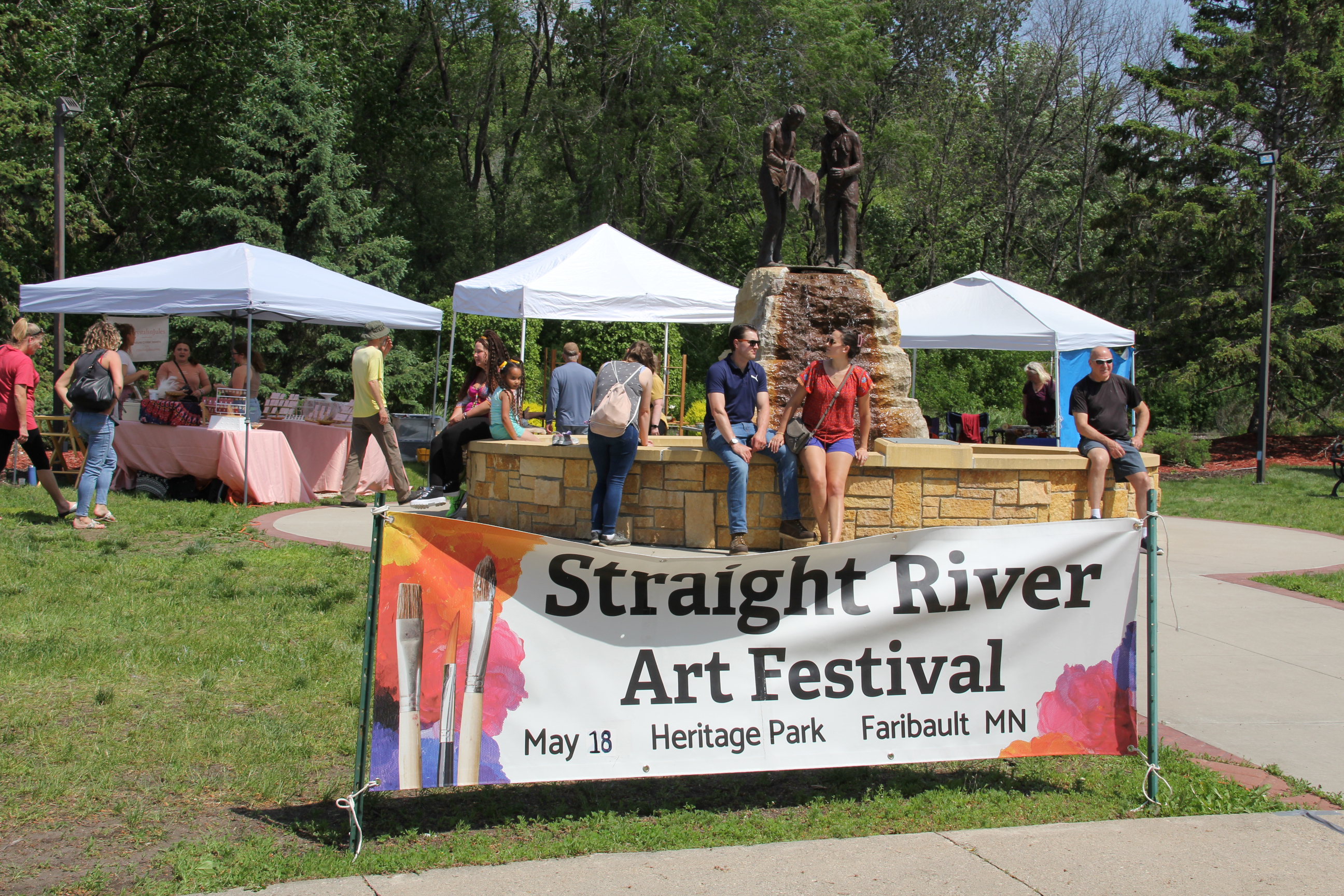
The soul of America also exists in good, kind and caring people like Roxy of Owatonna, who penned a personal note expressing her gratitude for the joy I bring into her life and for helping her see the world in a different way via my writing and photography. I am grateful for her generous words and for her well wishes as I work toward reclaiming my health.
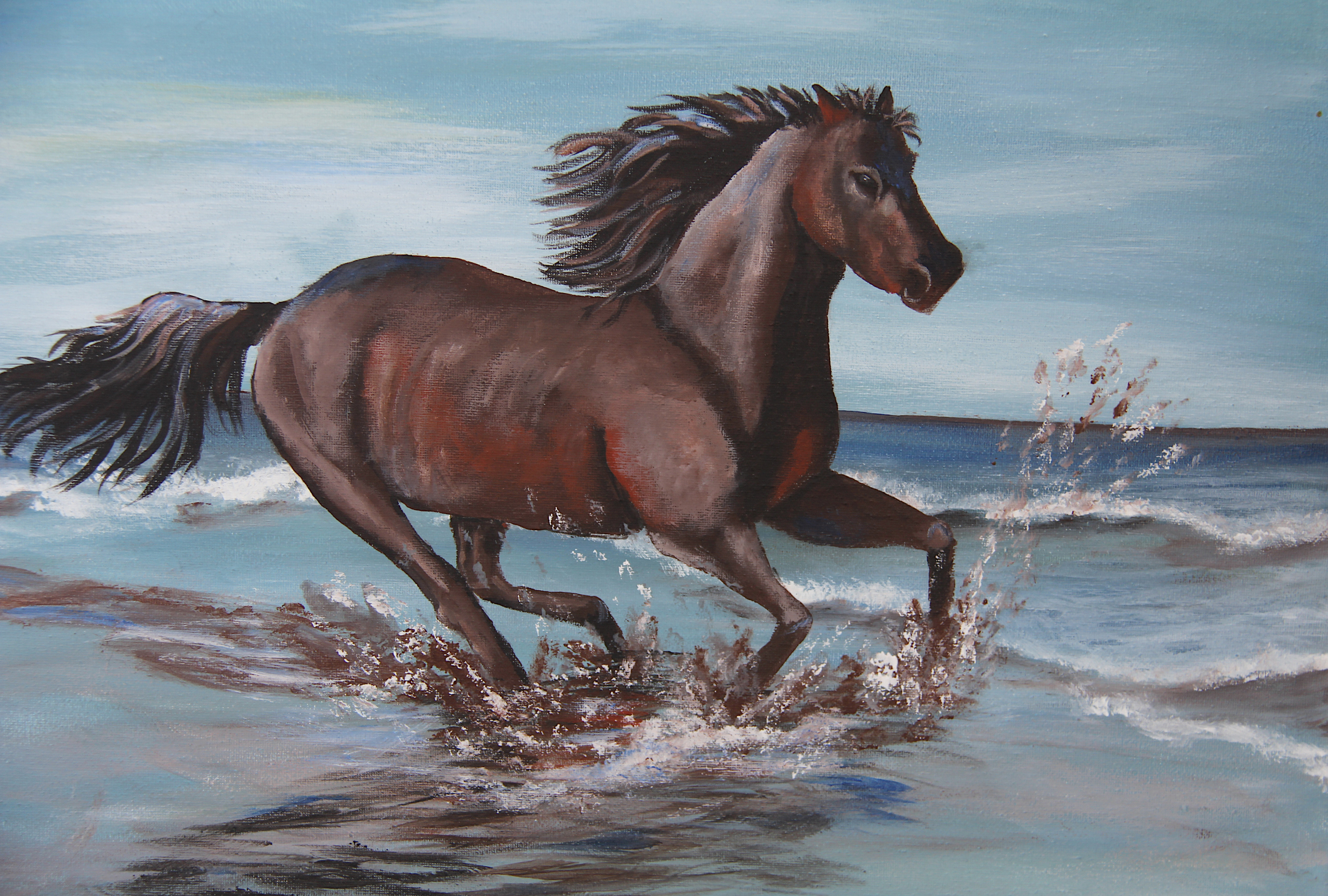
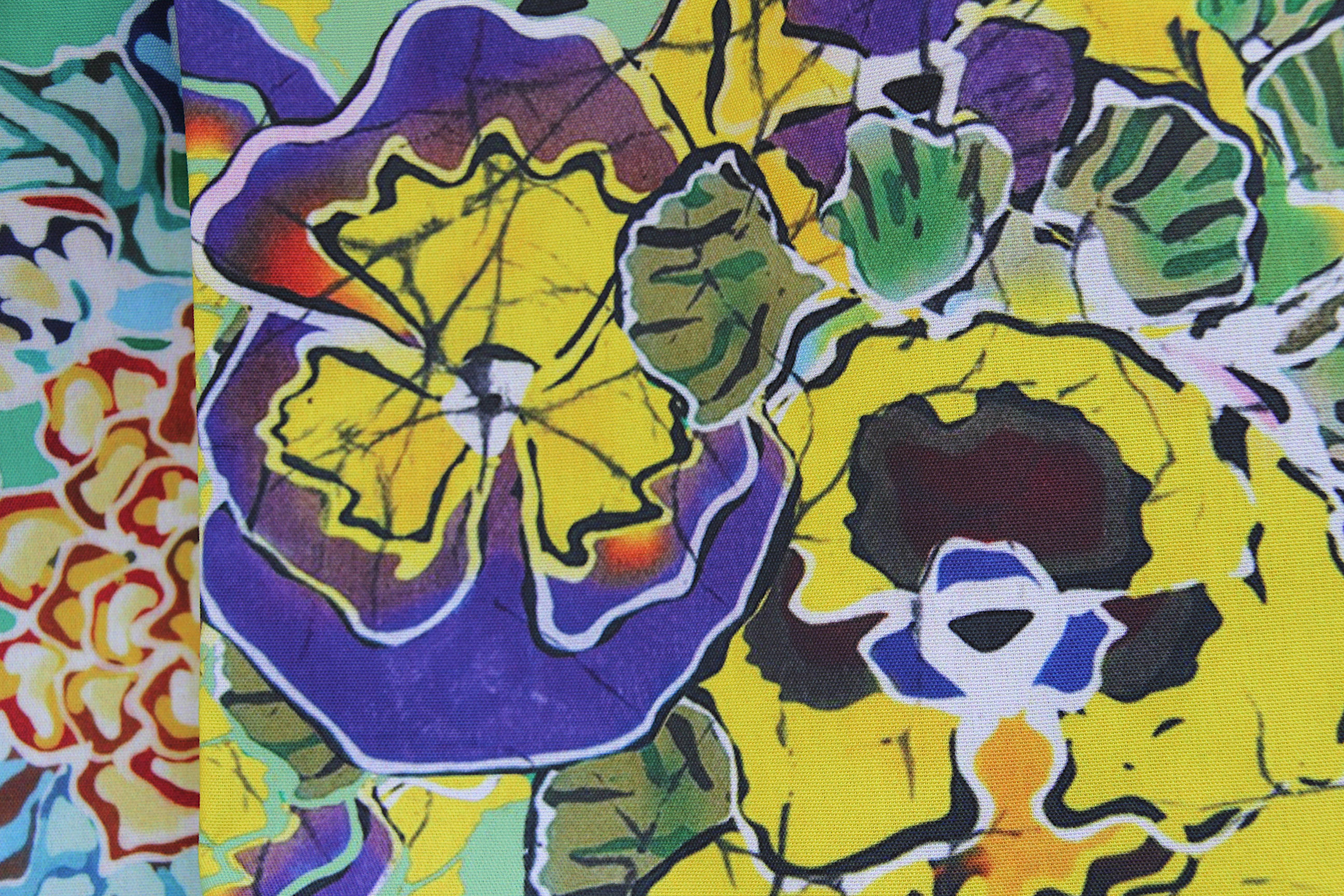
I continue to feel grateful for my many readers who have so graciously encouraged me through supportive comments and cards. I feel the love from coast to coast and throughout the heartland. Thank you.

© Copyright 2023 Audrey Kletscher Helbling