Minnesota Prairie Roots

Writing and photography by Audrey Kletscher Helbling

Multi-genre Minnesota authors talking craft & more at Faribault library October 31, 2023

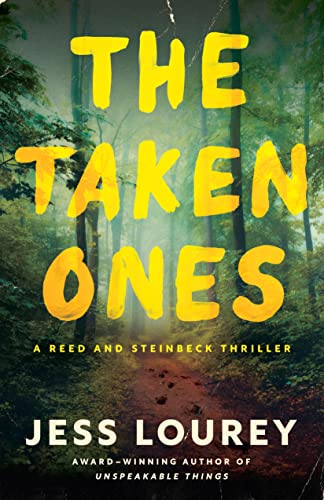
Book cover sourced online

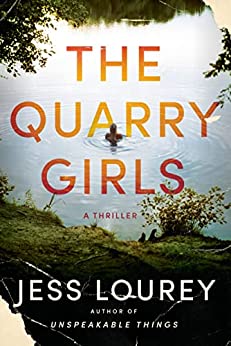
A FEW DAYS AGO, I nabbed Jess Lourey’s The Taken Ones from the LUCKY DAY shelves at my local library. This is a section where new books are placed and, if you’re lucky to get a new release, then lucky you. Already I want to stay up late reading this Minnesota author’s latest thriller. Just as I did when I read The Quarry Girls, a fictional crime story set in 1997 in St. Cloud and winner of the 2023 Minnesota Book Awards in genre fiction.

My familiarity with Lourey’s writing stretches back many years to my time as a freelance writer with Minnesota Moments, a magazine no longer in publication. Back then I reviewed Minnesota-authored books for the magazine, including books in Lourey’s Murder by Month romcom series set in Battle Lake, a real Minnesota community where she lived at the time. I still remember the name of the main character, Mira James, in books like May Day and June Bug.

Book cover sourced online

But since I’m an appreciator of intense mysteries, I’m more drawn to Lourey’s suspenseful crime titles. That’s my go-to genre, reaching as far back as the Nancy Drew detective series.

The library’s promo for Thursday’s event.

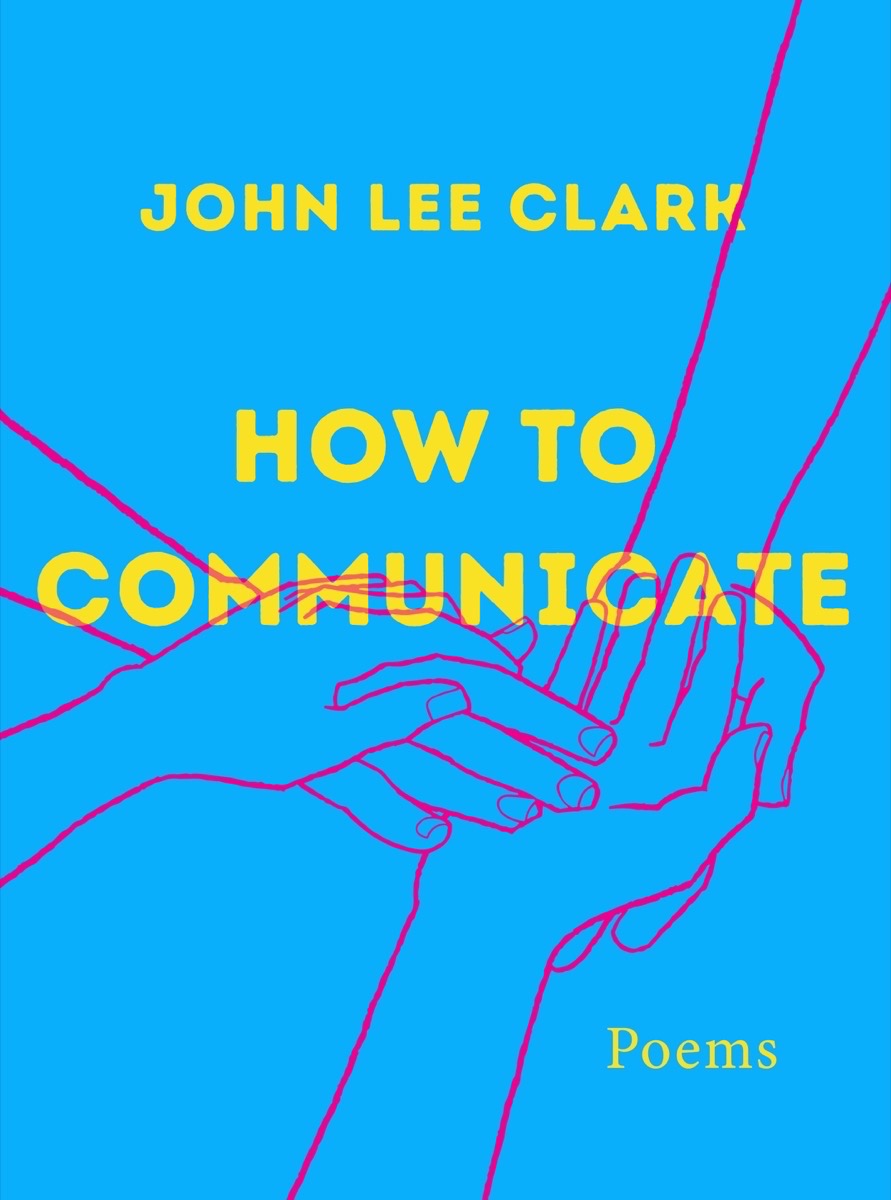
All of that aside, Lourey will be at Buckham Memorial Library in Faribault at 6 pm Thursday, November 2, as part of Moving Words: Writers Across Minnesota series. Authors John Lee Clark and Nicole Kronzer will join her. How lucky we are to have three talented, award-winning, multi-genre authors here to talk about their craft.

Book cover sourced online

While Clark and Kronzer are unknown to me, their online bios reveal two gifted writers. Clark, a DeafBlind poet, essayist and actor, won the 2023 Minnesota Book Award in poetry for his How to Communicate: Poems. It seems particularly fitting that he is coming to Faribault, home to the Minnesota State Academies for the Deaf and the Blind.

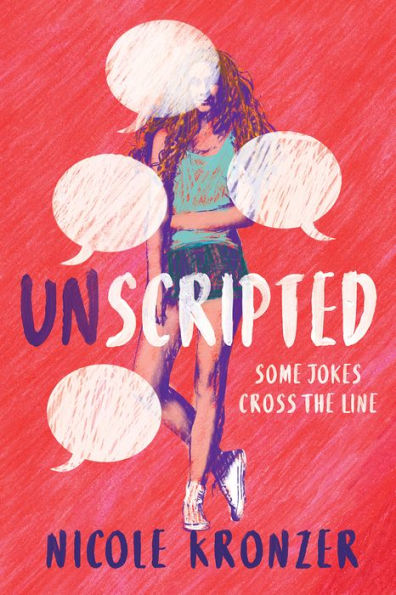
Book cover sourced online

And Kronzer, a high school English teacher and former professional actress, writes young adult novels. In 2021, Unscripted was a Minnesota Book Awards finalist in young adult literature. Her second book, The Roof Over Our Heads, published in January.

I’ve already requested Clark’s poetry book and Kronzer’s Unscripted from the library. If those books were on the Lucky Day shelves, I missed them.

Now, time to take a break from writing to resume reading The Taken Ones. For it is also by reading that writers learn and grow their craft. And Lourey has that covered, too, in Rewrite Your Life: Discover Your Truth Through the Healing Power of Fiction, a book to first read then use as a writing guide.

© Copyright 2023 Audrey Kletscher Helbling


In Seaforth: Celebrating books, art & people October 4, 2023

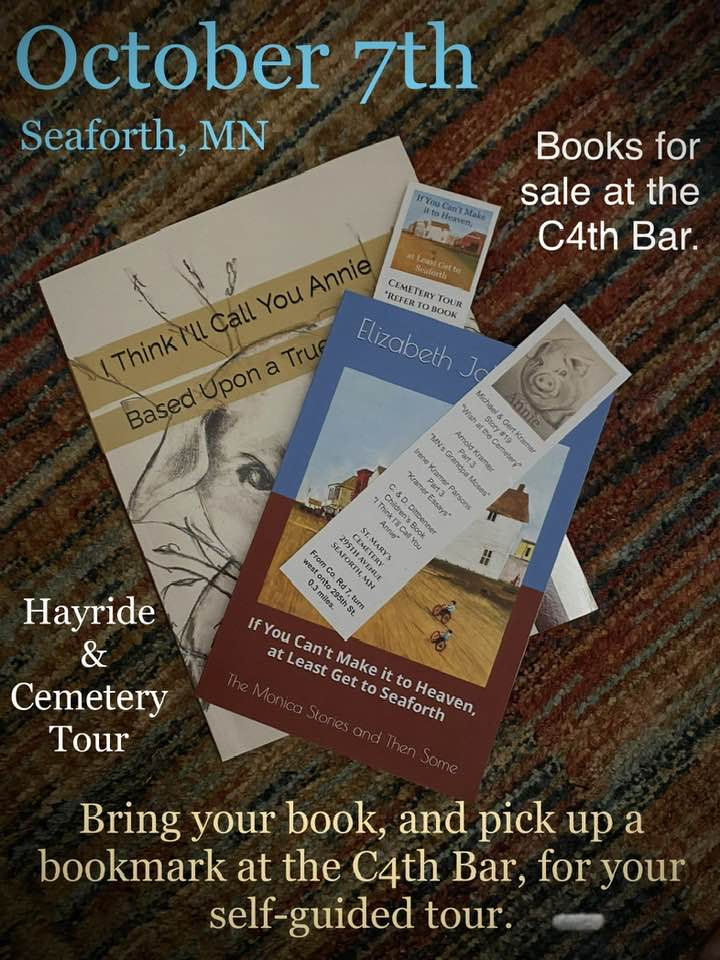
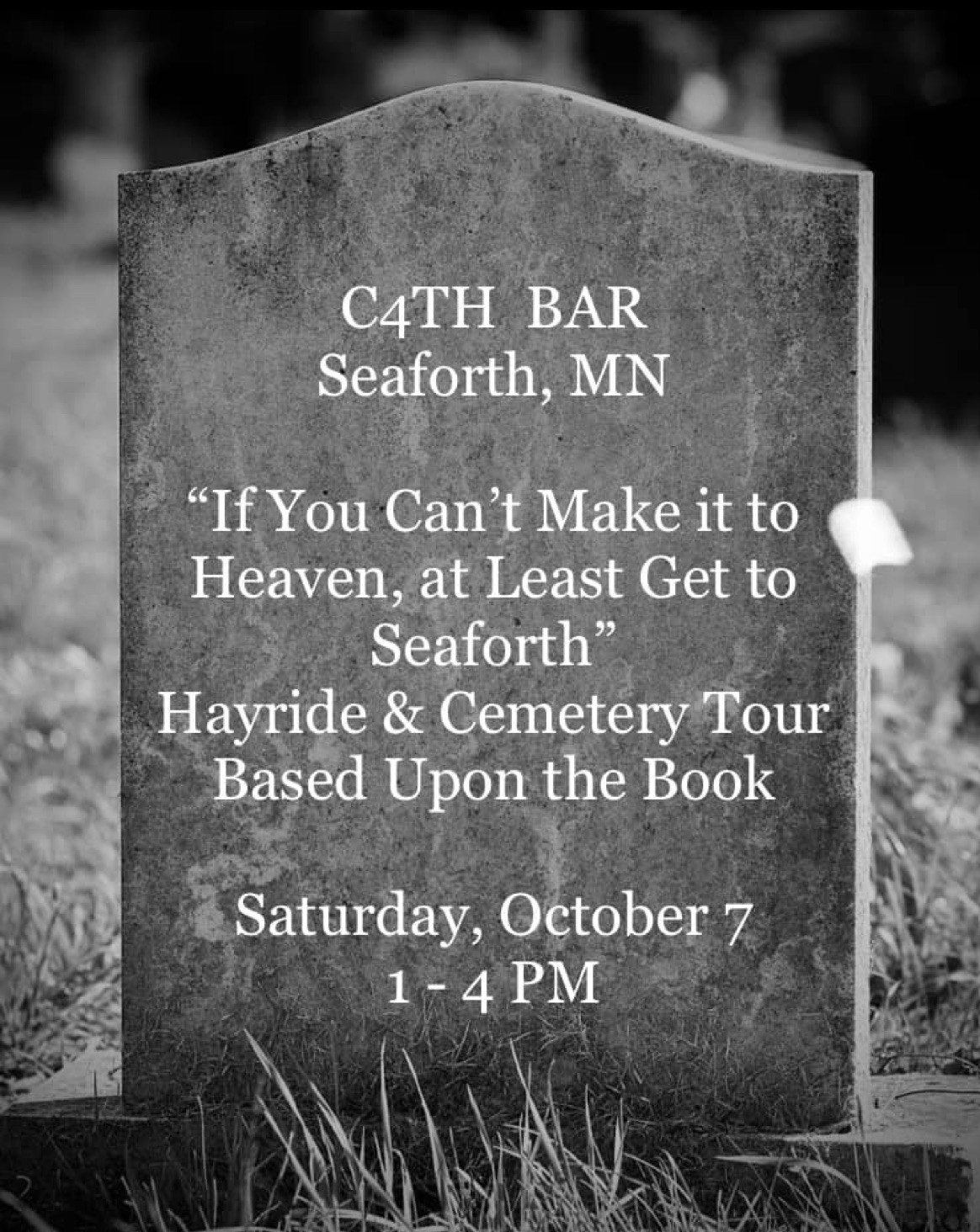
Promo for Saturday’s event, courtesy of Elizabeth Johanneck.

THEY ARE LONG-TIME FRIENDS. Friends who grew up together, who have a history of experiences and stories and of being there for one another. And they are both authors of books rooted in rural Redwood County, the land which shaped and grew them and their enduring friendship.

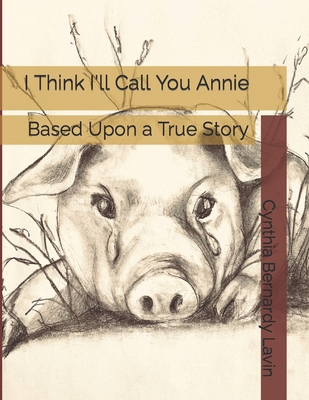
On Saturday, October 7, Twin Cities resident Elizabeth “Beth” Johanneck, author of If You Can’t Make it to Heaven, at Least Get to Seaforth—The Monica Stories and Then Some, and Granite Falls resident Cynthia “Cindy” Bernardy Lavin, author of the children’s book I Think I’ll Call You Annie: Based Upon a True Story (which Beth illustrated), return to Seaforth, population 77, for a 1-4 pm event sure to draw lots of interest.

The C4th Bar hosts the afternoon activities, which include a meet-and-greet (1-3 pm) with the authors and Monica Pistulka Fischer, prominently featured in Beth’s collection of short stories and art from the Seaforth and Wabasso areas. Books will be available for purchase.

Event promo courtesy of Elizabeth Johanneck.

But there’s much more planned than a book signing and time to chat with the long-time friends. The event also includes a hayride and self-guided tour of St. Mary’s Cemetery just northwest of Seaforth. Attendees can visit the gravesites of locals included in both books.

Image sourced online.

Back at the bar, Cindy, a retired elementary school teacher, will read her book about Seaforth’s most famous pig and offer a pig art project for kids.

The original painting of “Seaforth Main Street,” featured here on the cover of Beth’s book, will be on display at Saturday’s celebration. (Minnesota Prairie Roots copyrighted file photo 2023)

Art is an important part of this celebration as art is an integral part of Beth’s book. Her book includes the only printed collection of selected paintings by her grandfather, Arnold Kramer, dubbed “Minnesota’s Grandpa Moses.” He documented early to mid 1900s rural life and scenes, creating an historical agrarian treasure of some 400 paintings upon his retirement from farming. His original painting, “Seaforth Main Street,” which graces the cover of Beth’s book, will be displayed at Saturday’s celebration.

The C4th Bar is also honoring Kramer and several other Seaforth residents (and one pig) with special drinks: “The Grandpa Moses” for folk artist Arnold Kramer; “The Angie” for business owner Angie Bergen; “The Monica” for Monica Pistulka Fischer; and “The Annie” for Dana and Connie Dittbenner and Annie the Pig. “The Monica” and “The Annie” are non-alcoholic drinks. Hot chocolate and make your own s’mores will also be available.

No event is complete without music. The celebration features the live music of Cowboy Dave Gewerth.

It will be quite an afternoon in Seaforth. I can almost envision the scene of a packed bar, of Beth and Cindy mingling, of glasses raised, of stories shared, of memories made. That’s the thing about small towns, especially—you may leave, but you remain forever connected to the place, the events, the people. Like Beth and Cindy, long-time friends who on Saturday return to their roots to celebrate publication of their books, but, more importantly, Seaforth and its residents.

#

FYI: To purchase If You Can’t Make it to Heaven, at Least Get to Seaforth—The Monica Stories and Then Some, click here. (Also available through Barnes & Noble and independent bookstores, including Chapter Two Bookstore in Redwood Falls.) To read my review of the book, click here.

To purchase I Think I’ll Call You Annie, click here. Also available at independent bookstores and Barnes & Noble.

Disclaimer: I edited and proofed the manuscript for Beth’s book. My poem, “Her Treasure,” is printed in the book as a companion piece. Beth, Cindy and I attended Wabasso High School together, graduating with the class of 1974. Beth and I were also lockermates.

© Copyright 2023 Audrey Kletscher Helbling


The power of hair among Native Peoples September 19, 2023

“My Powerful Hair,” published in 2023 by Abrams Books for Young Readers. (Book cover source: Abrams Books)

SOME OF THE MOST MEANINGFUL, enlightening and powerful books I’ve read, I’ve found in the children’s picture book section of my local public library. That includes My Powerful Hair written by Carole Lindstrom and illustrated by Steph Littlebird.

I happened upon this book while searching for recently-published astronaut and geography books for my 4-year-old grandson. I never did find those sought-after titles. Not that it mattered. What I discovered instead were three must-read books: My Powerful Hair, Boycott Blues—How Rosa Parks Inspired a Nation and We Are Better Together.

Parks is certainly familiar to me as the Black seamstress who in 1955 refused to give up her seat to a white man on a city bus in Montgomery, Alabama. That sparked a bus boycott and the Civil Rights Movement. Likewise, working together to effect change, to improve our world, to help one another is a familiar theme.

“The Native Man, His Eagle & His Chanupa,” an oil painting by Dana Hanson and part of her 2018 “Healing the Land” exhibit at the Owatonna Arts Center. (Minnesota Prairie Roots copyrighted file photo 2018, used for illustration only. Art copyrighted by Dana Hanson.)

THE IMPORTANCE OF HAIR REVEALED

It is the story on hair, though, which proved a particularly teachable read. My Powerful Hair focuses on Native Peoples’ hair and its importance in their culture, their history, their lives. Through the writing of New York Times bestselling and award-winning author Lindstrom, who is Anishinaabe/Metis (and an enrolled citizen of the Turtle Mountain Band of Ojibwe), and Indigenous artist Littlebird of Oregon’s Confederated Tribes of Grand Ronde, I learned the symbolism and power of hair in Native American culture. Admittedly, this is something I should have known, having grown up on the southwestern Minnesota prairie between the Upper Sioux and Lower Sioux Indian Reservations (today termed “communities”). I thought I was informed. But I wasn’t, not about hair.

Told from the perspective of a young Native girl, My Powerful Hair explains the reasons Native Peoples grow their hair long. And keep it long. Hair holds stories, memories, strength, sorrow, connections to each other and to Mother Earth. And more. Page after page, the narrator shares events in her life that weave into her hair. When Nimishoomis (her grandfather) taught her to fish, her hair reached her ears. When her cousins taught her to make moccasins, her hair flowed past her shoulders. In the sharing of these moments, I began to understand the power of hair in Native American culture.

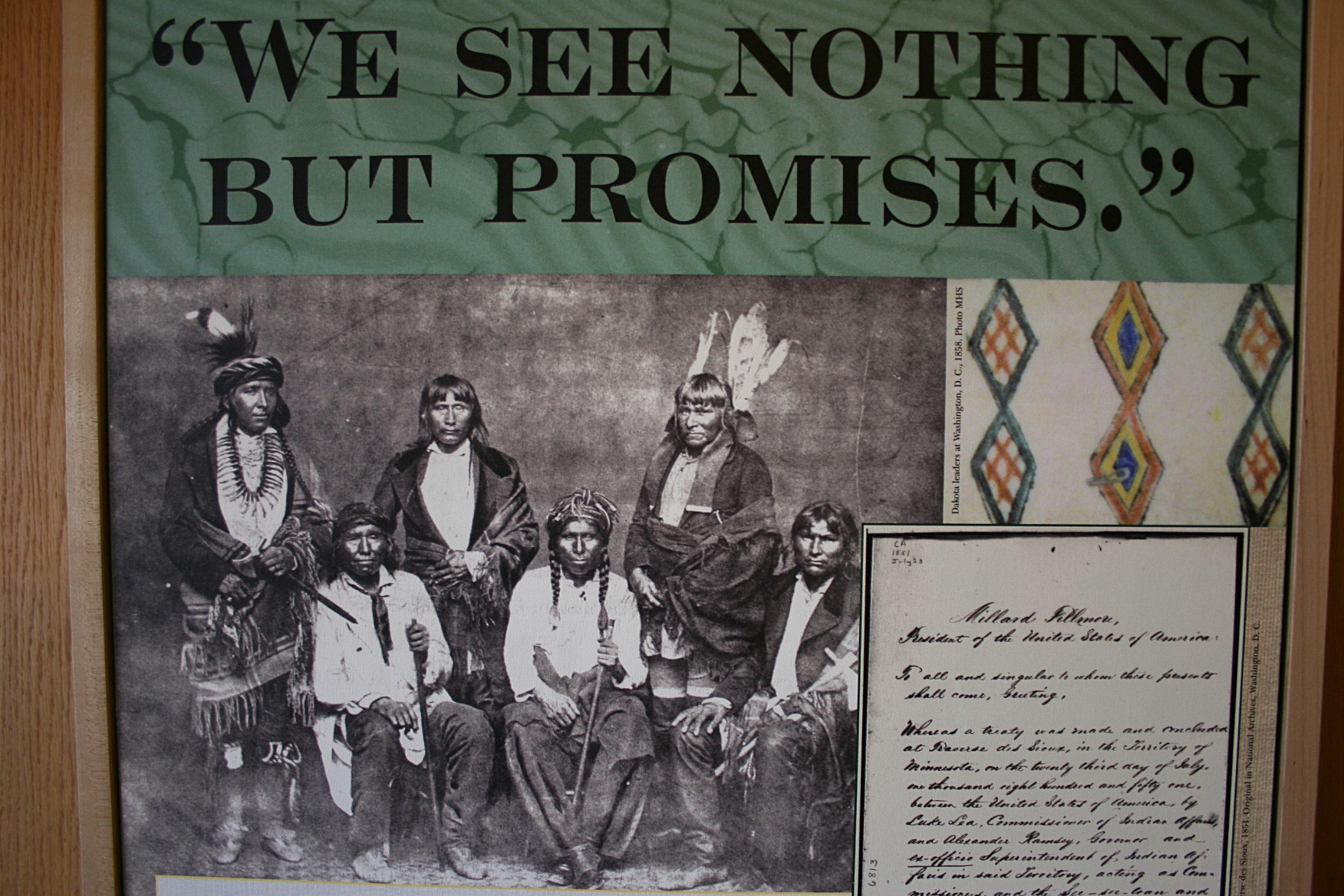
A photo panel at the Traverse des Sioux Treaty Center in St. Peter shows Dakota leaders photographed in Washington D.C. in 1858. The photo is from the Minnesota Historical Society and is used here for illustration only.

FORCED HAIRCUTS

I also understood fully, for the first time, the trauma inflicted upon Indigenous individuals forced long ago by white people to cut their hair. The writer and illustrator don’t hold back. In the first few pages, a young Nokomis (grandmother) is in tears as the hands of a Catholic nun grasp, then cut, her braids. It’s an emotionally impactful visual.

But this was reality at Indian boarding schools, within faith communities and elsewhere back in the day, in a time period when efforts focused on erasing Indigenous culture, on conforming Native Peoples to European ways. It was wrong.

Displayed at Bridge Square during Northfield’s Earth Day celebration in 2022. (Minnesota Prairie Roots copyrighted file photo April 2022, used for illustration only)

A TERRIBLE INJUSTICE”

A blogger friend from the central Minnesota lakes region recently shared a bit of her family’s experience per my request. Of unverified (records were often destroyed) Cherokee ancestry, Rose speaks of her mother’s trauma after being sent to a Catholic girls’ school in Crookston. “Mom didn’t tell us much about her experience there,” Rose says, “only that they made her cut her long black hair. My mom never cut her hair again for the rest of her life. She saw the forced haircut as a terrible injustice.” Injustice seems a fitting word.

In an author’s note, Carole Lindstrom shares the same trauma, documented, she writes, in a photo of her grandmother and two great aunts with their black hair shorn above their ears. They were forced into an Indian boarding school in the early 1900s.

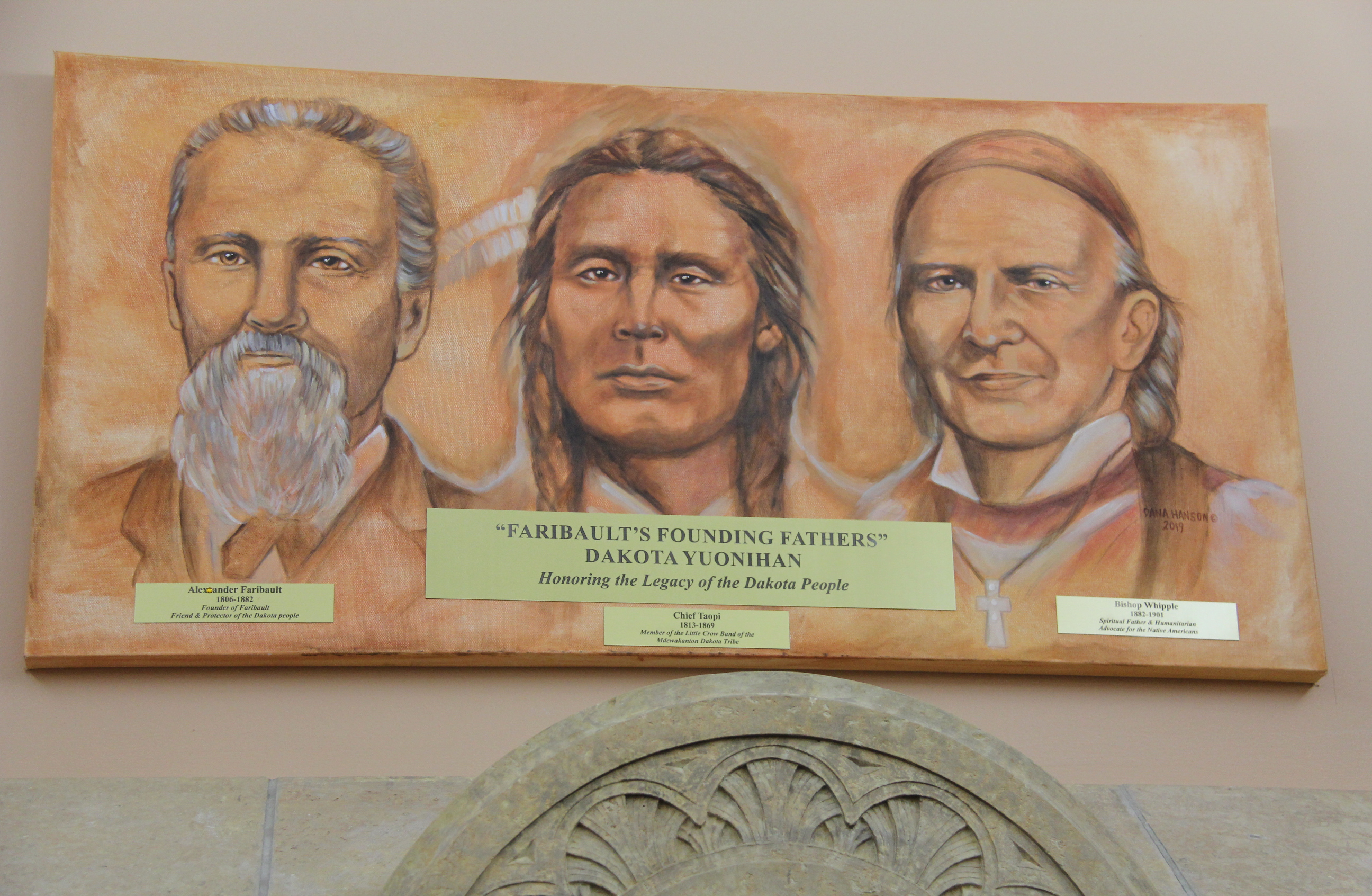
“Honoring the Legacy of the Dakota People” focuses this artwork by Dana Hanson. Chief Taopi centers the painting with Alexander Faribault to the left and Bishop Henry Whipple on the right. The word “Yuonihan” means honor or respect. This art hangs inside Buckham Memorial Library. (Minnesota Prairie Roots copyrighted file photo November 2022. Art copyrighted by Dana Hanson.)

POWER IN STORIES, IN HERITAGE, IN RESPECT

Rose is thankful for books like My Powerful Hair. “I am glad that stories like this are being told,” she says. “Much First Nations history nearly disappeared. And many First Nations keep their ceremonies and other information ‘secret’ so it won’t be distorted or misused by people who don’t understand, or who seek to harm them.” Based on history, that seems warranted.

This Minnesota woman has one more reason to feel grateful for children’s picture books by Indigenous Peoples. Her grandchildren are of Ojibwe heritage; their other grandmother lives on the White Earth Nation in northwestern Minnesota. “My hopes for my grandchildren are that they learn all they can about their Ojibwe ancestors and customs and values,” Rose says. “I hope they can choose what lessons they want to carry forward in their own life. I hope they are fantastic examples of how people from different backgrounds can get along and respect and love one another.”

And so I learned, not only from Rose, but from reading My Powerful Hair. Stories woven into our hair matter. For they are powerful.

© Copyright 2023 Audrey Kletscher Helbling


Book review: A collection of short stories & art from the Minnesota prairie by Elizabeth Johanneck July 27, 2023

The cover of Elizabeth Johanneck’s new book features the art of her grandfather, Arnold Kramer. (Minnesota Prairie Roots photo July 2023)

DECADES REMOVED from southwestern Minnesota, Twin Cities writer Elizabeth Johanneck and I remain rooted to the prairie—the land and people and smalls towns which shaped us. We both grew up on Redwood County farms, were Wabasso High School classmates and today hold a deep respect and fondness for the place we once called home.

Beth, as she’s known to me, recently published a book, If You Can’t Make it to Heaven, at Least Get to Seaforth—The Monica Stories and Then Some. This book features short stories and snippet observations in Beth’s humorous storytelling style, plus paintings and photos. These could be my stories, my memories, just with different characters and settings. Any prairie farm kid likely will feel the same.

ABOUT SEAFORTH & MONICA

But where is Seaforth? And who is Monica? Seaforth, population 77, is a farming community located along County Road 7, south of Minnesota State Highway 19 in central Redwood County. It’s near my hometown of Vesta, seven miles to the northwest. Monica Fischer is Beth’s friend, former co-worker and a character. A baby shoe in a pot of egg coffee and pantyhose found clinging inside a pant leg during Catholic Mass are among the many entertaining Monica stories that left me laughing aloud. By the time I’d finished reading this section of the book, I felt like I knew Monica well. Everyone should have a friend like her.

GROWING UP ON THE MINNESOTA PRAIRIE IN THE 1960s

And everyone should be so fortunate to have experienced rural Minnesota life in the 1960s, as Beth and I did. It is Part 2, “Random Nonsense of a MN Country Mouse,” that I find most similar to my childhood. Both farmers’ daughters with many siblings, Beth and I share the commonalities of being raised on the land among aunts and uncles and cousins and grandparents and immediate family who loved us deeply.

As in “The Monica Stories,” Beth writes about her personal experiences in a casual conversational style. It’s as if she and I are chatting over cups of coffee, and Beth does like her coffee. I connect with her stories about “the grove,” jars of pocket gopher feet in the freezer, grab bags, bloodsuckers, The Weekly Reader, hearing corn grow and more.

Her humor-infused short stories stretch into adulthood, into becoming a parent and grandparent. These are not earth-shattering remembrances, but rather observations about everyday life and events that could be mine, could be yours, but are definitively Beth’s.

NIBBLES OF COUNTRY INSIGHTS

In a section titled “Country Mouse Nibbles,” Beth shares her thoughts on topics in a sentence or two, the first being “When You Are Raised Close to the Land.” I fully understand—the smell after autumn harvest, looking to the west for approaching storms, filled fruit jars crowding root cellar shelves… And “Holding onto Memories”—Distant cheers from a local ball game are souvenirs worth saving for winter. Truly poetic words.

FEATURING THE ART OF “MINNESOTA’S GRANDPA MOSES”

There is much to be cherished in this book beyond pages and pages of rural memories and insights. Beth also intersperses photos, most from Seaforth. But it is Part 3, “Paintings by Arnold Kramer, Minnesota’s ‘Grandpa Moses,’” which is an historic agrarian art treasure. Following his retirement, Seaforth farmer Arnold Kramer took up painting, visually documenting early to mid-1900s rural life and scenes. He became well-known for his folk art style paintings done in primary colors. Beth’s book holds the only printed collection of paintings by her grandfather. The self-taught artist created more than 400 works of art and was dubbed “Minnesota’s Grandpa Moses” by the University of Minnesota at the peak of his creativity in the 1960s.

Book signing promo courtesy of Elizabeth Johanneck.

BOOK SIGNING SATURDAY IN SEAFORTH

Like her grandfather before her, Beth is also a visual artist. She illustrated a just-published children’s picture book by her lifelong friend, Cindy Bernardy Lavin, our WHS classmate. Both writers, along with Monica Pistulka Fisher, are doing a book signing from noon to 3 pm this Saturday, July 29, at the C4th Bar during Seaforth’s Hometown Days celebration.

Beth’s book is also available for purchase at Chapter Two Bookstore in Redwood Falls and online at Amazon and Barnes & Noble. Both her book and Cindy’s achieved bestseller status on Amazon following their release.

Julie Kramer, author of bestseller Stalking Susan, praises Beth’s book in her back cover endorsement, calling it “a delightful collection from a farm girl who grew up near the Minnesota home of Laura Ingalls Wilder.” I agree. Fully.

#

Disclaimer: I edited Beth’s book and advised her on the manuscript. She also included my poem, “Her Treasure,” as a companion piece in the “Country Mouse Nibbles” section. For many years, Beth hosted a blog, Minnesota Country Mouse.

© Copyright 2023 Audrey Kletscher Helbling


Fiction focus on teens’ mental health with Van Gogh thrown in the mix June 21, 2023

I NEARLY WALKED OUT of church once during a sermon. The pastor called Vincent Van Gogh “crazy.” Yes, the artist suffered from mental illness. But labeling him as “crazy” did not sit well with me. I find the term derogatory and disrespectful of anyone battling a mental health issue.

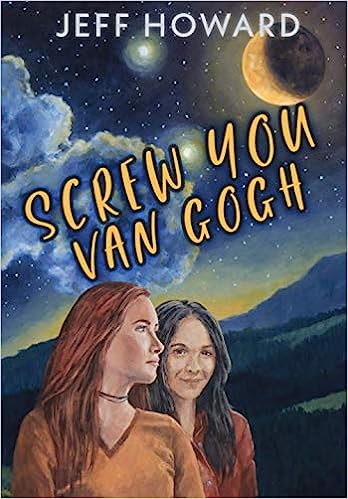
So when I picked up a newly-released book, Screw You Van Gogh, by Minnesotan Jeff Howard, I wondered how the Dutch painter would fit into the story line. Turns out the reference to the artist, who battled anxiety and depression, was held in asylums for the insane and eventually committed suicide, proved a good focal point for a story about high school students.

This fictional book, based on real life experiences, is not a feel good story about teenagers. But rather, this story is heavy, heavy with the issues teens face. Depression. Anxiety. Bullying. Relationship struggles. Trauma from abuse. Pressure to do well. And more.

WRITING WITH AUTHENTICITY

The author, a high school counselor for the past 15 years, writes with authenticity. A main character in the book, Michael Burns, is a counselor at Roosevelt High School. Therein comes the Van Gogh reference. Burns has a jigsaw puzzle of the artist’s painting, “Starry Night,” in his office for kids to work on with him. One of those students is Cassidy Towers, 16, new to Masonville, Iowa, and dealing with panic attacks, suicidal thoughts and more.

As the plot unfolds, so does a certain familiarity. This could be a high school anywhere so real are the characters. The popular kids. The quiet ones who follow the rules. The kids who, on the outside, appear not to give a damn about what they say or do, but who are hurting inside, hiding their truth. Like Tommi, who befriends Cassidy. She is in counseling for severe anxiety and depression, a fact she hides from her classmates. “Tommi could not bear the thought of people knowing she was crazy,” Howard writes.

There’s that word, “crazy,” again. But this time it fits because this is the thinking of a high school student with thoughts of suicide that sometimes “crept into her mind like an evil spirit.” As Tommi and Cassidy’s friendship grows, so does Cassidy’s awareness of Tommi’s struggles. She observes the vacant look in her friend’s eyes, her unkempt appearance, her repetitive petting of a kitten, all signs of Tommi’s declining mental health. By this time, Cassidy has worked through her own mental health issues via talking with the high school counselor, an improved relationship with her mother and using tools (like music) to help her cope.

HELP, HOPE & STIGMA

The author, given his professional work as a counselor, includes helpful ways to deal with anxiety, depression and more. Like Cassidy’s use of music. He emphasizes listening, empathy, deep breathing, hope…

He also addresses the ongoing stigma attached to mental illness. In a conversation with Cassidy, fictional counselor Burns talks about Van Gogh and how he grew anxious and depressed after art experts criticized his impressionist style of painting. Van Gogh turned to alcohol. Burns tells Cassidy that people, especially teens, “don’t want to admit they need help because that makes them weird.” And, because of that sometimes people “crash,” he says. That happens in this book, in a tragic way.

HUNTING & HOTDISH

Within all the heaviness of Screw You Van Gogh are the subplots of counselor Burns’ personal life and relationships and then a budding relationship between Cassidy and classmate Patrick, who once called her “a little crazy” and “goofy upstairs.” When the teens eventually go on a first date, it’s not to a movie, but pheasant hunting. That proved a lighthearted moment for me in the reading of this book. Oh, how rural Iowa/Minnesota, I thought. And then when the author threw in Minnesota’s signature tater tot hotdish served in the school cafeteria, I laughed aloud.

This book is authentic through and through and should be read by every teen, every parent, every educator, every counselor… And perhaps every counselor should purchase the jigsaw puzzle “Starry Night” as a tool to get kids to open up about their emotions, experiences, struggles, as Van Gogh did via his painting.

© Copyright 2023 Audrey Kletscher Helbling


“So much snow,” yup, that’s winter in Minnesota May 23, 2023

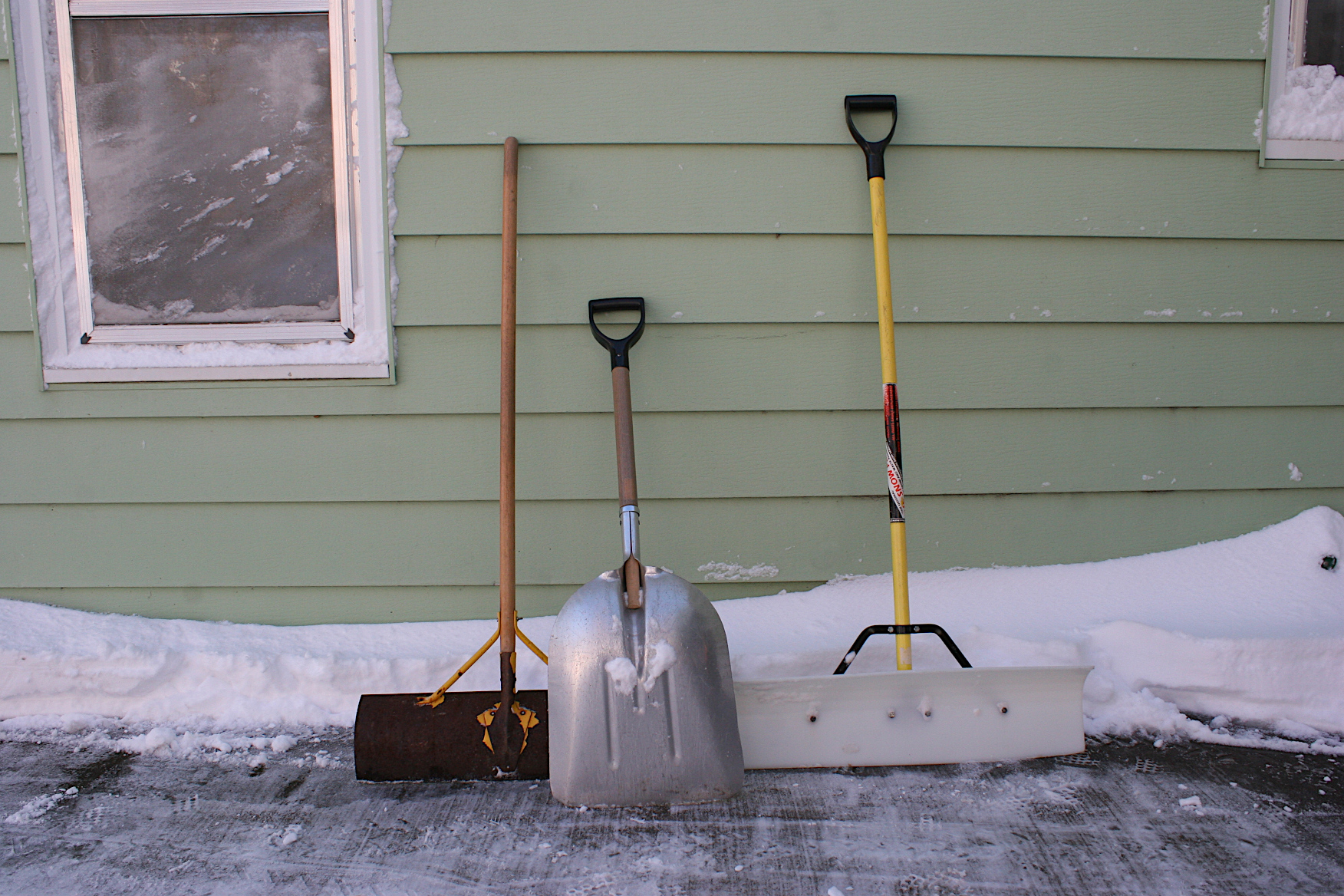
Our three snow removal shovels. (Minnesota Prairie Roots copyrighted file photo December 2021)

DISCLAIMER: If you don’t want to read the words snow or winter, then stop reading. This is a post about both. But also about spring. And a book.

Three prompts led me to write on this seasonal topic. First, when I was scanning my mom’s journals recently, I came across a May 11, 1966, entry in which she wrote, “Snow on the ground.” This didn’t surprise me. Occasionally snow falls in southern Minnesota in May. While I don’t recall the 1966 snow Mom references, I do remember driving back from my native prairie once on Memorial Day weekend to see snow atop a car in New Ulm. That would be at the end of May.

Secondly, a few weeks ago, Randy asked whether he should put the snow shovels away. I encouraged him to wait. And he did, until he felt confident the possibility of snow had passed. It has. I hope.

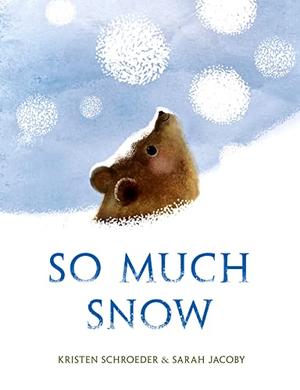
Finally, a new children’s picture book, So Much Snow by Minnesotan Kristen Schroeder, prompted this post. The book recently won the 2023 Minnesota Book Award in children’s literature. It’s as if Schroeder had the winter of 2022-2023 in mind when she penned this story. This past winter proved among our snowiest ever in Minnesota. The winter we thought would never end.

With minimal words per page, Schroeder writes the story of a week-long snowfall. Day after day after day the snow piles high around a menagerie of animals. Rabbit, fox, bear, moose… Illustrator Sarah Jacoby’s art has a dreamy, soft quality, just like the falling snow. That both artist (from Pittsburgh) and author understand winter is clear in their work.

Eventually, the sun shines, the snow melts, the grass greens. And spring, so it seems, has arrived. But then, a last page surprise. You can probably guess what that may be. It happens here in Minnesota seemingly every year. Just when we think winter has ended…

FYI: To read a short interview with Kristen Schroeder, click here.

© Copyright 2023 Audrey Kletscher Helbling
 

Connecting with my new neighbors via “Amazing Africa: A to Z” May 15, 2023

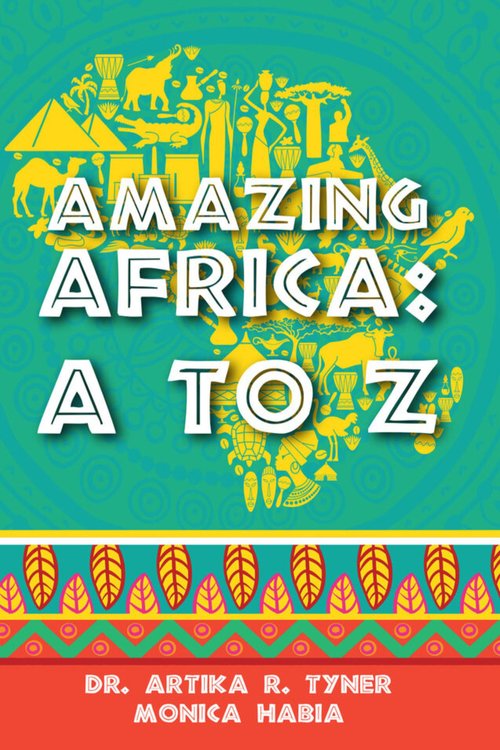
(Book cover credit: Artika Tyner’s website)

BUSY PATTERNS. Bold hues. Strong images and words. All define Amazing Africa: A to Z, a children’s picture book co-authored by Minnesotan Dr. Artika Tyner and Ghanaian Monica Habia and illustrated by Reyhana Ismail of the UK.

Somalians are very much a part of the Faribault community, photographed here at a Downtown Car Cruise Night. (Minnesota Prairie Roots copyrighted file photo)

For a community like mine, with a sizable Somali population, this book proves a natural draw. I always appreciate learning more about my new Faribault neighbors from the east African country of Somalia. The more we know about each other, the more comfortable and connected we feel. Disconnect and conflict often arise from lack of knowledge, fear of the unknown and differences. Differences in dress, food, language, culture, faith.

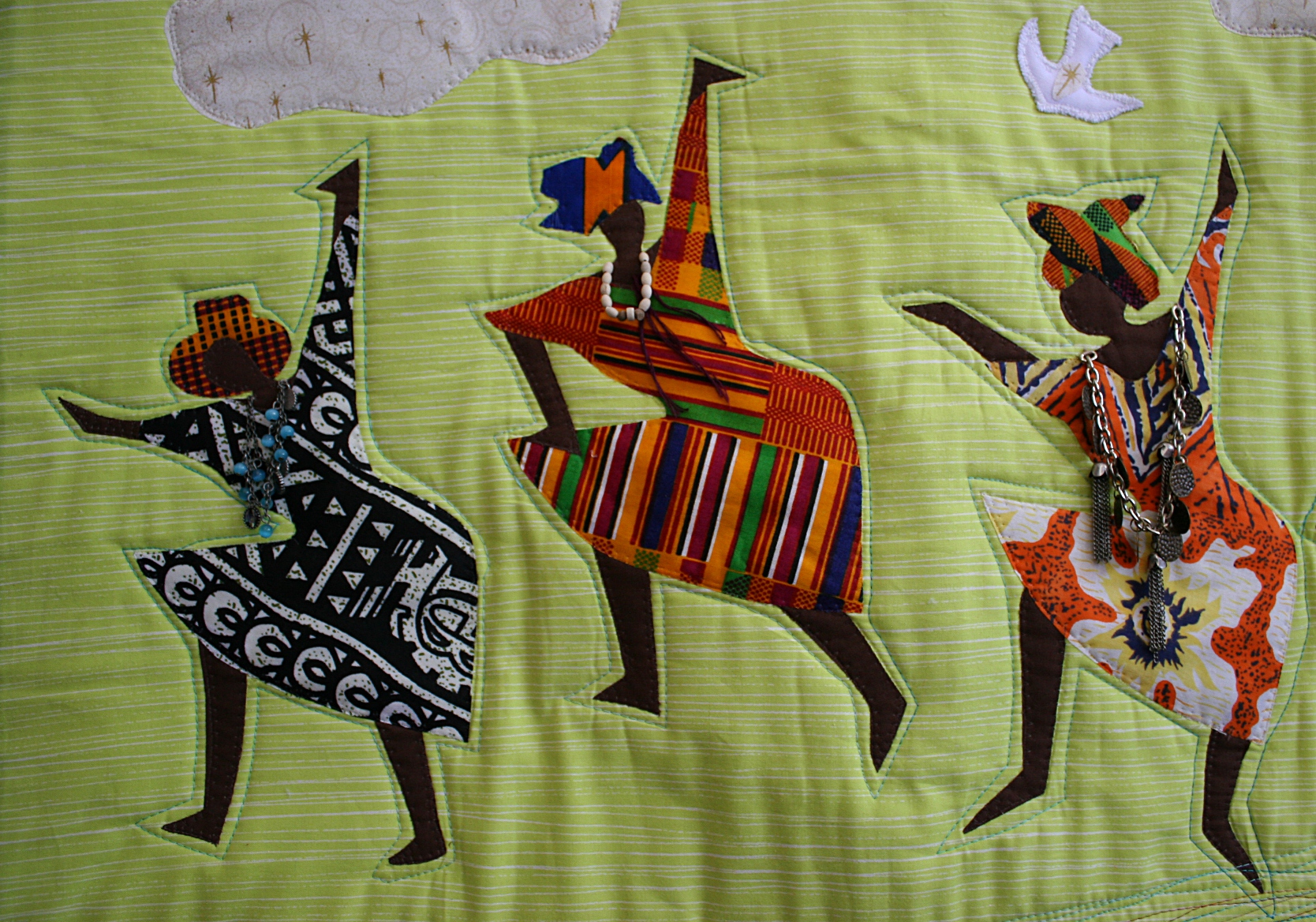
Nigerian-themed quilt art by my friend Susan Griebel. The fabric is from the collection of her mother-in-law, Margaret Griebel. Margaret’s husband was a Lutheran missionary in Nigeria, where the family lived. (Minnesota Prairie Roots copyrighted file photo)

This book bridges differences via facts and art that carries a signature African style of intense patterns and colors. With every new bit of information, with every turn of the page, I feel more and more connected to this continent of 54 countries. For example, the word hospitality, chosen to represent the letter “H” in this alphabet book, strikes me as exactly what I hope for in Faribault. Africans believe no one is an island; rather everyone is part of the community, the text reads in part. Two clasped hands visually reinforce that belief.

Lul Abdi shows off beautiful wood crafts from Kenya and Somalia at a past International Festival Faribault (Minnesota Prairie Roots copyrighted file photo)

Events like the Faribault Diversity Coalition’s summer International Festival Faribault and now occasional public talks by immigrants and others are ways we join hands and grow community. I’ve seen the art of my neighbors from Africa. I’ve heard the music, tasted the sambusa, admired colorful clothing… Faribault’s newest residents add a depth and richness to my southern Minnesota city.

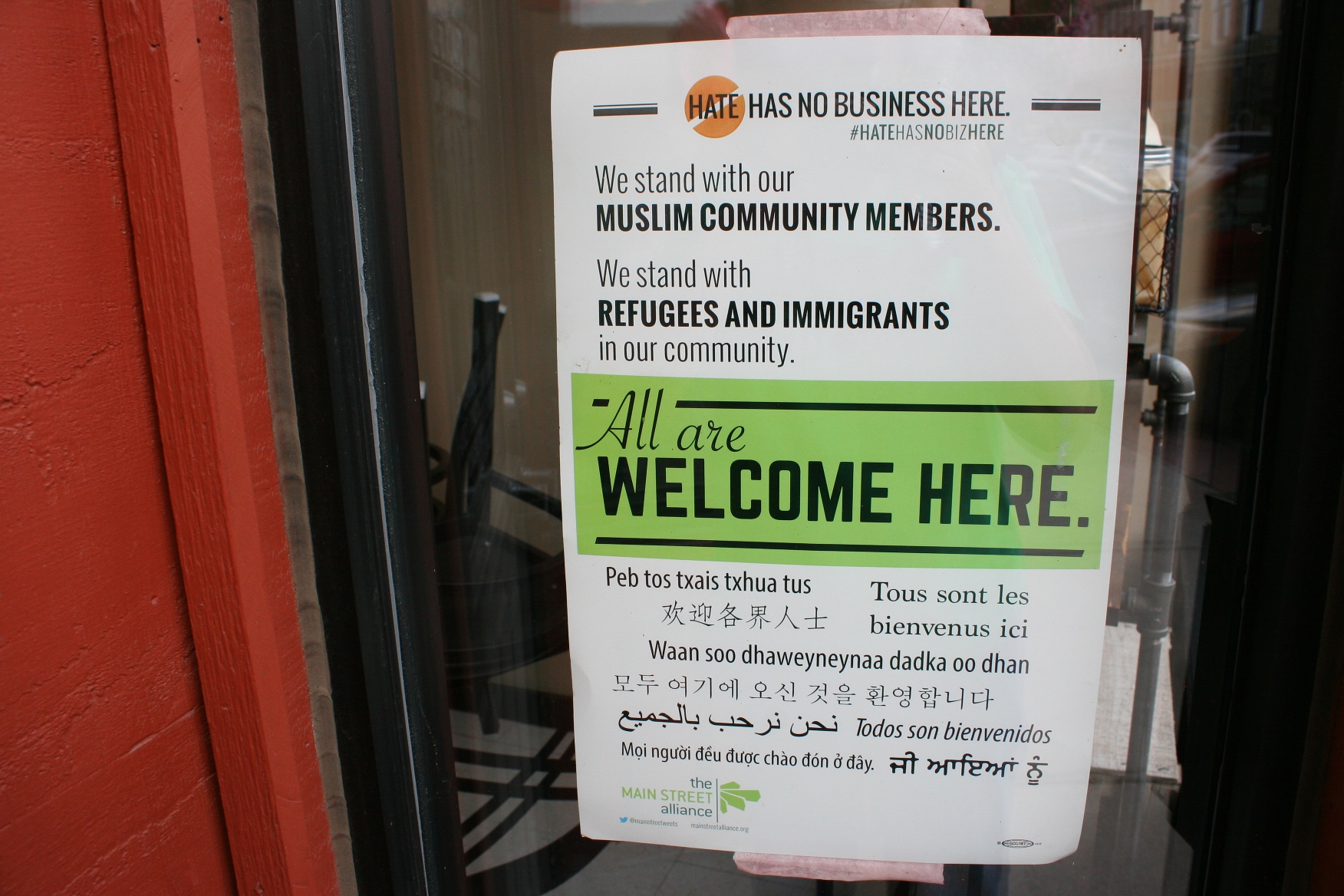
A sign posted in a downtown Faribault business storefront window several years ago. (Minnesota Prairie Roots copyrighted file photo)

Consider African proverbs, chosen in Amazing Africa: A to Z to represent the letter “P.” These wise sayings span cultures. The authors include this powerful Swahili proverb, among several, at the end of the book: “Unity is strength, division is weakness.” If only we all read and take those words to heart. I firmly believe that we, as individuals and as community, need to be here for one another. We truly are stronger when not divided.

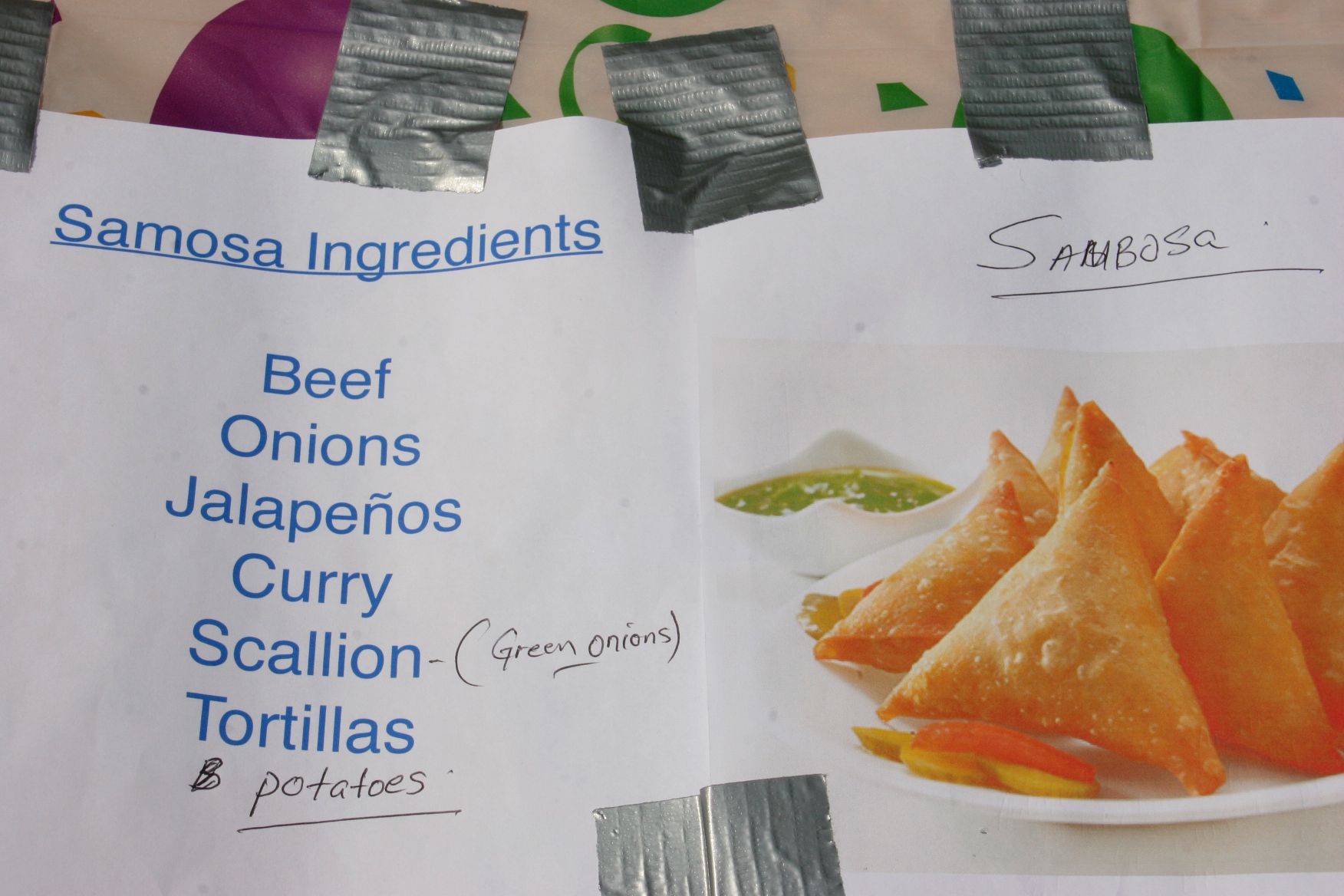
A sign lists Somali food sold at a past International Festival Faribault. (Minnesota Prairie Roots copyrighted file photo)

As I read of 1,000 languages spoken throughout Africa, I think of the Somalians now living in my community. Many have overcome war, poverty and other unimaginable challenges to settle in Minnesota. And now they must also overcome language barriers and resentment. If only we would all pause for a moment and remember that, for most of us Minnesotans, English was not the native tongue of our immigrant forefathers. Mine spoke German. Others spoke Norwegian, French, Dutch…

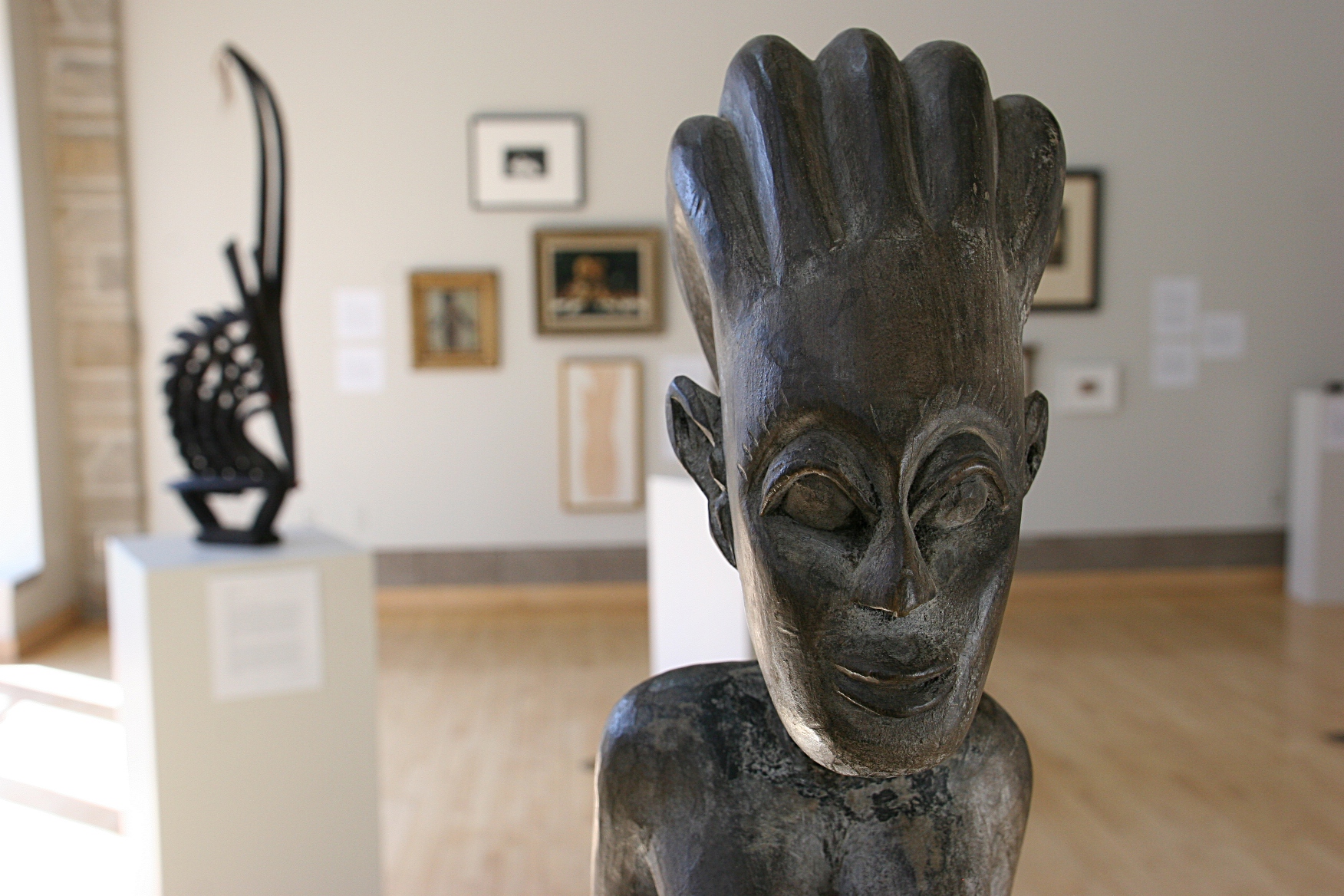
A wood sculpture from Africa, artist unknown, and titled “Seated Maternity Figure.” Exhibited at St. Olaf College, Northfield, in 2015. (Minnesota Prairie Roots copyrighted file photo April 2015)

I certainly can’t pronounce all of the words published in this book about Africa. Words like Uhuru, Yamoussoukro, Ugali and more. But I can appreciate the beauty of language, the way these words speak the rhythm of the continent of Africa.

Bisa Butler inspired art created by fourth grader Ilwad and exhibited at a Student Art Show in Faribault. Butler is an award-winning African American textile artist. (Minnesota Prairie Roots copyrighted file photo March 2023)

Africa is the story of slavery, of dancing, of the world’s largest waterfall, of greatness, of so much richness and depth. You’ll find that, see that, read that in Amazing Africa: A to Z.

FYI: Dr. Artika Tyner, co-author of this book (and many others) and also a motivational speaker, educator and attorney, will speak on her journey towards justice from 6-7 pm Tuesday, May 16, at Buckham Memorial Library, Faribault. She is part of the Southeastern Libraries Cooperating 2023 Minnesota Author Tour. In her work, she focuses on racial and economic justice and social change. Tyner founded the nonprofit, Planting People Growing Justice Leadership Institute.

I previously reviewed Tyner’s children’s book, Justice Makes a Difference—The Story of Miss Freedom Fighter, Esquire. To read that book review, click here.

© Copyright 2023 Audrey Kletscher Helbling


With gratitude on May Day May 1, 2023

A gift to me, with a note written in clearly disguised handwriting. (Minnesota Prairie Roots copyrighted photo May 2023)

THIS MORNING A PACKAGE landed on my front steps. Unexpected. A sweet surprise on this first day of May, a day typically reserved for May baskets left by someone who rings the doorbell, then runs away. I’ve previously received such May Day drops of treats and lovely wishes. But today, oh, today, I got a book dropped by the United States Postal Service.

Fed Up! A Feast of Frazzled Foods by Rex Barron was exactly what I needed. This ABC children’s picture book, which is really for any age, made me laugh. Laugh because it fits how I feel right now. Fed up. Not with anyone, but rather with my recent diagnosis of vestibular neuronitis. The nerve which controls balance in my right ear has been inflamed, leaving me with multi-layered issues. Basically, because of a roadblock in the interconnected pathways in my brain, I need to retrain my brain to navigate along different paths. I’m doing that via vestibular rehab therapy.

Someone among my blog readers latched onto that and found Fed Up!, a vivid and humorous book so fitting of how I feel and what I am attempting to accomplish—retraining of my brain. I have no idea who sent this to me. But thank you!

I also want to take a moment to thank all of my readers. When I started blogging in July 2009, I did so because I am passionate about writing and photography. I’d just ended a blogging gig with a Minnesota magazine, no longer in circulation, and wanted to continue blogging. So I launched Minnesota Prairie Roots. But blogging grew into much more than an outlet for my creativity. It grew into a community. A community that I’ve found incredibly kind, caring, compassionate and more. Friendships have formed. I’ve always felt encouraged, supported and appreciated, whether I’m writing about a day trip discovery, a new book or personal challenges. Likewise, I appreciate that readers share their stories so that I can reciprocate. We are, after all, all part of this family of humanity that ought to care about one another.

Fed Up!, the ABC book gifted to me today is just one of many examples of the kindnesses extended to me through my years of blogging. That an anonymous reader took the time to find this fitting book and then pen an appropriate note touched me deeply and reaffirms my belief that much good still exists in this chaotic world.

How could I not laugh at “Cabbage Crying over Coleslaw” or “Impatient Ice Cream” (with a graphic of a melting ice cream cone) or “Radishes Relax by a Radio”? I laughed in the humor of it all—images and word. But, even more than that, I feel gratitude on this May Day to this anonymous friend and to my wider community of caring readers. Thank you!

© Copyright 2023 Audrey Kletscher Helbling


Book review: Things you gotta see & do in Minnesota showcased in new travel guidebook April 17, 2023

(Image source: Julie Jo Larson’s website)

WHETHER YOU’RE A LIFE-LONG Minnesotan, a newbie or a visitor, Julie Jo Larson’s newly-published 100 Things to Do in Minnesota Before You Die guidebook is an invaluable resource for exploring this place I call home. I’ve lived here my entire life, but only experienced or visited one-quarter of the listings in Larson’s travel guide.

Babe the Blue Ox of Paul Bunyan legend stands along Nisswa’s Main Street. In her book, Larson encourages readers to seek out the many Minnesota-centric statues found throughout our state. (Minnesota Prairie Roots copyrighted file photo 2017)

Minnesota is an expansive state, spanning 400 miles from north to south and 350 miles from east to west. So there’s lots to see and do from prairie to woodland, from lakes to rivers, from bluffs to valleys, from small towns to bigger cities. Larson offers a good mix of destinations and activities.

Domeier’s German Store, nestled in a residential neighborhood for decades, is a must-see German import shop in New Ulm. (Minnesota Prairie Roots copyrighted file photo)

I should note that I feel a kinship with Larson in a commonality of roots. She was born in New Ulm, in Brown County next to my home county of Redwood in southwestern Minnesota. New Ulm, situated in the Minnesota River Valley and rich in German heritage and culture, has long been a favorite community of mine. There’s so much to see and do from touring and sampling beer at August Schell Brewing Company; shopping at compact German import store, Domeier’s; exploring Flandrau State Park along the Cottonwood River; watching the Glockenspiel; and lots more. Larson now lives in rural Brainerd and has already written a guide on the Minnesota Northwoods. Her love for Minnesota shines.

Craft beer flights are served on old movie reels at Sleepy Eye Brewing, housed in a former movie theater. While not included in Larson’s book, I recommend a stop at this unique southwestern Minnesota brewery. (Minnesota Prairie Roots copyrighted file photo)

In creating this travel book, Larson divides her suggested “things to do” into five categories: Food and Drink, Music and Entertainment, Sports and Recreation, Culture and History, and Shopping and Fashion.

The bluegrass band, Monroe Crossing, performs every July 4 in North Morristown. (Minnesota Prairie Roots copyrighted file photo)

I so now want to try the chicken wild rice pizza at Poor Guy’s Pizza in Moose Lake. That—the wild rice part—sounds incredibly Minnesotan. I want to tour the Minnesota Music Hall of Fame in New Ulm to learn more about musicians and bands like Monroe Crossing, which performs each July Fourth in North Morristown. I want to wander among the 50 metal sculptures crafted by Ken Nyberg in Vining simply because I love outdoor public art. I want to tour the Mille Lacs Indian Museum and Trading Post in Onamia to learn more about that region’s Indigenous peoples. I want to peruse the handcrafted goods at The Shoppes of Little Falls. I want to…

I climbed up to the tower, but not up the Paul M. Thiede Fire Tower. I’d suggest combining a stop here with Pequot Lakes’ annual Bean Hole Days in July. (Minnesota Prairie Roots copyrighted file photo 2021)

Yes, there’s a lot to do in Minnesota. Some things on Larson’s list, though, I won’t do. I won’t travel into the depths of the earth at the Soudan iron ore mine. I won’t climb to the top of a fire tower at Pequot Lakes, although I’ve hiked to it. I won’t zip through the trees 175 feet off the ground on a Kerfoot Canopy Tour in the Minnesota River Valley at Henderson. But other readers of Larson’s guidebook will and that’s good. Her “100 things to do” offers a variety of experiences and places that appeal to diverse interests.

At Minneopa State Park, Mankato, visitors can get up close with a bison herd on a drive-through across the prairie. (Minnesota Prairie Roots copyrighted file photo August 2019)

As a life-long southern Minnesotan who has explored this region extensively, I especially appreciate Larson’s tips from other areas of this vast state. She even breaks down her list to activities by seasons and suggested itineraries. Black-and-white photos scattered through the pages and a centerfold of color images only further entice readers to get out and explore.

A walleye statue fronts Lake Mille Lacs in Garrison. The walleye is Minnesota’s state fish. (Minnesota Prairie Roots copyrighted file photo)

Bottom line, 100 Things to Do in Minnesota Before You Die rates as an excellent resource for anyone planning a road trip, looking for something to do/see while in a specific area of Minnesota or even just seeking to learn more about the North Star State.

You’ll find great hamburgers and homemade pies at The Dam Store. (Minnesota Prairie Roots copyrighted file photo 2010)

Looking for a great slice of pie? Larson recommends (and so do I) the Rapidan Dam Store, yes, by the dam at Rapidan (which is near Mankato). Want to enjoy art in a top-notch museum along the Mississippi River? Visit the Minnesota Marine Art Museum in Winona. Interested in a cave tour? Head to Niagra Cave near Harmony. Wanna see a replica Viking ship? The Hjemkost Center in Moorhead features one. Need a book fix? Visit any one of Minnesota’s independent bookstores.

The independent bookstore portion of Victor Lundeen Company in Fergus Falls. (Minnesota Prairie Roots copyrighted file photo)

And while we’re talking books, buy a copy of 100 Things to Do in Minnesota Before You Die, published by Reedy Press. Support a Minnesota author while, bonus, learning about all sorts of places to visit and things to do in this place Larson and I call home.

© Copyright 2023 Audrey Kletscher Helbling


The powerful impact of a Little Free Library April 11, 2023

Filed under: Uncategorized — Audrey Kletscher Helbling @ 5:00 AM
Tags: , , , , , , ,

The beautiful handcrafted LFL donated to my hometown of Vesta in 2012 by Todd Bol. (Minnesota Prairie Roots copyrighted file photo July 2012)

TEN YEARS AGO, Todd Bol, co-founder of the Little Free Library, drove three hours from Hudson, Wisconsin, with his wife, Susan, to deliver and install a LFL in my hometown. That act of kindness fulfilled my life-long dream of a library in Vesta, a small farming community on the southwestern Minnesota prairie. Growing up on a farm a mile from town, I longed for a library. So when Todd offered to make that dream come true, I felt overjoyed.

The team that worked to bring a Little Free Library to Vesta includes Dorothy Marquardt, left, and Karen Lemcke, representing the sponsoring Vesta Commercial Club, LFL co-founder Todd Bol and me (holding a copy of a poetry anthology I donated). (Minnesota Prairie Roots copyrighted file photo July 2012)

On a July afternoon in 2012, the Bols, a local newspaper reporter, two community leaders and I gathered outside the Vesta Cafe for the library planting. Todd and I then shelved the books we brought. From there the project grew with the cafe operators adding shelving inside for more books, and magazines. A librarian from nearby Wabasso contributed eight bags of books. And I brought more whenever I visited my mom. Community members embraced the LFL. Today the library has expanded into the City Hall/Community Center with a library based there. That’s inside the former Vesta Elementary School where all those years ago I learned to love books from teachers who read The Little House and other chapter books aloud each day after lunch. That compensated for the lack of an in-school library.

The books Todd Bol and I placed inside Vesta’s LFL. (Minnesota Prairie Roots copyrighted file photo July 2012)

At the time of his donation to Vesta, Todd called this the first in his Small Towns Minnesota LFL Movement. He aimed to get LFLs into rural communities without libraries. He died in 2018 from pancreatic cancer. But his mission continues today through the LFL’s Impact Library Program designed to reach underserved urban, suburban, rural and indigenous communities without, or with limited access to, books.

A Tardis LFL in a front yard in Waseca. (Minnesota Prairie Roots copyrighted file photo October 2018)

Thus far, the St. Paul-based nonprofit has donated more than 1,500 LFLs filled with books via the Impact Library Program. That includes 14 in Minnesota. One went to the small town of Goodridge in northwestern Minnesota near the Canadian border. The closest library is 20 miles away. I can relate to that geographical distance given I also lived 20 miles from a library as a child.

But even in big cities, there’s a need for LFLs. During National Reading Month in March, one was placed inside the governor’s office at the Minnesota State Capitol in celebration of books and accessibility to books.

Buckham Memorial Library in Faribault. (Minnesota Prairie Roots copyrighted file photo December 2022)

Today I live several blocks from the public library in Faribault, a city of nearly 25,000 about 120 miles from my hometown. I’ve spotted many LFLs in Faribault neighborhoods. And I’ve also seen many others in Minnesota and beyond, most placed and maintained by individuals or organizations. I have easy access to books.

A LFL in an east-side Faribault neighborhood. (Minnesota Prairie Roots copyrighted file photo)

Yet, even with a public library nearby, a library may not be accessible to all. For example, in Le Center, a small town about 30 miles west of Faribault, a LFL was still needed, according to Christine. She applied for a free LFL and got one. In her application to the Impact Library Program, Christine noted the many low income families (including migrants) who live in this rural community and who have limited access to books. Now they have one more book source in a LFL. Also in southern Minnesota, the cities of Austin and Winona (both with public libraries), have LFLs as part of the Impact Library Program.

A LFL in downtown Decorah, Iowa. (Minnesota Prairie Roots copyrighted file photo)

When I think back to the July day Todd Bol arrived in my hometown 10 years ago with a LFL and books donated by participating publishers, I feel such gratitude. He told me at the time how much he loved books. And he showed that by bringing a little library to a town without a library. From there, the library in Vesta became so much more than little. It became big. Bigger than I ever dreamed.

Photographed in a front yard in Somerville, MA., in 2016. (Minnesota Prairie Roots copyrighted file photo May 2016)

Books opened, still open, the world for me. They took, still take, me on adventures to places I will never visit, experiences I will never experience. Books grew, still grow, my love of words. And that love of words evolved into a love of writing. That’s powerful.

A LFL in downtown Plainview, a small southeastern Minnesota town. (Minnesota Prairie Roots copyrighted file photo June 2022)

FYI: If you’re in need of a LFL in your community or neighborhood, apply to the Impact Library Program. There are requirements such as maintaining and stocking the LFL, hosting a community event and more.

TELL ME: Are you the sponsor of a LFL or do you have one near you? I’d like to hear your stories.

© Copyright 2022 Audrey Kletscher Helbling