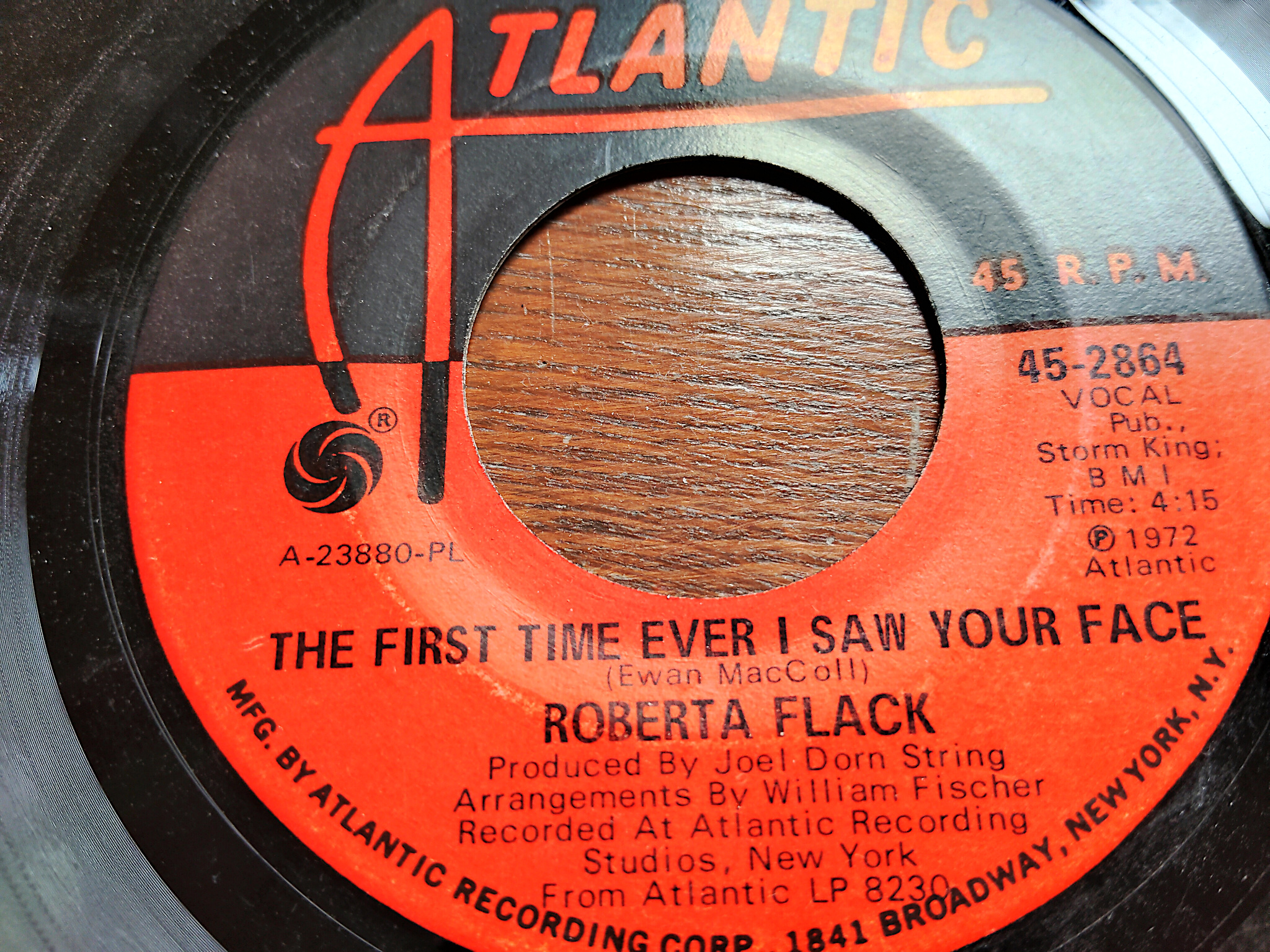
My vintage single of Roberta Flack’s hit song, “The First Time Ever I Saw Your Face.” (Minnesota Prairie Roots copyrighted photo February 2025)
WHEN ROBERTA FLACK SANG, her words flowed effortlessly. Soothing. Her voice like poetry singing words of love.
Flack died today (Monday) at age 88, news which pulled me back to the early 1970s and her Grammy award-winning singles, “The First Time Ever I Saw Your Face” (1973) and “Killing Me Softly With His Song” (1974). I love those two hits of new love and of love exposed.
I filed through my vintage 45 rpm vinyls until I found Flack’s, then dropped the record onto the turntable to once again immerse myself in feelings of young love. I was in high school when Flack’s singles released and then became Billboard hits.
The songs are universal in theme, undeniably beautiful in delivery. At least that’s my perspective as a Baby Boomer who can’t read a single musical note, can’t carry a tune and knows she likes a song when she likes it.
The timing of Flack’s death during February, Black History Month, seems worth noting, too. She accomplished much as a Black woman. At the age of 15, Flack received a full scholarship to Howard University, a historically Black private college in Washington DC. She earned a bachelor’s in music in 1958, going on to teach music while also pursuing a singing career. Clearly, she accomplished her goals.
(Book cover sourced online)
In researching her background, I learned of a 2023 children’s picture book autobiography, The Green Piano: How Little Me Found Music, written by Flack and by Tonya Bolden with illustrations by Hayden Goodman. The title references a piano Flack’s father found in a junkyard, then refurbished and painted a grassy green. Flack was nine years old when she got that first piano. That it came from a junkyard reminds me of the bicycles my maternal grandfather pulled from the junkyard, repaired, painted and gifted to me and my siblings. I was just as thrilled to have my own bike as Flack was to have her own piano.
Flack’s backstory of growing up in a family that valued music and recognized her talent is a love story, too. If only every child would be loved so deeply and encouraged to follow his/her dreams, what a beautiful world this could be.
TELL ME: Whose music do you appreciate and why? And if you remember Roberta Flack, I’d like to hear your thoughts on her and her work.
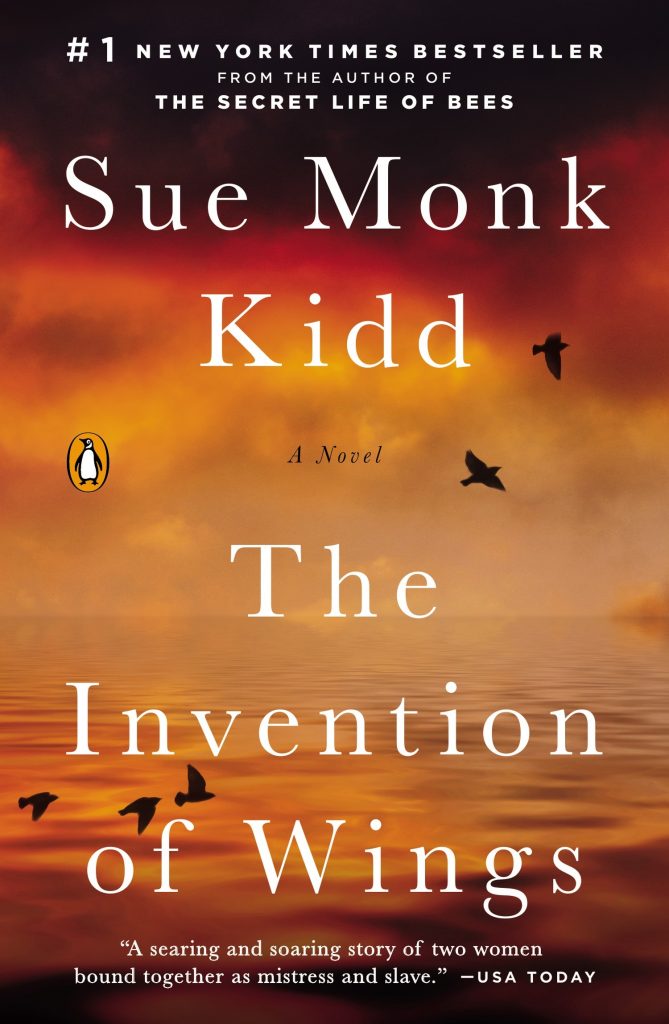
I recently finished this book about slavery, freedom and abolition. A must-read. (Book cover sourced online)
DURING THIS, BLACK HISTORY MONTH, I’ve intentionally read books about slavery, Black people and the Black experience. It’s important to me that I widen my knowledge and understanding. Many of the stories are heartbreaking, almost unbelievable in the mental and physical cruelty inflicted upon Blacks. This is hard stuff to read. But it is in the hard stuff that we begin to fully comprehend the importance of empathy, kindness, compassion and the need to stand strong against that which is hateful, hurtful and oppressive.
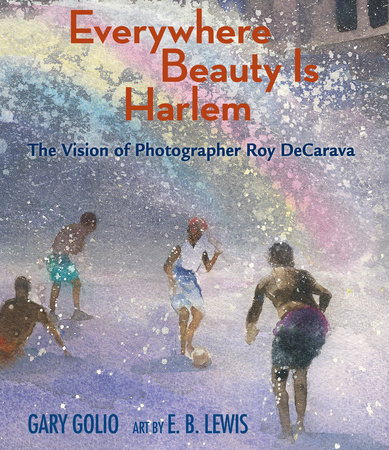
This book resonates with me personally and professionally in telling the story of 1940s world famous photographer Roy DeCarava, unknown to me until I read this book. Trained in the arts and in photography, he would go on to photograph everyday life in his native Harlem via work for the Works Progress Administration Project, fellowships and more. He worked as a photographer for major publications, has/had his photos featured in exhibits and art museums, became an art professor… And he was Black.
But what I love most about this story is that DeCarava aimed to photograph everyday life, everyday scenes, everyday people in the streets of Harlem. He shows life in raw reality. He worked back in the days of film, admittedly much more challenging than shooting with a digital camera. I started with film, too. You often get only one chance to take a photo. No firing off shots. No digital manipulation. Just a single, unedited print.
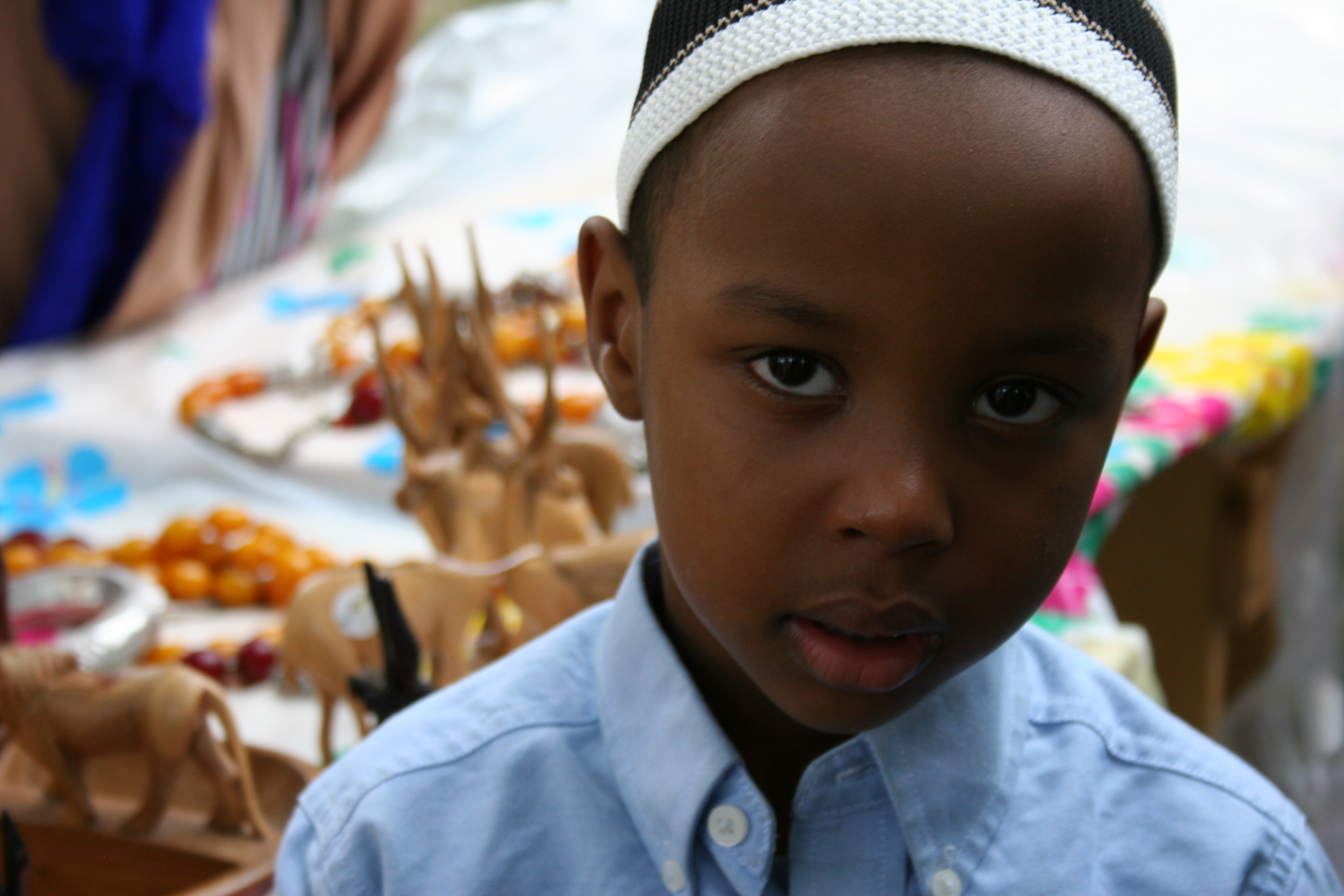
I took this portrait, one of my favorites, nearly 11 year ago at International Festival Faribault. (Minnesota Prairie Roots copyrighted file photo 2014)
I will never match the talent of DeCarava. But I do share his focus. I also aim to photograph the ordinary, the everyday, right where I live (or mostly in southern Minnesota). Like him, I notice details. The light. The moments. The expressions. The people, scenes, settings and events that define a place. The anything that might make for an interesting photo.
Unlike DeCarava, my roots are rural. I’ve only ever been to New York City once, while in college. I was awed by the skyscrapers, the street vendors, Chinatown and men hurrying along Wall Street in leisure suits. (This was in 1977.) But I have no desire to return to a place that feels too closed in, too busy, too chaotic.
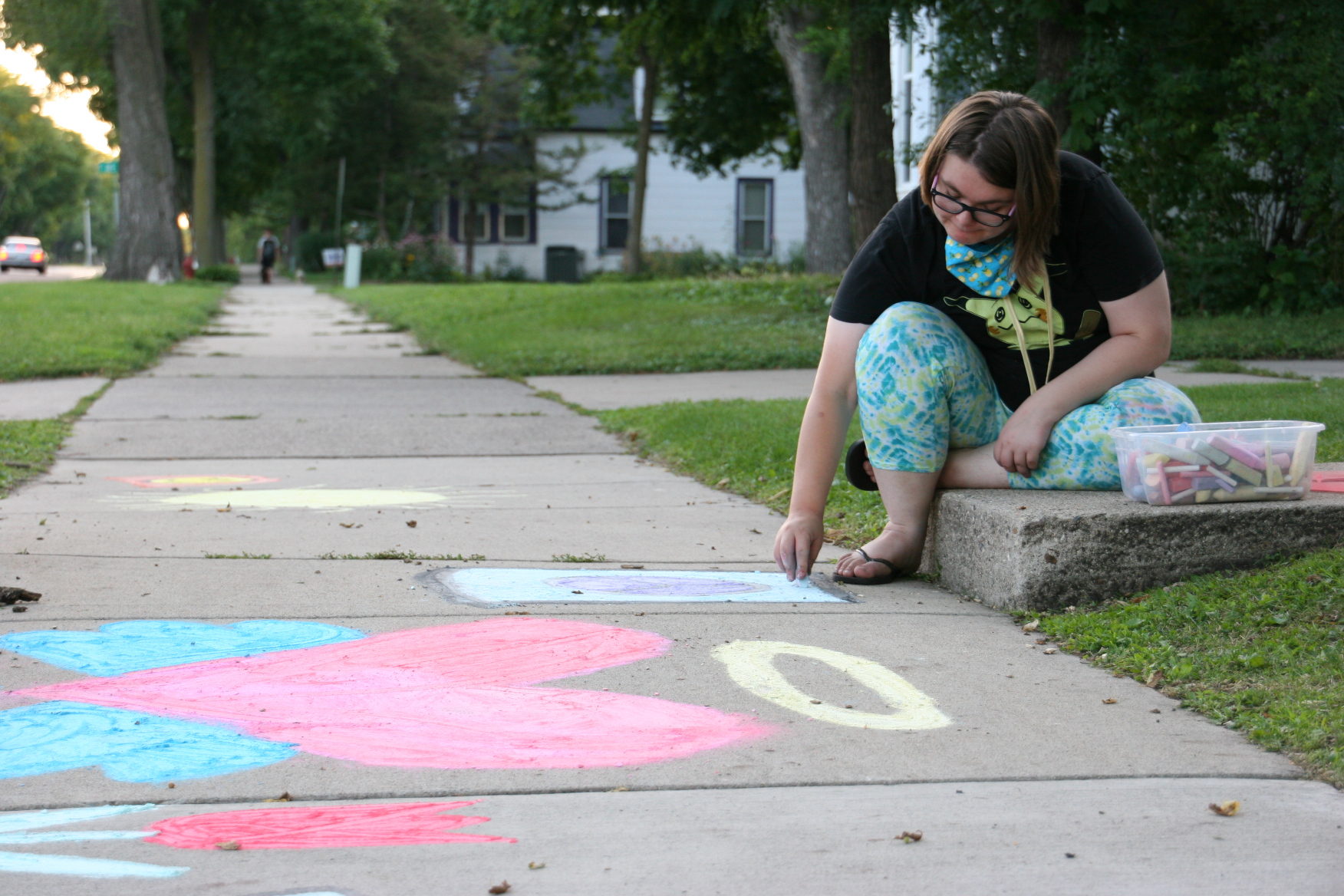
My photo of Jane chalking art on a Faribault sidewalk. (Minnesota Prairie Roots copyrighted file photo August 2020)
Yet, Harlem in Upper Manhattan was DeCarava’s home, where he found the subjects of his photos. Everywhere Beauty Is Harlem gives a snapshot of the images this photographer snapped. A man on the subway. A boy drawing on the sidewalk with chalk. Black and brown children dancing in water spraying from a fire hydrant.
Beyond the visuals, the story in this children’s picture book encompasses the essence of DeCarava’s photographic focus on the everyday and the ordinary. I really ought to buy a copy of this book for my personal library. If you want to understand my photographic work, then read this multi award-winning children’s picture book. But, more importantly, read this book to learn about a world famous Black photographer whose talent for visual storytelling is a gift to all of us. To see the world through his eyes presents life as it is. Real. Raw. Unedited.
#
FYI: I encourage you to also check out the photography of New York City photographer Keith Goldstein, whose work I follow on his blog, “For Earth Below.” His street photography has opened my eyes to humanity in a way that I never see here in southern Minnesota. His talent is remarkable. Goldstein, I think, works much like Roy DeCarava did, with his camera focused on the everyday, the ordinary. And therein both have found the extraordinary.
The restored Security State Bank Building clock in historic downtown Faribault. (Minnesota Prairie Roots copyrighted file photo)
TIME, WHEN YOU’RE YOUNG, seems to pass slowly. You’re waiting, always waiting. To turn another year older. To master a skill. To gain independence. To do whatever seems so important you wonder how you can possibly wait for another day or week or month to pass.
Now I wish time would slow down. But it can’t and it won’t and so I accept the reality of time passing, of aging, of days disappearing too quickly. Of celebrating my 50-year high school class reunion this year. Of my youngest turning thirty. Of me nudging seventy.
A street clock in historic downtown Wabasha. (Minnesota Prairie Roots copyrighted file photo)
In a recent conversation with a beloved aunt, she shared that she can’t believe how old her nieces and nephews are, considering she’s only twenty-nine. I love that about Aunt Dorothy, who has always and forever declared herself on the cusp of thirty while in reality she’s closing in on ninety. I like her thinking.
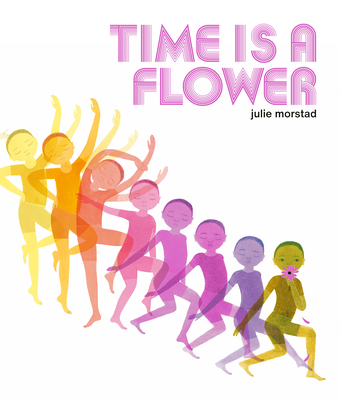
(Book cover sourced online)
By happenstance, I picked up a children’s picture book at my local library a few weeks ago that focuses on time. I’m not trying to go back in time to my childhood. Rather, I enjoy books written for kids. Many hold important messages and beautiful art that resonate with me. I highly-recommend you check out recently-published children’s picture books to see how they’ve evolved over the decades into some timely masterpieces of words and art.
Among the books I selected was Time Is a Flower, written and illustrated by Julie Morstad of Vancouver, British Columbia. In her opening page, Morstad writes of time as a clock, as a calendar, in the traditional ways we consider time.
A prairie sunset in southwestern Minnesota. (Minnesota Prairie Roots copyrighted file photo)
But then the book unfolds, page by page, into time comparisons that are simplistic, everyday, ordinary, unremarkable. Yet remarkable in the way Morstad presents them with sparse words and bold art. If I could rip the pages from her book, I would frame her illustrations of a sunset reflected in sunglasses; a child’s long wavy locks woven with bird, butterfly and flower; and a wiggly tooth in a gaping mouth.
A swallowtail butterfly feeds on a zinnia. (Minnesota Prairie Roots copyrighted file photo)
Time is the moments, the memories. The details. Not necessarily the extraordinary. That is the message I take from Morstad’s book. Appreciate the caterpillar, not just the butterfly. Appreciate the seed, not just the flower. Value the slant of sunlight across the floor, and the shadows, too.
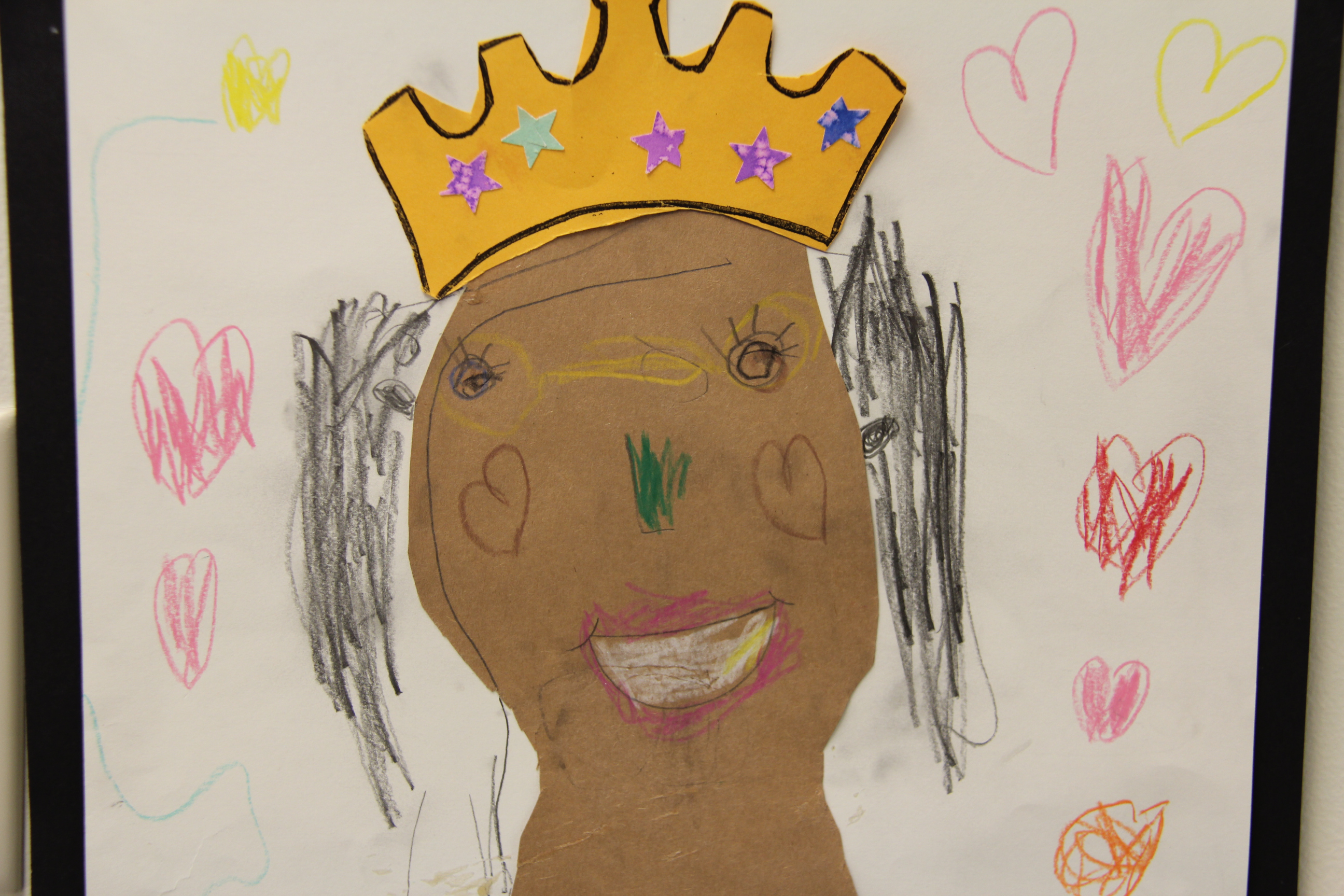
A princess by Roosevelt Elementary School kindergartner Ruweyda, exhibited in March 2023 at the Student Art Show, Paradise Center for the Arts, Faribault. (Minnesota Prairie Roots copyrighted file photo)
As I consider Time Is a Flower, I think of my dear aunt half a country away in New Jersey. Too many years have passed since I’ve seen Aunt Dorothy, so long that I can’t recall the last time we embraced. But I hold memories of her, of our time together. She was the young aunt who arrived from the Twin Cities with discarded jewelry and nail polish for me and my sisters. She was the aunt who called her husband, “My Love,” an endearing name that imprinted upon me her deep love for Uncle Robin (who died in January). She is the aunt who took me into New York City when I was a junior in college visiting her on spring break. She is the aunt who, for my entire life, has called me “My Little Princess.”
A 1950s scene in downtown Faribault honors history and the passage of time in this mural. (Minnesota Prairie Roots copyrighted file photo)
Yes, time passes too quickly. The clock ticks. Days on the calendar advance. Years pass.
Each spring the daffodils bloom. (Minnesota Prairie Roots copyrighted file photo)
But within each day, seconds and minutes and hours remain. Time to live. Time to love. And time to remember that time is like a flower. Sprouting. Growing. Blooming. Dying. Time is a moment, until it’s a memory.
Most people no longer wear wrist watches. I still do. (Minnesota Prairie Roots copyrighted file photo)
NOTE: Remember, this Sunday, March 10, time changes as we shift to daylight savings time in the U.S. We lose an hour of time as we spring forward.
(Minnesota Prairie Roots copyrighted file photo September 2022)
IN THE PAST YEAR, my desire to learn more about Native American culture has heightened. My new interest followed a talk in September 2022 by then Rice County Historical Society Director Susan Garwood about “The Indigenous history of the land that is now Rice County, Minnesota.” This county, this community, in which I live was home first to Indigenous peoples, long before the first settlers, the fur traders, the Easterners who moved west.
This sculpture of Alexander Faribault and a Dakota trading partner stands in Faribault’s Heritage Park near the Straight River and site of Faribault’s trading post. Ivan Whillock created this art which sits atop the Bea Duncan Memorial Fountain. (Minnesota Prairie Roots copyrighted file photo)
I knew that, of course. But what I didn’t know was that the Wahpekute, one of the seven “Council Fires” of the Dakota Nation, used the current-day Wapacuta Park just up the hill from my house for honoring their dead.
This Faribault city park, where my kids once zipped down a towering slide, clamored onto a massive boulder, slid on plastics sleds, was where the Wahpekute many years ago placed their dead upon scaffolding prior to burial. That ground now seems sacred to me.
That it took 40 years of living here to learn this information suggests to me that either I wasn’t paying attention to local history or that my community has not done enough to honor the First Peoples of this land.
(Book cover sourced online.)
Whatever the reason, I have, on my own, decided to become more informed about Indigenous peoples. And for me, that starts with reading. I recently headed to the children’s section of my local library and checked out the book, The Forever Sky, written by Thomas Peacock (a member of the Fond du Lac Band of Lake Superior Anishinaabe Ojibwe) and illustrated by Annette S. Lee (mixed-race Lakota-Sioux of the Ojibwe and Lakota-Sioux communities).
These two Minnesotans, in their collaborative children’s picture book, reveal that “the sky and stars all have stories.” Oh, how I value stories. And the stories shared in this book, these sky stories, are of spirits and animals and the Path of Souls, aka The Milky Way, and…
I especially appreciate the book’s focus on the northern lights, explained as “the spirits of all of our relatives who have passed on.” The descriptive words and vivid images make me view the northern lights, which I have yet to see in my life-time, through the eyes of Indigenous peoples. The changing blues and greens are their loved ones dancing in the night sky. Dancing, dancing, dancing. How lovely that imagery in replacing loss with hope and happiness.
The Forever Sky has created an awareness of Native culture previously unknown to me. Just like that talk a year ago by a local historian aiming to educate. I have much to learn. And I am learning via books found not only in the adult section of the library, but also among the children’s picture books. That writers and illustrators are covering topics of cultural importance in kids’ books gives me hope for the future. My grandchildren, even though they will never see the vast, dark, star-filled sky I saw nightly as a child of the prairie, are growing up much more informed. They will understand cultures well beyond their own heritage. And that encourages me.
Promo for Saturday’s event, courtesy of Elizabeth Johanneck.
THEY ARE LONG-TIME FRIENDS. Friends who grew up together, who have a history of experiences and stories and of being there for one another. And they are both authors of books rooted in rural Redwood County, the land which shaped and grew them and their enduring friendship.
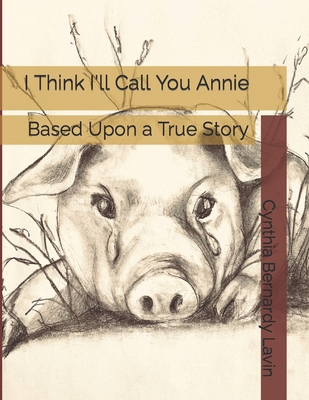
On Saturday, October 7, Twin Cities resident Elizabeth “Beth” Johanneck, author of If You Can’t Make it to Heaven, at Least Get to Seaforth—The Monica Stories and Then Some, and Granite Falls resident Cynthia “Cindy” Bernardy Lavin, author of the children’s book I Think I’ll Call You Annie: Based Upon a True Story (which Beth illustrated), return to Seaforth, population 77, for a 1-4 pm event sure to draw lots of interest.
The C4th Bar hosts the afternoon activities, which include a meet-and-greet (1-3 pm) with the authors and Monica Pistulka Fischer, prominently featured in Beth’s collection of short stories and art from the Seaforth and Wabasso areas. Books will be available for purchase.
Event promo courtesy of Elizabeth Johanneck.
But there’s much more planned than a book signing and time to chat with the long-time friends. The event also includes a hayride and self-guided tour of St. Mary’s Cemetery just northwest of Seaforth. Attendees can visit the gravesites of locals included in both books.
Image sourced online.
Back at the bar, Cindy, a retired elementary school teacher, will read her book about Seaforth’s most famous pig and offer a pig art project for kids.
The original painting of “Seaforth Main Street,” featured here on the cover of Beth’s book, will be on display at Saturday’s celebration. (Minnesota Prairie Roots copyrighted file photo 2023)
Art is an important part of this celebration as art is an integral part of Beth’s book. Her book includes the only printed collection of selected paintings by her grandfather, Arnold Kramer, dubbed “Minnesota’s Grandpa Moses.” He documented early to mid 1900s rural life and scenes, creating an historical agrarian treasure of some 400 paintings upon his retirement from farming. His original painting, “Seaforth Main Street,” which graces the cover of Beth’s book, will be displayed at Saturday’s celebration.
The C4th Bar is also honoring Kramer and several other Seaforth residents (and one pig) with special drinks: “The Grandpa Moses” for folk artist Arnold Kramer; “The Angie” for business owner Angie Bergen; “The Monica” for Monica Pistulka Fischer; and “The Annie” for Dana and Connie Dittbenner and Annie the Pig. “The Monica” and “The Annie” are non-alcoholic drinks. Hot chocolate and make your own s’mores will also be available.
No event is complete without music. The celebration features the live music of Cowboy Dave Gewerth.
It will be quite an afternoon in Seaforth. I can almost envision the scene of a packed bar, of Beth and Cindy mingling, of glasses raised, of stories shared, of memories made. That’s the thing about small towns, especially—you may leave, but you remain forever connected to the place, the events, the people. Like Beth and Cindy, long-time friends who on Saturday return to their roots to celebrate publication of their books, but, more importantly, Seaforth and its residents.
Disclaimer: I edited and proofed the manuscript for Beth’s book. My poem, “Her Treasure,” is printed in the book as a companion piece. Beth, Cindy and I attended Wabasso High School together, graduating with the class of 1974. Beth and I were also lockermates.
I happened upon this book while searching for recently-published astronaut and geography books for my 4-year-old grandson. I never did find those sought-after titles. Not that it mattered. What I discovered instead were three must-read books: My Powerful Hair, Boycott Blues—How Rosa Parks Inspired a NationandWe Are Better Together.
Parks is certainly familiar to me as the Black seamstress who in 1955 refused to give up her seat to a white man on a city bus in Montgomery, Alabama. That sparked a bus boycott and the Civil Rights Movement. Likewise, working together to effect change, to improve our world, to help one another is a familiar theme.
“The Native Man, His Eagle & His Chanupa,” an oil painting by Dana Hanson and part of her 2018 “Healing the Land” exhibit at the Owatonna Arts Center. (Minnesota Prairie Roots copyrighted file photo 2018, used for illustration only. Art copyrighted by Dana Hanson.)
THE IMPORTANCE OF HAIRREVEALED
It is the story on hair, though, which proved a particularly teachable read. My Powerful Hair focuses on Native Peoples’ hair and its importance in their culture, their history, their lives. Through the writing of New York Times bestselling and award-winning author Lindstrom, who is Anishinaabe/Metis (and an enrolled citizen of the Turtle Mountain Band of Ojibwe), and Indigenous artist Littlebird of Oregon’s Confederated Tribes of Grand Ronde, I learned the symbolism and power of hair in Native American culture. Admittedly, this is something I should have known, having grown up on the southwestern Minnesota prairie between the Upper Sioux and Lower Sioux Indian Reservations (today termed “communities”). I thought I was informed. But I wasn’t, not about hair.
Told from the perspective of a young Native girl, My Powerful Hair explains the reasons Native Peoples grow their hair long. And keep it long. Hair holds stories, memories, strength, sorrow, connections to each other and to Mother Earth. And more. Page after page, the narrator shares events in her life that weave into her hair. When Nimishoomis (her grandfather) taught her to fish, her hair reached her ears. When her cousins taught her to make moccasins, her hair flowed past her shoulders. In the sharing of these moments, I began to understand the power of hair in Native American culture.
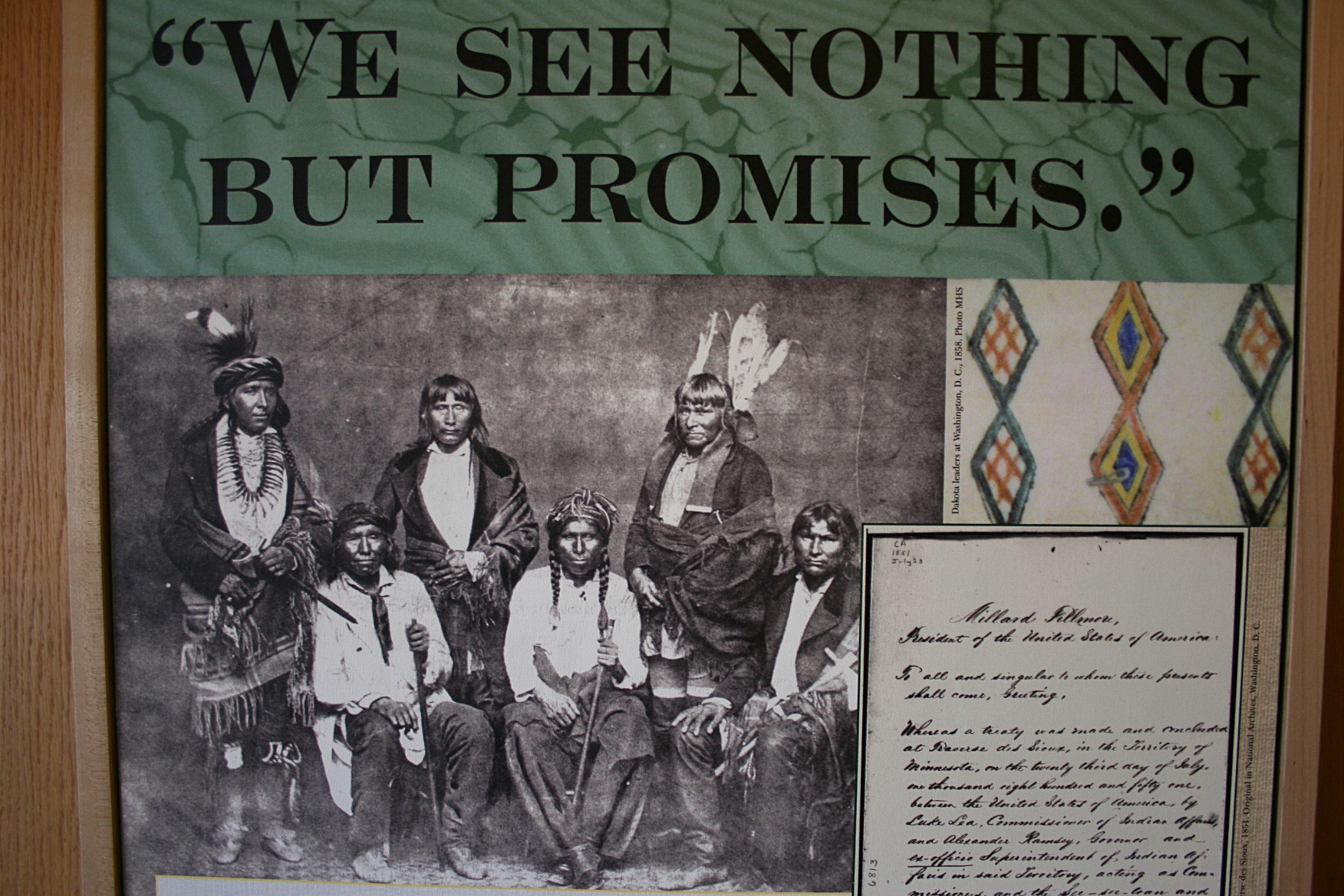
A photo panel at the Traverse des Sioux Treaty Center in St. Peter shows Dakota leaders photographed in Washington D.C. in 1858. The photo is from the Minnesota Historical Society and is used here for illustration only.
FORCED HAIRCUTS
I also understood fully, for the first time, the trauma inflicted upon Indigenous individuals forced long ago by white people to cut their hair. The writer and illustrator don’t hold back. In the first few pages, a young Nokomis (grandmother) is in tears as the hands of a Catholic nun grasp, then cut, her braids. It’s an emotionally impactful visual.
But this was reality at Indian boarding schools, within faith communities and elsewhere back in the day, in a time period when efforts focused on erasing Indigenous culture, on conforming Native Peoples to European ways. It was wrong.
Displayed at Bridge Square during Northfield’s Earth Day celebration in 2022. (Minnesota Prairie Roots copyrighted file photo April 2022, used for illustration only)
“A TERRIBLE INJUSTICE”
A blogger friend from the central Minnesota lakes region recently shared a bit of her family’s experience per my request. Of unverified (records were often destroyed) Cherokee ancestry, Rose speaks of her mother’s trauma after being sent to a Catholic girls’ school in Crookston. “Mom didn’t tell us much about her experience there,” Rose says, “only that they made her cut her long black hair. My mom never cut her hair again for the rest of her life. She saw the forced haircut as a terrible injustice.” Injustice seems a fitting word.
In an author’s note, Carole Lindstrom shares the same trauma, documented, she writes, in a photo of her grandmother and two great aunts with their black hair shorn above their ears. They were forced into an Indian boarding school in the early 1900s.
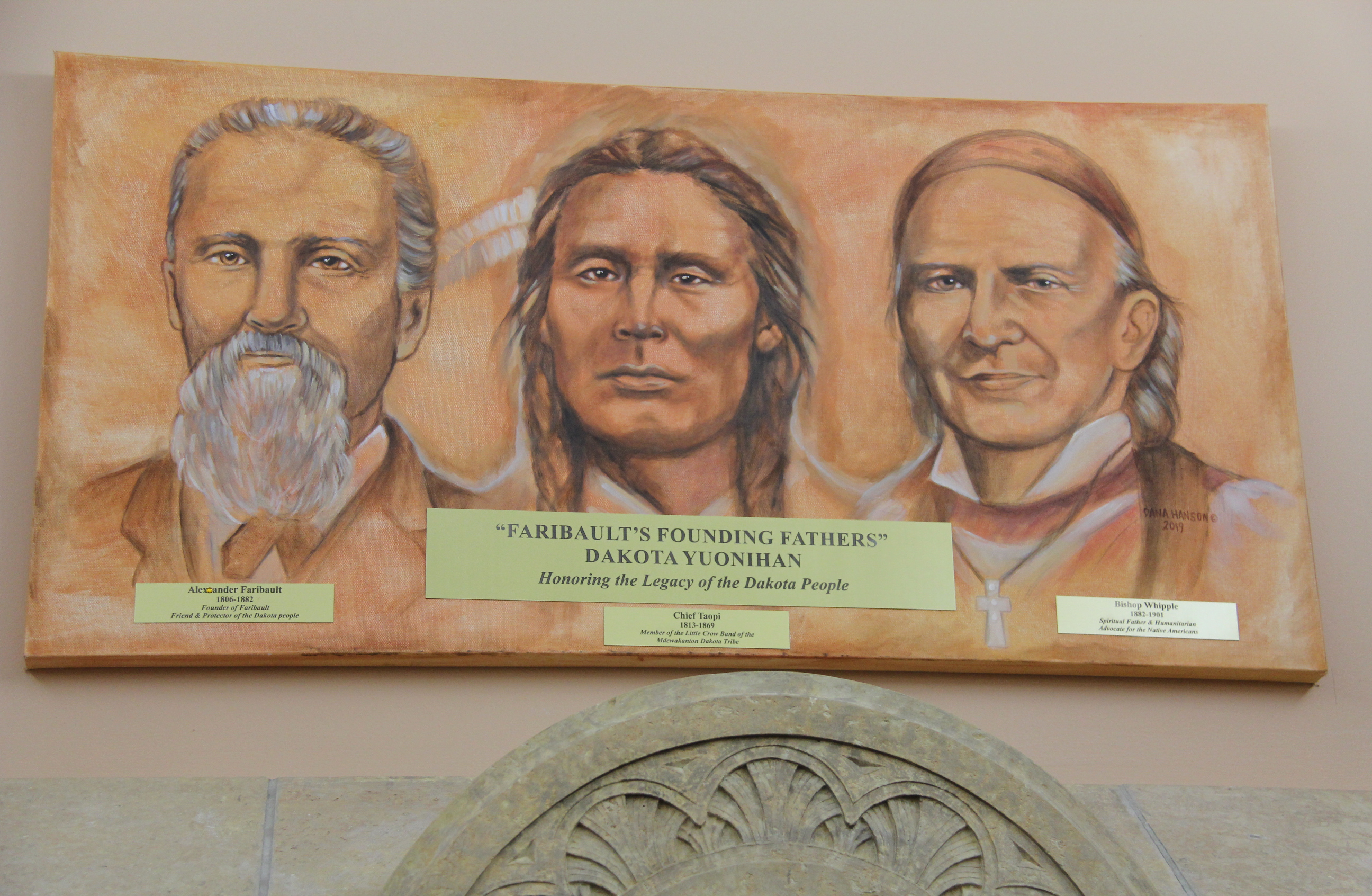
“Honoring the Legacy of the Dakota People” focuses this artwork by Dana Hanson. Chief Taopi centers the painting with Alexander Faribault to the left and Bishop Henry Whipple on the right. The word “Yuonihan” means honor or respect. This art hangs inside Buckham Memorial Library. (Minnesota Prairie Roots copyrighted file photo November 2022. Art copyrighted by Dana Hanson.)
POWER IN STORIES, IN HERITAGE, IN RESPECT
Rose is thankful for books like My Powerful Hair. “I am glad that stories like this are being told,” she says. “Much First Nations history nearly disappeared. And many First Nations keep their ceremonies and other information ‘secret’ so it won’t be distorted or misused by people who don’t understand, or who seek to harm them.” Based on history, that seems warranted.
This Minnesota woman has one more reason to feel grateful for children’s picture books by Indigenous Peoples. Her grandchildren are of Ojibwe heritage; their other grandmother lives on the White Earth Nation in northwestern Minnesota. “My hopes for my grandchildren are that they learn all they can about their Ojibwe ancestors and customs and values,” Rose says. “I hope they can choose what lessons they want to carry forward in their own life. I hope they are fantastic examples of how people from different backgrounds can get along and respect and love one another.”
And so I learned, not only from Rose, but from reading My Powerful Hair. Stories woven into our hair matter. For they are powerful.
Our three snow removal shovels. (Minnesota Prairie Roots copyrighted file photo December 2021)
DISCLAIMER: If you don’t want to read the words snow or winter, then stop reading. This is a post about both. But also about spring. And a book.
Three prompts led me to write on this seasonal topic. First, when I was scanning my mom’s journals recently, I came across a May 11, 1966, entry in which she wrote, “Snow on the ground.” This didn’t surprise me. Occasionally snow falls in southern Minnesota in May. While I don’t recall the 1966 snow Mom references, I do remember driving back from my native prairie once on Memorial Day weekend to see snow atop a car in New Ulm. That would be at the end of May.
Secondly, a few weeks ago, Randy asked whether he should put the snow shovels away. I encouraged him to wait. And he did, until he felt confident the possibility of snow had passed. It has. I hope.
With minimal words per page, Schroeder writes the story of a week-long snowfall. Day after day after day the snow piles high around a menagerie of animals. Rabbit, fox, bear, moose… Illustrator Sarah Jacoby’s art has a dreamy, soft quality, just like the falling snow. That both artist (from Pittsburgh) and author understand winter is clear in their work.
Eventually, the sun shines, the snow melts, the grass greens. And spring, so it seems, has arrived. But then, a last page surprise. You can probably guess what that may be. It happens here in Minnesota seemingly every year. Just when we think winter has ended…
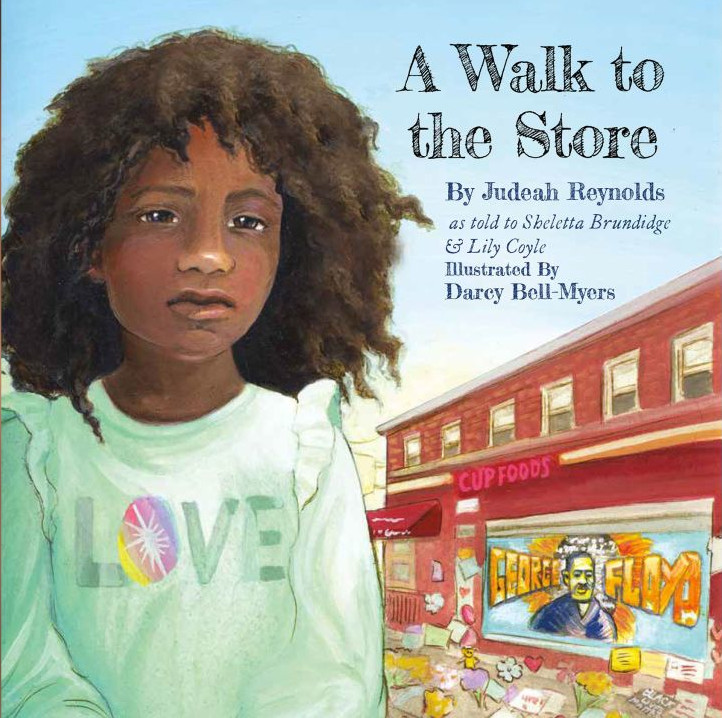
SHE WAS ONLY NINE YEARS OLD, too young to walk alone to the store to buy candy with the $3 clutched in her hand. Eventually, her 17-year-old cousin, Darnella Frazier, agreed to accompany Judeah Reynolds to Cup Foods. That decision on May 25, 2020, would forever change their lives. And the world.
When I learned of the book’s September 2022 release by St. Paul-based Beaver’s Pond Press, I knew immediately that I needed to read this recounting of Judeah’s witness to Floyd’s death. The cousins arrived on an unfolding scene outside Cup Foods where Floyd lay on the ground next to a squad car, a police officer pressing his knee into the 46-year-old’s neck. Judeah, Darnella and other bystanders pleaded with the police to stop while Darnella recorded the scene on her cellphone and then shared that video online. She won a 2021 Pulitzer Prize for that documentation.
While this book recounts the death of George Floyd from a child’s perspective, it is much more than a basic retelling. The story also reveals the trauma Judeah experienced. The sadness. The difficulty sleeping. The bad dreams. The replaying of Floyd’s killing in her mind.
But this is also a story of strength and hope and about being brave enough to speak up. To say something. To let your voice be heard. To effect change.
Messages like this are included in the book. I photographed this two years ago in small town Kenyon, MN. (Minnesota Prairie Roots copyrighted file photo 2020)
I heard Judeah’s determined voice in her words. I saw it, too, in Darcy Bell-Myers’ art, which reinforces the story with strong, message-filled illustrations. This book is empowering for children who read or hear this story. And it’s equally as impactful for adults.
At the end of the book is a list—How to Help Children Process a Traumatic Event. I appreciate the inclusion of those 10 suggestions given Judeah did, indeed, experience trauma. Her family even moved out of Minnesota.
This LOVE mural by Minneapolis artist Jordyn Brennan graces a building in the heart of historic downtown Faribault. The hands are signing LOVE. (Minnesota Prairie Roots copyrighted file photo June 2021)
As I finished reading A Walk to the Store, I considered how ironic that young Judeah wore a colorful shirt emblazoned with the word LOVE as she stood on the sidewalk outside Cup Foods, witness to George Floyd’s murder.
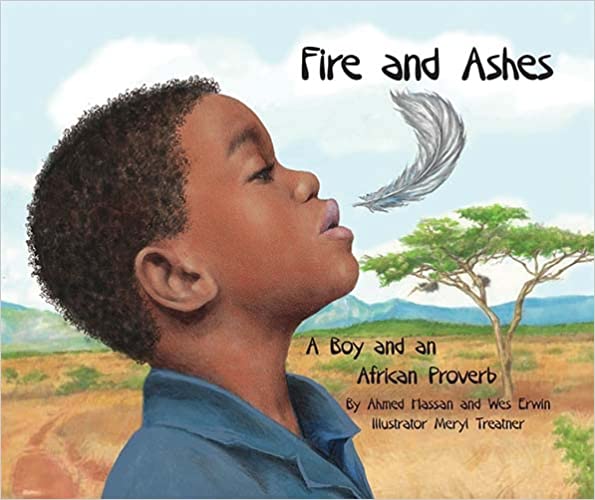
LIVING IN A MINNESOTA community with a sizable Somali population, I was excited to read the recently-published children’s picture book Fire and Ashes—A Boy and an African Proverb co-authored by Minnesotans Ahmed Hassan and Wes Erwin. Why? It’s important for me to learn about my new neighbors, their homeland, their culture, their experiences before resettling in Faribault. Reading books is one way to gain insights.
Fire and Ashes, even though a book geared toward children, is an enlightening read for adults, too. I found myself fully-engaged in the story of young Warfa, a refugee from Somalia who experienced unimaginable trauma. His trauma flares when he works on a school assignment—creating a poster about himself. I can almost feel my tummy hurting, my head spinning, my heart racing right along with Warfa as he relives terrifying moments in Africa. That includes witnessing the violent death of a neighbor. (Because of that, children should read this story with an adult.)
Award-winning children’s book illustrator Meryl Treatner reinforces the story line with art so realistic that I felt like I stepped into Africa and then into Warfa’s American classroom. I could almost smell the flowery scent of the acacia tree, feel the threat in a shadowy figure, hear Warfa’s uneven breathing.
It is Warfa’s grandma who helps her “little lion” deal with his anxiety via an African proverb and practical visualization and breathing techniques. Proverbs are used in many cultures to effectively teach, to pass along wisdom. The co-authors of Fire and Ashes, both licensed counselors, wrote this book not only to share a proverb, to tell Warfa’s story, but also to shine a light on mental health and self-care. The book includes authors’ notes and a link to additional supportive resources.
There are so many reasons to appreciate Fire and Ashes. The book gives readers like me a glimpse into atrocities experienced by my new neighbors. This book gives insights into culture. And for those who have endured any type of trauma, whether young like Warfa or two generations older, this book opens the door to discussion and then to healing, to an understanding that memories are ashes, not fire.
FYI:Fire and Ashes—A Boy and an African Proverb is available for check-out at Buckham Memorial Library in Faribault and the Lanesboro Public Library, local requests only. I hope other libraries in the 11-county Southeastern Libraries Cooperating system add this book to their collections. This book, published by The Little Fig, is the first in a series focusing on African proverbs. I’d recommend purchasing Fire and Ashes for your personal library or as a gift.
Colorful trees photographed from my backyard. (Minnesota Prairie Roots copyrighted photo mid-October 2022)
WE KNOW IT’S COMING. Winter. Yet, we Minnesotans hope for one more glorious autumn day. One more day of warm temps. One more day of no snow. The reality, though, is that this is November and the weather can shift just like that to cold, grey and, well, seasonal.
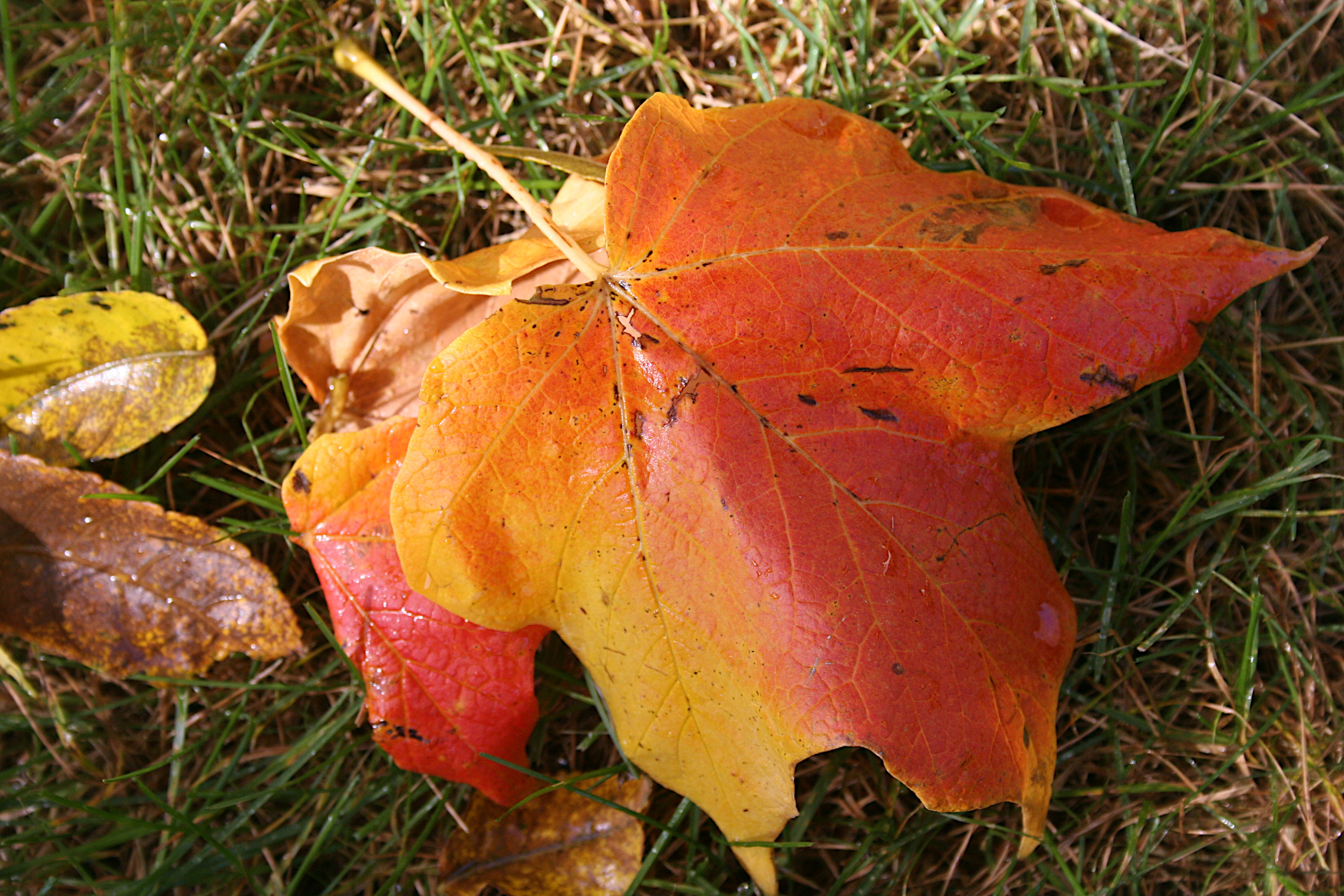
A maple on my lawn in all its fall glory. (Minnesota Prairie Roots copyrighted photo mid-October 2022)
With the exception of minimal rain in an already drought-stricken state, this fall in southern Minnesota has been exceptional with many sunny, warm days and lovely fall colors.
Autumn brings lots of yard work (like raking leaves) in preparation for winter.(Minnesota Prairie Roots copyrighted photo mid-October 2022)
Minnesota fully embraces autumn with unbridled enthusiasm. It’s as if we need to pack in as much as we can, outdoors especially, before we settle mostly inside for the winter.
The restored clock on the historic Security Bank Building in downtown Faribault. (Minnesota Prairie Roots copyrighted file photo September 2015)
The end of daylight savings time this weekend signals that seasonal shift. It will get darker earlier and that, psychologically, triggers an awareness of winter’s impending arrival. I find myself just wanting to stay home in the evening, snuggled under a fleece throw reading a good book.
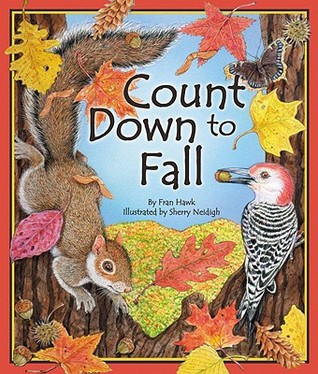
A page from “Count Down to Fall” in the current StoryWalk. (Minnesota Prairie Roots copyrighted photo October 2022)
Sometimes that may be a children’s book. Picture books aren’t just for kids. I find the stories and illustrations therein inspiring, entertaining, informative, poetic. In Faribault, Buckham Memorial Library even brings picture books right into the community via a StoryWalk. Pages from a selected picture book are posted in protective casings along several blocks of Central Avenue to the library. The currently featured book is Count Down to Fall written by Fran Hawk and illustrated by Sherry Neidigh.
NOTE: In a project similar to Faribault’s StoryWalk, Minneapolis-St. Paul International Airport features a Minnesota-authored children’s picture book on panels placed between gates C18 and C19 in Terminal 1. Each book is in place for two months in this Picture Book Parade.

























 Minnesota Prairie Roots
Recent Comments