The eagle is a symbol of freedom in the U.S., here in sculpture form at small town Minnesota memorial. (Minnesota Prairie Roots copyrighted file photo)
IN CONSIDERING AMERICA’S 249th BIRTHDAY, I decided to write down words that immediately popped into my mind relating to this holiday, America and the current state of our country. I limited myself to 20 individual words or phrases. Here’s what flowed from my brain to pen to paper before I typed this list into my computer for you to read:
freedom
democracy
liberty
voting rights
free and fair elections
divisiveness
fear
deportations
due process
freedom of speech
freedom of the press
protests
my voice
threats
intimidation
injustice
checks and balances
life
melting pot
history
I could easily take each word or phrase and expound on how I feel about these topics in current-day America. But for today, I will allow the words to mostly stand alone while you ponder their meaning or create a list of your own. I will only state that I am saddened some of these words found their way into my brain as I think about our country on its 249th birthday. What words would be on your list?
Corn rows emerge in a field near Delhi in my native southwestern Minnesota prairie.(Minnesota Prairie Roots copyrighted file photo)
I COME FROM A LONG LINE of engaged citizenry rooted in the rich dark soil of the southwestern Minnesota prairie. On that land, generations of my family used their voices and skills to create change, to make the place they called home a better place. My paternal great grandfather, Rudolph, started that engagement by helping found a Lutheran church in my hometown. Pre-building, congregants met in his farmhouse.
My grandfather, Henry Kletscher, served as school board clerk when Vesta Elementary School was built in the late 1950s. I attended school here. (Vintage photo from my collection)
From that church to school boards to county boards, from elementary schools to high schools to college campuses and more, countless family members have served and continue to serve others by representing them, crafting policies, improving lives. I am proud of that legacy.
Now you might ask, what about you, Audrey? I, too, have served, but in a different capacity. I’ve never held a desire to lead, to run for elected office or even sit on a board. Rather, I’ve observed, used the written word to inform others. During my years working as a newspaper reporter, I covered endless county board, city council, planning and zoning board, school board, caucuses and other meetings. I learned a lot about how government does and doesn’t work during those many hours of scribbling notes, gathering quotes, writing news stories. I learned, too, that individual voices matter and are heard. And I shared that in my unbiased, balanced reporting.
Today I craft writing that is not straight news reporting, because I am no longer a newspaper reporter. Rather, my writing is personal and sometimes opinionated. My voice matters…as much as anyone’s.
An opinion piece I wrote in 1974 for my high school newspaper. (Minnesota Prairie Roots copyrighted photo April 2025)
While coming of age near the end of the Vietnam war, I began writing angsty poetry about the war. I purchased and wore a POW bracelet, a thick silver band that wrapped around my wrist. It was engraved with the name of an American soldier held as a prisoner of war. I also wrote the occasional opinion piece for my high school paper. Not about the war, but on other topics.
A photo of my dad, Elvern Kletscher, taken in 1980. (Photo from mycollection)
It was my dad, a dairy and crop farmer, who inspired me to voice my thoughts in the May 24, 1974, issue of my school paper, Rabbit Tracks. In an opinion piece titled “Farmers Develop Backbone of America,” teenage me wrote about low farm prices and how farmers were struggling to survive. I had witnessed my dad dumping milk down the drain during a nationwide protest by the National Farmers Organization. All these decades later, I more fully understand how difficult that must have been for Dad. He depended on income from milk sales to provide for our family. But he sacrificed and let his voice be heard in that NFO protest.
Spring planting in Minnesota will soon be underway. (Minnesota Prairie Roots copyrighted file photo)
Sunday evening I listened to another farmer voice his thoughts, this time in the open mic part of a Town Hall meeting attended by hundreds in nearby Owatonna. He drove from Janesville to share concerns about how tariffs will negatively affect his farming operation via market loss, dropping crop prices and rising costs for everything from tractor parts to fertilizer and fuel. This farmer of 60-plus years pleaded with his Congressman, Representative Brad Finstad (a fourth-generation farmer who was invited but did not attend), to listen and to do something. It was a powerful and particularly emotional delivery.
This was one of the many signs displayed at the Sunday Town Hall in Owatonna. Organizers rightly guessed that Congressman Brad Finstad would not attend. He was also invited to a recent Town Hall in Faribault, but did not show. (Minnesota Prairie Roots copyrighted photo April 2025)
Emotions are running high right now across this country. I cannot imagine anyone who would disagree with that. We may disagree on policies, decisions and leaders. But we still—as of this writing—have a voice, even as efforts to suppress our voices continue. We can protest, like my 82-year-old uncle did on Saturday at the Minnesota State Capitol. We can attend town halls to learn, to speak, to let our voices be heard. We can contact our elected officials via phone and/or email and tell them what we think. We can engage. We can vote.
(Minnesota Prairie Roots copyrighted file photo)
A long line of speakers and attendees of all ages addressed numerous topics from veterans’ issues to education to housing to healthcare to democracy and more at the Sunday Town Hall in respectful conversation. The common threads weaving through the event were a deep concern for what is happening in our country and to assure our voices are heard.
The beginning of Mary’s letter to the editor, penned in 1974 for Rabbit Tracks. The headline is so fitting for 2025. (Minnesota Prairie Roots copyrighted photo April 2025)
I leave you with this opinion piece published in the October 15, 1974, issue of my high school newspaper. An 11th grader wrote about posters she created and which students were defacing. Here’s Mary’s closing sentence in a letter to the editor titled “Keep Hands, Pens Off”: A lot of time and effort has been put into these signs and the least you can do is keep your hands off of them. If everyone is so anxious to write something on the wall, make your own posters. How applicable those words are to today.
#
NOTE: I welcome respectful conversation here. That said, I moderate all comments on this, my personal blog, and make the final decision on publishing comments.
An American flag flies in rural Minnesota. (Minnesota Prairie Roots copyrighted file photo)
I DEBATED FOR SEVERAL DAYS whether I should write this post, because it could be misconstrued as purely political. It is not. Rather this is a story about a grassroots gathering of people sharing information, ideas and opinions. Democracy at its core. This story is about us as Americans—listening, learning, agreeing or disagreeing, and letting our voices be heard.
Tuesday evening I attended a town hall meeting in Faribault hosted by DFL Senate District 19. It was open to everyone, regardless of political affiliation. But the crowd was decidedly Democrat, as you would expect given the hosting group. Republican Brad Finstad, who represents the 1st Congressional District in Minnesota, was invited, but did not attend. His district includes parts of Goodhue, Rice (where I live), Steele and Waseca counties in rural southern Minnesota.
Some 300 constituents packed the space, overflowing into adjacent rooms. Yes. Even I was surprised by the turn out. That tells me a whole lot of people have concerns about what is currently happening at the federal level and how government action is, or will, impact them. I expect not a single American will be untouched, whether directly or indirectly, by slashes in government personnel and funding and/or by changes in domestic and foreign policies.
A sculpture at the Northfield Area Veterans Memorial. (Minnesota Prairie Roots copyrighted file photo)
Town hall organizers lined up speakers to address topics covering a broad range of subjects affecting a whole lot of people and programs—farmers, education, healthcare, seniors, veterans, those with disabilities, communication, nonprofits and much more. I was impressed by how well prepared these speakers were with facts and statistics. I learned a lot.
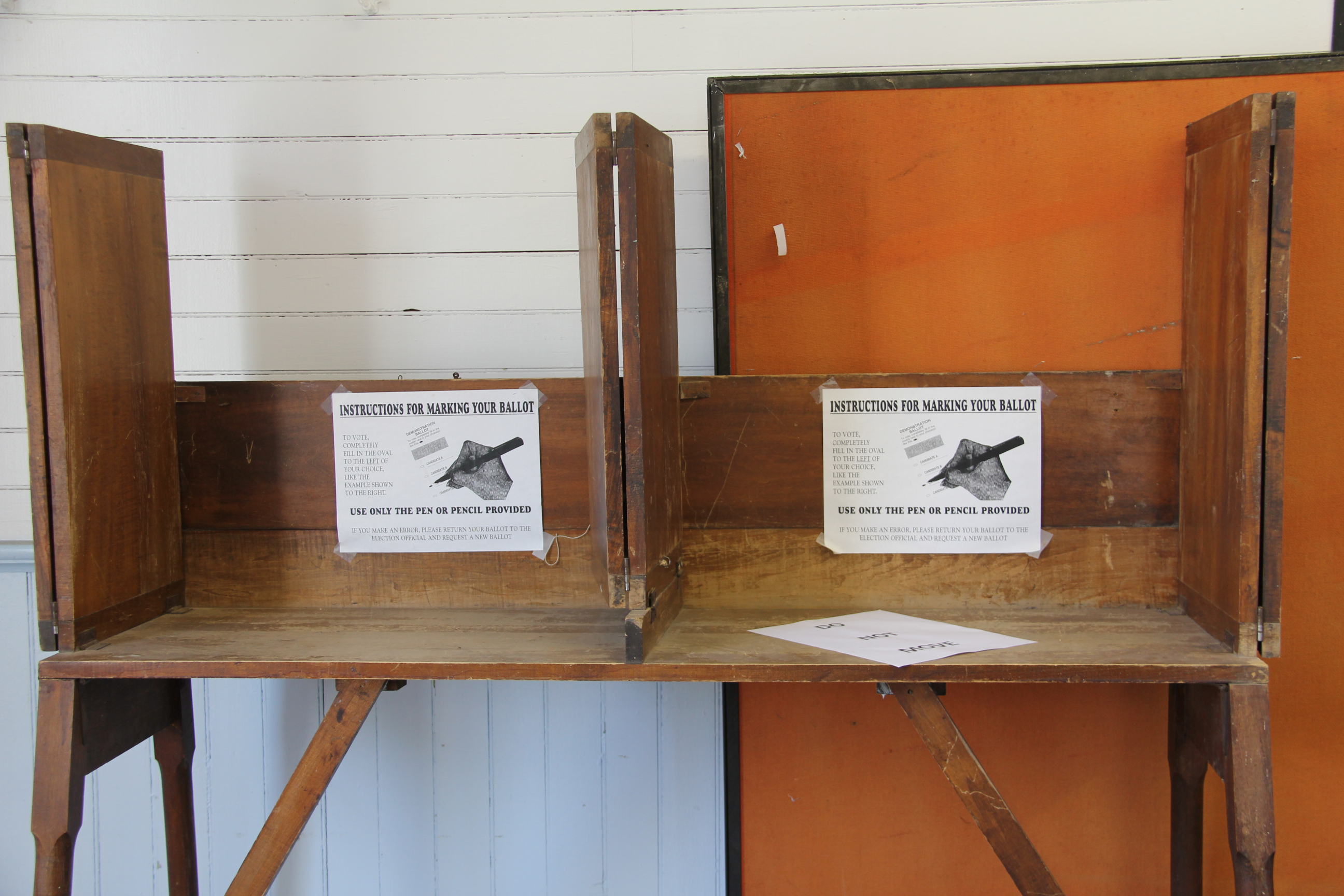
A vintage voting booth in the former Northfield, Minnesota, town hall. (Minnesota Prairie Roots copyrighted file photo)
I’m not going to give you a detailed report of what each speaker said. Rather, I want to share several messages or phrases which really resonated with me and which should resonate with every American, no matter who they voted for. The phrase “we the people” was repeated by one speaker and embraced by the crowd. “We the people” means us. Americans, not members of one political party or the other. And, yes, I’m well aware of how those words from the preamble to the Constitution are being used politically as a mantra of sorts. But in this context, “we the people” references our right to speak up, to be heard, to tell our elected officials what we think and what we would like them to do as our representatives in Washington DC. That can be done by attending town halls like this; the meeting was video taped and will be sent to Representative Finstad. We can be heard via phone calls, emails and letters. We the people have power in our voices, in our votes, whether Democrat, Republican or Independent.
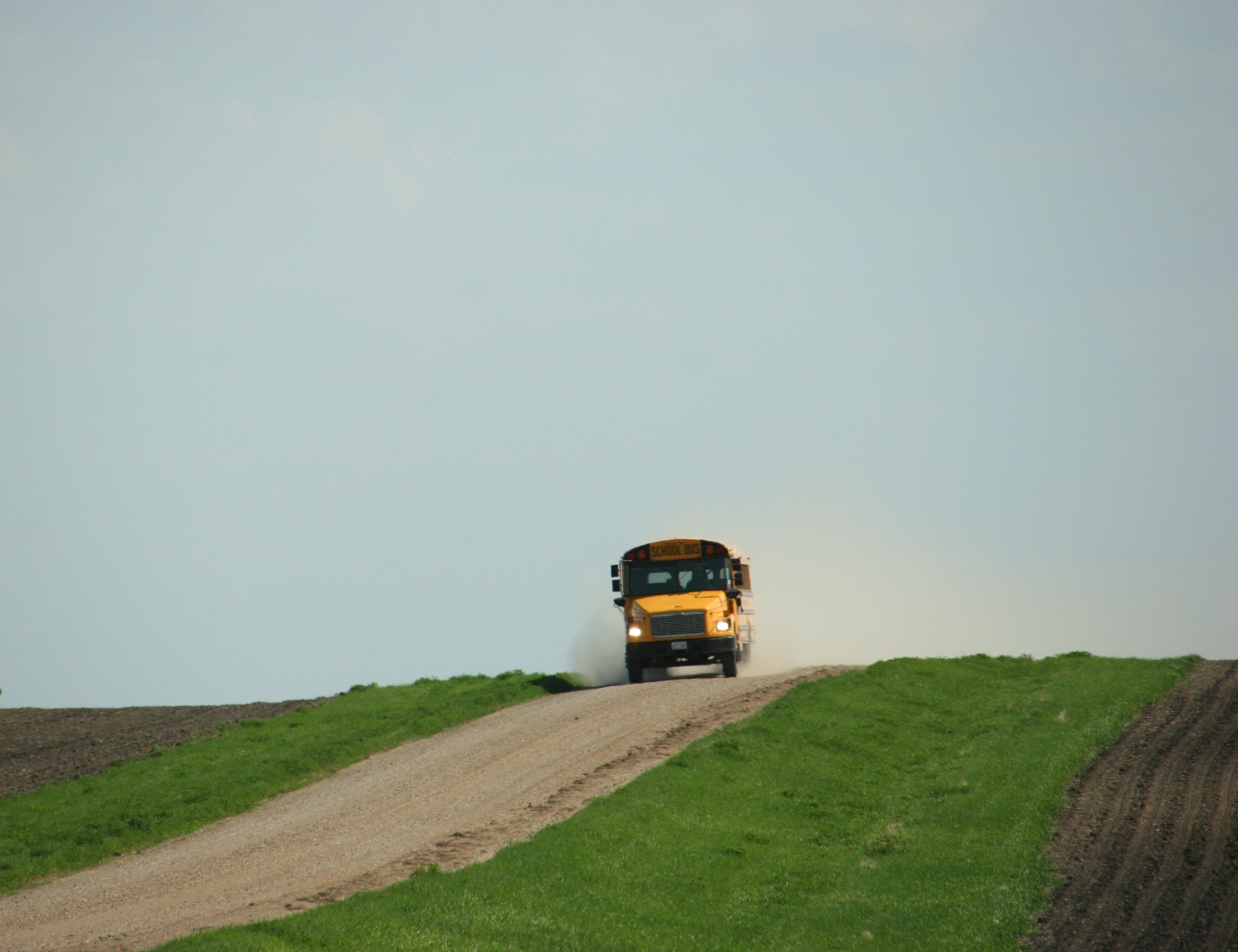
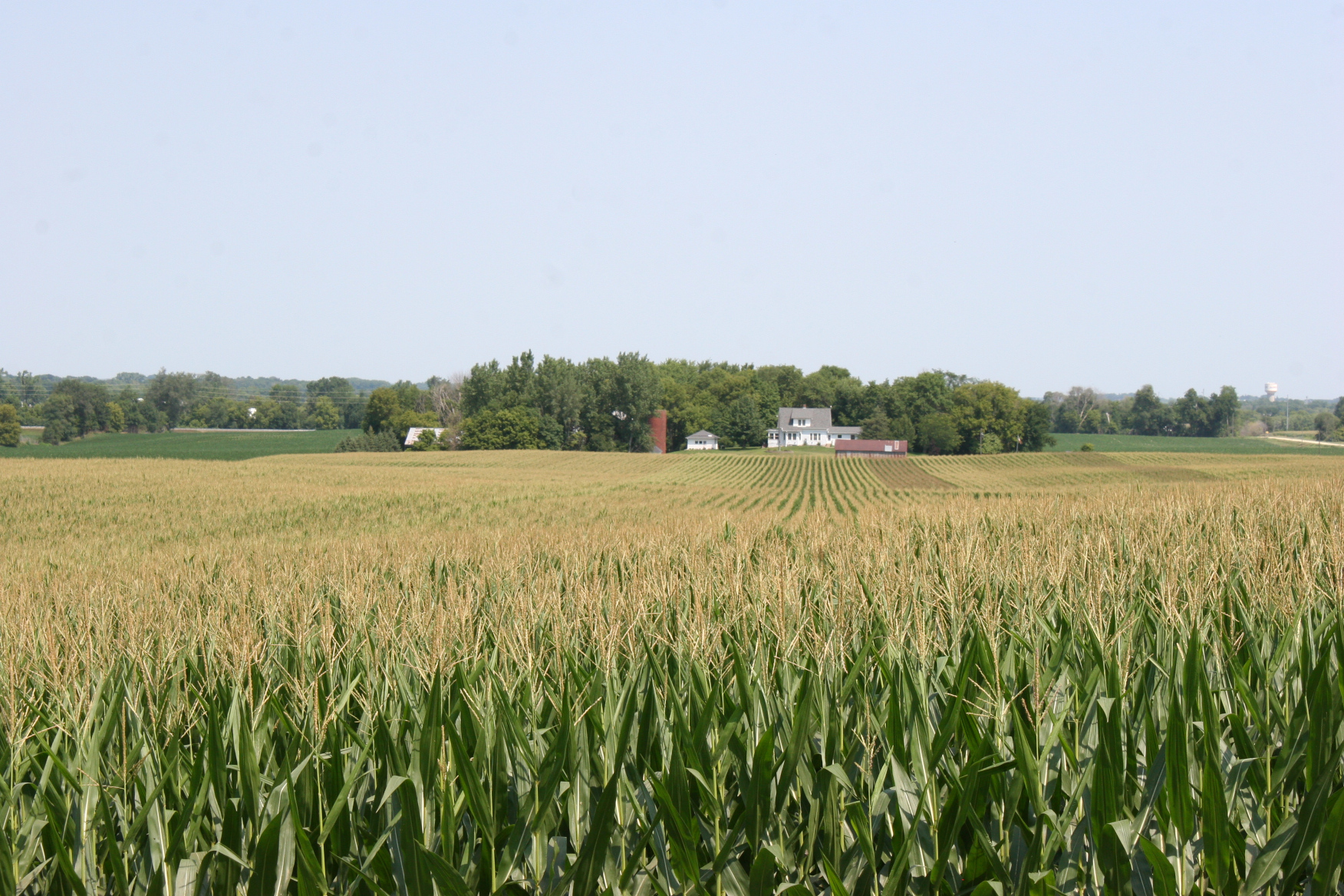
Photographed on a back country road near Morgan in southwestern Minnesota. (Minnesota Prairie Roots copyrighted file photo)
Secondly, a local educator asked the crowd and Finstad to ask themselves this question: “How are the children?” So, yes, how are the children, when many live in poverty, when federal funding for education is in imminent danger of being mostly cut, when…fill in the blank here? I think we can all agree that children are our future and we ought to care about their health, happiness, education and much more.
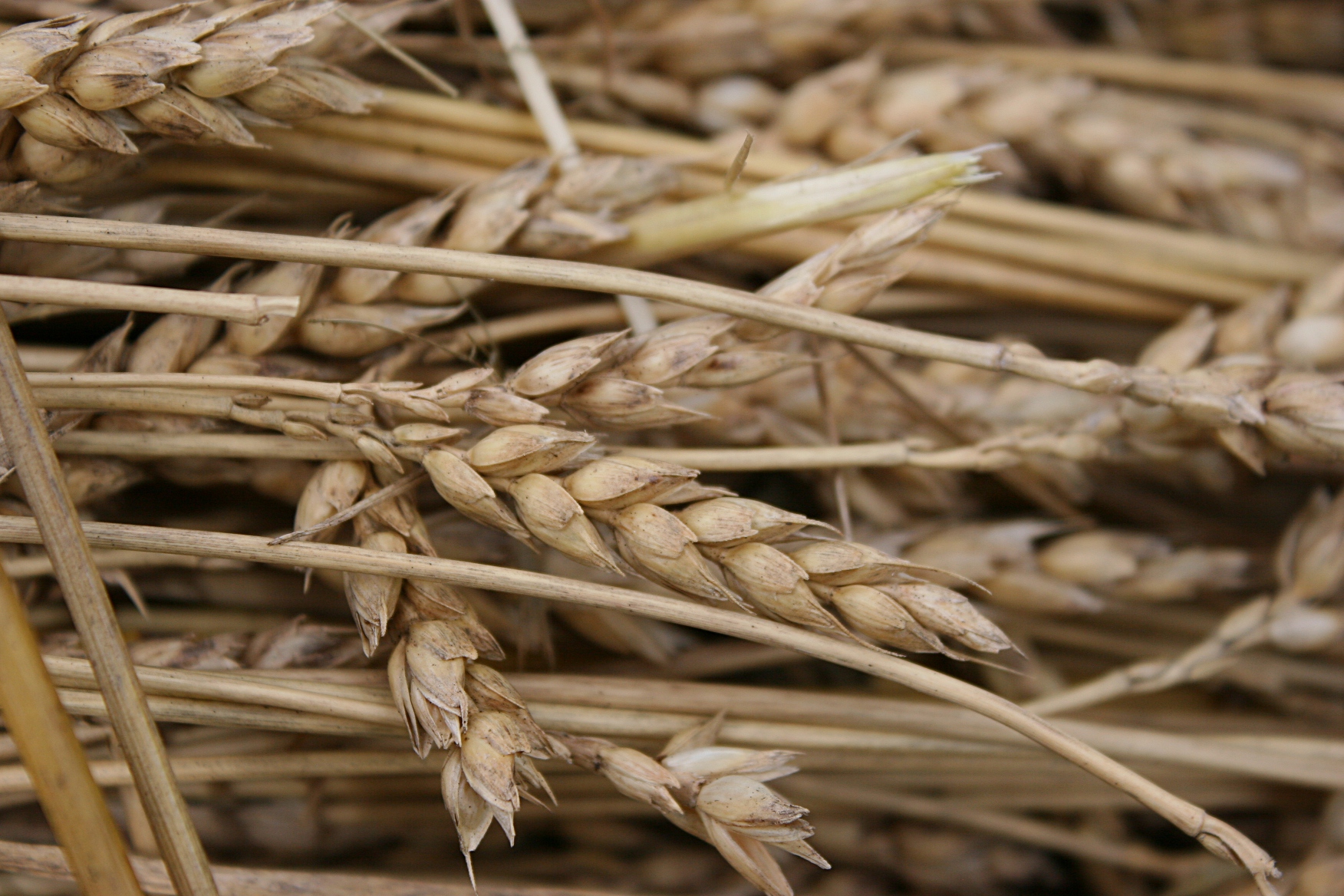
A pile of wheat. (Minnesota Prairie Roots copyrighted file photo)
Third, one of the speakers shared that, as someone of the Catholic faith, he is called upon to help others. He called upon Representative Finstad, who is also Catholic, to do the same. That means feeding the hungry (funding USAID, for example), protecting Medicaid and Social Security, etc. all of those ways and places we help one another as human beings in this country and abroad. Now I’m not Catholic; I’m Lutheran. Doesn’t matter. My faith compels me to show love, compassion and care for others, especially those in need. America once did that as a country. Generously. But that is changing. We have bounty and resources we can share to help starving children, to provide medical care, to help others in any way we can. It is the right thing to do as a nation blessed with great bounty.
Rural Rice County, Minnesota. (Minnesota Prairie Roots copyrighted file photo)
Fourth, a local farmer spoke about $3.2 million in contracts with farmers in our district which have now been broken by the U.S. government. The consequences will be devastating to those farmers who have already invested those federal monies in their operations. Trust has been broken, she said. I think we can all agree that when a legal contract is broken, it’s a breach of trust.
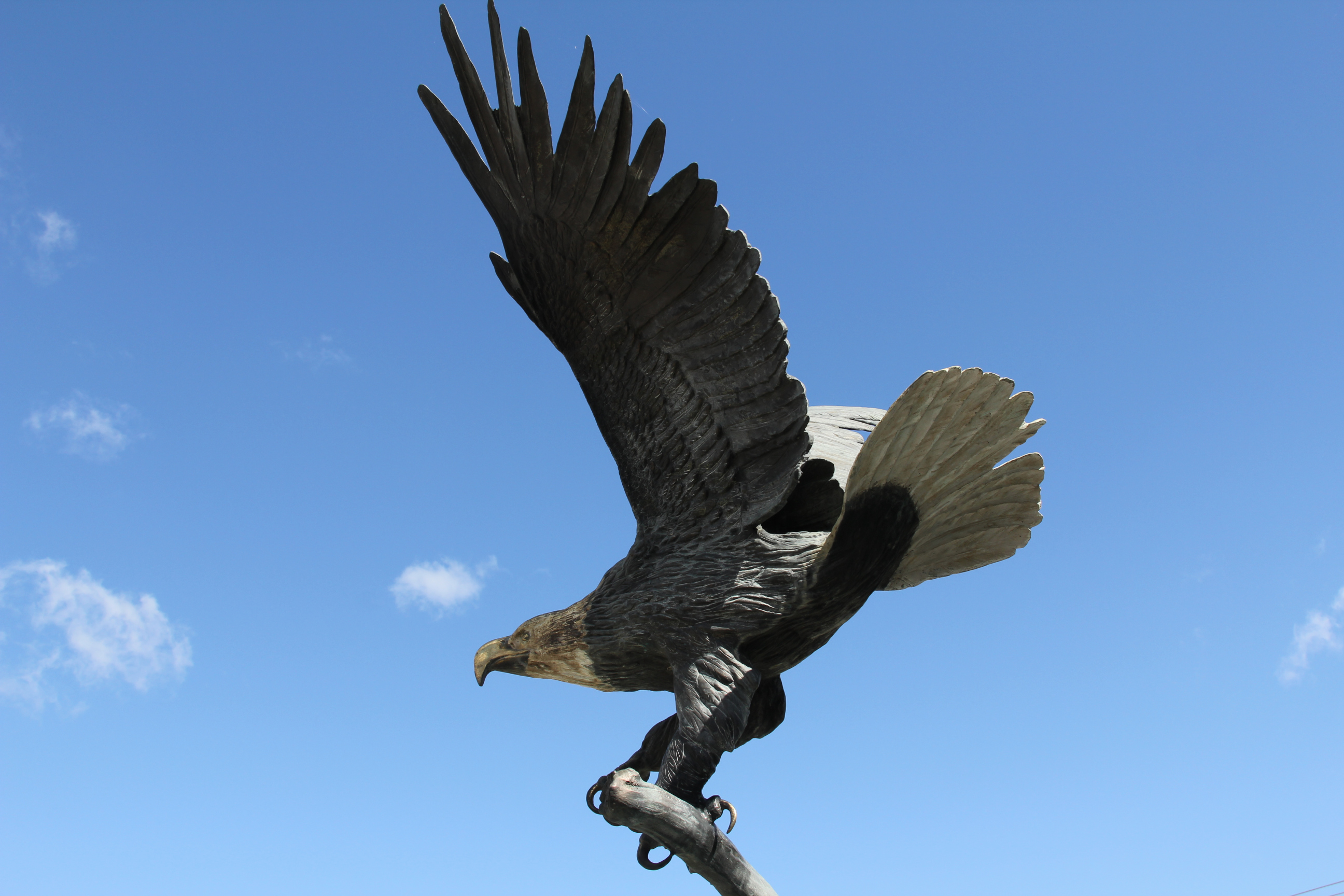
A symbol of freedom, an eagle sculpture at Veterans Memorial Park in Morristown, Minnesota. (Minnesota Prairie Roots copyrighted file photo)
There’s so much more I could share from that town hall session. But I want to conclude with this. I encourage you, if you have the opportunity to do so, attend a town hall meeting. Listen. Learn. Engage. Let your voice be heard. Remind your elected officials, too, that they need to listen, learn and engage.
FYI: A second Town Hall Meeting hosted by DFL Senate District 19 is set for 6 p.m. Sunday, April 6, at Mineral Springs Brewery, 210 N. Oak Ave., Suite 1, in Owatonna. It will follow the same format as the Faribault Town Hall with a moderator, speakers and an open mic. Representative Brad Finstad has been invited.
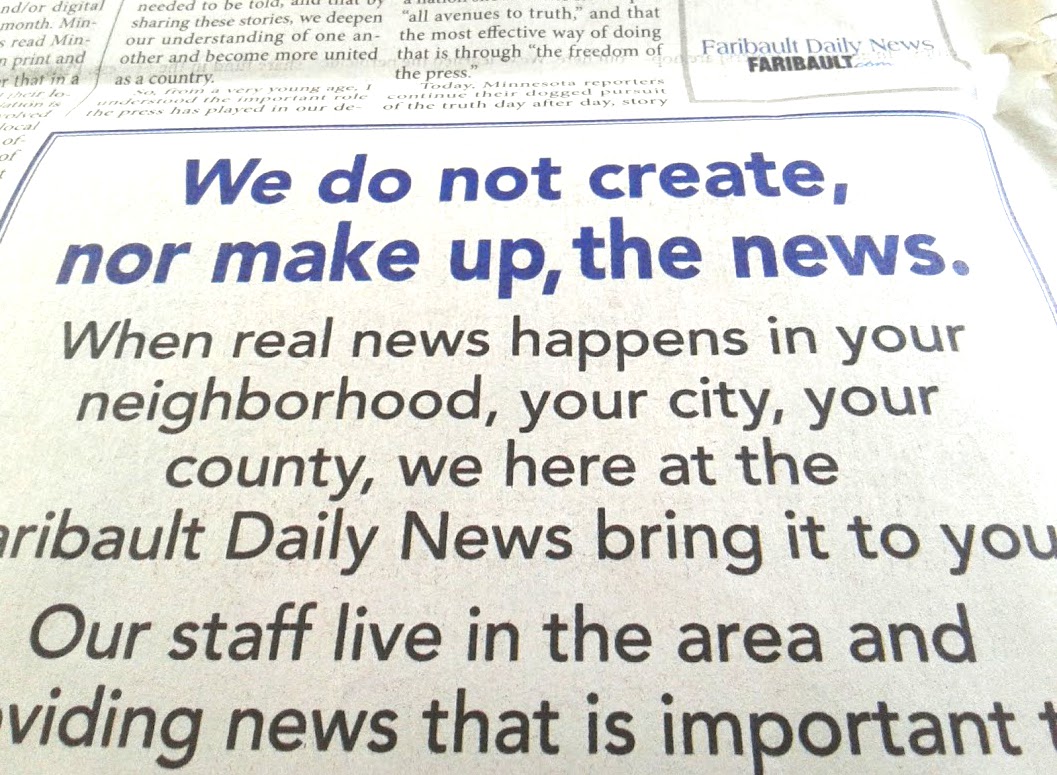
I AM WRITING THIS OPINIONATED POST with no apologies. As an American woman with a college degree in mass communications (news/editorial emphasis) and experience as a newspaper reporter, I’ve always felt strongly about a free press. Even more so today with threats to that freedom. If you are unaware of current actions against the press, research and read. A free press is a vital part of democracy.
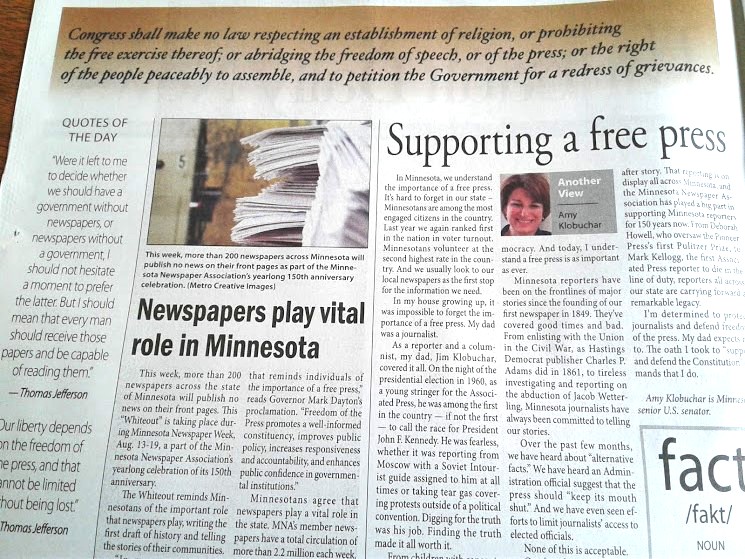
The second page of the Daily News from the August 15, 2017, issue explains the importance of a free press and its role. (Minnesota Prairie Roots copyrighted file photo 2017)
Journalists serve, among other roles, as government watchdogs. That means they, ideally, provide accurate and balanced reporting on government, at all levels. The “fourth estate” holds the government accountable via the stories they write. Not agenda-driven stories shaped by a biased editorial perspective or by information spoon fed to them by a press secretary. But rather stories based on quotes, actions, interviews, facts. Good solid reporting. Not misinformation, disinformation and/or propaganda. I must, though, state the obvious here. Not all sources speak truth to the media. And not all media write truth.
Suppression and criticism of the press are nothing new. Some of the criticism is deserved. Much of it is not. You may like journalists or you may not. That’s not the point. The point is that we need a free press, one unsuppressed/uncensored by those who are in positions of power. If you think otherwise, then look to history and to countries under authoritarian leaders, dictators. Under those leaders, messaging is/has been carefully controlled. Manipulation, intimidation and absolute power rule.
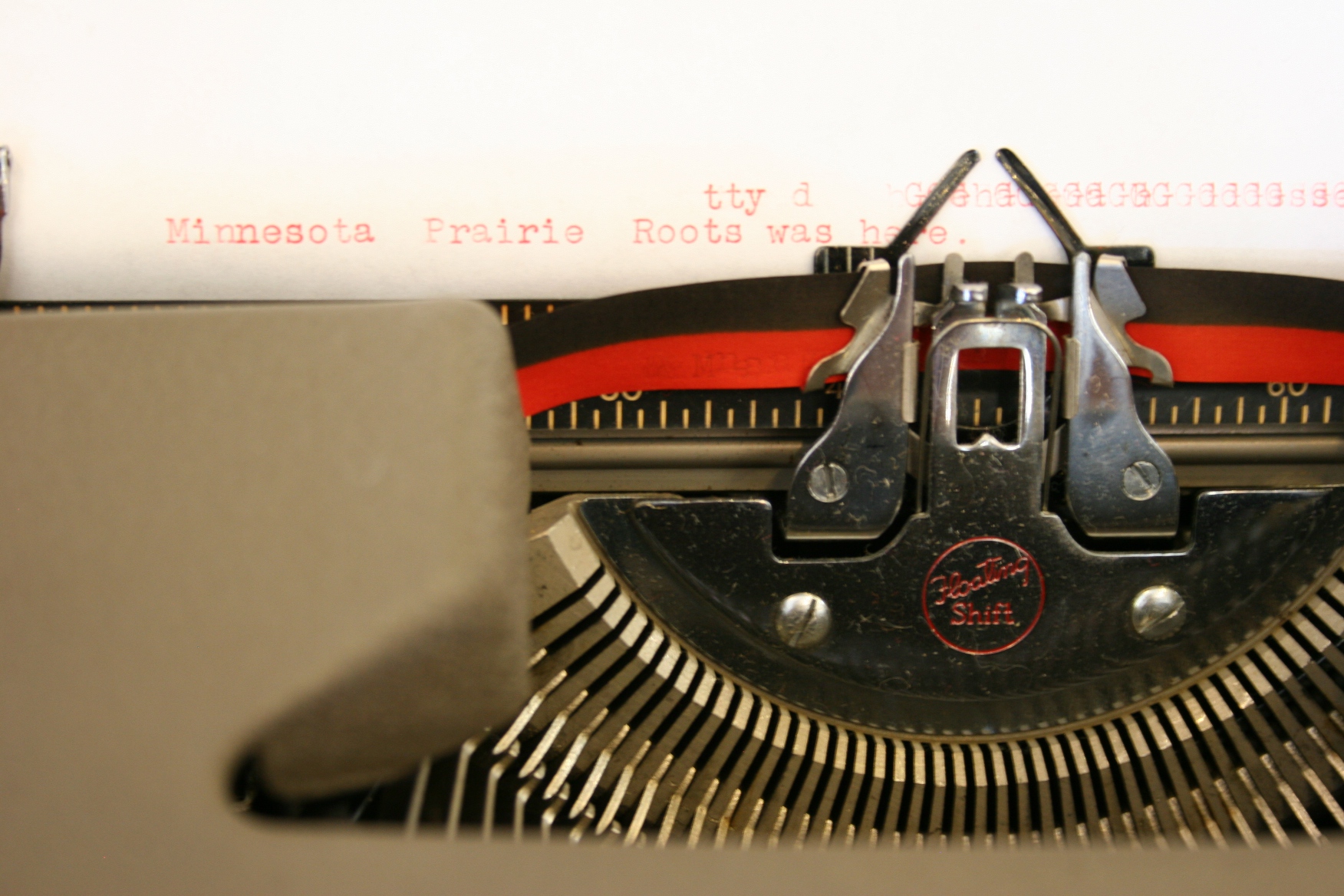
I started my newspaper career at a small town Minnesota weekly, typing my stories on a manual typewriter. This photo was taken in a Hastings antique shop, where I left a message. (Minnesota Prairie Roots copyrighted file photo)
During my journalism career, I have not been immune to those who wanted to control what I wrote. They did that sometimes in a back door way via criticizing me and my work and/or by shutting me out. Thankfully, my editors always had my back.
Let me give you some examples. While covering a school board meeting for a small town southern Minnesota weekly, a teacher said some things that were controversial. Decades out, I can’t recall details. But I do remember how this teacher fumed about my quoting him in a news story. The quote did not reflect favorably on him. But he made the statement at a public meeting. And it needed to be reported. Readers could decide what they thought of his comments.
In that same community, a local realtor called me out for quoting him in a story about a city council meeting. Again, I don’t remember details. But he was absolutely irate and verbally attacked and bullied me for what I’d written. (Sound familiar? Bullying. Fake news.) My reporting was accurate. I was not about to cave to his pressure. Once again, my editor stood up for me. He knew I demanded the best of myself in my work and that I would settle for nothing less than fair and accurate reporting.
Flash ahead to a different small town where I, once again, found myself despised. This time by a school superintendent. He didn’t like that I covered a student walk-out. It happened. I observed, interviewed him and students. And he retaliated. Every time I attended a school board meeting, he refused to give me an agenda or the packet of information distributed to board members and to the editor of the local weekly newspaper. (I worked for a regional daily.) He refused to talk to me. He made no effort to hide his disdain or to make information accessible to me. His was clearly an effort to stop me from reporting on anything school related, including school board meetings. His strategy did not work.
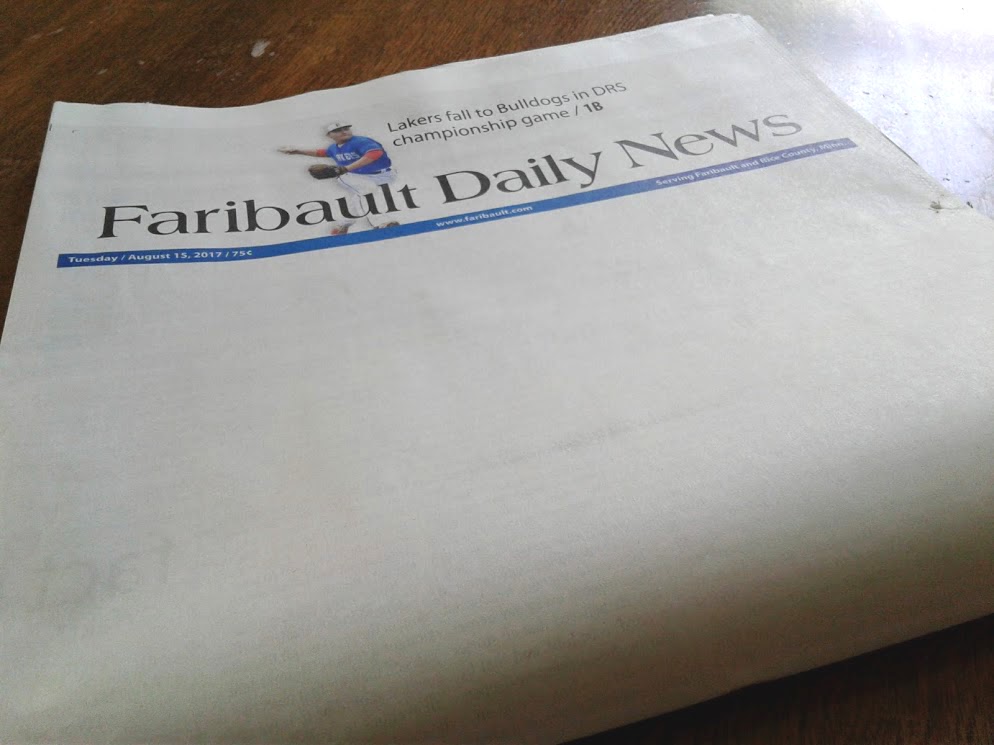
Published in the Faribault Daily News in August 2017 as part of the “Whiteout” campaign. (Minnesota Prairie Roots copyrighted file photo 2017)
Attacks on journalists have become more rabid in recent years. I think we can all agree on that. Don’t kill the messenger for the message he/she delivers. Respect those journalists who truly are doing their best to report fairly and accurately and who hold themselves and their work to high standards. Turn to those reliable sources for news.
Certainly, some media outlets and journalists are incredibly biased with specific agendas. They have become mouthpieces for government leaders, political parties and issues. I’m not praising those who are manipulating people to shape public opinion and to push ideas. Unfortunately, though, I see more and more government leaders, politicians and others targeting dedicated-to-the-craft journalists. These hardworking reporters are being shut out, degraded and abused because they accurately report what they see and hear in their watchdog role. Kinda like me with that small town school superintendent decades ago, just a lot more amplified and with much more serious consequences.
Thankfully, plenty of journalists committed to writing the truth still remain. They are strong men and women of integrity and morals who give a damn about democracy and a free press. Now, more than ever, we need to recognize the value of a free press, underscore FREE. Even though I no longer work as a newspaper journalist, I still strongly value freedom of the press. It is, always has been, a cornerstone of democracy.
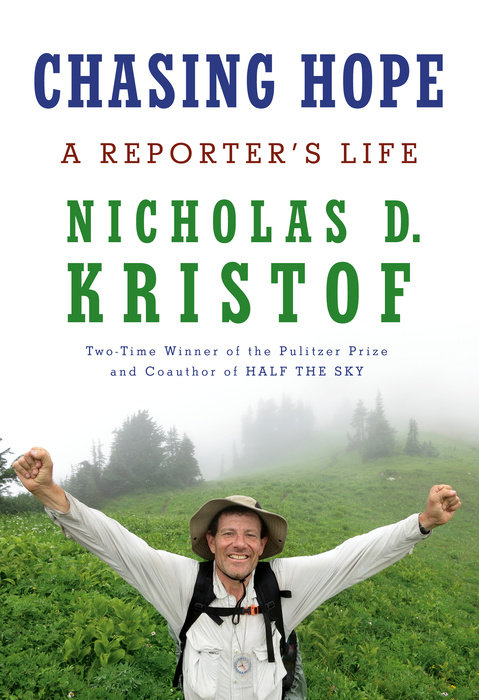
(Book cover sourced online)
FYI: I encourage you to read Chasing Hope—A Reporter’s Life by Nicholas D. Kristof, currently an op-ed columnist for The New York Times. The two-time Pulitzer Prize-winning journalist worked as a foreign correspondent in Hong Kong, Beijing and Tokyo. He witnessed some pretty horrible atrocities—including the massacre in Tiananmen Square, the genocide in Darfur and much more—and offers remarkable insights via his experiences, observations and exceptional storytelling.
Of special note in Kristof’s book is a reference to an August 2008 campaign rally in Lakeville, Minnesota, which the author calls “one of the finest moments in American politics in my lifetime.” Kristof shares a story about Senator John McCain, who was then vying for the Republican Presidential nomination. I refer you to pages 239 and 240 in Chasing Hope. This book is worth the read for that story alone. It will give you hope. And, no, I’m not telling you more. Read the book.
This shows a portion of a photo by Steve Somerstein featured in a 2015 exhibit, “Selma to Montgomery, Marching Along the Voting Rights Trail,” at St. Olaf College in Northfield, MN. (Minnesota Prairie Roots file photo)
FOR THE FIRST TIME EVER, I voted early, in person. I waited in line for 30 minutes to cast my ballot. I didn’t mind. And I’m not a patient person. But this, this election, especially, I wanted to ensure that nothing would stop me from voting. Because we never know what life will throw at us at the last minute, I decided voting early was the right choice for me.
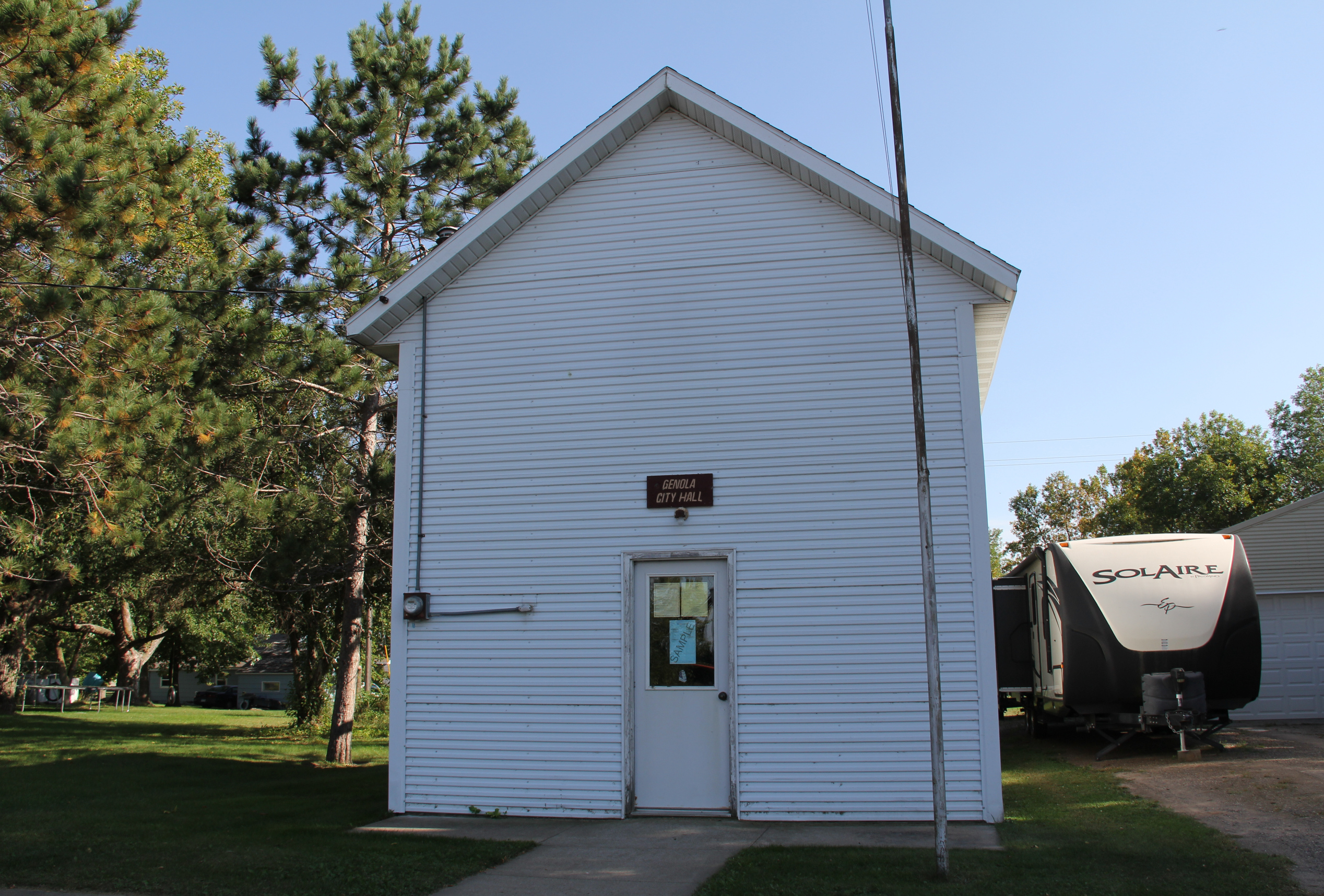
Genola City Hall, where I found a sample primary ballot posted on the door in September. (Minnesota Prairie Roots copyrighted photo September 2024)
A woman staffing my polling place shared that “busy” and “a steady stream” have been the norm at this location since absentee/early voting opened in Minnesota. It’s clear that people are invested in this election, more so than any I can ever recall. There’s a lot at stake. And we have a voice in the outcome.
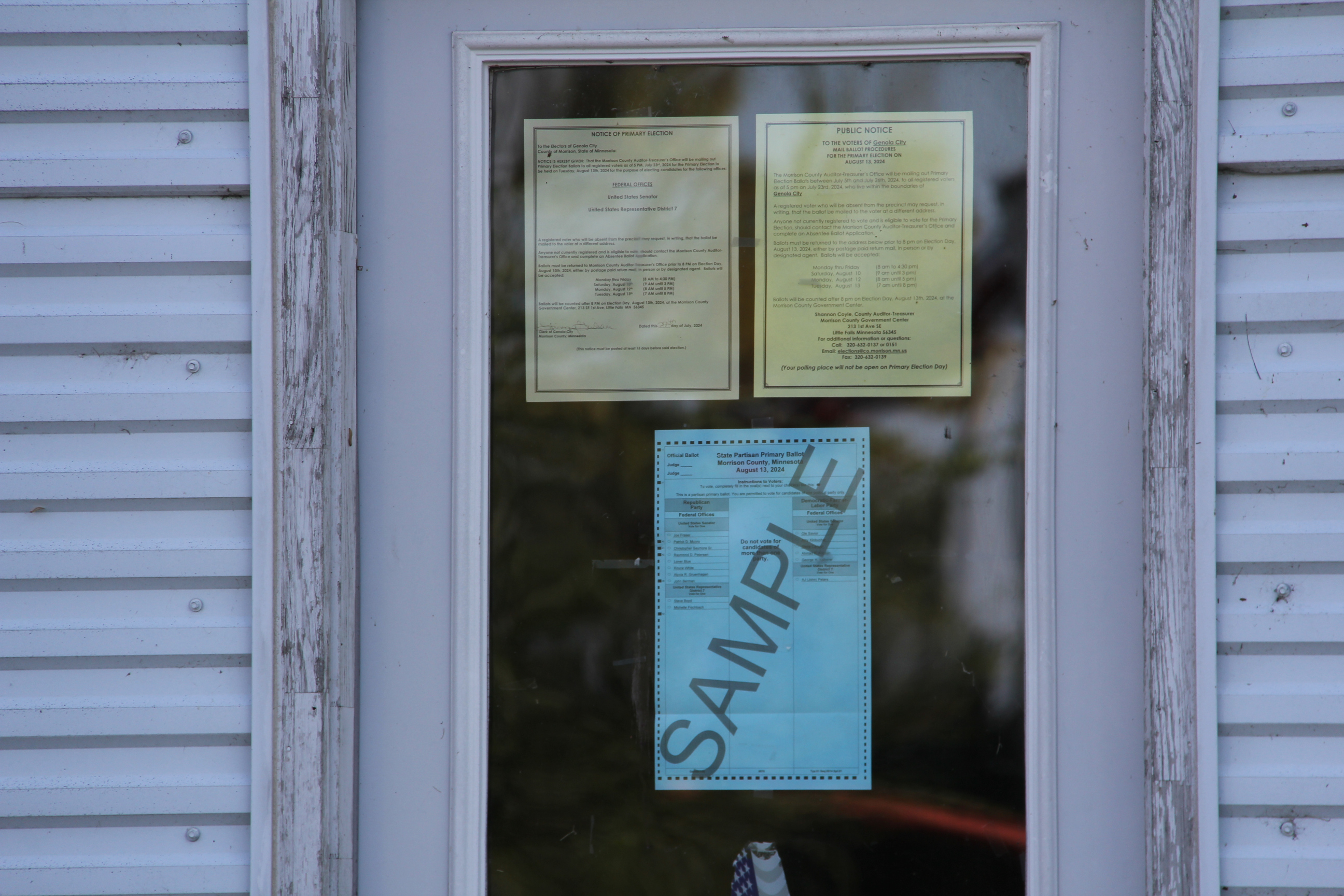
A close-up of the sample primary ballot on the door of the Genola City Hall. Genola is a small town in Morrison County in central Minnesota. (Minnesota Prairie Roots copyrighted photo September 2024)
My ballot included not only the all important Presidential race, but also voting for those who will represent me in Washington DC, St. Paul and locally (school board, city council, mayor, etc.). There were additional questions on the ballot about a local sales tax and about continuing to fund environmental programs with state lottery monies.
I attended local candidate forums sponsored by the American Association of University Women, read newspaper Q & A’s and more to learn about people and issues on the ballot. The forums proved especially eye-opening. Audience members were able to anonymously submit written questions to the moderator and you can bet I did. People don’t always come across the same in person as they do in print or other media. The value of forums/debates/whatever you want to term them is in the unexpected. Being put on the spot. Hearing questions that may otherwise not have been asked. Listening not only to how a candidate responds, but also observing their body language and interaction with other candidates.
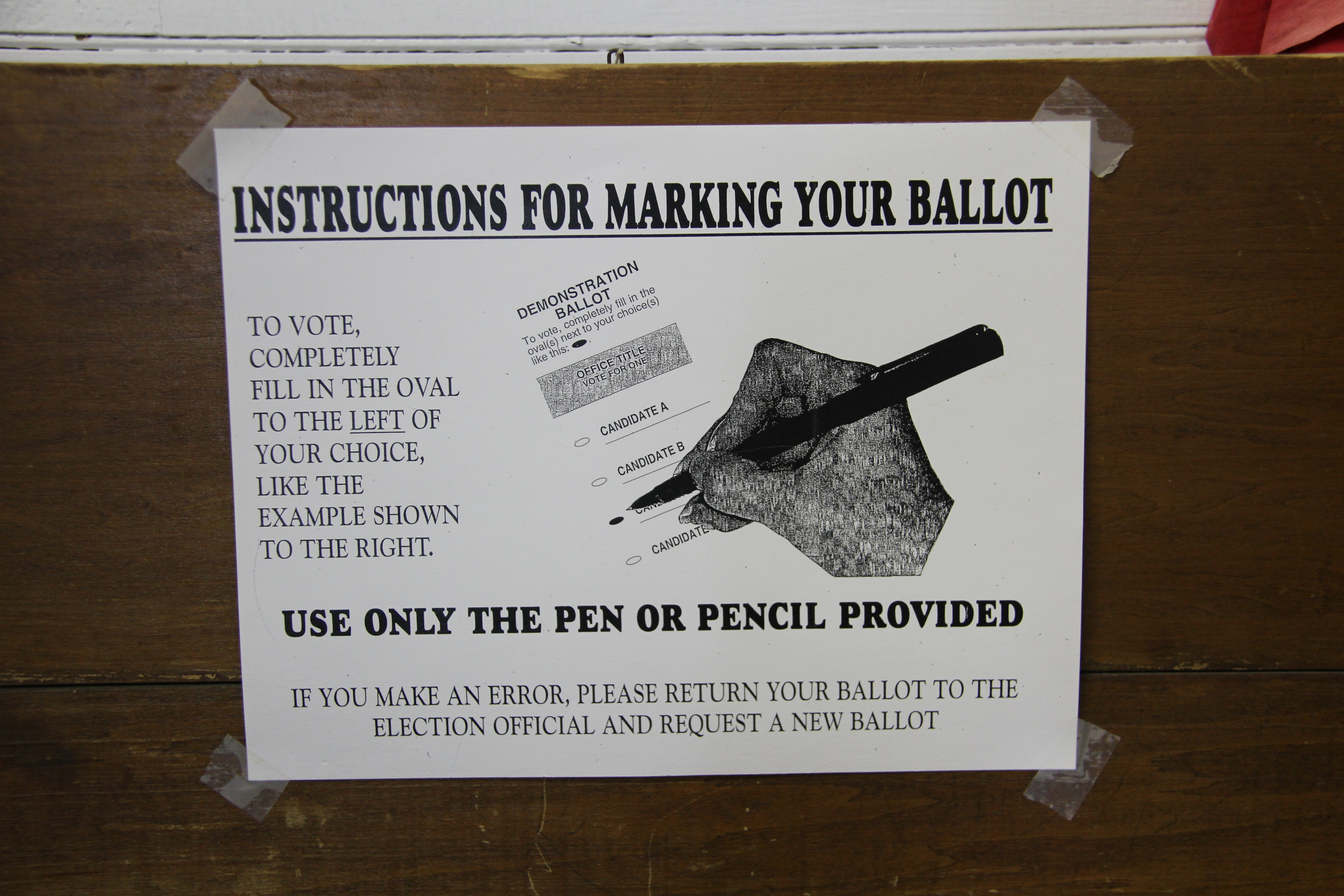
I photographed these ballot instructions inside an historic building at the fall 2024 Rice County Steam & Gas Engines Show, rural Dundas, MN. (Minnesota Prairie Roots copyrighted photo September 2024)
When I went to my polling place, I knew exactly who would get my vote. I felt fully-informed. There was never a question about what’s important to me. I value honesty, integrity, compassion, a candidate who cares and truly represents the people he/she serves. An individual who works for the common good, not for himself/herself and his/her personal agenda and power. An individual who listens, to everyone. An individual who does not degrade others. At the local level, I want someone who keeps politics out of places they don’t belong. I value that. I value truth.
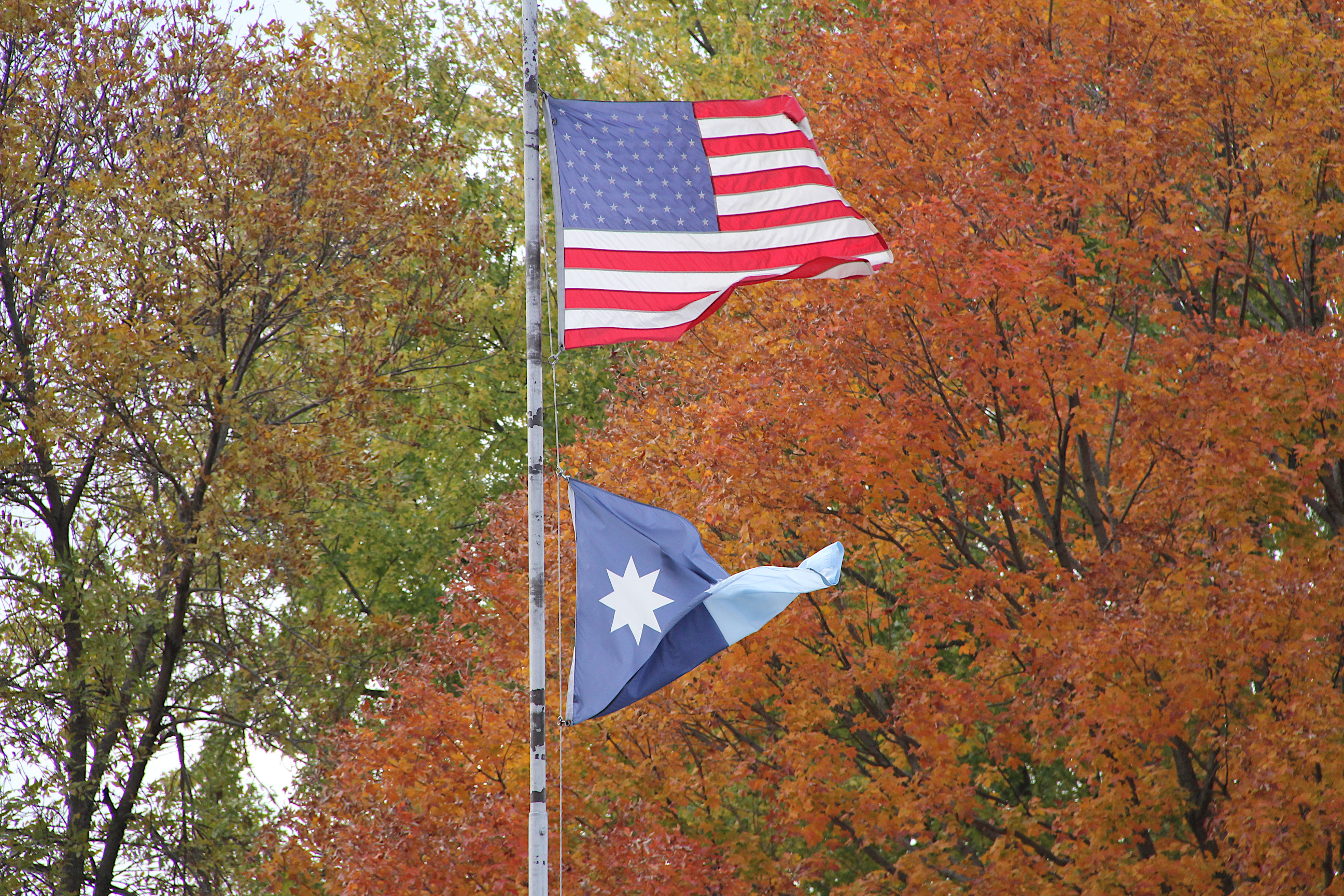
The American and Minnesota state flags fly on the campus of the Minnesota State Academy for the Deaf, Faribault. (Minnesota Prairie Roots copyrighted photo October 2024)
I value freedom, democracy, the right to vote my conscience.
Please exercise your right to vote if you haven’t already done so. It’s your responsibility as an American.
NOTE: This post is not meant to spark political debate or discord, but rather to share the importance of voting and what centers my vote. As the creator of this blog, I moderate all comments. The decision whether to publish a comment or not is my choice.
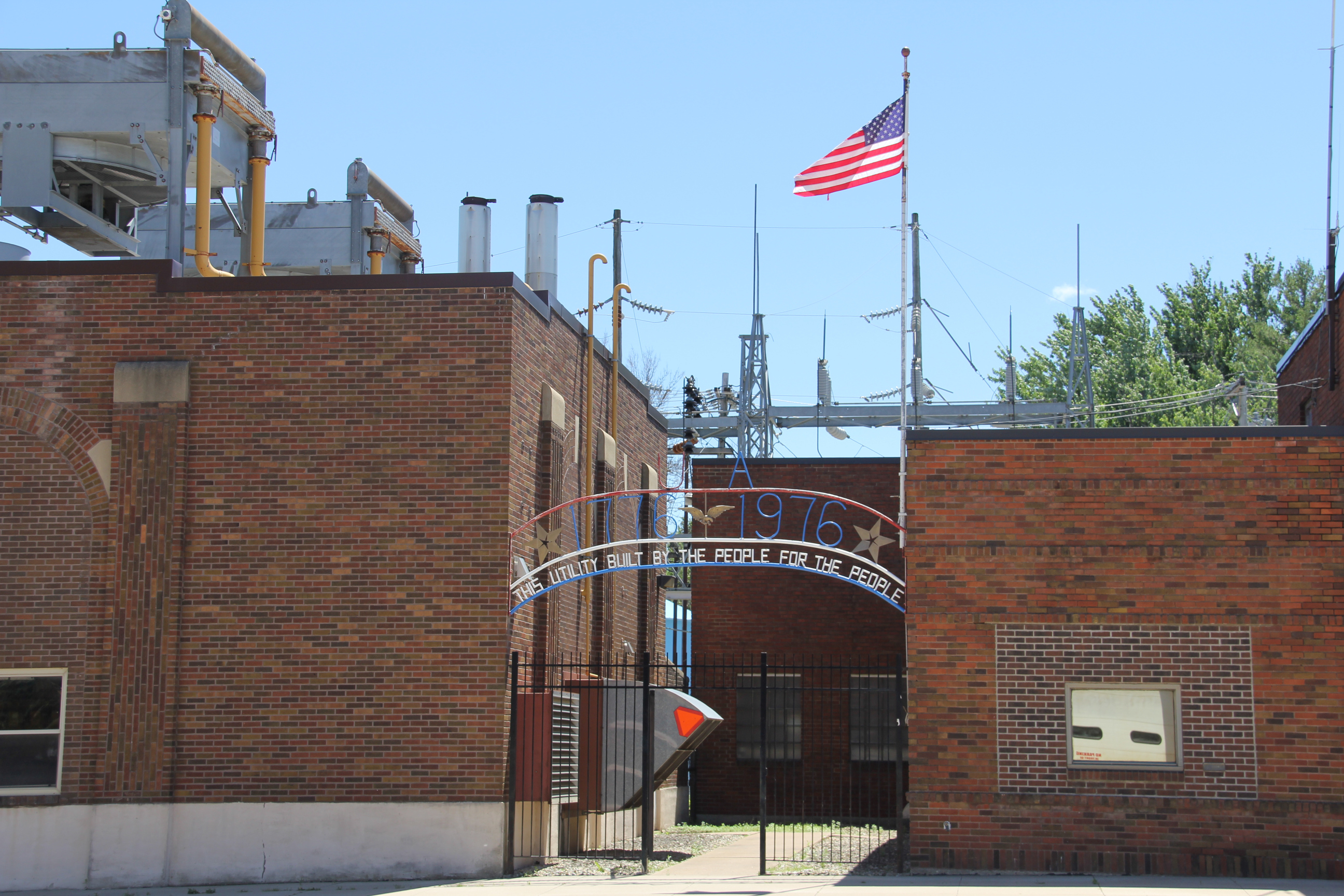
At the Kenyon Public Utilities building, signage marks the birth and bicentennial of our country from 1776-1976. (Minnesota Prairie Roots copyrighted photo June 2024)
BUILT BY THE PEOPLE FOR THE PEOPLE. I suppose in many ways that could describe the building of America. We are a nation built by the people on the principles of freedom, of democracy. That’s important to remember in the hoopla of the Fourth of July, a holiday synonymous with BBQs, parades, fireworks and a day off from work.
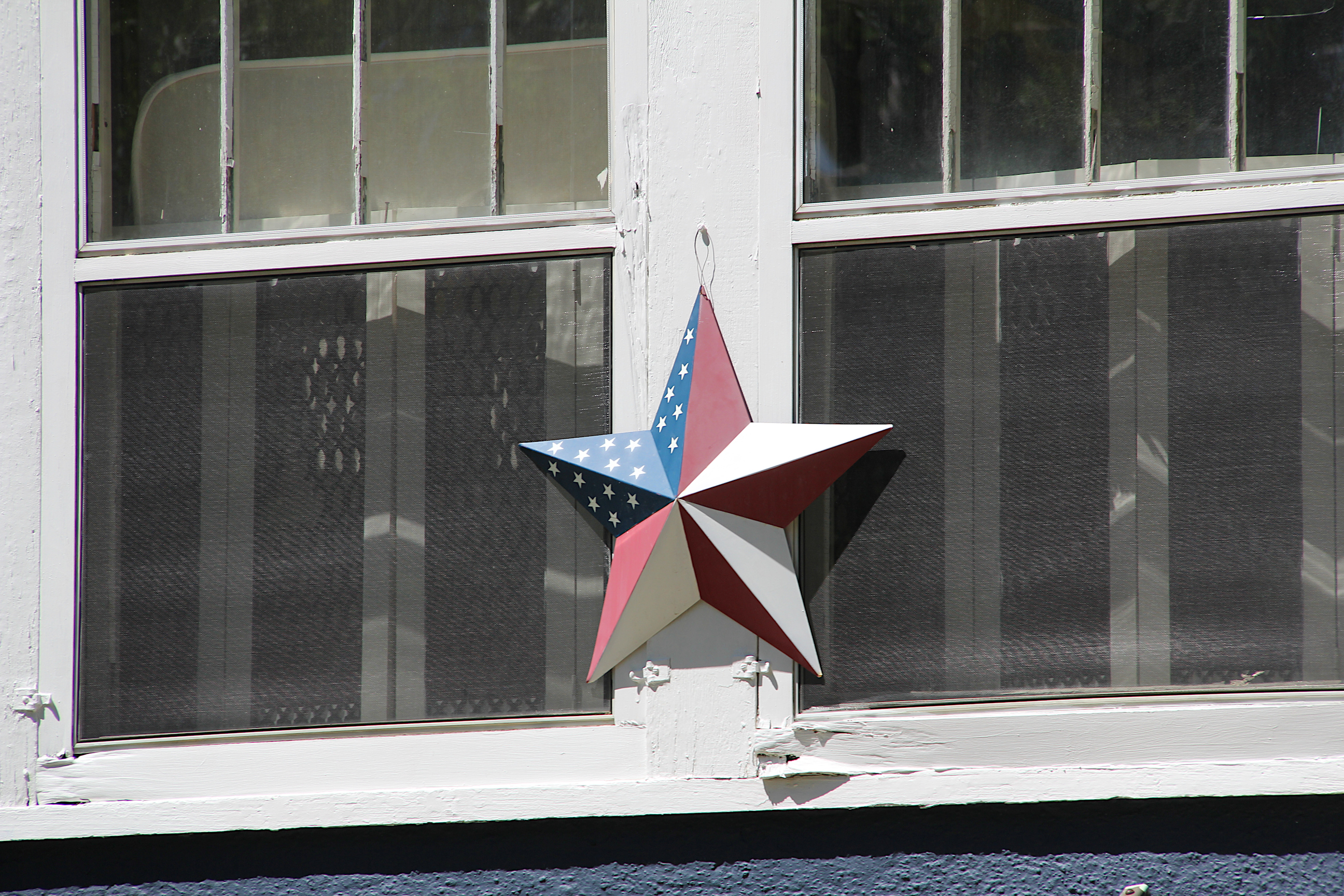
Spotted on a house in Kenyon. (Minnesota Prairie Roots copyrighted photo June 2024)
But the founding of our country, the birth of a nation, is at the core of our July Fourth celebration. Or at least it should be.
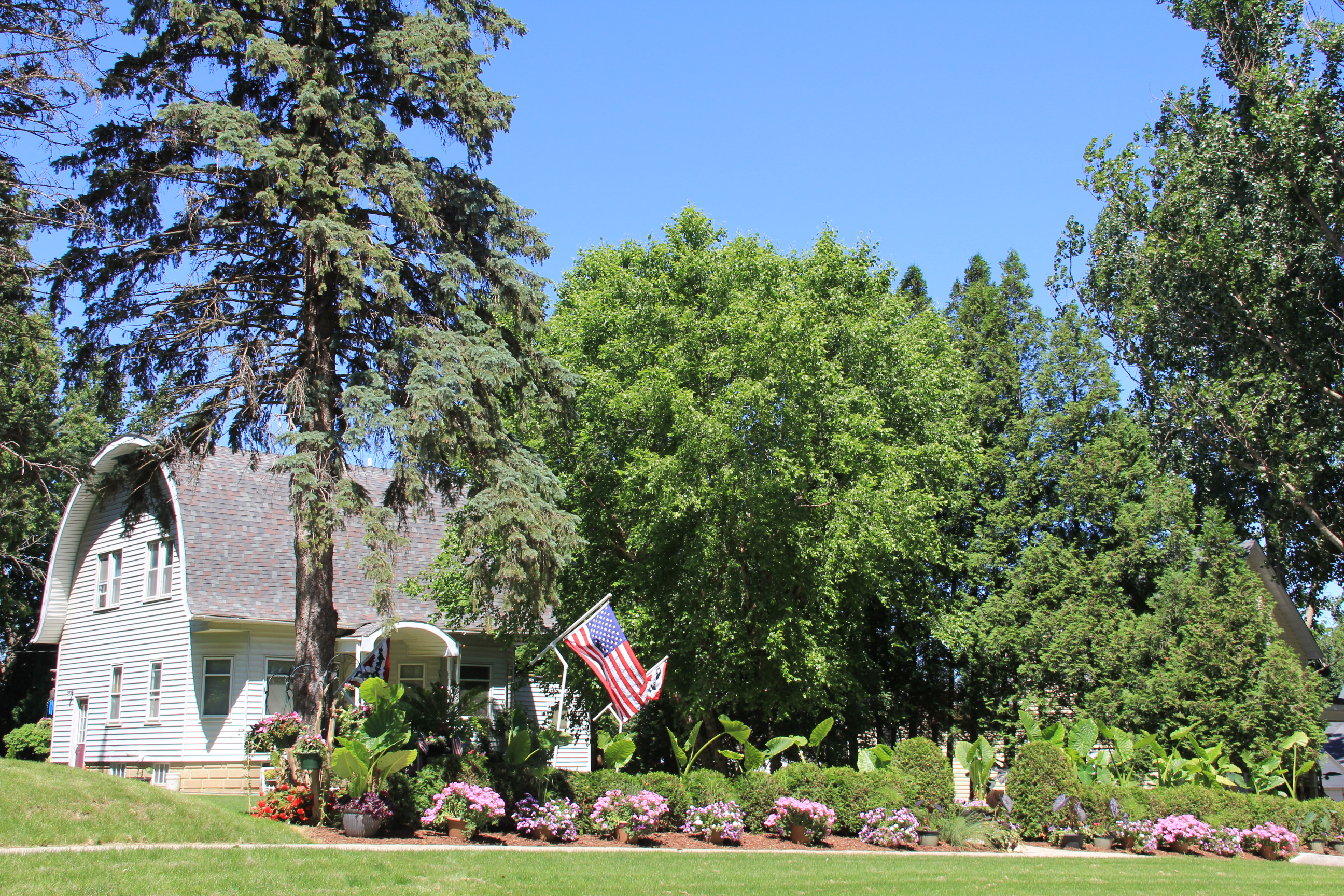
A stunning house along Red Wing Avenue showcases beautiful landscaping and the red-white-and-blue. (Minnesota Prairie Roots copyrighted photo June 2024)
On recent day trips to several small towns in southern Minnesota, I noticed the red-white-and-blue on full display. Visual reminders that loyalty to country and liberty are still cherished.
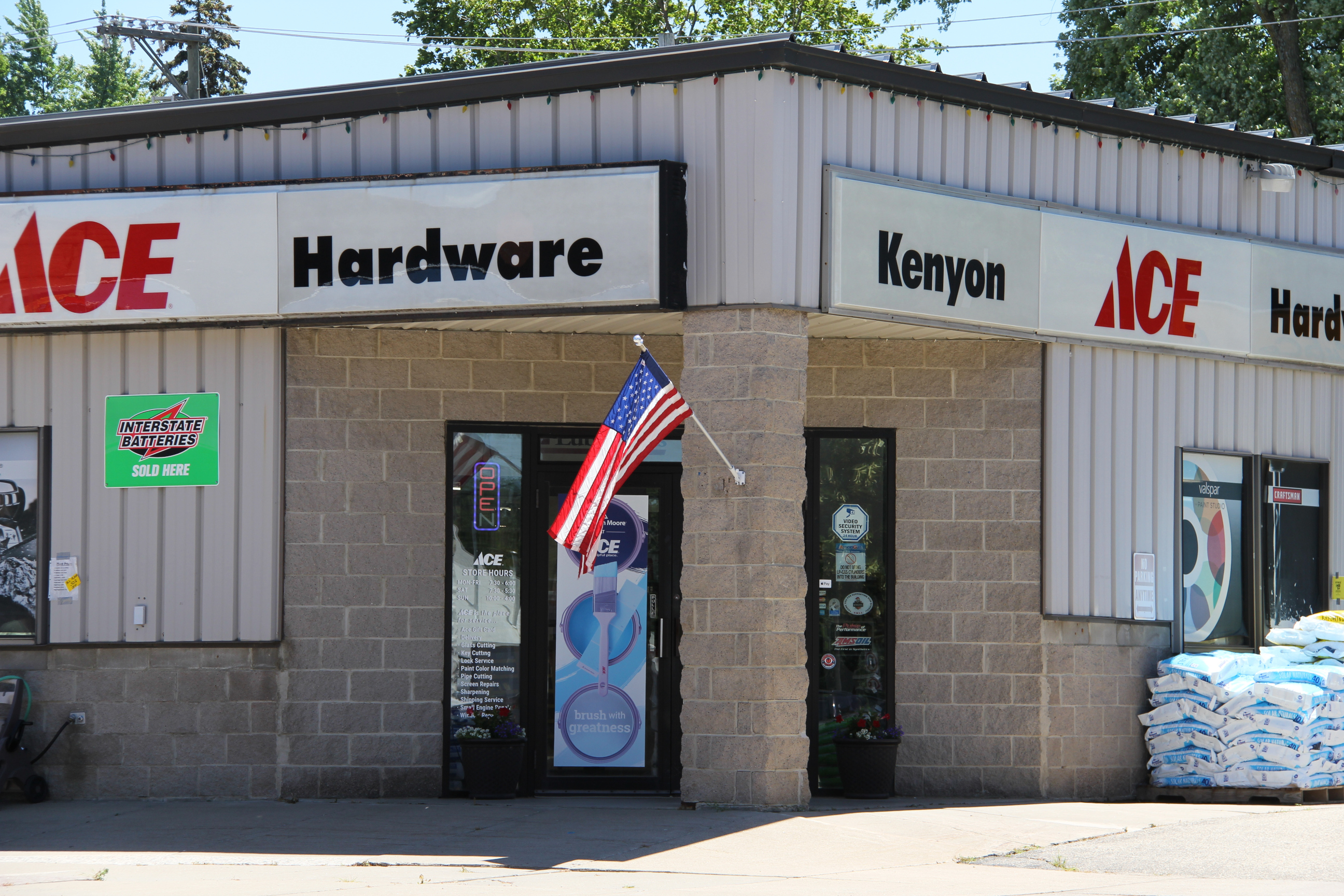
A flag flies at Kenyon’s hardware store. (Minnesota Prairie Roots copyrighted photo June 2024)
I appreciate when people, businesses, governments showcase the colors of this country in ways that honor and respect the integrity of America. Not to make a political statement.
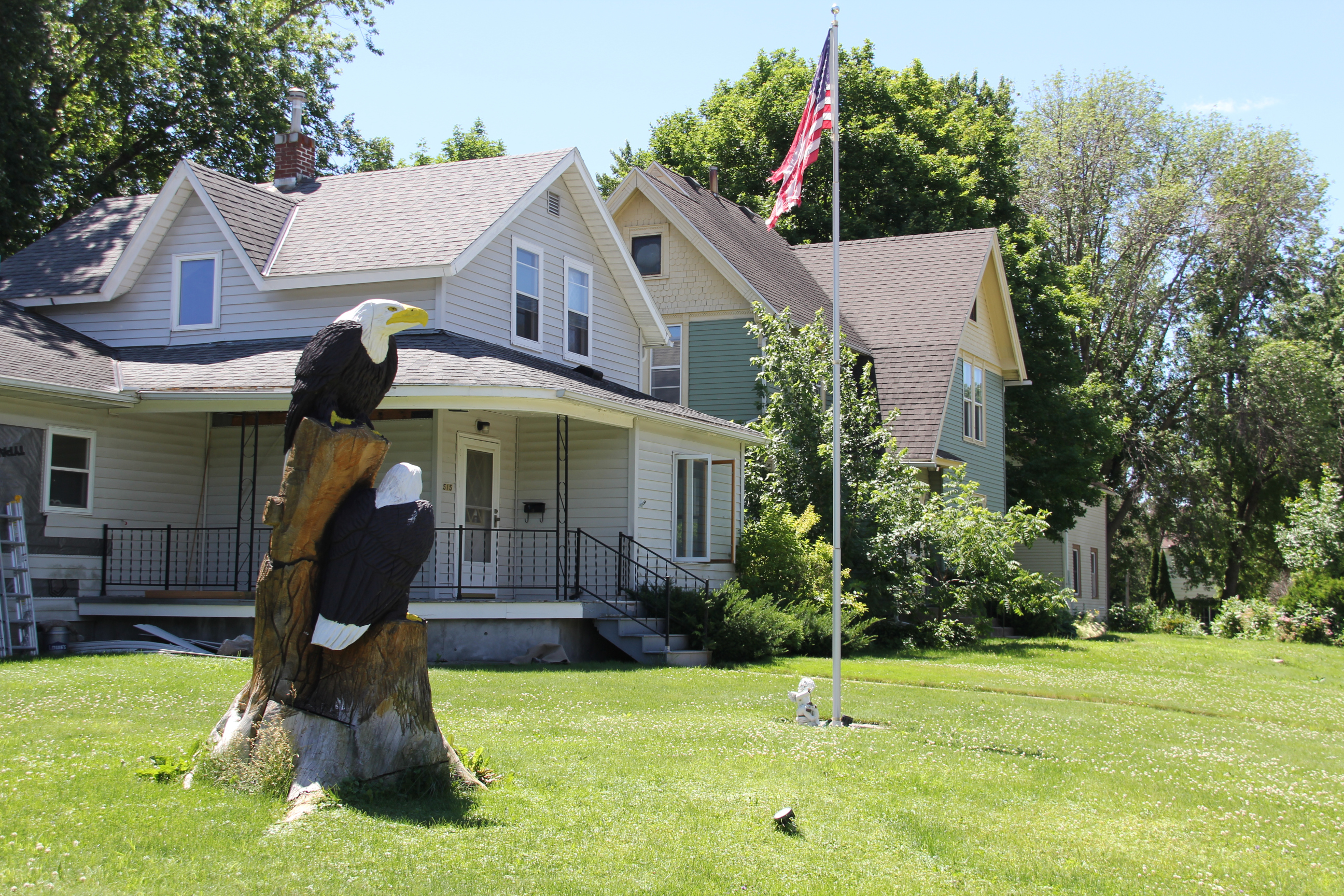
Patriotism in carved eagles and an American flag in a Kenyon neighborhood. (Minnesota Prairie Roots copyrighted photo June 2024)
In Kenyon, a rural community of just under 2,000 in Goodhue County, I found an array of red-white-and-blue. From Main Street to residential neighborhoods, locals have infused the colors of our country into the landscape.
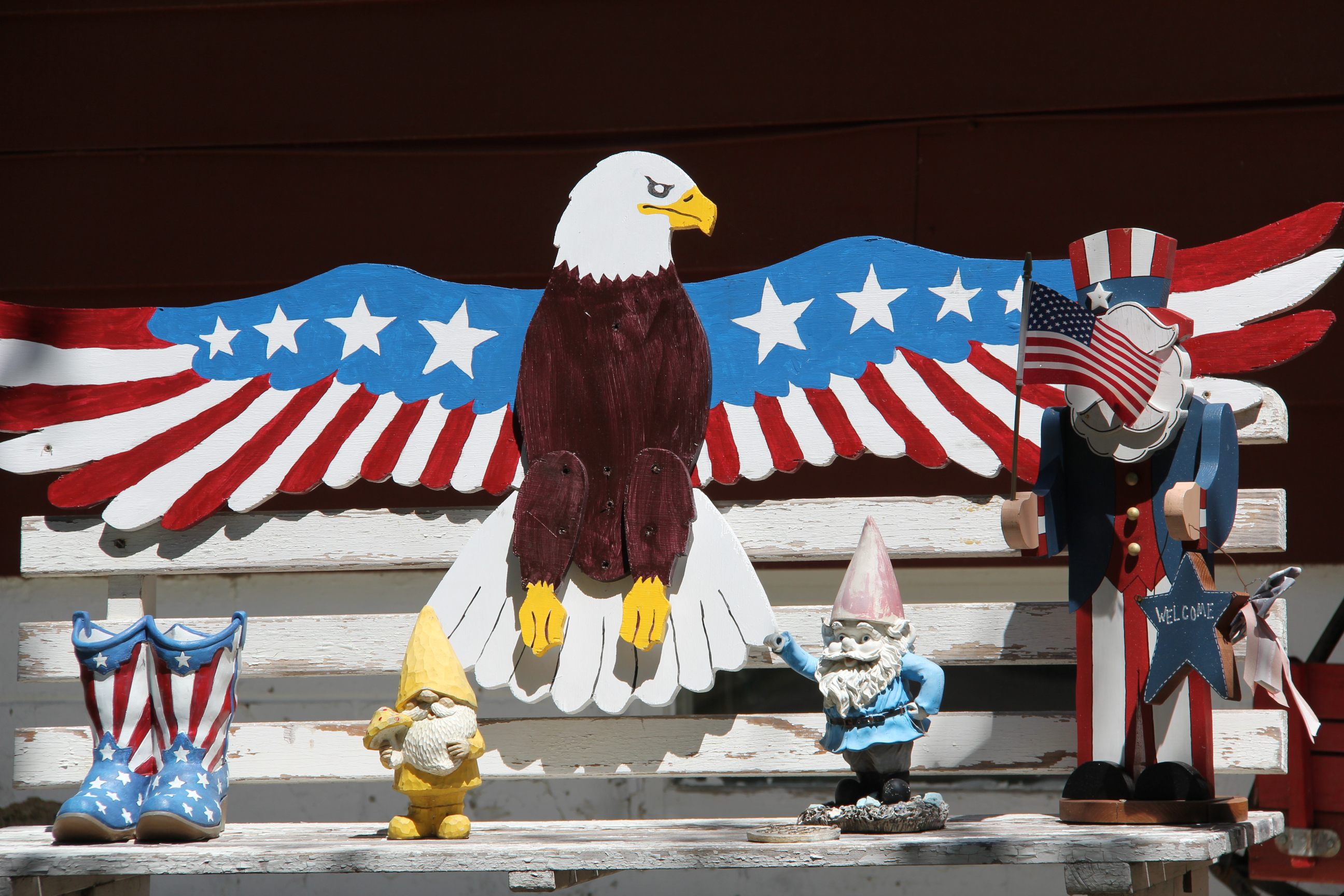
Allan and Connie Turner have lots of kitschy handcrafted art in their yard at the corner of Red Wing Avenue and Eighth Street next to the Kenyon water tower. (Minnesota Prairie Roots copyrighted photo 2024)
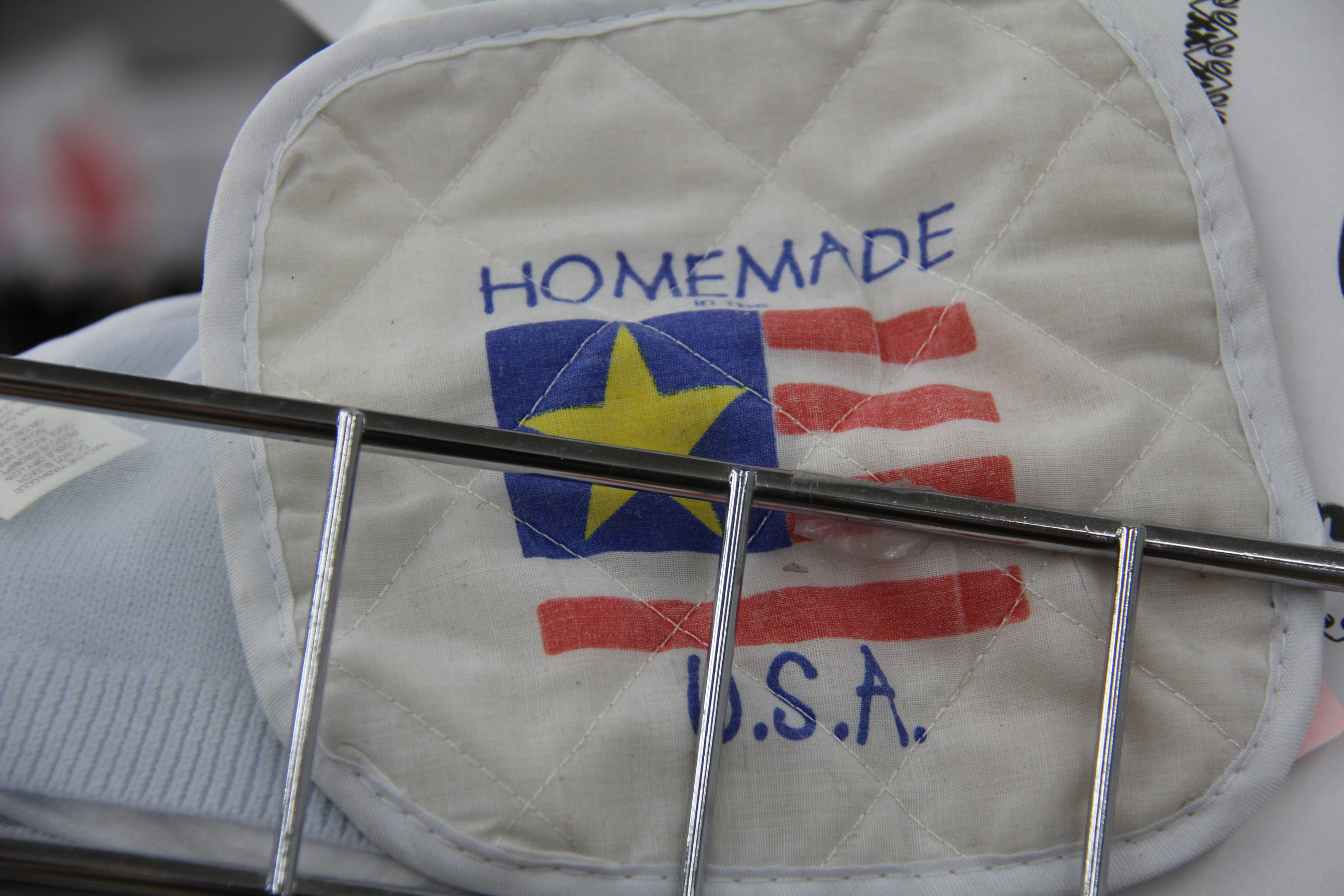
American made sold at All Seasons Thrift Store. (Minnesota Prairie Roots copyrighted photo June 2024)
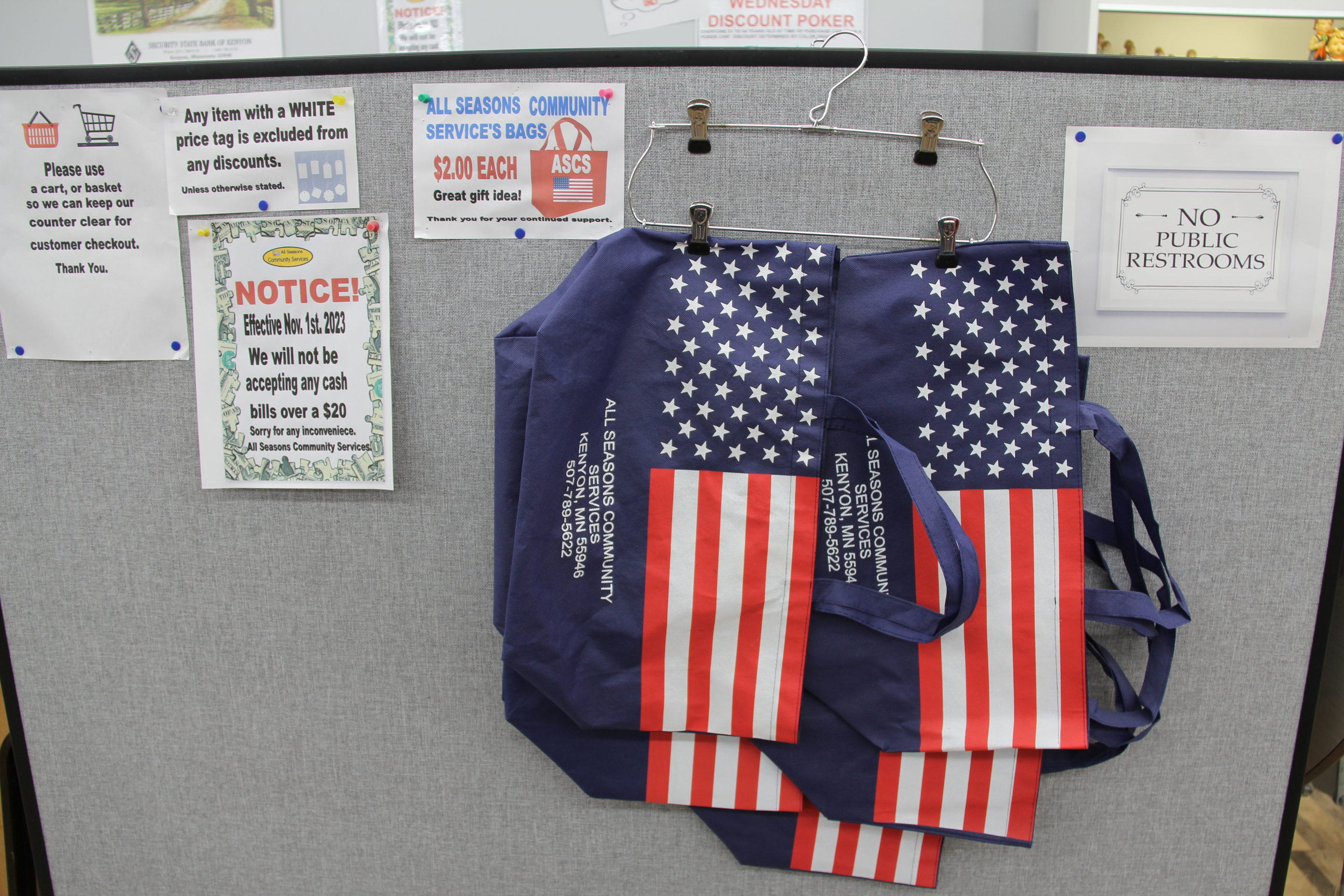
Patriotic bags for sale in the thrift shop. (Minnesota Prairie Roots copyrighted photo June 2024)
Flags fly. Kitschy yard art celebrates the Fourth. Even inside a thrift store, American pride shows.
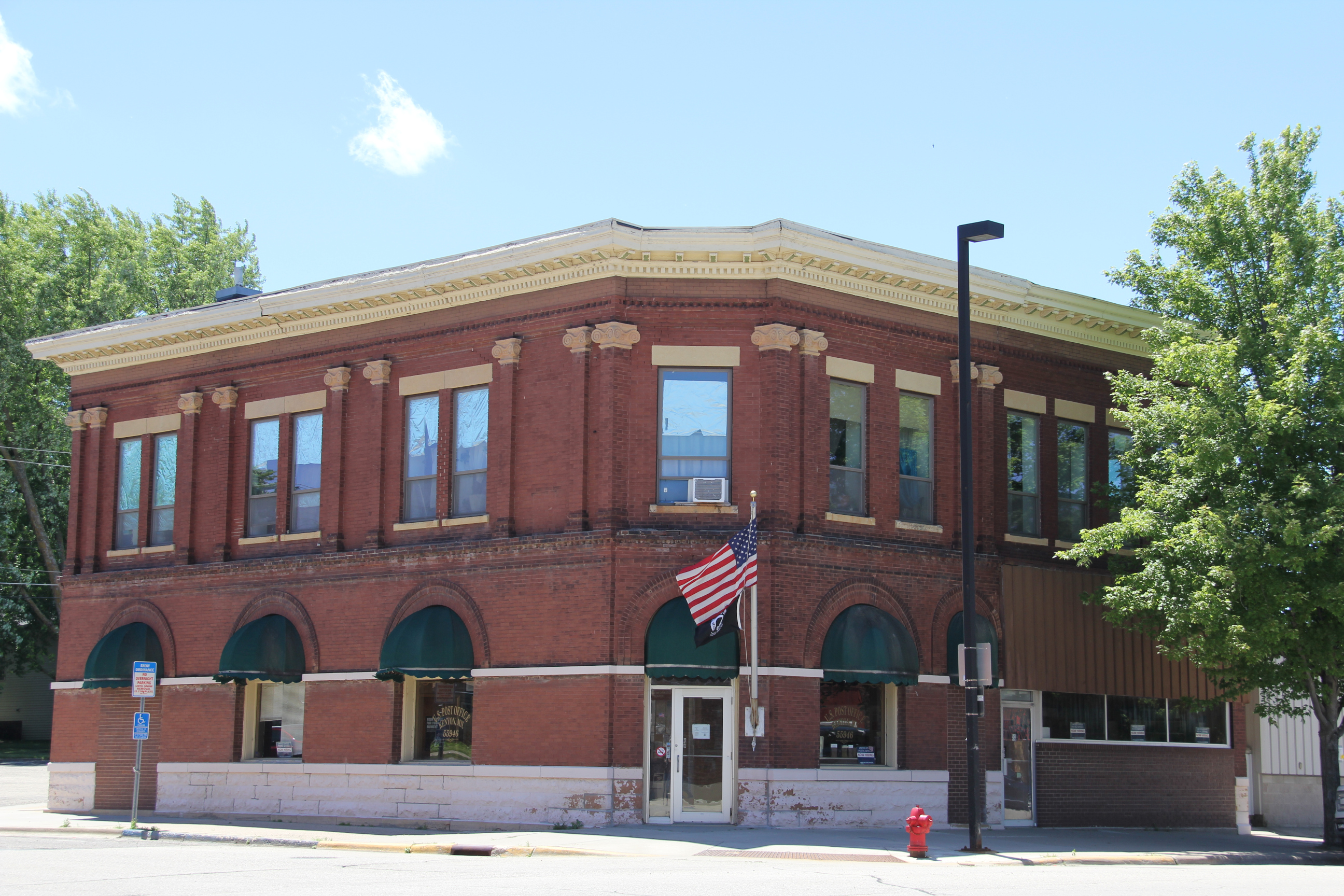
An American and MIA flag fly at the Kenyon Post Office. (Minnesota Prairie Roots copyrighted photo June 2024)
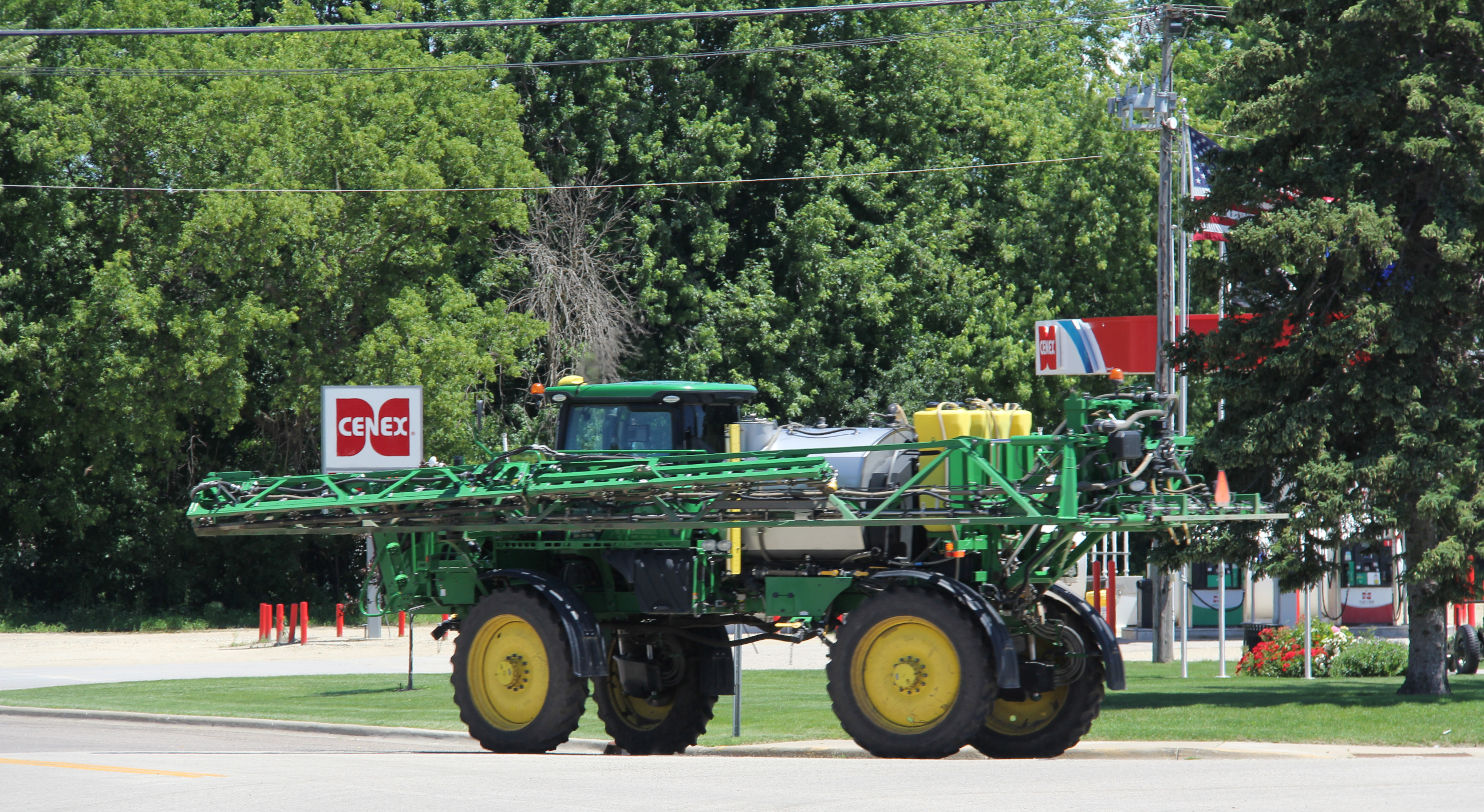
An American flag is barely visible to the right as a sprayer passes Kenyon’s veterans’ memorial. (Minnesota Prairie Roots copyrighted photo June 2024)
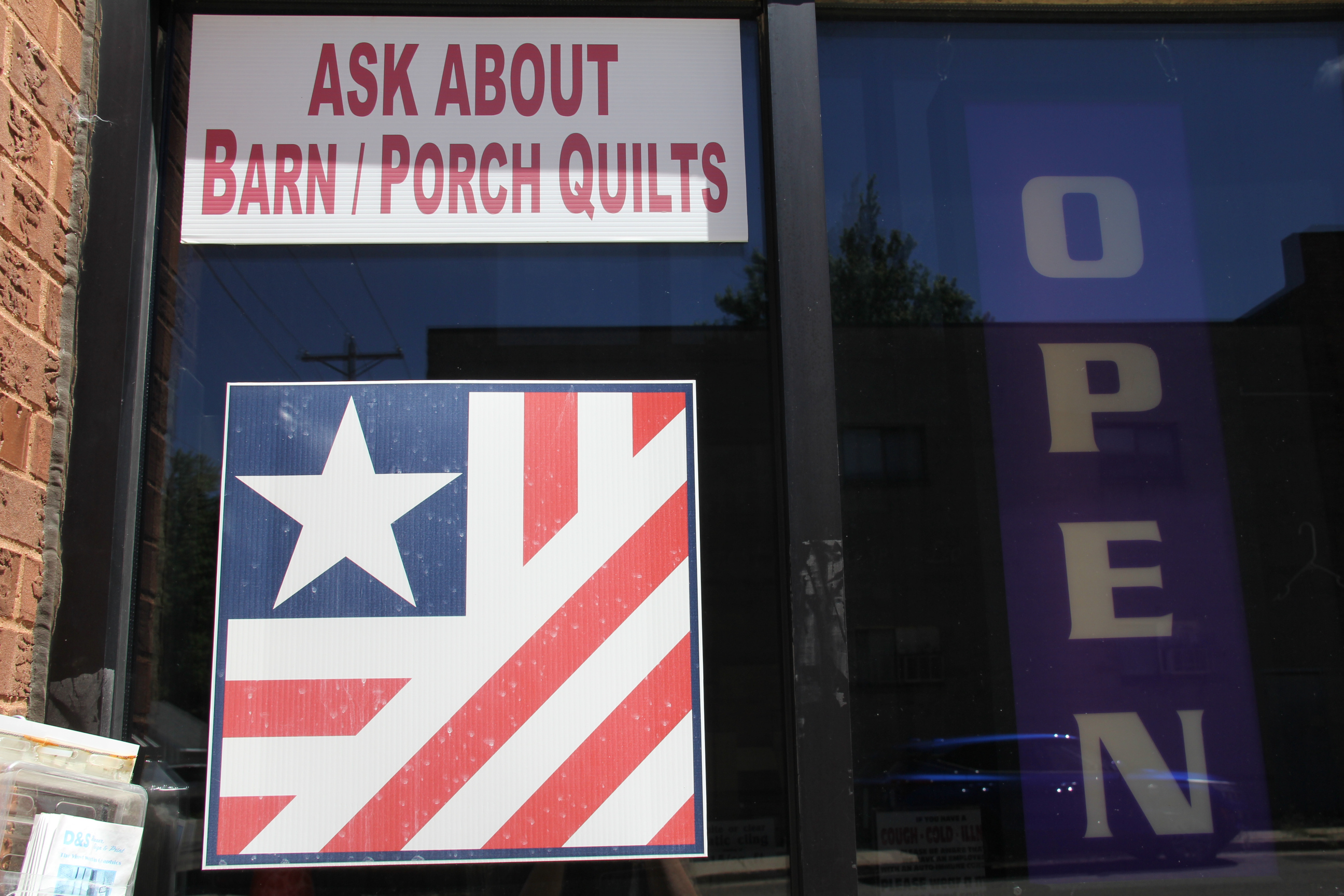
A patriotic barn and porch quilt, available at D & S Banner, Sign & Print. (Minnesota Prairie Roots copyrighted photo June 2024)
This is America. From small town to big city. From coast-to-coast. No matter where we live in this big wide country, we are, today, one nation celebrating the birth of our nation.
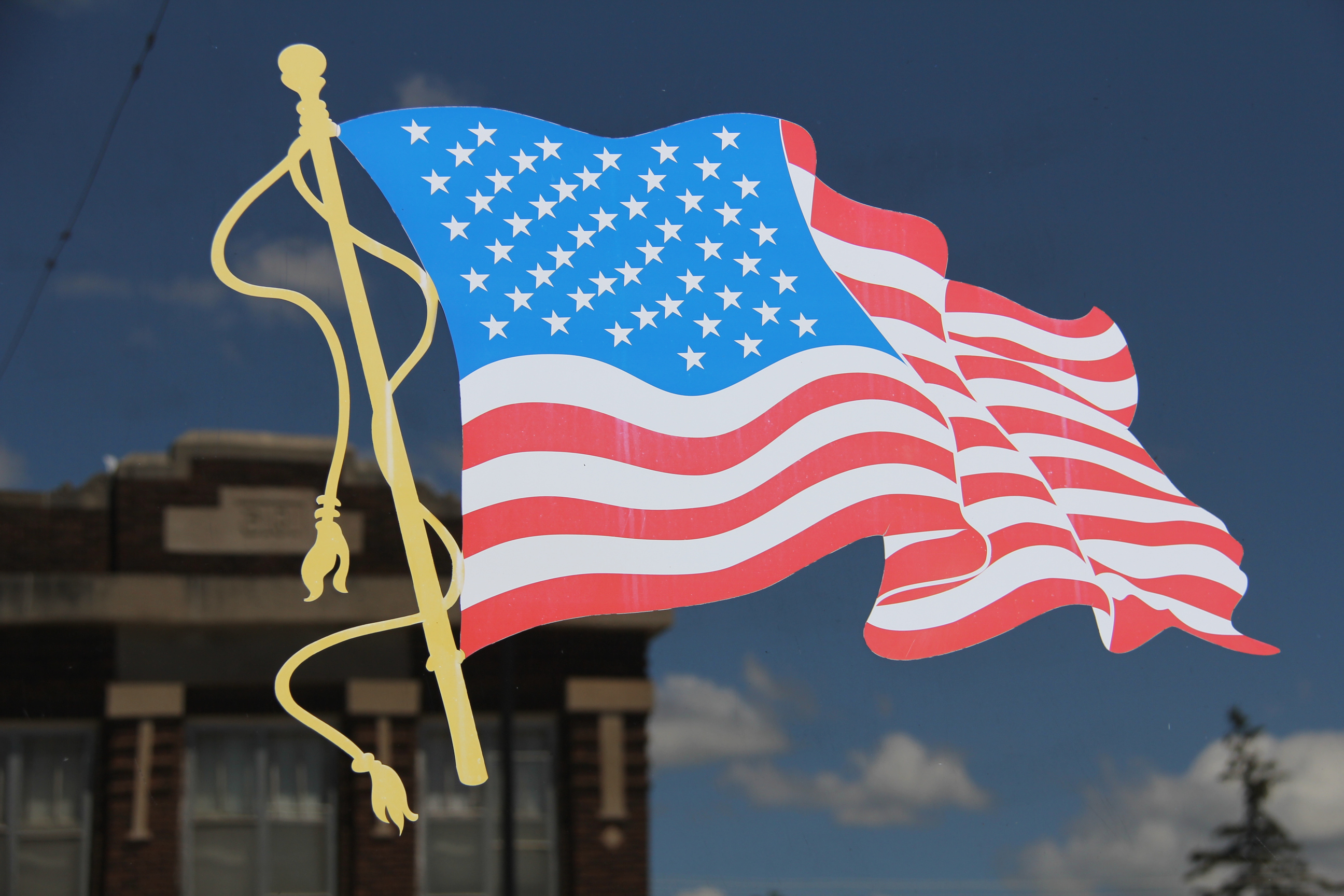
One of several flag decals in the windows of the VFW. (Minnesota Prairie Roots copyrighted photo June 2024)
Happy birthday, America! And happy Fourth of July, dear readers!
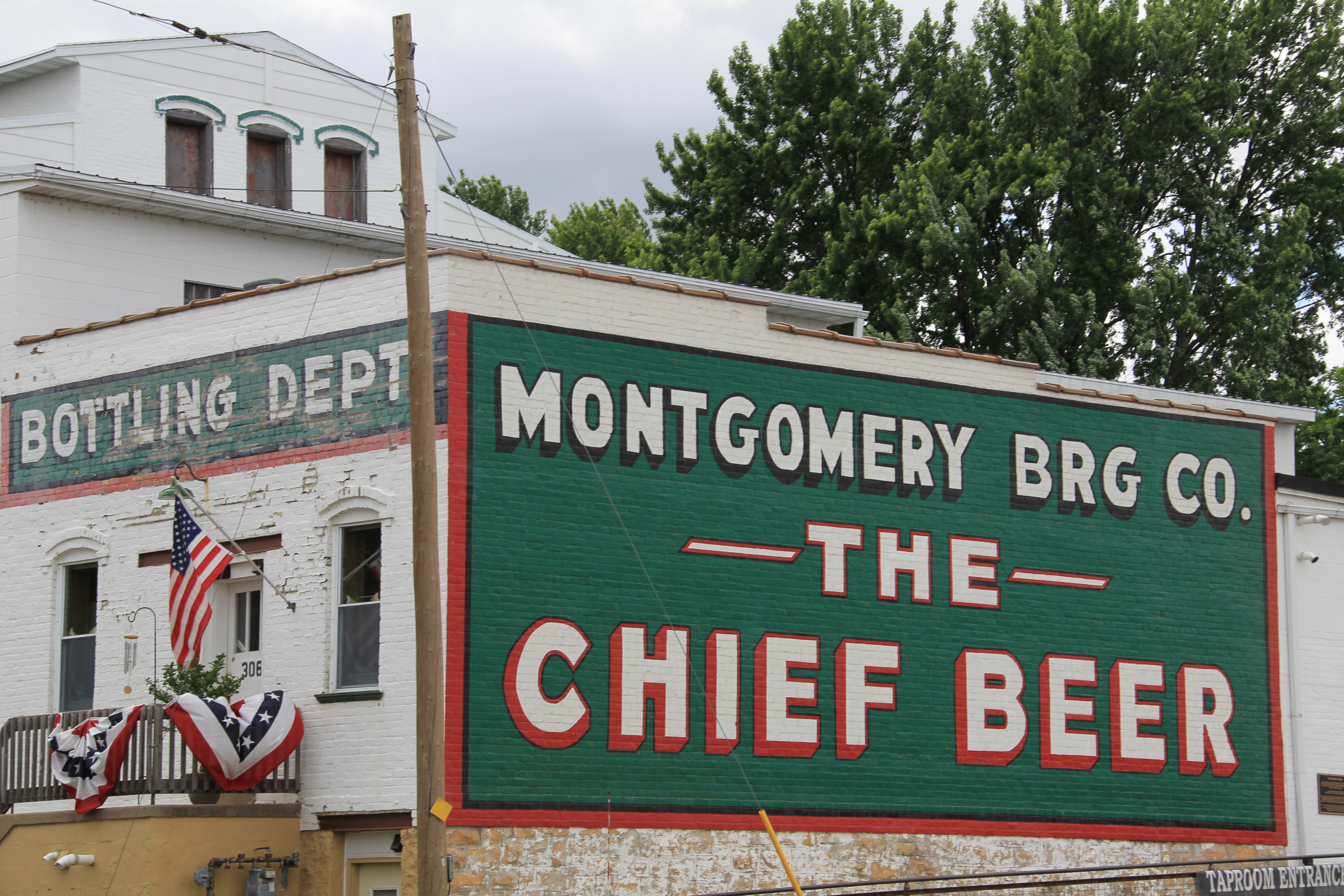
American pride displayed at a brewery in Montgomery, Minnesota. (Minnesota Prairie Roots copyrighted photo June 2024)
O say, does that star-spangled banner yet wave
O’er the land of the free and the home of the brave.
A flag flies from the popular Franke’s Bakery in downtown Montgomery. (Minnesota Prairie Roots copyrighted photo June 2024)
How often have you sung those words, heard those lyrics, considered the meaning of our national anthem? Perhaps, after time, the words have become simply rote, voiced without much thought of their meaning.
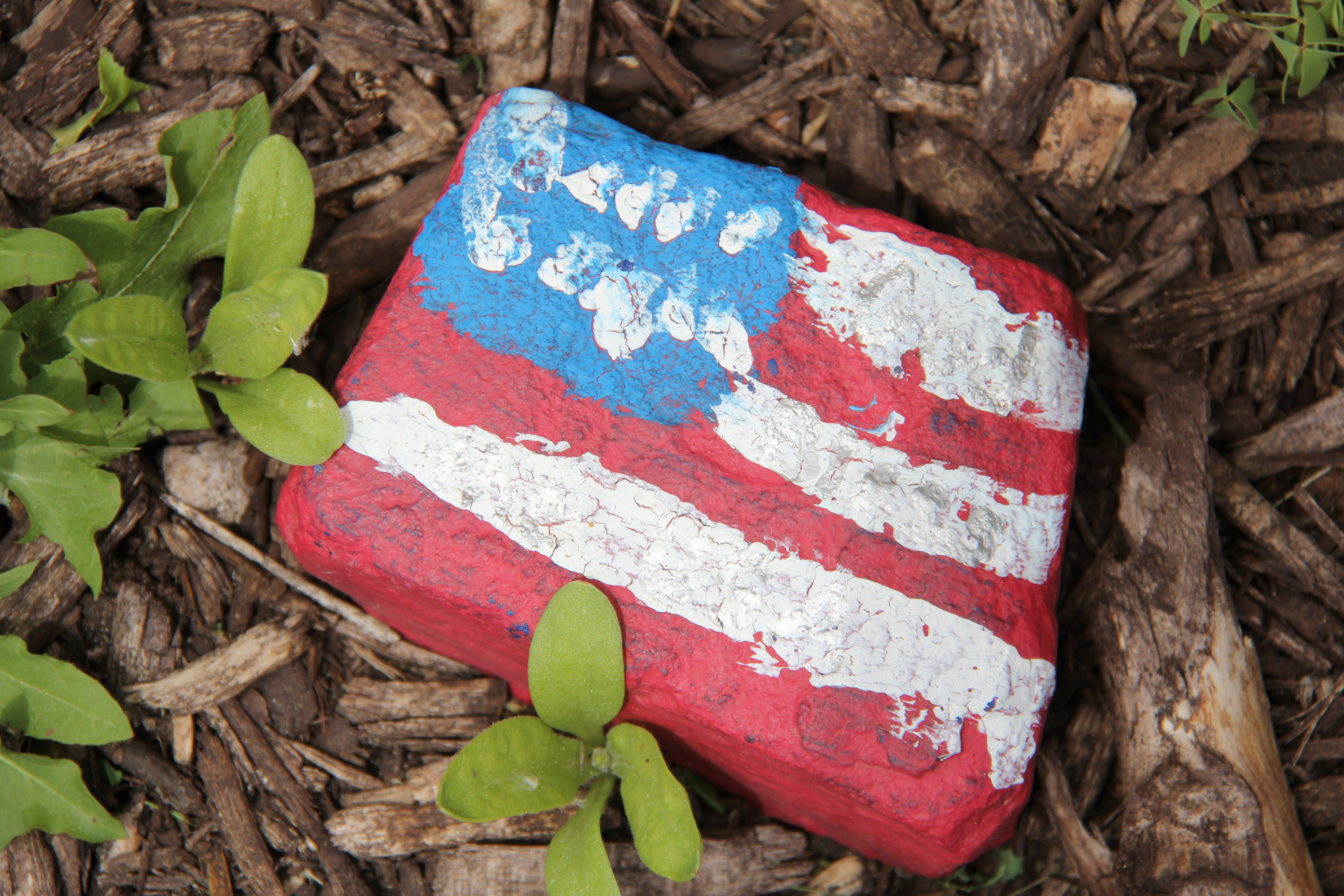
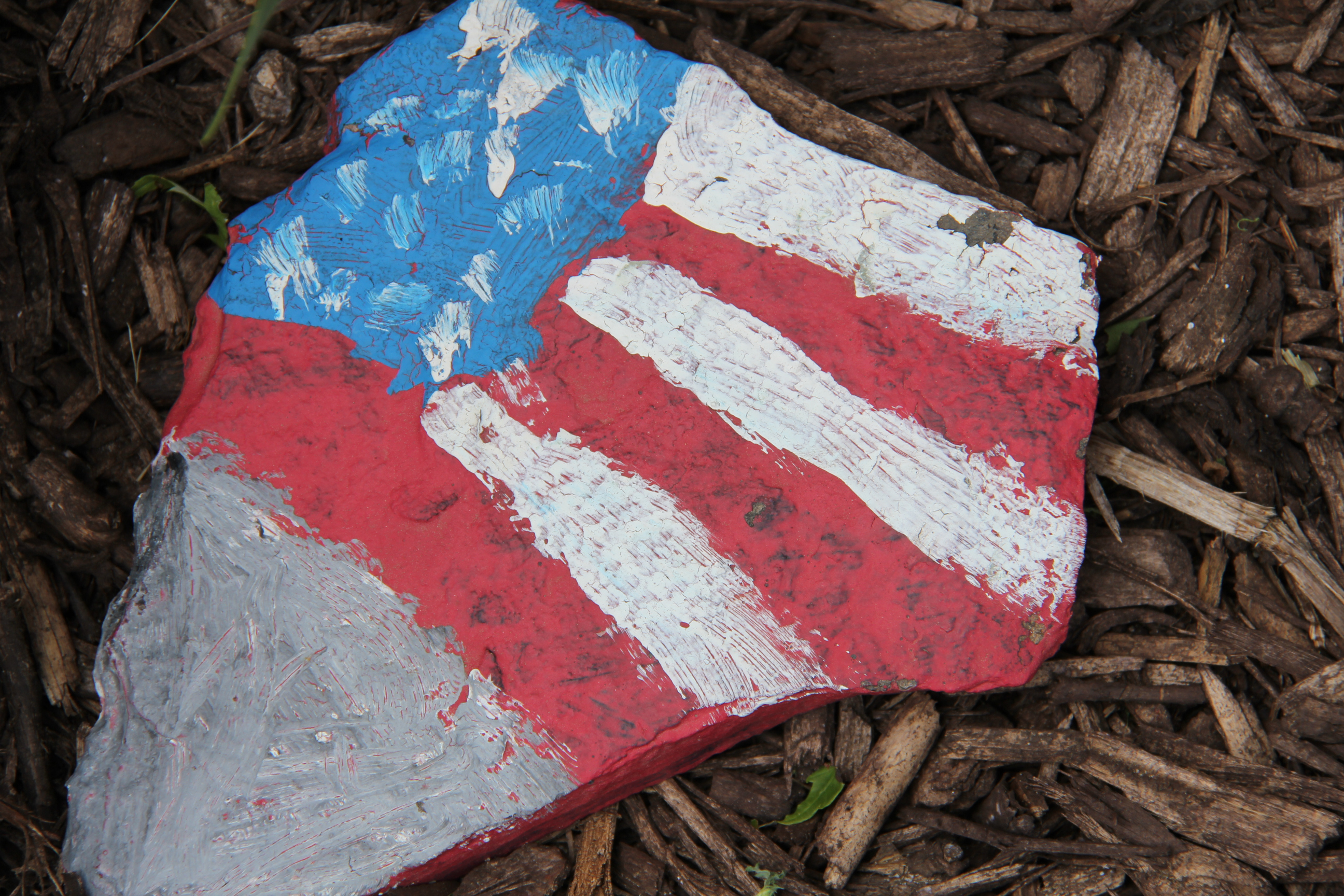
A flag rock in a flower garden at Most Holy Redeemer Catholic School. (Minnesota Prairie Roots copyrighted photo June 2024)
Our nation’s birthday seems a good time to ponder the depth of bravery required to attain and maintain our freedom. It’s come at great cost with loss of life and physical, mental and emotional trauma. And, at times, with events that have rocked the very core of our democracy.
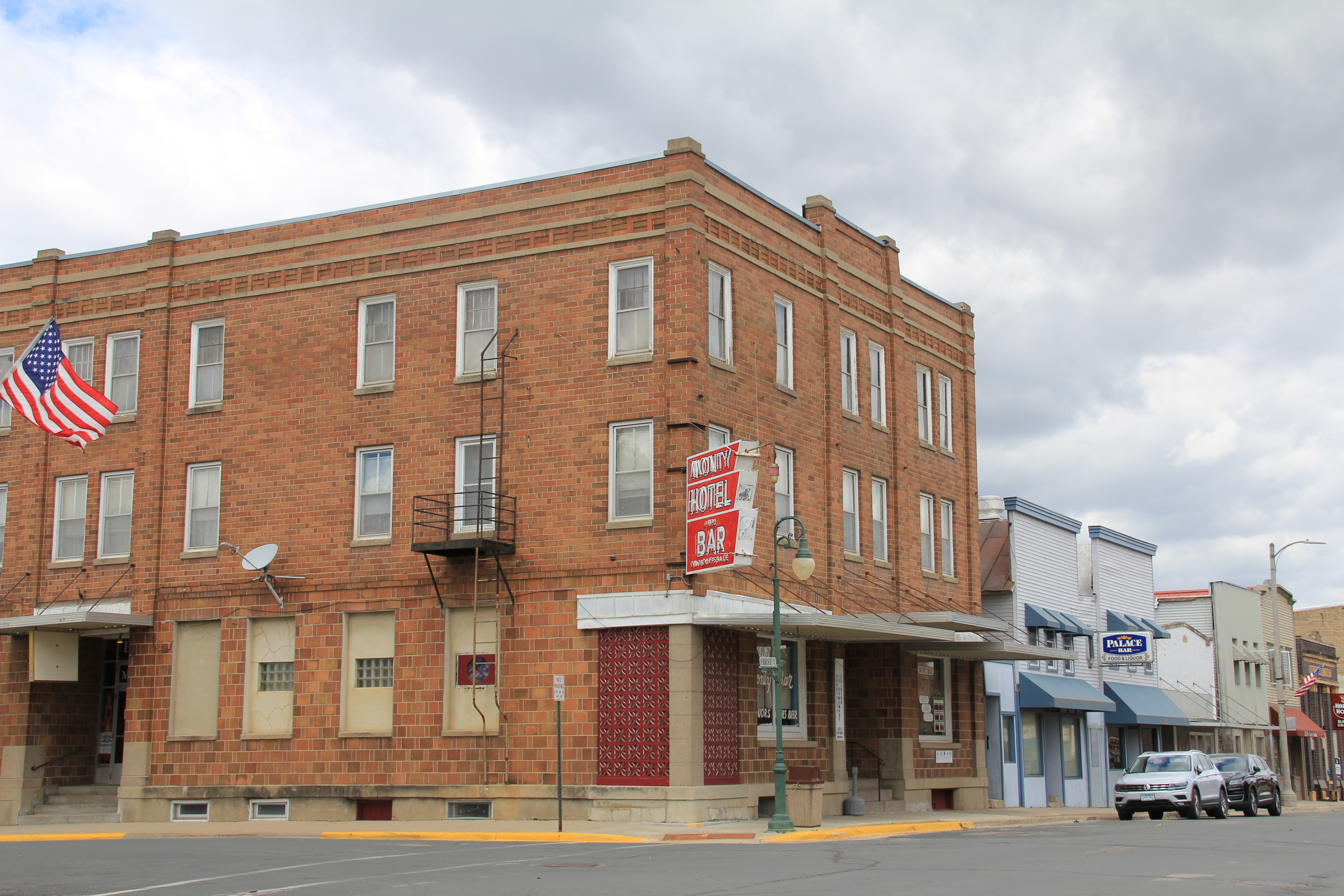
A flag flies near The Monty Bar, a mammoth building anchoring a corner. (Minnesota Prairie Roots copyrighted photo June 2024)
Through everything, our flag still waves—sometimes tattered, torn and abused—but still there. A symbol of our country and the freedoms we live.
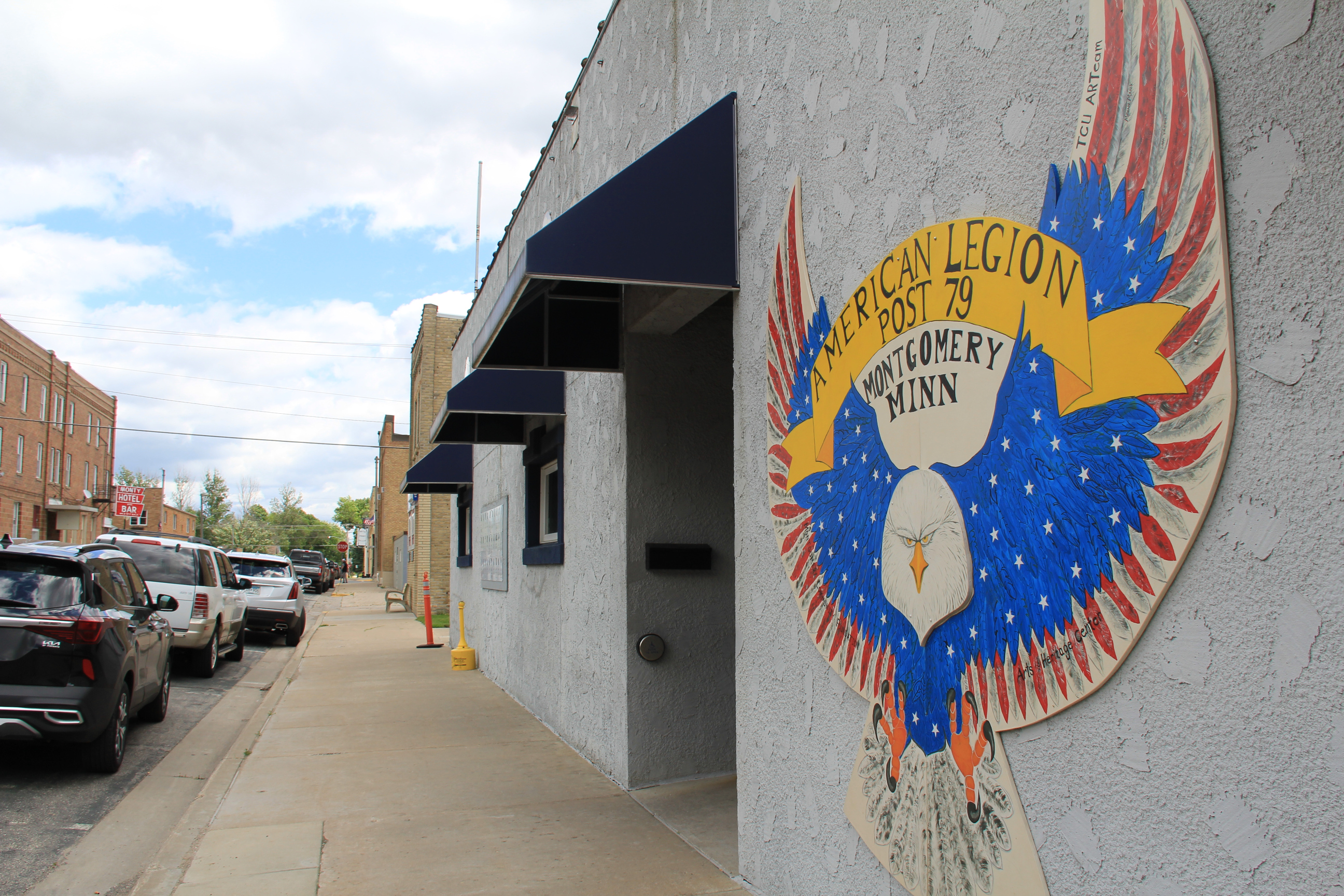
Patriotic art on Legion Post 79 is part of The Montgomery Wings Mural Walk. (Minnesota Prairie Roots copyrighted photo June 2024)
It always amazes me how small towns, especially, fly so many American flags. Take Montgomery, a southern Minnesota community that honors its veterans with photos and bios of them posted throughout the downtown area. Montgomery also flies a lot of U.S. flags.
To the far right in this photo, an oversized flag flies along Main Street Montgomery. (Minnesota Prairie Roots copyrighted photo June 2024)
Those flags mostly grace lampposts, but also flagpoles, businesses and flower gardens. The red-white-and-blue flashes color into Main Street and elsewhere, creating a visual of patriotism. There’s something about a crisp, new American flag publicly displayed that swells the heart with love of country.
Another flag rock in a Most Holy Redeemer garden. (Minnesota Prairie Roots copyrighted photo June 2024)
My country ‘tis of Thee, sweet land of liberty of Thee I sing…let freedom ring.
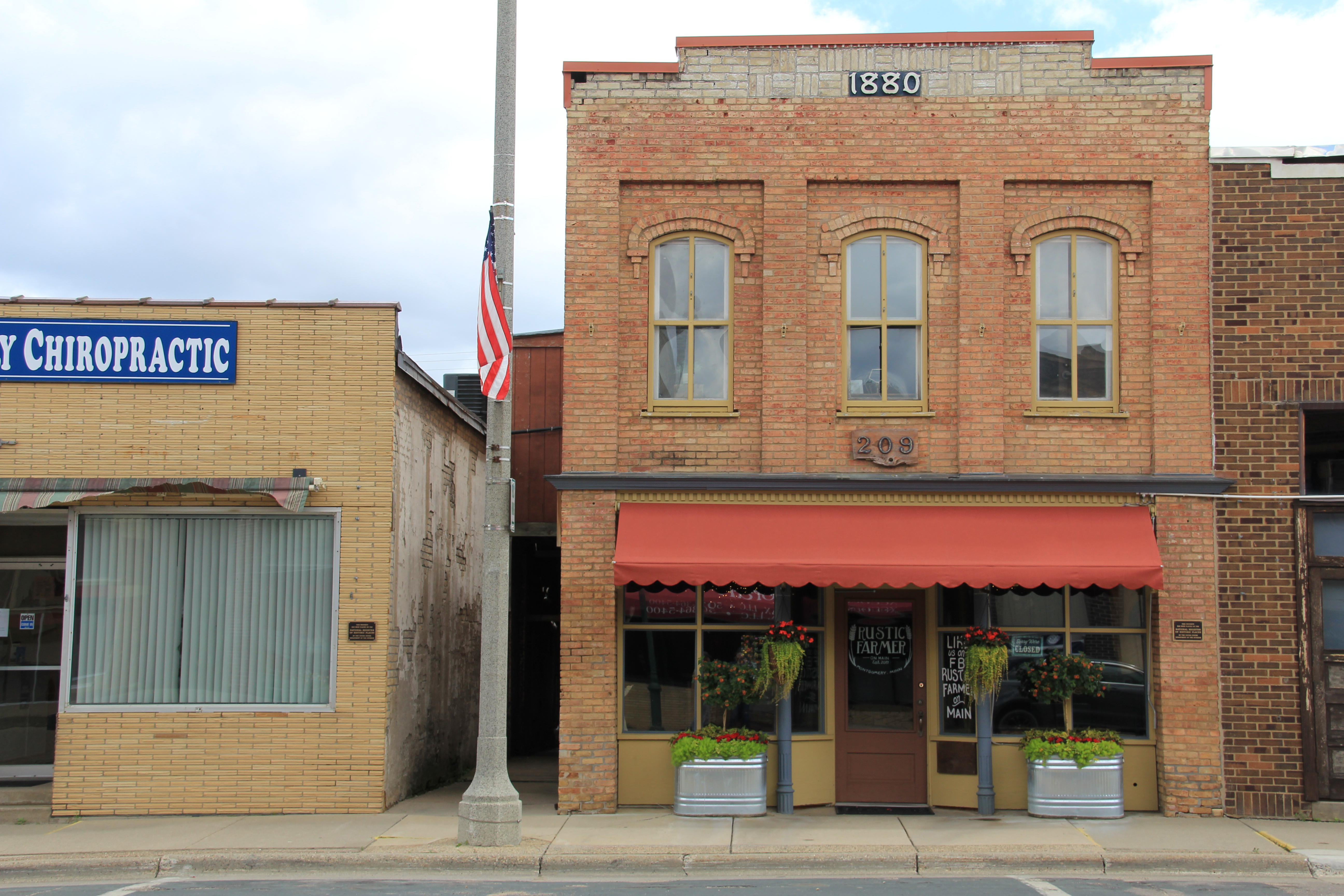
A flag drapes on a pole outside The Rustic Farmer on Main, an event center and community gathering spot in Montgomery. (Minnesota Prairie Roots copyrighted photo June 2024)
Let freedom ring, unsuppressed by anyone who may attempt to silence it via words, actions, ego, authority. Let freedom ring strong and loud in this land.
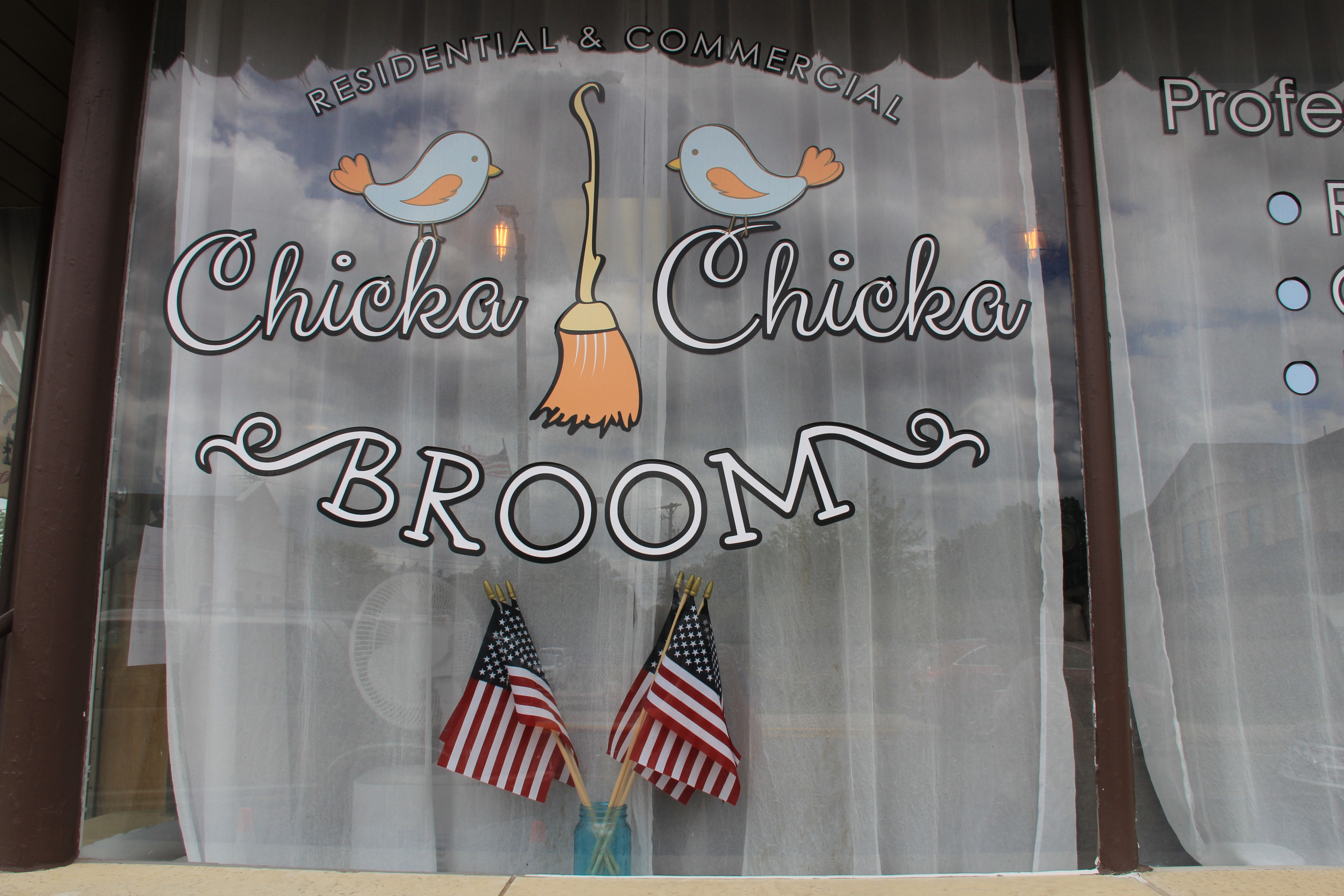
Even small flags like this in the storefront window of a cleaning service make an impact. (Minnesota Prairie Roots copyrighted photo June 2024)
Let the flag fly as a symbol of a free people, a free country, where democracy is to be valued, cherished and respected.
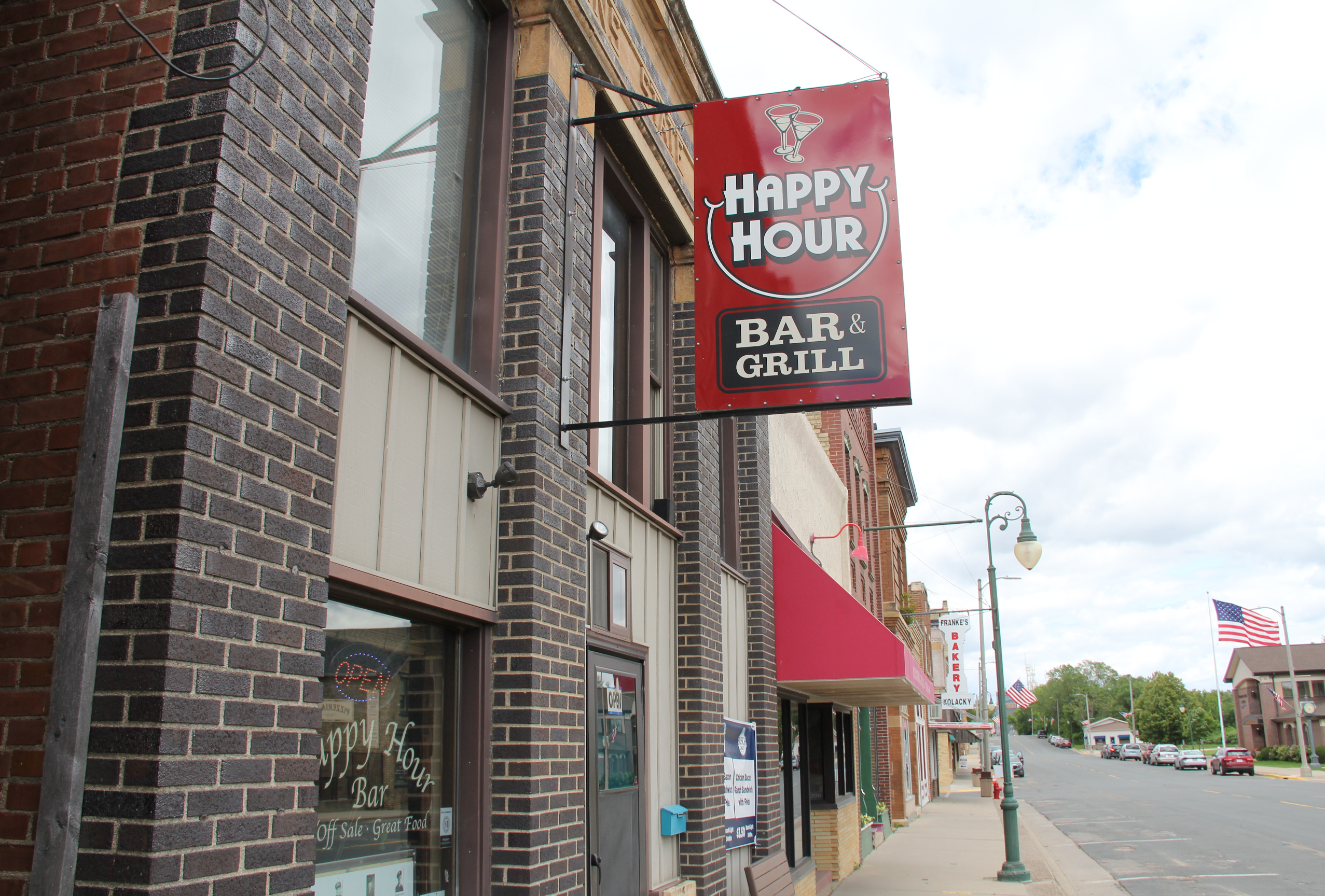
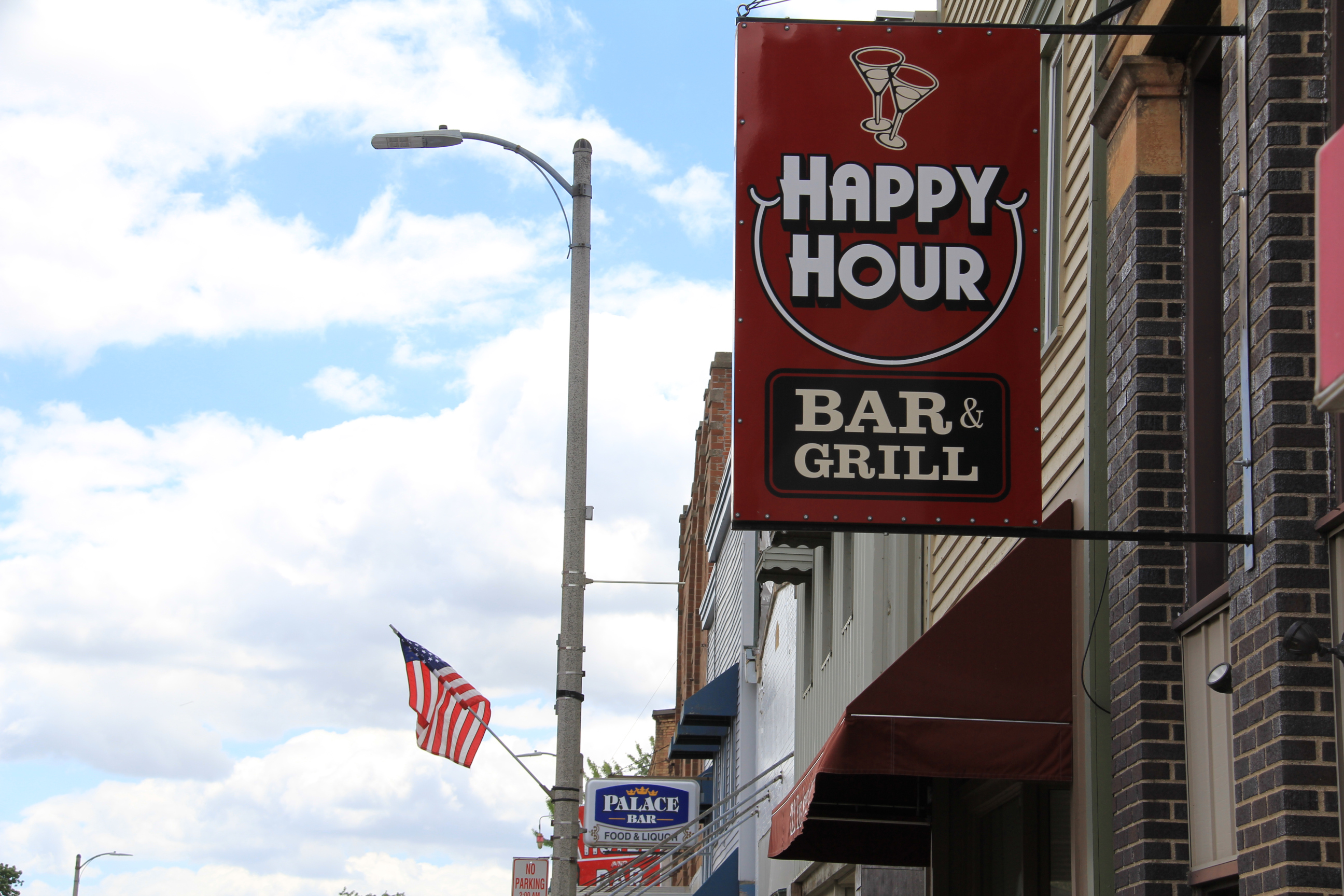
Montgomery has a lot of drinking establishments and a lot of American flags. (Minnesota Prairie Roots copyrighted photo June 2024)
This Fourth of July, the 248th birthday of the United (emphasis on united) States of America, let’s remember the freedoms we have and vow to always honor them. Always.
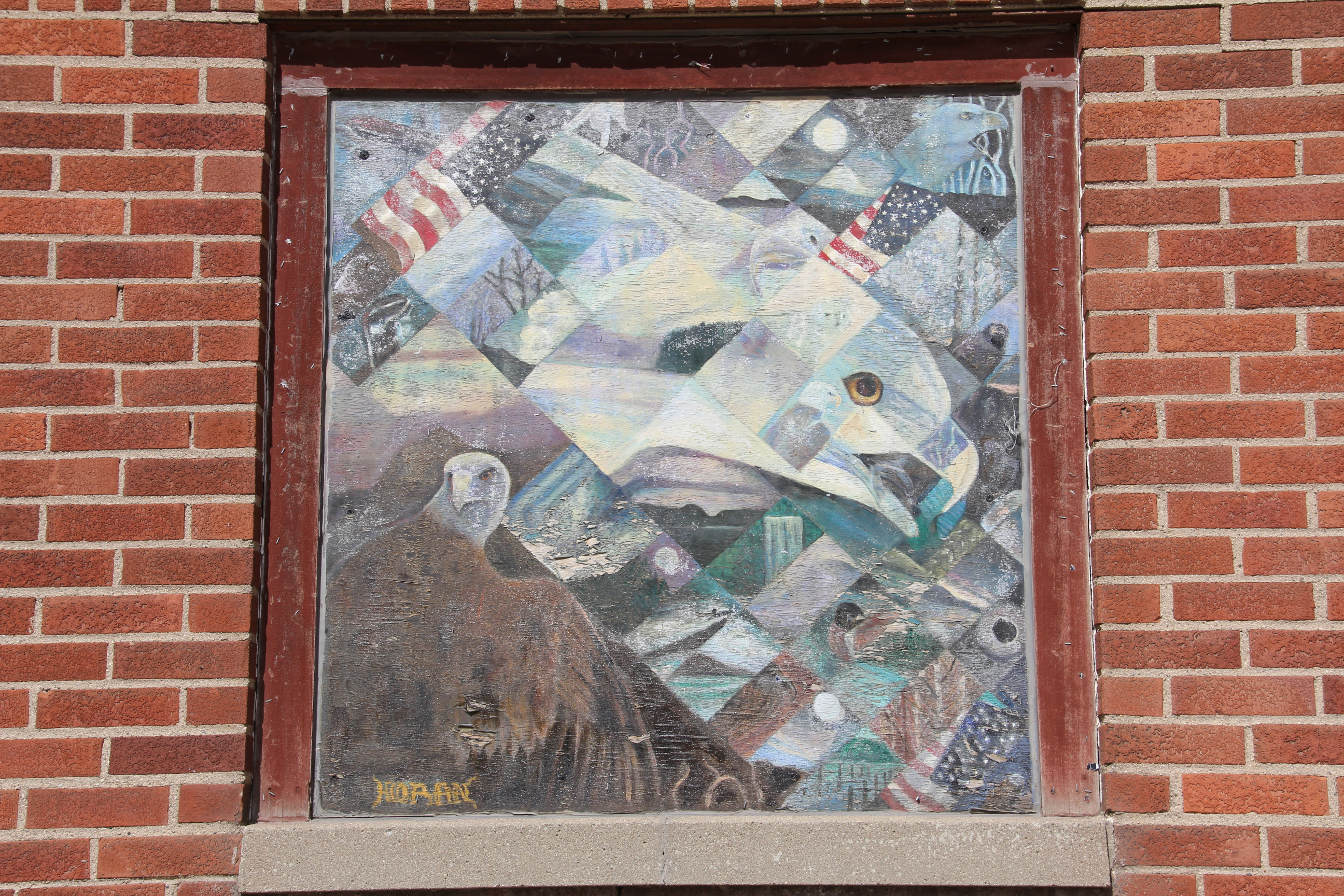
This eagle graces the veterans’ memorial in Morristown. (Minnesota Prairie Roots copyrighted file June 2024)
AMERICAN FLAGS, eagles, freedom, democracy…those symbols, those words imprint upon my vision, upon my mind as I consider our nation’s 248th birthday on July 4.
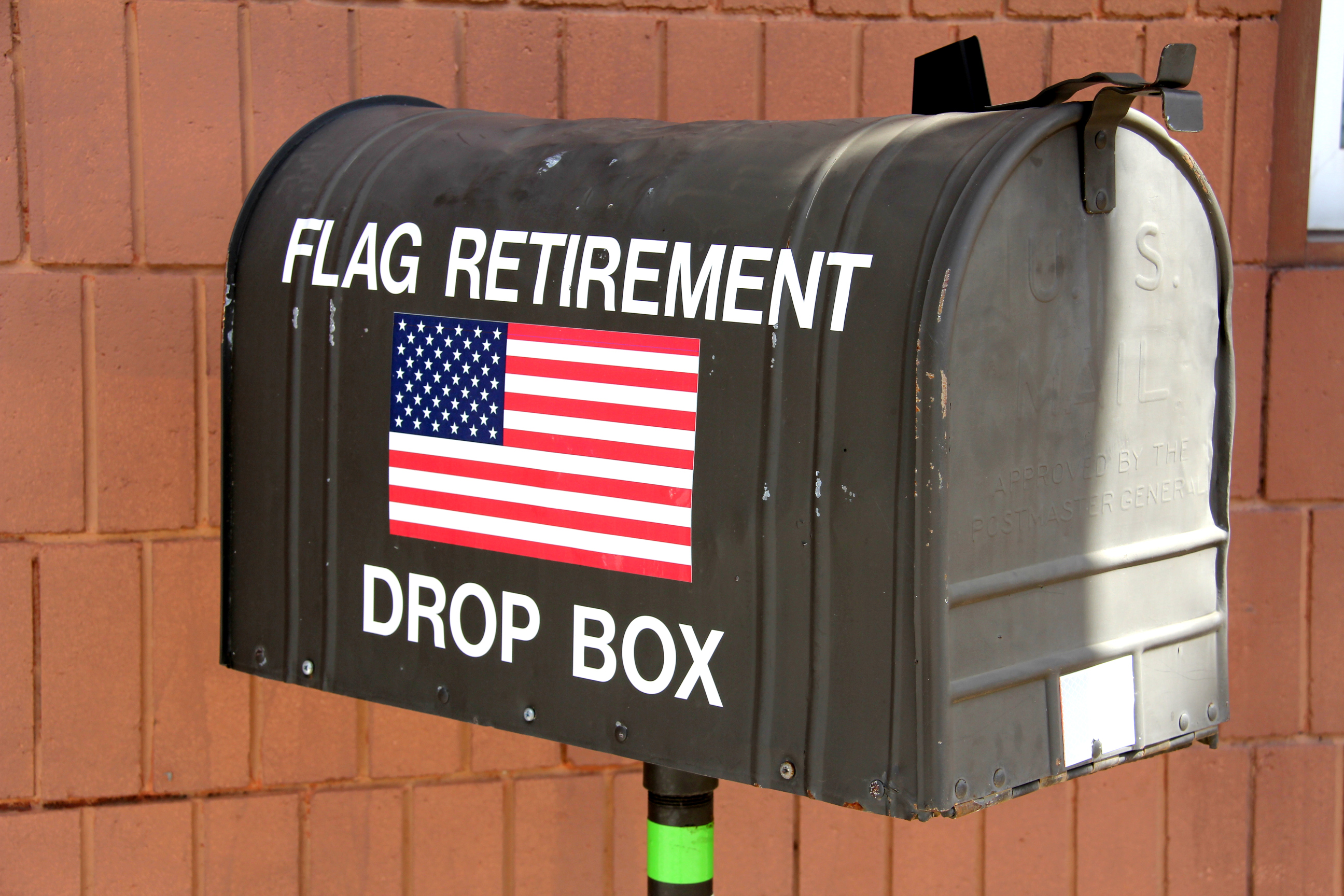
Outside the Morristown Legion, a place to dispose of worn out American flags, which are then burned in a special ceremony held by Legion members. (Minnesota Prairie Roots copyrighted photo June 2024)
Admittedly, recent years have proven challenging on so many levels in our country. Division, chaos, discontent have been all too common. That cannot be denied. But, on the Fourth of July, I hope we can all pause, set aside our differences, and appreciate the freedoms we have as U.S. citizens. I hope we understand, too, that our freedoms should never be taken for granted. Ever.
Eagle art on the exterior of the Corner Bar in Waterville. (Minnesota Prairie Roots copyrighted photo June 2024)
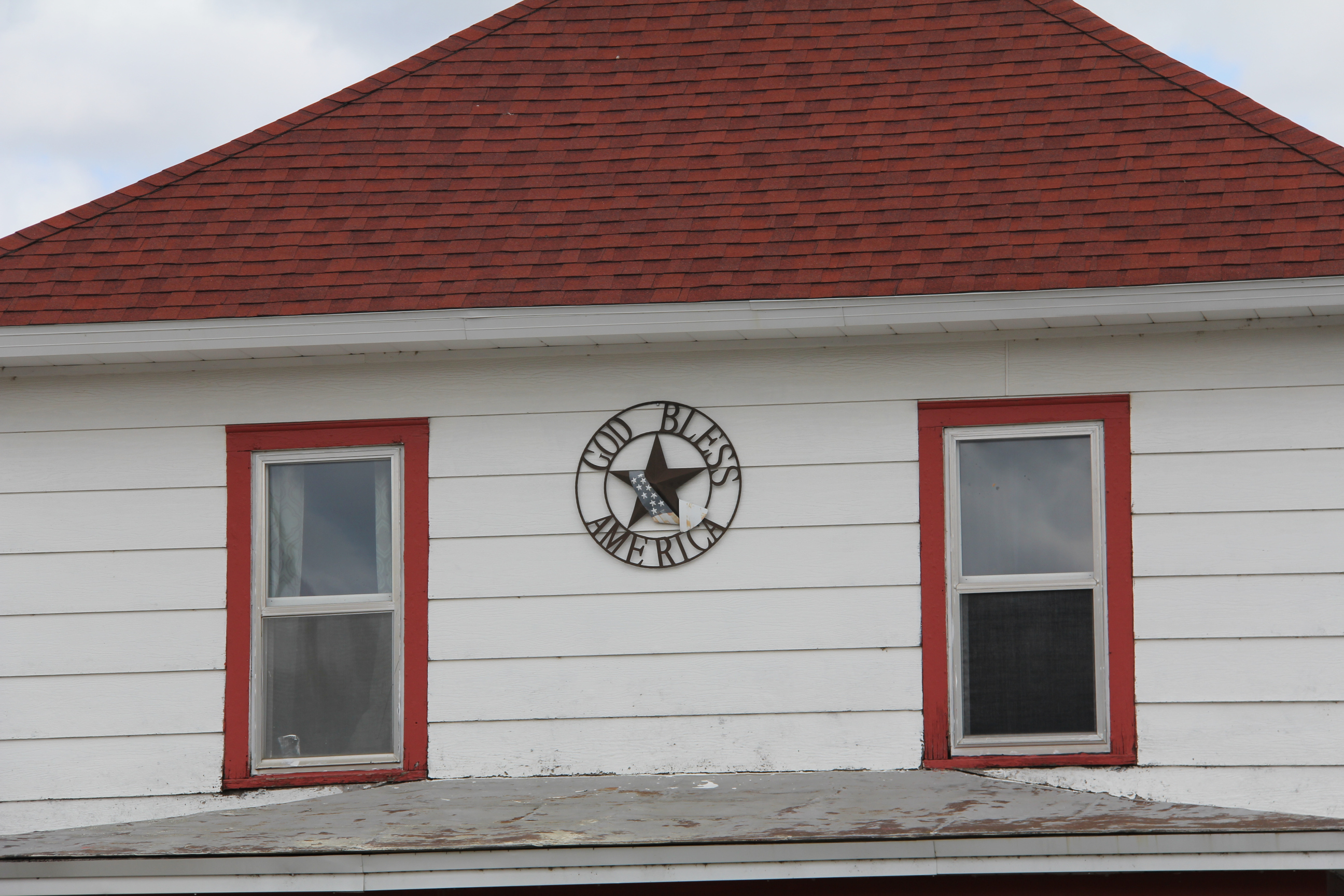
A message spotted on a house in downtown Waterville. (Minnesota Prairie Roots copyrighted photo June 2024)
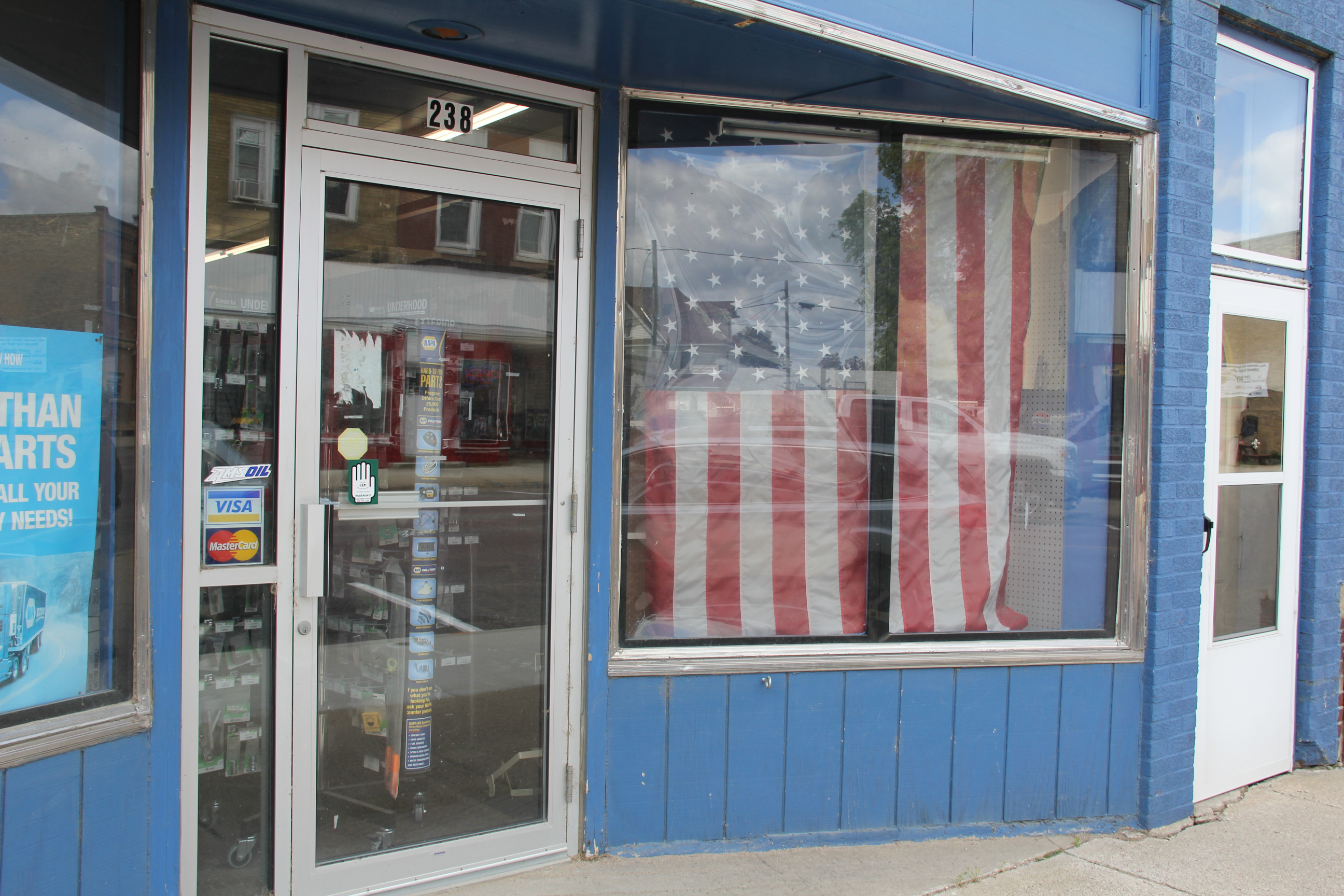
Patriotism in the front window of Twin Lakes Auto Parts in Waterville. (Minnesota Prairie Roots copyrighted photo June 2024)
On recent day trips to small southern Minnesota communities, I captured images that express love of country. I appreciate those displays of American pride seen along Main Streets. From flags to messages to art, these are reminders that our democracy is to be cherished and celebrated.
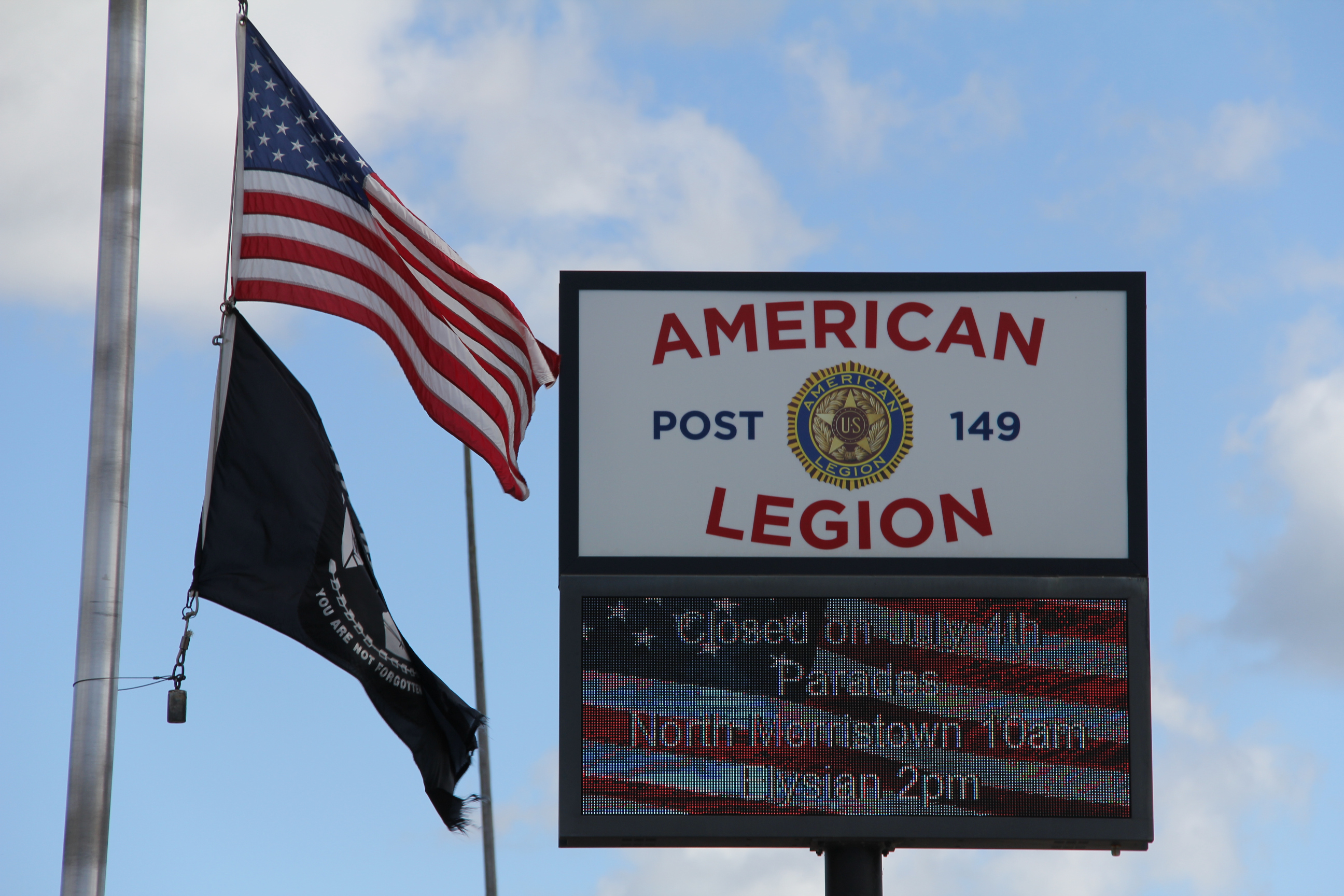
Nearby July 4 celebrations are promoted on the Morristown Legion sign. (Minnesota Prairie Roots copyrighted photo 2024)
All across my region of Minnesota, small towns host July Fourth celebrations. Families and neighbors gather for backyards BBQs. Kids wave flags. Fireworks erupt in the black night sky.
Posted in the window of Bridge Square Barbers in Northfield. (Minnesota Prairie Roots copyrighted photo June 2024)
There is reason to feel jubilant and hopeful and proud to be an American.
My dad carried home a July 31, 1953, memorial service bulletin from Sucham-dong, Korea. In the right column is listed the name of his fallen buddy, Raymond W. Scheibe. Minnesota Prairie Roots file photo.
MEN AND WOMEN have fought and died for our democracy.
A chair placed before a Stephen Somerstein photo offers visitors a place to sit and contemplate. This photo was taken at the “Selma to Montgomery: Marching Along the Voting Rights Trail” exhibit at St. Olaf College in 2015. Minnesota Prairie Roots file photo.
Men and women and children have marched for equality. And they still are.
A portion of a photo by Steve Somerstein, from the exhibit at St. Olaf College. Minnesota Prairie Roots file photo 2015.
There was a time not all that long ago when people of color and women did not have the right to vote.
A message posted on a house in Dundas. Minnesota Prairie Roots file photo August 2020.
It is our responsibility as citizens of the United States of America to vote. To let our voices be heard. To exercise our freedom. To cut through the political rhetoric and untruths to make informed choices. To recognize that in a democracy, every vote matters.
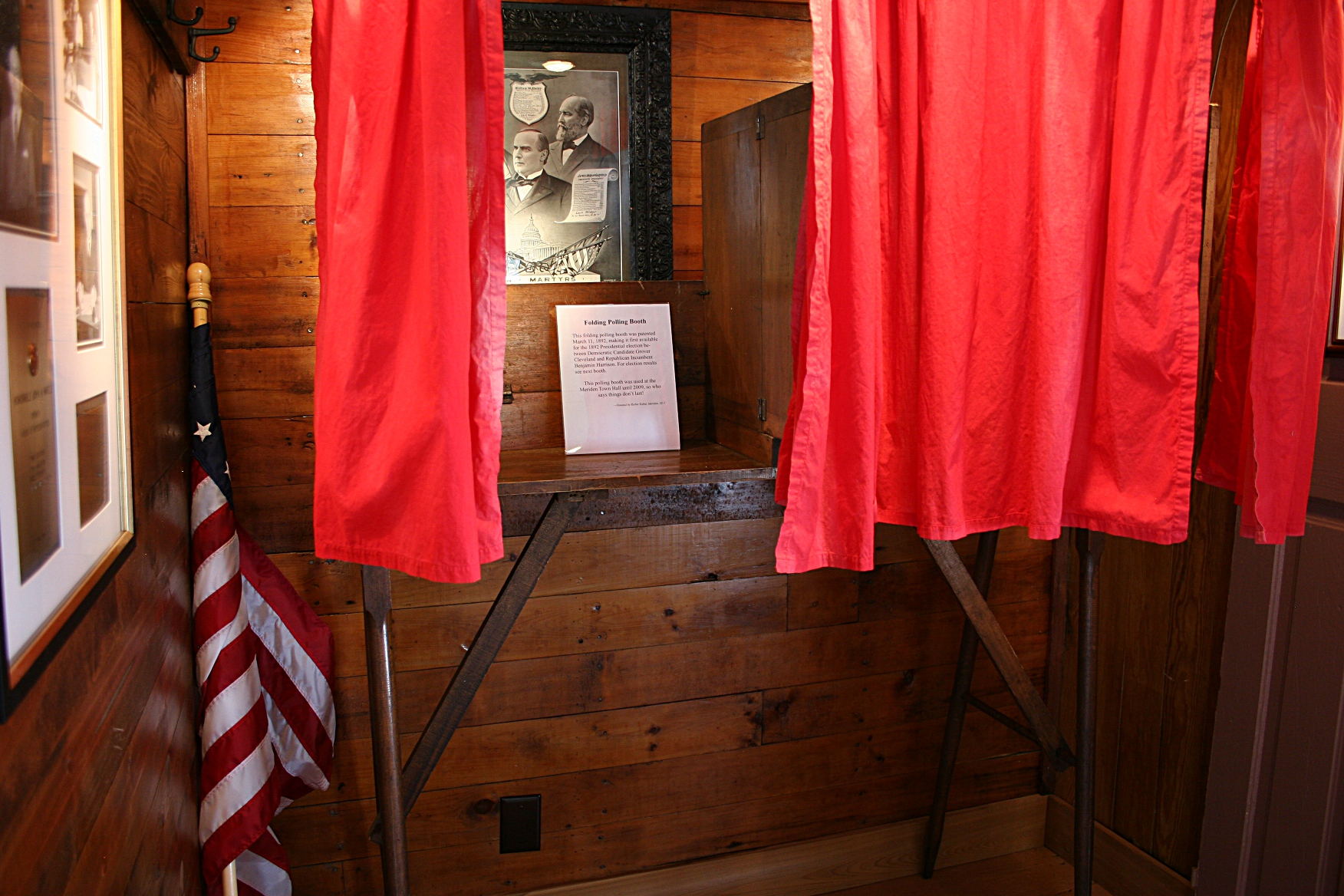
This folding polling booth, patented in March 1892, is on display at the Village of Yesteryear in Owatonna. It comes from the Meriden Town Hall, where voters used it until 2009. Minnesota Prairie Roots file photo July 2012.
If you have not yet voted, then get to your polling place today and cast your votes. I voted early, via mail-in ballot. And, yes, I hold full confidence in that system.
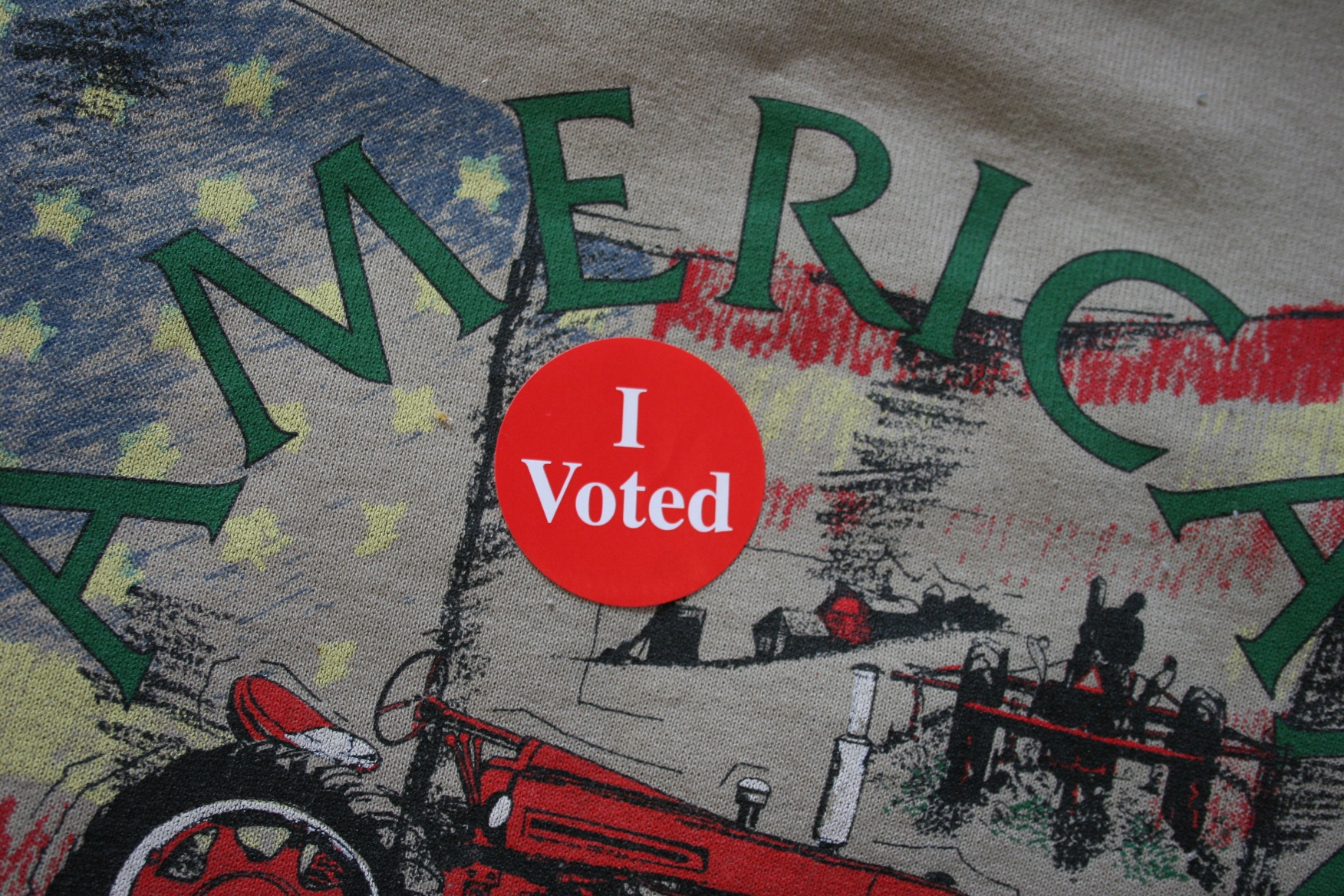
Randy put this sticker on his sweatshirt after voting in the 2010 election. Minnesota Prairie Roots file photo.
And then, like the rest of you, my dear Americans, I will wait, recognizing I have done my part by voting, by exercising my democratic right.
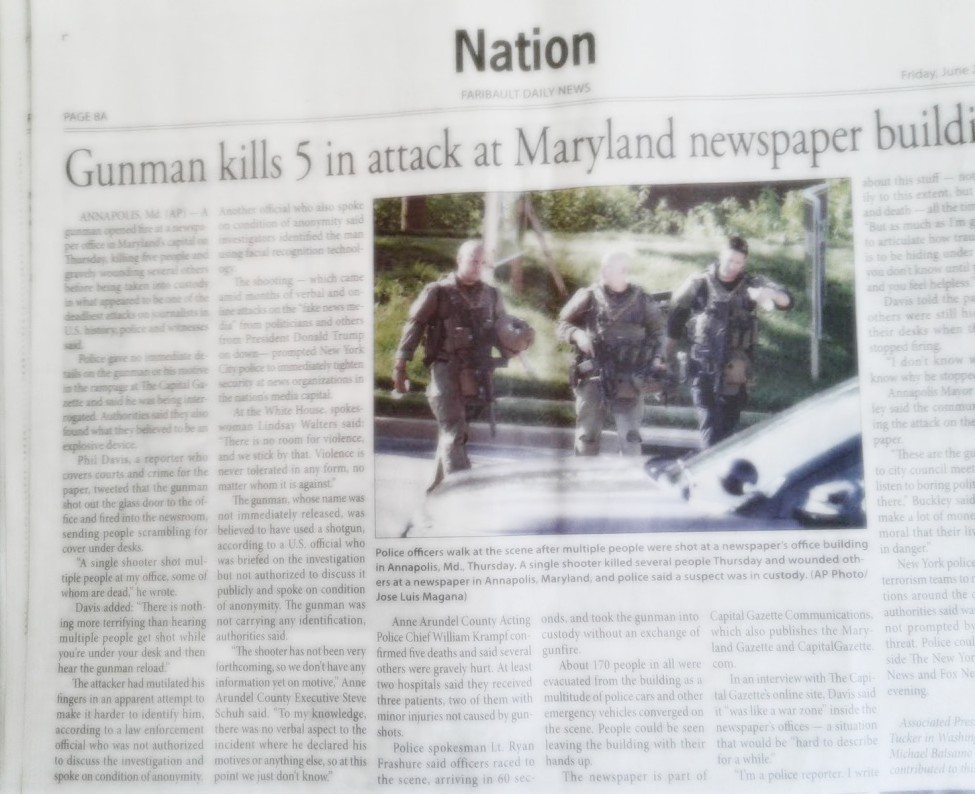
I’M A FORMER NEWSPAPER reporter and photographer. As such, the killings of five employees in The Capital Gazette newsroom just days ago affects me in a way it may not non-journalists.
The single phrase that repeated through my mind: He (the suspect) really did kill the messengers (newspaper employees). The alleged shooter apparently held a grudge against the Gazette for writing about his conviction for stalking a woman.
Too often I’ve heard people attack and criticize reporters for doing their jobs of reporting the news. Journalists are blamed for whatever is negative. It’s an unfair accusation. Do not kill the messenger. The reporter did not cause the bad thing that now banners the newspaper.
If journalists report only the good news or whatever is spun to them, then they are nothing more than pawns, propaganda tools, mouthpieces. These are difficult times to be a journalist with the constant spewing of the words “fake news” and open hostility and name-calling at the highest levels of government. Democracy needs a free and open press. The press is not the enemy.
I experienced firsthand efforts to suppress my reporting while working in the profession decades ago. In small town Minnesota. How dare I attend a school board meeting and quote a teacher who didn’t want his comment, made at an open, public meeting, printed. My editor backed me up. But I had to endure the ire of that teacher and his superintendent for the rest of my stay in that rural community.
Likewise, a prominent businessman in the same county seat town harassed me for quoting him at a city planning meeting. When I moved to another job with a regional daily working in a satellite news bureau, I encountered the same hostility from a superintendent who didn’t like my story on a student walk-out. He treated me with absolute contempt, behavior which I found (and still find) totally unprofessional for an educator.
Then there was the sheriff’s department employee who wanted to withhold public information from me when I was gathering facts in a drug case.
There are those who will argue that the media deserve the contempt and criticism heaped on them. There are those who will say media people are nothing but a bunch of biased liberals. There are those who will blame journalists for anything and everything. Everyone is entitled to an opinion in a free country. Not all journalists are fair or balanced in their reporting. I agree with that.
But I also come from that perspective of working in the news profession. I know how hard I worked (long and odd hours with low pay) to accurately and fairly gather and report the news. I cared that I got the story right. I think most journalists do.
A reporter at the Gazette tweeted after the shootings: “I can tell you this: We are putting out a damn paper tomorrow.” That tweet shows remarkable strength when a man with a gun has just killed the messengers in a Maryland newsroom.










Voices rise, past & present in Minnesota April 7, 2025
Tags: commentary, Congressman Brad Finstad, democracy, family legacy, farming, memories, Minnesota, opinion, Owatonna Town Hall, Rabbit Tracks, student newspaper, Town Hall, voices, Wabasso High School
I COME FROM A LONG LINE of engaged citizenry rooted in the rich dark soil of the southwestern Minnesota prairie. On that land, generations of my family used their voices and skills to create change, to make the place they called home a better place. My paternal great grandfather, Rudolph, started that engagement by helping found a Lutheran church in my hometown. Pre-building, congregants met in his farmhouse.
From that church to school boards to county boards, from elementary schools to high schools to college campuses and more, countless family members have served and continue to serve others by representing them, crafting policies, improving lives. I am proud of that legacy.
Now you might ask, what about you, Audrey? I, too, have served, but in a different capacity. I’ve never held a desire to lead, to run for elected office or even sit on a board. Rather, I’ve observed, used the written word to inform others. During my years working as a newspaper reporter, I covered endless county board, city council, planning and zoning board, school board, caucuses and other meetings. I learned a lot about how government does and doesn’t work during those many hours of scribbling notes, gathering quotes, writing news stories. I learned, too, that individual voices matter and are heard. And I shared that in my unbiased, balanced reporting.
Today I craft writing that is not straight news reporting, because I am no longer a newspaper reporter. Rather, my writing is personal and sometimes opinionated. My voice matters…as much as anyone’s.
While coming of age near the end of the Vietnam war, I began writing angsty poetry about the war. I purchased and wore a POW bracelet, a thick silver band that wrapped around my wrist. It was engraved with the name of an American soldier held as a prisoner of war. I also wrote the occasional opinion piece for my high school paper. Not about the war, but on other topics.
It was my dad, a dairy and crop farmer, who inspired me to voice my thoughts in the May 24, 1974, issue of my school paper, Rabbit Tracks. In an opinion piece titled “Farmers Develop Backbone of America,” teenage me wrote about low farm prices and how farmers were struggling to survive. I had witnessed my dad dumping milk down the drain during a nationwide protest by the National Farmers Organization. All these decades later, I more fully understand how difficult that must have been for Dad. He depended on income from milk sales to provide for our family. But he sacrificed and let his voice be heard in that NFO protest.
Sunday evening I listened to another farmer voice his thoughts, this time in the open mic part of a Town Hall meeting attended by hundreds in nearby Owatonna. He drove from Janesville to share concerns about how tariffs will negatively affect his farming operation via market loss, dropping crop prices and rising costs for everything from tractor parts to fertilizer and fuel. This farmer of 60-plus years pleaded with his Congressman, Representative Brad Finstad (a fourth-generation farmer who was invited but did not attend), to listen and to do something. It was a powerful and particularly emotional delivery.
Emotions are running high right now across this country. I cannot imagine anyone who would disagree with that. We may disagree on policies, decisions and leaders. But we still—as of this writing—have a voice, even as efforts to suppress our voices continue. We can protest, like my 82-year-old uncle did on Saturday at the Minnesota State Capitol. We can attend town halls to learn, to speak, to let our voices be heard. We can contact our elected officials via phone and/or email and tell them what we think. We can engage. We can vote.
A long line of speakers and attendees of all ages addressed numerous topics from veterans’ issues to education to housing to healthcare to democracy and more at the Sunday Town Hall in respectful conversation. The common threads weaving through the event were a deep concern for what is happening in our country and to assure our voices are heard.
I leave you with this opinion piece published in the October 15, 1974, issue of my high school newspaper. An 11th grader wrote about posters she created and which students were defacing. Here’s Mary’s closing sentence in a letter to the editor titled “Keep Hands, Pens Off”: A lot of time and effort has been put into these signs and the least you can do is keep your hands off of them. If everyone is so anxious to write something on the wall, make your own posters. How applicable those words are to today.
#
NOTE: I welcome respectful conversation here. That said, I moderate all comments on this, my personal blog, and make the final decision on publishing comments.
© Copyright 2025 Audrey Kletscher Helbling