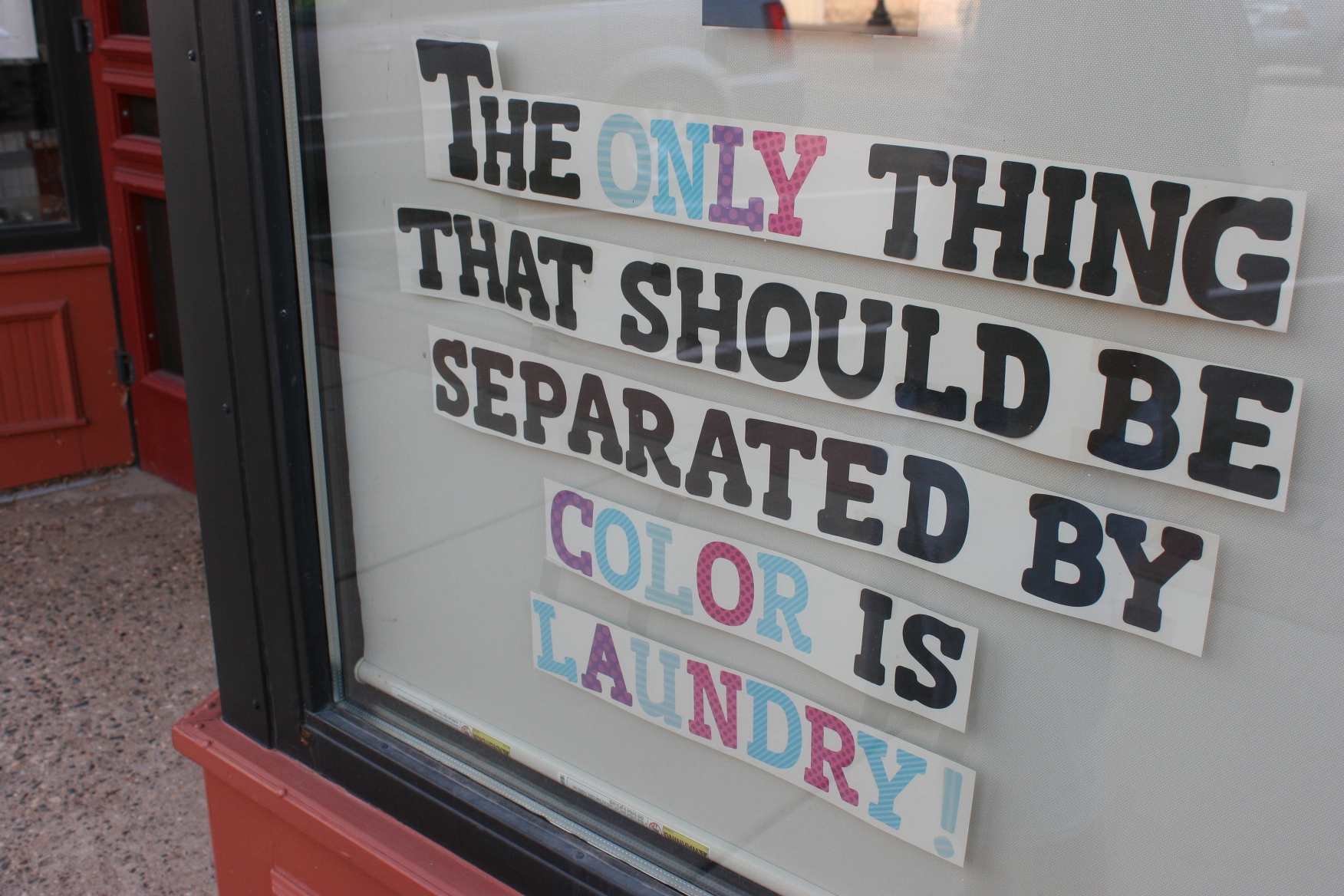
Photographed in August 2018 in a storefront window of a business in downtown Faribault. (Minnesota Prairie Roots copyrighted file photo 2018)
ON THIS DAY OF CELEBRATION,Juneteenth, I reflect on our nation’s past, on how far we’ve come and how far we have yet to go.
June 19, 1865, marks the day when enslaved people in Texas learned of the Emancipation Proclamation issued by President Abraham Lincoln 2 ½ years earlier. That proclamation freed slaves in Confederate states. It wasn’t until the 13th Amendment to the Constitution was passed in December 1865 that slavery was fully abolished in the entire United States.
Thinking about slavery is difficult. It’s emotionally challenging to consider that some 4 million men, women and children were “owned,” treated like property rather than human beings. Forced to work, forced to live under abusive and oppressive conditions. Without freedom to come and go.
Today the focus is not on the awfulness of slavery, but rather on the move from enslavement to freedom. Thus the celebrations on Juneteenth.
Moving onward as a people and a nation, we need to work harder on respecting one another, no matter our skin color, our social status, our differences. We’ve certainly made strides. But the reality is that we can do better.
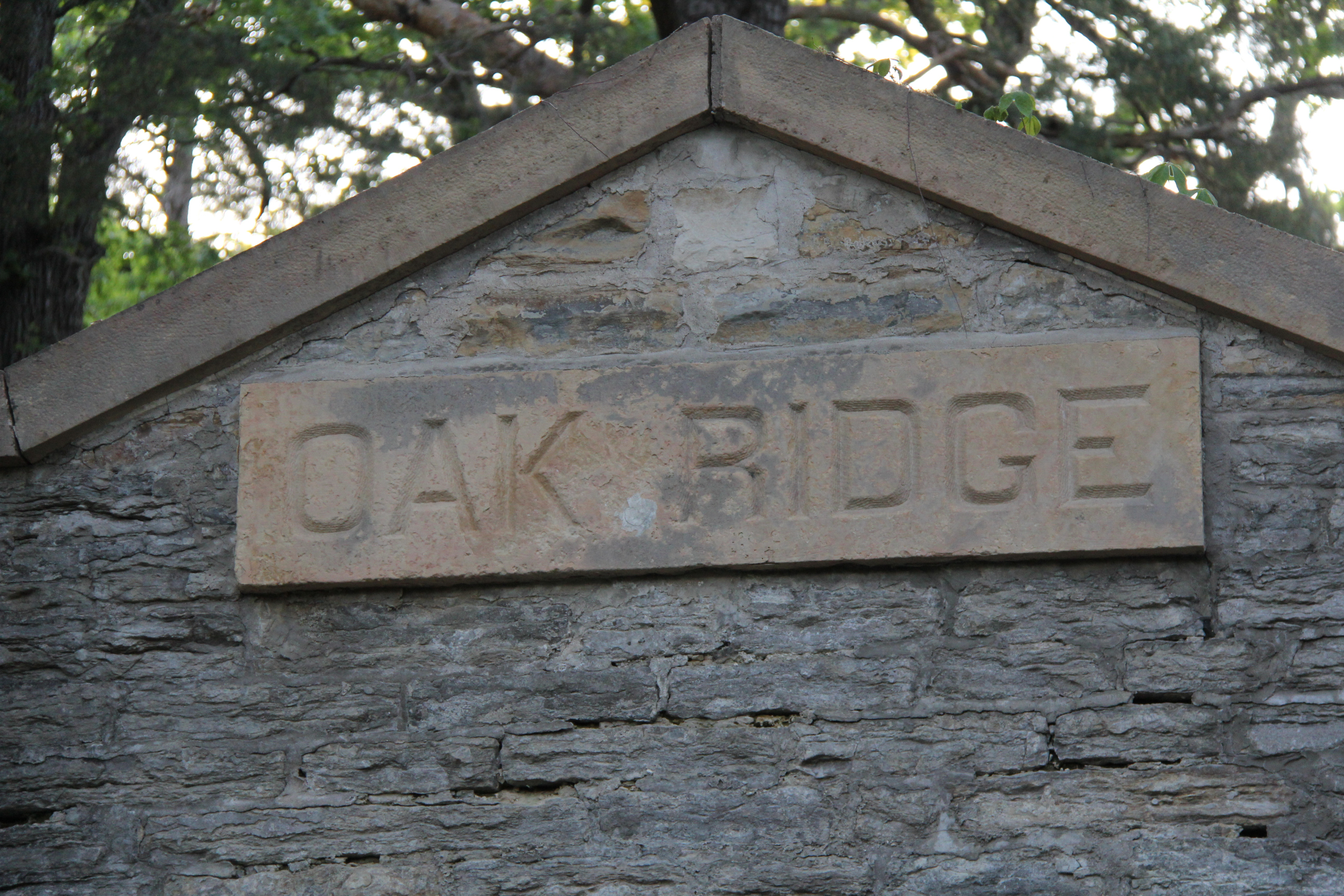
Sign on the Oak Ridge Cemetery limestone crypt. (Minnesota Prairie Roots copyrighted photo May 2023)
THEY ARE PLACES of sorrow, of history, of art, of beauty. Of stories, too. They are cemeteries.
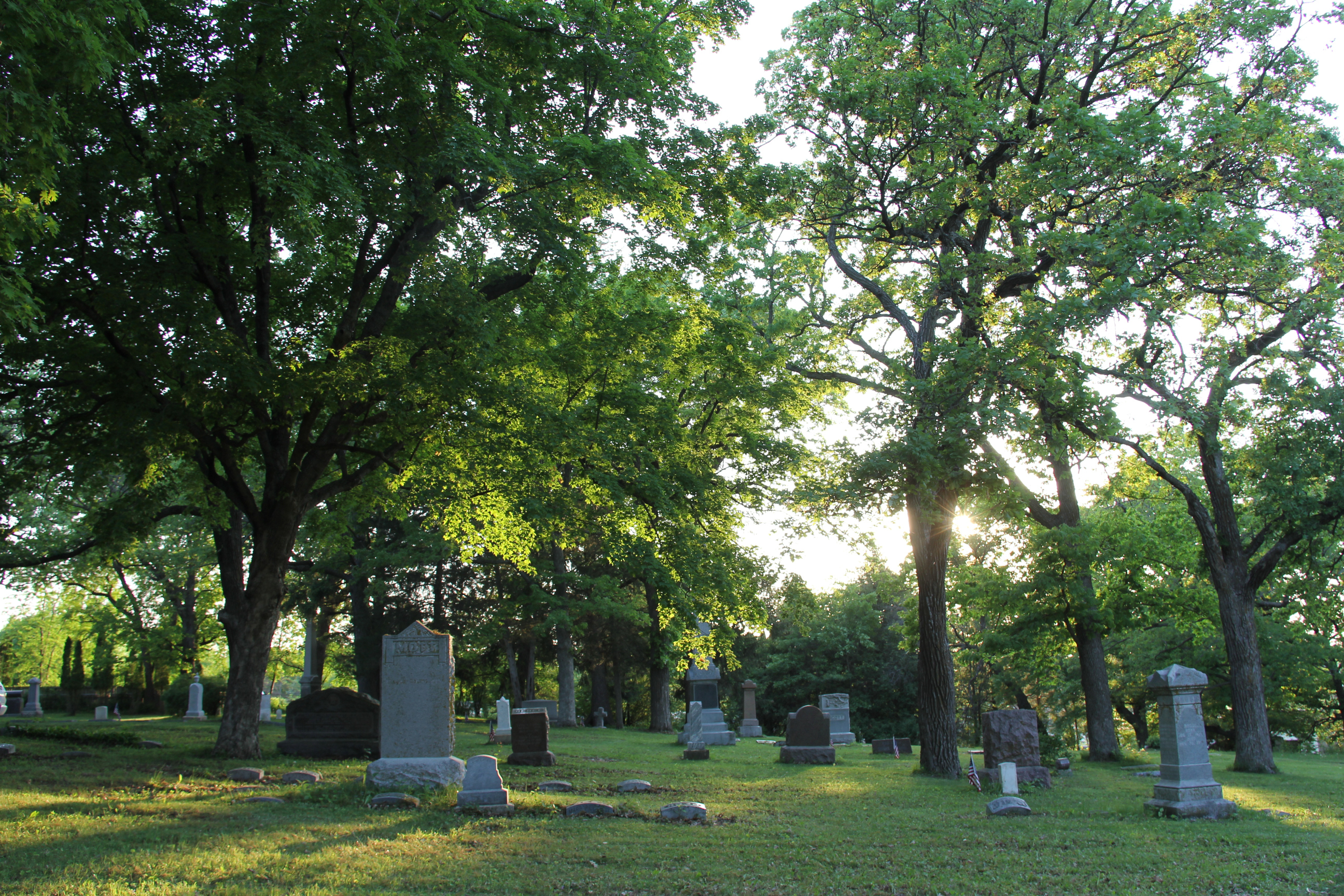
Trees fill the historic Oak Ridge Cemetery in Faribault. (Minnesota Prairie Roots copyrighted photo May 2023)
Decades ago, as a child, I feared cemeteries, thinking about the bodies buried in caskets beneath the ground. The unexpected death of my paternal grandfather when I was not quite eight shaped my thoughts then of graveyards. But my thinking and perspectives changed as I aged until I felt comfortable walking in a cemetery. I had accepted death.
The natural beauty of Oak Ridge, especially the oaks, is one of the things I most appreciate. (Minnesota Prairie Roots copyrighted photo May 2023)
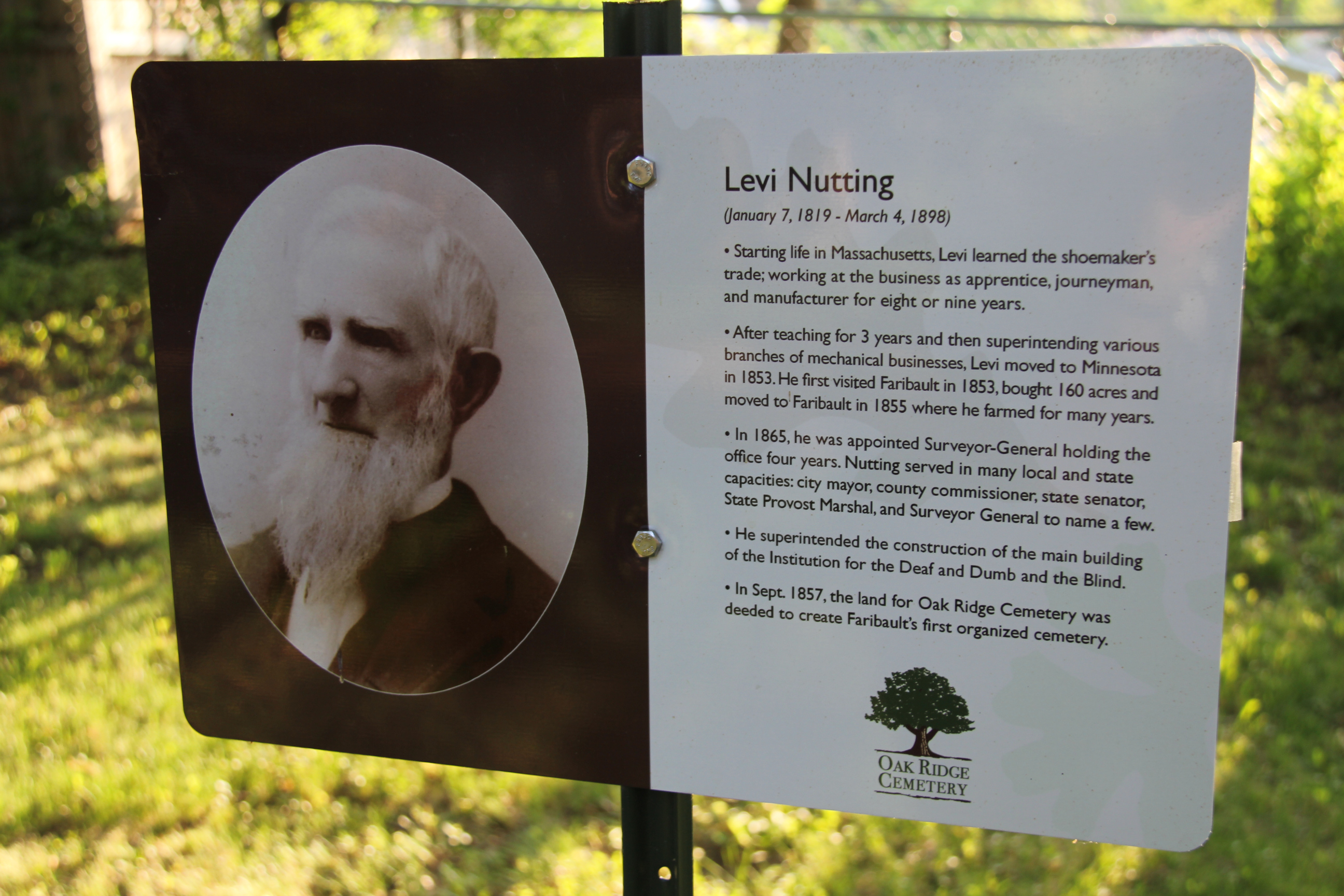
An informational sign about Levi Nutting. (Minnesota Prairie Roots copyrighted photo May 2023)
It’s Faribault’s first cemetery, incorporated in 1857, five years after the town was founded. The death of his 26-year-old wife, Mary, on Christmas Day 1856 prompted Levi Nutting to lead founding of an official cemetery. Nutting was a man of prominence. As an early area settler, he helped shape his community, serving as mayor and Rice County commissioner. Nutting also held several state government offices, including that of a senator.
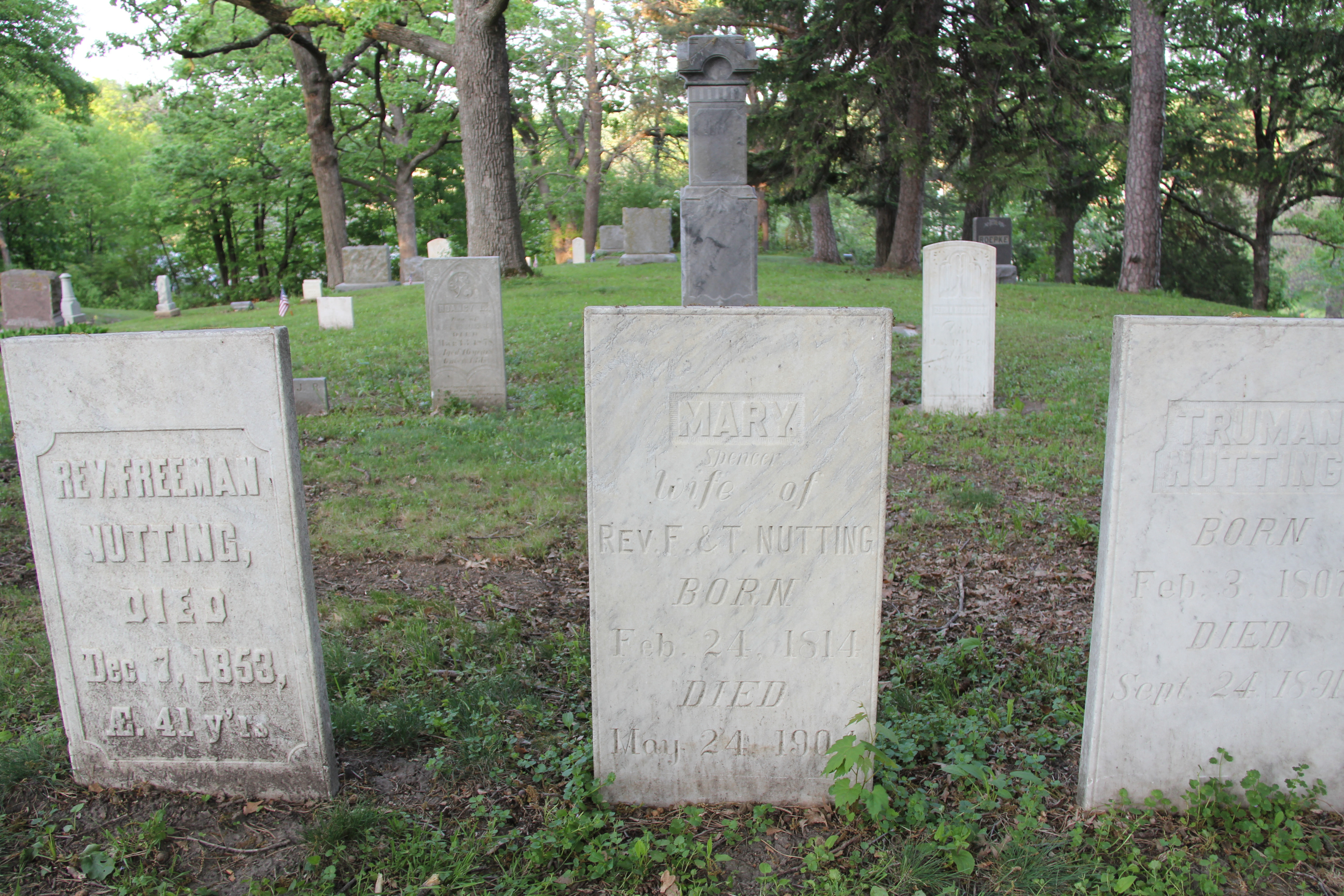
Nutting family grave markers. (Minnesota Prairie Roots copyrighted photo May 2023)
Levi and many other Nuttings lie buried beneath the soil at Oak Ridge among the oaks and spruce and maple. This place feels like a hilltop island of peacefulness. Not that it’s quiet here. But a sense of calm and serenity in this spot of remarkable natural beauty prevails.
(Minnesota Prairie Roots copyrighted photo May 2023)
(Minnesota Prairie Roots copyrighted photo May 2023)
(Minnesota Prairie Roots copyrighted photo May 2023)
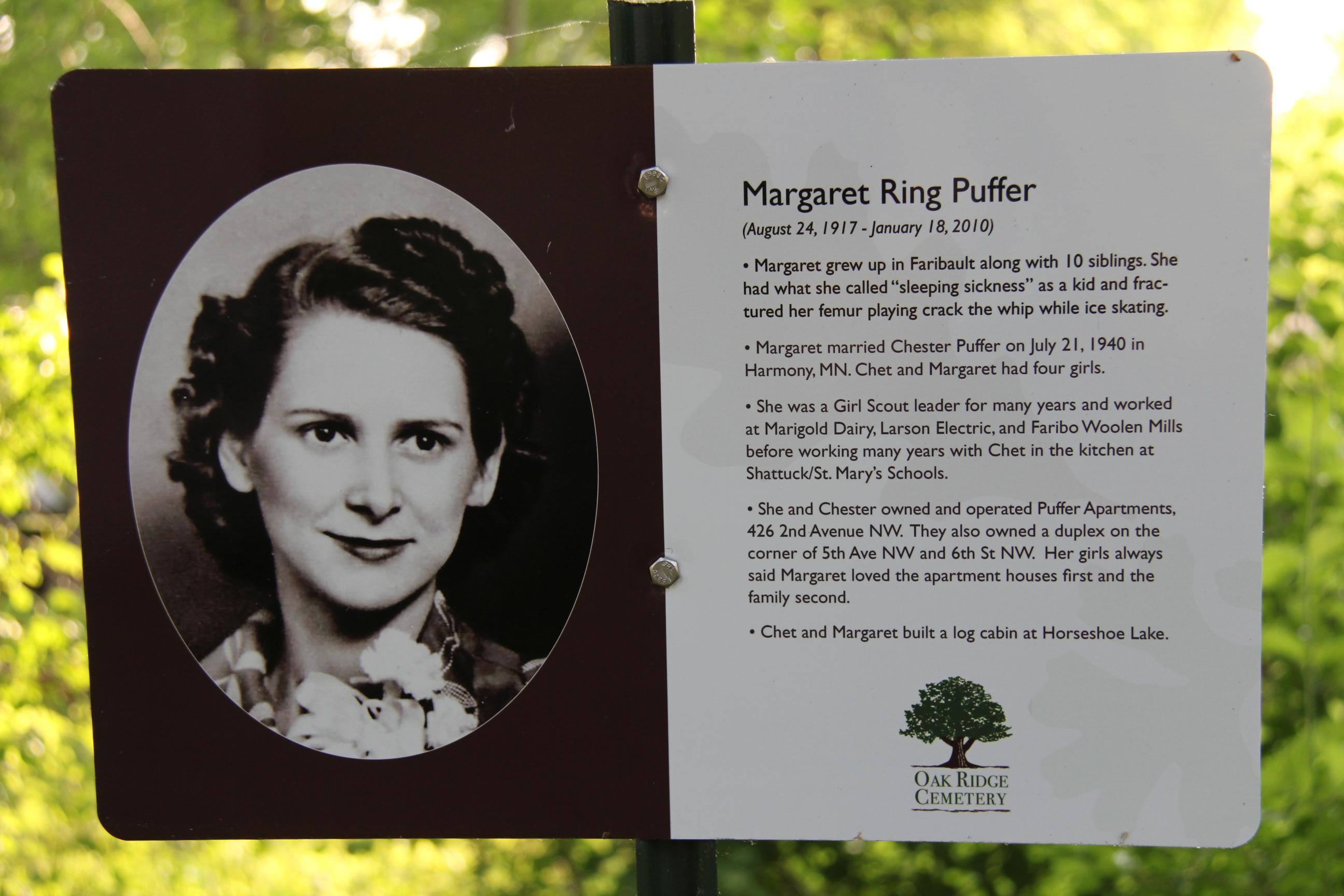
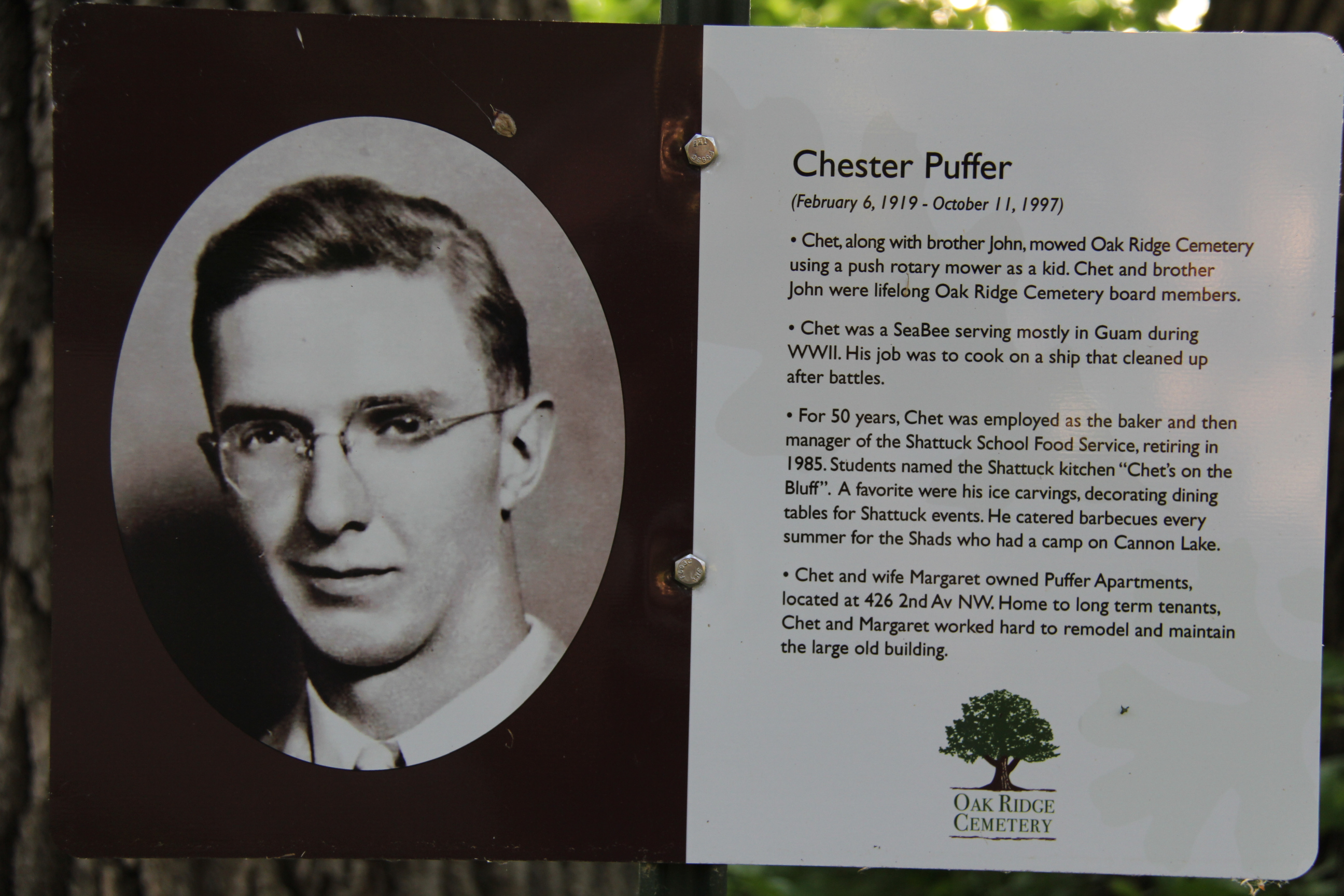
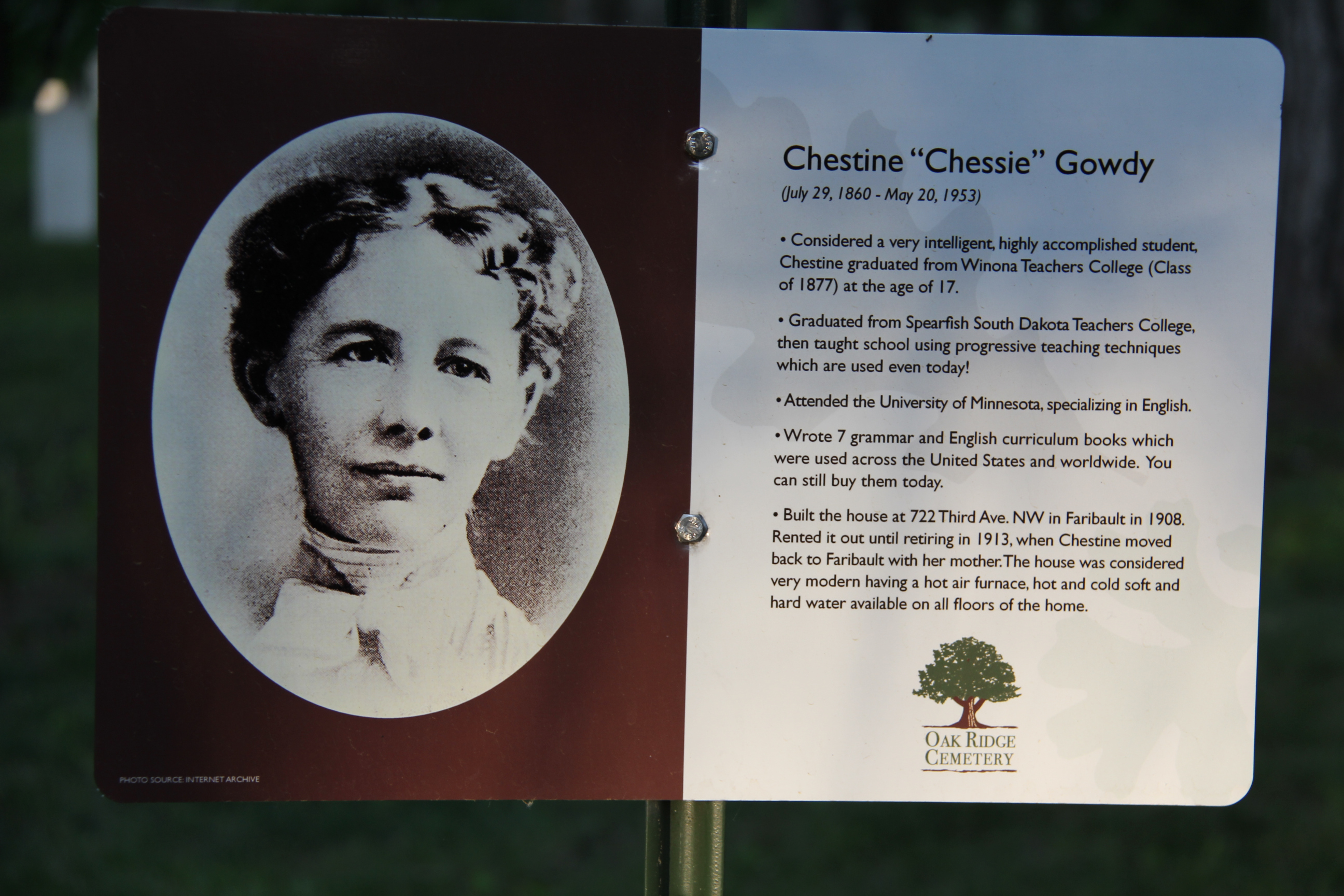
History also infuses Oak Ridge, not only in names on gravestones, but also on informational plaques scattered throughout the grounds.
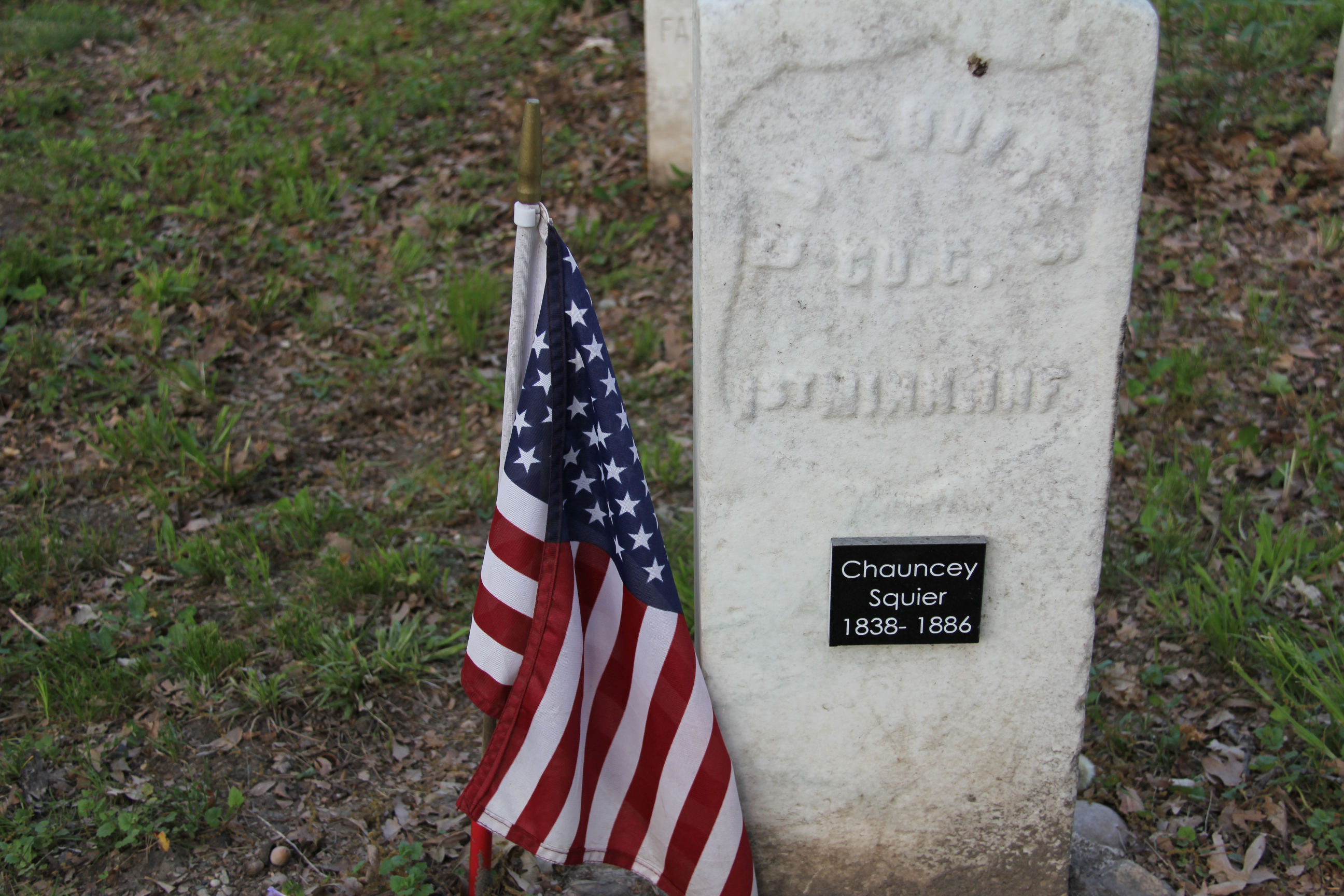
The burial spot of a Civil War veteran, flagged for Memorial Day. (Minnesota Prairie Roots copyrighted photo May 2023)
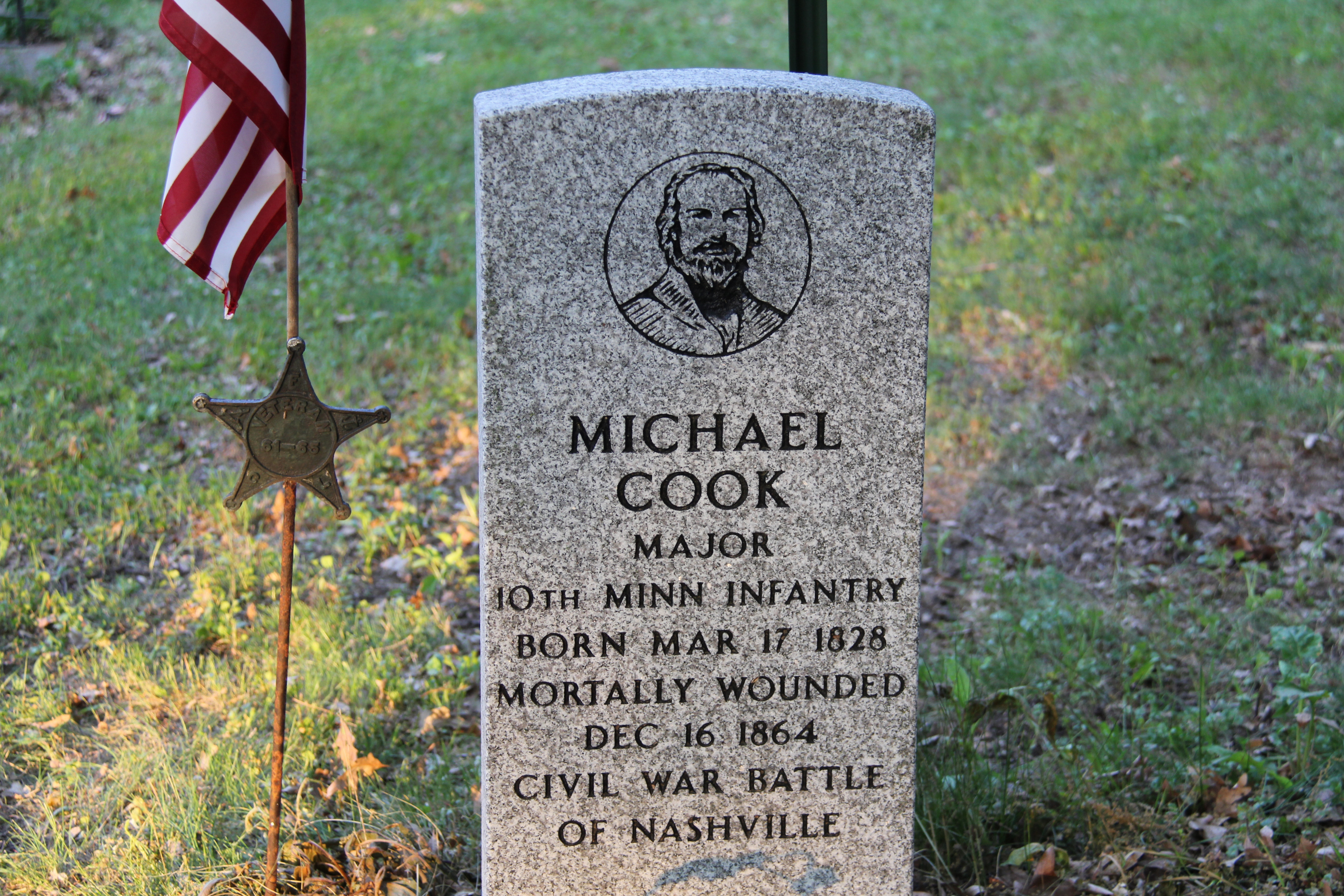
Civil War veteran Michael Cook’s marker details his death. (Minnesota Prairie Roots copyrighted photo May 2023)
There are a whole lot of long ago dates inscribed in stone. The first known burial here was in 1850, before cemetery incorporation. Men who fought in the Civil and Spanish American Wars lie here. So do legislators, business leaders, farmers, paupers, immigrants and more, according to the Oak Ridge website.
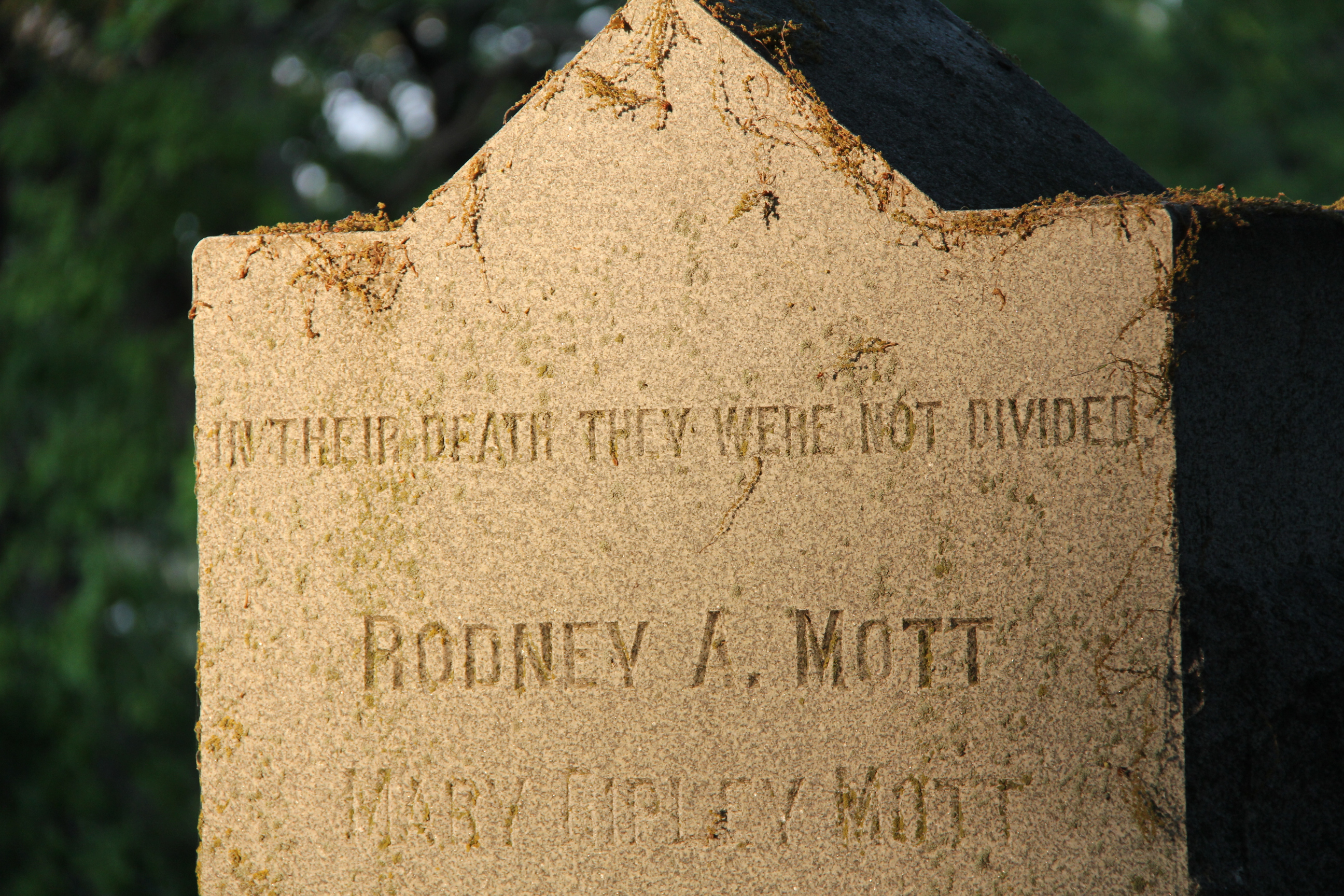
Loving words on a husband and wife’s tombstone. (Minnesota Prairie Roots copyrighted photo May 2023)
“IN THEIR DEATH THEY WERE NOT DIVIDED” reads the message on the headstone of Rodney A. Mott and Mary Ripley Mott.
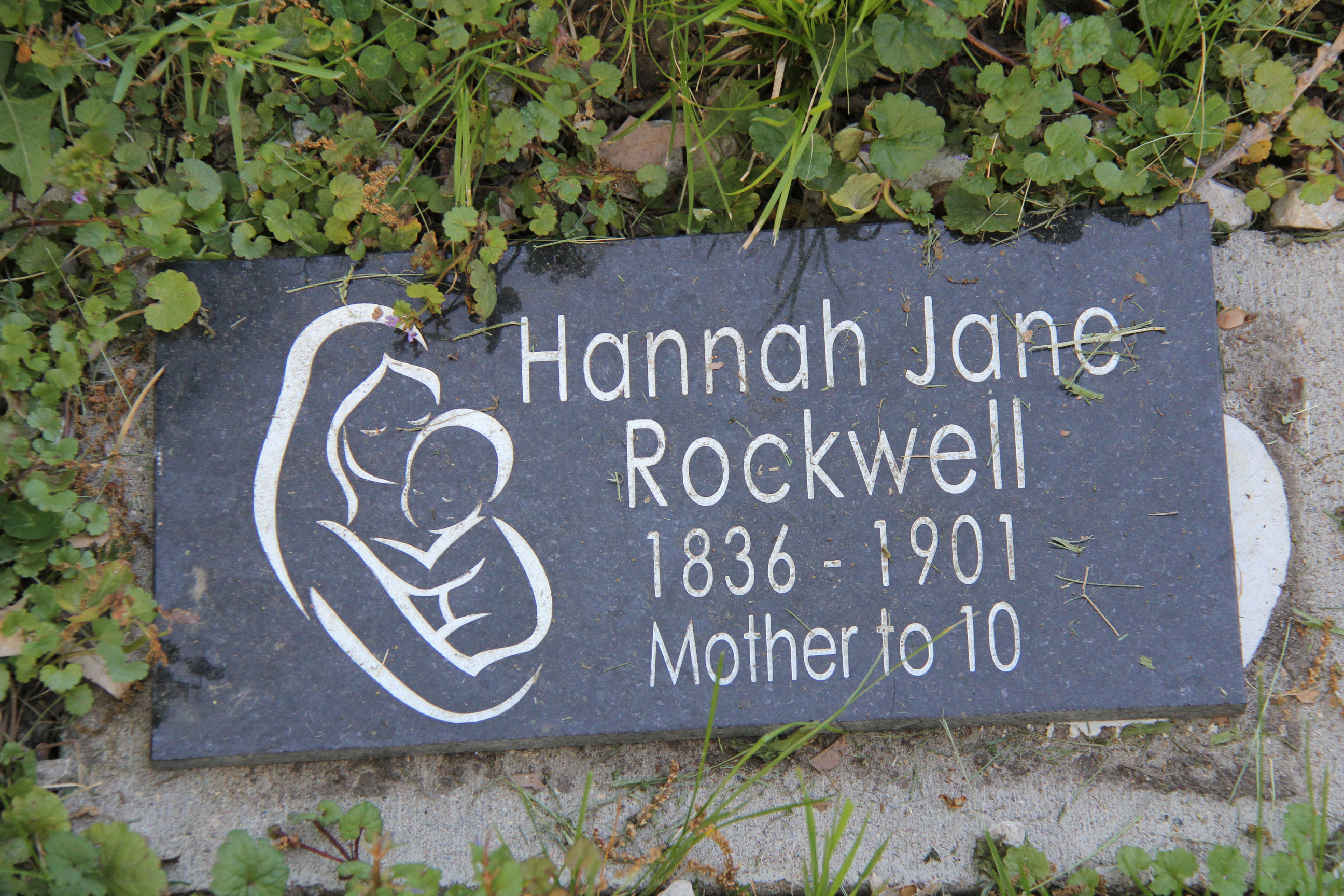
Markers like this can be purchased for unmarked graves. (Minnesota Prairie Roots copyrighted photo May 2023)
Hannah Jane Rockwell’s marker, installed through Oak Ridge’s Sponsor a Marker for an Unmarked Grave Program, simply lists her name, birth and death dates, and then the loving words, “Mother to 10.”
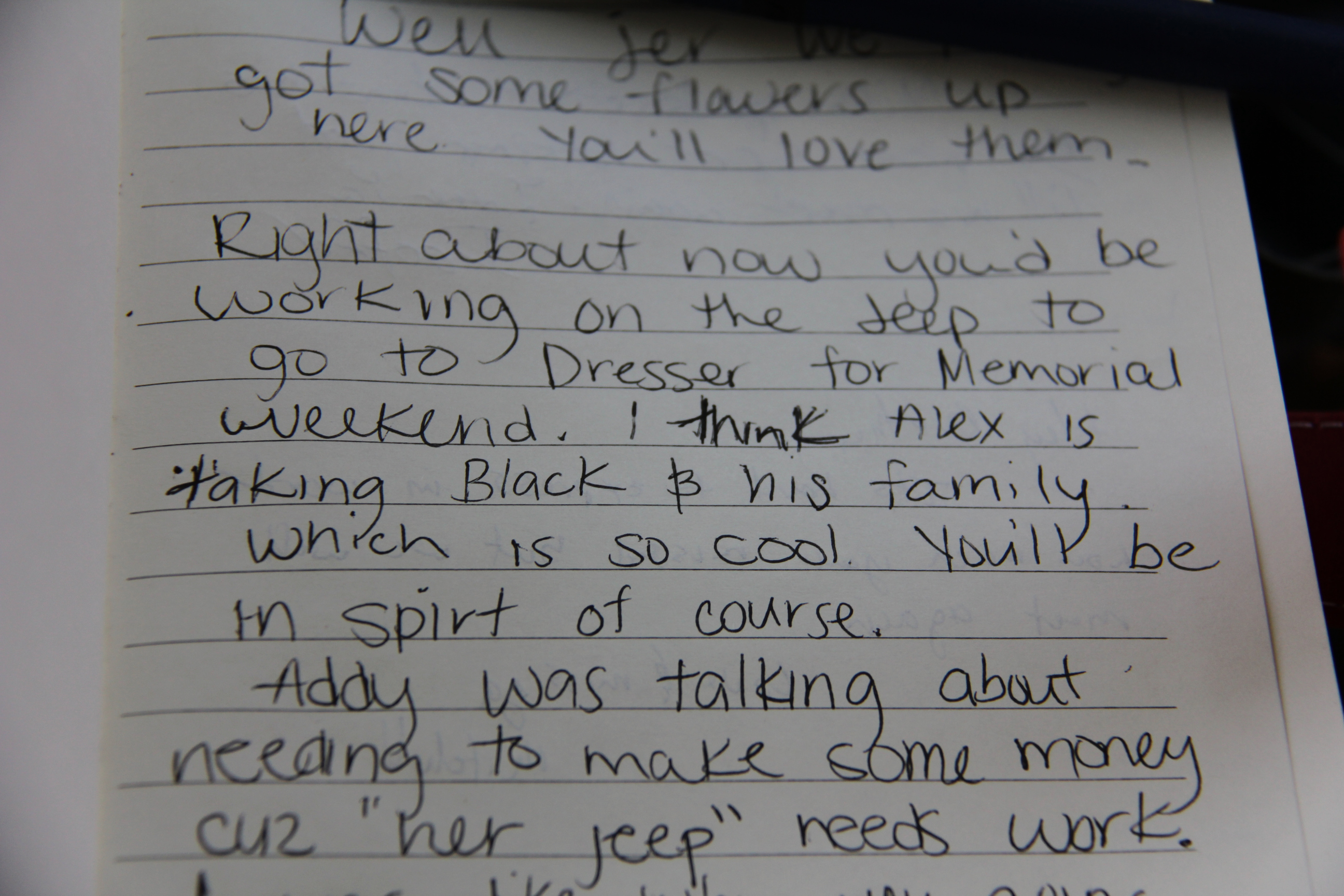
A message written in a notebook at Jeremy’s grave. (Minnesota Prairie Roots copyrighted photo May 2023)
Jeremy J. Weber’s black tombstone, still shiny with newness, is surrounded by expressions of recent grief. The 34-year-old father of three died in 2021. A waterproof case includes a notebook for messages and memories. Words written therein are loving, heartbreaking.
Beautiful urn art graces a grave. (Minnesota Prairie Roots copyrighted photo May 2023)
Grief is undeniably here. I read that, see that, feel that. But I also feel the love. These were individuals with families who loved them and whom they loved. These were individuals who were valued personally and/or professionally. They were, above all, human beings who held a special place on this earth.
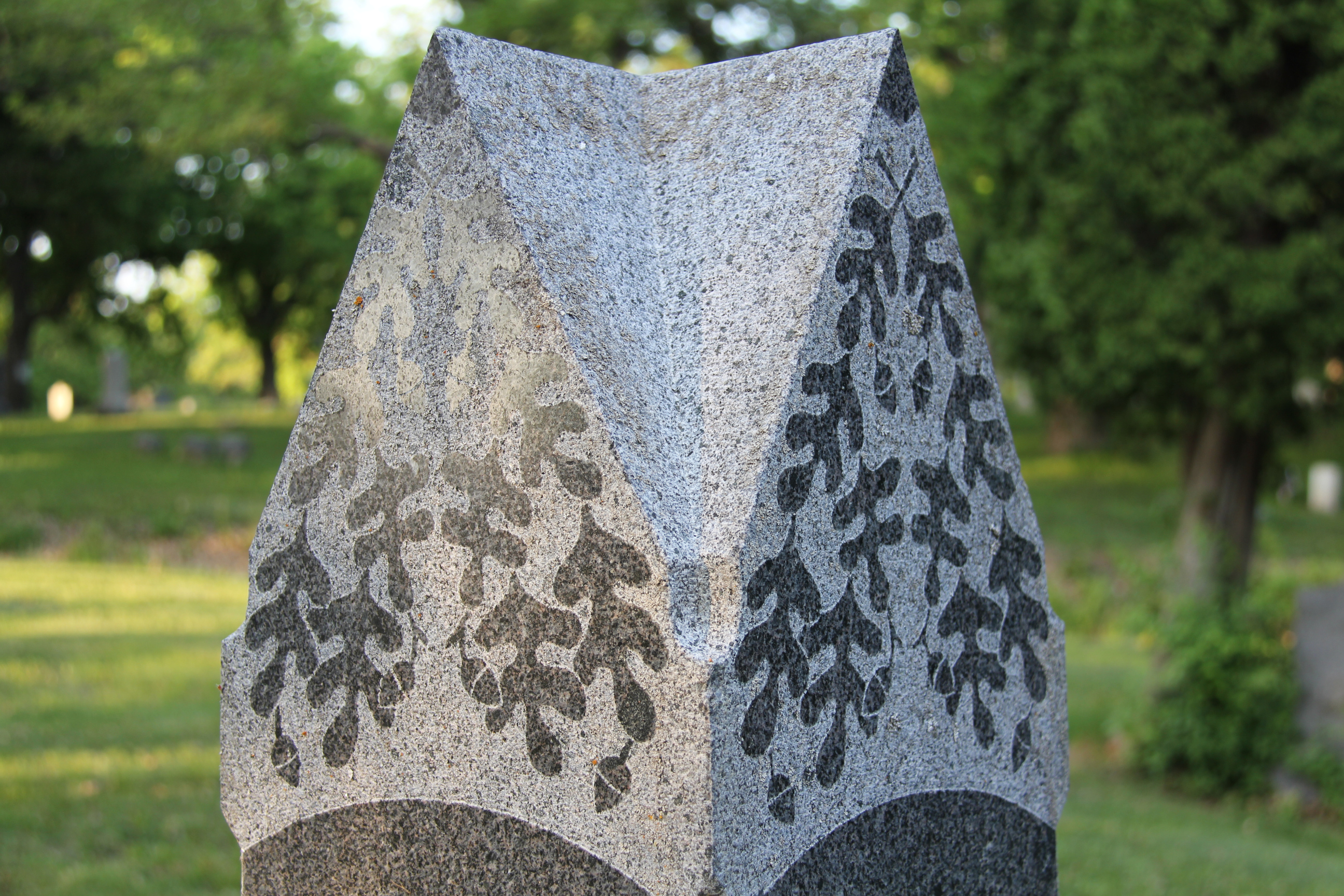
Fitting for Oak Ridge, oak leaves on a tombstone. (Minnesota Prairie Roots copyrighted photo May 2023)
Cemeteries reveal all of this, if only we take the time to walk among the tombstones, aged and new. Inscriptions, art, names, dates, memorabilia and flowers placed graveside all tell stories. That is the beauty within the boundaries of a cemetery like Oak Ridge, which rises high above a city founded 171 years ago, the place where Levi Nutting moved with his family in 1855, a year later his young wife dead.
The historic limestone pumphouse sits atop the hill, in the heart of the cemetery. (Minnesota Prairie Roots copyrighted photo May 2023)
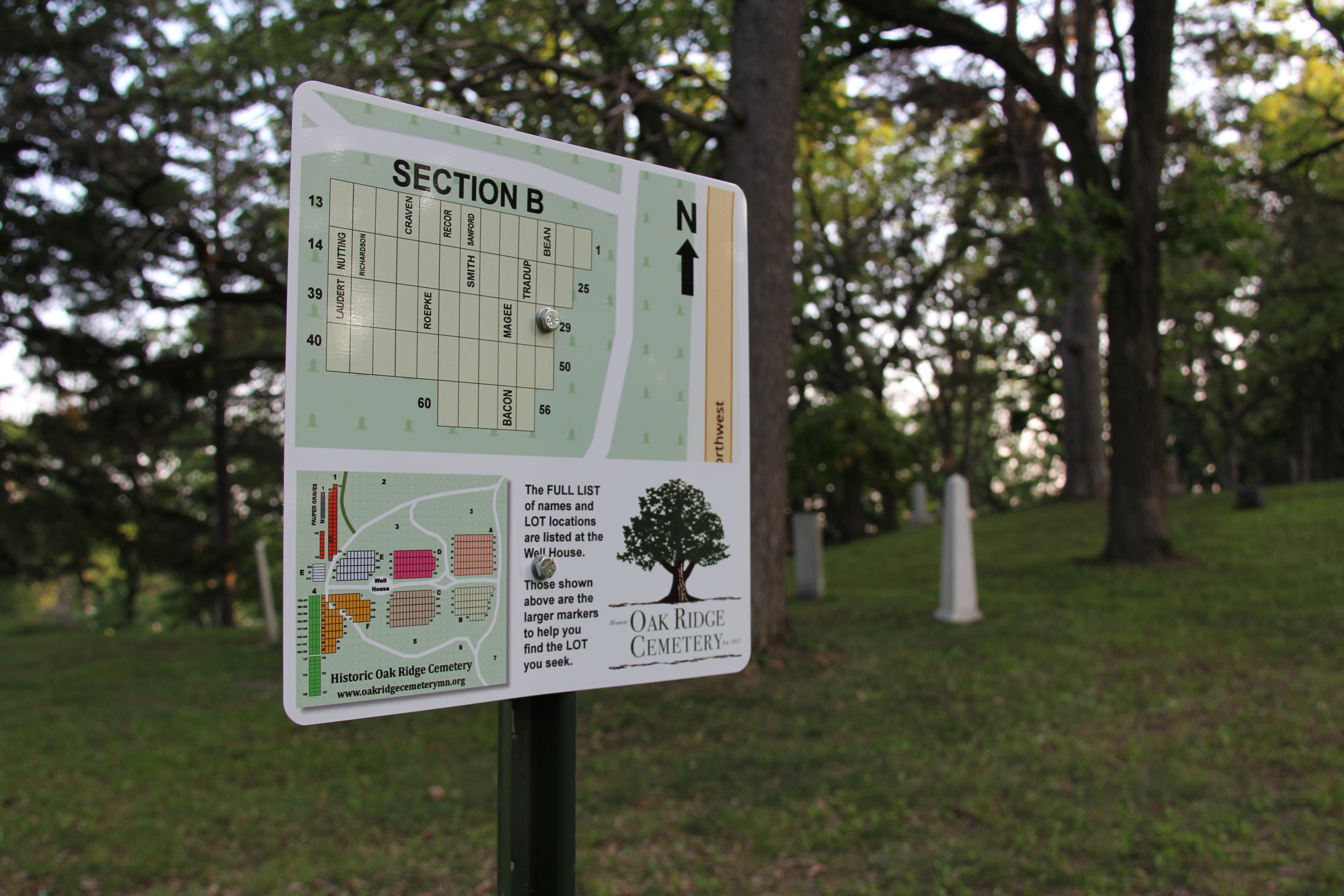
This map shows a section of Oak Ridge’s lay-out. (Minnesota Prairie Roots copyrighted photo May 2023)
FYI: Oak Ridge accepts donations and welcomes volunteers to help with cemetery upkeep. Burial plots are for sale. And markers may be purchased for unmarked graves.
Mom’s journals stacked in a tote. (Minnesota Prairie Roots copyrighted file photo)
DAYS BEFORE MOTHER’S DAY, I slide a clear plastic tote from a closet in the bedroom where my daughters once slept. I unlatch the lid. An overwhelming musty odor rises from the spiral-bound notebooks layered inside.
These are my mom’s journals. The story of her life recorded on paper from 1947 until her final entry on March 4, 2014, with a few years missing.
Mom died in January 2022. She left this handwritten documentation of an ordinary, yet extraordinary, life. As her oldest daughter and as a writer, I cherish the words she penned. They are not flowery poetic or personal entries, but rather a record of life as a farm wife and mother to six. Days that revolved around family, faith and farm life.
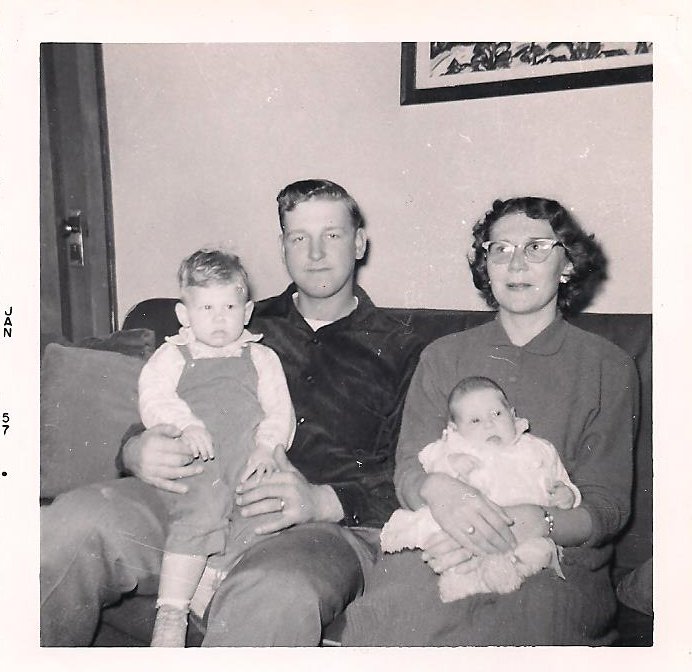
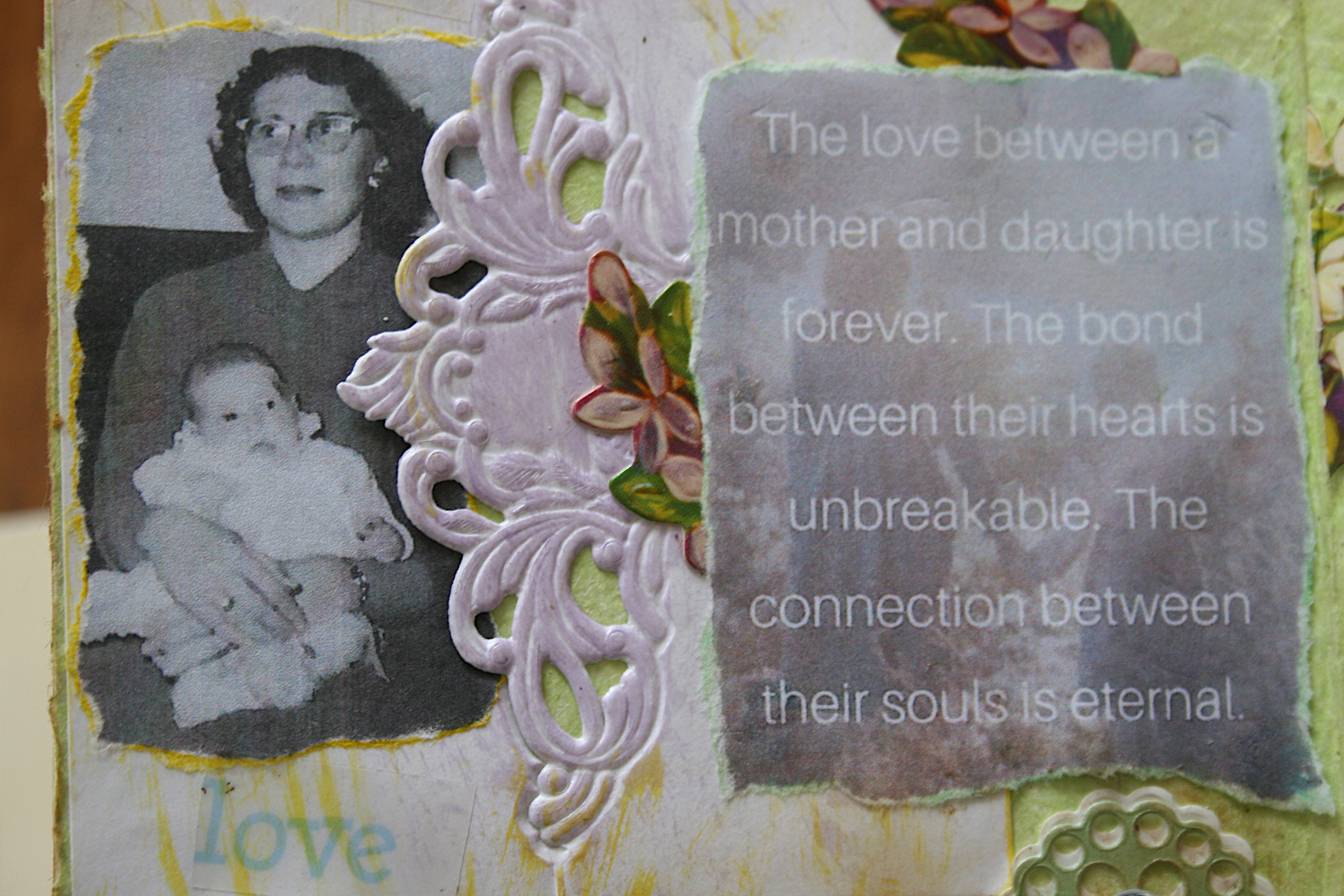
The only photo I have of my mom, Arlene, holding me. My dad is holding my brother, Doug.
With Mother’s Day only days away, I chose Mom’s 1955 journal, the year she became a mother, to begin reading. Mom invited her parents over for a Mother’s Day goose dinner that May, about two months before she gave birth to my oldest brother. I flipped ahead to July, reading her entries in the days right before Doug was born. Even at full-term, she kept working as hard as ever, freezing 24 boxes of green beans, canning a crate of cherries, pulling weeds in the garden and ironing clothes within days of delivering an 8-pound baby.
A page in an altered book crafted by my friend Kathleen. This page honors me and my mom. (Minnesota Prairie Roots copyrighted file photo)
Fast forward to May 1956. Mom notes in her Mother’s Day and subsequent entries that her mom went to the “Heart Hospital” on May 10 and came home May 17. Some six months later, Josephine died of a heart attack. She was only 48. And I was only two months old. I cannot imagine the grief my mom felt in the unexpected death of her mother. But she never put those emotions on paper. Rather her diary entries are straight forward, almost of journalistic detachment. Notations of her mom’s December 1 death, a funeral and writing thank yous.
My mom saved everything, including this Mother’s Day card I made for her in elementary school. I cut a flower from a seed catalog to create the front of this card. (Minnesota Prairie Roots copyrighted file photo)
On the next Mother’s Day in May 1957 and through 1961, there are no references to any special way in which my mom was honored. No gifts. No special meal. Only that I had a bad case of the measles as a nine-month-old. In May 1962, my brother had the mumps. But I did give Mom a paper flower at a school Mother’s Day program.
In entries in the years that followed, Mom always wrote of attending the Mother’s Day programs at Vesta Elementary School. I hold vague memories of standing on the stage, reading a poem about lavenders blue dilly dilly in verse that now eludes me.
And although I don’t remember, I gave Mom plants and, in 1967, “a fancy flower,” whatever that means. But most meaningful to me, a writer, was the gift of a writing pad to Mom in 1964. Now, in return, I have the gift of her words written in perfect, flowing penmanship.
In May 1963, Mom got a Whirlpool dishwasher. In May 1968, she redeemed Green Stamps for two lamps. She also got an automatic Maytag washing machine with suds saver for $300 from Quesenberry’s Appliance in Redwood Falls. I can only imagine how these Mother’s Day gifts of dishwasher and automatic washer eased her workload.
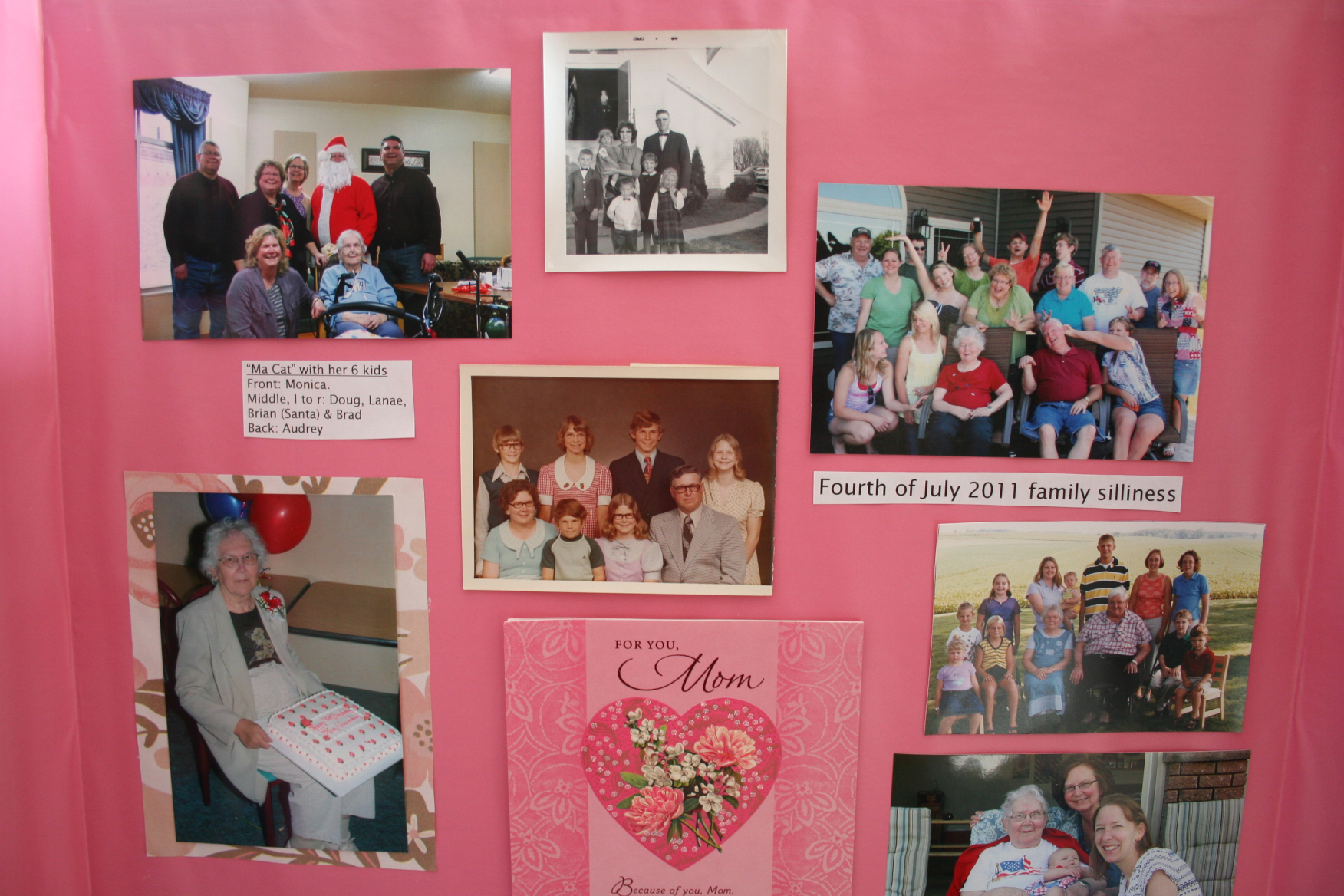
A section of a family-themed photo board I created for Mom’s January 2022 funeral. (Minnesota Prairie Roots copyrighted file photo 2022)
I wish I’d realized while growing up on the farm just how hard my mother worked. That would come later in life, when I became a mom in 1986, raising three kids, not six like her. In her final years, I thanked Mom many times for loving and caring for me, for raising me to be kind, compassionate, caring and a woman of faith. I hugged her and held her hand and cried whenever I left her care center, each time wondering if it would be the last time I would see Mom.
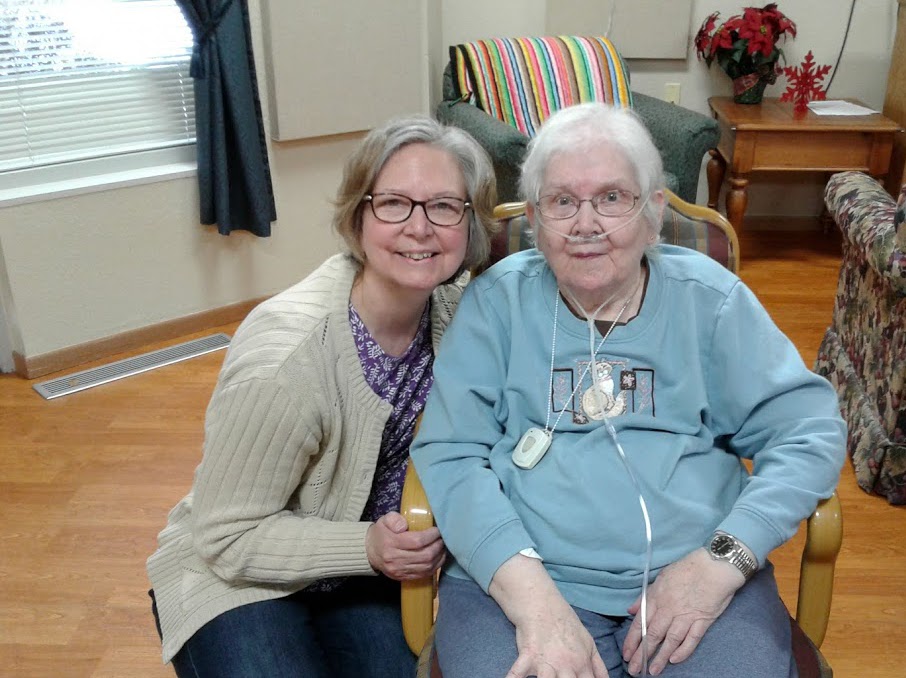
One of my favorite later photos with Mom, taken in 2017. (Photo credit: Randy Helbling)
Now, as I mark my second Mother’s Day without the mom I loved, still love, tears edge my eyes. I read page after page after page of her writing. Gratitude rises for this legacy she’s left, this story of her ordinary life on a southwestern Minnesota farm, this story of a mother who loved, labored, and lived a full and beautiful life.
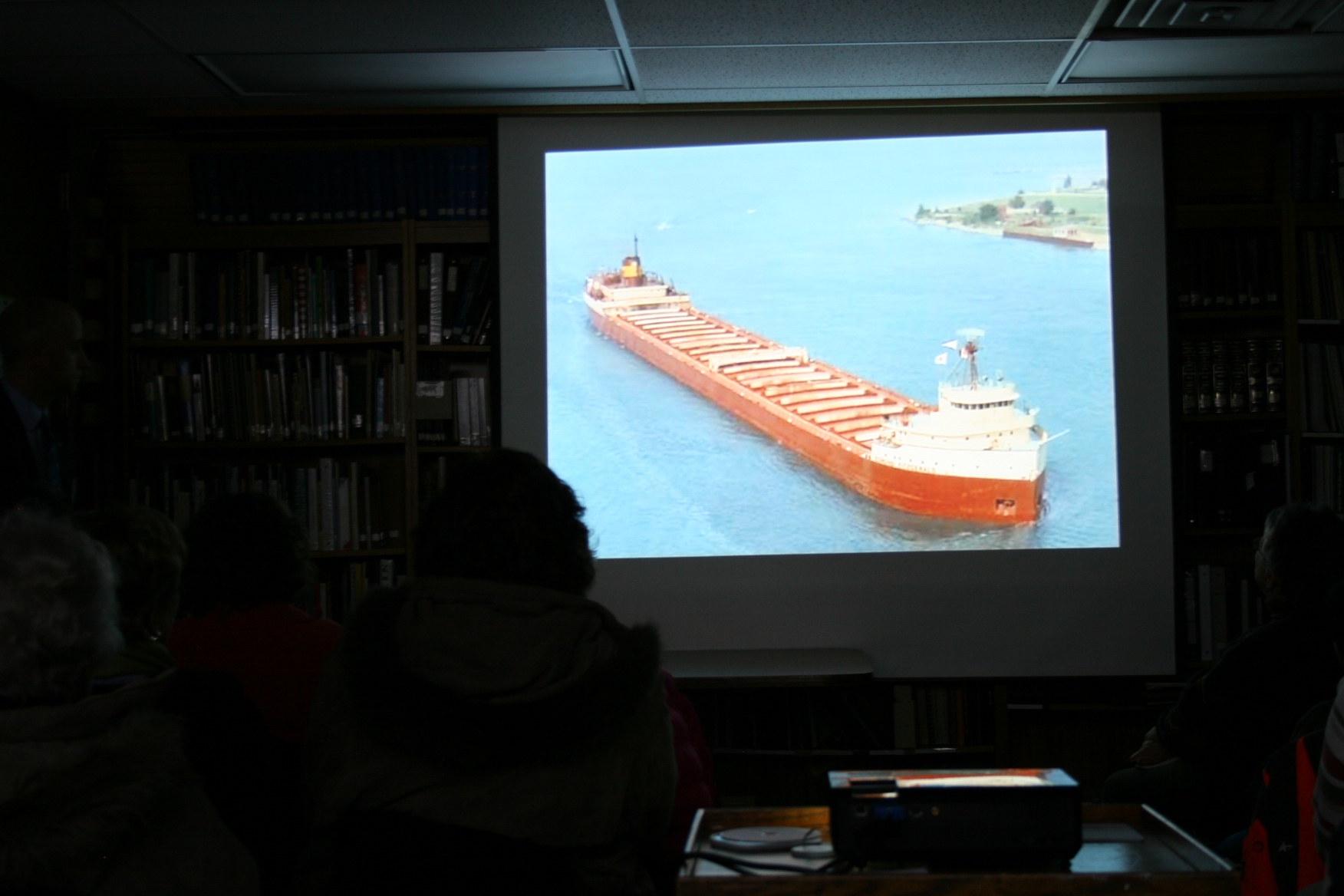
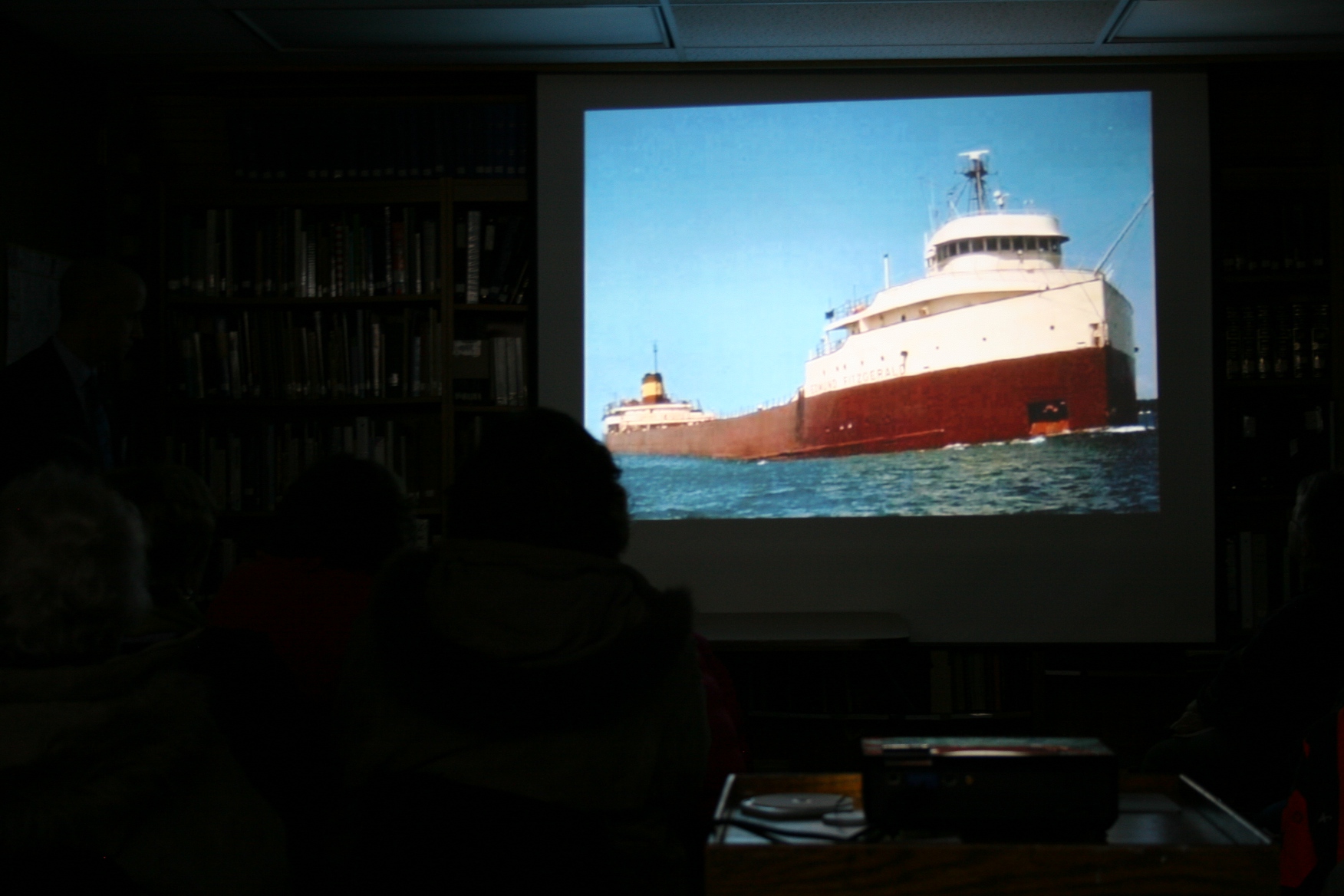
A photo of the Edmund Fitzgerald shown during a 2014 presentation in Faribault. (Minnesota Prairie Roots copyrighted file photo 2014)
CERTAIN SONGS FROM MY TEEN years into my early 20s occasionally surface like ear worms in my mind. Today that tune is “The Wreck of the Edmund Fitzgerald,” a ballad by Canadian singer, songwriter and guitarist Gordon Lightfoot.
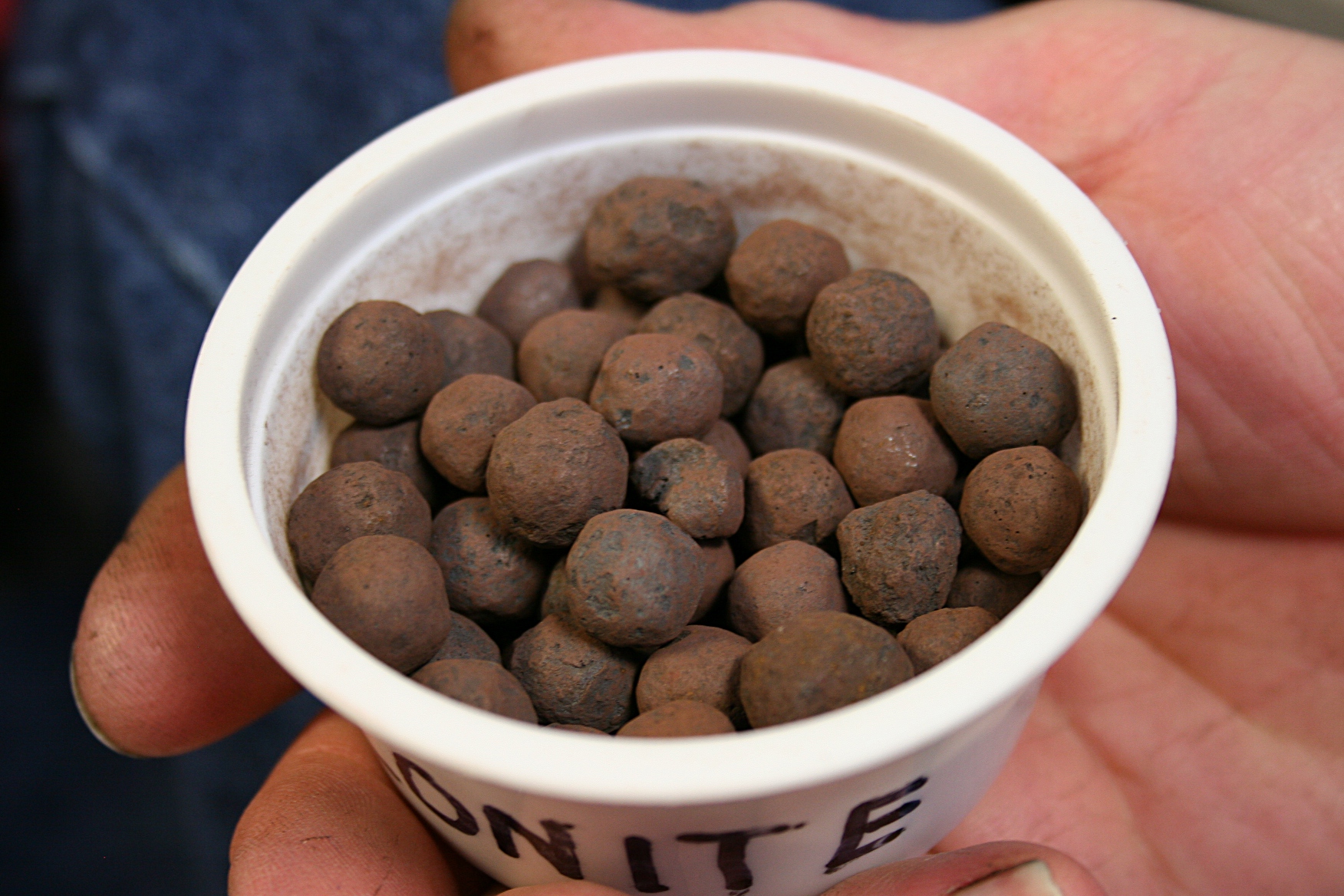
Taconite pellets, like these, filled the cargo holds of The Edmund Fitzgerald as it journeyed across Lake Superior on November 9 and 10, 1975.(Minnesota Prairie Roots copyrighted file photo 2014)
The 84-year-old musician died on Monday, leaving a legacy of storytelling that includes his version of the Edmund Fitzgerald’s fateful final journey. The iron ore carrier sank in Lake Superior on November 10, 1975, claiming the lives of 29 crewmen.
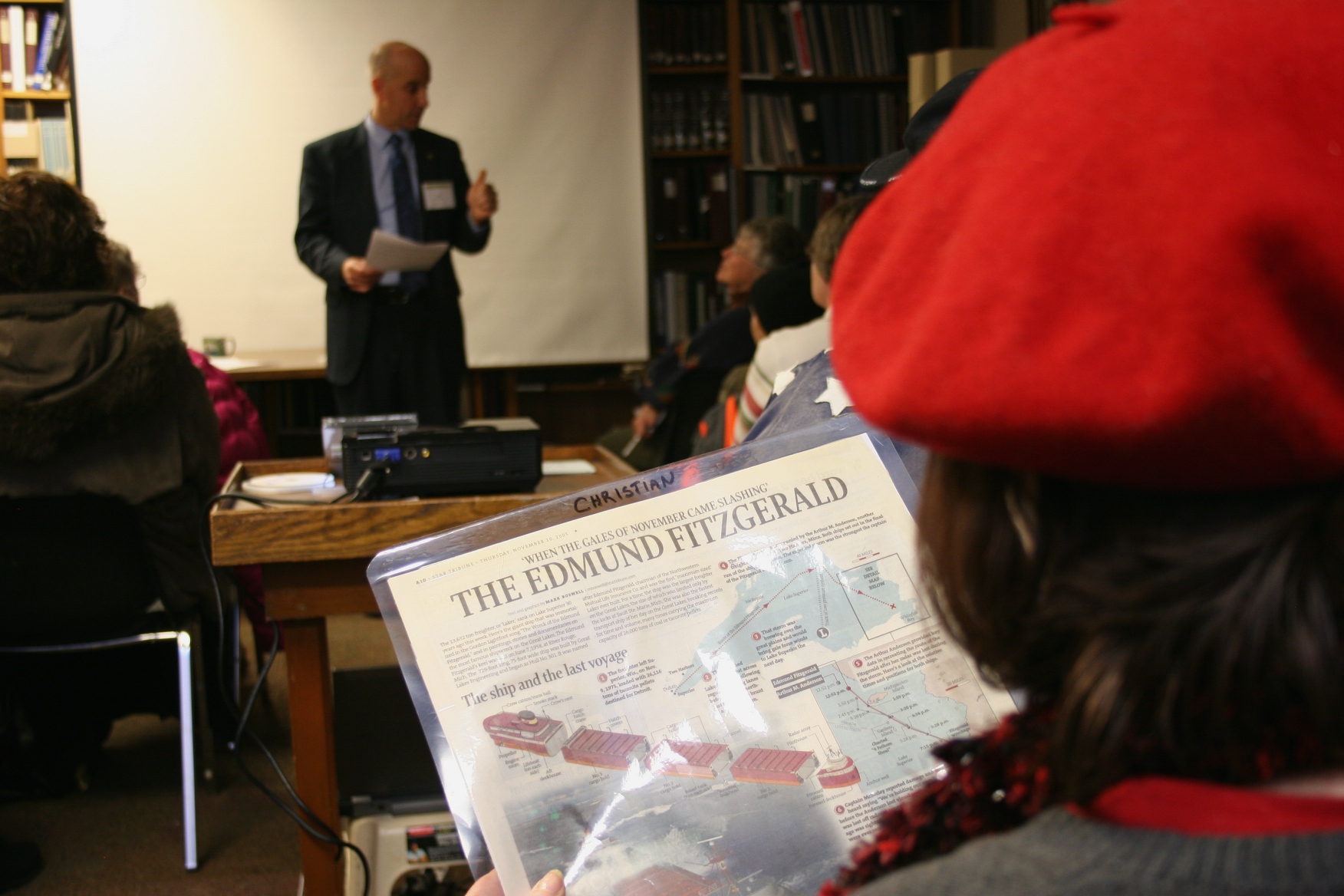
Newspaper clippings about The Fitz were passed around to audience members at a 2014 presentation in Faribault. (Minnesota Prairie Roots copyrighted file photo 2014)
Stories about the catastrophic shipwreck during a storm with hurricane force winds, waves reaching 70 feet and a gale force warning bannered newspapers. It was especially big news here in Minnesota since the 729-foot long by 75-foot wide ship left Superior, Wisconsin, just across from the port city of Duluth. The Fitzgerald was weighted with 26,000 tons of taconite pellets and bound for a steel mill near Detroit, Michigan.
PBS did a documentary on the Edmund Fitzgerald. (Minnesota Prairie Roots copyrighted file photo 2014)
On the afternoon of November 9, the freighter left Superior. By 7:15 pm the next evening, the USS Edmund Fitzgerald disappeared, the wreckage later found 17 miles northwest of Whitefish Point, Michigan.
In Lightfoot’s words:
The captain wired in he had water comin’ in And the good ship and crew was in peril And later that night when his lights went out of sight Came the wreck of the Edmund Fitzgerald
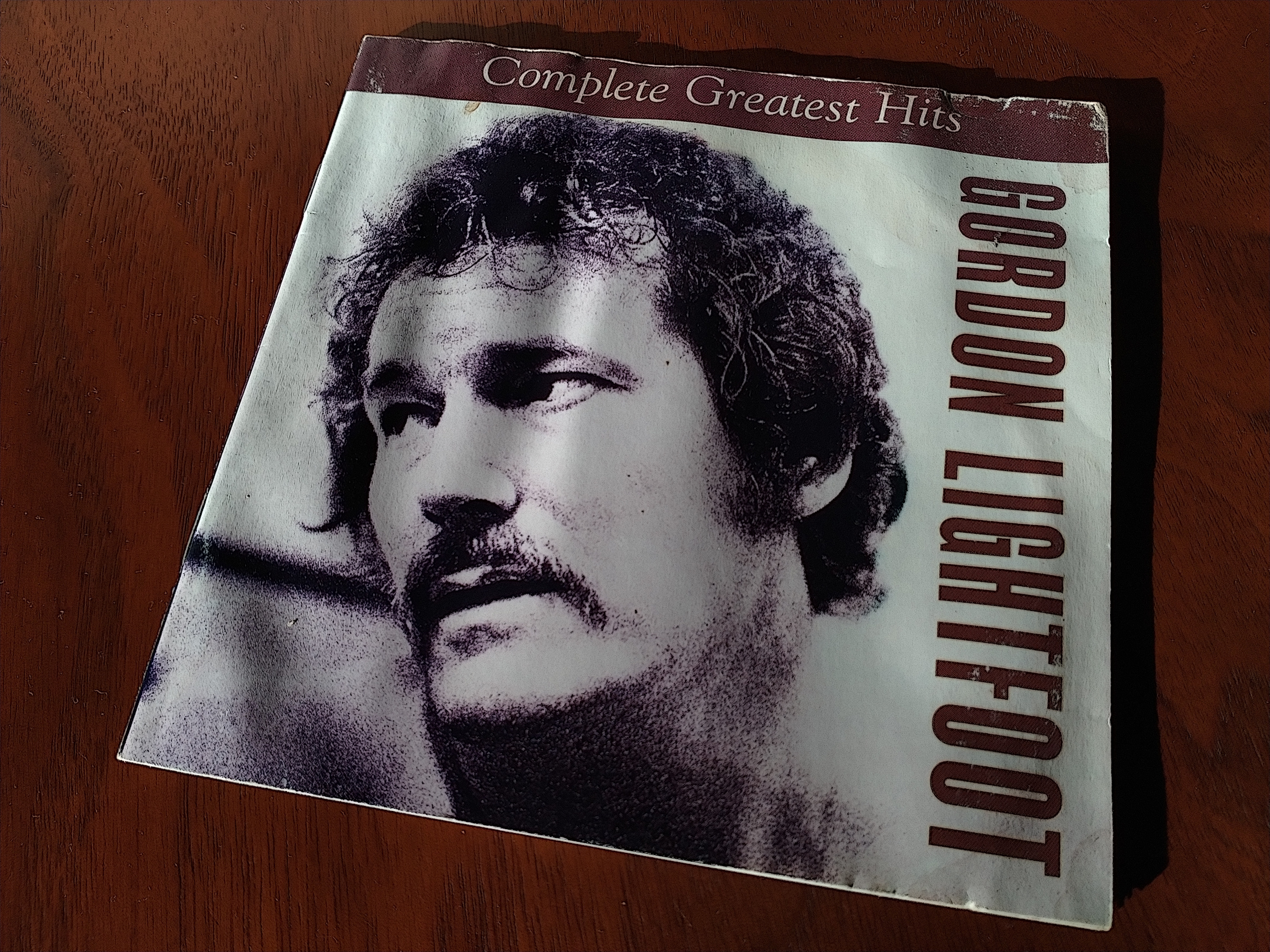
Lightfoot on the cover of his 2002 CD, which my husband owns. “The Wreck of the Edmund Fitzgerald” soared to #2 on the Pop chart and remained there for 21 weeks. (Minnesota Prairie Roots copyrighted photo May 2023)
The lengthy folk song of 6.5 minutes unfolds in suspenseful storytelling style. Lightfoot takes his listeners on board the massive Edmund Fitzgerald caught in the stormy, churning waters of Gitche Gumee (Ojibwe for Lake Superior). The songwriter uses some artistic license in his version of the disaster as noted when comparing facts to lyrics. Yet, his haunting song, like reality, carries the truth of death, the heavy emotions of loss. Every time I hear Lightfoot’s song, I feel overcome with sadness, as if the powerful, roiling waves of Superior are rolling over me, pulling me down down down into the dark depths of the lake.
The Edmund Fitzgerald stretched more than two football fields long. (Minnesota Prairie Roots copyrighted file photo 2014)
The emotional intensity of “The Wreck of the Edmund Fitzgerald” remains strong for me, even decades after I first heard the new release in 1976. And that’s a credit to Lightfoot, who wrote history into a ballad that is poetically and tragically memorable.
TELL ME: Are you a fan of Gordon Lightfoot or any of his songs? I’d like to hear your thoughts on him, this ballad or musicians and/or songs particularly memorable to you.
Signage indicating the Trinity service is airing. (Minnesota Prairie Roots copyrighted file photo April 2018)
DURING THE COVID-19 PANDEMIC, when I wasn’t attending worship services at my church, Trinity Lutheran, Faribault, I switched on the radio. In the safety and shelter of my home, I listened to Sunday morning worship services broadcast on Faribault-based KDHL radio. I was grateful for the AM listening option. I could have watched live-streaming. But I preferred the less distracting radio delivery.
Vintage switches inside the Trinity Radio Club booth. (Minnesota Prairie Roots copyrighted file photo April 2018)
Eventually, I returned to in-person worship. But today I’m back tuning the radio to 920 AM at 8 am Sunday because of a health issue that leaves me sensory sensitive and more. I can’t tolerate the sound of the organ or the multi-layered sensory input of being among people in a busy environment.
The original microphone used in 1948.(Minnesota Prairie Roots copyrighted file photo April 2018)
That’s the backstory behind my personal appreciation of the Trinity Radio Club, which has broadcast church services for 75 years, first airing on April 25, 1948. That’s remarkable in longevity, in decades of sharing the Gospel initially via the air waves and then via live-streaming and other online platforms.
The early transmitter. (Minnesota Prairie Roots copyrighted filephoto April 2018)
This weekend, April 29 and 30, the Trinity Radio Club celebrates its 75th anniversary during worship and during a special program between Sunday morning services. It’s important to commemorate and honor the work of long ago visionaries who embraced a radio ministry. They initially pledged $5/each toward the effort and also committed to paying 35 cents weekly to support the broadcasts. That doesn’t seem like much money today. But I expect it was a sacrifice in 1948, when the first broadcast cost $46.
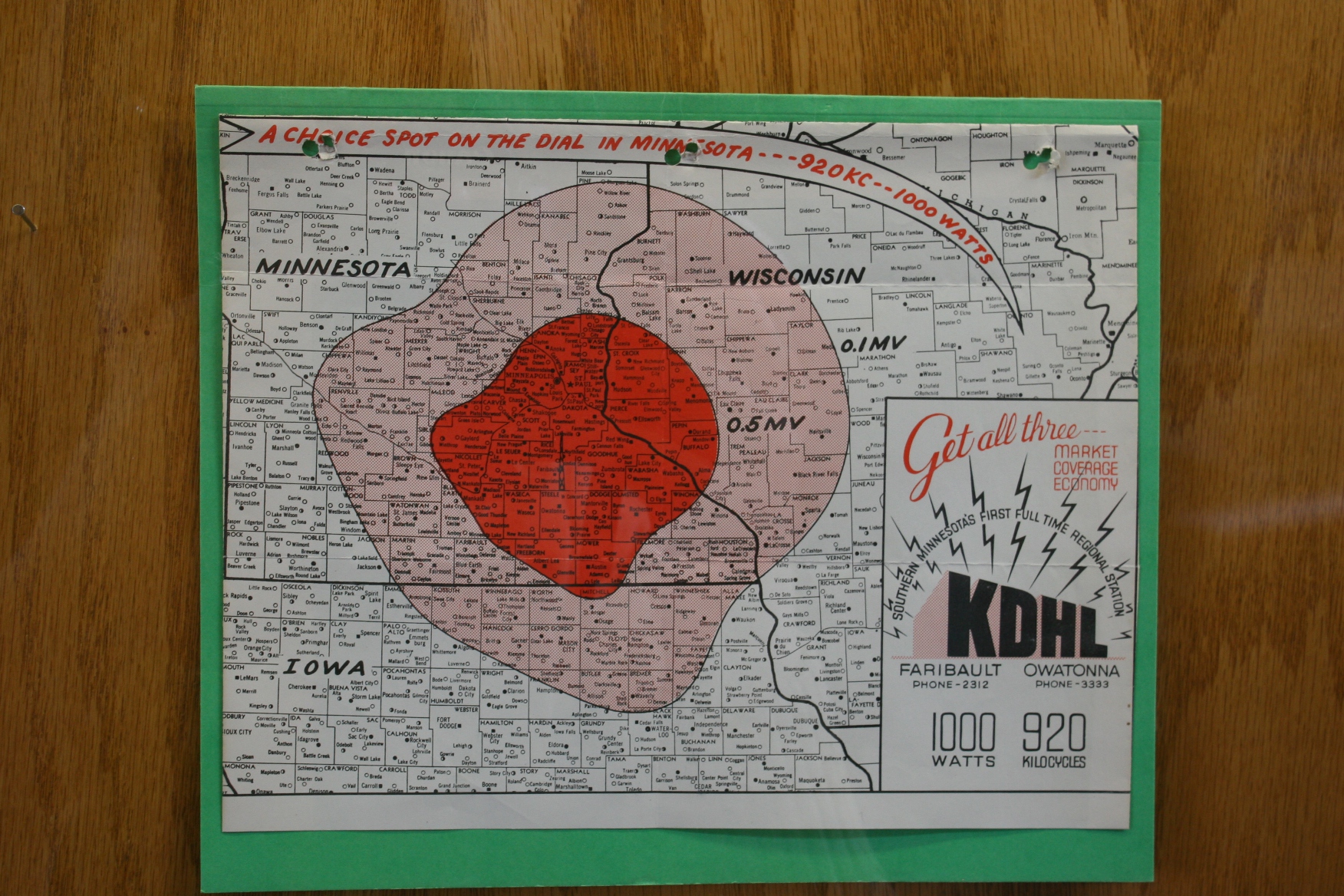
The original coverage area for KDHL radio, which began broadcasting in 1948. (Minnesota Prairie Roots copyrighted file photo April 2018)
Throughout its 75 years, the Trinity Radio Council (today the Trinity Radio Club) has remained strong in its mission of reaching people with the good news of salvation, whether locally or an ocean away. The club has continued to upgrade technology, to make improvements that assure uninterrupted transmission of services via radio and online. Unlike many churches during the COVID pandemic, Trinity was already up and running with a strong, safe and viable way of reaching and connecting with people outside the walls of the sanctuary.
Vintage radio room art centers on Christ. (Minnesota Prairie Roots copyrighted file photo April 2018)
For awhile, Randy and I (mostly Randy) were part of the club’s mission. Once a month, sometimes more, Randy would take a DVD of the 8 am worship service to a local nursing home. Sometimes I accompanied him. He would lead part of the service and then play the sermon part of the recording for residents. Many of them slept through the entire thing. But, yet, when Randy led them in The Lord’s Prayer, they would join in. No memory issues. No sleepiness. Just a roomful of the faithful praying.
The operations tech hub inside the radio studio at Trinity in 2018. (Minnesota Prairie Roots copyrighted file photo April 2018)
That word “faithful” seems appropriate to insert here. Generations have committed to maintaining and expanding the Trinity Radio Club ministry. That comes via financial support and volunteering. When our tech-savvy son was in high school, he volunteered. Every broadcast and streamed service requires people in the soundproof studio working the computer, the switches, all the tech stuff I don’t understand.
A view from the studio overlooking the sanctuary in 2018. (Minnesota Prairie Roots copyrighted file photo April 2018)
But I understand one thing. I understand the importance of this ministry personally. When I can’t be in church, and there are others just like me, I can still be there.
Gratitude on the screen, Trinity sanctuary in the background. (Minnesota Prairie Roots copyrighted file photo April 2018)
I am grateful to those individuals who saw the need for a radio broadcast 75 years ago. I am grateful for the continuing expansion via technology. I am grateful for a congregation which financially and otherwise supports the Trinity Radio Club. I am grateful for listeners who also donate. It takes a joint effort, a team, dedication and hard work. And for the initial founders of the Trinity Radio Council, it took a vision based on faith to launch this ministry which has blessed so many, including me, during its 75-year history.
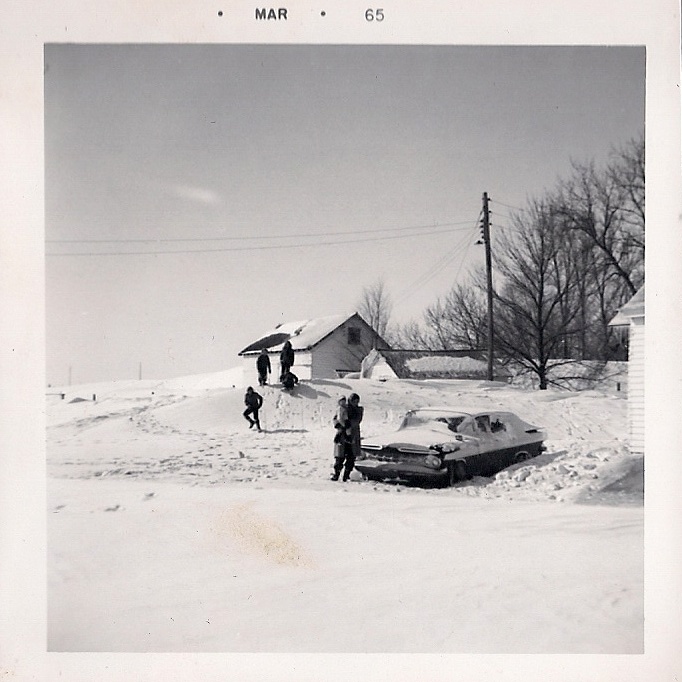
This huge snowdrift blocked my childhood farm driveway in this March 19, 1965, photo. I’m standing next to Mom. (Photo credit: Elvern Kletscher)
SHE WAS NOT QUITE 33 years old, this young mother of five living on a southwestern Minnesota dairy and crop farm in March 1965. It was an especially harsh winter, documented in a spiral bound notebook she kept.
She filled page after page with several-line daily entries about everyday life. She wrote about crops and household chores and kids and food and the most ordinary daily happenings. And, always, she recorded the weather—the wind, the precipitation, sometimes the temperature.
Arlene Kletscher’s journals stacked in a tote. (Minnesota Prairie Roots copyrighted file photo)
This keeper of prairie history in rural Redwood County was my mother, who died in January 2022 at the age of 89. I am the keeper of her journals, which she kept from 1947-2014, from ages 15 to 82. Sixty-seven years of journaling. Several years, when she met and fell in love with my dad, are noticeably missing.
Recently, I pulled the tote holding her collection of writing from the closet. This snowy winter of 2022-2023 in Minnesota prompted me to filter through Mom’s notebooks from 1964 and 1965. That winter season of nearly 60 years ago holds the state record for the longest consecutive number of days—136—with an inch or more of snow on the ground. We are closing in on that, moving into the top ten.
Mom’s journal entries confirm that particularly snowy and harsh winter on the Minnesota prairie. From February into March, especially, many days brought snow and accompanying strong wind. Two photos from March 1965 back up Mom’s words. Her first March entry is one of many that notes the seemingly never-ending snow falling on our family farm a mile south of Vesta. She writes of the weather:
March 1—What a surprise! Snowing & blowing when we got up & kept on all day. No school.
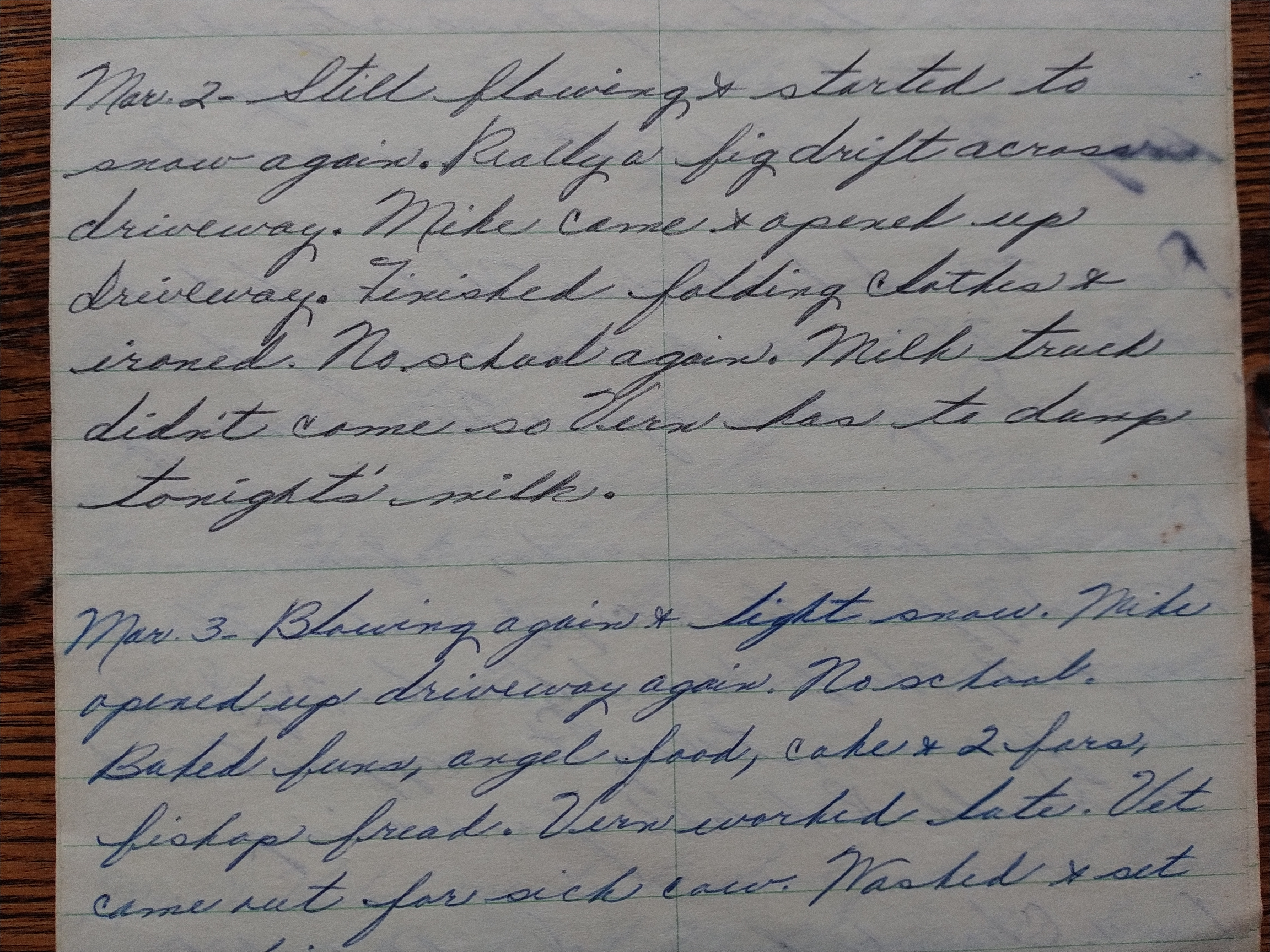
March 2—Still blowing & started to snow again. Really a big drift across the driveway. Mike came & opened up driveway. No school again. Milk truck didn’t come so Vern has to dump tonight’s milk.
Entries from my mom’s March 1965 journal document a harsh Minnesota winter. My Uncle Mike had to drive from his farm a mile-plus away to open our driveway. (Minnesota Prairie Roots copyrighted photo March 2023)
Let me pause here and emphasize the hardship referenced in Mom’s March 2 entry. My dad had to dump the milk from his herd of Holsteins. That was like pouring money down the drain. I can only imagine how emotionally and financially difficult that was to lose a day’s income. But if the milk truck can’t get through on snow-clogged country roads to empty the bulk tank, there’s no choice but to pour away milk.
My dad planted DeKalb seed corn (among other brands). (Minnesota Prairie Roots copyrighted file photo September 2015)
On March 3-5, Mom writes the same—of snow and blowing snow and efforts to keep the driveway open and no school. Then comes a respite from the snow. Dad was even planning ahead to spring, receiving a delivery of DeKalb seed corn on March 15. But then snowfall resumes on St. Patrick’s Day in this land of wide open spaces, where the wind whips fierce across the prairie.
March 17—Snowing & blowing. Got worse all day. Good thing the milk truck came. No school.
March 18—Quit snowing, but is really blowing. Huge drift across driveway & in grove. Almost all roads in Minn are blocked. No school. Cold, about 10 degrees.
Our southwestern Minnesota farmyard is buried in snowdrifts in this March 19, 1965, image. My mom is holding my youngest sister as she stands by the car parked next to the house. My other sister and two brothers and I race down the snowdrifts. (Photo credit: Elvern Kletscher)
March 19—We all went outside & took pictures of the big drifts & all the snow. Mike came over through field by gravel pit & started to clear off yard. Clear & cold.
Mom’s March 19 entry is notable for multiple reasons. First, my parents documented the snowdrifts with their camera. They didn’t take pictures often because it cost money to buy and develop the film. Money they didn’t have. That is why I have few photos from my childhood. That they documented the huge drifts filling our driveway and farmyard reveals how much this snow impacted their daily lives. In the recesses of my memory, I remember those rock-hard drifts that seemed like mountains to a flat-lander farm girl. That my Uncle Mike, who farmed just to the east, had to drive through the field (rather than on the township and county roads) to reach our farm also reveals much about conditions.
In the two days following, Mom writes of a neighbor coming over with his rotary (tractor-mounted snowblower) to finally open the driveway. But when the milk truck arrived at 4:30 am, the driveway was not opened wide enough for the truck to squeeze through the rock hard snow canyon. The driver returned in the afternoon, after Dad somehow carved a wider opening.
The weather got better in the days following, if sunny and zero in the mornings and highs of 12 degrees are better. At least the snow subsided. On March 23, Mom even notes that they watched the space shot on TV. I expect this first crewed mission in NASA’s Gemini Project proved a welcome diversion from the harsh winter.
In her March 27 journal entry, hope rises that winter will end. Mom writes: Sunny & warmer than it has been for days. Got to 45 degrees. Minnetonka beat Fairbault (sic) in basketball tournament. I almost laughed when I read that because Minnesotans often associate blizzards with state basketball tournament time. I also laughed because Faribault would eventually become my home, the place I’ve lived for 41 years now.
So much for optimism. On March 28, snow fell again. All day.
But the next day, Mom writes, the weather was sunny and warm enough to thaw the snow and ice and create a muddy mess. I stopped reading on March 31. I’d had enough snow. I expect Mom had, too.
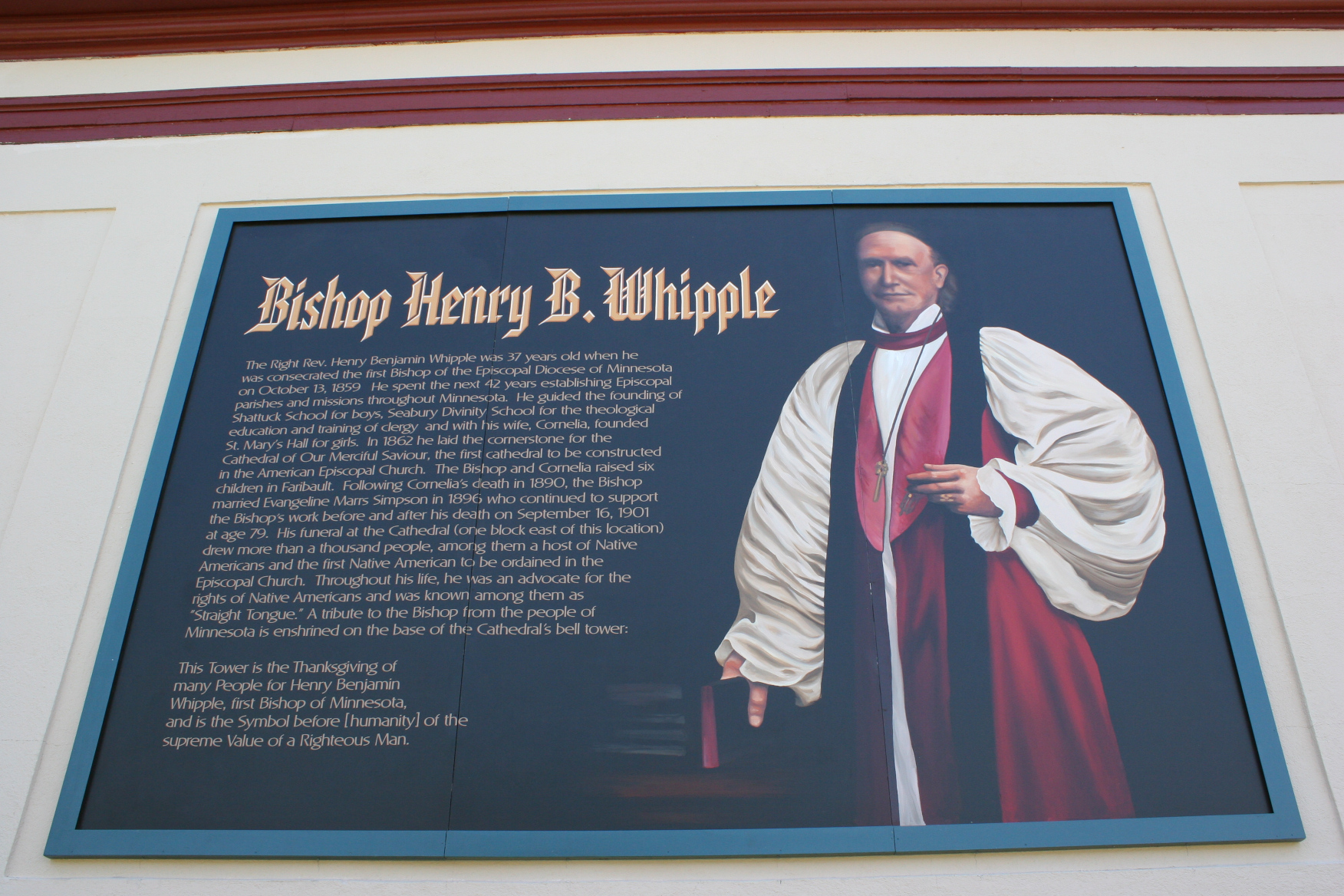
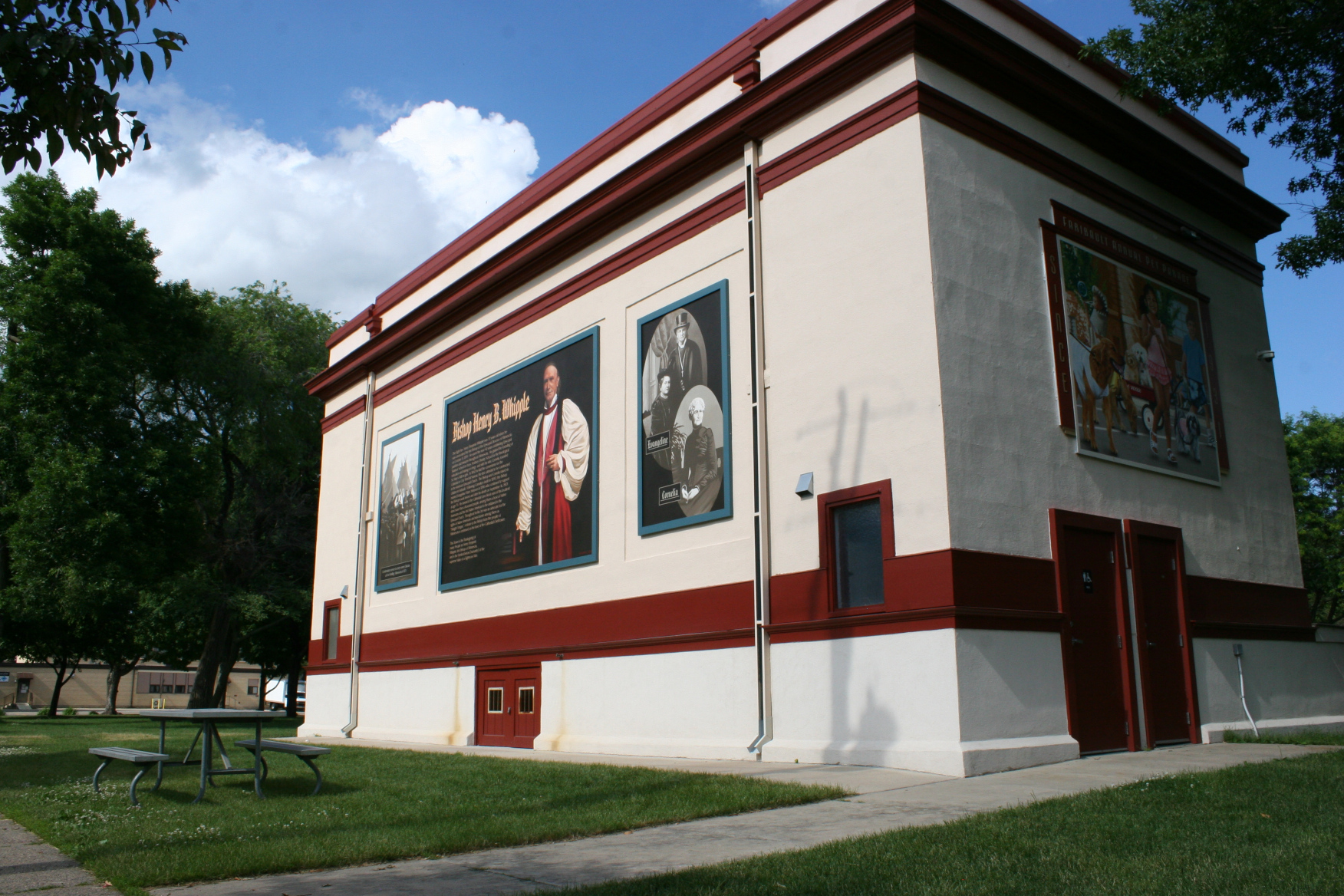
A painting of Bishop Henry Whipple and information about him grace a mural on Faribaults’ Central Park Bandshell. (Minnesota Prairie Roots copyrighted file photo June 2020)
He was known as “Straight Tongue” for his honesty. He was disparagingly called “The Sympathizer” by others for the compassion and care he held for the Dakota. He was Bishop Henry Whipple.
Thursday evening, Rice County Historical Society Executive Director David Nichols spoke to a packed room about this Episcopal priest who played such a pivotal role in Minnesota history, specifically during the time shortly before, and then after, The U.S.-Dakota War of 1862. For me, personally, Nichols’ focused talk connected my home region of Redwood County, the area in which the war centered, to my home of 40 years, Rice County.
I grew up with a limited (white) perspective of the war with no knowledge of Whipple. I only learned of this New York born clergyman upon my move to Faribault in 1982. Nichols broadened my understanding during his presentation and during a question and answer session that followed.
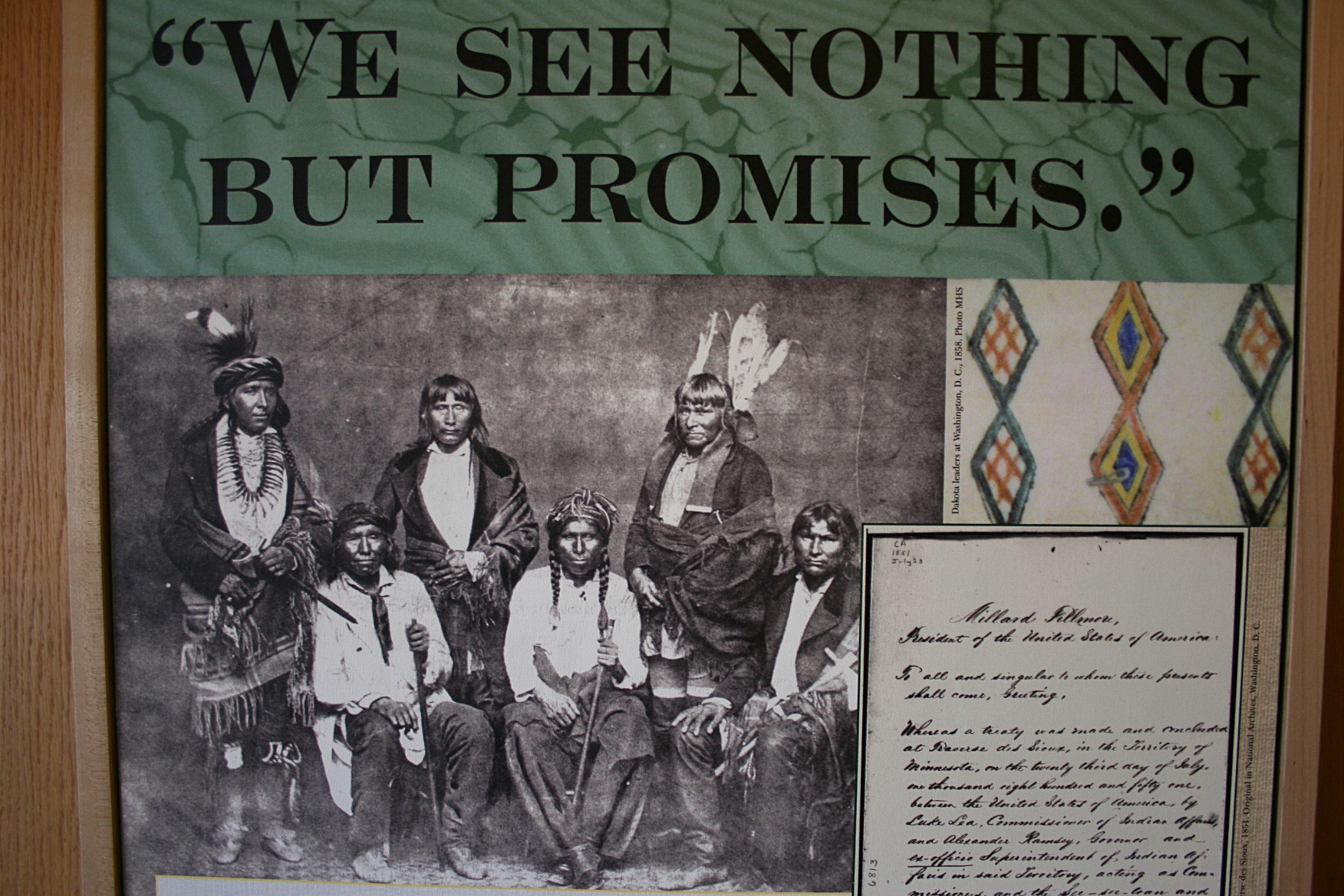
A panel at the Traverse des Sioux Treaty Center in St. Peter shows Dakota leaders photographed in Washington D.C. in 1858. The photo is from the Minnesota Historical Society. It references broken treaty promises and rising tension. (Minnesota Prairie Roots copyrighted file photo)
HIGH TENSIONS
Whipple arrived here in 1860 as the newly-elected Bishop of Minnesota, settling in Faribault. Already at that time, tensions were mounting among settlers and the first peoples of Minnesota, Nichols said. Tensions also existed between the “Farmer Indians” (those who adapted to Euro culture) and “Blanket Indians” (who maintained their Native culture, traditions and lifestyle). Conditions on reservations were terrible with disease, starvation, and dishonest agents failing to provide promised government annuities.
That is the situation Whipple found when he landed in Minnesota. It was a time, noted Nichols, of “tensions about to boil over.” And eventually they did with the outbreak of war in August 1862. It was a decidedly bloody and awful war, as all wars are. Some 600-800 died and the Dakota were eventually displaced from their land.
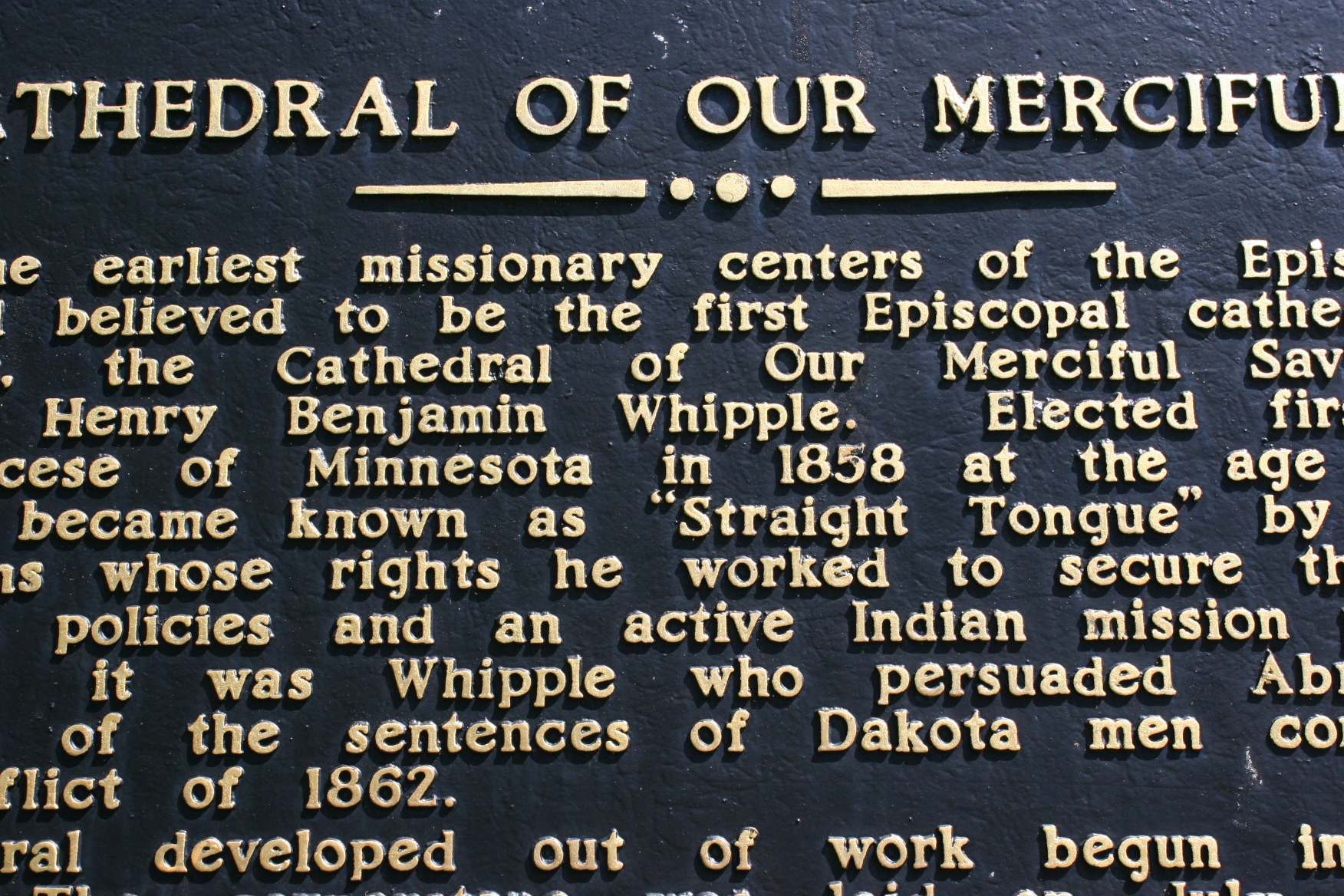
Details on a sign outside The Cathedral of Our Merciful Saviour, Whipple’s church in Faribault. (Minnesota Prairie Roots copyrighted file photo 2020)
THE SHAPING OF A HUMANITARIAN
To understand Whipple’s position and part in this, Nichols provided background. Whipple was involved in New York politics as a “conservative Democrat,” a term which drew laughter from the crowd at Thursday’s presentation. He briefly attended Oberlin College, notable because the college was among the earliest to admit women and African Americans. And Whipple was ordained in 1849, during the so-called “Second Great Awakening” with a focus on civil rights.
Learning this helped me better understand the bishop. All of these experiences shaped a man who spoke with honesty and compassion, advocated for Minnesota’s Indigenous Peoples (both the Dakota and the Ojibwe, natural enemies), called for reform and peace and understanding. Whipple was, said Nichols, a voice for calm, calling for justice, not vengeance, when the short-lived U.S.-Dakota War ended.
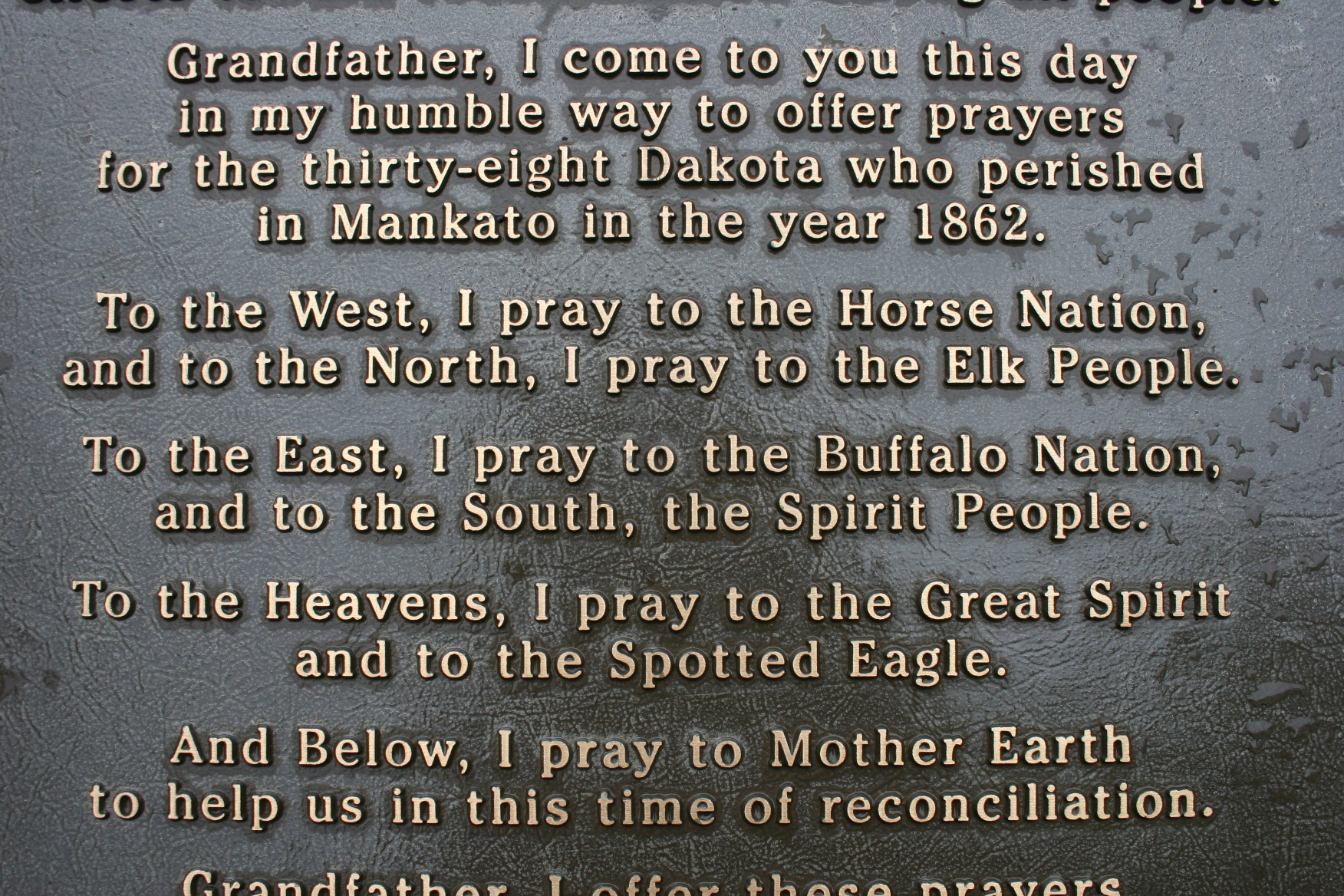
Words on a marker in Reconciliation Park in Mankato where 38 Dakota + 2 were hung on Dec. 26, 1862. (Minnesota Prairie Roots copyrighted file photo May 2012)
ADVOCATING FOR PARDONS
In his many years of missionary work and advocacy, even when his life was threatened by those who viewed him as an “Indian sympathizer,” one singular moment stands out to me. And that is Whipple’s efforts to save the lives of 303 Dakota men sentenced to death after the war. He met with President Abraham Lincoln and was “partly responsible,” Nichols said, for Lincoln’s eventual pardon of all but 38 Dakota. The 38, plus two others, were hung in a public mass execution in Mankato on December 26, 1862. It is a terrible and profoundly awful moment in Minnesota history, especially the history of the Dakota.
A full view of the bandshell mural featuring Bishop Whipple and his first wife, Cornelia, and his second wife, Evangeline. (Minnesota Prairie Roots copyrighted file photo)
ASSIMILATION
While listening to Nichols’ presentation on Whipple, I felt conflicted. Conflicted because the bishop was, he said, “a strong assimilationist.” That label bothered me until I talked further with Nichols. He explained that Whipple did not view himself and Europeans as superior to Native Peoples, but rather observed, in the context of place and time and thinking, the need to adapt versus being driven out. That helped me better understand Whipple’s approach. I recognize, though, and acknowledge the current-day struggles with assimilation, especially as it relates to Indian boarding schools. I appreciate the recognition of, and return to, culture, tradition and heritage today.
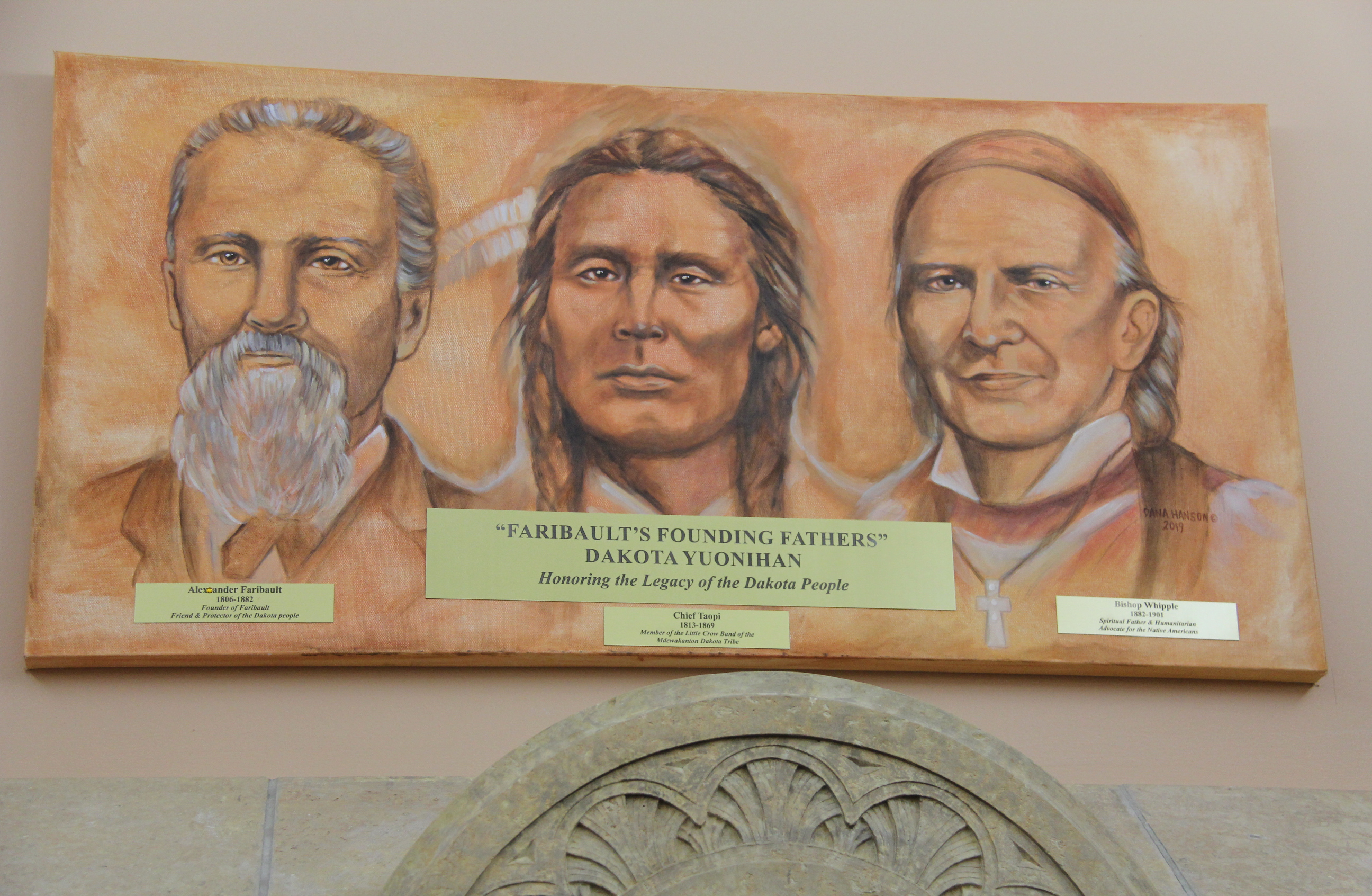
“Faribault’s Founding Fathers,” portraits of Alexander Faribault, left to right, Chief Taopi and Bishop Henry Whipple, by Dana Hanson hangs in Faribault’s Buckham Memorial Library. (Minnesota Prairie Roots copyrighted file photo November 2022)
WELCOMING THE DAKOTA TO FARIBAULT, OR NOT
Whipple, by his words and actions, embraced the Dakota and Ojibwe who called Minnesota home long before white settlers arrived, long before he moved to Faribault. My community, founded by fur trader Alexander Faribault, himself half Dakota, was a safe haven for the Dakota (“you don’t attack family”) during the 1862 war and thereafter, Nichols said. Faribault and Whipple worked together to move 180 Dakota from St. Paul’s Fort Snelling, where they were held following the war, to live on land Alexander owned along the Straight River in Faribault.
I wondered, “Were they welcomed here?” The answer, given by former RCHS Executive Director Susan Garwood, was as I expected. Mixed. While some supported the Dakota’s presence in Faribault, others were vocal in their opposition. In that moment, I thought of our ever-growing immigrant population in my community. Many welcome our newest neighbors and, like Alexander Faribault and Bishop Henry Whipple, support and encourage them. But many also want them gone. History repeats.
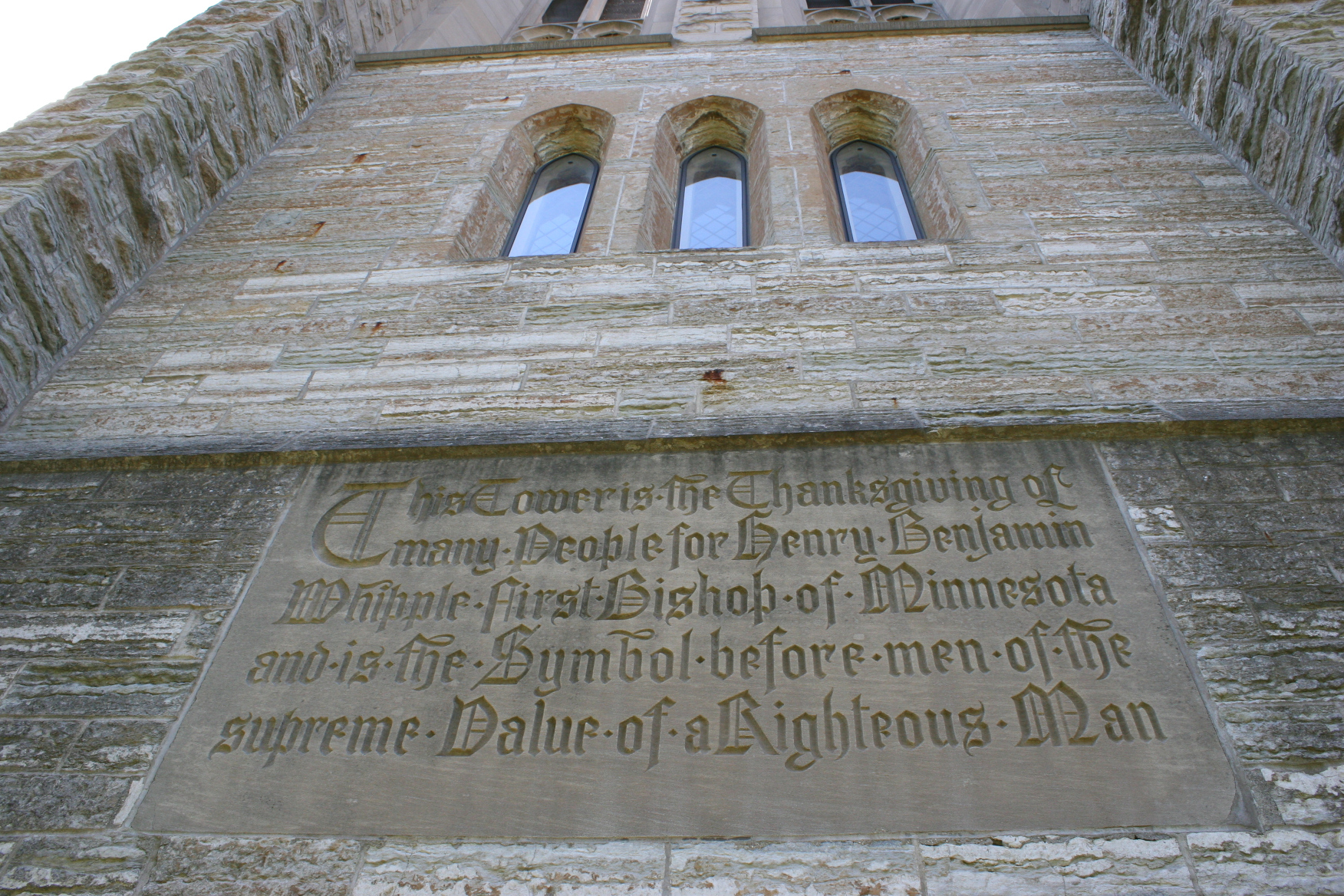
An inscription honors Whipple on the Cathedral bell tower. (Minnesota Prairie Roots copyrighted file photo June 2020)
MARKING HISTORY
Walk around Faribault today and you will see many reminders of the work Whipple did not only locally, but across Minnesota. Historical markers and inscriptions about the bishop grace The Cathedral of Our Merciful Saviour, his faith base. He’s buried under the altar there. Across the street at Central Park, Whipple-themed murals cover the west side of the historic bandshell. Downtown, one of many history-focused benches honors Whipple. And across town, at the Chapel of the Good Shepherd on the campus of Shattuck-St. Mary’s School, a marker notes his role in founding Shattuck and other schools in Faribault.
Efforts are underway now locally to recognize the Dakota as well, to publicly mark their place in the history of Faribault. I’d like to think Bishop Henry Whipple, also known as “Straight Tongue” and “The Sympathizer,” would welcome the idea, would even step up to fund raise, just as he did some 160 years ago to support the relocation of 180 Dakota from Fort Snelling to Faribault.
Beata Sampson (Photo source: Sunset Funeral Home obituary)
Beata. What a beautiful name, one I’d never heard before scrolling through a recent list of obituaries from my home region of southwestern Minnesota. I wanted, needed, to learn more about this 98-year-old woman with the Latin-derived (beatus) name meaning “blessed.”
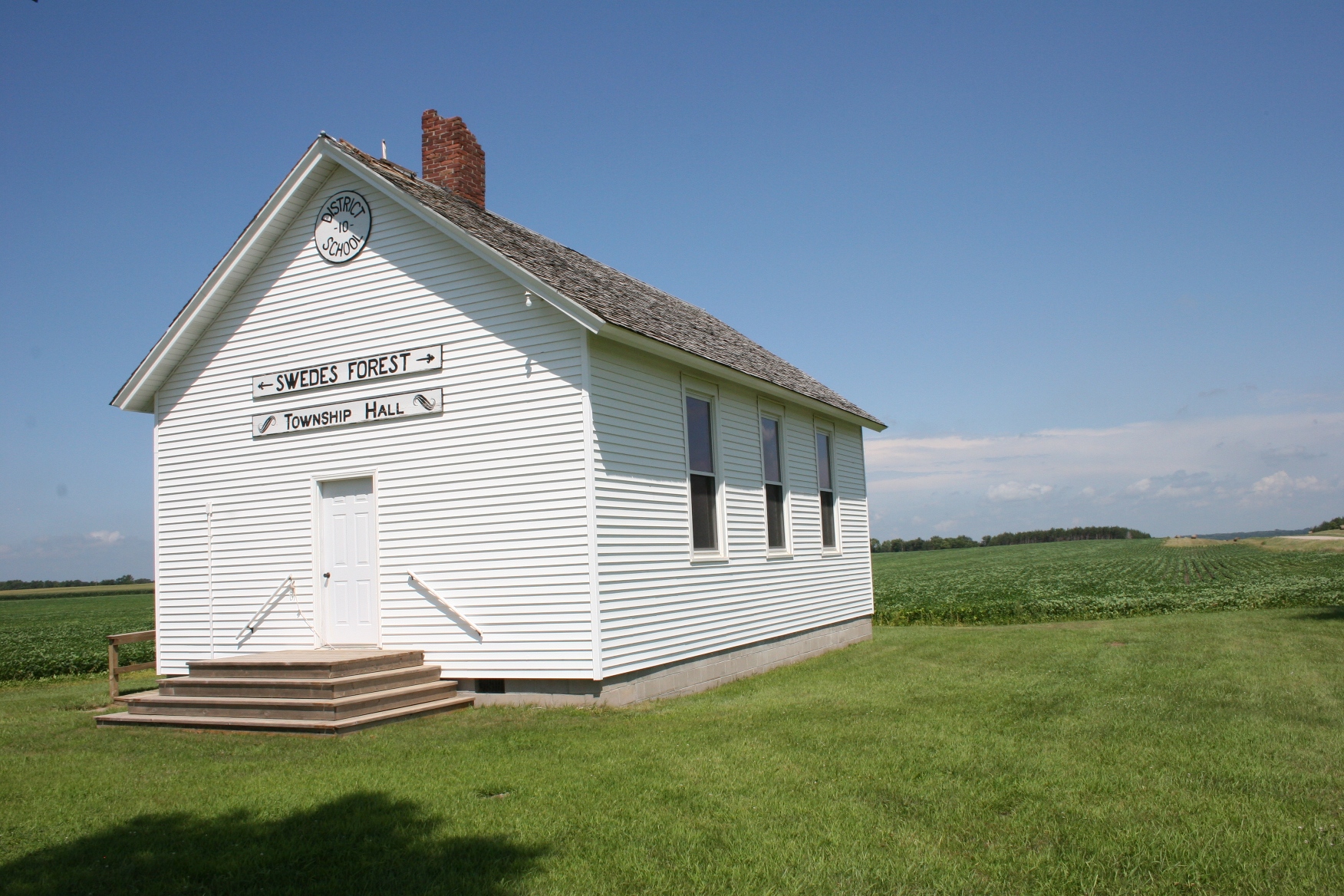
A well-written obituary provides not only basic factual information of birth, life and death, but also enough personal details to tell a story. Beata’s obit speaks to a strong woman born 98 years ago in the Sandager family home in Swedes Forest Township in the northern most part of Redwood County.
Swedes Forest Township Hall, formerly the District 10 School which Beata attended. (Minnesota Prairie Roots copyrighted file photo August 2011)
Even the township name titles a story—of the Scandinavian immigrants who started settling this area just south of the Minnesota River in 1867. Norwegians, mostly, and Swedes and Danes (like Beata’s Danish-born grandfather, Nils H. Sandager). Knute and Erick and Thor and Ole and Torkel and Turi and Gunhild and Ingeborg… And Beata Ellen’s Norwegian grandmothers, Beret and Ellen, after whom she is named.
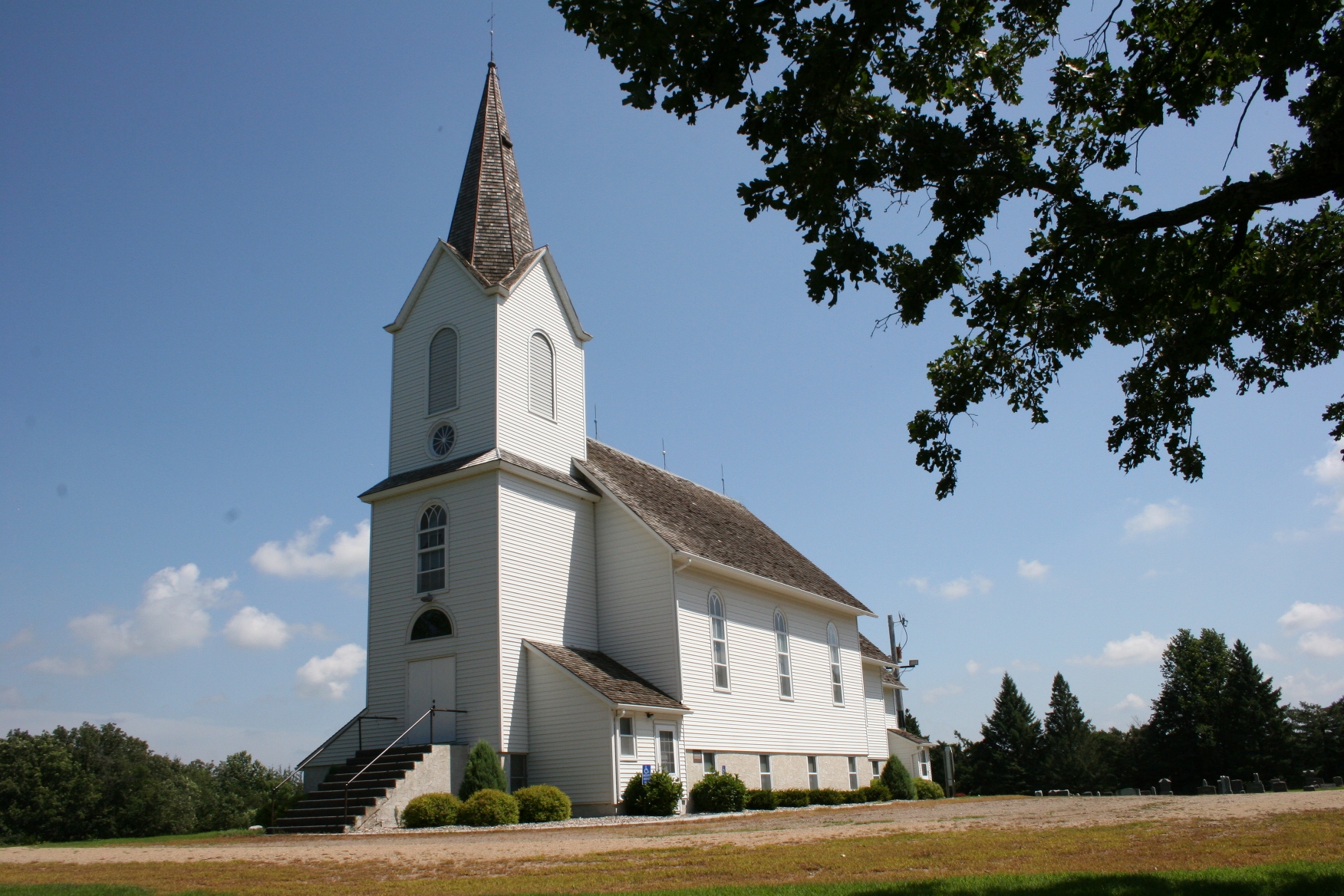
Picturesque Rock Dell Lutheran Church. (Minnesota Prairie Roots copyrighted file photo August 2011)
History runs deep here, all the way back across the ocean. Family history held importance for Beata, who died on February 11 and will be buried today at Rock Dell Cemetery in Swedes Forest Township. This township, this land, this place, it was hers. Beata’s home since her December 27, 1924, birth.
She left only briefly, heading to college in Moorhead in 1942 before returning in 1943 when her father died. Beata was just 18. But her mother, Barbra, and brother Nels needed her help on the family farm. Six years later she would marry Lloyd Sampson, also a farmer. After only 11 years of marriage, Beata was widowed at age 35, her husband dead from cancer.
What strength it must have taken for this young woman and mother of two to endure first the death of her father and then her husband. I’d like to think she had a strong support system of friends and family and neighbors rallying around. A community of people who cared. Knowing rural southwestern Minnesota as I do, I expect that’s true.
Yet, “after a couple years in their big, cold house, Beata and her children (Coral Beth and Joel Loren) moved to live with her mom and brother.” Recognizing the importance of immediate family love and support, of understanding that she needed family near, shows strength, too.
Driving through northern Swedes Forest Township in the summer of 2014. (Minnesota Prairie Roots copyrighted file photo June 2014)
But there’s more, much more, to Beata’s story. In 1979, she became the first woman elected to office in Swedes Forest Township. It took 107 years for a woman to gain an elected seat on the township board. While that seems unfathomable in today’s world, it’s absolutely believable for that time period. Beata served for 24 years as treasurer of Swedes Forest Township.
She followed in the footsteps of her grandfather Nils H. Sandager, who also left a legacy of public service. He was elected township treasurer 12 times and also held the offices of town chair, supervisor and constable for a total of 19 years.
Beata’s local involvement stretches beyond township government. She was active, too, in the Lutheran churches she attended—Rock Dell and Grace. And she found time for the other aspects of life that held her heart—living in the country, the outdoors, flowers, bird watching, family history, family, children, puzzles…and pretty dishes. Yes, this strong strong woman who made history in Swedes Forest Township, who was there for her family, loved pretty dishes. And that, too, says a lot about a woman whose name means “blessed.”
Portraits of the deceased musicians grace the Surf Ballroom. (Minnesota Prairie Roots copyrighted file photo May 2015)
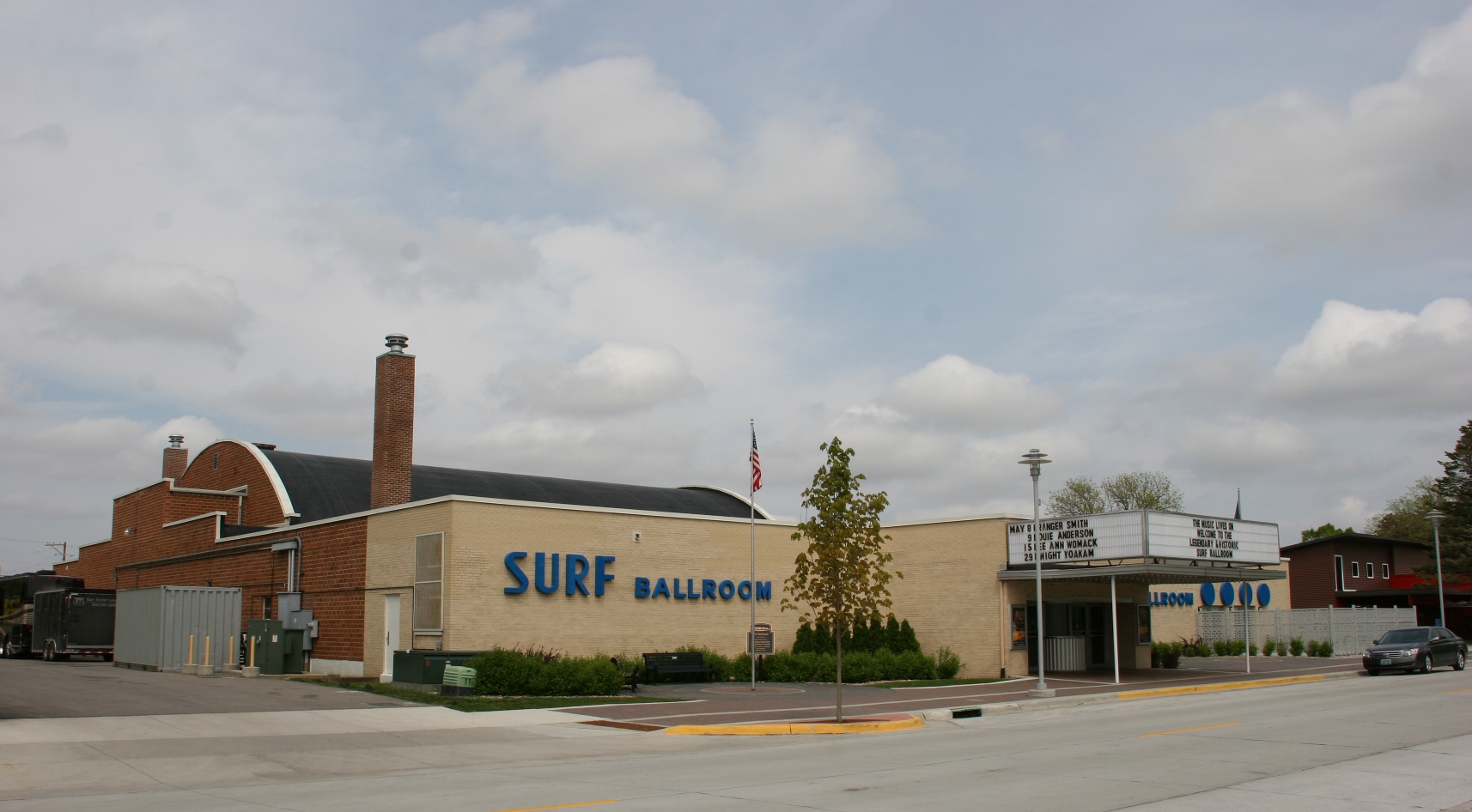
I’M SEVERAL DAYS LATE to the party. Yet, it’s worth noting, even after the fact, the importance of February 2 and 3 in music history. On February 2, Buddy Holly, Ritchie Valens, J.P. “The Big Bop” Richardson and other musicians performed at the Surf Ballroom in Clear Lake, Iowa. The next day, the three died, along with the pilot, when their chartered plane crashed in a field near this northern Iowa community. It was, as Don McClean later wrote and sang, “the day the music died.”
A broad view of the massive ballroom which seats 2,100. (Minnesota Prairie Roots copyrighted file photo May 2015)
Each February, Clear Lake commemorates the musicians and celebrates their music at a Winter Dance Party. I’m about 10 years too young to have known these early rock and rollers. But I still appreciate their status in rock and roll, a music genre I definitely embraced as a teen. McClean’s iconic lengthy “American Pie,” which holds meaning well beyond the tragedy in Clear Lake, remains forever imprinted in my memory, like so many other songs of my adolescent years.
In the back are layers of booths, all original. (Minnesota Prairie Roots copyrighted file photo May 2015)
In mid-May 2015, Randy and I traveled to Clear Lake, just an hour and 15 minutes from Faribault across the Iowa border along Interstate 35. We toured the Surf, but because of rain, did not walk to the crash site. The sprawling ballroom is worth visiting for the history it holds and simply for its ballroom of yesteryear appeal. Retaining its original ocean beach club theme (yes, in rural Iowa nowhere near an ocean), built-in wooden booths and a hardwood floor, this music venue feels like a step back in time. Simply put, I felt like I could have brought a whiskey bottle in a brown paper bag, ordered a set-up and settled in for an evening of dancing and fun.
This display references “American Pie.” (Minnesota Prairie Roots copyrighted file photo May 2015)
Even if you’re like me, not too knowledgeable about music, the Surf will draw you into the music of the era with posters and historical information. But mostly, it’s about being there, about feeling the music that was made, and continues to be made, here.
Lake Time Brewery, a great place to converse with the locals. (Minnesota Prairie Roots copyrighted file photo May 2015)
Clear Lake is one of those small towns that appeals to me. Art and history and eats and drink and natural beauty and homegrown shops and much more make this a must-visit Iowa community. Randy and I are already thinking about a return trip there this summer. On our list of places to revisit is Lake Time Brewery. There we met Connie, Nancy, Chris and “They Call Me Norm.” What a welcoming bunch, exactly the type of connection we hope to make when visiting a place. We still reminisce about enjoying craft beer with locals on the Lake Time patio on a lovely May evening.
A public dock in Clear Lake.(Minnesota Prairie Roots copyrighted file photo May 2015)
These are my thoughts as I reflect on the tragic deaths on February 3, 1959, outside Clear Lake, Iowa, so far from the ocean yet so near.
TELL ME: Have you been to the Surf Ballroom in Clear Lake?
The Rice County Historical Society, host of the POW presentation. (Minnesota Prairie Roots copyrighted file photo July 2022)
JUST BLOCKS FROM THE VACATED SITE of the former Faribault Canning Company, a group packed a Rice County Historical Society Museum meeting room Thursday evening for a lesson in World War II-related regional history. Specifically, we learned about German Prisoner of War camps in Minnesota and Wisconsin from Matt Carter, executive director of the Dakota County Historical Society. He offered an overview of those camps, which included 15 in Minnesota, one at the canning company in Faribault. Carter is a native of Reedsburg, Wisconsin, home to a POW camp. Growing up, he never learned about the camp in school. That prompted him to later research, write about and present on POW camps in the US.
Former Faribault Daily News reporter Pauline Schreiber photographed the Faribault POW Camp barracks shortly before they were torn down in 1990. (Photo courtesy of the Rice County Historical Society)
WORKING AG-RELATED JOBS
I’ve always held an awareness of Camp Faribault and the prisoners who worked at the canning factory and on area farms. I also knew of the low-slung buildings housing the POWs who arrived here in June 1944. Those barracks were torn down in 1990 during an expansion of Faribault Foods, as the canning company came to be called. The business still exists today, in a sprawling manufacturing and distribution complex opened in 2017 in northwest Faribault’s industrial park.
Back during WWII, with millions of Americans off to serve in the military, POWs like those in Faribault offset the local labor shortage. Faribault Canning requested 200 prisoners to assist during the summer months with pea and sweet corn processing. The company paid the government 55 cents an hour for each POW laborer. That covered food and other living expenses. Prisoners received 80 cents a day for their work. Carter noted that the Faribault-based POWs worked within a 25-mile radius, some also laboring on farms, others installing power poles for Dakota Electric Association and 60 contracted to work for the local Andrews Nursery Company.
Some of the buildings remaining at the former Faribault Canning Co (Faribault Foods) site. I know nothing about the use or ages of the buildings. (Minnesota Prairie Roots copyrighted photo April 2022)
SETTLING IN AT CAMP FARIBAULT& BEYOND
POW camps were scattered throughout Minnesota with other nearby branch camps, as they were termed, in Owatonna, Montgomery and St. Charles. Camps farther north focused mostly on logging. All were offshoots of barbed wire-secured base camps (where prisoners initially arrived and were processed) in Algona and Clarinda, Iowa. Once prisoners settled in community camps like Faribault, they still remained under guard, although much more loosely watched. An estimated 450,000 – 600,000* prisoners arrived in the US on Liberty Ships during WWII to live in repurposed Civilian Conservation Corps camps, on fairgrounds, even in tents, Carter said. In Faribault, the POWS moved into barracks built by the canning company.
WEDDINGS, PROPAGANDA & “CODDLING”
Within the confines of his just-over-an-hour-long presentation, Carter presented an excellent overview of POW camps, adding some details that I found notably interesting. For example, proxy weddings were performed by local clergy. Under Geneva Convention rules, German prisoners could legally marry women back in Germany. Prisoners would gather flowers for the missing-brides prison camp weddings. Across the ocean their brides perhaps did the same while marrying absent grooms not seen in years.
Carter also shared that prisoners watched newsreels of German war atrocities as part of a reorientation program in the camps. Viewed as propaganda by some POWs, they responded by distributing handwritten propaganda while traveling on secured trains. Baffled by how these leaflets were dropped, officials determined that the papers were dropped down toilets and then onto the rails.
The third bit of shared information that struck me involves food. Newspapers reported how well prisoners ate, how they were being “coddled,” Carter noted. He showed a list of menus, which confirms the generous meals. The reaction was an outcry from an American public living on rationed foods and upset about the treatment of German-held US soldiers. In 1945, POWs were no longer allowed to buy beer, soda or cigarettes. And some of their food choices became less desirable (like hearts and liver).
Once the war ended, prisoners were repatriated, a process that took time. Many later returned to the US because of how well they were treated here, according to Carter. That was encouraging to hear. Even in war-time, kindness existed.
Matt Carter referenced this book during his talk, citing it as a good source of information about POW camps in Minnesota.
DIGGING DEEPER
Today all that remains of the Faribault POW Camp is a marker by the former canning company. If there are stories and photos, I am unaware. But I’m inspired now to dig deeper. I’ve already checked out Prudence by David Treuer from my local library. The novel focuses on a German soldier who escaped from a Minnesota POW camp. I also intend to read Anita Albrecht Buck’s Behind Barbed Wire: German Prisoners of War in Minnesota during World War II.
And maybe some day I’ll travel to Algona, Iowa, to visit the Camp Algona POW Museum and learn more about this place which housed prisoners sent to Minnesota, including to Faribault.
#
*Because of differences and discrepancies in record-keeping, the number of prisoners housed in US POW camps is uncertain. Some sources claim 600,000-plus, while Carter estimates closer to 500,000 prisoners based on his research.





























 Minnesota Prairie Roots
Recent Comments