Minnesota Prairie Roots

Writing and photography by Audrey Kletscher Helbling

Commentary: I care about my neighbors, a free press, freedom & more December 3, 2025

Filed under: Uncategorized — Audrey Kletscher Helbling @ 6:01 AM
Tags: , , , , , , , , , , , ,
Protesting in Northfield at a NO KINGS rally. (Minnesota Prairie Roots copyrighted file photo October 2025)

I CAN’T IGNORE the news. I want to, no, need to, know what’s happening on all levels from local to international. Perhaps it’s my innate curiosity or my journalism background that compels me to read and watch media reports. I feel an obligation, especially in these challenging times, to be as informed as possible.

What I’ve been hearing and reading from the federal government in Washington DC continues to concern me. Deeply. I can hardly believe the rhetoric, the hatred, the awfulness that is flowing like hot lava from fiery mouths upon this land.

Somali women walk through downtown Faribault during a community event. (Minnesota Prairie Roots copyrighted file photo)

The latest is the hatred directed by our president toward Somalis living in America, including some 80,000 in Minnesota. My community of Faribault is home to many Somali Americans. The president has singled out Somalis in Minnesota with his derogatory words and planned, targeted ICE raids here. I am proud of the mayors of Minneapolis and St. Paul and other leaders, including the Minneapolis police chief, for speaking up and standing strong for the Somali community during a Tuesday afternoon news conference. They recognize the threat to this specific demographic. And they value the Somalis who call Minnesota home.

“Who,” I ask, “will be next? Me, because my eyes are green?” Maybe he doesn’t care for green-eyed people. Or you? Because he doesn’t like something about you.

This is a pig, not a female journalist. (Minnesota Prairie Roots copyrighted file photo)

He certainly doesn’t care for journalists, especially female journalists. I realize a dislike of journalists is nothing new. But this president has gone well beyond “dislike” to outright meanness, bullying and name-calling. I never thought I would see the day when the leader of our country would chastise a reporter with “Quiet, piggy.” I never thought I would hear an American president call a reporter fat or terrible or ugly or any other adjective while hissing “fake news” at the media.

Bracelets against censorship and for rights. (Minnesota Prairie Roots copyrighted file photo 2025)

When the U.S. government launched a Media Bias page on the official White House website just days ago, I felt nothing short of outraged. This is the United States of America, where freedom of the press ought to mean something, where the media is independent of the government, where reporters have a right and a duty to accurately report the truth without fear of intimidation, public shaming, recrimination,… This newest tactic of naming a “Media Offender of the Week” ought to anger every single person in this country. I don’t care what side of the political aisle you sit on. This latest action speaks to censorship, to controlling the press, to propaganda, to anything but democracy.

I value freedom. I hope you do, too, enough to stand up for a free press, individual rights, freedom from fear, intimidation, oppression and all that threatens us. These are unprecedented times (yes, I recognize that may be an overused word, but it fits) in our country. I refuse to remain silent.

THOUGHTS?

© Copyright 2025 Audrey Kletscher Helbling


Connected by place & profession to a Minnesota tragedy June 20, 2025

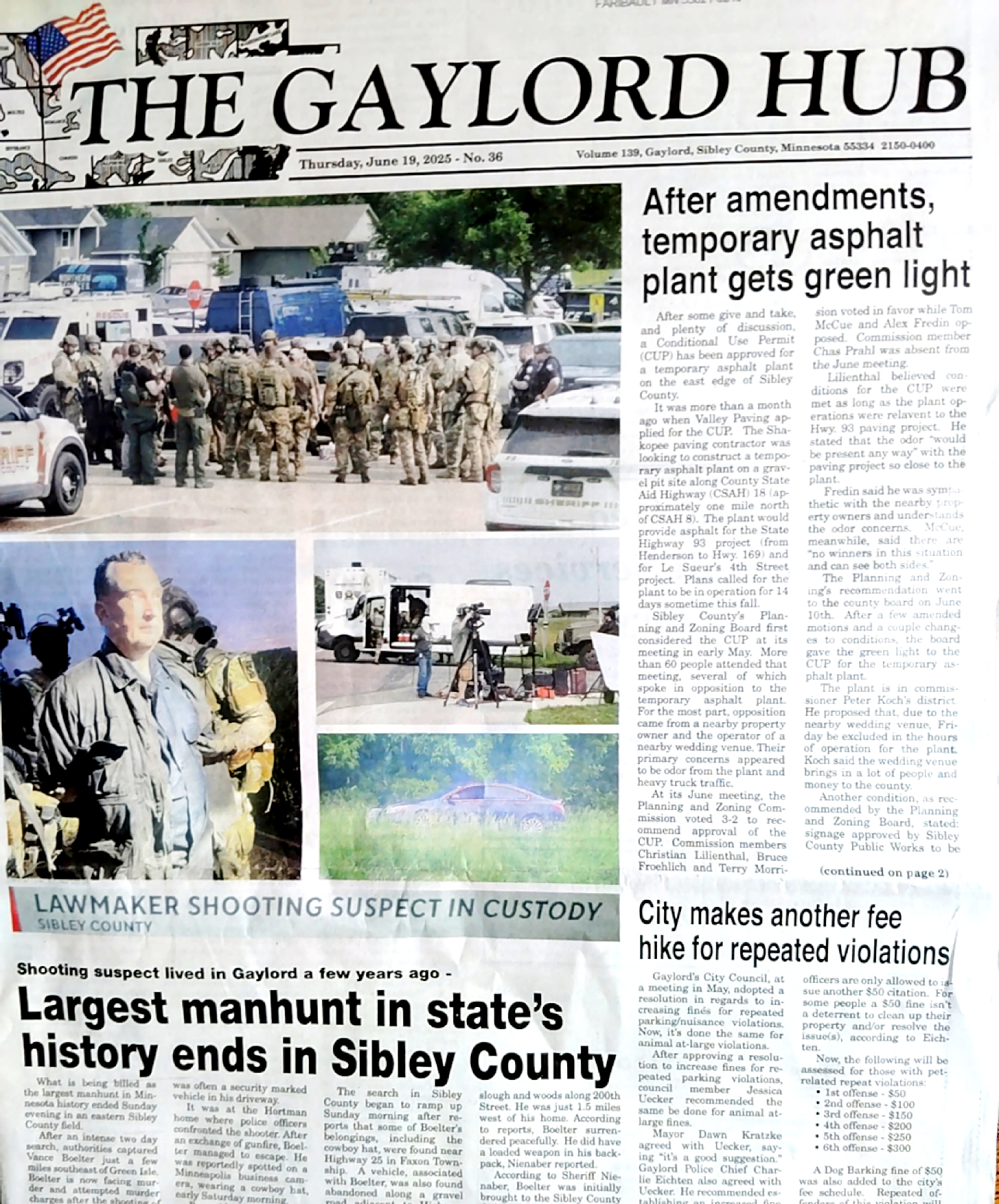
This shows an edited section of the front page of the June 19, 2025, The Gaylord Hub. (Minnesota Prairie Roots photo June 2025)

ALTHOUGH I AM DECADES removed from working as a full-time journalist, my innate curiosity remains unchanged. I still want to gather the facts, get answers, and uncover the who, what, when, where, why and how. That has never left me.

Last Saturday, June 14, memories of working as a newspaper reporter in Gaylord, the county seat of Sibley County, rushed back as the top news story in Minnesota, and the nation, unfolded. That breaking news was the politically-targeted assassinations of Minnesota State Representative Melissa Hortman and her husband, Mark, and the shootings of Senator John Hoffman and his wife, Yvette. The suspect now accused in the crimes, Vance Boelter, 57, lived near Green Isle. In rural Sibley County.

My first job fresh out of Minnesota State University, Mankato, in 1978 with a degree in mass communications, news/editorial emphasis, landed me in small town Gaylord, at The Gaylord Hub. I was affectionately dubbed “The Cub from the Hub,” or at least affectionately by those who appreciated my fair and balanced reporting. Some did not. Gaylord lies about 15 miles southwest of Green Isle, where Boelter was eventually apprehended near his home. Green Isle was mostly outside The Hub’s coverage area, although I recall writing a few stories from that part of Sibley County.
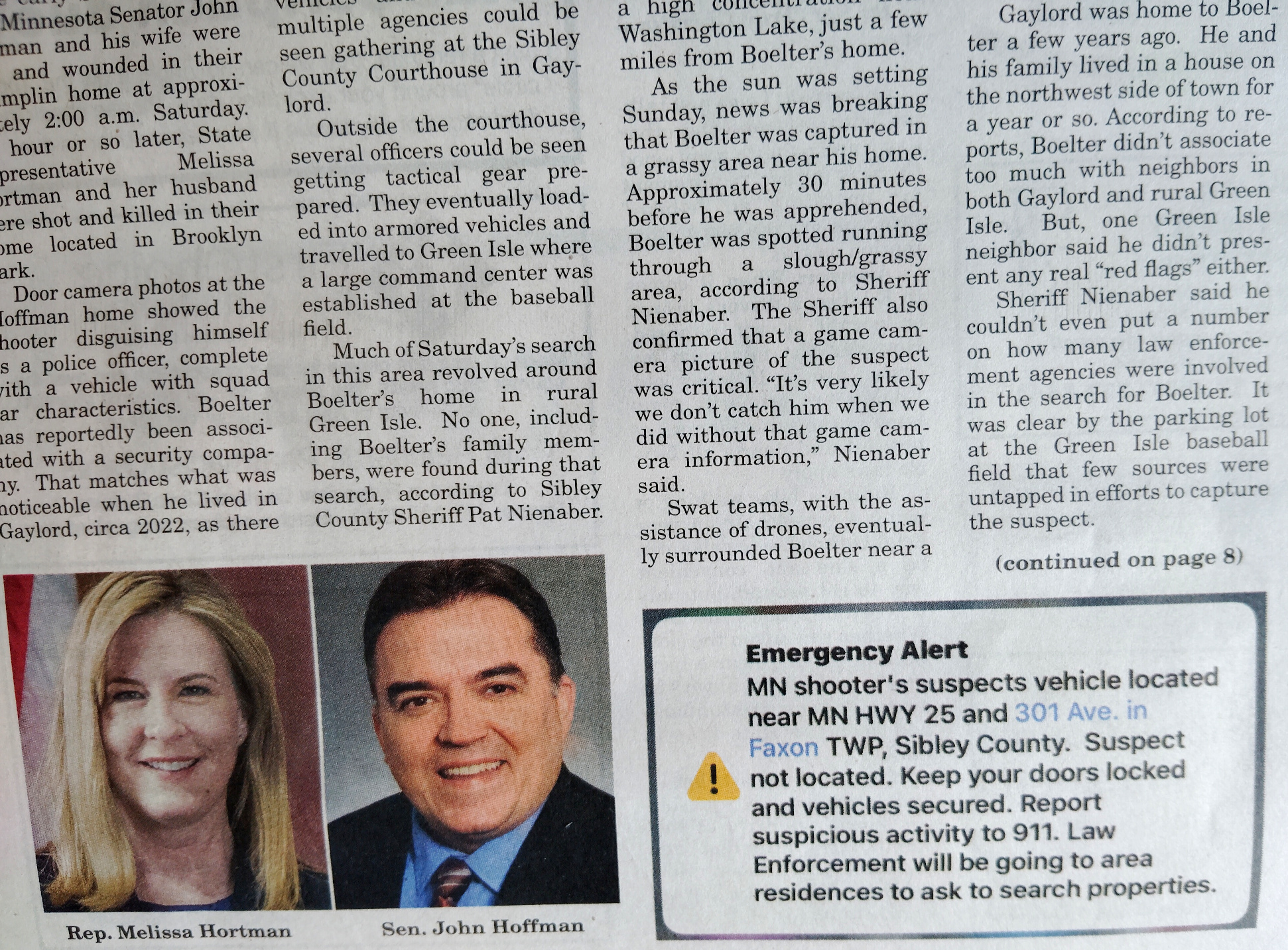
The bottom portion of the front page story written by Joseph Deis. (Minnesota Prairie Roots photo June 2025)

Today the June 19 edition of The Hub landed in my mailbox. I’d been waiting for this issue, curious to see how third-generation publisher and editor, Joseph Deis, would cover the largest news story in the paper’s history. The Hub front page headline reads: Shooting suspect lived in Gaylord a few years ago—Largest manhunt in state’s history ends in Sibley County.

I couldn’t help but think how hard Joe (he was just a kid when I worked for his dad, Jim, at The Hub) and other media have worked to cover this evolving story. It’s not easy to gather information from multiple sources and angles and keep everything straight. That said, law enforcement did an impressive job of informing the media and the public, at least from my at-a-distance perspective.

And Joe Deis did a good job of pulling everything together in a lengthy story that published in his weekly. His dad would be proud, as am I. His story included new-to-me information that Boelter and his family lived on the northwest side of Gaylord a few years ago. They mostly kept to themselves, the article states.

Now, as if the Gaylord/Sibley County connection to my past isn’t enough, there’s more. I left The Hub after several years to become a newspaper reporter at The Sleepy Eye Herald-Dispatch. The murder suspect grew up in Sleepy Eye, graduating from the public high school in 1985. (I was long gone.) Boelter returned to his rural southern Minnesota hometown, living with his family in Sleepy Eye from 2008-2011 and working at Del Monte. And he apparently preached occasionally at church services held in the high school gym, according to media reports. If I know one thing about Sleepy Eye, it’s that the community is deeply religious, with an especially strong Catholic base. I have no idea what Boelter’s childhood faith background may be. But he graduated from an interdenominational Bible college in Texas in 1990 and served as an evangelical missionary in the Democratic Republic of Congo in recent years.

These two connections to my past rattled me. But they also reminded me that, even in rural areas, a reporter’s job can be about more than covering government, sports, community events and the everyday happenings of small town life. Sometimes it can be about covering a really big, life-changing story. A story that grabs headlines locally, statewide, nationally and internationally as did the manhunt in Sibley County, in the readership area of a small town weekly newspaper where I once covered the news.

© Copyright 2025 Audrey Kletscher Helbling


Commentary: The importance of a free press in a democracy March 4, 2025

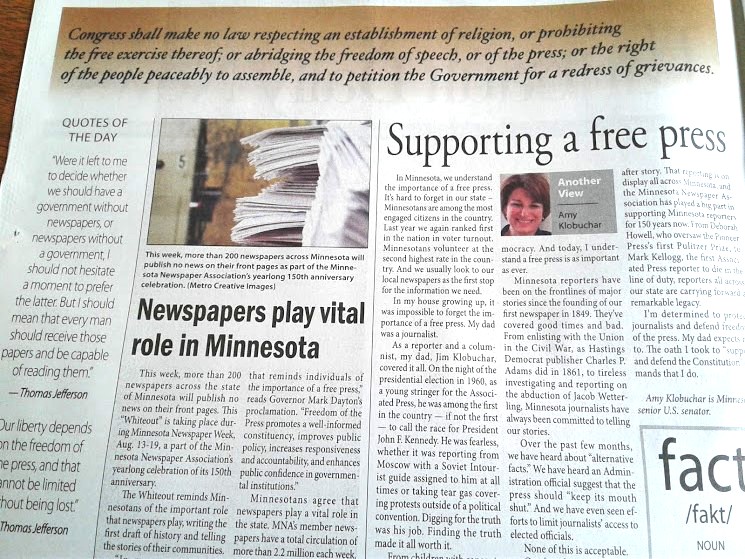
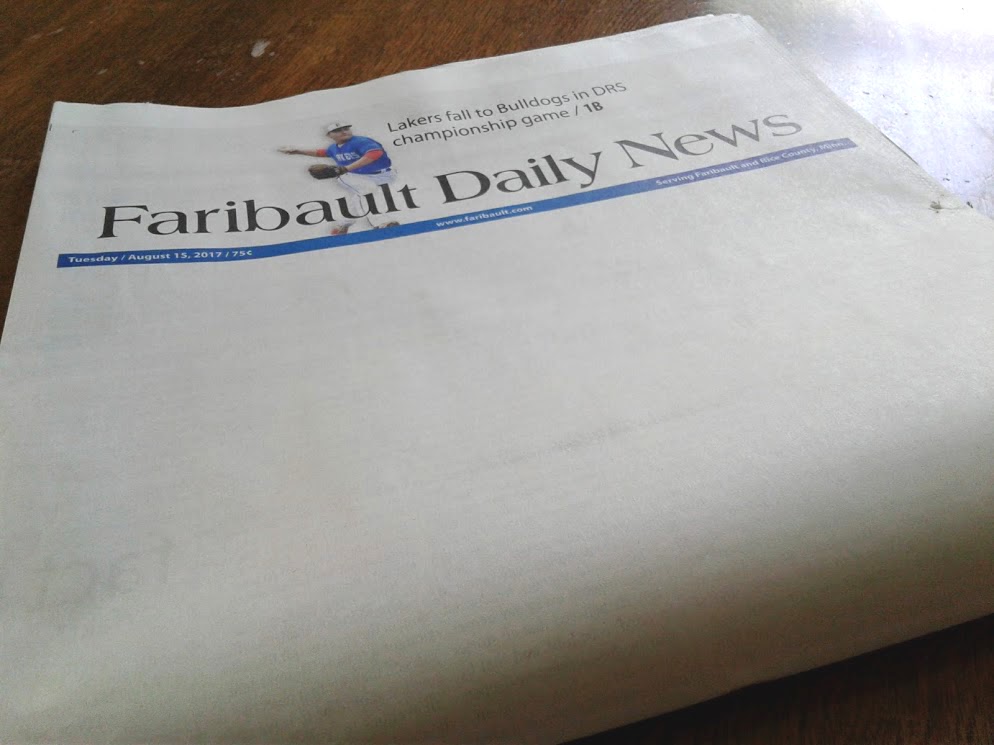
This is the front page of the August 15, 2017, Faribault Daily News. It was part of “Whiteout,” an effort during Minnesota Newspaper Week to remind readers of the importance of newspapers. Imagine if there was no free press. (Minnesota Prairie Roots copyrighted file photo 2017)

I AM WRITING THIS OPINIONATED POST with no apologies. As an American woman with a college degree in mass communications (news/editorial emphasis) and experience as a newspaper reporter, I’ve always felt strongly about a free press. Even more so today with threats to that freedom. If you are unaware of current actions against the press, research and read. A free press is a vital part of democracy.

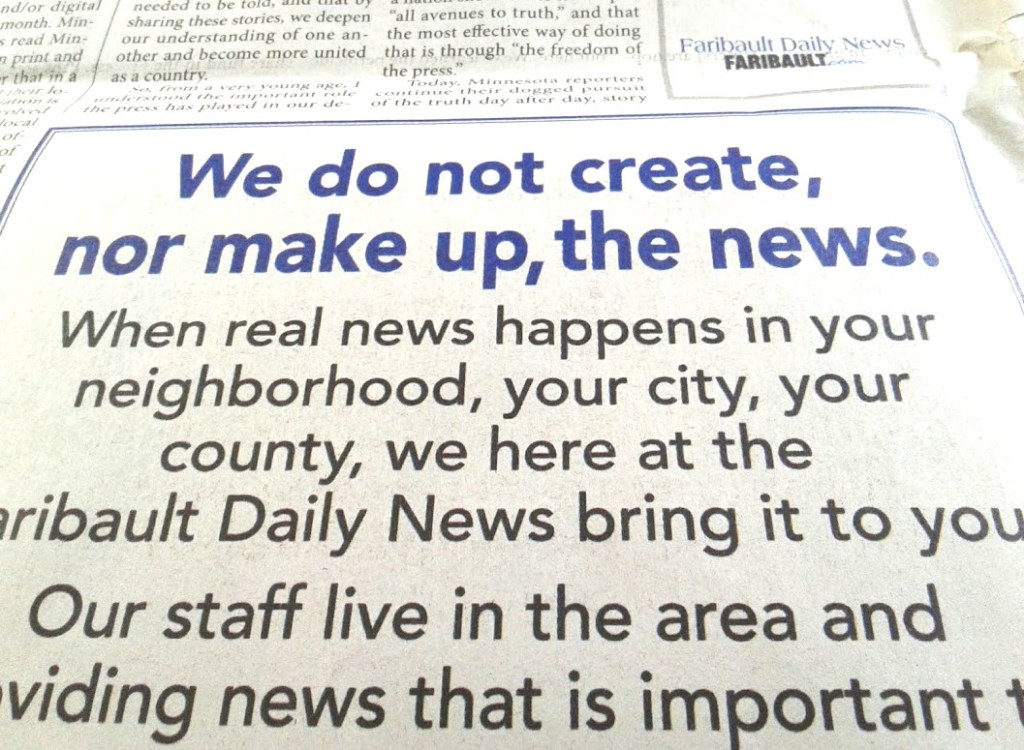
The second page of the Daily News from the August 15, 2017, issue explains the importance of a free press and its role. (Minnesota Prairie Roots copyrighted file photo 2017)

Journalists serve, among other roles, as government watchdogs. That means they, ideally, provide accurate and balanced reporting on government, at all levels. The “fourth estate” holds the government accountable via the stories they write. Not agenda-driven stories shaped by a biased editorial perspective or by information spoon fed to them by a press secretary. But rather stories based on quotes, actions, interviews, facts. Good solid reporting. Not misinformation, disinformation and/or propaganda. I must, though, state the obvious here. Not all sources speak truth to the media. And not all media write truth.

Suppression and criticism of the press are nothing new. Some of the criticism is deserved. Much of it is not. You may like journalists or you may not. That’s not the point. The point is that we need a free press, one unsuppressed/uncensored by those who are in positions of power. If you think otherwise, then look to history and to countries under authoritarian leaders, dictators. Under those leaders, messaging is/has been carefully controlled. Manipulation, intimidation and absolute power rule.

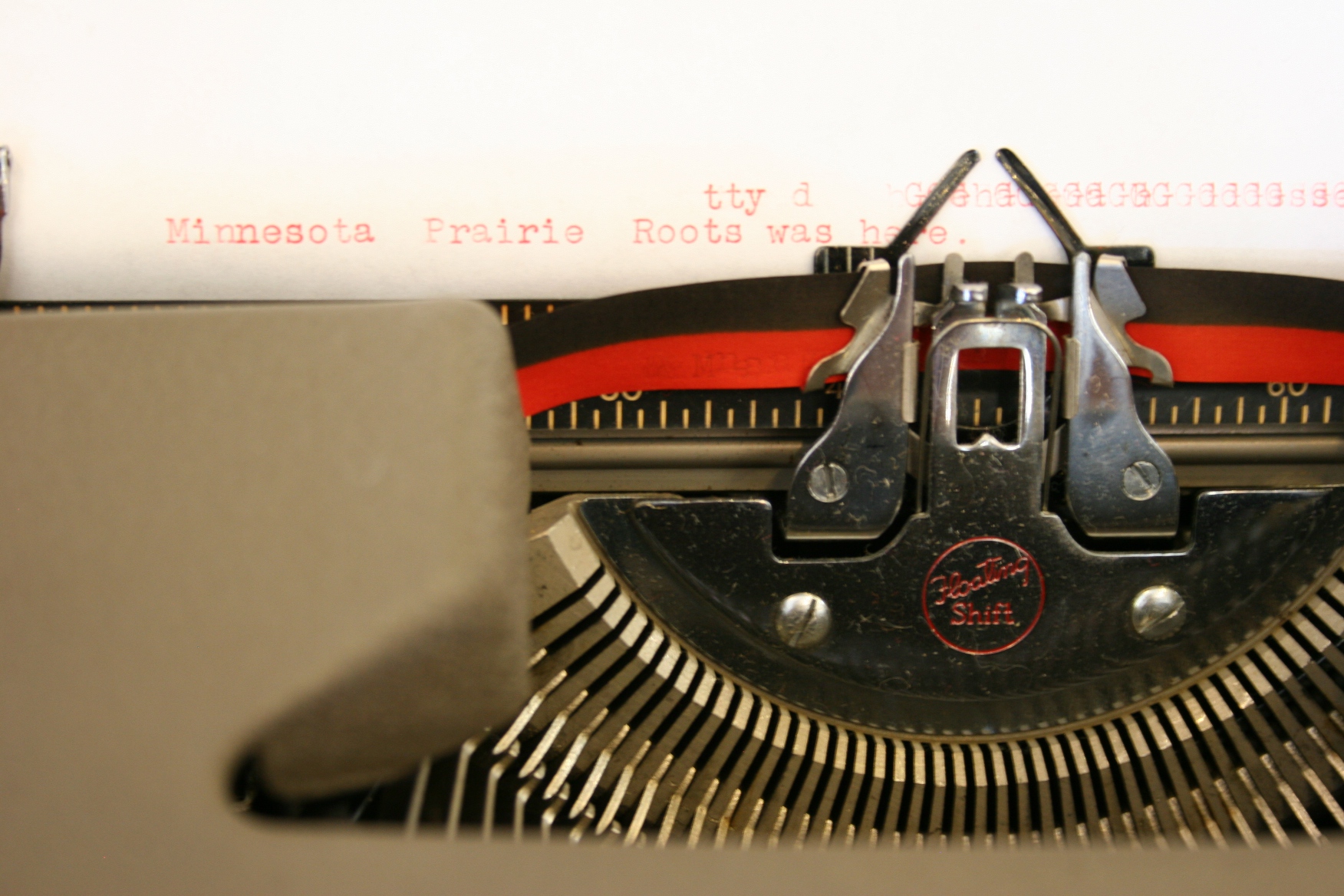
I started my newspaper career at a small town Minnesota weekly, typing my stories on a manual typewriter. This photo was taken in a Hastings antique shop, where I left a message. (Minnesota Prairie Roots copyrighted file photo)

During my journalism career, I have not been immune to those who wanted to control what I wrote. They did that sometimes in a back door way via criticizing me and my work and/or by shutting me out. Thankfully, my editors always had my back.

Let me give you some examples. While covering a school board meeting for a small town southern Minnesota weekly, a teacher said some things that were controversial. Decades out, I can’t recall details. But I do remember how this teacher fumed about my quoting him in a news story. The quote did not reflect favorably on him. But he made the statement at a public meeting. And it needed to be reported. Readers could decide what they thought of his comments.

In that same community, a local realtor called me out for quoting him in a story about a city council meeting. Again, I don’t remember details. But he was absolutely irate and verbally attacked and bullied me for what I’d written. (Sound familiar? Bullying. Fake news.) My reporting was accurate. I was not about to cave to his pressure. Once again, my editor stood up for me. He knew I demanded the best of myself in my work and that I would settle for nothing less than fair and accurate reporting.

Flash ahead to a different small town where I, once again, found myself despised. This time by a school superintendent. He didn’t like that I covered a student walk-out. It happened. I observed, interviewed him and students. And he retaliated. Every time I attended a school board meeting, he refused to give me an agenda or the packet of information distributed to board members and to the editor of the local weekly newspaper. (I worked for a regional daily.) He refused to talk to me. He made no effort to hide his disdain or to make information accessible to me. His was clearly an effort to stop me from reporting on anything school related, including school board meetings. His strategy did not work.

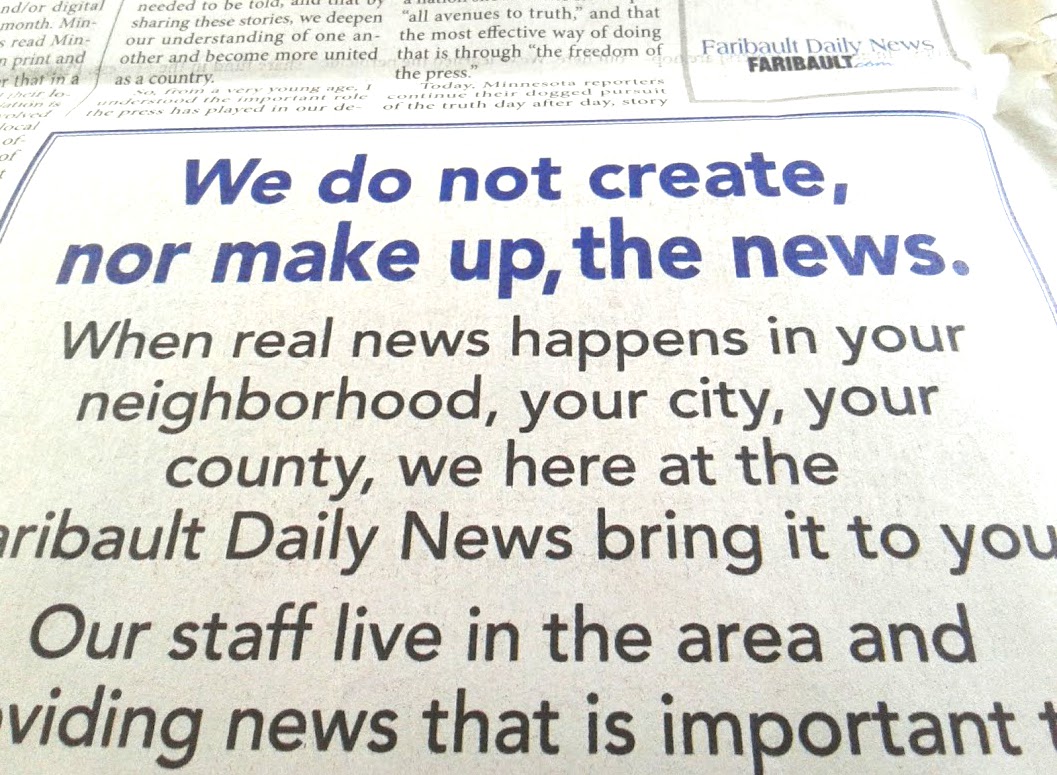
Published in the Faribault Daily News in August 2017 as part of the “Whiteout” campaign. (Minnesota Prairie Roots copyrighted file photo 2017)

Attacks on journalists have become more rabid in recent years. I think we can all agree on that. Don’t kill the messenger for the message he/she delivers. Respect those journalists who truly are doing their best to report fairly and accurately and who hold themselves and their work to high standards. Turn to those reliable sources for news.

Certainly, some media outlets and journalists are incredibly biased with specific agendas. They have become mouthpieces for government leaders, political parties and issues. I’m not praising those who are manipulating people to shape public opinion and to push ideas. Unfortunately, though, I see more and more government leaders, politicians and others targeting dedicated-to-the-craft journalists. These hardworking reporters are being shut out, degraded and abused because they accurately report what they see and hear in their watchdog role. Kinda like me with that small town school superintendent decades ago, just a lot more amplified and with much more serious consequences.

Thankfully, plenty of journalists committed to writing the truth still remain. They are strong men and women of integrity and morals who give a damn about democracy and a free press. Now, more than ever, we need to recognize the value of a free press, underscore FREE. Even though I no longer work as a newspaper journalist, I still strongly value freedom of the press. It is, always has been, a cornerstone of democracy.

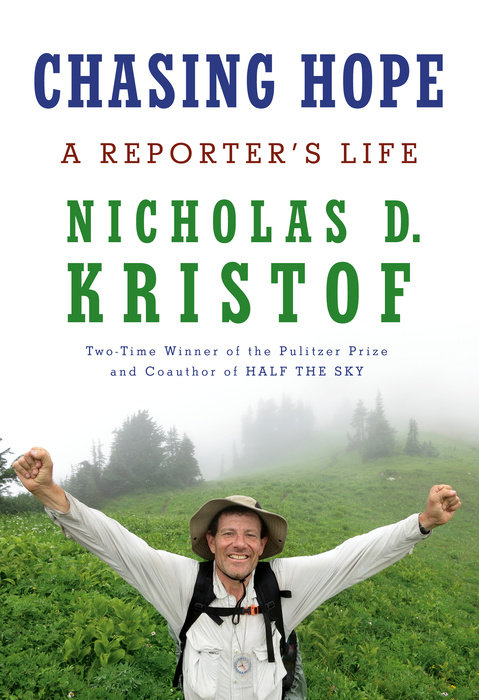
(Book cover sourced online)

FYI: I encourage you to read Chasing Hope—A Reporter’s Life by Nicholas D. Kristof, currently an op-ed columnist for The New York Times. The two-time Pulitzer Prize-winning journalist worked as a foreign correspondent in Hong Kong, Beijing and Tokyo. He witnessed some pretty horrible atrocities—including the massacre in Tiananmen Square, the genocide in Darfur and much more—and offers remarkable insights via his experiences, observations and exceptional storytelling.

Of special note in Kristof’s book is a reference to an August 2008 campaign rally in Lakeville, Minnesota, which the author calls “one of the finest moments in American politics in my lifetime.” Kristof shares a story about Senator John McCain, who was then vying for the Republican Presidential nomination. I refer you to pages 239 and 240 in Chasing Hope. This book is worth the read for that story alone. It will give you hope. And, no, I’m not telling you more. Read the book.

© Copyright 2025 Audrey Kletscher Helbling
 

Reflecting on 2021 in an A & E magazine column January 12, 2022

Photographed at the Rice County Steam & Gas Engine Flea Market, rural Dundas. (Minnesota Prairie Roots copyrighted file photo May 2021)

WHEN SOUTHERN MINN SCENE, a regional arts and entertainment magazine in southern Minnesota resumed publication late last year, I reclaimed my column. I’m delighted to be back crafting “Through a SoMinn Lens,” an essay of images and words, but mostly images.

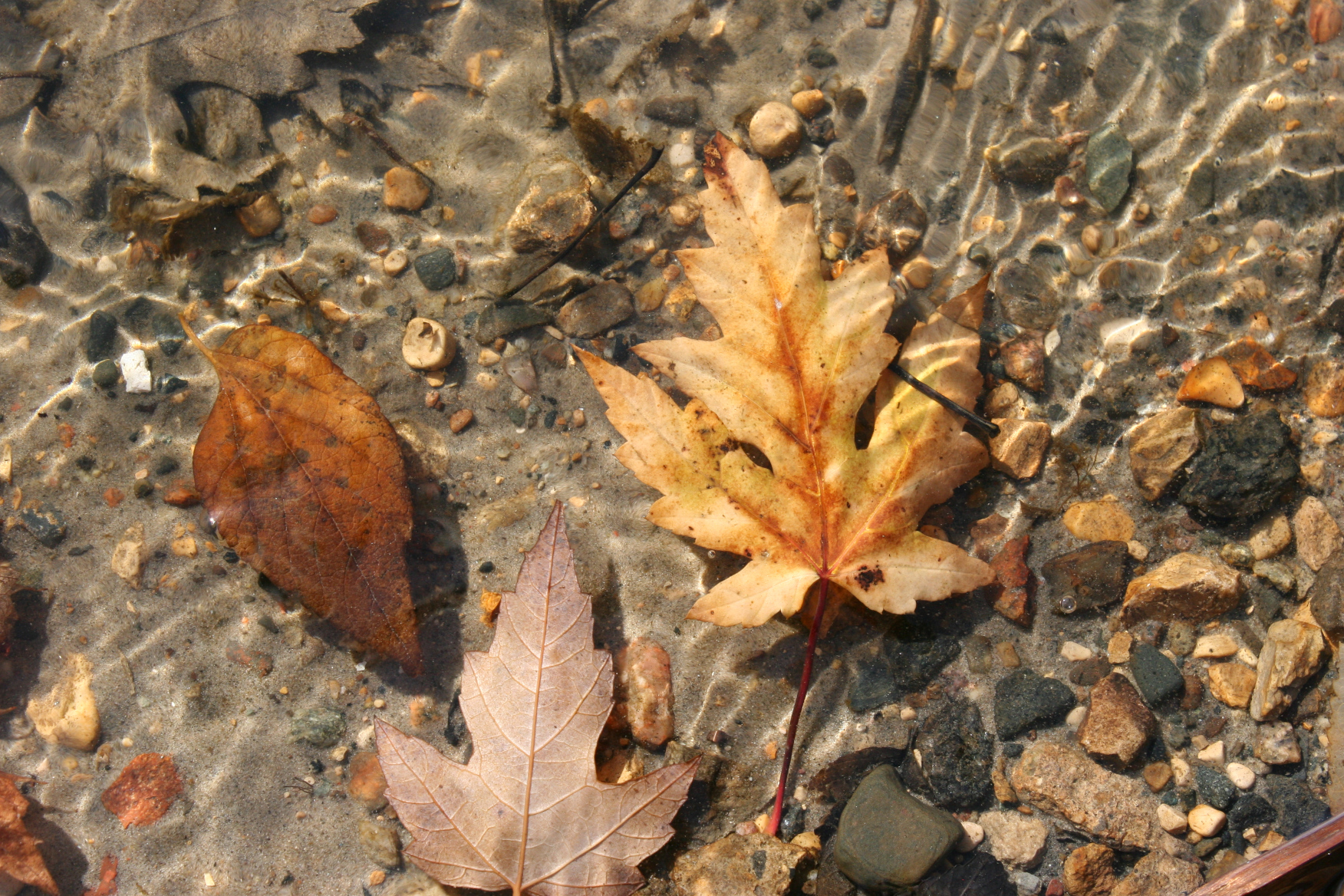
Leaves in the Cannon River. (Minnesota Prairie Roots copyrighted file photo)

A look back at 2021 themed the recently-published January issue. I titled my piece “Reflections and hope during a pandemic year.” I wrote a reflective essay and then searched my photo files for supporting images.

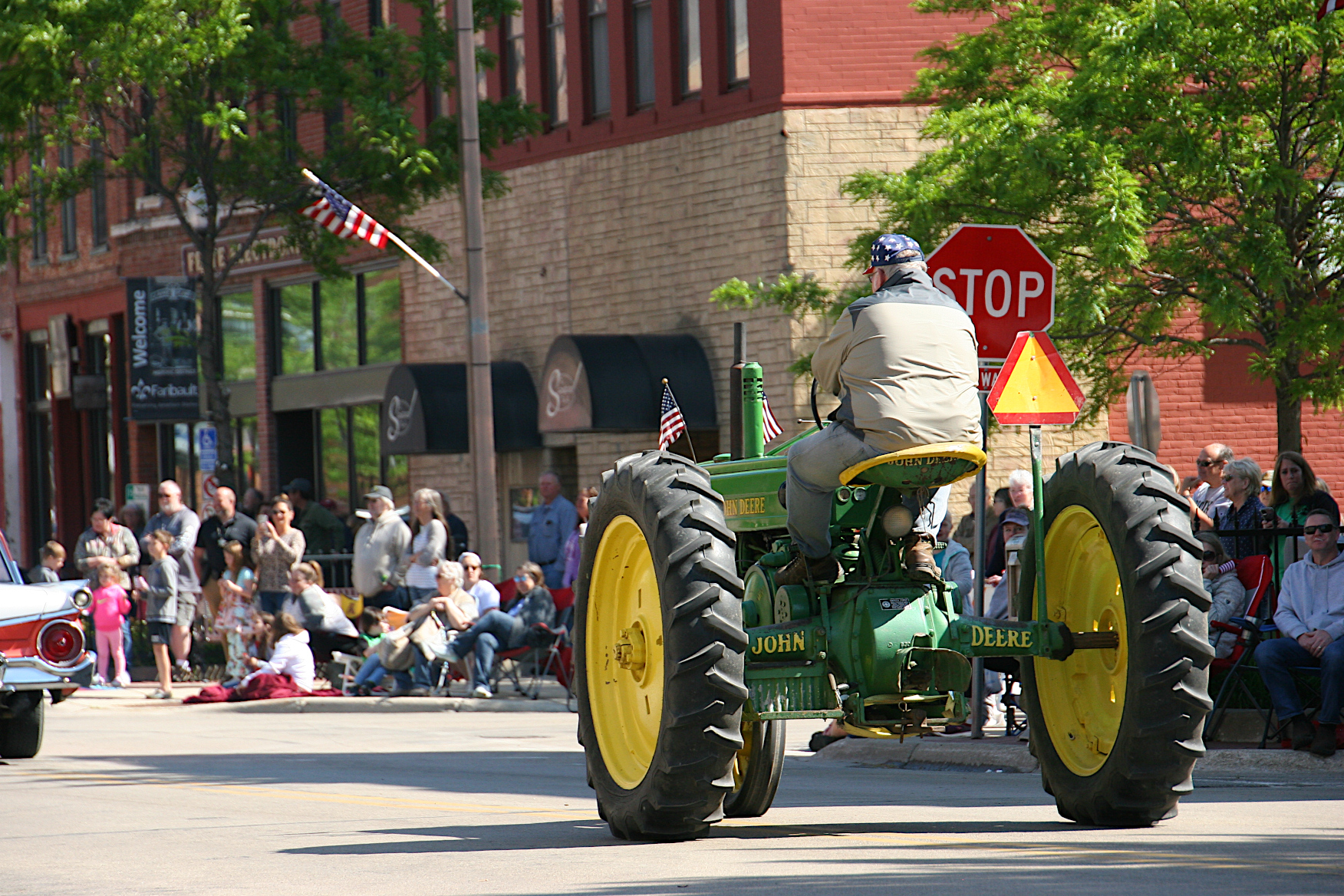
A scene at Faribault’s 2021 Memorial Day Parade along Central Avenue. (Minnesota Prairie Roots copyrighted file photo May 2021)

I encourage you to view my column, which features 26 photos, by clicking here. I aim to tell the story of 2021 in southern Minnesota from an everyday perspective. Through my camera lens as I’m out and about. I focus on words, people, events, nature, art, small town Main Street… This is my world. Perhaps your world, too. Or maybe a place not at all familiar.

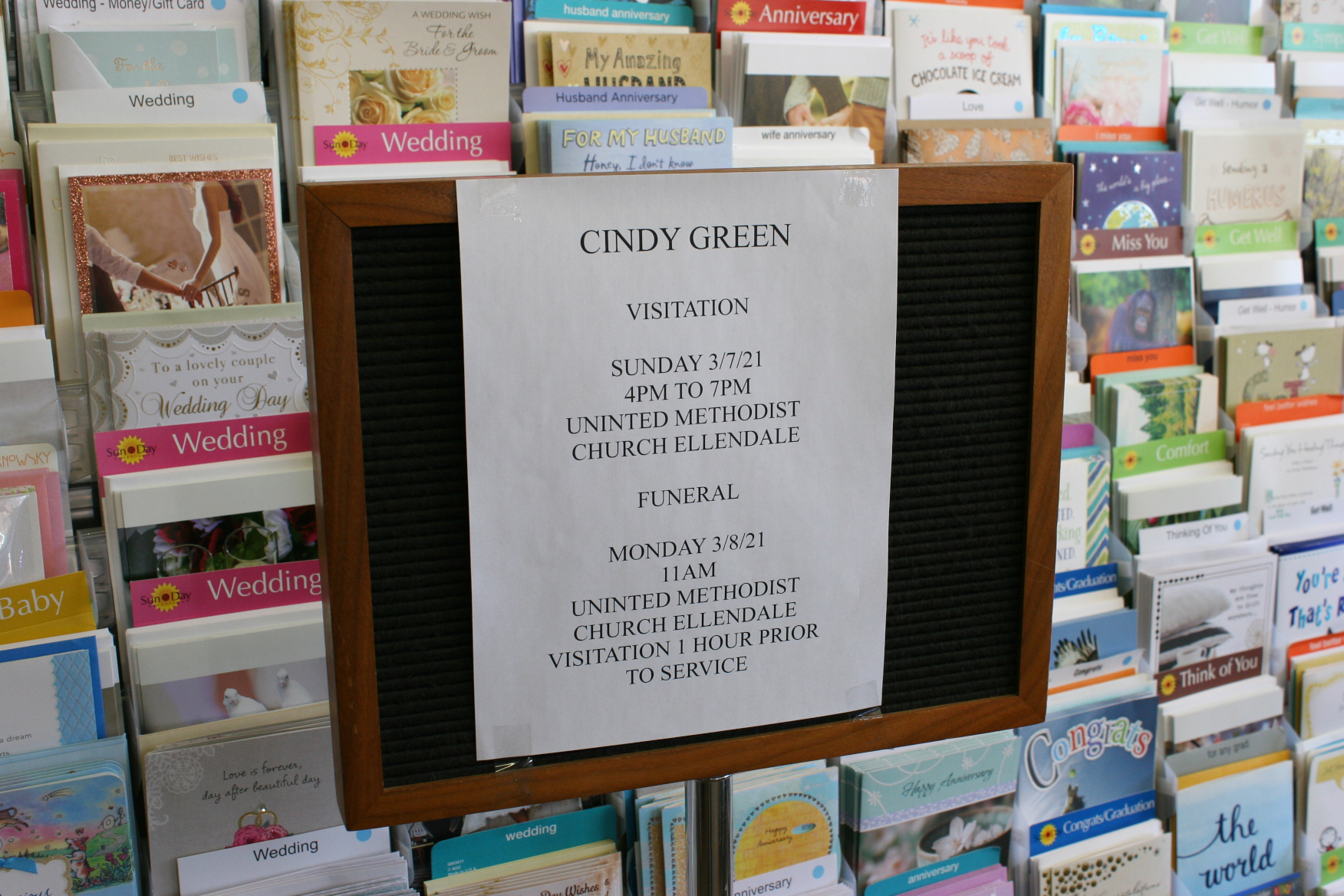
A funeral visitation notice posted in front of the greeting cards at Lerberg’s Foods in Ellendale, MN. (Minnesota Prairie Roots copyrighted photo March 2021)

Yet, wherever we live, whatever we do, we share the commonality of humanity. We need to remember that as we begin 2022, as we continue pushing through this pandemic with hope.

© Copyright 2022 Audrey Kletscher Helbling
 

A 1979 interview with Mike Max & reflections on community journalism June 12, 2020

A CARDBOARD BOX, stacked in an under-the-roof storage space on the second floor of my house, holds layers of yellowed newspaper clippings. Not stories of personal value because they are about me or my family. But rather stories I wrote, as a community journalist.

In March 1978, newly-graduated with a mass communications degree from Mankato State (now Minnesota State University, Mankato), I started my multi-faceted job at The Gaylord Hub. I was the first-ever journalist hired at the small rural weekly in Gaylord, the county seat of Sibley County. Prior to that, family at the then second-generation family-owned paper covered all the editorial work.

I did everything from writing news stories and features to taking and printing photos to writing headlines to going to the printing plant and then swinging canvas bags full of newspapers into the back of a van for delivery to the post office. I learned nearly every aspect of community newspapers except selling and designing ads and covering sports. Under the guidance of a supportive, encouraging and kind editor and publisher, Jim Deis, I grew my skills and my passion for small town community journalism.


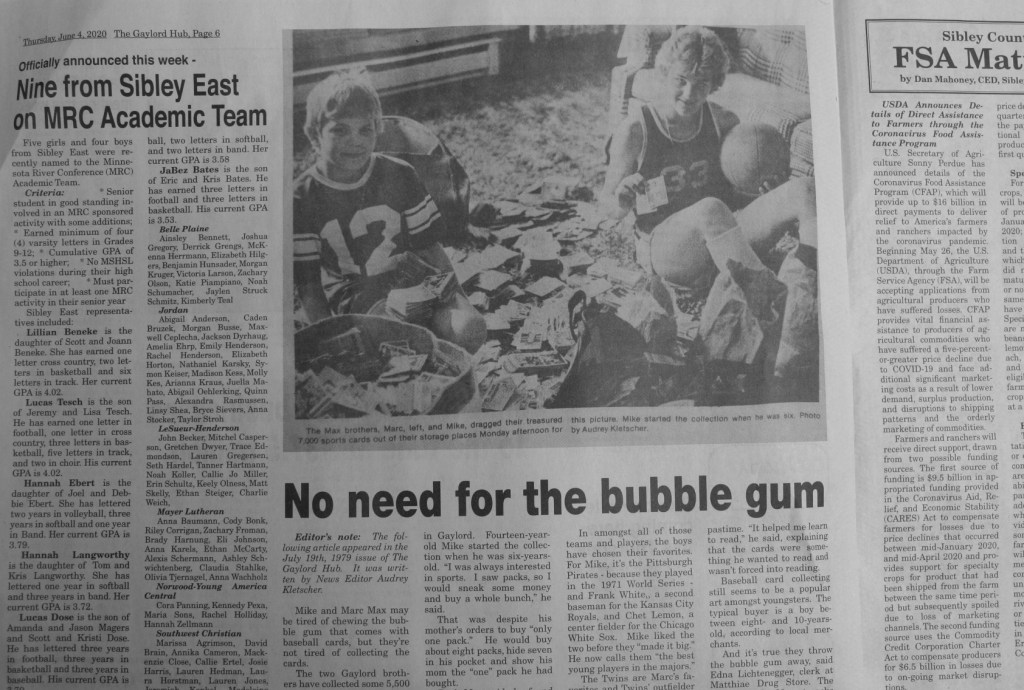
A feature I wrote in 1979 republished in the June 4, 2020, issue of The Gaylord Hub.


Forty years after I left The Hub, the newspaper still arrives weekly in my mailbox. Jim passed many years ago. His son, Joe, just a kid when I worked at the paper, now serves as the third-generation editor and publisher. And last week he republished a feature, No need for the bubble gum, I wrote in July 1979. Perhaps my one and only sports story. I interviewed the Max brothers—Mike and Marc—for a feature about their sports card collection.

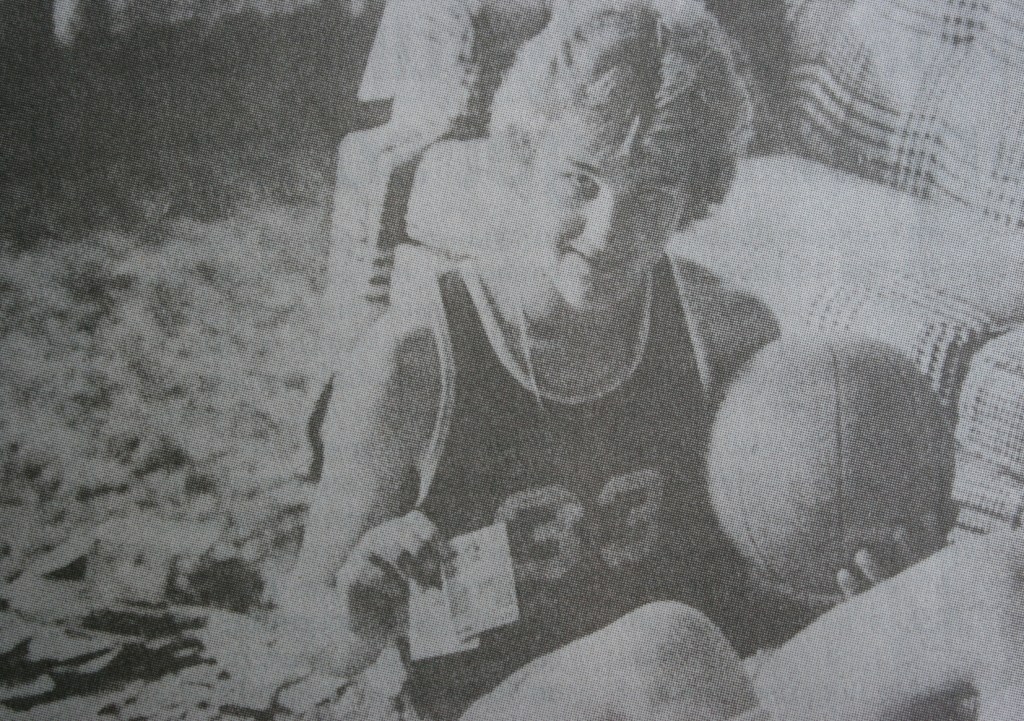
I recall going to the brothers’ home in Lakeside Acres and the piles and piles of bagged, boxed and loose cards numbering some 7,000. But I didn’t remember details of that interview with the 9 and 14-year-olds. So rereading that story I wrote 41 years ago proved entertaining, especially considering where one of those boys landed. Mike Max went on to become the sports director for WCCO-TV in the Twin Cities. And more recently, he expanded to hard news by covering the protests surrounding the death of George Floyd in Minneapolis.


WCCO personality Mike Max, up close in a photo I took in 1979. Photo by Audrey Kletscher from The Gaylord Hub.


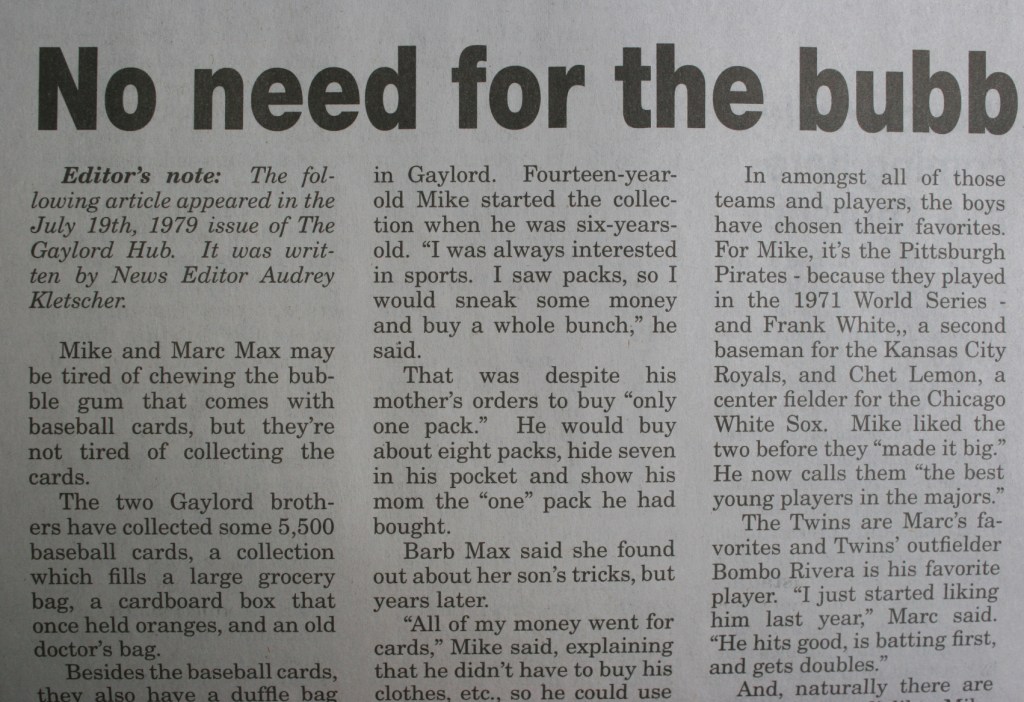
But back to that 1979 feature I wrote. Here’s my favorite quote from Mike:

“I was always interested in sports. I saw packs (of collector cards and bubble gum), so I would sneak some money and buy a whole bunch,” he said.

That was despite his mother’s orders to buy “only one pack.” He would buy about eight packs, hide seven in his pocket and show his mom the “one pack” he had bought.

Barb Max said she found out about her son’s tricks, but years later.

I love that part of the story.

But I find equally humorous this paragraph from my feature:

The two plan on keeping their cards, but speculate on selling some of them if the price is right. “I’ll save them until I get real old,” Marc said. “I’ll save them until they’re worth more and more, but maybe someday sell them if I need money real bad.”


A section of the republished story from 1979.


Reflecting on that feature of four decades ago, I am reminded of the importance of community newspapers. These are the stories we are losing as more and more small town weekly newspapers, and even some dailies, are folding. Declines in advertising revenue and subscribers, rising expenses and the growth of online media alternatives have all factored into the demise of print journalism. I can’t even begin to tell you how much that saddens me. We are losing such a valuable part of our communities. The watchdogs. The storytellers. The historians. The source of information about public meetings, community events, deaths—news in general. The media is too often under attack, blamed for reporting too much bad news. Don’t kill the messenger, I say.

I will always remain grateful for the two years I worked as The Cub from the Hub, a name tagged to me while in Gaylord. There I learned and grew as a writer, always striving for integrity, honesty and balanced reporting. By far, feature writing proved the most enjoyable aspect of my work. From Gaylord, I would go on to report for The Sleepy Eye Herald-Dispatch, The Mankato Free Press (St. James bureau), The Owatonna People’s Press and The Northfield News. Some were temporary fill-in jobs, others full-time. But no matter where I worked, I worked long, hard hours at low pay to cover the community. I reported the hard news and attended endless city council/school board/county board meetings into the late hours of the night. And sometimes I wrote, too, about kids who collect sports cards. Kids like Mike Max and his younger brother, Marc.

© Copyright 2020 Audrey Kletscher Helbling
 

With gratitude for community newspapers April 15, 2020

Published in the Faribault Daily News in August 2017 as part of a “Whiteout” campaign by Minnesota newspapers during Minnesota Newspaper Week. Minnesota Prairie Roots file photo 2017.


NOW, MORE THAN EVER, our community newspapers need our support. They, like so many businesses, have been negatively affected by COVID-19.

Ad revenue has plummeted due to business closures. One only need page through a local newspaper to notice the drop. Advertising, and subscriptions, pay expenses from printing to payroll.


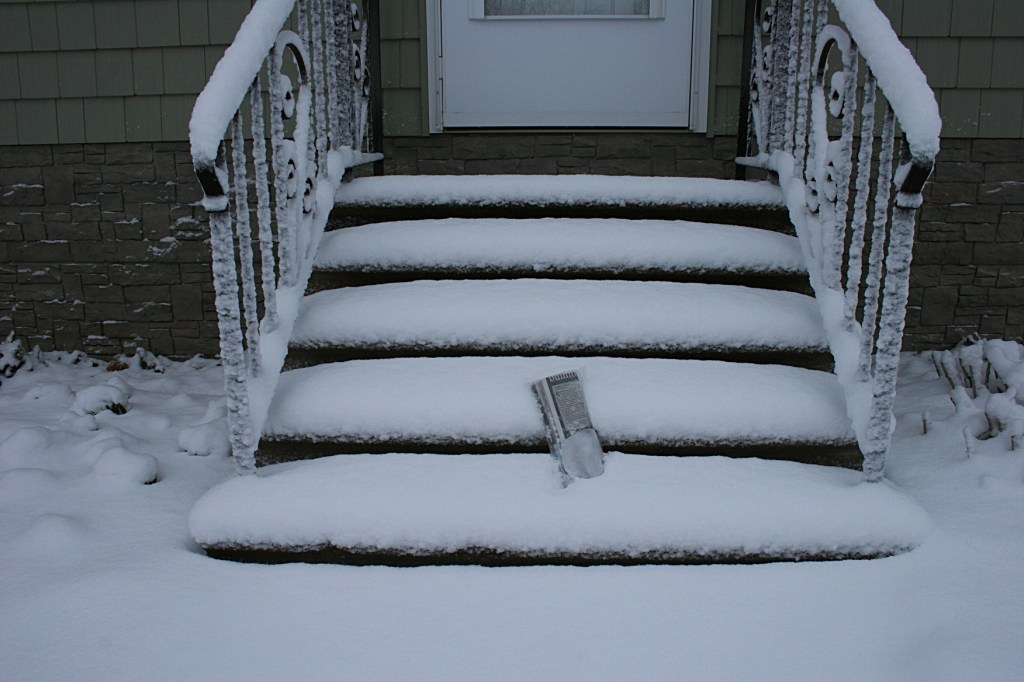
The Faribault Daily News on my front steps, when it was still delivered by carrier. Today the paper lands in my mailbox, delivered by the post office. Minnesota Prairie Roots file photo.


Already in Minnesota, several newspaper—The Hastings Star-Gazette and the Bulletin, serving Woodbury and Cottage Grove and owned by River Town Multimedia—will cease publication in early May. In Fargo/Moorhead, The Forum is no longer publishing a print paper on Mondays and Fridays.

In my community and throughout the region, Adams Publishing Group employees’ hours have been cut. And more. I’ve lost work as a freelancer and columnist for an APG arts/entertainment/lifestyle magazine that has temporarily suspended publication.

I view this issue from an insider perspective, having earned a degree in journalism and with experience as a small town newspaper reporter and photographer, albeit decades ago. I understand the importance of community journalism. I understand how hard these reporters and editors work to bring you local news. I understand the long and odd hours and the low pay. I’ve been there. Now, more than ever, newspapers are an essential business in keeping communities informed.


Published as part of the “Whiteout” campaign in 2017. Minnesota Prairie Roots file photo 2017.


Journalists commit to bringing you the stories that matter in your community. Think about that for a moment. Stories that matter in your community. The feel-good stories. The watchdog stories about public meetings. The hard news. Only in a local paper will you see those stories and photos targeted specifically for your community or region.


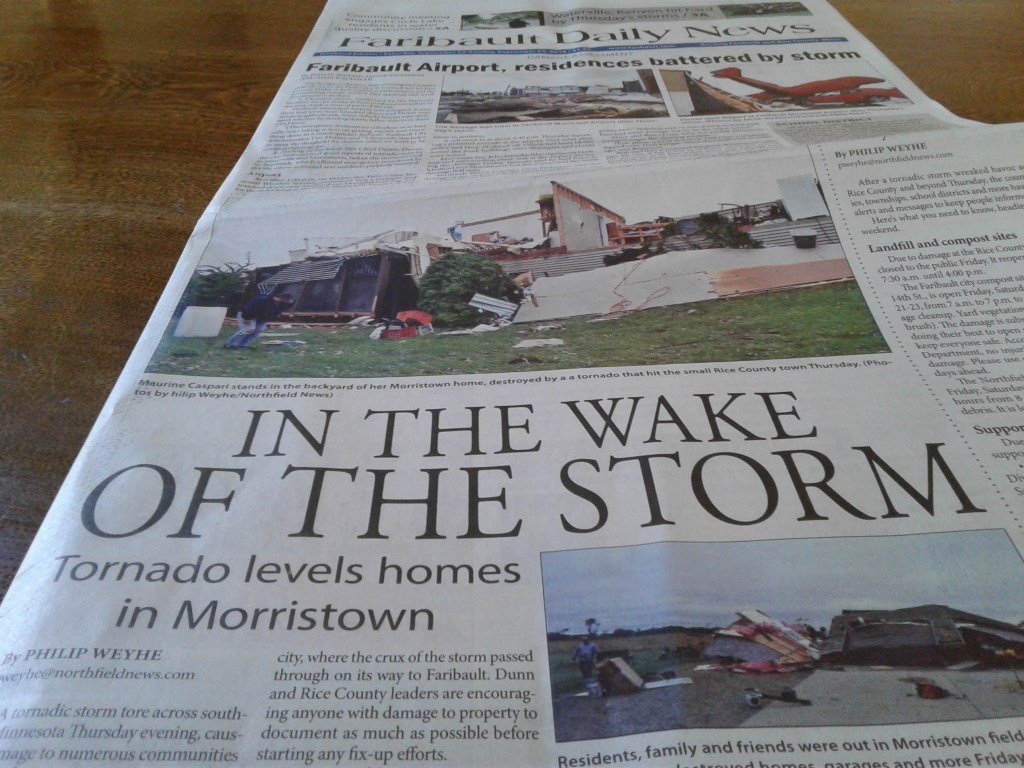
The front page of the Faribault Daily News following a devastating tornado in September 2018. Local news found only in community newspapers. Minnesota Prairie Roots file photo 2018.


I am grateful to the reporters, editors, page designers, ad reps and more at my local paper, the Faribault Daily News, who continue to invest their time and energy in community journalism. All too often, people criticize their work. Complain. Please, don’t kill the messenger who delivers bad news, along with the good. The reporter is just doing his/her job.

Rather, we should be grateful. We should thank these hard-working men and women for all they do. And today that means making sense of COVID-19 on a local level—writing about locals sewing face masks, hospital staff cuts and, yes, even the difficult stories about people infected with the virus. You won’t necessarily hear or read those stories in other media outlets. Our community newspapers are just that, all about community. Your community.

Please support community journalism by subscribing to your local newspaper, by purchasing ads (if your budget and situation allow), by saying “thank you.”


What if your community lost its newspaper? This is the front page of the Faribault Daily News during the 2017 “Whiteout” campaign. Minnesota Prairie Roots file photo 2017.


FYI: I invite you to read my August 2017 post about a “Whiteout” campaign by 200 Minnesota newspapers reminding people about the importance of local newspapers in their communities. It’s worth a read. Click here. And remember that a free press is a vital part of our democracy. We need reporters asking tough questions, gathering information and presenting the facts.

JOIN ME in expressing your gratitude for community newspapers in the comments section below. Tell me what you appreciate about your local newspaper and those who work there. Thank you.

© Copyright 2020 Audrey Kletscher Helbling
 

Way to go, Wisconsin DNR March 28, 2020

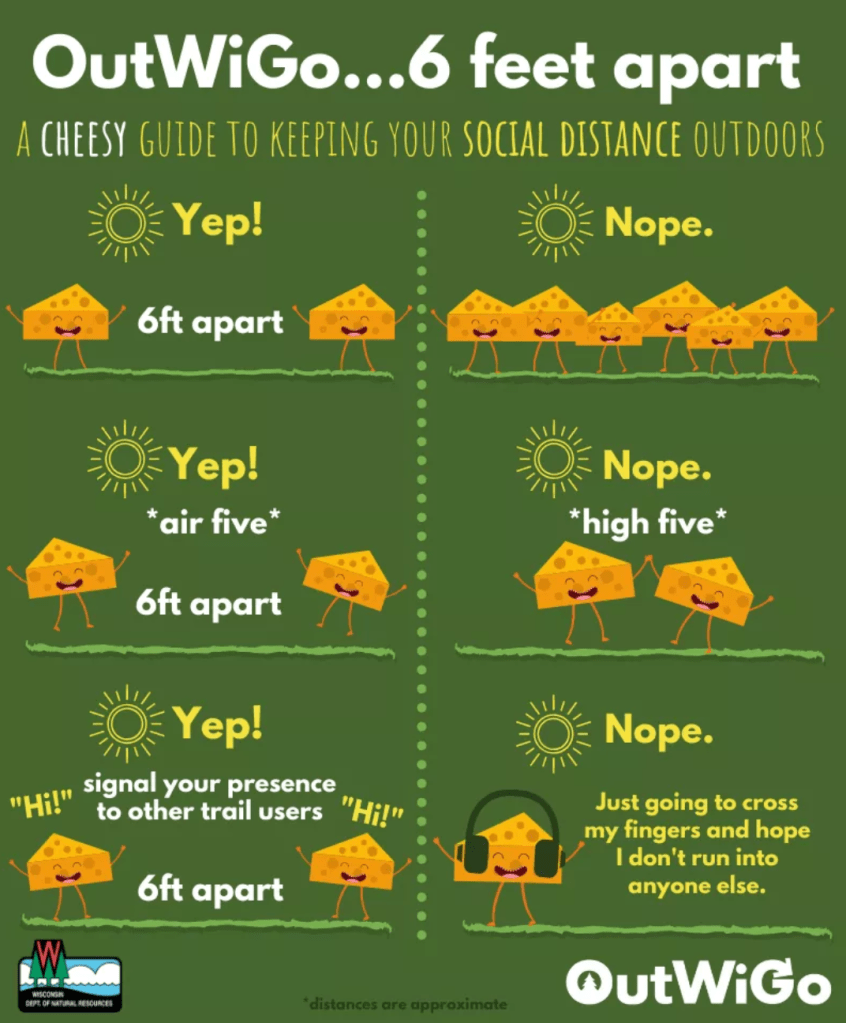
Wisconsin Department of Natural Resources image


IF EVER WE NEED LAUGHTER, it’s now. And the Wisconsin Department of Natural Resources delivered this week with A CHEESY GUIDE TO KEEPING YOUR SOCIAL DISTANCE OUTDOORS.

The second daughter, who lives in Wisconsin, where a “Safer at Home” order is now in place, texted the graphic to me this morning. While reading this message, I laughed out loud. Repeatedly.

This additional info accompanied the guide posted on the DNR Facebook page:

Hey Cheeseheads! Wisconsin’s state parks and trails are open for you to OutWiGo and enjoy some fresh air. If you head out, we encourage you to stay close to home and within your community.

Social distance is key to slowing COVID-19. Stay at least 6 feet away from others – but don’t forget about the air fives!

Kudos to the creative who came up with this idea. I always appreciate a savvy and fun media campaign. Humor resonates with people. They remember. They talk about it.

The Facebook posting certainly has people talking in the comments section. And it’s not good. Seems people are flocking to state parks and not a lot of social distancing is happening. Wisconsin isn’t the only place with this problem. I’ve heard from friends about overcrowding issues at North Carolina state parks (now closed) and even in Minnesota.

You can only do so much, I suppose. Thank you, Wisconsin DNR, for doing your best and for making me laugh today.


More than just a riddle February 20, 2019

DO KIDS STILL appreciate riddles?

When I was a kid, I loved them. Some riddles were stupid. Others silly. Many challenged me. Whichever, riddles usually made me laugh.


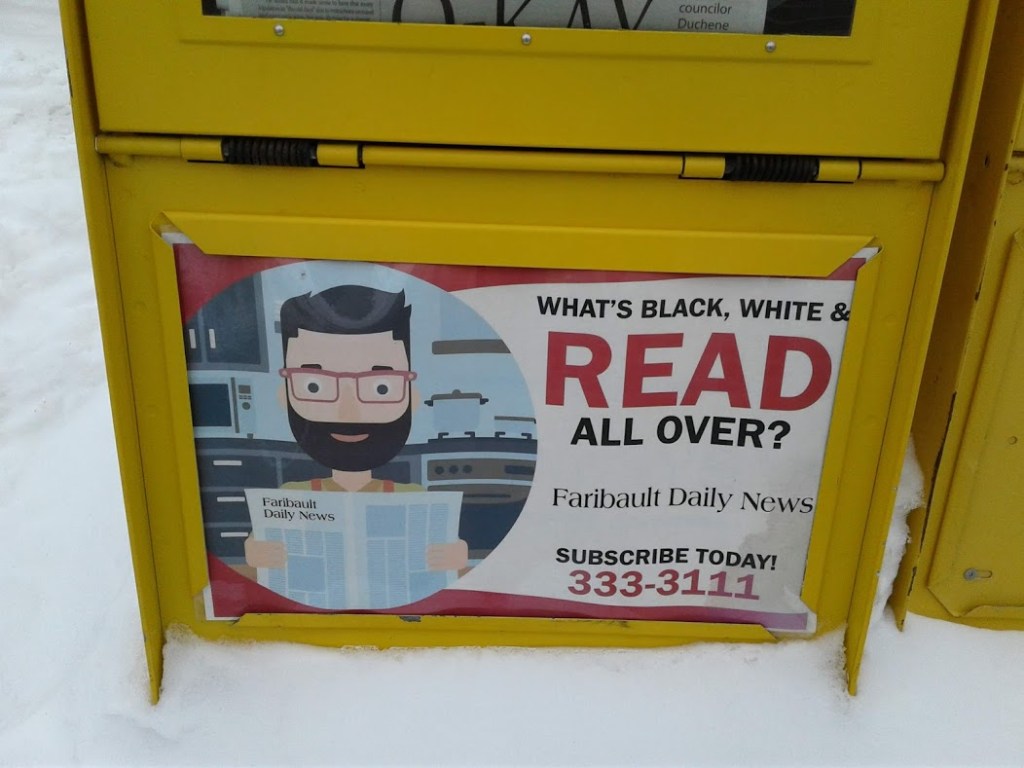
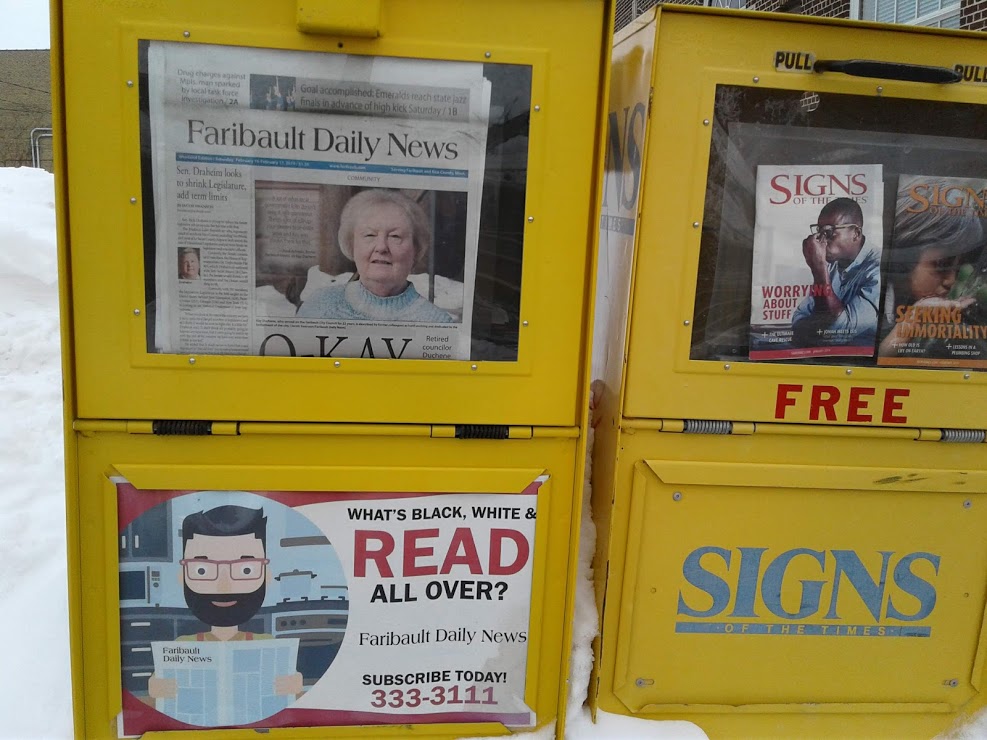
So when I saw one of my favorite childhood riddles posted in a newspaper stand outside the Faribault post office, I laughed, exited the van and walked across icy surfaces to photograph the posting.

Q: What’s black, white and read all over?
A: A newspaper.

I heard that riddle countless times when growing up. I liked it then, like it still, although the riddle no longer rings reality. Newspaper aren’t read all over. And that saddens me, a former journalist. Too many people no longer value newspapers. Rather, they get their news from other sources, not necessarily the most reliable sources either.

Newspapers and journalists are too often the targets of criticism, much of it unjustified. I’m not talking about the publications that call themselves newspapers, but truly are not in any sense of the word. I’m talking about legitimate “news papers” staffed by hardworking, unbiased journalists.


I value newspapers, especially community newspapers. I value the stories reporters write, yes, even the hard news. I value that newspapers keep me informed, expose me to differing viewpoints on the editorial page, alert me to happenings and issues in my community and elsewhere.

I recognize that my feelings about newspapers and journalists stand much stronger than those of most people. In my days working as a news reporter, I was attacked by individuals who disliked me quoting them or writing on an issue they’d rather not see in print. But their disdain didn’t stop me from doing my job.

We need a free press, a strong press, a press that does not cave to political or societal pressure. Our democracy depends on freedom of the press.

Q: What happens in a country without a free press?

A:


TELL ME: Share your thoughts or share a riddle. Please be respectful in your comments.


Here’s an example of a riddle my second daughter shared with the public many years ago at a roller rink:

A: How do you make a Kleenex dance?

Q: Put a little boogie in it.


© Copyright 2019 Audrey Kletscher Helbling
 

When reporters cover tough topics… January 31, 2019


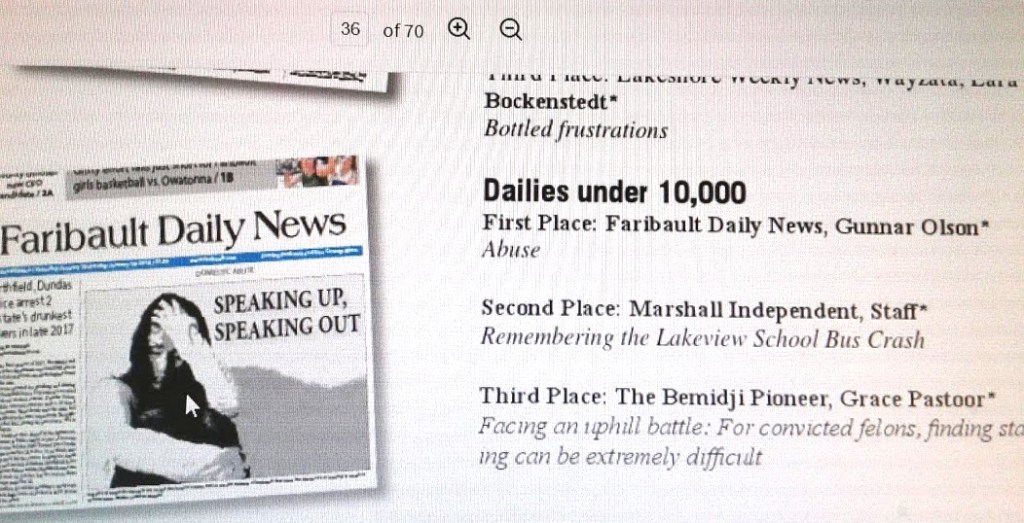
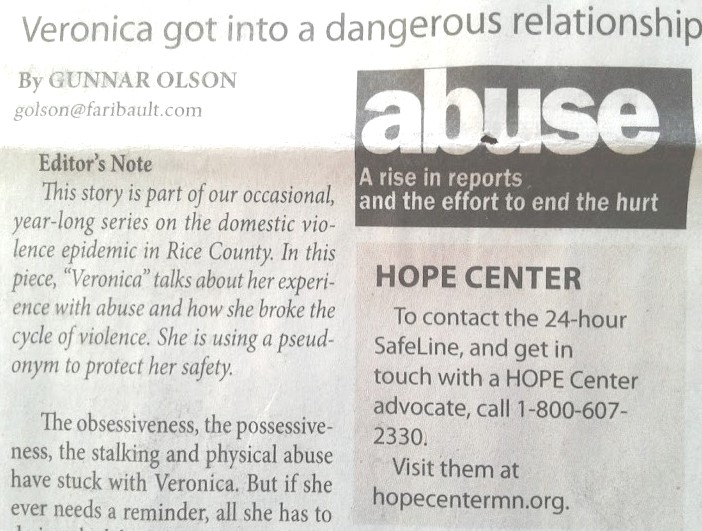
THE NEXT TIME YOU CRITICIZE a journalist or rant that reporters are nothing but a bunch of biased writers, consider this. My local newspaper, the Faribault Daily News, recently placed first in the Social Issues category of the 2017-2018 Minnesota Newspaper Association Better Newspaper Contest. For a series on domestic violence.

The award-winning series, titled “Abuse,” published over a period of a year and covered the gamut from information to interviews with survivors and their families, advocates, police and more. These were powerful pieces, written primarily by reporter Gunnar Olson but also by Regional Editor Suzanne Rook.

It is the personal stories which made this series. Emotional stories. Gut-wrenching, difficult stories. Stories that needed to be told, heard, written, read and, then, remembered.


When a reporter can take a topic like domestic abuse and violence, interview people in a caring and compassionate way, and then share those stories through dynamic writing, that work deserves recognition. By fellow journalists. And by readers. I applaud the Daily News for raising awareness, educating and connecting people to this social issue via deeply personal stories.

As a former weekly and daily newspaper reporter, I will confirm that writing stories like this is difficult. I once wrote a series on eating disorders that included interviewing a survivor and the mother of a young woman who died from anorexia. Although I kept my professional persona in place while working on the series, inside my heart hurt for every single individual I interviewed. Reporters have a job to do. But they are still human.

I often hear newspapers criticized for printing nothing but bad news. That raises my ire. Do not kill the messenger. Newspapers are not PR mouthpieces. They are newspapers. It is their job to report the news—good and bad. Features and hard news. They do not cause the bad news. People do.

Today, more than ever, journalists are under attack. For writing fake news. For not writing something they should have or for writing something they shouldn’t have. They are losing their jobs. The free press is threatened. That should scare every single person. Democracy needs a strong and free press.

Yes, I’ve sidetracked a bit. But I’ll circle back now and reaffirm how much I appreciate my community newspaper. Reporters keep me informed of local issues and happenings, of good news and bad. I am grateful for their hard work and their willingness to stretch beyond the everyday news to cover important topics. Like domestic violence.

© Copyright 2019 Audrey Kletscher Helbling
 

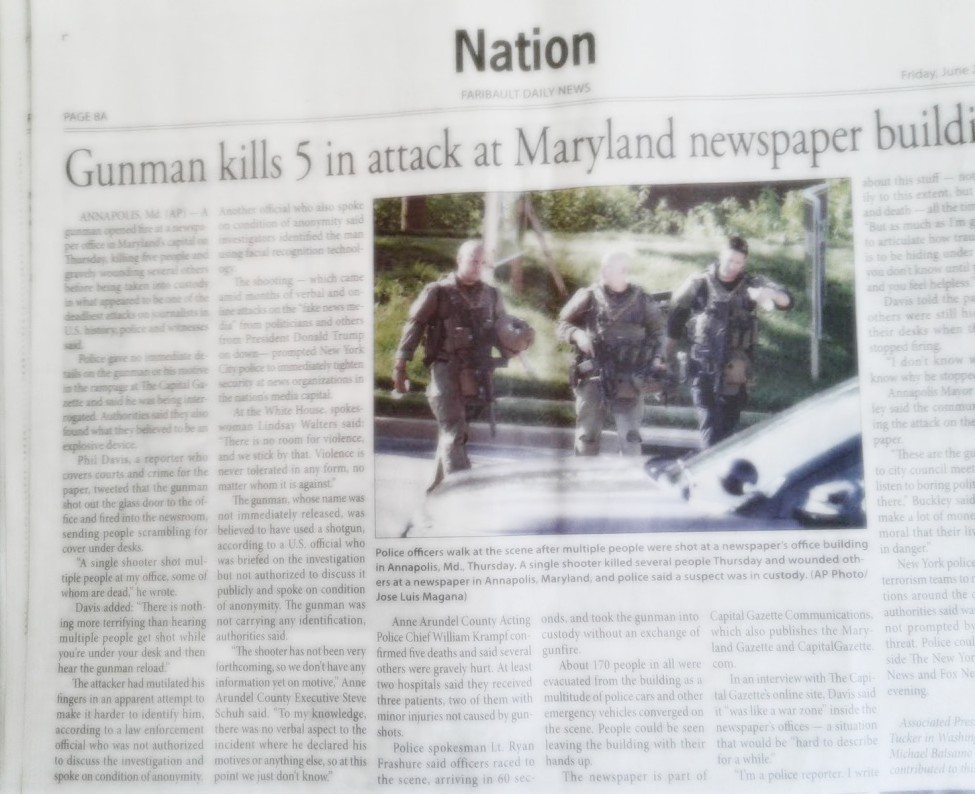
From the perspective of a former reporter: Thoughts after The Capital Gazette shootings June 30, 2018

Filed under: Uncategorized — Audrey Kletscher Helbling @ 5:00 AM
Tags: , , , , , , , , , , ,


I’M A FORMER NEWSPAPER reporter and photographer. As such, the killings of five employees in The Capital Gazette newsroom just days ago affects me in a way it may not non-journalists.

The single phrase that repeated through my mind: He (the suspect) really did kill the messengers (newspaper employees). The alleged shooter apparently held a grudge against the Gazette for writing about his conviction for stalking a woman.

Too often I’ve heard people attack and criticize reporters for doing their jobs of reporting the news. Journalists are blamed for whatever is negative. It’s an unfair accusation. Do not kill the messenger. The reporter did not cause the bad thing that now banners the newspaper.

If journalists report only the good news or whatever is spun to them, then they are nothing more than pawns, propaganda tools, mouthpieces. These are difficult times to be a journalist with the constant spewing of the words “fake news” and open hostility and name-calling at the highest levels of government. Democracy needs a free and open press. The press is not the enemy.

I experienced firsthand efforts to suppress my reporting while working in the profession decades ago. In small town Minnesota. How dare I attend a school board meeting and quote a teacher who didn’t want his comment, made at an open, public meeting, printed. My editor backed me up. But I had to endure the ire of that teacher and his superintendent for the rest of my stay in that rural community.

Likewise, a prominent businessman in the same county seat town harassed me for quoting him at a city planning meeting. When I moved to another job with a regional daily working in a satellite news bureau, I encountered the same hostility from a superintendent who didn’t like my story on a student walk-out. He treated me with absolute contempt, behavior which I found (and still find) totally unprofessional for an educator.

Then there was the sheriff’s department employee who wanted to withhold public information from me when I was gathering facts in a drug case.

There are those who will argue that the media deserve the contempt and criticism heaped on them. There are those who will say media people are nothing but a bunch of biased liberals. There are those who will blame journalists for anything and everything. Everyone is entitled to an opinion in a free country. Not all journalists are fair or balanced in their reporting. I agree with that.

But I also come from that perspective of working in the news profession. I know how hard I worked (long and odd hours with low pay) to accurately and fairly gather and report the news. I cared that I got the story right. I think most journalists do.

A reporter at the Gazette tweeted after the shootings: “I can tell you this: We are putting out a damn paper tomorrow.” That tweet shows remarkable strength when a man with a gun has just killed the messengers in a Maryland newsroom.

© Copyright 2018 Audrey Kletscher Helbling