These two new Faribault city snowplow trucks now bear names following a Name a Snowplow contest. (Photo credit: City of Faribault)
WHEN IT COMES to plowing snow, getting the white stuff off city streets as quickly as possible is likely top of mind for most property owners. We’re thankful when the plow clears our street, but even more thankful if that’s done before we’ve opened our driveways. There’s nothing quite as maddening as the snowplow plugging up the end of your driveway with a ridge of snow right after you’ve put away the shovel or snowblower. Timing is everything.
A tech inspired name for the snowplow also references the salt used on snowy and icy city streets. (Photo credit: City of Faribault)
But now the City of Faribault has put a little fun into snow removal by sponsoring a Name a Snowplow contest, much like the one held annually by the Minnesota Department of Transportation. The winners of Faribault’s inaugural contest to name two new snowplows are…drum roll, please: Ctrl Salt Delete with 84 votes (28 percent) and Darth Blader with 67 votes (22 percent). Both names were past winners in MnDOT contests.
Coming in third was Alexander Fariblow with 48 votes out of the 300-plus cast. Even though only two names were supposed to win, city officials discussed and decided to go with a third winner for a large front-end blower used to clear the downtown area. Good call, I say, as the name honors town founder Alexander Faribault whose 1853 wood-frame house stands downtown.
So how did the city get from contest idea to tagging two plows and a blower with names? First they asked for suggestions from the community with around 50 ideas submitted. Those were narrowed to six. The other three were Frost Responder, Farisnow and The Big Snowplowski. Then voting opened online.
But the city offered one more ballot option which I really like because it got kids involved. At a Halloween event at a local car dealership, the city placed decals of the top six names on the front of a snowplow. Kids and/or parents could then vote by putting their initials by their preferred name. About 60 votes were cast in that unique poll.
All in all, I’d say this first Name a Snowplow contest in Faribault was a success if you’re measuring community engagement and novel winter fun.
Second top vote-getter, Darth Blader. (Photo credit: City of Faribault)
Additionally, maybe seeing Ctrl Salt Delete or Darth Blader roaring down a snowy street will help us to be a bit more understanding if our driveway is plowed shut just after we’ve opened it. Maybe. I mean, raging at Darth Blader seems risky.
MINNESOTANS ARE KNOWN for their generosity. And once again they showed up big time to support those affected by federal immigration enforcement in our state.
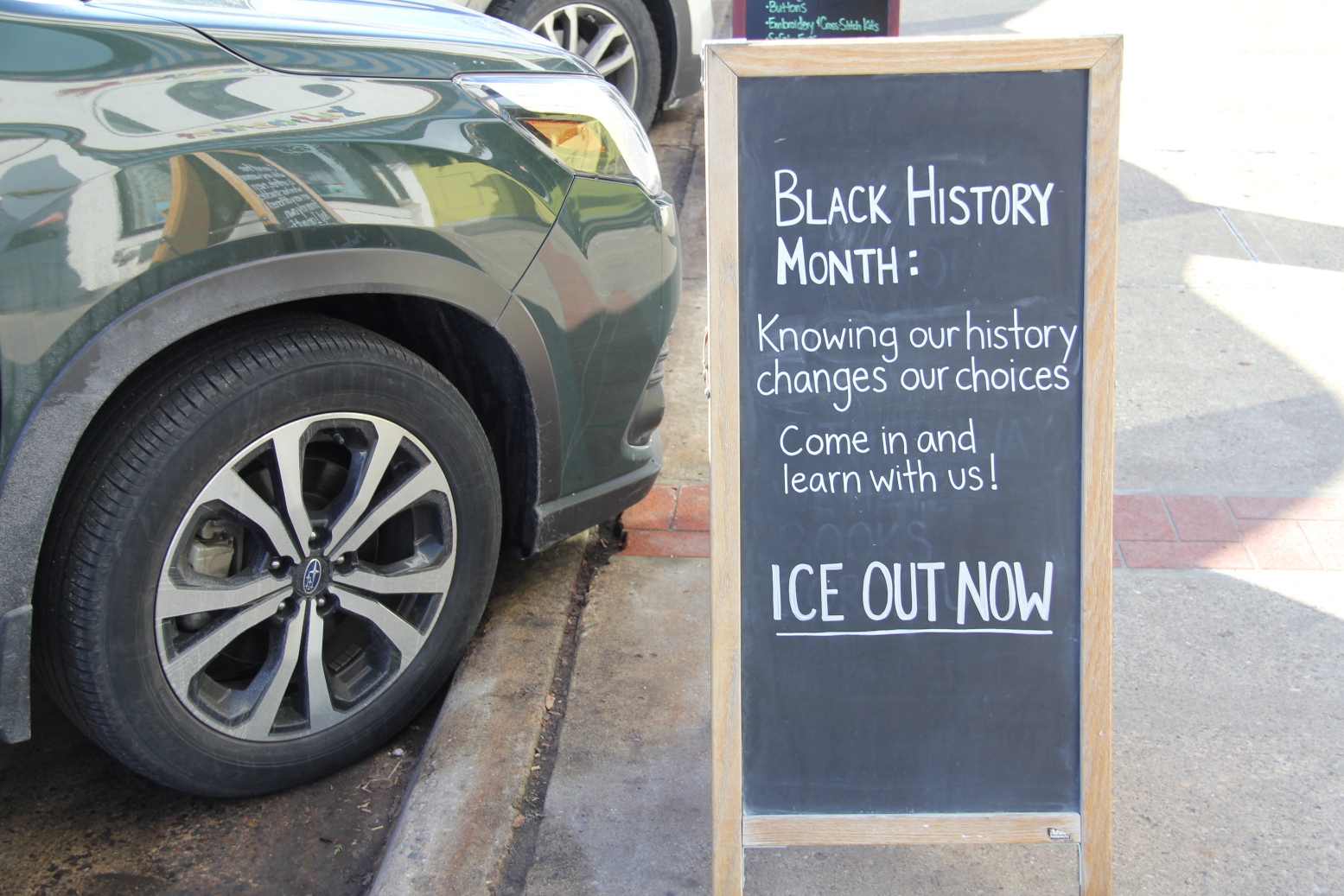
I photographed this sandwich board outside Content Bookstore in mid-February. (Minnesota Prairie Roots copyrighted photo February 2026)
At Content Bookstore in nearby Northfield, around $3,000 was donated to the two organizations. I was among the donors and among the many Content shoppers who visited with Allen Eskens, a writer of thrillers and mysteries from St. Peter, and Mary Bleckwehl, a Northfield children’s book author.
I got a free copy of this book for donating to one of the selected nonprofits. (Book cover sourced online)
Nearly 60 writers participated statewide in Authors for Minnesota Day, giving of their time and also giving away selected books to those who gave to the two recipient nonprofits. I snagged a soft-cover copy of Bleckwehl’s Arrrgh! Me Hate to Wait! Eskens had already given away his supply of free books by the time I arrived in mid-afternoon.
This event was about more than helping two deserving nonprofits focused on helping immigrants in Minnesota. This was also about supporting independent bookstores and Minnesota writers. Content Bookstore buzzed with shoppers browsing shelves, buying books and even standing in line to chat with Eskens and Bleckwehl.
To see this level of interest and support was encouraging, but not surprising. Minnesota has repeatedly proven, in the past few months especially, that it cares about and looks out for its neighbors.
Lourey, co-organizer with author Kristi Belcamino, posted on Facebook: “I was in tears several times throughout the day seeing how many people in our community want to support small businesses and immigrant rights. Thank you to all the bookstores and authors who participated, and to everyone who showed up—we got to see the best of Minnesota today.”
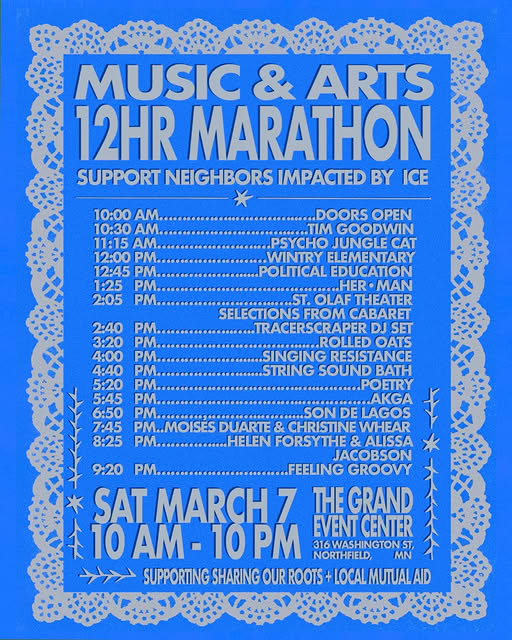
(Promo sourced from The Grand Event Center Facebook page)
THE GOOD FOLKS of Northfield, Minnesota, are organizing again to help their neighbors. This time it’s via a 12-hour Mutual Aid Marathon from 10 am-10 pm Saturday, March 7, at The Grand Event Center in this college town south of the Twin Cities.
Proceeds from the fundraiser will go to organizations—such as Sharing Our Roots and Northfield Community Action Center—providing mutual aid to those in the community impacted by federal immigration enforcement.
Doors open at 10 am at the event center, 316 Washington Street, just a block off Division Street in the heart of this historic downtown. Suggested donation at the door is $10.
From 10 until noon, attendees can enjoy a breakfast with 30 percent of entree sales going to organizations doing vital work in the community. Likewise, profits from a “pay what you can” appetizer buffet, which starts at 4 pm, will also be donated.
Event planners promise a full day and evening of live music, performances, poetry, political education, and powerful speakers. See the event poster promo above for a complete schedule.
Organizers are calling upon the public to: Bring friends. Bring family. Bring your appetite and your solidarity. Come for a while or stay for the entire marathon.
As I see it, the Mutual Aid Marathon is all about neighbors helping neighbors, which is the very definition of a loving and caring community.
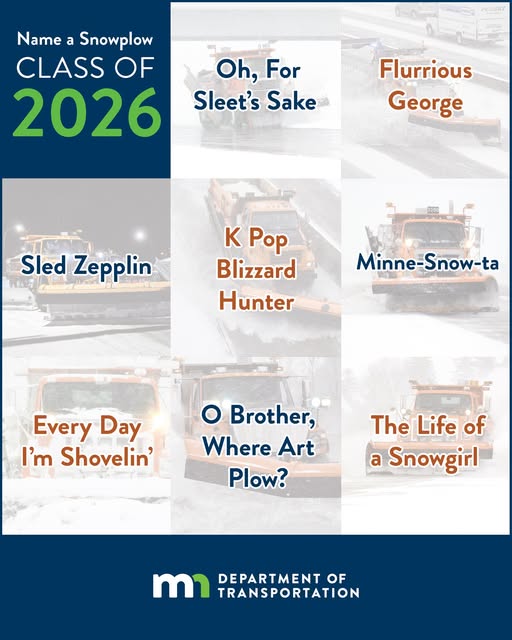
Winning names in the 2025-2026 Minnesota Department of Transportation Name a Snowplow contest. (Graphic credit: MnDOT)
MINNESOTA WINTERS can get long. So long that many of our older residents flee to Arizona or Florida, becoming snowbirds for a few months before returning here in the spring. They don’t have to worry about shoveling or plowing snow or navigating snowy roads.
But for those of us who live here year-round, winter requires stamina and distractions to endure the snow, ice, cold and darkness that hallmarks Minnesota winters. In recent years, the Minnesota Department of Transportation has provided an entertaining diversion from winter in its annual Name A Snowplow Contest.
Recently, the winning names in the sixth annual competition were announced, demonstrating once again the creativity of those who came up with monikers for snowplows in each of MnDOT’s eight districts. It’s a process to get there from submissions, to selection of finalists, to voting. This year nearly 19,000 people voted, with “Oh, For Sleet’s Sake” as the top vote-getter. Gotta love that wintry version of “Oh, for Pete’s sake!”
As a creative myself, I’m always surprised by the names, most of them a play on phrases, a song, a pop culture whatever. You really do have to be up on your current musicians and such. I am the first to admit that I am not.
My mom holds Curious George. (Minnesota Prairie Roots copyrighted file photo March 2021)
But “Flurrious George,” the name picked for District 6 in southeastern Minnesota with headquarters in Rochester (my district), is rooted in a name familiar to me. It’s based on the mischievous monkey in the Curious George children’s picture books. You know, the monkey who messes with The Man in the Yellow Hat.
Yet, this snowplow name stretches beyond a monkey and a man to a personal memory. Of my mom. In the final years of her life, when COVID-19 kept me from seeing her in a long-term care center 2 ½ hours from my home, Mom developed an attachment to Curious George. She couldn’t get enough of this monkey’s antics. She loved to watch Curious George cartoons on DVDs stacked in her room. Mom was so fixated on the story that a staff member, on her own time, shopped for a stuffed toy Curious George for her. She clutched that monkey like a toddler’s security blanket.
I don’t know what happened to Mom’s Curious George. I wish I had the plush monkey she cradled on her lap, touched with her fingers. It would connect me tangibly to my loving mother, who died four years ago in January 2022.
I’ve never really cried over losing Mom. I just haven’t. Until today. As I was writing this post about a snowplow named “Flurrious George,” I remembered photographing Mom holding Curious George when I visited her in March 2021. I hadn’t seen her in a year due to COVID visitor restrictions. I clicked on the story I wrote five years ago. I read. I scrolled. And I cried.
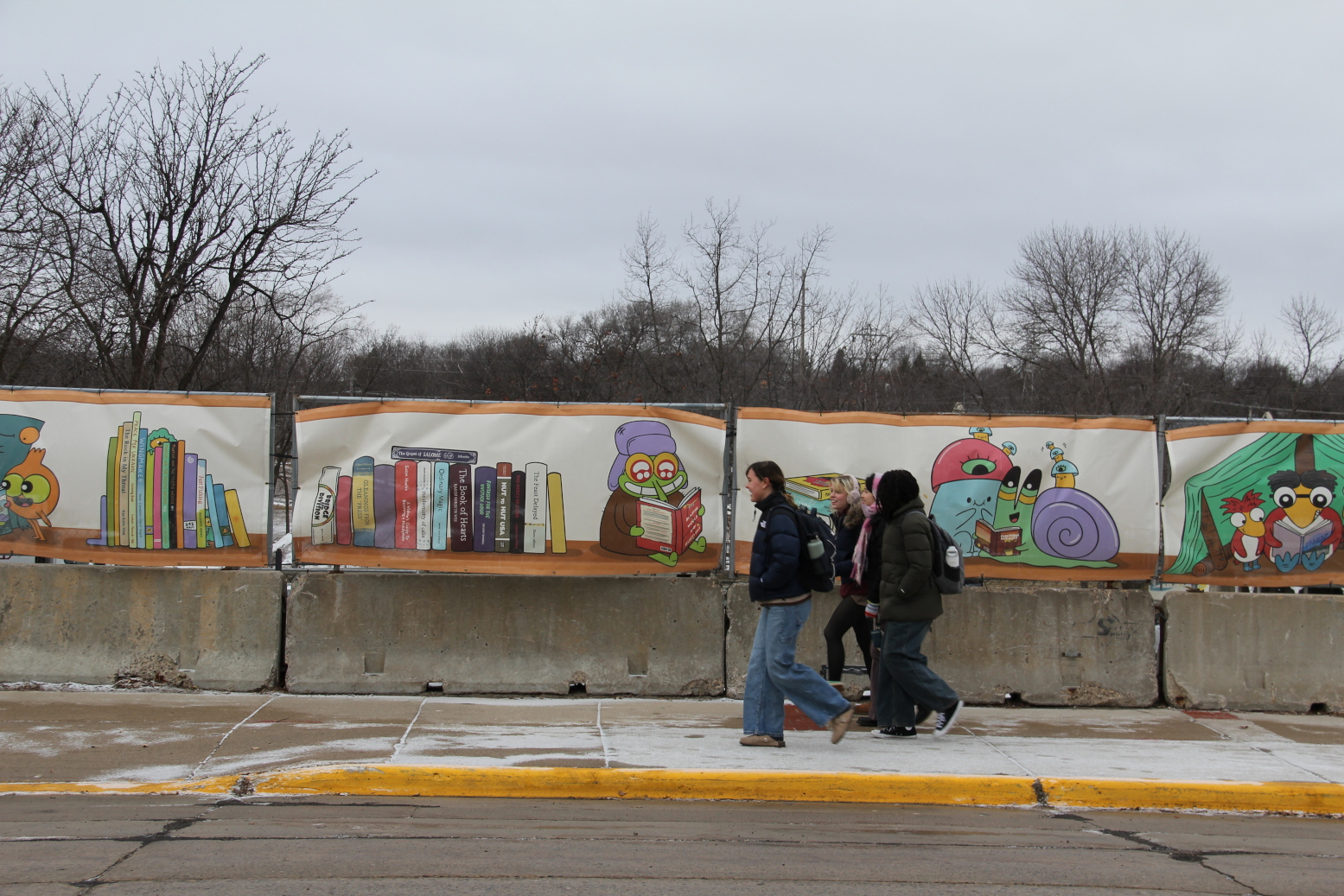
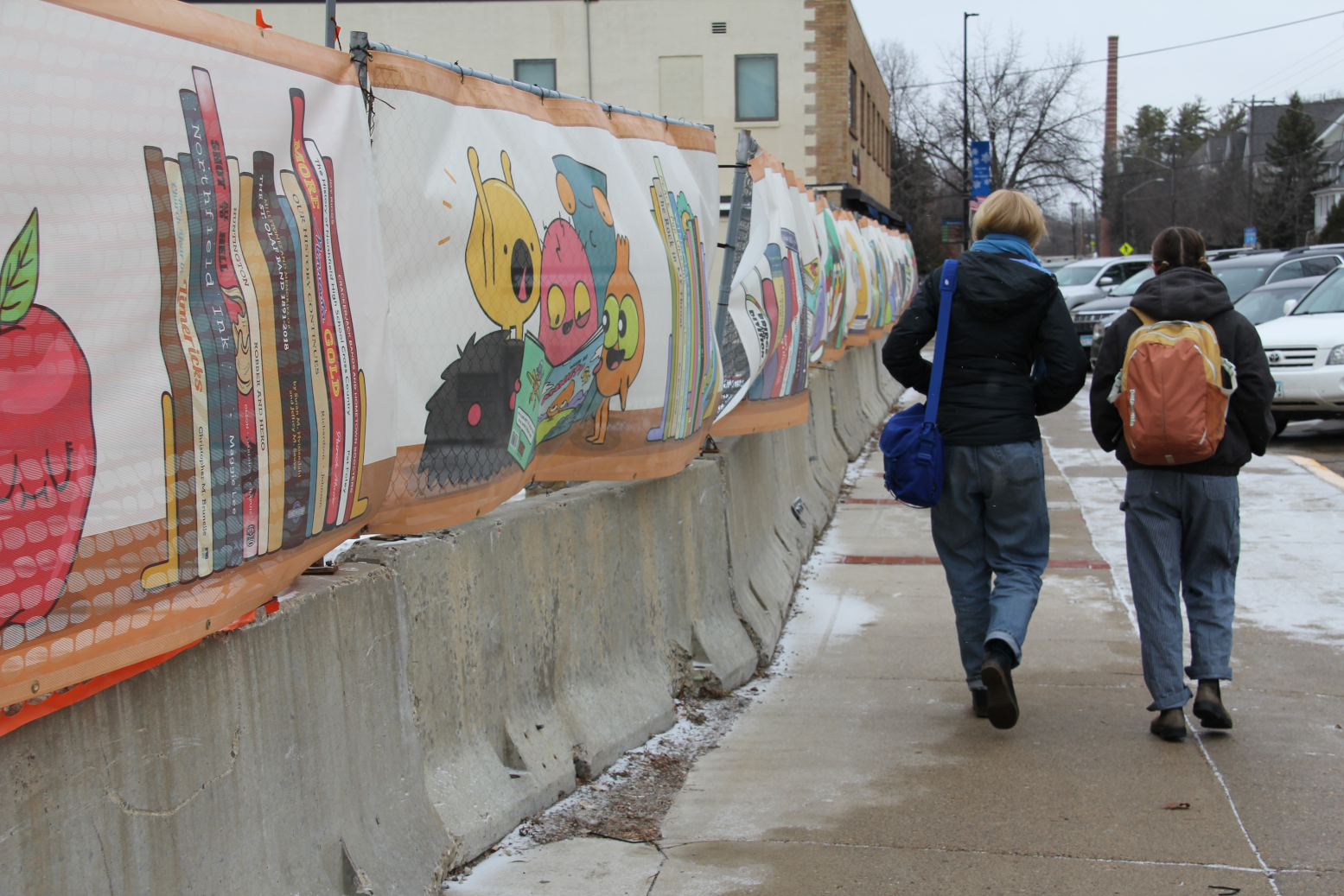
College students walk past a public mural fronting a vacant lot in downtown Northfield. (Minnesota Prairie Roots copyrighted photo January 2026)
BETWEEN DIVISION STREET and the Cannon River in downtown Northfield across from the public library, an art installment stretches, hiding a fenced, vacant spot of land.
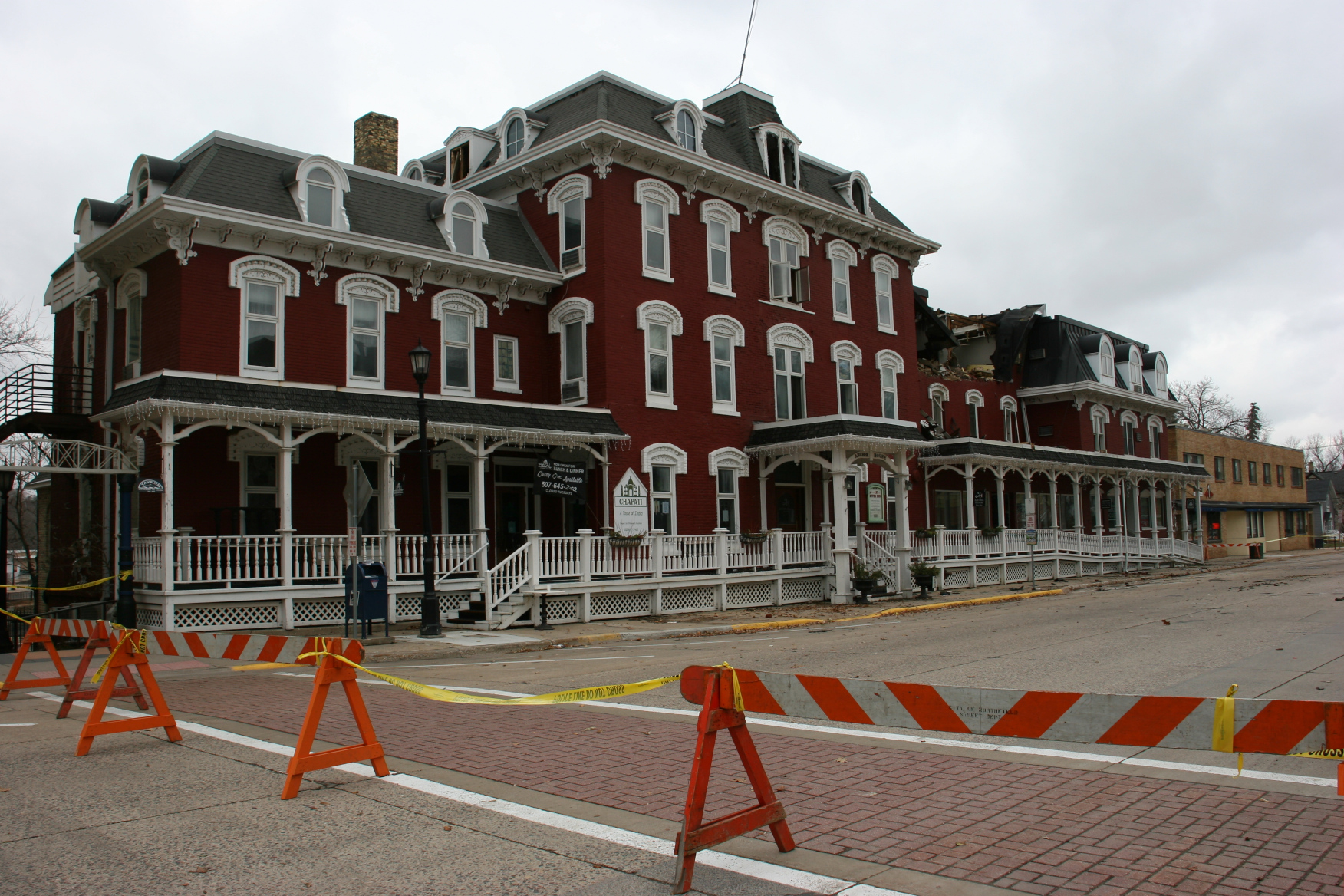
Barricades block entry to the historic Archer House, damaged by a 2020 fire and later demolished. The public art installation covers the length of the hotel. (Minnesota Prairie Roots copyrighted file photo November 2020)
Here the historic Archer House River Inn once stood, a sprawling complex of hotel and businesses until a November 2020 fire severely damaged the building. It was later demolished, leaving a gaping hole in the heart of this thriving southern Minnesota college town.
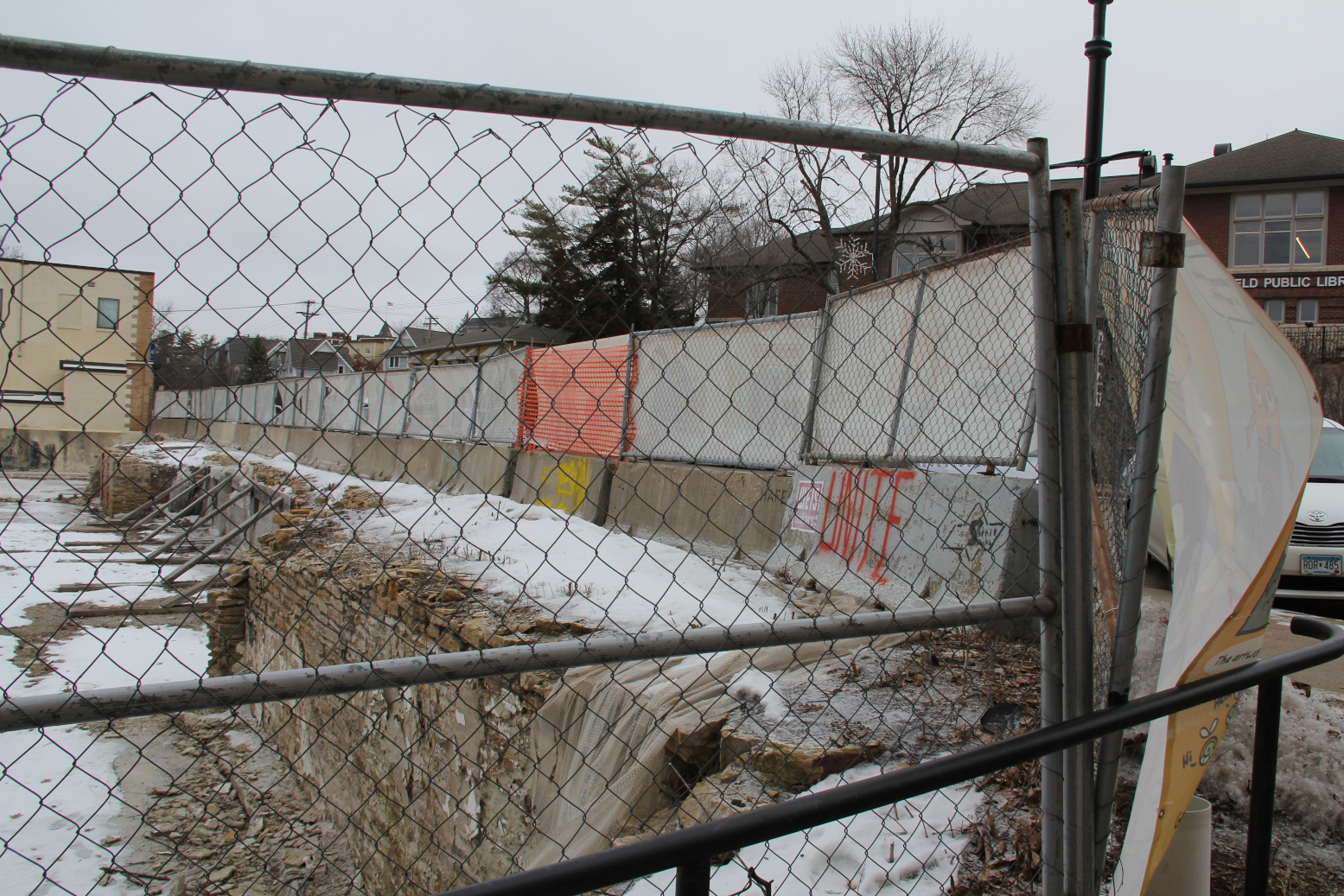
The back view behind the panels shows the foundation of the Archer House. The Northfield Public Library sits in the background across Division Street. (Minnesota Prairie Roots copyrighted photo January 2026)
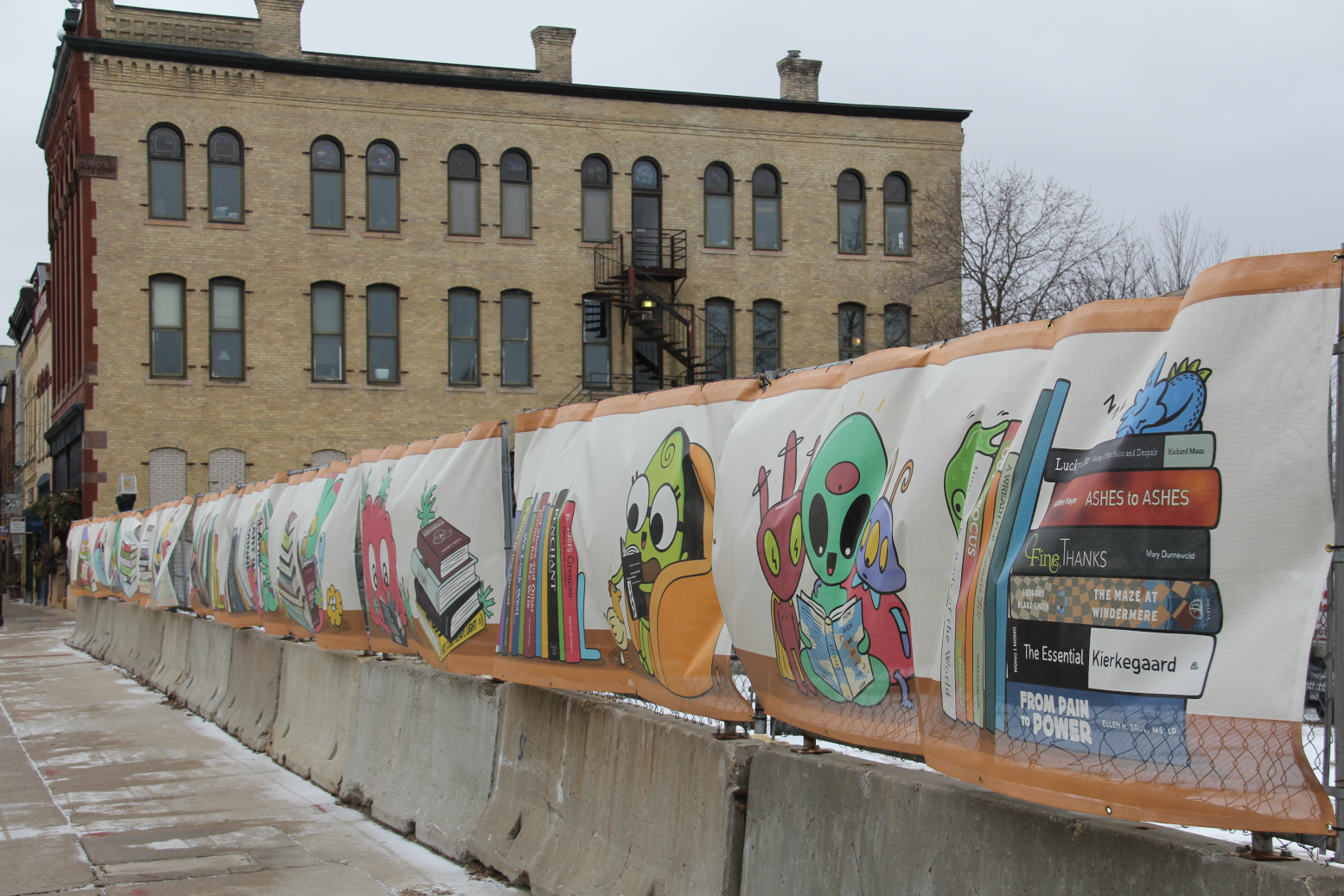
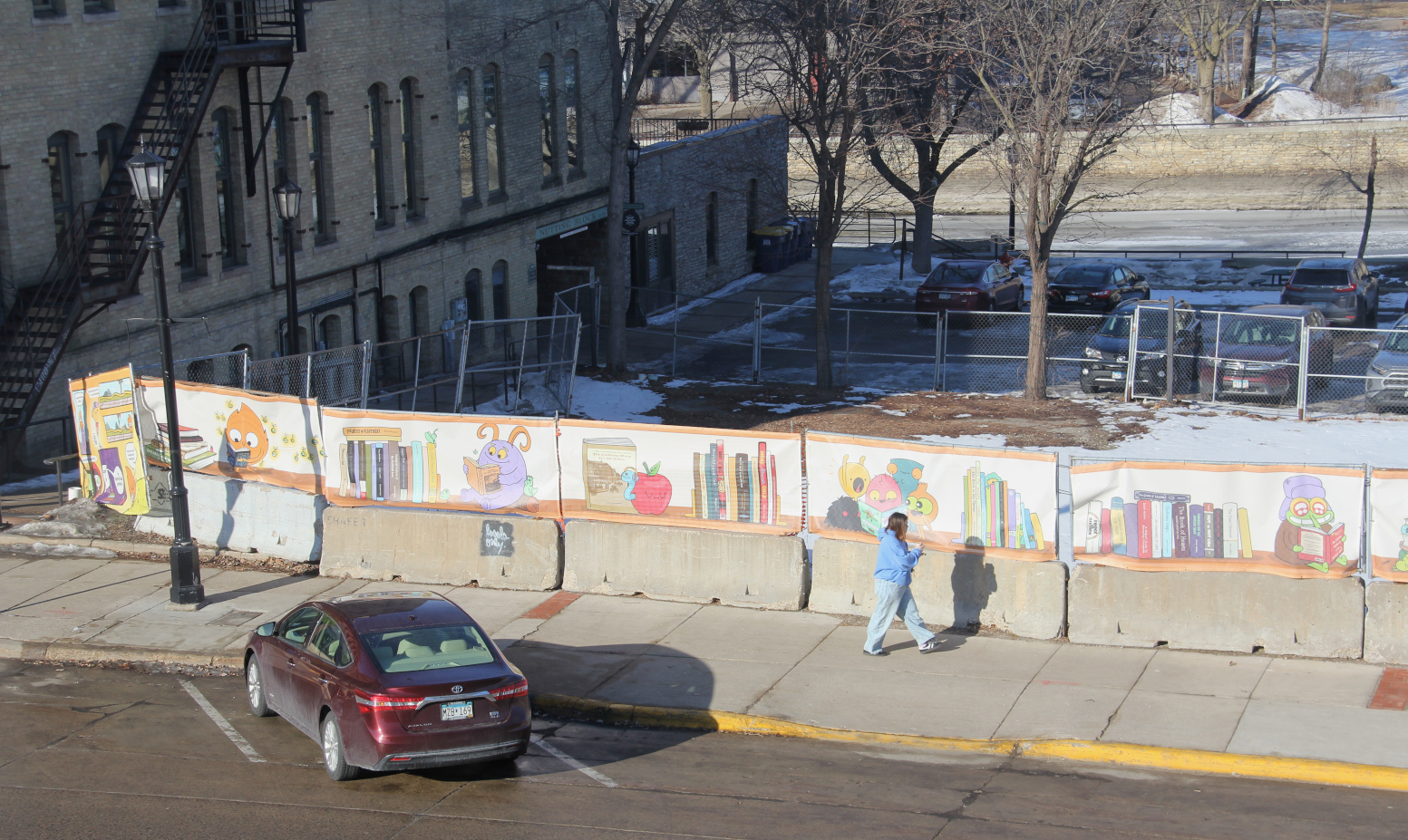
Flash forward years later and a 170-foot long length of 17 individual mesh fabric murals now hang on fencing surrounding foundation remnants and earth. Until the land is developed, this public art installation hides an eyesore and stands as a tribute to the creatives in the Northfield community.
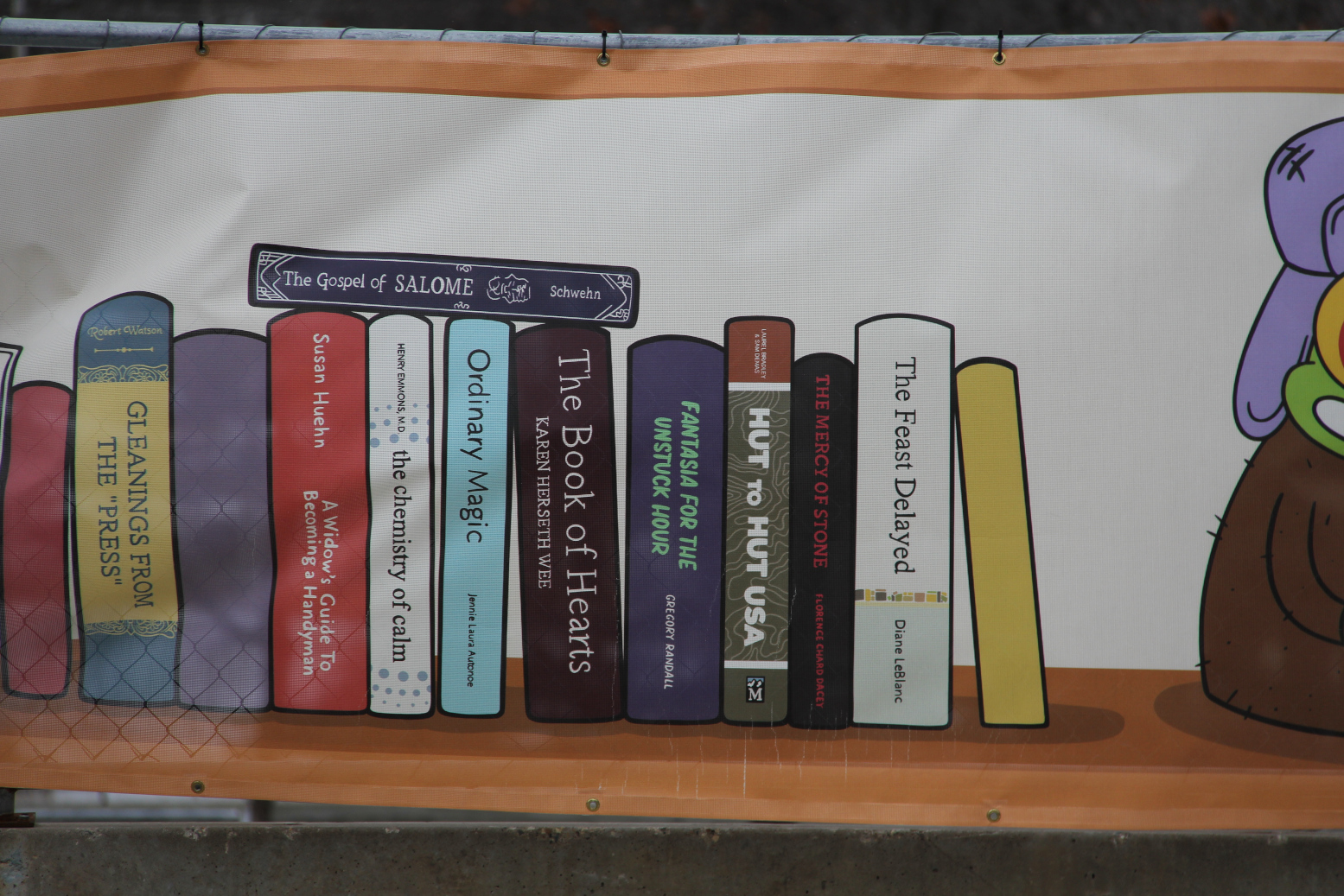
Northfield library staffers compiled a list of books by Northfielders, past and present, to incorporate into the panels. (Minnesota Prairie Roots copyrighted photo January 2026)
As a lover of both art and books, I appreciate this unique community endeavor to create something artistically beautiful and informative.
College students pass by the mural panels while I photograph the installation. (Minnesota Prairie Roots copyrighted photo January 2026)
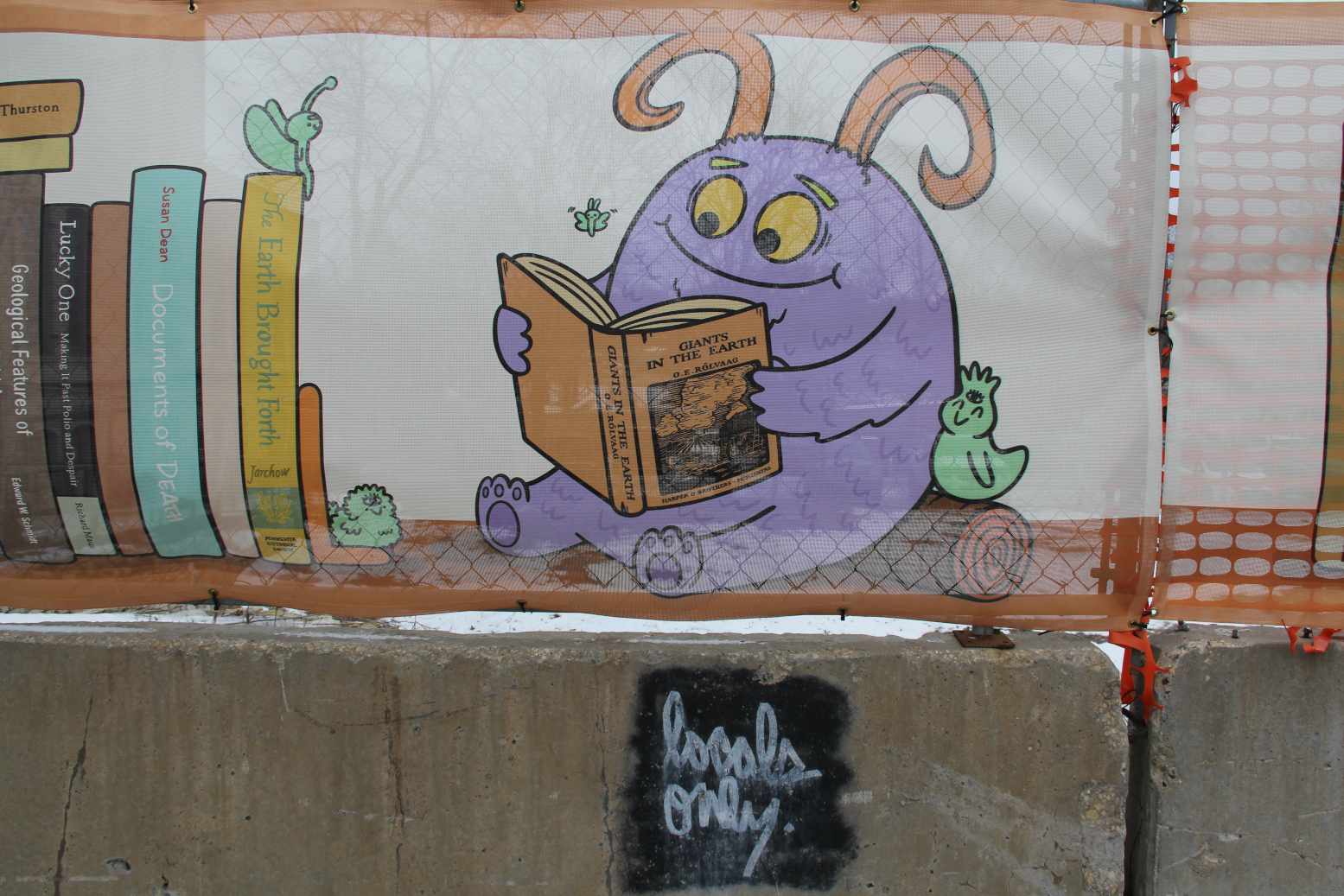
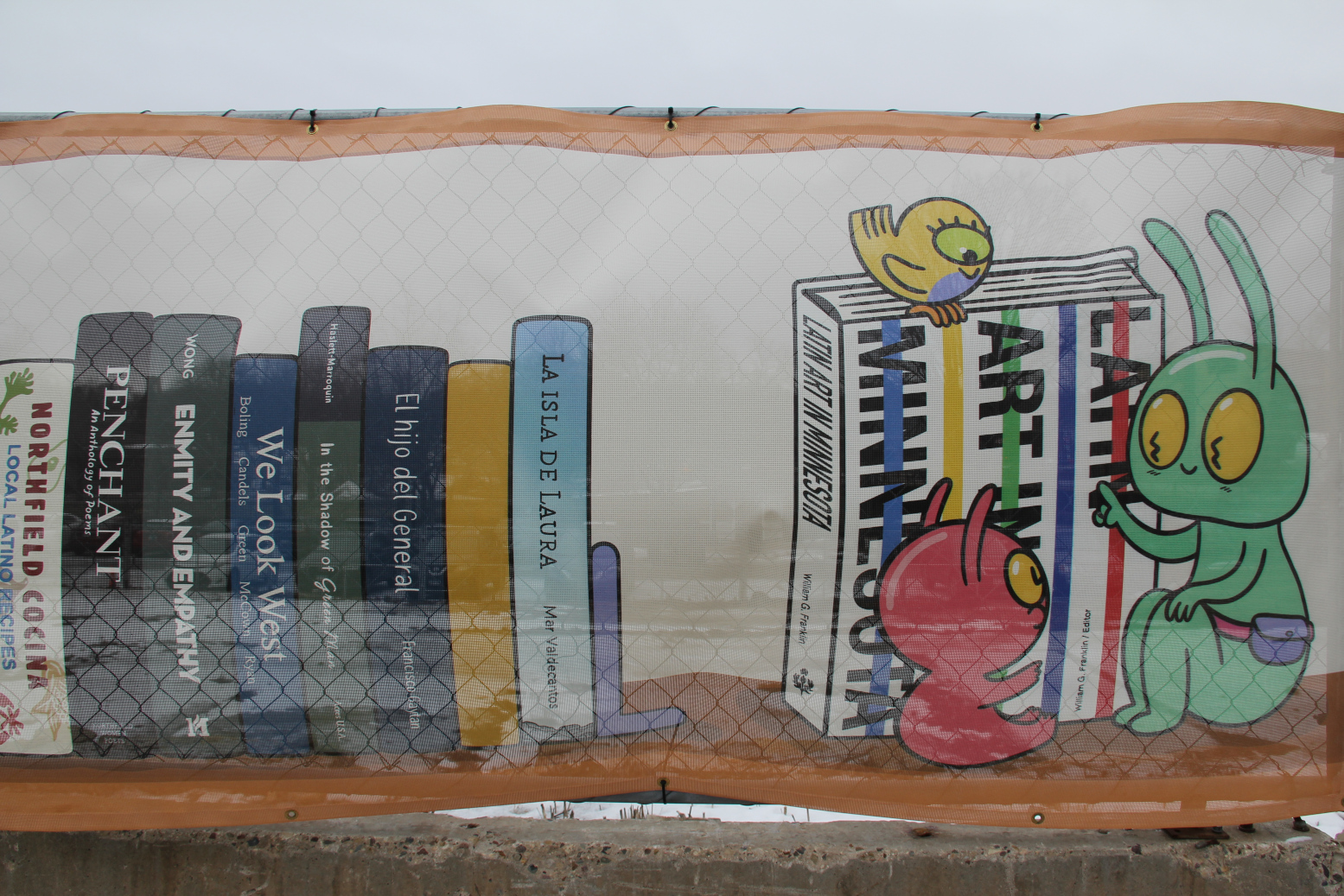
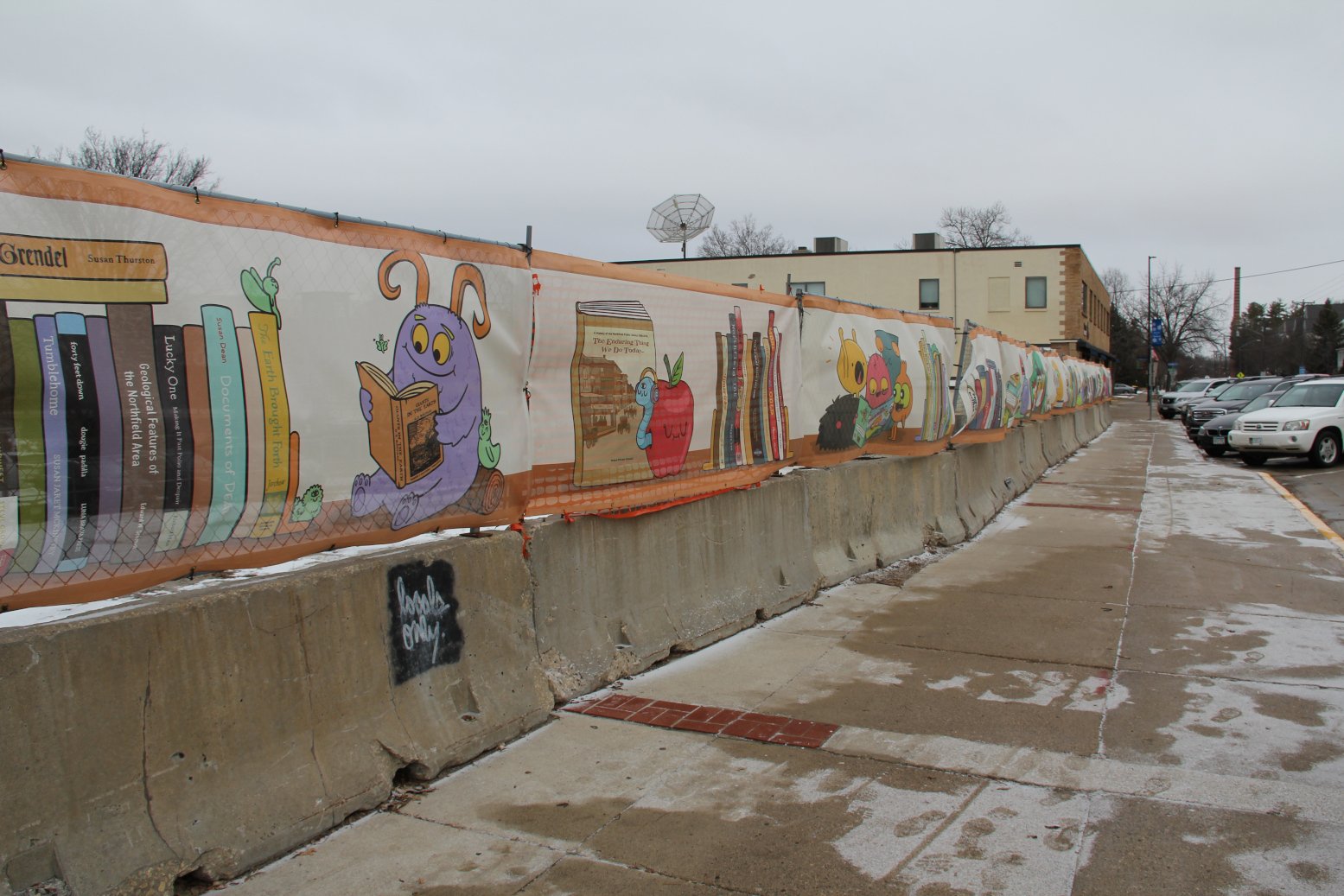
The Northfield Public Library worked with local Latino artist Rocky Casillas Aguirre on the project, which features more than 100 books by Northfield authors showcased on bookshelves printed on fabric. Walking along the mural scanning the titles is almost like walking into the library across the street up the hill and searching for a book.
One of Aguirre’s characters reads “Giants in the Earth.” (Minnesota Prairie Roots copyrighted photo January 2026)
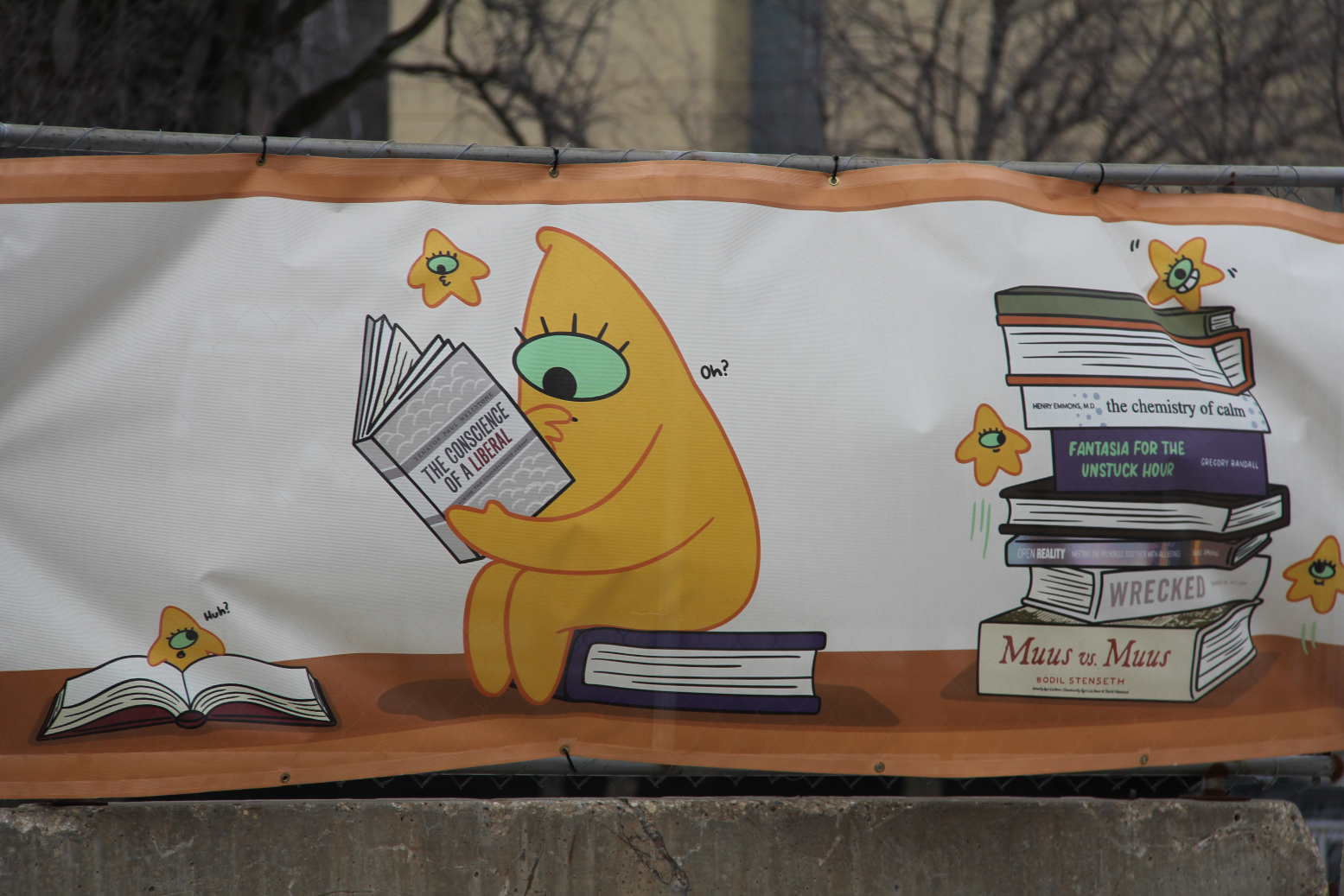
As I followed the installation, photographing and reading book titles, I found books familiar and unfamiliar. Some are widely-known, like Giants in the Earth, a story about Norwegian immigrants homesteading in Dakota Territory during the 19th Century, by Ole E. Rolvaag. Or Minnesota Senator Paul Wellstone’s The Conscience of a Liberal—Reclaiming the Compassionate Agendas. He died in a 2002 plane crash.
Characters created by Rocky Casillas Aguirre mix with books by Northfielders. (Minnesota Prairie Roots copyrighted photo January 2026)
Then there are poetry collections by Northfield poets—Bridge and Division, We Look West… This is a community rich in poets, a city where poems imprint upon concrete in a Sidewalk Poetry project.
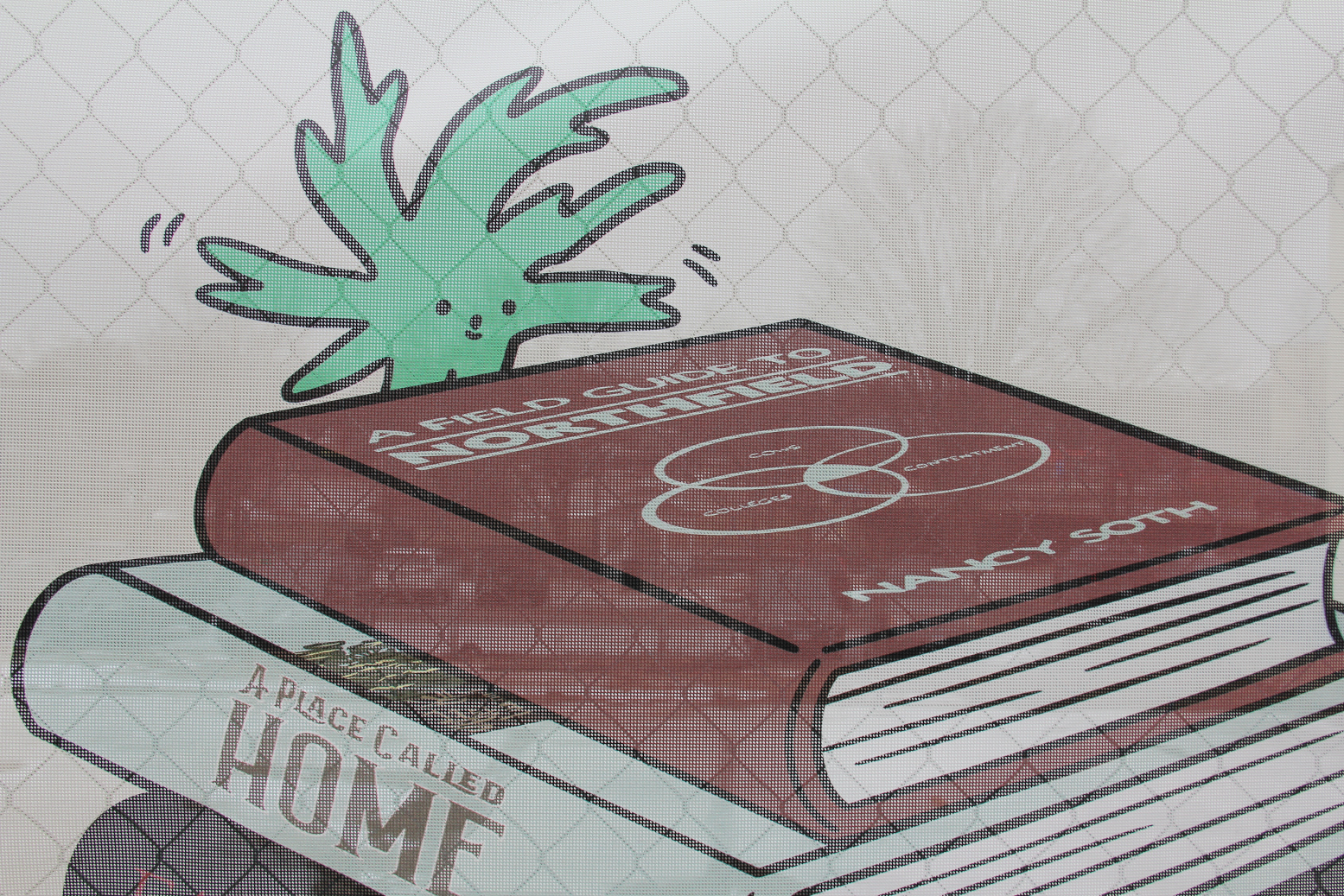
Some of the books by Northfield authors are specifically themed to Northfield. (Minnesota Prairie Roots copyrighted photo January 2026)
Other titles also drew my eye like A Field Guide to Northfield by Nancy Soth, Peace for Ukraine Coloring Book, Northfield Cocina: Local Latino Recipes and many more.
Lots of the artist’s cartoon characters are busy reading books. (Minnesota Prairie Roots copyrighted photo January 2026)
Beyond those 100 plus books featured in the art installation are the colorful characters Aguirre creates for his books, cartoons and stand alone art. They are interspersed among the titles—reading, interacting, resting, adding elements of color and interest.
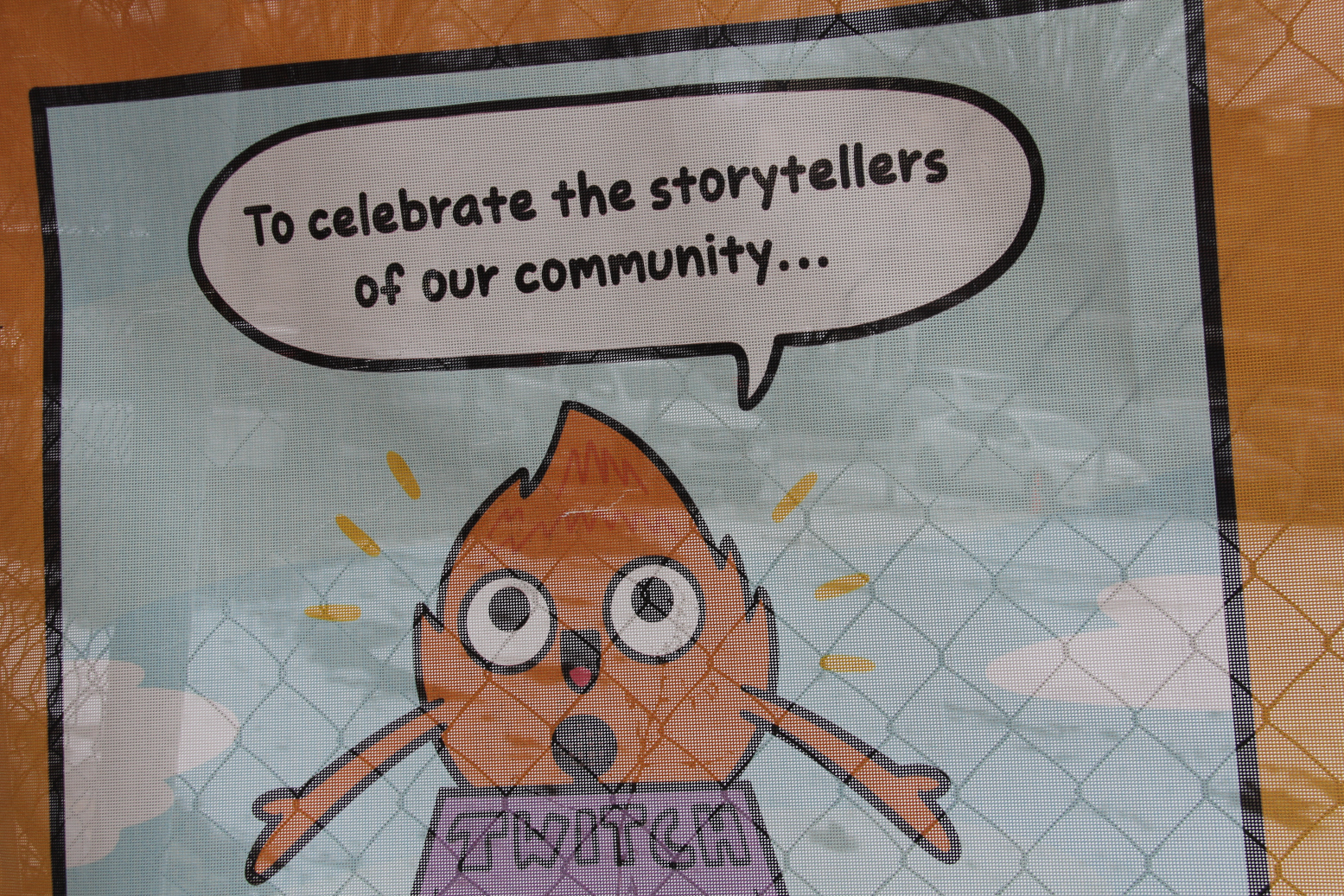
Twitch, a magical campfire created by the artist for his own art, is incorporated into the murals. (Minnesota Prairie Roots copyrighted photo January 2026)
Aguirre, who has dealt with anxiety and depression, focuses his art on raising awareness about mental health, especially among youth. Twitch, a magical campfire, is among the characters he’s created and which can be spotted on the downtown mural.
Another view of the panels, looking south on Division St. (Minnesota Prairie Roots copyrighted
This artist, born in Mexico but raised in Northfield and a resident for more than 20 years, also worked with the local Latino community on another city-supported art project, “Dear Northfield.” He interviewed 100 local Latinos, among the 2,000 who live in the city, to get their insights on topics like housing, food, transportation and more. The result is a series of bi-lingual posters that inform, raise awareness and connect. “Dear Northfield” is currently displayed at the Northfield library.
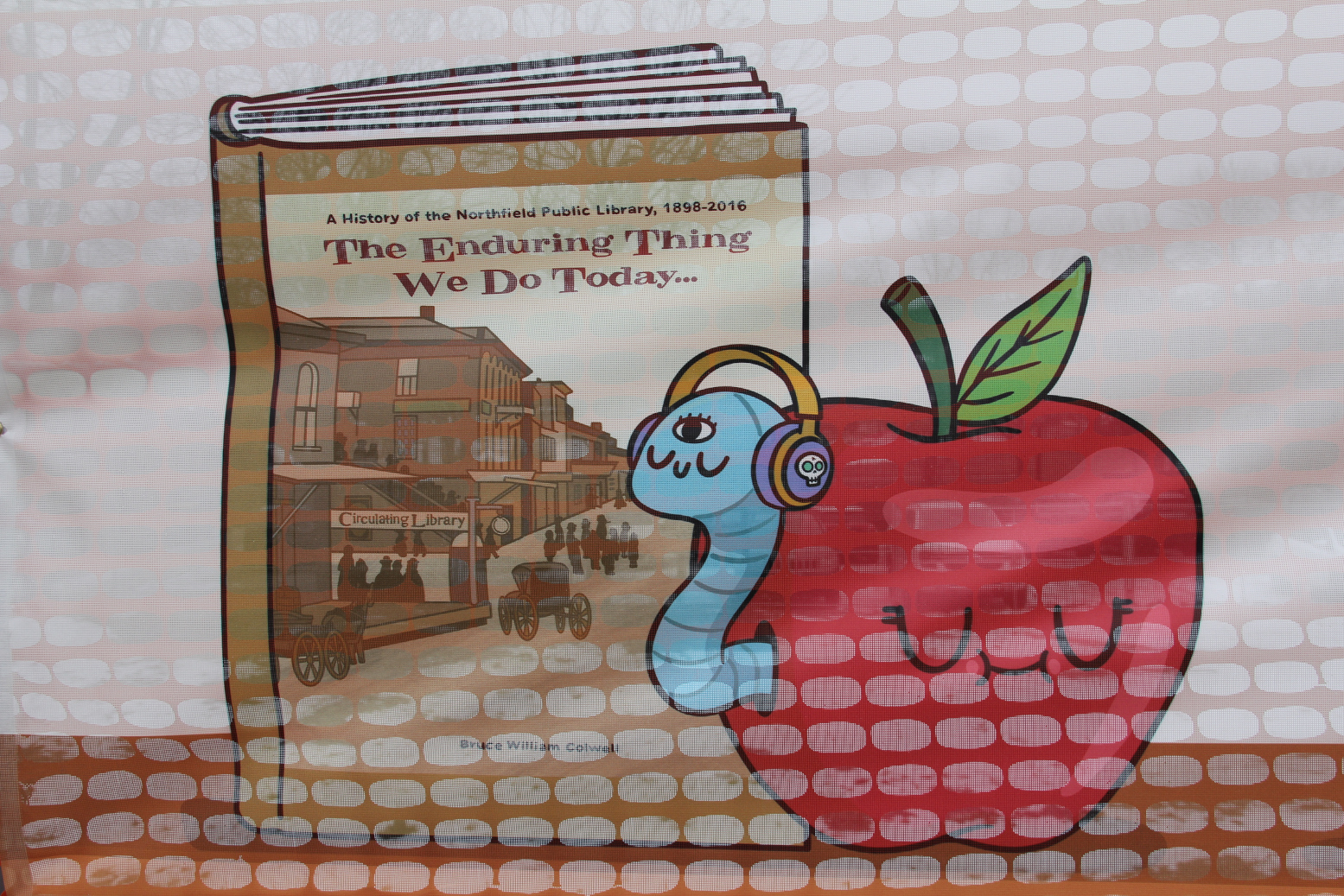
Even the library has its own history book. (Minnesota Prairie Roots copyrighted photo January 2026)
I learned a lot by simply walking along the mural panels attached to fencing at the site of the demolished Archer House. I learned that Northfield has far more authors than I ever imagined. Authors who write in all genres.
Looking at the mural north along Division Street. (Minnesota Prairie Roots copyrighted photo January 2026)
An overview of the art installation photographed through a second floor library window looking down on the Division Street scene. (Minnesota Prairie Roots copyrighted photo February 2026)
I’m excited to see more and learn more. The visual arts are such a gift, whether hung on a fence screening a vacant lot or hung in a gallery inside an arts center. Art holds the power to move us, inform us, enlighten us and, sometimes, even to change us.
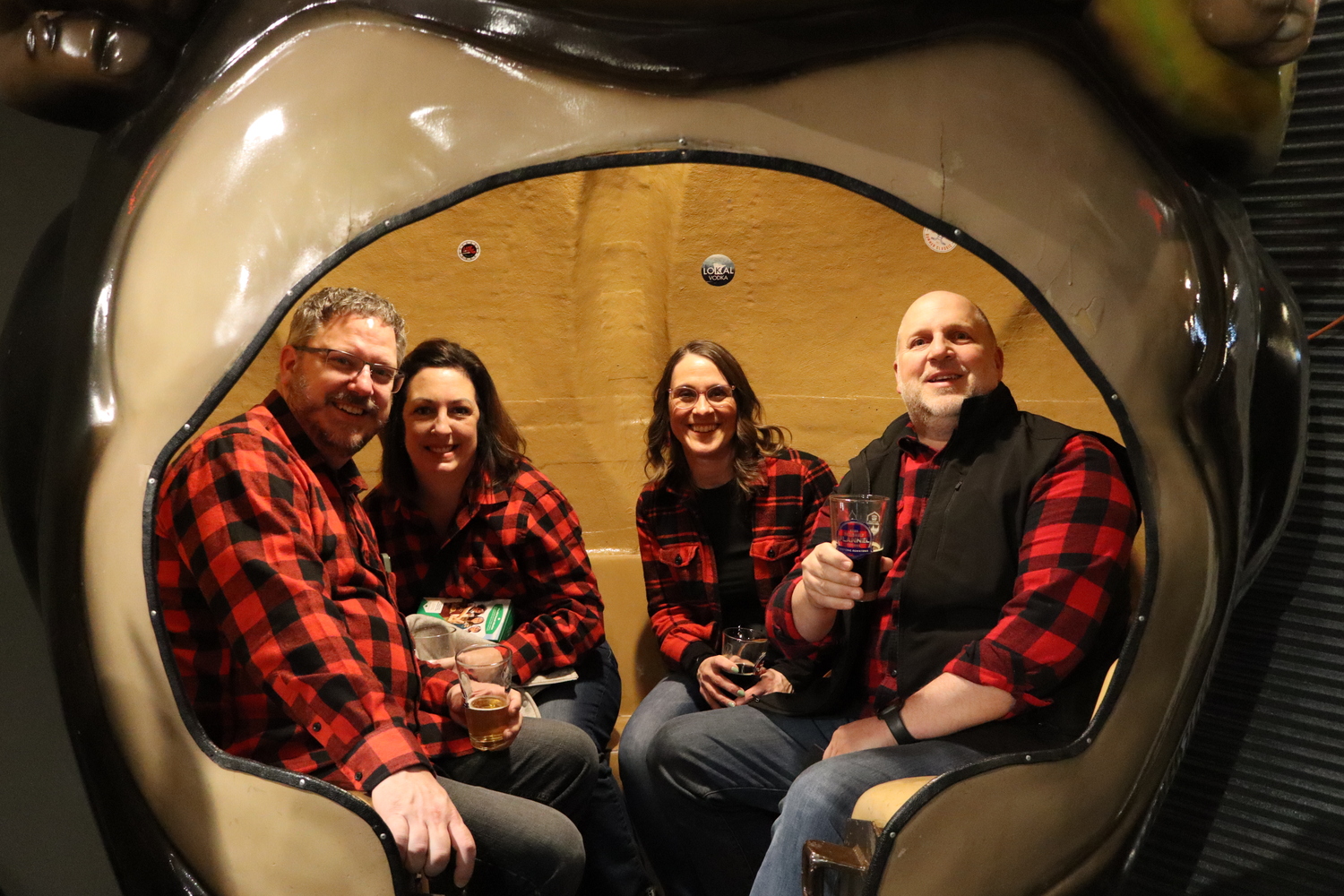
Attendees at a past Faribault Flannel Formal cozy inside a non-working amusement ride inside Corks & Pints. (Photo credit: Faribault Area Chamber of Commerce & Tourism)
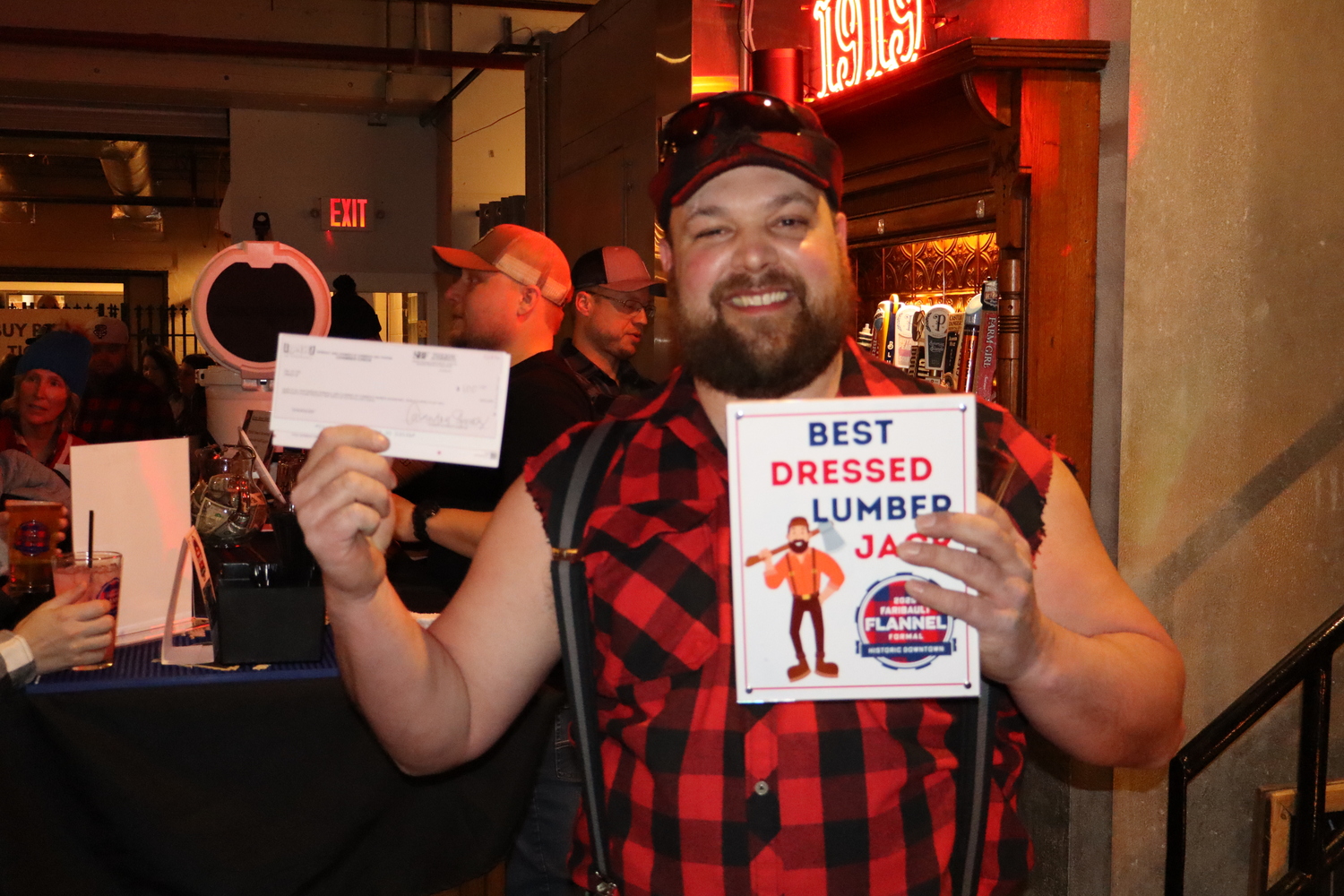
Voted as the Best Dressed Lumber Jack in 2025. (Photo credit: Faribault Area Chamber of Commerce & Tourism)
The dress code calls not for formal wear, but rather for flannel, preferably buffalo plaid red and black. That’s my kind of winter attire. Attendees can even participate in Lumber Jack and Jane costume contests, which call for creativity in flannel wear. Beards will also be judged to find “the best,” whatever fits that definition.
Chicken Wild Rice Hotdish, an example of the hotdish you may find at the Faribault Flannel Formal. (Minnesota Prairie Roots copyrighted file photo)
This promises to be a Minnesotan event through and through with activities like a Hotdish Showdown. Note, I wrote hotdish, which is the Minnesota word for casserole. Locals will cook up their favorite hotdishes to be judged and sampled.
The influence of legendary lumberjack Paul Bunyan—who may or may not have eaten hotdish, but who certainly wore buffalo plaid flannel—will be noticeable. There will be axe throwing in a special trailer, a Beaver Toss (that would be stuffed beavers), bag toss and hammerschlagen (driving nails into a stump). Fun stuff to show off precision skills and perhaps a bit of brawn.
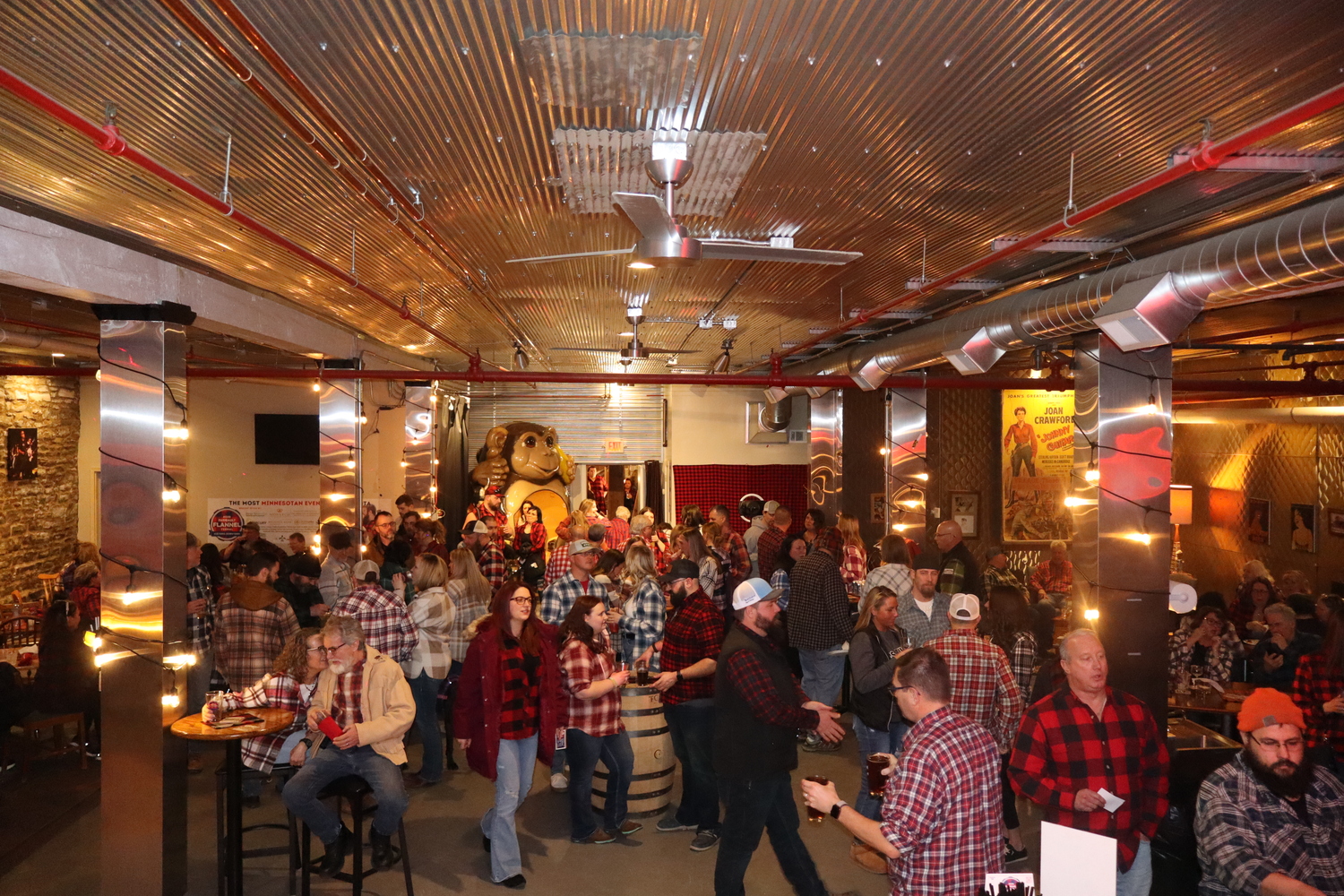
Inside the lower level of Corks & Pints, which connects to the distillery. (Photo credit: Faribault Area Chamber of Commerce & Tourism)
No event is complete without music. Minneapolis rock cover band Robos headlines the stage. Those who purchase $75 VIP experience tickets for early admittance at 3 p.m. can also exclusively enjoy the music of Wayne & the Boys, a one-man band performing the music of Wayne Wagner, inducted into the Legends of South Dakota Country Music Hall of Fame. VIP perks also include a swag bag, two complimentary drink tickets, voting power and access to exclusive hideouts.
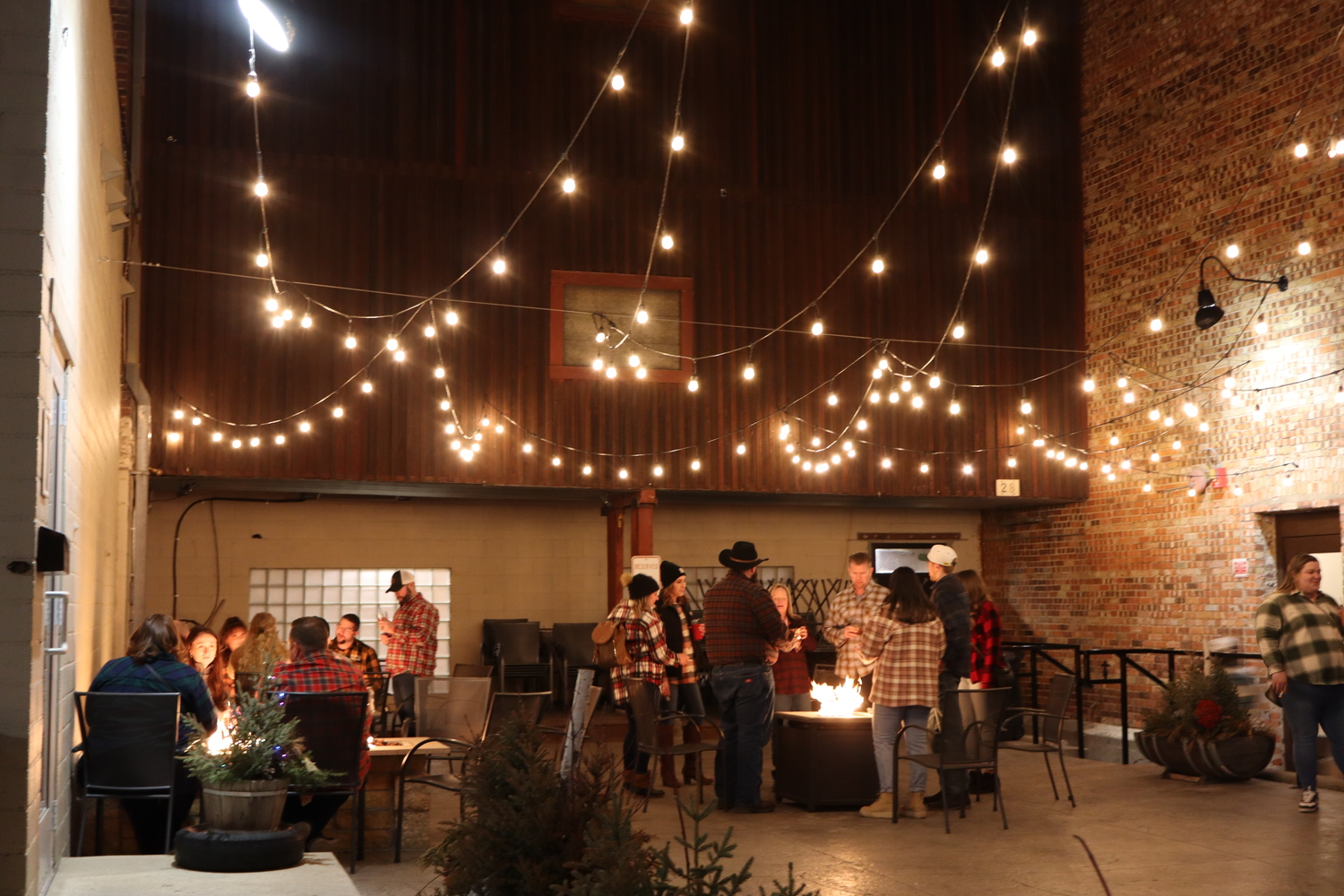
Flannel attendees gather on the patio between the distillery and Corks & Pints. (Photo credit: Faribault Area Chamber of Commerce & Tourism)
Whether you go VIP or opt for a $25 general admission experience, the Faribault Flannel Formal is sure to be a true Minnesotan experience, especially with all that plaid flannel. You can even experience Minnesota winter by stepping outside to order a drink at the Sleigh Bar (new this year) and then warm up in a heated tent, followed perhaps by a conversation about the weather. We like to talk weather here in Minnesota.
You may even overhear phrases like “You betcha.” Or “That’s different.” Or “It could be worse.”
But mostly, I expect you will hear friendly conversations, lots of laughter, maybe an ice fishing tale or three, and praise for Minnesota, this place we love. Even in the deep of winter. (Mostly.)
A painting on burlap by Mexican artist Jose Maria de Servinfrom my art collection. It seems to fit the moment. (Minnesota Prairie Roots copyrighted file photo)
AS I GATHERED INFORMATION for this blog post, I wondered how to start. I’ll begin with one simple statement: The need is great here in Minnesota following the largest mass federal immigration enforcement in the country.
That’s a broad, undefined statement which I want to narrow down to specifics in my community of 25,000 in southeastern Minnesota, an hour south of Minneapolis. Faribault is a blue collar city, home to many people of color, including Somalis, Hispanics and Latinos, the demographic hit hardest by the months’ long Operation Metro Surge.
I can’t tell you how many people have been taken from my Greater Minnesota community by ICE. I can’t tell you how many people have been racially profiled, stopped and questioned. But residents of Faribault have been taken. And stopped, because of their skin color. I know this simply by being out and about, talking with people. This federal activity, which initially saw 3,000 immigration agents in the state, is not done, despite statements otherwise.
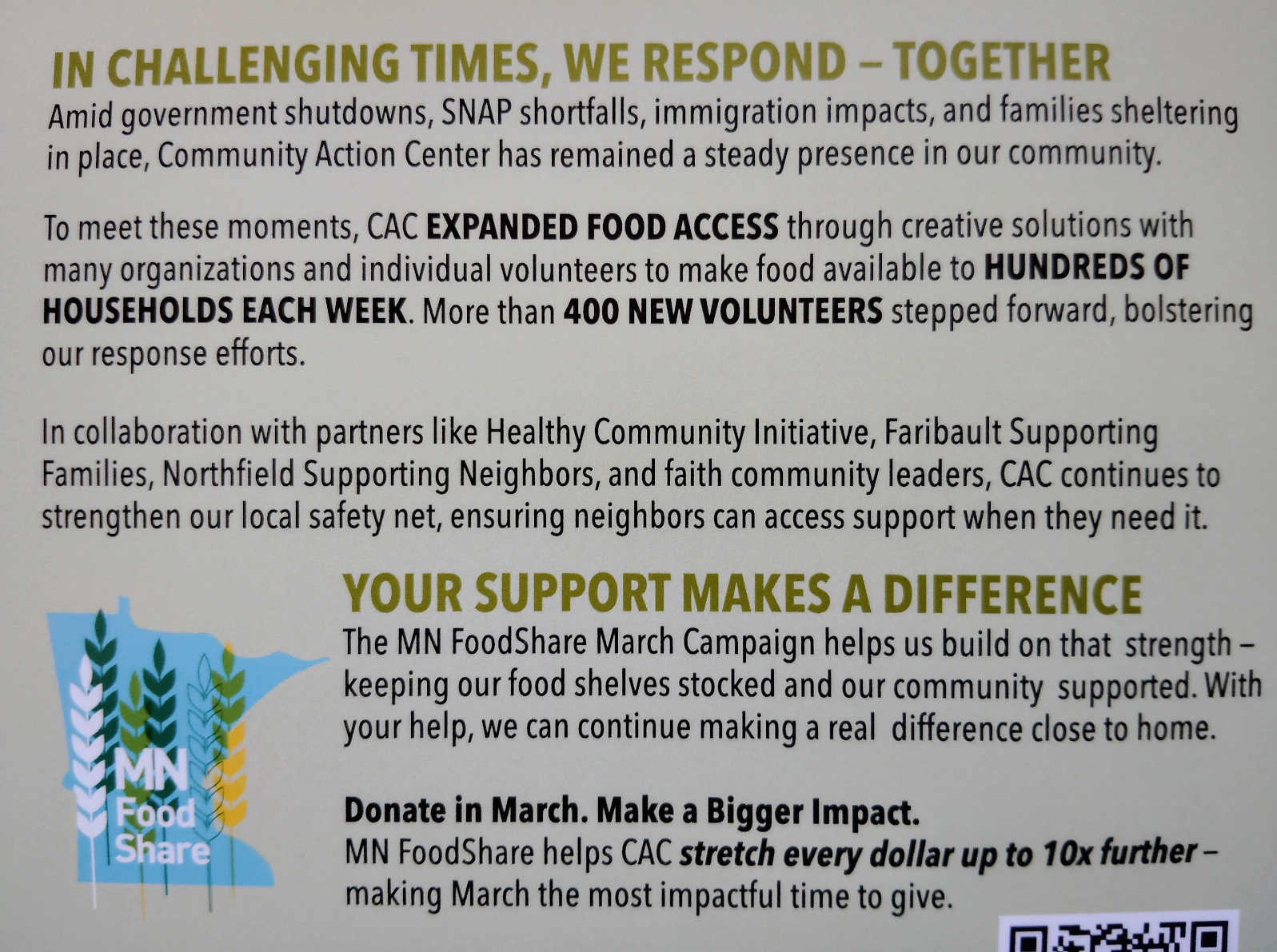
This shows a portion of a promo I received in the mail this week from the Community Action Center with locations in Faribault and in Northfield.
FACING FINANCIAL CHALLENGES
That brings me to the topic of today’s post. Need. And how you can help the many people in my community who now find themselves facing financial challenges due to ICE activity. Many have been sheltering in their homes, afraid to go to work or the grocery store or church. Afraid to take their kids to school…
The fear they’ve felt of being detained, even if they’ve done nothing wrong, even if they are here legally, even if they are American citizens, has been great. As a white woman, as a human being, I feel a moral obligation to do what I can for my neighbors who are suffering. Many people in Faribault have stepped up—taking kids to school, delivering groceries, driving people to work, donating food and money…
Some of you have asked me how you can help, and some of you have already helped. Please accept my heartfelt gratitude for your kindness, your care, your compassion, your support, your encouragement and your financial gifts.
Our Savior’s Lutheran Church has been a collection site for food and non-food items during the current crisis. (Graphic sourced from the Our Savior’s Facebook page)
The demand for funds to assist renters facing eviction is high. These are people who have not gone to work because they fear ICE. No work equals no income equals no money to pay the rent or other expenses.
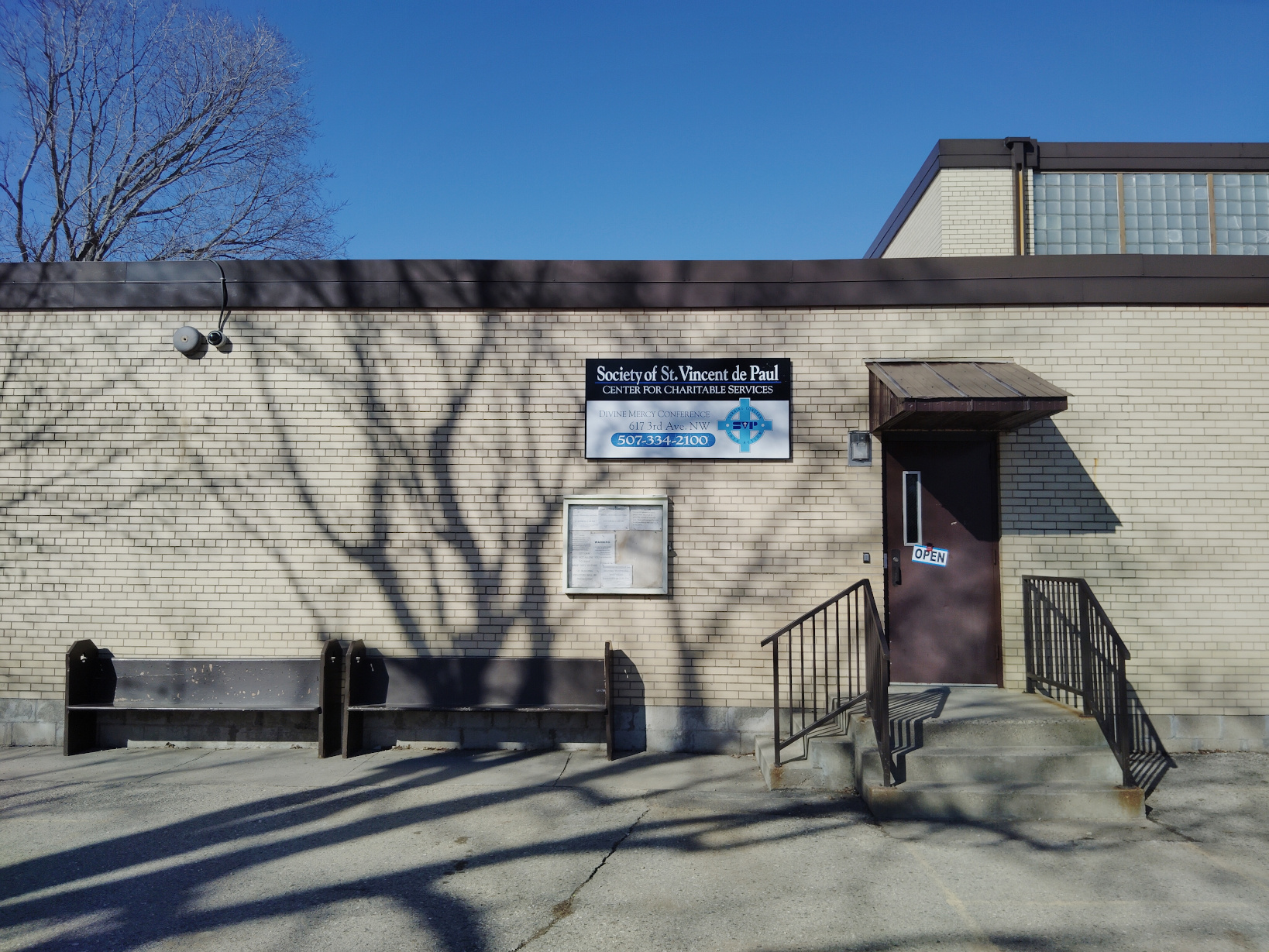
The Society of St. Vincent de Paul in Faribault is among the organizations helping people in my community. (Minnesota Prairie Roots copyrighted photo February 2026)
HELPING PEOPLE IN FARIBAULT
I’ve compiled a short list of selected places to which you can donate monies that will help those impacted by federal immigration enforcement, and others, in Faribault. Please click on the boldfaced organization names to reach websites, where you will find donation tabs and more information. Thank you for considering my request to help people in my community. I am grateful.
Faribault Community Action Center. Donate to the CAC Community Response Fund which meets urgent and evolving needs such as for food and rent. Please designate your gift for the FARIBAULT CAC as one exists in neighboring Northfield. That town’s council approved a $50,000 request for emergency rental assistance.
Spreading Warmth: Supporting Immigrant Families in Faribault.This is a GoFundMe campaign aiming to raise $30,000 (a new goal) to help struggling immigrant families. Thus far, the effort has raised nearly $21,000. The organizer provides detailed info on needs and how families have already been helped.
Faribault Supporting Families.This group manages a small community-supported fund to help families facing urgent immigration-related challenges.
Three Rivers Community Action. This organization offers multi-faceted services, including in the area of housing, such as rental assistance.
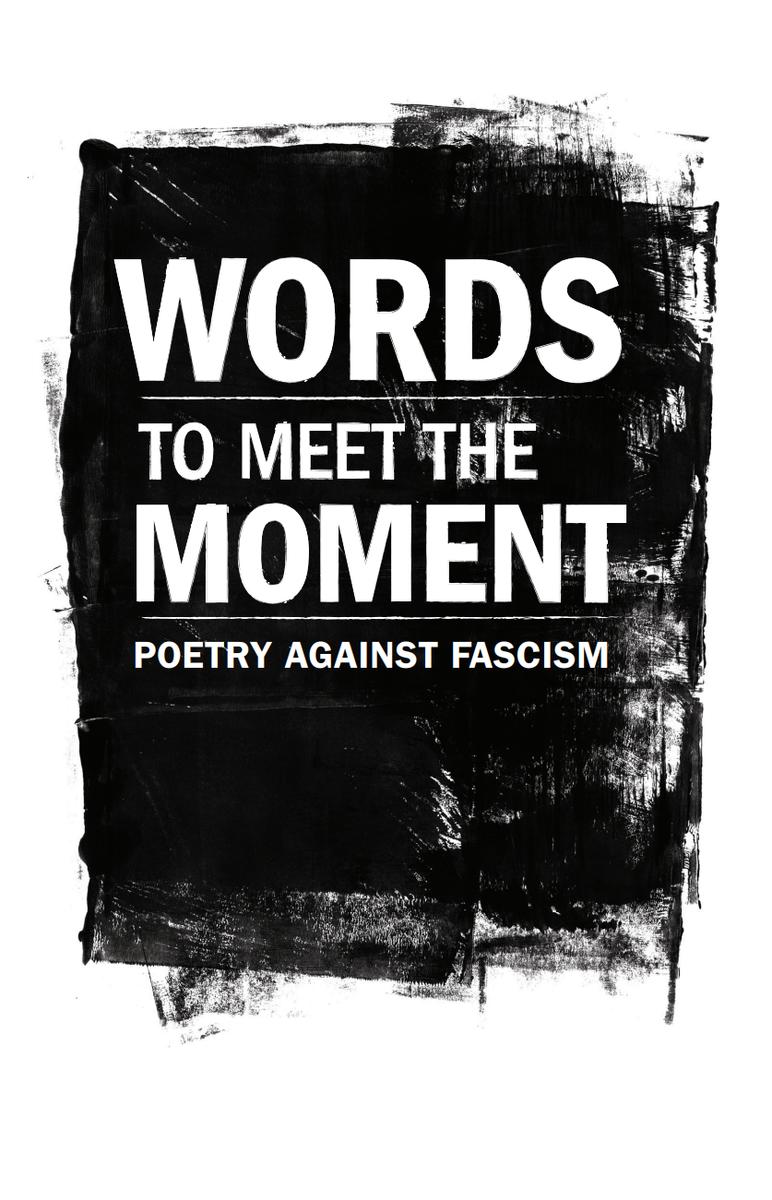
Mark Heiman designed the book cover. (Image sourced online)
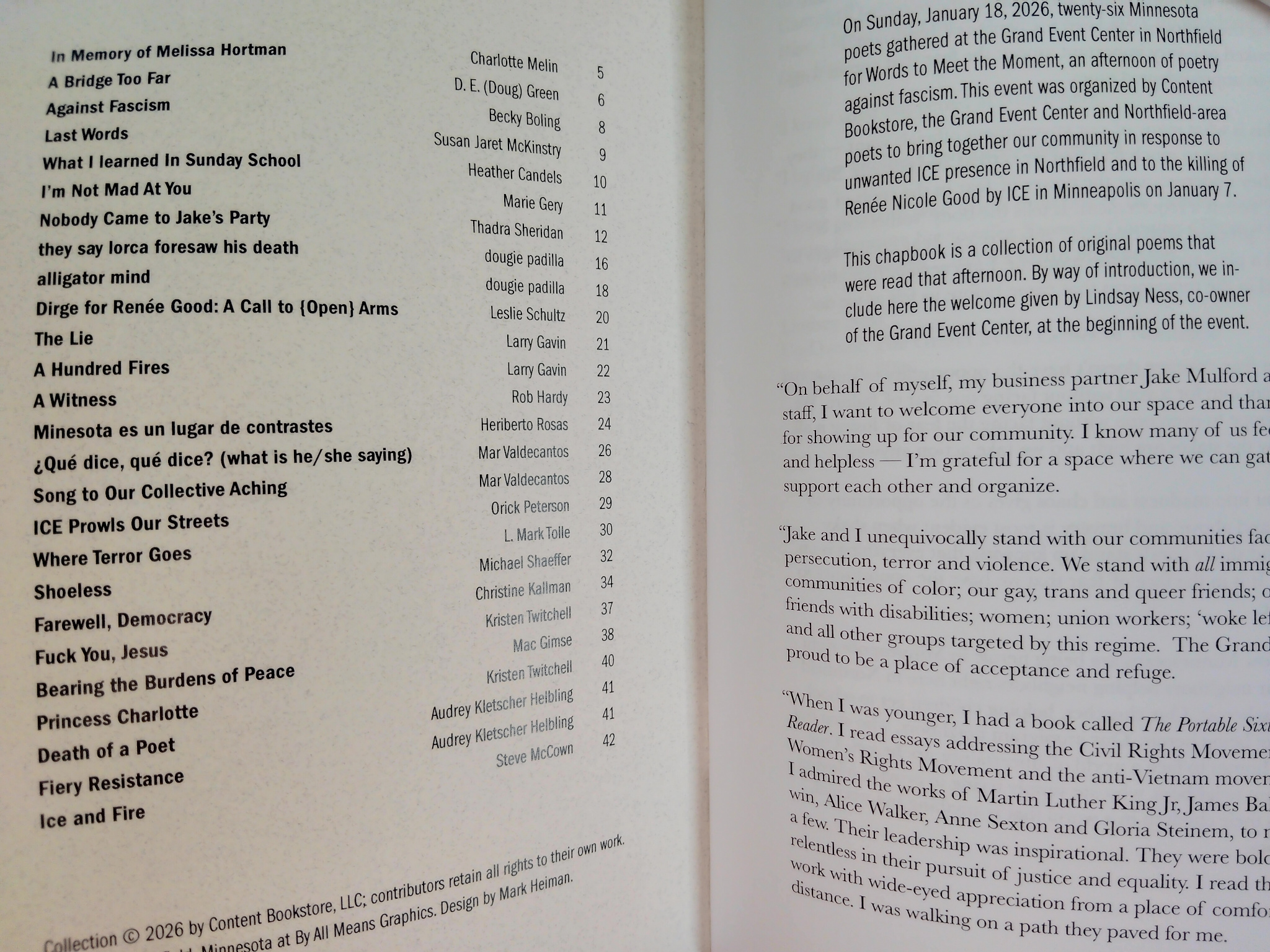
IN A SLIM VOLUME of poetry collected by a small town Minnesota independent bookstore and printed by a small town printer, 22 area poets raise their voices in response to the massive immigration enforcement efforts in Minnesota. The result is 26 powerful, empowering, strongly-worded poems that hold back nothing.
These poets unleash their fury, their fears, their frustrations, layers of intense emotions. “Let every poem be a witness,” writes my friend and former Northfield Poet Laureate Rob Hardy in his poem, “A Witness.” He writes that in the context of the fatal shooting of mother and poet, Renee Nicole Good, by a federal immigration agent on the streets of Minneapolis on January 7.
The poets and their poems plus an intro by Lindsay Ness, co-owner of The Grand Event Center. She introduced a “Words to Meet the Moment: Poets Against Fascism” poetry reading which preceded publication of this chapbook. If you find the title of a poem offensive, read the poem and you will understand the title. (Minnesota Prairie Roots copyrighted photo February 2026)
Two poems, “Last Words” by Susan Jaret McKinstry and “I’m Not Mad at You” by Marie Gery, quote Renee Good’s final words—”I’m not mad at you”—spoken to a federal immigration agent right before her fatal shooting.
The words within these 26 poems reflect not only individual poets’ thoughts but also a collective community reaction to ICE in Minnesota. Themes of anger, fear, unity, dignity, hope and light run throughout this poetry.
Colorful merchandise inside Mercado Local in Northfield, where I met Mar Valdecantos and read poetry with Becky Boling and D.E. Green. (Minnesota Prairie Roots copyrighted file photo)
I especially appreciate the writing of two immigrants, including my friend Mar Valdecantos, who came to the U.S. from Spain many years ago. She uses humor to make a point, stating that perhaps she should cover her dark hair with a blonde wig. That would allow her to semi hide her ethnicity and allow her to feel safer while out and about in the community. Safe against racial profiling, used freely by immigration agents to stop people of color in Minnesota.
Latino immigrant Heriberto Rosas, in “Minnesota es un lugar de contrastes,” writes of whence and why he came to America, the challenges he and other immigrants have faced, and the hope and gratitude they hold. It’s an especially revealing poem written in Spanish and translated into English on the opposite page.
My poet friend D.E. (Doug) Green also writes “hope” into his poem, “A Bridge Too Far,” as he references the Civil Rights Movement and the bridge crossed, literally, “in the face of violence, cruelty and terrible hatred.” A bridge which must once again be crossed.
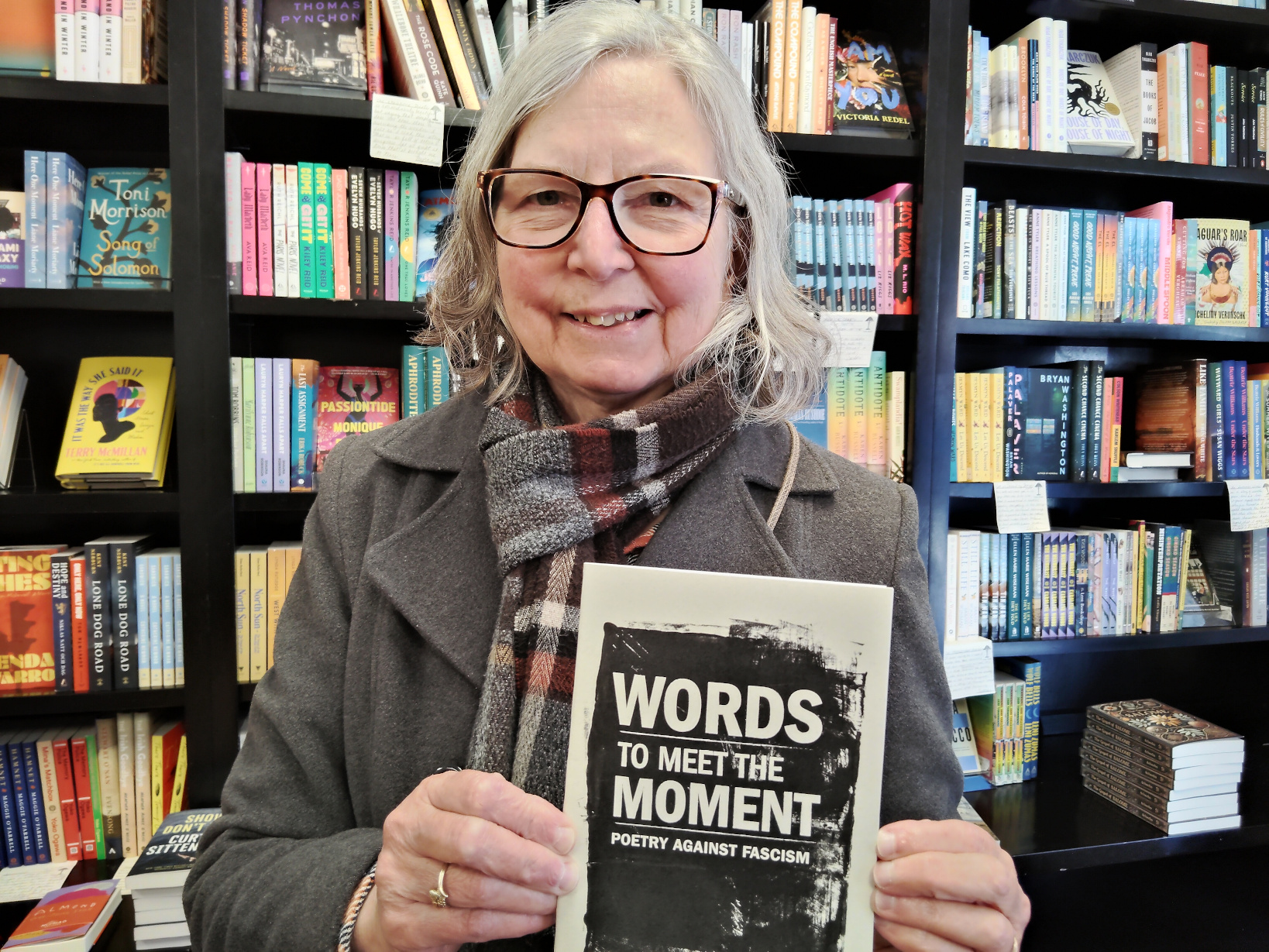
I picked up my copy of the chapbook at Content Bookstore after a morning of protesting in Faribault, thus the flat hair. (Minnesota Prairie Roots copyrighted photo by Randy Helbling)
These poems are raw, relentless, sometimes raging in content. That includes my “Fiery Resistance” and “Death of a Poet.” Words hold power. “We the people have a job to do,” writes Orick Peterson in “ICE Prowls Our Streets.” He asks us to muster our courage against the bullies, take on our neighbors’ fears, lean into each other.
Steve McCown, who died unexpectedly on the day he was to read his original poem, “Ice and Fire,” at a “Words to Meet the Moment: Poetry Against Fascism” event on January 18 in Northfield, summarizes everything well in the final line of his poem: “We can build a fire on ice.” Let me repeat his final line, with emphasis: “We can build a fire on ice.”
FYI: The 42-page chapbook, Words to Meet the Moment: Poetry Against Fascism, is for sale only at Content Bookstore in Northfield. Cost is $10. The bookstore will ship domestically at a cost of $4.99, the media mail book rate, with an additional $1 charge for each book ordered.
Content Bookstore published the chapbook with printing By All Means Graphics. The original print run is 300 books. Once expenses are paid, proceeds from sale of the chapbook will go to the Northfield Community Action Center.
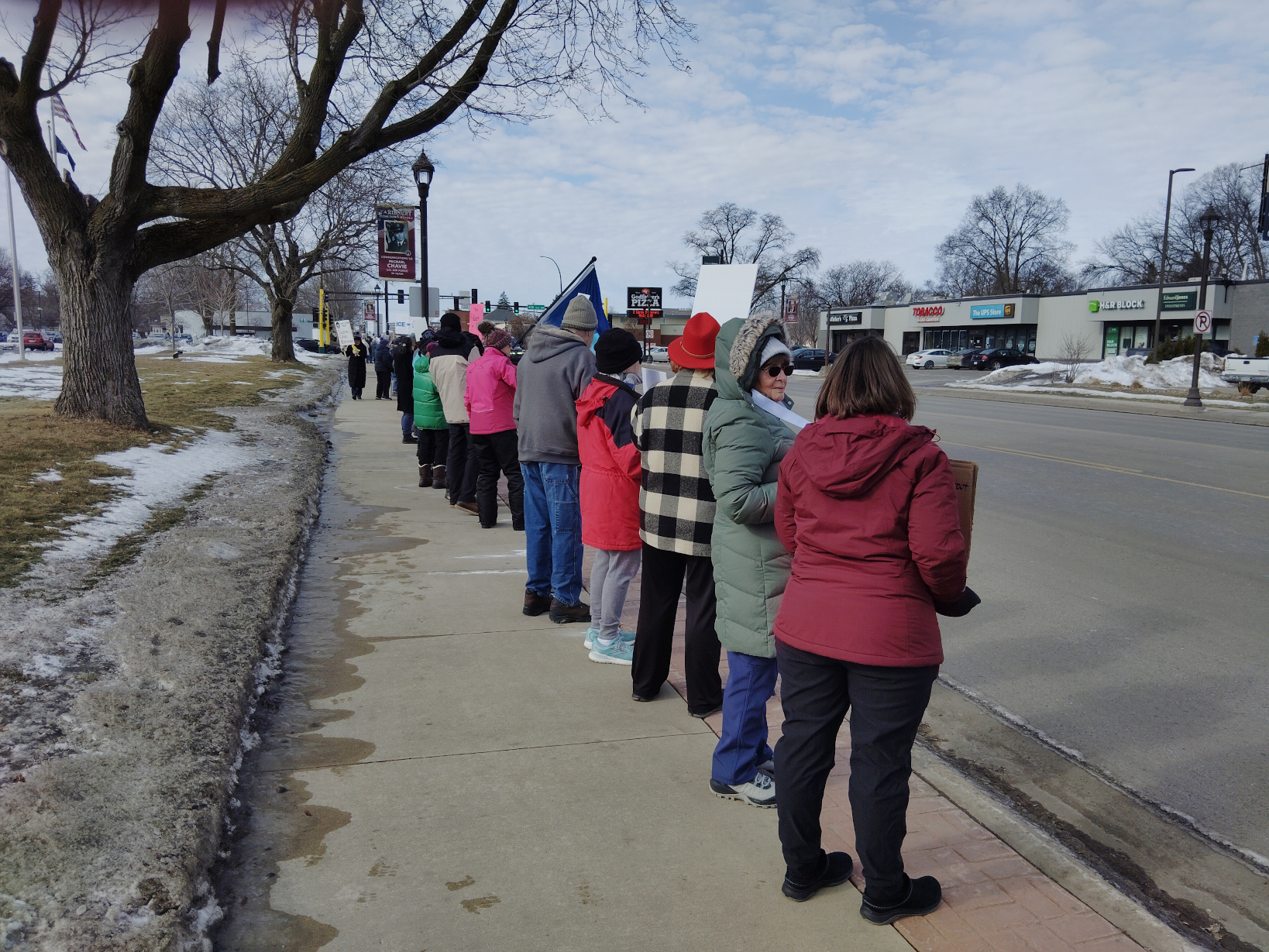
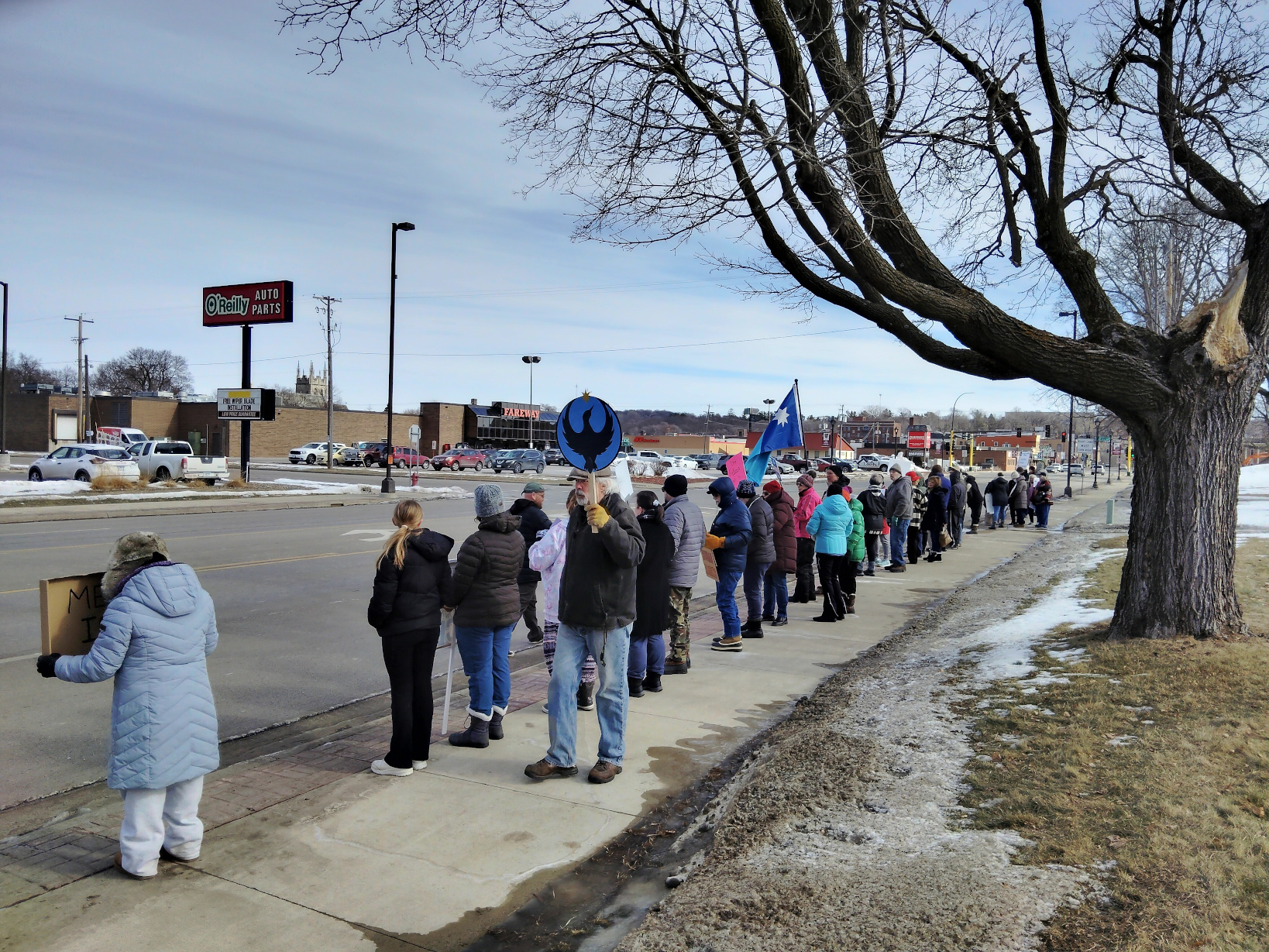
Protesters line up along Minnesota State Highway 60 in Faribault two weeks ago. (Minnesota Prairie Roots copyrighted file photo February 2026)
WE PULLED INTO THE PARKING LOT shortly before 11 a.m. Saturday, grabbed our signs from the back of the van and headed to the sidewalk. There Randy and I joined others filtering in to protest by the Rice County government services building along busy Minnesota State Highway 60/Fourth Street in Faribault.
For six Saturday mornings now, people have gathered here to raise their voices against aggressive federal immigration enforcement in Minnesota and against many other policies and directives of the Trump administration negatively affecting our lives (and that of our neighbors) and/or threatening our country. Whatever concerns someone—democracy, Constitutional rights, due process, tariffs, the economy, voting rights, authoritarianism, immigration—those topics are covered in signage and/or in conversations.
Saturday morning we stood some 40 strong in 15-degree temps with a biting wind. That’s about half our usual number. Some of the regulars were missing, but I also saw many new faces.
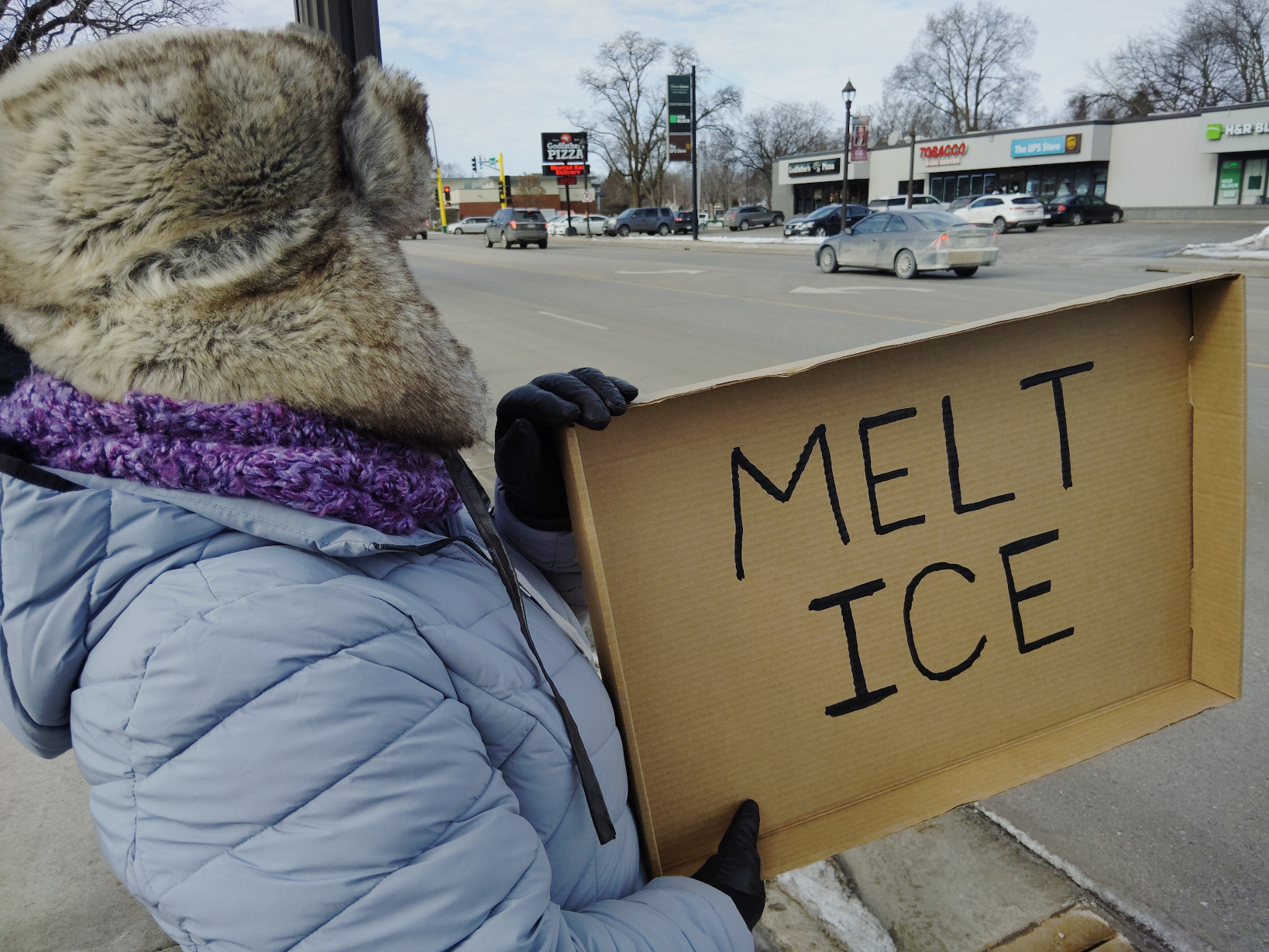
Protesting against ICE two weeks ago. (Minnesota Prairie Roots copyrighted file photo February 2026)
ICE IS STILL HERE
Top on all of our minds remains Operation Metro Surge, the largest mass immigration enforcement effort in the country which saw 3,000 federal agents descend on Minnesota. That includes here in our community, home to many Latinos, Hispanics and Somalis.
Despite the announced drawdown of those agents, ICE activity in Faribault has not decreased since they started working here in early December, according to one protester I questioned on Saturday. He laughed when I inquired, a telling response. He’s a trustworthy source, a boots-on-the-ground individual who is active and informed.
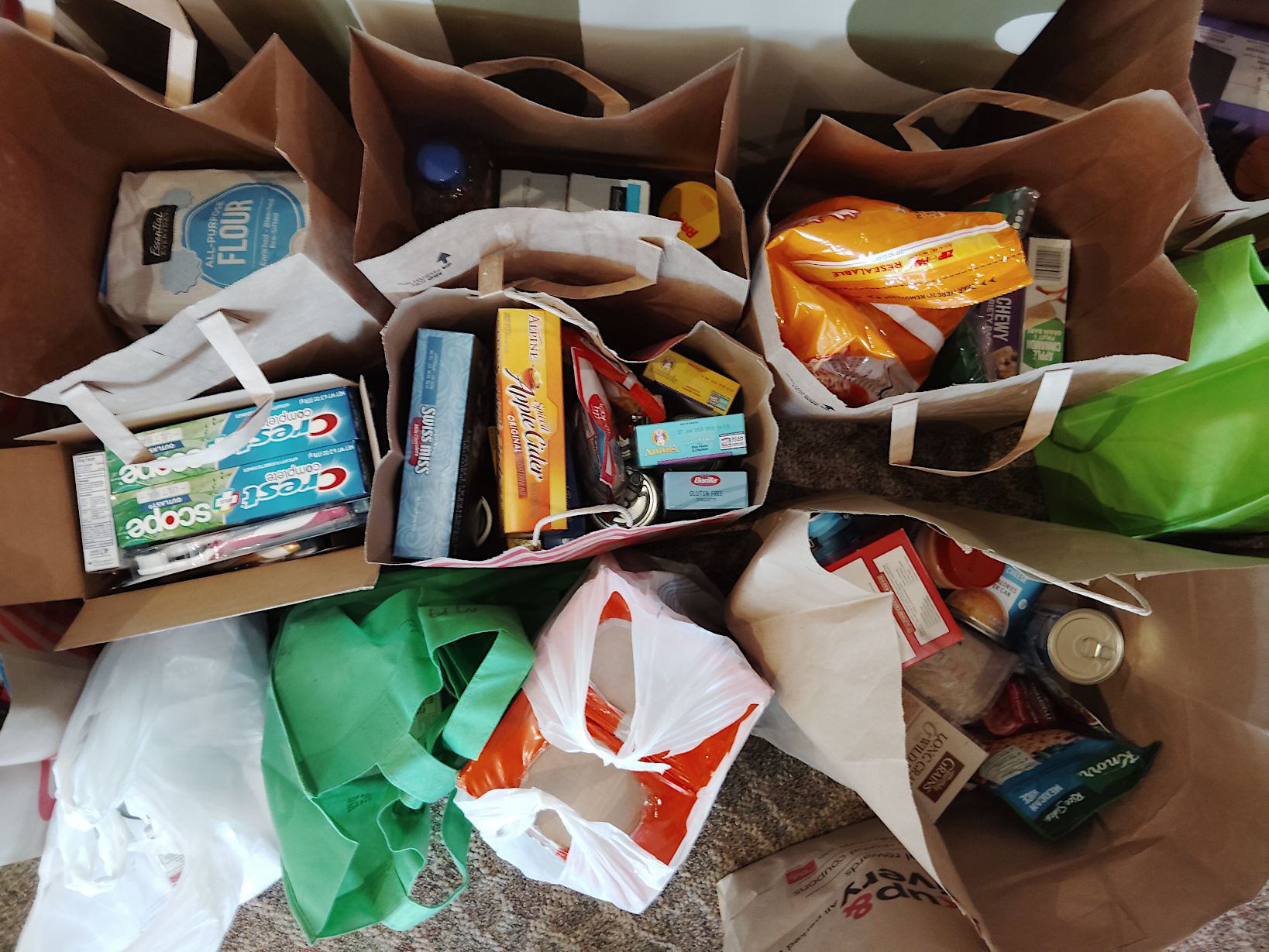
Groceries and personal care items collected by a church in the south metro for those in need. (Minnesota Prairie Roots copyrighted file photo February 2026)
THE PERSONAL & FINANCIAL FALL-OUT
To hear stories of retired teachers giving kids rides to school is simultaneously heartening and heartbreaking. Parents should be driving their children to school or walking them to the bus stop. But, because of ICE, others are doing that while they are sheltered at home, afraid to leave, not working, not going to the grocery store.
Food shelves have sprung up in schools and in churches, supplementing already existing nonprofit food shelves. The need is great. I recently started volunteering at a local food shelf.
Families unable to pay rent now face eviction. The Faribault City Council last week denied a request from the Faribault Community Action Center for $50,000 in emergency rental assistance. In neighboring Northfield, the city council unanimously approved an identical request from the Northfield Community Action Center.
Faribault is a blue collar community that runs red. Northfield is white collar blue.
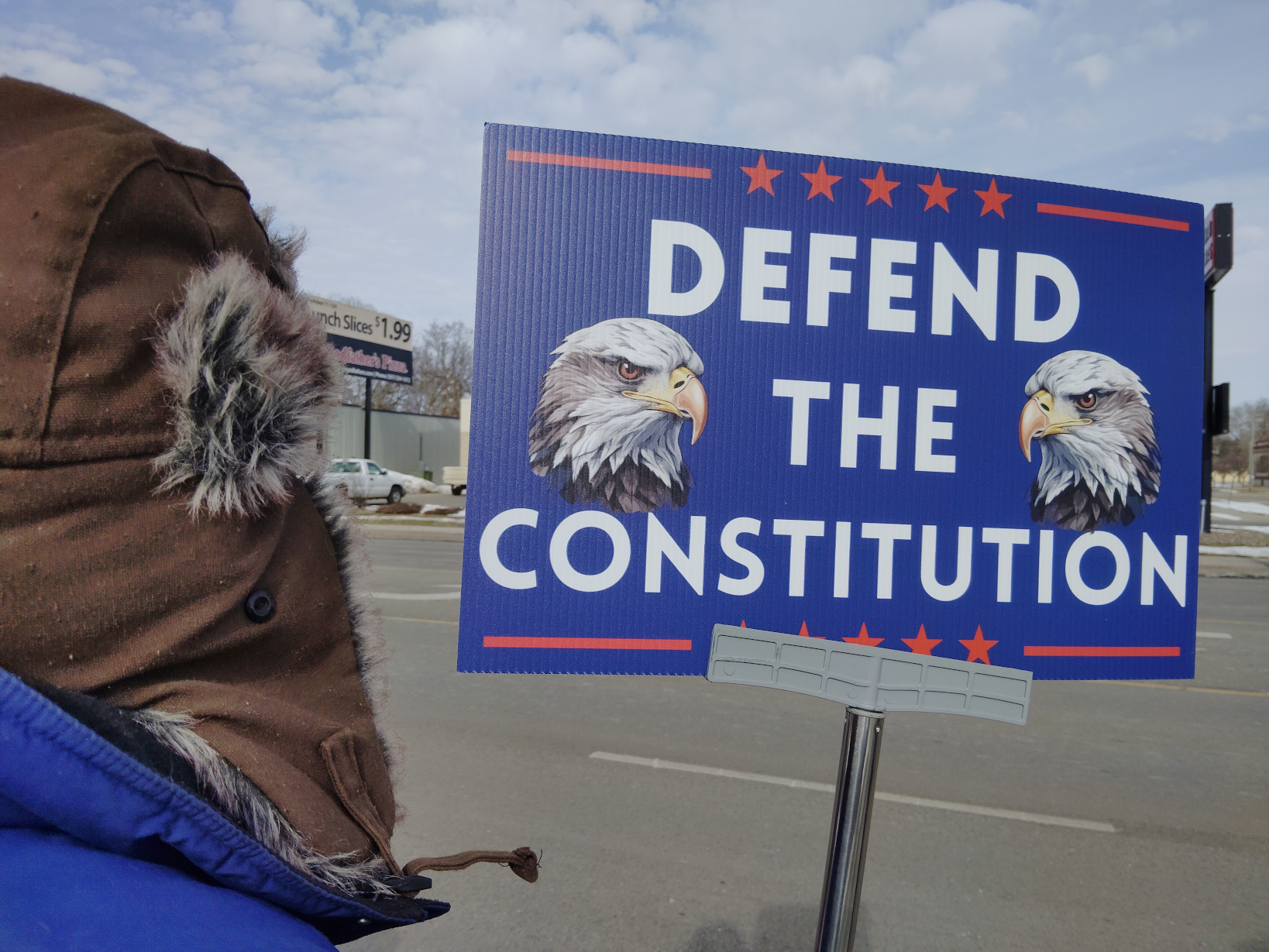
A sign held at a previous protest. (Minnesota Prairie Roots copyrighted file photo)
REACTIONS TO OUR PROTESTS
Whenever we protest, we are subjected to profanity, vulgarity and negative behavior from passing motorists among the overwhelmingly positive support. Based on my observations the four past Saturday mornings, the loudest and angriest are white women probably in their forties. I don’t understand the intensity of their angry outbursts. We just smile and wave, figuring we got to them with our messages.
Near the center of this frame, a protester carries a Rebel Loon sign. (Minnesota Prairie Roots copyrighted file photo February 2026)
THE STORIES
I like to mingle when I protest. It’s a great opportunity to meet new people, to hear stories. Like that of an elementary school student who returned to classes last week after a two-month absence. Or the first-time protester whose husband, an immigrant, has worked mostly remotely rather than drive to his job in Minneapolis. Or the man who crafted a Rebel Loon (the Minnesota state bird) sign and was protesting for someone who could not be there for fear of ICE.
These are real stories of real people in my community. I may not know the little girl who returned to school or the protester’s husband or the friend of the Rebel Loon guy. But I do know that I care about the people in my community who have lived in, and continue to live in, fear of federal immigration agents regardless of legal status. Residents of my community have been racially profiled, stopped, questioned because they are black or brown, have an accent, dress differently. I have talked to a Hispanic woman, an American citizen, who was stopped by ICE.
This is why I protest in the deep cold of a Minnesota winter, standing beside others with signs, Minnesota state flags and peace flags in a town of 25,000 where protesting exposes you to criticism. It matters to my profiled and targeted neighbors that I am publicly standing up for them. They’ve told me so. I cannot remain silent. We are stronger together. Minnesota Strong.
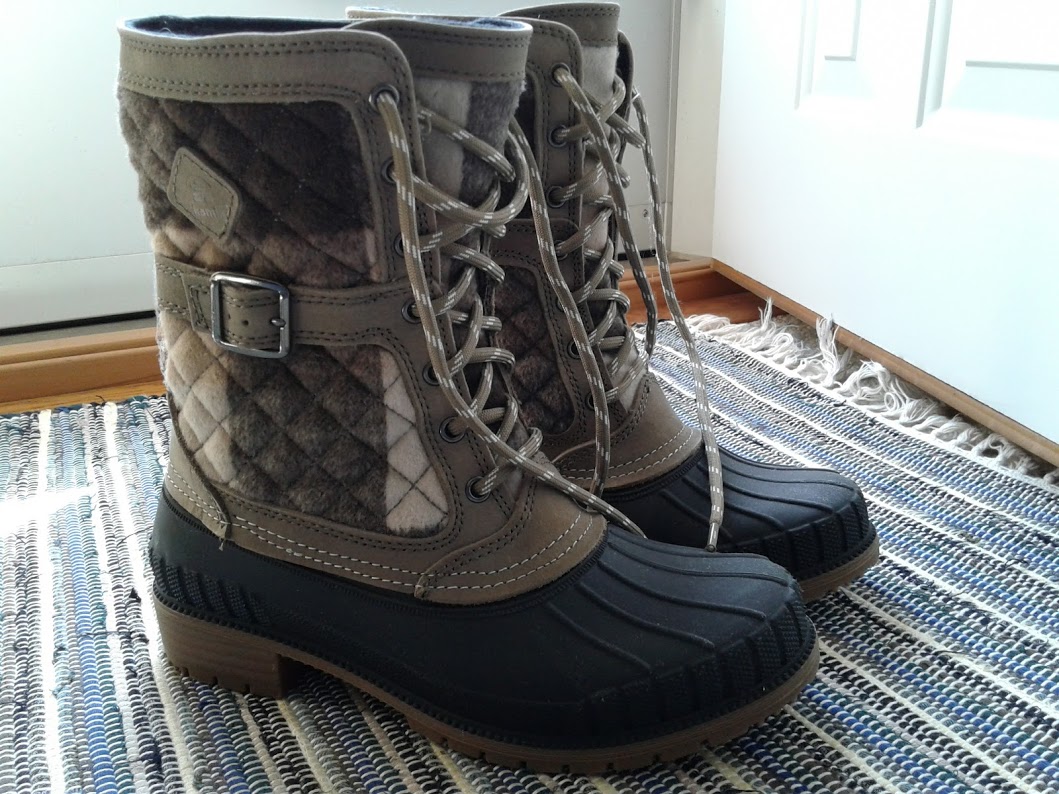
The winter boots I wear while protesting. (Minnesota Prairie Roots copyrighted file photo)
BREAD BAGS
We protesters brave the cold for those who cannot safely stand here. We wrap scarves around our necks, put on parkas, pull on long johns and ear flapper caps and wool socks and winter boots, sometimes adding foot and hand warmers. Several of us joked about returning next week with bread bags inside our boots for another layer of warmth, a throwback to our childhood days.
By then I’d been outside for an hour, my cheeks slapped red by the wind, my fingers and toes growing numb. But I was laughing, deep belly laughing, at the bread bag stories. It felt good to laugh with these protesters, to find comedic relief in the darkest of times.
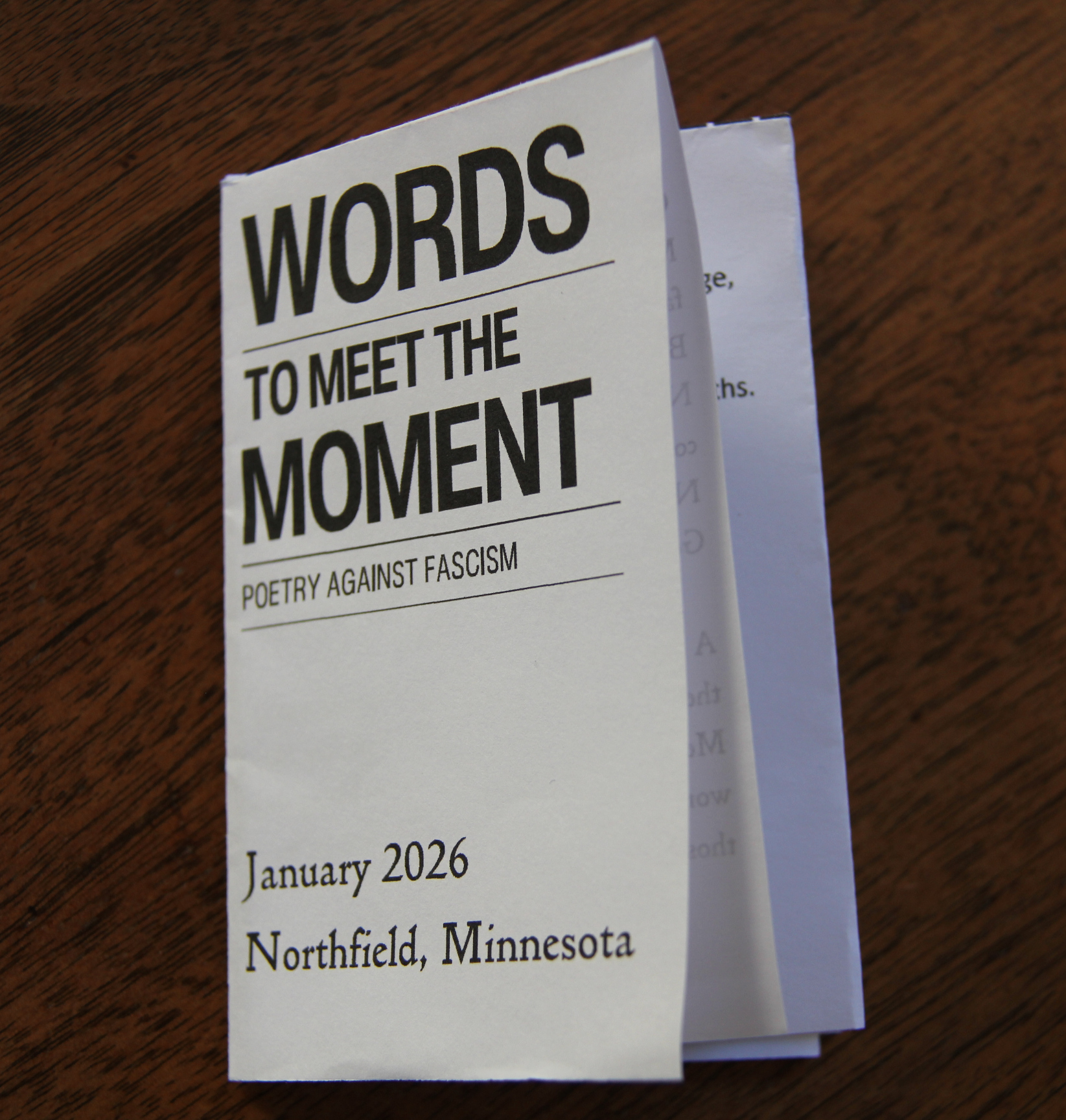
“Words to Meet the Moment,” published by Content Bookstore, Northfield, Minnesota, and printed by Northfield-based By All Means Graphics.(Book cover designed by Mark Heiman)
POETRY HOLDS POWER. And perhaps no time has that been more evident in Minnesota than during the massive federal immigration enforcement, Operation Metro Surge.
In January, poets from my area of southern Minnesota gathered to read original poetry at a “Words to Meet the Moment: Poetry Against Fascism” event in Northfield. I was in Wisconsin, unable to attend. But a poet friend, Becky Boling, read my two poems, “Death of a Poet” and “Fiery Resistance.”
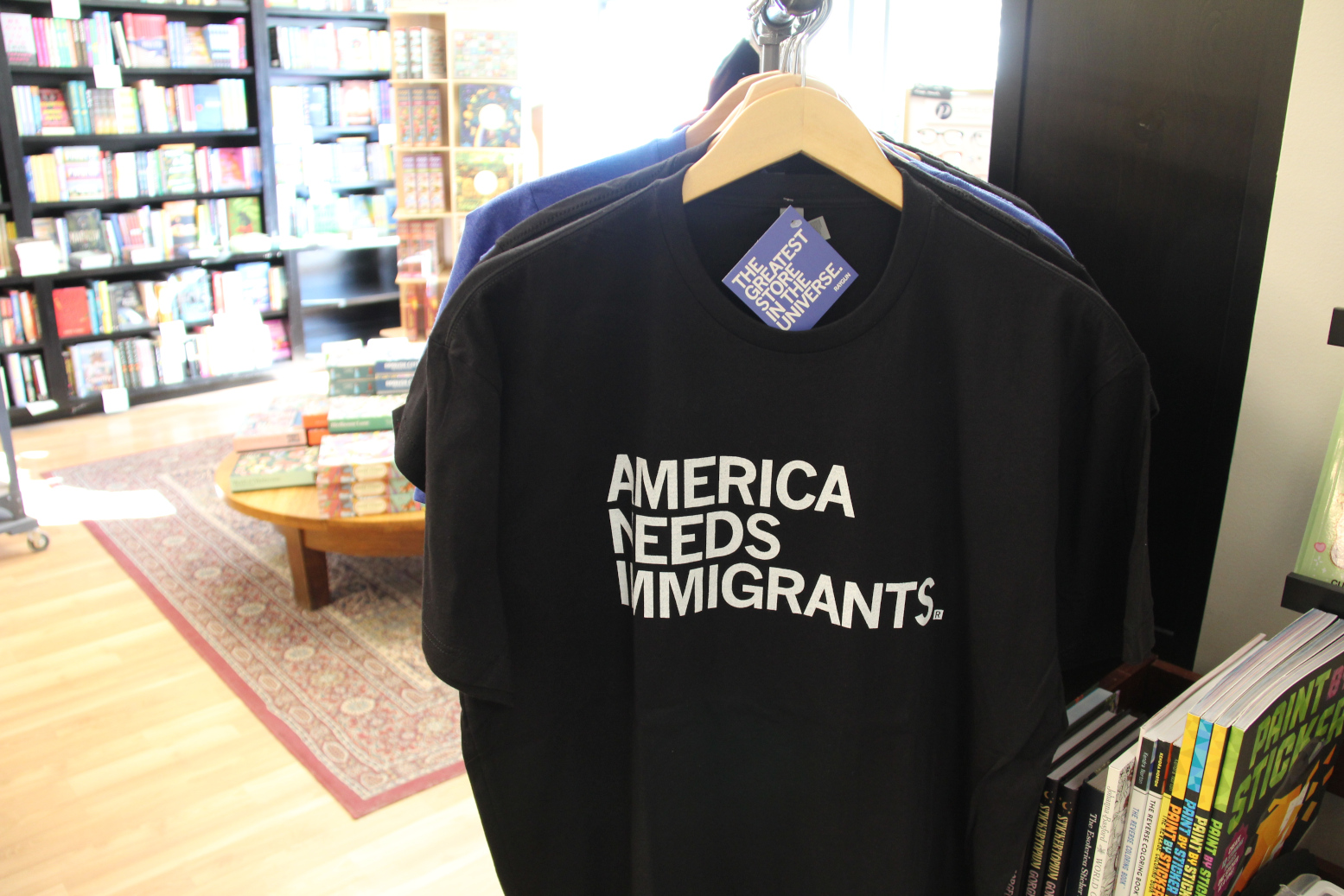
T-shirts for sale at Content Bookstore. (Minnesota Prairie Roots copyrighted file photo February 2026)
Now those two poems and others read at The Grand Event Center in January have been printed in a chapbook, Words to Meet the Moment, published by Content Bookstore. That’s an independent, socially-conscious bookshop in the heart of historic downtown Northfield. Once printing costs have been covered, all proceeds from chapbook sales will be donated to the Northfield Community Action Center, a nonprofit serving the community.
The work of 20 poets, some of whom I know personally (and have read poetry with) or whom I’ve heard read, are printed therein. These are gifted poets, many with their own published collections of poetry. Several were previous poet laureates in Northfield.
I picked up this zine when I was recently at Content Bookstore. It includes three poems, “Ice and Fire” by Steve McCown, “Last Words for Renee Nicole Good” by Susan Jaret McKinstry and “A Witness” by Rob Hardy. (Minnesota Prairie Roots copyrighted photo February 2026)
All of us wrote in response to ICE’s presence in Minnesota and/or in reaction to the fatal shooting of Renee Good by a federal immigration agent on January 7. This was prior to the second fatal shooting, that of Alex Pretti, by ICE agents. Good was a poet, which makes this new chapbook especially meaningful.
Whether you like poetry or not, this is one collection you should read to better understand how we as Minnesotans, we as poets, have been feeling these past few months. Poetry holds power. It is a way to raise our voices against injustice, a way to express our thoughts, our feelings. A way to make a difference. A way to meet the moment.
FYI:To pre-order/order Words to Meet the Moment: Poetry Against Fascism, click here. The chapbook is priced at $10. Content Bookstore will ship the chapbook domestically for an additional cost of $4.99, the media mail book rate, plus an additional $1 per book shipped. Only one printing is planned, unless the chapbook sells quickly. Books will also be available for purchase in the store.














 Minnesota Prairie Roots
Recent Comments