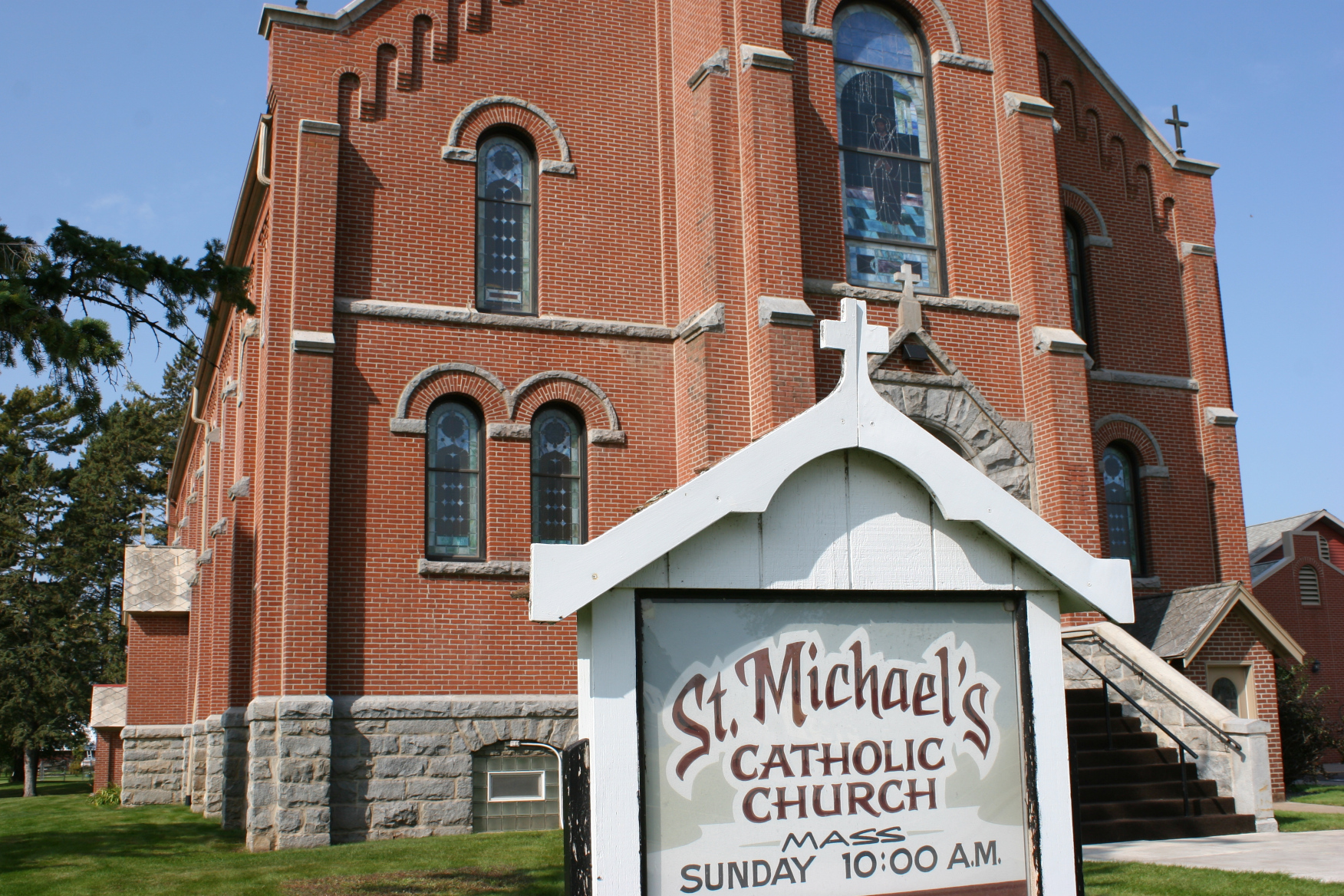
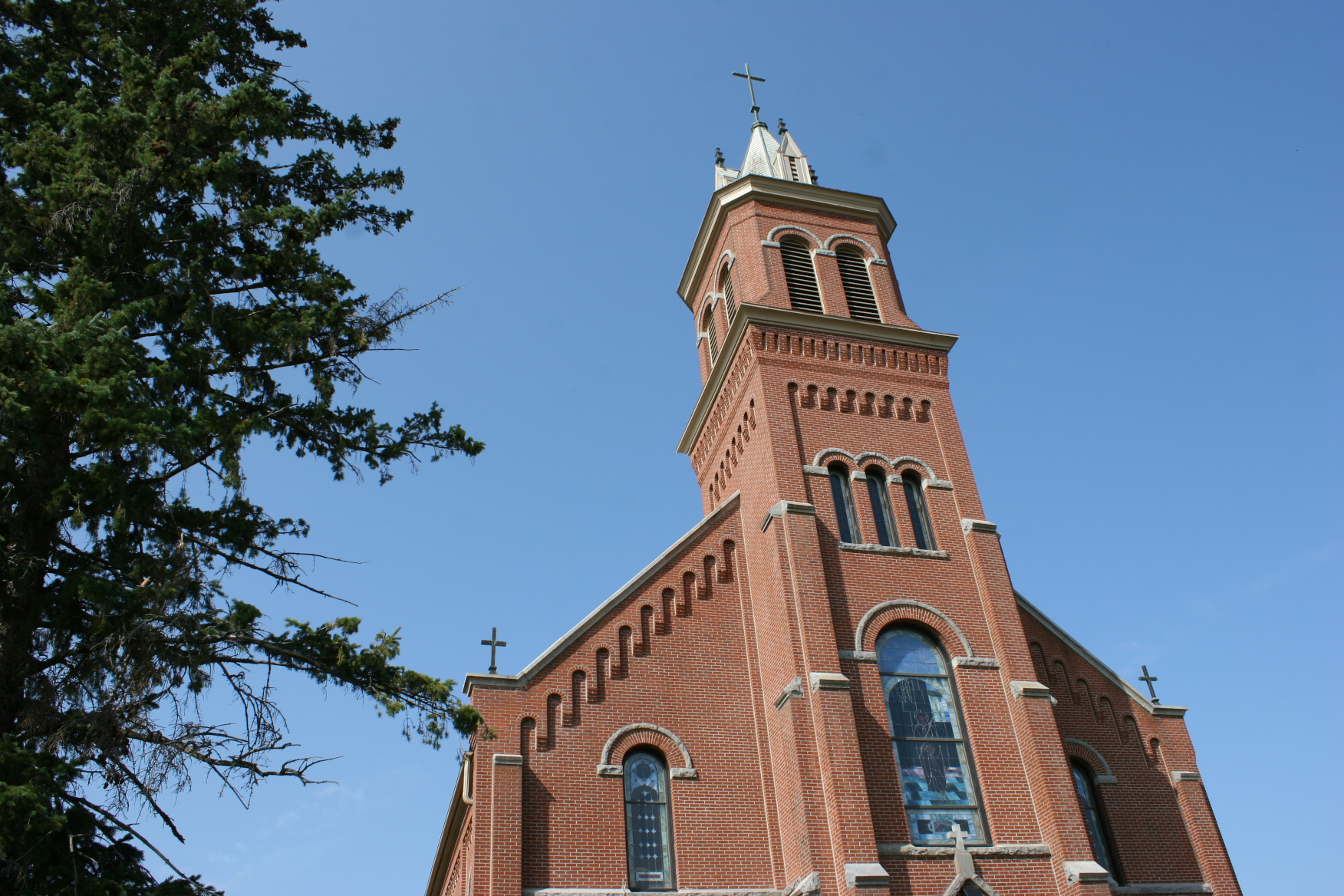
Outside my husband Randy’s home church, St. Michael’s in Buckman. Minnesota Prairie Roots file photo September 2020.
FOR MANY, THE WORD “church” prompts visions of a physical structure, a place where people of faith gather to worship. Certainly, that’s part of the definition. But, even more important, “church” is the people. That’s why, in times of natural disaster or fire or whatever may render a physical building unusable, the “church” continues.
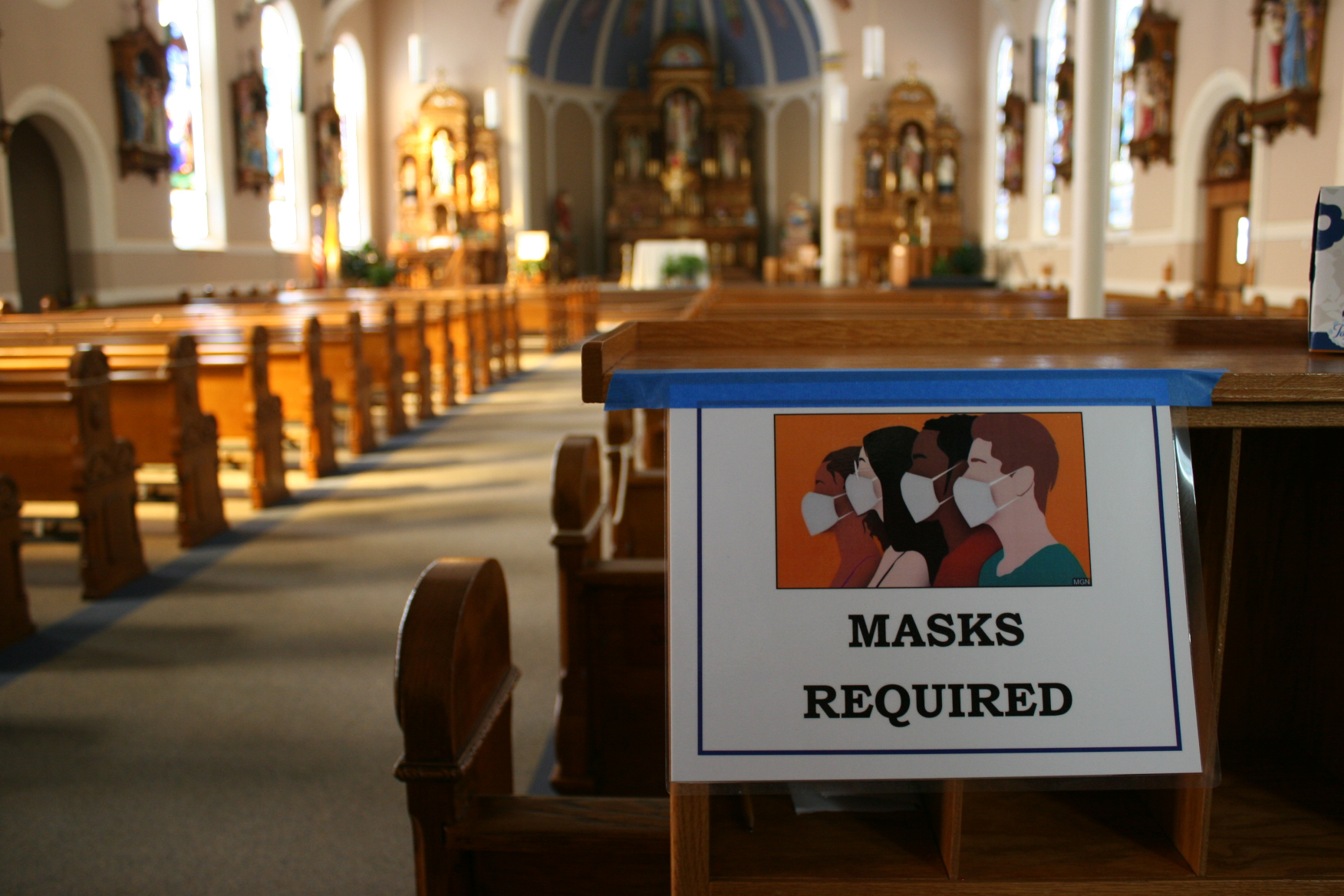
This sign marks a back pew. Minnesota Prairie Roots file photo September 2020.
For 118 years, the faithful have gathered at St. Michael’s Catholic Church in Buckman. Even during COVID-19, Mass happens three mornings a week. On the September weekday Randy and I visited, not a soul was around, giving us ample opportunity to explore this beautiful aged sanctuary.
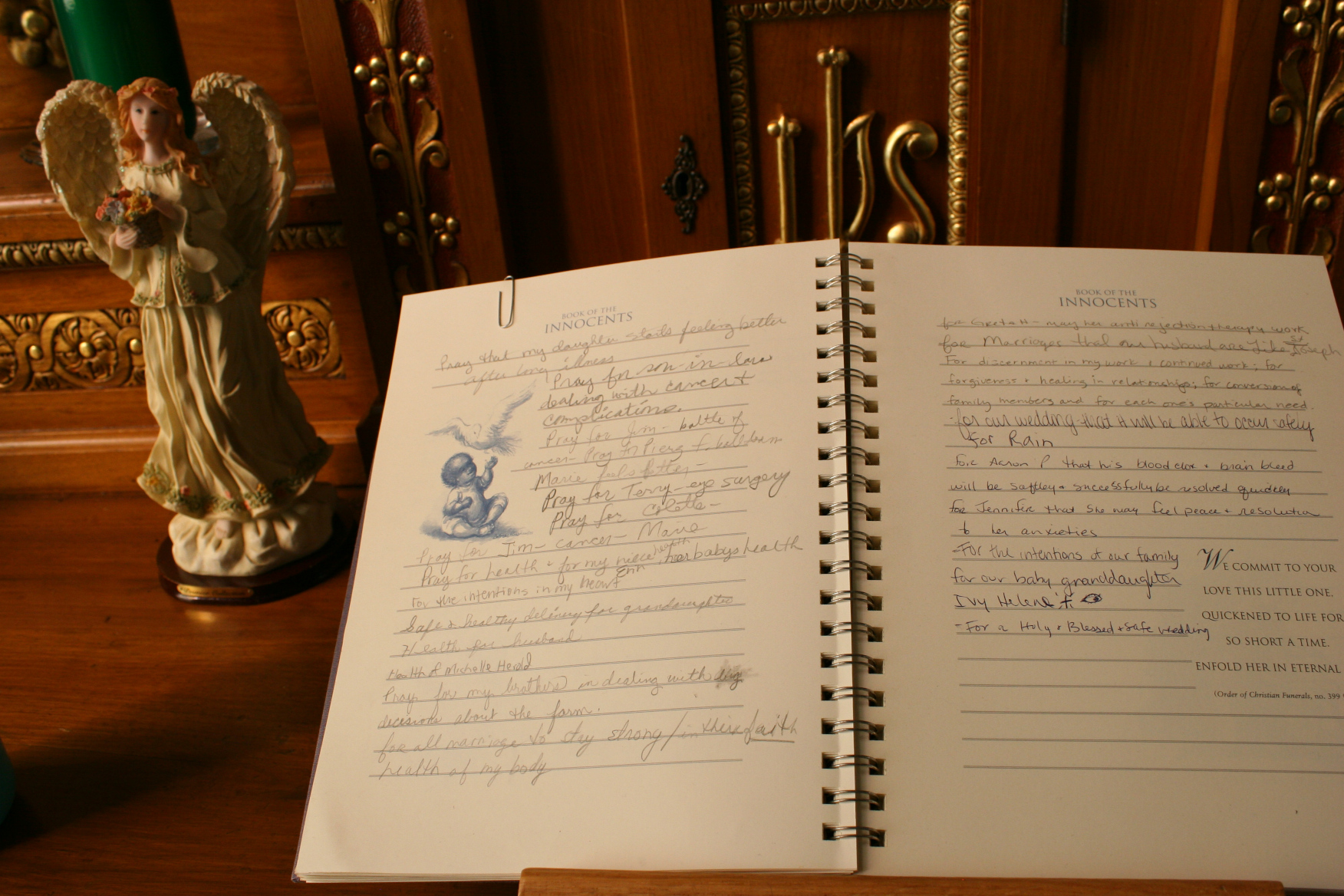
Book of the Innocents photographed at St. Michael’s. Minnesota Prairie Roots file photo September 2020.
Despite the absence of people, I experienced the presence of those who call St. Michael’s their church home. I saw the human spiritual connection in handwritten prayers recorded in The Book of Innocents.
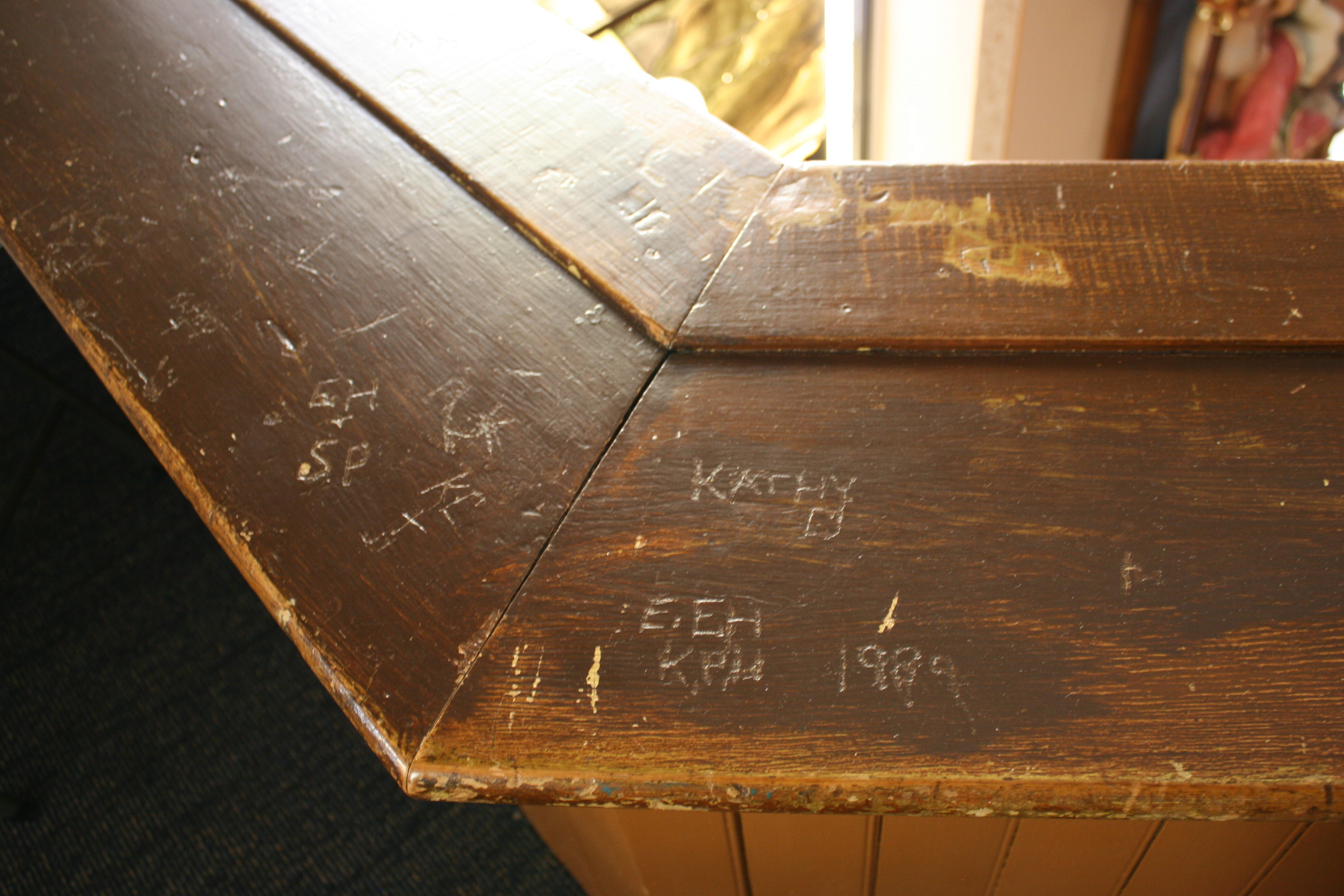
They left their mark… Minnesota Prairie Roots file photo September 2020.
Upstairs, atop the balcony wall ledge, I noticed initials, names and dates etched in wood. Another human notation, albeit probably not appreciated by all. But the scratchings are part of St. Michael’s history.
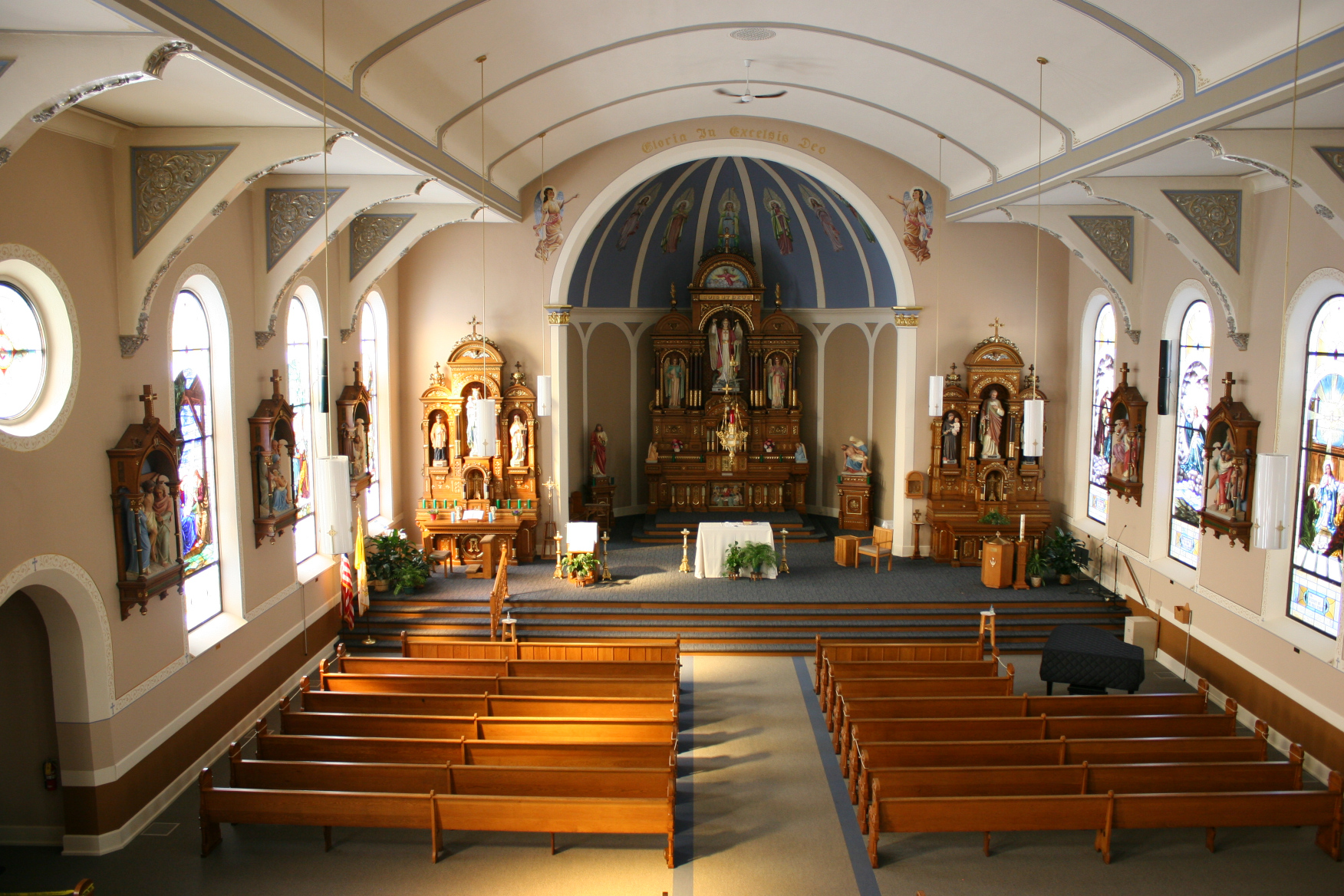
A view from the balcony. Minnesota Prairie Roots file photo September 2020.
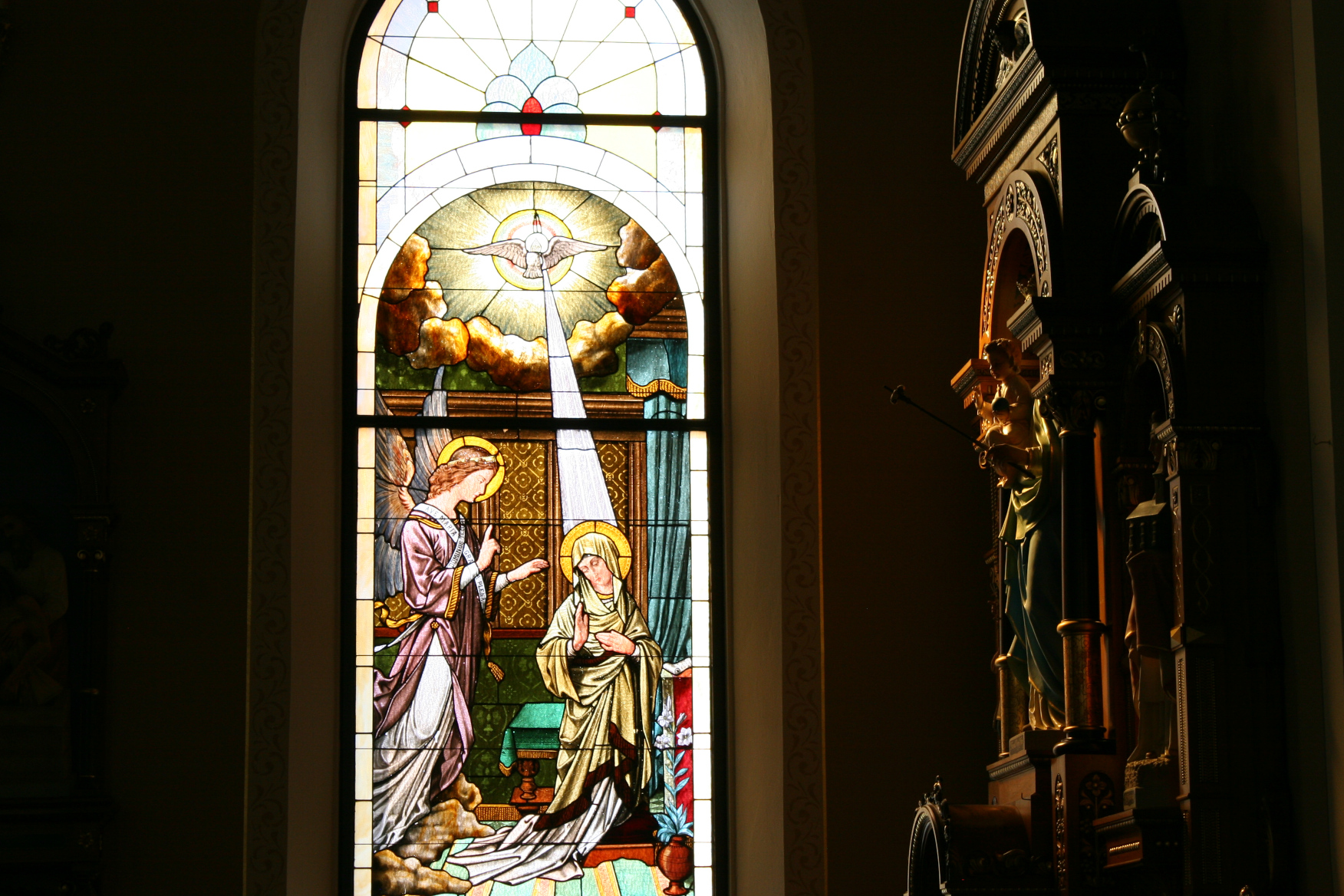
Stained glass windows abound, this one next to a side altar. Minnesota Prairie Roots file photo September 2020.
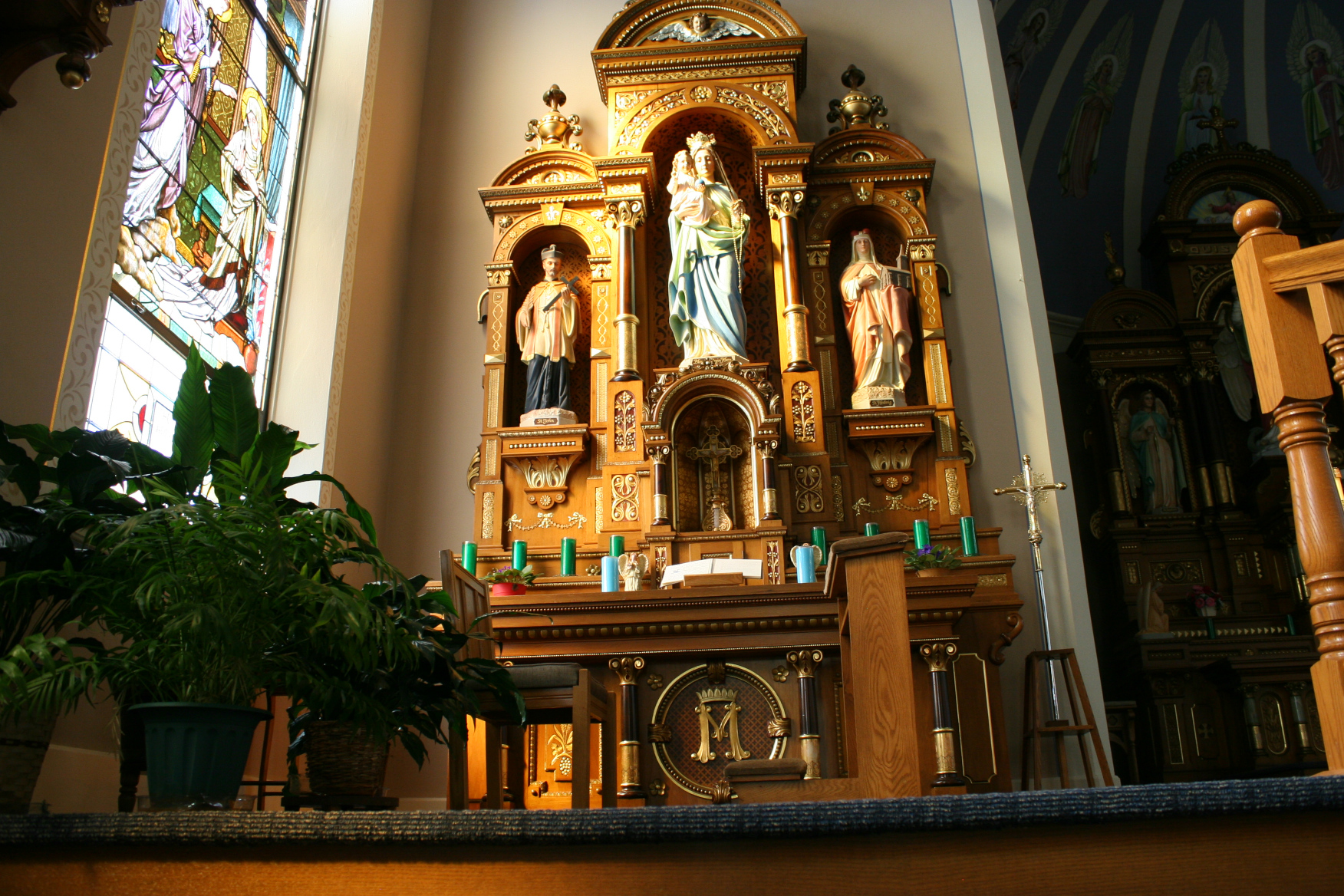
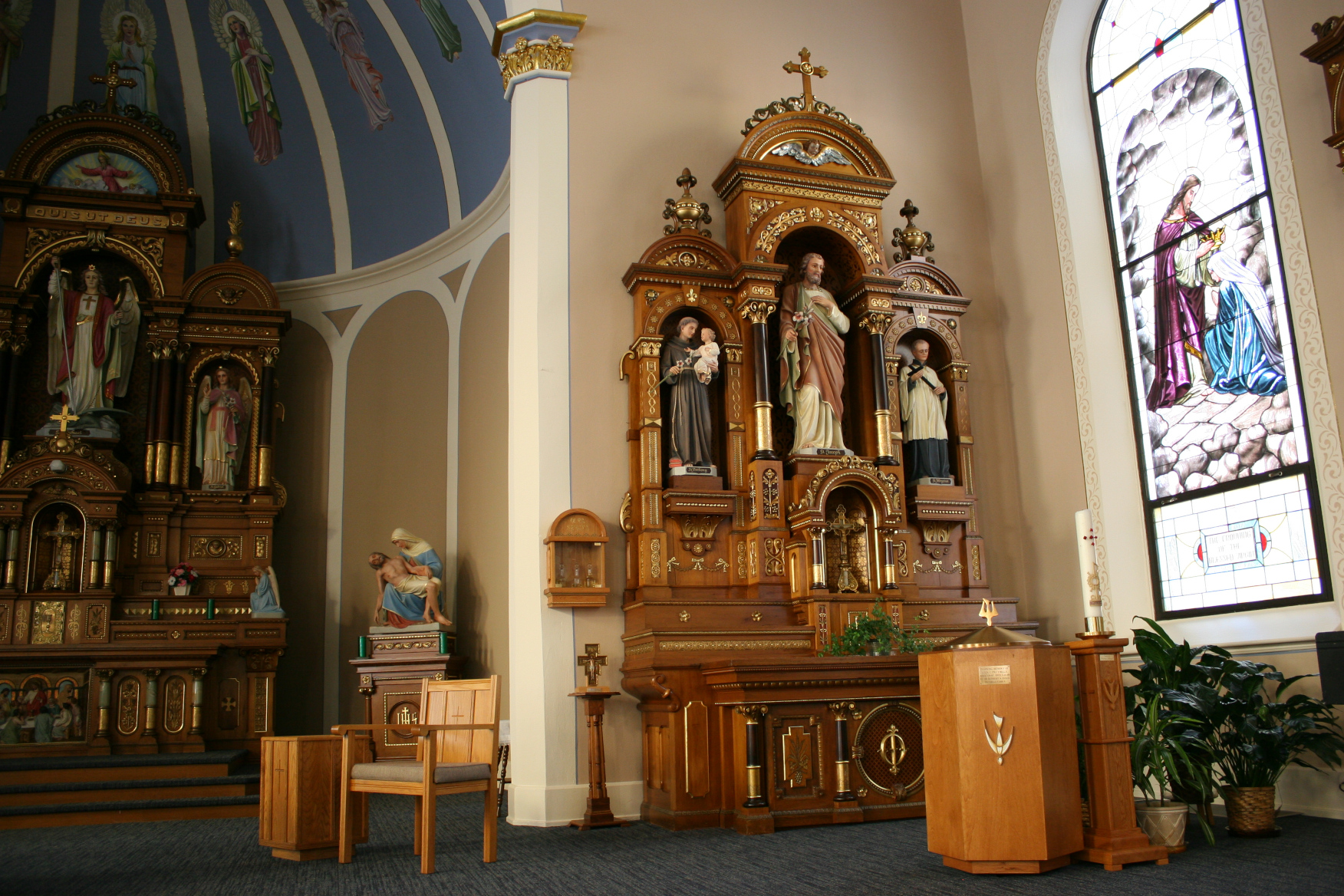
The beautiful side altar. Minnesota Prairie Roots file photo September 2020.
As I looked down upon the massive sanctuary defined by stained glass, sculptures, woodcarvings, paintings and other impressive art, I considered the humanity of this place. Baptisms. First Communions. Weddings. Funerals. Events—joyful and sad—which brought/bring people together to celebrate or to mourn. Mass, too, with singing and praying and forgiving and worshiping and growing in faith.
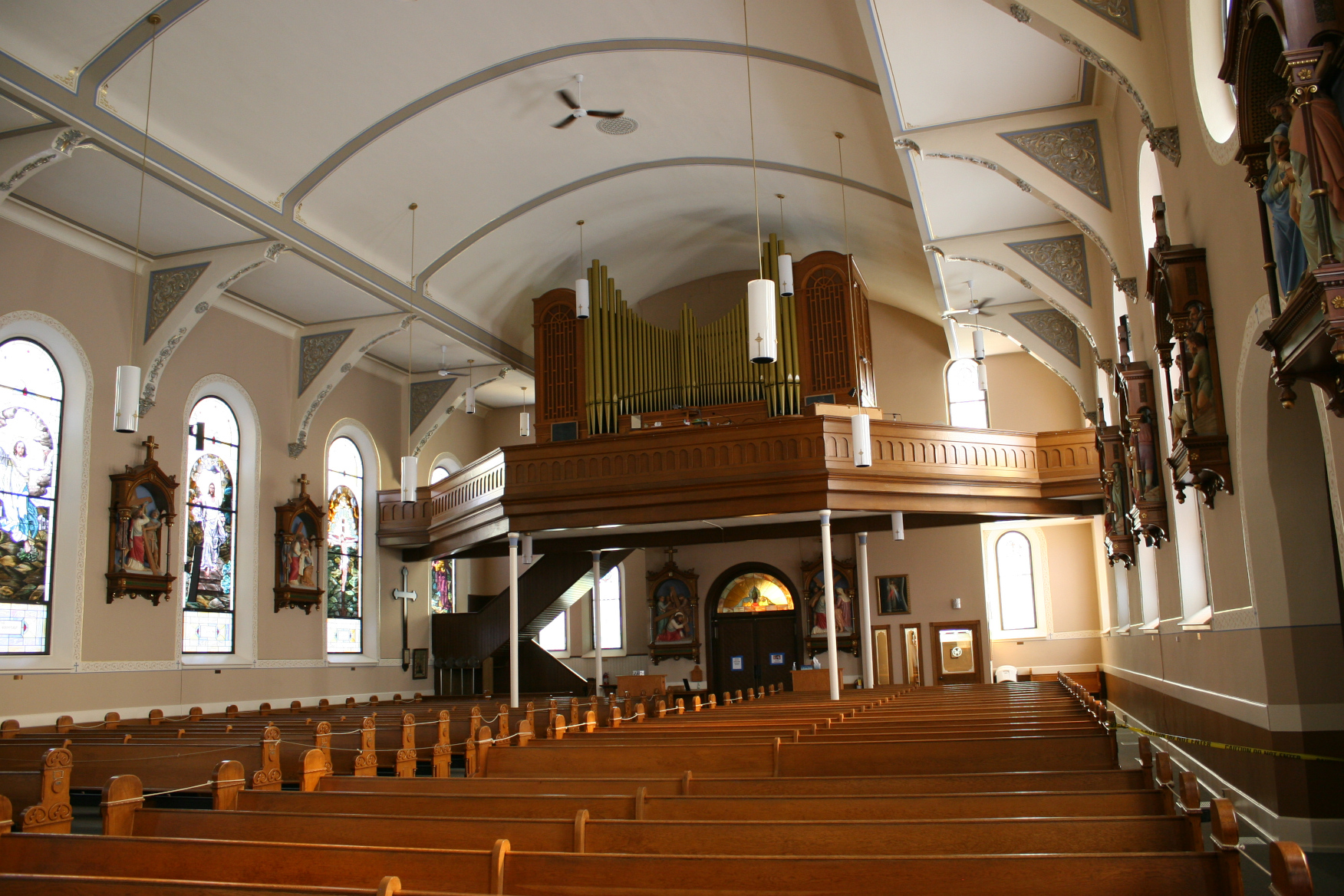
Looking toward the back of the church and the balcony. Minnesota Prairie Roots file photo September 2020.
Generations have gathered here, within these walls, as a faith family.
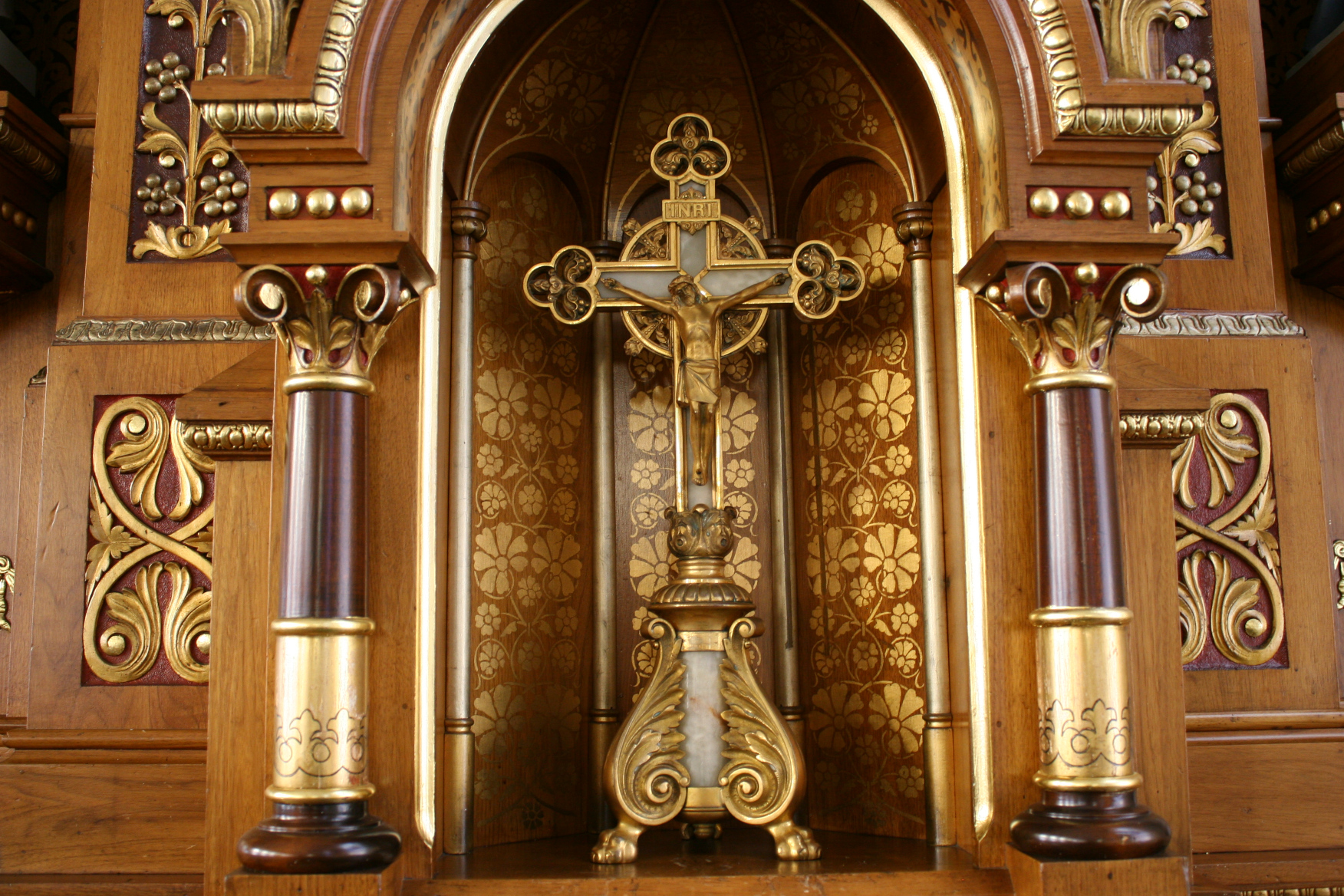
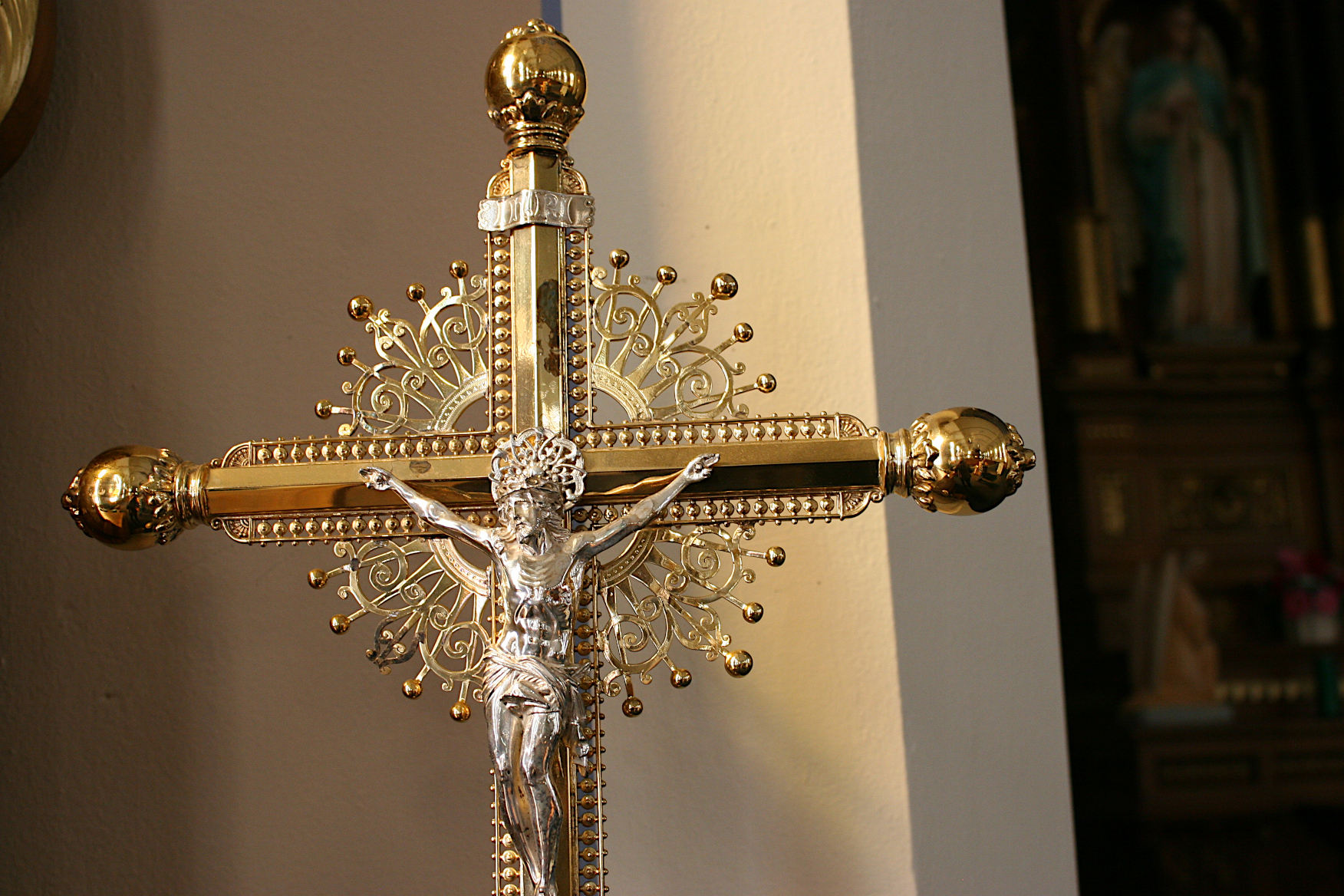
This stunning cross stands in the center of the main altar. Minnesota Prairie Roots file photo September 2020.
I’ve found comfort and joy here, too, celebrating the marriage of my father-in-law and a sister-in-law and grieving the loss of a brother-in-law and then my mother-in-law 27 years ago. Since then, the church has been restored and a side entry and fellowship hall added, making the building much more accessible.
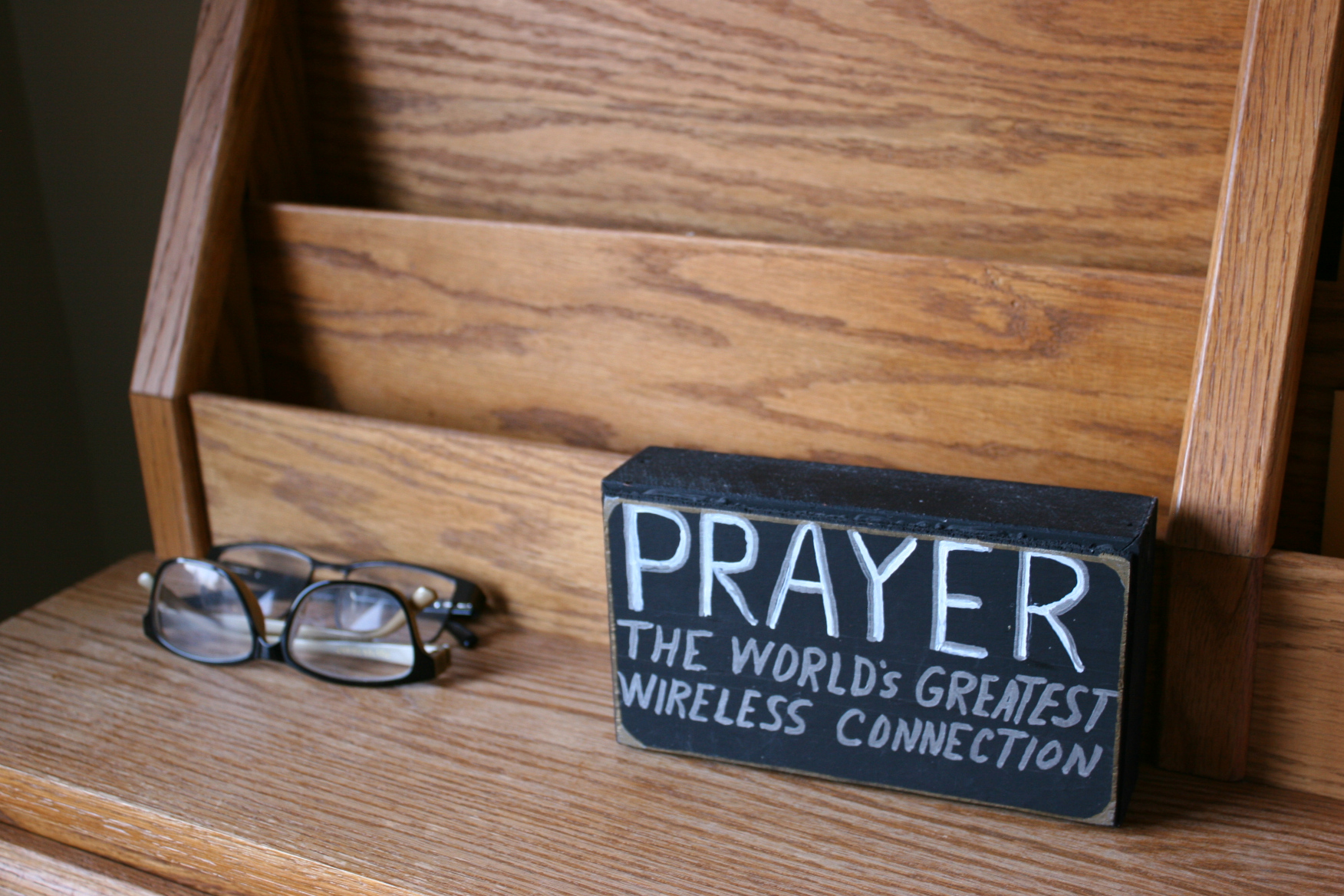
Spotted on a table in the entry. Minnesota Prairie Roots file photo September 2020.
In the new entry, I paused to read a small sign: PRAYER THE WORLD’S GREATEST WIRELESS CONNECTION. I laughed and thought, so true while simultaneously considering how much the world has changed since the construction of this church in 1903.
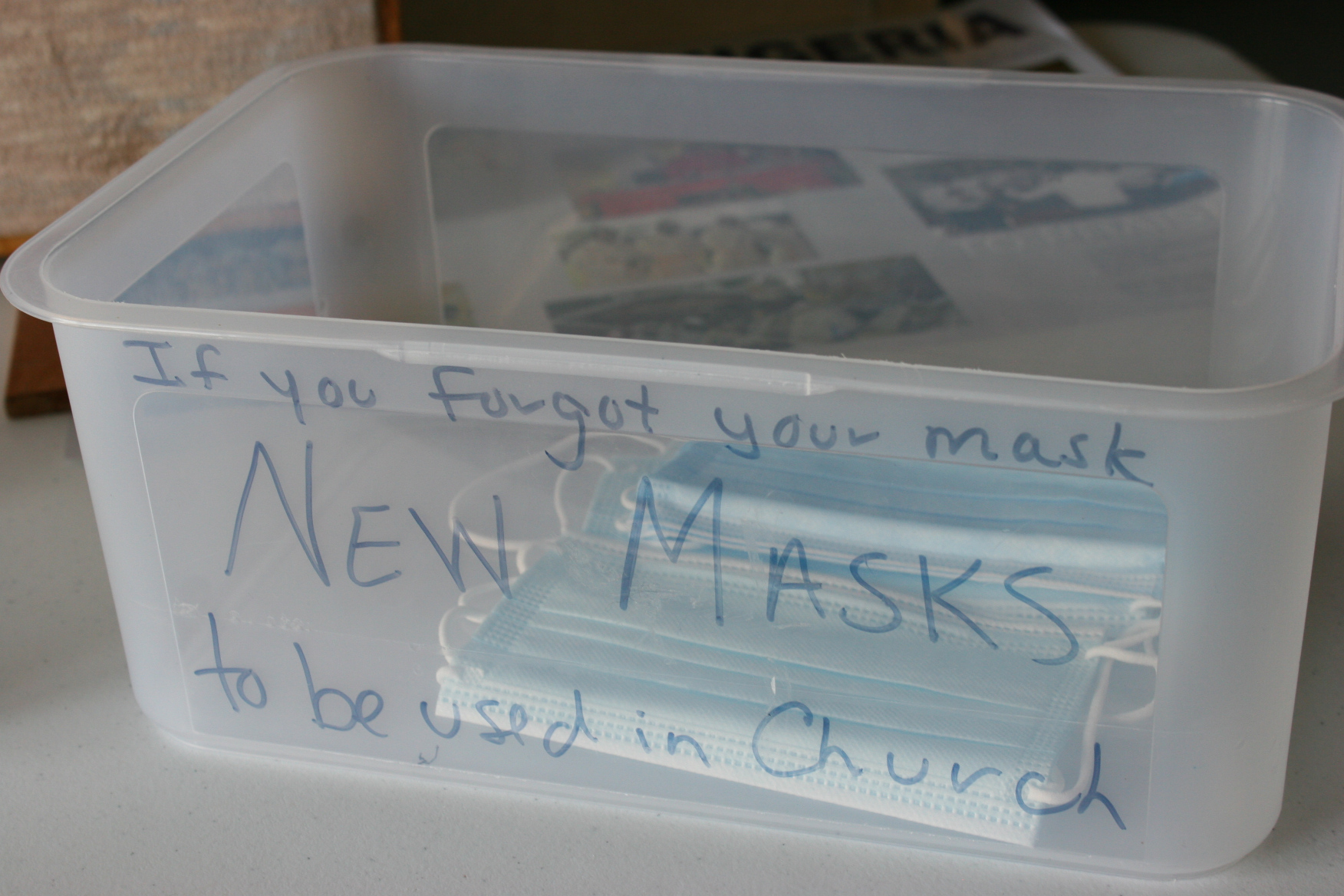
Masks are available for worshipers inside the entry. Minnesota Prairie Roots file photo September 2020.
Yet, little has changed. People still define St. Michael’s. They gather here—as they have for generations—within this art rich sanctuary, embracing liturgy steeped in music and tradition, to worship God. And to connect, heart-to-heart, with one another and with their Savior. Even during a global pandemic.
This is the final post in my three-part series on St. Michael’s Catholic Church, Buckman, Minnesota.
St. Michael’s Catholic Church in Buckman. Minnesota Prairie Roots file photo September 2020.
WHEN I STEP INSIDE A CHURCH like St. Michael’s Catholic Church in Buckman in central Minnesota, I feel overwhelmed by the sheer artistic beauty and craftsmanship. I wonder about those who built this massive church in 1903, dedicating it on September 29, St. Michael’s Day. How did they manage to build this 118 years ago without modern equipment? That amazes me.
Looking toward the front of St. Michael’s. Minnesota Prairie Roots file photo September 2020.
Beyond the actual structure, which surely took much muscle, many manpower hours and grit to complete, I wonder about the artists behind the artwork inside. Who crafted the stained glass windows? Who built the altars? Who shaped the statues and painted the angels and built the pews?
A stained glass depiction of Jesus carrying his cross. Minnesota Prairie Roots file photo September 2020.
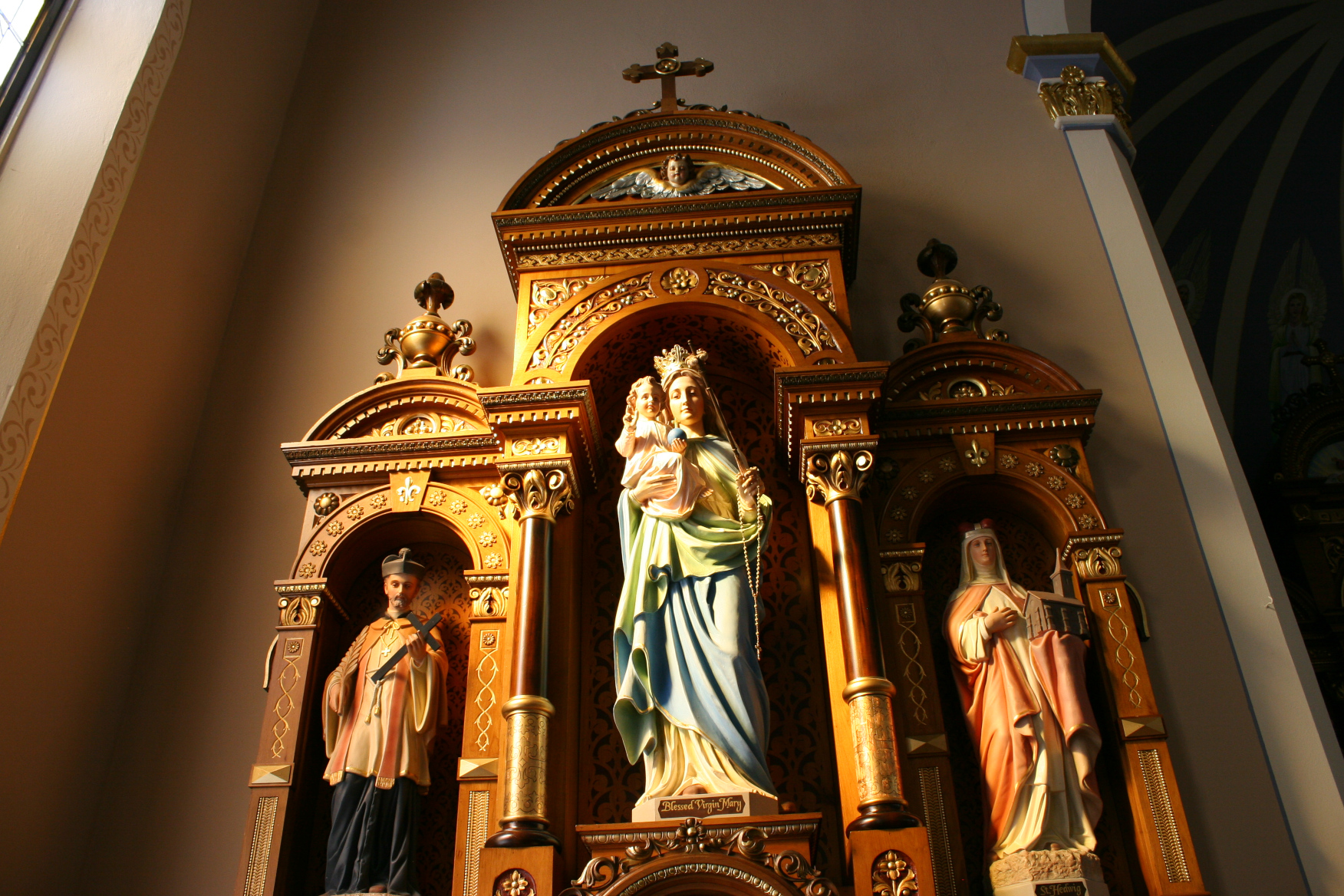
One of the side altars, right, at St. Michael’s. Minnesota Prairie Roots file photo September 2020.
The Nativity represented in stained glass, left. Minnesota Prairie Roots file photo September 2020.
I am grateful to those faith-focused artists and craftsman who created such beauty here in the middle of Minnesota. A place for farm families (mostly) to gather for Mass. To praise God. To confess their sins. To press their hearts in prayer. To mourn. To celebrate. To grow deeper in their faith.
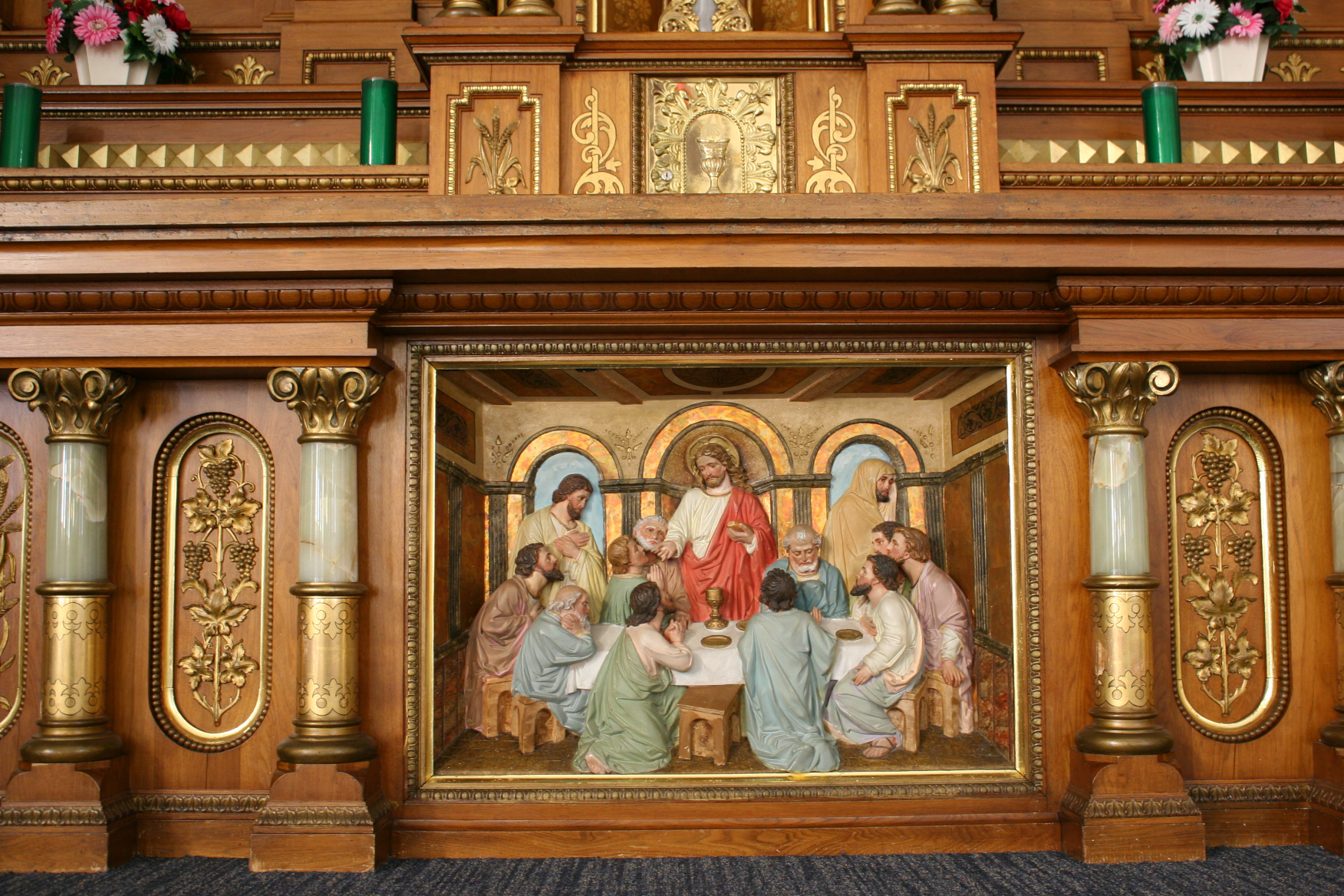
The Last Supper is depicted on the lower part of the main altar. Simply stunning. Minnesota Prairie Roots file photo September 2020.
The Helbling family made St. Michael’s their church home upon relocating to Minnesota from North Dakota in 1963. My husband, Randy, and his siblings attended elementary school across the street. That school, next to the cemetery, is long gone. My mother-in-law and a brother-in-law are buried here, across Minnesota Highway 25 from the church. So, by marriage, St. Michael’s is now part of my history.
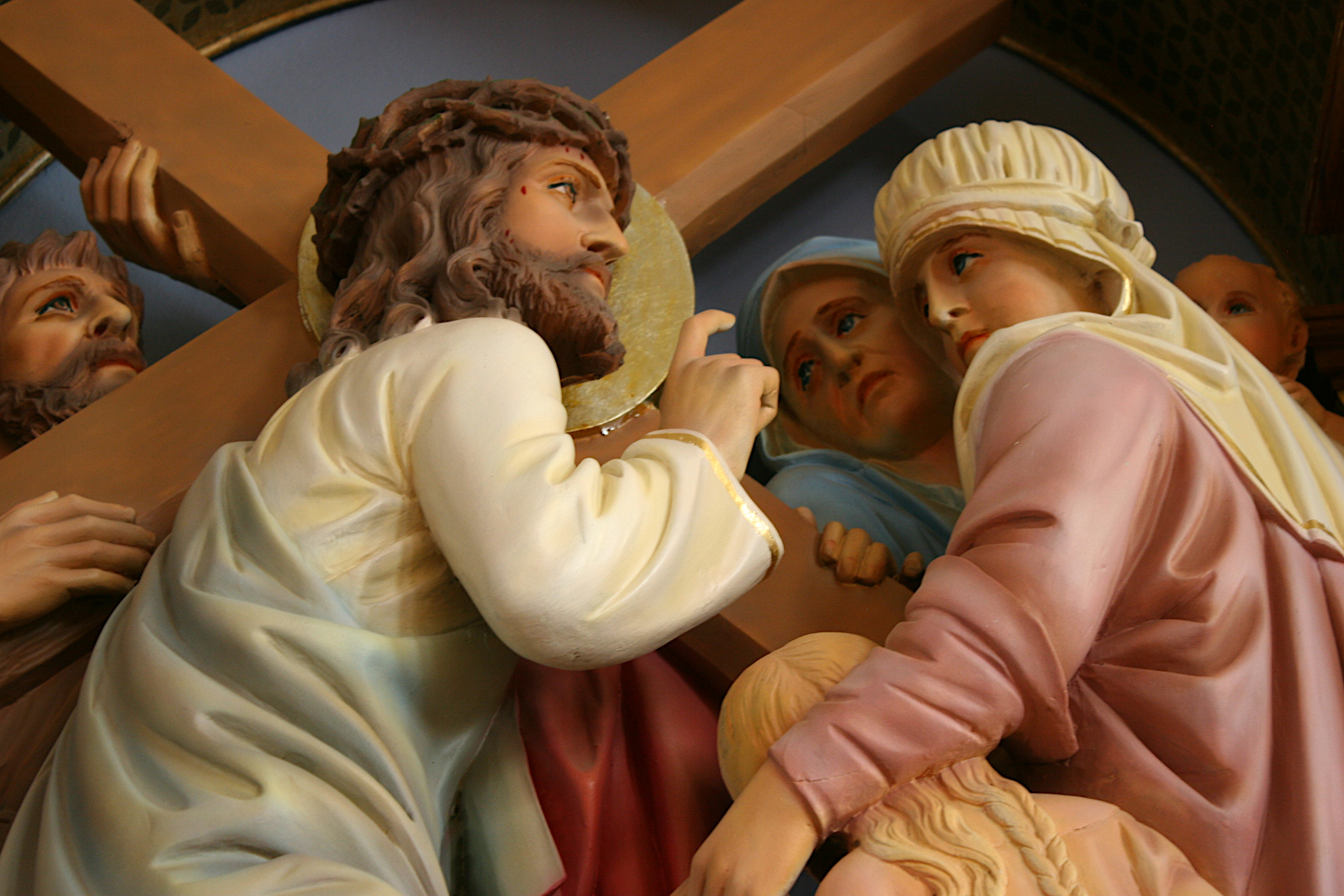
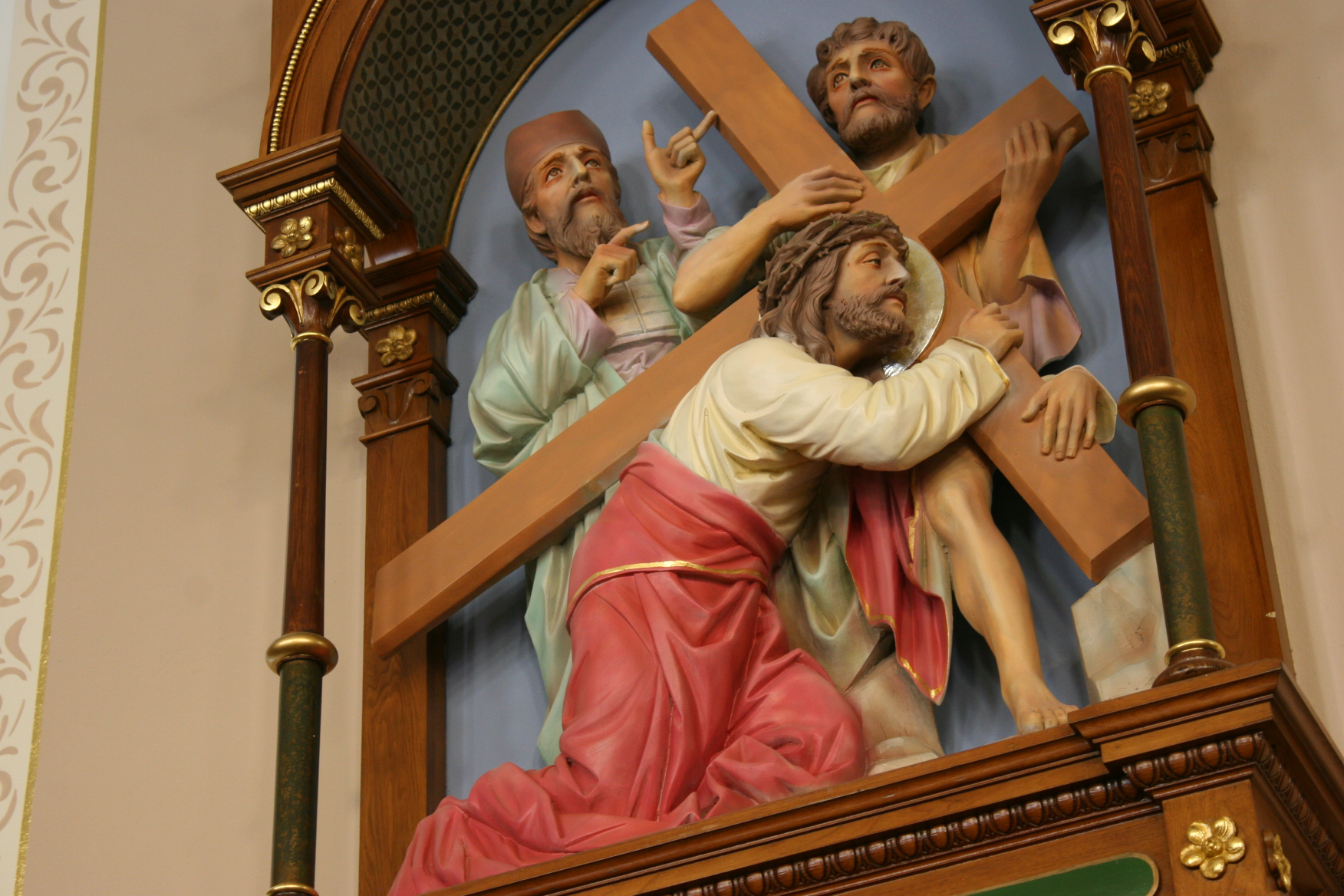
Just look at the emotions sculpted into this art. I see peace, pain, determination… Minnesota Prairie Roots file photo September 2020.
Certainly, I don’t hold the deep emotional connection that comes from years of worshiping within the walls of this rural Minnesota church. But I still hold a deep appreciation for this place which was such a valued part of my in-laws’ lives.
Stained glass windows and sculptures adorn the side walls of St. Michael’s. Minnesota Prairie Roots file photo September 2020.
As a woman of faith—I grew up Lutheran—I value aged churches and art. Religious art is often symbolic, reinforcing Bible truths and stories. It can uplift, comfort, provide peace, bring joy, remind us of our weaknesses and the source of strength and hope. It can center and ground us when we most need to feel centered and grounded.
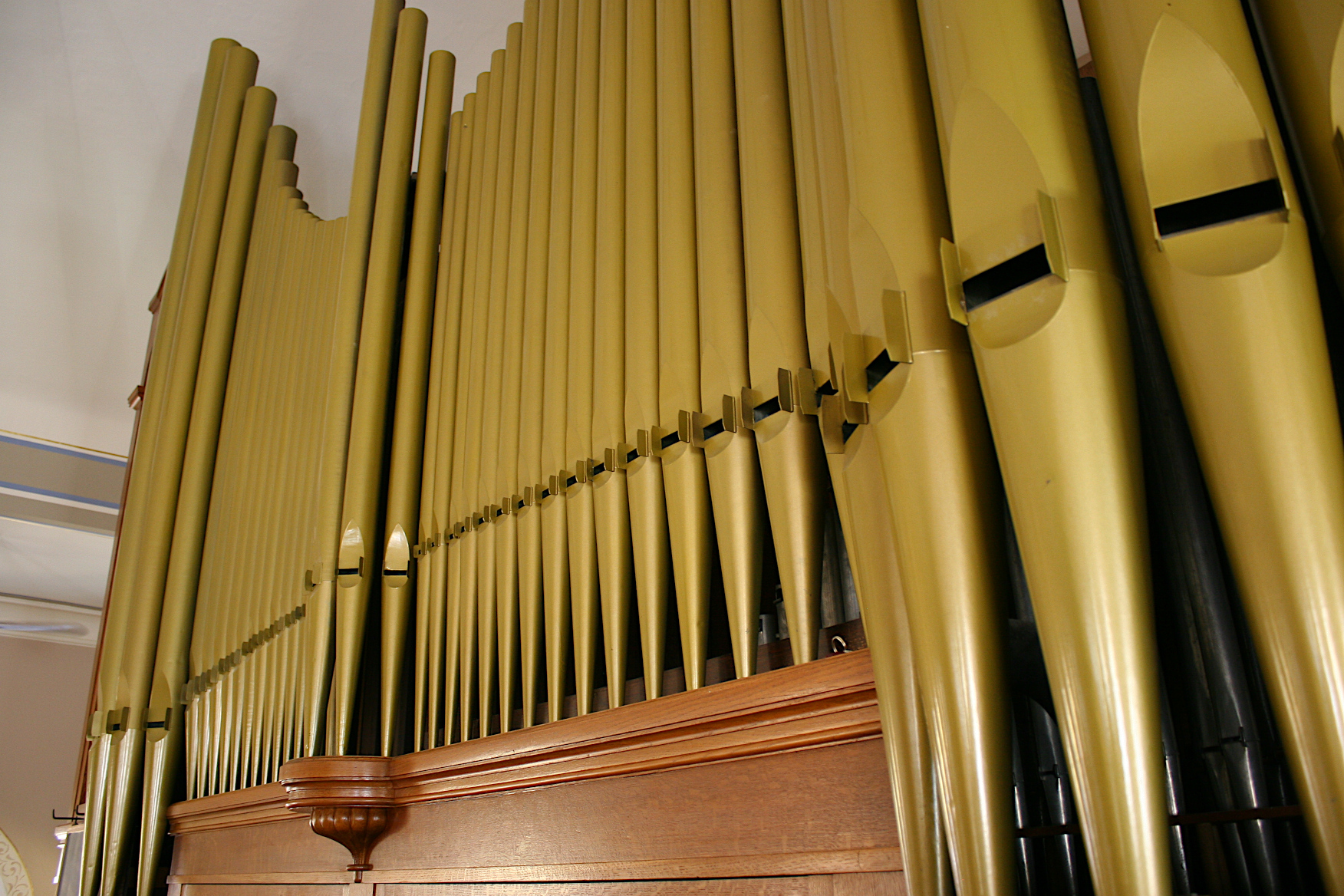
Massive pipes on the pipe organ in the St. Michael’s balcony. Minnesota Prairie Roots file photo September 2020.
Many times, church art has reinforced my faith, helped me to feel the presence and closeness of God whether in a stained glass window, the words of a familiar hymn or the comfort of a worn wooden pew.
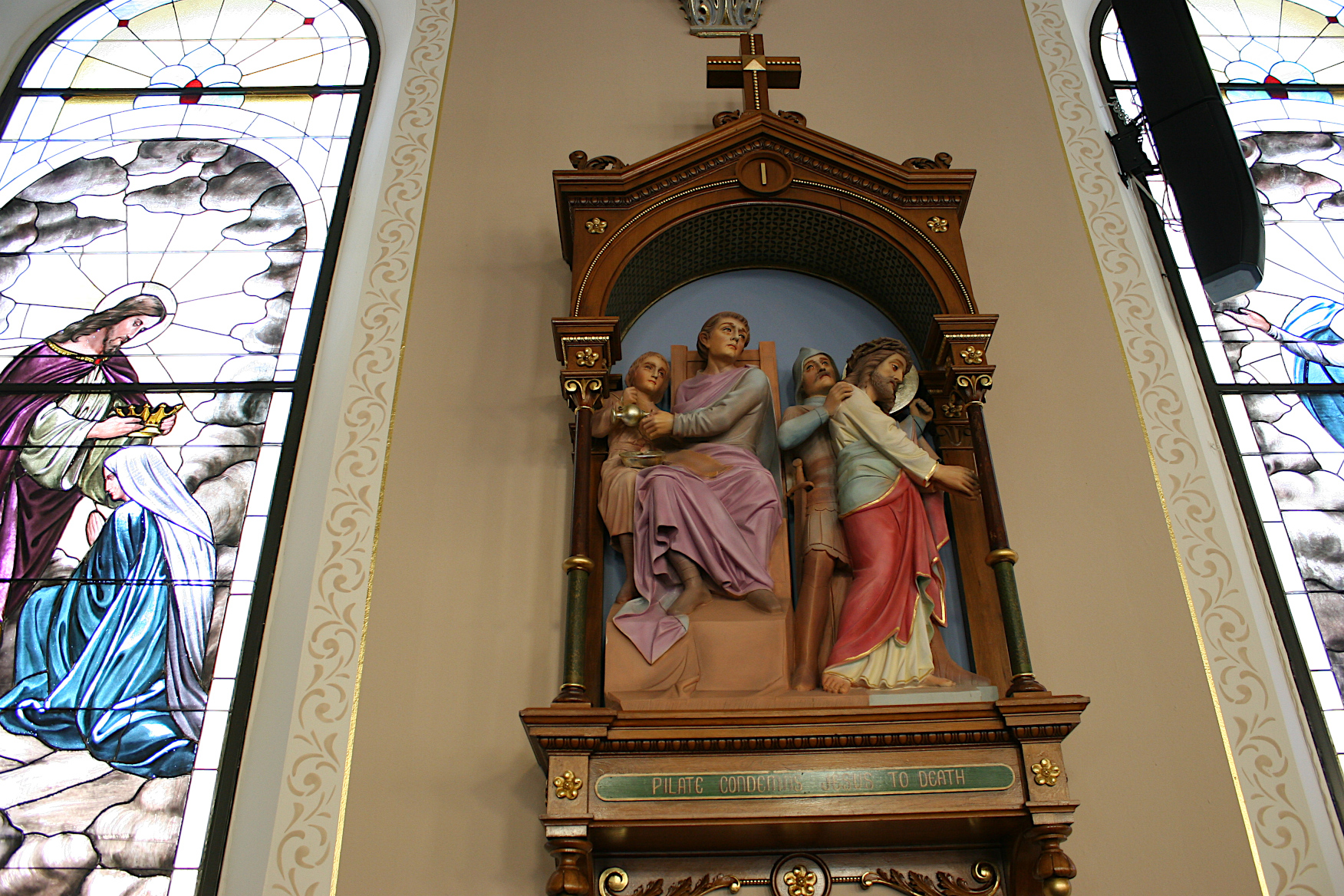
“Pilate condemns Jesus to death” sculpture between two stained glass windows. Minnesota Prairie Roots file photo September 2020.
Inside St. Michael’s, generations of families have gathered. I am grateful for those early settlers who labored to create this sanctuary in the small town of Buckman, Minnesota.
Please check back as I take you inside St. Michael’s for the final post in this three-part series.
IMAGINE, AS A YOUNG BOY, moving nearly 400 miles across the plains of North Dakota east to Minnesota with your family to start a new life. You’ve left behind your grandparents and other extended family, and the comforting familiarity of farm home, church and school. For my husband, that was reality.
St. Michael’s Catholic Church in Buckman. Minnesota Prairie Roots file photo September 2020.
As the Tom and Betty Helbling family settled onto a farm southeast of Buckman in central Minnesota in the early 1960s, Randy found himself adjusting from a one-room country schoolhouse with one teacher to a parochial school with multiple classrooms and teachers. He no longer faced cancellation of recess due to coyotes circling the playground at Chimney Butte School near St. Anthony. Rather, he faced nuns slapping his hands with a ruler or drilling thumbs into his skull, adding to his angst as the new boy in school. And then there was the matter of the frightening statue across the street inside the massive St. Michael’s Catholic Church.
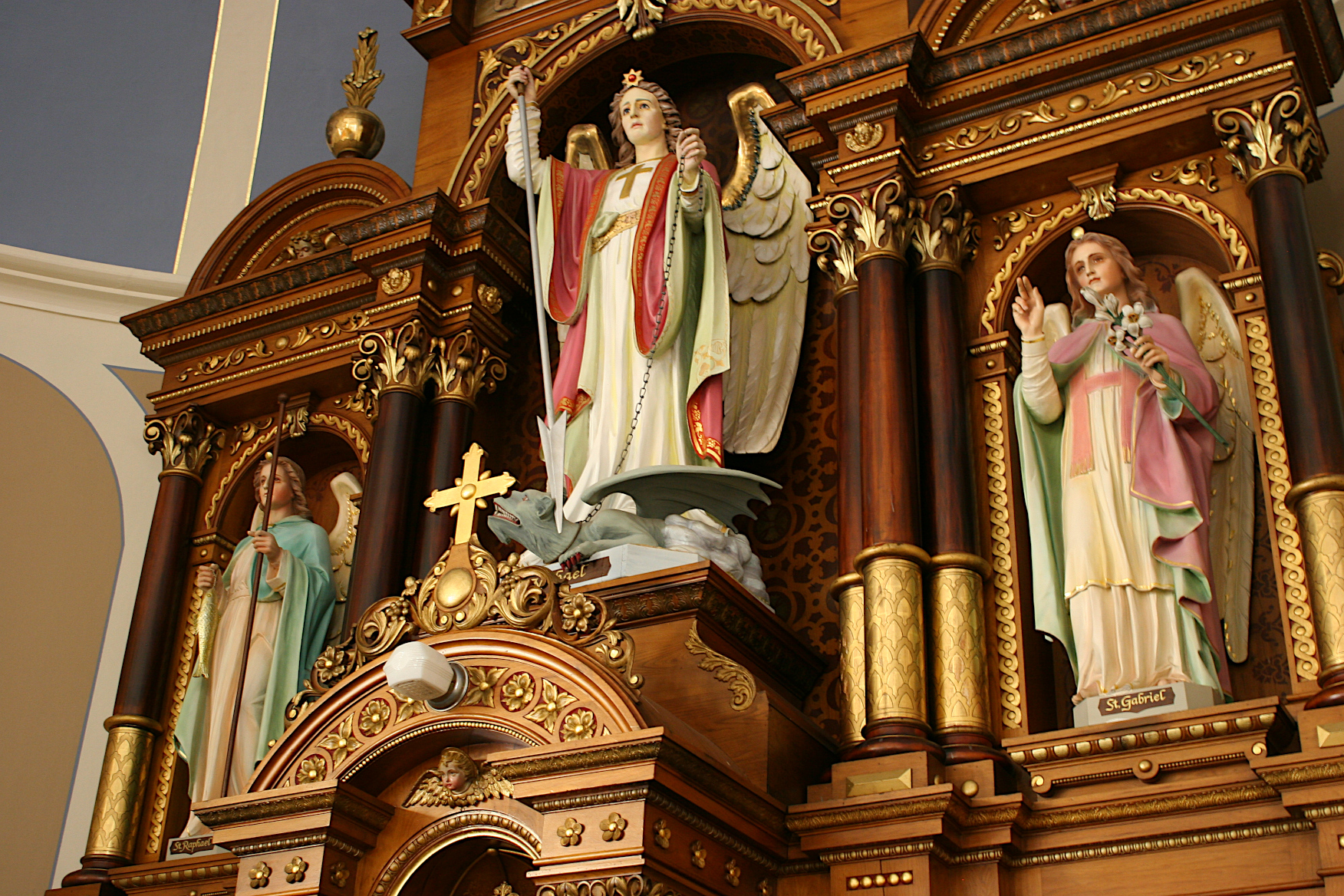
In the center, St. Michael overpowering Satan. Minnesota Prairie Roots file photo September 2020.
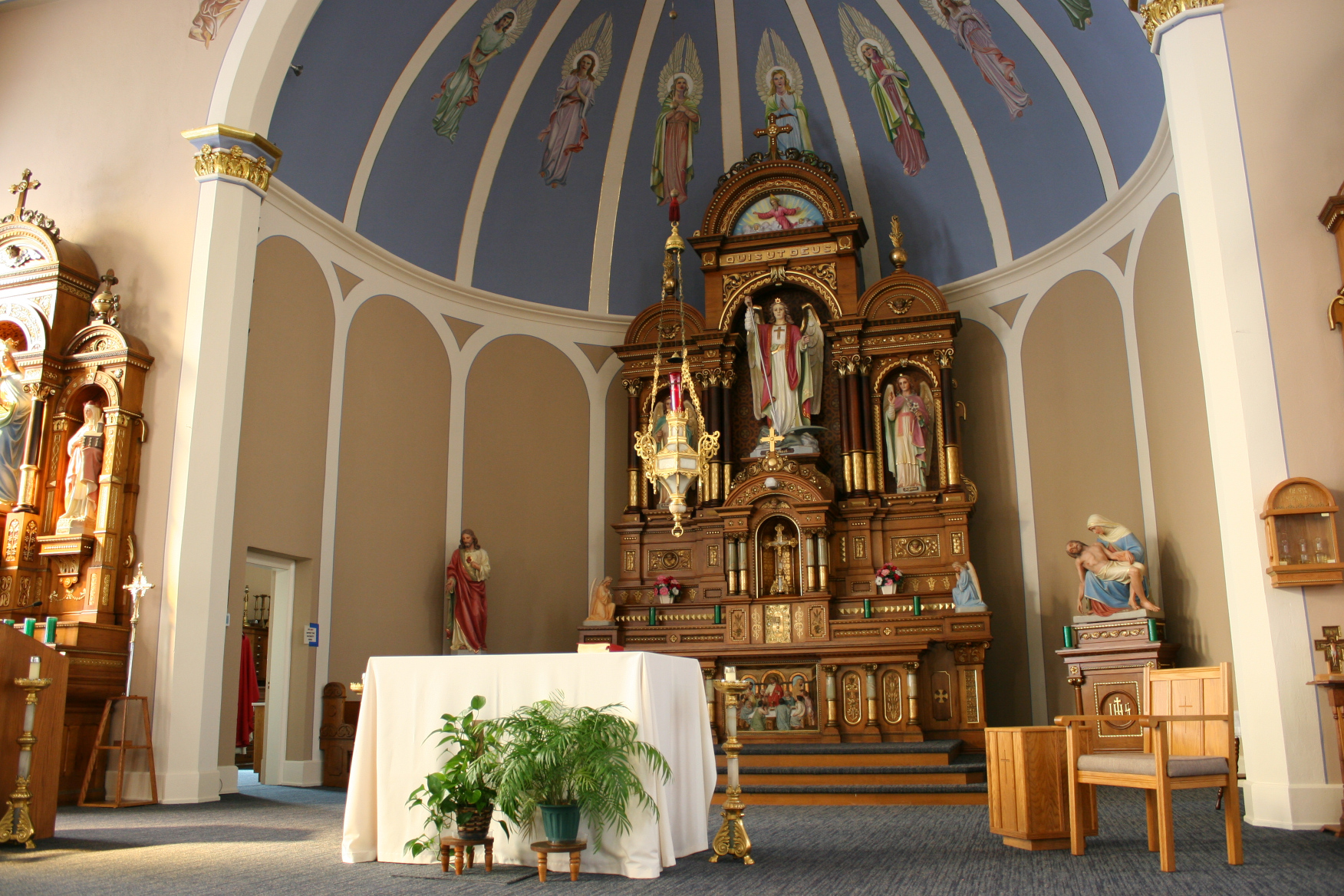
Some six months ago, I heard for the first time about Randy’s boyhood fear of the statue which centers the main altar at St. Michael’s, where he attended weekday and Sunday Mass. The statue features a triumphant St. Michael overpowering Satan with a spear. A horrid, crouching other-worldly creature with an open mouth of sharp teeth and equally sharp claws represents Satan. Enough to scare any child looking over adult heads to that altar art. Not even the chain and weapon would be enough to inspire confidence in the Evil One’s captivity.
St. Michael’s stretches long and high. Minnesota Prairie Roots file photo September 2020.
All of that aside, St. Michael’s is a truly beautiful church. Massive in size and vast in art. I’ve come to know it only through marriage as I grew up 145 miles to the south of Buckman and in the Lutheran faith.
“The Nativity” stained glass, one of many similar windows inside St. Michael’s. Minnesota Prairie Roots file photo September 2020.
A stunningly beautiful cross, one of many. Minnesota Prairie Roots file photo September 2020.
Statues on a side altar. Minnesota Prairie Roots file photo September 2020.
I don’t pretend to understand the meaning of all the art which graces this space. But one thing I do understand is that this house of worship excels in craftsmanship and artistry. Each piece of art holds meaning, significance, purpose. From the stained glass windows to the sculptures to the ornate altars.
Looking toward the back of the church and to the balcony. Minnesota Prairie Roots file photo September 2020.
Years have passed since I stepped inside St. Michael’s. So when Randy and I visited his mother’s and brother’s gravesites at the church cemetery last September, we decided to also check out the recently-restored church. I expected locked doors, so often the case now in rural and small town churches. But the doors to an addition were open and we had the place to ourselves. Note that plenty of security cameras film visitors.
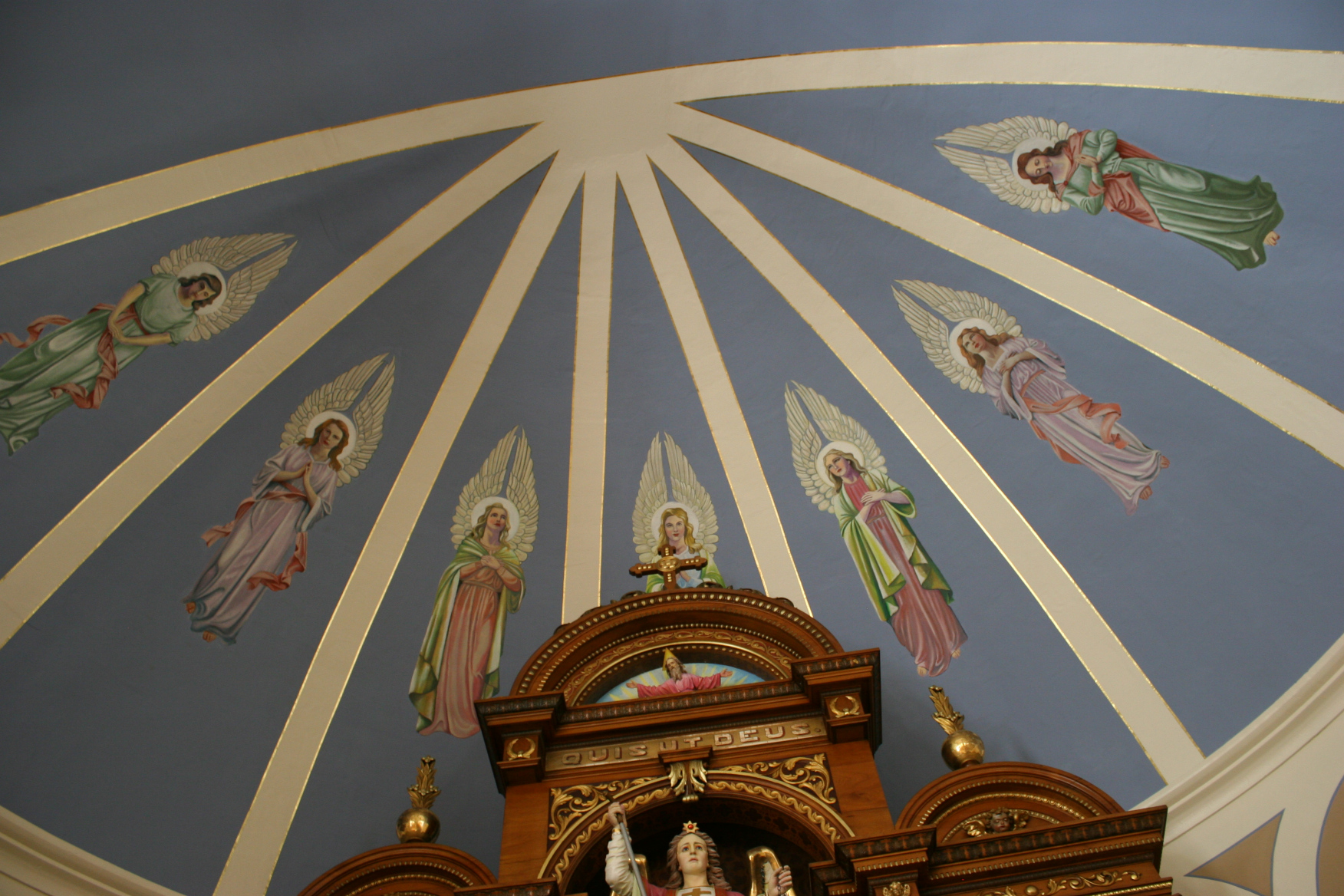
My favorite art in St. Michael’s are these angels painted on the ceiling above the altar. Minnesota Prairie Roots file photo September 2020.
My reaction was one of awe as I stood inside the sanctuary with its soaring ceiling, art seemingly everywhere. It’s a photographer’s paradise. An art lover’s dream. A place of peace for the faithful.
A side altar up close. Minnesota Prairie Roots file photo September 2020.
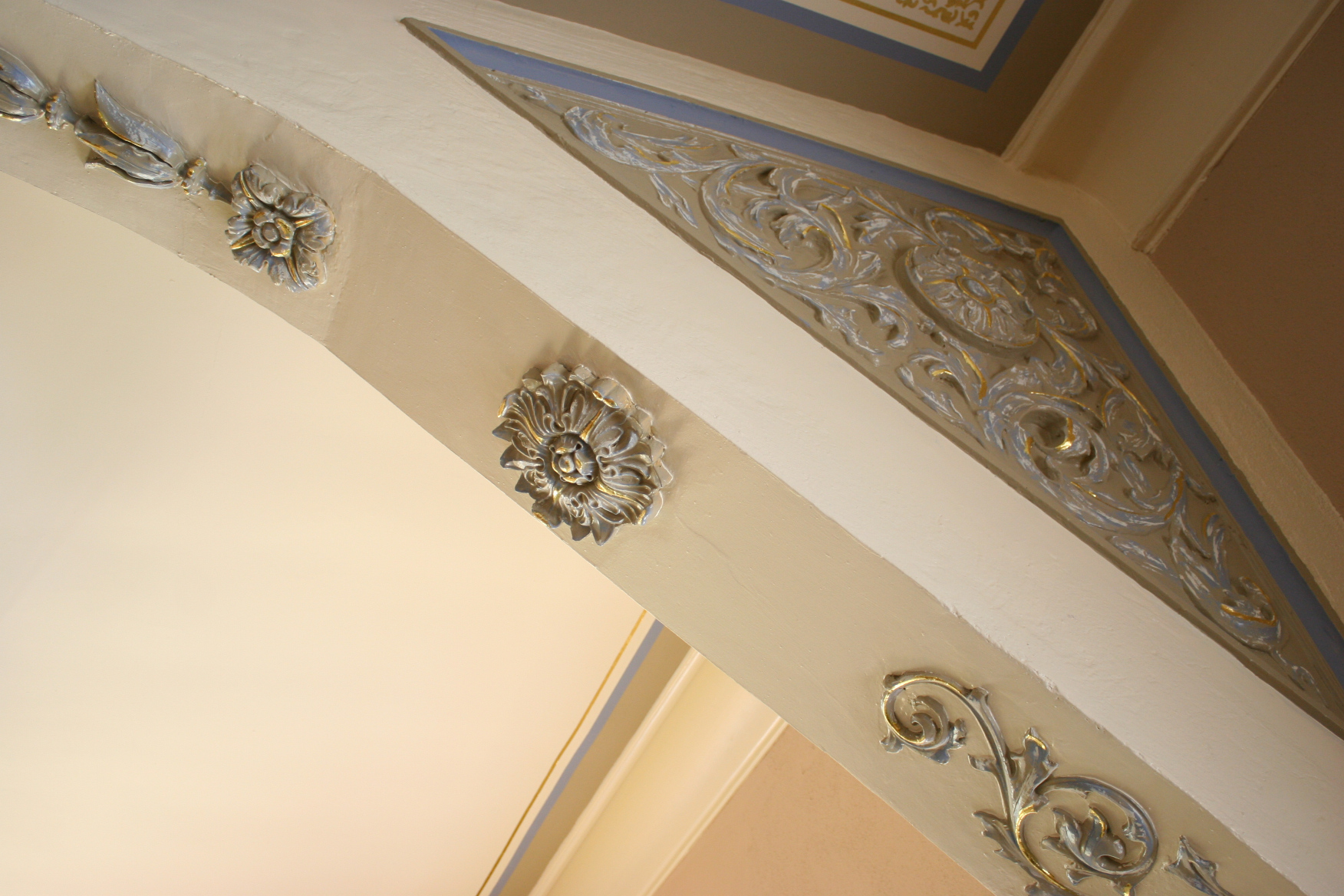
Ornate ceiling details. Minnesota Prairie Roots file photo September 2020.
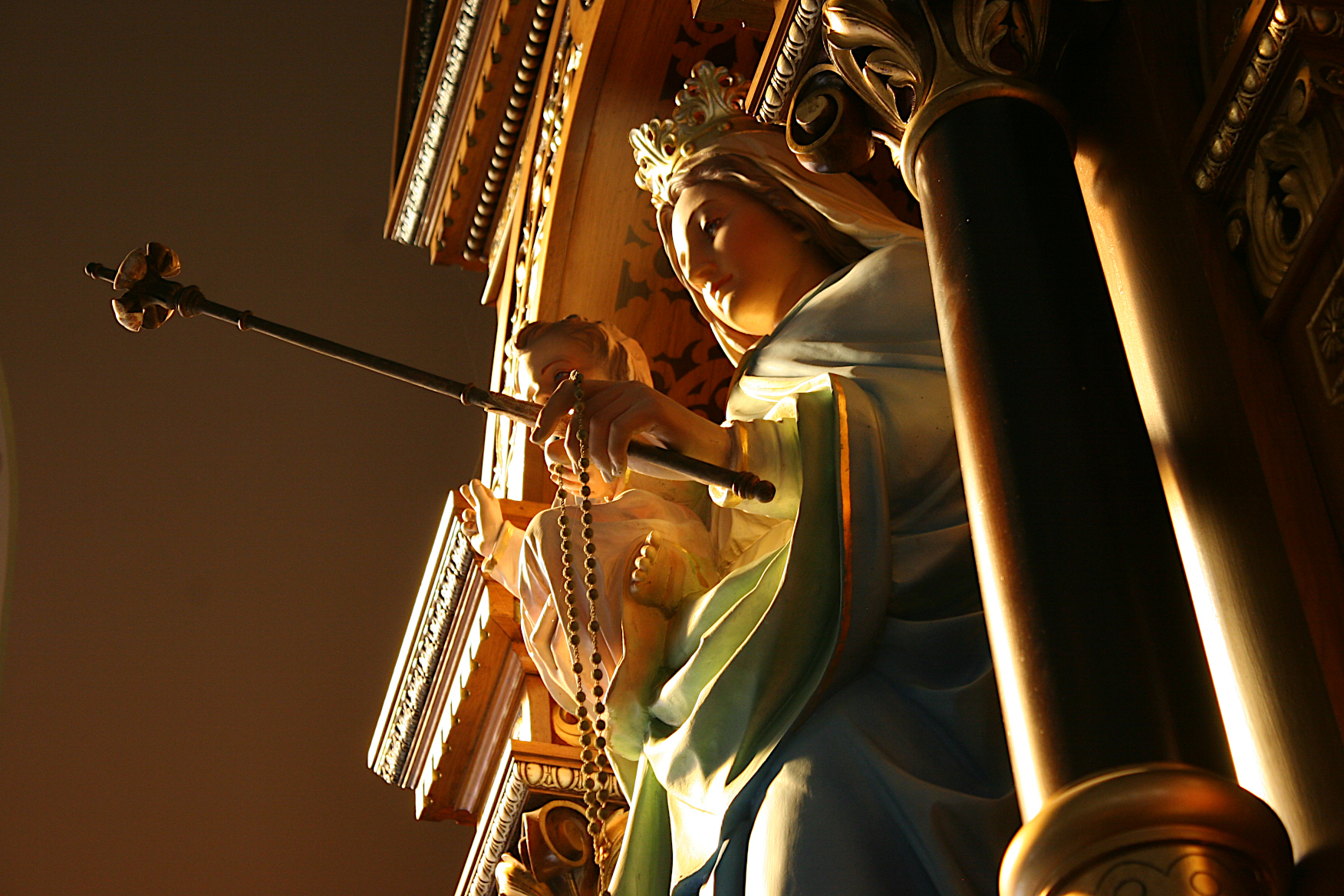
One of many detailed sculptures. Minnesota Prairie Roots file photo September 2020.
I felt overwhelmed as I moved from one area of the church to the next—attempting to take in all I saw. The whole picture. The details. Oh, the details.
The center altar, with that frightening statue. Minnesota Prairie Roots file photo September 2020.
I stood for a moment, placing myself in Randy’s shoes as that young boy from North Dakota seeing this all for the first time. I locked eyes on the statue of St. Michael towering over Satan, the terrible, horrible creature with the sharp teeth and claws. And I understood Randy’s fear manifested there all those decades ago.
Please check back as I bring you more photos from inside St. Michael’s Catholic Church, Buckman, Minnesota.
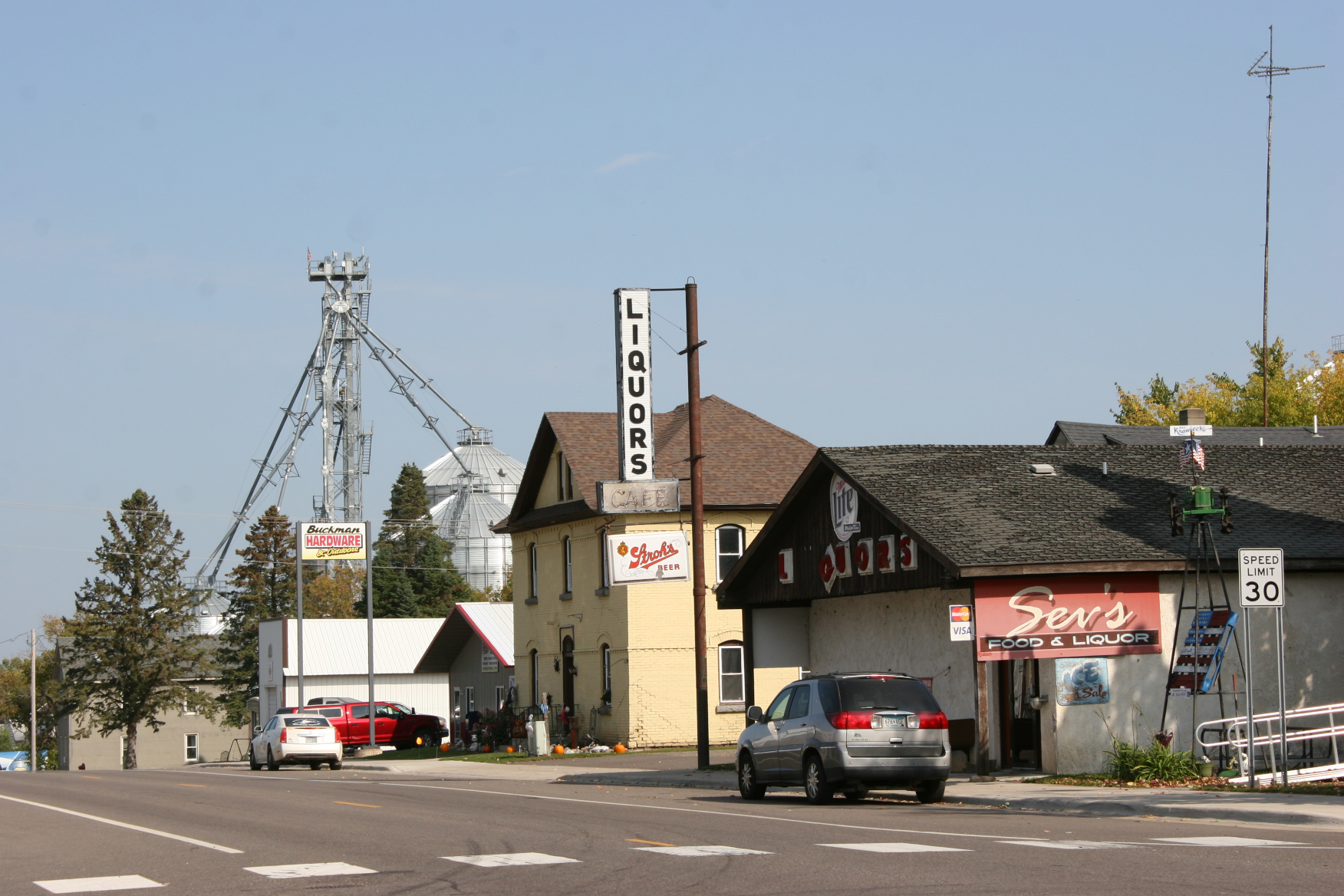
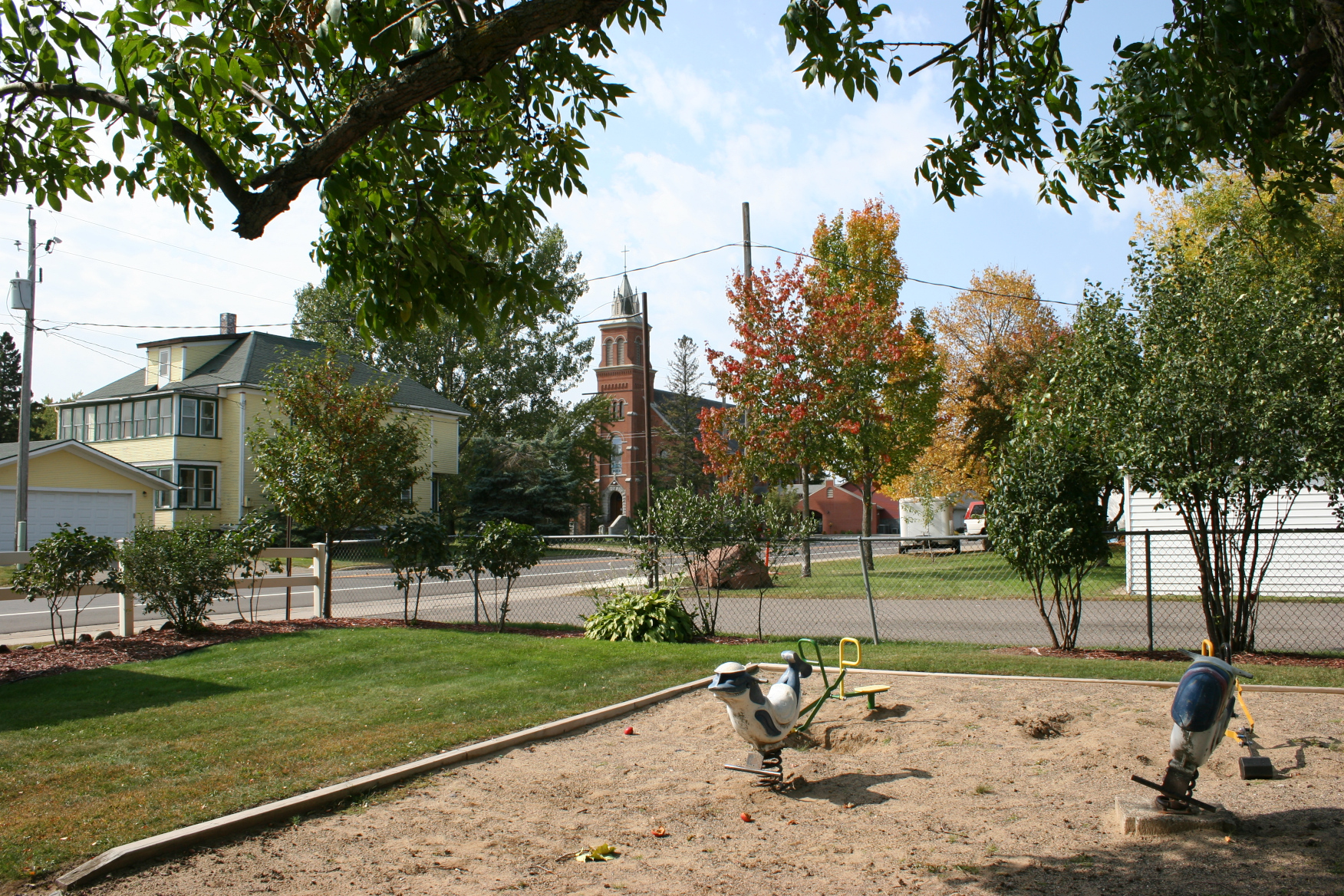
The heart of small town Buckman, Minnesota. Minnesota Prairie Roots file photo September 2020.
HOW DO YOU DEFINE a small town?
For some, it’s a community to pass by or through en route to wherever.
For others, it’s an occasional destination to visit extended family.
But for some of us, it’s the place of our roots.
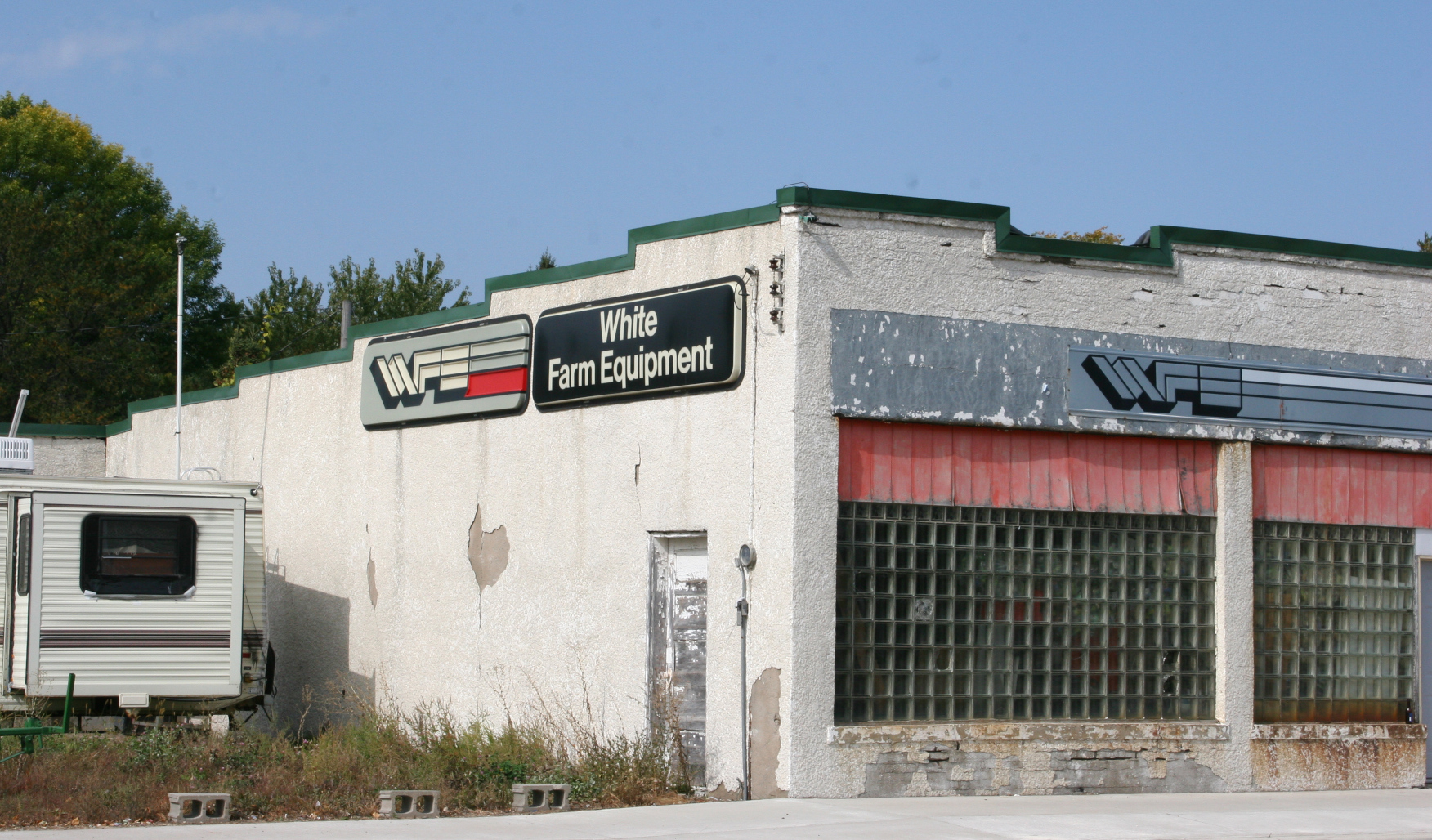
The vacated farm implement dealership in Buckman. Minnesota Prairie Roots file photo September 2020.
Randy and I both grew up on dairy and crop farms near small towns—him near Buckman in central Minnesota and me just outside Vesta in southwestern Minnesota. Those communities, once thriving with elementary schools and many businesses, are no longer hubs of local commerce or education. Much has changed since we each left our respective rural towns in 1974.
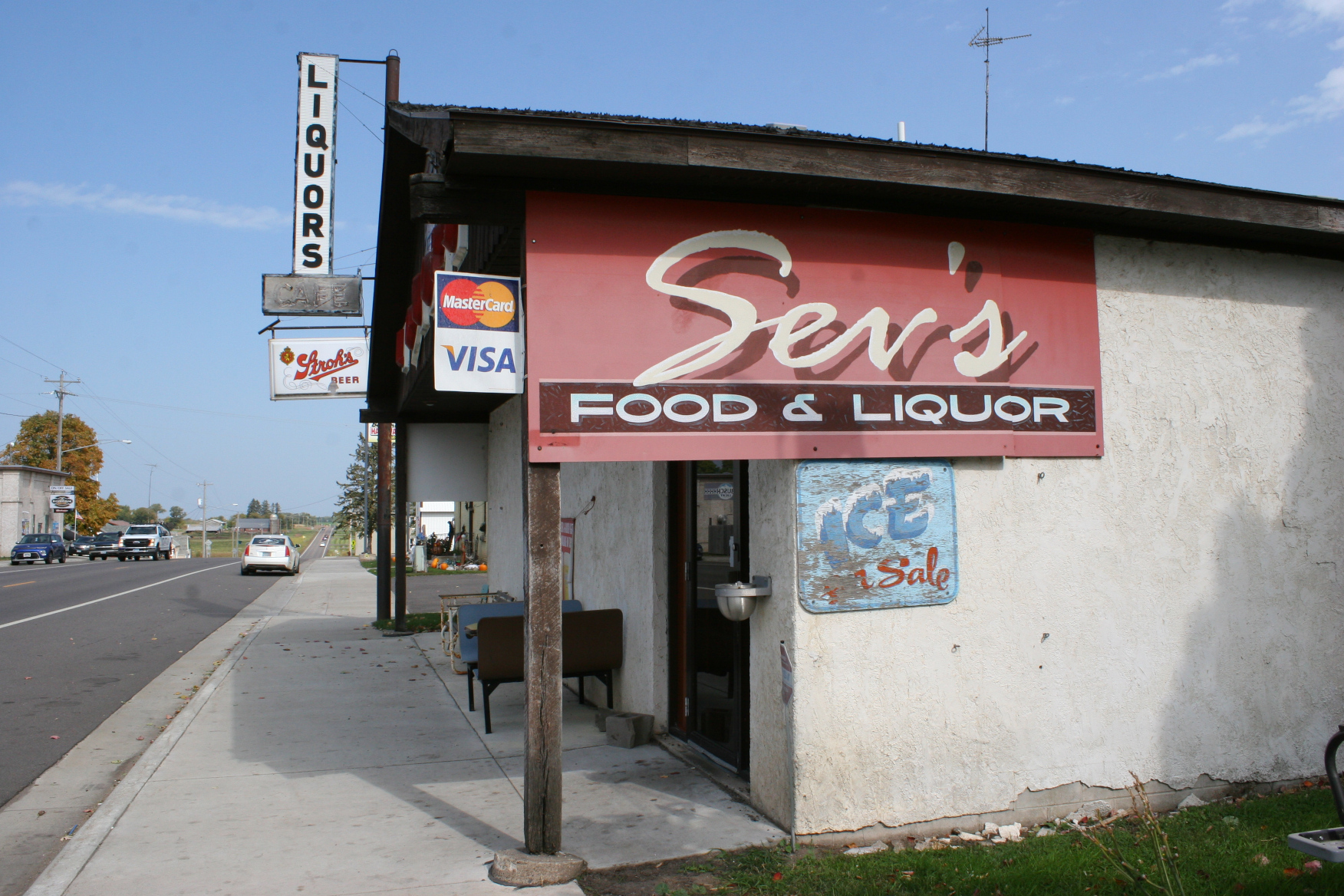
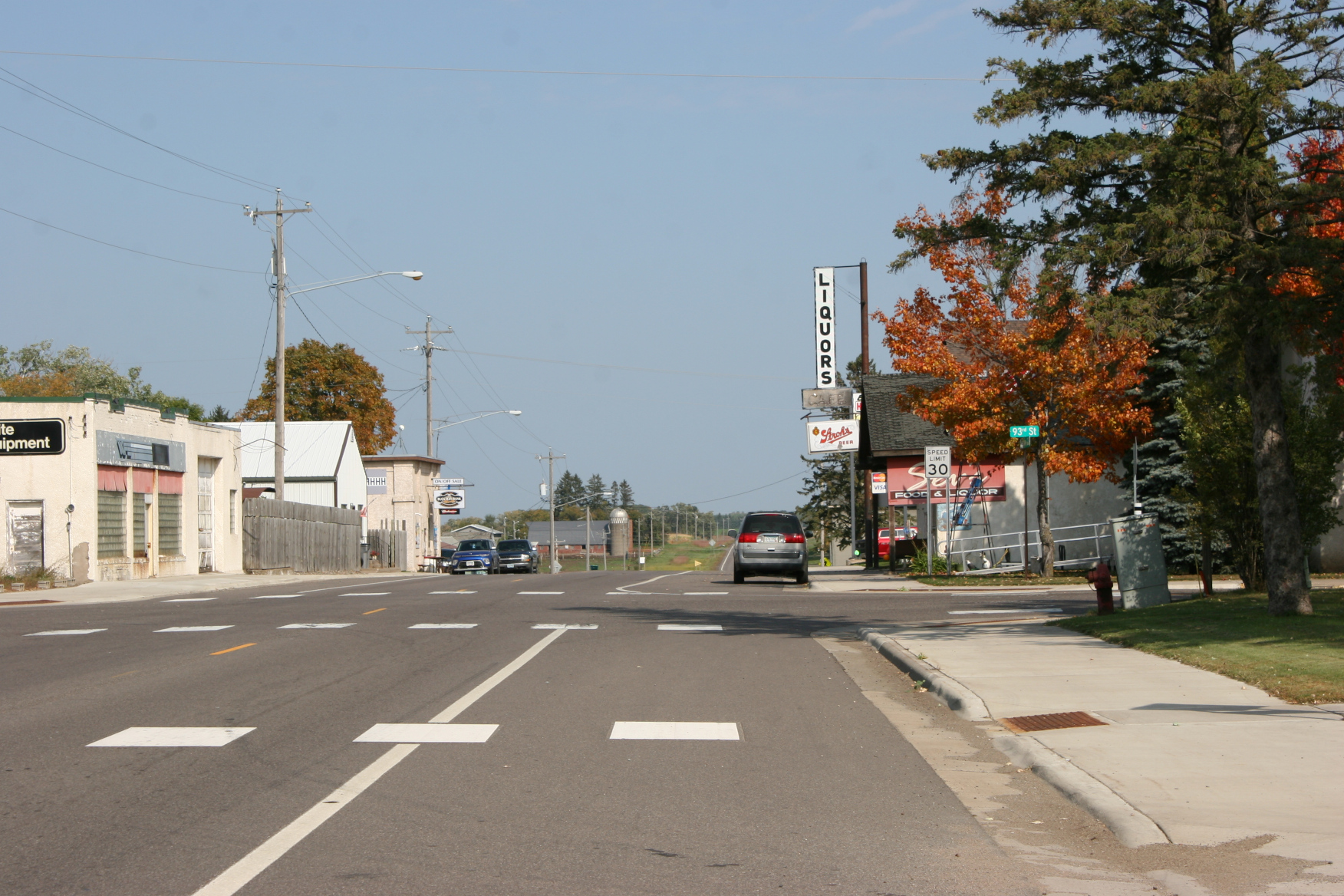
Sev’s Food & Liquor sits along Minnesota Highway 5 in Buckman. Minnesota Prairie Roots file photo September 2020.
Yet, the core of our hometowns, with populations under 300 and 145 miles apart, remains unchanged. Community spirit and neighborliness and a certain connection to place remain particularly strong. Often, generations of families live within miles of each other. Churches center these towns, too, as do bars, both community gathering spots.
It’s not often now that either of us returns to our hometowns. The farms we grew up on are no longer in the family, a loss I feel deeply. I return only for funerals and the annual family reunion. Only occasionally do we divert to Buckman so we can visit the gravesites of Randy’s mom and brother, Brian.
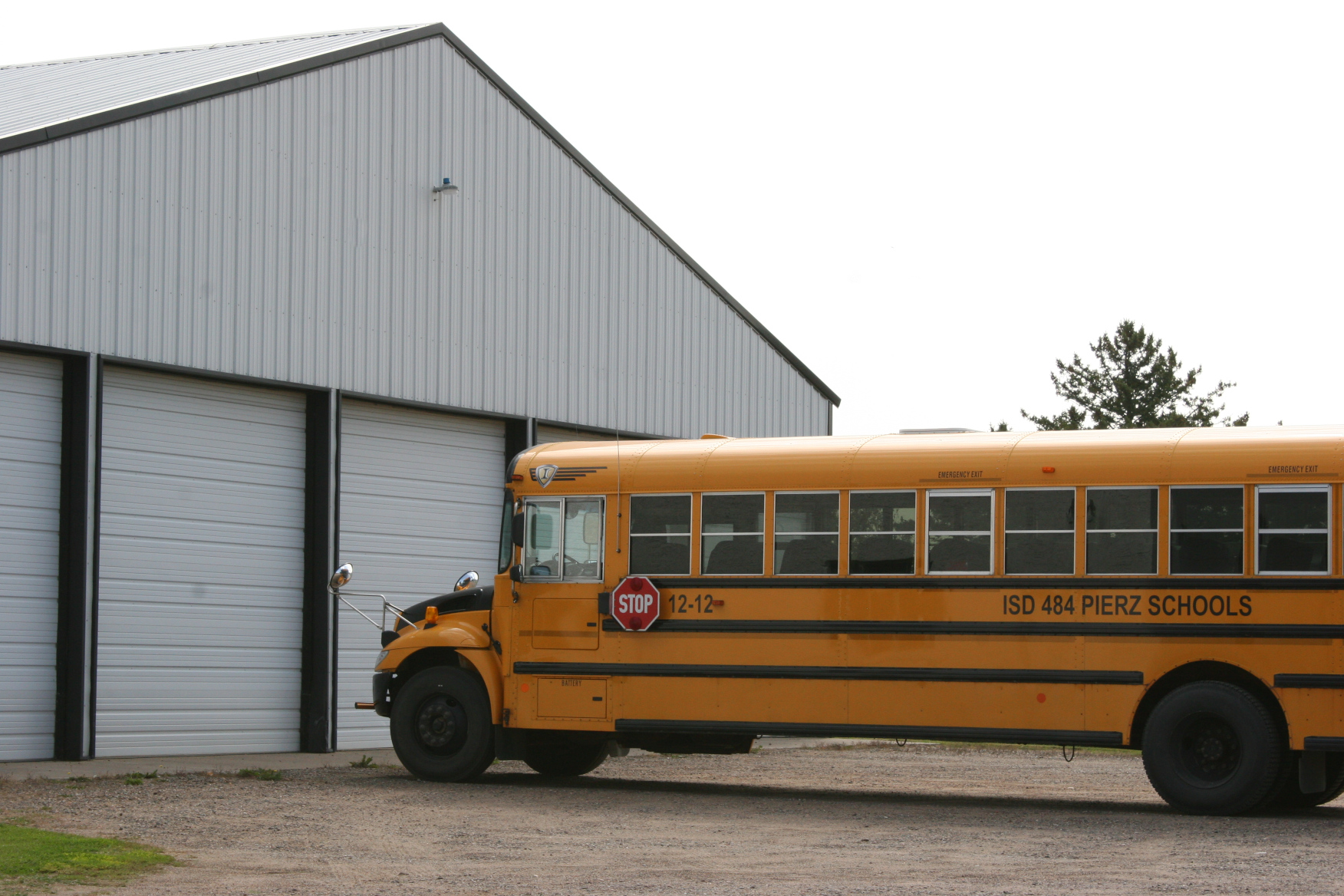
Randy attended elementary school at St. Michael’s (now gone) in Buckman and the rest of his schooling in Pierz. This bus was parked outside a garage in Buckman. Minnesota Prairie Roots file photo September 2020.
We did just that this past fall after spending time at a family member’s guest lake cabin in the Brainerd Lakes area. Buckman lies some 40 miles to the south of Brainerd. We drove through Pierz, where Randy attended junior and senior high schools, on our way to his hometown.
Minnesota Highway 25 runs through the middle of Buckman, here looking north in the heart of downtown. Minnesota Prairie Roots file photo September 2020.
Some seven miles later, we pulled off Minnesota State Highway 25, which slices through Buckman, and turned into St. Michael’s Cemetery. I always feel such a sense of sadness upon visiting my mother-in-law’s gravesite. She died way too young at age 59, just months before her grandson, our son, was born.
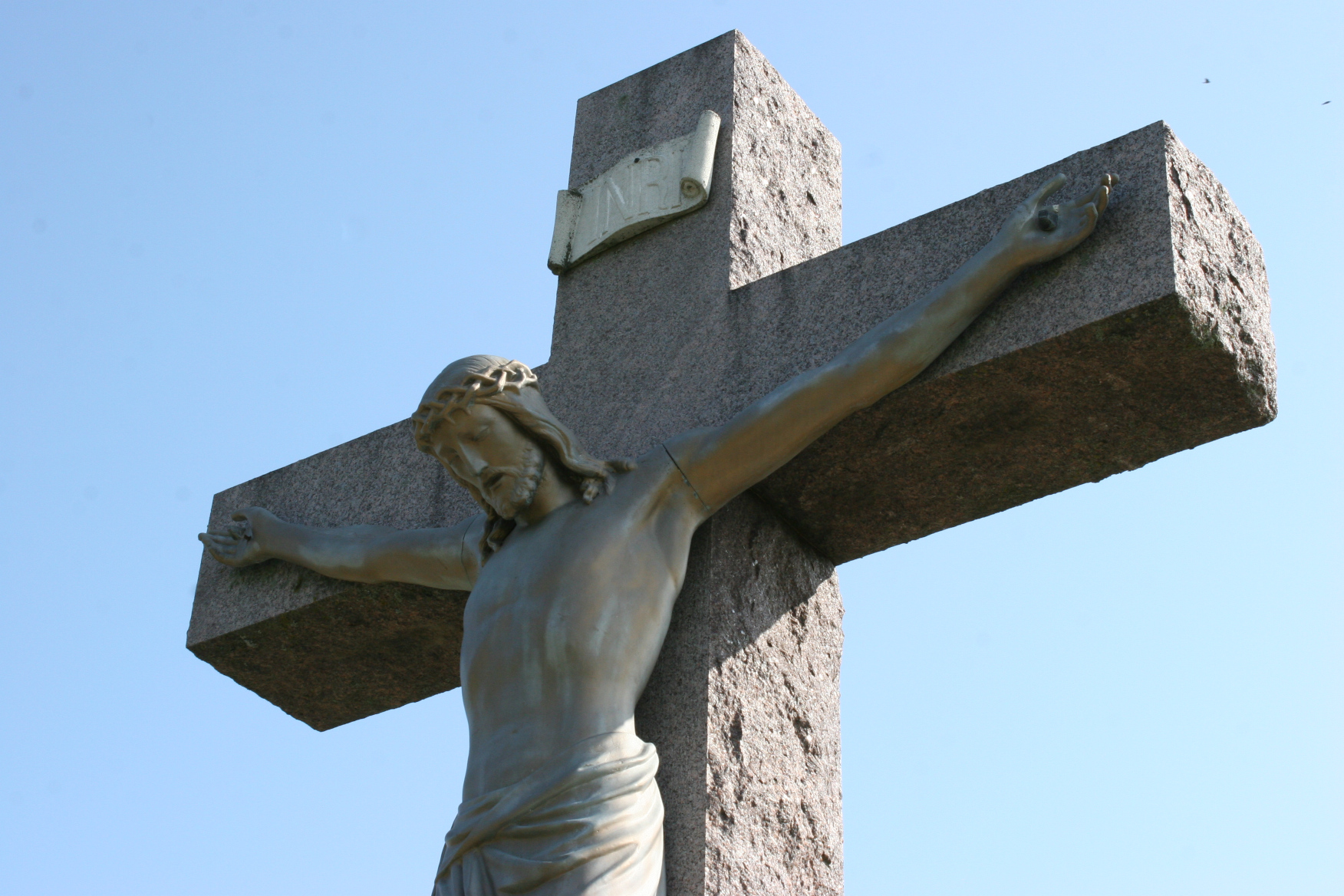
A massive stone cross monument marks St. Michael’s Cemetery in Buckman. Minnesota Prairie Roots file photo September 2020.
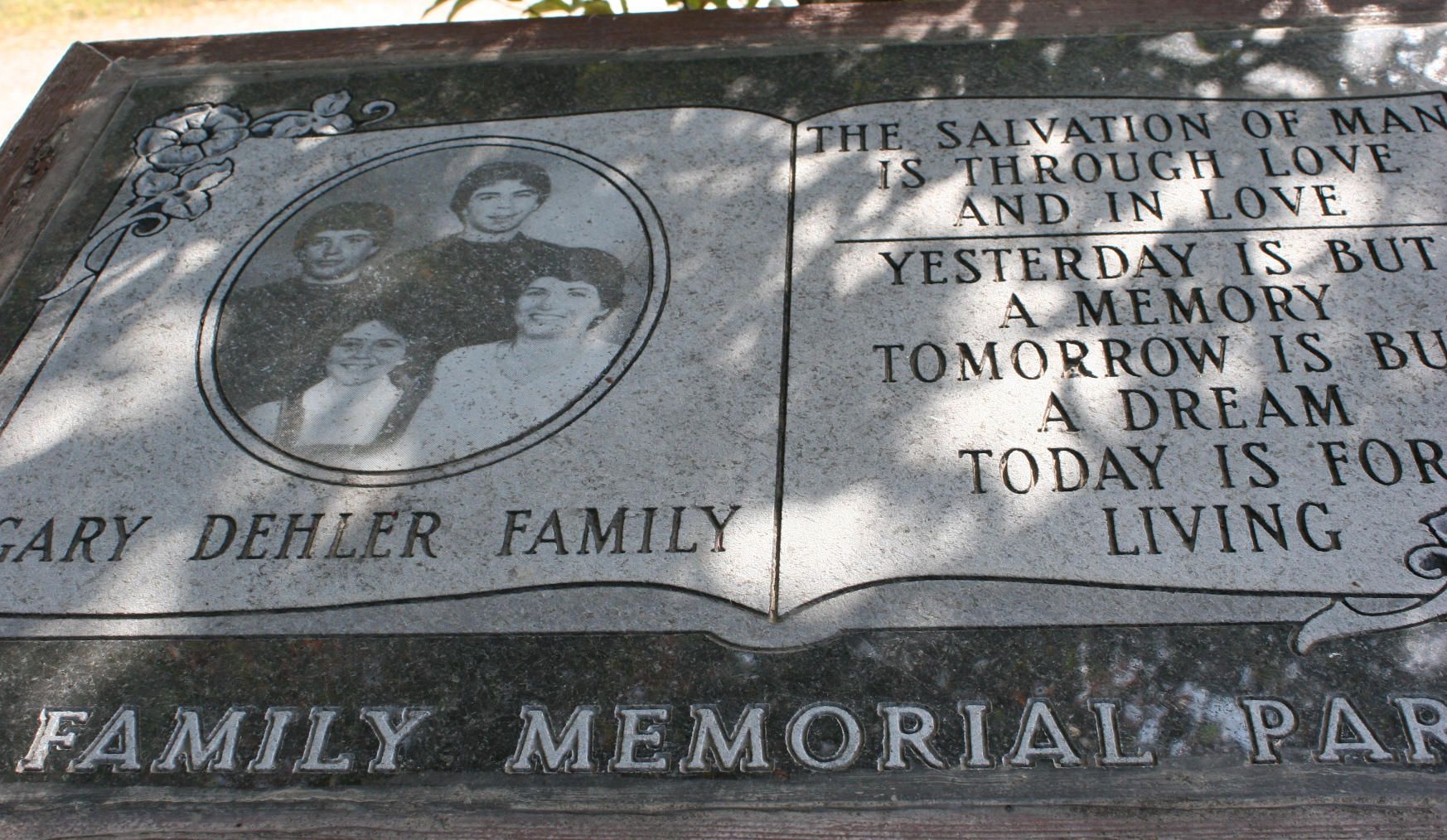
Tragedies, like those of the Dehler family, are written upon tombstones in this cemetery landmarked by a towering stone cross.
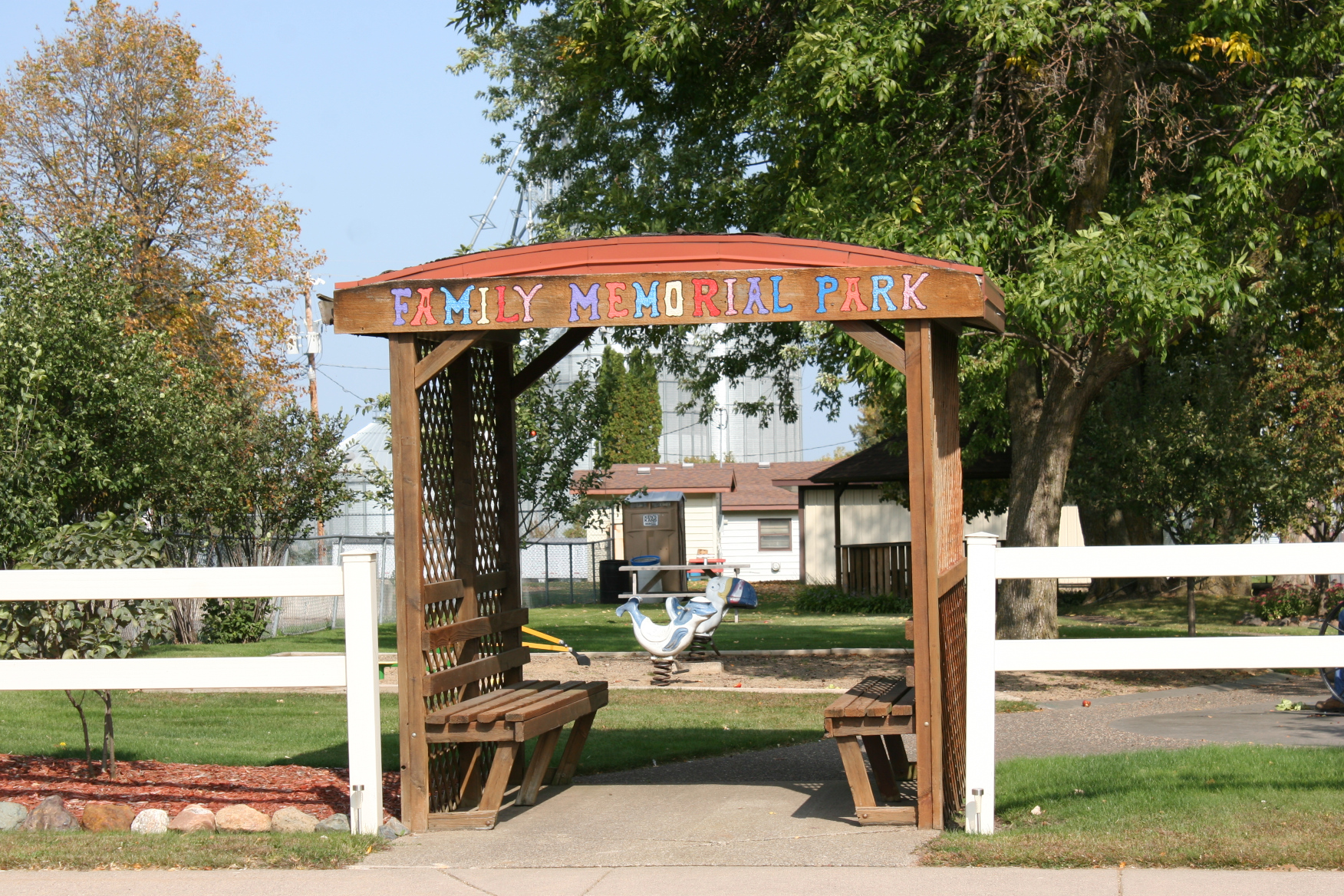
The entry to Family Memorial Park, across the street from the bus garage and cemetery, Minnesota Prairie Roots file photo September 2020.
A plaque honors the Dehlers, four of whom died in a car-train collision. Minnesota Prairie Roots file photo September 2020.
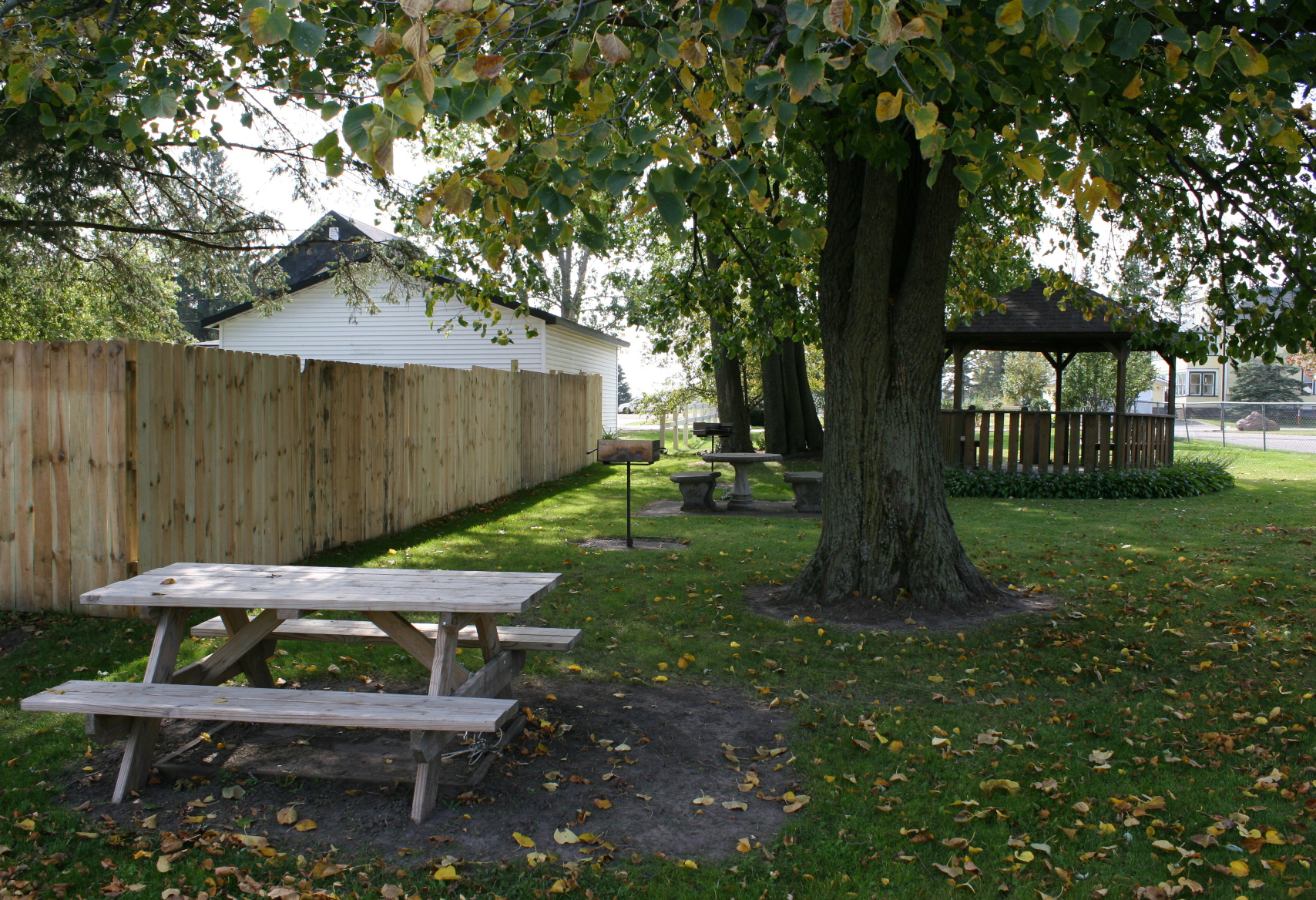
Inside Family Memorial Park, Buckman. Minnesota Prairie Roots file photo September 2020.
Across the street, Family Memorial Park—with a mini playground, picnic tables and gazebo—honors 36-year-old Suzette Dehler and her children, Gerald, 15, Christopher, 14, and Tammi, 8. They died in a car-train accident in July 1986.
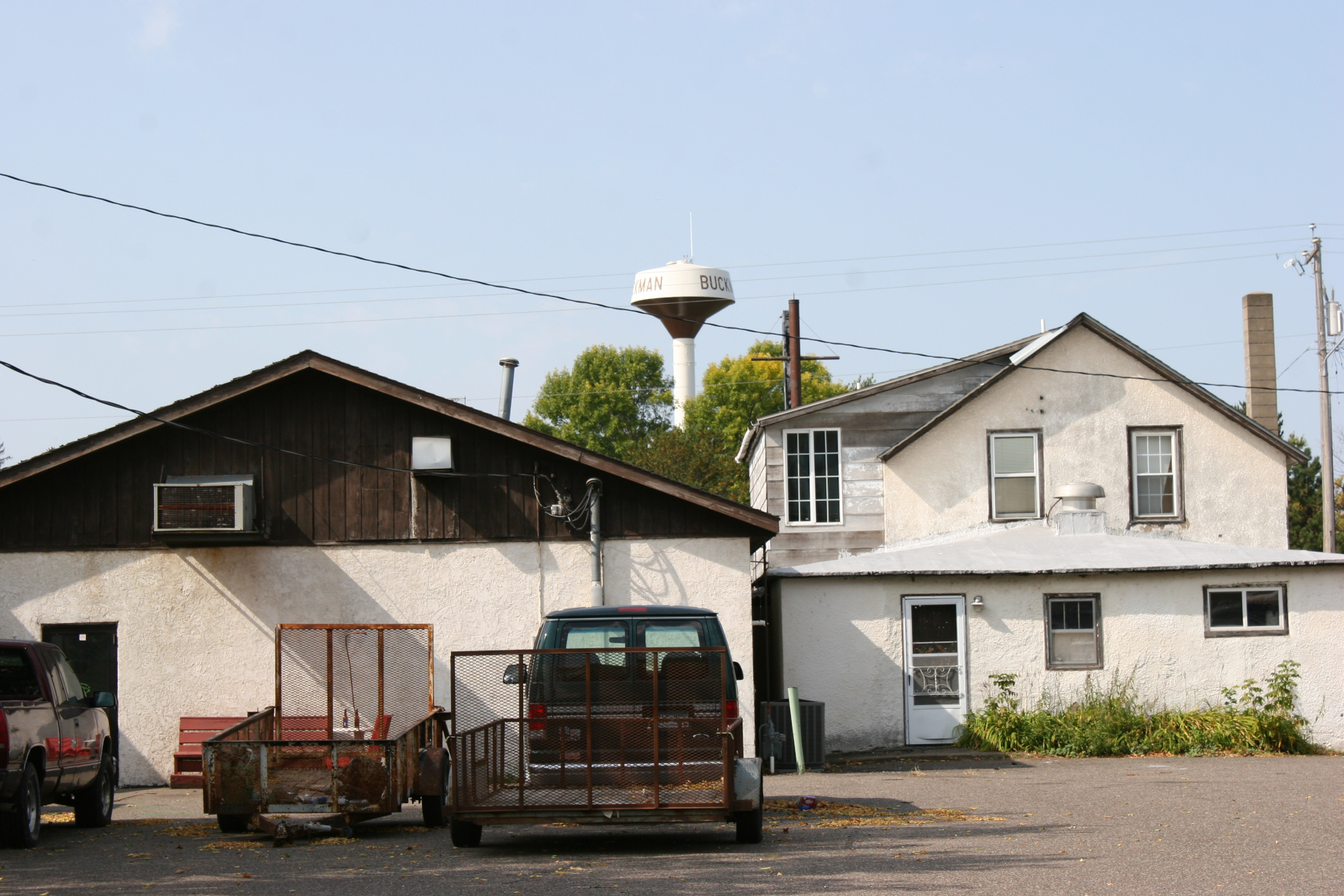
Photographed from the park, the back of Sev’s with the Buckman water tower in the distance. Minnesota Prairie Roots file photo September 2020.
On this autumn afternoon, we picnicked there, behind Sev’s Food & Liquor and across the street from the bus garage. A dog barked at the neighboring house, breaking the small town silence.
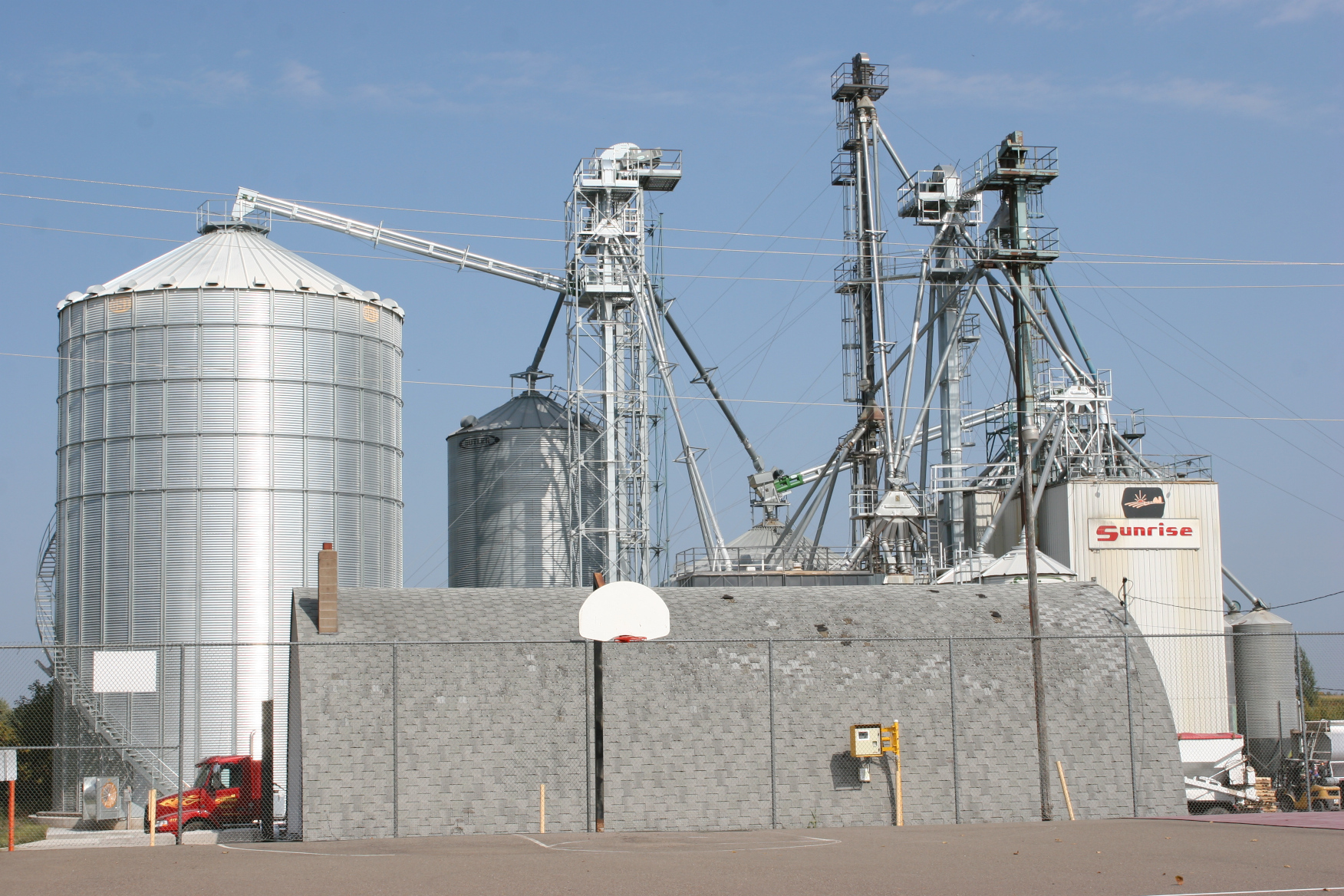
Buckman still centers around agriculture, as seen in this ag business on the north end of town. Minnesota Prairie Roots file photo September 2020.
To the north, massive grain bins define this as an agricultural community.
To the west of Family Memorial Park, St. Michael’s Catholic Church rises above Buckman. Minnesota Prairie Roots file photo 2020.
And to the west, the steeple of St. Michael’s Catholic Church rises above Buckman. It’s a beautiful church, recently refurbished, and an integral part of this town. Randy worshiped here with classmates from St. Michael’s Parochial School and with his parents and siblings. He served as an altar boy, too. We mourned his mom here and a few years later he stood as best man when his dad remarried. I photographed the wedding.
On this day, I carried my camera inside again, this time to document the sanctuary. I feel like a foreigner inside Catholic churches, which are typically massive and ornate, so different from the simple Lutheran churches of my upbringing.
Check back as I take you inside St. Michael’s in a series of posts focusing solely on this church. The art inside will, I expect, impress you. And remind you that, even in the smallest of towns, treasures await our discovery.
Upcoming posts will also feature more photos from Buckman and several from neighboring Pierz.
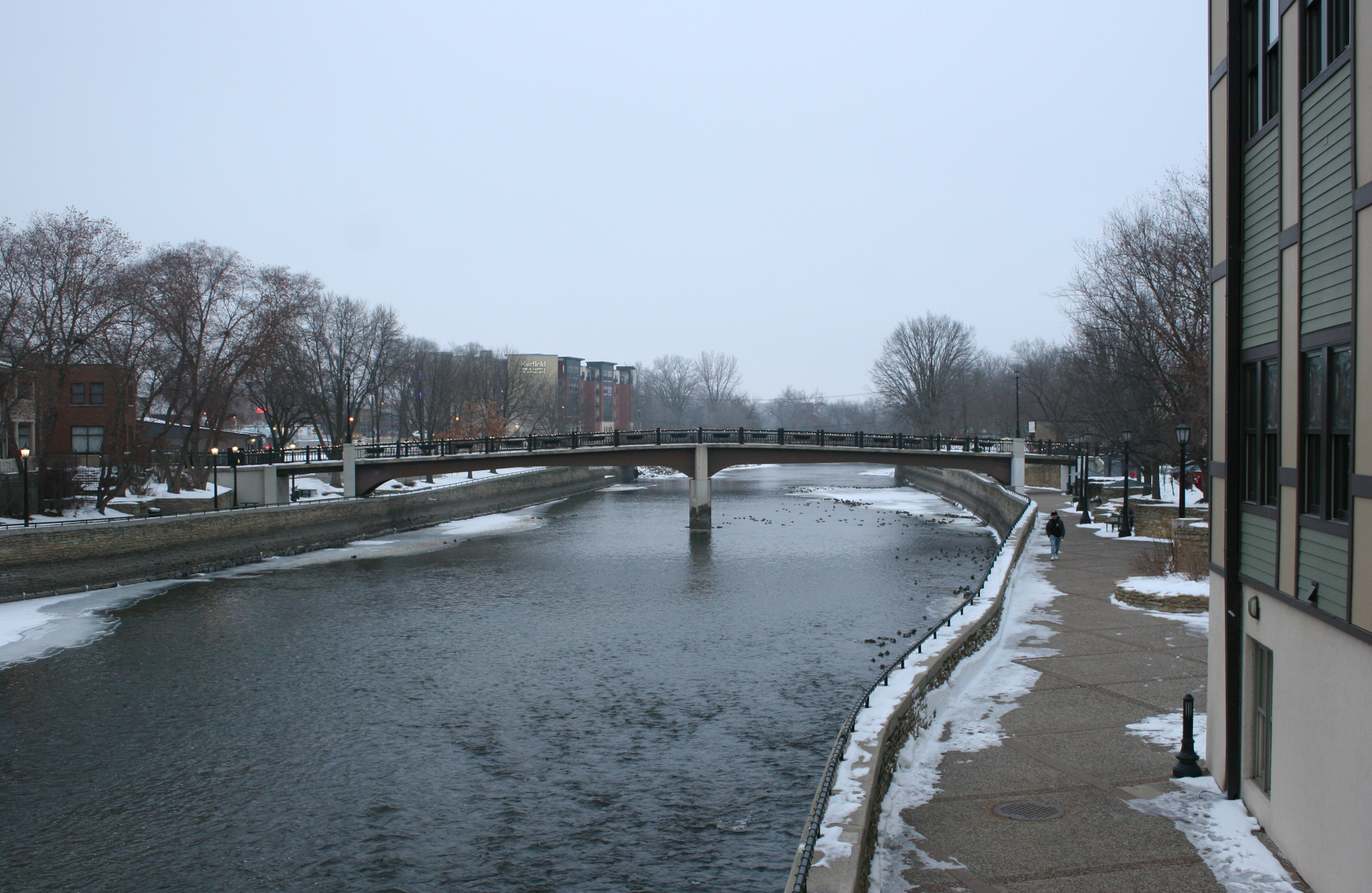
I love walking along the Cannon River in the heart of downtown Northfield, Minnesota.
PHOTOGRAPHING MINNESOTA COMMUNITIES remains a focal point of my photography. I love to document people, places and events with my camera.
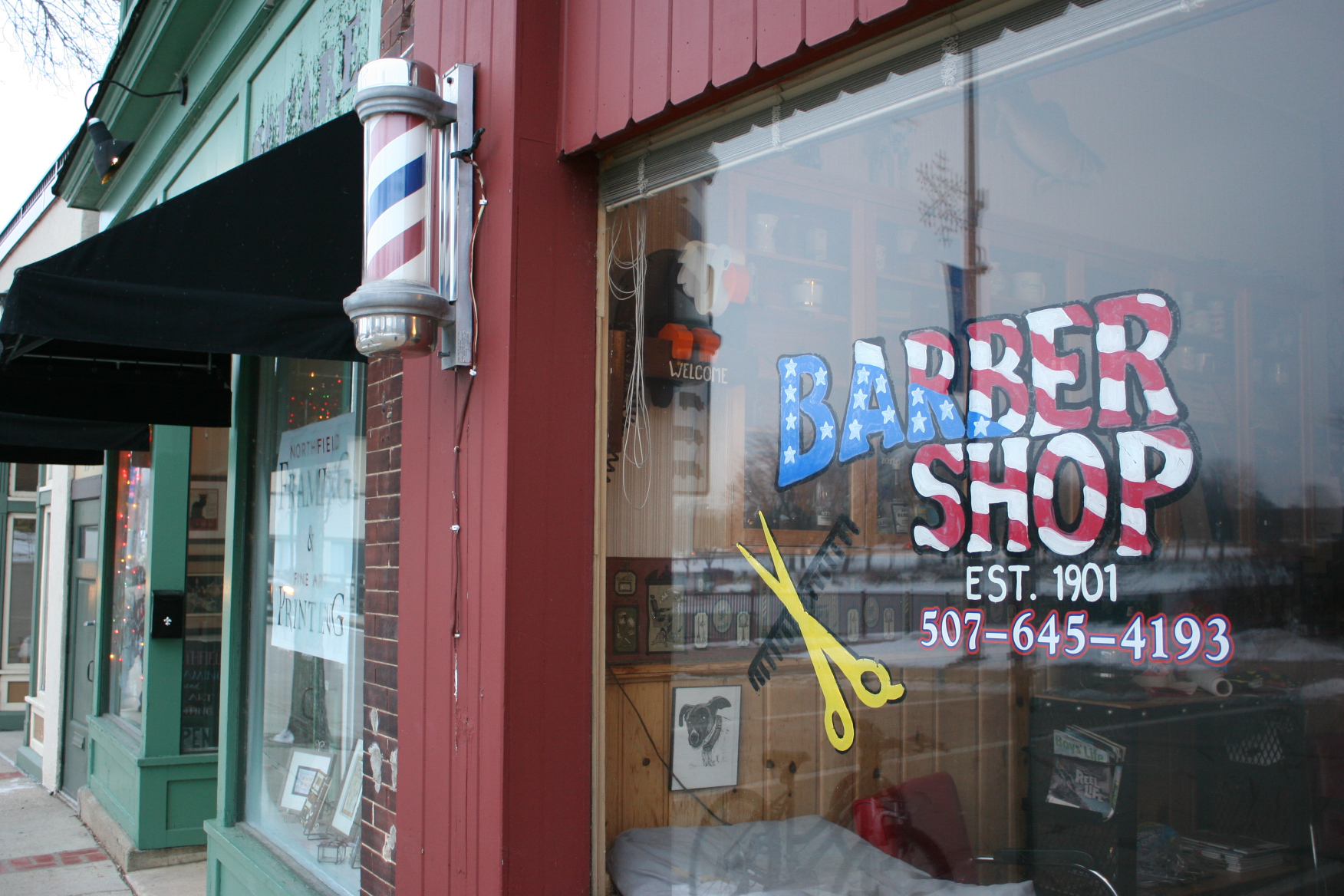
This image seems so iconic Americana, hearkening back in time to places like fictional Mayberry. This barbershop is across the street from Bridge Square in Northfield.
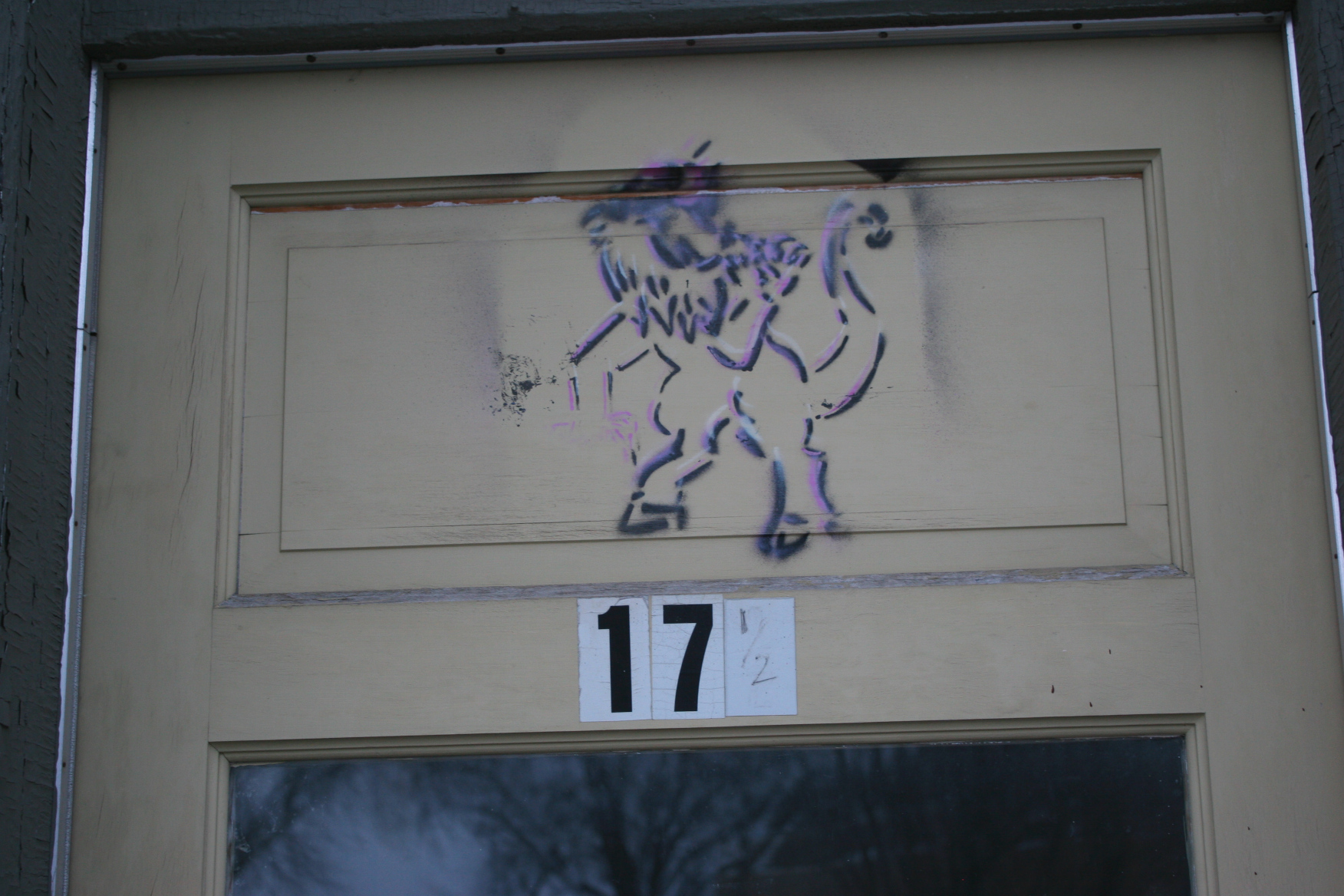
I don’t know the symbolism of this graphic art, photographed above a doorway.
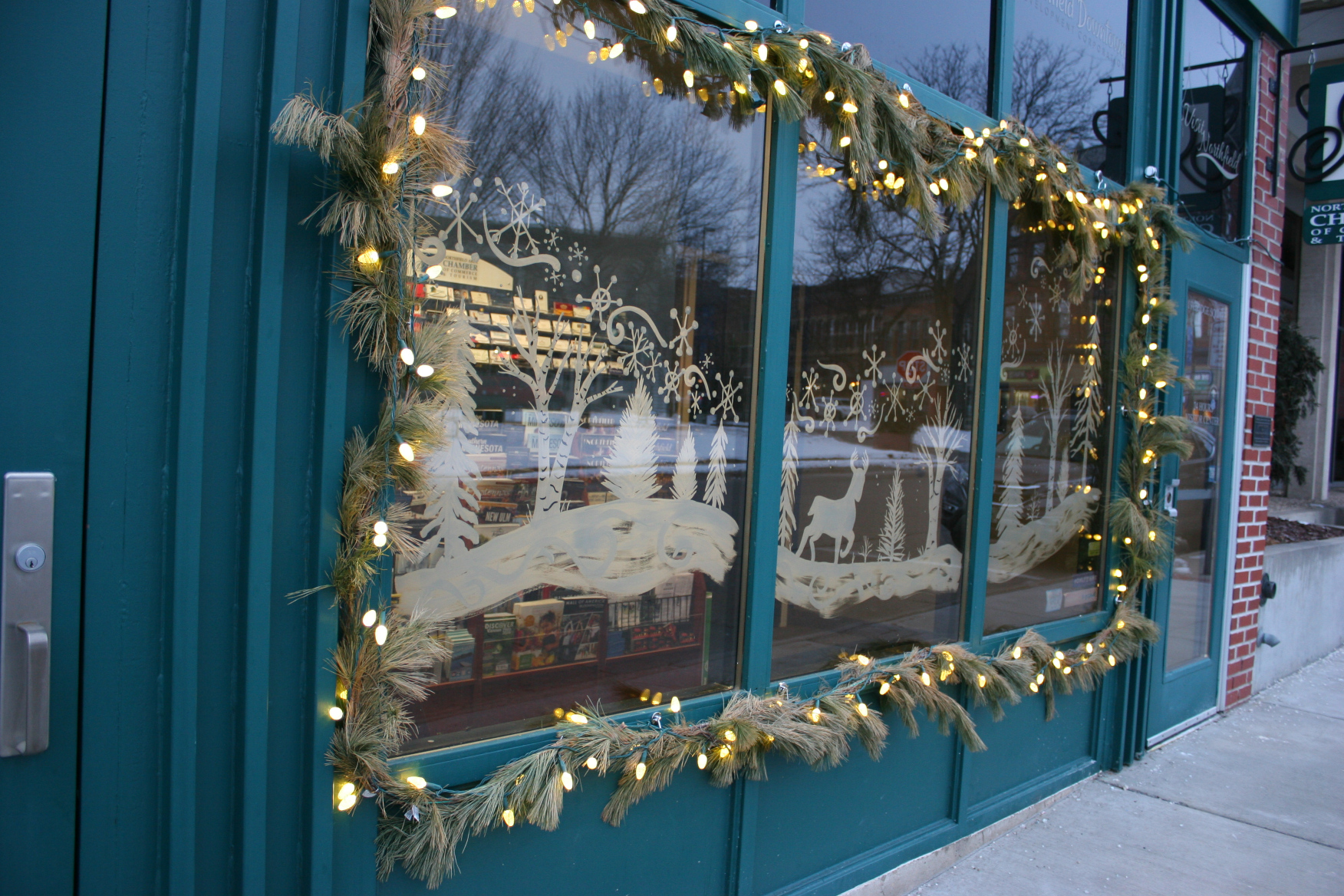
Northfield always does a great job with window displays, including this holiday-themed one.
My photos present visual stories. I suppose you could say I am both the writer and the editor. I choose what to photograph and how. I decide, in the moment, whether to show you a detailed up-close subject or whether to cover a broader area. Both are important in storytelling. I also decide the perspective from which I will photograph. Down low. Eye level. Or some other angle.
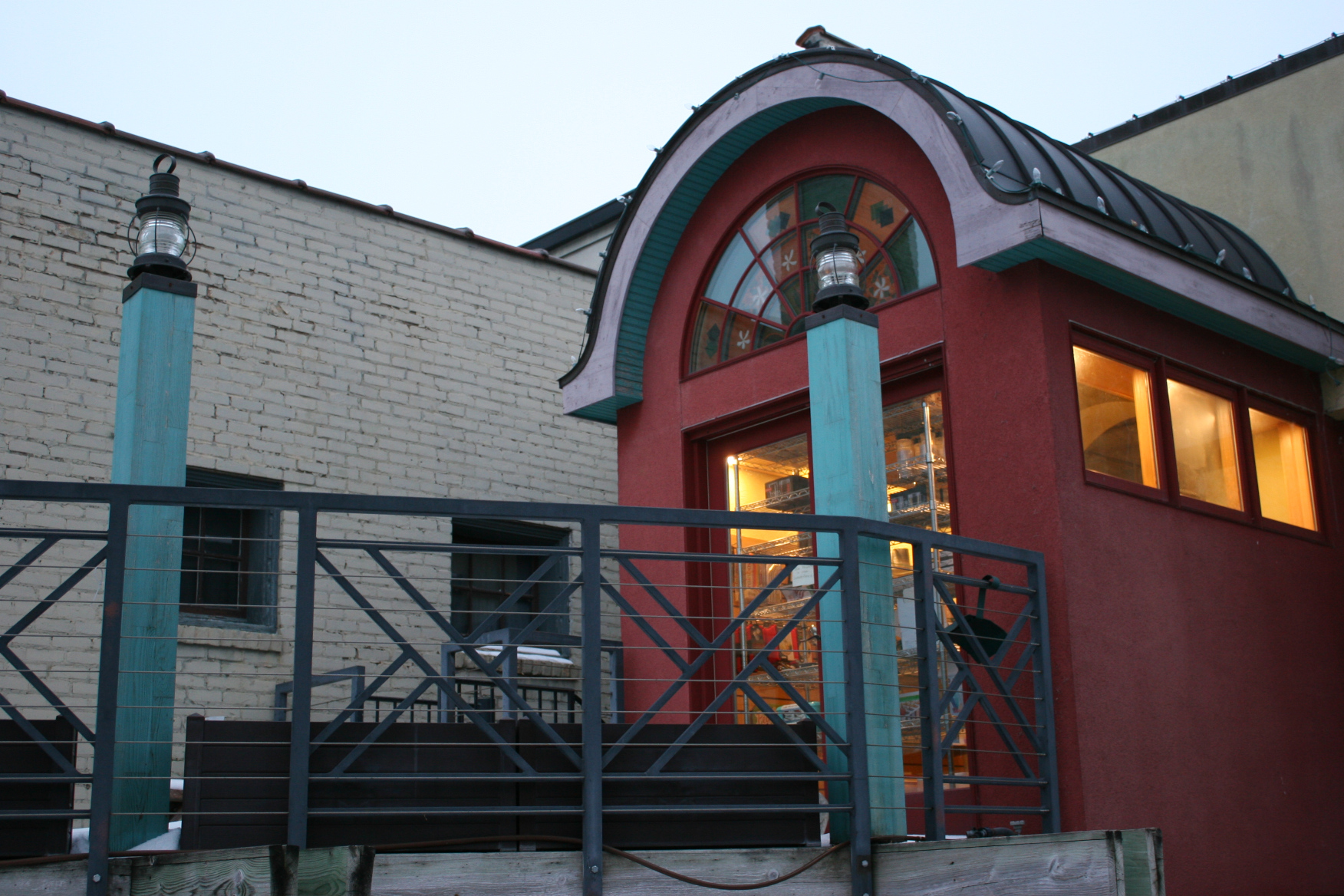
I found this add-on structure to a kitchen ware retail shop and upper level deck charming. This is on the back of the building.
During a recent visit to Northfield, one of my favorite Minnesota communities about a 20-minute drive away, I had exactly 10 minutes to photograph before our food order was ready for pick up on the other side of town. I asked Randy to act as time-keeper. When I’m photographing, I lose all track of time, so engaged am I in the creative process.
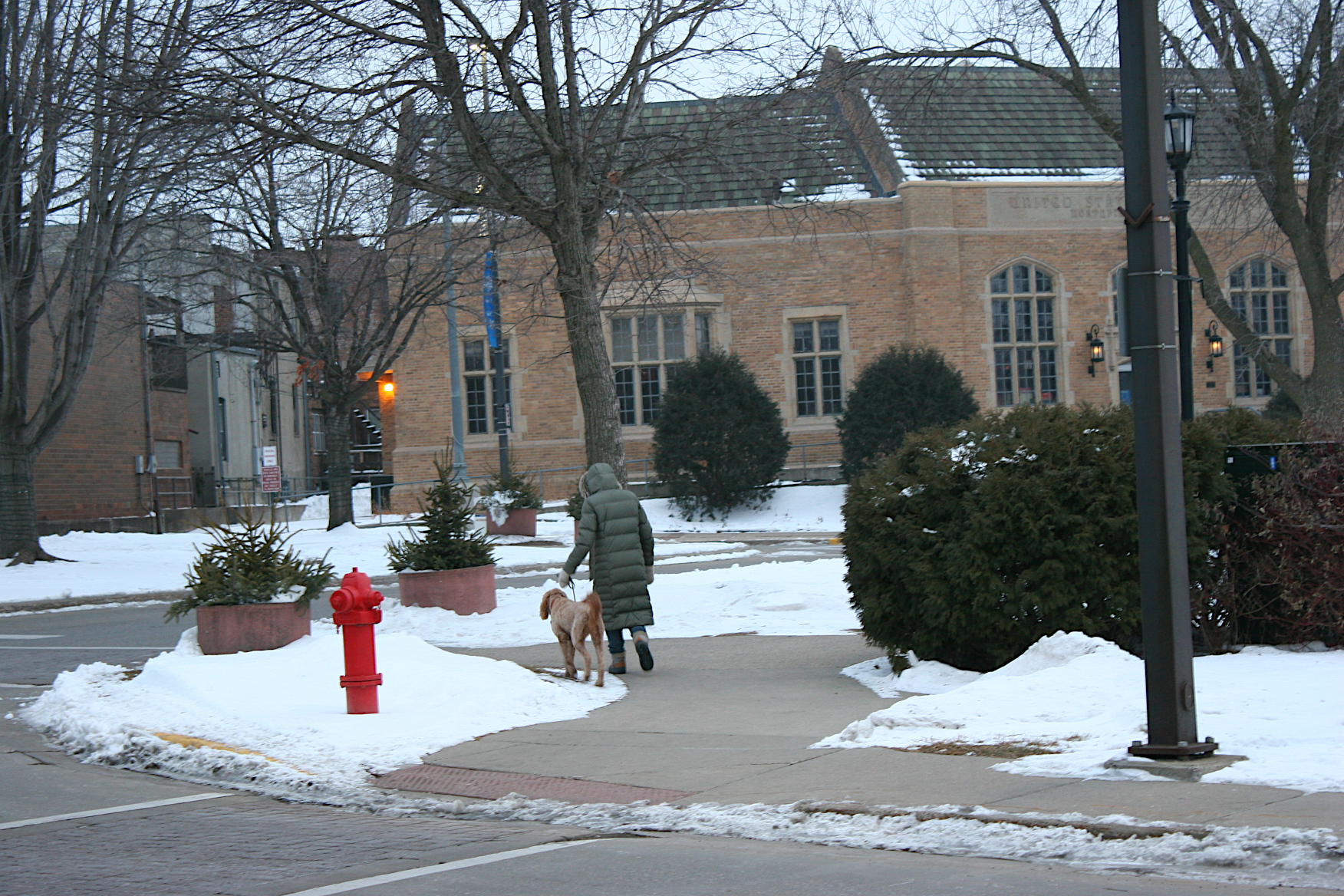
Bundled up to walk the dog at Bridge Square on a cold winter afternoon in Northfield.
We parked near Bridge Square, the heart of downtown Northfield and a community gathering spot. On this late January afternoon with the temp not quite 20 degrees and with COVID-19 reducing the number of visitors to this typically busy downtown, I observed only a few people out and about. Often finding a place to park proves challenging. Not so on this Saturday.
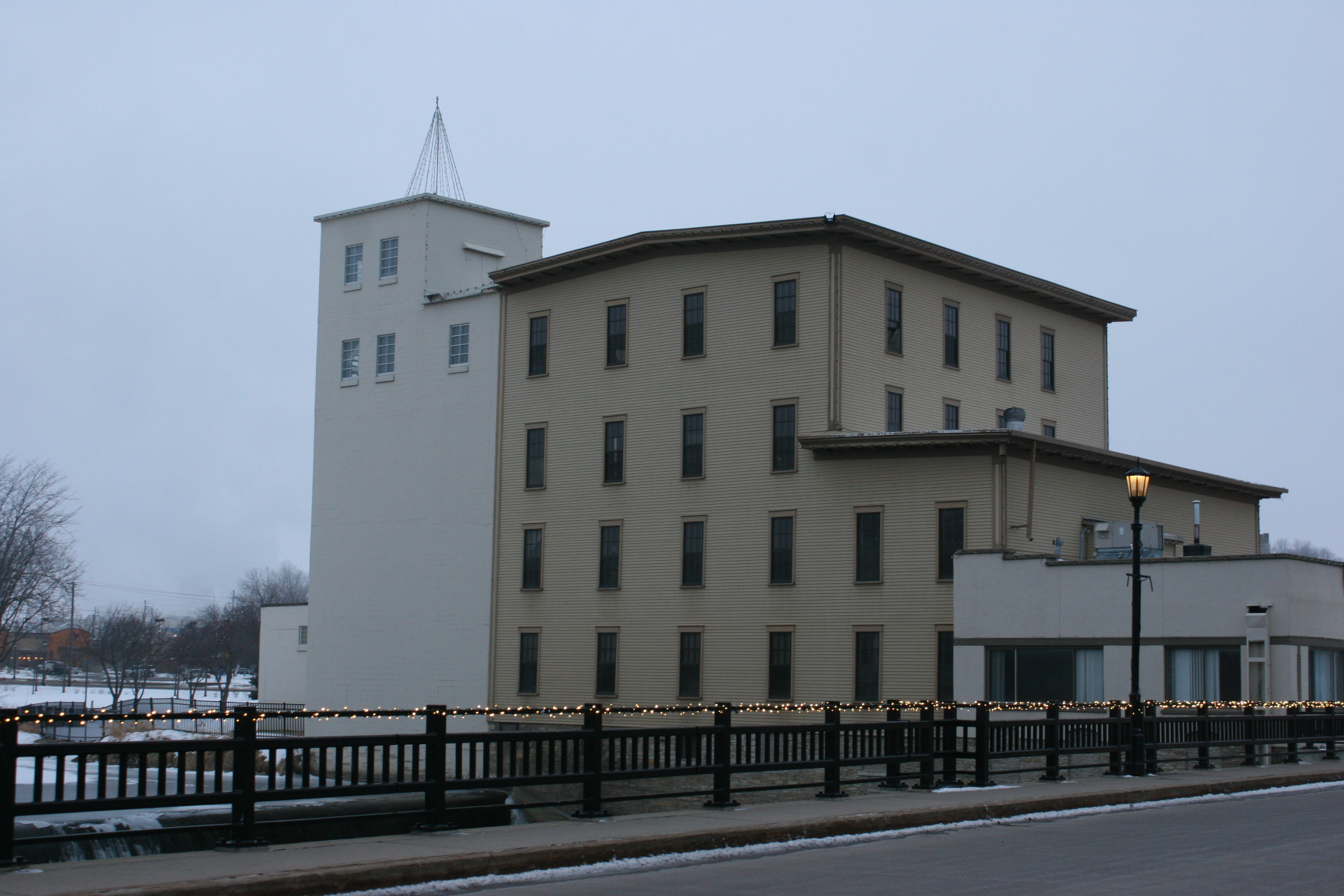
The historic Ames Mill sits on the banks of the Cannon River across the river from Bridge Square.
We walked toward Bridge Square, adjacent to the Cannon River. Turning the corner off Division Street, the wind sliced cold across my face. I knew that exposing my fingers to snap the shutter button of my camera would be numbing. My mittens, which open to finger-less gloves, help. I’d highly recommend these if you work a camera in a cold weather environment like Minnesota.
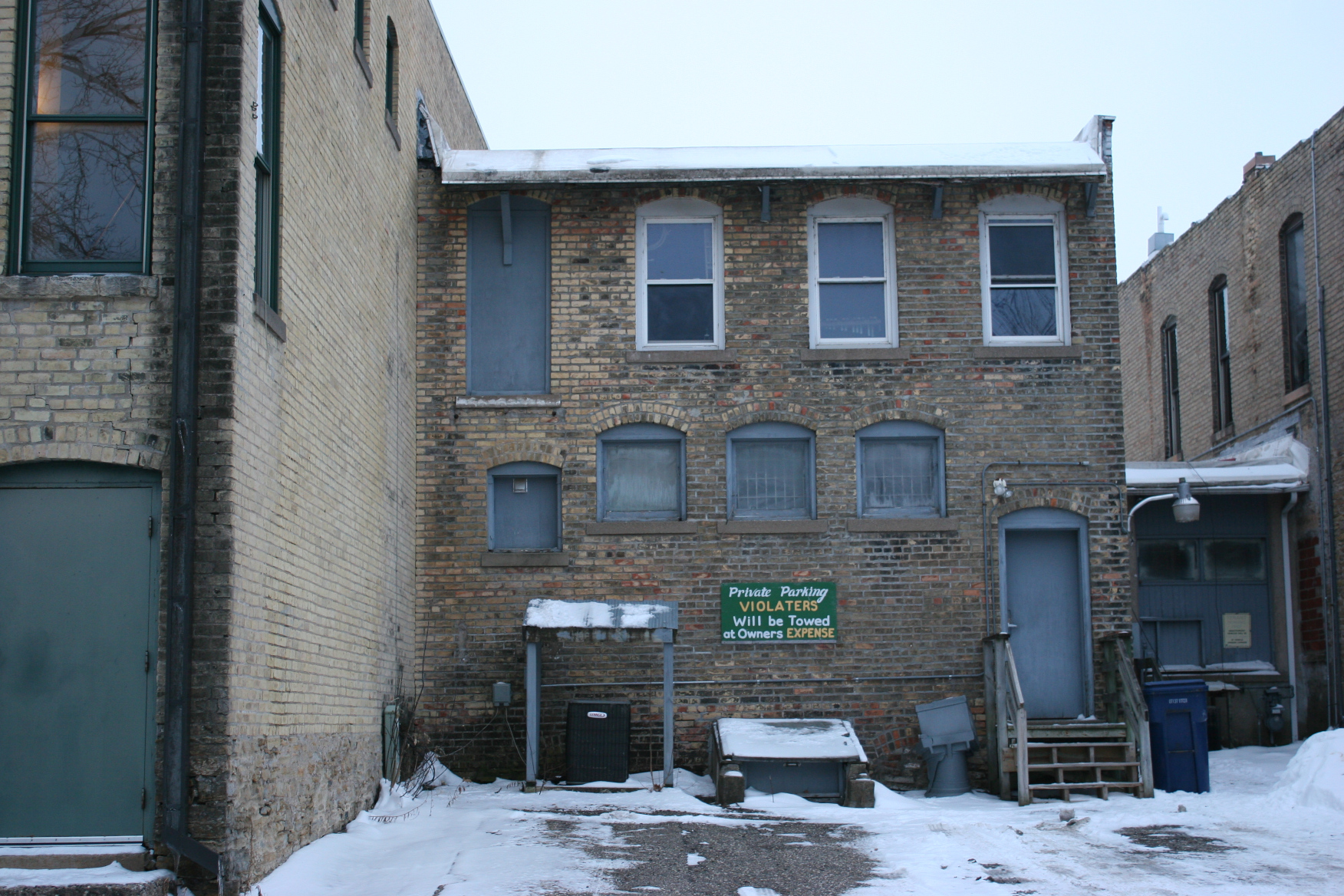
The backs of buildings can prove as interesting as the fronts. My eyes were drawn to the sign and to the brick buildings.
For the next 10 minutes, while Randy walked ahead of me—I always lag when I’m photographing—I concentrated on the half-block square area around me. The signs. The buildings. A woman and her dog. The river.
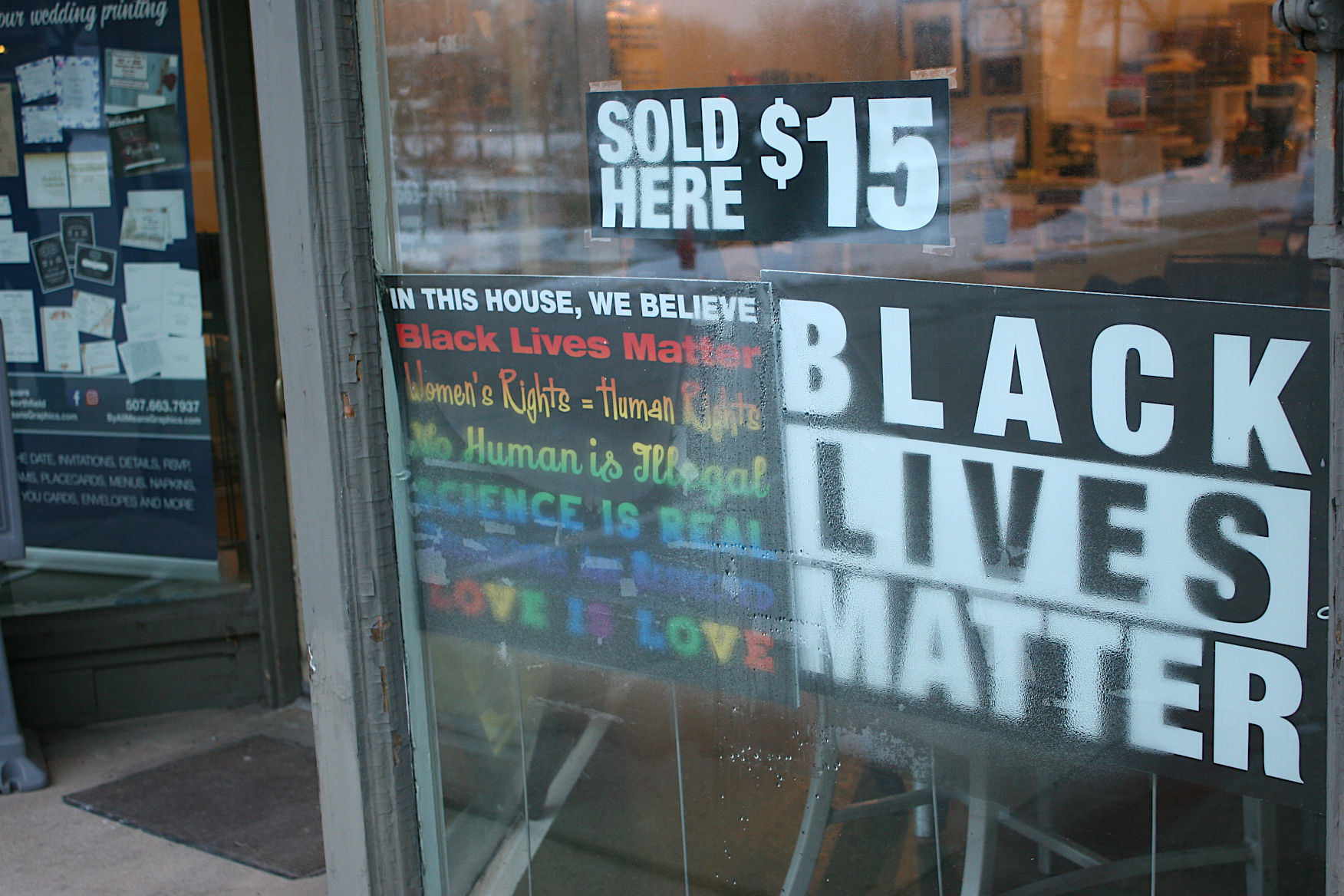
Northfield residents, businesses and students at its two colleges often express their viewpoints in publicly-posted signs and art.
In this short segment of time, I composed a short story, or at least the beginning of one. With these minimal images, I show you history, nature, voices. A glimpse in to the heart and soul of Northfield. This brings me joy, this ability to follow my passion, to share with you these visual stories through my photography.
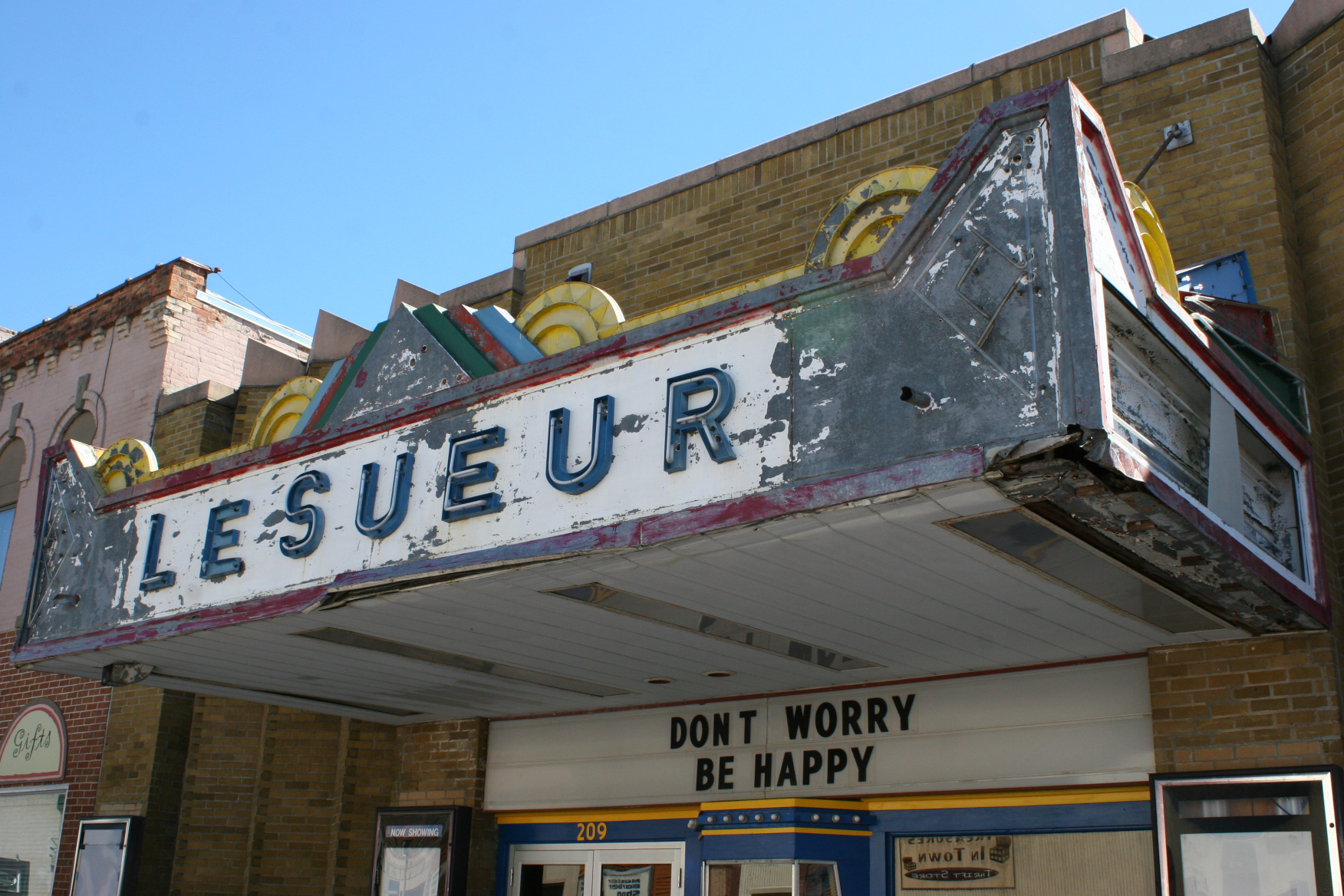
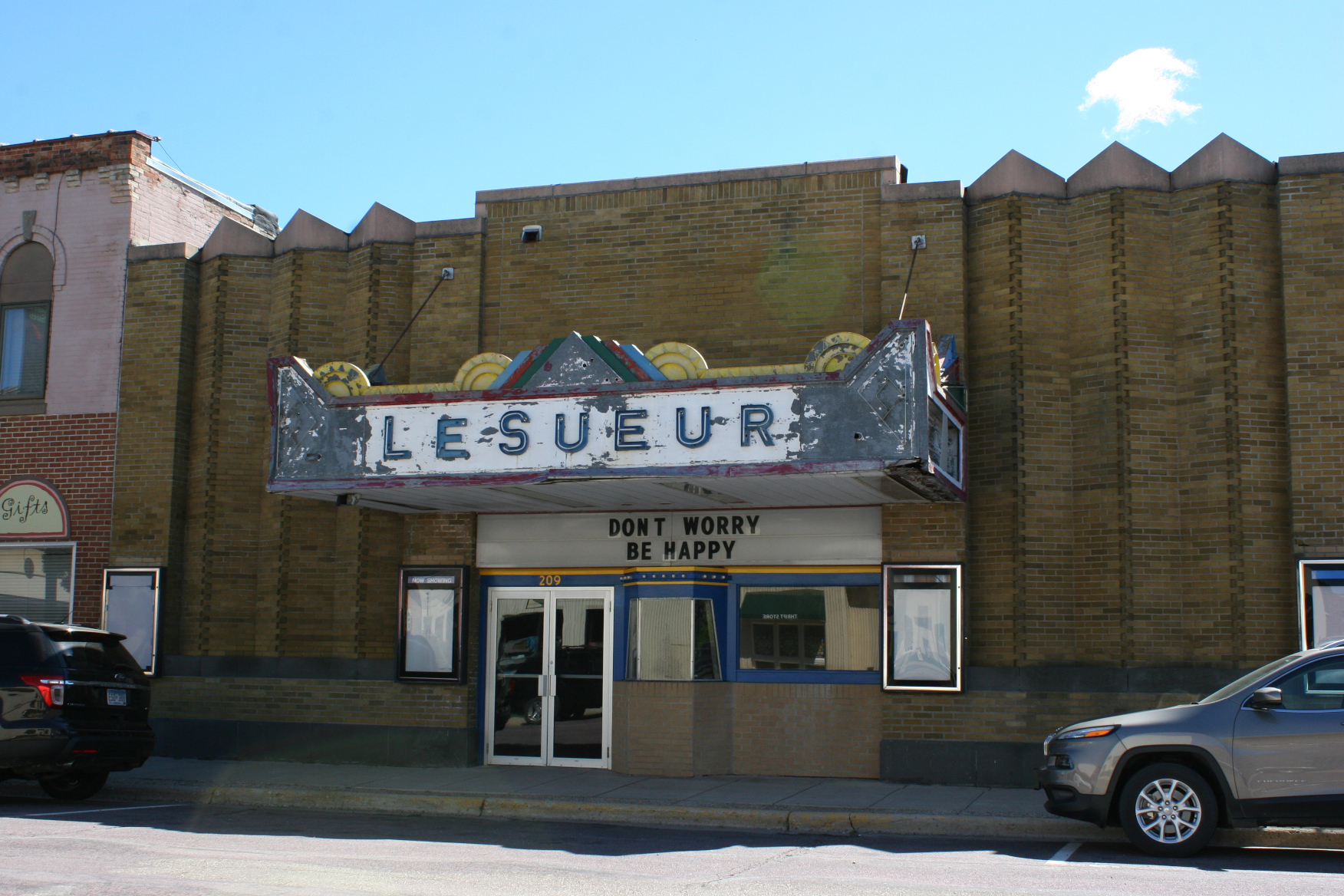
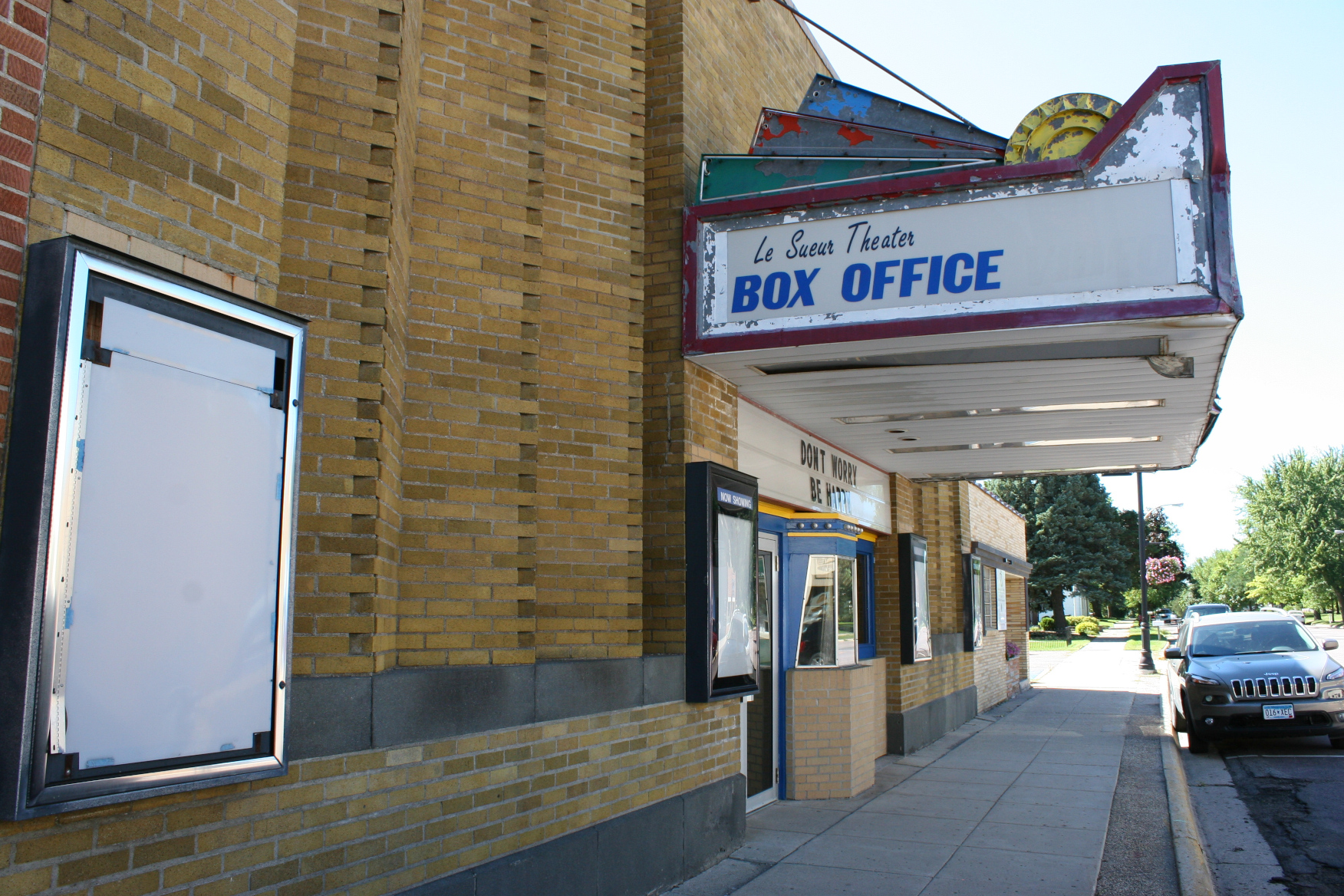
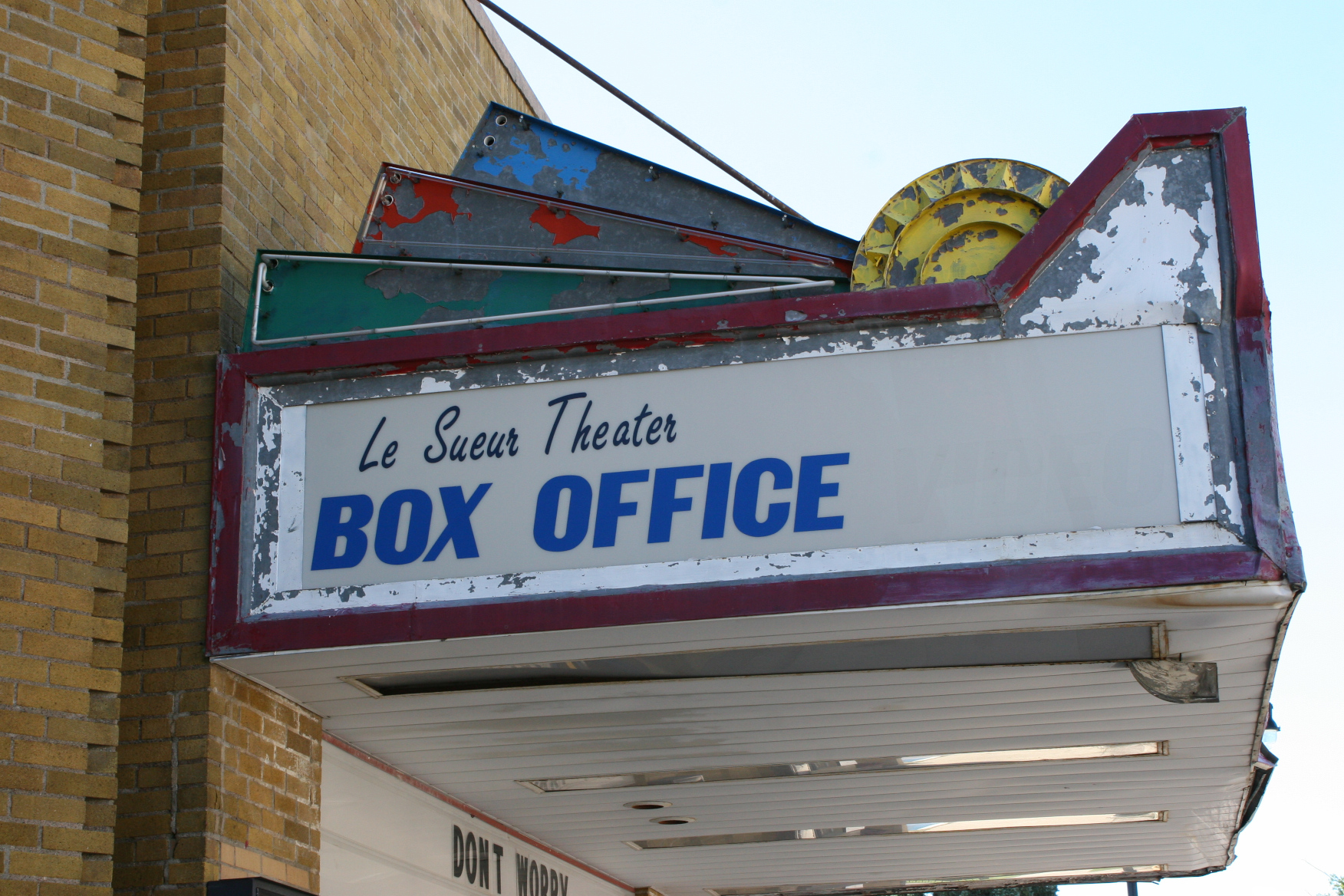
Posted on the marquee of the Le Sueur Theater. Minnesota Prairie Roots file photo August 2020.
DON’T WORRY. BE HAPPY.
Ah, what a message, one that, in these turbulent times, seems difficult to follow. Or even consider. Yet, focusing on the positives and joys in life feels more important than ever right now. Not that we should ignore the challenges—and there are many today—but rather balance them with also viewing the bright side of life.
Soon this marquee will be restored. Minnesota Prairie Roots file photo August 2020.
Don’t worry, be happy. Those words from the 1988 hit song by Bobby McFerrin make me smile all these years later. At the cheesy simplicity. At the thought that we can focus on the light of happiness even in the worries of darkness.
Photographed in August 2020 along Main Street South in Le Sueur. Minnesota Prairie Roots file photo.
With that, I shift to a series of photos I took in downtown Le Sueur in late August 2020. I typically fall behind in posting my images given all I shoot during the warm weather months here in Minnesota. Regardless, this seems the right time to pull these photos from the archives and share a bit of “happy.”
In the process of being restored in downtown Le Sueur. Minnesota Prairie Roots file photo August 2020.
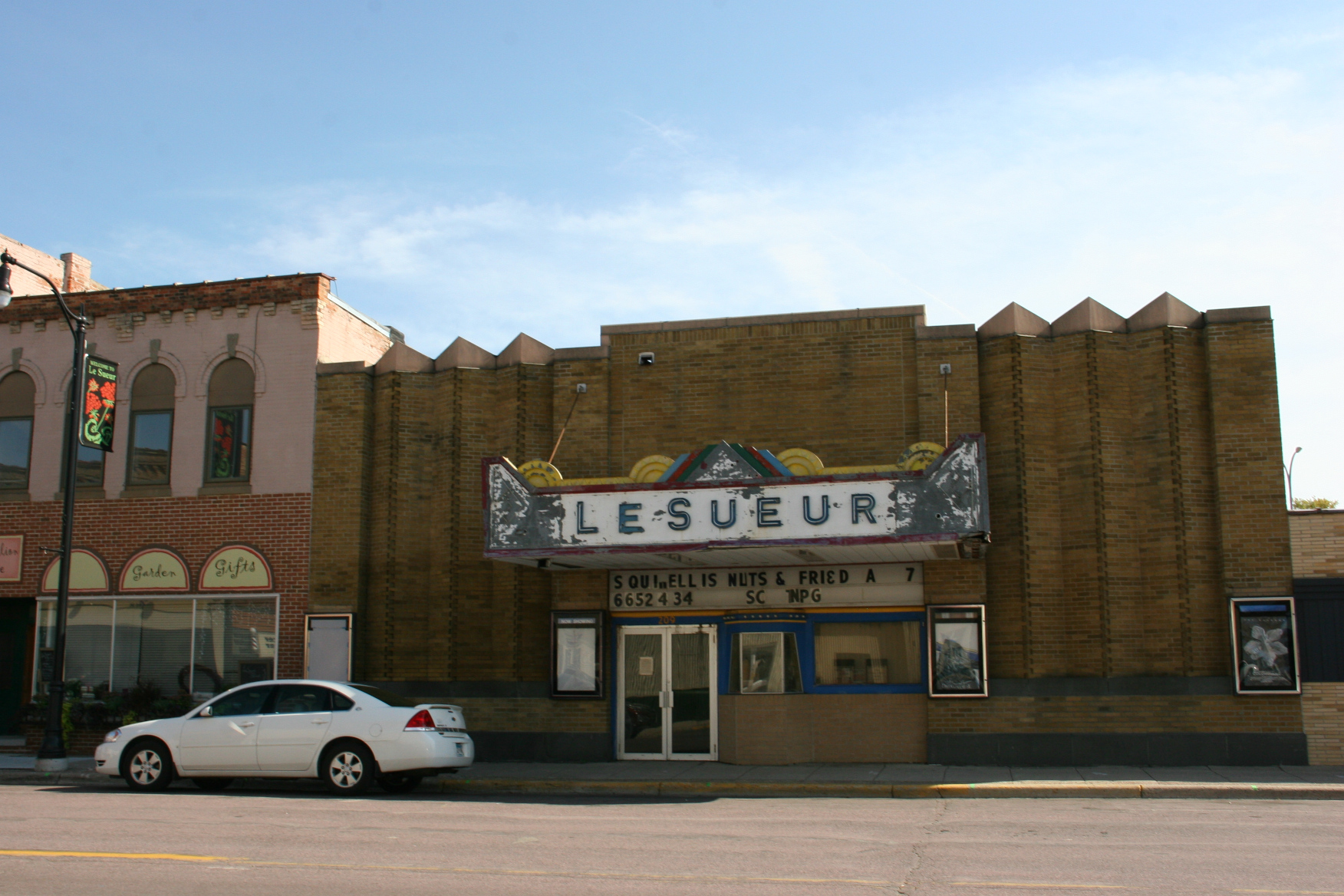
Before work began on the Le Sueur Theater. Minnesota Prairie Roots file photo October 2016.
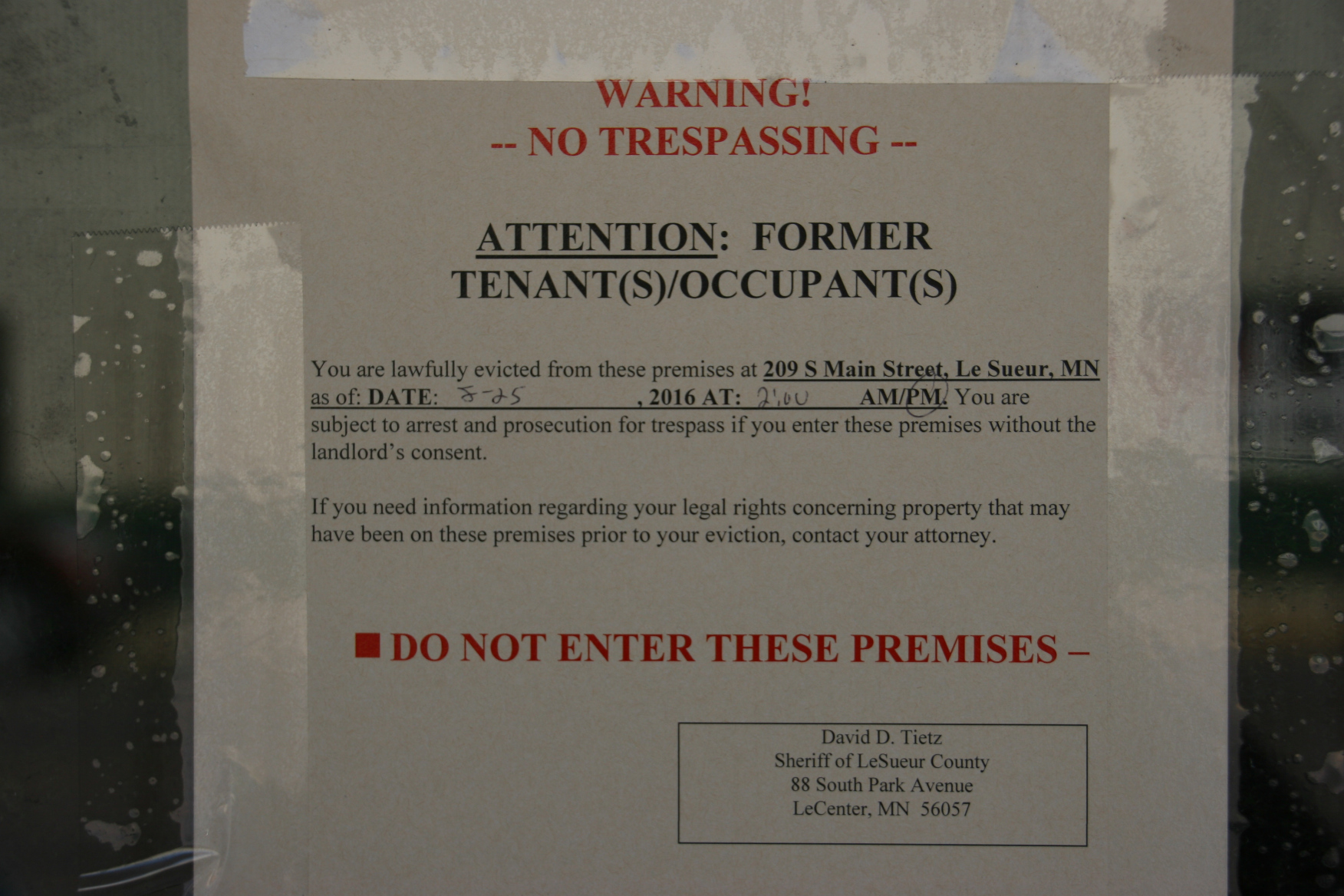
When I first photographed the theater in 2016, this eviction notice was posted on the door as the property went into foreclosure. Minnesota Prairie Roots file photo October 2016.
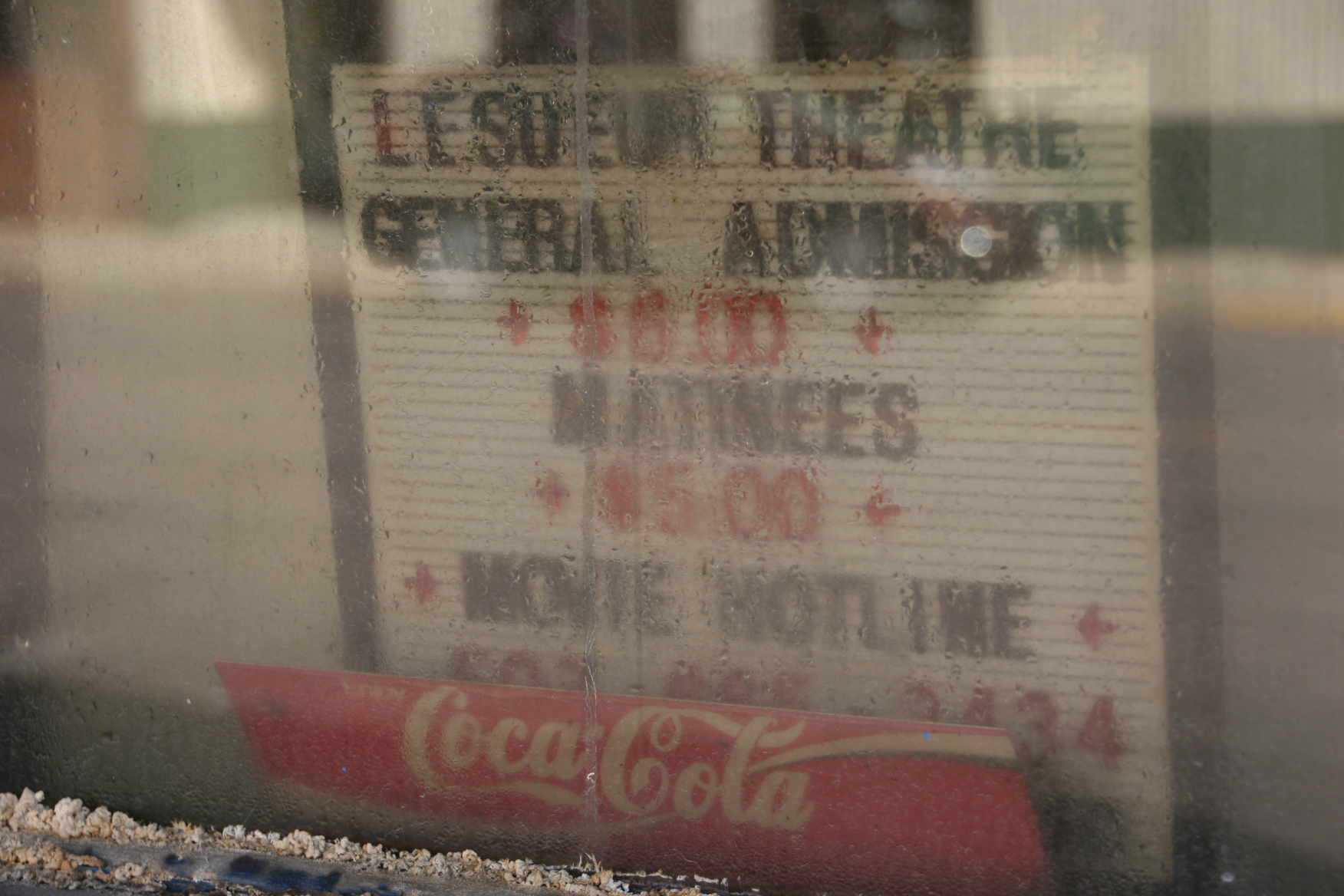
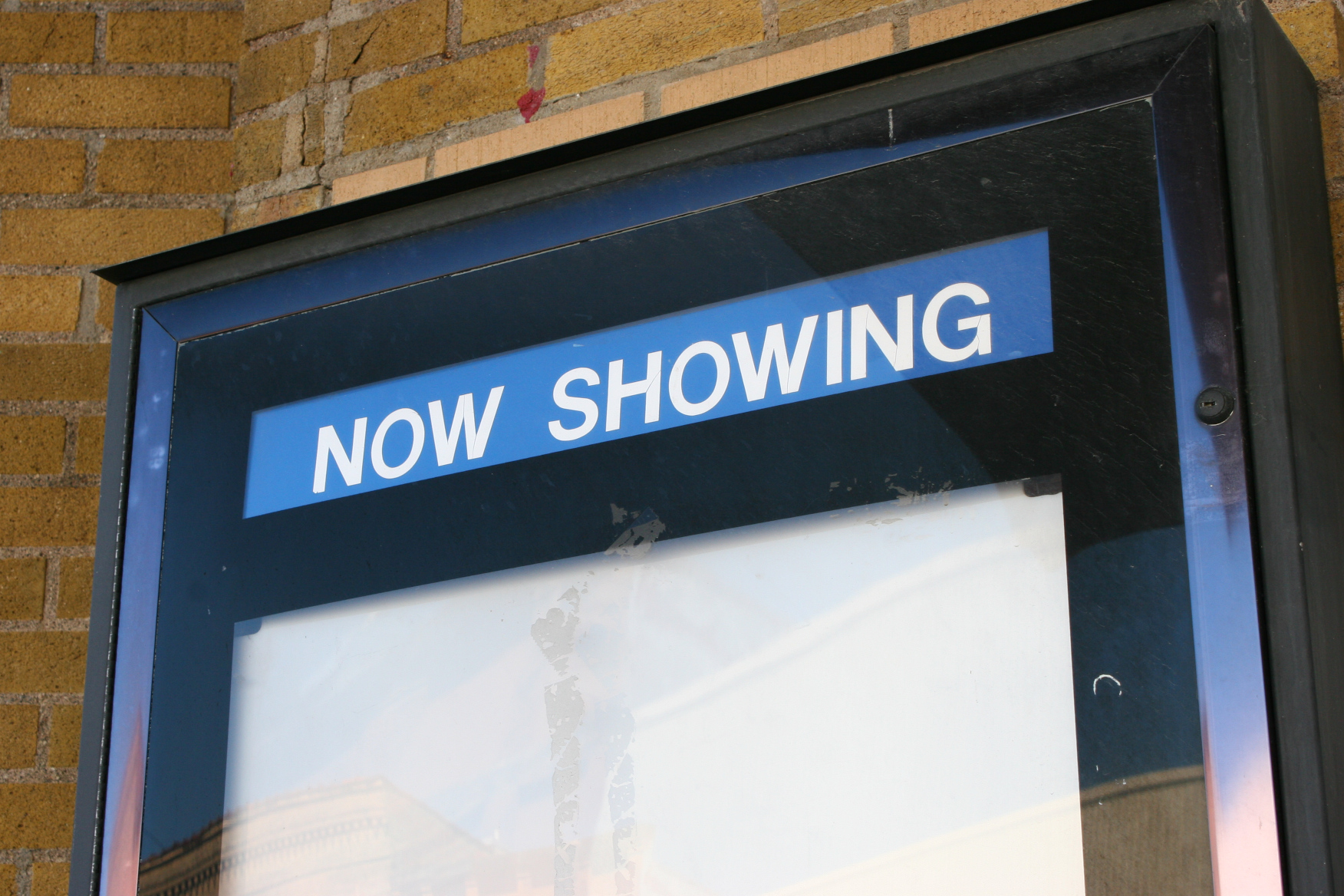
Signs of a once active movie theater. Minnesota Prairie Roots file photo October 2016.
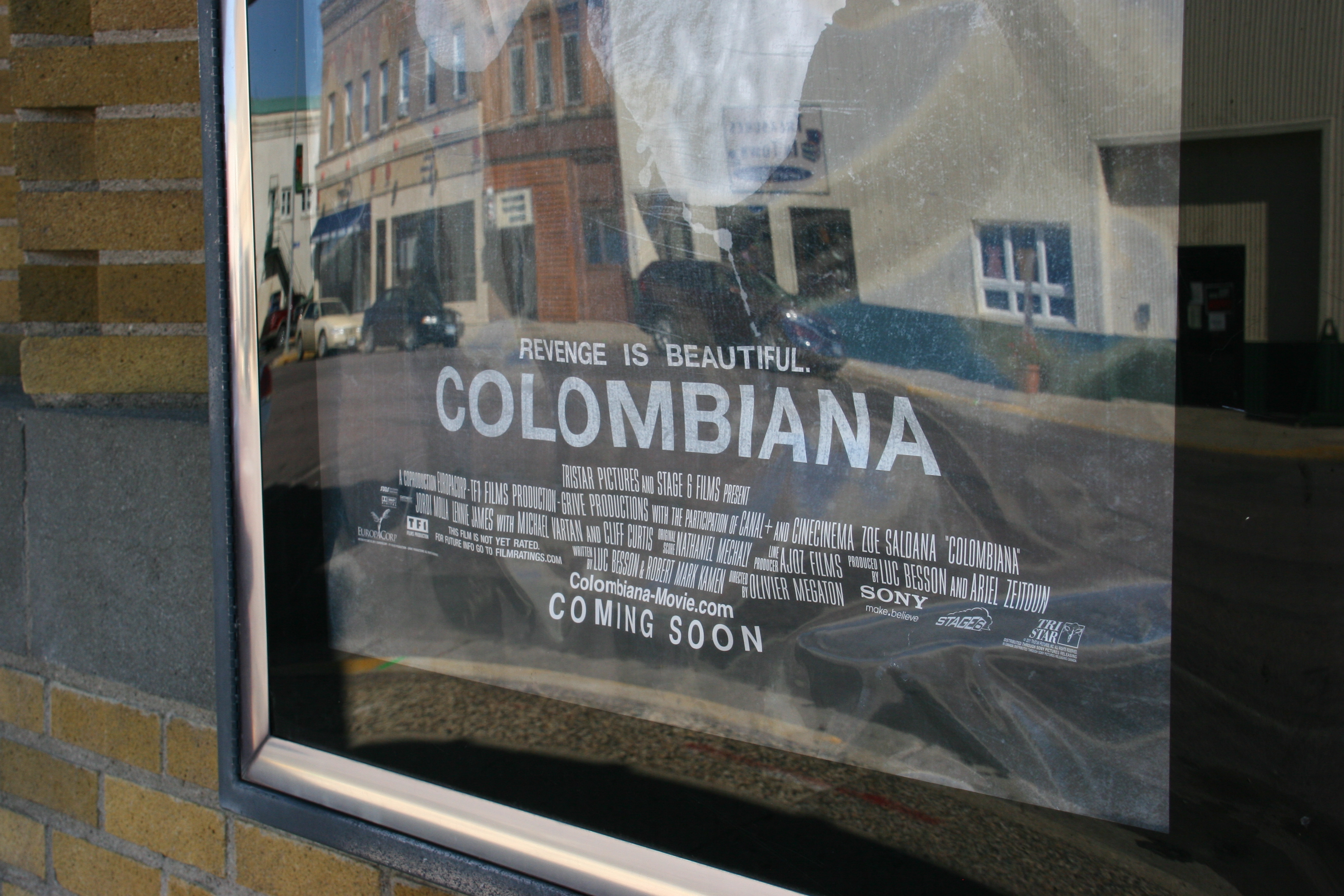
A movie poster still posted when I first photographed the theater in October 2016. Minnesota Prairie Roots file photo.
And so, while walking through the heart of downtown Le Sueur, I came across the vacant Le Sueur Theater and its once beautiful marquee. I remember photographing this theater previously and lamenting its abandonment. But then, while researching for this post, I discovered a reason to feel happy. Thankful, really.
I can only imagine how beautiful this marquee once its restored (or whatever it takes). Minnesota Prairie Roots file photo August 2020.
A side view of the Le Sueur Theater marquee. Minnesota Prairie Roots file photo August 2020.
Leading the project is Katie Elke of Le Sueur, who bought the building in 2016 and plans to reopen the theater for cinema, music, theatrical performances, comedy shows and other entertainment, making it a community gathering spot.
Some day this space will be filled with a new listing. Minnesota Prairie Roots file photo August 2020.
I love this plan. This idea. I’ve watched as my own community of Faribault restored an historic theater into the Paradise Center for the Arts, a center for arts, entertainment and more. That the good folks of Le Sueur and the surrounding area will now have a similar hub makes me happy. I recognize that this happens only with plenty of funding (Katie started a go fund me site), hard work and enthusiastic support. Some day I hope to step inside the restored Le Sueur Theater and show you how a plan, along with grit, determination, effort, money and a whole lot of happy can take an idea to reality. Even, and especially, during a global pandemic.
The weather on Saturday, November 7, was warm enough to put the top down on the convertible, this one driving along Rice County Road 45 toward Medford.
WITH SNOW LAYERING the ground as I write this several days before publication and with the furnace cranking out heat to stave off the cold, warmer days seem but a distant memory. But not that long ago, on November 7 and 8, we were enjoying warm temps and sunshine here in southern Minnesota. And my photos document that.
Before the recent snow, fallen leaves defined the lawn at the Medford City Park.
On that recent weekend, Randy and I finished raking and hauling leaves to the compost pile on Saturday morning. Then we packed a picnic lunch with intentions of an afternoon wandering through rural Minnesota with no specific destination. One of our Sunday afternoon drives, except on a Saturday. Only briefly did we discuss staying home to wash windows. Nope, the weather was too nice and we wanted to enjoy the afternoon. In Minnesota we recognize such beautiful November days as rarities to savor in time spent outdoors. Playing, not working.
So we gased up the van and then headed south on the back county road to Medford. A few miles from Faribault, we heard a clunk and Randy realized he’d left the gas cap at the gas station. We retraced our route, retrieved the cover and restarted our leisurely drive. I was a bit irritated with the husband for forgetting the gas cap. More on that later.
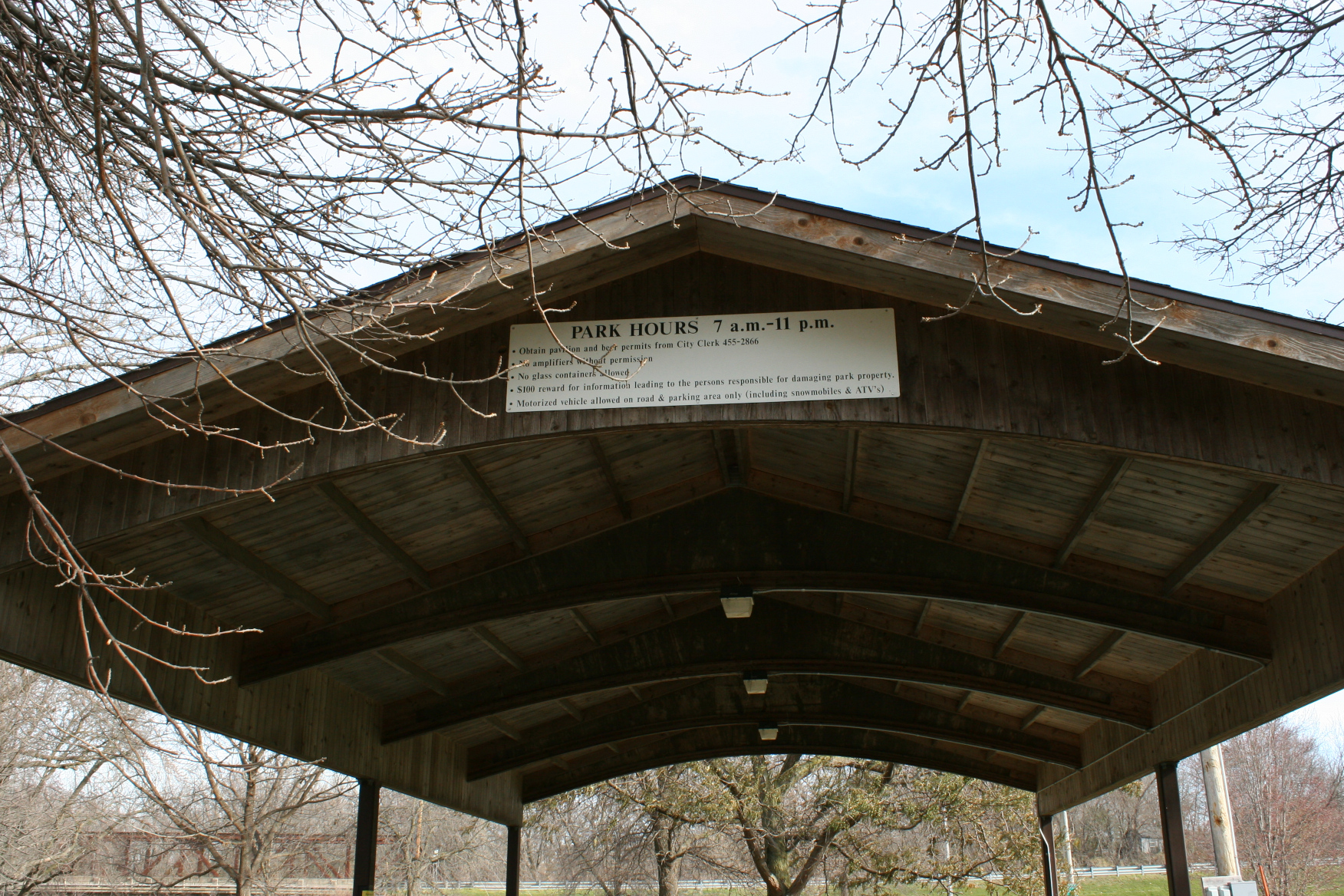
An artsy roofline on the shelter where we ate our picnic lunch.
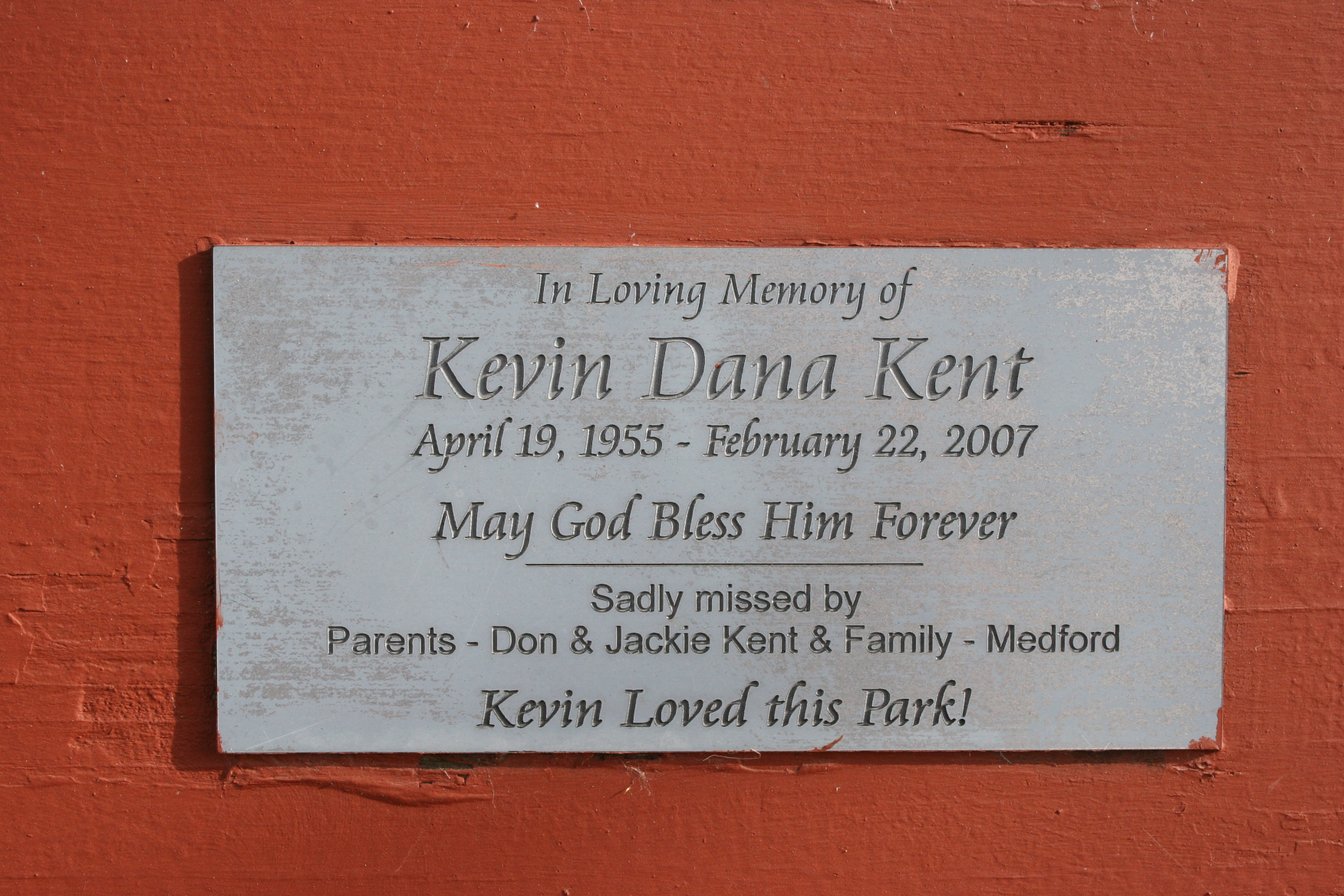
A plaque on a bench: Kevin loved this park!
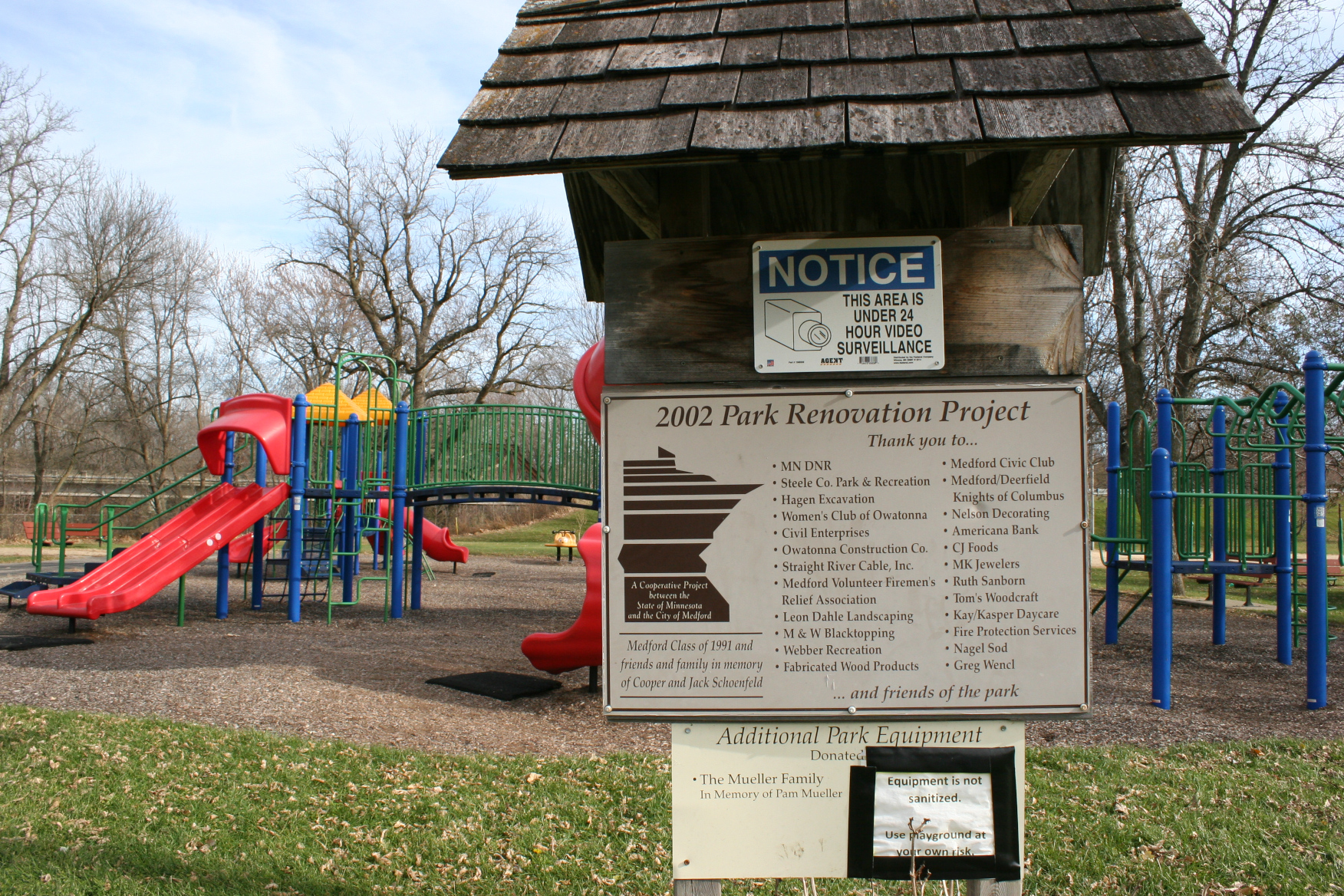
The expansive playground next to the shelterhouse.
By the time we reached Medford, it was past noon and we were both hungry for that picnic lunch. So we pulled into the city park along the Straight River, settled in at a picnic table inside a wind-whipped shelter and watched kids on the playground while we ate our sandwiches.
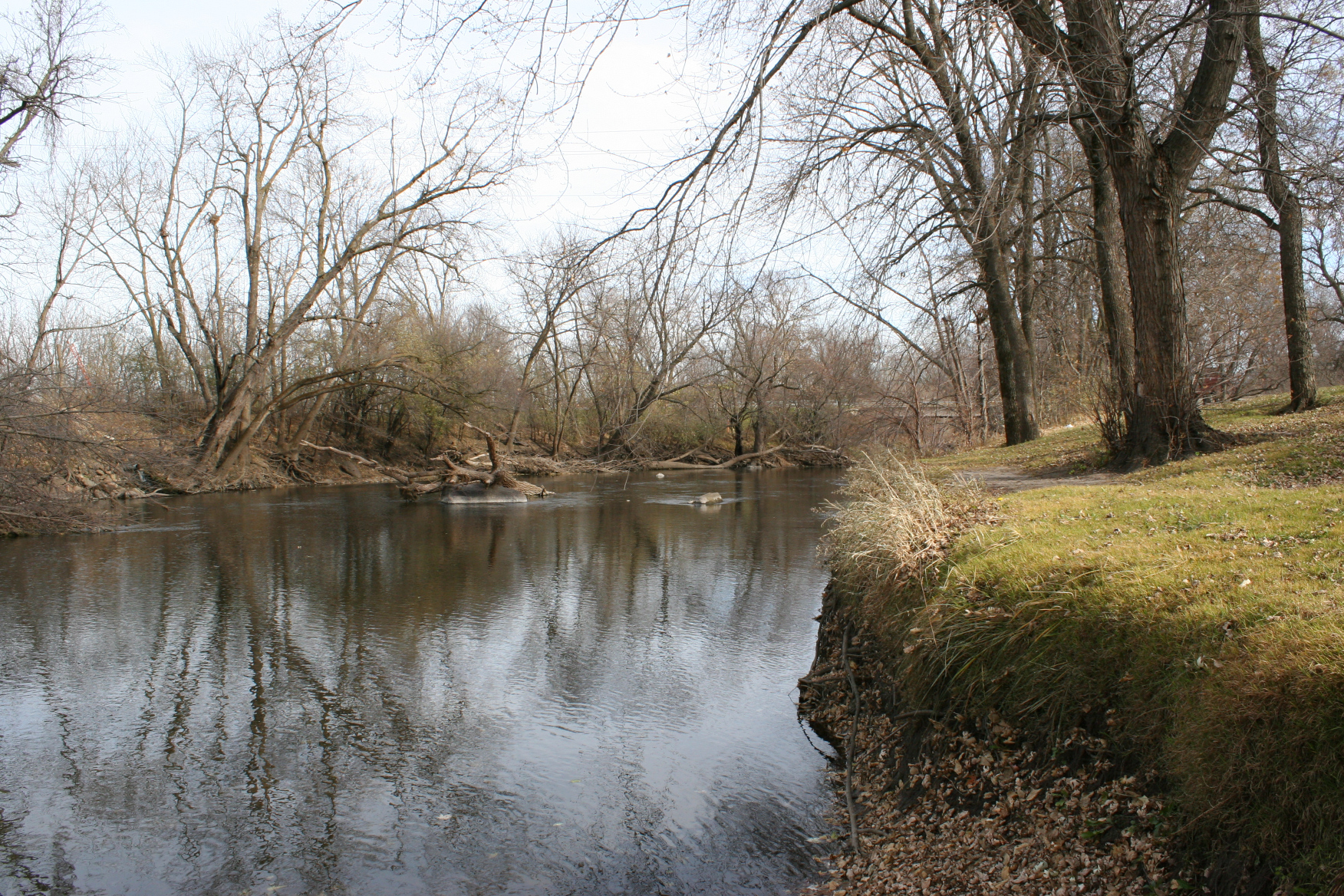
The Straight River winds past the park.
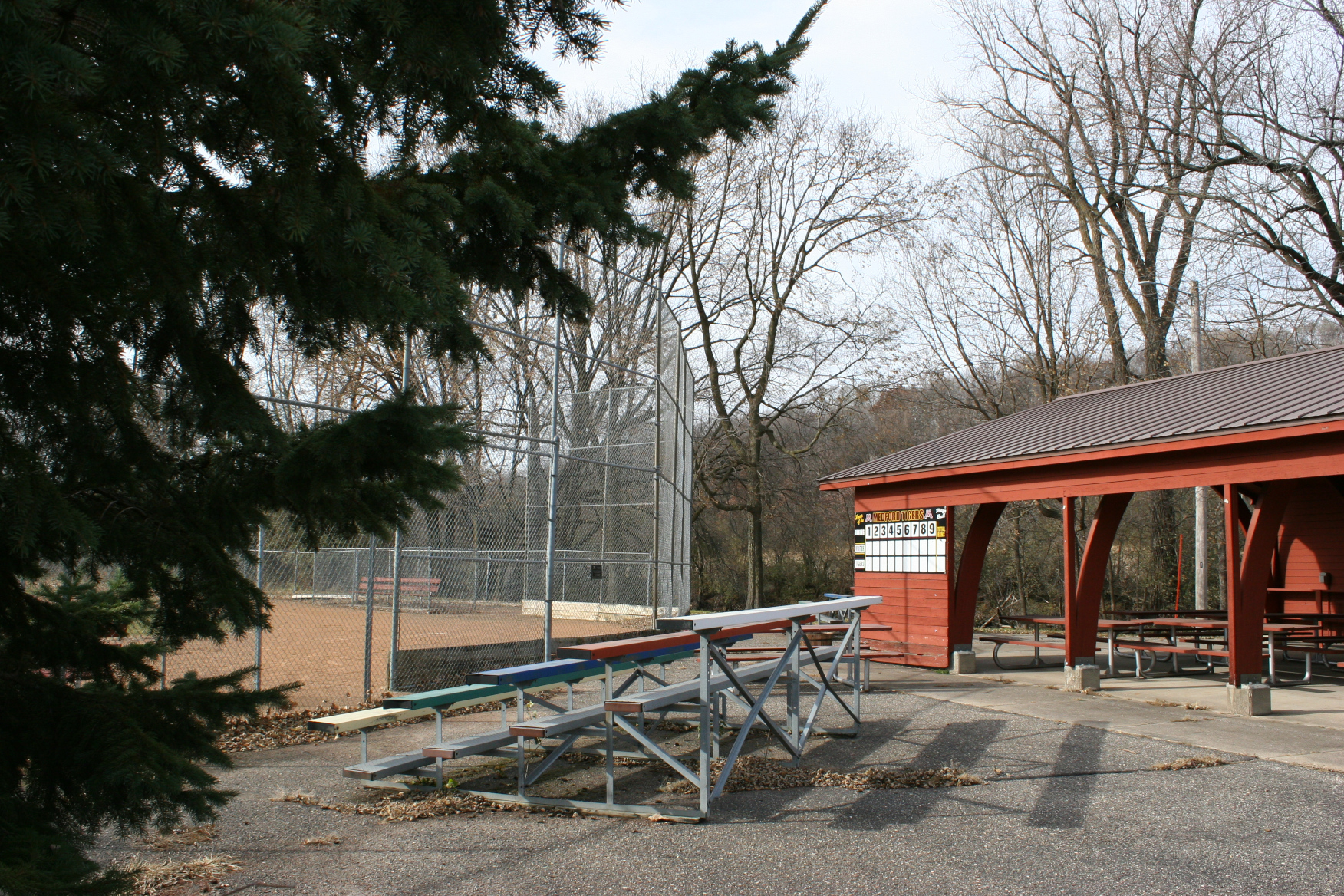
The second shelter sits by the ballpark.
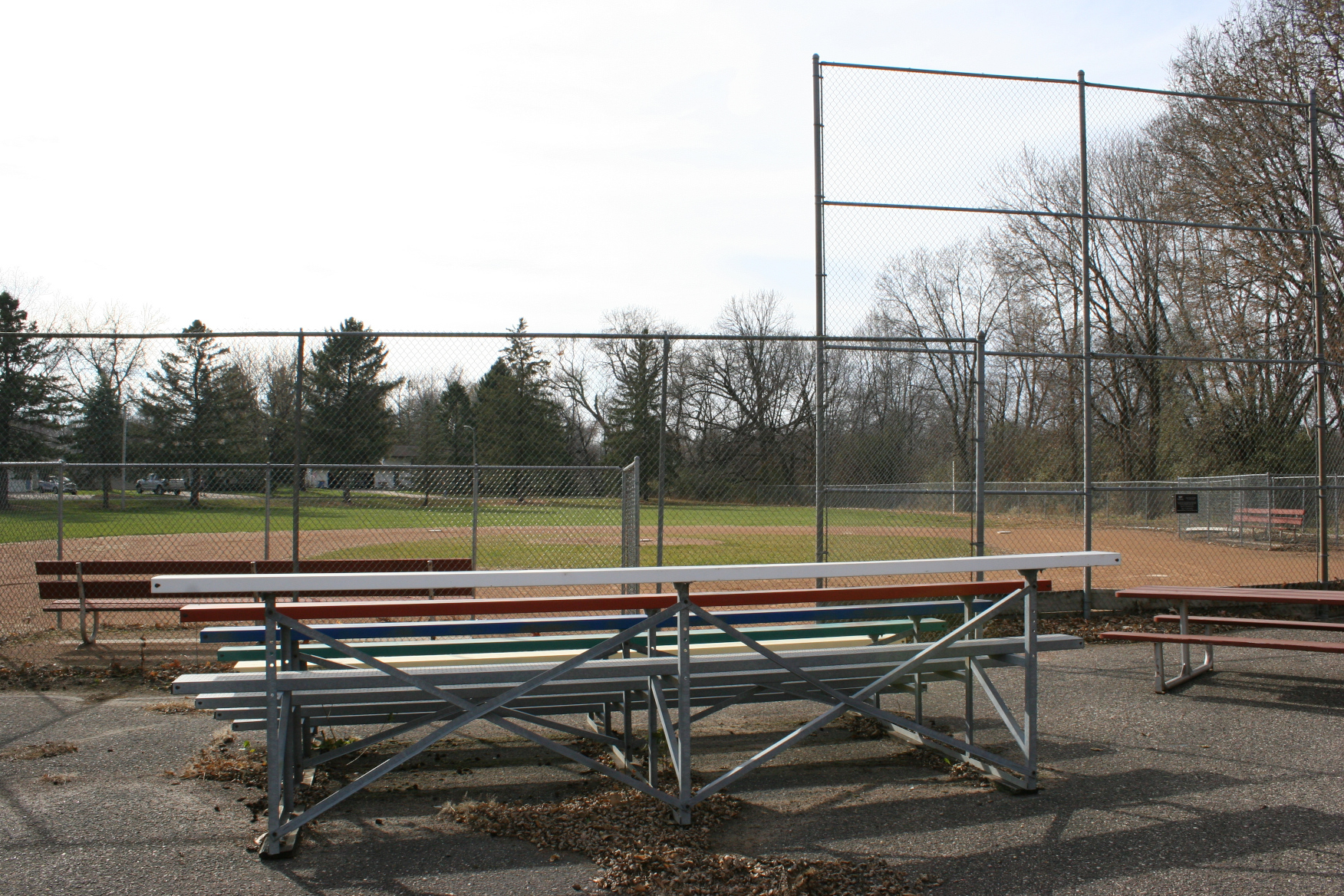
A view of the ball field.
Afterward, we walked around the park for a bit, down to the banks of the Straight River, around the ballpark and then back to the van. After more photos—I can always find something interesting to photograph—we were on our way.
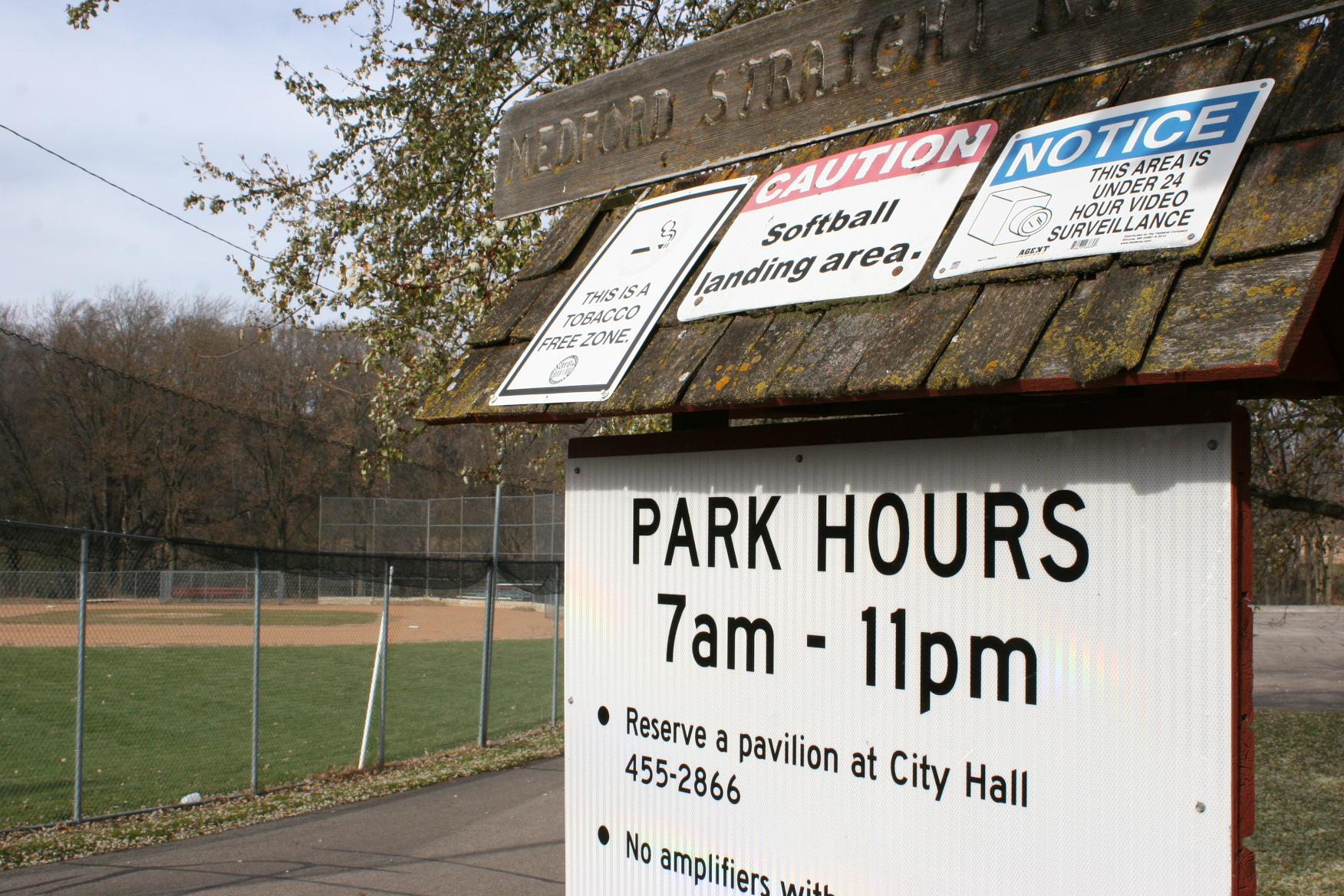
I laughed at this sign, at the “softball landing area” warning.
Except we weren’t. Two blocks from the park, the power steering went out in the van. The engine light flashed on. Gauges indicated overheating. Randy switched off the van, lifted the hood and investigated. At times like this, I am thankful for a husband who has worked as an automotive machinist for decades and is extremely knowledgeable in diagnosing and dealing with vehicle issues.
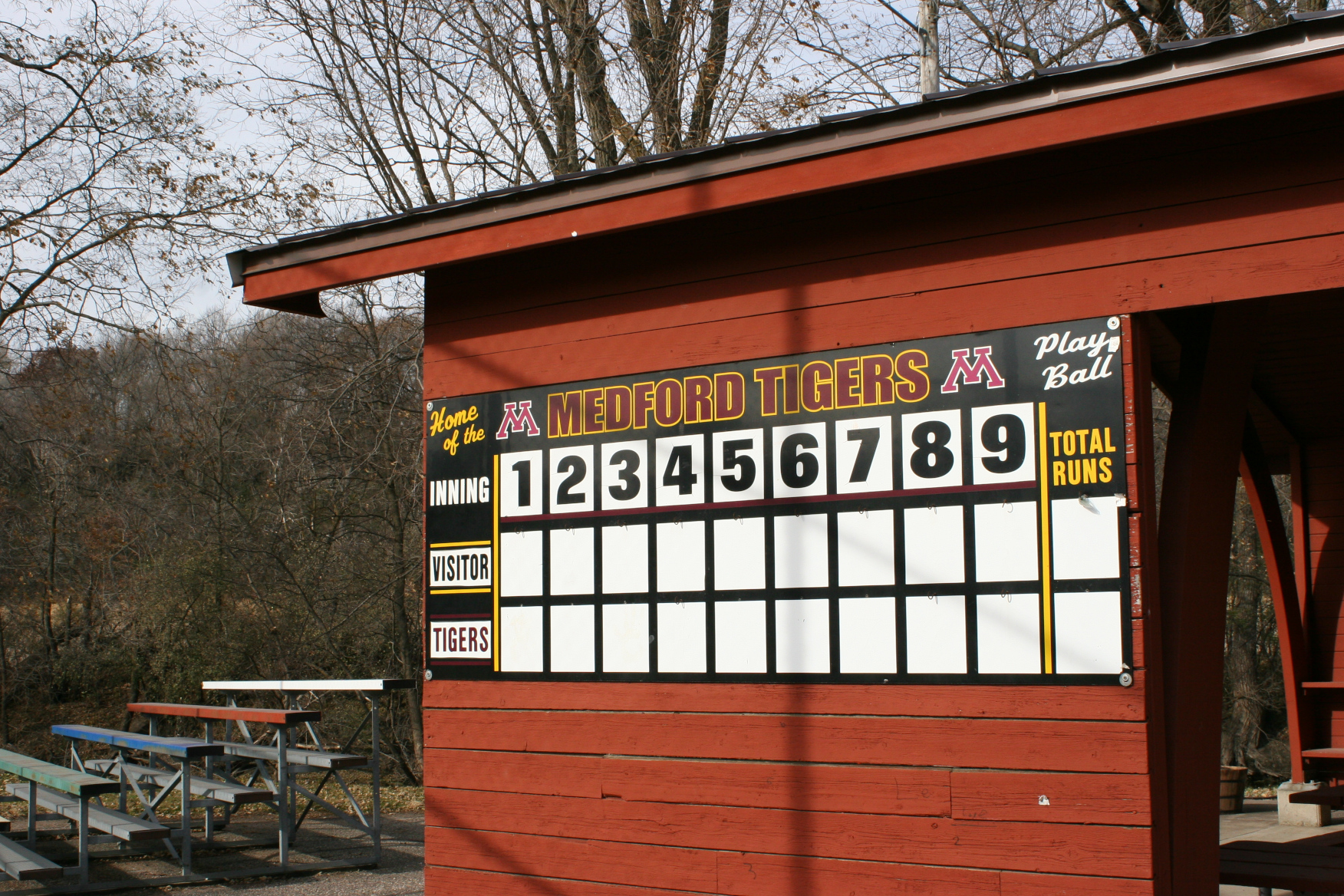
I love small town scoreboards like this with character.
I suggested we call a tow truck. Randy insisted we could make it home to Faribault. If the engine didn’t overheat. I was skeptical. Half-way back, he noted that the engine was getting hotter. Long story, but we pulled into friends’ rural property (they weren’t home) and waited about 45 minutes for the engine to cool. Back on the road, with only miles to go, Randy cut the engine at the top of a hill. The van then coasted the final miles into Faribault. At a stop sign, Randy restarted the van to get the remaining blocks home. We made it. Who would have thought?
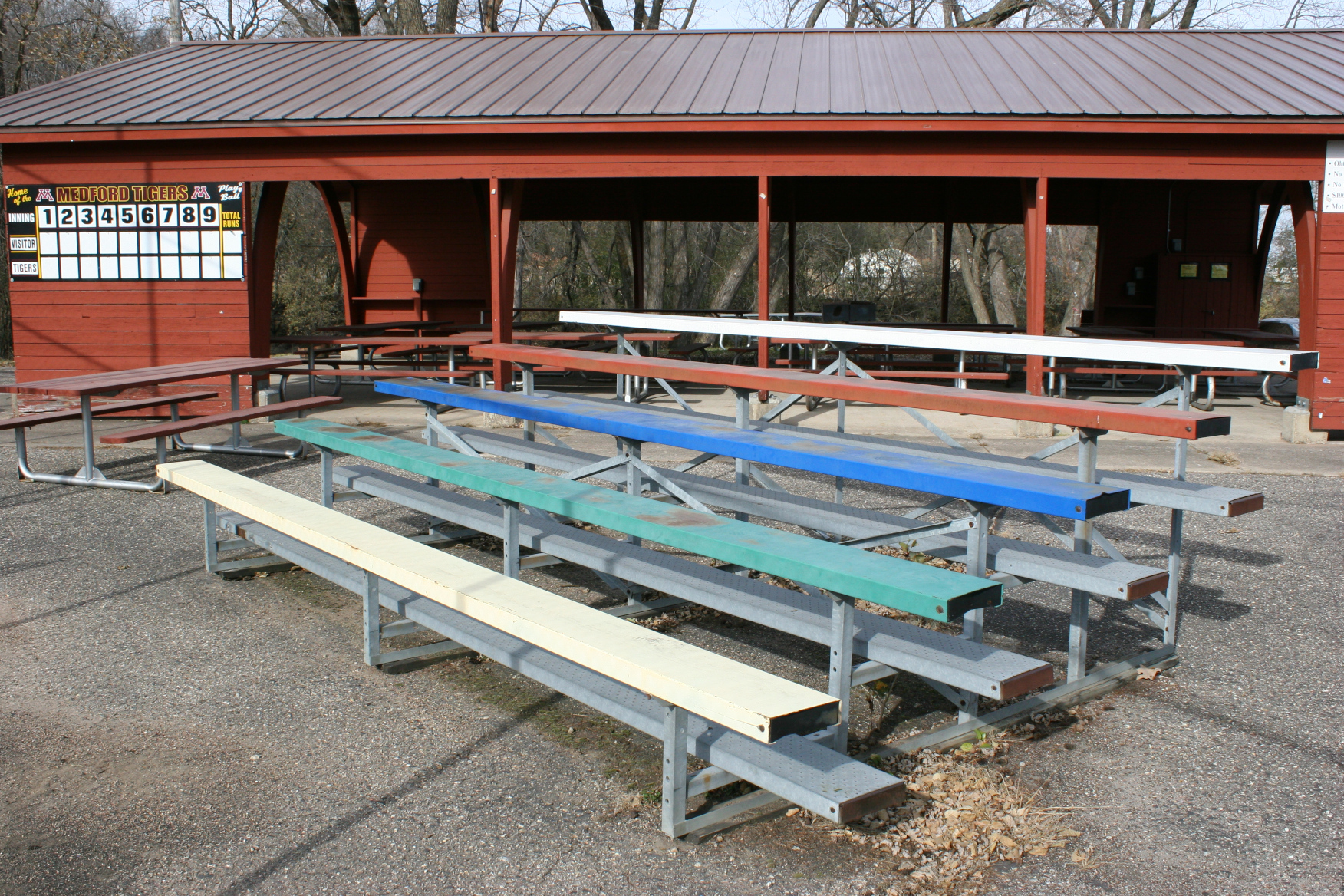
Love the colorful bleachers…
So much for that planned afternoon outing. Randy was now out in the garage, back under the hood, rooting out the problem. He diagnosed a broken spring inside the tensioner. That caused the belt to come loose which caused the subsequent issues. A trip to the parts store and about an hour later, he had fixed the van.
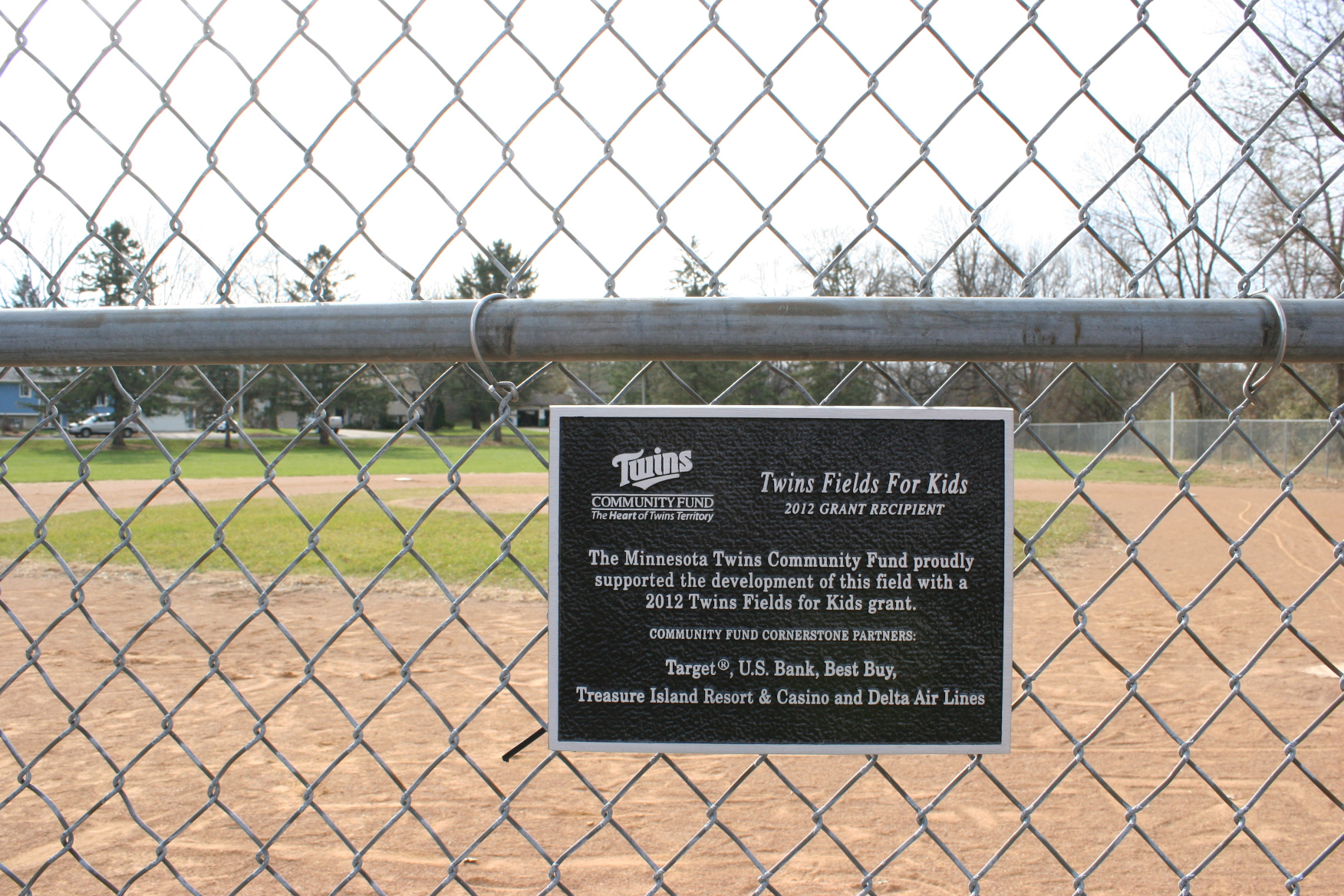
Posted on the ball field fence. Small towns have a knack for finding creative ways to fund projects.
But here’s the deal. Remember that forgotten gas cap and the irritation I felt over Randy’s forgetfulness? Well, if he hadn’t left the cover, we would have been further down the road, probably to Owatonna. And those extra miles likely would not have allowed us to get the van back home on our own. So, yeah, sometimes when little things like this happen and delay our best-laid plans, it’s for a reason. Lesson learned. On a beautiful day in early November in Minnesota.
One of the many inspiring signs posted in the Atwood Neighborhood of Madison, Wisconsin. Minnesota Prairie Roots file photo.
SIGNS. I FIND THEMINTRIGUING. Interesting. Telling. A way to communicate a message, a thought, an idea.
I think we can all agree, though, that during this election year, sign overload exists. Political signs clutter yards and buildings, even vehicles and sides of roadways. It’s visually overwhelming at times.
Photographed in Kenyon, Minnesota, on Sunday, October 22.
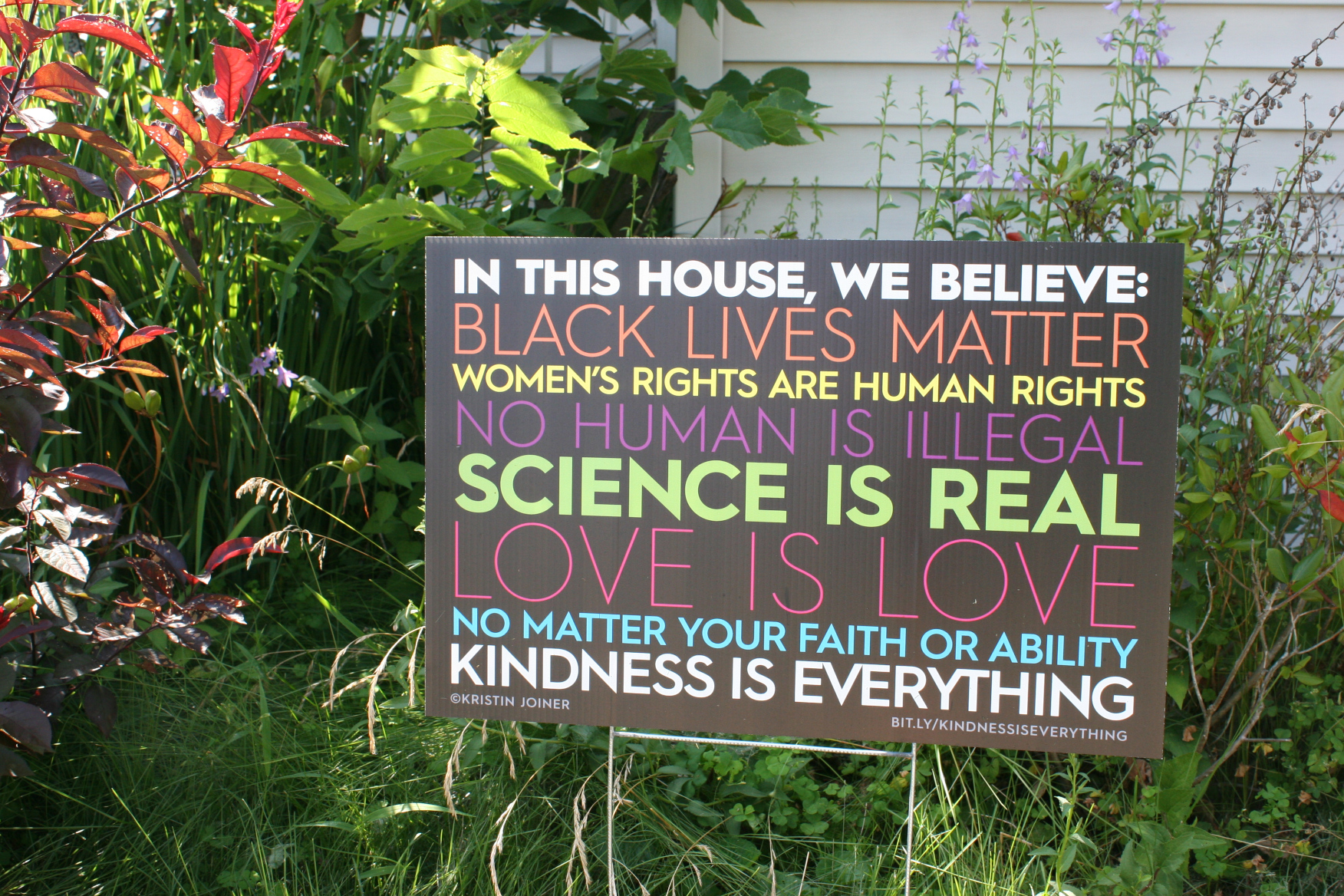
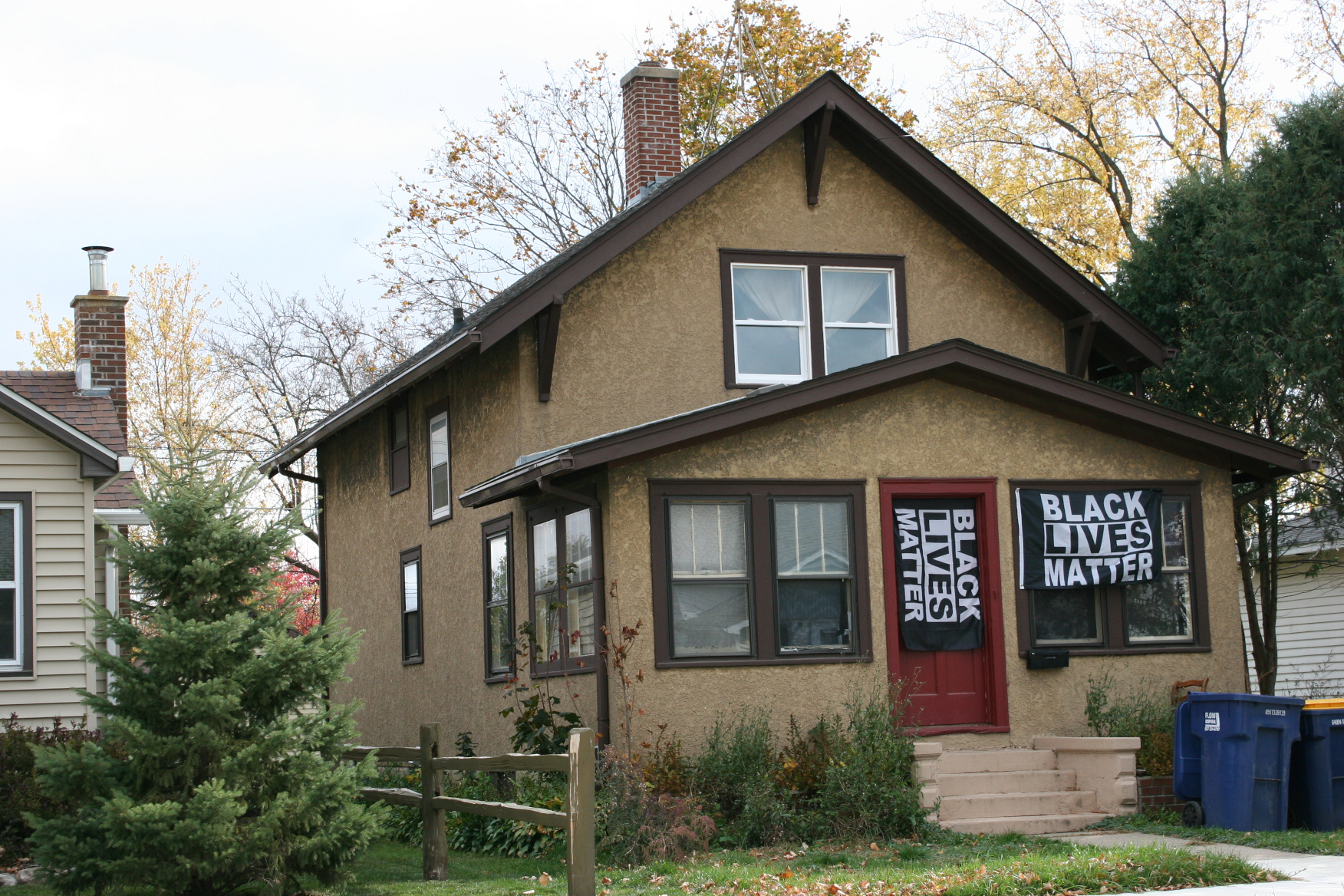
But some especially meaningful signs have emerged, signs that convey ideas rather than banner a candidate’s name. Those I appreciate because they prompt thought. And that includes the BLACK LIVES MATTER signs I’ve seen, some in Rice County (especially in Northfield), many in the Atwood Neighborhood of Madison, Wisconsin, and, just last week, two posted on a modest house in Kenyon.
I often wonder about the stories behind those posting the BLACK LIVES MATTER (or similar “issue”) signs. Did a personal experience prompt someone to share their views in such a public way? Or rather do they simply believe so strongly in something that they opt to freely express their opinion via signage? Maybe both. It doesn’t matter. What matters is that they care about this social justice issue, this human issue really. Even in small towns like Kenyon, population around 1,800.
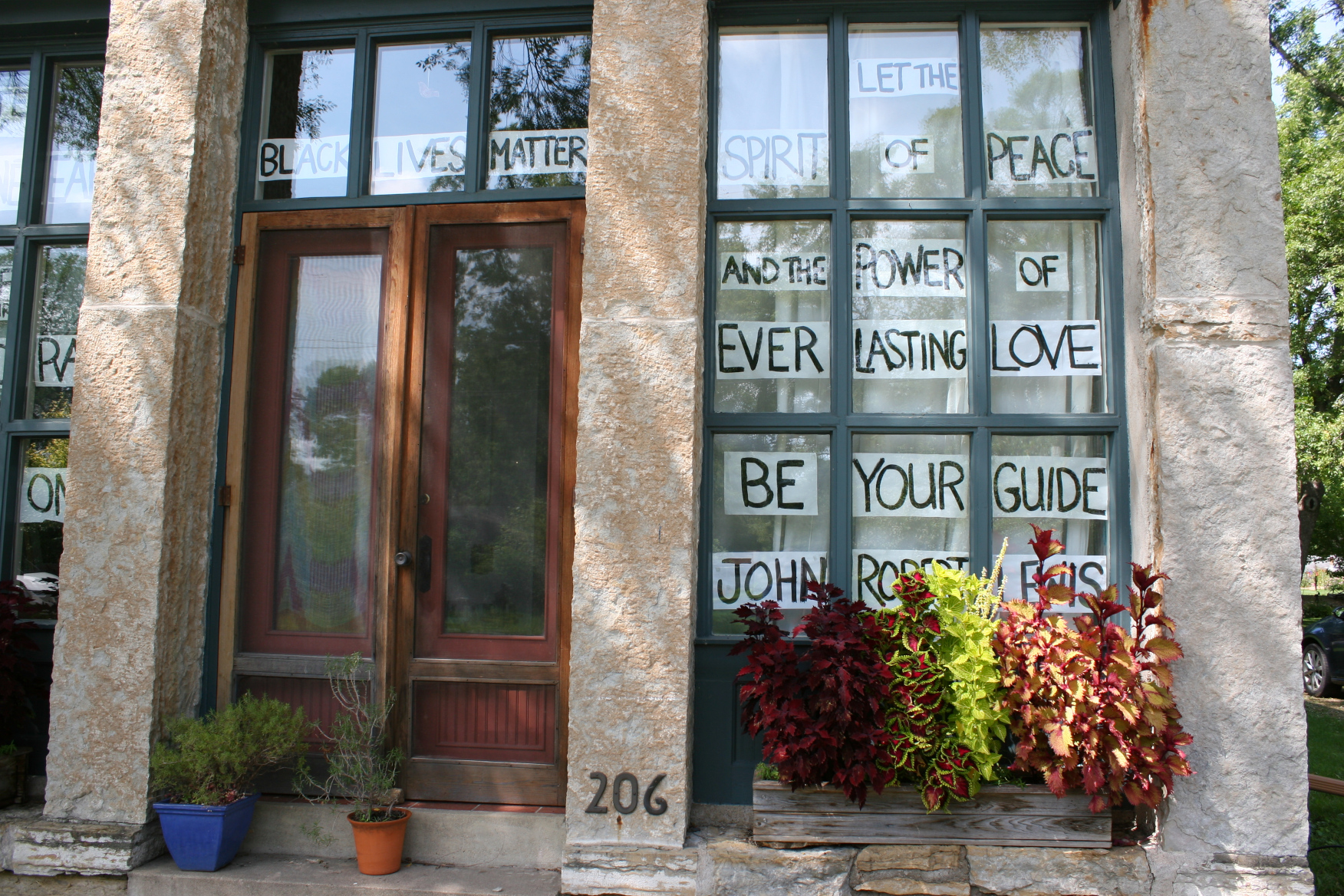
Messages on a house in small town Dundas, Minnesota. Minnesota Prairie Roots file photo August 2020.
I recognize that, when you live in a small community (under 5,000 by my definition), everyone pretty much knows everyone. If you hang a sign like BLACK LIVES MATTER on your front door and porch windows, everyone in town will know. There is no anonymity. You could quickly become the subject of coffee talk or rumors or whatever people choose to circulate. I’m not saying this is the case in Kenyon, just making a general observation.
Posted in the “Selma to Montgomery” exhibit. Minnesota Prairie Roots file photo 2015.
Whatever, at least people will be thinking. Maybe even engaging in meaningful and respectful conversations that promote understanding and healing. Bring fairness and equality. In the current divisive environment, I recognize that’s not easy to achieve. But we must keep trying.
The grain elevator complex in Zumbrota, a busy place especially during the fall harvest. Minnesota Prairie Roots file photo October 18, 2020.
TOO OFTEN THESE DAYS, I feel discouraged by all the discord in our country, by the selfishness and lack of care for others.
But then I discover something that lifts my spirits and reaffirms my belief in our goodness, our ability to help one another, to think beyond ourselves and our needs to those of the people around us.
This is the story of such a discovery. Of goodness and kindness and care for those we call our family, neighbors, friends. Or strangers. And this I found in Zumbrota, a small town about a 45-minute drive east of Faribault.
On a recent Sunday afternoon drive through the Zumbro River Valley of southeastern Minnesota, Randy and I stopped in Zumbrota for a picnic lunch, or what was supposed to be a picnic lunch. The weather, only in the 30s and blustery, proved too cold for outdoor dining. We opted to eat in the van while parked outside the public library.
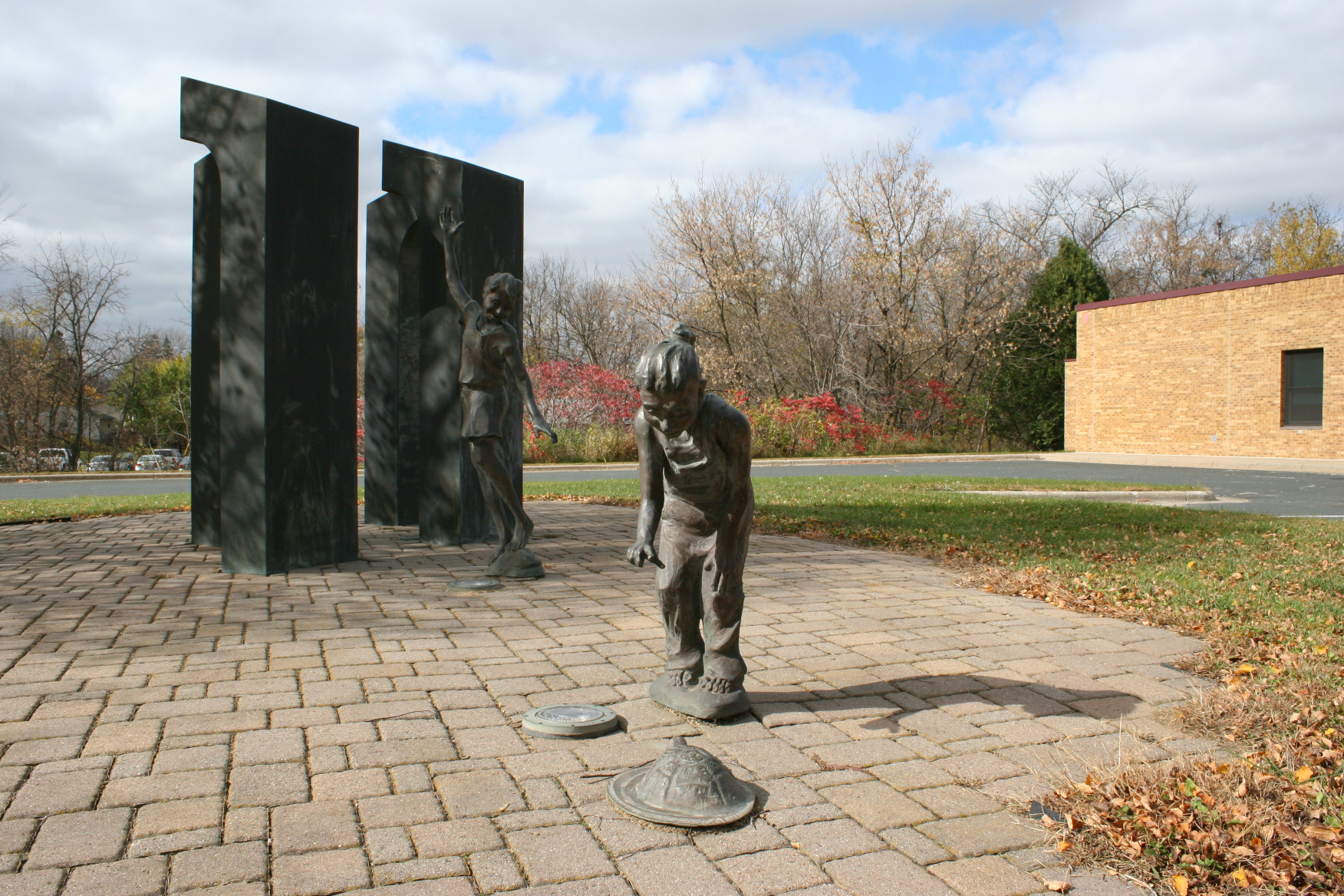
“Heritage of Promise” by Jeff Barber. A third sculpture of a child is not included in this photo.
Directly in our line of vision stood a sculpture of children near a structure, which I soon determined to be an artistic interpretation of an historic covered bridge on the other side of the library. I planned, upon finishing my sandwich, grapes and protein bar, to photograph the art and then we would be on our way.
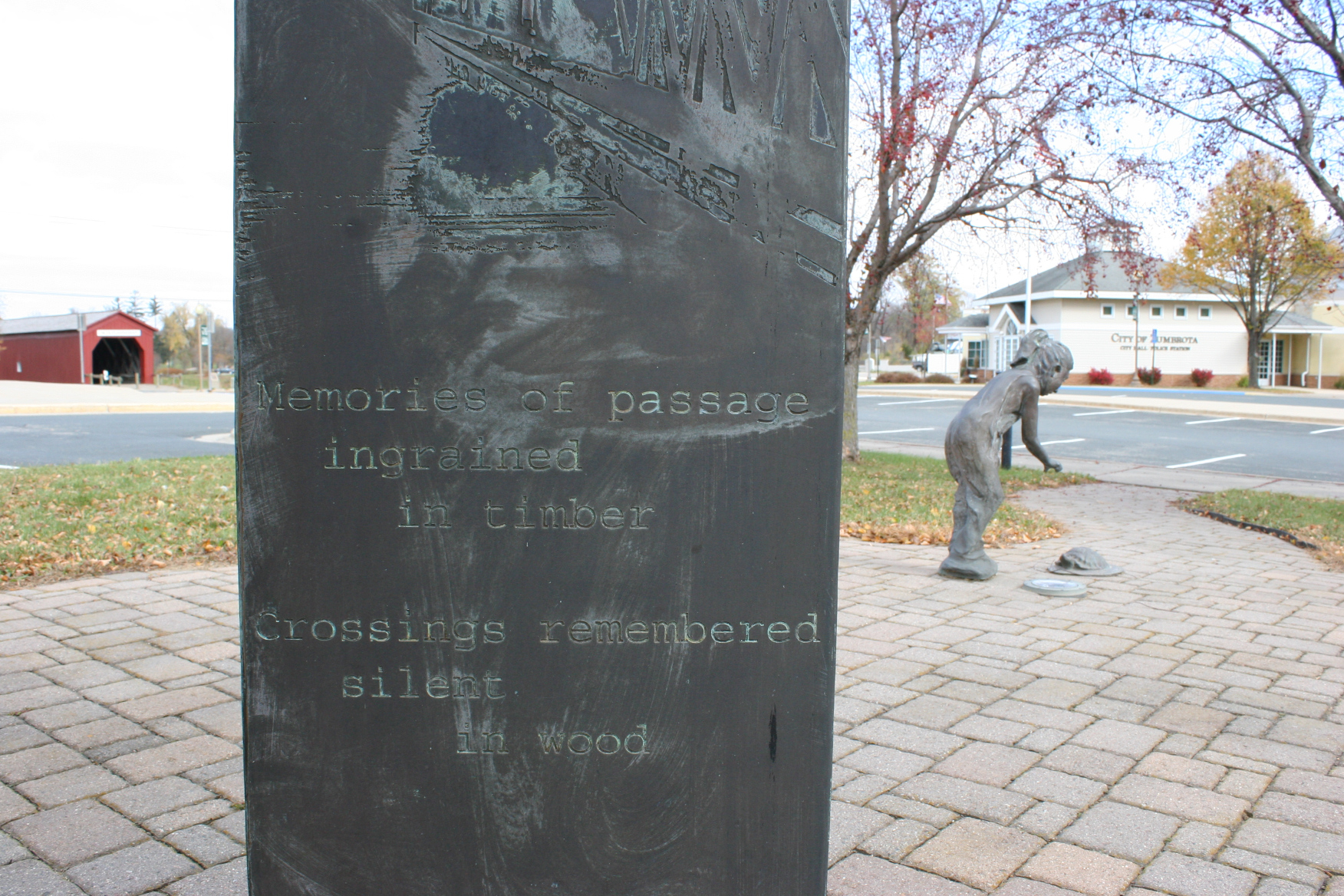
Some of the words inscribed on the sculpture. In the background, you can see the historic covered bridge.
On any other day, Randy and I would walk across that aged bridge to the park, explore a bit while stretching our legs. But the weather was just too darned cold. I hurried to photograph the sculpture as my fingers numbed.
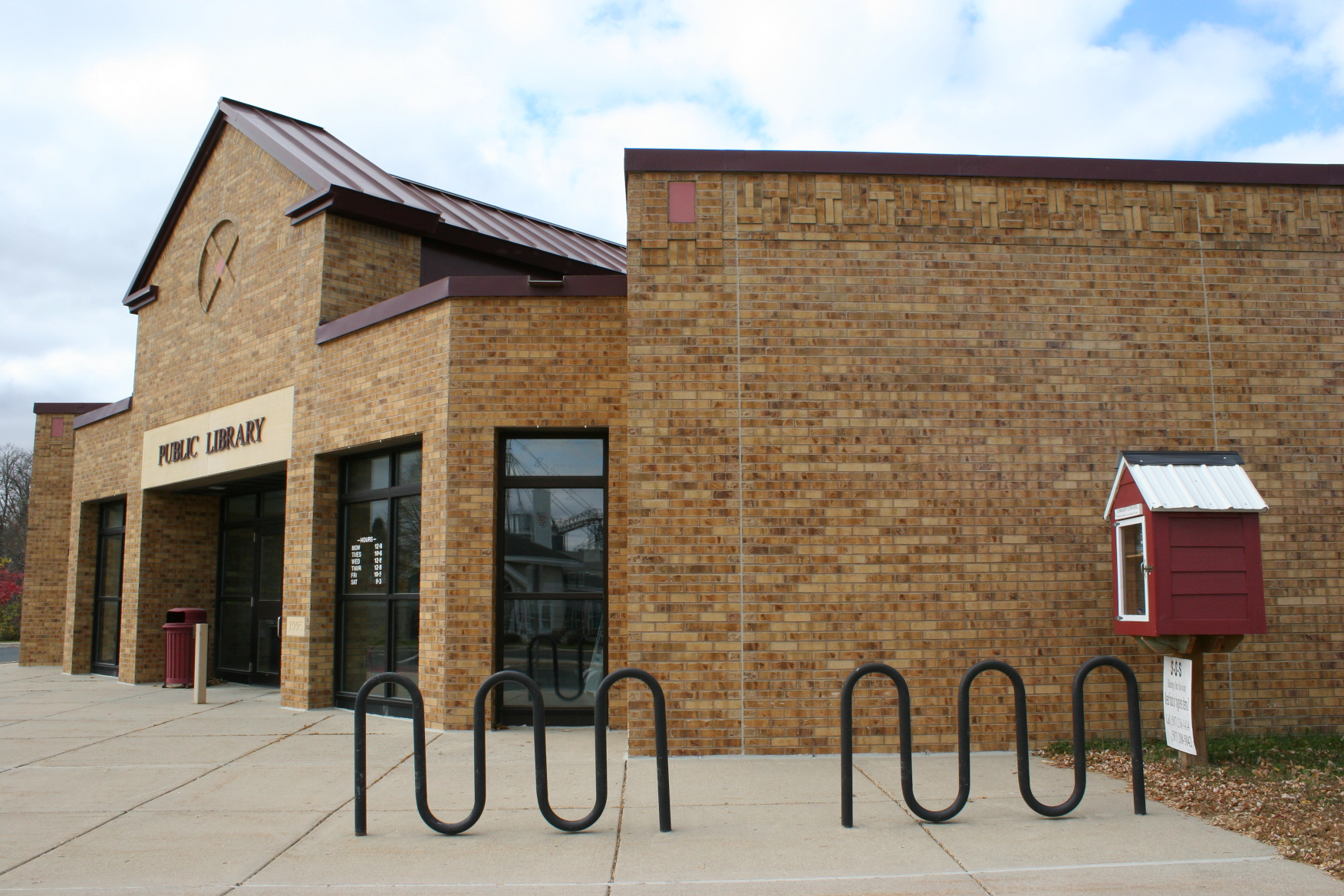
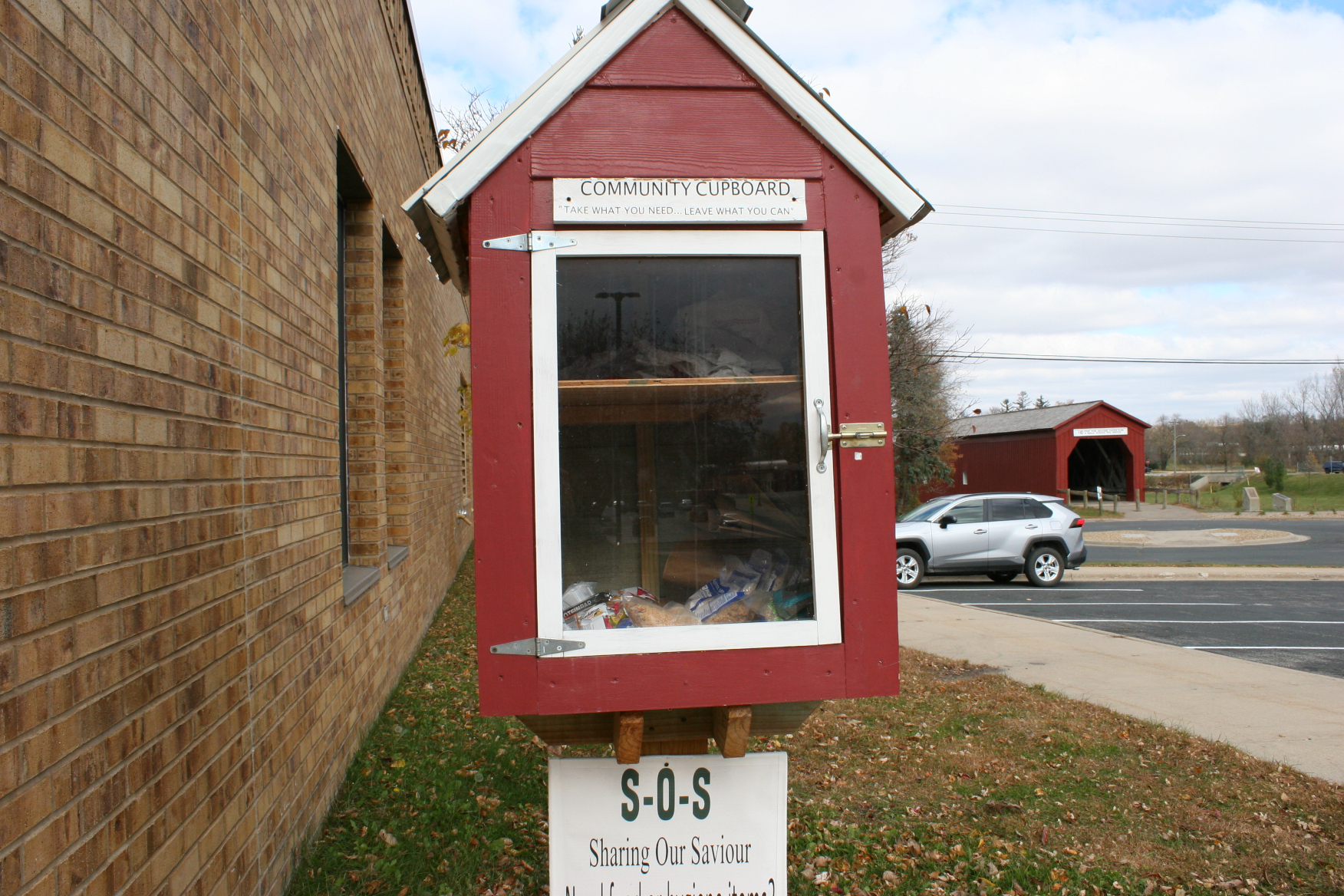
The Community Cupboard and the Zumbrota Public Library designs both mimic the historic covered bridge nearby.
Once done, I walked back toward the van, only to notice a Little Free Library next to the public library. I found that odd.
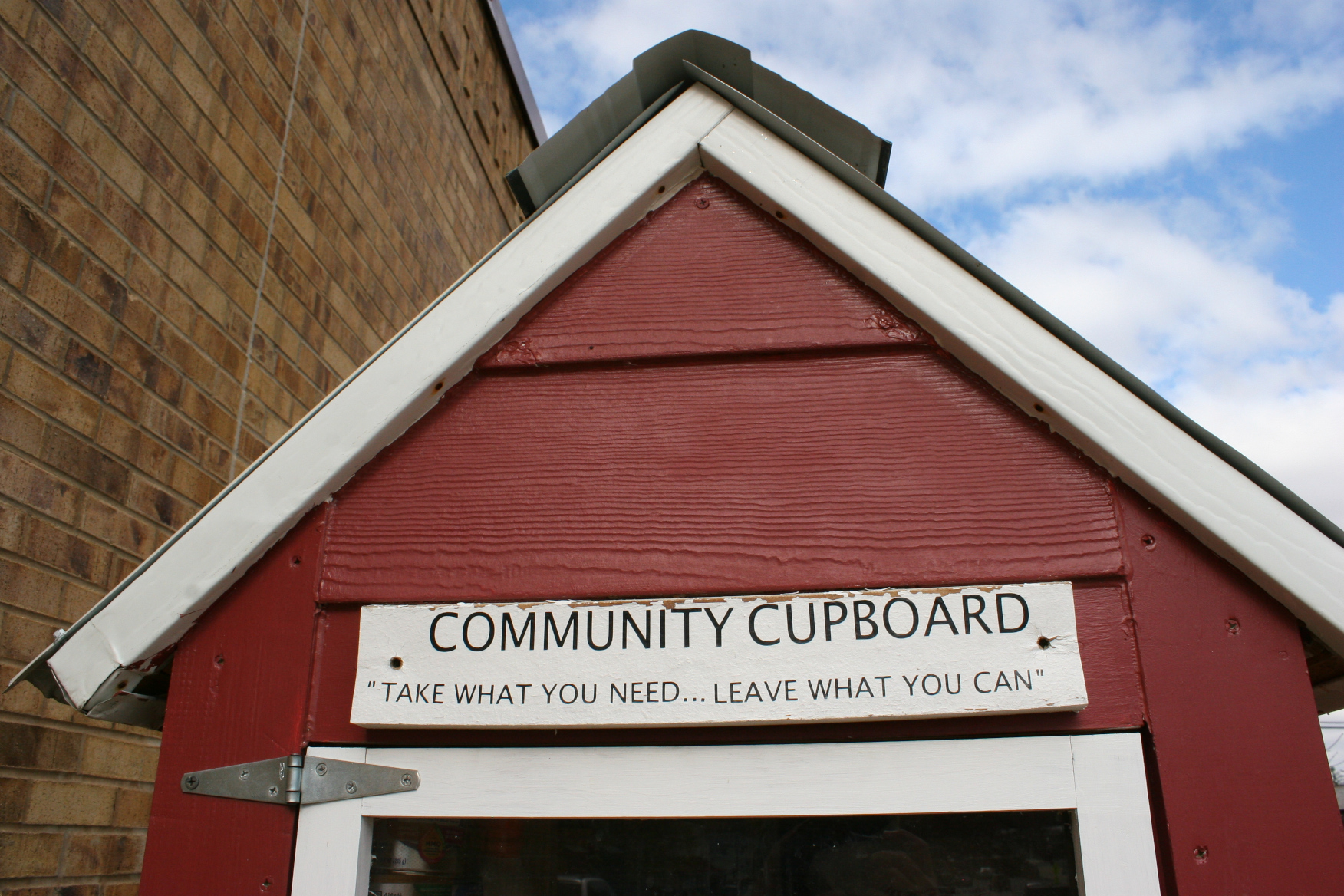
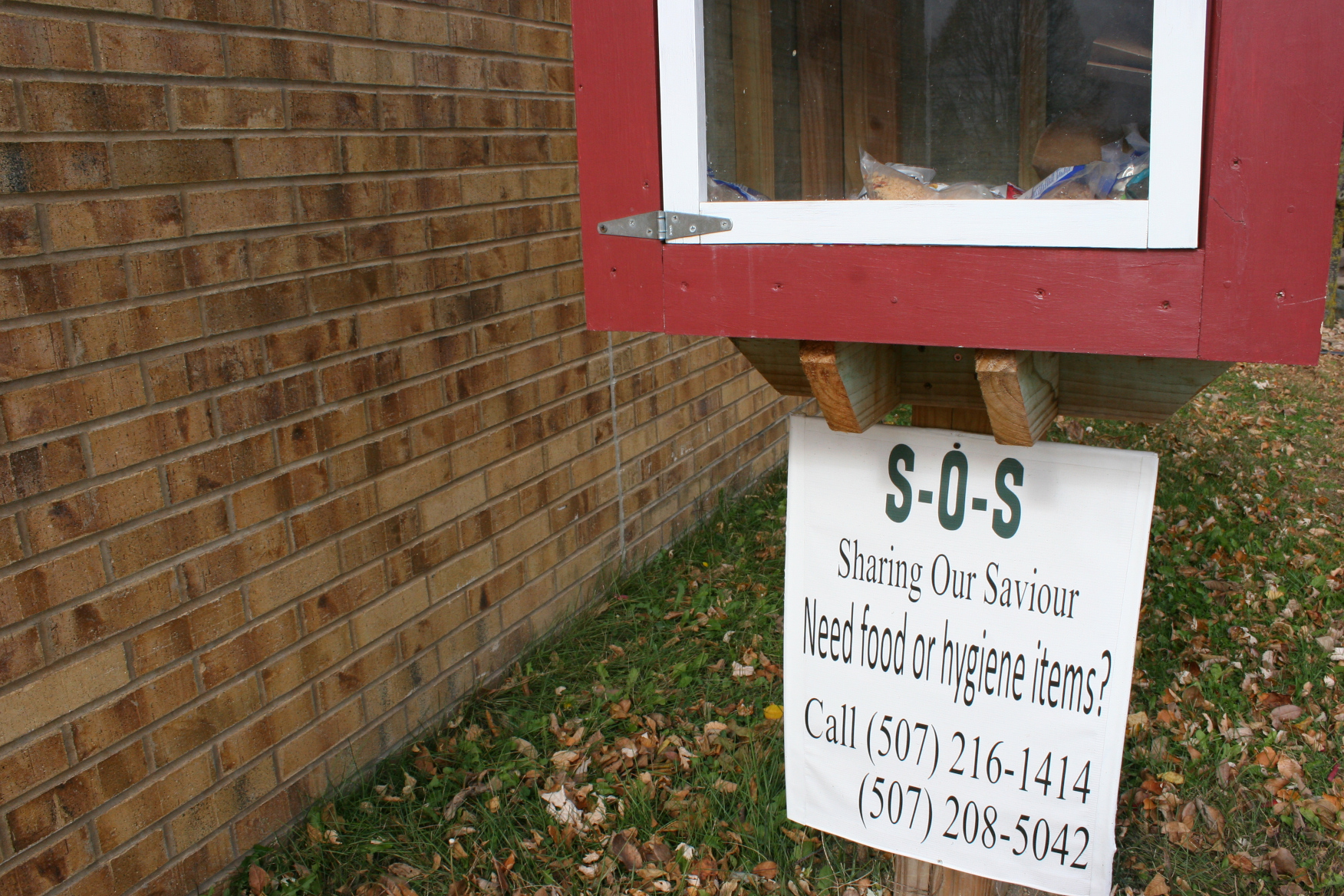
As I drew closer, I found I was mistaken. This was not a LFL but rather a Community Cupboard—a source of food and hygiene products. Free for the taking.
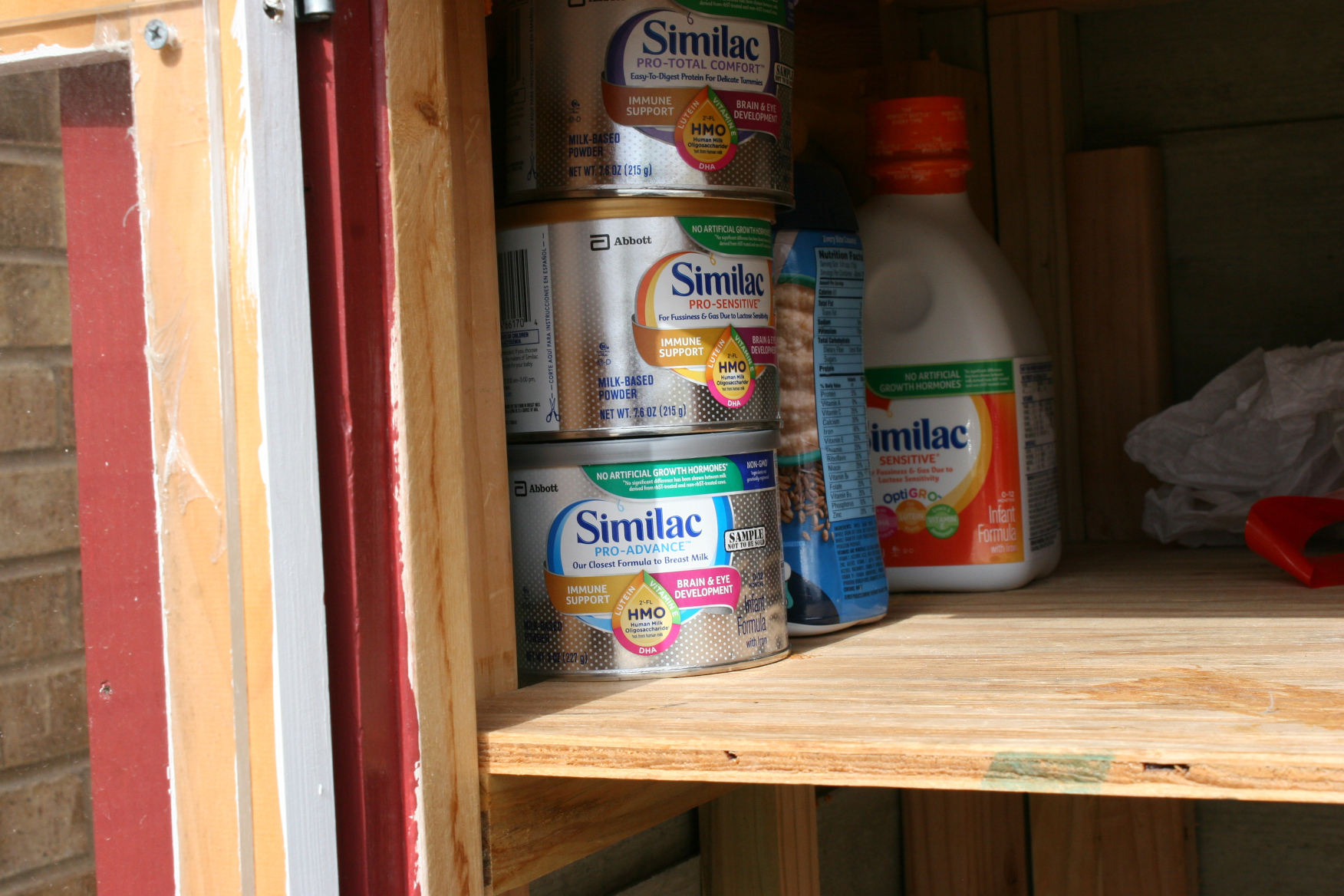
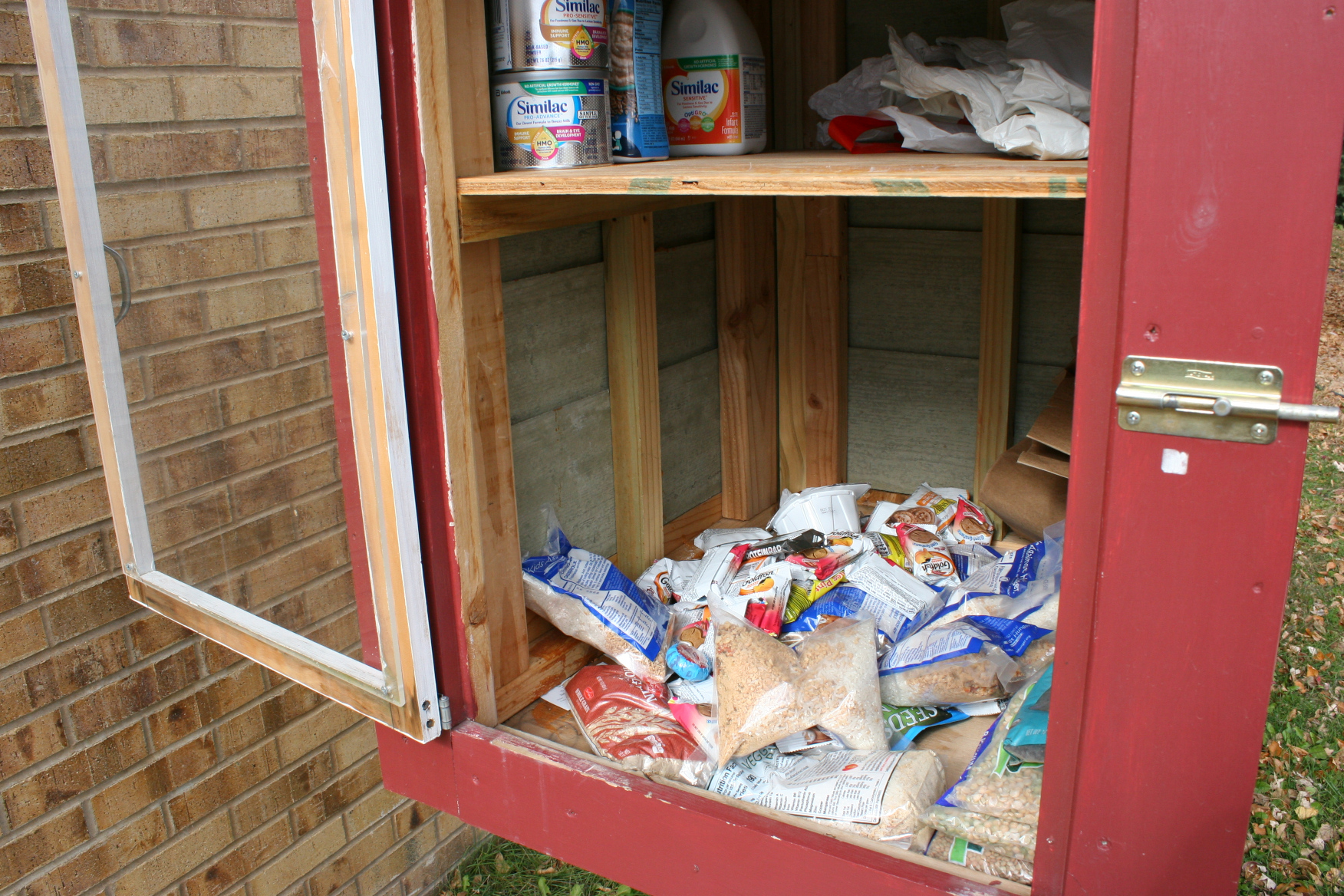
The message thereon invites those opening the door of this small structure, designed like the nearby covered bridge, to TAKE WHAT YOU NEED, LEAVE WHAT YOU CAN. Baby formula. Snacks. Dried legumes. I didn’t poke around to see all of the contents.
Rather, as I photographed the Community Cupboard, I felt a sense of gratitude for this “Sharing Our Saviour” food outreach of Our Saviour’s Lutheran Church. I thought of the many times Jesus fed the hungry of body and of soul. And how thankful I am that churches and nonprofits and so many others help people in more ways than we will ever know. This lifts my spirits.
TELL ME: How do you or your community or church (or whatever) help individuals and families in need? I’d like to hear more uplifting stories.
MANY TIMES I’VE PASSEDthrough Kenyon, usually en route to visit family in Madison, Wisconsin, four hours distant. But many times also, this town of some 1,800 about a half hour east of Faribault has been my specific destination. Last Sunday afternoon on a drive to view the harvest and fall colors (before an unexpected snowstorm changed the landscape to winter), Randy aimed our van north out of Monkey Valley toward Kenyon just a few miles away.
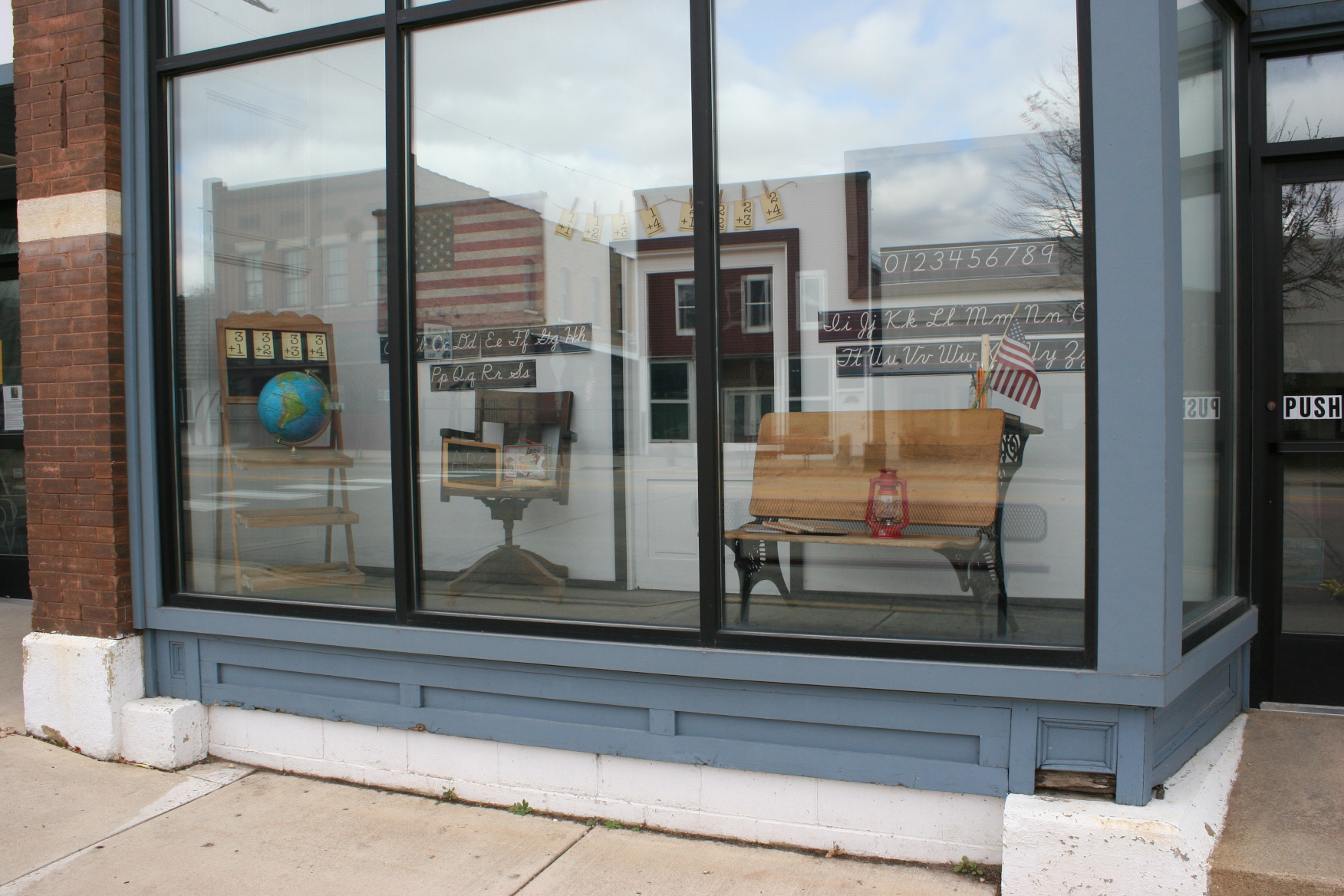
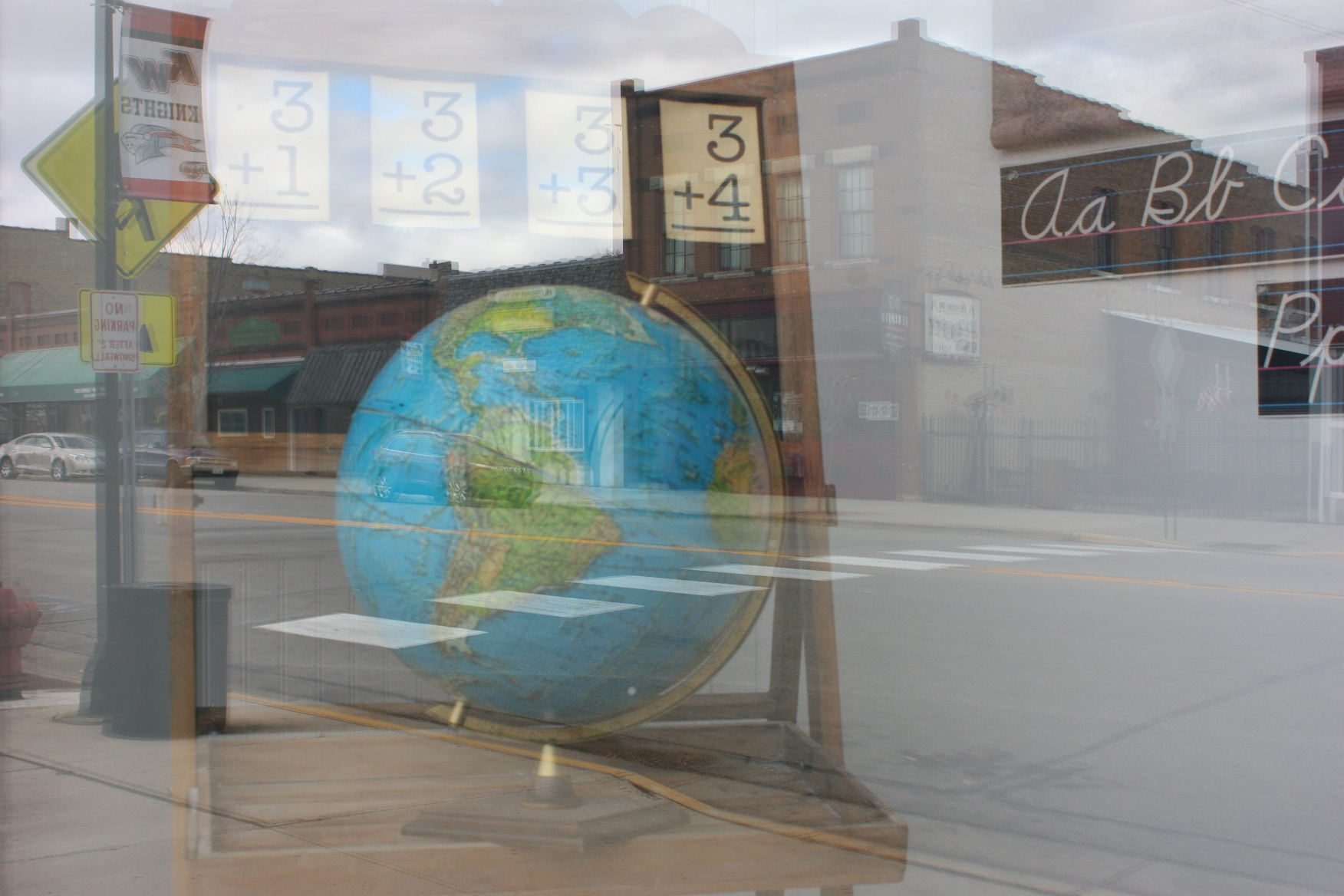
This window features a classroom of yesteryear.
A close-up of a focal globe in the classroom display.
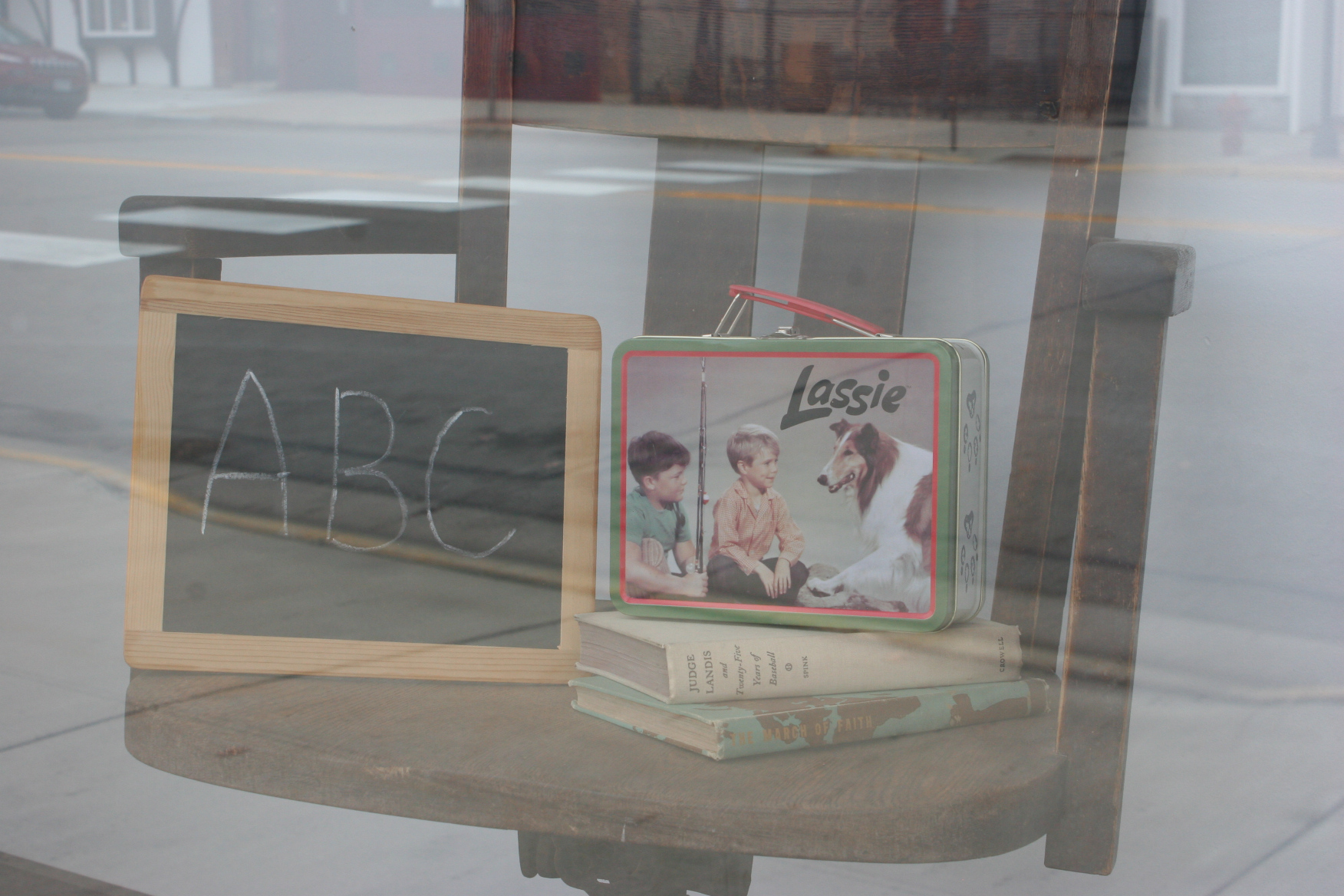
More details from the past…
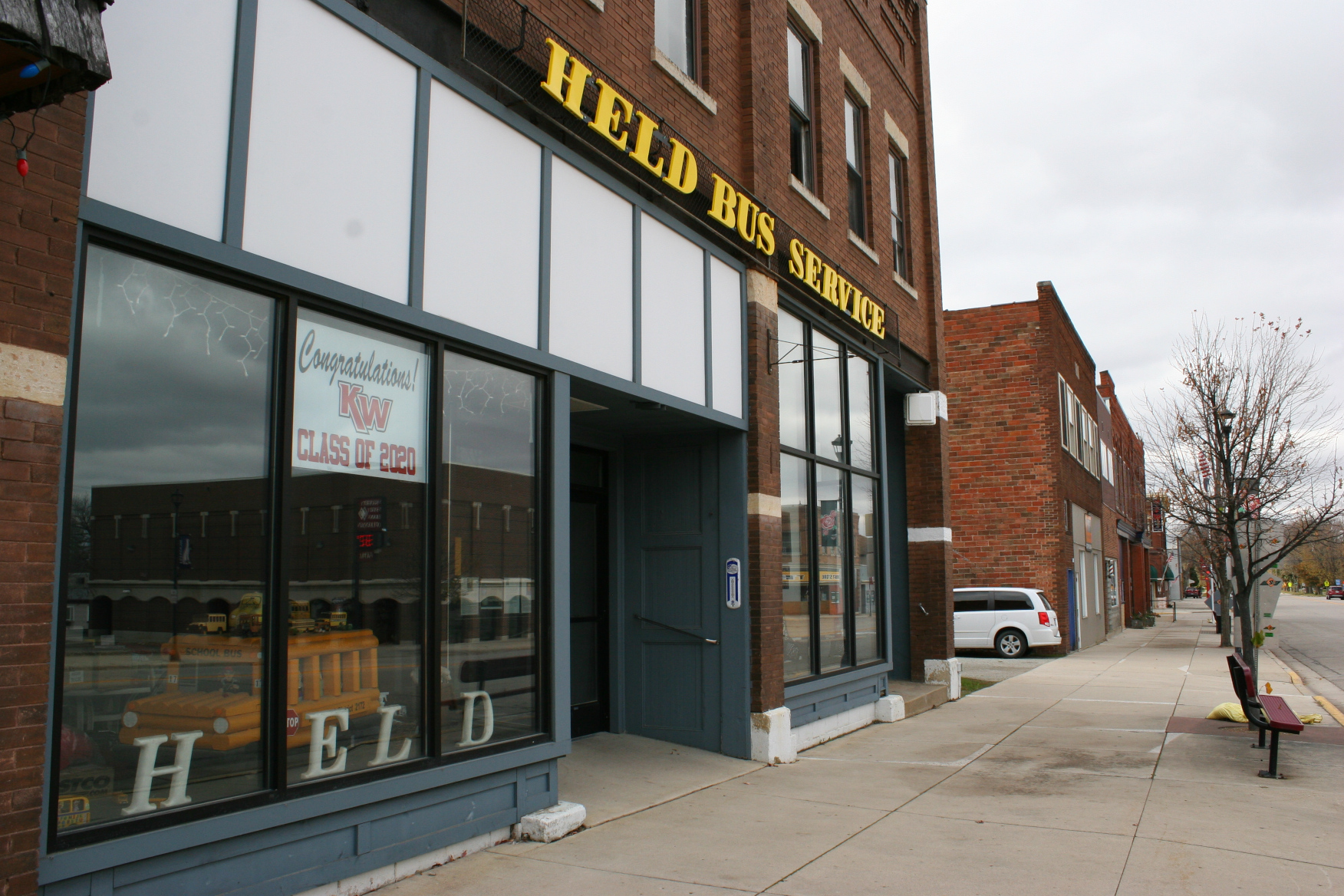
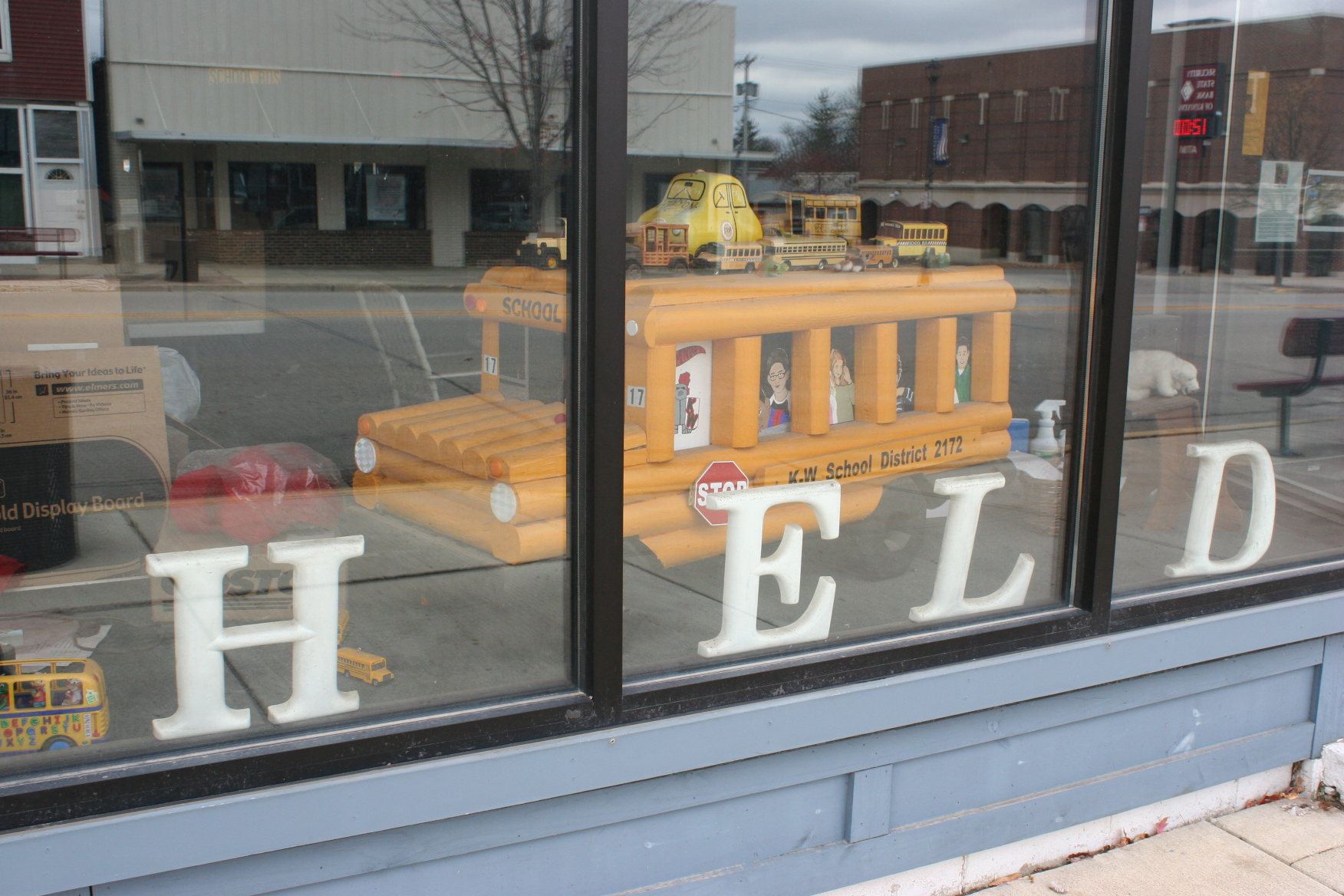
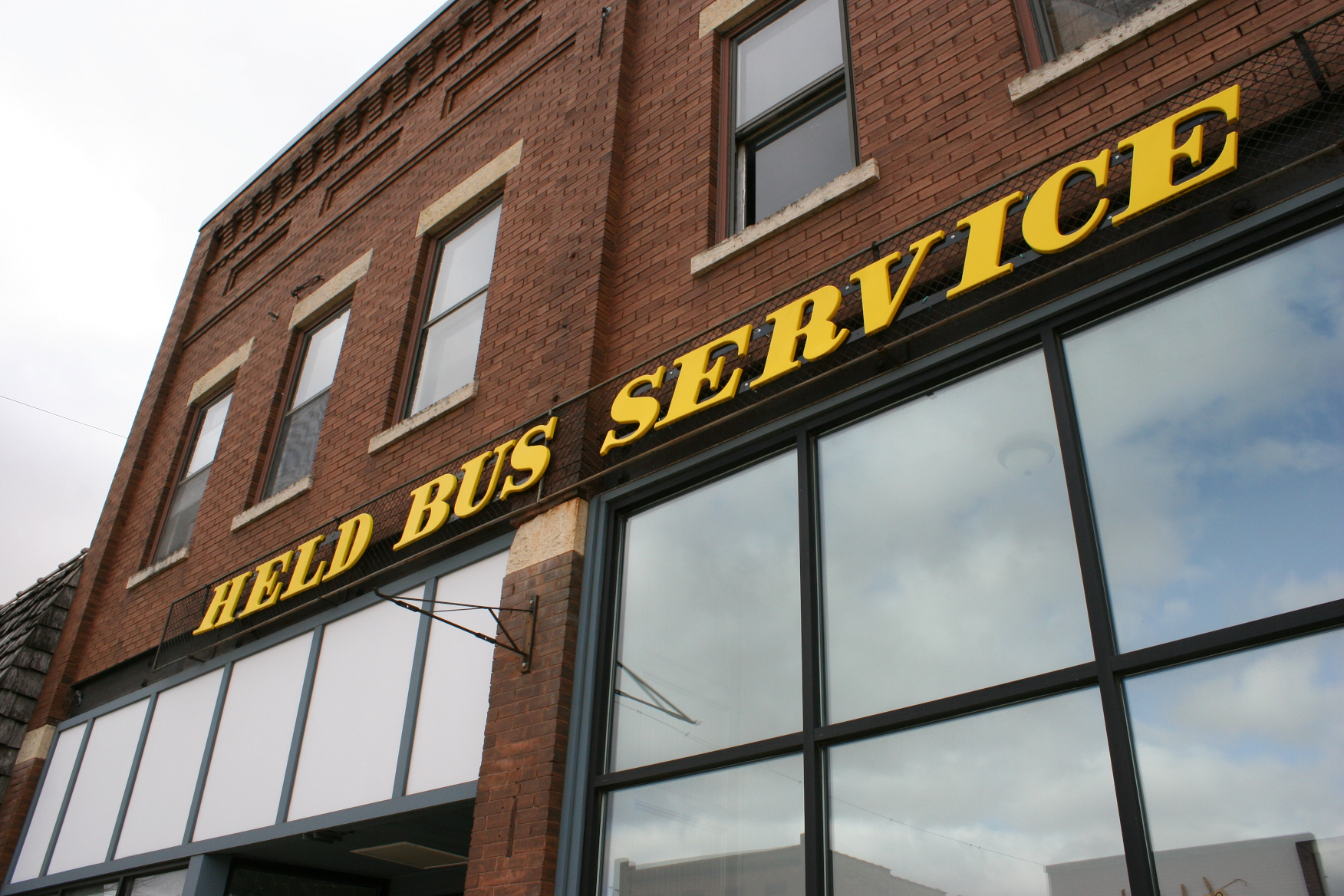
We had no intention of stopping in Kenyon. But the passenger side window needed cleaning so Randy pulled into a corner service station and washed the glass. (He’s thoughtful like that.) Then we continued down Minnesota State Highway 60, which runs through the heart of the business district. As luck would have it, I happened to look, just at the right time, at the Held Bus Service building. And there, in the front windows, I spotted a school-themed display. Photo-worthy, I thought, as I asked Randy to swing around the block and return to the bus building. He even pulled ahead so the van wouldn’t reflect in the glass. (He’s thoughtful like that.)
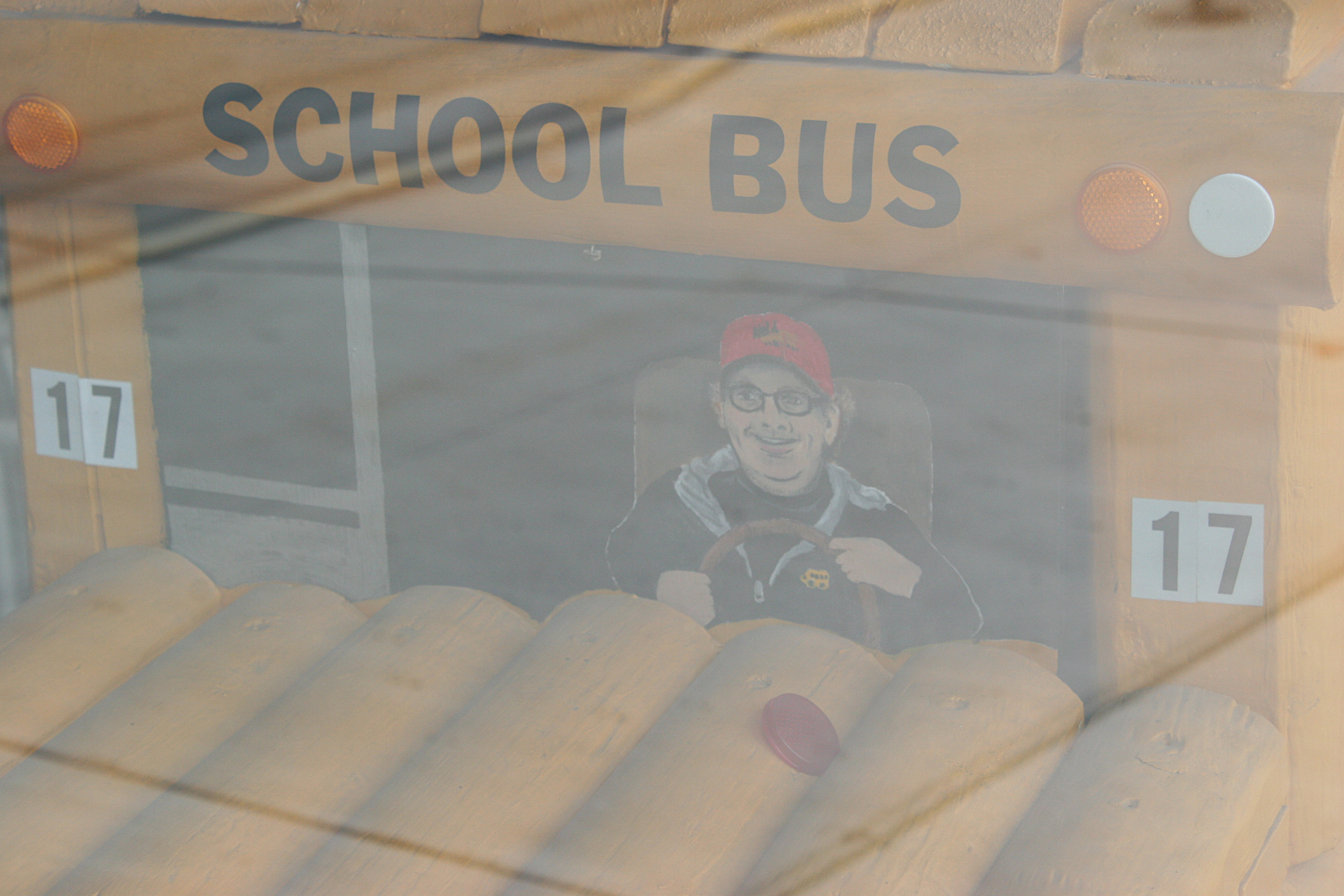
Look at this bus-themed window display with the apparently handcrafted bus.
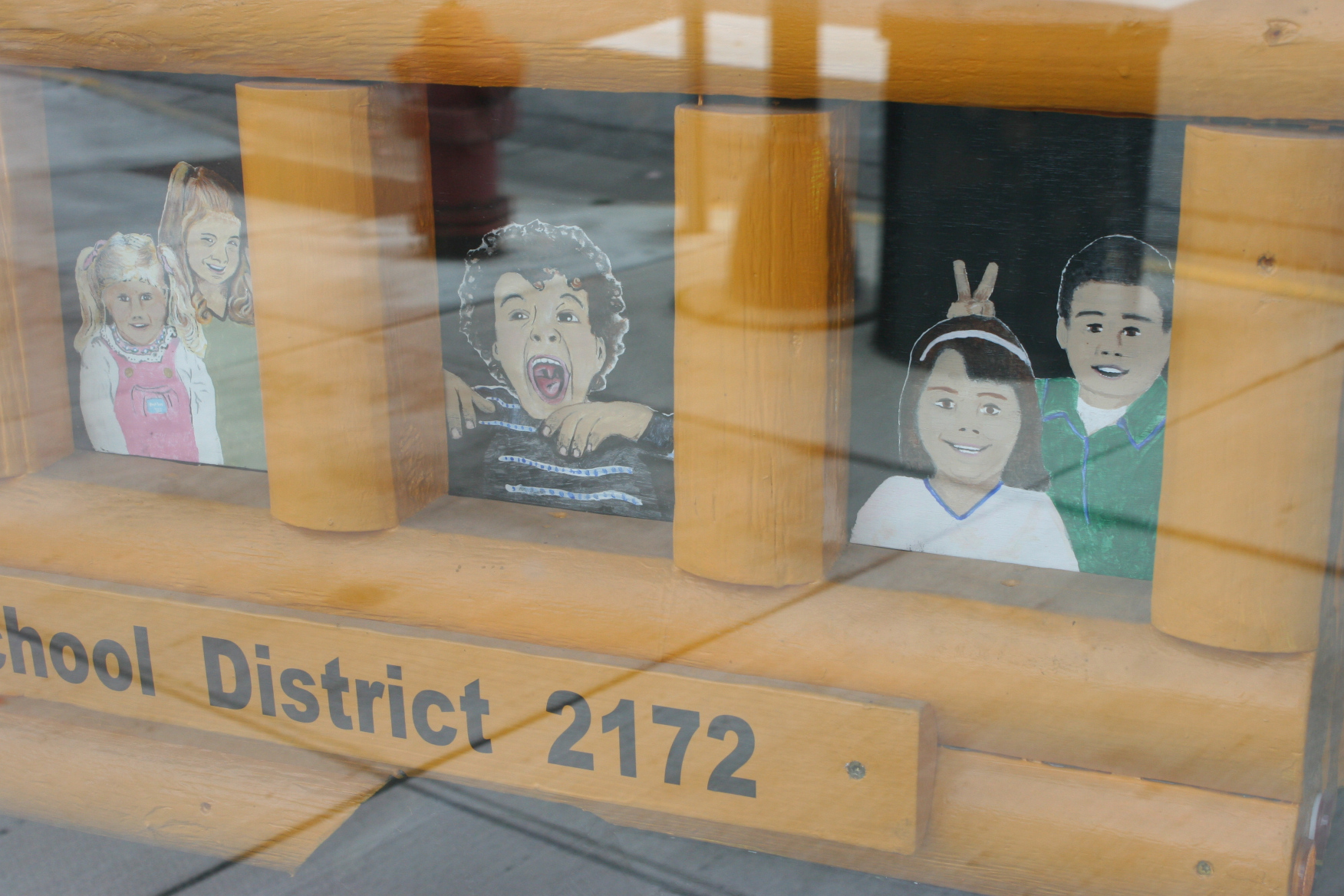
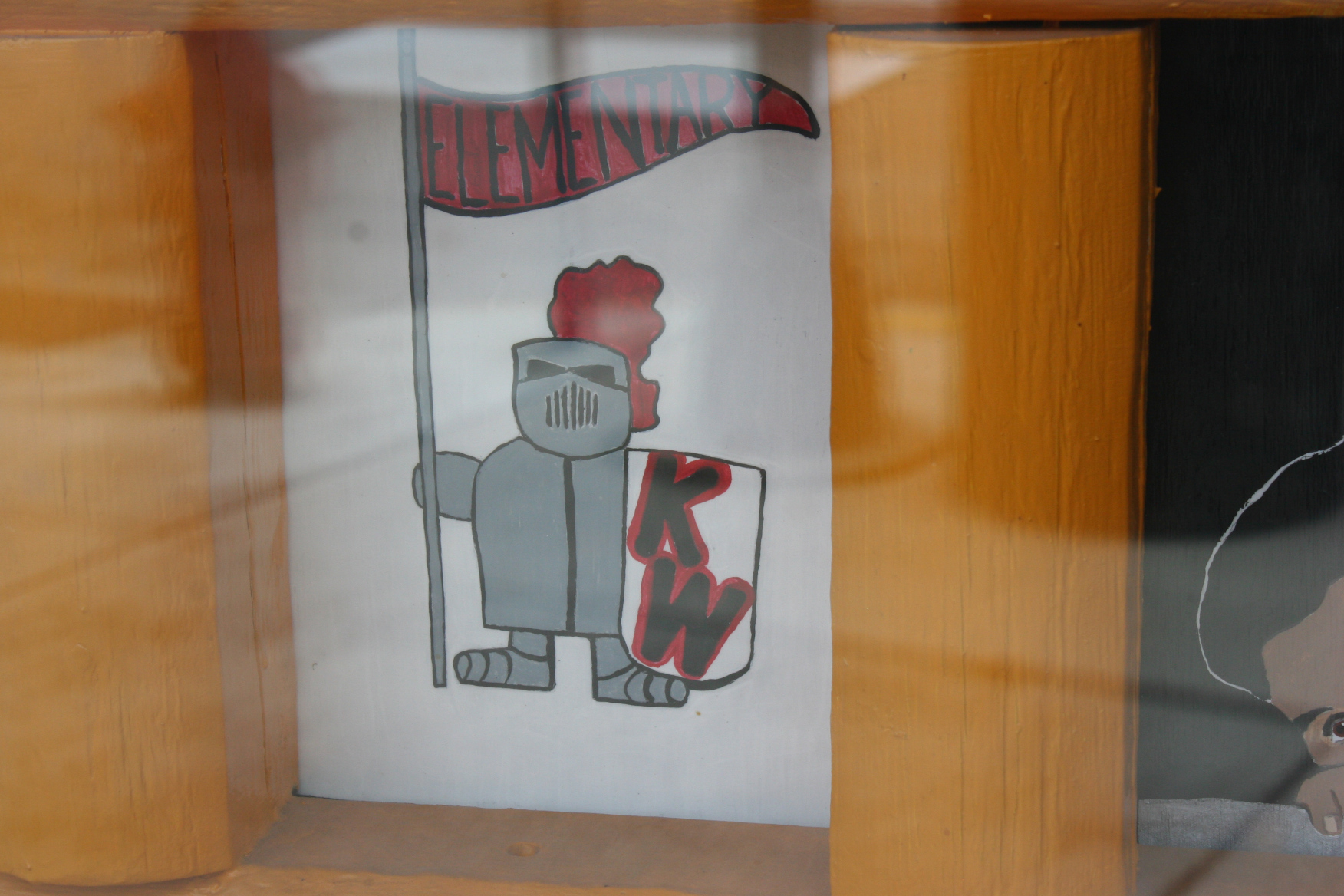
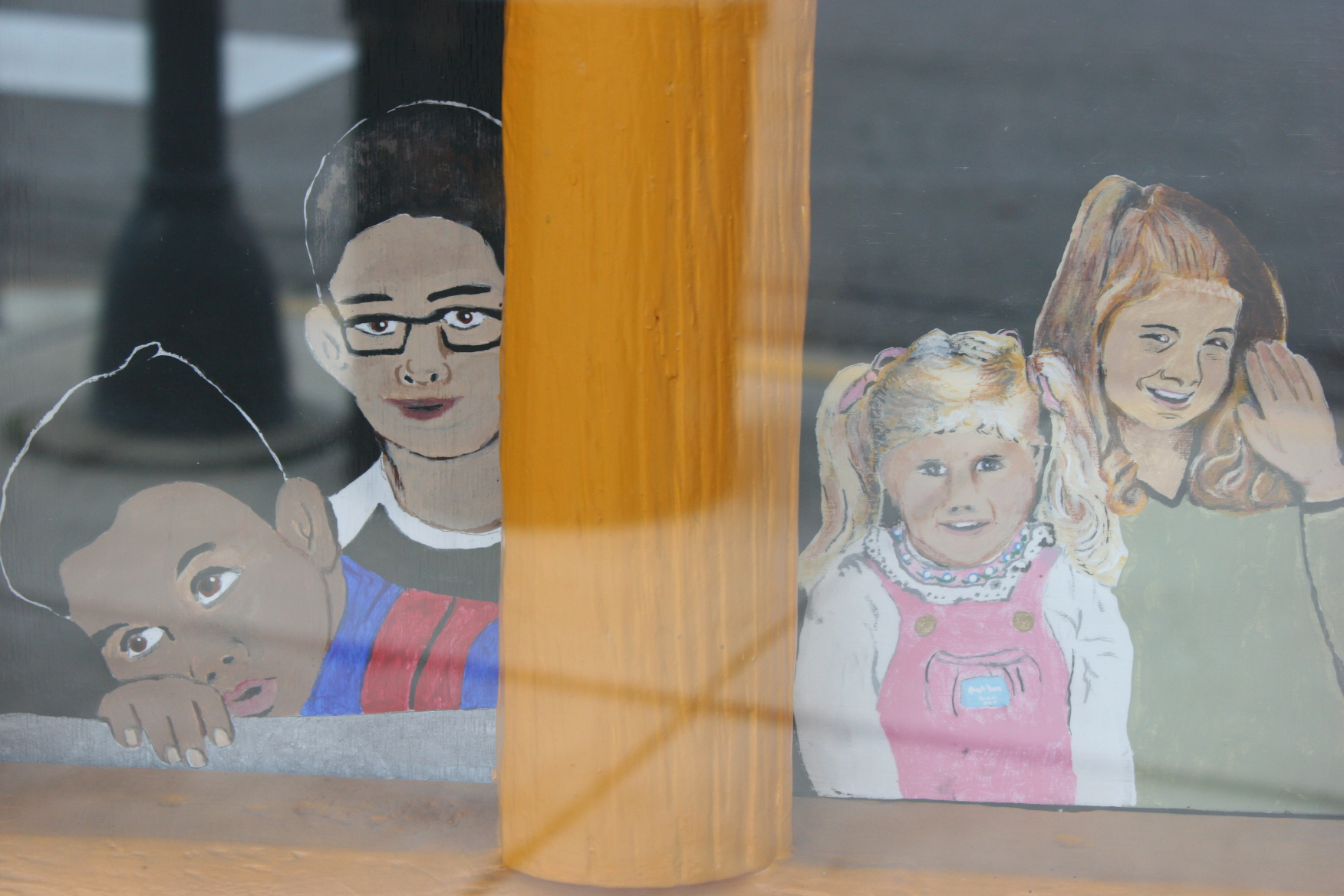
Photographing the window art proved challenging given the reflections. But I was determined to do my best. Someone worked hard to craft and create these educational-themed displays that show the importance of the Kenyon-Wanamingo School in this community—right down to the Knights mascot, the happy bus driver in the red cap and the smiling students. Yes, by that time I’d noticed two separate window displays, one an historic classroom and the other themed to school buses.
Love these portraits of students on the bus.
The school mascot even gets a place of honor.
More KW students riding the bus.
As someone who grew up riding the bus for 12 years to schools in southwestern Minnesota, I understand the importance of bus drivers. Mine were Jeff and Harley. Great guys. Friendly. Kind. Competent. It’s not easy driving on rural roads during a Minnesota winter. Nor is it necessarily easy dealing with a bus full of kids.
Presumably Jon Held behind the wheel of the bus.
But Jon Held, owner of Held Bus Service, loves kids. According to a 2016 KARE 11 TV feature on him, he is well-loved, too. He knows kids by name, greeting them daily before and after school (pre-COVID), often with hugs. He keeps a candy stash and one year even handed out his company’s signature red caps to some happy students.
The business is housed in an historic building which was damaged in an August 2016 fire. You can’t tell by looking at it now.
That’s a snapshot of the backstory framing these window displays. These are the stories that define small towns like Kenyon as caring communities, more than simply some place to pass through en route to somewhere else.


















 Minnesota Prairie Roots
Recent Comments