This unique, artsy “fence” is the first thing I noticed in downtown Elgin. Absolutely love the creative functionality of these repurposed doors. (Minnesota Prairie Roots copyrighted photo May 2022)
SMALL TOWNS, LIKE PEOPLE, have personalities. I’ve discovered that in my years of exploring rural regions. I can learn a lot about a place by simply walking through the heart of a community, even if I never enter a single business.
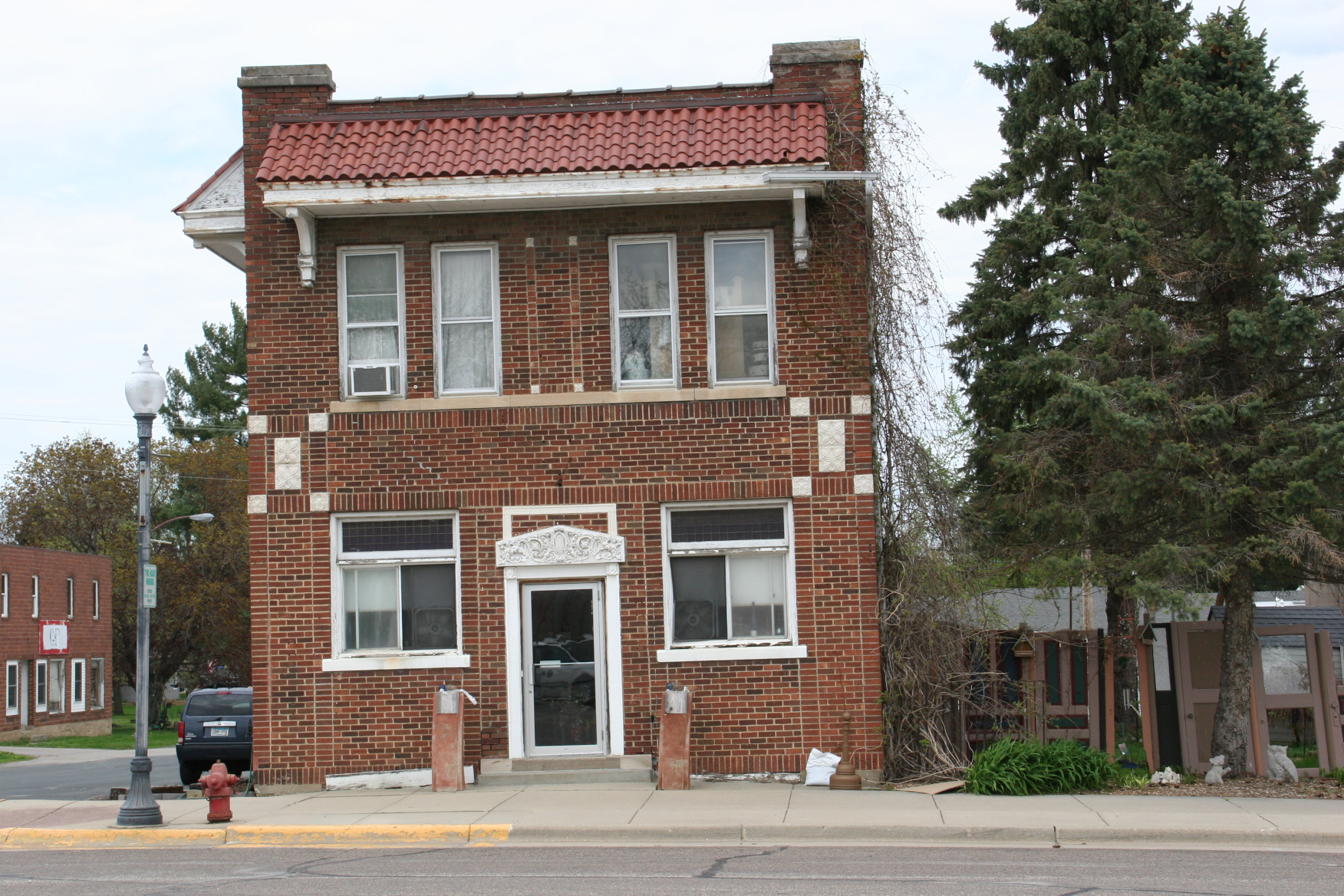
The door fence is to the right of this stately corner brick building with the lovely architectural details. (Minnesota Prairie Roots copyrighted photo May 2022)
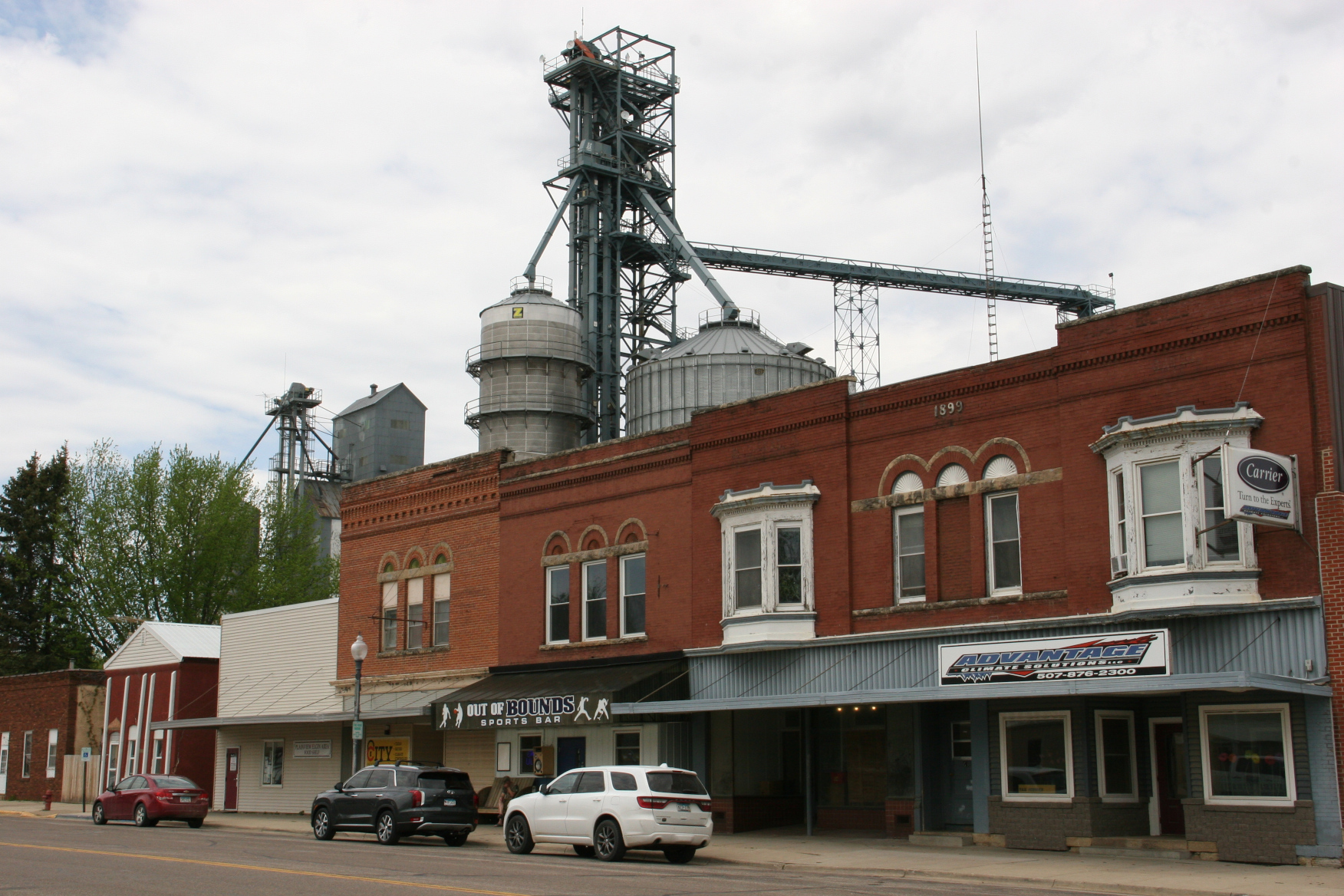
On a recent day trip into Wabasha County in southeastern Minnesota, Randy and I stopped briefly in Elgin. Three words define my initial impression of the business district in this community of 1,090 just 20 minutes northeast of Rochester: bricks, bins and bars.
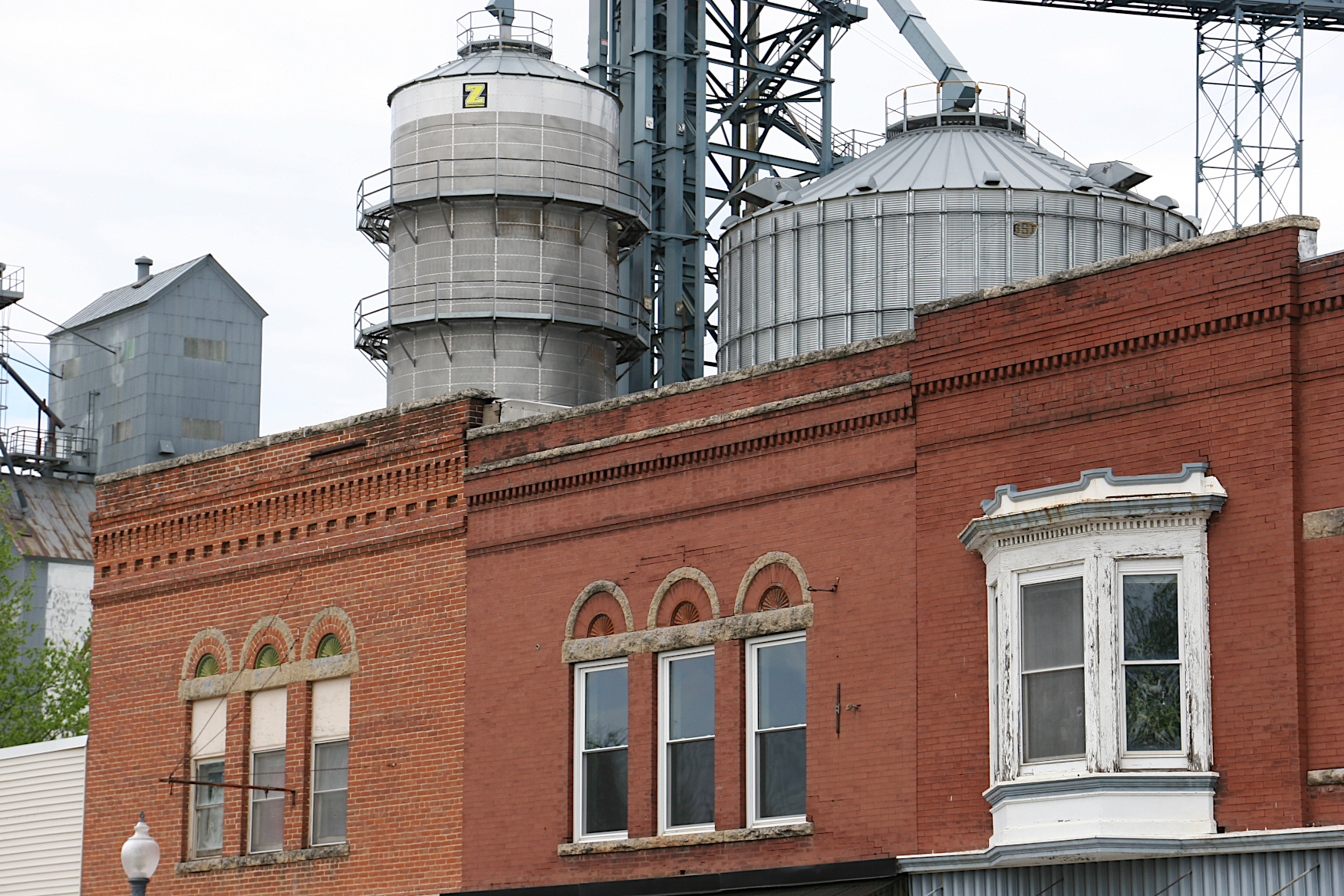
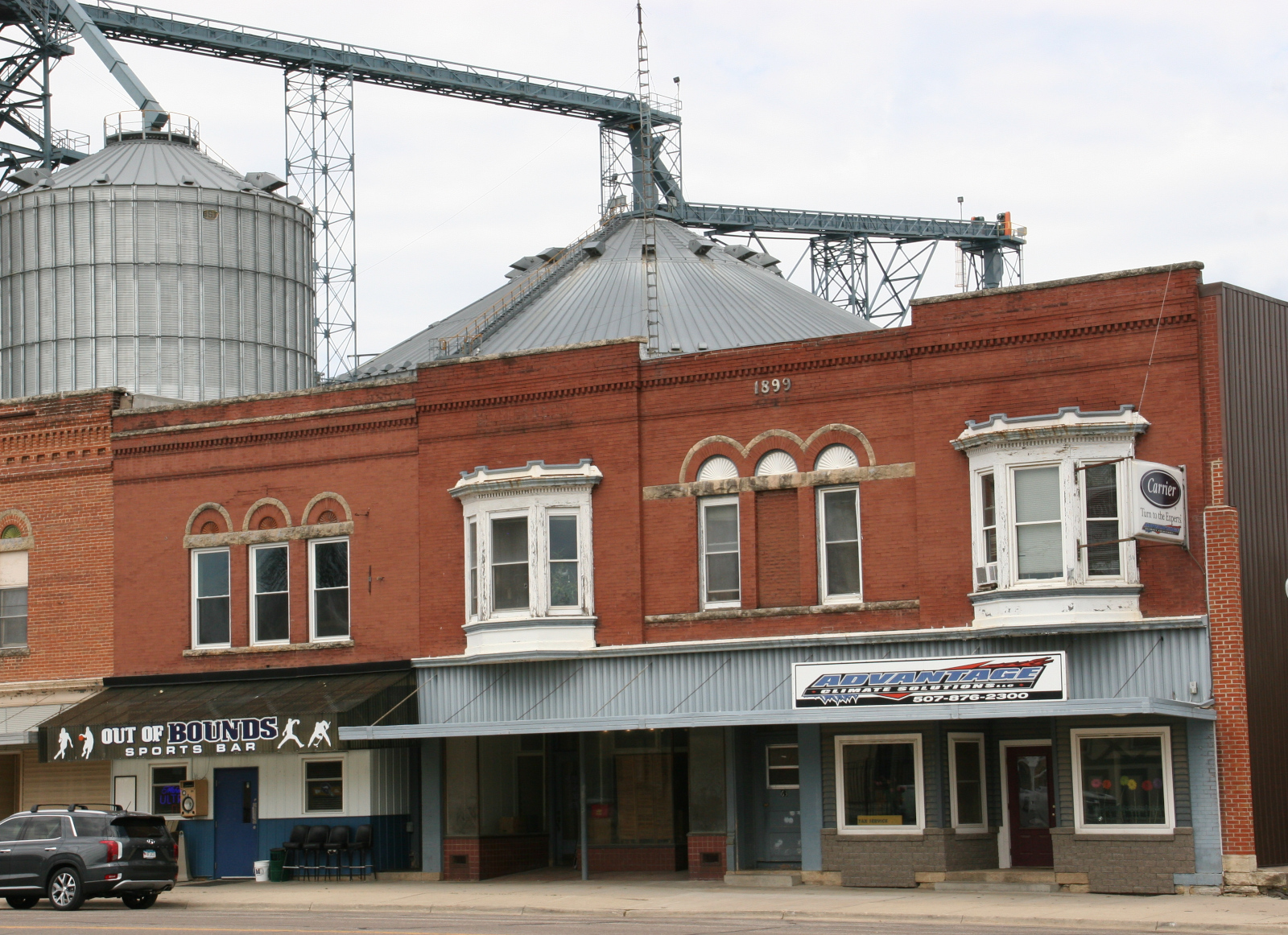
Bricks reference the row of aged brick buildings I spotted along one side of the street. One dates to 1899. I see so much potential in these historic structures if the “updates” on ground level were removed to reveal the original. I recognize, though, that takes money. But, as one who appreciates aged buildings with good, solid bones, I would love to see these buildings restored to their historic selves. What an asset that would be to Elgin.
Behind those brick buildings, bins rise. (Minnesota Prairie Roots copyrighted photo May 2022)
Bins reference the mammoth grain bins back-dropping that row of brick buildings. This is most-assuredly a farming community, home to All-American Co-op. I especially appreciate the faded signage identifying the local ag business.
Identifying signage provides a vintage artsy backdrop. (Minnesota Prairie Roots copyrighted photo May 2022)
At one time, Elgin was also home to a creamery and milk service. The community honors its dairy heritage with Elgin Cheese Days, an annual small town festival slated this year for June 17-19. Events include a parade, carnival, tractor pull, burnouts, vendor and craft show, softball and volleyball tournaments, garage sales, music and the EMS Cheese Chase (walk/run). As these celebrations go, they are really reunions of those who once called this town home or still call this place home.
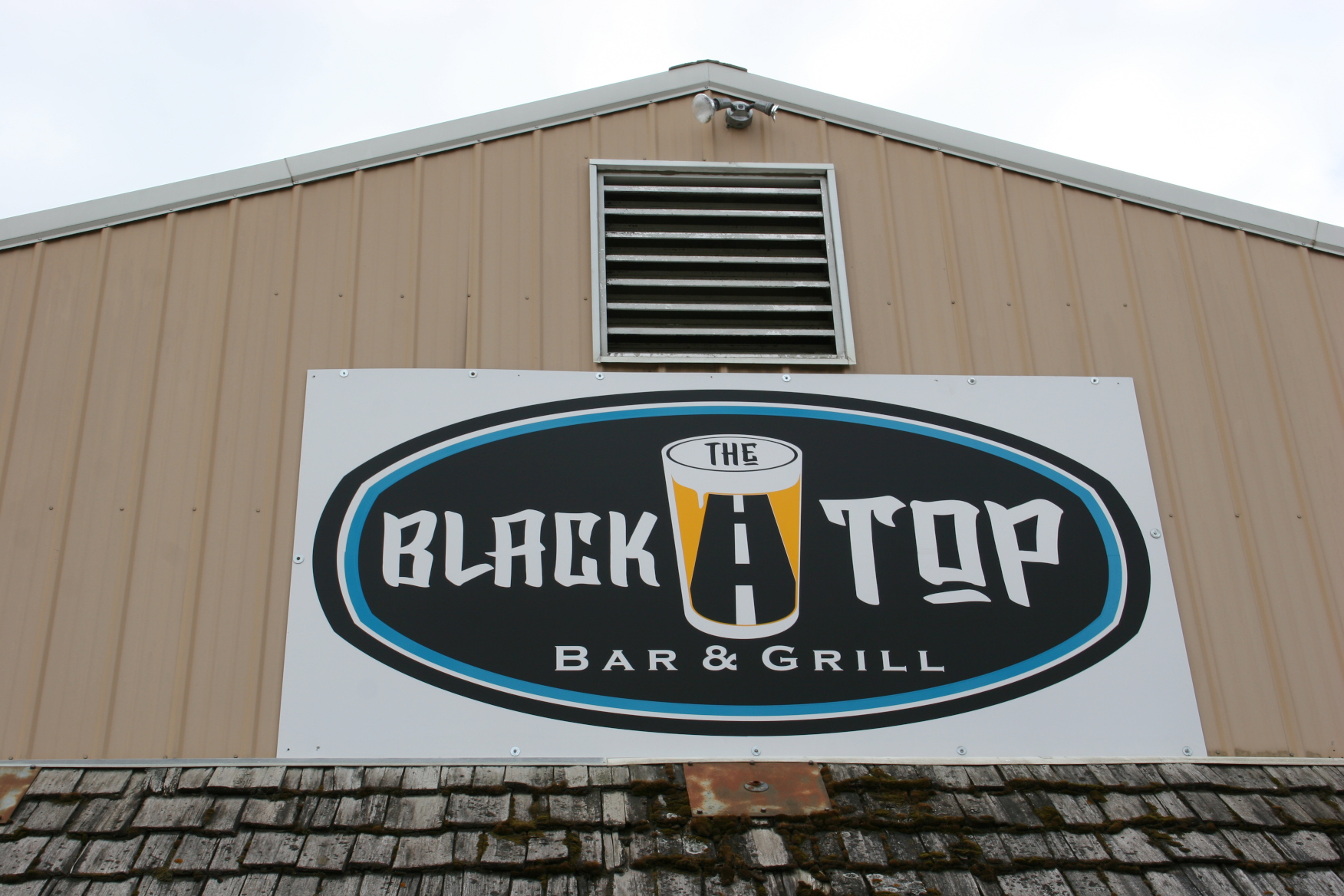
Bold signage for a place that welcomes everyone like family. (Minnesota Prairie Roots copyrighted photo May 2022)
To the left, Out of Bounds Sports Bar, “where everyone knows your name.” (Minnesota Prairie Roots copyrighted photo May 2022)
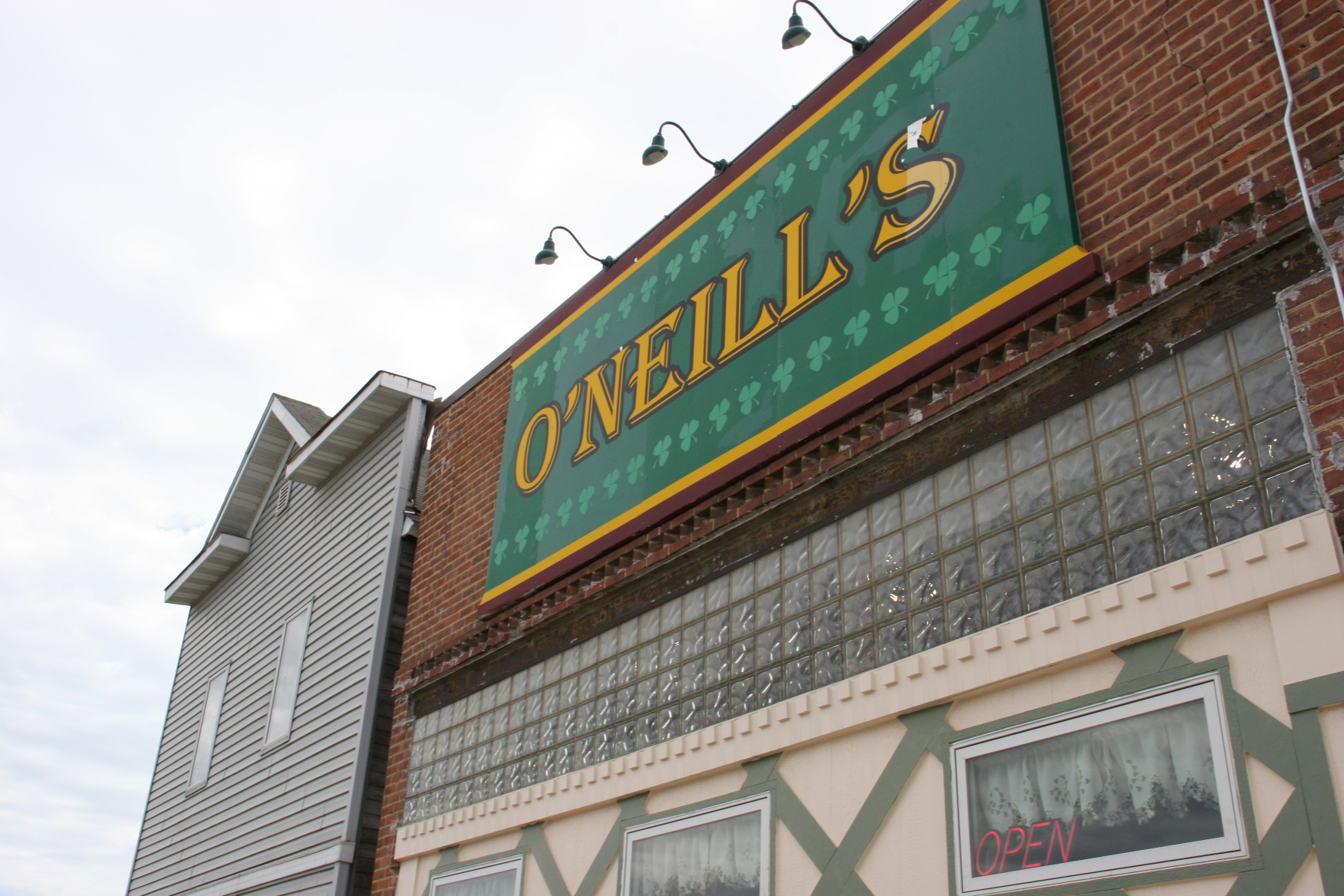
O’Neill‘s Pizza Pub serves more than pizza. There’s Irish whiskey, too, and a game room with classic games. (Minnesota Prairie Roots copyrighted photo May 2022)
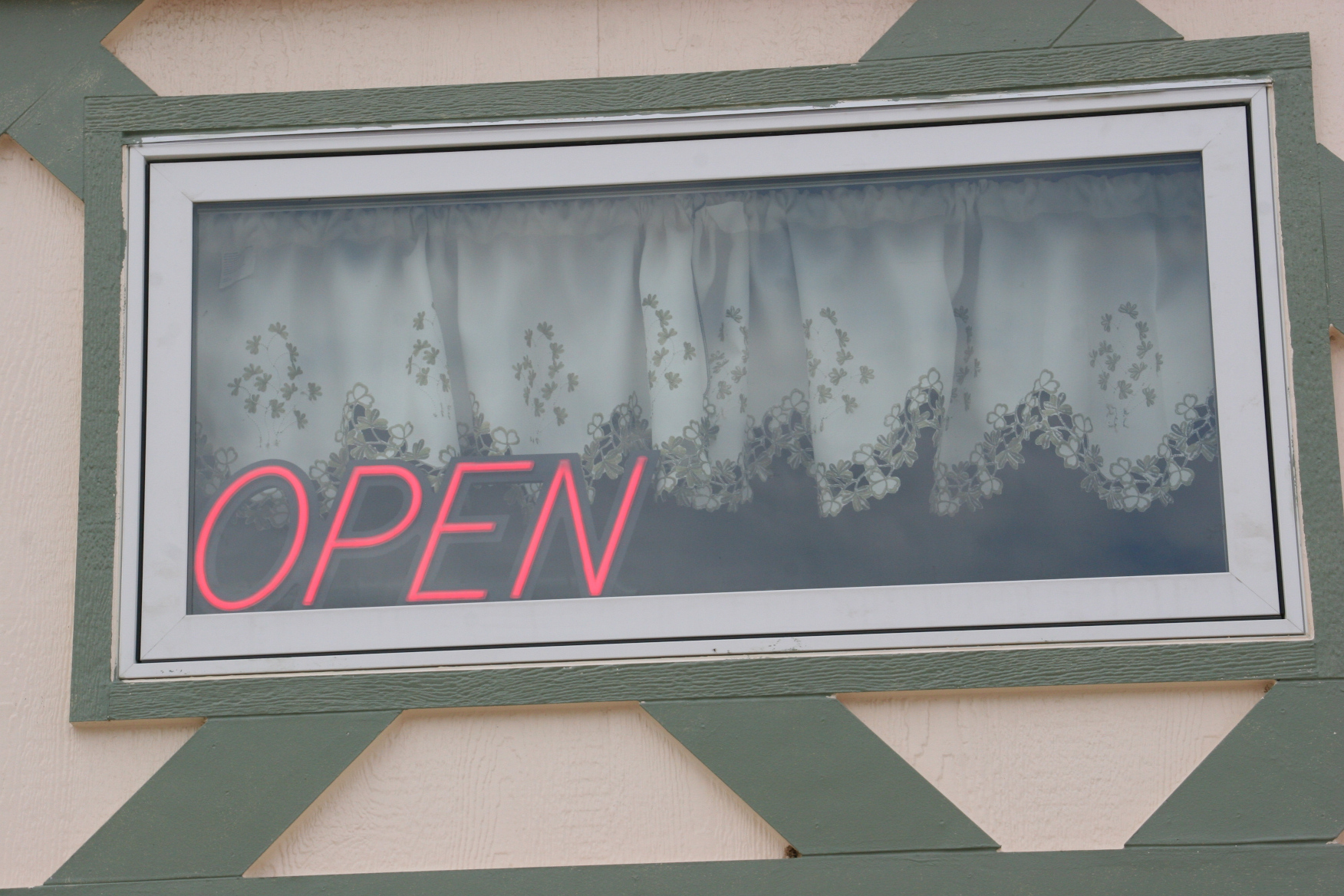
The pub is open. (Minnesota Prairie Roots copyrighted photo May 2022)
Although Randy and I didn’t patronize any of these places, I expect they are worth a stop for food and drink and conversation. As a group of cyclists told us, the bar they lunched at served up a mighty fine sandwich. We had packed a picnic lunch. Next time.
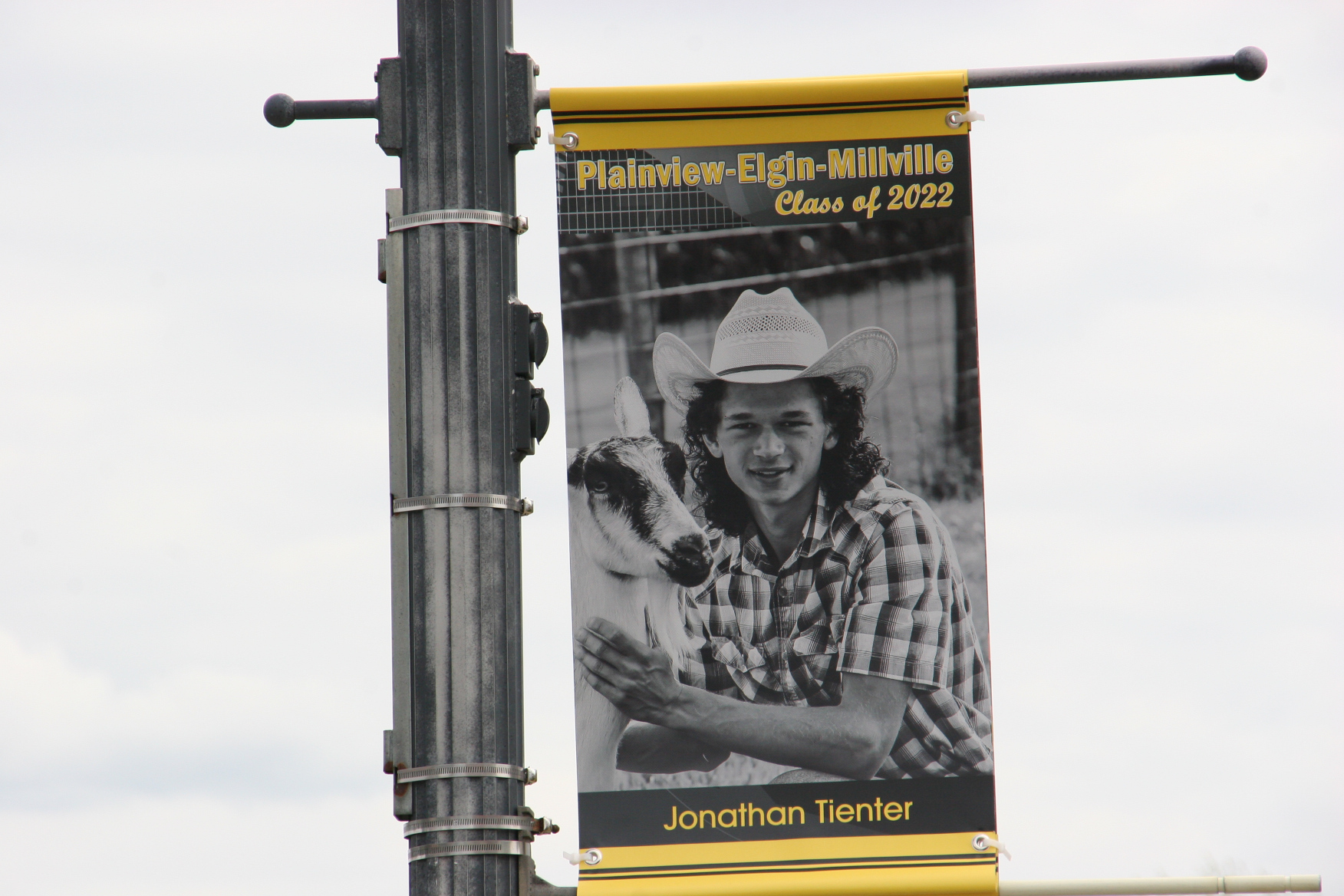
Banners feature students from the graduating class of 2022. (Minnesota Prairie Roots copyrighted photo May 2022)
Yes, we’ll return to Elgin to explore a bit more. Perhaps drive 1.5 miles south of town to pick up some cheese at Prairie Hollow Farm.
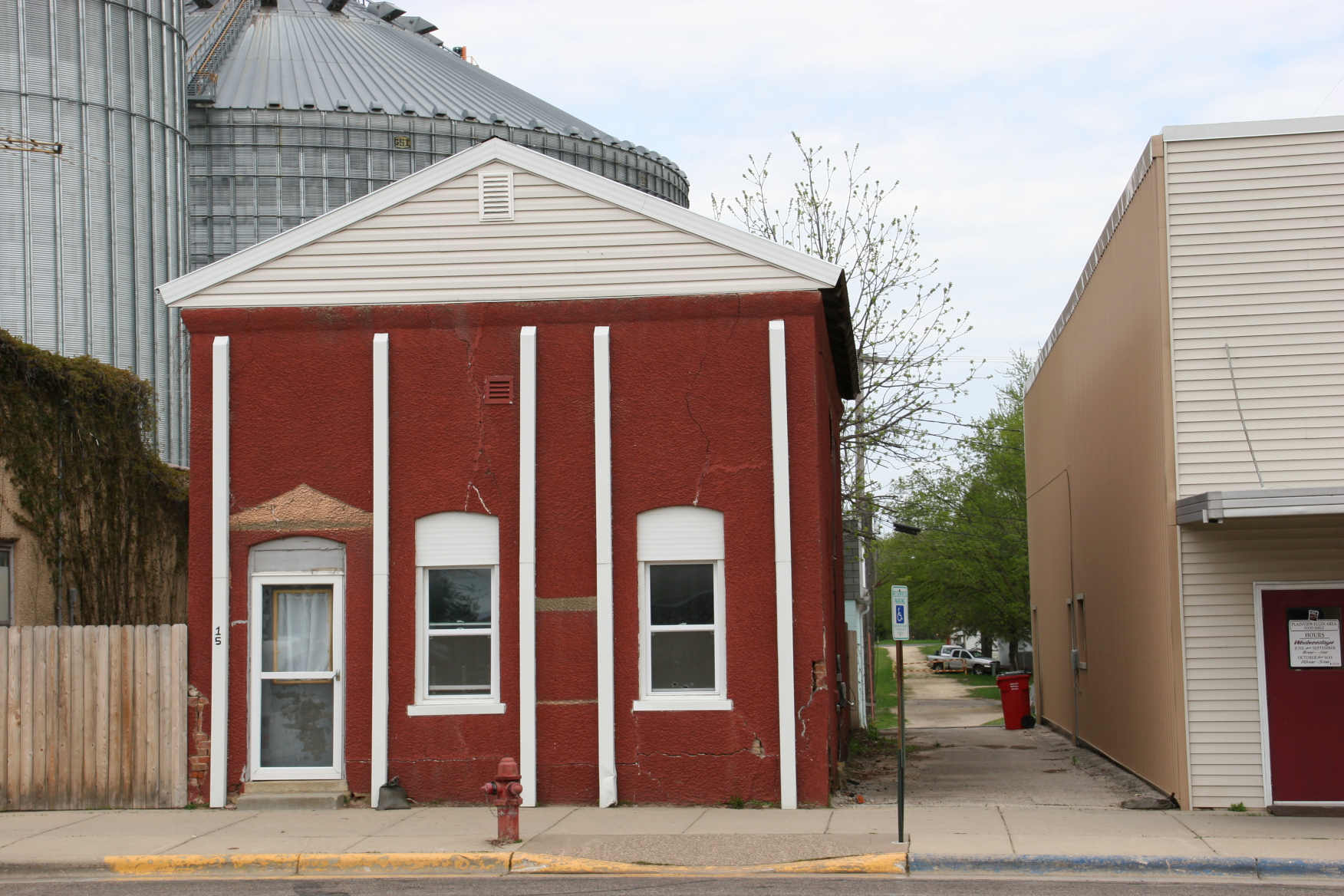
I wonder about the current use and history of this small building by the bins, by the alley. (Minnesota Prairie Roots copyrighted photo May 2022)
I know we missed a lot during our quick stop…
TELL ME: If you’re familiar with Elgin, what should I see/do next time I’m in town? I’m looking for any insider tips, things I might bypass because I’m unaware. Why should someone visit Elgin?
Please check back for another post from this community. And then it’s on to neighboring Plainview.
Promotional graphic created by artist Jeff Jarvis. (Credit: Straight River Art Festival)
WE ARE A CREATIVE BUNCH, we Minnesotans. And this weekend, 20 creatives from Faribault, Northfield and the surrounding area will showcase their work at the Straight River Art Festival.
The new event runs from 9 am–6 pm Saturday, May 21, at Heritage Park, alongside the Straight River, just a block from Faribault’s historic downtown. There fine artists will set up booths to vend their art, engage in conversation and, for some, demonstrate their crafts.
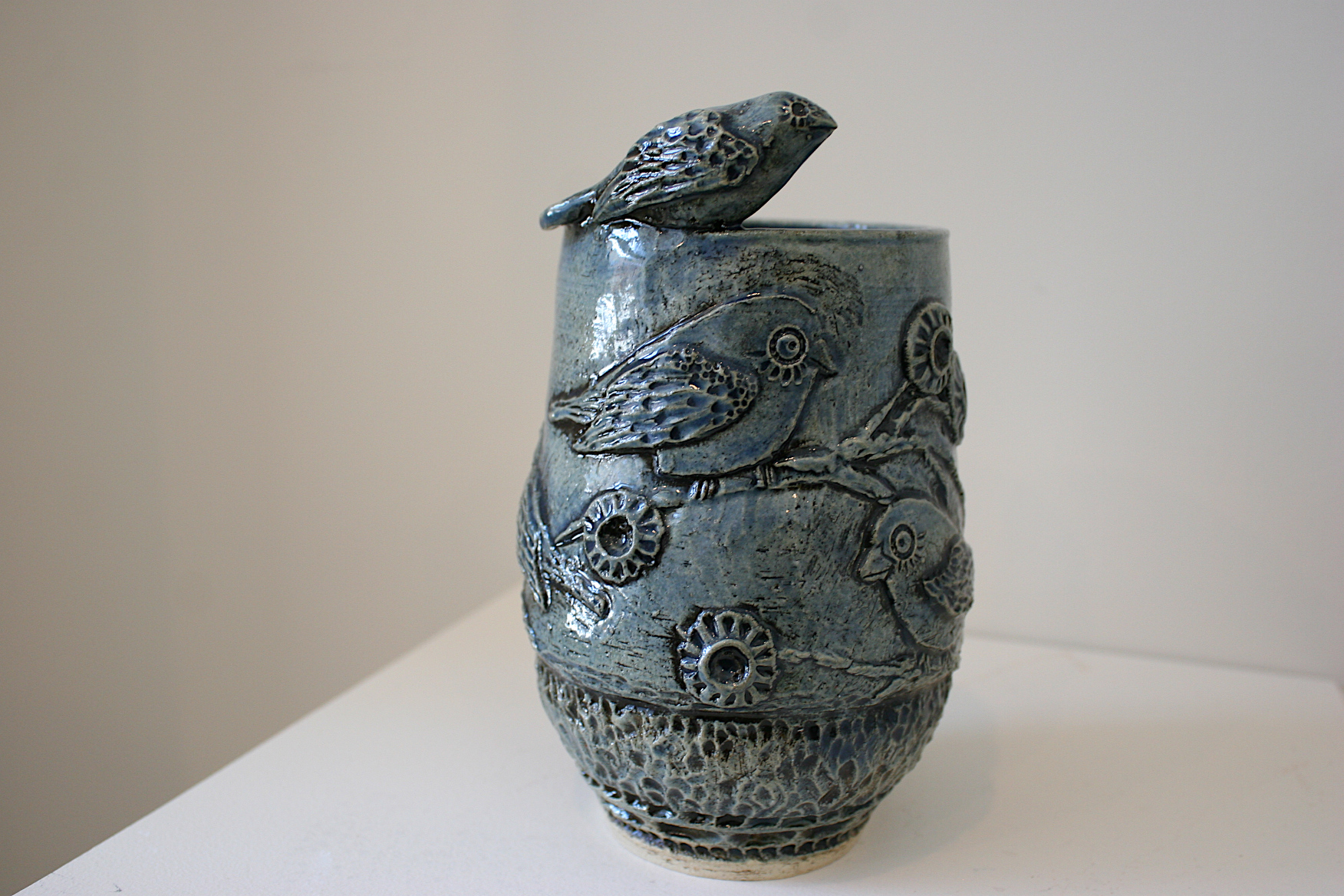
An example of Tami Resler’s pottery. (Minnesota Prairie Roots copyrighted file photo March 2021)
Featured art includes stained glass, jewelry, pottery, apparel and accessories, photography, hand-blown glass, textile design, painting, drawing, fiber art, quilting and woodcarving. Some of the artists are familiar, others perhaps not as much. Yet each brings talent and enthusiasm to the creative process. To have them all together in an outdoor setting makes their art easily accessible and visible.
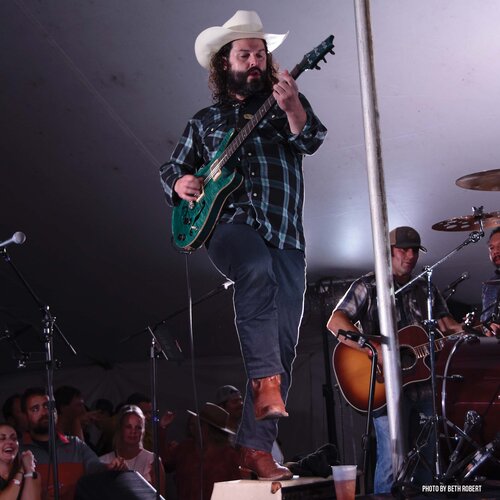
Mark Joseph. (Photo credit: Straight River Art Festival)
Performing artists are also part of the Straight River Art Festival with music by Lil’ Fun Band (11 am-1 pm), Pop Prohibition (1:30-2:30 pm) and Mark Joseph (3-4 pm).
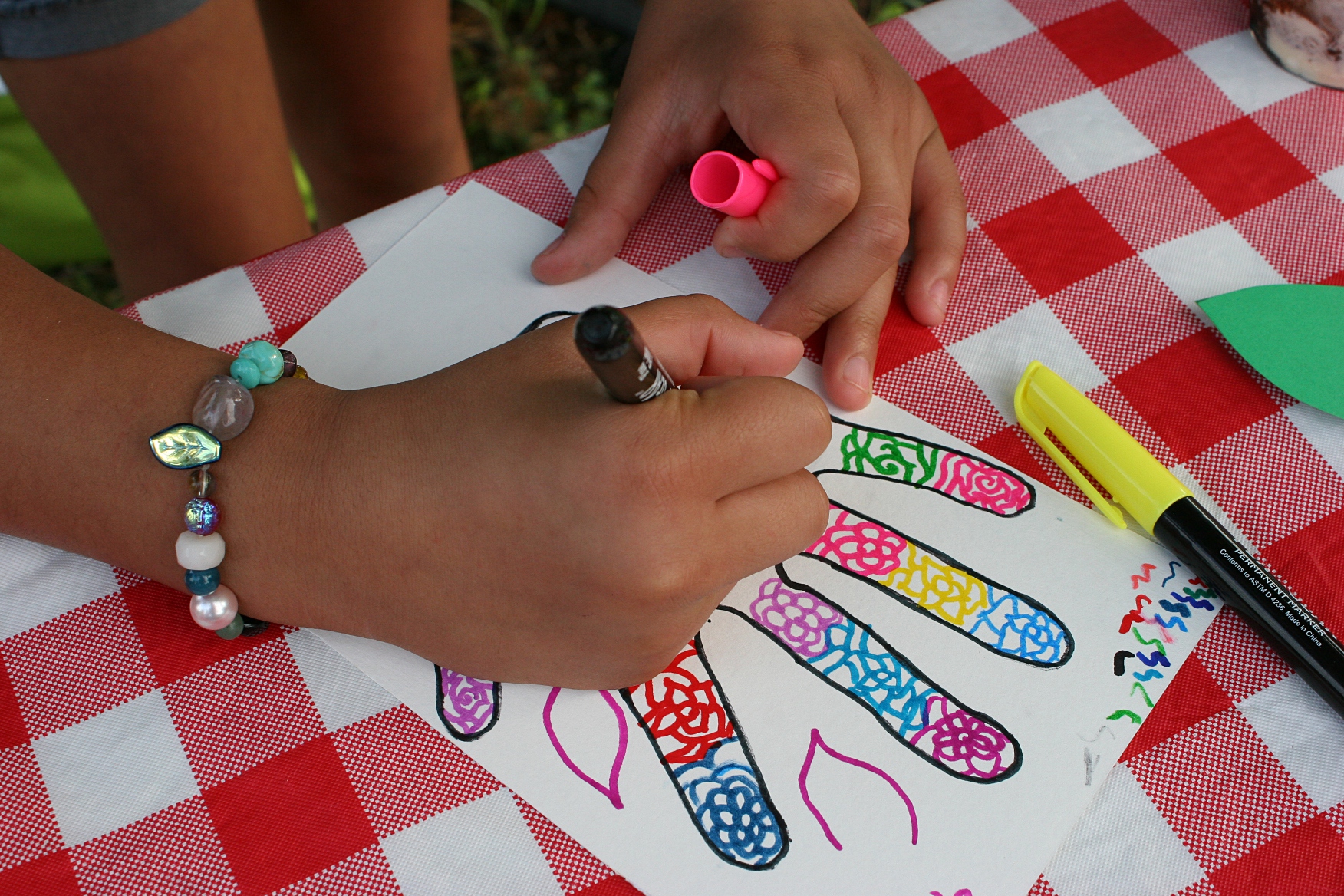
Hands-on art created at a past arts-oriented event in Faribault and unrelated to this Saturday’s festival. (Minnesota Prairie Roots copyrighted file photo July 2019)
This mural on the back of The Upper East Side in downtown Faribault features the art of Jeff Jarvis, a multi-talented artist at West Cedar Studio, Morristown. (Minnesota Prairie Roots copyrighted photo May 2021)
Brigg Evans Textiles are fabric pieces printed from original scanned Seri Batiks created by Suz Klumb, aka Brigg Evans. (Photo credit: Straight River Art Festival)
Prill loves art festivals. And, obviously, art and artists given her creative bend and home-grown Fleur de Lis Gallery. “Faribault is an amazing town with a ton of talent to highlight so I knew this event would be a great way to do that,” she says. She also notes the need for “more fun things for people in the community to do in town.” Her desire to create a new arts festival drew her to Resler and Person, both actively engaged in the arts and with strong connections to local creatives.
Down to Earth Stoneware, pottery by Diane Lockerby. (Photo credit: Straight River Art Festival)
“We are all very passionate about the town and the arts and are very excited to bring this event to the community,” Prill continues.
Bending Sunlight Glassworks, artist Sandra Seelhammer. (Photo credit: Straight River Art Festival)
I’m excited, too, as I share Prill’s love of the arts. I cannot imagine a life without writing and photography. Both feed my spirit, my soul, my need to create. And this Saturday 20 creatives who share that passion will fill Heritage Park with their art and creative energy.
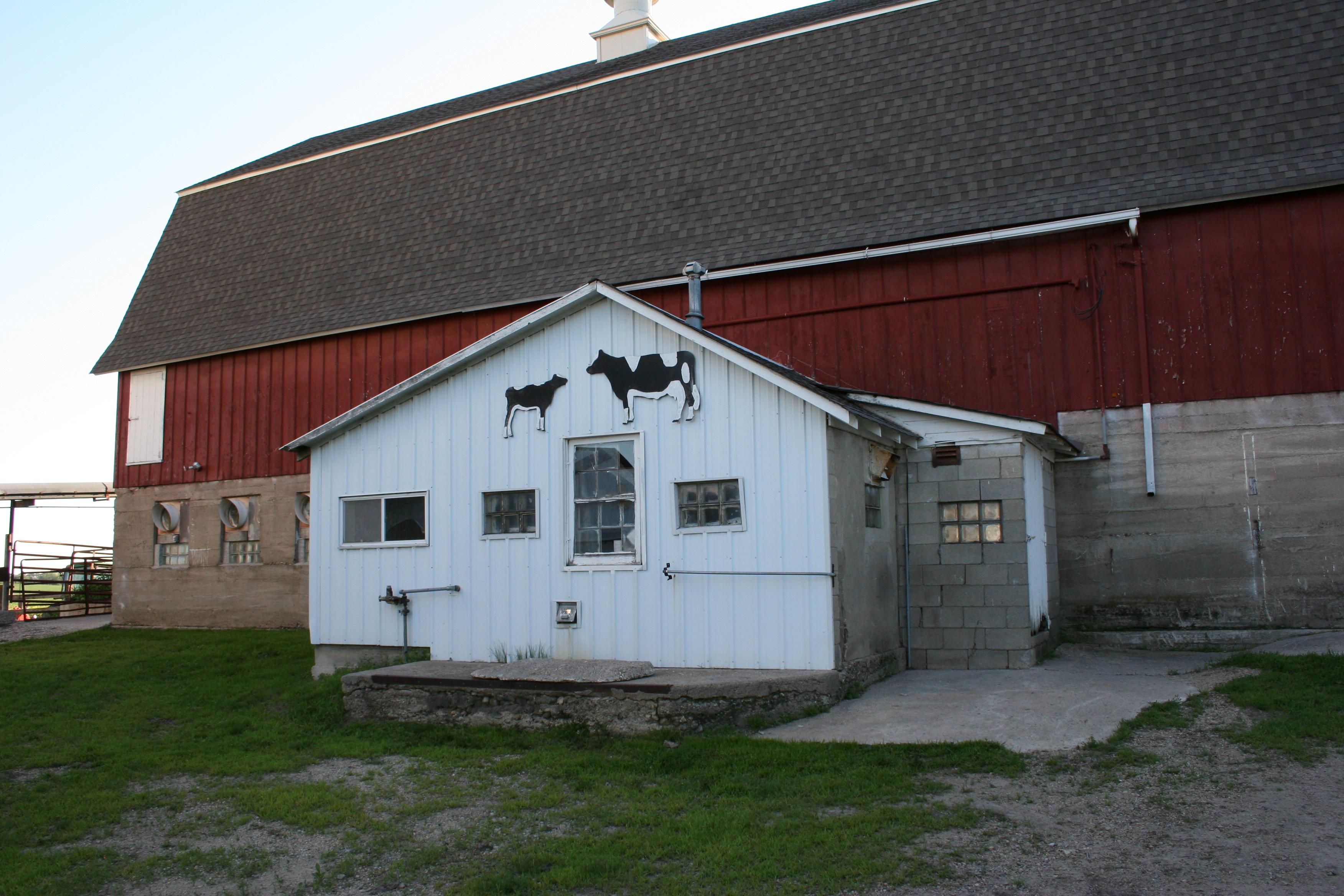
Holstein cow art adorns the milkhouse on the barn of friends in rural Dundas (near Northfield). These farmers once milked Holsteins. (Minnesota Prairie Roots copyrighted file photo September 2011)
NOW BILLED AS“A Classic American River Town” by the local tourism office, Northfield fits that description. This southern Minnesota community, where the James-Younger gang was defeated in 1876, hugs the Cannon River. The historic downtown is filled with mostly home-grown shops and eateries. And, as cliché as it sounds, Northfield is quaint and charming.
I love Northfield. If the cost of houses in 1984 had not been significantly higher than in neighboring Faribault, Randy and I would be living there. Instead, Randy has commuted from Faribault to Northfield to work as an automotive machinist for too many decades. But such is life and we’re happy to call Faribault home.
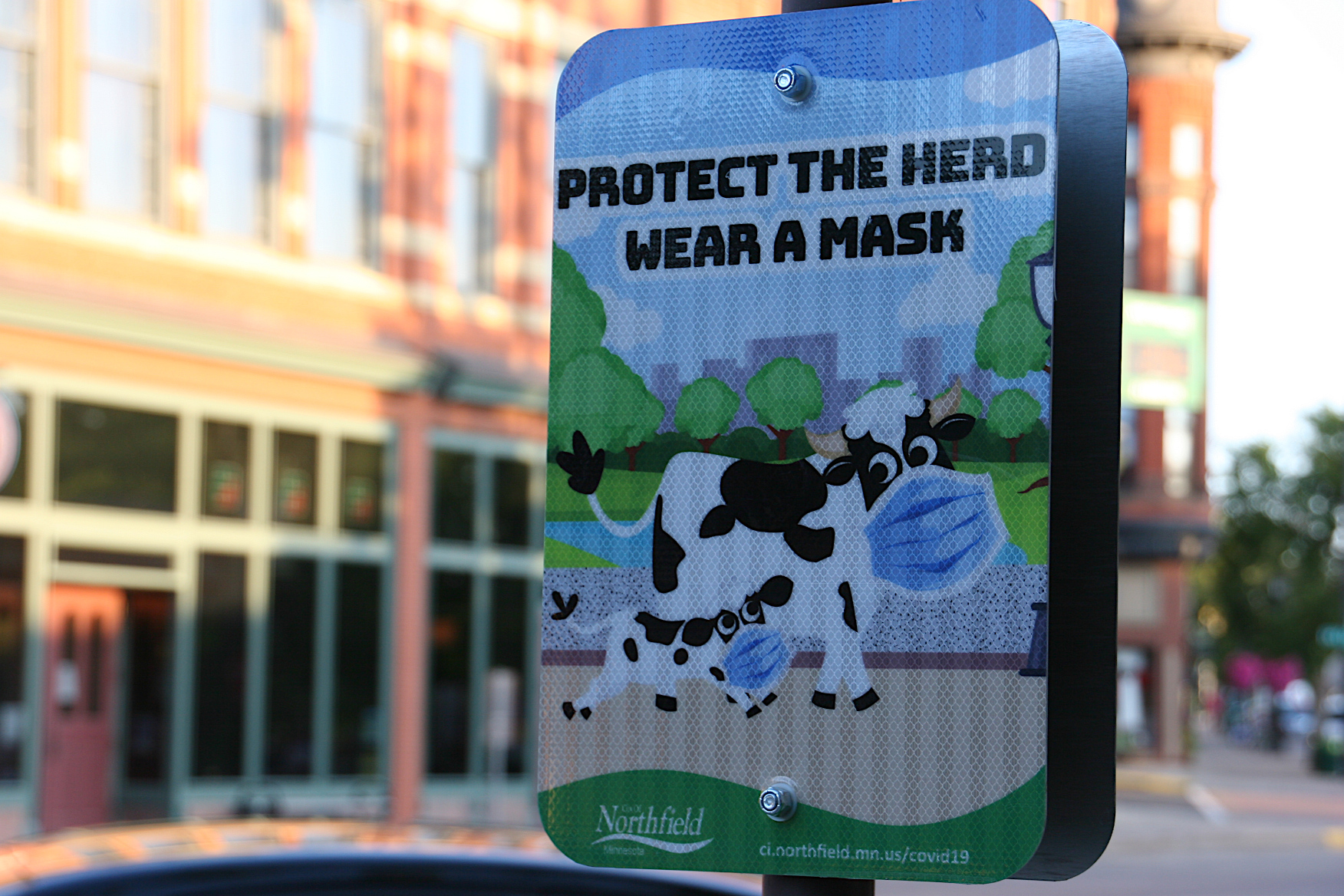
“Protect the herd” plays off the city’s “Cows, Colleges & Contentment” slogan. (Minnesota Prairie Roots copyrighted file photo 2020)
But back to Northfield. There was a time when this city actively tagged its community with the phrase “Cows, Colleges & Contentment.” That slogan still graces some signage. I observed a cow-themed sign encouraging masking early in the pandemic. “Protect the herd” focused the message from the City of Northfield. I thought that incredibly powerful and catchy. You know, we’re all in this together type attitude. Care about one another.
I understand how “contentment” fits this community. And colleges, too, as Northfield is home to St. Olaf and Carleton colleges.
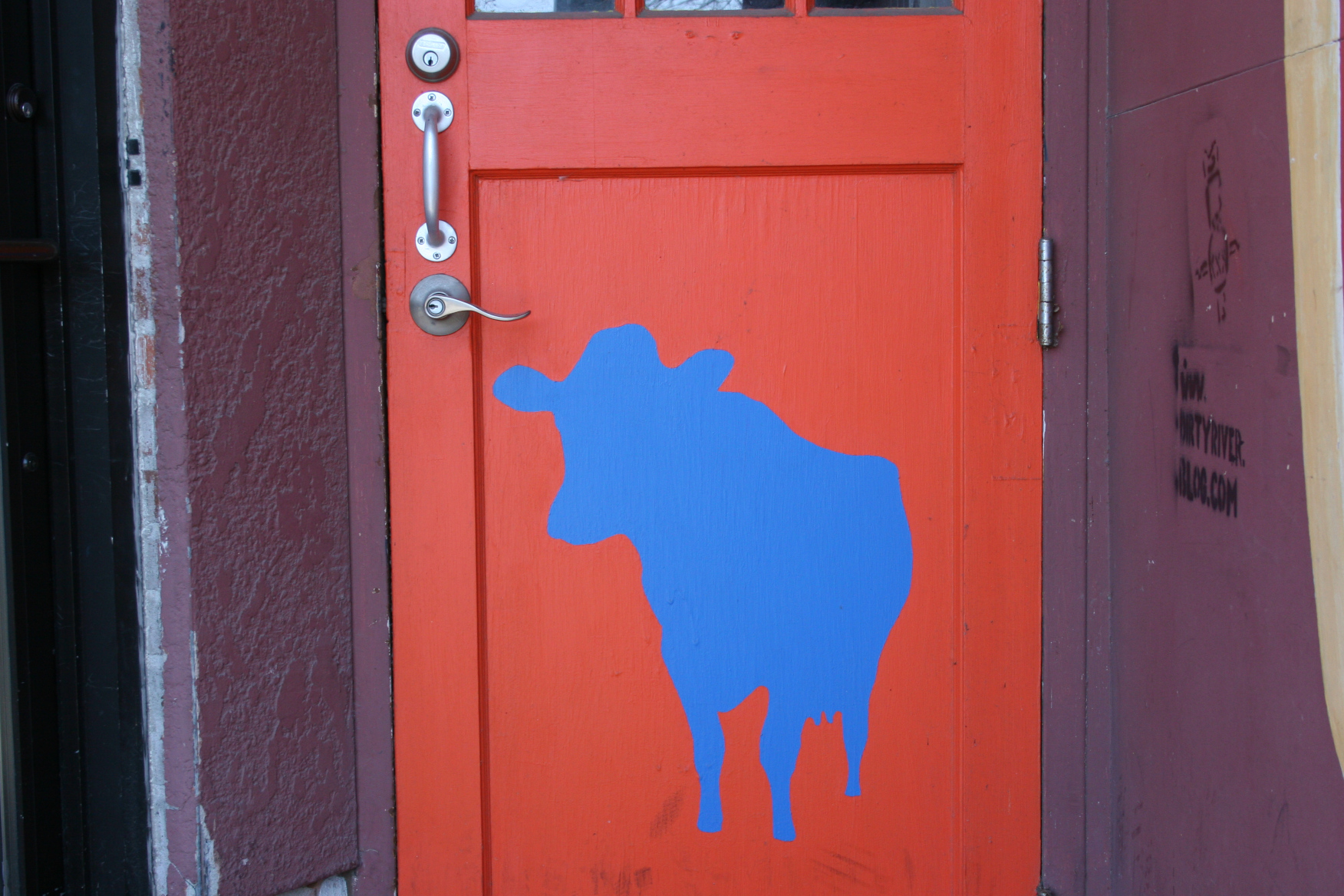
The blue cow I spotted recently in downtown Northfield. (Minnesota Prairie Roots copyrighted photo 2022)
But I didn’t quite get the “cows” part until I found an explanation on the Visit Northfield website. In summary, in the late 1890s, a local farmer/newspaper editor suggested Northfield could attract businesses by focusing on breeding of Holstein cows. That eventually happened with 5,532 Holstein dairy cattle and 261 breeders in the area by 1916, a Northfield Holstein Club and the moniker, “Holstein Capital of America,” attached to Northfield. The aforementioned colleges also established Holstein herds. I encourage you to read the full story about the Northfield cows by clicking here.
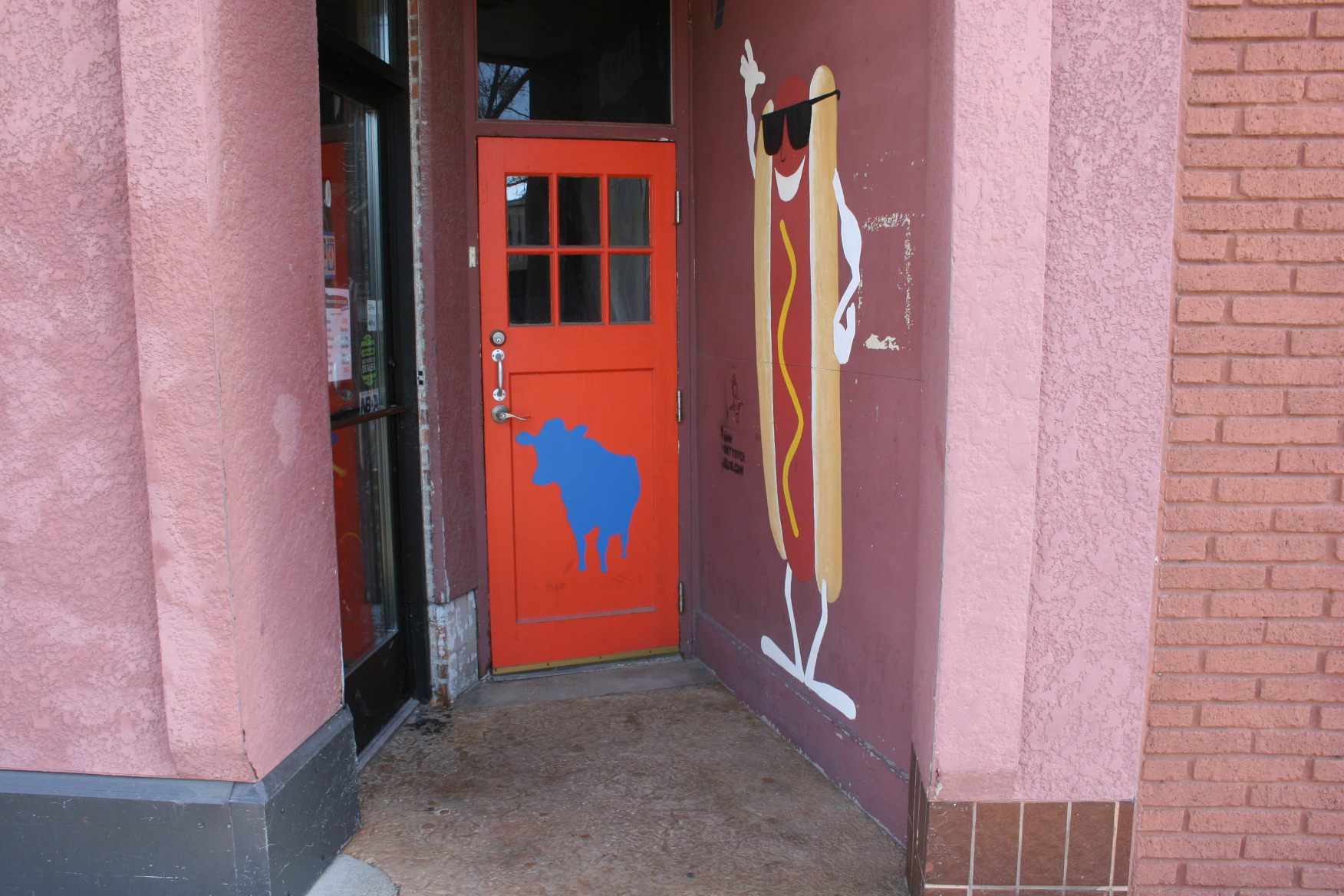
Downtown Bicycles’ blue cow image. Now, what’s with the hot dog? (Minnesota Prairie Roots copyrighted photo 2022)
On a recent walk through downtown Northfield, I didn’t see any Holsteins. But I happened upon a blue cow painted on an orange door. The cow graphic marks Downtown Bicycles, 321 Division Street. Seeing that cow brought to mind the “Cows, Colleges & Contentment” theme, which led me to uncover the story behind the bovines of Northfield.
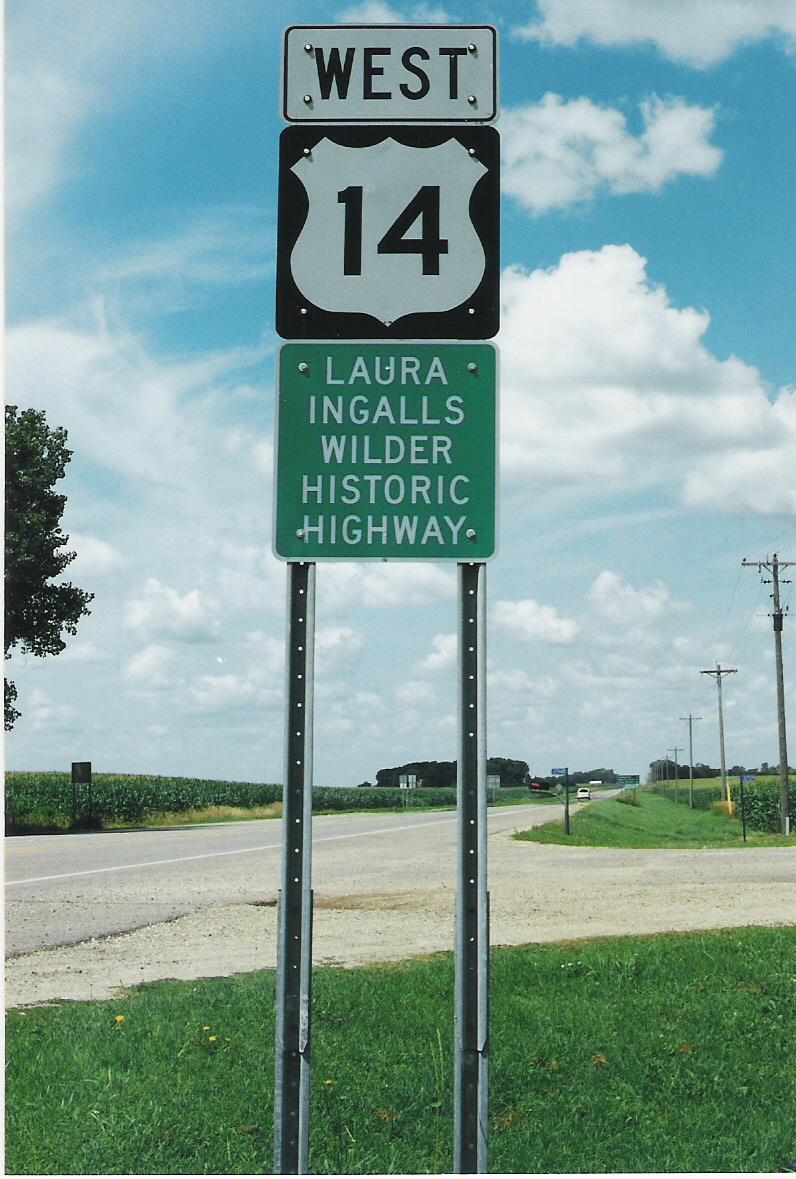
U.S. Highway 14 west of New Ulm in southwestern Minnesota. (Minnesota Prairie Roots copyrighted file photo)
IF YOU’RE A FAN of the “Little House on the Prairie” television series, you will recognize these town names: Walnut Grove. Sleepy Eye. Mankato. In the TV version, the Charles and Caroline Ingalls family lived in Walnut Grove, but also traveled to Sleepy Eye and Mankato. In her books, Laura Ingalls Wilder doesn’t write about journeying to either town from Walnut Grove. Hollywood added its creative perspective, including a setting that is not exactly accurate in its depiction of the prairie. I know this area well. My hometown of Vesta lies 20 miles north of Walnut Grove on the mostly flat prairie of big sky and wide open spaces.
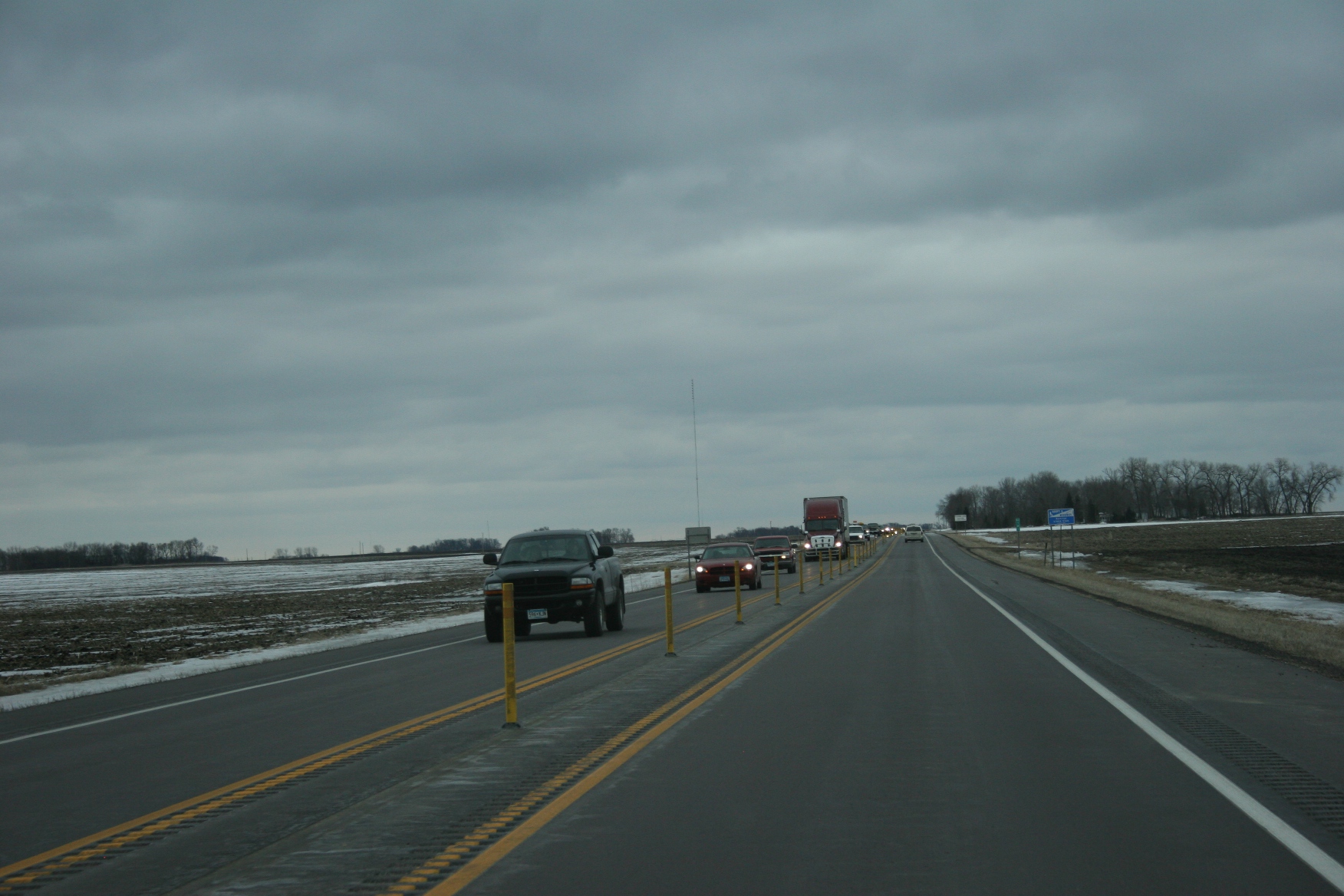
Heavy traffic on U.S. Highway 14 between Nicollet and North Mankato in March 2013, before that section of two-lane expanded to four-lane. (Minnesota Prairie Roots copyrighted photo 2013)
The trip back to Redwood County from my Faribault home takes me along U.S. Highway 14, also known as the Laura Ingalls Wilder Historic Highway. That road passes through Mankato and Sleepy Eye and many other communities into the heart of rural Minnesota, along a particularly dangerous stretch of roadway. Highway 14 has/had a reputation for above average deadly crashes. That’s no surprise given the narrow lanes carrying heavy traffic volumes.
West of Nicollet, signage warns drivers that Highway 14 goes back to two-lane. It’s at this point where the current four-lane expansion begins to New Ulm. (Minnesota Prairie Roots copyrighted file photo December 2016)
But that is all changing. Several days ago, government officials and others gathered for a ceremonial event to kick off a two-year road construction project that will replace 12 miles of two-lane roadway between Nicollet and New Ulm with a four-lane road. It’s about time. This is the last stretch of two-lane converting to four-lane from Rochester to New Ulm.
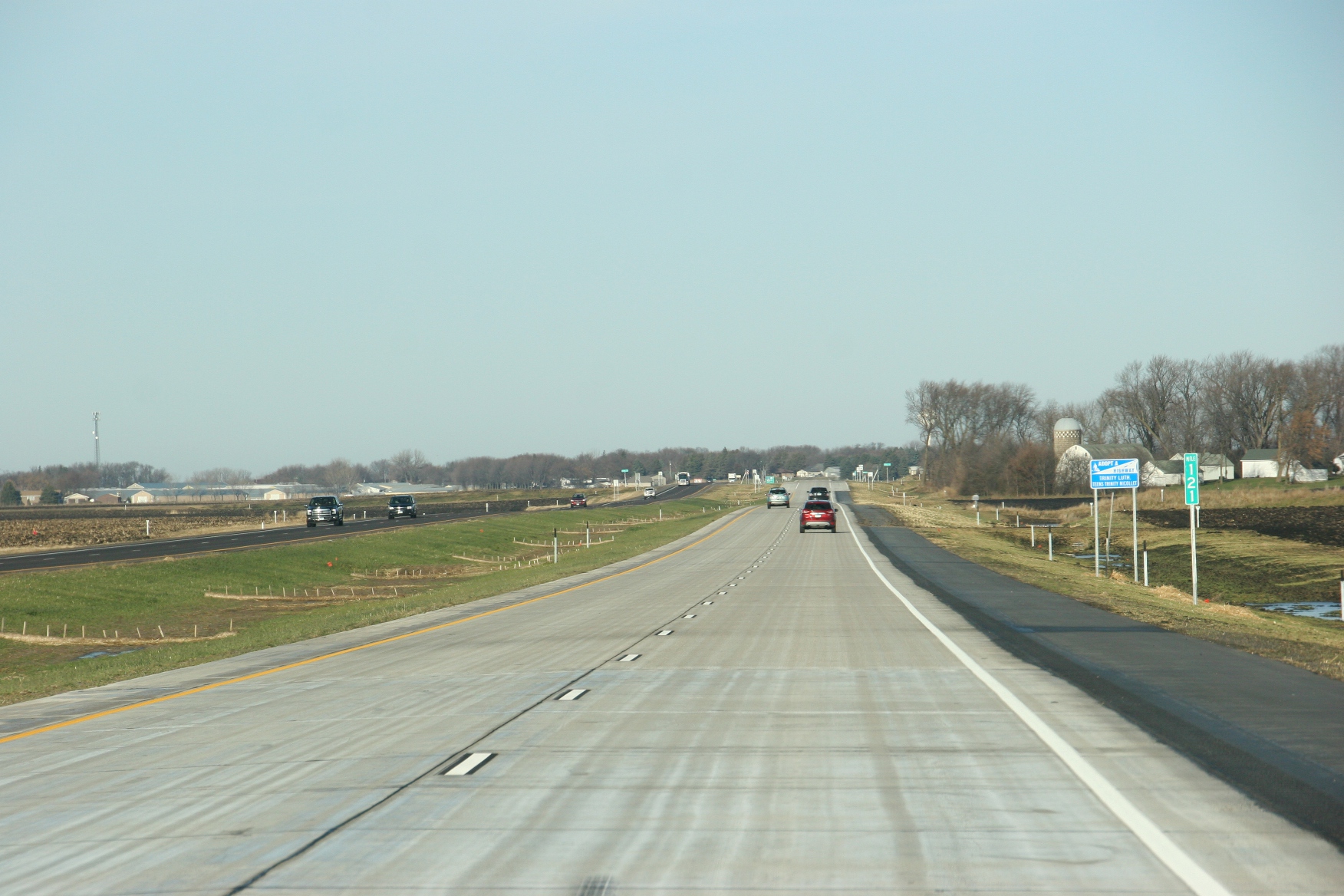
Westbound on Highway 14 heading to Nicollet from Mankato. (Minnesota Prairie Roots copyrighted file photo 2016)
I don’t get back to southwestern Minnesota all that often anymore, just for the occasional funeral or family gathering. But I’m thankful that come October 2023, the drive between Nicollet and New Ulm will be easier, safer, faster. Just like it is now between Mankato and Nicollet.
Once west of New Ulm, Highway 14 will remain the same. Narrow. Well-traveled. Not particularly safe. But for today, I’m grateful for the improvements to 12 miles of a route the Ingalls family didn’t follow, but which many fans of “Little House on the Prairie” travel today en route to Walnut Grove.
THE LAST TIME I STOPPED at Owatonna’s Central Park, this southern Minnesota city’s community gathering spot pulsed with activity. The park hosts a busy Owatonna Farmers Market from May through October.
A scene from Owatonna’s Central Park on February 19. (Minnesota Prairie Roots photo February 2022)
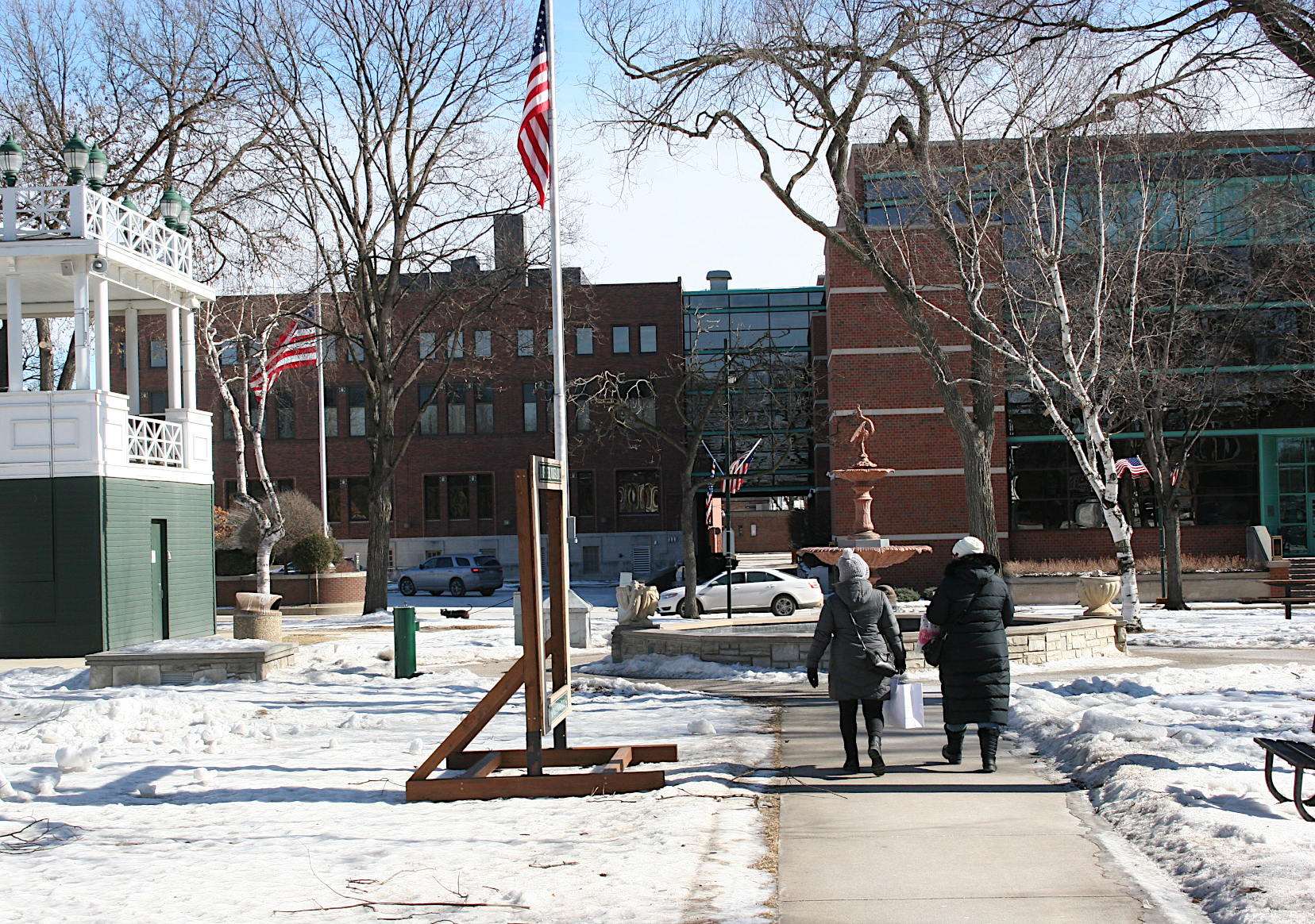
But on this cold Saturday in late February when I stopped by, only a few people used the park. A couple walked their dogs. And two women crossed to the center fountain, purses angled across downy winter coats, stocking caps clamped on and shopping bags looped over three gloved hands, take-out coffee clutched in the fourth.
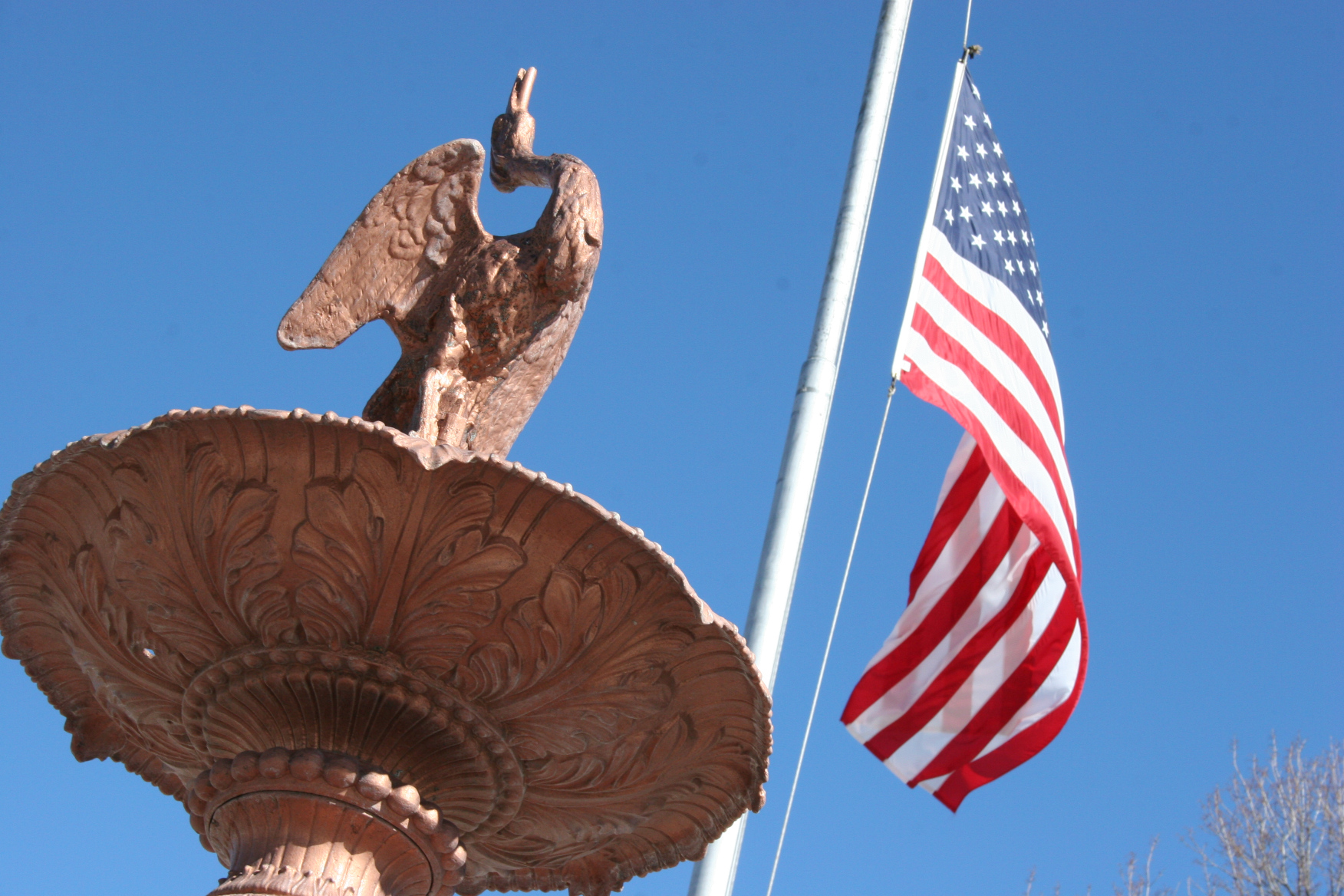
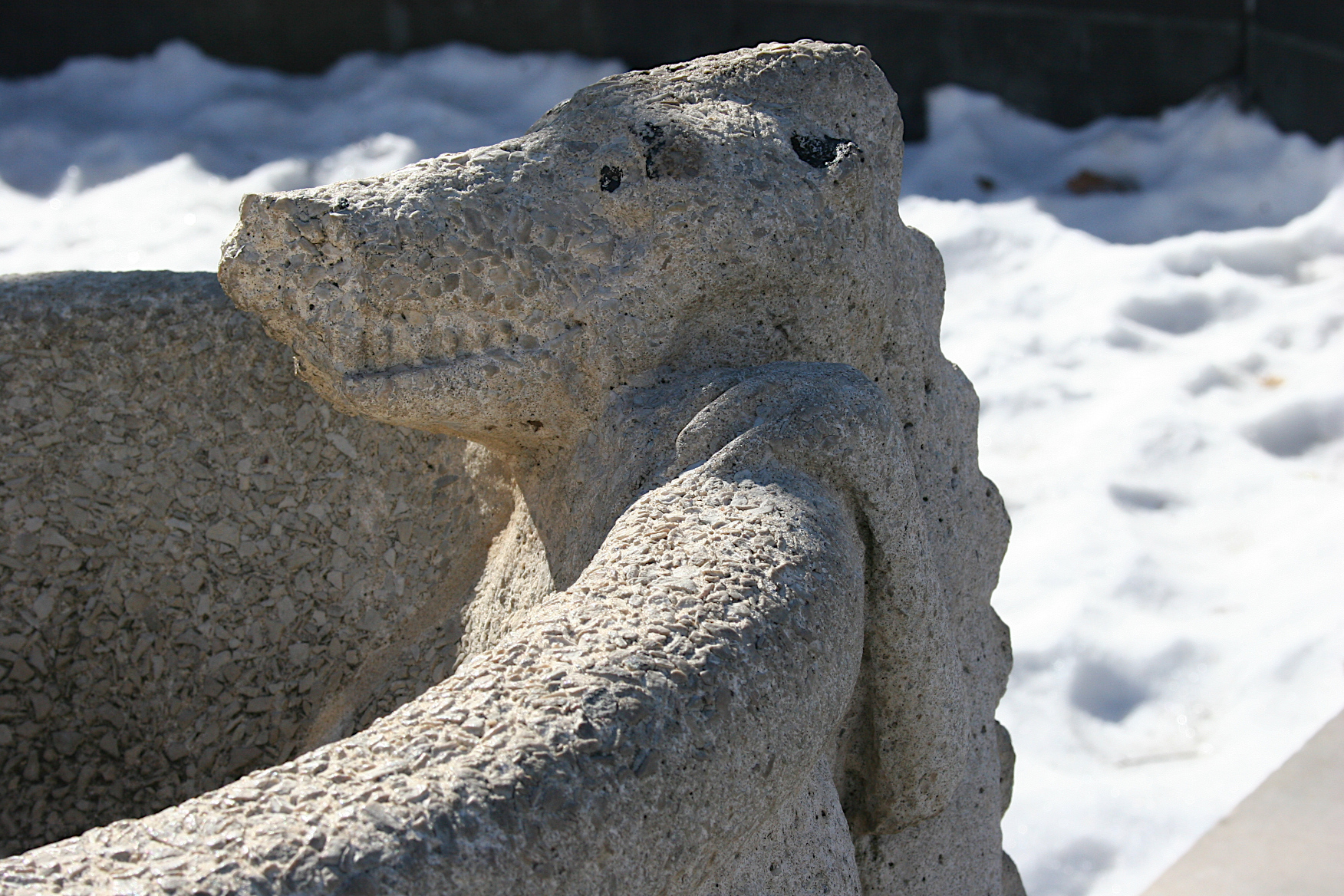
A crane tops the 1909 fountain, refurbished in 2021. (Minnesota Prairie Roots copyrighted photo February 2022)
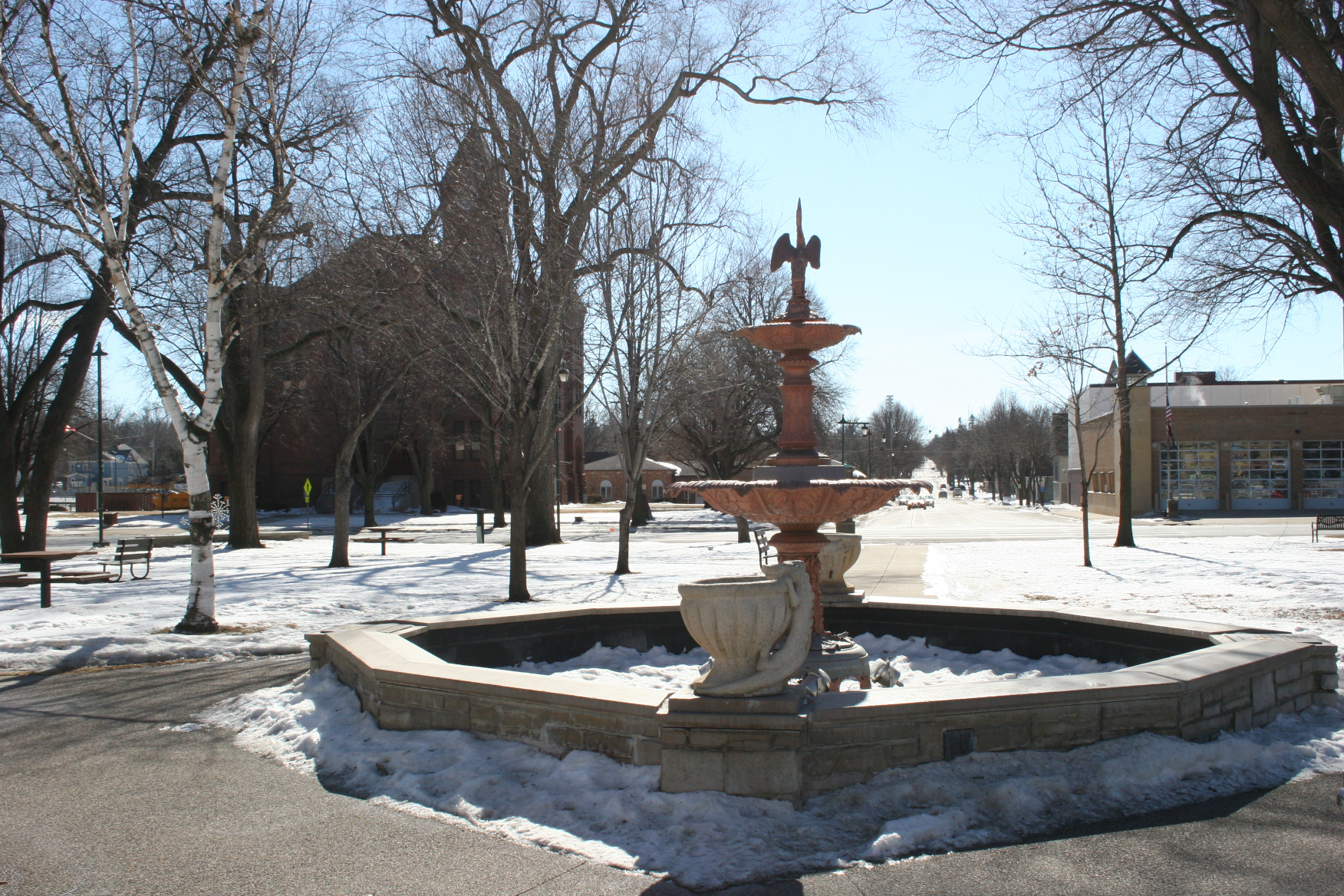
Imagine this fountain in the warmer months. (Minnesota Prairie Roots copyrighted photo February 2022)
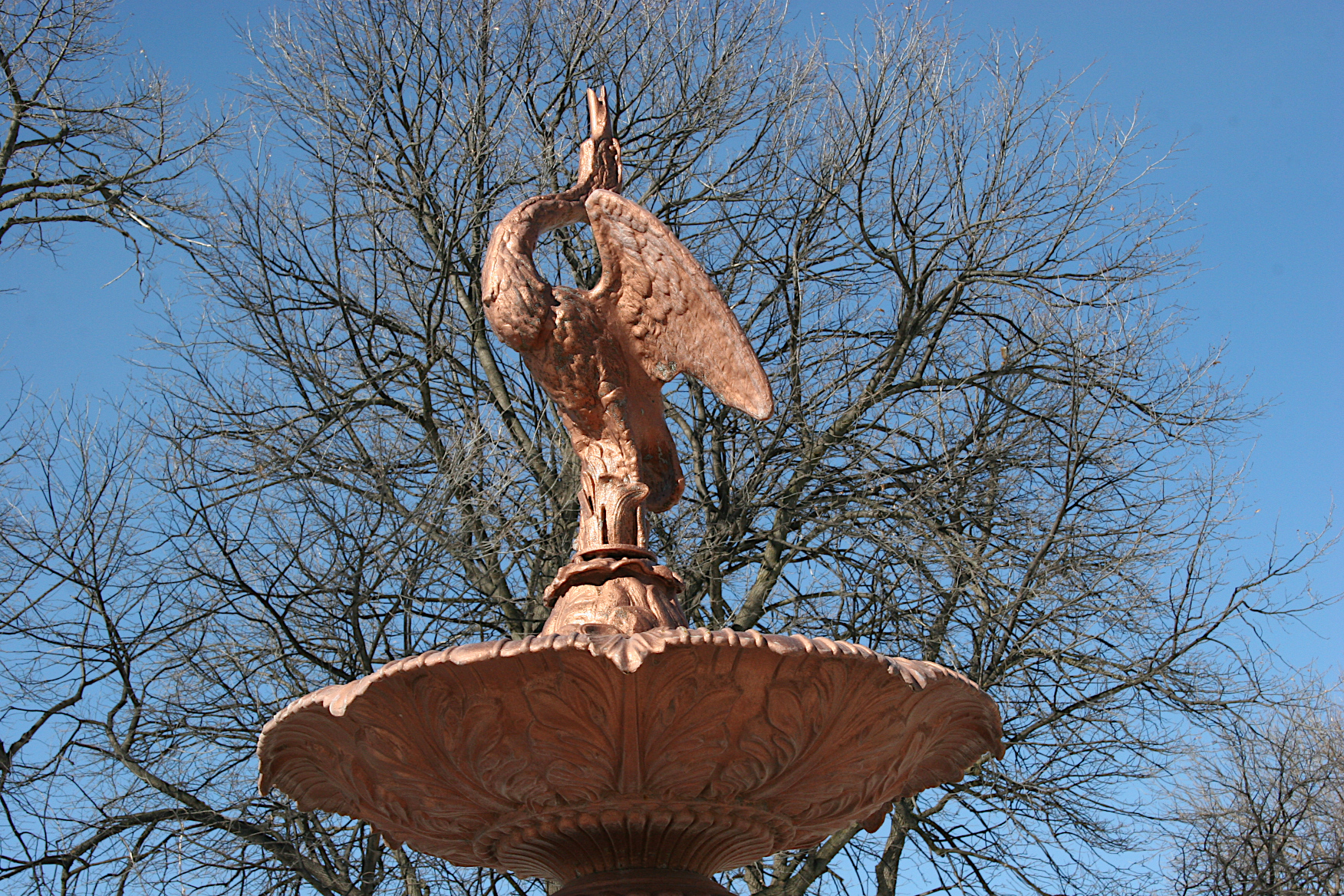
Love the graceful curve of the fountain top crane. (Minnesota Prairie Roots copyrighted file photo February 2022)
As the women paused near the centerpiece fountain placed here in 1909, I studied the scene before me, camera ready. Only moments earlier, I finished my packed lunch inside the cozy warmth of the van. Randy and I had planned to eat at nearby Rice Lake State Park. But that all changed when hiking trails proved too icy for safe walking. So here we were in Owatonna, shifting our plans.
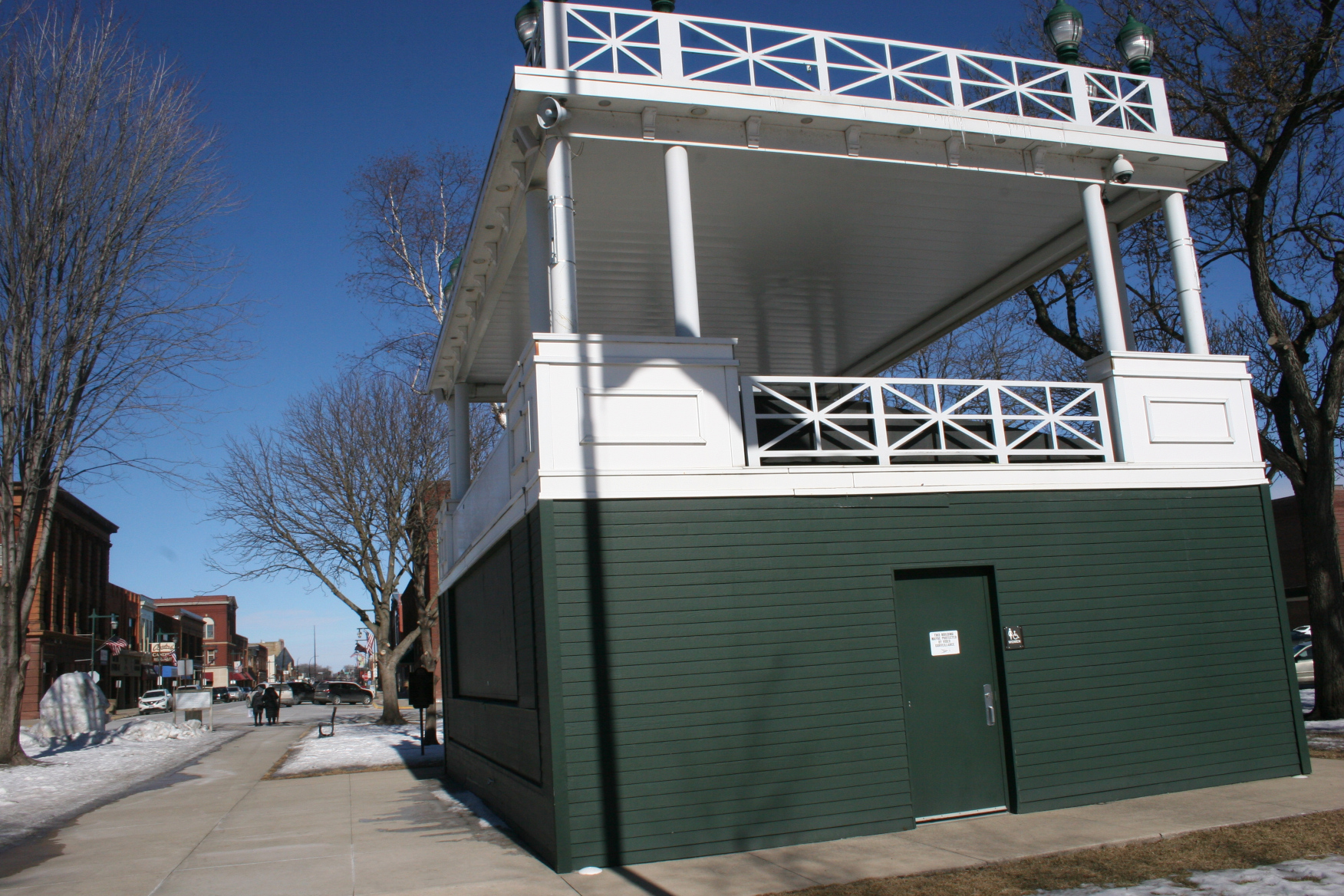
This replica of the 1899 community stage centers the park. It was built in 2004, on Owatonna’s 150th anniversary. (Minnesota Prairie Roots copyrighted photo February 2022)
I was determined that the cold weather would not keep me from photographing the park. Dressed in a warm hand-me-down parka from my son layered over tee and flannel shirts, long johns under jeans, practical winter boots, hand-knit cap and mitten/gloves, I felt prepared. The combo mitten/gloves were a gift from Randy years ago. They work great for winter photography. I flip back the fleece ends to reveal open fingertips. That allows me to manipulate my camera without exposing my entire hand.
An artsy planter sits on fountain’s edge awaiting spring planting. (Minnesota Prairie Roots copyrighted photo February 2022)
Even with all of that, I soon found myself hurrying my creative pace. My fingertips were freezing.
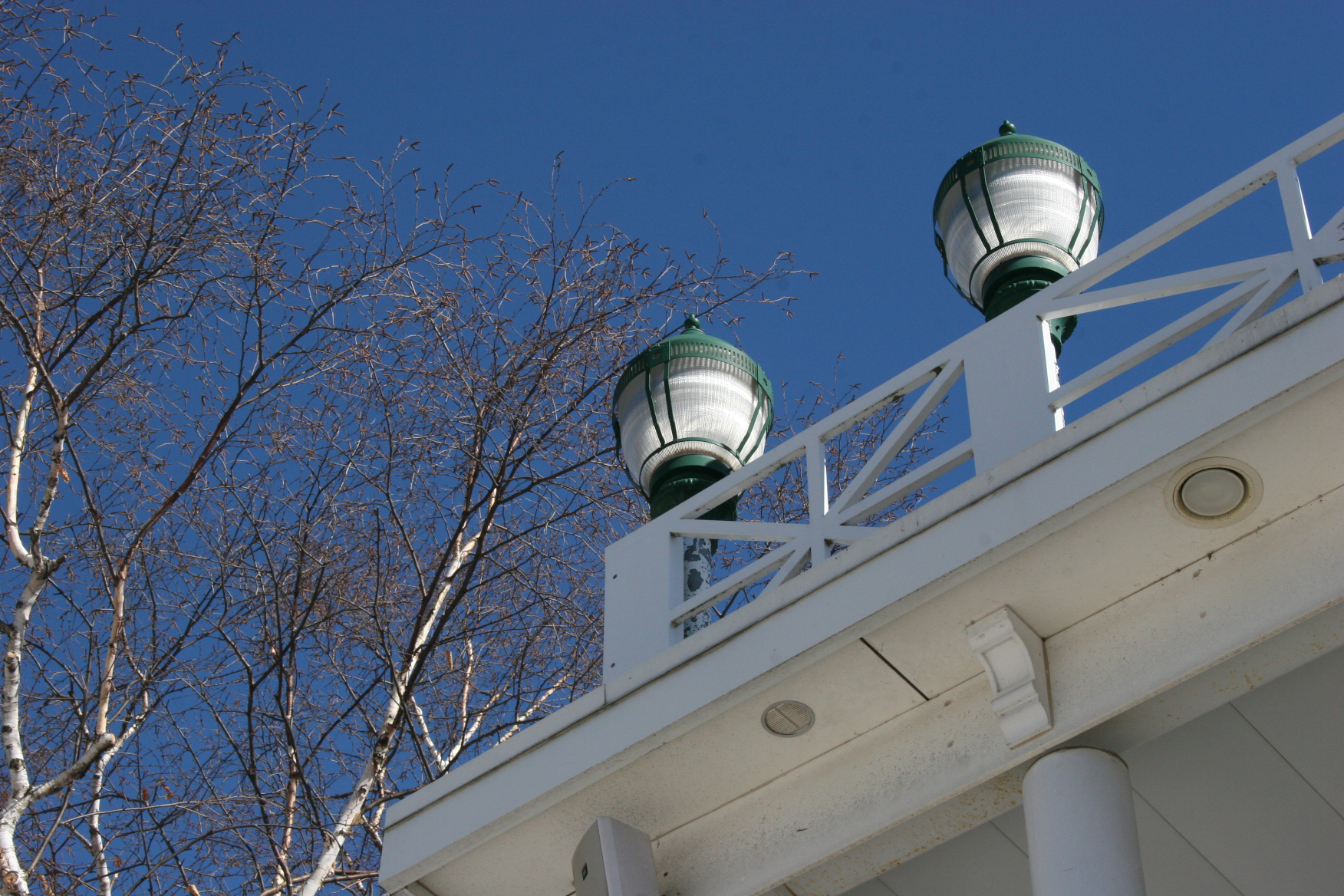
Trees and lights against a bold blue sky by the stage/bandshell. (Minnesota Prairie Roots copyrighted photo February 2022)
But I was determined to document the setting on an afternoon that looked deceptively warm. Bold blue skies. Sunshine. Artsy fountain. Stout community stage. Historic buildings bordering the park. Remnants of snow sculptures.
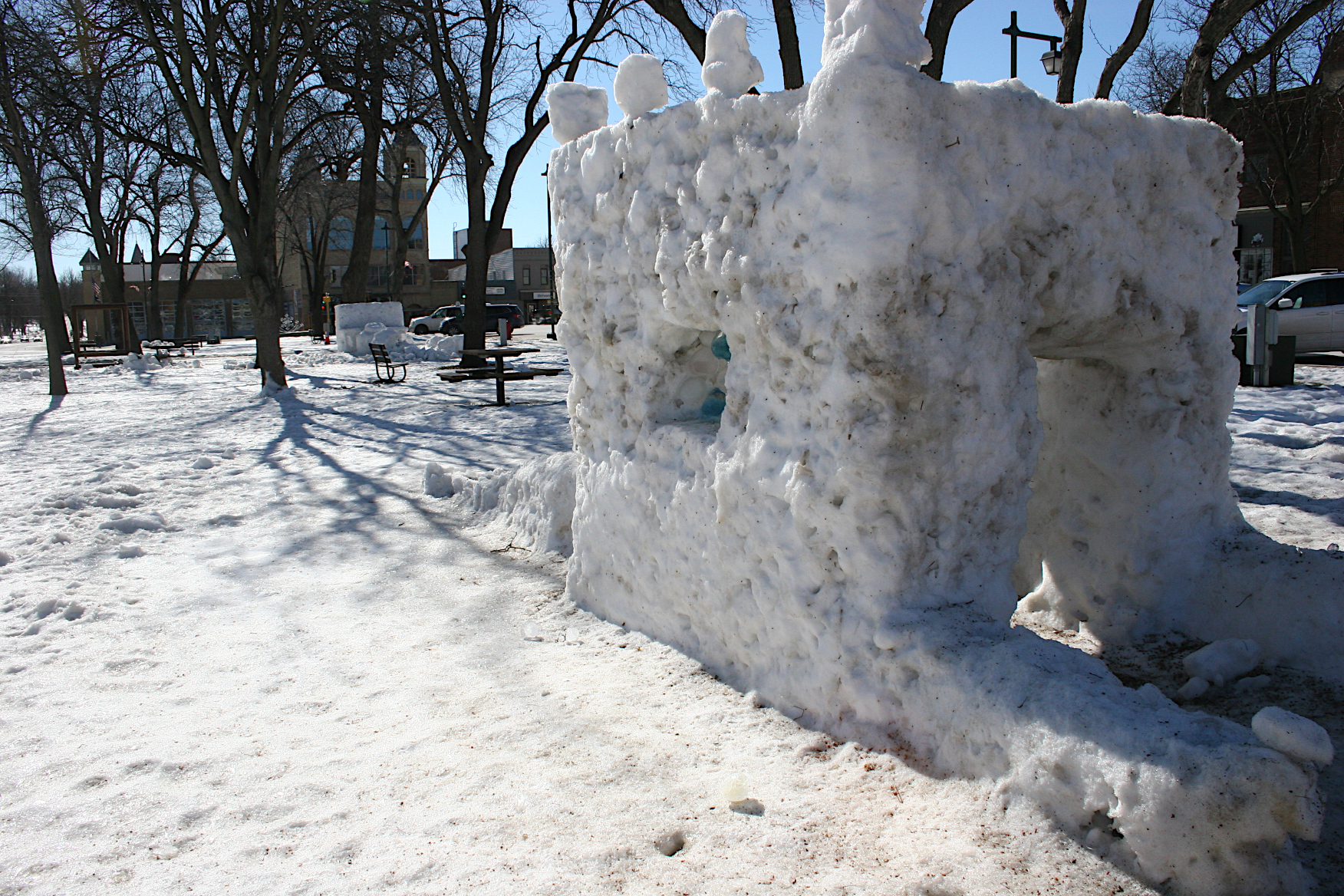
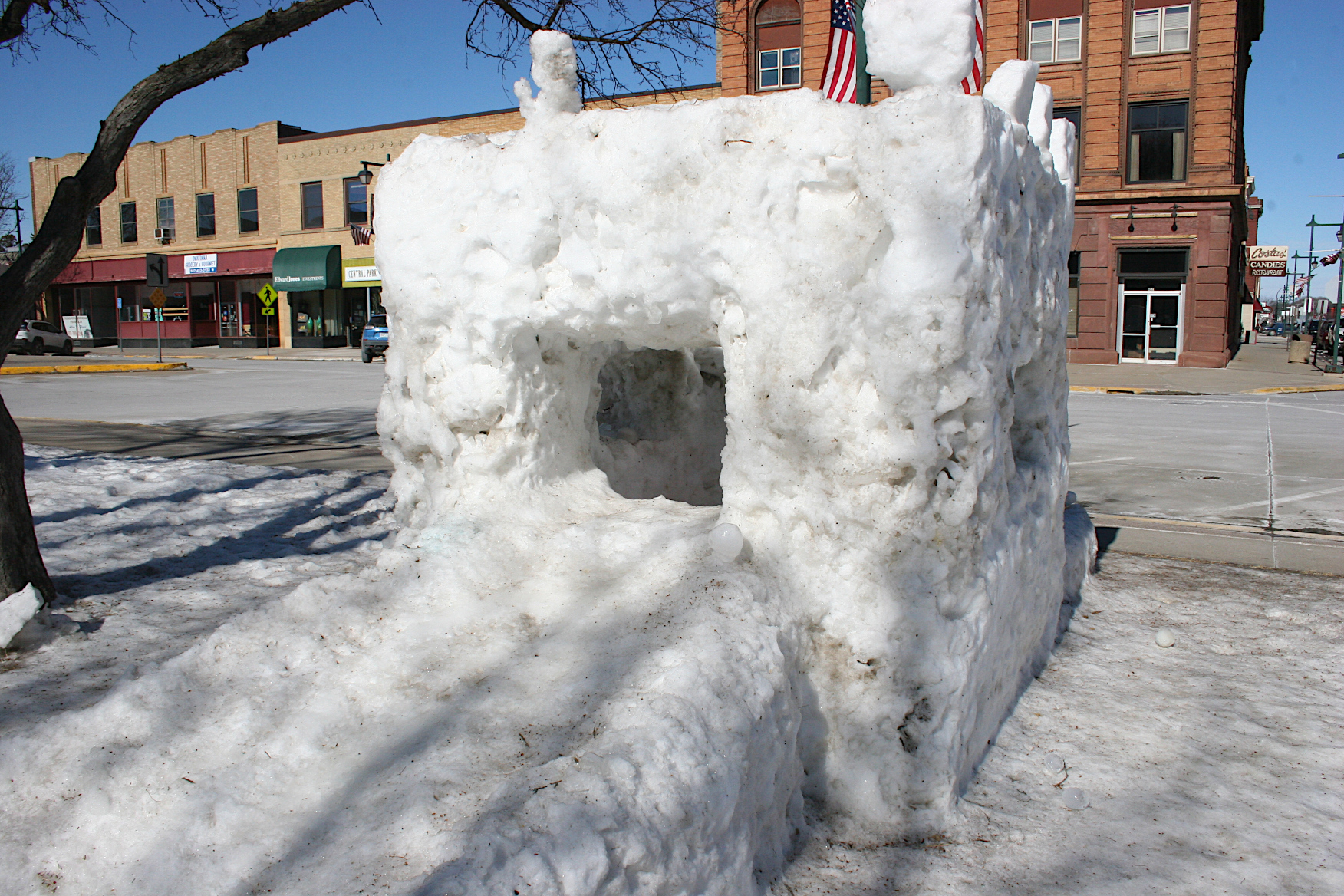
This snow castle still stands, albeit weathered after a month. (Minnesota Prairie Roots copyrighted photo February 2022)
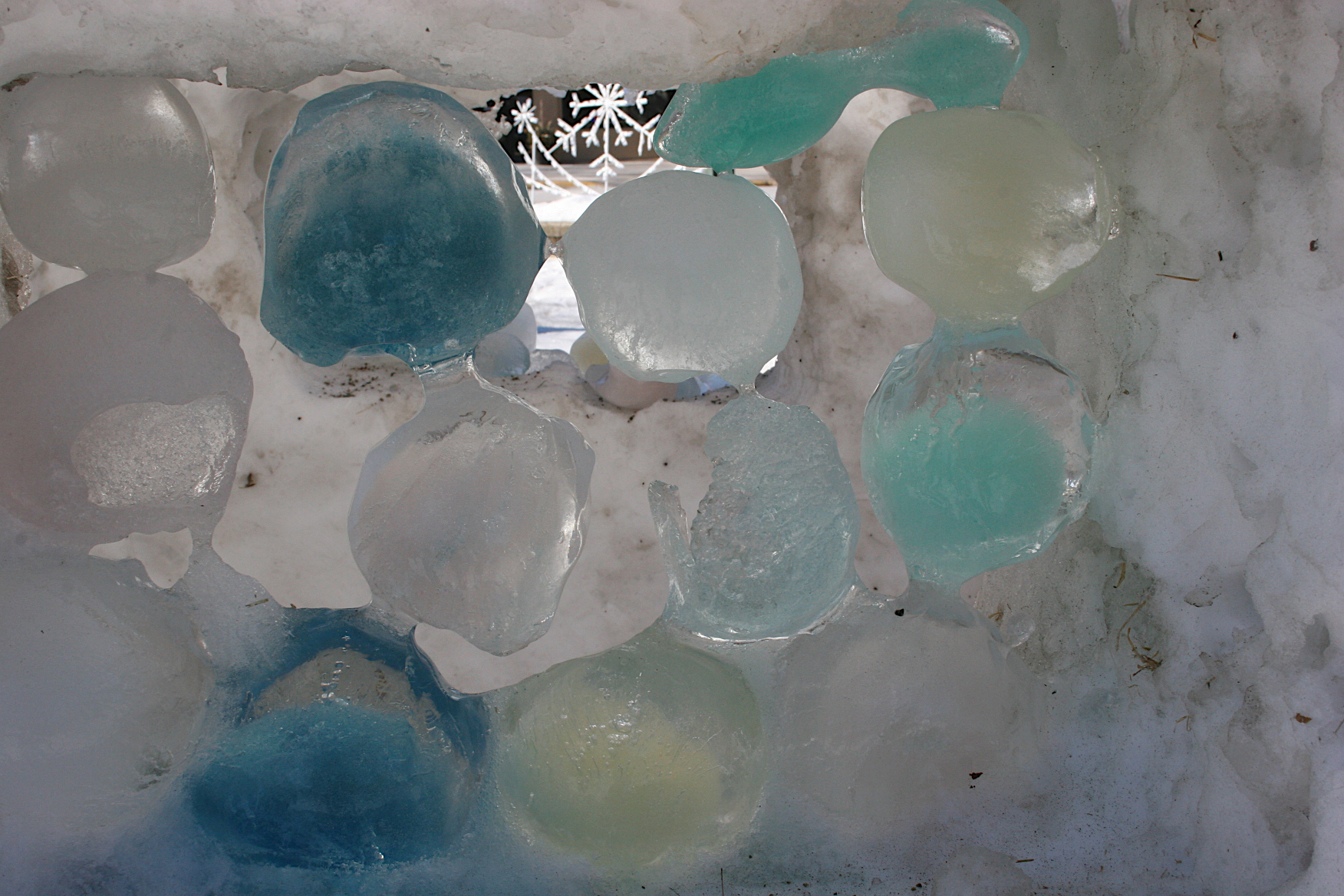
Beautiful colored ice fills a window of the snow castle. (Minnesota Prairie Roots copyrighted photo February 2022)
The back side of the castle features a slide. (Minnesota Prairie Roots copyrighted photo February 2022)
I regretted that we missed Owatonna’s Bold & Cold Winter Festival at the end of January. Then those sculptures would have been newly-built, pristine. But now I could only imagine kids slipping down the slide at the deteriorating snow castle.
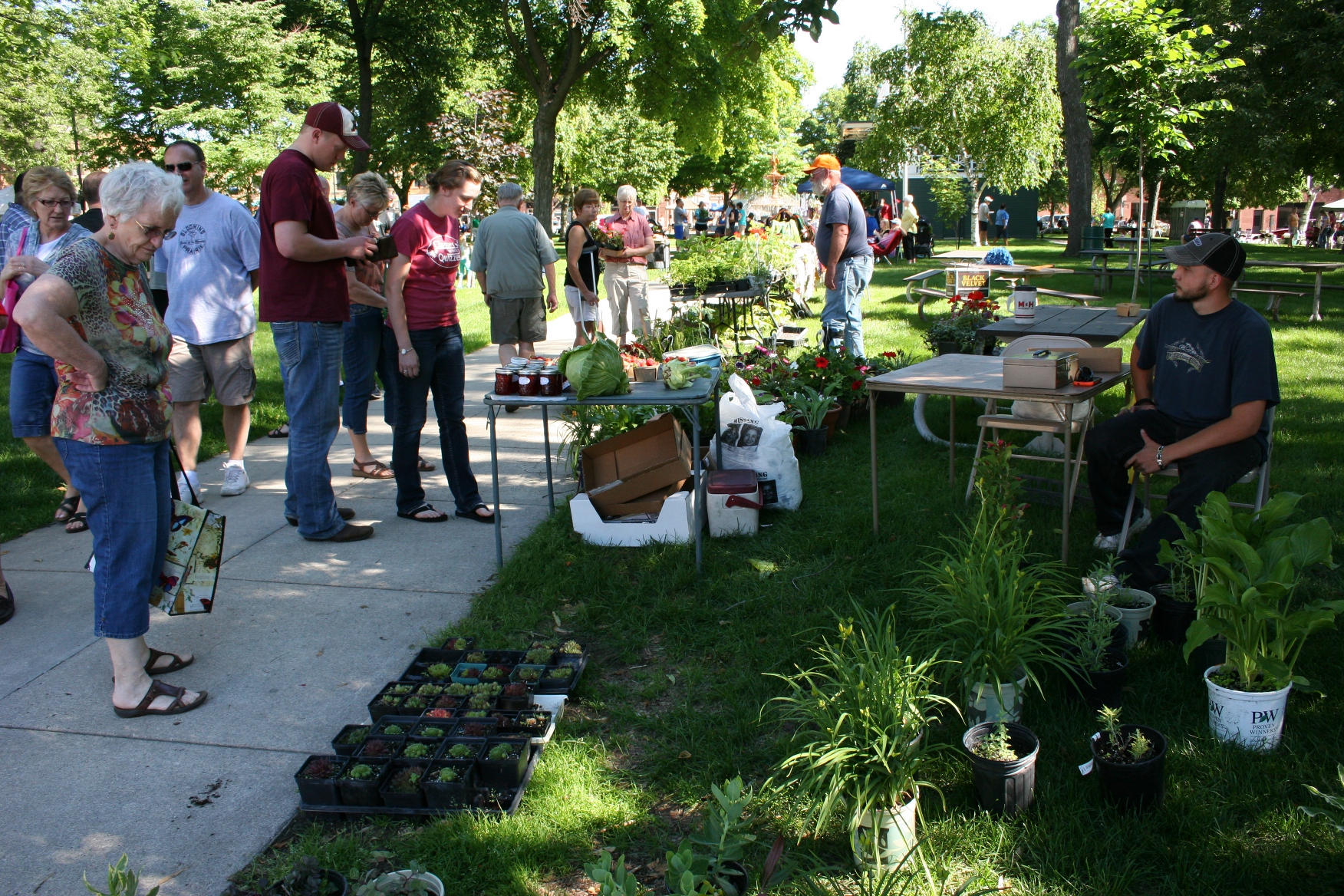
Plants for sale at the 2014 Owatonna Farmers Market. (Minnesota Prairie Roots copyrighted photo February 2022)
I also imagined how, in a few months, this scene will change. How leaves will unfurl on the birch trees. How the fountain will spill water. How Farmers Market vendors will set up shop. How music will create a joyful rhythm that welcomes spring, then summer. And warmth.
A snapshot scene from the 2014 Owatonna Farmers Market, which covers one-block square Central Park. (Minnesota Prairie Roots copyrighted file photo June 2014)
This I contemplate as I snap frames, fingertips freezing, hurting now in the cold of winter. Back in the van, I hold my fingers close to the blower, seeking heat while the sun shines bright, bold over Central Park.
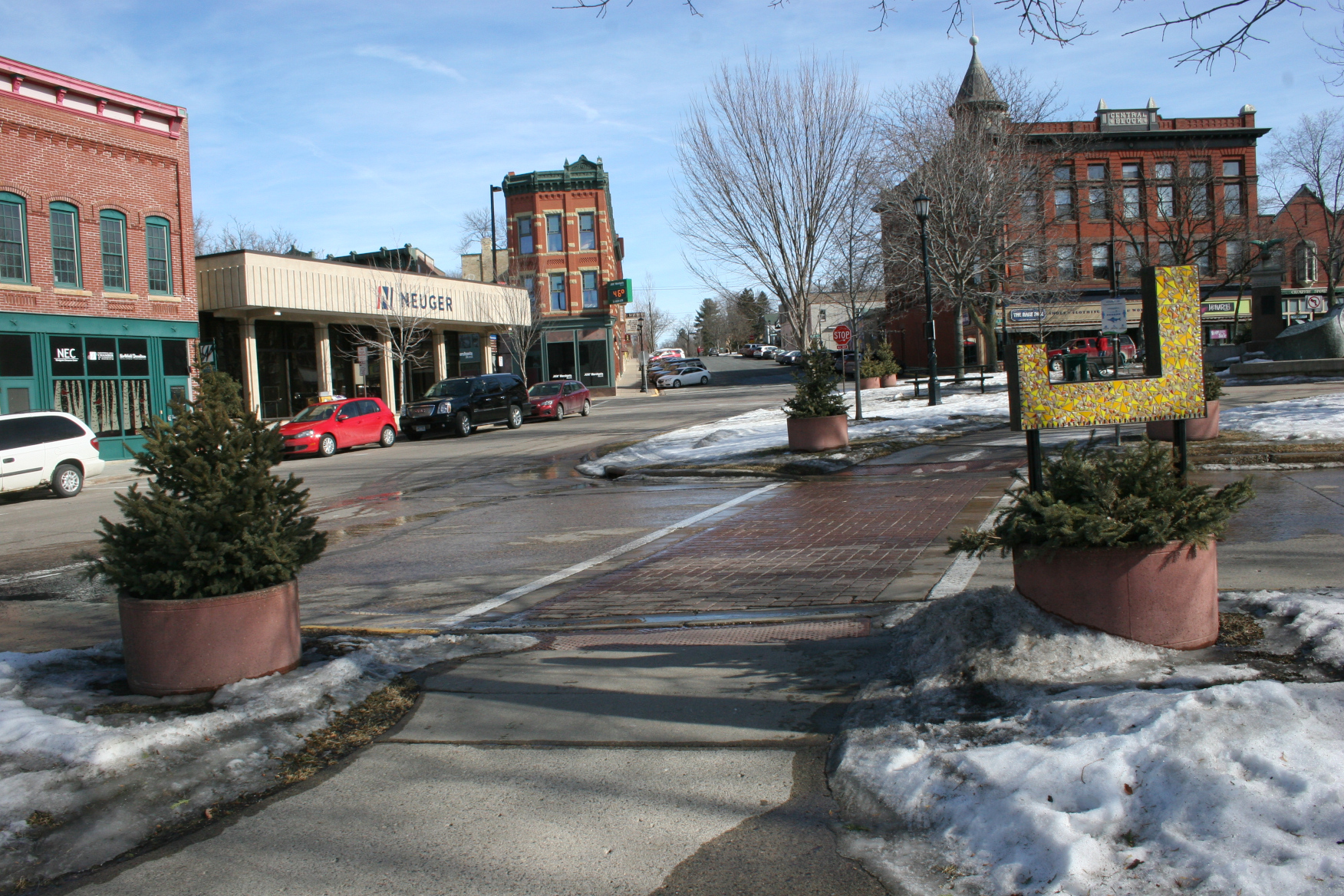
“Framing the Scene,” a relatively new art installation, right, in the heart of historic downtown Northfield.
AS A MEGA APPRECIATOR of outdoor public art, I delighted in the recent discovery of some new, at least new-to-me, art staged in historic downtown Northfield. This southern Minnesota river town boasts a thriving community of literary, visual and performing artists.
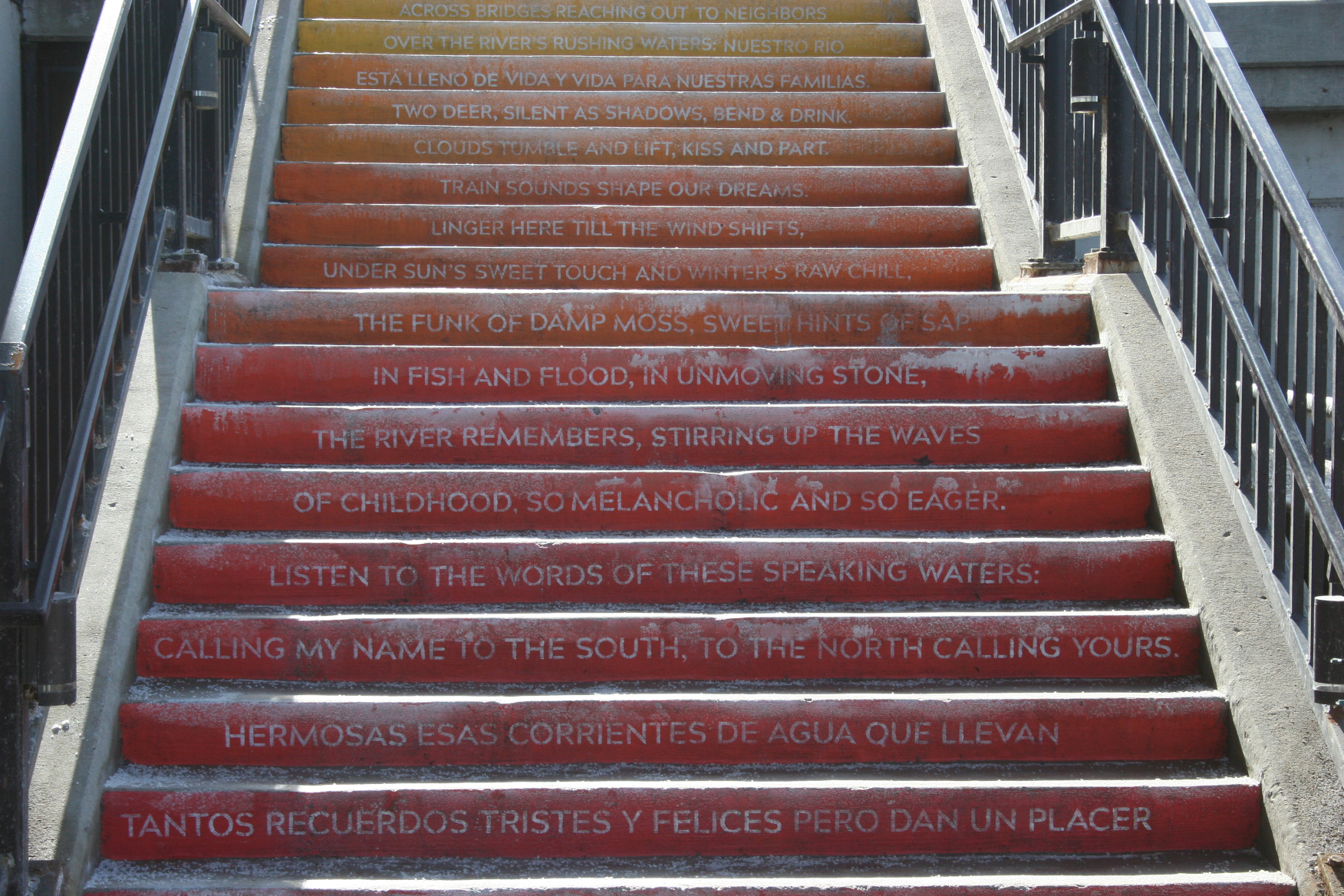
This shows a section of Northfield’s “Poem Steps,” a collaboration of 17 local poets. These poetry steps (covered here with salt residue) are along the Riverwalk. (Minnesota Prairie Roots copyrighted photo February 2022)
Here you’ll find poems imprinted in sidewalks, painted on steps and read at poetry readings in a city with a poet laureate. Here you’ll see outdoor sculptures scattered about town. Here you can listen to a concert at Bridge Square, a local church, St. Olaf or Carleton Colleges or elsewhere. Here you can enjoy live theater. Here you can appreciate the works of creatives at the Northfield Arts Guild and many other venues.
Northfield truly is synonymous with the arts.
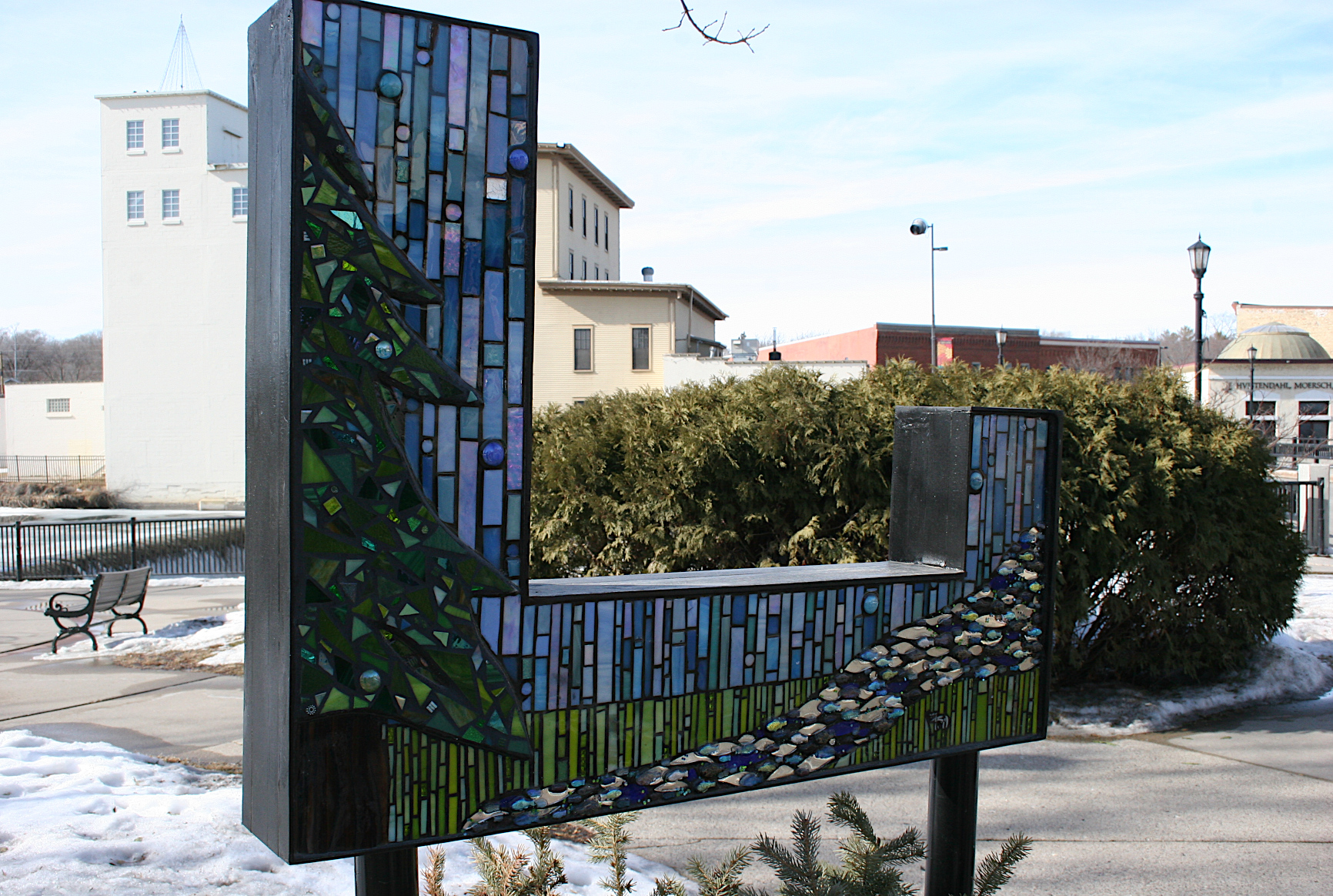
The riverside-themed side of Erin Ward’s “Framing the Scene.” In the background water rushes over the Ames Mill Dam next to the historic mill on the Cannon River. (Minnesota Prairie Roots copyrighted photo February 2022)
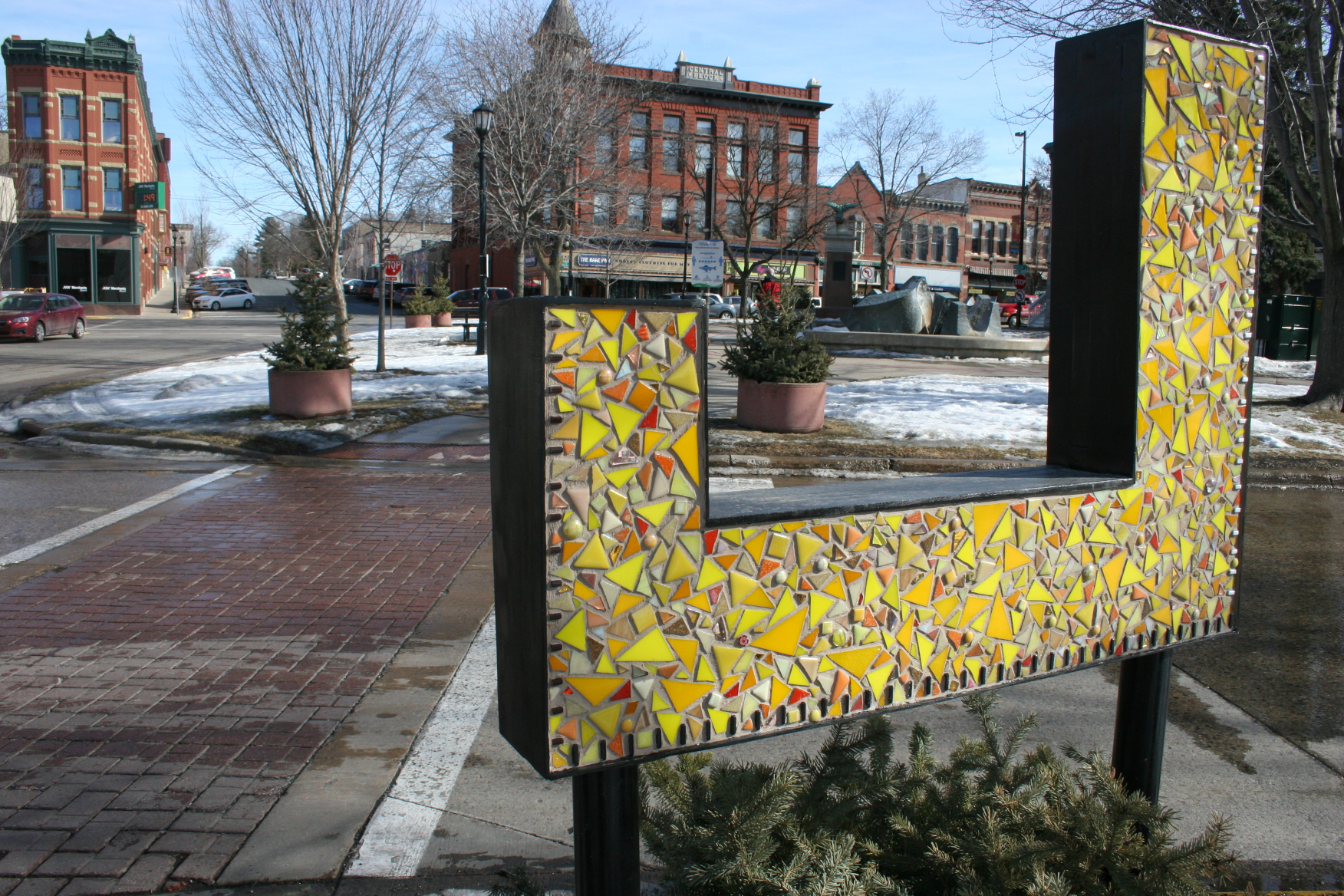
So when I spied a recently-installed sculpture, “Framing the Scene” by St. Paul glass artist Erin Ward, I felt a jolt of excitement. The free-standing, two-dimensional mosaic frames the nearby Cannon River and Riverwalk on one side and Bridge Square on the other. It’s meant to be an interactive sculpture for framing photos.
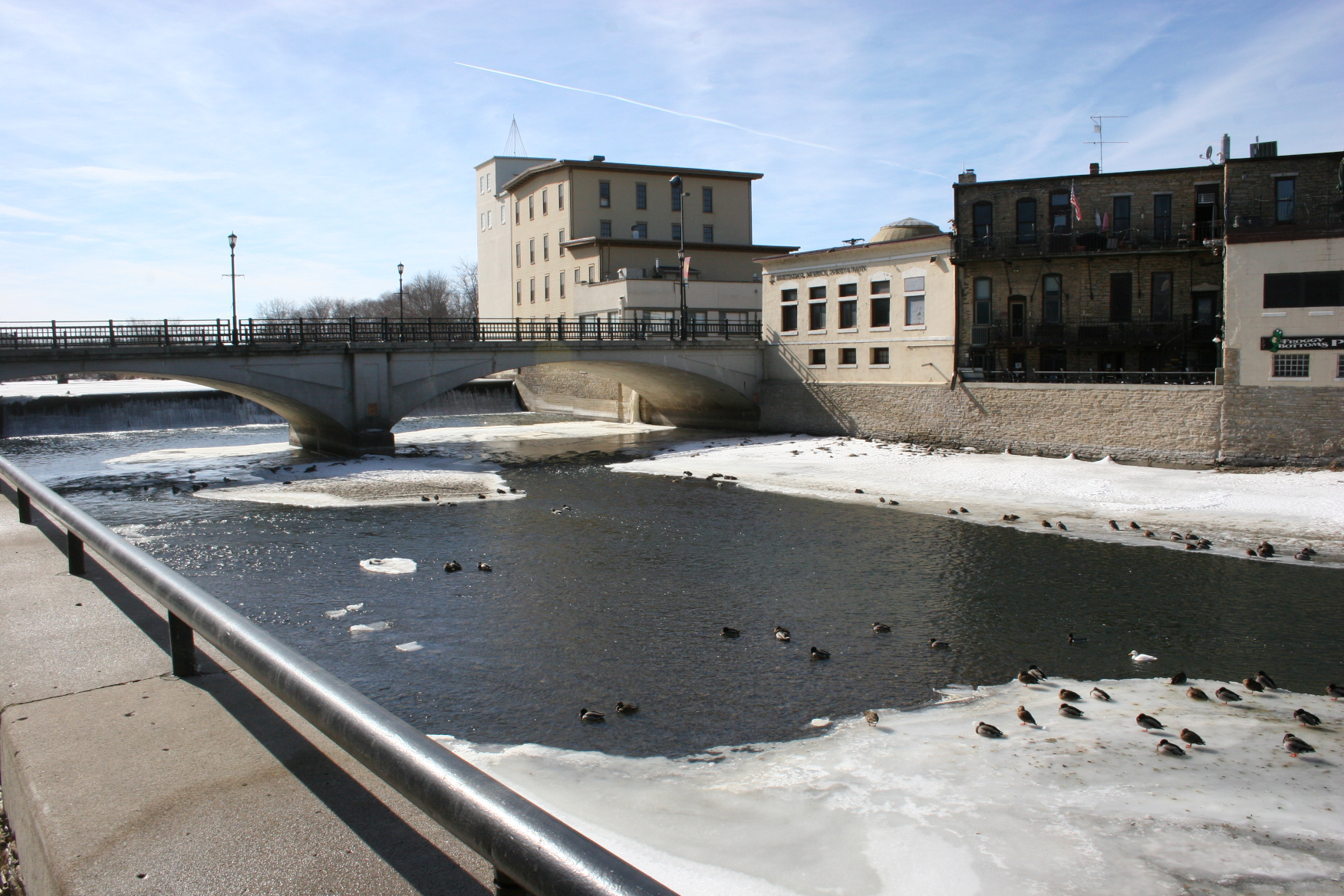
The Cannon River flows through downtown Northfield. (Minnesota Prairie Roots copyrighted file photo February 2022)
Ward was among five artists awarded $2,000 grants from the Minnesota Arts Board for the Northfield Downtown Development Corporation’s 2021 Artists on Main Street projects. That program aspires to get “creative placemaking” into the historic downtown. The intersection of arts and culture, downtown revitalization and historic preservation all factor into the artistic endeavors.
“Framing the Scene” meets all of those criteria, in my creative opinion. The artwork itself represents the vision and skills of a talented artist. The art adds to the downtown Northfield experience. That experience is one of dipping in and out of mostly home-grown local shops or of dining in an historic setting. The cliques “quaint and charming” fit Northfield. This is a community rich in history, rich in historic architecture, rich in natural beauty and rich in art.
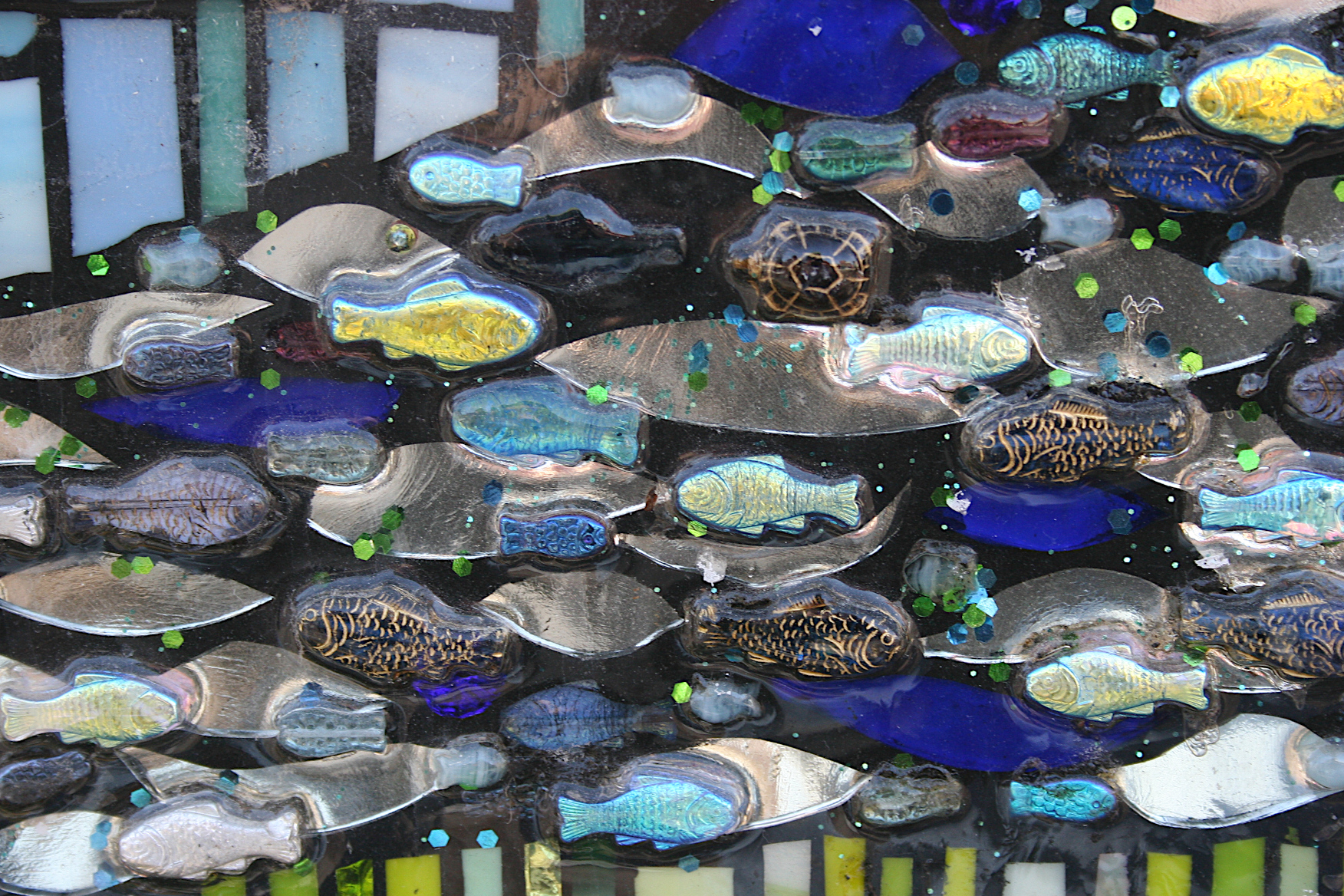
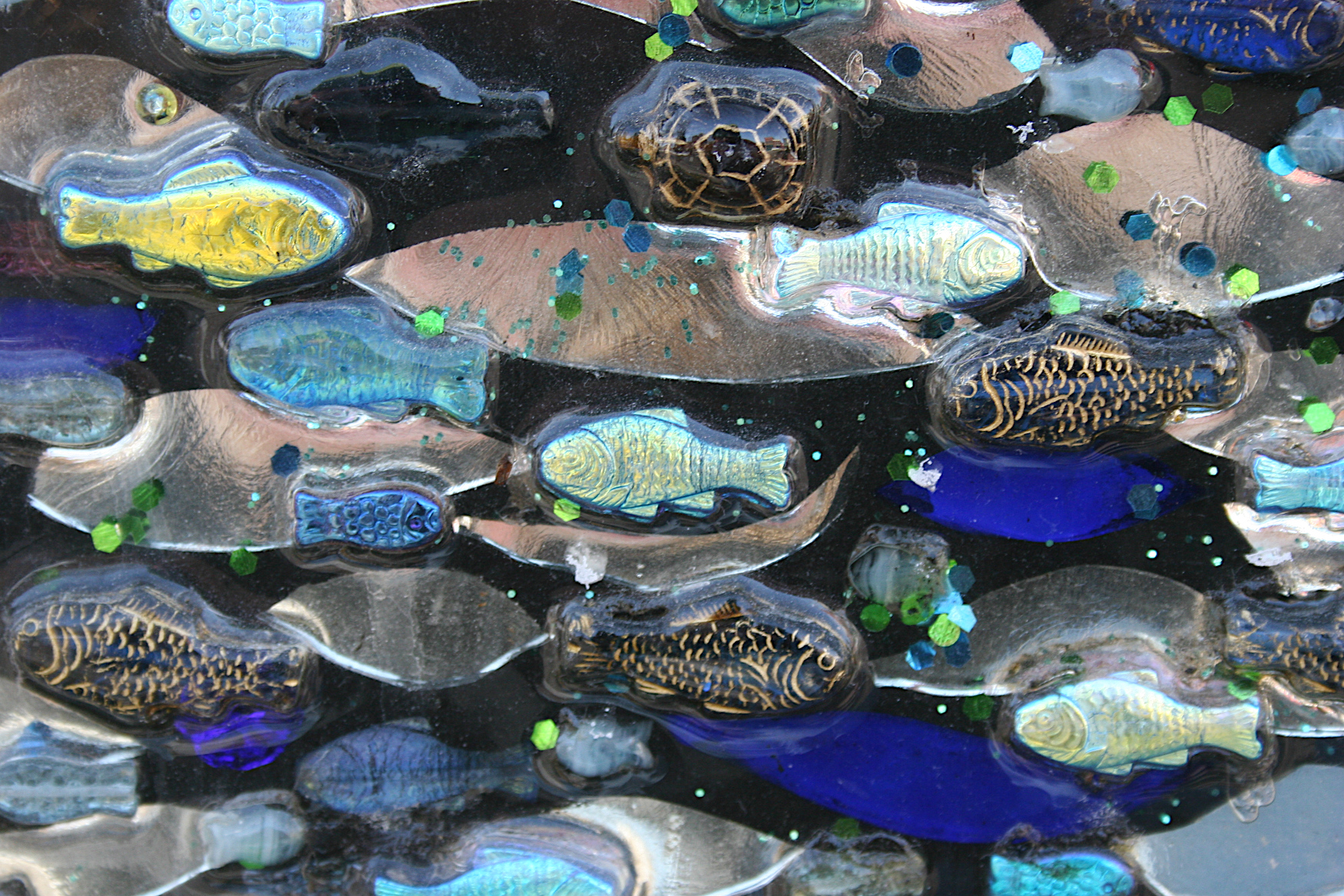
So much detail in the mosaic… (Minnesota Prairie Roots copyrighted photo February 2022)
I appreciate how Ward melded art and nature in creating a mosaic which honors both. As I studied her interpretation of the Cannon River, I recognized the thought she invested in this detailed art of many many pieces. Her river evokes movement in waters teeming with fish and the occasional turtle. Assorted greens and blues evoke a sense of calm and peacefulness. Ward’s art honors this river which runs through. This river of life, now a backdrop to a community which still appreciates her beauty, her recreational qualities, her history, her aesthetic value.
This side of Ward’s mosaic focuses attention toward Bridge Square and buildings downtown. (Minnesota Prairie Roots copyrighted file photo February 2022)
And then, on the flip side of “Framing the Scene,” bold pieces of mostly yellow, orange and red triangles create a completely different feeling. It’s as if sunbeams fell from the sun in a chaotic, jumbled mix of happiness. That’s my interpretation.
This side of the art looks toward Bridge Square, community gathering spot in downtown Northfield. Place of concerts and popcorn wagon, Santa house and quiet bench-sitting. Place of artistic activism. And beyond that, to the back of the frame, historic buildings rise.
One final look at Ward’s interpretation of the Cannon River in historic Northfield. (Minnesota Prairie Roots copyrighted photo February 2022)
Art rises in Northfield, enriching the lives of locals and the lives of visitors like me, come to town to follow the Riverwalk, to walk along Division Street and, then, to pause near Bridge Square and frame the scene.
Please check back for more posts about art in historic downtown Northfield, Minnesota.
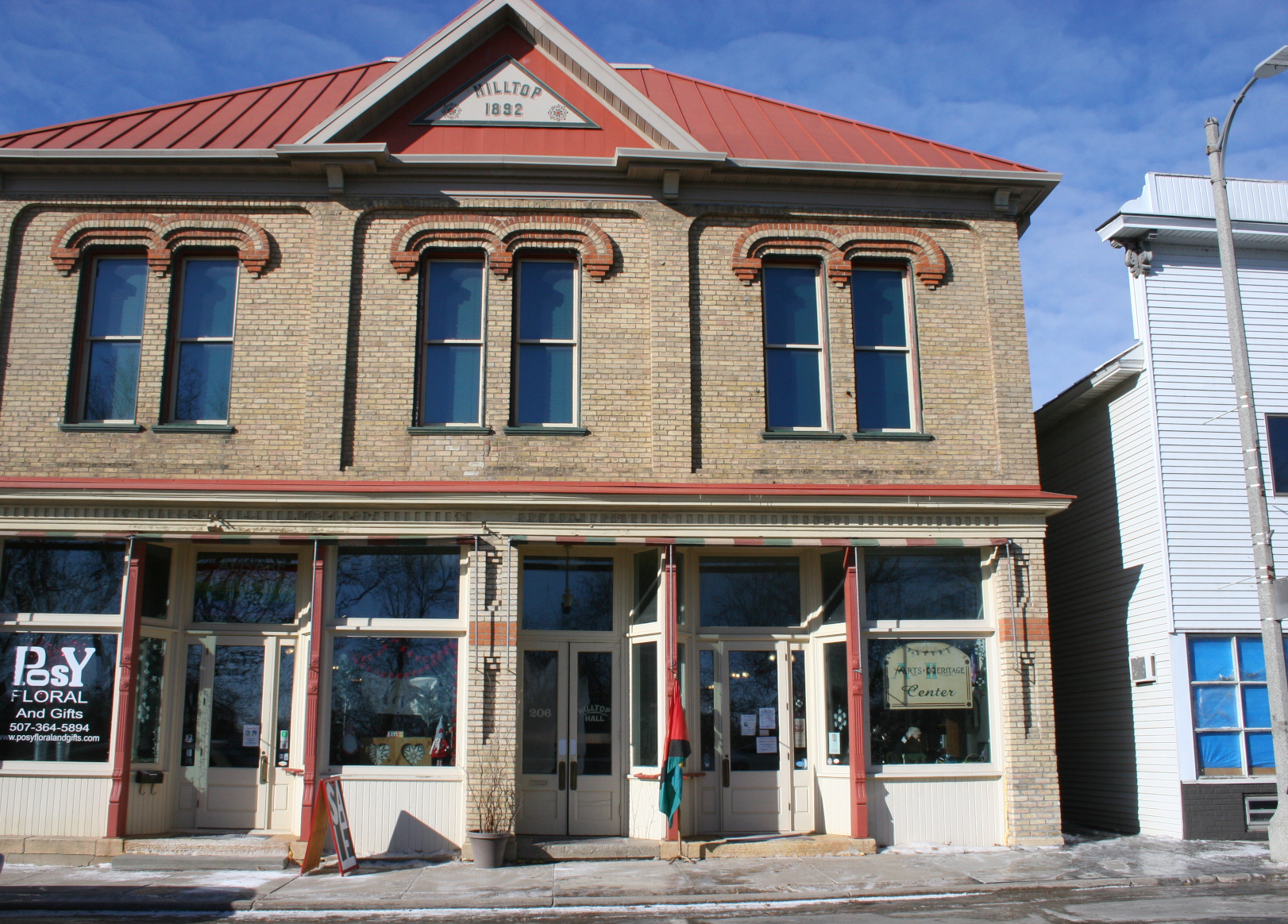
The historic Hilltop Hall houses The Arts & Heritage Center of Montgomery on the right and Posy Floral & Gifts, left. (Minnesota Prairie Roots copyrighted photo February 2022)
Inside the center, Kotasek’s prints plaster walls. (Minnesota Prairie Roots copyrighted photo February 2022)
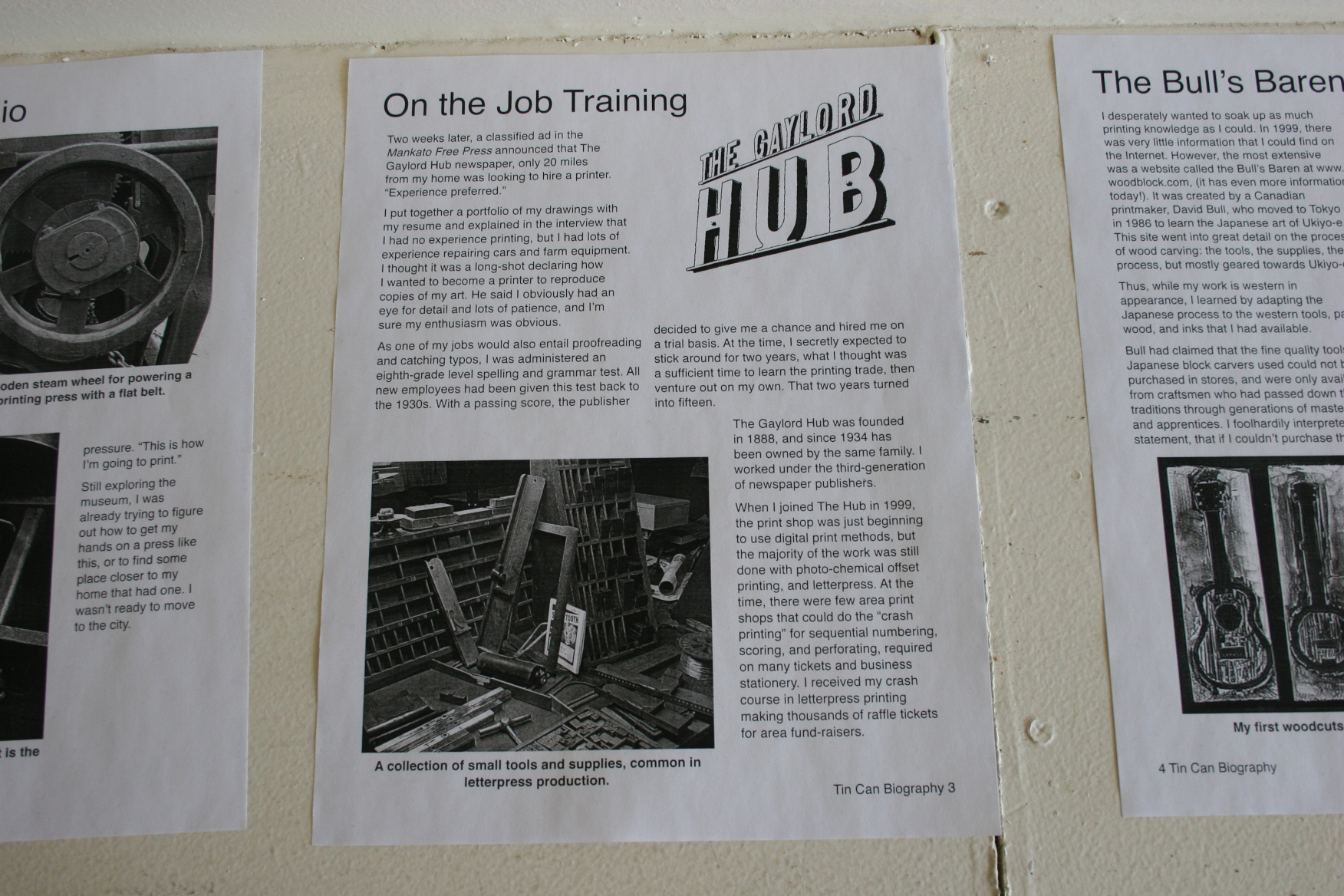
The artist includes some background info about himself, this sheet focused on his time at The Gaylord Hub. (Minnesota Prairie Roots copyrighted photo February 2022)
As a journalist and an art lover especially appreciative of letterpress printing, I delighted in this exhibit of an art now in revival. Not only that, I hold a connection to Kotasek. We both worked at The Gaylord Hub, me as my first newspaper reporting job straight out of college in 1978 and he as an apprentice printer there in 1999. We learned under the mentorship of Jim Deis, then editor and publisher of the generational family-owned newspaper. I’ve never met Kotasek, yet I feel linked via The Hub.
This shows the steps in creating a multi-hued print. (Minnesota Prairie Roots copyrighted photo February 2022)
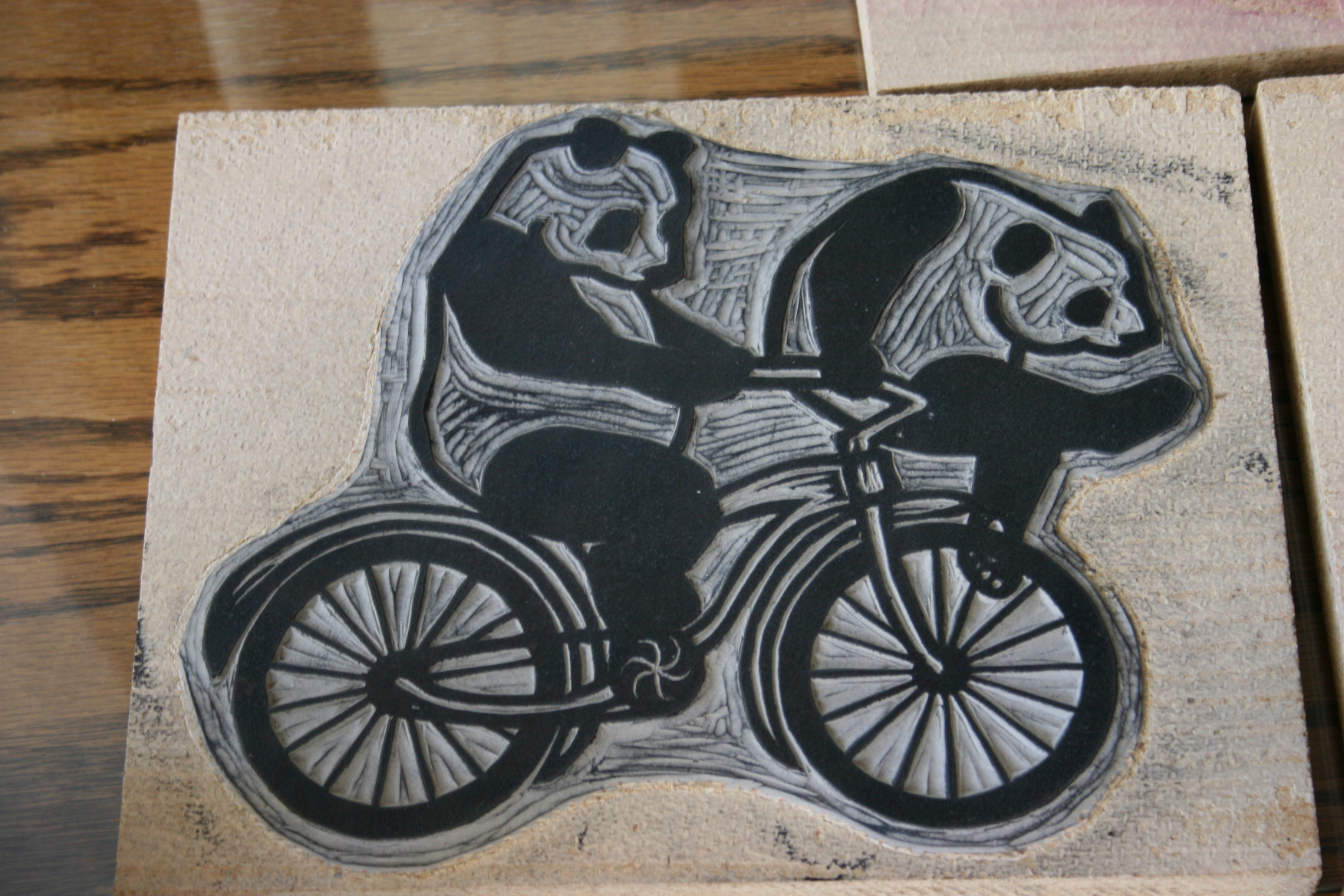
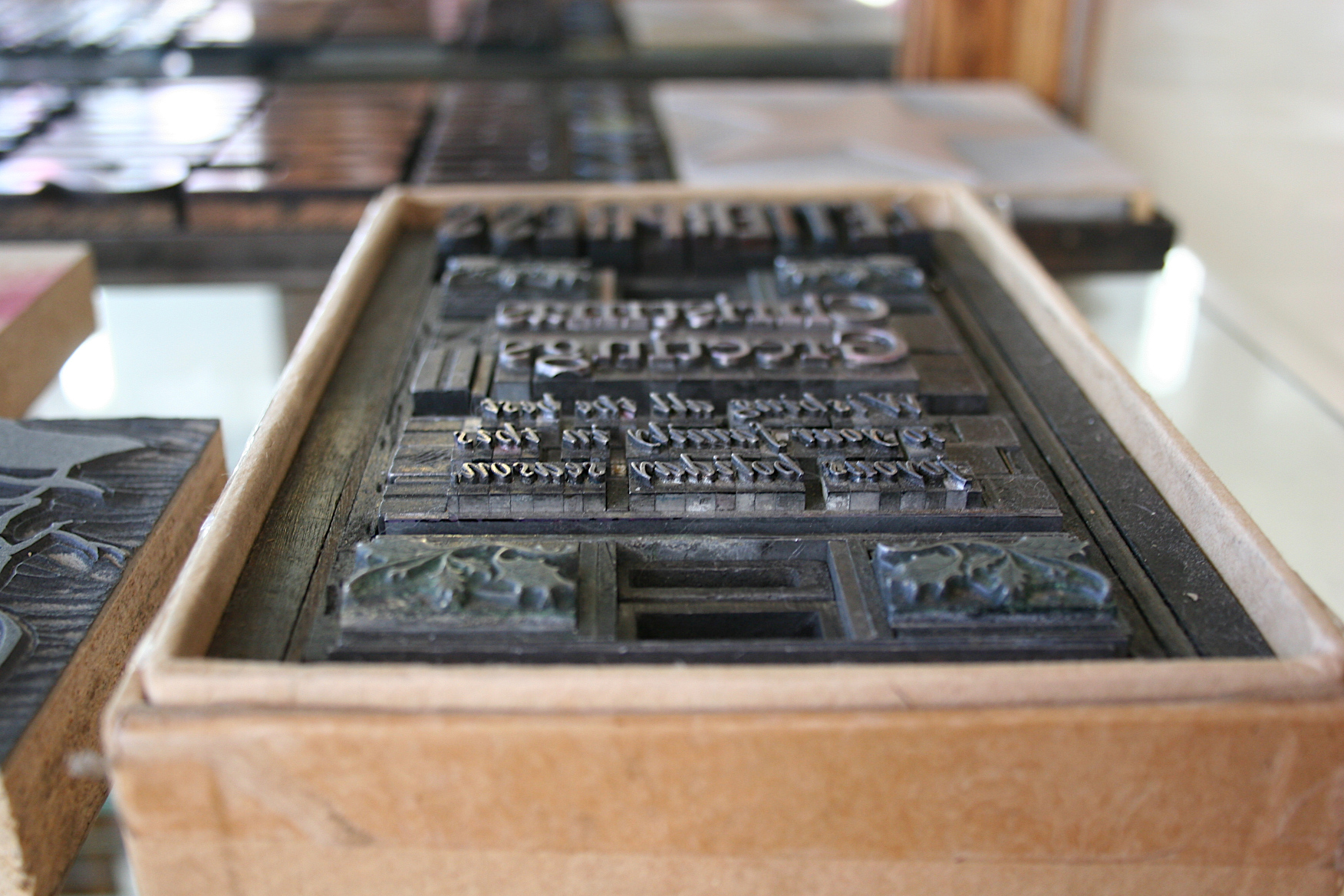
To view his art is to gain an appreciation for a past printing process. In letterpress printing, movable raised wood or lead letters/type are pieced together in a frame, then secured before inking onto paper via a printing press. That’s a simplistic explanation. If multiple ink colors are required, the process is layered, longer, more labor intensive. Likewise, art carved from linoleum or wood blocks goes through a similar process in creating fine art prints, gig posters and more.
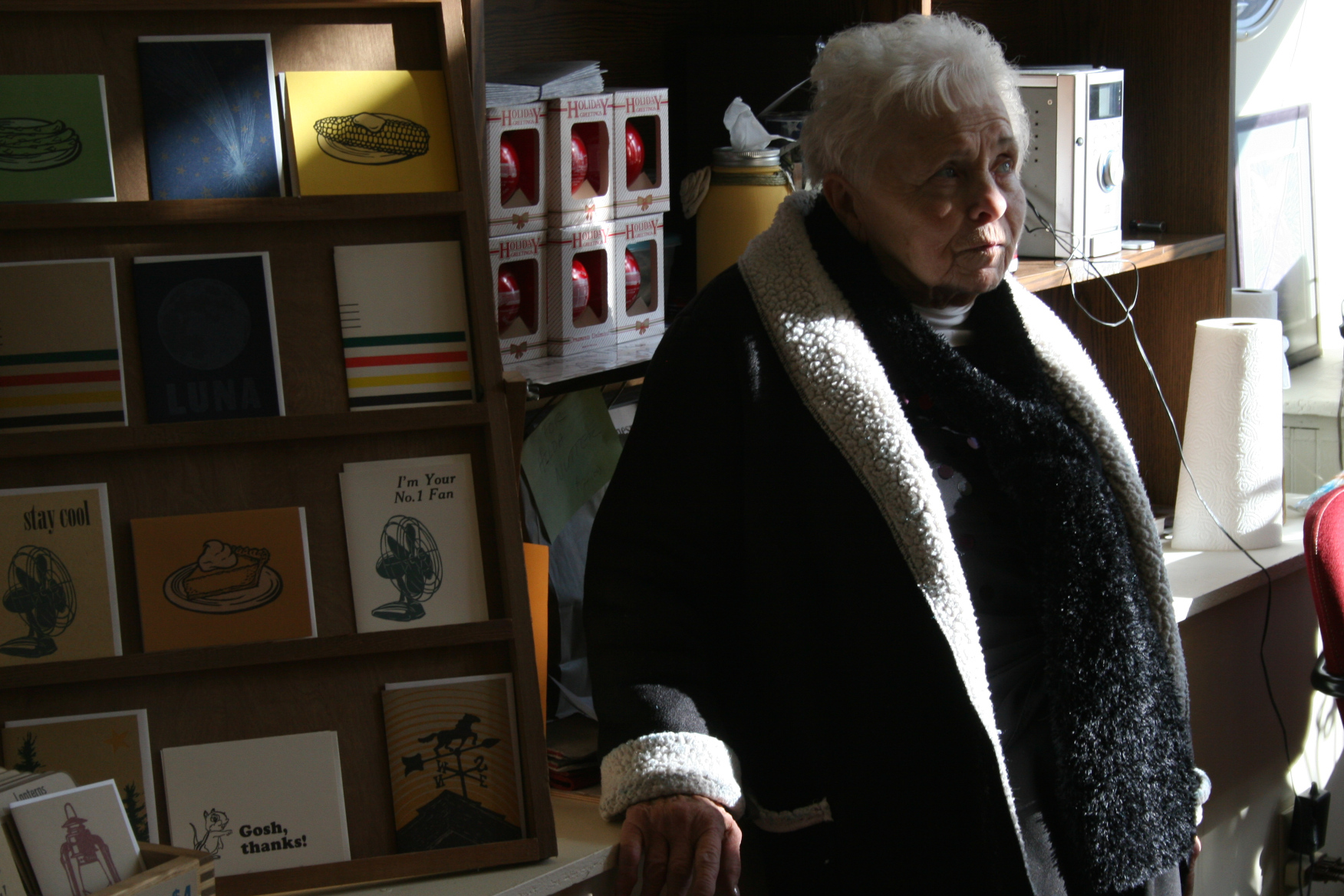
Volunteer JoAnn Petricka with Kotasek’s prints to the left. (Minnesota Prairie Roots copyrighted photo February 2022)
When I entered the narrow room which houses The Arts & Heritage Center in the small southern Minnesota community of Montgomery and saw Kotasek’s letterpress art, memories rushed back. Memories of the strong scent of ink, the clacking of noisy printing presses, scenes of printers Dale and Bucky laboring in stained printers’ aprons, me trying to hear phone conversations with sources. Me pounding out news stories on an aged manual typewriter against the backdrop of all that noise.
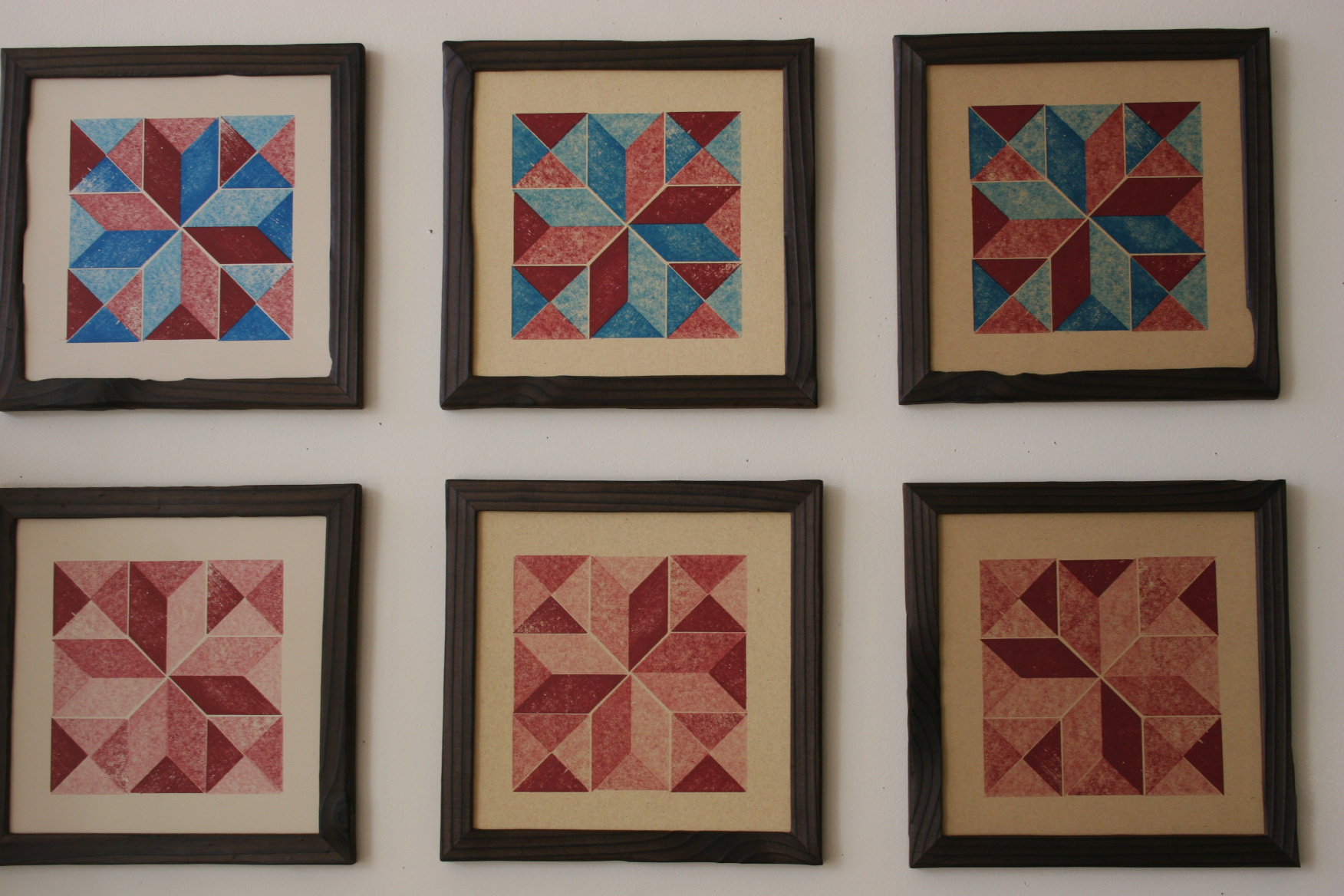
Hand-carved blocks were used to create this art titled “Eight-Pointed Star.” (Minnesota Prairie Roots copyrighted photo February 2022)
But on this February morning, quiet prevailed as I studied the work of this craftsman, this visual artist. Letterpress is both craft and art.
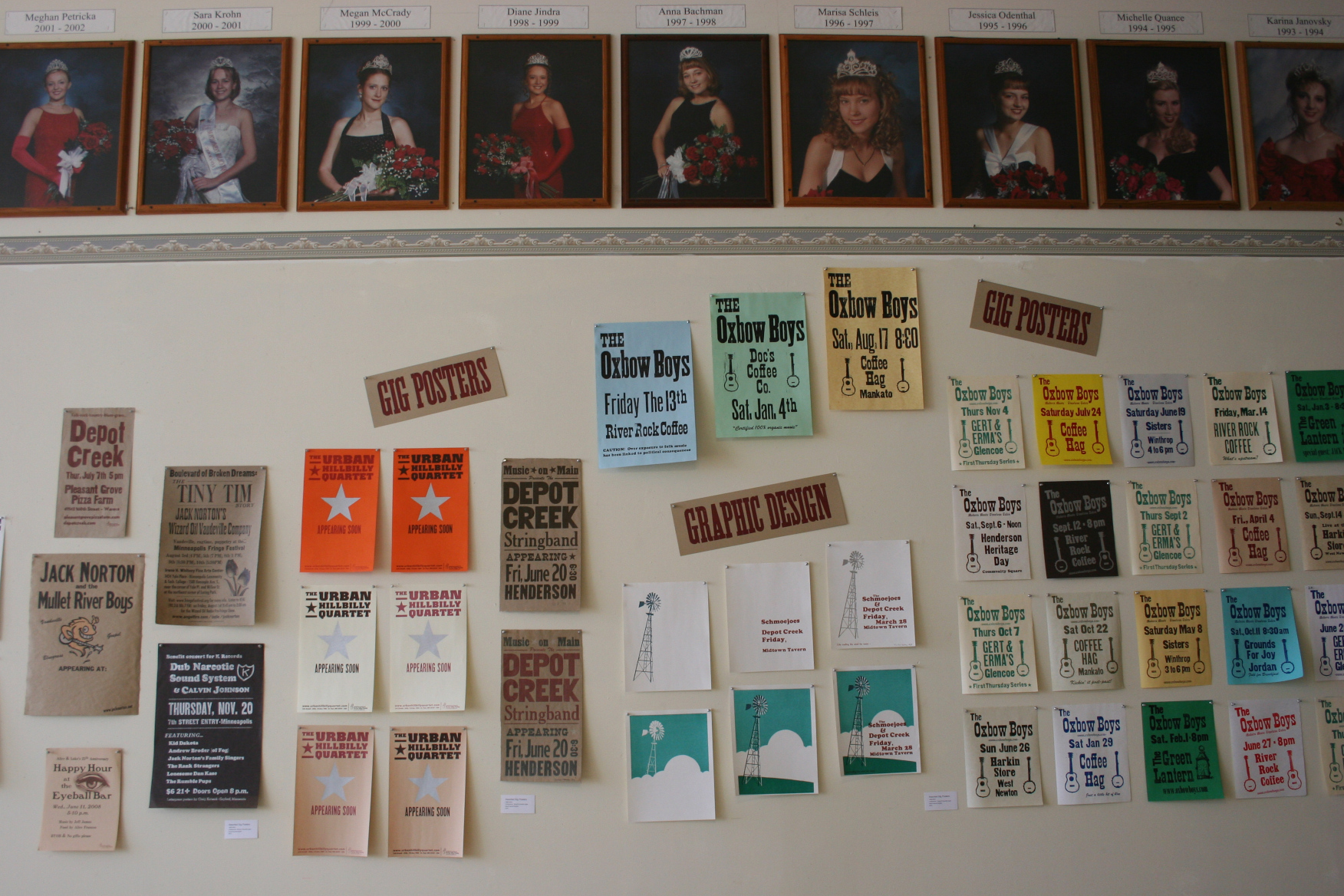
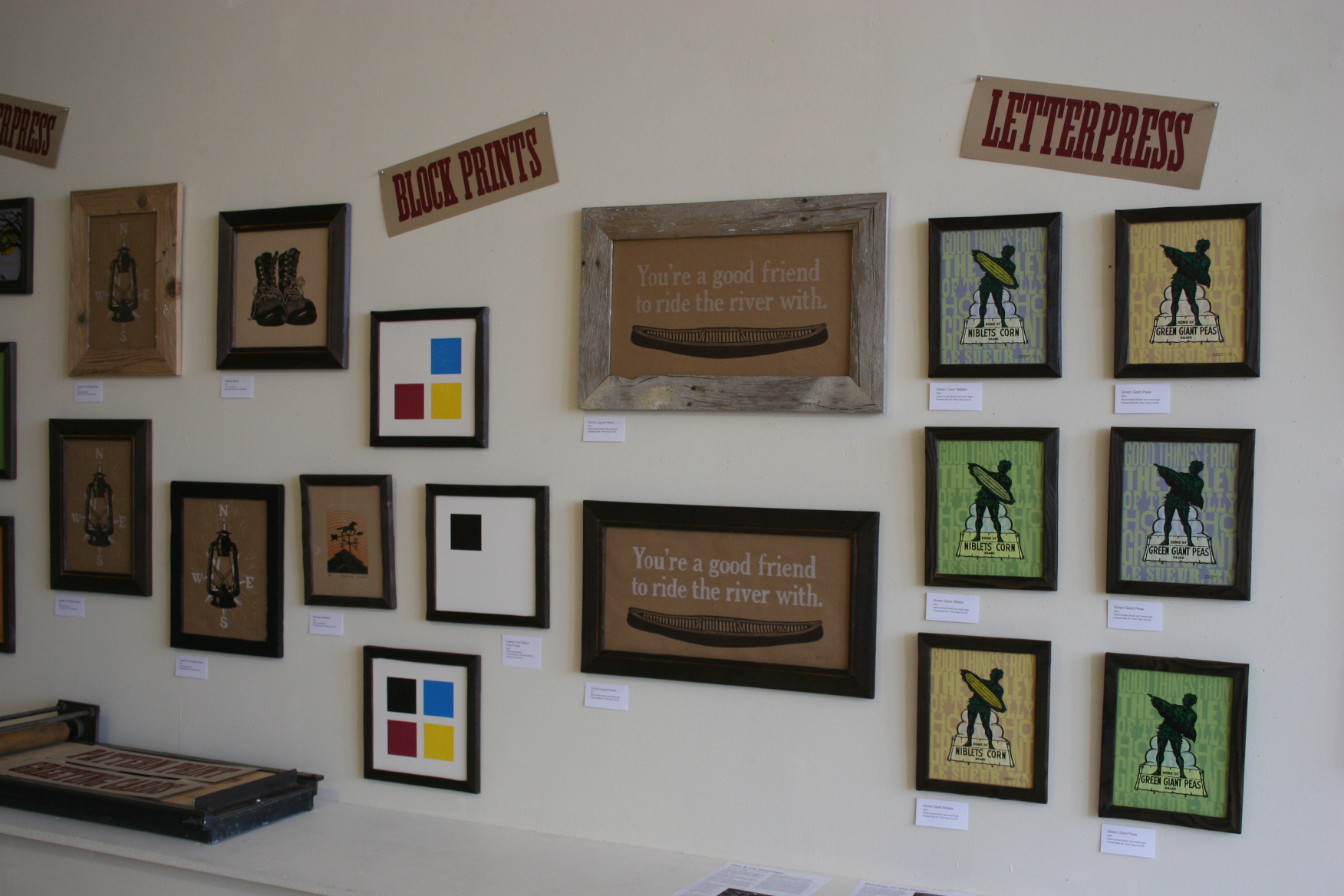
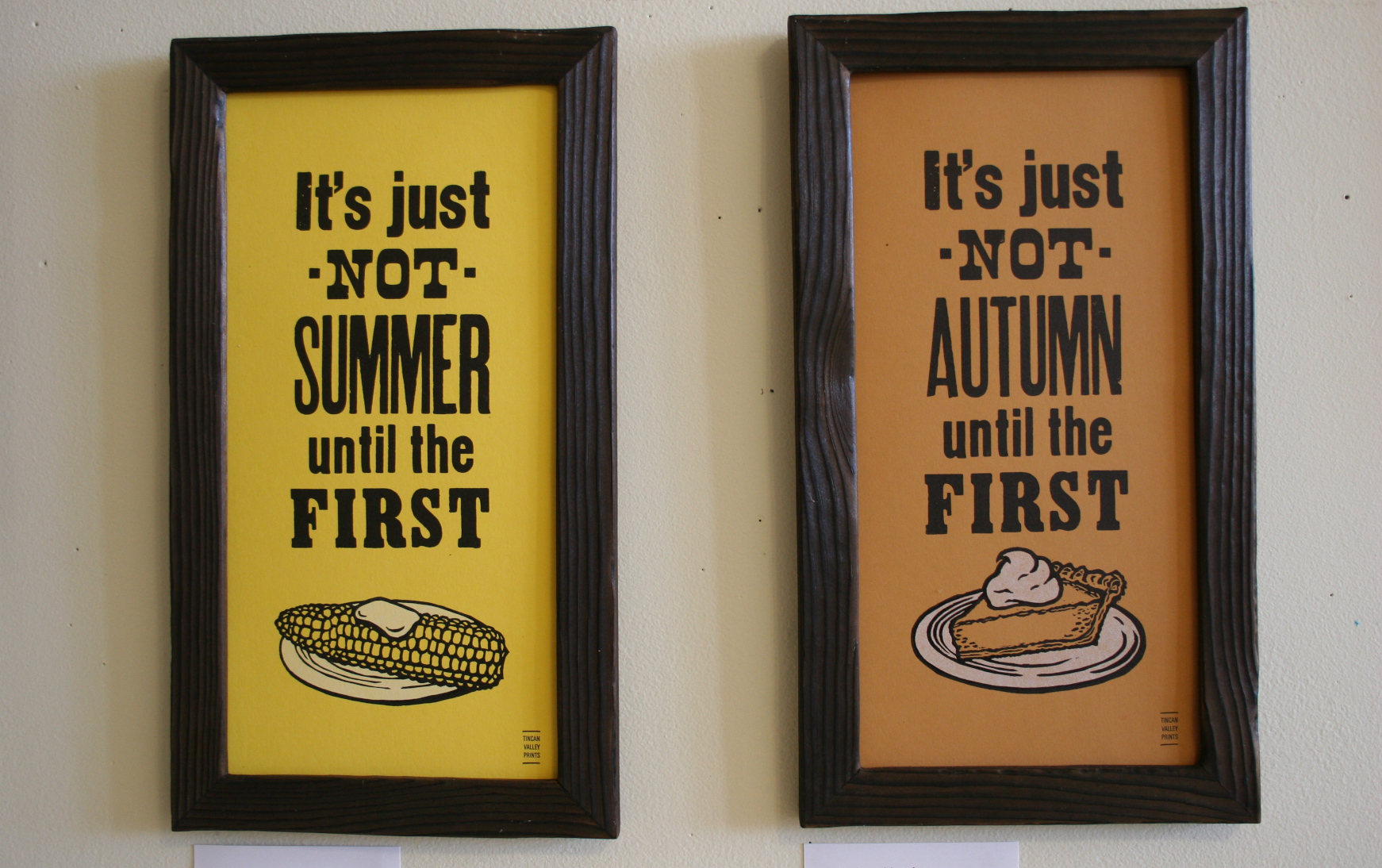
Kolacky Days queens in framed photos over prints from Tin Can Valley Printing. (Minnesota Prairie Roots copyrighted photo February 2022)
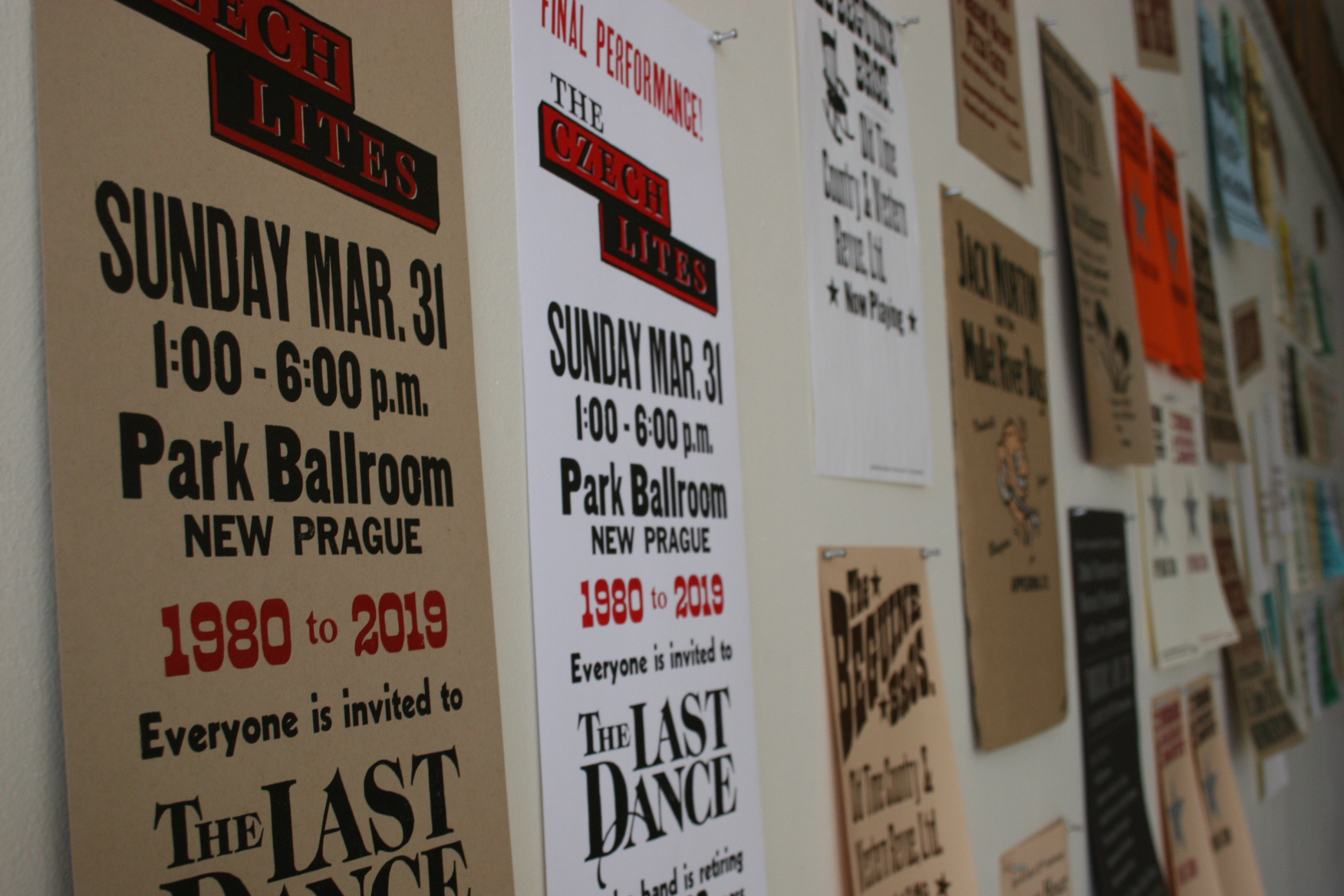
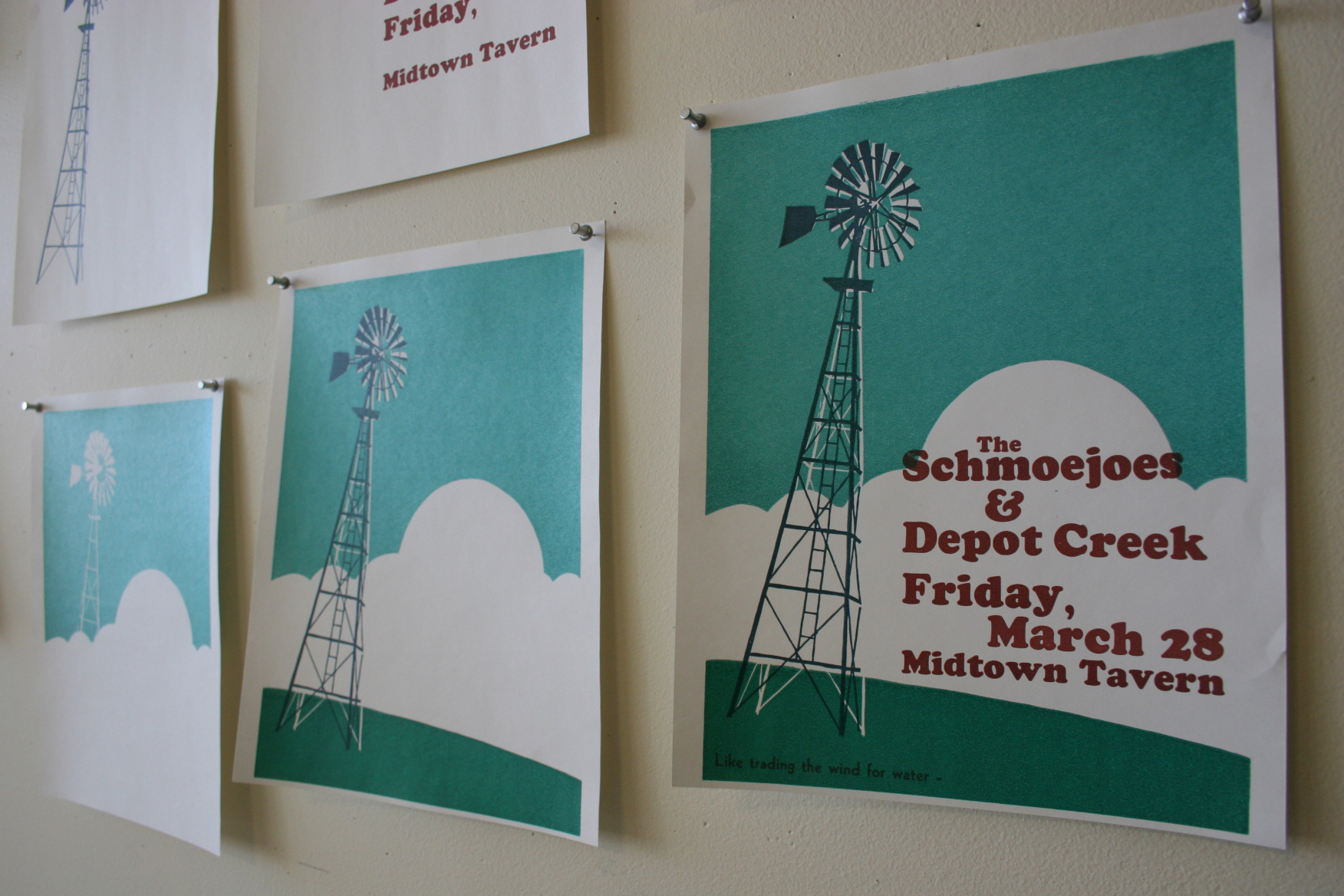
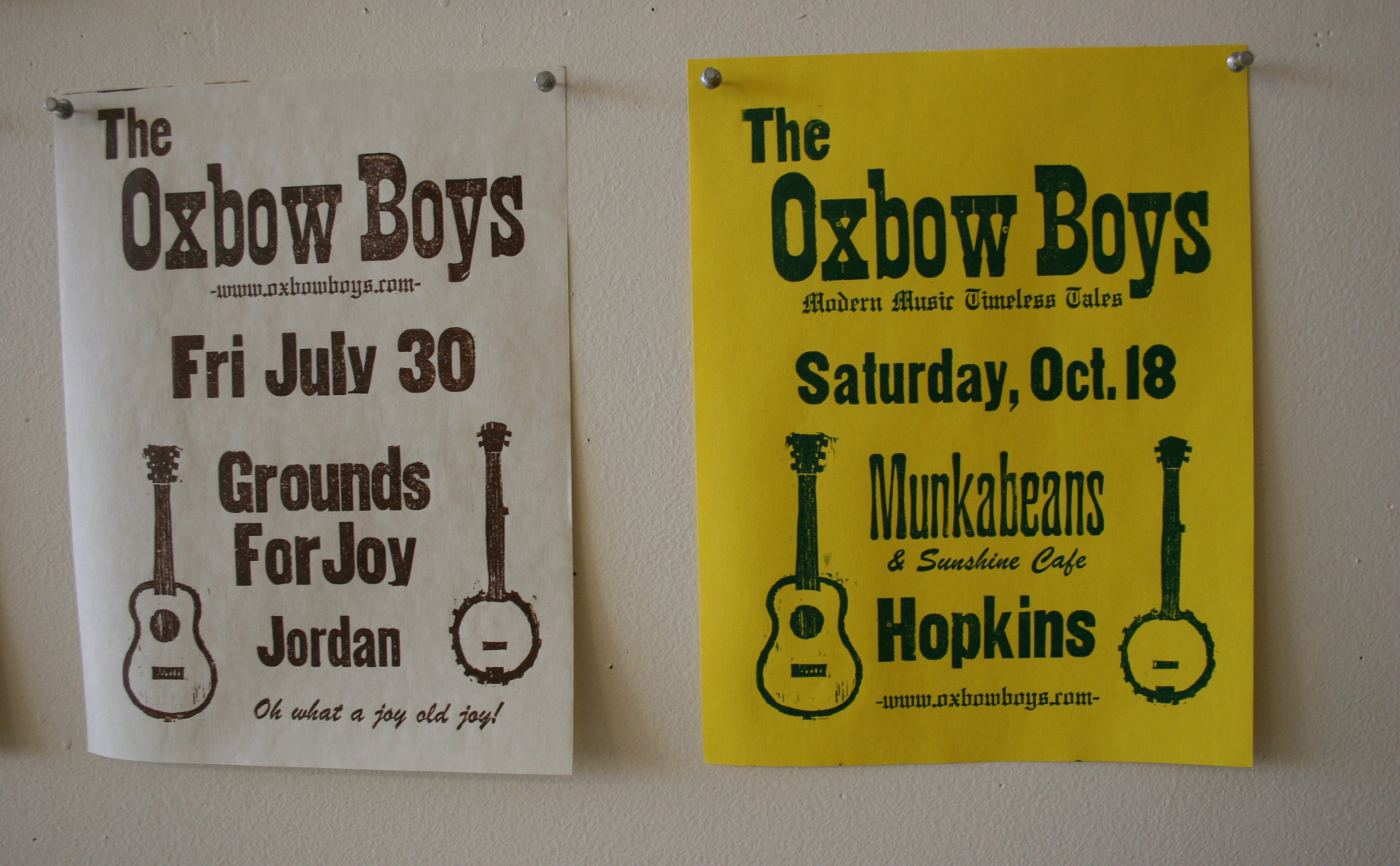
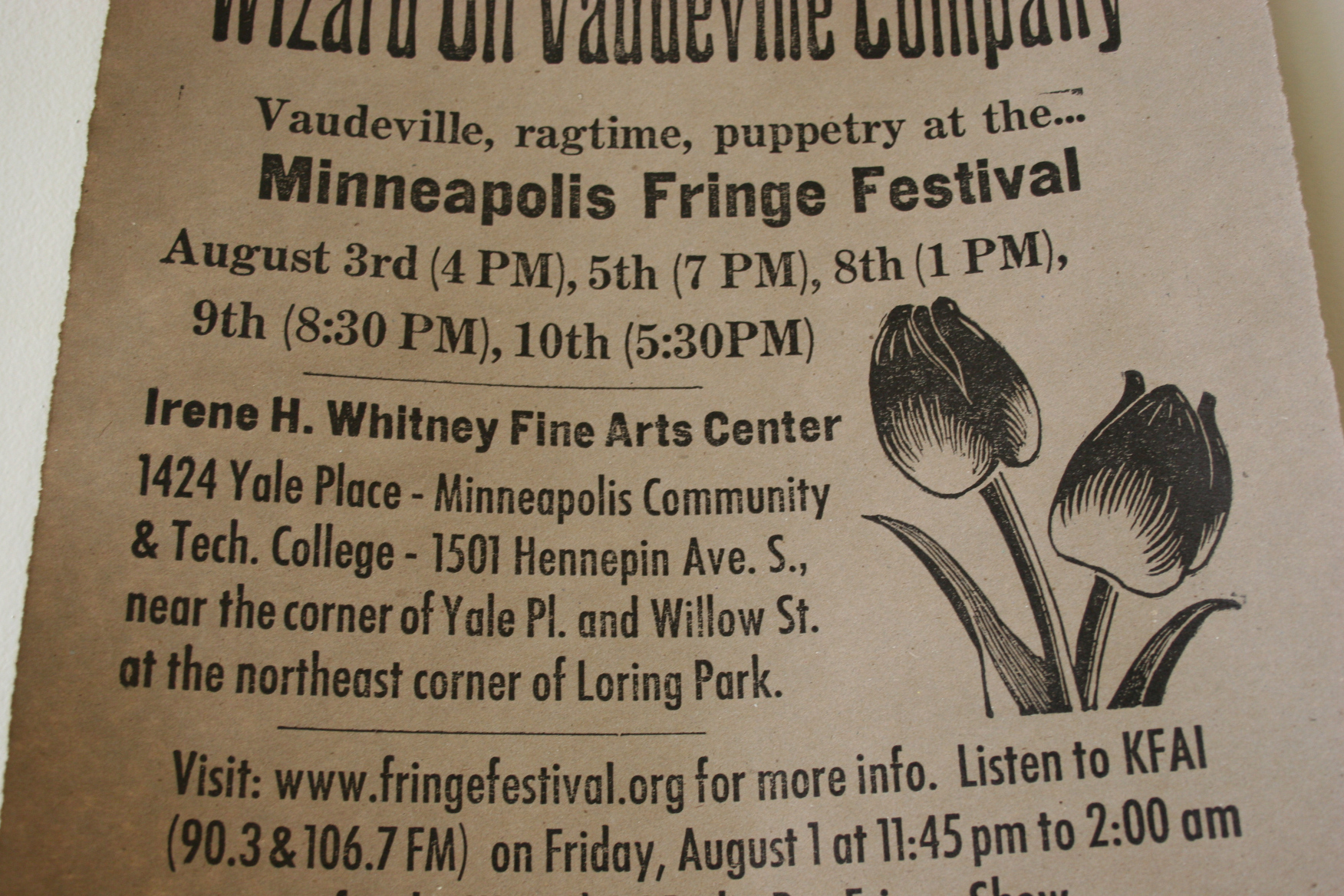
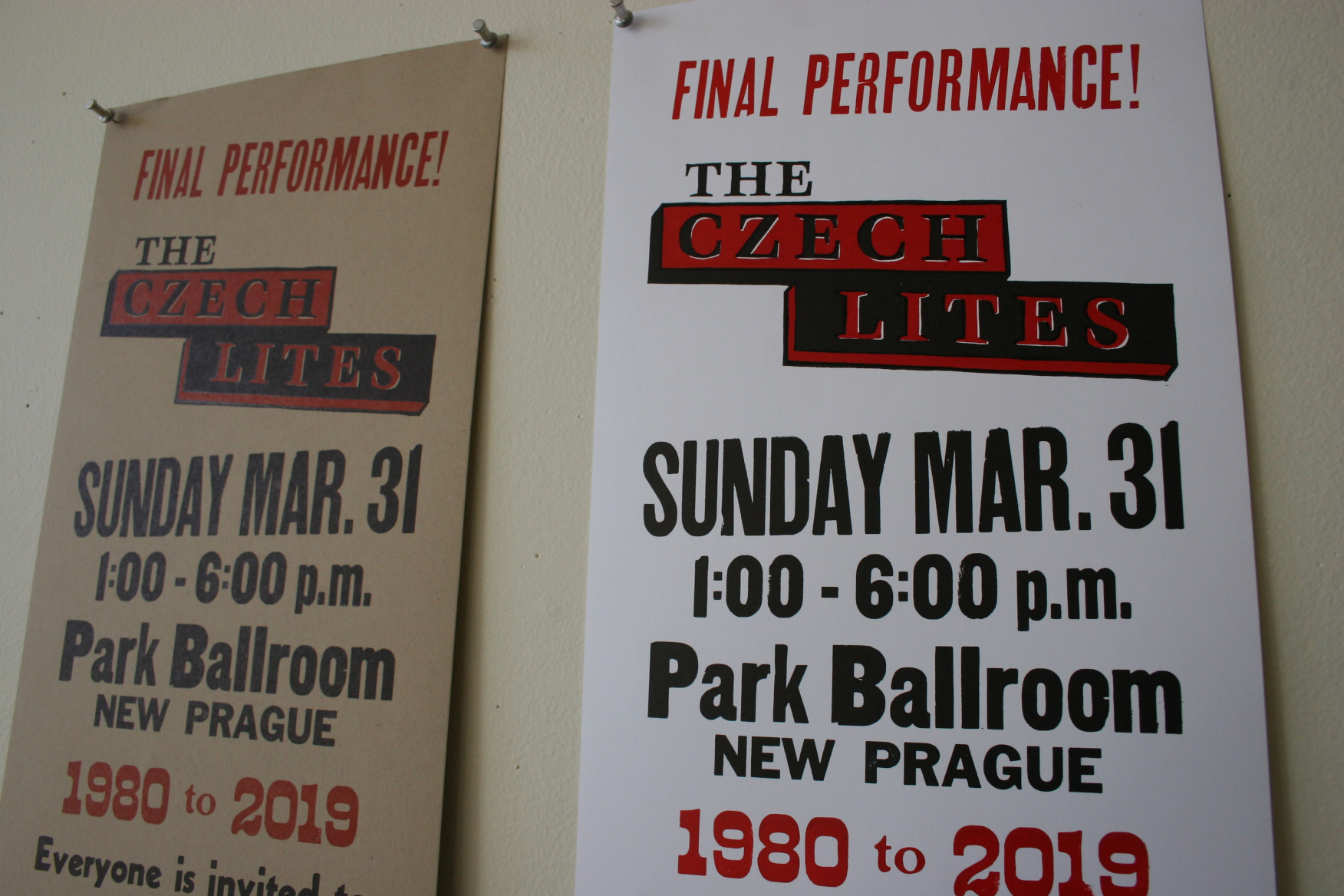
One of his specialties is creating posters for musical gigs. (Minnesota Prairie Roots copyrighted photo February 2022)
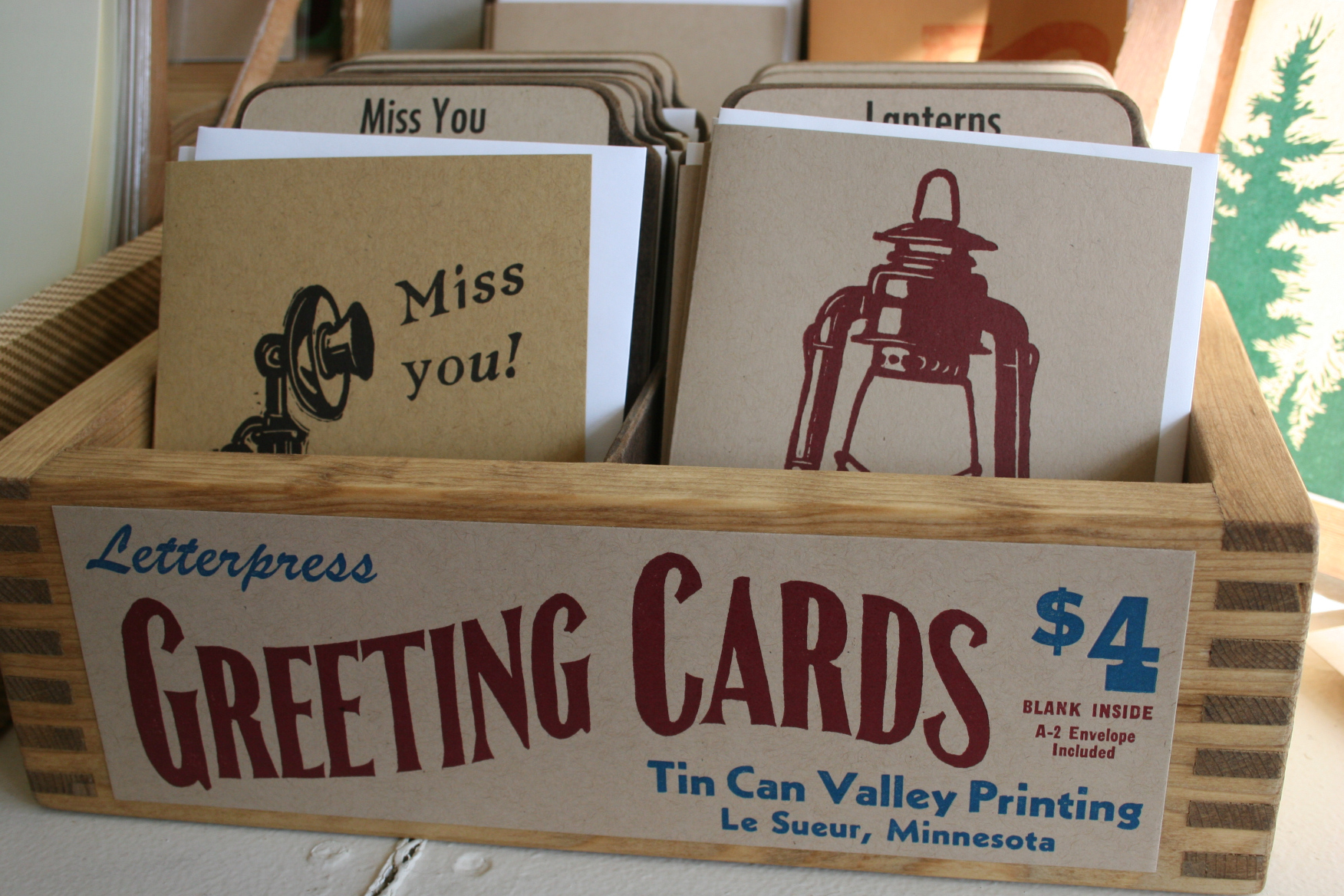
Beneath professional portraits of Kolacky Days queens, which ring this room near the ceiling, hang examples of Kotasek’s assorted creations. Gig posters for musical groups (including his own Oxbow Boys band). Fine art prints created with hard-carved blocks. A mix of letterpress and block. And on a shelf, a box of his popular letterpress greeting cards. Another display holds his $10 numbered prints.
A hand-carved block for printing. (Minnesota Prairie Roots copyrighted photo February 2022)
I feel such an appreciation for Kotasek. His love for the letterpress craft shows in his printing skills, his creativity. To get clear, crisp prints takes patience, practice, time, effort. But before that comes the visualization, the creativity, the ability to bring many elements together in hands-on work.
Type in a tray. (Minnesota Prairie Roots copyrighted photo February 2022)
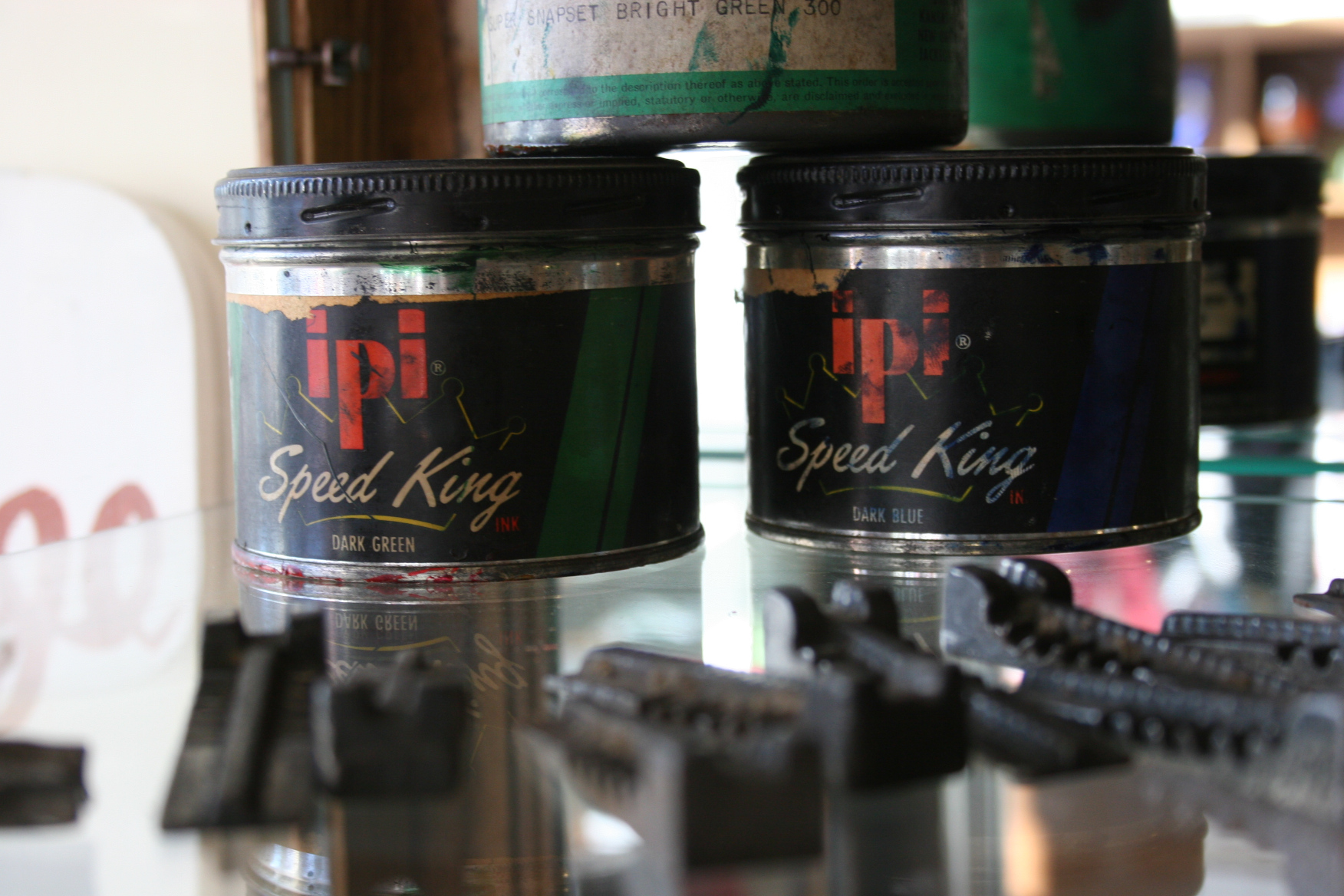
Cans of ink to color his art. (Minnesota Prairie Roots copyrighted photo February 2022)
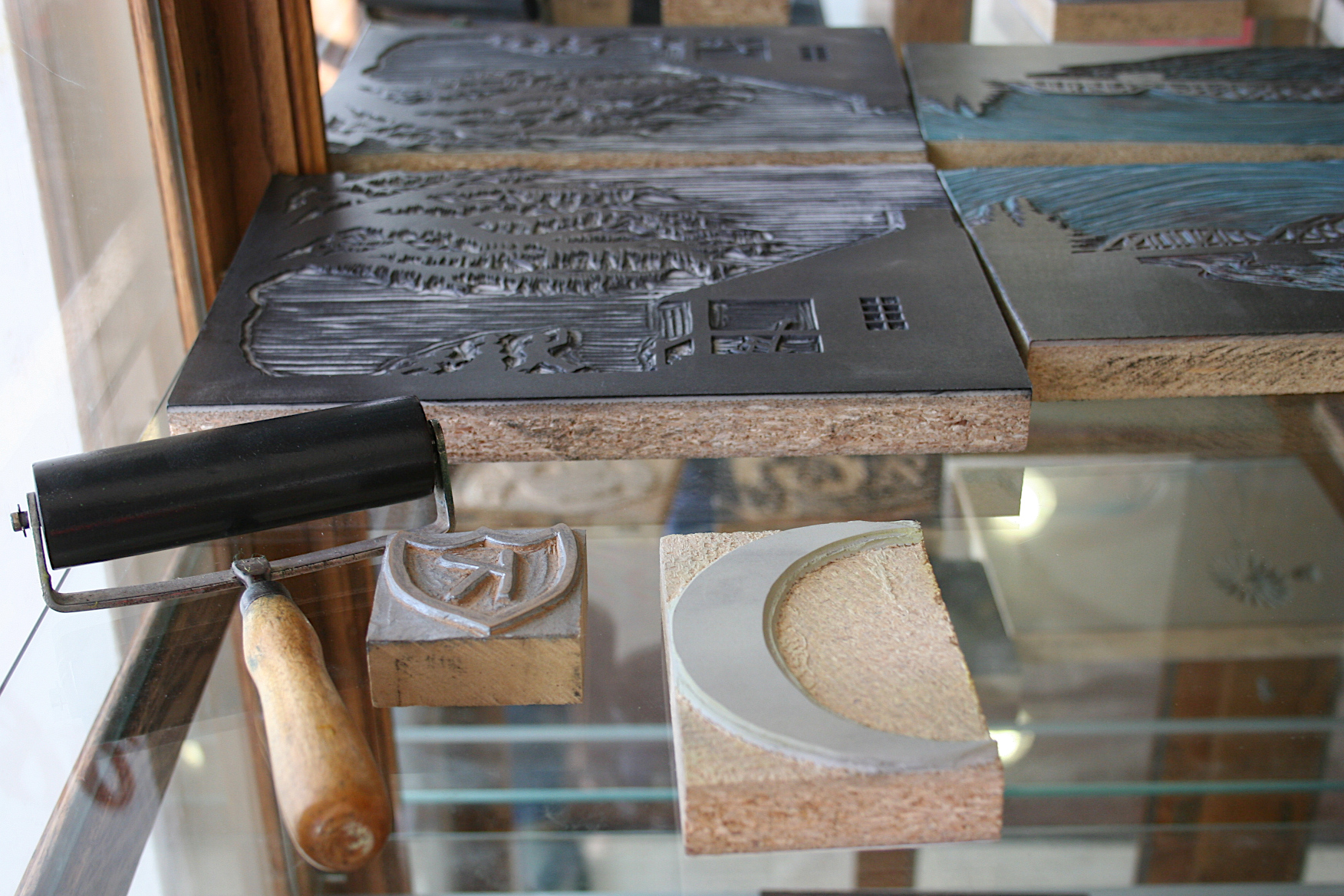
Roller and carved blocks to print. (Minnesota Prairie Roots copyrighted photo February 2022)
A tall enclosed cabinet holds some of Kotasek’s tools of the craft. Letters. Rollers. Ink. Wood-cuts. All offer a glimpse into this artist’s world. He’s gathered abandoned, about-to-be-scrapped printing presses and other printing tools from small town newspapers in Minnesota and set up shop in a renovated granary on the family farm just outside Le Sueur. His studio overlooks the valley, home of the Jolly Green Giant associated with Minnesota Valley Canning Company, later Green Giant.
Kotasek has created numerous Green Giant prints. (Minnesota Prairie Roots copyrighted photo February 2022)
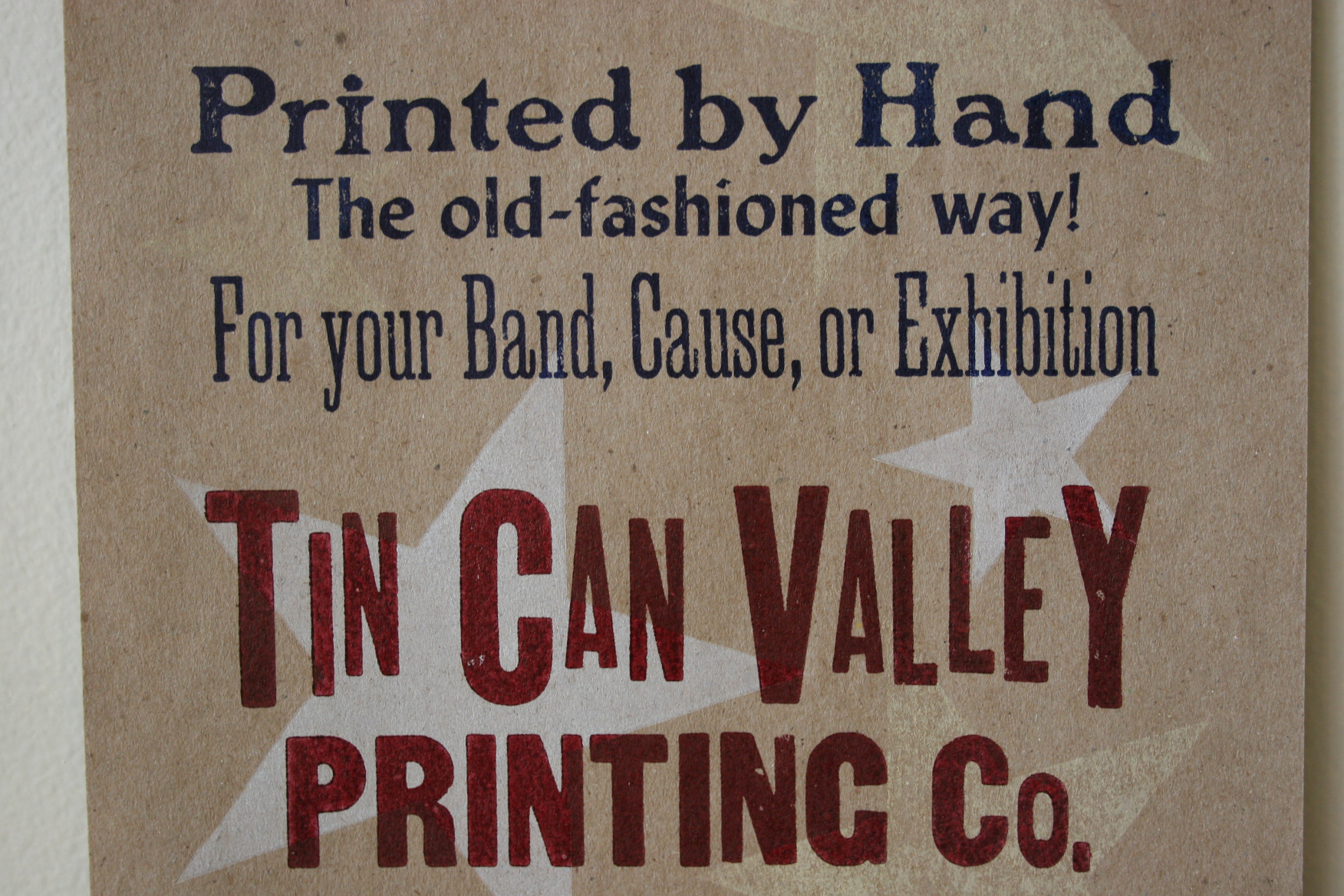
Kotasek pays homage to the vegetable canning company in the name of his printing business, Tin Can Valley Printing. On his website, he offers several explanations, one referencing a farmer who fed discarded canned vegetables to his pigs from damaged cans. As the story goes, the pig farmer tossed those empty tin cans into a ravine. During a massive flood of the Minnesota River Valley in 1965, the cans reportedly floated into town, causing an array of issues. The name Tin Can Valley stuck. I like the historic reference, the memorable moniker.
Featured art includes Jolly Green Giant prints, right. (Minnesota Prairie Roots copyrighted photo February 2022)
More food art prints. (Minnesota Prairie Roots copyrighted photo February 2022)
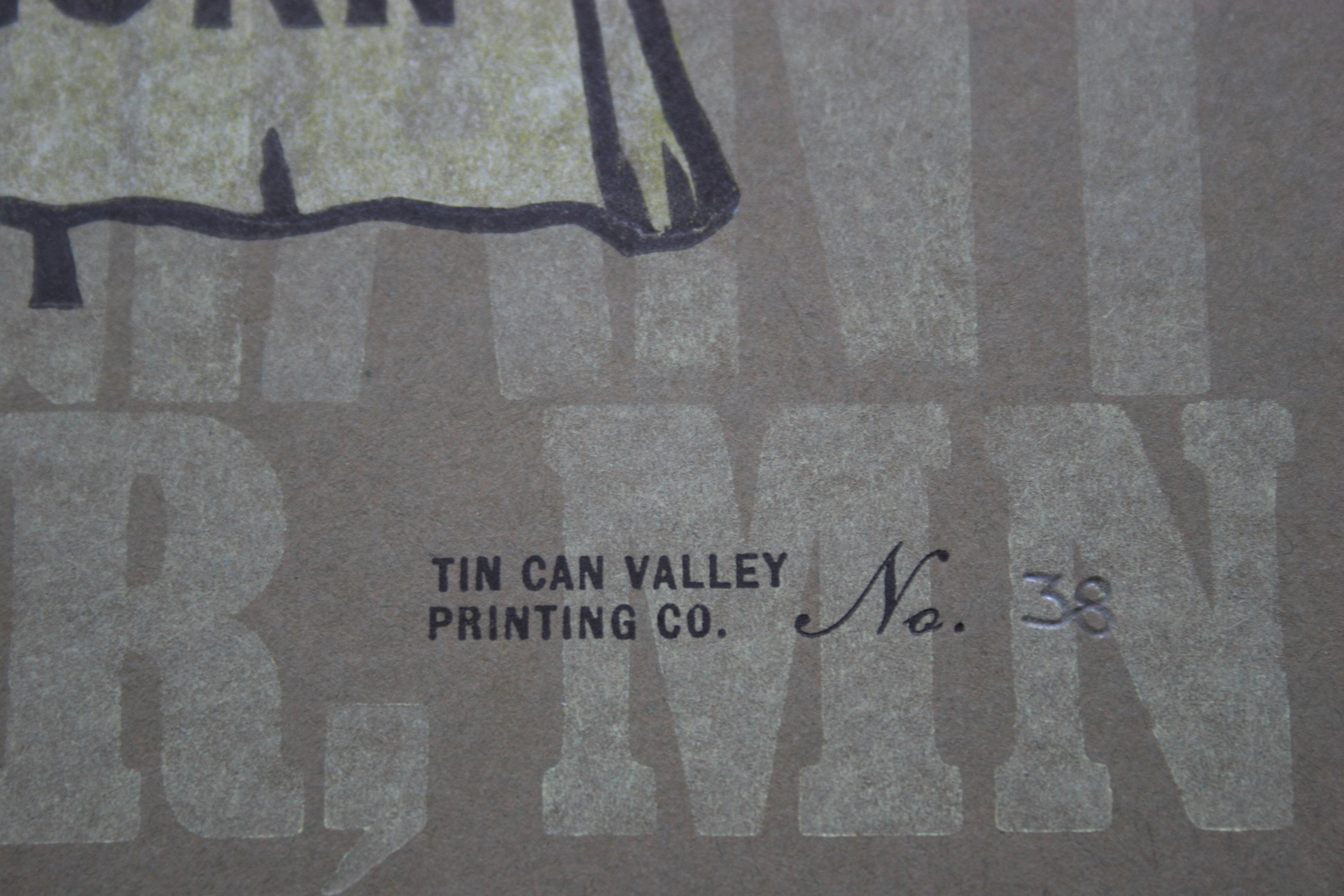
In the corner of my “Niblets of Corn Sign” print. (Minnesota Prairie Roots copyrighted photo February 2022)
I found myself drawn to Kotasek’s Green Giant-themed prints. I purchased No. 38 of his 2019 “Niblets Corn Sign” 8 x 10 card stock print. It’s a reproduction of a metal sign that once marked the Green Giant canning factory in Le Sueur. The four-color print, crafted from wood type and hand-carved wood and linoleum blocks, features the legendary Green Giant hefting a massive ear of sweetcorn. The image is iconic rural Minnesota.
This particular poster has an old style newspaper vibe. (Minnesota Prairie Roots copyrighted photo February 2022)
Kotasek represents in many ways the past of newspapers in Minnesota. Early editors printed their papers with letterpress. They also served their communities as print shops. When I worked at The Gaylord Hub, farm auction bills flew off the aged printing presses. Kotasek remembers the endless fundraiser raffle tickets he printed while learning the printing trade.
A poster fitting for the Czech farming community of Montgomery. (Minnesota Prairie Roots copyrighted photo February 2022)
If you’re interested in meeting Kotasek, visit The Arts & Heritage Center of Montgomery, 206 First Street North, between 9 am – noon on Saturday, February 26, during an artist’s reception. The center is open limited hours: from 2-5 pm Thursdays and Fridays and from 9 am-noon on Saturdays. The show closes February 26.
While in Montgomery, be sure to check out the shops (gift, floral, quilt, thrift, drugstore…) and stop at Franke’s Bakery for a sweet treat. You’ll find kolacky there in this self-proclaimed “Kolacky Capital of the World.” The town is also home to Montgomery Brewing and Pizzeria 201 (a popular local eatery with curbside pick-up only currently). I encourage you to check destination hours in advance of a visit to avoid disappointment. Also notice the historic architecture, the photo tributes to veterans and the town mural (across from the bakery). Montgomery rates as one of my favorite area small towns…because of The Arts & Heritage Center and more.
Portraits of the deceased musicians inside the Surf Ballroom. (Minnesota Prairie Roots copyrighted file photo May 2015)
SIXTY-THREE YEARS AGO TODAY, the music died. On February 3, 1959, three musicians—Buddy Holly, Ritchie Valens and J.P. “The Big Bopper” Richardson—and a pilot died in a plane crash near Clear Lake, Iowa. It was, and remains, a monumental moment in American music history.
A broad view of this massive ballroom which seats 2,100. (Minnesota Prairie Roots copyrighted file photo May 2015)
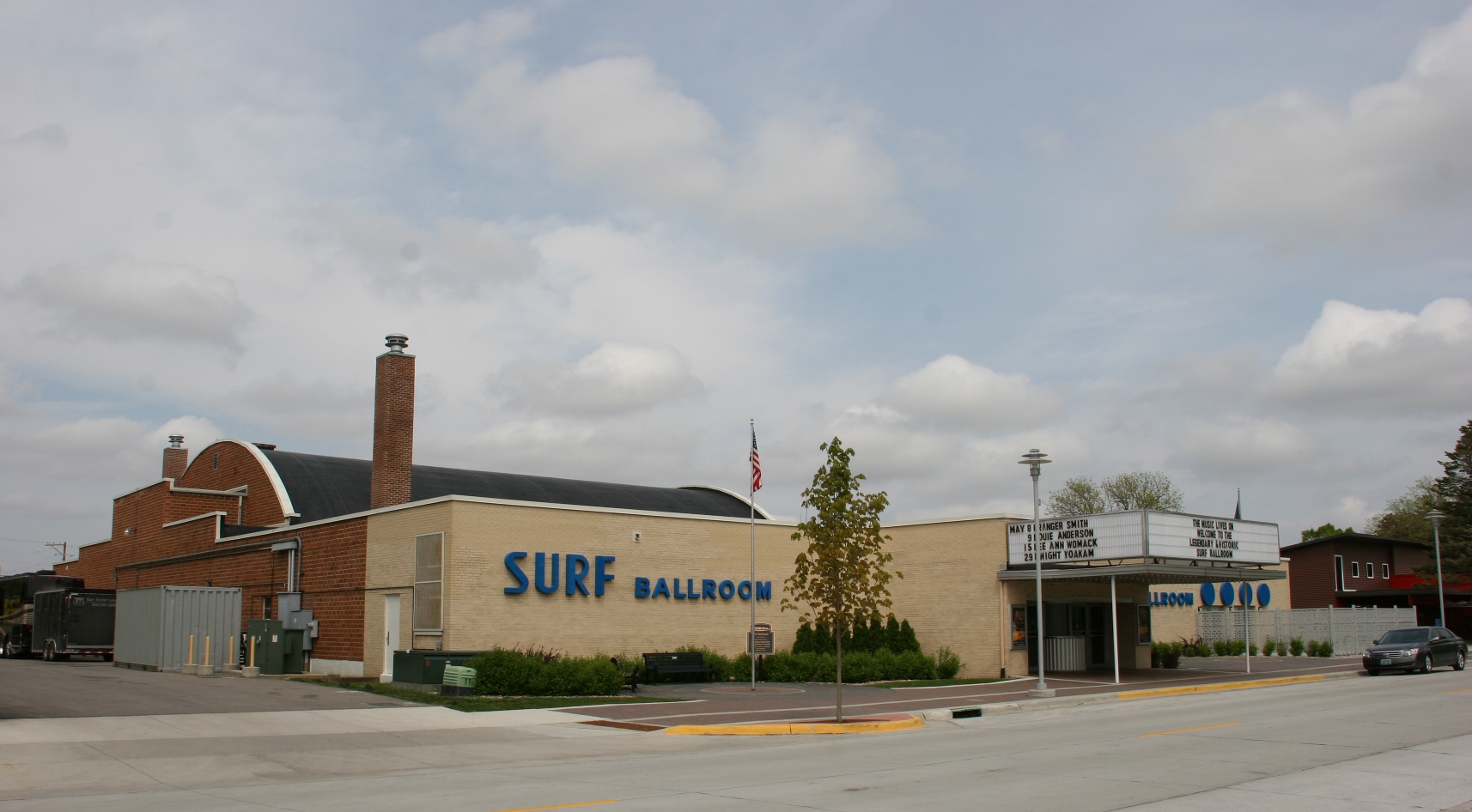
Today the Surf Ballroom in Clear Lake still hosts a Winter Dance Party honoring the musicians who performed their final concert there on February 2, 1959. Early the next morning en route to Moorhead, Minnesota, the charter flight carrying the rock-n-roll musicians crashed in a field near Clear Lake in northern Iowa.
This display references “American Pie.” (Minnesota Prairie Roots copyrighted file photo May 2015)
In 2015, Randy and I traveled an hour and 15 minutes south of Faribault along Interstate 35 to Clear Lake, where we toured the Surf. We were mere preschoolers when Holly and the others died. But the story of this tragedy imprinted upon us as teens, when Don McLean released his hit, “American Pie,” in 1971. How well I remember that tribute, the lyrics, the length of the nearly 8.5-minute song.
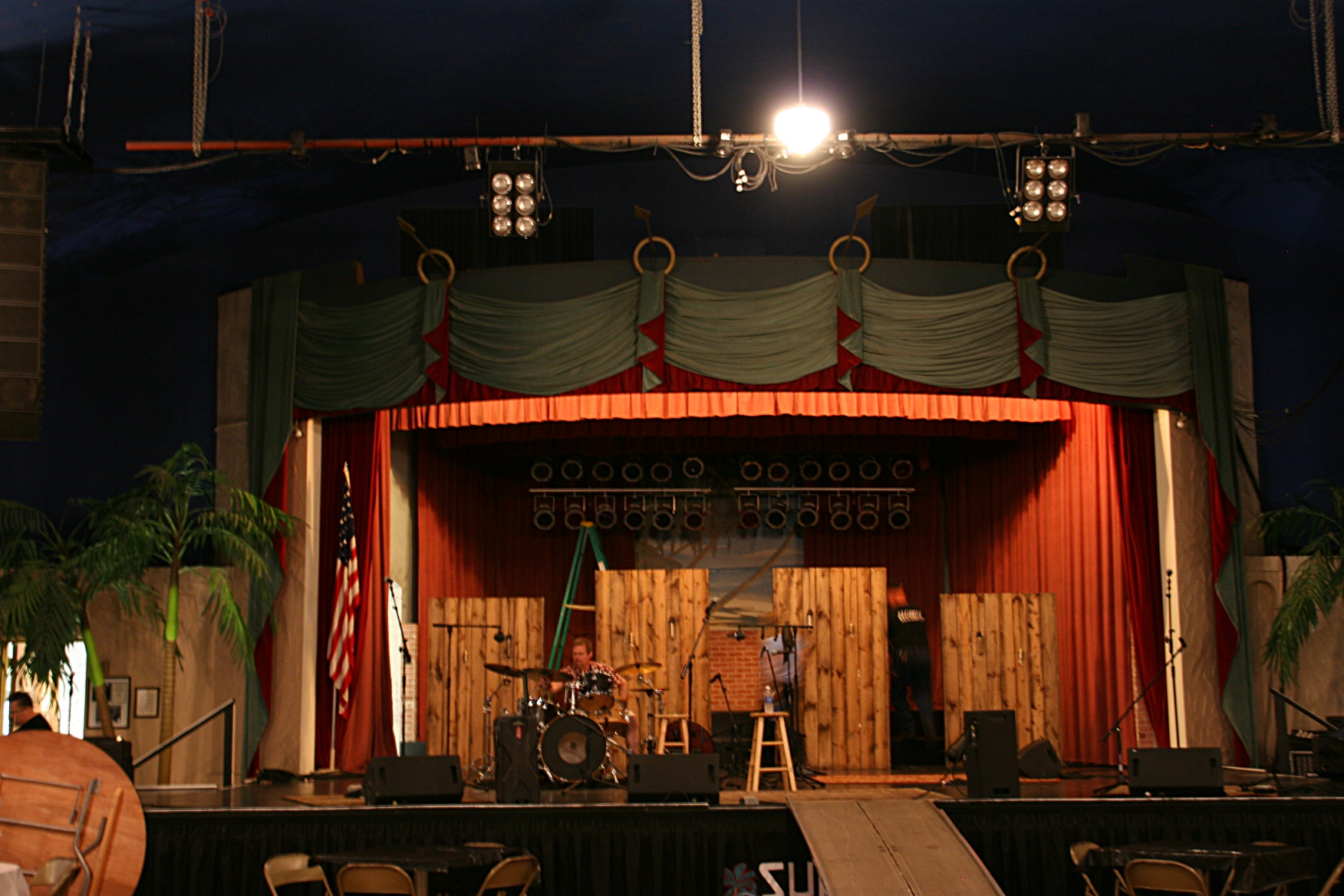
The ballroom stage. (Minnesota Prairie Roots copyrighted file photo May 2015)
While in Clear Lake on that May day seven years ago, we didn’t visit the crash site. Rain kept us away. But we certainly enjoyed our tour of the historic ballroom, site to many concerts from greats such as Duke Ellington, Lawrence Welk, the Beach Boys, the Doobie Brothers… The posters and photos, the aged booths, the stage and dance floor, all pay homage to the past, when ballrooms centered entertainment. The Surf, on the National Register of Historic Places and a designated National Historic Landmark, represents another time, another era, not simply a concert venue.
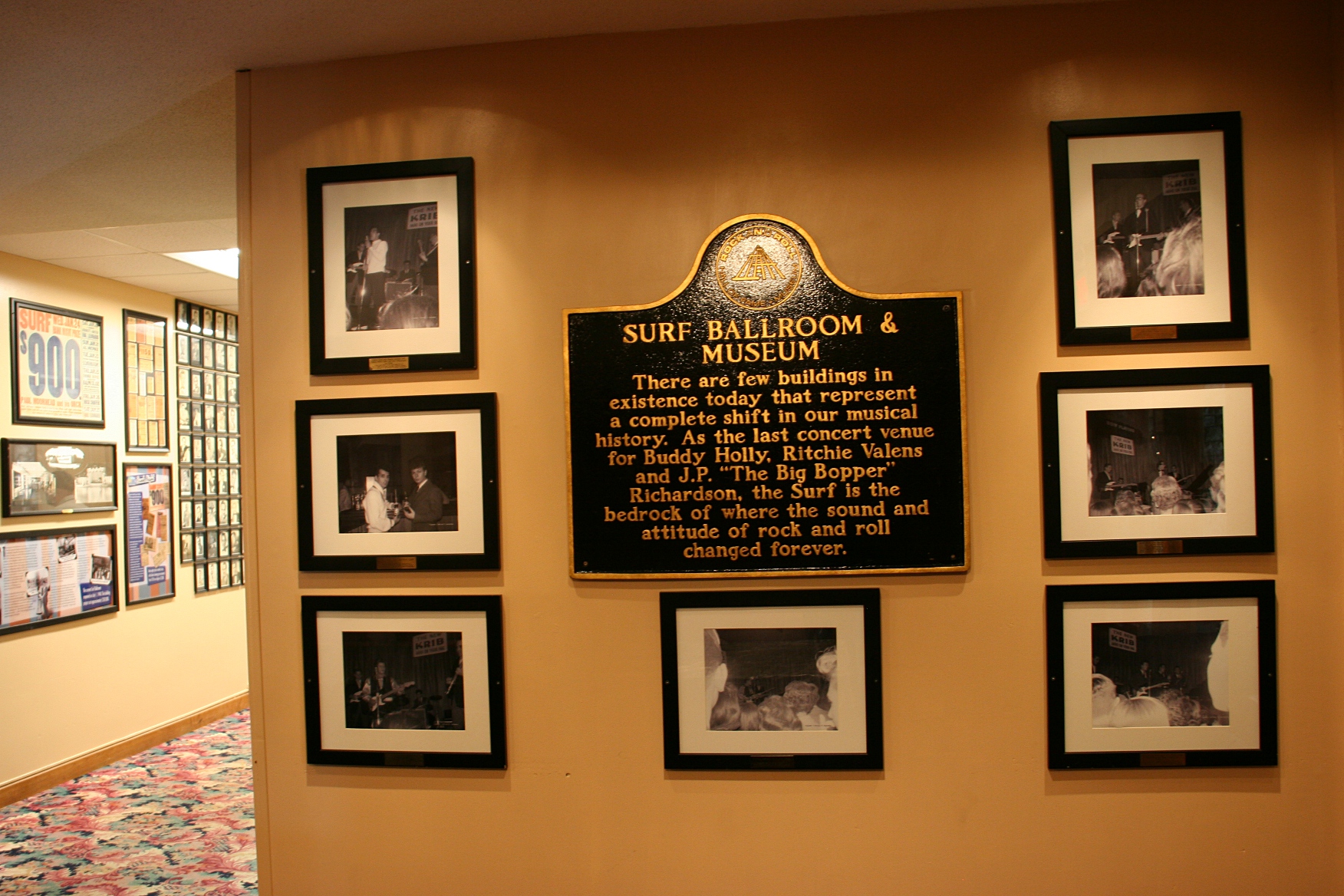
This sign summarizes the importance of the Surf. (Minnesota Prairie Roots copyrighted file photo May 2015)
Today I celebrate music and those who create it, past and present. Music enriches our lives beyond entertainment. Music, in many ways, writes like poetry into our hearts, souls and memories. And this February day, I honor the memories of Buddy Holly, Ritchie Valens and J.P. Richardson, as I consider “the day the music died.”
#
TELL ME: Have you toured the Surf Ballroom or the crash site? Or do you have music memories of Holly, Valens and Richardson that you’d like to share?
Nearing Terminal 1 at MSP on a quiet December day in 2015, a very different scene from Tuesday evening. (Minnesota Prairie Roots copyrighted file photo December 2015)
NEARLY AN HOUR after picking him up outside Terminal 1 at the Minneapolis-St. Paul International Airport Tuesday evening, my son and I embraced.
I wanted to wrap him in my arms immediately. But vehicles jammed the pick-up area. The hug would have to wait 45 minutes until we arrived home in Faribault. I recognized that if everyone stopped to hold their loved ones close, the traffic delays would only worsen. So he shoved his suitcase inside the van and climbed into the front passenger seat while I skirted the bag and slid the side door shut.
Randy and I’d already spent too much time waiting, creeping along toward arrivals. Mostly unfamiliar with the roads and lay-out of this terminal, Randy took a wrong turn and we ended up looping back around, back into the gridlock. In the end, that error proved OK timing wise.
I felt gratitude for drivers who allowed us to nudge into line. We did the same. I felt not so much appreciation for the driver of the big black pick-up truck with Wisconsin license plates. I observed bullying moves. But I suppose when you’re piloting a bulky truck…
I felt thankfulness also for the airport traffic director, attempting to create order from a traffic mess. I didn’t envy his job of keeping motorists and pedestrians safe.
Flying into MSP. (Minnesota Prairie Roots copyrighted file photo December 2015)
In the end, I got that long-awaited hug. Six months have passed since I’ve seen my son, who moved to Indiana in August to pursue his PhD at Purdue University. Oh, the joy in that first hug. The love that filled my mama’s heart. We held each other tight. Lingering. Savoring the moment.
In only days, that will repeat with my second daughter, whom I have not seen since mid-May. I’m anticipating the moment when she and her husband pull into the driveway after a 4 ½ hour drive from Madison, Wisconsin. I will wrap her in my arms. Lingering. Savoring the moment.
On Sunday, the eldest daughter, her husband and our two grandchildren will join us, completing the family circle. This will be our first Christmas together in five years. There will be more hugging and lingering. And joy filling this mother’s heart.
The back of buildings in the 400 block of Central Avenue, Faribault. (Minnesota Prairie Roots copyrighted photo 2021)
EVERY DAY WE PASS BY sights which often become so woven into our environment that we no longer see them. Until one day we pause. And notice.
Recently, I stopped to look around me, standing in a parking lot along Minnesota State Highway 60/Fourth Street, a half-block off Central Avenue next to Corks & Pints.
I rotated, taking in seemingly ordinary scenes. Part of the fabric of Faribault. Past and present.
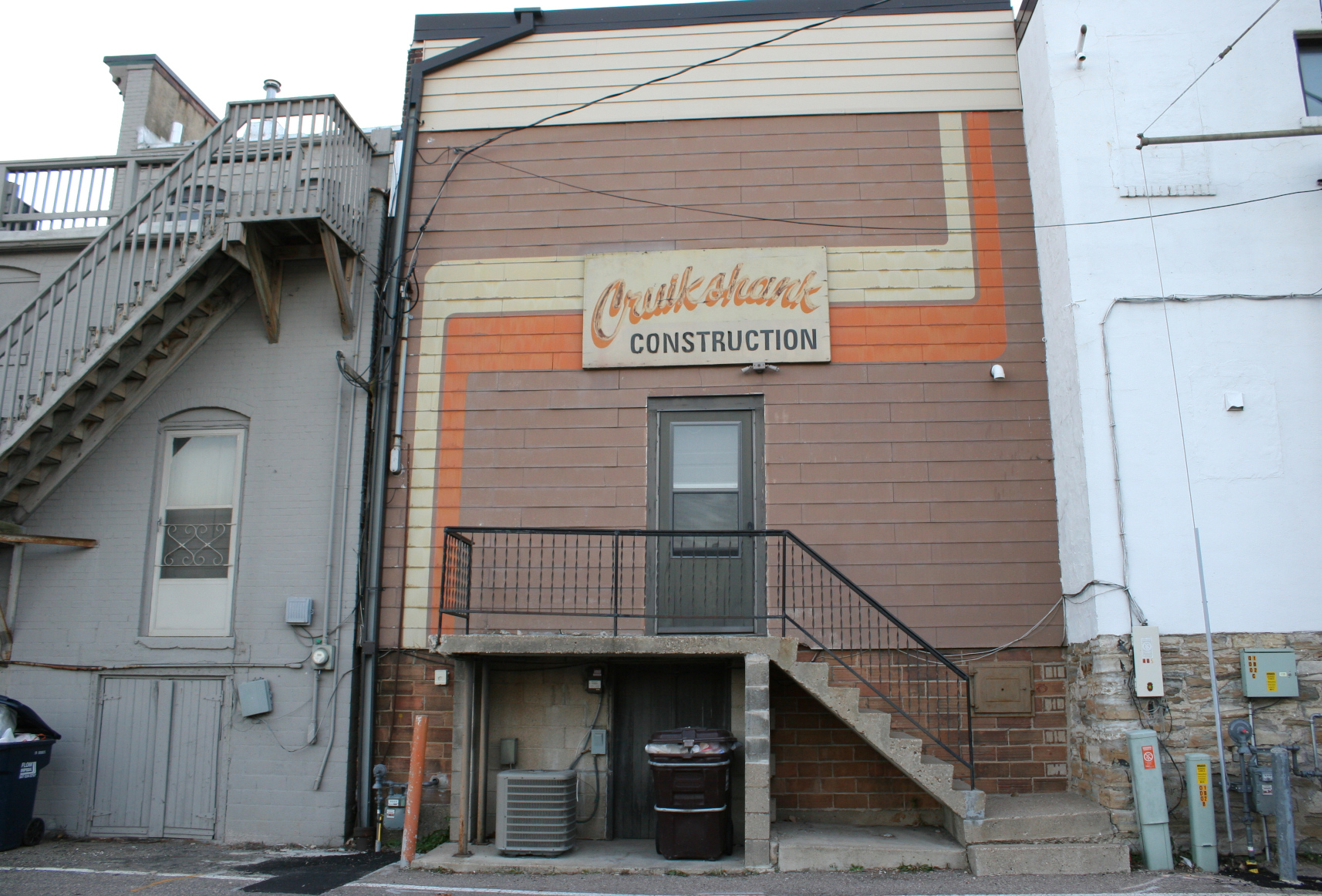
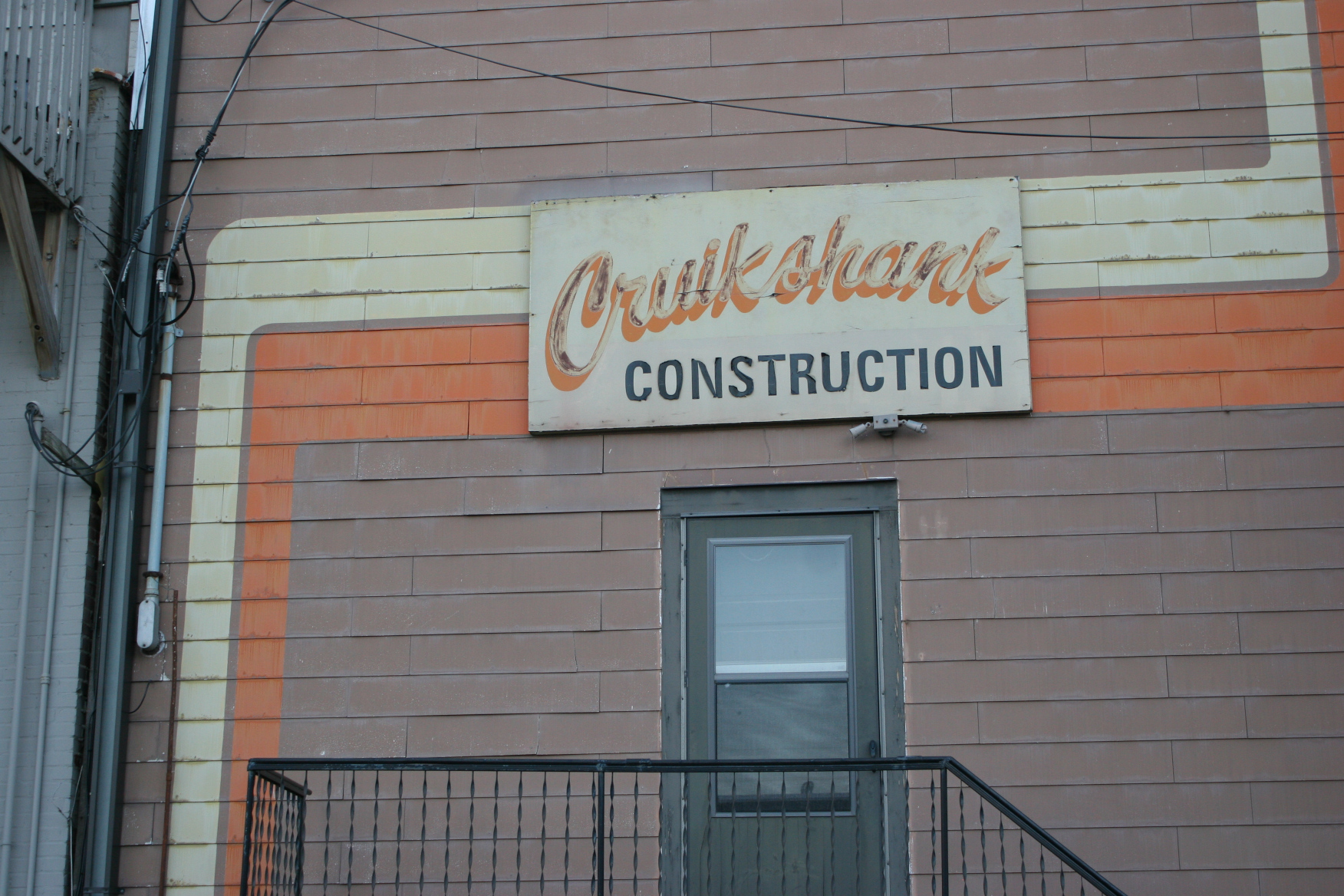
A sign marks Jack Cruikshank’s business.(Minnesota Prairie Roots copyrighted photo 2021)
Cruikshank Construction. I don’t know whether Jack Cruikshank still has his construction business. But, many decades ago, he installed replacement windows in our home. And he operated a paint store that was our go-to place for paint. Jack knew paint and was willing to share his expertise. For a while, he also had a bookstore in his shop. Jack was/is an exceptional individual and businessman—trustworthy, friendly, kind, knowledgeable, genuine and caring…
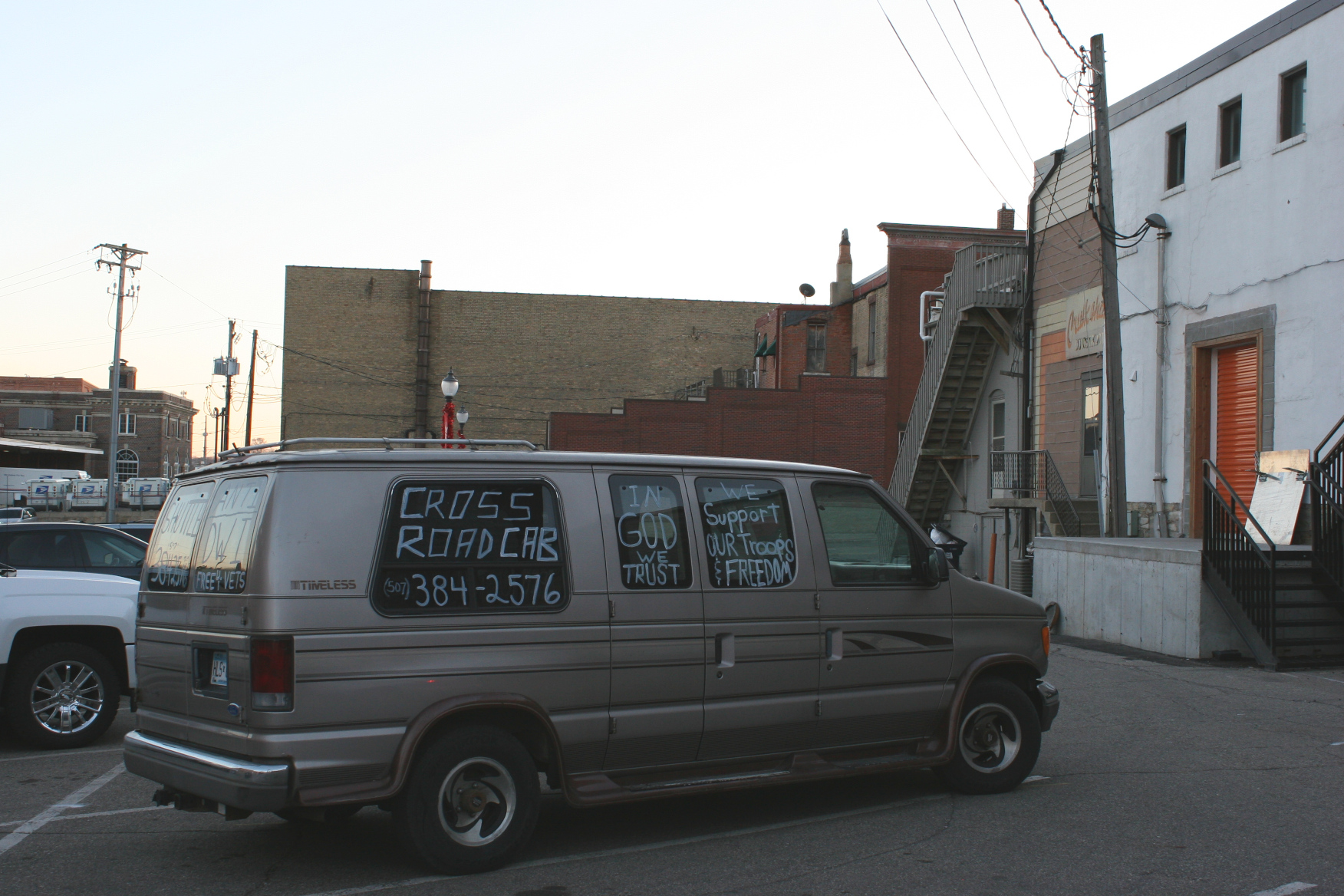
A cab company with a focus and message. (Minnesota Prairie Roots copyrighted photo 2021)
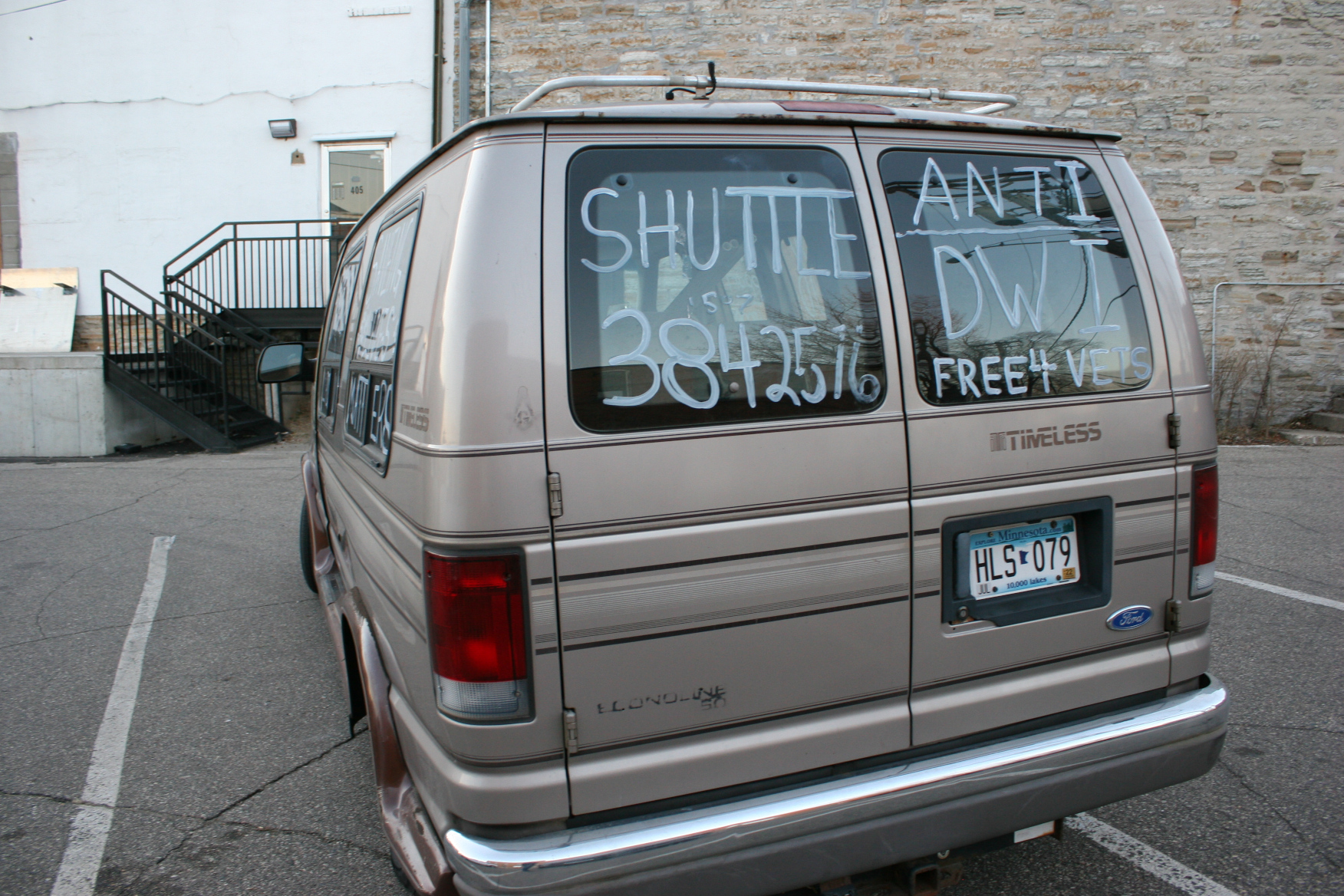
More messages on this cab. (Minnesota Prairie Roots copyrighted photo 2021)
I saw the same care written upon windows of a van, from which a couple disembarked while the driver of Cross Road Cab waited inside. I didn’t talk to him, but rather noted the messages of support for veterans, troops and freedom. Plus his stand against driving while intoxicated.
The grey building in the foreground houses Corks & Pints with 10,000 Drops in the brick building. The historic brick structure originally housed Peterson Art Furniture. (Minnesota Prairie Roots copyrighted photo)
The pair walked toward Corks & Pints and 10,000 Drops Craft Distillers. A mural, “Ice Skating on the Straight River,” graces the side of 10,000 Drops. It’s based on a vintage photo. The transformation of this downtown anchor corner has been a real asset to our community. Pre-distillery, the building housed an antique shop and architectural salvage business. It was dark, cluttered and not all that appealing. But now, wow. With the inside gutted and opened up, the distillery interior features wood floors, exposed beams, brick walls and much more, including cozy spaces to visit. It’s unlike any other place in Faribault. An inviting setting to enjoy a locally handcrafted cocktail with friends. Inside, or outside on the patio. Corks & Pints is part of the complex, housed next door in the former F-Town Brewing located in a former garage. It’s a tap house and wine bar, another welcoming spot to connect and converse.
A while ago, Cry Baby Craig’s focused conversation in our downtown. Craig Kaiser moved his hot sauce business to Faribault, into a former sporting goods store at 405 Central Avenue North. CBC’s highly-acclaimed habanero and garlic hot sauce is a staple in our refrigerator. And it’s become a favorite among restaurants in the metro and beyond.
If you’re mostly unfamiliar with Faribault, I hope you’ve learned a thing or ten about our town via my pivoting parking lot perspective. And, if you’re local, I invite you to pause and appreciate all that our community offers.



















 Minnesota Prairie Roots
Recent Comments