Minnesota Prairie Roots

Writing and photography by Audrey Kletscher Helbling

The creative framing of Northfield February 24, 2022

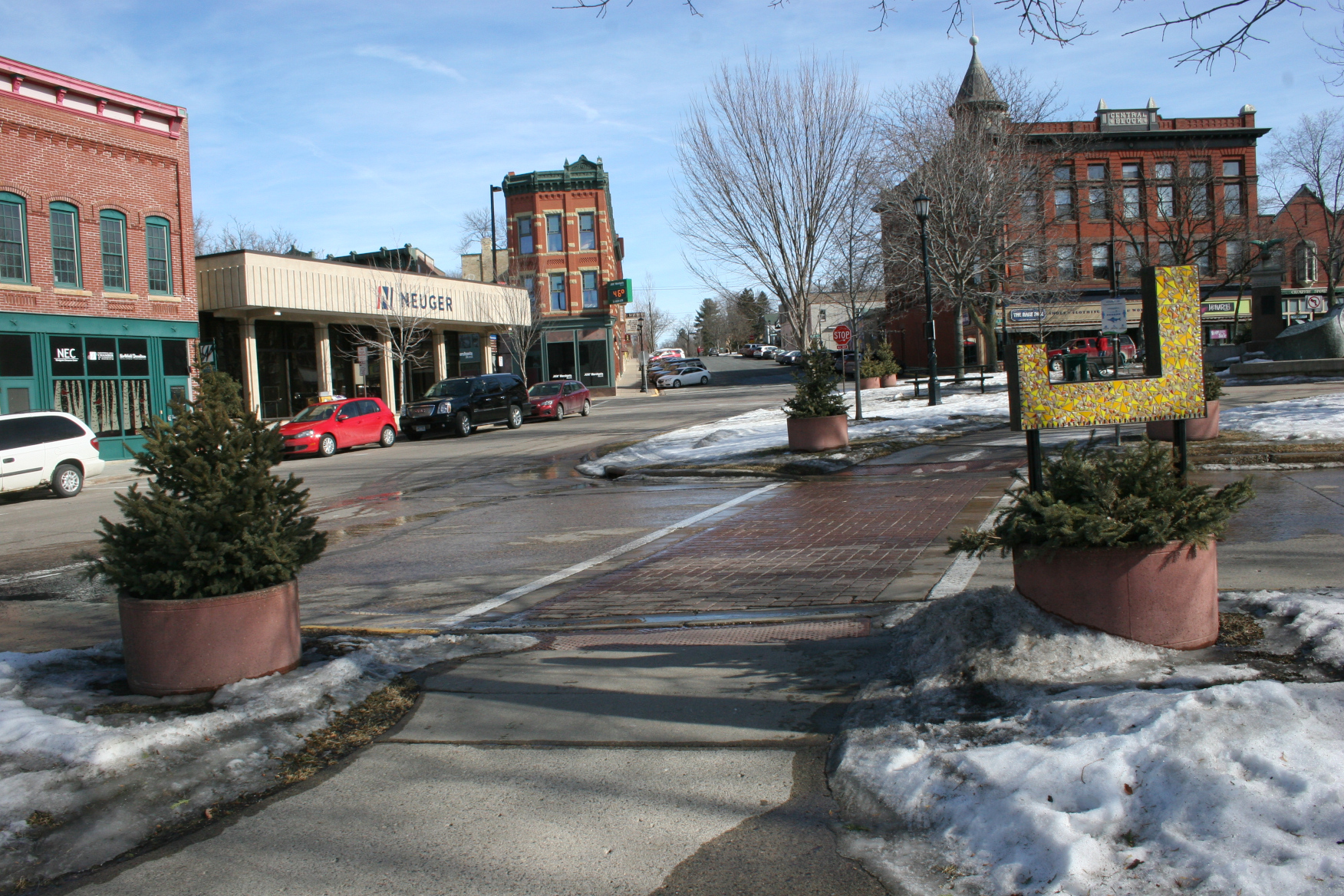
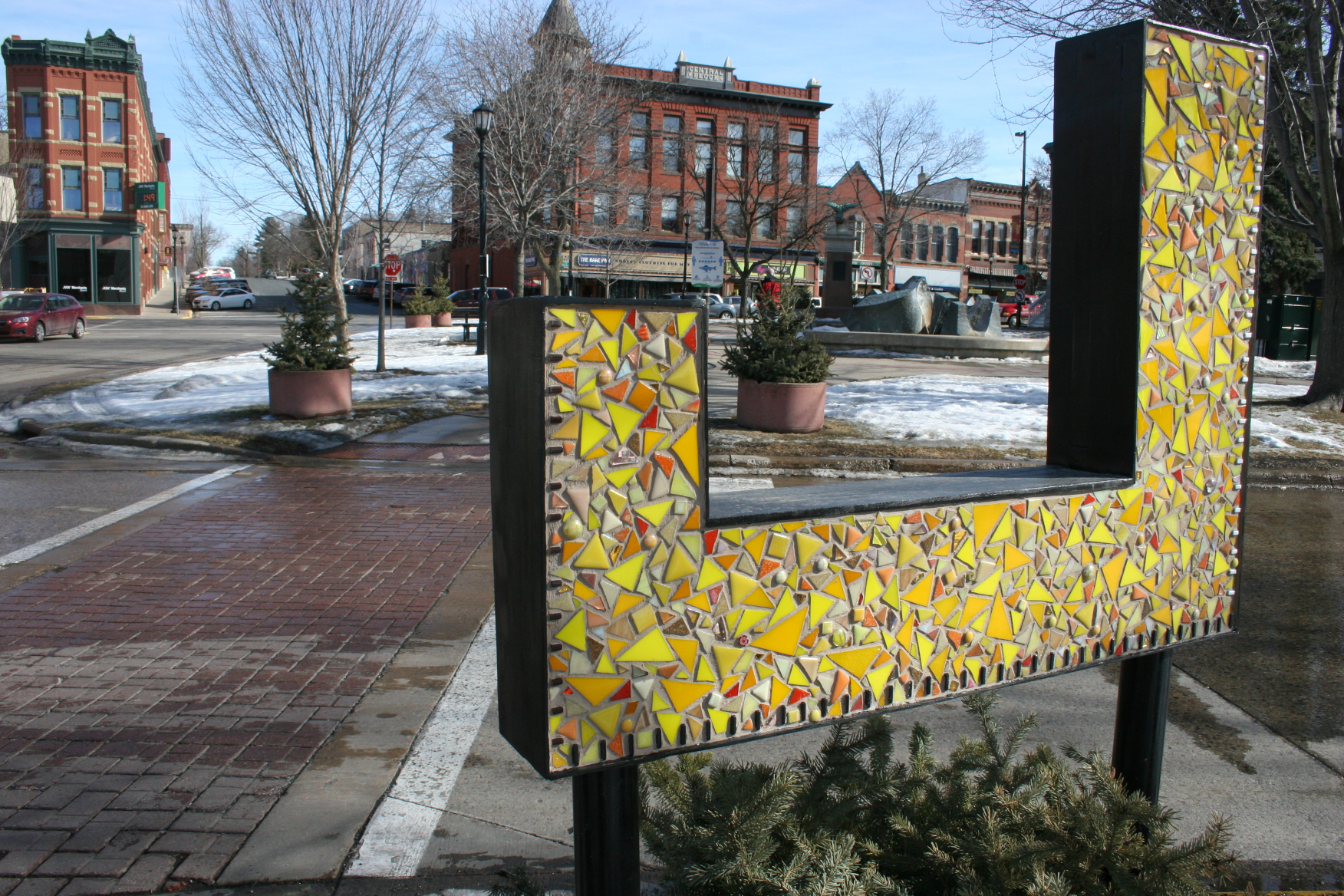
“Framing the Scene,” a relatively new art installation, right, in the heart of historic downtown Northfield.

AS A MEGA APPRECIATOR of outdoor public art, I delighted in the recent discovery of some new, at least new-to-me, art staged in historic downtown Northfield. This southern Minnesota river town boasts a thriving community of literary, visual and performing artists.

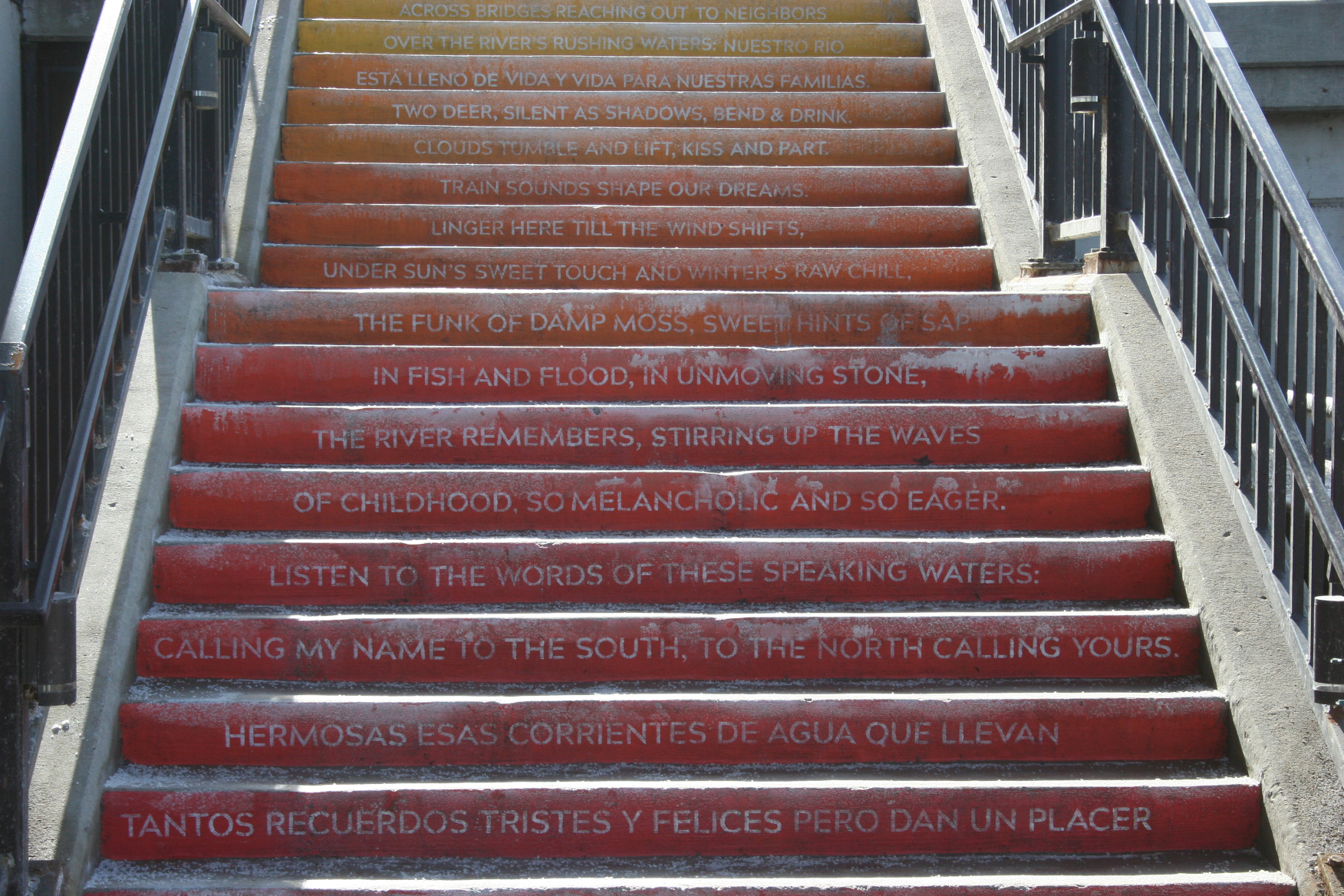
This shows a section of Northfield’s “Poem Steps,” a collaboration of 17 local poets. These poetry steps (covered here with salt residue) are along the Riverwalk. (Minnesota Prairie Roots copyrighted photo February 2022)

Here you’ll find poems imprinted in sidewalks, painted on steps and read at poetry readings in a city with a poet laureate. Here you’ll see outdoor sculptures scattered about town. Here you can listen to a concert at Bridge Square, a local church, St. Olaf or Carleton Colleges or elsewhere. Here you can enjoy live theater. Here you can appreciate the works of creatives at the Northfield Arts Guild and many other venues.

Northfield truly is synonymous with the arts.

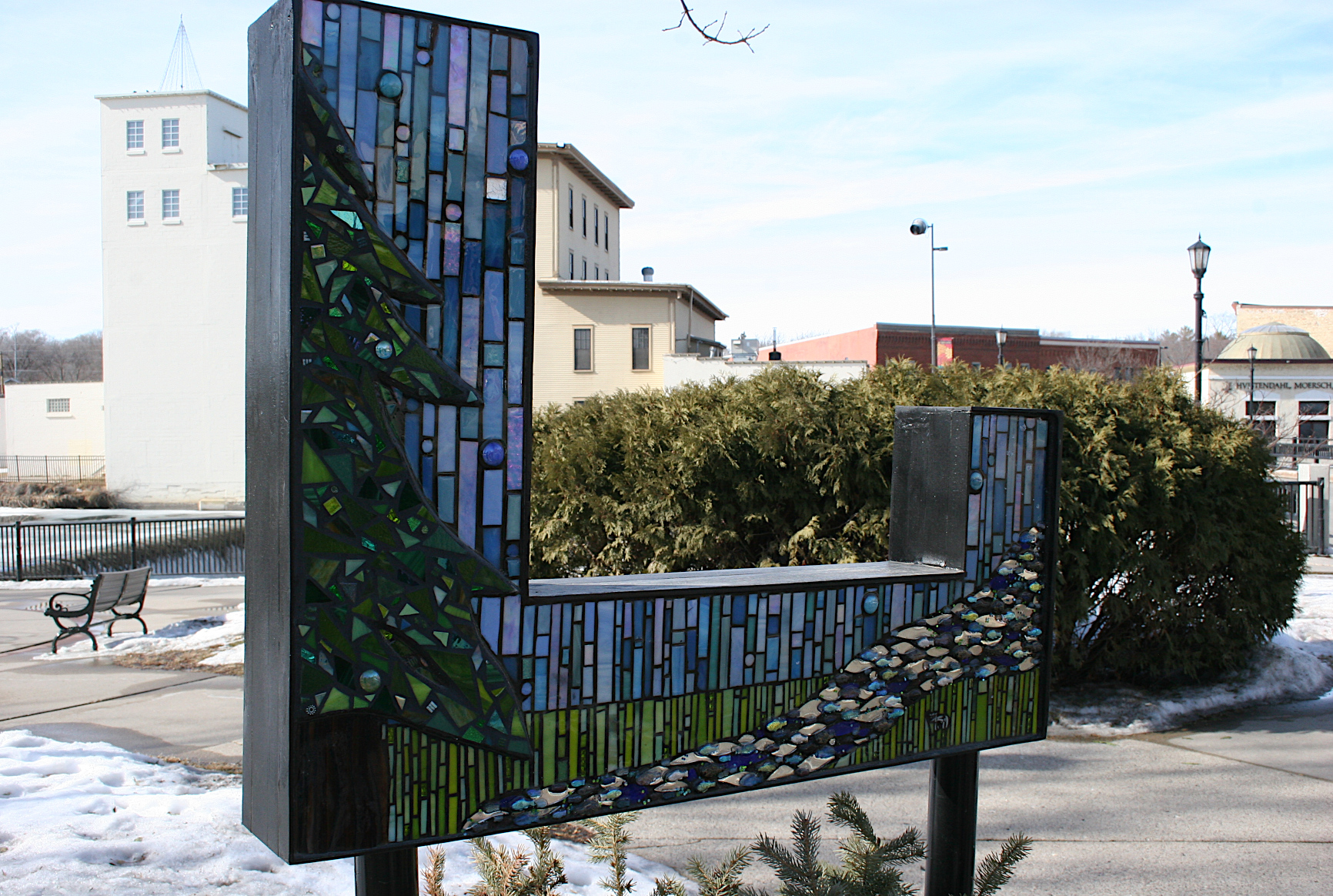
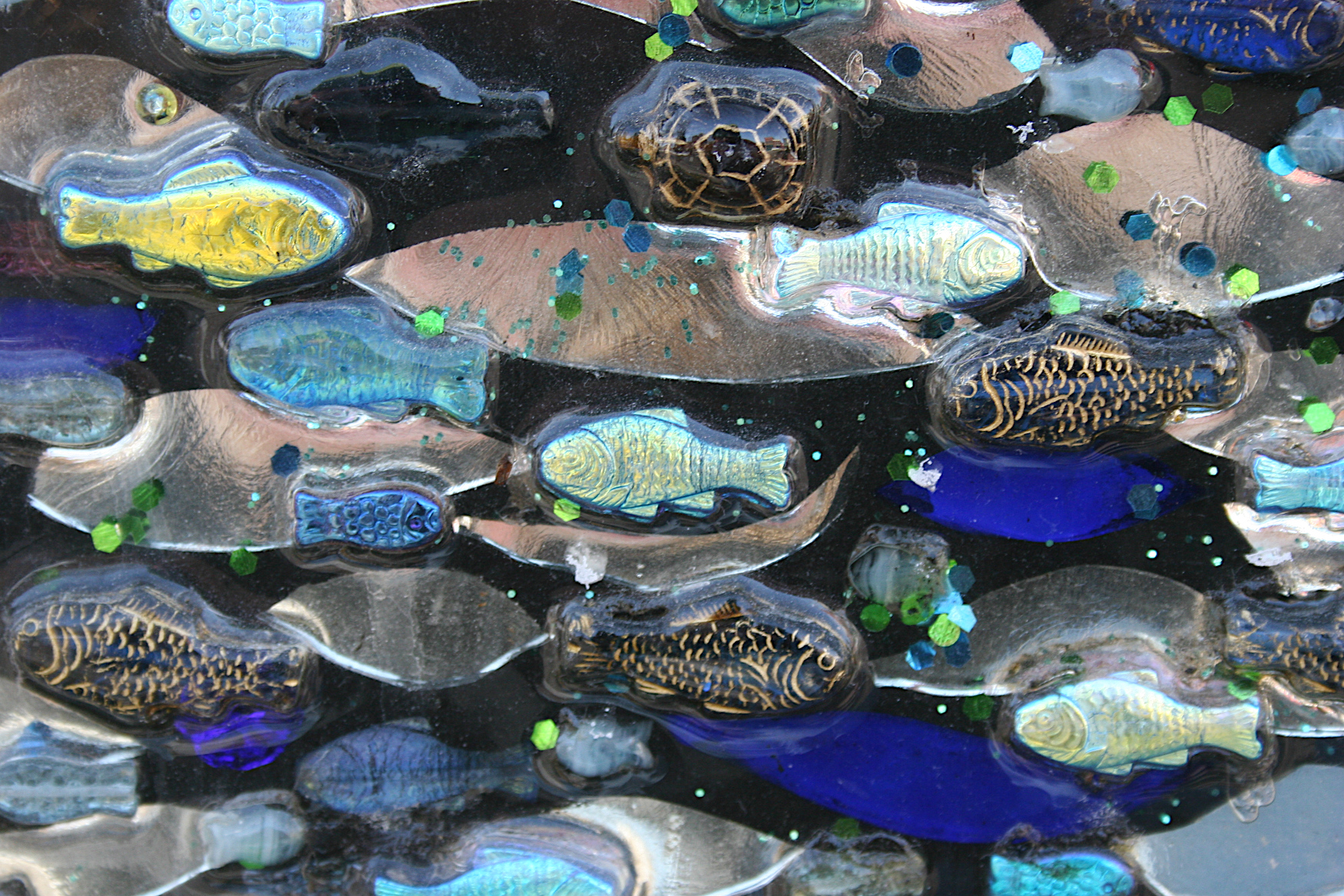
The riverside-themed side of Erin Ward’s “Framing the Scene.” In the background water rushes over the Ames Mill Dam next to the historic mill on the Cannon River. (Minnesota Prairie Roots copyrighted photo February 2022)

So when I spied a recently-installed sculpture, “Framing the Scene” by St. Paul glass artist Erin Ward, I felt a jolt of excitement. The free-standing, two-dimensional mosaic frames the nearby Cannon River and Riverwalk on one side and Bridge Square on the other. It’s meant to be an interactive sculpture for framing photos.

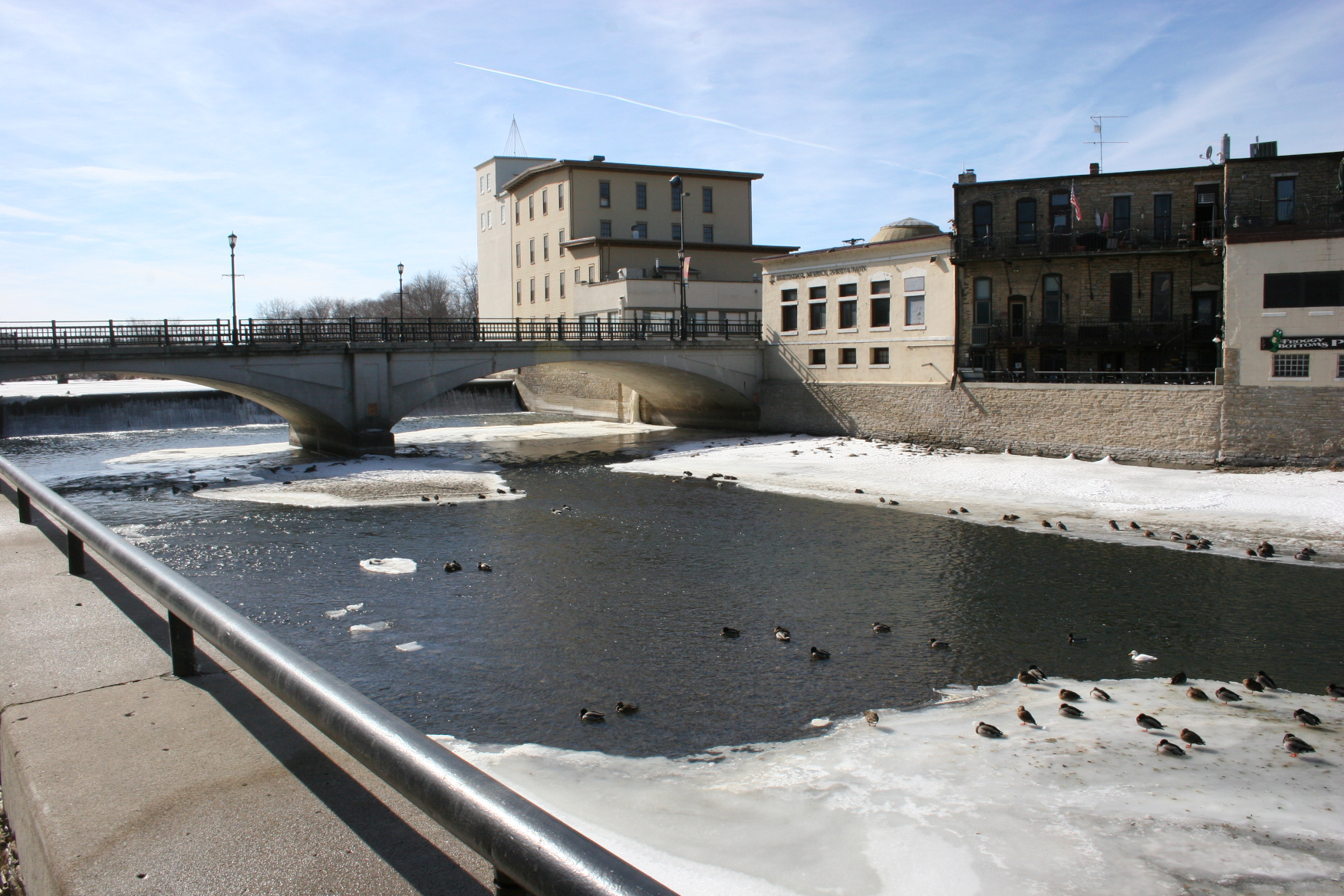
The Cannon River flows through downtown Northfield. (Minnesota Prairie Roots copyrighted file photo February 2022)

Ward was among five artists awarded $2,000 grants from the Minnesota Arts Board for the Northfield Downtown Development Corporation’s 2021 Artists on Main Street projects. That program aspires to get “creative placemaking” into the historic downtown. The intersection of arts and culture, downtown revitalization and historic preservation all factor into the artistic endeavors.

Lovely historic buildings grace downtown Northfield. (Minnesota Prairie Roots copyrighted photo February 2022)

“Framing the Scene” meets all of those criteria, in my creative opinion. The artwork itself represents the vision and skills of a talented artist. The art adds to the downtown Northfield experience. That experience is one of dipping in and out of mostly home-grown local shops or of dining in an historic setting. The cliques “quaint and charming” fit Northfield. This is a community rich in history, rich in historic architecture, rich in natural beauty and rich in art.

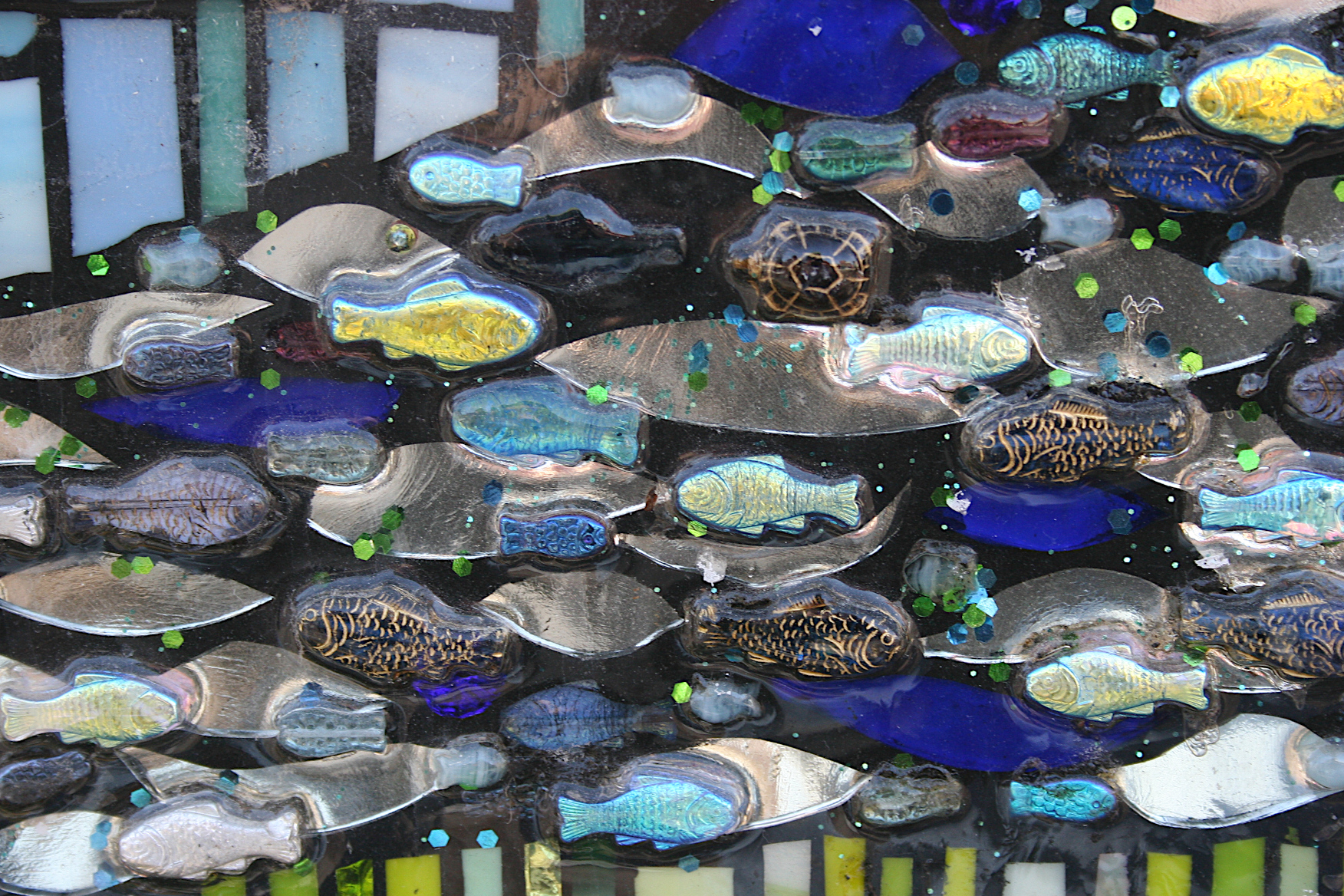
So much detail in the mosaic… (Minnesota Prairie Roots copyrighted photo February 2022)

I appreciate how Ward melded art and nature in creating a mosaic which honors both. As I studied her interpretation of the Cannon River, I recognized the thought she invested in this detailed art of many many pieces. Her river evokes movement in waters teeming with fish and the occasional turtle. Assorted greens and blues evoke a sense of calm and peacefulness. Ward’s art honors this river which runs through. This river of life, now a backdrop to a community which still appreciates her beauty, her recreational qualities, her history, her aesthetic value.

This side of Ward’s mosaic focuses attention toward Bridge Square and buildings downtown. (Minnesota Prairie Roots copyrighted file photo February 2022)

And then, on the flip side of “Framing the Scene,” bold pieces of mostly yellow, orange and red triangles create a completely different feeling. It’s as if sunbeams fell from the sun in a chaotic, jumbled mix of happiness. That’s my interpretation.

This side of the art looks toward Bridge Square, community gathering spot in downtown Northfield. Place of concerts and popcorn wagon, Santa house and quiet bench-sitting. Place of artistic activism. And beyond that, to the back of the frame, historic buildings rise.

One final look at Ward’s interpretation of the Cannon River in historic Northfield. (Minnesota Prairie Roots copyrighted photo February 2022)

Art rises in Northfield, enriching the lives of locals and the lives of visitors like me, come to town to follow the Riverwalk, to walk along Division Street and, then, to pause near Bridge Square and frame the scene.

Please check back for more posts about art in historic downtown Northfield, Minnesota.

© Copyright 2022 Audrey Kletscher Helbling


In Montgomery: Featuring the letterpress art of Tin Can Valley Printing February 16, 2022

A promo poster printed by Craig Kotasek of Tin Can Valley Printing. (Minnesota Prairie Roots copyrighted photo February 2022)

INSIDE AN HISTORIC 1892 BRICK BUILDING in the heart of Minnesota Czech country, a Letterpress Print Show drew me to The Arts & Heritage Center of Montgomery. The show, continuing until February 26, features the art of Craig Kotasek of Tin Can Valley Printing Co. in nearby Le Sueur.

The historic Hilltop Hall houses The Arts & Heritage Center of Montgomery on the right and Posy Floral & Gifts, left. (Minnesota Prairie Roots copyrighted photo February 2022)
Inside the center, Kotasek’s prints plaster walls. (Minnesota Prairie Roots copyrighted photo February 2022)
The artist includes some background info about himself, this sheet focused on his time at The Gaylord Hub. (Minnesota Prairie Roots copyrighted photo February 2022)

As a journalist and an art lover especially appreciative of letterpress printing, I delighted in this exhibit of an art now in revival. Not only that, I hold a connection to Kotasek. We both worked at The Gaylord Hub, me as my first newspaper reporting job straight out of college in 1978 and he as an apprentice printer there in 1999. We learned under the mentorship of Jim Deis, then editor and publisher of the generational family-owned newspaper. I’ve never met Kotasek, yet I feel linked via The Hub.

This shows the steps in creating a multi-hued print. (Minnesota Prairie Roots copyrighted photo February 2022)

To view his art is to gain an appreciation for a past printing process. In letterpress printing, movable raised wood or lead letters/type are pieced together in a frame, then secured before inking onto paper via a printing press. That’s a simplistic explanation. If multiple ink colors are required, the process is layered, longer, more labor intensive. Likewise, art carved from linoleum or wood blocks goes through a similar process in creating fine art prints, gig posters and more.

Volunteer JoAnn Petricka with Kotasek’s prints to the left. (Minnesota Prairie Roots copyrighted photo February 2022)

When I entered the narrow room which houses The Arts & Heritage Center in the small southern Minnesota community of Montgomery and saw Kotasek’s letterpress art, memories rushed back. Memories of the strong scent of ink, the clacking of noisy printing presses, scenes of printers Dale and Bucky laboring in stained printers’ aprons, me trying to hear phone conversations with sources. Me pounding out news stories on an aged manual typewriter against the backdrop of all that noise.

Hand-carved blocks were used to create this art titled “Eight-Pointed Star.” (Minnesota Prairie Roots copyrighted photo February 2022)

But on this February morning, quiet prevailed as I studied the work of this craftsman, this visual artist. Letterpress is both craft and art.

Kolacky Days queens in framed photos over prints from Tin Can Valley Printing. (Minnesota Prairie Roots copyrighted photo February 2022)
One of his specialties is creating posters for musical gigs. (Minnesota Prairie Roots copyrighted photo February 2022)

Beneath professional portraits of Kolacky Days queens, which ring this room near the ceiling, hang examples of Kotasek’s assorted creations. Gig posters for musical groups (including his own Oxbow Boys band). Fine art prints created with hard-carved blocks. A mix of letterpress and block. And on a shelf, a box of his popular letterpress greeting cards. Another display holds his $10 numbered prints.

A hand-carved block for printing. (Minnesota Prairie Roots copyrighted photo February 2022)

I feel such an appreciation for Kotasek. His love for the letterpress craft shows in his printing skills, his creativity. To get clear, crisp prints takes patience, practice, time, effort. But before that comes the visualization, the creativity, the ability to bring many elements together in hands-on work.

Type in a tray. (Minnesota Prairie Roots copyrighted photo February 2022)
Cans of ink to color his art. (Minnesota Prairie Roots copyrighted photo February 2022)
Roller and carved blocks to print. (Minnesota Prairie Roots copyrighted photo February 2022)

A tall enclosed cabinet holds some of Kotasek’s tools of the craft. Letters. Rollers. Ink. Wood-cuts. All offer a glimpse into this artist’s world. He’s gathered abandoned, about-to-be-scrapped printing presses and other printing tools from small town newspapers in Minnesota and set up shop in a renovated granary on the family farm just outside Le Sueur. His studio overlooks the valley, home of the Jolly Green Giant associated with Minnesota Valley Canning Company, later Green Giant.

Kotasek has created numerous Green Giant prints. (Minnesota Prairie Roots copyrighted photo February 2022)

Kotasek pays homage to the vegetable canning company in the name of his printing business, Tin Can Valley Printing. On his website, he offers several explanations, one referencing a farmer who fed discarded canned vegetables to his pigs from damaged cans. As the story goes, the pig farmer tossed those empty tin cans into a ravine. During a massive flood of the Minnesota River Valley in 1965, the cans reportedly floated into town, causing an array of issues. The name Tin Can Valley stuck. I like the historic reference, the memorable moniker.

Featured art includes Jolly Green Giant prints, right. (Minnesota Prairie Roots copyrighted photo February 2022)
More food art prints. (Minnesota Prairie Roots copyrighted photo February 2022)
In the corner of my “Niblets of Corn Sign” print. (Minnesota Prairie Roots copyrighted photo February 2022)

I found myself drawn to Kotasek’s Green Giant-themed prints. I purchased No. 38 of his 2019 “Niblets Corn Sign” 8 x 10 card stock print. It’s a reproduction of a metal sign that once marked the Green Giant canning factory in Le Sueur. The four-color print, crafted from wood type and hand-carved wood and linoleum blocks, features the legendary Green Giant hefting a massive ear of sweetcorn. The image is iconic rural Minnesota.

This particular poster has an old style newspaper vibe. (Minnesota Prairie Roots copyrighted photo February 2022)

Kotasek represents in many ways the past of newspapers in Minnesota. Early editors printed their papers with letterpress. They also served their communities as print shops. When I worked at The Gaylord Hub, farm auction bills flew off the aged printing presses. Kotasek remembers the endless fundraiser raffle tickets he printed while learning the printing trade.

A poster fitting for the Czech farming community of Montgomery. (Minnesota Prairie Roots copyrighted photo February 2022)

If you’re interested in meeting Kotasek, visit The Arts & Heritage Center of Montgomery, 206 First Street North, between 9 am – noon on Saturday, February 26, during an artist’s reception. The center is open limited hours: from 2-5 pm Thursdays and Fridays and from 9 am-noon on Saturdays. The show closes February 26.

While in Montgomery, be sure to check out the shops (gift, floral, quilt, thrift, drugstore…) and stop at Franke’s Bakery for a sweet treat. You’ll find kolacky there in this self-proclaimed “Kolacky Capital of the World.” The town is also home to Montgomery Brewing and Pizzeria 201 (a popular local eatery with curbside pick-up only currently). I encourage you to check destination hours in advance of a visit to avoid disappointment. Also notice the historic architecture, the photo tributes to veterans and the town mural (across from the bakery). Montgomery rates as one of my favorite area small towns…because of The Arts & Heritage Center and more.

© Copyright 2022 Audrey Kletscher Helbling


“The day the music died” February 3, 2022

Portraits of the deceased musicians inside the Surf Ballroom. (Minnesota Prairie Roots copyrighted file photo May 2015)

SIXTY-THREE YEARS AGO TODAY, the music died. On February 3, 1959, three musicians—Buddy Holly, Ritchie Valens and J.P. “The Big Bopper” Richardson—and a pilot died in a plane crash near Clear Lake, Iowa. It was, and remains, a monumental moment in American music history.

A broad view of this massive ballroom which seats 2,100. (Minnesota Prairie Roots copyrighted file photo May 2015)

Today the Surf Ballroom in Clear Lake still hosts a Winter Dance Party honoring the musicians who performed their final concert there on February 2, 1959. Early the next morning en route to Moorhead, Minnesota, the charter flight carrying the rock-n-roll musicians crashed in a field near Clear Lake in northern Iowa.

This display references “American Pie.” (Minnesota Prairie Roots copyrighted file photo May 2015)

In 2015, Randy and I traveled an hour and 15 minutes south of Faribault along Interstate 35 to Clear Lake, where we toured the Surf. We were mere preschoolers when Holly and the others died. But the story of this tragedy imprinted upon us as teens, when Don McLean released his hit, “American Pie,” in 1971. How well I remember that tribute, the lyrics, the length of the nearly 8.5-minute song.

The ballroom stage. (Minnesota Prairie Roots copyrighted file photo May 2015)

While in Clear Lake on that May day seven years ago, we didn’t visit the crash site. Rain kept us away. But we certainly enjoyed our tour of the historic ballroom, site to many concerts from greats such as Duke Ellington, Lawrence Welk, the Beach Boys, the Doobie Brothers… The posters and photos, the aged booths, the stage and dance floor, all pay homage to the past, when ballrooms centered entertainment. The Surf, on the National Register of Historic Places and a designated National Historic Landmark, represents another time, another era, not simply a concert venue.

This sign summarizes the importance of the Surf. (Minnesota Prairie Roots copyrighted file photo May 2015)

Today I celebrate music and those who create it, past and present. Music enriches our lives beyond entertainment. Music, in many ways, writes like poetry into our hearts, souls and memories. And this February day, I honor the memories of Buddy Holly, Ritchie Valens and J.P. Richardson, as I consider “the day the music died.”

#

TELL ME: Have you toured the Surf Ballroom or the crash site? Or do you have music memories of Holly, Valens and Richardson that you’d like to share?

FYI: To see more photos and stories from my visit to Clear Lake, Iowa, please click here.

© Copyright 2022 Audrey Kletscher Helbling
 

Christmas homecoming December 23, 2021

Nearing Terminal 1 at MSP on a quiet December day in 2015, a very different scene from Tuesday evening. (Minnesota Prairie Roots copyrighted file photo December 2015)

NEARLY AN HOUR after picking him up outside Terminal 1 at the Minneapolis-St. Paul International Airport Tuesday evening, my son and I embraced.

I wanted to wrap him in my arms immediately. But vehicles jammed the pick-up area. The hug would have to wait 45 minutes until we arrived home in Faribault. I recognized that if everyone stopped to hold their loved ones close, the traffic delays would only worsen. So he shoved his suitcase inside the van and climbed into the front passenger seat while I skirted the bag and slid the side door shut.

Randy and I’d already spent too much time waiting, creeping along toward arrivals. Mostly unfamiliar with the roads and lay-out of this terminal, Randy took a wrong turn and we ended up looping back around, back into the gridlock. In the end, that error proved OK timing wise.

I felt gratitude for drivers who allowed us to nudge into line. We did the same. I felt not so much appreciation for the driver of the big black pick-up truck with Wisconsin license plates. I observed bullying moves. But I suppose when you’re piloting a bulky truck…

I felt thankfulness also for the airport traffic director, attempting to create order from a traffic mess. I didn’t envy his job of keeping motorists and pedestrians safe.

Flying into MSP. (Minnesota Prairie Roots copyrighted file photo December 2015)

In the end, I got that long-awaited hug. Six months have passed since I’ve seen my son, who moved to Indiana in August to pursue his PhD at Purdue University. Oh, the joy in that first hug. The love that filled my mama’s heart. We held each other tight. Lingering. Savoring the moment.

In only days, that will repeat with my second daughter, whom I have not seen since mid-May. I’m anticipating the moment when she and her husband pull into the driveway after a 4 ½ hour drive from Madison, Wisconsin. I will wrap her in my arms. Lingering. Savoring the moment.

On Sunday, the eldest daughter, her husband and our two grandchildren will join us, completing the family circle. This will be our first Christmas together in five years. There will be more hugging and lingering. And joy filling this mother’s heart.

© Copyright 2021 Audrey Kletscher Helbling


From Faribault: A pivoting parking lot perspective December 9, 2021

The back of buildings in the 400 block of Central Avenue, Faribault. (Minnesota Prairie Roots copyrighted photo 2021)

EVERY DAY WE PASS BY sights which often become so woven into our environment that we no longer see them. Until one day we pause. And notice.

Recently, I stopped to look around me, standing in a parking lot along Minnesota State Highway 60/Fourth Street, a half-block off Central Avenue next to Corks & Pints.

I rotated, taking in seemingly ordinary scenes. Part of the fabric of Faribault. Past and present.

A sign marks Jack Cruikshank’s business. (Minnesota Prairie Roots copyrighted photo 2021)

Cruikshank Construction. I don’t know whether Jack Cruikshank still has his construction business. But, many decades ago, he installed replacement windows in our home. And he operated a paint store that was our go-to place for paint. Jack knew paint and was willing to share his expertise. For a while, he also had a bookstore in his shop. Jack was/is an exceptional individual and businessman—trustworthy, friendly, kind, knowledgeable, genuine and caring…

A cab company with a focus and message. (Minnesota Prairie Roots copyrighted photo 2021)
More messages on this cab. (Minnesota Prairie Roots copyrighted photo 2021)

I saw the same care written upon windows of a van, from which a couple disembarked while the driver of Cross Road Cab waited inside. I didn’t talk to him, but rather noted the messages of support for veterans, troops and freedom. Plus his stand against driving while intoxicated.

The grey building in the foreground houses Corks & Pints with 10,000 Drops in the brick building. The historic brick structure originally housed Peterson Art Furniture. (Minnesota Prairie Roots copyrighted photo)

The pair walked toward Corks & Pints and 10,000 Drops Craft Distillers. A mural, “Ice Skating on the Straight River,” graces the side of 10,000 Drops. It’s based on a vintage photo. The transformation of this downtown anchor corner has been a real asset to our community. Pre-distillery, the building housed an antique shop and architectural salvage business. It was dark, cluttered and not all that appealing. But now, wow. With the inside gutted and opened up, the distillery interior features wood floors, exposed beams, brick walls and much more, including cozy spaces to visit. It’s unlike any other place in Faribault. An inviting setting to enjoy a locally handcrafted cocktail with friends. Inside, or outside on the patio. Corks & Pints is part of the complex, housed next door in the former F-Town Brewing located in a former garage. It’s a tap house and wine bar, another welcoming spot to connect and converse.

Cry Baby Craig’s can’t miss signature orange truck. (Minnesota Prairie Roots copyrighted photo 2021)

A while ago, Cry Baby Craig’s focused conversation in our downtown. Craig Kaiser moved his hot sauce business to Faribault, into a former sporting goods store at 405 Central Avenue North. CBC’s highly-acclaimed habanero and garlic hot sauce is a staple in our refrigerator. And it’s become a favorite among restaurants in the metro and beyond.

If you’re mostly unfamiliar with Faribault, I hope you’ve learned a thing or ten about our town via my pivoting parking lot perspective. And, if you’re local, I invite you to pause and appreciate all that our community offers.

© Copyright 2021 Audrey Kletscher Helbling


Along Goodhue County Road 8, past fields, farms & ghost towns November 16, 2021

Just outside of Cannon Falls along Goodhue County Road 8, we stopped to admire the treeline and the gravel road winding toward it. (Minnesota Prairie Roots copyrighted photo mid-October 2021)

WHITE ROCK. Belle Creek. Hader. They are among the 60-plus ghost towns of Goodhue County. Places that once thrived, marked now only by signs along a road, a cluster of homes, perhaps a church or abandoned buildings.

Oh, lovely hues of autumn near Cannon Falls. (Minnesota Prairie Roots copyrighted photo mid-October 2021)

Yet, acknowledging their existence, as the Goodhue County Historical Society does with roadside signs, matters. Because these towns mattered to previous generations and still matter to those with connections to the likes of Aspelund, Burr Oak Springs, Crystal Springs, Eidsvold, Skyberg and so many more with names that hint at heritage and sound poetically beautiful.

Snugging CR 8, a well-kept barn. (Minnesota Prairie Roots copyrighted photo mid-October 2021)

On a road trip to Goodhue County a month ago, Randy and I followed County Road 8 east and then south of Cannon Falls back toward Faribault.

Clouds and trees and field along CR 8. (Minnesota Prairie Roots copyrighted photo mid-October 2021)

Our route took us past clusters of woods, some tinged in autumn hues.

Goodhue County Road 8 near Cannon Falls sweeps into the valley. (Minnesota Prairie Roots copyrighted photo mid-October 2021)

Soon the road curved and swept into the valley, rows of corn rolling across the landscape. Only groves of trees surrounding farm sites broke the vista of endless unharvested fields.

Somewhere between White Rock and Belle Creek, this farmyard drew my eye. (Minnesota Prairie Roots copyrighted photo mid-October 2021)

Sometimes those farmyards hugged the paved road and I caught a close-up glimpse of farms, some with aged weathered barns and outbuildings, others updated with modern equipment and structures.

Likely a former creamery in Belle Creek. (Minnesota Prairie Roots copyrighted photo mid-October 2021)

In Belle Creek, Randy and I noticed a white building, likely a former creamery. Creameries often graced these small settlements, a necessity for farmers who sold cream for butter-making.

In Belle Creek, a building with an unknown-to-us story. (Minnesota Prairie Roots copyrighted photo mid-October 2021)

Another building in Belle Creek left us guessing at its past life. Perhaps a general store. Then a dance hall. We could be way off…

Seeing cows in the countryside takes me back in time. (Minnesota Prairie Roots copyrighted photo mid-October 2021)
Near Hader, I spotted calves outside their huts. (Minnesota Prairie Roots copyrighted photo mid-October 2021)

Occasionally, we spotted cattle, cows, calves. Growing up on a dairy farm, I delight in seeing bovines, especially Holsteins. But rare are the small family farms today that still raise animals. Corporate and mega farms have mostly replaced that self-sufficient lifestyle. That’s reality.

Lots of sky and cornfields along CR 8 in Goodhue County. (Minnesota Prairie Roots copyrighted photo mid-October 2021)

Just like ghost towns, many farms have become, in some ways, ghost farms. They are but ghosts of the past. Ghosts of their former selves and purposes. I see that in decaying, empty buildings, especially barns. I see that in the absence of livestock. I see that in families who can no longer support themselves solely via the farm.

Farm after farm after farm defines this area of Goodhue County. (Minnesota Prairie Roots copyrighted photo mid-October 2021)

All of this is unsettling. But with time comes change. And with change must come acceptance and perhaps also an added historical appreciation for the past.

© Copyright 2021 Audrey Kletscher Helbling


On the backroads of Sogn Valley November 9, 2021

Along a backroad in the Sogn Valley, an aged barn and silo hug a curve on a gravel road. (Minnesota Prairie Roots copyrighted photo October 2021)

MINNESOTA’S DIVERSE LANDSCAPE inspires. From the vast prairie to the northwoods. From lakes to rivers. From hills to valleys. My home state, minus mountain ranges and ocean, is truly a beautiful place. We are so much more than cold and snow, as many non-residents equate with Minnesota.

The countryside near Nerstrand, on our way to Sogn Valley. (Minnesota Prairie Roots copyrighted photo October 2021)

Autumn, especially, showcases Minnesota’s natural beauty. This fall, Randy and I took many rural drives to immerse ourselves in the countryside and the season. We chose road trips over staying home and doing chores on the weekends. Our priorities change as we age. The work can wait. We recognize, too, the approach of winter. We felt an urgency, a need, to hit the road before the snow flies.

We drove through Nerstrand, past the grain elevator, on our way to the Sogn Valley. (Minnesota Prairie Roots copyrighted photo October 2021)

Often we choose a destination, this time Cannon Falls. But sometimes we simply head in a general direction, oversized Minnesota Atlas & Gazetteer available to guide us. We prefer paper maps to GPS. This trip, we aimed east toward Goodhue County, driving through the picturesque Sogn Valley.

The rolling countryside of the Sogn Valley provides a beautiful backdrop for farms. (Minnesota Prairie Roots copyrighted photo October 2021)

I love this rural region defined by farms and fields and winding gravel roads. Hills and river valleys and prairie intermingle and it’s all like poetry writing upon the land.

I delight in finding cows grazing deep in Sogn Valley. (Minnesota Prairie Roots copyrighted photo October 2021)

As a farmer’s daughter, I hold a fondness for aged barns, at one time the anchor of an agrarian life. I labored for years on my southwestern Minnesota childhood family dairy and crop farm, most of that time inside the barn. Or the silo.

Abandoned building, abandoned tractor in the Sogn Valley. (Minnesota Prairie Roots copyrighted photo October 2021)

Now, when I pass by barns weathering in abandonment, I feel overcome by sadness. I recognize that a way of life is vanishing. I understand and appreciate advances in agriculture while simultaneously grieving the loss of farm life as I knew it.

I worry about all the barns we are losing. They hold history. Stories. Memories. And they are falling in heaps of rotted wood.

Eidsvold Norwegian Methodist Church, rural Goodhue County. (Minnesota Prairie Roots copyrighted photo October 2021)

But, on this drive through the Sogn Valley, we happened upon a small country church that uplifted my spirits. Country churches and adjoining cemeteries rate as another draw for me deep into rural Minnesota. They are historically, poetically, spiritually and artistically relevant.

Along 70th Street in Goodhue County, on a small plot of land ringed by a row of trees and set among cornfields, Eidsvold Norwegian Methodist Church rises. The last service was held here in 1949. Yet, the aged clapboard structure remains. Important to someone. And on this Friday morning in mid-October, appreciated by me.

PLEASE CHECK BACK tomorrow as I take you on a tour around, but not inside (it was locked), Eidsvold church.

© Copyright 2021 Audrey Kletscher Helbling
 

Another creative look at Cannon Falls November 8, 2021

This ghost sign and stairway caught my interest in downtown Cannon Falls. (Minnesota Prairie Roots copyrighted photo October 2021)

I VIEW THE WORLD through a creative lens. So when I see an exterior metal stairway, I see beyond the intended purpose of a pathway up or down. Rather, I see the angles, the details, the architectural, artsy side of the utilitarian.

Look to the right to see the lovely floral design in the bracing bracket. (Minnesota Prairie Roots copyrighted photo October 2021)

On a recent visit to Cannon Falls, a small town in Goodhue County in southeastern Minnesota, I noticed a metal stairway hugging the side of Antiques on 4th. I paused to appreciate the construction and the artwork. Curved braces detailed with florals support the stairway. I love that incorporation of art.

Aiming my camera lens up to the underside of that artsy stairway. (Minnesota Prairie Roots copyrighted photo October 2021)

And I appreciate, too, the fading ghost sign lettering for a dry goods and clothing store painted on the brick building.

I spotted this magnetic word board at the library. (Minnesota Prairie Roots copyrighted photo October 2021)

JUST UP THE STREET a half a block away at the public library, a magnetic word board invites patrons to create. And while I didn’t, I took note of the coupling of words, whether by intentional placement or not:

smile just once

SHOP sausage

AMERICAN SPORTS are on fire

You bellow blind information like an ugly flood of manure

AMERICANS like cake more

This mural graces Cannon River Winery. (Minnesota Prairie Roots copyrighted photo October 2021)

WE AMERICANS ALSO LIKE our wine. Back across the street, near the artsy metal stairway, Cannon River Winery also embraces the arts with a sprawling mural on the side of its building. The scene depicts the area’s rural-ness and the business of growing grapes and crafting wine.

I’ll raise my glass to that—to the winery, to the library, to the antique shop and to all the places in, and people of, this Minnesota community who value the arts. Thank you. I am grateful for the creativity in Cannon Falls.

© Copyright 2021 Audrey Kletscher Helbling


Once Upon a Time at the Cannon Falls Library November 3, 2021

The “Once Upon a Time” mural in the Cannon Falls Library. (Minnesota Prairie Roots copyrighted file photo October 2021)

TUCKED INTO A SIDE CORNER, behind a nondescript cushioned seat for two, a bold mural pops color into the Cannon Falls Library.

The mural is fun, playful, colorful, inspirational… (Minnesota Prairie Roots copyrighted photo October 2021)

I discovered the art on a recent day trip to this small Goodhue County community along the Cannon River. A sign in a downtown storefront window promoting the library’s “Mailbox Mysteries” program led me to the library. Once inside, I registered for the mystery challenge and then browsed. Not books. But art.

This tastefully and artfully decorated library creates an inviting setting in a cozy space. I felt comfortably at home here, where a fireplace angles into a corner with cushy seating nearby.

So much to see and interpret. (Minnesota Prairie Roots copyrighted photo October 2021)

But it was that vivid mural which focused my attention. There’s so much to take in. Even now, as I scroll through my photos, I note details previously unnoticed. This mural requires study and an appreciation for nuances.

What a fitting theme for this library mural. (Minnesota Prairie Roots copyrighted photo October 2021)

Titled “Once Upon a Time,” this artwork was created by local students under the direction of Cannon Falls native and New York artist Kelli Bickman. A similar, and much larger, Youth Mural Arts project graces the exterior of the local Chamber of Commerce building 1 ½ blocks away.

Among the many inspirational quotes incorporated into the library mural is this favorite. (Minnesota Prairie Roots copyrighted photo October 2021)

As a wordsmith, I especially appreciate the inspirational quotes incorporated into the painting: Today a reader, tomorrow a leader. The noblest art is that of making others happy.

Love this quote… (Minnesota Prairie Roots copyrighted photo October 2021)

And my favorite: Happiness can be found in the darkest of times if one only remembers to turn on the light. How well that quote fits today as we deal with the darkness of a global pandemic. The artists could not have known that, just months after the dedication of this mural in June 2019, darkness would descend upon our world. Now, more than ever, those words of encouragement—of remembering to turn on the light—resonate.

Once Upon a Time can take you anywhere. (Minnesota Prairie Roots copyrighted photo October 2021)

Art is always open to interpretation. So what I take away from this mural may differ from the artists’ vision or from others who view it. I see strength and grace. I see reaching for the stars and achieving goals. I see fiery passion and the fluidity of life. I see going places that may lead far from Cannon Falls, from Minnesota even. I see dreams taking wing. I see how books and music and art and nature influence us.

A stack of books painted into the mural fits the setting and the theme. (Minnesota Prairie Roots copyrighted photo October 2021)

I see that Once Upon a Time is our story to write. We write the words and paint the scenes to create the personalized murals which depict our lives. And, in the darkest of times, we can choose to switch on the light, to see happiness.

#

NOTE: Please check back for more from the Cannon Falls Library. Click here to read my earlier post on the newest downtown mural. Click here for a brief tour of downtown. And, finally, click here for a post about Hi Quality Bakery.

© Copyright 2021 Audrey Kletscher Helbling
 

In the heart of historic Cannon Falls November 1, 2021

Signage on the building housing Antiques on 4th, a bright, uncluttered shop with artfully-displayed merchandise and friendly shopkeepers. (Minnesota Prairie Roots copyrighted photo October 2021)

YOU CAN LEARN much about a small town by simply walking. And looking, really looking.

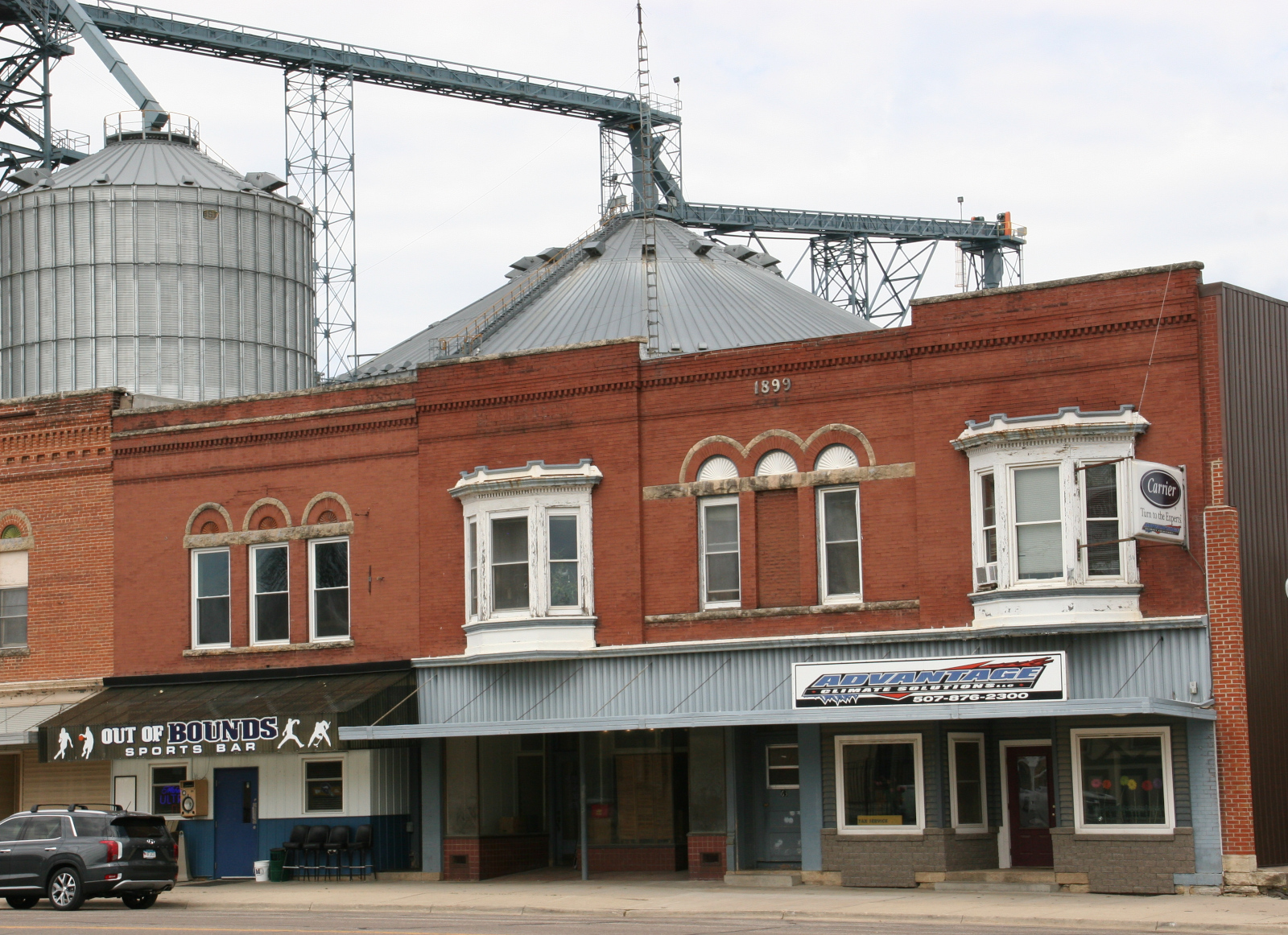
Two historic buildings in downtown Cannon Falls. (Minnesota Prairie Roots copyrighted photo October 2021)

On a recent day trip to Cannon Falls, I explored part of the downtown business district. Now on the National Register of Historic Places, the Cannon Falls Historic District includes 22 historically-significant structures.

Bold art on the side of the building identifies the local hardware store. (Minnesota Prairie Roots copyrighted photo October 2021)

Given my love of historic architecture, and art, this Goodhue County community of 4,220 within a 40-minute drive of Minneapolis and St. Paul rates as a favorite regional destination.

Signage marks the popular winery in Cannon Falls. (Minnesota Prairie Roots copyrighted photo October 2021)

Cannon Falls thrives with a well-known winery and bakery and an assortment of shops from antique to gift to hardware store. Toss in a mix of eateries, bars and a brewery and, well, there’s lots to see and do here. Plus, the town attracts outdoor enthusiasts who canoe the Cannon River and/or bike/hike the Cannon Valley Trail and Mill Towns Trail.

A mural at Cannon River Winery provides a backdrop for an outdoor space. (Minnesota Prairie Roots copyrighted photo October 2021)

During my mid-October visit, I popped into a few shops (including the bakery), discovered the lovely library and admired a new downtown mural. Because of COVID concerns, I skipped dining and imbibing. It was too early in the day and too cool to enjoy either outdoors.

Cannon Falls’ newest mural, a 2021 Youth Mural Arts Community Project, highlights geography, history and local interests. (Minnesota Prairie Roots copyrighted photo October 2021)

Still, I found plenty to take in from the colorful new mural to the art inside the library to ghost signage.

Showing some love for Cannon Falls. (Minnesota Prairie Roots copyrighted photo October 2021)

I noticed, too, hometown pride in the I LOVE CANNON FALLS! tees in a storefront window.

I learn so much about communities by reading signs in windows. (Minnesota Prairie Roots copyrighted photo October 2021)

I noticed also notices taped in a display window, one of which alerted me to Mailbox Mysteries, which led me to the library around the corner which led me to sign up for this challenging endeavor. Now I’m trying to solve the “Gangster’s Gold” mystery with weekly clues snail mailed to me by the library.

Inside the library, I found this vivid “Once Upon a Time” mural. (Minnesota Prairie Roots copyrighted photo October 2021)

Had I not done this walk-about through downtown Cannon Falls, I likely would have missed these nuances. The details which help define this community.

A scene in the center of downtown Cannon Falls reminds me of the town’s rural roots. (Minnesota Prairie Roots copyrighted photo October 2021)

As I meandered, I paused to watch a John Deere tractor roll through downtown pulling a wagon heaped with golden kernels of corn. This is, after all, an agricultural region.
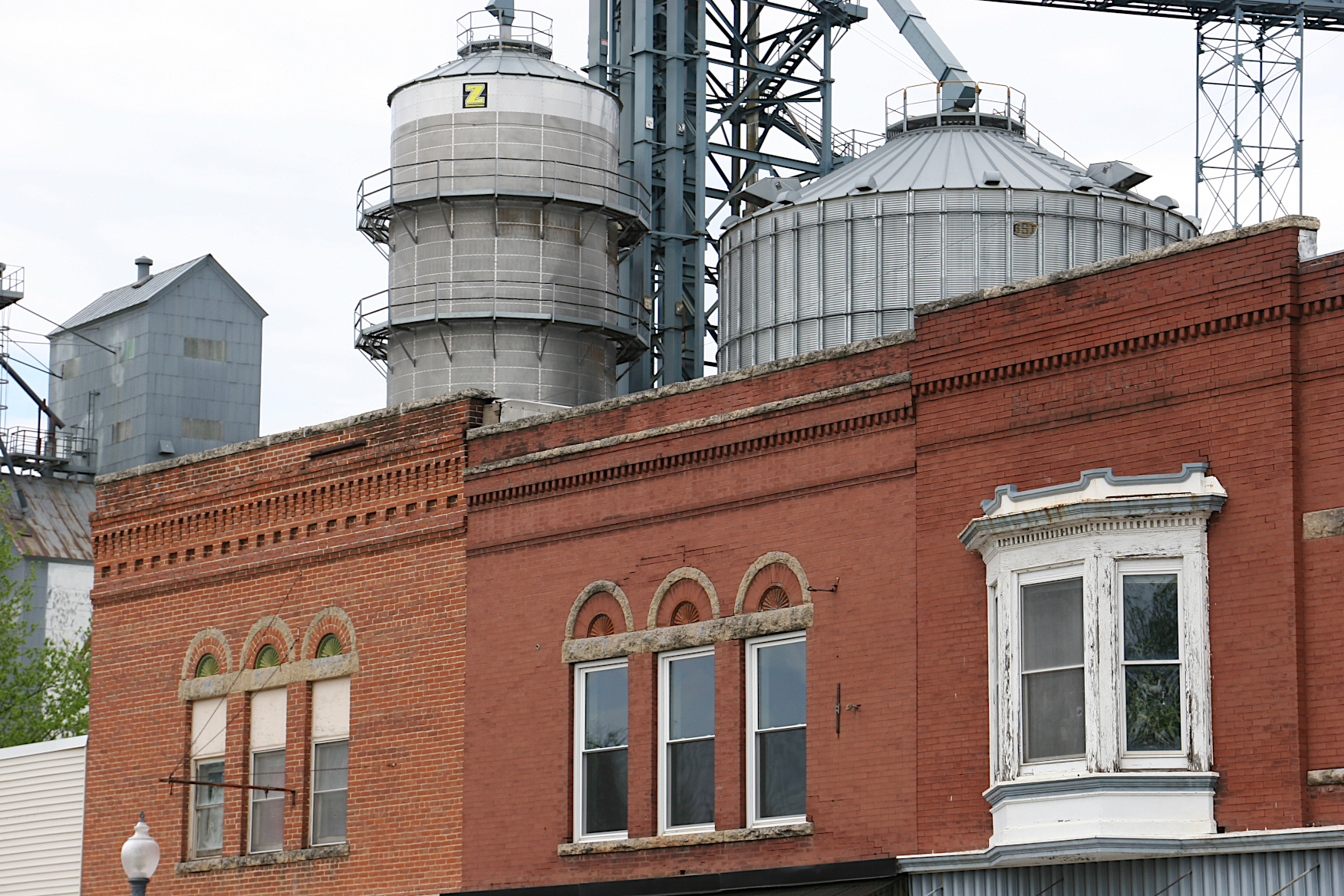
A grain complex in Cannon Falls. (Minnesota Prairie Roots copyrighted photo October 2021)

Later, Randy and I picnicked at Hannah’s Bend Park, the local grain elevator complex defining the nearby skyline. As we finished our lunch, a bald eagle soared overhead, wings spread wide. I expect the Cannon River drew the majestic bird here, to this small southeastern Minnesota town, this Cannon Falls.

#

FYI: Please check back for more posts from Cannon Falls and the surrounding area, including the Sogn Valley. Also enjoy my earlier post on Hi Quality Bakery by clicking here.
© Copyright 2021 Audrey Kletscher Helbling