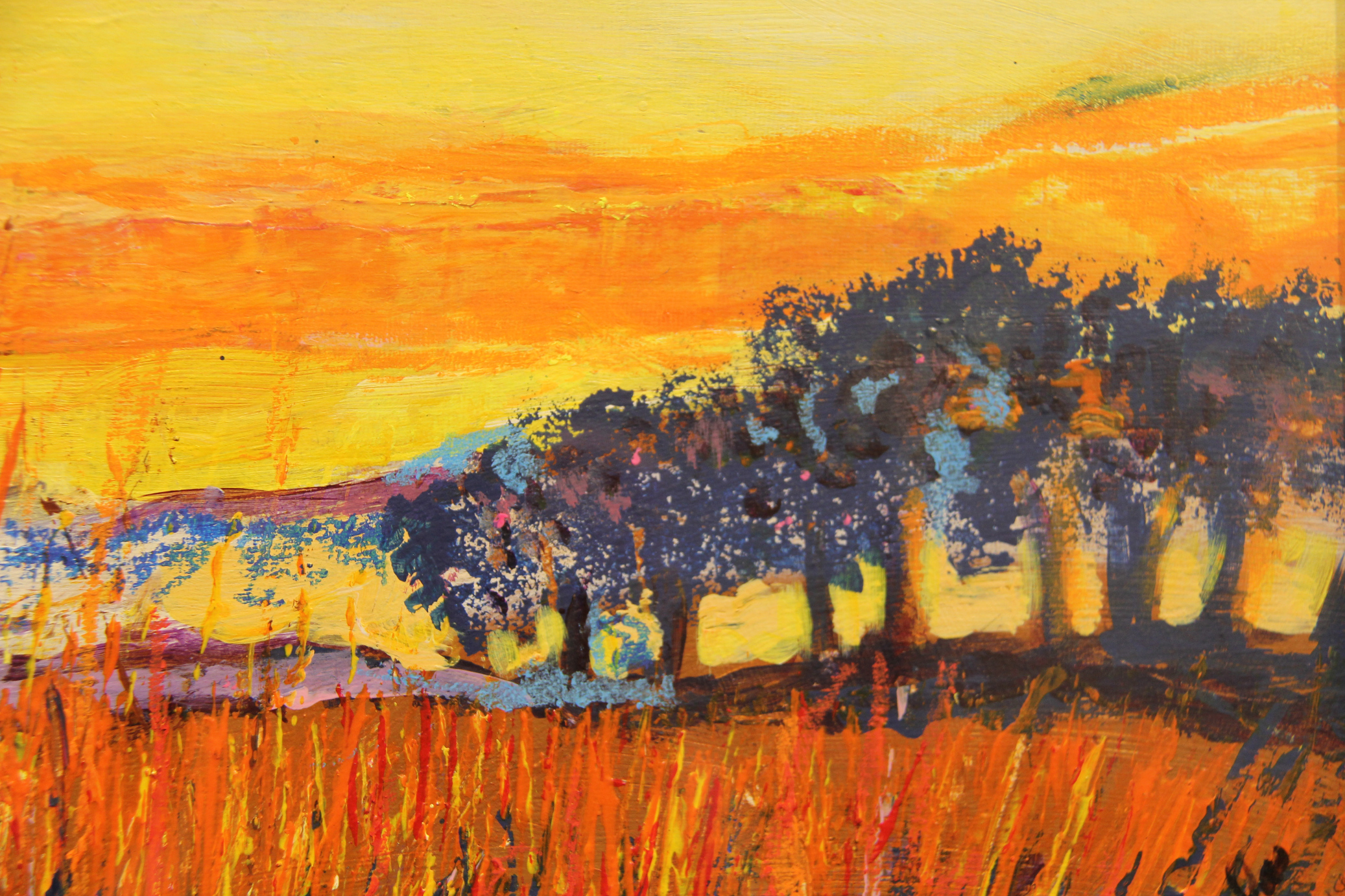
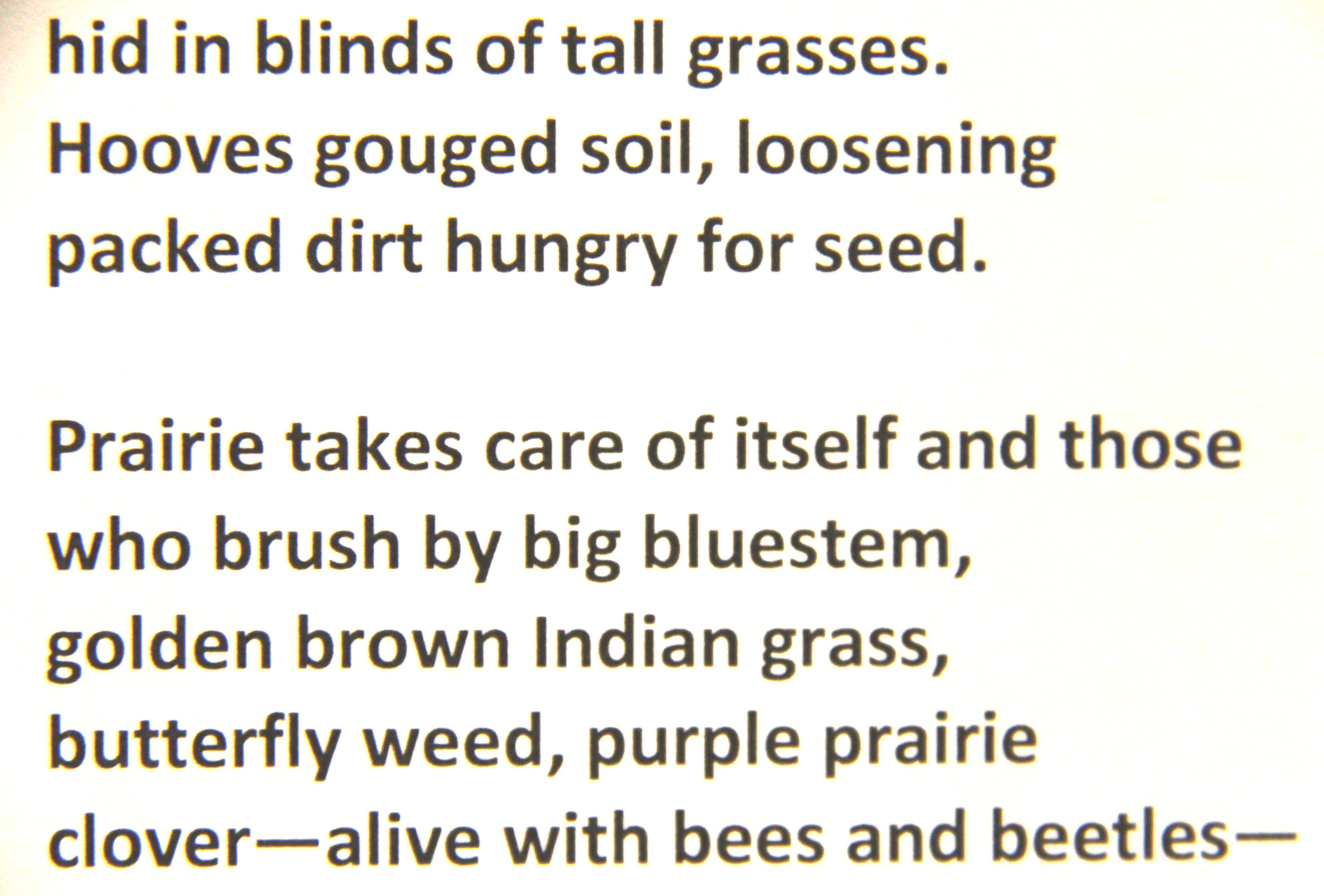
Here are some lines from Northfield poet Becky Boling’s poem, “Red Prairie,” inspired by “Wisconsin Sunset.” (Minnesota Prairie Roots copyrighted photo October 2025)
As a long-time writer and photographer, who is also a published poet, I’ve participated in similar collabs in nearby Zumbrota. I found it a whole lot of fun not only to write poems, but especially to see how an artist interpreted my poetry. I expect those participating in this pairing of poetry and visual art in Northfield feel the same. The work in this show is visual art inspiring poetry.
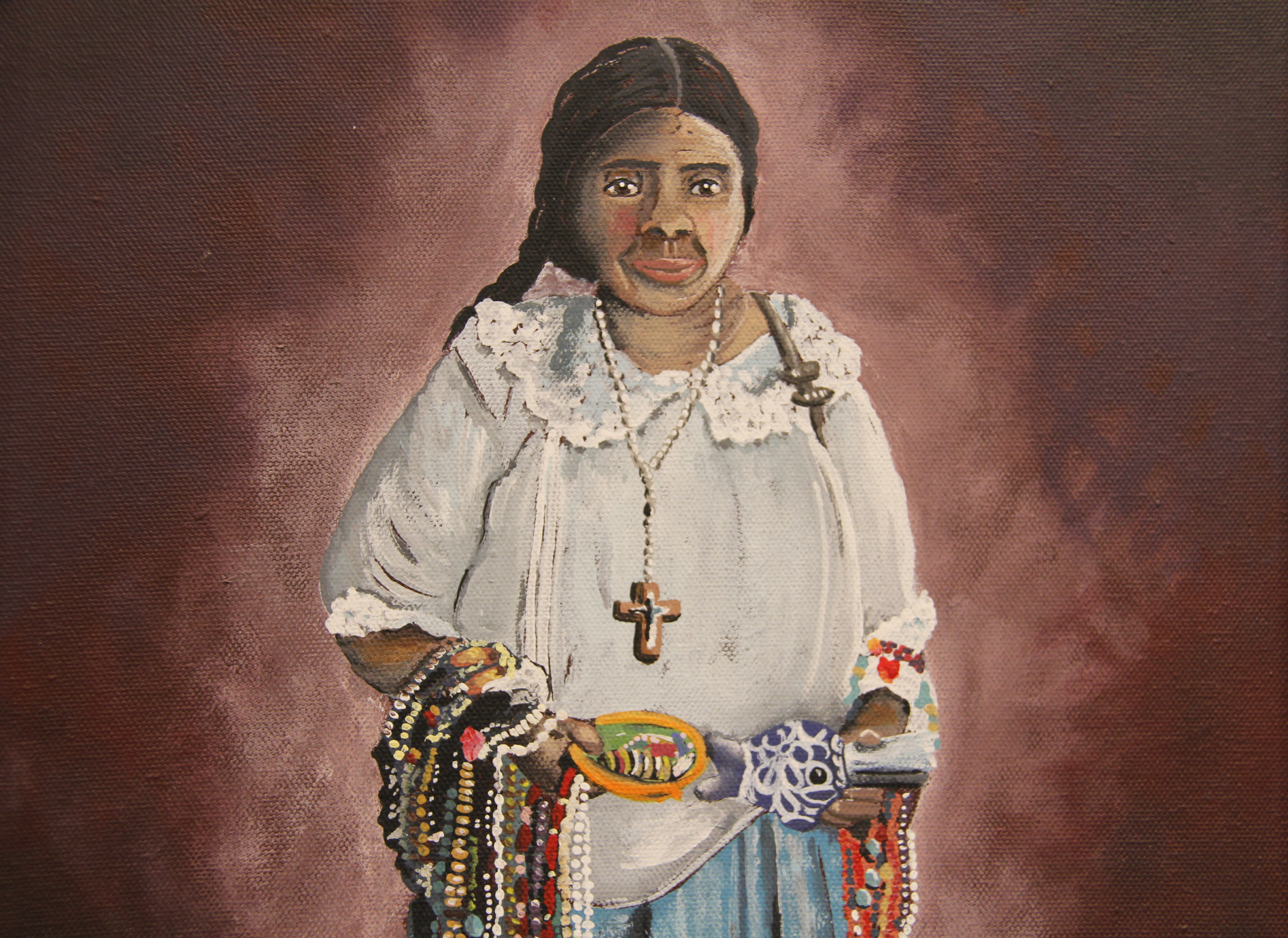
“Brave,” a poem by Orick Petersen, is paired with Sharon Henry’s painting, “The Bead Lady.”
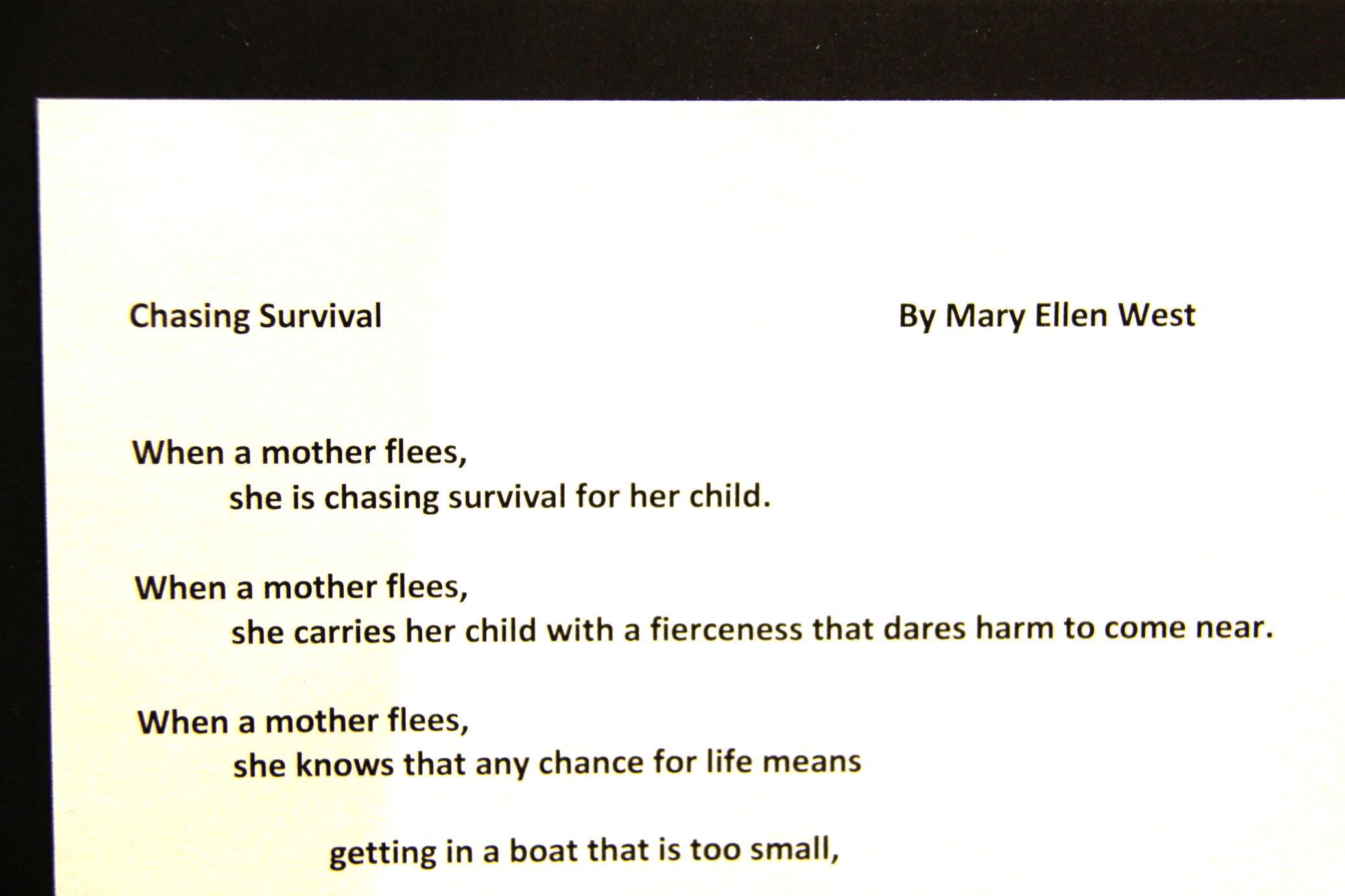
This shows several lines from a thought-provoking poem inspired by an equally thought-provoking photograph of a mother and child by Dean Neuburger. (Minnesota Prairie Roots copyrighted photo October 2025)
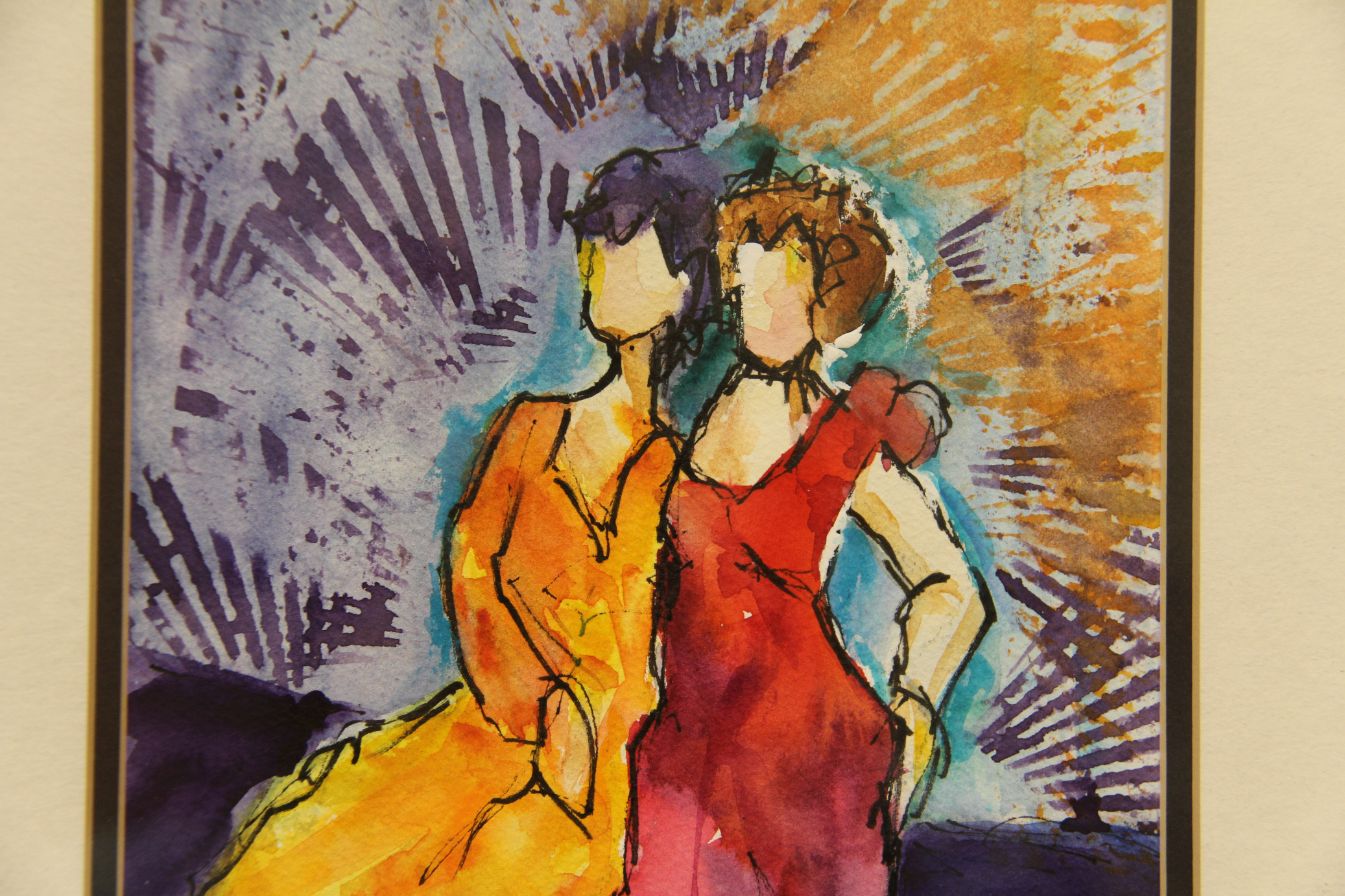
Marty Amundson’s watercolor and ink, “Sisters Still,” inspired Marie Gery’s poem, “30th High School Reunion.”
I feel fortunate to live in a region rich in the arts. The arts expose us to new ideas, thoughts, beauty and more. The arts open us to a world wide beyond our own. The arts can serve as a catalyst for positive change. The arts represent voice, a way for us to speak via our creativity.
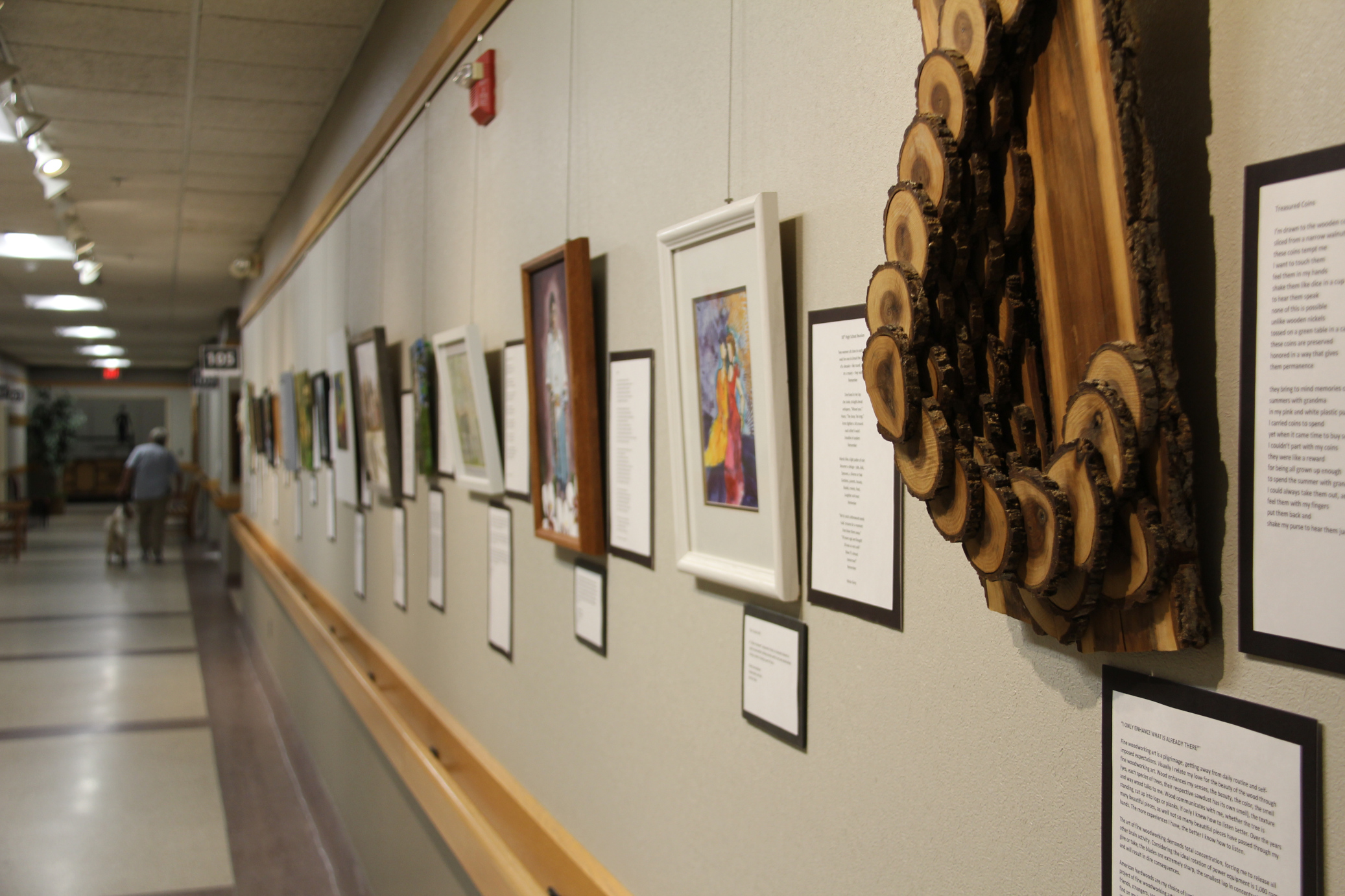
Art and poetry stretch along a hallway at FiftyNorth. (Minnesota Prairie Roots copyrighted photo October 2025)
In “Echoes & Shadows,” artists express themselves in carefully crafted words and in a variety of visual art that seems to fit its inspirational poetry. Painting, appliqueing, woodworking, photography, collage…all are part of this collaboration.
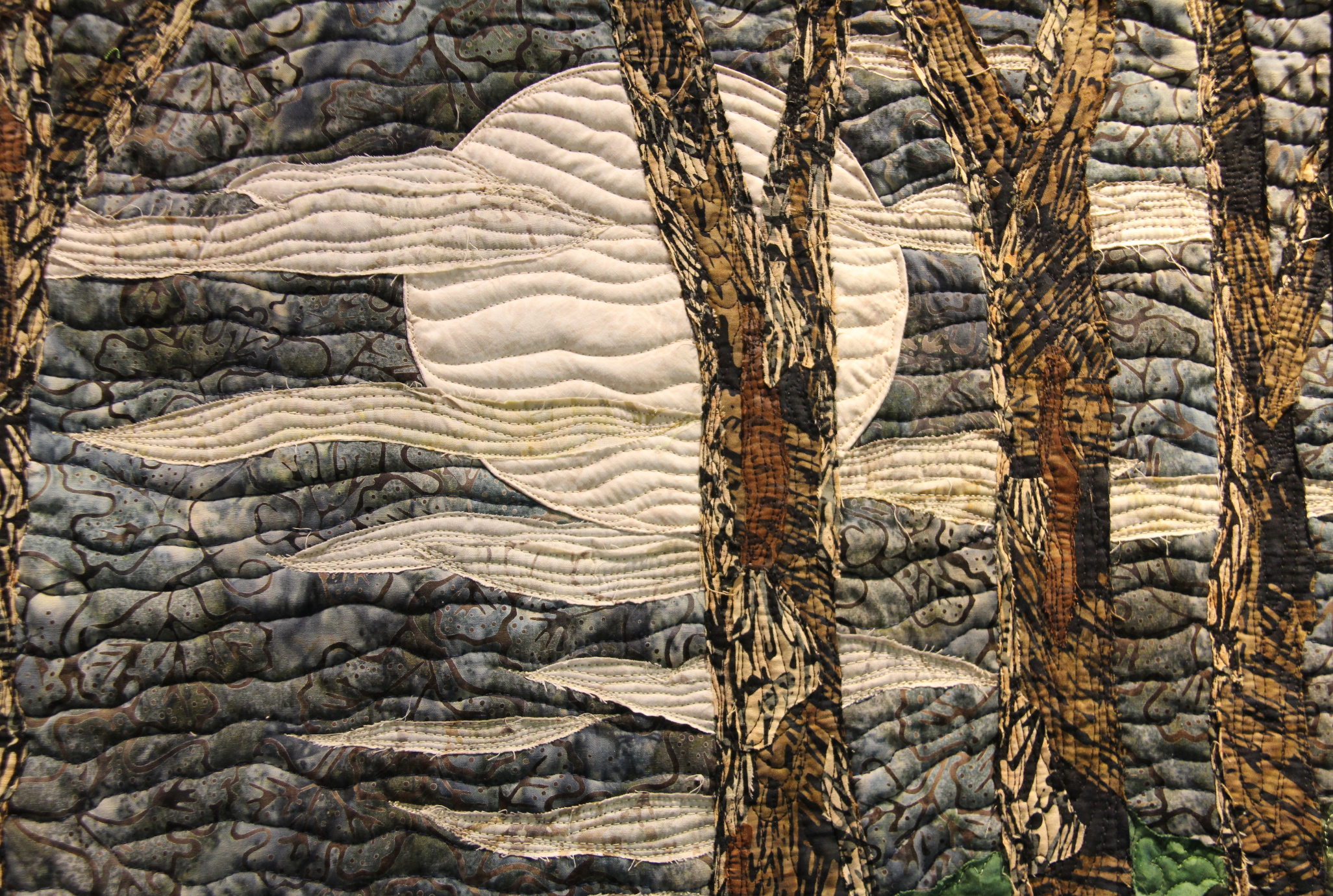
Lake Superior in northern Minnesota inspired Kathy Weed to create “Moon Glow” in textile art. (Minnesota Prairie Roots copyrighted photo October 2025)
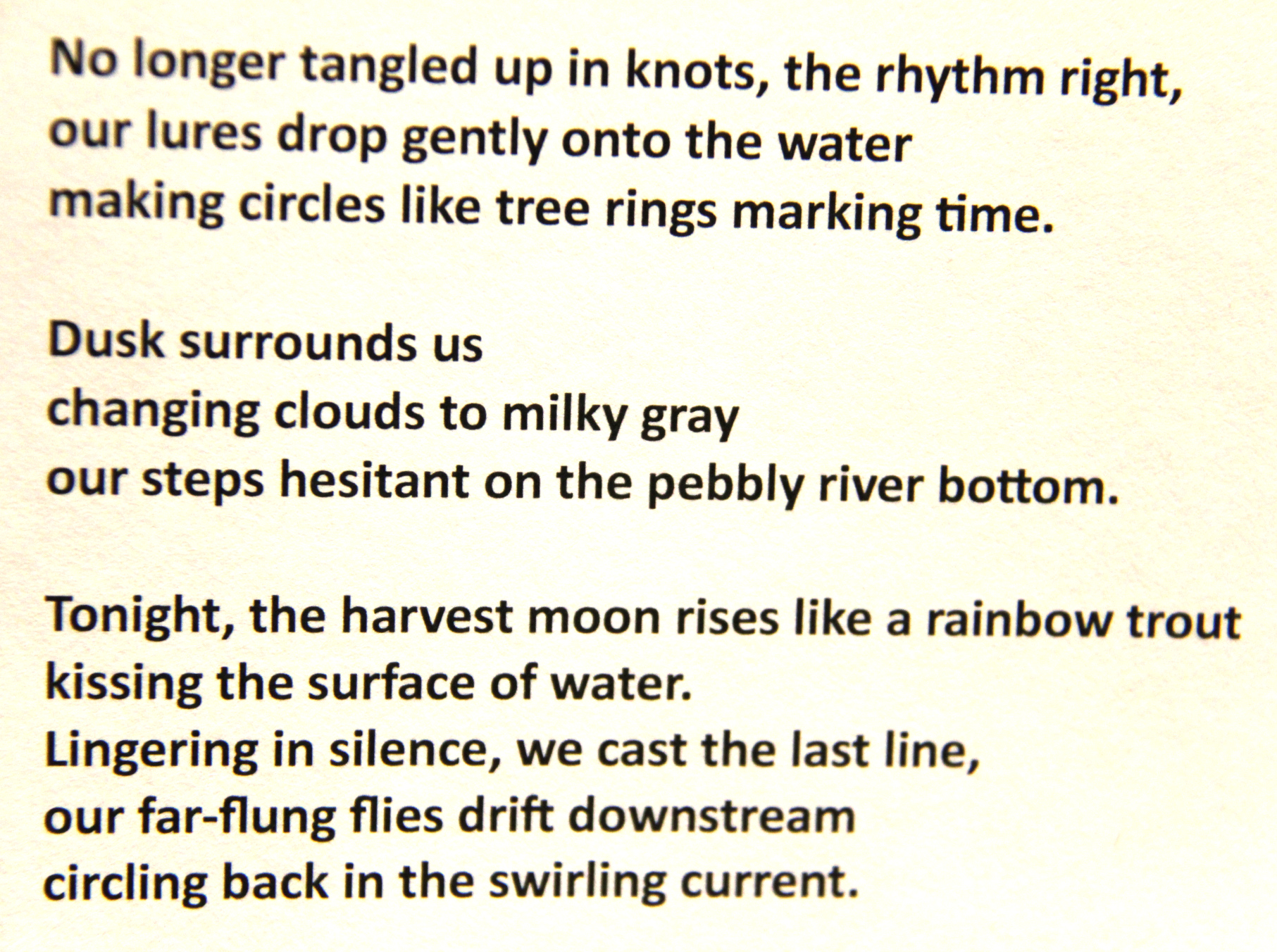
And then Jane Sarles Larson wrote “Circling Back” to pair with Kathy Weed’s art. (Minnesota Prairie Roots copyrighted photo October 2025)
More knots…Judy Saye-Willis’ necklace inspired Marie Gery’s poem, “Knotty Reality.” (Minnesota Prairie Roots copyrighted photo October 2025)
I like that word, “collaboration.” It means working together. Even that seems especially meaningful today.
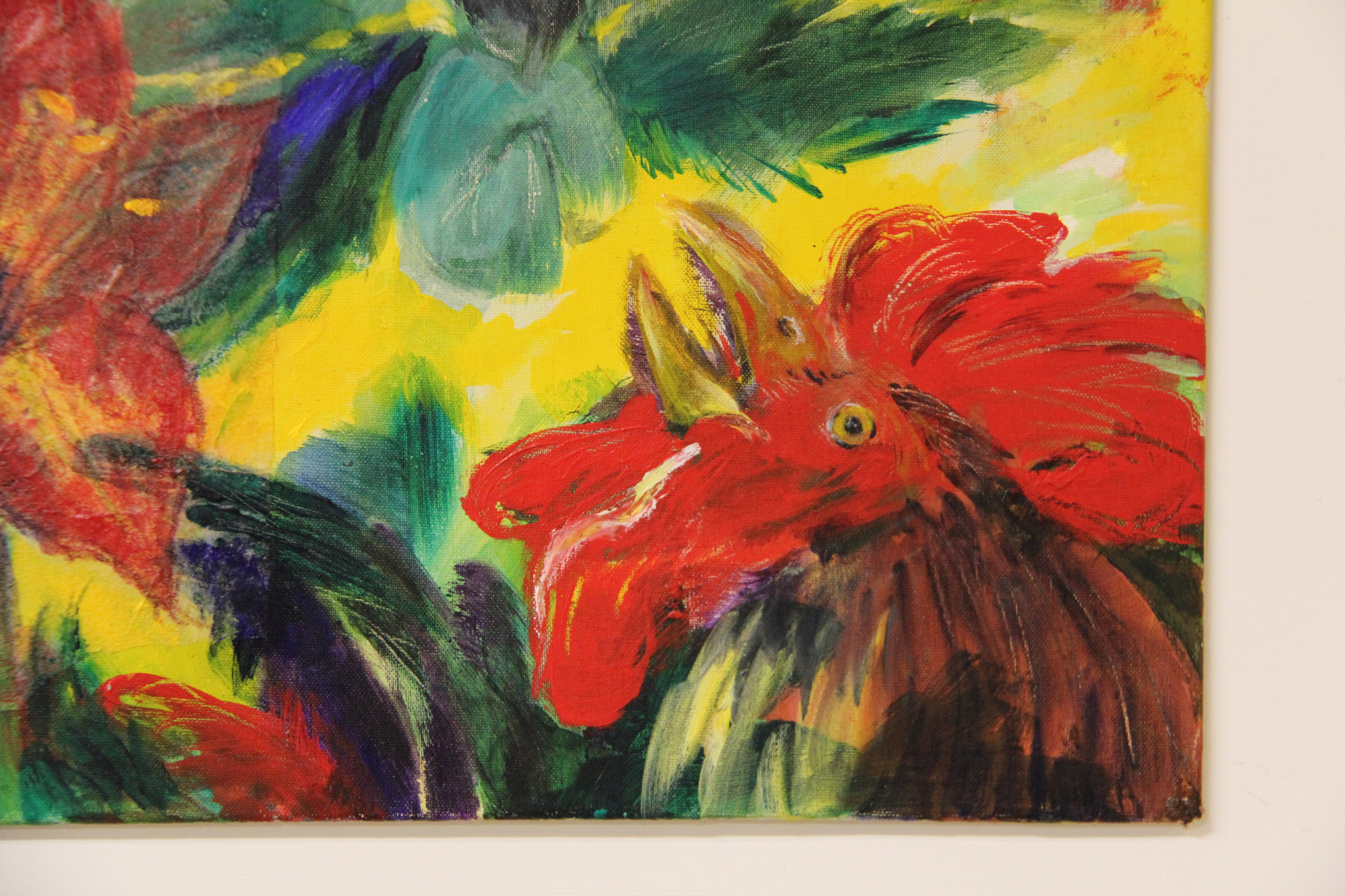
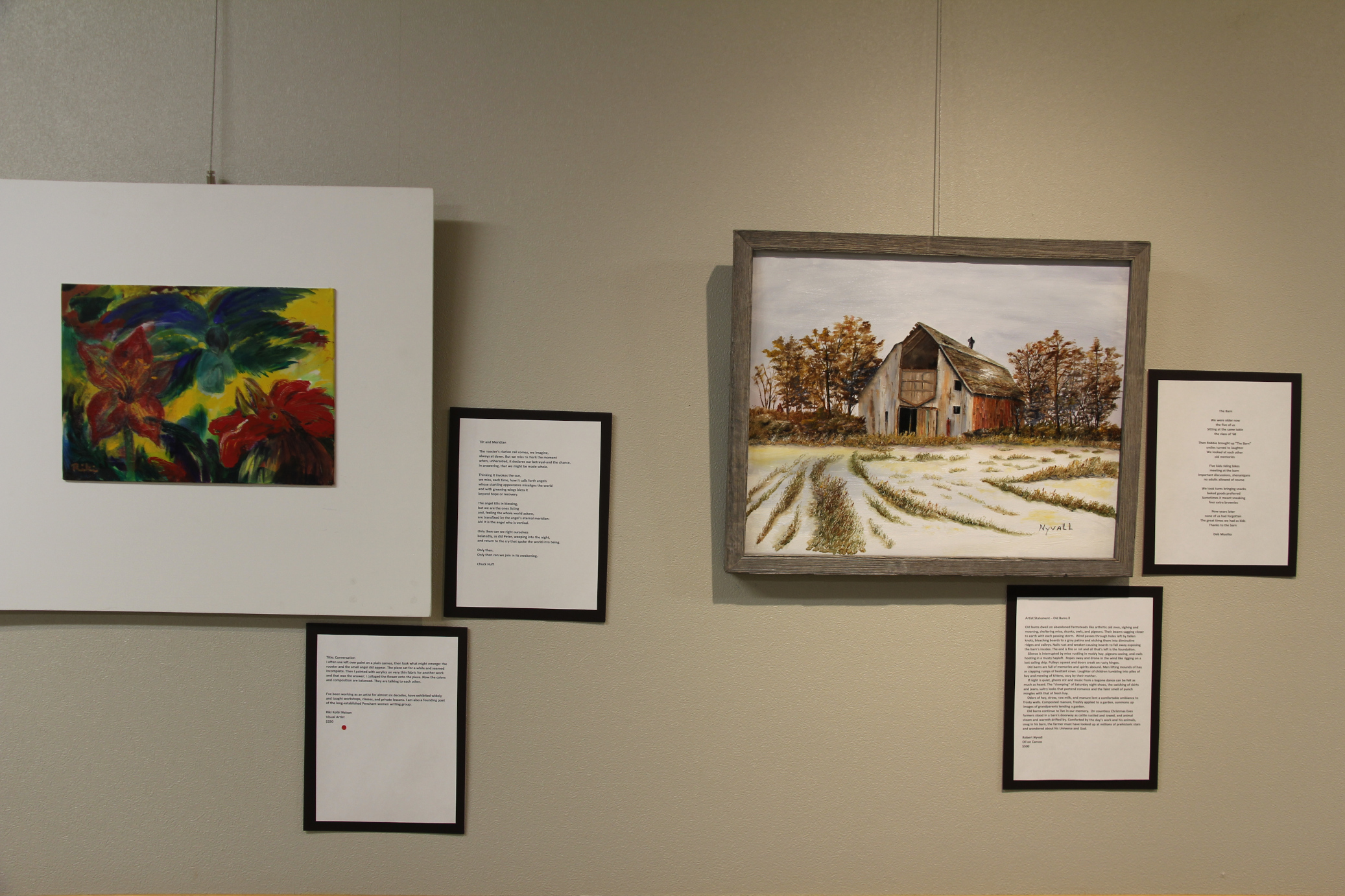
Riki Kolbl Nelson’s “Conversation” acrylic and collage of a rooster and angel inspired Chuck Huff to write “Tilt and Meridian.” (Minnesota Prairie Roots copyrighted photo October 2025)
In this pairing of art and poetry, I see collaboration, how literary art and visual art play off and balance one another, centering the two pieces of art into one unified piece without sacrificing individuality. Creatives are, after all, uniquely creative even when working together.
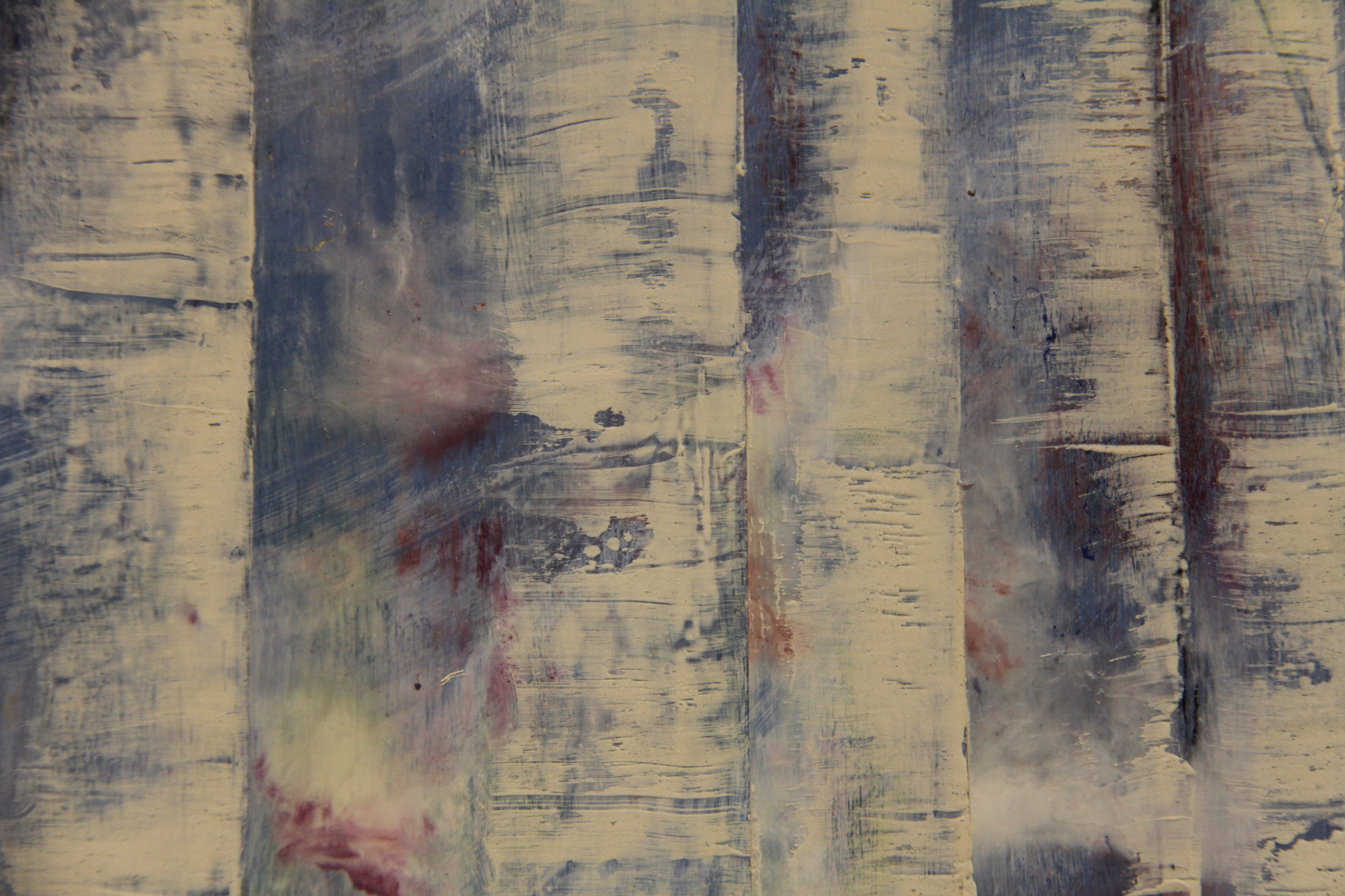
Barbara Bauer’s encaustic medium art inspired D.E. Green to write “Stand of Birches.” (Minnesota Prairie Roots copyrighted photo October 2025)
Promotional information about the FiftyNorth poetry and art collaboration, “Echoes & Shadows,” references a quote from poet Carl Sandburg: “Poetry is an echo, asking a shadow to dance.” Oh, how lovely those words. And how fitting for a collaboration that echoes and dances.
Pairings of poetry and art by Riki Kolbl Nelson, left, with poem by Chuck Huff and a barn painting by Robert Nyvall with accompanying poem, “We Are Older Now,” by Deb Muotka on the right. (Minnesota Prairie Roots copyrighted photo October 2025)
FYI: The “Echoes & Shadows” exhibit closes on October 31. To view the exhibit online, click here. Note that I photographed the art and poetry in this post with permission of FiftyNorth. In most cases, I’ve opted to show only part of the creative works. In featuring the poems, I’ve edited the images.
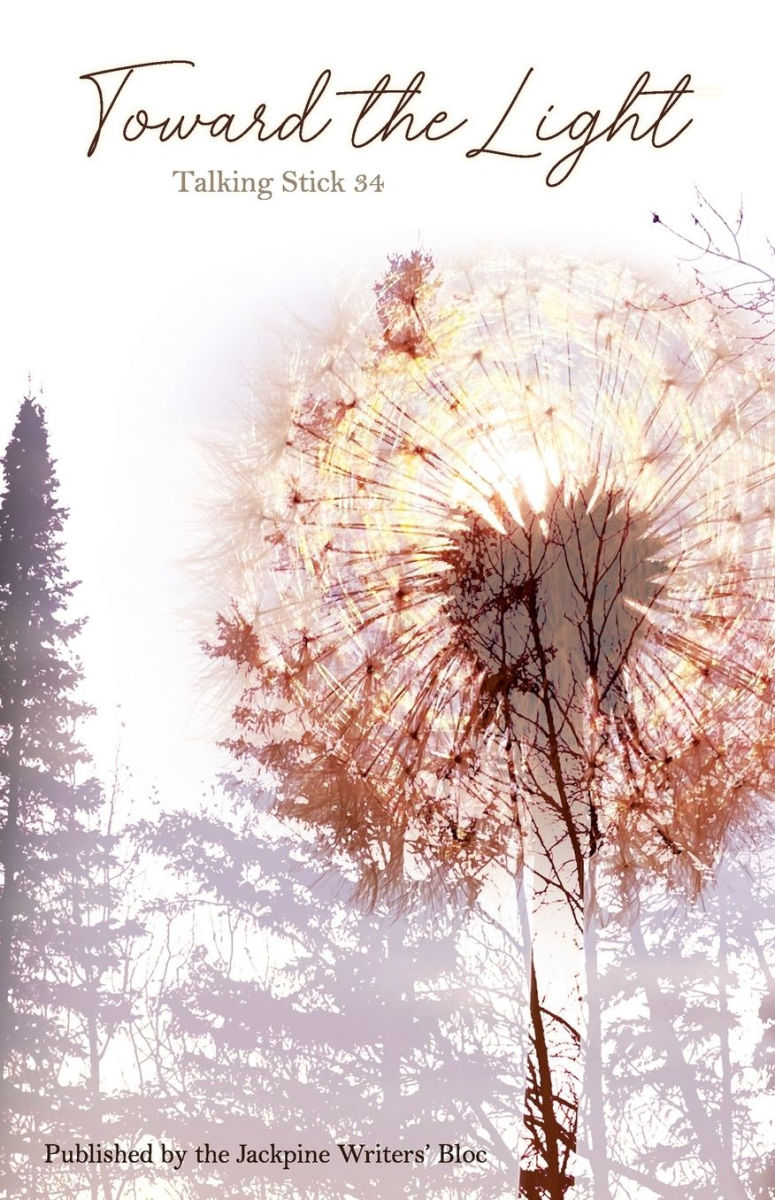
Two of my poems and a work of creative nonfiction are published in this literary anthology. (Book cover sourced online)
FOR THE 16thCONSECUTIVE YEAR, my writing has been selected for publication in the Talking Stick, a literary anthology published by the Jackpine Writers’ Bloc based in northern Minnesota.
The editorial board chose two of my poems, “Up North at the Cabin” and “Where There’s Smoke, There’s Fire,” and a work of creative nonfiction, “Birthing Everett,” for publication in volume 34, titled Toward the Light. The recently-released book features 128 pieces of writing by 76 writers either from Minnesota or with a strong connection to the state.
I consider it an honor to be published in the Talking Stick, which includes the work of talented writers ranging from novice to well-known. I especially appreciate that entries are blind-judged so each piece stands on its own merits. There were 275 submissions from 119 writers for this year’s competition.
Grandpa Randy and grandchildren Izzy and Isaac follow the pine-edged driveway at the northwoods lake cabin. This is my all-time favorite cabin photo. (Minnesota Prairie Roots copyrighted file photo 2020)
I’m particularly excited about two of my pieces published in Toward the Light. Anyone who’s ever spent time at a lake cabin will enjoy my “Up North” poem as it centers on nature and family togetherness. I was in my sixties before I first experienced cabin life. Now I’m building memories with my grandkids each summer at a family member’s lake cabin. That centers this poem.
My grandson Everett, nine months old, plays with his toys in his Madison, Wisconsin, home. (Minnesota Prairie Roots copyrighted photo October 2025)
A grandchild also focuses “Birthing Everett,” a deeply personal story about the birth of my 10-pound grandson in January. My daughter Miranda nearly died during childbirth. I knew I needed to write about this to heal from my own trauma of nearly losing her. I will be forever grateful to the medical team at UnityPoint Health-Meriter Hospital in Madison, Wisconsin, for saving Miranda’s life. You just don’t think of women dying during childbirth any more, but it can, and does, happen.
This poster inside Trinity Lutheran Church shows an architectural drawing of Ridgeview Heights and a Vacation Bible School mission fundraising goal for the housing project. (Minnesota Prairie Roots copyrighted photo August 2025)
ON MY WAY TO SUNDAY MORNING church services, I missed an opportunity to live my faith. Reflecting on that moment, I’m still uncertain what I could have done. But the guilt I feel about doing nothing at the time remains.
Let me set the scene. While driving to church, Randy and I dropped off some mail downtown. Up the hill from the post office, I noticed a parked car crammed with stuff. Someone clearly lived out of the vehicle, one I’ve previously seen. Then my eyes shifted to the adjacent street corner and an individual, cocooned in a bright gold blanket, sleeping atop a bench. And then we turned the corner.
“I should take a picture,” I told Randy, my mind already creating a story that would enlighten others about homelessness in Faribault. But then I quickly realized that taking a photo wouldn’t be particularly kind. And so we continued on to church.
Still, I couldn’t shake the image of that person stretched atop a bench along Central Avenue. I wondered about his story, why and how he found himself without a home. And I considered how vulnerable and exposed I would feel sleeping like that in a public place. Those thoughts followed me into church.
“HOUSING FOR THE HOMELESS”
When I stepped inside the sanctuary, I immediately noticed a “Housing for the Homeless” poster near the organ. There are coincidences and then there are what I term “God moments.” And this, in my mind, was clearly divine. I’ve seen enough of these occurrences in my life to distinguish the two. God was assuredly nudging me to write on the topic of homelessness and housing insecurity in my community.
That sign in church was a promotional for the chosen mission of this year’s Vacation Bible School, which started that very evening at Trinity. Participants are donating their monetary gifts to Ridgeview Heights, an accessible, sustainable housing community to be built in downtown Faribault just blocks from the slumbering man on the bench. The VBS fundraising goal is $500.
That $500 may seem inconsequential considering the $2.5 million project cost. But every dollar helps in constructing the two buildings aimed at housing families with children, including those experiencing homelessness. Two of the eight units will serve as free emergency shelters and the other six will be market rate workforce units.
A COMMUNITY ACTS
The Community Action Center, which works collaboratively to alleviate hunger, homelessness and poverty among individuals and families in the community, is the lead on Ridgeview Heights. With an in-kind land donation from the city of Faribault, two grants, gifts, community donations and financing, the CAC is able to break ground at 4 p.m. today, August 6, for the much-needed two and three-bedroom units.
So first I saw the sleeping man, then the poster. And then came the sermon…with a directive that congregations ought to think, plan and act in ways that bless people. The guest pastor encouraged us not to think less of ourselves, but to think of ourselves less (a loose quote from C.S. Lewis). In other words, turn the focus outward on the community rather than inward to the church’s needs. The VBS kids will be doing exactly that this week with their “Housing for the Homeless” mission focus.
A FAMILY THAT CARES
Now you may think my story ends here. But it doesn’t. On July 28, I received a mass email about an upcoming Helbling family reunion. Organizers are changing things up this year by raffling items made by family members. One of several ways to qualify for a raffle entry is via a $5 charitable donation. All donations will go to the Community Action Center in Faribault with a dollar-for-dollar match from my eldest niece’s employer.
Truly, I was meant to write this story. I may have bypassed the man sleeping on the bench. But I got the message, loud and clear, that I needed to write about homelessness and housing insecurity in Faribault. I’ve seen the tents pitched along the river, beside train tracks, behind evergreen trees, next to a park. I’ve seen the homeless in the library, sleeping in the Central Park bandshell, biking and walking about town, including past my house. I am aware of the long waiting list for emergency shelter. Even if I failed to “do” something, I can raise awareness through my writing. And by doing that, perhaps I am helping in some small way to bless my community, including the man sleeping on a bench in the heart of downtown Faribault on a Sunday morning.
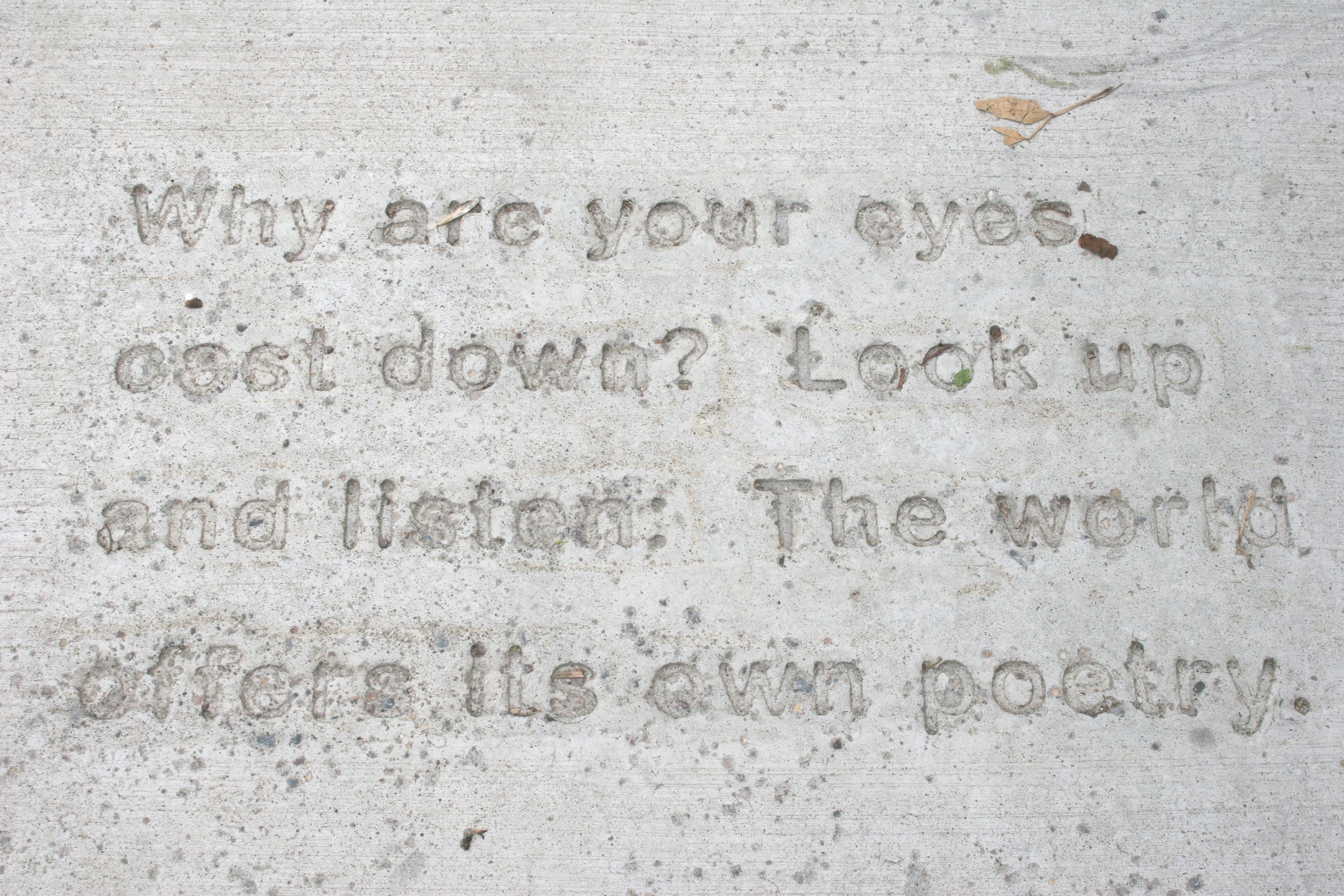
Sidewalk poetry in downtown Northfield, Minnesota, carries a powerful message. (Minnesota Prairie Roots copyrighted file photo)
I DON’T READ MUCH POETRY. I probably shouldn’t admit that given I’m a published poet. But I suspect most of you also are not big poetry readers. Yet, we all should be, especially me.
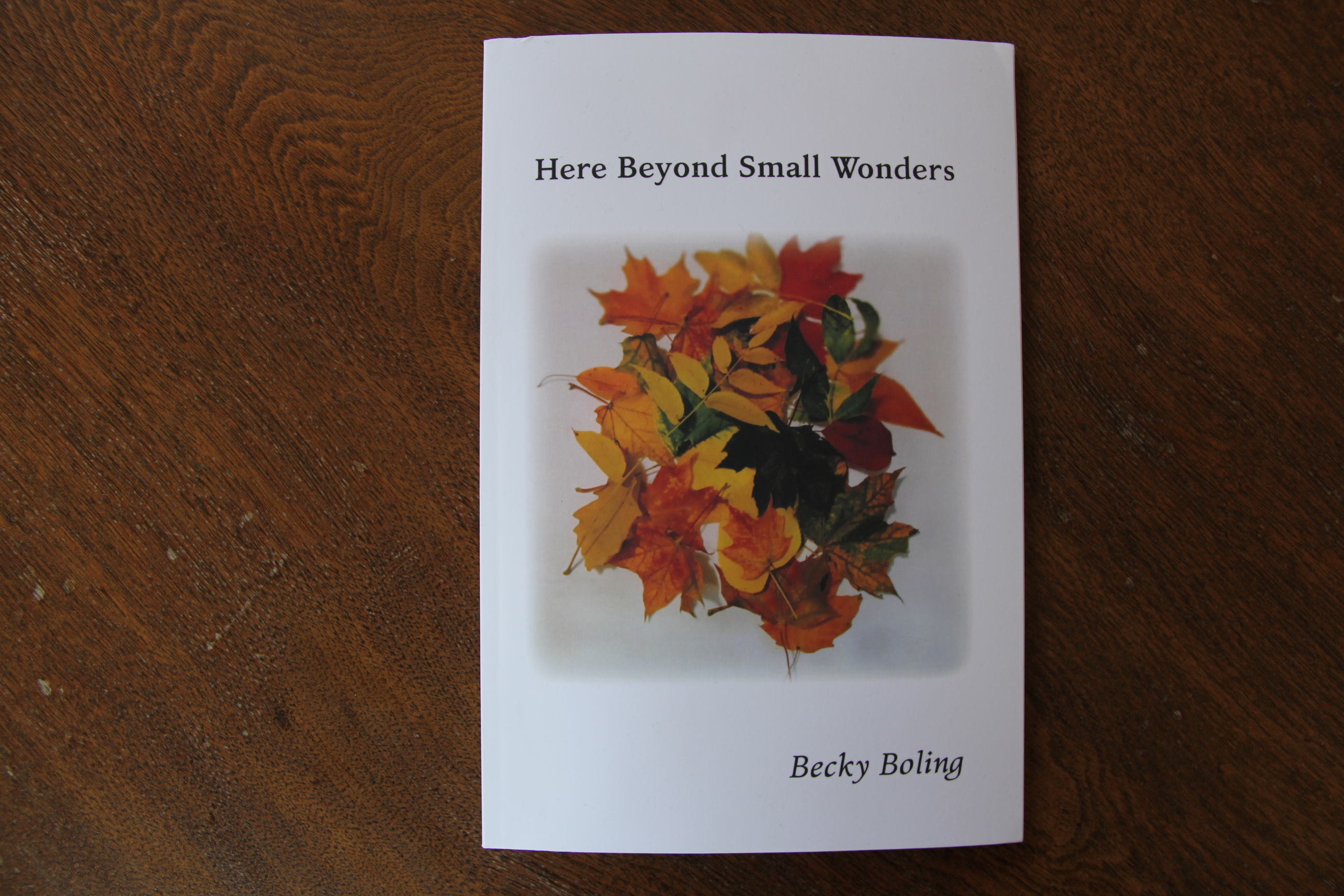
Becky Boling’s recently-released first collection of published poetry. The cover features the poet’s artwork. (Minnesota Prairie Roots copyrighted photo April 2025)
Poetry offers a creative way to view the world, to experience life, eliciting a whole range of emotional responses that connect us to each other, to the earth, to the past and present, and much more. I get excited when I discover a poet whose work truly resonates with me. And that would be the poetry of Northfielder Becky Boling.
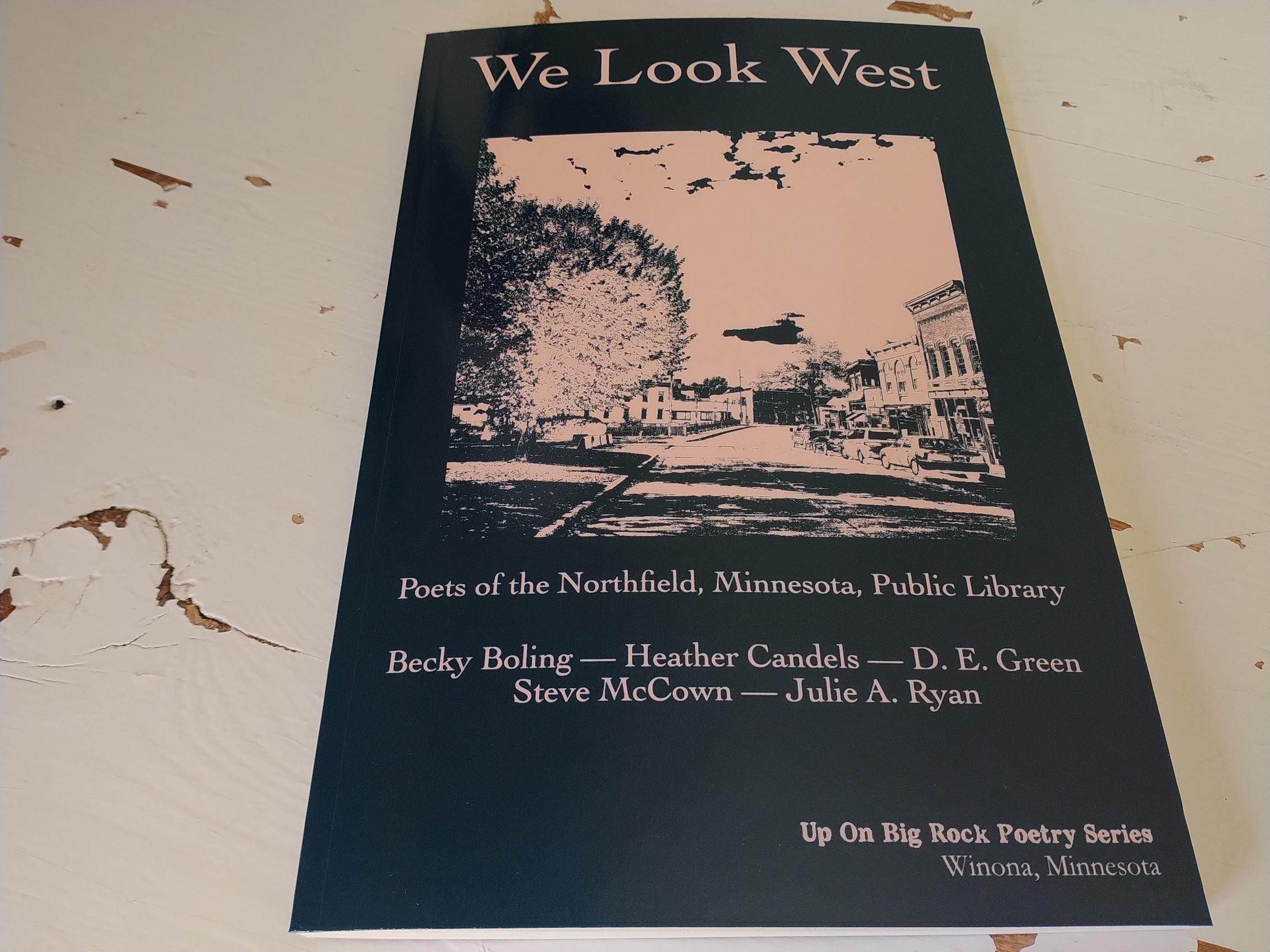
We Look West was published in early 2024 by Shipwreckt Book Publishing Company. (Minnesota Prairie Roots copyrighted file photo 2024)
A year ago, I met Boling when she dropped off a copy of the anthology, We Look West, a collaboration of the Poets of the Northfield Public Library. It includes her work and that of four other talented poets. I love the collection which takes the reader from the sunrise to the sunset of life. The poetry therein is so understandable and relatable.
A box holds bagged poems included in the “Poetry in a Bag” project. (Minnesota Prairie Roots copyrighted file photo 2024)
In May 2024, Boling, I and several other poets participated in a community poetry reading for the “Poetry in a Bag” project coordinated by Mercado Local, a Northfield marketplace for immigrants. Our poems were printed, rolled and bagged before distribution within our communities.
I would see Boling again in September 2024, when she and the other Northfield poets read from We Look West at Books on Central, a Rice County Area United Way used bookshop in Faribault.
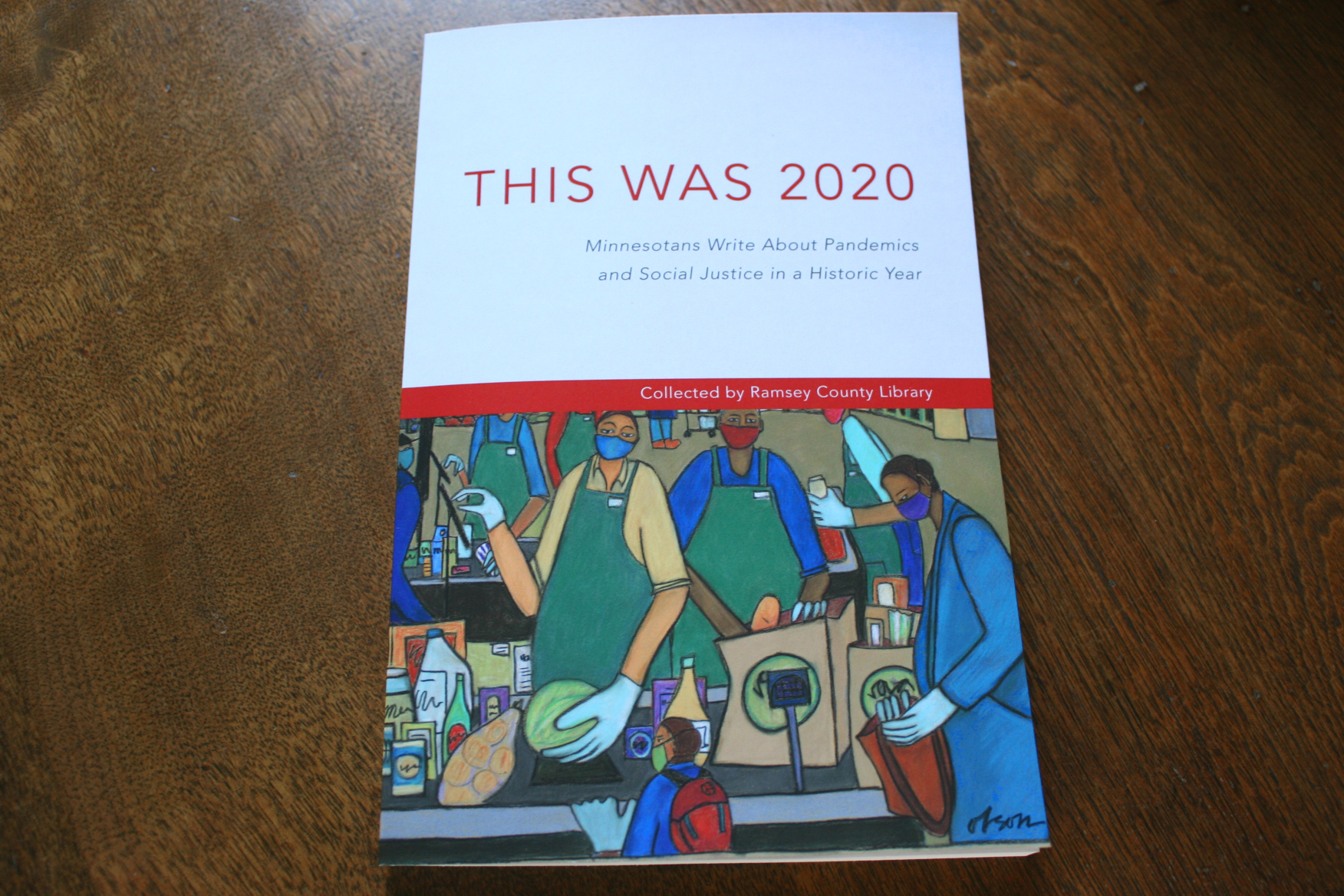
Selected prose and poetry about the pandemic and social justice issues were published by the Ramsey County Public Library in this anthology. (Minnesota Prairie Roots copyrighted file photo)
The poetry of Becky Boling in her first published collection featuring 37 of her poems. (Minnesota Prairie Roots copyrighted photo April 2025)
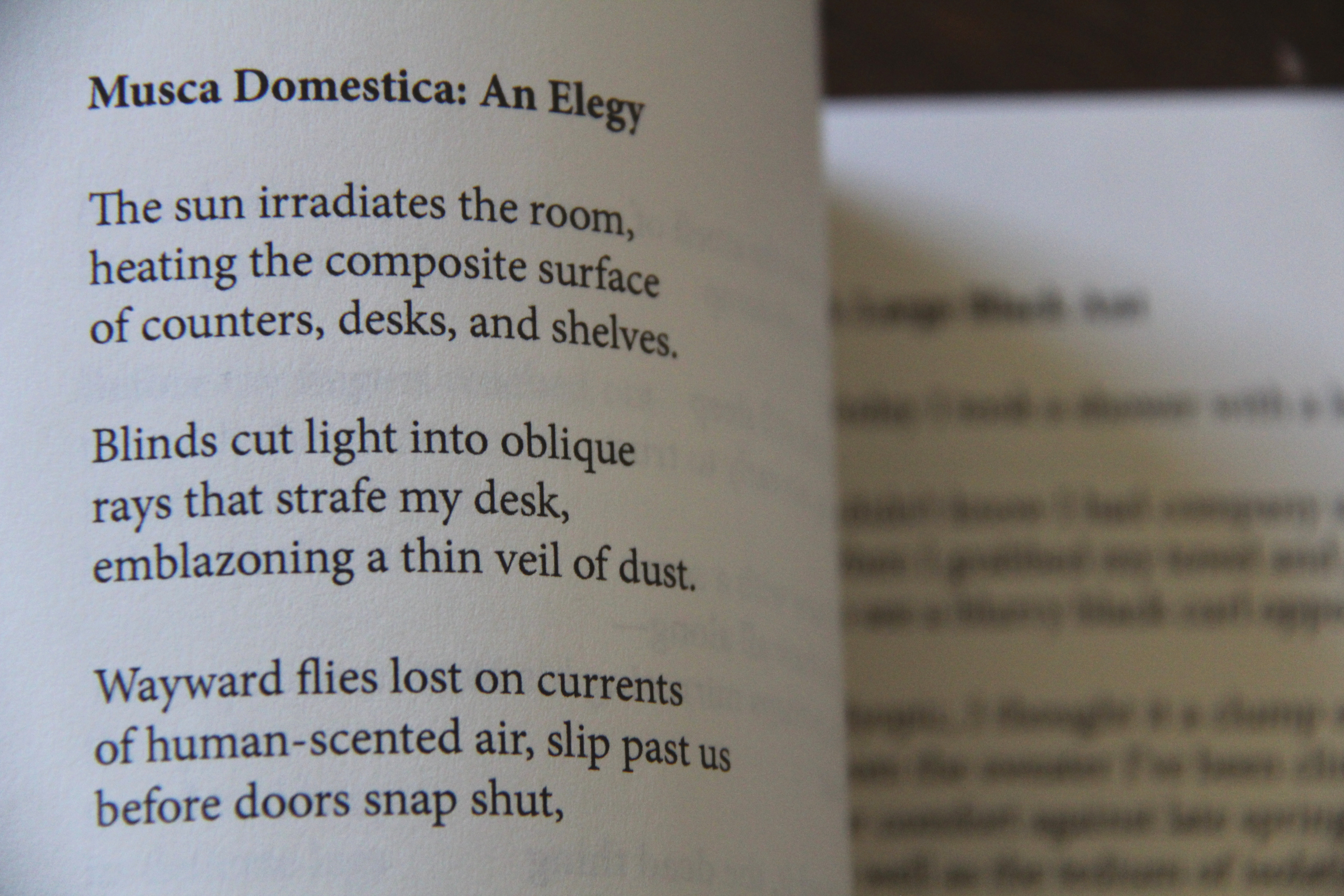
Because of those shared experiences, shared publications and shared love of words, I feel a sisterhood with Boling. So when she asked if I wanted a copy of her first solo poetry collection, I responded with an enthusiastic, “Yes!” Within the pages of Here Beyond Small Wonders, I found what I’ve come to expect from Boling—detailed writing, often about the most ordinary subjects—a dead mouse, a fly, walnuts… Topics you may not even consider poetry-worthy. But Boling has this ability to observe and engage all of her senses to craft words into connective, meaningful poetry.
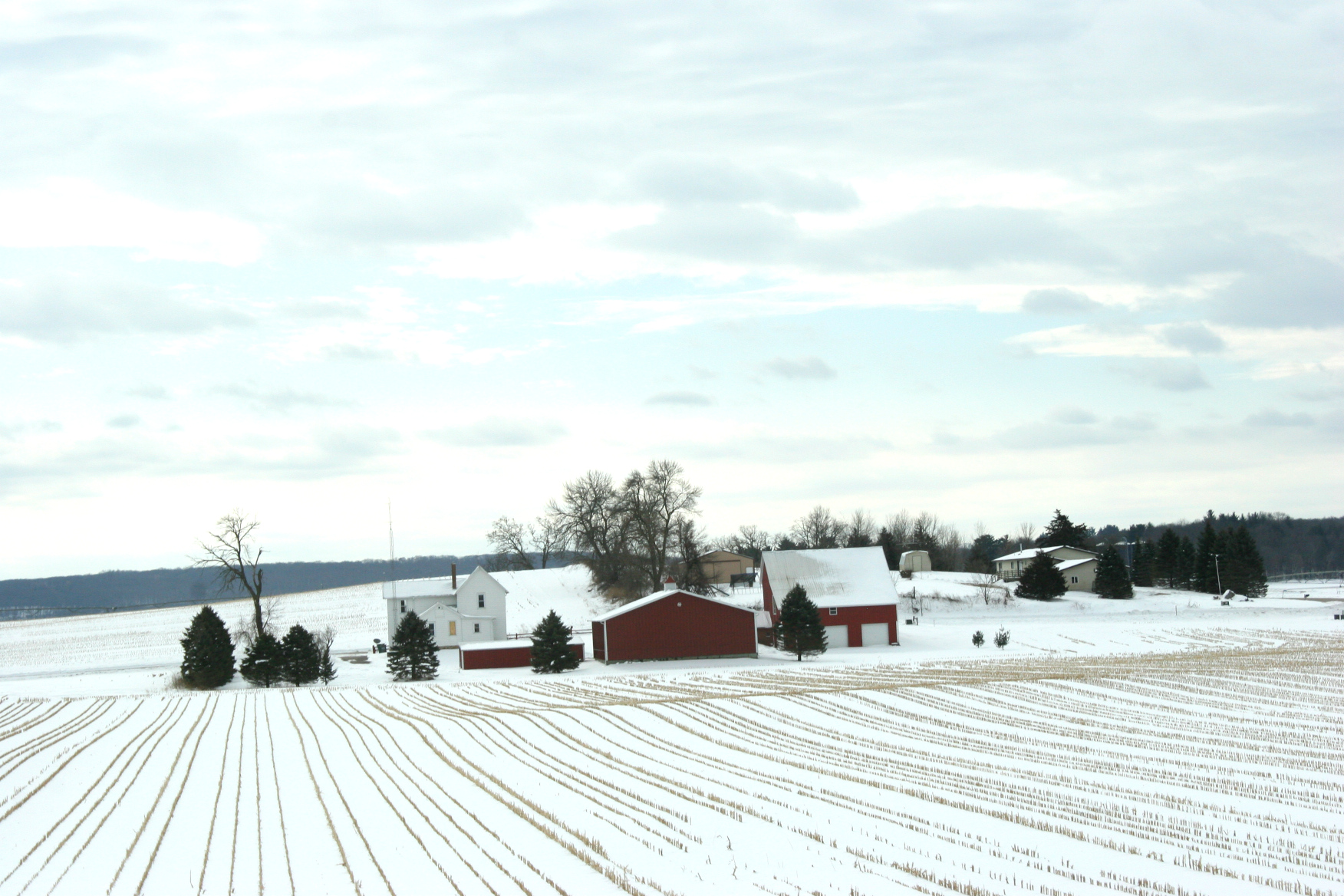
A Wisconsin farm site photographed from Interstate 90 could be a poetry prompt.(Minnesota Prairie Roots copyrighted file photo)
In her poem “Snow Pond,” she defines poetry: Poetry, like freezing temps, seizes the moment, recasts it—through the physics of sight, memory, language—resurrects it anew into patterns, sound and light, marks on a snowy page that glisten and melt on tongue, alight on the inner eye. That definition of poetry is among the best I’ve read, because it is poetry.
Clothespins on my clothesline clip clothing, not beach towels. (Minnesota Prairie Roots copyrighted file photo)
Anyone who writes poetry recognizes the challenges of finding just the right word, of stringing words together in a new, creative and succinct way, of connecting on an emotional level. But Boling makes the process look easy, taking the reader along with her, whether into her yard or onto the sandy shores of Lake Michigan. In her poem “Clothesline,” she writes of beach towels dancing in the wind. She takes the reader to the beach, to the sights, scents and sounds along the inland sea. I feel her fingertips unclipping the dried towels at end of day as she gathers them like weary babes into my open arms. I did not see that end coming. That element of surprise is, too, a mark of a gifted poet.
Kid-sized Adirondack chairs on a Minnesota beach. (Minnesota Prairie Roots copyrighted file photo)
Her “Adirondack Chair in Snow” is another favorite of mine in Boling’s collection of 37 poems published by Finishing Line Press. She writes of the typically-lakefront chair wedged into a snowbank outside her mother’s apartment building. But this poem is about so much more than an out-of-place chair buried in snow. Boling uses personification to write about her mother. In those six verses, I found myself missing my own mom, who died during the pandemic in January 2022. Boling’s emotions, my emotions, weave together in her writing and in my reaction.
My own artsy autumn leaf image, of leaves in the Cannon River. (Minnesota Prairie Roots copyrighted file photo)
In one of her longest poems, Boling writes about the transition to autumn in “Persephone’s Bouquet.” Unfamiliar with this Greek goddess, I learned that Persephone’s descent into the underworld is associated with the start of winter. Autumn themes Boling’s poem as the author gathers hot-pepper reds, creamy yellows…brazen scarlet…leaves, something I also enjoy doing in fall. But this is a poem about life, too, not just about a change in seasons. Plus, the poem connects to the cover of Here Beyond Small Wonders, Boling’s own autumn leaf art.
Her first collection of poems is about nature and place and seasons and life. Moments experienced. Details noticed right down to a tar-dark county road…horse flies, green heads glistening in the sun…reedy breath trembling into song. Boling, in her words, opens herself to a pool of words. And I, for one, embrace her poetic writing.
#
FYI: Becky Boling is a retired professor of Spanish and Latin American literature at Carleton College in Northfield. Her poetry and prose have been widely-published in literary journals and anthologies. She also served as a Co-Poet Laureate of Northfield. Click here to find Here Beyond Small Wonders on the Finishing Line Press website.
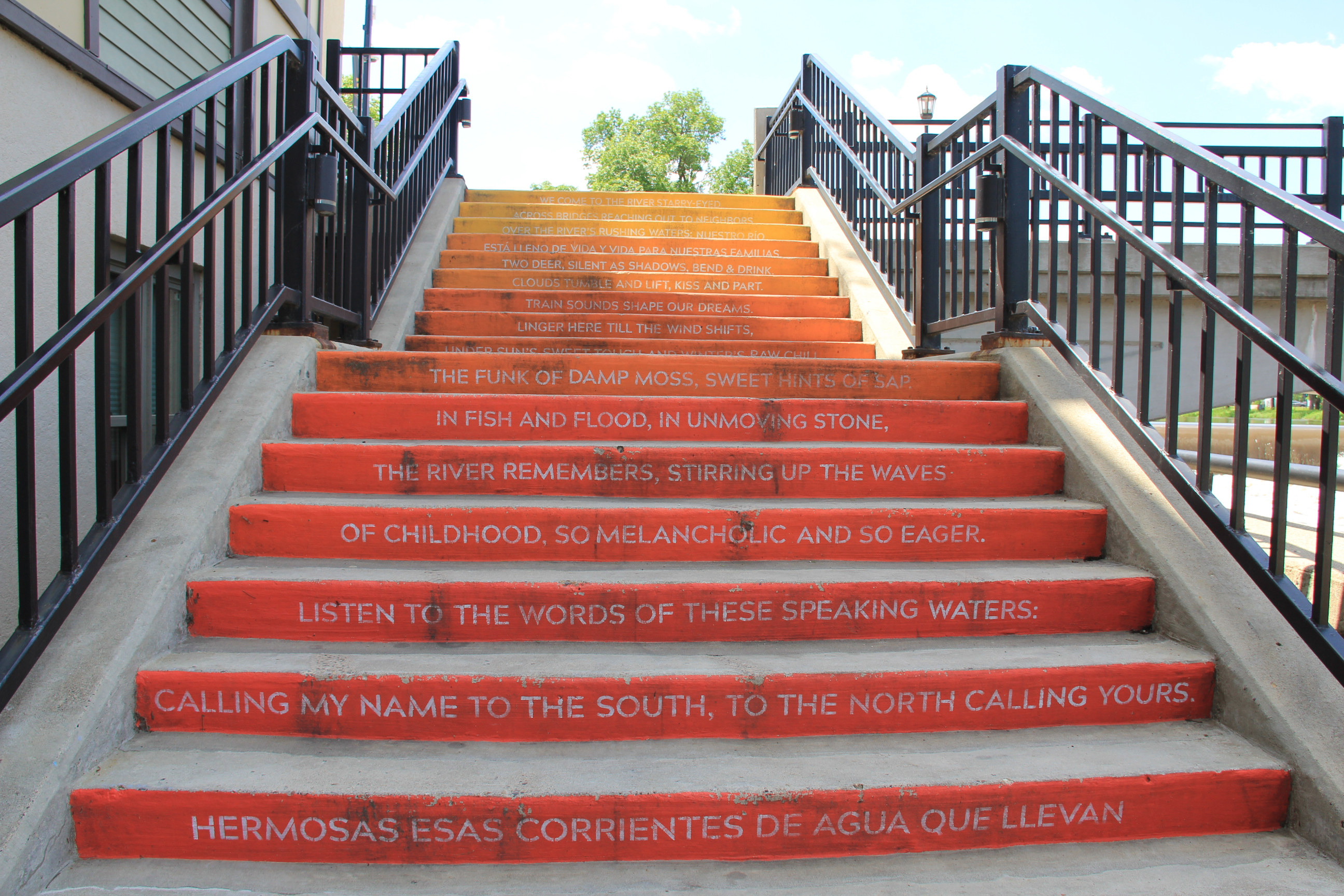
The Riverwalk Steps Poem alongside the Cannon River in the heart of downtown Northfield. (Minnesota Prairie Roots copyrighted file photo)
I FEEL FORTUNATE to live in an area of Minnesota which values poetry. Some 20 minutes away in Northfield, poems imprint upon concrete throughout the city as part of the long-time Sidewalk Poetry Project. Along the Riverwalk, a poem descends steps. In the public library, a poem graces the atrium.
Sidewalk poetry in downtown Northfield carries a powerful message.(Minnesota Prairie Roots copyrighted file photo)
But that’s not all in Northfield. This city of some 21,000 has a poet laureate, currently Russ Boyington, who fosters poetry, organizes and publicizes poetry events, and leads an especially active community of wordsmiths. These are published poets, serious about the craft.
This anthology published in 2024.(Minnesota Prairie Roots copyrighted file photo)
Five seasoned Northfield poets recently collaborated to publish a collection of their work in We Look West. Even if you think you don’t like poetry, you will find something in this anthology which resonates. These poets take the reader through the seasons of life with humorous, sad, nostalgic, reflective and introspective poems. This anthology is especially fitting for anyone closer to the sunset, than the sunrise, of life.
A serene country scene just north of Lamberton in southern Redwood County on the southwestern Minnesota prairie. (Minnesota Prairie Roots copyrighted file photo)
April, National Poetry Month, marks a time to celebrate poets like those in Northfield and beyond. In my own community of Faribault, we have an especially gifted poet, Larry Gavin, a retired high school English teacher and writer. He’s published five collections of his work. Larry writes with a strong sense of place, his poems reflective of his love of nature, of the outdoors. A deep love of the prairie—he attended college, then lived and worked for a while in my native southwestern Minnesota—connects me to this remarkable poet. Plus, Larry has the rich voice of a poet, which makes listening to him read his poems aloud an immersive, joyful experience.
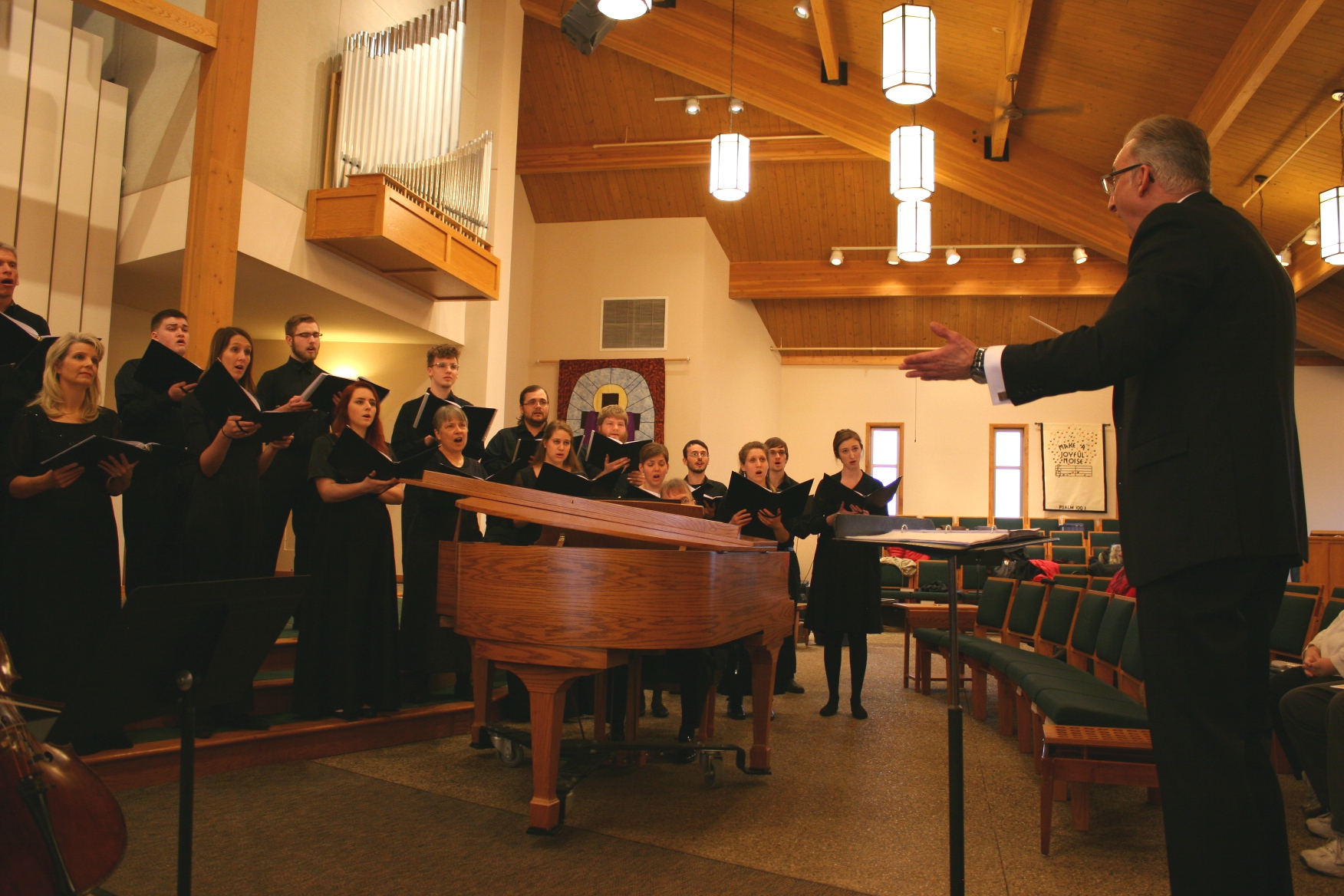
A chamber choir, directed by composer David Kassler, performs artsongs written from poems in 2017, mine included. (Minnesota Prairie Roots copyrighted file photo)
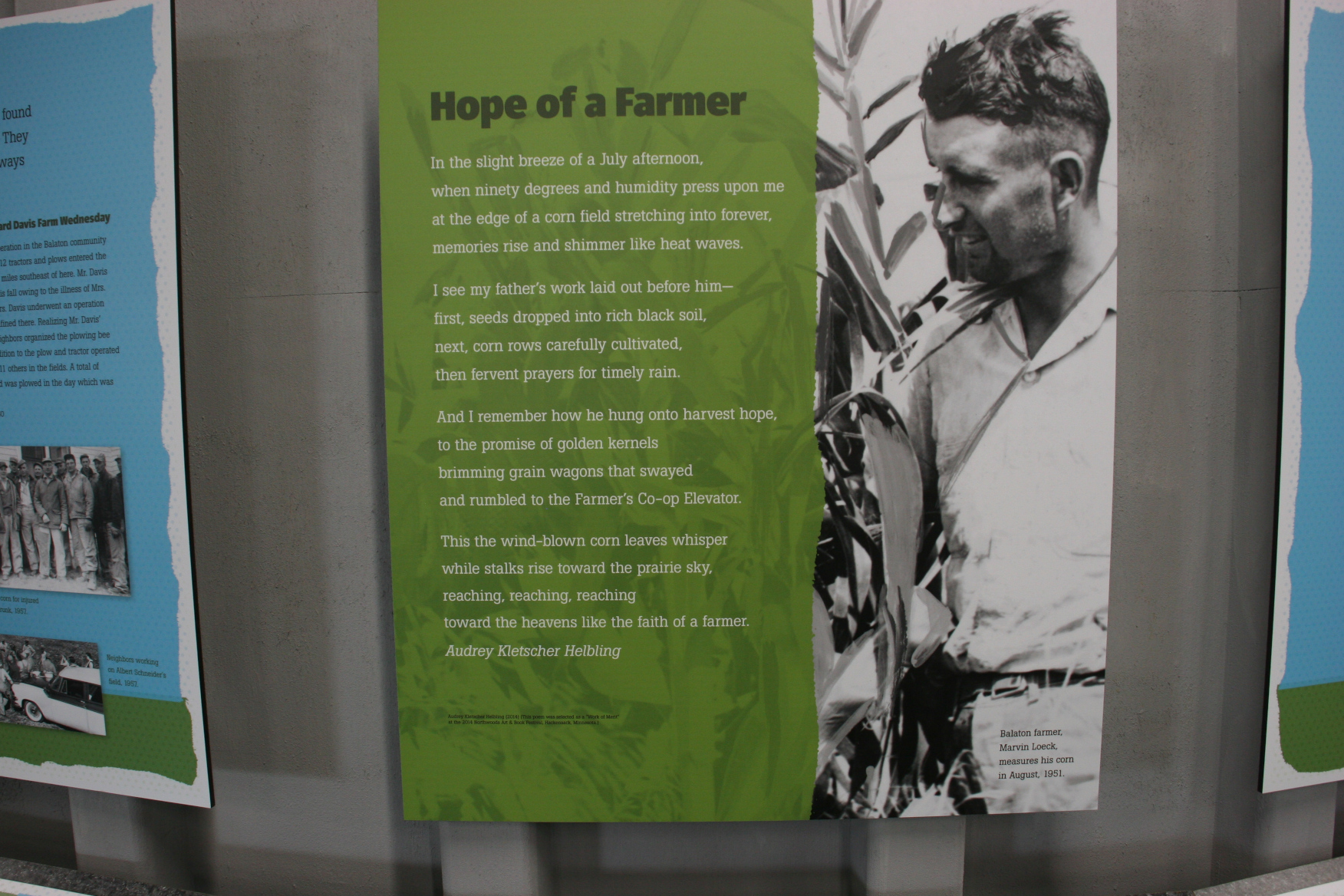
I, too, write poetry and am a widely-published poet, although certainly not as much as many other Minnesota poets. From anthologies to a museum, from the Mankato Poetry Walk & Ride to poet-artist collaborations, billboards and more, my poems have been out there in the public sector. Perhaps the most memorable moment came when a chamber choir performed my poem, “The Farmer’s Song,” during two concerts in Rochester in 2017. David Kassler composed the music for the artsongs.
Two of my rural-themed poems are included in an exhibit, “Making Lyon County Home,” at the Lyon County Historical Society Museum in Marshall. (Minnesota Prairie Roots copyrighted file photo)
Poetry has, I think, often gotten a bad rap for being stuffy, difficult, too intellectual and unrelatable. And perhaps it was all of those at one time. Butt that’s not my poetry. And that’s not the poetry of Larry Gavin or of the five We Look West Northfield poets or most poets today. The poetry I read, write and appreciate is absolutely understandable, rich in imagery and rhythm, down-to-earth connective.
My most recent poem selected for the Mankato Poetry Walk & Ride. Poets must follow character and line limits in writing these poems.This is a competitive process.(Minnesota Prairie Roots copyrighted file photo)
When I write poetry, I visualize an idea, a place, a scene, a memory, an emotion, then start typing. The words flow, or sometimes not. Penning poetry is perhaps one of the most difficult forms of writing. Every word must count. Every word must fit the rhythm, the nuances of the poem in a uniquely creative way.
Not the pancakes Grandpa made, but the pancakes and sausages made at the annual Faribault Lions Club Pancake Breakfast. (Minnesota Prairie Roots copyrighted file photo)
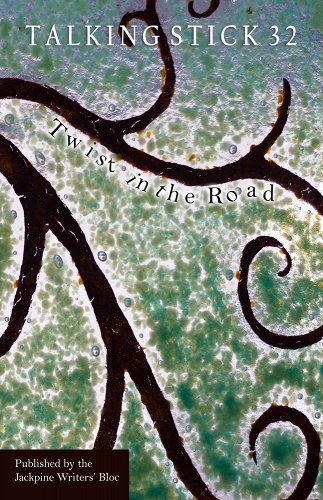
One of my most recent poems, “Pancakes with Grandpa,” was inspired by an exchange between my husband, Randy, and our grandson Isaac, then four. It was printed in Talking Stick 32—Twist in the Road, an anthology published in 2023 by northern Minnesota based Jackpine Writers’ Bloc. It’s a competitive process to get writing—poetry, fiction and creative nonfiction—in this collection.
So, in celebration of National Poetry Month, here’s my pancake poem, penned by a poet who doesn’t particularly like pancakes.
My fiction, creative nonfiction and poetry has published in all these volumes of The Talking Stick, plus volumes 32 and 33 not pictured here. (Minnesota Prairie Roots copyrighted file photo)
WITH ONLY WEEKS until the deadline for an annual writing contest, I am stretching my mind to come up with short stories and poetry that will please not only me, but also the editors of a Minnesota-based literary anthology. It’s not easy, this creative writing. Yet, I enjoy the challenge.
I can’t always explain from whence my fictional stories spring. I’ve written some really dark stuff that has landed me publication and sometimes prizes. Stories with undertones of darkness and violence. Nothing like I’ve experienced in real life, although certainly I’ve faced plenty of dark and trying days.
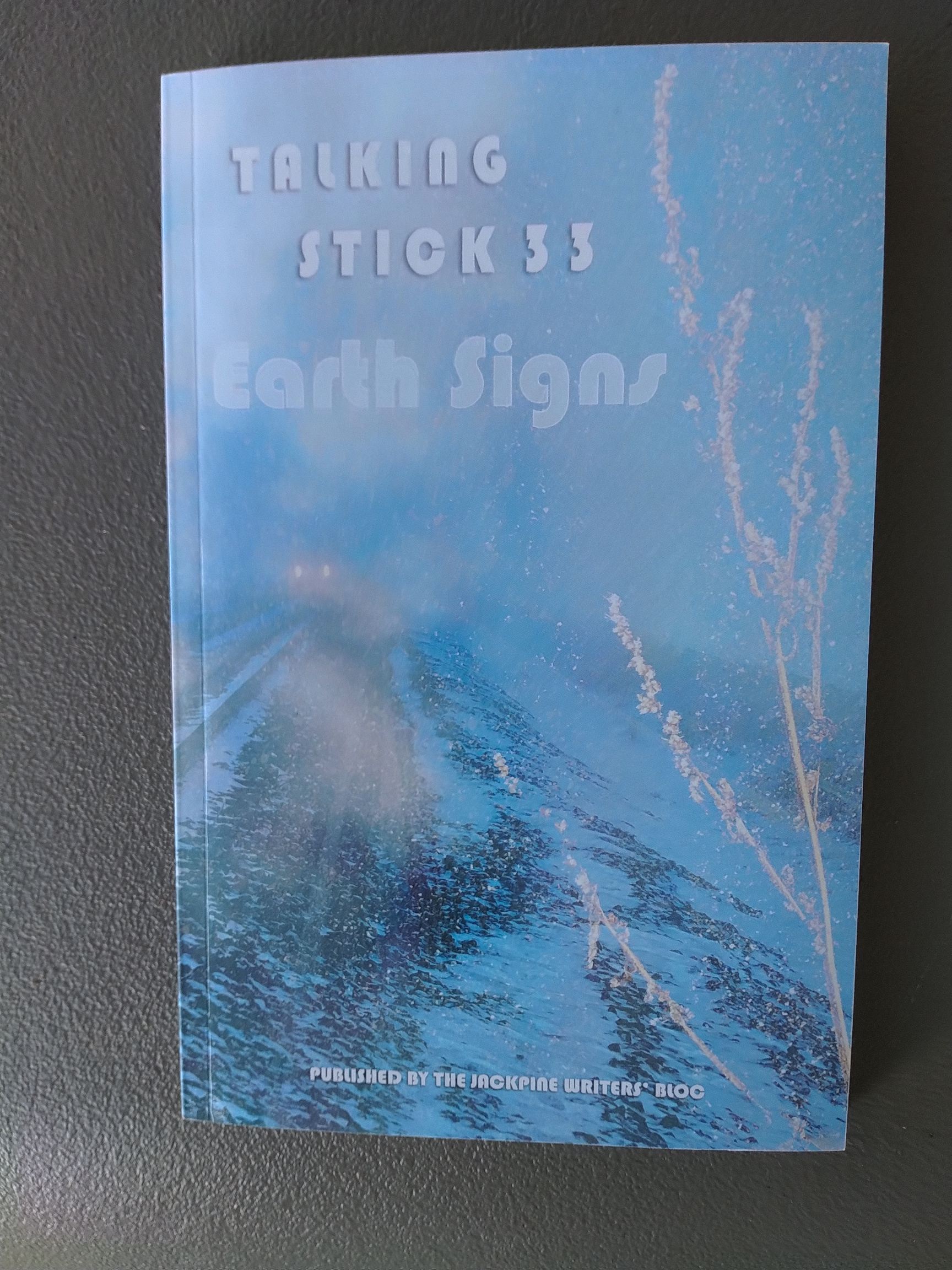
When I read my second place winning fictional story, “Dear Mother,” at last fall’s Talking Stick 33—Earth Signsbook launch party in northern Minnesota, I qualified my reading with “I don’t know where this dark story came from.” It was implied that the main character killed her abusive mother. The writer who followed me as the first place winner in fiction also wrote a dark story. I don’t recall if Tara or some other writer explained that, in order to reach the light, we need to go through darkness. That resonated with me.
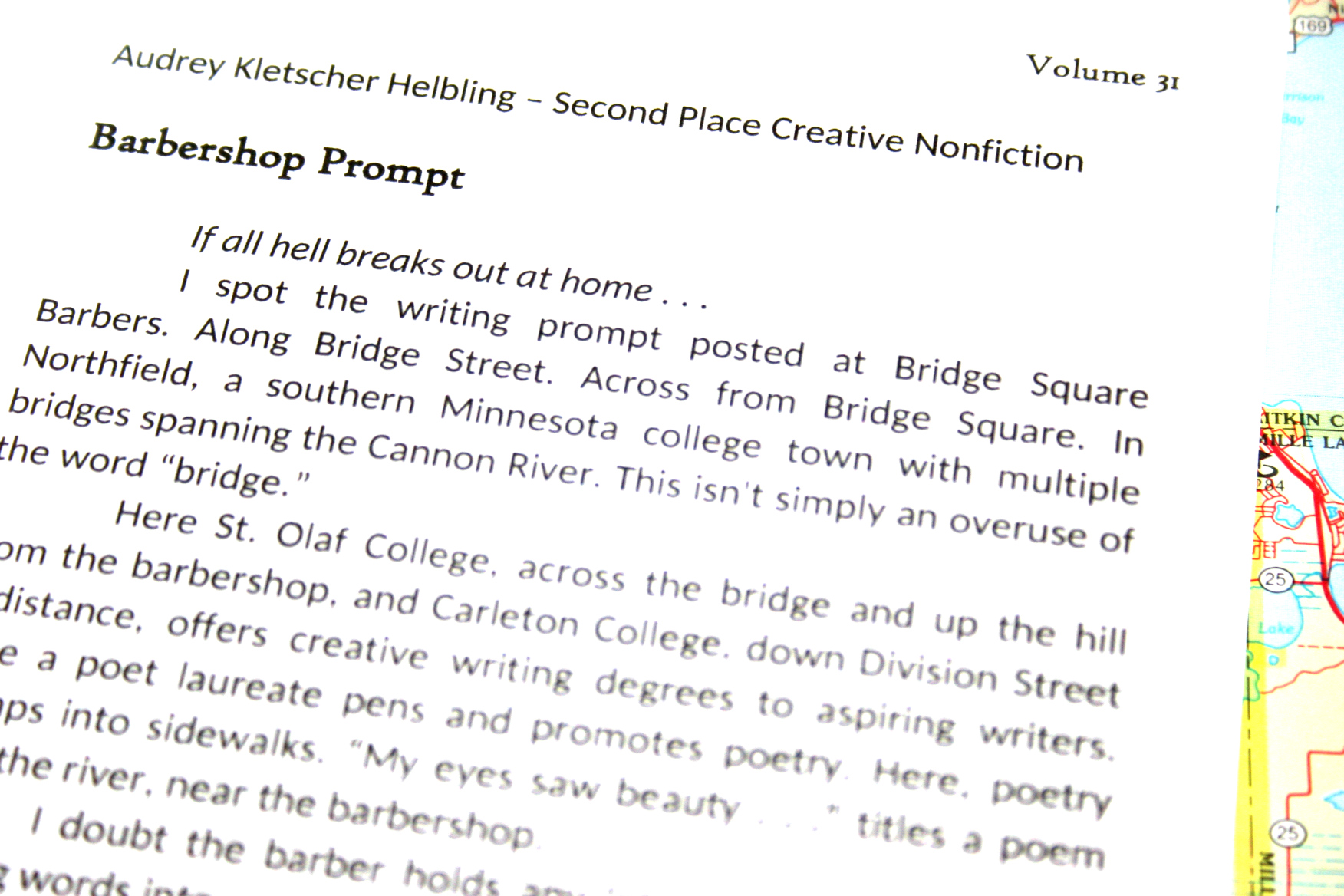
The beginning of “Barbershop Prompt,” published in Talking Stick 31–Escapes. (Minnesota Prairie Roots copyrighted file photo)
I’ve completed the initial draft of my first piece of fiction for this year’s contest. It, too, includes some dark elements. The community calendar in my local newspaper prompted the story, which I realize may seem rather odd. But, hey, inspiration can strike in the most unlikely of places. A previous work prompted by a sign at Bridge Square Barbers in Northfield earned me a second place in creative nonfiction in 2022.
Now three years later, with the printed community calendar of events lying on my office desk, I glanced from newspaper to computer screen as the idea of a story began to take shape. Once I finished the intro, words began to fly (OK, admittedly not always) from my brain to the keyboard to the screen. The draft is saved, awaiting a second look in a few days.
This sharing library in Pine River is inspiring my next creative work. (Minnesota Prairie Roots copyrighted photo July 2024)
Now I’m on to my next piece of writing. A photo I took of a sharing library (like a Little Free Library) in Pine River is serving as my inspiration for a story that has yet to unfold. But I see the possibilities in the many love-themed/titled books shelved inside that library adorned with a Peace/Love/Books sticker.
Romeo and Juliet by Shakespeare. Lunkers Love Nightcrawlers, author unknown to me. Tuesdays with Morrie by Mitch Albom, packed with life lessons, including that of love. Sin Killer by Larry McMurtry, a book of adventure, humor and romance on the American frontier. And then Absolute Power by David Baldacci, about a President “caught” with a billionaire’s wife. That title seems so relatable to today. Absolute power. But writing contest rules call for no political or religious rants, meaning I will need to steer clear of politics.
And so I’ll see where this idea goes. If a plot develops in my mind, if a story flows into something that may, or may not, be dark.
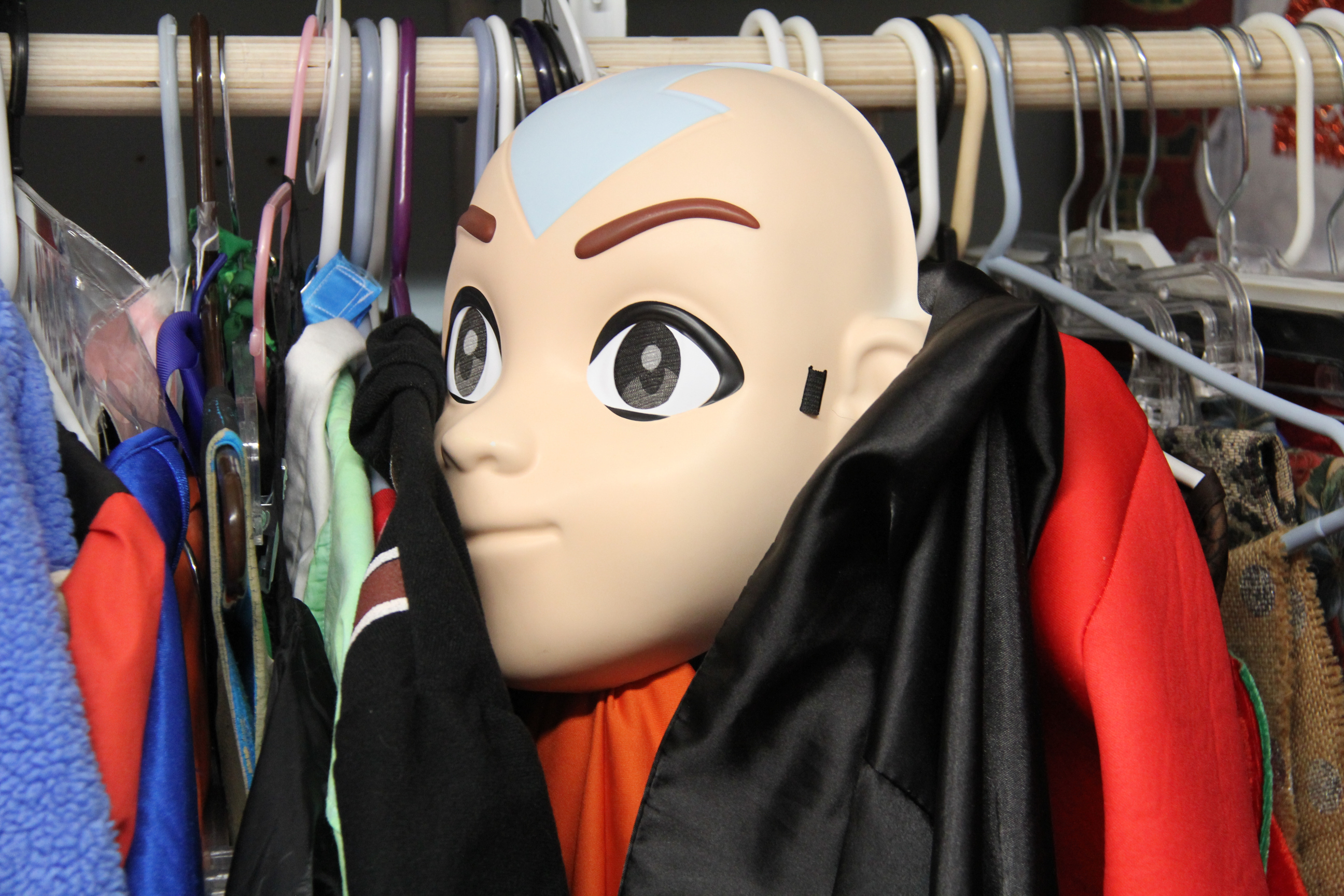
A Halloween mask and costumes for sale at Something for All, a thrift shop in Lonsdale, MN. (Minnesota Prairie Roots copyrighted photo October 2024)
OCTOBER 31. Halloween, the one day when scary is celebrated in a big way. But October 31 also marks another notable day, the final day in Domestic Violence Awareness Month. Domestic violence is far scarier than any ghoulish, frightening, unsettling costume or event. Domestic violence and abuse are real. Real scary.
Warning signs of relationship abuse from an event held in Faribault many years ago.
Abuse can be physical, psychological/mental and/or emotional. Death, injuries, scars, trauma and so much more result from abuse which is, at its core, all about manipulation, power and control. Those can be insidious or blatant.
My fictional story, “Evidence,” is published in this anthology.
With that brief background, I am sharing a fictional story printed in Talking Stick 32—Twist in the Road, a literary anthology published by northern Minnesota based Jackpine Writers’ Bloc. I wrote “Evidence,” which won an honorable mention in the 2023 Talking Stick writing competition. Please read my story and then my comments following.
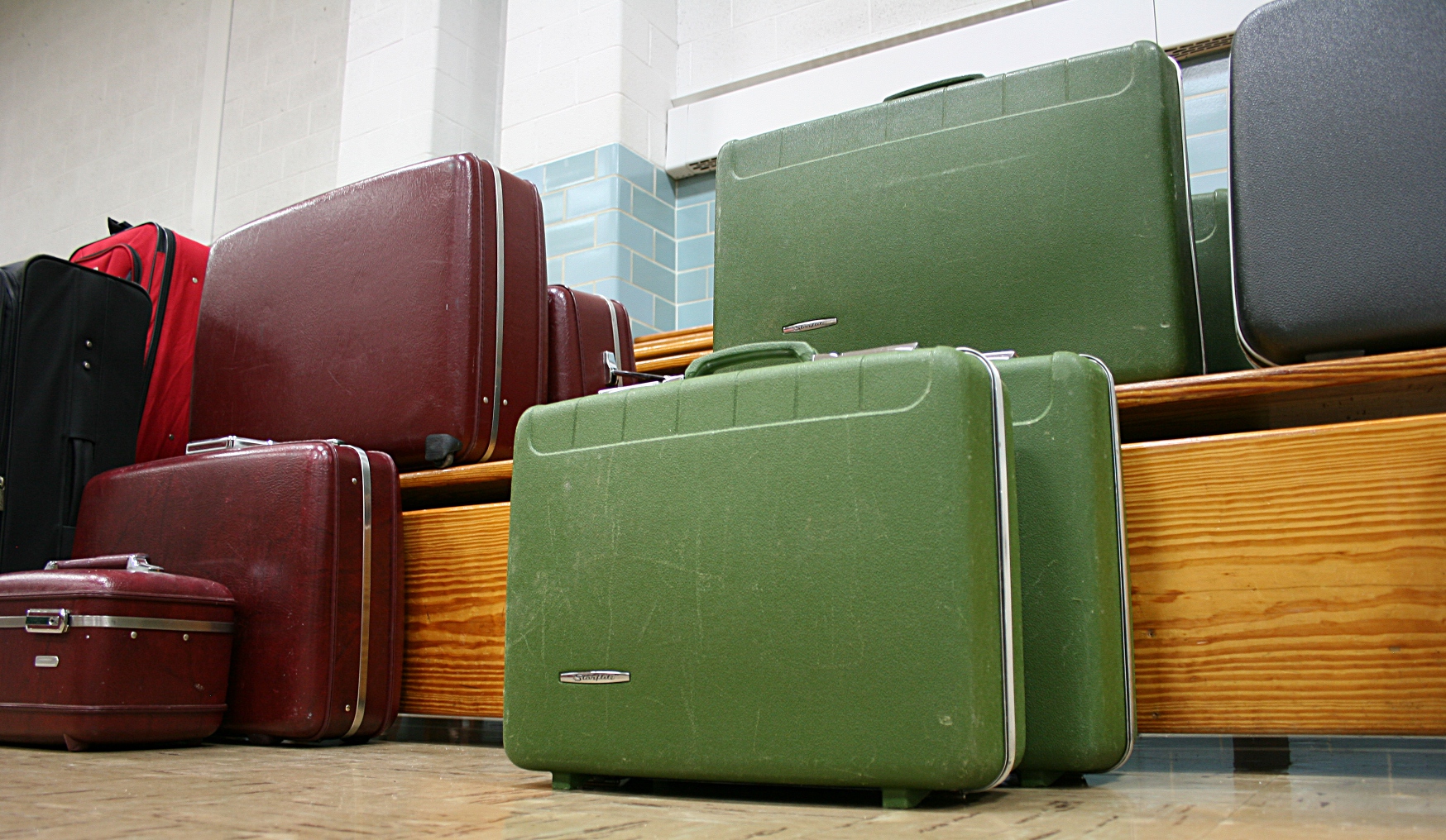
Some victims of domestic abuse/violence flee with minimal belongings in a single bag or suitcase. Some leave with nothing at all. Leaving marks the most dangerous time period when exiting an abusive relationship. (Minnesota Prairie Roots copyrighted file photo)
Evidence
She waited inside the bus station, body molded into a hard plastic chair, battered suitcase at her feet nudging shoes that needed a good polishing. Beverly felt restless, lost, as if at any moment she would awaken from her nightmare of a life. She pressed her right thumb into her sweaty left palm, a soothing habit that sometimes helped calm her. But not today.
Only hours earlier she’d fled to this place after tossing several changes of clothing alongside her diary in the bag now resting on the sticky, worn floor soiled by a thousand feet, a thousand stories. Today her story.
Her mind drifted to those first years when she wrote in flowery script, embellishing her writing with hearts. Love, so much love. He cherished her, loved her, embraced her with words and flowers and praise. Until he didn’t.
It was all so subtle, how Thomas, not Tom, chose to slip hurtful words into conversations, wearing her down. Day by day. Complaints of undone laundry and cold dinner and dirty dishes. And then the accusations flew. Where were you? Why were you speaking to him? Why can’t you ever do anything right? Then he slapped her. Repeatedly. Often.
She felt beaten. Weak. Exhausted. Trapped. Her writing reflected that, emotional words looping across the lined paper. Uneven and running together and sometimes nearly unreadable. Tears traced through the ink and wrinkled the pages.
For the longest time, she endured, pulled inside herself, determined she could do better, be better, love him more. Yet, it was never enough. Thomas continued to berate her, to find fault in everything she said and did. And she recorded it all in the journal zippered inside the suitcase stuffed in the back of their closet, the suitcase now at her feet. Evidence.
Beverly pulled herself back to reality, checked the time on the massive clock inside the bus station. Soon the Greyhound would roll in. She grabbed the worn handle of the battered bag, rose from the uncomfortable chair, and headed toward the boarding area. The momentum of hurrying passengers, their shoes slapping against the speckled linoleum, carried her. The bus doors pulsed open. Beverly stepped inside, handing her ticket to the driver. Her mood shifted, lightened with each step down the aisle until she saw him through the window, face flashing anger, fists clenched at his sides.
#
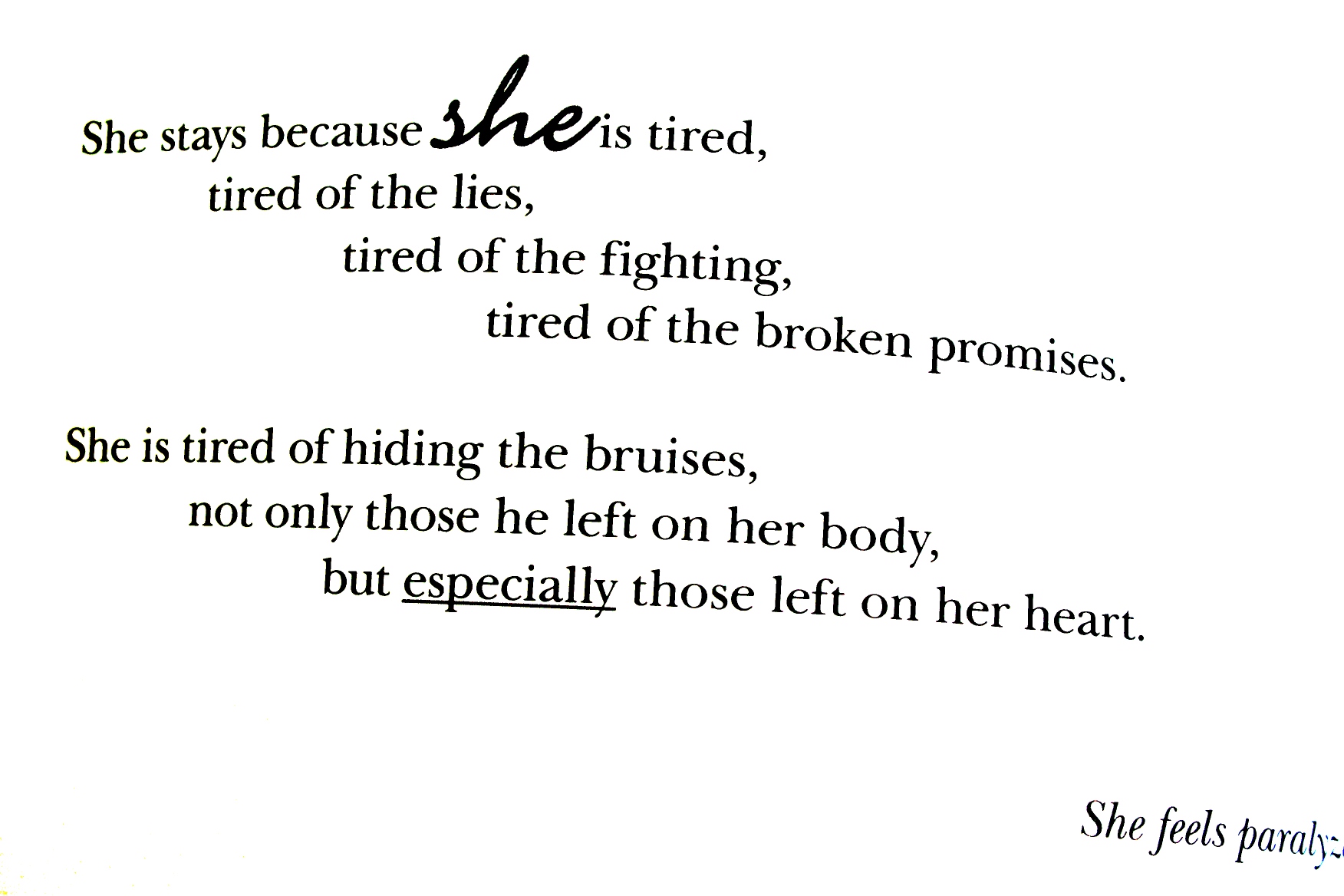
This text was published in a book, “She Stays,” by Eric Staab-Absher, director of HOPE Center in Faribault.(Text copyright of Erica Staab-Absher)
COMMENTS: If you recognize yourself or someone you love in my fictional story, first know that you are not alone. Help is available through organizations that will support you and/or your family. That may be a shelter or an advocacy/outreach organization focused on preventing domestic violence, providing education and resources, and simply being there for you. If you’re not ready for that step, talk to a trusted friend or family member.Seek help.
Leaving an abuser is not easy. It’s scary and difficult. Even dangerous. But you (or someone you love) are so worth living a life free from manipulation, control, abuse and/or violence.
VIOLENCE FREE MINNESOTAhas released its “2023 Homicide Report: Relationship Abuse in Minnesota.” In 2023, there were 40 confirmed victims of intimate partner and domestic violence-related homicides in the state. That’s the highest number since tracking began in 1989. Gunshot is the leading cause of deaths. This report honors victims across Minnesota with photos and information. It’s packed with statistics and other valuable information and is well worth your read. Click here to read the full report or a summary of it.
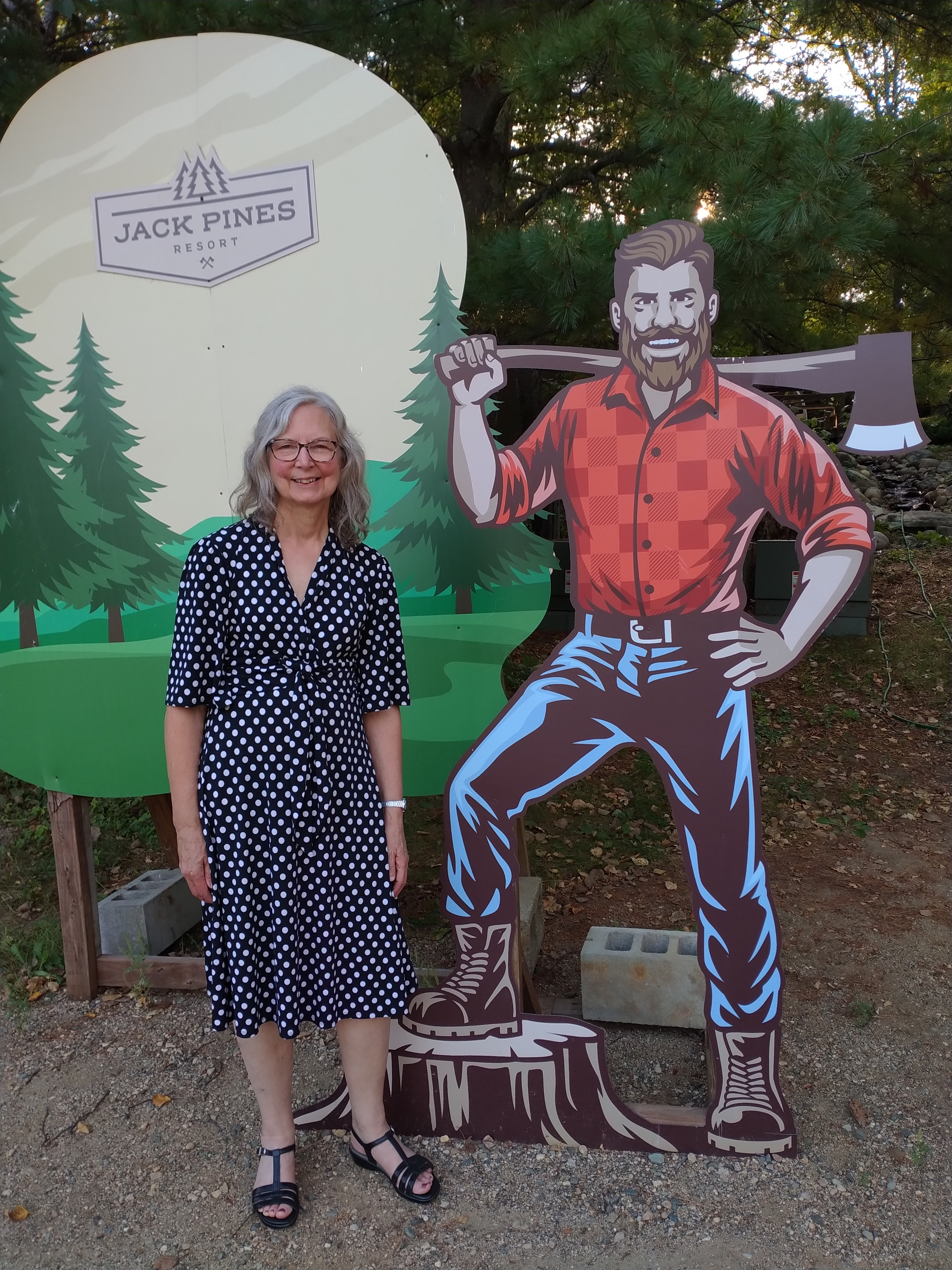
I am a down-to-earth writer who focuses on writing about people, places and events primarily in Minnesota. Here I’m pictured outside Jack Pines Resort, rural Osage. I was there attending a book launch party for an anthology in which my writing published. (Minnesota Prairie Roots copyrighted file photo by Randy Helbling, September 2024)
I’VE ALWAYS LOVED WRITING. From early on, my love of language, of words, of grammar, of, yes, even spelling, defined me. Give me a book to read. Give me a spelling test. Give me a pen and a notebook. And then a computer. Words, words and more words. I will find them, use them, create stories with them.
At one time, I wanted to pursue a degree in German. But, after a year in college, I changed direction because I didn’t want to teach. I decided to study journalism. It was absolutely the right decision for me, my interests and my skills.
With that intro, I join the many writers who are celebrating National Newspaper Week October 6-12. That includes journalists from my local paper, The Faribault Daily News, in which my writing publishes each weekend and sometimes more. I no longer consider myself a full-fledged journalist as much as a writer. These days I write from a personal perspective, more as a columnist, rather than as an objective reporter. I write fiction, creative nonfiction and poetry, too.
MY JOURNALISM EXPERIENCE
But I did work as a full-time newspaper reporter and photographer after graduating with a mass communications degree (news/editorial emphasis) in 1978 from Minnesota State University, Mankato. I worked for newspapers in Gaylord, Sleepy Eye, Mankato, Owatonna and Northfield. Eventually I gave up journalism when I started a family. The long and odd hours are not conducive to family life.
Today my three kids are long grown and gone, and I’ve found my way back to writing with an added focus on photography. What makes a good writer, a good newspaper reporter? Topping my list are the abilities to listen and focus on detail. I’ve always considered myself a good listener, a necessity for any newspaper reporter. I developed the skill of taking notes while actively listening. Organization also factors in. There’s always a bit of homework involved in prepping for an interview. Research the subject. Prepare questions, but be open to asking more as the interview progresses. Focus on details. Tell a story.
I worked in journalism before the days of cellphones, so I filled notebooks with pages of notes. I also studied and worked in the profession before computers and digital cameras. My first job out of college, I typed all of my stories on a manual typewriter, shot all my photos on film. I would never want to go back to either. Give me a computer and a digital camera. It’s much easier to create with those.
FOCUS ON LOCAL STORIES
I love sharing stories and photos of people, places and events that weave into my life, that I discover. I find joy in following a gravel road, in discovering interesting signage, in exploring small towns, in meeting ordinary people following their passions… People often tell me I find the most interesting things. I agree. And then I tell them it’s right here in their own backyard if only they pause to look, and see.
Therein lies the value of community journalism, which I want to highlight and honor during National Newspaper Week. Our local newspapers are all about local. Local reporters cover and write about the people, places and events that are happening locally. They write stories ranging from features to hard news. I covered all of those, too, while working as a full-time reporter. It’s not an easy job. People are quick to criticize, slow to praise. So I want to state right now that I appreciate our local news team. They work long, odd hours, just as I did, to gather and write the news. They care.
Everyone ought to care that freedom of the press thrives, that these journalists are covering our government meetings, writing about our neighbors, highlighting ordinary people who do extraordinary things and much more. We need newspapers as much today as ever before, perhaps even more.
Please, support your local newspaper by subscribing. And thank a newspaper reporter for their dedication to the profession. They deserve to be recognized, especially during National Newspaper Week.
Getting published in this anthology is a competitive process with blind-judging. The judges—this year a university English professor and writer, a writer who moved to Minnesota for a rural artist-in-residency, and the author of a cozy mystery series—have no idea whose work they are considering for honors. The Jackpine editorial team chooses their top pieces to pass along to the judges for review and awards.
There were 280 submissions from 121 Minnesota writers or writers with a strong connection to our state in the 2024 writing competition. Of those, 113 works from 72 writers were published. That includes 63 poems, 22 creative twist pieces, 15 creative nonfiction stories and 13 fictional stories.
Me with author and fiction judge Jeanne Cooney, right. (Photo credit: Randy Helbling)
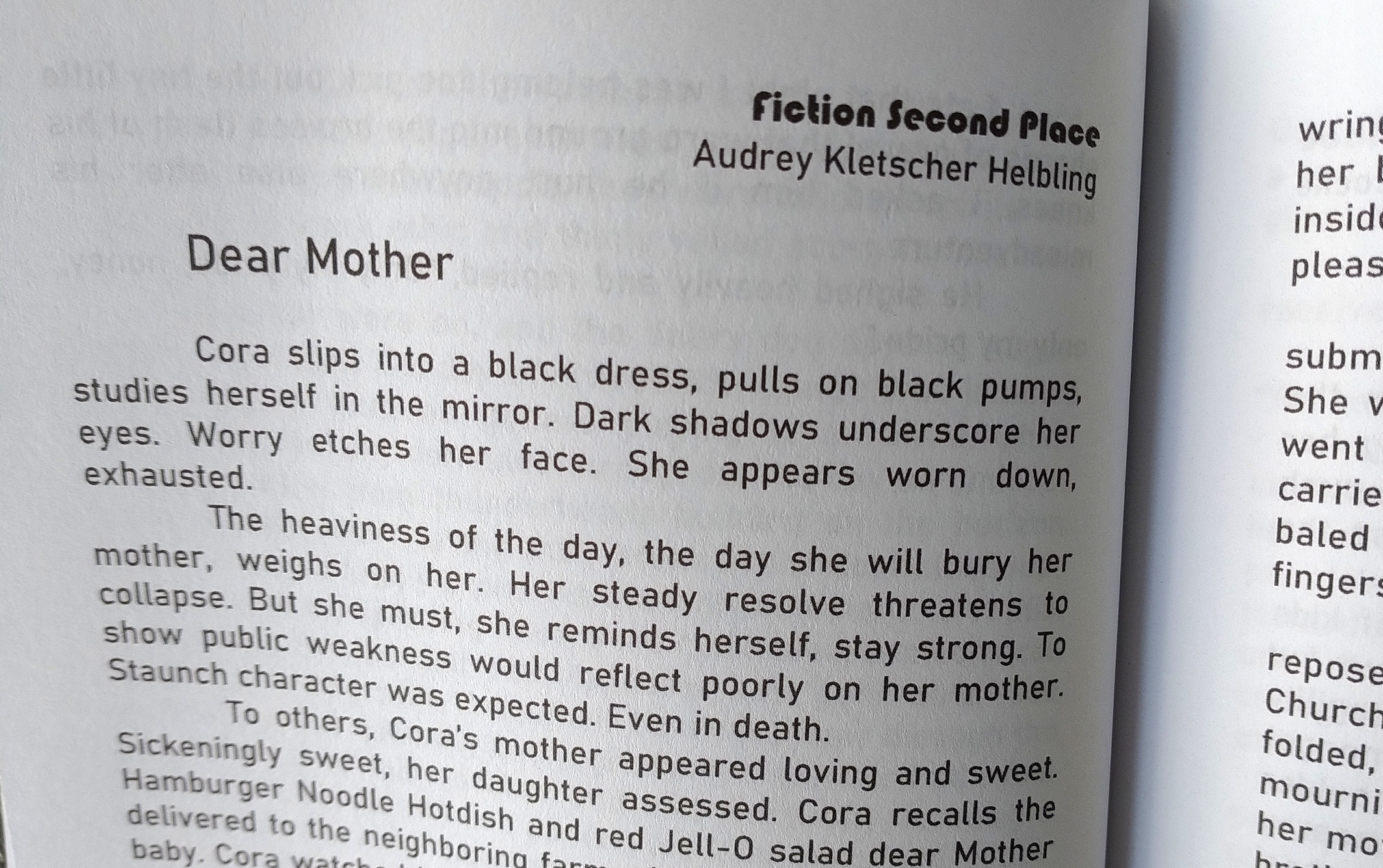
My short story, “Dear Mother,” earned second place in fiction as decided by author Jeanne Cooney. She’s written “A Hot Dish Heaven Mystery” series and has launched a new “It’s Murder” series. Did my mention of Hamburger Noodle Hotdish and red Jell-O salad in my story influence Cooney’s decision? I’d like to think not, but I suppose subconsciously it could have. When I wrote my short story, though, I had no idea who would be judging the fiction category. Hotdish simply fit into the storyline.
The beginning of my prize-winning fictional story, “Dear Mother.” (Minnesota Prairie Roots copyrighted photo September 2024)
Cooney called “Dear Mother” a “Very good story. But needs to be clearer.” She was right. Her comments helped me shape a stronger, better piece of writing. Dark writing. Mine is a story that begins seemingly ordinary enough, wrapping up in a surprise ending. Or rather an inferred dark ending.
Congratulations to everyone whose work published in “Talking Stick 33.” Those include readers of this blog. Thanks also to Managing Editors Sharon Harris and Tarah L. Wolff for their ongoing dedication to the craft of writing. (Minnesota Prairie Roots copyrighted photo September 2024)
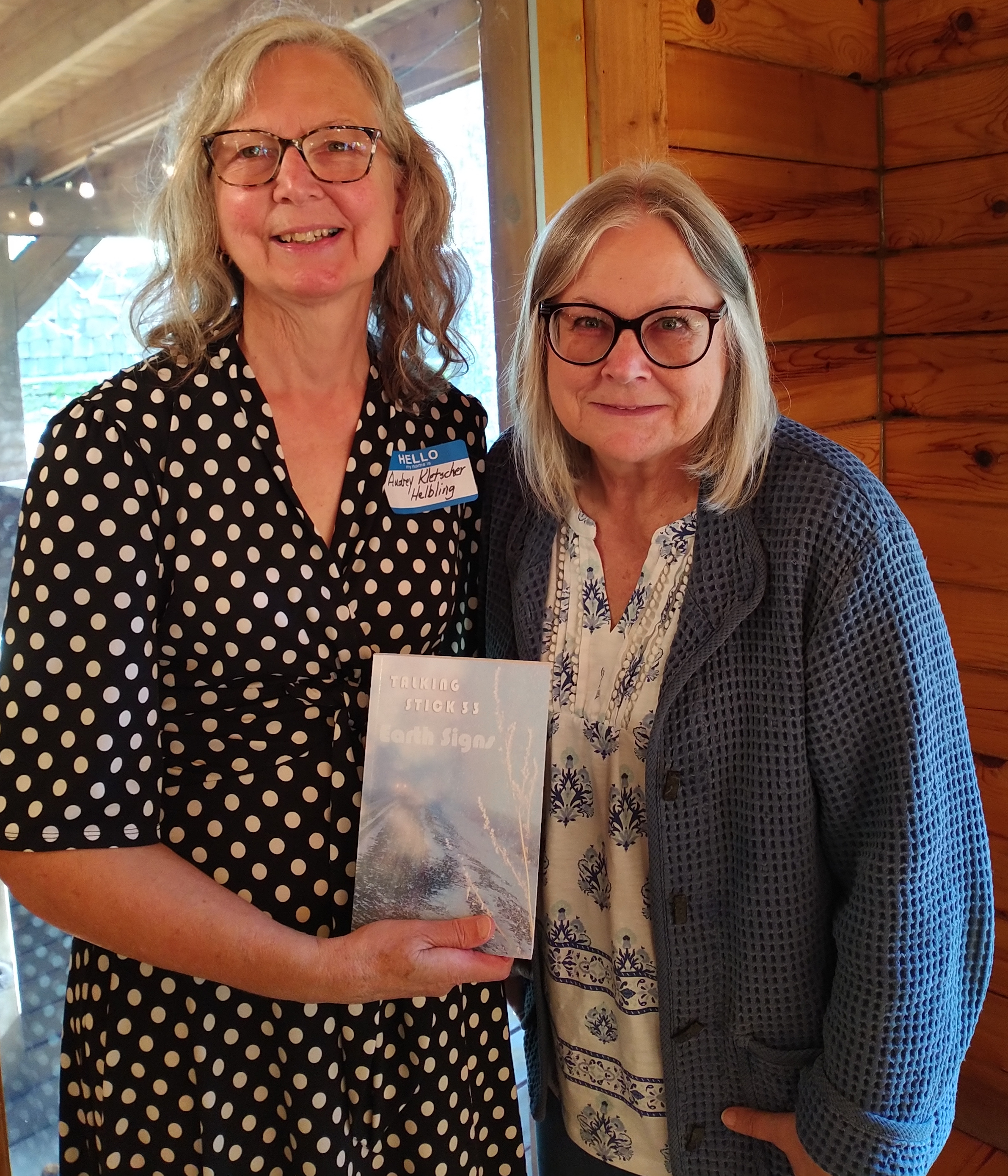
Last Saturday afternoon, I gathered with other writers and supporters for a party launching publication of Talking Stick 33—Earth Signs at Jack Pines Resort (no connection to the writers’ group) in rural Osage, a four-hour drive from Faribault. The event included a writing workshop (which I did not attend), book reading and socializing.
I’m not especially comfortable reading to a roomful of people, even though I’ve done so many times. But I practiced and then read “Dear Mother” with dramatic inflections and soft tones in just the right spots, managing to convey exactly what I wrote. There’s something to be said for hearing a poem or story read aloud. The piece comes alive via the voice of the writer.
As I listened to all these writers, I felt a strong sense of community. I felt encircled by a group of incredibly talented and supportive creatives. People who care about language and emotion and damn good writing.
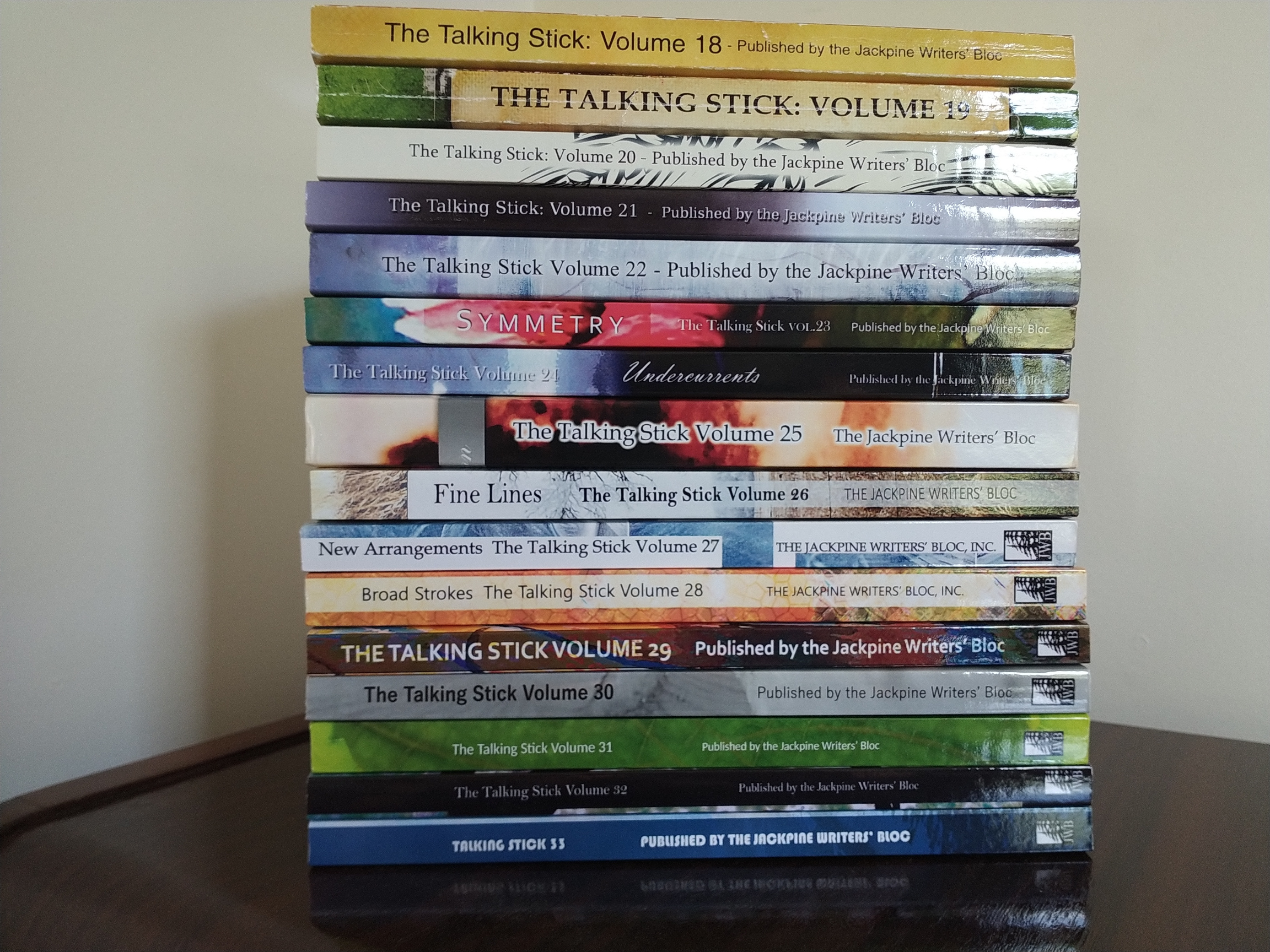
My collection of “Talking Stick” books. I’ve been published in 15 of these 16 volumes. (Minnesota Prairie Roots copyrighted photo September 2024)
This marks the 15th consecutive year my writing has published in Talking Stick. A poem, “Misunderstood,” and a work of creative nonfiction, “Lessons Inside the Dome,” were also selected for publication in the 2024 volume. Both are Faribault-rooted. My poem focuses on the connection between the Wahpekute and today’s homeless population living in woods along the Straight River. In “Lessons,” I write about walking inside the Shattuck-St. Mary’s School dome during the winter and lessons I learned there.
My writing is often rooted in experiences, in observations, in overheard conversations, in memories. I’ve covered everything from farming, to aging to domestic abuse, trauma, Minnesota Nice and more. Writing prompts have come from a vintage family photo, a sign on a barbershop window in Northfield, a painting by Andy Warhol… There are stories everywhere.
I’m grateful to the Jackpine Writers’ Bloc for repeatedly choosing my work for publication in Talking Stick. That includes 15 poems, 10 short stories, nine creative nonfiction stories and two creative twist stories (written using a list of pre-selected words). I’ve thrice been awarded second place (poetry, fiction and creative nonfiction). I’ve also earned eight honorable mentions (four for fiction, two for creative nonfiction, and one each in poetry and creative twist). Winning those awards is validating to me as a writer.
But just as validating is being among other writers. Writers who appreciate the craft of writing and the hard work it takes to shape a poem or a short story. Writers who understand the importance of word choice. Writers who recognize the power of words. Writers who don’t settle for the mundane, the cliché, the everyday. Writers who will spend several hours together on a glorious September afternoon in the northwoods celebrating the release of Talking Stick, a stellar literary anthology. We have much to celebrate in Minnesota, in this place that produces a remarkable number of talented writers.
THEY ARE SEASONED WRITERS, also well-seasoned in life. They are Becky Boling, Heather Candels, D.E. Green, Steve McCown and Julie A. Ryan, collectively The Poets of the Northfield Public Library. And at 6 p.m. Thursday, September 5, they will gather at Books on Central, 227 Central Avenue North, Faribault for a poetry reading followed by a Q & A.
If you happen to be one of those people who claim a dislike of poetry, I encourage you to reconsider and come to this literary event. The poetry this group will read comes from their recently-published anthology, We Look West. Their poems are down-to-earth relatable. Trust me. I’ve read this 116-page book, loved it and reviewed it. (Click here to read my review.)
The writing within the pages of this volume are stories of life, in poetry form. Poems that transition from east to west, from the sunrise to the sunset of our lives.
They’re written by poets with extensive publishing credentials. Four have taught at the high school or college level. The fifth comes from a strong literary and visual arts background. Two are Pushcart nominees.
I’ve met Boling and Green and read poetry with them at an event at Mercado Local in Northfield. They are a wonderful married couple, comfortable and friendly. No stuffy poets here. And no stuffy poems. Just plain good writing that moves the spirit, fills the soul, imprints upon the heart.
I look forward to hearing The Poets of the Northfield Public Library read selected poems and then share the stories behind their poetry. As a poet, I’m always interested in learning what inspired a particular poem.
And if you have questions, ask away. Writers welcome engagement as they share their passion for poetry, the craft of writing.
FYI: Books on Central is a second-hand book shop run by the Rice County Area United Way and staffed by volunteers. Proceeds from the bookstore benefit organizations and nonprofits throughout the county.

















 Minnesota Prairie Roots
Clearly I needed to write about homelessness & housing insecurity in Faribault…read on August 6, 2025
Tags: church, commentary, Community Action Center, donations, emergency housing, faith, Faribault, homelessness, housing insecurity, Minnesota, mission, Ridgeview Heights, Trinity Lutheran Church, Vacation Bible School, workforce housing, writing
ON MY WAY TO SUNDAY MORNING church services, I missed an opportunity to live my faith. Reflecting on that moment, I’m still uncertain what I could have done. But the guilt I feel about doing nothing at the time remains.
Let me set the scene. While driving to church, Randy and I dropped off some mail downtown. Up the hill from the post office, I noticed a parked car crammed with stuff. Someone clearly lived out of the vehicle, one I’ve previously seen. Then my eyes shifted to the adjacent street corner and an individual, cocooned in a bright gold blanket, sleeping atop a bench. And then we turned the corner.
“I should take a picture,” I told Randy, my mind already creating a story that would enlighten others about homelessness in Faribault. But then I quickly realized that taking a photo wouldn’t be particularly kind. And so we continued on to church.
Still, I couldn’t shake the image of that person stretched atop a bench along Central Avenue. I wondered about his story, why and how he found himself without a home. And I considered how vulnerable and exposed I would feel sleeping like that in a public place. Those thoughts followed me into church.
“HOUSING FOR THE HOMELESS”
When I stepped inside the sanctuary, I immediately noticed a “Housing for the Homeless” poster near the organ. There are coincidences and then there are what I term “God moments.” And this, in my mind, was clearly divine. I’ve seen enough of these occurrences in my life to distinguish the two. God was assuredly nudging me to write on the topic of homelessness and housing insecurity in my community.
That sign in church was a promotional for the chosen mission of this year’s Vacation Bible School, which started that very evening at Trinity. Participants are donating their monetary gifts to Ridgeview Heights, an accessible, sustainable housing community to be built in downtown Faribault just blocks from the slumbering man on the bench. The VBS fundraising goal is $500.
That $500 may seem inconsequential considering the $2.5 million project cost. But every dollar helps in constructing the two buildings aimed at housing families with children, including those experiencing homelessness. Two of the eight units will serve as free emergency shelters and the other six will be market rate workforce units.
A COMMUNITY ACTS
The Community Action Center, which works collaboratively to alleviate hunger, homelessness and poverty among individuals and families in the community, is the lead on Ridgeview Heights. With an in-kind land donation from the city of Faribault, two grants, gifts, community donations and financing, the CAC is able to break ground at 4 p.m. today, August 6, for the much-needed two and three-bedroom units.
So first I saw the sleeping man, then the poster. And then came the sermon…with a directive that congregations ought to think, plan and act in ways that bless people. The guest pastor encouraged us not to think less of ourselves, but to think of ourselves less (a loose quote from C.S. Lewis). In other words, turn the focus outward on the community rather than inward to the church’s needs. The VBS kids will be doing exactly that this week with their “Housing for the Homeless” mission focus.
A FAMILY THAT CARES
Now you may think my story ends here. But it doesn’t. On July 28, I received a mass email about an upcoming Helbling family reunion. Organizers are changing things up this year by raffling items made by family members. One of several ways to qualify for a raffle entry is via a $5 charitable donation. All donations will go to the Community Action Center in Faribault with a dollar-for-dollar match from my eldest niece’s employer.
Truly, I was meant to write this story. I may have bypassed the man sleeping on the bench. But I got the message, loud and clear, that I needed to write about homelessness and housing insecurity in Faribault. I’ve seen the tents pitched along the river, beside train tracks, behind evergreen trees, next to a park. I’ve seen the homeless in the library, sleeping in the Central Park bandshell, biking and walking about town, including past my house. I am aware of the long waiting list for emergency shelter. Even if I failed to “do” something, I can raise awareness through my writing. And by doing that, perhaps I am helping in some small way to bless my community, including the man sleeping on a bench in the heart of downtown Faribault on a Sunday morning.
© Copyright 2025 Audrey Kletscher Helbling