Minnesota Prairie Roots

Writing and photography by Audrey Kletscher Helbling

In celebration of National Poetry Month: One April day April 18, 2022

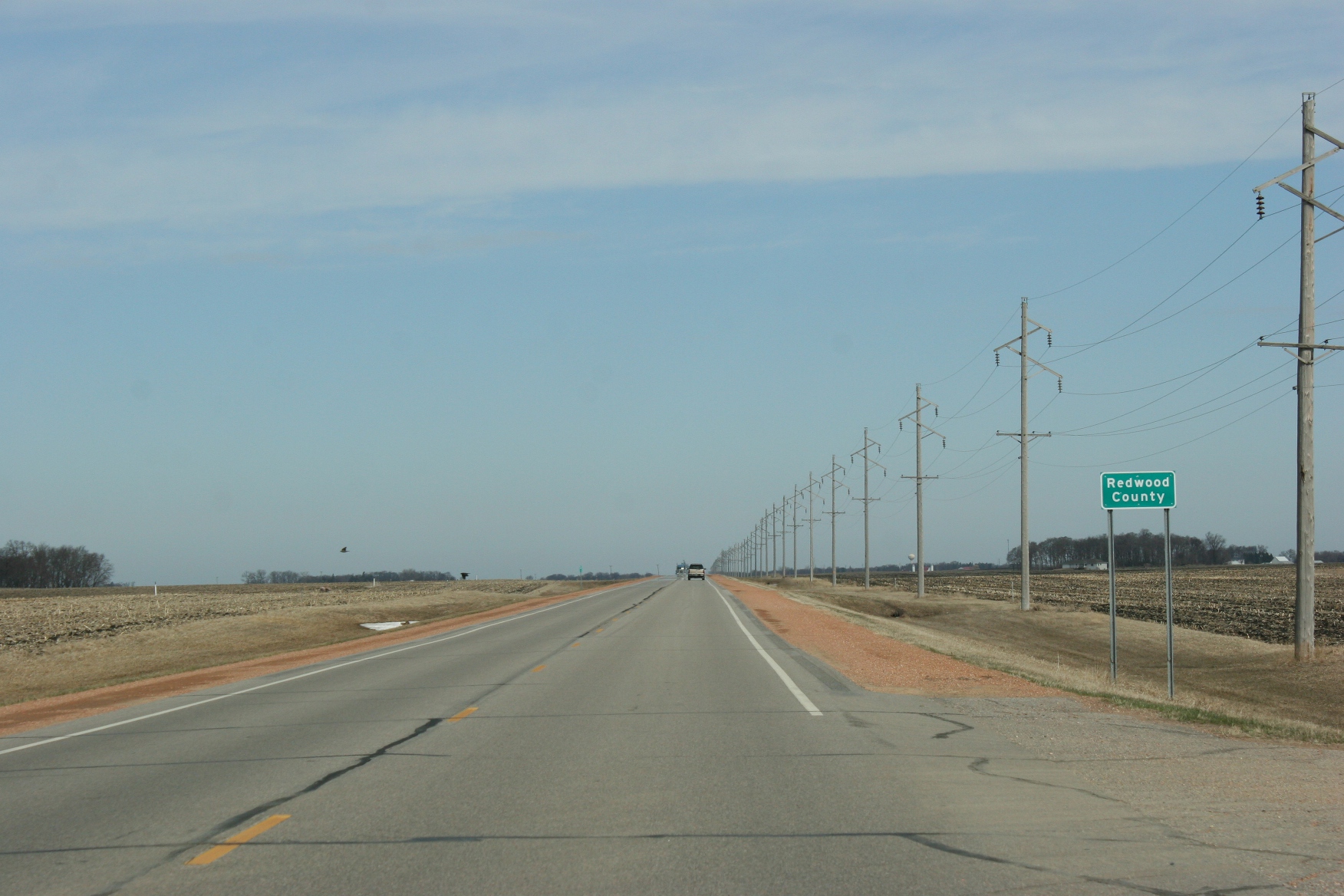
Entering my home county of Redwood along Minnesota State Highway 68 southeast of Morgan. (Minnesota Prairie Roots copyrighted file photo April 2018)

ON THE AFTERNOON of the April morning I scanned the #811 shelves at Buckham Memorial Library for poetry books, I raked a banana from the boulevard.

“Hey, I found a rotten banana,” I hollered to Randy, who had just switched off the lawnmower as he mulched leaves.

“You didn’t eat it, did you?” he asked.

“No,” I shouted back, rolling my eyes at his humor.

“I found a dead mouse or squirrel earlier,” he shared in an apparent effort to top my discovery of a dried black banana. (We never know what we’ll find while raking in the spring.) He walked across the lawn to the curb along busy Willow Street and kicked up the dried carcass I really did not want to see.

“Mouse,” I concluded, and looked away.
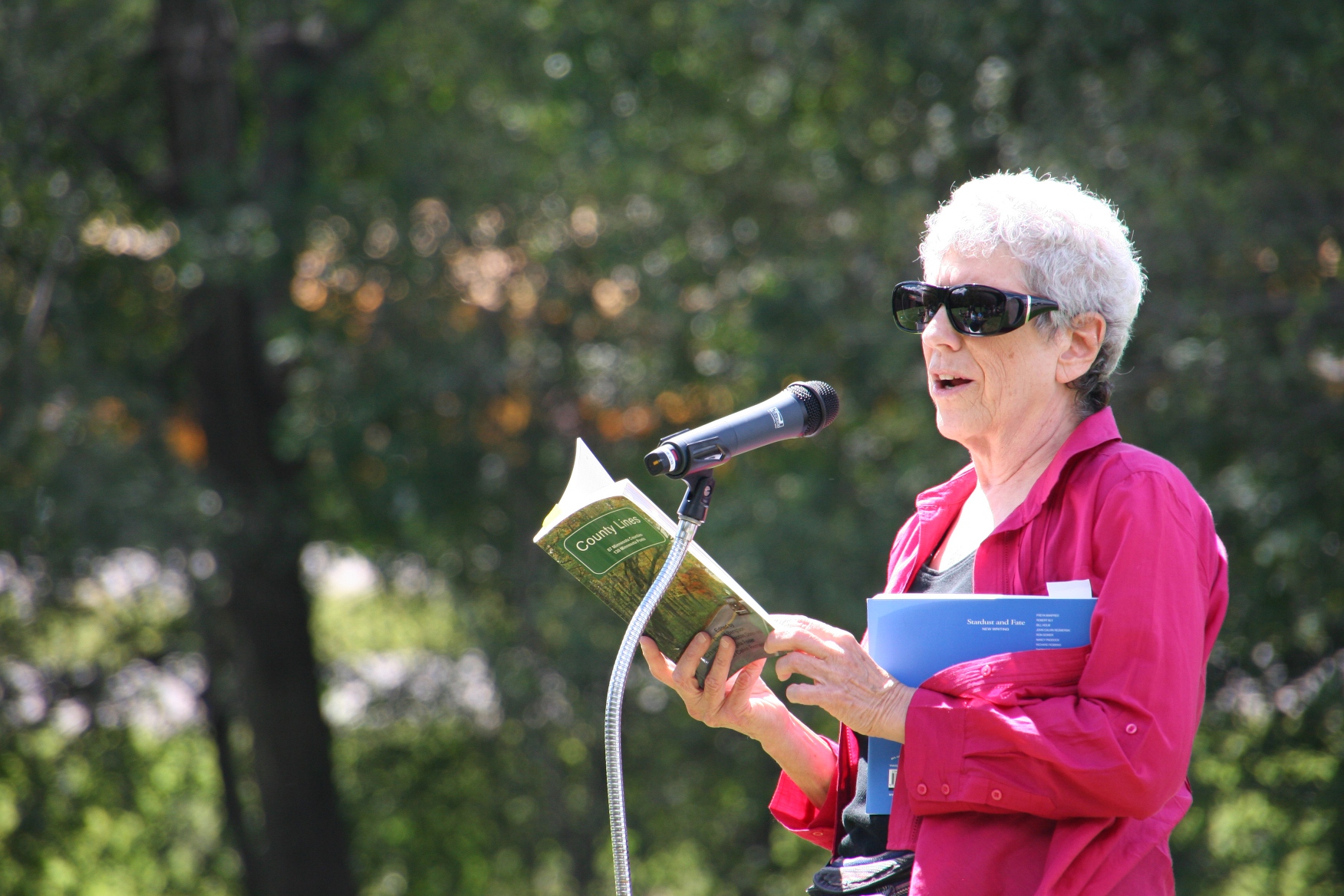
Mira Frank reads the works of Minnesota poets from “County Lines” at an event in St. Peter in 2016. (Minnesota Prairie Roots copyrighted photo August 2016)

That takes me back to those poetry books I checked out, including County Lines: 87 Minnesota Counties, 130 Poets. Published in 2008 by Loonfeather Press of Bemidji, this volume features poems collected from Minnesota poets and representing all 87 Minnesota counties. It was published on the 150th anniversary of our statehood.

It’s a must-read book which accurately, and poetically, reflects Minnesota. Among the poems published therein, “April” by Connie Wanek. The first four lines of her five-verse poem from St. Louis County, are so relatable. She writes:

When the snow bank dissolved

I found a comb and a muddy quarter.

I found the corpse of that missing mitten

still clutching some snow.

As someone who’s lived in Minnesota her entire life, I “get” most of the poetry published in this collection. These poets write about land and weather, experiences and observations, small town cafes and polka dancing and trains roaring down tracks and closing the cabin and picking rock and…
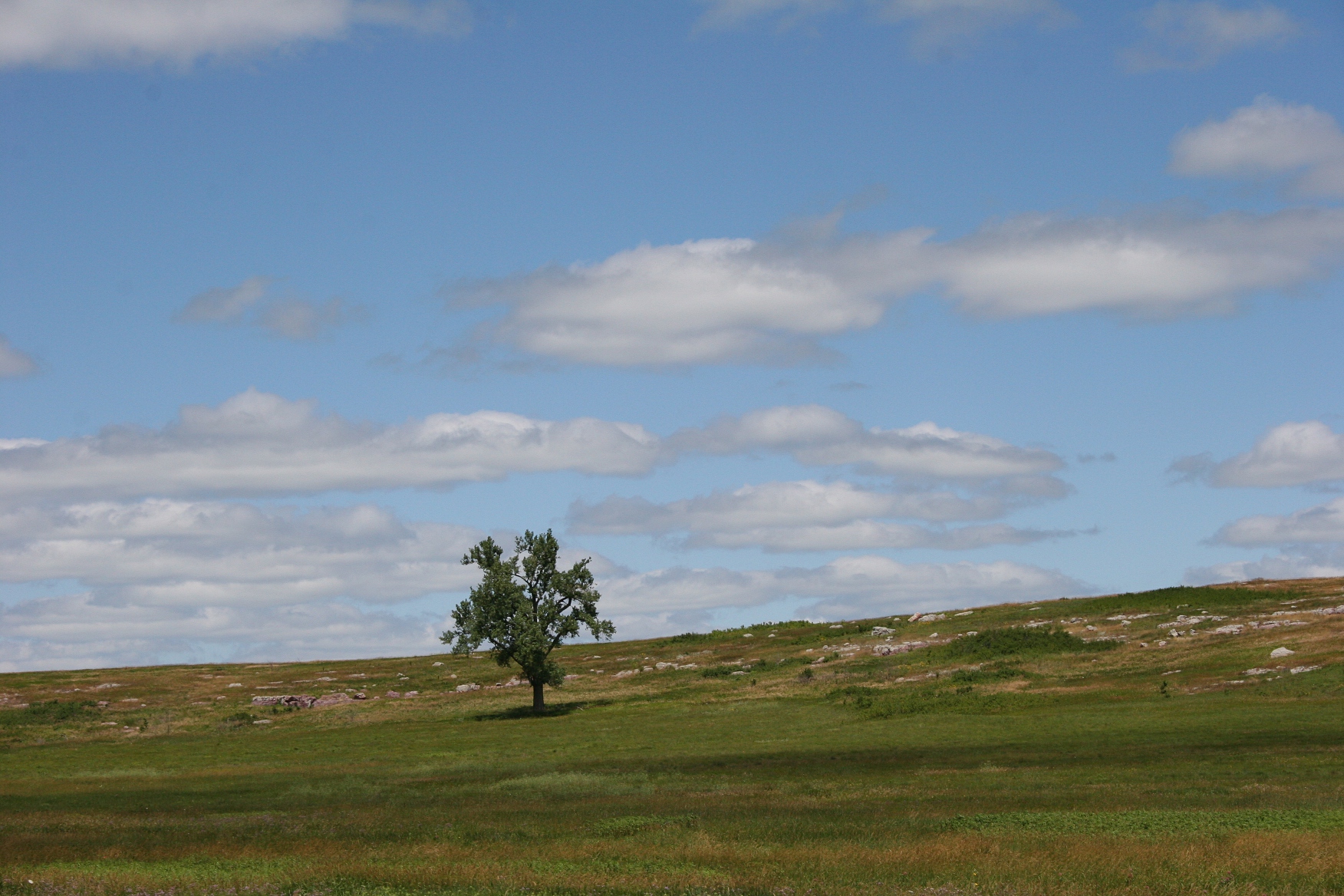
The plentiful large rocks pictured here at Blue Mounds State Park are likely similar to those referenced in Leo Dangel’s poem. The park in rural Luverne is about 20 miles from Jasper, which Dangel names in “Stone Visions.” (Minnesota Prairie Roots copyrighted file photo August 2013)

I laughed aloud when I read Leo Dangel’s “Stone Visions” from Pipestone County in my native southwestern Minnesota. The topic—picking rock. For those of you who’ve never picked rocks, it’s exactly what it says. Walking through a field gathering and tossing rocks that seem to sprout every spring. Poet Dangel viewed oversized stones in a field near Jasper in a poetic way while his farmer uncle observed, “I’d hate like hell to start picking rock in those fields.”
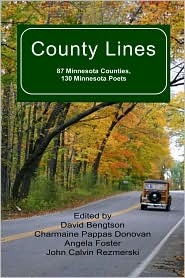
Image source: Goodreads.

Uncovering rocks. Uncovering a dried mouse carcass. Uncovering a dried black banana. Uncovering poetry that resonates. Within the span of several hours, I found winter’s remains and a treasure of a poetry collection.

County Lines uncovers the stories of Minnesota in poetic voice from lesser-known to well-known Minnesota writers. Poets like David Bengston, Robert Bly, Philip S. Bryant, Susan Stevens Chambers, Charmaine Pappas Donovan, Angela Foster, Larry Gavin, Laura L. Hansen, Sharon Harris, Margaret Hasse, Bill Holm, John Calvin Rezmerski, Candace Simar, Joyce Sutphen and so many more.

From Willmar to Hibbing to Lac qui Parle and, oh, so many places in between, the layers of our state, our people, our stories, our history, our heritage are revealed. This April day I celebrate National Poetry Month in a Minnesota poetry book pulled from the #811 shelves at Buckham Memorial Library in Faribault.

#

FYI: Former Minnesota Poet Laureate Joyce Sutphen will read from her newest poetry books, Carrying Water to the Field and The Long Winter, at 1 pm Saturday, April 23, at the Little Falls Carnegie Library. “Making Rural Connections Through Poetry with Joyce Sutphen” focuses on the loss of small farms in Minnesota. Sutphen grew up on a Stearns County farm. Three of her poems are featured in the “Stearns County” entries in County Lines.

TELL ME: Do you have a favorite book of poetry you’d like to recommend? Or, if you’ve written a book (s) of poetry, please feel free to share information here.

© Copyright 2022 Audrey Kletscher Helbling


Faith art focus during Holy Week April 14, 2022

The birth of Christ depicted at St. Michael’s Catholic Church, Buckman, Minnesota. This is my husband’s home church. (Minnesota Prairie Roots file photo September 2020)

STAINED GLASS ART graces many a church. Most often that art depicts the history of Jesus’ birth, death and resurrection.

This stained glass window inside the Mother of Good Counsel Votive Chapel at The Shrine of Our Lady of Guadalupe, La Crosse, Wisconsin, depicts Mary and Jesus. I often think of Mary during Holy Week and how great her loss in losing her son. (Minnesota Prairie Roots copyrighted file photo 2015)

So it’s fitting that this week, Holy Week, I share some images from my archives of beautiful stained glass windows discovered in my wanderings. As a woman of faith, an art appreciator and one who values churches, I am drawn to this art form.

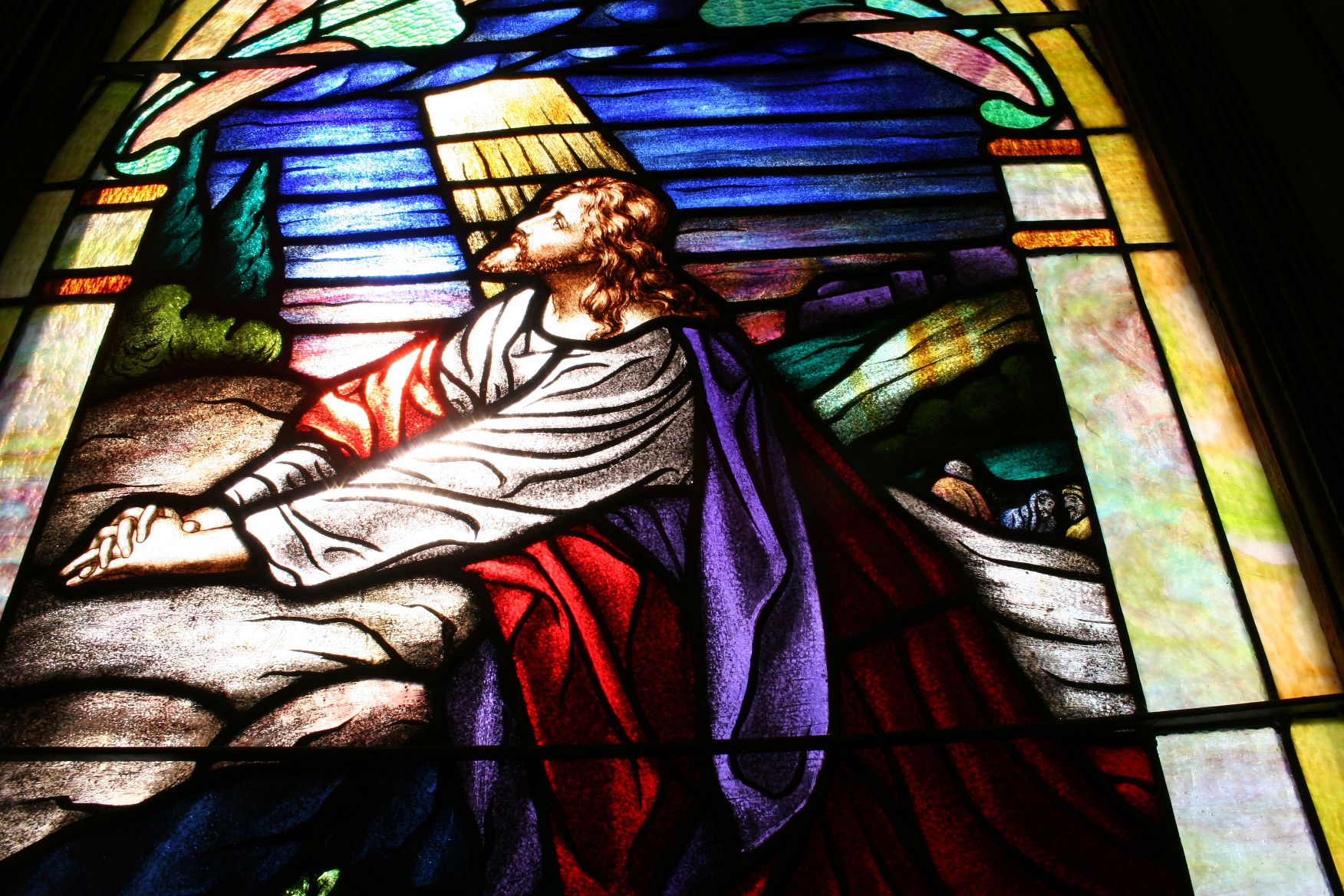
Jesus prays in the Garden of Gethsemane. Stained glass window in the sanctuary of Vang Lutheran Church, rural Dennison, Minnesota. (Minnesota Prairie Roots copyrighted file photo 2014)

My husband, Randy, has dabbled in stained glass art and I know from watching him that creating this art takes time, patience, skill and dedication. He took a stained glass class locally decades ago, has crafted several sun catchers and also repaired aged windows at our church, Trinity Lutheran in Faribault. I hope that when he retires, he can more fully embrace this art form.

Jesus carries his cross to Golgotha. Stained glass at St. Michael’s Catholic Church, Buckman. (Minnesota Prairie Roots copyrighted file photo September 2020)

That sidebar aside, I feel such gratitude to those long ago craftsmen who labored to create stained glass windows for churches. Such windows enhance worship, infusing a sanctuary with beauty and a visual telling of biblical stories. Like the birth of Jesus. The agony of his suffering, death and glorious resurrection.

A stained glass window inside Holden Lutheran Church, rural Kenyon, Minnesota, depicts Jesus’ crucifixion. (Minnesota Prairie Roots copyrighted file photo 2016)

Like illustrations in a book, the art of stained glass adds to the words, opens our eyes to better see that which we hear and read.

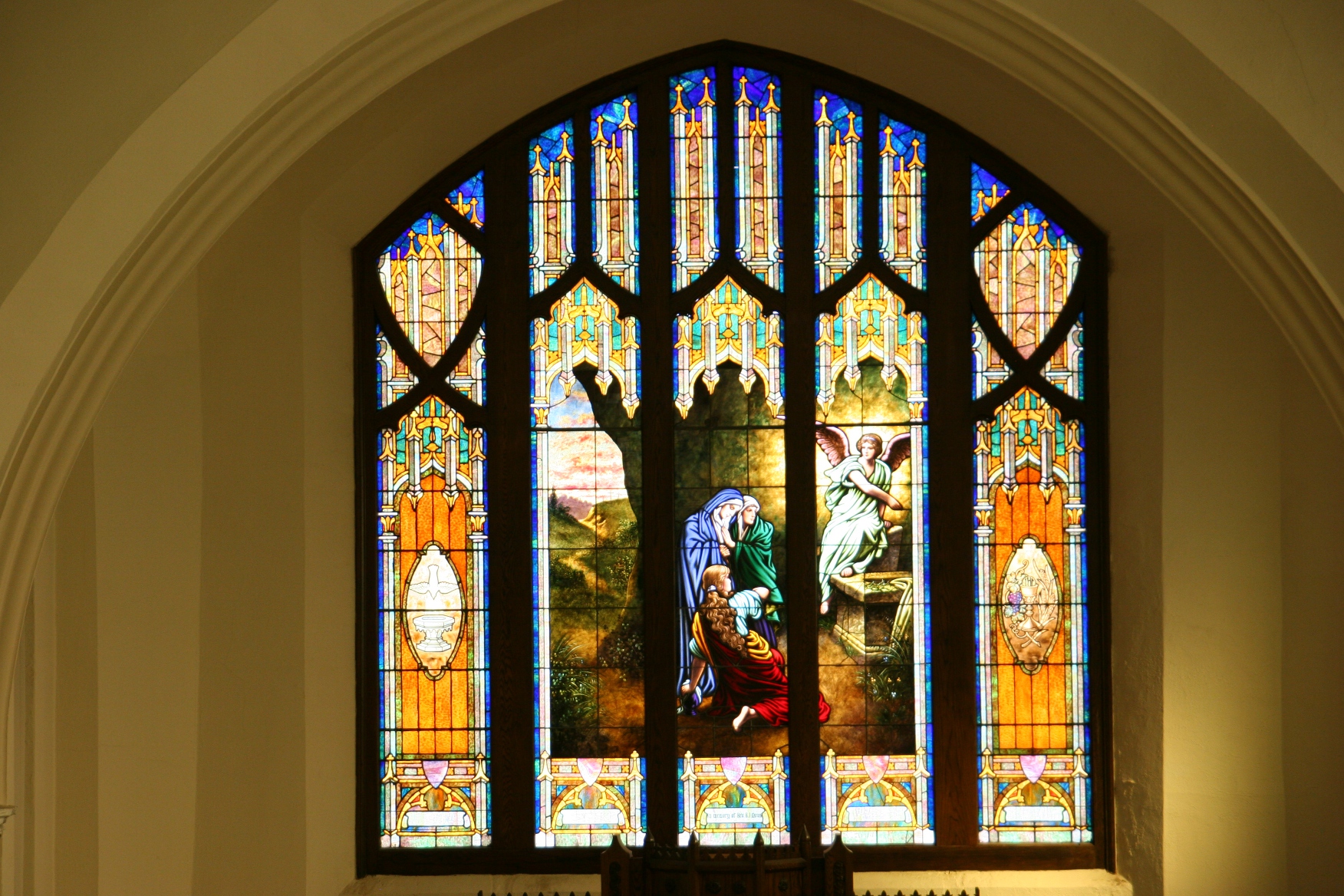
This stained glass window of the women and angel at Jesus’ empty tomb rises above the altar at Holden Lutheran Church, rural Kenyon, Minnesota. (Minnesota Prairie Roots copyrighted file photo 2016)

Art adds a depth to my understanding and to my faith.

This shows a snippet of the center stained glass window in a trio above the altar at Trinity Lutheran Church, Wanamingo, Minnesota. This section shows Jesus risen from the dead. (Minnesota Prairie Roots copyrighted file photo 2016)

As we near the end of Holy Week, please take time to reflect on the stained glass art here or within your own community.

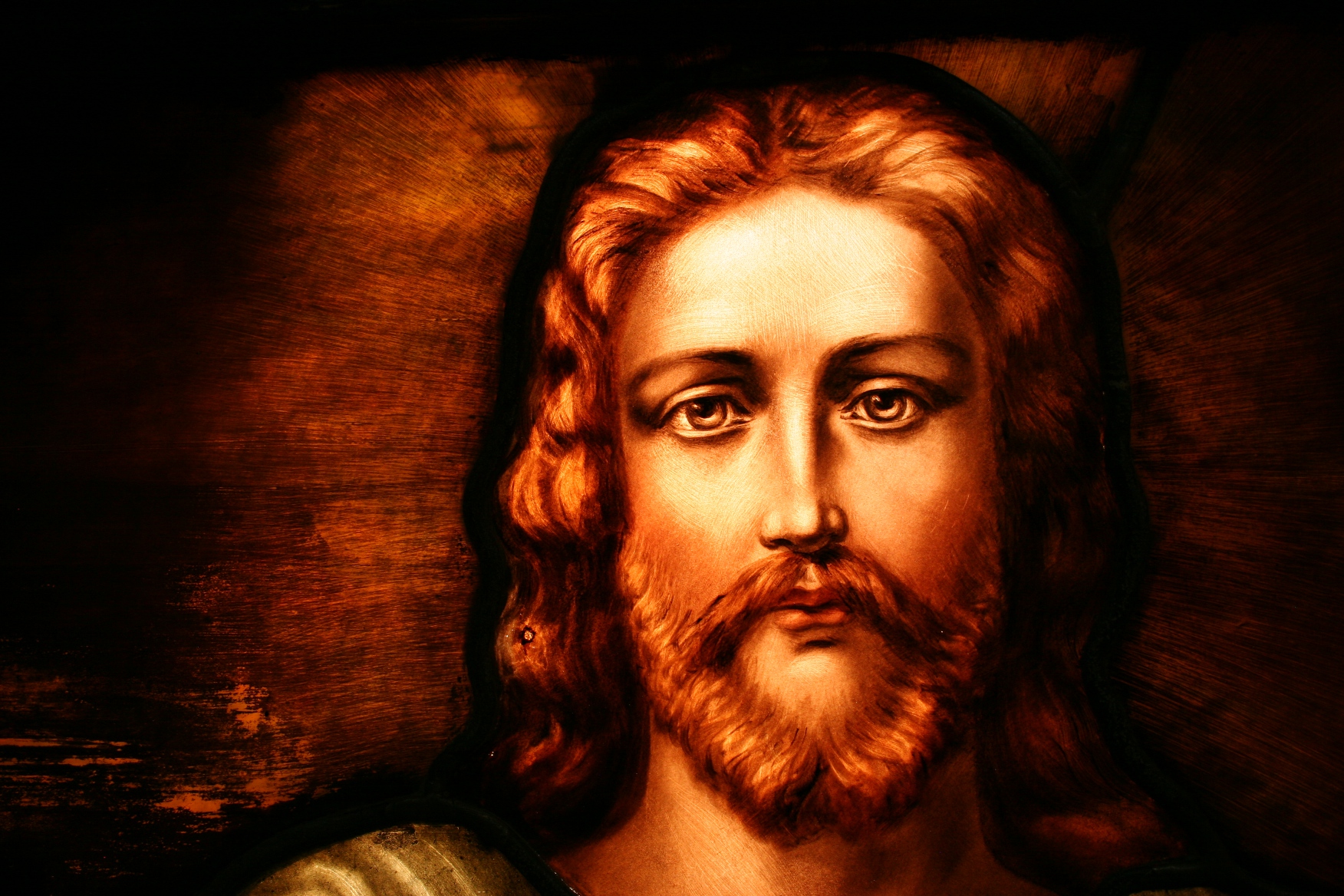
A photo of Christ’s face from a stained glass window in my church, Trinity Lutheran, Faribault. (Minnesota Prairie Roots copyrighted file photo 2012)

And may this art bless you as it has me. Have a joyful and blessed Easter!

© Copyright 2022 Audrey Kletscher Helbling


Elusive grief April 13, 2022

Filed under: Uncategorized — Audrey Kletscher Helbling @ 5:00 AM
Tags: , , , , ,
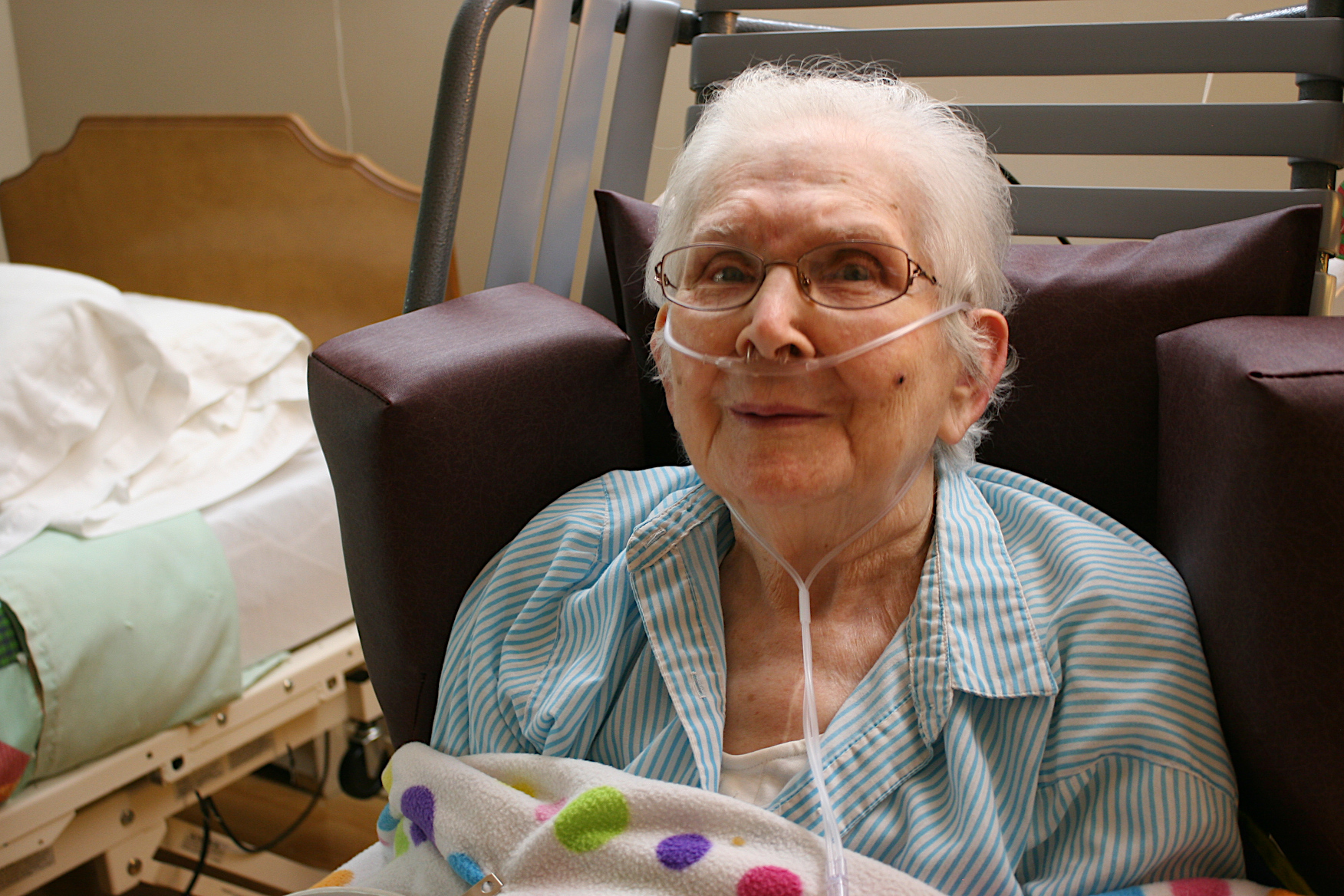
Me with my mom during a January 2020 visit. (Minnesota Prairie Roots copyrighted file photo January 2020 by Randy Helbling)

JANUARY 13, 2022. Three months have passed since my mom died. Sometimes that feels like forever. And sometimes like yesterday.

In all that time, I have yet to grieve like I feel I should. That is a heart-wrenching, full-out crying session of shoulders heaving, tears gushing, emotions overtaking me.

And I keep asking myself, “Why can’t I cry?” I loved my mom and I miss her and losing her is one of life’s greatest losses.

The answer to my self-imposed question seems multi-layered. Losing my mom was a gradual process. One of declining health paired with an inability to connect with her during these awful years of a global pandemic. Long before her death, she lost the ability to talk on a telephone. So my weekly Sunday evening phone calls to her ceased. My last long-distance conversations with her were via speaker phone, me talking “at” her rather than “to” her.

One of my last portraits of Mom. We had a particularly good visit that day. (Minnesota Prairie Roots file photo July 2021)

As Mom’s memory and overall health faded, even our rare in-person visits at her care center proved difficult. I reminded myself that I was there for her, not for me. And that helped. If she connected with a flicker of recognition or a smile or a few words, then I felt grateful. It was always about her. Not me. Always.

Today I feel an emptiness. A void. An absence.

Her public funeral (not something I wanted/supported) did not provide an outlet for my grief. It was not a funeral as usual for me at the height of omicron. I did not stand in a receiving line accepting hugs and hand shakes. That was way beyond my comfort level among the unmasked in a crowded fellowship hall and sanctuary in rural southwestern Minnesota. I felt disrespected as a grieving daughter and nearly did not attend the funeral due to the health risk (to myself and others). But I mustered through, feeling like a masked outsider at my own mother’s funeral. Grief and comfort eluded me on Mom’s burial day because of choices made. And not necessarily just my choices.

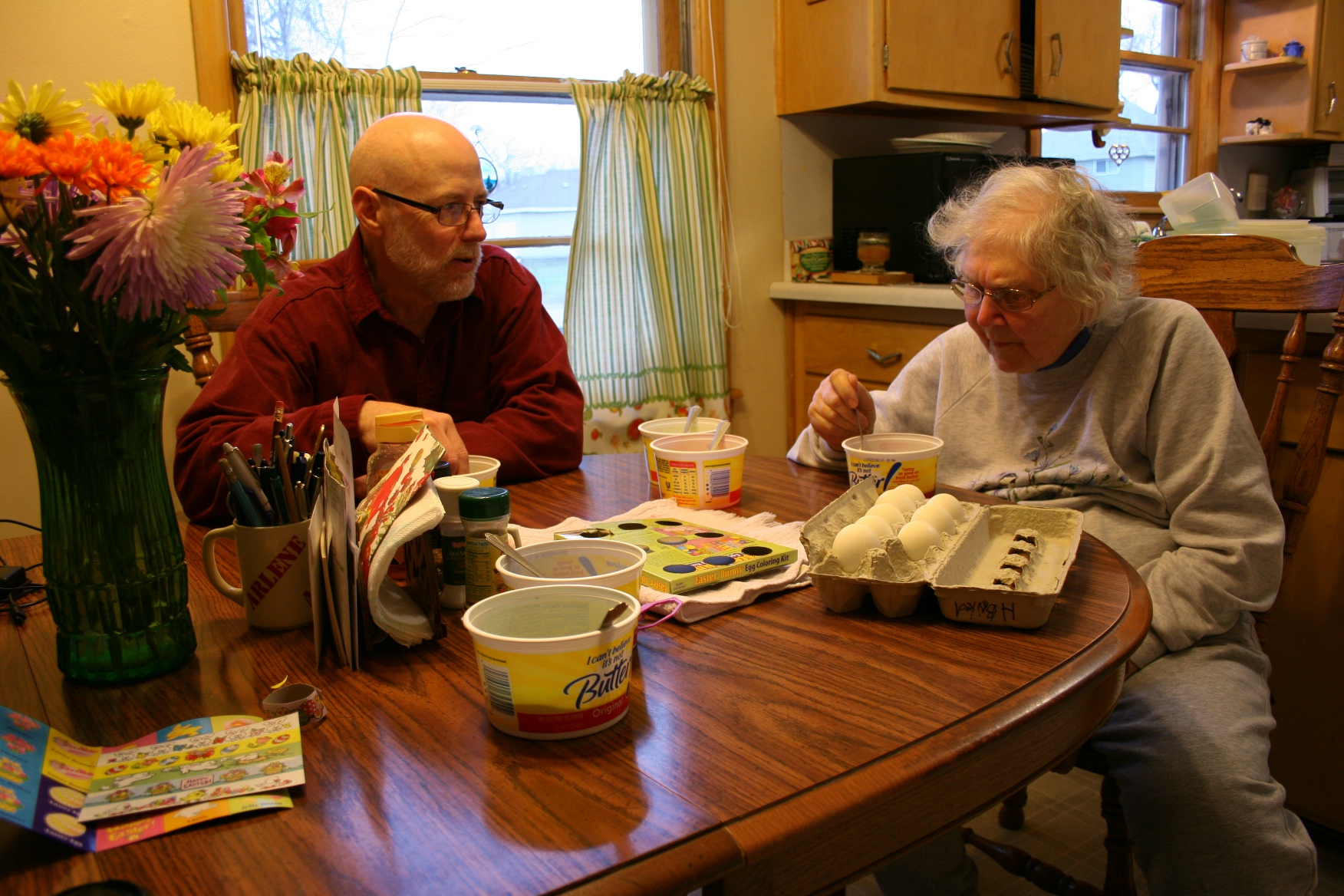
Randy and Mom dye Easter eggs in her home in 2014. (Minnesota Prairie Roots copyrighted file photo April 2014)

And so here I am today, three months later. Recently I stood before a rack of Easter-themed greeting cards at Dollar Tree. My eyes scanned the labels—for daughter, son, granddaughter, grandson…then focused on “Mom.” And in that moment I felt the pain of losing Mom and I remembered the Easter of 2014 when Randy and I traveled 120 miles to my hometown of Vesta to spend the holiday weekend with her. I recall how she delighted in dyeing eggs, giddy like a child. Oh, to bring her such joy. But that April visit also proved a pivotal point for Mom. We observed her debilitating chronic pain, her inability to get around. Shortly thereafter, she moved into assisted living. Eventually, she would land in the nursing home wing of Parkview, her home for nearly eight years.

One of the many inspirational pieces Mom clipped and saved. (Minnesota Prairie Roots photo)

As I reflect on Mom’s journey, I feel thankful that she lived to age 89, nearing 90. Too many times during her life, we did not think she would survive major health crises. A viral infection in her heart nearly killed her in the early 1980s. Open heart valve replacement surgery followed. She nearly bled to death another time. Pneumonia almost claimed her life years later. A broken neck resulting from a fall placed her in a metro area ICU trauma unit. Countless times we gathered at her bedside to say our goodbyes. But each time Mom pulled through and relief washed over me. Once more.

Did all of those near-death experiences factor into how I feel today about Mom dying? Perhaps. I’d mentally prepared myself and said “goodbye” so many times in the past. Now when I need to grieve, grief feels elusive.

Her name remains in black marker on my whiteboard prayer list. I thank God for bringing her to faith, for blessing me with her as my mother, for the long life she lived.

Her name remains inked, too, in my address book. I can’t bring myself to X it out, for doing so means finality.

I expect prior to Mother’s Day, when I’m standing before the card rack at Dollar Tree searching for a card for my daughter, my eyes will scan the labels then land on “For Mom.” And when that happens, grief will rise. Not in tears, but in the way grief sneaks up on you in the most ordinary of ways and clenches your heart with pain.

#

JUST A NOTE: I recognize that grief is a process, one that takes time and differs for everyone. I recognize that many of you are also grieving and that you, too, may have experienced a loss of public comfort and grief during the pandemic. I’m sorry. I understand. I empathize. You are not alone. I care. Others care.

© Copyright 2022 Audrey Kletscher Helbling


From the heart of Northfield: A sculpture reflects community love April 12, 2022

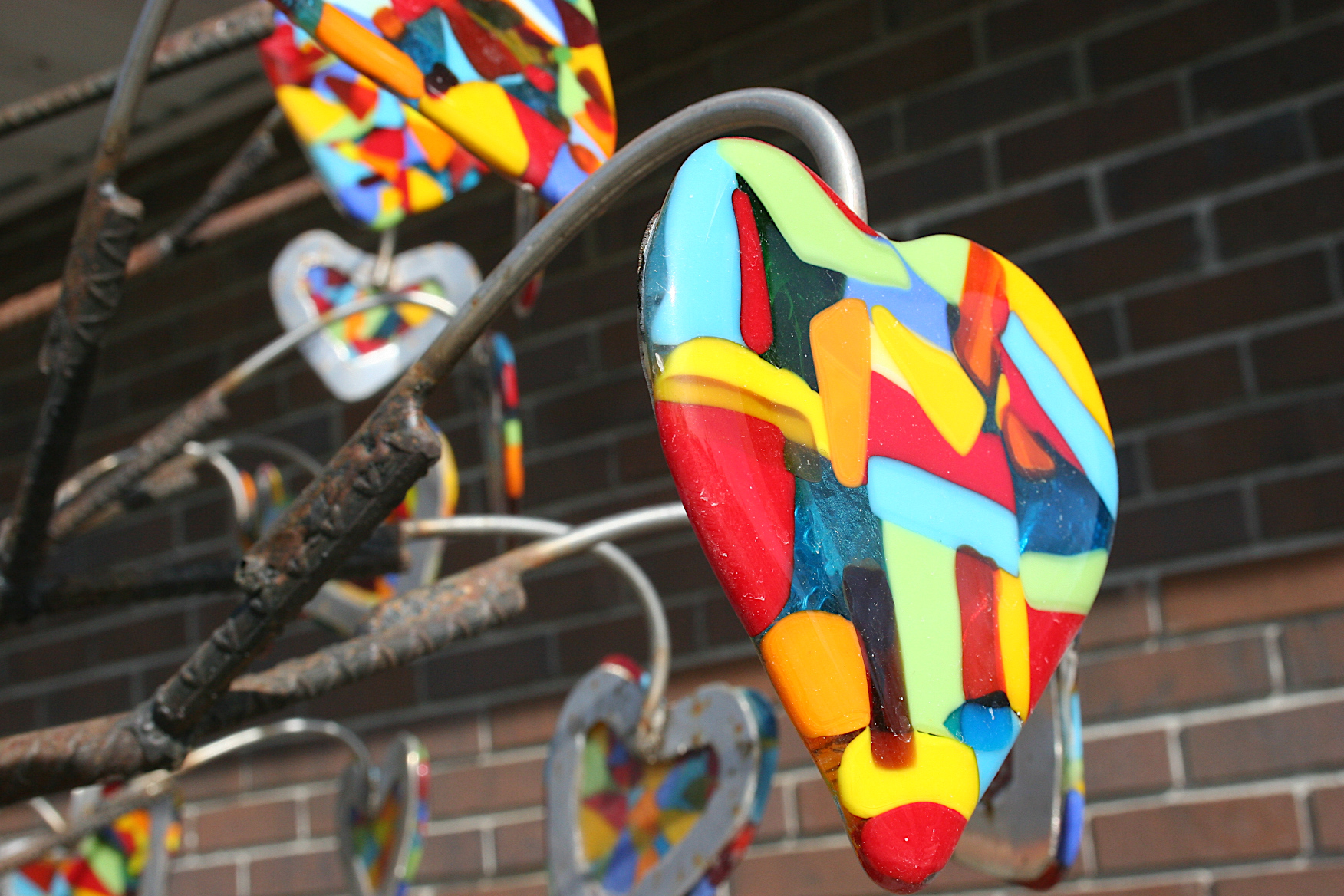
Fused glass hearts on the sculpture “Spreading the Love.” (Minnesota Prairie Roots copyrighted photo February 2022)

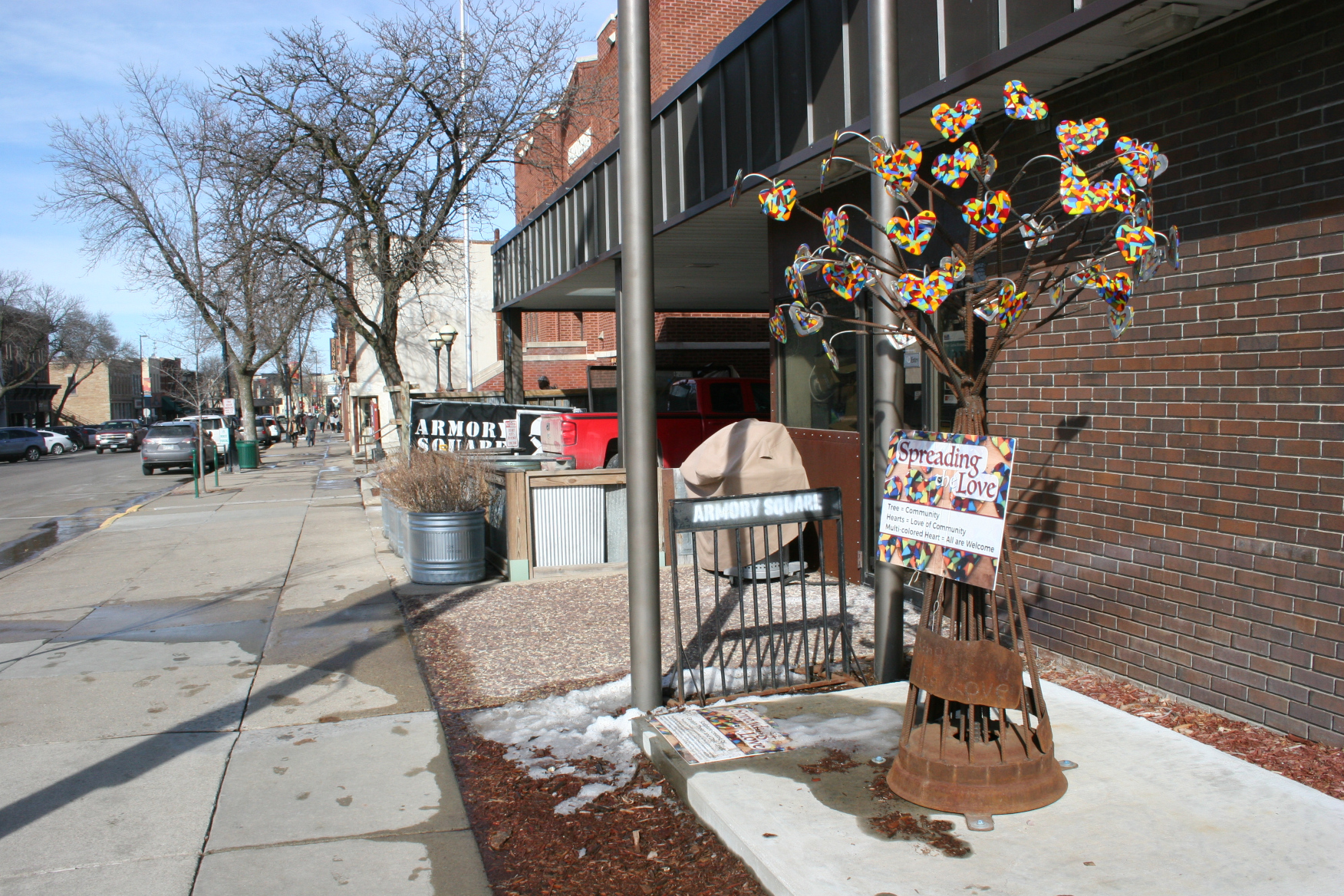
IN SOME WAYS, the “Spreading the Love” sculpture reminds me of a box of crayons. It’s a boldly colorful work of art sidling next to a sidewalk near the corner of Division and Sixth Streets in downtown Northfield.

The sculpture is located along Division Street, near Armory Square and Imminent Brewing. (Minnesota Prairie Roots copyrighted photo February 2022)

The crayon comparison comes in the mix of colors that combine in fused glass hearts created by Geralyn Thelen. The Northfield glass artist crafted the sculpture in collaboration with Hastings metal artist Dale Lewis as part of the 2020 Artists on Main Street Program.

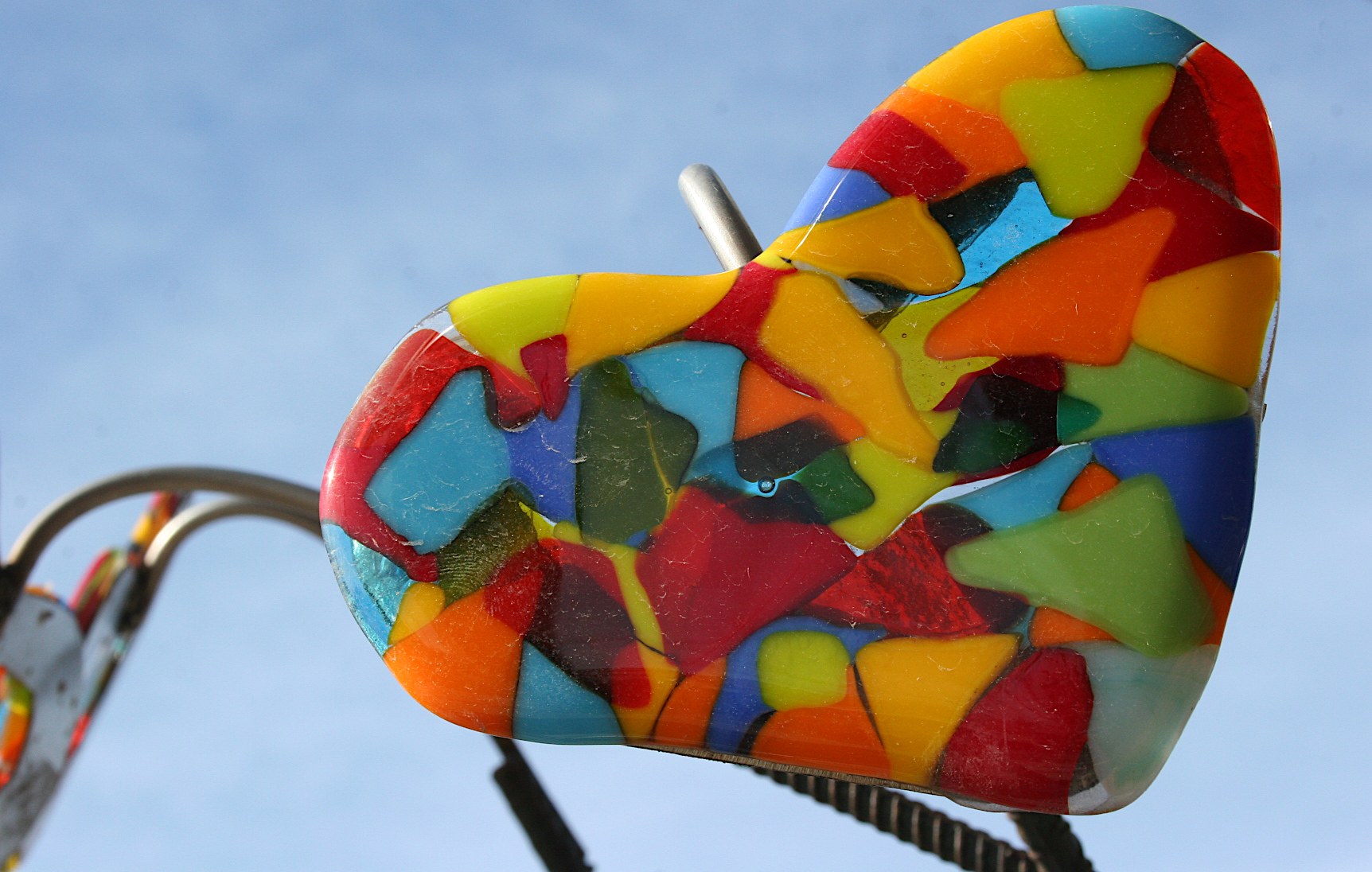
Against a blue sky, a bold and beautiful multi-hued heart. (Minnesota Prairie Roots copyrighted photo February 2022)
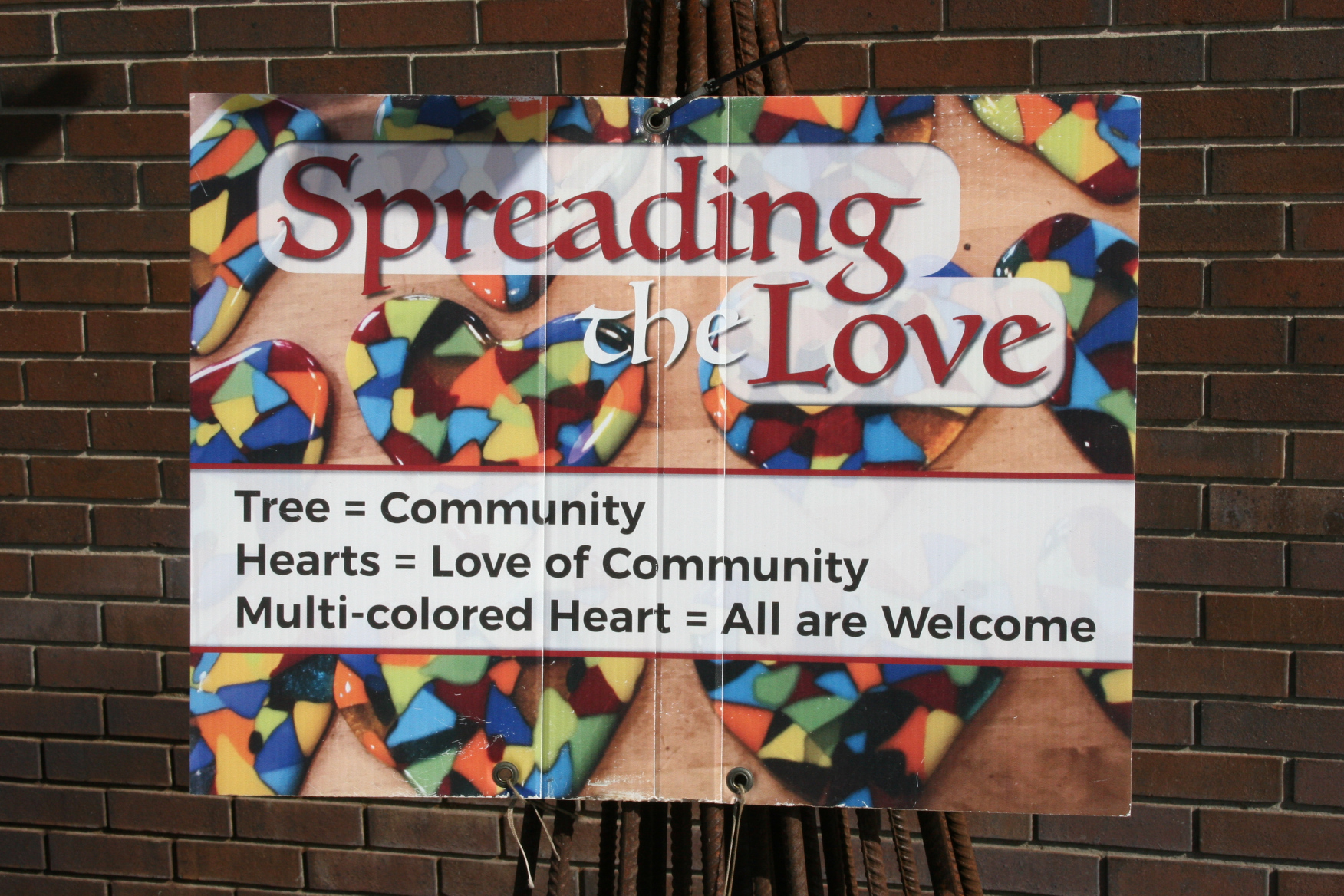
Signage explains the meaning of the sculpture. (Minnesota Prairie Roots copyrighted photo February 2022)
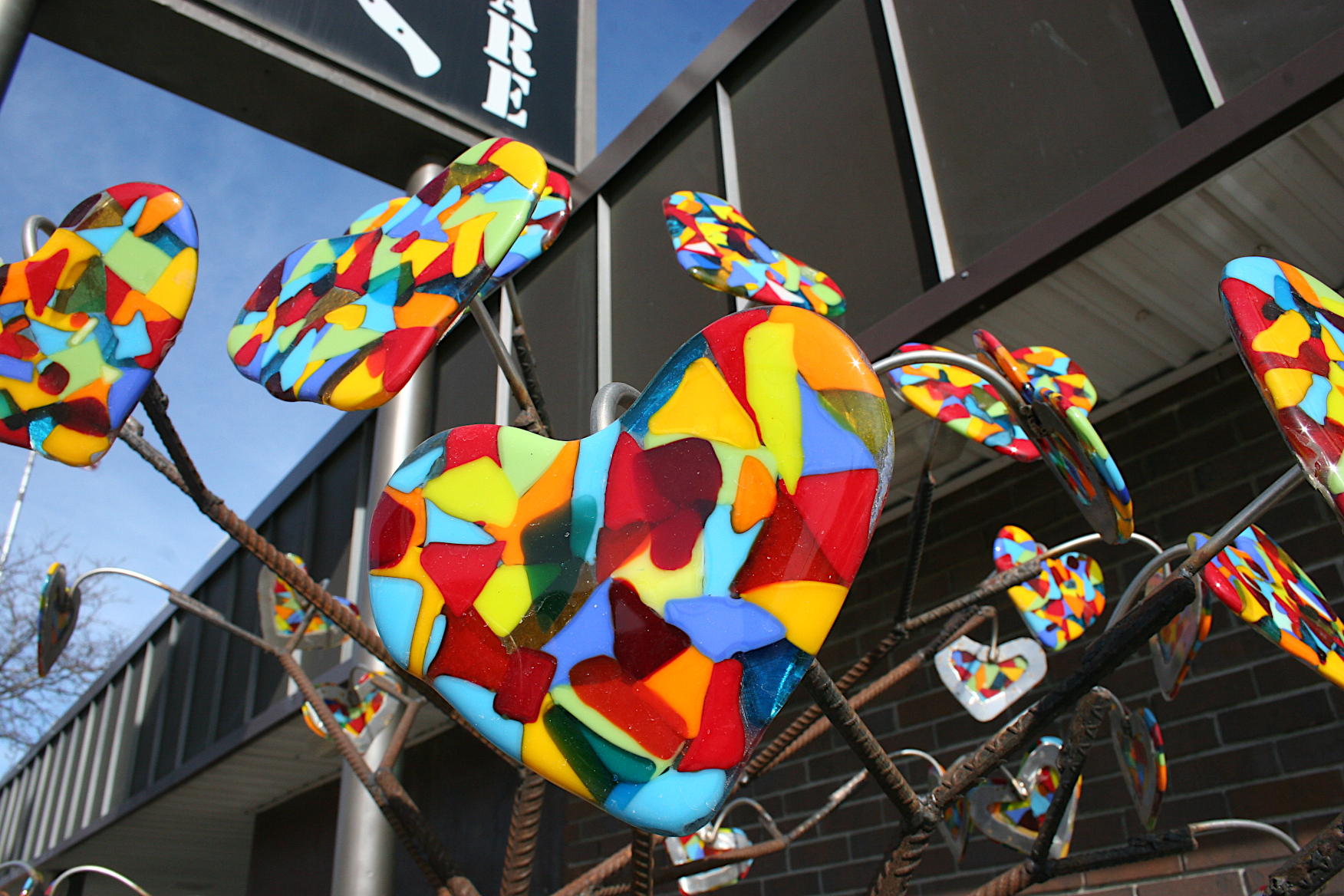
The heart-filled tree represents community. (Minnesota Prairie Roots copyrighted photo February 2022)

The result is this metal community tree adorned with vibrant heart “leaves.” The heart shape represents love. And the mixed hues of those hearts represent inclusiveness, that all are welcome here.

Many hearts in many colors. (Minnesota Prairie Roots copyrighted photo February 2022)

That brings me back to crayons. Remember the thrill of a new box of Crayola crayons? The scent. The sharp points. The rows of neatly packed colors in, oh, so many hues and shades? What kid didn’t want a box of 64 crayons versus the standard 24?

A full view of “Spreading the Love.” (Minnesota Prairie Roots copyrighted photo February 2022)

Yet, even though we had all those choices in colors, there were expectations. Grade school worksheets directed us to color the sun yellow, the grass green, the horse brown, the heart red, for example. To earn an S+ on a paper, we needed to follow directions. It was a way to teach reading and colors. But that left zero options for creativity, for an opening of the mind.

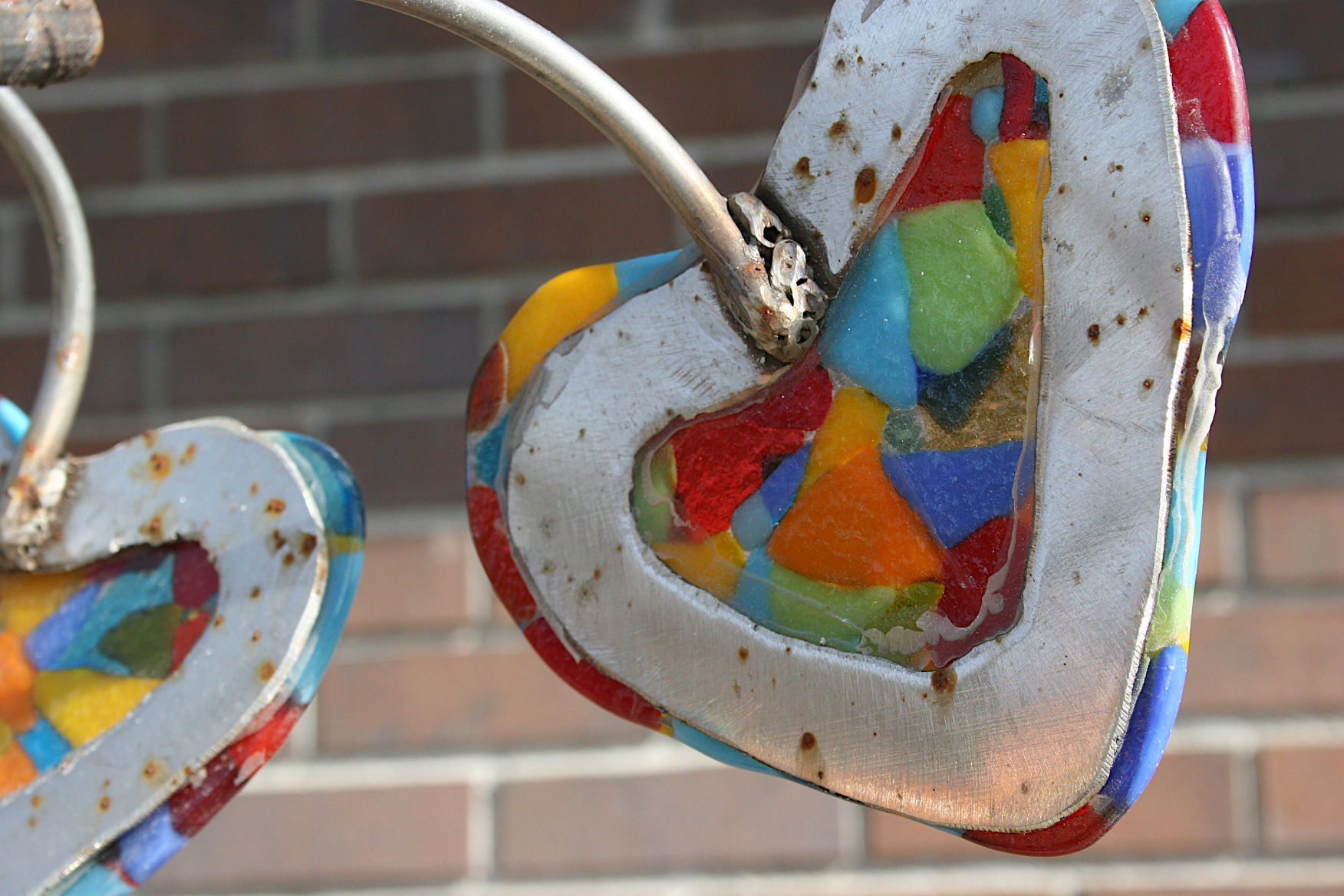
This shows how metal artist Dale Lewis attached the hearts. (Minnesota Prairie Roots copyrighted photo February 2022)

To the child who yearned to use all the colors in the crayon box, following directions stifled creativity in the necessity of conformity. I’d like to think as adults that we consider all the colors in the crayon box. If only that were true.

Geralyn Thelen’s fused glass hearts represent love. (Minnesota Prairie Roots copyrighted photo February 2022)

That’s why projects like “Spreading the Love” hold such value. Art encourages us to see, to think, to open our minds and reflect. To color the sun purple, the grass orange, the horse pink, the heart in a mix of hues. Ours is a multi-colored world of skin tones, beliefs, lifestyles and more. Yet, we all share the commonality of love. Giving love. Receiving love. Feeling loved. And, it is my hope, spreading love.

TELL ME: How do you spread love?

© Copyright 2022 Audrey Kletscher Helbling
 

Planning coffee with a friend, a sign-inspired short story from Northfield April 11, 2022

Filed under: Uncategorized — Audrey Kletscher Helbling @ 5:00 AM
Tags: , , , , , ,
Minnesota Prairie Roots copyrighted photo February 2022

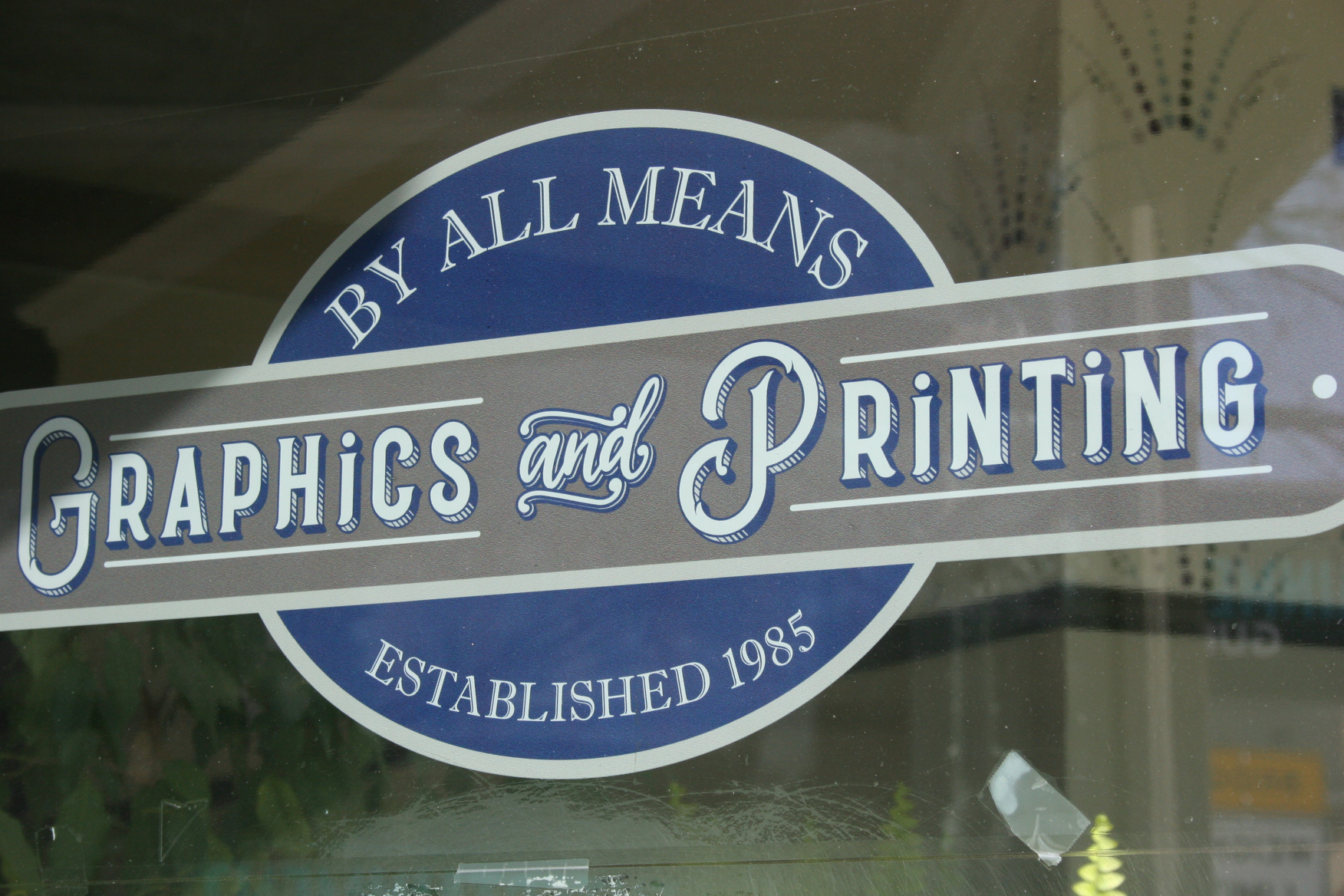
By all means,

Minnesota Prairie Roots copyrighted photo February 2022

let’s take five.

Minnesota Prairie Roots copyrighted photo February 2022

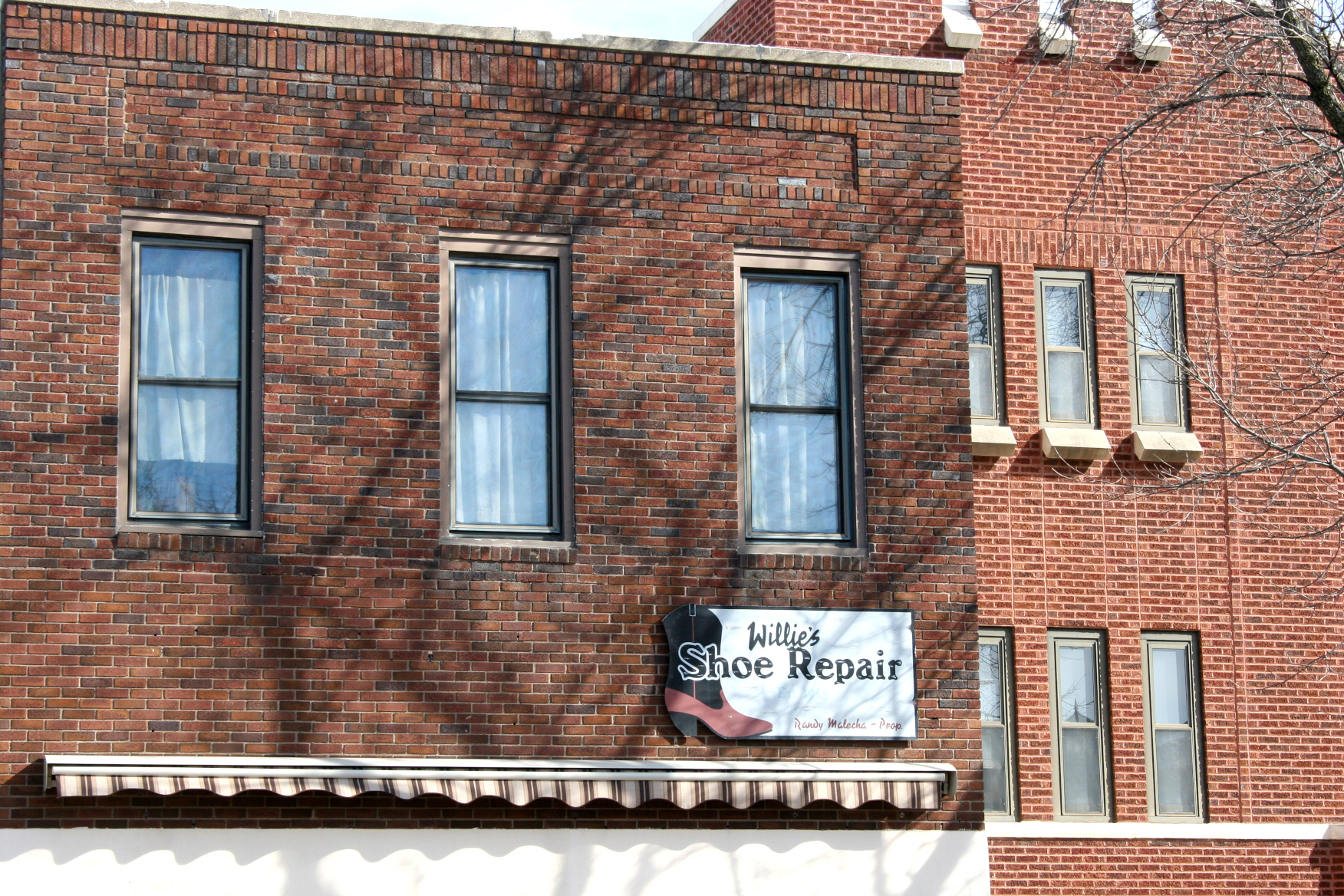
But I gotta stop at Willie’s first for my shoes.

Minnesota Prairie Roots copyrighted photo February 2022

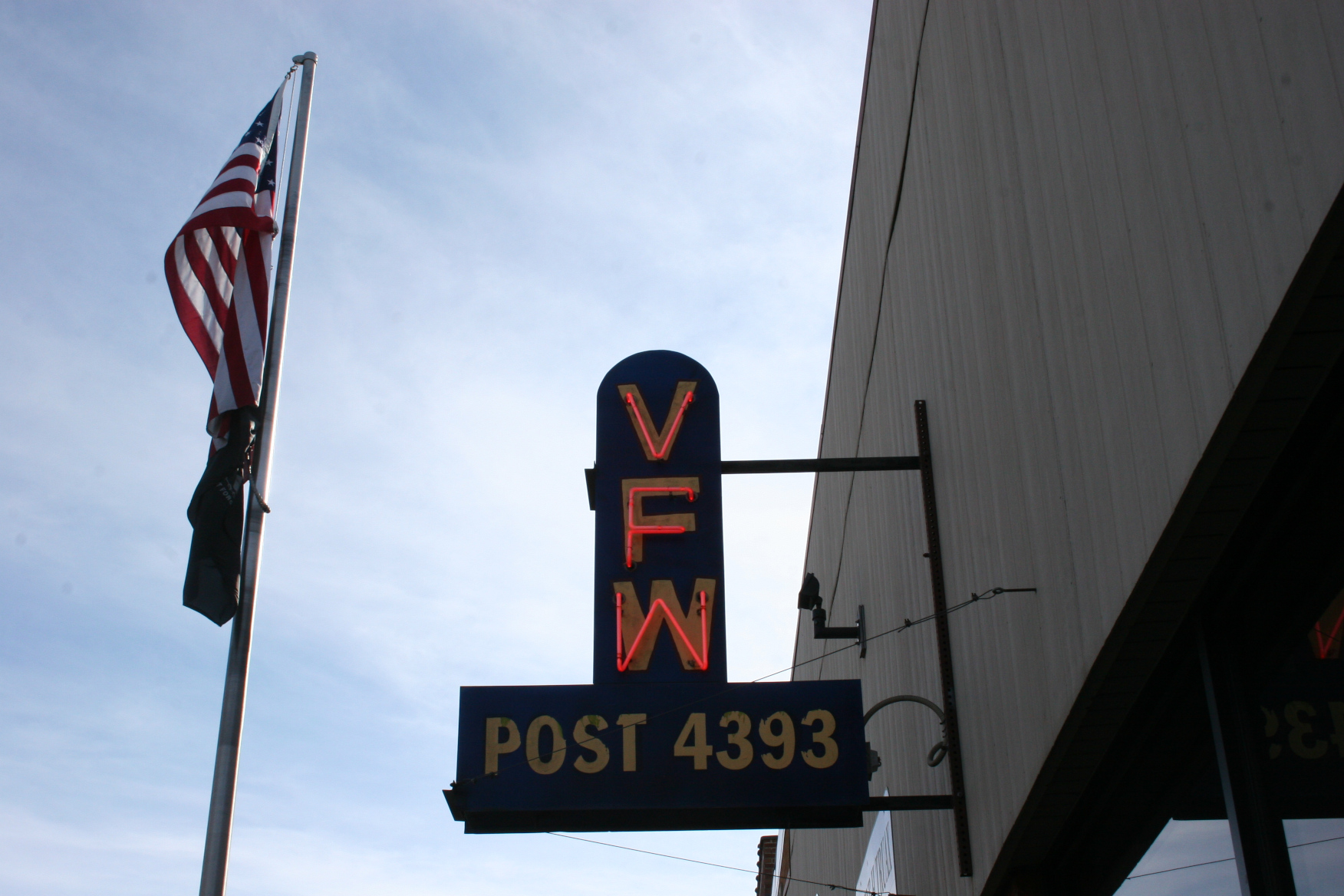
That’s across from the VFW.

Minnesota Prairie Roots copyrighted photo February 2022

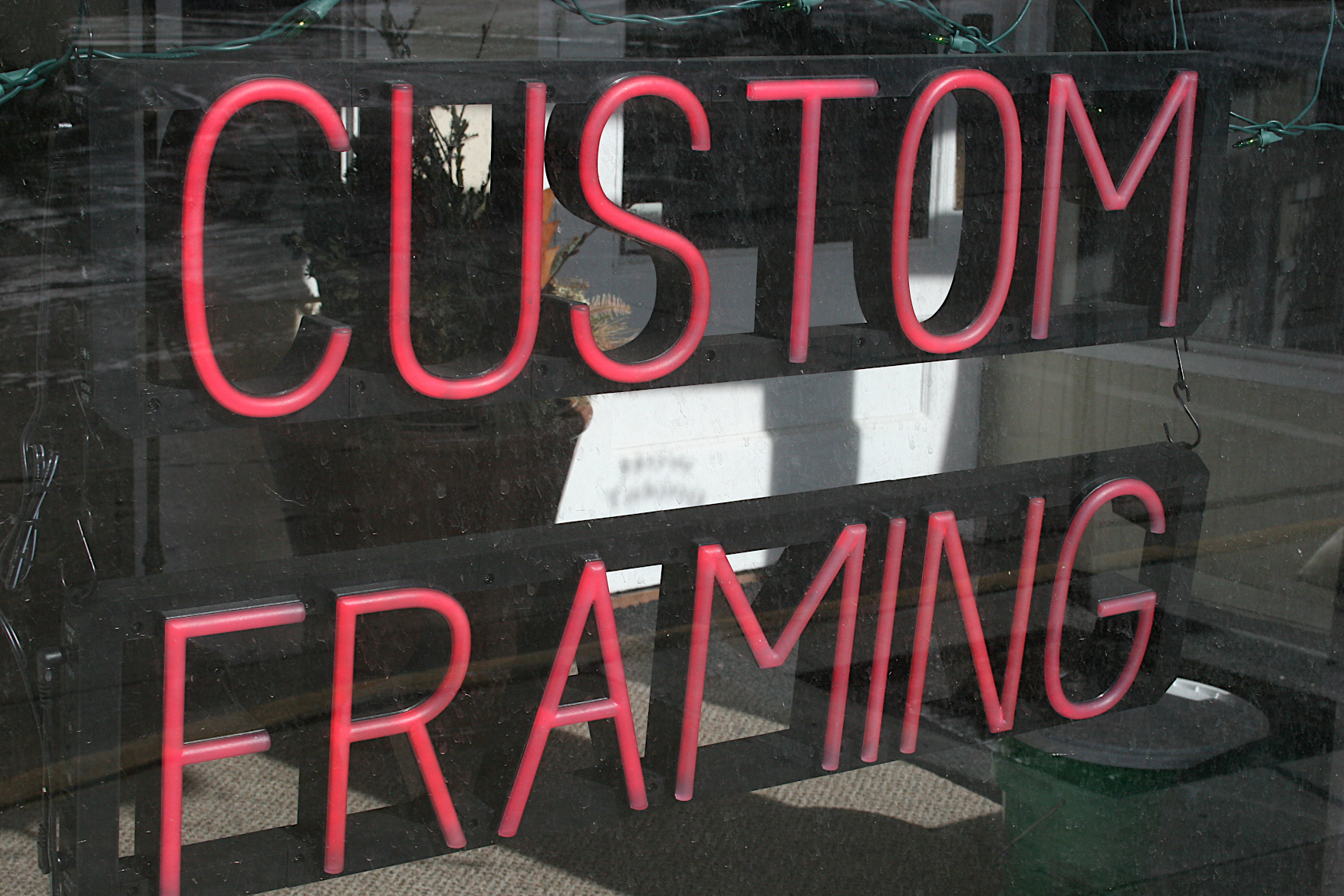
And then I need to pick up my custom framed print.

Minnesota Prairie Roots copyrighted photo February 2022

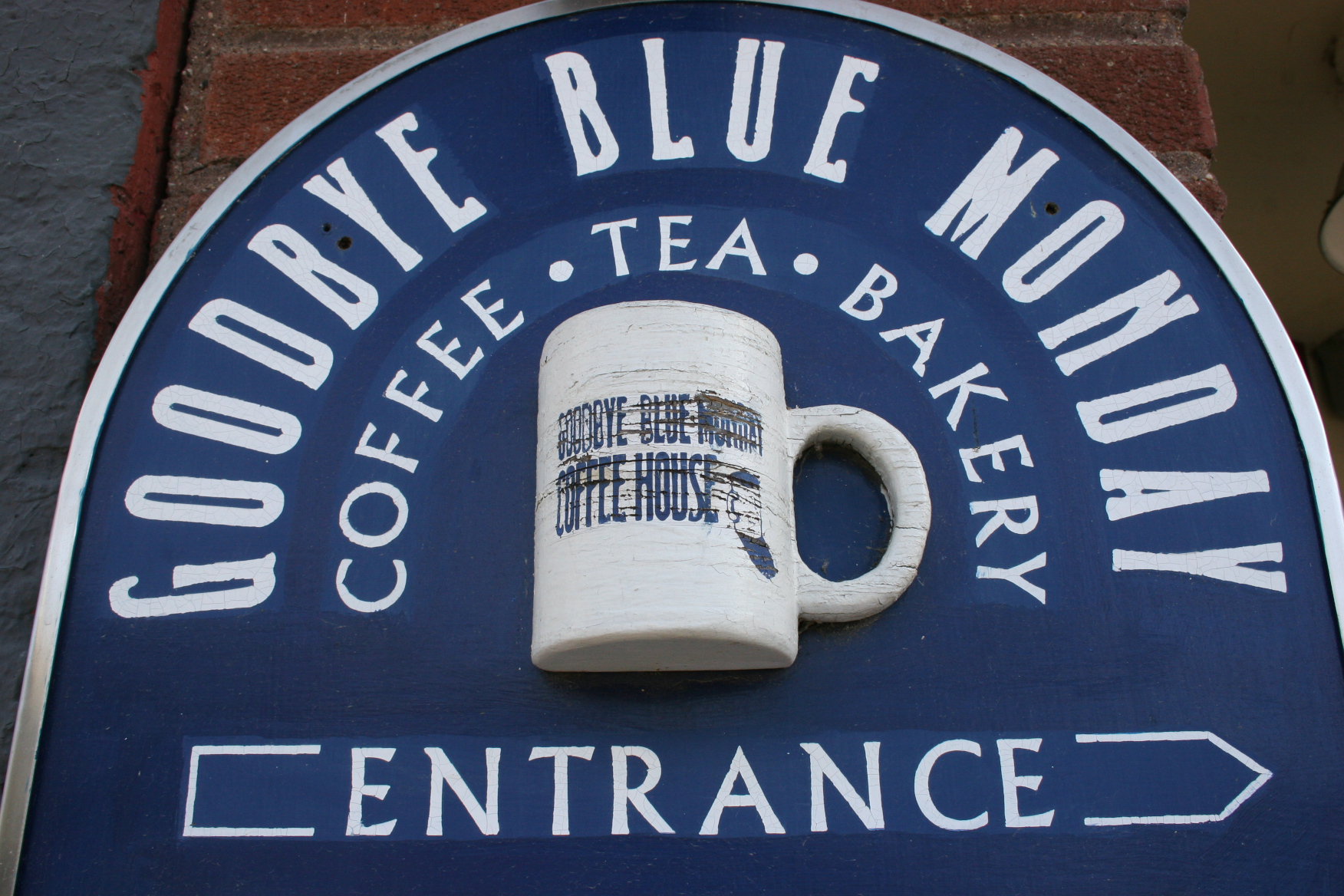
So can we meet at 10 am at Goodbye Blue Monday?

Minnesota Prairie Roots copyrighted photo February 2022

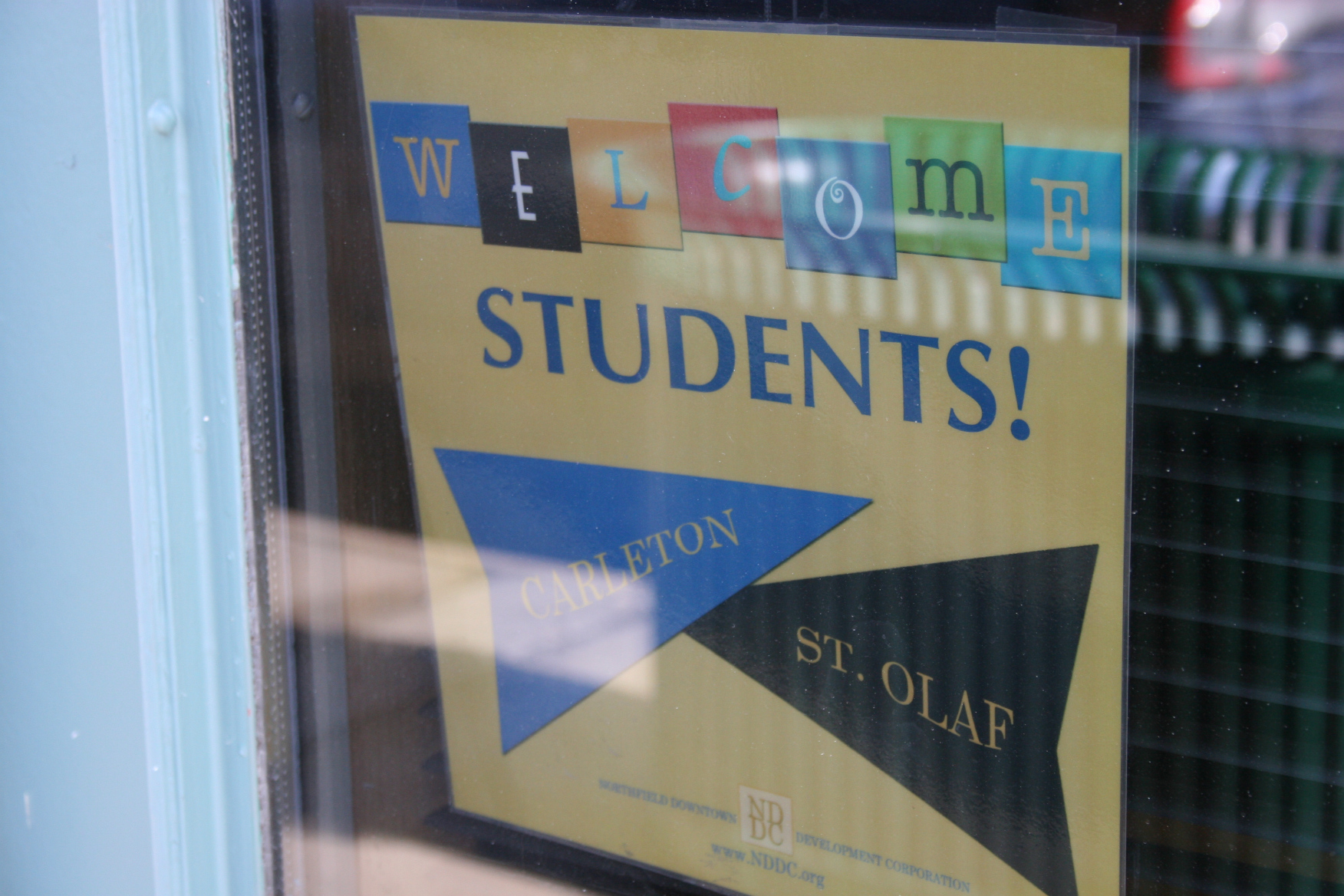
I hope we beat the student rush.

Minnesota Prairie Roots copyrighted photo February 2022

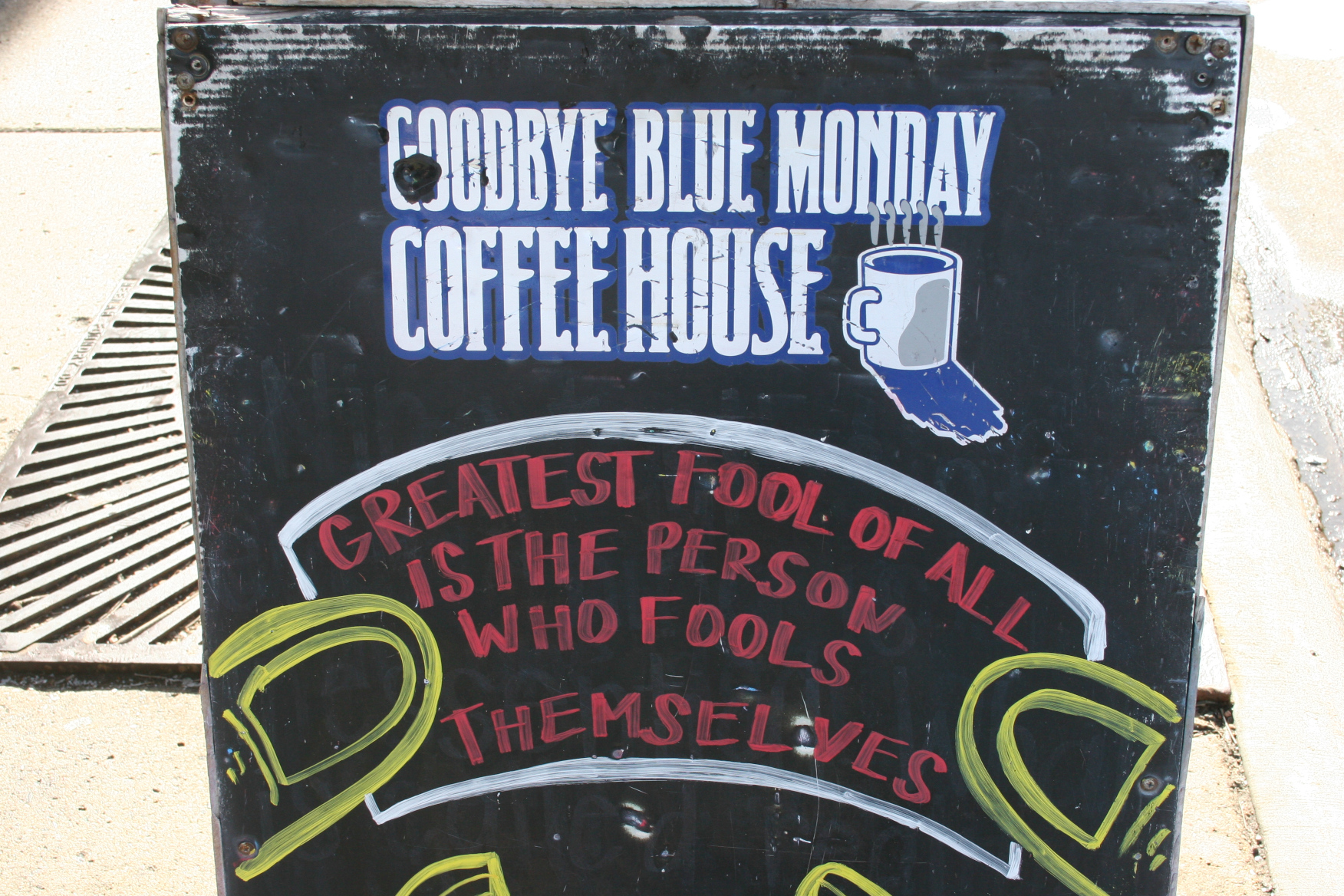
Or maybe I’m fooling myself.

Minnesota Prairie Roots copyrighted photo February 2022

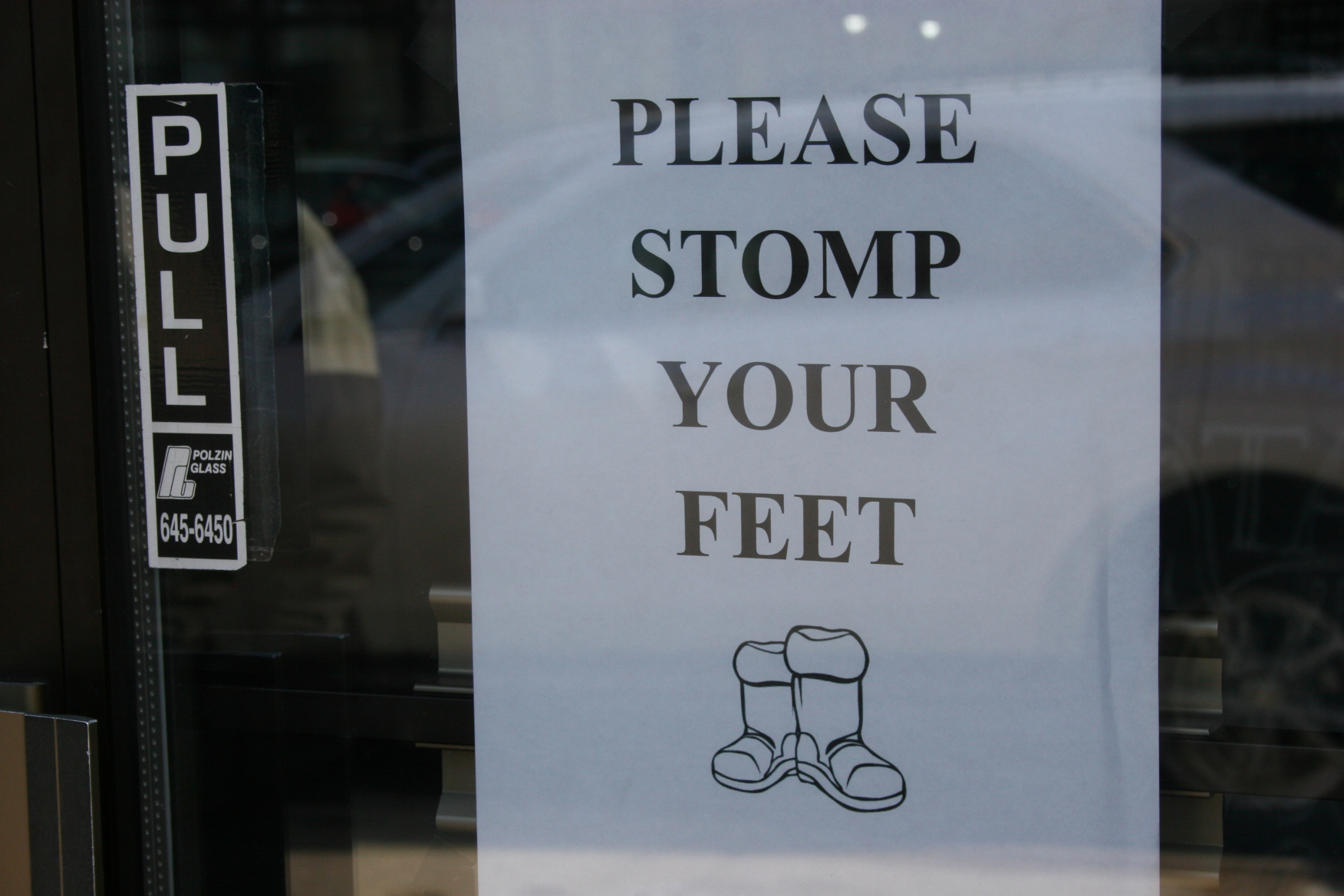
Oh, I see it’s snowing again. Better wear my boots.

Minnesota Prairie Roots copyrighted photo February 2022

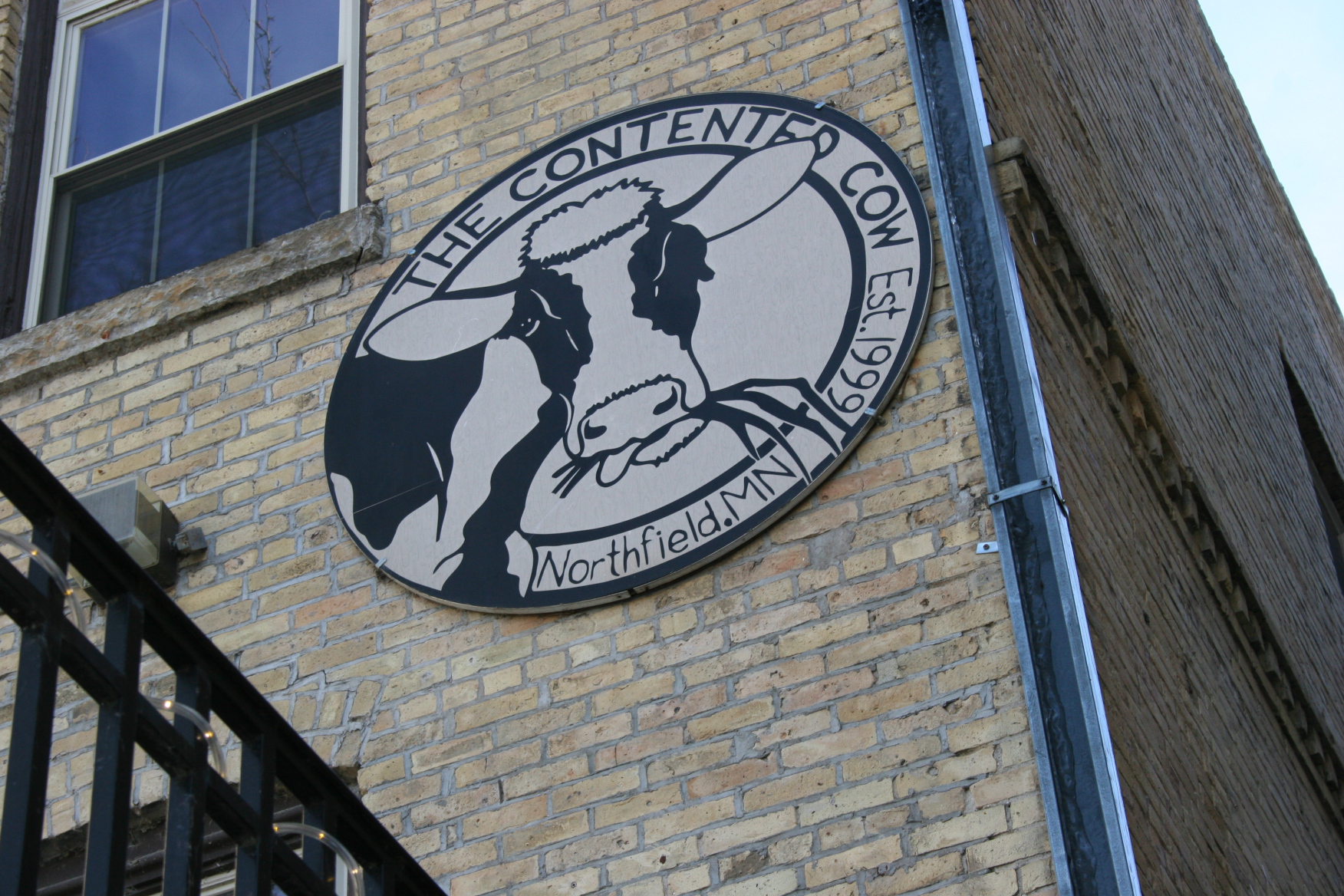
I’ll be as contented as a cow if this winter ever ends.

#

FYI: All photos were taken in historic downtown Northfield, Minnesota, in February.

© Copyright 2022 Audrey Kletscher Helbling


The poetry of “Where the Crawdads Sing” April 8, 2022

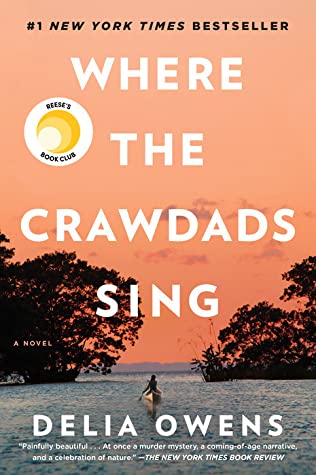
Image source: goodreads

IF I HADN’T CAUGHT the news flash in an entertainment segment on an early morning TV show recently, I doubt I would have read Where the Crawdads Sing by Delia Owens. But I did. And the book proved so riveting that I didn’t want to put it down. You know the type of book, when you stay up past your bedtime to read.

Published in 2018, this New York Times fiction bestseller, releases in July as a movie. So I suppose my timing in reading this is about right. Not that I will see the film. Big screen versions, after I’ve read a book, usually disappoint. Plus, I am not a movie-goer; the last time I went to a movie (three years ago), I walked out and asked for a refund (which I got).

All that aside, that I read Where the Crawdads Sing in April, National Poetry Month, is also fitting. More on that in a bit.

First a summary: Set along the coastal marshes of North Carolina, this book tells the story of young Kya, beginning in 1952. Her family abandons her and she grows up, isolated, alone, connecting with nature. Known to locals as “Marsh Girl,” she reads poetry to gulls, boats through the marshland, immerses herself in learning and studying and documenting the surrounding natural world.

In following her story, which is much more complicated than someone living alone in a remote location, I learned a lot about an area of the US I’ve never even come close to visiting. That includes the many birds which focus Kya’s attention. It’s good for me to stretch my reading wings to a region unfamiliar to me. To learn of landscape, sea life, culture, food, peoples and more in a focused time period, primarily 1960-1970.

The book broadens to include a mystery—the death of a well-known young man from the coastal town of Barkley Cove. Even the name of that community sounds foreign to my Minnesota ears. His life intertwines with Kya’s and that’s what left me wanting to stay up late reading.

Themes of abuse, abandonment, isolation, misconceptions, meanness, prejudice, privilege and small town narrow-mindedness thread through the pages of Where the Crawdads Sing. Love, too.

Author Delia Owens also weaves poetry into pages in poems quoted. Poems by Emily Dickinson. By Pulitzer Prize-winning poet James Wright, who taught in Minnesota at the University of Minnesota and Maclester College. By Amanda Hamilton (there’s a surprise). A fisherman named Scupper proclaims his love of poetry, declaring that poems “make ya feel something.” He’s right.

I encourage you to read this book for the story, the strong sense of place and, yes, for the poetry.

TELL ME: Have you read Where the Crawdads Sing? If yes, what are your thoughts and will you see the movie?

© Copyright 2022 Audrey Kletscher Helbling


Missing in Minnesota: Daryl Budenski & too many others April 7, 2022

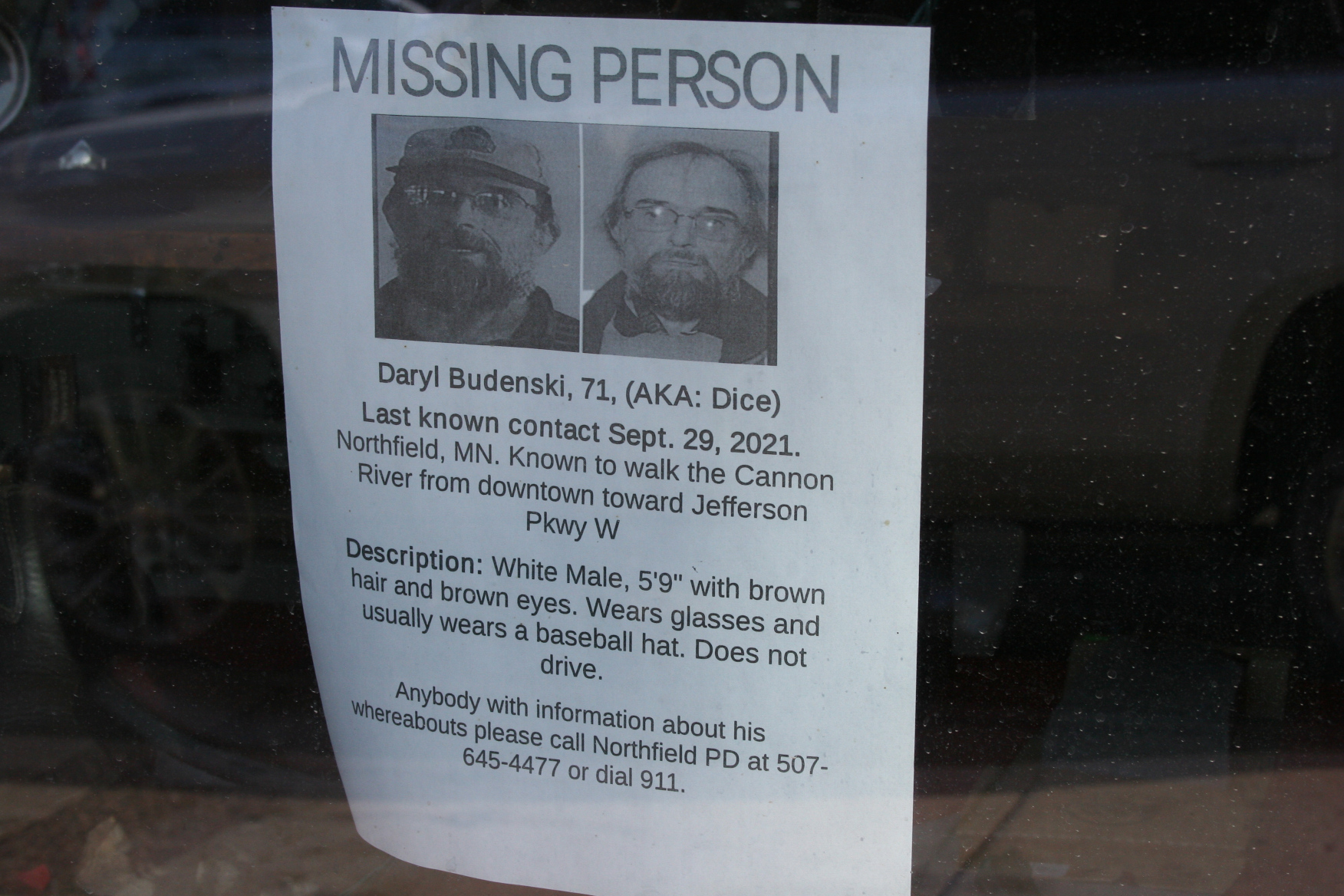
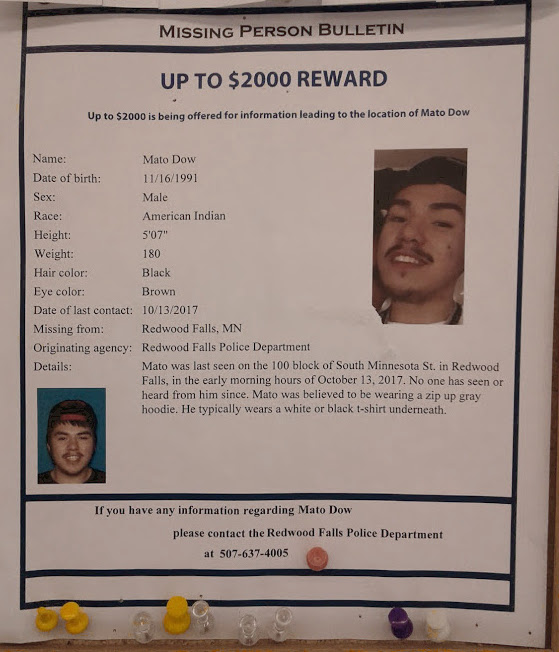
Photographed in February in the window of a downtown Northfield, Minnesota, business, a missing persons poster for Daryl Budenski. (Minnesota Prairie Roots copyrighted photo February 2022)

I EXPECTED TO FIND his name and profile on the list of missing persons in Minnesota. But Daryl Budenski is not on the Minnesota Bureau of Criminal Apprehension’s “Minnesota Missing and Unidentified Persons Clearinghouse” online site. The Northfield man went missing on October 1, 2021. The Northfield Police Department has termed him an “endangered missing person due to possible onset dementia.”

That BCA site is “a tool to assist in the recovery of missing children and adults in the state of Minnesota” and posts information about those reported missing to a law enforcement agency. I expect specific criteria exist for placement on that list.

In Northfield the search continues for the 71-year-old man affectionately known to locals as “Dice.” Budenski was last seen around 3:30 pm September 30, 2021, near Koester Court Apartments in Northfield. His baseball cap and money clip were found in searches, but nothing else, according to media reports.

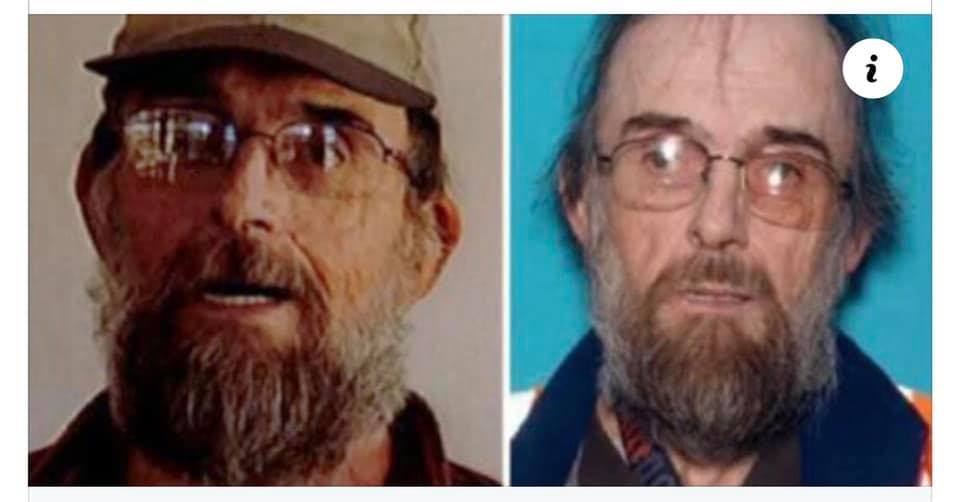
Missing: Daryl “Dice” Budenski. (Photo credit: Search for Daryl Budenski Facebook page)

For the family and friends of Dice, the unknown has to feel excruciating. That they care deeply about finding him is clear from the posts and comments on the Search for Daryl Budenski Facebook page. They are not giving up. They’ve held rallies and searches. Public and private. They’ve gotten his name, photo and missing person status out there.

I photographed this poster in a Redwood Falls convenience store in 2018. Mato Dow, who disappeared in October 2017, remains missing. (Minnesota Prairie Roots file photo 2018)

To have a loved one missing, even for a short period of time, is beyond difficult. That is the reality for too many families in Minnesota. The BCA Missing Persons list currently profiles 93 missing people. Like Carla, Haley, Kevin, Roger, Laurie, Mark, Jeremy, Mary Jo, Harold, Sheila, Brandon, Leanna… All ages. And from all parts of Minnesota, from our big cities to our most rural areas. Mankato, Motley, Minneapolis. Redwood Falls, Rochester, Roseville. Willmar, Worthington, Winona. And too many places in between to list.

Their ages range from preschooler to adult. And they’ve been missing anywhere from a year to decades. The longest missing are young brothers Daniel, David and Kenneth Klein, who disappeared in Minneapolis on November 10, 1951. Other old cases date back to 1963 and 1967. The most recent missing person profiled is Evan Jensrud, who disappeared from Cambridge in February 2021.

In my immediate area, two individuals are included on the BCA list: JoJo Boswell, who went missing from Owatonna in July 2005, and John Deeny, who went missing from Janesville in March 1973.

I recognize other names as high profile cases.

As each day passes, then week, then month, then year, then decades, answers remain elusive. What happened to these individuals? Why did they disappear? Did someone take them? Where are they? Uncertainty takes an emotional toll. Only answers will ease the pain, the stress and agony for loved ones and friends.

If you have any information about Daryl Budenski or any of the individuals listed on the BCA website (click here), please contact the appropriate law enforcement agency.

© Copyright 2022 Audrey Kletscher Helbling
 

The woods are… April 6, 2022

Inside the woods at River Bend Nature Center, Faribault, MN. (Minnesota Prairie Roots copyrighted photo March 2022)

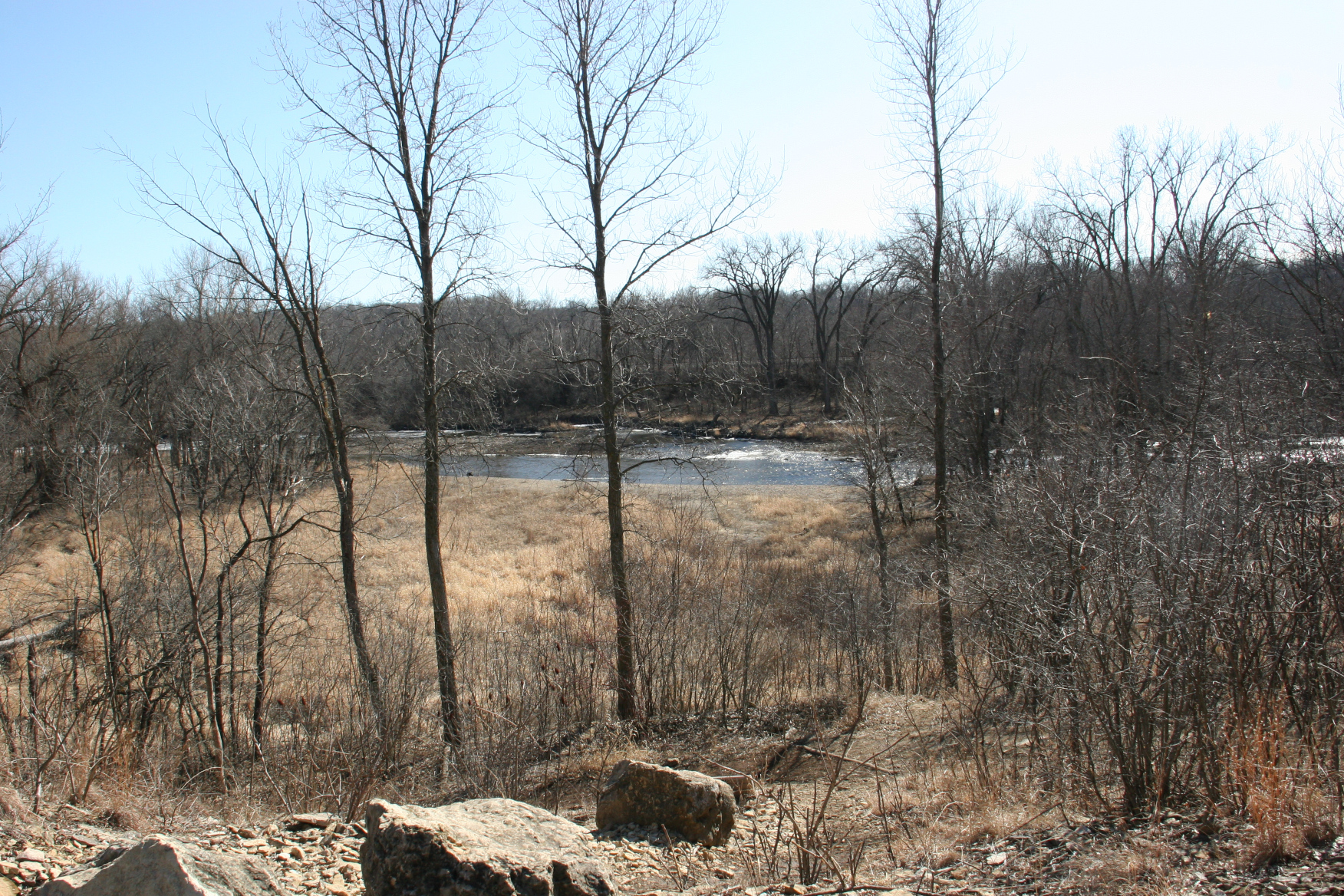
FOR SOMEONE LIKE ME who grew up on the prairie, woods are not a natural fit. I’ve always felt a bit out of place in the density of trees. Uncomfortable even. But time and distance from a landscape of big sky and wide open spaces have eased me into the woods.

A view of the Straight River from Honor Point. (Minnesota Prairie Roots copyrighted photo March 2022)

I appreciate woods, as long as there aren’t “too many” trees. I need to see glimpses, even vistas, of openness. River Bend Nature Center in Faribault offers both. Prairie and woods.

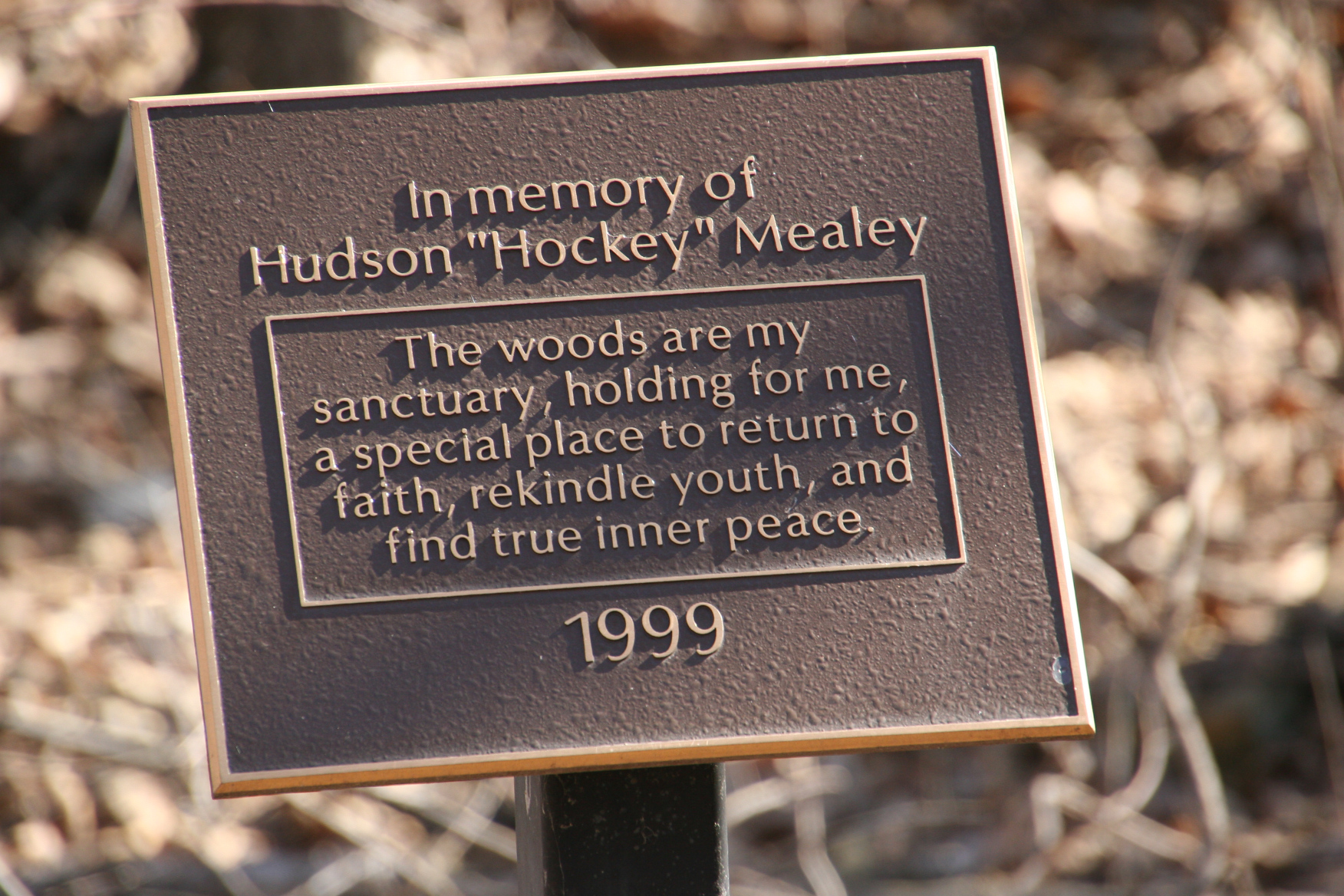
Love this quote on a memorial sign at River Bend. (Minnesota Prairie Roots copyrighted photo March 2022)

On a recent visit, I followed trails into the woods. And, as always, I noticed the beauty therein. I view the natural world through many lenses. Close-up. From afar. With an artsy perspective. But mostly with a deep appreciation.

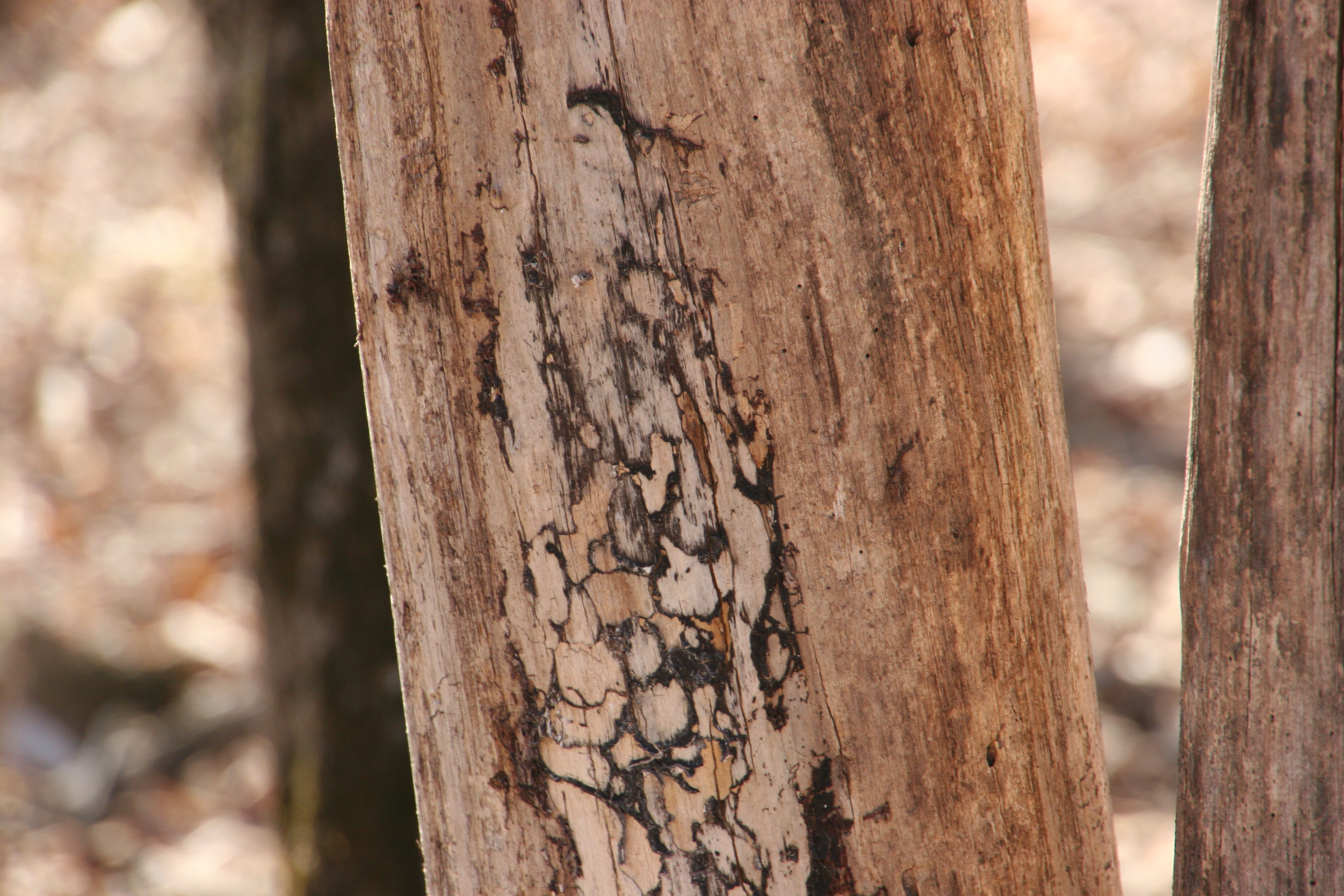
This mottling on a tree trunk looks like art to me. (Minnesota Prairie Roots copyrighted photo March 2022)

It doesn’t take much to catch my eye, to cause me to pause and reflect. Photograph. Delight. Savor the moment, the scene.

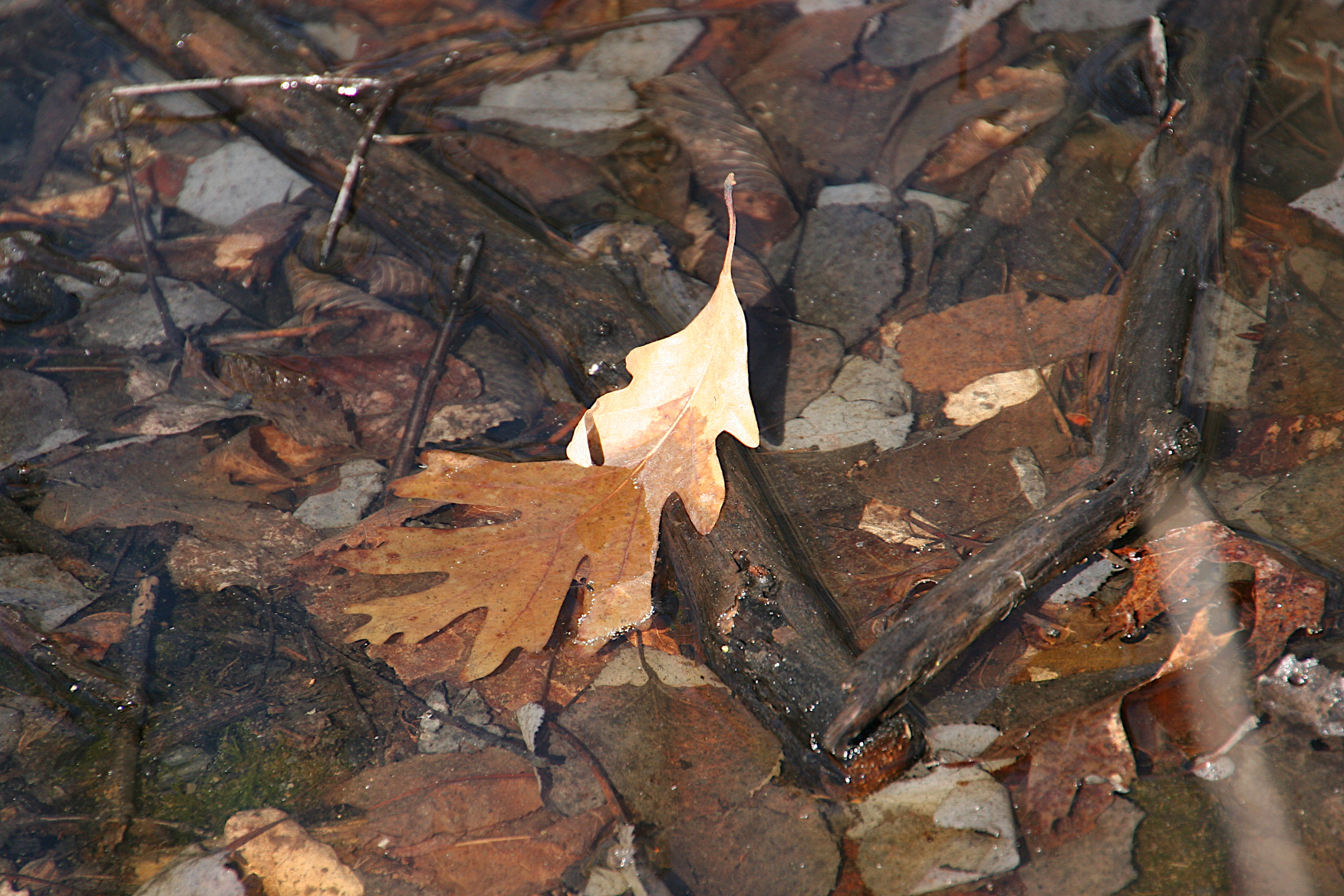
I’m always drawn to leaves in water, here in a melting snow puddle along a trail. (Minnesota Prairie Roots copyrighted photo March 2022)
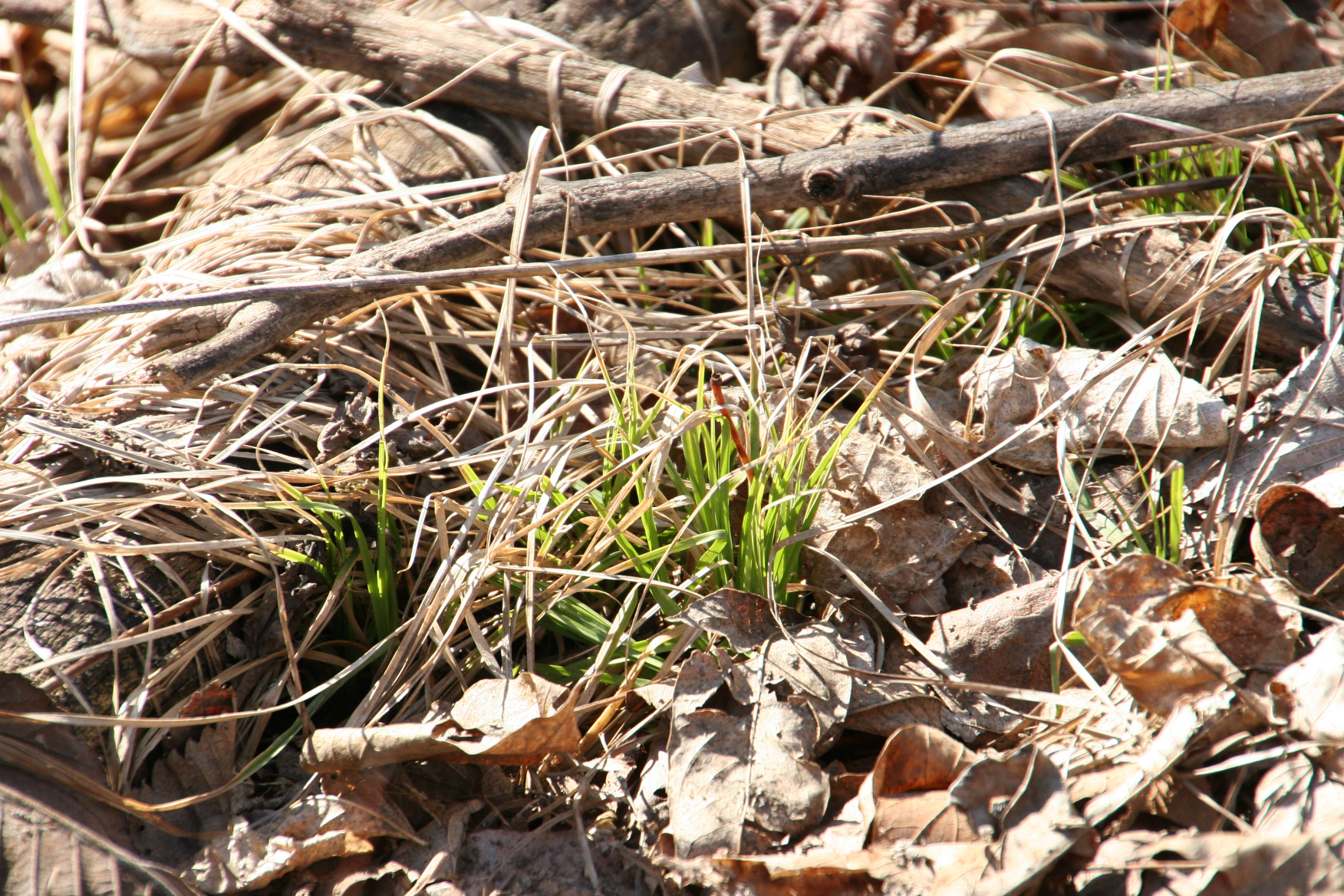
Loved spotting this patch of green in mid-March. (Minnesota Prairie Roots copyrighted photo March 2022)
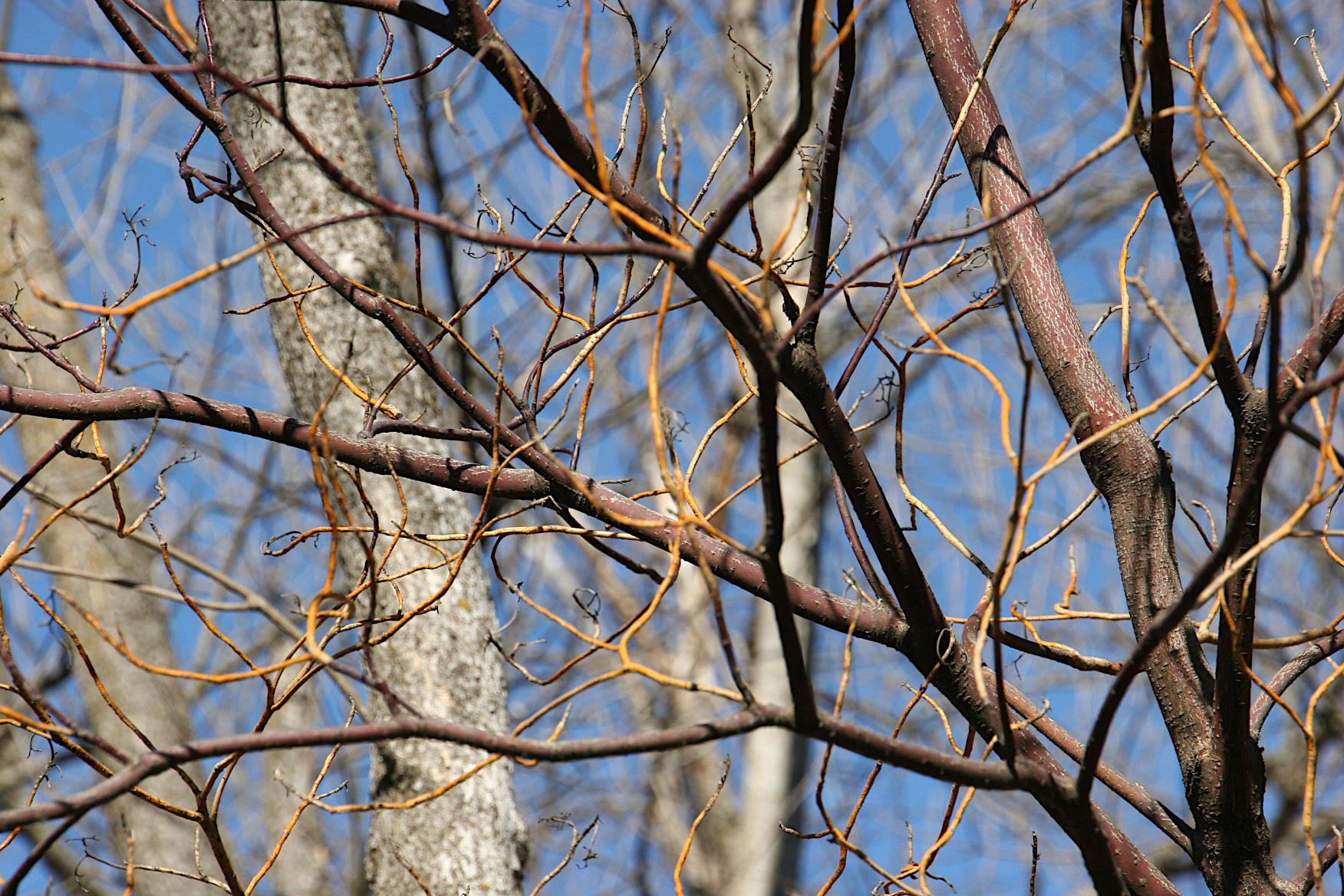
Tangled branches and blue sky. Beautiful. (Minnesota Prairie Roots copyrighted photo March 2022)

If you walk with me into the woods, you won’t fast track from Point A to Point B. Sometimes I go at a rapid pace. But most of the time, I can’t. Because I simply see too much. Poetry in puddled leaves. Spring in a patch of green grass. Abstract art in a mottled tree trunk. Dancers in twisted branches.

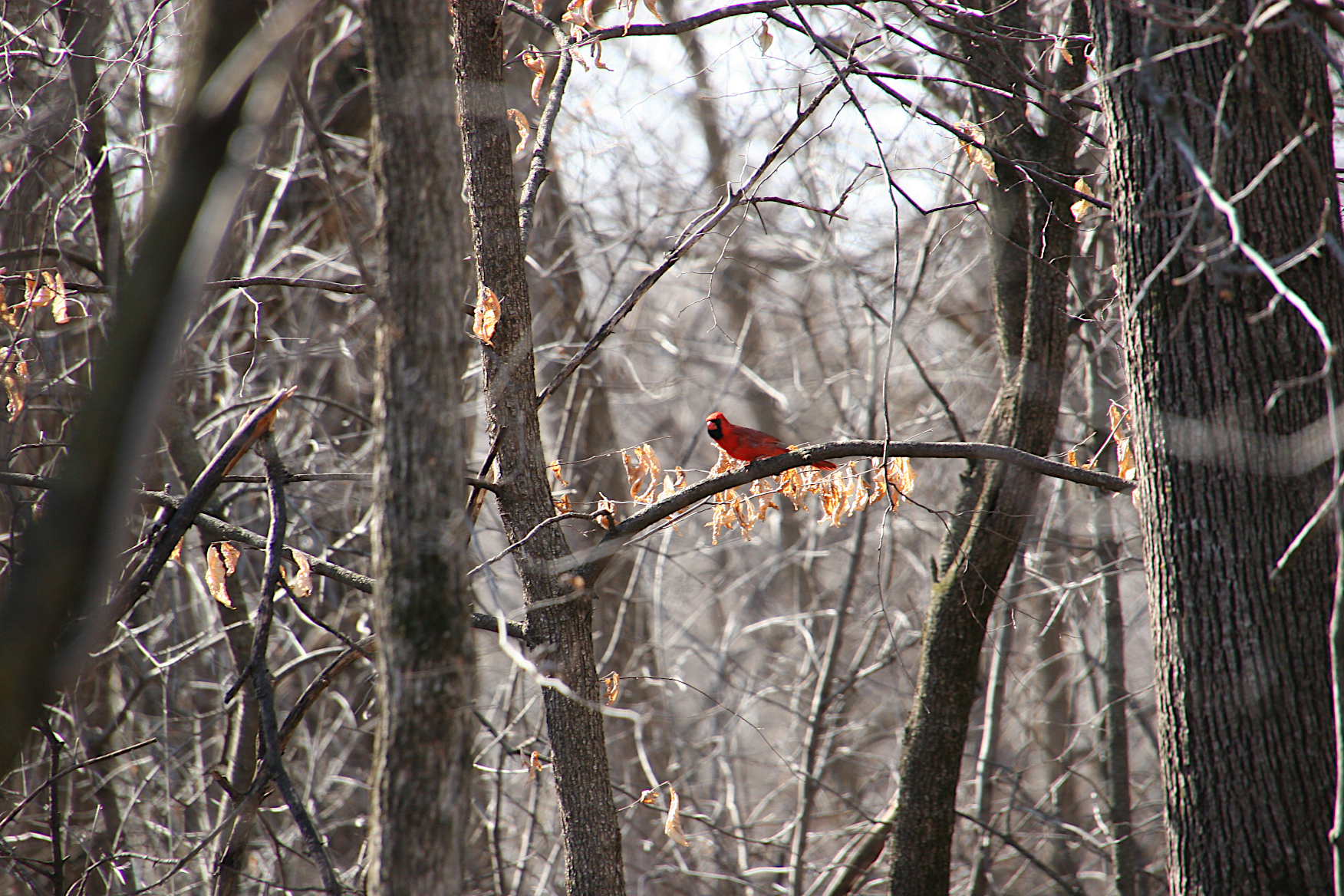
It took me awhile to get this focused shot with my zoom lens of a flitting cardinal. (Minnesota Prairie Roots copyrighted photo March 2022)

Sights and sounds draw me to linger in the woods. The shrill call of a cardinal and a flash of red cause me to pause. I wait. Listen. Photograph.

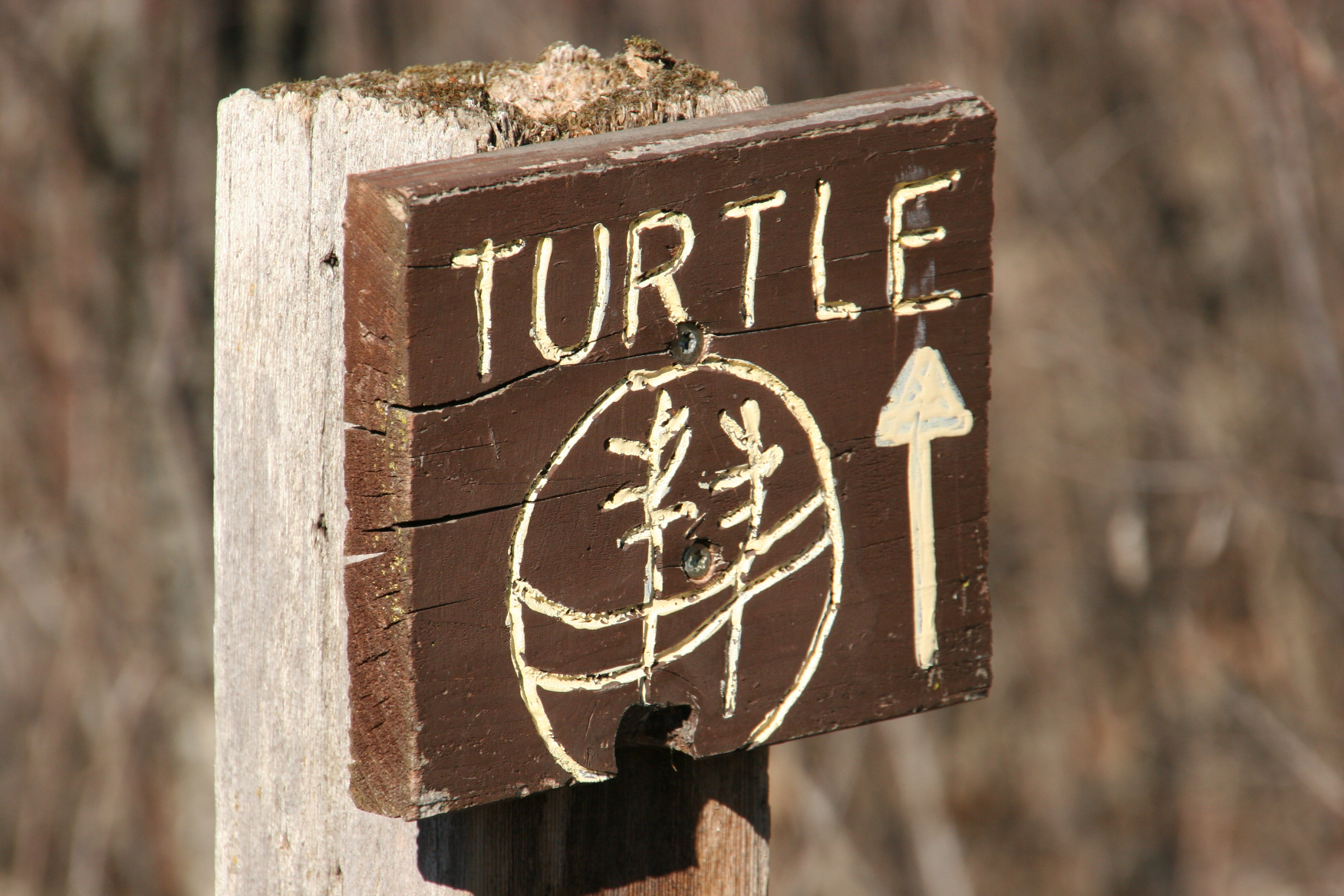
The sign pointing to the Turtle Pond, where the turtles had not yet emerged on my March 19 visit. (Minnesota Prairie Roots copyrighted photo March 2022)

I feel such a sense of wonderment in it all. A peace, too, that comes only from immersing one’s self in the natural world. In the chaos and noises of life, the woods are on this day, indeed, my sanctuary.

TELL ME: How do you react to the natural world?

© Copyright 2022 Audrey Kletscher Helbling


From $221K for Ukrainian kids to top film awards April 5, 2022

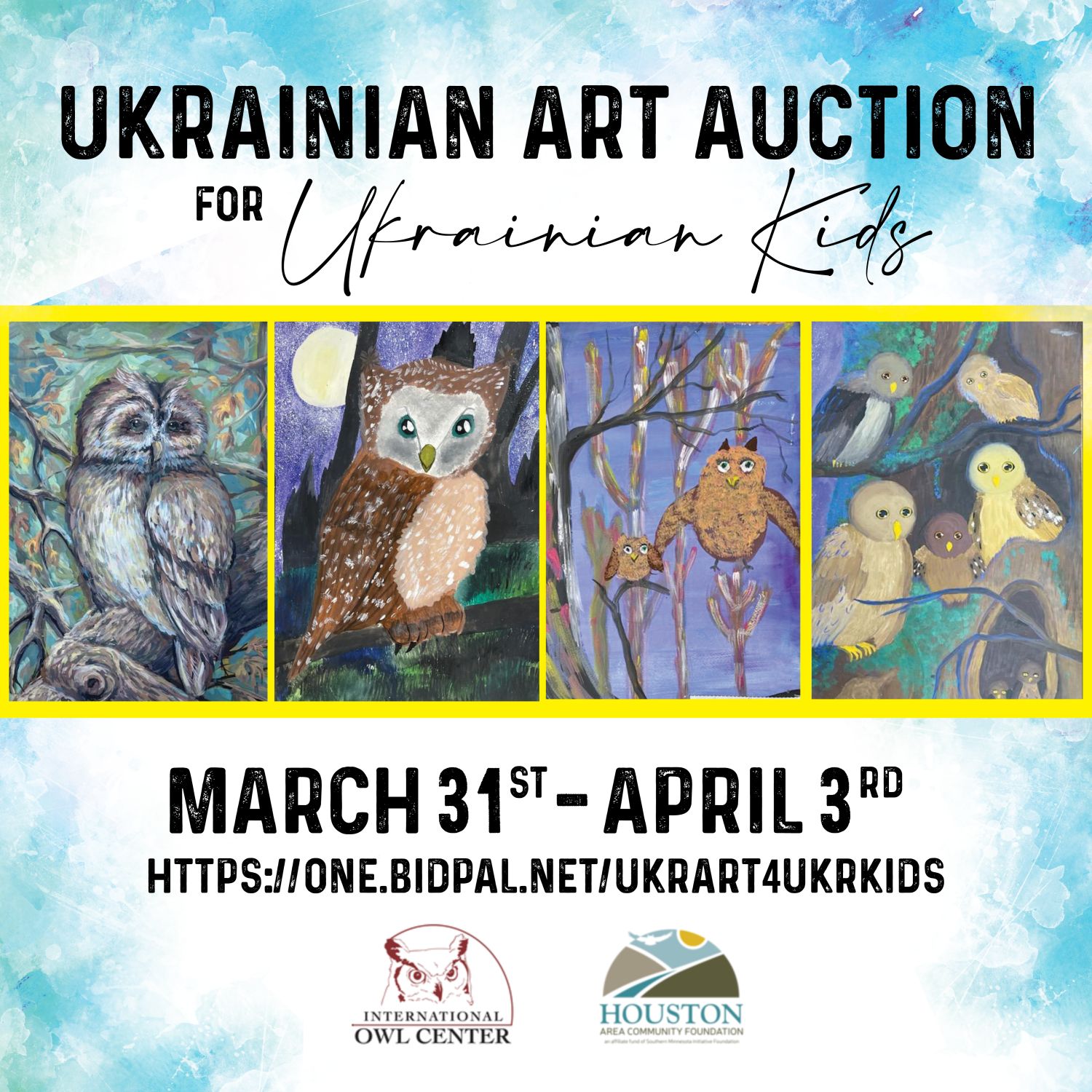
The promo for the final owl art auction. (Source: International Owl Center Facebook page)

IN THE MIDST OF WAR and pandemic, inflation and everyday struggles, I want to pause and focus on two recent bits of good news. One comes from the tiny town of Houston in southern Minnesota. The other comes from the glitz and glamour of the entertainment world. Two complete opposites, yet notable in how important each is in this vast connected world of ours.

Let’s start with Houston, where the International Owl Center just concluded its third online “Ukrainian Art Auction for Ukrainian Kids.” The final auction of art created by Ukrainian youth for the center’s annual International Kids’ Owl Art Contest raised $48,893 for UNICEF, designated specifically for kids in Ukraine.

All three auctions raised a whopping $221,353. That’s an incredible amount generated from the sale of 190 pieces of original owl art, limited edition prints and direct donations. The giving spirit of those wanting to help youth in war-town Ukraine stretched well beyond Houston, population around 1,000, to a wide world of caring and generous souls. I am heartened by this show of love and support.

And I am heartened to read on the Owl Center Facebook page that staff connected with some of the young artists and learned that they have fled Ukraine with their families and are safe.

Promo for “Summer of Soul” from the “Summer of Soul” Facebook page.

Now the other bit of positive news has nothing to do with war, but rather with film and music. The documentary, “Summer of Soul,” just won the 2022 Grammy Awards Best Music Film. And a week earlier, it landed an Oscar for the Best Documentary Feature.

Generally, I pay no attention to these awards because, well, they don’t interest me. That’s not to diminish the hard work of these artists because their creativity enriches our lives and world. But I cared about “Summer of Soul” Oscar and Grammy nominations after watching a public television airing of the documentary by filmmaker Ahmir “Questlove” Thompson. His film focused on the Harlem Cultural Festival in the summer of 1969. Six concerts over six weeks brought 300,000-plus people together in Harlem to celebrate the Black culture, specifically music. Performers included the likes of Stevie Wonder, Nina Simone, Gladys Knight and the Pips… But Thompson’s film was about more than the music. It was about the issues facing Black people, highlighted in interviews woven into concert footage. Many of these same issues remain today.

There’s more to this story. Although produced 53 years ago, “Summer of Soul” was only recently released. In promos for the film, it’s titled as “Summer of Soul (Or, When the Revolution Could Not Be Televised)” on ABC. I encourage you to view this enlightening documentary. Experience the music, the culture. And then reflect. For in opening our hearts and minds, we expand our understanding of each other in a world that needs to connect and care.

The International Owl Center, located in downtown Houston, Minnesota. (Minnesota Prairie Roots copyrighted file photo)

To the creatives behind “Summer of Soul” and to the creatives behind the “Ukrainian Art Auction for Ukrainian Kids,” thank you for sharing your talent and for your generosity of spirit. I am grateful.

FYI: The International Owl Center is taking a pause from its “Ukrainian Art for Ukrainian Kids” auctions to prepare for the International Festival of Owls April 30 – May 1. I will update you if/when more fundraisers happen. Or check the International Owl Center Facebook page to stay posted.

© Copyright 2022 Audrey Kletscher Helbling
 

Celebrating poetry: Reflections from a Minnesota poet April 4, 2022
Roses from my husband, Randy. (Minnesota Prairie Roots file photo 2012)

Roses are red,

violets are blue.

Sugar is sweet

and so are you.

RAISE YOUR HAND if that’s the first poem you ever read or heard. My right hand is wildly waving. See it, right there next to a mass of many many hands?

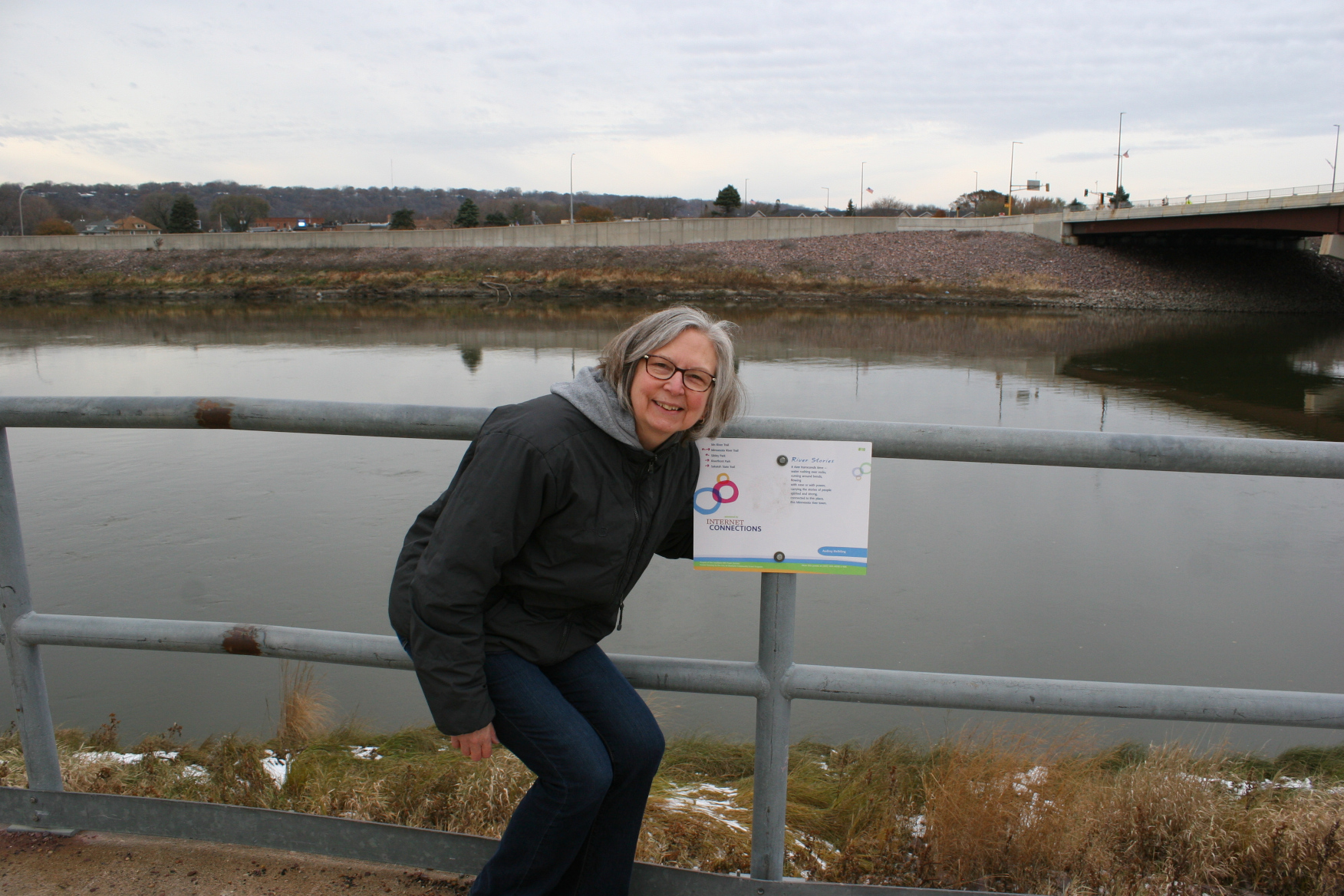
Me, next to my posted poem, “River Stories,” selected for the 2019 Mankato Poetry Walk & Ride. (Minnesota Prairie Roots November 2019 file photo by Randy Helbling)

Today, April 4, marks day four of National Poetry Month, which celebrates the importance of poetry in our culture and lives. Whether you like or dislike poetry, it holds value as a form of artistic expression, communication, storytelling, endearment…

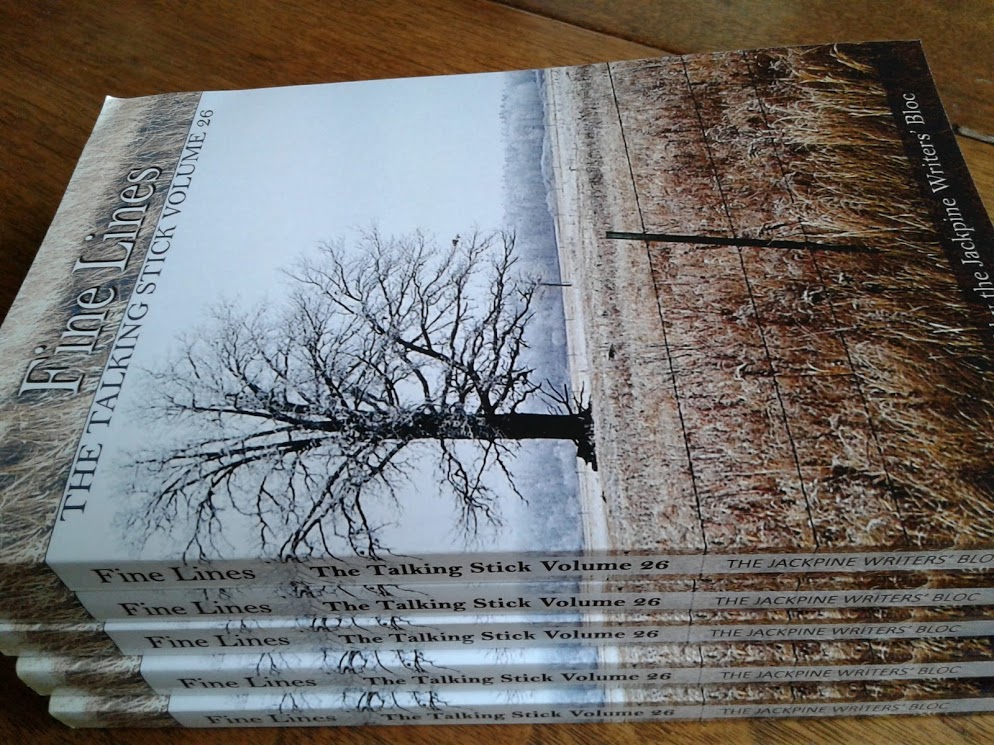
Many of my poems (plus short stories and creative nonfiction) have been selected for publication in The Talking Stick, an annual anthology published by the Jackpine Writers’ Bloc. (Minnesota Prairie Roots copyrighted file photo)
I am proud to call myself a poet. A published poet. How did I get there? I’ve always loved words, the song of language. Poetry is, I think, a lot like music. It carries a rhythm. A beat. A cadence. That comparison comes from a poet who can’t carry a tune, can’t read a musical note, can’t play an instrument.
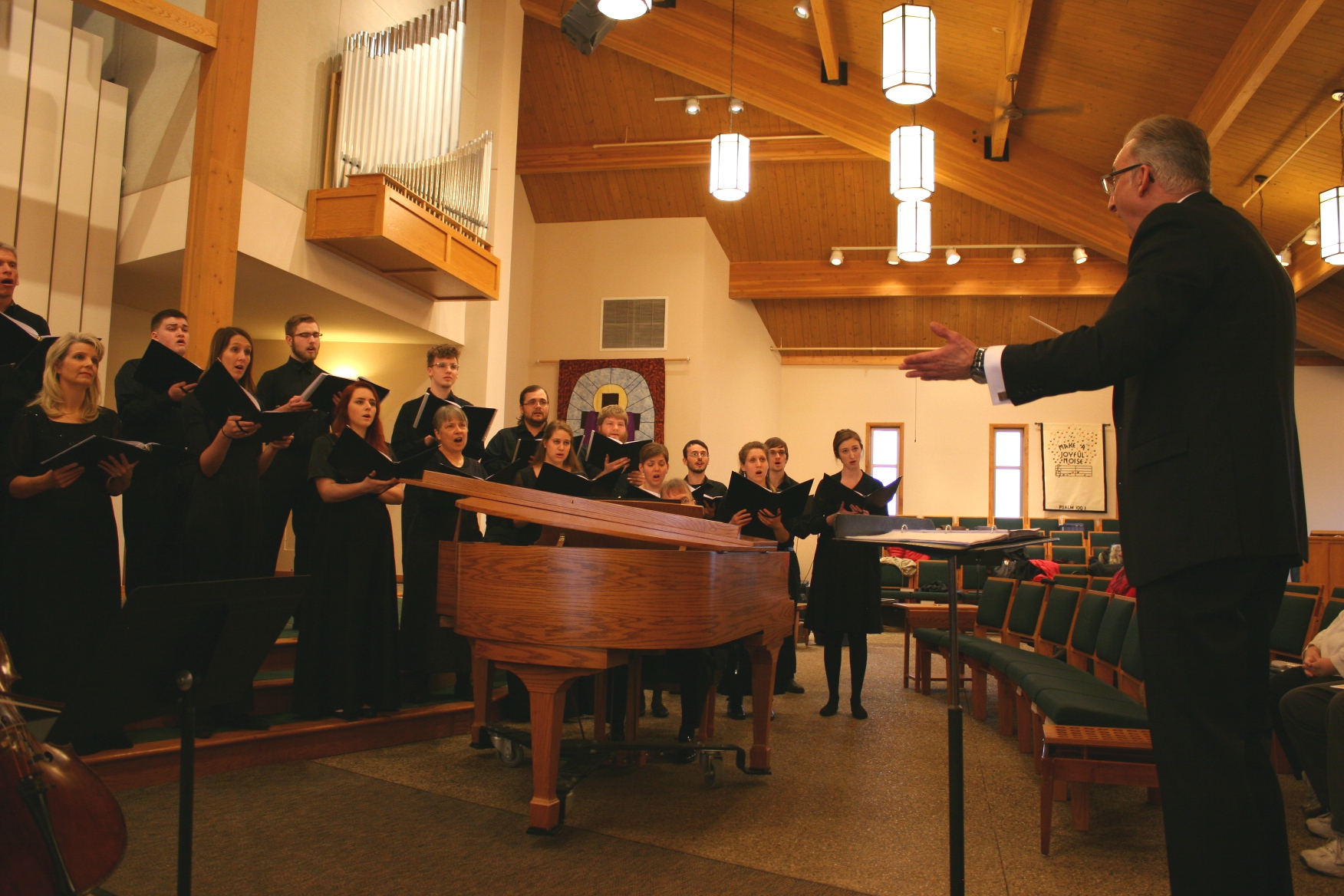
A Chamber Choir performs artsongs written from poems, directed by David Kassler. (Minnesota Prairie Roots file photo April 2017)

But in 2017, a chamber choir performed my poem, “The Farmer’s Song,” at two concerts in Rochester. David Kassler composed the music for my poem and six others as part of an artsong project. To sit in that audience and hear those vocalists sing my poem was overwhelmingly humbling. And validating.

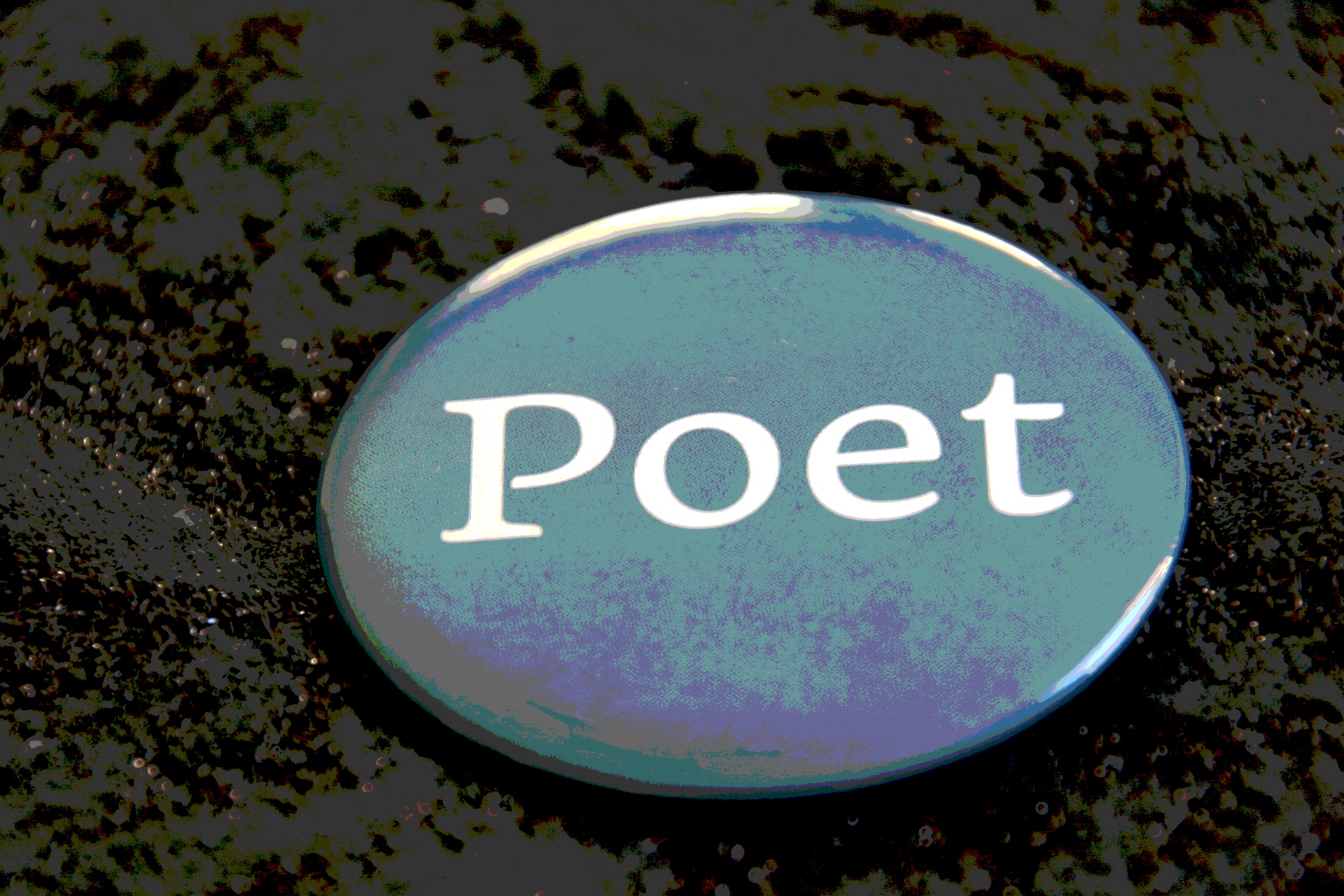
I took poetic license and photoshopped this image of the button I wore identifying me as a poet at a Poetry Bash. (Minnesota Prairie Roots copyrighted file photo)

I am a poet.

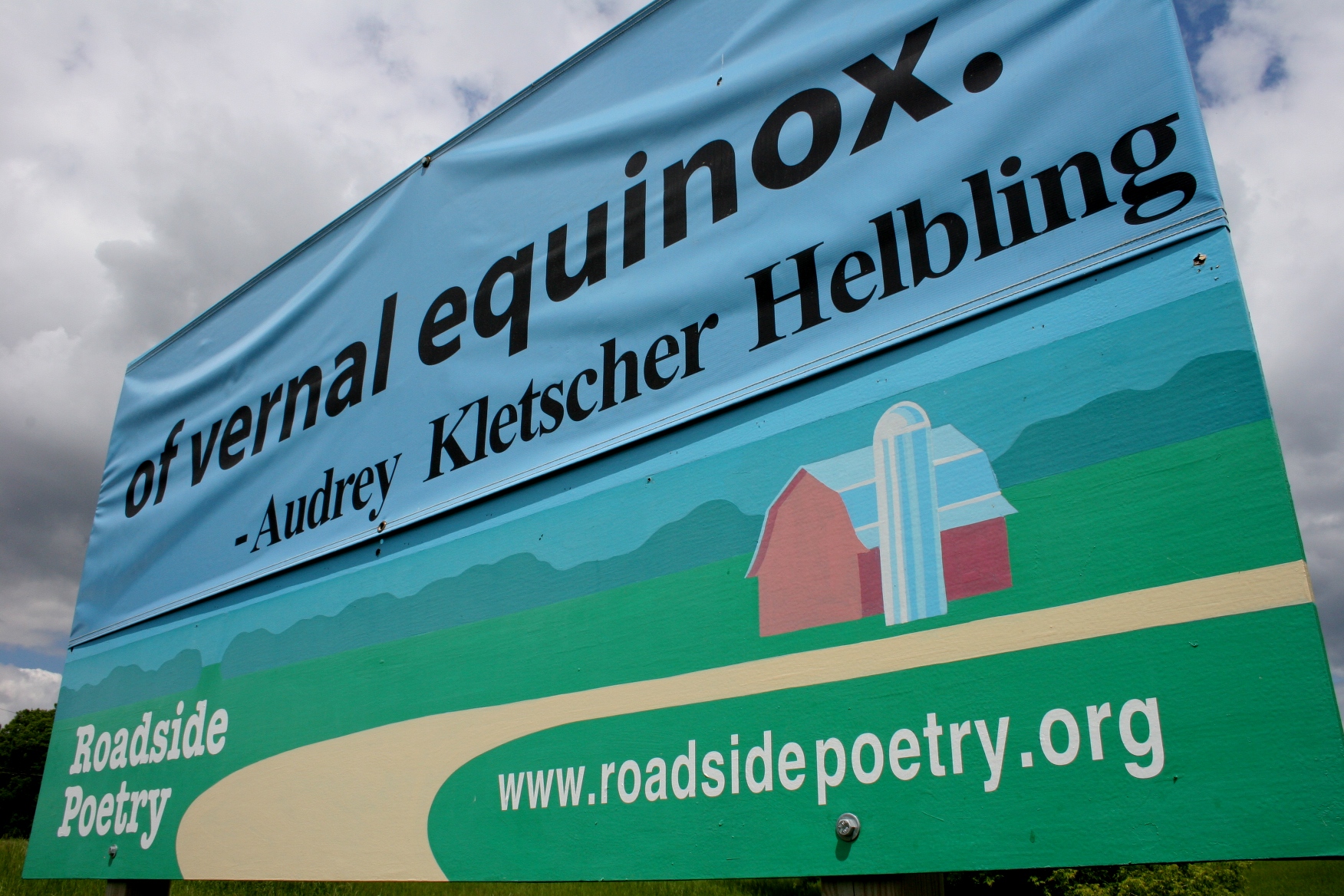
The last of four billboards featuring my Roadside Poetry spring poem. (Minnesota Prairie Roots file photo 2011)

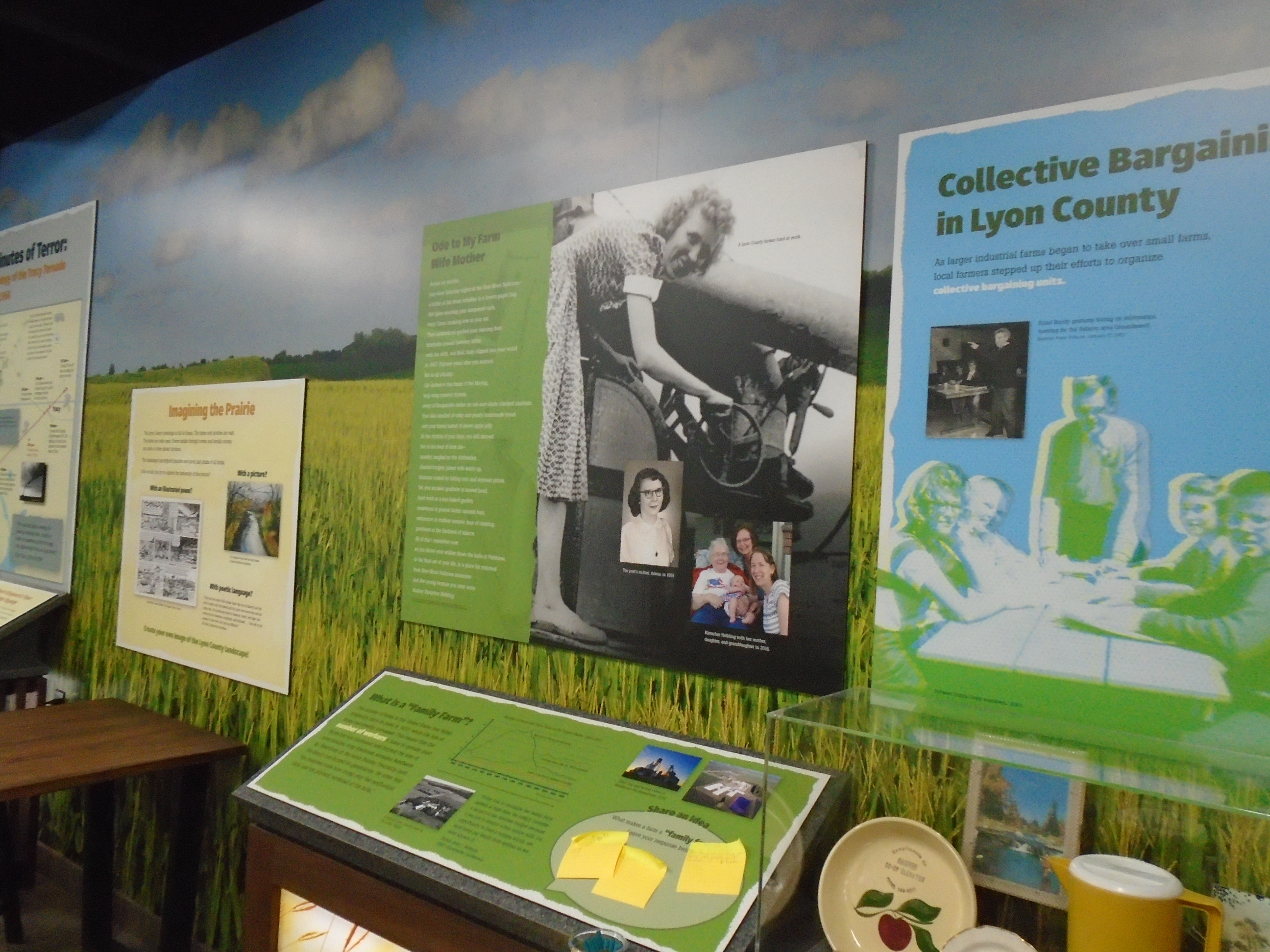
My poetry has been published in newspapers, magazines, literary journals, anthologies… And in unexpected places. In 2011, my spring-themed poem bannered four billboards in Fergus Falls as part of the Roadside Poetry Project. Other poems have been posted on signs along trails as part of the Mankato Poetry Walk and Ride. “Ode to My Farm Wife Mother” is currently showcased in an exhibit at the Lyon County Historical Society Museum in Marshall, Minnesota, in my hometown area.

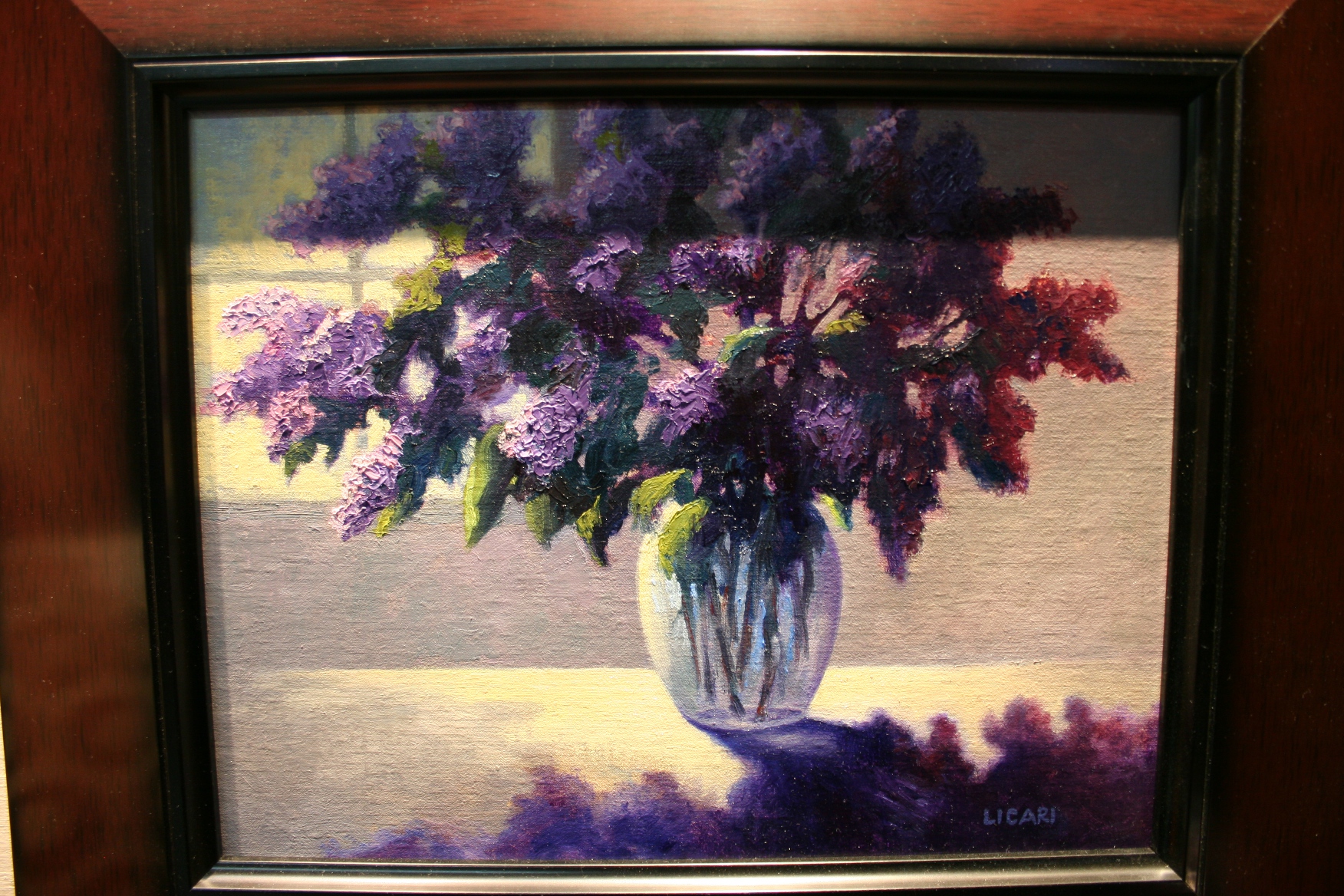
Jeanne Licari’s absolutely stunning interpretation of my “Lilacs” poem. Her “Lilacs on the Table” is oil on mounted linen. (Minnesota Prairie Roots copyrighted file photo May 2014)

Some of my poems have inspired art in Poet-Artist Collaborations, been aired on the radio and read by me at poetry readings.

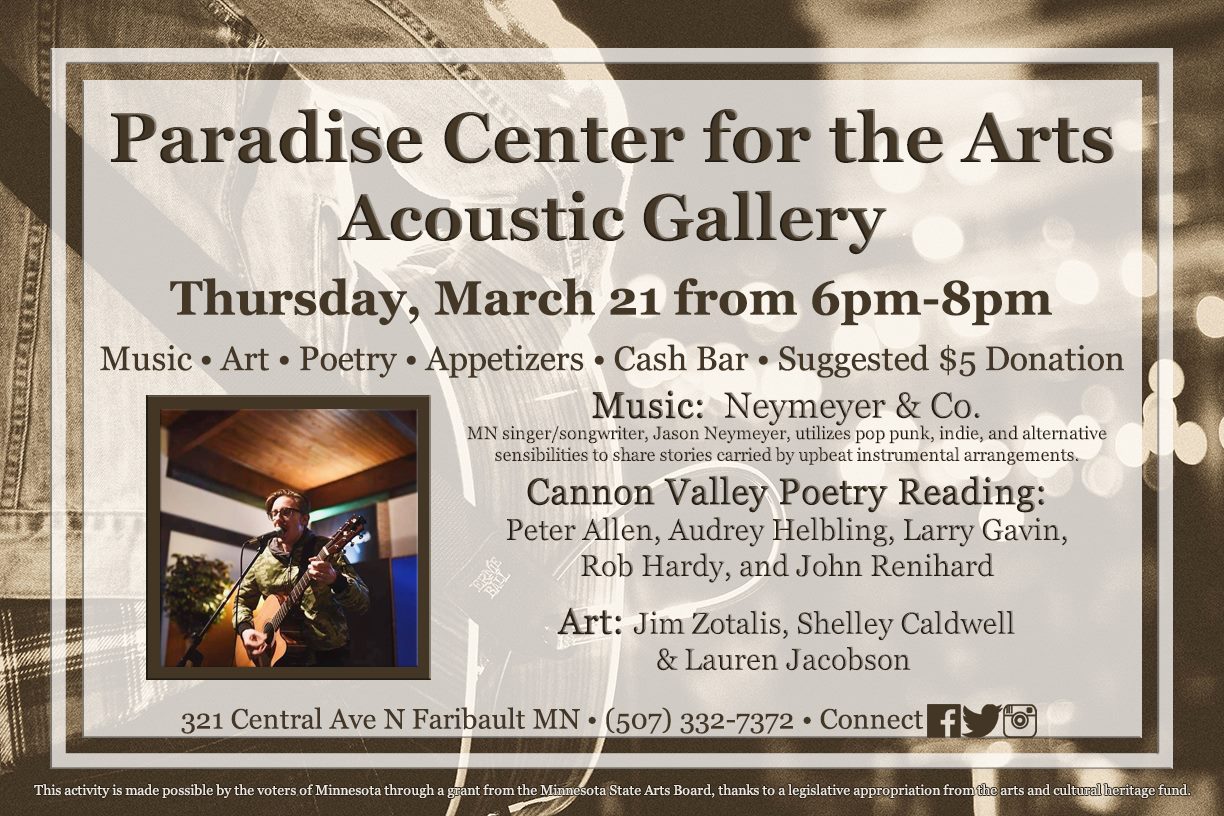
I read poetry at this event at my local arts center in March 2019. I was honored to read with other talented area poets. (Promo courtesy of the Paradise Center for the Arts)

Even I’m surprising myself at the volume of poetry I’ve crafted through the decades. I never set out to be a poet. It simply happened as an extension of my love of words, of language. And that undeniable need to express myself creatively. Unlike that “Roses are red…” introductory poetry of old, my poems do not rhyme.

My poem, “Ode to My Farm Wife Mother,” with accompanying photos (center of this photo) in the Lyon County exhibit. (Photo courtesy of the LCHS)

My poetry is like me. Unpretentious. Down-to-earth understandable. Flannel shirt and blue jeans. Honest. Detail-oriented. Rooted in the land with a strong sense of place and a story to be told.

TELL ME: What’s your opinion of poetry? Do you read it, like it, write it? I’d like to hear.

Please click on links in this post to read some of the poems I’ve written.

FYI: Content Bookstore, 314 Division St. S., Northfield, is hosting two Poetry Nights, both beginning at 7 pm. On Thursday, April 7, Northfield poet Diane LeBlanc will read from her latest works. That includes her new poetry book, The Feast Delayed. Northfield Poet Laureate Rob Hardy and poet Greta Hardy-Mittell will read from their latest works also. Hardy’s newest poetry collection, Shelter in Place, just released.

© Copyright 2022 Audrey Kletscher Helbling