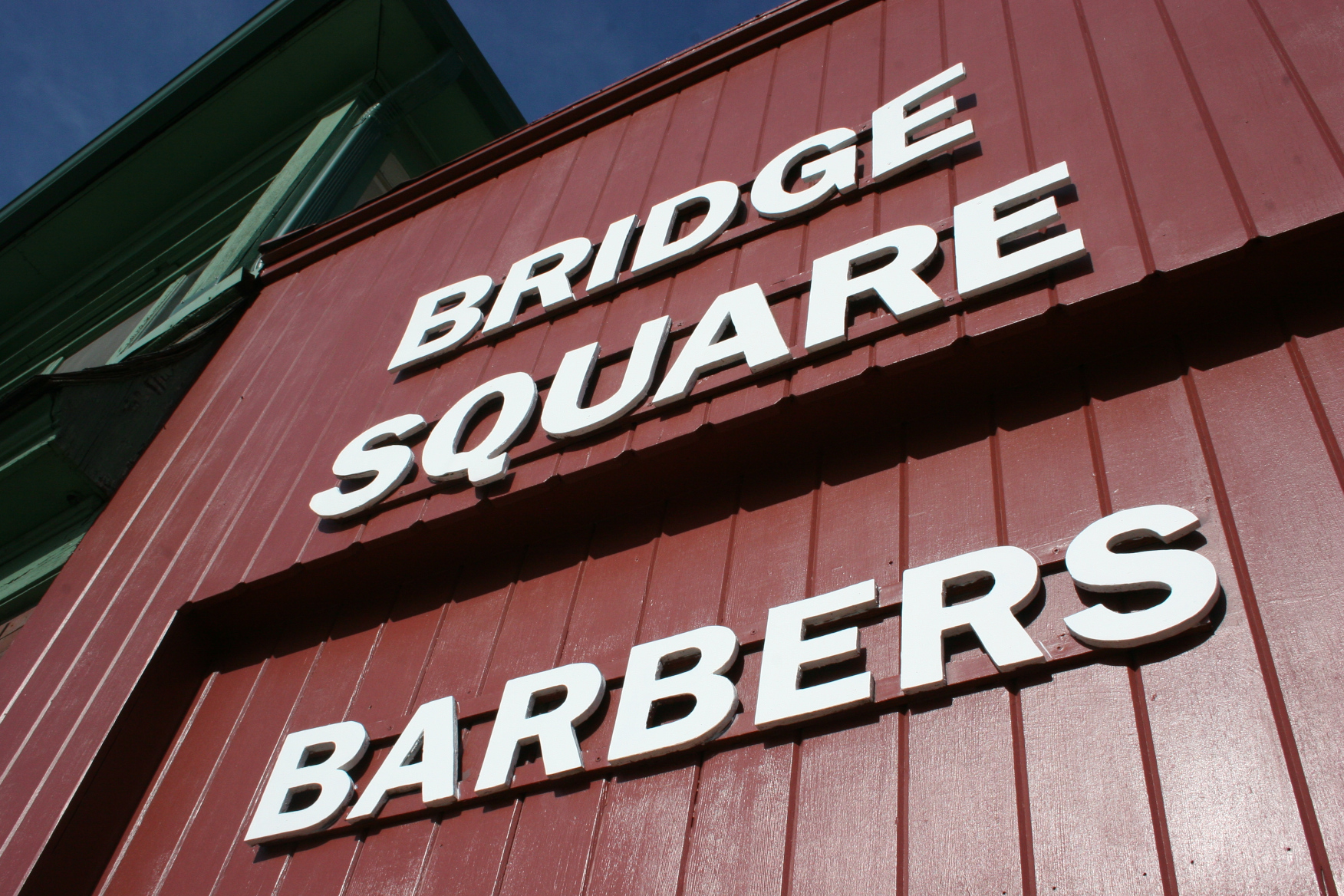
Bridge Square Barbers, appropriately located at 15 Bridge Square across the street from Bridge Square in the heart of downtown Northfield, Minnesota, to the right in this stretch of businesses. (Minnesota Prairie Roots copyrighted photo February 2022)
WHENEVER I’M OUT AND ABOUT with my camera in a downtown business district, I notice details. In storefront windows. On doors. In building signage.
An unassuming sign banners the top of the building. (Minnesota Prairie Roots copyrighted photo February 2022)
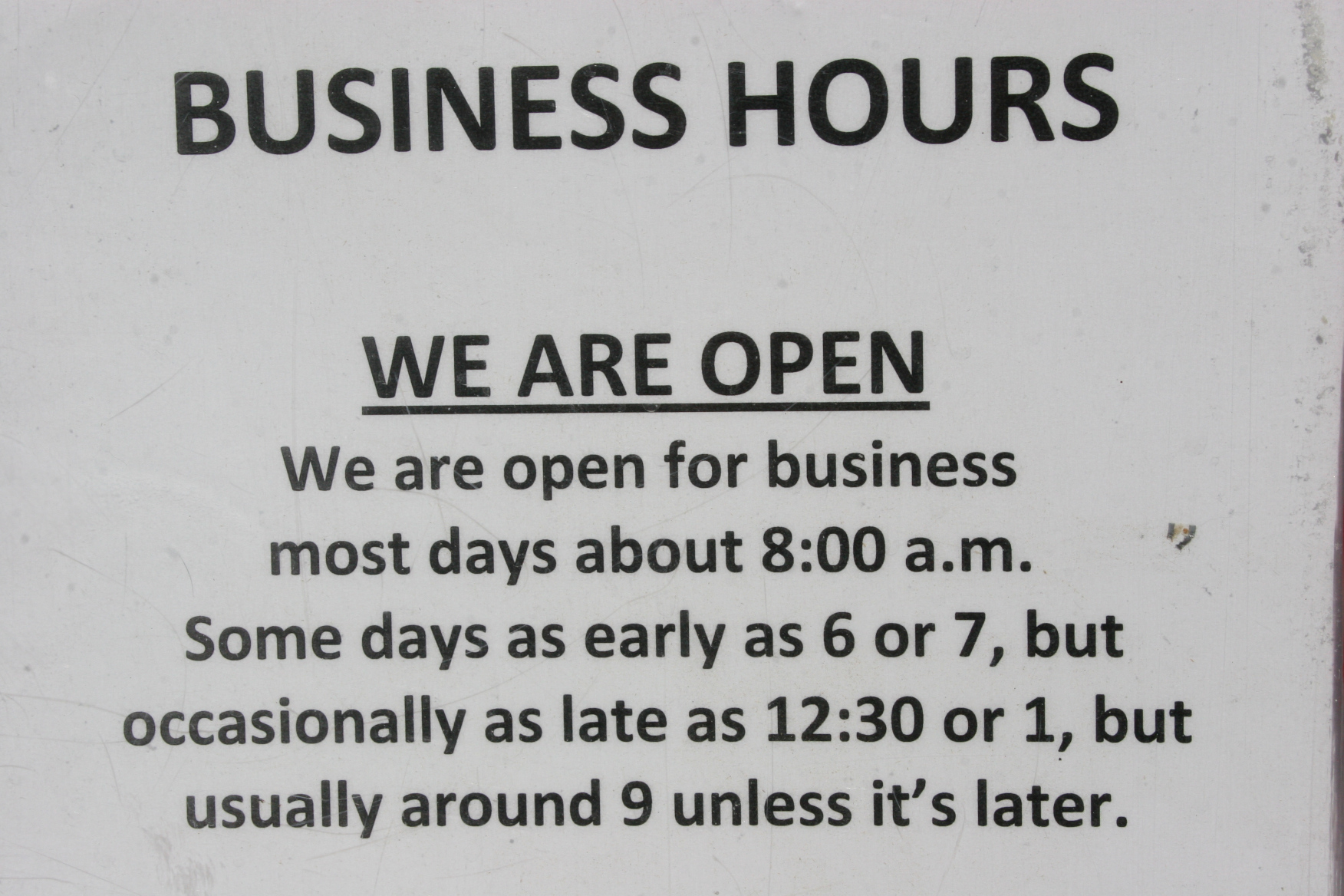
On a recent walk through Northfield, I spotted a typewritten sign at Bridge Square Barbers that caused me to erupt with laughter. And laughter is an expression of happiness that I need more than ever in this unsettled world.
The top part of the sign at Bridge Square Barbers. (Minnesota Prairie Roots copyrighted photo February 2022)
I stood in front of that sign about business hours, read, laughed, then focused my lens.
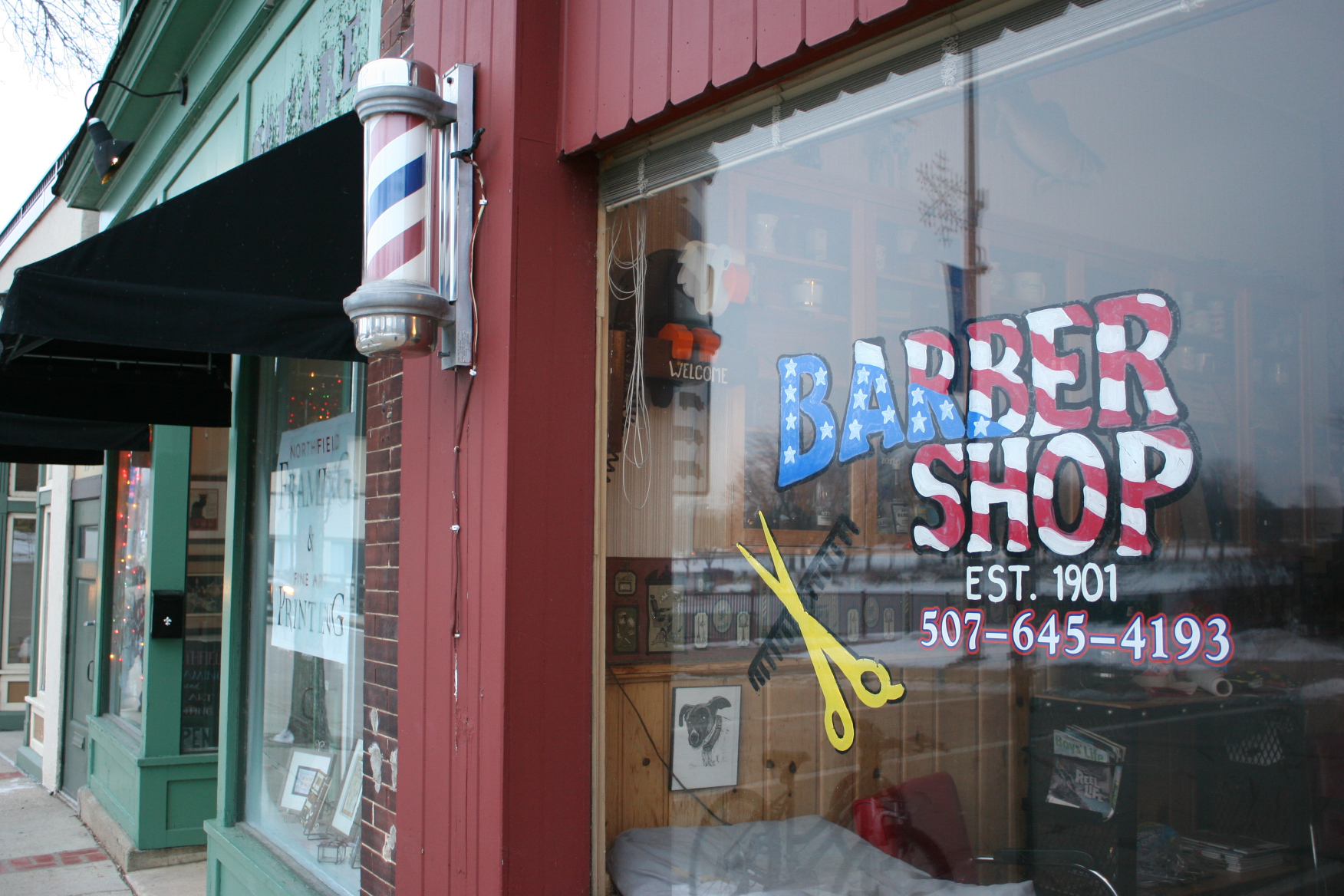
This is iconic barbershop with a barber pole. (Minnesota Prairie Roots copyrighted file photo January 2021)
I love, and appreciate, this humorous approach by a barber unknown to me. Rather than post a straightforward notice of hours, this businessman crafted a memorable message to humor customers should they find the door locked. That’s creative. Smart. Excellent customer relations.
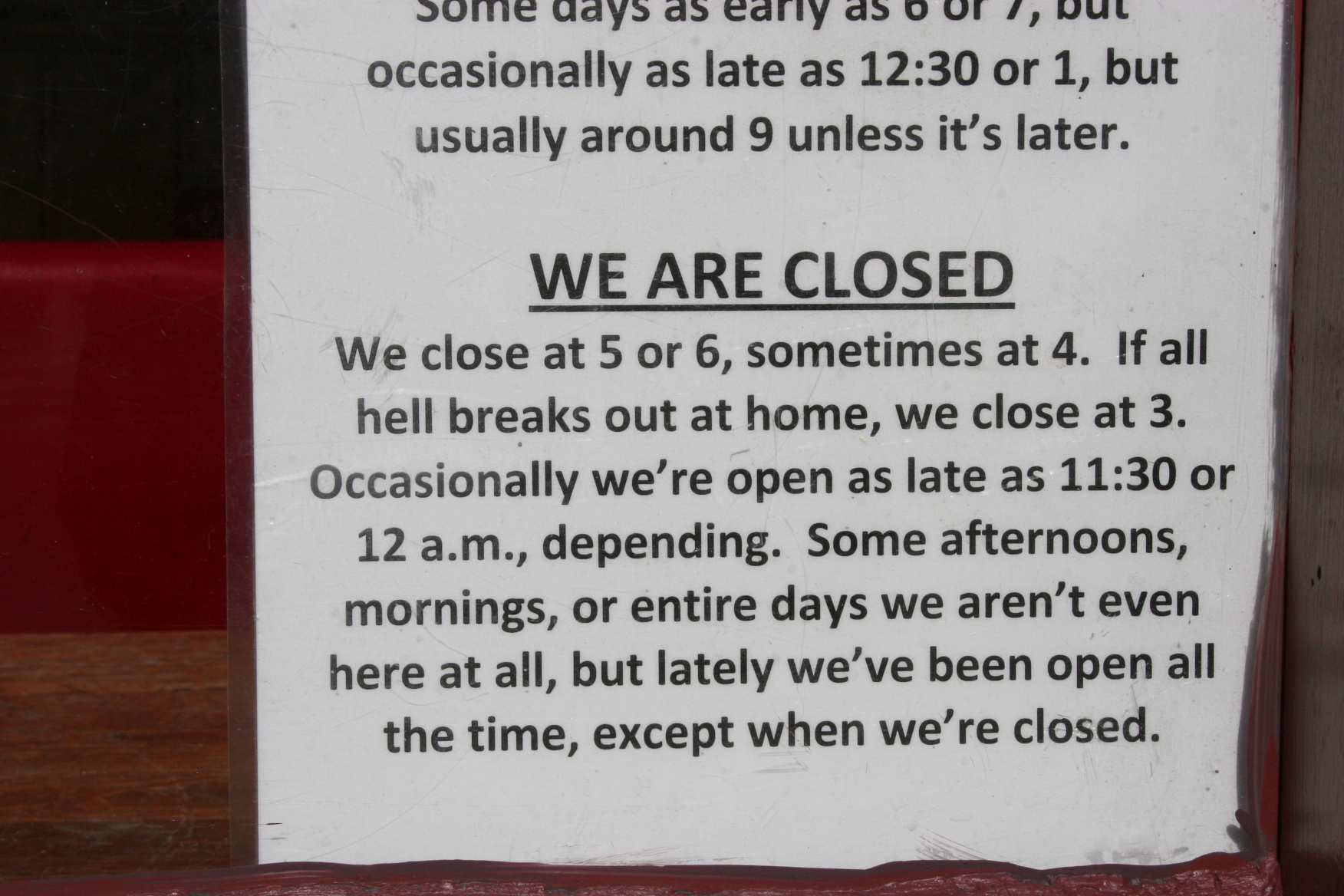
The bottom half of the humorous message at Bridge Square Barbers. (Minnesota Prairie Roots copyrighted photo February 2022)
However, I’m left wondering about “if all hell breaks out at home.” As a writer, my brain is drafting multiple stories, none of them probably true, but all prompted by the barber’s words. Does “all hell breaks out” involve children? Pets? Just life in general?
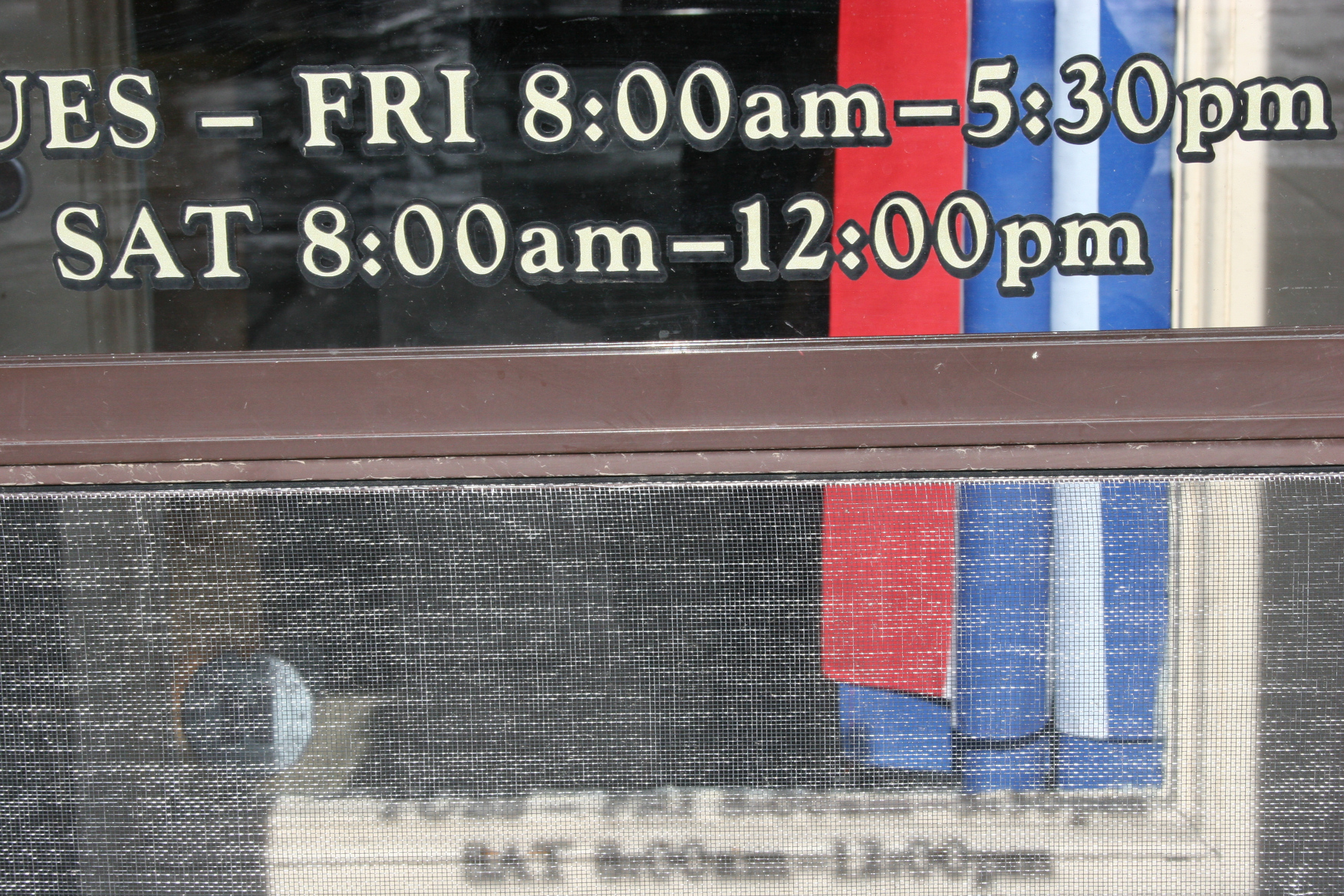
Hours posted on the front barbershop door, photographed through the exterior door. (Minnesota Prairie Roots copyrighted photo February 2022)
Whatever the story, this writer and photographer appreciates when business owners show their personalities in creative messages like these. I notice. And I laugh. Well done, Bridge Square Barbers!
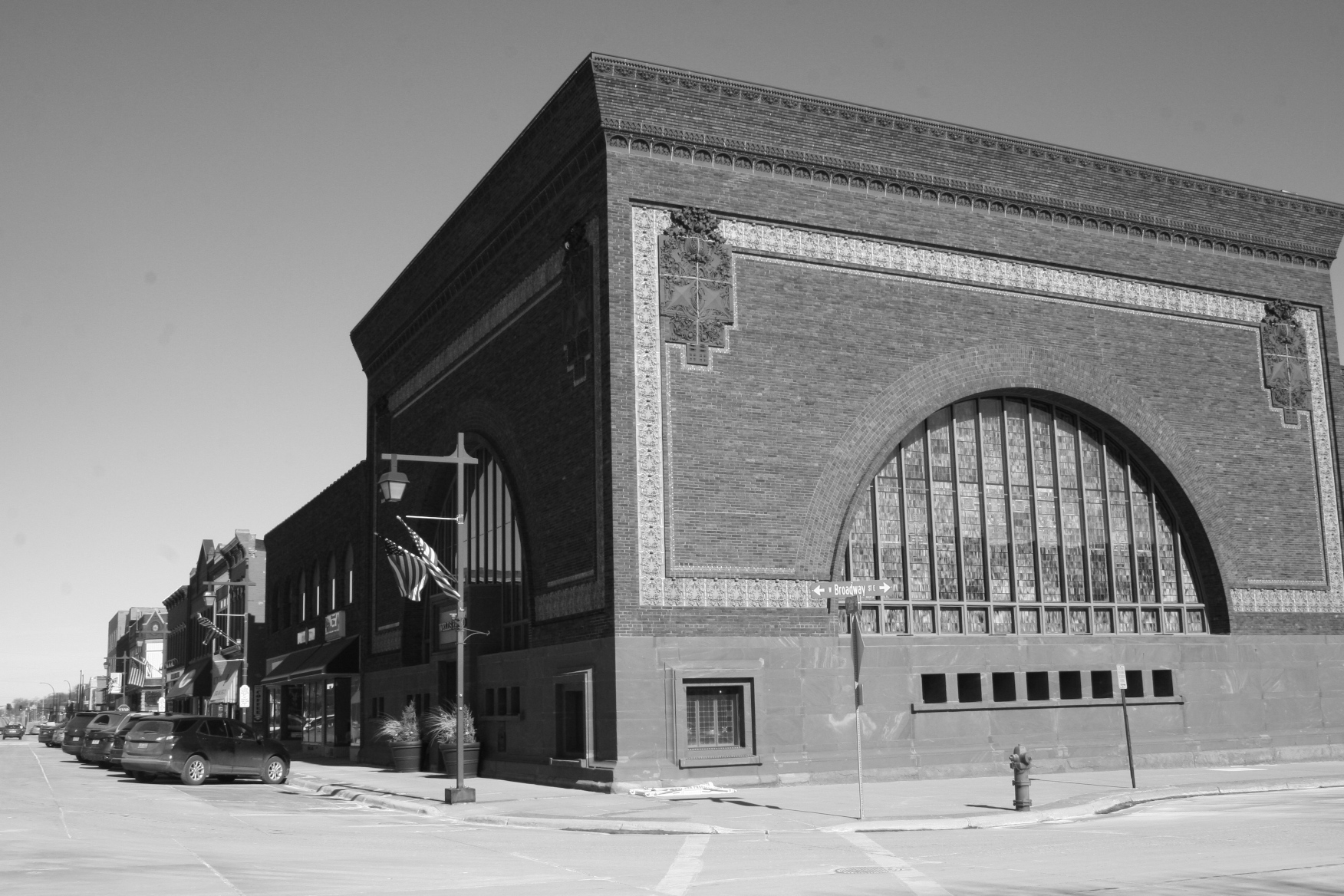
National Farmer’s Bank of Owatonna rates as particularly important architecturally. Designed by Louis Sullivan in the Prairie Architecture School style, it features stained glass windows, gold leaf arches, nouveau baroque art designs and more. This “jewel box of the prairie” was built between 1906-1908. (Minnesota Prairie Roots copyrighted photo February 2022)
STRIPPING IMAGES OF COLOR lends an historic context to several aged buildings I recently photographed near Central Park in downtown Owatonna. It’s easier for me to see the past, to appreciate these long-standing structures through the lens of time when I view them in black-and-white.
Love this corner historic building which houses A Taste of the Big Apple, serving pizza, soup, sandwiches and more, including a Tater Tot Hot Dish special on March 3. (Minnesota Prairie Roots copyrighted photo February 2022)
First, I feel such gratitude that these buildings still stand. A time existed when the thought was that new is better. Out with the old, in with the new. I’m not of that camp and I’m thankful for the shift in attitudes.
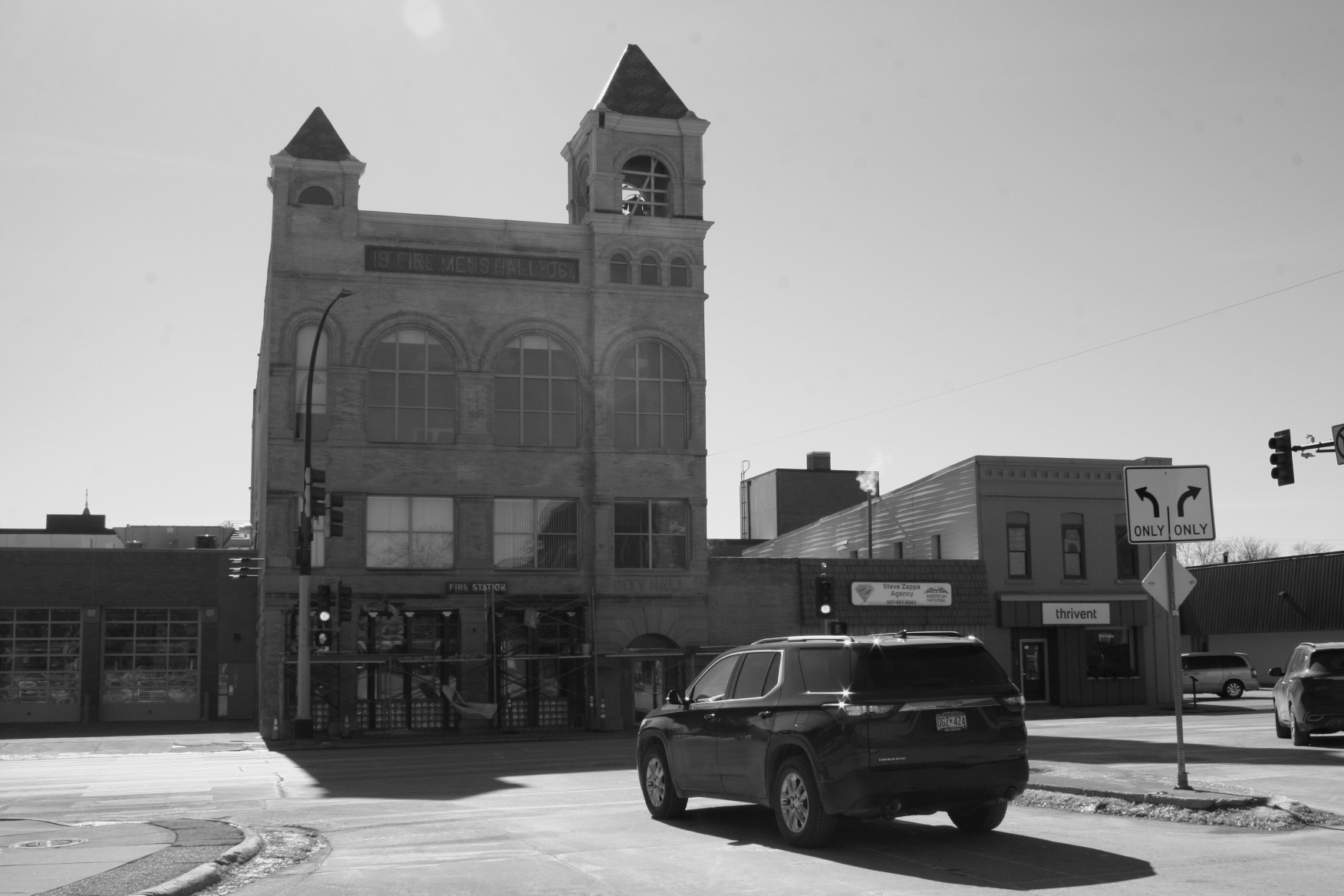
Firemen’s Hall, constructed 1906-1907 for $19,643, sits just across the street from Central Park. (Minnesota Prairie Roots copyrighted photo February 2022)
Twelve city blocks in Owatonna’s downtown define the community’s designation as a National Register Historic District. Three of the 75 “contributing buildings” within that district are on the National Register of Historic Places: the National Farmer’s Bank, the Steele County Courthouse and the Firemen’s Hall.
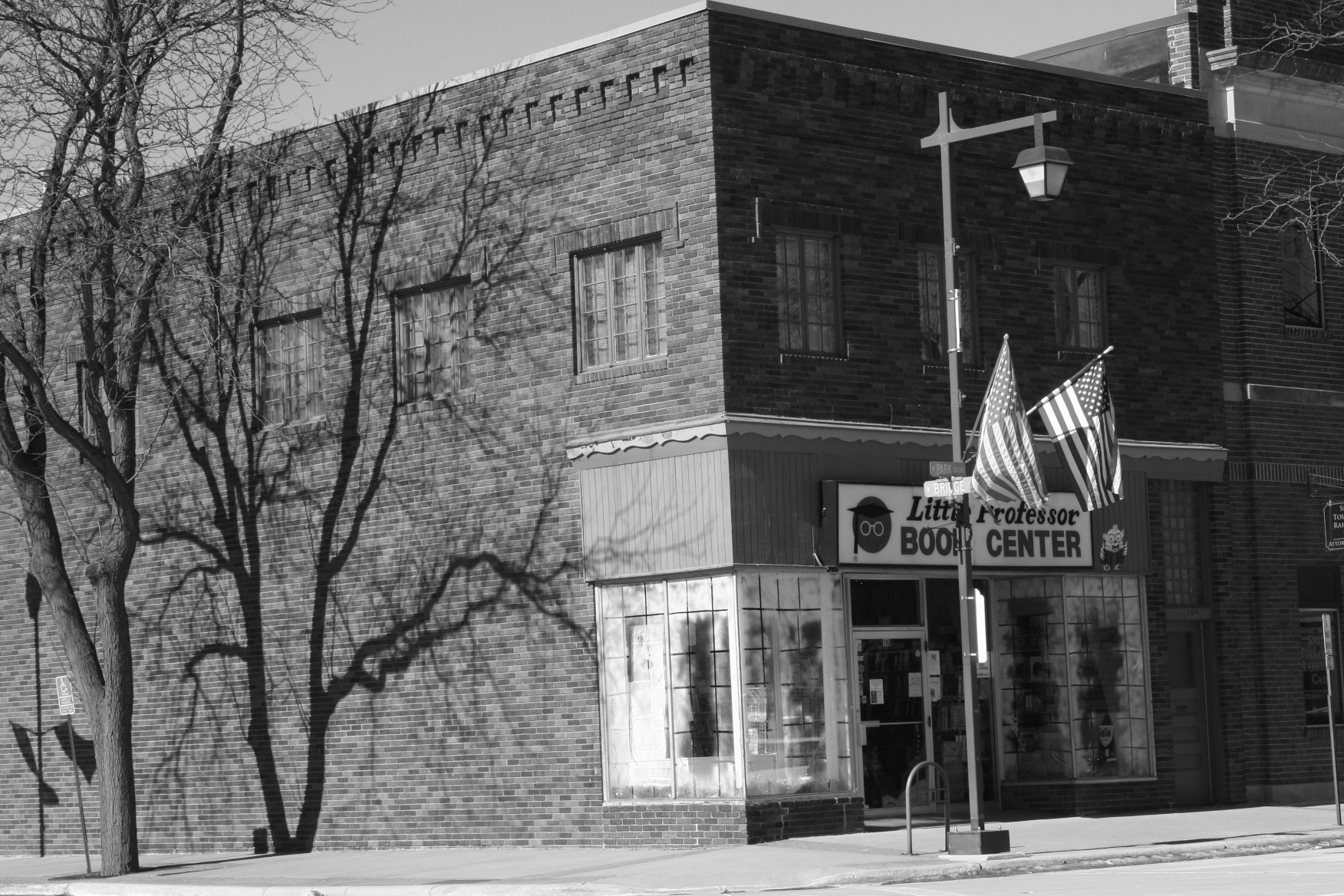
This home-grown bookstore anchors a downtown corner, directly across from Central Park. (Minnesota Prairie Roots copyrighted photo February 2022)
On a recent visit to Owatonna’s Central Park, I pivoted to observe those key historic buildings and others in a downtown of multiple core business streets.
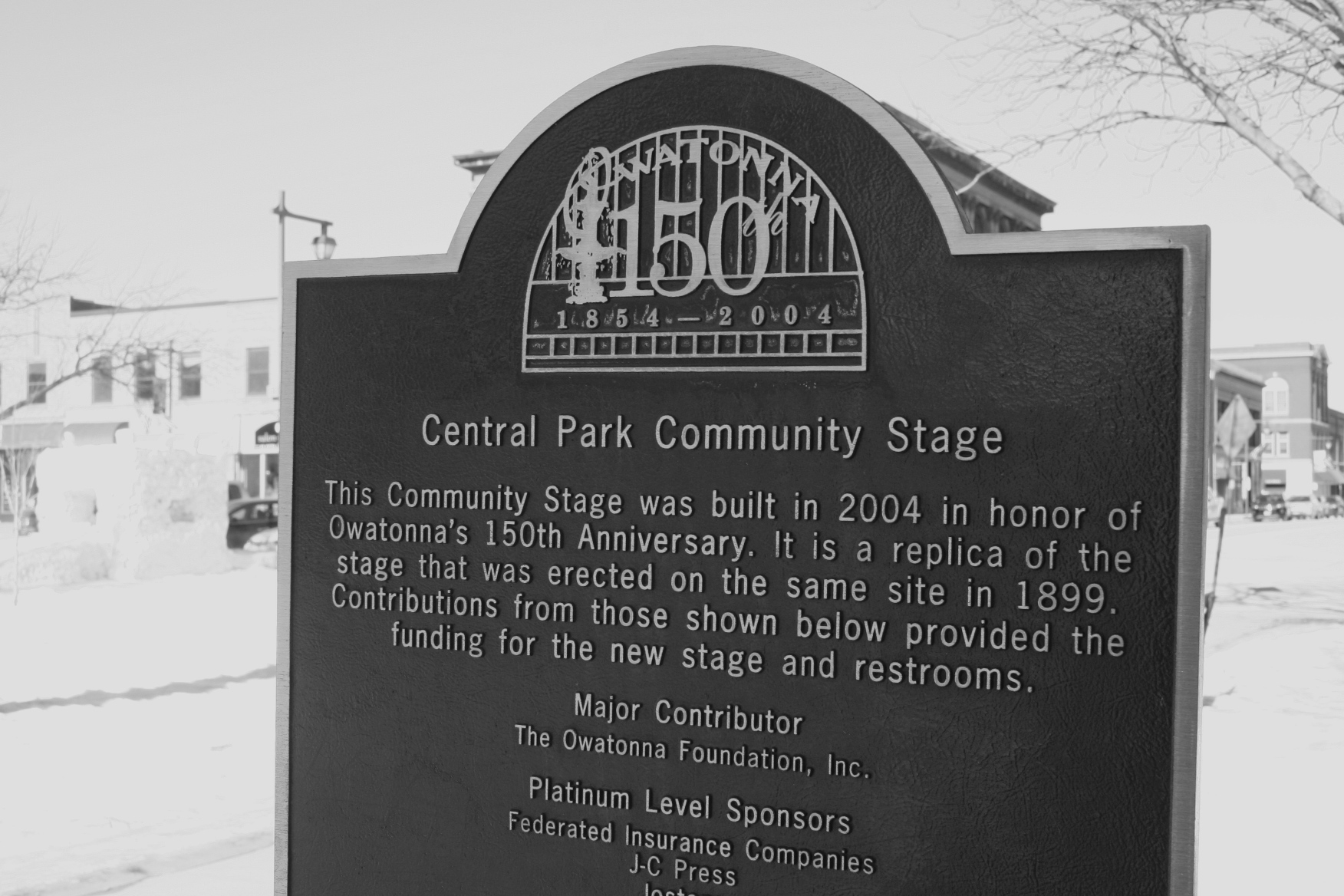
A sign in Central Park provides information about the community stage. (Minnesota Prairie Roots copyrighted photo February 2022)
The park, with a replica of the 1899 community stage, serves as the “town square,” the physically identifiable point of focus and gatherings. Here folks gather for concerts, the farmers’ market and other events. Music and the undeniable human need to socialize connect the past to the present.
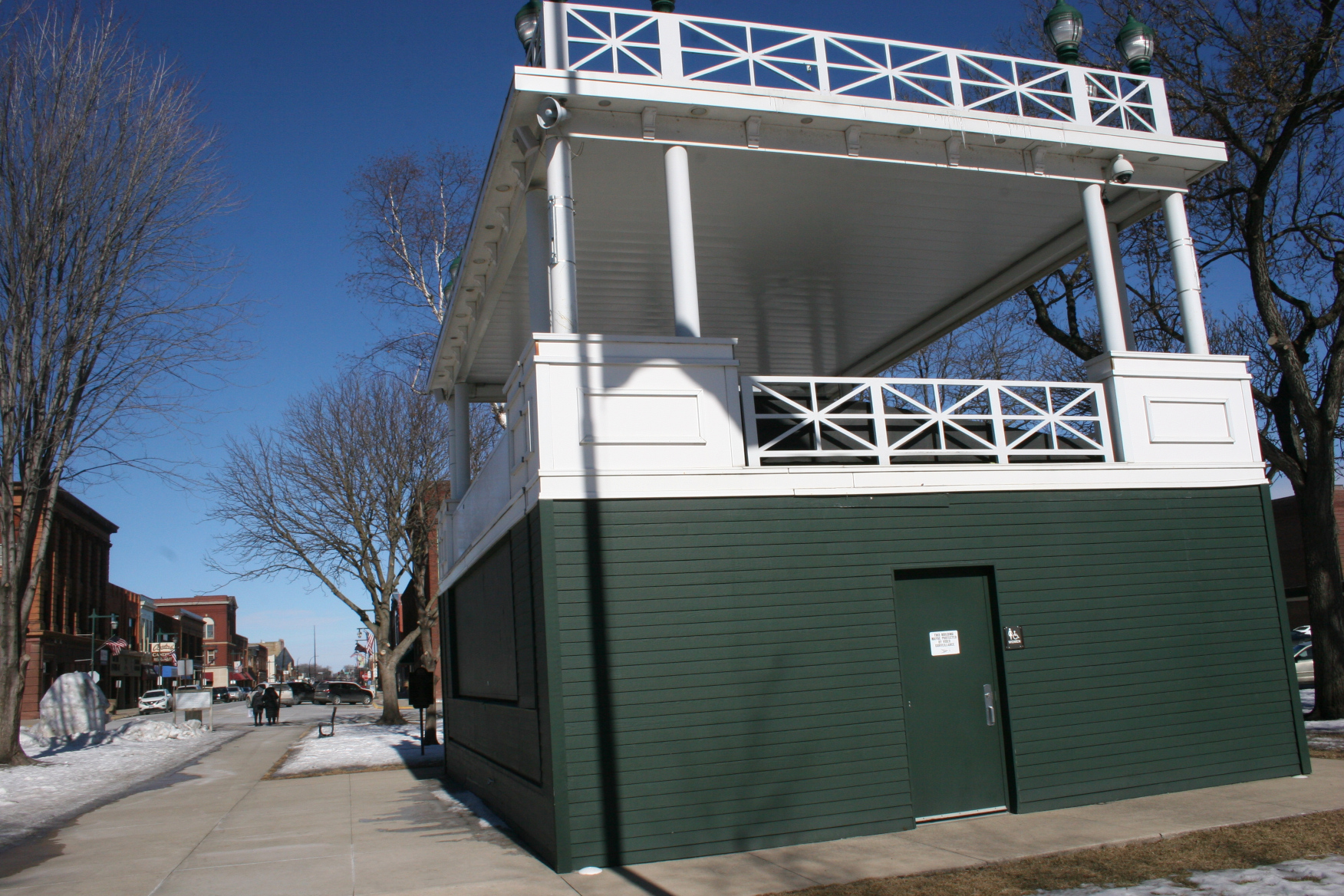
The replica community stage/bandshell. (Minnesota Prairie Roots copyrighted photo February 2022)
I feel inspired now, via my recent stop in Central Park, to return to downtown Owatonna and further explore its history and architecture. Sure I’ve been here before, but not in awhile and not with a focused purpose of intentional appreciation for and photographic documentation of this historic district.
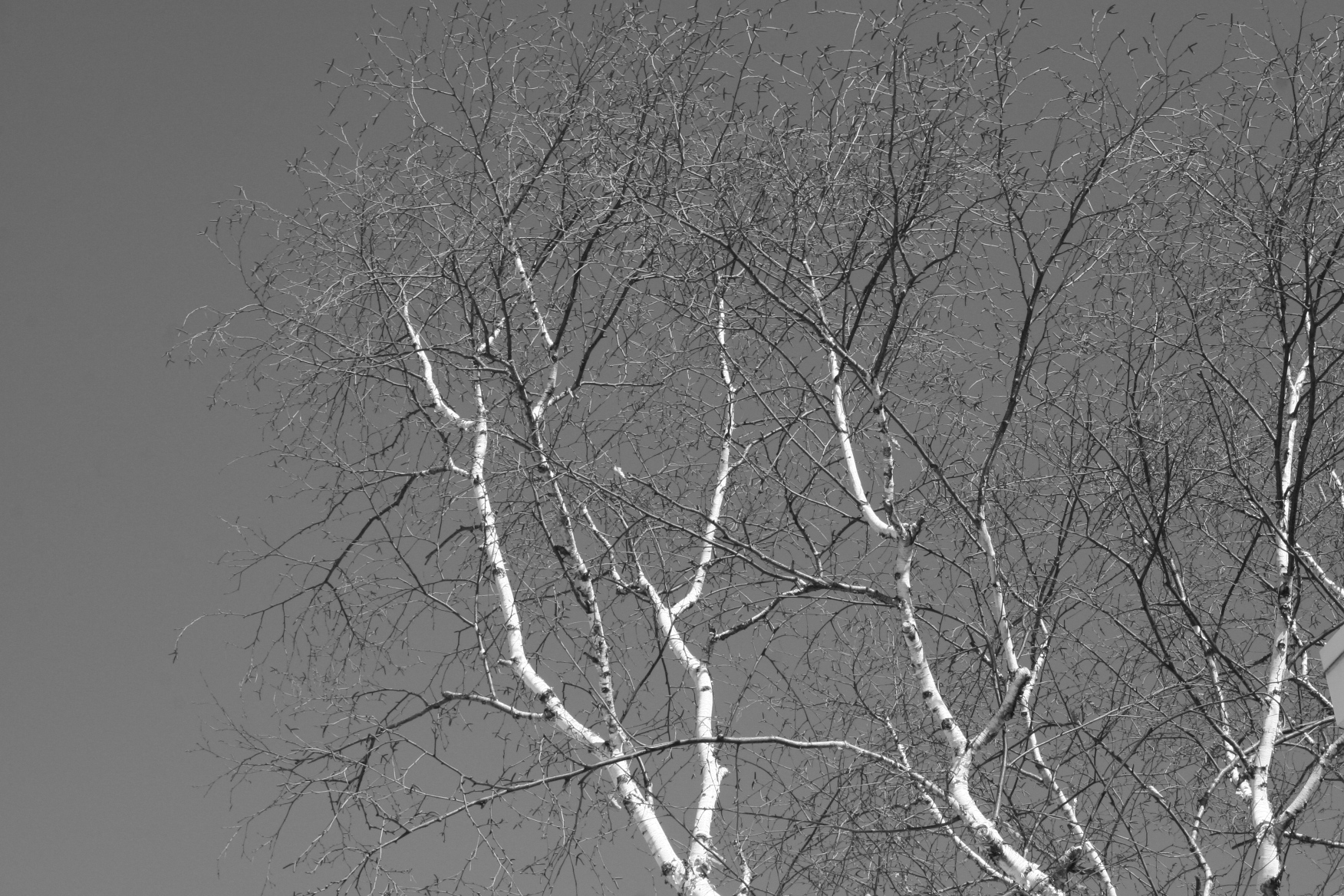
Strip away the color and appreciate the stark beauty. (Minnesota Prairie Roots copyrighted photo February 2022)
I encourage each of you, wherever you live, to pause. Strip away the color to black-and-white. See the basics, uncolored by time or attitudes or that which detracts. Observe how the past and present connect. Value the “good” in your community. Appreciate the place you call home.
TELL ME: What do you appreciate about your community?
THE LAST TIME I STOPPED at Owatonna’s Central Park, this southern Minnesota city’s community gathering spot pulsed with activity. The park hosts a busy Owatonna Farmers Market from May through October.
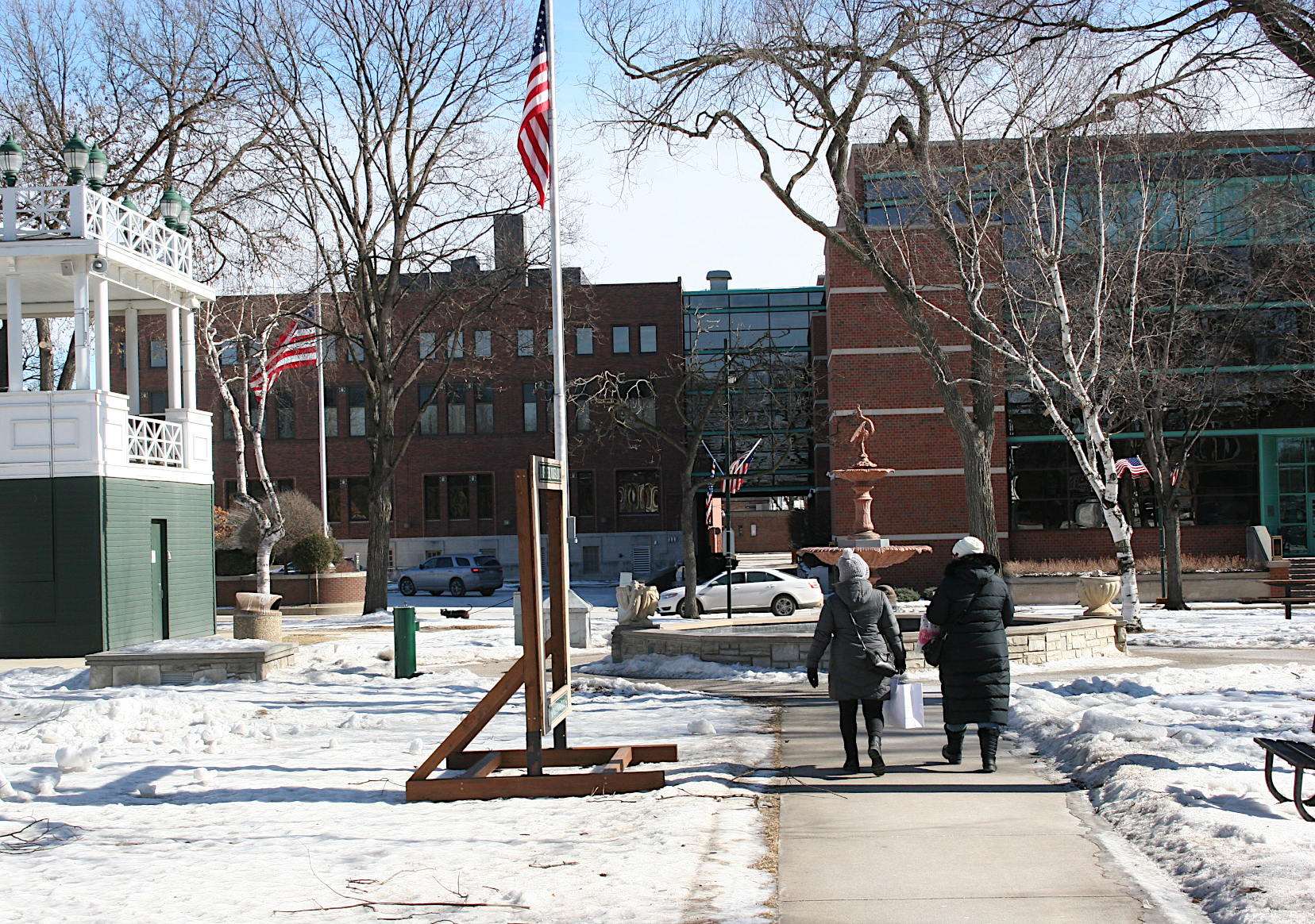
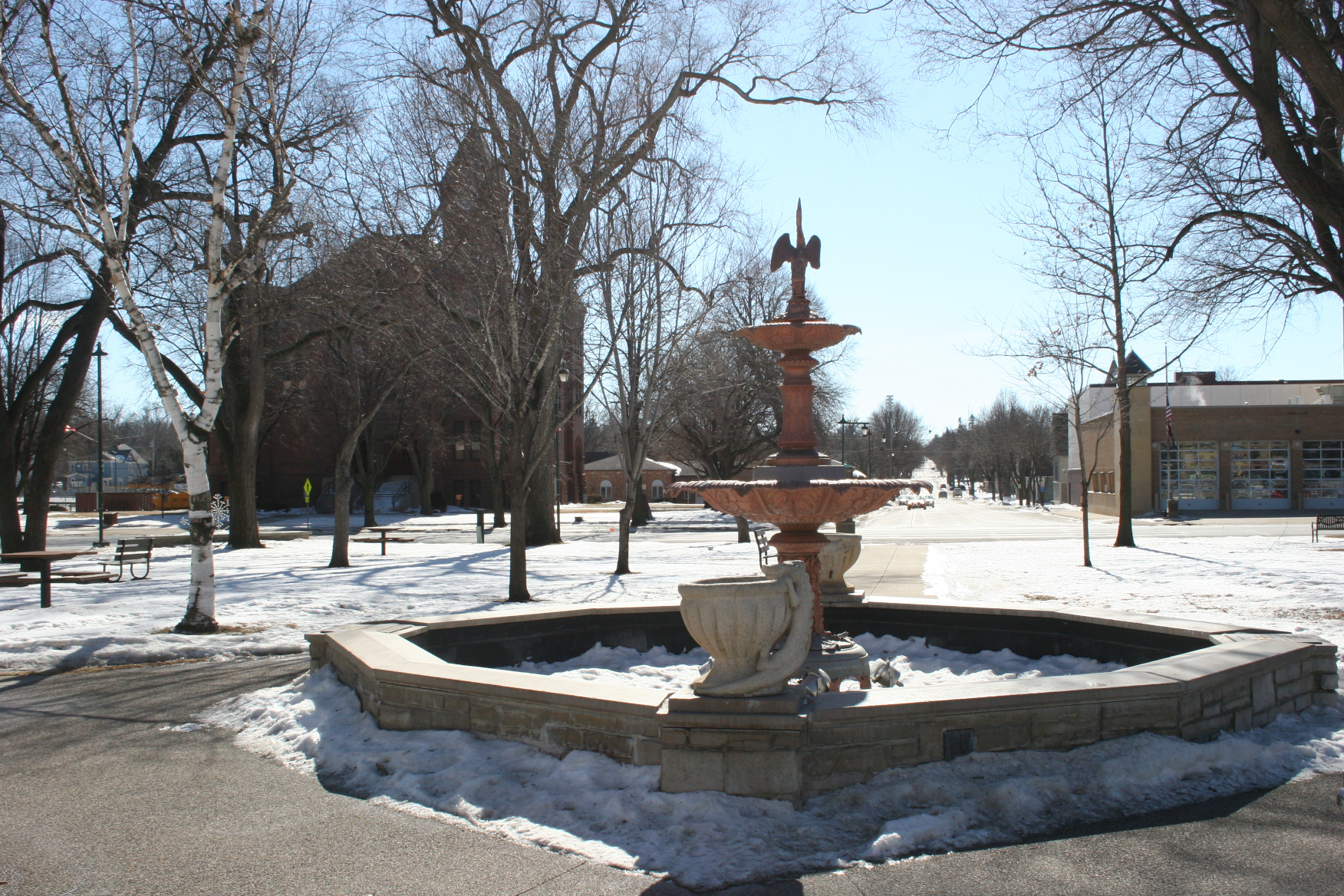
A scene from Owatonna’s Central Park on February 19. (Minnesota Prairie Roots photo February 2022)
But on this cold Saturday in late February when I stopped by, only a few people used the park. A couple walked their dogs. And two women crossed to the center fountain, purses angled across downy winter coats, stocking caps clamped on and shopping bags looped over three gloved hands, take-out coffee clutched in the fourth.
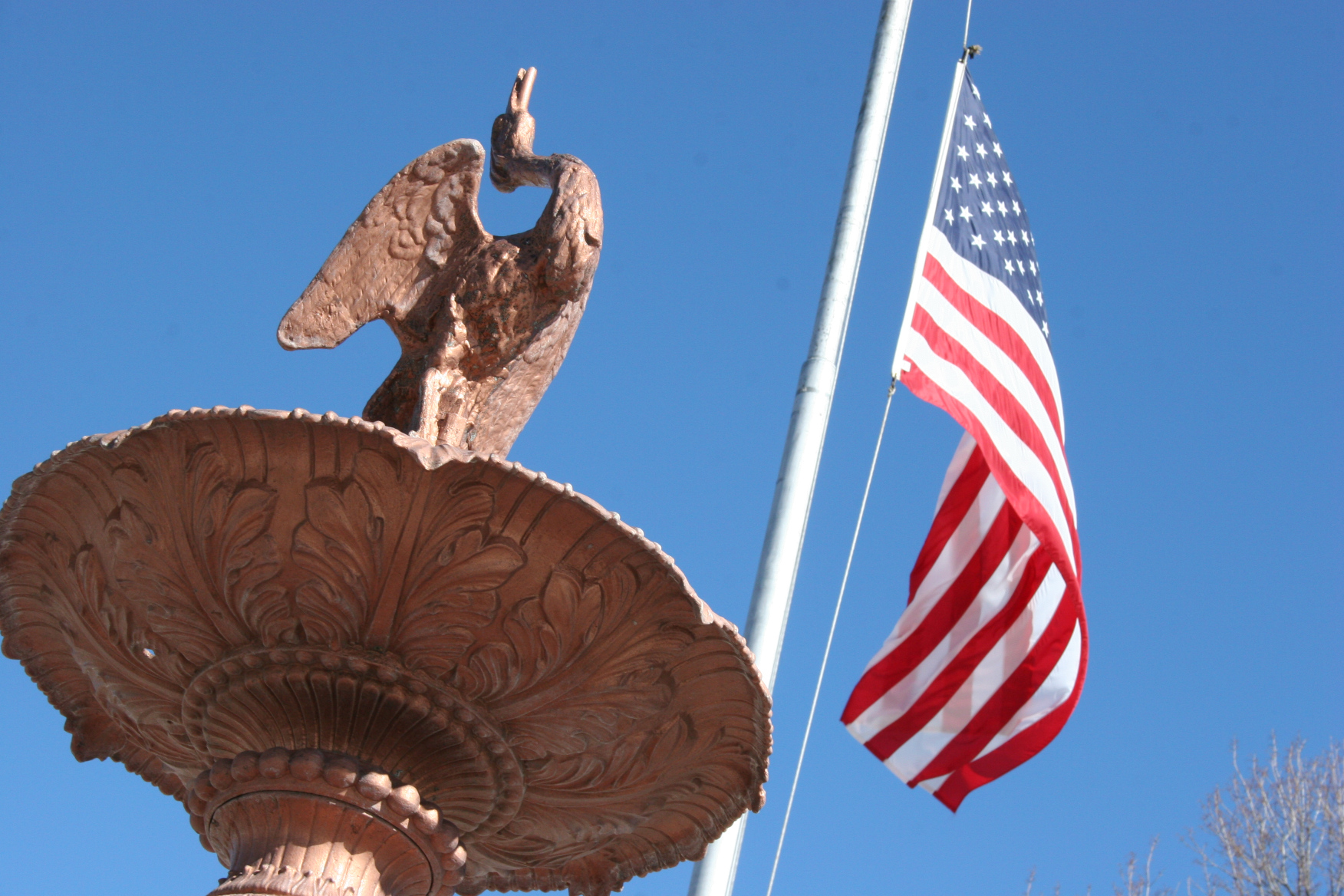
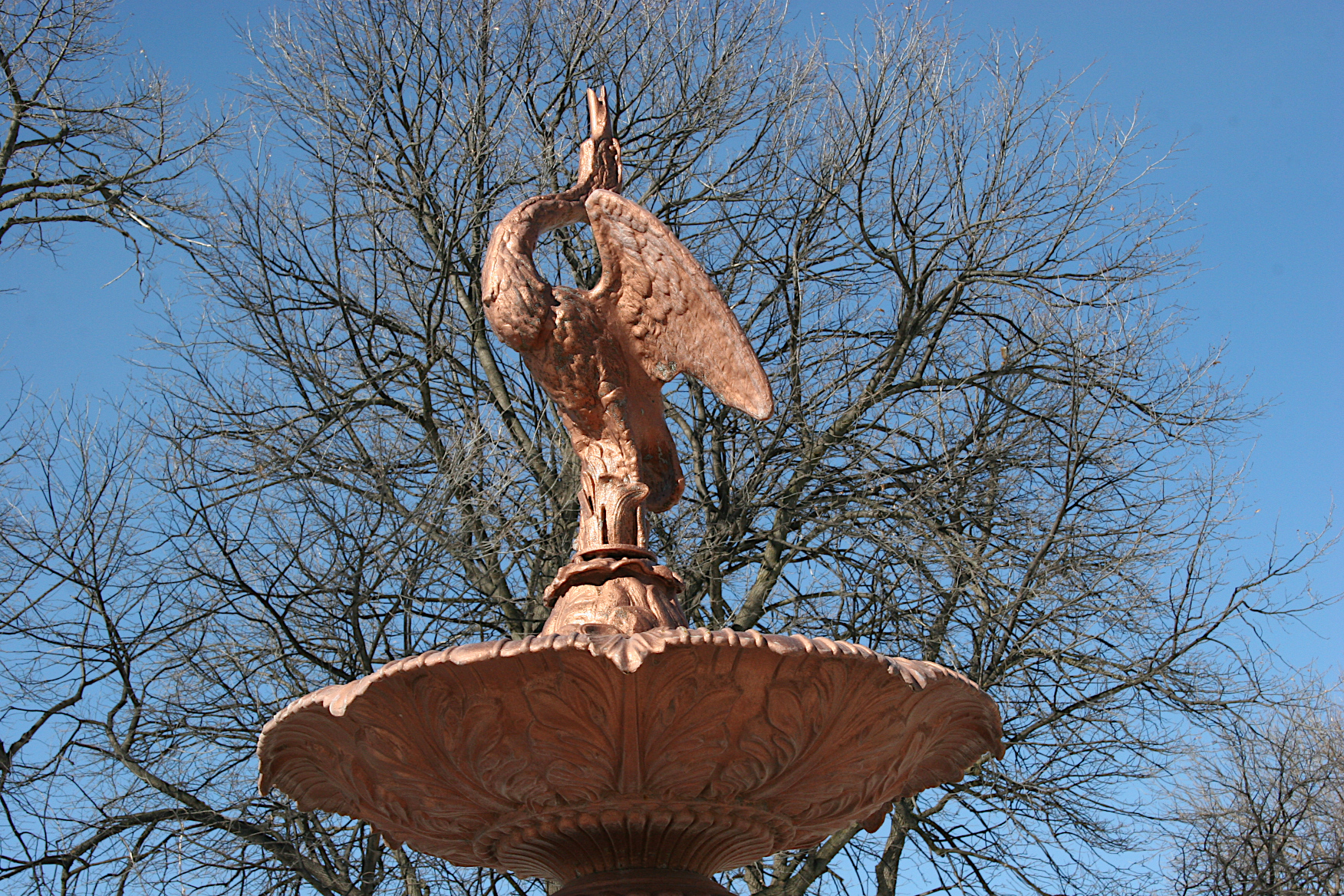
A crane tops the 1909 fountain, refurbished in 2021. (Minnesota Prairie Roots copyrighted photo February 2022)
Imagine this fountain in the warmer months. (Minnesota Prairie Roots copyrighted photo February 2022)
Love the graceful curve of the fountain top crane. (Minnesota Prairie Roots copyrighted file photo February 2022)
As the women paused near the centerpiece fountain placed here in 1909, I studied the scene before me, camera ready. Only moments earlier, I finished my packed lunch inside the cozy warmth of the van. Randy and I had planned to eat at nearby Rice Lake State Park. But that all changed when hiking trails proved too icy for safe walking. So here we were in Owatonna, shifting our plans.
This replica of the 1899 community stage centers the park. It was built in 2004, on Owatonna’s 150th anniversary. (Minnesota Prairie Roots copyrighted photo February 2022)
I was determined that the cold weather would not keep me from photographing the park. Dressed in a warm hand-me-down parka from my son layered over tee and flannel shirts, long johns under jeans, practical winter boots, hand-knit cap and mitten/gloves, I felt prepared. The combo mitten/gloves were a gift from Randy years ago. They work great for winter photography. I flip back the fleece ends to reveal open fingertips. That allows me to manipulate my camera without exposing my entire hand.
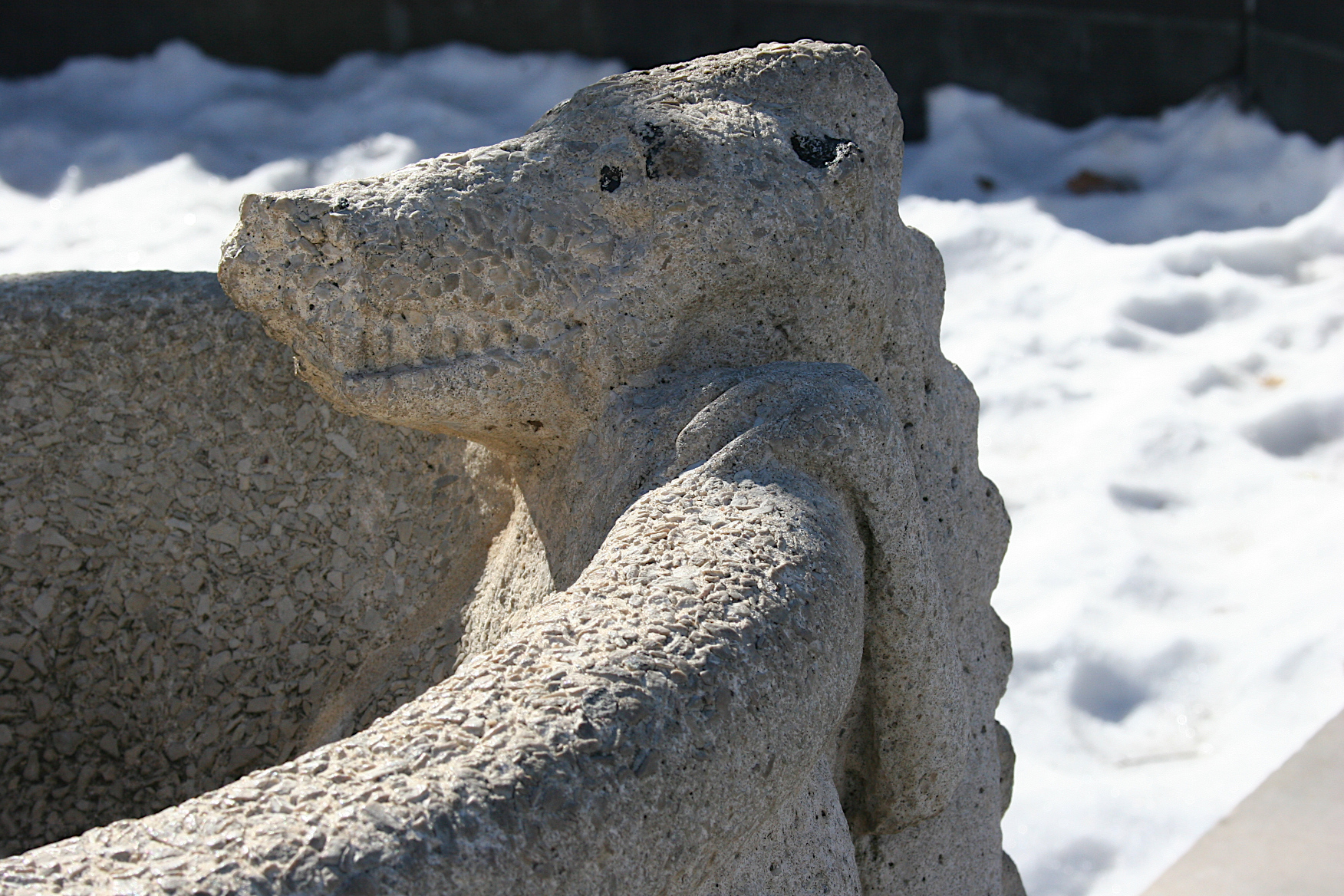
An artsy planter sits on fountain’s edge awaiting spring planting. (Minnesota Prairie Roots copyrighted photo February 2022)
Even with all of that, I soon found myself hurrying my creative pace. My fingertips were freezing.
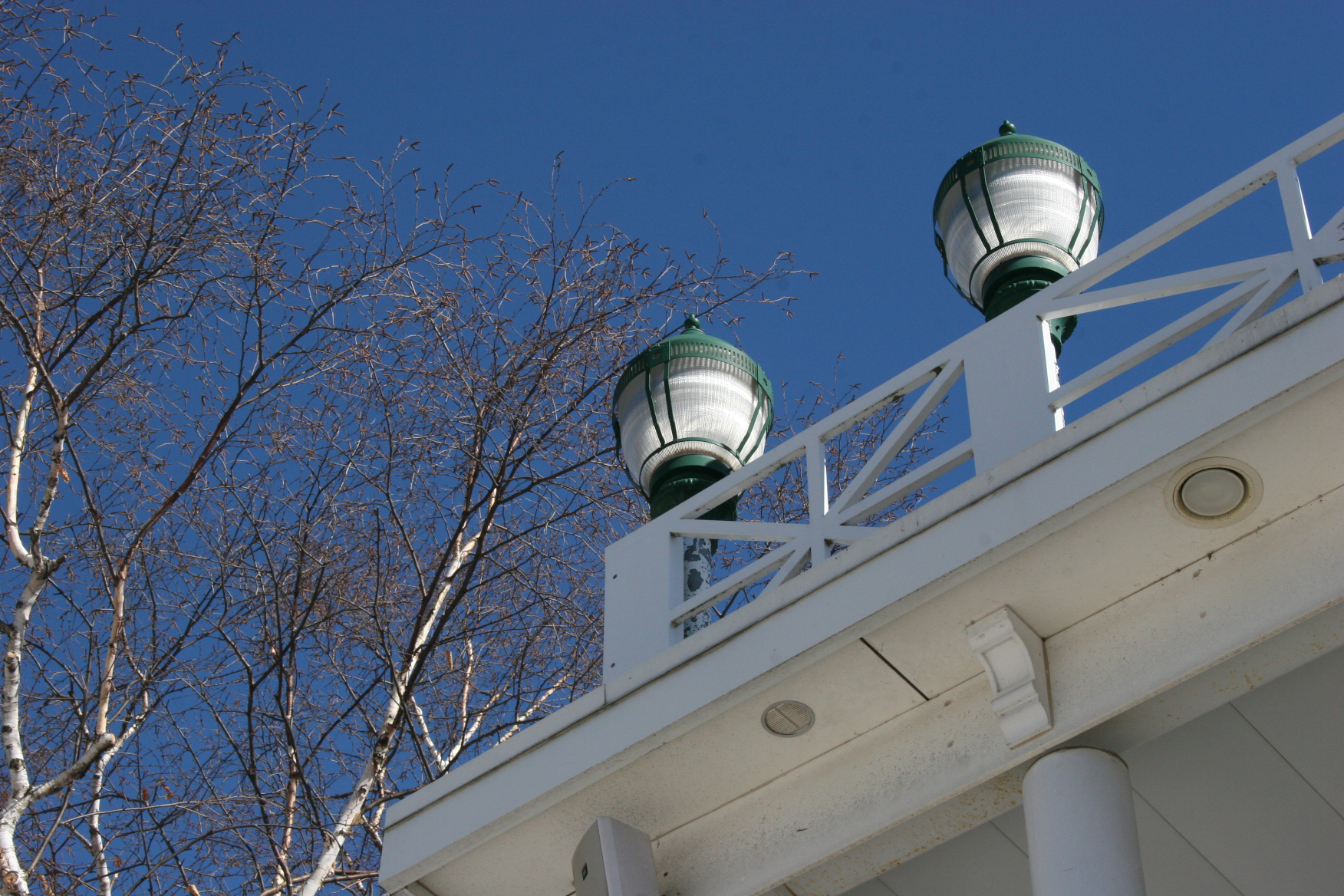
Trees and lights against a bold blue sky by the stage/bandshell. (Minnesota Prairie Roots copyrighted photo February 2022)
But I was determined to document the setting on an afternoon that looked deceptively warm. Bold blue skies. Sunshine. Artsy fountain. Stout community stage. Historic buildings bordering the park. Remnants of snow sculptures.
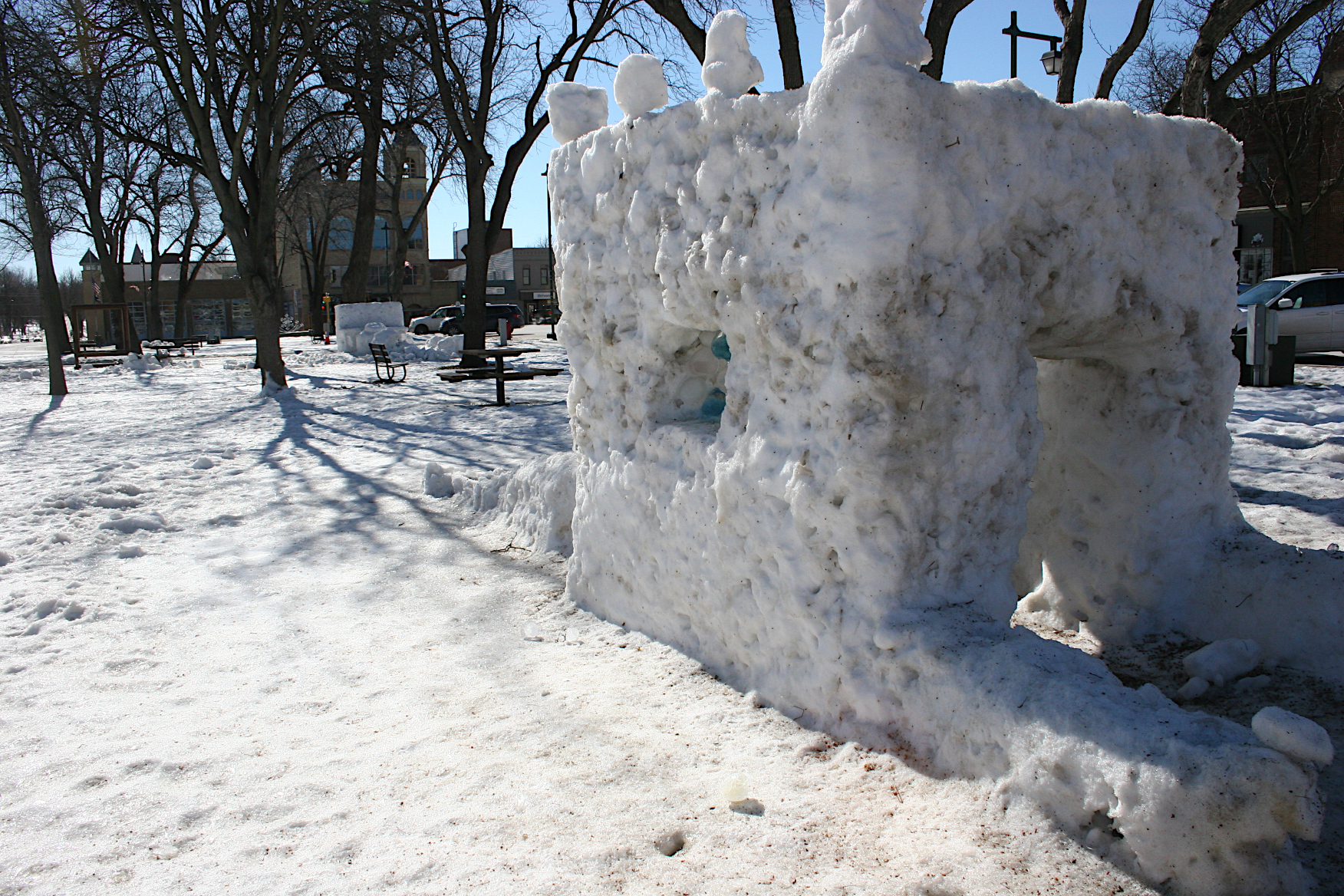
This snow castle still stands, albeit weathered after a month. (Minnesota Prairie Roots copyrighted photo February 2022)
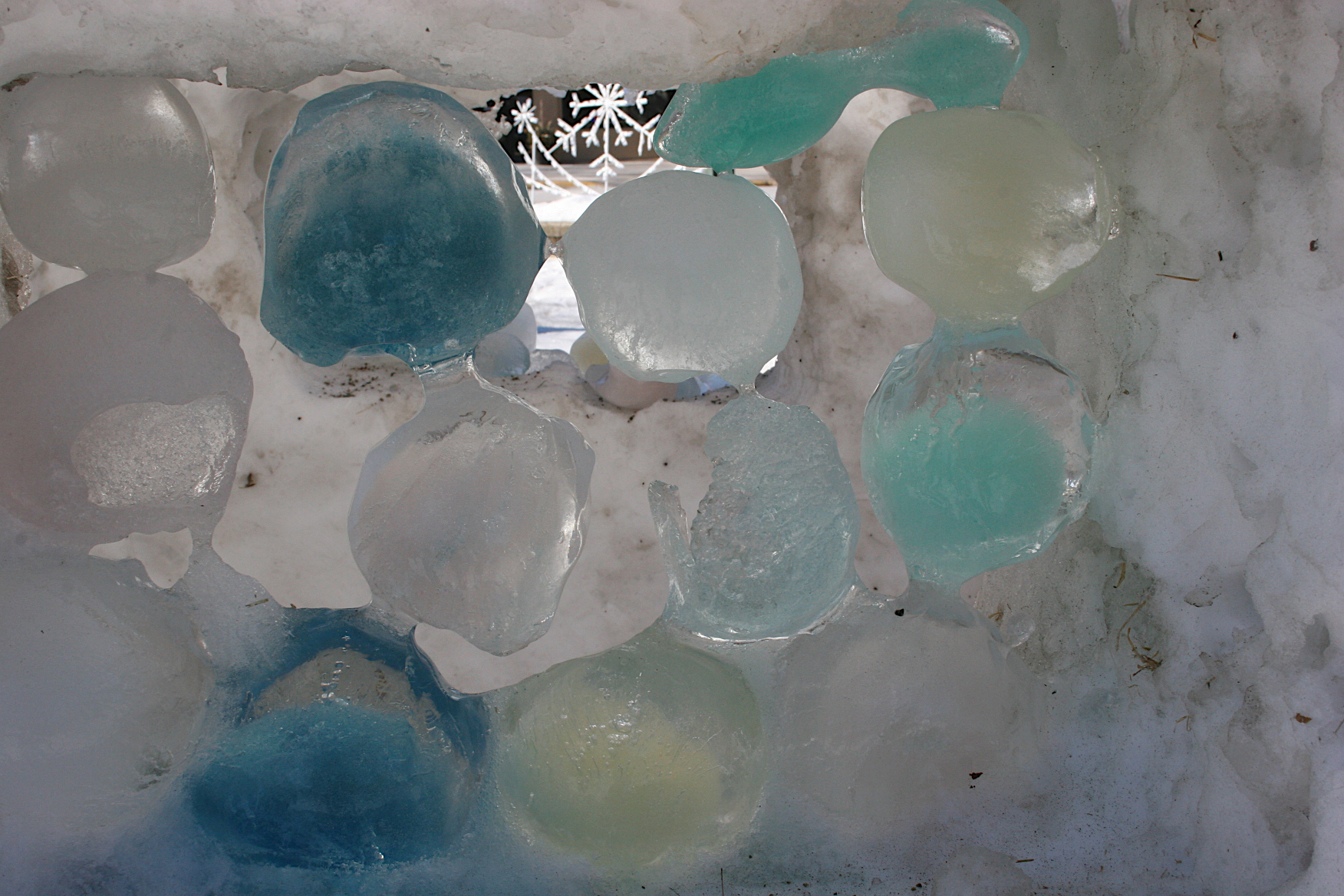
Beautiful colored ice fills a window of the snow castle. (Minnesota Prairie Roots copyrighted photo February 2022)
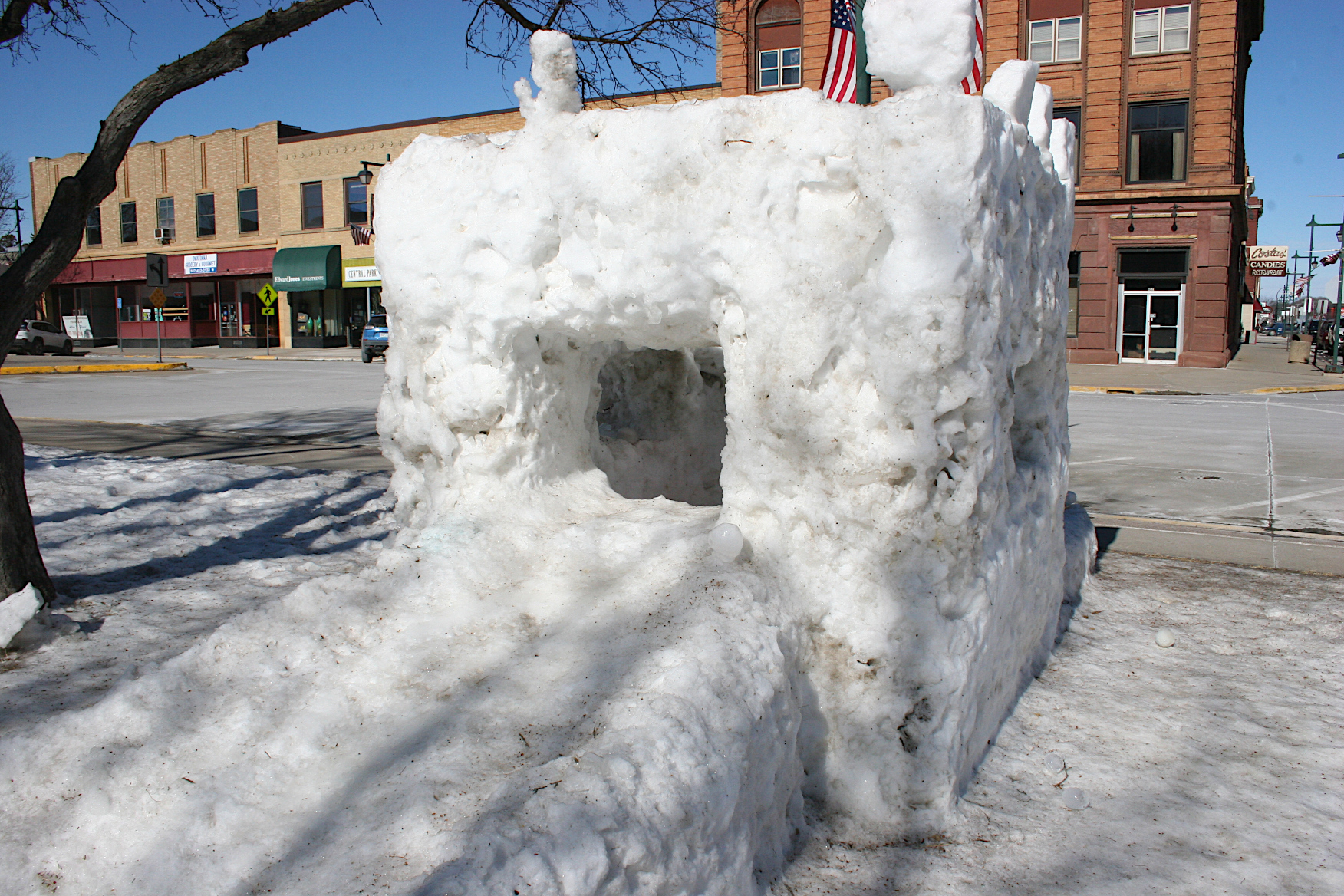
The back side of the castle features a slide. (Minnesota Prairie Roots copyrighted photo February 2022)
I regretted that we missed Owatonna’s Bold & Cold Winter Festival at the end of January. Then those sculptures would have been newly-built, pristine. But now I could only imagine kids slipping down the slide at the deteriorating snow castle.
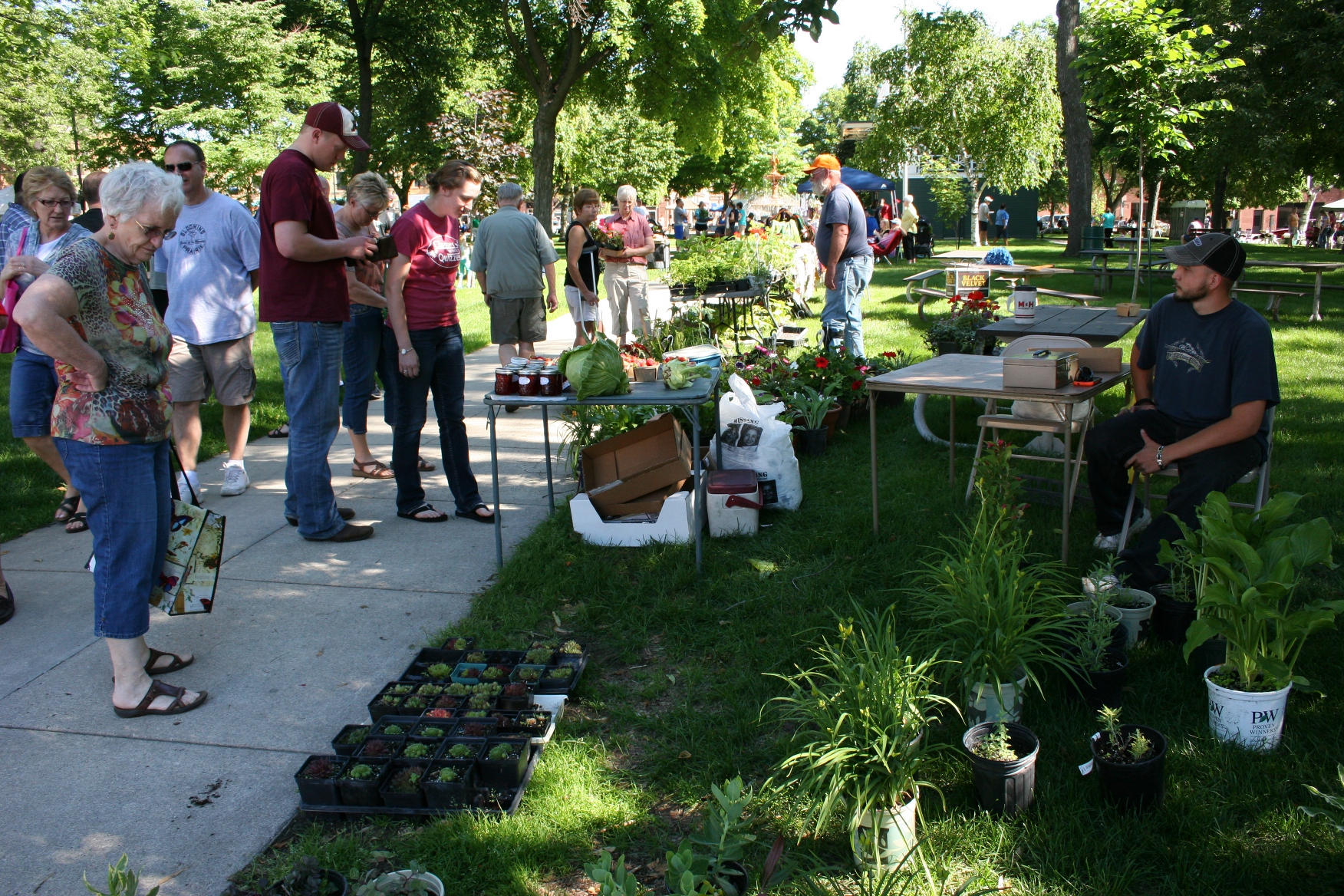
Plants for sale at the 2014 Owatonna Farmers Market. (Minnesota Prairie Roots copyrighted photo February 2022)
I also imagined how, in a few months, this scene will change. How leaves will unfurl on the birch trees. How the fountain will spill water. How Farmers Market vendors will set up shop. How music will create a joyful rhythm that welcomes spring, then summer. And warmth.
A snapshot scene from the 2014 Owatonna Farmers Market, which covers one-block square Central Park. (Minnesota Prairie Roots copyrighted file photo June 2014)
This I contemplate as I snap frames, fingertips freezing, hurting now in the cold of winter. Back in the van, I hold my fingers close to the blower, seeking heat while the sun shines bright, bold over Central Park.
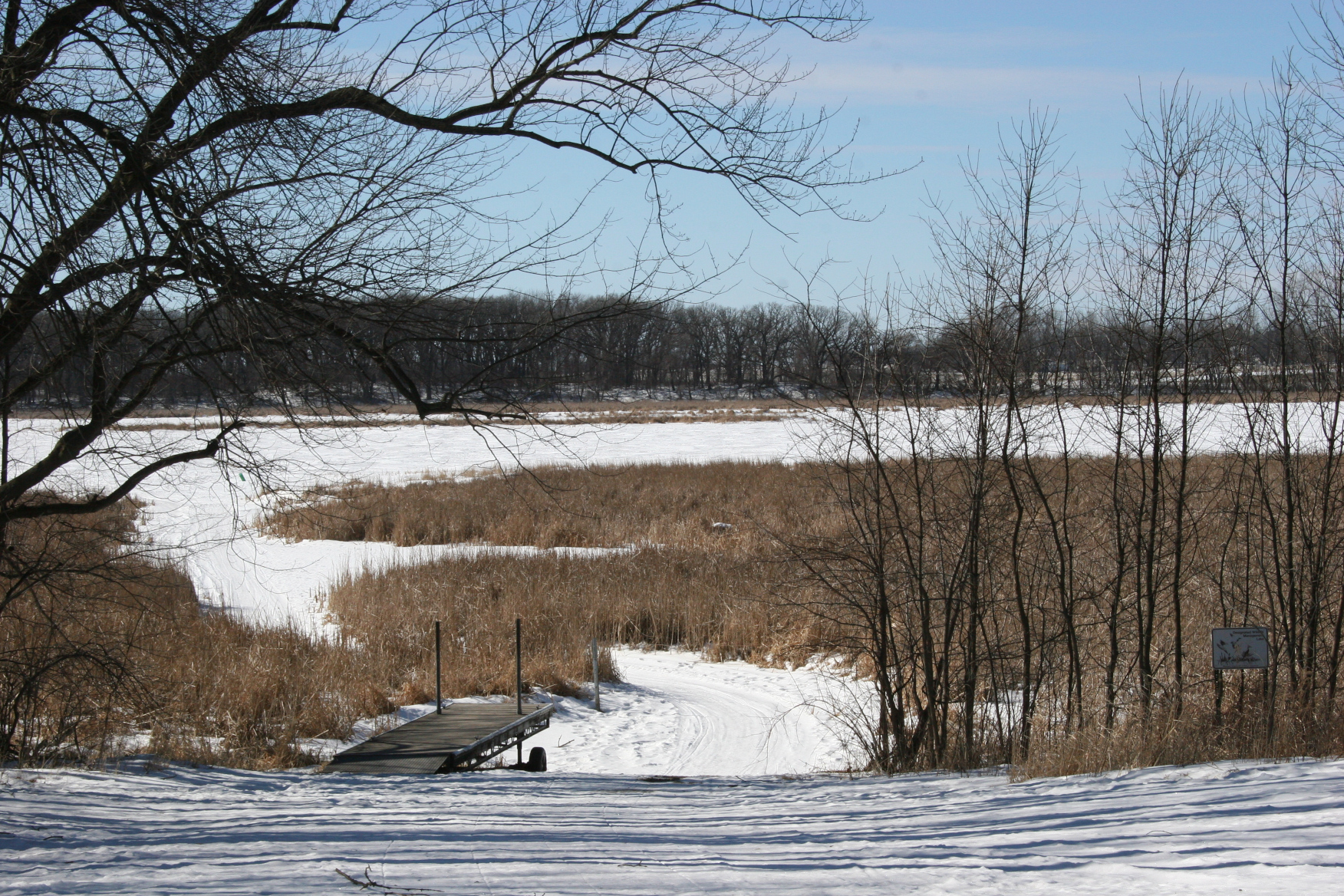
A view of frozen Rice Lake at Rice Lake State Park on February 19. (Minnesota Prairie Roots copyrighted photo February 2022)
IN THEORY, THE PLAN seemed a good one. Randy and I would hike in a nearby state park on February 19, the first of four “free entry” days to Minnesota’s 75 state parks and recreation areas.
Mid Saturday morning, we packed sandwiches, fruit, granola bars and almonds for a picnic lunch, although we would eat in the comfort and warmth of our van. Temps in the 20s do not allow for outdoor dining.
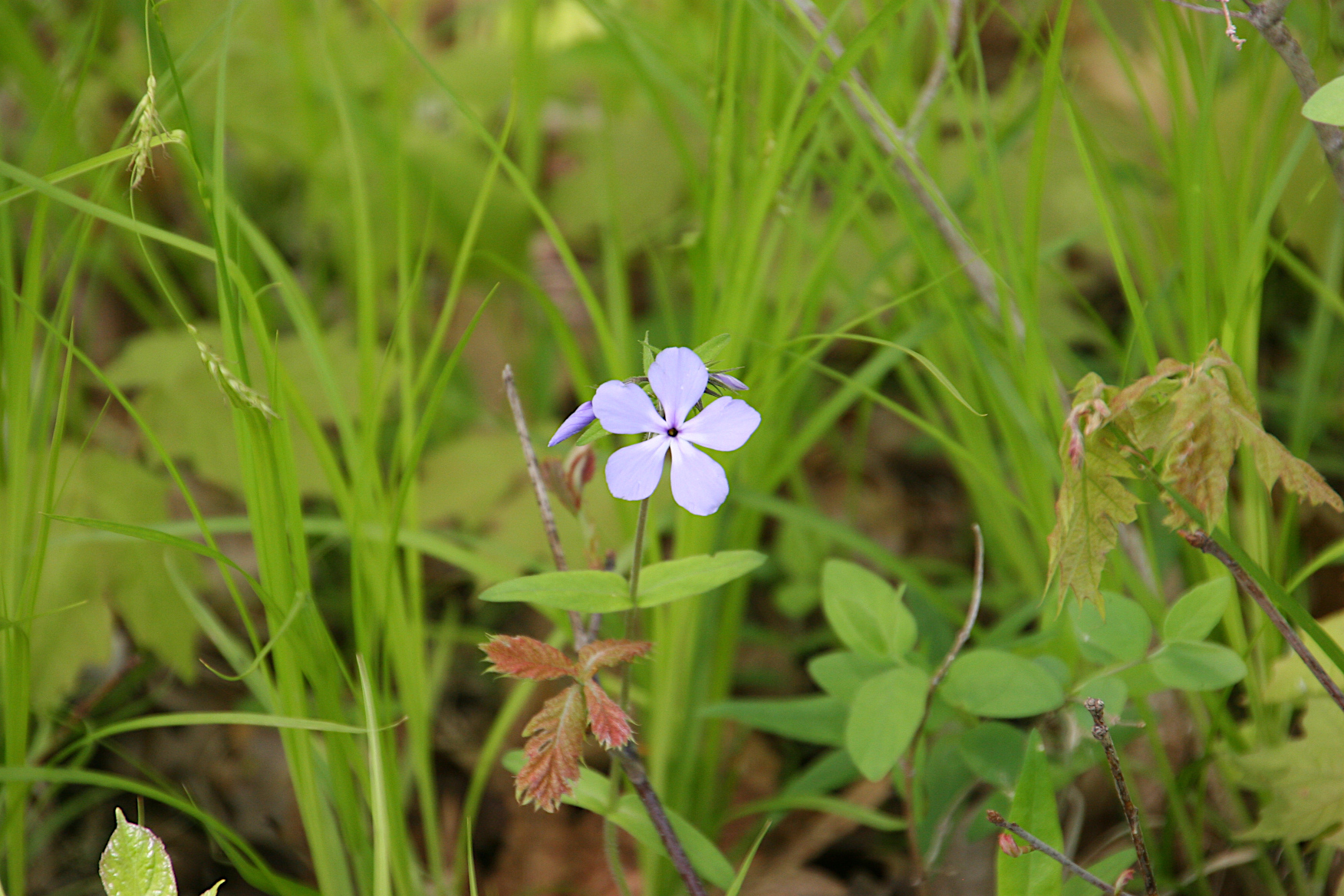
Wildflowers abound in the woods at Rice Lake State Park in this spring-time photo. (Minnesota Prairie Roots copyrighted file photo May 2022)
Originally we intended to drive to Carley State Park south of Plainview. It’s a park we have not visited. But part way there, I suggested we wait. A description of Carley’s Whitewater River-hugging Wildflower Trail and Virginia bluebells carpeting the forest floor in May prompted the change in plans.
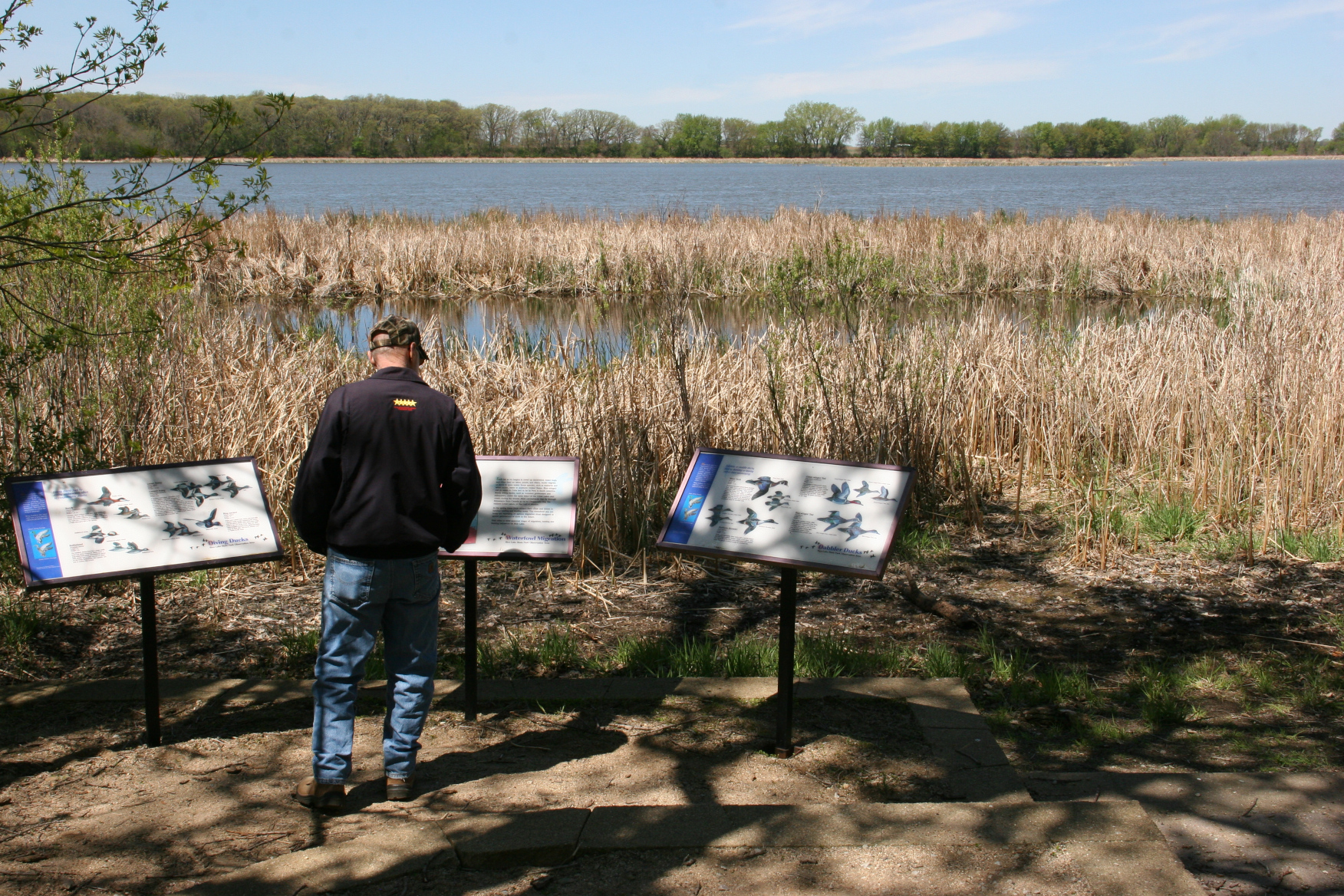
Randy reads signs about waterfowl posted by the lake during a May 2020 visit to Rice Lake State Park. (Minnesota Prairie Roots copyrighted file photo May 2020)
Instead, we aimed for Rice Lake State Park some eight miles east of Owatonna. We’ve previously been there, although not in winter. Following back paved county and gravel roads, I already envisioned hiking the park’s trails along frozen Rice Lake. I imagined the quiet of the woods, the beauty of the snow-covered landscape. Such were my expectations. I also felt excited to participate in the Rice Lake State Park Challenge, a special free entry day event that involved finding passwords to claim a possible prize.
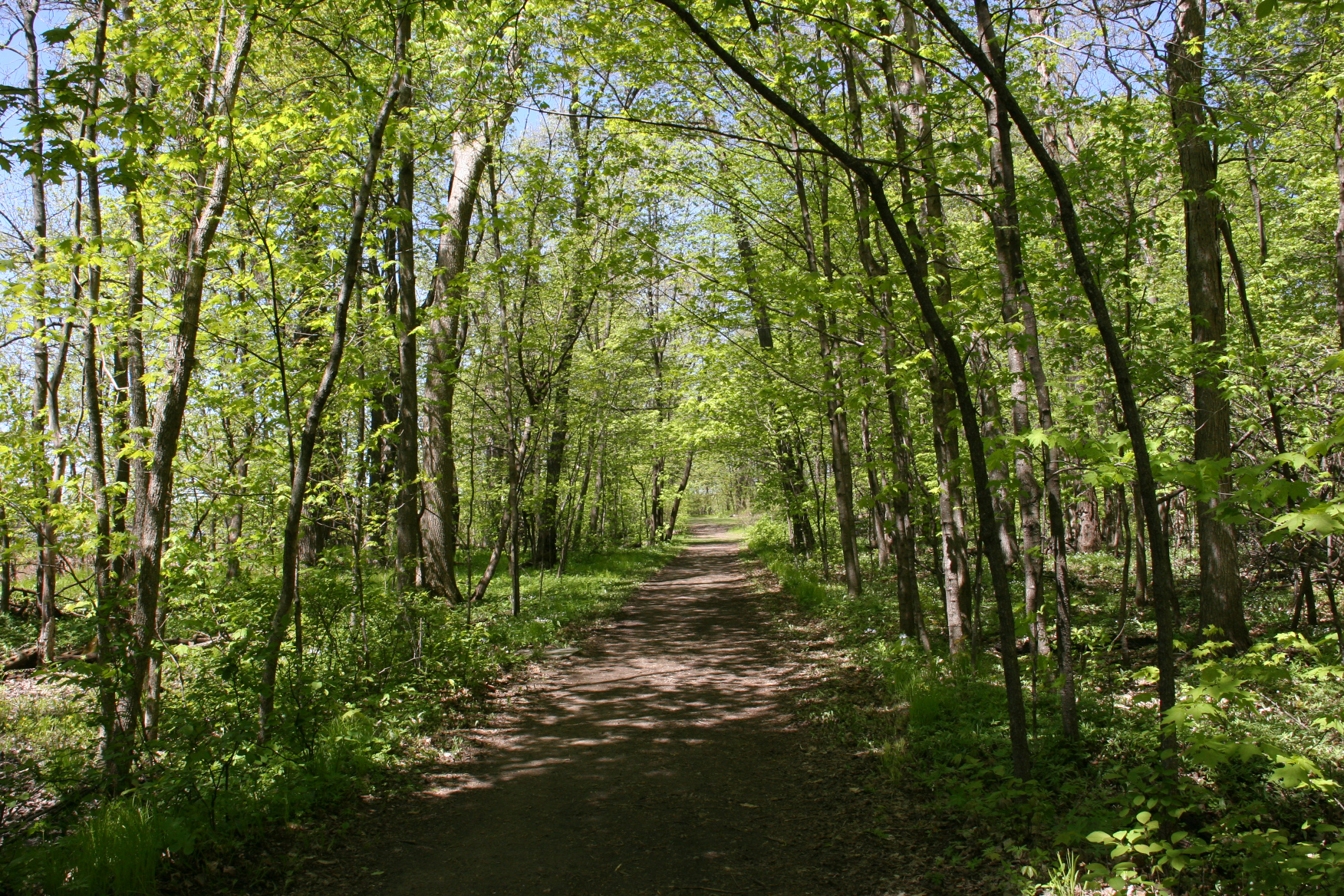
Walking into the woods at Rice Lake State Park in the spring. (Minnesota Prairie Roots copyrighted file photo May 2020)
When we pulled into the park, I checked in at the park office for a map and the challenge entry form. As I was about to leave, the park staffer warned, “Be careful, the trails are icy.” I would soon discover for myself just how right she was in that assessment.
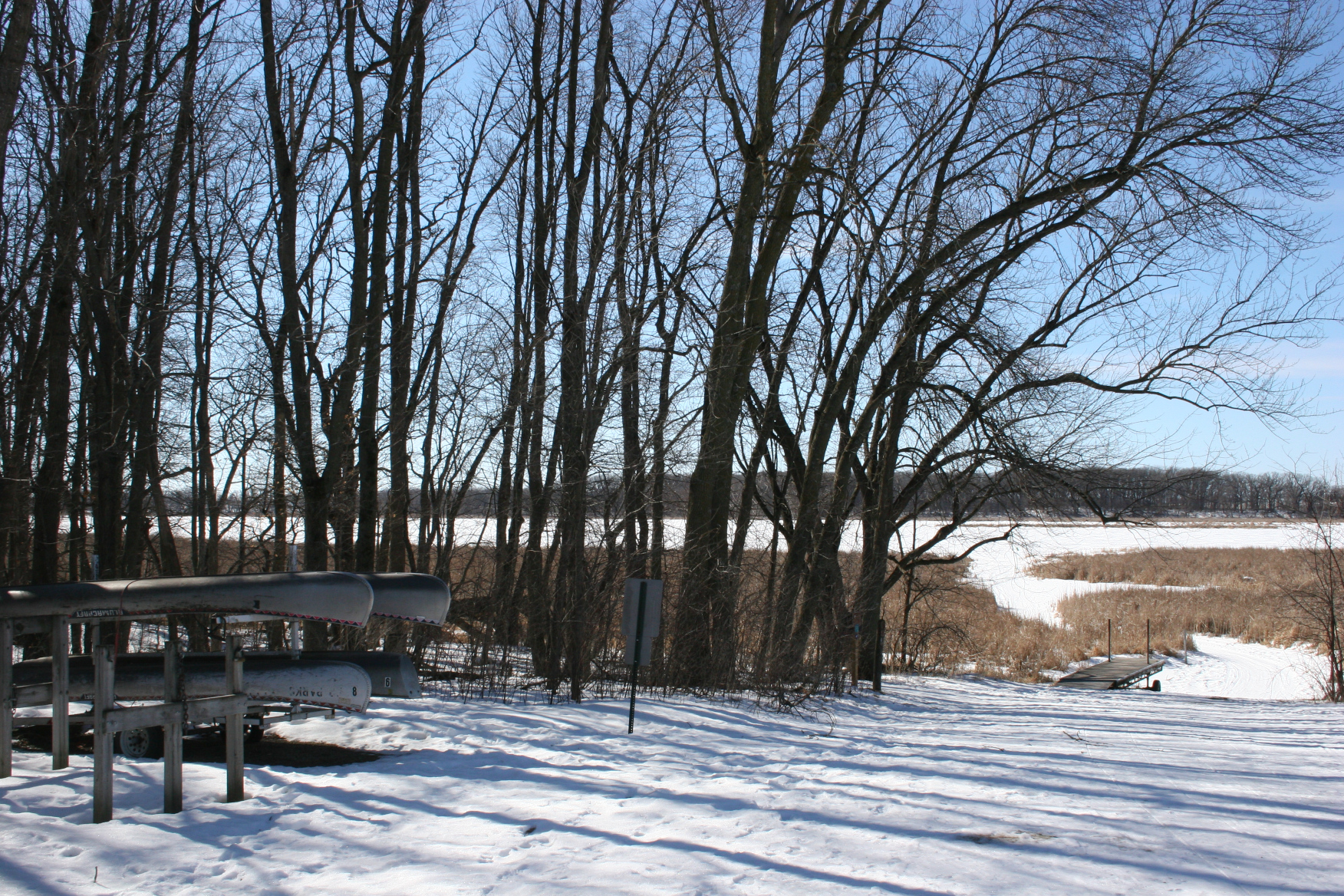
Rental canoes are stacked next to the parking lot and lake. The trail we took started at the edge of the woods near lake’s edge. (Minnesota Prairie Roots copyrighted photo February 2022)
The snow-packed, icy parking lot offered the first clue to conditions. I carefully stepped from the van, draped my camera strap around my neck and aimed toward the lakeside trail. Not even part way there, I was already grasping Randy’s arm. As someone who’s broken her right shoulder and left wrist in falls (the last requiring surgery), I have no desire to fall and break a third bone. Note that neither occurred in winter but rather in May and June and involved a missed step inside a hospital and a rain-slicked wooden step in a friend’s backyard.
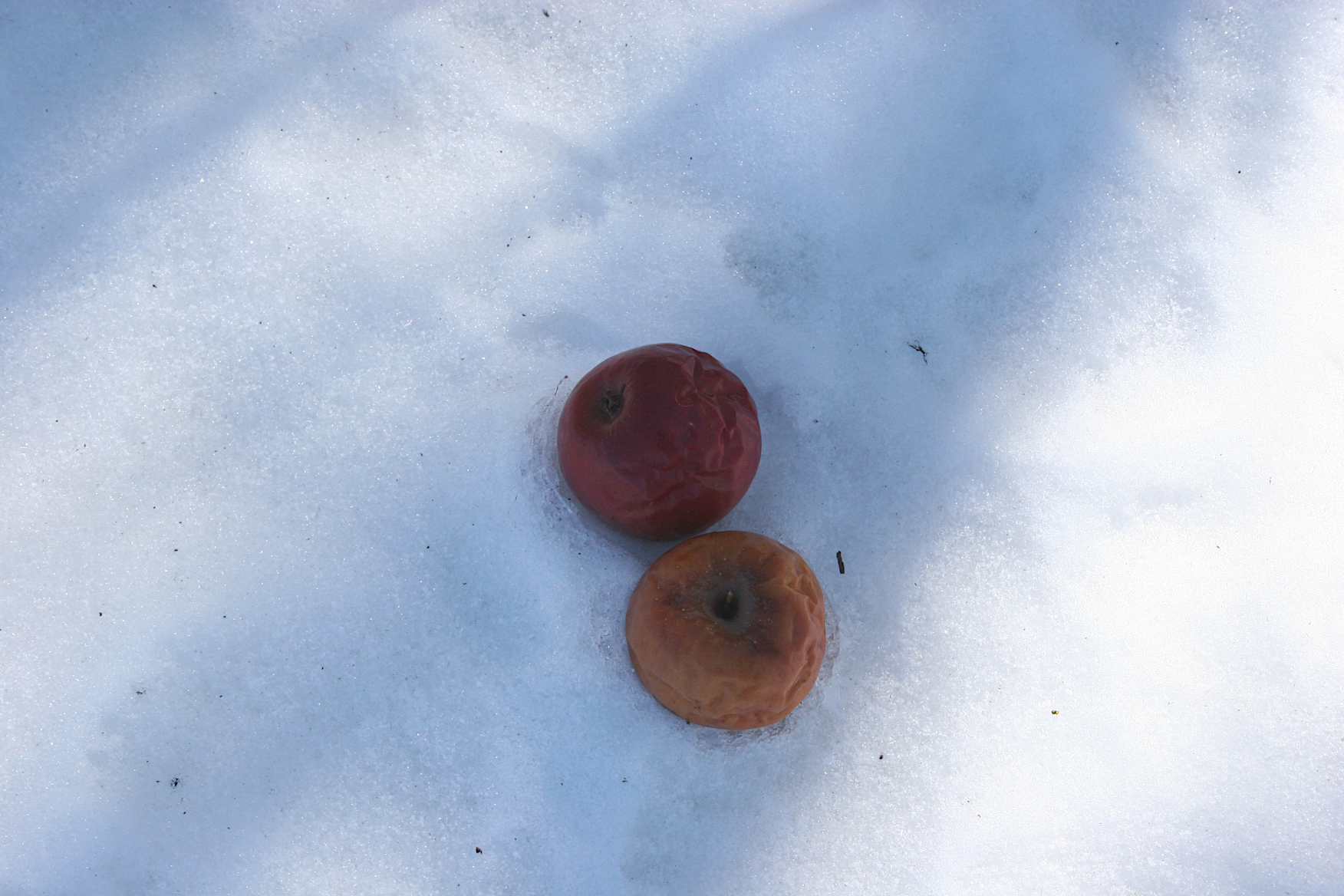
On the way back to the van, I spotted these apples in the snow. Deer food? (Minnesota Prairie Roots copyrighted photo February 2022)
At the beginning of the trail at Rice Lake State Park, I paused, observed and assessed that, yes, the trail was, indeed, icy. But I was willing to try, hoping conditions would improve. They didn’t. Soon Randy and I found ourselves crunching through the snow aside the trail rather than traversing the ice-packed path. Not even 20 feet in, Randy advised that perhaps we best turn around. I agreed.
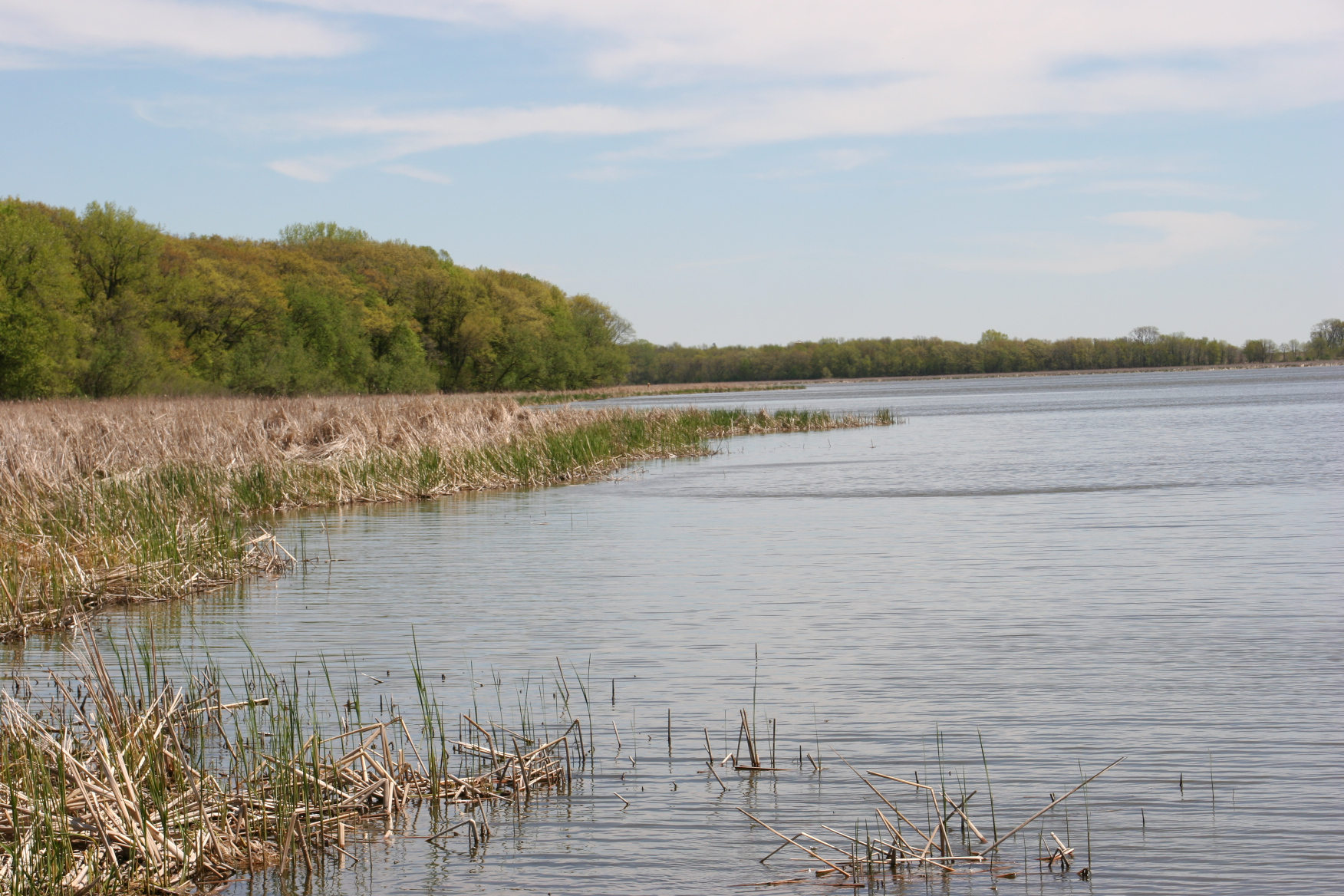
Lake and sky meet at Rice Lake State Park during a spring visit. (Minnesota Prairie Roots copyrighted file photo May 2020)
Disappointment filled my thoughts. I didn’t realize how much I had anticipated this time in nature, in the woods, by the lake. And now…plans would pivot. We realized conditions would likely be the same at other state parks. So we headed west to Owatonna for that picnic lunch and more.
#
TELL ME: If you live in southern Minnesota, where can I find clear trails for winter hiking? If you live elsewhere, where do you like to hike this time of year?
#
FYI: Minnesota has three more upcoming “free entry” to state parks and recreation areas in 2022. Those dates are April 23, June 11 and November 25. I highly-recommend a warm weather hike in Rice Lake State Park. It’s especially peaceful.
I pulled stories from a family history book for a family history trivia contest at a 2017 Helbling reunion. (Minnesota Prairie Roots copyrighted file photo 2017)
YESTERDAY I PULLED A SPIRAL-BOUND family genealogy book from an upstairs closet. Compiled in 1993 by my sister-in-law Vivian, the book details the families of Alfred Helbling and Rosa Schaner Knoll Helbling. For someone like me who married into the Helbling family, it takes effort to understand the information therein, especially with second marriages (due to deaths) and stepchildren.
A stone building in southern Wisconsin, used for illustration only. (Minnesota Prairie Roots file photo)
But I’m clear on one fact—the Helbling ancestors are considered “Germans from Russia.” As the family tree shows, the Helblings trace their roots back to Wingen, Alsace in the Rhine River Plain. Like many Germans, they left their homeland for Russia when Russian Czarina Catherine the Great (a former German princess) promised free farmland and more to immigrants. My husband Randy’s great great great great grandfather and his family were among the founding fathers of the Catholic colony of Speier in 1809. That’s in the southern area of current day Ukraine near the Black Sea port city of Odessa.
So now you understand why I pulled that family genealogy book from the closet. The unfolding invasion of Ukraine (including in Odessa) resonates with me in a way that is personal. This land, now under attack by the Russian military, was once home to the Helbling family. They arrived in this area with hopes and dreams.
As often happens in history, leadership and policies change. That prompted Randy’s great grandparents, Russian-born Valentine and Emina Helbling, to emigrate to the U.S. from Russia. They arrived in Mandan, North Dakota in May 1893. Accompanying them were their three sons, including 5-year-old Alfred, Randy’s grandpa.
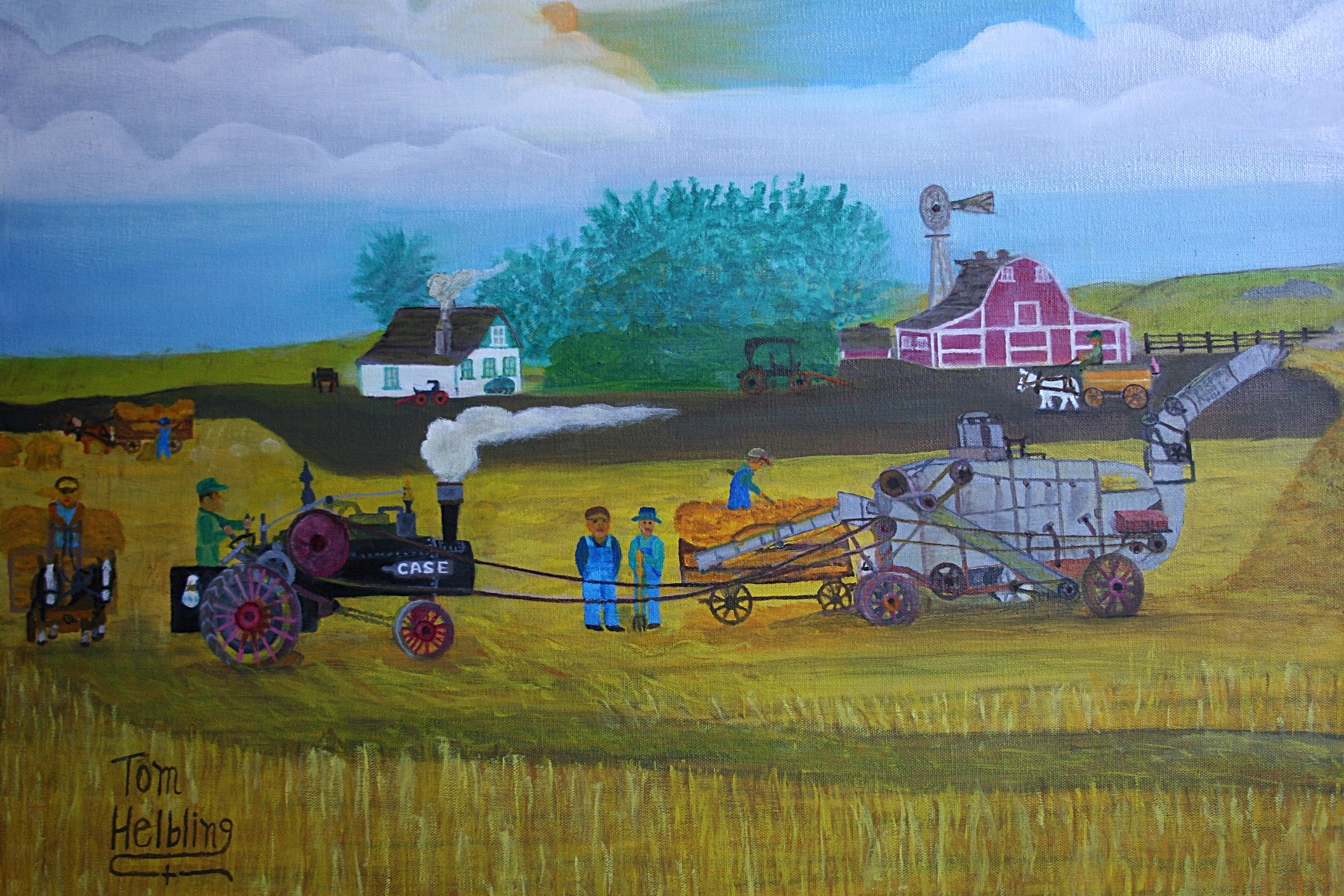
“Threshing on the home place, rural St. Anthony, North Dakota,” a painting by my father-in-law. Thomas Helbling. (Minnesota Prairie Roots copyrighted file photo)
I’m always amazed at the generational closeness of my husband to his family’s homeland. Mine is a generation farther removed (from Germany). In 1898, Valentine and Emina homesteaded a claim near St. Anthony south of Mandan. That young boy who traversed the ocean from Russia with his parents would also farm there as would Randy’s father, Tom. When Randy was seven, his family uprooted and moved to central Minnesota.
As I consider all of this family history, I wonder at the dreams and challenges. To leave your home country behind, understanding you would never return, takes fortitude. I can only imagine the fortitude Ukrainians must tap in to today as they face a Russian invasion.
Early in his marriage, Alfred Helbling faced an unspeakable loss—the tragic death of his first wife. Katherine, 27, apparently lost her balance, fell into a well and died while retrieving a container of milk stored inside.
Artwork created by Gracie for a 2018 student art show at the Paradise Center for the Arts, Faribault. (Minnesota Prairie Roots file photo March 2018)
Today people are dying in Ukraine, a country that suddenly doesn’t seem all that far away. An ocean and some 5,200 miles separate this land from Minnesota. But when I page through the spiral-bound genealogy of the Helbling family, I feel much closer. Closer in a way that causes me to feel emotional. Upset. Concerned. Worried about not only the future of Ukraine, but also of this world.
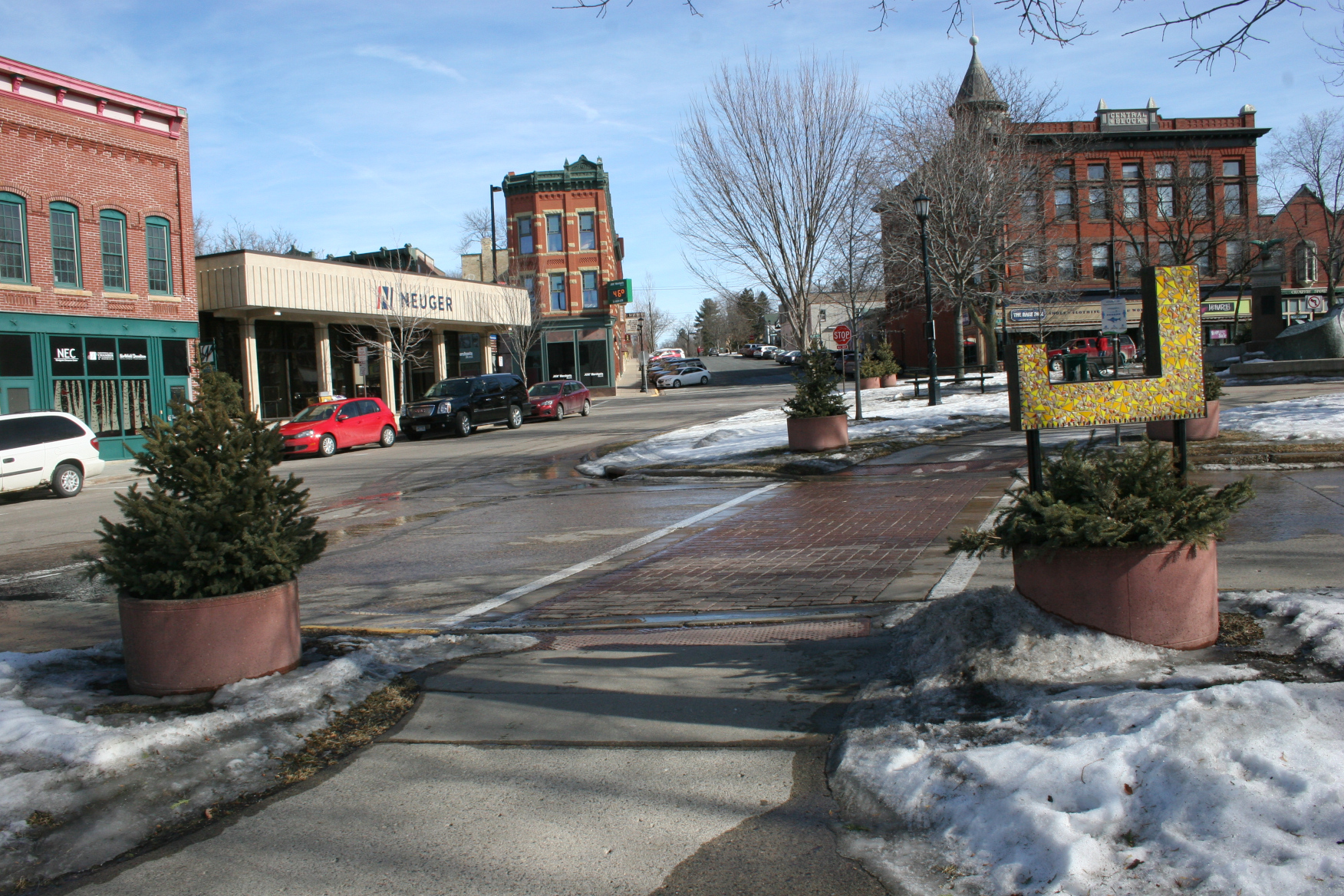
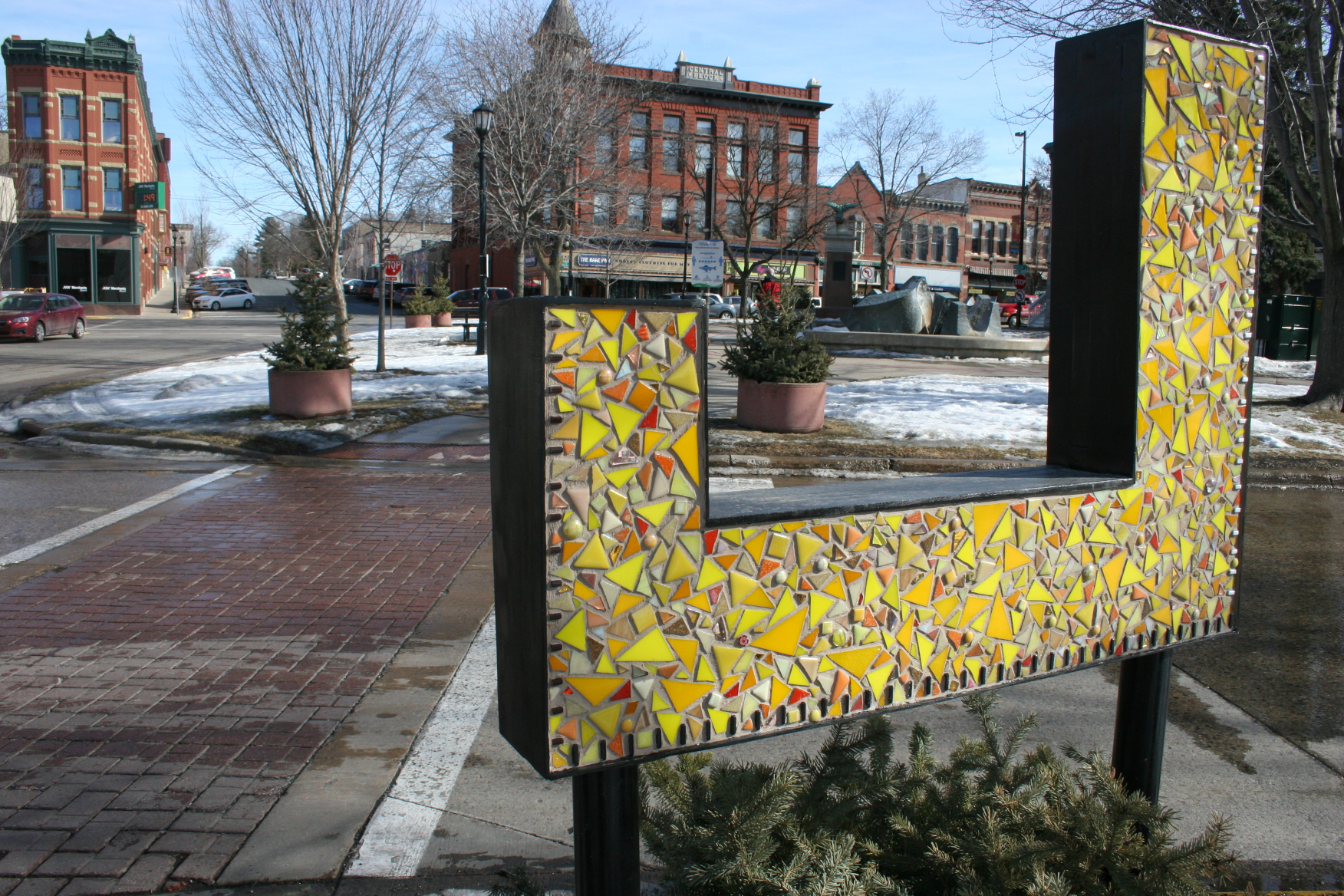
“Framing the Scene,” a relatively new art installation, right, in the heart of historic downtown Northfield.
AS A MEGA APPRECIATOR of outdoor public art, I delighted in the recent discovery of some new, at least new-to-me, art staged in historic downtown Northfield. This southern Minnesota river town boasts a thriving community of literary, visual and performing artists.
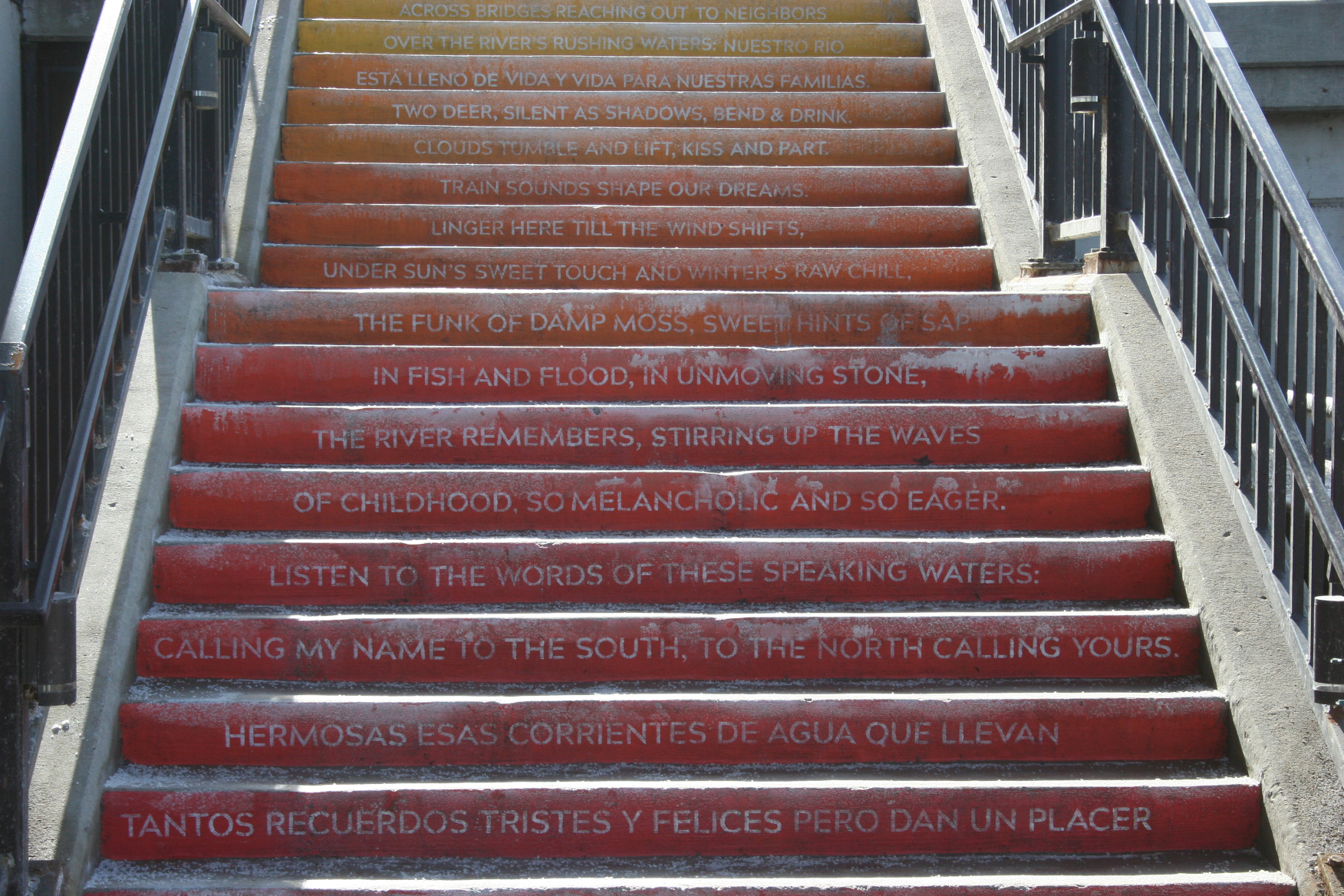
This shows a section of Northfield’s “Poem Steps,” a collaboration of 17 local poets. These poetry steps (covered here with salt residue) are along the Riverwalk. (Minnesota Prairie Roots copyrighted photo February 2022)
Here you’ll find poems imprinted in sidewalks, painted on steps and read at poetry readings in a city with a poet laureate. Here you’ll see outdoor sculptures scattered about town. Here you can listen to a concert at Bridge Square, a local church, St. Olaf or Carleton Colleges or elsewhere. Here you can enjoy live theater. Here you can appreciate the works of creatives at the Northfield Arts Guild and many other venues.
Northfield truly is synonymous with the arts.
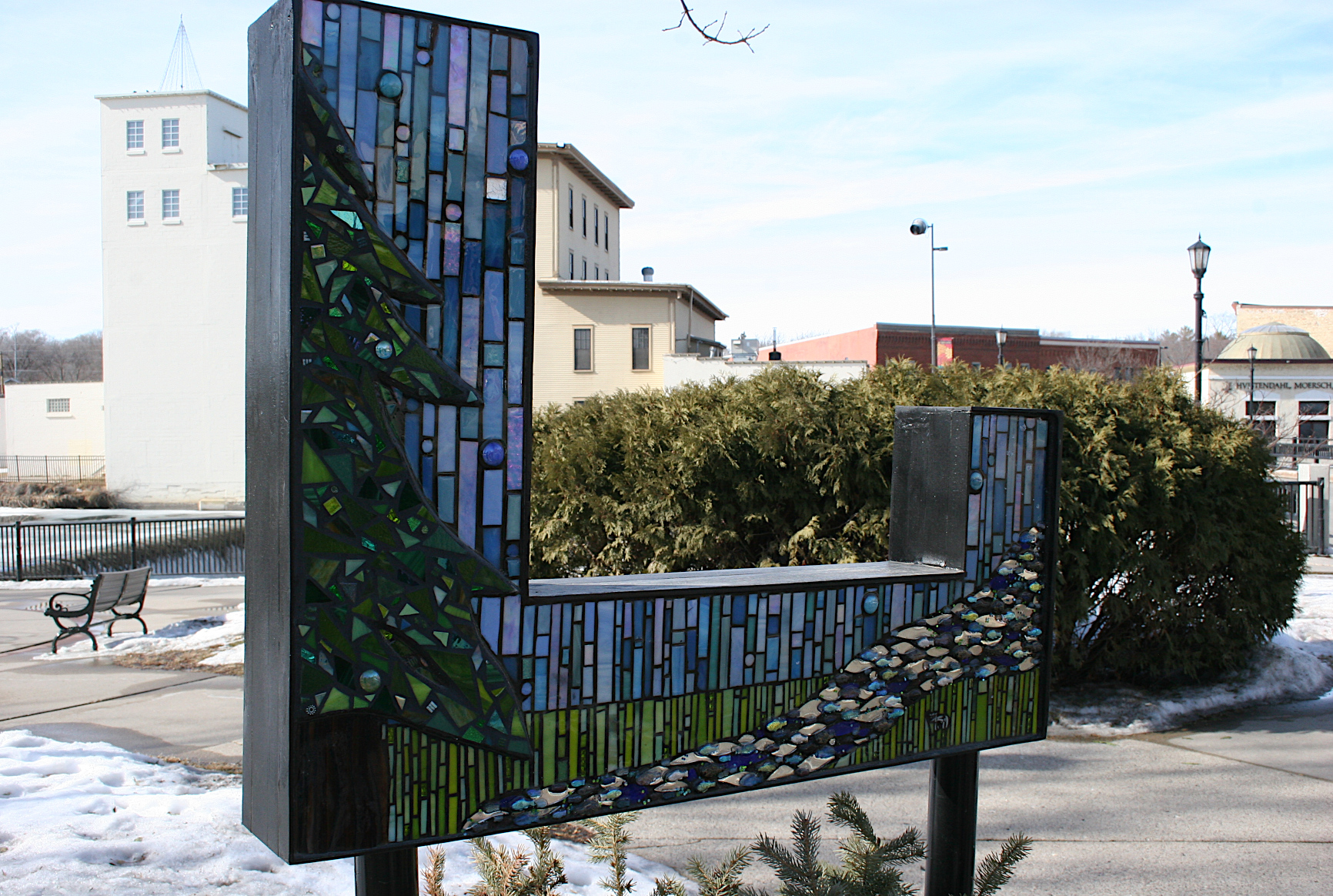
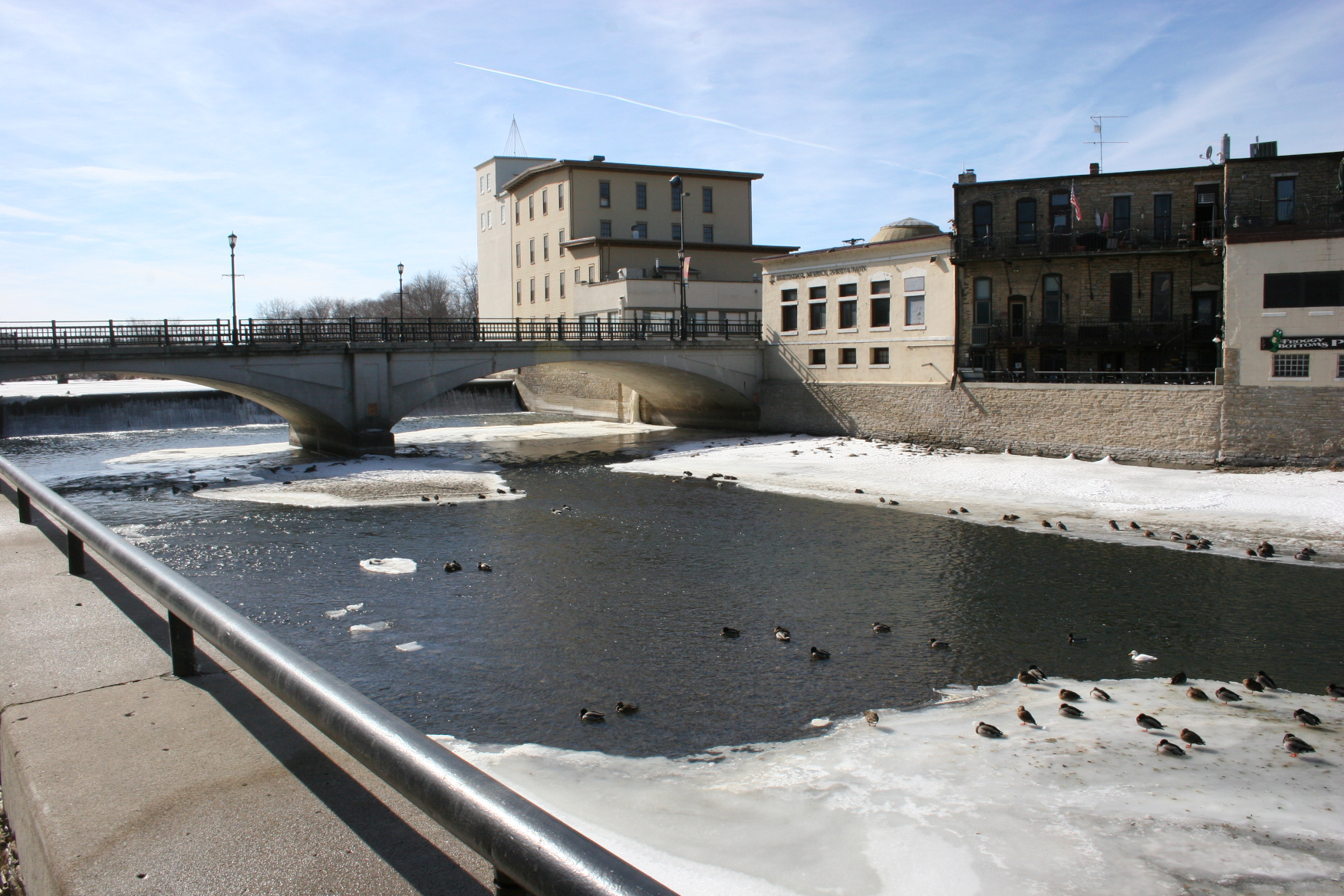
The riverside-themed side of Erin Ward’s “Framing the Scene.” In the background water rushes over the Ames Mill Dam next to the historic mill on the Cannon River. (Minnesota Prairie Roots copyrighted photo February 2022)
So when I spied a recently-installed sculpture, “Framing the Scene” by St. Paul glass artist Erin Ward, I felt a jolt of excitement. The free-standing, two-dimensional mosaic frames the nearby Cannon River and Riverwalk on one side and Bridge Square on the other. It’s meant to be an interactive sculpture for framing photos.
The Cannon River flows through downtown Northfield. (Minnesota Prairie Roots copyrighted file photo February 2022)
Ward was among five artists awarded $2,000 grants from the Minnesota Arts Board for the Northfield Downtown Development Corporation’s 2021 Artists on Main Street projects. That program aspires to get “creative placemaking” into the historic downtown. The intersection of arts and culture, downtown revitalization and historic preservation all factor into the artistic endeavors.
“Framing the Scene” meets all of those criteria, in my creative opinion. The artwork itself represents the vision and skills of a talented artist. The art adds to the downtown Northfield experience. That experience is one of dipping in and out of mostly home-grown local shops or of dining in an historic setting. The cliques “quaint and charming” fit Northfield. This is a community rich in history, rich in historic architecture, rich in natural beauty and rich in art.
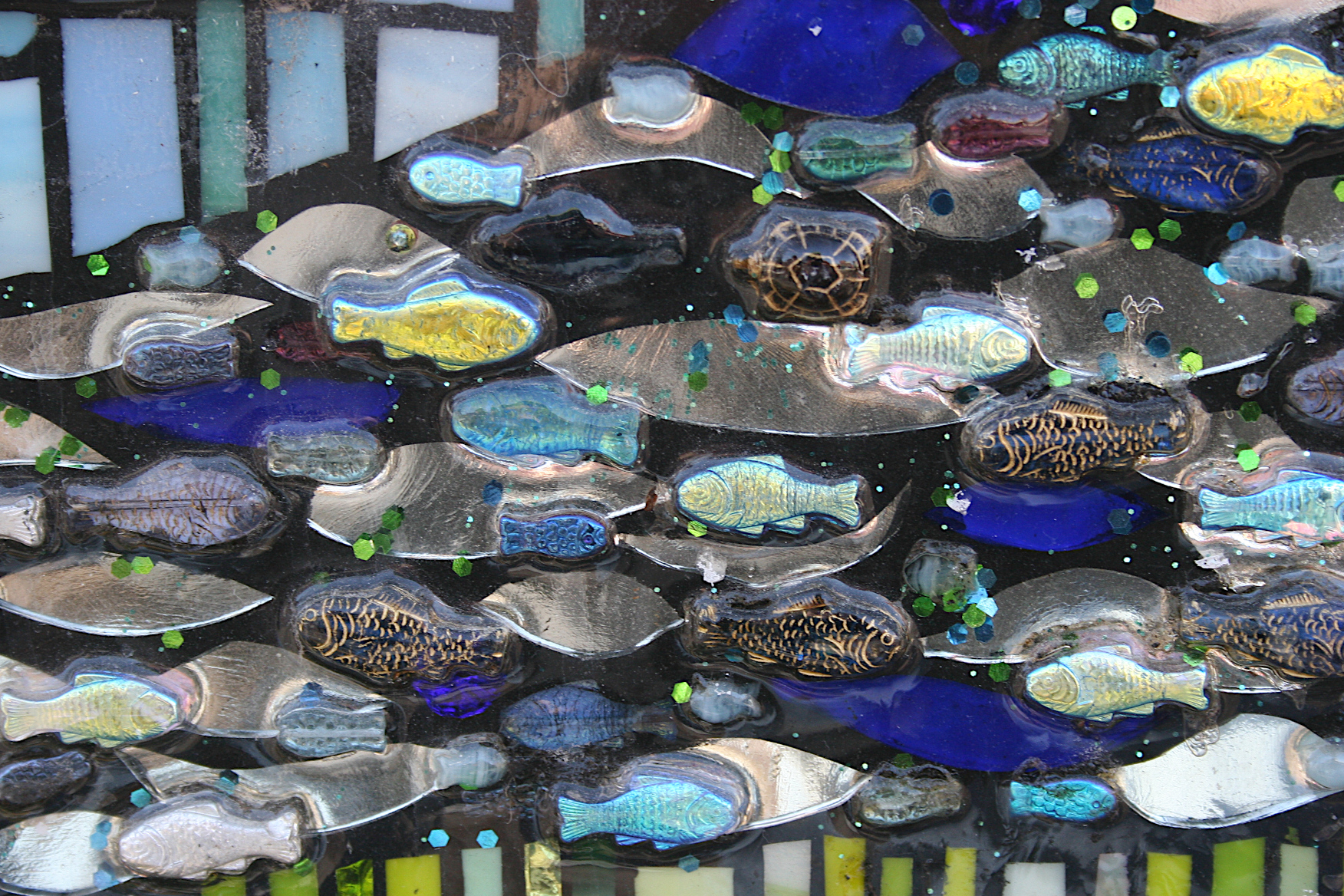
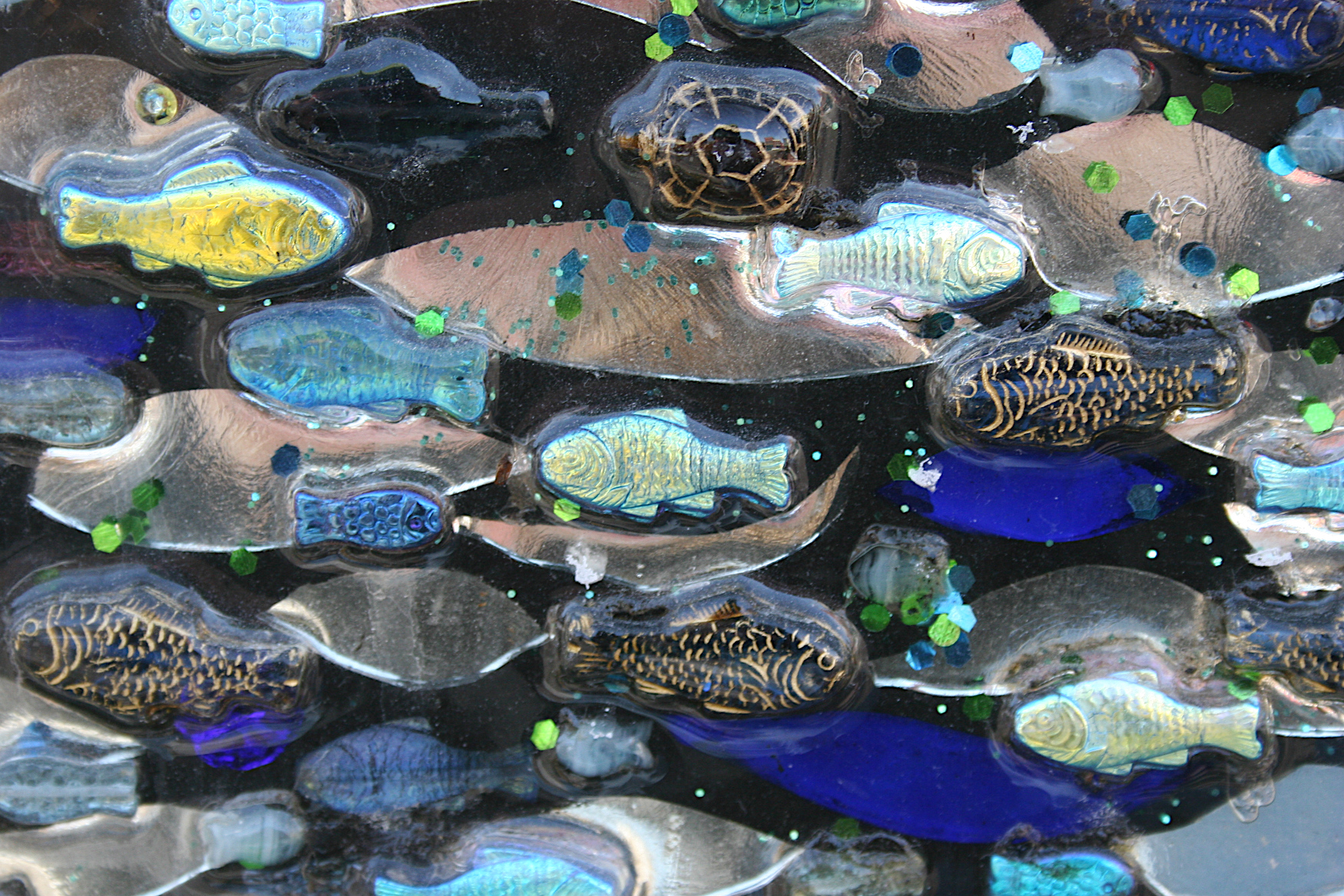
So much detail in the mosaic… (Minnesota Prairie Roots copyrighted photo February 2022)
I appreciate how Ward melded art and nature in creating a mosaic which honors both. As I studied her interpretation of the Cannon River, I recognized the thought she invested in this detailed art of many many pieces. Her river evokes movement in waters teeming with fish and the occasional turtle. Assorted greens and blues evoke a sense of calm and peacefulness. Ward’s art honors this river which runs through. This river of life, now a backdrop to a community which still appreciates her beauty, her recreational qualities, her history, her aesthetic value.
This side of Ward’s mosaic focuses attention toward Bridge Square and buildings downtown. (Minnesota Prairie Roots copyrighted file photo February 2022)
And then, on the flip side of “Framing the Scene,” bold pieces of mostly yellow, orange and red triangles create a completely different feeling. It’s as if sunbeams fell from the sun in a chaotic, jumbled mix of happiness. That’s my interpretation.
This side of the art looks toward Bridge Square, community gathering spot in downtown Northfield. Place of concerts and popcorn wagon, Santa house and quiet bench-sitting. Place of artistic activism. And beyond that, to the back of the frame, historic buildings rise.
One final look at Ward’s interpretation of the Cannon River in historic Northfield. (Minnesota Prairie Roots copyrighted photo February 2022)
Art rises in Northfield, enriching the lives of locals and the lives of visitors like me, come to town to follow the Riverwalk, to walk along Division Street and, then, to pause near Bridge Square and frame the scene.
Please check back for more posts about art in historic downtown Northfield, Minnesota.
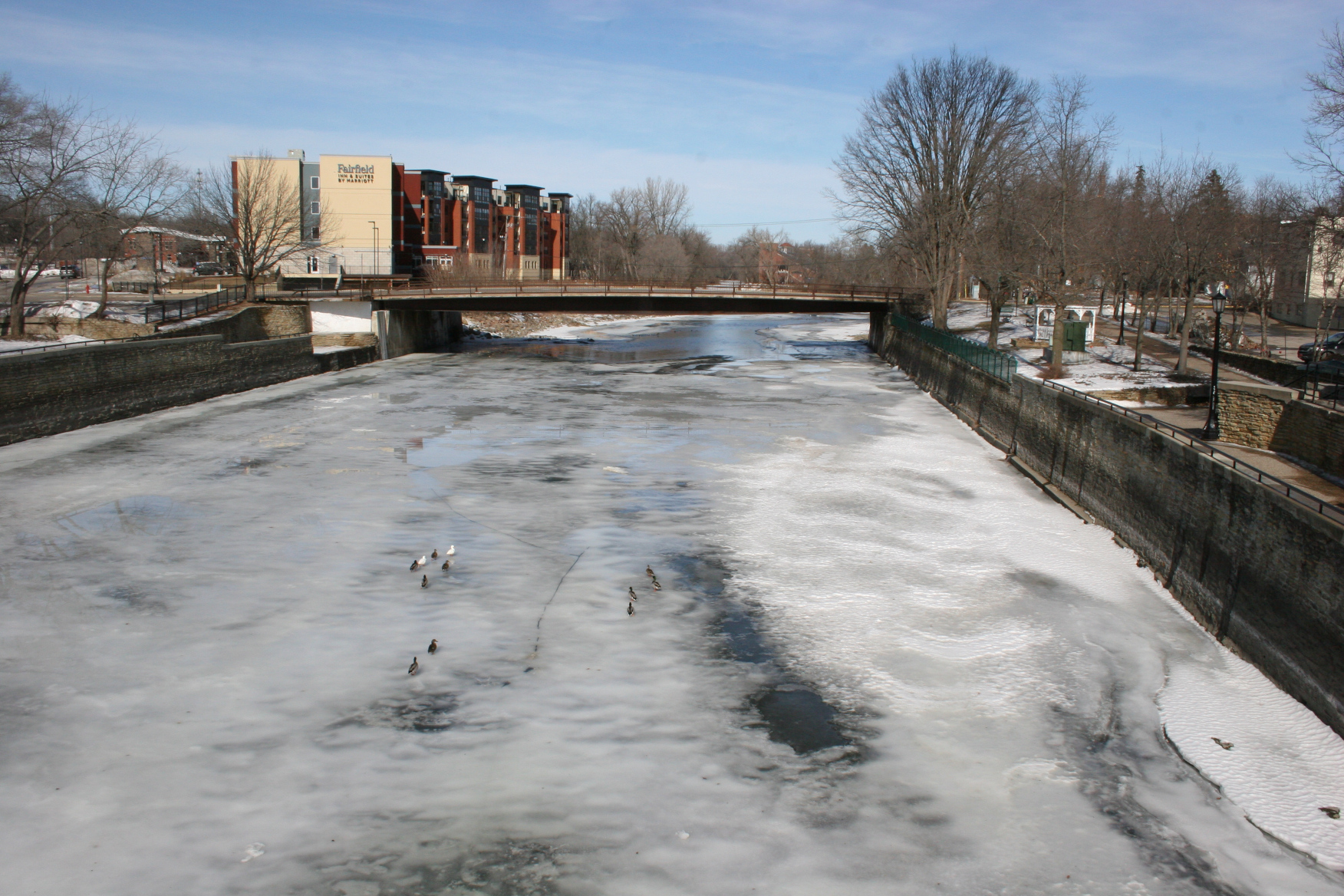
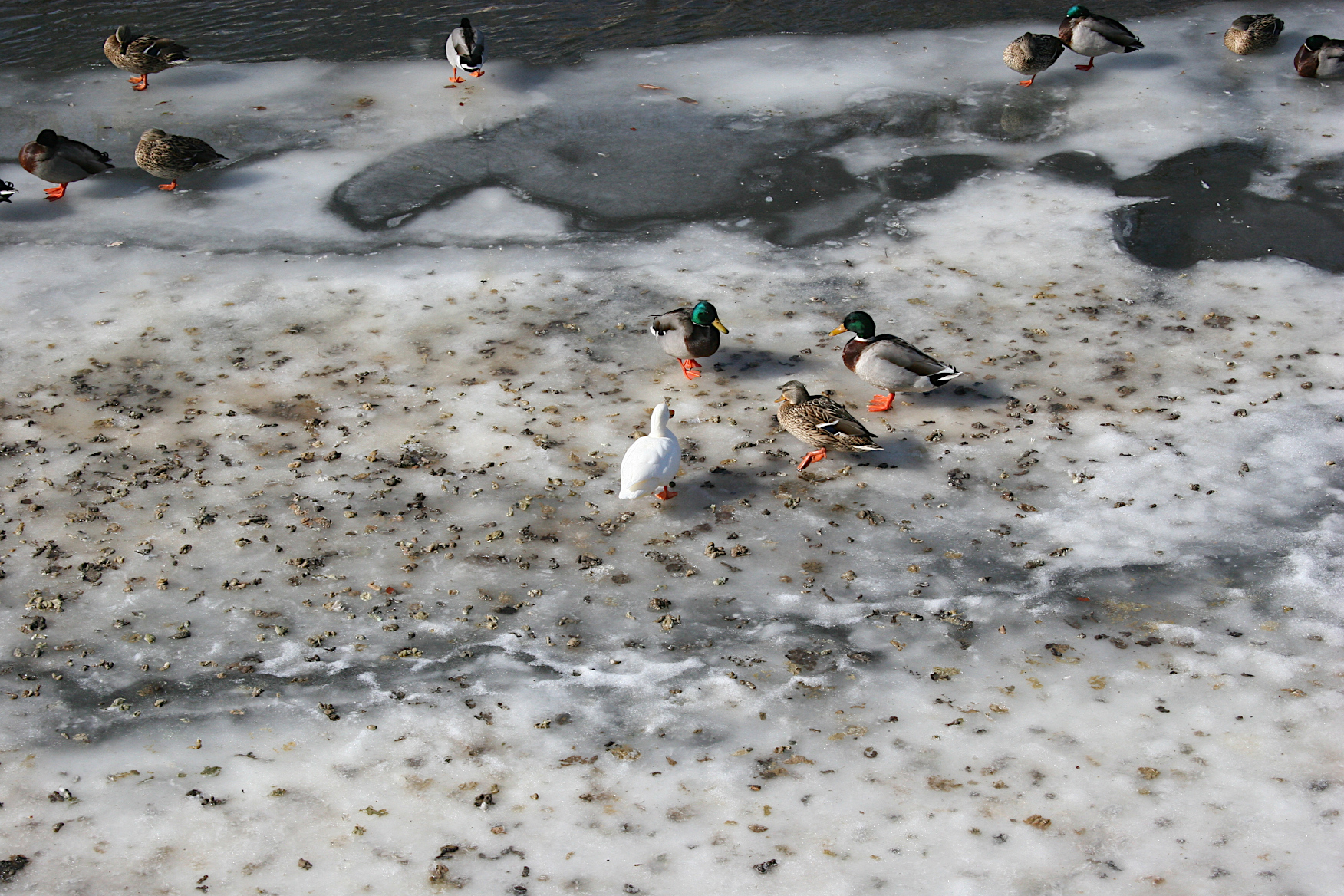
A cluster of ducks, including two white ducks, follow the partially frozen Cannon River in downtown Northfield. (Minnesota Prairie Roots copyrighted photo February 2022)
“DUCK, DUCK, GRAY DUCK!” If you’re not a native Minnesotan, you might stop me right here and protest. “It’s Duck, Duck, Goose!” you likely would correct. And then I would protest.
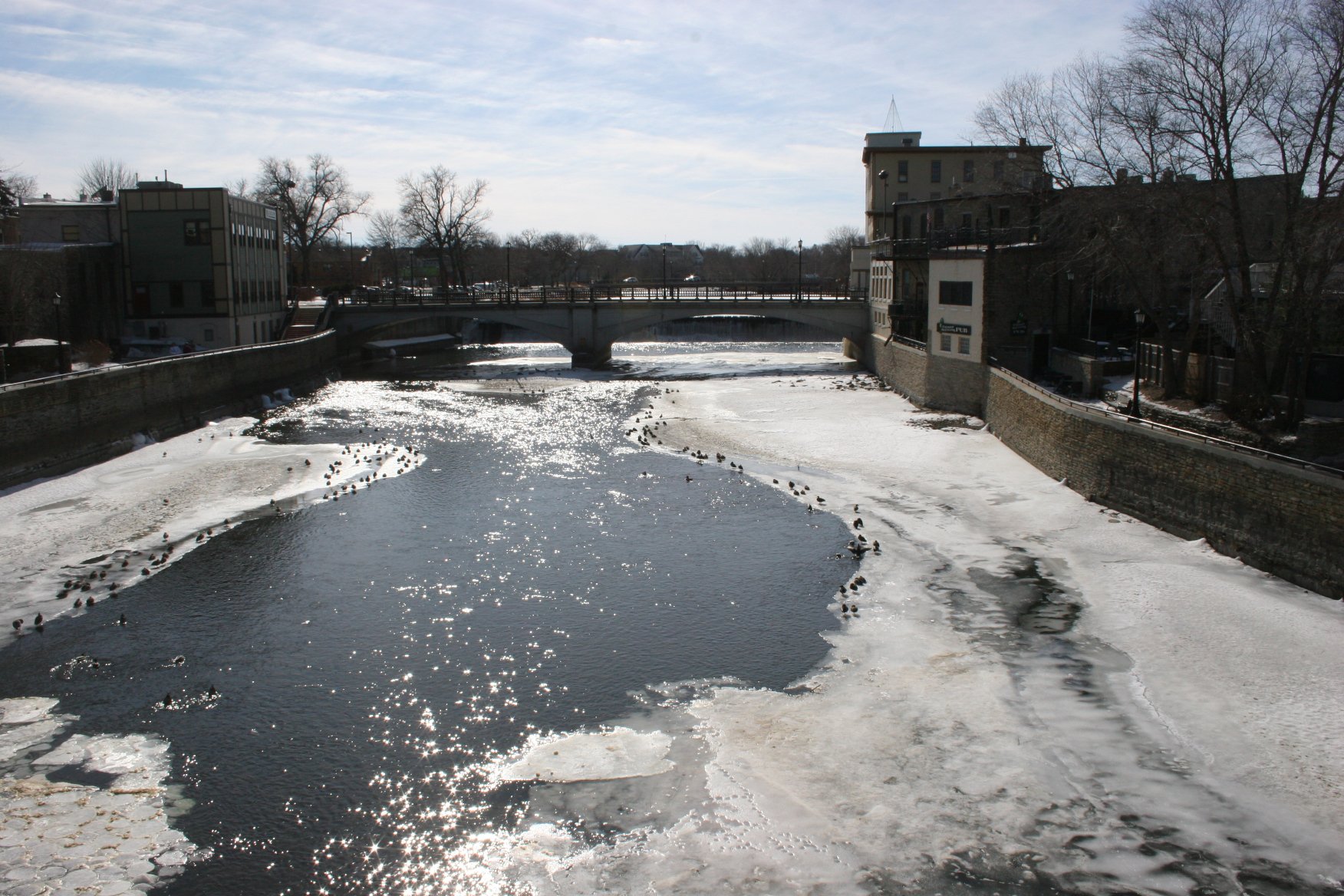
Ducks border both sides of the Cannon River on a February afternoon in Northfield. (Minnesota Prairie Roots copyrighted photo February 2022)
A few years back, in October 2017 to be exact, a tight end for the Minnesota Vikings initiated a game of Duck, Duck, Goose following a touchdown. Ohio native Kyle Rudolph was quickly corrected. Here in Minnesota, we term that children’s game Duck, Duck, Gray Duck. Not Goose. But Gray Duck. That set off a storm of conversations in which many a Minnesotan defended our name for this game which involves participants sitting in a circle, tapping each other on the head and calling out “Duck” or assorted versions thereof. The child pegged as the “Gray Duck” then tries to catch the person who is “It.”
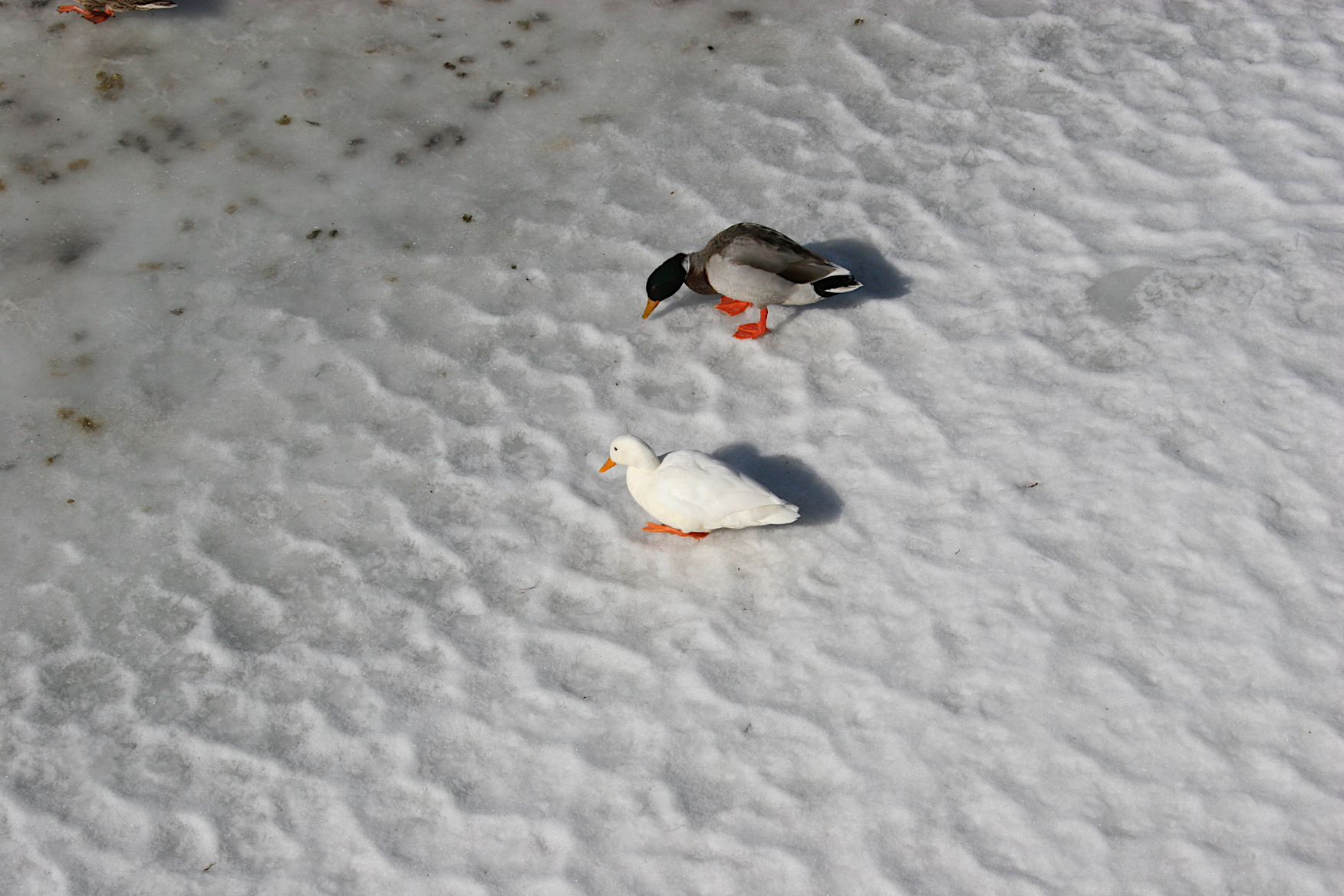
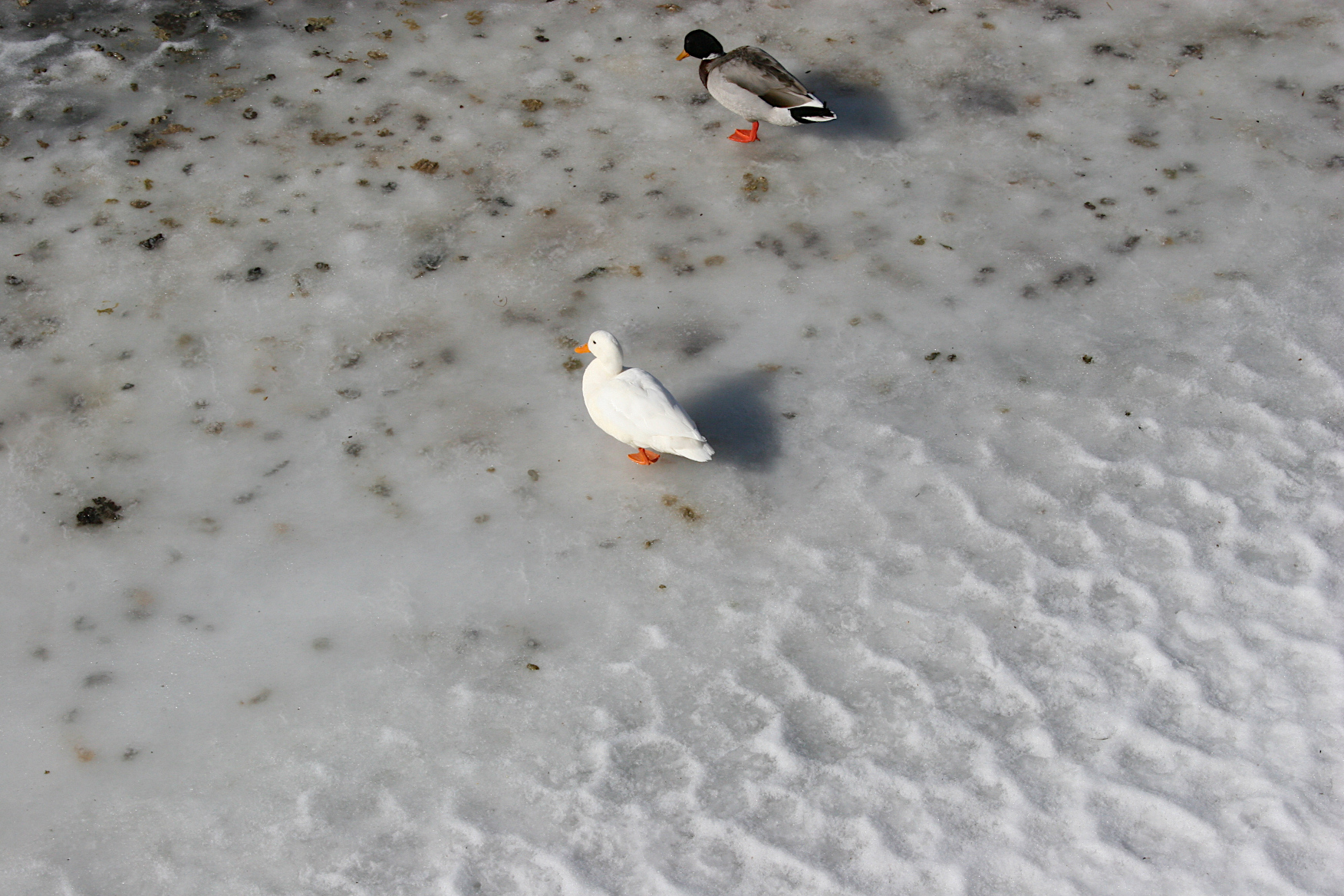
Nearly camouflaged against a snowy backdrop, an uncommon white duck. (Minnesota Prairie Roots copyrighted photo February 2022)
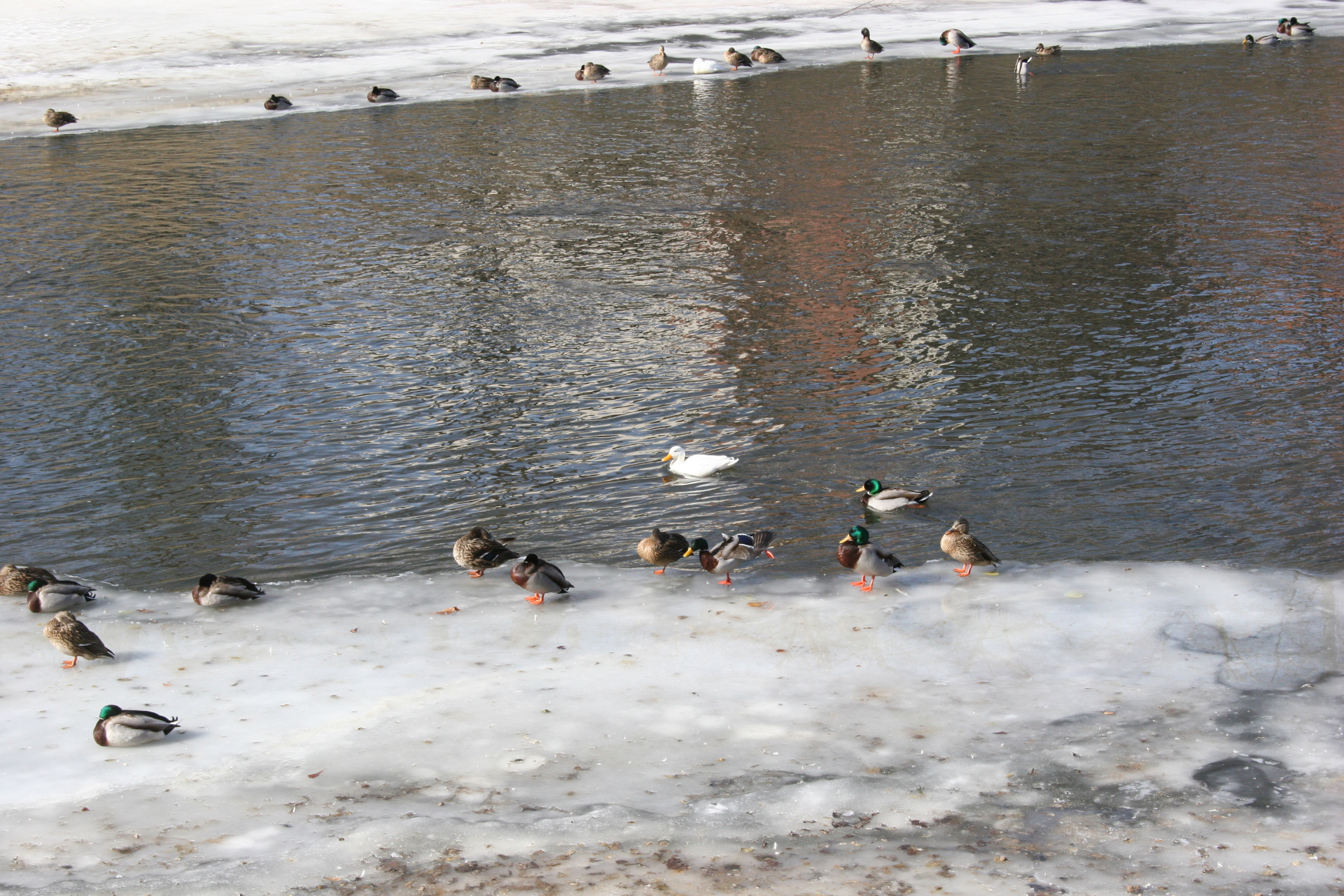
Duck thoughts fly through my head as I consider a scene on the Cannon River in the heart of downtown Northfield Sunday afternoon. There, among the drake mallards with brilliant iridescent green heads and the hens in their unassuming shades of brown, were four white ducks. All white with brilliant orange beaks and webbed feet.
Looking the other direction from the pedestrian bridge offers a view of ducks edging the open river. (Minnesota Prairie Roots copyrighted photo February 2022)
I was thrilled to finally see these white ducks Randy has previously spotted flying over Northfield on his way to work. These, he said, are not domestic ducks given their propensity to fly just like any other wild duck.
I watched this pair for awhile and they appeared to get along just fine. (Minnesota Prairie Roots copyrighted photo February 2022)
We can only guess at their origins since we are uninformed, except when it comes to Duck, Duck, Gray Duck. Perhaps the white ducks resulted from a genetic mutation. Or the mixing of wild and domesticated. Whatever the reason, these waterfowl drew our interest.
Ducks hang out together on the frozen Cannon River. (Minnesota Prairie Roots copyrighted photo February 2022)
I wondered if the other ducks would exclude/shun/avoid the white ducks. As I watched them walk across the ice and swim in patches of open water, I observed no ostracization. We could learn a thing or ten from those ducks.
SAY THEIR NAMES NORTHFIELD INTERVENTION #32 chalk art activism at Bridge Square, Northfield. (Minnesota Prairie Roots copyrighted photo February 2022)
SUNDAY PROVED ENLIGHTENING, educational and reflective. And that’s a good thing because ongoing learning often makes us more informed, compassionate and caring individuals.
The scene from the Riverwalk along the Cannon River in downtown Northfield Sunday afternoon. (Minnesota Prairie Roots copyrighted photo February 2022)
The focus of my learning was not intentional, but rather a coming together of several elements. That began with a decision to follow the Riverwalk in Northfield on a rare February afternoon of sunshine and warmth in southern Minnesota. At 40-plus degrees, it was simply too nice to stay indoors. Northfield, only about a 25-minute drive, is a beautiful progressive river town, home to St. Olaf and Carleton Colleges, a thriving downtown historic business district, an active arts scene and more, including community activism.
Bridge Square with its monument and fountain, framed by a mosaic.Minnesota Prairie Roots copyrighted photo February 2022)
A statement by the artist activists. (Minnesota Prairie Roots copyrighted photo February 2022)
Spread out before the Civil War Monument, Black Lives Matter message and names. (Minnesota Prairie Roots copyrighted photo February 2022)
On this Sunday, activism and engagement focused my initial attention as Randy and I exited the van across from Bridge Square, a mini middle-of-the-downtown park next to the Cannon River. As I pulled my camera strap over my neck, I noticed a group of young people chalking the sidewalk leading to and around the Civil War Monument and center fountain. I decided in that moment not to photograph them writing their messages as part of SAY THEIR NAMES INTERVENTION #32. I remembered the controversy over such chalk art at Bridge Square. I believe the City of Northfield enacted an ordinance banning the chalking of the public space, although I could not confirm that information online.
From the SAY THEIR NAMES NORTHFIELD Facebook page: “In honor of Amir Locke and many other Black persons killed by police.” (Minnesota Prairie Roots copyrighted photo February 2022)
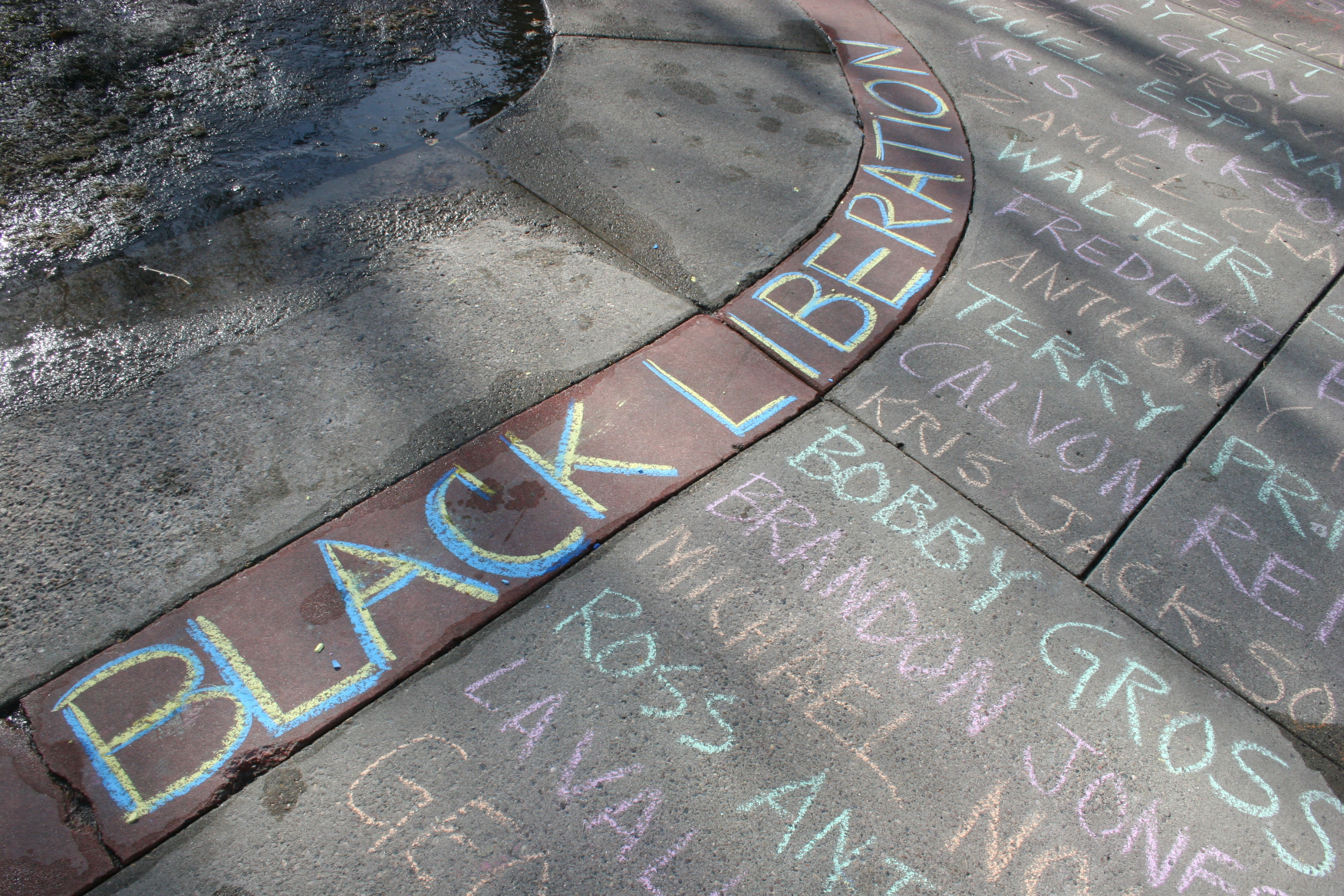
Later, after we walked along the river and then along Division Street, we paused to read the messages printed by SAY THEIR NAMES NORTHFIELD participants who had now left the square. As in previous “interventions,” their words repeated that BLACK LIVES MATTER. All too familiar names were chalked onto the cement—George Floyd, Breonna Taylor, Philando Castile, Jamar Clark, Daunte Wright… And new to the list, Amir Locke.
Too many names… (Minnesota Prairie Roots copyrighted photo February 2022)
As I photographed the names and messages, I felt an overwhelming sense of sadness at the injustices, the fact that this is 2022 and we are still grappling with racism and social injustice and many other issues related to race.
Promo for “The Summer of Soul.” (Photo credit: “Summer of Soul” Facebook page)
That evening, the same response repeated as I watched filmmaker Ahmir “Questlove” Thompson’s newly-released documentary “The Summer of Soul (…Or, When the Revolution Could Not Be Televised)” on ABC. The film documents the Harlem Cultural Festival which brought some 300,000-plus people together in Harlem in the summer of 1969 for six concerts over six weeks. Stevie Wonder, Nina Simone, Gladys Knight and the Pips, and other mostly Black musicians performed before a primarily Black crowd. The film, interspersed with concert footage and follow-up interviews with those who participated or attended, is a remarkable historic documentation of not only the music, but also of Black people, their culture, their connections in the community of Harlem and also the issues they faced in 1969. Issues which remain today.
I was especially moved by the joyful performance of “Aquarius/Let the Sunshine In” by Fifth Dimension, complete with audience participation and by the singing of “Take My Hand, Precious Lord,” Martin Luther King Jr’s favorite hymn sung at his funeral. All were performed against a stage backdrop collage of vibrant squares, rectangles and L shapes. (I’d love to have a poster of that artsy 1969 graphic.)
I felt a mix of sadness and concern that here we are, 53 years later, and just now this film footage has been released. Woodstock, the Apollo moon landing and more overshadowed the Harlem Cultural Festival in 1969. I appreciate the release of this film nominated for a 2022 Academy Award for Best Documentary Feature and a 2022 Grammy Award for Best Music Film. It’s important I watched it for, among many reasons, the insights and perspectives gained.
A must-read book of historical fiction.
Before “The Summer of Soul” aired on TV Sunday evening, I’d begun reading Under the Tulip Tree, a historical novel by Michelle Shocklee set in Nashville following the stock market crash of 1929. Only a third into the book, I found it fitting of my unexpected Sunday focus on Black lives The main character is a young White writer interviewing a former slave. And, yes, although fictional, real-life stories weave into the book.
BROWN LIVES FOR BLACK LIBERATION is the message leading to the list of names. (Minnesota Prairie Roots copyrighted photo February 2022)
I feel grateful for all the elements—chalk art, a documentary and a book—which came together on a February Sunday in Minnesota to educate and enlighten me about many aspects of Black lives. To learn is to grow in understanding and compassion.
FYI: Activism and art will theme an event on Thursday, March 3, offered through St. John’s Women, a Northfield-based group in its fourth year of sponsoring “Courageous Conversations” via monthly speakers and book studies. Carleton College Professor Cecilia Cornejo, an artist and also leader of the local SAY THEIR NAMES group, will talk about “Anti-Racism Activism Through Community-Engaged Art” at 7 pm via Zoom. Click here for more information.
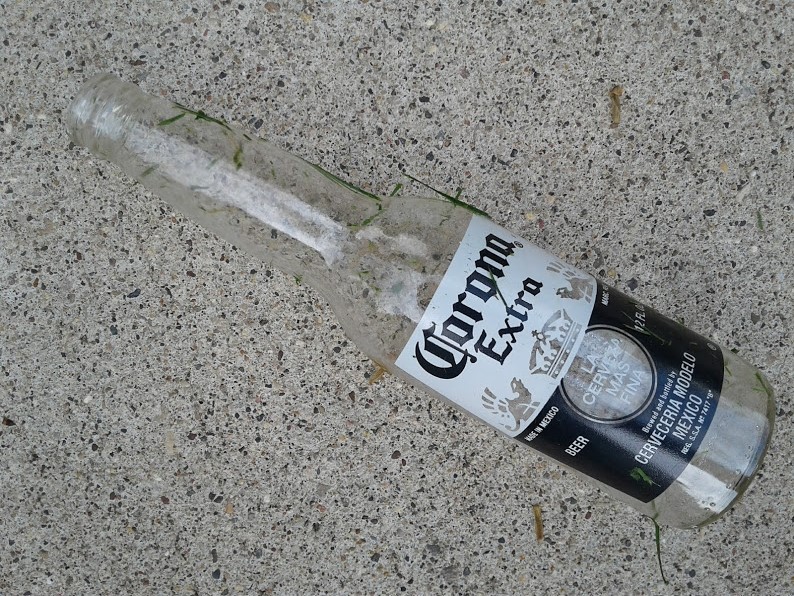
Lying on the sidewalk in front of my house, a beer bottle, one of many that land there, on the boulevard and in the yard. (Minnesota Prairie Roots copyrighted file photo 2017)
LIVING ALONG A BUSY STREET means more than dealing with noisy traffic. It also means dealing with litter. Tossed beer bottles and cans. Fast food bags and containers. Lots of those. Even a tire, which rolled off a vehicle and slammed into the side of our house, just missing the gas meter many years ago. And this winter, a stop sign propelled into the yard after a car went out of control on the icy street, jumped the curb and took out the sign.
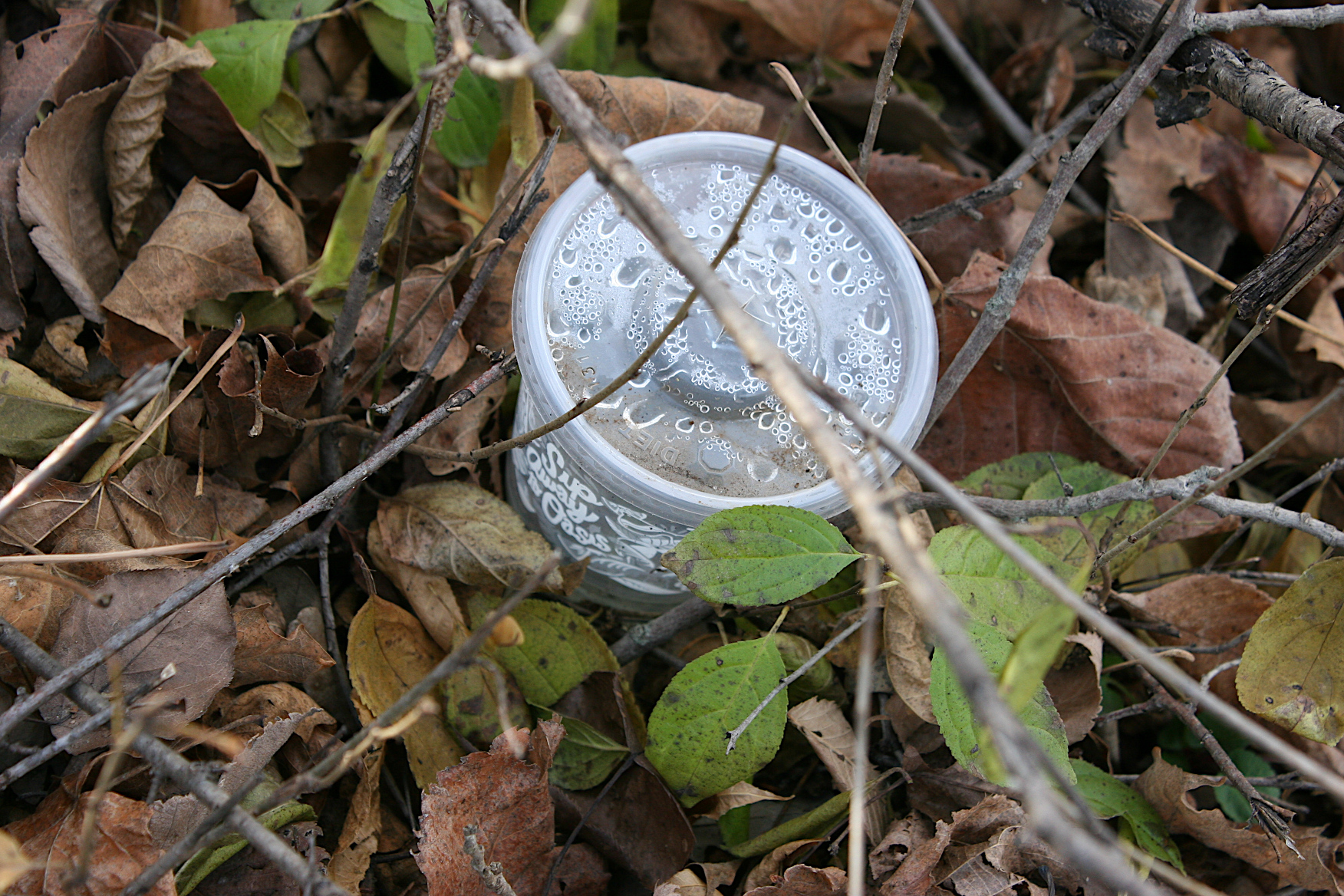
Litter photographed several months ago at River Bend Nature Center in Faribault. (Minnesota Prairie Roots copyrighted photo November 2021)
It bugs me when people litter. The phrase “Don’t be a litterbug” comes to mind. If you’re of a certain age, you perhaps remember that 1960s anti-littering ad campaign. Lady Bird Johnson (First Lady to President Lyndon B. Johnson) championed efforts to stop littering and to limit billboards visually littering our roadways.
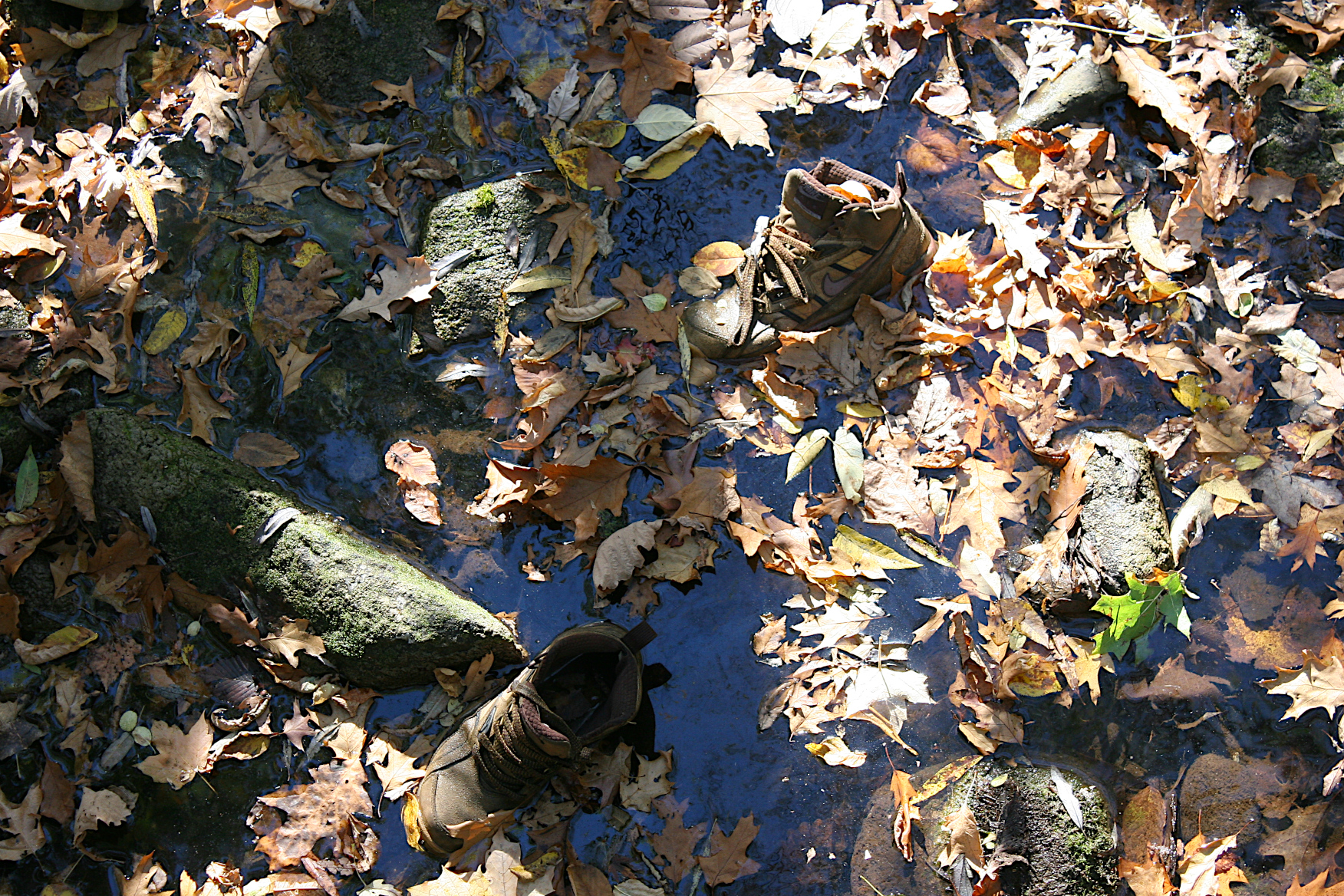
Hiking boots, tossed into the creek at Falls Creek County Park, rural Faribault. (Minnesota Prairie Roots copyrighted file photo October 2021)
As a teen, I once picked up litter from road ditches in my home county of Redwood. Employed through a southwestern Minnesota summertime program for low income families, I joined three other girls in working for the county highway department. One day we were tasked with collecting litter. Now decades later I recall only two of the many items we gathered from ditches—a dirty diaper and a torn up love letter. During our noon lunch break, we pieced together that letter. I wish I recalled the words written on that lined notebook paper. But I only remember how entertained we were.
Sometimes balls roll down the hill and into our yard, never to be retrieved by children, but by me. (Minnesota Prairie Roots copyrighted file photo 2017)
Thankfully we’ve come a long ways in eliminating litter—although I still see plenty—and in reducing trash sent to the landfill. Recycling helps. My eldest daughter and her husband even participate in organic recycling. In this program offered through their south metro county, they save food scraps, tissues, napkins and more which can be recycled. Yes, it’s extra work. But I applaud this additional effort to limit what goes into our landfills.
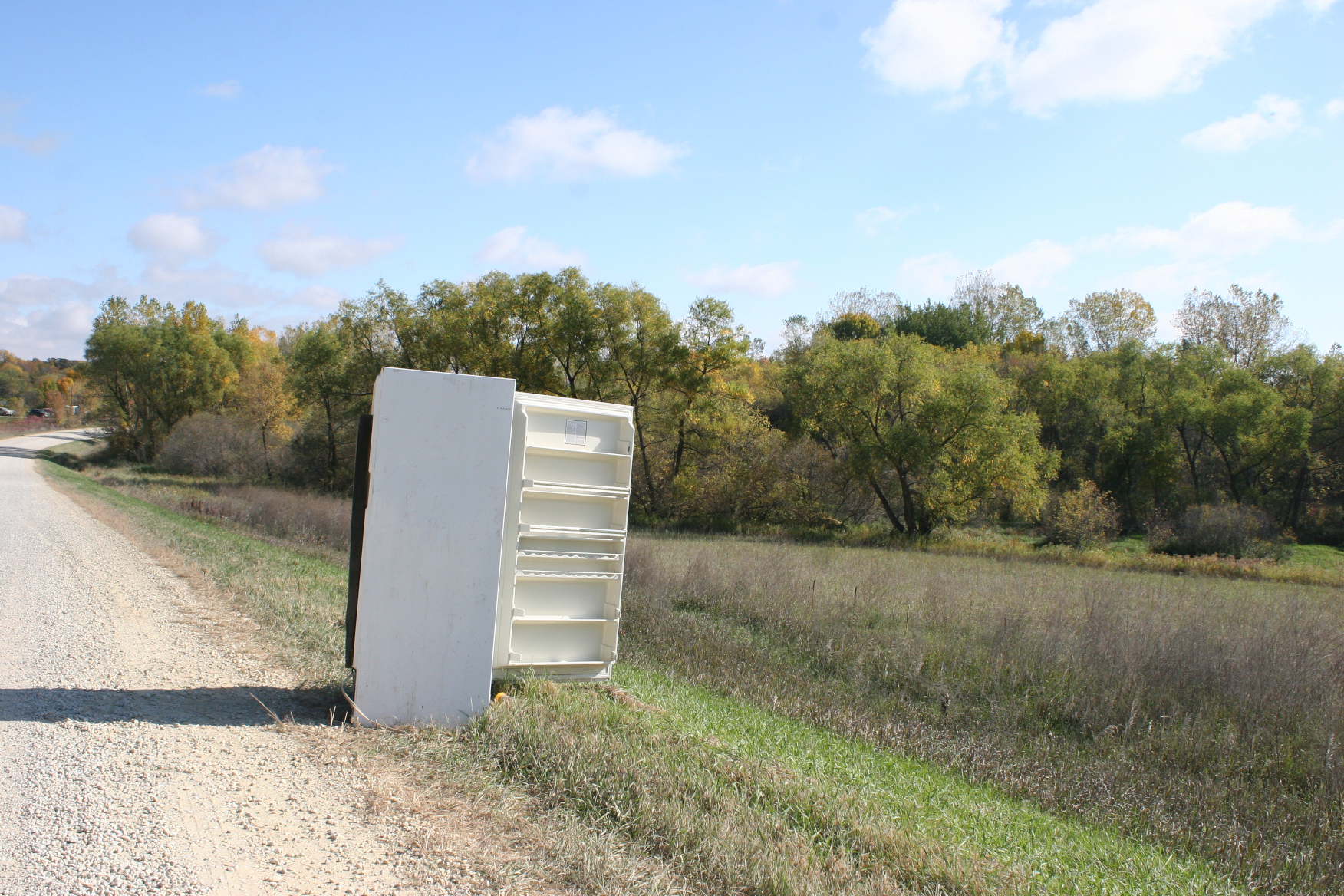
I photographed this abandoned refrigerator on the shoulder of a gravel road just outside Faribault last fall. (Minnesota Prairie Roots copyrighted file photo October 2021)
Of all the littering, other than in my own yard, I’m particularly bothered by the dumping of appliances, mattresses and furniture into ditches and along roadways. I recognize getting rid of these unwanted items can prove costly. Some cities host annual community clean-up days to collect items like these. And maybe that’s the solution because not everyone can afford disposal. Make the disposal easy, convenient and free, or low cost.
To the left in this image, you can see the black tire mark on the siding from a tire that came off a vehicle and rolled down the hill, slamming into our house. (Minnesota Prairie Roots copyrighted file photo)
Therein lies a benefit of living along a busy street. Whenever Randy and I want to get rid of something, because we’ve upgraded or no longer need the item, we set it curbside tagged with a FREE sign. And each time, someone stops to claim our discards. Swing set. Recliner. Lamp. End table. Headboard and frame. Bookshelf. And more items that I’m not recalling. Sure, maybe we could have sold these things, but we didn’t want the hassle. And, if someone needed what we no longer needed, then we were happy to give it away.
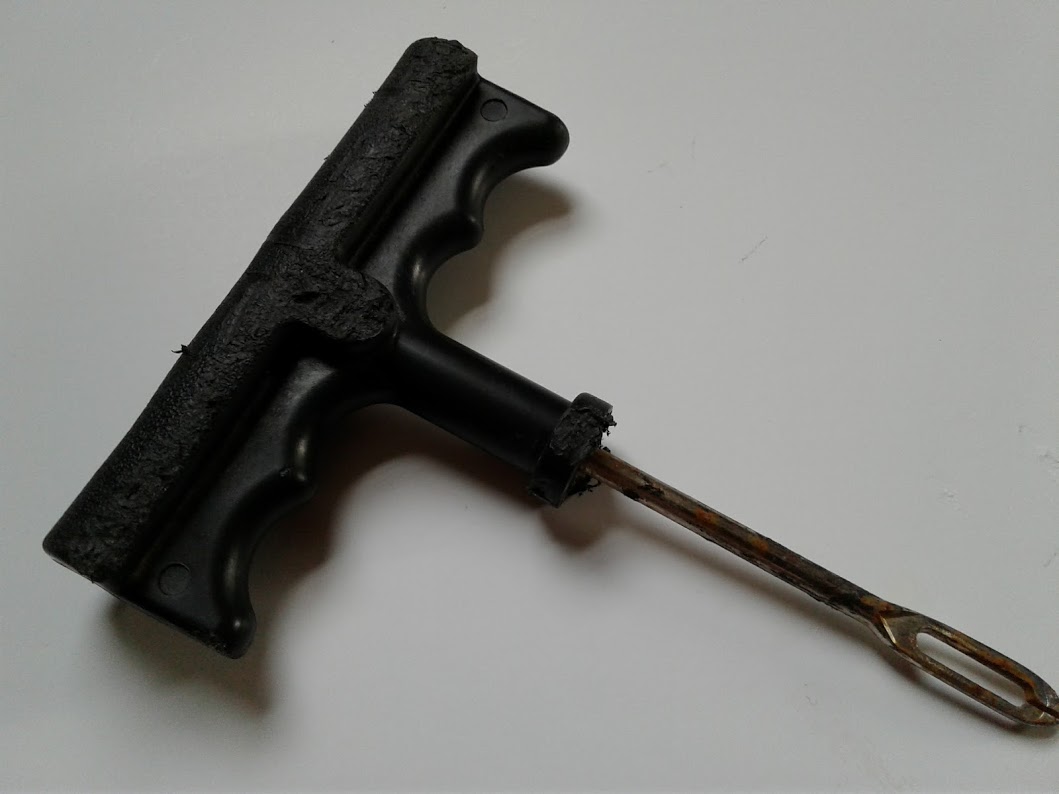
I found this tire repair tool in a street corner flowerbed by our house. (Minnesota Prairie Roots copyrighted file photo 2017)
But please, dear people, who pass by our house either on foot or by vehicle, we don’t need your litter.
TELL ME: What litter/discards/trash bother you in particular? What especially unusual items have you seen tossed in a ditch, onto a sidewalk, along the road, at a nature center…? Do you recycle and, if yes, what?
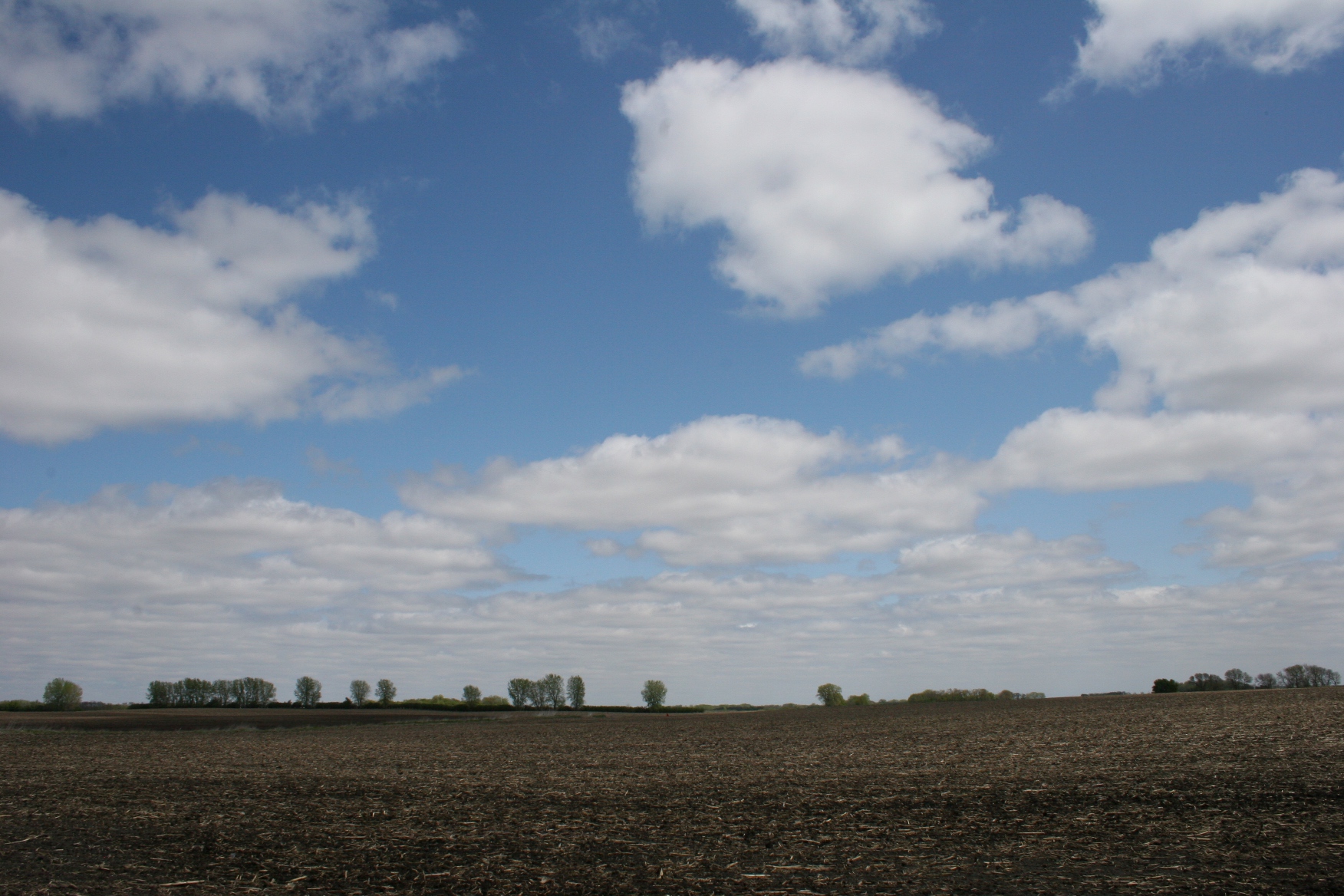
A serene rural scene just north of Lamberton in southern Redwood County, my home county, shows the roots of my creativity in the prairie. (Minnesota Prairie Roots copyrighted file photo October 2013)
I’VE ALWAYS SENSED within the artistic community an unwavering support of one another. A kinship in creativity. A connection sparked by the sheer act of creating, whether by words, by music, by paintbrush or pencil or camera or hands or…
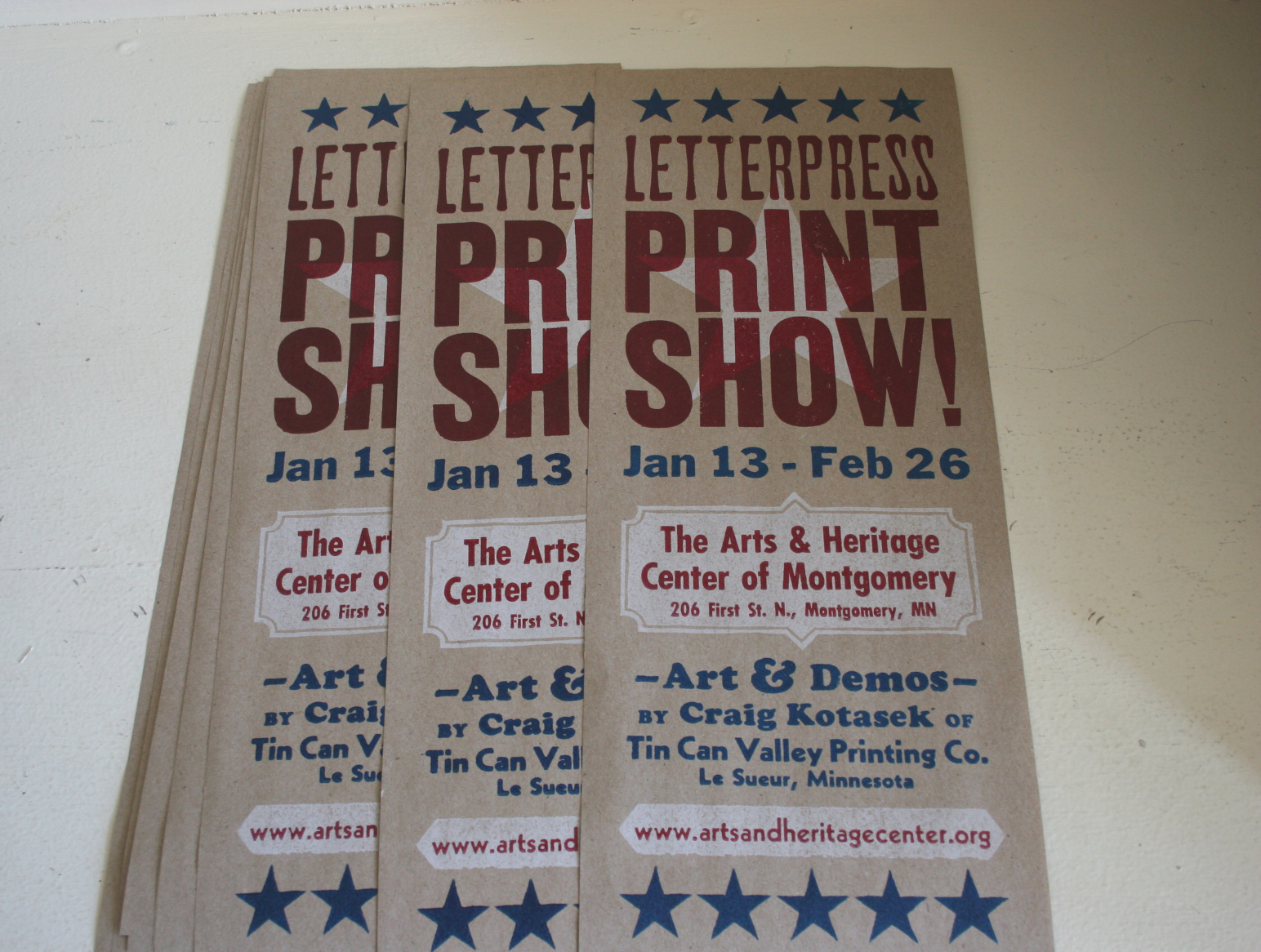
Craig Kotasek crafted these letterpress print promo posters for his current show. (Minnesota Prairie Roots copyrighted photo February 2022)
Well, Craig heard about my post, followed up with an email to me and then posted the kindest/loveliest/nicest review of my work on his website (click here). I am not only humbled by his generous words, but by his detailed gratitude for Minnesota Prairie Roots. He clearly understands me, my artistic and journalistic passions, my love for small towns and rural Minnesota, and my desire to share my discoveries.
Craig is just one example of how generous this community of creatives.
When we create, we share part of ourselves with the world. I cannot imagine not creating. That comes from a southwestern Minnesota farm girl who grew up with minimal exposure to the arts. No music lessons. No art classes. No gallery shows. No community concerts. Nothing outside the basic core of required class courses in middle and high school.
A snippet of the land my father farmed, my middle brother after him, on the rural Vesta farm where I grew up. (Minnesota Prairie Roots copyrighted file photo April 2013)
But what I lacked in the arts I found in the prairie landscape. In the unrelenting wind. In sunsets bold and beautiful. In snowstorms that washed all color from the earth. In wild pink roses pushing through road ditch grass. In the earthy scent of black dirt turned by a plow. I took it all in, every detail in a sparse land.
And I read. Laura Ingalls Wilder, pioneer girl from Walnut Grove only 20 miles distant. Nancy Drew with her inquisitive mind. Whatever books I could find in a town without a library.
Today I feel grateful to live blocks from a library. I feel grateful to have access to the arts. You will find me often posting about creatives on this blog. Creatives like Craig Kotasek of Tin Can Valley Printing. He’s a gifted craftsman and artist specializing in letterpress printing. What a talented community of artists we have in rural Minnesota. I feel grateful to be part of that creative community.





















 Minnesota Prairie Roots
Recent Comments