Minnesota Prairie Roots

Writing and photography by Audrey Kletscher Helbling
CHRISTmas blessings December 25, 2012

Filed under: Uncategorized — Audrey Kletscher Helbling @ 10:05 AM
Tags: , , , , , , , , ,
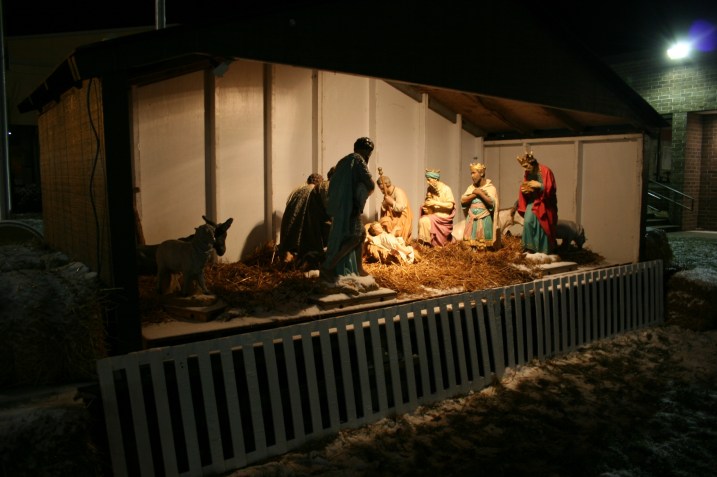
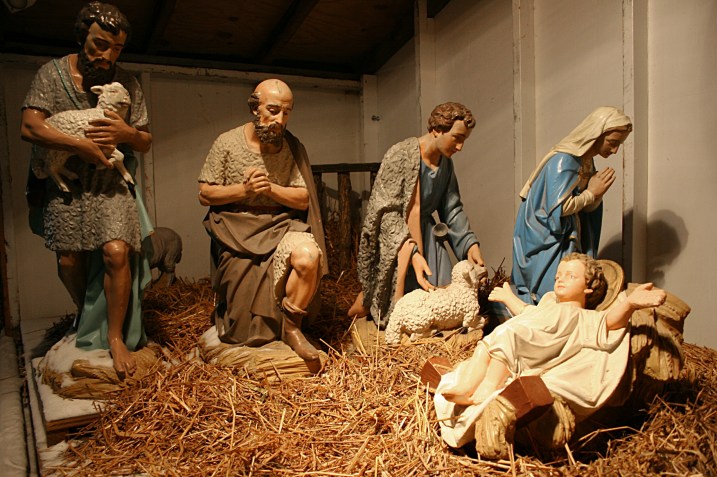
This Nativity scene has graced the lawn of Buckham Memorial Library and the Faribault Community Center for all the years I have lived in my southeastern Minnesota community, which would be 30.

This Nativity scene has graced the lawn of Buckham Memorial Library and the Faribault Community Center for all the years I have lived in my southeastern Minnesota community, which would be 30.

FROM MY FAMILY to yours, I wish you a most blessed CHRISTmas. And, yes, I capitalize that first syllable because the Saviour centers my Christmas celebration and I hope it does yours also.

This Nativity set, donated, I believe, by the Knights of Columbus, is a rich part of my community's history and a work of art. If anyone knows the history of this Nativity set, please submit a comment with details.

This Nativity set, donated, I believe, by the local Knights of Columbus, is a rich part of my community’s history and a work of art. If anyone knows the history of this Nativity, please submit a comment with details.

While they were there, the time came for the baby to be born, and she gave birth to her firstborn, a son. She wrapped him in cloths and placed him in a manger, because there was no room for them in the inn.

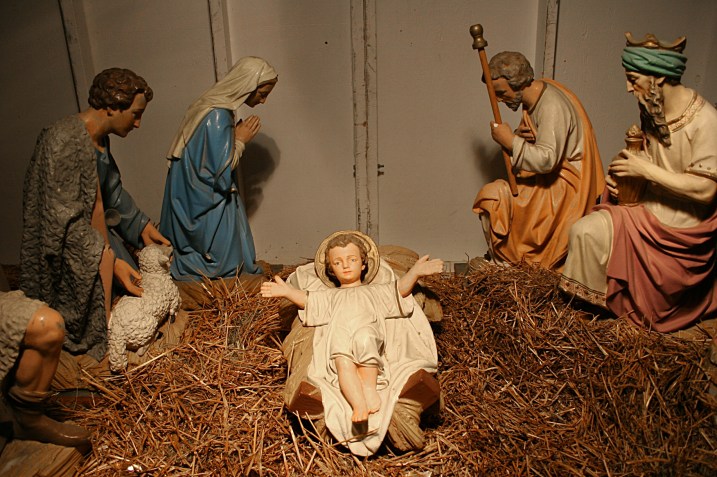
One side of the scene shows the shepherds in the stable.

One side of the scene shows the shepherds in the stable.

And there were shepherds living out in the fields nearby, keeping watch over their flocks at night. An angel of the Lord appeared to them, and the glory of the Lord shone around them, and they were terrified. But the angel said to them, “Do not be afraid. I bring you good news of great joy that will be for all the people. Today in the town of David a Savior has been born to you: he is Christ The Lord.”

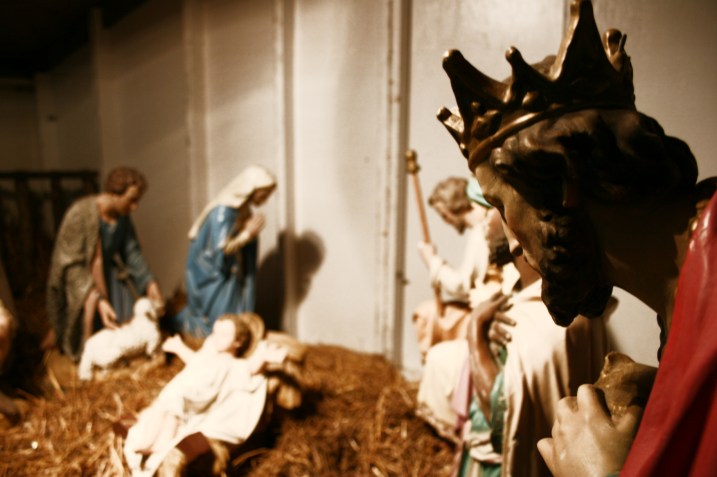
Although the wise men did not arrive at the birth of Christ, they are typically depicted in nativities. I added the "star" with an editing tool to enhance the image.

Although the wise men did not arrive at the birth of Christ,  but much later, they are typically depicted in nativity scenes. I added the “star” with an editing tool to enhance the image.

After they had heard the king, they went on their way, and the star they had seen in the east went ahead of them until it stopped over the place where the child was. When they saw the star, they were overjoyed.

Can you imagine the reverent joy the wise men felt in seeing their Saviour?

Can you imagine the reverent joy the wise men felt in worshiping their Saviour?

On coming to the house, they saw the child with his mother Mary, and they bowed down and worshiped him. Then they opened their treasures and presented him with gifts of gold and of incense and of myrrh. And having been warned in a dream not to go back to Herod, they returned to their country by another route. (Click here to learn more about the wise men and when they visited the Christ Child.)

© Photos copyright 2012 Audrey Kletscher Helbling
Text credit goes to gospel writers Matthew and Luke.


A chicken even I can love December 14, 2012

Filed under: Uncategorized — Audrey Kletscher Helbling @ 8:13 AM
Tags: , , , , , ,

SOMETIMES I TAKE photos and then have nowhere to weave them into the fabric of a blog post. So you never see them.

Take two images I shot last Saturday afternoon at the Faribo West Mall in a store selling a hodge podge of collectibles, clothing and other, well, stuff. I can’t tell you the name of the place because I don’t recall seeing a business sign. And when I purchased two items (not these), the shopkeeper simply stuffed my five $1 bills into his pants pocket.

All of that aside, I spotted so many objects that I wanted to photograph simply for the color, the art, the shape, the uniqueness, the nostalgia. But, I also did not feel comfortable clicking away unfettered while other shoppers browsed.

Thus, I focused my camera on only two pieces of colorful merchandise—a rainbow-hued glass elephant and a vibrant wind-up chicken.

When I show you those two unedited images, you might be impressed. But probably not. Here are the original untouched photos:

Except for resizing, I've done nothing with this photo of a glass elephant.

Except for resizing, I’ve done nothing with this photo of a glass elephant.

The original chicken photo, only resized.

The original chicken photo, only resized.

Then I opted to play with my photo editing tools, of which I understand little. I once edited and posted some winter photos here and then a reader asked “How did you do that?” Seems she wanted to duplicate what I had done. I could not tell her.

But this time, oh, this time, I am going to exercise my smartness by telling you I simply clicked on the “posterize” editing tool and these were the results:

I clicked on "posterize" and this was the result.

A bolder and more modern looking posterized chicken.

Isn’t this fun?

Ta-da, the posterized elephant.

Ta-da, the posterized elephant.

I took plain ordinary images and, with the click of my mouse, transformed them into works of art that really don’t resemble photos at all.

I’m especially smitten with that chicken. And for me to admit any fowl love…

WHAT ARE YOUR THOUGHTS on these two transformed photos or photo editing in general? Do you use photo editing tools to enhance your photos and/or create art?

© Copyright 2012 Audrey Kletscher Helbling
 

Support regional writing this Christmas via the gift of words December 6, 2012

WITH ALL THE “SHOP LOCAL” buzz this time of year, have you ever considered how that applies to the printed word?

Are you supporting local and regional authors, writers from within your state?

Allow me to show you two Minnesota publications that would make ideal Christmas gifts for anyone who appreciates regional based writing. Both feature collections of fiction, creative nonfiction and poetry.

Lake Region Review, volume two, with cover art by  Charles Beck

Lake Region Review, volume two, with cover art by Charles Beck

Lake Region Review, a literary magazine centered in Battle Lake in the northwestern part of our state, showcases work by writers from Minnesota and the eastern Dakotas selected in a competitive process. This year 34 pieces were culled from some 430 submissions for publication in volume two.

In their introduction to this 160-page soft-cover book-style collection produced by the Lake Region Writers Network, co-editors Athena Kildegaard and Mark Vinz write in part:

Our aim in selecting writing for this issue is simply to look for the best writing that engages and enlightens through attention to language. In these pages you’ll find characters challenged by circumstances (and weather), poems charged with vitality (and weather), and essays that will provoke and move you.

How true. With topics like polio and Alzheimer’s, installing a satellite dish on a snowy rooftop and falling through the ice, unemployment and death, and even some stories—“Norwegian Love” and “Julebukking”—of Scandinavian influence, you are certain to find writing that entertains and evokes emotional reactions.

The writers themselves range from beginners to seasoned.

Visitors to the Kaddatz Galleries in downtown Fergus Falls peruse the art of Charles Beck.

Visitors to the Kaddatz Galleries in downtown Fergus Falls peruse the art of Charles Beck. Minnesota Prairie Roots file photo.

A bonus to both volumes of Lake Region Review is the original regional-based cover art. This year’s cover features “Cardinals,” a wood print by well-known Minnesota artist Charles Beck of Fergus Falls.

Stephen Hennings painting on the cover of Lake Region Review, volume one.

Stephen Henning’s painting on the cover of Lake Region Review, volume one.

Last year a detail of an original landscape painting, “Christina Lake: View from Seven Sisters,” by nationally-renowned artist Stephen Henning of Evansville graced the cover of volume one.

Like Lake Region Review, The Talking Stick produced by the Jackpine Writer’s Bloc based in Menahga (near Park Rapids) offers a quality selection of works in a book-style collection.

The cover of The Talking Stick, Volume 21, Nightfall, also has a Minnesota bend with a stock photo of loons on a lake from iStockphoto.com.

The cover of The Talking Stick, Volume 21, Nightfall, also has a Minnesota bend with a stock photo of loons on a lake from iStockphoto.com.

According to the Jackpine website, “…we publish to encourage solid writing that shows promise, creativity and brilliance.”

Especially heavy in poetry (94 poems), volume 21 of this literary journal features 130 pieces (chosen from 278 submissions) by writers from Minnesota or with a Minnesota connection.

With titled works like “Bologna Sandwich,” “Memories of Duluth,” “And a Bier for Dad,” “January Snow,” “Iceout,” “Blueberry Woods Symphony,” and more, the Minnesota influence presses deep into the 192 pages of this volume, subtitled Nightfall.

Therein lies the beauty of buying local in the printed word: a strong regional imprint.

That local connection also ties into the financial support provided to these two literary collections. Otter Tail Power Company, an energy company servicing western Minnesota and the eastern Dakotas, provided “generous support” to Lake Region Review. And a grant from the Region 2 Arts Council with funding from the Minnesota Legislature financed, in part, volume 21 of The Talking Stick.

HAVE YOU PURCHASED/or will you buy local books or literary collections as Christmas gifts this year? If so, please share your recommendations.

FYI: To learn more about the two literary collections highlighted here and how to purchase them, click here for the Lake Region Review. Then click here for The Talking Stick.

Some of the writers published in Lake Region Review, volume two, will read from their works beginning at 2 p.m. this coming Sunday, December 9, at Zandbroz Variety, 420 Broadway Avenue, in downtown Fargo, N.D. (If only I was going to be in Fargo this weekend. But I will read some of my poetry beginning at 6:00 p.m. Thursday, December 6, in the Great Hall at Buckham Memorial Library, Faribault.)

Disclaimer: My work has been published in both volumes of Lake Region Review and in several volumes of The Talking Stick. However, I received no monetary compensation for that or for this review, nor was I asked to pen this post.

© Copyright 2012 Audrey Kletscher Helbling
 

A heartwarming Christmas story & an interview with Northfield author Patrick Mader December 4, 2012

NORTHFIELD AUTHOR PATRICK MADER possesses a gift—a gift to create, along with illustrator Andrew Holmquist, award-winning children’s picture books.

His latest, a Christmas story, continues that winning tradition of excellence. Visiting the Visitors recently received a silver award in the holiday book category in the 2012 Moonbeam Children’s Book Awards competition.

The cover of Patrick Mader's latest book, illustrated by Andrew Holmquist. The artist incorporated the wise men's heads into the tree branches.

The cover of Patrick Mader’s latest book, illustrated by Andrew Holmquist. See how Holmquist incorporated the wise men’s heads into the tree branches.

In his holiday tale, Mader takes the reader again into a rural setting, as he does in his first two books, Opa & Oma Together and Oma Finds a Miracle.

He’s reworked the story of the wise men visiting the Christ child into a contemporary story line of three siblings and their grandparents trekking across snow-covered fields to deliver gifts, but in this version to the wise men and the animals, not the Holy Family.

This heartwarming spin on the timeless and enduring biblical record of the wise men journeying to Bethlehem is especially memorable when told from the perspective of children. That coupled with animals as an integral part of the plot—we all know how much most kids love animals—makes this an especially appealing book.

Illustrator Andrew Holmquist, a Northfield native now living and working as an artist in Chicago.

Illustrator Andrew Holmquist, a Northfield native now living and working as an artist in Chicago.

Illustrator Holmquist’s artwork, created via pencil, charcoal, graphite washes, colored pencil and markers combined with digital coloring in the computer, sets a peaceful and inviting mood that reminds me so much of my childhood winter nights on the star-studded Minnesota prairie, warm light spilling from barn and house windows onto the snow.

Yes, this book evokes nostalgia, at least for me.

But it also evokes a sense of wonderment and thankfulness, of understanding and simplicity, of treasuring the real gift of Christmas, of reclaiming that special magic we adults felt as children.

I promise, Visiting the Visitors will hold your heart and those of the children you love.

THAT SAID, HOW DID PATRICK MADER, an elementary school teacher in Morristown (about 10 miles west of my Faribault home in southeastern Minnesota), create this story?

How does he continue to reap awards (Writer’s Digest honorable mention for Opa & Oma Together and the bronze medal for Big Brother Has Wheels from the Independent Publisher Books Awards in 2010) and the accolades of well-known Minnesota writers?

I posed those questions, and more, to Mader and here’s what he had to say:

Q: What inspires you in your writing?

A: My objective is to write books with positive messages—I refer to them as “Heartwarming Stories of the Heartland.” They are based on what I have seen, what I have heard, what I remember, and what I have felt as I witness life. Family members and friends have had some fascinating events in their lifetime and I simply try to make the stories come to life with a bit of creativity and Andrew Holmquist’s stunning artwork.

Patrick Mader with his wife, Karen, and children, Karl and Ellen, by the family's nativity set. the wood stable was crafted of wood from the barn on the childhood farm (home of his parents, George and Mary Margaret Mader) near St. Bonifacius where Mader grew up.

Patrick Mader with his wife, Karen, and children, Karl and Ellen, by the family’s nativity set. The stable was crafted of wood from the barn on Mader’s childhood farm (home of his parents, George and Mary Margaret Mader) near St. Bonifacius.

Q: What specifically inspired Visiting the Visitors?

A: When our children were very young, they would ask whether we could go to a neighbor’s very large outdoor nativity set. We would sing songs, they would hug the statues of the nativity characters, and then we would return home for hot chocolate and cookies. They were very tender and memorable moments that you don’t forget as a parent. It was stored in my memory until I felt confident that I could write and market a Christmas book.

Q: Is there a message you’re attempting to convey via this story?

A: Yes, it is that the origin of the Christmas holiday is still of interest and can have a quiet majesty to children.

Q: Two of the names you chose for the three children in this story are unusual. Can you explain the significance of the names Malik and Balta?

A: Actually, the names of all three children took a few hours to finalize. The names are Malik, Cassie, and Balta. They are multicultural children and in my research I learned the name Malik has been a popular African-American name. Cassie is the girl in the story and that is not an uncommon name. The name Balta was chosen because some ethnic groups have an a or o as a last letter. When you put the three names together, they are derivations from the supposed names of the three wise men who are characters in the book: Melchior, Casper, and Balthazar. While most children will not grasp the significance, adults who question the names will often figure it out and it can become a teachable moment.

Q: You’ve garnered three awards and also accolades from well-known Minnesota authors. How do you explain such success?

A: I am thrilled that our books have won awards. The success is due to many professional and talented people at Beaver’s Pond Press, the editors, the layout design artist, and, most significantly, the illustrator, Andrew Holmquist.

The success in obtaining endorsements from Tom Hegg, Catherine Friend, Doug Wood, and Jim Gilbert probably are more due to them being gracious and thoughtful people than it is of my writing. Combined they have probably sold over five million books, yet they are very approachable and quietly candid.

Q: Are you working on, or do you have plans for, a fourth book?

A: Yes, it worries my wife! I have begun to co-author a non-fiction book about Minnesota athletes with a former StarTribune sportswriter. I like sports and thought that some of the lesser known athletes had intriguing stories to tell. They do. It may take us two to four years to get it published because it requires lots of travel since we decided to have personal interviews with each of the athletes that will be profiled.

Meanwhile, I have drafts for two more children’s picture books: one is a story that revolves around Halloween, the other is about a young girl who mixes up sounds of words—it will be my first attempt at a book that will have lots of humor yet have a tender ending.

Q: Why do you write?

A: I have found writing enjoyable, but I really thrive on sharing our books through presentations. I like engaging an audience, providing teachable moments, and encouraging attendees to follow their own aspirations. So writing is the vehicle that allows me not only to do programs, but it also leaves its own small legacy. It has been very rewarding to read letters or listen to people say that our books have touched them. Those conversations and messages touch me and bring great joy.

FYI: To learn more about Patrick Mader and Andrew Holmquist and their books, and how to purchase them, click here to reach Mader’s website.

Disclaimer: I received a free copy of Visiting the Visitors for purposes of reviewing this book. Patrick also donated copies of his first three books to the Little Free Library in my hometown of Vesta.

© Copyright 2012 Audrey Kletscher Helbling
Artwork and photos courtesy of Patrick Mader and Andrew Holmquist.


Wisconsin exhibit highlights Leonardo da Vinci’s inventive side November 27, 2012

Another facet of Leonardo da Vinci, on exhibit in Appleton, Wisconsin.

QUICK. When I say “Leonardo da Vinci,” what pops into your mind?

For me, it’s his “The Last Supper” painting.

Inside The History Museum, a sign welcomes visitors to the da Vinci exhibit.

I do not even think of him as a scientist or inventor.

But this Renaissance man surely was, a fact emphasized in a current exhibit originating in Florence, Italy, and currently showing at a northeastern Wisconsin museum through January 6, 2013.

The History Museum at the Castle, 330 W. College Avenue, Appleton, Wisconsin.

Two months ago I toured “Leonardo da Vinci: Machines in Motion” at The History Museum at the Castle in downtown Appleton, a hip and historic city some 300 miles from my southeastern Minnesota home and today home to my daughter Miranda.

An overview of one exhibit room, a working crane in the front and a tank in the back, right.

Typically I would not get particularly excited about a show which features mechanical-oriented displays. But given da Vinci’s notoriety and my interest in art and in sharing discoveries with you, I embraced this working models exhibit of 40 da Vinci machines. Modern day scientists and artisans built the machines based on da Vinci’s codices.

This is an interactive exhibit.

Kids will thrill in “Machines in Motion” as much as adults.

An informational sign summarizes well the multiple talents da Vinci possessed:

Perhaps more than anyone before him—and perhaps anyone since—Leonardo was a great scientist, engineer, and artist all in one. He combined a scientist’s passion for exploring how things work and an artist’s ability to vividly illustrate his revelations. His machine designs were ingenious and visionary—often ahead of his time. They illustrate principles at the heart of machines today.

One of da Vinci’s more impressive flight designs, suspended from the ceiling of an auditorium at the History Museum.

In his study of air, water, earth and fire, this genius—and I don’t hesitate to term someone of da Vinci’s intellectual and artistic talent as thus—created ideas which evolved into workable solutions aiding mankind.

See for yourself via these selected photos from the exhibit or by traveling to Appleton to tour this vast, interactive display. Click here for more information about “Leonardo da Vinci: Machines in Motion.”

An illustration by the scientist/inventor, Leonardo da Vinci.

Machines created from da Vinci’s codices.

More inventions showcased.

Da Vinci’s version of a horse-drawn armored military tank.

The bird’s wings flap as it moves across the stage during theatrical performances.

A machine in motion.

Da Vinci the artist and da Vinci the scientist.

Da Vinci’s idea to traverse water.

One final exhibit overview.

Disclaimer: I received a $25 gift certificate from Downtown Appleton, Inc., prior to my visit and used that money toward museum admission for myself, daughter and husband. That did not influence my decision to post about the da Vinci exhibit.

© Copyright 2012 Audrey Kletscher Helbling
 

At the Hjemkomst Center: A cultural melting pot of gifts November 19, 2012

The interior of the Hjemkomst, a replica Viking ship.

IMAGINE PACKING YOUR ENTIRE LIFE into a steamer trunk and sailing across a vast ocean into the unknown and a future that holds both fear and promise.

I cannot fathom this as I am neither an adventurer nor lover of water transportation. Nor would I desire to leave the familiarity of the only home I’d ever known, or loved ones behind.

To be an early immigrant to this country had to be difficult.

My ancestry is 100 percent German.

My own forefathers, both maternal and paternal, arrived here from Germany, making their way west to eventually settle in Minnesota.

A Swedish ( I think) gift shop doll.

Minnesota. Home to Swedes and Germans, Norwegians and Finns and Irish and Poles and Italians and…a whole melting pot of people in those early days of settlement. Today we might add Sudanese, Somali and Hispanic to the mix.

A gift shop doll labeled Solveig. Norwegian, I think.

So where am I going with this pondering?

In the center of the Hjemkomst Center, the mast area of the Hjemkomst ship dominates the roofline.

A visit to the Hjemkomst Center on the western border of Minnesota in the city of Moorhead, snugged against the Red River of the North, prompted all this thought about immigration. The center is, among other things, home to the Hjemkomst, a replica Viking ship constructed in northwestern Minnesota and then sailed from Lake Superior in Duluth, Minnesota, across the Atlantic Ocean to Norway in 1982. (Click here to read my post about the Hjemkomst.)

A Scandinavian painting on a plate in the gift shop.

It was the Hjemkomst Center Heritage Gift Shop which truly directed my thoughts toward immigration and celebrating the cultural diversity of our country. Here, in this store, you can purchase merchandise which connects to ethnicity.

A Viking helmet on display.

And because I have never traveled across the ocean, not any farther west than the eastern border of Wyoming, but as far east as New York with the Statue of Liberty within my view, shops like this allow me to experience snippets of other countries and cultures.

Hands down, I found this to be the most stunning piece of handcrafted art for sale in the Heritage Center Gift Shop. Bosnian immigrant Dzenan Becic carved this incredible cedar chest and other pieces sold in the gift shop. I tried to find more info online about this artist, but could not. His father, Izudin, is also a carver. These artists live either in Fargo or Moorhead.

I know. This museum gift shop does not hold the same meaning to those of you who are seasoned world travelers. But for me, a child of the land-locked prairie, such places hold a certain allure. I suppose it’s like reading a book. I can travel afar without actually ever boarding the ship.

More Becic carving in a wall shelf.

Just a cute little Viking I spotted for sale in the gift shop. May I call a Viking “cute?”

BONUS BUY:

Even though, geographically, you’re in Moorhead, Minnesota, and not Fargo, North Dakota, when you’re at the Hjemkomst Center, you may still be interested in purchasing this Fargo native t-shirt.

© Copyright 2012 Audrey Kletscher Helbling
 

Discovering historic & vibrant downtown Fargo November 12, 2012

Filed under: Uncategorized — Audrey Kletscher Helbling @ 8:29 AM
Tags: , , , , , , , ,

A view of the 300 block on North Broadway, including signage for the Fargo Theatre, built in 1926 as a cinema and vaudeville theatre. The restored theatre is on the National Register of Historic Places and serves as a venue for independent and foreign films, concerts, plays and more.

NOT EVEN THE SHROUD of gray mist and gloom which wrapped around Fargo in the late afternoon of a bone-chilling Saturday in early November could quell my enthusiasm for this historic downtown in a city I’ve only begun to explore.

This is my kind of downtown with historic buildings and a vibe that is both vibrant and subdued. I’d feel as comfortable here glammed for an evening on the town as I would kicking about in my jeans and buffalo plaid flannel shirt.

Under the protective canopy of the Fargo Theatre, I shot this street scene.

In a brief walk of not quite two blocks—shortened by the drizzle and my desire to keep my camera out of the rain—I realized that I need to revisit this downtown when time and weather allow for a more intimate look.

I swung my camera around to focus on the advertising on this stately brick building just off Broadway.

A quick visual tour revealed well-kept brick buildings with great architectural detail, vintage neon signs, advertising painted on brick walls, art in the sidewalk and a general impression that those who live and work here care about this place.

Sidewalk art featuring the Fargo Theatre.

It’s no wonder that in 2011, Forbes magazine recognized downtown Fargo as one of the nation’s top 10 most transformed neighborhoods.

If you want big box retailers and miles of cement and malls, all of which you could find in Anytown, U.S.A., Fargo has that too, over in West Fargo.

Almost anywhere you go in Fargo, you will encounter railroad tracks, even in the heart of downtown, here in the 400 block of North Broadway.

But the downtown, oh, the downtown, that to me holds the personality of Fargo as an historic river and railroad and farming community, appreciative of its past, adapting to the present and aware of its future.

Looking toward the 400 block of North Broadway, a broader view of the image above.

Signage details on buildings in the 400 block of North Broadway.

More sidewalk art, with the names Ed & Hildegarde Kraus embedded.

Across from the Fargo Theatre, O’Day Cache’ , located in the building labeled Fargoan.

Another shot of downtown, from the corner of Fourth and Broadway.

© Copyright 2012 Audrey Kletscher Helbling

 

What’s with all those dangling bras in downtown Fargo? November 8, 2012

SO…MY HUSBAND and I are driving through downtown Fargo Saturday afternoon, en route to Zandbroz Variety because I want to see Lake Region Review on bookshelves there. Sometimes I am vain like that. But I’ve had poetry published in the first two volumes of LRR and, as any writer will tell you, there’s a certain thrill in seeing a book, which includes your work, shelved and for sale.

I digress.

Before we reach Zandbroz, which rates as a quite cool variety store, we pass the Hotel Donaldson, locally referenced as the HoDo. This stately brick building anchoring the corner of First Avenue North and Broadway in the heart of downtown Fargo was built in 1893 as an Odd Fellows Lodge. Today it’s been transformed into a hotel, cultural and entertainment center and fine dining establishment. Not that I’ve been inside; I’ve only read this.

My first view of Bras on Broadway at the HoDo.

And for the month of October and apparently into November, the HoDo has become the canvas for Bras on Broadway.

Looking up on the First Avenue side of the bras dangling from the HoDo.

Yes, you read that correctly. The exterior of the HoDo is adorned/decorated/covered (choose your verb) in strings of bras reaching from rooftop to first floor window level.

The Bras on Broadway art installment on the corner of First Avenue North and Broadway.

Fortunately, as we approach the HoDo, the stoplight turns red, thus allowing me enough time for a quick photo shoot while we wait and then turn the corner onto Broadway. I try not to think about the mist as I stick my camera out the van window and aim the lens upward, hoping I will get a few publishable shots.

Turning onto Broadway, I shoot this scene of Bras on Broadway.

With no parking spaces available, I will figure out what the whole bra thing is about later. And so, at the variety store, I ask, “What’s going on with all the bras on that building?”

“It’s Bras on Broadway at the HoDo, raising funds for breast cancer,” I am informed, but do not press for details given Zandbroz is teeming with shoppers.

According to the Bras on Broadway website, the event “supports those in our area fighting breast cancer by providing accommodations, gas cards and wigs.” Last year $102,000 was donated to the American Cancer Society, bringing the six-year donations total to $264,000. (I couldn’t find a total for 2012.)

This October marks the seventh annual Bras on Broadway with monies raised in a variety of ways: For a minimum $5 and donation of “any old bra,” a bra can be added to the garlands of bras. Teams and individuals collect bras and monetary gifts. Sales of event related merchandise go toward the cause. Artists reinvent wearable and non-wearable bras that are auctioned off.

The Broadway side of the HoDo exhibit.

All of this Bras on Broadway fundraising apparently is finished for this year. Even so, I want to share this story and photos with you because, wow, something like thousands of bras dangling from an historic building in Fargo, of all places, grabs your attention.

And get this, Bras on Broadway hosted a “Deck the Bras” event at the Fargo Civic Center where anyone could bring bras and enhance them with bling and trinkets for the HoDo installment. The mobile mammography truck from the local medial center also showed up at the decorating party.

One final shot of Bras on Broadway as we drive past the HoDo.

Oh, and if you’re wondering, the first two volumes of the regional literary journal Lake Region Review are stocked at Zandbroz Variety, 420 Broadway, just blocks from the Bras on Broadway at the HoDo.

© Copyright 2012 Audrey Kletscher Helbling
 

The inspiring art of Richard Vilendrer October 28, 2012

Filed under: Uncategorized — Audrey Kletscher Helbling @ 8:55 AM
Tags: , , , , , , ,

IF YOU HAVE ANYTHING in your life weighing you down today, and I mean anything, then you need to watch a You Tube video, “The Artwork of Richard Vilendrer.” (Click here to view.)

Richard is a 73-year-old Faribault artist who uses a ballpoint pen and colored pencils and a technique called cross hatching to create the most uplifting and inspiring art. He draws subjects like flowers, leaves, crosses, stained glass and more, integrating religious themes.

An example of Richard’s nature and faith-inspired pen-and-ink and colored pencil artwork.

In fine and precise block print, Richard often incorporates a message: GOD’S GREAT LOVE HOLDS EVERYTHING IN EXISTENCE or I AM THE BREAD OF LIFE or MAY THE PEACE OF JESUS BE WITH YOU ALL.

I first discovered Richard’s art about a year ago at the Faribault Farmers’ Market where Carol Vilendrer was selling her husband’s work, and I hesitate to call his art “work.” Passion would be a more accurate description, I later learned in a phone interview with Richard. That led to a blog post, which you can read by clicking here.

Recently, Carol tipped me off to the You Tube video created by the Vilendrers’ daughter, Rebecca Quidley, who is pursuing a Bachelor of Arts degree with an emphasis on arts at a North Carolina community college. As a class assignment, Rebecca had to write about someone who inspired her in life. She chose to write about her father.

When you view this video, you will understand why Rebecca chose Richard because, I promise, you will be inspired. You see, Richard suffered a stroke while vacationing in October 2010 and was paralyzed on his right side. Fortunately, he is left-handed. Richard underwent intense physical therapy to recover. The video shows that recovery process.

Daughter Rebecca writes in her video that, after the stroke, her dad drew with more passion and fervor than ever. That shows.

He draws in a small room—a bedroom before the kids left home—at a drawing table.

Childhood memories, daily life and his faith in God inspire Richard in his art.

Right now, watch “The Artwork of Richard Vilendrer” and be inspired. Your day will be better for having done so.

Scripture and Christian songs also inspire Richard.

FYI: Richard’s given four drawings to his church, Divine Mercy, and one was purchased by the Friends of the Library, on display at Buckham Memorial Library in Faribault. Half-fold greeting cards are sold at a downtown Faribault consignment shop, Fabulous Finds. Richard’s prints and cards are also sold at events with all proceeds given to the American Cancer Society.

© Text copyright 2012 Audrey Kletscher Helbling
All artwork copyright of Richard Vilendrer and photographed with permission


Transforming an historic building into Seven Sisters Coffee, a community gathering spot & more in rural Minnesota October 23, 2012

This 1892 former bank building and 95-year bakery anchoring a corner of Lamberton’s Main Street is being renovated into Seven Sisters Coffee by a young couple with connections to this area of southwestern Minnesota. After the business opens, the upstairs will be renovated into loft style apartments.

DAVID AND MICHELLE can see beyond the crumbling mortar, the moisture damage, the buckling floor boards, the teal paint.
Just barely into major renovation of an historic 1892 bank building and former long-time bakery in downtown Lamberton, this couple is thoughtfully and methodically working toward their summer 2013 goal of opening Seven Sisters Coffee.
This shows the side and back view of the building, with the rear part added on to the original. Soot from a 2005 fire, which destroyed Plum Creek Crafts next door, mars the brick. Behind the building, a tree was removed and plans are to install a patio area for outdoor dining. They saved a slice of the tree to build a table.

Even the name, Seven Sisters, holds special significance for the pair as Michelle is one of seven sisters and three brothers who grew up in Lamberton, a strong agricultural community of 822 in Redwood County on the southwestern Minnesota prairie. Additionally, Michelle notes that Seven Sisters possesses multiple meanings—in Greek mythology, astronomy and even as a mountain range.

The old sign for the former Sanger’s Bakery still graces the building.

The couple may, perhaps, feel at times as if they are scaling a mountain to reach their goal of establishing a combination cafe, coffee shop and entertainment venue in the 1,900 square foot first floor of the 8,000 square foot brick building. But they are purposeful and focused and driven every week to travel 2 ½ hours from their home to proceed with their project on the prairie.

Michelle and David  are keeping the original candy and bakery goods counters and the vintage cabinet, photographed here in the front part of the building. This area of the former bank and bakery will house the cafe and soda fountain. The couple discovered a dumb waiter hidden in the area behind them in the corner.

David envisions Seven Sisters as “an artistic haven as well as a community space.” He expects “townies,” he says, to frequent the front Main Street side of the building, the bright and cheery cafe section offering a full breakfast and lunch menu and ice cream treats from a soda fountain.

Fifty loaves of bread could be baked in this 1960s vintage two-ton rotary oven. It occupies much of the space in the middle room which will become a cozy coffee shop. This room and the front former bakery/soda fountain area were painted teal after Bob’s niece first chose that hue for the bathroom. Bob loved the color so much that he painted the rest of the place teal. The color has been on the walls for 50 years. No, they are not keeping the teal color.

An oversized mixer also occupies space in the middle room.

The smaller middle section, once a post office entry, baking area and even home to the Sanger family, will be transformed into a warm and intimate coffee shop.

The back room, with focal point brick walls, will become an entertainment venue and artists’ haven.

And in the rear area of exposed brick walls, David expects artists and others to hang out in a more energetic and modern New York loft style space devoted to music and art and private event rental.

Tour this building, inside and out, with David and Michelle and you can see the overwhelming amount of work, inside and out, that needs to be done before Seven Sisters becomes a reality in a community already embracing the business venture.

Locals as well as those living in neighboring towns such as Revere, Jeffers and Tracy and even farther away in the regional hub city of Marshall are ecstatic about Seven Sisters, David says.

Original coffee cups and Bob Sanger’s special cup are stacked under the lunch counter.

The older gas burners Bob Sanger apparently used to make coffee, etc.

When locals George and Vern, for example, stop by to check on the renovation, David invites them inside for coffee. The two were coffee klatsch buddies of Bob Sanger, long-time bakery owner who died in March. Sanger purchased the bakery from his father, Nick, in 1961. Between Bob, Nick and previous owner, Martin Kuhar, the building has housed a bakery in the First National Bank building for 95 years.

A vintage photo of bakery owner Bob Sanger who died in March at the age of 80.

A vintage photo of the First National Bank.

Says David of his and Michelle’s decision to purchase the former bakery after Bob Sanger’s death:

The building is positively gorgeous and has a fascinating history. We had admired it for some time. The quality of the construction is superior to similar buildings of that era. We’ve always talked about opening our own business and the location and timing were right.

Our review of the local economy and the needs of the surrounding area indicates a very strong potential for growth and a serious need for a business of this kind. By offering excellence in service in three different approaches (cafe, coffee shop, event space) we will offset some of the inherent risk of this type of business. In short, it was a perfect confluence of events. We got lucky.

The pair is determined also to buy local as much as possible. Dry goods will come from Griffith’s Grocery across the street. They plan to work with Brau Brothers Brewing and Fieldstone Vineyards, located in the region. They’ll grow their own herbs.

It is clear in talking to David and Michelle that they appreciate the historic gem they’ve purchased.

A section of this original lunch counter built by Bob Sanger will be refurbished and topped with granite.

They’re attempting, they say, to retain as much of the natural charm as possible. For example, they plan to refurbish the soda fountain built by Bob; relocate an original bank fireplace facade and tile into the coffee shop and install an electric fireplace; refinish the wood floors; keep the tin ceiling; reuse the candy and bakery counters; restore an old player piano; and more.

Wooden floors, like this behind the lunch counter, run throughout the building. In one section, however, where the bank vault once stood, the floor is made of pipestone granite.

This shows a section of the original tin ceiling in the front part of the building. Ceilings are a lofty 12 and one-half feet high.

Plans are to move the facade and tile from the this original First National Bank fireplace into the coffee shop, which David will manage. 

The couple is also uncovering and sifting through collectible treasures like WW I and WW II artifacts, signage, rocks, and more accumulated by Bob. So much was damaged though, beyond saving, by moisture problems in the building, David says. But they are saving what they can, possibly incorporating some of their treasures into Seven Sisters.

A pile of recently found treasures.

Among the old books uncovered was this one on poultry. Bob Sanger kept a flock of 100 chickens at his house, Michelle says. He used the eggs at his bakery and also sold eggs.

Another find, a vintage bomber transport chart damaged by water, like many of the old items found in the building.

Inedible silver cake decorating balls remain from Bob’s days of baking wedding cakes.

The couple found empty candy boxes (pictured here) and candy still in boxes inside the former bakery.

Michelle has fond memories of coming to Sanger’s for sweet treats. She remembers penny Tootsie Rolls and gumballs and candy cigarettes sold at the candy counter:

Thinking about the hundreds of people who have memories of this building, I really hope we can fill that same role for the next generations.

FYI: Lamberton is located along U.S. Highway 14 about 10 miles east of Walnut Grove, childhood home of Laura Ingalls Wilder, author of the Little House children’s book series. The area is a strong draw for summer tourists interested in Wilder’s books and the Little House on the Prairie television series set in Walnut Grove.

© Copyright 2012 Audrey Kletscher Helbling