AS I WRITE THIS EARLY Tuesday afternoon, snow falls, layering the landscape in Minnesota’s first measurable snowfall of the season. Several inches are expected in some areas, more in others. This marks an unusually early snow event.
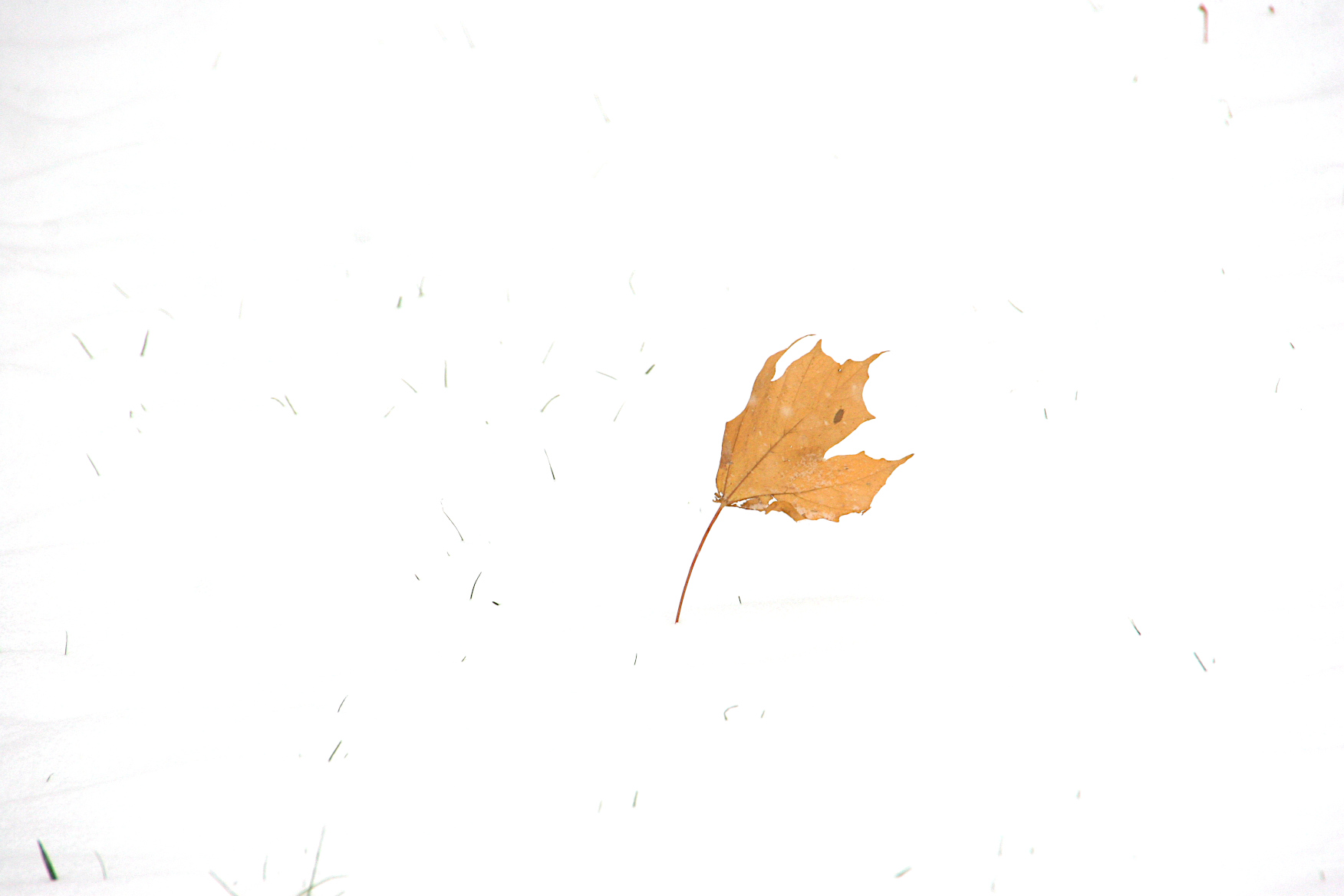
A solo maple leaf stands upright in my snowy backyard.
Only yesterday I wrote of the winter ahead. I didn’t expect that to be the next day, but rather late November or early December. This is just a little too early for my liking.
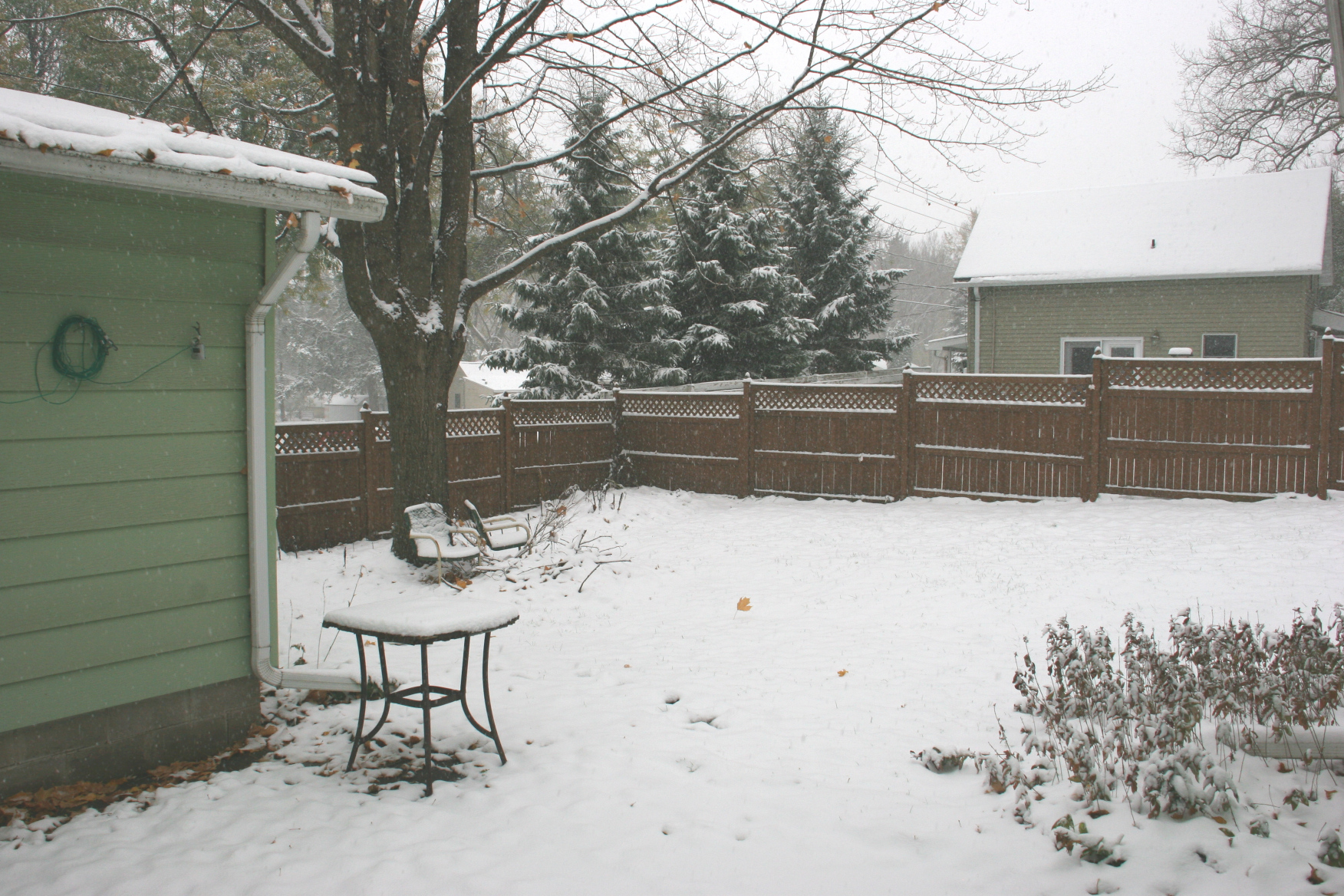
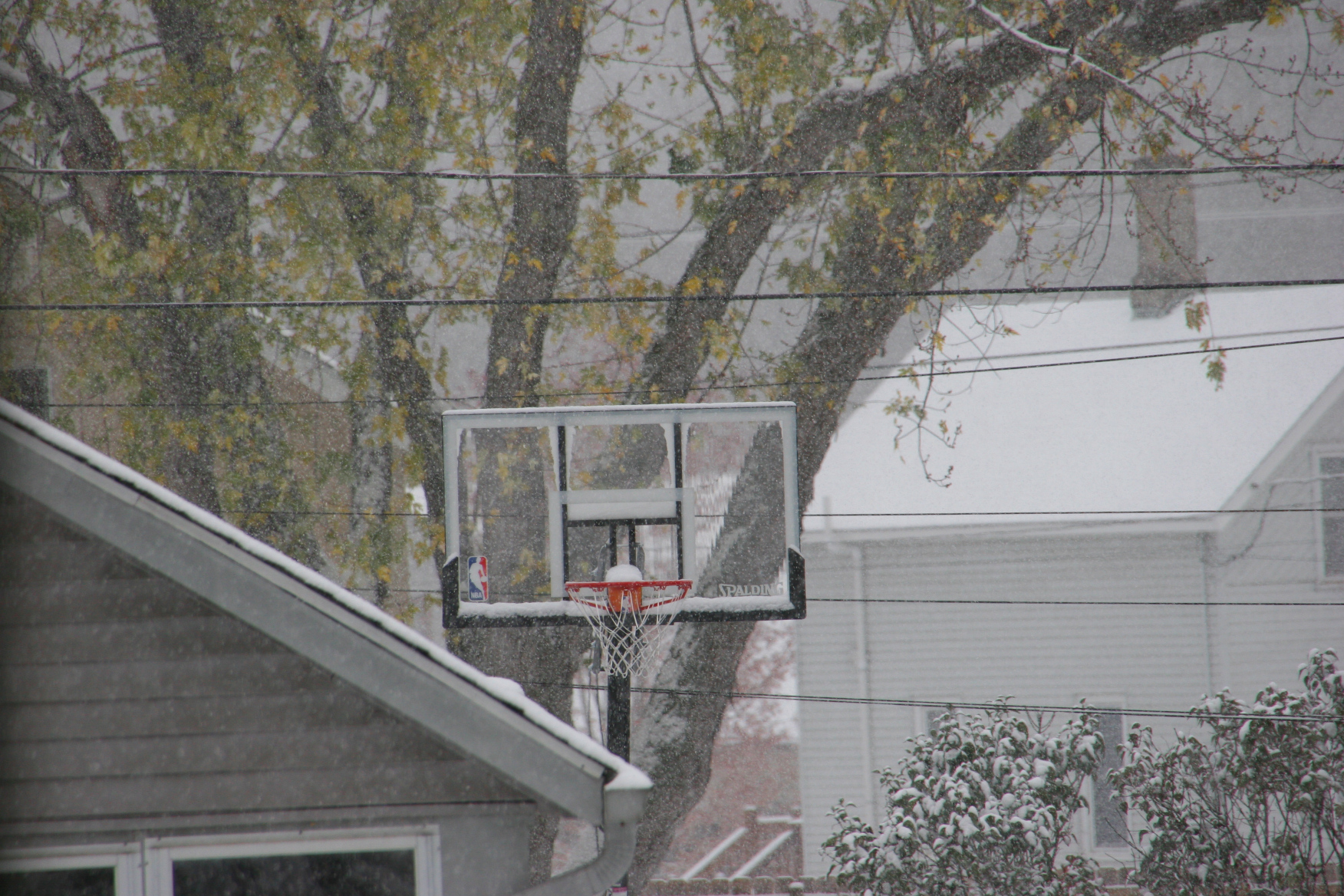
I took this photo from my back door early Tuesday afternoon.
As I look outside, I observe a squirrel rooting around in my backyard, probably intent on finding a place to stash a walnut.
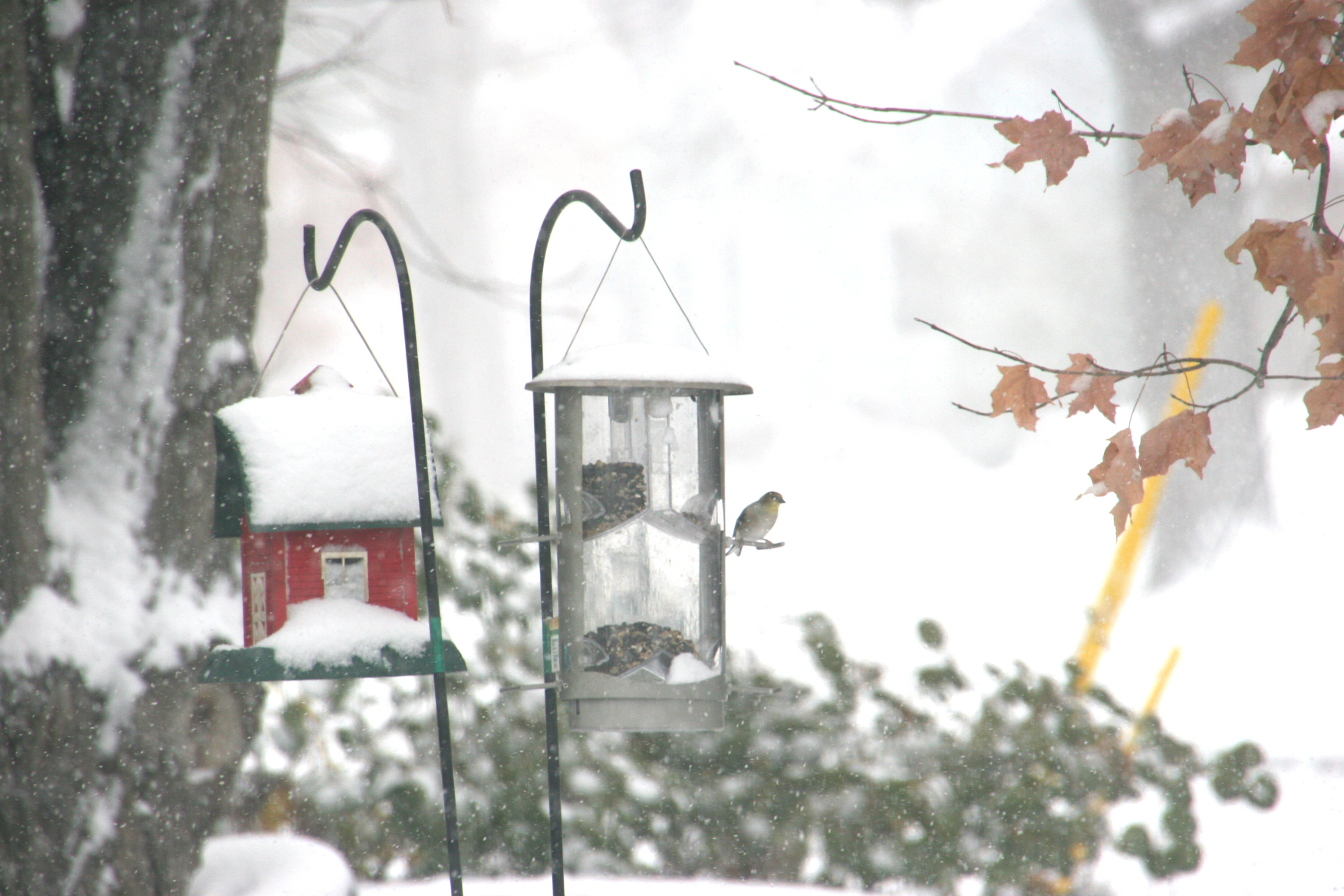
Next door, birds dine at my neighbor’s bird feeders near an almost naked maple tree.
Across the street, snow piles atop jack-o-lanterns on another neighbor’s front steps, reminding me of the 1991 Halloween blizzard of 20-plus inches of snow here in Minnesota.
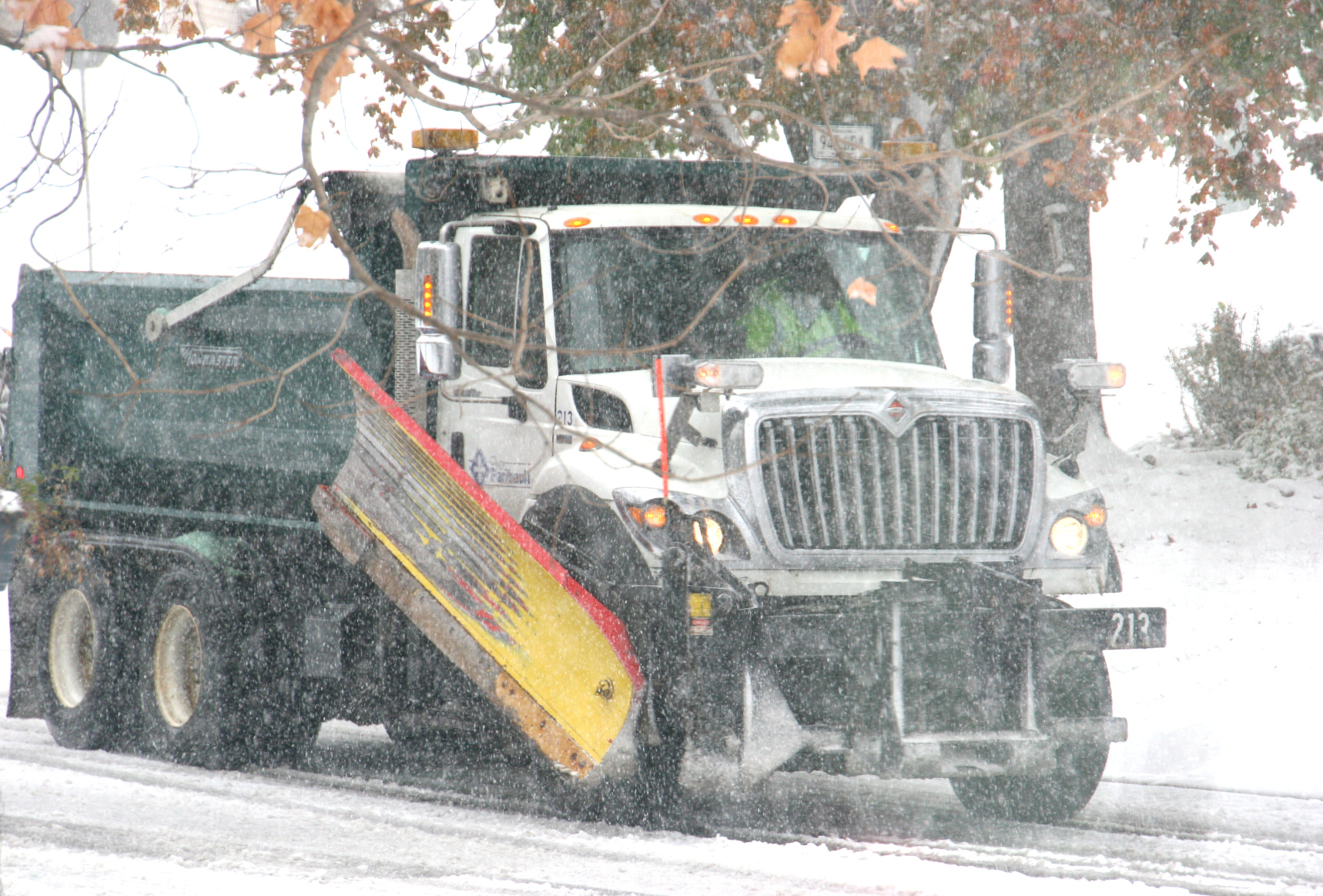
Already a city plow truck has sprayed a mix of sand/salt/chemicals onto the street at the bottom of a steep hill.
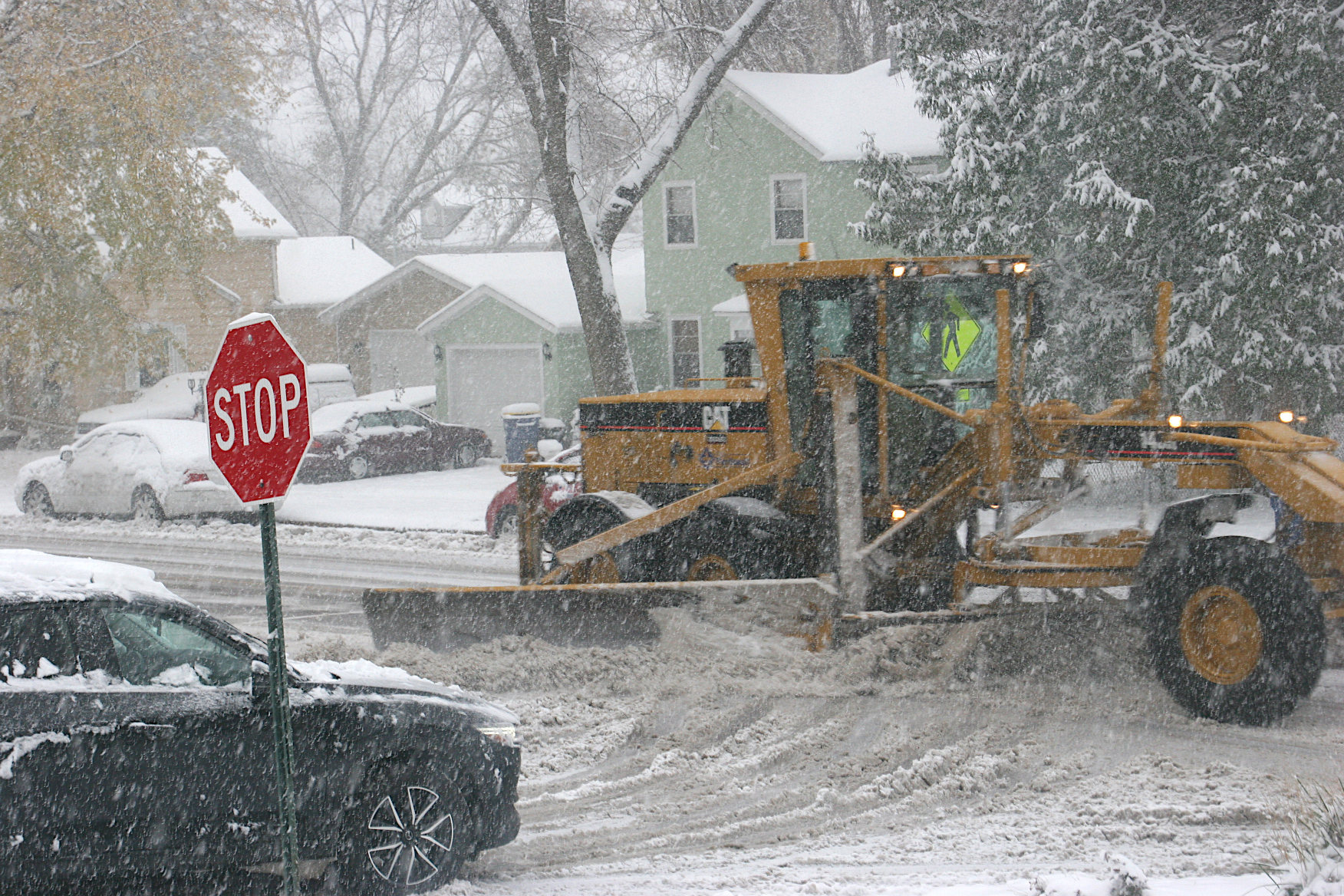
Later a snowplow scrapes the snow from streets.
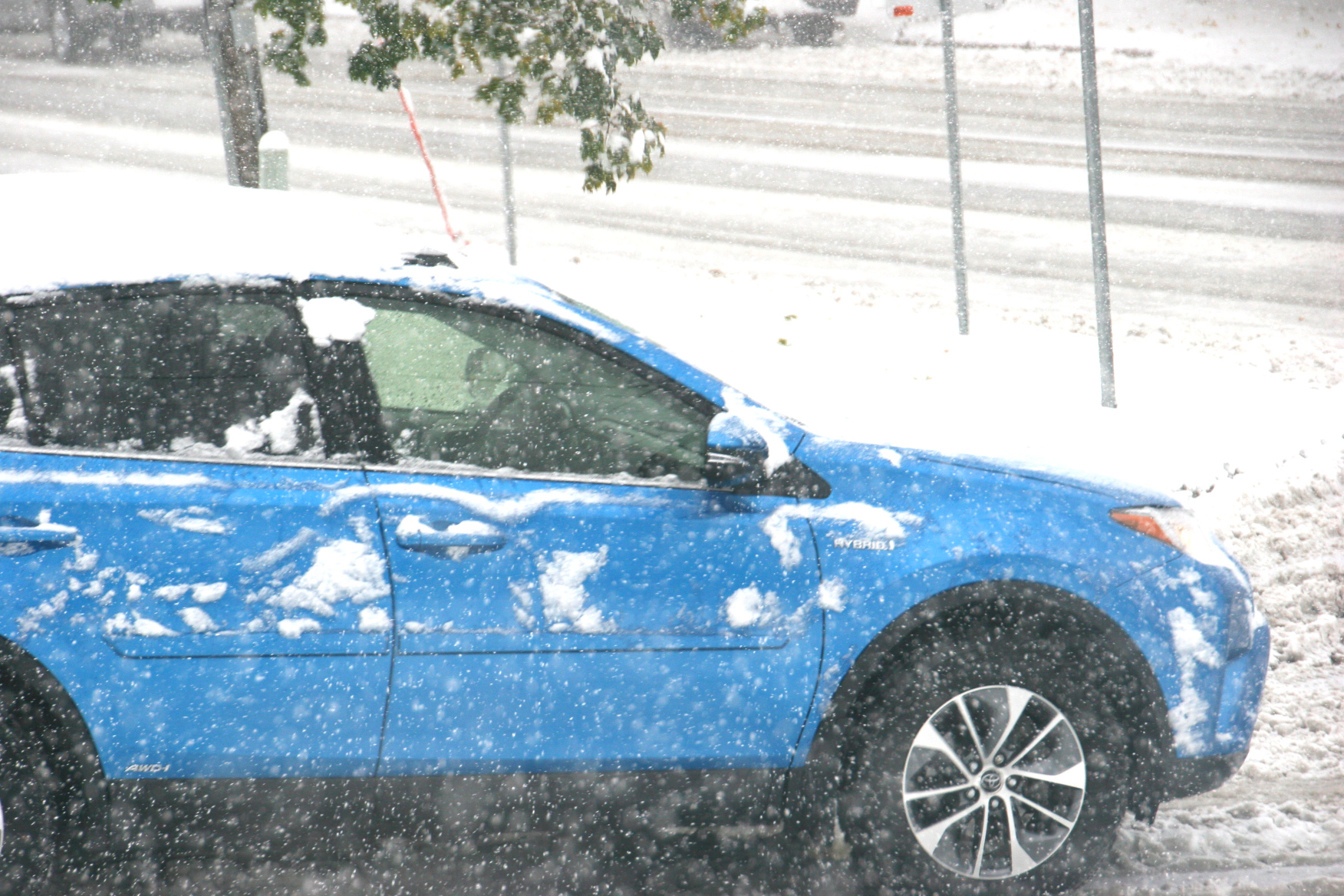
The first snow of the season always challenges drivers.
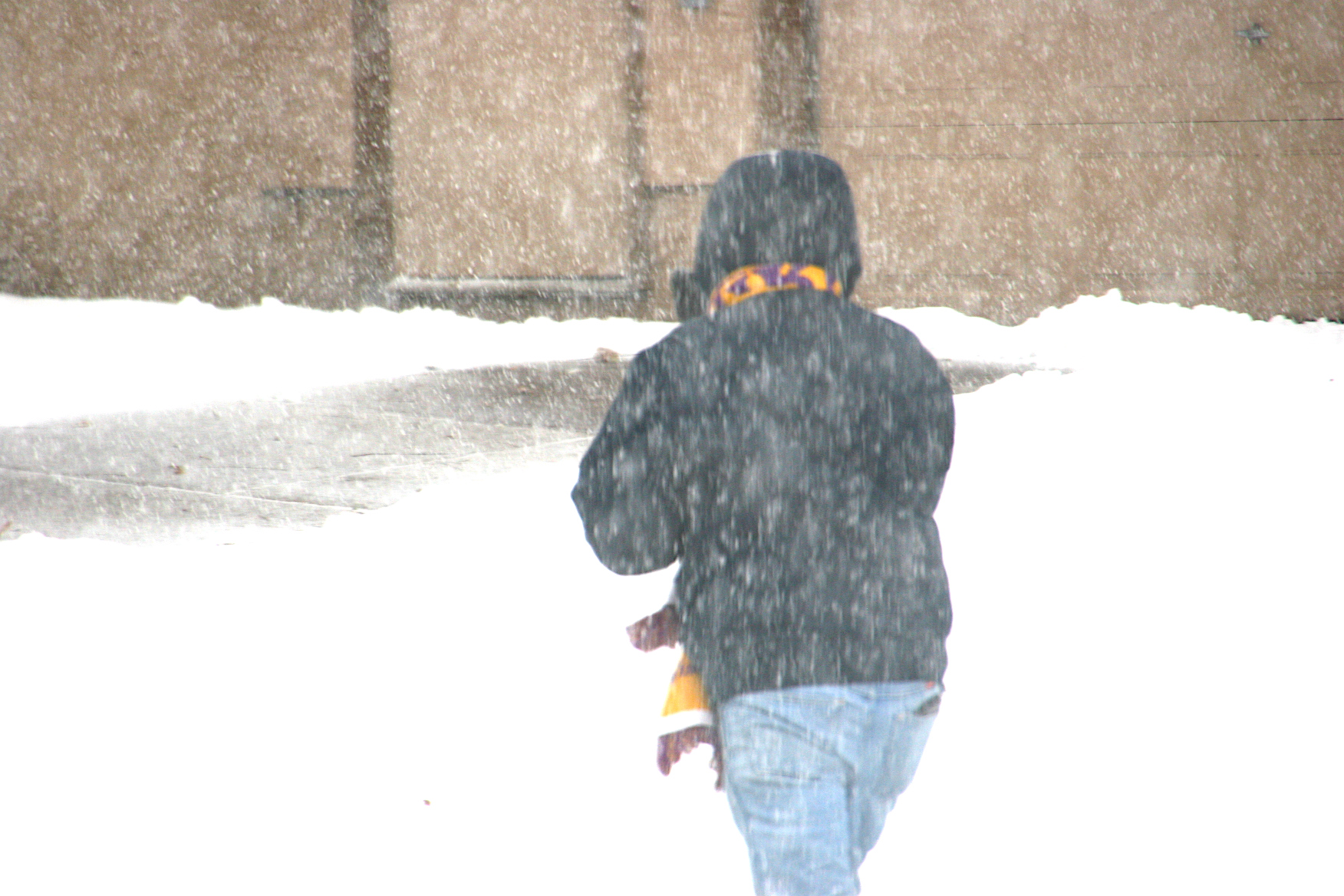
A half hour ago, a Fed Ex worker crossed the street after delivering a package to a neighbor. The young man wore shorts. In 32-degree temps with snow falling. Apparently he didn’t get the weather memo or he can tolerate cold.
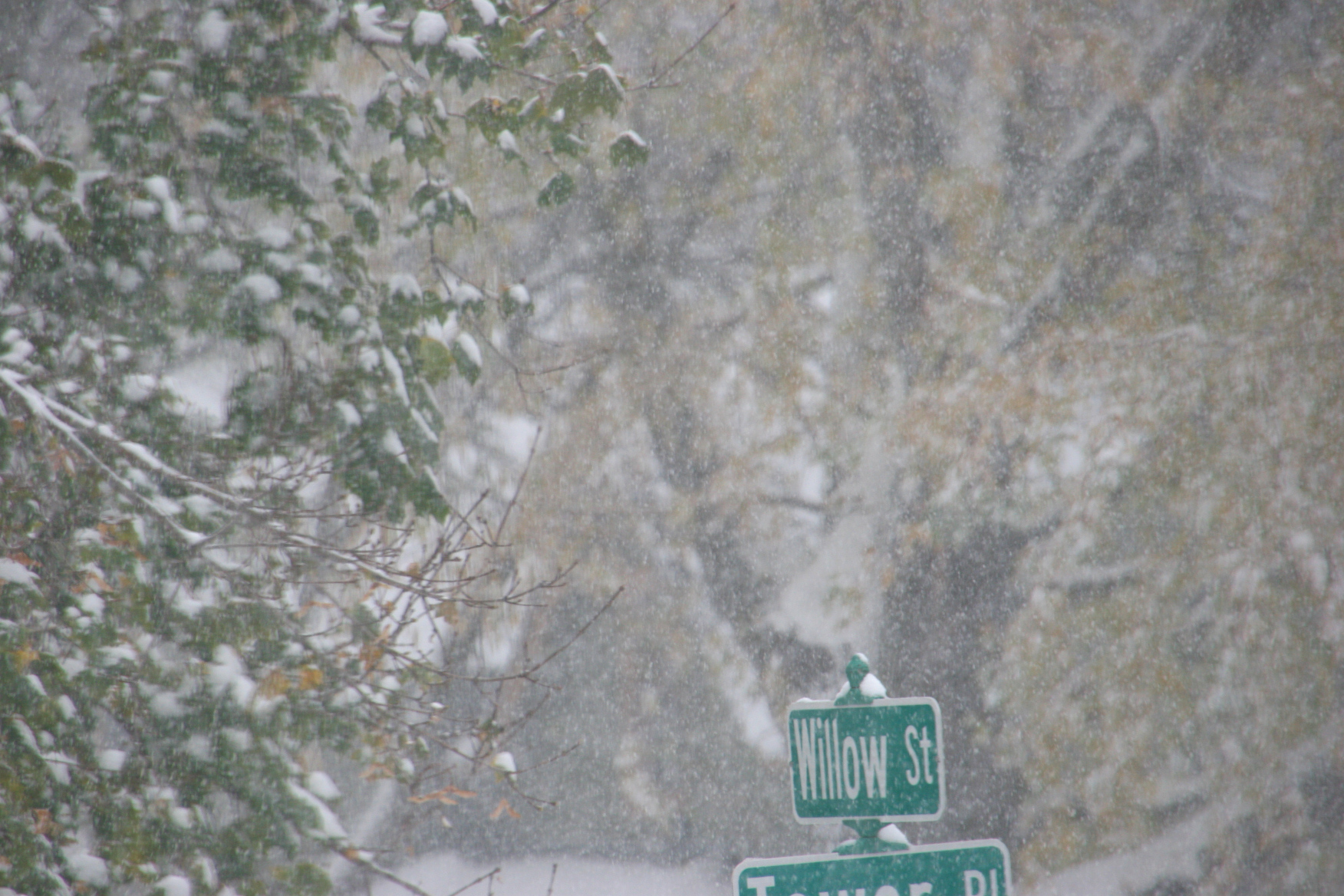
My snowy Faribault, Minnesota, neighborhood.
All of this I observe from inside the warmth and comfort of my home with no reason to go outdoors. Earlier this morning, before the snow began, I hustled to haul flower pots, a water fountain and other garden art into the garage. Now I’m hoping I won’t need to head out later to shovel…because the snow shovels are still stored in the rafters.
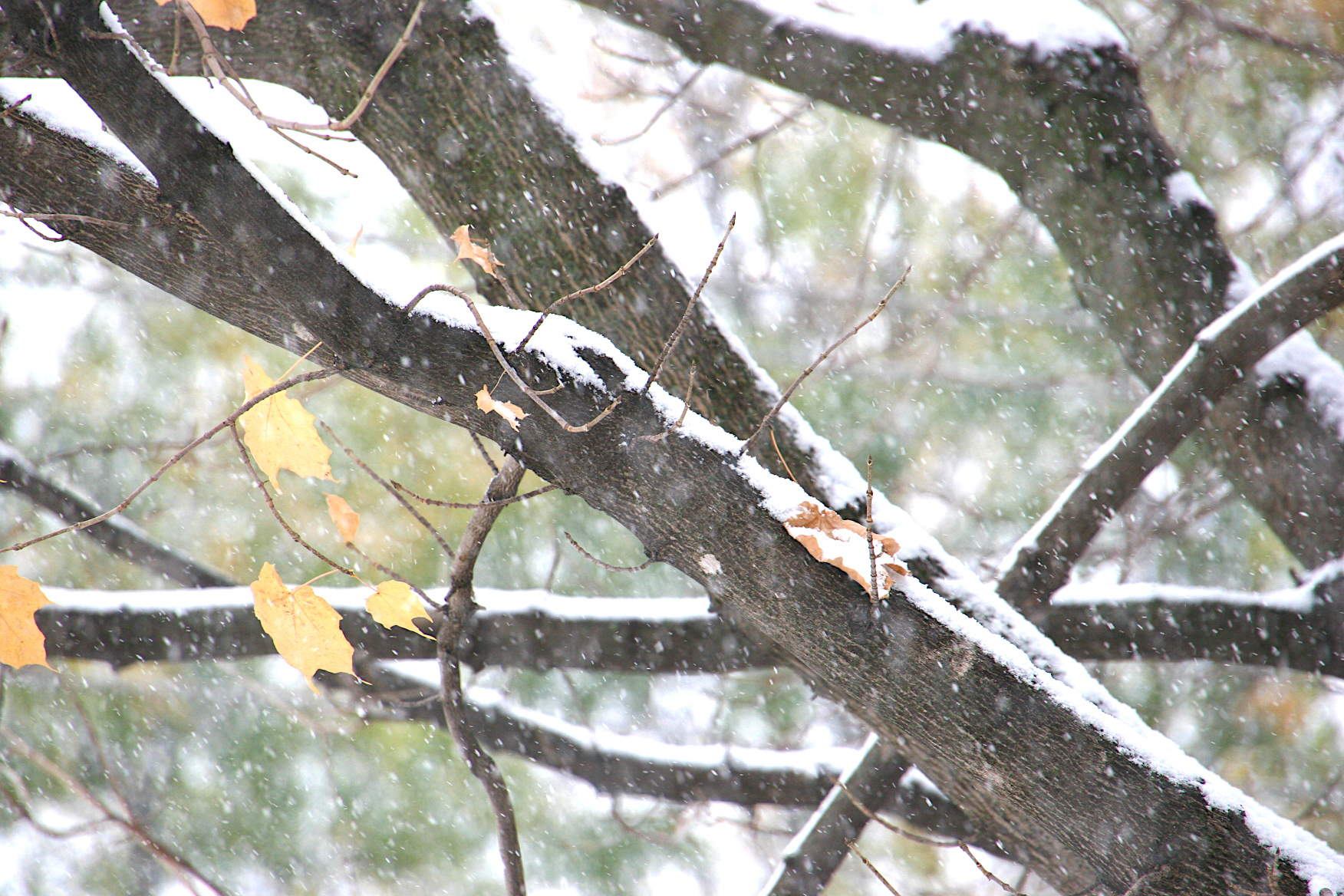
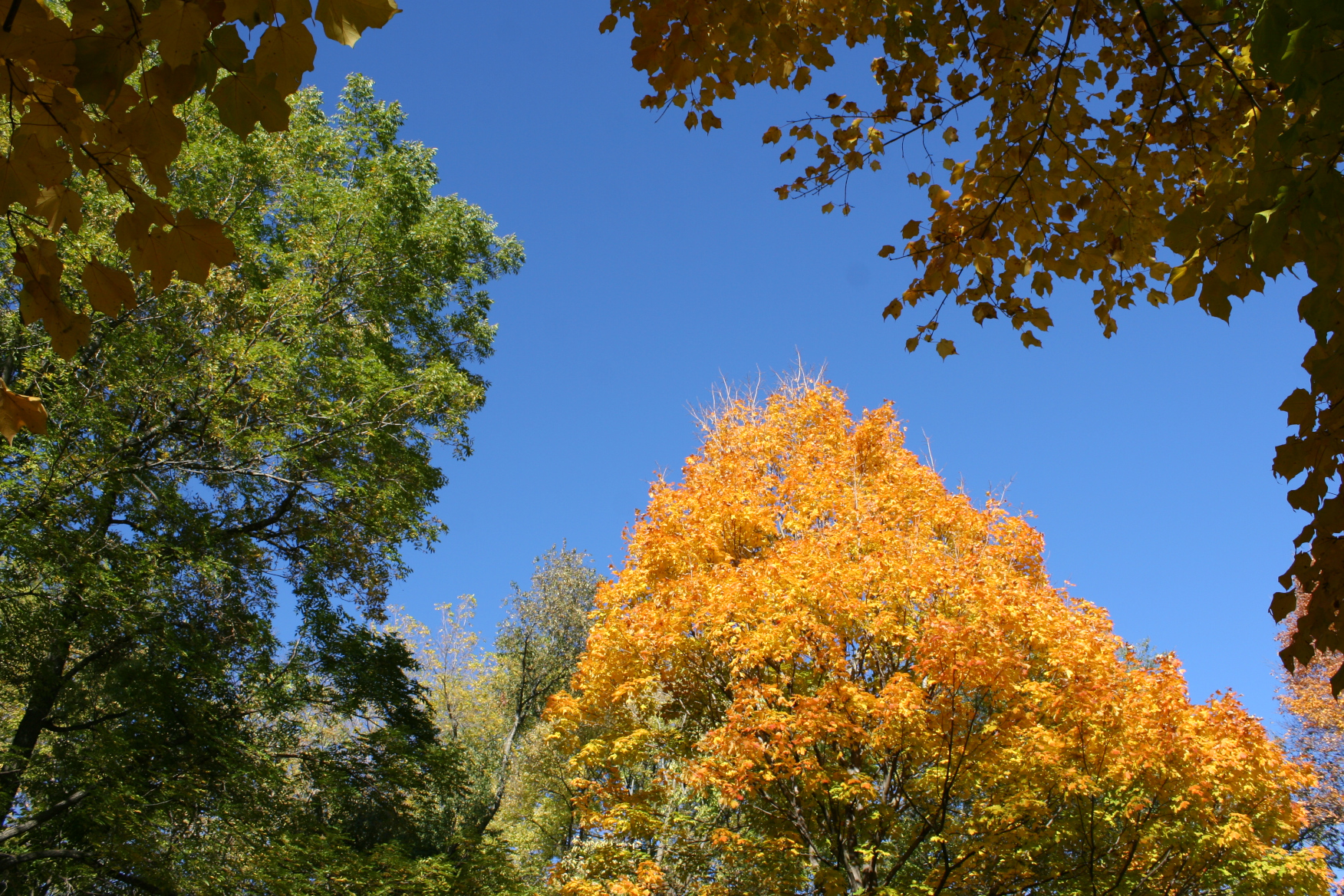
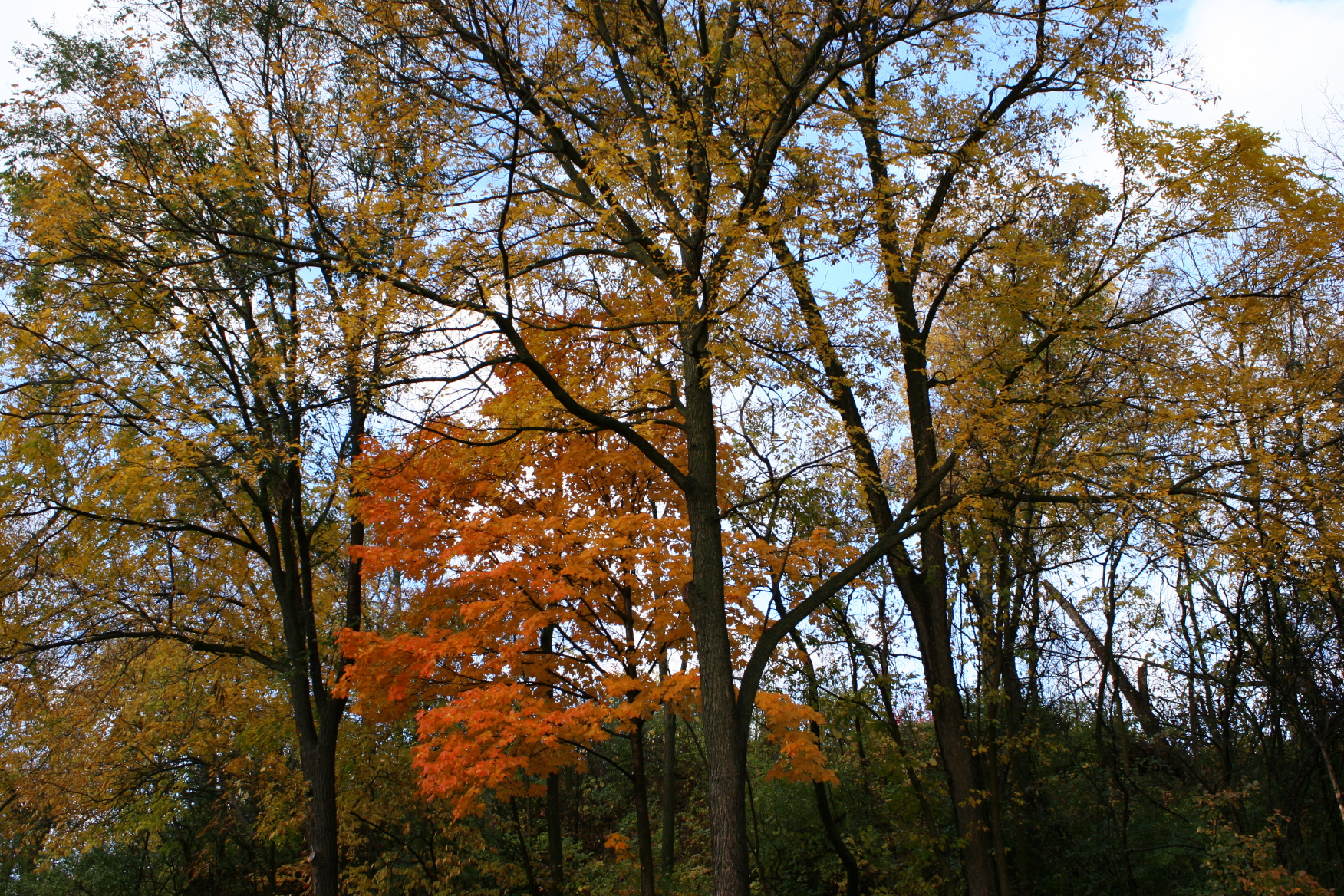
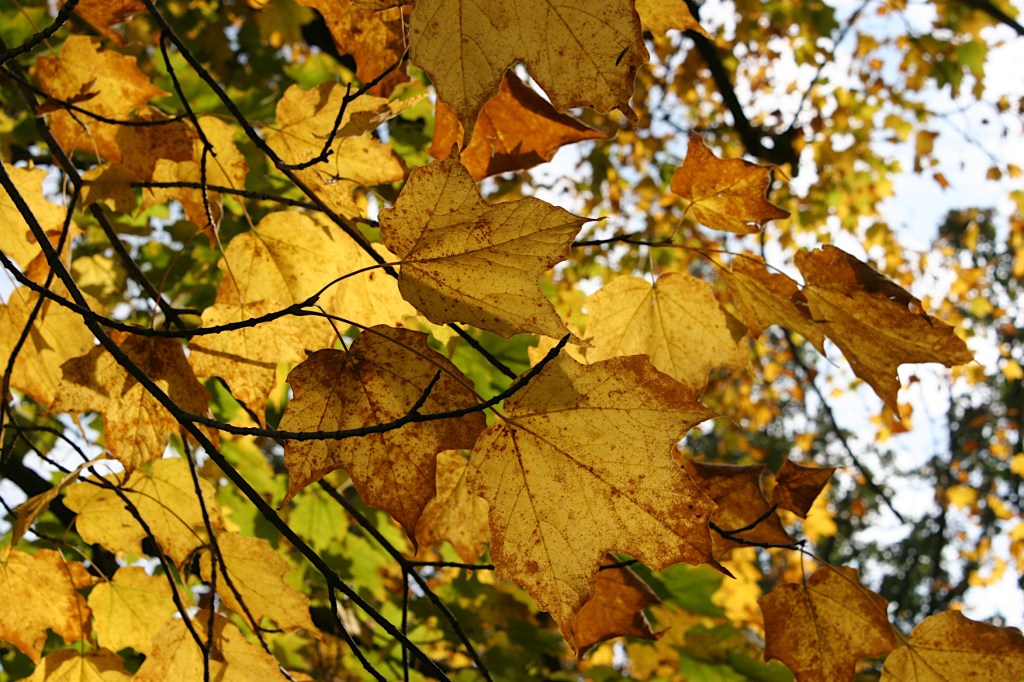
Looking up at trees in view of my backyard, from our solo maple, to the neighbor’s tree to the woods behind our garage.
AS I WRITE, a grey-haired man leans into the fierce wind as he walks his black lab along the sidewalk across the street. In the distance, a block away, I note a fiery red maple blazing color into the cityscape. Soon, though, my neighborhood will be devoid of color, trees stripped of leaves, as autumn shifts ever closer to winter.
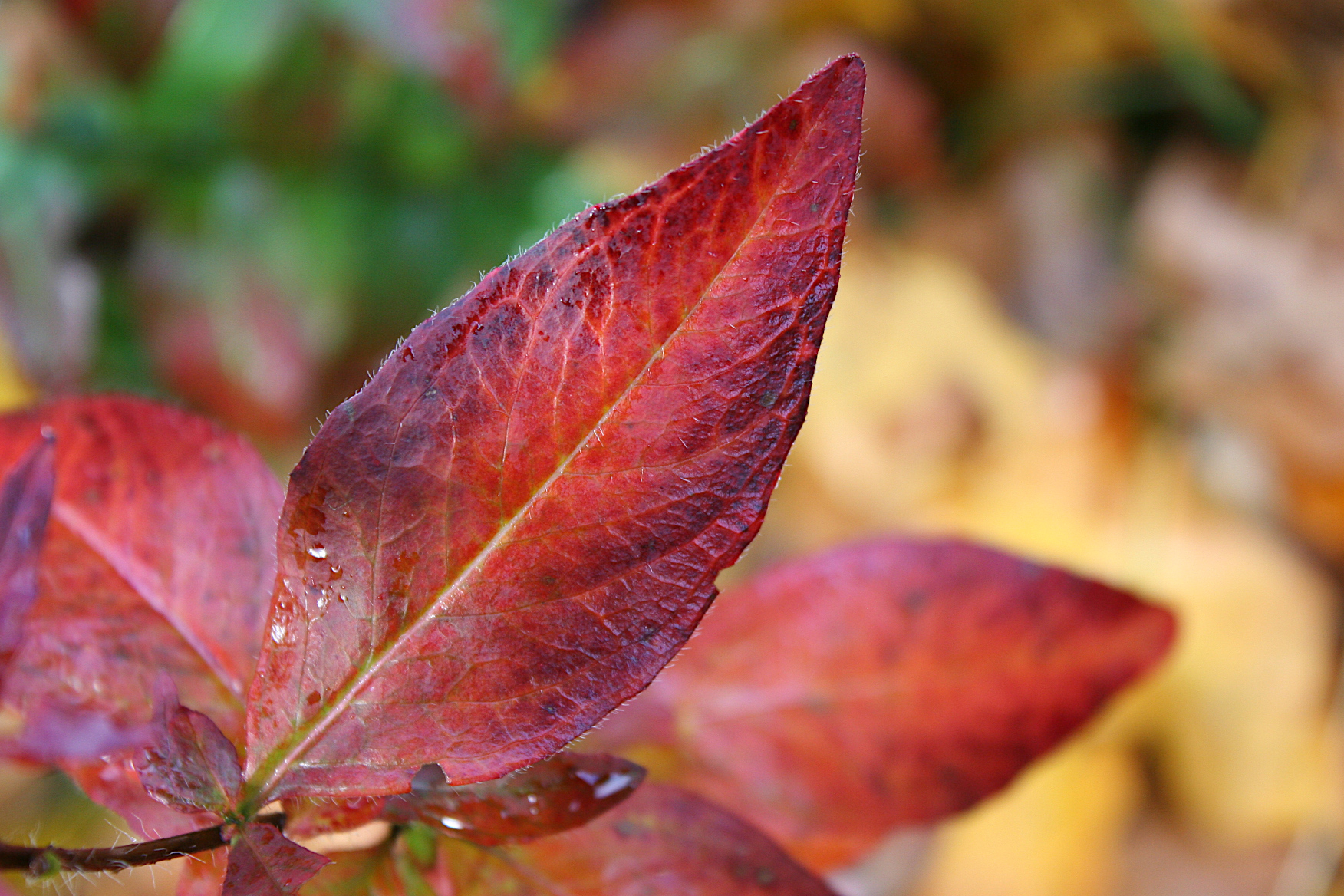
A leaf on a perennial in my yard.
These days, more than ever, I am cognizant of autumn’s departure, of what I anticipate to be an especially long winter ahead with COVID-19.
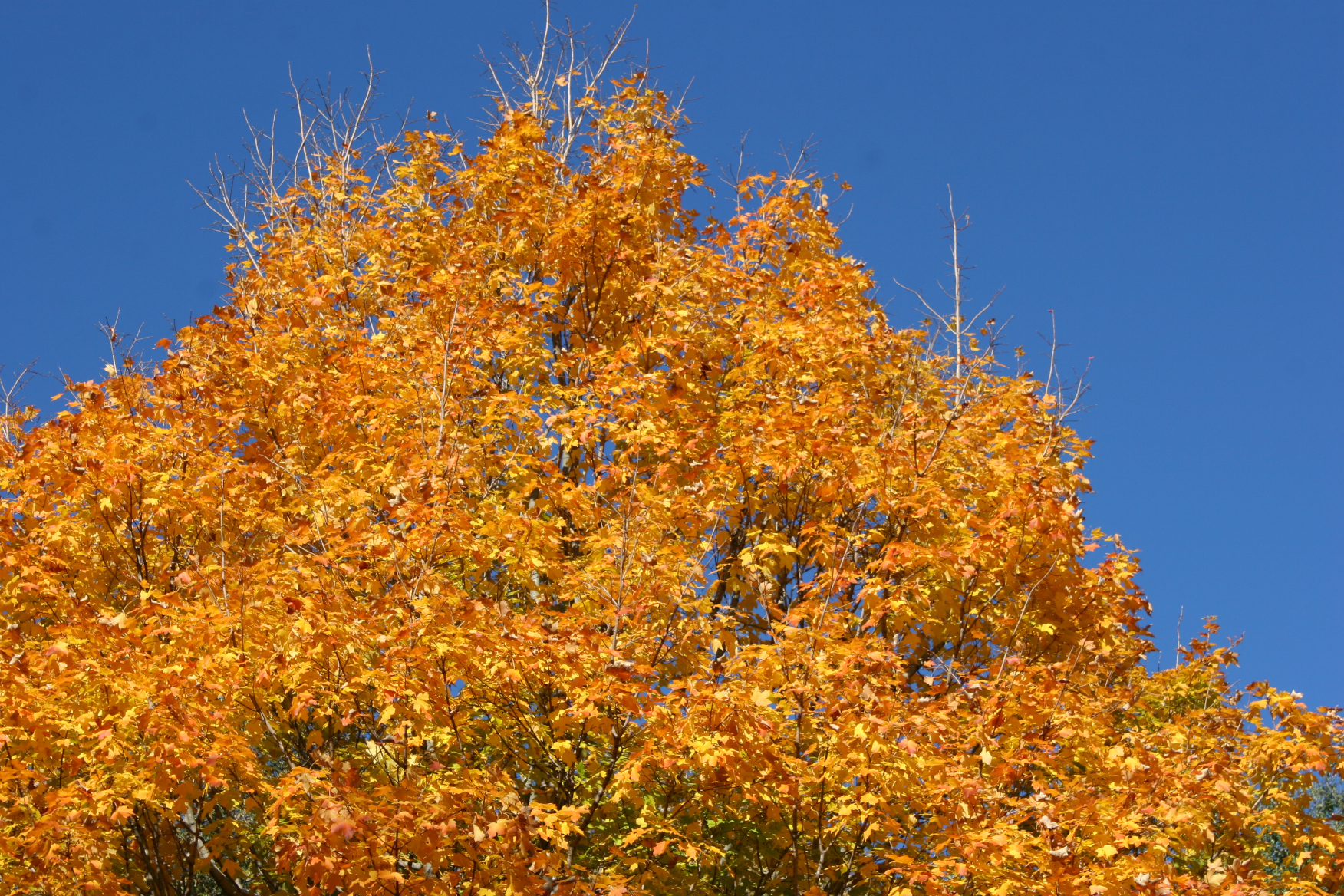
Our neighbor’s beautiful backyard maple set against a cobalt sky. The tree is mostly bare now.
But for now, I want to take you into my backyard, to scenes I photographed within the past 10 days. My yard presents a microcosm of autumn in southern Minnesota. Colorful. Ever-changing. Cobalt skies one day, grey skies the next.
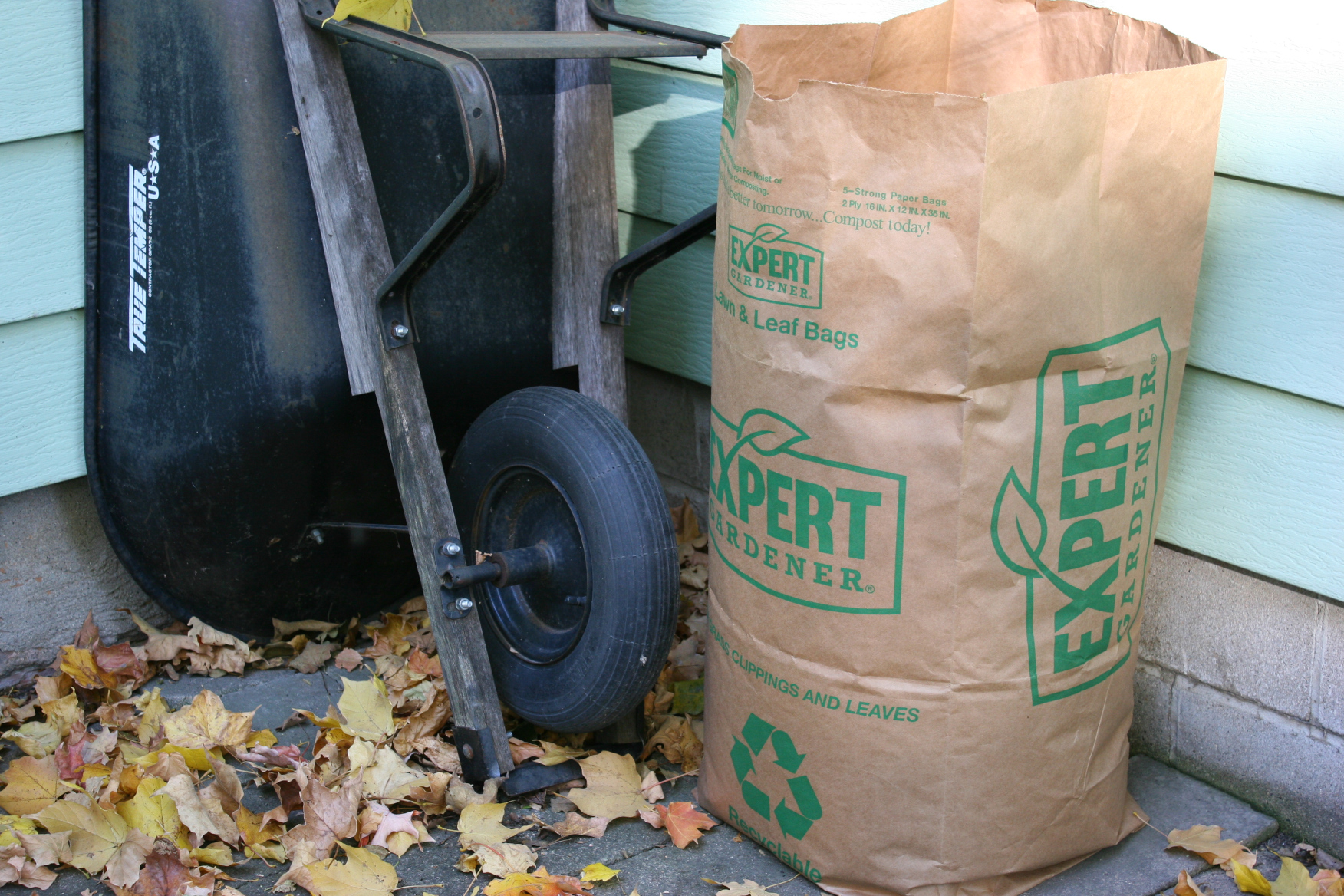
I’ve been bagging leaves in our yard to take to the city compost pile.
Tuesday and Wednesday I worked in my yard, emptying pots of flowers, raking and bagging leaves, all those seasonal tasks I’ve put off. As I age, I find I don’t enjoy this work as much. I’d rather do fun activities like hike and spend time with my grandchildren.
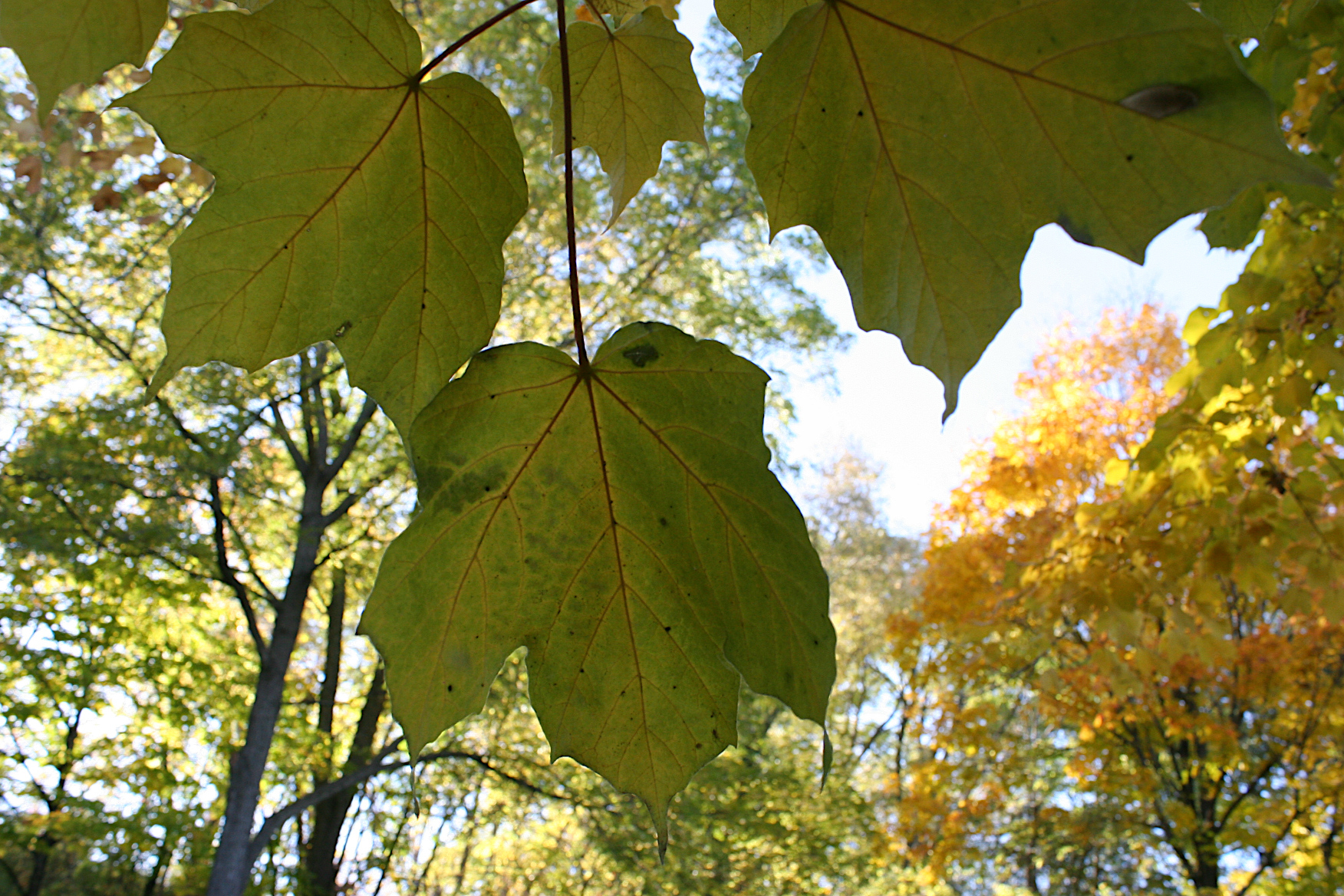
When I took this photo within the past 10 days, leaves on our maple were still green. Now they’ve turned yellow and mostly fallen off. That’s the wooded hillside adjoining our property.
We have only one tree, a maple, on our property. But woods abut our yard. And leaves from neighbors’ trees don’t understand boundaries.
Time to put away the tabletop fountain on the patio.
The clock is ticking to complete autumn yard work before the first snowfall. To then stash away the rakes and pull out the snow shovels. And, for Randy, to drain gas from the lawnmower and check the snowblower.
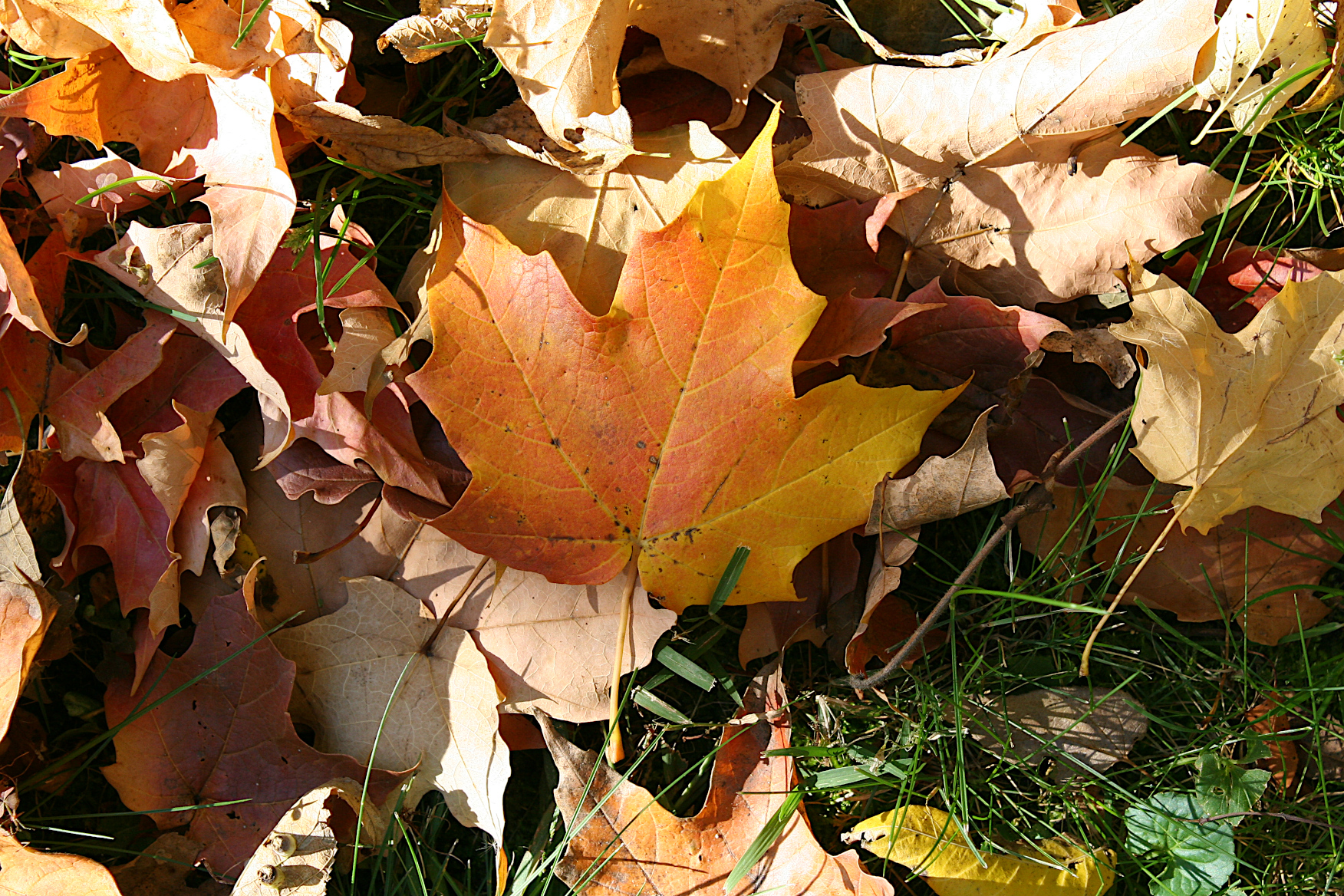
Maple leaves blanket the lawn.
But for now, I want to savor these final days of autumn. To appreciate the colors of autumn leaves clinging stubbornly to branches, to walk across the lawn, leaves crackling underfoot.
The colorful wooded hillside behind our garage. What I most dislike about this scene in winter is that I can see the “tornado trees,” the trees broken by a tornado which went through our city and neighborhood two years ago in September.
For soon enough, winter will overtake the Minnesota landscape, defining our days.
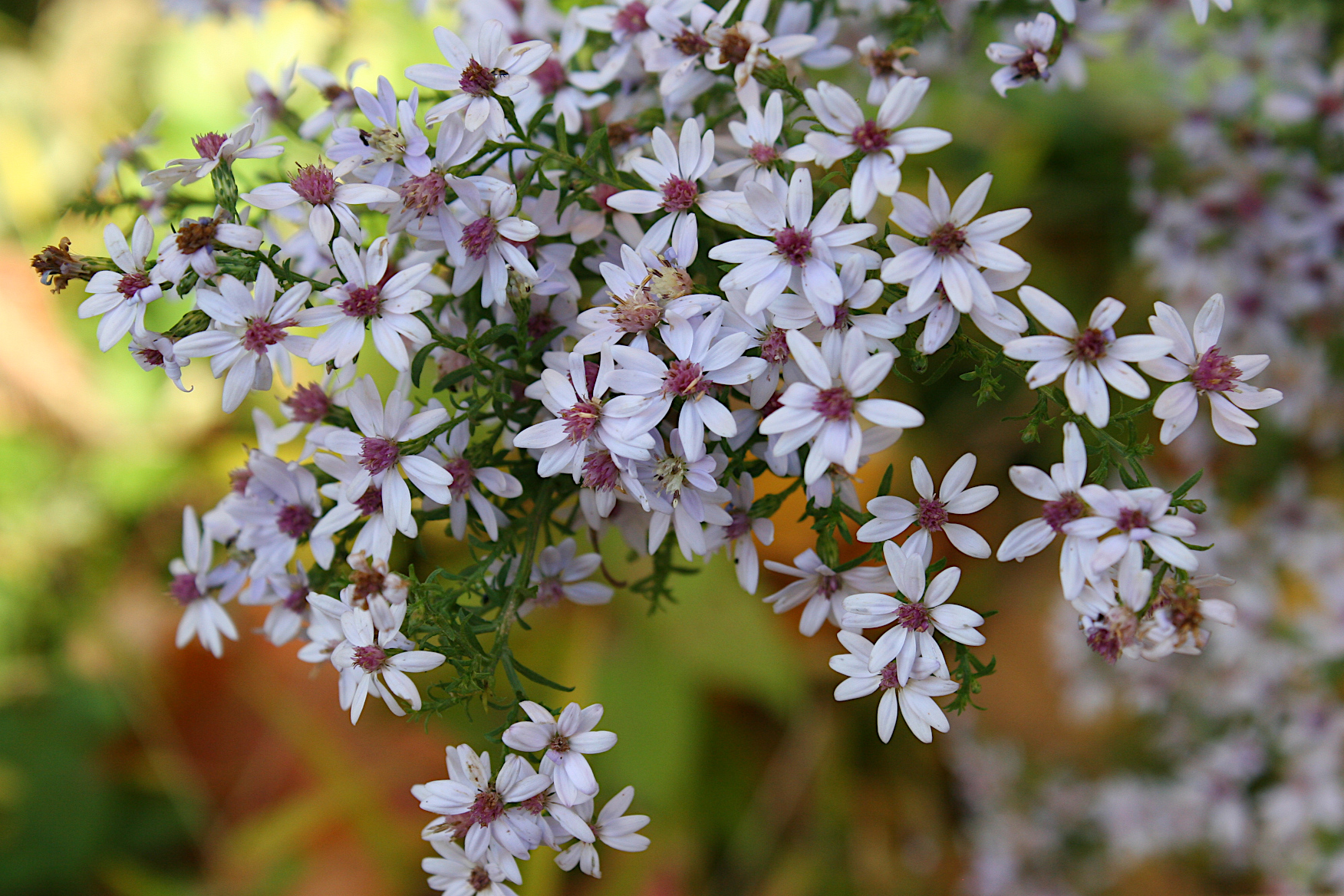
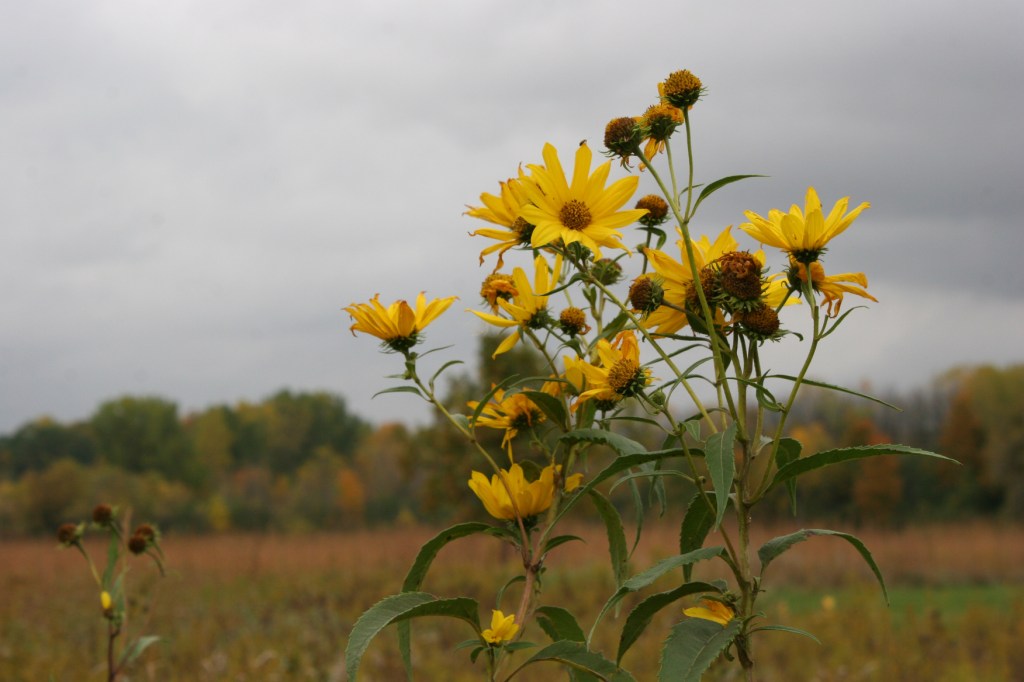
The last of the wildflowers blooming in my backyard.
As we await the arrival of spring and the cycle of seasons continues.
I photographed this eastside Faribault residence covered in toilet paper Saturday morning as part of the TP’ing homecoming tradition. Bethlehem Academy celebrated homecoming last weekend.
But here we are, with the pandemic in full-blown mode all these months later and plenty of toilet paper to go around. Or at least enough that high schoolers here in Faribault continue the homecoming tradition of TP’ing houses and yards. I saw at least six local residences swathed in toilet paper while out and about over the weekend.
That’s a lot of toilet paper. Toilet paper we paid good prices for back in March and April, especially.
Years ago I held the mindset that TP’ing was just plain stupid and a waste of good toilet paper. I still consider it a waste of good toilet paper. But I now consider TP’ing property to be good fun given other less desirable options.
But, I wonder, in a month or two will these kids wish they had the toilet paper rolls they so freely tossed to the wind? Only time will tell…as the pandemic relentlessly continues.
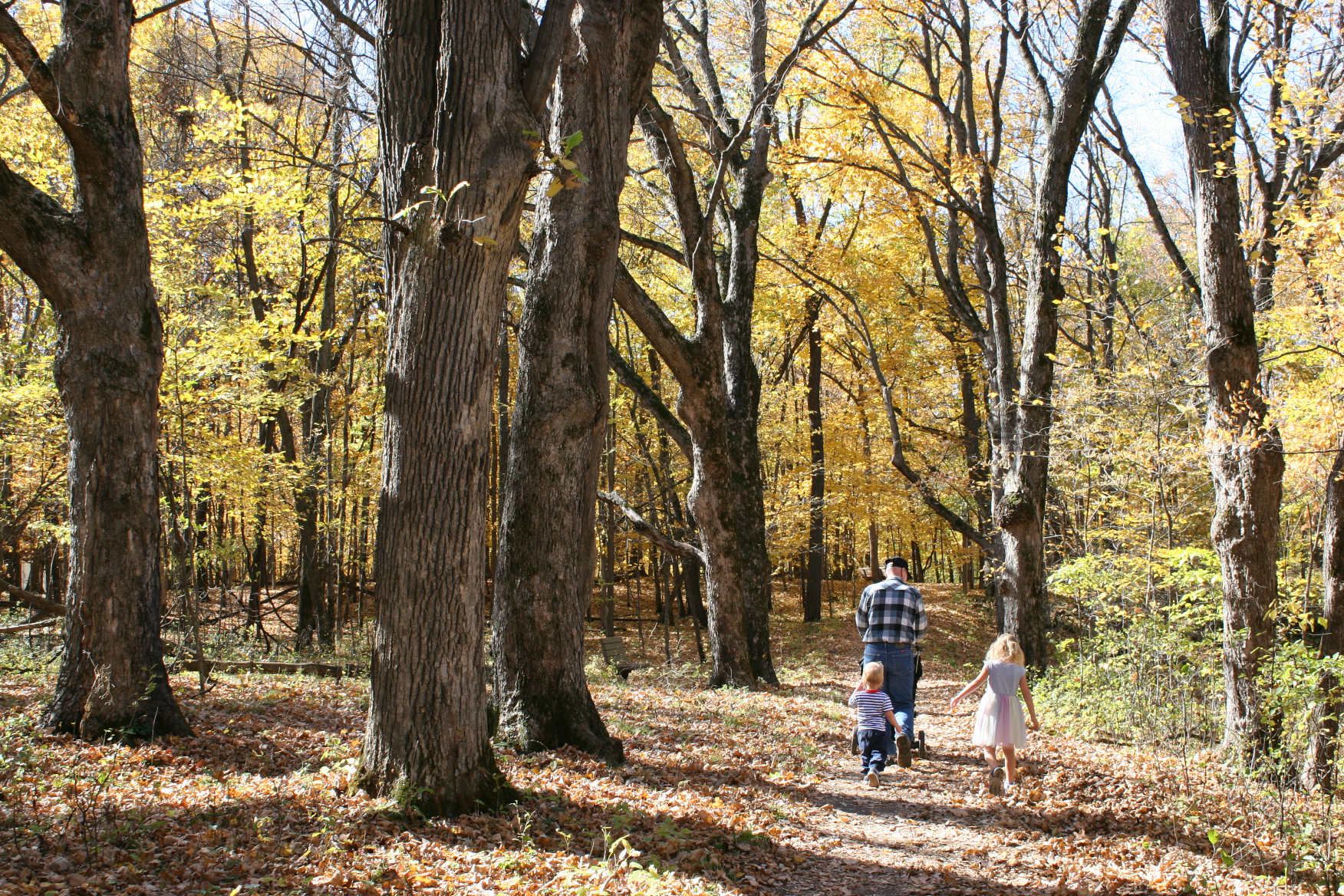
Randy walks with the grandkids at River Bend Nature Center in Faribault on Saturday afternoon.
NOTHING BRINGS ME more joy than time with my grandchildren, Isabelle, 4 ½ and Isaac, 21 months. This past weekend they spent all of Saturday with us, overnight into early Sunday evening so their parents could have some much-needed time alone. Randy and I love having the kids. They are easy-going, fun and just plain happy.
Our living room, kid central this weekend with toys pulled from totes and cupboards.
At their young ages, the siblings are content doing most anything from coloring to “helping” make apple crisp. This visit, Izzy headed straight for her Uncle Caleb’s Brio train set. And Isaac, besides pushing any toy with wheels, loved putting together puzzles. The same ones, over and over. (We think he’s pretty smart.) And this visit, Grandpa’s vinyls spinning on the record player also fascinated him.
We stopped often at River Bend to view the colorful leaves.
But, for me, it was our time outdoors that proved most engaging and memorable. We took the kids to River Bend Nature Center on Saturday afternoon, arriving to a parking lot filled with vehicles, including several school buses. Unbeknownst to us, a cross country meet was taking place. We stayed as far away from that busyness as possible, although a cluster of several teens out for a practice run in the woods veered way too close for comfort. That aside, it was a mostly solo walk for the four of us.
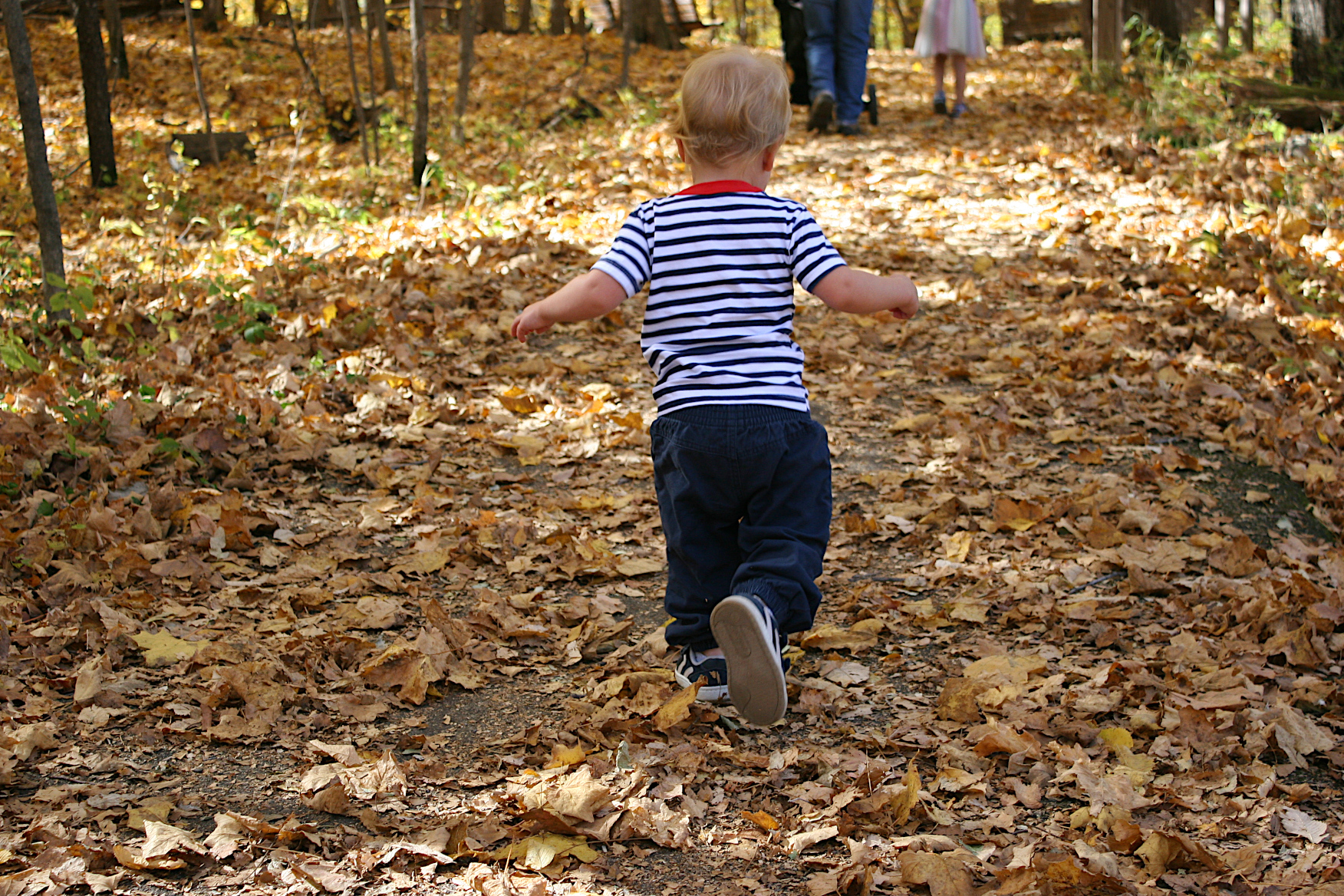
Our grandson, 21 months, runs along a trail at River Bend. Once taken out of the stroller, he never went back. Our walk ended with his sister riding in the stroller.
We started out with Isaac in the stroller given the distance we planned to walk. Part way in, we let him walk, or shall I say, run. Even with legs much longer than his, Randy and I struggled to keep up with our grandson. Occasionally he would stop, though, to examine a leaf or pick up a stick.
That’s the part I appreciate about being with little kids. You see the world through their eyes, at their level, from their inquisitive perspective. And that’s refreshing. There are many stop and smell the roses moments.
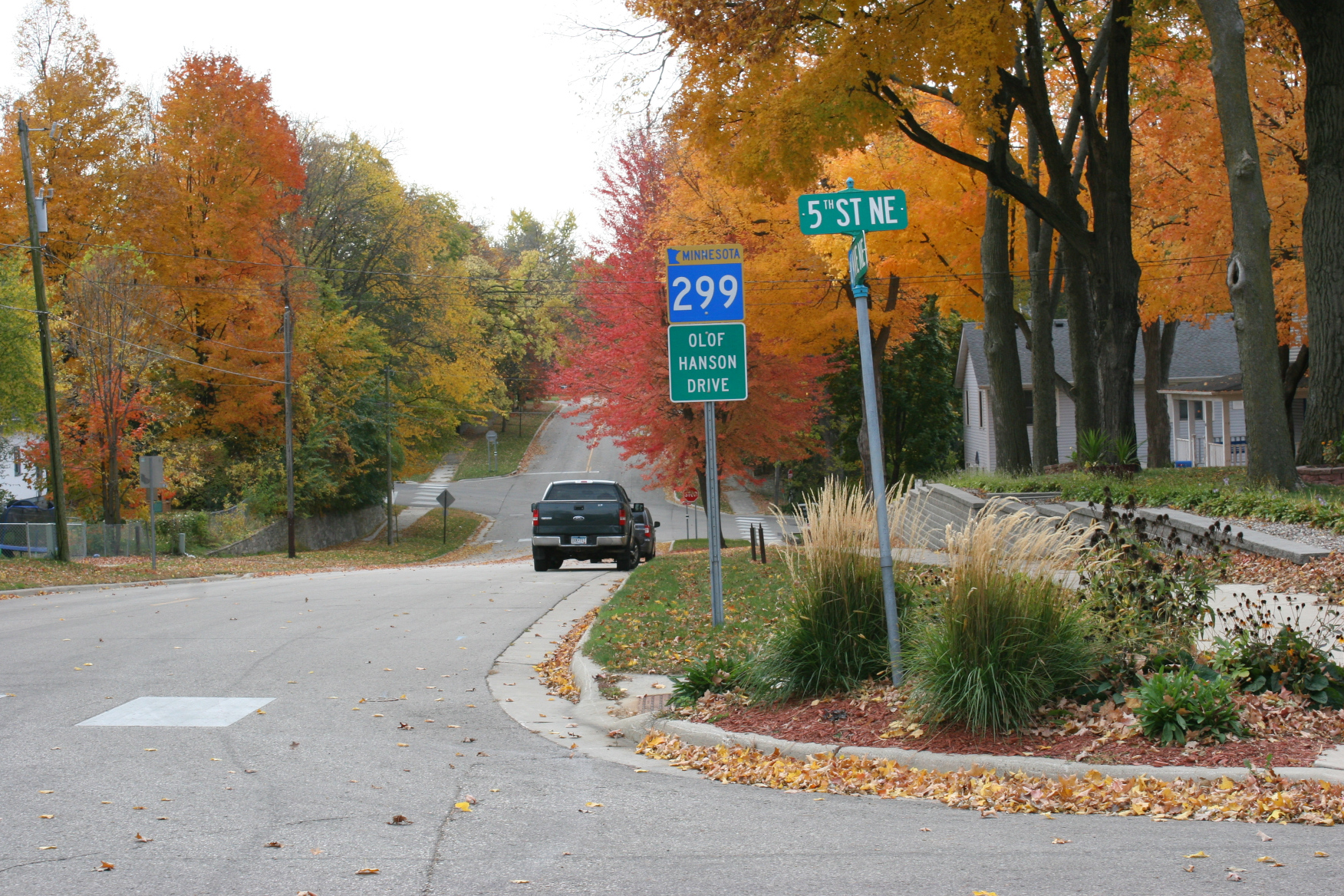
The street by the MSAD shows the beautiful fall colors gracing Faribault.
We experienced those at River Bend and again on Sunday when we looped our way around the Minnesota State Academy for the Deaf campus. Izzy zoomed ahead of us on her scooter. And Isaac likewise moved as fast as his legs could carry him. Fast enough for these grandparents.
Randy lifted Isaac for a closer look at these bold berries on a tree at the MSAD.
Occasionally the kids paused to gather pine cones, colorful leaves and berries or to pick petunias (shhh) from a flowerbed. I bagged their nature finds for them to take home.
I hope we are instilling in them an appreciation for the outdoors and for nature. But, more than that, I hope they will remember these times with us—the minutes and hours and days together. Connecting, sharing, learning and loving each other as only grandparents and their grandchildren can. What a joy. What a blessing.
The pottery of Tom Willis, displayed at a past Studio ARTour. He will be among six artists at Studio #7, 10754 Farrel Avenue, Northfield. Minnesota Prairie Roots file photo.
ART, FOOD, FUN and more food. All will focus events in the Faribault area this weekend. And even though I’m uncertain yet whether I will attend any—because of my COVID-19 comfort level—I want to pass along this community information. These are all worthy events which I’ve attended in past years.
First up is the annual south central Minnesota Studio ARTour, featuring the work of 16 regional artists either in studios or, in Faribault, also at the Paradise Center for the Arts. Some of those studios will be open from 4-8 pm Friday in addition to weekend hours that start at 10 am and continue until 6 pm on Saturday and until 5 pm on Sunday.
The tour is scaled back from previous years, but still includes a variety of artists who paint, shape clay into pottery, practice the Norwegian art of rosemaling, engage in fiber art, design jewelry, create with photography and more. I’ve always appreciated the opportunity to meet these artists, to view their work and where they work.
Promotional info for the tour emphasizes that health and safety come first and that participants—yes, that includes everyone—must wear a mask and that hand sanitizer will be used. Some artists will set up outdoors.
A previous flag ceremony featured national anthems and information about the countries from which Faribault residents have originated. Minnesota Prairie Roots file photo.
Likewise, the Faribault Diversity Coalition, organizers of the 15th annual International Festival Faribault, promises plenty of safety protocol during the 10 am – 4 pm Saturday fest at Faribault’s Central Park. If you’re comfortable attending, I’d encourage you to do so. It’s a great opportunity to learn more about the diverse people who call Faribault home. The fest is aptly billed as “Neighbor Meeting Neighbor.”
This celebration of our cultural diversity includes a full day of entertainment from Native American, Guatemalan and Aztec dancers to Guatemalan and Hispanic singers and more. Other highlights include a Naturalization Ceremony and a Flag Ceremony, both in the early afternoon.
And there’s more—arts and crafts, kids’ activities, informational booths and food. Let’s not forget the food. Food from around the world. The fest offers a great opportunity to try ethnic foods.
My plate full of food from a past Trinity harvest dinner. Not all foods served are on this plate. Minnesota Prairie Roots file photo.
Food centers the final local event I want to highlight. That’s the annual Trinity North Morristown Harvest Dinner from 11 am – 1 pm Sunday. I’ve attended this annual church dinner many times and highly-recommend it for the outstanding food. For only $10, you’ll get a meal of turkey, ham and all the trimmings that tastes like it came directly from Grandma’s kitchen.
This year the meal is take-out only with tickets sold on the adjacent Fourth of July picnic grounds and meals then handed out via drive-through on the south side of this rural church. I’ve always enjoyed the dining-in experience of cramming inside the church basement for good food and conversation among this friendly crowd. But, because of COVID, there will be none of that nor will there be a craft or bake sale.
Life goes on, pandemic or not. Just, please, if you attend any of these events, mask up (whether indoors or out), social distance and keep your hands clean. If you’re sick or have COVID symptoms or have been exposed to anyone with COVID or COVID symptoms, stay home.
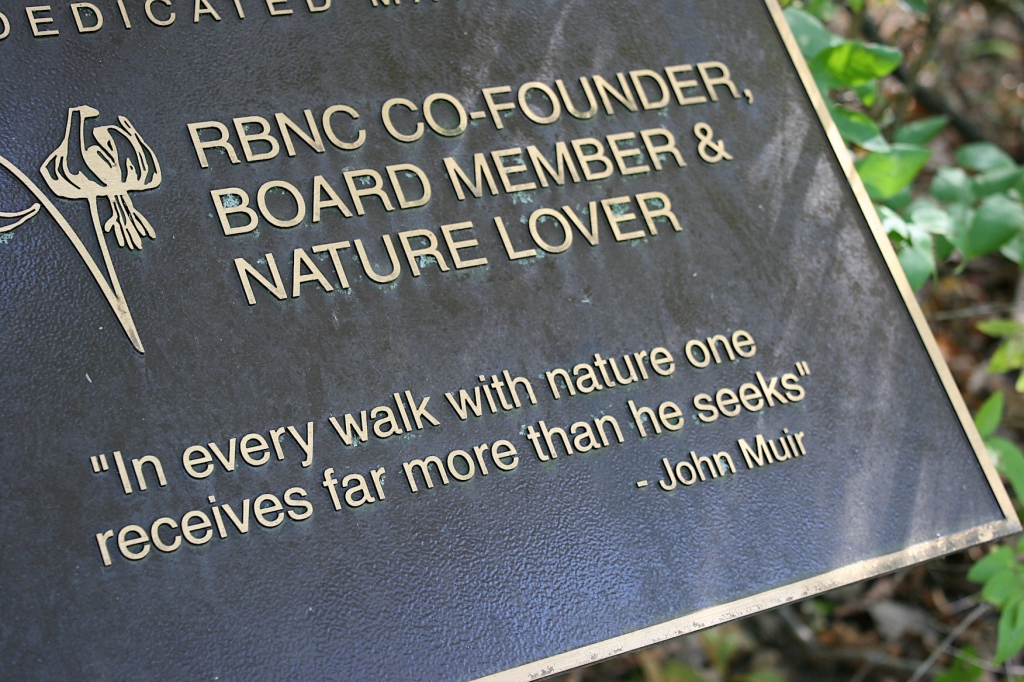
Posted near the amphitheater at River Bend Nature Center, Faribault, Minnesota.
IN EVERY WALK with nature one receives far more than he seeks—John Muir.
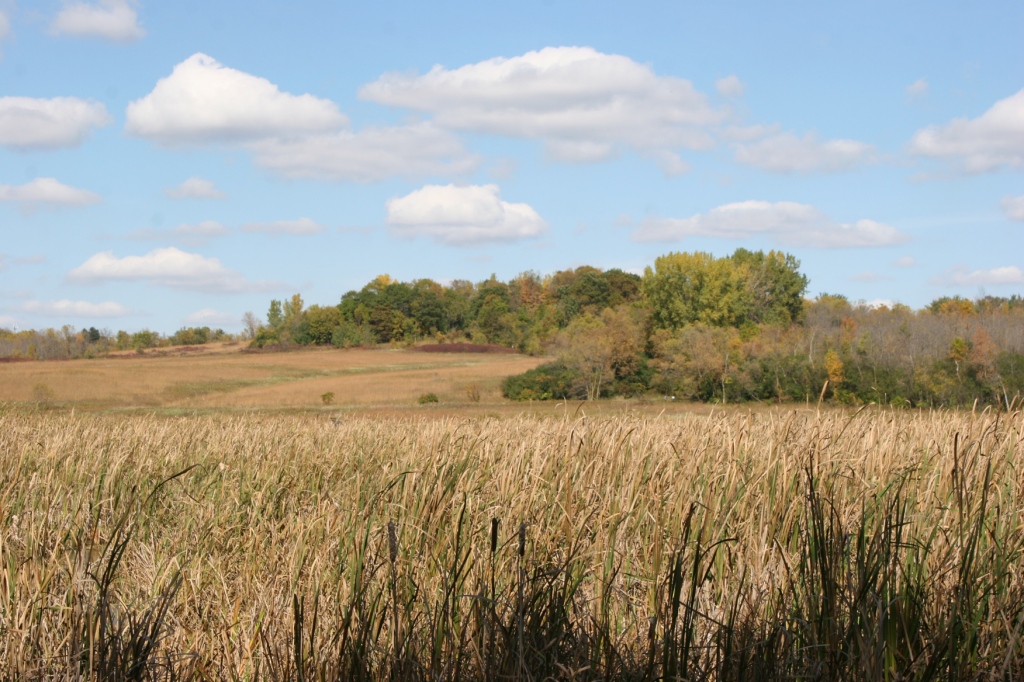
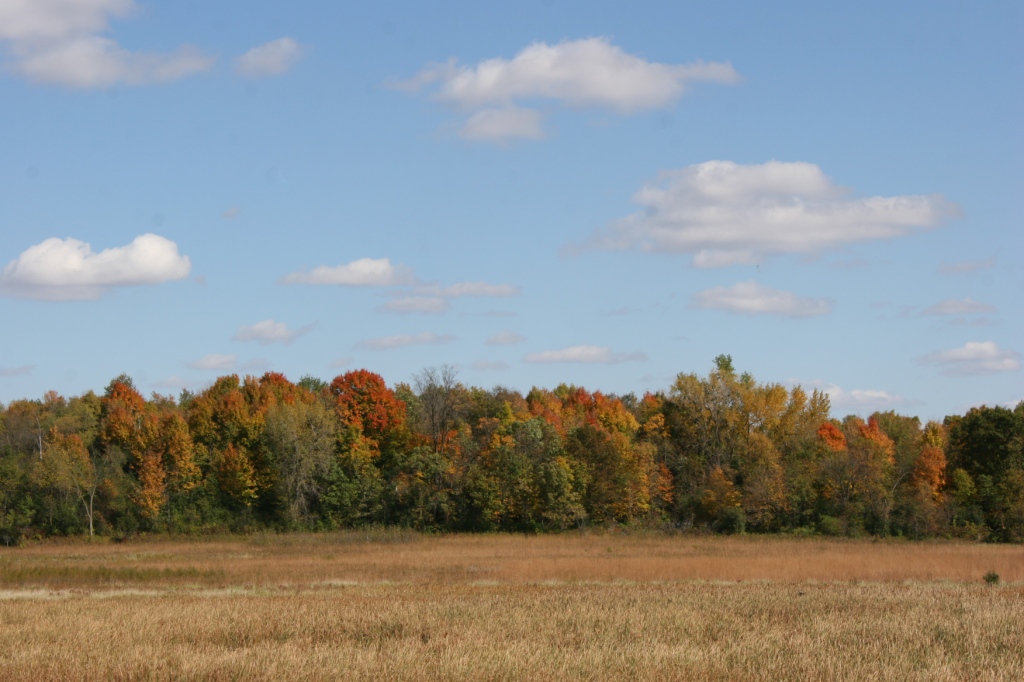
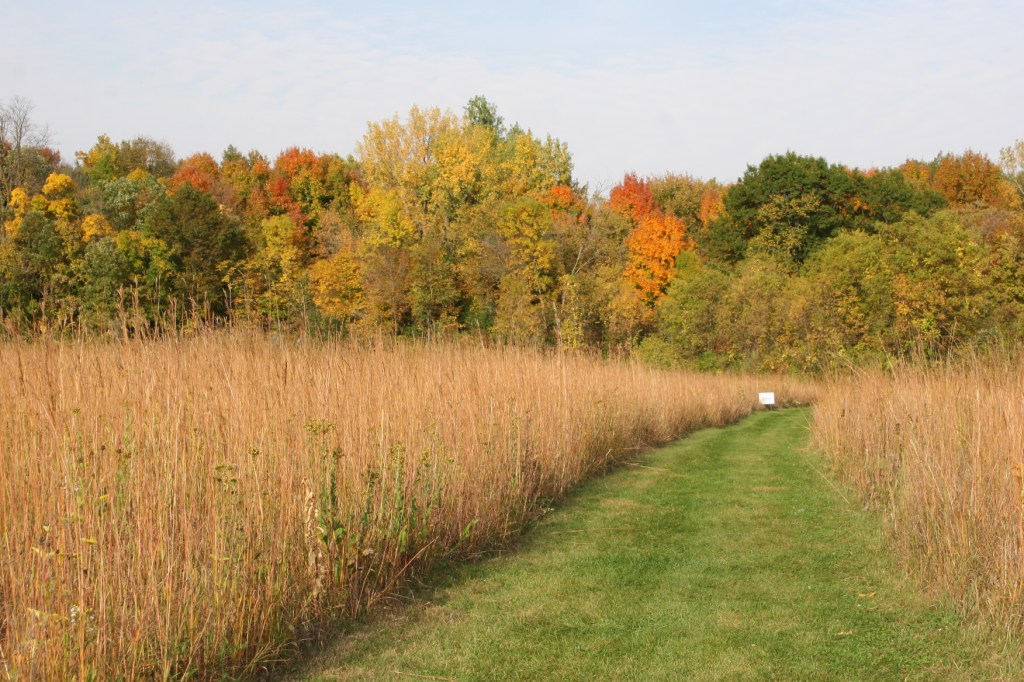
A scene at River Bend, looking from the swamp across the prairie to the distant treeline on Sunday afternoon.
Those words, imprinted upon a memorial plaque at River Bend Nature Center in Faribault, hold a depth of meaning worth pondering. To think that every walk outdoors gives us more than we expect, or search out, seems valid. Especially now, during COVID-19, when many of us are rediscovering the beauty and healing power of the natural world.
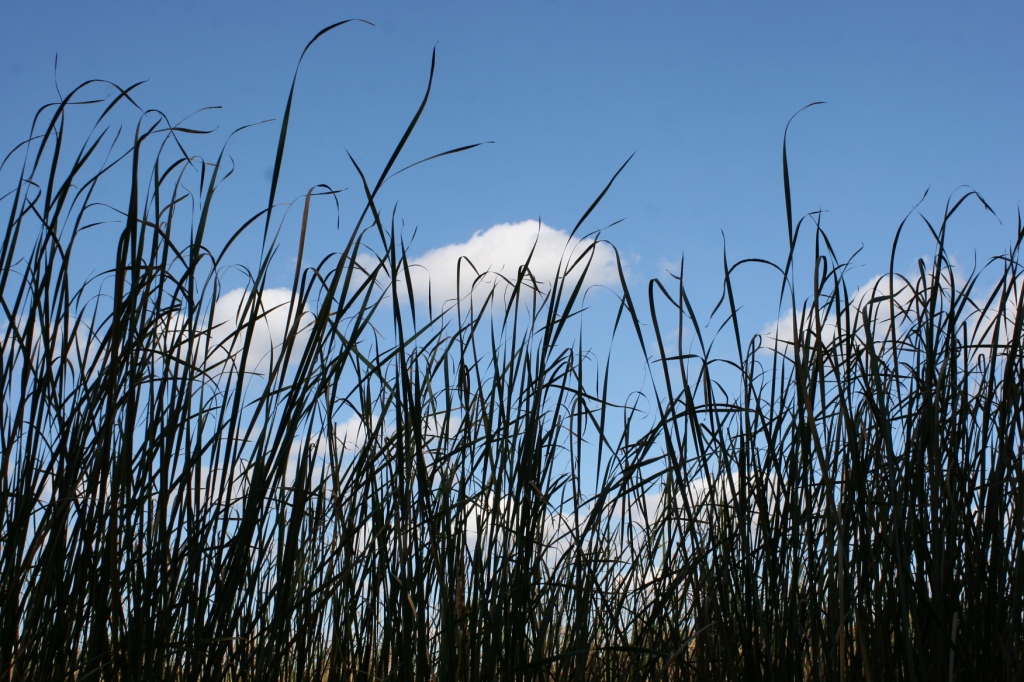
Even the drying swamp grasses prove beautiful against the autumn sky.
Are you among the many embracing the outdoors with renewed enthusiasm and appreciation? I certainly am.
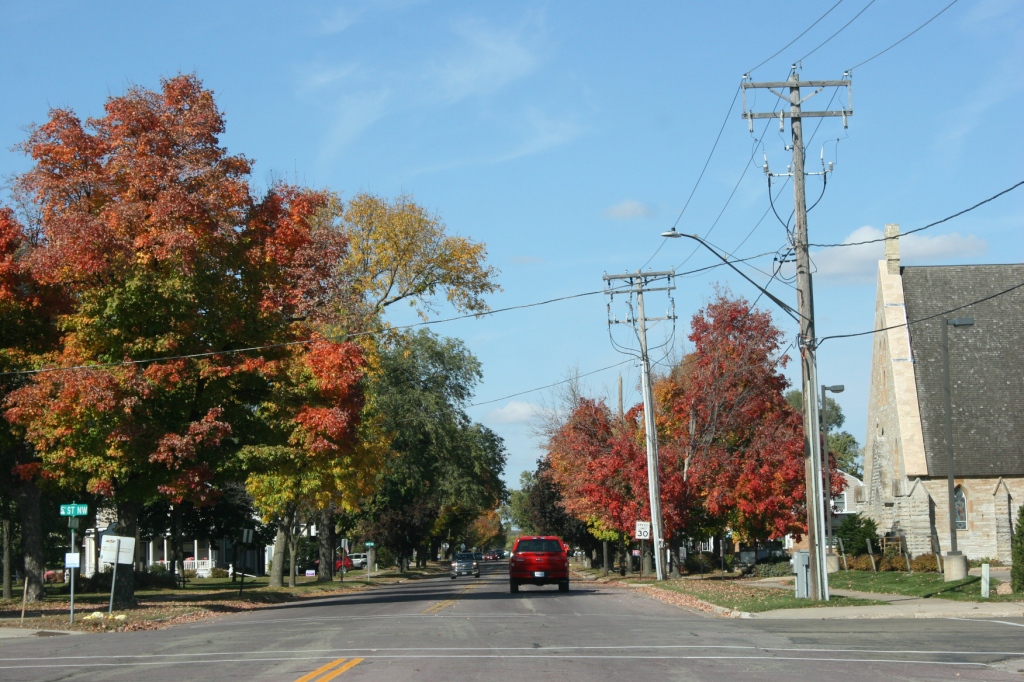
This is an example of the many beautiful tree-lined streets in Faribault. I shot this along Second Avenue, with Central Park on the left and The Cathedral of Our Merciful Savior on the right.
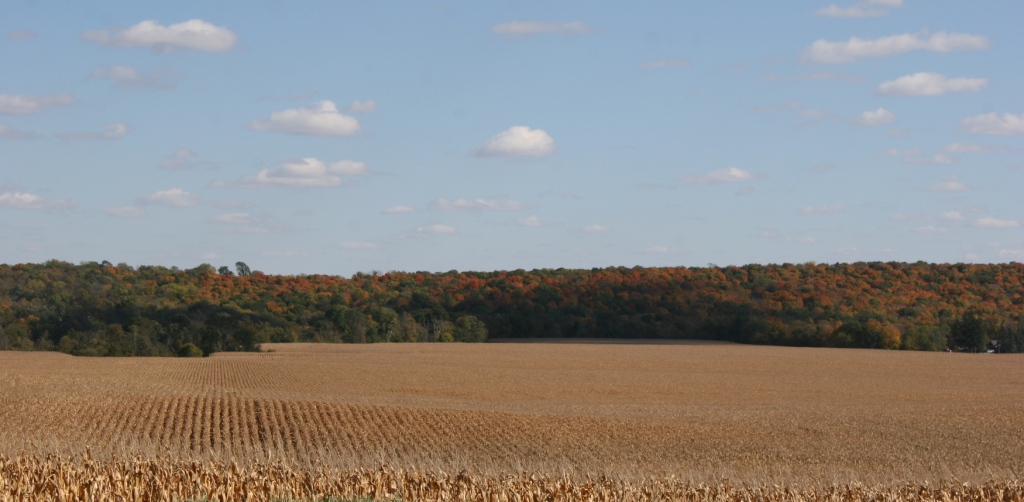
To the northeast of Cannon City, we stopped along a back gravel road so I could photograph this distant, colorful hillside across acres of ripening corn.
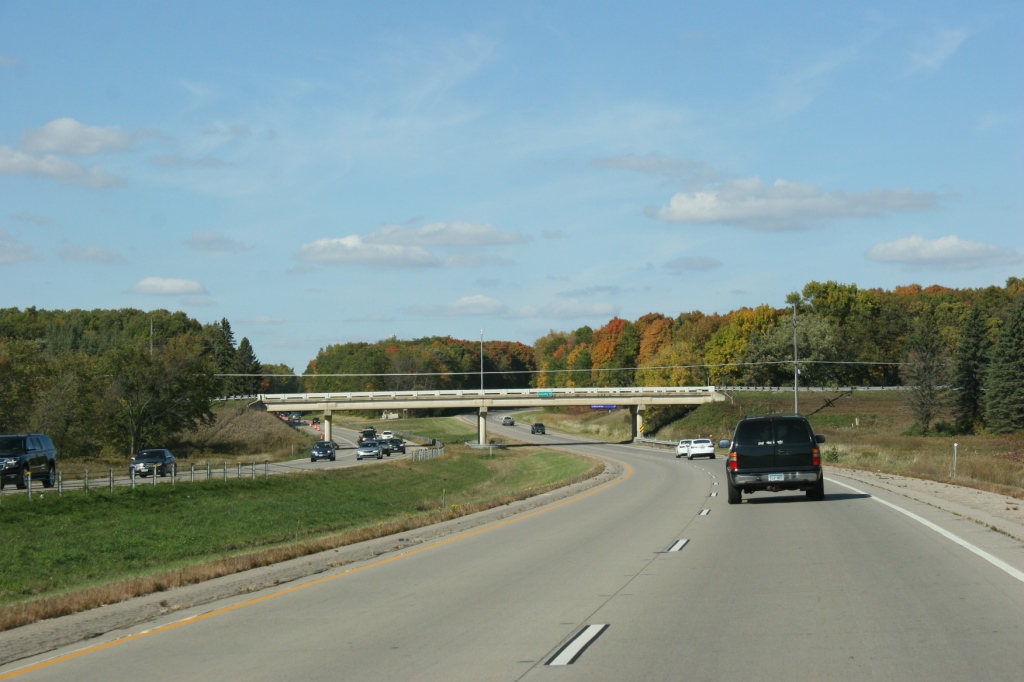
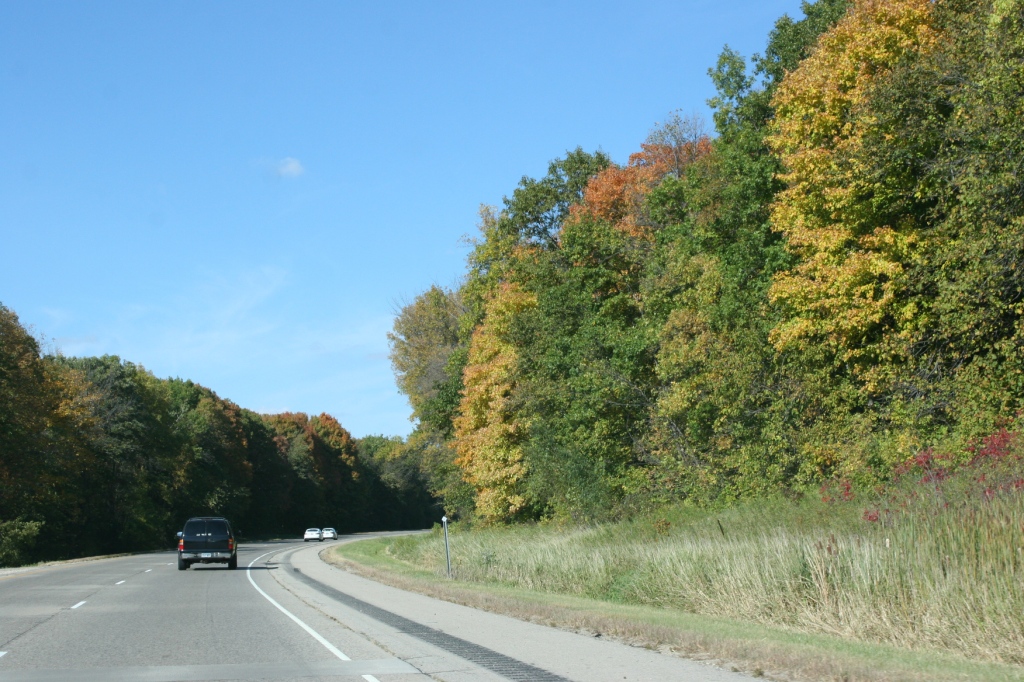
Northbound along Interstate 35 just north of Faribault, leaves are changing color.
Whether walking at a local park or hiking through a nature center or following a city street or driving along a back country road or even traveling along a busy interstate, I feel a heightened sense of gratitude for the sky, the trees, the land, all that surrounds me.
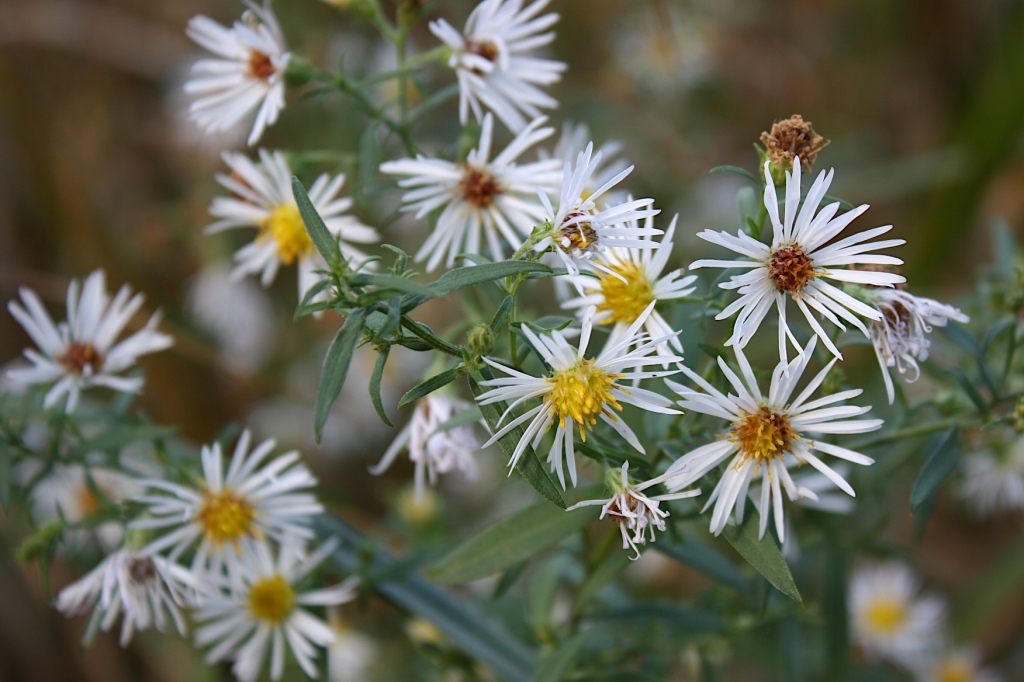
Wildflowers still bloom at River Bend as autumn wanes.
And as autumn presses on toward winter, I also feel an urgency to get outside. On foot before ice and snow pack trails and I feel less secure in my footing. Maybe this will be the winter I buy metal grippers that clamp onto my boots. Maybe this will be the winter I reclaim my youthful enthusiasm for the season.
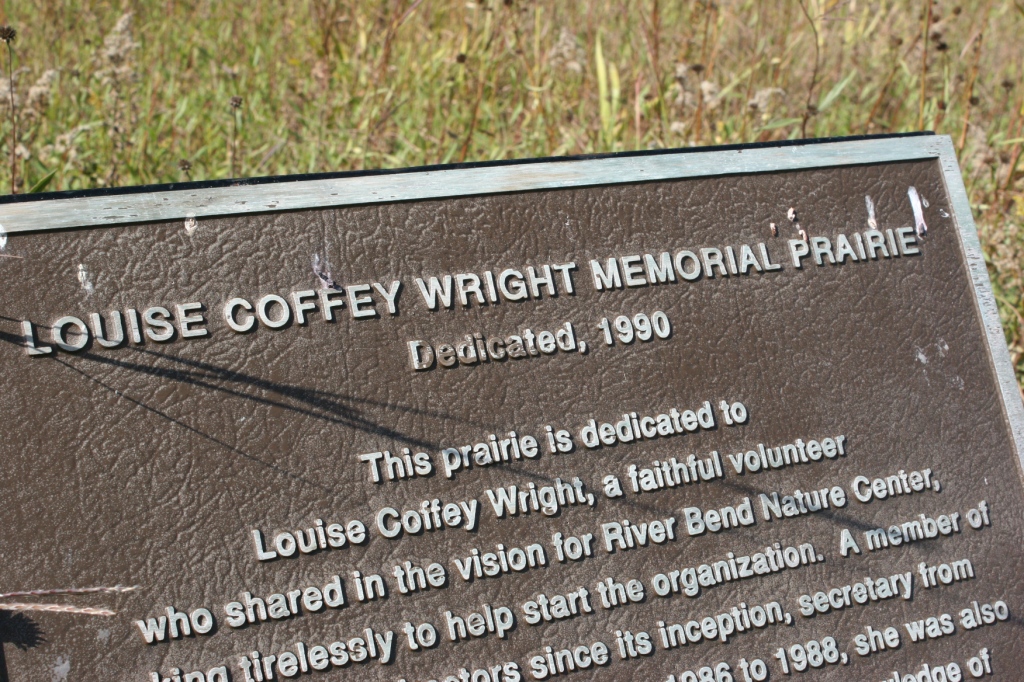
A prairie plaque honors a volunteer at River Bend.
Many days I long to get away. Away from traffic and noise and busyness and people to the quiet of woods, the silence of the prairie, the peace that nature offers.
Autumn colors trees at River Bend.
There’s so much turmoil now. Too much hatred. Too much dissent and too much untruth and too much of everything that’s mean and unkind and disrespectful of others. I yearn for a world where we all hold genuine compassion and care for one another.
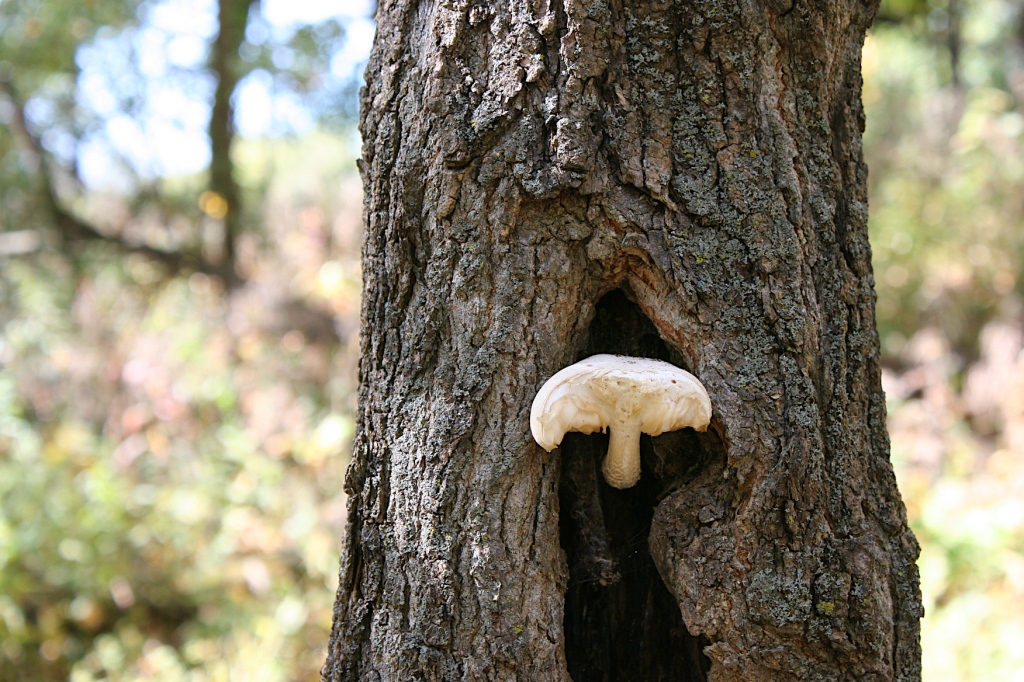
The hole, the decay, in this tree reminds me in some ways of our country right now.
I’ve never, in my sixty-plus decades on this earth, witnessed such chaos, discord, selfishness…
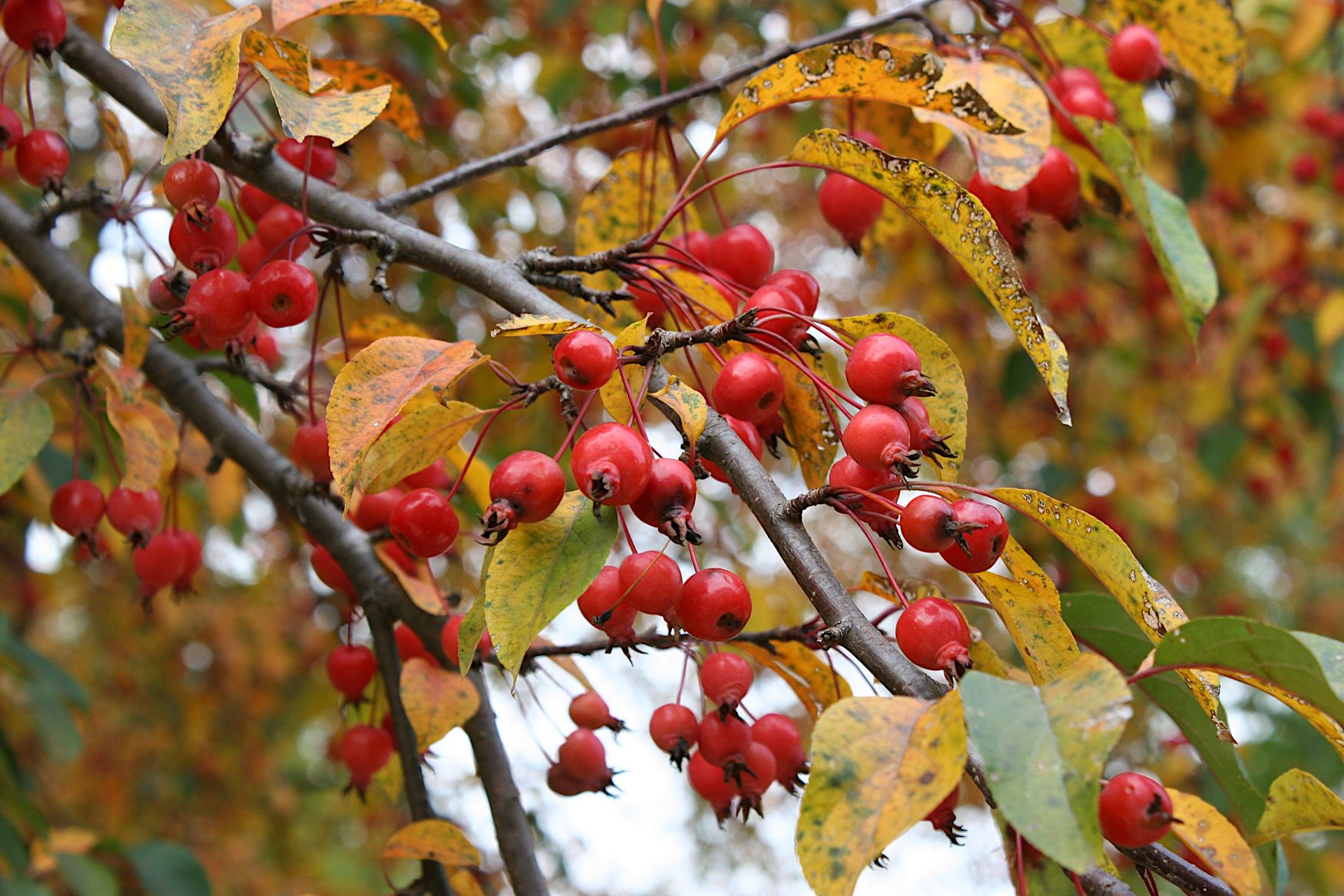
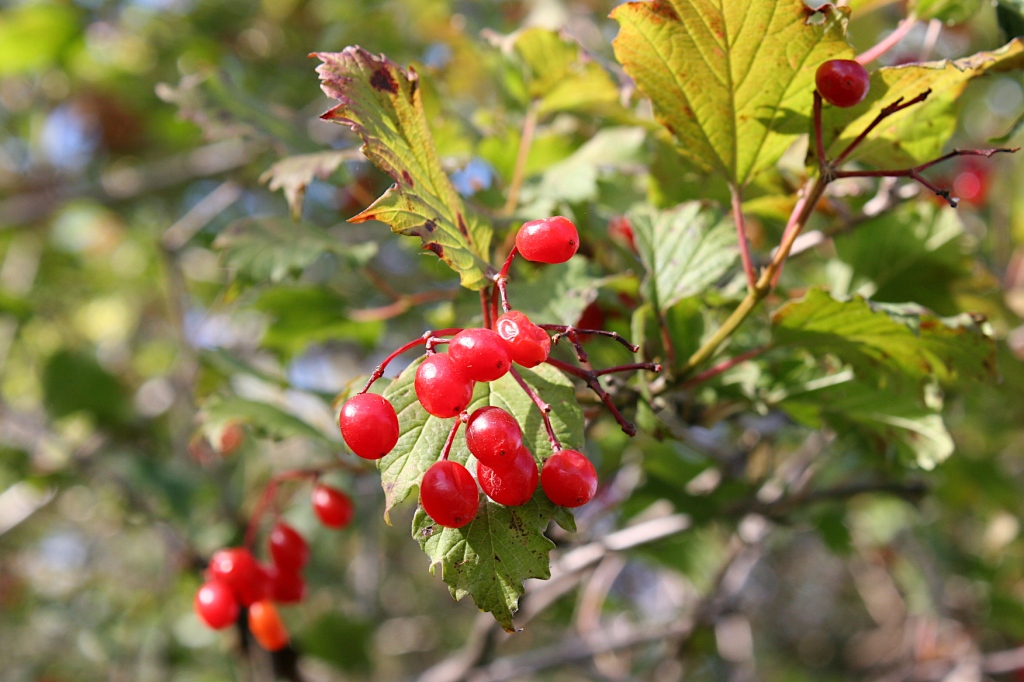
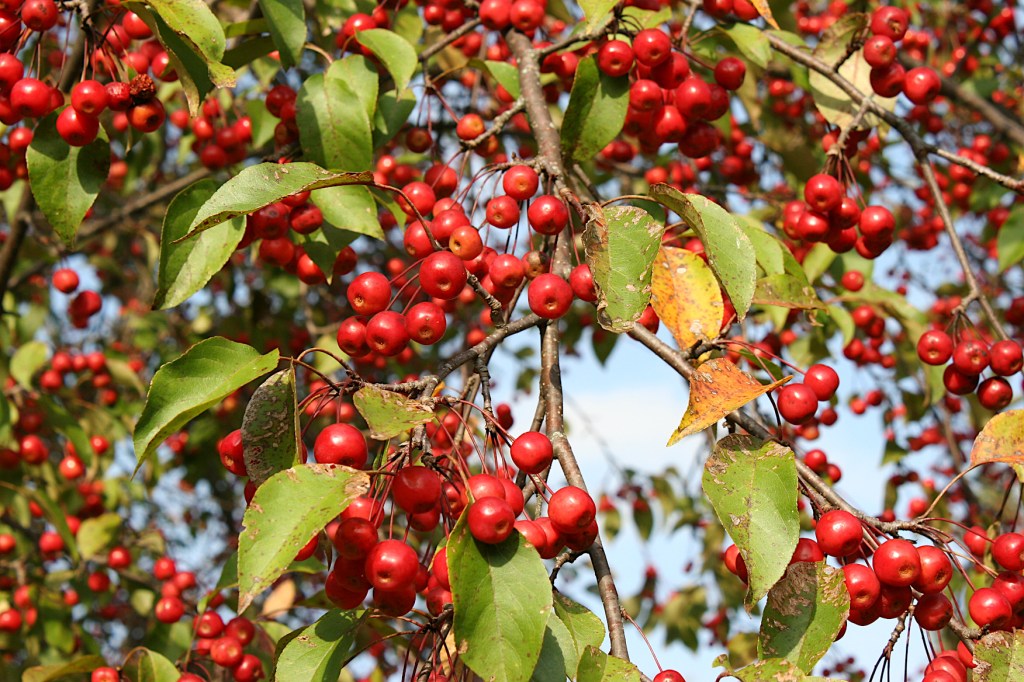
Like these bold berries pop color into the River Bend landscape, we can pop positivity into the world. We can choose to be bold, to stand for decency and the common good.
I have within me the power to act with decency, with empathy, with understanding. With kindness.
North of Faribault along I-35.
To settle my mind into a frame of peacefulness, I embrace prayer and nature. To do so is to receive more than I seek.
Currently, I am reading The Finnish Way: Finding Courage, Wellness, and Happiness Through the Power of Sisu. A friend, who recently moved to the lakes region of central Minnesota, gifted Katja Pantzar’s book to me. I’m only 58 pages into the read. But already the words written therein about the Finns’ resilience and close connection to nature resonate. In two more chapters, I’ll be into “Nature Therapy, The Benefits of a Walk in the Woods.”
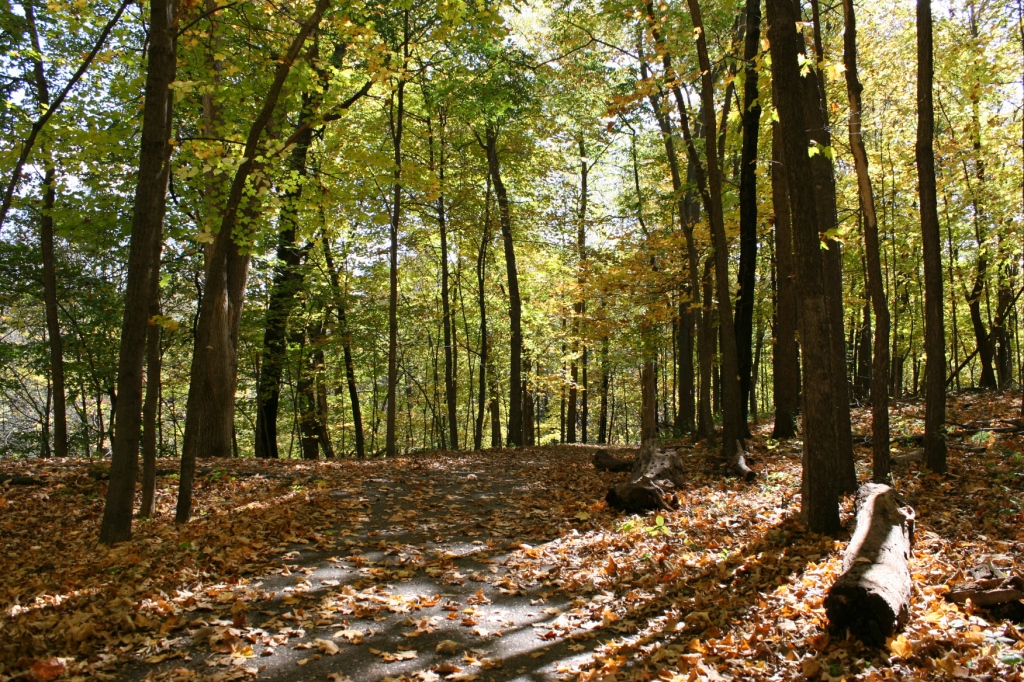
In the woods at River Bend…
I don’t expect the contents of that chapter to surprise me. Whether walking in the woods or through a city park, we can benefit from simply being in nature. To feel the warmth of sunshine, to hear the rush of wind through trees, to watch water tumble over rocks, to smell the scent of autumn…all calm the spirit, restore peace, and lift moods. What a gift.
TELL ME: Are you rediscovering nature during COVID-19? If so, in what ways has this helped you deal with the pandemic? What’s your favorite nature spot?
A grassy trail runs along the prairie at River Bend, leading to the woods.
TYPICALLY, I STICK to paved and grassy trails when hiking at River Bend Nature Center in Faribault. I feel more secure on a firm surface, mostly free of hidden obstacles.
Following the river bottom trail into the woods.
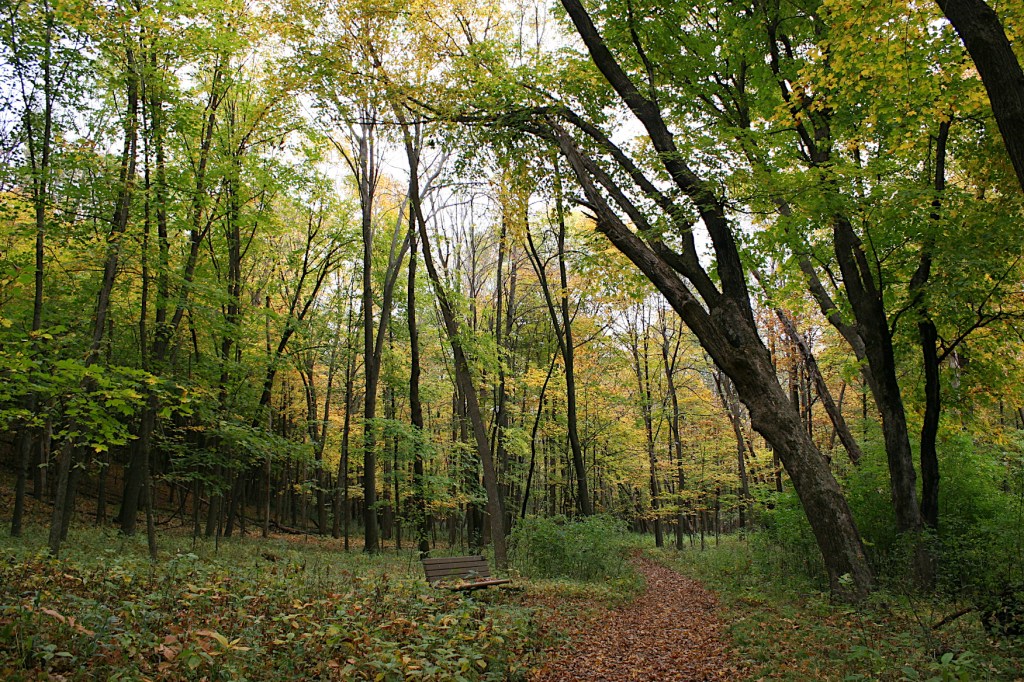
Beautiful maples color the woods.
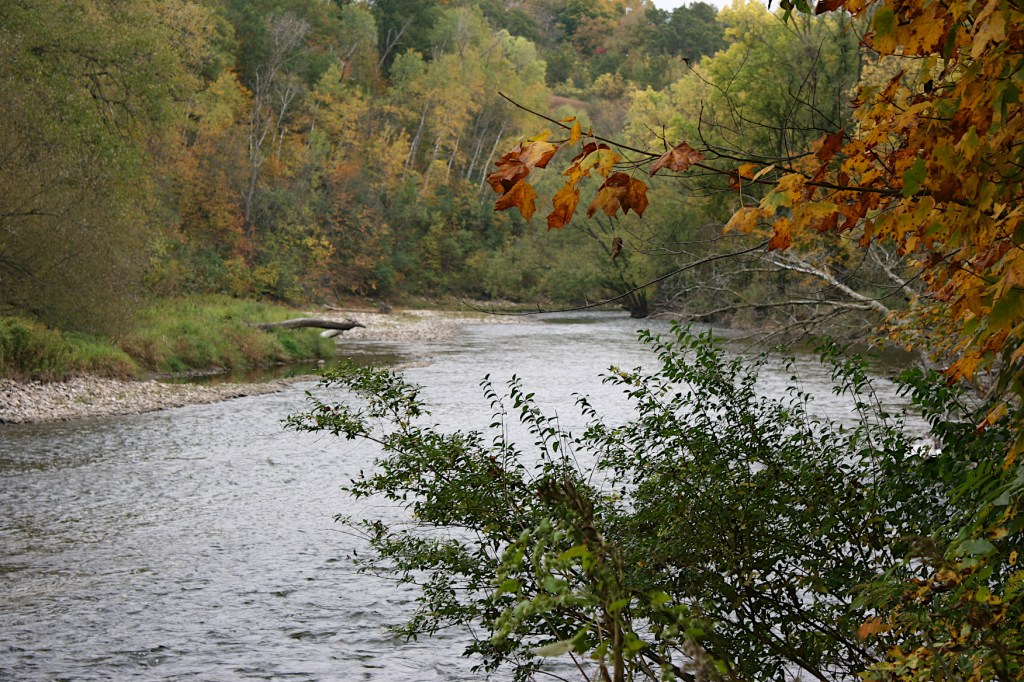
A view of the Straight River along a trail through River Bend Nature Center.
But, on a recent visit to River Bend, Randy and I followed a dirt trail down a steep hill to the Straight River. I felt apprehensive as we navigated, like mountain goats, down the limestone-pocked hill. He’s always willing to grab my hand, a reassuring act that makes me feel more confident. With two broken bones resulting from falls in my medical history, I hold a heightened awareness of keeping myself safe.
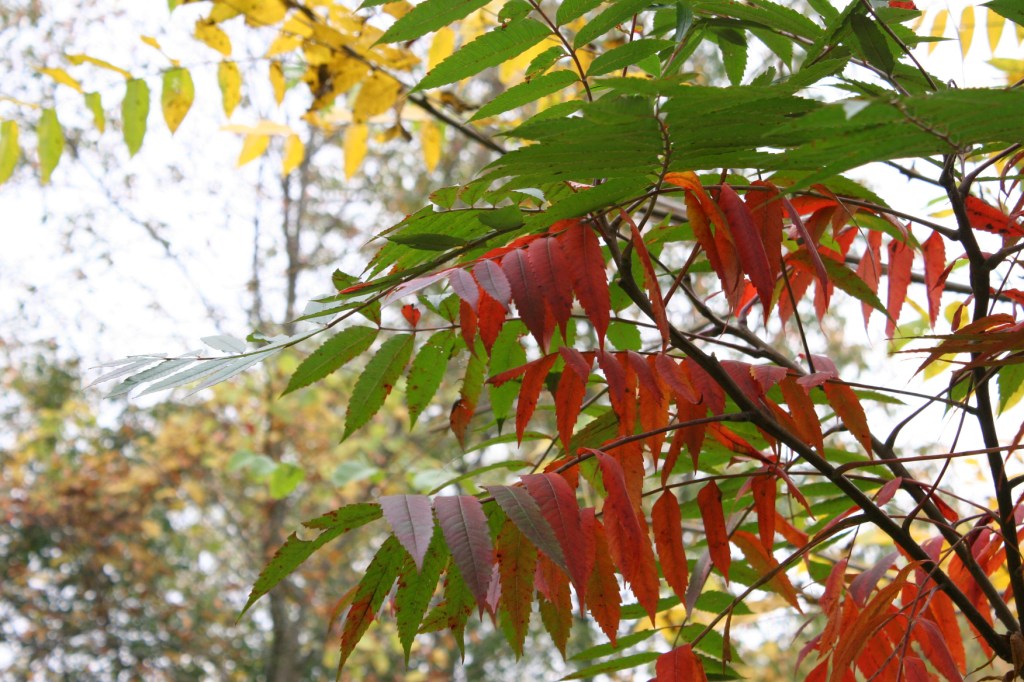
Sumac pop color into the autumn landscape.
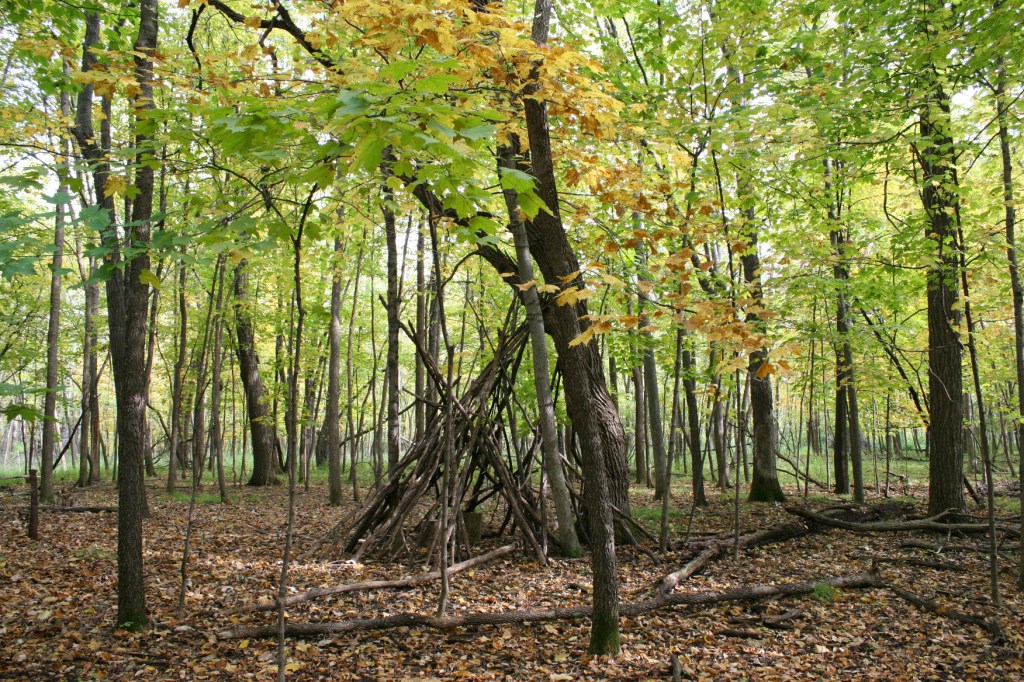
Getting creative in the woods with a tipi style structure.
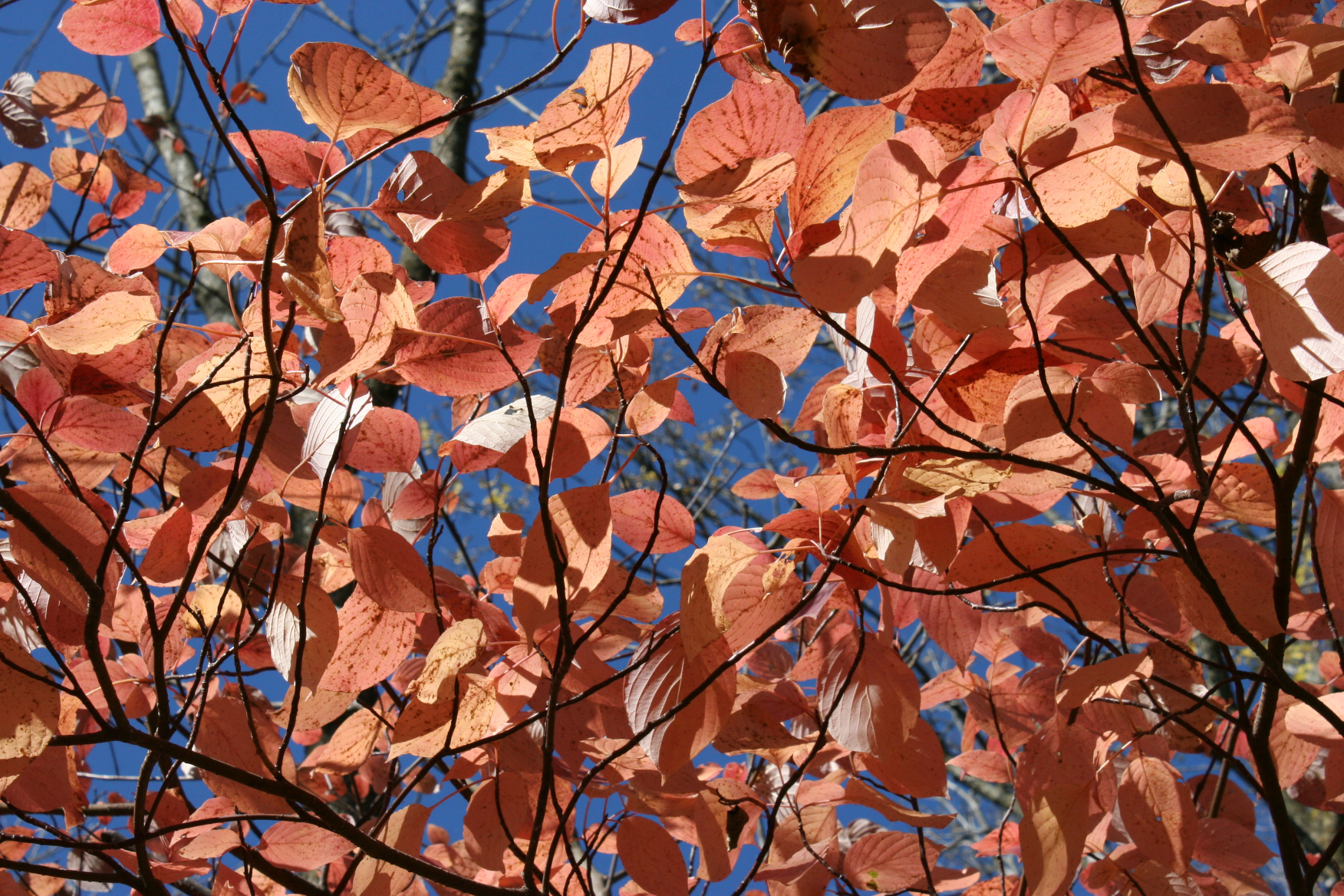
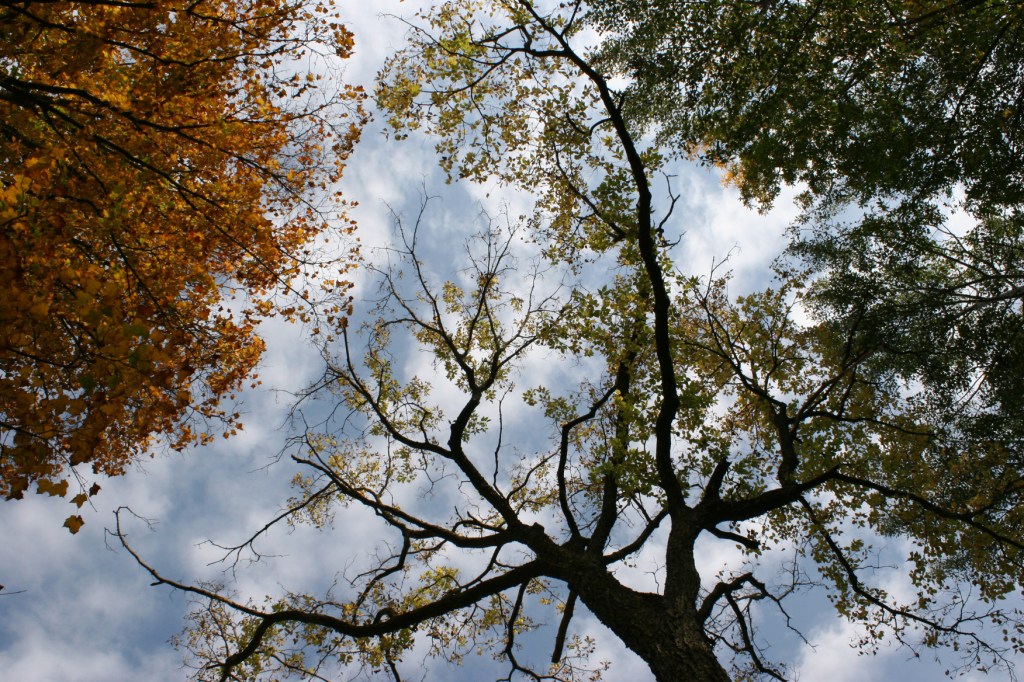
I found myself pausing often to look toward the treetops.
So, as we followed the dirt path covered with leaves and tripping tree roots, I watched my step more than my surroundings. And when you’re a photographer always alert to her environment, this is not ideal. I found myself stopping often to take in the woods and details therein. Randy is also great about alerting me to possible photo subjects. I deeply appreciate that about him, that he values my interest in photography.
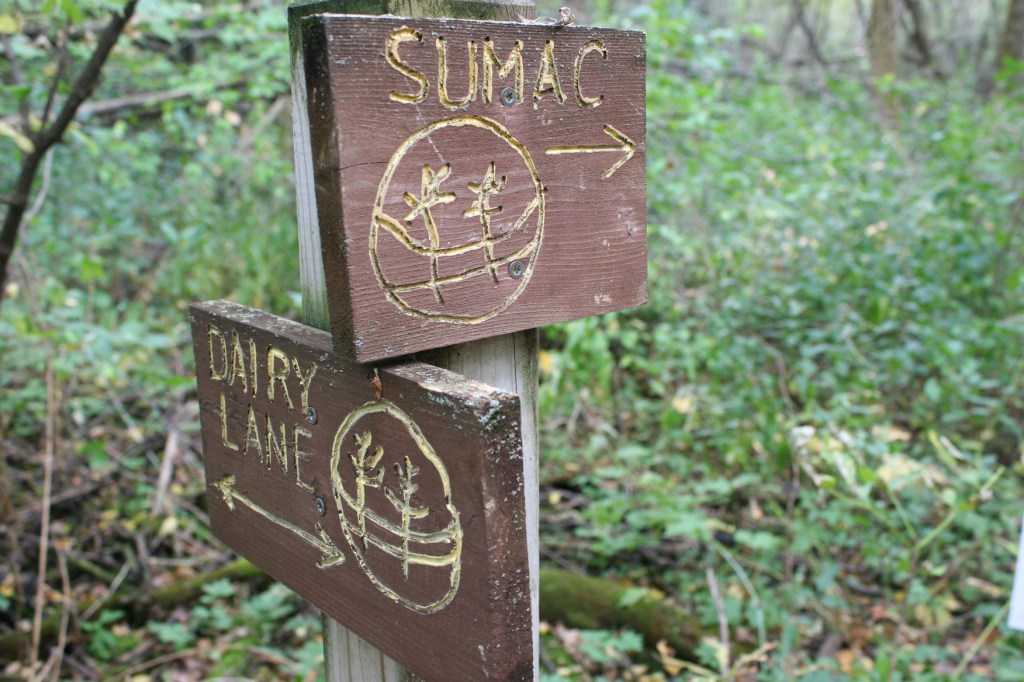
Trails are sometimes well-marked, sometimes not.
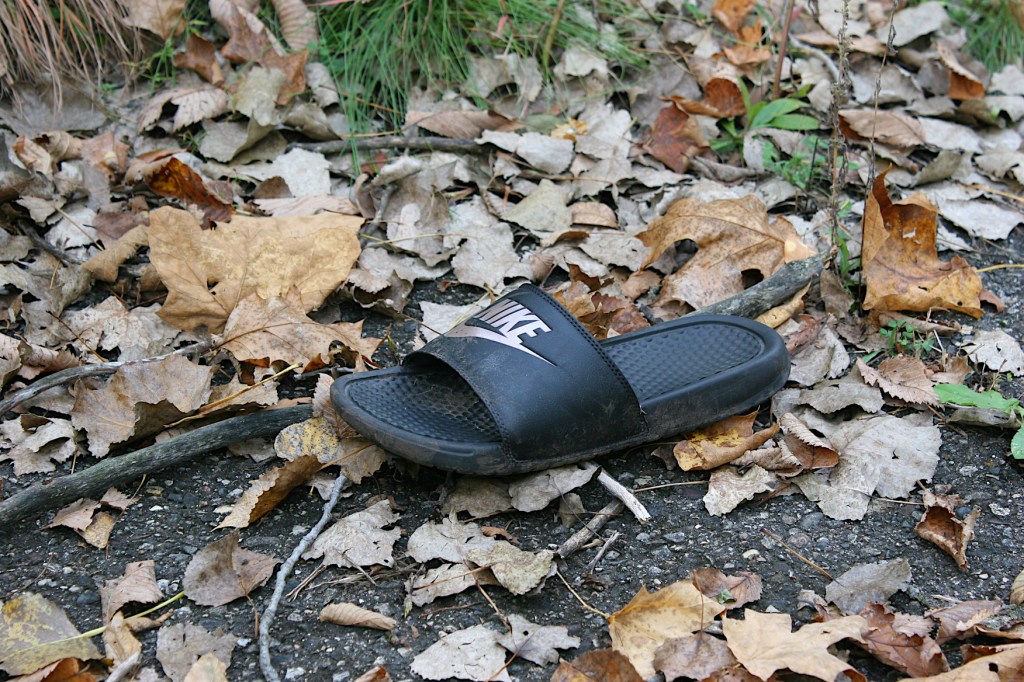
I may get directionally lost, but I’ve never lost a shoe. I spotted this along a trail.
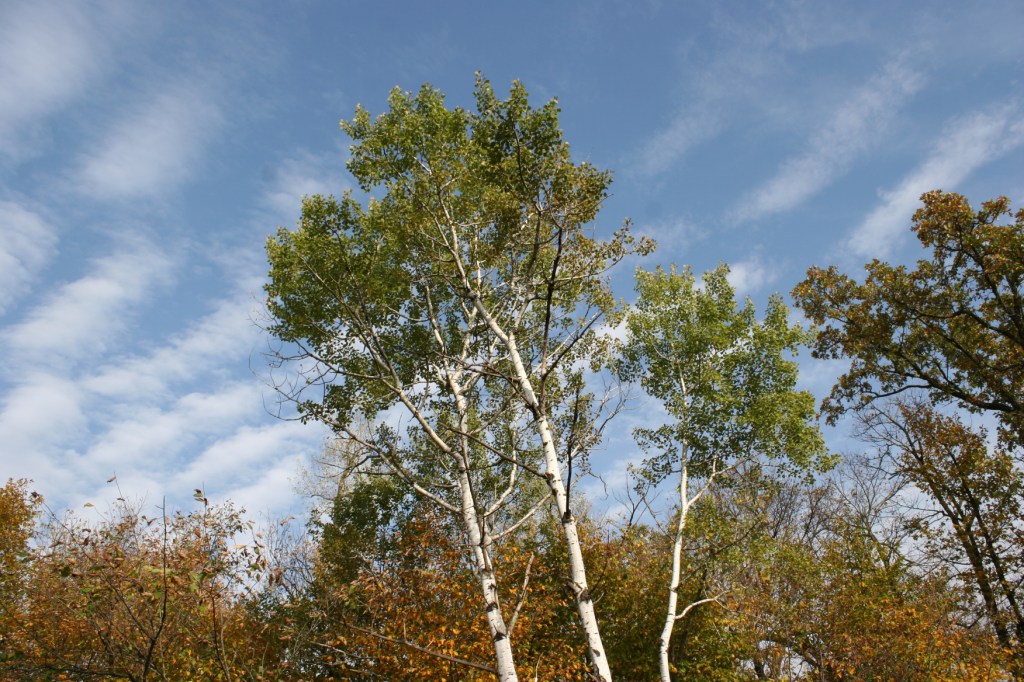
You don’t see many birch trees in the southern part of Minnesota, so I always delight in spotting one.
He also recognizes that my map-reading skills rate at about zero as does my sense of direction, unless I’m in my native southwestern Minnesota prairie of straight, gridded lines. I rely on him to know where we are going. And sometimes, I’ve found, he fakes that knowledge. That makes me uncomfortable. But we always emerge out of the woods, safe and sound.
Beautiful prairie wildflowers.
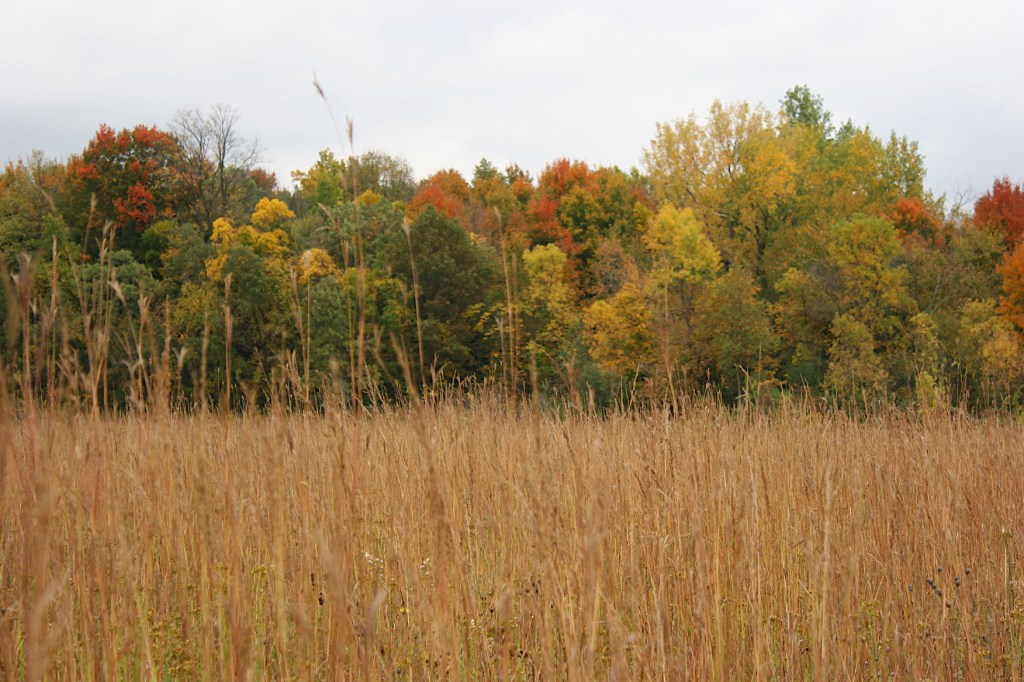
Prairie grasses and woods at River Bend.
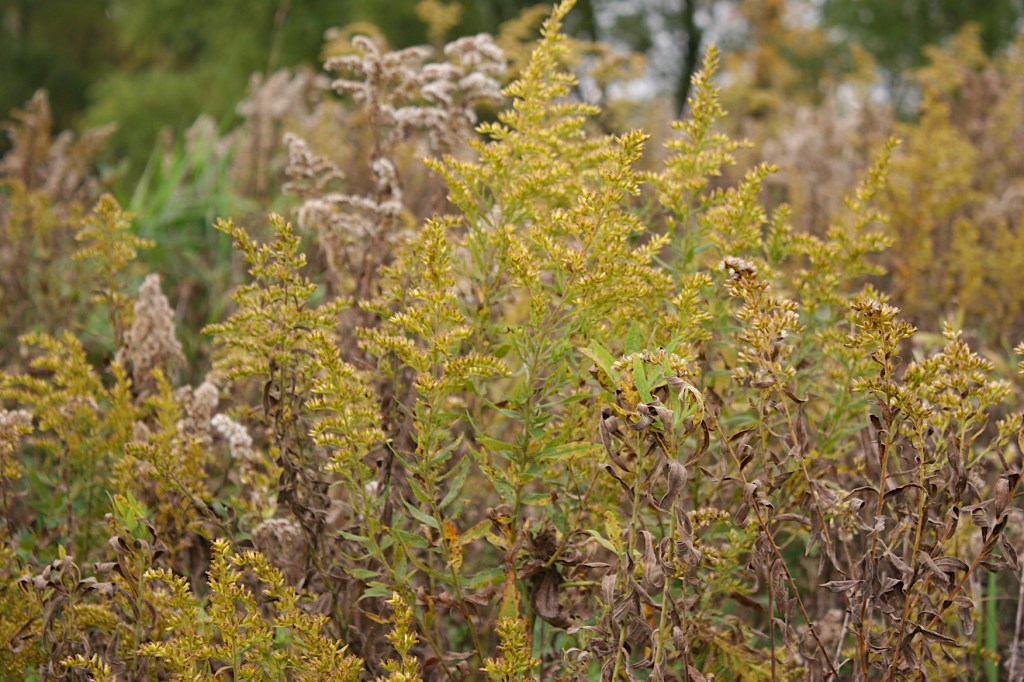
Goldenrod add an autumnal hue to the landscape.
No visit to River Bend is complete without a walk through the prairie to take in the tall grasses and wildflowers defining that landscape. I need to see wide sky and open land, so much a part of me. Of my history as a daughter of the prairie.
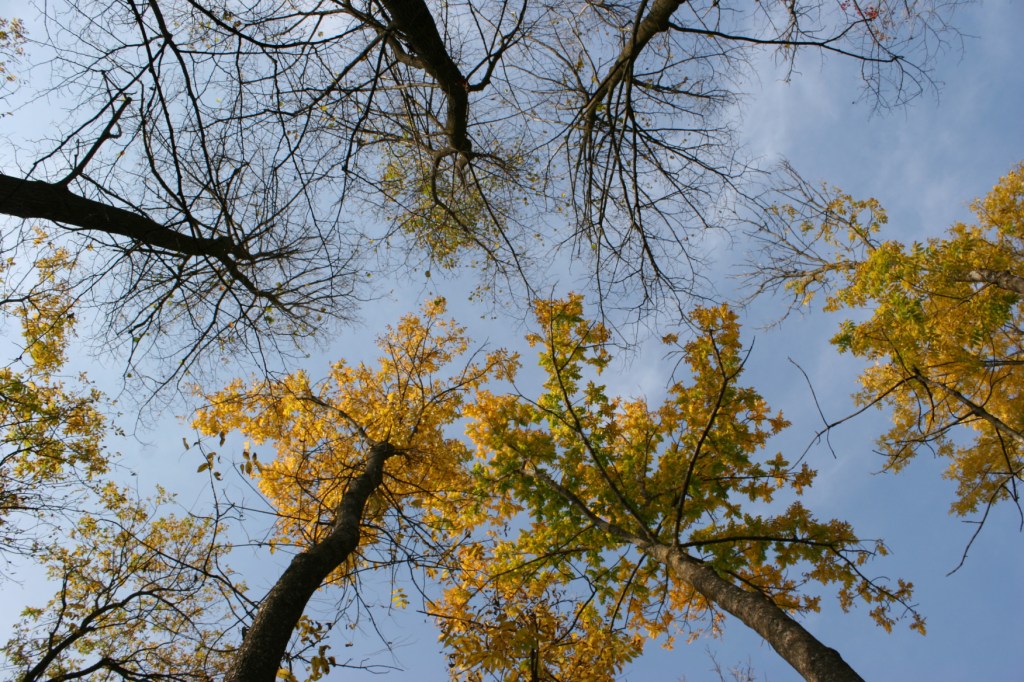
Looking up to the treetops, I see such beauty.
Bold berries burst color on a tree outside the visitor center.
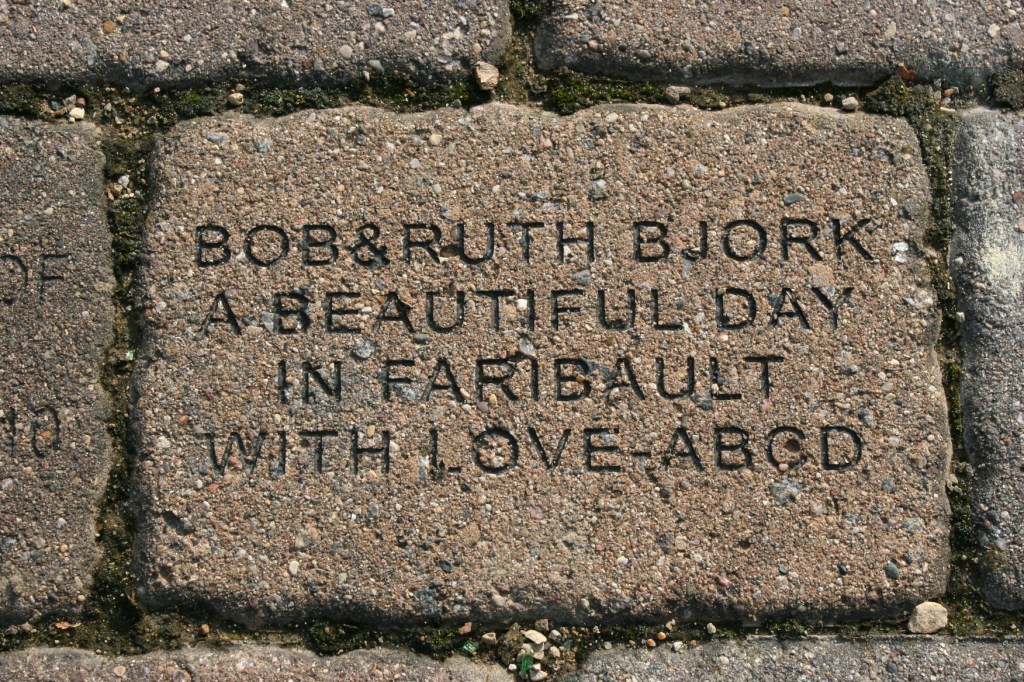
Any day at River Bend is a truly beautiful day as noted on this paver at a look-out patio above the Straight River. Thank you, A, B, C and D for this gift honoring your parents.
Yet, having lived in southeastern Minnesota for nearly 40 years, I’ve grown to appreciate the woods and hills and lakes, mostly absent from the landscape of my youth. Every place, every landscape, possesses a certain beauty, if only we stop in the busyness of life to recognize that. These days, especially, call for each of us to pause and reassess. To consider what we most value. And on my list of faith, family, friends and health, I also add nature.
This year my short story, “Josephine Holding Deloris,” earned honorable mention in creative nonfiction. The story connects a 1 ½-inch square vintage family photo to my life experiences.
The beginning of my award-winning story.
Nonfiction judge Jill Johnson, author of several books, including Little Minnesota: 100 Towns Around 100, praises my work. “Thank you for sharing your touching story about your grandmother and aunt. You connected the tiny size of the photo to the small moments of life. You allowed the reader a vivid description of mother and daughter and brought the connection full circle. Keep writing!”
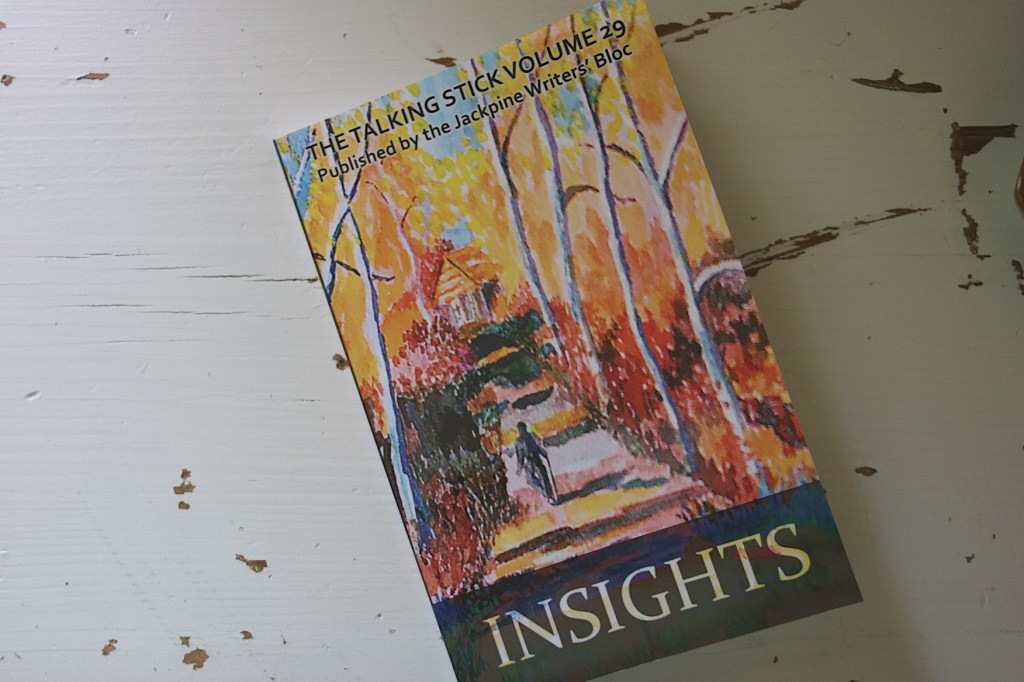
My poem, “Final Harvest,” and second piece of creative nonfiction, “A Quick Guide to Practicing Minnesota Nice,” were also chosen for publication in Insights, The Talking Stick, Volume 29.
This year’s book features 139 poems and stories (selected from 300 submissions) by 92 Minnesota-connected writers. My writing has published many times in The Talking Stick and earned multiple honors.
Copies of the latest book and past volumes are available for purchase at jackpinewriters.com. On the back cover of Insights, the editors note, “In the midst of social distancing, in the midst of mask wearing and Plexiglas shields, we are all grieving the changes in our world. But let’s keep one thing the same—you can still curl up with a good book and read. You can open the pages of Talking Stick 29 and see what your fellow Minnesota writers have written, and some how, perhaps, we can all feel a little bit closer.”
I’d encourage you to order a copy of this collection featuring so many talented writers. That includes Bernadette Hondl Thomasy, a native of Owatonna and a reader of this blog. Her “Mother’s Mojo” also earned honorable mention in creative nonfiction. She co-authored the book, Under Minnesota Skies, with her sister Colleen Hondl Gengler. Minnesota, in my opinion, has produced many gifted writers in all genres. And you’ll find a fine sampling of those creatives in Insights, The Talking Stick, Volume 29.
ON A RECENT AFTERNOON, I took a visual break from the computer, a mental break from writing, to glance out my office window.
The view isn’t particularly lovely. Lots of parked vehicles in my line of vision. Almost like a car lot, a repair shop, a junkyard.
And then there’s the street itself, a main artery through Faribault, heavy with traffic. The drone of vehicles and wail of sirens assures few moments of peace.
So, when I take a break from work, that is what I see. I often wish my office was located elsewhere in our house, with a view of the wooded hillside that rises to the south and west. But, unless we move the kitchen or demolish the garage and add on, I’m stuck with this spot, this scene.
But, amid all of this, there is a splash of beauty in the flowers that rise right outside my office window. Phlox in white and shades of pink and purple. And hydrangea that anchor each side of the front steps, their massive flowers so beautiful that people occasionally stop to inquire about them. That includes a neighbor, a trucker, and the last person I would think interested in flowers. I’ve promised him hydrangea roots in the spring. Maybe he’ll give me some of his lovely peonies in return.
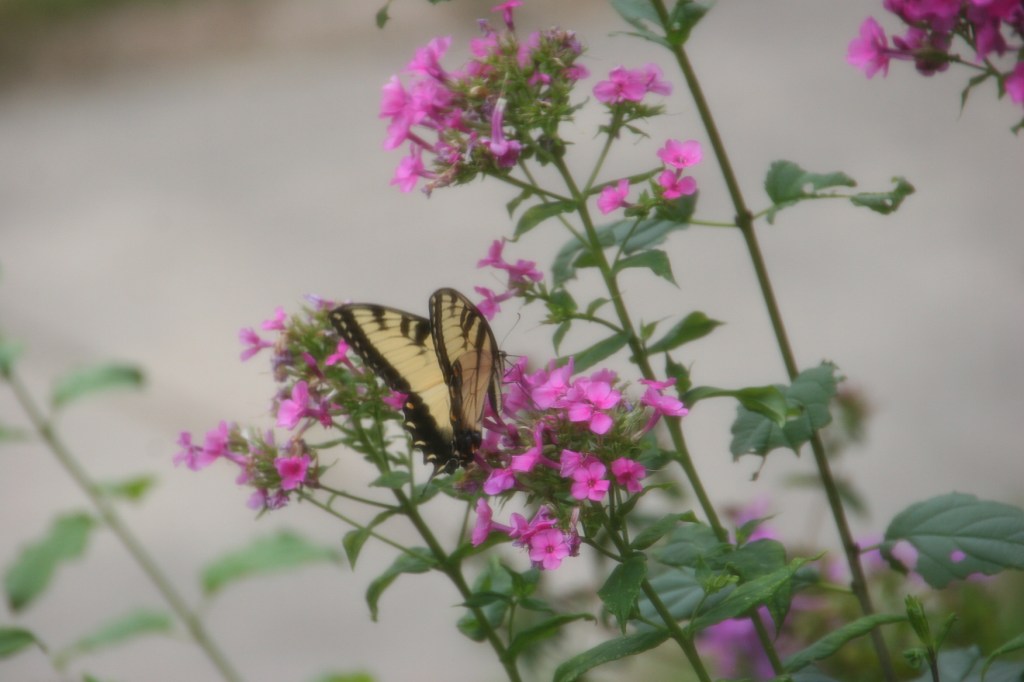
An Eastern tiger swallowtail butterfly feeds on my phlox.
My perennials provide the nature perspective I need when breaking briefly from work. And, on a recent summer afternoon, those phlox presented even more—three Eastern tiger swallowtail butterflies swooping, hovering, landing among the blossoms.
I grabbed my camera, with no intention of hurrying outside to photograph the butterflies. I knew from experience that they would be gone before I grabbed my shoes, flew outside and rounded the house. So I opted to photograph through the screen window, filthy from all the passing traffic.
The results were not sharp images and I deleted most. But one stood out. Soft. Butterfly feeding upon vivid pink blossoms. Poetic. Exquisite. A natural respite from the clutter that typically defines the view from my office window.
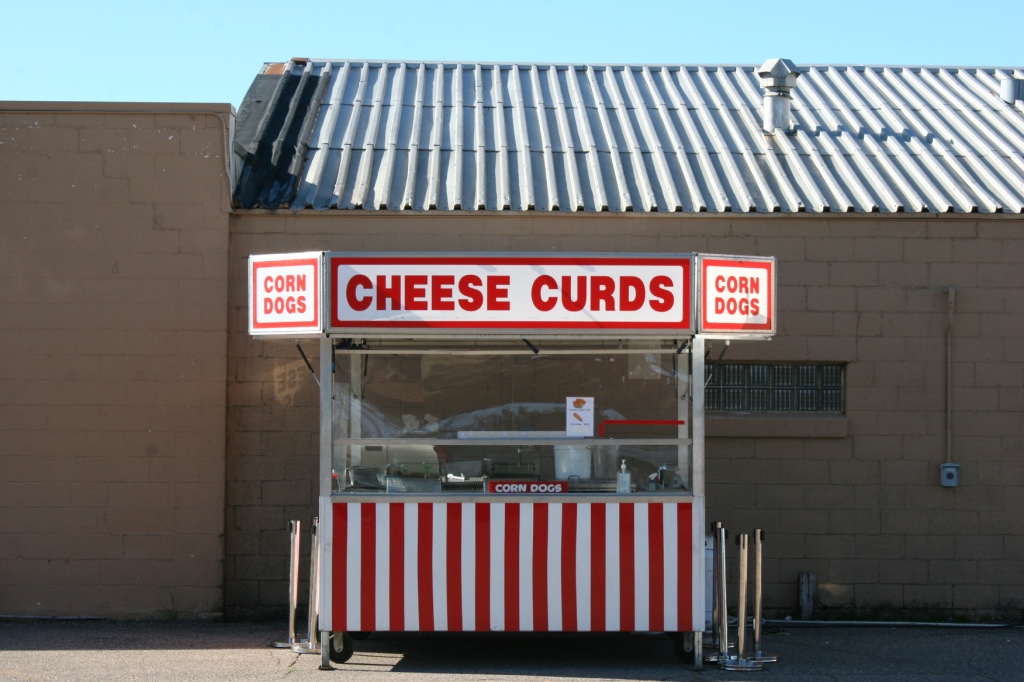
Photographed on August 29 in the Ace Hardware store parking lot, Faribault, Minnesota.
MINNESOTANS LOVE THEIR FAIRS. County and then state. And right about now, crowds would be converging on the Minnesota State Fairgrounds in Falcon Heights for the final days of the Great Minnesota Get Together.
But not me; I haven’t attended in nearly 40 years. And not anyone at the fair this year due to COVID-19 and the resulting cancellation of this big food/entertainment party.
While the fair features everything from crop art (gone virtual this year) to farm animals, from carnival rides to marketplaces, from politicians (especially this election year) to princesses, the food seems the draw. Anything on-a-stick. And a lot not on a stick.
To satisfy the hungry masses missing fair food, the State Fair this year offered a drive-through Food Parade at the fairgrounds for $20/vehicle plus whatever the cost for the foods ordered from 16 participating vendors. Tickets quickly sold out for the food frenzy event that continues through Labor Day weekend.
While people are waiting in their vehicles for turkey legs, mini donuts, egg rolls on-a-stick, sno cones, walleye cakes, funnel cakes, Sweet Martha’s cookies and much more, I’m content to avoid the congestion.
I know faithful fair food devotees will tell you it’s not the same…but I spotted this food stand in the parking lot of the local Ace Hardware Store on Saturday morning. Cheese curds and pronto pups vended right here in Faribault. No need to travel to the Cities or pay $20 or wait in line at the fairgrounds.
I already hear the protests. “But it’s not the fair!” And that would be accurate. No crowds pressing in. No feeling of togetherness. No endless food choices. Just a taste of the fair, right in my backyard. In hardware store and other parking lots around Minnesota. Streetside. On fairgrounds in Rice and Steele counties during special food events earlier this summer. And even in some restaurants. It may not be the same experience as the State Fair, but, hey, it’s something. Which is better than nothing during a global pandemic.










 Minnesota Prairie Roots
Recent Comments