Minnesota Prairie Roots

Writing and photography by Audrey Kletscher Helbling

Faribault renames its airport in honor of WASP, Elizabeth Wall Strohfus March 4, 2017

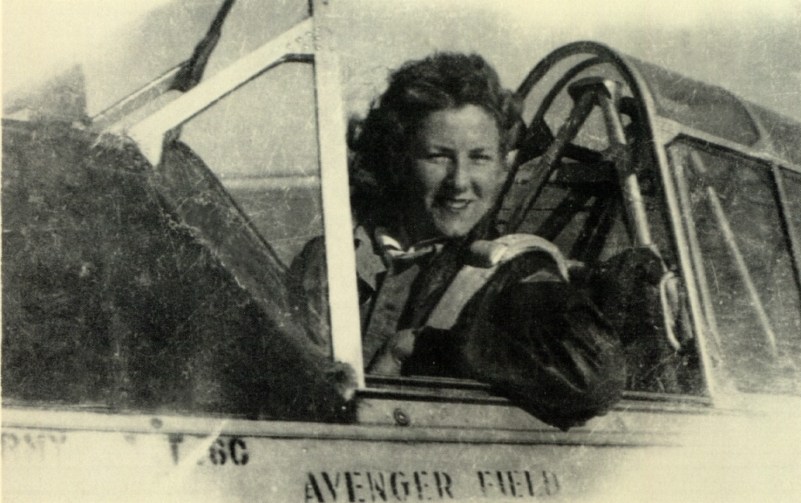
Elizabeth Wall Strohfus, circa 1943, at Avenger Field. (Photo from family archives.)

Elizabeth Wall Strohfus, circa 1943, at Avenger Field. (Photo from family archives.)

ELIZABETH WALL STROHFUS traveled the country for nearly 30 years sharing her story of flying fighters and bombers for the U.S. military during World War II.

She served as a parade grand marshal, participated in panel discussions, talked at schools, visited museums, gave countless interviews. But not until now has she been permanently honored and recognized in her hometown of Faribault. This week the City Council approved a resolution renaming the municipal airport as The Faribault Municipal Airport—Liz Wall Strohfus Field. That resolution will be forwarded to the Federal Aviation Administration for final approval.

What an honor for a woman who faced many challenges (simply for being a woman) before and after becoming a Women’s Airforce Service Pilot. She will be the first WASP to have an airport named after her.

That’s quite an accomplishment for Strohfus, who convinced a local banker to lend her $100 to join The Sky Club at the Faribault airport. The then 22-year-old used her bike as collateral and subsequently proved to the “women don’t fly” banker that he was wrong. She could fly. And fly she did, training at Avenger Field in Sweetwater, Texas, with the first class of WASPs to earn their wings. Strohfus went on to train infantry gunners for battle, teach instrument flying to male cadets and ferry B-17 and AT-6 warbirds around the country.

But when the war ended, the WASPS received no recognition for their service to country. Eventually Strohfus, after retiring as an air traffic controller in the late 1980s, began efforts to correct that. She traveled the country sharing WASP stories in her signature down-to-earth storytelling style. She successfully lobbied for the WASPs to be recognized as active military duty and for burial honors at Arlington National Cemetery. This strong and determined pilot also received the Congressional Medal of Honor.
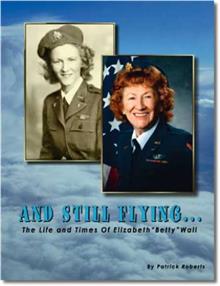
A book about Elizabeth Strohfus written by her son Patrick Roberts. He accompanied her on speaking engagements around the country.

A book about Elizabeth Strohfus written by her son Patrick Roberts. He accompanied her on speaking engagements around the country.

Yet, despite all the accolades, all the efforts, Liz Stohfus valued one thing above all. “Her favorite thing to do was to encourage kids,” son Art Roberts revealed at the City Council meeting. His mother repeated that in the many interviews she gave, telling youth that, “The sky is not the limit.” They could, like her, do anything.

Elizabeth “Betty” Strohfus Wall died on March 6, 2016, at the age of 96. Although she did not live long enough to see her hometown airport named after her, her legacy will live on in Faribault. In addition to new signage naming Liz Wall Strohfus Field, renowned local woodcarver Ivan Whillock is creating a woodcarving to be placed inside the airport. And Roberts will be donating items belonging to his mother.

It’s a wonderful thing my community, led by the American Association of University Women—Faribault Branch, is doing in honor of Strohfus. She embodies a strong American woman who always believed she could fly.

FYI: To view an interview with Liz Strohfus, check out Faribault Community Television and its 1855—Faribault History documentary series produced by local high school students Logan Ledman and Samuel Temple. This is top-quality professional. Click here.

Of additional interest is this story from the Experimental Aircraft Association in Oshkosh, Wisconsin. Click here.

Click here to read a story about how Strohfus and other WASPs were honored at the University of Wisconsin, Green Bay, via a theatrical production.

Learn more about that play, “Censored on Final Approach” by Phylis Ravel, by clicking here. Perhaps a Faribault-based theatre company or the History Theatre in St. Paul could consider performing that play.

Finally, click here to learn more about the National WASP WWII Museum in Sweetwater, Texas. What an honor this would be to Strohfus’ memory to bring the museum’s traveling exhibit, “The WASP: Untold Story, a Photographic Exhibit,” to Faribault.

© Copyright 2017 Audrey Kletscher Helbling


Take two: A second look at the film “Sweet Land” & immigration issues February 6, 2017

sweet-land-envelope-copy

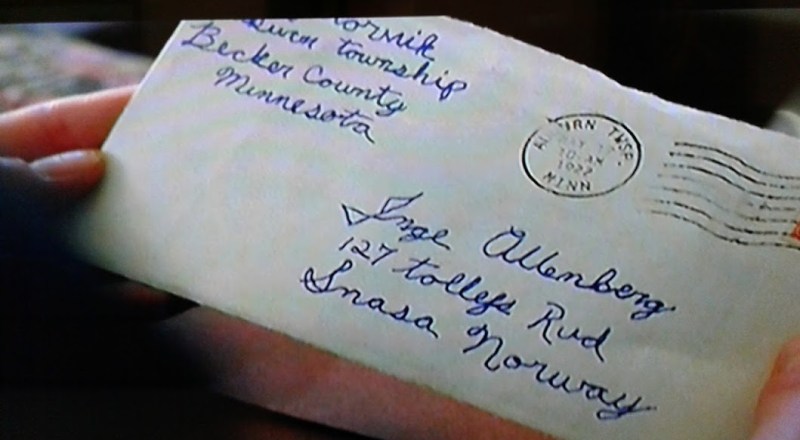
The letter Inge received from Olaf, in the fictional film Sweet Land.

She is not one of us. We speak a common language. We have a common background, a common culture. She is not one of us.
#

We have to be careful about this sort of thing…German nationals. German nationals engage in prostitution. They harbor dangerous political convictions. Are you aware of the Espionage Act of 1916?
#

English only in the church. English.
#

You’re German. It’s a bad influence. You’re German. It’s a disruption to my community. You make coffee that’s too black.

She makes good coffee, not like the women in church.
#

I was fearful of her differences, but I was hopeful she could join us on our path….Do not allow your good lives to be poisoned by these two.
#

This is German food?

No, just food.
#

You don’t have the papers.

sweetlandposter_mini

Promotional from Sweet Land website.

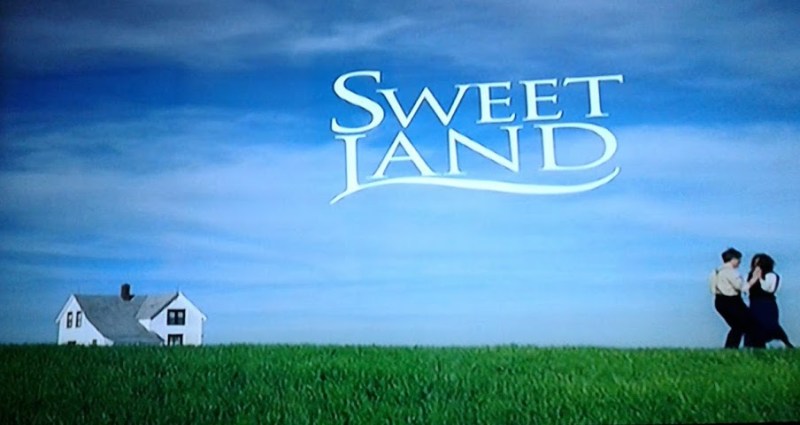
LAST WEEK I REWATCHED Sweet Land, an award-winning independent film released in 2005. The movie, based on Minnesota writer Will Weaver’s short story, “A Gravestone Made of Wheat,” and filmed on my native southwestern Minnesota prairie, rates as a favorite of mine.

sweet-land-farmhouse-copy

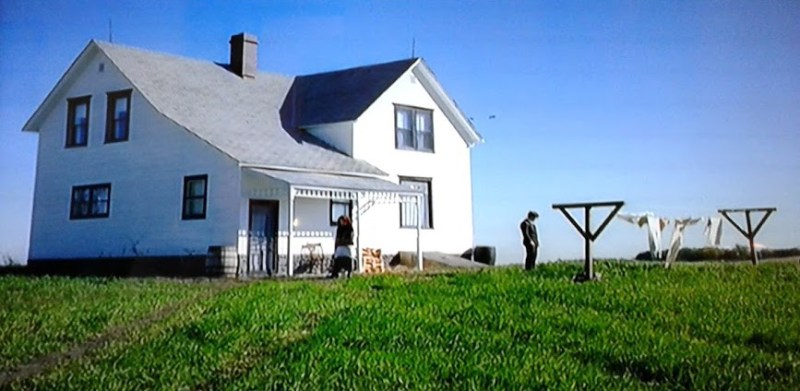
Olaf Torvik’s home on the prairie. The film was shot in and around Montevideo, Minnesota.

I appreciate the early 1920s setting, the music, the story and, now, its relevancy to today. The above dialogue comes from Sweet Land, which focuses on the challenges faced by Inge Altenberg, summoned to America by Norwegian farmer Olaf Torvik. He expects a Norwegian mail order bride as do others in the community. But Inge is not Norwegian; she is German.

Thereafter, the conflict begins with “She is not one of us.”

The land and love shape the story.

The land and love weave into this story. Here Inge and Olaf dance on the prairie.

I won’t give away the plot, which includes a love story. But I will tell you that I watched the movie this time from a much different perspective, in the context of current day immigration issues in our country. Sadness swept over me.

Please watch this thought-provoking, conversation-starting film. It’s a must-see whether you make coffee that’s good, judged as too black or you don’t brew coffee at all. It’s still coffee.

FYI: Sweet Land, the musical opens April 29 at History Theatre in St. Paul. It runs for five weeks, Thursday – Sunday, until May 28. Will I go? I’d love to…

RELATED: Saturday afternoon a sizable crowd gathered on the Rice County Courthouse grounds in my community for a peaceful protest. Please click here to watch the video, Faribault, Minnesota Immigration Ban Protest 2-4-17, posted by Terry Pounds. Faribault is home to many immigrants and refugees, including from Somalia.

A photographic exhibit of refugee children who fled Syria, leaving everything behind, is showing at the American Swedish Institute in Minneapolis. Photos for Where the Children Sleep were taken by award-winning Swedish photojournalist Magnus Wennman. In order to increase community access to the exhibit, the ASI is providing free admission on Wednesdays in February. The exhibit runs through March 5. Where the Children Sleep launches the Institute’s 2017 “Migration, Identity and Belonging Programming.”

Review © Copyright 2017 by Audrey Kletscher Helbling


A Nigerian civil war story untold until now & my emotional reaction January 31, 2017

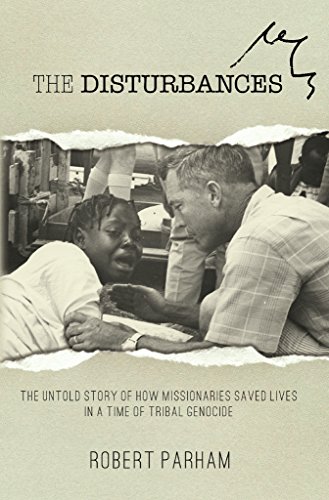
"The Disturbances" is told in both book and film.

The Disturbances is told in both book and film.

I NEVER EXPECTED to find myself on the verge of crying while watching a documentary about a civil war in Nigeria in 1966. But I did on Sunday afternoon as I viewed The Disturbances at Redeemer Lutheran Church in Owatonna.

Produced by the Baptist Center for Ethics, the film tells the stories of missionaries and their families who, caught in the middle of a civil war, helped save the lives of Igbos, a tribe victimized by genocide. Thousands upon thousands of tribal natives died, many hacked to death by machetes.

The letter calling the Rev. Paul Griebel and his family to the mission field in Nigeria.

The letter calling the Rev. Paul Griebel and his family to the African mission field.

I’ll admit, I’m not the best with history and geography and, until recently, knew nothing of this strife in Nigeria 51 years ago. But then my pastor-friend, the Rev. Kirk Griebel of Redeemer, alerted me to the documentary. He was an “MK,” as missionary kids were tagged, living in Nigeria with his Lutheran Church Missouri Synod pastor father, mother and five siblings at the height of the violence. He was only eight when his family arrived from Minnesota, thus recalls little.

But plenty of others do remember the civil war and spoke openly about it for the first time in The Disturbances, the film titled after the code name the missionaries gave to the conflict. Their experiences were horrible. And memorable. Even 50 years later, their words and faces reveal the trauma of witnessing such violence.

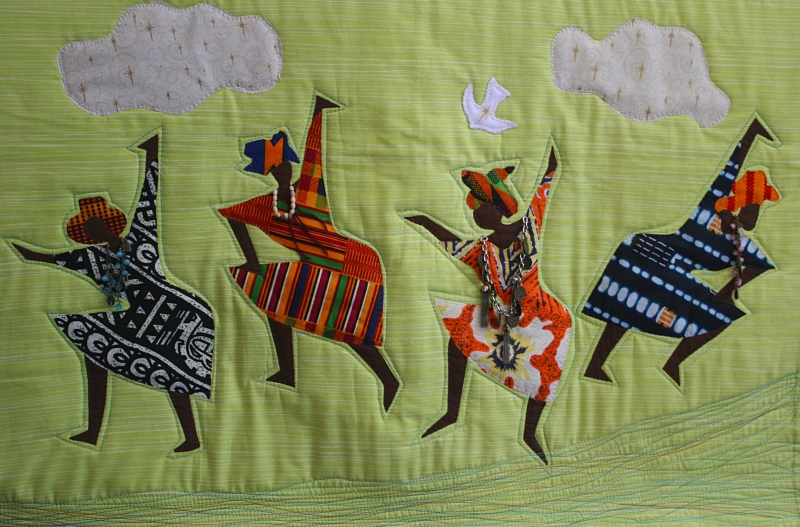
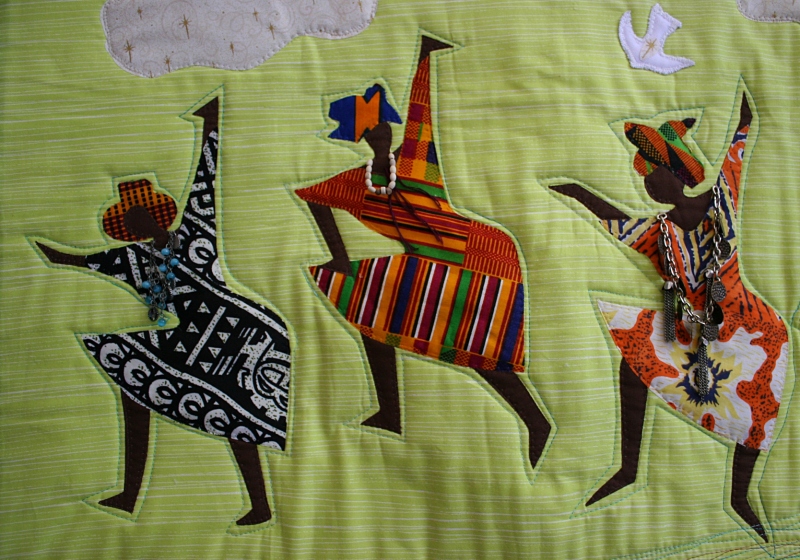
Artist Susan Griebel crafted this quilted art from fabric her mother-in-law, Margaret Griebel, had gotten in Africa.

Artist Susan Griebel crafted this quilted art from fabric her mother-in-law, Margaret Griebel, acquired in Africa.

The featured missionaries (including pastors, teachers and others from many denominations) lived in and around the city of Jos, a cultural melting pot and the epicenter of the violence. They were warned, “Tomorrow there will be trouble.” The next day the phone rang followed by a three-word declaration: “It has started.”

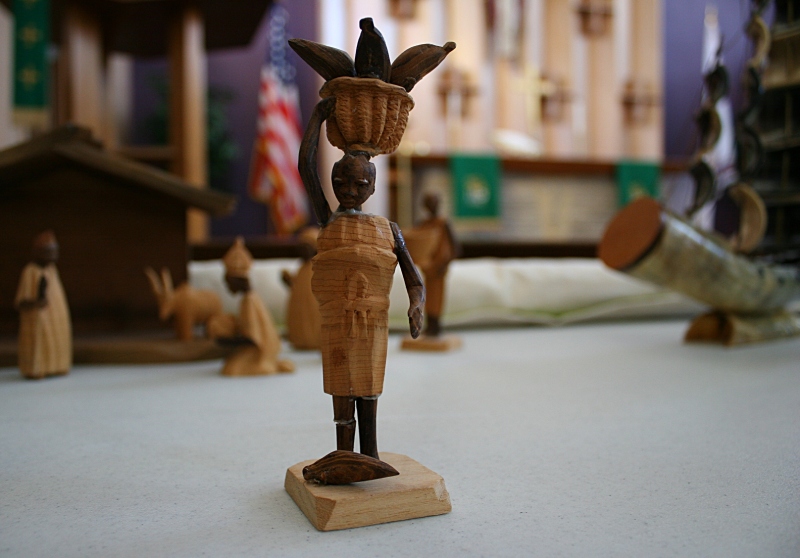
A beautiful carving from Africa, among those the Rev. Paul and Margaret Griebel brought back to the U.S. from Africa.

A beautiful carving from Africa, among those the Rev. Paul and Margaret Griebel brought back to the U.S. from Africa.

And so the stories emerged of Igbos hiding in fields and in rafters of the church sanctuary and in a store room. Stories of Igbos escaping with the help of missionaries. Stories of missionaries hiding a body in elephant grass. Stories of murdered Igbos picked up by trash trucks and buried in mass graves. Stories of the teen children of missionaries tending the wounded inside a police compound. Stories of missionaries lighting a runway with the headlights of their cars during an evacuation effort.

As I listened, I felt my grief rising, heightened perhaps by the unsettling current events in our own country regarding refugees. I wonder what stories they might tell, what violence many have fled/desire to flee for safety in America.

Two stories in particular imprinted upon me from The Disturbances. A victim of the attacks asked a young woman tending him whether she would be his daughter. His entire family had been slaughtered. She agreed, reciting Psalm 23 (The Lord is my shepherd…) and The Lord’s Prayer to the dying man. The woman, 50 years later, still remembers his final words. “I’m going home, my daughter.”

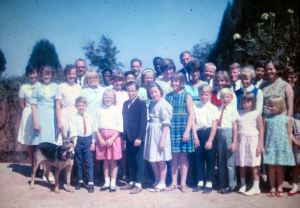
Missionary children at ELM House (Evangelical Lutheran Mission House) in Nigeria. Missionary children lived in the hostel so they could attend boarding school in Jos, Nigeria. The Rev. Paul and Margaret Griebel served as houseparents. Three of their children, including Kirk, are pictured in this group photo.

Missionary children at ELM House (Evangelical Lutheran Mission House) in Nigeria with teacher Carl Eisman in the back row. Missionary children lived in the hostel so they could attend boarding school in Jos. The Rev. Paul and Margaret Griebel served as houseparents. Three of their children, including Kirk, are pictured in this group photo. Photo courtesy of the Rev. Kirk Griebel.

And then there’s the story shared by Carl Eisman, a Lutheran teacher at Hillcrest School (a boarding school in Jos) and friend/co-worker of the Rev. Paul Griebel. After evacuating children from a hostel, the two men remained hidden there with tribal members. As an angry mob approached ELM House, Eisman hid in the shadows with a hunting knife. And, as he recounted, Rev. Griebel sat at a nearby table reading Scripture and praying. Eventually, the mob dispersed and the men emerged to find a body, one they temporarily hid in elephant grass.

My friend, the Rev. Kirk Griebel, doesn’t recall his father (or mother; both now deceased) ever talking about the violence they witnessed. He remembers only an angry mob and waiting outside a fenced police compound where the injured and dying were taken.

This close-up of Susan Griebel's Nigerian-themed art shows the dove she incorporated as

This close-up of Susan Griebel’s Nigerian-themed art shows the dove she incorporated as representing the Holy Spirit. In the film, one interviewee said the missionaries had only one resource–that of prayer.

The film explains why the missionaries didn’t speak openly about the violence, even to family and church staff back home. They felt caught without resources in the middle of a civil war. As foreigners, they thought it best to lie low. They desired, too, to protect the children, to normalize their lives. And so they remained mostly silent. Until now and the documenting of their experiences in The Disturbances.

Given the time period and their foreigner status, I understand the guarded position. Missionaries and Nigerian pastors met, though, for two days in October 1966 to discuss “the disturbances” privately. I am thankful that these long-ago missionaries and their family members have now chosen to speak publicly about their experiences. For it is through the telling of personal stories that we learn and begin to understand suffering, courage, compassion and faith in times of violence. And for those who witnessed such atrocities, talking begins the process of healing.

FYI: Upcoming screenings of The Disturbances are scheduled in Missouri and Alabama. Click here for details. The Rev. Kirk Griebel will present the film this Wednesday, February 1, at 6 p.m. at King of Kings Lutheran Church, 1701 NE 96th St. in Kansas City, Missouri.

© Copyright 2017 Audrey Kletscher Helbling
 

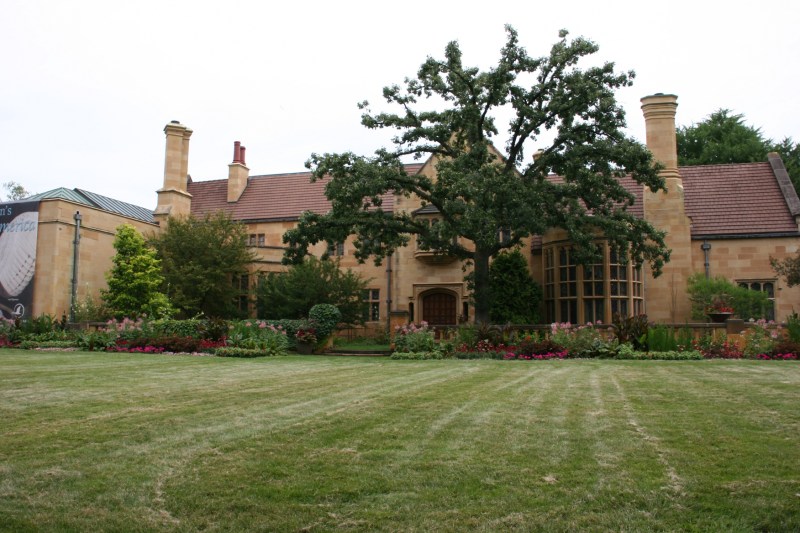
From Wisconsin: A look inside The Paine, setting for an episode of The Bachelor January 25, 2017

OSHKOSH, WISCONSIN is perhaps best-known for its annual summer air show that draws aviation enthusiasts from around the world.

But Monday evening may have changed that, at least for a segment of the population—those who watch The Bachelor. The fourth episode of this TV show took viewers to Wisconsin, home state of this season’s bachelor, Nick Viall of Waukesha, a Milwaukee suburb.

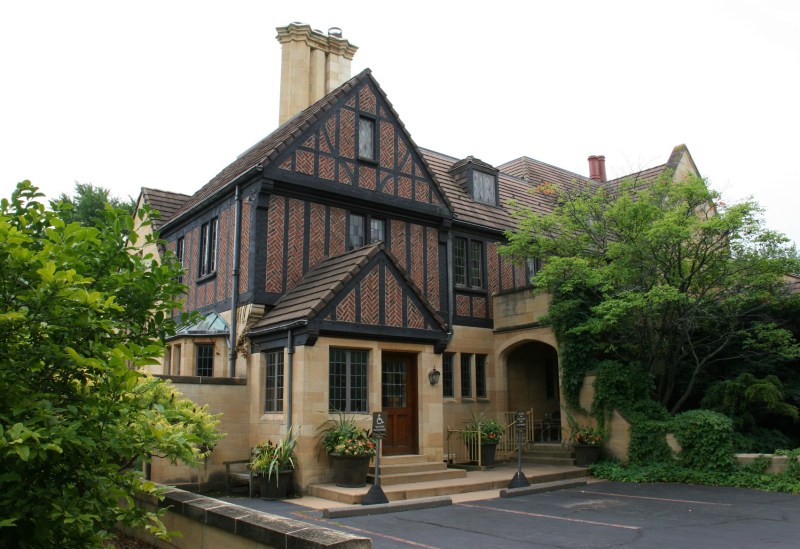
The visitors' entry to The Paine Art Center, housed in a 1920s mansion.

The visitors’ entry to The Paine Art Center, housed in a 1920s mansion.

I occasionally tune in to The Bachelor, which I hesitate to admit. Monday was one of those times. And, as it turned out, a good evening to see Wisconsin showcased, including the community of Waukesha, Omro area Knigge Farms and The Paine Art Center and Gardens in Oshkosh.

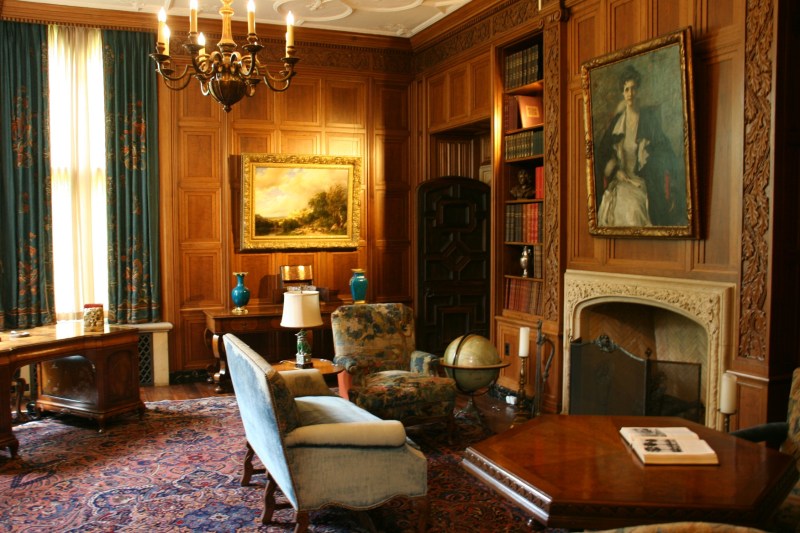
Among art in the library is an oil on canvas portrait of Koto Robertine Chase Carr Sullivan painted by her father William Merritt Chase, ca. 1914.

Among art in the library is an oil on canvas portrait of Koto Robertine Chase Carr Sullivan painted by her father, William Merritt Chase, ca. 1914.

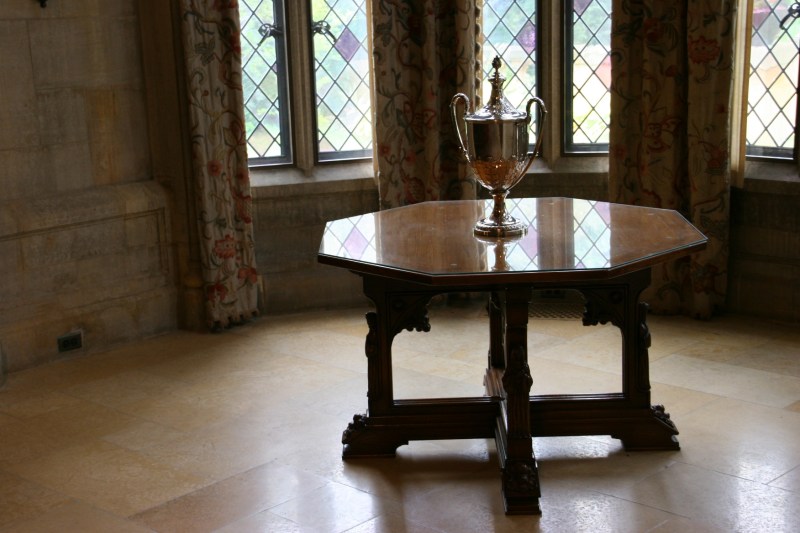
the-paine-66-urn-on-table

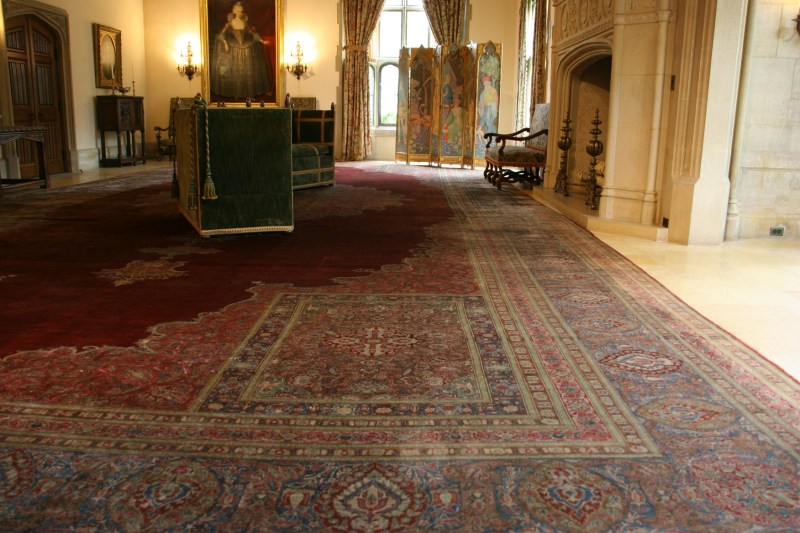
The Great Hall, designed for leisure and entertainment, features an aged rug. Visitors cannot walk on that rug.

The Great Hall, designed for leisure and entertainment, features an aged Persian rug upon which you cannot walk.

This past July I toured The Paine with my husband and daughter Miranda, who lives in the area. The Paine is the legacy of Nathan and Jessie Kimberly Paine of the once-thriving Paine Lumber Company. Construction started on the mansion in 1927. Then The Depression hit and the business took a hit and so did completion of the estate. Decades later the opulent house and grounds opened to the public. No one ever lived in the historic home.

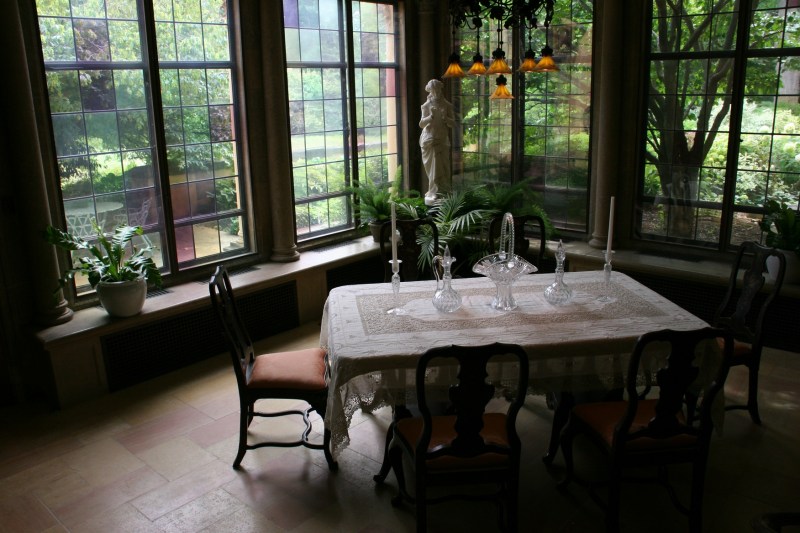
My favorite space, the sun-drenched Breakfast Room.

My favorite space, the window-lined Breakfast Room.

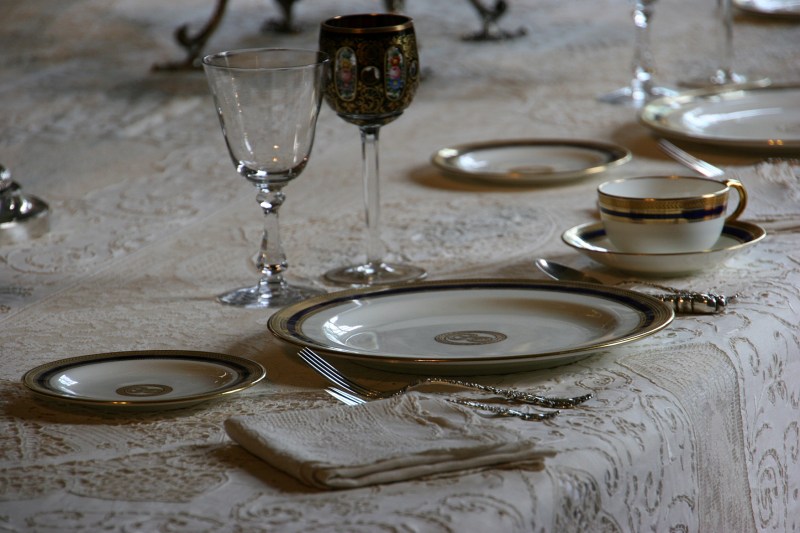
Everything about The Paine exudes elegance, including the table setting.

Everything about The Paine exudes elegance, including the table setting in the formal dining room.

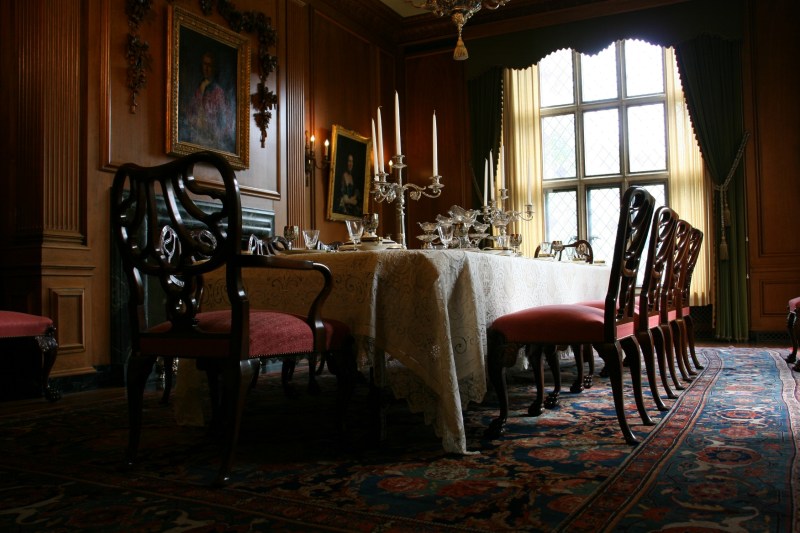
The luxurious dining room.

The luxurious dining room.

In the January 23 episode of The Bachelor, Viall and women vying to become his wife were filmed inside and outside The Paine. As most estates are, The Paine is a lovely place of gardens, art, architectural beauty and history. And love. Not just The Bachelor love, but as the site of many weddings.

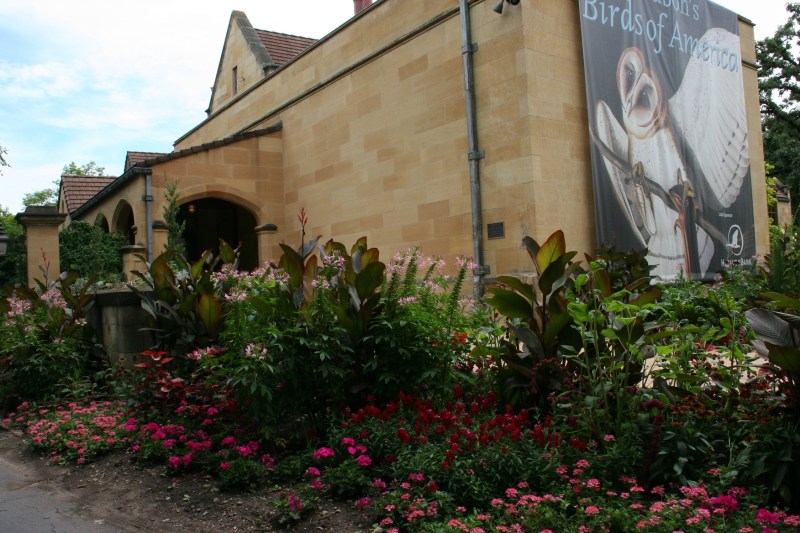
Beautiful flowerbeds edge the mansion and extend into backyard gardens.

Beautiful flowerbeds edge the mansion and extend into backyard gardens.

When I visited this past summer, “Audubon’s Birds of America” was on exhibit in the mansion gallery. Photos were banned there, although I could photograph throughout the rest of the property, inside and out.

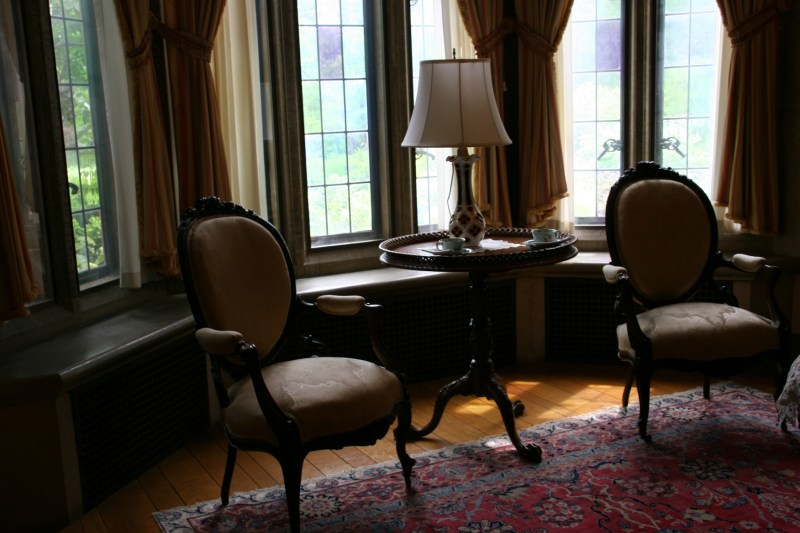
A sitting area.

A sitting area.

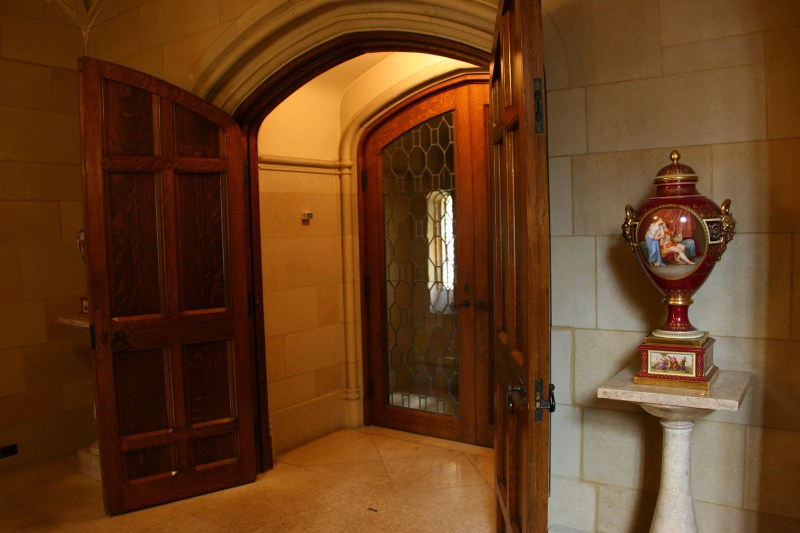
Arched doors and doorways, heavy doors, art and more define The Paine.

Arched doors and doorways, heavy doors, art and more define The Paine.

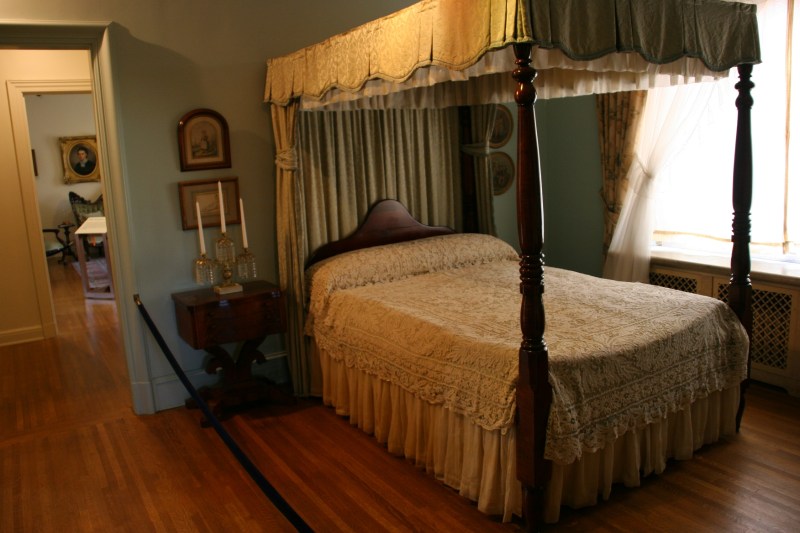
The second floor includes two bedrooms.

The second floor includes two bedrooms.

Enjoy this first look at a place that can now add an episode of The Bachelor to its notoriety.

the-paine-157-full-front-view

FYI: Click here to learn more about The Paine Art Center and Gardens. The Paine is open to visitors from 11 a.m. – 4 p.m. Tuesday – Sunday, closed on Monday. Animals and rural imagery by Wisconsin artist Craig Blietz are currently displayed in The Paine gallery. Check back for another post, outdoors at The Paine.

© Copyright 2017 Audrey Kletscher Helbling

 

Part I from Pleasant Grove: About those pioneer women January 24, 2017

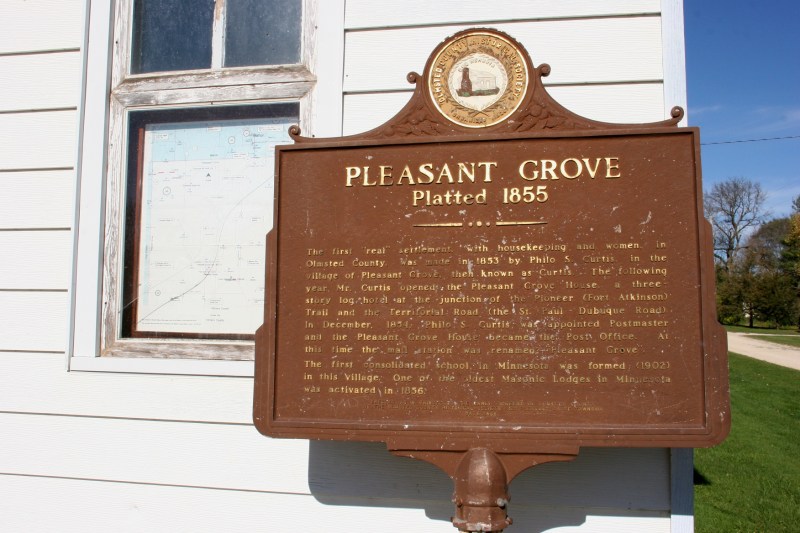
pleasant-grove-town-hall-99-historical-marker


I ALMOST CAN’T BELIEVE what I am reading:

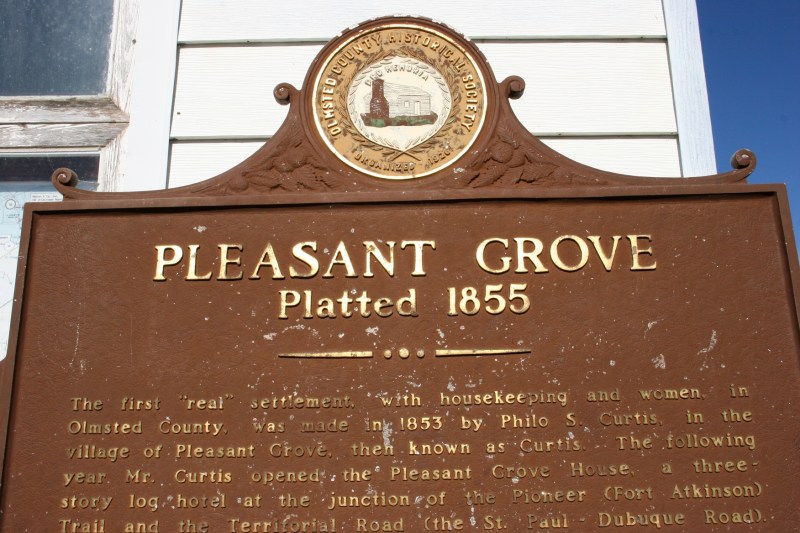
The first “real” settlement, with housekeeping and women, in Olmsted County was made in 1853 by Philo S. Curtis in the village of Pleasant Grove, then known as Curtis. The following year Mr. Curtis opened the Pleasant Grove House, a three-story log hotel at the junction of the Pioneeer (Fort Atkinson) Trail and the Territorial Road (St. Paul-Dubuque Road)…


pleasant-grove-town-hall-100-close-up-of-sign


Reread those first words: The first “real” settlement, with housekeeping and women


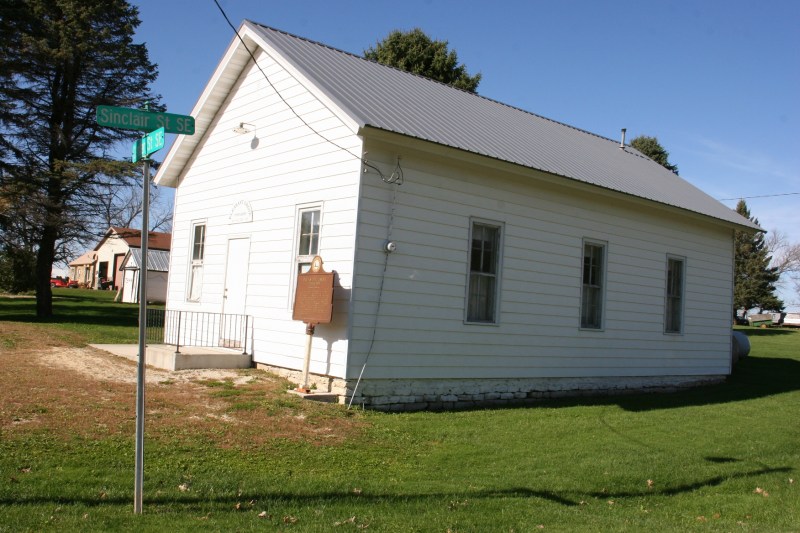
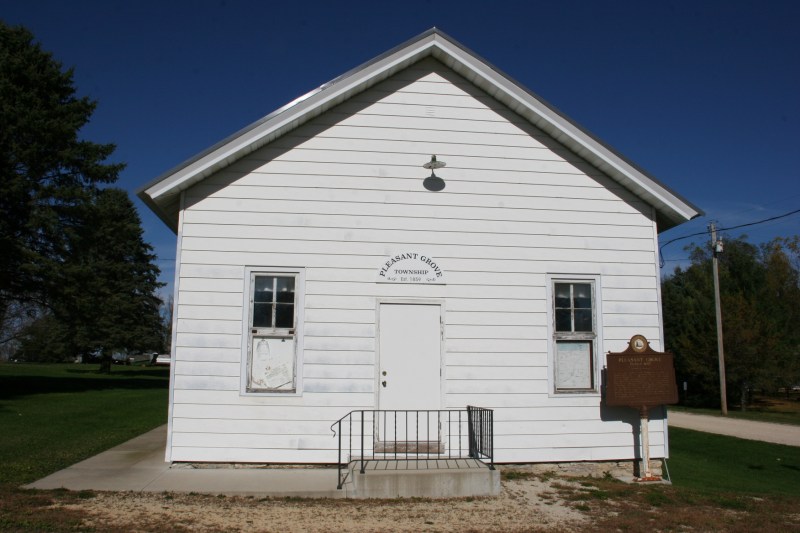
pleasant-grove-town-hall-98-side-view


What exactly does that mean? The words are posted on a sign erected in 1966 (or maybe it was 1986 at the Pleasant Grove Town Hall; I can’t decipher the decade) by the Olmsted County Historical Society.


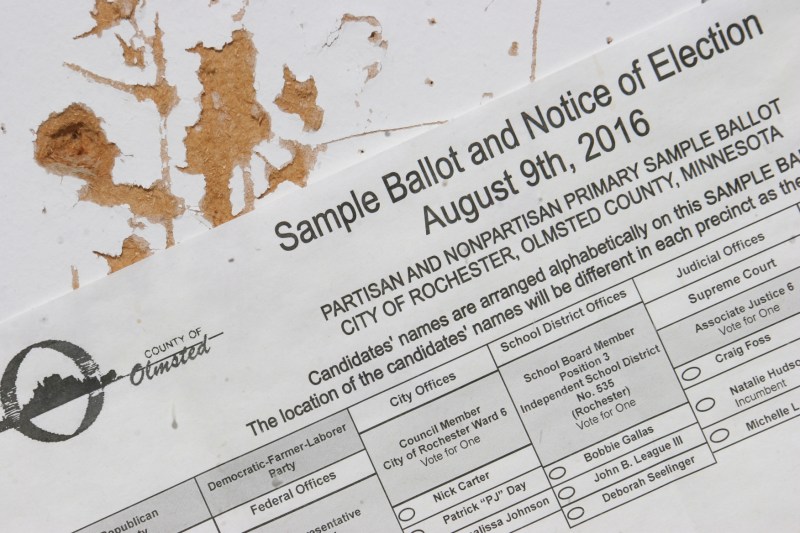
pleasant-grove-town-hall-102-ballot


Pleasant Grove, as I understand the historical marker, was the first settlement in this southeastern Minnesota County where women lived. And those women were tasked with housekeeping. (Maybe more?) Now there’s nothing wrong with either sex assuming household duties. But I’m bothered by the wording; as a woman, it just strikes me as wrong. This is, after all, 2017, not the mid 1800s. A woman ran for President. Women ran for office everywhere, even in Olmsted County. We can vote. We can march. Perhaps this could be written in a more positive way to honor the early pioneer women who settled here.


pleasant-grove-town-hall-103-front-of


And why were so many towns named after men? Did you catch that? Philo Curtis established the village, originally called Curtis. Thank goodness someone had the good sense to change the name to the much more pleasing Pleasant Grove.


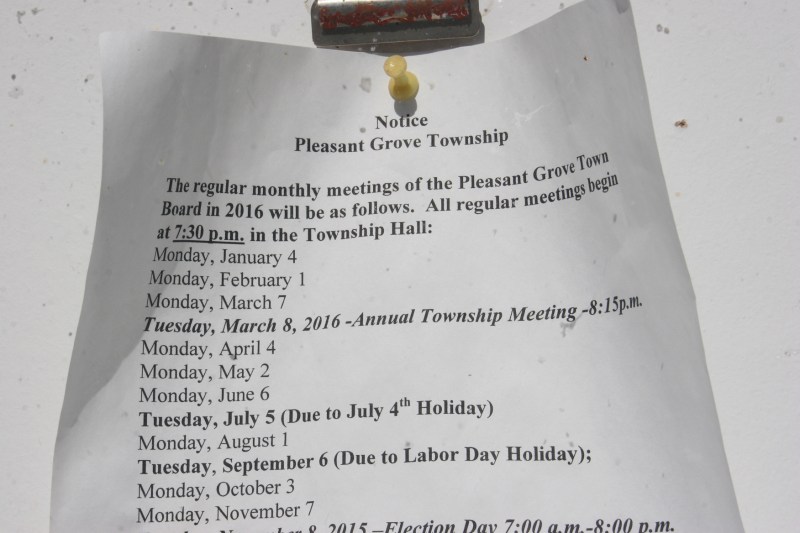
pleasant-grove-town-hall-101-meeting-notices


Now, if only someone would replace the weathered, nearly unreadable historical marker with something more pleasant.

TELL ME: What are your thoughts on the wording of this sign? Should it be changed? If so, what would you write? Or is it OK given the historical context?

FYI: Please check back as I bring you more discoveries from my stop in Pleasant Grove several months ago, well before winter arrived.

© Copyright 2017 Audrey Kletscher Helbling
 

Faribault’s newest mural depicts timeless 1950s street scene October 9, 2016

mural-144-front-of-building-and-mural


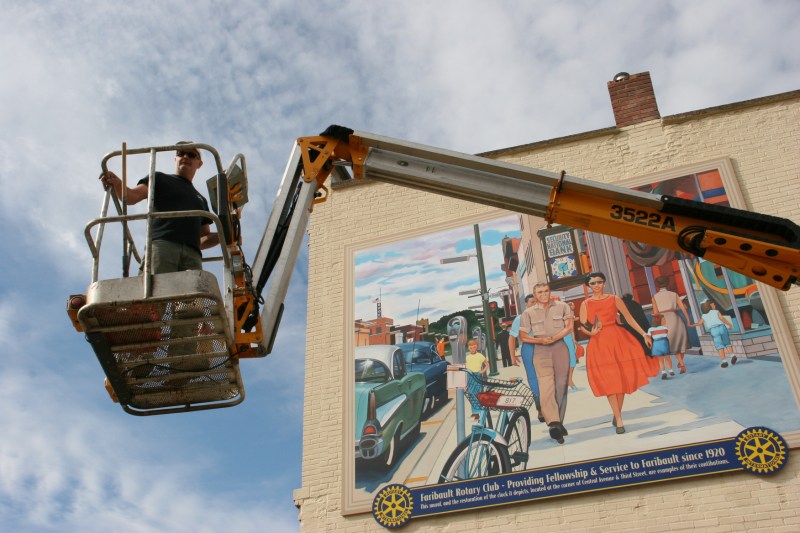
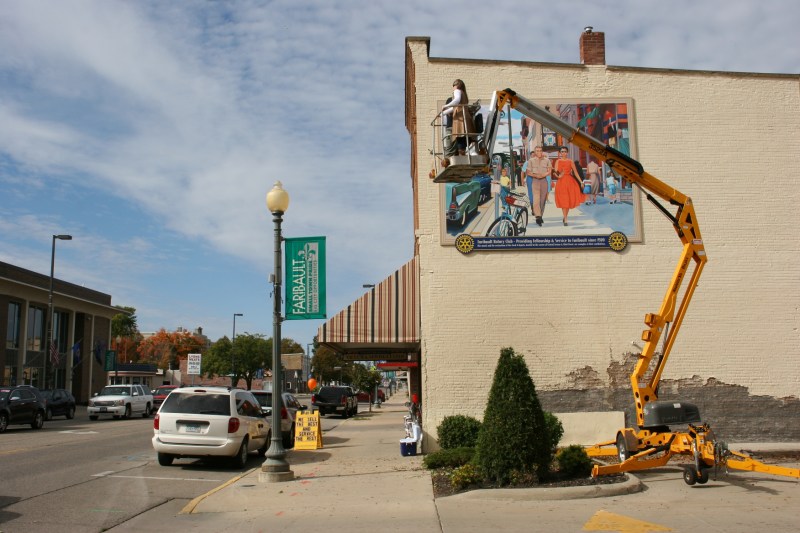
LATE SATURDAY MORNING, I stood in the parking lot next to Faribault Vacuum & Sewing Center, eyes and camera fixed upward.


mural-164-paint-tray


mural-151-close-up-of-dave-painting


mural-148-back-of-dave-painting-mural


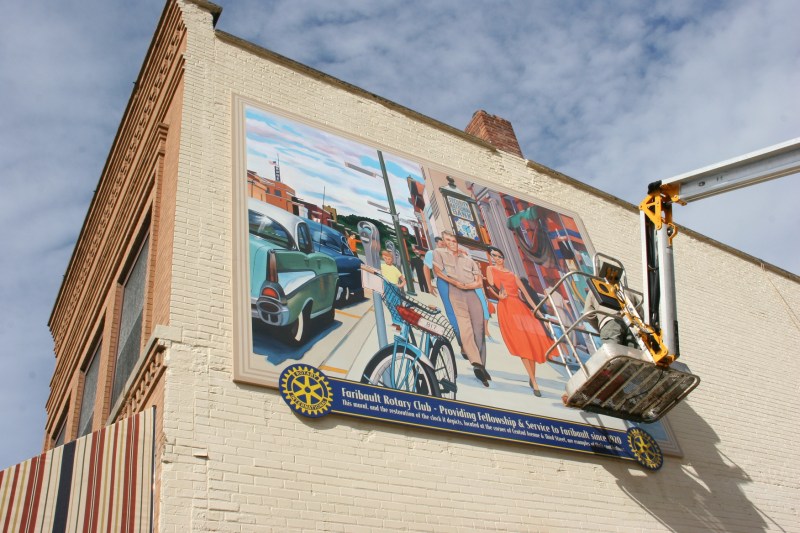
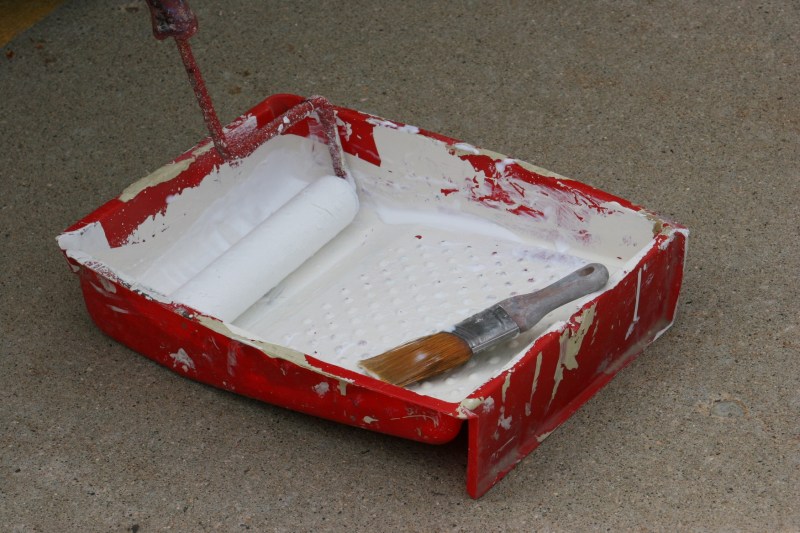
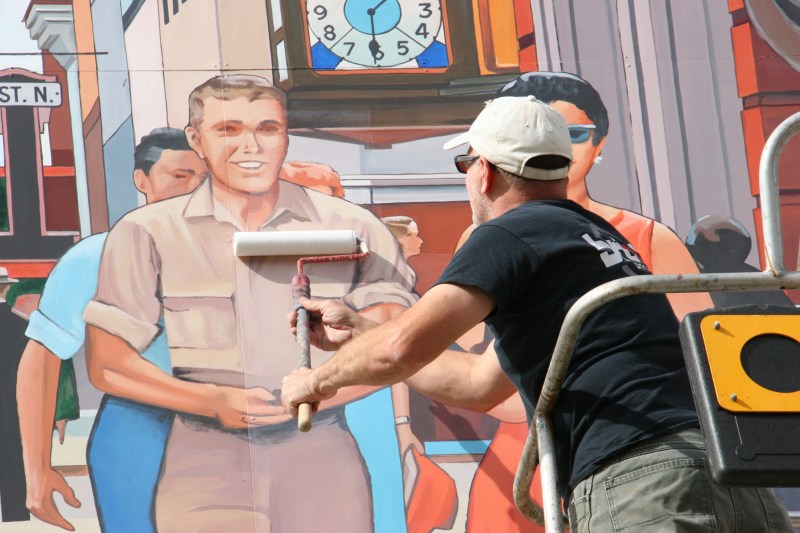
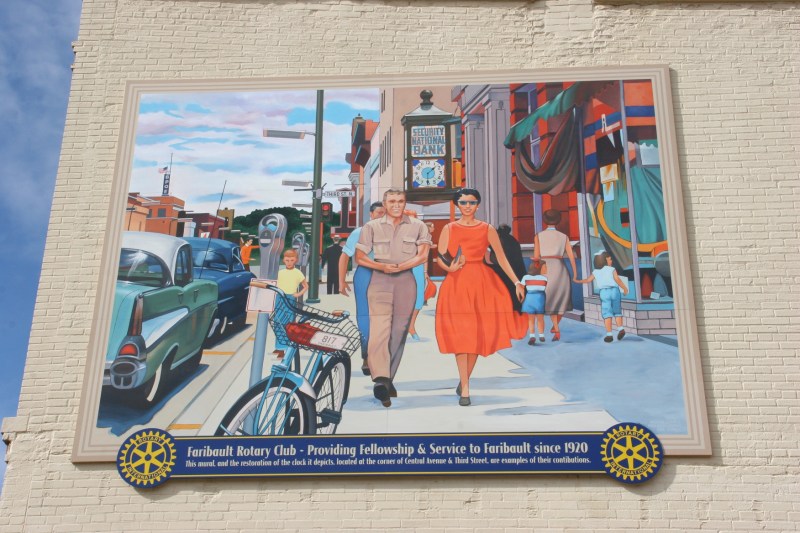
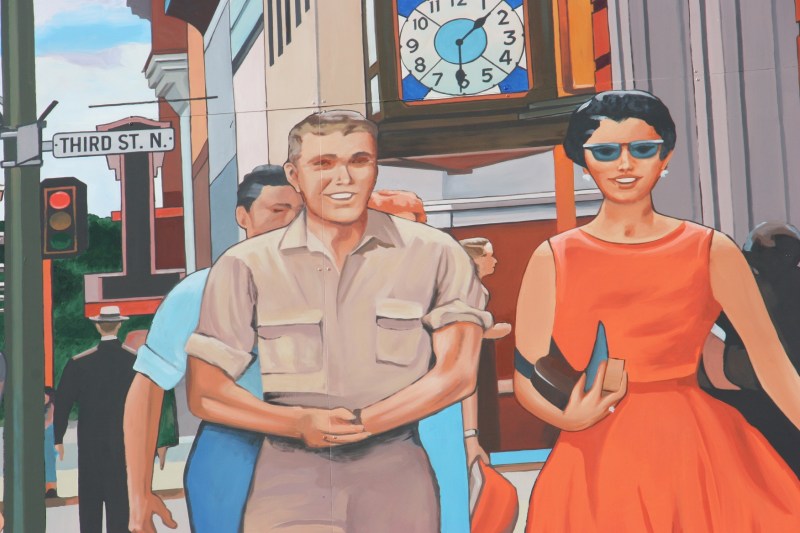
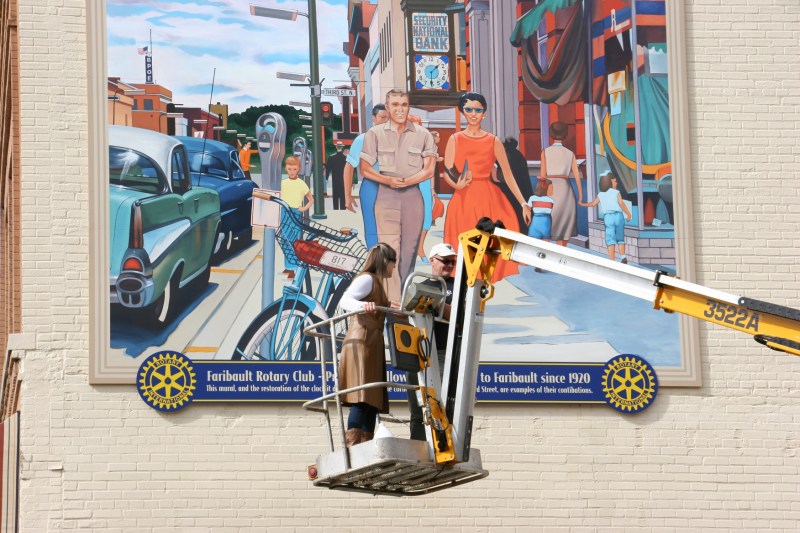
On the side of the brick building in the heart of historic downtown Faribault, artist Dave Correll rolled a clear top coat across this community’s newest mural depicting a late 1950s streetscape. The large-scale painting replicates art commissioned for a Northern Natural Gas Company ad campaign decades ago. The artist is unknown, but permission was secured to reproduce the work.


mural-156-whole-mural


It’s a stunning and vibrant piece highly visible to motorists driving westbound on Minnesota State Highway 60/Fourth Street. And it’s the eighth historic-themed mural to grace downtown Faribault.


mural-154-dave-to-left-of-mural


Dave, who owns Brushwork Signs along with his wife, Ann Meillier, teamed up with Adam Scholljegerdes to design and paint the sign. Daughter Madeline Correll also assisted, traveling back from Milwaukee upon her parents’ request.


mural-160-ann-dave-close-up-in-lift-basket


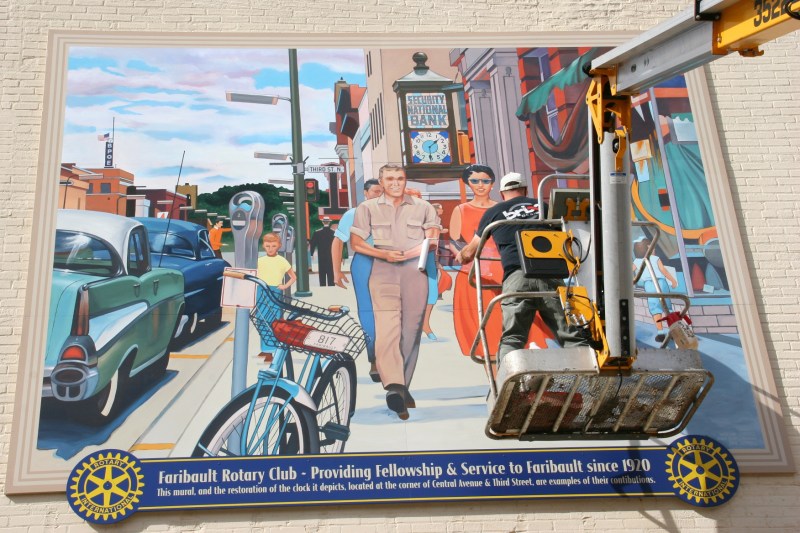
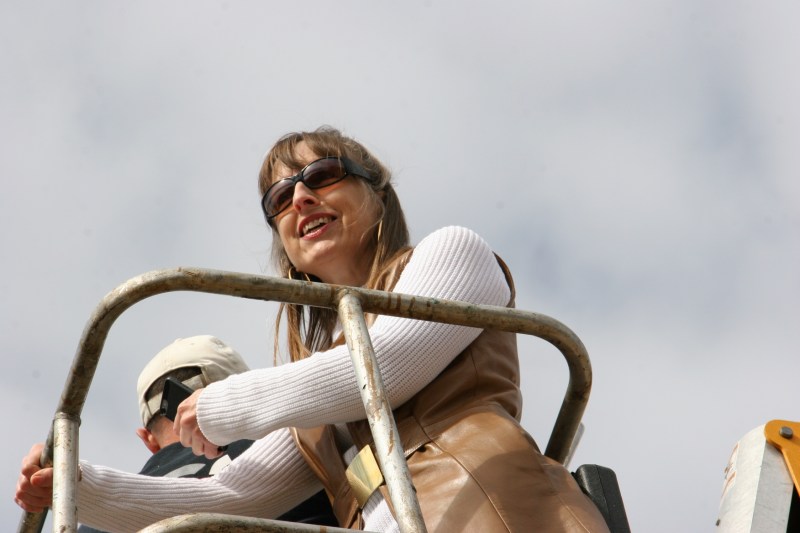
Saturday Dave worked to finish the project before a 1 p.m. dedication while Ann kept a watchful eye from below…until she climbed into a lift for a close-up view and photo opps.


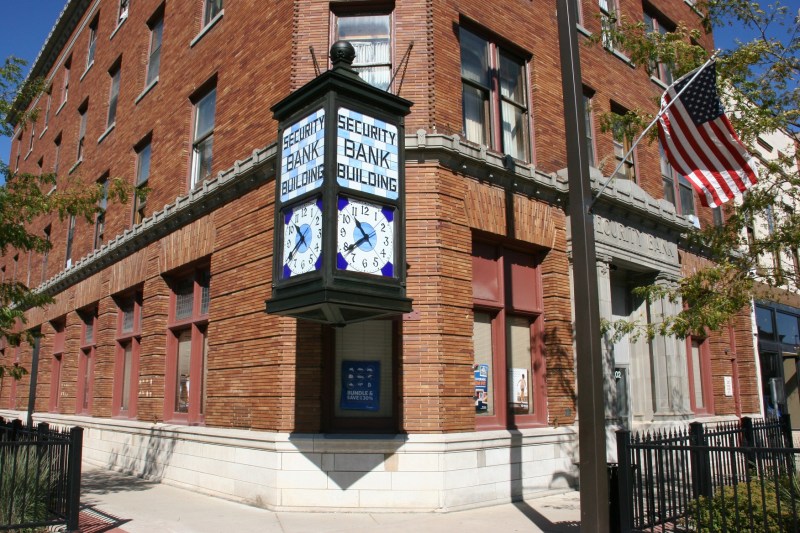
This restored 1915 clock was installed on the Security State Bank Building, 302 Central Avenue, on Saturday.

This restored 1915 clock was installed on the Security State Bank Building in September 2015. Minnesota Prairie Roots file photo.

mural-158-mural-close-up-snippet


The Faribault Rotary Club led efforts to bring this newest mural to downtown, and fittingly so. The subject matter ties to a previous Rotary project—raising $25,000 for restoration of the Security Bank Building clock. Just a year ago, that refurbished historic clock was installed at 302 Central Avenue, 1 ½ blocks away. The clock is a focal point in the mural.


mural-169-ann-dave-by-mural


Credit for the mural subject goes to Faribault Area Chamber of Commerce and Tourism President Kymn Anderson who discovered and purchased the original fifties streetscape painting. Once the Rotary mural planning team saw the art, they knew it would be perfect. And it is.


mural-166-mural-fourth-street


I love how this latest mural honors the 1950s history of Faribault. I appreciate the vintage street scene and its connection with the 2015 restoration of the Security Bank clock. Faribault is a community which values its past. That’s evident in projects like the clock restoration, well-kept historic buildings and historic murals. Public art expresses visible community pride. And every community needs such pride to thrive in to the future.

© Copyright 2016 Audrey Kletscher Helbling
 

Faribault area welcomes you to bike, run, eat, drink, learn about history & more this weekend October 6, 2016


fall-festival-291x300-copy

FARIBAULT CELEBRATES FALL this Saturday with a day jammed full of activities for all ages.

If you’ve never been to my southeastern Minnesota community, please join us. If you live here, appreciate what Faribault offers. Here’s a round-up of events slated for Saturday, most in our historic downtown:

Faribault’s Fall Festival begins at noon with the Children’s Costume Parade starting at Community Co-op and continuing north along Central Avenue to Fifth Street. Afterwards, kids, accompanied by adults, can trick-or-treat at downtown businesses until 3 p.m.

Additionally, there will be pumpkin painting, yard games and unicycle shows to keep families and other folks busy and entertained.


Participants in last year's Chili Contest dish up chili at a business along Central Avenue during the Fall Festival.

Sampling chili during a Fall Festival in downtown Faribault. Minnesota Prairie Roots file photo.


From 12:20 – 2:30 p.m., chili lovers, for a $5 fee, can sample chili from stands set up along historic Central Avenue.


The Adam Weyer Wagon Shop, built of limestone in 1874, is among historic buildings on the tour.

The Adam Weyer Wagon Shop, constructed of limestone in 1874, is among historic buildings on the tour. Weyer built buggies, carriages, wagons and bobsleds here from 1874 in to the early 1900s. He then opened a blacksmith shop. Today the building houses Carriage House Liquors.


Even before the costume parade, a free guided Old Town walking and biking tour of historical sites in downtown Faribault is scheduled from 10 – 11:30 a.m. Participants should meet at Buckham Center, 11 East Division Street.


And the volunteer firemen were on duty.

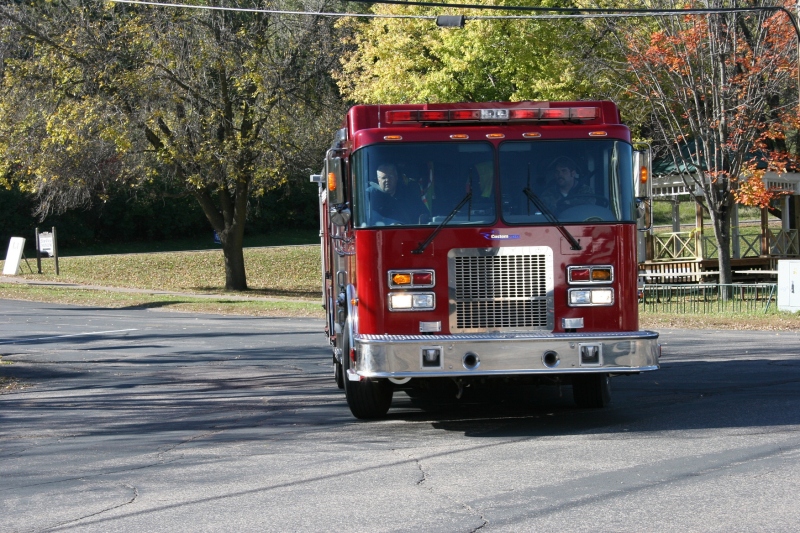
Firefighters return from a call in Marine on St. Croix, on the eastern side of Minnesota. Minnesota Prairie Roots file photo used for illustration purposes only.


Also at 10 a.m., until 2 p.m., the Faribault Fire Department hosts its annual open house. Kids can meet fire fighters and Sparky The Fire Dog. There will be free demos, free fire hats and free smoke detectors.


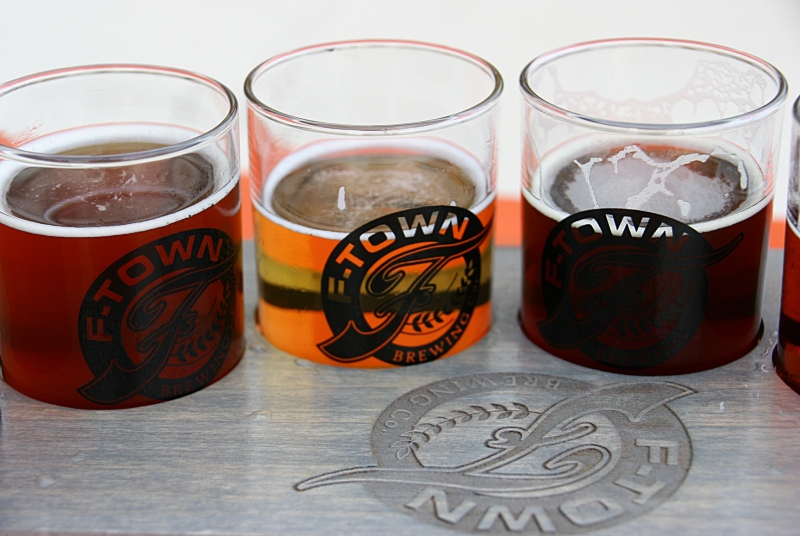
We wanted to sample all of the beers on tap, so we ordered a flight.

A sampler of F-Town beers. Minnesota Prairie Roots file photo.


Half a block off Central Avenue, F-Town Brewing kicks off its F-Oktoberfest at 11 a.m. with Gravel Grinder, a 50-mile charity bike race.

Brewery fun continues for 12 more hours with food trucks, live music and plenty of F-Town beer.


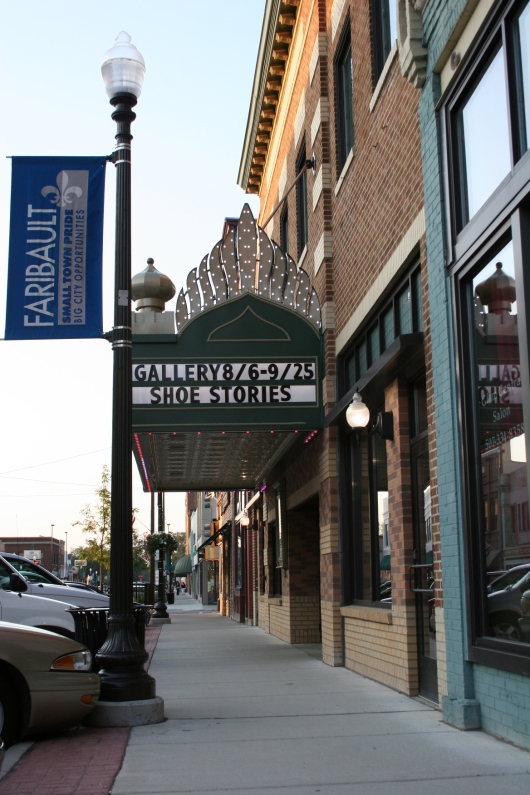
"Shoe Stories" opened Friday at the Paradise Center for the Arts in Faribault.

The Paradise Center for the Arts is housed in a beautifully restored theater. Minnesota Prairie Roots file photo.


At the Paradise Center for the Arts, 321 Central Avenue North, the arts center hosts the Paradise Haunted Basement Tour from 1 – 3 p.m.

And for music fans, the Paradise presents A Tribute to “The Boss” Bruce Springsteen at 7 p.m. Admission price is $15 for members and $20 for non-members.


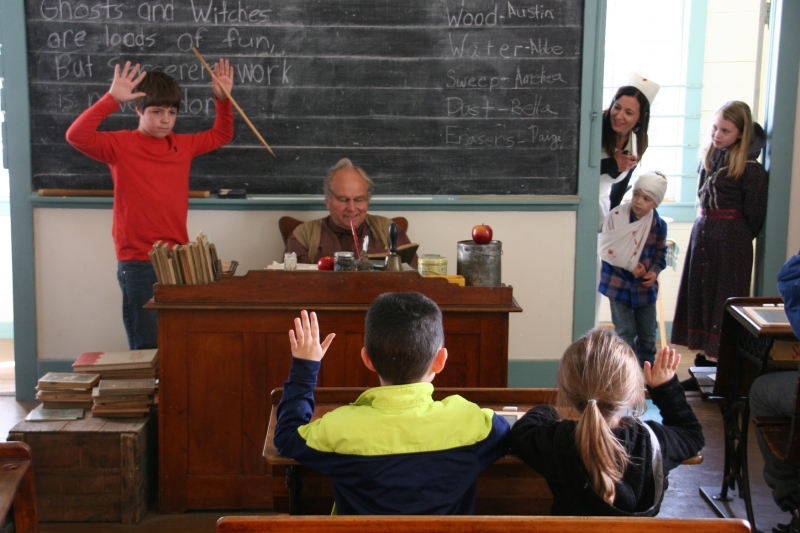
Math class is underway inside the one-room Pleasant Valley School.

Math class is underway inside the one-room Pleasant Valley School during a past “A Night at the Museum.” Minnesota Prairie Roots file photo.


On the north side of town by the Rice County Fairgrounds, the Rice County Historical Society opens its doors and grounds for the fourth annual “A Night at the Museum.” The event, with a $2 admission price for adults and $1 for kids, runs from 4 – 7 p.m. It’s a great opportunity to observe and participate in living history.


hope-in-harmony


At River Valley Church, 722 Ravine St., the Lakelanders Acapella Chorus will present a 7 p.m. concert benefiting three local organizations that help women dealing with issues like domestic violence, homelessness, addiction, etc. Admission is a free will offering.

There you go. Lots to do in Faribault on Saturday. Come, join the fun, eat (and drink) local, shop local and appreciate all this community offers.


BONUS:

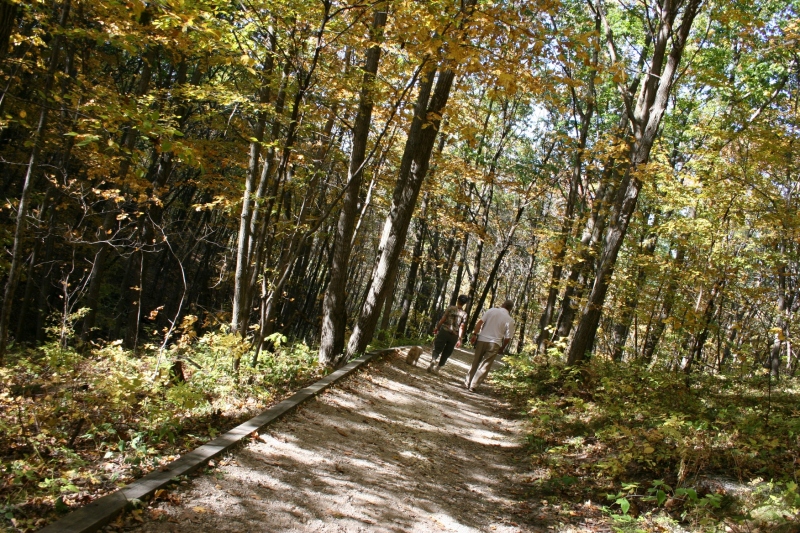
Well-kept and well-traveled paths take hikers deep into the Big Woods.

Well-kept and well-traveled paths take hikers deep into the Big Woods at Nerstrand Big Woods State Park. The park is known for its incredible fall foliage. Minnesota Prairie Roots file photo.


Just to the east of Faribault, St. John’s United Church of Christ, Wheeling Township, hosts its annual Big Woods Run half marathon/10K/5K/kids K through Nerstrand Big Woods State Park. The events begins at 9 a.m. New this year is a guided prairie walk and nature talk.


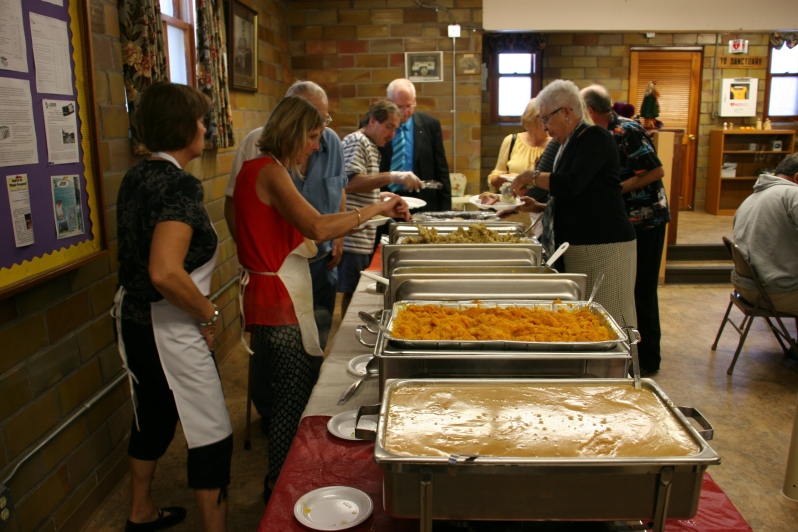
Delicious home-cooked food fills roasters at Trinity's annual fall harvest dinner on Sunday.

Delicious home-cooked food fills roasters at Trinity’s annual fall harvest dinner in the church basement. Minnesota Prairie Roots file photo 2016.


On Sunday, to the west of Faribault at Trinity Lutheran Church, North Morristown, the church will host its annual fall dinner and craft/bake sale. For $12 (ages 13 and up; $5 for those 6 – 12)) you can enjoy a homemade meal of turkey, ham and all the fixings. I’ve eaten here many times and this is an incredibly delicious meal cooked by folks who know how to cook. The food is delicious, the portions ample and the company welcoming and friendly. Serving is from 11 a.m. – 1 p.m.

© Copyright 2016 Audrey Kletscher Helbling
Logo from Faribault Main Street, key organizer of the Faribault Fall Festival.


Vietnam wall replica arrives in Faribault today with opportunities to honor & heal August 31, 2016

Filed under: Uncategorized — Audrey Kletscher Helbling @ 5:00 AM
Tags: , , , , , , , ,
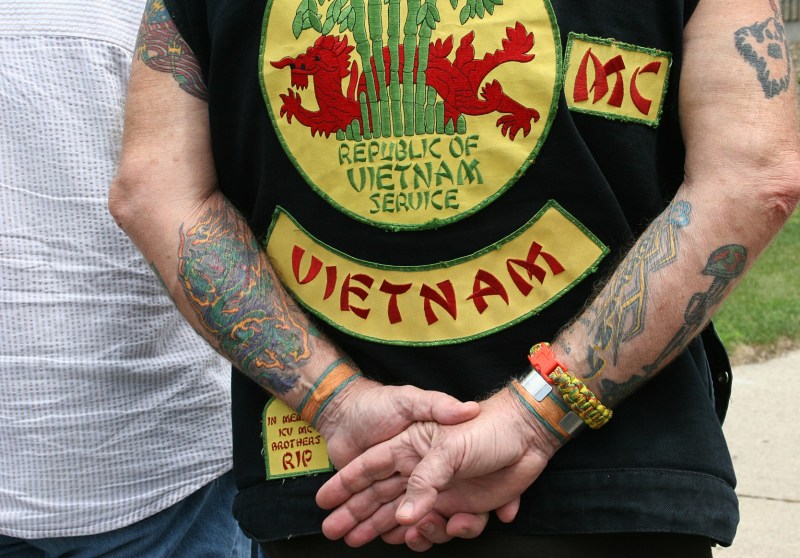
Many Vietnam veterans attended the ceremony.

I photographed this Vietnam veteran during a ceremony at Faribault American Legion Post 43 in July 2013. Minnesota Prairie Roots file photo.

VIETNAM WAR. Those two words can create angst in those of us who remember that turbulent time in our nation’s history. Unrest and protests headlined media coverage. Veterans found themselves returning to a country ungrateful for their service. They were shunned, neglected, disrespected.

But today, with decades since the end of that war and with an aging population of Vietnam veterans, thinking has shifted and we as Americans recognize the need to honor these men and women who served and those who died doing so.

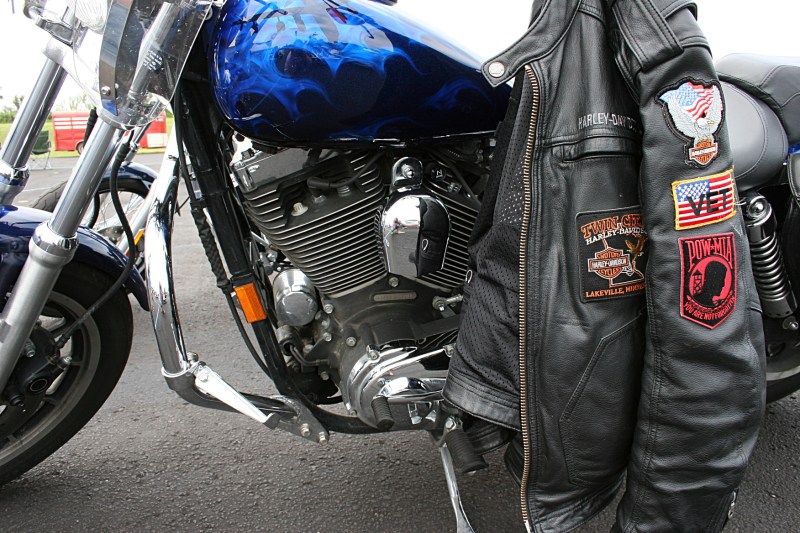
The Harley dress code: black leather.

Bikers will be among those escorting the traveling wall from Owatonna, through Medford and into Faribault between 3 – 4 p.m. today. Minnesota Prairie Roots file photo.

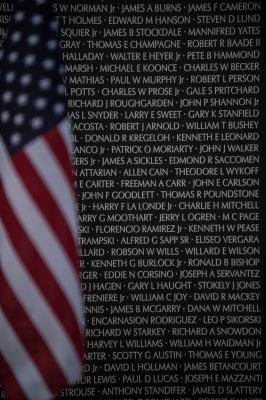
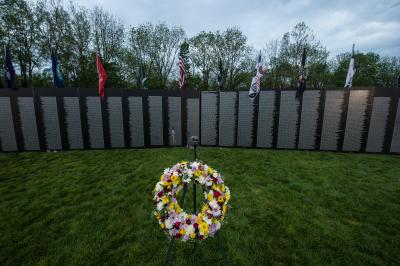
This afternoon in my southeastern Minnesota community of Faribault, the Traveling Vietnam Memorial Wall arrives under escort for a several-day stay at the Rice County Fairgrounds. For those living along the route, like me, this presents a public opportunity to pay respect. I hope Faribault residents and others will show an enthusiastic and honorable patriotic welcome as the motorcade proceeds through town. Click here to see the specific processional route for the entourage, expected to arrive here around 3:30 p.m. today.

I hope, too, that many will visit this 80 percent replica wall of the original memorial in Washington, D.C. It will be open 24/7 from Thursday afternoon through early afternoon on Labor Day. I am certain seeing the thousands of names thereon will make a powerful personal impact.

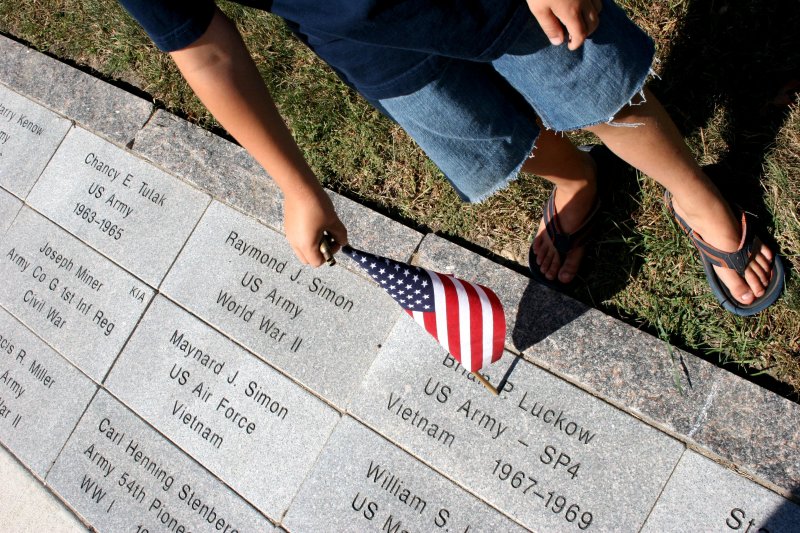
A young boy peruses the pavers honoring veterans at the Rice County Veterans Memorial in Faribault.

Pavers at the Rice County Veterans Memorial in Faribault honor Vietnam and other veterans. Minnesota Prairie Roots file photo.

There is hope also among local organizers for healing as written in their mission statement:

To offer veterans and visitors an opportunity to experience both an educational and healing experience, and offer an important historical contribution to the understanding of our nation’s history.

Healing is possible, even decades after the Vietnam War ended.

© Copyright 2016 Audrey Kletscher Helbling
 

Traveling Vietnam Memorial Wall rolling into Faribault August 29, 2016

AS A TEENAGER OF THE EARLY 1970s, the Vietnam War proved part of my life in the fringe sort of way war does when you’re an emerging adult.

Along with my too short hot pants ensemble and my shiny go-go boots, I sported a POW bracelet, the shiny medal banding my wrist with the name of an American soldier held captive by the Viet Cong. I wish I remembered his name or even what happened to that bracelet. It may be stashed away in a cardboard box in a closet. To even write that seems dishonorable. How could I not give more respect to a prisoner of war who deserved my gratitude?

This week I will have a local opportunity to honor those who died in the Vietnam War, the war from which veterans arrived home without a nation’s welcome. Protests prevailed. I remember.

traveling wall logo


Thankfully attitudes have changed. This Wednesday, the Traveling Vietnam Memorial Wall rolls into Faribault for a six-day stay at the Rice County Fairgrounds. I am grateful to the individuals, businesses and organizations—like the Faribault Elks, multiple American Legion Posts, the local VFW Post and the Marine Corps League—that worked hard to bring this 80 percent scale version of the wall here to southeastern Minnesota.

Stock image courtesy of the Traveling Wall Faribualt 2016.

Stock image courtesy of the Traveling Wall Faribualt 2016.

Perhaps my POW’s name is imprinted on that wall, among the 58,282 Americans who died in this war. I will search for one name, that of Benjamin Franklin Danielson whose fighter jet was shot down over Laos in 1969. I remember the media coverage when this Minnesota soldier’s remains were returned to his native Kenyon in 2007, several years after bone fragments were found to match his DNA. I expect many individuals will be looking for names of loved ones or classmates or others on this 360-foot long by eight foot high replica wall.

Stock image courtesy of Traveling Wall Faribault 2016.

Stock image courtesy of Traveling Wall Faribault 2016.

But before the temporary memorial goes up on the north side of Faribault, it will arrive in my community of 23,000 Wednesday afternoon under escort by law enforcement, fire department personnel, bikers and others in private vehicles. Organizers emphasize that this is not a parade but rather a solemn procession. Those living aside the route from Owatonna along County Road 45 to Medford and then into Faribault are encouraged to line the roadway with American flags and to show their support.

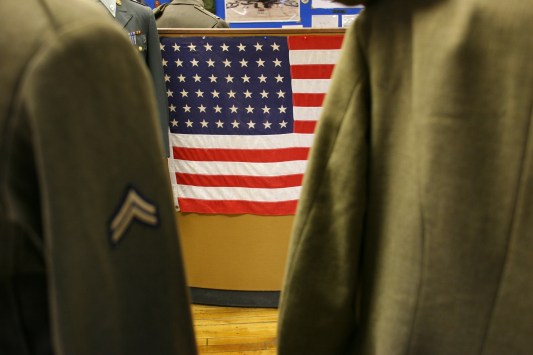
Between two military uniforms, I shot this view of a 48-star American flag.

Minnesota Prairie Roots file photo.

I live along the processional route. Those who know me personally and would like to join me in my front yard are welcome to do so. Dress in patriotic attire and bring American flags and patriotic items plus a lawn chair. I expect the entourage to pass my home around 3:20 – 3:30 p.m.

At 6:30 p.m. on Thursday, the traveling wall debuts with a grand opening ceremony. The memorial remains open 24/7 until the closing ceremony at 1 p.m. on Labor Day. What a great opportunity this will be for us, as a community, as a county, as Minnesotans, as Americans, to honor those like Benjamin Danielson and my unidentified POW. Decades after I clamped that POW bracelet around my wrist, I understand the significance of this opportunity.

FYI: Many related events are planned in conjunction with the Traveling Vietnam Memorial Wall exhibit in Faribault. Click here to learn details. And click here to learn about the original memorial wall in Washington, DC.

© Copyright 2016 Audrey Kletscher Helbling
 

Appreciating the historic setting of Faribault’s Car Cruise Night July 21, 2016
the historic

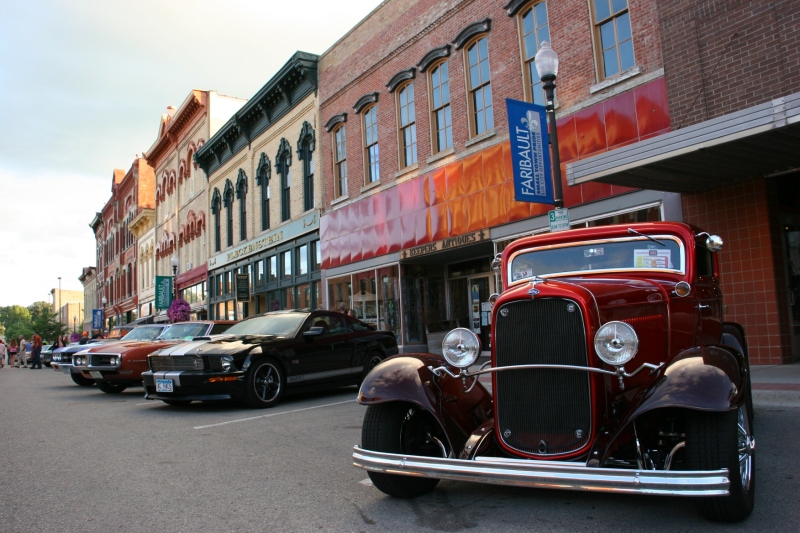
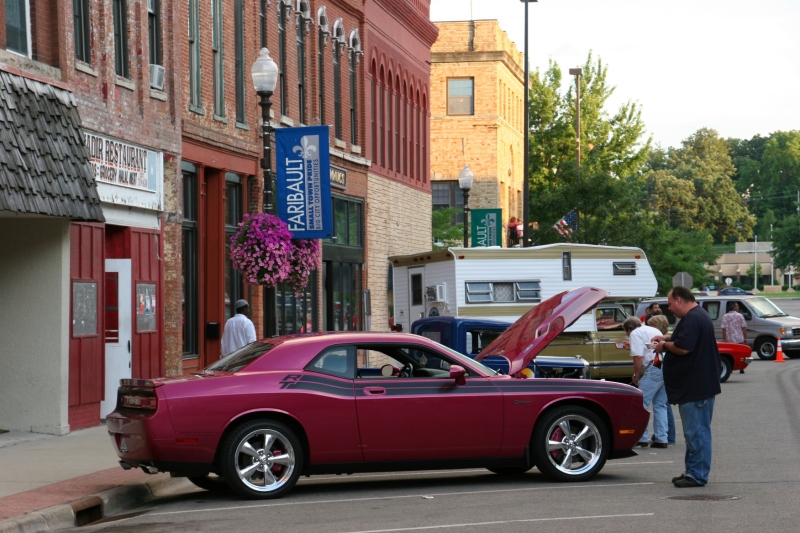
Buildings on the National Register of Historic Places provide the backdrop for vintage vehicles during Faribault’s Car Cruise Night on July 15.
SO MUCH ABOUT FARIBAULT DOWNTOWN Car Cruise Nights appeals to me. Certainly the vehicles draw my interest from an artistic, photographic and historical perspective. The opportunity, too, to mingle and visit also appeals to me.

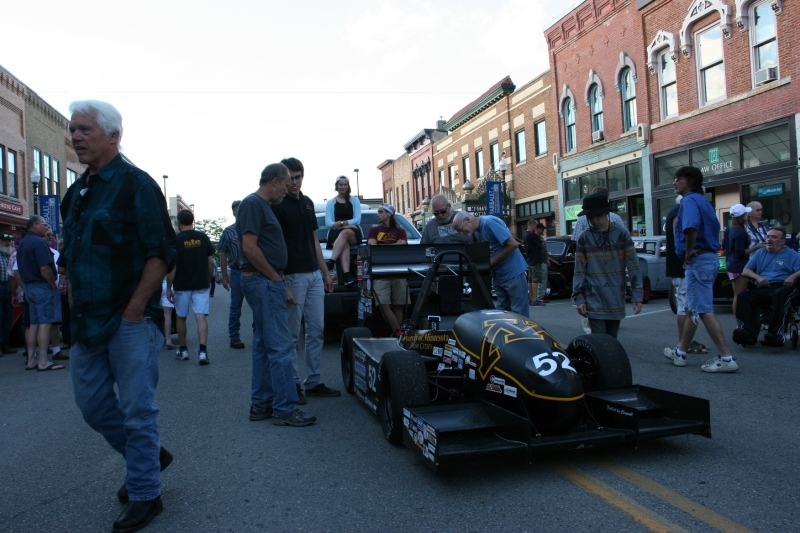
The University of Minnesota Gopher Motorsports team brought their global Formula SAE series race car to cruise night .

The University of Minnesota Gopher Motorsports team brought its global Formula SAE series race car to cruise night and parked it in the 300 block of Central Avenue’s historic district.

But one other aspect imprints upon me every single time I attend this monthly summer event. That’s the historic setting. Aged buildings in the 5 x 2 1/2 block Faribault Commercial Historic District provide a lovely backdrop to the many vintage vehicles that roll onto Central Avenue.

Lovely old buildings in the 300 block house places like a cheese shop and a cakery.

Lovely old buildings in the 300 block house places like a cheese shop and a cakery. My eldest daughter’s wedding reception was held several years ago in The Loft, a second floor event rental space in the Bachrach Building (with the arched windows).

As a photographer, I am always cognizant of light and background, of angle and perspective, of composition and subject. Thus, I notice the primarily brick buildings that rise stories above the street, casting deep shadows as dusk settles.

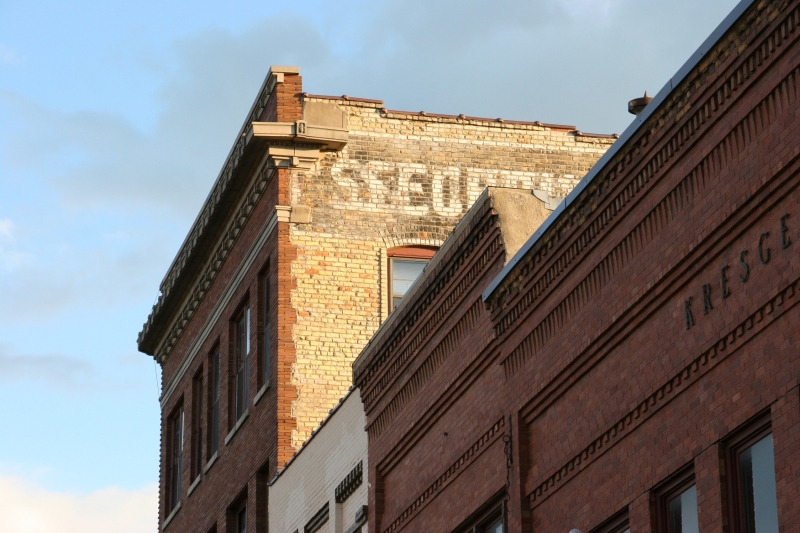
I appreciate the faded lettering on the former Security Bank building.

Details on buildings along the west side of the 300 block of Central Avenue.

Sometimes I just stand in the middle of Central and look upward toward the arched windows, the ornate roof lines, the fading letters that mark long ago businesses and wonder about yesteryear. I think about the tailors and harnessmakers, the shoemakers, the purveyors of dry goods, books and stationery…

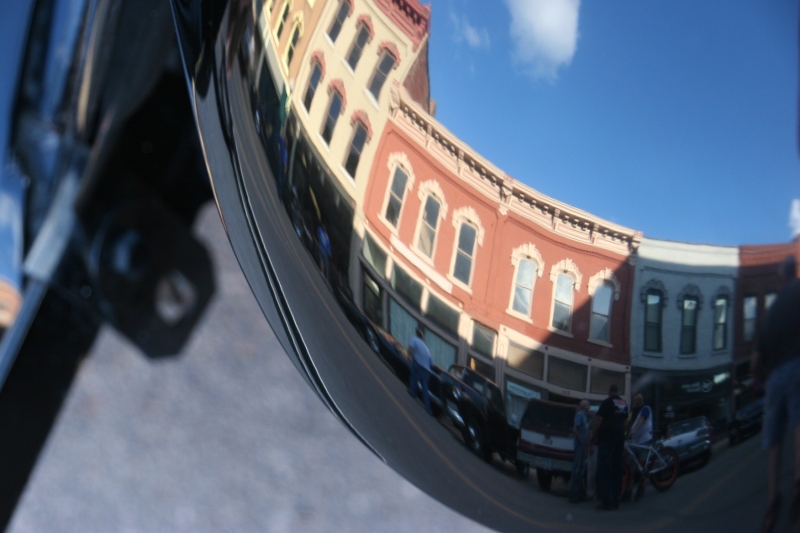
Historic buildings reflected in a polished vehicle at Car Cruise Night.

Historic buildings reflected in a polished vehicle at Car Cruise Night.

I am grateful that my community had the foresight to preserve these stalwart buildings of the 1870s and 1880s rather than tear them down. I am grateful for the existence of the Faribault Heritage Preservation Commission. I appreciate my downtown.

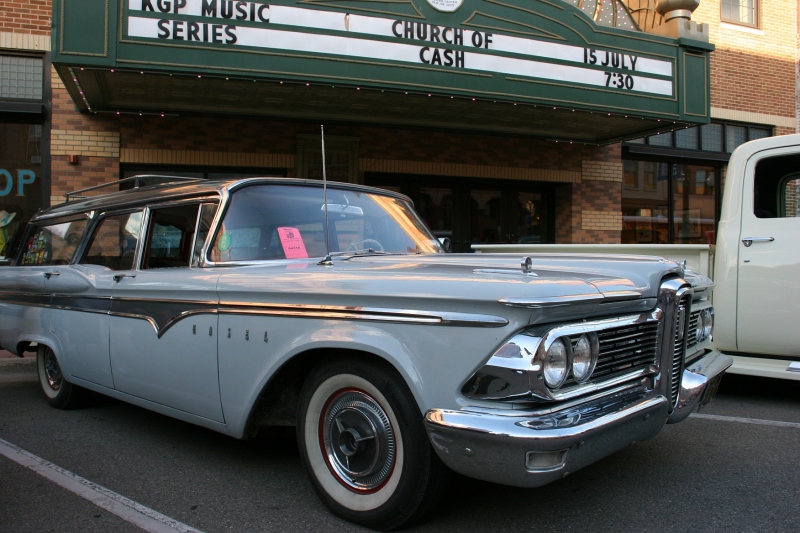
A 1959 Edsel Village Wagon is parked in front of the Paradise Center for the Arts with its restored marquee.

A 1959 Edsel Village Wagon is parked in front of the Paradise Center for the Arts with its recreated marquee.

Faribault is uniquely geographically positioned off Interstate 35 within an hour of the Twin Cities metro to draw visitors. Minnesota State Highway 60 also passes right through the heart of town. I’m sensing that more people are finally discovering this place I’ve called home for some 30 years. Newer businesses like a cheese shop, brewery and cakerya thriving arts center; and more are bringing people into our historic downtown.

This emblem tops a trophy to be awarded August 19 at the Car Club Show Down.

This emblem tops a homemade over-sized trophy to be awarded August 19 at the Car Club Show Down.

I’d like to see, though, a shift in local attitudes. While many residents appreciate and value downtown Faribault, we need to grow more local pride. Events like Car Cruise Night and the upcoming Blue Collar BBQ & Arts Festival (on August 13) get residents involved and foster a sense of community.

pawn

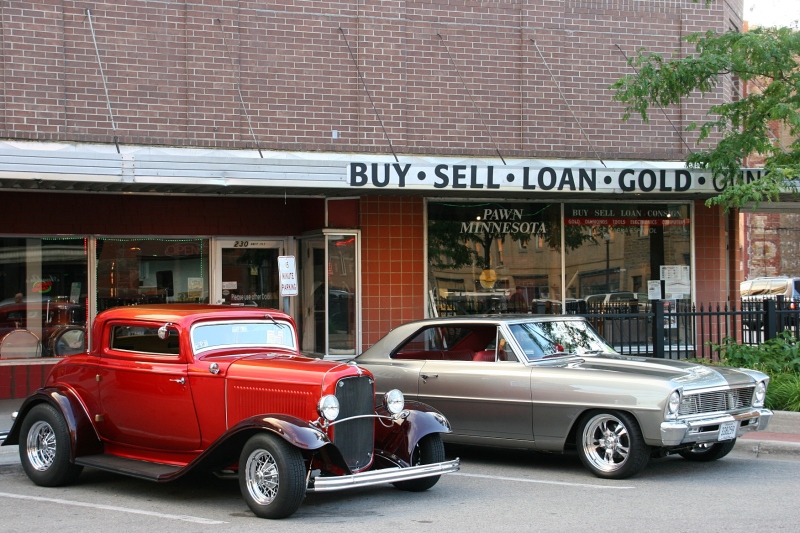
The building behind the cars (230 Central) is listed on documents as the Masonic Building, built in 1875. Pawn Minnesota once housed Poirier Drug Store. In 1993, Warner Brothers filmed a scene in the drug store for the movie Grumpy Old Men starring Walter Matthau and Jack Lemmon.

As someone who grew up 120 miles away to the west in a small town founded nearly 50 years after Faribault, I deeply appreciate Faribault’s historic downtown. My hometown of Vesta is devoid of old buildings, the one-block Main Street now mostly vacant lots. Faribault has dozens of places throughout the community on the National Register of Historic Places, including the 200 block of Central Avenue. Those historic buildings are an enviable asset.

Collector vehicles pop color and history into the

Collector vehicles pop color and history into Faribault’s downtown.

When I attend events like Car Cruise Night, I take notice of my surroundings. Not just the collector vehicles. But the historic setting that showcases them. And I realize how valuable this downtown is to this city.

BONUS PHOTOS:

The Drag-On's Car Club brings together local car enthusiasts.

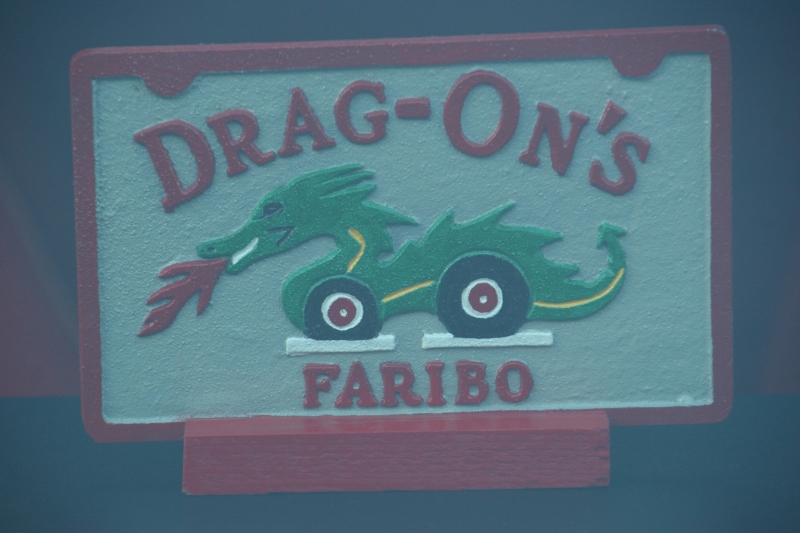
The Faribault Drag-On’s Car Club, established in 1987, brings together local car enthusiasts. This sign was posted inside a vehicle at Car Cruise Night.

Pride reflected in the polished

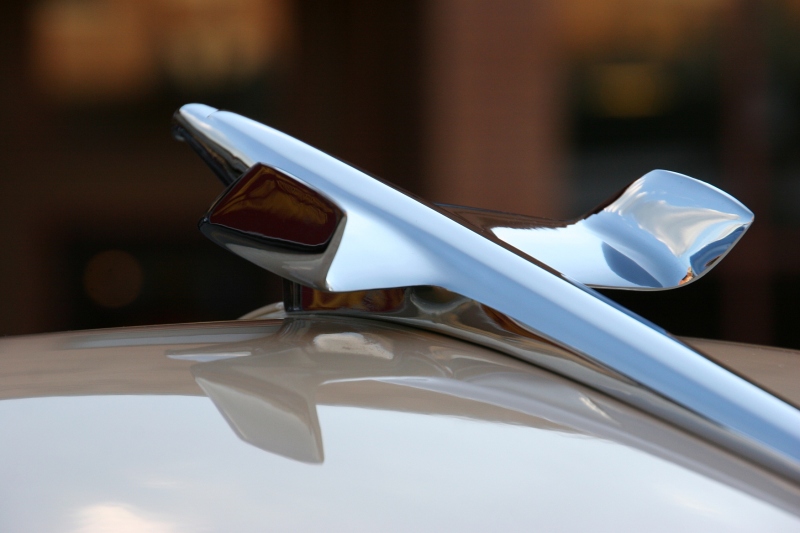
Pride reflected in the polished finish of car and hood ornament.

This unique vehicle drew lots of interest at the July 15 Car Cruise Night.

This unique vehicle, parked in front of the Paradise Center for the Arts, drew lots of interest at the July 15 Car Cruise Night.

The sleek lines of a jetliner hood ornament drew my artistic attention.

The sleek lines of a jetliner hood ornament drew my artistic attention.

A multitude of messages in a vehicle window caused me to pause.

A multitude of messages in a vehicle window caused me to pause.

The Dodge Super Bee with the bee theme going on drew my interest.

The Dodge Super Bee with the bee theme going on drew my interest. This was parked in the 200 block of Faribault’s historic downtown Central Avenue.

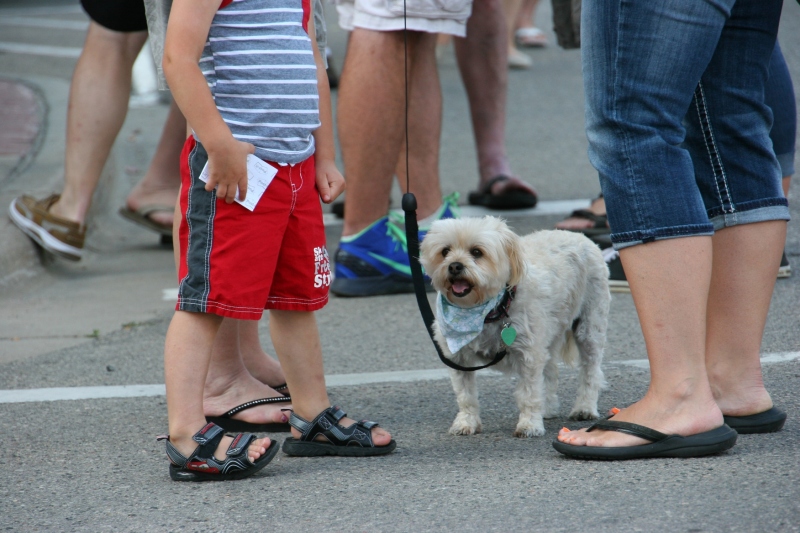
Faribault Downtown Car Cruise Nights draw all ages and some dogs, too. I'd like to see some family-oriented events added, perhaps a scavenger hunt that focuses on the historic building exteriors.

Faribault Downtown Car Cruise Nights draw all ages and some dogs, too. I’d like to see family-oriented events added, perhaps a scavenger hunt that focuses on the historic buildings.

Some buildings in the historic commercial district

Some buildings in the historic commercial district have not yet been fully restored.

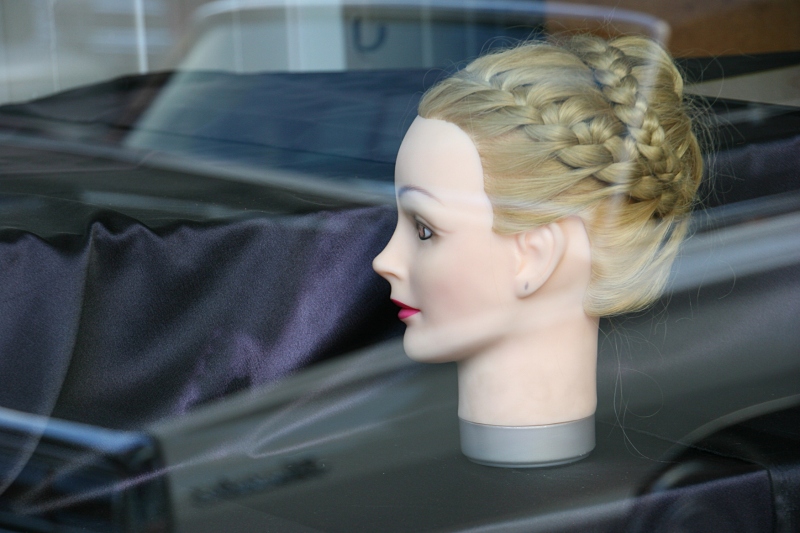
While photographing vehicles, I noticed the truck reflection in the storefront window of a hair salon.

While photographing vehicles, I noticed the truck reflection in the storefront window of a hair salon with this simple artsy display.

FYI: This concludes my three-part series on the July 15 Faribault Downtown Car Cruise Night. Click here to see my first post and here to read my second in this series.

© Copyright 2016 Audrey Kletscher Helbling