Minnesota Prairie Roots

Writing and photography by Audrey Kletscher Helbling
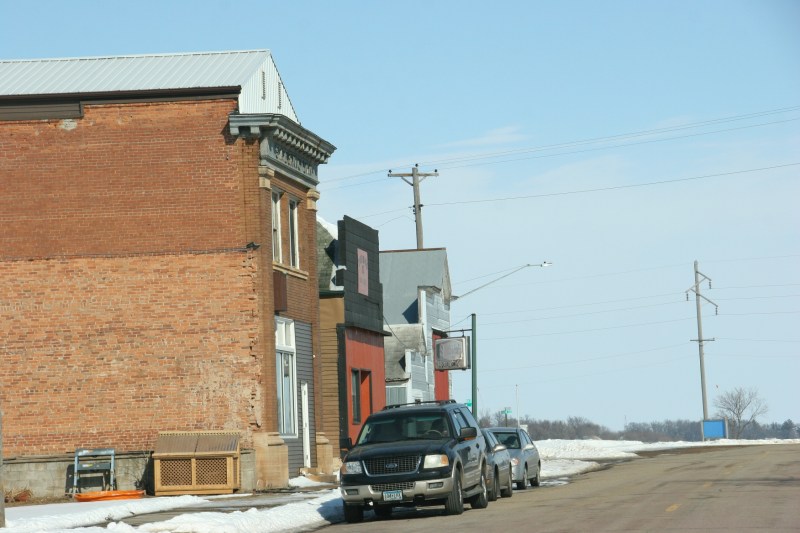
Evan, like so many small southwestern Minnesota towns, is fading into the prairie March 19, 2018

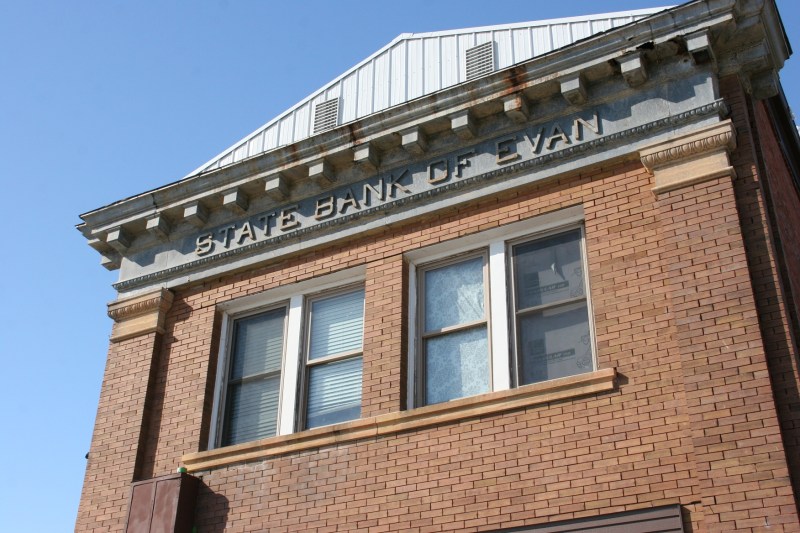
Downtown Evan today anchored by a former bank building.


LIKE SO MANY OTHER SMALL TOWNS on the southwestern Minnesota prairie, Evan once boasted a long list of businesses—creamery, bank, two general stores, hardware store, lumberyard, blacksmith shop, stock dealer, garage, implement dealer, three elevators, restaurant, utility company, library and two churches.


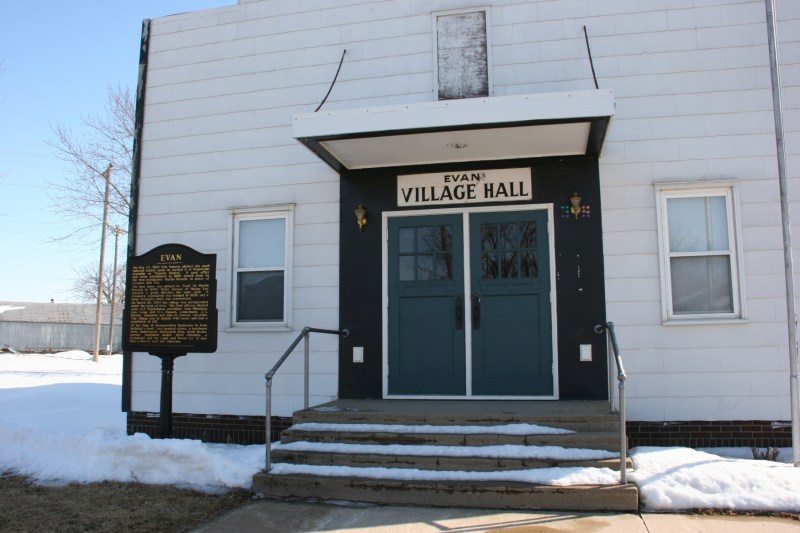
Evan, incorporated in 1904, is named after Eva Hanson, married to Nels. He platted the railroad station known as Hanson Station several years earlier.


So claims the historical marker fronting the village hall in this Brown County community of around 80 residents.


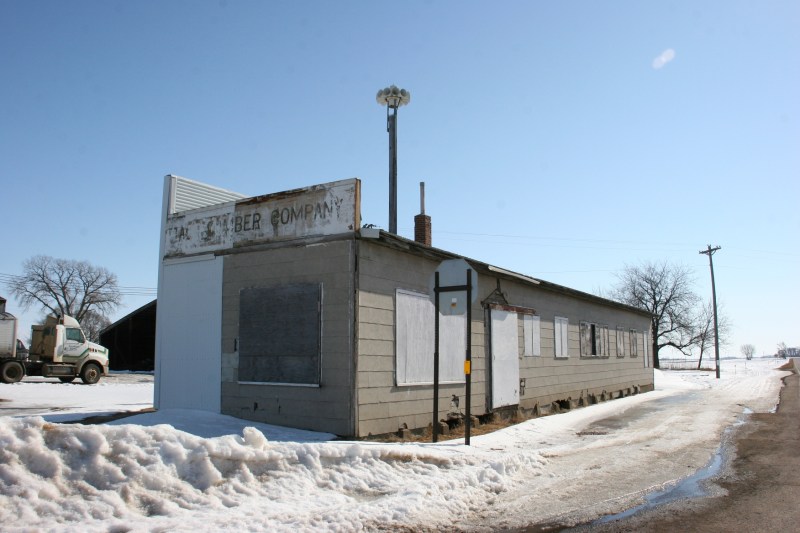
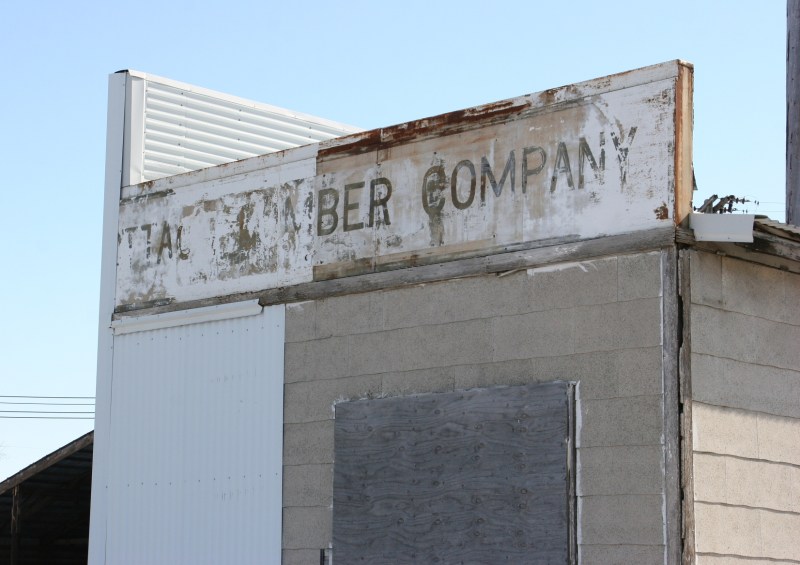
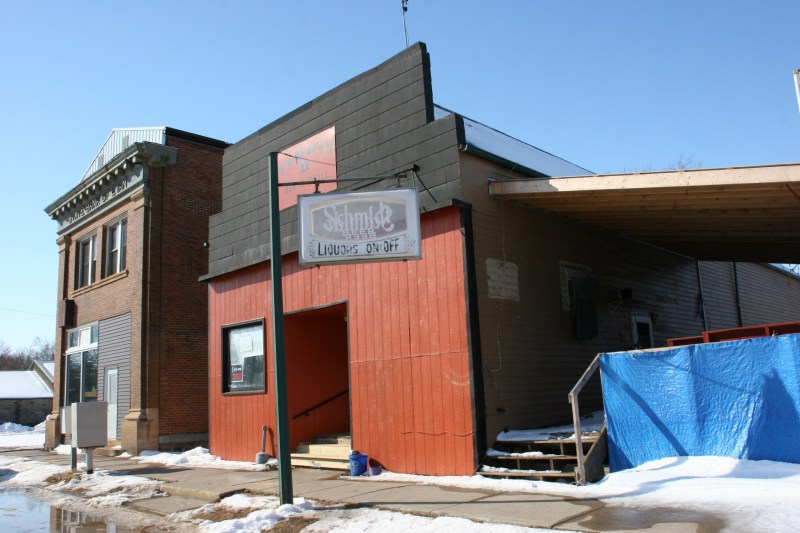
Fading signage identifies this as the former lumberyard.


Today only remnants of those original businesses remain.


I believe the brick building may be the former creamery.


On a recent drive through Evan, I noted the decline.


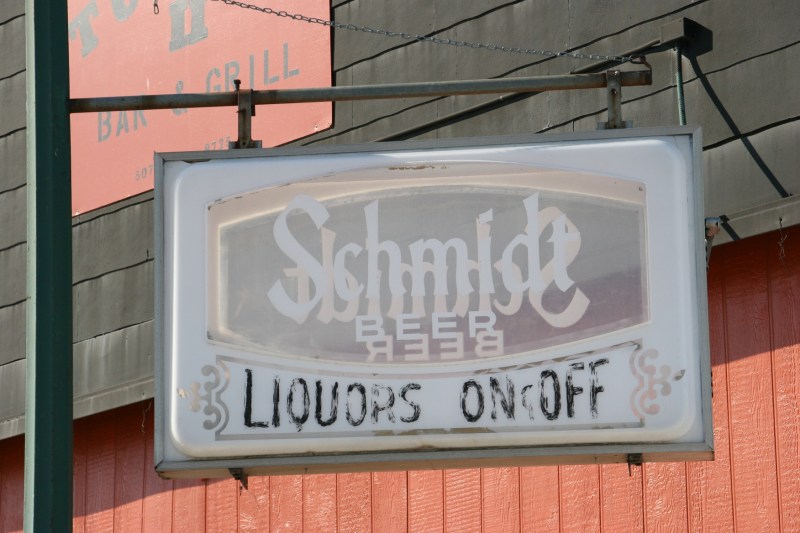
This vintage sign hangs outside Tubby’s II Bar & Grill. A sign in the window noted the bar is closed for the winter.


Faded signs.


Boarded windows.


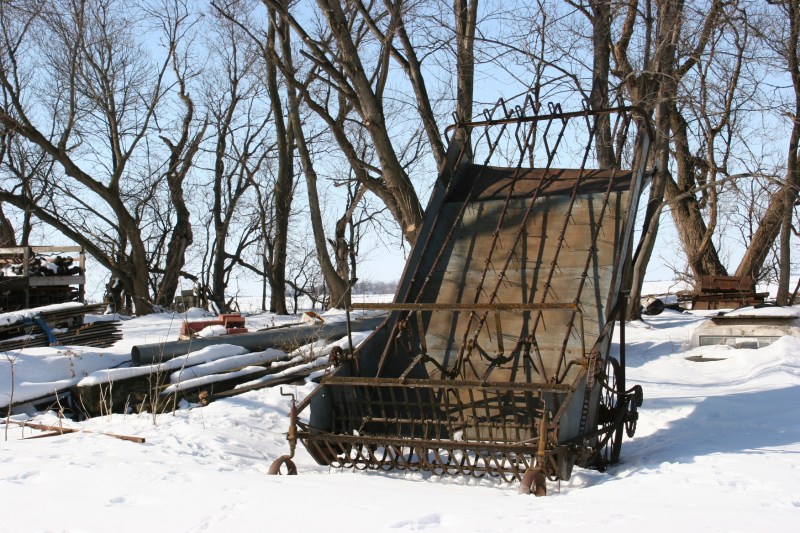
This vintage hay loader rested among other junk.


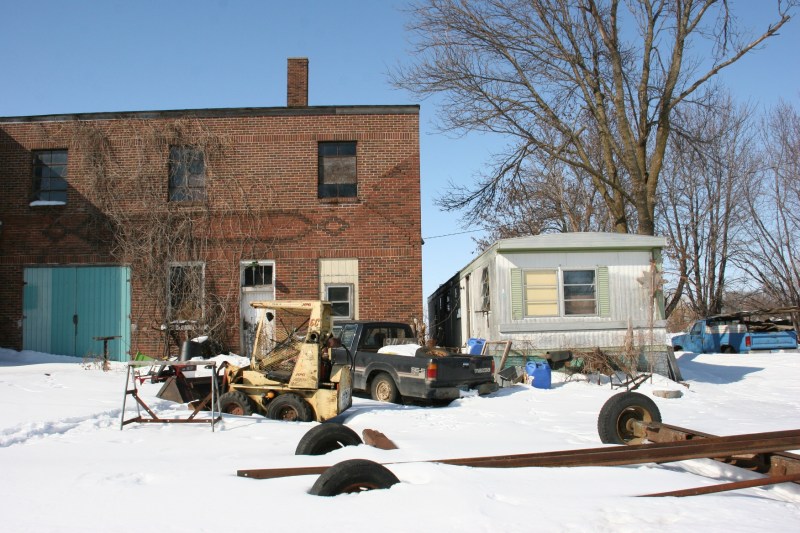
Clustered junk.


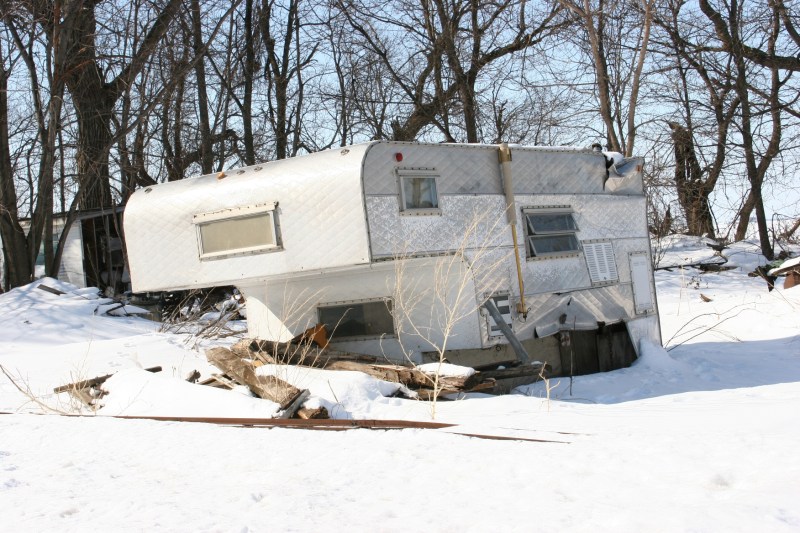
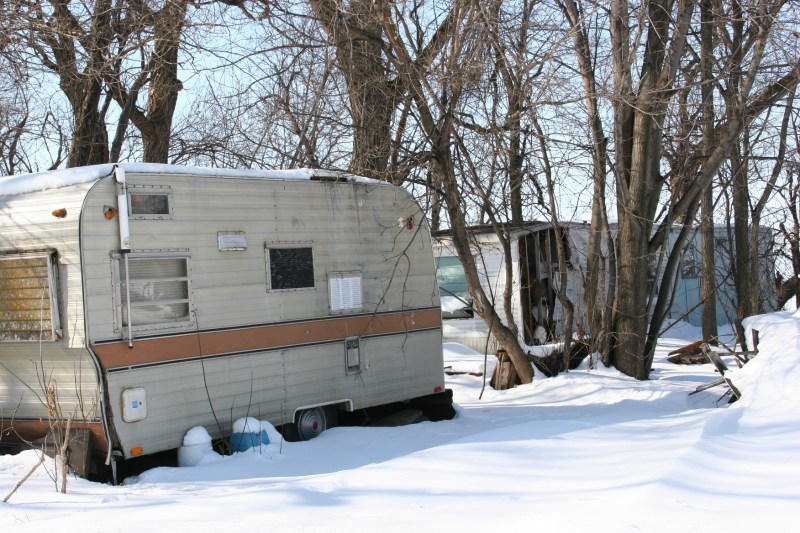
I’ve never seen anything like this graveyard of campers and trailers.


Abandoned campers and trailers and trucks. It made me sad, just sad, to see the abandonment.


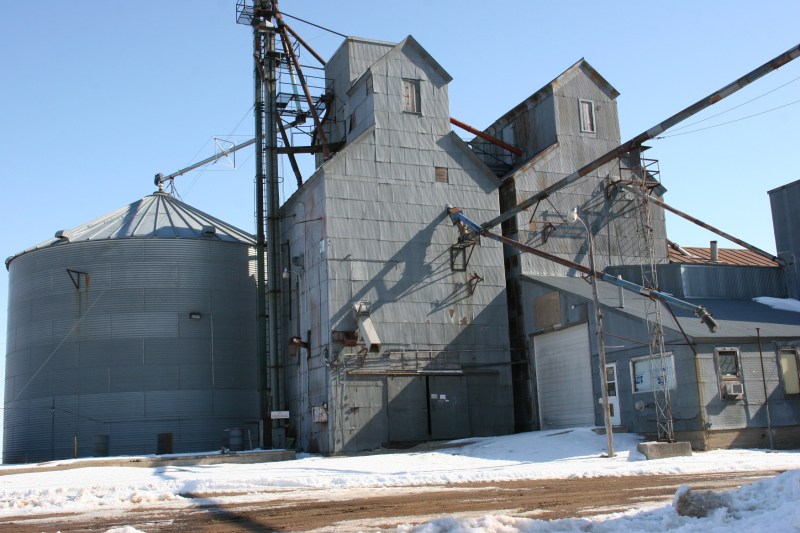
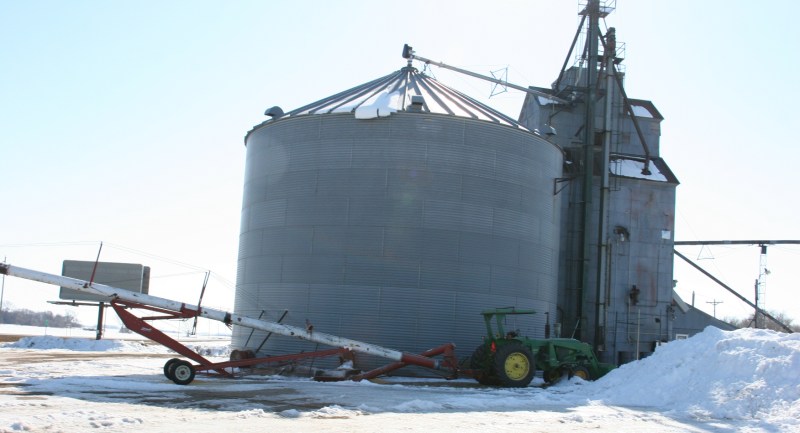
The old grain elevators still stand on the edge of town along the highway.


But none of this surprises me. It’s our fault really. We are a much more mobile society, a society much different than back-in-the-day or even 20 years ago. At one time, places like Evan thrived as area farmers and locals kept their business local. Today regional shopping centers pull in customers from all those small towns.


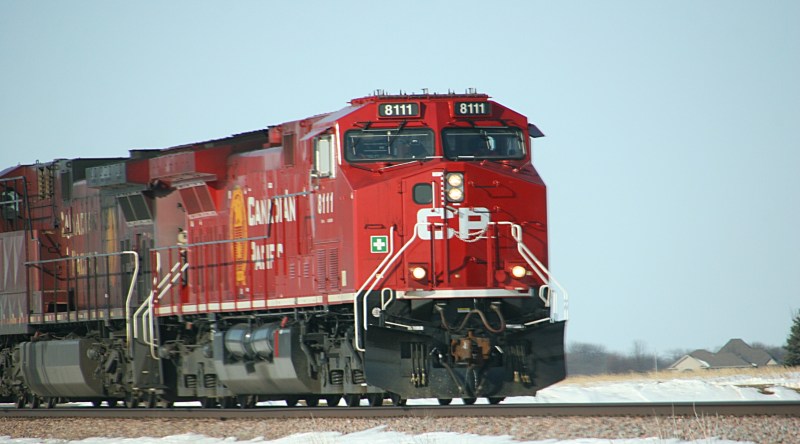
The train still runs, not through Evan, but through neighboring Sleepy Eye.


The railroad left.


Without jobs, with our farmer fathers still farming, many from my generation of Baby Boomers left Minnesota’s small towns. We couldn’t bank on a future in our rural hometowns.


Attitudes changed. Kids from my generation left for college and bigger cities and better opportunities. There’s nothing wrong with that desire to see the world, to become something other than our parents. But in doing so we added to the demise of many a small town. I am hard-pressed to think of many classmates who stayed in my hometown of Vesta 45 minutes from Evan to the north and west. Vesta, too, is a shell of the community it was when I grew up there in the 1960s and 1970s.


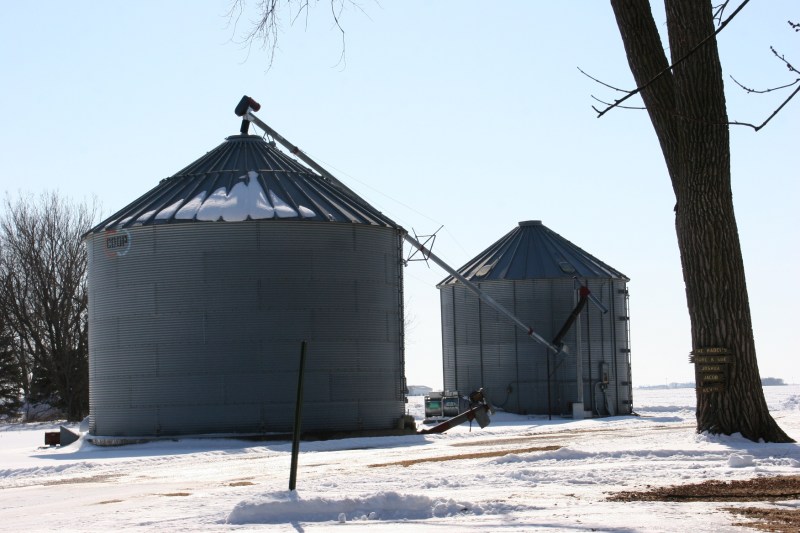
Grain bins on opposite ends of town mark this as a farming community still today.


I don’t pretend to know the intricacies of Evan’s decline except an overall understanding of why once thriving towns now are mere ghosts of their pasts. Certainly Evan’s remote rural location factors into the mix. Located along Minnesota State Highway 68, Evan is easy to bypass on the shortcut route between Sleepy Eye and Morgan.


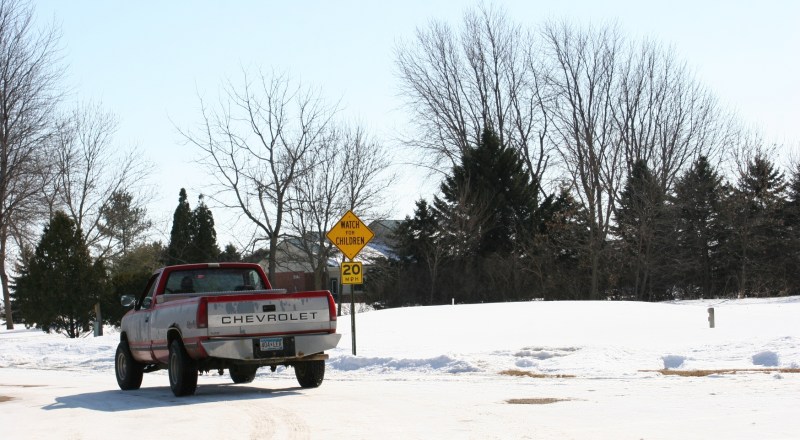
The only person or moving vehicle I saw in Evan during my short stop there.


Yet, Evan is home for some. I saw newer homes there. Not new as in recent, but newer than old. I saw a lovely church and that well-kept village hall. And grain bins. And the fading letters on the lumberyard, a visual reminder that at one time a demand for building supplies existed in a farming community that once prospered.

© Copyright 2018 Audrey Kletscher Helbling
 

Bringing poetry to the people in Mankato & I’m in January 19, 2018


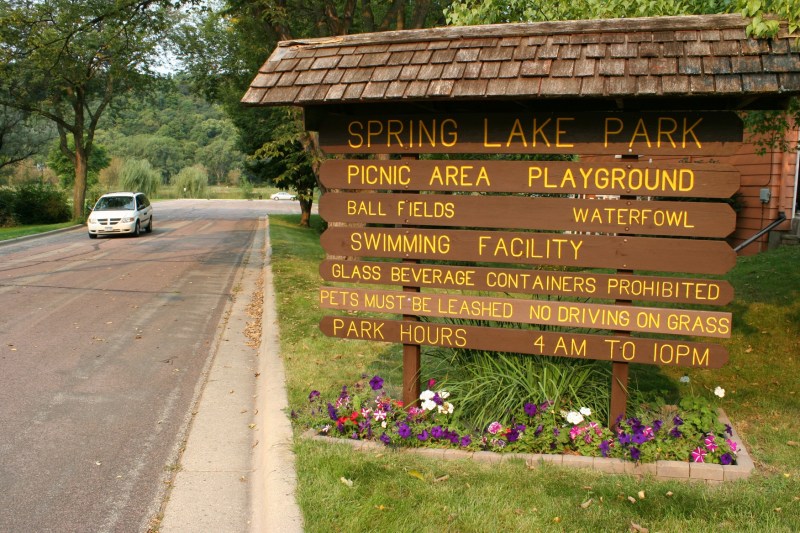
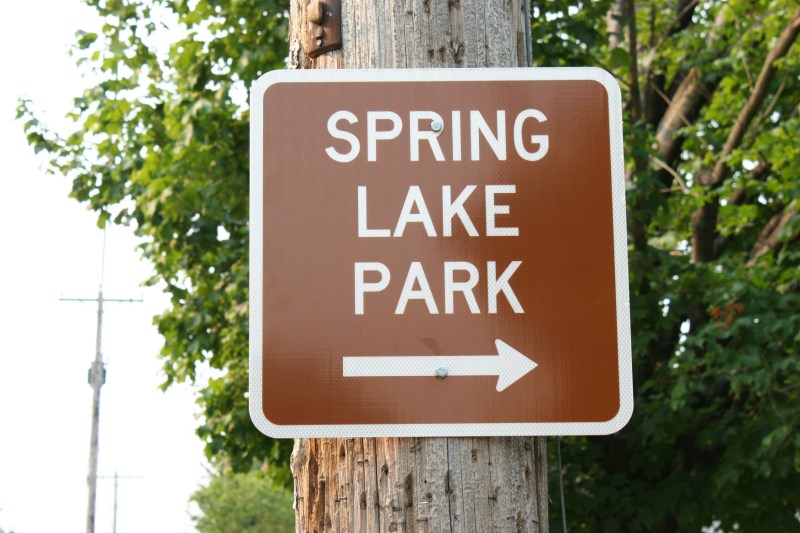
NEARLY SIX MONTHS have passed since I stopped at Spring Lake Park in North Mankato to view my poem posted there as part of the Mankato Poetry Walk & Ride.


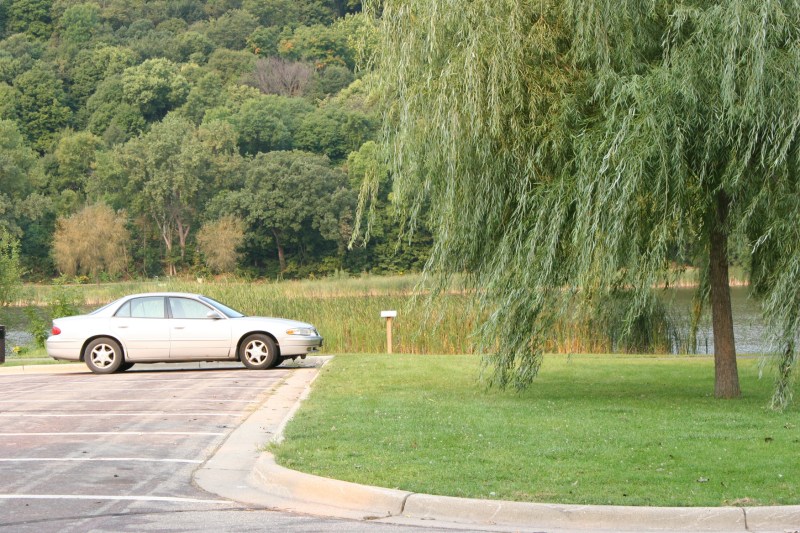
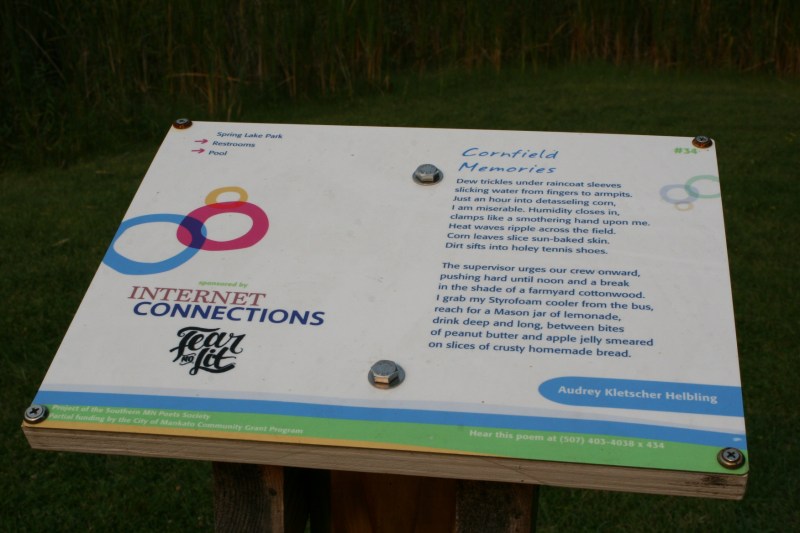
The post just to the front left of the car holds a sign with my poem printed thereon.


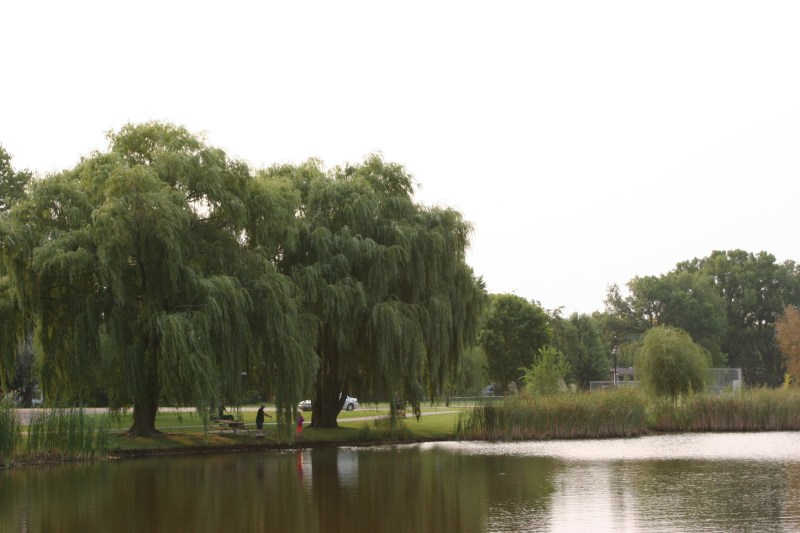
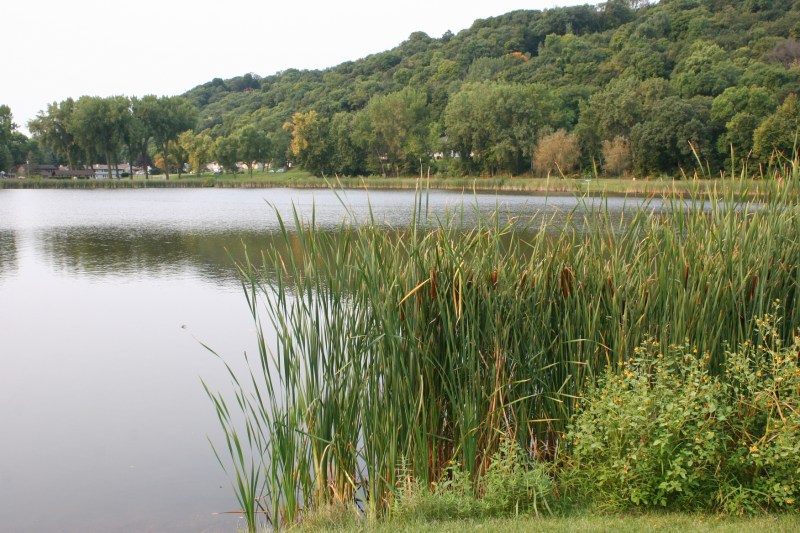
Looking back across the lake toward the willows and my nearby poetry sign.


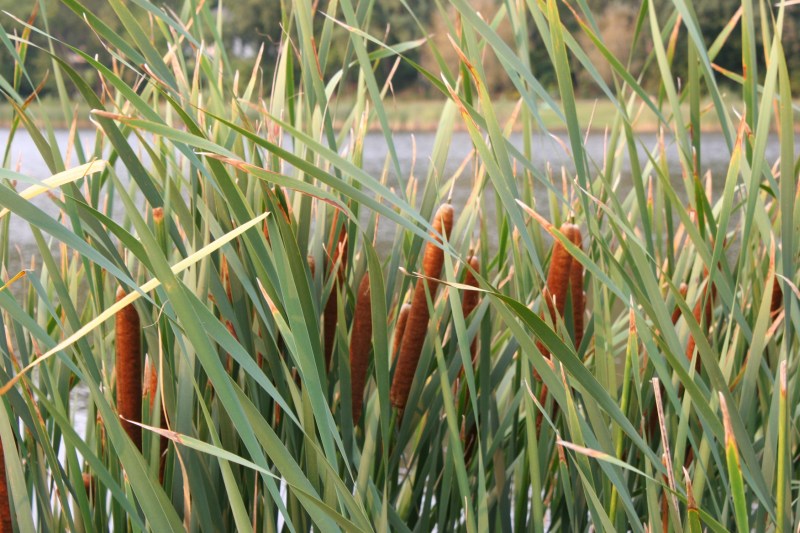
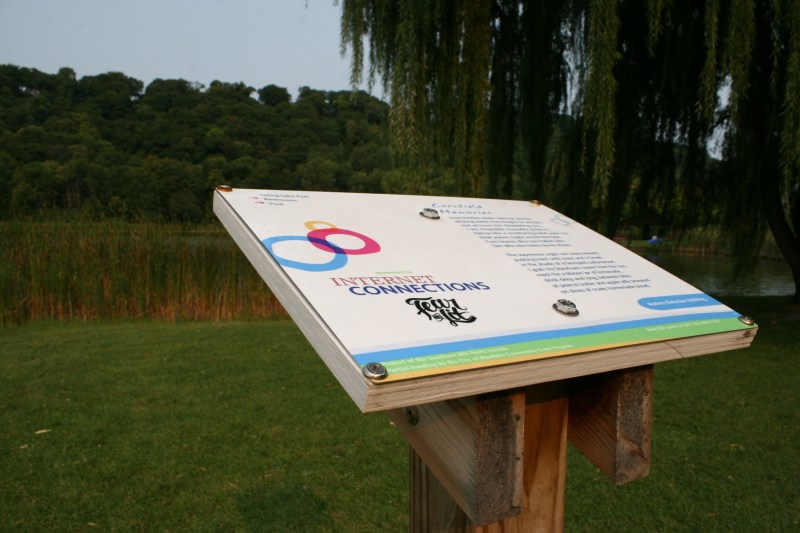
Located at the edge of a parking lot next to a trail and within a stone’s throw of drooping weeping willows, my award-winning poem about detasseling corn contrasts with the tranquil setting of lake and lawn separated by bullrushes flagged by cattails.


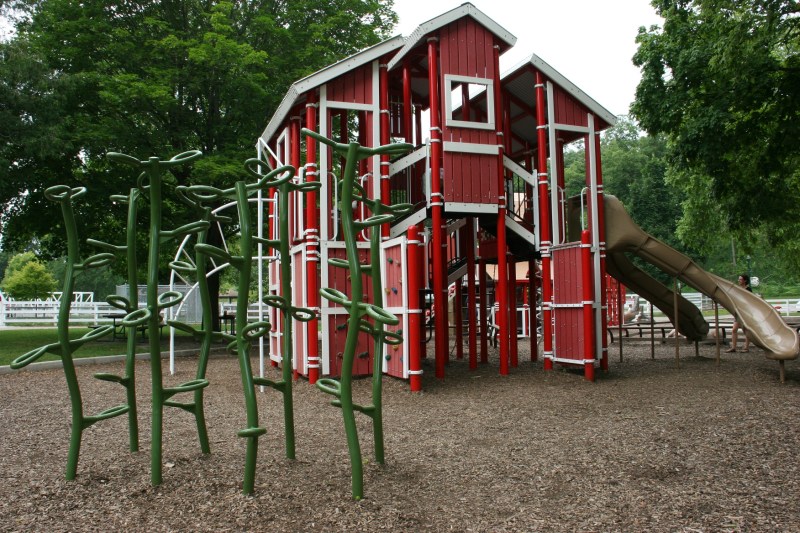
The Sibley Farm playground inside Sibley Park features these cornstalk climbing apparatus. Minnesota Prairie Roots file photo.


The poem may have been more appropriately placed next to cornstalk climbing apparatus at the Sibley Farm playground in Mankato’s Sibley Park.


A beautiful setting for poetry.


Still, I am grateful for this opportunity to get my poetry out there in a public place. This placement of selected poems along recreational trails and in parks in Mankato and North Mankato brings poetry to people in an approachable and everyday way. That is the beauty of this project—the accessibility, the exposure in outdoor spaces, the flawless weaving of words into the landscape.


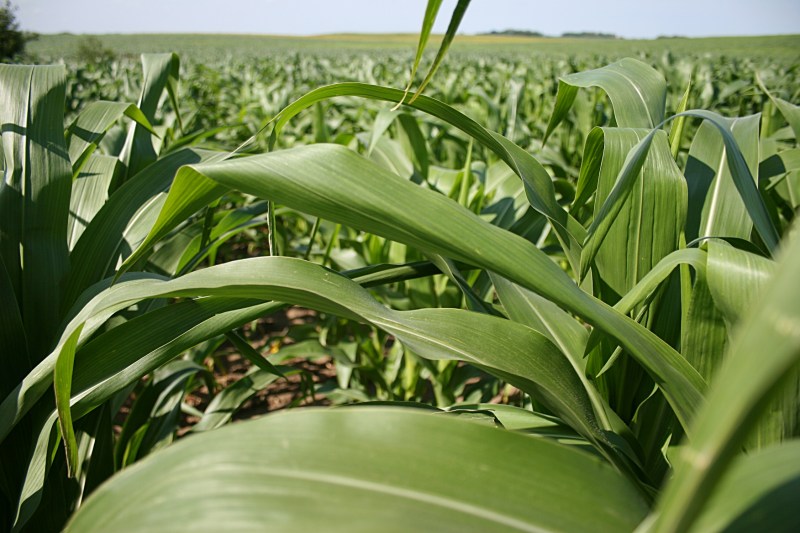
Inside a southern Minnesota cornfield. Minnesota Prairie Roots file photo.


My poem, as with much of my writing, reflects a strong sense of place. In Cornfield Memories, I take the reader into a southwestern Minnesota cornfield to experience detasseling corn, a job I worked several summers as a teenager. It’s hard work yanking tassels from corn stalks in the dew of the morning and then in the scorching sun of a July afternoon. All for $1.25/ hour back in the day.


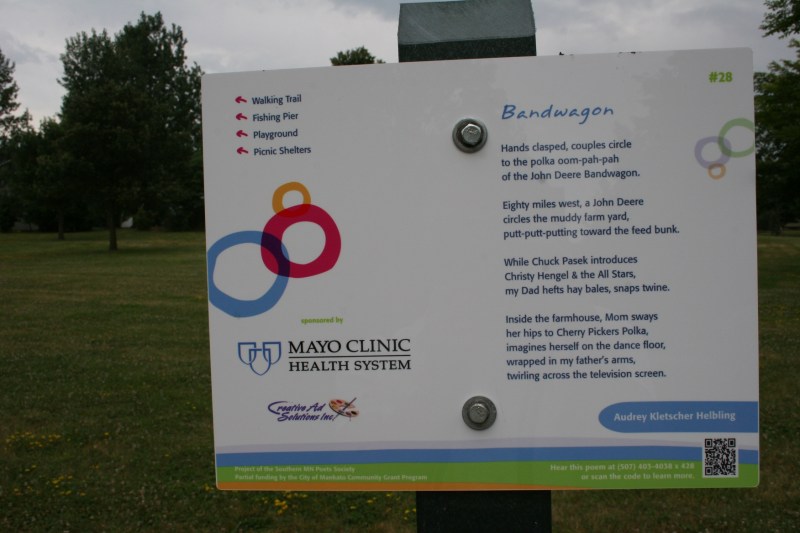
My poem, Bandwagon, previously posted at Lion’s Park in Mankato as part of a previous Mankato Poetry Walk & Ride. Minnesota Prairie Roots file photo 2014.


My poem shares rural history, a story, an experience. Just as my past poems—The Thrill of Vertical, Off to Mankato to “get an education” and Bandwagon—selected as part of previous Mankato Poetry Walk & Ride contests did.


I value public art projects like the Mankato Poetry Walk & Ride. Not only as a poet, but as an appreciator of the literary arts. Poetry doesn’t need to be stuffy and mysterious. And this project proves that.

I’D LIKE TO HEAR your thoughts on bringing poetry to the public in creative ways like this. Have you seen a similar project? Would you stop to read poems posted in public spots?

NOTE: All photos were taken in early September, within weeks of the 2017 Poetry Walk & Ride poems being posted.

© Copyright 2018 Audrey Kletscher Helbling


A last-look photo essay from a Minnesota steam & gas engines show, Part V September 13, 2017

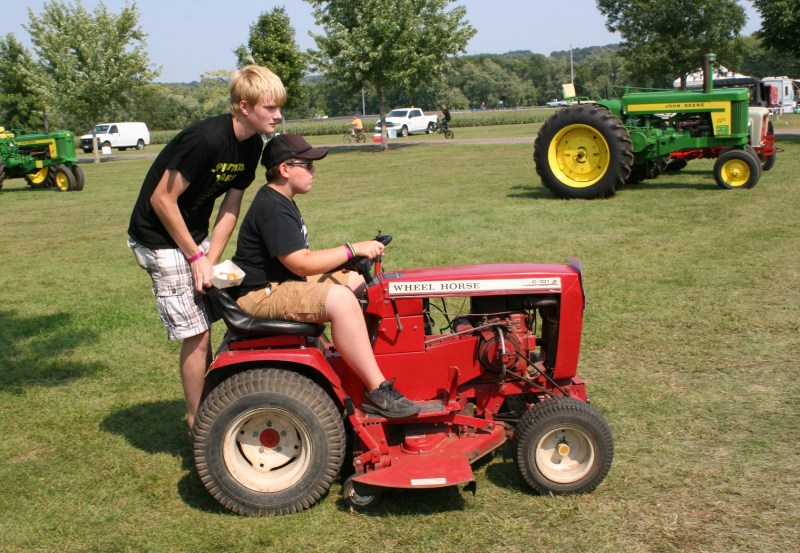
IT’S ALL ABOUT the vintage tractors for many participants and attendees:


For others, the flea market is the main draw:


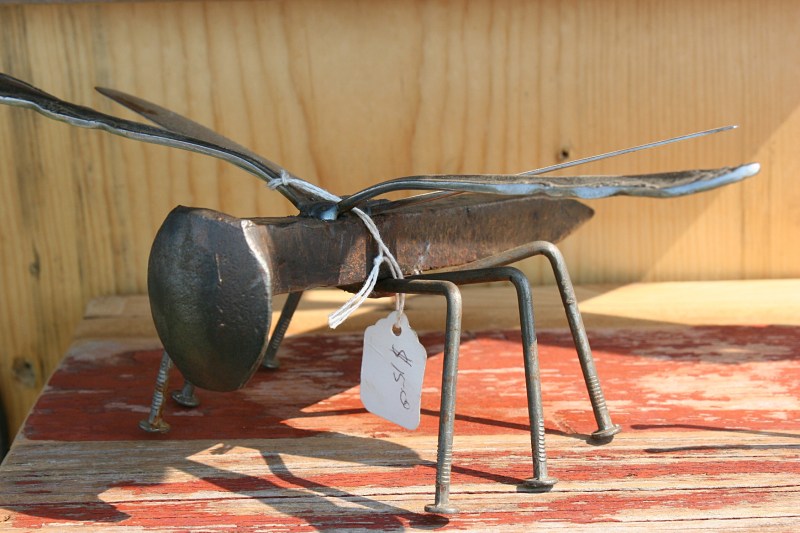
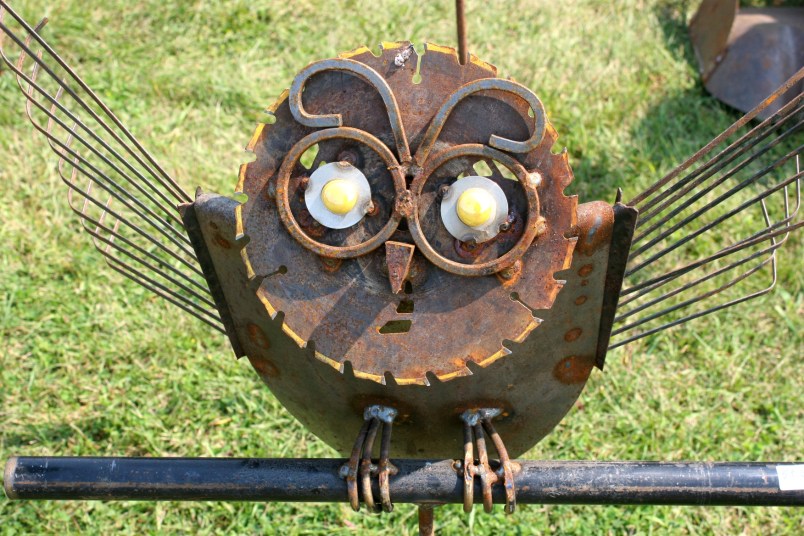
Larry and Nicholas Ahrens of The Brown Barn Works craft garden art from scrap metal and more.


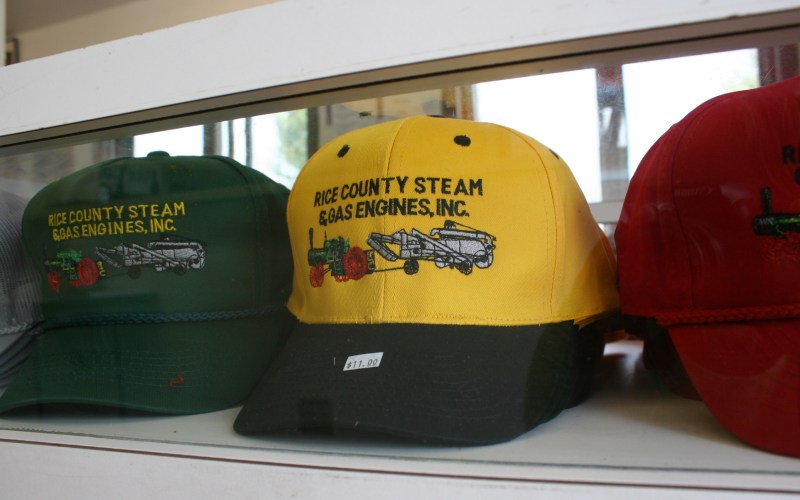
New caps are sold by the Rice County Steam & Gas Engines Show.


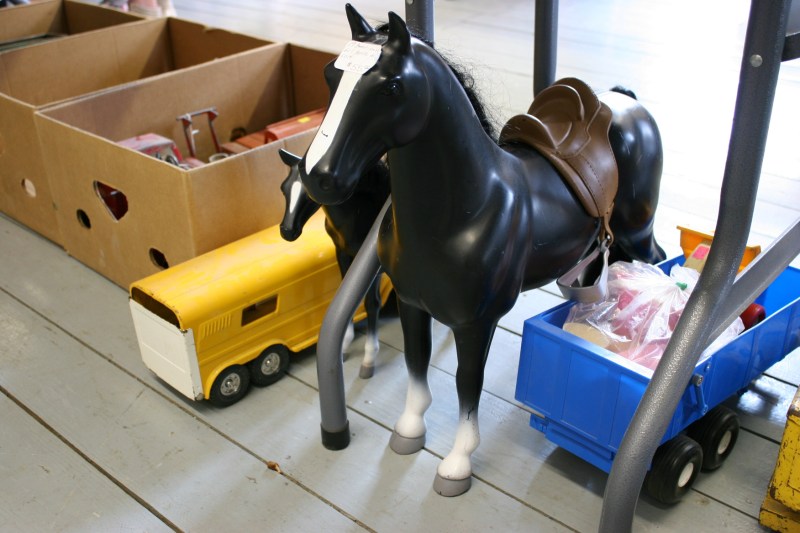
Under a vendors’ table, I spotted these horses and other merchandise.


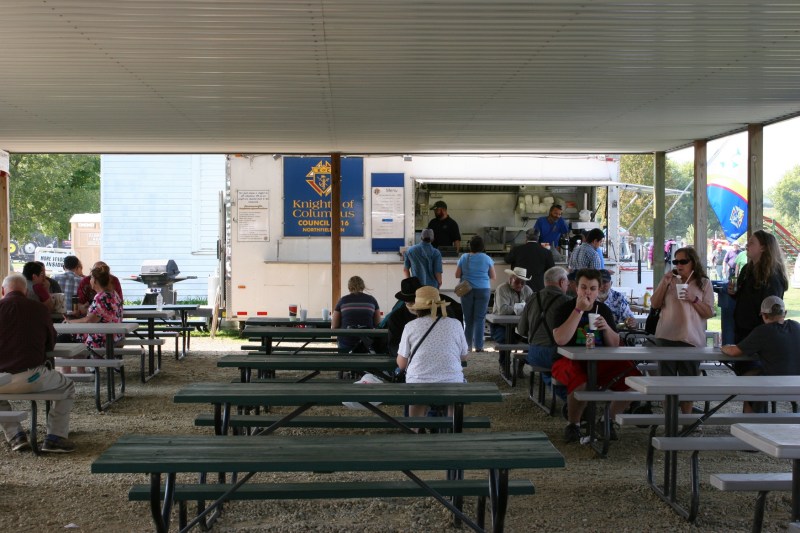
People have to eat. You’ll always find something tasty in the food court area:


Randy and I stopped for a mid-afternoon glass of freshly-squeezed lemonade. During the noon hour, this dining area is packed.


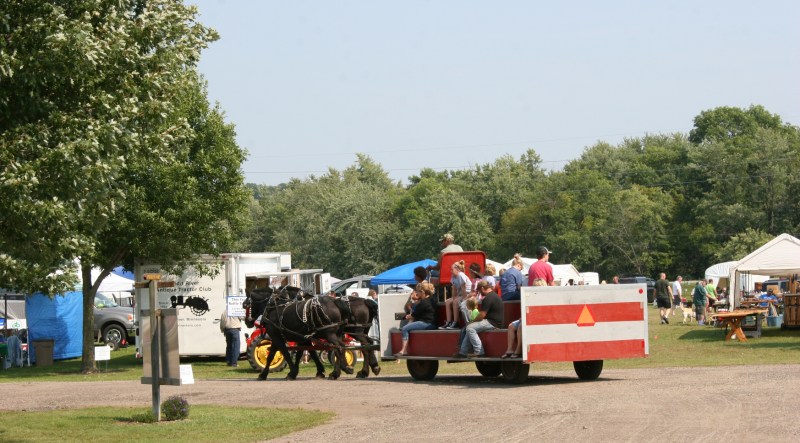
When feet tire, you can ride on this horse-drawn wagon or in a bring-your-own golf cart:


Old-time music draws attendees to the music barn:


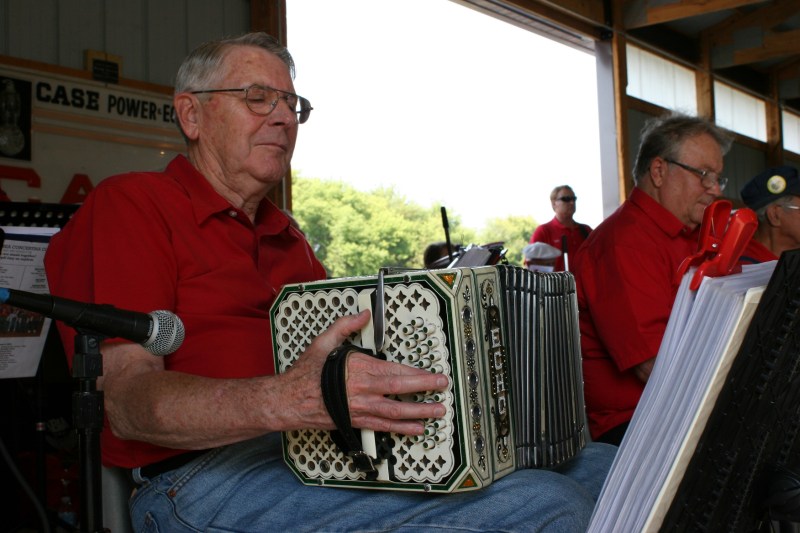
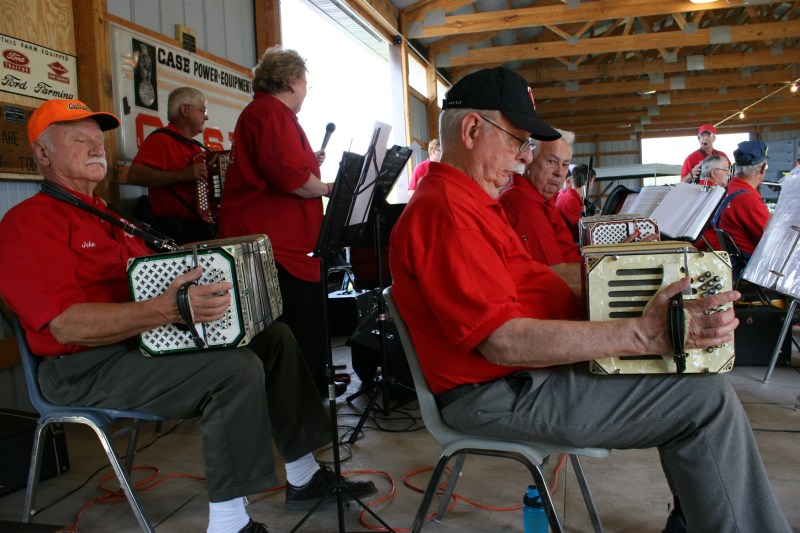
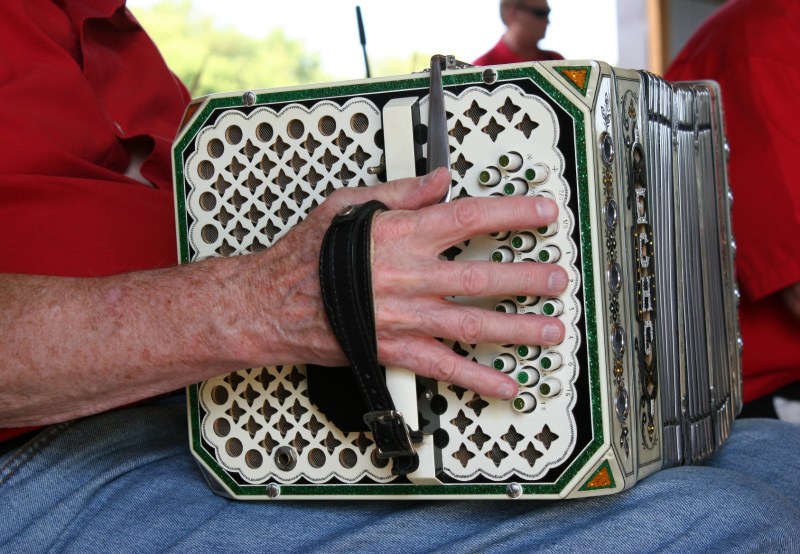
The Czech Area Concertina Club performs.


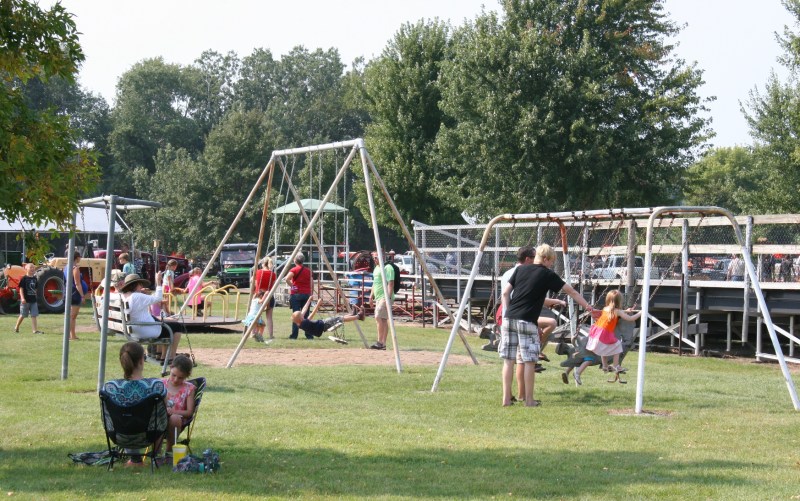
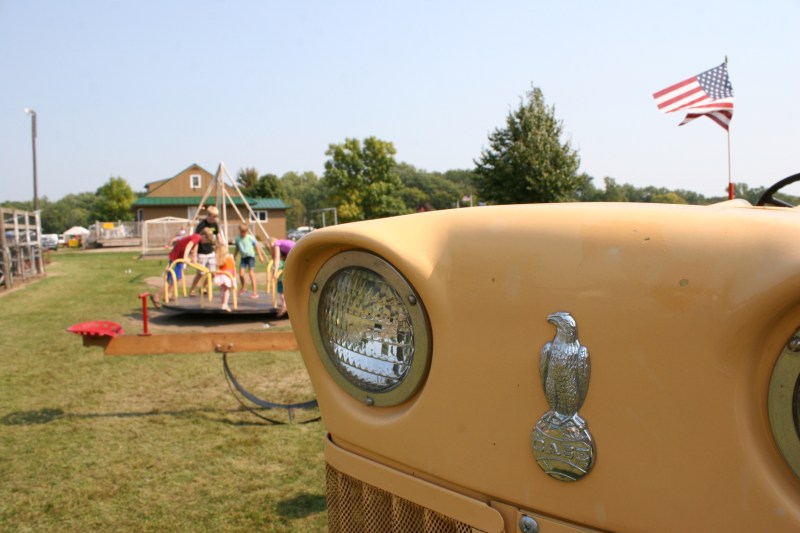
For kids (and some adults) the vintage playground equipment entertains:


A view of the merry-go-round in the background from the front of a vintage tractor. There’s a handcrafted seesaw (which Randy and I rode) in between.


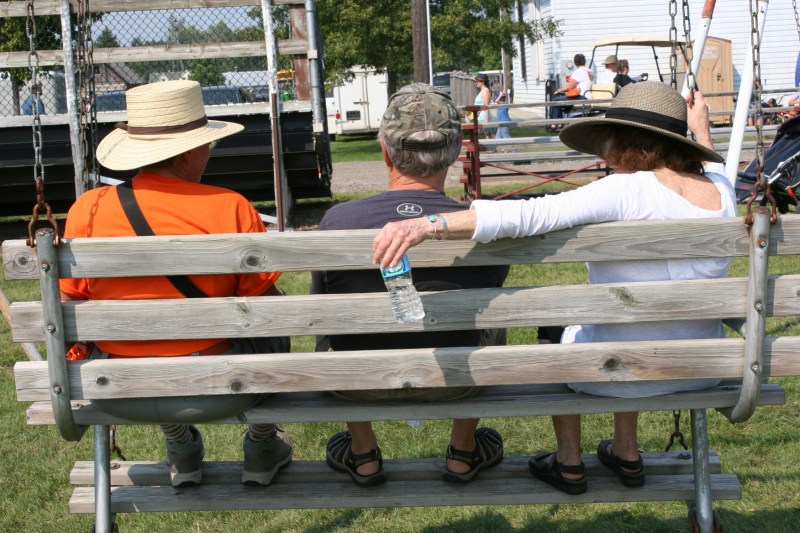
When you can’t keep up with the kids/grandkids at the playground, you just have to rest.


THE END:


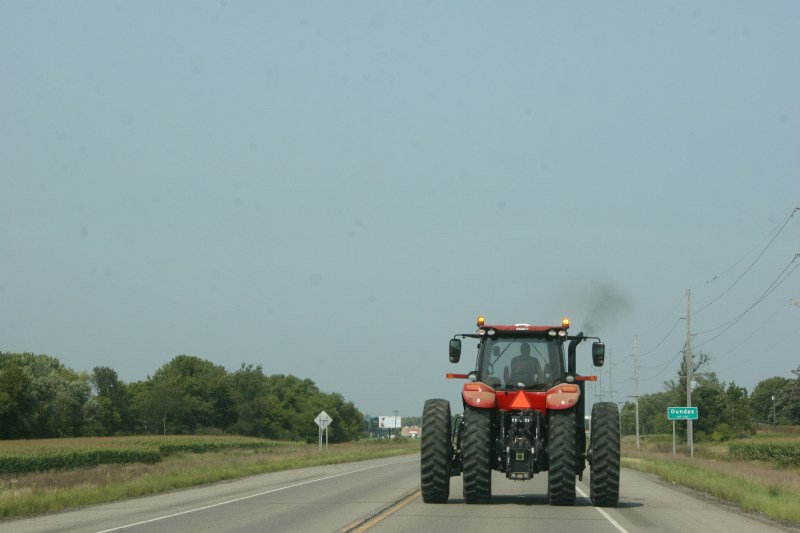
Randy and I followed this tractor off the show grounds northbound on Minnesota State Highway 3 toward Dundas.


© Copyright 2017 Audrey Kletscher Helbling

 

Discovering the arts at an historic Minnesota ag show, Part IV September 12, 2017

Filed under: Uncategorized — Audrey Kletscher Helbling @ 5:00 AM

Tags: , , , , , ,

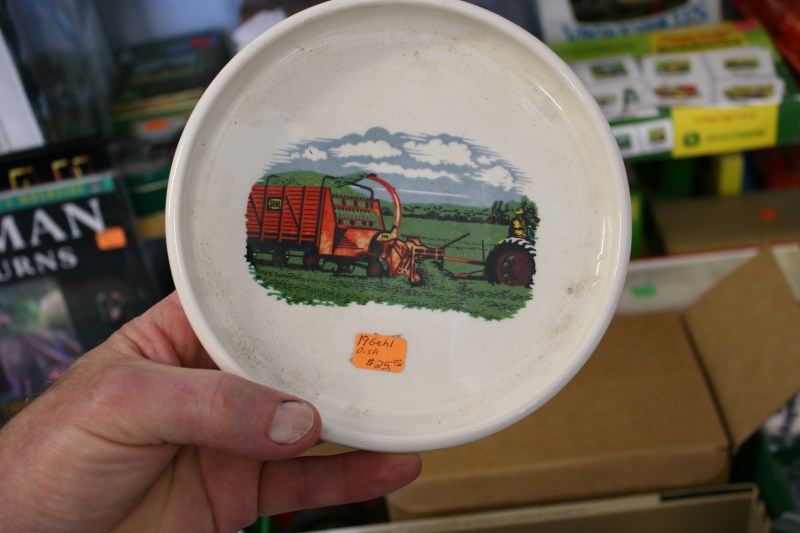
Farm art on a dish at the flea market.


AN EVENT FOCUSING on farming of bygone years might be the last place you would expect to experience the arts. But the biannual Rice County Steam & Gas Engines Show always showcases the arts through music, hands-on demos, flea market vendors and more. At least from my perspective.


The Czech Area Concertina Club performs.


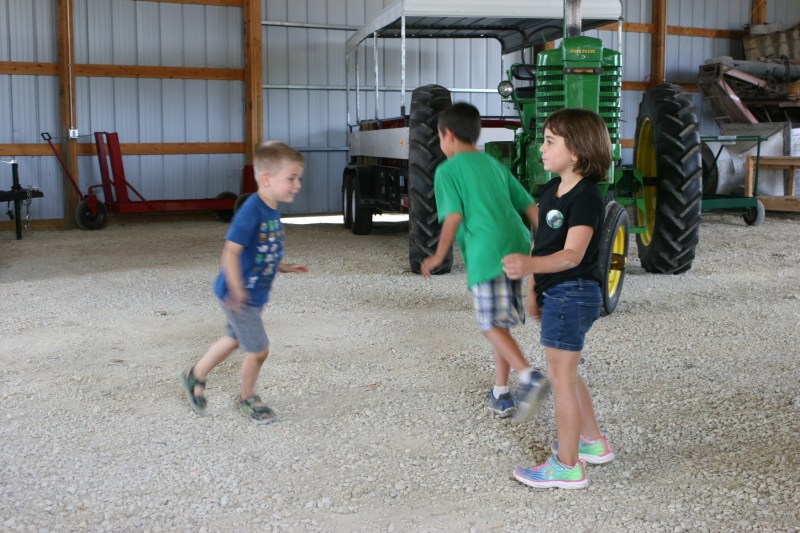
This year I watched and listened as seasoned musicians eased concertinas in and out, in and out. A trio of kids twirled on the gravel floor of the music barn next to a John Deere tractor in an impromptu dance recital.


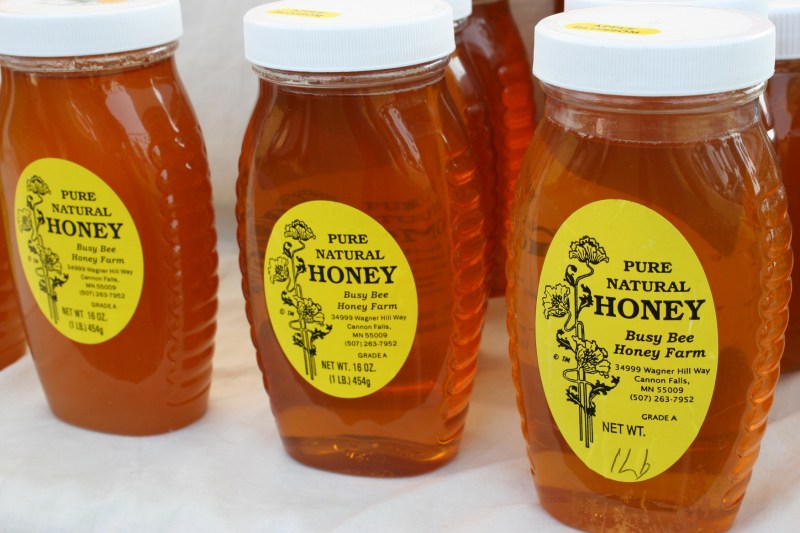
At the flea market, jars of golden honey showcased the culinary arts, beeswax candles the visual arts.


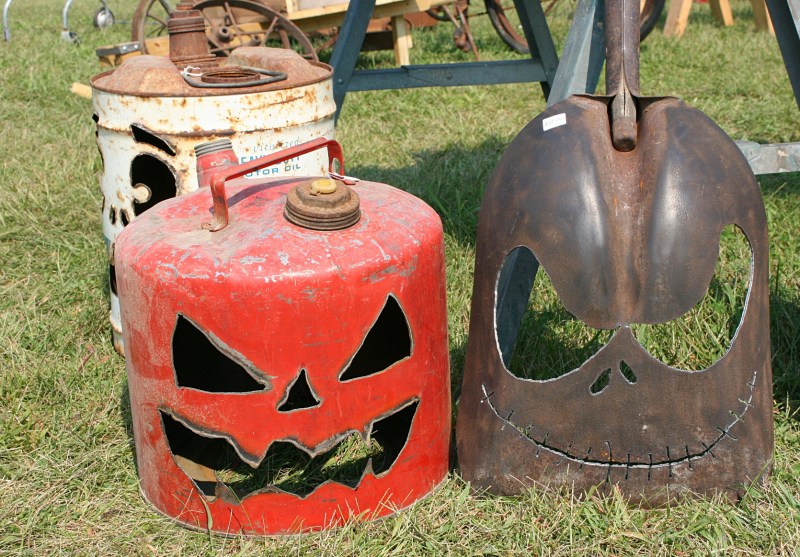
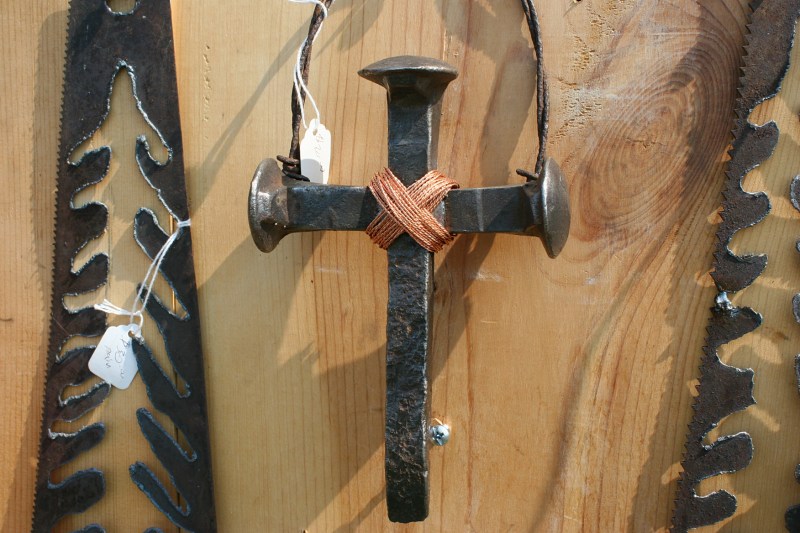
At the booth of Larry and Nicholas Ahrens, I found a gallery of garden art crafted from gas cans, shovels, railroad spikes, horseshoes, golf clubs and more. I admire the ingenuity of artists who can sculpt such art from what some might consider junk. This pair does it well.


Likewise handcrafted embroidered greeting cards from Boho Boutique and Gifts, New Prague, drew my interest for their uniqueness.


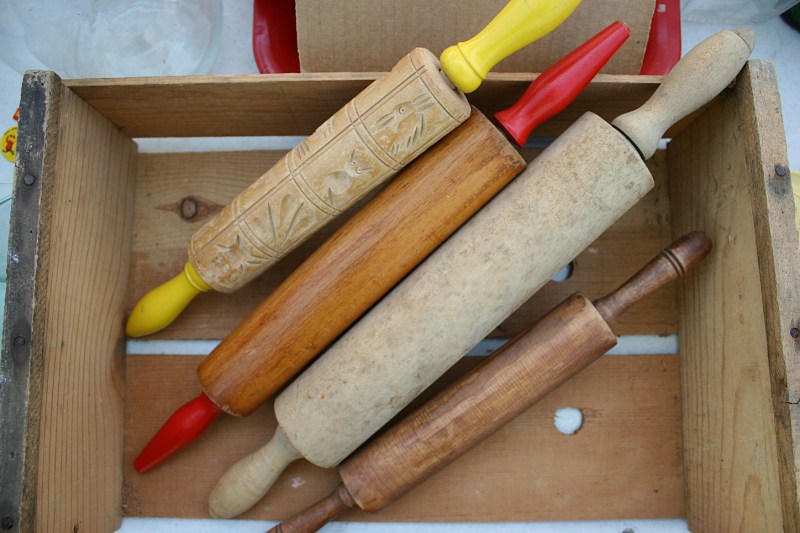
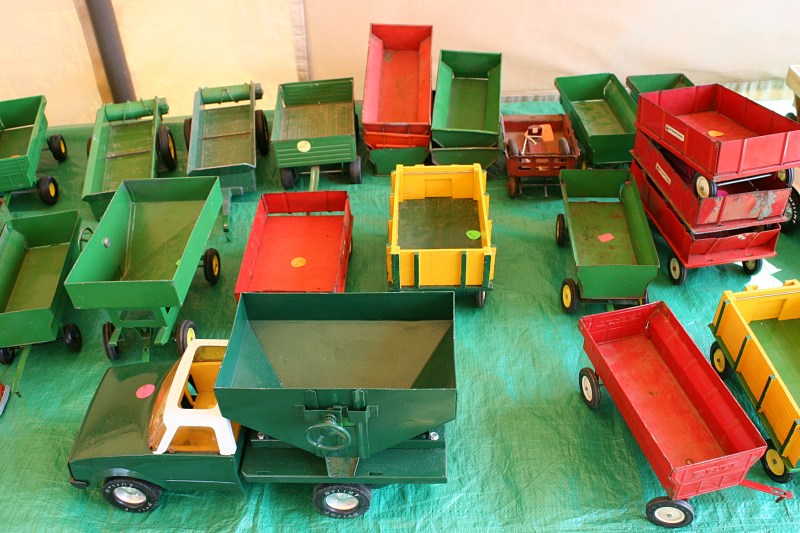
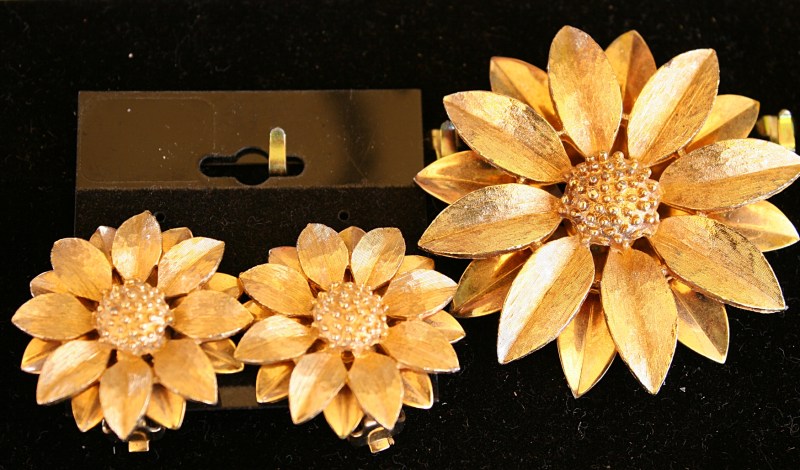
Often I see art in flea market merchandise displays—a cluster of angled rolling pins, a collage of toy farm wagons, three pieces of vintage 70s Sarah Coventry jewelry, a solo woodcarving and more.


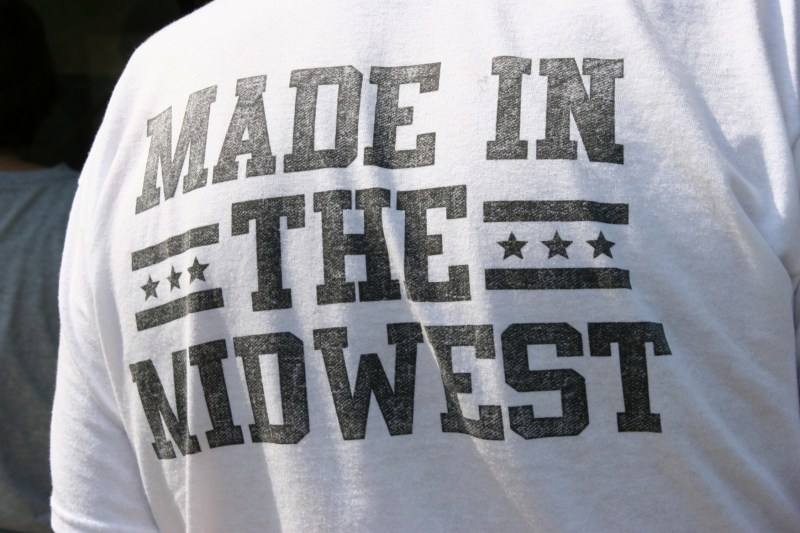
On the back of a t-shirt.


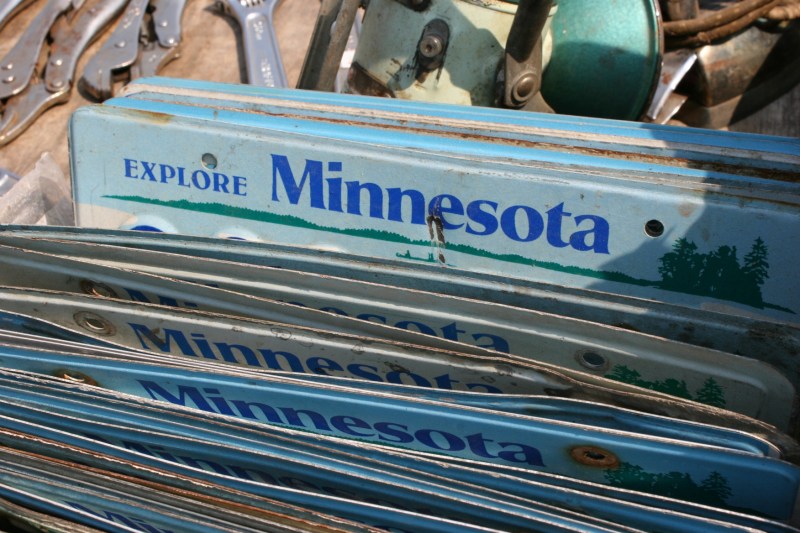
As an appreciator of the graphic arts, I am drawn to letters and words in advertising, in comic books, machinery manuals and even on license plates.


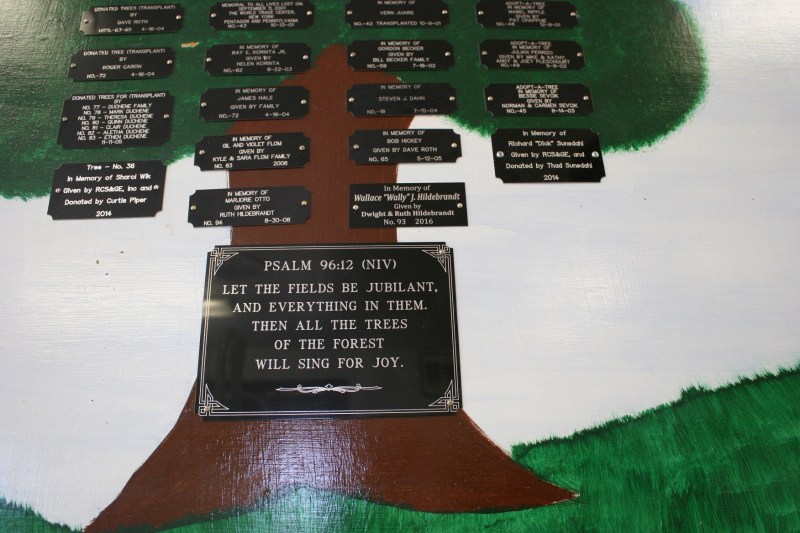
To my surprise, I discovered the literary arts on a tree mural memorial in the words of Psalm 96:12. Let the fields be jubilant, and everything in them. Then all the trees of the forest will sing for joy.


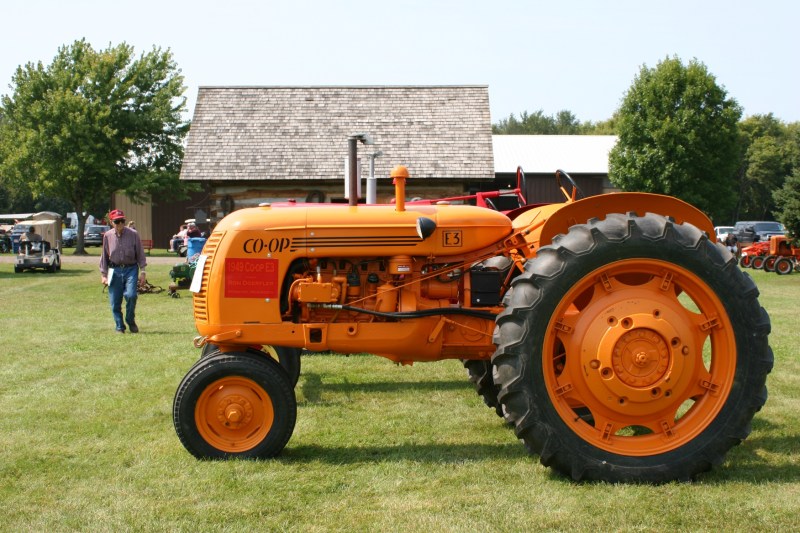
Beyond those words, outside on the grassy field punctuated by shade trees, I saw art, too, in the curves of tractor bodies, the spokes of a steering wheel, the jagged treads of a tire. This ag-focused event celebrates the arts with a decidedly rural twist.


Please check back for one more post in this five-part series.

© Copyright 2017 Audrey Kletscher Helbling
 

A tractor so deere featured at historic ag show, Part II September 7, 2017

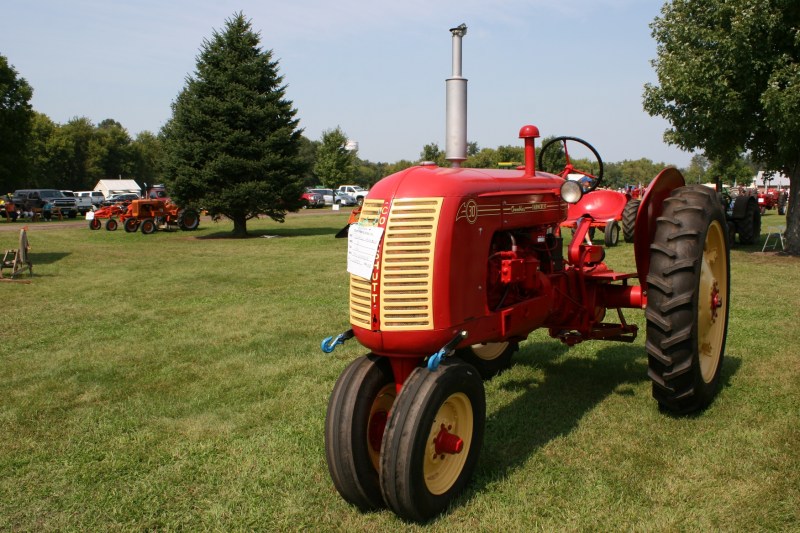
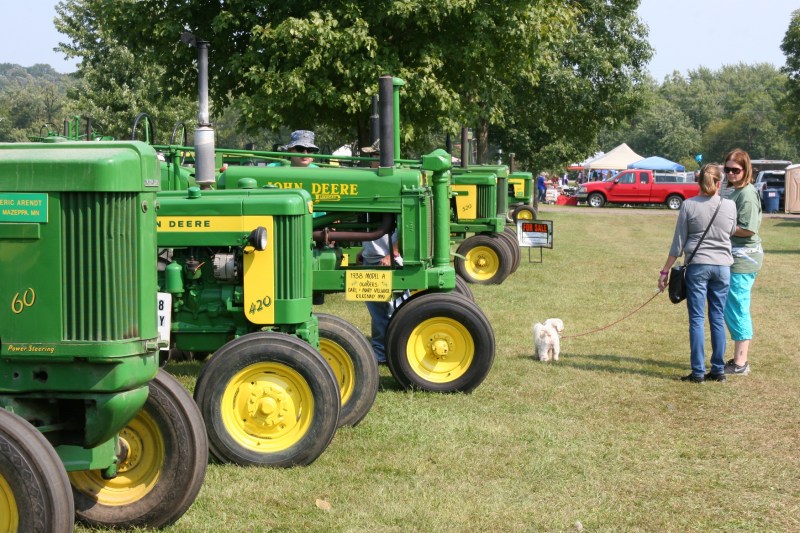
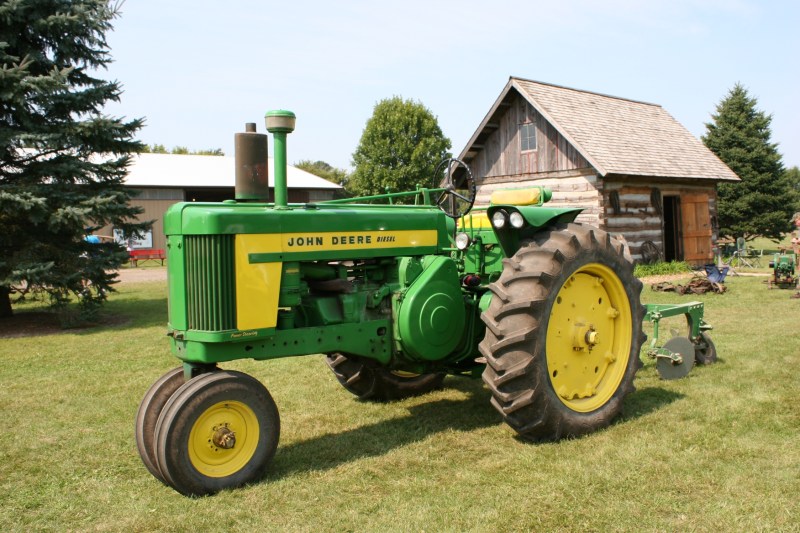
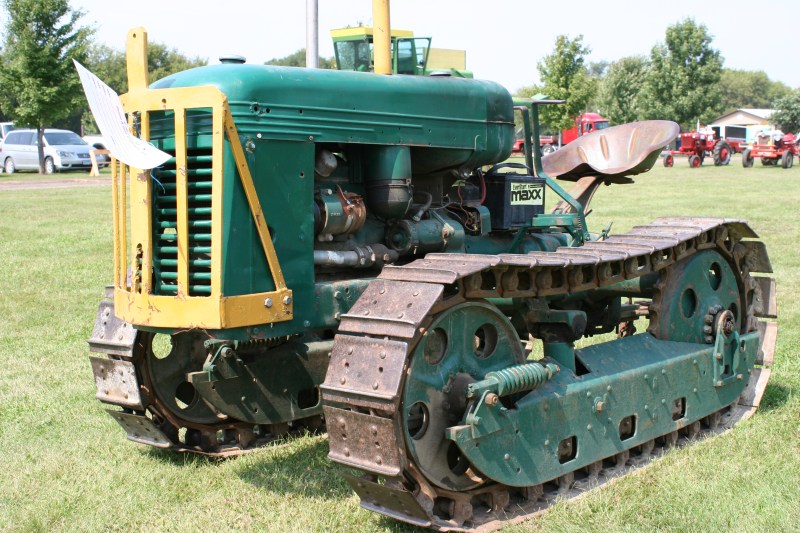
A snippet of the many vintage tractors displayed at the Rice County Steam & Gas Engines Show in rural Dundas, Minnesota.


DRIVING AWAY FROM THE RICE COUNTY Steam & Gas Engines Show, Randy and I reminisced about a long ago popular farming event in our respective rural Minnesota hometown areas. That would be John Deere Days, an annual implement dealership open house. At the ones I attended in Redwood Falls, families enjoyed a free meal of BBQs, baked beans and individual servings of ice cream eaten with mini wooden spoons from plastic cups. Funny how one recalls such details five decades later.


There were plenty of John Deere tractors on the grounds.


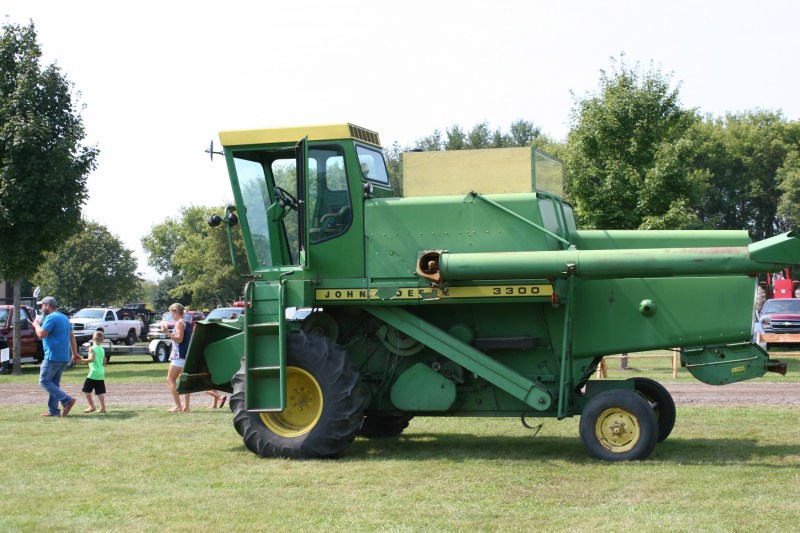
A vintage John Deere combine.


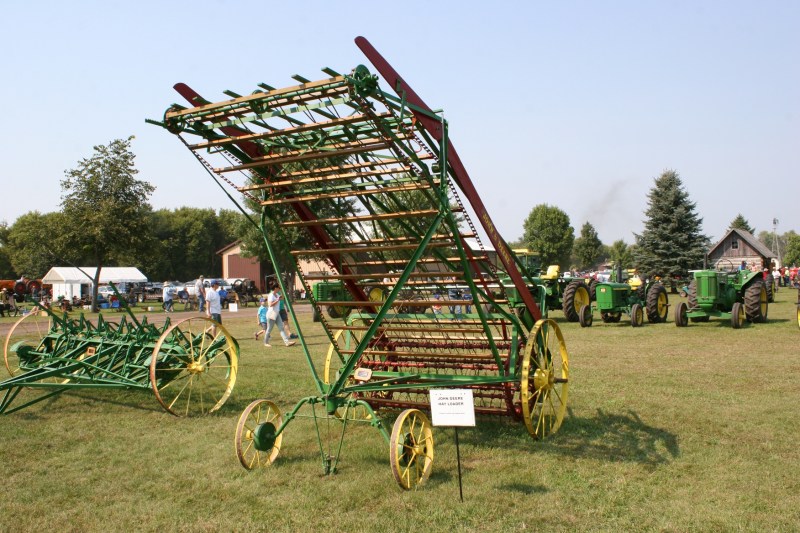
I found the vintage hay loader especially interesting.


I remember, too, going to the local theater afterward to watch movies about John Deere tractors and other farming equipment. To a farm girl who viewed less than a handful of big screen movies during her entire childhood, these yearly John Deere promo flicks rated as a big deal.


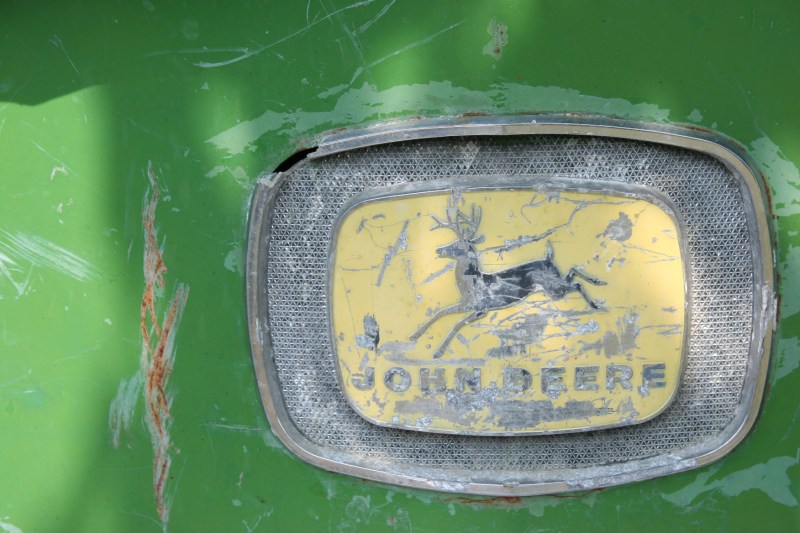
Not every tractor emblem at the show has been restored. I like the ones that bear the marks of hard use on the farm.


But before the film reel rolled, several lucky attendees won door prizes. Like silver dollars. Randy won a bag of seed corn. His dad, who planted the silage seed corn on his Morrison County farm, was likely more thrilled than his son about that prize.


John Deere tractors and related equipment got front row display space.


So what prompted our memories of John Deere Days after attending the recent historic ag show in rural Dundas? It was this year’s selection of the John Deere as the honored tractor line. I hold a fondness for The Long Green Line that traces back to my dad’s John Deere. There’s a certain comfort in the auditory memories of putt-putt-putt. Anything that specifically reminds me of my nearly 18 years on a southwestern Minnesota dairy and crop farm—and that would be John Deeres—yields sweet thoughts.


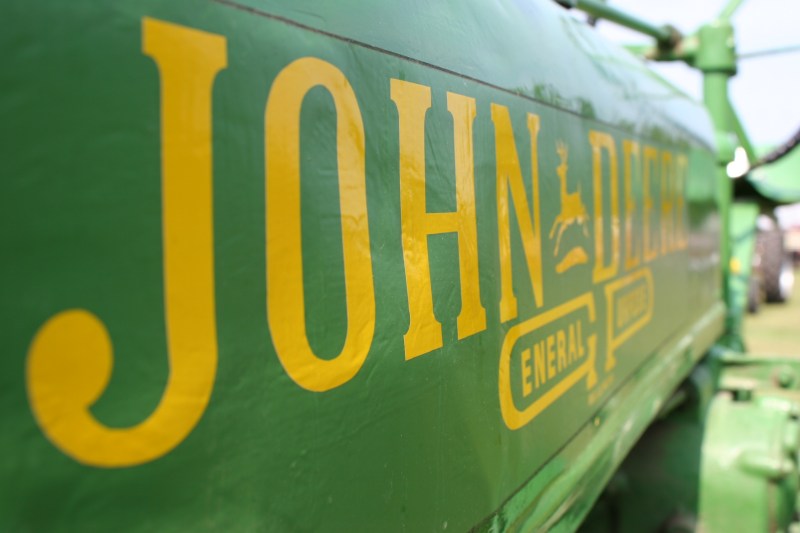
Identifying words on the side of a John Deere tractor at the Dundas show.


I really should tour the John Deere Tractor & Engine Museum in Waterloo, Iowa.


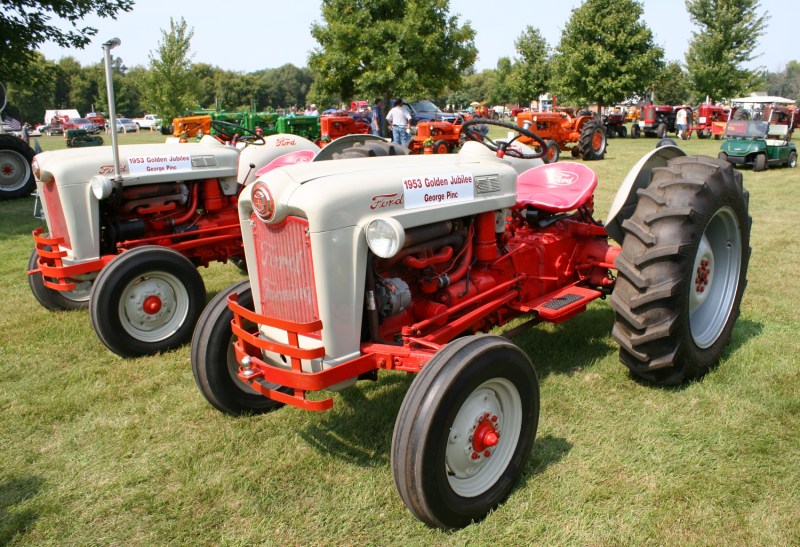
My dad owned a later model Ford, unlike these earlier Ford tractors.


Unlike my great nephew Landon who, at age four, is loyal solely to John Deere, I am not. My dad also owned Farmalls, Internationals and Fords. He, however, only ever allowed me to drive the B Farmall.


A leaping deer has long been John Deere’s iconic symbol.


Nothing runs like a Deere. That catchy coined phrase endures still as do the signature green and yellow and leaping deer symbols of this implement company. I appreciate those long-lasting recognizable tags that trace to my rural roots and remind me of my youth on a Minnesota farm.


Do you, like me, have sweet memories of a John Deere tractor?


TELL ME: Do you have memories of events like John Deere Days? Or do you hold a fondness for a particular tractor line? I’d love to hear.

© Copyright 2017 Audrey Kletscher Helbling
 

West of Mankato August 23, 2017

Cattle graze in a pasture along U.S. Highway 14.

Cattle graze in a pasture along U.S. Highway 14.


WHEN I TELL FELLOW MINNESOTANS I grew up on the southwestern Minnesota prairie, specifically near the small town of Vesta, I typically get a blank stare. So, when “Vesta” doesn’t register with them, I mention Marshall to the west and Redwood Falls to the east of my hometown. Both are county seats and fair-sized communities, in my opinion.


Driving on U.S. Highway 14 around Mankato traveling to southwestern Minnesota.

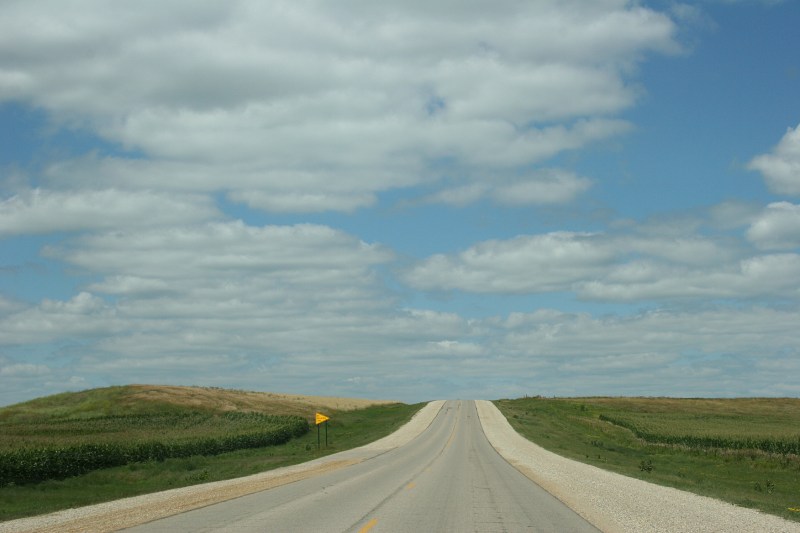
Driving on U.S. Highway 14 around Mankato traveling through southern Minnesota toward the prairie.


Even after dropping those two names, I still often get that quizzical look. It’s as if they have no idea there’s anything west of Mankato.


This barn along U.S. Highway 14 west of Sleepy Eye always catches my eye.

Gotta love this barn between Sleepy Eye and Springfield.


Grain storage along U.S. Highway 14.

Grain storage along U.S. Highway 14.


But there is. Lots. Land and sky and small towns and oddities and grain elevators, and corn and soybean fields stretching into forever. There are pitch-black skies perfect for star-gazing and sunsets so bold I sometimes wonder why I ever left this land.


There are so many well-kept barns along U.S. Highway 14, this one between Mankato and Nicollet.

There are so many beautiful old barns along U.S. Highway 14, this one between Mankato and Nicollet.


I understand beauty is in the eye of the beholder. I simply want others to see that this corner of Minnesota, just like the lakes and woods to the north and the rolling hills and rivers to the south and the Twin Cities metro, is lovely and quirky and interesting in a peaceful prairie way.


BONUS PHOTOS:

U.S. Highway 14 passes through many small towns, like Sleepy Eye where these guys were shopping for a car.

Shopping for cars in Sleepy Eye, one of many small towns along U.S. Highway 14 in southwestern Minnesota.


A farm site between Mankato and Nicollet.

A farm site between Mankato and Nicollet.


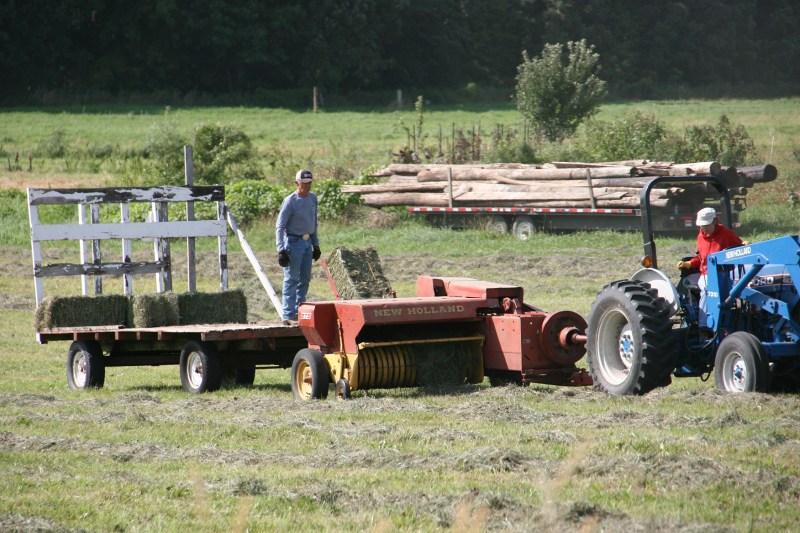
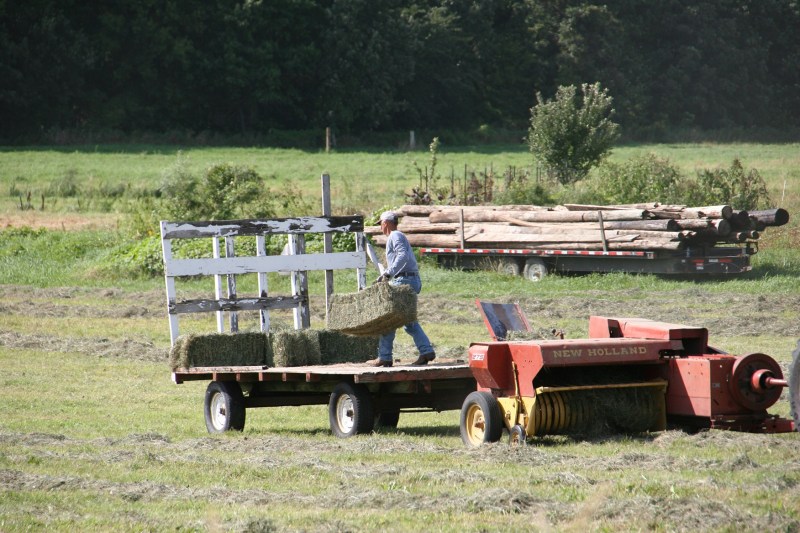
Baling the road ditch between Mankato and New Ulm.

Baling the road ditch between Mankato and New Ulm.


If you appreciate barns, this area of Minnesota offers plenty of barn gazing.

If you appreciate barns, this area of Minnesota offers plenty of barn gazing.


FYI: All of these photos are from my files and were taken along U.S. Highway 14 between Mankato and Lamberton. That would be west of Mankato.

© Copyright 2017 Audrey Kletscher Helbling
 

Scenes from the road in Iowa June 8, 2017

Filed under: Uncategorized — Audrey Kletscher Helbling @ 5:00 AM
Tags: , , , , , , , ,

Westbound from Illinois into Iowa along Interstate 80. Minnesota Prairie Roots file photo May 2016.


IN IOWA EXISTS a comfortable familiarity for me. It’s not that I’ve explored much of this state, except the northern fringes. But Iowa feels like a friendly next door neighbor or cousin, the ruralness of this land creating an instant bond.


For in Iowa—the Iowa I’ve seen—the lay of the land, the length of the sky, the scenes of barns and fields and small towns connect to my rural southwestern Minnesota roots.


I feel at home in Iowa, the place that is often the butt of Minnesota jokes. Outside the Twin Cities metro and the lakes and woods of northern Minnesota, our landscape mostly duplicates that of our southern neighbor.


The world’s largest truck stop, with eight restaurants, a movie theater, dentist and much more, has been open near Walcott off I-80 in eastern Iowa since 1964.


It’s OK to admit you like Iowa. Some of my favorite trips have been to Iowa communities—Clear Lake, Mason City, Decorah, McGregor, Marquette and Dubuque. These towns possess character and hold natural and historic interest for me.


Iowa 80, the world's largest truck stop.

Iowa 80, the world’s largest truck stop.


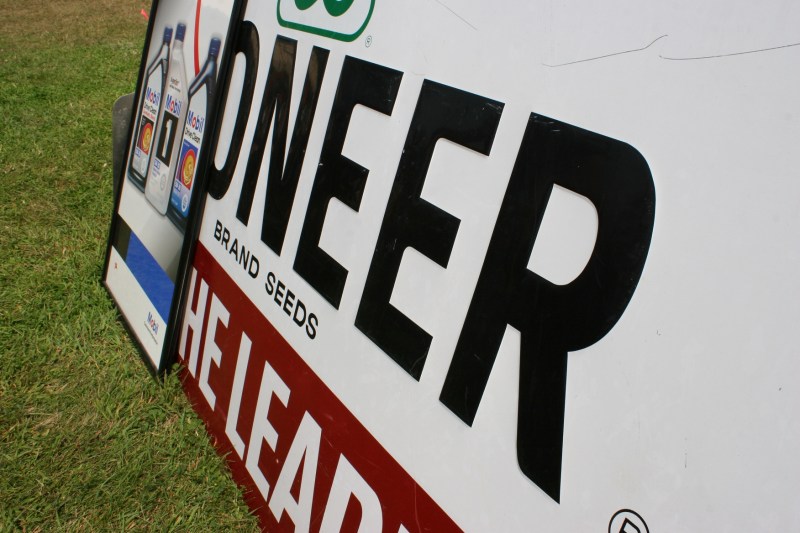
You know you’re in America’s agricultural heartland when you see a billboard advertising Pioneer seed.


Sometimes we need to step outside our boxes of preconceived ideas about a place and simply explore. Leave the metro and drive a gravel road, stop in a small town, delight in the simplicity of a rural landscape. Iowa and many parts of Minnesota are more than the middle of nowhere. If we choose to slow down, we begin to notice the nuances that define a place, that make it worth our time to visit and to appreciate.


TELL ME: If you’ve traveled to Iowa, what community would you suggest visiting and why? Or, if you haven’t been there, tell me what a visitor should see in your state or country?

© Copyright 2017 Audrey Kletscher Helbling
NOTE: All images were taken in late May 2016 on a return trip from Minnesota to Boston.


The art of an interstate rest stop in Iowa June 7, 2017


PRIME VACATION SEASON is almost upon us and that means many of you will soon hit the roads. And when you travel, especially long-distance, rest stops hold necessary importance.

A year ago, my husband and I drove 2,800 miles from Minnesota to Boston and back to attend our son’s graduation from Tufts University. Some days we spent up to 10 hours in the van. The need to stretch our legs, to pee and to take a break from roadway fatigue led us to many an interstate rest stop.

Hands down, Iowa has the best rest areas. Indiana, not so much.


The rest stop along Interstate 380 near Cedar Rapids honors artist Grant Wood and features his rural themed work on ceramic tile. The floor design mimics crop rows.


So what makes Iowa’s interstate rest areas so appealing? Themed rest stops, of which there are 16. These are centers of art and history as much as places to take a bathroom break, to picnic, to gather travel info and to stretch. And bonus, the sole facility we visited was clean.


My first view of the rest stop focusing on Iowa artist Grant Wood, who was born 40 miles to the northeast and then moved to Cedar Rapids with his family in 1901.


On our return trip from Boston, we stopped at the Grant Wood Rest Area northbound along I-380 south of Cedar Rapids in Linn County. At the time, I knew nothing of these unique stops for travelers. So imagine my surprise when we pulled off the interstate and into a place that looked like a cultural art center in the middle of, well, Iowa fields.


The many windows incorporated into the rest stop mimic the farmhouse windows in Wood’s “American Gothic” painting.


Wood’s work featured the rural Iowa landscape. Here his art is showcased in ceramic tile inside the rest area building.


Behind the rest stop building, visitors can consider the view through these window props.


Completed four years ago, “The View From Our Window: Grant Wood in Iowa” rest area honors Wood, painter of “American Gothic.” In my limited knowledge of Iowa art, this painting of a farm couple standing in front of a farmhouse is symbolic of Iowa as I view it. Rural, through and through. David Dahlquist of RDG Dahlquist Design Studio in Des Moines created the art at this interstate stop.


The green “waves” represent Iowa cropland.


Emerging soybean art inside the rest stop structure.


Real life farming in Iowa.


For this weary traveler, the Grant Wood rest area proved a welcome respite from the interstate and from the countless other rest stops that were nothing more than functional spaces to meet travelers’ basic needs. Expanding that purpose beyond—to include art and history—made an impression upon me.


Travelers can get a view of the U.S. on a map situated next to a duplicate of the farm woman Wood painted in “American Gothic.”


In other sections of Iowa, you can, for example, learn about Lewis and Clark at the southbound I-29 rest area at Sergeant Bluff.


Picnic areas are sheltered by machinery like structures.


These themed Iowa rest areas are most prolific along I-80. The Mississippi River is the focal point of the westbound stop in the Davenport area. Eastbound, the rest area at Grinnell highlights pioneers while one in Cedar County focuses on the Underground Railroad.


This sign inside the rest stop building honors Wood’s artist’s loft, 5 Turner Alley, in Cedar Rapids.


If you’re so inclined and looking for an inexpensive way to view public art and learn history in Iowa, you could plan a trip around visiting Iowa’s themed rest areas. If anything, it would be quite the unique vacation story.


TELL ME: Have you come across other such unique public interstate rest areas in your travels across the country? Or, offer your opinion of these Iowa rest areas.

FYI: Click here to visit the Iowa Department of Transportation website showcasing Iowa’s themed rest areas.

© Copyright 2017 Audrey Kletscher Helbling
 

Blessings, beer & baseball in St. Patrick January 18, 2017

EDITOR’S NOTE: The following is a story from summer-time, season inappropriate. But, in the throes of a Minnesota winter, we need reminders that summer will return. In something like four months.

Across the road from the St. Patrick of Cedar Lake Township Catholic Church cemetery sits St. Patrick's Tavern.

Across the road from the St. Patrick of Cedar Lake Township Catholic Church and cemetery sits St. Patrick’s Tavern.

A BAR AND A CHURCH. It’s not an uncommon pairing in parts of rural Minnesota, in Catholic faith communities especially.

The bar recently changed ownership and became St. Patrick's Tavern.

The bar recently changed ownership and became St. Patrick’s Tavern.

Blessings and beer.

St. Patrick Catholic Church of Cedar Lake Township.

St. Patrick Catholic Church of Cedar Lake Township.

On a Sunday afternoon drive in the summer of 2015, my husband and I happened upon St. Patrick, an unincorporated burg in Scott County. There, upon a hill, sits St. Patrick Catholic Church of Cedar Lake Township. Out the front door and down the hill rests the bar, appropriately named St. Patrick’s Tavern. And on the back side of the hill lies the baseball field, St. Patrick’s Bonin Field. It’s named after Father Leon Bonin, a strong supporter of baseball in St. Patrick.

St. Patrick's Bonin Field

St. Patrick’s Bonin Field

Blessings, beer and baseball. How decidedly rural Minnesotan.

BONUS PHOTOS:

St. Patrick's Tavern in St. Patrick, Minnesota

St. Patrick’s Tavern is located at 24436 Old Highway 13 Blvd. in St. Patrick, Minnesota.

Cruising past St. Patrick's Tavern on a Sunday afternoon.

Cruising past St. Patrick’s Tavern on a Sunday afternoon.

More signage on St. Patrick's Tavern.

More signage on St. Patrick’s Tavern.

TELL ME: Do you know of any similar hamlets that offer blessings, beer and baseball. I’d like to hear your stories.

© Copyright 2015 Audrey Kletscher Helbling
 

Finding the perfect little Christmas tree in Faribault December 19, 2016

Our family Christmas tree always sat on the end of the kitchen table, as shown in this Christmas 1964 photo. That's me in the red jumper with four of my five siblings.

The Kletscher family Christmas tree always sat on the end of the kitchen table, as shown in this Christmas 1964 photo. That’s me in the red jumper with four of my five siblings.

FEW PHOTOS EXIST OF ME as a child. So I treasure each one, especially a rare color print of me and four siblings clustered around the kitchen table on Christmas Eve 1964. We are dressed in our Sunday best, back home from worship services at St. John’s Lutheran Church in Vesta. I’m surprised we were willing to pose given the pile of presents.
 

christmas-trees-8-three-trees-close-up


But it is not the gifts or the setting or even the impatient look on my middle brother’s face that remain imprinted upon my memory so many decades removed from the farm. It is the Christmas tree. I never realized how small that table-topped tree until I grew into adulthood. But it’s short, maybe three feet. I recall going to the local grocer and sorting through trees leaning in the snow against the side of the grocery store. Such memories.

 

christmas-trees-5-sign


A few years ago, with my three children grown and gone, I decided to down-size our Christmas tree from average to small. I longed for a tree like the ones of my childhood. Imperfect and short with short needles. And I found that tree at Kuntze Christmas Tree Lot along Second Avenue Northwest in Faribault.
 

christmas-trees-1-pinecone


This no-frills lot run since 1988 by Ken Mueller (and in business since 1939) features fresh-cut, untrimmed trees from a dairy farm near Duluth. They’re as natural as a tree can be. Shaped by nature. Pinecones and leaves still clinging to branches. Pliable, fresh needles. Exactly what I wanted.
 

christmas-trees-4-putting-tree-in-van


This season, Ken’s had a run on trees. Donahue’s Greenhouse, a major supplier of Christmas trees to locals, is no longer open during the holiday season. So on the date I shopped, December 10, I found a limited selection of trees in Ken’s lot. He’s not planning to restock. After sorting through about a half-dozen trees, my husband and I chose our Charlie Brown tree and Ken placed it in the back of our van. Yes, the tree is that small.


christmas-trees-10-ken-randy


Randy handed him $20, told him to keep the $4 change and they chatted for a bit because this tree salesman is a talker. Plus I wanted to snap a few photos.


christmas-trees-audrey-by-tree


Now the tree stands in my living room, nestled between a window and a chest of drawers my dad once shared with his oldest brother. I snapped a selfie of myself with the tree after stringing the lights. I’m not good at selfies. (Or maybe I am since I meant for the tree to be the focus.)


christmas-trees-11-talking-with-customer


I’m much better at choosing a tree that reminds me of happy childhood Christmases on the family farm. For me, it’s all about the memories.

BONUS PHOTO: The message on the back of Ken’s business card:


christmas-trees-23-message-on-back-of-business-card


TELL ME: If you have a Christmas tree in your house, is it real or fake? Why?

This year the Christmas Tree Promotion Board has launched a campaign of “It’s Christmas. Keep it real.”  The board markets the tradition, scent and natural beauty of real trees.

© Copyright 2016 Audrey Kletscher Helbling