An American flag flies in rural Minnesota. (Minnesota Prairie Roots copyrighted file photo)
I DEBATED FOR SEVERAL DAYS whether I should write this post, because it could be misconstrued as purely political. It is not. Rather this is a story about a grassroots gathering of people sharing information, ideas and opinions. Democracy at its core. This story is about us as Americans—listening, learning, agreeing or disagreeing, and letting our voices be heard.
Tuesday evening I attended a town hall meeting in Faribault hosted by DFL Senate District 19. It was open to everyone, regardless of political affiliation. But the crowd was decidedly Democrat, as you would expect given the hosting group. Republican Brad Finstad, who represents the 1st Congressional District in Minnesota, was invited, but did not attend. His district includes parts of Goodhue, Rice (where I live), Steele and Waseca counties in rural southern Minnesota.
Some 300 constituents packed the space, overflowing into adjacent rooms. Yes. Even I was surprised by the turn out. That tells me a whole lot of people have concerns about what is currently happening at the federal level and how government action is, or will, impact them. I expect not a single American will be untouched, whether directly or indirectly, by slashes in government personnel and funding and/or by changes in domestic and foreign policies.
A sculpture at the Northfield Area Veterans Memorial. (Minnesota Prairie Roots copyrighted file photo)
Town hall organizers lined up speakers to address topics covering a broad range of subjects affecting a whole lot of people and programs—farmers, education, healthcare, seniors, veterans, those with disabilities, communication, nonprofits and much more. I was impressed by how well prepared these speakers were with facts and statistics. I learned a lot.
A vintage voting booth in the former Northfield, Minnesota, town hall. (Minnesota Prairie Roots copyrighted file photo)
I’m not going to give you a detailed report of what each speaker said. Rather, I want to share several messages or phrases which really resonated with me and which should resonate with every American, no matter who they voted for. The phrase “we the people” was repeated by one speaker and embraced by the crowd. “We the people” means us. Americans, not members of one political party or the other. And, yes, I’m well aware of how those words from the preamble to the Constitution are being used politically as a mantra of sorts. But in this context, “we the people” references our right to speak up, to be heard, to tell our elected officials what we think and what we would like them to do as our representatives in Washington DC. That can be done by attending town halls like this; the meeting was video taped and will be sent to Representative Finstad. We can be heard via phone calls, emails and letters. We the people have power in our voices, in our votes, whether Democrat, Republican or Independent.
Photographed on a back country road near Morgan in southwestern Minnesota. (Minnesota Prairie Roots copyrighted file photo)
Secondly, a local educator asked the crowd and Finstad to ask themselves this question: “How are the children?” So, yes, how are the children, when many live in poverty, when federal funding for education is in imminent danger of being mostly cut, when…fill in the blank here? I think we can all agree that children are our future and we ought to care about their health, happiness, education and much more.
A pile of wheat. (Minnesota Prairie Roots copyrighted file photo)
Third, one of the speakers shared that, as someone of the Catholic faith, he is called upon to help others. He called upon Representative Finstad, who is also Catholic, to do the same. That means feeding the hungry (funding USAID, for example), protecting Medicaid and Social Security, etc. all of those ways and places we help one another as human beings in this country and abroad. Now I’m not Catholic; I’m Lutheran. Doesn’t matter. My faith compels me to show love, compassion and care for others, especially those in need. America once did that as a country. Generously. But that is changing. We have bounty and resources we can share to help starving children, to provide medical care, to help others in any way we can. It is the right thing to do as a nation blessed with great bounty.
Rural Rice County, Minnesota. (Minnesota Prairie Roots copyrighted file photo)
Fourth, a local farmer spoke about $3.2 million in contracts with farmers in our district which have now been broken by the U.S. government. The consequences will be devastating to those farmers who have already invested those federal monies in their operations. Trust has been broken, she said. I think we can all agree that when a legal contract is broken, it’s a breach of trust.
A symbol of freedom, an eagle sculpture at Veterans Memorial Park in Morristown, Minnesota. (Minnesota Prairie Roots copyrighted file photo)
There’s so much more I could share from that town hall session. But I want to conclude with this. I encourage you, if you have the opportunity to do so, attend a town hall meeting. Listen. Learn. Engage. Let your voice be heard. Remind your elected officials, too, that they need to listen, learn and engage.
FYI: A second Town Hall Meeting hosted by DFL Senate District 19 is set for 6 p.m. Sunday, April 6, at Mineral Springs Brewery, 210 N. Oak Ave., Suite 1, in Owatonna. It will follow the same format as the Faribault Town Hall with a moderator, speakers and an open mic. Representative Brad Finstad has been invited.
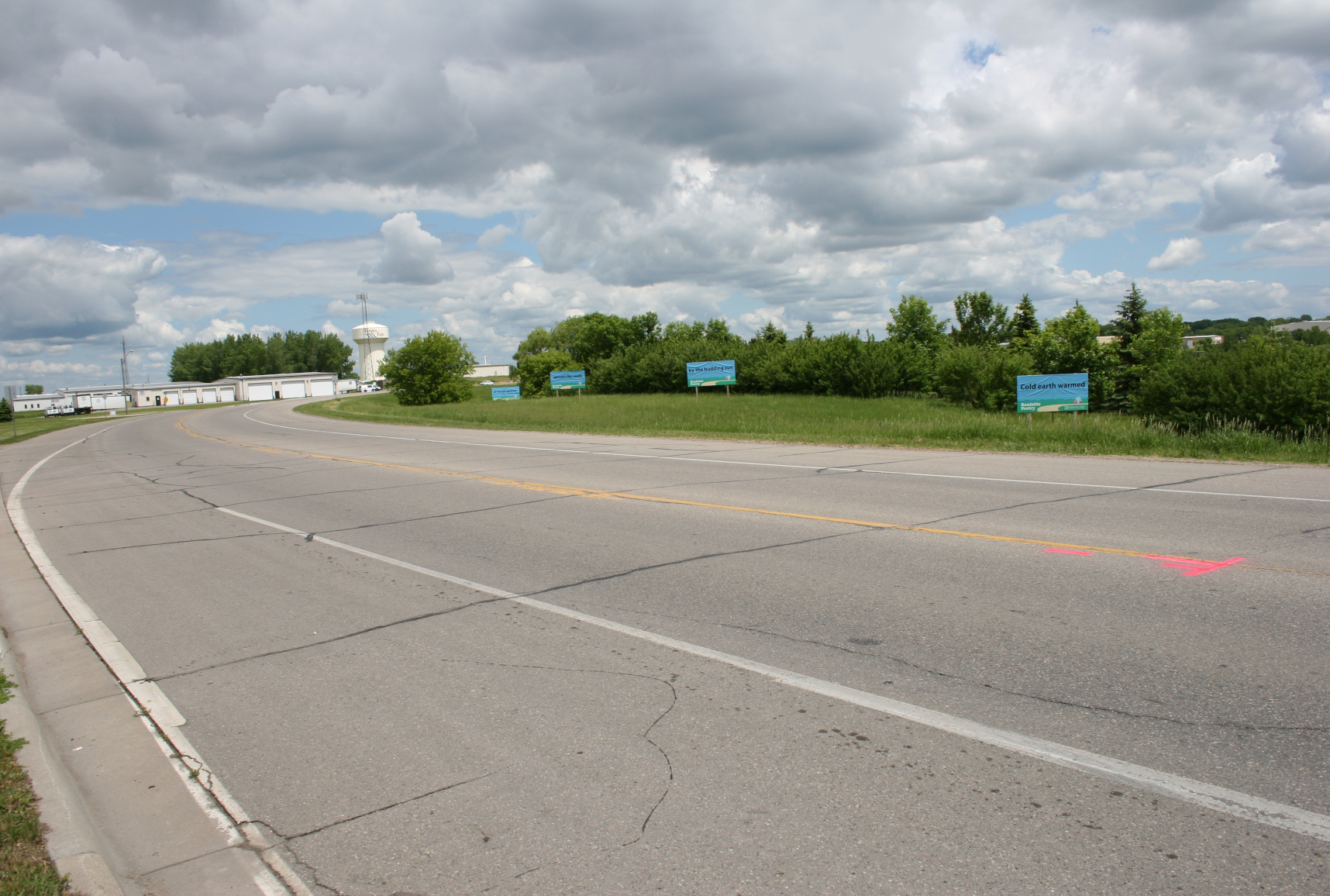
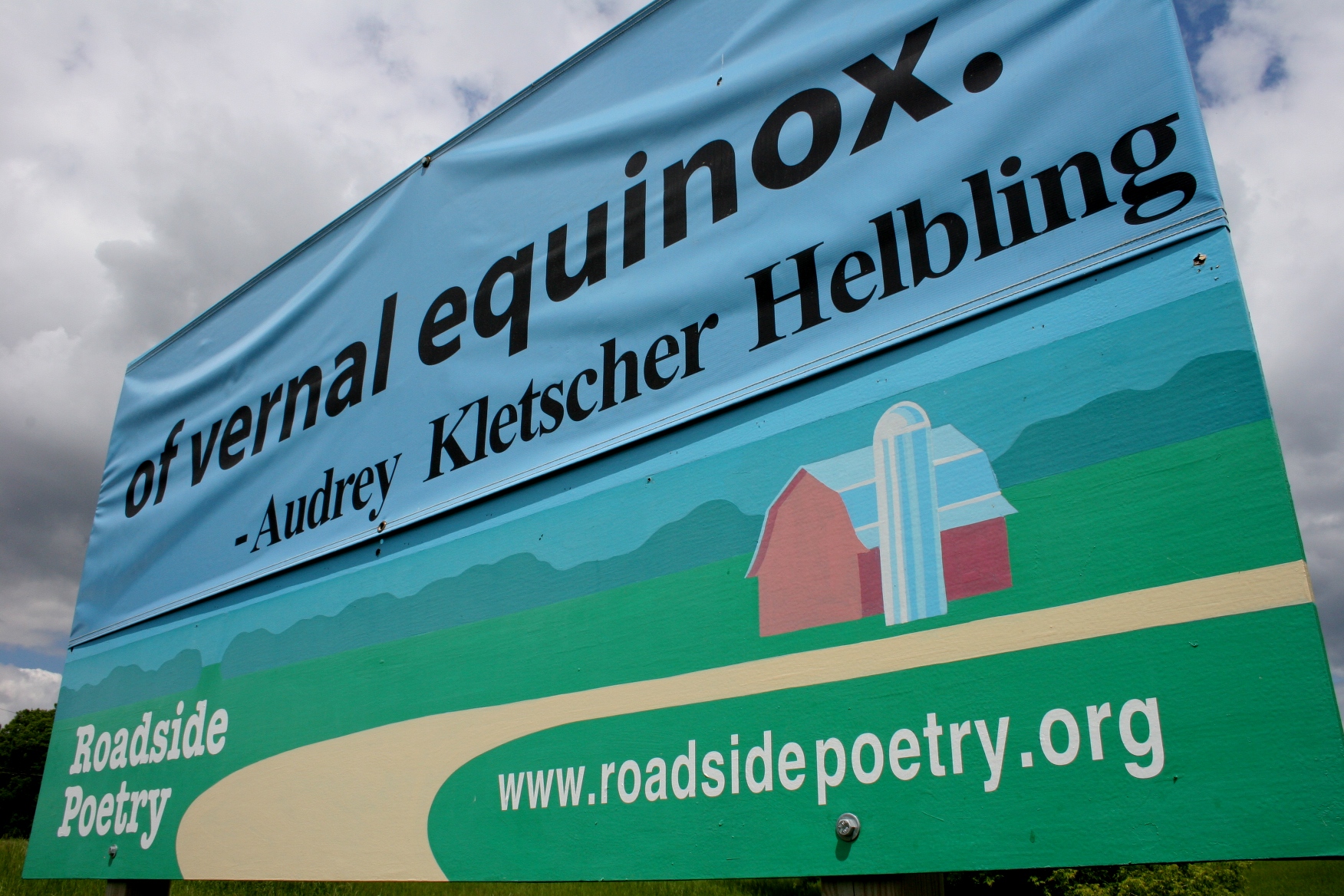
My poem about spring, shown here, was part of the 2011 Roadside Poetry Project. (Minnesota Prairie Roots copyrighted file photo 2011)
ON THIS FIRST DAY of spring, I want to share a poem I wrote in 2011. My spring-themed submission for the Roadside Poetry Project seasonal competition won. And, as a result, my poem was printed on billboard-sized signs, then placed along a roadway just off Interstate 94 in Fergus Falls in west central Minnesota. Some 100,000 vehicles a month passed by my poem.
Writing good poetry is not easy. And when you must write within guidelines, the process is even more challenging. Roadside Poetry contest rules called for only four lines of poetry with a maximum of 20 characters per line. The poem needed to fit on the signs and be readable from a distance.
Somehow, my brain managed to create what I consider a succinct and visually-strong poem defining spring. On this first day of spring, enjoy my short seasonal poem. Happy spring!
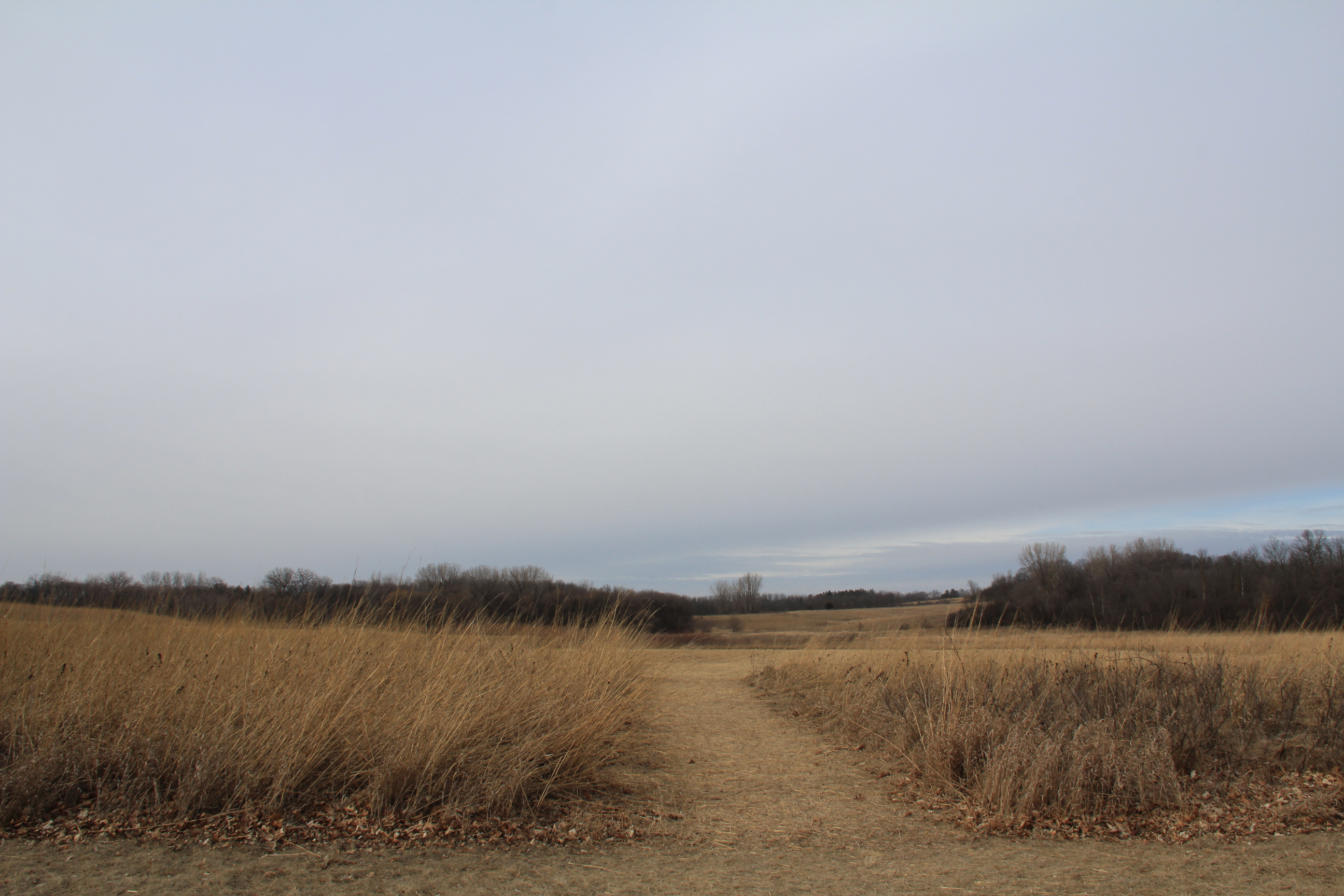
The prairie at River Bend Nature Center, Faribault. (Minnesota Prairie Roots copyrighted photo February 2025)
IN THE IN-BETWEEN SEASON of not exactly winter, but not quite spring here in Minnesota (although the calendar says otherwise), I feel like I’m waiting. Waiting for snowfalls to end. Waiting for the landscape to transition from drab browns and grays. Waiting for vibrant colors to appear.
My neighbor’s spring flowers. (Minnesota Prairie Roots copyrighted file photo 2023)
There’s a sense of anticipation and wonder when buds form, when the first tender shoots of spring bulbs emerge from the soil, then flower. Purple crocuses. Sunny yellow daffodils. Followed by tulips and other flowers in a rainbow of hues.
Spring wildflowers at Kaplan’s Woods Park, Owatonna. (Minnesota Prairie Roots copyrighted file photo)
I love the beginning of spring—real spring, not the teasing warm days of early and mid-March or simply a date (March 20) on a calendar.
Spring erupts in Minnesota at Falls Creek Park, rural Faribault. (Minnesota Prairie Roots copyrighted file photo May 2022)
I love when the landscape is flush in green, a green so vibrant that it’s almost indescribable.
Oak leaves at River Bend. (Minnesota Prairie Roots copyrighted photo February 2025)
The starkness of this time of year in Minnesota focuses the eye on details, like the rough bark of a tree in the woods at River Bend. (Minnesota Prairie Roots copyrighted photo February 2025)
Dried seedheads at River Bend. (Minnesota Prairie Roots copyrighted photo February 2025)
While I await the greening of the landscape, I remind myself to appreciate the natural world around me as it is now. The stubborn dried oak leaves that clung to branches through the fierce winds of winter. The rough textured bark of a tree. The dried seed heads and leaning swamp and prairie grasses. All hold the seasoned beauty of days, of weeks, of months, of time.
Animal prints in the snow in my backyard. (Minnesota Prairie Roots copyrighted photo February 2025)
Seasons are not timed by a calendar date, but by the natural world. Authentic spring arrives in Minnesota on her own timetable. Often unhurried. But sometimes abrupt.
The woods at River Bend await the budding of spring. (Minnesota Prairie Roots copyrighted photo February 2025)
As I await spring’s bloom and budding, I realize that the seasons of life also should not be hurried. The years pass too quickly, although we are mostly ignorant of that in our younger years. I understand that now in this advancing season of my life.
For several minutes, I watched and photographed this bald eagle soaring high above the Straight River at River Bend Nature Center. (Minnesota Prairie Roots copyrighted photo February 2025)
I value the moments more, recognizing that seasons end. And seasons begin.
A BILL IS BEING INTRODUCED in the Minnesota Senate today that should alarm everyone, whether you live in Minnesota or not. That’s the addition of “Trump Derangement Syndrome” to the definition of mental illness under current state law.
Apparently this term has been floating around for awhile, although I just learned of it on Sunday. My jaw dropped. I could not believe what I was hearing on an evening newscast. Five Republican senators from central Minnesota have authored the bill, which will be introduced today in the state Senate and then referred to the Health and Human Services Committee. It reads in part as follows:
Subd. 40a. Trump Derangement Syndrome.
“Trump Derangement Syndrome” means the acute onset of paranoia in otherwise normal persons that is in reaction to the policies and presidencies of President Donald J. Trump. Symptoms may include Trump-induced general hysteria, which produces an inability to distinguish between legitimate policy differences and signs of psychic pathology in President Donald J. Trump’s behavior. This may be expressed by: (1) verbal expressions of intense hostility toward President Donald J. Trump; and (2) overt acts of aggression and violence against anyone supporting President Donald J. Trump or anything that symbolizes President Donald J. Trump.
My reaction was immediate and emotional. Why? First, this proposed legislation is an affront to anyone who has ever dealt with/deals with a mental illness or who has a family member or friend who has ever dealt with/deals with a mental illness. The National Alliance on Mental Illness lists 12 mental health conditions, including anxiety, ADHD, bipolar disorder, depression, OCD, postraumatic stress disorder, schizophrenia and more. One in five U.S. adults experience mental illness in a given year, according to NAMI. My guess is that each of the five senators proposing this change in state law has been touched in some way by mental illness, whether they admit it or not.
Now, just as we’ve been making strides in raising awareness about mental health and reducing the stigma, along comes a bill like this which stigmatizes, degrades and demoralizes. It’s insensitive, absolutely unnecessary and is politicizing mental health conditions.
The other component of this proposed change in state law which really concerns me is the wordage “verbal expressions.” Yes, that’s further defined as “intense hostility.” But who defines “intense hostility?” And what happens if you’re found to be “hostile” by whomever simply because you disagree? Perhaps you’re just “passionate.” There’s a lot to think about here.
I support free speech. We have the right to criticize, voice our opinions, speak our minds in a democracy. Or so I thought. Note that I don’t condone acts of aggression and violence against anyone, even if I don’t care for the individual or his/her policies.
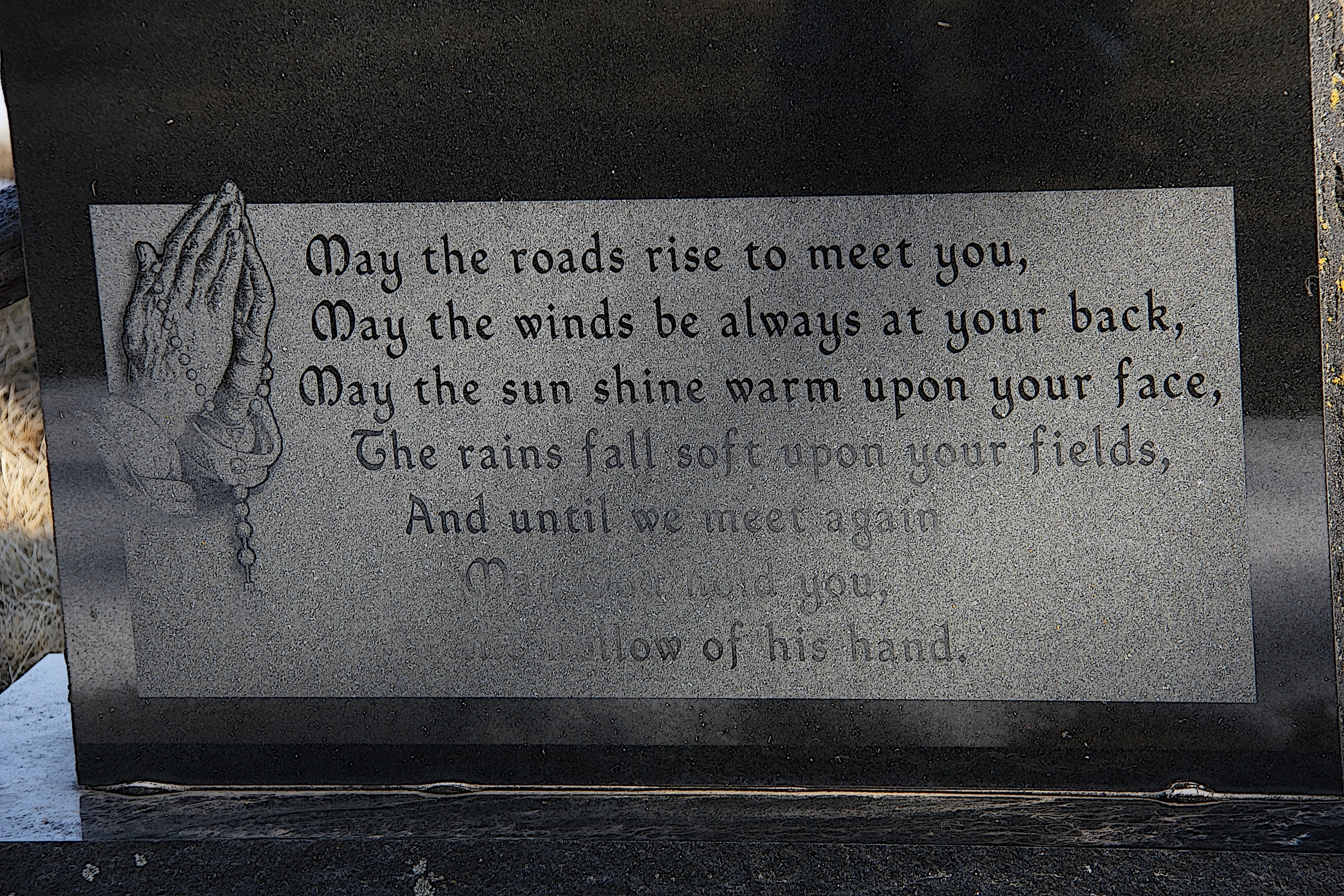
Engraved on a tombstone at Corpus Christi Cemetery. (Minnesota Prairie Roots copyrighted file photo March 2025)
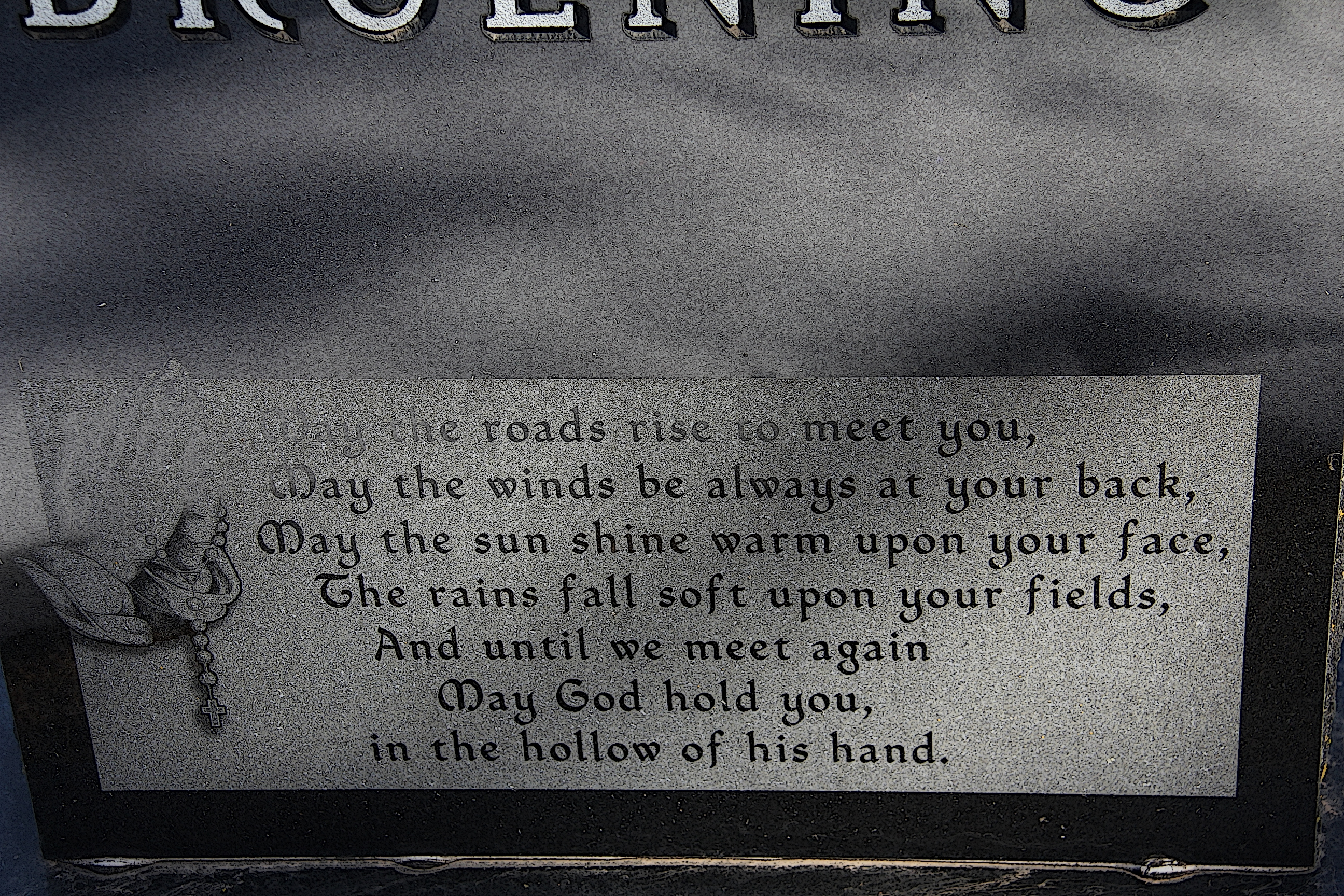
THE SUN SHADOWED the tombstone, making photographing the words thereon a challenge no matter which way I angled my body and camera. So in the end, I settled on two images to share an Irish blessing with you on this, St. Patrick’s Day.
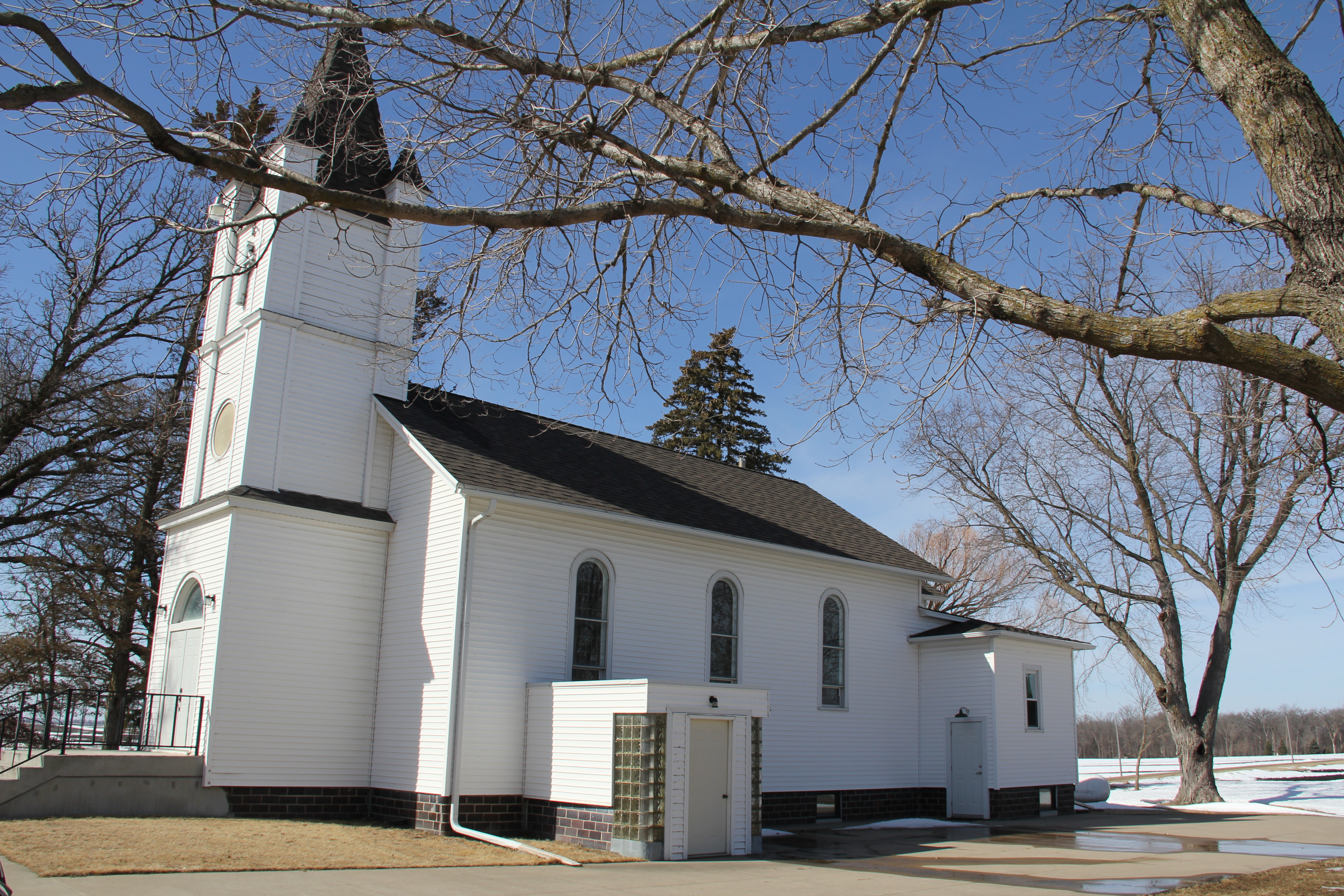
Corpus Christi Catholic Church, Deerfield Township. (Minnesota Prairie Roots copyrighted photo March 2025)
I found this gravestone blessing in the cemetery of Corpus Christi Catholic Church, a shuttered country church in Deerfield Township, rural Steele County, Minnesota. The 1856 church closed in 2016, when it merged with Christ the King Catholic Church in nearby Medford. It opens now for special occasions and is clearly much beloved by those who once worshiped here.
Another view of the Irish blessing with the bottom lines more visible. (Minnesota Prairie Roots copyrighted photo March 2025)
As I wandered among tombstones in the partially snow-covered cemetery, reading names and inscriptions a week before St. Patrick’s Day, I happened upon the familiar Irish blessing. I love the strong visuals the words create. The road. The sun. The fields. I can almost feel the road beneath my feet, the warm sun on my face, the soft rain on my skin, the wind at my back. The hand of God holding me securely.
While the blessing in this context is one of seeing a departed loved one again in heaven, the words fit the living, too. When we say goodbye to family and friends, especially those we won’t see for awhile, our love carries us until the next time we meet.
The message in this Irish blessing is so uplifting, so encouraging, so caring. Gentle words. Loving words. Words that carry us through the days of our lives, whether sunny or rainy. Always hopeful.
Blessed be your St. Patrick’s Day and every day thereafter…until we meet again.
UNTIL MY ELDEST ALERTED me around noon today, I was unaware that March 15 marks a notable day. At least for me and the millions of others worldwide who suffer from long COVID. Today is International Long COVID Awareness Day.
I’ve been living with long COVID for more than two years now. And in that time-frame, I’ve attempted to raise awareness about this debilitating chronic condition. I will continue to do so, because it’s important for others to understand. With understanding comes compassion and support.
My lengthy list of symptoms began after I contracted COVID in January 2023. I never self-tested positive for the virus. But that is not necessary to get a long COVID diagnosis. My primary care doctor and specialists ruled out any other medical reason for my varied symptoms. The connection to COVID was clear even to me, someone not particularly medically-inclined.
Today I am mostly fine, although I still struggle with residual issues, especially in the sensory area. It took six months of vestibular rehab therapy and lots of hard work to get me to a better place. During much of 2023, I thought I would never reclaim my life. I have.
IT TOOK A TEAM
But I didn’t do it alone. First, I credit Dr. Todd Sykora at Allina Health, Faribault, for not giving up on me, for showing great compassion and care, admitting that he didn’t have the answers. His concern for my health ran, still runs, deep. His decision to refer me to physical therapy saved my life.
At Courage Kenny Rehabilitation Institute in Faribault, I met physical therapist Ryan Iverson who, among other areas, specializes in vestibular issues. He was the perfect fit for me and the symptoms I was experiencing. To hear him say that my symptoms were like those of someone suffering a traumatic brain injury was validating. And then the hard work began, week after week for six months. Like my primary care doctor, Ryan showed great compassion and care.
SHOW COMPASSION & CARE BECAUSE LONG COVID IS REAL
If I want to make any point here, it’s that individuals living with long COVID need the compassion, care and understanding of family and friends. What we face is real. Difficult and debilitating. Without the support of my husband and eldest daughter, I could not have managed those first nine months of living with long COVID. They did a lot for me and always supported and encouraged. If my other two adult children lived in Minnesota, I know they would have offered the same.
Today I use my experiences to encourage a young man in my community who has been dealing with long COVID for 1.5 years. He’s had to drop out of college. He’s had to, on occasion, use a wheelchair. He struggles with fatigue and brain fog and much more. I referred him to my therapist, Ryan, and he’s making progress. I also stay connected with this young man’s mom. I recognize that she needs support, too.
Thank you for reading this post. That shows you care and want to learn more about long COVID. Please support those who suffer from this chronic condition by, first, acknowledging their challenges and then encouraging them.
#
IF YOU DEAL with long COVID (what are your symptoms?) or know someone who has this chronic condition, please share your thoughts. How are you managing or supporting? What do you want people to know? Let’s, together, raise awareness.
Pecan pie served at a church event. (Minnesota Prairie Roots copyrighted file photo)
MY GRANDSON UNDERSTANDS pi. I don’t. Did I mention that Isaac only recently turned six and is in kindergarten? His dad, a math major and actuary, taught him about pi some time ago.
Today my daughter texted a photo of Isaac displaying the pi formula, as he wrote it number-by-number. Isaac wanted to stay home from school so he didn’t miss Pi Day. Not sure what he would miss since his mom is, like me, mathematically-challenged and Dad was working. But who understands how a six-year-old mathematician’s mind works? Not me.
Given he couldn’t skip school, Isaac informed his mom that he would drink an infinite amount of water today because pi is infinite. That seems logical, although I would opt for an infinite amount of pie.
To all of you math nerds (and I mean that in the kindest way)—and that includes my son, a son-in-law, granddaughter, Isaac and a sister-in-law—enjoy your pi. I’ll never understand. But pie? Yup, that I understand.
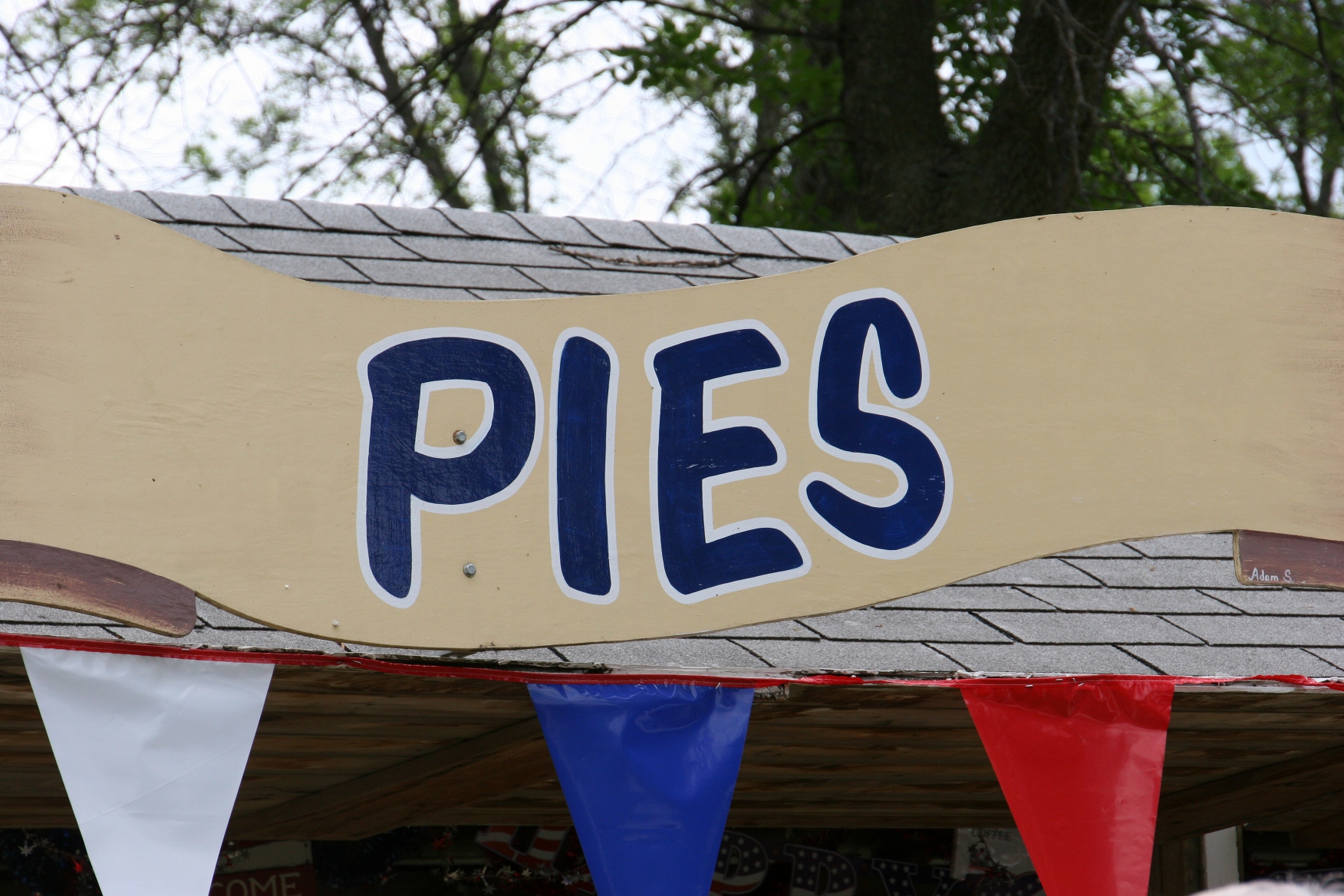
One of my favorite places to purchase homemade pie is at the North Morristown Fourth of July celebration. (Minnesota Prairie Roots copyrighted file photo)
For all you pie lovers, here’s an easy-to-make, healthy pie that is a family favorite. What types of pie do you especially like?
Chocolate Tofu Pie
10-12 oz. soft silken tofu
10 oz. dark chocolate chips
1-2 tsp. vanilla
9” graham cracker pie crust
In blender, blend tofu until smooth. Add vanilla. Blend again. Melt chocolate chips. Add melted chocolate to tofu in blender and mix thoroughly until smooth. Pour into pie crust. Refrigerate for 1-2 hours minimum. This keeps well in the fridge for several days. Serve with sliced strawberries, optional.
Tips: If you can’t find soft silken tofu, soft or firm will work. It just takes a lot more time to blend. Cut the tofu into chunks for easier blending. Also, if you are serving this to kids or picky adults, don’t mention the word “tofu.”
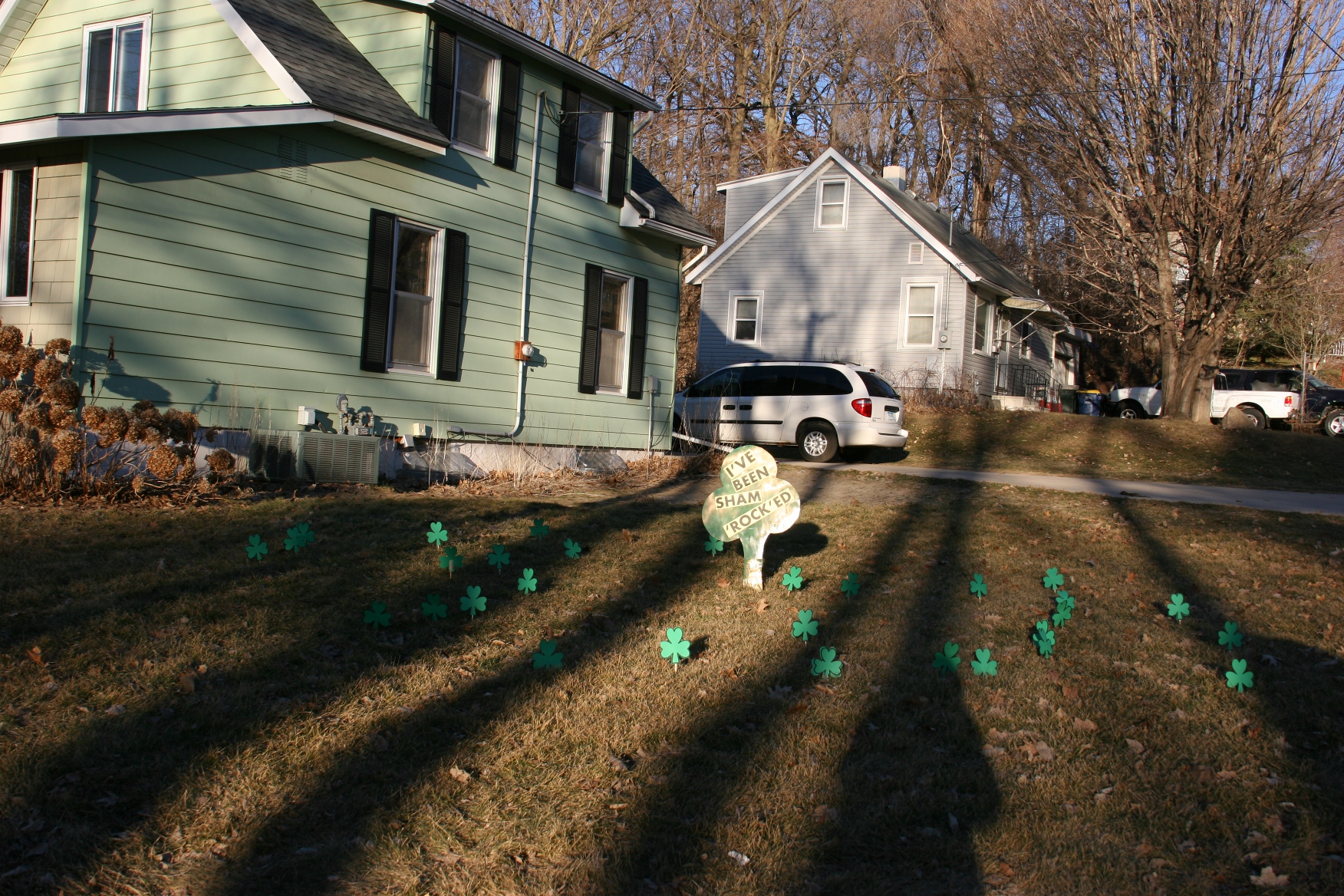
Three among the many shamrocks placed in my yard 10 years ago on St. Patrick’s Day. (Minnesota Prairie Roots copyrighted file photo)
IF YOU WANT to celebrate St. Patrick’s Day quietly without all the hype, I offer several suggestions. These center not on drinking green beer, listening to Irish music and such, but rather on simple, fun ideas that hold a bit of magic.
Friends planted shamrocks in my yard on a past St. Patrick’s Day. (Minnesota Prairie Roots copyrighted file photo)
First off—and this one takes the most effort—is shamrocking. And, no, this isn’t anything party-related. Rather, this is a way to surprise a friend, a neighbor, a family member with a field of shamrocks planted in their yard. About a decade ago, I was the recipient of this St. Patrick’s Day surprise. And I gotta tell you, this act of kindness left me smiling all day.
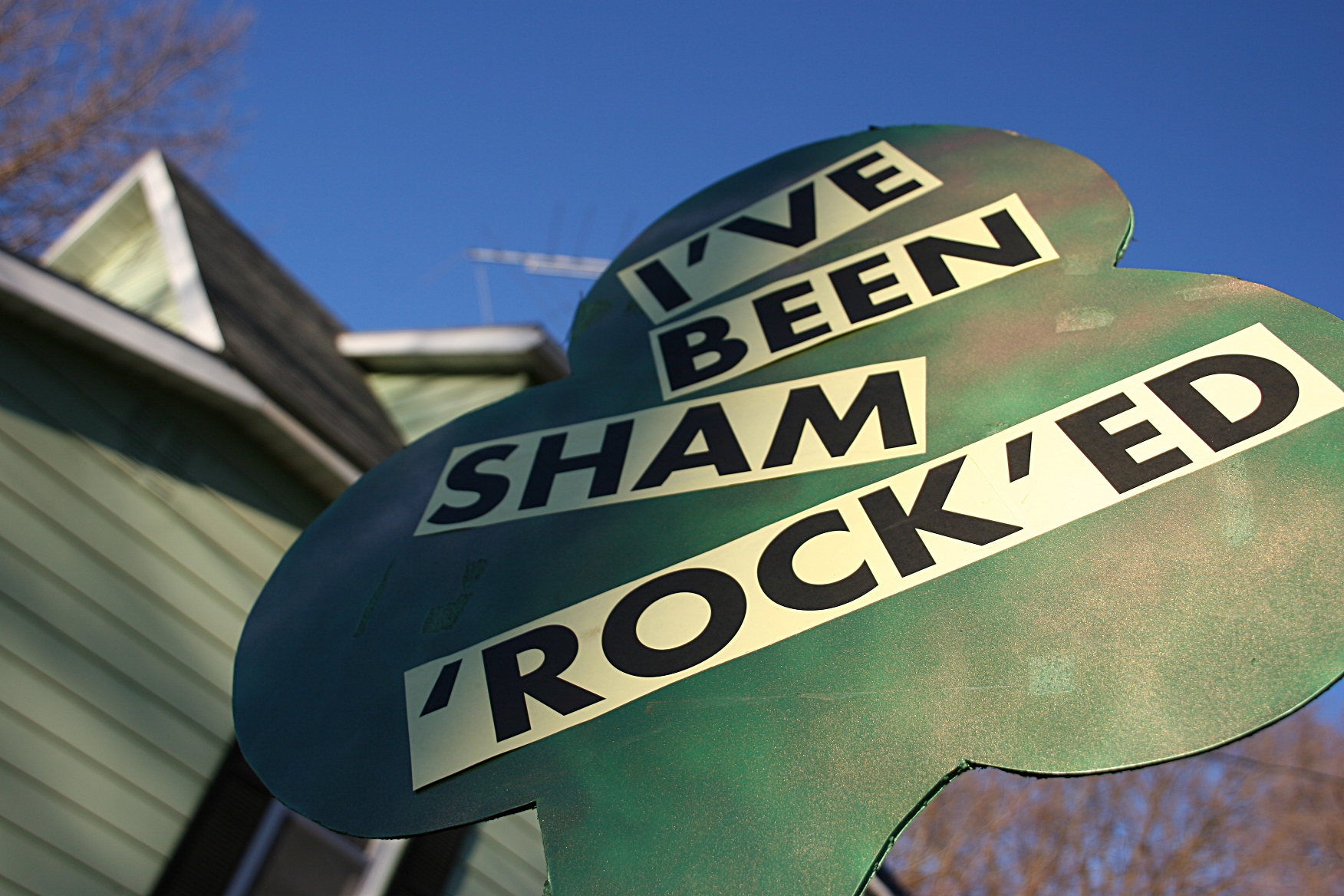
This message on the largest shamrock explains shamrocking. (Minnesota Prairie Roots copyrighted file photo)
Here’s how it works. Draw and cut about two dozen black magic marker-outlined shamrocks from green paper or tag board (or buy them, maybe at a dollar store), write a fun/uplifting message on them (this is optional), then tape to a short dowel (or whatever you can stick into the ground). Next, draw and cut one over-sized shamrock from green paper and write this message on it: “IVE BEEN SHAM ‘ROCK’ ED.”
Then, and this is the tricky part, you have to plant these shamrocks when the recipient isn’t watching, perhaps under the cover of darkness. The element of surprise, of awakening to a lawn growing shamrocks, is magical.
The leprechaun trap built by my grandkids last year. (Photo courtesy of Amber Schmidt)
Leprechauns, as we all know, are also magical. And especially mischievous. Last year, my two grandchildren built a leprechaun trap from Magna-Tiles, a plastic flower pot and a tissue box. They drew gold coins on paper to decorate the walls. They also placed fake coins inside the pot. The goal was to trap a leprechaun who would leave real, not fake, gold coins for them. A leprechaun (albeit paper) was, indeed, trapped in their contraption. He did not leave any gold, though. A quarter may have appeased the two of them. So if you have little people in your life, encourage them to craft a leprechaun trap. And then do your part to make some magic happen.
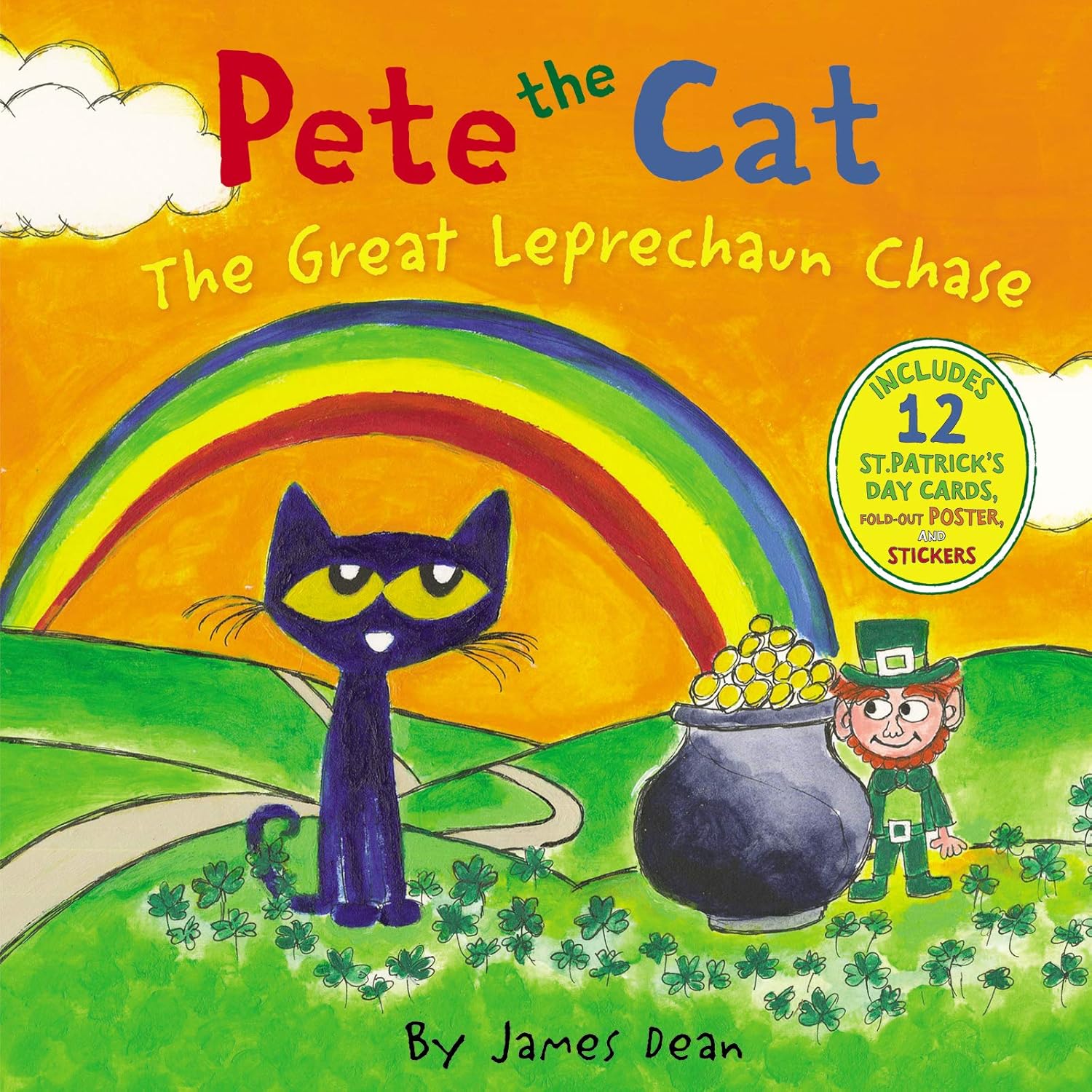
(Book cover sourced online)
My third suggestion—and this is because I love books—is to read a book about St. Patrick’s Day, Ireland or leprechauns. Read it to yourself or aloud to a little person. I typed “leprechaun” into my local library’s online catalog search engine and 14 books, mostly children’s picture books but also some nonfiction, popped up. How to Catch a Leprechaun written by Adam Wallace and illustrated by Andy Elkerton would be a good reference for the aforementioned trap project. And Pete the Cat:The Great Leprechaun Chase, a picture book written and illustrated by James Dean, would surely delight any child as Pete the Cat starts a leprechaun catching business. Even if you’re an adult without a kid to read to, read a book written for children. I love children’s picture books for their art, their stories and their messages.
Lucky Charms, photographed on a local grocery store shelf last March. There’s a collectible trap on the back of the box. (Minnesota Prairie Roots copyrighted file photo)
Finally, channel your inner kid and enjoy a bowl of Lucky Charms cereal. Sure they’re sugary and all that. But, hey, occasionally we have to treat ourselves, so says she who eats fruit-laced oatmeal nearly every morning for breakfast. Lucky Charms is about more than eating something sugary. It’s also about feeling like a kid again, recapturing youthful magic in every bite of those lucky charm marshmallows and toasted oat pieces. Who doesn’t believe in the magic of unicorns, rainbows, horseshoes and five other lucky charms? I do. At least on St. Patrick’s Day.
The Irish national flag flies outside an Irish pub in Wabasha. (Minnesota Prairie Roots copyrighted file photo)
I’VE NEVER ATTENDED a St. Patrick’s Day celebration. I’ve never eaten corned beef and cabbage. But I have eaten Irish stew at The Olde Triangle Pub in Wabasha, although not on St. Patty’s Day.
Green beer outside a bar in downtown La Crosse, Wisconsin. (Minnesota Prairie Roots copyrighted file photo)
I once spotted a partially-filled cup of green beer sitting outside a bar in La Crosse, Wisconsin, the day after St Patrick’s Day. I’m quite certain I’ve consumed an Irish lager or ale, although the beer was not colored green.
The Church of St. Patrick in St. Patrick. (Minnesota Prairie Roots copyrighted file photo)
I’ve never attended a St. Patrick’s Day Mass, although I’ve photographed the exterior of the Church of St. Patrick, Cedar Lake Township in the unincorporated village of St. Patrick.
A tombstone in the Church of St. Patrick Cemetery. (Minnesota Prairie Roots copyrighted file photo)
I am 100 percent German, although I had a full-blooded Irishman uncle (he died a year ago) from Belfast. He married into the family.
Now if any of this qualifies me to be an Irishwoman for a day, I will accept the luck of the Irish and don some green on March 17 or thereabouts.
We can all be Irish in mid-March as communities, churches, restaurants and bars, and more celebrate St. Patrick’s Day. In my region of southern Minnesota, you’ll find lots of ways to be Irish. Starting on Saturday, March 15, Sacred Heart Church in Waseca gets festivities underway with Irish music and Mass at 10:30 a.m. A Parade of Clans to The Mill Event Center follows at noon for an Irish rally. I take rally to mean a big party—food, including Mulligan Stew and corned beef and cabbage, served from a food truck; beer; music and entertainment; and more fun. At 7 p.m., Miss St. Patrick and Miss Irish Rose will be crowned. A dance follows. I should note here that Waseca is home to an Irish pub, Katie O’Leary’s Beef & Brew.
Signage on St. Patrick’s Tavern in St. Patrick. (Minnesota Prairie Roots copyrighted file photo)
The tiny, unincorporated Scott County burg of St. Patrick, basically a church, cemetery, baseball field and tavern, is, of course, honoring the patron saint (and its name) via food and music at St. Patrick’s Tavern. The bar and restaurant along Old State Highway 13 northeast of New Prague will serve corned beef, cabbage and red potatoes on March 15 with a green beer on tap. Food and beer specials continue on March 17. There will be music both evenings.
Shamrocks in my yard, planted by friends. (Minnesota Prairie Roots copyrighted file photo)
Over in Le Center, a full day of Irish-themed festivities begins at 11 a.m. March 15 with Mass at St. Mary’s Catholic Church. Over at the American Legion, Mulligan Stew will be served from 11 a.m. – 2 p.m. And then at 2 p.m., the big St. Patrick’s Day parade through downtown Le Center begins. Presiding over everything will be the newly-crowned royalty—Miss Shamrock, Miss Leprechaun and Miss Irish Rose. Dancing in the evening at the Legion wraps up the celebration.
A St. Pat’s Day decoration in a storefront window in Faribault. (Minnesota Prairie Roots copyrighted file photo)
In Owatonna, VFW Post 3723 is hosting a March 15 St. Paddy’s Day Dinner & Trivia party with dinner choices of corned beef and cabbage or Shepherd’s Pie, plus sides and dessert, served from 5-6:30 p.m. Irish Trivia follows at 7 p.m. with a chance to win a Pot of Gold. There will also be leprechaun races and other activities.
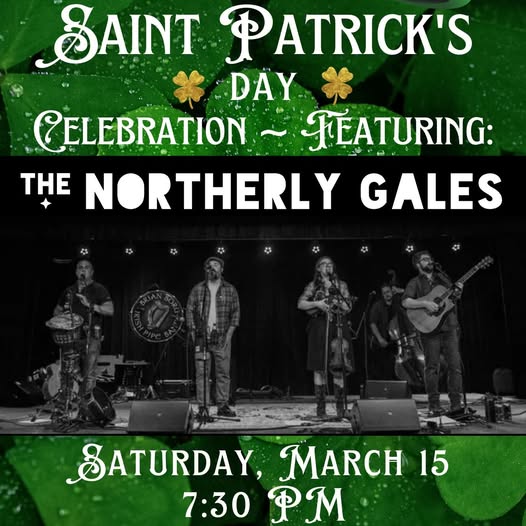
(Promo source: Paradise Center for the Arts Facebook page)
Music centers a high-energy show Saturday, March 15, at the Paradise Center for the Arts in Faribault as Twin Cities-based The Northerly Gales brings its spin on Celtic Folk and Americana to the stage at 7:30 p.m. And, yes, you can enjoy a beer while enjoying the music.
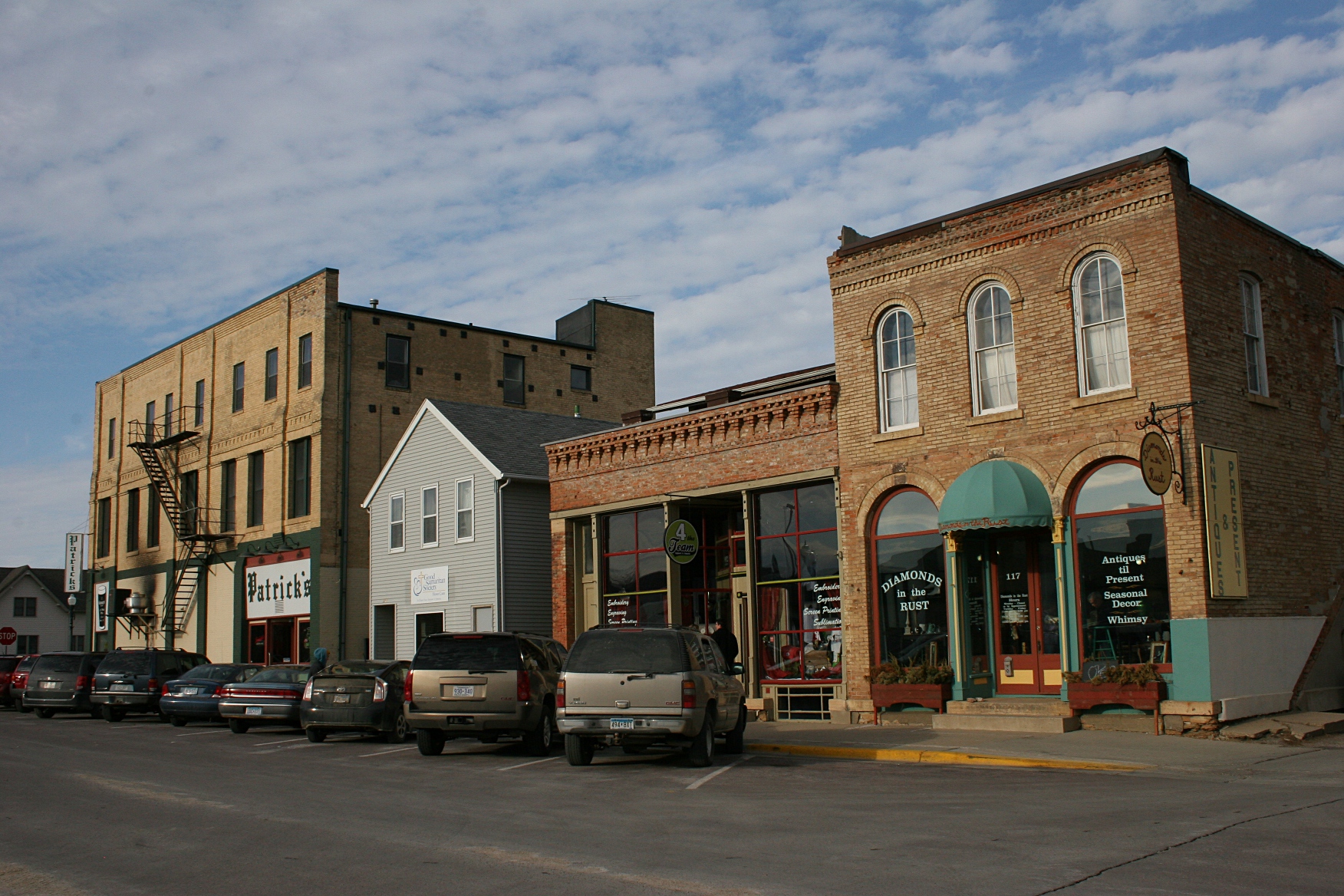
Patrick’s on Third anchors the corner on the left of this block in downtown St. Peter. (Minnesota Prairie Roots copyrighted file photo)
Over in St. Peter, St. Patrick’s Day is celebrated on the actual date, March 17. Paddlefish Brewing offers a special on its Leprechaun Lager. I expect the Irish and not-so-Irish will also gather at Patrick’s on Third for food and drink, including green beer. The Govenaires, the longest, continuously-operating drum and bugle corps in the U.S., performs in the 5:30 p.m. St. Patrick’s Day Parade and then briefly afterwards at Patrick’s on Third. The Governaires are traveling to Ireland in August to participate in the Rose of Tralee International Festival. They are encouraging donations of $17 on March 17 to help fund the trip.
Irish pride shows on the Kilkenny, Minnesota, water tower. (Minnesota Prairie Roots copyrighted file photo)
So there you go, a sampling of St. Patrick’s Day activities happening in my region. But I must mention one more thing. If you want to celebrate St. Patrick’s Day in Kilkenny, Minnesota, you’ll have to wait. The Le Sueur County town of some 150 with the Irish name shifted its annual Irish celebration to September. Halfway to St. Paddy’s Day is set this year for September 13 and 14. Mark your calendars for more Irish fun six months from now.
Sunrise on Horseshoe Lake, rural Merrifield, MN. (Minnesota Prairie Roots copyrighted file photo September 2024)
ON THE SATURDAY I should have been in Madison, Wisconsin, cuddling my nearly two-month-old grandson, Everett, I was, instead, home in Minnesota. Sick with a cold. I felt sad and disappointed that our trip was canceled.
But then my son-in-law sent a short video clip of Everett. To the soundtrack of “It’s a Beautiful Morning,” I watched Everett smile. You know the type of smile that widens and grows until it reaches your eyes. It was only a few seconds, but enough to shift my mood to joy.
And who doesn’t need a little joy right now? There’s a lot happening currently on a national and international scale that causes me deep concern, stress and worry. So I must intentionally seek out that which eases some of my angst. A visit with Everett and his parents would have proven a wonderful distraction. Soon, perhaps, Randy and I can do the four-hour drive to Madison.
Meanwhile, back home in Faribault, I connect with friends, go on walks, lift hand weights, hang laundry outside on the line, bake banana bread, take a Sunday afternoon drive, listen to uplifting music (specifically Christian radio station KTIS), pull out my camera, write, read…all simple things that brighten my days.
(Book cover sourced online)
Most of you know that I love to read. I happened upon a collection of short stories which was, in a way, like a short “It’s a Beautiful Morning” video clip. The slim volume, Notes from the Porch—Tiny True Stories to Make You Feel Better about the World by Thomas Christopher Greene, was exactly the book I needed to read on the weekend I was still fighting my cold and couldn’t see Everett.
Greene shared the stories via social media from his home in Vermont during the COVID-19 pandemic. And now he’s compiled those stories, typed into his laptop on his front porch, in this book. Even if you’re not a big reader—and I know a lot of people who don’t read books—this is a breeze of a relatable read.
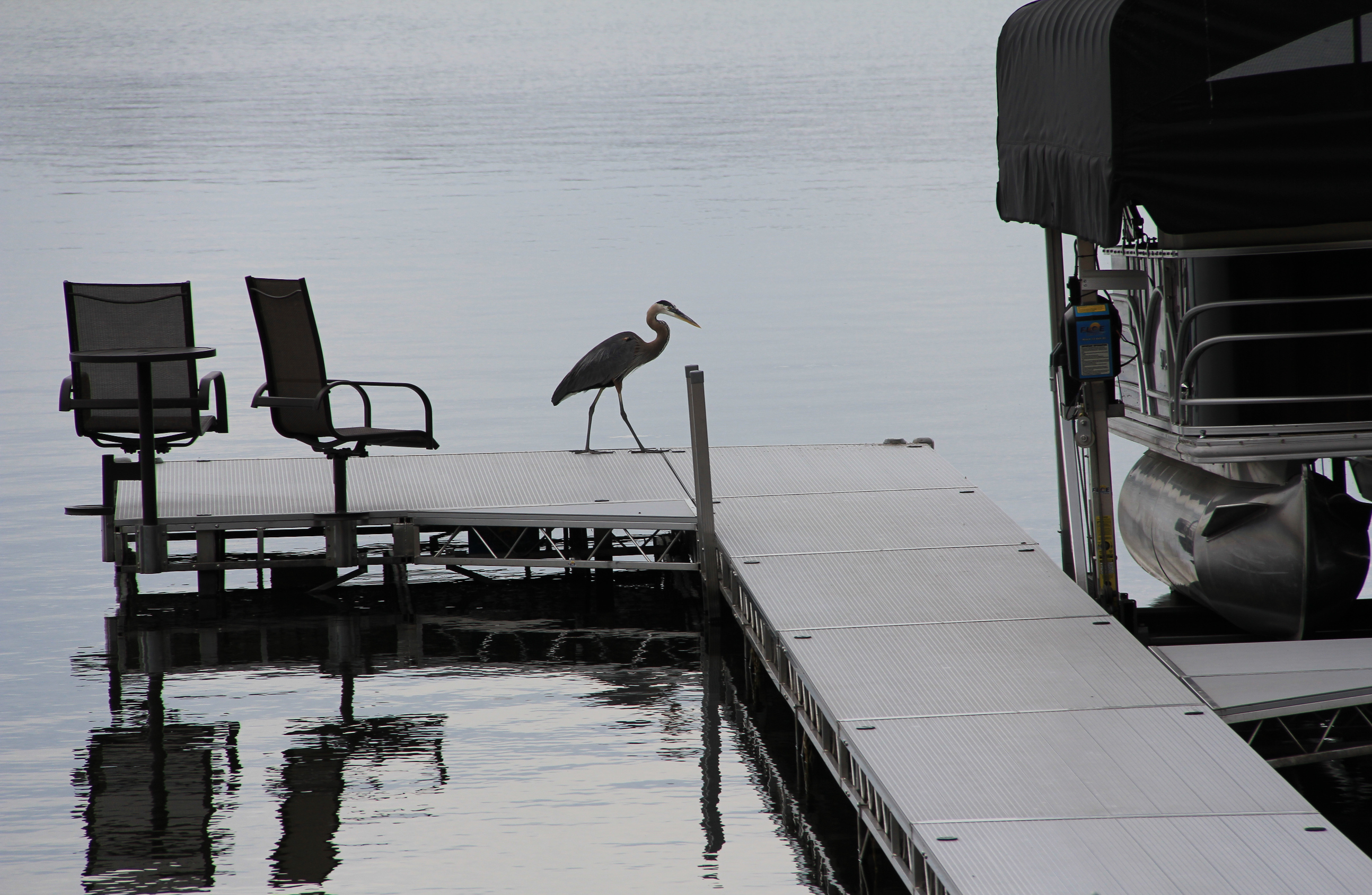
In his book, Thomas Greene writes about a blue heron in sharing the story of his baby daughter Jane. (Minnesota Prairie Roots copyrighted file photo)
The book title alone, Notes from the Porch, points to the content of short snippets about everyday life. Most are not extraordinary moments, with the exception of the death of the author’s daughter, Jane, at six months. Even that has a positive message of we’re all stronger than we think. I bet nearly all of you can relate to that—the resilience we find in the midst of incredible personal challenges. And if you haven’t faced such challenges, then I’m glad you haven’t.
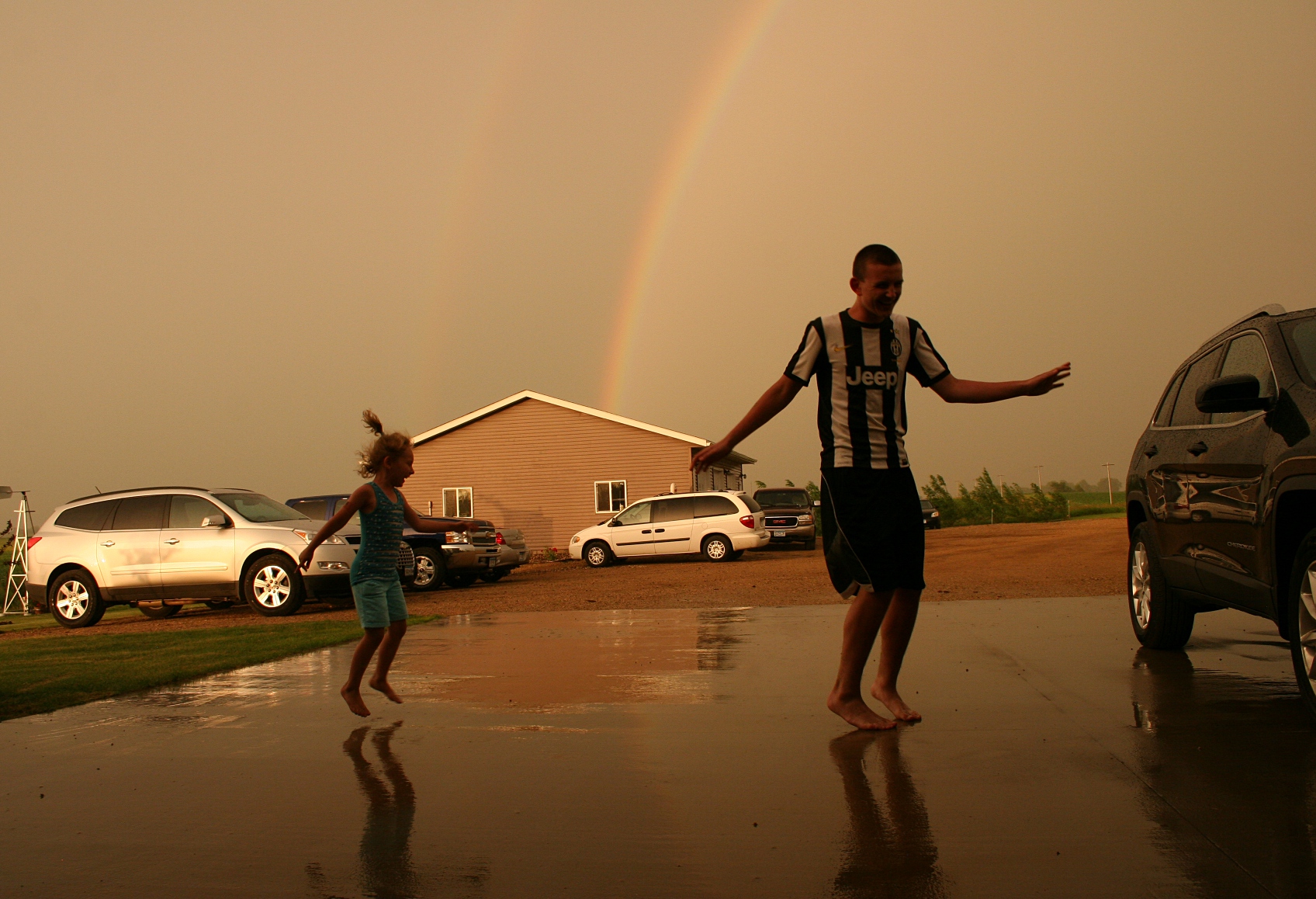
My niece and nephewdance in the rain at a family gathering. (Minnesota Prairie Roots copyrighted file photo)
But back to Greene’s book. He writes several stories about his seven-year-old neighbor boy who races his bike along the street. With wild abandon. Fearless. Occasionally stopping to chat with the front porch writer. I can picture that young boy, who also runs in the rain. Just as I can picture the older couple in another story, on their boat each evening chasing the sun. Rain and sunshine.
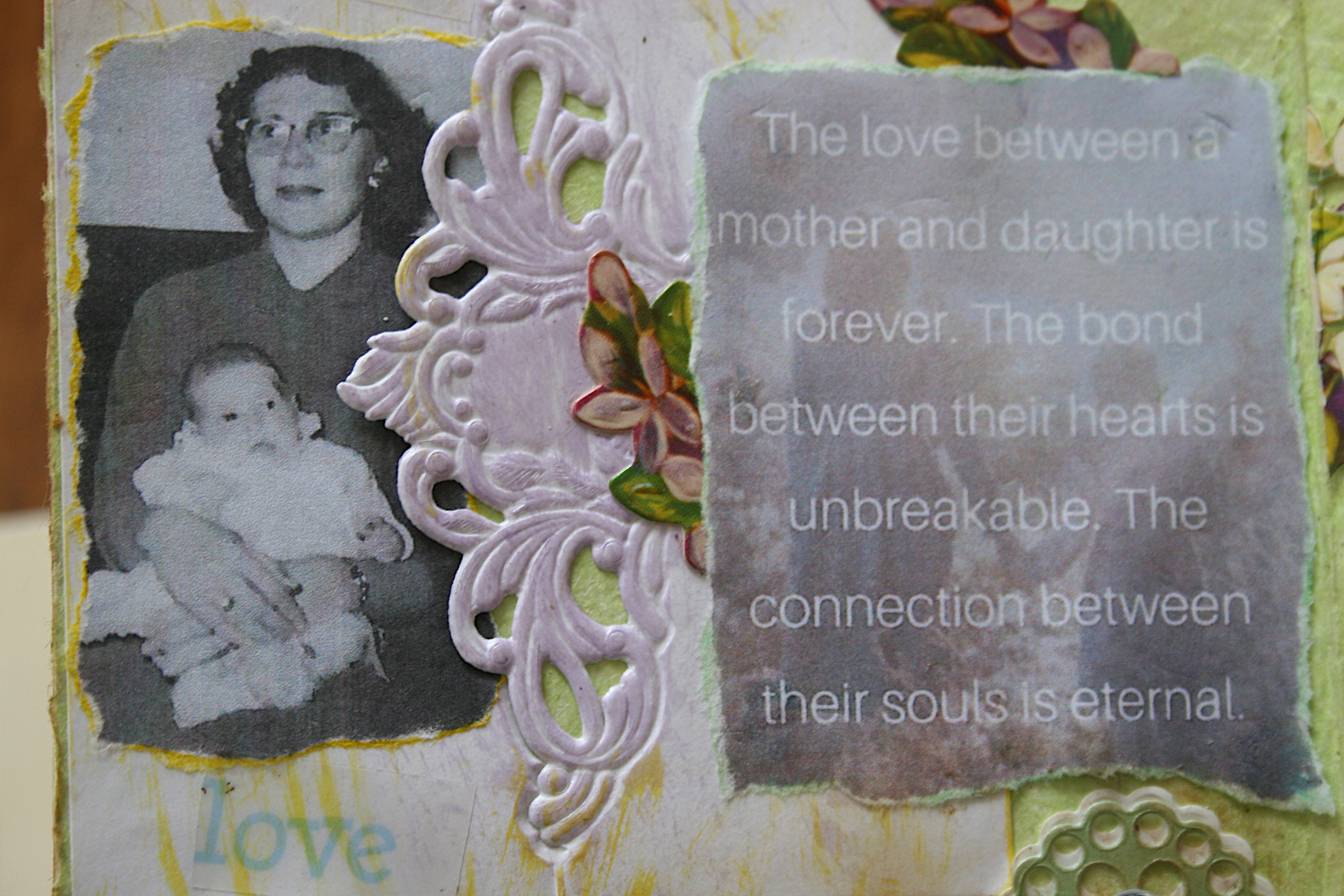
A page in a keepsake book a friend created for me after my mom died. The photo is of my mom holding me. (Minnesota Prairie Roots copyrighted file photo)
Greene’s writing is not only descriptive, but also emotionally touching and insightful. When I read his story, “The Only List I Will Ever Make,” I cried at #11, the final item on his living life list: 11. Call your mom. If your mom is no longer here, call her anyway. No one will root for you more. I used to call my mom every Sunday evening until she could no longer talk on the phone. She’s been gone three years now, dying during the height of Omicron (not of) in a long-term care center. There are days when I wish I could call her, hear her supportive words, tell her I love her. Greene’s writing reminds me that Mom is but a memory away, part of me for the kindness and compassion she taught me, for the unconditional love she gave to me, for the…
This art created by my granddaughter reminds me that we can all be each other other’s sunshine. (Minnesota Prairie Roots copyrighted file photo 2023)
And now Greene has gifted all of us with his kind and compassionate words. He writes of kindness witnessed in a grocery store. He writes about a father joyfully, publicly sharing the news that his straight A daughter has been accepted into an Ivy League school. A Black girl from Vermont, the daughter of an immigrant without any money, going to Harvard because she earned it. That reminds me of my own son getting into an elite East Coast college, because of his smarts, certainly not because we had the money to send him there.
Notes from the Porch uplifts, encourages, teaches. Each story is like “It’s a Beautiful Morning” video clip of my smiling grandbaby. Sure to leave you feeling better.



























 Minnesota Prairie Roots
Town hall talk, a commentary March 20, 2025
Tags: 1st Congressional District, Americans, commentary, concerns, democracy, DFL Senate District 19, education, Faribault, farming, federal government, Minnesota, opinion, Representative Brad Finstad, social issues, town hall meeting, veterans
I DEBATED FOR SEVERAL DAYS whether I should write this post, because it could be misconstrued as purely political. It is not. Rather this is a story about a grassroots gathering of people sharing information, ideas and opinions. Democracy at its core. This story is about us as Americans—listening, learning, agreeing or disagreeing, and letting our voices be heard.
Tuesday evening I attended a town hall meeting in Faribault hosted by DFL Senate District 19. It was open to everyone, regardless of political affiliation. But the crowd was decidedly Democrat, as you would expect given the hosting group. Republican Brad Finstad, who represents the 1st Congressional District in Minnesota, was invited, but did not attend. His district includes parts of Goodhue, Rice (where I live), Steele and Waseca counties in rural southern Minnesota.
Some 300 constituents packed the space, overflowing into adjacent rooms. Yes. Even I was surprised by the turn out. That tells me a whole lot of people have concerns about what is currently happening at the federal level and how government action is, or will, impact them. I expect not a single American will be untouched, whether directly or indirectly, by slashes in government personnel and funding and/or by changes in domestic and foreign policies.
Town hall organizers lined up speakers to address topics covering a broad range of subjects affecting a whole lot of people and programs—farmers, education, healthcare, seniors, veterans, those with disabilities, communication, nonprofits and much more. I was impressed by how well prepared these speakers were with facts and statistics. I learned a lot.
I’m not going to give you a detailed report of what each speaker said. Rather, I want to share several messages or phrases which really resonated with me and which should resonate with every American, no matter who they voted for. The phrase “we the people” was repeated by one speaker and embraced by the crowd. “We the people” means us. Americans, not members of one political party or the other. And, yes, I’m well aware of how those words from the preamble to the Constitution are being used politically as a mantra of sorts. But in this context, “we the people” references our right to speak up, to be heard, to tell our elected officials what we think and what we would like them to do as our representatives in Washington DC. That can be done by attending town halls like this; the meeting was video taped and will be sent to Representative Finstad. We can be heard via phone calls, emails and letters. We the people have power in our voices, in our votes, whether Democrat, Republican or Independent.
Secondly, a local educator asked the crowd and Finstad to ask themselves this question: “How are the children?” So, yes, how are the children, when many live in poverty, when federal funding for education is in imminent danger of being mostly cut, when…fill in the blank here? I think we can all agree that children are our future and we ought to care about their health, happiness, education and much more.
Third, one of the speakers shared that, as someone of the Catholic faith, he is called upon to help others. He called upon Representative Finstad, who is also Catholic, to do the same. That means feeding the hungry (funding USAID, for example), protecting Medicaid and Social Security, etc. all of those ways and places we help one another as human beings in this country and abroad. Now I’m not Catholic; I’m Lutheran. Doesn’t matter. My faith compels me to show love, compassion and care for others, especially those in need. America once did that as a country. Generously. But that is changing. We have bounty and resources we can share to help starving children, to provide medical care, to help others in any way we can. It is the right thing to do as a nation blessed with great bounty.
Fourth, a local farmer spoke about $3.2 million in contracts with farmers in our district which have now been broken by the U.S. government. The consequences will be devastating to those farmers who have already invested those federal monies in their operations. Trust has been broken, she said. I think we can all agree that when a legal contract is broken, it’s a breach of trust.
There’s so much more I could share from that town hall session. But I want to conclude with this. I encourage you, if you have the opportunity to do so, attend a town hall meeting. Listen. Learn. Engage. Let your voice be heard. Remind your elected officials, too, that they need to listen, learn and engage.
FYI: A second Town Hall Meeting hosted by DFL Senate District 19 is set for 6 p.m. Sunday, April 6, at Mineral Springs Brewery, 210 N. Oak Ave., Suite 1, in Owatonna. It will follow the same format as the Faribault Town Hall with a moderator, speakers and an open mic. Representative Brad Finstad has been invited.
© Copyright 2025 Audrey Kletscher Helbling