
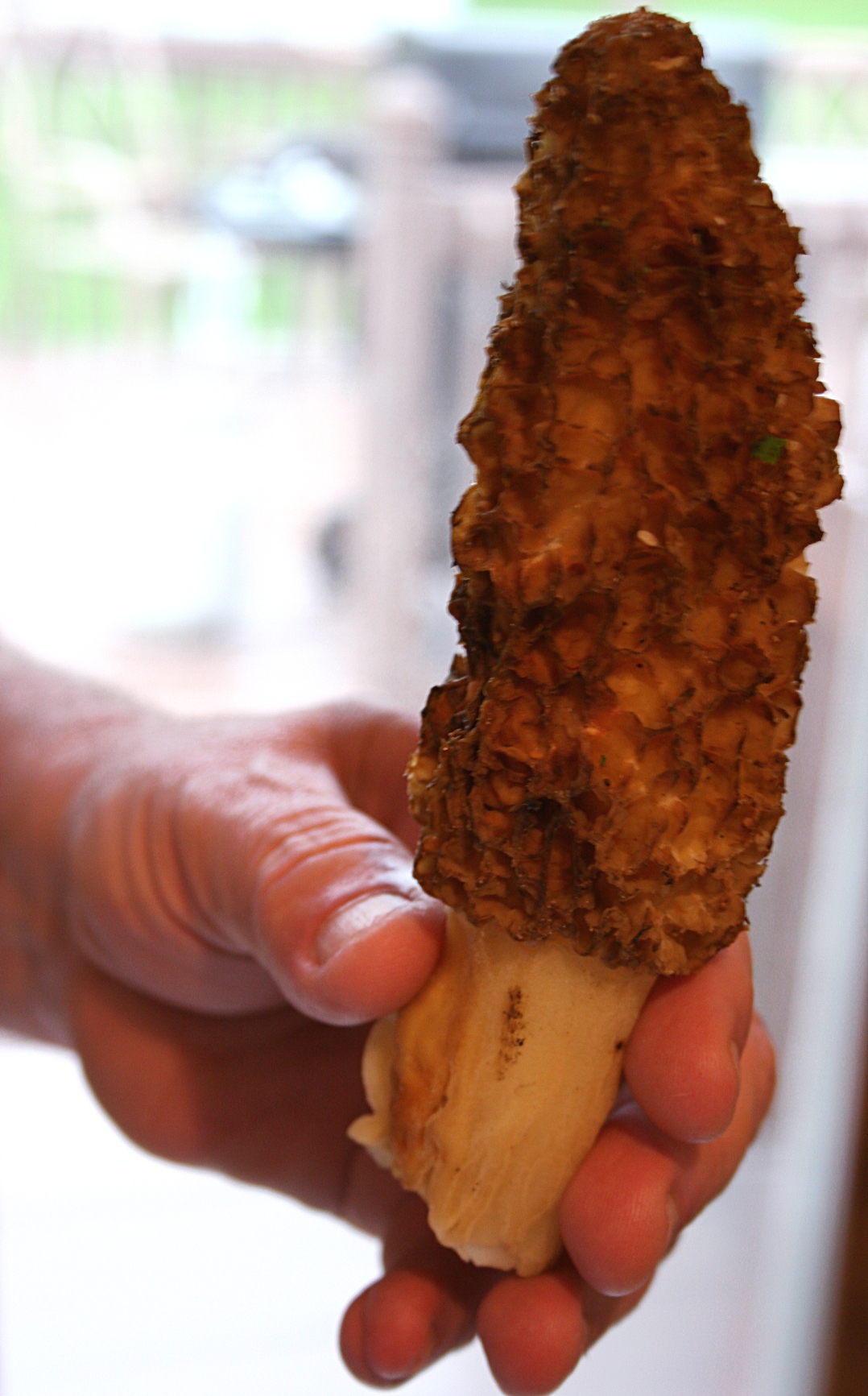
This morel measures about eight inches high.
MY SISTER, LANAE, and her husband, Dale, were giddy as two kids in a candy store when Dale walked in with the net bag plumped with a dozen morels.
Lanae grabbed her camera. I grabbed mine. And we photographed the largest morels I’ve ever seen. Not that I’ve seen many of these tasty mushrooms…but the tallest, an eight-inch high chunky morel, certainly impressed me.
It’s been a bumper crop year for morels in Minnesota, according to my brother-in-law, who has been hunting for this savory spring treat since he was a kid growing up in southwestern Iowa. He remembers piling into the family car afer church on hot, humid mornings and heading to the wooded hills west of Defiance to search for morels.
Dale lives in southeastern Minnesota now and, through the years, has uncovered morel hotbeds. He revealed the location of his latest find—within a half hour of his Waseca home—and then instructed me, with a grin spreading across this face, that he’d have to kill me if I shared the specific location.
My lips are zipped.
However, Dale offered this publishable tip to finding morels: on the south side of wooded hillsides where there are dead elms or where elms once grew.
I didn’t realize just how serious my brother-in-law is about this morel business until he sat down at his laptop and clicked onto morels.com, an online community bulletin board/information center for “Morel Madness 2012.” Here you can see photos of the latest morel finds and, surprisingly, even find out where to find morels. Or you can inquire about buying and selling.
Dale tells me morels were selling recently for $20 – $35 a pound on Craig’s list and eBay.
While earlier this spring my sister and her husband bought morels, they have plenty of their own now. A week ago Saturday Dale harvested some 65 morels from one location. Morels are sprouting two weeks earlier and are more abundant than normal this year, probably due to the unseasonably warm April, he speculates. The season has nearly ended now.
But this morel-loving couple will still be eating mushrooms into the summer and beyond as Dale dehydrates them. For now, this pair savors fresh morels, sauteed in butter. Lanae even saves the butter and reuses it to fry eggs, to make grilled cheese sandwiches and to put on asparagus. The butter has a “nice nutty flavor,” she says.
All of this morel show-and-tell got me interested in morels, which I found once perhaps two decades ago in the woods behind my house. I’ll admit, though, to a bit of nervousness over identifying morels.
Dale showed me a photo of a poisonous false morel and then offered this advice: “If it ain’t hollow, don’t swallow.”
Translate that to mean that edible morels are hollow inside. If you click here to Mushroom-Appreciation.com, you’ll find even more useful identification tips. I wouldn’t want you heading into the woods uninformed.
Perhaps next year my brother-in-law will allow me to join him on a morel hunt, if I promise not to photograph anything specific to give away his secret location.
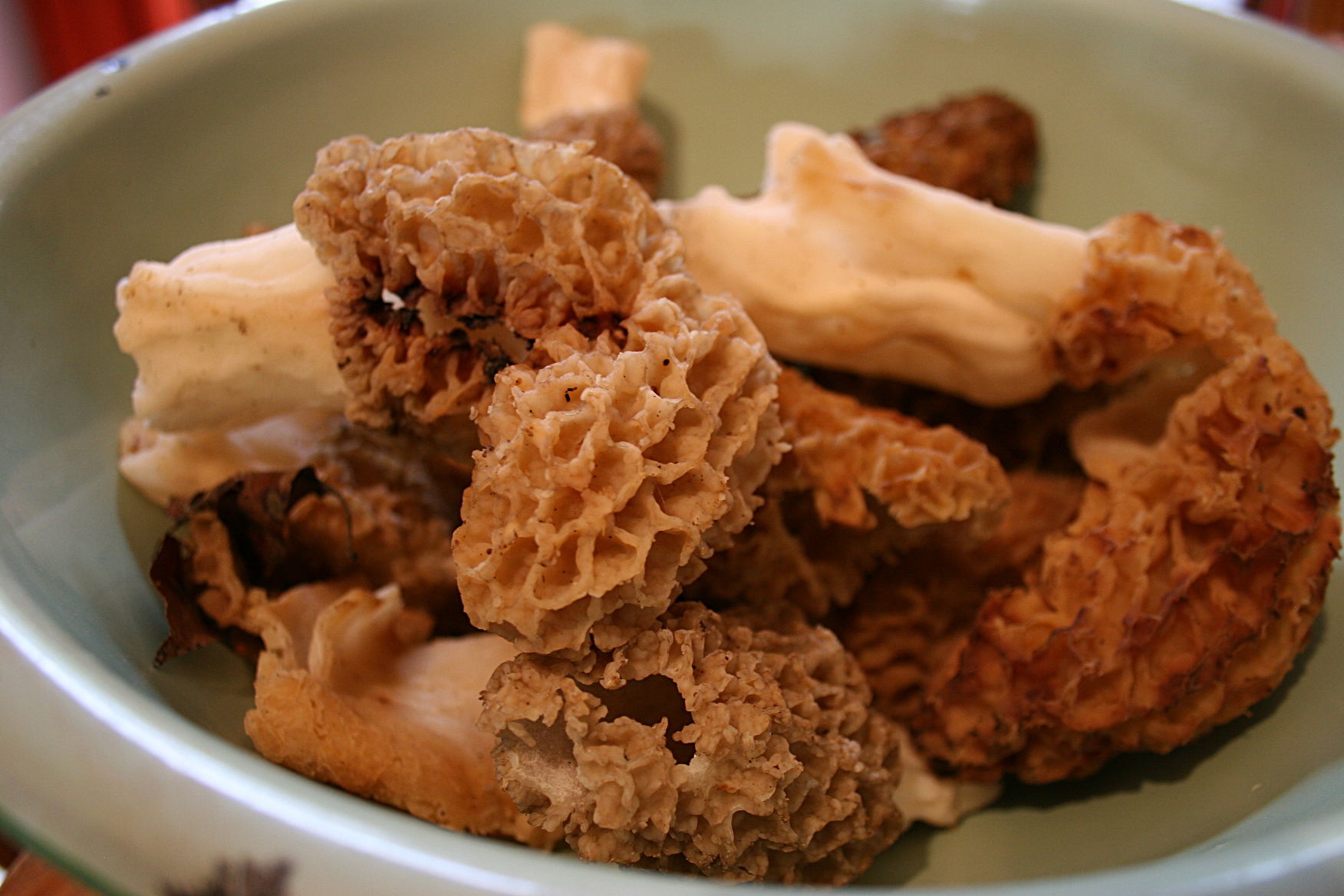
Dale’s latest stash of morels, harvested on Saturday morning near his Waseca home.
© Copyright 2012 Audrey Kletscher Helbling







 Minnesota Prairie Roots
Yes, Faribault is a diverse community May 3, 2012
Tags: City Pages, comments, diversity, Faribault, Minnesota, thoughts
In this file photo, a Somali family waits to cross a downtown Faribault street.
ON ANY GIVEN DAY, I can drive on a street in Faribault, walk along the sidewalk, glance out my office window or go shopping and see a racial diversity of people.
I can stand in my side yard and look toward the home of an Asian couple. I can glance up the hill and watch two preschoolers, the daughters of a white mother and an African American father, play outside. In my front yard, I can see, several houses down, the Hispanic family that has lived in my neighborhood for years.
Yes, Faribault, population 23,352, is a community of diversity. Thirteen percent of our residents are Hispanic/Latino and another 7.4 percent, black or African American, according to the 2010 U.S. Census. All totaled, about one-fifth of our residents identify themselves as “non-white.”
As my husband would say—and this is not meant at all as derogatory—shopping in at least one local grocery store is like walking into the United Nations. We shop side-by-side with Spanish-speaking Latino families and with Somali women clothed in billowing dresses and head scarves.
Just the other evening, as I entered the local public library, a Sudanese man held the exterior library door open for me while his pre-teen son opened the interior door. It’s been a long time since a young boy held a door for me and I expressed to him my appreciation for his respect and good manners.
The other day, while waiting in the car for my husband to pick up milk at a local convenience store, I observed a cluster of teenaged Somali girls, dressed in head scarves and flowing dresses, move along the sidewalk while, just across the street, a 60-something white woman clad in a jacket resembling an American flag pushed a cart of groceries. It was a unique visual illustrating diversity in Faribault.
Several Latinos lead in singing of Mexico’s national anthem last September during the International Festival at Faribault’s Central Park. Flags represent the birthplace nations of those participating.
The diversity of my community bubbled to the surface Tuesday after I read a comment on City Pages, an online Minneapolis-based information source. A post I published last week about jewelry store thefts in Faribault and elsewhere in Minnesota was linked to in “The Blotter” section as was an article in the Faribault Daily News which identified the jewelry store thieves as “black males.”
Now I don’t want to get into the issue of whether the news reporter should have racially-tagged the suspects. But I was miffed by the first Blotter comment on the blog post.
It looks like “diversity” has now spread to Hastings and Faribault.
That comment was followed by a reply I won’t print here because of the language. But you can read it by clicking here.
So why did the initial diversity comment rile me? Well, I’m tired of over-generalizations that those of us living outside the Twin Cities metro area reside in closed-up communities comprised mostly of Anglo-Americans. We are not just a bunch of white descendants of Scandinavians or Germans or Irish or French… We are racially diverse and growing in diversity.
If you ask the residents of Willmar or Worthington, St. James or Madelia, or many other Minnesota towns, they’ll tell you the same. Latinos, Asians, Somalians, Sudanese and others call outstate Minnesota home.
Diversity spread to Faribault decades ago. Just stroll through my neighborhood.
How diverse is your neighborhood, your small town, your suburb, your city? Let’s hear.
© Copyright 2012 Audrey Kletscher Helbling