Minnesota Prairie Roots

Writing and photography by Audrey Kletscher Helbling

From Wisconsin: A book about food, friendship, family, love, trauma & place April 2, 2025

(Book cover sourced online)

I FOUND THE BOOK in the new fiction section of my local public library, the place where I discover reading materials that grow me, stretch me, teach me, and, yes, entertain me. The Funeral Ladies of Ellerie County by Claire Swinarski fits all four of those categories. I love this book. Underline love.

I did not expect this reaction when I randomly pulled the novel from the shelf, drawn by its catchy title printed in a colorful font, drawn by the simple cover art of a lakeside Northwoods cabin. I do, indeed, judge a book by its covers, front and then back synopsis. These covers hit all the marks for me, someone who appreciates stories rooted in rural. Stories that are simple, yet complex. Stories that make me think, that tap into my empathy, that move me. Stories that are strong in place.

(Book cover sourced online)

In some ways, this book reminds me of the writing of Minnesotan Lorna Landvik, author of the popular Patty Jane’s House of Curls, The Tall Pine Polka, Once in a Blue Moon Lodge and more, most of which I have read. But the author of The Funeral Ladies of Ellerie County hails from neighboring Wisconsin, which is similar to Minnesota, but different.

These are what we call bars (the kind you eat) in Minnesota and Wisconsin. Maybe elsewhere. (Minnesota Prairie Roots copyrighted file photo)

At the heart of this story are the funeral ladies, a group of long-time friends who prepare meals for mourners at St. Anne’s Catholic Church. Casseroles—not hotdish as we call casseroles in Minnesota—concocted with canned cream soups. Shredded beef. Peanut butter bars. Pies made with Door County cherries. Food for the body and soul. This reminded me of the Reception Committee in my childhood home church on the southwestern Minnesota prairie. That group of Lutheran women prepared funeral hotdishes comprised of hamburger, pasta, a vegetable and assorted canned cream soups with salt and pepper for seasoning. The recipes are published in the 1985 St. John’s Anniversary Cookbook. The covers of that cookbook have fallen off my tattered copy. A cookbook is central to Swinarski’s novel.

The point here is that The Funeral Ladies of Ellerie County is absolutely relatable for me. I felt comfortably at home with the story initially, even when I learned of a heartbreaking scam involving main character Esther Larson. That shapes the story. Then the story-line focus shifts from friendship, faith and family to tough topics after a Food Network star and his children arrive to bury his estranged wife in her hometown.

Mental health gets attention in this book. (Minnesota Prairie Roots copyrighted file photo)

Without revealing too much of the plot, know that family relationships, love and trauma weave into this novel. That trauma is post traumatic stress disorder, experienced by paramedic Cooper Welsh after participating in a holiday parade interrupted by a deadly shooting. In real-life, six people died in November 2021 when a driver plowed his SUV into a Christmas parade in Waukesha, Wisconsin, killing six and injuring many others. I expect Swinarski patterned her fictional tragedy loosely after this event or the many other mass shootings this country experiences.

I appreciate that the author, even in this fictional account of such violence and its personal aftermath, writes with authenticity. As a reader, I felt emotionally invested. I was rooting for Cooper and for those who love him. Swinarski doesn’t just touch on PTSD. She dives into it head on, writing in her acknowledgments that she talked to individuals dealing with PTSD to craft Cooper’s life story. That research shows.

A sign along the interstate advertises Ishnala Supper Club in Lake Delton near the Wisconsin Dells. (Minnesota Prairie Roots copyrighted file photo)

She writes, too, in an authentic Wisconsin voice with a strong sense of place. Noodles in chili (yes, it’s a thing in Wisconsin). Beer not wine. Brandy old-fashioneds, Wisconsin’s signature drink. Supper clubs. And eating at the popular Wisconsin-based fast food chain, Culver’s.

There are so many reasons to love The Funeral Ladies of Ellerie County. Even if you’re a Lutheran from Minnesota who eats hotdishes, not casseroles.

© Copyright 2025 Audrey Kletscher Helbling


Stories to make you feel better March 11, 2025

Sunrise on Horseshoe Lake, rural Merrifield, MN. (Minnesota Prairie Roots copyrighted file photo September 2024)

ON THE SATURDAY I should have been in Madison, Wisconsin, cuddling my nearly two-month-old grandson, Everett, I was, instead, home in Minnesota. Sick with a cold. I felt sad and disappointed that our trip was canceled.

But then my son-in-law sent a short video clip of Everett. To the soundtrack of “It’s a Beautiful Morning,” I watched Everett smile. You know the type of smile that widens and grows until it reaches your eyes. It was only a few seconds, but enough to shift my mood to joy.

And who doesn’t need a little joy right now? There’s a lot happening currently on a national and international scale that causes me deep concern, stress and worry. So I must intentionally seek out that which eases some of my angst. A visit with Everett and his parents would have proven a wonderful distraction. Soon, perhaps, Randy and I can do the four-hour drive to Madison.

Meanwhile, back home in Faribault, I connect with friends, go on walks, lift hand weights, hang laundry outside on the line, bake banana bread, take a Sunday afternoon drive, listen to uplifting music (specifically Christian radio station KTIS), pull out my camera, write, read…all simple things that brighten my days.

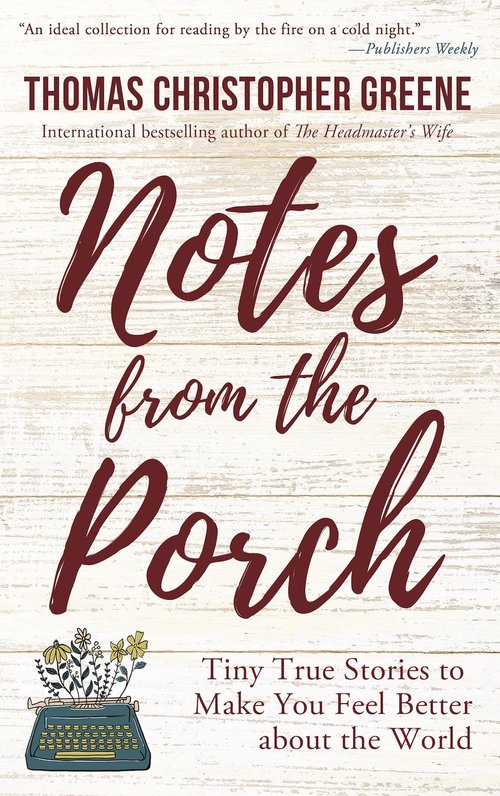
(Book cover sourced online)

Most of you know that I love to read. I happened upon a collection of short stories which was, in a way, like a short “It’s a Beautiful Morning” video clip. The slim volume, Notes from the Porch—Tiny True Stories to Make You Feel Better about the World by Thomas Christopher Greene, was exactly the book I needed to read on the weekend I was still fighting my cold and couldn’t see Everett.

Greene shared the stories via social media from his home in Vermont during the COVID-19 pandemic. And now he’s compiled those stories, typed into his laptop on his front porch, in this book. Even if you’re not a big reader—and I know a lot of people who don’t read books—this is a breeze of a relatable read.

In his book, Thomas Greene writes about a blue heron in sharing the story of his baby daughter Jane. (Minnesota Prairie Roots copyrighted file photo)

The book title alone, Notes from the Porch, points to the content of short snippets about everyday life. Most are not extraordinary moments, with the exception of the death of the author’s daughter, Jane, at six months. Even that has a positive message of we’re all stronger than we think. I bet nearly all of you can relate to that—the resilience we find in the midst of incredible personal challenges. And if you haven’t faced such challenges, then I’m glad you haven’t.

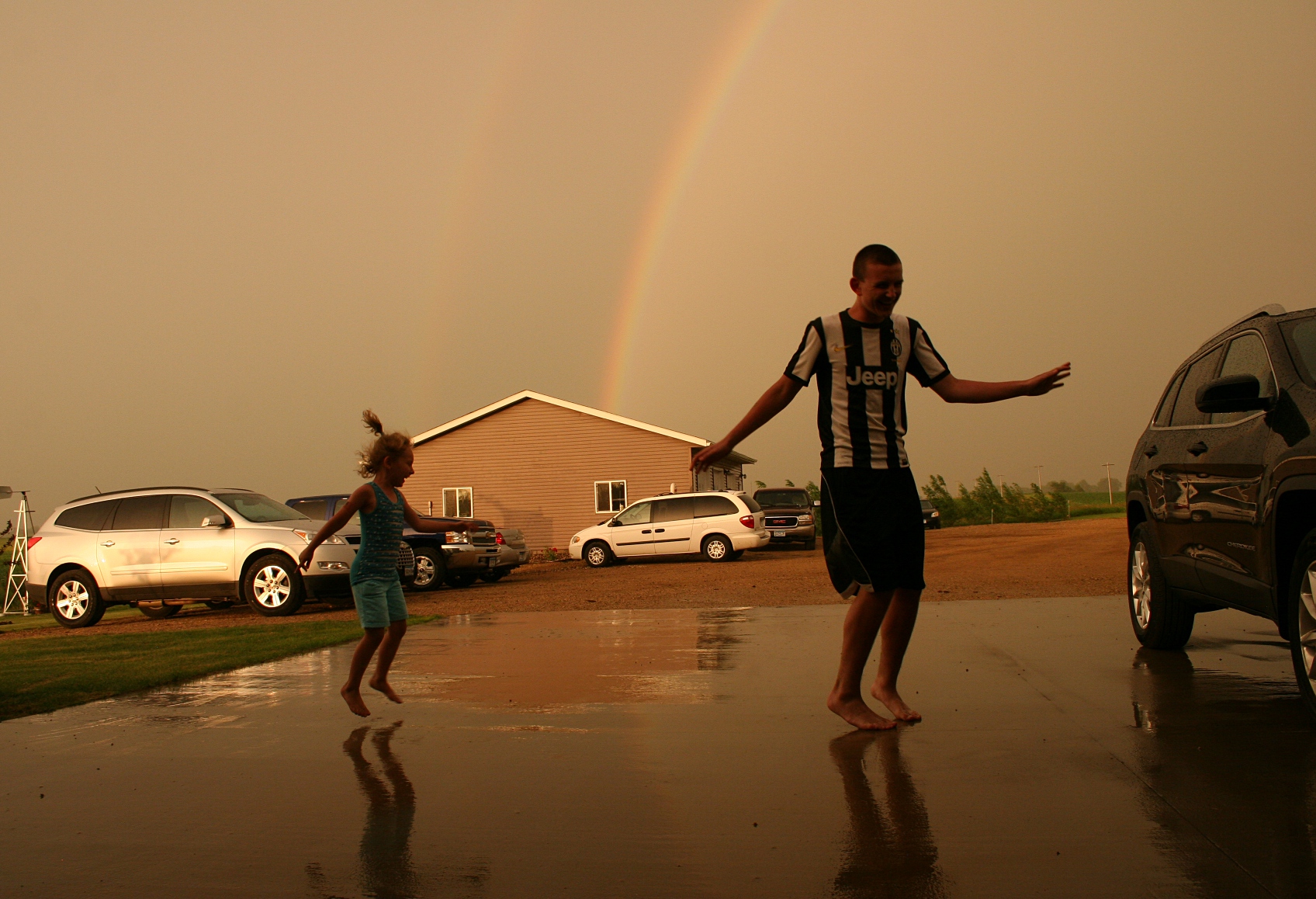
My niece and nephew dance in the rain at a family gathering. (Minnesota Prairie Roots copyrighted file photo)

But back to Greene’s book. He writes several stories about his seven-year-old neighbor boy who races his bike along the street. With wild abandon. Fearless. Occasionally stopping to chat with the front porch writer. I can picture that young boy, who also runs in the rain. Just as I can picture the older couple in another story, on their boat each evening chasing the sun. Rain and sunshine.

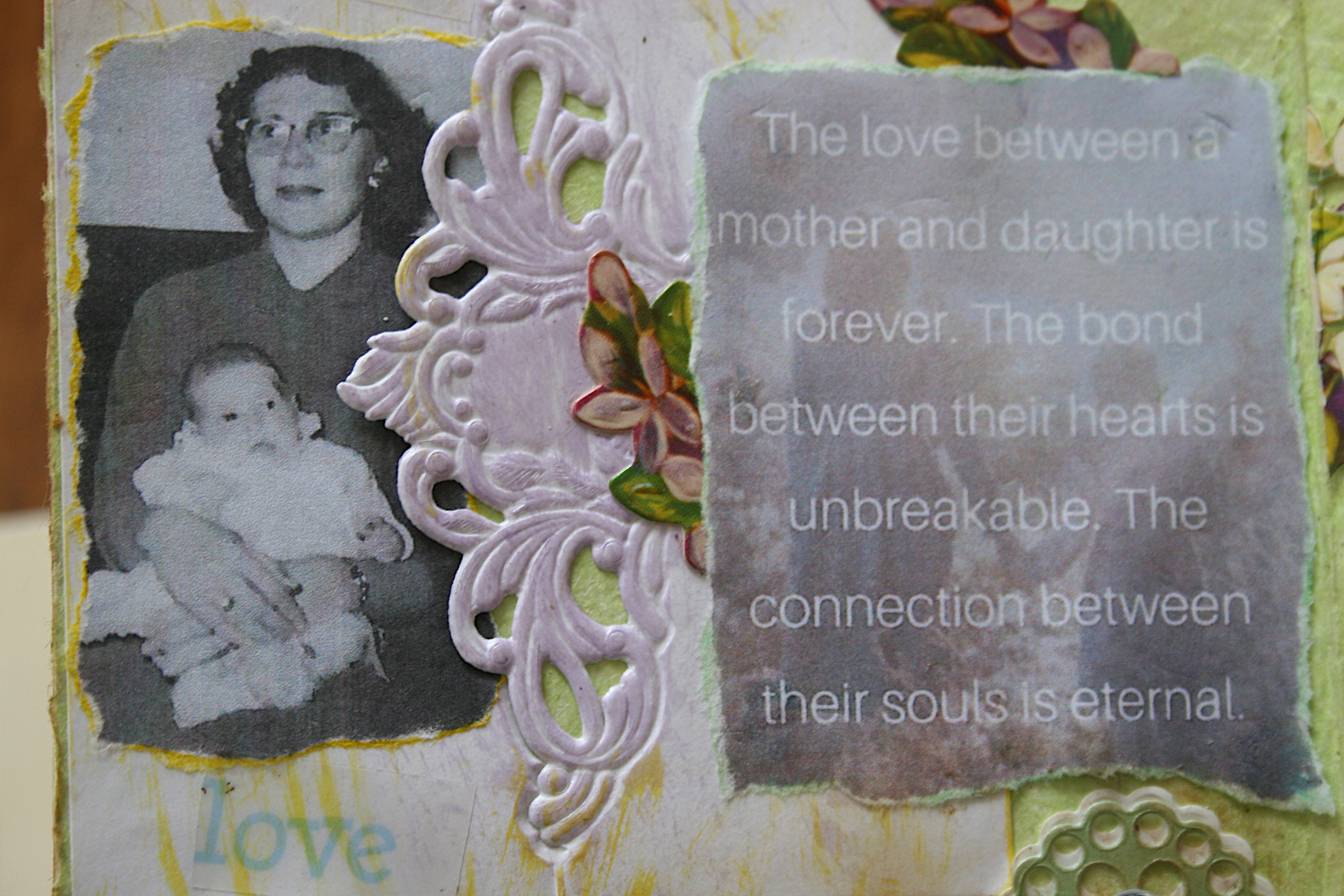
A page in a keepsake book a friend created for me after my mom died. The photo is of my mom holding me. (Minnesota Prairie Roots copyrighted file photo)

Greene’s writing is not only descriptive, but also emotionally touching and insightful. When I read his story, “The Only List I Will Ever Make,” I cried at #11, the final item on his living life list: 11. Call your mom. If your mom is no longer here, call her anyway. No one will root for you more. I used to call my mom every Sunday evening until she could no longer talk on the phone. She’s been gone three years now, dying during the height of Omicron (not of) in a long-term care center. There are days when I wish I could call her, hear her supportive words, tell her I love her. Greene’s writing reminds me that Mom is but a memory away, part of me for the kindness and compassion she taught me, for the unconditional love she gave to me, for the…

This art created by my granddaughter reminds me that we can all be each other other’s sunshine. (Minnesota Prairie Roots copyrighted file photo 2023)

And now Greene has gifted all of us with his kind and compassionate words. He writes of kindness witnessed in a grocery store. He writes about a father joyfully, publicly sharing the news that his straight A daughter has been accepted into an Ivy League school. A Black girl from Vermont, the daughter of an immigrant without any money, going to Harvard because she earned it. That reminds me of my own son getting into an elite East Coast college, because of his smarts, certainly not because we had the money to send him there.

Notes from the Porch uplifts, encourages, teaches. Each story is like “It’s a Beautiful Morning” video clip of my smiling grandbaby. Sure to leave you feeling better.

© Copyright 2025 Audrey Kletscher Helbling


From Minnesota & Harlem, photographing everyday life February 20, 2025

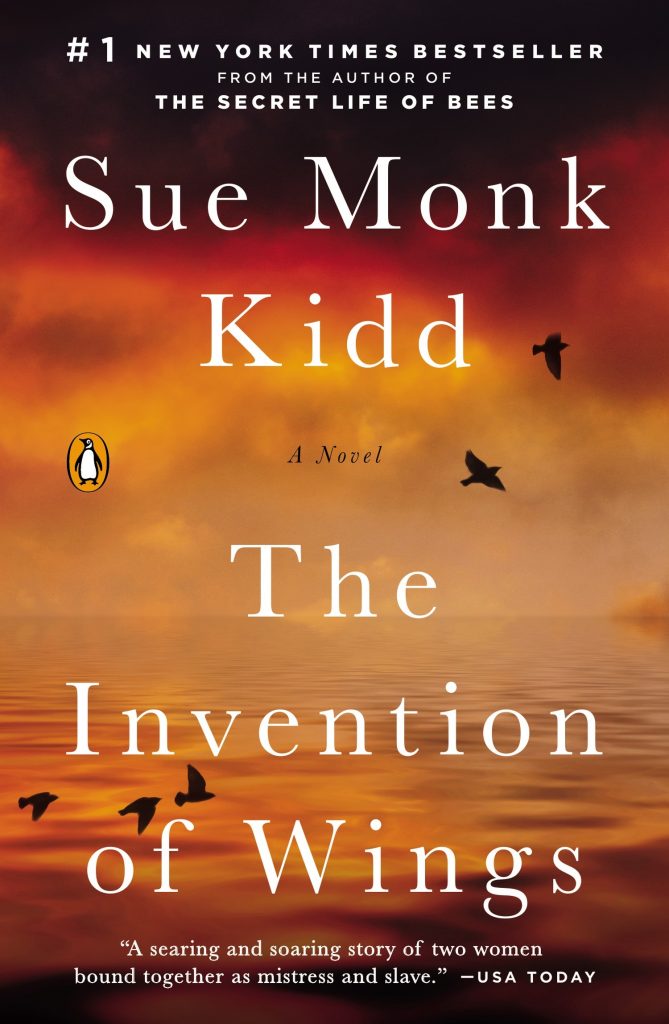
I recently finished this book about slavery, freedom and abolition. A must-read. (Book cover sourced online)

DURING THIS, BLACK HISTORY MONTH, I’ve intentionally read books about slavery, Black people and the Black experience. It’s important to me that I widen my knowledge and understanding. Many of the stories are heartbreaking, almost unbelievable in the mental and physical cruelty inflicted upon Blacks. This is hard stuff to read. But it is in the hard stuff that we begin to fully comprehend the importance of empathy, kindness, compassion and the need to stand strong against that which is hateful, hurtful and oppressive.

(Book cover sourced online)

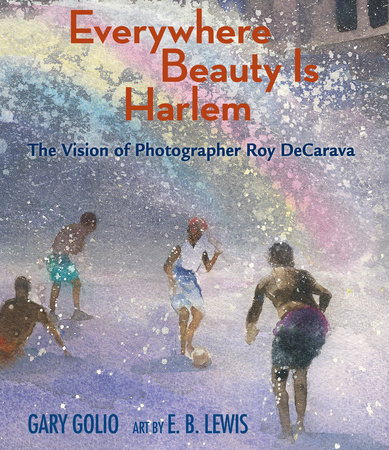
This week, though, I read a Black-focused book which inspired and uplifted me. It’s a children’s picture book, Everywhere Beauty Is Harlem: The Vision of Photographer Roy Decarava. The book, written by Gary Golio and illustrated by E.B. Lewis, won the 2025 Coretta Scott King Illustrator Honor Award.

This book resonates with me personally and professionally in telling the story of 1940s world famous photographer Roy DeCarava, unknown to me until I read this book. Trained in the arts and in photography, he would go on to photograph everyday life in his native Harlem via work for the Works Progress Administration Project, fellowships and more. He worked as a photographer for major publications, has/had his photos featured in exhibits and art museums, became an art professor… And he was Black.

But what I love most about this story is that DeCarava aimed to photograph everyday life, everyday scenes, everyday people in the streets of Harlem. He shows life in raw reality. He worked back in the days of film, admittedly much more challenging than shooting with a digital camera. I started with film, too. You often get only one chance to take a photo. No firing off shots. No digital manipulation. Just a single, unedited print.

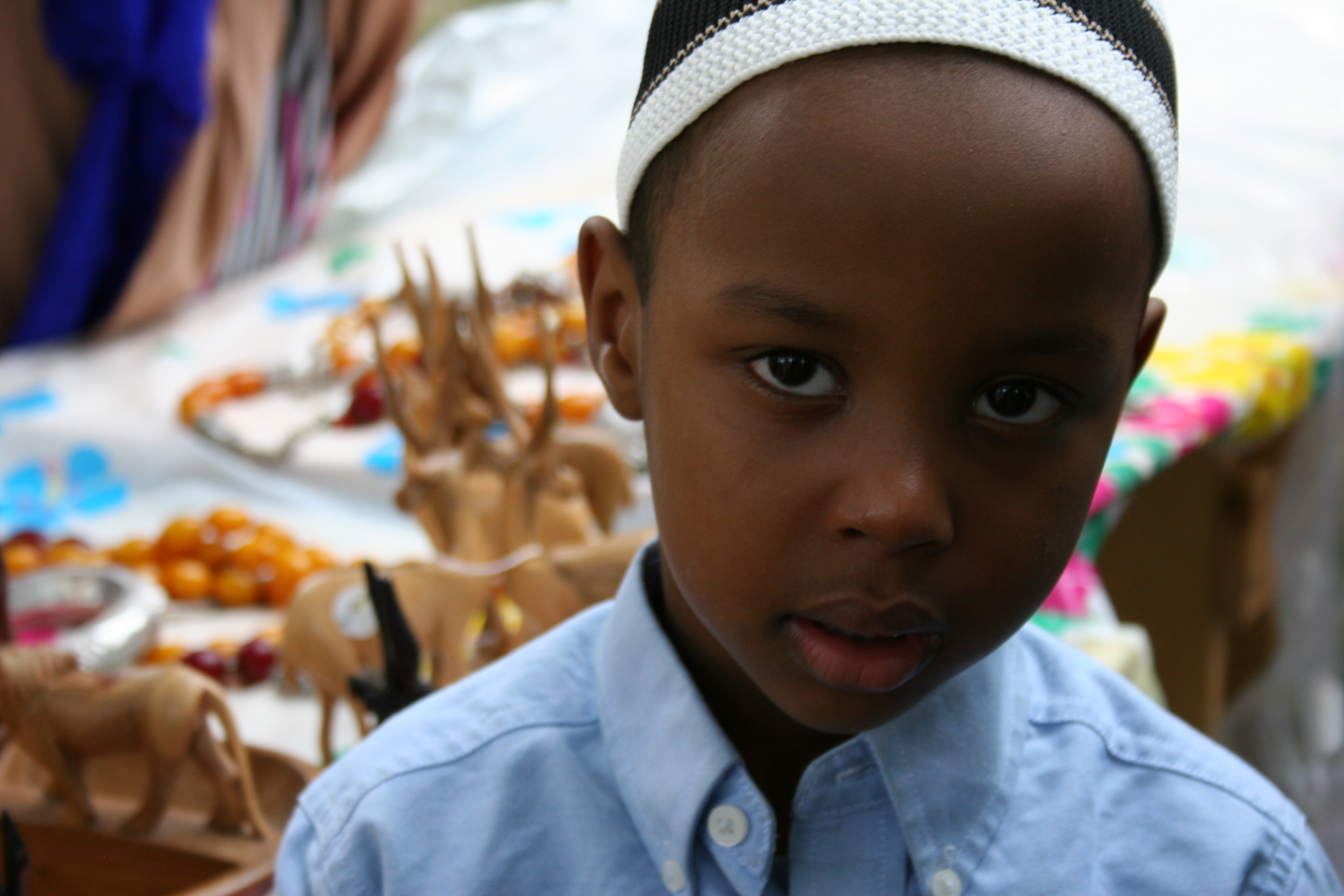
I took this portrait, one of my favorites, nearly 11 year ago at International Festival Faribault. (Minnesota Prairie Roots copyrighted file photo 2014)

I will never match the talent of DeCarava. But I do share his focus. I also aim to photograph the ordinary, the everyday, right where I live (or mostly in southern Minnesota). Like him, I notice details. The light. The moments. The expressions. The people, scenes, settings and events that define a place. The anything that might make for an interesting photo.

Unlike DeCarava, my roots are rural. I’ve only ever been to New York City once, while in college. I was awed by the skyscrapers, the street vendors, Chinatown and men hurrying along Wall Street in leisure suits. (This was in 1977.) But I have no desire to return to a place that feels too closed in, too busy, too chaotic.

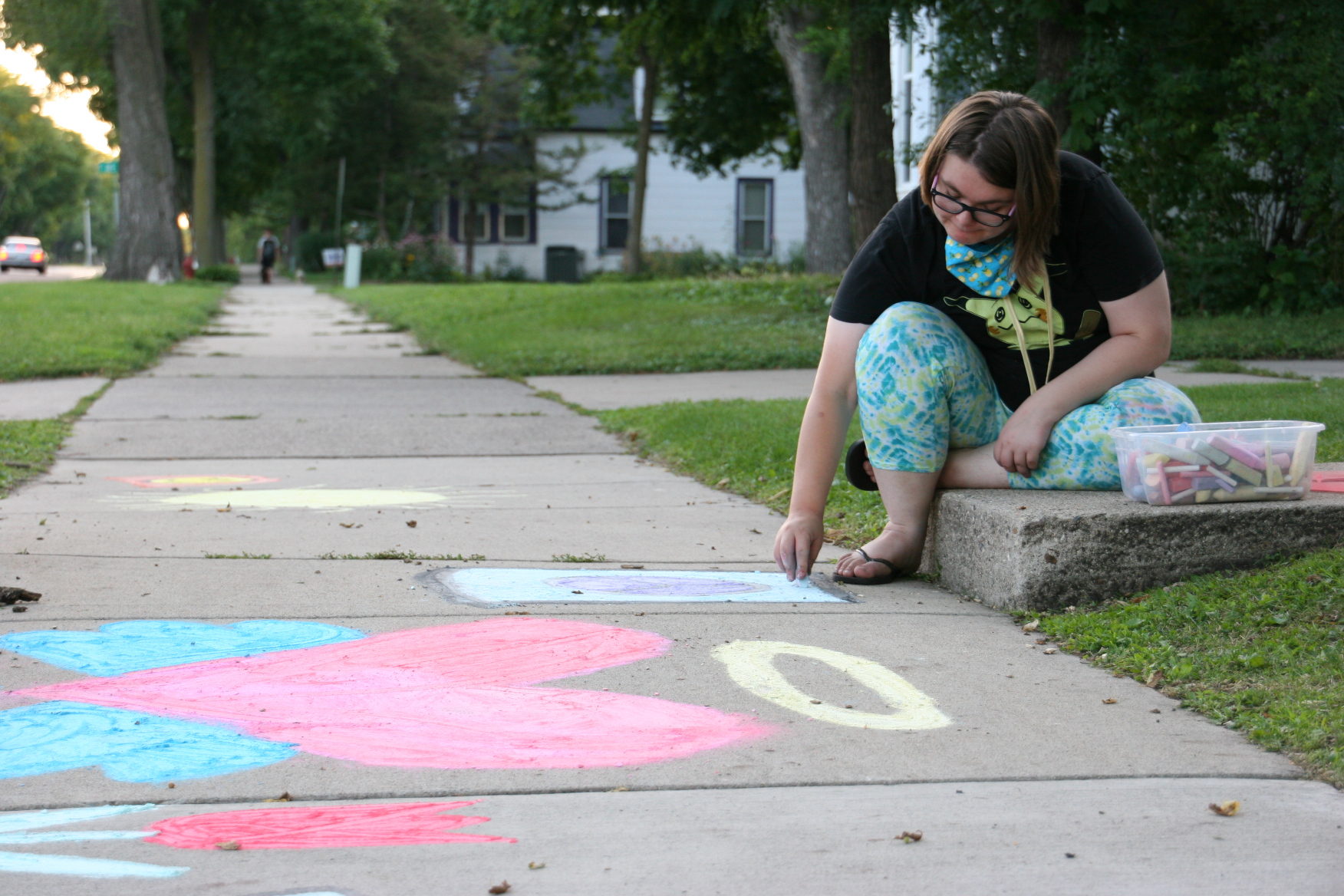
My photo of Jane chalking art on a Faribault sidewalk. (Minnesota Prairie Roots copyrighted file photo August 2020)

Yet, Harlem in Upper Manhattan was DeCarava’s home, where he found the subjects of his photos. Everywhere Beauty Is Harlem gives a snapshot of the images this photographer snapped. A man on the subway. A boy drawing on the sidewalk with chalk. Black and brown children dancing in water spraying from a fire hydrant.

Beyond the visuals, the story in this children’s picture book encompasses the essence of DeCarava’s photographic focus on the everyday and the ordinary. I really ought to buy a copy of this book for my personal library. If you want to understand my photographic work, then read this multi award-winning children’s picture book. But, more importantly, read this book to learn about a world famous Black photographer whose talent for visual storytelling is a gift to all of us. To see the world through his eyes presents life as it is. Real. Raw. Unedited.

#

FYI: I encourage you to also check out the photography of New York City photographer Keith Goldstein, whose work I follow on his blog, “For Earth Below.” His street photography has opened my eyes to humanity in a way that I never see here in southern Minnesota. His talent is remarkable. Goldstein, I think, works much like Roy DeCarava did, with his camera focused on the everyday, the ordinary. And therein both have found the extraordinary.

© Copyright 2025 Audrey Kletscher Helbling

 

A traffic stop & conversations about race & identity January 7, 2025

Book cover sourced online

EARLY ON A RECENT WEEKDAY MORNING, my husband was pulled over by a deputy sheriff while driving to work. Randy had no idea why he was being stopped on the edge of Faribault. The officer who approached the passenger side of our rusty 2005 white van and rapped on the window did not immediately tell Randy why he pulled him over.

But the questions and actions that followed left me unsettled and thinking about what could have unfolded. You see, I was in the middle of reading Our Hidden Conversations—What Americans Really Think About Race and Identity by Michele Norris, creator of The Race Card Project. That partially prompted my adverse reaction.

As I listened to Randy’s retelling of the traffic stop, I felt thankful that he is a past-middle-aged White guy. I felt a bit guilty for thinking that. But…

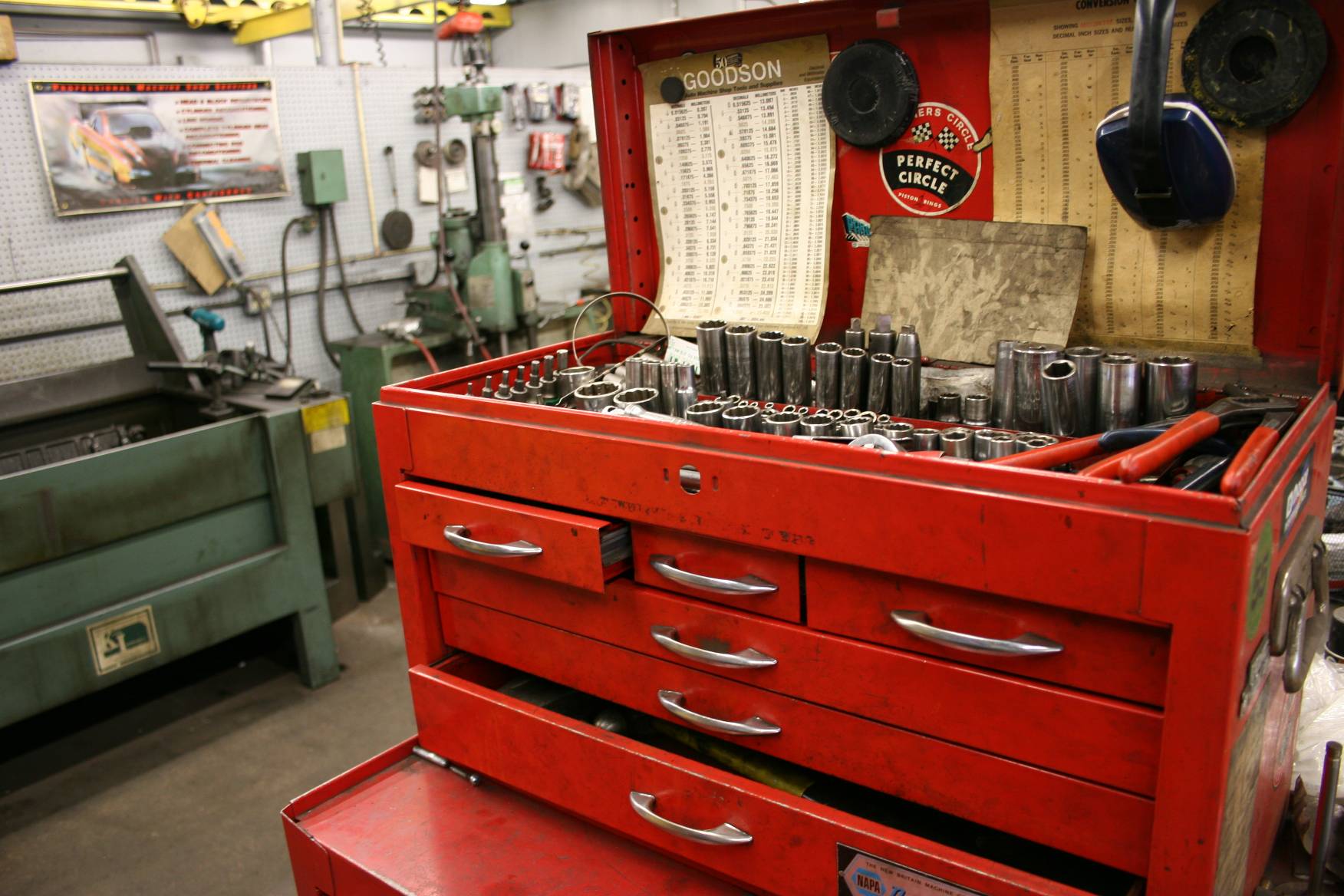
Randy, in his work jacket and uniform, was just driving to work at his job as an automotive machinist when he was pulled over and questioned. (Minnesota Prairie Roots copyrighted file photo)

DO YOU HAVE A WEAPON?”

After requesting the usual identifying documents, the officer asked Randy where he was going, where he worked, whether his address was current and how long he’s lived there. All seemed odd questions. But the next question proved even more unusual. The officer, peering into the van, asked Randy if he had a weapon. Thinking he was referring to an item on the floor between the seats, Randy leaned down and said, “No, it’s a snow brush.”

My immediate reaction to this part of the story was this: “You did what? You could have been shot!”

The deputy wasn’t referencing the brush on the floor, but what he thought was a weapon lying on the passenger seat. He reached inside the van and moved a pair of gloves aside to reveal the case for Randy’s glasses. The supposed gun.

I wasn’t there. I don’t know what was going through the deputy’s mind before and during the traffic stop. But I do recognize what could have happened had the cop felt threatened.

Only after all of this and after the deputy ran a license check did he tell Randy why he’d been stopped—because the brake light in the middle of the tailgate door was not working. Randy has since replaced the bulb.

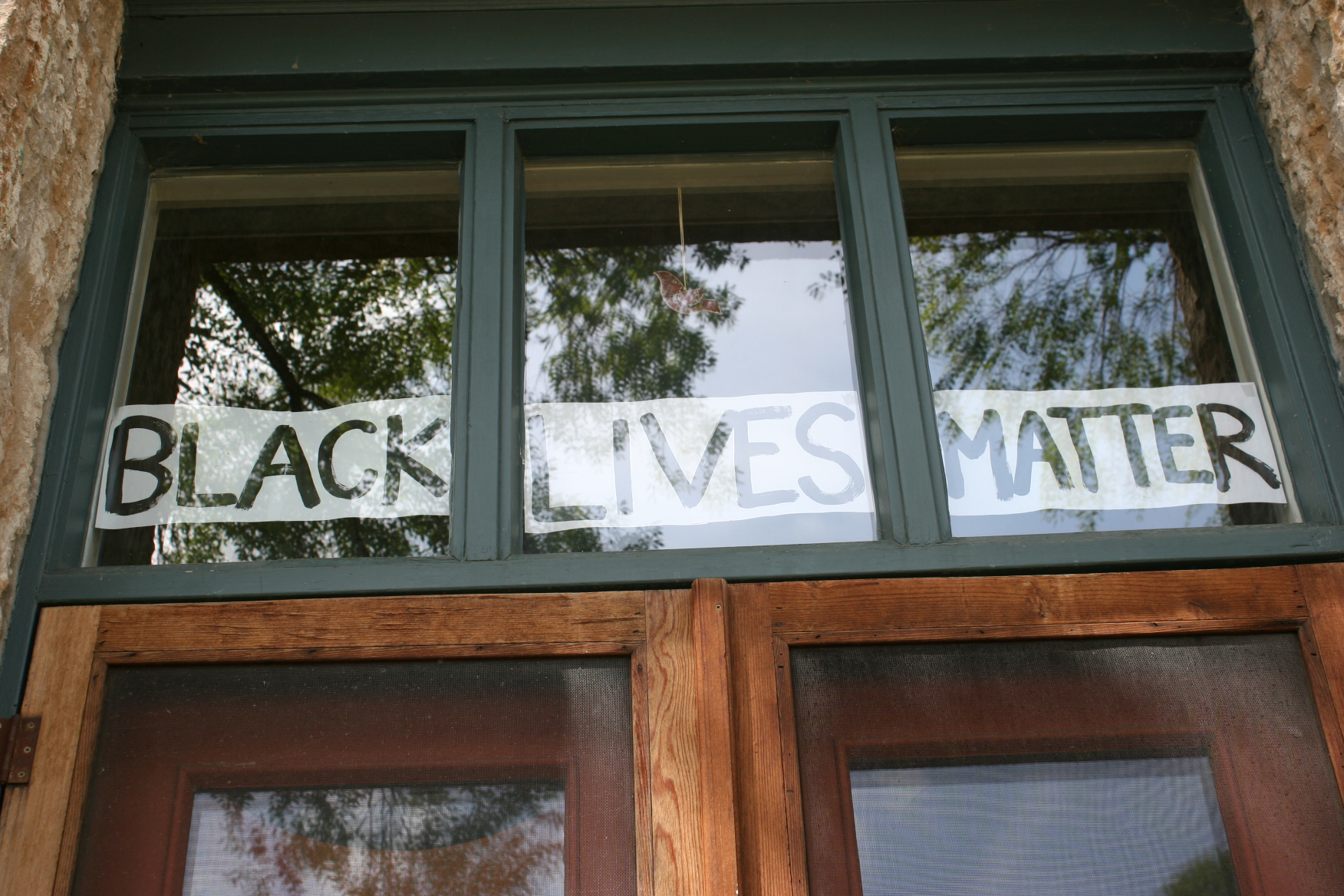
Posted on a house in small town Dundas. (Minnesota Prairie Roots copyrighted file photo 2020)

THE “WHAT IFS?”

Why am I sharing this story? It’s not because I’m anti-law enforcement. I appreciate and respect our police and the important work they do in serving our communities and keeping us safe. Yet, had Randy been a person of color in the wrong place on the wrong day with an officer who perceived his actions as a threat, this traffic stop may have ended differently. Again, I’m not criticizing this specific cop or law enforcement in general.

Admittedly, Randy should not have reached toward that snow brush. But it is not ingrained in his mind to limit his movements, to think about how his actions may be perceived. Black men, especially, cannot risk such behavior. That I understand based on conversations with my son-in-law, who is biracial; on traffic stop shootings of Black men; and on the stories shared in Our Hidden Conversations—What Americans Really Think About Race and Identity.

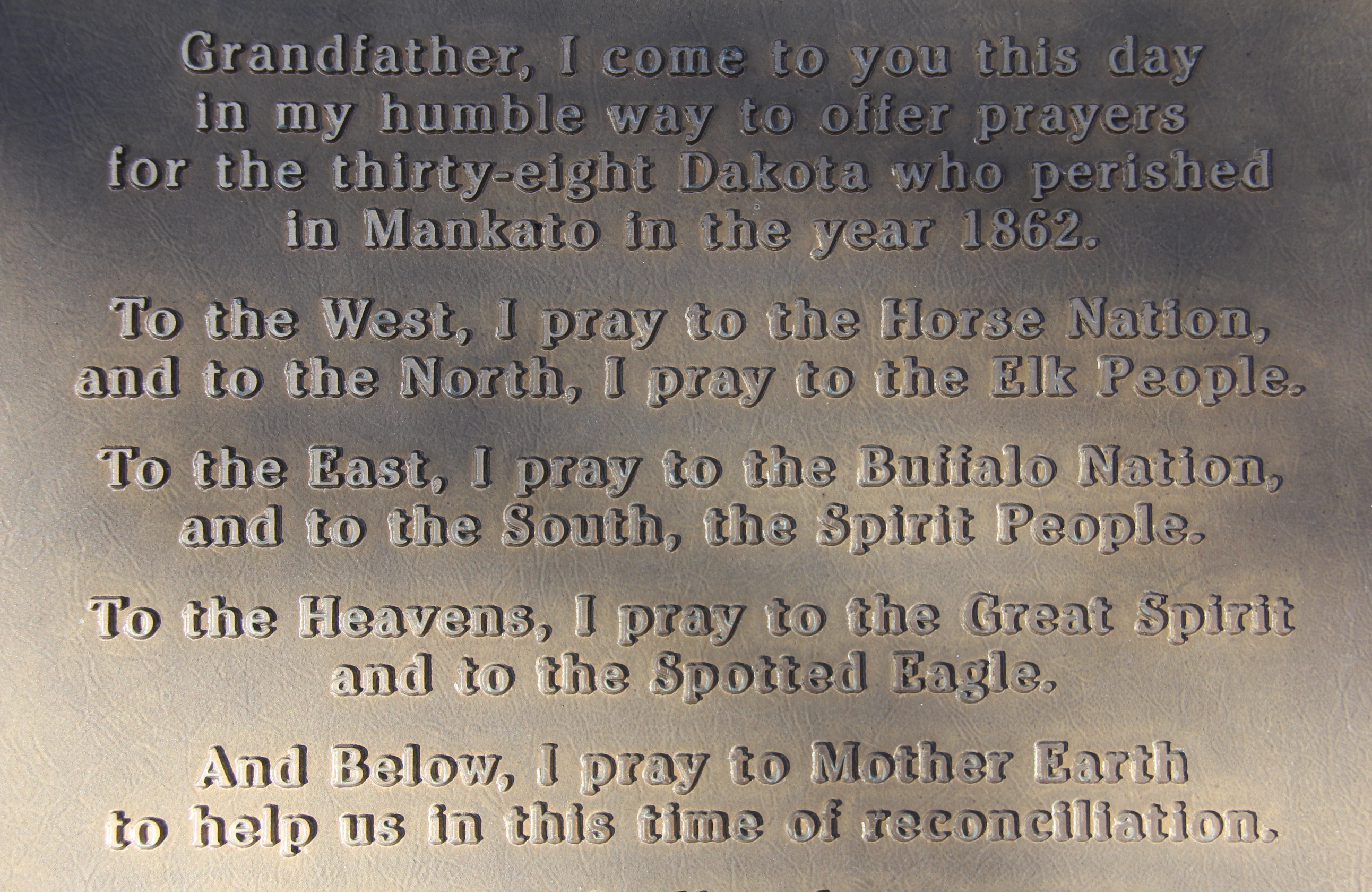
A Dakota prayer focuses on reconciliation at the Dakota 38 Memorial in Reconciliation Park, Mankato. (Minnesota Prairie Roots copyrighted file photo November 2023)

READ OUR HIDDEN CONVERSATIONS

If you read one book in 2025, I encourage you to read this one. The author, who grew up in Minneapolis, is a well-respected, award-winning journalist and former host on National Public Radio. For 14 years, Michele Norris has collected responses to this prompt: Race. Your story. 6 words. Please send. Those responses, submitted on specially-printed postcards and online, shape Our Hidden Conversations. This ranks as one of the most powerful books I’ve ever read on race and identity and should be required reading for every American.

Norris does not focus solely on Blacks in her collection of stories shared by thousands. She also writes about the discrimination, the prejudices, the challenges faced by many others. One entire section, for example, is devoted to Indigenous Peoples. That includes information about long ago Indian boarding schools (specifically the one in Morris, Minnesota) and about the 38 Dakota men who were hung in Mankato, Minnesota following the U.S.-Dakota War of 1862. She writes about Japanese internment camps in America during WWII. She writes about challenges faced by people with disabilities. This is hard stuff. But so necessary to read, to understand the backstory, the history and how things have, and have not, changed. The author writes about lynching, about adopting Black babies, about Blackness perceived as a threat…

The lengthier sections penned by Norris are interspersed with shorter stories from those responding to The Race Card Project prompt. The six word responses are scattered throughout the pages, printed exactly as submitted. One mother wishes her Black son was a girl.

An especially bright spot with an uplifting message in a downtown Faribault pocket park. (Minnesota Prairie Roots copyrighted file photo 2019)

PAINFUL & REVEALING

I cannot even begin to tell you how painful it was at times to read the heartbreaking words printed in this book. It seems unfathomable that we as human beings can treat others with such inhumanity simply because of skin color or other differences. Yet, I saw myself in some of those words, specifically in the subtle (and sometimes not so subtle) racially-charged words that I heard and repeated as a child. I didn’t understand then that the rhyme I was reciting or the term my dad used for Brazil nuts were offensive. I recognize that now.

Like many others quoted in this book, I am determined to grow my knowledge, listen, treat others with respect and compassion, recognizing that we can all do better. I want that for my soon-to-be-born grandson, whose father is biracial, whose mother is White. I want him to grow up in a world where color matters not, where he is appreciated and valued for who he is (and not judged by his skin color), where he doesn’t have to think about what could happen if he is someday pulled over during a traffic stop.

© Copyrighted 2025 Audrey Kletscher Helbling

 

A humorous book rooted in rural November 18, 2024

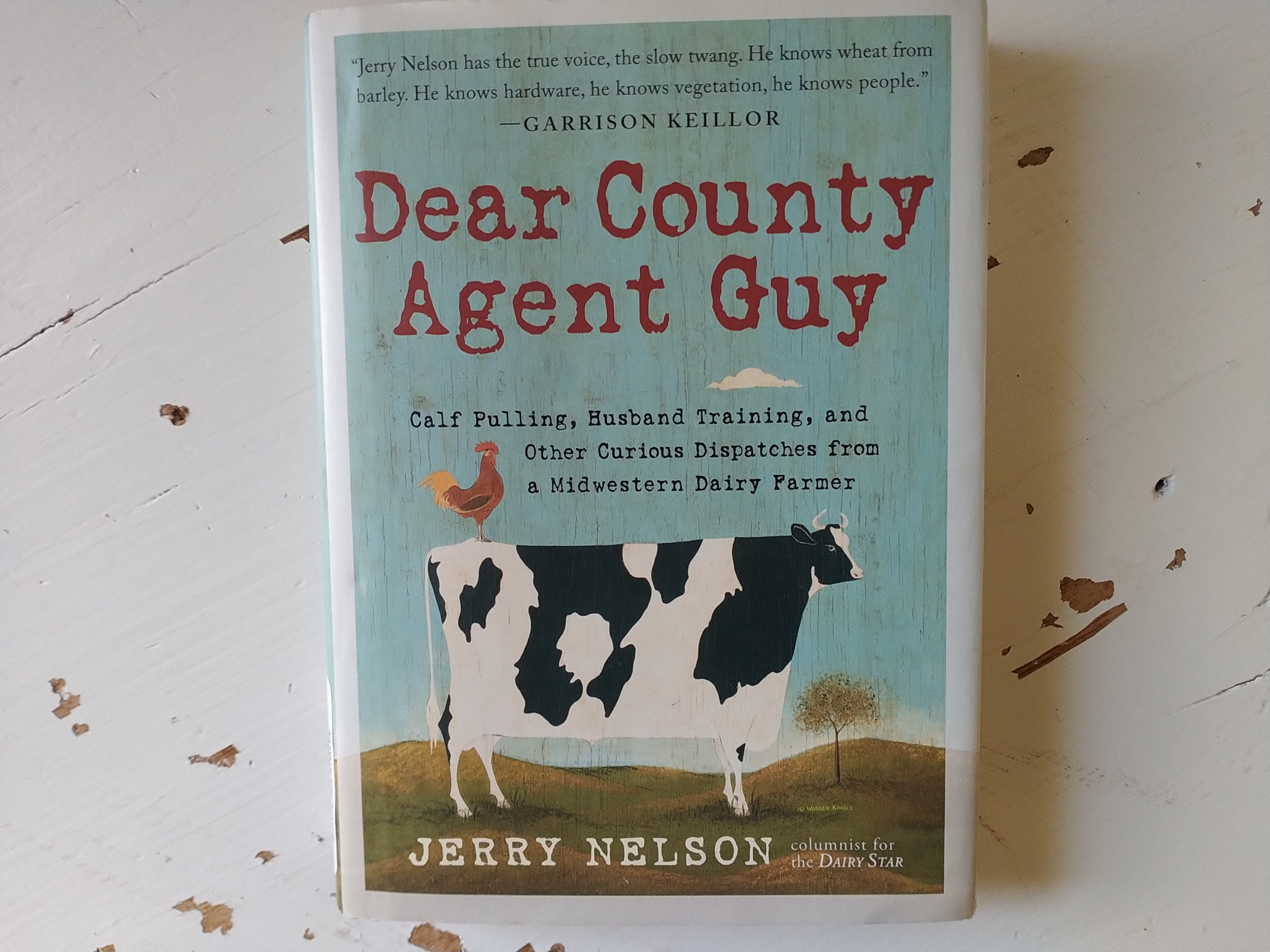
This book published in 2016. (Minnesota Prairie Roots copyrighted photo November 2024)

I NEEDED TO LAUGH. So I picked up a book I started a while ago, but which I’d set aside. That book is Dear County Agent Guy by South Dakota humor writer Jerry Nelson.

First, let’s clarify “county agent” for those of you who may not have rural roots. A county agent (kinda an old school term) is someone specifically trained to share information and research with individuals and the community. Farmers might contact the county agent about issues related to crops or livestock, for example. In Minnesota the entity heading extension services is the University of Minnesota. The U’s efforts cover agriculture, natural resources, health and wellness, youth (4-H) and more.

In his book, the author, who grew up on and then operated a South Dakota dairy farm, focuses on farm life. I, too, was raised on a dairy farm, but then left for college when I turned seventeen. This collection of humorous short stories is so relatable. Many of Nelson’s stories could be mine, although I am German, not Scandinavian, and assuredly do not like lutefisk.

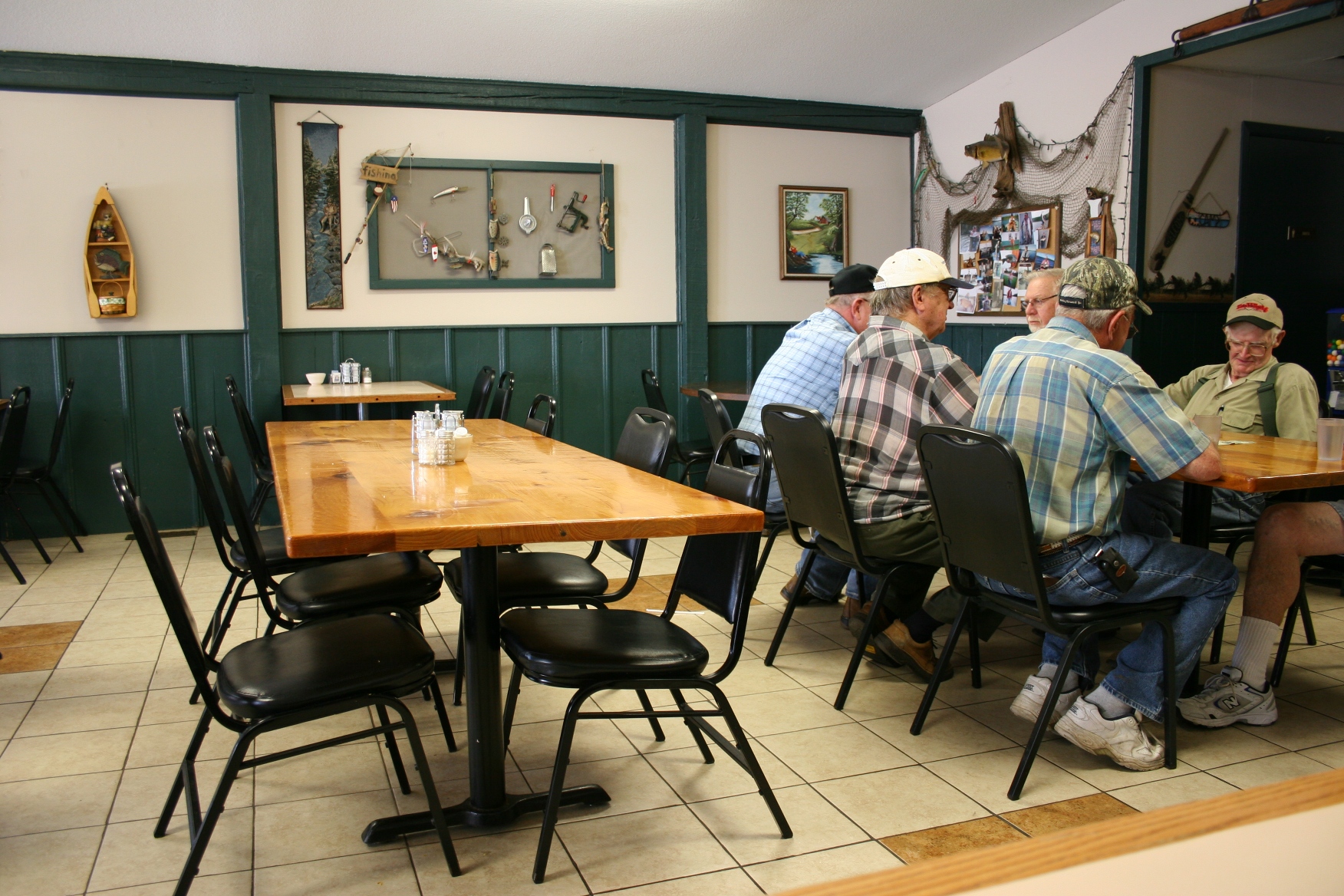
Friends gather for coffee and conversation at the Whitewater Cafe in St. Charles, Minnesota, in 2011. (Minnesota Prairie Roots copyrighted file photo)

A GIFTED RURAL STORYTELLER

Nelson’s writing made me laugh out loud at stories overflowing with humor. He’s a heckuva storyteller. I could picture him gathered with a bunch of other farmers, and a few townies, at the local cafe. Drinking coffee. Shaking dice. Exchanging stories and advice. And laughter. Lots of laughter. But I’m glad he opted to compile his stories in a book. Nelson also writes a column for Dairy Star, a Minnesota-based publication for dairy farmers in eight states. He’s among a lengthy list of columnists that include Minnesota’s Princess Kay of the Milky Way. His work publishes in many other farm publications.

The book subtitle of Calf Pulling, Husband Training, and Other Curious Dispatches from a Midwestern Dairy Farmer pretty well summarizes the content therein. It helps to have a farm background when reading this collection. But even if you don’t, you can still read, learn and laugh.

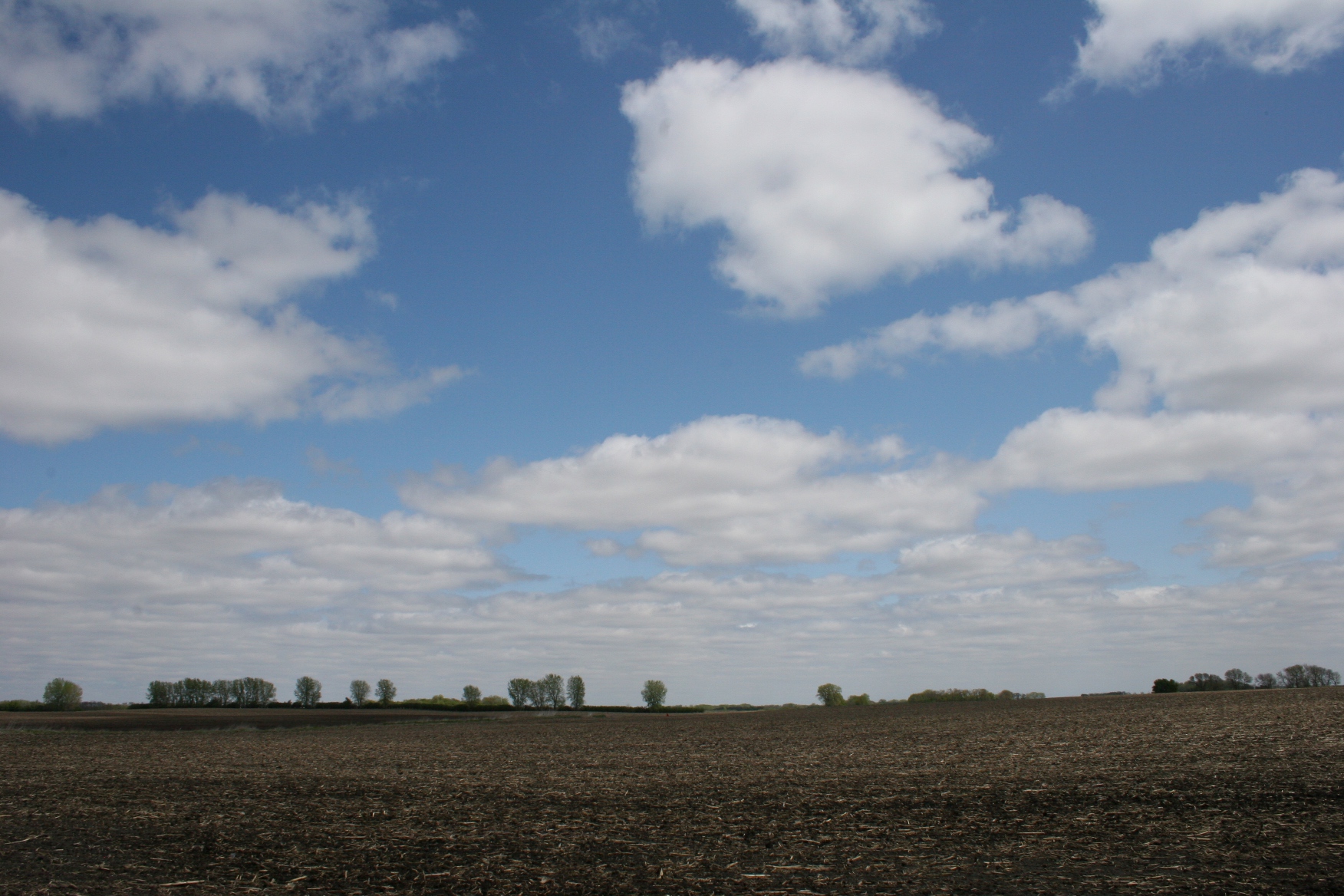
A snippet of the land where I grew up in rural Redwood County, Minnesota. My father farmed this land and my middle brother after him. The farm is no longer in the family. (Minnesota Prairie Roots copyrighted file photo)

MEMORIES GALORE FOR ME

There’s lots of nostalgia packed into these stories. How well I remember playing in the grove (the shelterbelt of trees surrounding our farm site), getting company (unexpected family and neighbors showing up to visit) and stretches of winter days stuck on the farm without electricity. Just as Nelson remembers. How well I recall Dad needing to assist a cow in giving birth (using a calf puller). How well I remember the earthy scent of freshly-turned soil.

While humor and nostalgia decidedly center Nelson’s stories, he also offers good, sound wisdom—about the importance of finding time to fish (or whatever) in a work-life balance, about appreciating family, about recognizing that life can end, just like that. Nelson nearly lost his life in a manure pit. He climbed inside to fix malfunctioning equipment when hydrogen sulfide gas overtook him. He was found floating face-up in the pit. His is a story of survival and resulting gratitude for every new sunrise.

Nelson’s writing shines with humor rooted in rural. I am grateful for his book, which shines sunshine into the world and made me laugh.

#

THANK YOU to Noreen, who follows my blog from Washington state and who gifted me with a hardcover copy of Dear County Agent Guy. I am grateful for your sharing this collection with me.

© Copyright 2024 Audrey Kletscher Helbling
 

Marcie Rendon, an authentic Native American voice in riveting mystery November 13, 2024

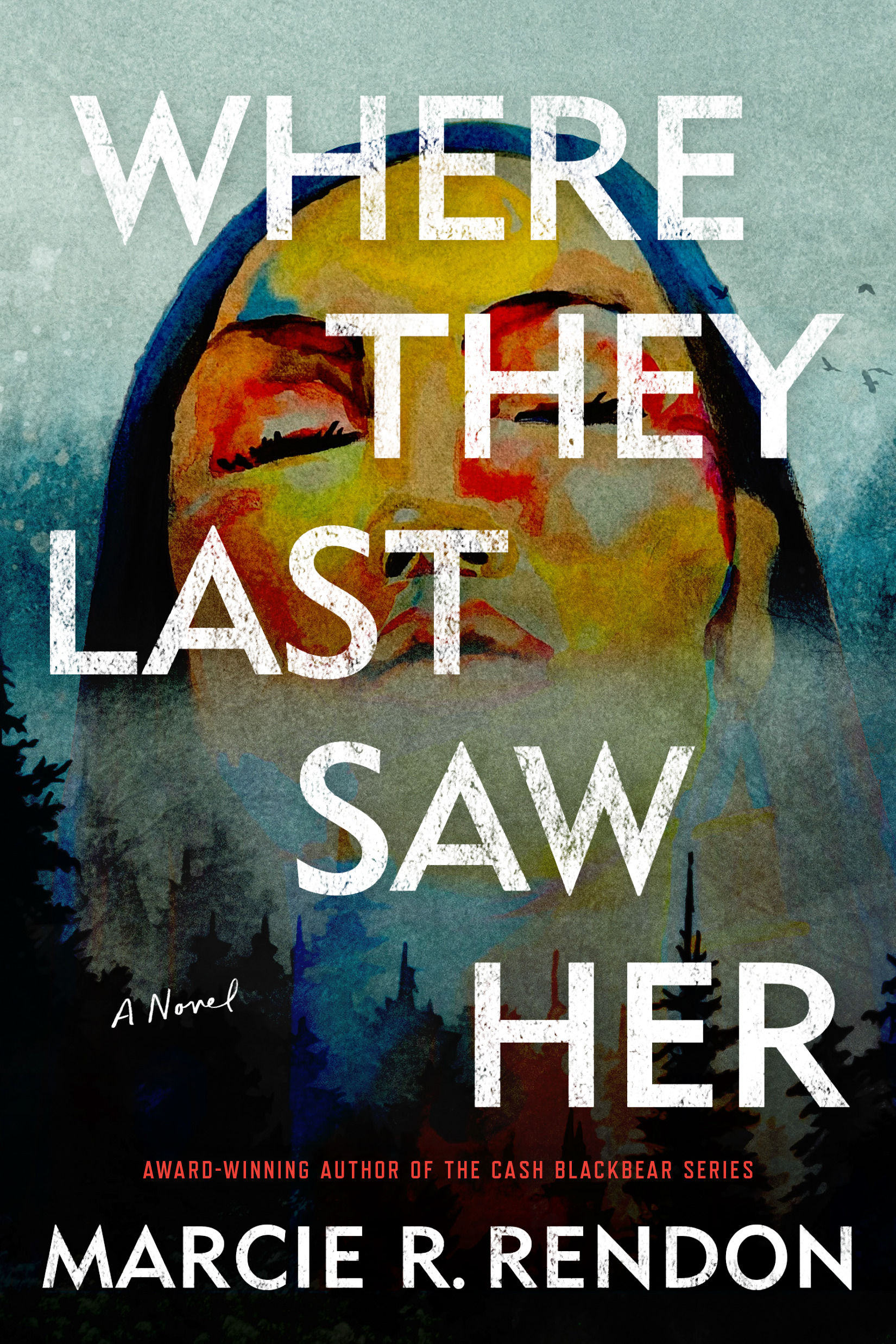
(Book cover sourced online)

AS A WRITER, I bring my voice into my writing. My work is distinctively, authentically mine. Just as it is for most writers.

Recently I finished reading a novel, Where They Last Saw Her, by a Minnesota writer with an authentically strong Native American voice. It’s a voice we don’t often hear, which is perhaps why I find the writing of Marcie R. Rendon so compelling. She is a citizen of the White Earth Nation in north-central Minnesota.

I’ve read the first three books in her Cash Blackbear mystery series and am eagerly awaiting the release of her fourth in 2025. In the meantime, I found this stand-alone mystery set on the fictional Red Pine Reservation in northern Minnesota. As in her Cash series, the main character in Where They Last Saw Her, Quill, is a strong Native woman. Quill is the mother of two, a runner, and loyal friend to Punk and Gaylyn. And she is a woman who takes matters into her own hands when Indigenous women and children go missing.

The logo of the Minnesota Missing and Murdered Indigenous Relatives Office. (Image sourced online)

I wish that part—the missing women and children—was fictional. But it’s not. Rendon assures the reader understands that. The missing focus her book. In real life, between 27 and 54 American Indian women and girls in Minnesota were missing in any given month from 2012 to 2020. That’s according to the Minnesota Missing and Murdered Indigenous Relatives Office, an agency established in 2021 to provide support and resources to families and communities affected by such violence.

Rendon weaves a story that, if not for the disclaimer of “any resemblance to actual events, locales, or persons, living or dead, is entirely coincidental,” could pass for the truth. As a writer, I understand that in every bit of fiction lies some truth. And this book seems to hold a lot of underlying truth in events, trauma, violence and much more.

I felt compelled to visit the Minnesota Bureau of Criminal Apprehension’s missing person’s website, where I scrolled through a lengthy list of missing persons. There I found the names of three Native American women: Nevaeh Kingbird, last seen in Bemidji in October 2021. Sheila St. Clair, last seen in Duluth in August 2015. And then American Indian JoJo Boswell, gone missing in Owatonna in July 2005. I expected to find more based on the MMIR summary information. Perhaps I missed something in my surface search.

That brings me back to Rendon’s fictional story. In addition to providing me with a much deeper understanding of missing (including trafficked) Indigenous women and girls in a book that I didn’t want to put down, I learned more about the culture and language of First Nations peoples. Ojibwe words are scattered throughout the story. A glossary would be helpful. Customs, traditions and spiritual beliefs are also part of Rendon’s writing. All of that lends the authenticity I noted earlier. Only someone intimately familiar with Indigenous Peoples could write with such an authentic Native American voice.

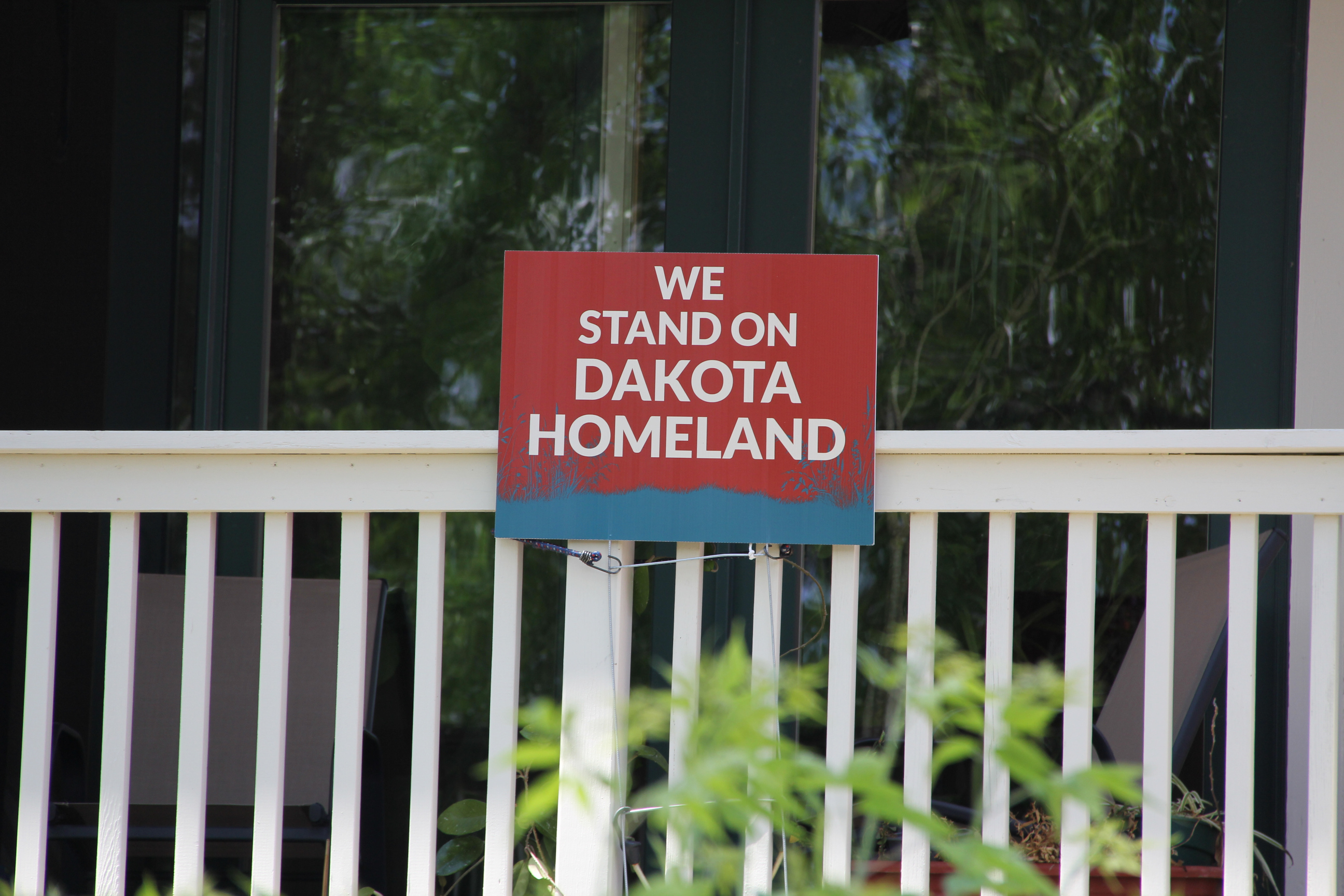
I photographed this sign along the Cannon River in Northfield. St. Olaf College in Northfield is hosting several events during Native American Heritage Month. Click here. (Minnesota Prairie Roots copyrighted file photo May 2024)

Environmental topics and pipeline construction (an actual controversial issue in Minnesota and North Dakota) also play into the plot of Where They Last Saw Her.

I’d encourage anyone who enjoys a good mystery, and who wants to become more informed, to read Where They Last Saw Her. This is a riveting read that rates as simultaneously heartrending.

#

(Image source: The U.S. Department of the Interior Indian Affairs)

NOTE: November marks National Native American Heritage Month with a 2024 theme of “Weaving together our past, present and future.” Events are planned throughout the US, including right here in Minnesota (click here). Tuesday, November 19, is set aside as Red Shawl Day, a day to remember missing and murdered Indigenous people and to honor their families. Writer Marcie Rendon includes this wearing of red in her book, Where They Last Saw Her. Please take time this month to honor Indigenous people by learning, celebrating, respecting, remembering.

© Copyright 2024 Audrey Kletscher Helbling
 

Chris Norbury’s newest book, this one for young adults, proves another excellent read August 13, 2024

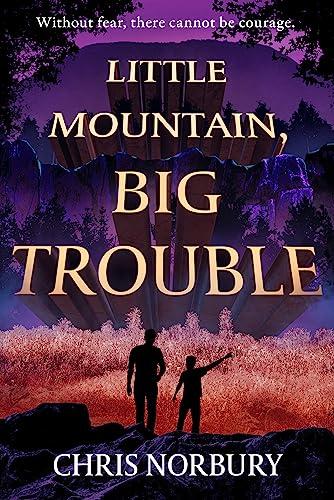
Cover image sourced online.

WE CAN ALL USE some encouragement, no matter our age. And that’s exactly what you’ll find in “Little Mountain, Big Trouble,” a debut young adult novel by Owatonna writer Chris Norbury.

I don’t typically read fiction written for youth. But when I met Norbury this summer at Faribault’s Heritage Days and learned about his latest book, I knew I had to read it. I’m a fan of Norbury’s writing. He’s the author of three books in the Matt Lanier mystery/suspense/thriller series. All are set in Minnesota, which makes them even more appealing to me.

Given the differences in writing mysteries for adults versus fiction for youth, I wondered if Norbury could pull it off. He did, and so well that I wanted to continue reading “Little Mountain, Big Trouble” one evening well past my bed-time. That, in my opinion, is the sign of a good book.

BULLIED

The story centers around 12-year-old Eduardo, or EJ, who’s unpopular, bullied, short and at that awkward middle school age with its uncertainties, peer pressure and insecurities. Toss in poverty, a broken family and other challenges and you have a relatable read. I imagine many middle or high schoolers can empathize with EJ’s pain, struggles and lack of confidence. Even I, decades removed from junior high school, felt difficult memories of bullying surge back. Some things you just never forget. I still carry the pain of name-calling with me. But, because of that, I lean into compassion, understanding, empathy and kindness.

BIG BROTHER, LITTLE BROTHER

Norbury’s book is filled with all of that, too, no surprise given his experiences as a Big Brother. In real life, he mentored boys through Big Brothers Big Sisters of Southern Minnesota and now donates a portion of his book sale proceeds to the organization. When we met, Norbury enthused about the program and how much his “little brothers” meant, still mean, to him.

In “Little Mountain, Big Trouble,” main character EJ is paired with Big Brother, Russ. That relationship focuses the story-line as the chapters unfold. Although a disclaimer at the front of the book assures the content is fictional, I understand that, as a writer, our writing is influenced by what we’ve lived or observed.

CLIMBING MOUNTAINS

It takes EJ a while to trust Russ, to realize that his Big Brother is not perfect and is there to support him. Russ doesn’t talk down to EJ, but rather listens to and encourages him, like they are equals in many ways. Eventually, EJ opens up about his goal to become a mountain climber. At this point, I wondered what Norbury was thinking by writing that into the plot. A Minnesota kid with no mountain climbing background wanting to climb Mount Everest?

Russ doesn’t dismiss EJ’s dream as insurmountable. Rather, he breaks the goal down into doable steps, starting first with training and then climbing Eagle Mountain. That mountain is real, the highest point in Minnesota, with much of the hiking trail to the summit running through the Boundary Waters Canoe Area Wilderness.

ANXIOUS AND WORRIED

And that is where EJ and Russ end up, heading up, then down, the mountain. And this is where the tension thickens to the point that I am feeling anxious and worried. To elicit that response in the reader shows Norbury’s skills as a writer. The duo face challenges that test their strength and endurance, even threaten Russ’ life.

WE ALL NEED SOMEONE

I won’t spoil the book by revealing the outcome of that mountain hike. But know that the book ends in a heart-warming way. EJ has developed confidence, gained the acceptance and respect of his peers, and grown to understand that he can overcome, and do, anything. Sometimes it just takes someone, like Russ, believing in you and cheering you on, just as I expect Chris Norbury did for his little brothers.

© Copyright 2024 Audrey Kletscher Helbling
 

“From Somalia to Snow” offers insights into our new Minnesota neighbors May 29, 2024

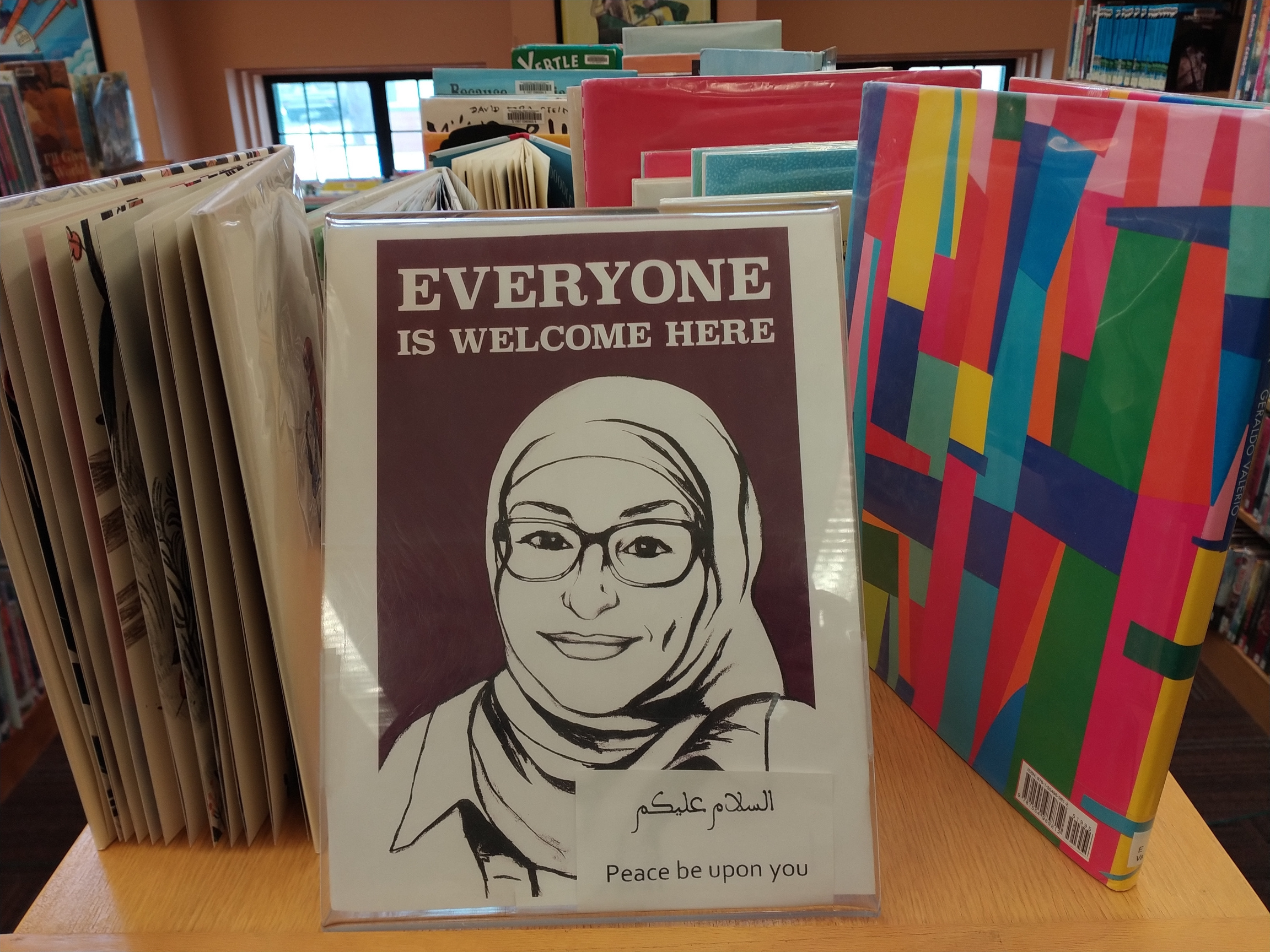
A welcoming sign photographed earlier this year in the children’s section of Buckham Memorial Library, Faribault. (Minnesota Prairie Roots copyrighted photo 2024)

KNOWLEDGE IS POWER. Not in the sense of personal power, but in understanding. And I am always about growing my knowledge and understanding, especially within my community.

Faribault, like many neighboring communities, is culturally-diverse, home to immigrants, refugees and those who have received American citizenship. Somalis. Hispanics. Latinos. And others from countries that fit anything but the mostly White European backgrounds of rural Minnesotans. We are a state evolving in diversity, and I embrace that.

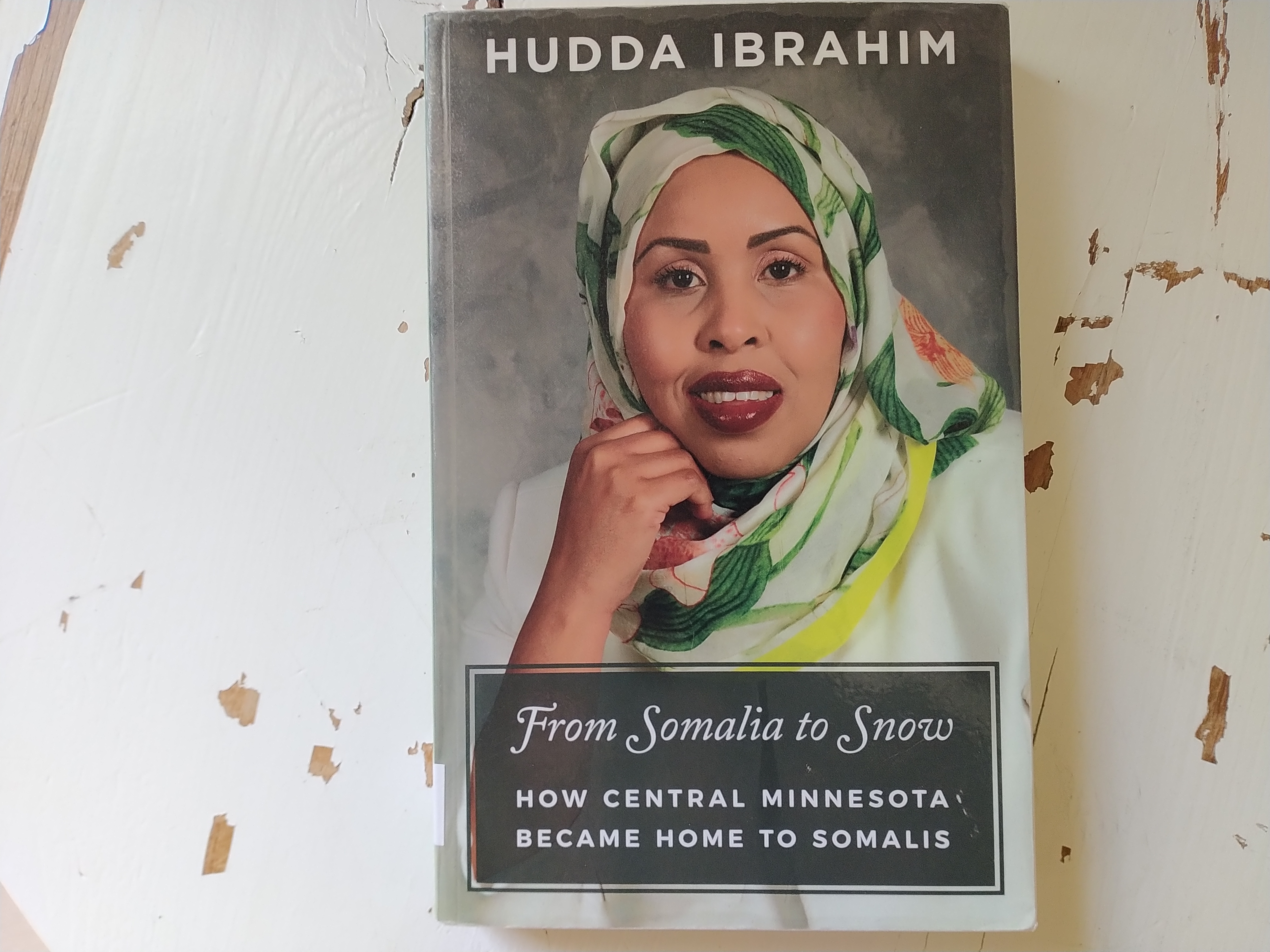
Hudda Ibrahim’s book offers an in-depth look at Somalis living in Minnesota. (Minnesota Prairie Roots copyrighted photo May 2024)

Recently I met a central Minnesota author who was in town as part of an event celebrating Somali culture at the Paradise Center for the Arts. Hudda Ibrahim of St. Cloud, which has a sizable Somali population, was selling her books, including From Somalia to Snow—How Central Minnesota Became Home to Somalis. Although I didn’t purchase her book then, I eventually checked it out through my regional library system. That and her nonfiction children’s picture book, What Color Is My Hijab?

Hudda Ibrahim’s children’s book inspires girls to be whatever they want to be via Ibrahim’s empowering words and Meenal Patel’s vivid art. (Book cover sourced online)

After reading those two books, I have better insights into the backgrounds, stories, culture and challenges of my new neighbors. Ibrahim writes with authenticity. She was born and raised in Africa (Somalia, Ethiopia and Kenya), came to the U.S. in 2006, teaches diversity and social justice in St. Cloud, and works closely with Somalis there. From Somalia to Snow includes interviews with Somalis in Ibrahim’s community along with her observations, insights and recommendations.

I quickly discovered that I had much to learn, even when it comes to understanding the basics. A person of Somali ethnicity is not a “Somalian,” as I’d incorrectly said, but rather a “Somali.” I appreciate that about Ibrahim’s writing. She doesn’t presume her readers know, making her book a really good source of basic, yet detailed and thorough, information.

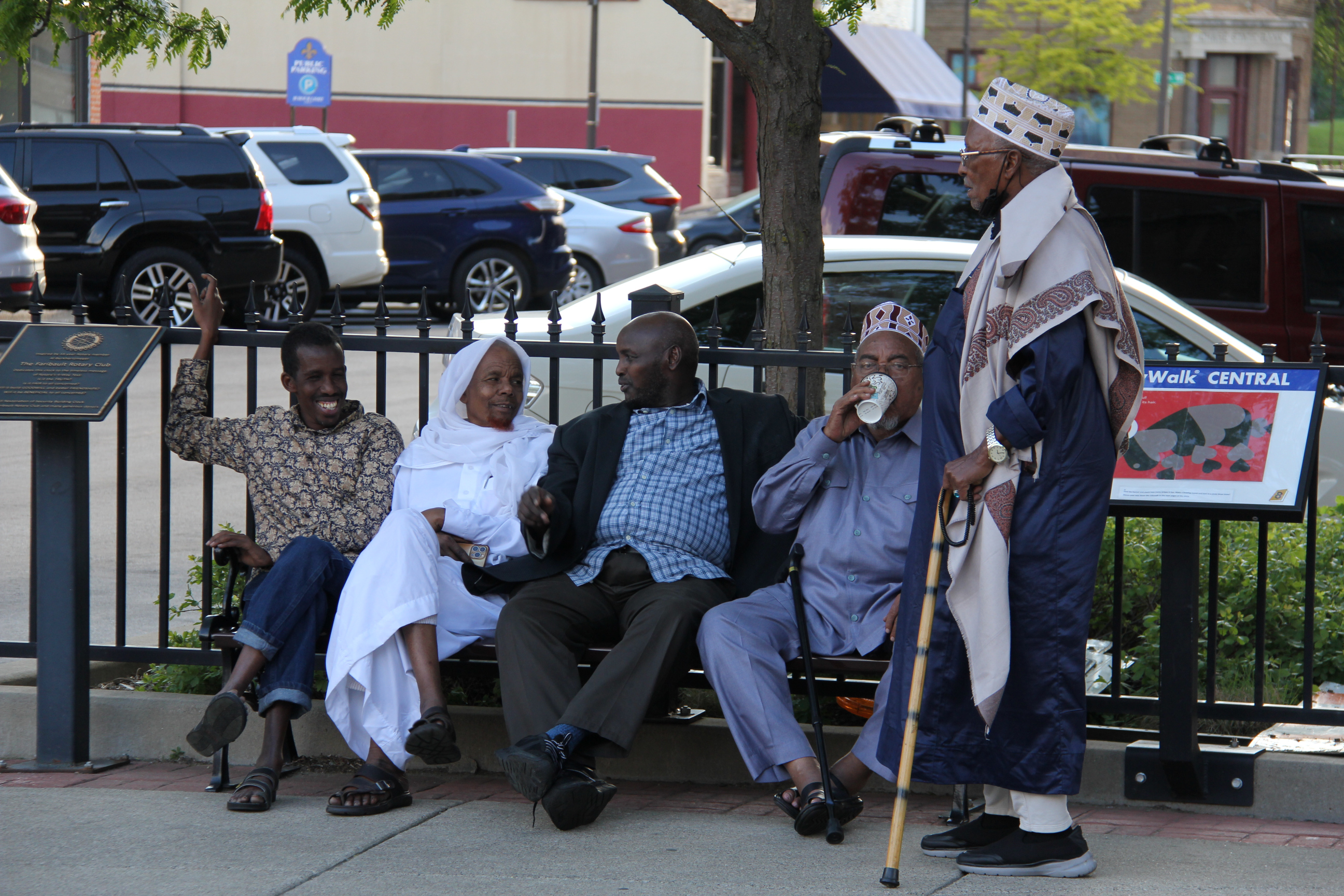
I often see Somali men visiting in downtown Faribault, where many live. (Minnesota Prairie Roots copyrighted file photo May 2024)

I especially appreciated her chapter titled “Integration and Assimilation” because I’ve heard the comments from locals about how Somalis need to do this and that because they’re living in America now. Ibrahim states that Somalis prefer to “integrate,” not “assimilate.” That makes sense to me, that our new neighbors want to retain their cultural identity while also adapting to their new home. I think back to my own maternal ancestors who settled together near New Ulm in southern Minnesota and clung to their German identity, speaking in German, following customs and traditions from the Old Country. The same can be said for Scandinavians, who still eat lefse and lutefisk. Cultural identity is important to all of us.

So is family. Like my German ancestors settled together, so do those who come from Africa. They want to be near people who get them, understand them, share a language and faith and customs and culture. Jobs and family (clans) brought Somalis to St. Cloud, Ibrahim writes. Many work in meat-packing plants, just like in my community.

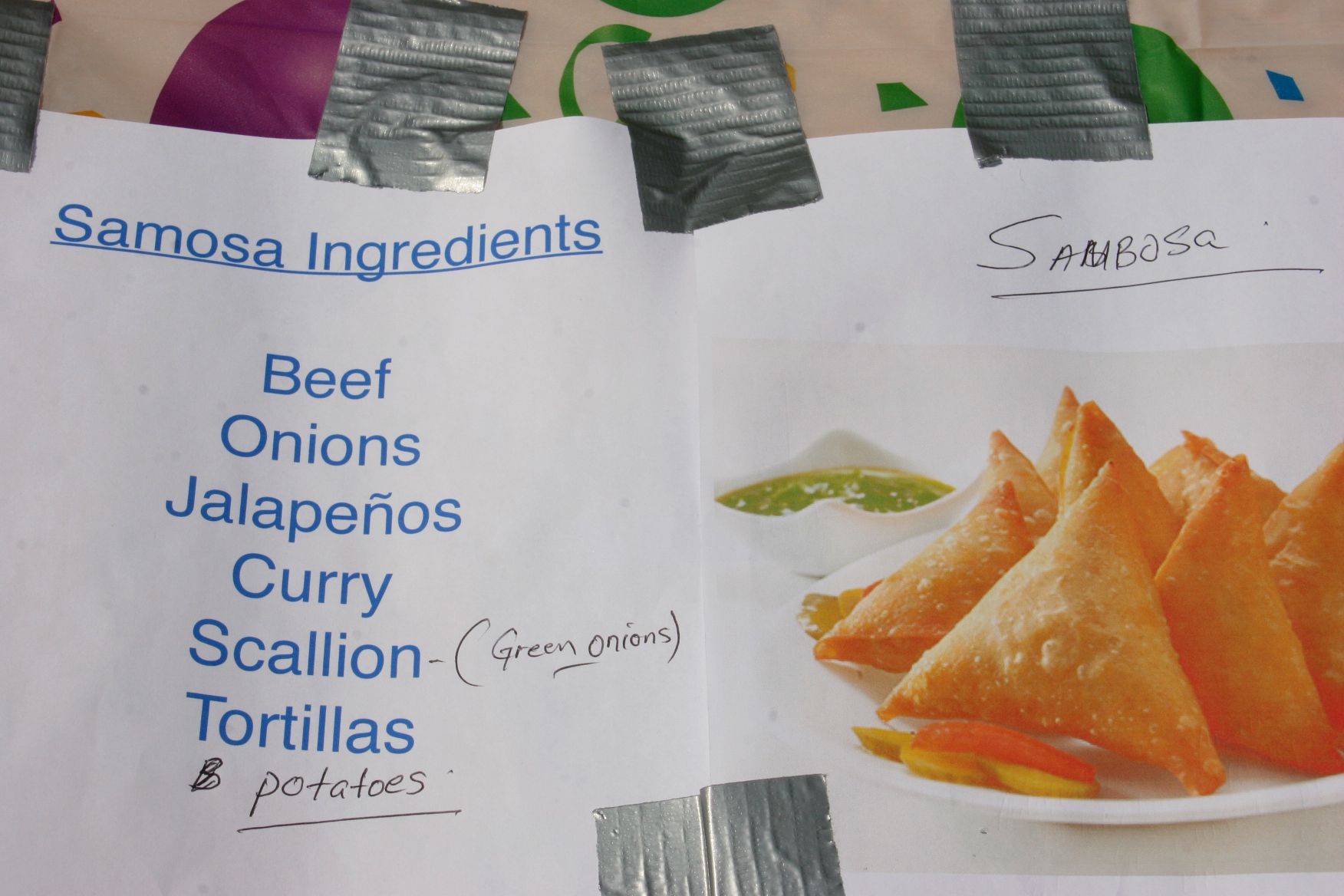
This sign for Somali food was posted at a past International Festival in Faribault. I especially like sambusa, a spicy, meat-filled triangular pastry. It was served at the recent Somali-focused event I attended. (Minnesota Prairie Roots copyrighted file photo)

Others have pursued higher education and entrepreneurship, opening businesses which serve primarily their community. I need only walk Faribault’s downtown business district to see numerous Somali-owned shops and restaurants. I love the color and culture they bring. And I love Somali tea, which I tried at that event where I met Ibrahim. It’s tea mixed with milk and spiced with cinnamon, ginger, cloves, cardamom… The scent is heavenly, the taste divine. And I can buy it locally.

Faribault is a culturally-diverse city, as seen in this image taken during a car show in downtown Faribault in 2015. (Minnesota Prairie Roots copyrighted file photo 2015)

Ibrahim’s book is packed with insights: Somalis value oral communication over written. They are good oral poets. Restaurants often do not have printed menus, primarily because they serve Somalis. Muslims memorize the Quran (with 6,666 verses), a process that can take years. Socializing and community are important. Barriers remain in healthcare. There’s just a whole lot to learn via reading From Somalia to Snow. It starts with an overview of Somali history and then takes readers into the lives, cultures and challenges of Somalis living in Minnesota today. Thanks to Ibrahim’s writing, I now have a better understanding of my new neighbors. And for that I am grateful.

© Copyright 2024 Audrey Kletscher Helbling

 

Poetry that sings from Minnesota’s poet laureate May 2, 2024

Book cover sourced online. Cover watercolor painting, “The Musician,” is by Cherokee artist Roy Boney, Jr.

HER POEMS SING with the rhythm of a writer closely connected to land, heritage and history. She is Gwen Nell Westerman of Mankato, Minnesota poet laureate and author of Songs, Blood Deep, published by Duluth-based Holy Cow! Press.

Of Dakota and Cherokee heritage, Westerman honors her roots with poems that reflect a deep cultural appreciation for the natural world. The water. The sky. The seasons. The earth. The birds and animals. They are all there in her writing, in language that is down-to-earth descriptive. Readers can hear the birdsong, feel the breeze, see the morning light… That she pens nature poems mostly about the land of my heart—fields and prairie—endears me even more to her poetry.

This slim volume of collected poems is divided into seasons of the year, each chapter title written in the Dakota language. The book features multiple languages—Dakota, Cherokee, Spanish and English. That adds to its depth, showing that, no matter the language we speak, write or read, we are valued.

This silo mural in downtown Mankato celebrates the cultural diversity of the region, including the Dakota. (Minnesota Prairie Roots copyrighted photo November 2023)

Westerman clearly values her Native heritage, how lessons and stories have been passed to her through generations of women, especially. Songs, blood deep. In her poem “First Song,” she shares a lesson her grandmother taught her about the importance of sharing. After reading that thought-provoking poem, I considered how much better this world would be if we all focused on the singular act of sharing.

The Dakota 38 Memorial at Reconciliation Park in downtown Mankato lists the names of the 38 Dakota men hung at this site on December 26, 1862. (Minnesota Prairie Roots copyrighted photo November 2023)

This poet, who is also a gifted textile artist (creator of quilts), wraps us in her words. In the season of waniyetu, her poetry turns more reflective and introspective, as one would expect in winter. She writes of family, injustices and more. “Song for the Generations: December 26” is particularly moving as that date in history references the mass execution of 38 Dakota sentenced to death in 1862 and hung in Mankato. Westerman writes of rising and remembering, of singing and prayer. It’s a truly honorable poem that sings of sorrow and strength.

Her poems remind us that this land of which she writes was home first to Indigenous Peoples. Westerman writes of a state park in New Ulm, the sacred Jeffers Petroglyphs and Fort Snelling, where Dakota were imprisoned after the U.S.-Dakota War of 1862 and before their exile from Minnesota. The name of our state traces to Mni Sota Makoce, Dakota for “the land where the water reflects the sky.” It’s included in Westerman’s poetry.

I appreciate poems that counter the one-sided history I was taught. I appreciate Westerman’s style of writing that is gentle, yet strong, in spirit. Truthful in a way that feels forgiving and healing.

In the all of these poems, I read refrains of gratitude for the natural world, gratitude for heritage and gratitude for this place we share. We sang. We sing. Songs, blood deep.

FYI: Songs, Blood Deep, is a nominee for the 2024 Minnesota Book Award in poetry. The winner will be announced May 7. This is Westerman’s second poetry book. Her first: Follow the Blackbirds. In addition to writing poetry and creating quilts, Westerman teaches English, Humanities and Creative Writing at Minnesota State University, Mankato.

© Copyright 2024 Audrey Kletscher Helbling
 

House of Kahmanns: A story of trauma, family love & resilience May 1, 2024

IT WAS A TUESDAY in January 1964. Wash day in the Kahmann household. Outside, a ground blizzard raged, reducing visibility on the southwestern Minnesota prairie. The events of that morning, of that day, would forever change the lives of siblings Karl, Patsy, Eric, Andy, John, Paul, Kevin, Katy, Karen, Phillip, Jim and Beth, and their parents, Jack and Della.

That sets the scene for House of Kahmanns, a memoir by P.G. (Patsy) Kahmann, oldest daughter, second oldest among 12 children. Sixteen months earlier, the family moved from Kansas City, Missouri, to Minnesota when Jack, a traveling salesman in a farm business, was relocated. They settled near their maternal grandparents, into a rental home by Granite Falls.

I expect Jack Kahmann was driving in weather and road conditions similar to this. (Minnesota Prairie Roots copyrighted file photo, January 2020, used for illustration only)

This is familiar land to me in a familiar time. I was not quite eight years old in January 1964, living on a farm some 30 minutes away in neighboring Redwood County. I understand full well the fierce prairie wind that whips snow into white-out conditions. On that blustery morning, as Jack and Della and Della’s parents set out for medical and business appointments in Minneapolis, leaving the oldest, Karl, to care for the youngest children, Patsy and her school-age siblings boarded the school bus.

Rosary beads. (Minnesota Prairie Roots copyrighted file photo used for illustration only)

Patsy was in English class when she got the devastating news. There had been a crash. A bread truck driven by an unlicensed 14-year-old ran a stop sign and then a yield sign before slamming into the 1957 Chevy driven by Jack. Della, mother of a dozen, was the most seriously injured. “How many Hail Marys will it take to save my mother’s life?” Patsy asks herself.

An altar in a southern Minnesota Catholic church. (Minnesota Prairie Roots copyrighted file photo used for illustration only)

Faith, a strong Catholic faith, threads through this story. The Kahmanns were devout, prayerful, always in church. The church, or rather the local parish priest, would play the primary role in turning the initial tragedy into even more intense pain, suffering, separation and trauma for the family. Father Buckley demanded that the 12 children be placed with Catholic families while their parents recovered at a hospital 70 miles away. That, even though a Lutheran couple offered to move into the Kahmanns’ farm home and care for the children. Together.

At this point in the book, I felt my anger flashing. Anger over the inhumanity of a man of the cloth who is supposed to exude compassion, care and love. More atrocities by the priest followed. By the time I read the epilogue, I was irate, forgiveness far from my mind.

Love and forgiveness were taught in the Kahmann home. (Minnesota Prairie Roots copyrighted file photo used for illustration only)

But the Kahmanns were a loving and forgiving family. (Not necessarily of that priest.) One evening after they are all reunited, Jack asks his family to pray blessings upon the driver of the bread truck. Three-year-old Phillip mishears. “God bless the red truck!” he shouts. Laughter erupts. I needed that humor in a story weighing heavy upon my soul.

I wanted to step into the pages of the book and hug those kids and make everything better. Just as Millie Bea did when the Kahmanns lived in Kansas City and Jack was traveling around the country and Della needed extra help with the kids. The book flips back and forth in time and place between Missouri and Minnesota, before and after the crash.

The Kahmanns were not unfamiliar with trauma. In June 1955, Andy’s hand was nearly severed in a hand cement mixer. A Kansas City surgeon successfully reattached his limb, even though a priest told Jack that his son’s hand had been amputated. That was untrue.

Family love is such a strong theme in this book. (Minnesota Prairie Roots copyrighted file photo used for illustration only)

Through all of this, themes of love, strength and resilience thread. The Kahmann siblings clearly looked out for and loved one another and got through some pretty awful stuff. Their motto, Patsy writes, was “No one died. We all survived.” They never talked about the accident. I’m not surprised. Who did back then? Eventually the family would relocate to Bird Island, 32 miles directly east of Granite Falls. It was a new start in a new place following their 75 days apart, “75 days of confusion, anxiety and foreboding.”

And now, with publication of House of Kahmanns—A Memoir, A story about family love and shattered bonds, about finding each other in the aftermath, perhaps these siblings are talking about all they endured. For Patsy, it is also about keeping a promise. In the book dedication she writes: To Mom and Dad/I promised you I would write this story. And she did, with honesty, pain and a great deal of strength.

© Copyright 2024 Audrey Kletscher Helbling