Minnesota Prairie Roots

Writing and photography by Audrey Kletscher Helbling

Investing in community: the story of a small town Minnesota movie theatre’s survival January 14, 2025

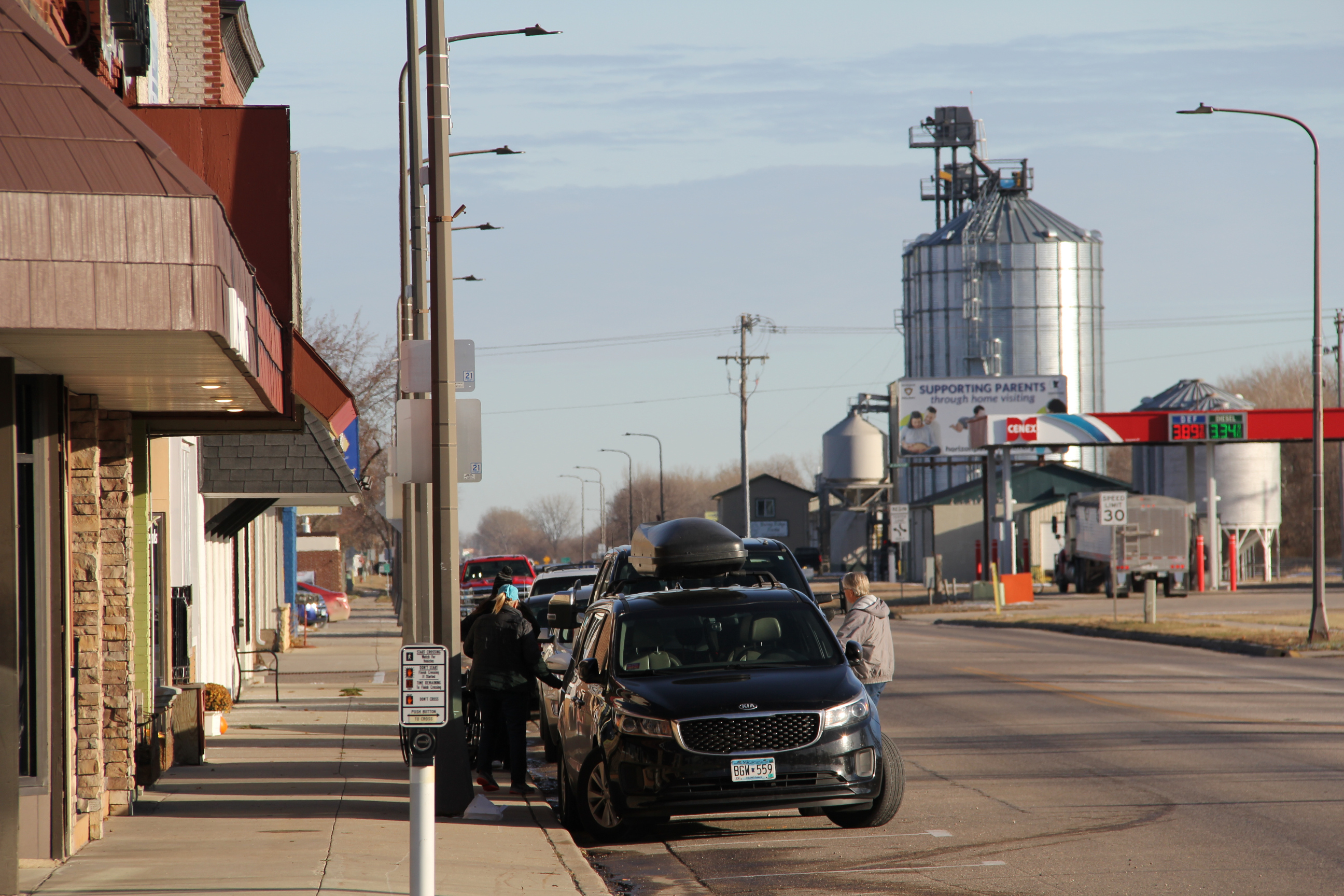
Benson, Minnesota, along Atlantic Avenue. (Minnesota Prairie Roots copyrighted photo November 2024)

IN THE FAR REACHES of west central Minnesota, two counties in from the South Dakota border, the small farming community of Benson perches on the prairie. It’s a place many might consider the middle of nowhere. But Benson is home to some 3,400 residents, the county seat of Swift County and a town I recently passed through on my way to visit family in neighboring Morris.
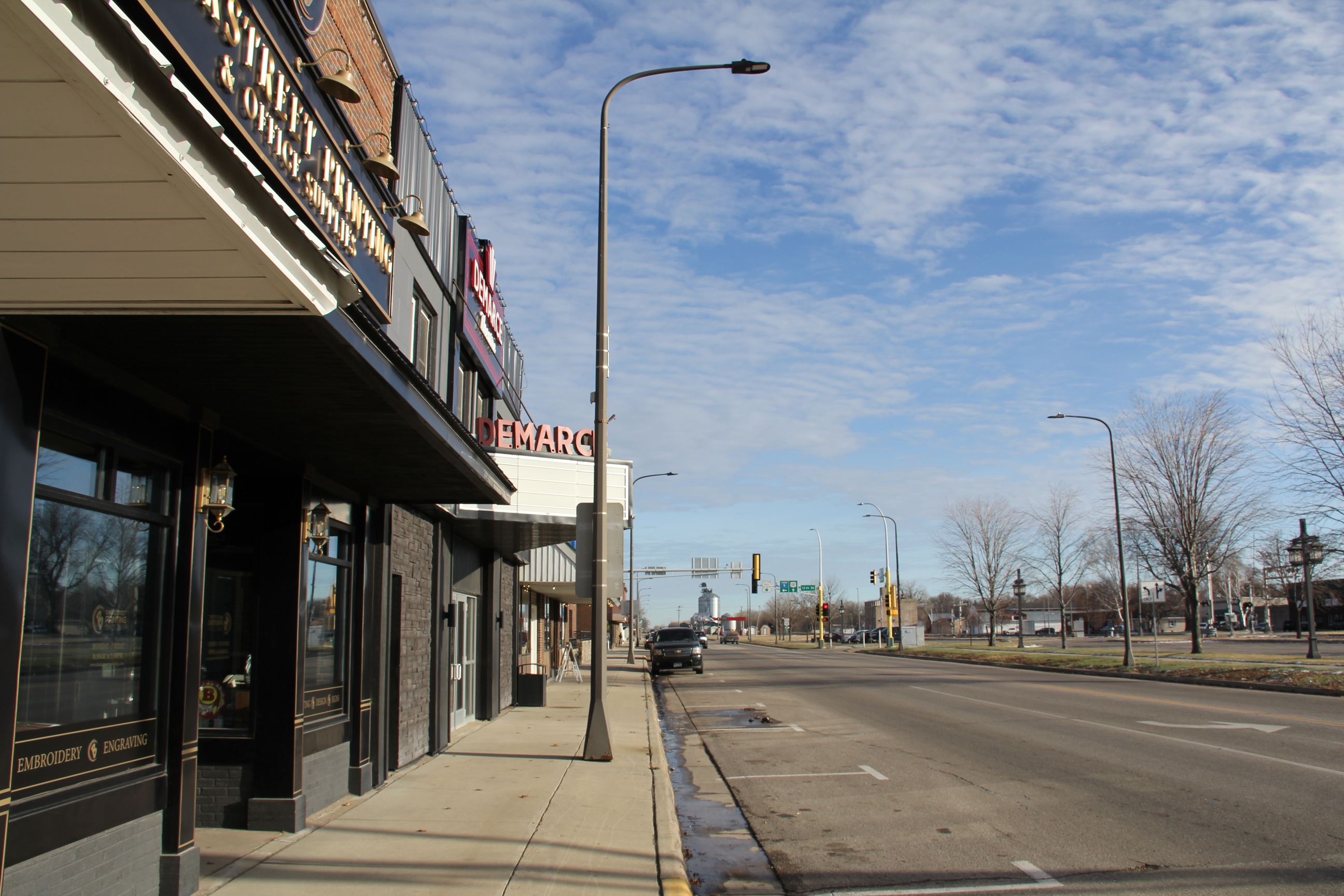
A wider Atlantic Avenue street shot photographed near the Demarce Theatre. (Minnesota Prairie Roots copyrighted photo November 2024)

For me, Benson would not be just another dot along the map to my destination. I wanted to stop briefly and photograph the DeMarce Theatre, which my cousin Tim and his wife, Susie, own. Or so I thought. After photographing the theatre exterior, I learned from the proprietor of Rustic Class, a Benson consignment shop, that the Kletschers no longer own the business. That news never traveled to me on the family grapevine.

The Demarce Theatre, when Tim and Susie Kletscher purchased it in 2011. (Photo credit: Tim Kletscher)

I was disappointed, of course, to hear this. Tim and Susie bought the 1925 theatre in 2011, invested thousands of dollars to upgrade to digital projection and a silver screen, operating the business until May 2020. By that time, Tim, a Benson Elementary School teacher, was tapping into his retirement account to keep the business afloat. That’s all history. But I’m grateful to my cousin and his family for the near-decade they kept the theater operational.
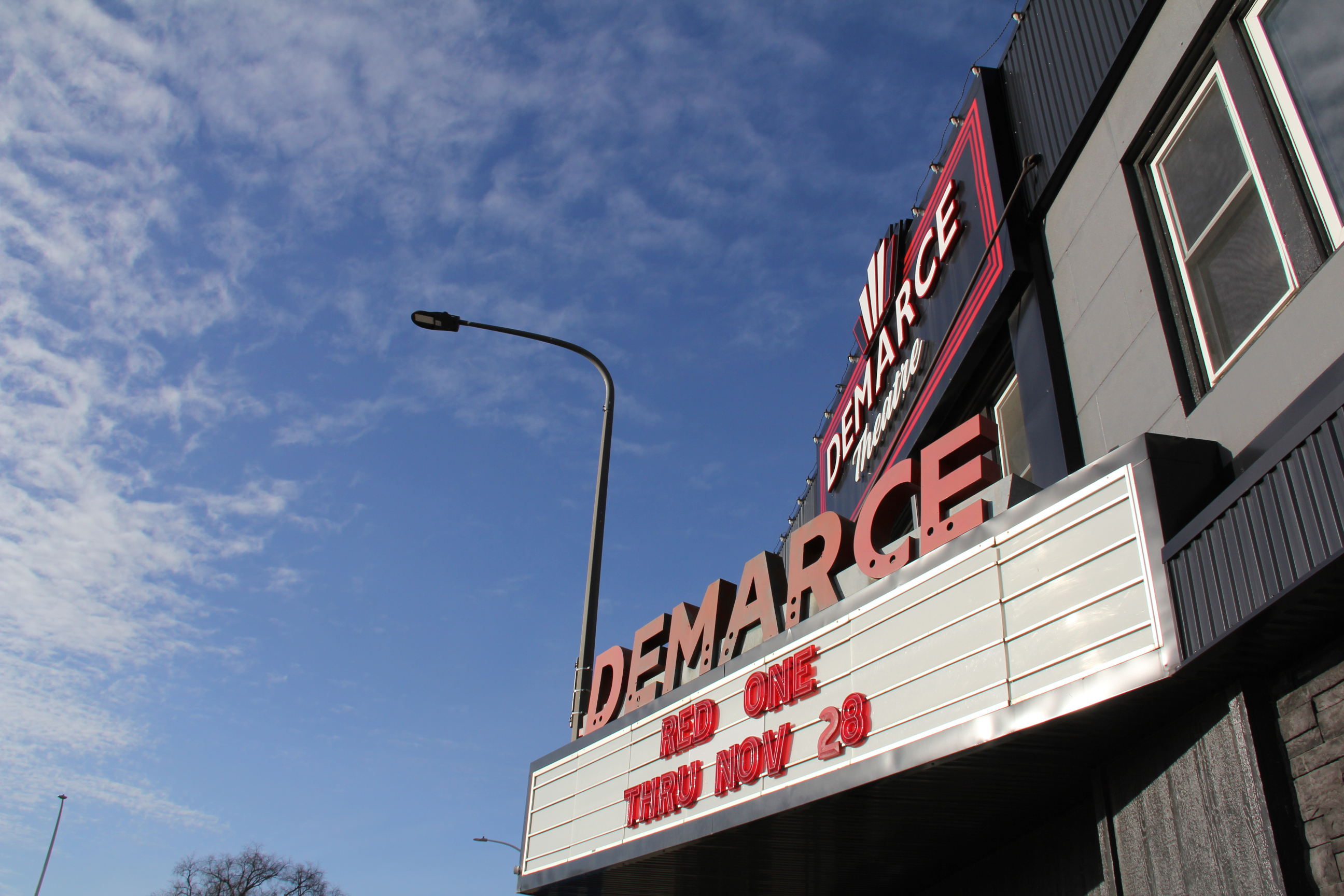
The new owners updated the movie theatre inside and out. (Minnesota Prairie Roots copyrighted photo November 2024)

And I’m grateful to the new owners, Randy and Pam Marran of St. Michael for purchasing the theatre, revamping and reopening it in June 2022. I understand small Minnesota prairie towns like Benson and how even one business closure matters to the people who live there. Like anywhere, people want to see their town thriving, not dying. They want local entertainment options. Distances are far on the prairie.

The front of the theatre received a complete facelift. (Minnesota Prairie Roots copyrighted photo November 2024)

That the Marrans, like my cousin, recognized the value of a theatre in Benson speaks to their understanding of this rural region. Pam grew up here with family still in the area. Their daughter Tyler manages the theatre. Like the Kletschers before them, the couple has poured plenty of time and money into the theatre with interior remodeling, installation of used leather seats, and a new facade and marquee. They’ve made an investment in Benson.
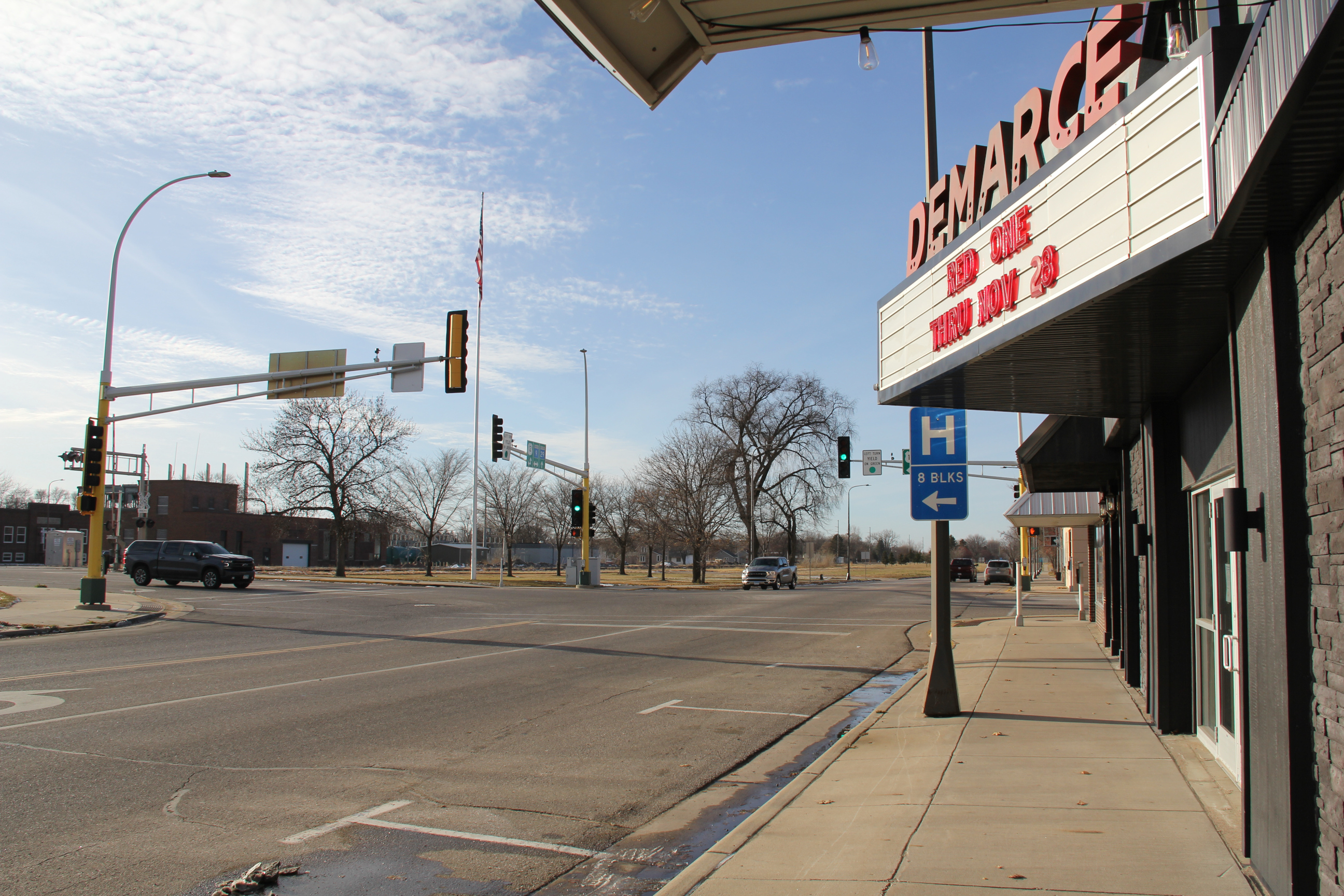
No need for Benson residents to drive out of town to see a movie. (Minnesota Prairie Roots copyrighted photo November 2024)

As I consider this, I can’t help but think that my city of nearly 25,000 does not have a movie theatre. While I’m not privy to details concerning its closure many years ago, I do know that locals were driving out of Faribault to a south metro theatre to see shows. Today that continues with three theatres within 20 minutes of my community.
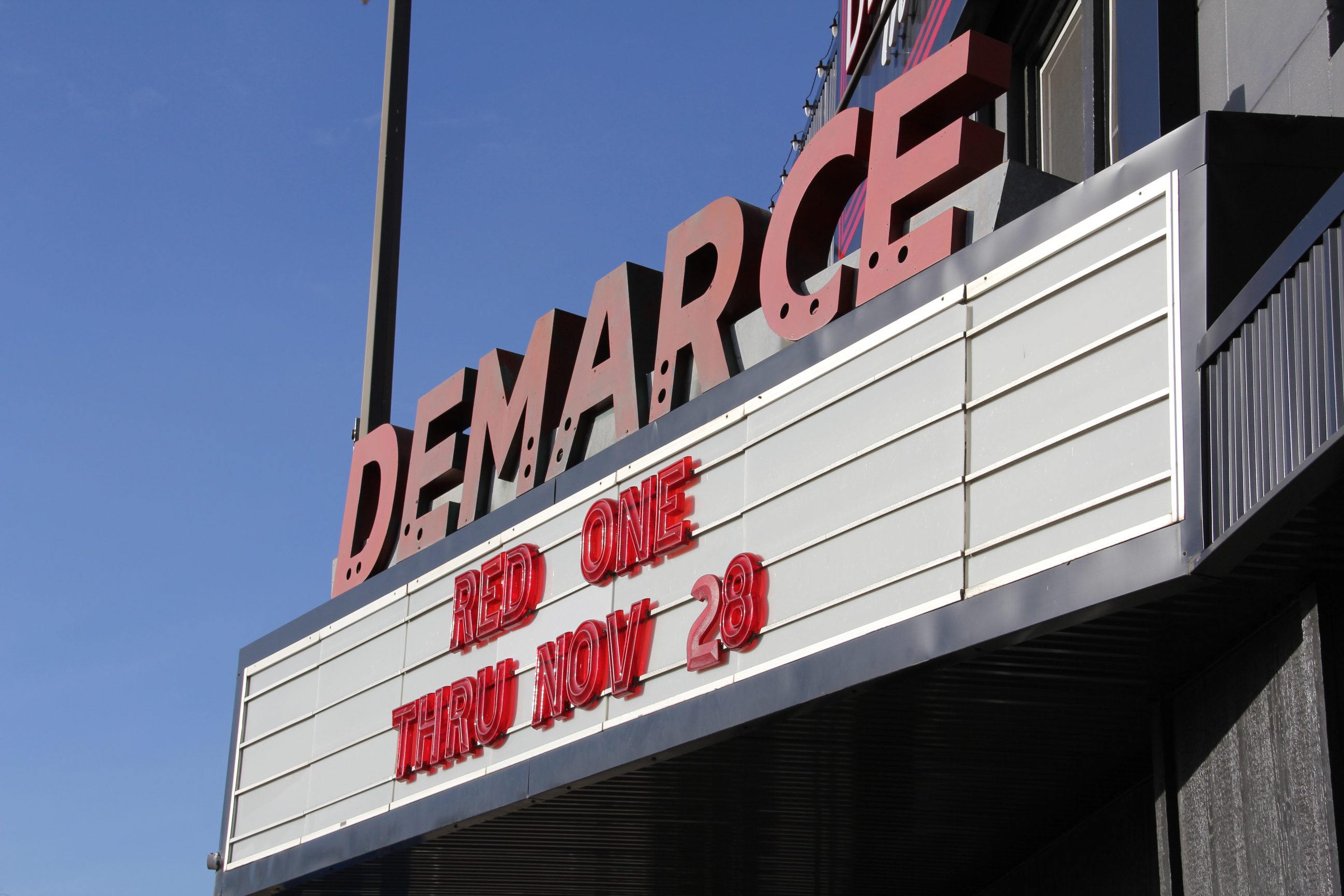
Back in November, this movie was showing at the Demarce Theatre. (Minnesota Prairie Roots copyrighted photo November 2024)

I expect on cold winter evenings like we’re experiencing now in Minnesota, the good folks of Benson are thankful to have a movie theatre in town—a place to escape into a film, to connect with friends and family, to down a soda or an alcoholic beverage, to purchase pizza, a pretzel or mini donuts, to dip fingers into a big bucket of buttery movie popcorn.

Likewise, movie theatres remain open in towns near Benson. There’s the Grand Theatre in Madison, the Millennium Theatre in Montevideo and the Morris Theatre in the college town of Morris. None of these prairie places are particularly large population-wise with 1,500-5,200 residents. But still they have theatres, a spot for locals to watch a movie about Minnesota native Bob Dylan in “A Complete Unknown” or “Sonic the Hedgehog 3.” Admittedly, I am not a movie-goer, having last stepped inside a movie theatre in May 2019, then requesting a refund not long into the film due to its violent content. (In fairness to me, I went with the guys in my family and knew nothing about the movie.)
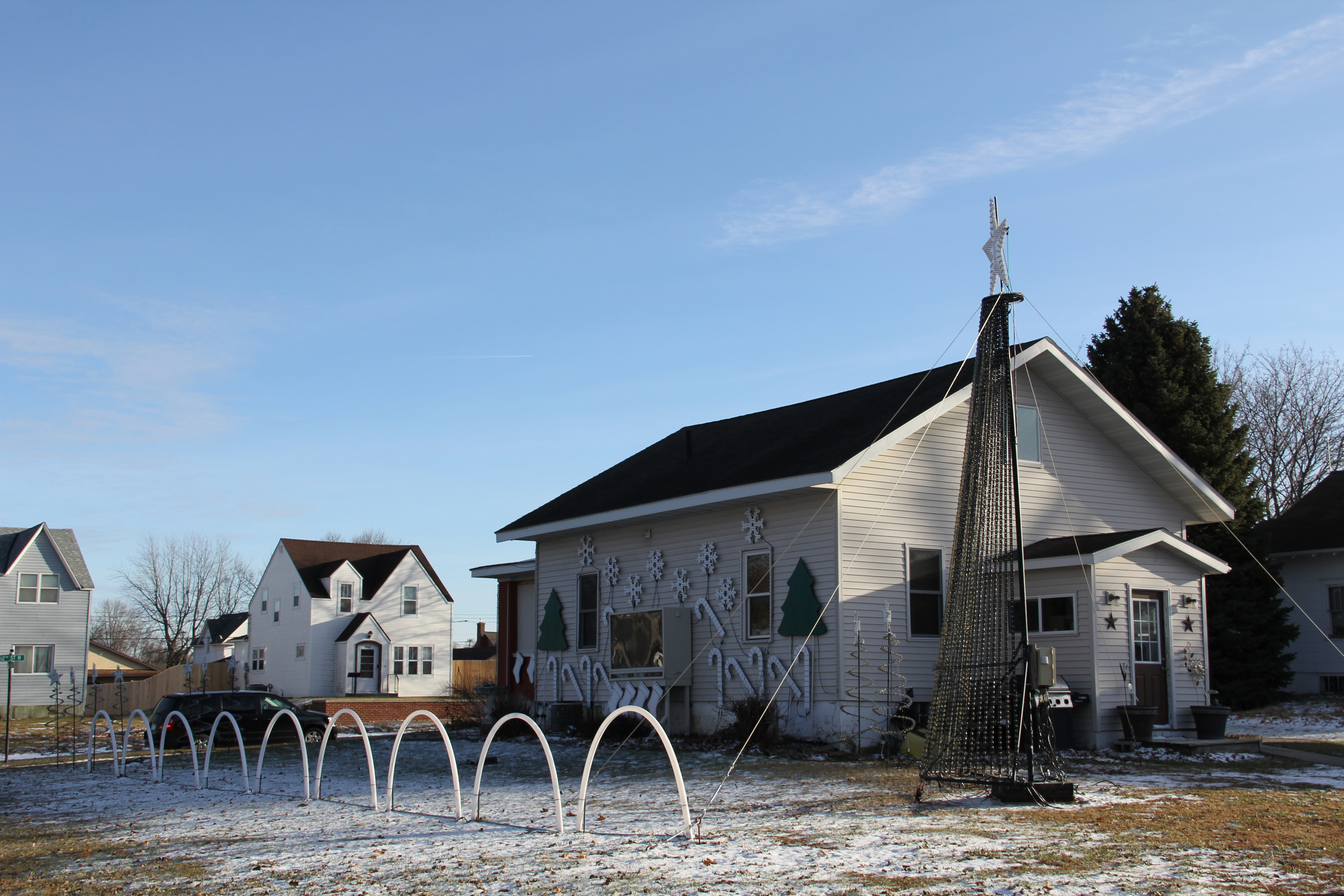
A residential neighborhood within blocks of the Demarce Theatre. (Minnesota Prairie Roots copyrighted photo November 2024)

That the residents of Benson, Madison, Montevideo and Morris have movie theatres in their towns is remarkable really. In Benson, my cousin Tim and his wife, Susie, and now the Marran family, recognized the value of investing in their community, in this place perched on the Minnesota prairie just 40 miles from the South Dakota border.

© Copyright 2025 Audrey Kletscher Helbling


Peaches, beyond simply a fruit to eat August 15, 2024

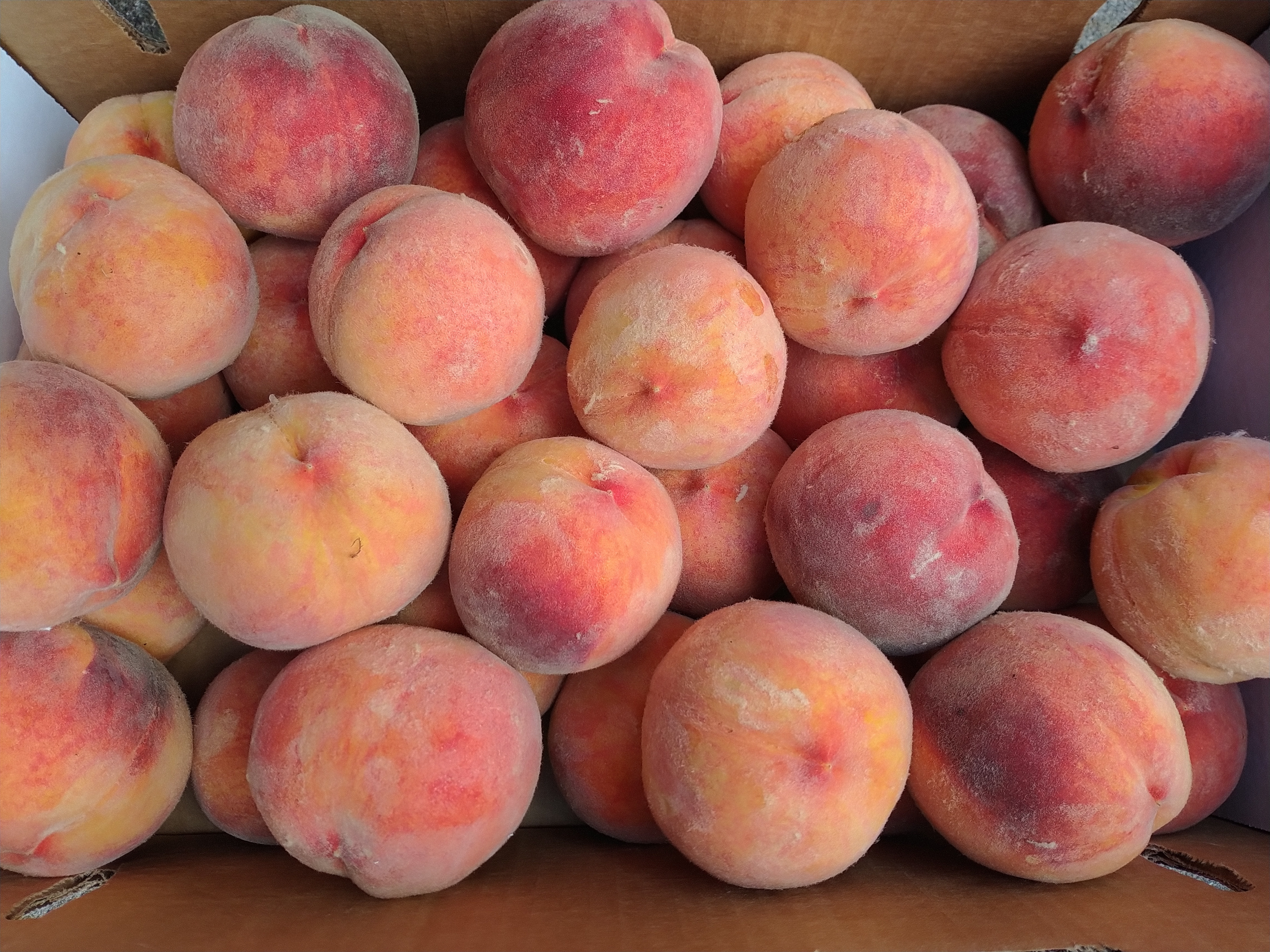
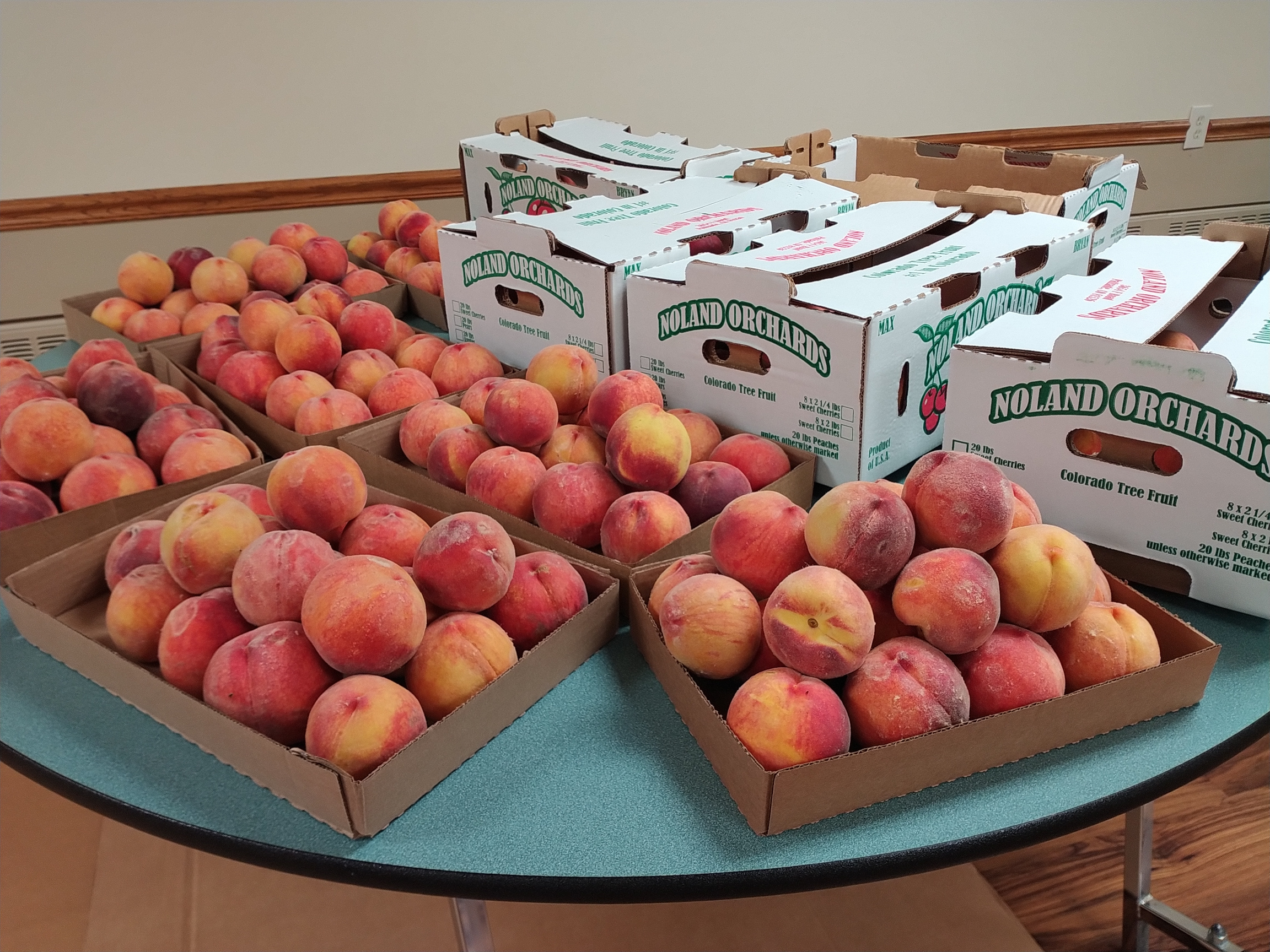
Peaches fill a box and now my fridge. (Minnesota Prairie Roots copyrighted photo August 2024)

PEACHES PACK my refrigerator. Several ripen in a brown paper bag on the kitchen counter. Big, beautiful Colorado peaches.

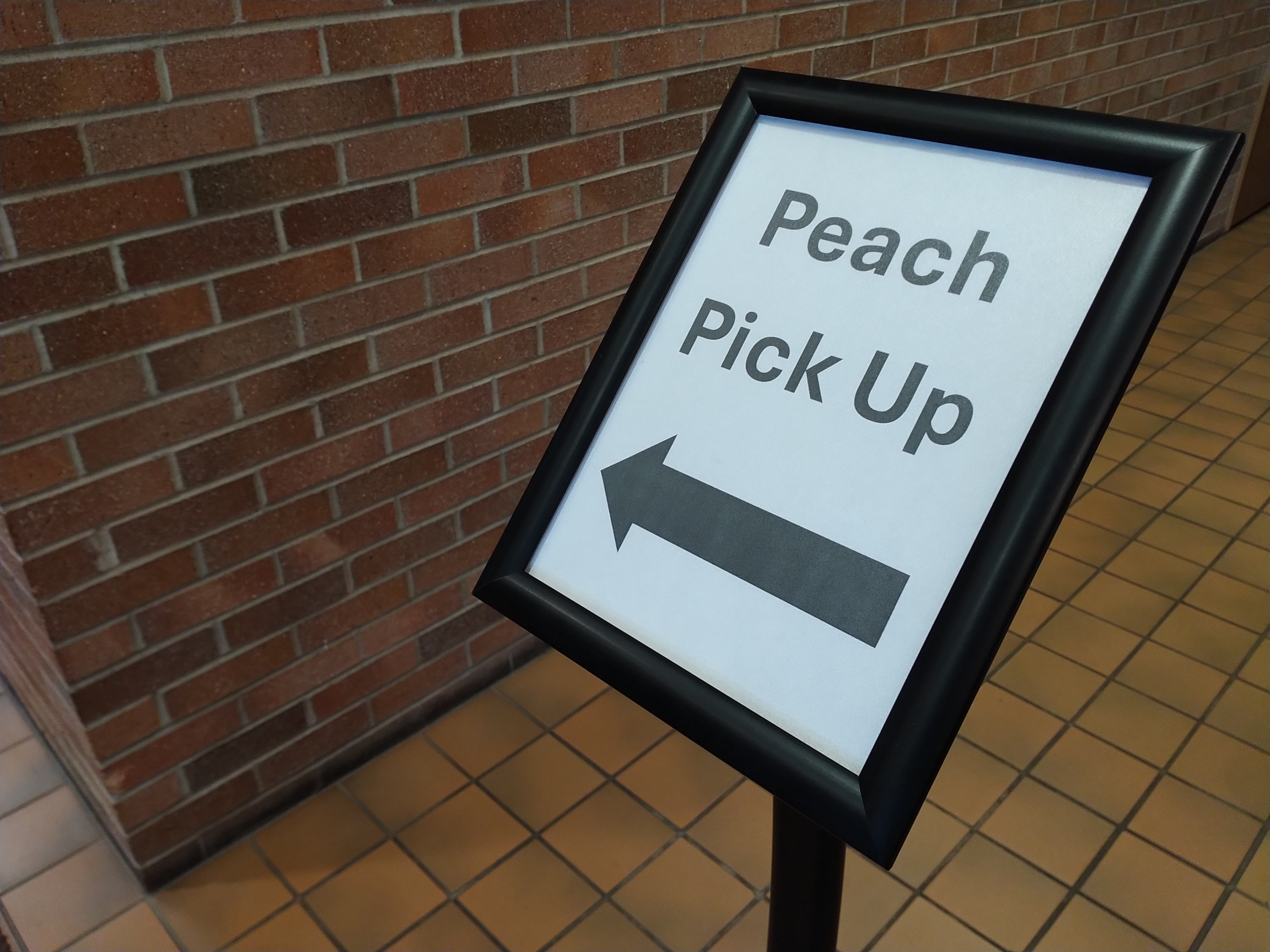
Signs directed people into the peach pick up spot in the basement. (Minnesota Prairie Roots copyrighted photo August 2024)

Earlier this week, Randy and I picked up a 20-pound case of peaches in the basement of First English Lutheran Church. That’s a lot of peaches—around 40—for two people to eat. But I love peaches. And we’ll share some with our eldest daughter and her family.

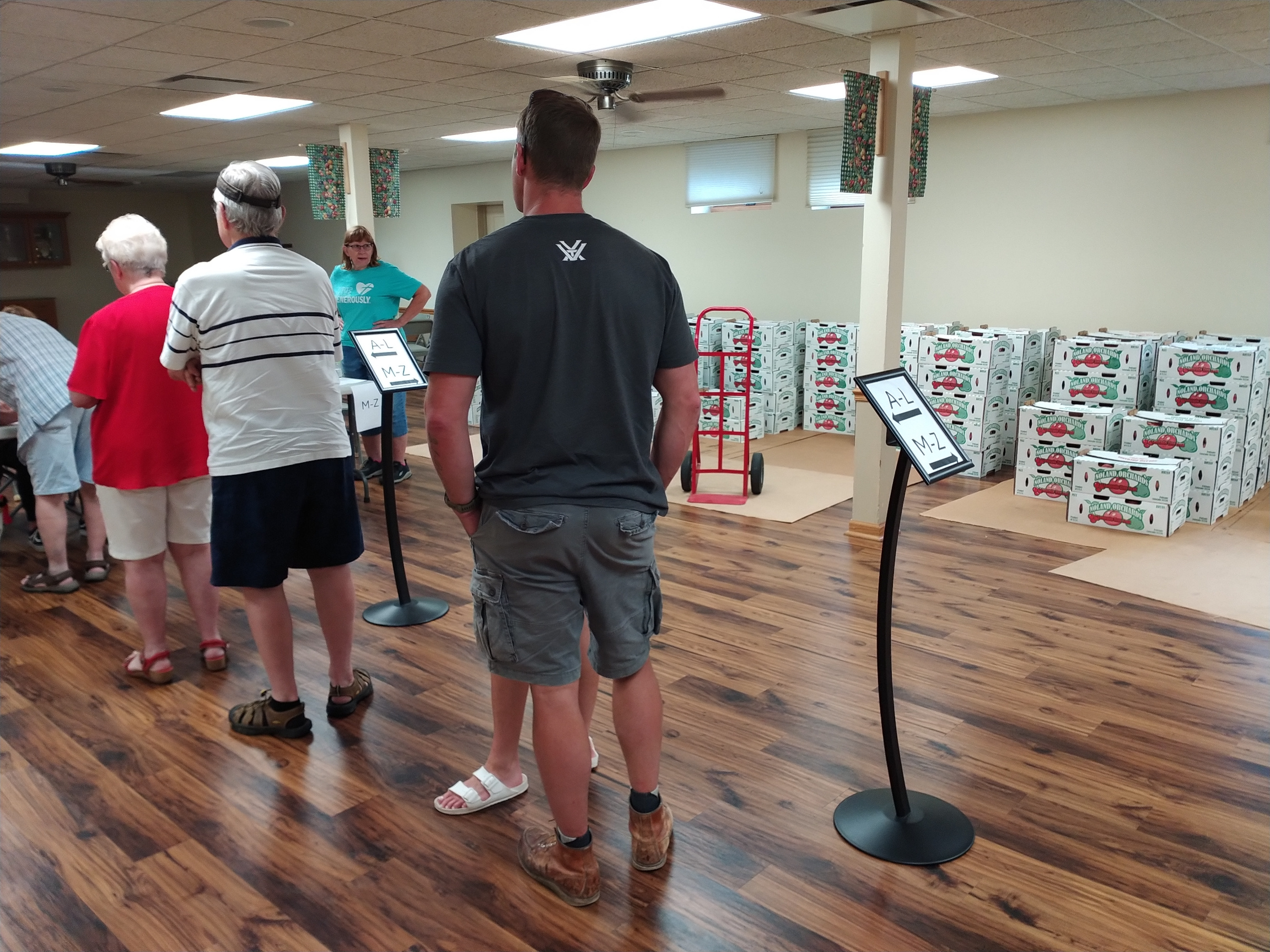
People wait in line for their peaches at First English Lutheran Church. (Minnesota Prairie Roots copyrighted photo August 2024)

A steady stream of people flowed into the cold church basement late Tuesday afternoon for their pre-ordered peaches, sold as a fundraiser by the youth group. We paid $37 for our full box. That’s $1.85/pound. I have no idea if that’s a “good” price. It doesn’t matter. I prefer peaches shipped directly from the grower. I also like supporting local church youth, because I was once that mom of kids raising monies for mission trips and youth gatherings.

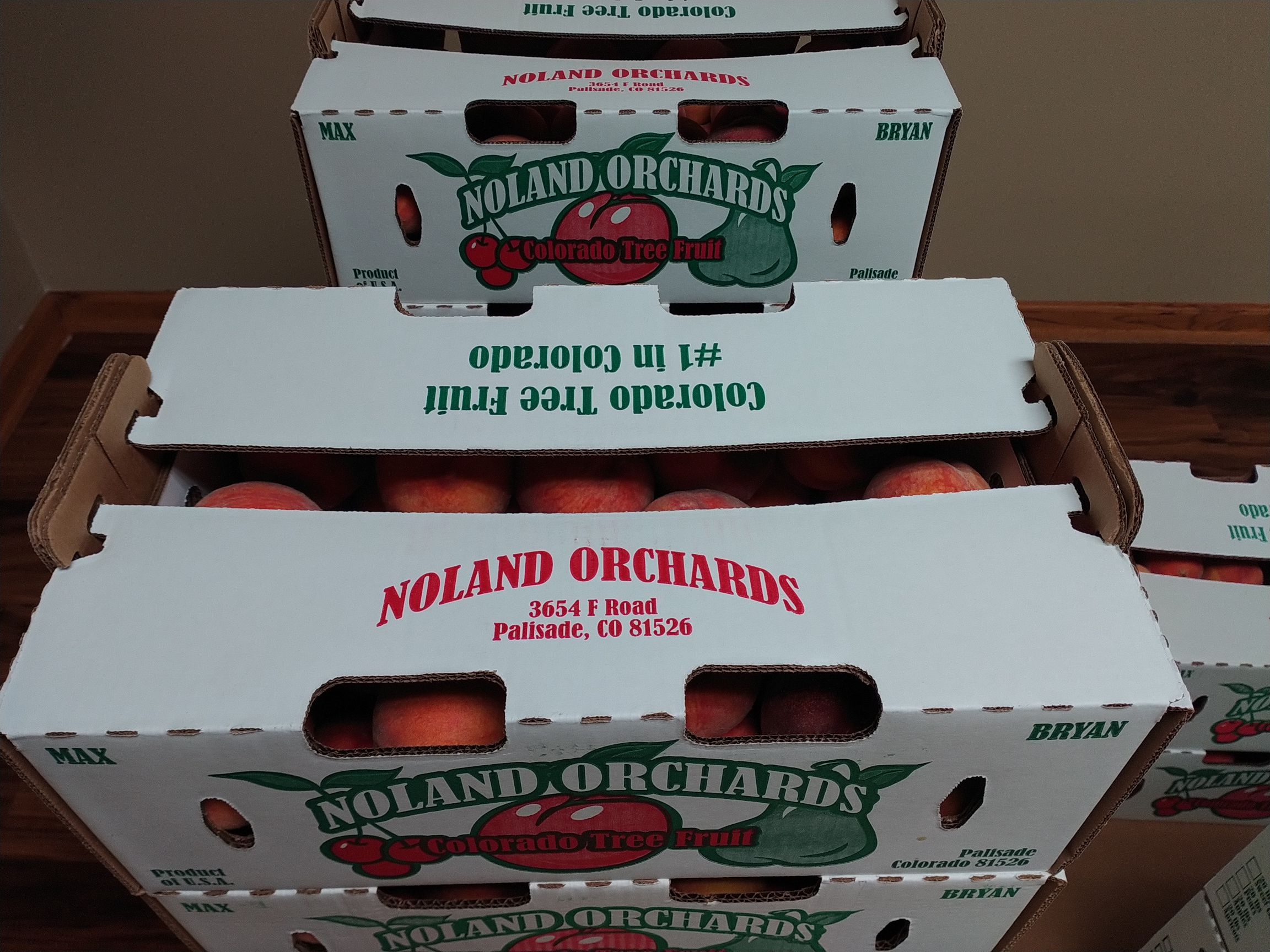
Peaches no longer come in wooden crates, but in cardboard boxes. (Minnesota Prairie Roots copyrighted photo August 2024)

Peaches, though, mean more to me than simply supporting a good cause and eating one of my favorite fruits. Peaches take me back to summer on the farm, into the kitchen. There my mom pried open a wooden crate of peaches wrapped in pinkish tissue paper (saved for later use in the outhouse). Then she dropped the peaches into a large kettle of boiling water to remove the skins. Next, she halved or sliced the peaches into Mason and Ball quart jars. Topped with lids and ringed, the jars went into the pressure cooker. Once removed, the jars cooled and sealed. Then we carried the jars to the cellar.

Beautiful (and delicious) Colorado peaches sold at First English. (Minnesota Prairie Roots copyrighted photo August 2024)

I admire farm women like my mom who labored to preserve fruits and vegetables to feed their families during the winter months ahead. And winters on the prairie were long and harsh. Many a cold, snowy evening, Mom would pull open the kitchen floor trap door and send me down the open wooden steps into the depths of the dank, dark, dirt-floored cellar lit by a single light bulb. There I selected a quart jar from the wooden shelves. Whatever fruit Mom wanted. Pears, cherries, plums, apples, peaches. The preserved fruit would complete our meal of meat, boiled potatoes with gravy, a side vegetable (pulled from the freezer) and homemade bread.

We ate well. Good food without preservatives. Beef from our cattle. Vegetables from our garden. Apples from local trees. And then all those fruits, purchased in crates and preserved. No additives. Just simple, good food.

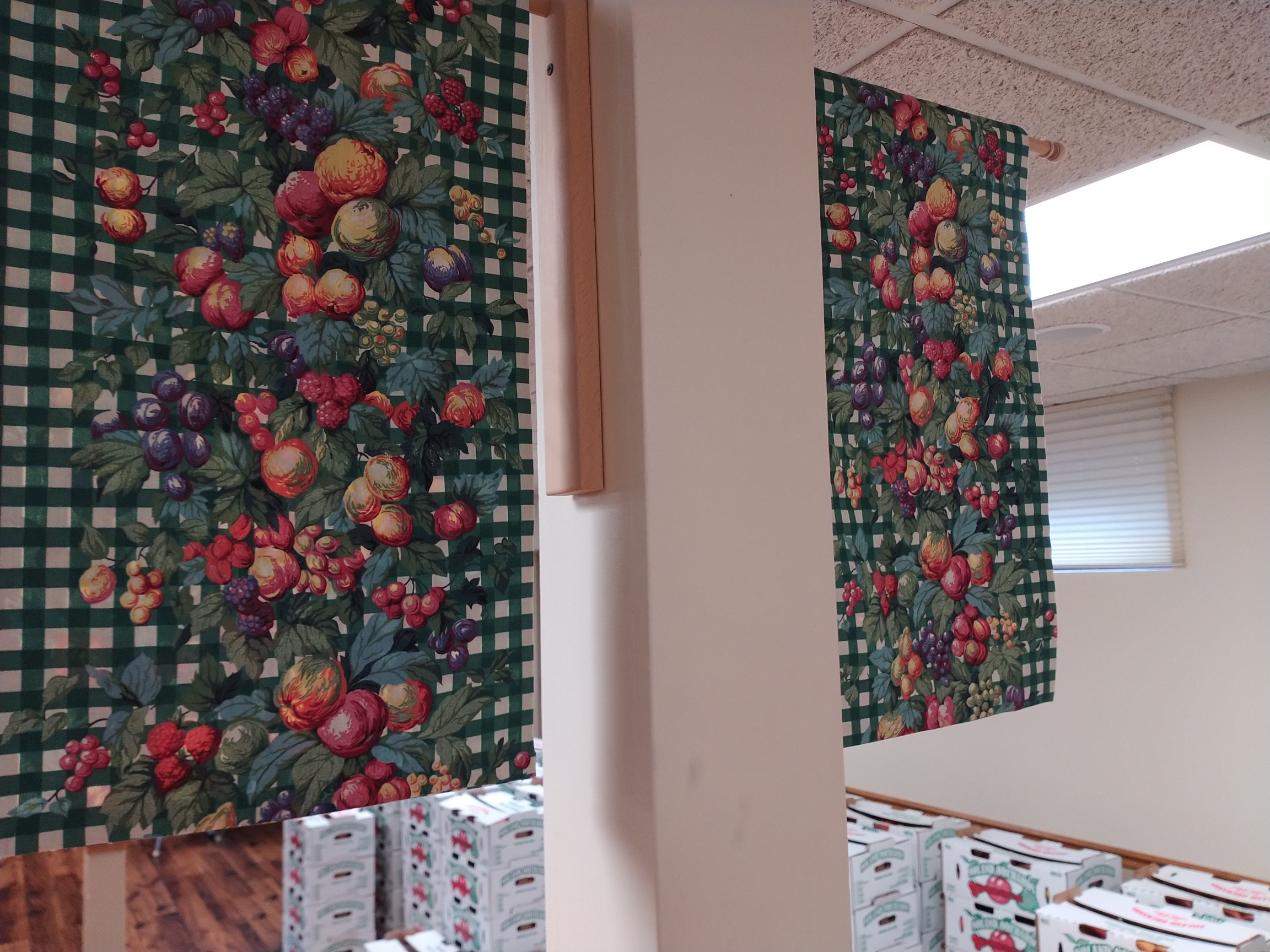
Fruit-themed banners add a festive flair to peach pick up. (Minnesota Prairie Roots copyrighted photo August 2024)

I always thought I would follow my mom’s example of planting a big garden and preserving food. But I never did. I live on a mostly shady lot in town. I raised only three children, not six like her. I have easy access to multiple grocery stores, unlike her. Fresh fruit is readily available. I prefer fresh. And, if I’m really honest with myself, I never wanted to labor in the kitchen for hours during the hot summer putting up fruits and vegetables.

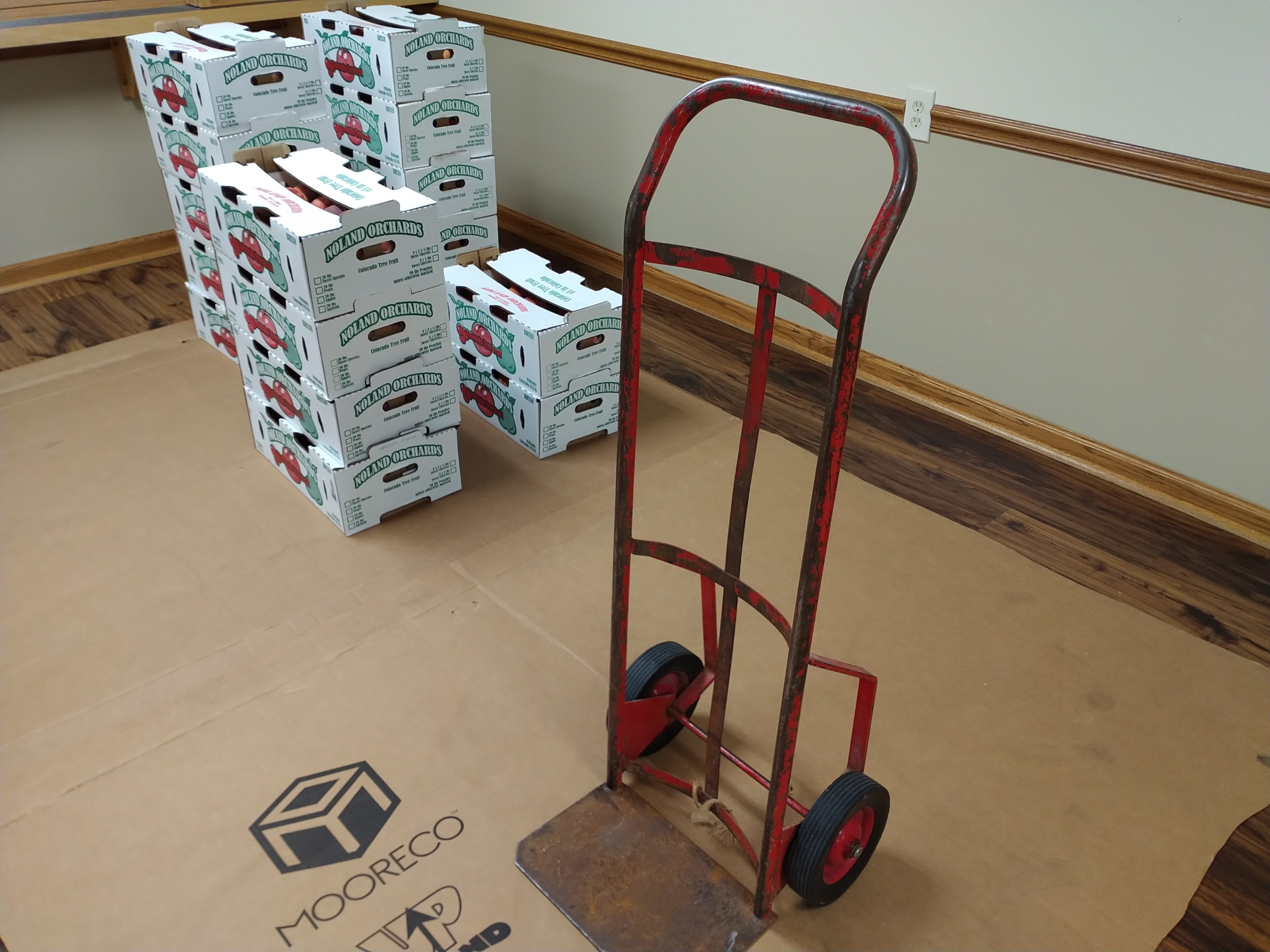
Carts were ready for volunteers to wheel peach cases to vehicles. (Minnesota Prairie Roots copyrighted photo August 2024)

Still, I buy that case of peaches from First English. All those peaches, minus the tissue paper wrappings reused in the outhouse. In many ways, I am honoring my mom, hardworking farm woman of the Minnesota prairie. As I pull ripened peaches from a brown paper bag to slice into my morning oatmeal, to eat with a meal or to incorporate into a crisp, pie or galette, I think of Mom. She, who showed her love for family not in words or hugs, but rather in rows and rows of quart jars filled with fruit. Jars shelved on planks in the dank, dark depths of the dirt-floored cellar.

© Copyright 2024 Audrey Kletscher Helbling


Book review: A collection of short stories & art from the Minnesota prairie by Elizabeth Johanneck July 27, 2023

The cover of Elizabeth Johanneck’s new book features the art of her grandfather, Arnold Kramer. (Minnesota Prairie Roots photo July 2023)

DECADES REMOVED from southwestern Minnesota, Twin Cities writer Elizabeth Johanneck and I remain rooted to the prairie—the land and people and smalls towns which shaped us. We both grew up on Redwood County farms, were Wabasso High School classmates and today hold a deep respect and fondness for the place we once called home.

Beth, as she’s known to me, recently published a book, If You Can’t Make it to Heaven, at Least Get to Seaforth—The Monica Stories and Then Some. This book features short stories and snippet observations in Beth’s humorous storytelling style, plus paintings and photos. These could be my stories, my memories, just with different characters and settings. Any prairie farm kid likely will feel the same.

ABOUT SEAFORTH & MONICA

But where is Seaforth? And who is Monica? Seaforth, population 77, is a farming community located along County Road 7, south of Minnesota State Highway 19 in central Redwood County. It’s near my hometown of Vesta, seven miles to the northwest. Monica Fischer is Beth’s friend, former co-worker and a character. A baby shoe in a pot of egg coffee and pantyhose found clinging inside a pant leg during Catholic Mass are among the many entertaining Monica stories that left me laughing aloud. By the time I’d finished reading this section of the book, I felt like I knew Monica well. Everyone should have a friend like her.

GROWING UP ON THE MINNESOTA PRAIRIE IN THE 1960s

And everyone should be so fortunate to have experienced rural Minnesota life in the 1960s, as Beth and I did. It is Part 2, “Random Nonsense of a MN Country Mouse,” that I find most similar to my childhood. Both farmers’ daughters with many siblings, Beth and I share the commonalities of being raised on the land among aunts and uncles and cousins and grandparents and immediate family who loved us deeply.

As in “The Monica Stories,” Beth writes about her personal experiences in a casual conversational style. It’s as if she and I are chatting over cups of coffee, and Beth does like her coffee. I connect with her stories about “the grove,” jars of pocket gopher feet in the freezer, grab bags, bloodsuckers, The Weekly Reader, hearing corn grow and more.

Her humor-infused short stories stretch into adulthood, into becoming a parent and grandparent. These are not earth-shattering remembrances, but rather observations about everyday life and events that could be mine, could be yours, but are definitively Beth’s.

NIBBLES OF COUNTRY INSIGHTS

In a section titled “Country Mouse Nibbles,” Beth shares her thoughts on topics in a sentence or two, the first being “When You Are Raised Close to the Land.” I fully understand—the smell after autumn harvest, looking to the west for approaching storms, filled fruit jars crowding root cellar shelves… And “Holding onto Memories”—Distant cheers from a local ball game are souvenirs worth saving for winter. Truly poetic words.

FEATURING THE ART OF “MINNESOTA’S GRANDPA MOSES”

There is much to be cherished in this book beyond pages and pages of rural memories and insights. Beth also intersperses photos, most from Seaforth. But it is Part 3, “Paintings by Arnold Kramer, Minnesota’s ‘Grandpa Moses,’” which is an historic agrarian art treasure. Following his retirement, Seaforth farmer Arnold Kramer took up painting, visually documenting early to mid-1900s rural life and scenes. He became well-known for his folk art style paintings done in primary colors. Beth’s book holds the only printed collection of paintings by her grandfather. The self-taught artist created more than 400 works of art and was dubbed “Minnesota’s Grandpa Moses” by the University of Minnesota at the peak of his creativity in the 1960s.

Book signing promo courtesy of Elizabeth Johanneck.

BOOK SIGNING SATURDAY IN SEAFORTH

Like her grandfather before her, Beth is also a visual artist. She illustrated a just-published children’s picture book by her lifelong friend, Cindy Bernardy Lavin, our WHS classmate. Both writers, along with Monica Pistulka Fisher, are doing a book signing from noon to 3 pm this Saturday, July 29, at the C4th Bar during Seaforth’s Hometown Days celebration.

Beth’s book is also available for purchase at Chapter Two Bookstore in Redwood Falls and online at Amazon and Barnes & Noble. Both her book and Cindy’s achieved bestseller status on Amazon following their release.

Julie Kramer, author of bestseller Stalking Susan, praises Beth’s book in her back cover endorsement, calling it “a delightful collection from a farm girl who grew up near the Minnesota home of Laura Ingalls Wilder.” I agree. Fully.

#

Disclaimer: I edited Beth’s book and advised her on the manuscript. She also included my poem, “Her Treasure,” as a companion piece in the “Country Mouse Nibbles” section. For many years, Beth hosted a blog, Minnesota Country Mouse.

© Copyright 2023 Audrey Kletscher Helbling


Linoleum block print art stories from the prairie February 15, 2023

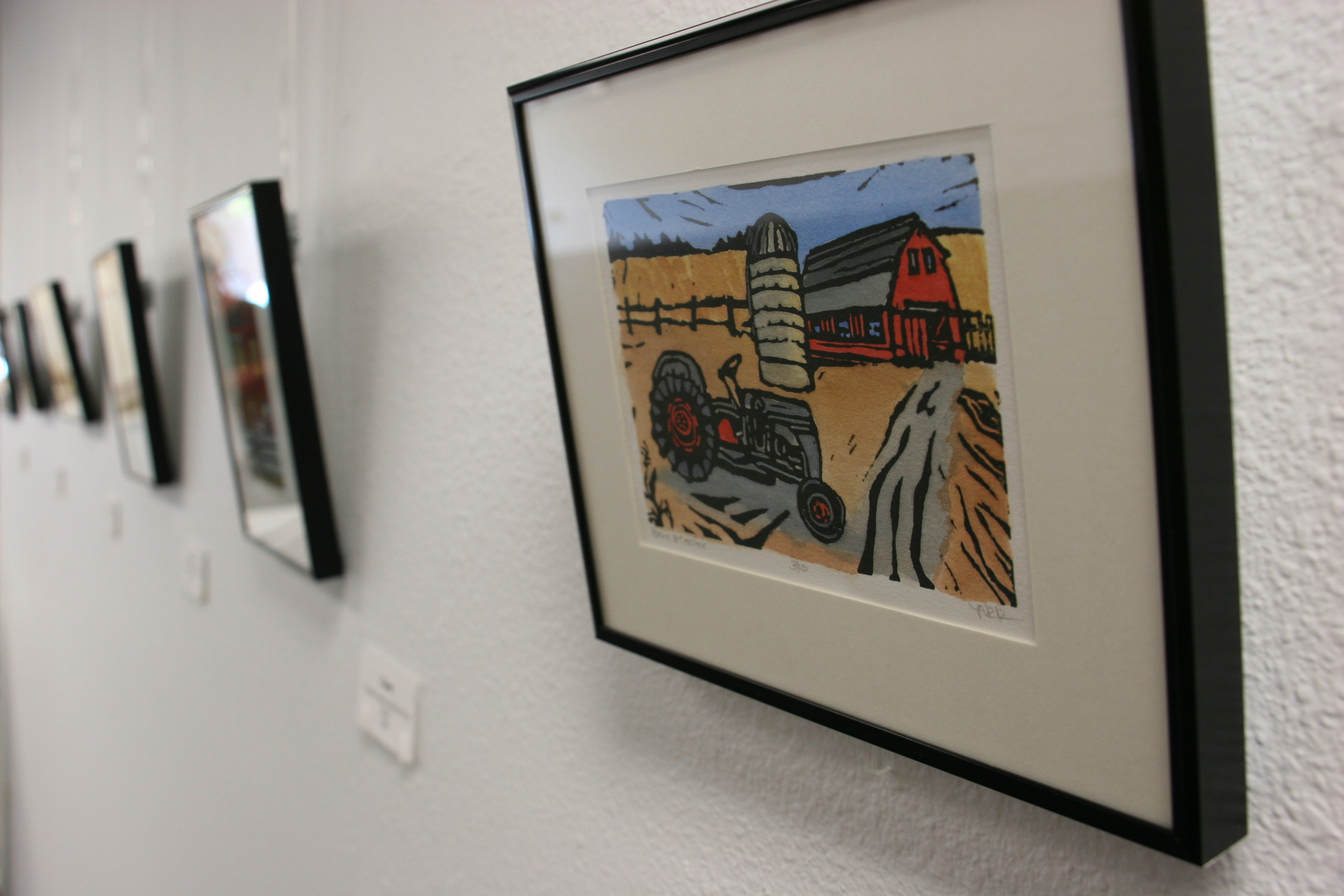
“Main Street,” watercolored block print by Nan Karr Kaufenberg. (Minnesota Prairie Roots copyrighted photo September 2022)

MANY DECADES AGO, in a time when gender roles factored strongly into classes a student could and couldn’t take in high school, I learned to carve a design into a linoleum block for printing. Girls and boys traded classes for two weeks with female students allowed into the male-dominated world of shop class. The guys headed to the home economics kitchens to acquire basic cooking and baking skills.

Nan Karr Kaufenberg’s depiction of a farm site. (Minnesota Prairie Roots copyrighted photo September 2022)

Oh, how things have changed since I was an early 1970s high school student briefly surrounded by saws and tools and other equipment and carving art into a linoleum block. I don’t recall the design I crafted. But I do remember feeling empowered inside that industrial arts shop, my eyes opened to possibilities that stretched beyond societal limitations.

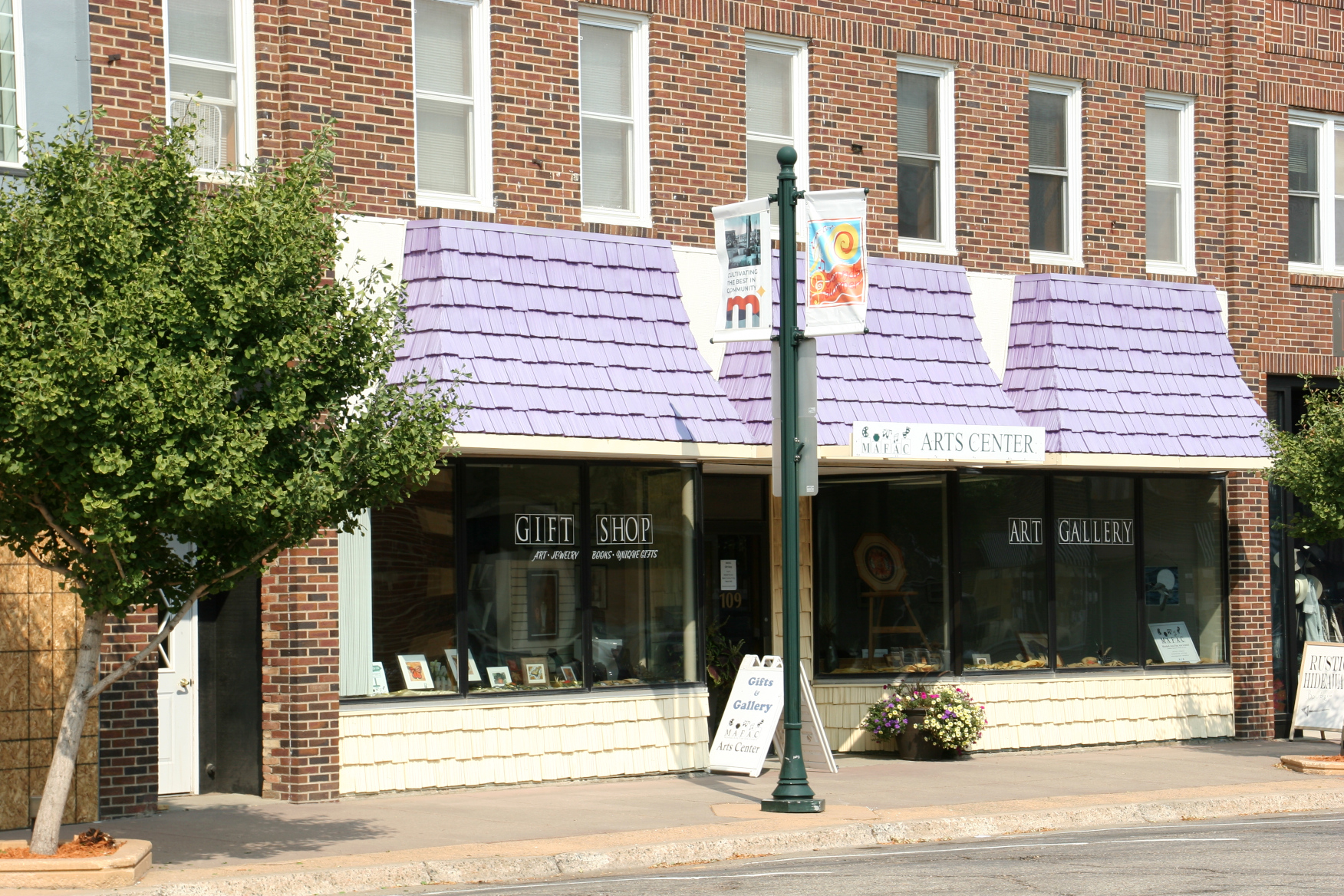
The Arts Center in downtown Marshall. (Minnesota Prairie Roots copyrighted photo September 2022)

Maybe that experience is partially why I am drawn to linoleum block prints. On a return trip to my native southwestern Minnesota prairie in September, I visited the Marshall Area Fine Arts Council Arts Center which was hosting an exhibit, appropriately named “Block Party,” by watercolor block print artist Nan Karr Kaufenberg of Redwood Falls. I’d previously seen, and admired, her work.

Nan Karr Kaufenberg’s “Coneflowers.” (Minnesota Prairie Roots copyrighted file photo September 2022)
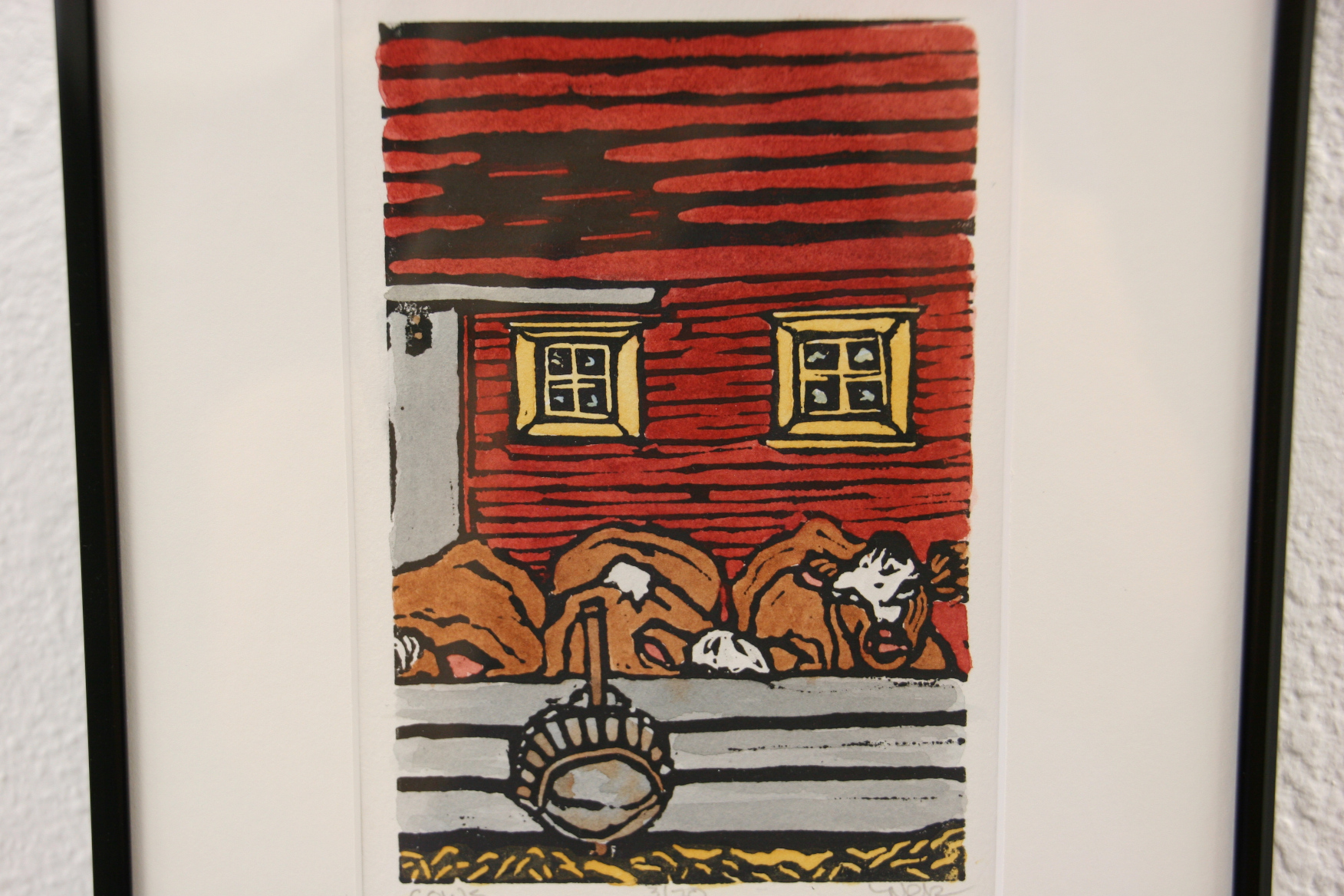
Feeding cattle focus this print by Nan Karr Kaufenberg. (Minnesota Prairie Roots copyrighted photo September 2022)
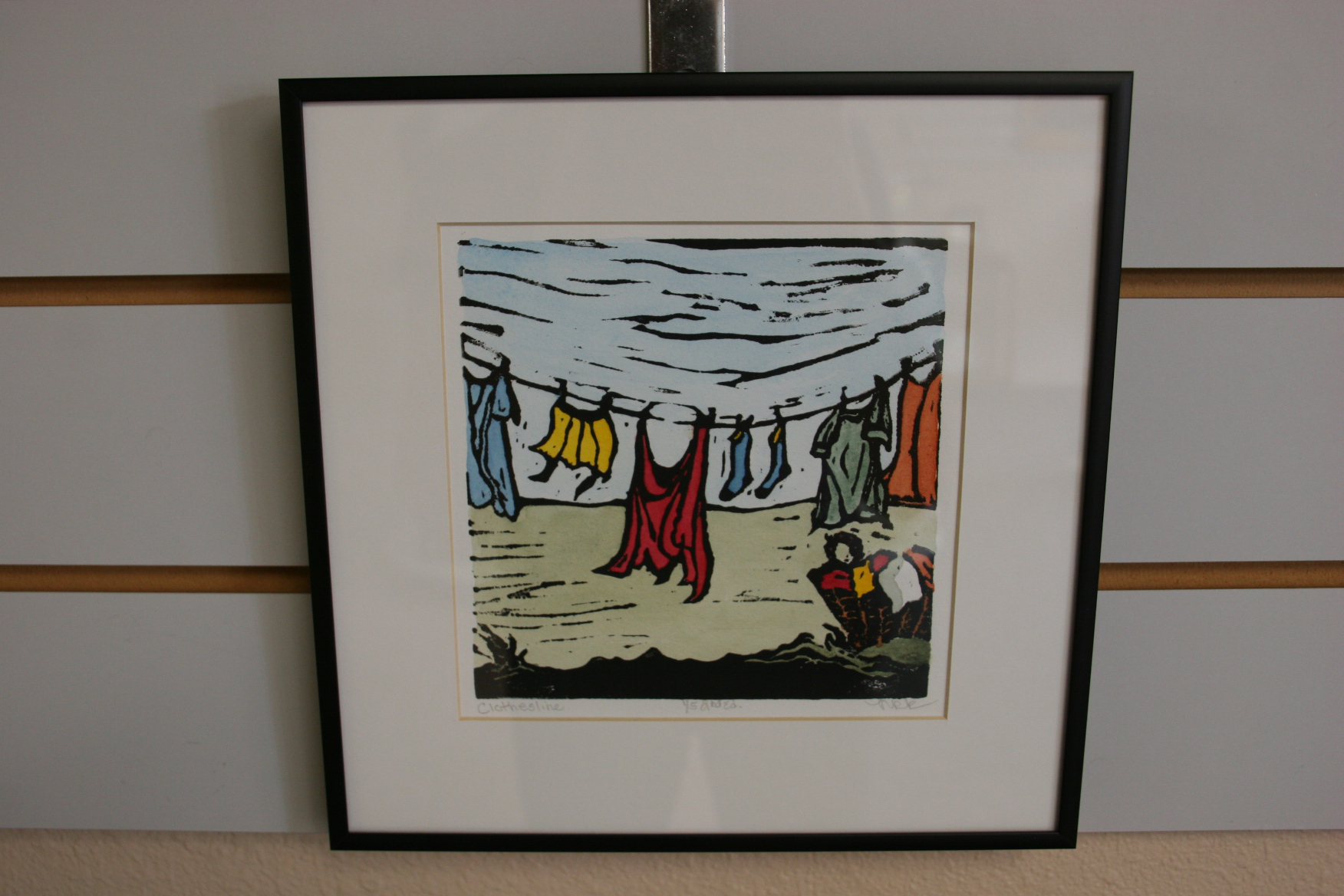
“Clothesline” by Nan Karr Kaufenberg. (Minnesota Prairie Roots copyrighted photo September 2022)

That admiration remains for this artist who observes the prairie world around her and then creates. I feel comfortably at home with her interpretations of rural southwestern Minnesota. Her depictions of prairie flowers, farm scenes, small towns, even laundry on a clothesline, touch me with that sense of familiarity, that feeling of connection to a place I called home and forever hold dear.

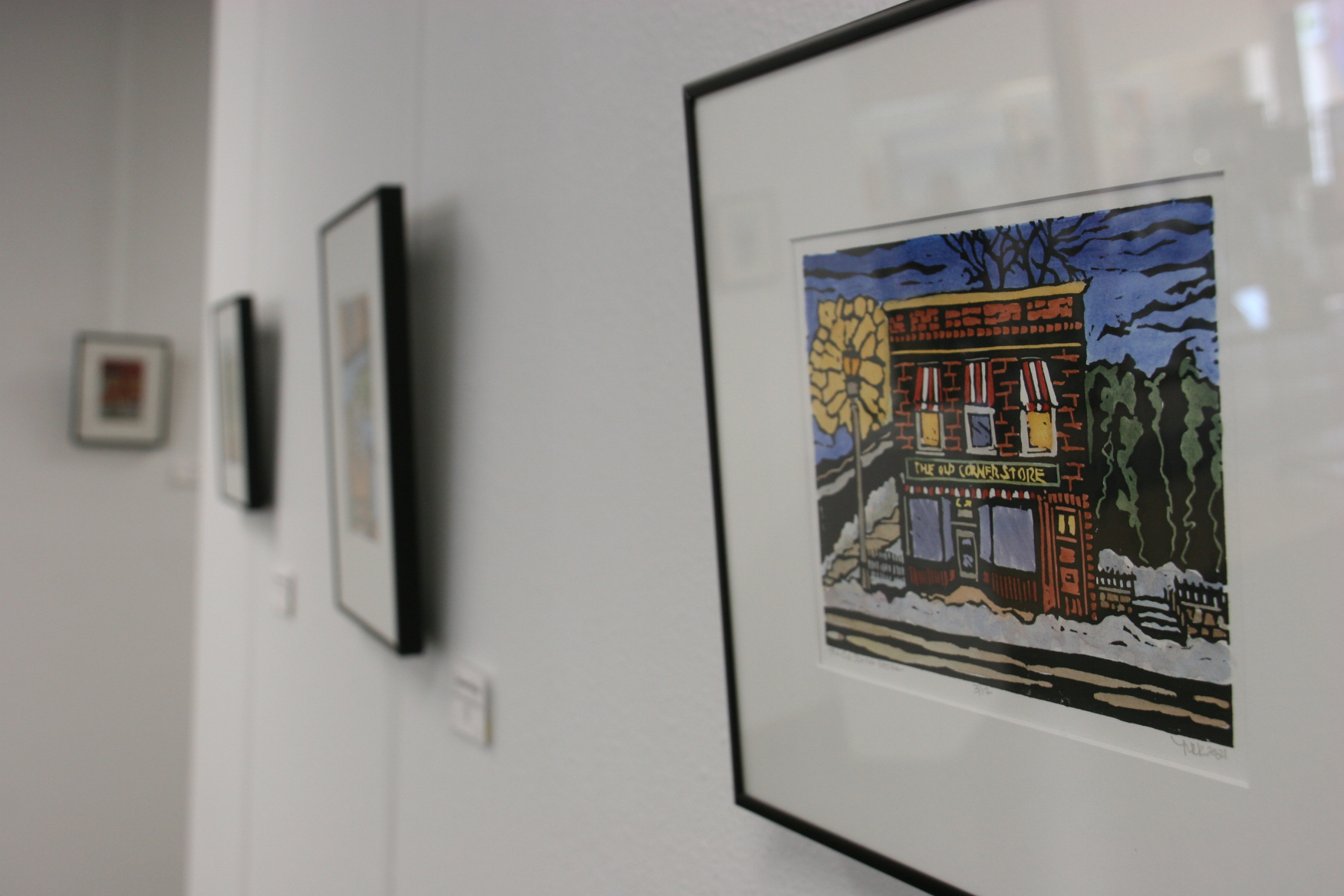
A block print by Nan Karr Kaufenberg of The Old Corner Store. (Minnesota Prairie Roots copyrighted photo September 2022)

For more than 30 years, Kaufenberg, who has art degrees (from the University of Minnesota and Southwest Minnesota State University), who once worked at a tourism center in extreme southwestern Minnesota (she moved following the 2001 high profile murder of her daughter Carrie Nelson), and who is also a realtor, has specialized in tinted linoleum block prints. She colors her printed designs with watercolors. The results are simply stunning. Bold black stamped ink softened by watercolor.

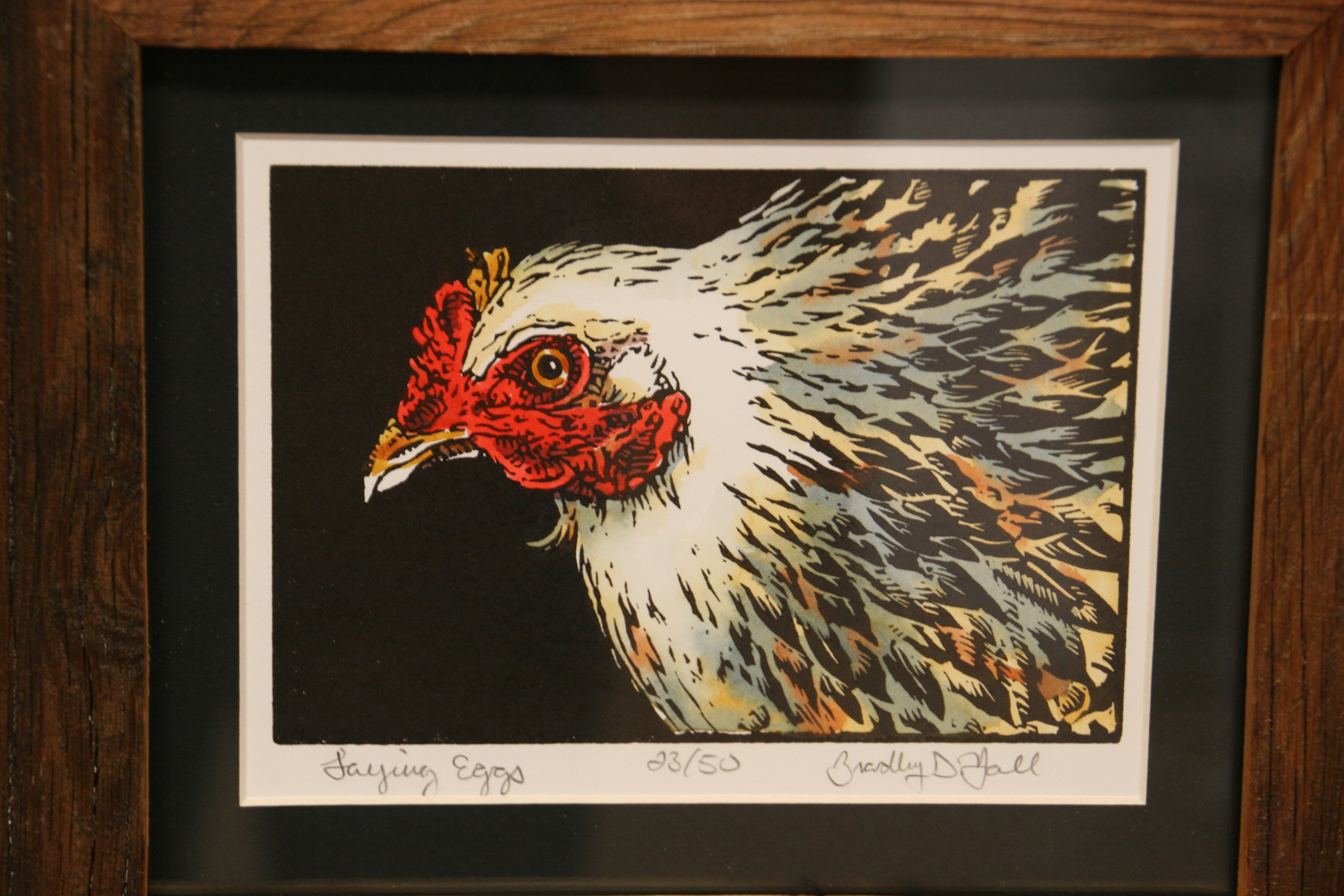
“Laying Hens” by Bradley D. Hall. (Minnesota Prairie Roots copyrighted photo September 2022)

Granite Falls artist Bradley D. Hall does the same, hand-carving linoleum blocks, then hand-printing the inked block design before hand-coloring with watercolors. I also saw his work inside the Marshall Arts Center. While similar to that of Kaufenberg in its rural themes, Hall’s art features finer black lines. Each artist has developed a certain identifiable style with the same basic art form.

A view of the Marshall Arts Center gift shop. (Minnesota Prairie Roots copyrighted photo September 2022)

Hall, who left southwestern Minnesota for Chicago and worked there for 20 years in factories, returned to his native Granite Falls in 2002 to open a studio. By then he’d already taken numerous art classes, including at the American Academy of Art in downtown Chicago. Upon his return to Minnesota, Hall connected with letterpress artist Andy Kahmann of A to Z Letterpress in Montevideo and learned the arts of linoleum block carving and printmaking. I love that these creatives shared with, and learned from, one another.

“Windmill” by Bradley D. Hall. (Minnesota Prairie Roots copyrighted photo September 2022)

More than 50 years ago, industrial arts teacher Ralph Brown shared his linoleum block print skills with me and a shop full of other teenage girls at Wabasso High School. Those two weeks of hands-on learning inside a place typically reserved for male students proved pivotal. I could see the world beginning to crack open to young women, emerging women who would ink life with their designs, their styles, their strong bold lines.

© Copyright 2023 Audrey Kletscher Helbling

Artwork photographed with permission of the Marshall Area Fine Arts Council Arts Center. Individual art is copyrighted by the artists.


Sculpture prompts prairie snow & ice memories December 12, 2022

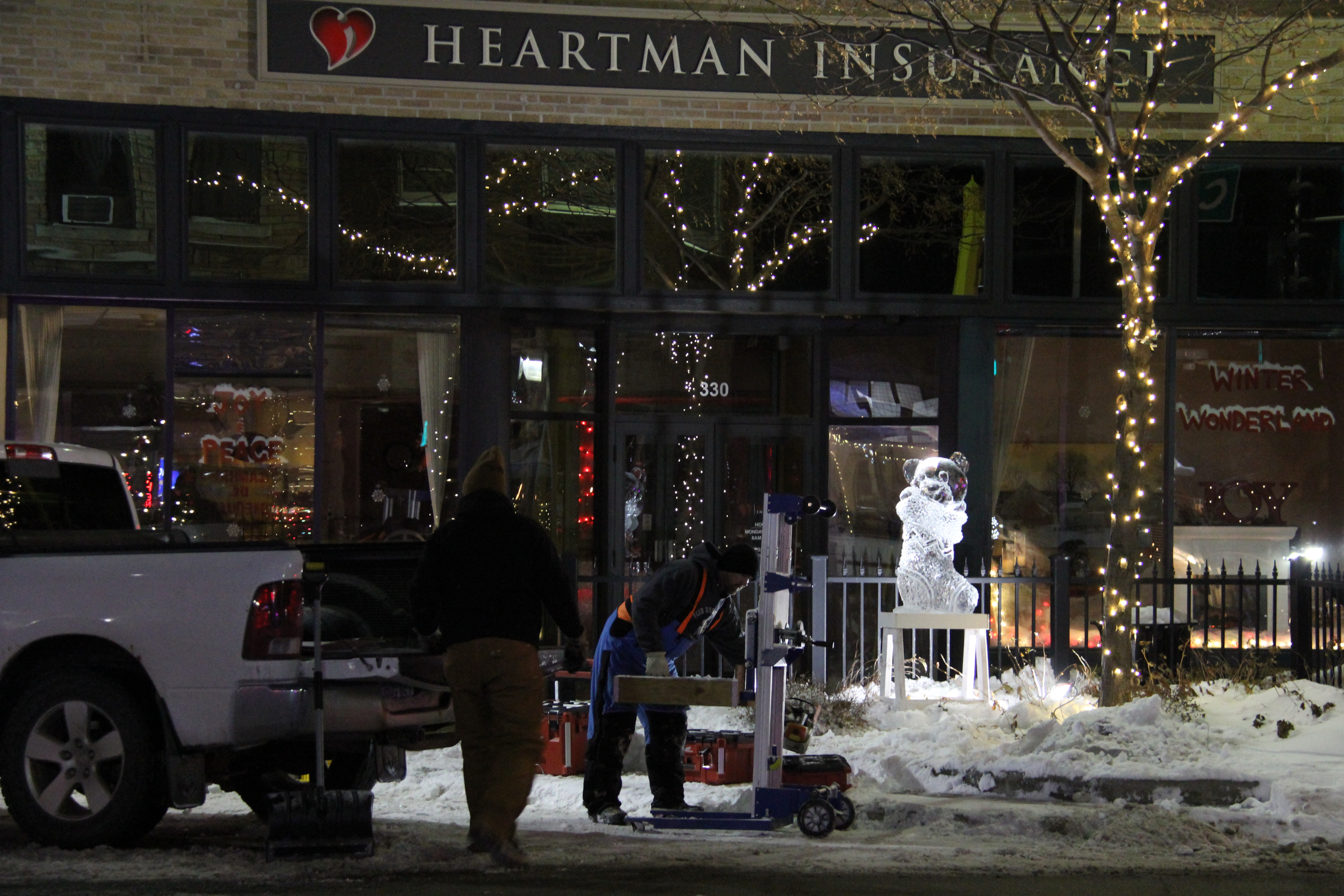
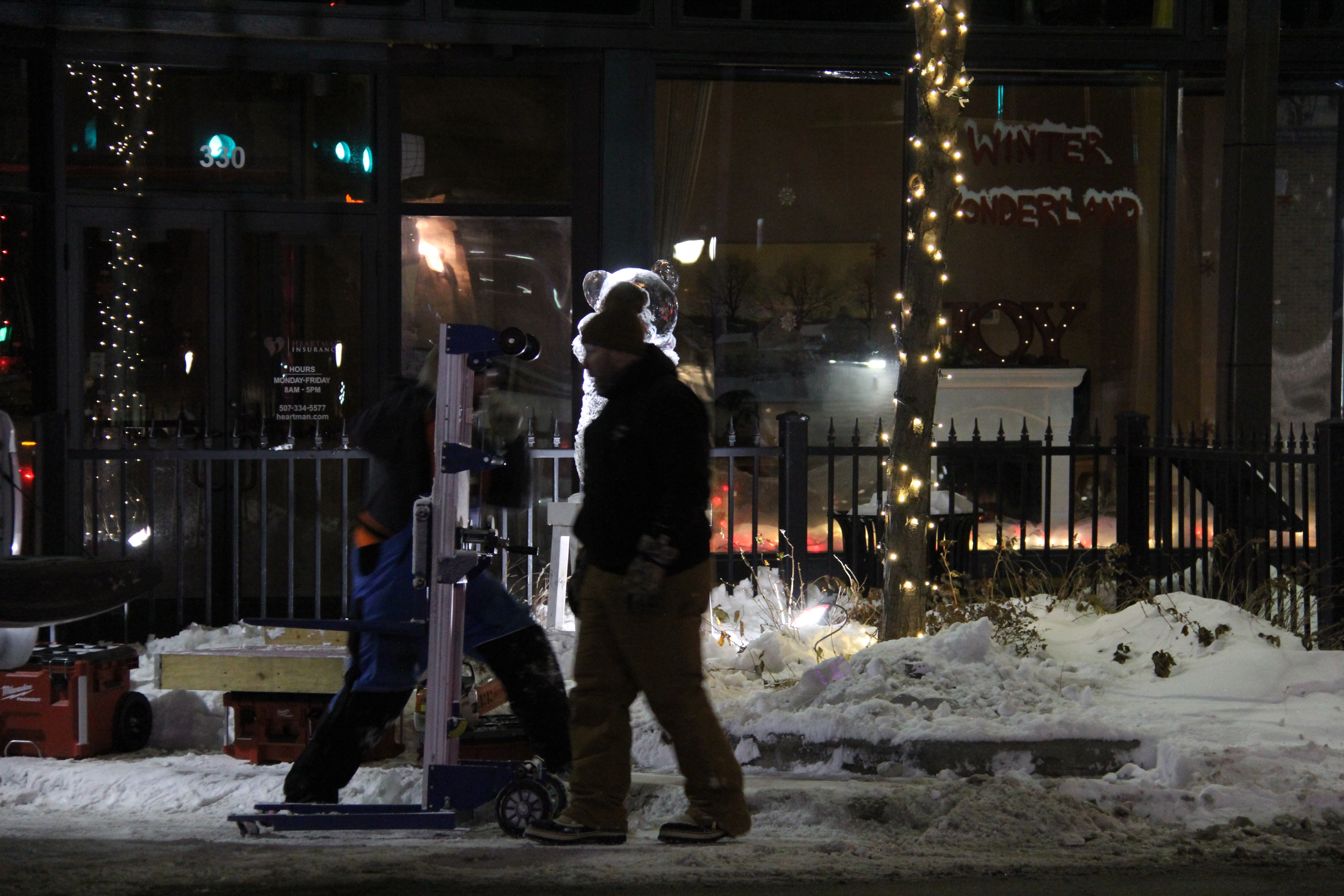
Sakatah Carvers pack their equipment after carving an ice sculpture at the corner of Central Avenue and Fourth Street/Minnesota State Highway 60 in Faribault during Winterfest. (Minnesota Prairie Roots copyrighted photo December 2022)

ONCE UPON A TIME, which is longer ago than I care to admit, I welcomed winter. Snow equated outdoor fun on the farm of my youth in southwestern Minnesota. Prairie winds swept the snow into rock-hard mountainous drifts around buildings and windbreaks. My siblings and I pulled on our winter gear and for hours played atop those mountains and the snow piles mounded by Dad with the bucket of his tractor.

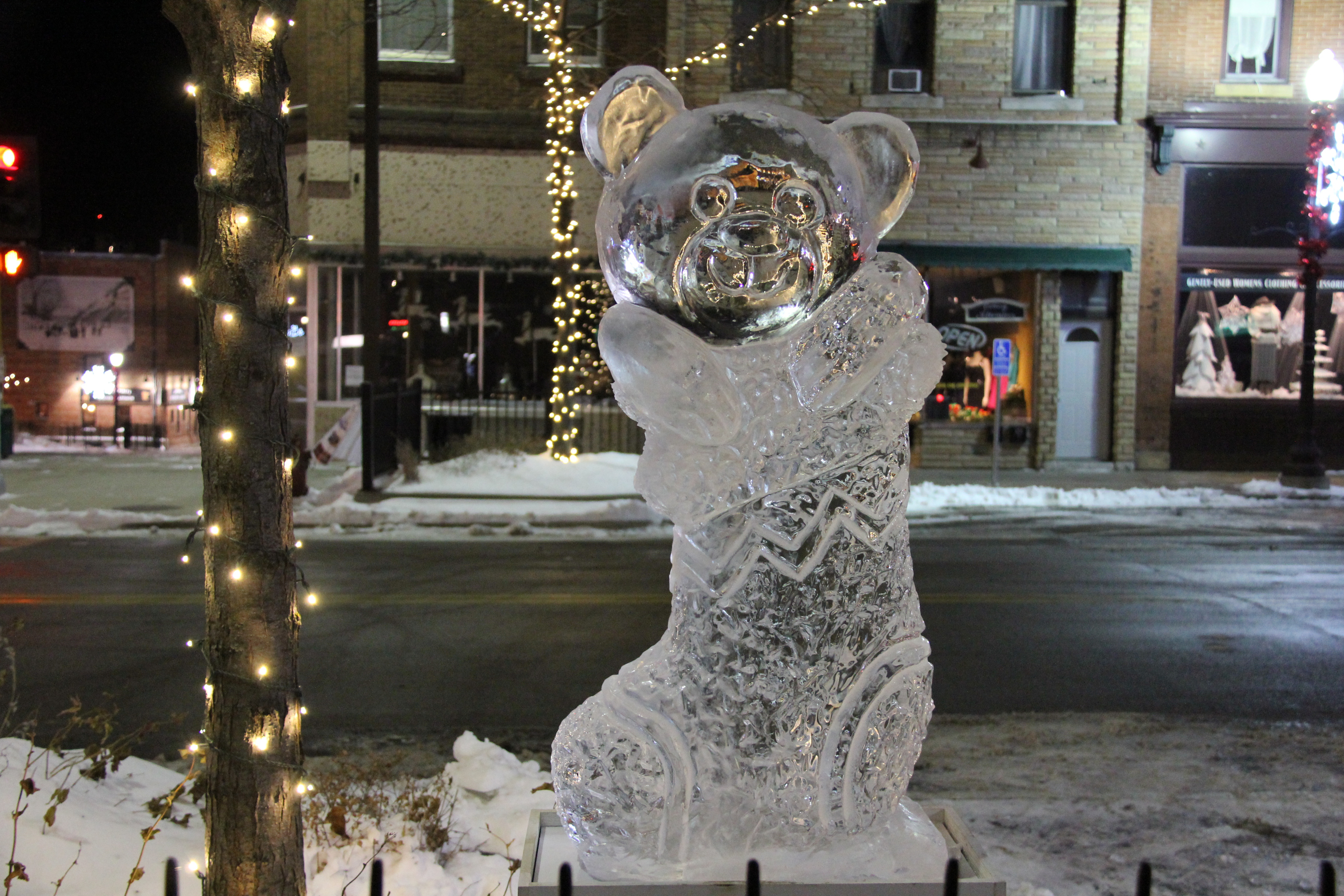
The completed sculpture. (Minnesota Prairie Roots copyrighted photo December 2022)

And then there were the icicles hanging along the milkhouse roof. Those became swords for hard-fought battles against one another. Ice clashing against ice until a sword, or both, broke. Somehow we avoided poking out each other’s eyes.

I found those icicles, some the length of our torsos, magical. They appeared seemingly overnight, glistening in the sunlight, water frozen clear and beautiful.

The other side of the sculpture, photographed from across the street, with part of the equipment to the left. (Minnesota Prairie Roots copyrighted photo December 2022)

Likewise, I felt the same about ice patches that formed on field’s edge. To slide across that ice in my buckle overshoes proved freeing and powerful. I was a champion figure skater in my own imaginative world. When the ice rink opened in my hometown of Vesta in the shadow of the grain elevator, I donned my Aunt Dorothy’s hand-me-down skates and raced from one end to the other, flying like the fierce prairie wind.

Today I no longer skate or engage in sword fights. Rather I approach ice with the cautiousness of a Baby Boomer who’d rather not break a bone. I avoid ice if possible.

The teddy bear sculpture up close, glistening in the holiday and street lights. (Minnesota Prairie Roots copyrighted photo December 2022)

But there’s an exception. Ice sculptures. These are a thing of beauty, reminding me of long ago ice ponds and ice swords and my once-love of ice. Artists who can carve a block of ice into something magical and beautiful garner my appreciation. That includes the team from Sakatah Carvers, Signs and Creations, who recently sculpted a teddy bear inside a stocking for Faribault’s Winterfest.

The second I snapped this frame, the ice carver blocked my view of the sculpture. But I like the results, highlighting the artist. (Minnesota Prairie Roots copyrighted photo December 2022)

While I didn’t witness the actual creation of the ice sculpture, I saw the warmly-dressed crew packing up their gear afterwards. It takes a love of winter and of ice to engage in this art form, which recalls for me prairie winters past of snow and ice.

© Copyright 2022 Audrey Kletscher Helbling


Oh, for the poetic beauty of sunrises & sunsets in Minnesota May 1, 2017


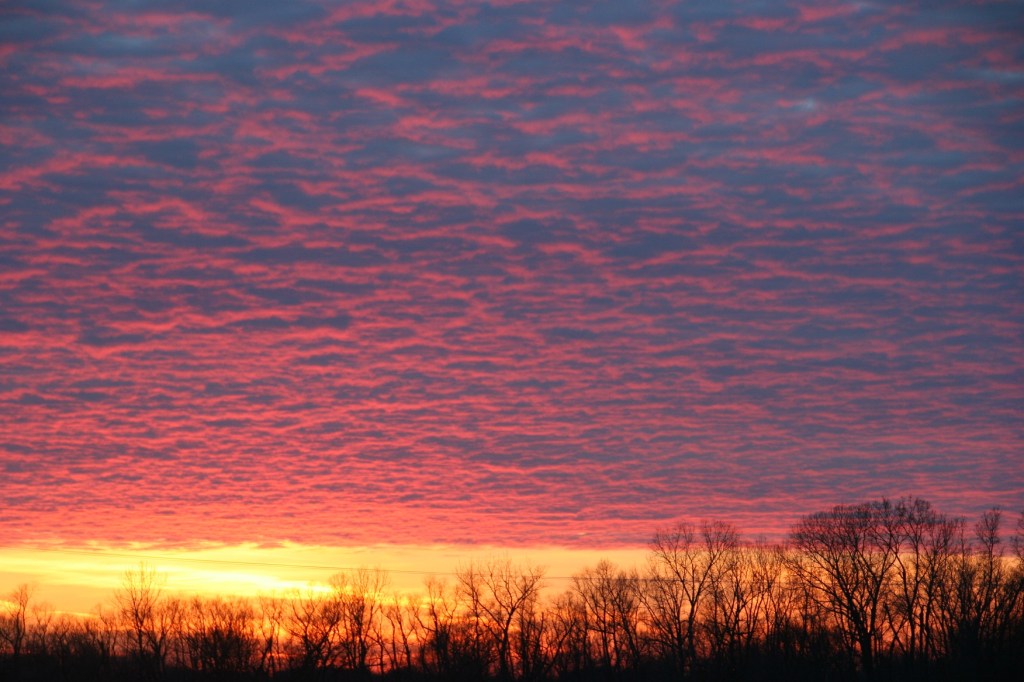
SOMETIMES I WONDER if nature can offer anything more beautiful than a sunrise or a sunset. But then I have not seen the mountains of the West or the deserts of the Southwest or the ocean other than the Atlantic once.


Still, the sunrise and sunset are universal. We all see the same sun, just in different places.


Farm fields and a wide sky backdropped my youthful vision of the sun. To this day, for me, there’s nothing quite like a prairie sunset, the blazing ball of the sun overwhelming the southwestern Minnesota landscape. Those childhood memories leave me grieving for the sunsets I’ve missed while living in a valley within a city for 33 years. Hillside and trees filter and block the sinking sun.


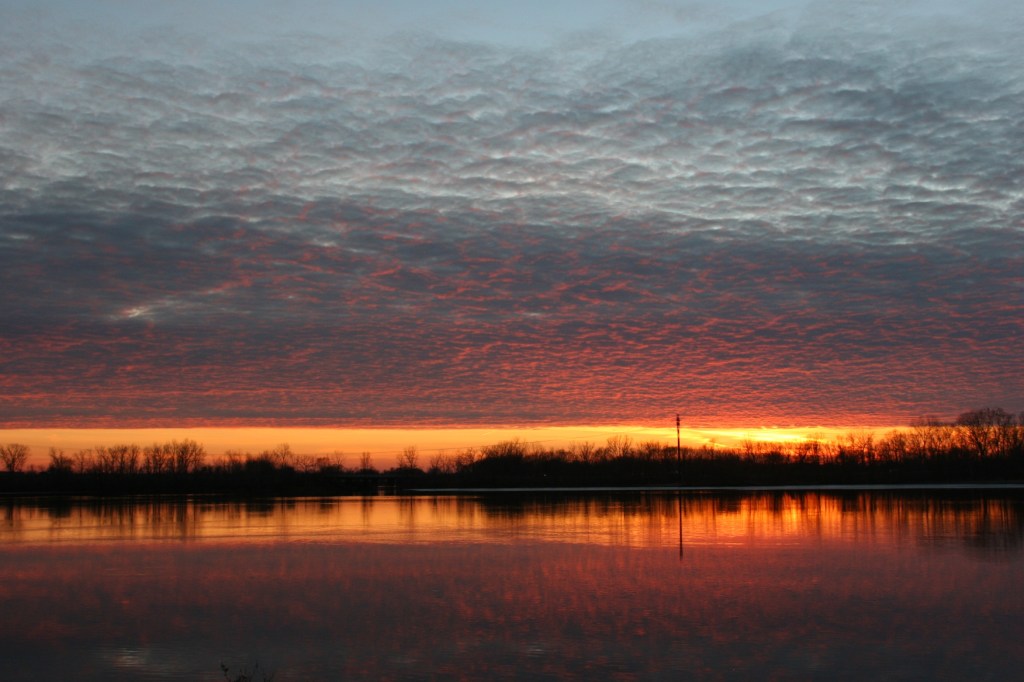
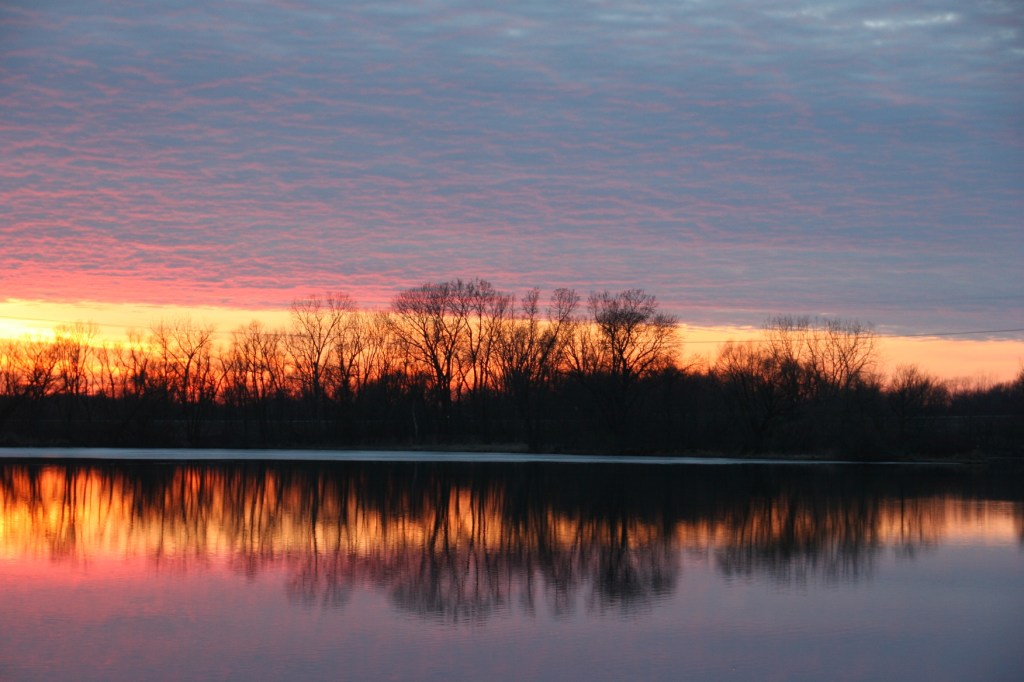
Still, living in Faribault, a southeastern Minnesota community situated along rivers and lake, gives me an opportunity to view the sunset waterside. And there is beauty in that, too, in the reflections that dance poetry across water backdropped by a day shifting from twilight to dusk to dark.


FYI: These images were taken in mid-March from the shores of Wells Lake at King Mill Park along the Cannon River in Faribault. Click here to see additional photos of the above sunset as I entered Faribault along Highway 60 from the east.

#

Writing poetry as the sun rises

My fingertips linger within a mere whisper of the keyboard
as I pause, half-thought, words interrupted mid-phrase,
to tilt my head toward the window and the sunrise
spreading gold and pink across the sky like jam on toast.

In that morning moment, I desire nothing more
than to dip my fingers into the jar of dawn,
to sample her sweetness, to taste of her earthy goodness,
to delight in sunshine and rain and succulent fruit plucked from vines.

But language beckons me back to the keyboard,
to dip my fingers into the jar of words,
to choose and shape and share the poetry that rises within me,
in rhythm and verse upon the breaking day.


FYI: My poem about the sunrise published in Poetic Strokes, A Regional Anthology of Poetry From Southeastern Minnesota, 2012.

© Copyright 2017 Audrey Kletscher Helbling


Minnesota Faces: A pastor with prairie roots February 20, 2015

Portrait #8: Pastor Gordon


Portrait 8, Pastor Gordon Deuel at Little Prairie


This week, the beginning of Lent and Christ’s journey toward crucifixion, seems an appropriate time to feature a portrait of a pastor.

I met the Rev. Gordon Deuel several summers ago when he was still shepherding Little Prairie United Methodist Church, rural Dundas. He left in June 2013 to become the Elko New Market Campus Pastor for Lakeville-based Crossroads Church.

My introduction to this clergyman happened on a Sunday afternoon when my husband and I stopped at Little Prairie School, a former country school located kitty corner from the Little Prairie church. Pastor Gordon noticed us lingering, walked across the road and unlocked the door into the historic building.

Later, we strolled over to the church and poked around. That’s when I captured this portrait of the preacher in beautiful natural light.

While talking to Rev. Gordon, I learned that he, like me, is a native of southwestern Minnesota. He’s from Hendricks, which is about as close to South Dakota as you can get without being in it. I always feel a special kinship with prairie people. We are rooted deep in the land, appreciative of wide open spaces and big skies, fields and small towns. We don’t dismiss the prairie as the middle of nowhere, as some place to pass through en route to somewhere better. The prairie is home, whether we still live there or not.

With that commonality of place, I connected with Pastor Gordon that Sunday afternoon in August 2012.

Now, 2 ½ years later, after visiting the City of Hendricks website, I understand even more how people and place shaped the pastor. Here’s a snippet of well-crafted writing designed to draw visitors and new residents to this rural community of some 700 folks just a stone’s throw from South Dakota:

The residents of Hendricks have focused on creating a town which is a perfect place for children. Our school district is one of the best in the nation. Our weather is temperate and provides for four seasons of fun. We are well grounded in our past, as we continue to worship in a prairie church which is now on the National Register of Historic Places. We look to better our tomorrow through efforts such as our wind farm and organic farming. We believe you will find the Hendricks, Minnesota, quality of life second to none.

And I expect, as in Lake Wobegon, that “all the women are strong, all the men are good-looking and all the children are above average” in this “Little Town by the Lake.”

#

This is part of a series, Minnesota Faces, published every Friday on Minnesota Prairie Roots.

© Copyright 2015 Audrey Kletscher Helbling
Lake Wobegon quote is from Minnesota writer Garrison Keillor.


Chasing the light in Luverne September 18, 2013

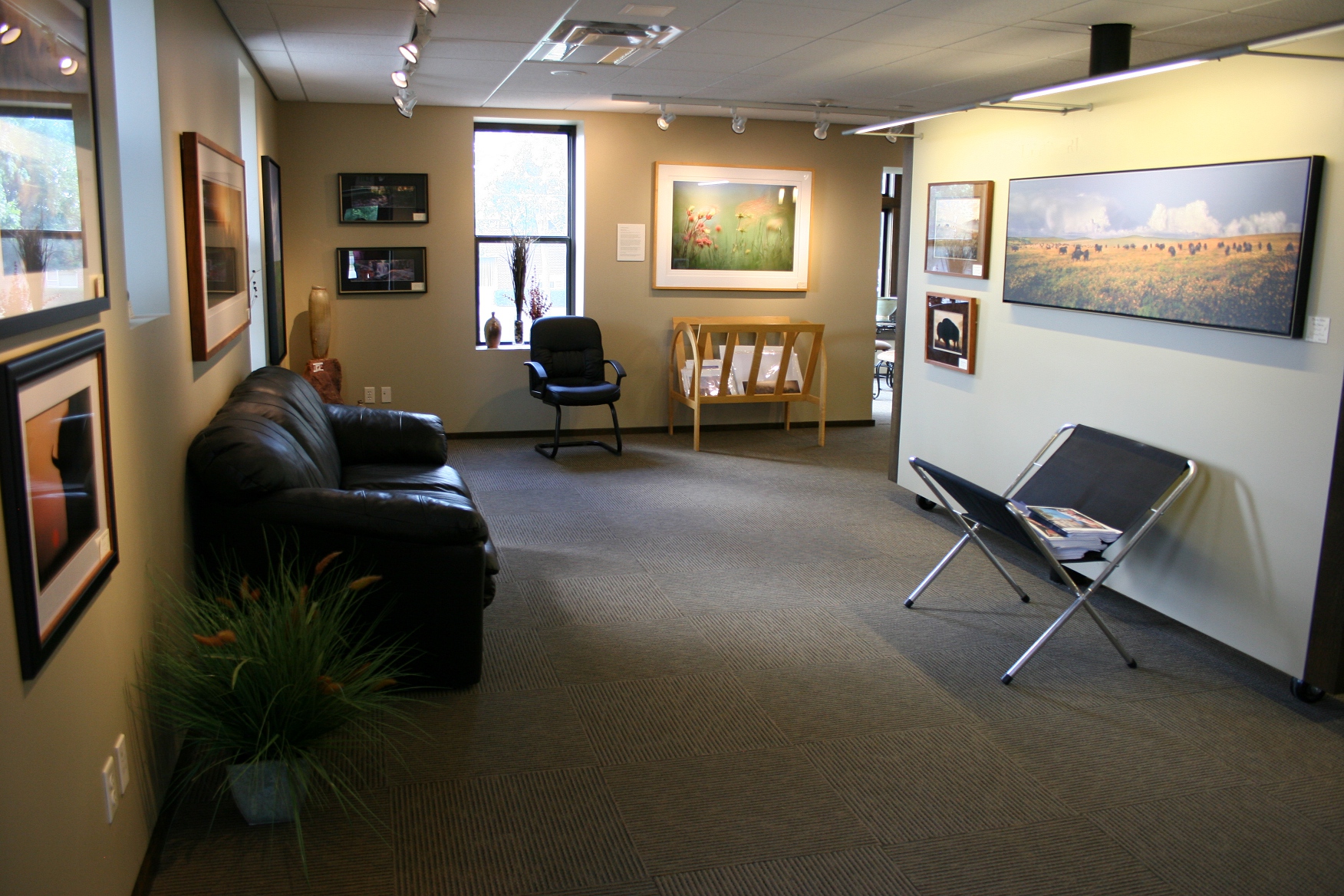
An overview of the gallery's inviting first level.

An overview of the gallery’s inviting first level.

WALK INTO THE BRANDENBURG GALLERY in Luverne with a camera and you likely will feel unworthy and intimidated, but mostly in awe.

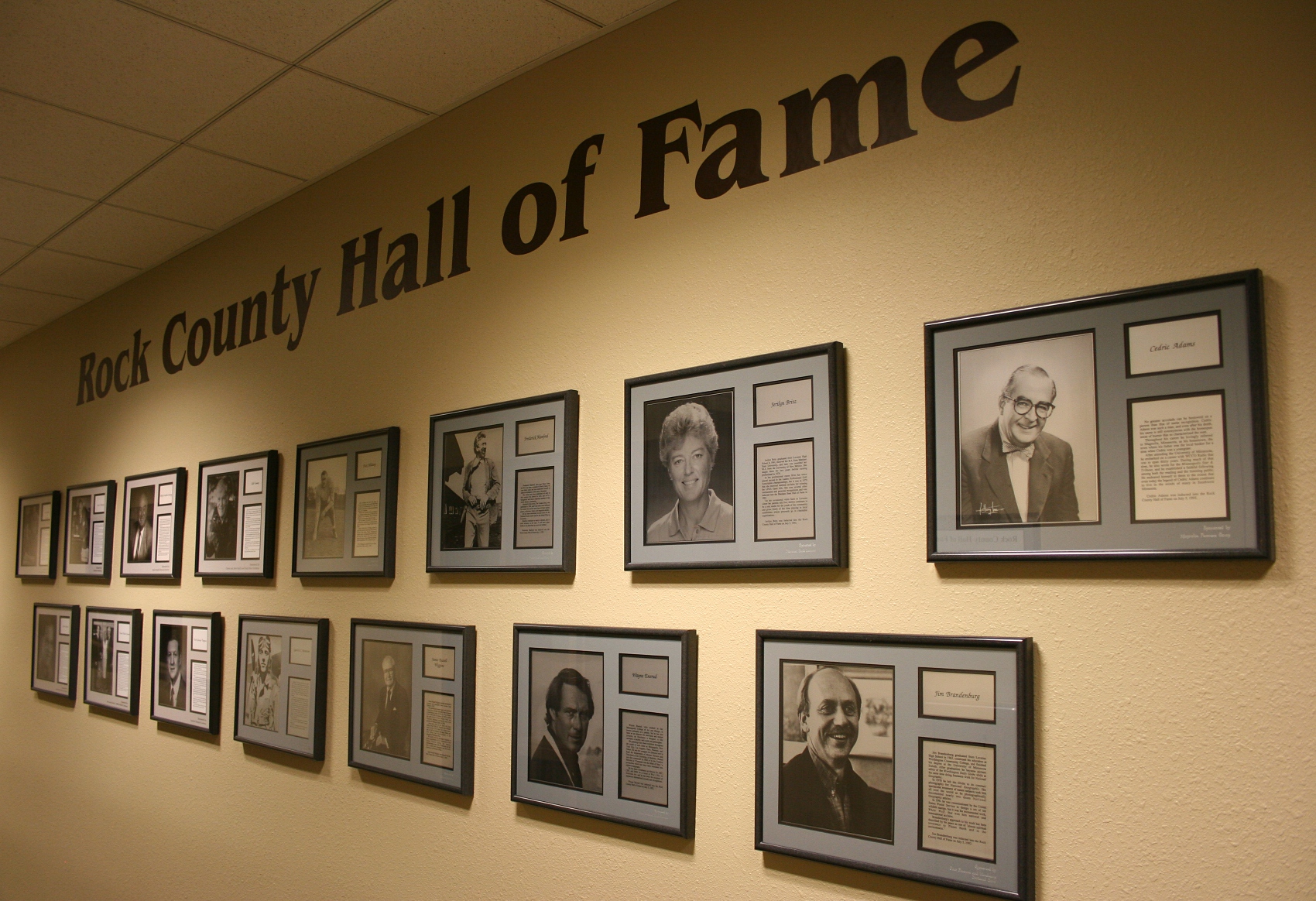
Brandenburg is among natives honored on a lower level hallway Rock County Hall of Fame. He's on the lower right.

Brandenburg is among native residents honored in a lower level hallway Rock County Hall of Fame. He’s on the lower right, inducted in 1992. Brandenburg graduated from Luverne High School in 1963 and, after college, worked as picture editor at the nearby Worthington Daily Globe while also freelancing for National Geographic. He left the Globe in 1978 to do contract work for National Geographic.

This gallery houses the work of native son Jim Brandenburg, probably Minnesota’s best-known nature photographer.

A Brandenburg bison photo hangs to the left and the photographer talks about his work in a video, right.

A Brandenburg bison photo hangs to the left and the photographer talks about his work in a video, right.

For more than three decades, Brandenburg traveled the globe photographing for National Geographic. Yes, he’s that good. He’s accumulated numerous awards and has been published in so many places I can’t possibly list them all. (Click here to read his biography.)

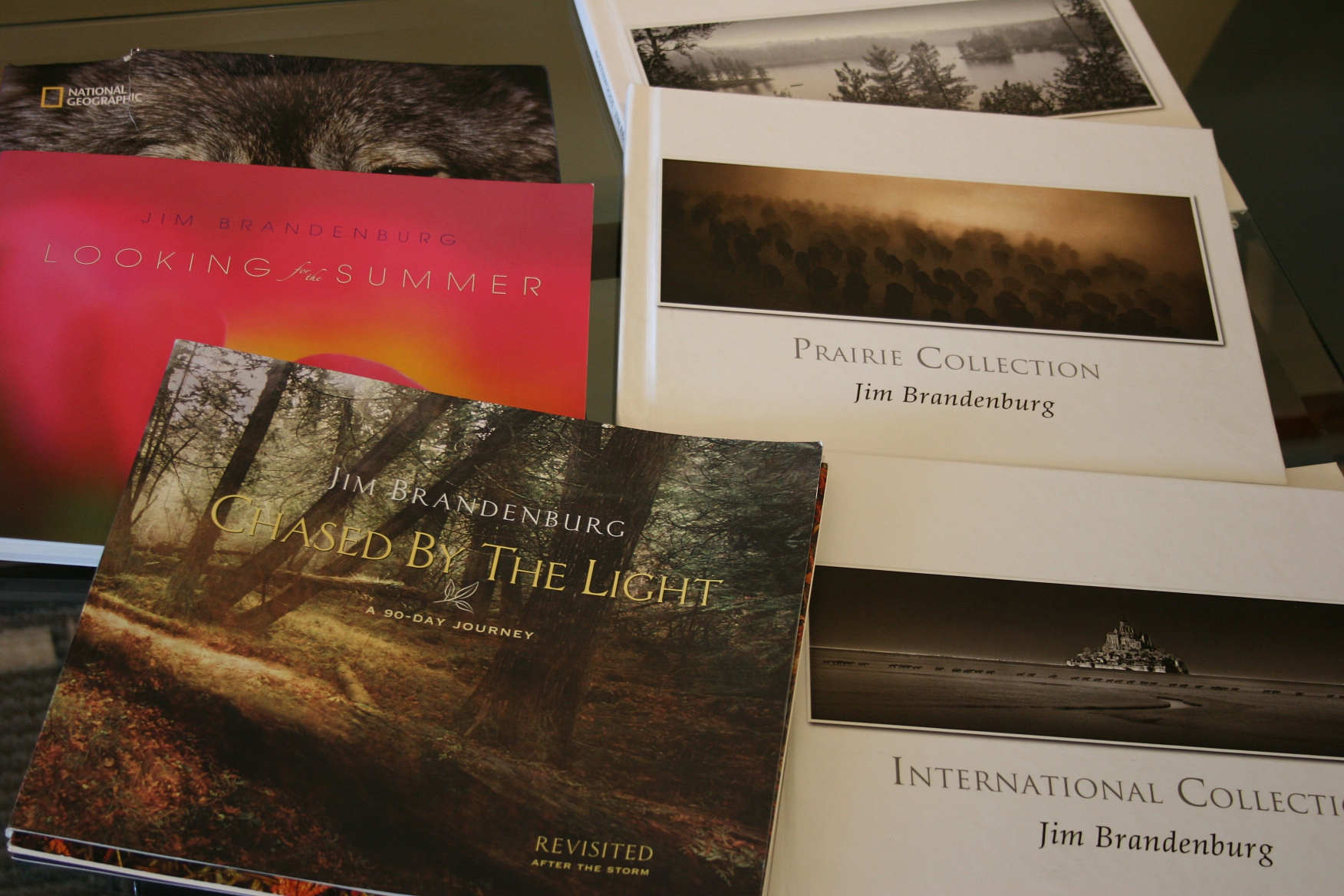
Some of Brandenburg's photo books.

Some of Brandenburg’s photo books.

For years I’ve wanted to tour this gallery in the extreme southwestern corner of my state, to view, close up, the images I’ve seen in books, plus more. I wanted to study his photos—the light, the angles, the perspective.

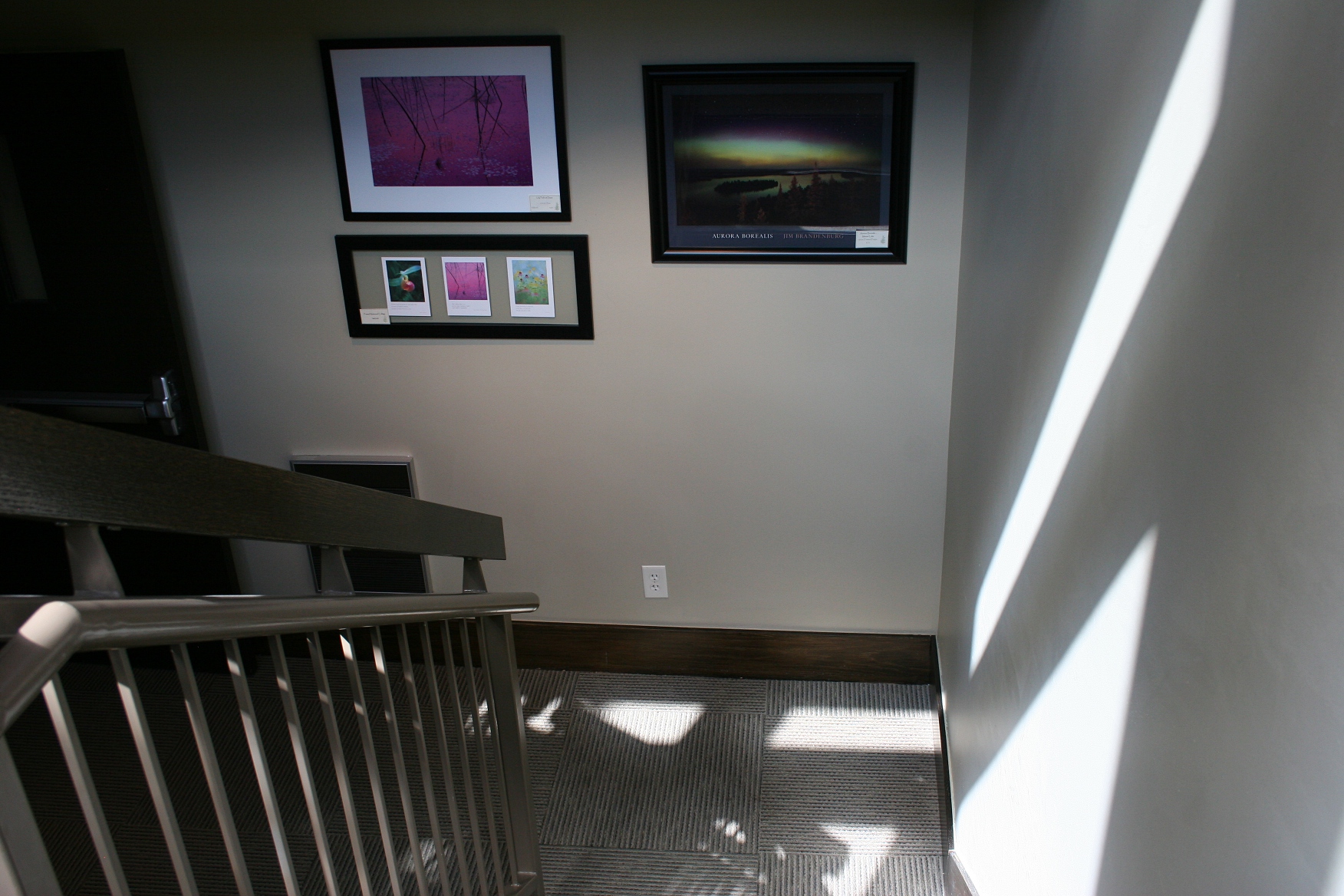
Light plays upon walls, floors and Brandenburg photos in a stairway display.

Light plays upon walls, floors and Brandenburg photos in a stairway display.

Brandenburg is known for his focus on light. Light, as all serious photographers understand, can make or break a photo. This noted photographer features some of his best “light” photos in a published collection, Chased by the Light—A 90-Day Journey. Images from that book are among those showcased in the gallery.

The first floor of the gallery, which doubles as the Luverne Chamber of Commerce office, is artfully and comfortably decorated.

The first floor of the gallery, which doubles as the Luverne Chamber of Commerce office, is artfully and comfortably decorated. Here are three of Brandenburg’s prairie photos. The tall grass prairie, he says, played in to his development as a photographer. He calls prairie grass magical.

Given my deep love for my native southwestern Minnesota prairie, I most appreciate Brandenburg’s prairie images, displayed on the first floor of the gallery. If you doubt that beauty exists on the prairie, you won’t after seeing these photos.

Brandenburg's published books include Brother Wolf--A Forgotten Promise.

Brandenburg’s published books include Brother Wolf–A Forgotten Promise. The photographer says he swapped a hunting rifle for a camera and never tires of capturing an animal with his camera. The red fox , not the wolf as one would expect, is his favorite animal.

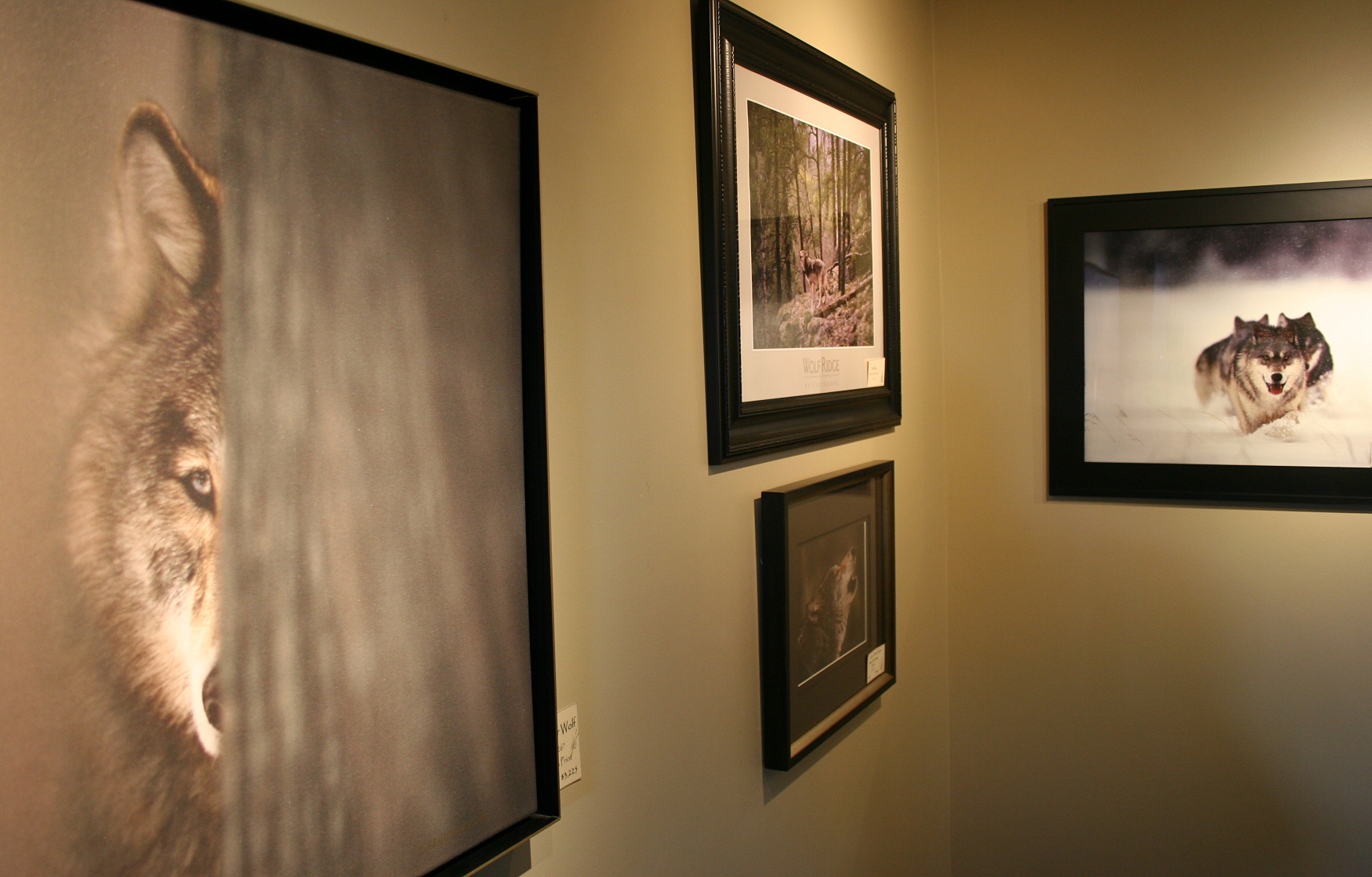
The gallery’s lower level offers a variety of images, but focuses on scenes from Minnesota’s northwoods, where Brandenburg now lives and works near Ely. Think mostly wolves.

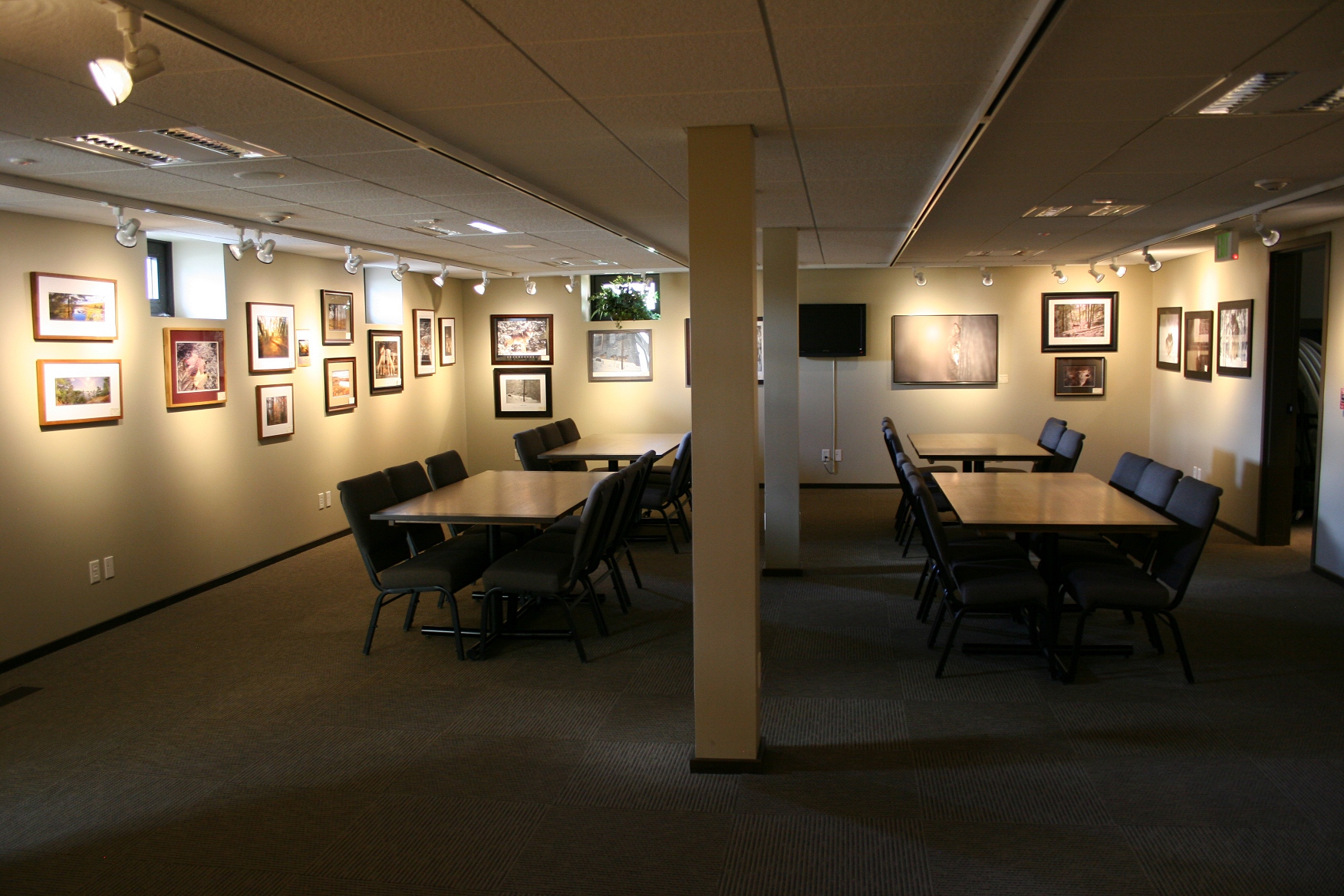
The lower level gallery, also a conference space.

The lower level gallery, also a conference space.

After meandering through the gallery, I contemplated not only the talent Brandenburg possesses as a photographer, but his deep knowledge of the natural world and the patience required to wait for the ideal light or for an animal’s arrival. To anticipate, to react or not, to click the shutter button at the precise moment takes a certain talent. And I was graced, for an hour, to walk in the light of such incredible talent.

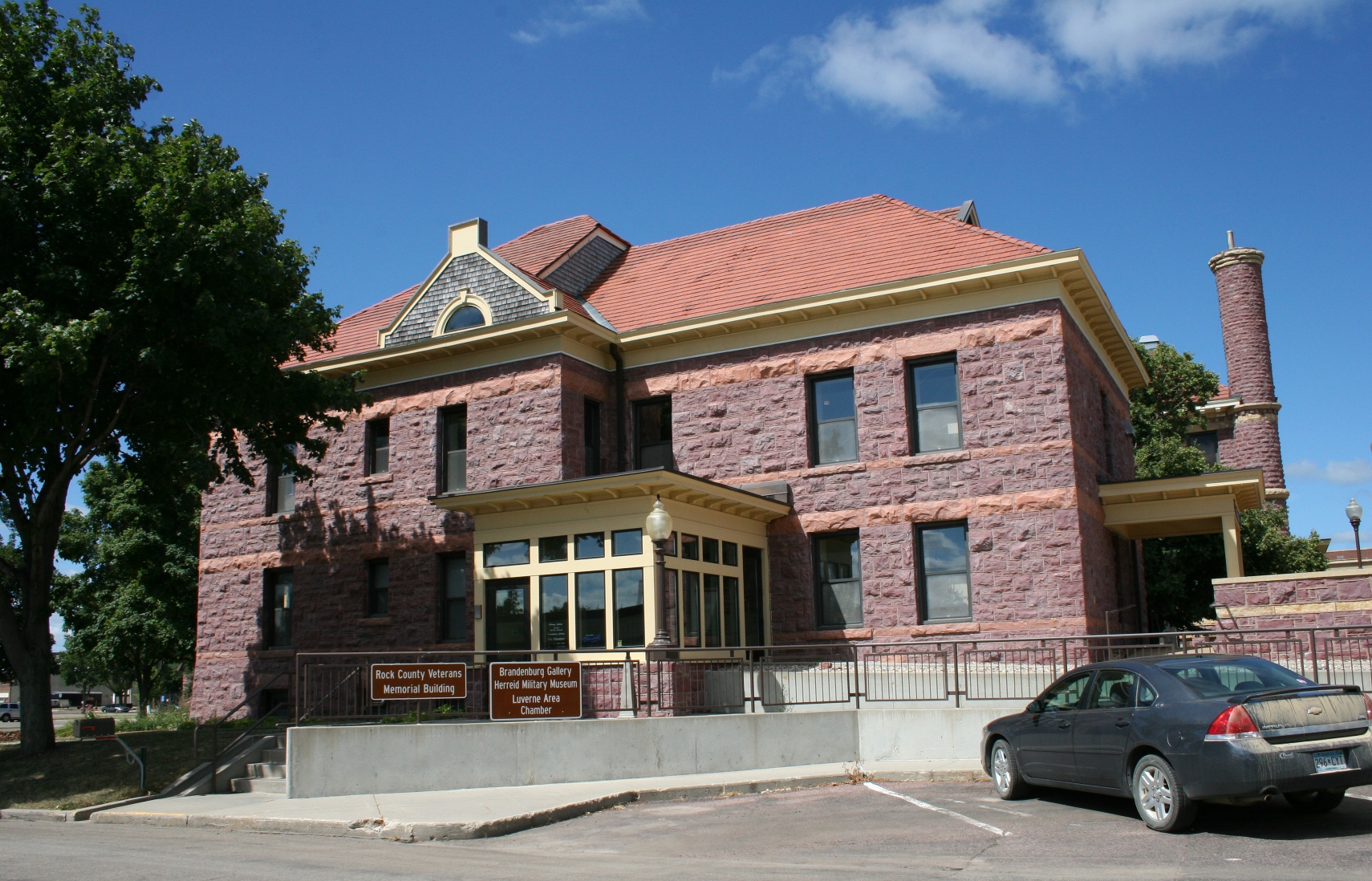
The entry to the gallery, located in the Rock County Courthouse square.

The gallery, located in the Rock County Courthouse square.

FYI: The Brandenburg Gallery, 213 East Luverne St., is open from 8 a.m – 5 p.m. Monday – Friday and from 10 a.m. – 5 p.m. Saturdays. There is no admission fee. Note that I had difficulty finding the gallery as the address does not seem to coincide with the street on which the gallery is located. When you see the courthouse, you’ve found the gallery, located right next door in the old county jail, now the Rock County Veterans Memorial Building. The building is actually along McKenzie Street.

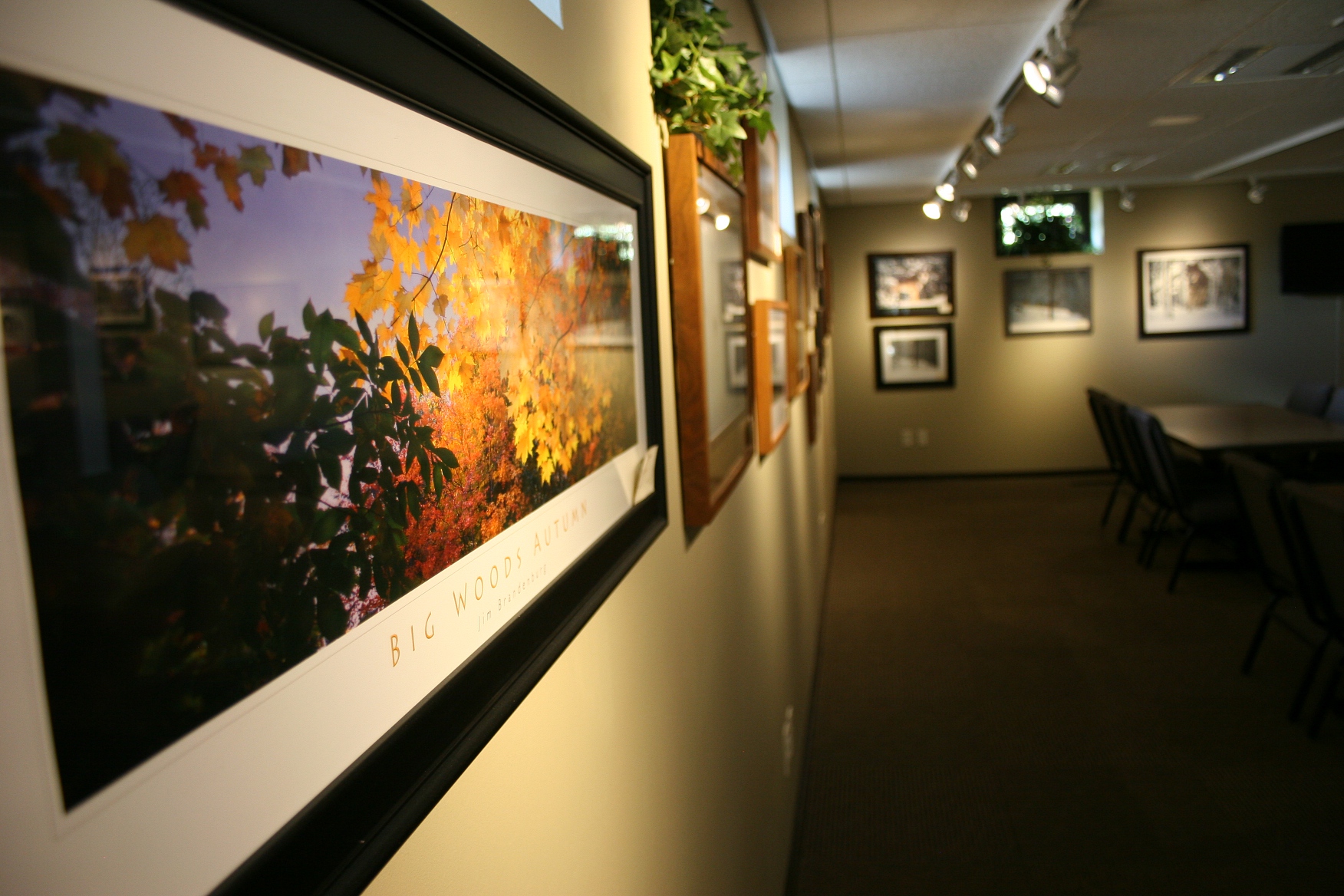
A familiar scene to me, autumn leaves photographed in the Big Woods of Minnesota, within 20 miles of my home.

A familiar scene to me, autumn leaves photographed in the Big Woods of Minnesota, within 20 miles of my home.

Also, note that I asked permission to photograph in the gallery and was given the OK to do so.

FYI: Please click here to read my first in a series of posts, on Blue Mounds State Park, from the Luverne area.

© Copyright 2013 Audrey Kletscher Helbling


Unlocking the poetry within an abandoned farmhouse April 30, 2012

An abandoned farmhouse along Minnesota State Highway 19 east of Vesta on the southwestern Minnesota prairie.

Abandoned Farmhouse

My old bones rattle in the winter wind,
grown weary from years of standing,
bitter cold encompassing my body.

Despair surrounds me
like rot in the weathered heap of the barn,
like rust consuming the junk pile.

Alone, all alone now, abandoned
except for the dying circle of trees
that embrace me, holding me close.

The years have broken my spirit—
too much silence within my walls,
too many tears shed upon my floors.

Left here, without laughter, without hope.
Dreams shattered in my broken windows.
My door closed, locked with a skeleton key.

Abandoned. Desolate. Alone.
Leaning only on the prairie sky,
in a circle of dying trees.

#

IN 2001, THIS POEM published in Poetic Strokes, A Regional Anthology of Poetry from Southeastern Minnesota, Volume 3. To this day, it remains one of my favorite poems among all those I’ve penned.

“Abandoned Farmhouse” retains that status because the poem connects to my past, to rural southwestern Minnesota where I grew up in a cramped 1 1/2-story wood-frame farmhouse. When I was 11 years old, my parents built a rambler with a walk-in basement a stone’s throw across the circular gravel driveway from the old house. They needed the space for their growing family as the sixth, and final, child arrived in August of 1967.

The summer after we moved into the new house, we tore down the old house, board by board. Memories of dismembering that house lath by lath, nail by nail, imprinted upon my memory. Decades later I would recall the bones of the old house, the skeleton key that unlocked the porch door, the grove of trees that sheltered it from the strong winds that swept across the prairie.

I would write this poem, personifying an abandoned farmhouse.

My poetic words reach beyond my childhood home, though, to embrace the many abandoned farmhouses that dot the prairie landscape. I often wonder about the families that lived in these houses and about the stories they would tell.

Returning to an even earlier time period, my poem also reflects a pervasive loneliness that often troubled early pioneer women in a land that could feel desolate, harsh and inhospitable.

This past March, I captured that desolation in an abandoned farmhouse photo (above) taken within five miles of my childhood home. It aptly illustrates my poem.

To this day, I see both beauty, and despair, in abandoned farmhouses.

©  Copyright 2012 Audrey Kletscher Helbling
Shared with you in celebration of National Poetry Month, which ends today, April 30.


Prairie poetry in Fergus Falls June 12, 2011

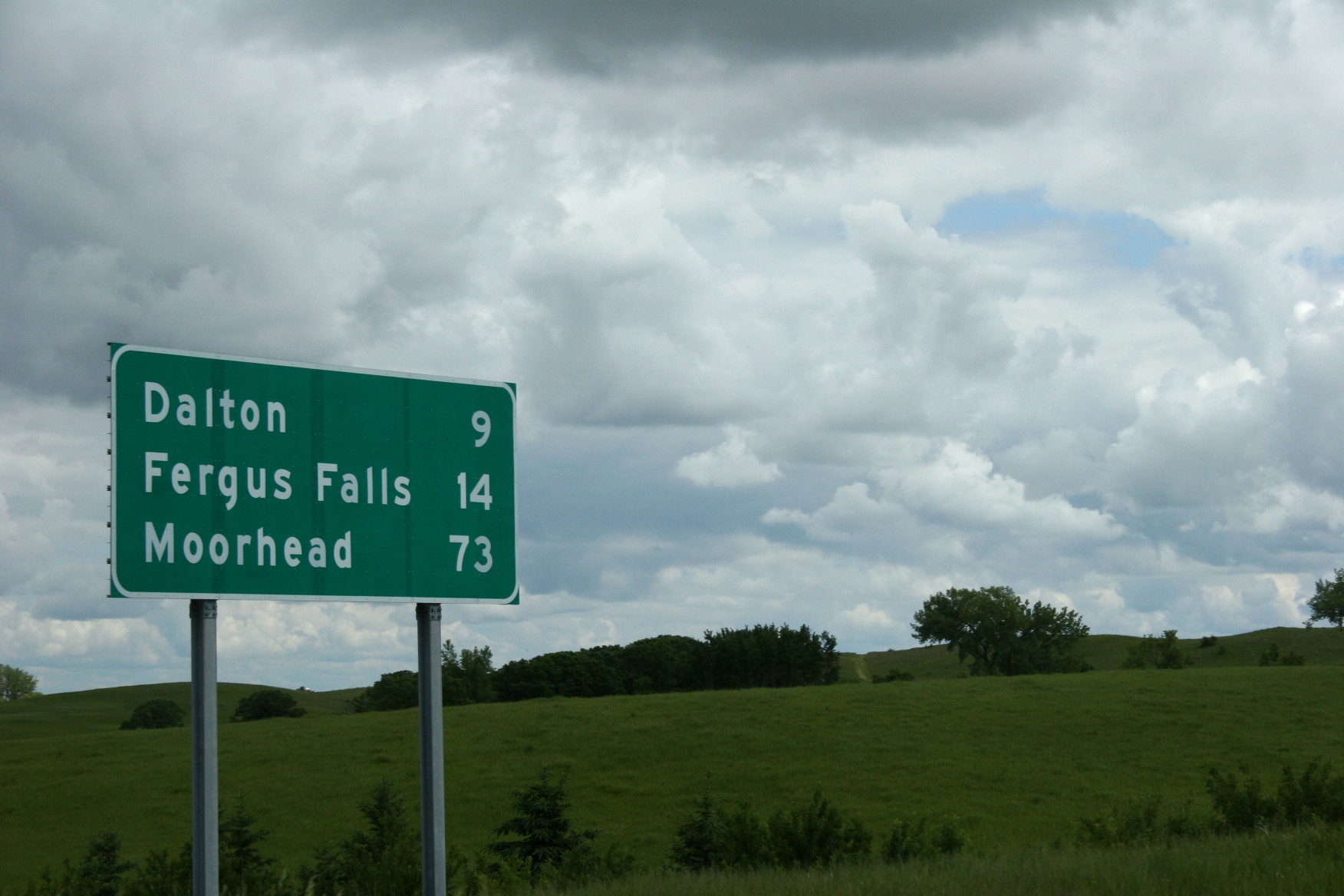
SATURDAY MORNING MY HUSBAND and I hit the road, heading north on Interstate 35 and then west on Interstate 94 to the west central part of Minnesota.

This was our destination:

It's approaching noon on Saturday, and we've nearly reached our destination, Fergus Falls.
Because of this:

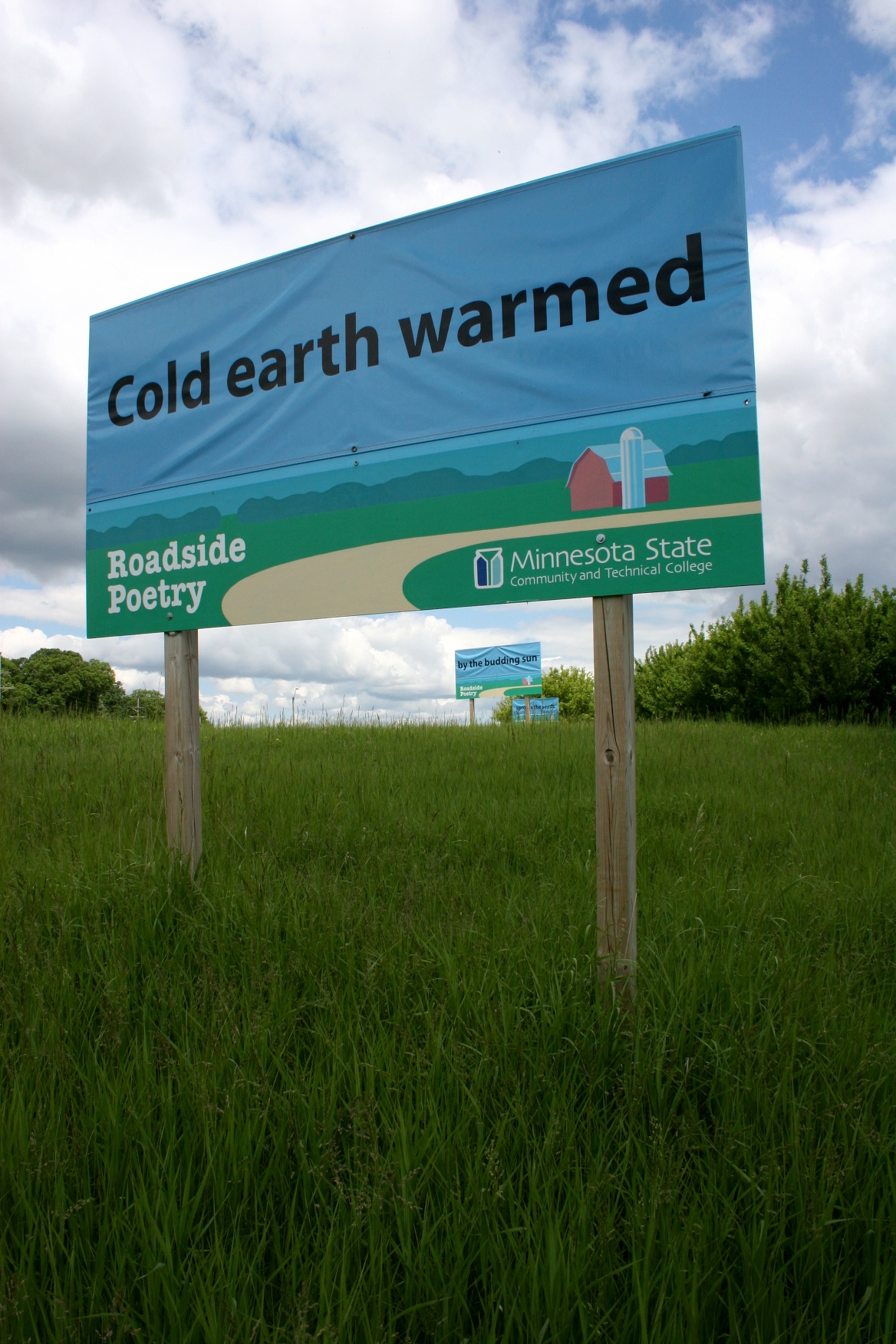
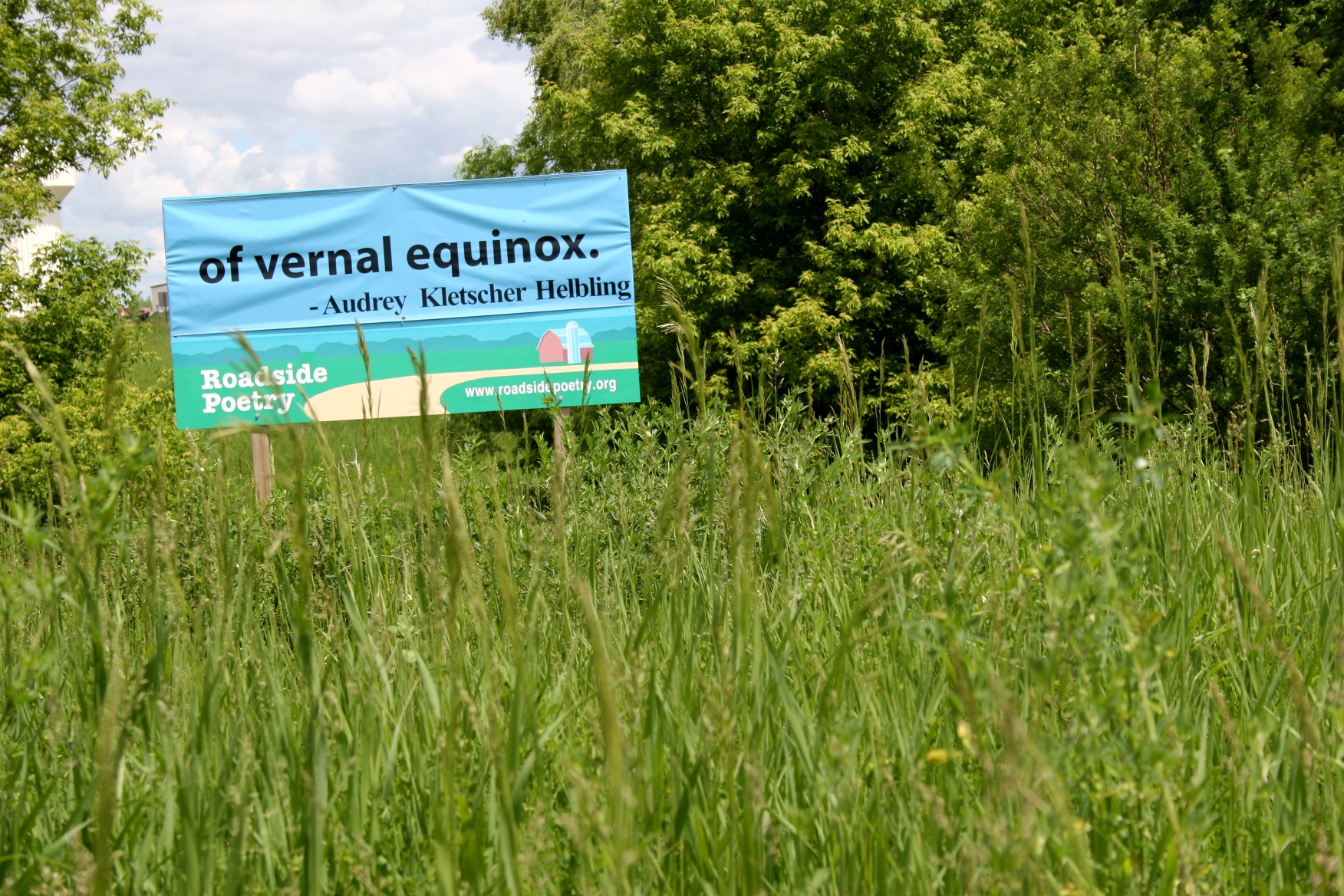
The first of my four Roadside Poetry billboards in a stretch of ditch along North Tower Road in Fergus Falls.
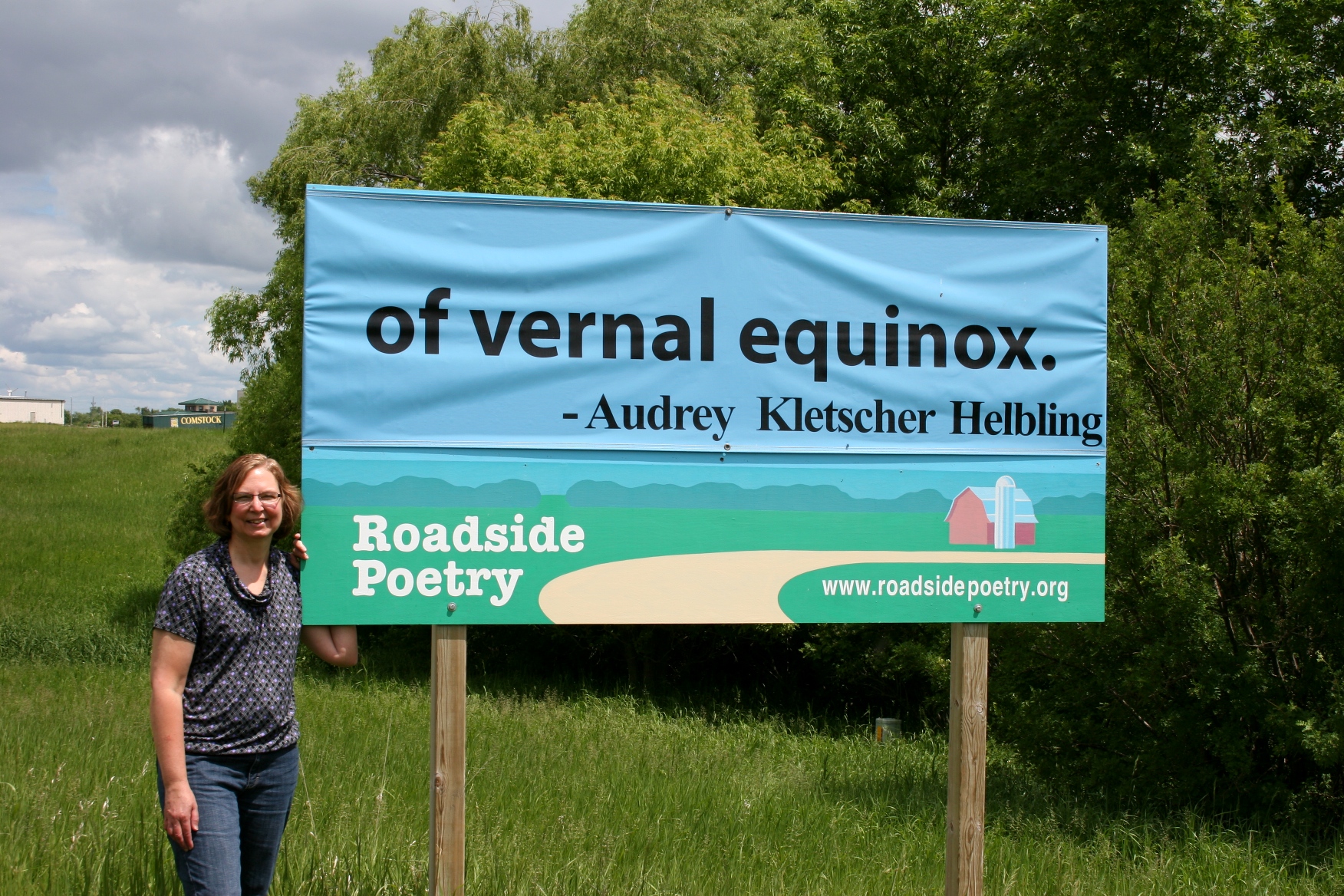
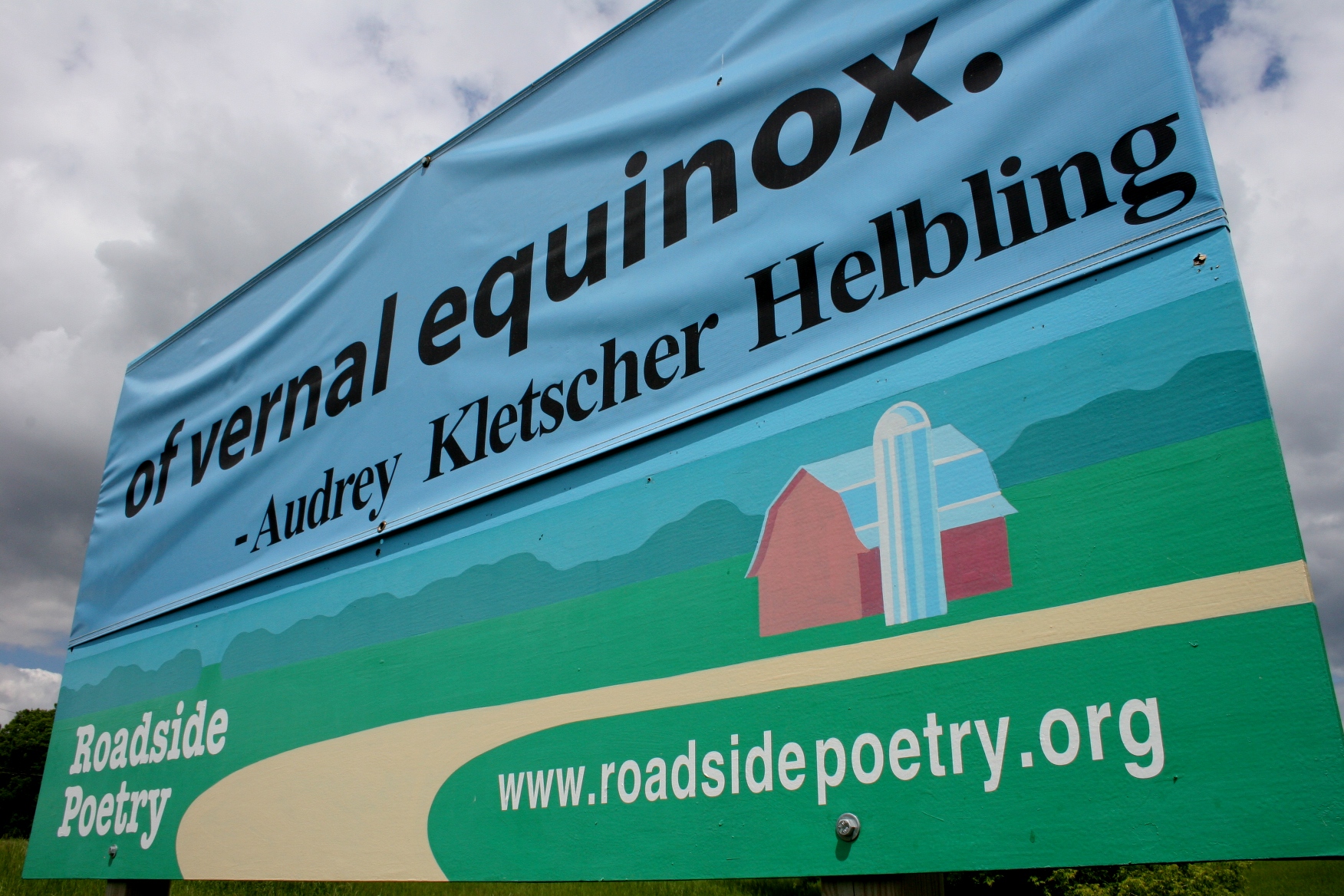
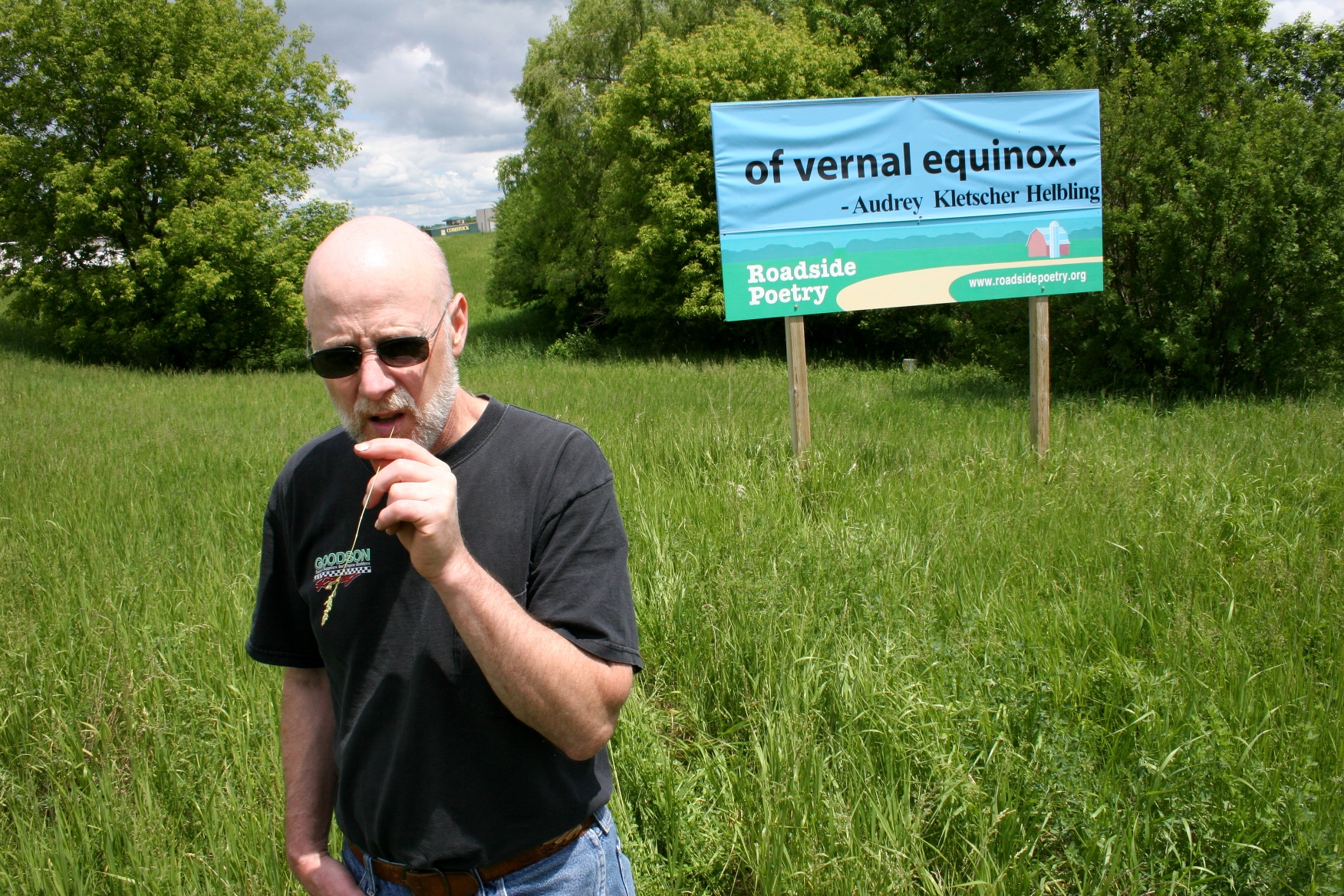
I got word last Monday that my winning Roadside Poetry Project spring poem will come down on June 17, to be replaced with a summer poem. (Click here to read a previous post about my poem.) So if I wanted to see “Cold earth warmed by budding sun sprouts the seeds of vernal equinox” and my name—all sprawled across four Burma Shave style billboards—we had to get our butts up to Fergus Falls.

So we did, making the 200-mile trip this weekend under big skies that stretched all the way to the Dakotas.

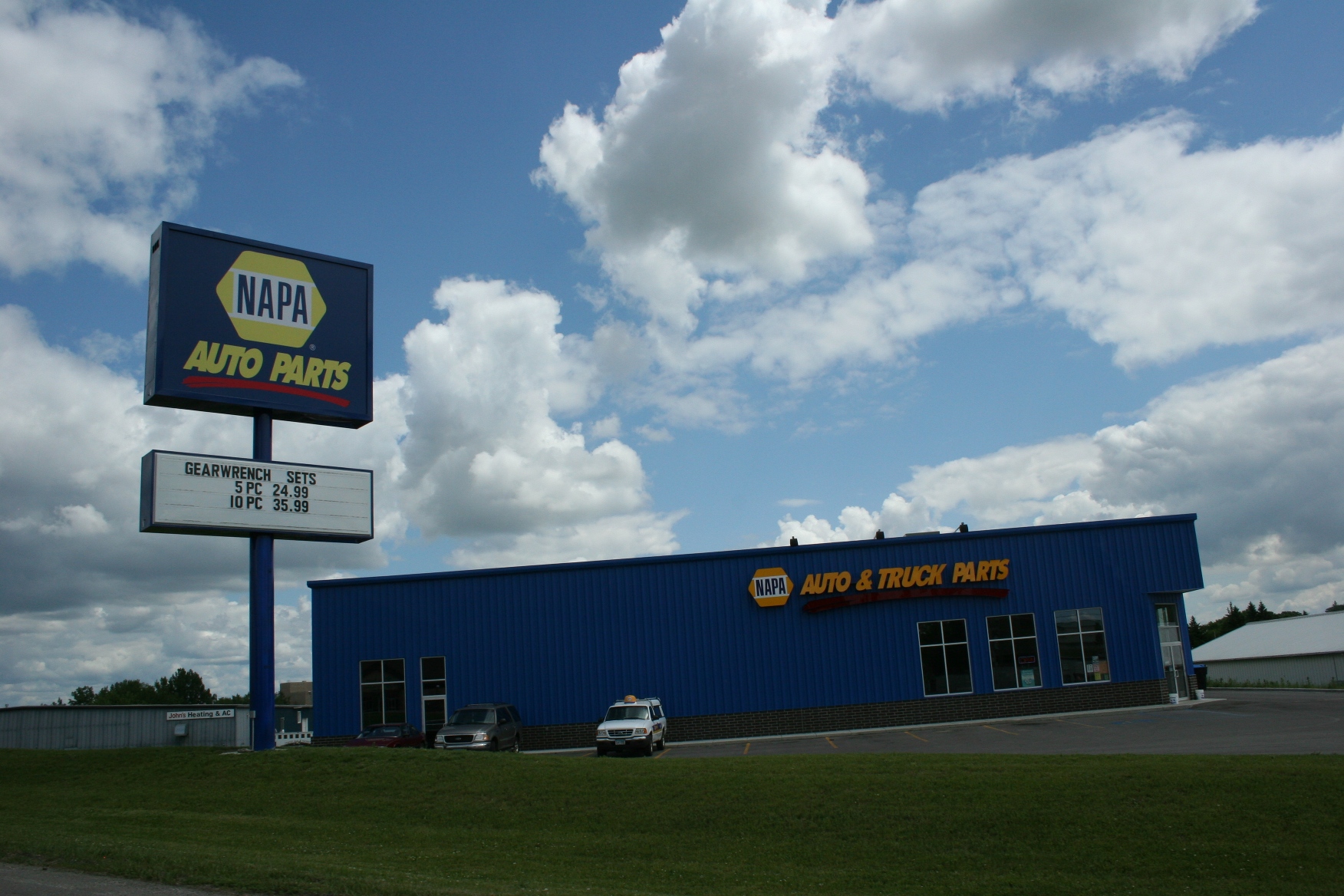
After a few stops, including a swing into Melrose to view an historic Catholic church (more on that in another post), we eventually reached Exit 54 into Fergus some 3 1/2 hours later. We followed Highway 210/West Lincoln Avenue, turned onto North Tower Road and drove past the NAPA Auto Parts store before reaching those poetry billboards. I mention NAPA because Randy works at the NAPA store in Northfield as an automotive machinist and we found it interesting that my poems just happened to be right down the road from the Fergus NAPA store.

We passed right by the NAPA store to reach my billboards just down the road.

When Randy pulled to the side of North Tower Road by my billboards, I determined this was not the safest place to park. So we pulled into the Fastenal parking lot and then descended the steep ditch, wading through tall, and wet, prairie grasses—sweet clover, June grass, alfalfa—and more than a few thistles.

Our shoes and jean legs were soon soaked with moisture. But, you know, that really didn’t matter. I was so focused on viewing my four-line, spring-themed poem and on taking photos that the wet feet and denim seemed more a nuisance than anything worth fretting over on a glorious early Saturday afternoon.

And so, billboard by billboard, we worked our way down the road ditch, stopping by each sign for photos. Eventually I handed the camera over to Randy, who managed to figure out how to turn on the camera, focus it, compose and snap some pictures.

Me posing by the last of the four billboards with my spring poem.

This may be the first and last time my poetry, and my name, will be on billboards, so I savored every letter, every word, every line, every billboard...

Then I snapped this image of my husband, who had plucked a spear of prairie grass and slipped it into his mouth. The frame marked one of those quick clicks of the camera that resulted in a photo that you could never recapture given its spontaneity.

A sweet shot of my husband as he walked away from the final billboard.

I’m uncertain how long we worked the road ditch along North Tower. But long enough to appreciate that this spot on the edge of town, under a sky that always feels bigger, wider, on the open prairie, perfectly fit a poem written by me, a southwestern Minnesota prairie native.

I crouched to capture this image which focuses on the road ditch prairie grasses.

© Copyright 2011 Audrey Kletscher Helbling