POETRY, WHEN READ ALOUD, is, in many ways, like music. It presents one way on paper. But read a poem aloud, and it becomes a song. Music with rhythm, beat and emotion. Vocal intonations carry a poem to melodic heights.
Becky Boling’s recently-published collection of her poems. (Minnesota Prairie Roots copyrighted file photo)
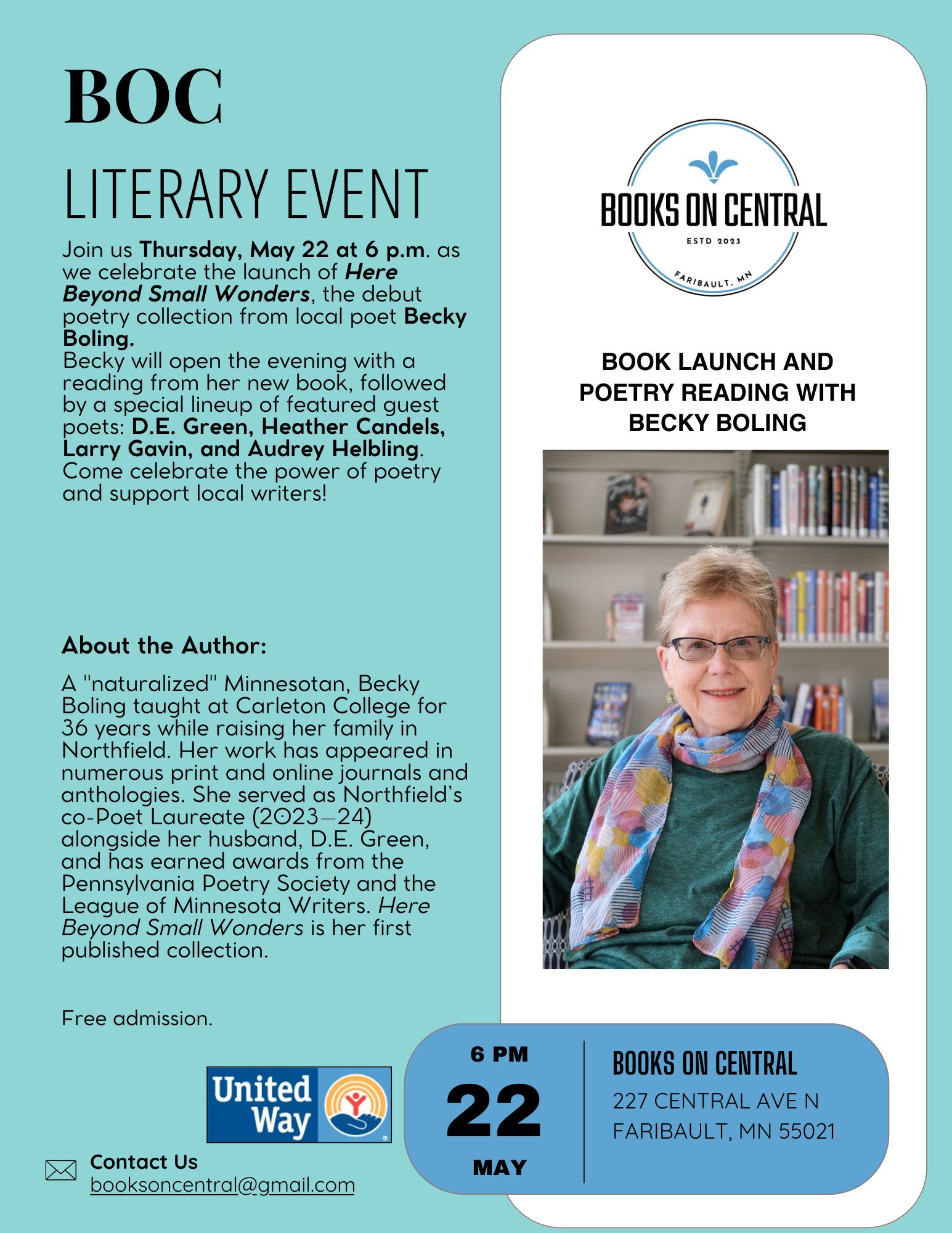
At 6 p.m. Thursday, May 22, the music of poetry will fill Books on Central in Faribault as Becky Boling reads from her first anthology, Here Beyond Small Wonders. Recently published by Finishing Line Press, this collection features detail-rich poems that often focus on ordinary subjects. It’s signature Boling, who is a prolific poet, served as Northfield’s co-Poet Laureate, and is retired from teaching Spanish and Latin American Literature at Carleton College in Northfield.
I love Boling’s writing. Her poems resonate with me in an everyday life kind of way. She has a visually-strong writing style—as most poets do—coupled with emotion-evoking poetry that prompts memories, questions, deeper thinking.
(Literary Event promo courtesy of Books on Central)
Boling has invited four other poets to join her at Thursday’s reading. Those include her husband, D.E. Green, also an accomplished poet; Northfield poet Heather Candels; Faribault poet Larry Gavin; and me. I’m honored to join this gifted group of writers in reading our poems aloud. I will read right after Boling.
I’ve previously listened to all of them read, so I can vouch for how much I’ve enjoyed hearing them. Gavin, especially, has a rich radio voice that makes me want to settle in and let his voice pull me into his writing.
Now, as I’m preparing for this Thursday evening event, I’m paging through the many books in which my poetry has published, selecting the poems I want to read during my allotted five minutes. Then I’ll practice reading those poems aloud, using my voice to create poetic music.
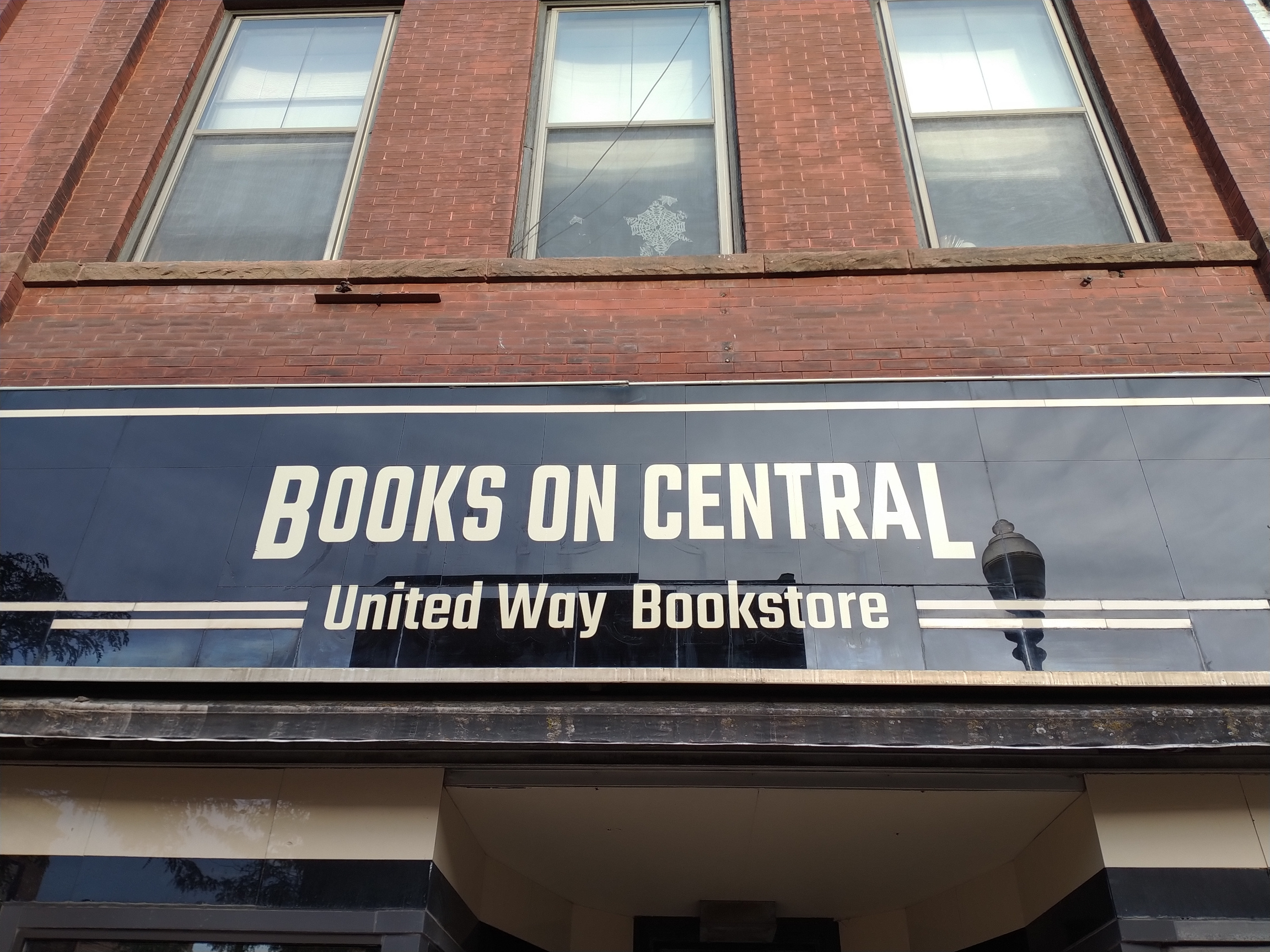
This used bookshop is located in the heart of downtown Faribault along Central Avenue. (Minnesota Prairie Roots copyrighted file photo)
FYI: Books on Central, 227 Central Avenue North, Faribault, hosts periodic free literary events to celebrate authors and to draw people into this volunteer-run used bookstore operated by Rice County Area United Way. All proceeds benefit select nonprofits in the county. It’s a beautiful small space (complete with a centering chandelier) housed in a former jewelry store.
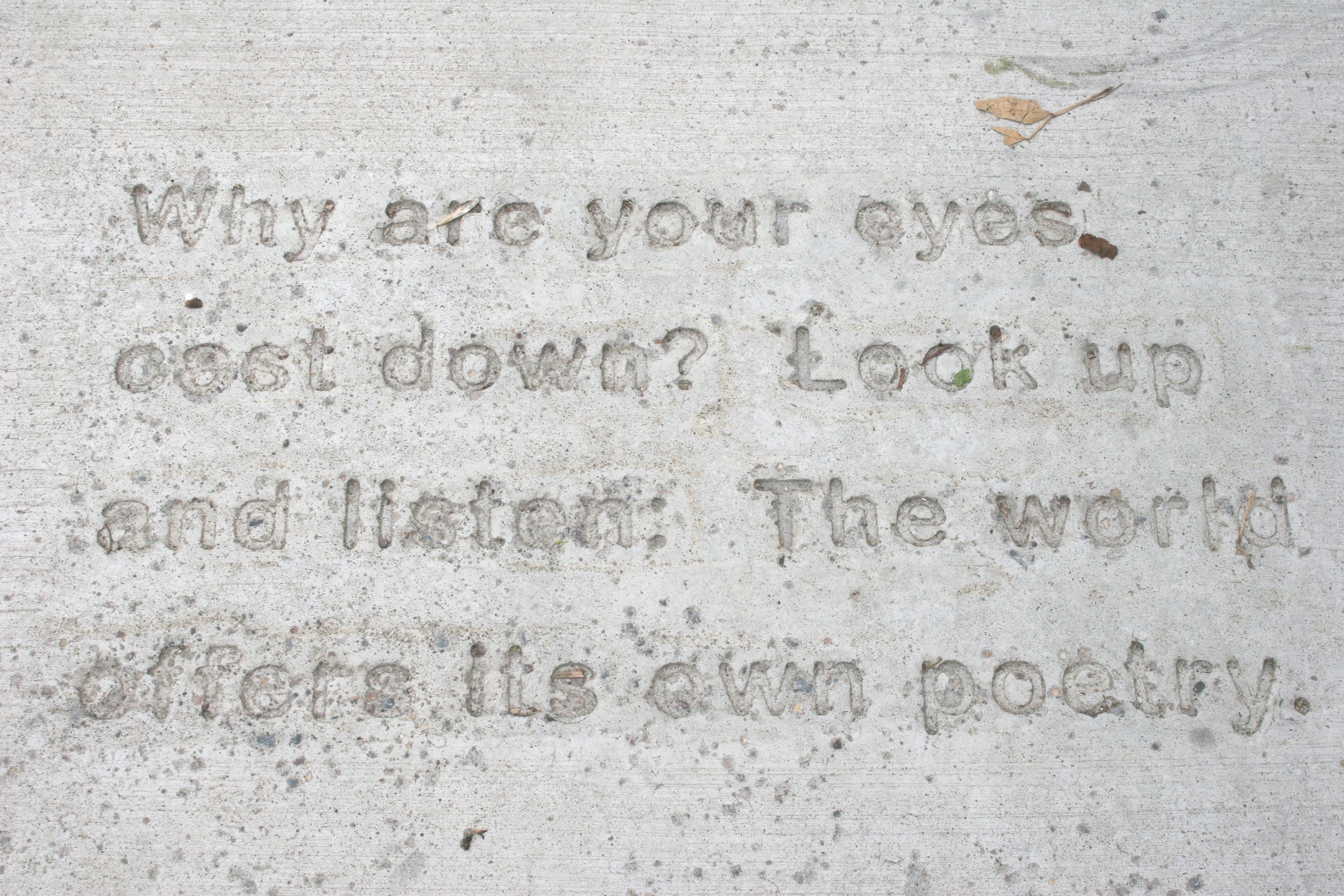
Sidewalk poetry in downtown Northfield, Minnesota, carries a powerful message. (Minnesota Prairie Roots copyrighted file photo)
I DON’T READ MUCH POETRY. I probably shouldn’t admit that given I’m a published poet. But I suspect most of you also are not big poetry readers. Yet, we all should be, especially me.
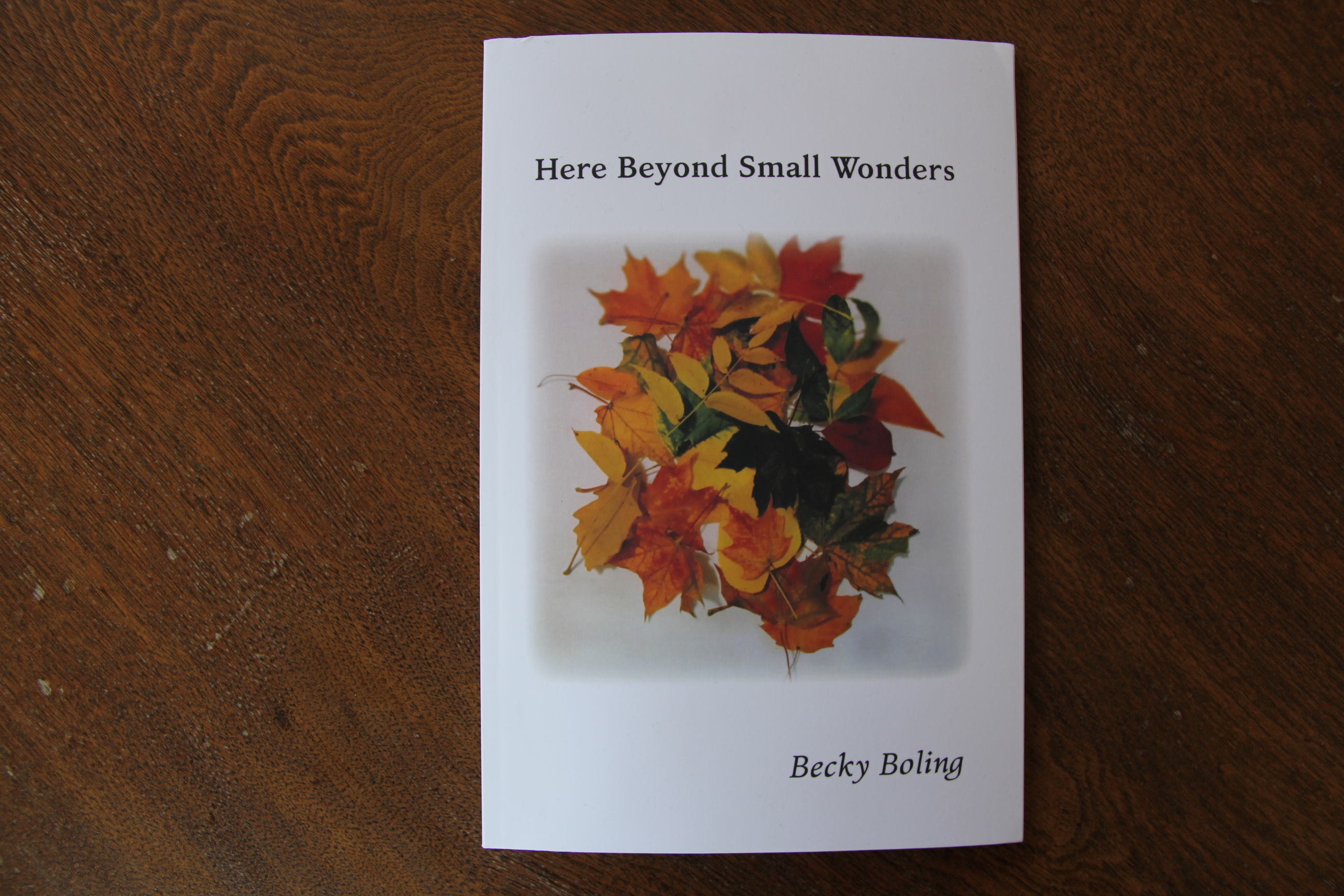
Becky Boling’s recently-released first collection of published poetry. The cover features the poet’s artwork. (Minnesota Prairie Roots copyrighted photo April 2025)
Poetry offers a creative way to view the world, to experience life, eliciting a whole range of emotional responses that connect us to each other, to the earth, to the past and present, and much more. I get excited when I discover a poet whose work truly resonates with me. And that would be the poetry of Northfielder Becky Boling.
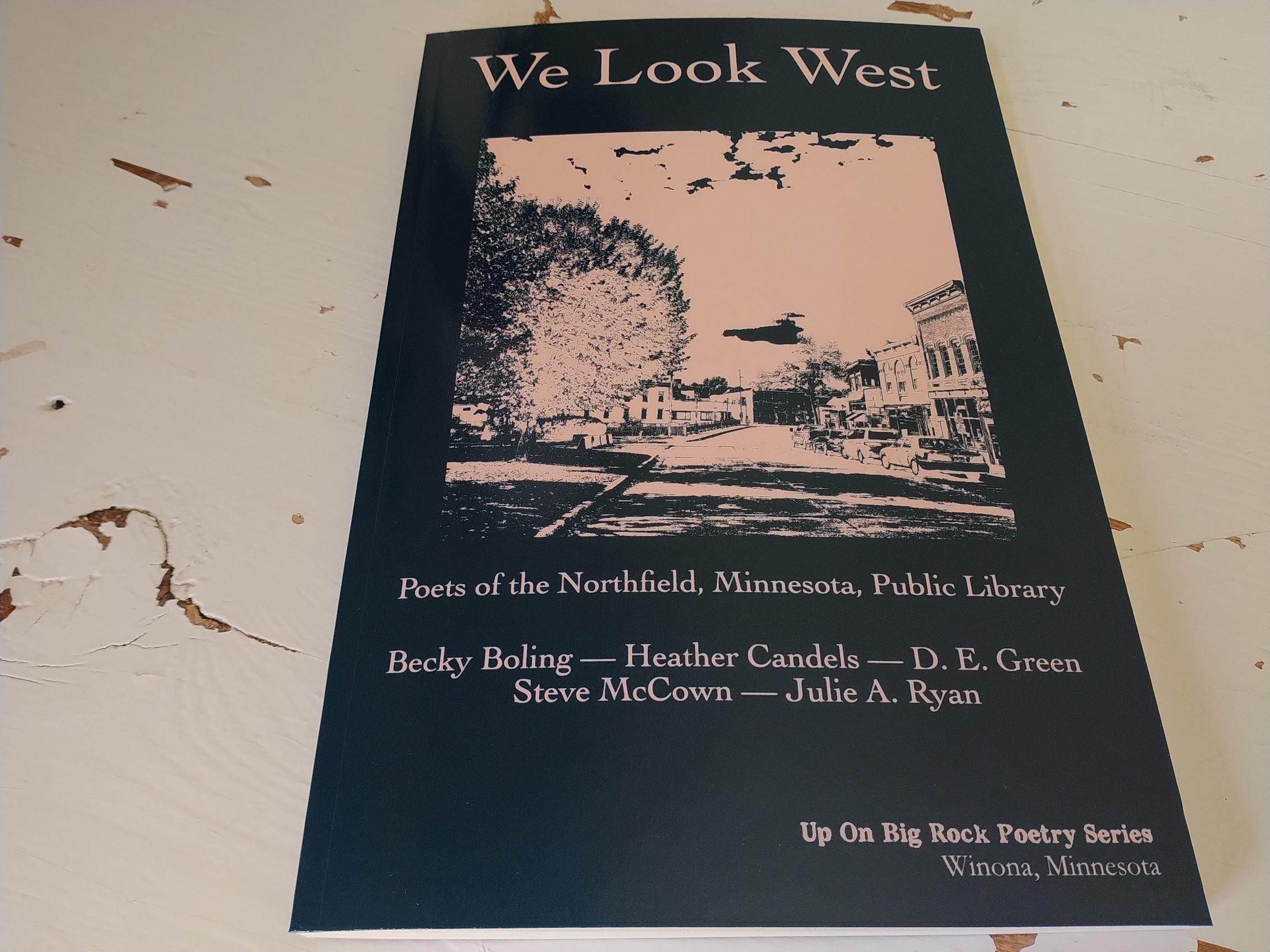
We Look West was published in early 2024 by Shipwreckt Book Publishing Company. (Minnesota Prairie Roots copyrighted file photo 2024)
A year ago, I met Boling when she dropped off a copy of the anthology, We Look West, a collaboration of the Poets of the Northfield Public Library. It includes her work and that of four other talented poets. I love the collection which takes the reader from the sunrise to the sunset of life. The poetry therein is so understandable and relatable.
A box holds bagged poems included in the “Poetry in a Bag” project. (Minnesota Prairie Roots copyrighted file photo 2024)
In May 2024, Boling, I and several other poets participated in a community poetry reading for the “Poetry in a Bag” project coordinated by Mercado Local, a Northfield marketplace for immigrants. Our poems were printed, rolled and bagged before distribution within our communities.
I would see Boling again in September 2024, when she and the other Northfield poets read from We Look West at Books on Central, a Rice County Area United Way used bookshop in Faribault.
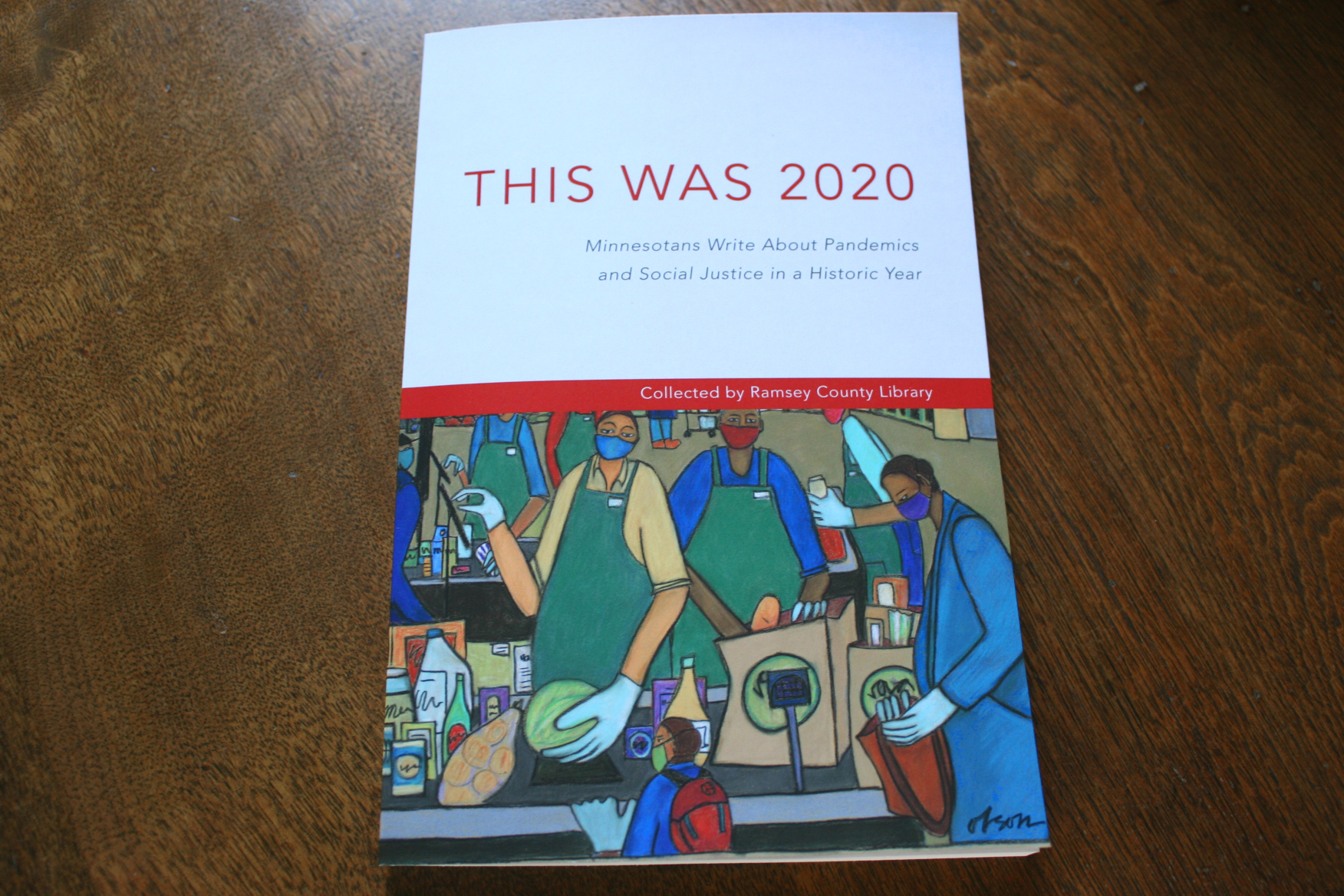
Selected prose and poetry about the pandemic and social justice issues were published by the Ramsey County Public Library in this anthology. (Minnesota Prairie Roots copyrighted file photo)
The poetry of Becky Boling in her first published collection featuring 37 of her poems. (Minnesota Prairie Roots copyrighted photo April 2025)
Because of those shared experiences, shared publications and shared love of words, I feel a sisterhood with Boling. So when she asked if I wanted a copy of her first solo poetry collection, I responded with an enthusiastic, “Yes!” Within the pages of Here Beyond Small Wonders, I found what I’ve come to expect from Boling—detailed writing, often about the most ordinary subjects—a dead mouse, a fly, walnuts… Topics you may not even consider poetry-worthy. But Boling has this ability to observe and engage all of her senses to craft words into connective, meaningful poetry.
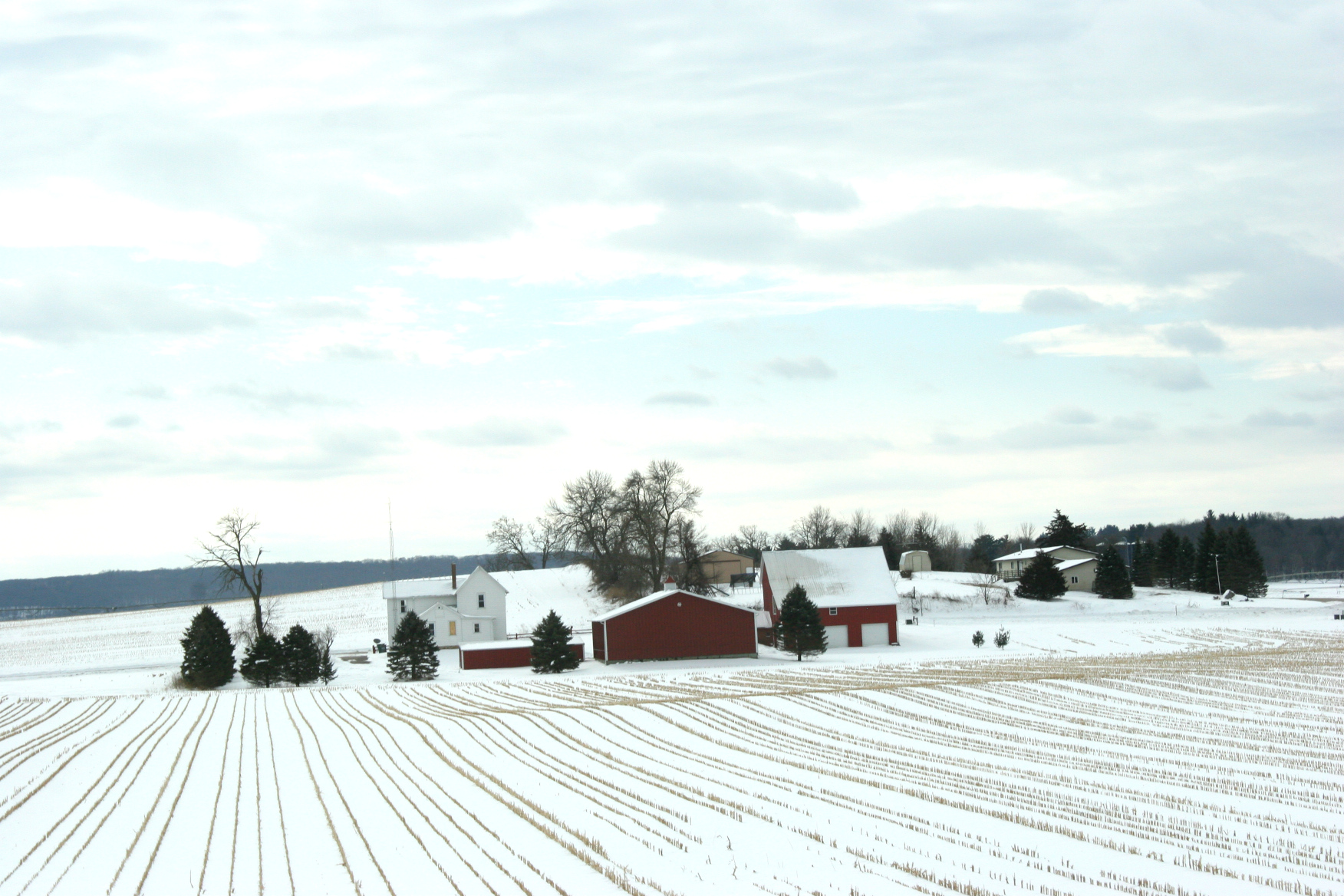
A Wisconsin farm site photographed from Interstate 90 could be a poetry prompt.(Minnesota Prairie Roots copyrighted file photo)
In her poem “Snow Pond,” she defines poetry: Poetry, like freezing temps, seizes the moment, recasts it—through the physics of sight, memory, language—resurrects it anew into patterns, sound and light, marks on a snowy page that glisten and melt on tongue, alight on the inner eye. That definition of poetry is among the best I’ve read, because it is poetry.
Clothespins on my clothesline clip clothing, not beach towels. (Minnesota Prairie Roots copyrighted file photo)
Anyone who writes poetry recognizes the challenges of finding just the right word, of stringing words together in a new, creative and succinct way, of connecting on an emotional level. But Boling makes the process look easy, taking the reader along with her, whether into her yard or onto the sandy shores of Lake Michigan. In her poem “Clothesline,” she writes of beach towels dancing in the wind. She takes the reader to the beach, to the sights, scents and sounds along the inland sea. I feel her fingertips unclipping the dried towels at end of day as she gathers them like weary babes into my open arms. I did not see that end coming. That element of surprise is, too, a mark of a gifted poet.
Kid-sized Adirondack chairs on a Minnesota beach. (Minnesota Prairie Roots copyrighted file photo)
Her “Adirondack Chair in Snow” is another favorite of mine in Boling’s collection of 37 poems published by Finishing Line Press. She writes of the typically-lakefront chair wedged into a snowbank outside her mother’s apartment building. But this poem is about so much more than an out-of-place chair buried in snow. Boling uses personification to write about her mother. In those six verses, I found myself missing my own mom, who died during the pandemic in January 2022. Boling’s emotions, my emotions, weave together in her writing and in my reaction.
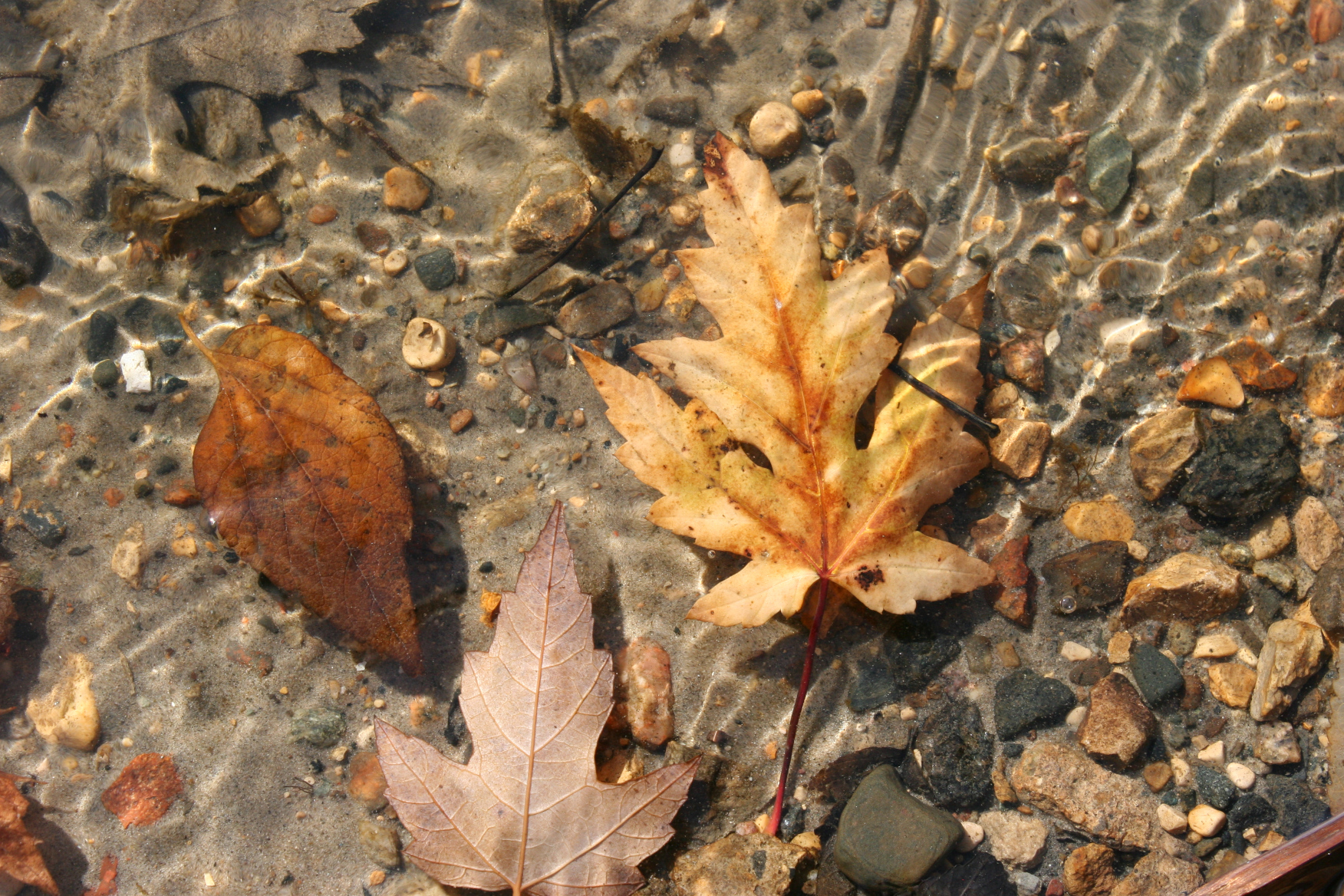
My own artsy autumn leaf image, of leaves in the Cannon River. (Minnesota Prairie Roots copyrighted file photo)
In one of her longest poems, Boling writes about the transition to autumn in “Persephone’s Bouquet.” Unfamiliar with this Greek goddess, I learned that Persephone’s descent into the underworld is associated with the start of winter. Autumn themes Boling’s poem as the author gathers hot-pepper reds, creamy yellows…brazen scarlet…leaves, something I also enjoy doing in fall. But this is a poem about life, too, not just about a change in seasons. Plus, the poem connects to the cover of Here Beyond Small Wonders, Boling’s own autumn leaf art.
Her first collection of poems is about nature and place and seasons and life. Moments experienced. Details noticed right down to a tar-dark county road…horse flies, green heads glistening in the sun…reedy breath trembling into song. Boling, in her words, opens herself to a pool of words. And I, for one, embrace her poetic writing.
#
FYI: Becky Boling is a retired professor of Spanish and Latin American literature at Carleton College in Northfield. Her poetry and prose have been widely-published in literary journals and anthologies. She also served as a Co-Poet Laureate of Northfield. Click here to find Here Beyond Small Wonders on the Finishing Line Press website.
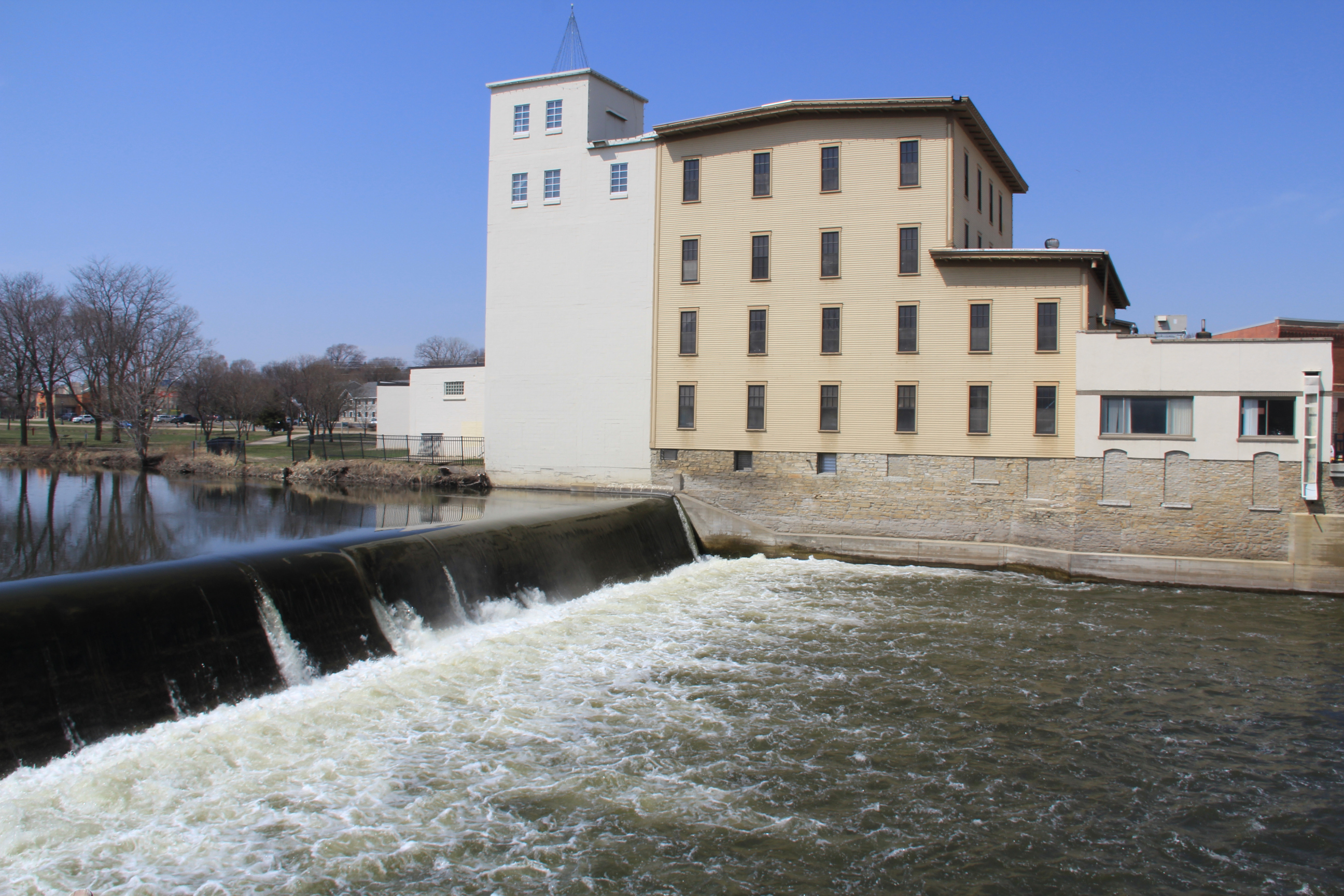
The Cannon River spills over the dam by the historic Ames Mill. (Minnesota Prairie Roots copyrighted photo April 2025)
WE COME TO THE RIVER. The Cannon River, spilling over the dam by the Ames Mill. Roaring. Churning. Then flowing under the bridge and between the walls of the Riverwalk in downtown Northfield.
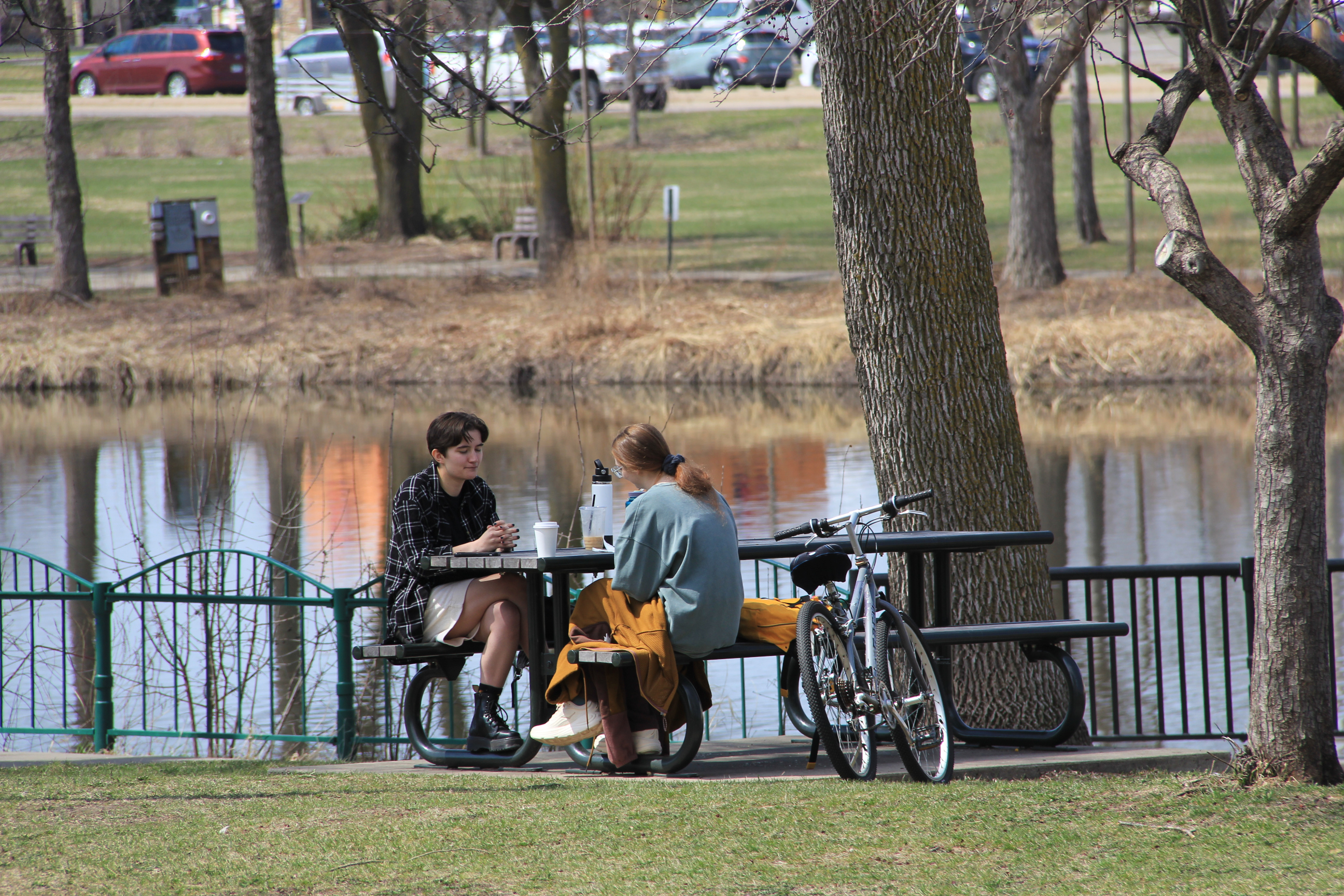
Enjoying beverages and time together beside the Cannon River in Bridge Square. (Minnesota Prairie Roots copyrighted photo April 2025)
We come here on a Sunday afternoon, on an April day of temps pushing into the sixties, the sun beaming warmth upon us, upon the land, upon the river. To sit. To walk. To lean toward the river. To simply be outdoors on an exceptionally lovely spring day in southern Minnesota.
The mood feels anticipatory, joyful, as we walk ourselves, and some their dogs, along the riverside path.
Historic buildings hug the Cannon River (and Division Street) in Northfield’s quaint downtown. (Minnesota Prairie Roots copyrighted photo April 2025)
I come with my Canon camera in hand. An observer. An appreciator of the sun, the sky, the warmth, the river, the historic buildings, the people and activities happening around me. In some ways, the scene seems Norman Rockwell-ish, Busy, yet tranquil. A slice of small town Americana. Everyday people enjoying each other, nature, the outdoors. Life.
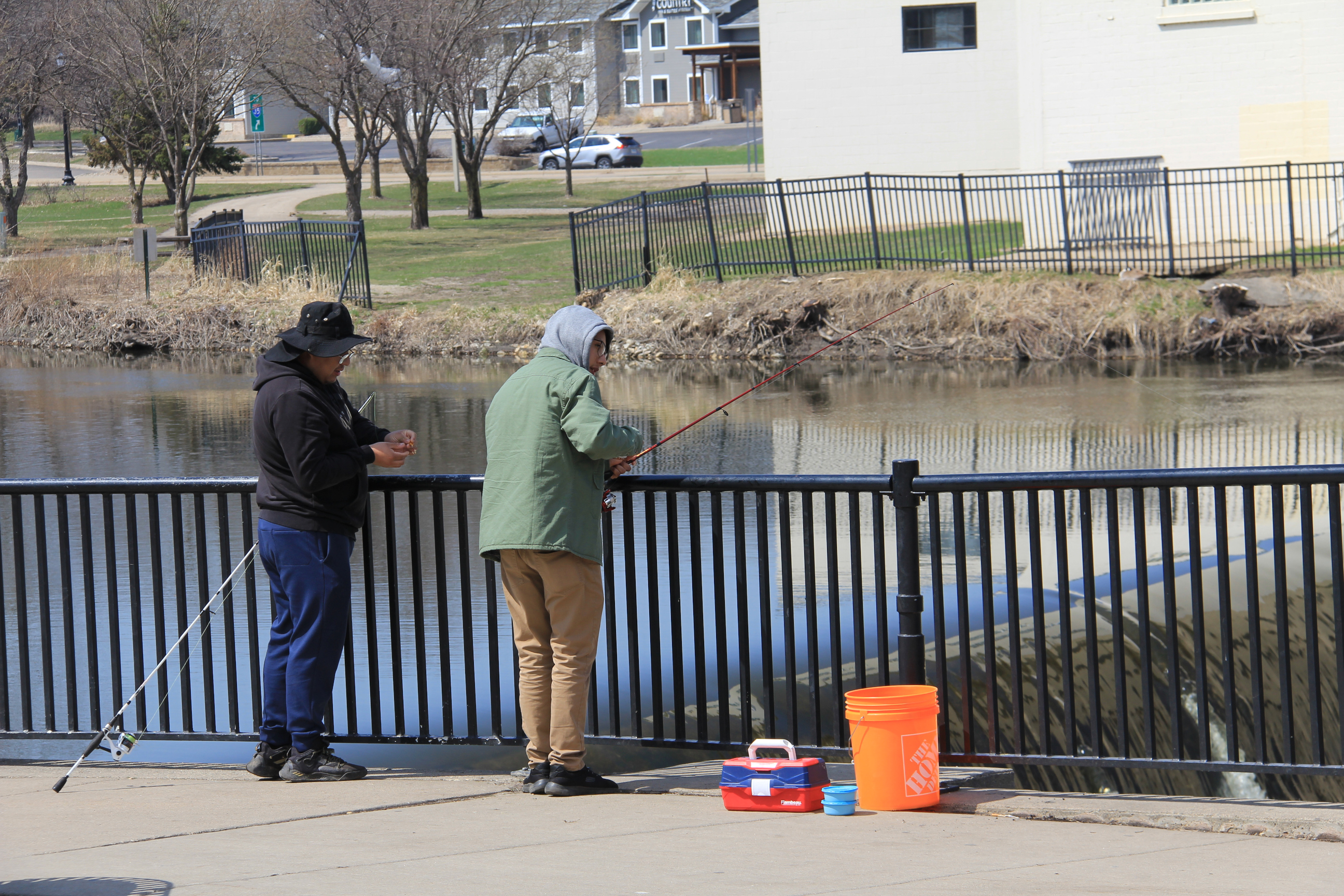
Fishing by the Ames Mill dam. (Minnesota Prairie Roots copyrighted photo April 2025)
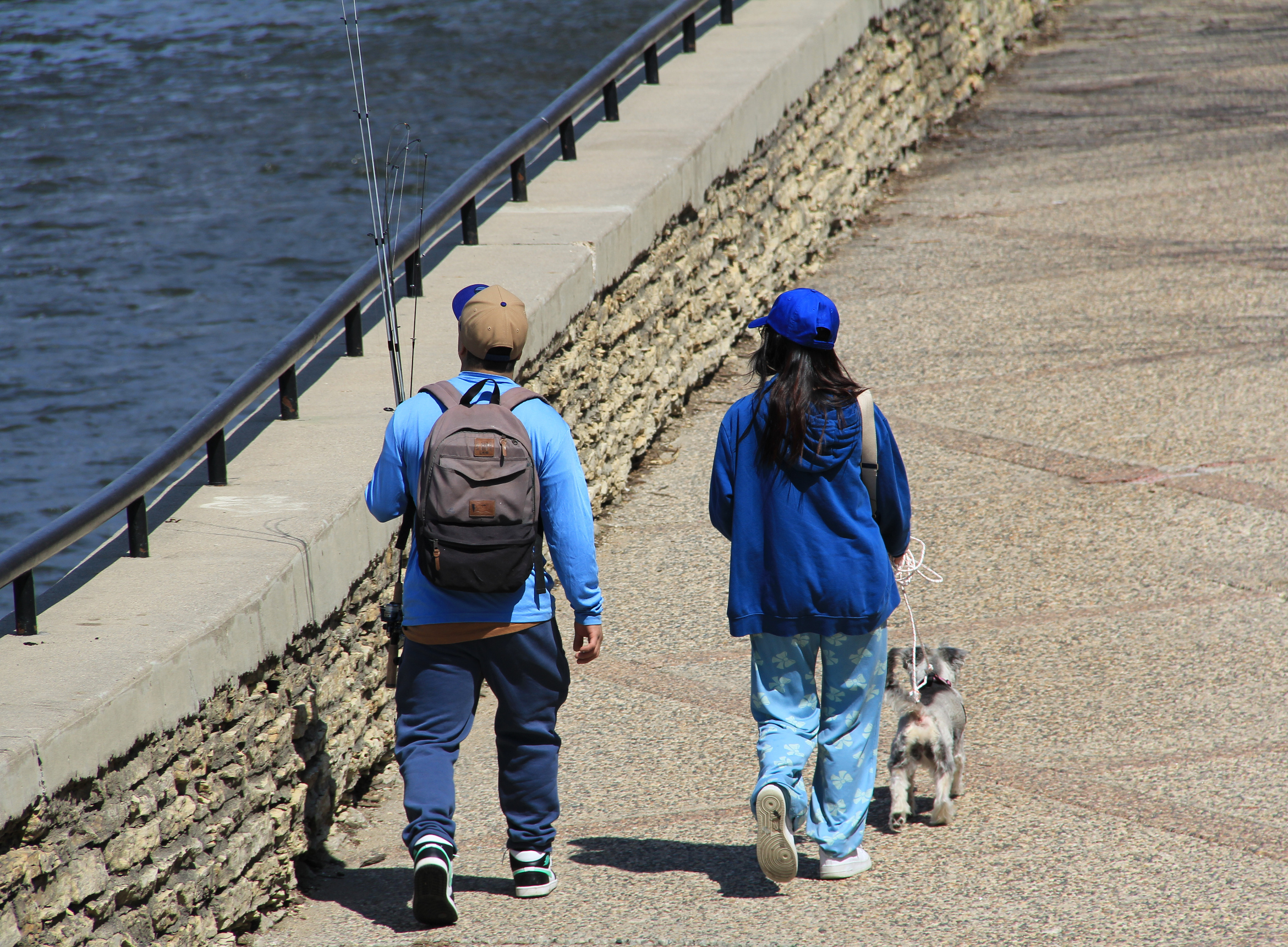
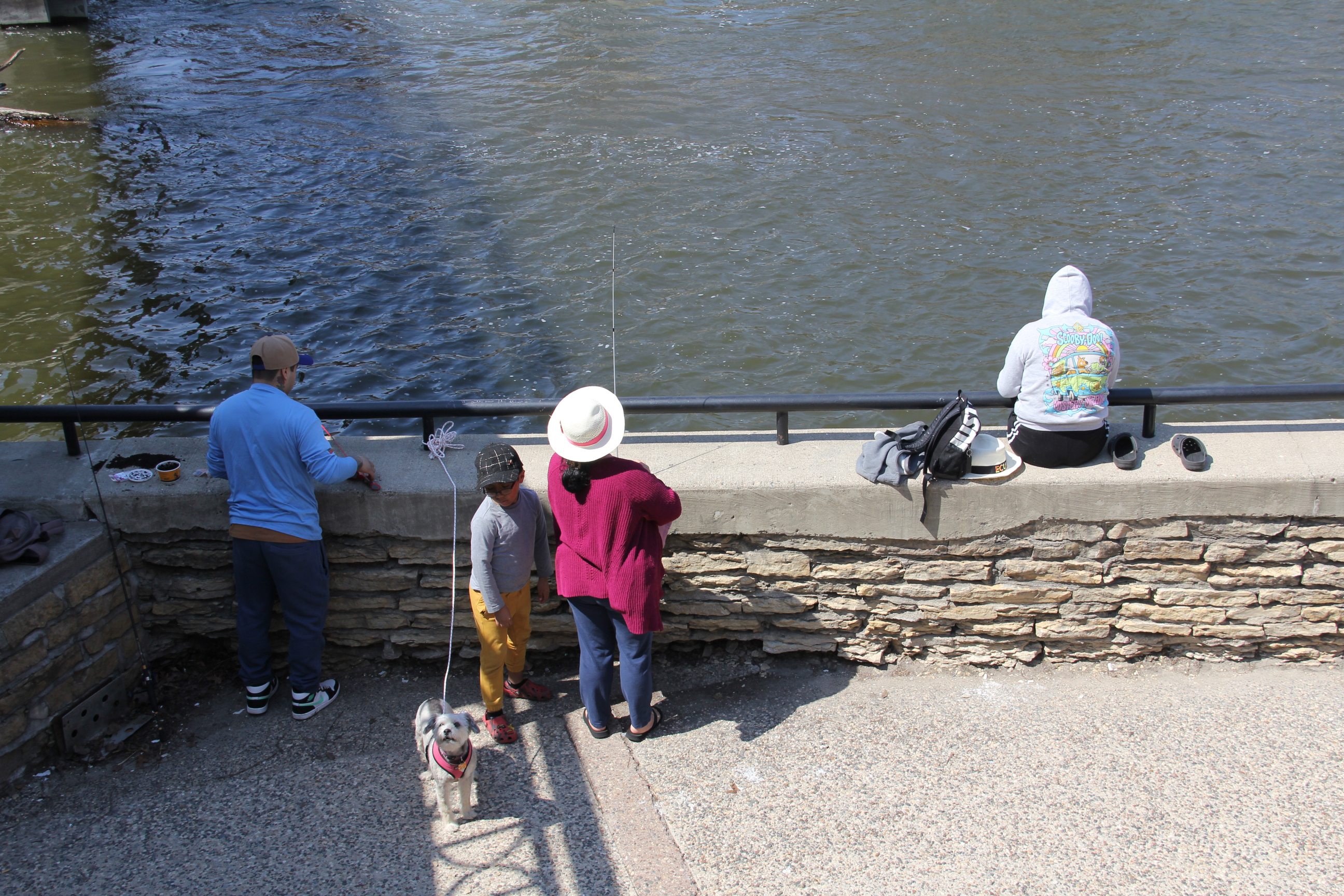
Many carry fishing poles, tackle boxes, containers of bait. Anglers press against the riverside railing, dropping lines into the water far below.
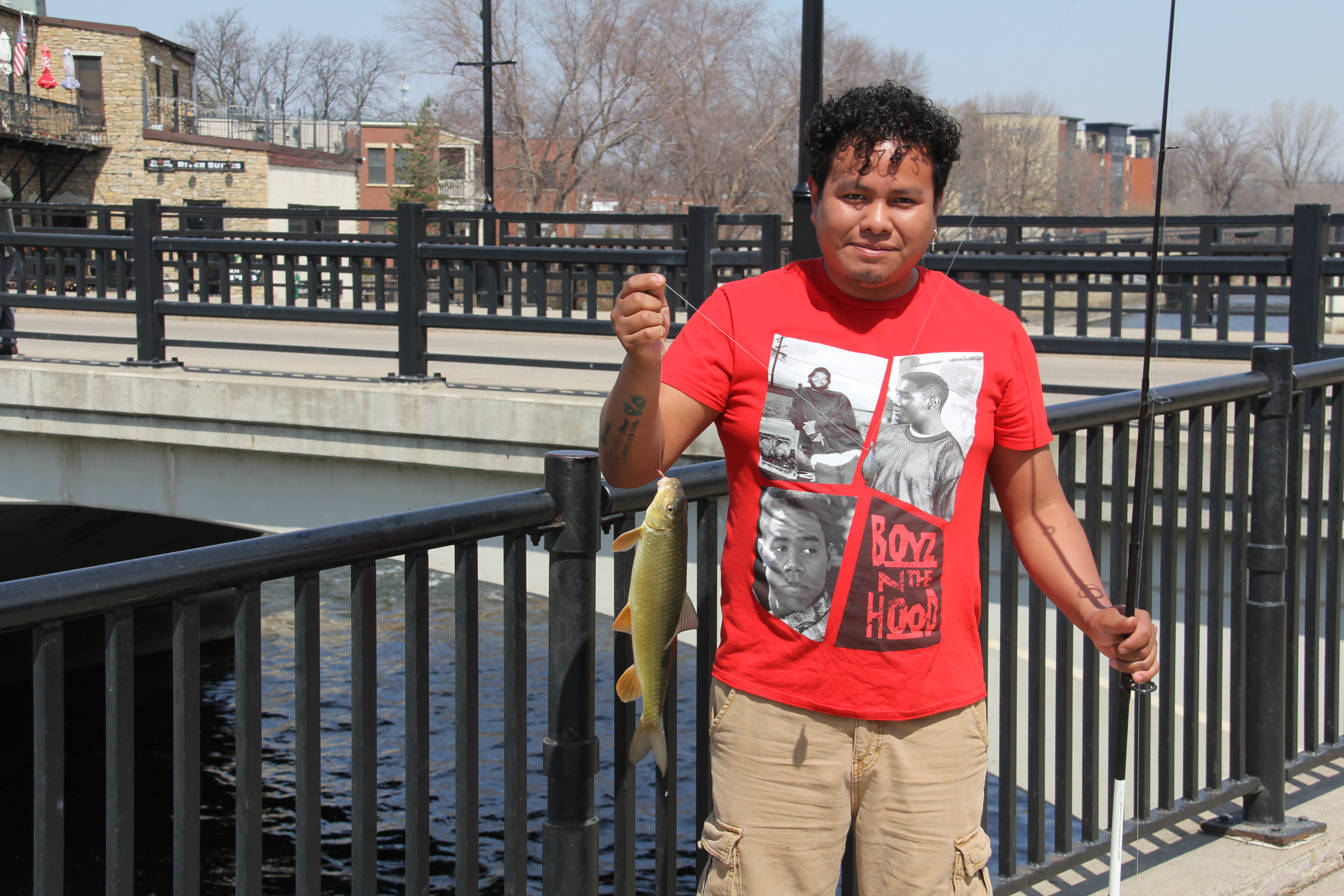
Caught in the Cannon, a sucker fish. (Minnesota Prairie Roots copyrighted photo April 2025)
I watch as a young man pulls in an unidentifiable-to-me fish (later identified as a white sucker by my husband). His friend snaps a photo of the proud angler and his first catch of the day.
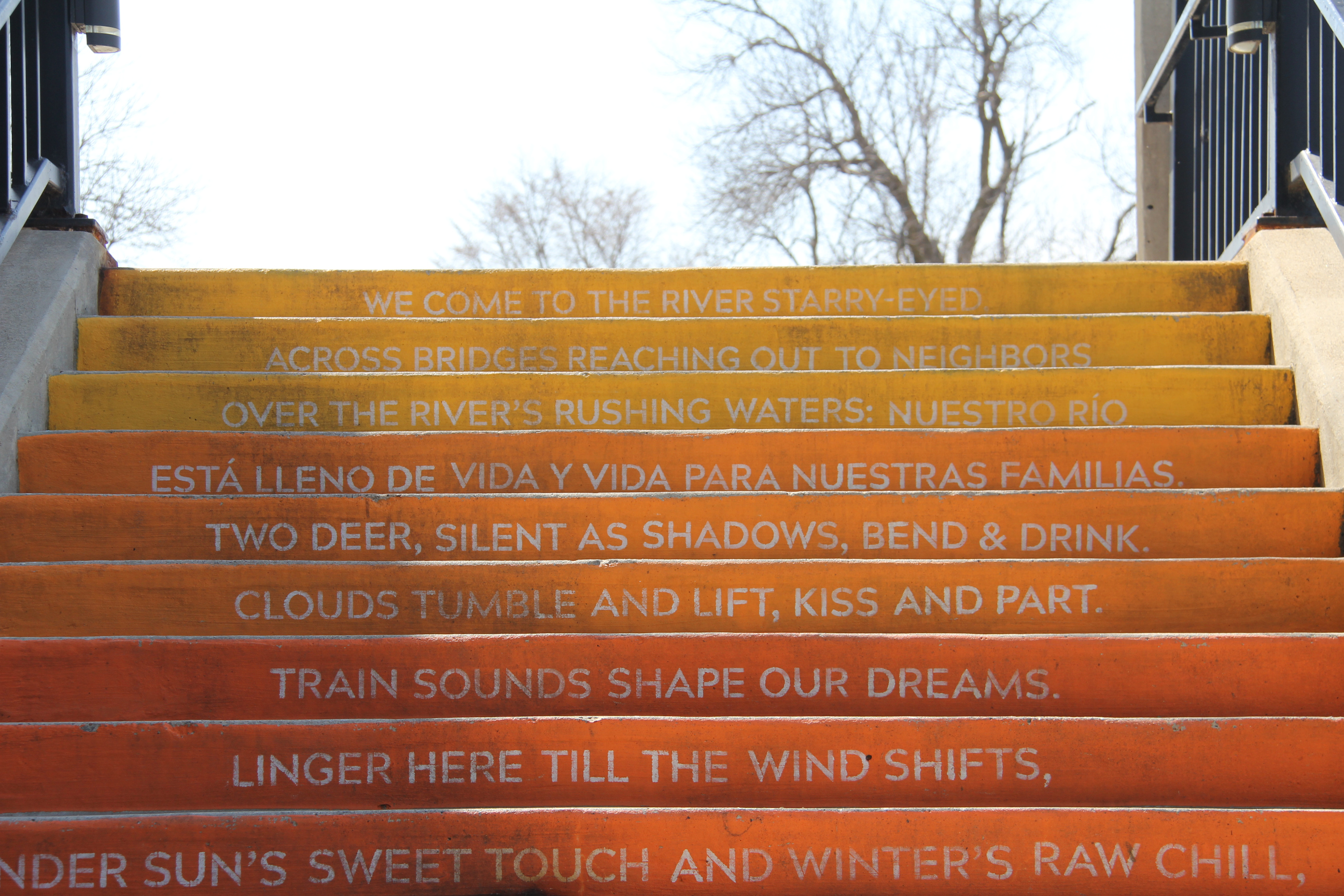
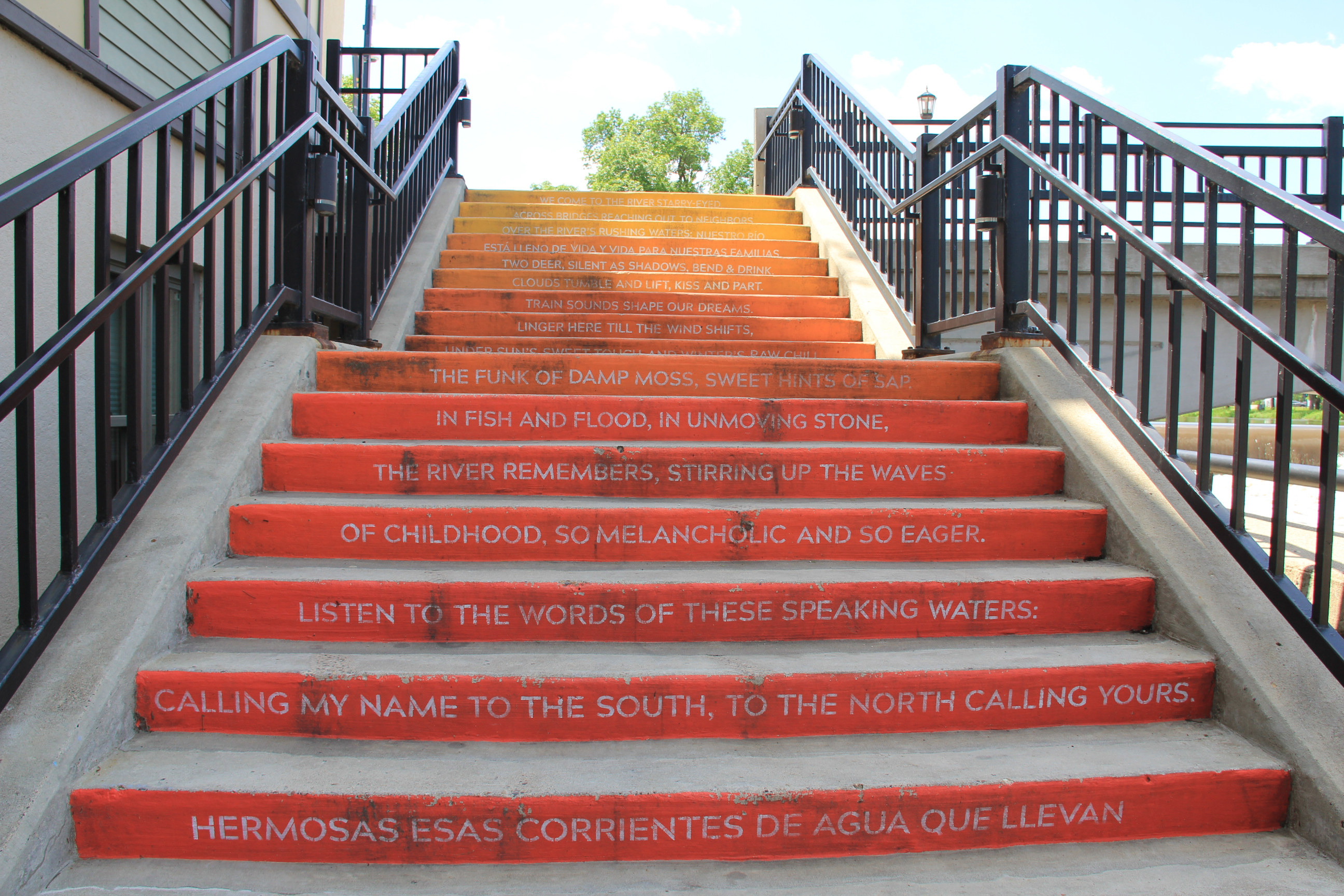
The top section of the Riverwalk Poetry Steps. (Minnesota Prairie Roots copyrighted photo April 2025)
After hanging around the river by Bridge Square for a bit, I descend the colorful Riverwalk Poetry Steps, a river poem crafted by a collaboration of 17 poets. We come to the river starry-eyed/across bridges reaching out to neighbors/over the river’s rushing waters…
Following the Riverwalk to find a fishing spot along the Cannon River. (Minnesota Prairie Roots copyrighted photo April 2025)
I trail behind a couple, a family, a dog, another family, all of us connected by the water, by this place, on this spring day. I’m the only one to pause and read the poetry.
A family fishes the Cannon. (Minnesota Prairie Roots copyrighted photo April 2025)
Atop the river wall, young women sit, sans shoes, while they fish. We all watch the river flow. Bobbers bob. A pair of ducks—one pure white—flies low, skimming the water before landing upon the surface of the Cannon.
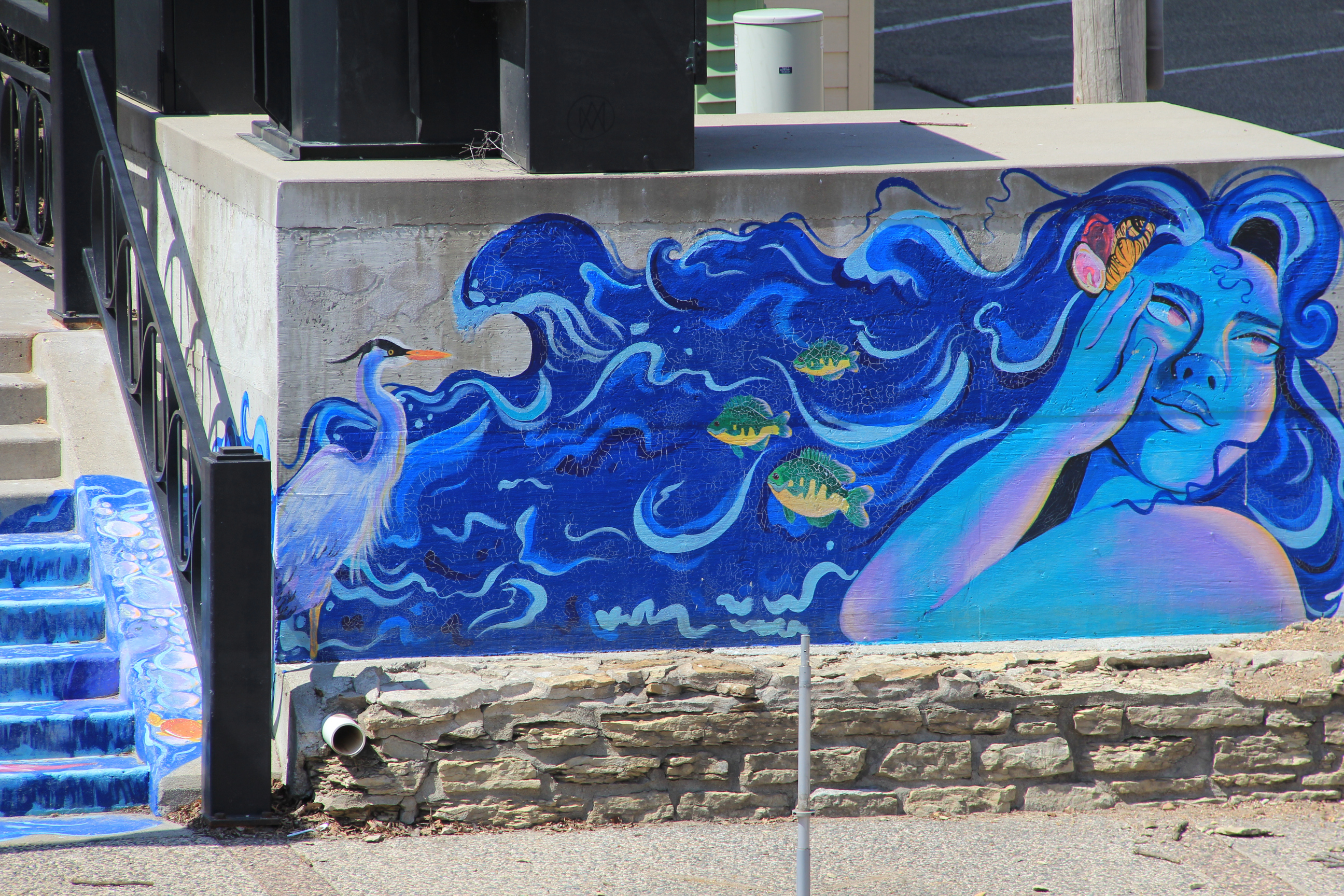
“Lady Cannon,” a riverside mural by Maya Kenney and Raquel Santamaria. (Minnesota Prairie Roots copyrighted photo April 2025)
Across the river, Lady Cannon watches. Fish swim in her tangled waves of locks, flowing like water down steps toward the river. She is the art of the Cannon.
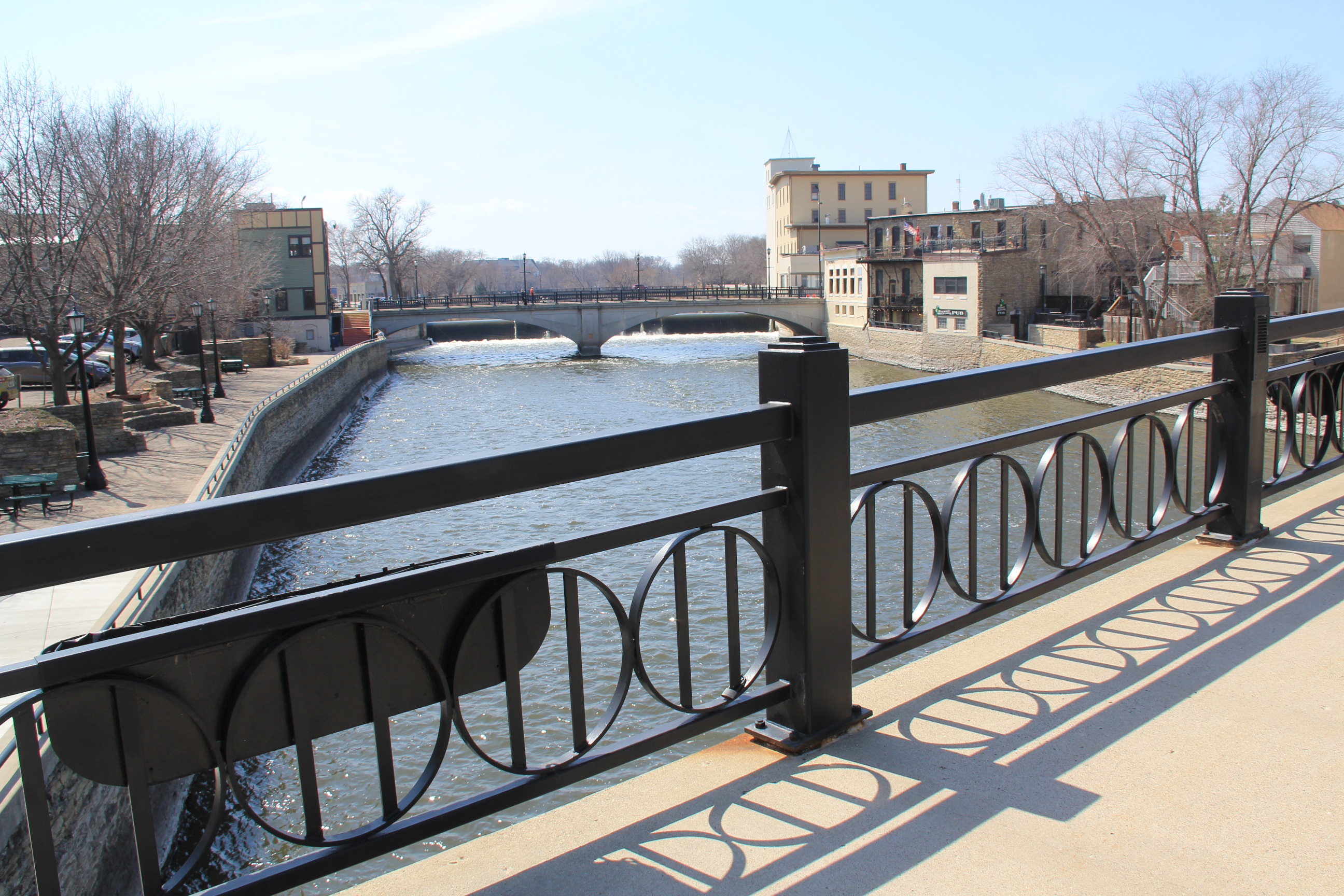
On the pedestrian bridge looking toward the Cannon and the Ames Mill, right in the distance. (Minnesota Prairie Roots copyrighted photo April 2025)
I see art, too, in a railing shadowed upon the pedestrian bridge. I linger, mesmerized by the moving water, the riverside historic flour mill a block away.
There’s so much to take in here. So much that connects us. The sun, the sky, the land. And the river that flows beside and below us.
The Riverwalk Steps Poem alongside the Cannon River in the heart of downtown Northfield. (Minnesota Prairie Roots copyrighted file photo)
I FEEL FORTUNATE to live in an area of Minnesota which values poetry. Some 20 minutes away in Northfield, poems imprint upon concrete throughout the city as part of the long-time Sidewalk Poetry Project. Along the Riverwalk, a poem descends steps. In the public library, a poem graces the atrium.
Sidewalk poetry in downtown Northfield carries a powerful message.(Minnesota Prairie Roots copyrighted file photo)
But that’s not all in Northfield. This city of some 21,000 has a poet laureate, currently Russ Boyington, who fosters poetry, organizes and publicizes poetry events, and leads an especially active community of wordsmiths. These are published poets, serious about the craft.
This anthology published in 2024.(Minnesota Prairie Roots copyrighted file photo)
Five seasoned Northfield poets recently collaborated to publish a collection of their work in We Look West. Even if you think you don’t like poetry, you will find something in this anthology which resonates. These poets take the reader through the seasons of life with humorous, sad, nostalgic, reflective and introspective poems. This anthology is especially fitting for anyone closer to the sunset, than the sunrise, of life.
A serene country scene just north of Lamberton in southern Redwood County on the southwestern Minnesota prairie. (Minnesota Prairie Roots copyrighted file photo)
April, National Poetry Month, marks a time to celebrate poets like those in Northfield and beyond. In my own community of Faribault, we have an especially gifted poet, Larry Gavin, a retired high school English teacher and writer. He’s published five collections of his work. Larry writes with a strong sense of place, his poems reflective of his love of nature, of the outdoors. A deep love of the prairie—he attended college, then lived and worked for a while in my native southwestern Minnesota—connects me to this remarkable poet. Plus, Larry has the rich voice of a poet, which makes listening to him read his poems aloud an immersive, joyful experience.
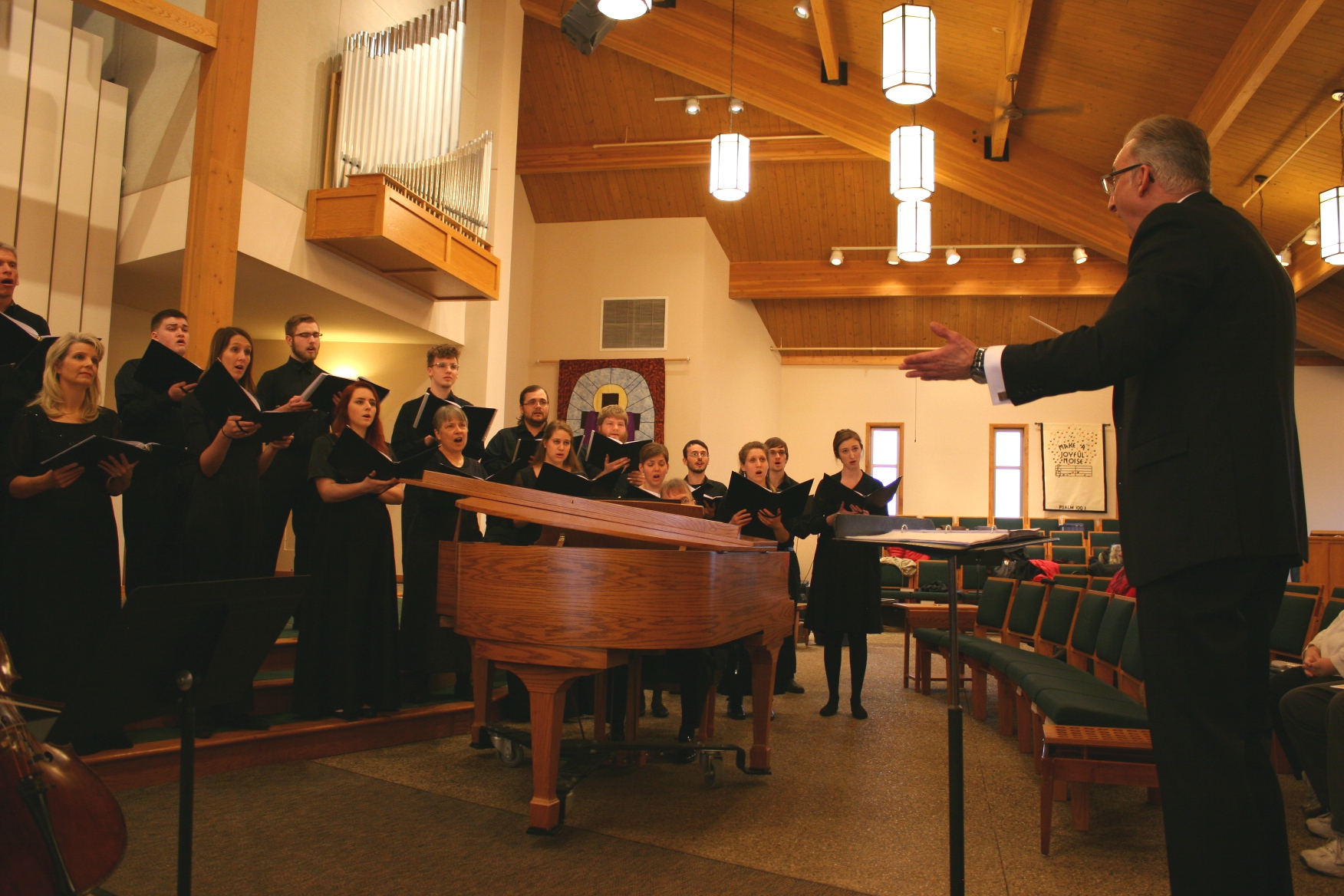
A chamber choir, directed by composer David Kassler, performs artsongs written from poems in 2017, mine included. (Minnesota Prairie Roots copyrighted file photo)
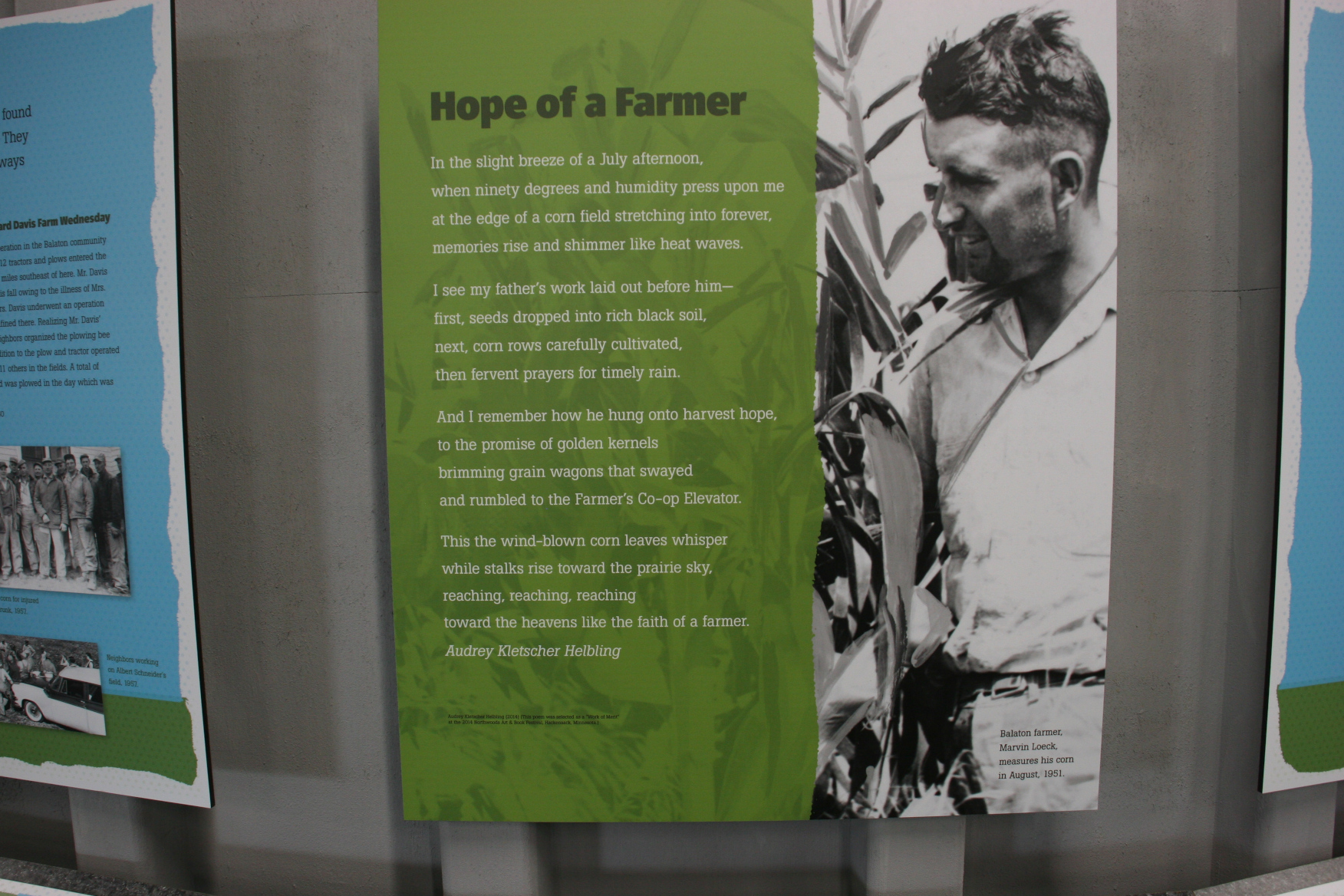
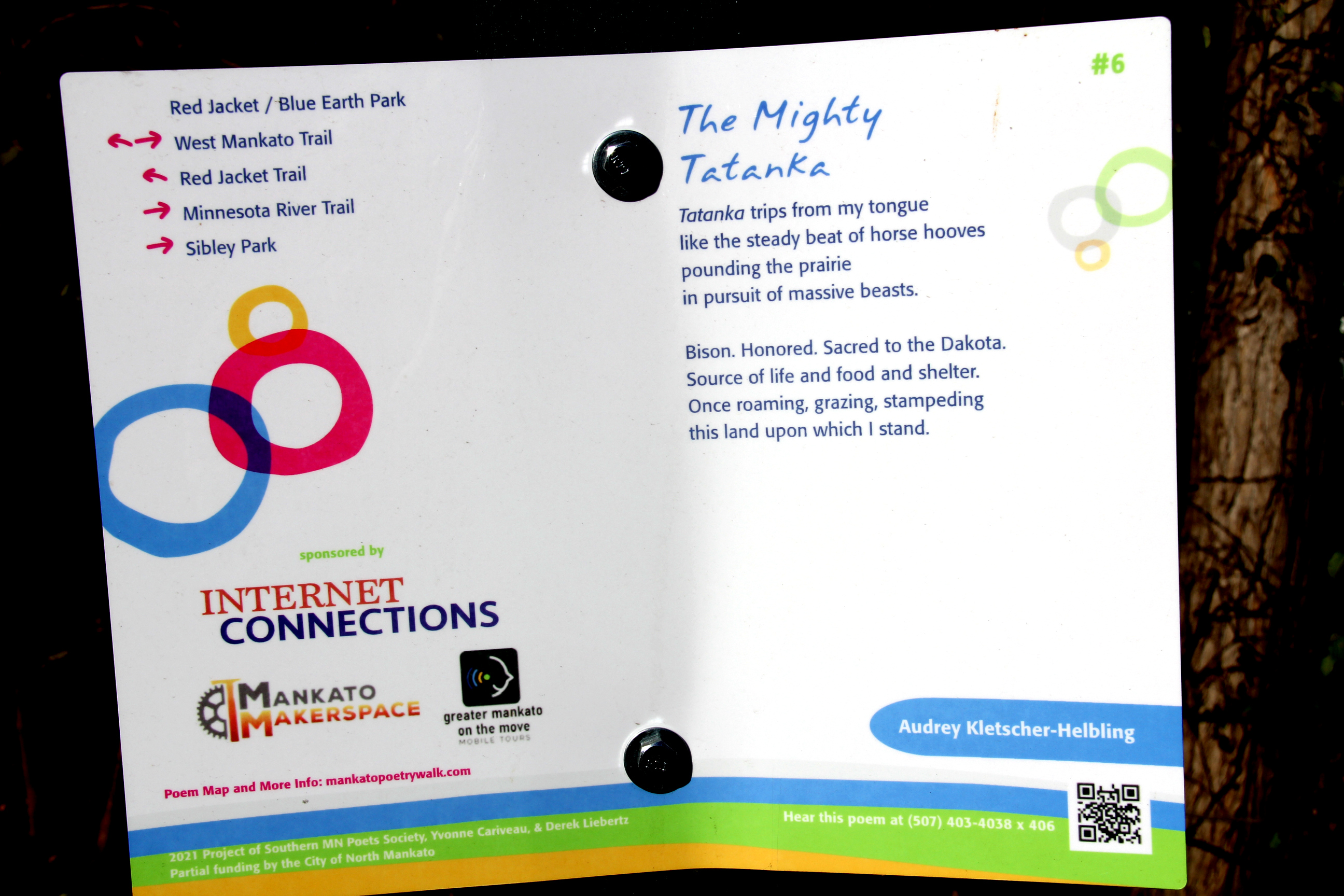
I, too, write poetry and am a widely-published poet, although certainly not as much as many other Minnesota poets. From anthologies to a museum, from the Mankato Poetry Walk & Ride to poet-artist collaborations, billboards and more, my poems have been out there in the public sector. Perhaps the most memorable moment came when a chamber choir performed my poem, “The Farmer’s Song,” during two concerts in Rochester in 2017. David Kassler composed the music for the artsongs.
Two of my rural-themed poems are included in an exhibit, “Making Lyon County Home,” at the Lyon County Historical Society Museum in Marshall. (Minnesota Prairie Roots copyrighted file photo)
Poetry has, I think, often gotten a bad rap for being stuffy, difficult, too intellectual and unrelatable. And perhaps it was all of those at one time. Butt that’s not my poetry. And that’s not the poetry of Larry Gavin or of the five We Look West Northfield poets or most poets today. The poetry I read, write and appreciate is absolutely understandable, rich in imagery and rhythm, down-to-earth connective.
My most recent poem selected for the Mankato Poetry Walk & Ride. Poets must follow character and line limits in writing these poems.This is a competitive process.(Minnesota Prairie Roots copyrighted file photo)
When I write poetry, I visualize an idea, a place, a scene, a memory, an emotion, then start typing. The words flow, or sometimes not. Penning poetry is perhaps one of the most difficult forms of writing. Every word must count. Every word must fit the rhythm, the nuances of the poem in a uniquely creative way.
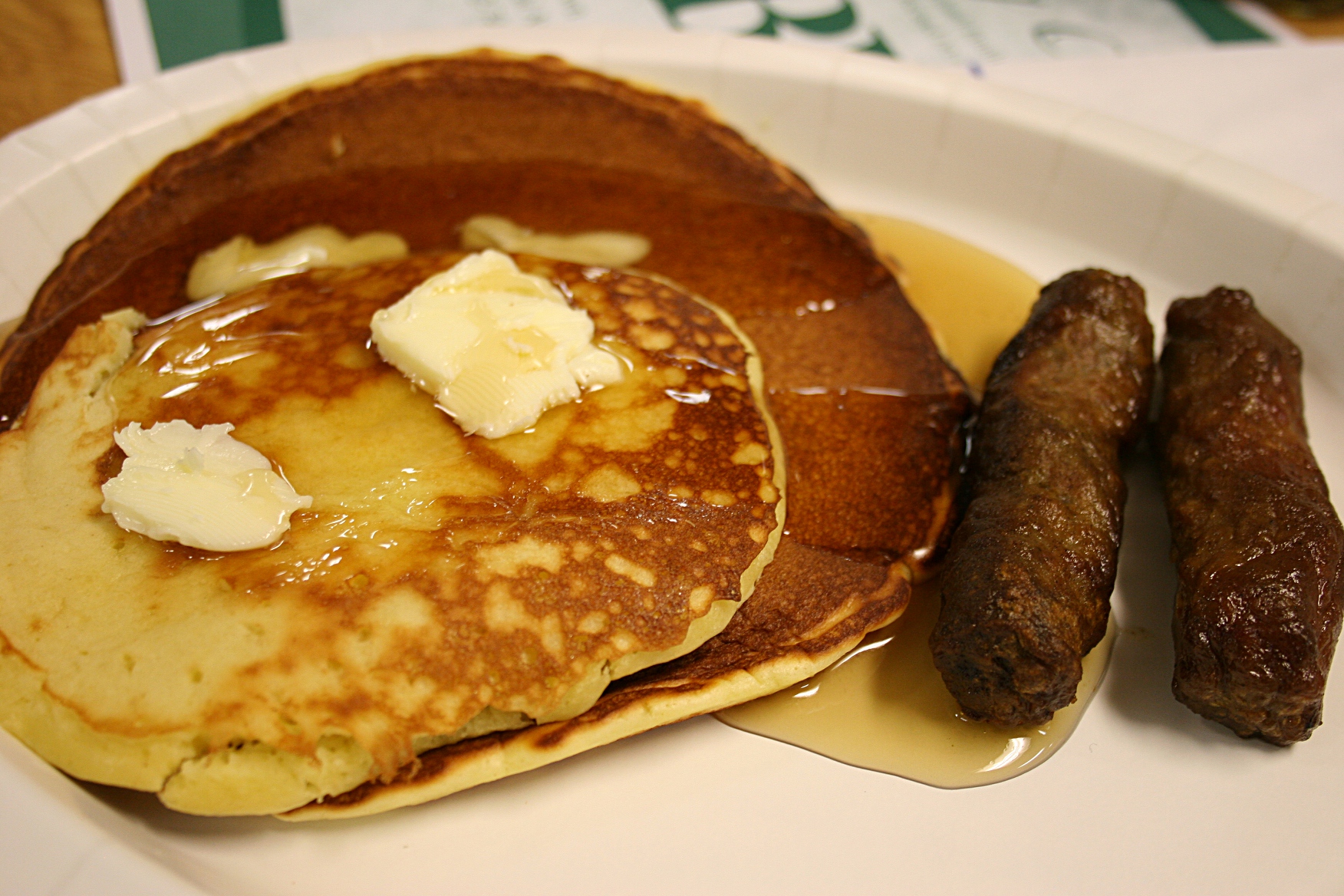
Not the pancakes Grandpa made, but the pancakes and sausages made at the annual Faribault Lions Club Pancake Breakfast. (Minnesota Prairie Roots copyrighted file photo)
One of my most recent poems, “Pancakes with Grandpa,” was inspired by an exchange between my husband, Randy, and our grandson Isaac, then four. It was printed in Talking Stick 32—Twist in the Road, an anthology published in 2023 by northern Minnesota based Jackpine Writers’ Bloc. It’s a competitive process to get writing—poetry, fiction and creative nonfiction—in this collection.
So, in celebration of National Poetry Month, here’s my pancake poem, penned by a poet who doesn’t particularly like pancakes.
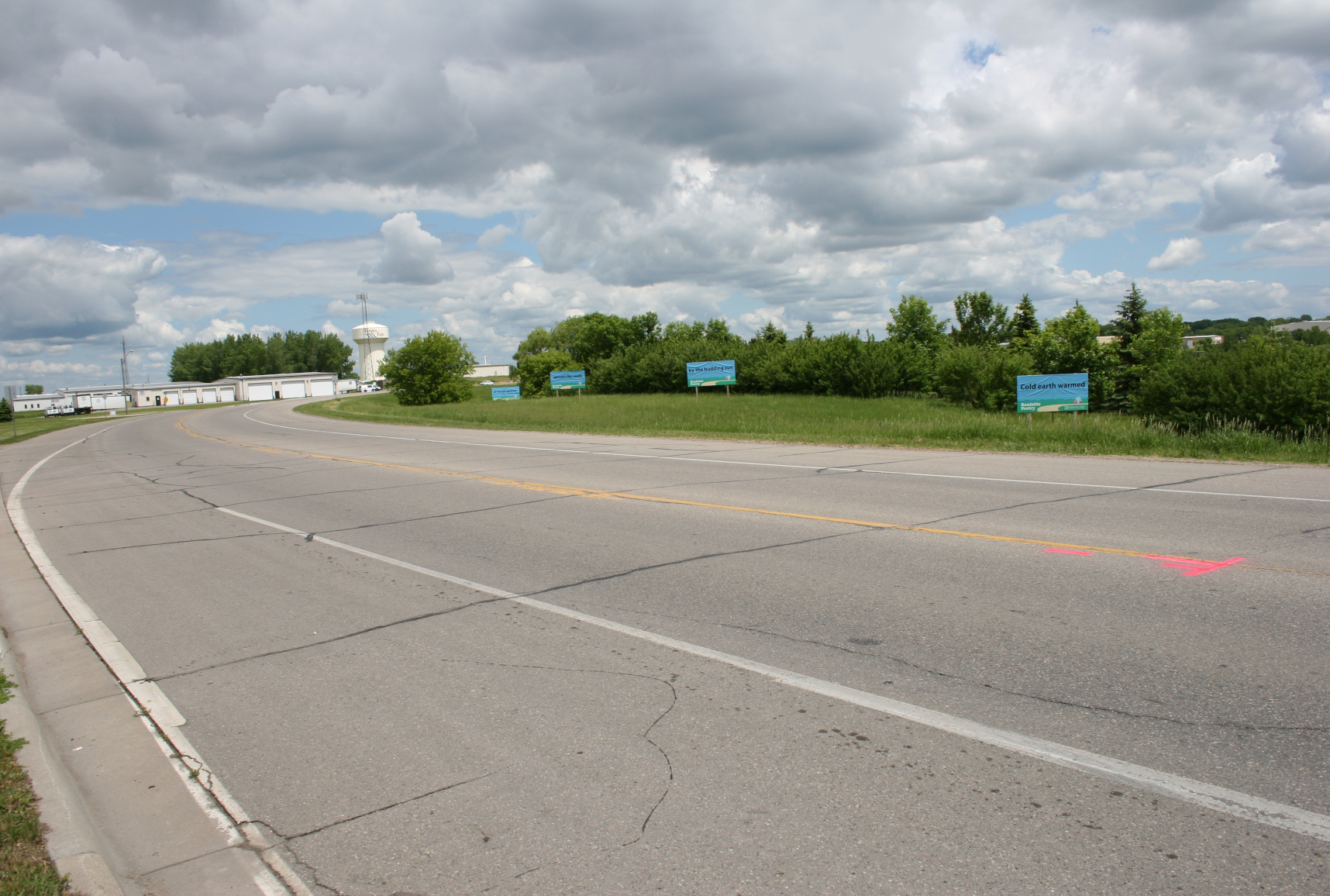
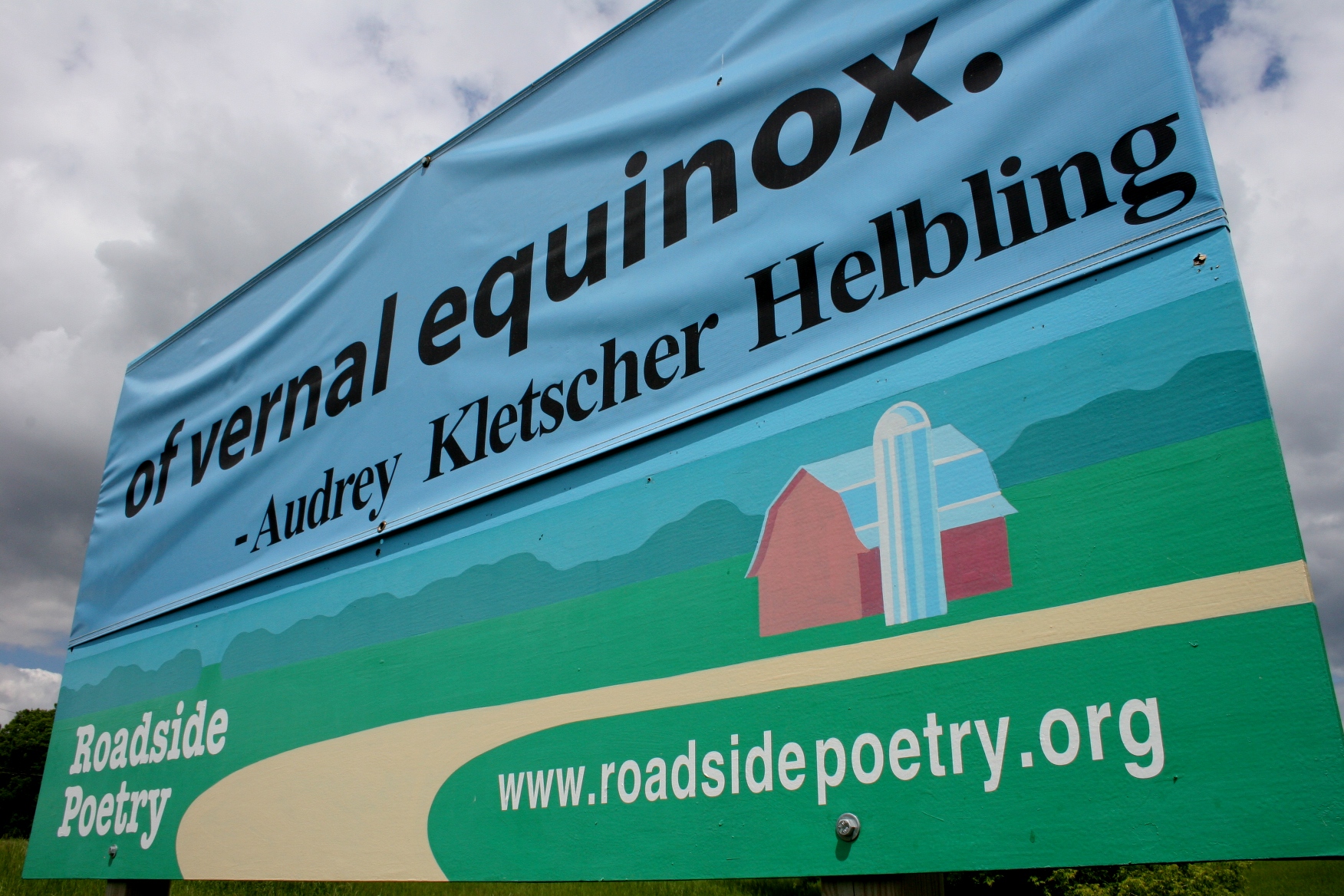
My poem about spring, shown here, was part of the 2011 Roadside Poetry Project. (Minnesota Prairie Roots copyrighted file photo 2011)
ON THIS FIRST DAY of spring, I want to share a poem I wrote in 2011. My spring-themed submission for the Roadside Poetry Project seasonal competition won. And, as a result, my poem was printed on billboard-sized signs, then placed along a roadway just off Interstate 94 in Fergus Falls in west central Minnesota. Some 100,000 vehicles a month passed by my poem.
Writing good poetry is not easy. And when you must write within guidelines, the process is even more challenging. Roadside Poetry contest rules called for only four lines of poetry with a maximum of 20 characters per line. The poem needed to fit on the signs and be readable from a distance.
Somehow, my brain managed to create what I consider a succinct and visually-strong poem defining spring. On this first day of spring, enjoy my short seasonal poem. Happy spring!
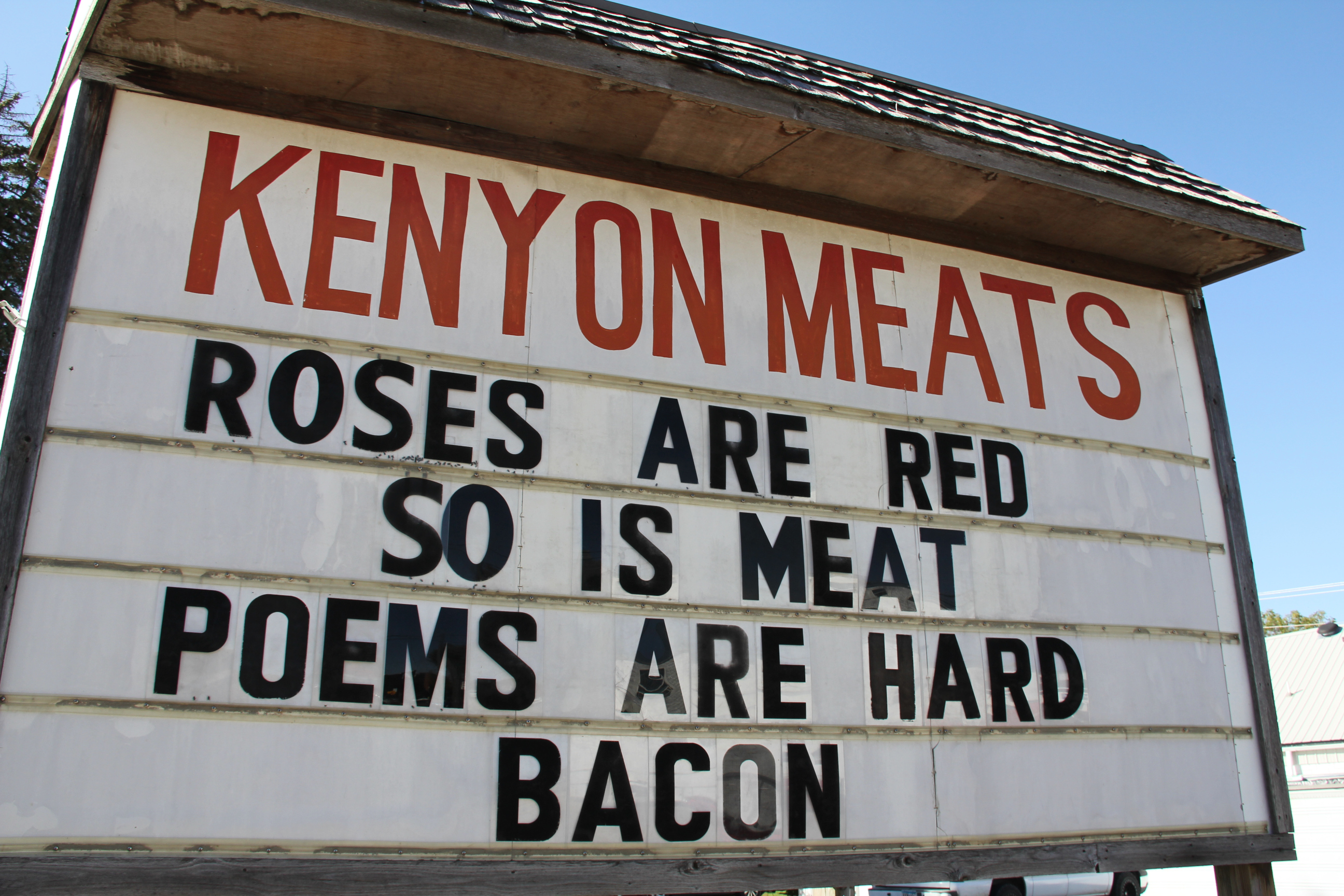
A poem on a sign outside Kenyon Meats. (Minnesota Prairie Roots copyrighted photo September 2024)
ROSES ARE RED/SO IS MEAT/POEMS ARE HARD/BACON.
It’s not exactly the most romantic version of the traditional ROSES ARE RED poem. But it’s certainly one of the most humorous spin-offs I’ve seen. I love this poem spotted last fall outside a small town southern Minnesota Meat Market, Kenyon Meats.
Roses my husband previously gifted to me. (Minnesota Prairie Roots copyrighted file photo)
It seems appropriate to share this poem now, during Valentine’s week. Maybe your sweetheart would welcome a package of jerky from the meat locker. Or your poetic version of ROSES ARE RED with a side of bacon.
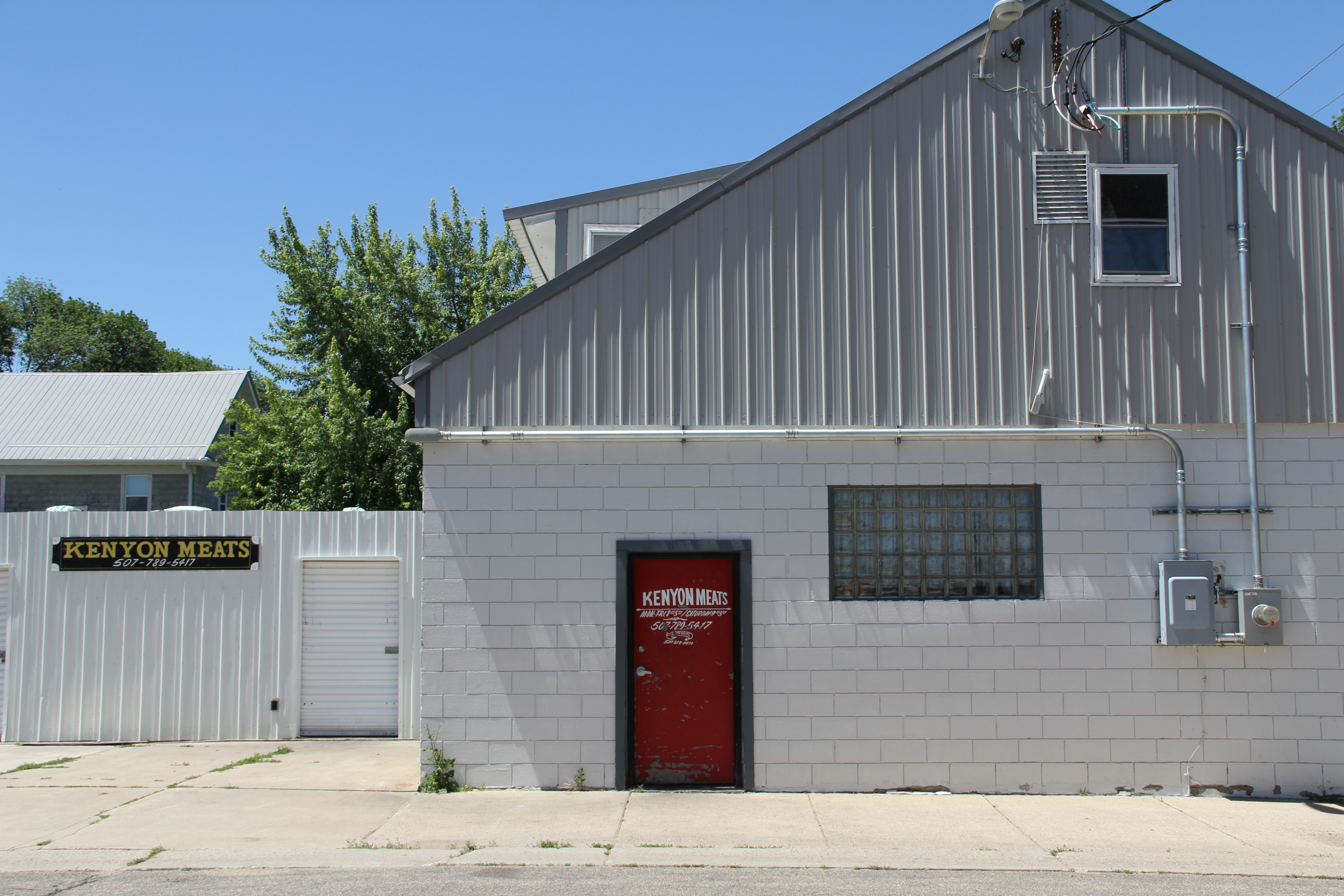
The unassuming building that houses Kenyon Meats. (Minnesota Prairie Roots copyrighted photo June 2024)
The market sits just off Minnesota State Highway 60, a major route running right through the heart of Kenyon’s several-block business district. The roadside messages posted on the meat market sign are enough to turn heads. And elicit laughter.
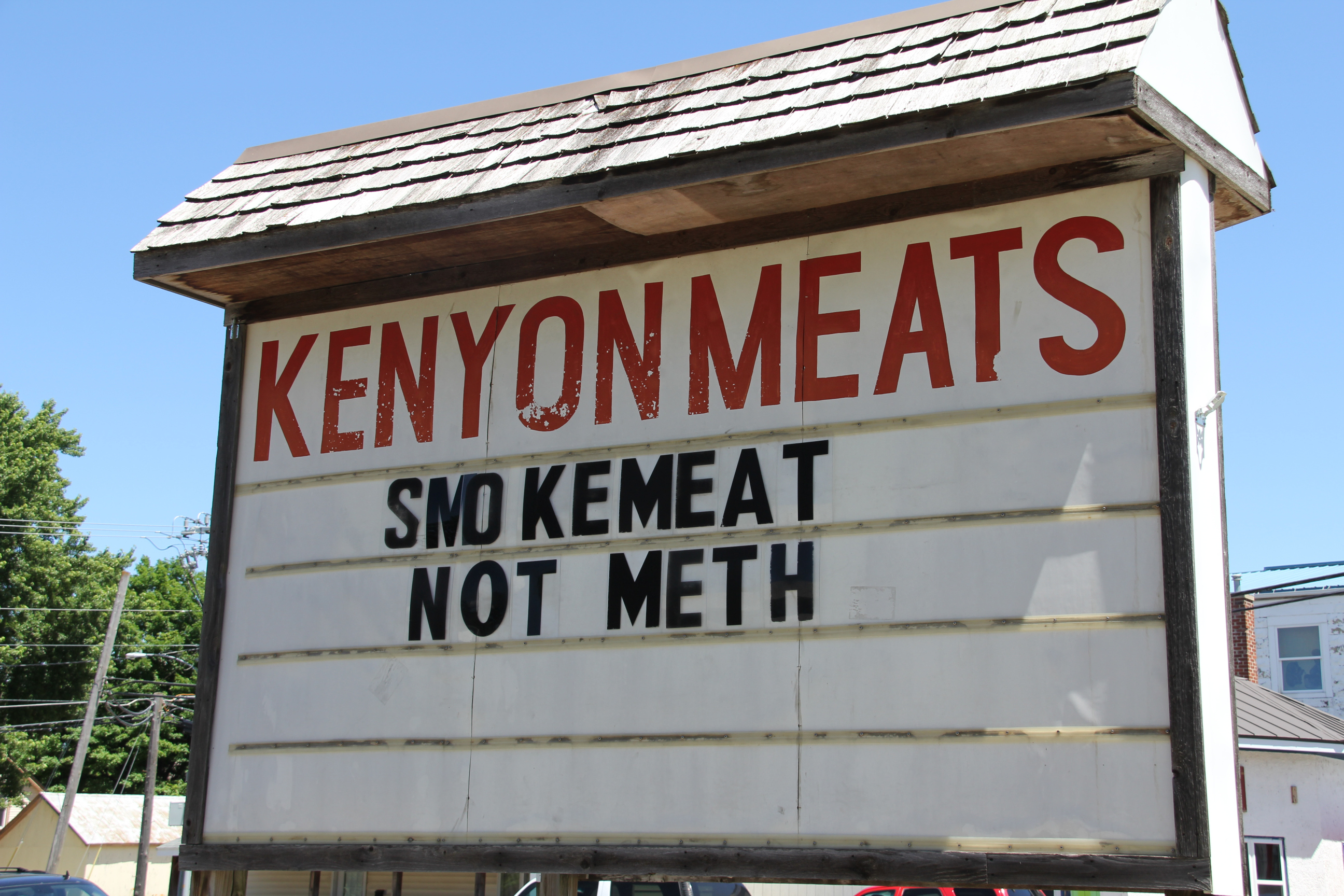
More humorous signage… (Minnesota Prairie Roots copyrighted photo June 2024)
I’ve also read this on the two-sided Kenyon Meats sign: SMOKE MEAT/NOT METH.
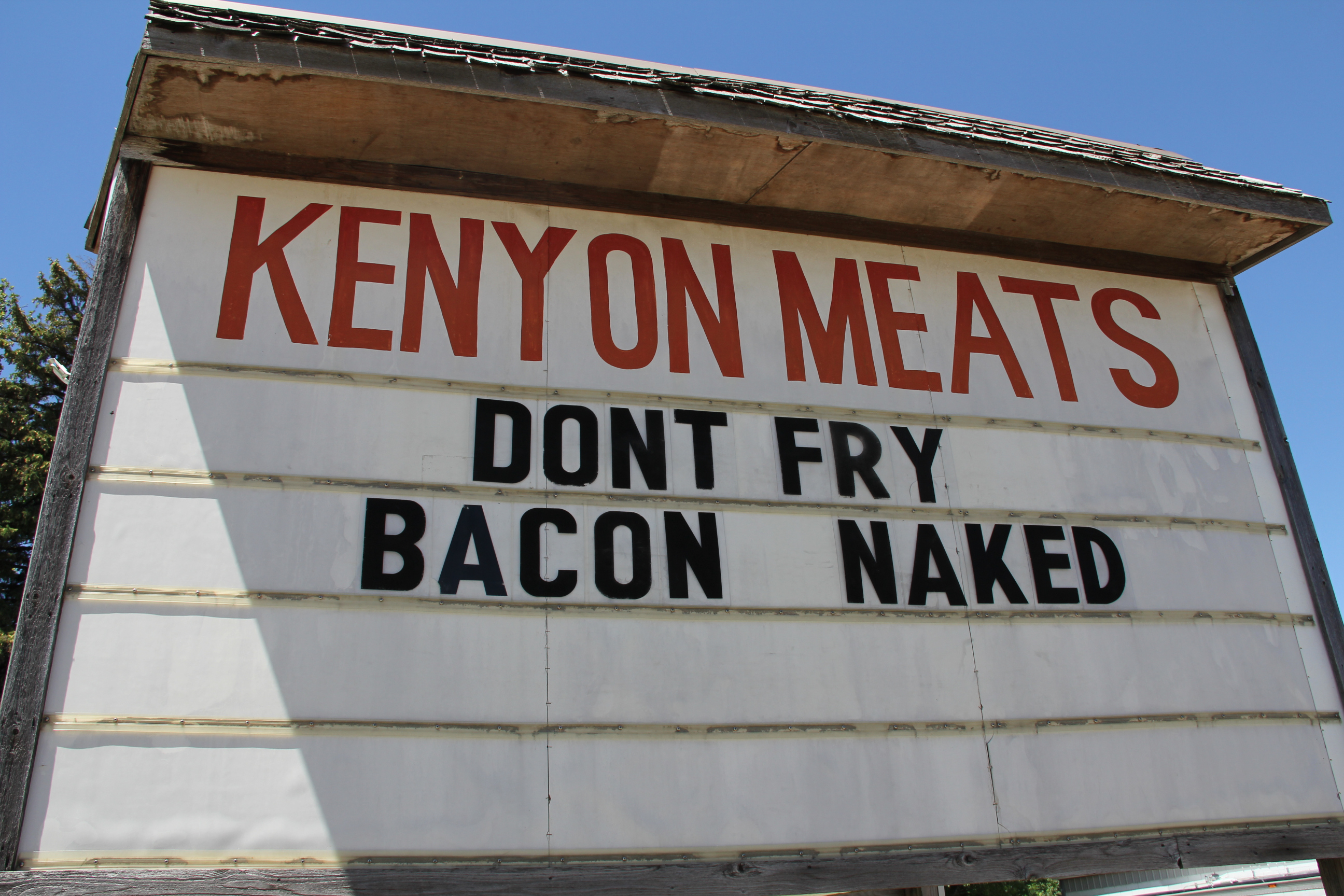
And more words to make you laugh. (Minnesota Prairie Roots copyrighted photo June 2024)
And then there’s this one: DON’T FRY/BACON NAKED.
Obvious good advice aside, I truly appreciate the attention-grabbing humorous writing. Short enough to read while driving by. Clever. Funny. What a great marketing tool, especially with a meat reference included in the wordage.
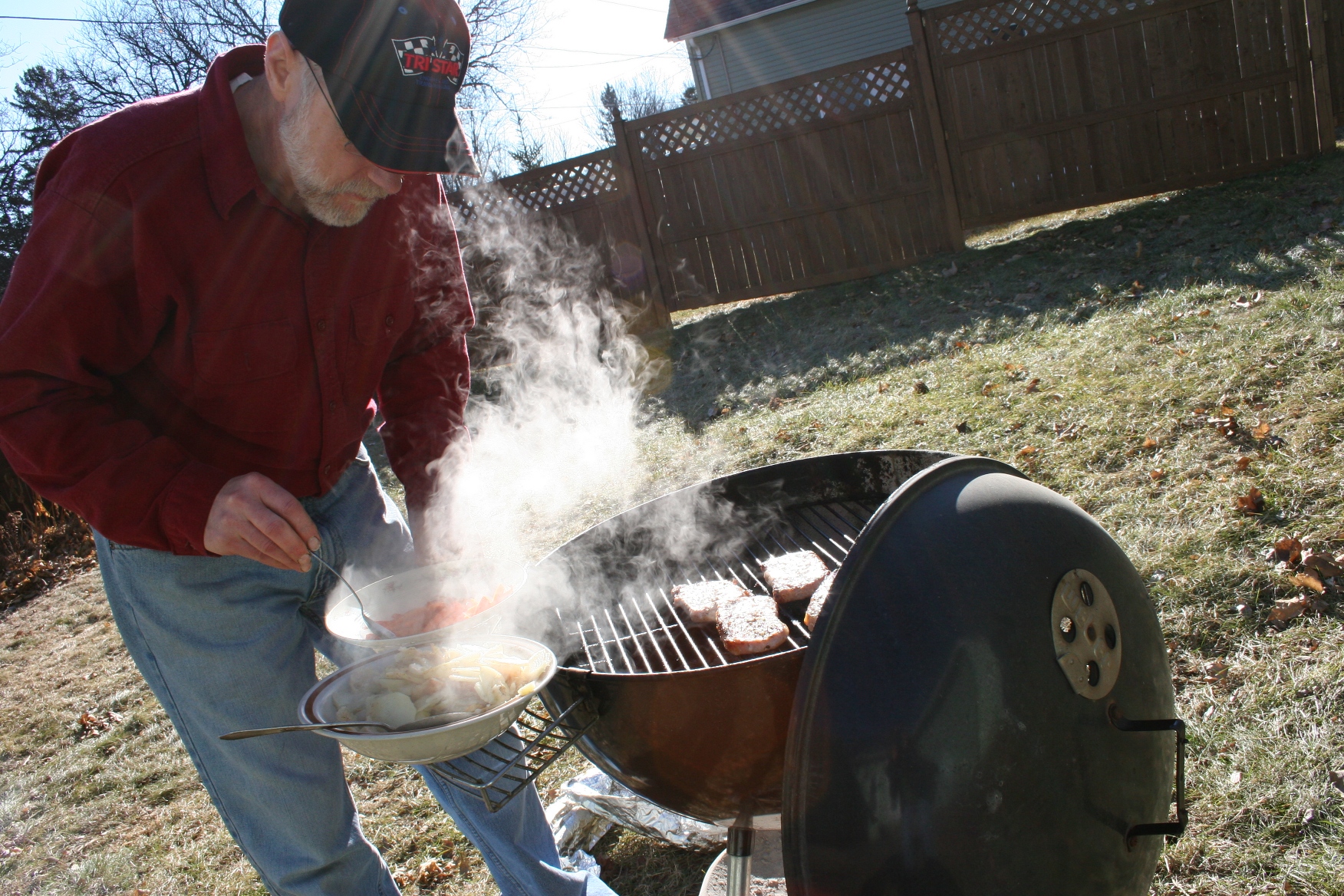
Randy grills meat and vegetables year-round, yes, even in the Minnesota winter. (Minnesota Prairie Roots copyrighted file photo)
The words drew me to photograph the scene while my husband, who likes home-grown meat markets, stepped inside to buy flavored brats. Randy loves meat (and grilling meats) as much as I love vegetables.
(Minnesota Prairie Roots copyrighted file photo)
Ah, love. It’s in the air this week. From poetry to flowers to chocolate to dinner out, love prevails. Even at the meat market.
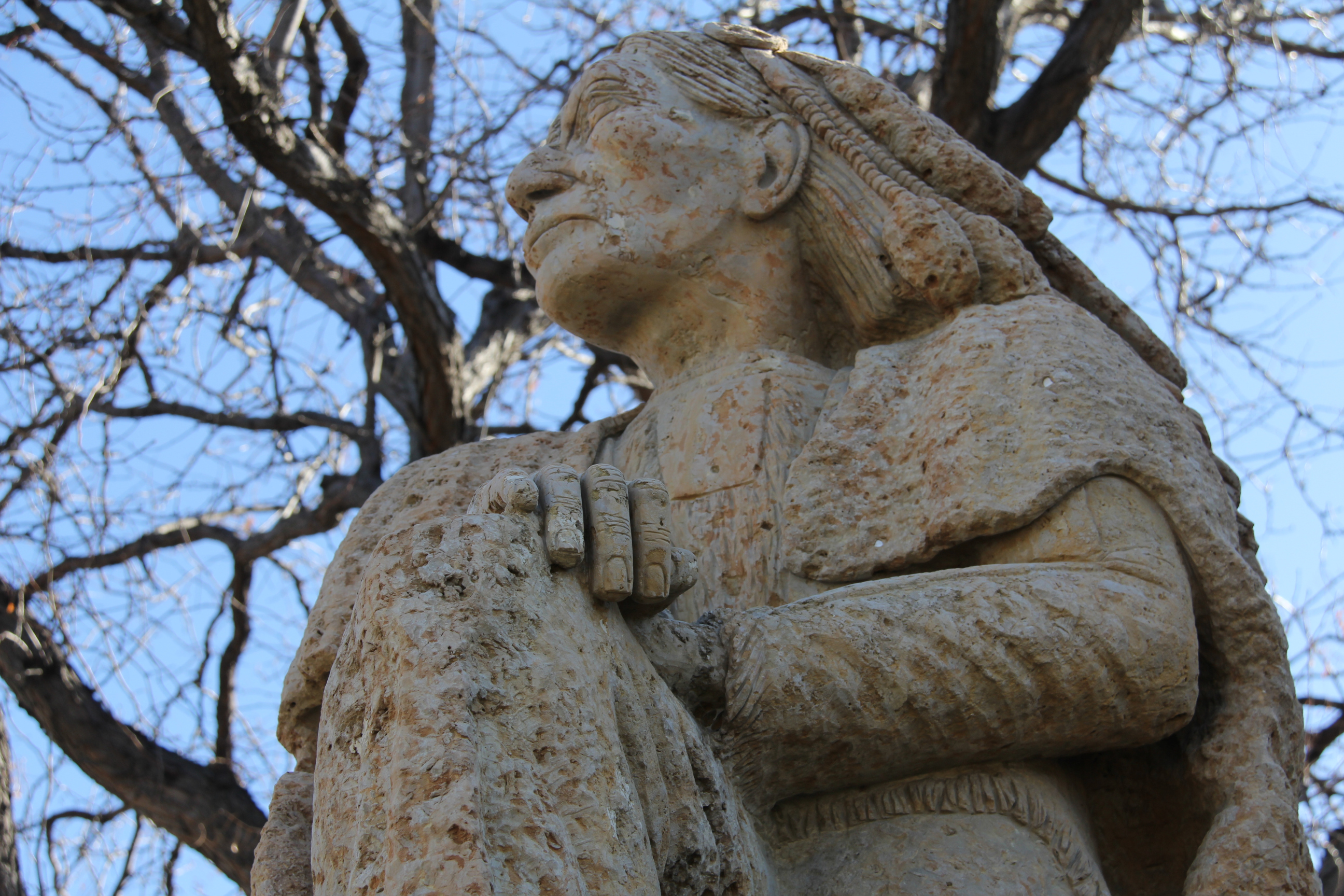
This limestone sculpture by Thomas Miller depicts a Dakota warrior. It sits across from Reconciliation Park in Mankato at the Blue Earth County Library. (Minnesota Prairie Roots copyrighted file photo November 2023)
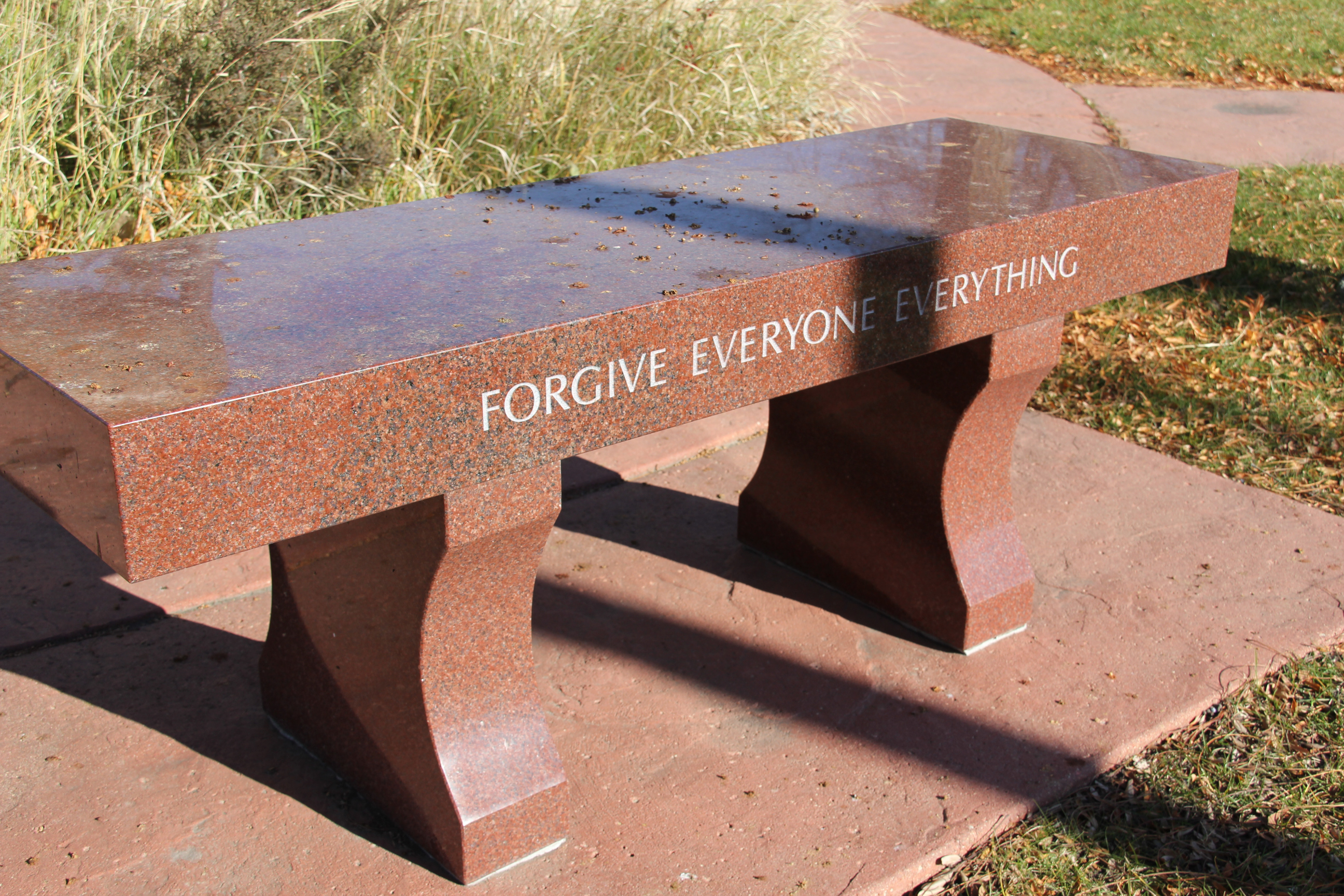
FORGIVE EVERYONE EVERYTHING.
Powerful words on a bench at the Dakota 38 Memorial in Reconciliation Park. (Minnesota Prairie Roots copyrighted file photo November 2023)
Those uppercase engraved block words, white against red on a stone bench at the Dakota 38 Memorial in the heart of downtown Mankato at Reconciliation Park, hold the strength of a people who really have no reason to forgive. But they choose to do so. And in forgiveness comes healing.
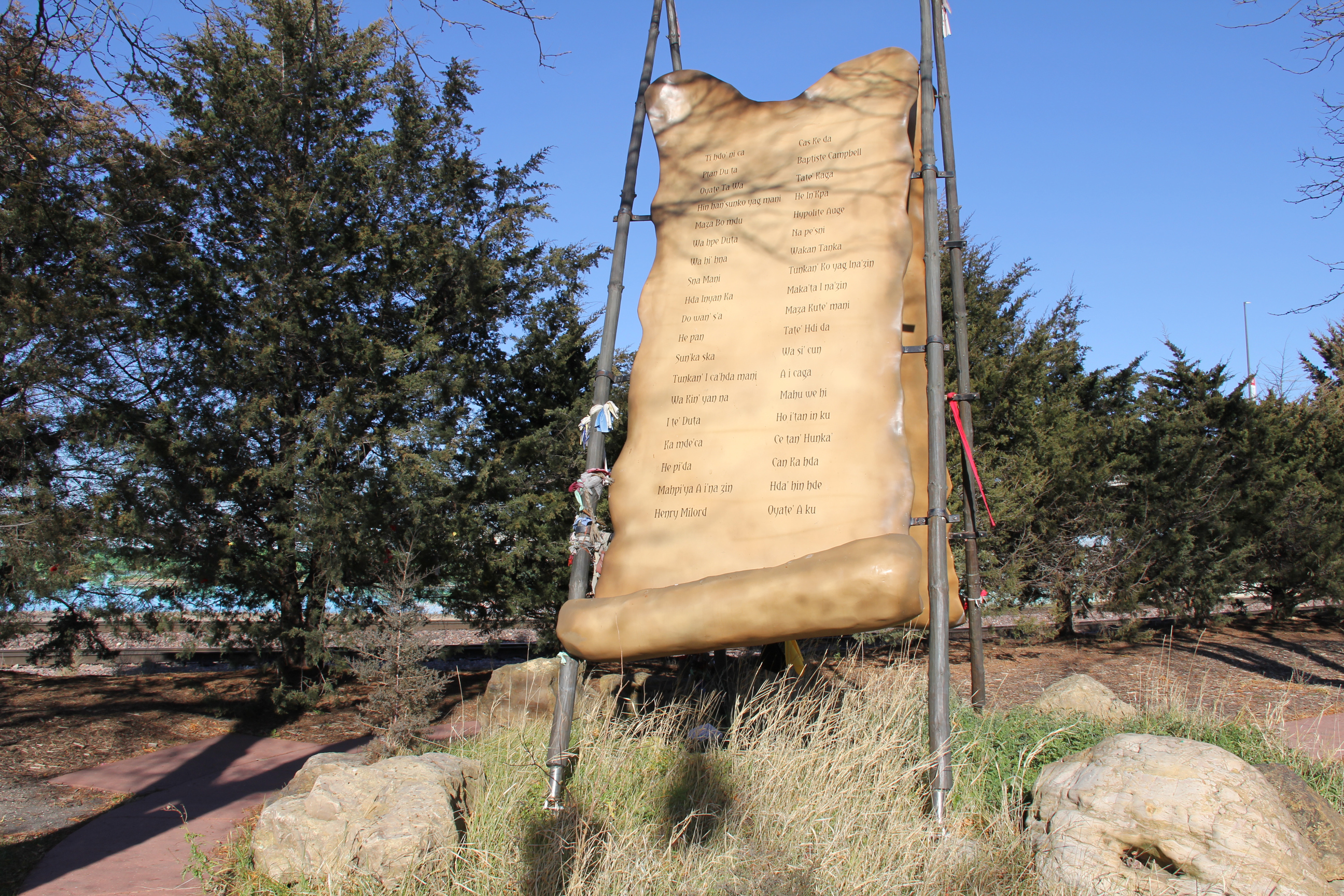
The names of the 38 Dakota men hung in Mankato are listed on the Dakota 38 Memorial. (Minnesota Prairie Roots copyrighted file photo November 2023)
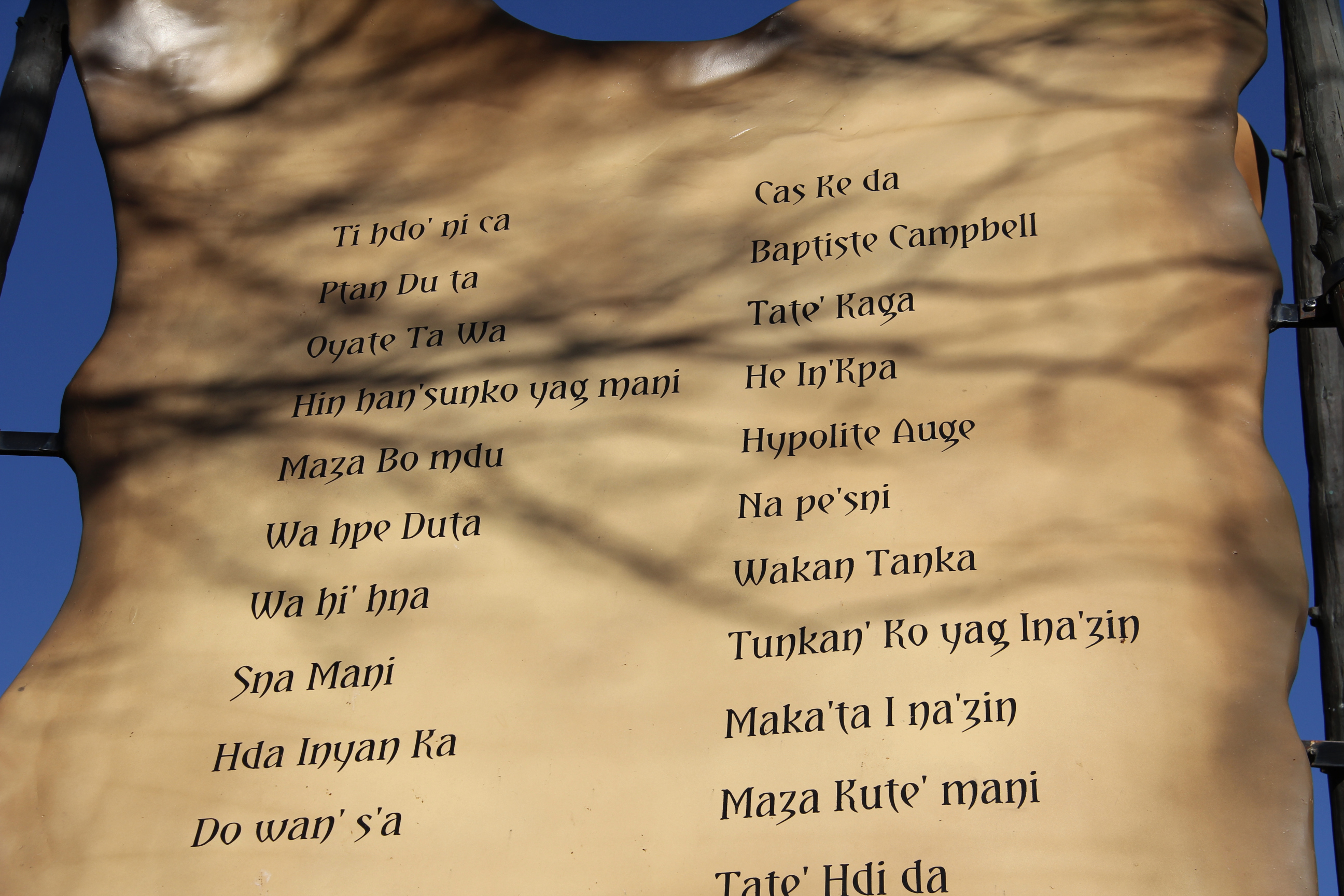
December 26 marks the date in 1862 when 38 Dakota men were hung near this site along the Minnesota River in America’s largest mass execution. Originally, 303 Dakota were sentenced to death following “trials” (the quotes are intentional) after the U.S.-Dakota War of 1862. President Abraham Lincoln reviewed the list of those sentenced to death, approving the hanging of thirty-eight. Thousands gathered to watch the execution on the day after Christmas 162 years ago.
Up close, names of the Dakota who were hung. (Minnesota Prairie Roots copyrighted file photo November 2023)
This history I learned early on, but only from a White perspective and only because of my roots in southwestern Minnesota, at the epicenter of the war. I expect many Americans, including many Minnesotans, to this day know nothing of this conflict that killed hundreds of Whites and Dakota. Internment and exile of the Dakota followed. Native Peoples suffered because of the atrocities before and after the war.
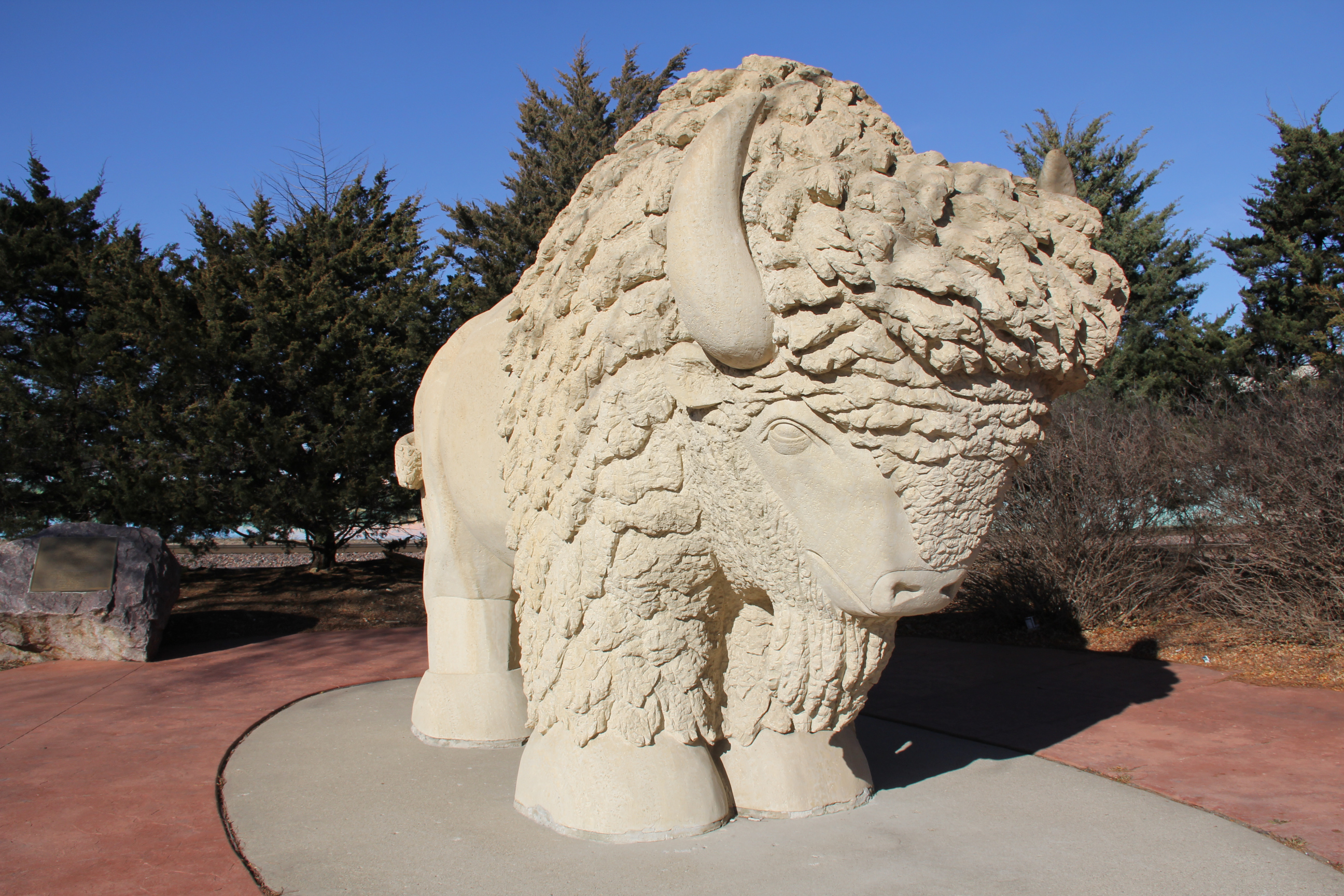
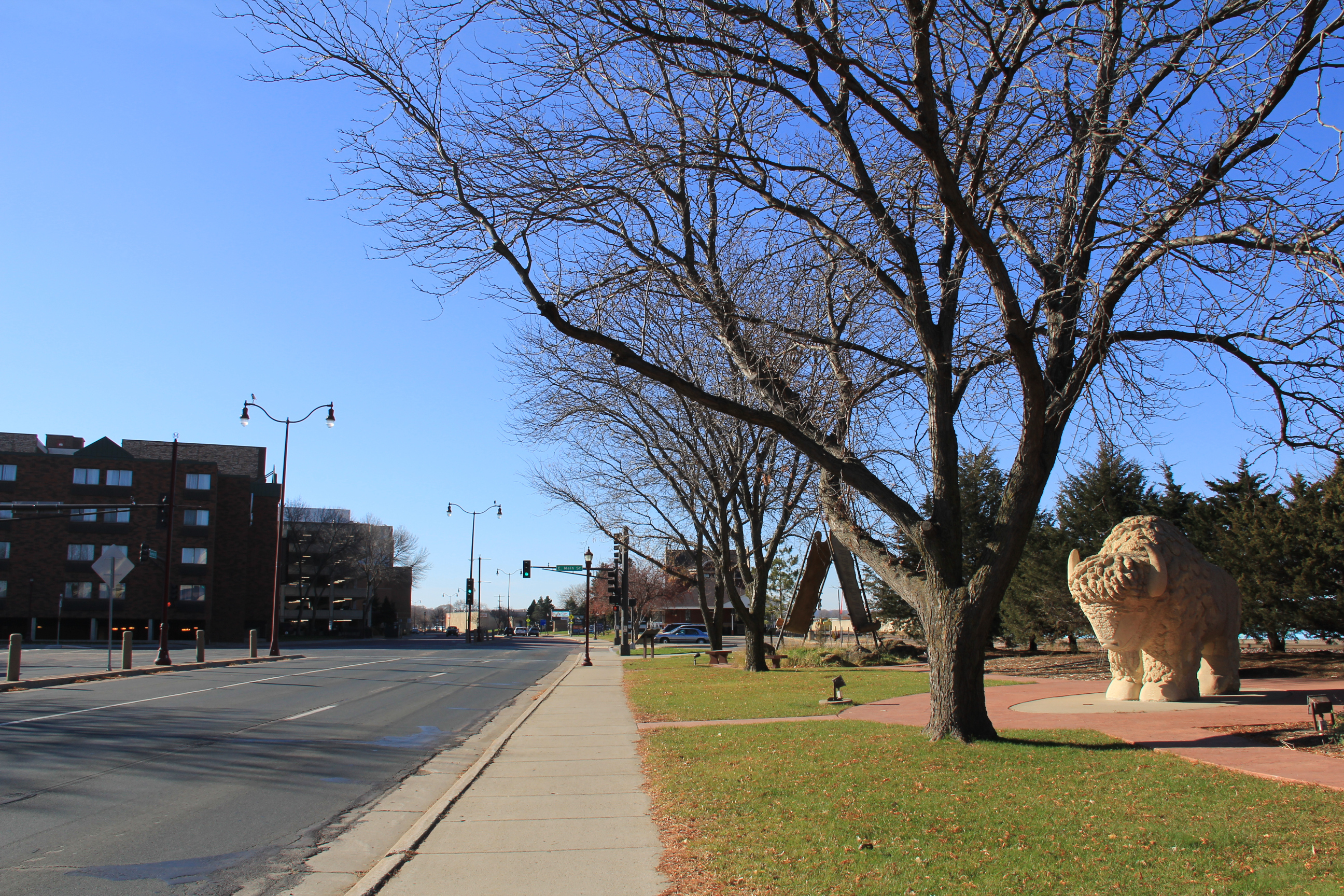
A massive limestone sculpture of a white buffalo in Reconciliation Park represents the spiritual survival of the Dakota. (Minnesota Prairie Roots copyrighted file photo November 2023)
This is history I’d encourage everyone to study. And not just from a one-sided perspective. I won’t pretend that I am fully-informed. I’m not. I do, though, have a much better understanding than I did growing up. I’ve read, listened, learned. I know of stolen land, broken treaties and promises. Starvation. Injustices. Demeaning words like those attributed to a trader who told starving Dakota to “eat grass.” Andrew Myrick was later reportedly found dead, his mouth stuffed with grass.
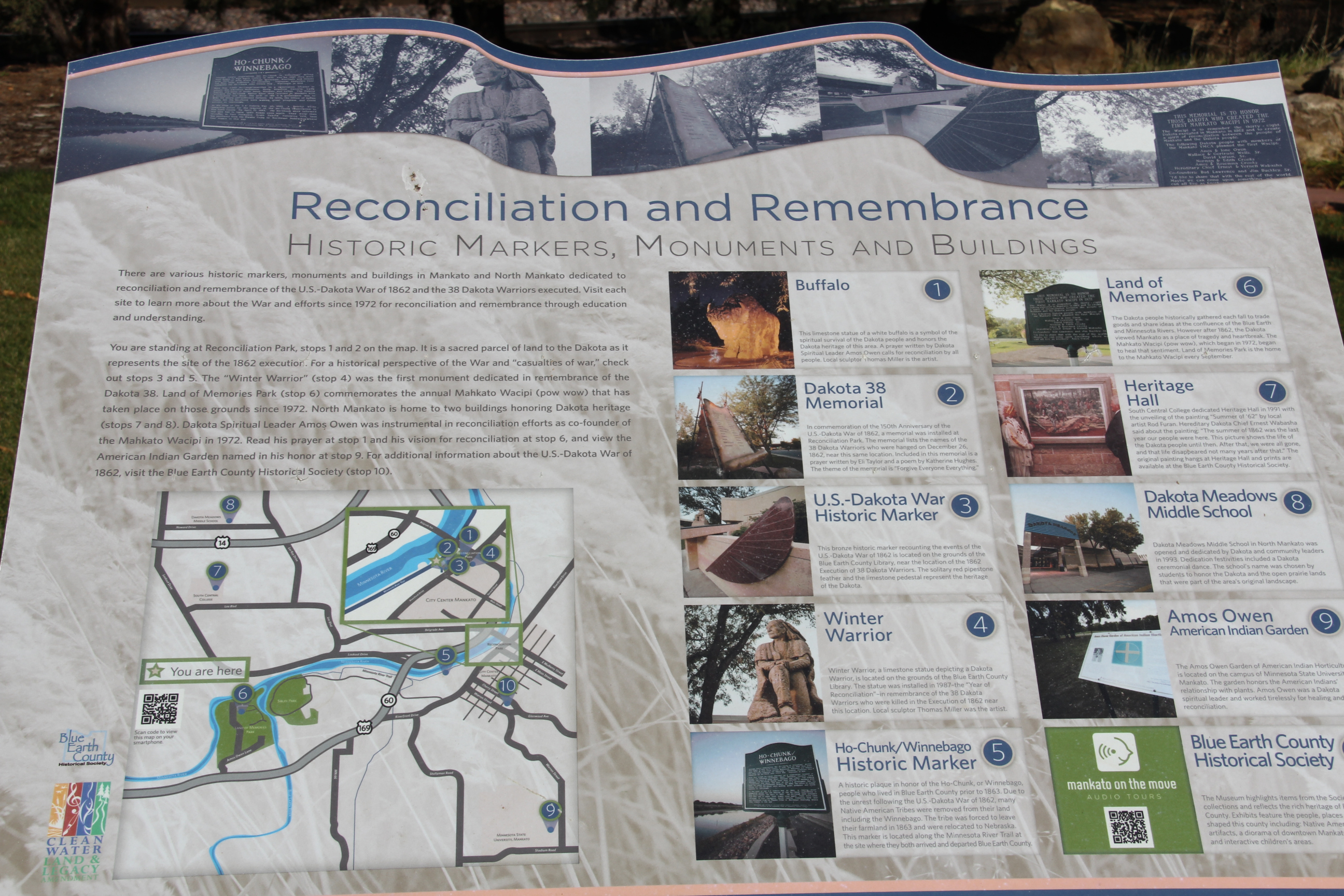
A sign in Reconciliation Park directs visitors to the many sites around Mankato focused on reconciliation and remembrance. (Minnesota Prairie Roots copyrighted file photo November 2023)
But back to those three words on that stone bench in Mankato: FORGIVE EVERYONE EVERYTHING. The Dakota truly have no reason to forgive. But they choose to do so. I’ve learned that forgiveness is part of Dakota culture and beliefs.
An overview of the location of Reconciliation Park along Riverfront Drive in Mankato, along the Minnesota River and across from the public library. (Minnesota Prairie Roots copyrighted file photo November 2023)
In the month of December, the attitude of forgiveness extends beyond words in stone to an annual horseback ride honoring the 38+2 (two more Dakota were sentenced to death two years later). This year, two rides—The Makatoh Reconciliation & Healing Horse Ride and The Dakota Exile Ride, the first originating in South Dakota, the other in Nebraska—will end on December 26 with gatherings at Reconciliation Park and the Blue Earth County Library, located across from each other.
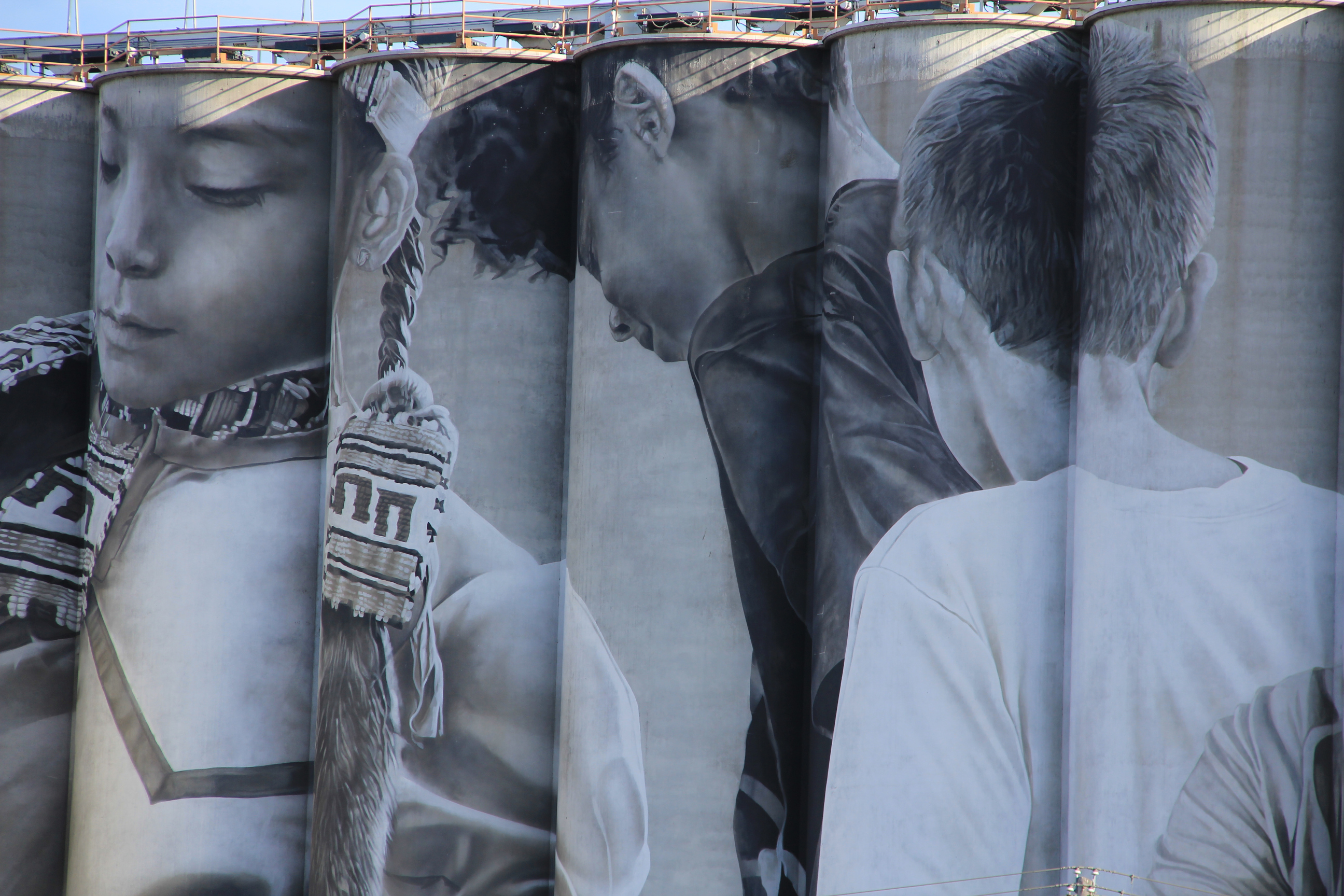
Just down the street from Reconciliation Park, murals on the Ardent Mills grain silos celebrate the diversity of Mankato, including that of the Dakota. (Minnesota Prairie Roots copyrighted file photo November 2023)
These rides focus on educating, remembering, honoring, healing and forgiving. Five powerful verbs when connected with the U.S.-Dakota War of 1862.
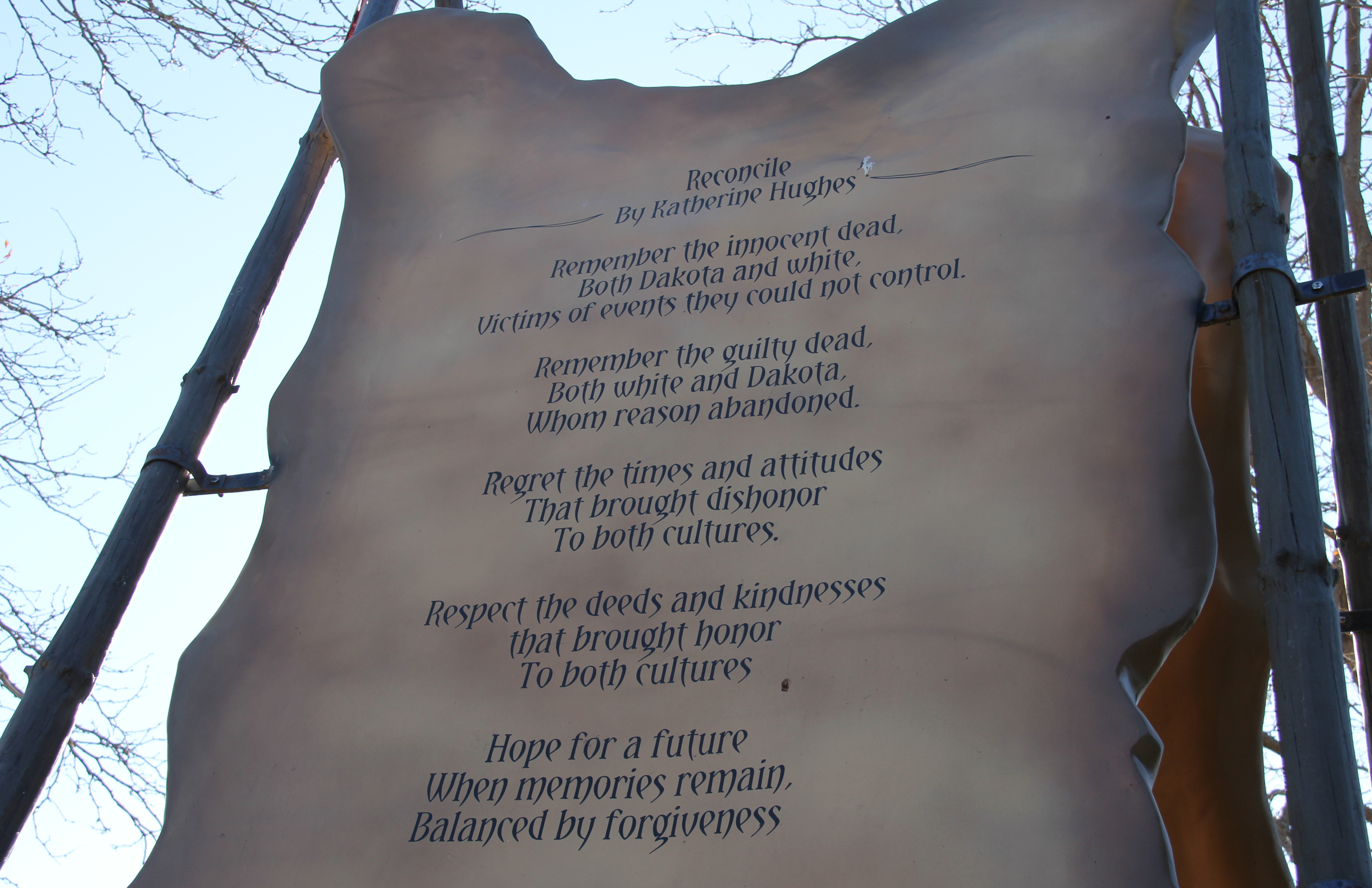
Katherine Hughes’ poem ends with the word “forgiveness.” (Minnesota Prairie Roots copyrighted file photo November 2023)
The poem “Reconcile,” written by Katherine Hughes and posted in Reconciliation Park, closes with this powerful verse: Hope for a future/When memories remain/Balanced by forgiveness.
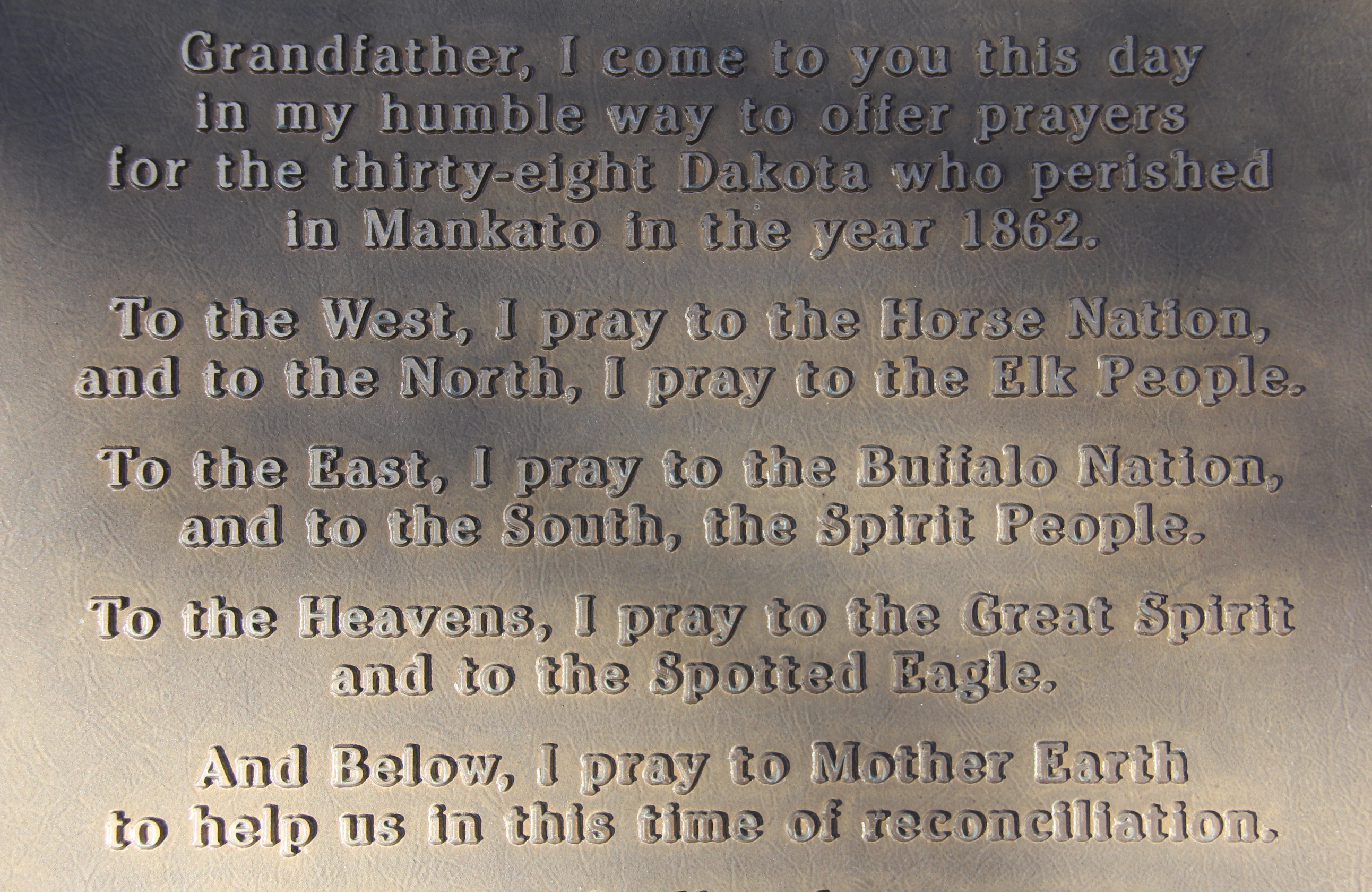
A Dakota prayer in the park ends with the word “reconciliation.” (Minnesota Prairie Roots copyrighted file photo November 2023)
FORGIVE EVERYONE EVERYTHING.
#
FYI: Here’s the schedule for the December 26 events. A community gathering is set for 9 am-10 am at Reconciliation Park and the library. Horseback riders arrive at 10 a.m. A ceremony in the park takes place from 10 am-11:30 am. From 11:30 am-1 pm, a healing circle will happen at the library with discussion surrounding the events of December 26, 1862, covering the past, present and future. A community meal for the horseback riders, who rode hundreds of miles to Mankato, follows.
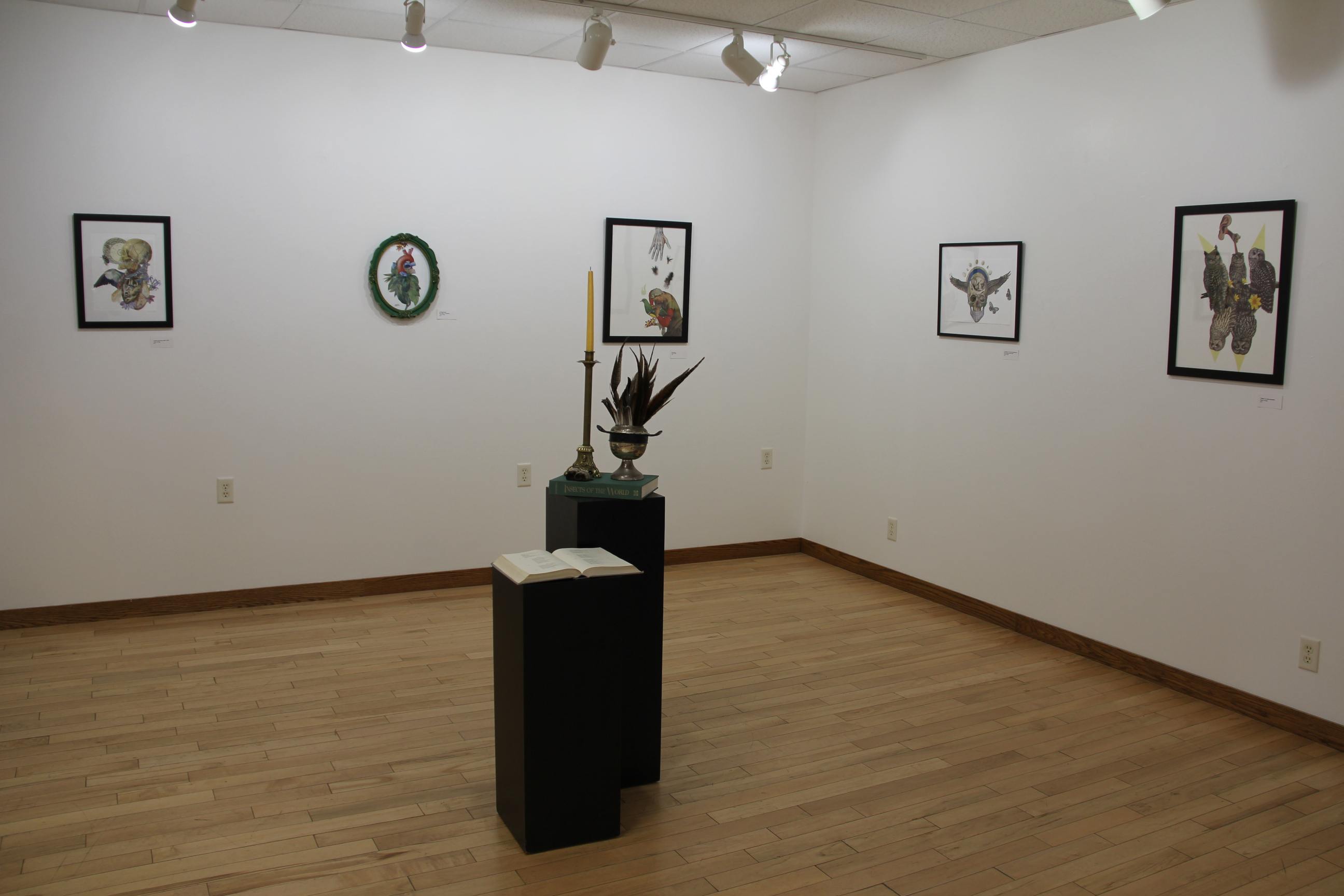
In a corner of the main floor gallery, Dodge also created a mood setting still life fronting her collage art. (Minnesota Prairie Roots copyrighted photo October 2024)
When I returned home from viewing Dodge’s work, I checked out two books of Dickinson’s poetry from the Faribault library to refresh my understanding of this recluse poet’s writing. She wrote most of her poems between 1862-1865. At one time, I really liked her poetry, maybe even understood some of it. Now? I struggled. Yet, I still delight in these words by Dickinson: “Hope” is the thing with feathers/ That perches in the soul/And sings the tune without the words/And never stops at all.
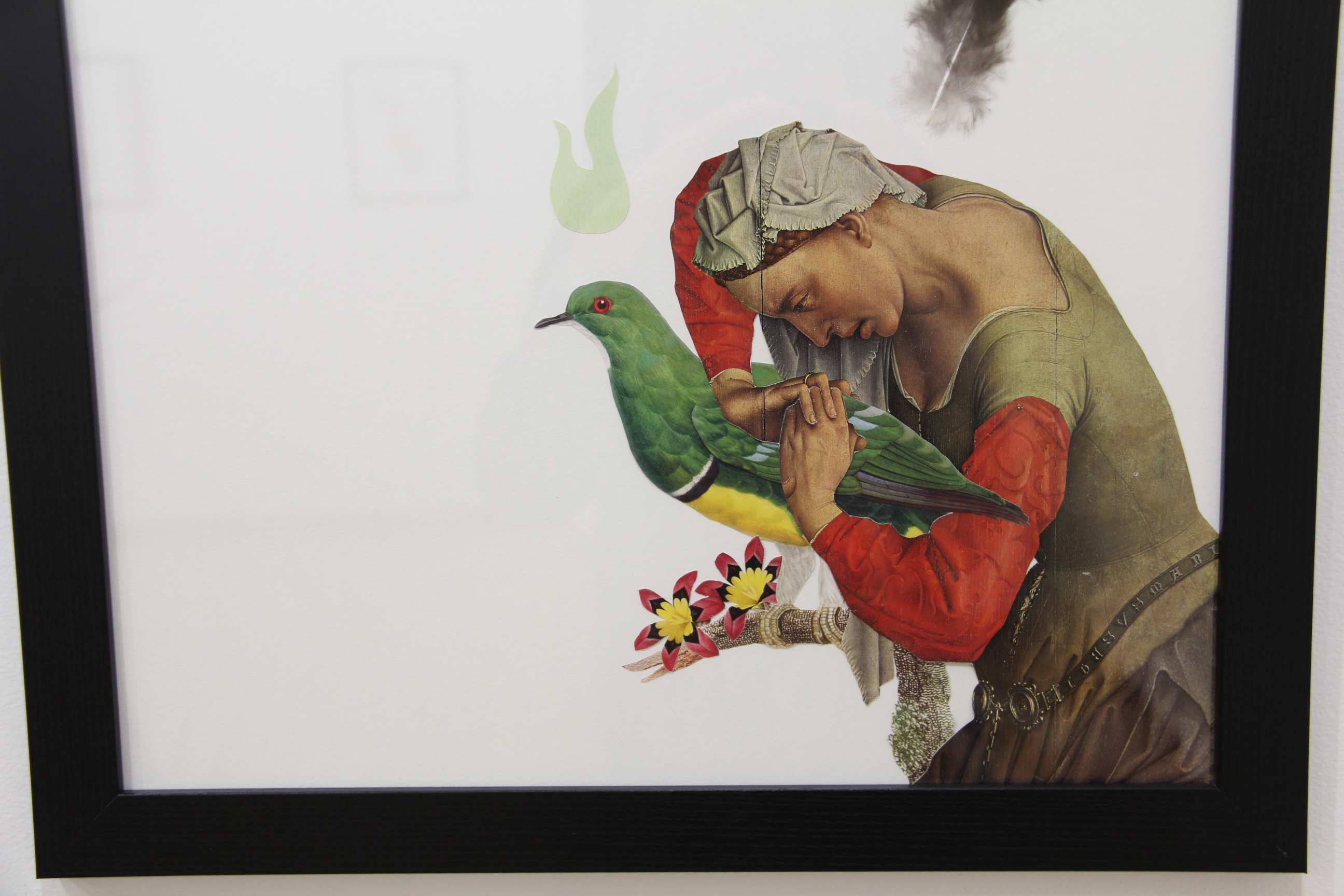
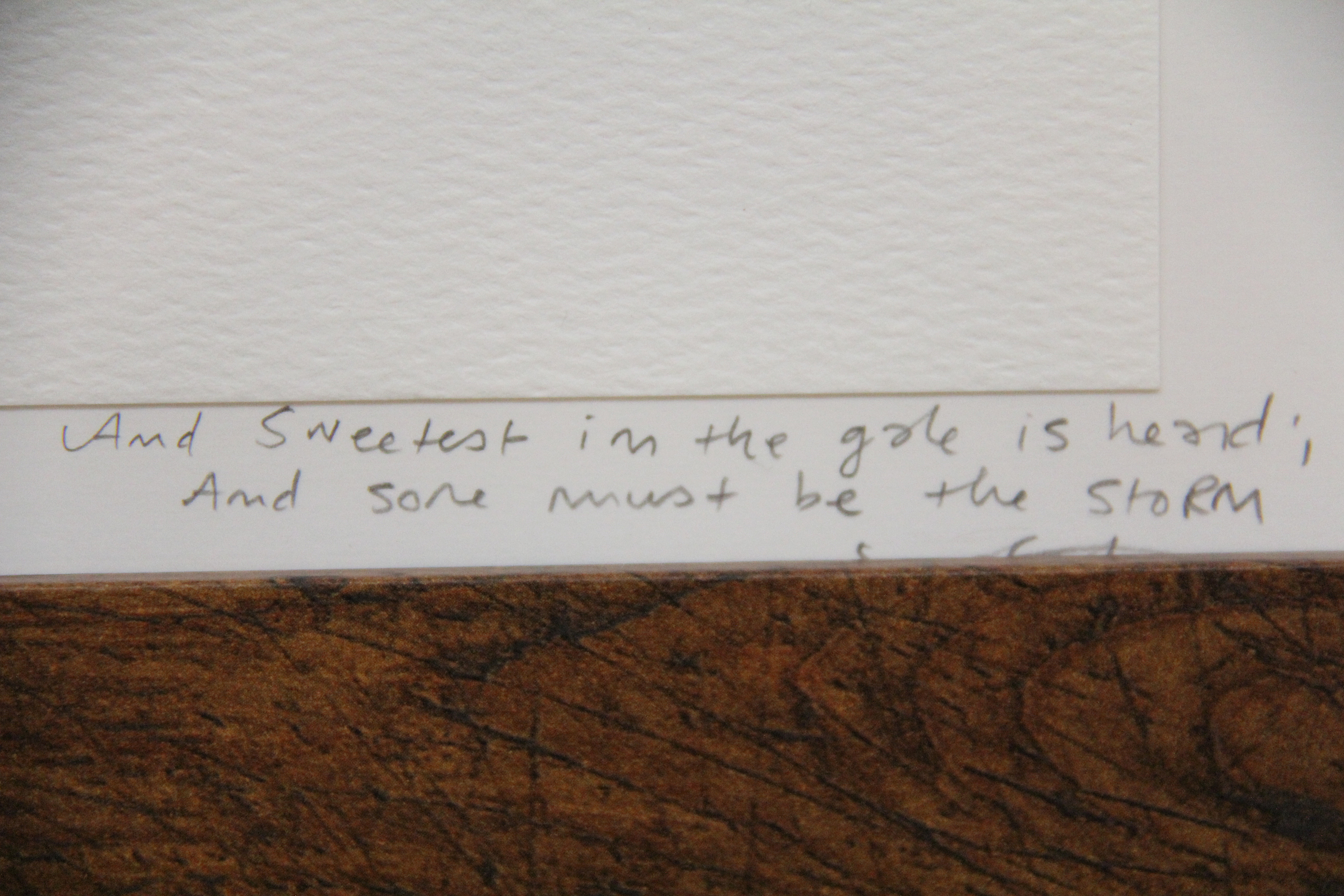
In this collage, a portion shown here. I see Emily Dickinson. It’s titled “And sweetest in the gale is heard; And sore must be the storm.” (Minnesota Prairie Roots copyrighted photo October 2024)
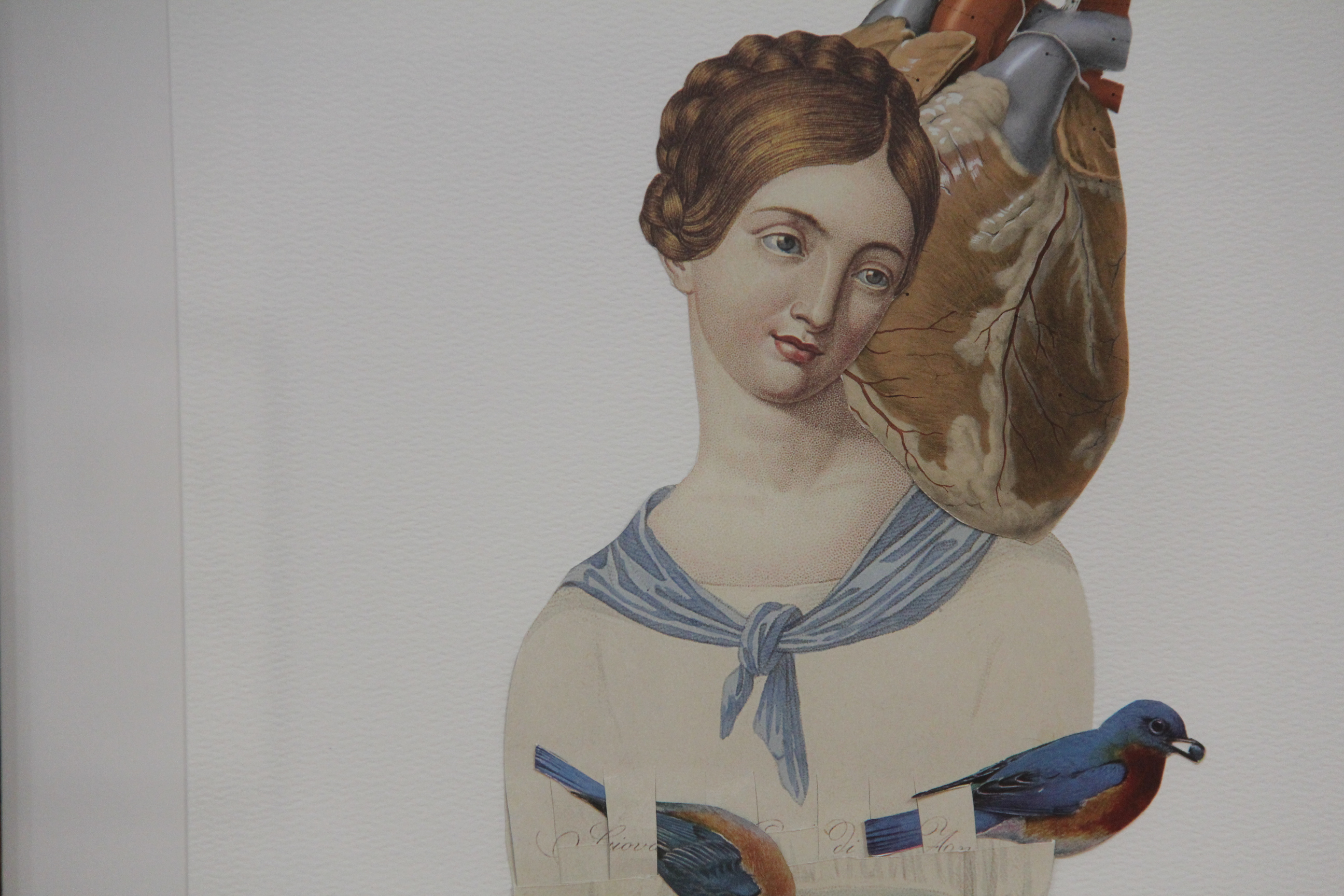
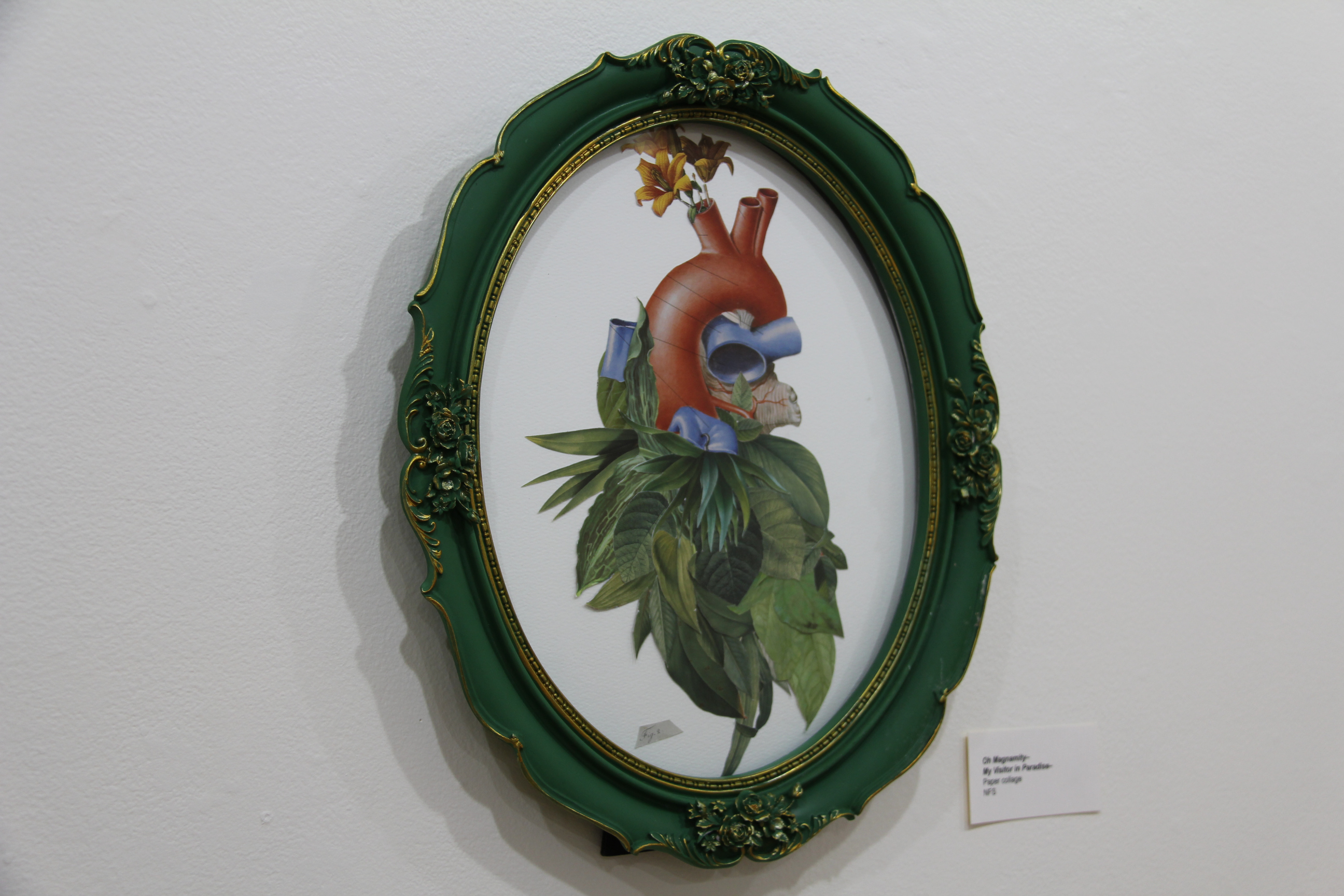
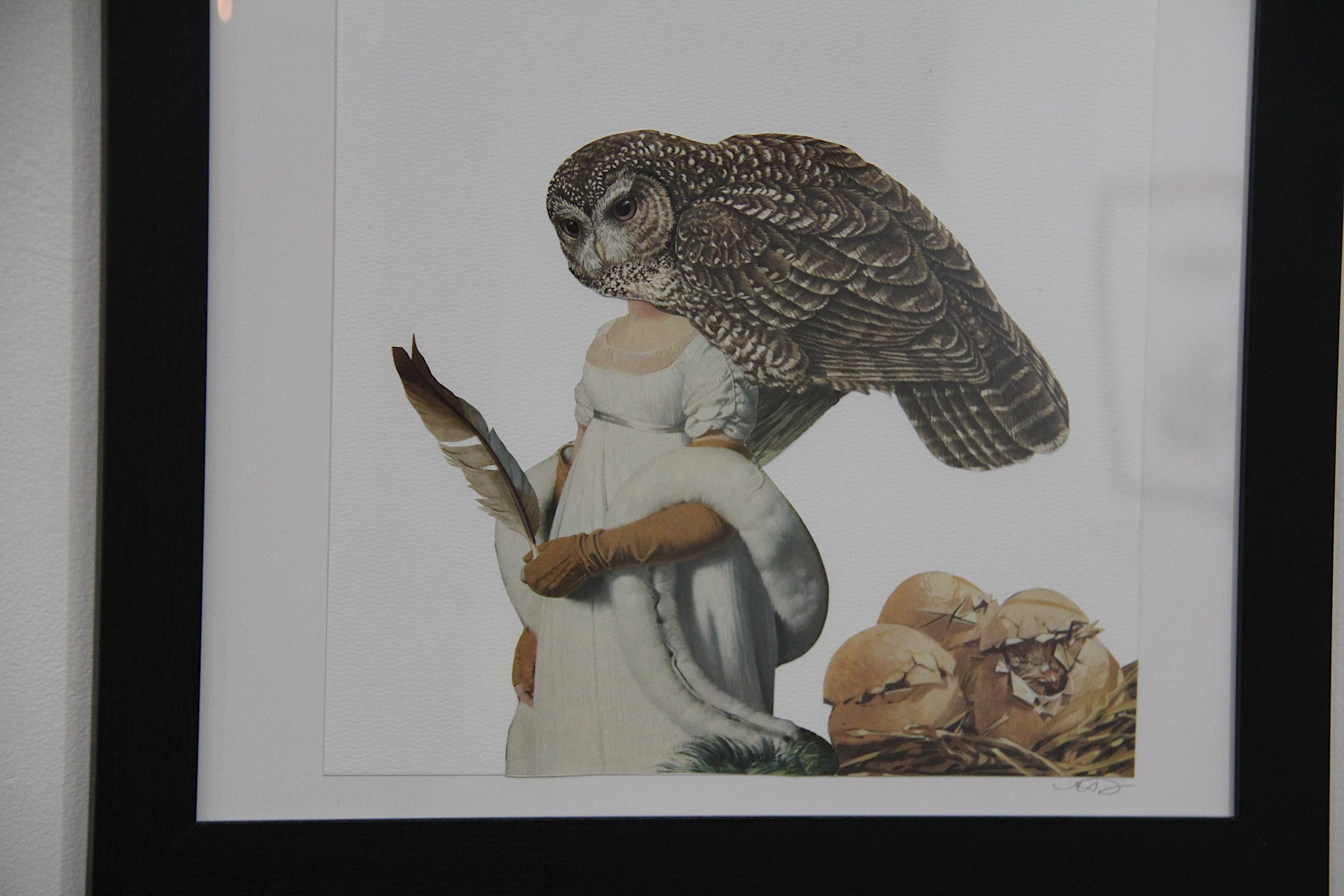
In viewing Dodge’s art, I could assuredly see the influence of Dickinson. In her artist statement, Dodge writes: “Her (Dickinson’s) fragmented, lyrical, elocutionary methods reminded me of the elements I was cutting out of books.” Dodge cut mostly flora, fauna and anatomical images from books to create her collages.
Titled “Oh Magnamity–My Visitor in Paradise.” (Minnesota Prairie Roots copyrighted photo October 2024)
Titled “I know that He exists. Somewhere–in silence.” (Minnesota Prairie Roots copyrighted photo October 2024)
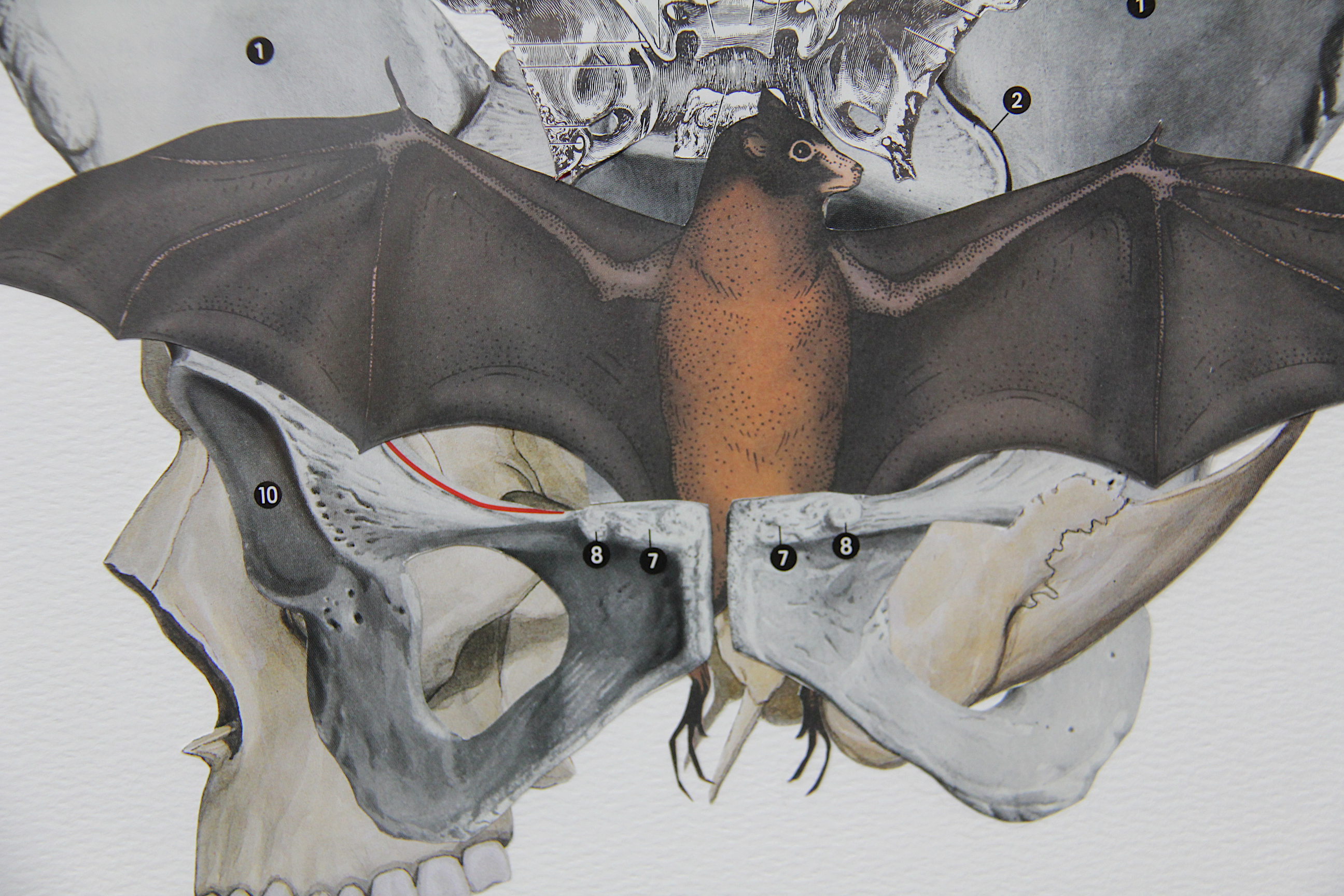
A collage titled “How softly sinks that troubling Sun In Human Nature’s West” incorporates an anatomical bat cut-out. (Minnesota Prairie Roots copyrighted photo October 2024)
It’s the anatomical aspect that pushed my mind toward scary thoughts. I doubt Dodge intended that. But given we are closing in on Halloween and body parts and birds and bats can be the stuff of fright, I leaned into that perspective.
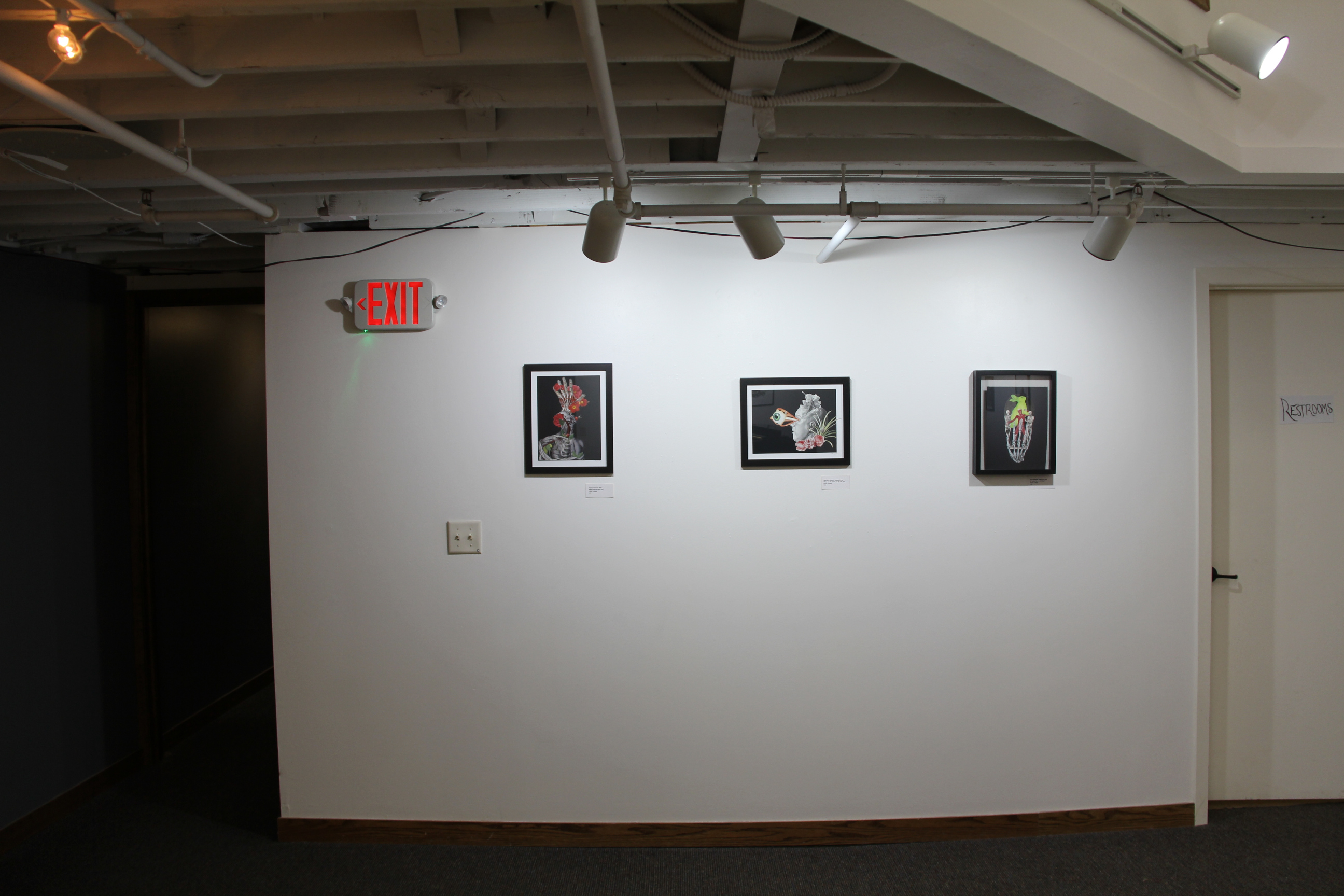
In the lower gallery, I found the eyeball popping collage, center, among a trio or art pieces hung on a wall. (Minnesota Prairie Roots copyrighted photo October 2024)
I termed Dodge’s collages initially as “ghoulish.” But the more I looked, the more I pondered, the more I connected her creations to Dickinson’s poems, the less I thought unsettling thoughts. Sure there are skulls and a popping eyeball and a chambered heart and bat and birds and such. But intermixed are the loveliness of flowers and plants and even a portrait that could be Emily Dickinson.
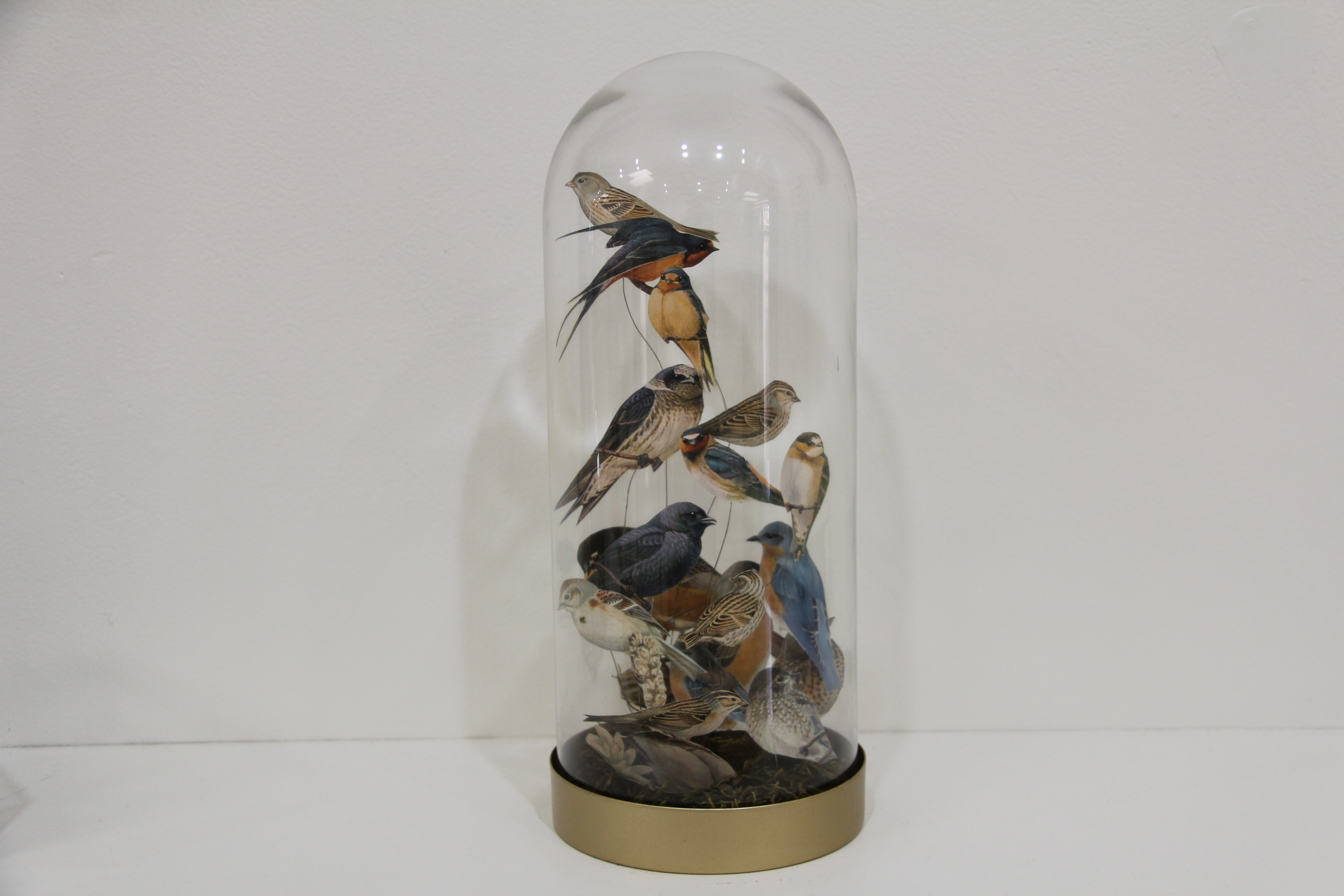
Tabletop domed art titled “God gave a loaf to every bird, But just a crumb to me.” (Minnesota Prairie Roots copyrighted photo October 2024)
The thing about art is that it is open to interpretation. We each bring our own experiences, our own biases, our own ideas to any art we view. But then an artist like Dodge, whose talent shines, causes us to pause and look through a clear lens. I could stretch my within to beyond.
Some titles are handwritten on the art. (Minnesota Prairie Roots copyrighted photo October 2024)
Dodge titled many of her pieces directly after the words of Dickinson, who never titled her poems. Titles lend themselves to insights into Dodge’s artwork.
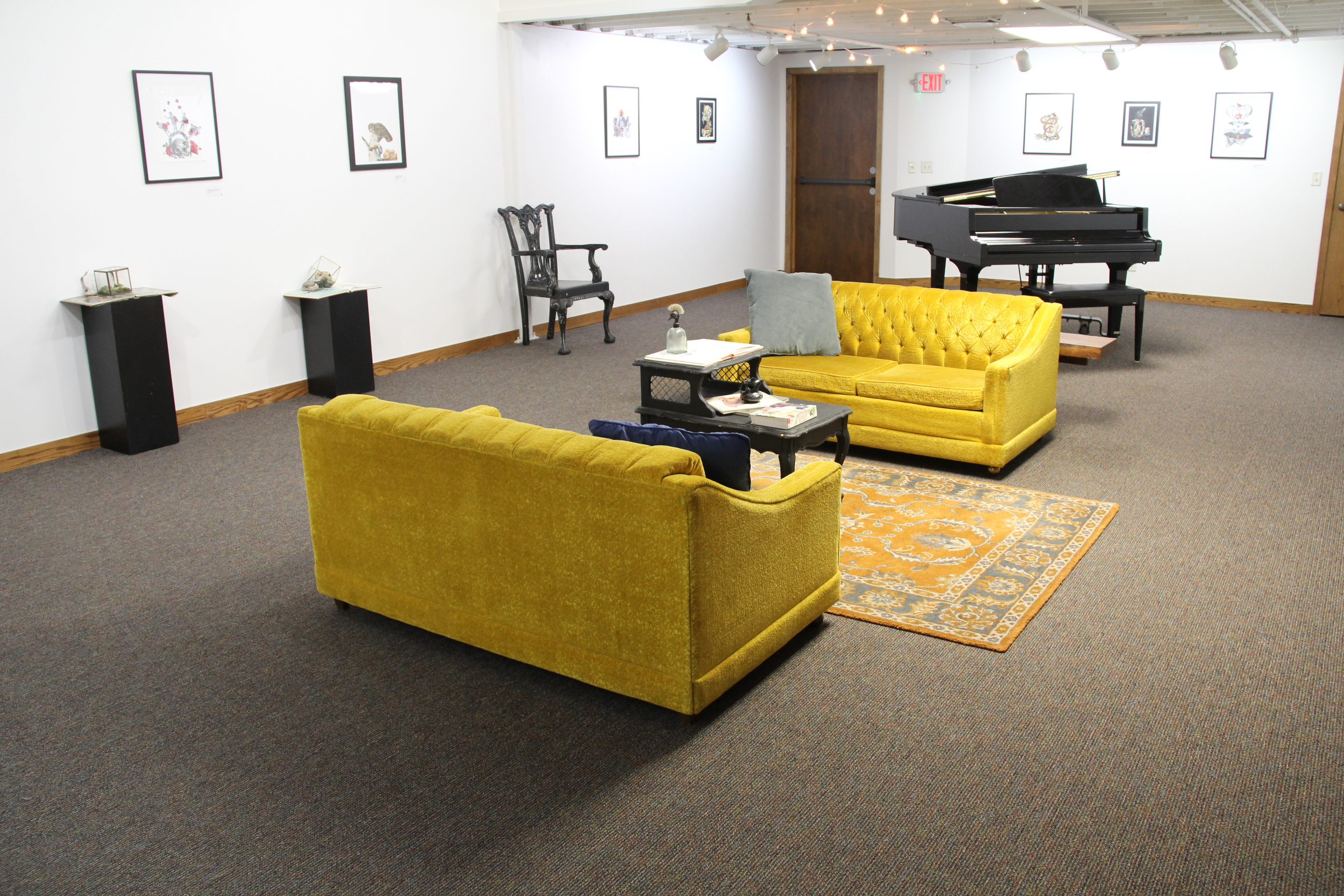
The lower level multi-purpose space where Dodge’s art is also showcased. (Minnesota Prairie Roots copyrighted photo October 2024)
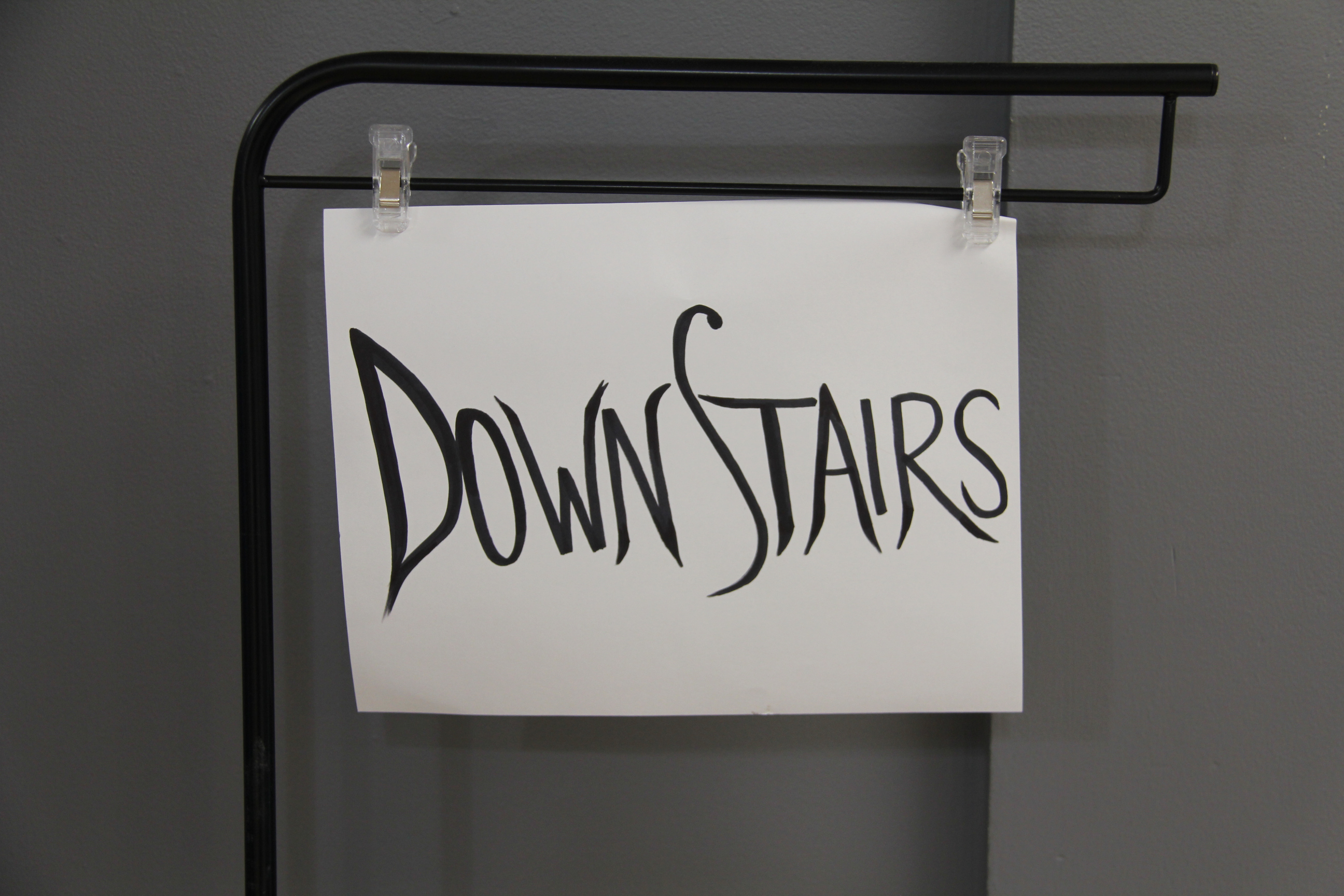
Even the sign directing visitors to the lower level is artsy. (Minnesota Prairie Roots copyrighted photo October 2024)
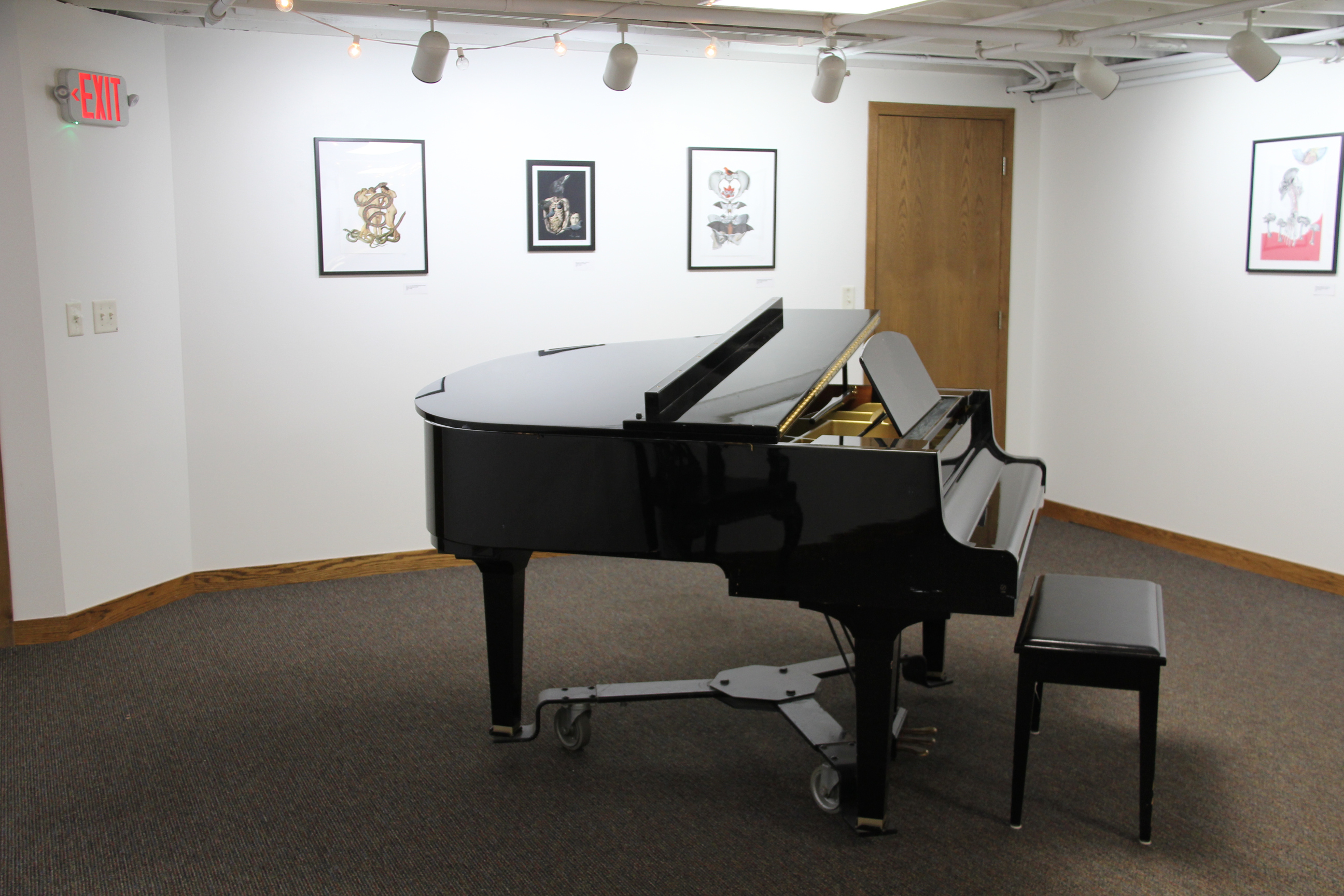
I didn’t expect to see a grand piano in the lower level gallery space. (Minnesota Prairie Roots copyrighted photo October 2024)
I never tire of viewing art in a gallery like that of the Arts Center of Saint Peter, where Dodge’s collages grace walls on the main level and also downstairs in a space centered by a sitting area and a grand piano. Greater Minnesota is home to some wonderful galleries and to incredible talent.
Another still life by Holly Dodge placed among her framed collages. (Minnesota Prairie Roots copyrighted photo October 2024)
I encourage you, wherever you live, to embrace the art and artists who share their talents in your town, your region. I don’t need to travel to a metro area to see inspiring, thought-provoking art.
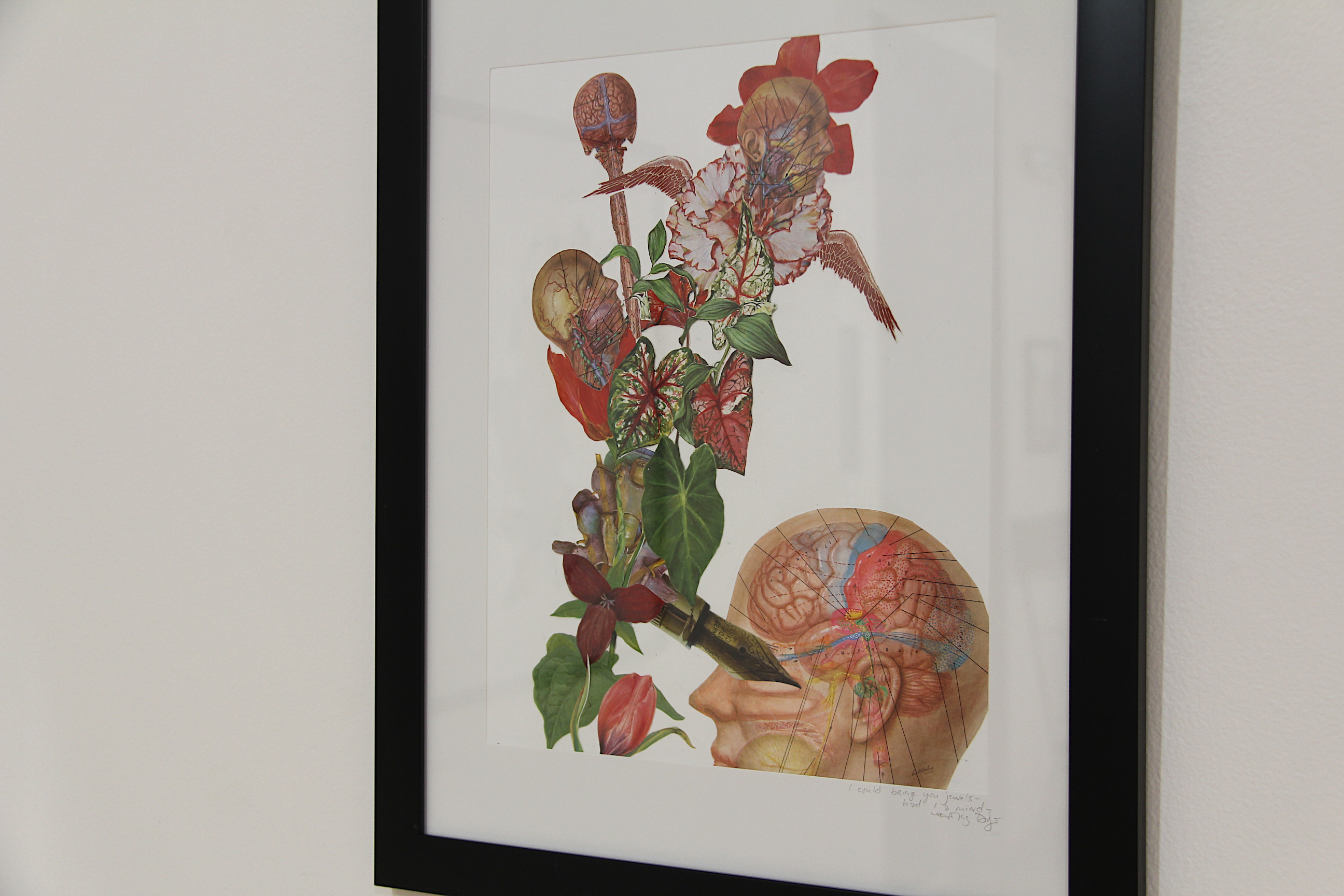
Dodge’s piece titled “I could bring you jewels–Had I a mind.” (Minnesota Prairie Roots copyrighted photo October 2024)
In the words of Emily Dickinson, “I could bring You Jewels—had I a mind to.” Holly Dodge has brought us jewels, as have so many other artists who create and share their art here in southern Minnesota.
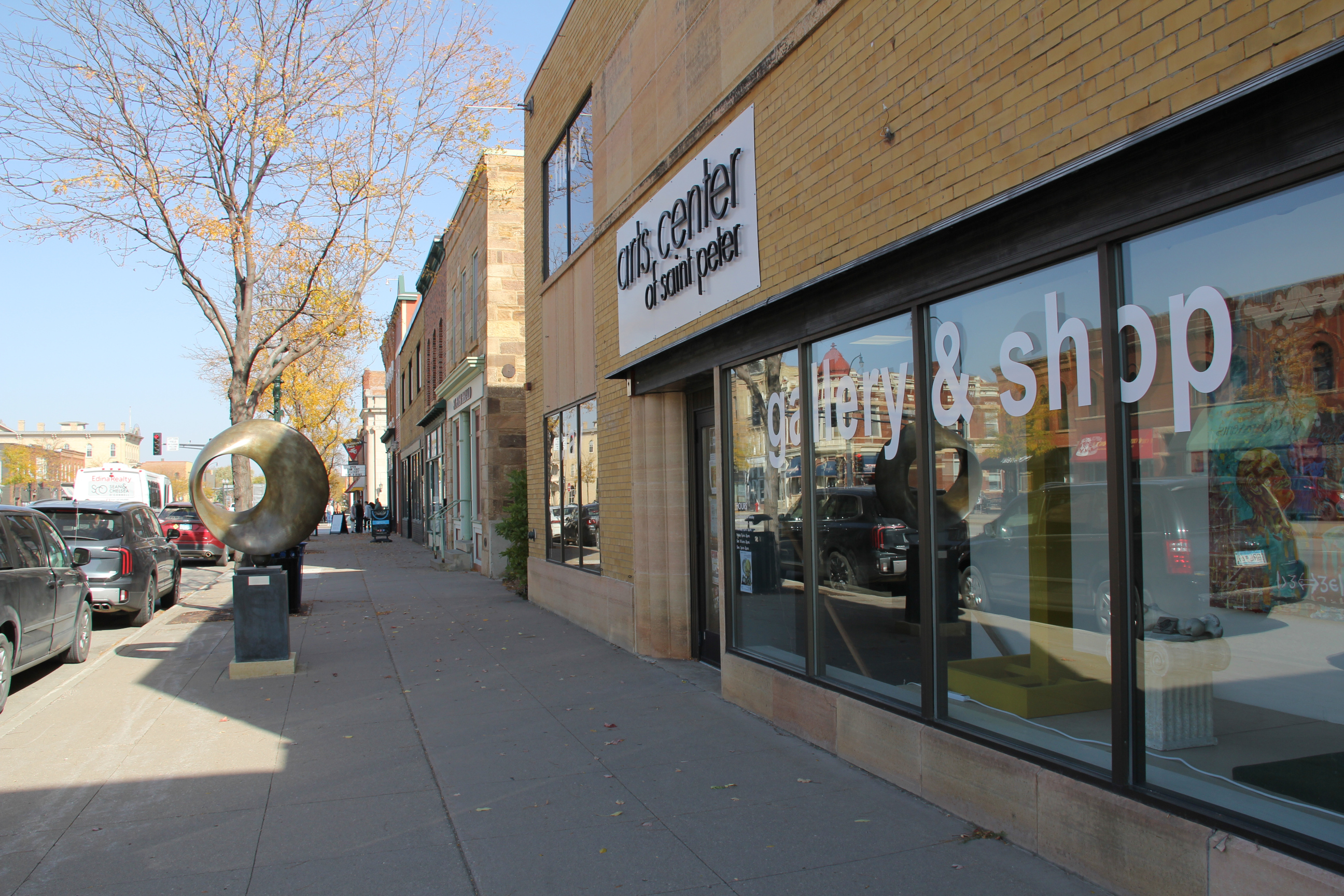
The Arts Center of Saint Peter is along busy Minnesota Avenue/Highway 169 running through downtown. (Minnesota Prairie Roots copyrighted photo October 2024)
FYI:The Arts Center of Saint Peter gallery hours are 1-5 p.m. Wednesday-Friday, 10 a.m.-5 p.m. Saturday and 1- 5 p.m. Sunday. The center is located at 315 South Minnesota Avenue in the heart of downtown St. Peter.
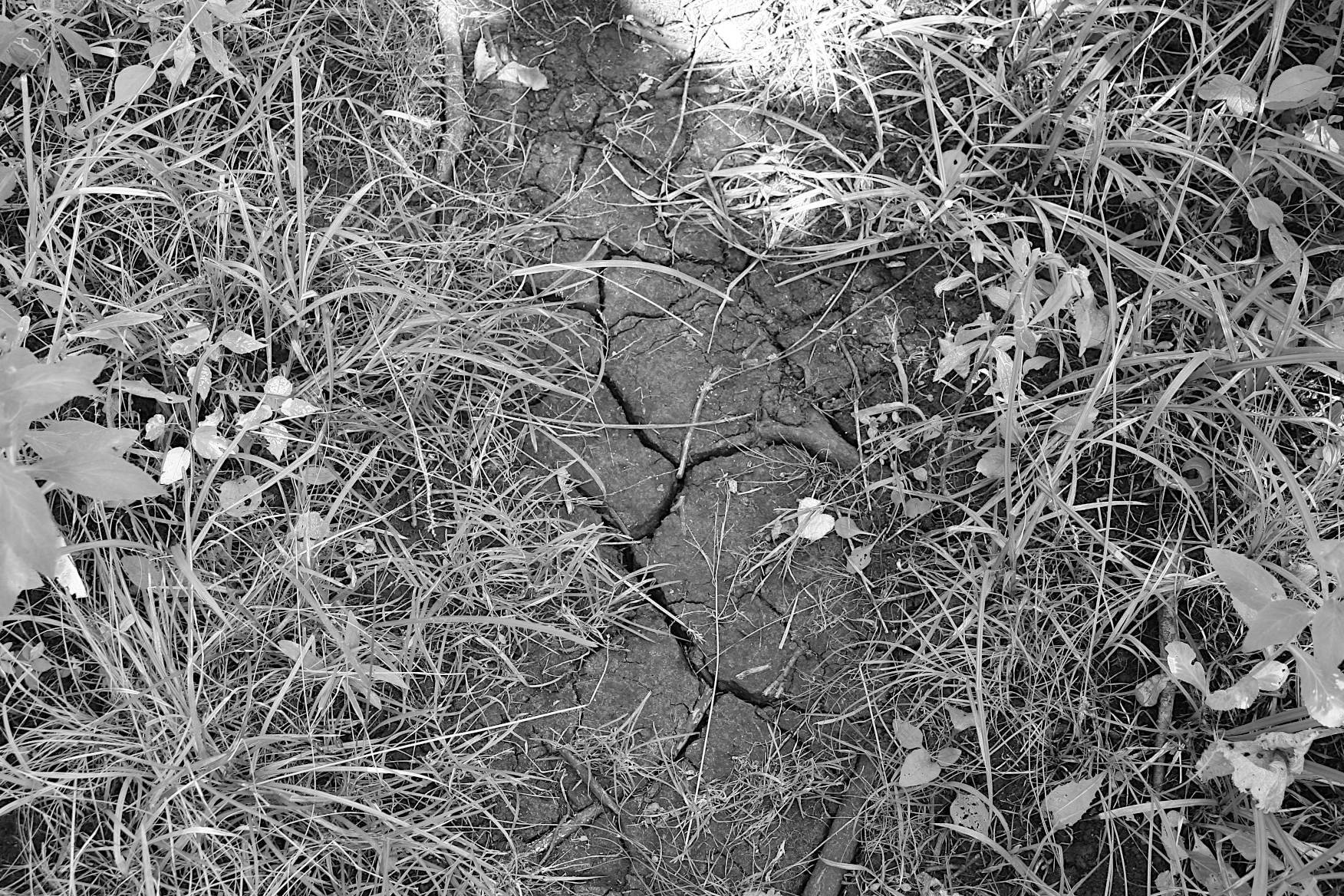
Parched, cracked earth by the Turtle Pond, River Bend Nature Center. (Minnesota Prairie Roots copyrighted file photo August 2021, used for illustration only)
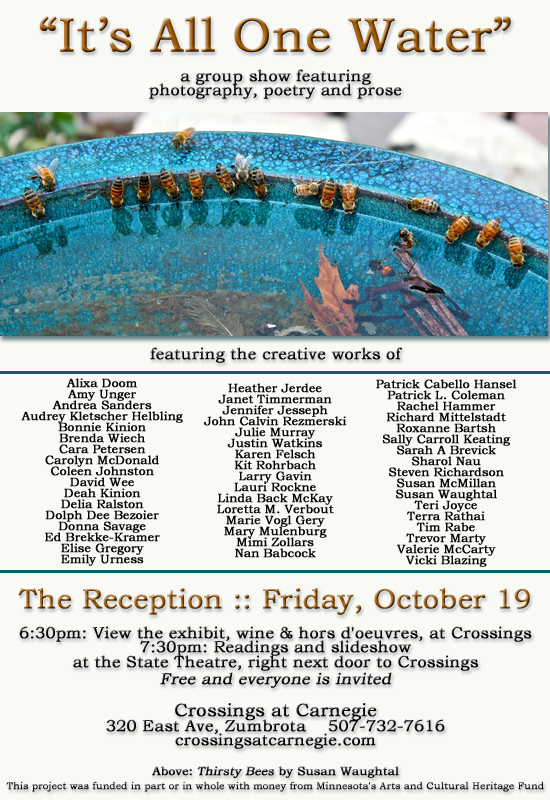
The invitation to the 2012 “It’s All One Water” reception and group show in Zumbrota.
The winning entries were printed in a beautiful 55-page booklet that paired the writing with submitted photos, all themed to water. I opted to pen a poem personifying Autumn as a woman searching for water upon the parched land. To this day I still love that strong visual, inspired by my long ago observations at River Bend Nature Center in Faribault.
And if I were to tap further into my visual memory, I would also see a semi trailer full of hay parked in a southwestern Minnesota farmyard in the summer of 1976. That was a year of severe drought, when my dad bought a boxcar full of hay from Montana so he could feed his cows and livestock. It was the year that nearly broke him as a farmer.
A REALLY DRY & WARM SEPTEMBER IN MINNESOTA
Here we are, 48 years later, settling once again into drought/abnormally dry weather conditions in Minnesota after a winter of minimal snow followed by an excessively wet spring, a dry-ish summer and now a record warm and dry September. This September, the Twin Cities recorded only 0.06 inches of rain and the most days of 80-degree or warmer high temps in any September. It doesn’t feel like fall in Minnesota, more like summer. But at least temperatures cool overnight.
Areas of western and central Minnesota are under a Red Flag Warning today, code words for a high fire danger, due to dry, windy conditions and dropping relative humidity. We are experiencing “near critical fire weather conditions” here in the southern part of the state.
AND THEN THERE’S TOO MUCH WATER
Contrast this with the weather my friends in western North Carolina and other areas affected by Hurricane Helene are experiencing. One is OK (as is her house). But she expects to be without power for a week and is relying on limited cell service at the local firehall. Another friend, a native Minnesotan, lost his car and may lose his home in Hendersonville after a creek swelled, flooding his garage (with four feet of water) and house (30 inches of floodwaters). A foundation wall “blew out” of his home. He is currently staying with family in Florida.
So, yes, even though the lack of rain and abnormally warm weather in Minnesota concern me, I feel a deeper concern for the folks dealing with loss of homes, businesses, infrastructures and, especially, deaths of loved ones. The devastation is horrific. It will take months, if not years, to recover.
RESPECT FOR WATER & MY POEM
In 2012, the following statement published in the intro to “It’s All One Water”: It is our hope to inspire respect, protection, preservation and awe in honor of water, our most precious of Natural Resources. How one views water right now depends on where they live. But I think we can all agree that water is “our most precious of Natural Resources.”
Autumn leaves in the Cannon River, Cannon River Wilderness Park. (Minnesota Prairie Roots copyrighted file photo 2021)
In which Autumn searches for Water
Water. The wayward word rises in a faint rasp,
barely a whisper above the drone of buzzing bees
weaving among glorious goldenrods.
I strain to hear as Autumn swishes through tall swaying grass,
strides toward the pond, yearning to quench her thirst
in this season when Sky has remained mostly silent.
But she finds there, at the pond site, the absence of Water,
only thin reeds of cattails and defiant weeds in cracked soil,
deep varicose veins crisscrossing Earth.
She pauses, squats low to the parched ground and murmurs
of an incessant chorus of frogs in the spring,
of Water which once nourished this marshland.
Autumn heaves herself up, considers her options
in a brittle landscape too early withered by lack of rain.
Defeat marks her face. Her shoulders slump. She trudges away, in search of Water.
Getting published in this anthology is a competitive process with blind-judging. The judges—this year a university English professor and writer, a writer who moved to Minnesota for a rural artist-in-residency, and the author of a cozy mystery series—have no idea whose work they are considering for honors. The Jackpine editorial team chooses their top pieces to pass along to the judges for review and awards.
There were 280 submissions from 121 Minnesota writers or writers with a strong connection to our state in the 2024 writing competition. Of those, 113 works from 72 writers were published. That includes 63 poems, 22 creative twist pieces, 15 creative nonfiction stories and 13 fictional stories.
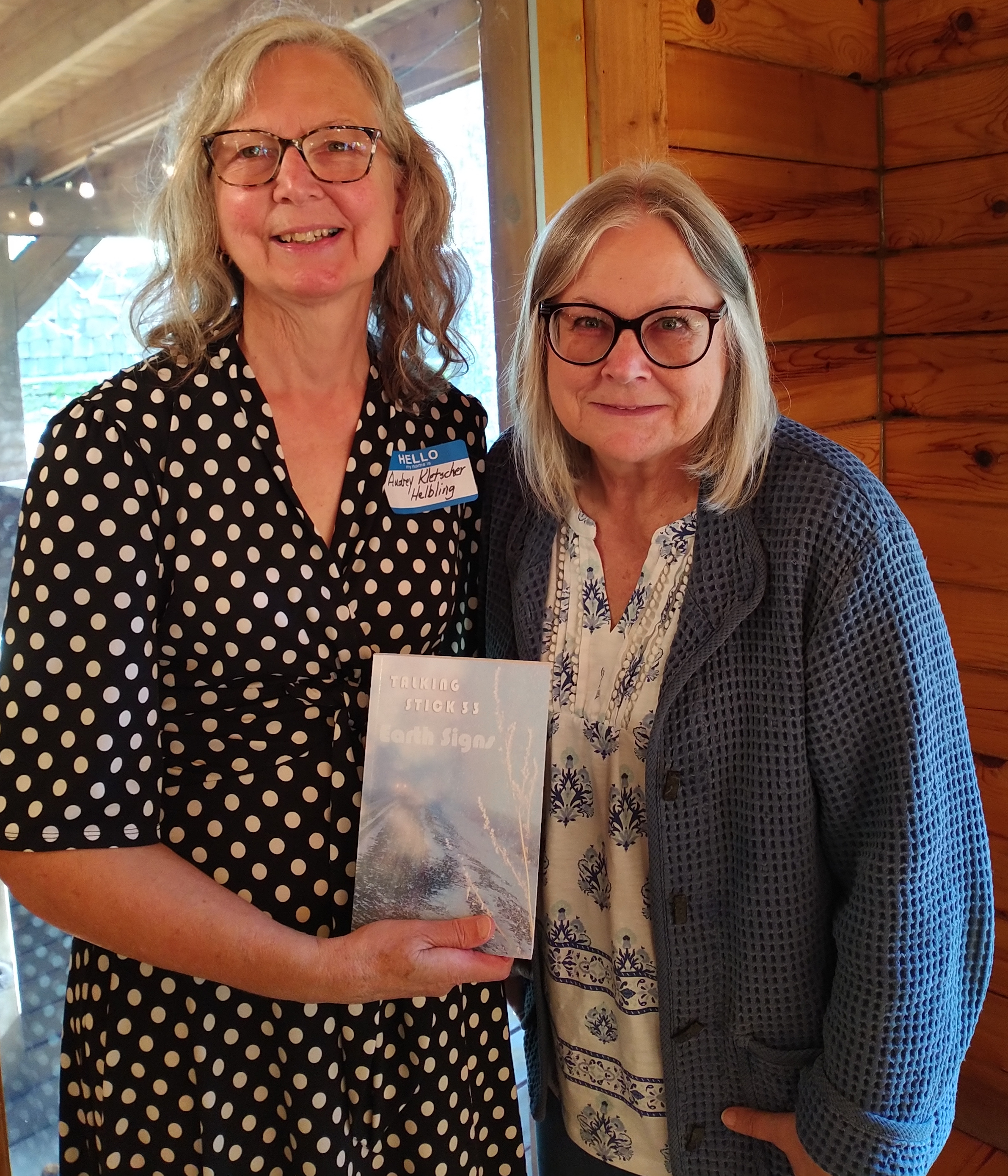
Me with author and fiction judge Jeanne Cooney, right. (Photo credit: Randy Helbling)
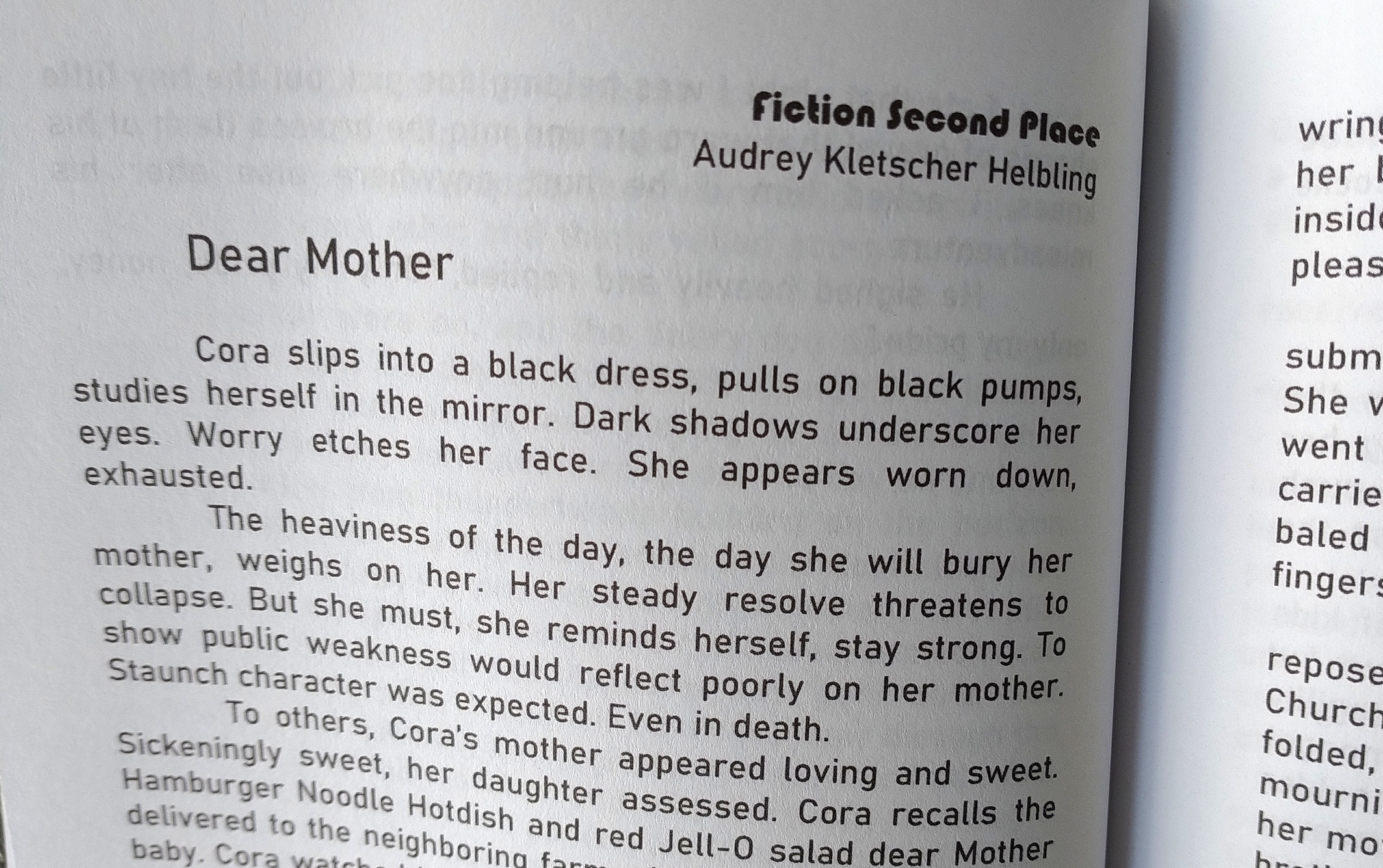
My short story, “Dear Mother,” earned second place in fiction as decided by author Jeanne Cooney. She’s written “A Hot Dish Heaven Mystery” series and has launched a new “It’s Murder” series. Did my mention of Hamburger Noodle Hotdish and red Jell-O salad in my story influence Cooney’s decision? I’d like to think not, but I suppose subconsciously it could have. When I wrote my short story, though, I had no idea who would be judging the fiction category. Hotdish simply fit into the storyline.
The beginning of my prize-winning fictional story, “Dear Mother.” (Minnesota Prairie Roots copyrighted photo September 2024)
Cooney called “Dear Mother” a “Very good story. But needs to be clearer.” She was right. Her comments helped me shape a stronger, better piece of writing. Dark writing. Mine is a story that begins seemingly ordinary enough, wrapping up in a surprise ending. Or rather an inferred dark ending.
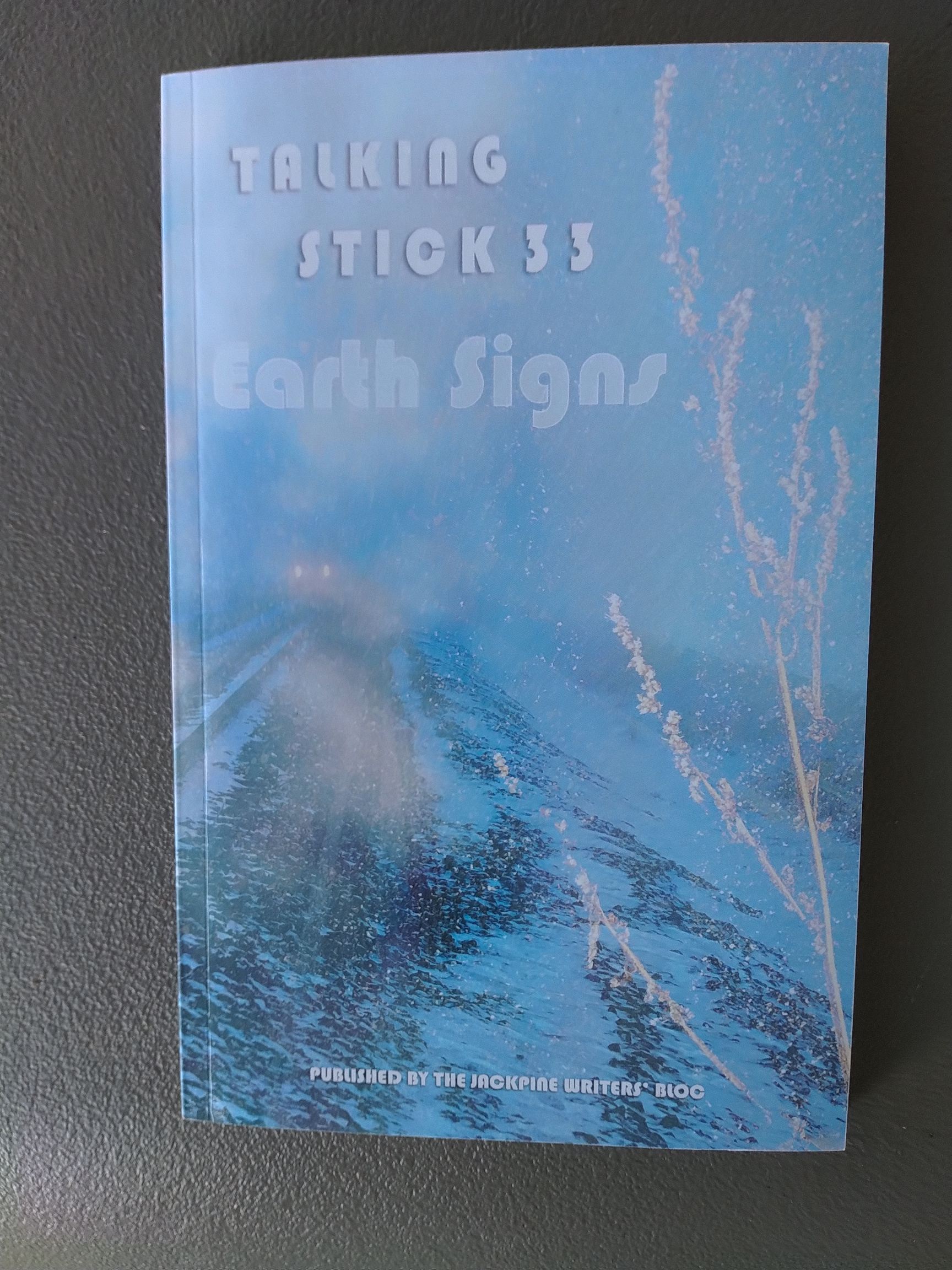
Congratulations to everyone whose work published in “Talking Stick 33.” Those include readers of this blog. Thanks also to Managing Editors Sharon Harris and Tarah L. Wolff for their ongoing dedication to the craft of writing. (Minnesota Prairie Roots copyrighted photo September 2024)
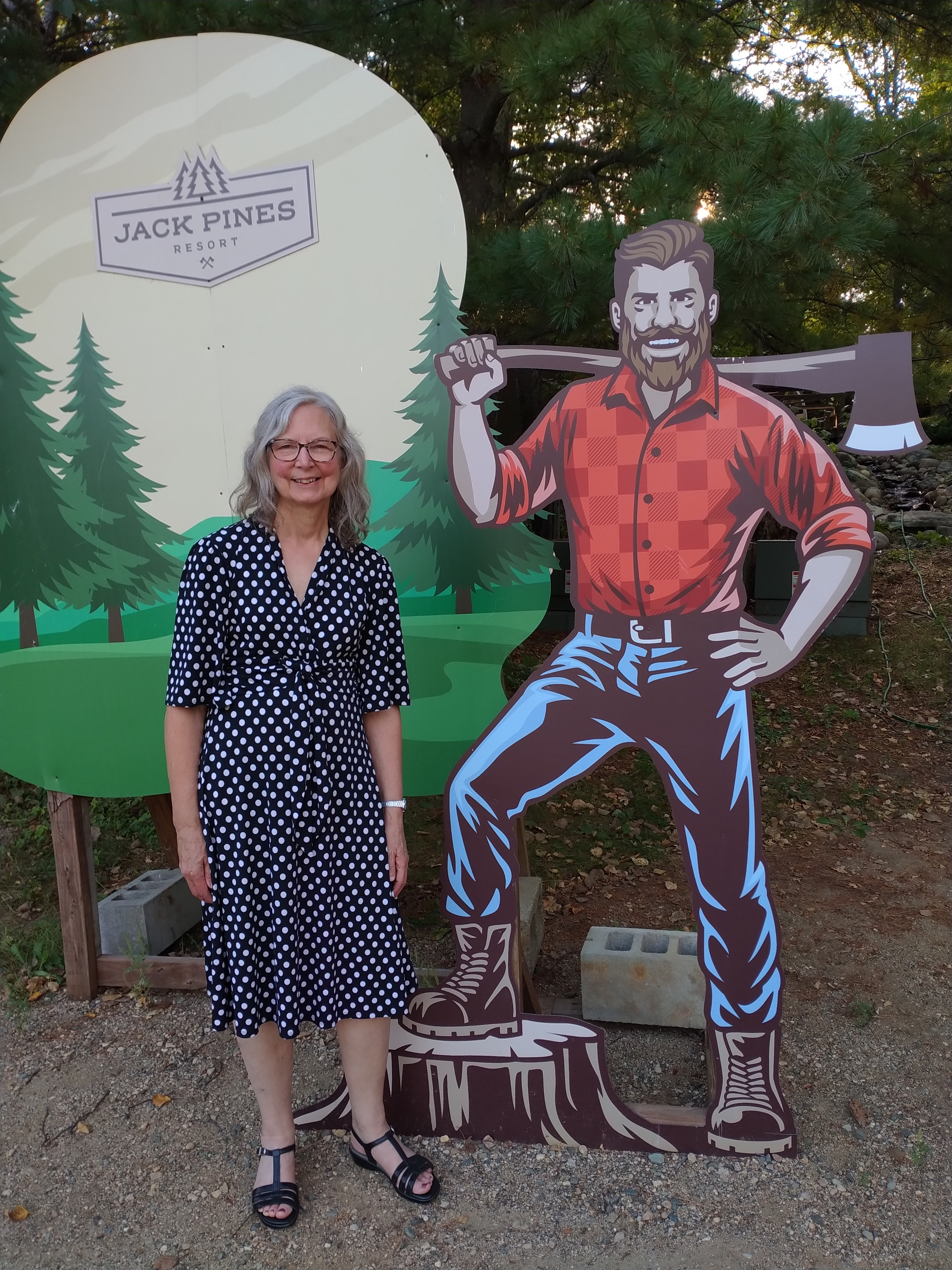
Last Saturday afternoon, I gathered with other writers and supporters for a party launching publication of Talking Stick 33—Earth Signs at Jack Pines Resort (no connection to the writers’ group) in rural Osage, a four-hour drive from Faribault. The event included a writing workshop (which I did not attend), book reading and socializing.
I’m not especially comfortable reading to a roomful of people, even though I’ve done so many times. But I practiced and then read “Dear Mother” with dramatic inflections and soft tones in just the right spots, managing to convey exactly what I wrote. There’s something to be said for hearing a poem or story read aloud. The piece comes alive via the voice of the writer.
As I listened to all these writers, I felt a strong sense of community. I felt encircled by a group of incredibly talented and supportive creatives. People who care about language and emotion and damn good writing.
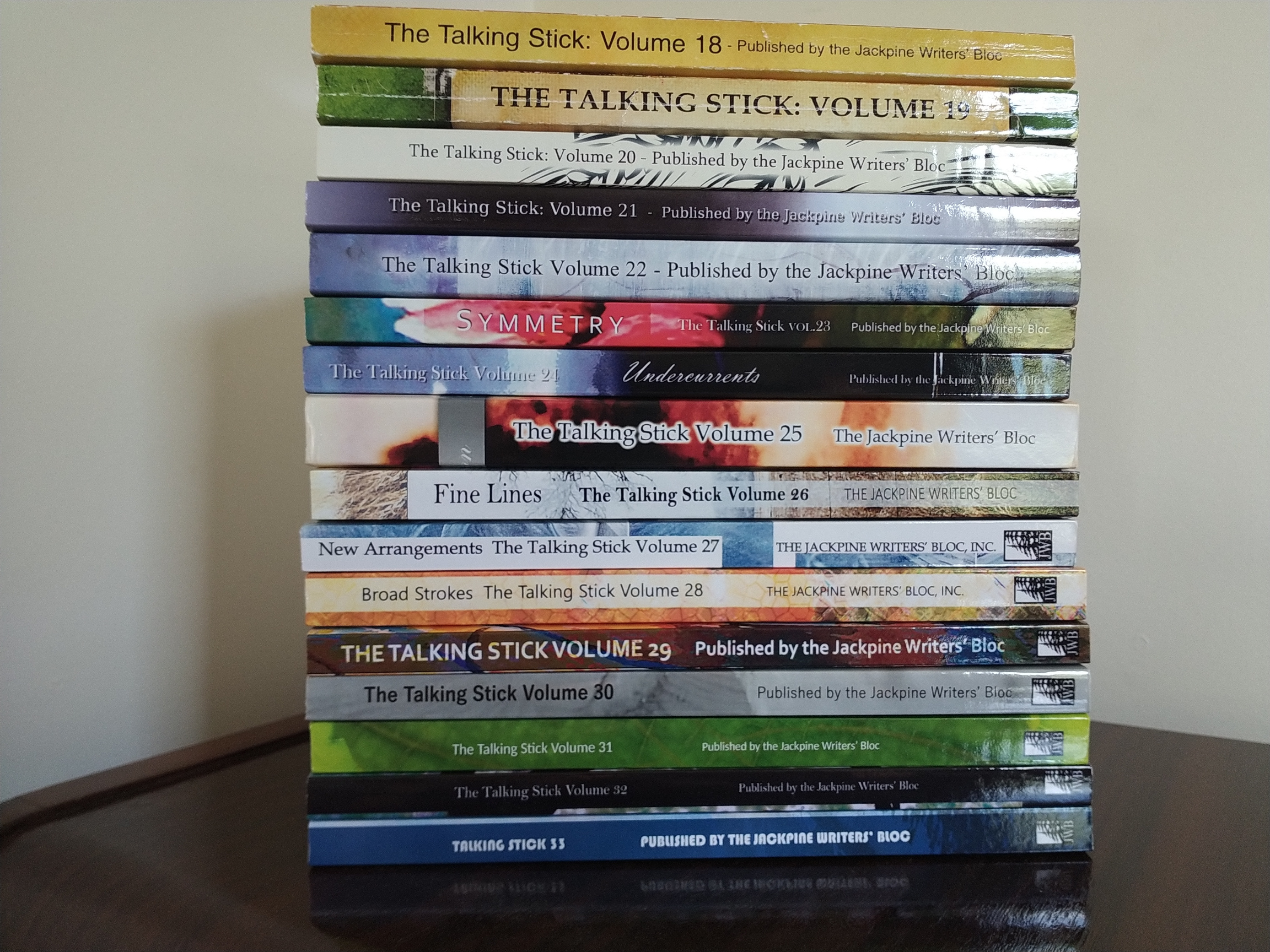
My collection of “Talking Stick” books. I’ve been published in 15 of these 16 volumes. (Minnesota Prairie Roots copyrighted photo September 2024)
This marks the 15th consecutive year my writing has published in Talking Stick. A poem, “Misunderstood,” and a work of creative nonfiction, “Lessons Inside the Dome,” were also selected for publication in the 2024 volume. Both are Faribault-rooted. My poem focuses on the connection between the Wahpekute and today’s homeless population living in woods along the Straight River. In “Lessons,” I write about walking inside the Shattuck-St. Mary’s School dome during the winter and lessons I learned there.
My writing is often rooted in experiences, in observations, in overheard conversations, in memories. I’ve covered everything from farming, to aging to domestic abuse, trauma, Minnesota Nice and more. Writing prompts have come from a vintage family photo, a sign on a barbershop window in Northfield, a painting by Andy Warhol… There are stories everywhere.
I’m grateful to the Jackpine Writers’ Bloc for repeatedly choosing my work for publication in Talking Stick. That includes 15 poems, 10 short stories, nine creative nonfiction stories and two creative twist stories (written using a list of pre-selected words). I’ve thrice been awarded second place (poetry, fiction and creative nonfiction). I’ve also earned eight honorable mentions (four for fiction, two for creative nonfiction, and one each in poetry and creative twist). Winning those awards is validating to me as a writer.
But just as validating is being among other writers. Writers who appreciate the craft of writing and the hard work it takes to shape a poem or a short story. Writers who understand the importance of word choice. Writers who recognize the power of words. Writers who don’t settle for the mundane, the cliché, the everyday. Writers who will spend several hours together on a glorious September afternoon in the northwoods celebrating the release of Talking Stick, a stellar literary anthology. We have much to celebrate in Minnesota, in this place that produces a remarkable number of talented writers.













 Minnesota Prairie Roots
Recent Comments