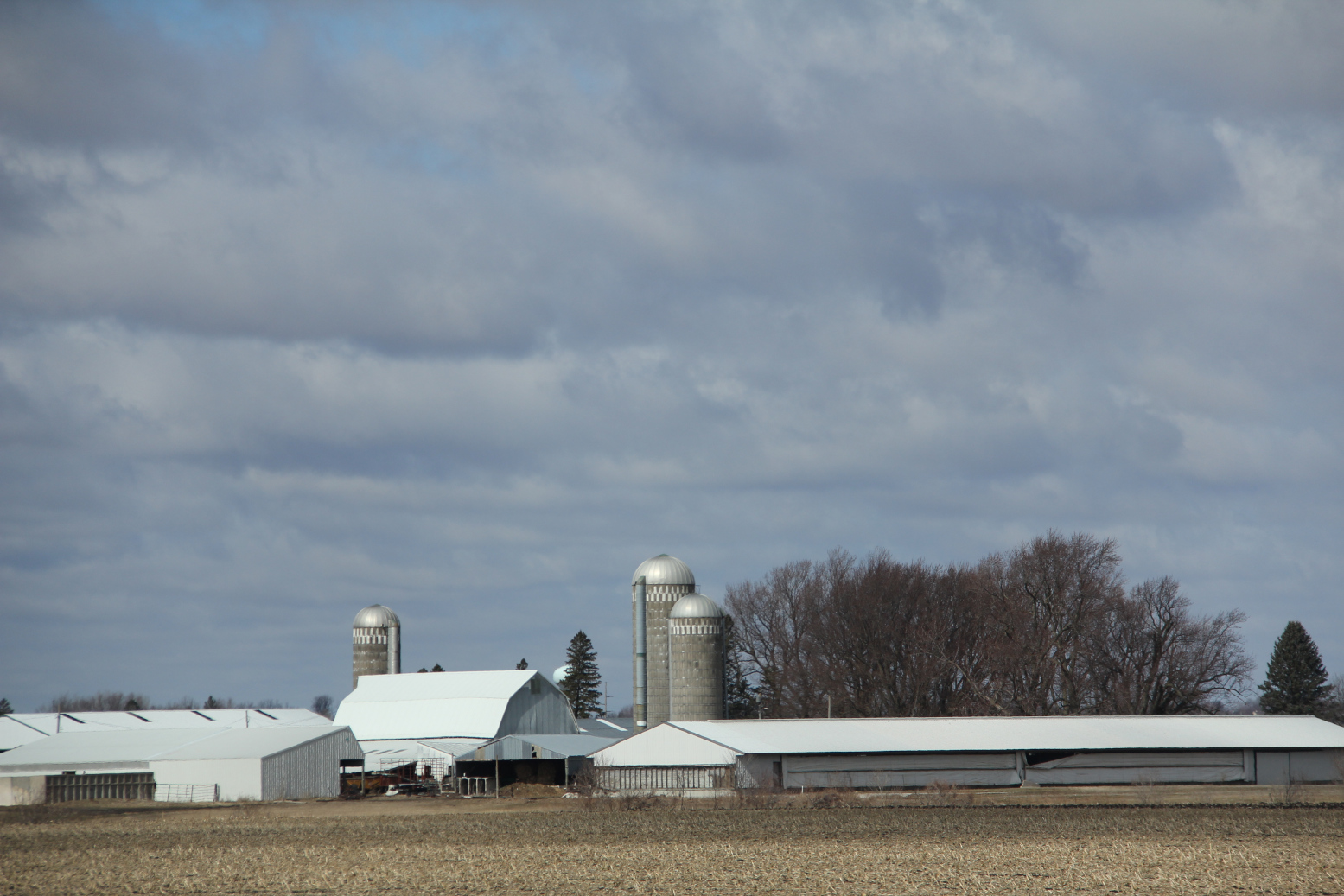
A farm site between Owatonna and Claremont. (Minnesota Prairie Roots copyrighted photo March 2026)
UNDER AN IMMENSE SKY in the wide open countryside of rural southern Minnesota, I always feel small.
Three US Air Force T-38 Talon Thunderbird jets landmark Owatonna Degner Regional Airport along Interstate 35. (Minnesota Prairie Roots copyrighted photo March 2026)
Sky and land dwarf me, impressing upon me the vastness and power of that which rises above and that which stretches around me.
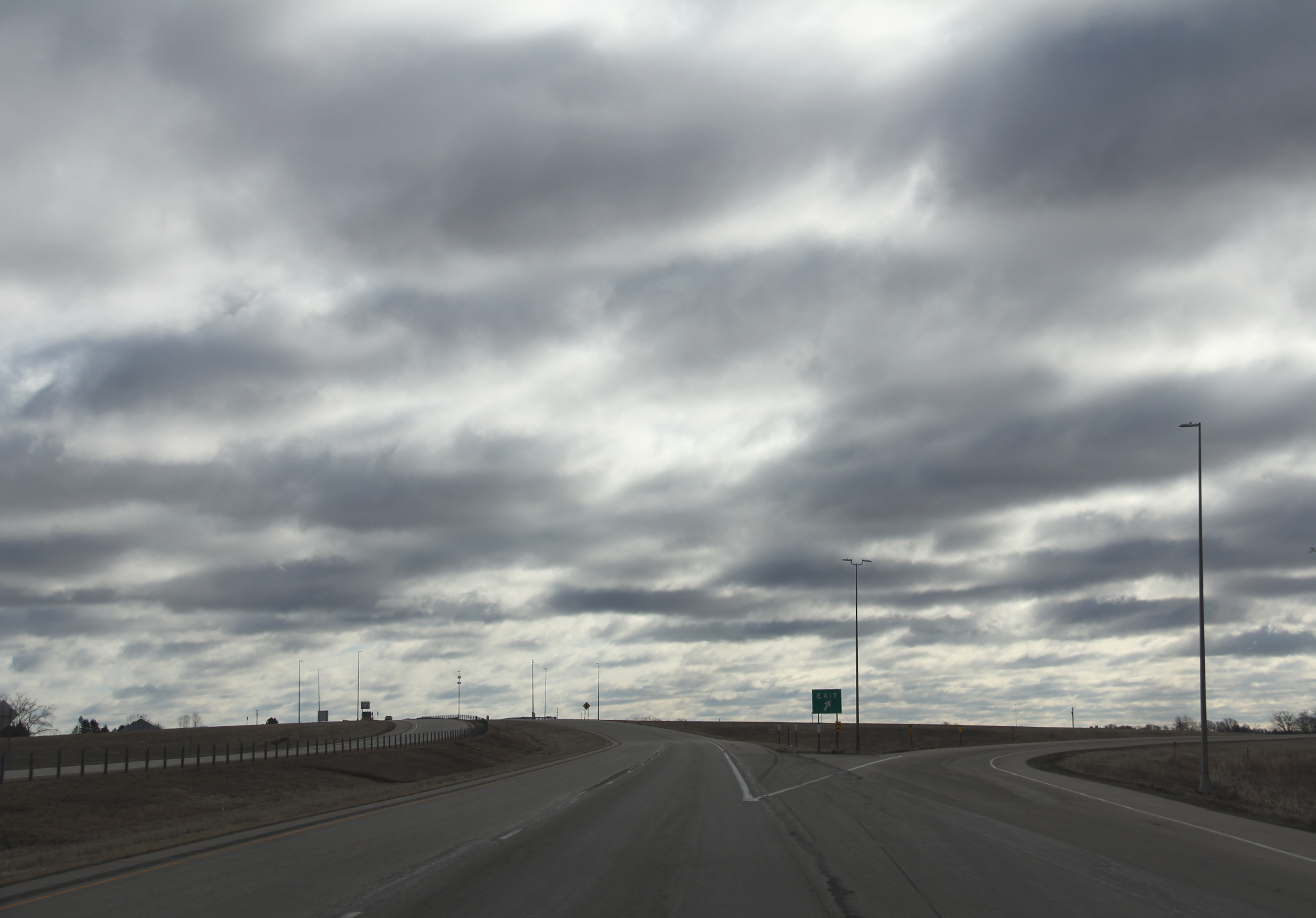
On US Highway 14 just east of Owatonna, driving into early morning grayness. (Minnesota Prairie Roots copyrighted photo March 2026)
On a recent road trip to Rochester and back, the brooding sky of mid-March appeared unsettled, threatening. Cloud after cloud after cloud nearly swiped the earth while towering in a brute mass into seemingly infinity.
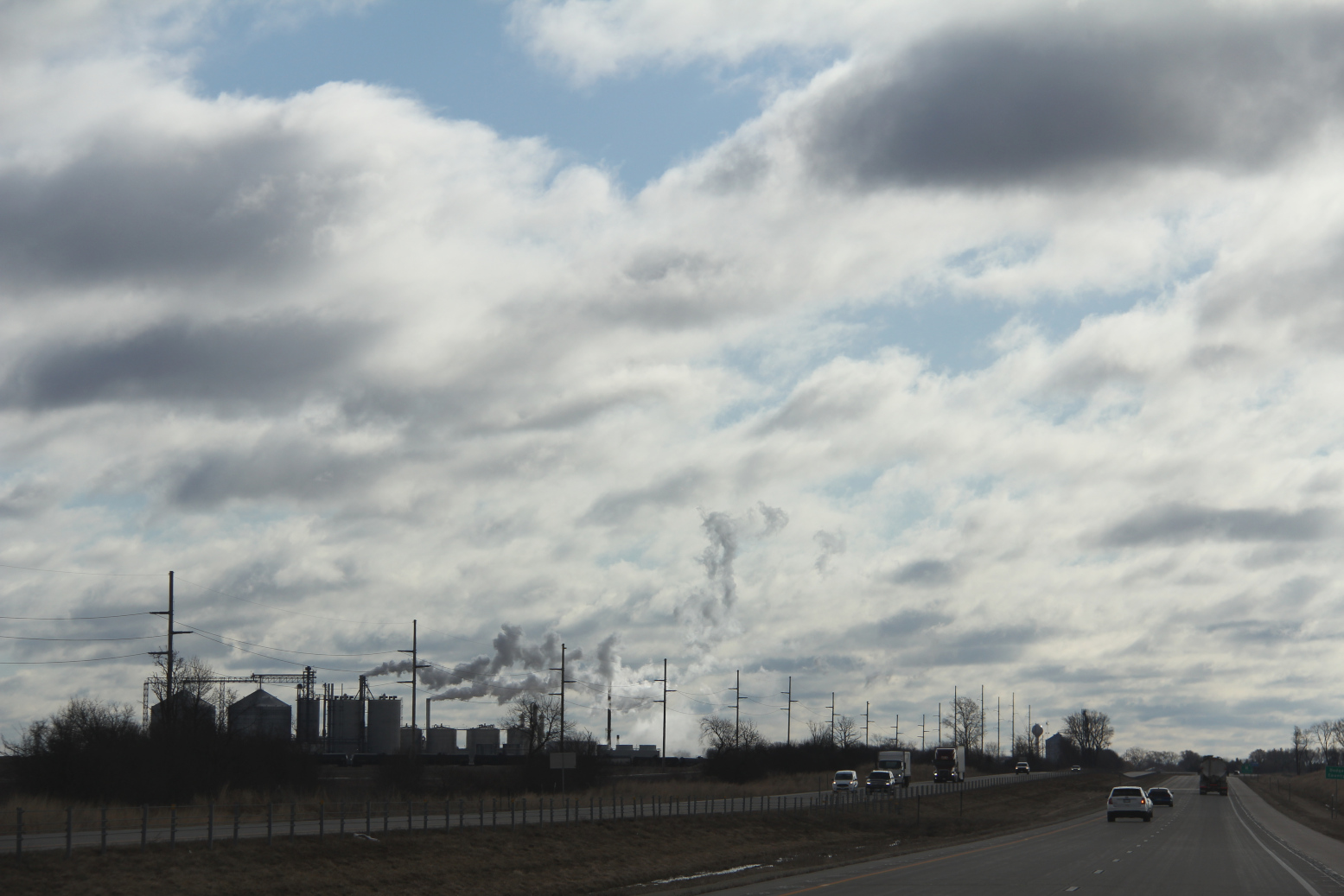
Heading east on highway 14, the All-Corn Clean Fuel ethanol plant by Claremont comes into view. (Minnesota Prairie Roots copyrighted photo March 2026)
Only occasionally did the sun fight through the clouds that darkened the day. Gray prevailed, a visual cue of the major winter storm that would arrive the next evening.
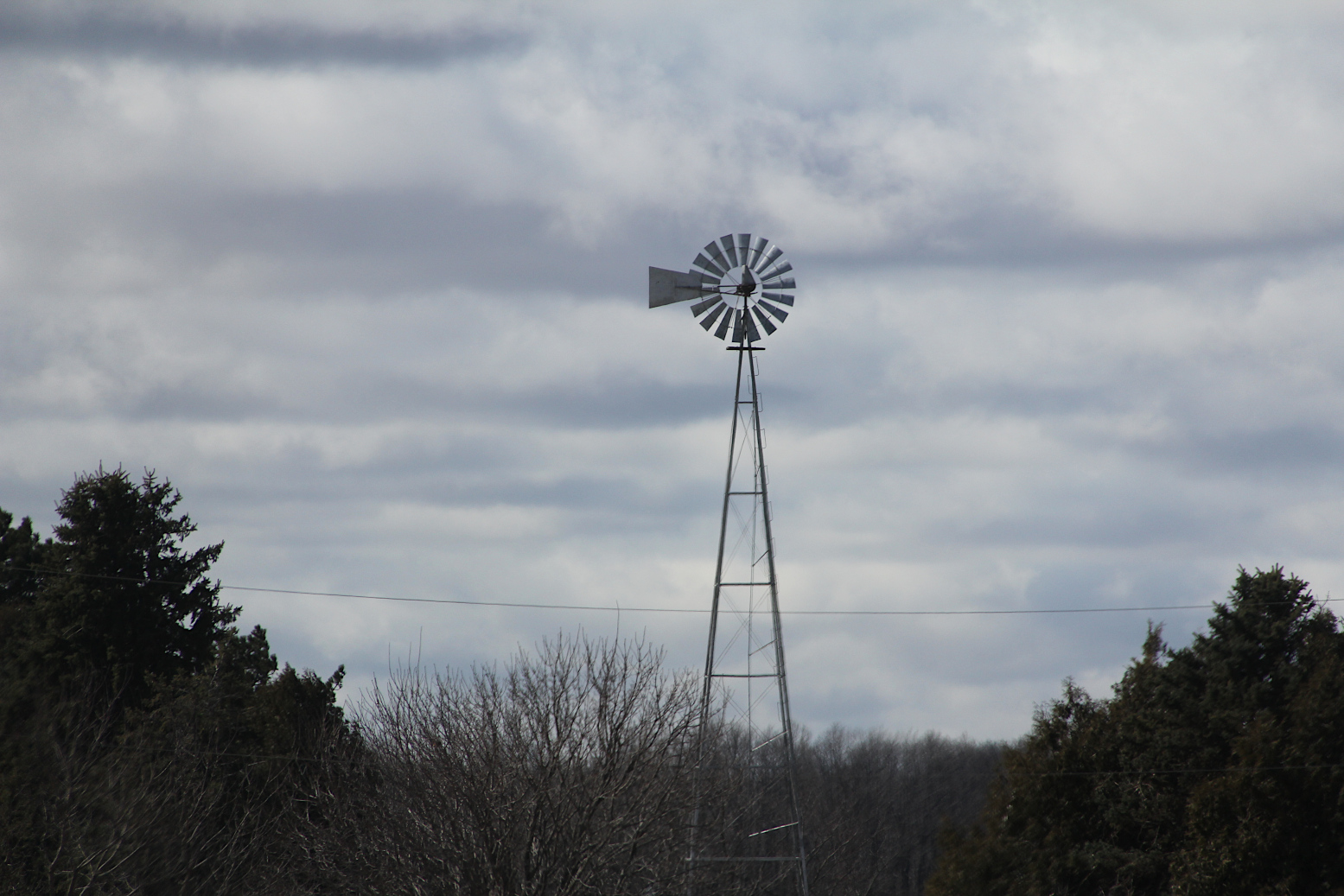
Harnessing the wind on a farm site near Claremont. (Minnesota Prairie Roots copyrighted photo March 2026)
In the flatness of the land, a strong wind bullied across the landscape. Pushing. Shoving. Bending the will of boughs. Punching at vehicles. Fearless and unrelenting.
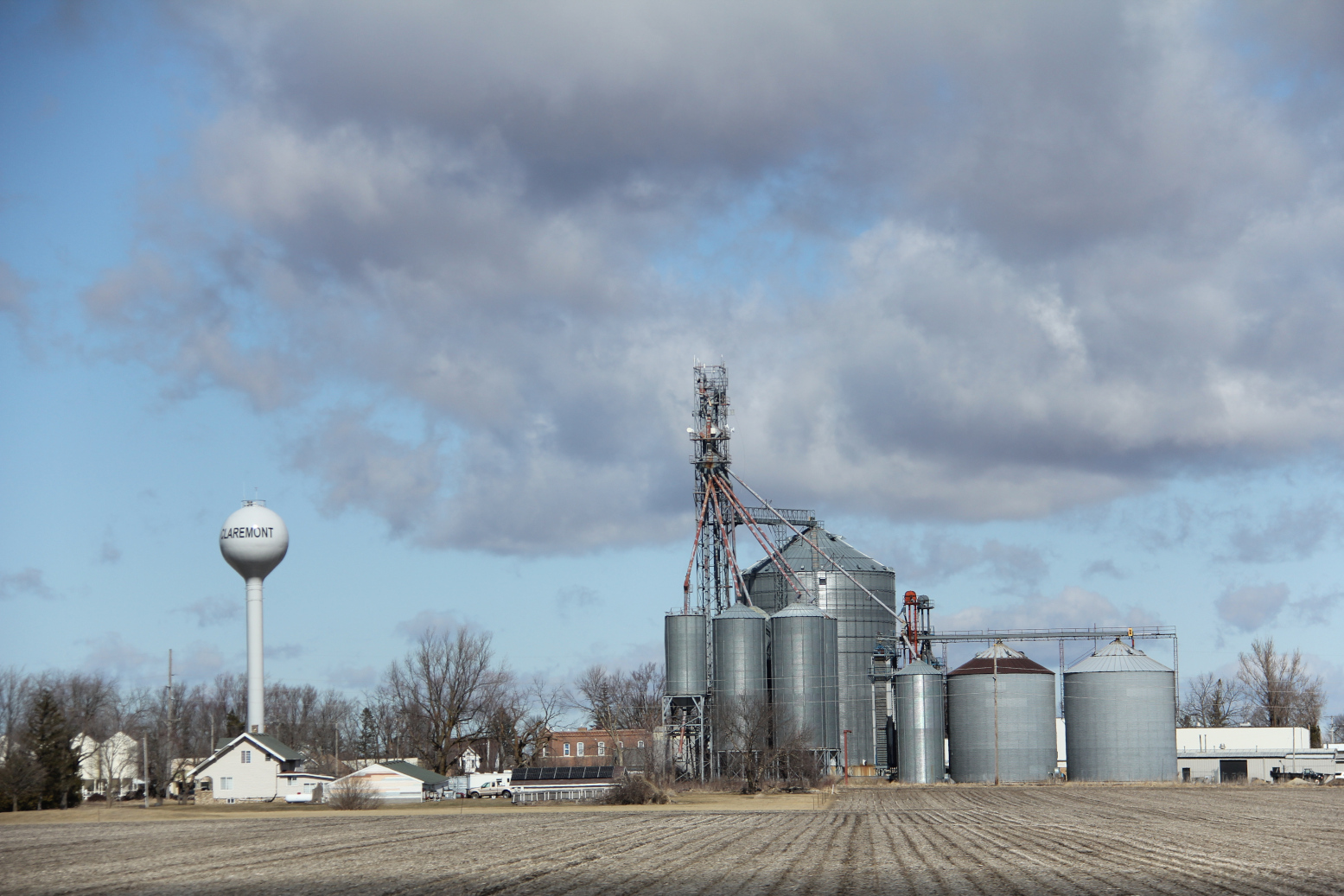
On the return trip to Faribault, the clouds partially broke, opening to blue skies over Claremont. (Minnesota Prairie Roots copyrighted photo March 2026)
This is March in Minnesota. One day angry and roiling. The next day calm, even warm, sunny and inviting. March marks the indecisiveness of sometimes spring, sometimes still winter.
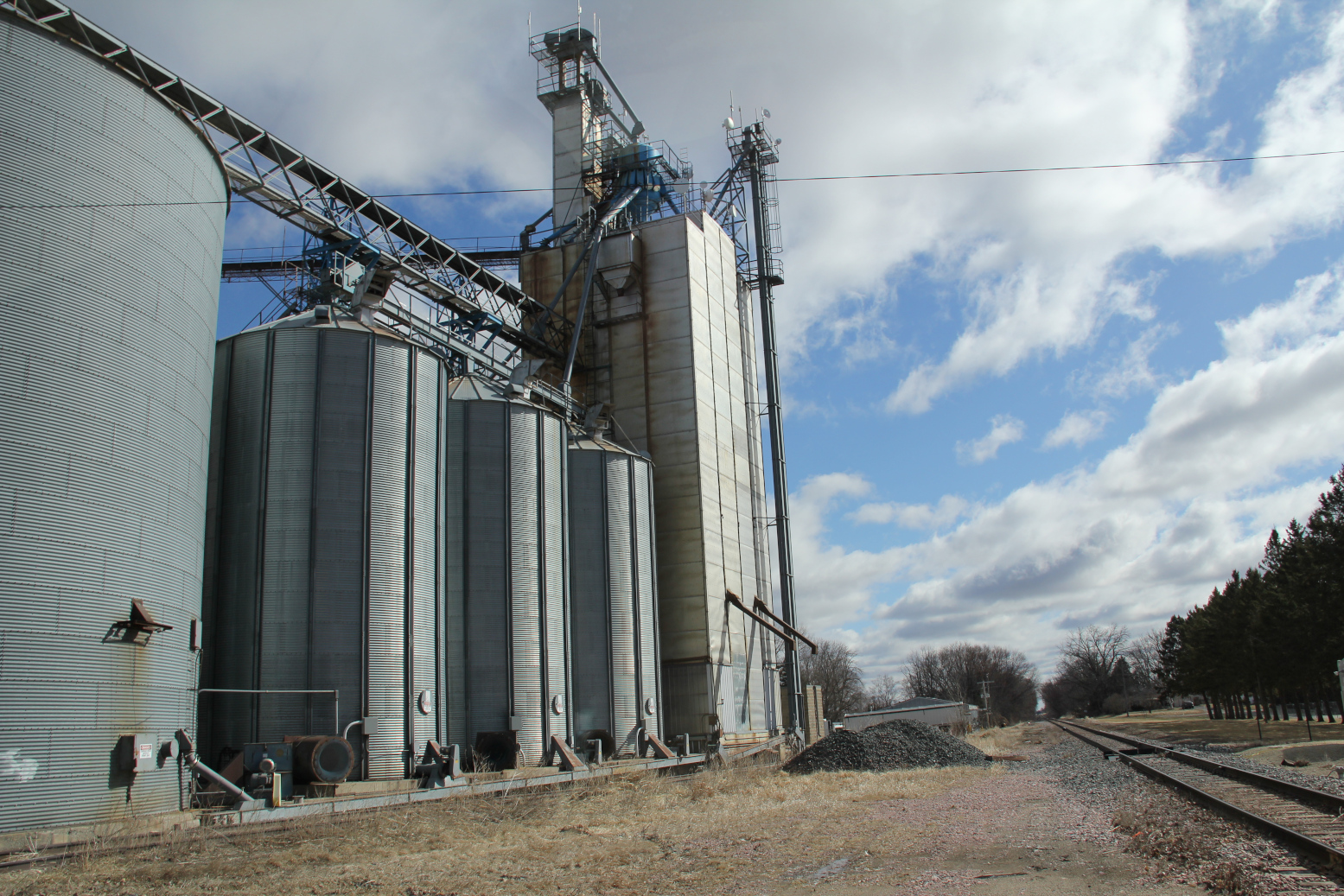
Byron Agri Center stretches skyward. (Minnesota Prairie Roots copyrighted photo March 2026)
There’s a certain restlessness this time of year among those of us who live in this cold climate state of long winters. We are weary of cold and snow, ready for real spring, not just the calendar spring. We crave sunshine, warmth and greenery.
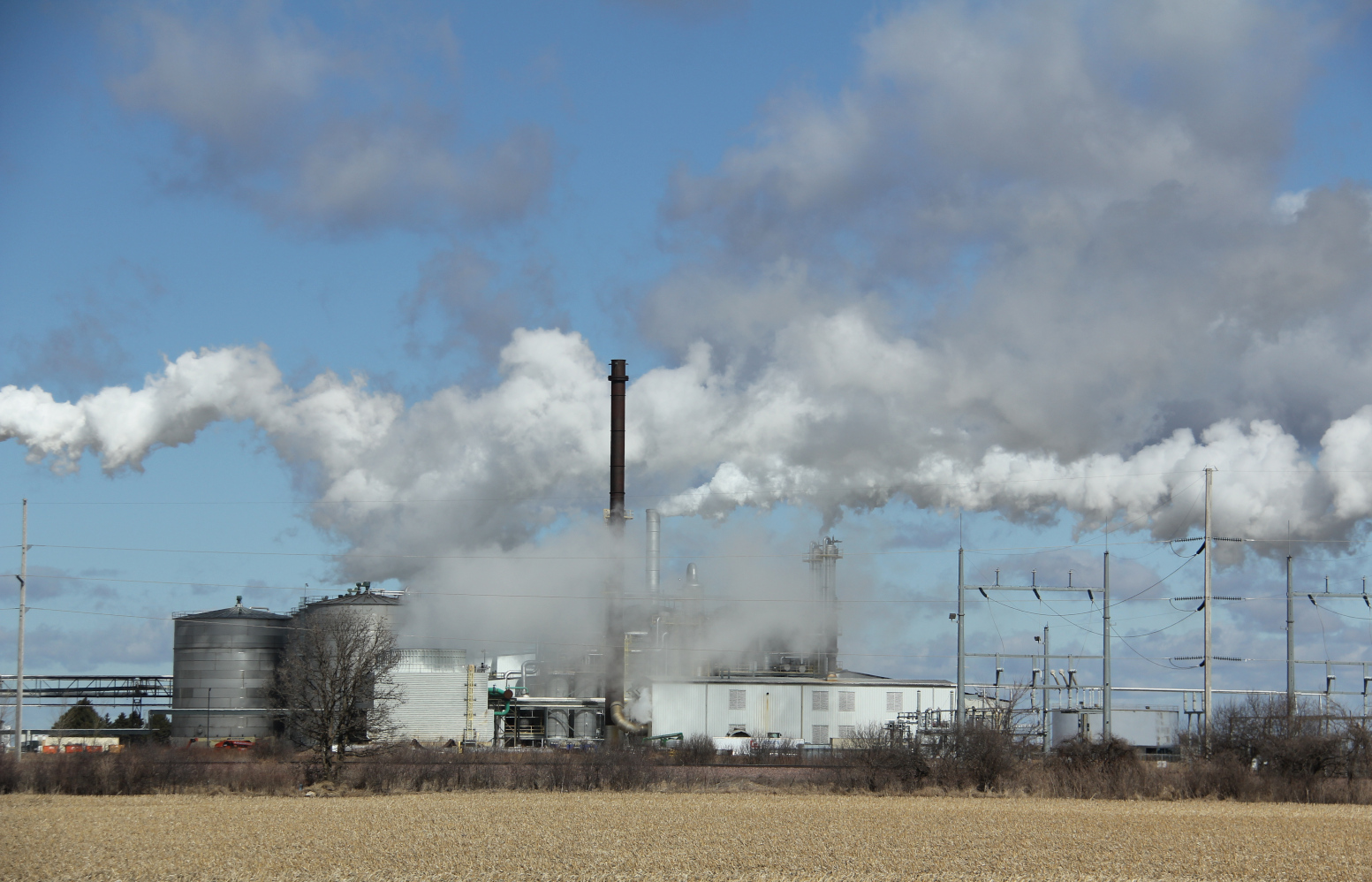
A view of the ethanol plant near Claremont on the return trip, when skies lightened. (Minnesota Prairie Roots copyrighted photo March 2026)
But realistically, Mother Nature has her own mind, deciding when a season reveals herself, not simply teases. I see that in the sky on this drive. The heavy morning sky, wrapped in a mass of clouds, refuses to bare herself to the sun.
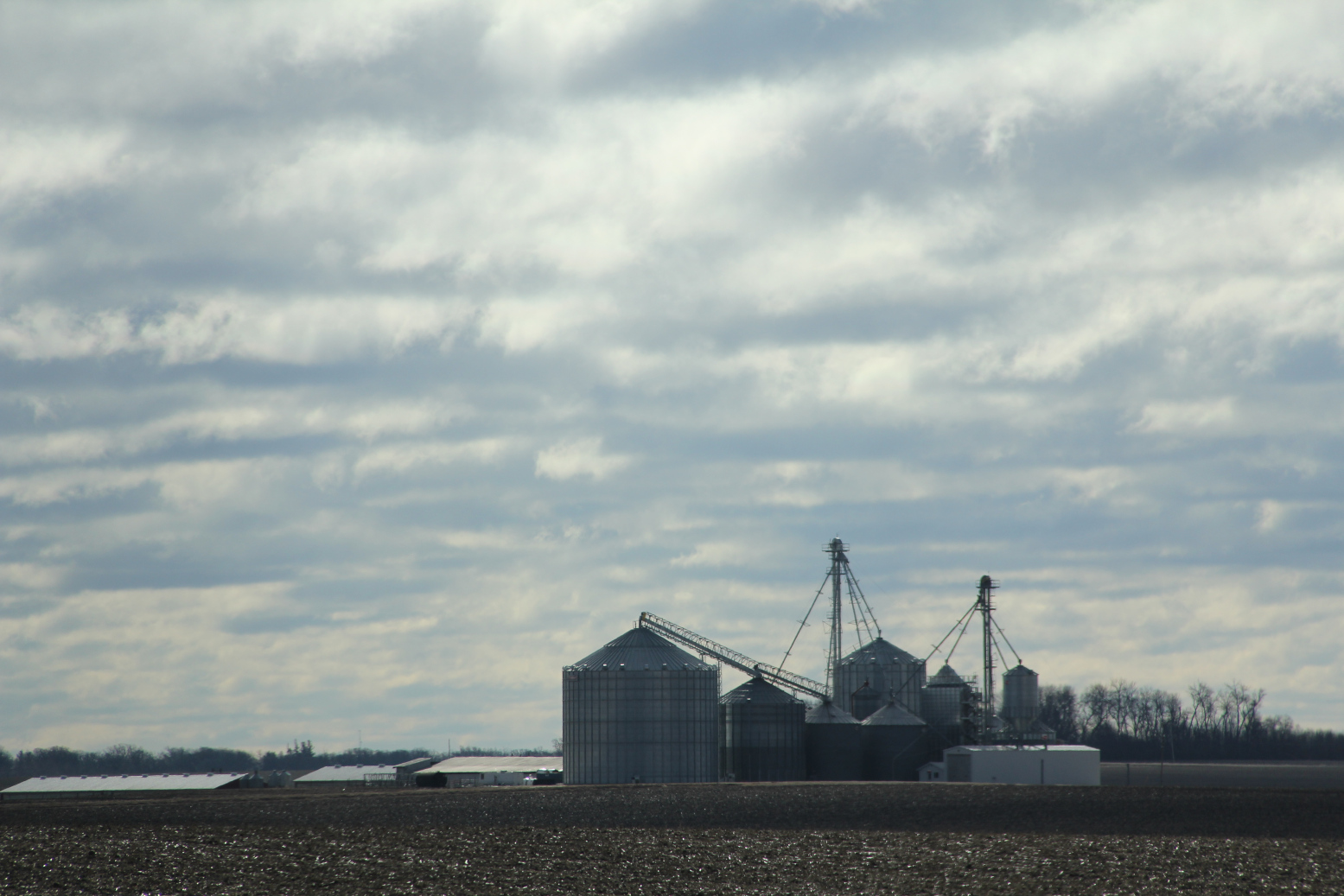
A farm site about 20 minutes west of Rochester. (Minnesota Prairie Roots copyrighted photo March 2026)
And so I feel pressed upon, diminished by sky. And land.
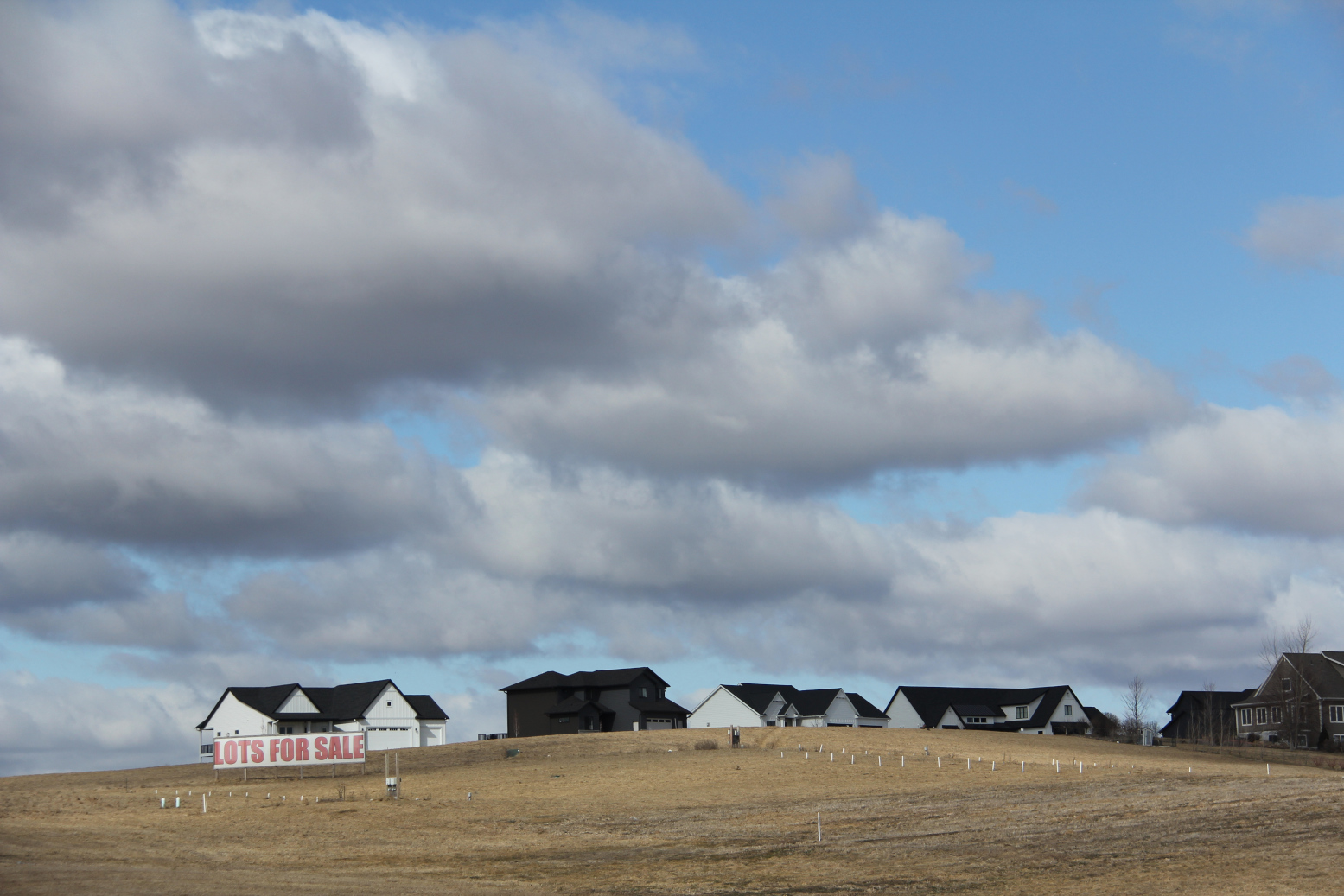
Dwarfed by the sky, a housing development atop a hill between Rochester and Byron. (Minnesota Prairie Roots copyrighted photo March 2026)
Buildings—barns and bins and houses—appear minuscule against this intimidating backdrop.
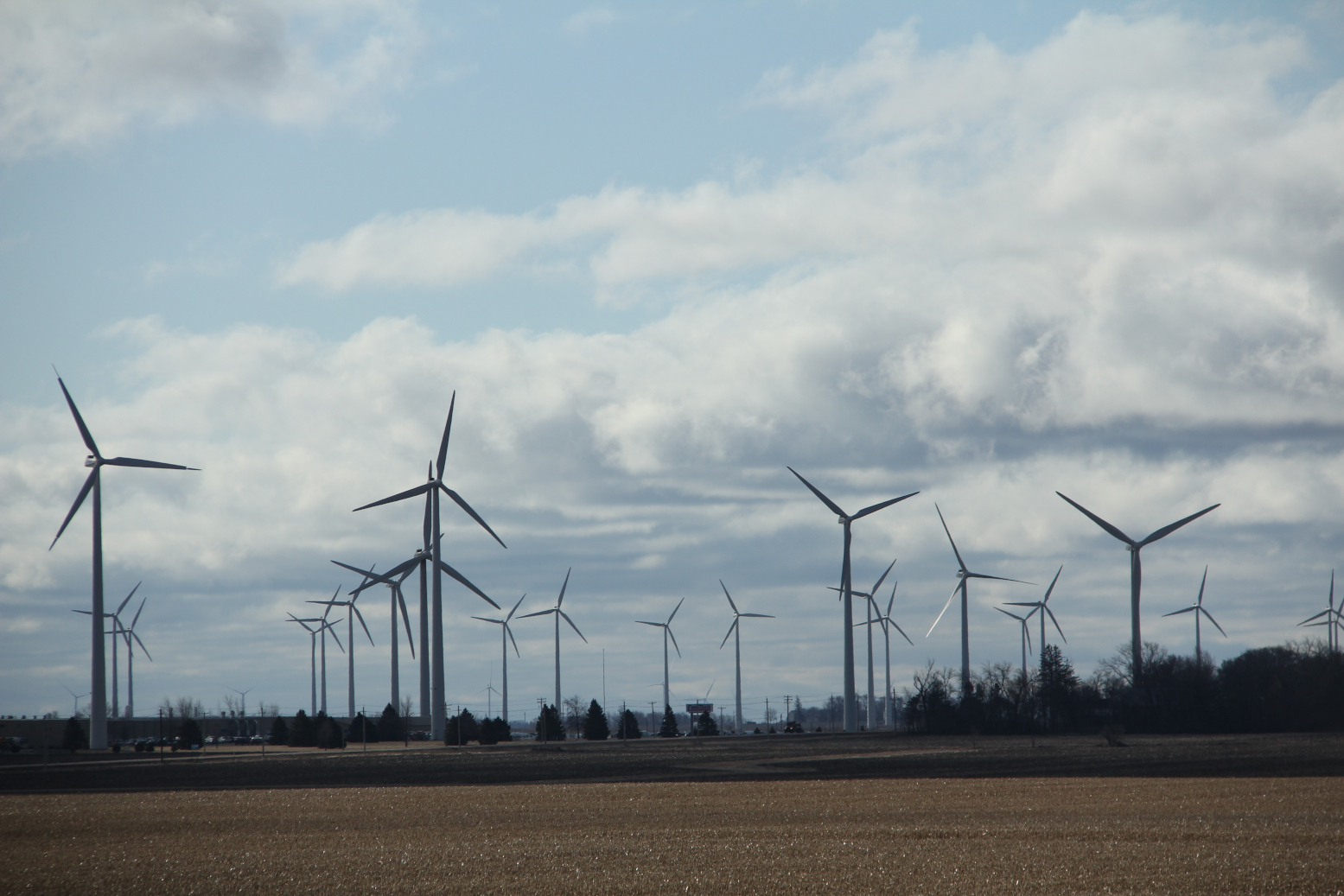
Wind turbines south of Dodge Center. (Minnesota Prairie Roots copyrighted photo March 2026)
Even wind turbines, which tower above treelines, and which I find visually unappealing, appear small-scale despite their height.
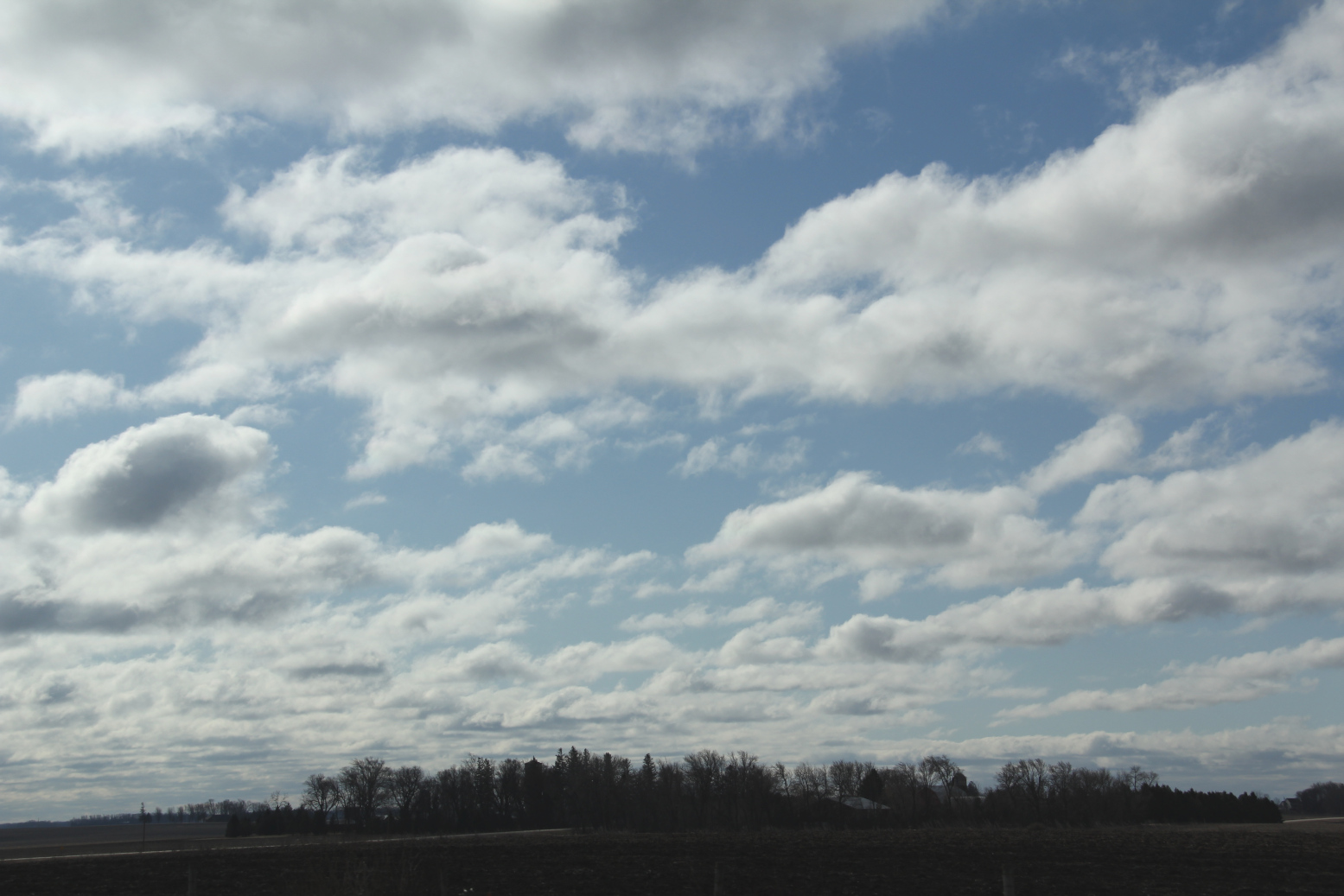
Sky and land meet in the immensity of this place. (Minnesota Prairie Roots copyrighted photo March 2026)
I suppose we really are small in the immensity of the universe. A road trip between Faribault and Rochester verifies that. The immense sky and stark, wide open land stretch before me, high and wide. And I feel small, oh, so small in the all of it in the midst of March in Minnesota.
NOTE: I took these on-the-road photos on March 13 as a front seat passenger in our van. I set my 35 mm camera at a fast shutter speedand shot images.
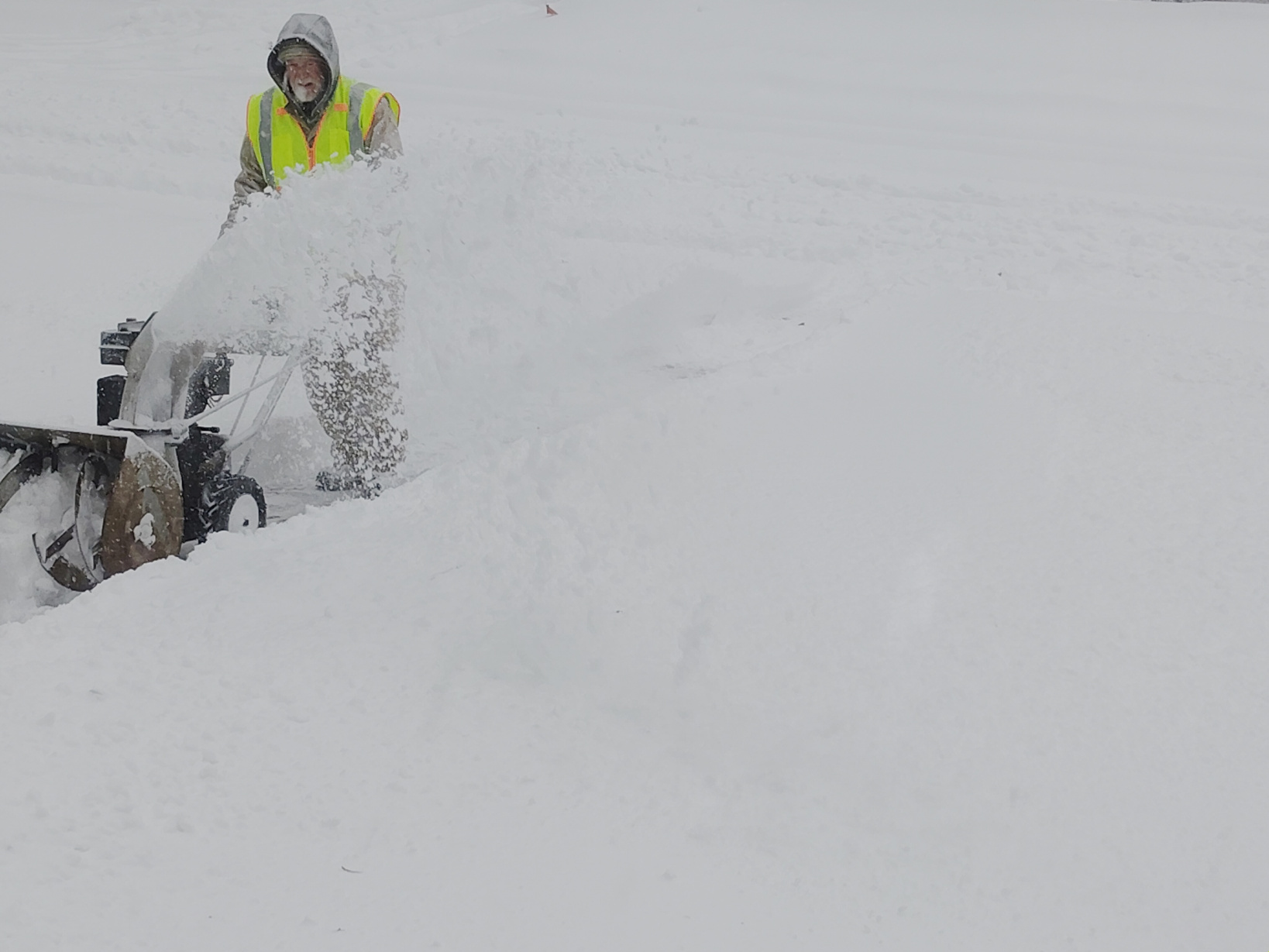
My husband, Randy, blows snow from our driveway Sunday morning. (Minnesota Prairie Roots copyrighted photo March 2026)
WHILE I SAT IN THE RECLINER hand-stitching loosened seams in a cuff of Randy’s flannel shirt and listening to “Face the Nation,” my husband was outdoors firing up the snowblower.
We are in the middle of a major winter storm in much of Minnesota. Snow began falling here Saturday evening and continues with some nine-plus inches of accumulation thus far in Faribault. Winds are whipping the new-fallen snow into a blizzard with no travel advised, roads closed, and more cancellations than I could possibly list. That includes cancellation of church services.
Little Prairie United Methodist Church, rural Dundas. (Minnesota Prairie Roots copyrighted file photo)
Across town, while I was stitching, then dicing celery and onions for the Chicken Wild Rice Hotdish I’ll make for supper, my friend Marian was tucked inside her home watching Little Prairie United Methodist Church services online. Broadcast not from the rural Dundas church, but from Pastor Penny Bonsell’s living room in nearby Northfield.
“She (the pastor) was in her slippers with a cup of coffee and her puppy needing to be removed from front and center!” Marian shared with me. “A close neighbor trudged through the snow to play the piano and she and her husband have beautiful voices. The puppy didn’t sing!”
Marian invited me to watch the service. I did. After I finished the breakfast dishes, ate the brunch Randy made, washed dishes again, and video chatted with my second daughter and one-year-old grandson four hours away in southeastern Wisconsin. Only light snow is falling in Madison.
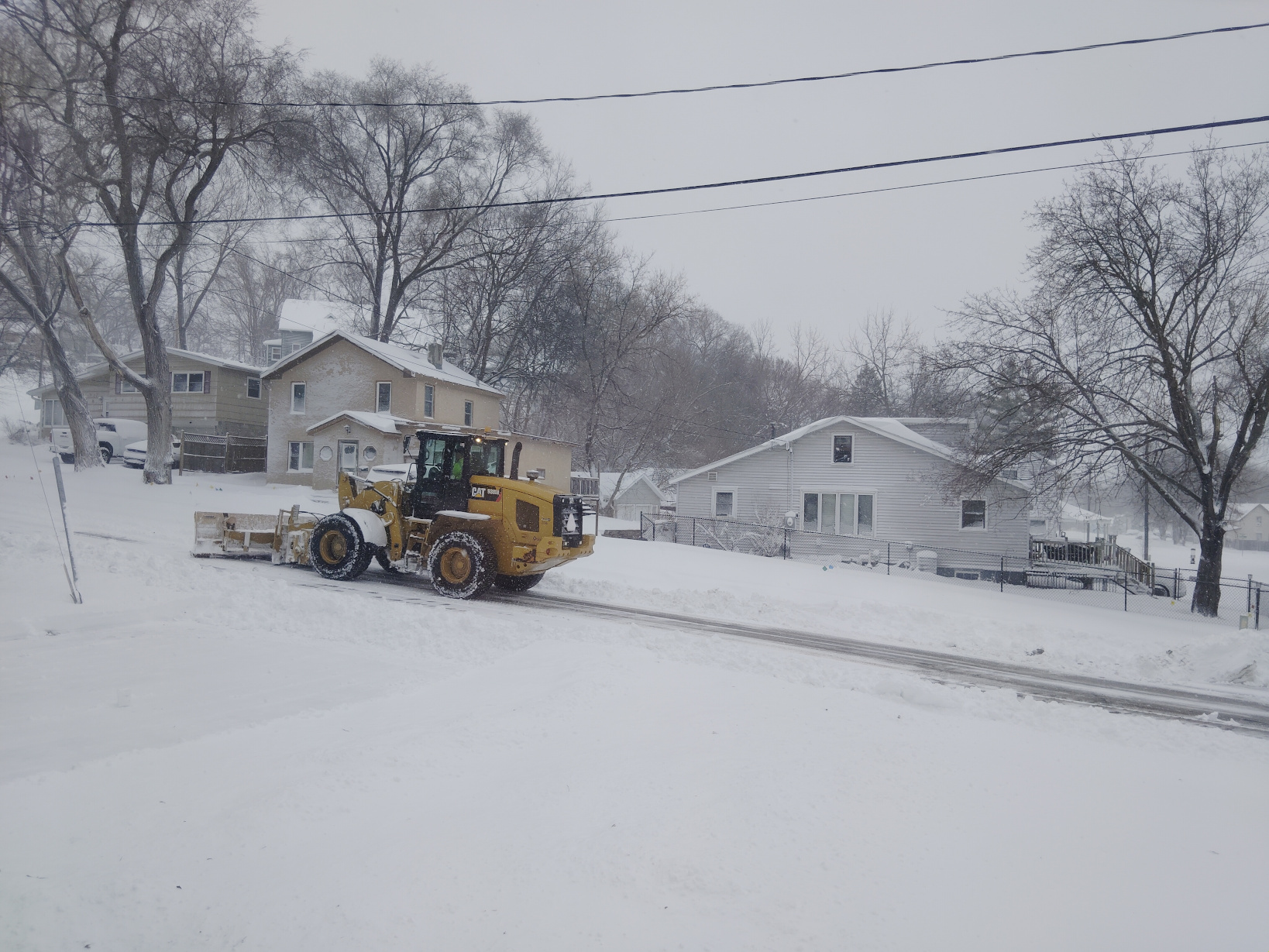
Randy had just finished clearing the driveway and sidewalk when the snowplow came by, filling in the ends of the drive and walk with a deep ridge of snow. Back to blowing. (Minnesota Prairie Roots copyrighted photo March 2026)
Snow is still piling up here, falling thick and heavy. But the Rev. Bonsell gave thanks for the new white snow, which “reminds us to be clean and make a new start in life.” I appreciated her positive perspective, which can be difficult to consider when you’re out shoveling and blowing away snow in fierce winds as Randy did for 1½ hours this morning.
But as I watched the Little Prairie UMC Church service, I felt such peace. Pastor Bonsell has a calming voice, graceful and poetic. As she led the service from her cozy living room, fire blazing in the fireplace, slippers on her feet, sipping coffee, rocking in a rocking chair, I felt the comfort of words offered in song, prayer and in her message, “Restores My Soul” (based on Psalm 23). Said the pastor, “You are never, ever alone.” She also talked about light and darkness, referencing Ephesians 5:8-14 and choosing to live in the light, to choose good.
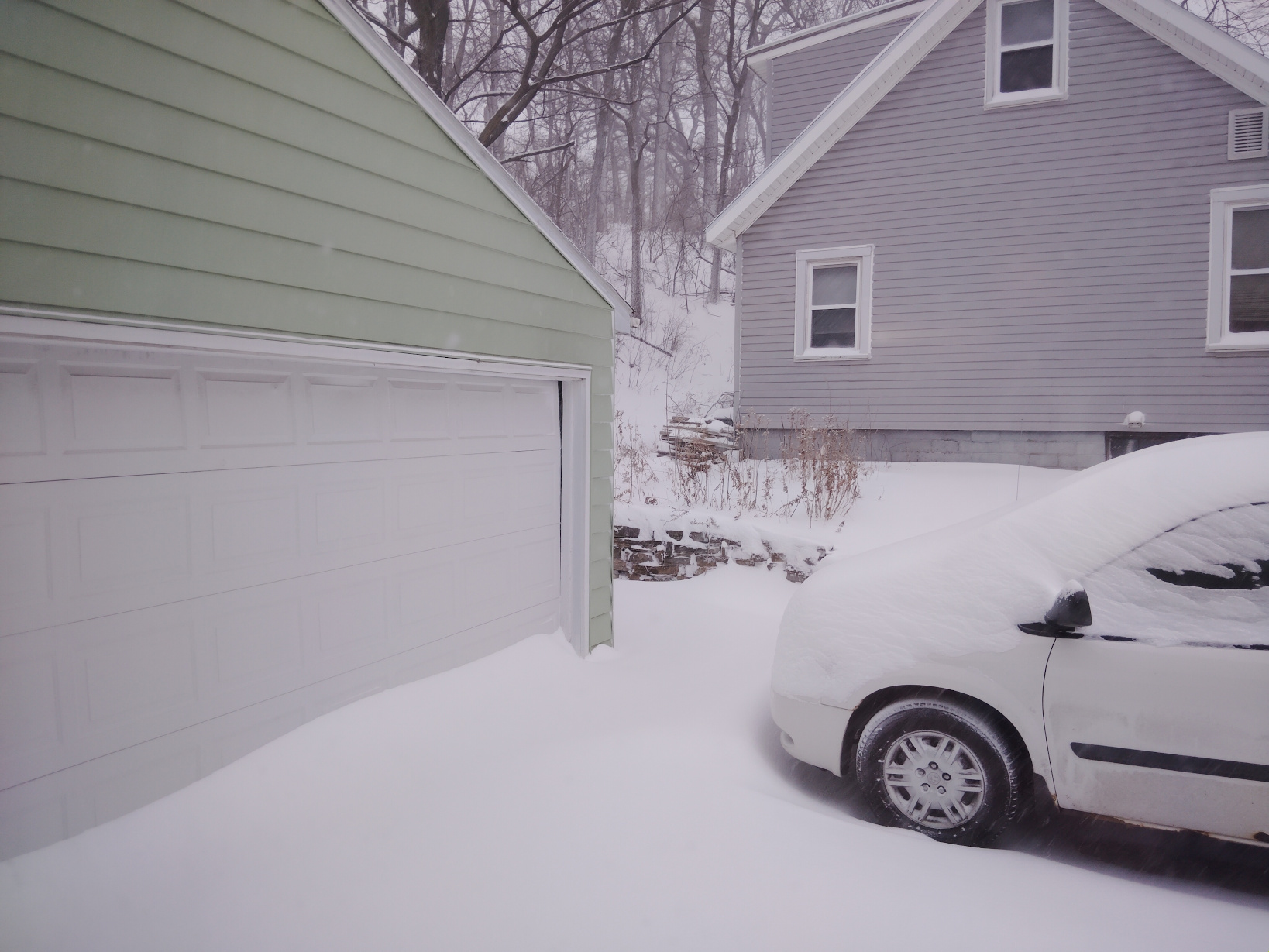
I took this photo early Sunday morning as the wind-driven snow began to pile up against the garage door. (Minnesota Prairie Roots copyrighted photo March 2026)
I didn’t intend to watch a church service when I was shaping the idea of this blog post around our winter storm. I attended worship at my church last evening given this morning’s service was canceled. But then my friend Marian’s words about the puppy and the pastor in slippers drew me to the Little Prairie UMC YouTube video.
Once online, I immediately felt at home in the pastor’s living room. I noticed a pillow with the directive to “Be Kind” positioned on a child-sized rocking chair. The fire blazed. The puppy roamed. Pianist Peter Webb sat poised at the piano.
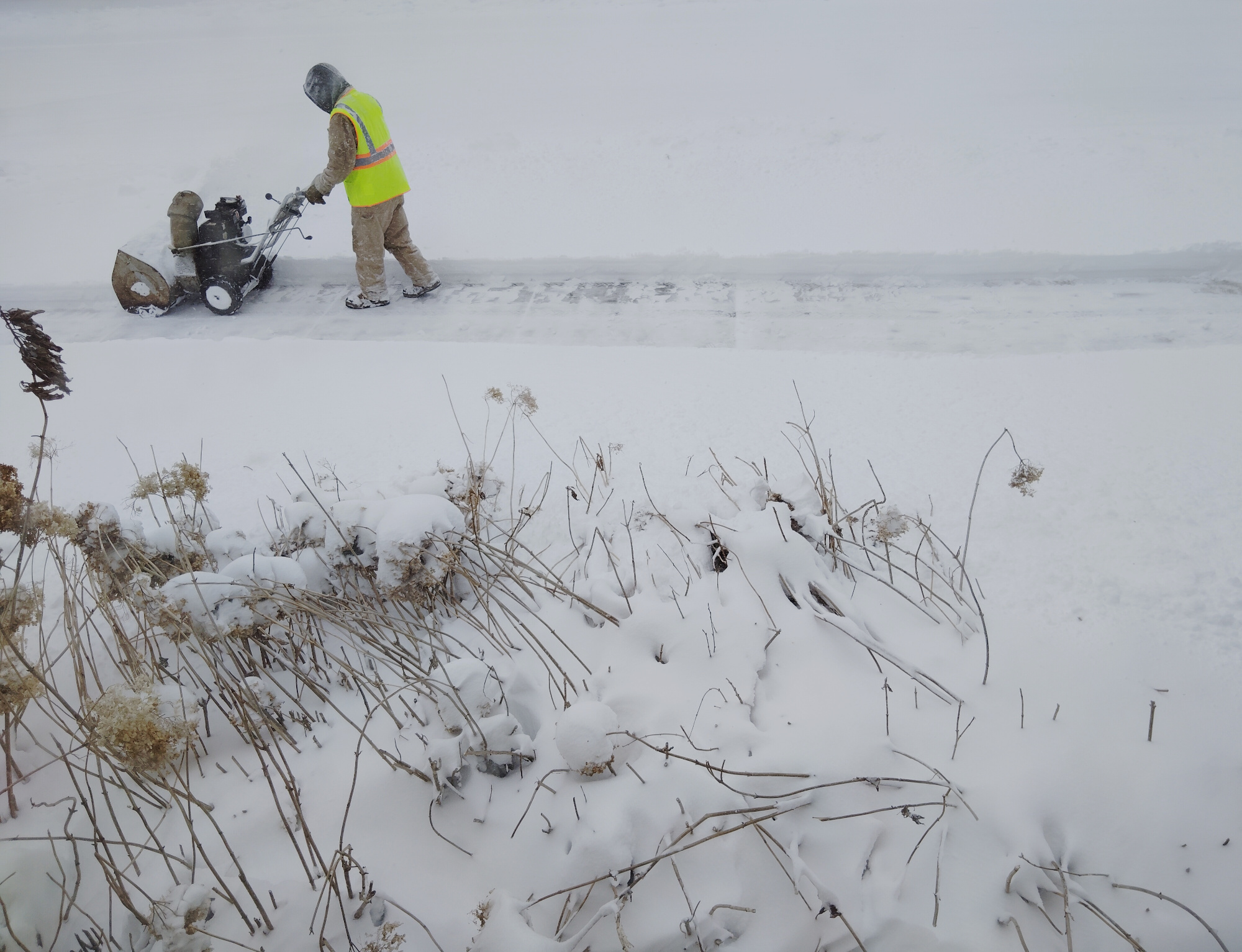
Just like the Rev. Bonsell, I advised Randy to be careful while clearing the heavy snow. Here he blows open the sidewalk with dried hydrangea in the foreground. (Minnesota Prairie Roots copyrighted photo March 2026)
And the Rev. Bonsell, in her welcome on this “snowstormy day” (her words), advised everyone to be careful when shoveling the heavy snow. Then, before beginning the worship service, she asked for more people to make pies and salads for a March 27 Fish Dinner. She announced the Holy Week schedule and a 90th birthday party open house for twins Doris and Doug, showed a video of a youth group bowling outing, and more.
And during a sharing of the peace, typically hand-shaking, the pastor and her husband, Tom, kissed. That sealed it. The snow may be falling at a rapid rate as I write. The wind may be creating chaos in the world outside. But in a small southern Minnesota living room, a pastor brought peace and love in the middle of a blizzard that won’t end until 7 a.m. Monday.
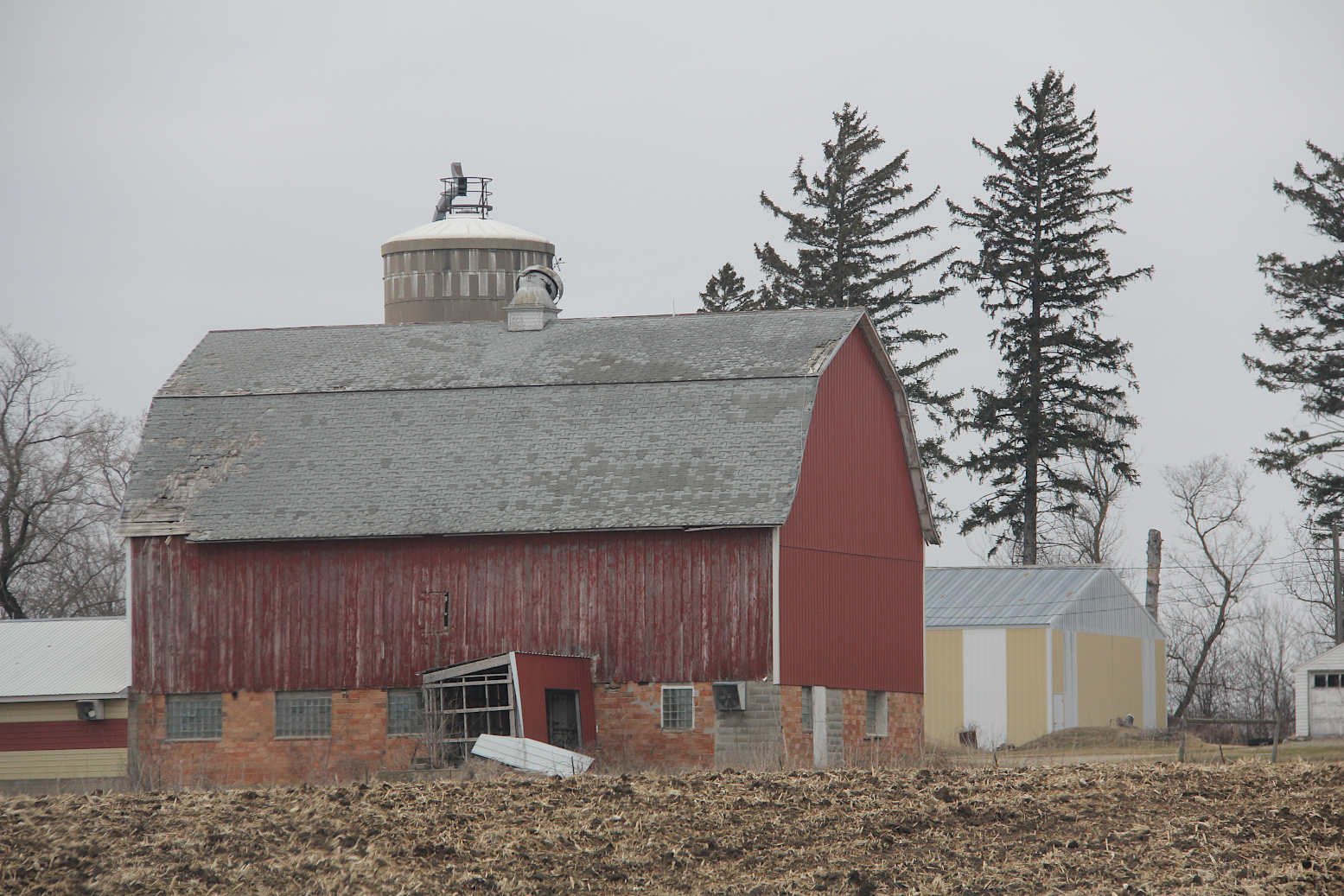
I’m drawn to photograph barns, this one along Goodhue County Road 11 west of Pine Island. (Minnesota Prairie Roots copyrighted photo March 2026)
IN THIS GO-BETWEEN TIME of almost spring here in southern Minnesota, the landscape appears mostly winter drab, plain, devoid of many photo opportunities. That is until I look beyond the bare-branched trees, the barren land, the basic gray of March skies.
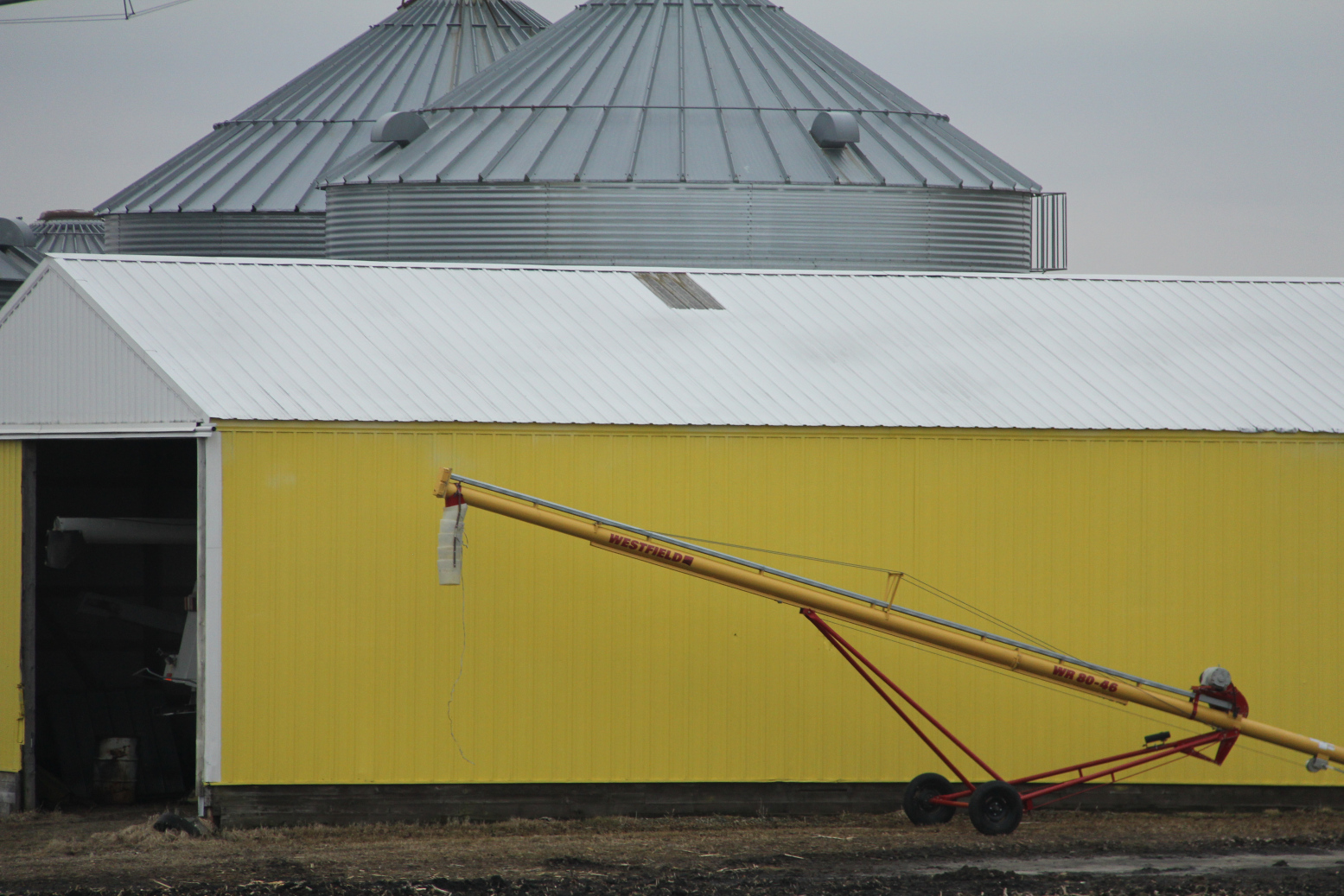
The brightest farm outbuilding I’ve ever seen is this one along Minnesota State Highway 60 between Faribault and Kenyon. (Minnesota Prairie Roots copyrighted photo March 2026)
Color, although not abundant, can still be found among the neutral hues.
Camera in hand, I watched for bright spots and more on a recent business road trip with my husband to Rochester. I kept an eye out for anything I thought would be photo-worthy. Or interesting. My definition of both may differ from yours.
Along Goodhue County Road 11 to the west of Pine Island, I found lots of well-kept red barns to photograph. (Minnesota Prairie Roots copyrighted photo March 2026)
But I enjoy on-the-road, literally, photography—taking photos from the passenger seat inside a moving vehicle. This requires awareness, anticipation and quick framing with the camera set at a fast shutter speed. Clean, or mostly clean, windows help as does a smooth road.
Sometimes I get the image I want. And sometimes I get an unfocused photo. It’s a bit of a crapshoot.
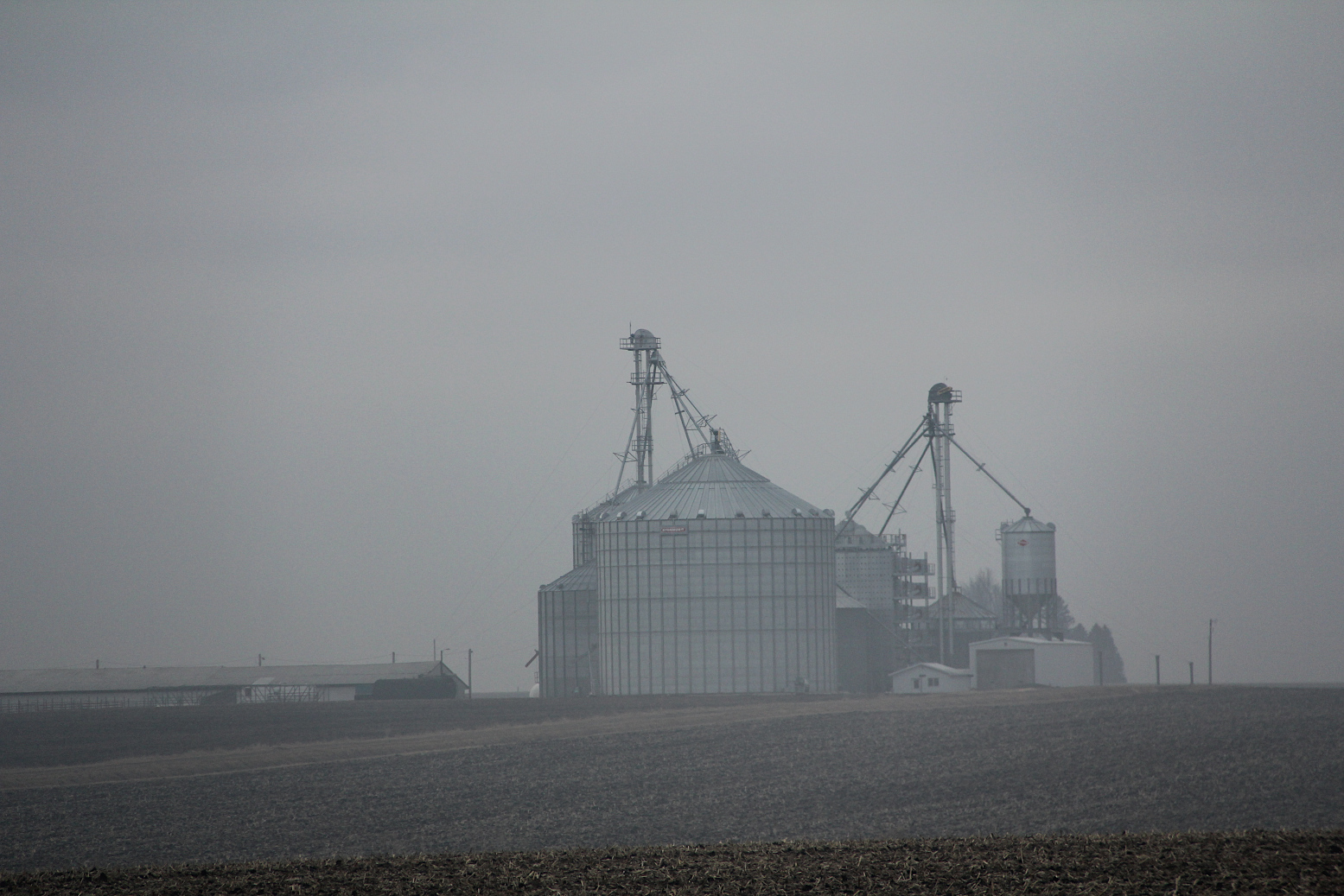
Fog shrouds bins and a grain drying complex along US Highway 14 west of Rochester. (Minnesota Prairie Roots copyrighted photo March 2026)
Regardless of photo outcomes, I’m content to scan my surroundings, appreciating the nuances of rural Minnesota. On this particular Thursday morning along US Highway 14 about 20 minutes west of Rochester, I was drawn first to fog enveloping a farm site. Gray on gray on gray on gray. Gray skies. Gray bins. Gray grain dryers. Long gray metal buildings.
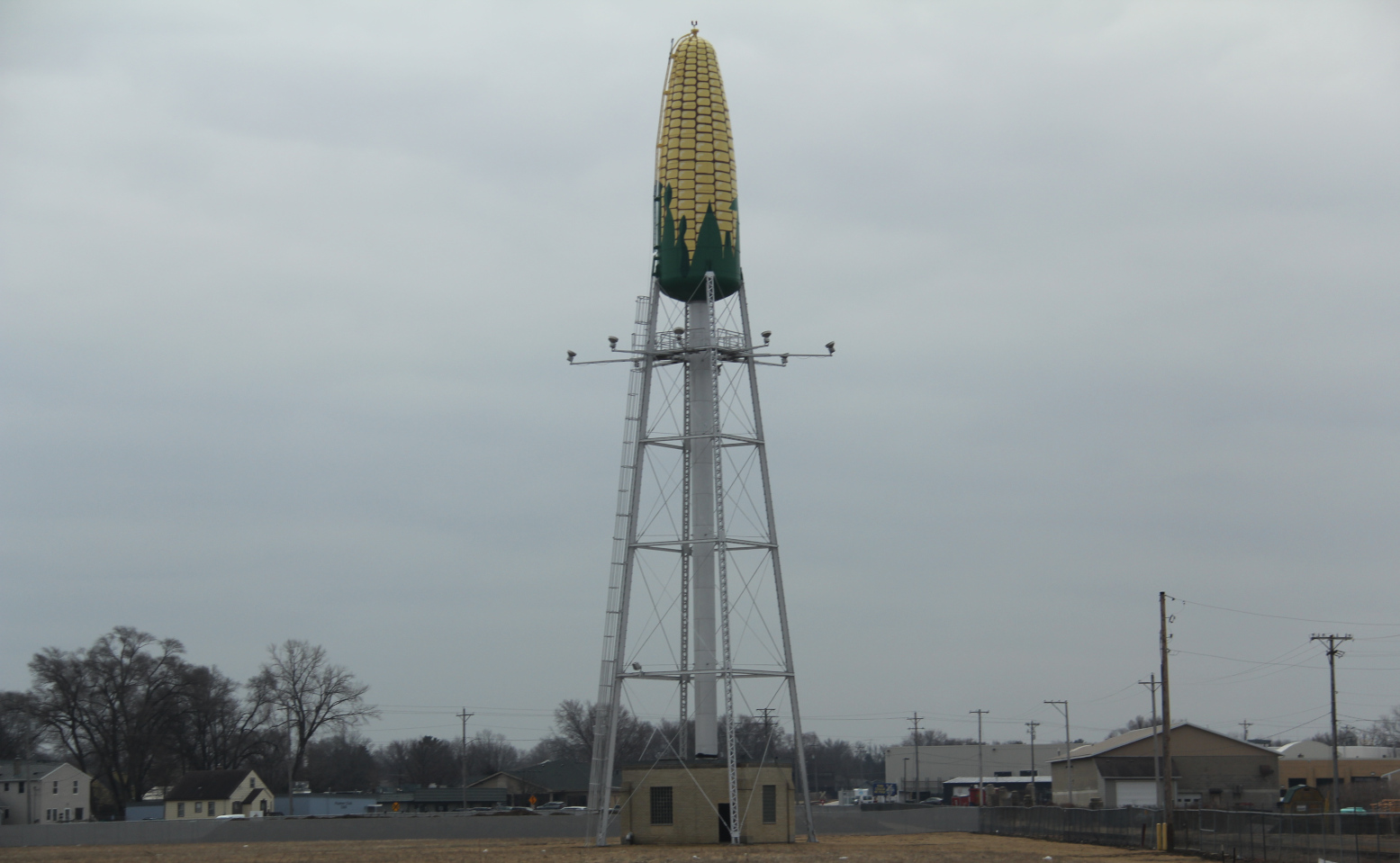
The restored historic Ear of Corn Water Tower near Graham Park in Rochester on a recent gray morning. (Minnesota Prairie Roots copyrighted photo March 2026)
Once in Rochester, color popped at me from a roadside attraction, the 151-foot tall Ear of Corn Water Tower built in 1931 for Reid, Murdoch & Co. The food cannery used the 50,000 gallon water tower in its canning operation, which included canning corn. The business changed hands twice before the plant closed in 2018. But the water tower landmark remains. I found it definitely photo-worthy as we passed by.
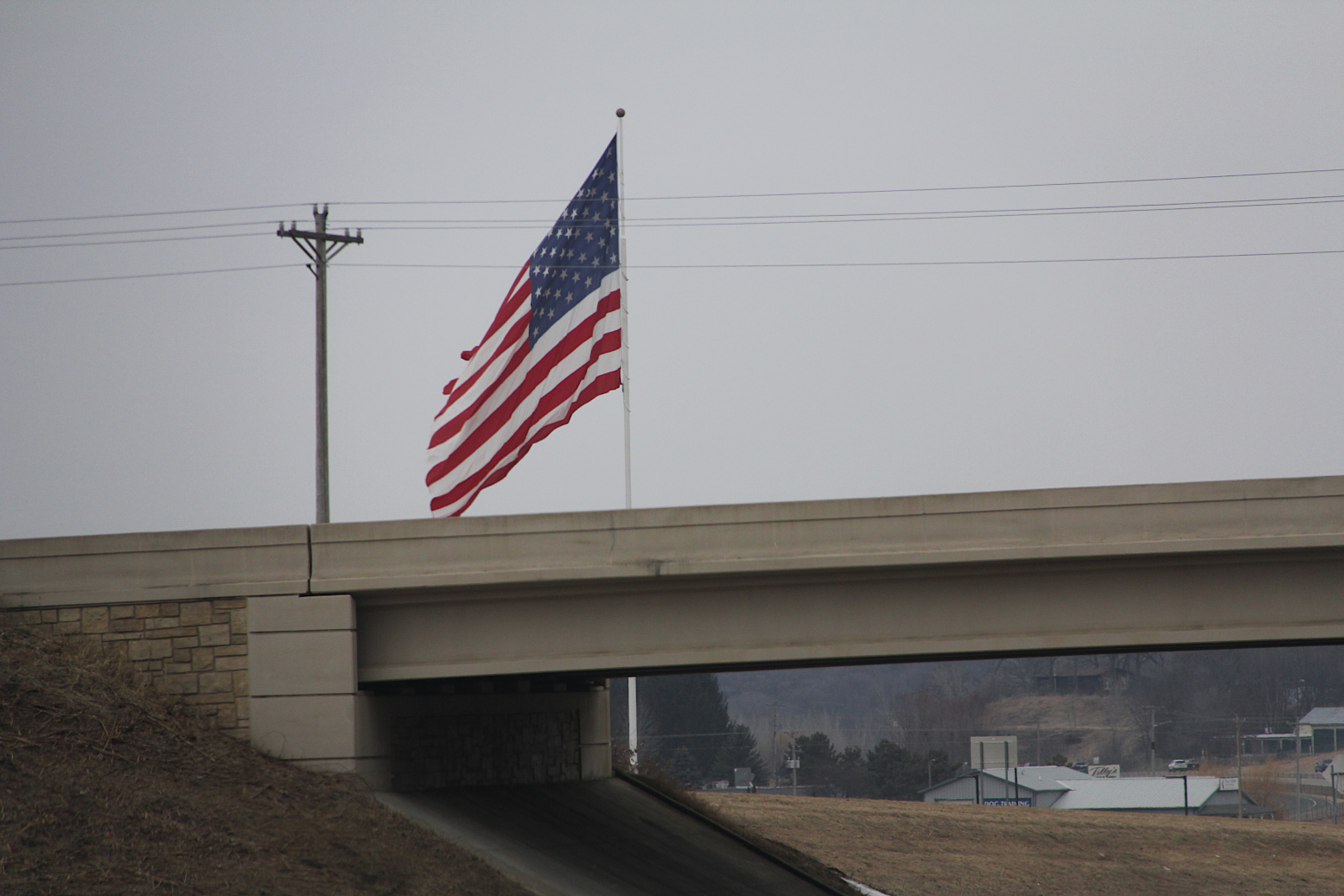
An American flag as photographed along US Highway 52 in Rochester. (Minnesota Prairie Roots copyrighted photo March 2026)
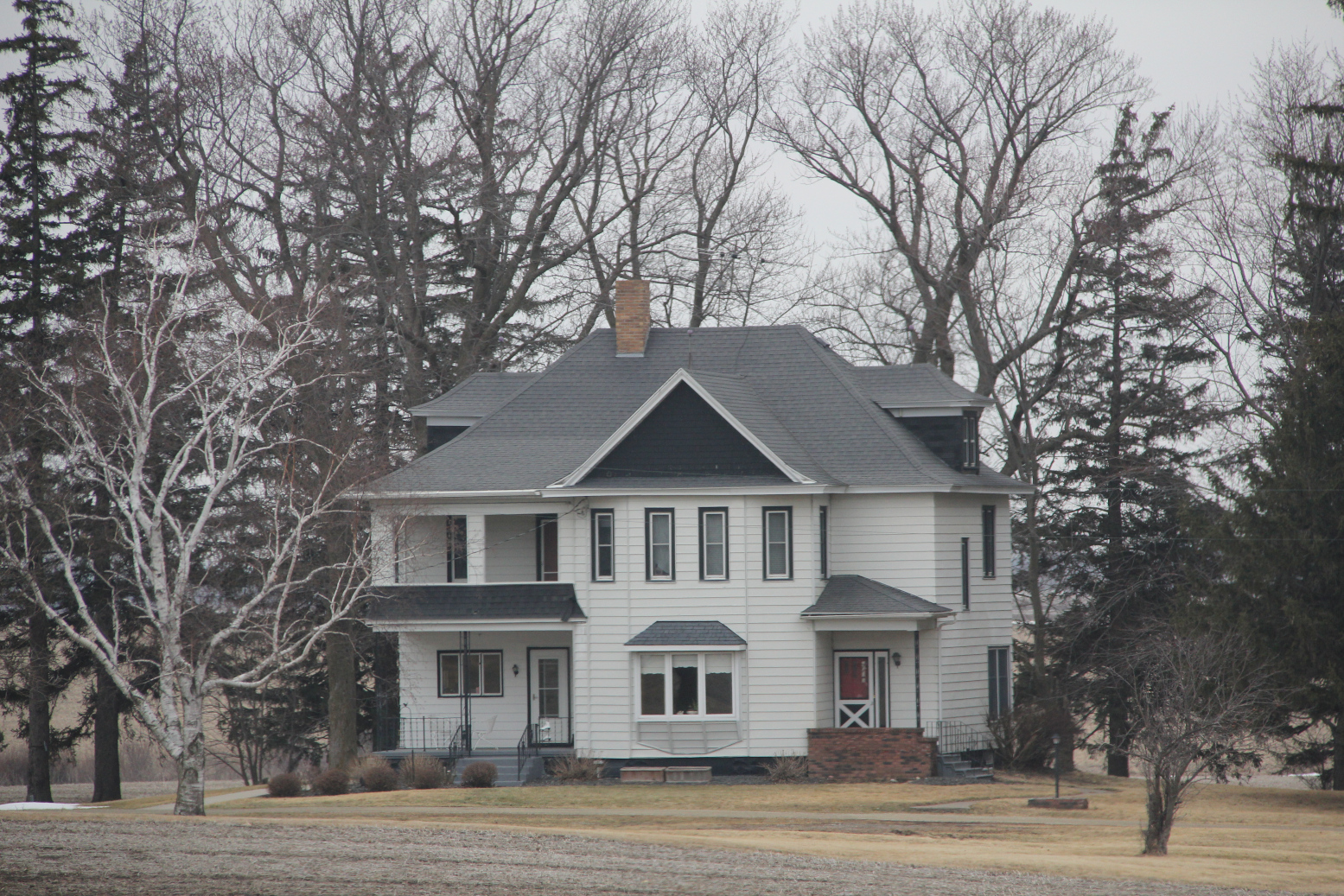
But something as simple as as an over-sized American flag flapping in the morning breeze, a red barn flashing color, a sprawling white farmhouse, a row of power lines, a distant farm site can grab my visual attention, too.
I always wanted to live in a sprawling farmhouse similar to this one along Goodhue County Road 11. (Minnesota Prairie Roots copyrighted photo March 2026)
I’m drawn to photograph rural scenes because of my farm background. Deep in my soul, I long to live again in the countryside, away from close neighbors, near nature, cocooned by quiet. But reality is that will never happen.
And so I find ways to reconnect with the land. In my writing. In my photography. In every season.
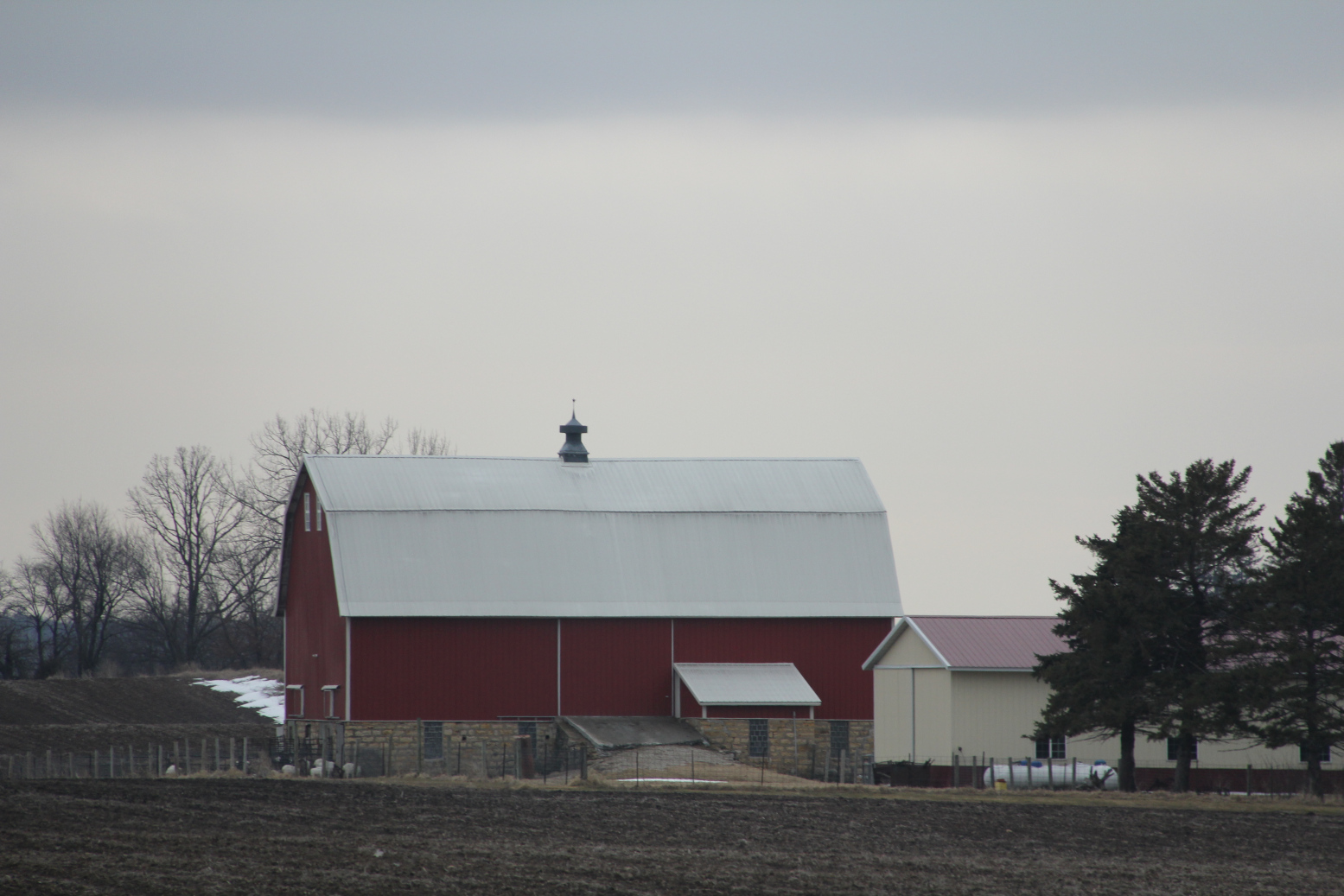
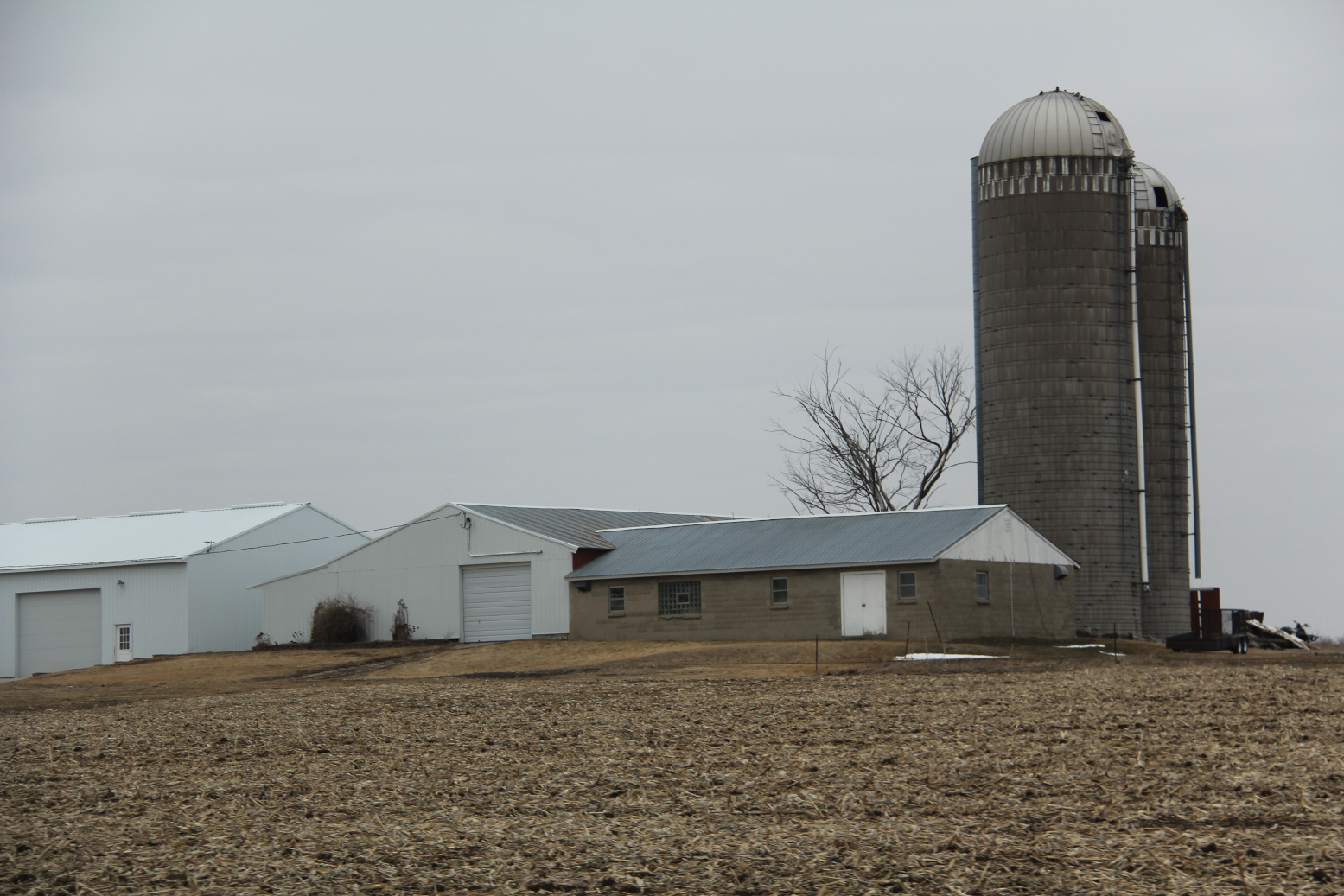
A farm site west of Pine Island along Goodhue County Road 11. (Minnesota Prairie Roots copyrighted photo March 2026)
Every farm field holds the hope of a farmer. Every farm site holds memories and hard work. And dreams. I see this on the road, through my camera lens, as my focus shifts with every mile covered.
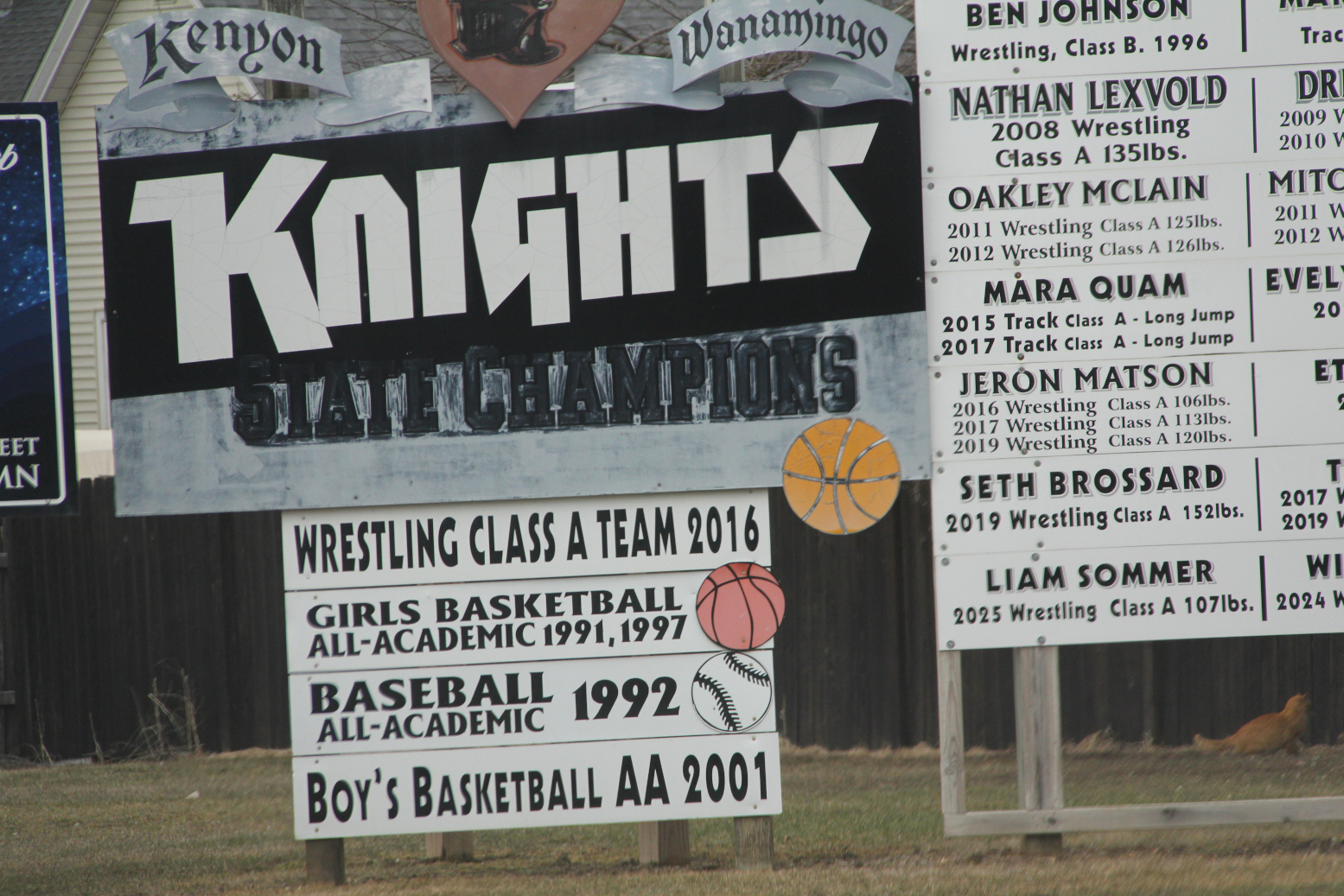
Kenyon-Wanamingo High School sporting accomplishments banner signs. (Minnesota Prairie Roots copyrighted photo March 2026)
I view an ever-changing rural winter landscape of red barns, aged farmhouses, towering silos, untilled fields and then, on the edge of Kenyon, signage boasting local high school sporting championships. Such signs are common in small Minnesota communities.
I zoomed in on this eagle flying high above the land outside Kenyon. (Minnesota Prairie Roots copyrighted photo March 2026)
Nearing the end of this quick road trip, an eagle leads us along Minnesota State Highway 60 west of Kenyon before veering to the right. When I see this majestic bird on this day, I feel as I always do about eagles—in awe of their size, their power, their speed. I snap three quick frames.
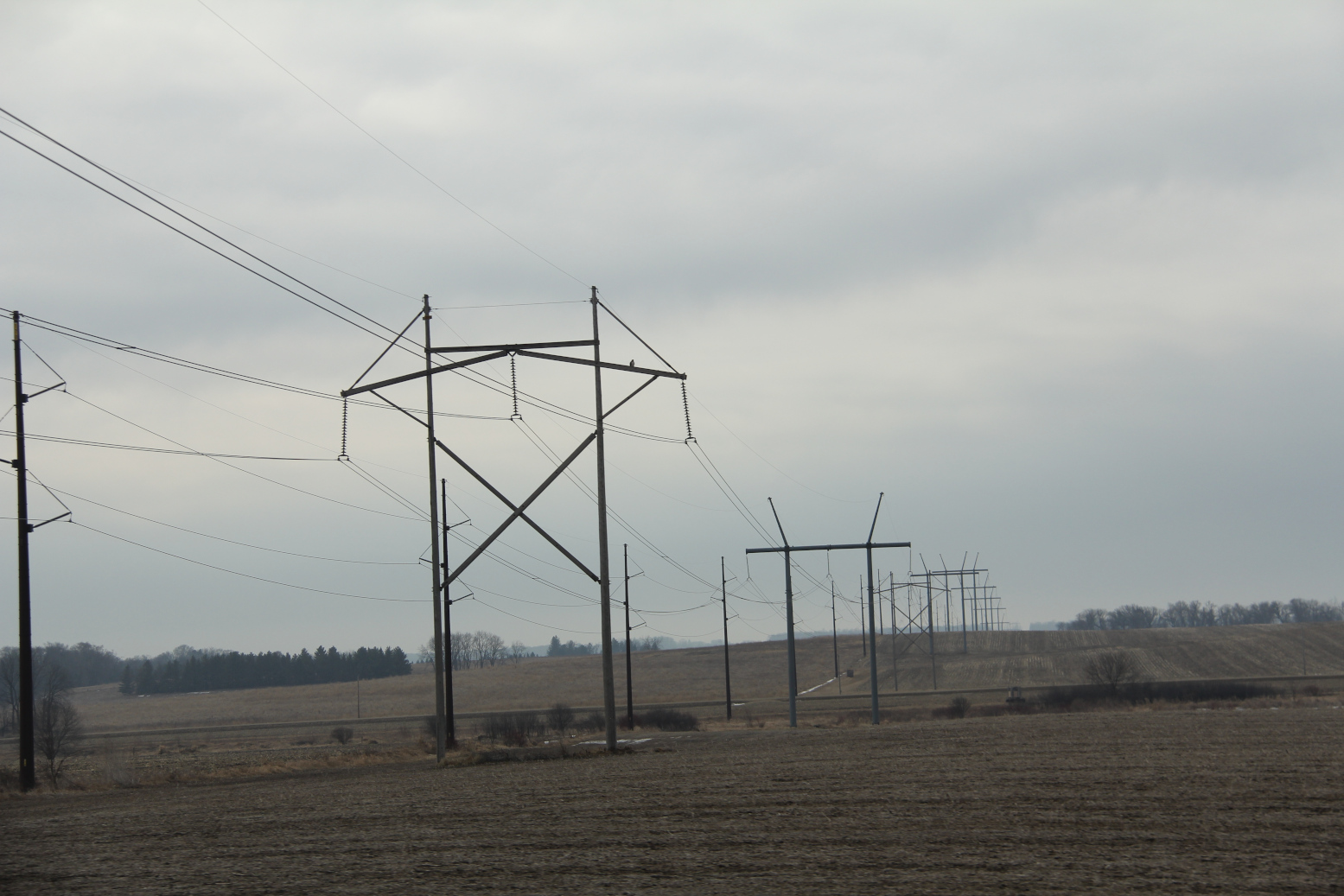
Massive power lines stretch seemingly into infinity along US Highway 14 somewhere between Owatonna and Rochester. (Minnesota Prairie Roots copyrighted photo March 2026)
Time passes. Miles pass. Rural southern Minnesota unfolds before me, captured through the lens of my camera on an almost-spring day in March.
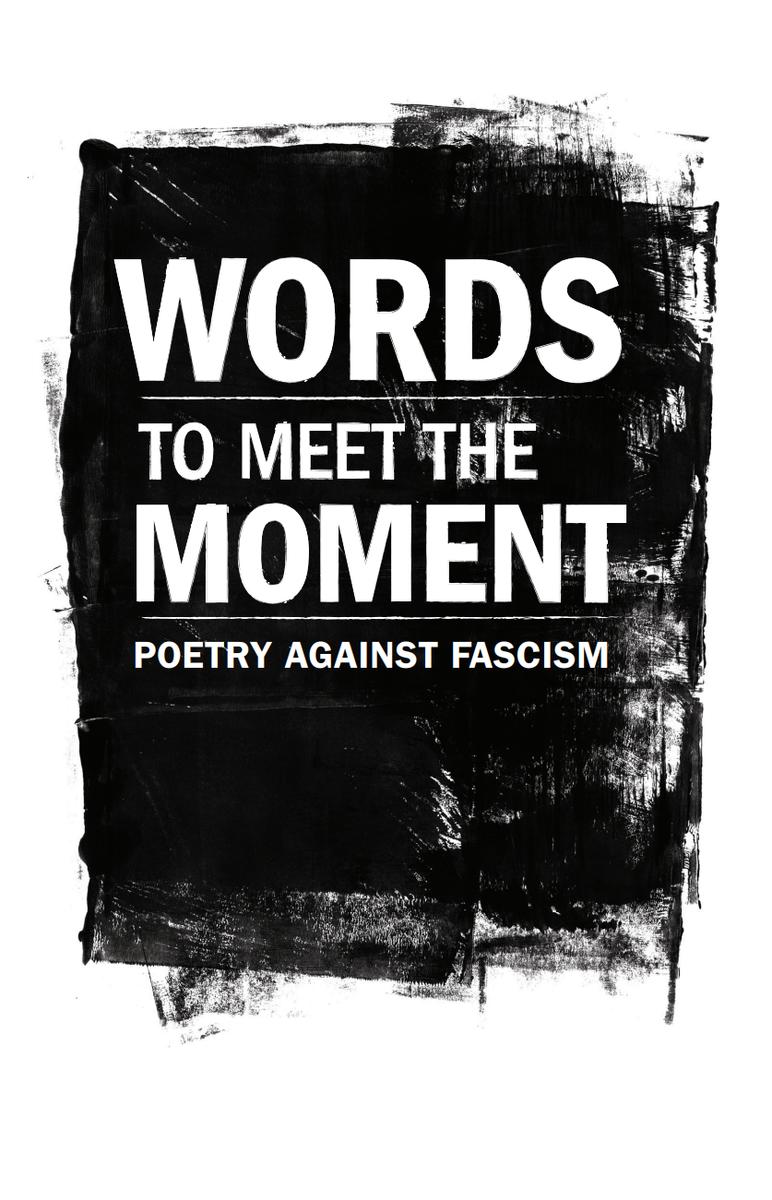
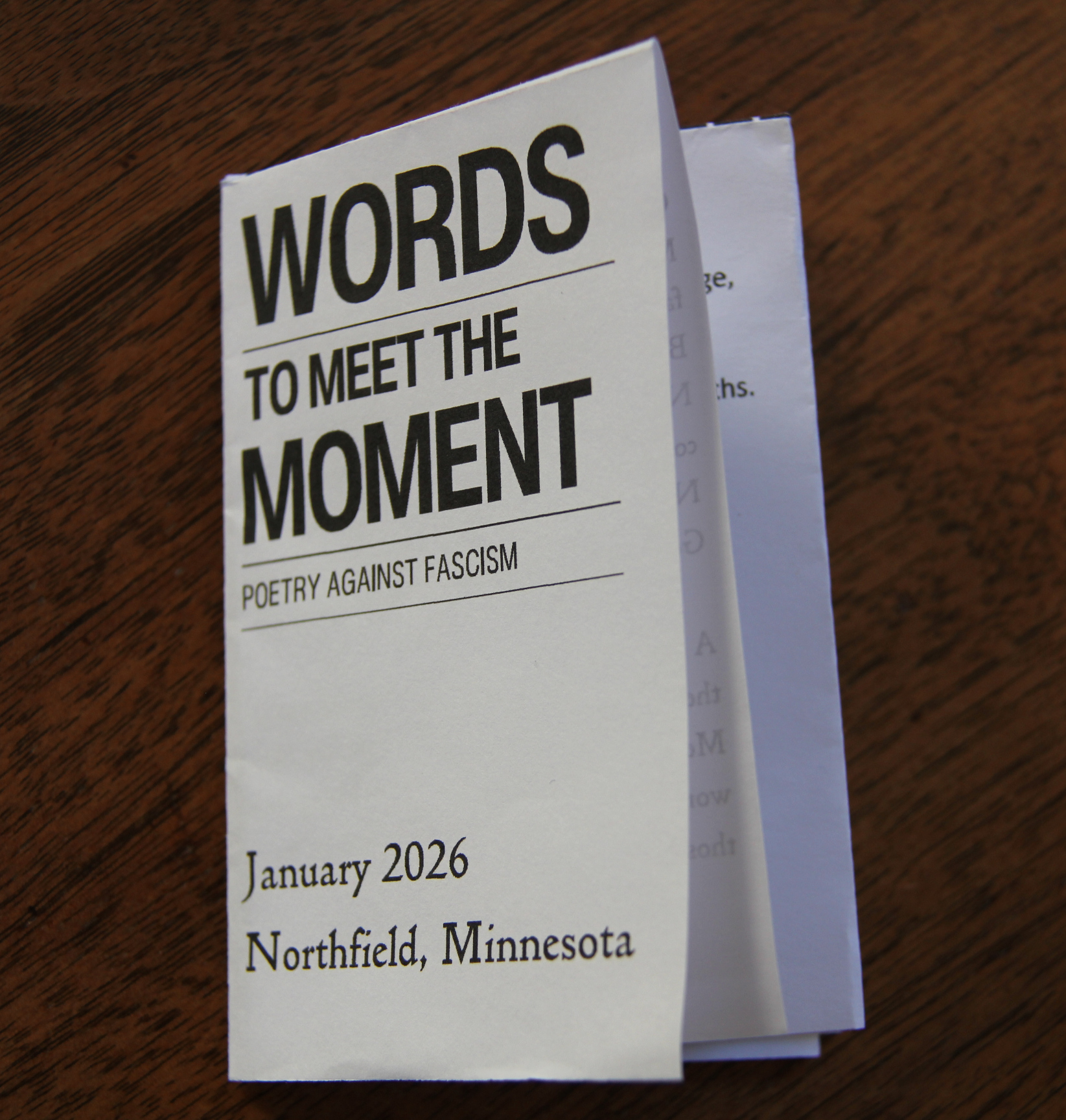
“Words to Meet the Moment,” published by Content Bookstore, Northfield, Minnesota, and printed by Northfield-based By All Means Graphics.(Book cover designed by Mark Heiman)
POETRY HOLDS POWER. And perhaps no time has that been more evident in Minnesota than during the massive federal immigration enforcement, Operation Metro Surge.
In January, poets from my area of southern Minnesota gathered to read original poetry at a “Words to Meet the Moment: Poetry Against Fascism” event in Northfield. I was in Wisconsin, unable to attend. But a poet friend, Becky Boling, read my two poems, “Death of a Poet” and “Fiery Resistance.”
T-shirts for sale at Content Bookstore. (Minnesota Prairie Roots copyrighted file photo February 2026)
Now those two poems and others read at The Grand Event Center in January have been printed in a chapbook, Words to Meet the Moment, published by Content Bookstore. That’s an independent, socially-conscious bookshop in the heart of historic downtown Northfield. Once printing costs have been covered, all proceeds from chapbook sales will be donated to the Northfield Community Action Center, a nonprofit serving the community.
The work of 20 poets, some of whom I know personally (and have read poetry with) or whom I’ve heard read, are printed therein. These are gifted poets, many with their own published collections of poetry. Several were previous poet laureates in Northfield.
I picked up this zine when I was recently at Content Bookstore. It includes three poems, “Ice and Fire” by Steve McCown, “Last Words for Renee Nicole Good” by Susan Jaret McKinstry and “A Witness” by Rob Hardy. (Minnesota Prairie Roots copyrighted photo February 2026)
All of us wrote in response to ICE’s presence in Minnesota and/or in reaction to the fatal shooting of Renee Good by a federal immigration agent on January 7. This was prior to the second fatal shooting, that of Alex Pretti, by ICE agents. Good was a poet, which makes this new chapbook especially meaningful.
Whether you like poetry or not, this is one collection you should read to better understand how we as Minnesotans, we as poets, have been feeling these past few months. Poetry holds power. It is a way to raise our voices against injustice, a way to express our thoughts, our feelings. A way to make a difference. A way to meet the moment.
FYI:To pre-order/order Words to Meet the Moment: Poetry Against Fascism, click here. The chapbook is priced at $10. Content Bookstore will ship the chapbook domestically for an additional cost of $4.99, the media mail book rate, plus an additional $1 per book shipped. Only one printing is planned, unless the chapbook sells quickly. Books will also be available for purchase in the store.
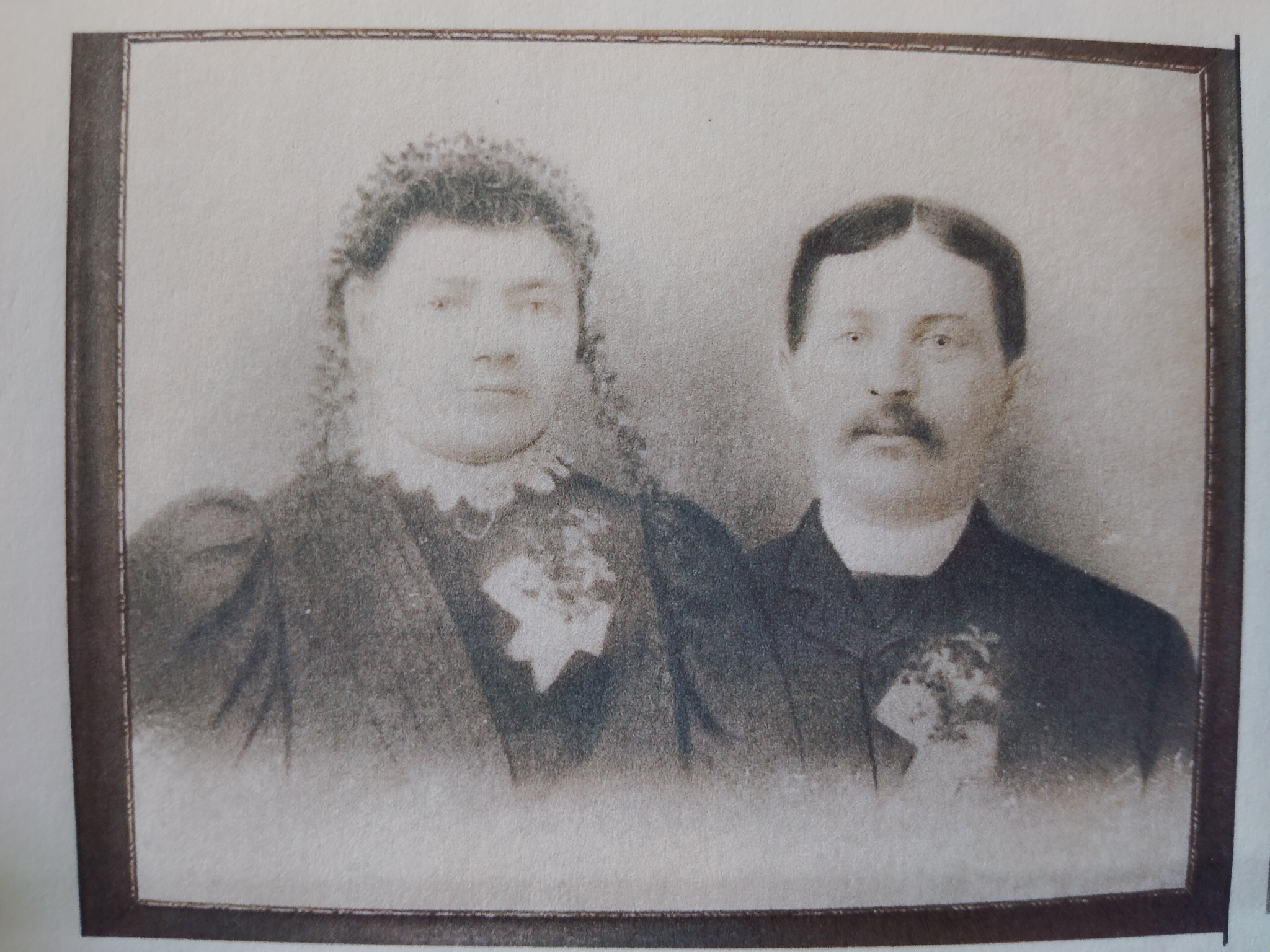
My great grandparents, Rudolph and Mathilda Kletscher, married in 1891. (Photo source: Kletscher Family Tree 2008 produced by Merlin and Iylene Kletscher)
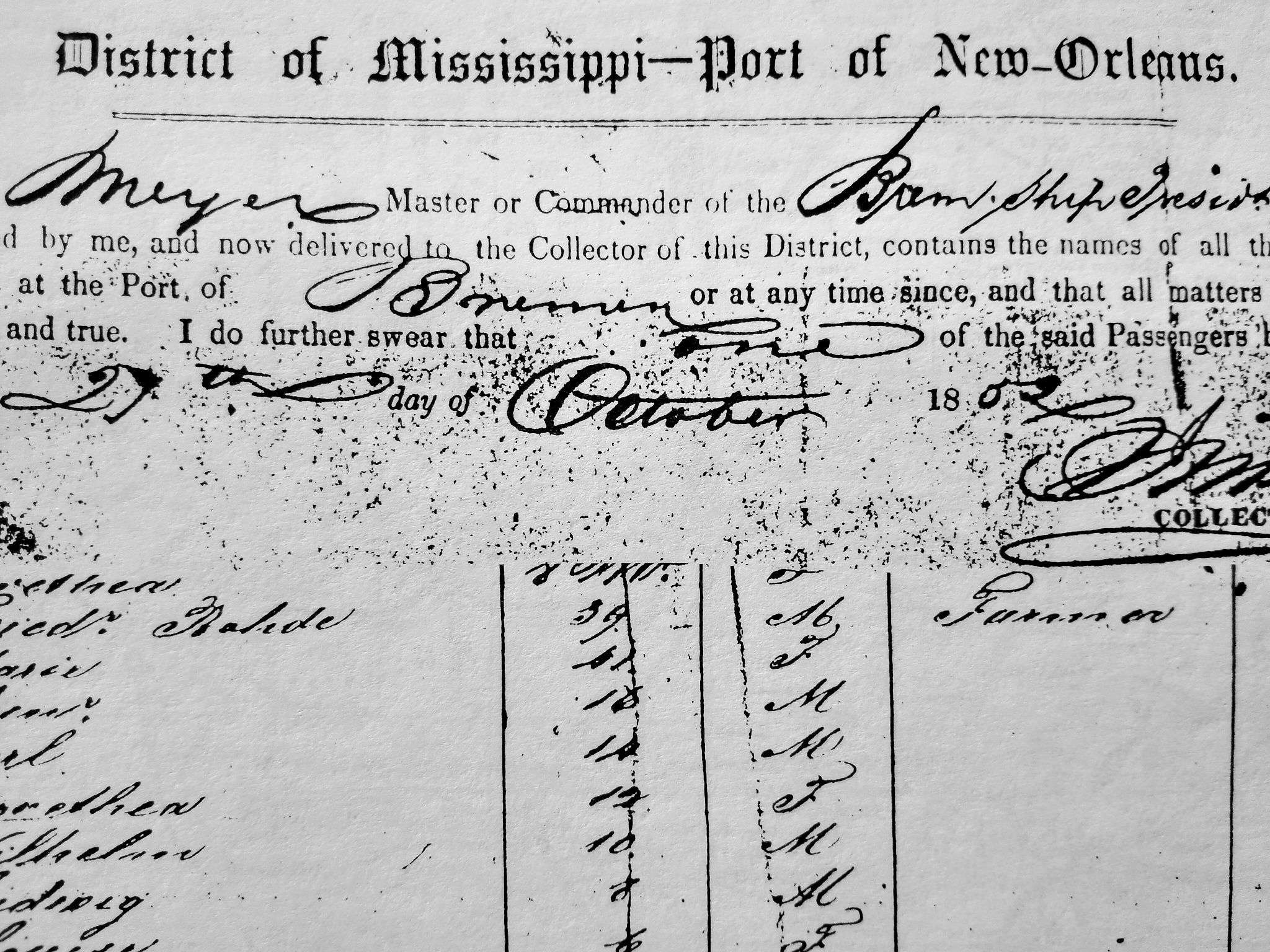
UNLESS WE ARE NATIVE AMERICANS, immigration is part of our family history. On my maternal side, Friedrich and Maria Bode arrived from Germany at the port of New Orleans in October 1852. They would settle in Illinois. Most of the family eventually moved to Minnesota. On my paternal side, my great grandfather, Rudolph Kletscher, landed in Baltimore from Germany in 1886, several years later journeying west to put down roots in southern Minnesota.
I pulled this information from pages of family history uncovered and compiled by family members who have researched our roots in Germany. I am grateful for their work, for the names, dates and places recorded for reference. Sometimes there are stories, or tidbits of stories. But mostly the research reveals documented facts only, not stories.
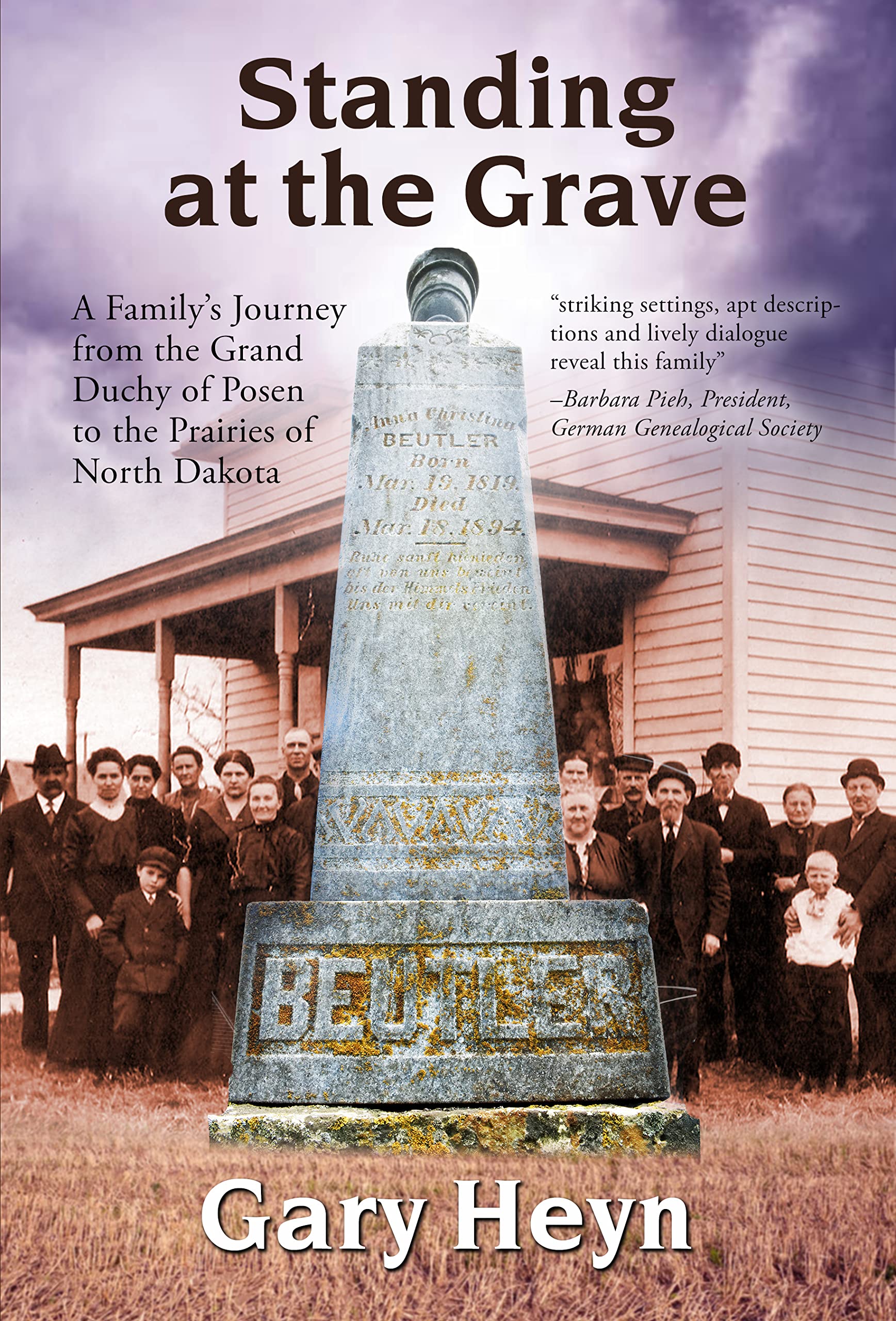
(Book cover sourced online)
It is the stories that interest me most, which explains my interest in reading Standing at the Grave—A Family’s Journey from the Grand Duchy of Posen to the Prairies of North Dakota by Minnesotan Gary Heyn. Books on Central in Faribault hosted Heyn on Thursday evening during a monthly literary event. I was among those in attendance, listening to Heyn read and then answer audience questions. I’d just finished reading his book about his ancestors who immigrated to America from Prussia (now Poland) beginning in 1867 shortly after the Civil War ended.
His ancestors could have been mine. Any of ours. Heyn took basic facts confirmed thorough research at the Minnesota History Center, church records, a Polish history website, old newspapers, even the National Weather Service and gleaned during several trips to Poland to form the foundation for his stories. The dialog and interactions are fictional slices of personal life in Prussia and then in America. Heyn’s characters really come alive when he reveals their fears, their worries, their hardships, griefs, challenges and more in intimate storytelling.
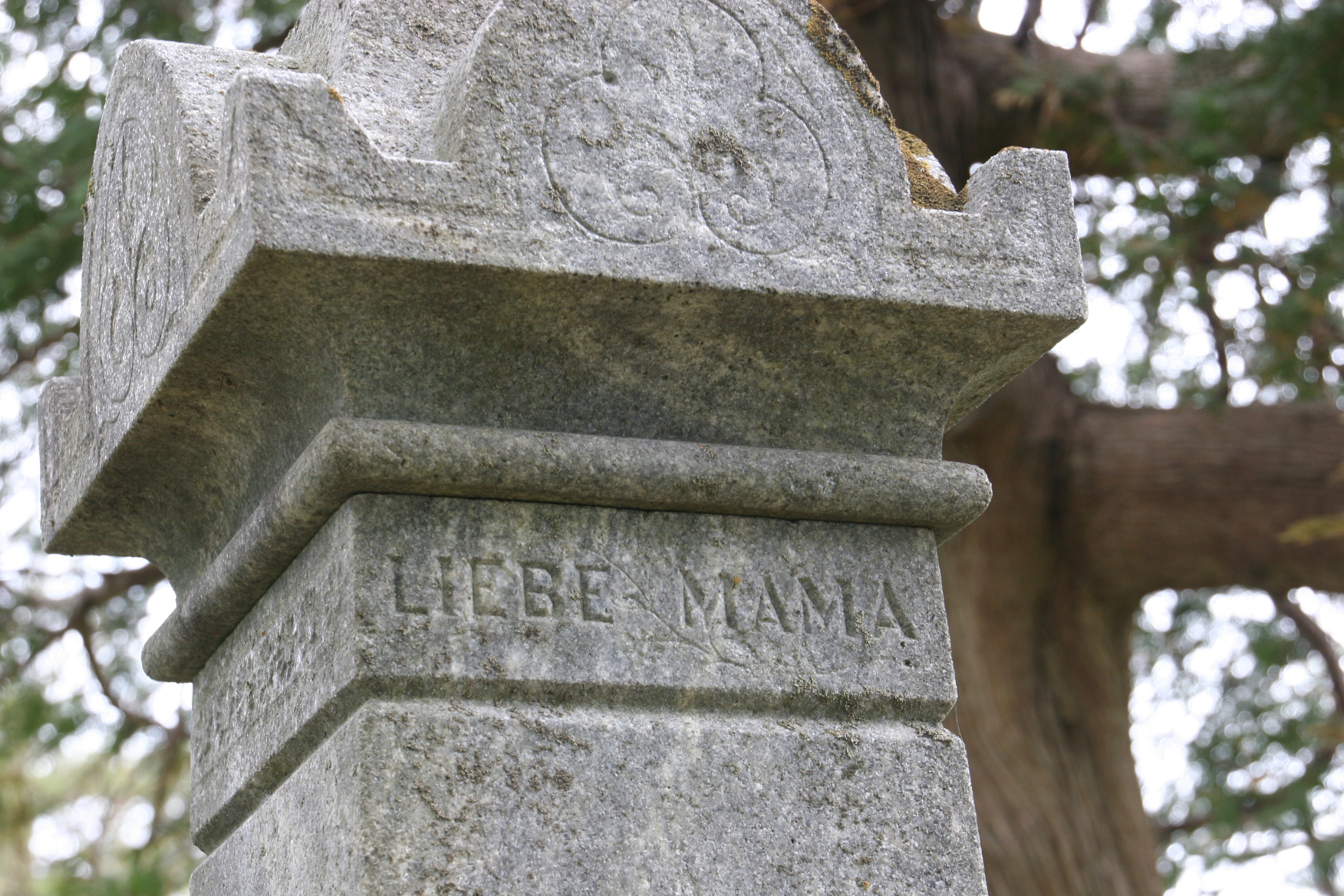
A tombstone in the Immanuel Lutheran Church Cemetery, Potsdam. The German word “LIEBE”means love in English. A Heyn family member is buried in this cemetery. (Minnesota Prairie Roots copyrighted file photo May 2022)
These are, at times, really hard stories. Of death by disease. Of death by accidents. Of death by suicide. Of death by botulism. I appreciate that the author doesn’t avoid tough topics. I understand the worries about weather and crop failure, vicariously stand at the graves of loved ones, recognize the depression a young mother experiences as she looks across the expansive North Dakota prairie, feeling isolated and alone.
But those difficult stories are balanced by the joys of births, of weddings, of the opportunity to claim land through the Homestead Act, to live and love and grow family in a new land rich in opportunity.
Main character, family matriarch Anna, follows her family to America many years after the first, eventually fulfilling her life-long dream of once again owning land, this time 160 acres in North Dakota. Most of the family found land in southern Minnesota, in the Rochester area where the author grew up and first heard the stories of his great grandmother. She lived with his childhood family. That sparked his interest in family history and genealogy, which, after his retirement as an accountant, led to writing Standing at the Grave.
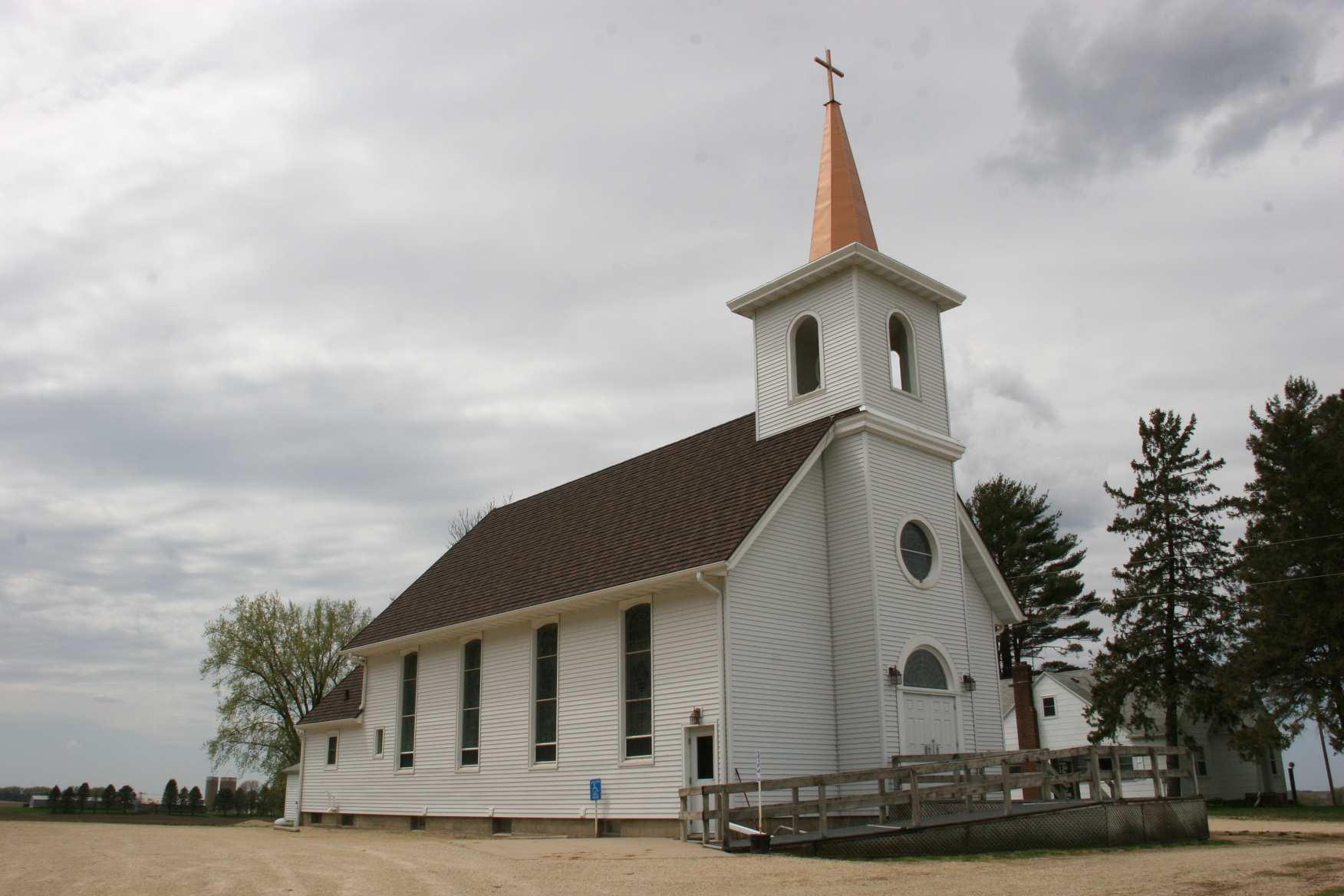
Immanuel Lutheran Church, Potsdam. (Minnesota Prairie Roots copyrighted file photo May 2022)
Southern Minnesotans, especially, will feel at home in places like Elgin, Grand Meadow, Pleasant Valley, Owatonna and more. I’ve even visited and photographed Immanuel Lutheran Church in Potsdam, where Anna stood on the front steps and scanned the countryside below the hilltop church. I’ve walked the cemetery, where Heyn’s ancestor, Willie, lies buried in an unmarked grave.
As much as I appreciate the storytelling in this book, I also appreciate its relevancy to today. Heyn family members new to America in the late 1800s are told to speak English, not German. Sound familiar? (My own mother, who died at age 89 in 2023, spoke German as her first language.) These newcomers to America felt like foreigners, often choosing to live among others from their homeland. Among those who shared their language, culture and customs, who liked bier, sauerkraut, Weihnachtsstollen and Glühwein.
But in times of challenges, Heyn reveals in one story, “…the citizens of this neighborhood, born all across the globe, banded together to help another working man.” That coming together of many nationalities repeats in his book, even as conflicts arise.
A passenger ship list from the port of New Orleans. (Source: The Bode Family book by Melvin & Lois Bode, 1993)
Heyn, in his writing, reveals the challenges, the dreams, the hopes, the resilience and resolve of his immigrant ancestors. These were strong individuals who relied on each other, their faith and their inner strength to cross a vast ocean for a new life in America. This is their story, but also a universal story of immigration, as relatable today as then.
This book helped me better understand those who came before me from Germany to America from a personal perspective. This book also reminds me of the struggles immigrants still face today in America, especially today.
The Northern Lights, photographed northeast of Faribault near Cannon City (with a treeline in the foreground) around 9 p.m. Tuesday, November 11. (Minnesota Prairie Roots copyrighted file photo November 2025)
IT TOOK A LIFE TIME, but I finally saw the Northern Lights for the first time. Ever. And they were poetic, artistic, inspiring, incredible, wondrous, glorious…all the adjectives you can use to describe a dark night sky colored with streaks of green, red and pink.
Randy and I were sitting comfortably in the warmth of our southern Minnesota home Tuesday evening when our son texted that he could see the Northern Lights even in the city lights of Boston. A photo proved it. Then the daughter who lives 35 minutes to the north of us texted that they, too, could see the lights in Lakeville, south of the Twin Cities. Photos proved it.
We popped up, grabbed our coats and set out to see for ourselves. We didn’t have to drive far into the countryside before we noticed the first streaks of light. Turning onto a gravel road, we parked, stepped outside and turned our eyes heavenward. Then we eventually tried to figure out how to photograph the majestic scene above us on our smartphones, with only minimal success.
While I would have loved some spectacular images, what matters most is that I saw, with my own eyes, that which I’ve wanted to see my entire life. Others were doing the same. We counted about a dozen vehicles parked along rural roads, the occupants gazing skyward.
This imprinted upon me how something like the Northern Lights can bring people outdoors, appreciating this beautiful natural world that surrounds us and, which on this November evening, put on a spectacular light show.
TELL ME: Have you seen the Northern Lights? When and where? How would you describe them?
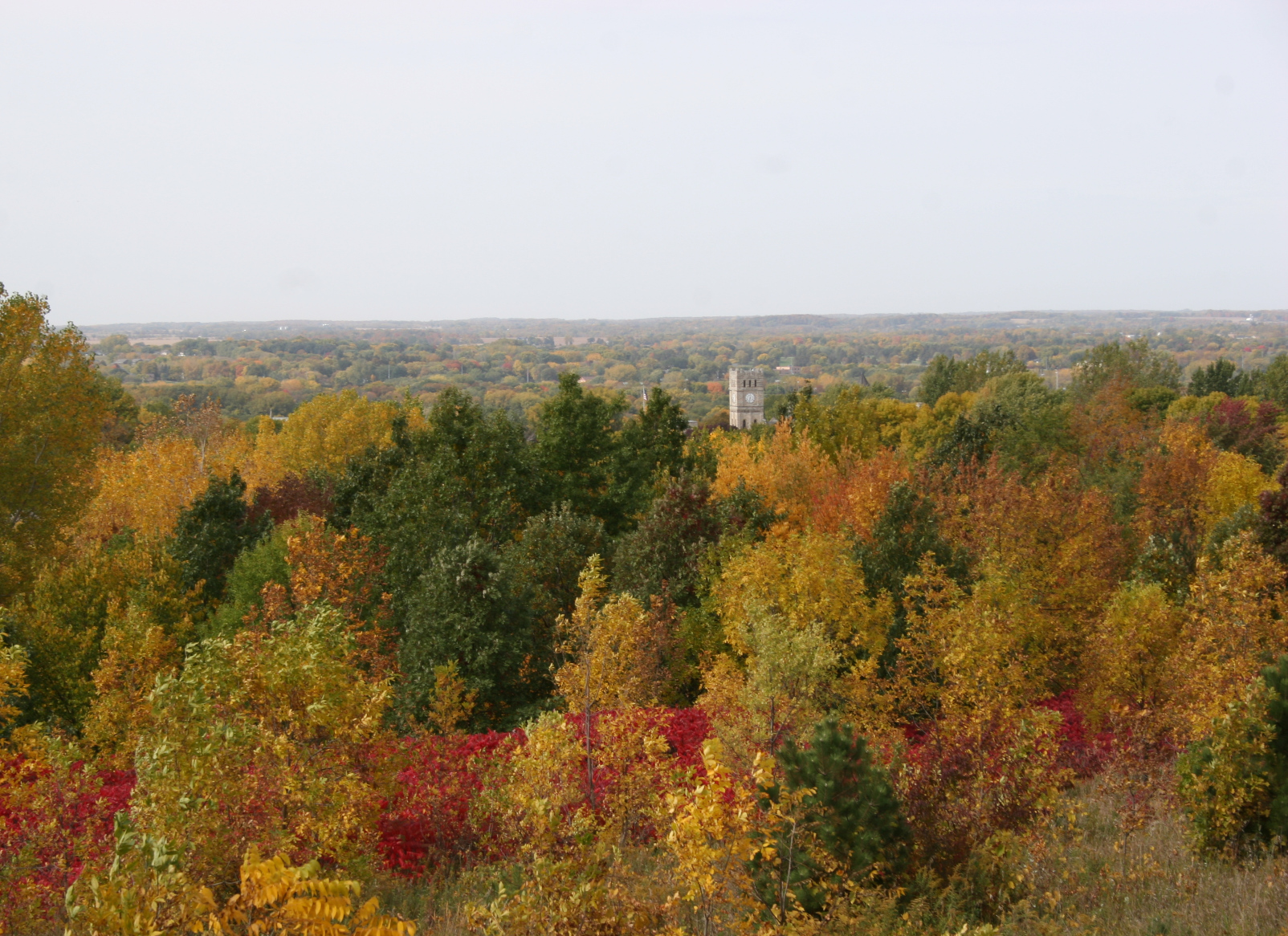
City View Park on Faribault’s east side provides a sweeping, colorful view of the city in October. (Minnesota Prairie Roots copyrighted file photo 2022)
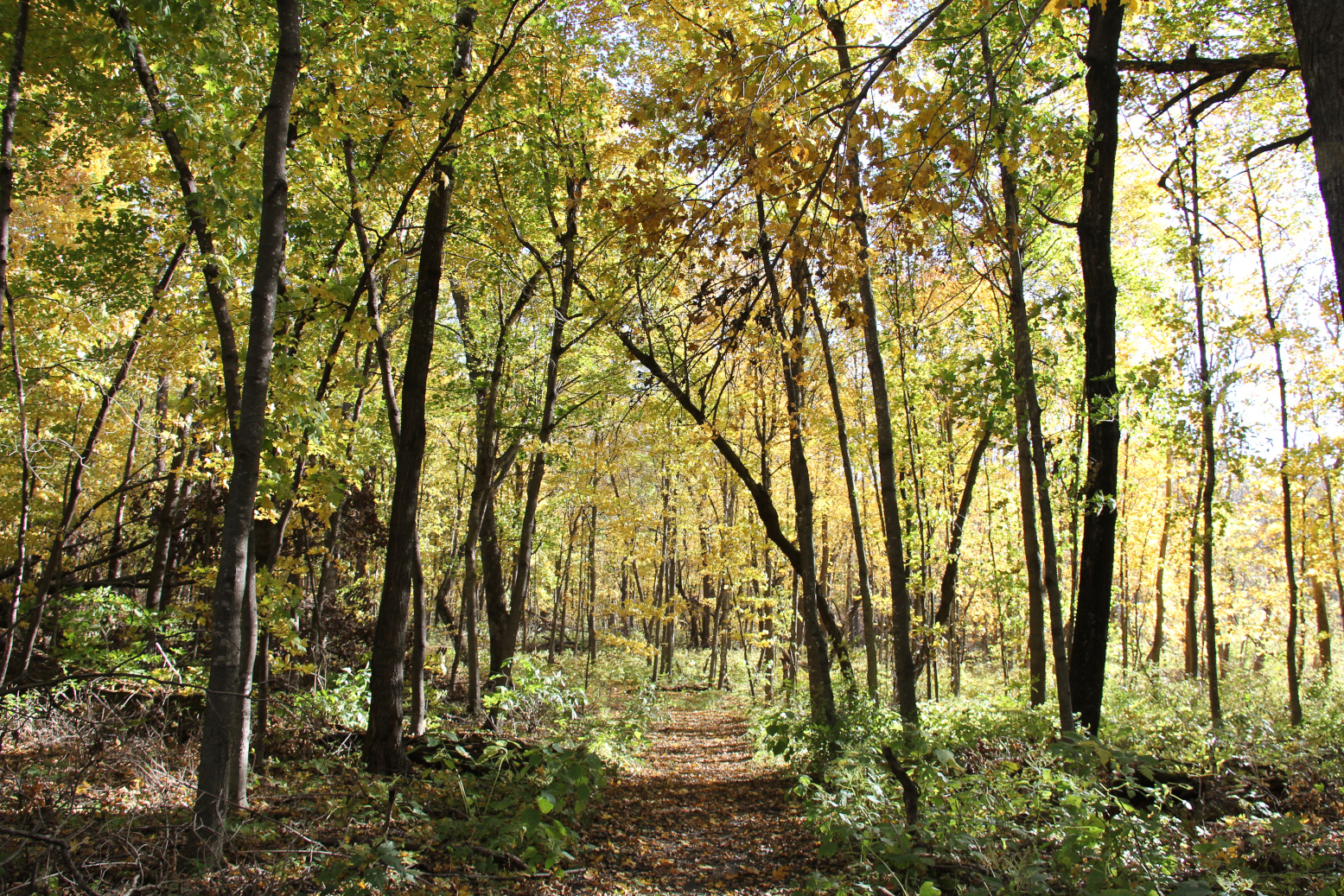
IF I WANT TO VIEW fall colors, I needn’t go far. I can step into my backyard to see glorious golden maples. Up the street from my Willow Street home, more trees blaze. If I follow Second Avenue to its intersection with Seventh Street, I’ll find especially vibrant trees on a corner property owned by friends Mark and Laurie. There are more splashy hues along Seventh Street and all about town. Tree-lined bluffs rising above the Straight River burst with color. Faribault is a beautiful, historic riverside city anytime, but especially in autumn.
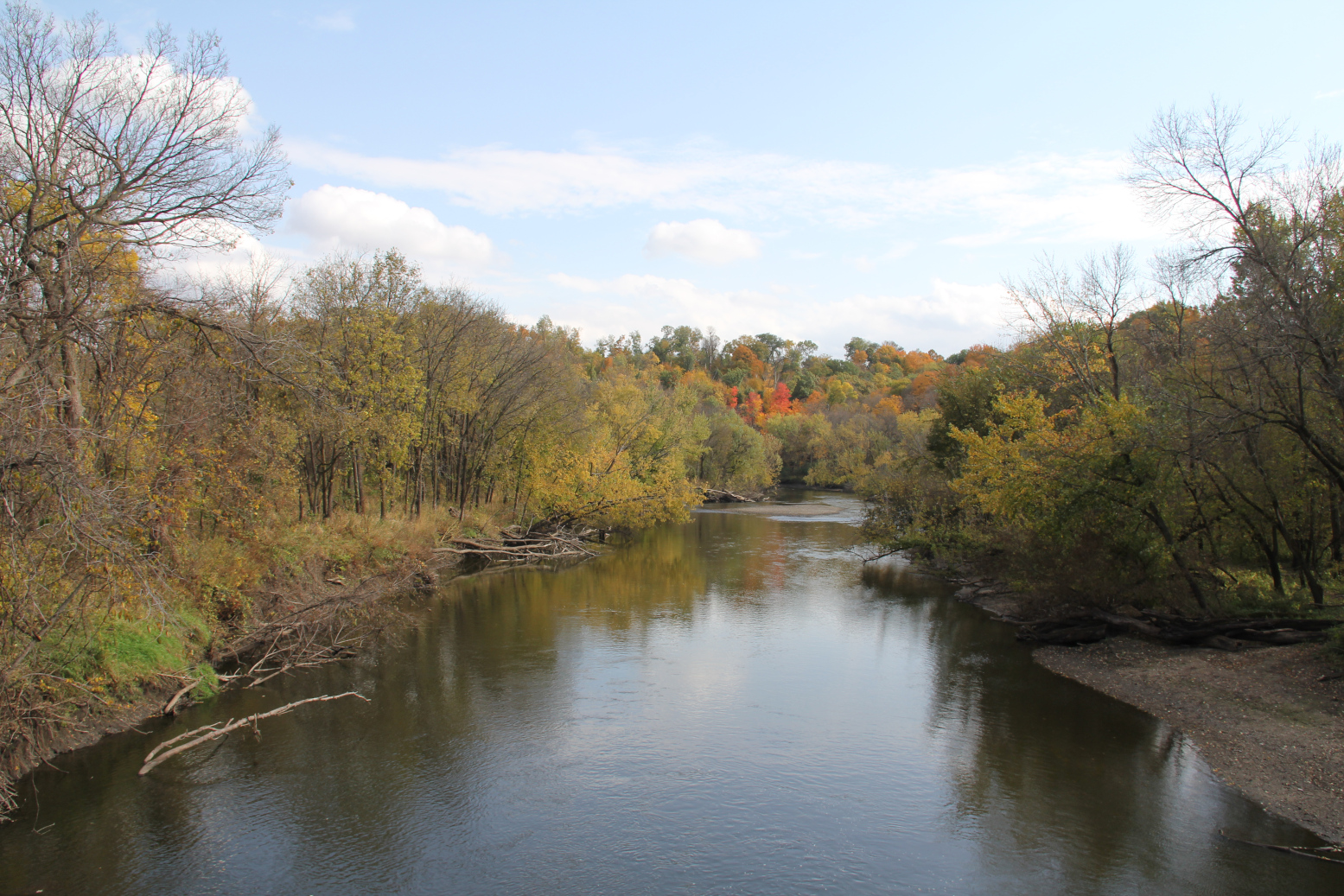
A view of the Cannon River from the pedestrian bridge at the Cannon River Wilderness Area between Faribault and Northfield. (Minnesota Prairie Roots copyrighted photo October 2025)
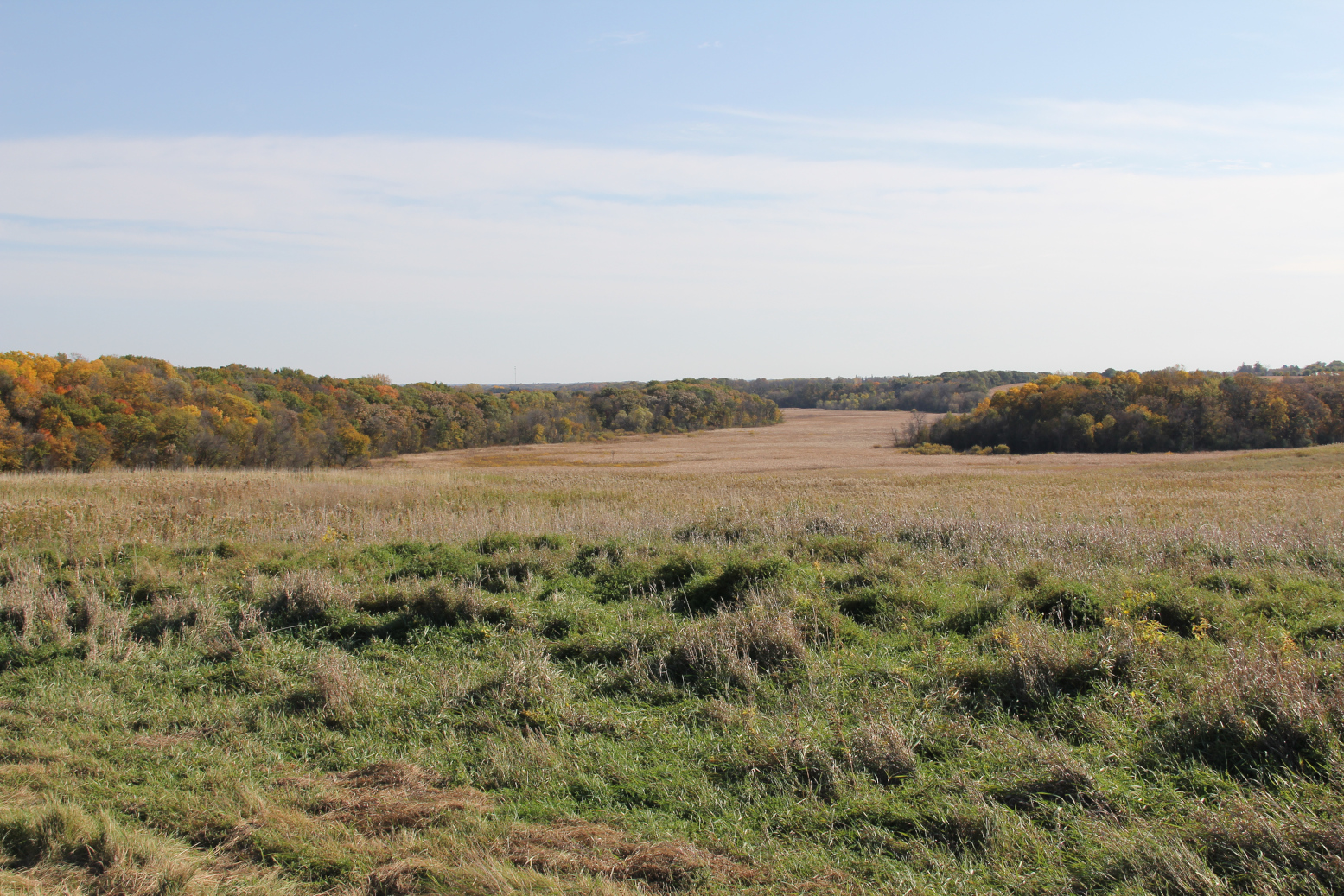
Yet, even with all the colorful trees in town, I like to go into the countryside to see the colors, too. And it’s not just about the orange, red and yellow leaves. It’s also about sky and water, fields and farms, the “all” which comprises and defines rural Minnesota in September and October.
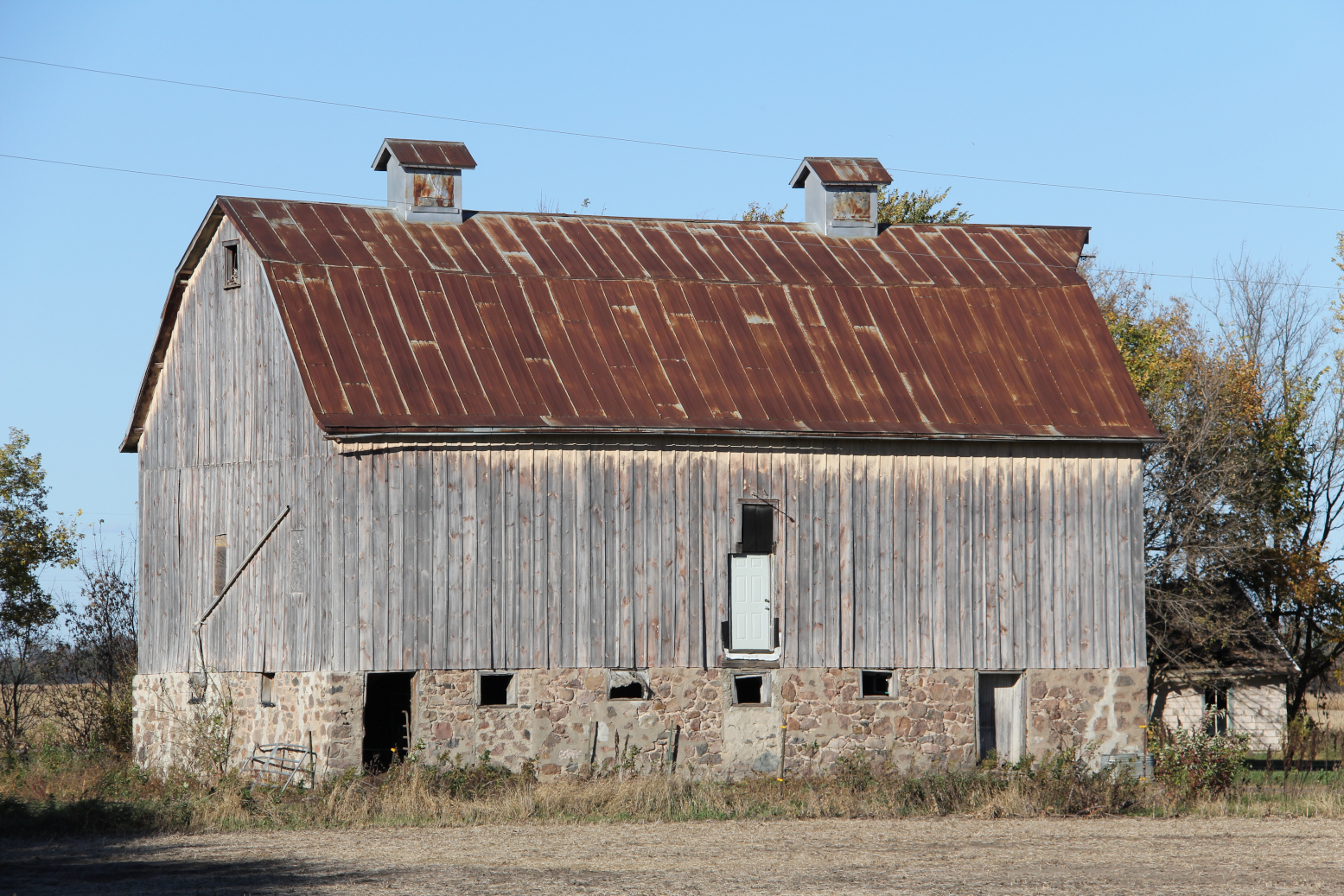
This weathered barn with the fieldstone foundation sits along the gravel road leading to Richter Woods County Park west of Montgomery in Le Sueur County. (Minnesota Prairie Roots copyrighted photo October 2025)
It’s also about following back gravel roads, the vehicle kicking up dust. It’s about meeting massive farm equipment on roadways. It’s about stopping to look at a weathered barn. It’s about traveling at a slower pace.
A view of Kelly Lake and a colorful shoreline. (Minnesota Prairie Roots copyrighted photo October 2025)
And it’s about stopping, exiting the van to walk into the woods or stand along the shoreline of an area lake to admire a colorful tree line.
A sweeping view of the countryside in the Union Lake area. (Minnesota Prairie Roots copyrighted photo October 2025)
As a native of the mostly treeless southwestern Minnesota prairie, it was not until I moved to Rice County in 1982 that I fully realized just how overwhelmingly stunning this season is in our state. I didn’t grow up going on vacations with the exception of two—one at age four to Duluth and the second to the Black Hills of South Dakota during my elementary school years. But each autumn, my siblings and I piled into the Chevy with our parents for a Sunday afternoon fall color drive along the Minnesota River Valley from north of Echo to Morton.
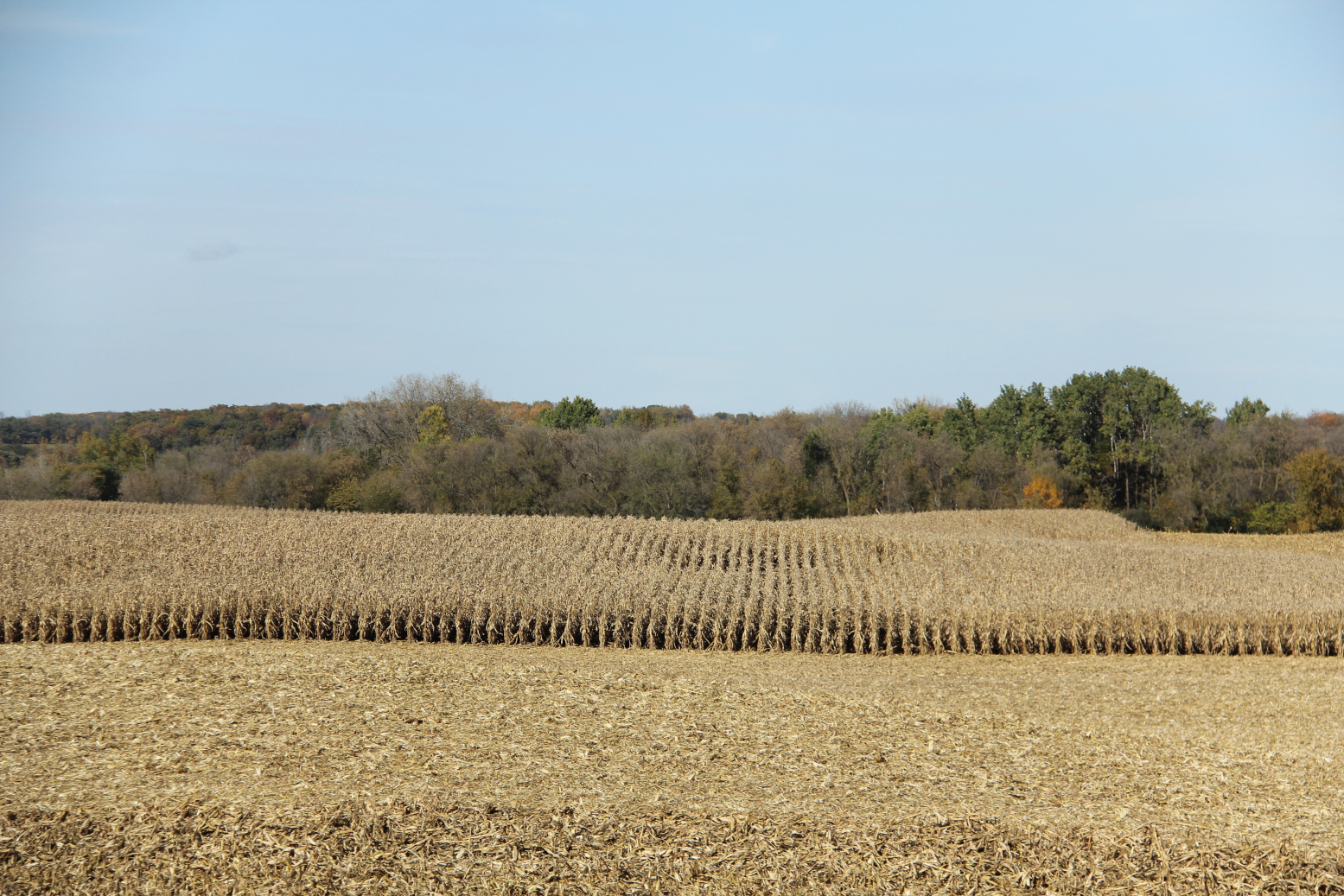
A partially-harvested cornfield in the Union Lake area. (Minnesota Prairie Roots copyrighted photo October 2025)
And so my love of Sunday drives (which were frequent during my youth because Dad wanted to look at the crops) evolved. As did my understanding that all we needed to do was travel a short distance to see a different landscape. One with woods, colorful woods, in autumn.
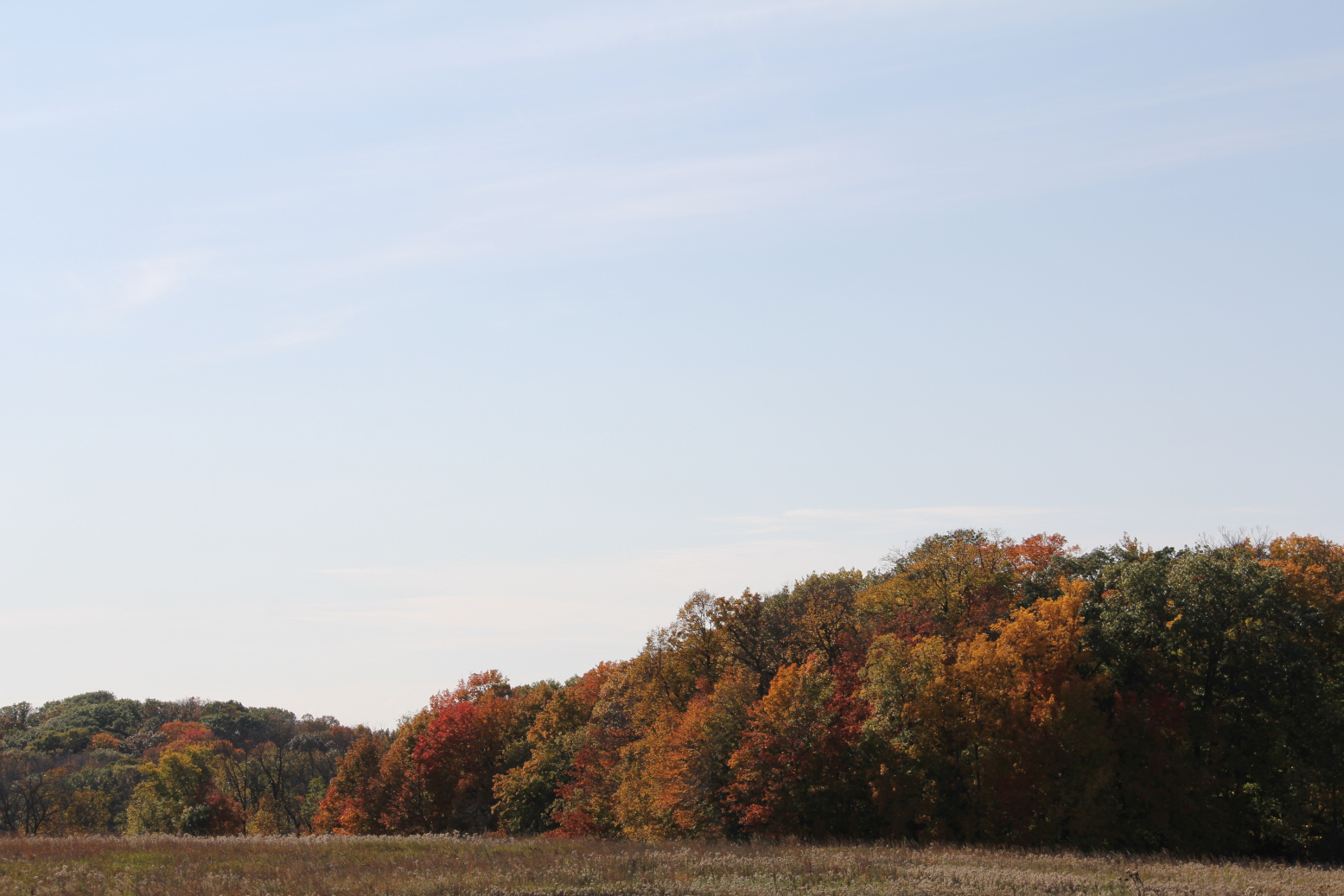
Colorful trees by Union Lake. (Minnesota Prairie Roots copyrighted photo October 2025)
The topography of Rice County is incredibly diverse. From the familiar flat prairie to rolling hills and valleys to lakes and rivers and streams, it’s all right here. Lovely.
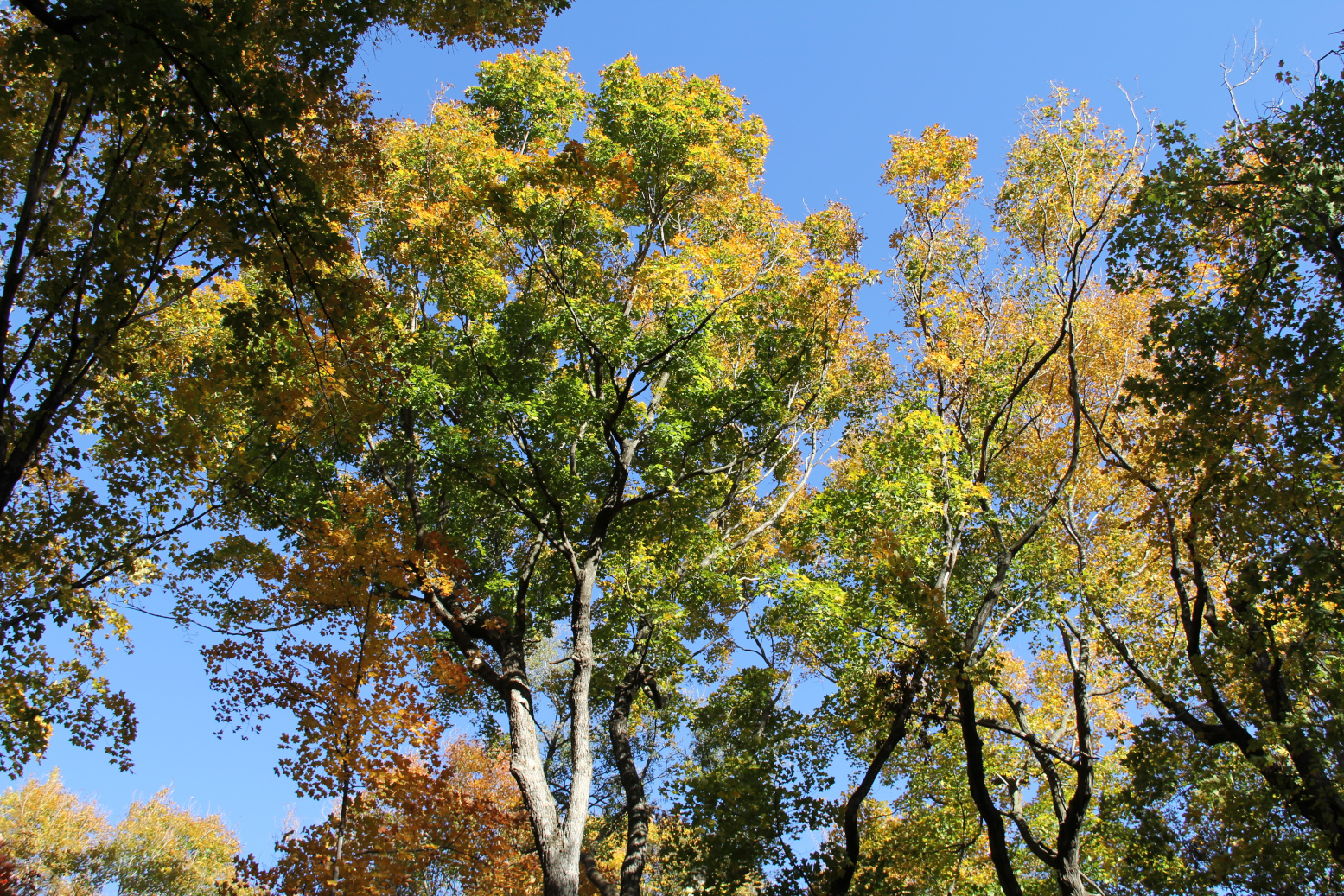
Sometimes you just have to stop and look up, here in Richter Woods. (Minnesota Prairie Roots copyrighted photo October 2025)
I encourage Sunday afternoon drives, or whatever day works for you. Forget about schedules and the work at home. Get in the vehicle and go. Go local. Appreciate what’s right in your backyard.
Pull over along a gravel road, if it’s safe to do so, and take in the countryside. Stand along the shore of a lake. Walk into the woods. Hear the crunch of dried leaves beneath your soles. Look up at the colorful leaves. And see, really see, the autumn beauty that surrounds you…before winter strips the land, leaving it naked and exposed.
A protester at the NO KINGS day rally in Northfield. (Minnesota Prairie Roots copyrighted file photo June 2025)
MONDAY EVENING I GATHERED in rural Rice County with a crowd concerned about issues ranging from healthcare to immigration, agriculture, education, the environment, diversity, gun violence, the SNAP program, tariffs, voting rights, veterans’ benefits, the economy and much more. All current-day topics worrying many of us, including me.
I’ve never been politically active. Until this year. To stay silent now feels complicit. I care enough about this country, about freedom, about democracy, to let my voice be heard. I’ve participated in three pro-democracy rallies, including the NO KINGS Day Rally in Northfield and two on Labor Day in Owatonna. I’ve volunteered at a DFL Sweetcorn Feed in Faribault. I’ve donated to the DFL, called and emailed my legislators in Washington, DC. And Monday evening I attended a potluck, billed as a DFL Working Families Garden Party. This all from someone who previously voted primarily Republican. But no more, not in the past four Presidential elections or in some other past elections. I’ve always looked at candidates, their character and their stances on issues before voting. I still do, but party affiliation now matters to me, too.
Minnesota potlucks always include bars, like these at a previous event I attended. (Minnesota Prairie Roots copyrighted file photo)
DEEP CONCERN
At all of these recent events, I’ve heard—whether from politicians, candidates for office or ordinary people like me—a deep concern for our country under the current administration and those who go along with whatever our President says and does. This concern comes from good, decent people. Farmers, teachers, business owners, lawyers, blue collar workers, college students. People who carry crockpots of pulled pork and baked beans, bowls of creamy garden-fresh cucumber salad, peach pie and bars to a political party on a rural acreage.
As I sat in this bucolic setting Monday evening listening to short speeches from candidates like Martha Brown of Faribault, running for Minnesota House District 19A on the slogan of “Common-Sense Leadership for Working People,” or fiery Matt Little from Elko New Market who embraces the label of “radical” and who is running for Congress in the Second Congressional District or Ben Schierer of Fergus Falls, campaigning for state auditor and vowing to represent both urban and rural communities, I felt hope.
Minnesota Secretary of State Steve Simon speaks at the DFL Garden Party hosted by Ted Suss, right, near Nerstrand. (Minnesota Prairie Roots copyrighted photo September 2025)
COMPASSION & HOPE
I felt hope, too, when I heard Minnesota Secretary of State Steve Simon talk about protecting voter information, voting rights and more. I felt hope when I heard Minnesota Senate Majority Leader Erin Murphy speak. As a nurse, her care and compassion for others threads through her speeches, shines in her political life.
Murphy spoke on Monday evening against a backdrop of American and Minnesota state flags and a banner of the Hortmans and their dog with this message: STAND UP FOR JUSTICE AND PEACE. She talked, too, about attending the funeral on Sunday of Fletcher Merkel, 8, among two students killed in a mass shooting that injured 21 others at Annunciation Catholic Church in south Minneapolis on August 27. Justice. Peace. No more gun violence.
This sign from the NO KINGS rally in Northfield really resonated with me. (Minnesota Prairie Roots copyrighted file photo June 2025)
UNPRECEDENTED
I’ve lived enough years to observe that what’s happening in this country right now is unprecedented. I’ve never felt more fearful of losing our freedoms under authoritarian rule. It’s happening already with snatching people off the streets, imprisonment and deportations without due process. It’s happening in intimidation and retribution; mass firings; suppression of free speech; funding cuts that are undermining research, healthcare, education and more; gathering of private information by the government; sending armed military into cities; and in countless other ways that affect all of us no matter our political affiliations.
This isn’t about rural vs urban. This isn’t about us vs them. This is, rather, about preserving and protecting our very freedoms as Americans. This is about caring and feeling hopeful. This is about speaking up. About doing something. And sometimes this is also about eating pulled pork, baked beans, cucumber salad and homemade peach pie at a potluck on a beautiful September evening in southern Minnesota.
#
NOTE: I moderate all comments on this, my personal blog, reserving the right to publish or not publish comments. Please be respectfulwhether you agree or disagree with me.
An angler fishes in Horseshoe Lake, rural Merrifield, on an August evening. (Minnesota Prairie Roots copyrighted photo August 2025)
IN MID AUGUST, Randy and I headed nearly 200 miles north of Faribault for our second stay of the summer at a family member’s cabin in the Brainerd lakes area. This trip our eldest daughter and her family joined us for several days. There’s nothing quite like time with the grandkids at the lake. Time to play, to relax, to make memories. And that we did. I cherish our days together Up North.
We mostly hung out on the beach or in the cabin. Weather conditions were not ideal with cool temps and strong winds prevailing when all six of us were there together. Yet, we got outdoors—the kids running along the sandy beach, digging a hole along water’s edge, enjoying the placid water on a warm and sunny day before the weather changed.
Looking upward toward the pines from a lakeside hammock. (Minnesota Prairie Roots copyrighted photo August 2025)
MAKING MEMORIES
I led the 6 and 9-year-olds on a scavenger hunt. We searched for a feather, a mushroom, a nest…that which nature offers like a gift if only we pause to see and appreciate. Randy taught Isaac to play Marbles on a homemade wooden board. It’s a long-time favorite of the extended Helbling family. We played Yahtzee and Connect 4, on an over-sized outdoor board. The puzzlers among us (not me) pieced together a lemonade stand. We headed into town for massive scoops of ice cream, a cabin tradition. And one day we picked peas from our sister-in-law and brother-in-law’s plot in a community garden. Later I taught Isaac how to shell them. The kids delighted in a timed Ninja course at a Crosslake playground and posed for photos behind Paul Bunyan family cut-outs at another park. We devoured s’mores around the campfire.
A campfire is the place to share stories, create memories. (Minnesota Prairie Roots copyrighted photo August 2025)
This is the stuff of memories. Simple. Uncomplicated. Mostly unplanned. Moments that connect us, deepen bonds.
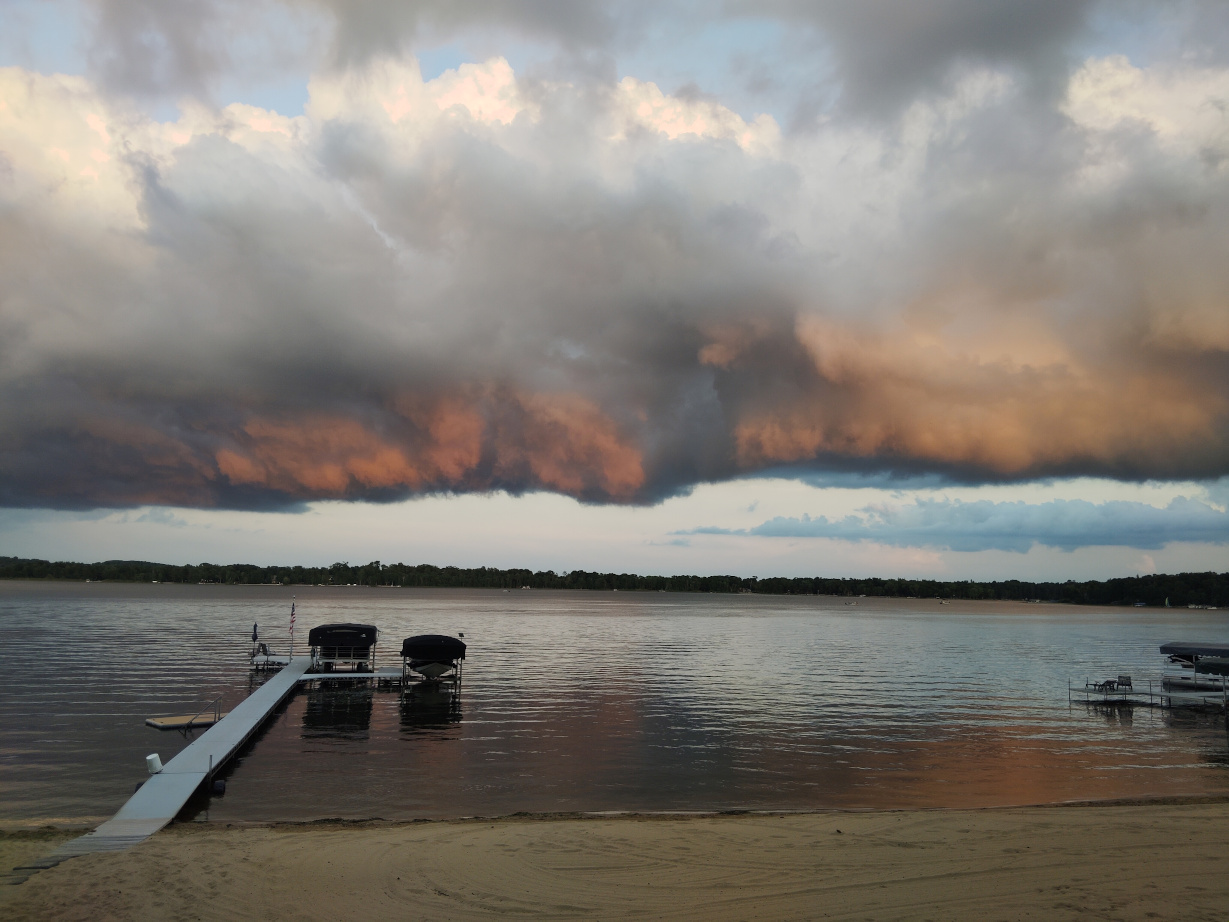
Moody clouds at sunset over Horseshoe Lake. (Minnesota Prairie Roots copyrighted photo August 2025)
Being outdoors, away from home and work and schedules and the demands of everyday life, opens us to the joys of vacationing. The haunting call of a loon and the sighting of a bald eagle perched atop a pine proved exhilarating. A bank of moody, pink-tinged clouds slung low in the evening sky drew all of us to focus on and admire the scene.
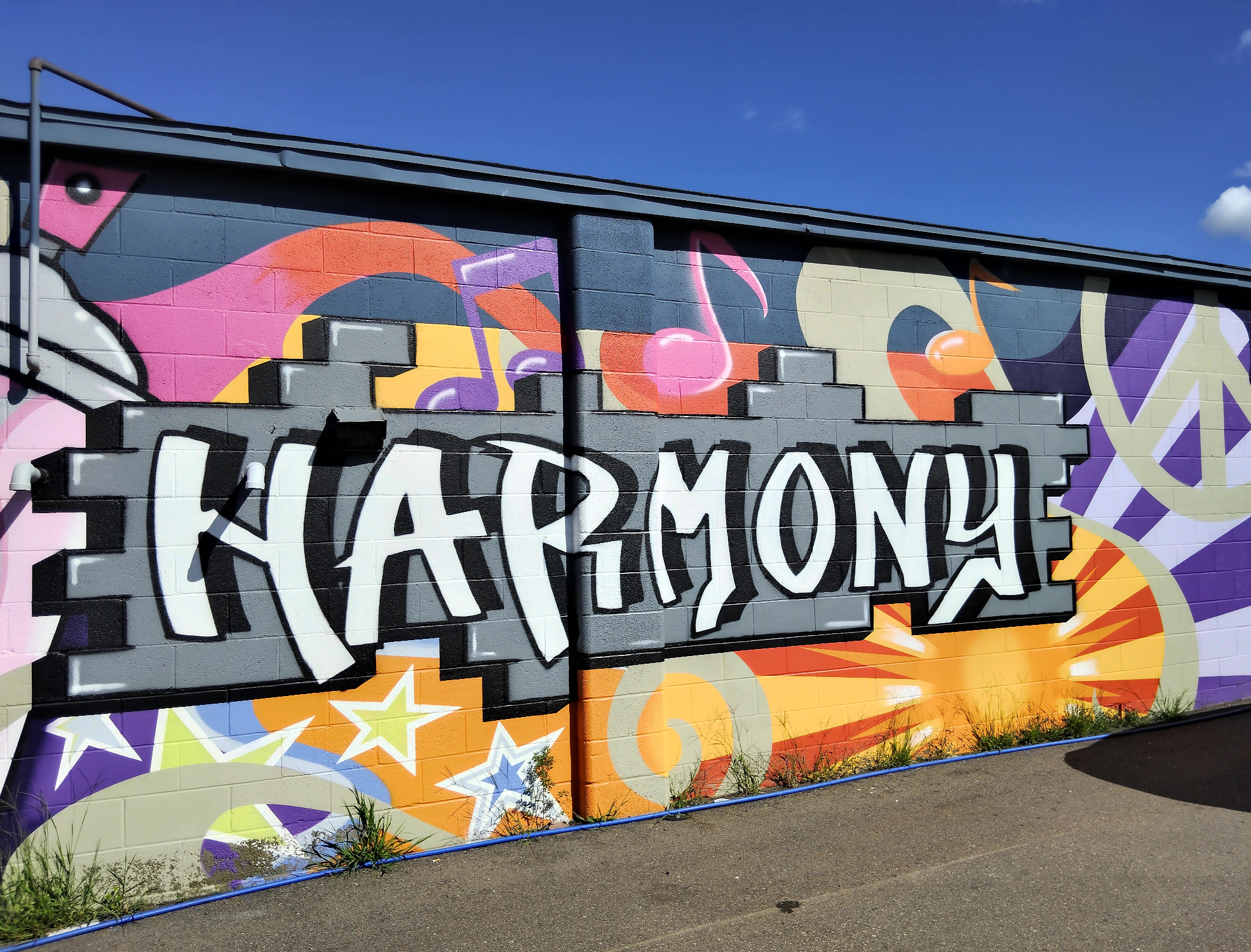
A mural in Crosby. (Minnesota Prairie Roots copyrighted photo August 2025)
MORE CHERISHED MOMENTS
When the grandkids and their parents left several days before us, our world seemed too quiet. No more kids scampering up and down the loft ladder. No more requests to go to the beach. No more…
But, sans kids, there were still moments to be cherished. Lakeside dining with friends at Breezy Point. Popping in to chat with a Faribault friend who lives in Nisswa now and works for the Chamber of Commerce. And then a chance encounter with adults with disabilities on an outing at Mission Park, rural Merrifield. I learned that visually-impaired Shannon, who uses a white cane and carries over-sized yellow sunglasses, likes to sing. I asked her to sing for me. And she did—to a movie soundtrack of ”My Heart Will Go On” by Celine Deon. I thought my heart would burst with joy as this young woman first mouthed the words, then sang them quietly and then louder as I encouraged her. It’s one of those moments I will forever treasure. Me nearly in tears and everyone inside that picnic shelter smiling during this impromptu weekday morning concert.
A mural by Adam Turman in downtown Crosby highlights recreational activities in the Cuyuna Lakes area. (Minnesota Prairie Roots copyrighted photo August 2025)
SOUTHERN MINNESOTA CONNECTIONS ON THE RANGE
On the way home, there were more delights during a stop in Crosby, an Iron Range community that is evolving into a destination with its many outdoor activities, shops and murals. I spotted a mural by Minneapolis artist Adam Turman, whose work can be found on murals in Northfield and on Faribault Mill products. He’s a favorite muralist of mine. I saw also, much to my delight, Faribault Mill blankets and Caves of Faribault cheeses in separate shops. I felt Faribault-proud seeing those wool blankets and exceptional cheeses for sale in Crosby.
ICE CREAM, GREEK STYLE
But it was the homemade ice cream—Rave Creamworks’ Super Premium—at Victual in Crosby that got rave reviews from me. Randy and I shared a large scoop of Baklava ice cream laced with flaky phyllo dough, chopped walnuts and honey. It is the shop’s bestseller among 24 choices, so said the teen behind the counter. I loved this creamy ice cream, which I expect my friend, Father Jim Zotalis at the Cathedral of Our Merciful Saviour in Faribault, would appreciate given his Greek heritage. Baklava is a Greek pastry. Even in that ice cream I felt a connection to southern Minnesota. We can leave home, but we never really do.
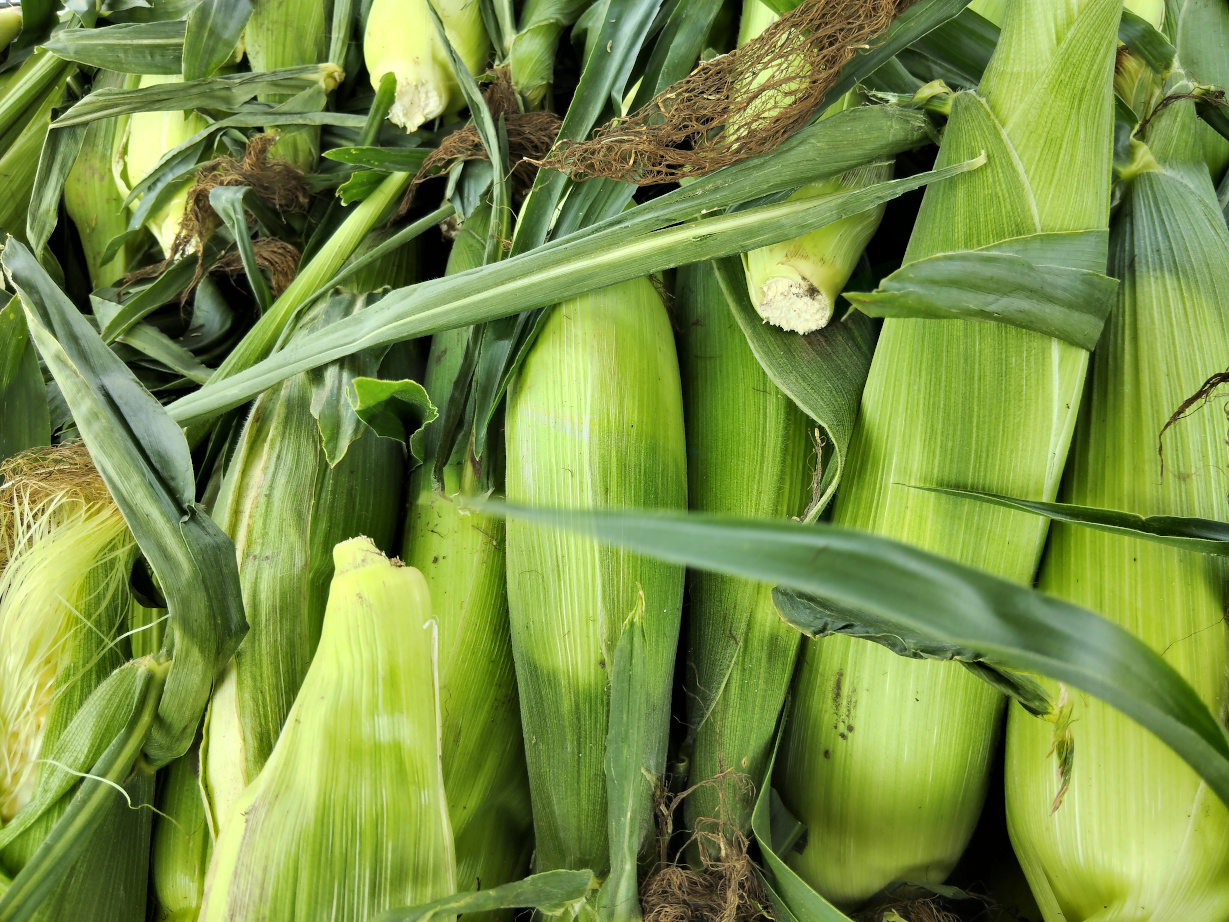
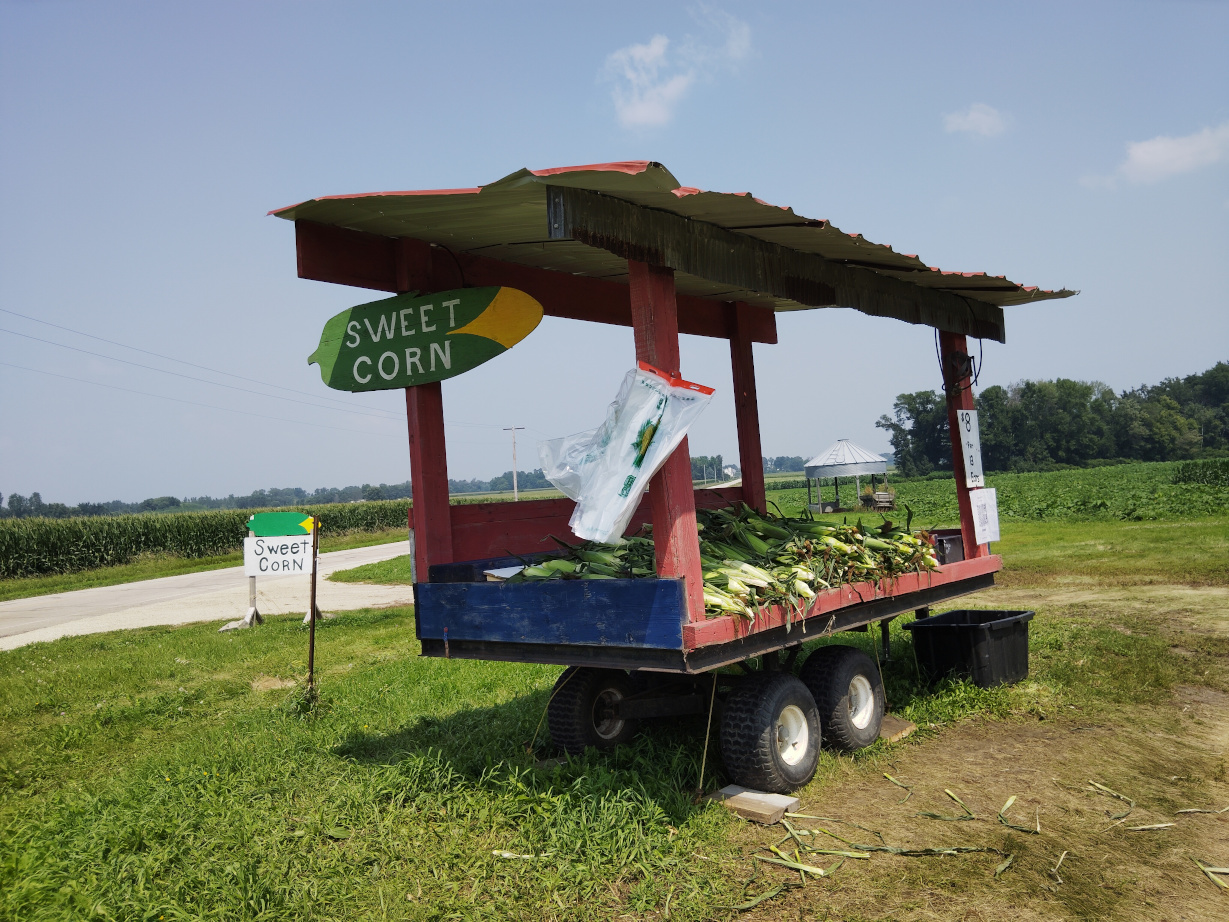
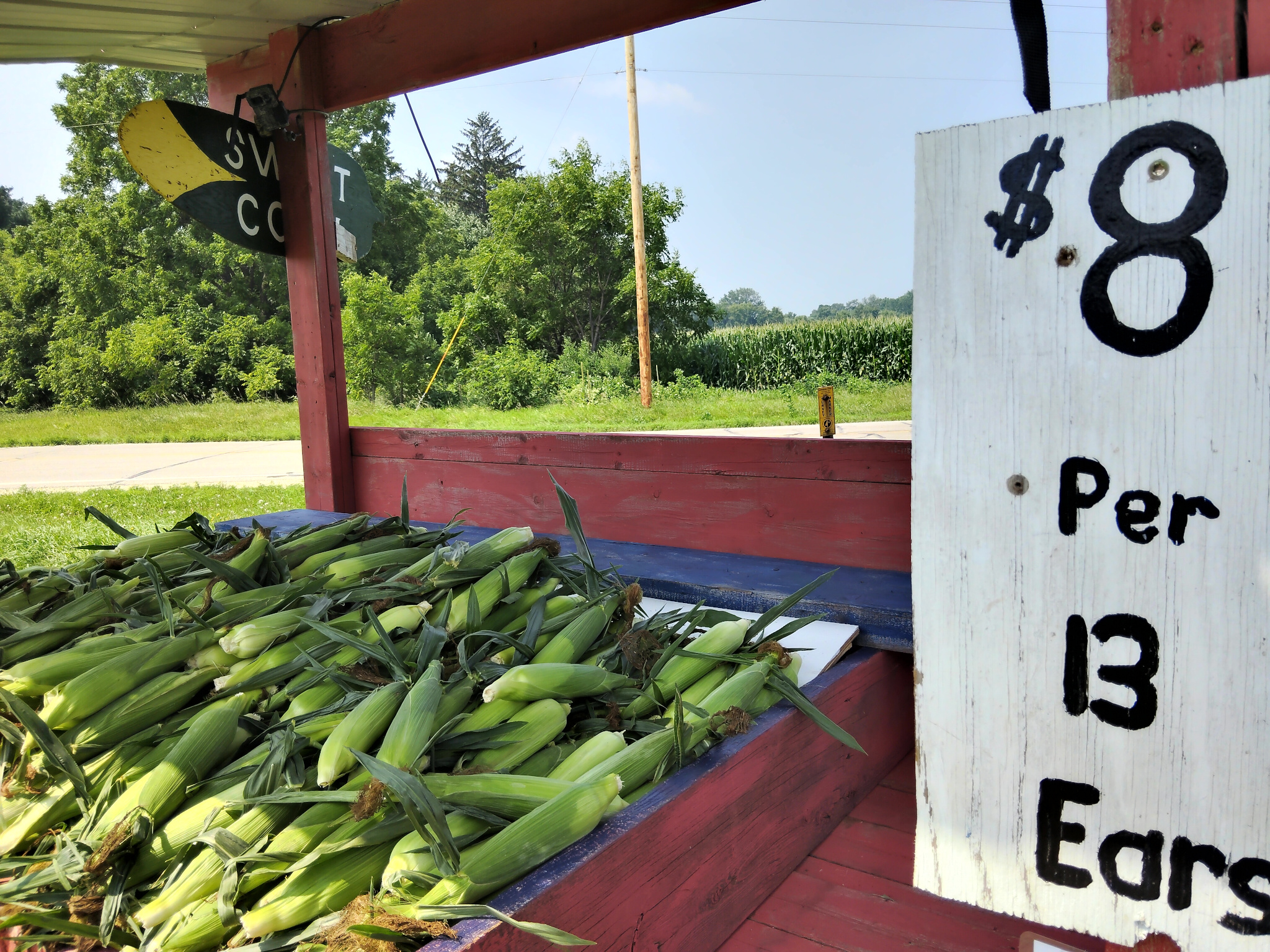
Freshly-picked sweetcorn at the Little Prairie roadside stand, rural Dundas. (Minnesota Prairie Roots copyrighted photo August 2025)
IF THE TASTE OF SUMMER can be defined in one word, then perhaps that would be “sweetcorn.”
Whether fresh from the garden, vended at farmers’ markets, sold at self-serve roadside stands or purchased at a local grocery store, Minnesota-grown sweetcorn tastes of earth and sky, sun and rain. There’s nothing quite like biting into that first corn of the season.
Little Prairie’s drive-up self-serve sweetcorn stand. Besides sweetcorn, there’s a small sunflower field for photo ops, but no maze this year. (Minnesota Prairie Roots copyrighted photo August 2025)
Right now an abundance of locally-grown sweetcorn can be found throughout southern Minnesota. Randy and I picked some up at a stand just off State Highway 3 between Faribault and Dundas at Little Prairie Sunflower Maze, Pumpkins & Produce. I proclaimed it the best corn I’ve ever eaten. Randy reminded me that, given this was our first sweetcorn of the summer, I may have been biased in that declaration. But the corn was good, really good.
Pick and bag your corn and then pay at the unattended Little Prairie produce stand south of Dundas. (Minnesota Prairie Roots copyrighted photo August 2025)
I shared my assessment with a young couple who pulled into Kaden Ernst’s roadside stand while I snapped photos of his business on wheels complete with homemade signage and an honor system drop box for payment. Ernst also offers the option of scanning a QR code and paying via Venmo. The pair, who recently moved to the area from San Diego, seemed pleased to hear my blue ribbon endorsement of this sweetcorn grown by a young man pursuing an agronomy degree. Ernst has vended his sweetcorn and other produce at roadside stands since high school and I was happy to promote his product.
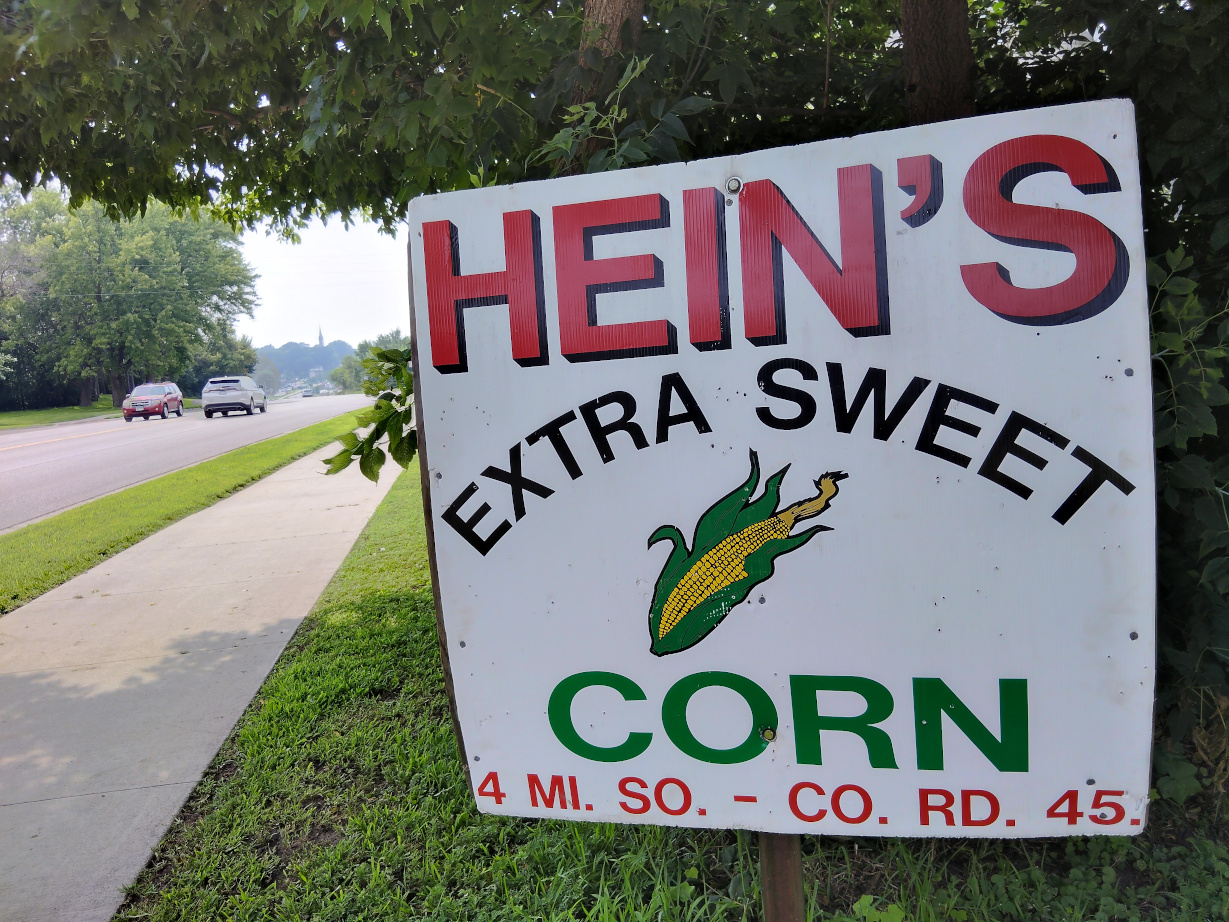
This sign on Faribault’s east side along Minnesota State Highway 60 promotes one of the area’s popular sweetcorn businesses. (Minnesota Prairie Roots copyrighted photo August 2025)
Likewise, I could endorse many other local growers, including Hein’s Extra Sweet Corn, a family-run business since 1997. When Hein’s signs start popping up around Faribault, I know it’s time to purchase some corn. Customers can buy the fresh-picked-daily sweetcorn at the farm site four miles south of Faribault along Rice County Road 45 or at Hy-Vee grocery stores in Faribault, Owatonna or Mankato. Randy and I have also bought plenty of corn through the years from growers at the Faribault Farmers’ Market.
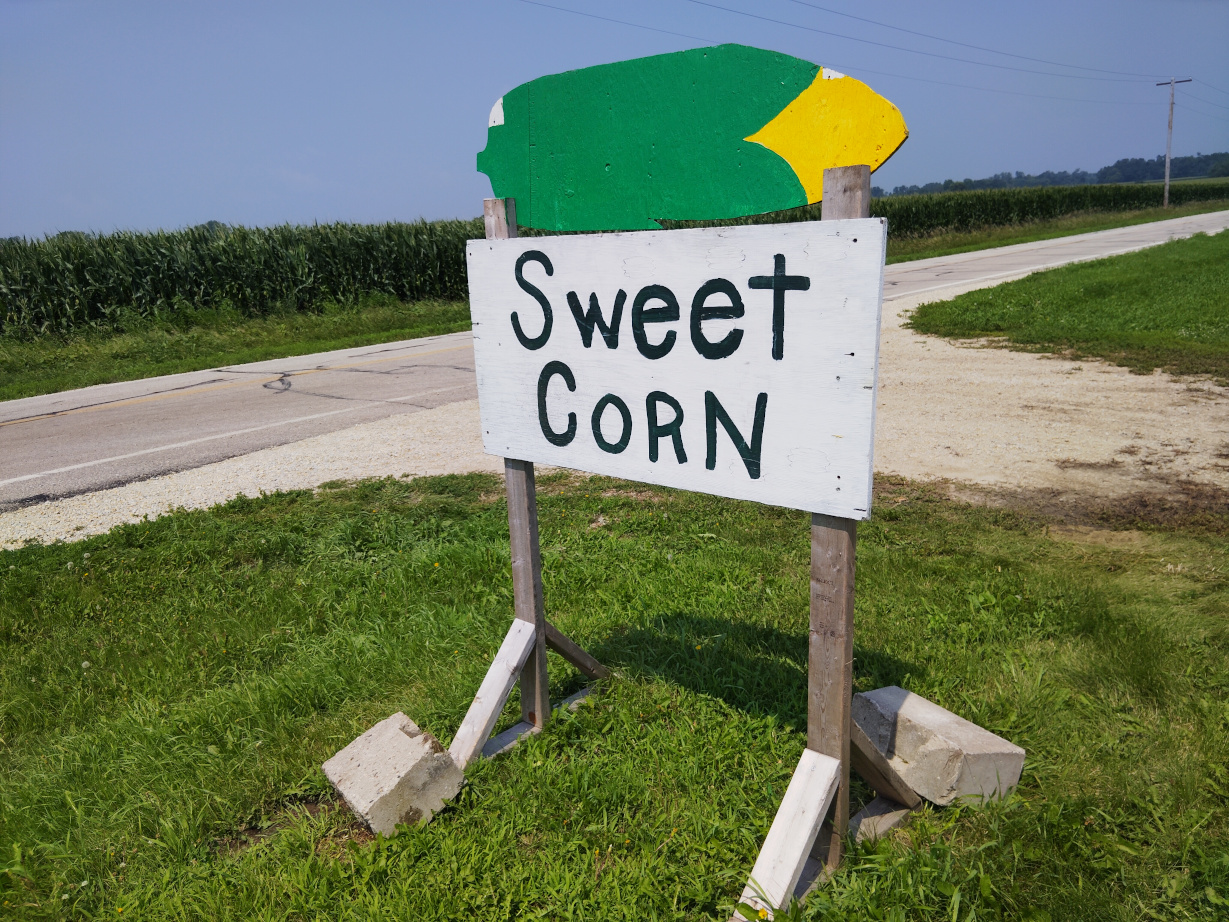
One of my favorite aspects of roadside stands is the kitschy homemade signage. (Minnesota Prairie Roots copyrighted photo August 2025)
Many decades ago, I ate corn grown on my southwestern Minnesota childhood farm. Whatever corn we didn’t eat fresh, we froze in preparation for winter. “Making sweetcorn” was an all-day event which began with my dad and Uncle Mike harvesting a pick-up bed full of corn from their plantings. Then we, meaning adults and kids alike, husked the corn before Mom blanched it and the men cut the kernels from the cobs for packaging and freezing. That corn tasted of earth and sky, sun and rain in the deep of a frigid Minnesota winter. Just as sweetcorn still tastes today of earth and sky, sun and rain in the heat of a Minnesota summer.













 Minnesota Prairie Roots
Politics, passionate voices & peach pie at a potluck September 9, 2025
Tags: America, Ben Schierer, commentary, democracy, DFL, DFL Garden Party, freedom, Martha Brown, Matt Little, Minnesota, Minnesota Secretary of State Steve Simon, Minnesota Senator Erin Murphy, opinion, political candidates, politics, potluck, Rice County, southern Minnesota
MONDAY EVENING I GATHERED in rural Rice County with a crowd concerned about issues ranging from healthcare to immigration, agriculture, education, the environment, diversity, gun violence, the SNAP program, tariffs, voting rights, veterans’ benefits, the economy and much more. All current-day topics worrying many of us, including me.
I’ve never been politically active. Until this year. To stay silent now feels complicit. I care enough about this country, about freedom, about democracy, to let my voice be heard. I’ve participated in three pro-democracy rallies, including the NO KINGS Day Rally in Northfield and two on Labor Day in Owatonna. I’ve volunteered at a DFL Sweetcorn Feed in Faribault. I’ve donated to the DFL, called and emailed my legislators in Washington, DC. And Monday evening I attended a potluck, billed as a DFL Working Families Garden Party. This all from someone who previously voted primarily Republican. But no more, not in the past four Presidential elections or in some other past elections. I’ve always looked at candidates, their character and their stances on issues before voting. I still do, but party affiliation now matters to me, too.
DEEP CONCERN
At all of these recent events, I’ve heard—whether from politicians, candidates for office or ordinary people like me—a deep concern for our country under the current administration and those who go along with whatever our President says and does. This concern comes from good, decent people. Farmers, teachers, business owners, lawyers, blue collar workers, college students. People who carry crockpots of pulled pork and baked beans, bowls of creamy garden-fresh cucumber salad, peach pie and bars to a political party on a rural acreage.
As I sat in this bucolic setting Monday evening listening to short speeches from candidates like Martha Brown of Faribault, running for Minnesota House District 19A on the slogan of “Common-Sense Leadership for Working People,” or fiery Matt Little from Elko New Market who embraces the label of “radical” and who is running for Congress in the Second Congressional District or Ben Schierer of Fergus Falls, campaigning for state auditor and vowing to represent both urban and rural communities, I felt hope.
COMPASSION & HOPE
I felt hope, too, when I heard Minnesota Secretary of State Steve Simon talk about protecting voter information, voting rights and more. I felt hope when I heard Minnesota Senate Majority Leader Erin Murphy speak. As a nurse, her care and compassion for others threads through her speeches, shines in her political life.
Most notable in Murphy’s talk, at least for me, is the deep grief she feels over the politically-motivated assassination of her friend and colleague, Minnesota Speaker of the House Emerita Melissa Hortman and Hortman’s husband, Mark. The Hortmans were shot to death on June 14, the day I protested in Northfield, despite warnings not to do so. I refuse to be silenced.
Murphy spoke on Monday evening against a backdrop of American and Minnesota state flags and a banner of the Hortmans and their dog with this message: STAND UP FOR JUSTICE AND PEACE. She talked, too, about attending the funeral on Sunday of Fletcher Merkel, 8, among two students killed in a mass shooting that injured 21 others at Annunciation Catholic Church in south Minneapolis on August 27. Justice. Peace. No more gun violence.
UNPRECEDENTED
I’ve lived enough years to observe that what’s happening in this country right now is unprecedented. I’ve never felt more fearful of losing our freedoms under authoritarian rule. It’s happening already with snatching people off the streets, imprisonment and deportations without due process. It’s happening in intimidation and retribution; mass firings; suppression of free speech; funding cuts that are undermining research, healthcare, education and more; gathering of private information by the government; sending armed military into cities; and in countless other ways that affect all of us no matter our political affiliations.
This isn’t about rural vs urban. This isn’t about us vs them. This is, rather, about preserving and protecting our very freedoms as Americans. This is about caring and feeling hopeful. This is about speaking up. About doing something. And sometimes this is also about eating pulled pork, baked beans, cucumber salad and homemade peach pie at a potluck on a beautiful September evening in southern Minnesota.
#
NOTE: I moderate all comments on this, my personal blog, reserving the right to publish or not publish comments. Please be respectful whether you agree or disagree with me.
© Copyright 2025 Audrey Kletscher Helbling