
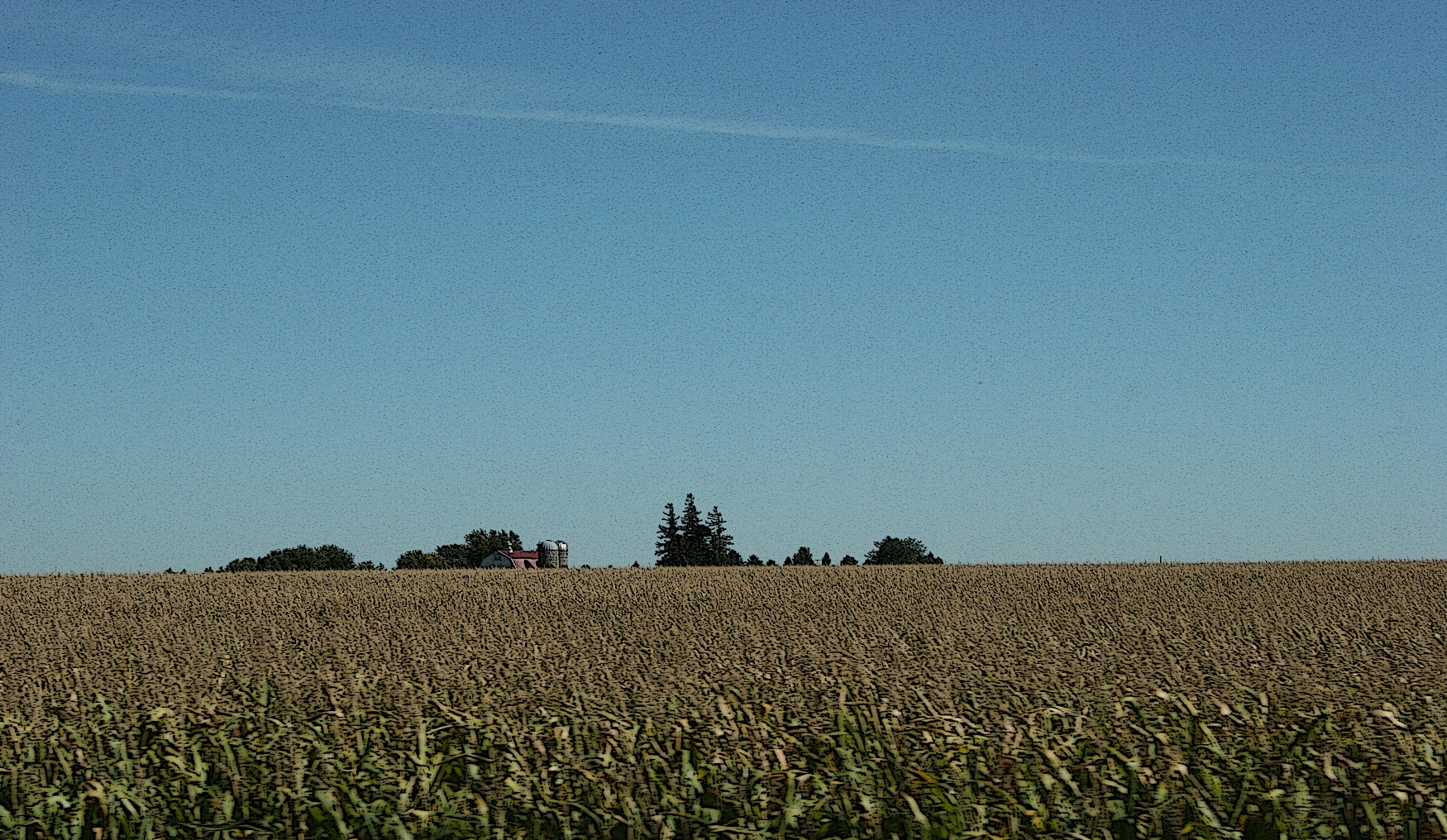
IN THE SEA OF CORN which defines southwestern Minnesota, an island emerges.
Copyright 2013 Audrey Kletscher Helbling
IN THE SEA OF CORN which defines southwestern Minnesota, an island emerges.
Copyright 2013 Audrey Kletscher Helbling

Grey skies and rain create a moody scene along U.S. Highway 14 between Sleepy Eye and Lamberton.
RAIN DRIZZLES, SOMETIMES SPLATTERS, across the windshield of our van as my husband and I aim toward the southwestern Minnesota prairie, driving toward Lamberton for a day of making horseradish with my extended family. It is a time-honored tradition, started by my father, dead 10 years now.
For me, this 120-mile trip from our Faribault home is not as much about the horseradish as it is about family and memories and spending a weekend in my beloved native prairie, the place that shaped me in to the person/writer/photographer I’ve become.

This section of U.S. Highway 14 between Sleepy Eye and Lamberton features many stately and well-kept barns like this brick one.
Even after 40 years away from this place of big skies and flat open spaces, of small towns and family farms, of corn and soybean fields stretching into forever, I still miss this land.
Especially at harvest time.

A cheery smile on a barn off U.S. Highway 14 serves as a backdrop to a ripened soybean field on a grey Saturday morning.
As we journey, my head pivots toward the corn and the beans, ripened mostly to muted gold.
I can almost hear the corn leaves rustling in the bendy wind under moody grey skies.
I can almost smell the intoxicating scent of earth that prevails only at harvest time.
I can almost hear the chomping combines and rumbling grain trucks, the roaring tractors and the lumbering grain wagons, parked and silent now as rain sweeps across the acres.

A serene country scene just north of Lamberton in southern Redwood County.
Later that day, after we’ve reached our rural destination and dug, washed, peeled, chopped, blended and bottled the horseradish, the heaviest of the clouds lift and shift east.

The skies have cleared along Redwood County Road 6 north of Lamberton where corn fields await harvest.
By Sunday morning we awaken to the clear and crisp skies of autumn in rural Minnesota.

Driving U.S. Highway 14 back to Faribault Sunday morning.
It’s a perfect morning.

Barns and ripening crops define the landscape of southwestern Minnesota this time of year.
Sunshine upon fields.

Grain bins await the harvest on a southwestern Minnesota farm.
Sunshine pooling upon my lap as we aim east, past bins and barns and bountiful fields, back home.

Rounding the curve eastbound into Sleepy Eye.
Past the ripening crops. Through the small towns, like Lamberton and Springfield and Sleepy Eye.
And when we reach the western outskirts of New Ulm, I feel as if we’ve crossed a line. Menards and Walmart loom to the left. U.S. Highway 14, the Laura Ingalls Wilder Historic Highway, is now a four-lane through this German community, busy with traffic and drivers racing to get ahead before the roadway once again narrows to two lanes en route to Mankato.

Barns, like this one, rise above the soon-to-be-harvested corn fields.
My mood shifts. I’ve left the peace of the prairie, the one place on this earth that holds my soul in solace.
FYI: This post was previously published on streets.mn. The above photos were taken on Saturday, September 28, and Sunday, September 29. Conditions change rapidly during harvest time, so I expect harvest is well underway, although delayed now due to the rain.
A post will be forthcoming on making horseradish.
Copyright 2013 Audrey Kletscher Helbling
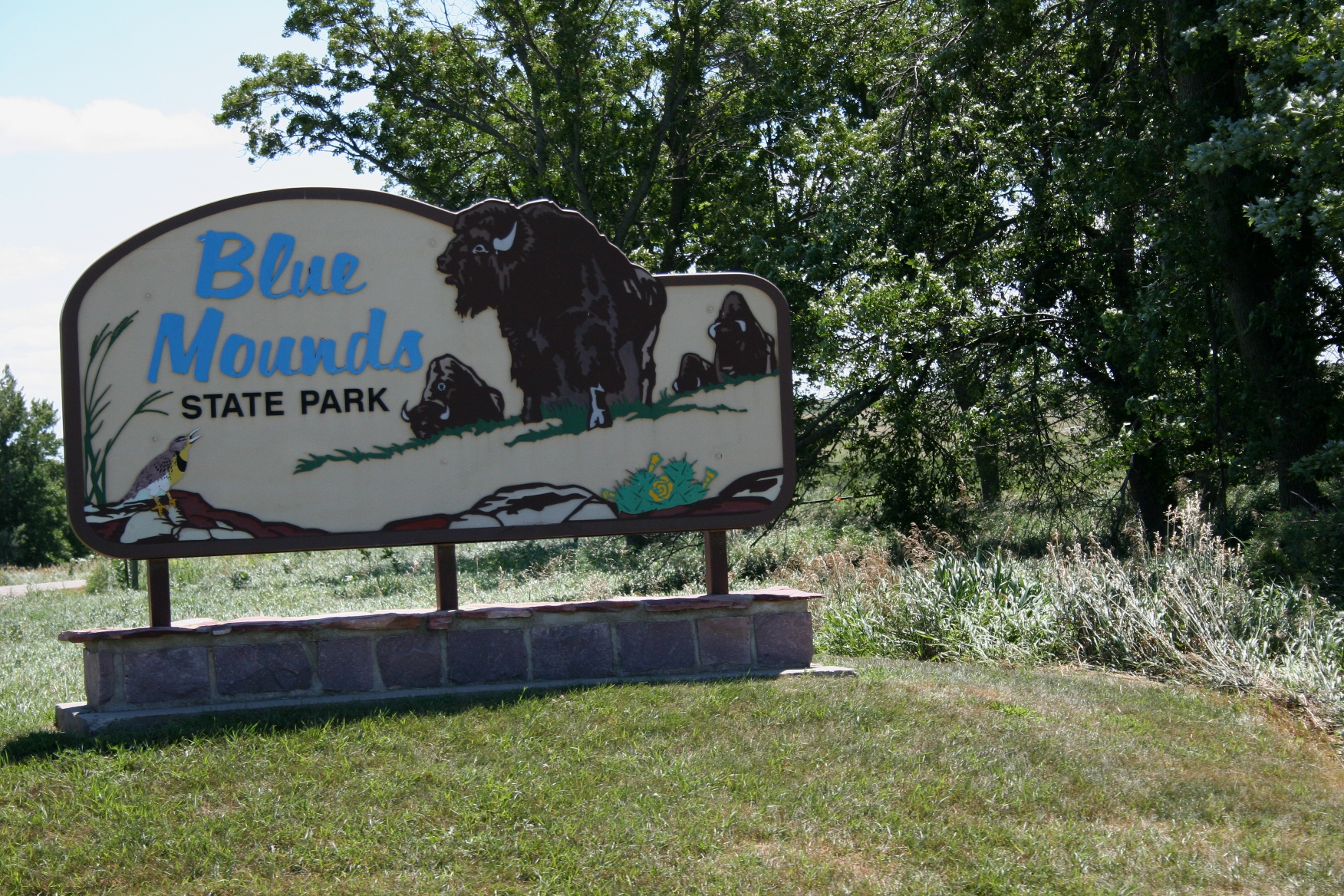
Welcoming visitors to Blue Mounds State Park in rural Rock County, Minnesota.
YOU WOULD THINK, considering I am a native of southwestern Minnesota, that I would have visited Blue Mounds State Park many times.
But I hadn’t, ever, and it has been on my list of must-see places for the past several years. That and the Brandenburg Gallery in Luverne, four miles to the south. That would be Jim Brandenburg, perhaps Minnesota’s best-known nature photographer. He grew up in rural Luverne, near the South Dakota border.
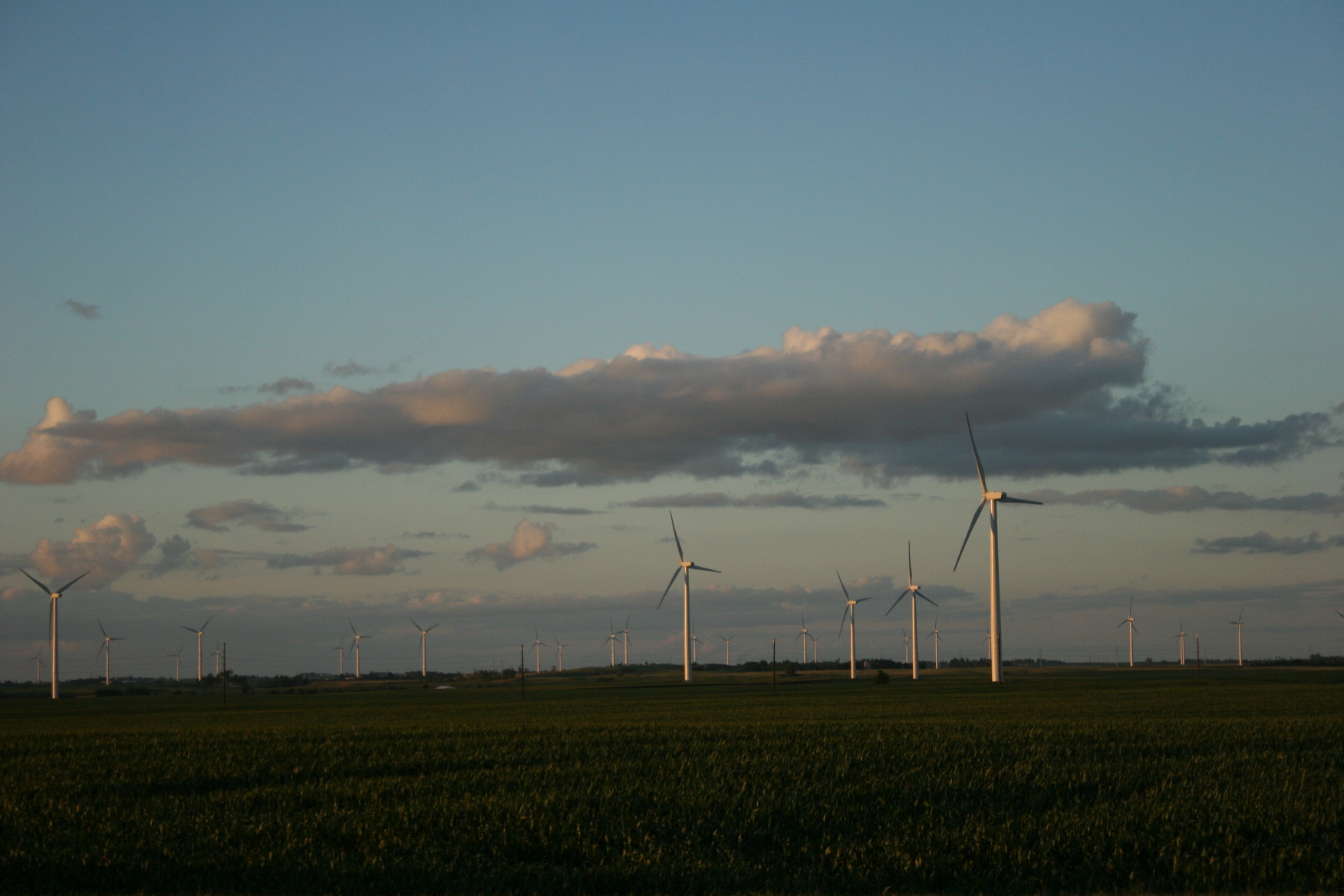
Hundreds of windmills now define this region of southwestern Minnesota.
Recently my husband and I traveled to this corner of Minnesota specifically to see these two sites. It was well worth the long drive that took us through many small agricultural communities, past acres and acres of cropland, and past hundreds of wind turbines which define so much of the landscape in this region now. While I understand their energy value, these unnatural giants, in my opinion, have ruined the aesthetics of the prairie. I like my prairie big, open and wide, without monstrosities to detract from its natural beauty.
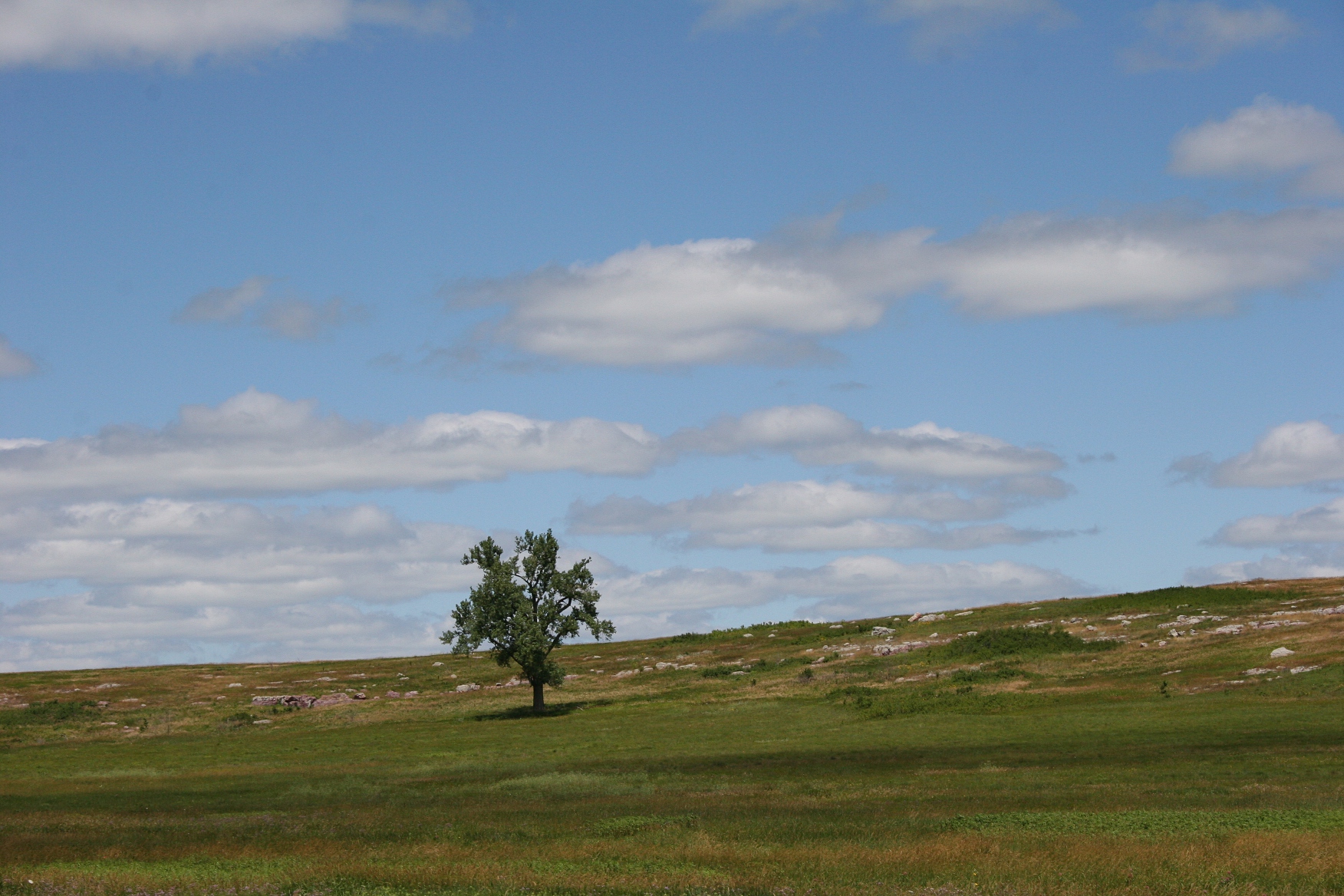
Beautiful natural scenery.
Thankfully, preserved and protected prairie remains in places like Blue Mounds State Park and nearby Touch the Sky Prairie and in Brandenburg’s images.

Hiking the path up and through the prairie grass.
On the Saturday we hiked Blue Mounds, strong winds buffeted the land, bending prairie grasses as we climbed a hillside,
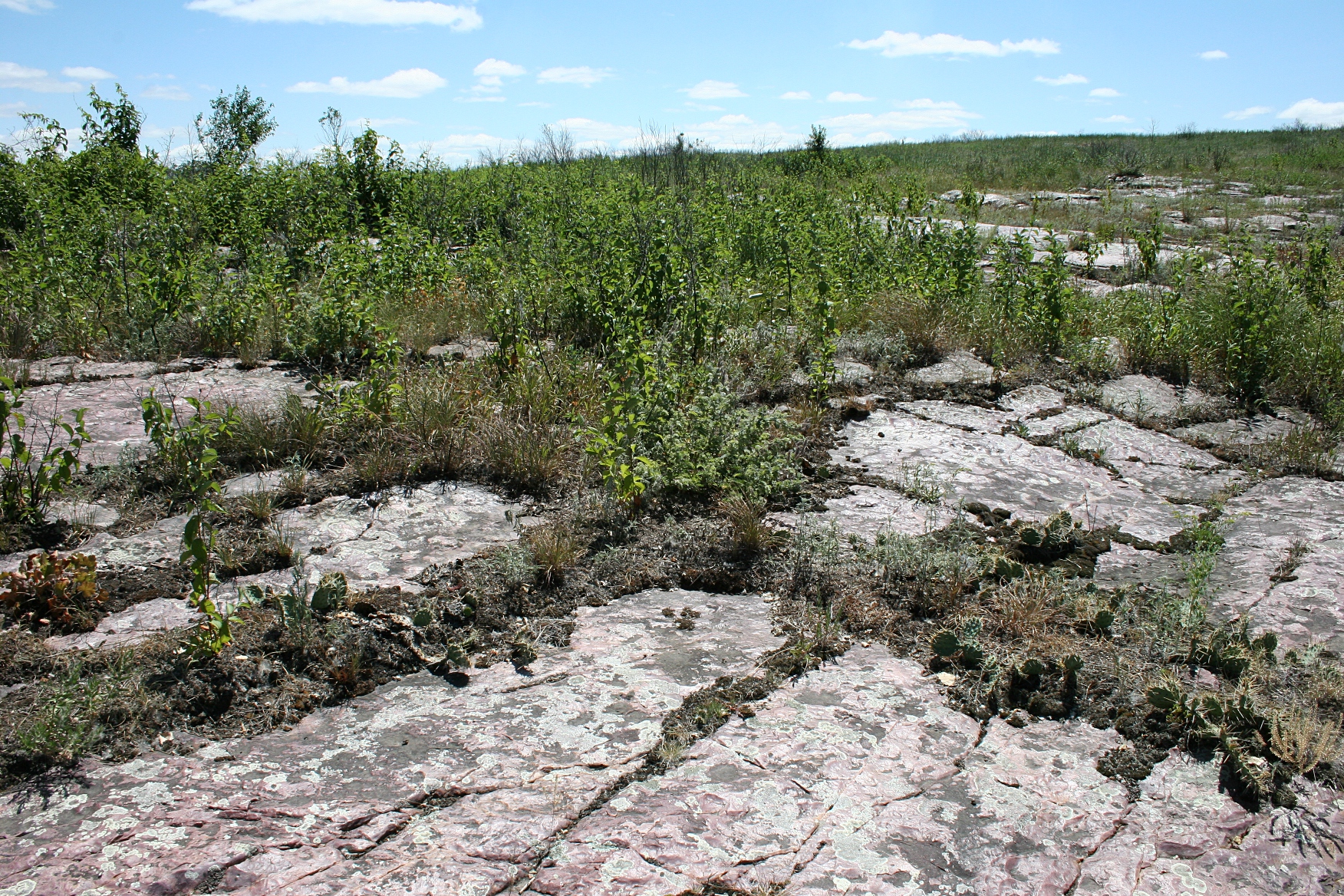
Mounds of flat rock naturally planted upon the prairie.
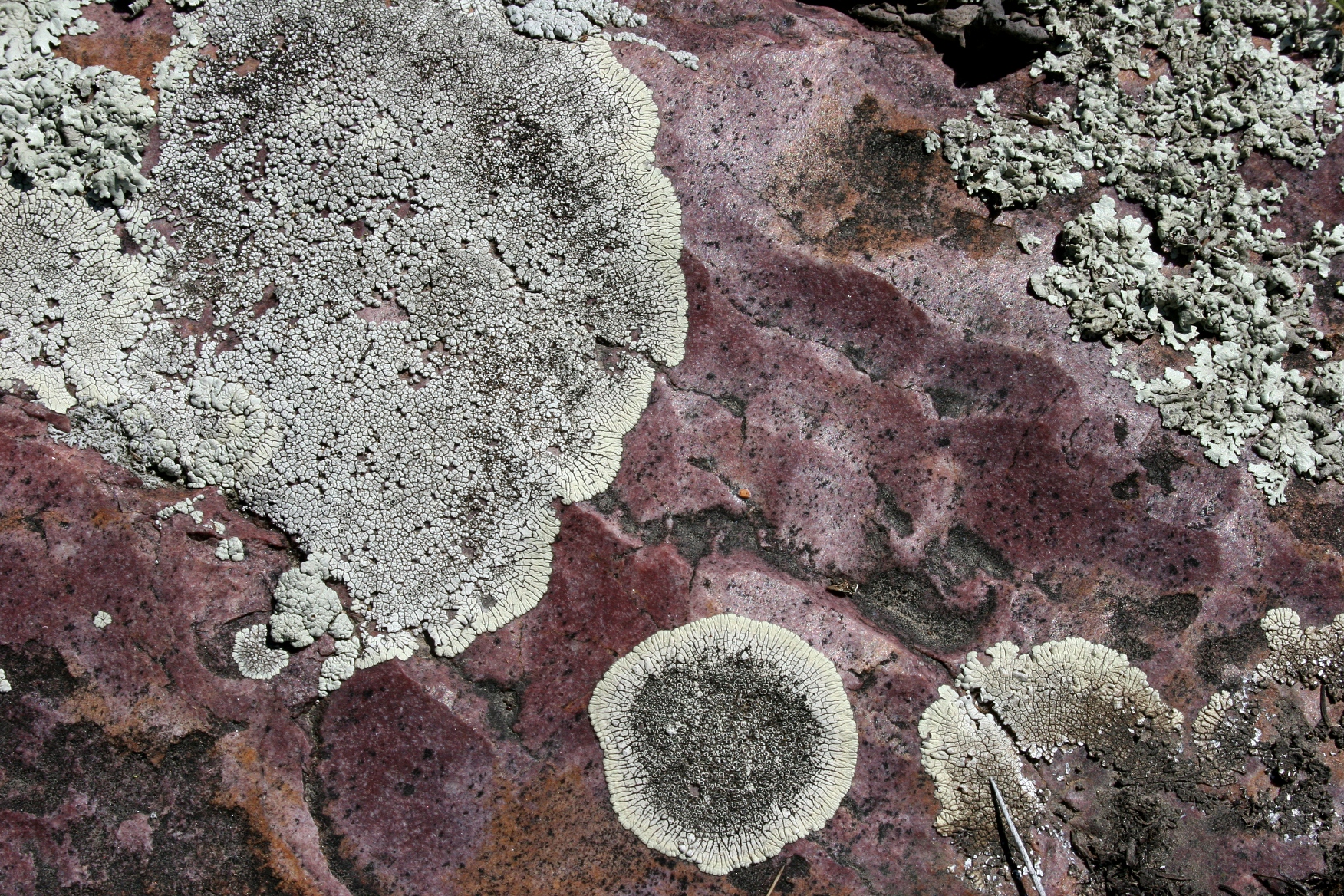
A close-up shot of that in-ground flat rock.
examined and walked upon clumps of huge rock,
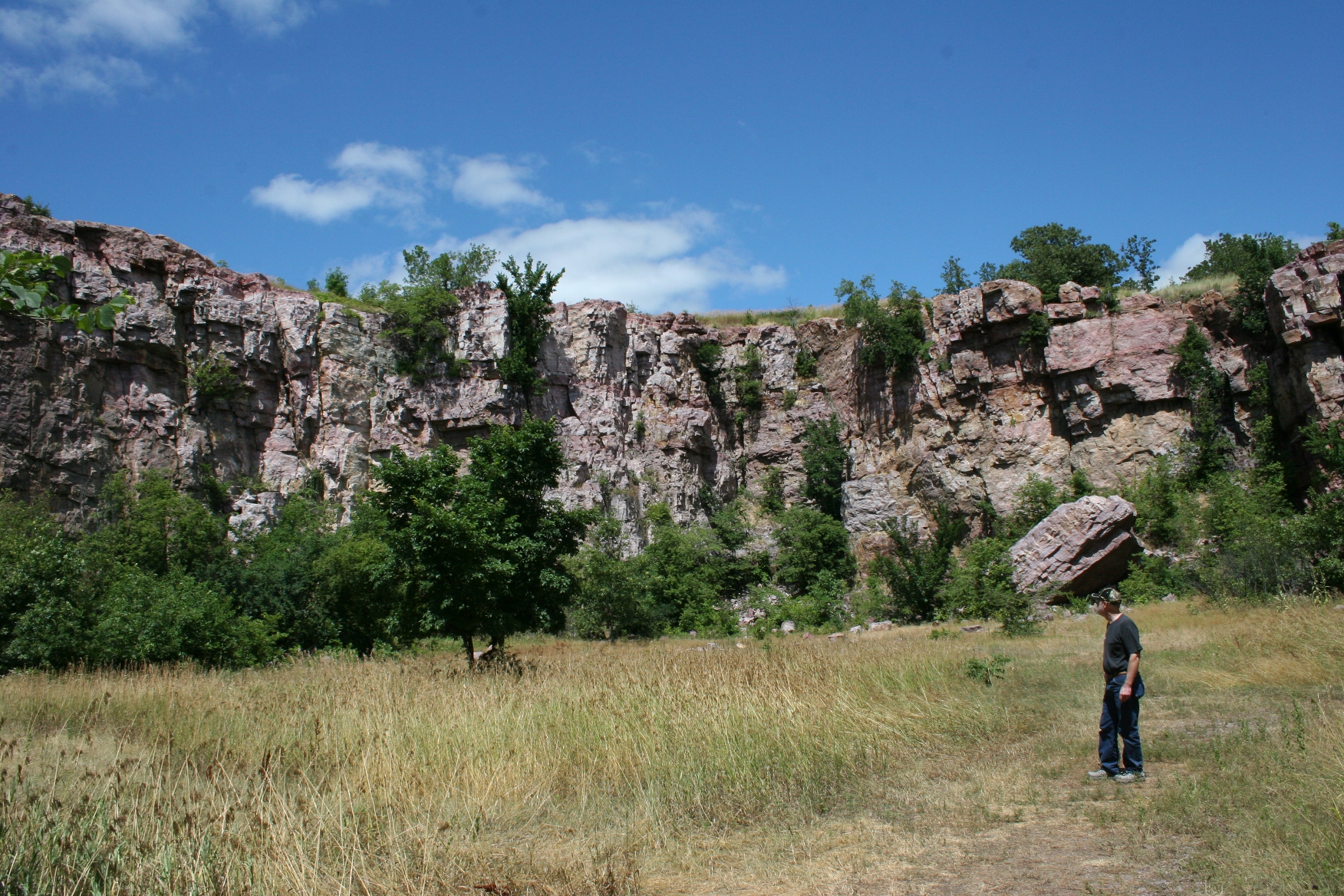
My husband inside the portion of the park where rock was once quarried.
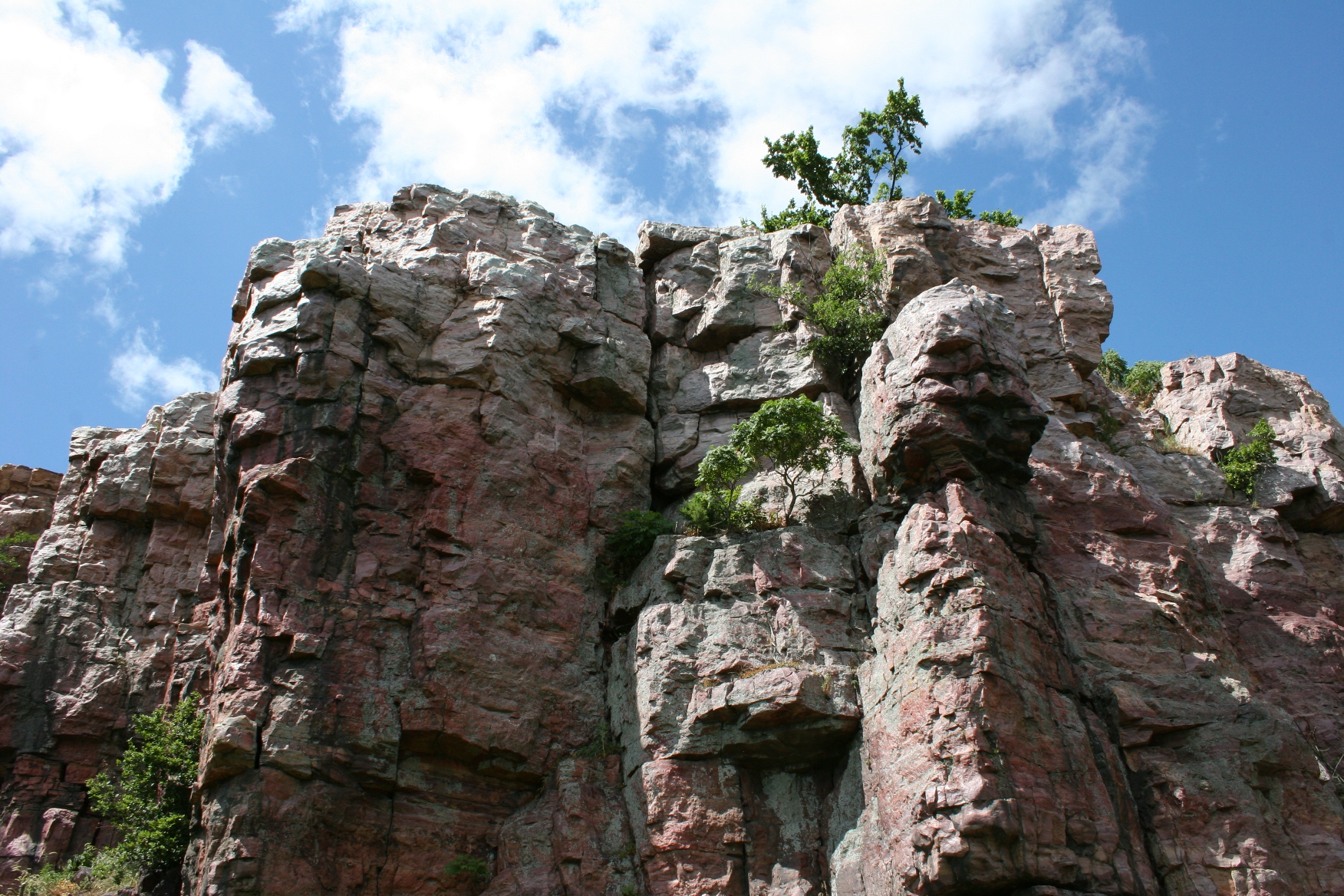
An impressive quarry wall of Sioux quartzite.
admired towering cliffs of Sioux quartzite,
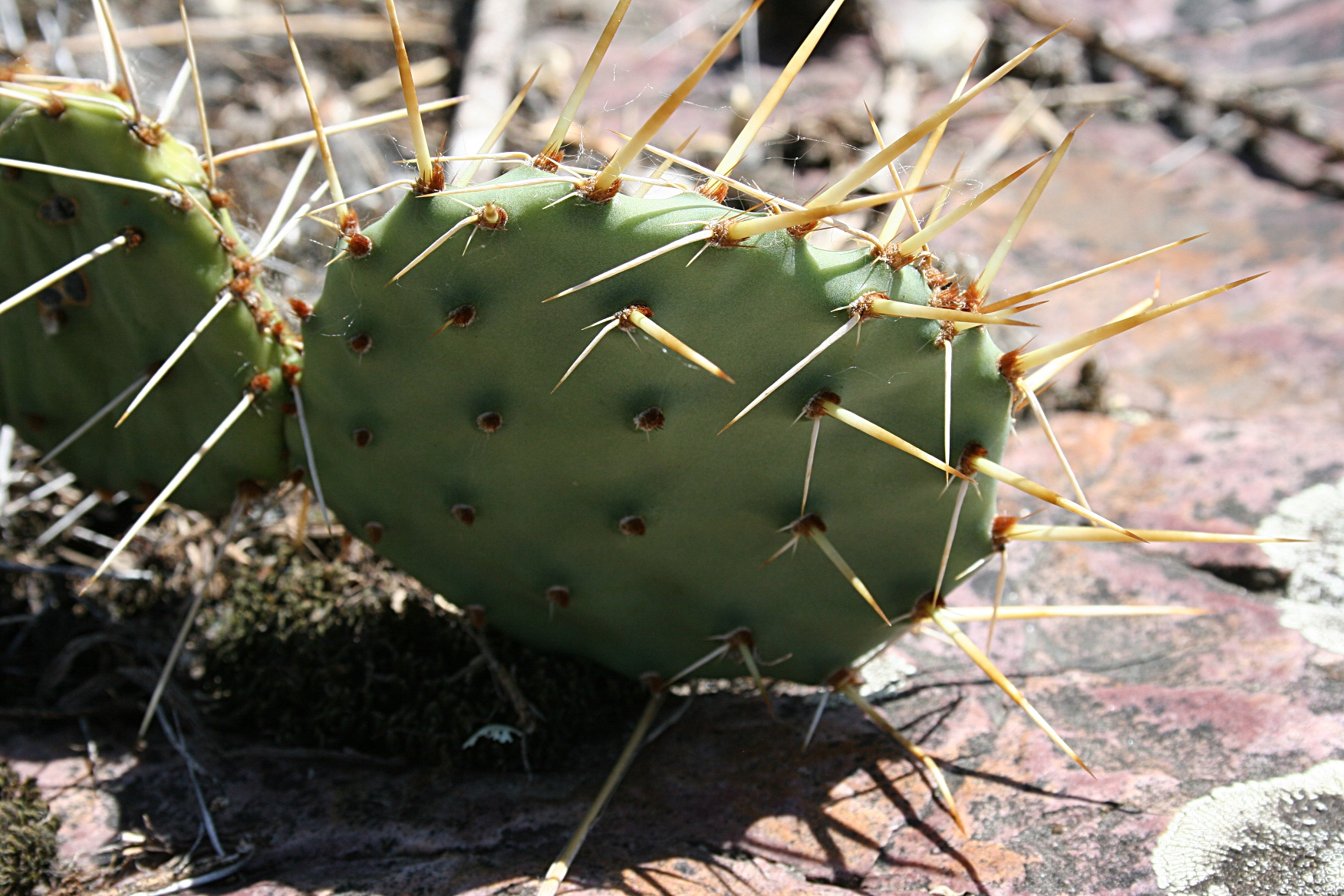
The prickly pear cactus seemingly grows right out of the rock.
bent low to study the prickly pear cactus, an unexpected plant in this northern climate. In the distance, we glimpsed the park’s herd of bison.
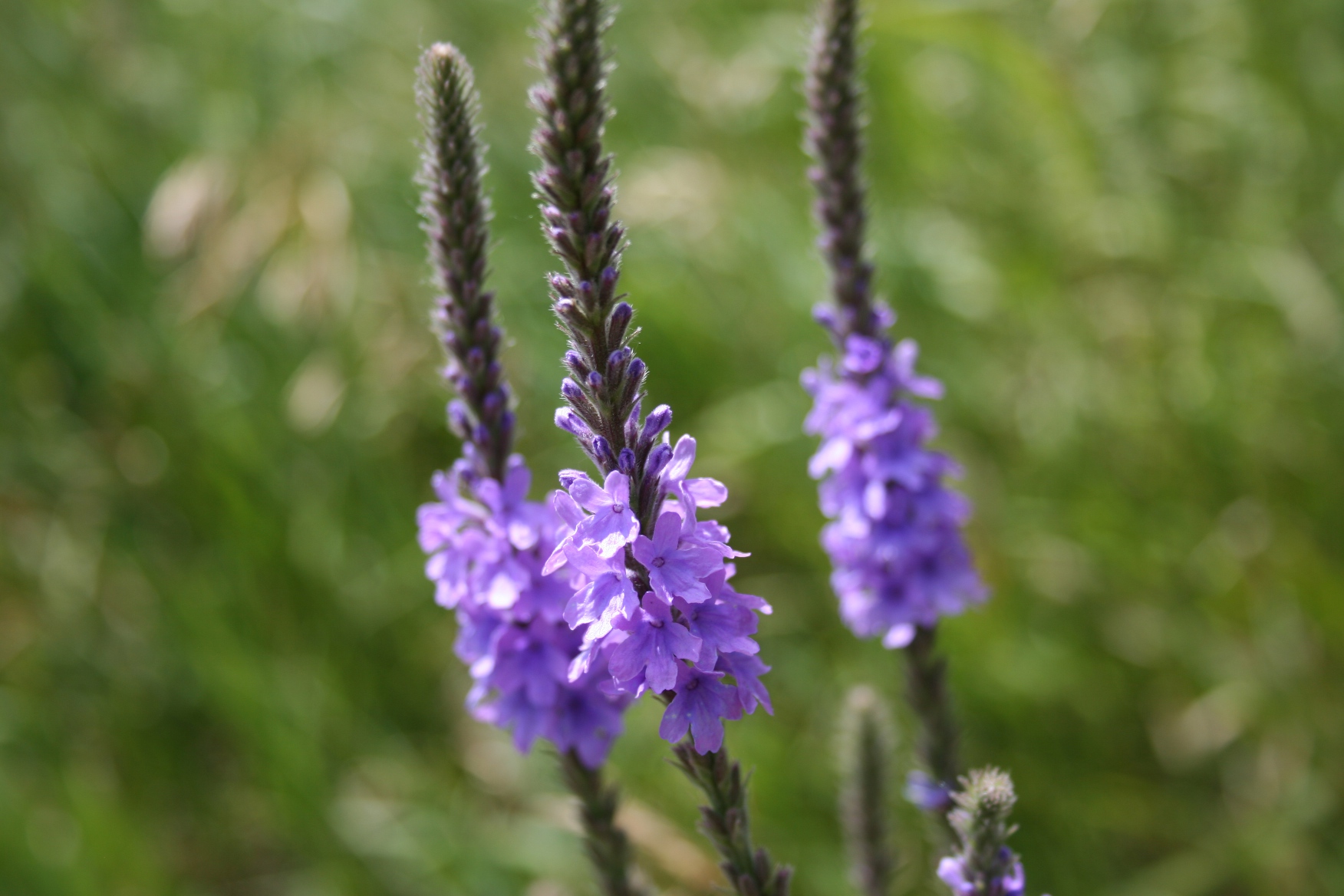
One example of the many prairie wildflowers.
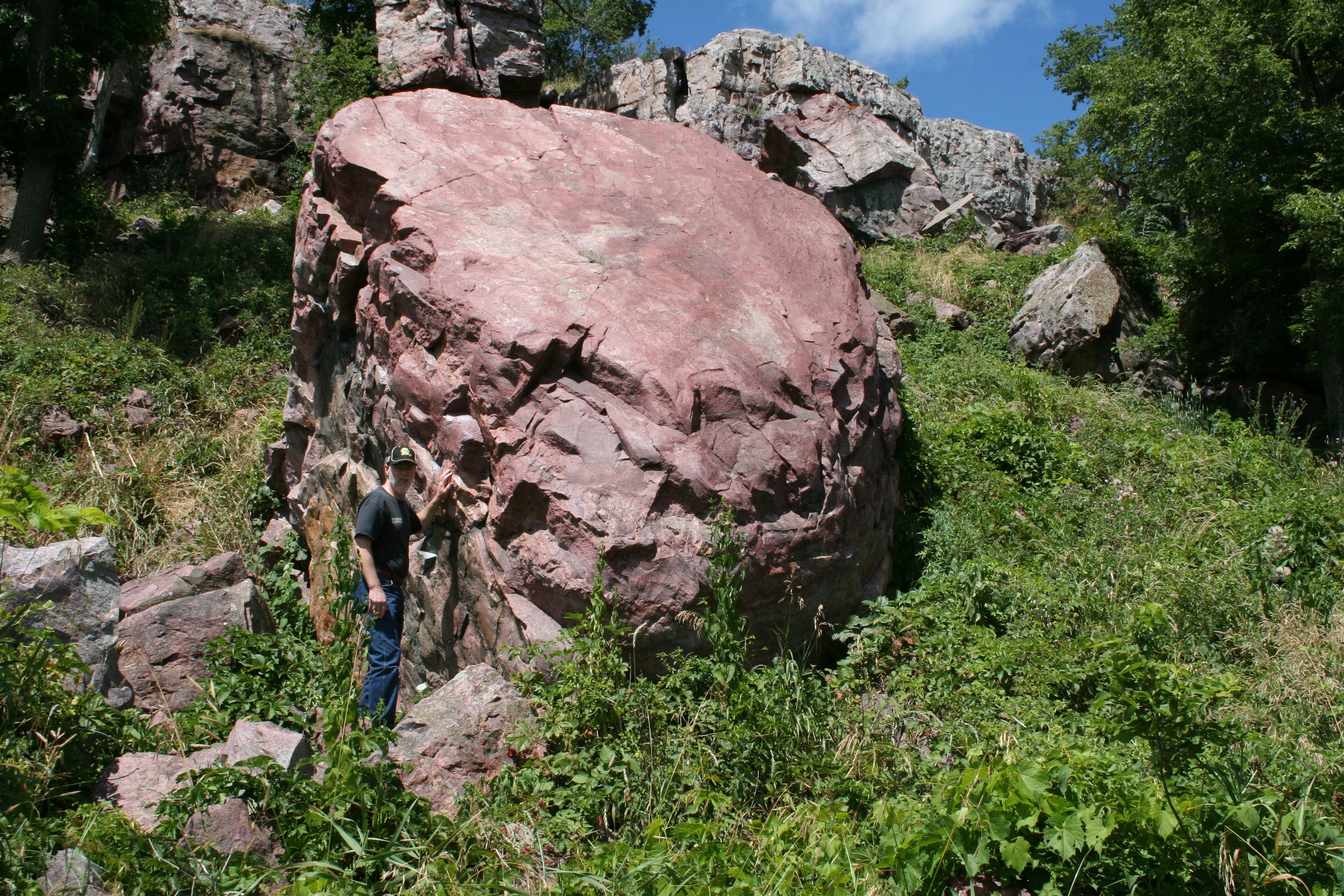
Look at the size of that Sioux quartzite rock compared to my husband.
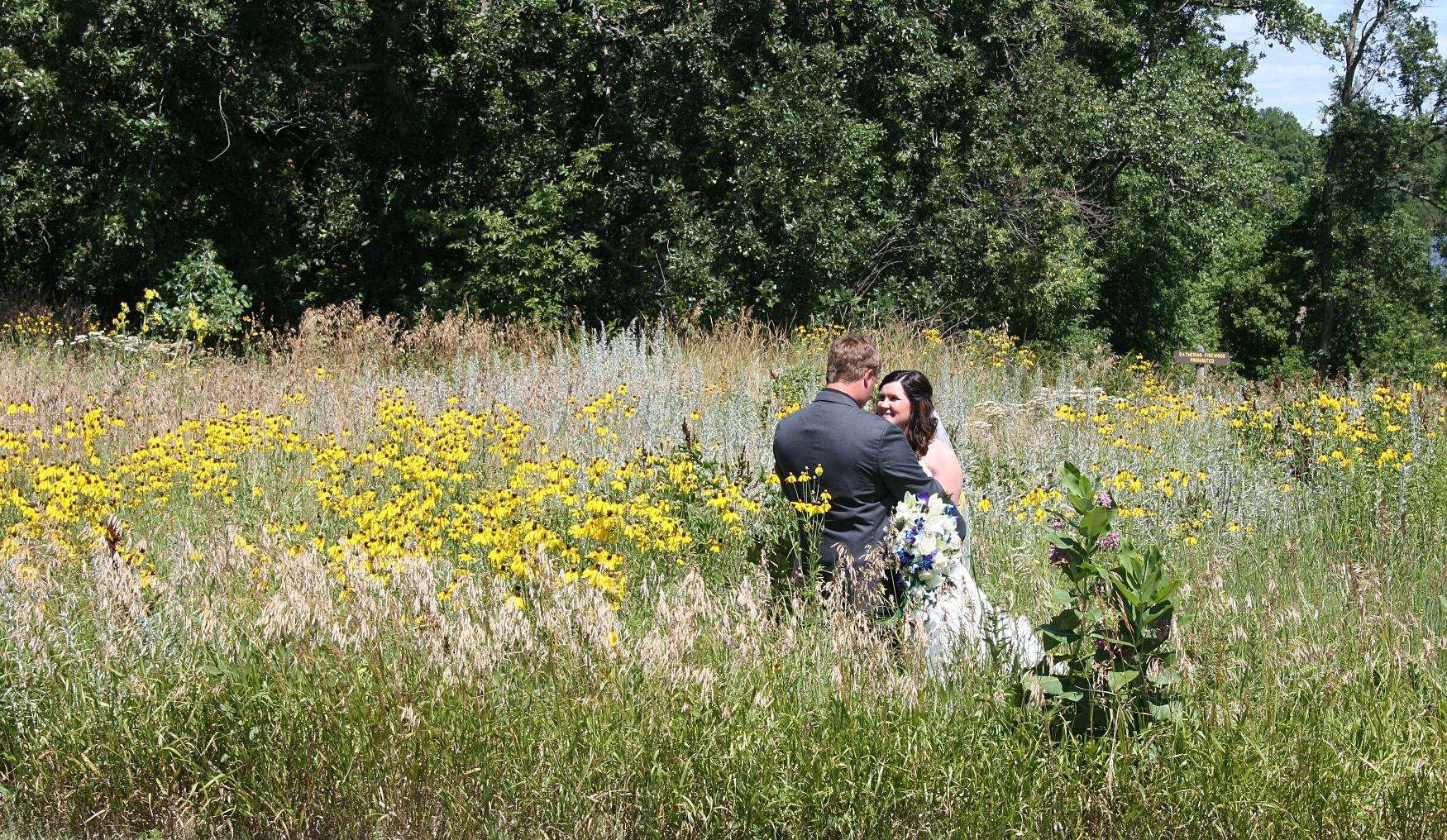
Just inside the park entry, I spotted this couple getting wedding photos taken among the prairie grasses and wildflowers.
I stopped more often than not to photograph wildflowers and the prairie grass and rocks and the overall scenery in this stunning spot on the prairie, unlike any I’ve ever viewed in Minnesota.
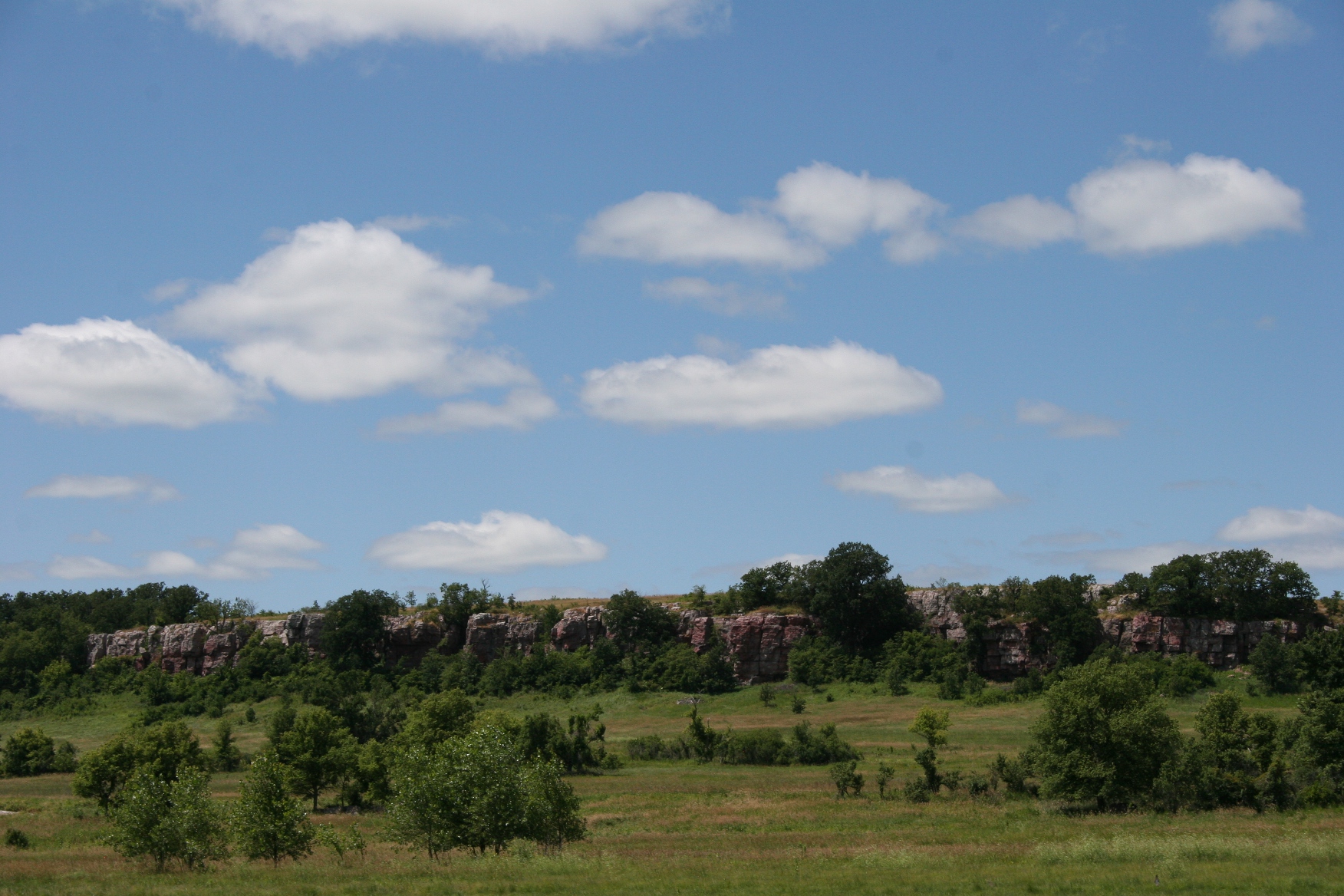
From a gravel road that loops past the park, I photographed this rugged rock line.
This prairie differs from the flat, cropped agricultural prairie of my youth. This prairie rolls and rises and meets the sky and feels wild and rugged and untamed. I almost expected to see horses galloping across the land, like a scene out of a western. It has that feel.
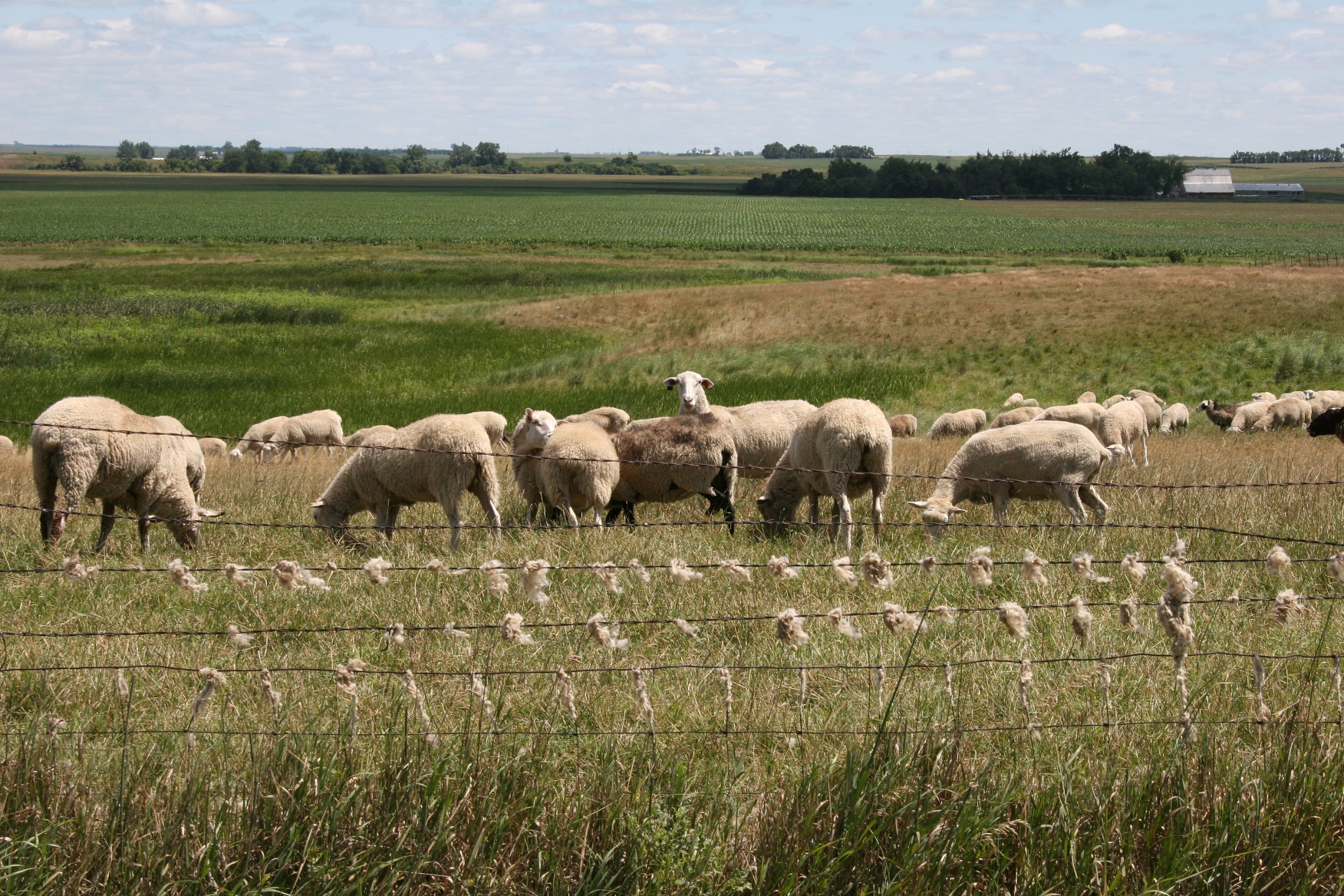
Pasture land near the park for these grazing sheep. Note the tufts of wool clinging to the fence.
I observed sheep and cattle grazing in an abundance of rocky pastures nestled between corn and soybean fields. And from the hilltops, the land seemed to stretch in to forever in all directions.
BONUS PHOTOS:
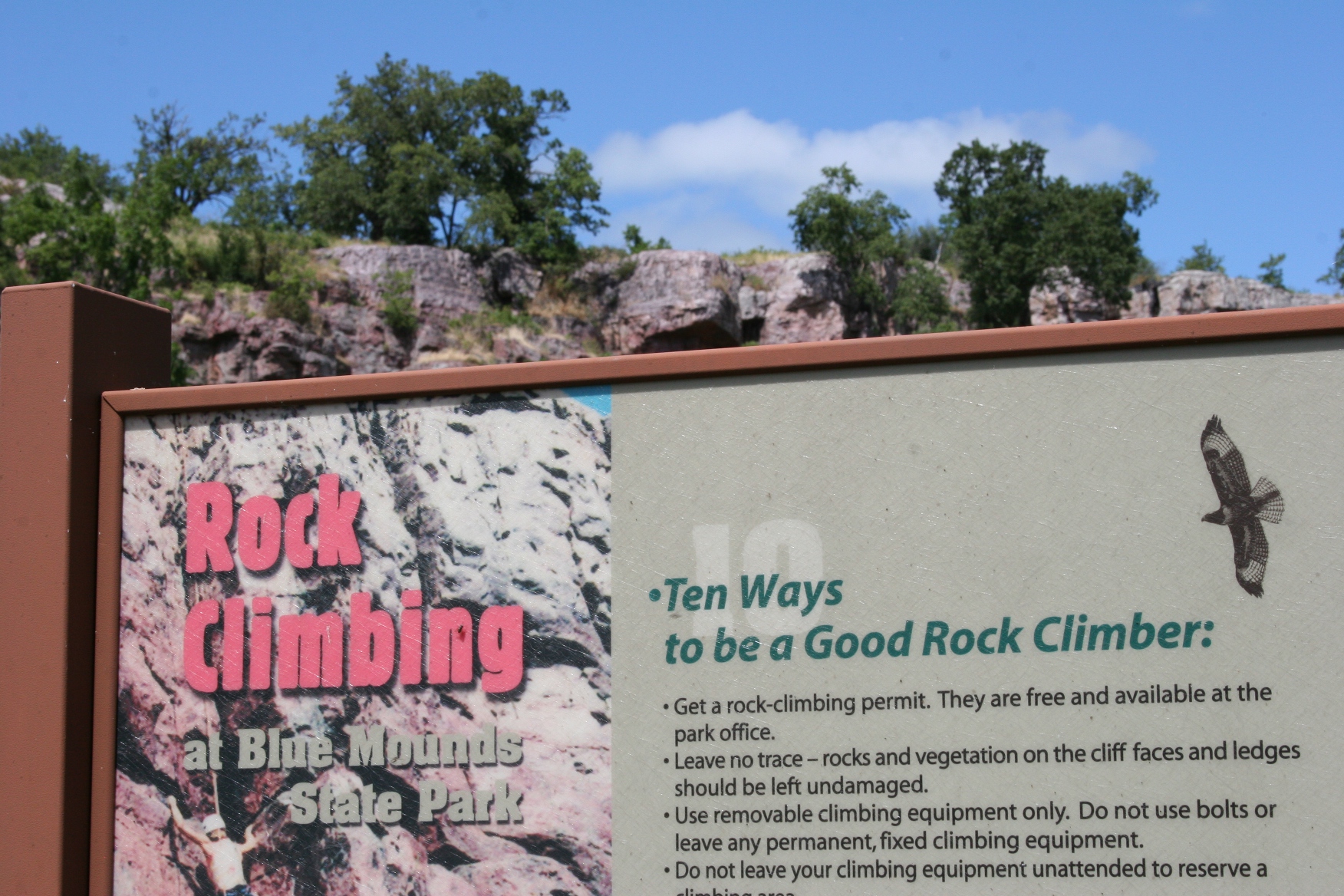
No rock climbing for us, but if you’re a rock climber, Blue Mounds allows this sport.
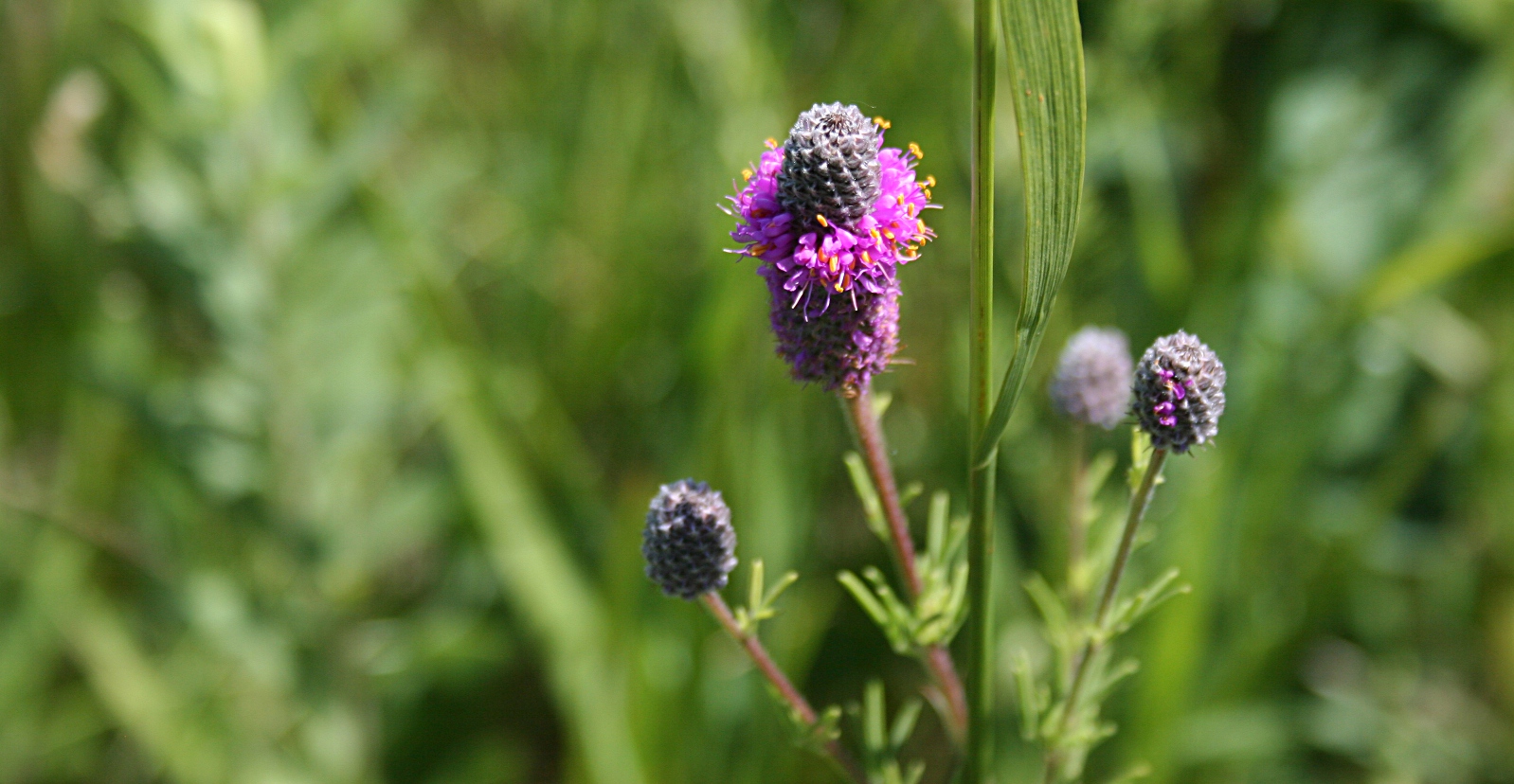
Photographing wildflowers is more my type of “sport.” That proved a challenge in the wind.
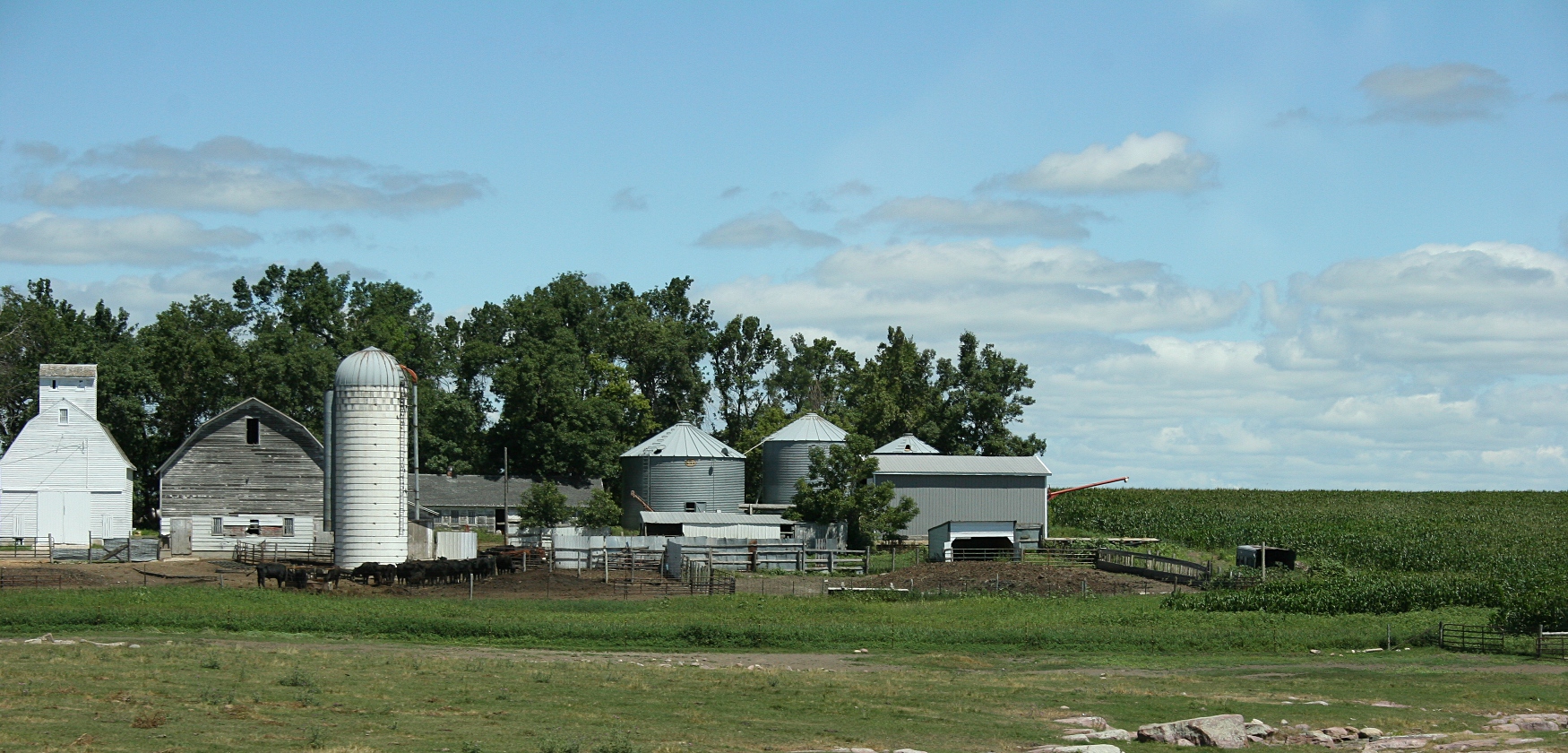
Farms like this border Blue Mounds State Park.
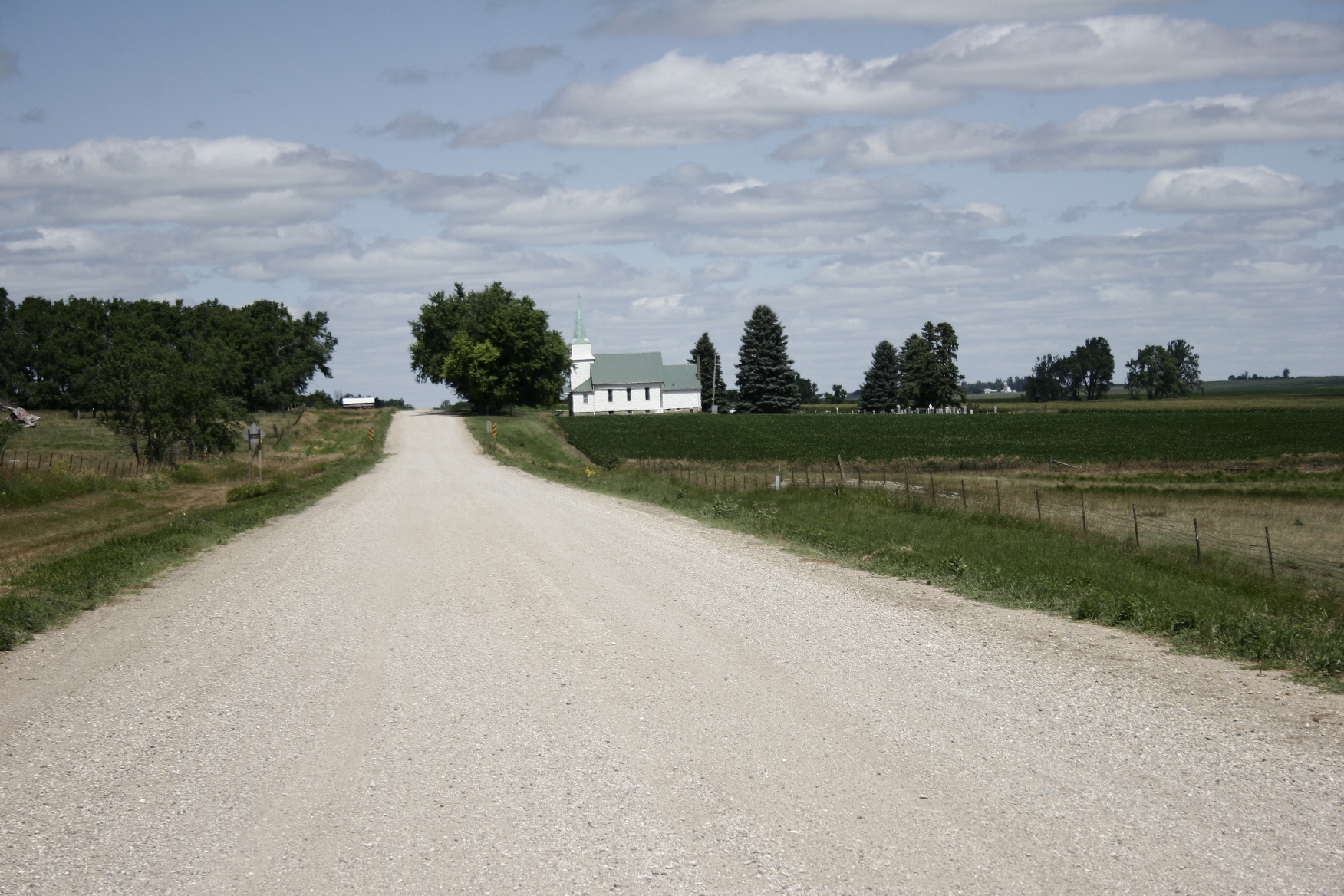
We followed this gravel road around the park and past a country church in the distance.
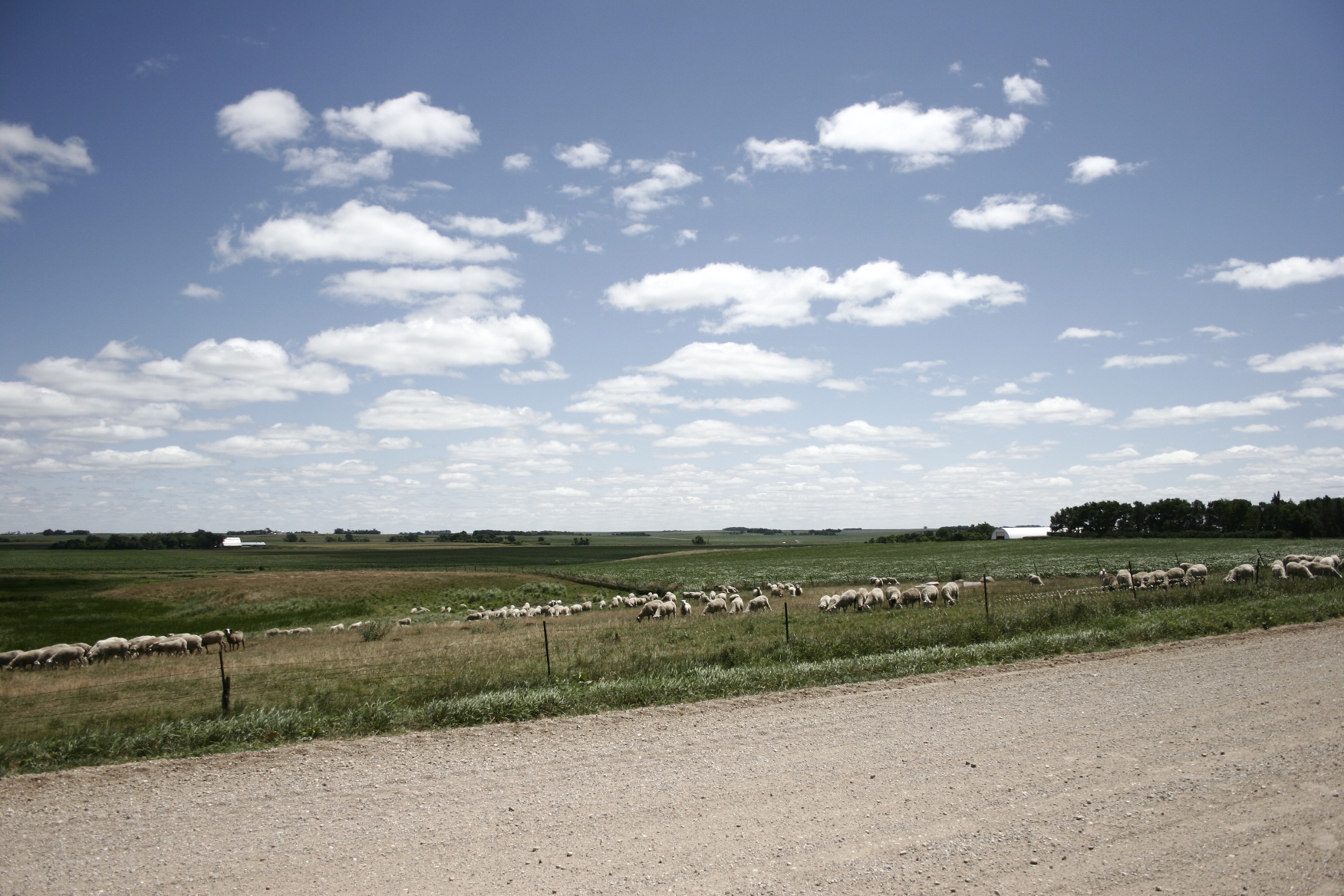
Sheep graze in a pasture near the country church.
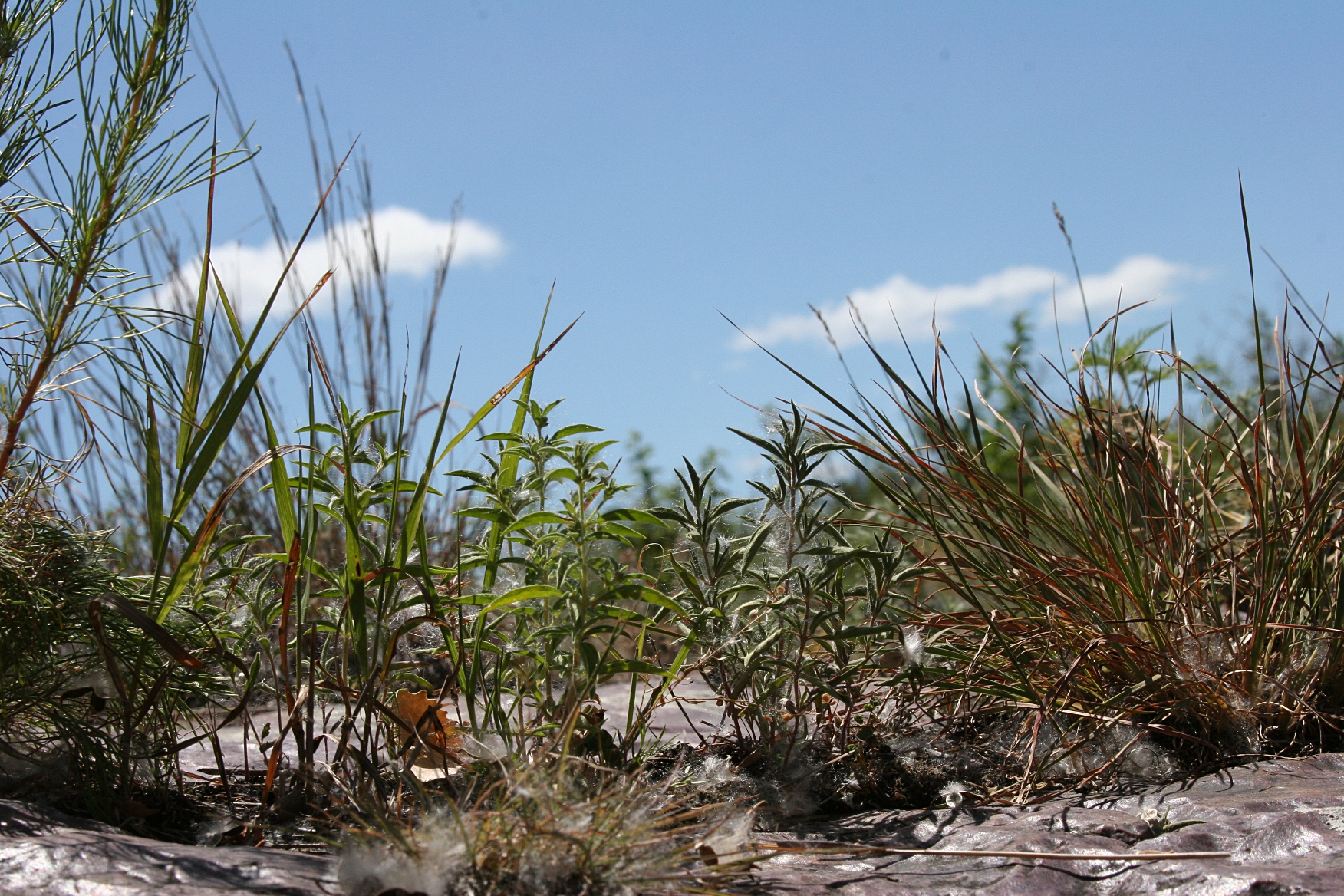
And because I value detail, I set my camera on a rock on the prairie and took this shot.
CHECK BACK for more posts from this region of Minnesota. I’ll take you into Luverne to view the Brandenburg Gallery and other points of interest.
© Copyright 2013 Audrey Kletscher Helbling
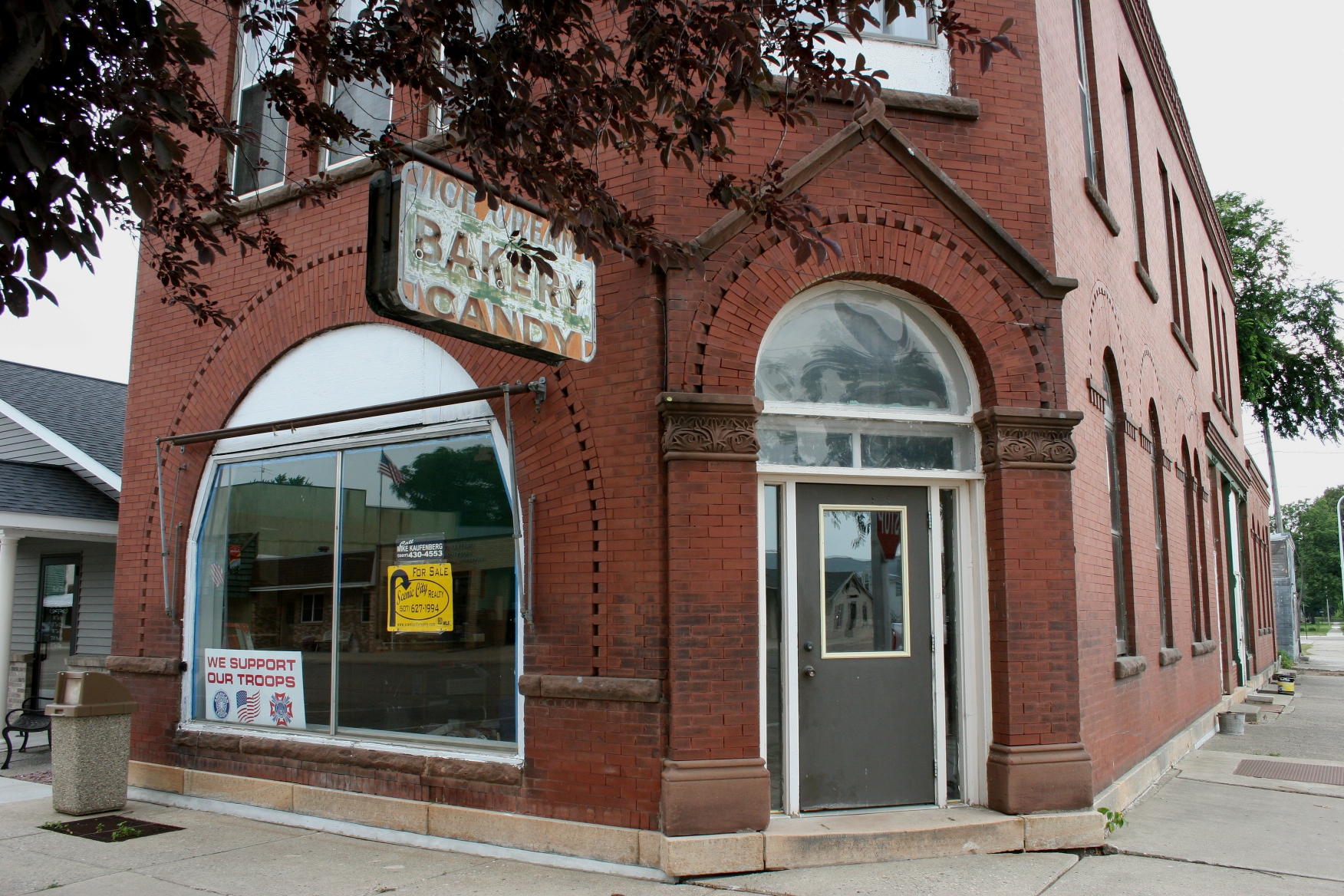
The former Sanger’s Bakery building, back on the market and photographed last week.
FOR DAVID AND MICHELLE, the dream of opening a coffee shop in an historic 1892 building in Michelle’s hometown of Lamberton in southwestern Minnesota has become just that, a dream.
About three weeks ago the old bank and long-time Sanger’s Bakery property, purchased last year by the couple, went back on the market. It was a move necessitated by an inability to secure financing for restoration of the massive brick building.
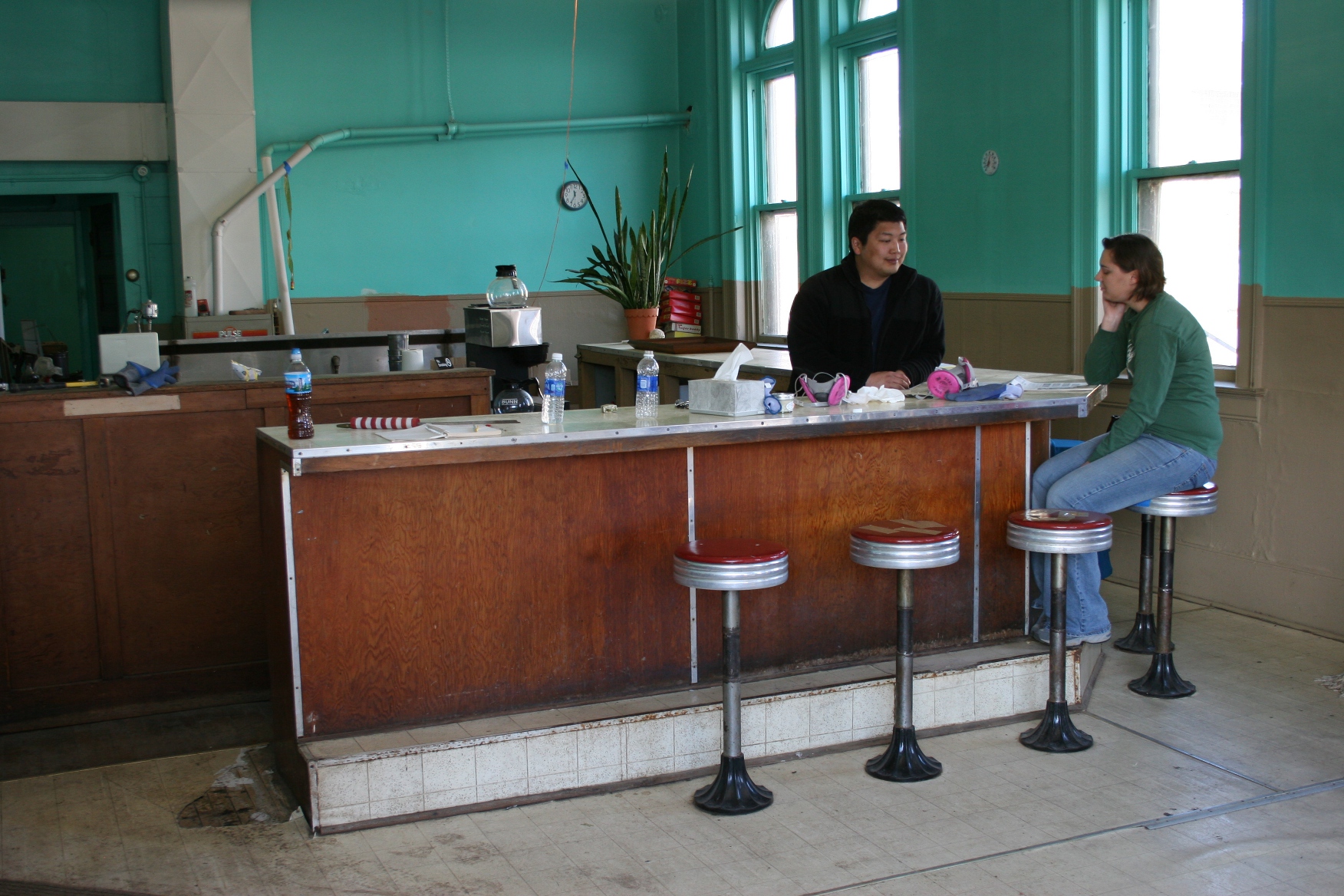
The original plan called for using the original lunch counter in the coffee shop. Minnesota Prairie Roots file photo from October 2012.
They had planned to open Seven Sisters Coffee as a local eatery, community gathering spot, entertainment center and artists’ haven this summer in this community of 820 residents along the Laura Ingalls Wilder Historic Highway in southern Redwood County.

The couple began work last year on this back room intended for entertainment and an artists’ haven.
The pair made numerous attempts, David says, to secure funding through several banks, all of which eventually classified the planned coffee shop as a restaurant and thus would not approve financing. Likewise, agencies such as the Redwood Area Development Corporation and local business coalitions could not provide the level of funding needed for the restoration, he says.
An Iraq War veteran, David is disappointed by what he perceives as a lack of support from the Veterans Administration and the Small Business Administration, through which he was working:
“We had completed exhaustive research on equipment, renovation, overhead, etc. All of the banks and organizations said our business plan and loan proposal were better researched and prepared than anything they had seen before.
The restoration and research was a joy. There is an enormous amount of history in that building. The end came as a dark and bitter disappointment. My wife and I are both hard-working, industrious people. Between her professional marketing acumen and my passion and skill sets; I thought we had a sure thing. The numbers were good…”

David and Michelle pose behind the original candy counter last fall. Michelle has sweet memories of coming here for candy as a child. Minnesota Prairie Roots file photo.
Having met the pair last October during a tour of the historic building, I, too, thought if anyone could succeed, this enthusiastic and ambitious couple could. They were, at the time of my visit, sorting through 80 years of accumulated possessions inside the old bakery and have since removed hazardous materials, repaired the roof of the 3,250 square foot two-story structure and more.
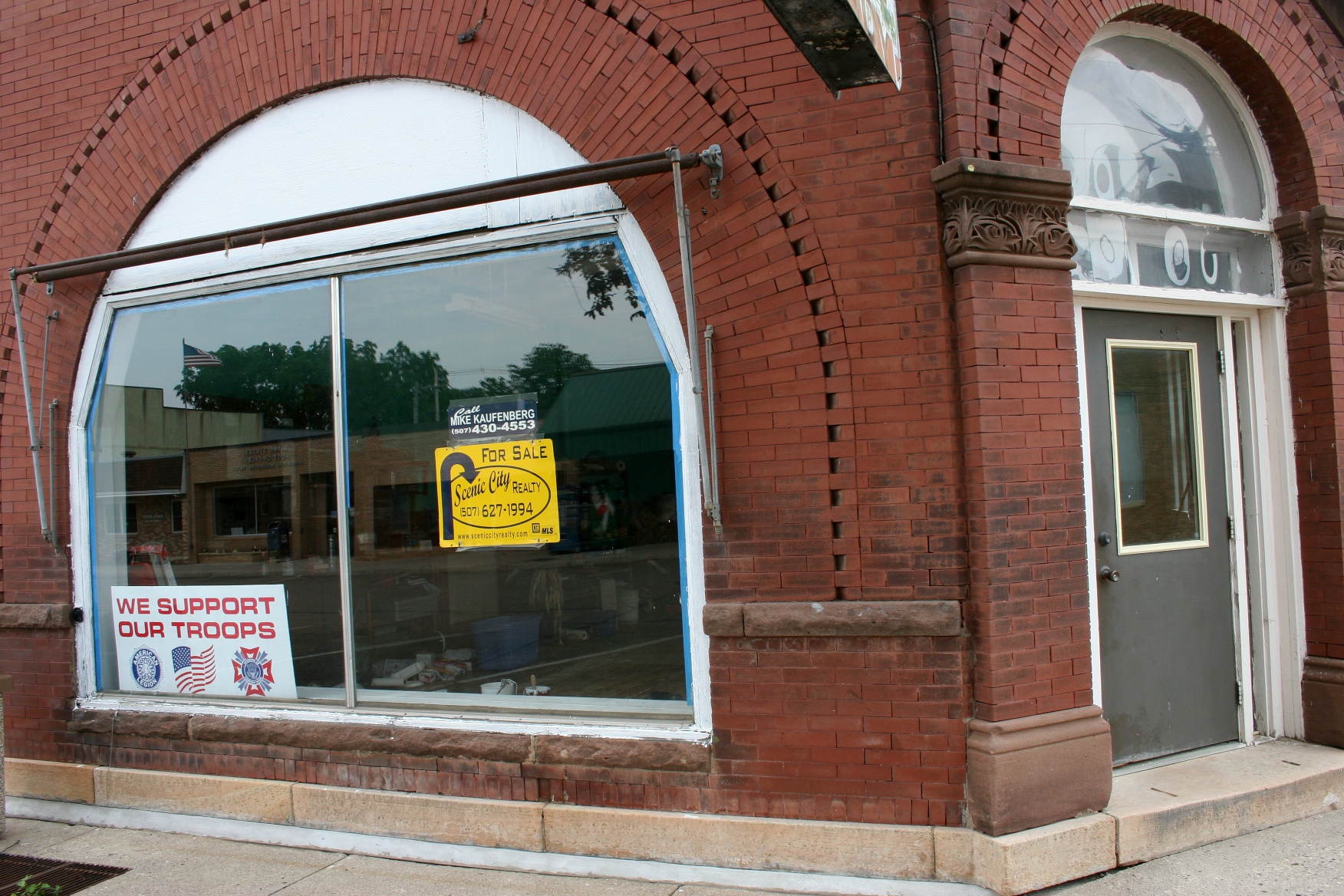
The yellow sign in the front window advertises the property for sale through Scenic City Realty.
A peek inside the old bakery last Saturday revealed half-painted walls and further restoration halted and that “for sale” sign posted on the front window.
“The coffee shop was a nice dream,” David says, “but it will have to wait for now. Despite the outcome, it was a good learning experience.”
To possess that positive attitude after months of hard work and time and money invested in the couple’s dream impresses me.
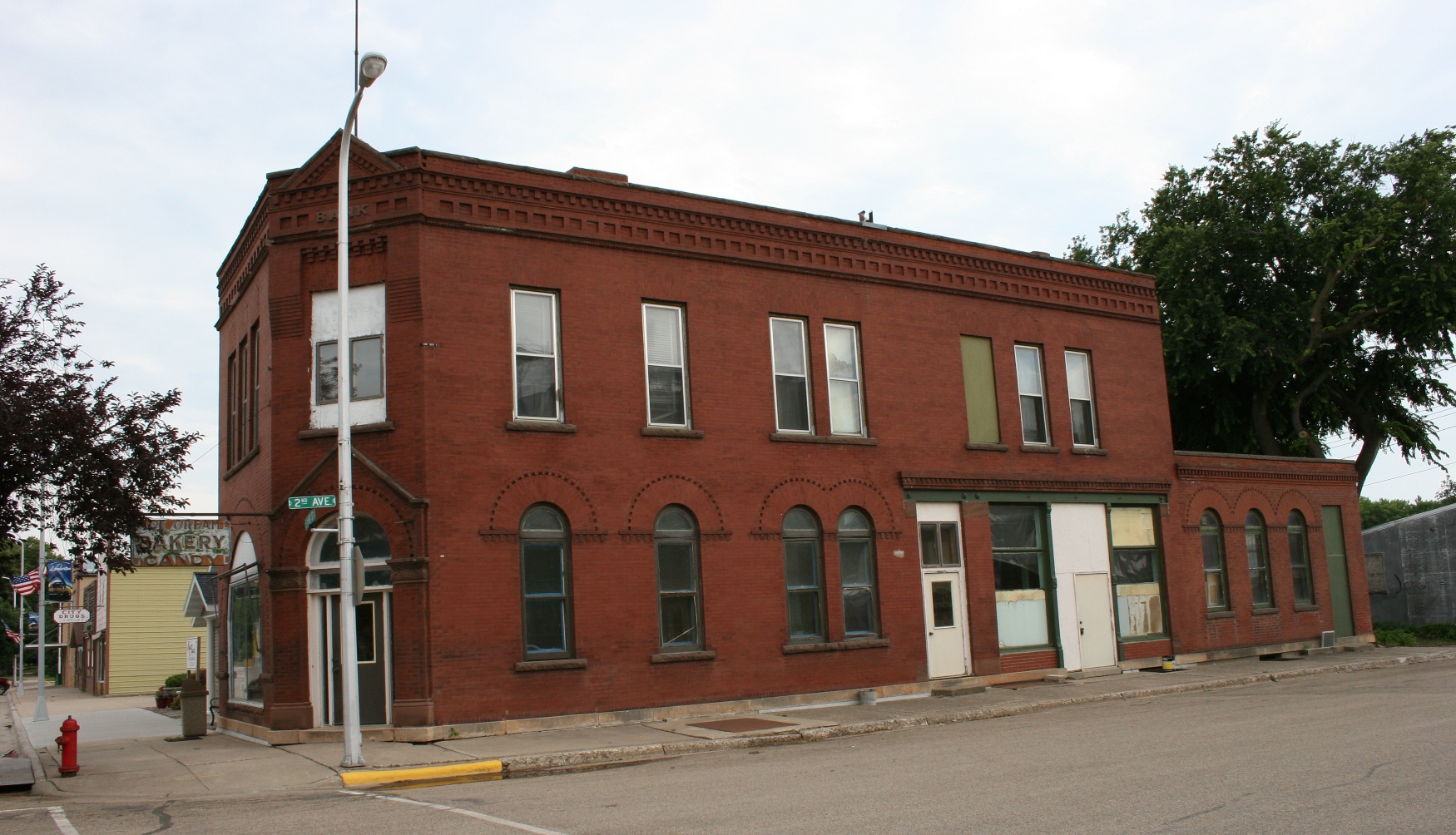
A side view of the massive historic building.
FYI: I spoke with Mike Kaufenberg, the broker/realtor who has the old bank/bakery listed at $37,000 with Redwood Falls based Scenic City Realty.
The building, he says, would provide a great place for a retail and online antiques business with room for additional retail and/or office space. Some antiques remain in the building and are part of the property offering. Two apartments are located on the second floor and could provide rental income.
To see the complete listing, click here.
I think this historic building has many possibilities for reuse, if you have the vision, drive, passion, time, energy and money. How would you reuse this building?
© Copyright 2013 Audrey Kletscher Helbling
I LOVE MY EXTENDED family and our annual tradition of gathering around the Fourth of July.
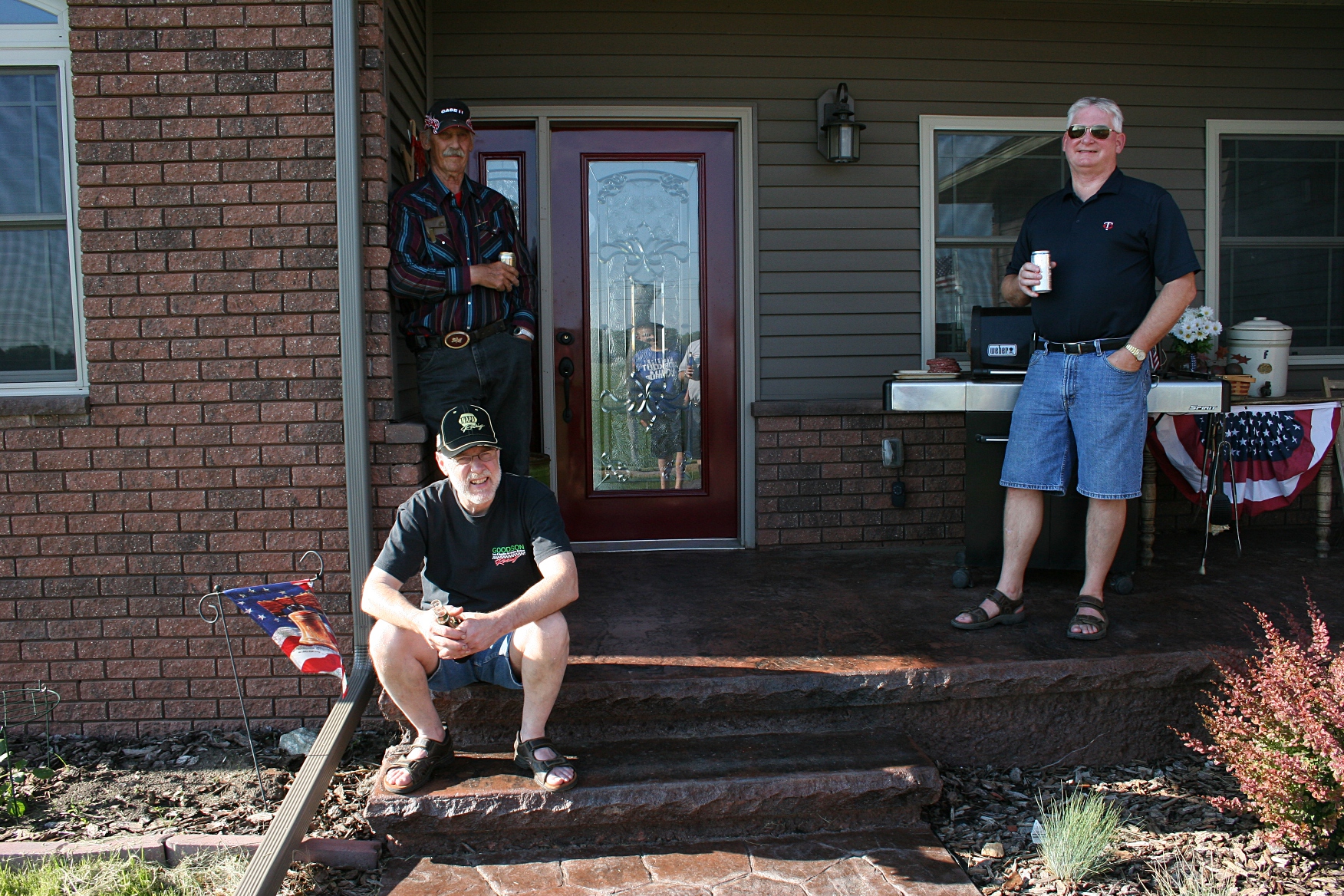
How many men does it take to grill burgers and brats? These three plus two more.
There’s plenty of food and drink, laughter, smart talk, and displays of patriotism. We end the evening with most of us bunking out on the basement floor or in spare bedrooms, arising the next morning for egg bake and accompanying breakfast foods, and coffee, before heading back to our homes.
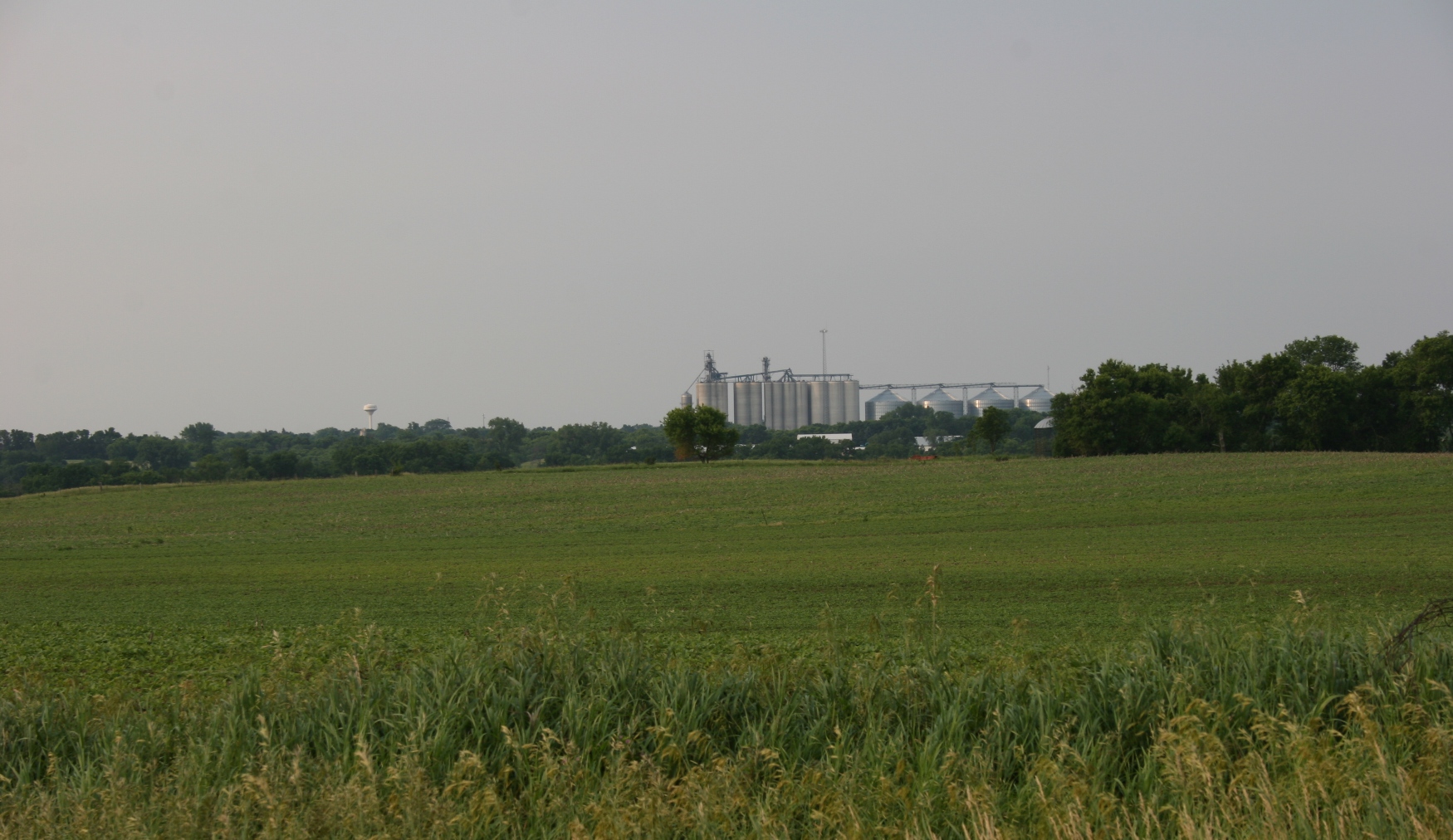
A view of Lamberton, Minnesota, just to the south of my brother’s rural acreage.
This year all of my adult children joined my husband and me for the trek to Lamberton in southwestern Minnesota. That, in itself, is cause enough to celebrate as seldom are my three all together. With one daughter five hours away in northeastern Wisconsin and the son soon moving to Boston, I treasure these family times.
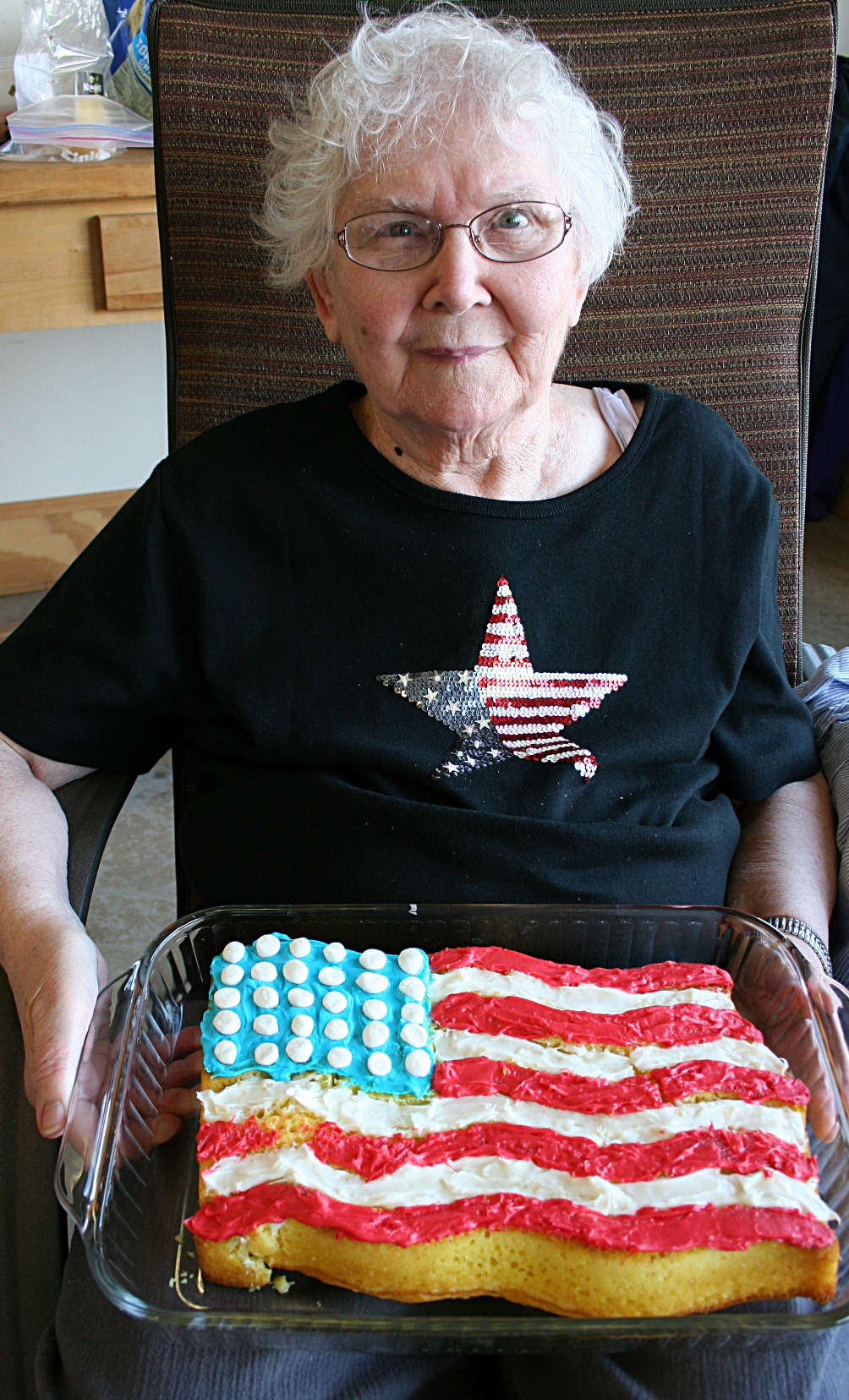
My mom, Arlene, made this flag cake. Impressive, huh?
I expect my 82-year-old mom felt the same—happy that five of her six kids and their families could attend.

The youngest attendee, my great nephew Hank, who recently turned one.
Nothing compares to the embracing love of family with whom you share a common bond of memories.
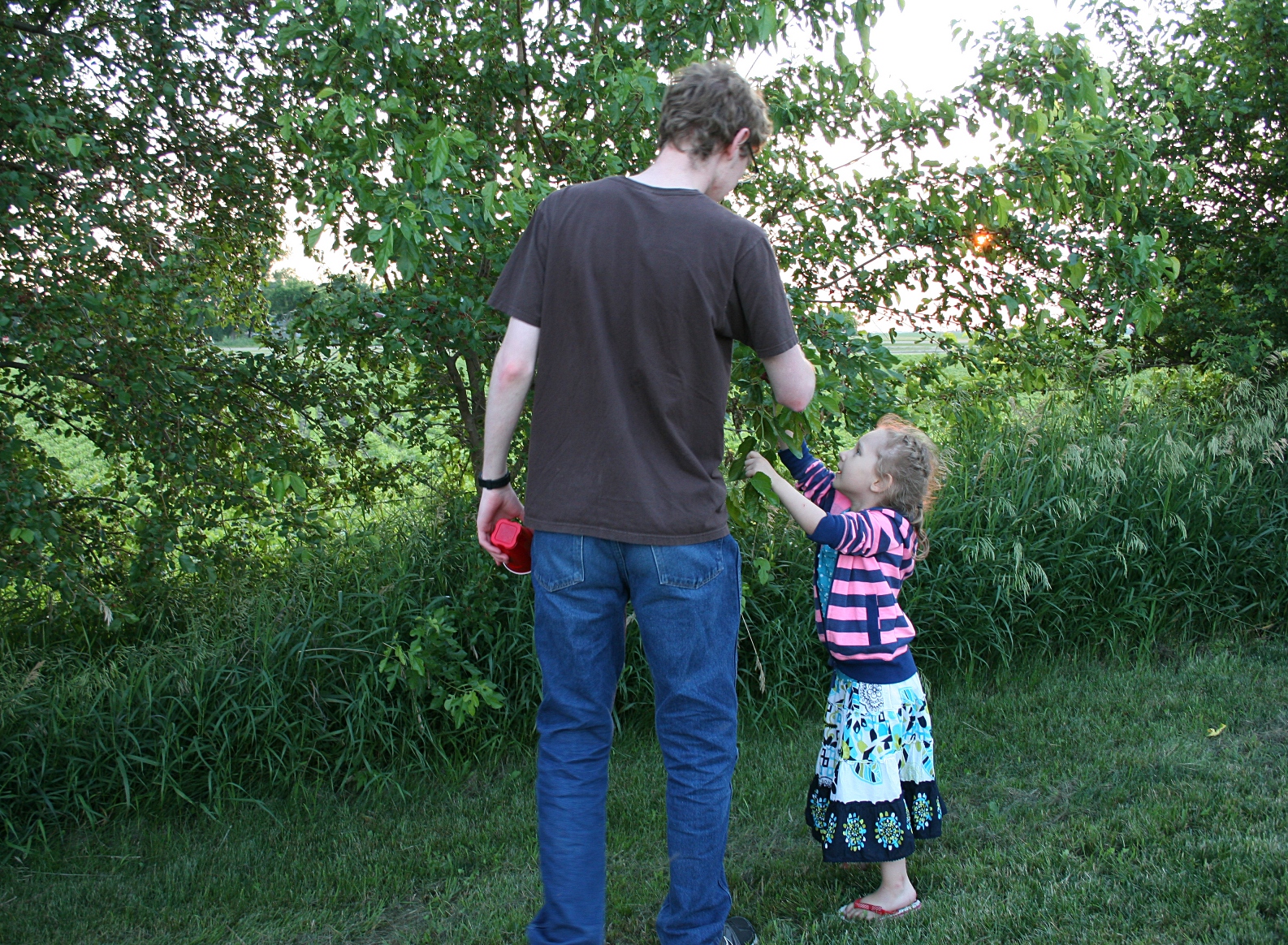
I love this photo of my 19-year-old son, Caleb, picking mullberries with Ari, my great niece.
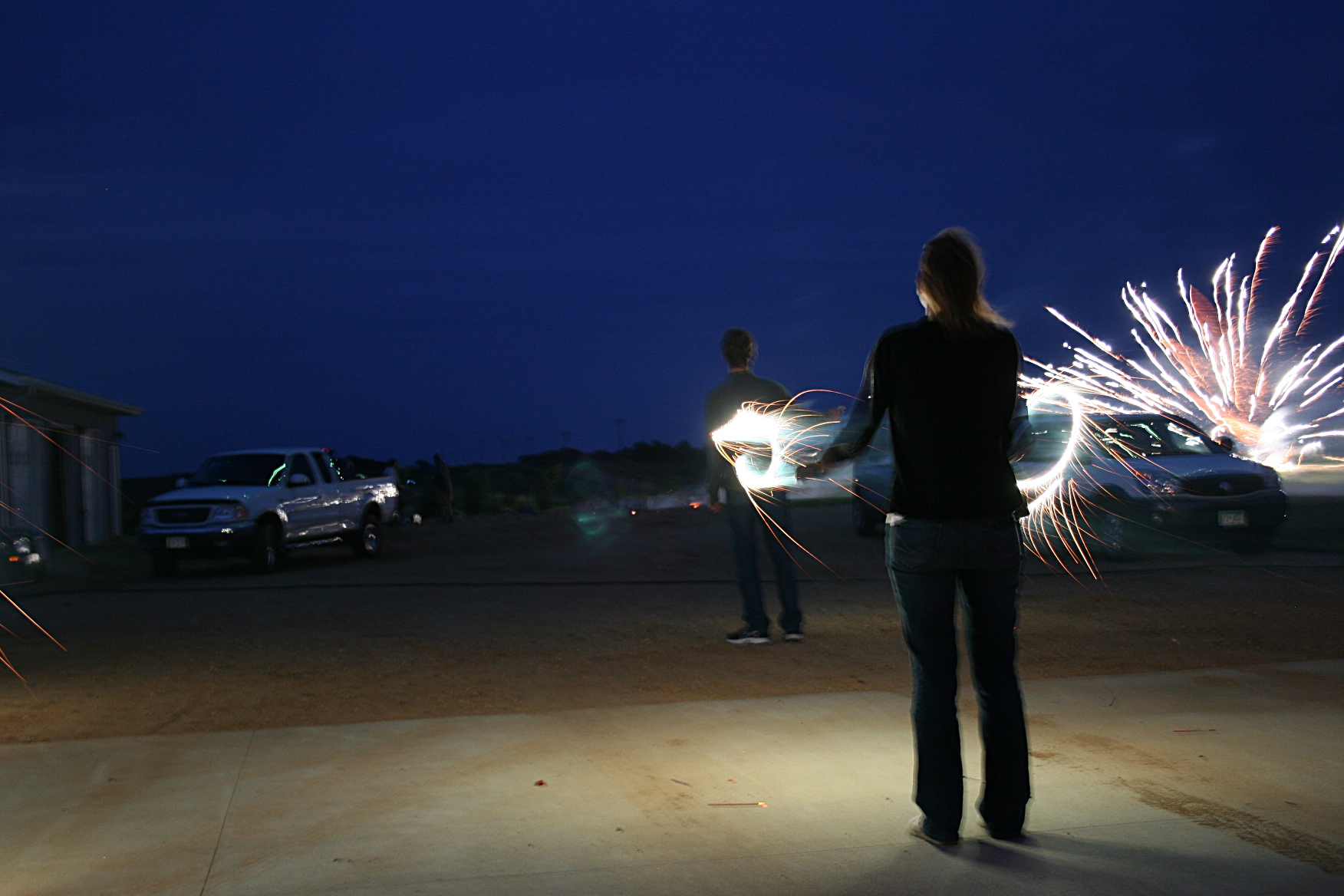
When the sun disappears from the prairie sky, the sparklers come out, part of the tradition.
© Copyright 2013 Audrey Kletscher Helbling
I LOVE BERNADETTE THOOFT’S infectious laugh and outgoing personality. And I love what this mother of seven is doing for my hometown.
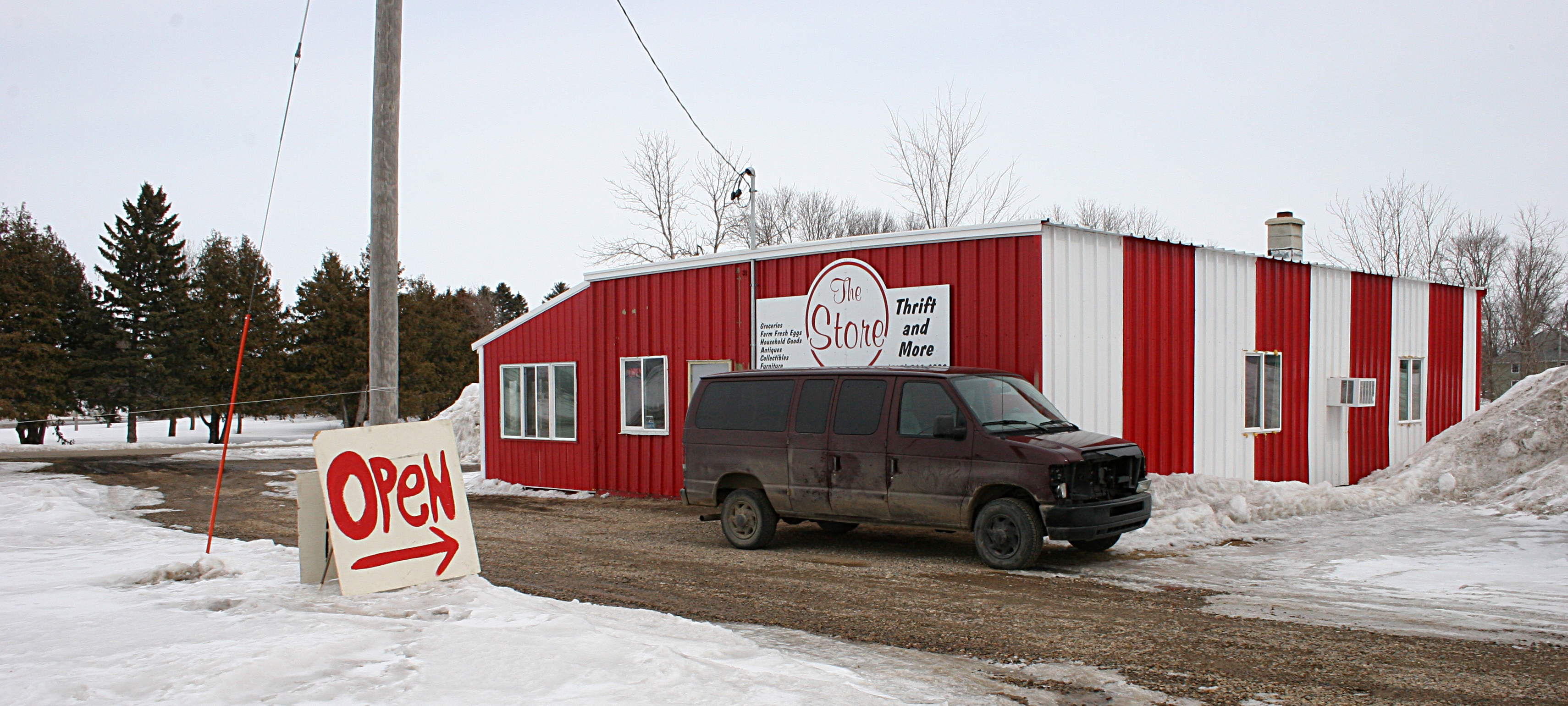
The Store: Thrift and More sits just off Minnesota Highway 19 in Vesta in Redwood County.
In February she opened The Store: Thrift and More in Vesta, population 330 and the only town along the 40-mile stretch of Minnesota Highway 19 between Redwood Falls and Marshall.
The “more” part of Bernadette’s store includes eight shelving units stocked with foodstuff, personal care items, paper products and more in addition to perishables stashed in nearby coolers.

The grocery section of the store includes basic perishables like dairy products, organic eggs, some fruit, lettuce and more. Canned, boxed and bagged foods; personal care items; and miscellaneous items like greeting cards, tape and such fill eight shelving units.
I don’t know exactly how long my hometown has been without a grocery store. But it’s been awhile. Locals, like my 80-year-old mom, have had to drive 20 miles either east or west to find the nearest grocery store. Now this community’s residents, many of them elderly, need only walk or drive to the west edge of town to buy a loaf of bread, a gallon of milk, organic eggs from Bernadette and Matt Thooft’s farm, fruit and an assortment of processed foods that include SPAM, much to my mom’s delight.
This is huge, to have groceries and basic necessities available in Vesta. Bernadette even offered to have her 11-year-old son deliver right to my mom’s doorstep a block away. Such small-town neighborliness simply warms my heart. Many times the good people of Vesta have assisted my mother. And for that, I am grateful.
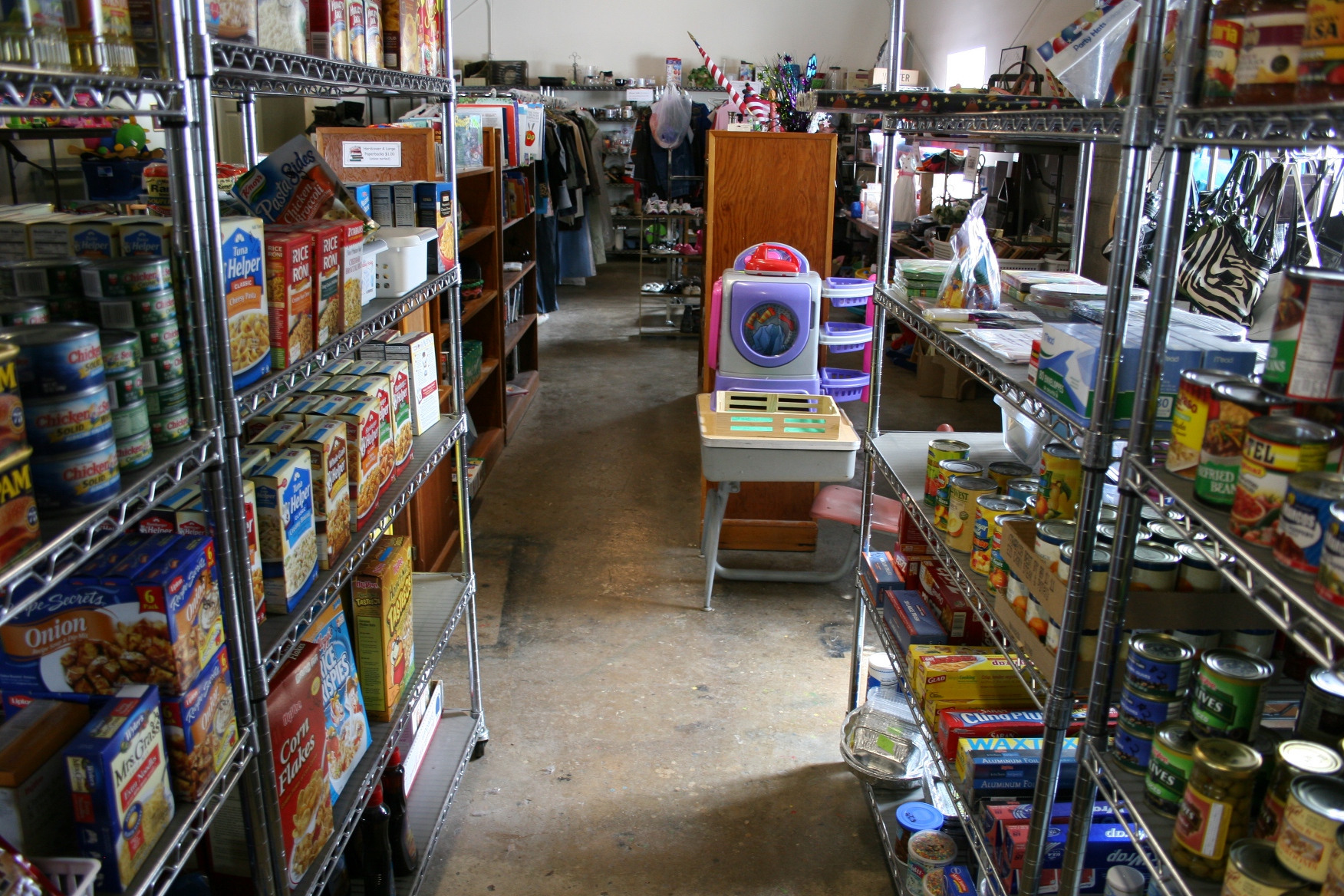
Looking from the front grocery section toward the back thrift area of The Store.
Bernadette tells me she originally hadn’t planned on stocking groceries, rather dedicating her floor space to thrift items that range from kitchenware to toys, books to clothing, gift items to home décor and an assortment of other merchandise.
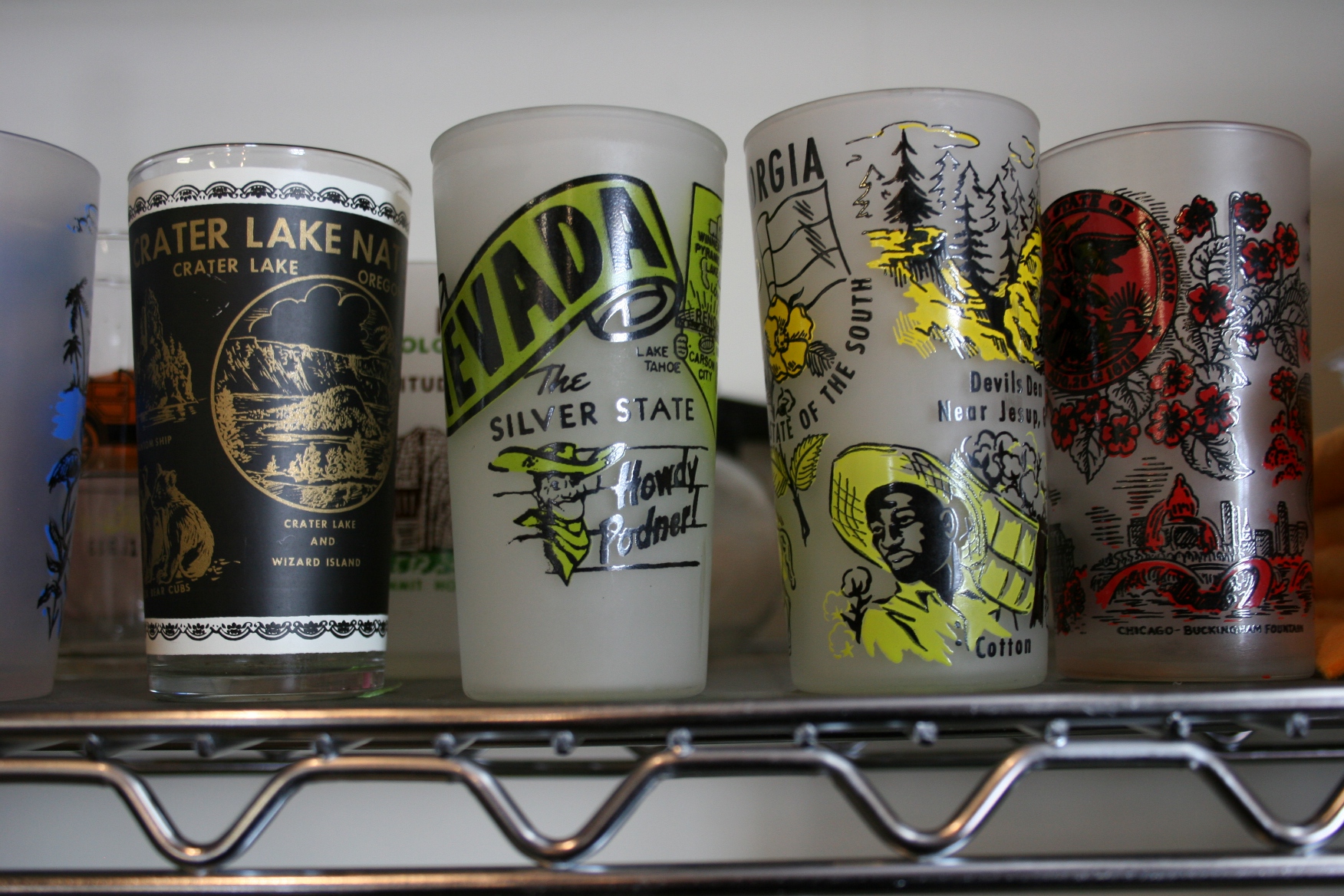
Vintage glasses in the thrift section.
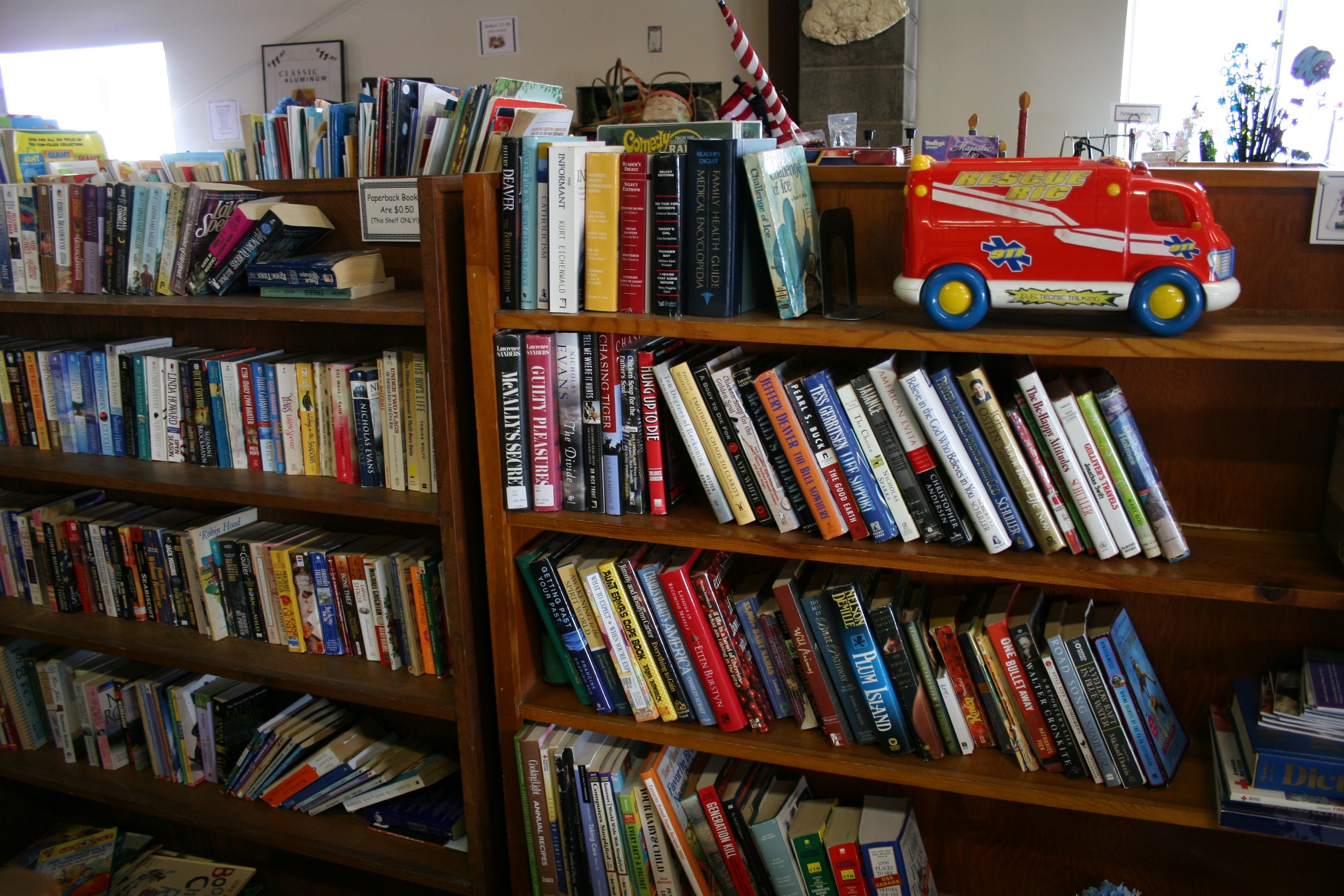
Bernadette offers a great selection of used books for all ages.
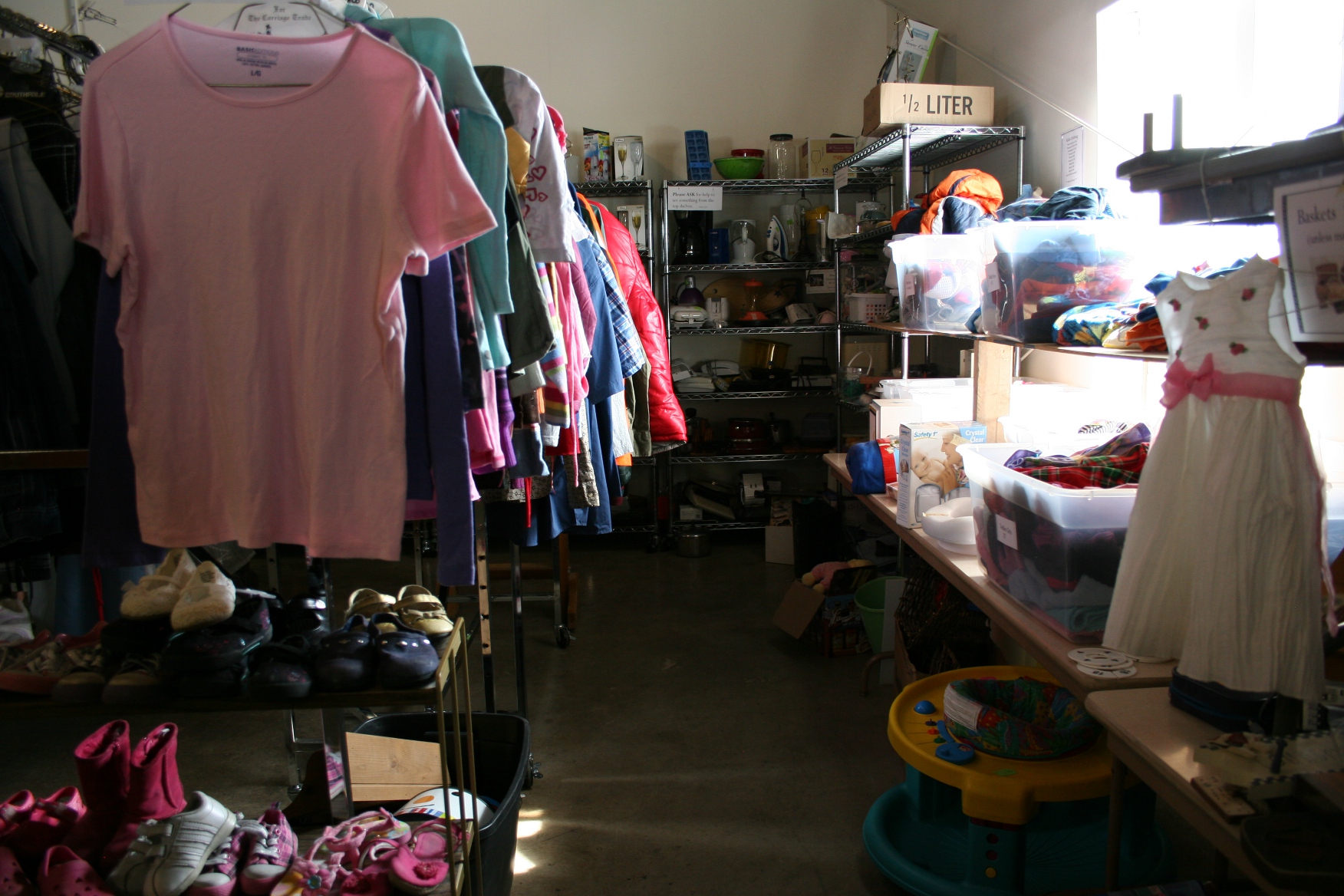
You’ll also find a shoes and clothing.

One of my favorite finds in The Store, an $8 vintage Pyrex casserole, which I nearly purchased.
But then she started getting requests to carry groceries. So Bernadette decided to buy food and products her family can use. That way, if items don’t sell, she doesn’t lose anything. Once a week this entrepreneur mother drives the 20 miles west to Hy-Vee Foods in Marshall, reselling her purchases in Vesta at a slightly marked up price that will help cover gas expenses.
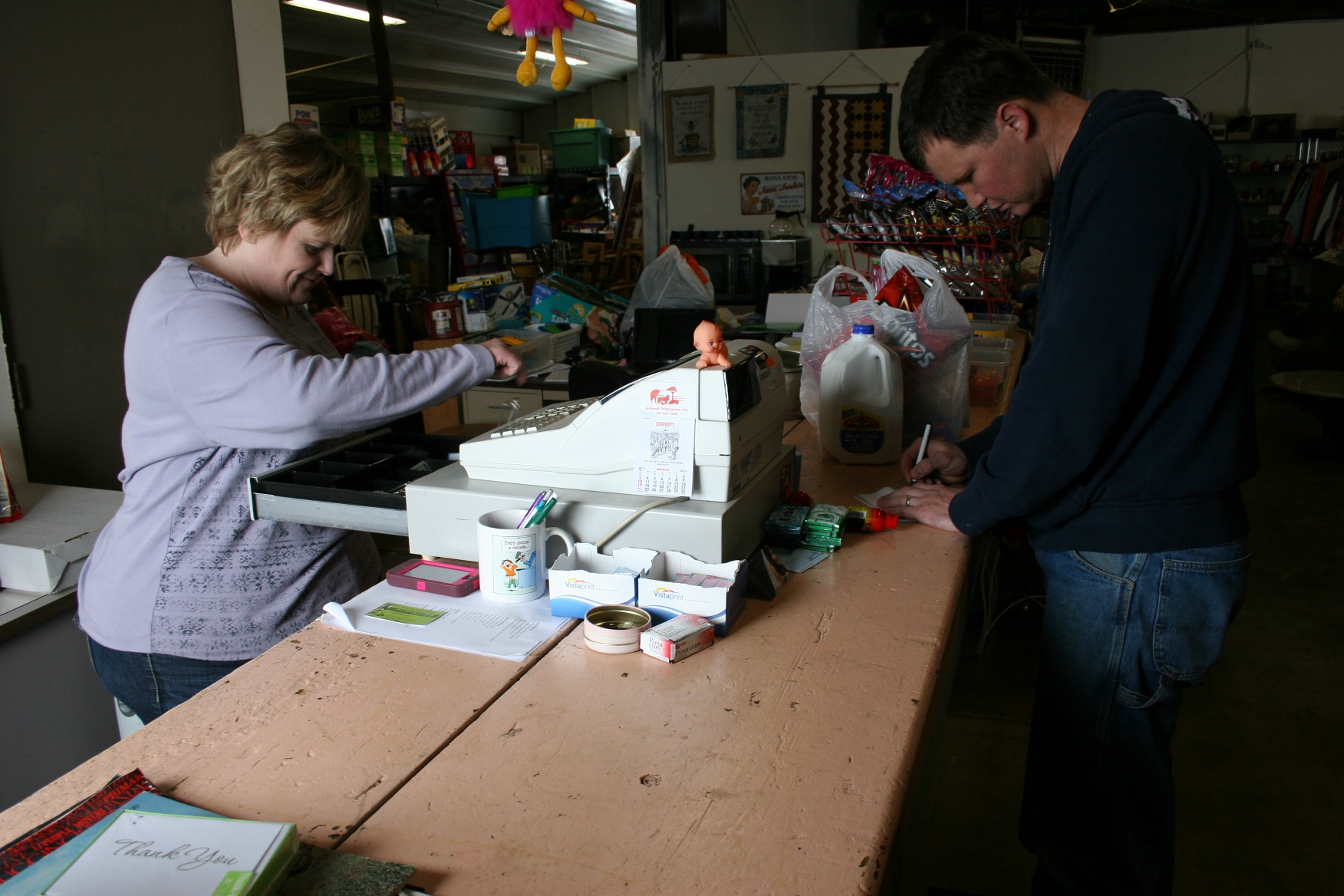
Jason Kramer stops in to buy a few grocery items from Bernadette.
Already several local families come to The Store once a week to purchase their groceries, she says. On the Saturday afternoon I visited, Jason Kramer popped in from his home across the street to pick up Oreos, chips, bread and milk. He calls opening of The Store “flippin’ awesome.”
It is that type of enthusiasm Bernadette hopes for from other Vesta area residents. She needs their support, and business off the highway, to make her venture work in this isolated prairie town.
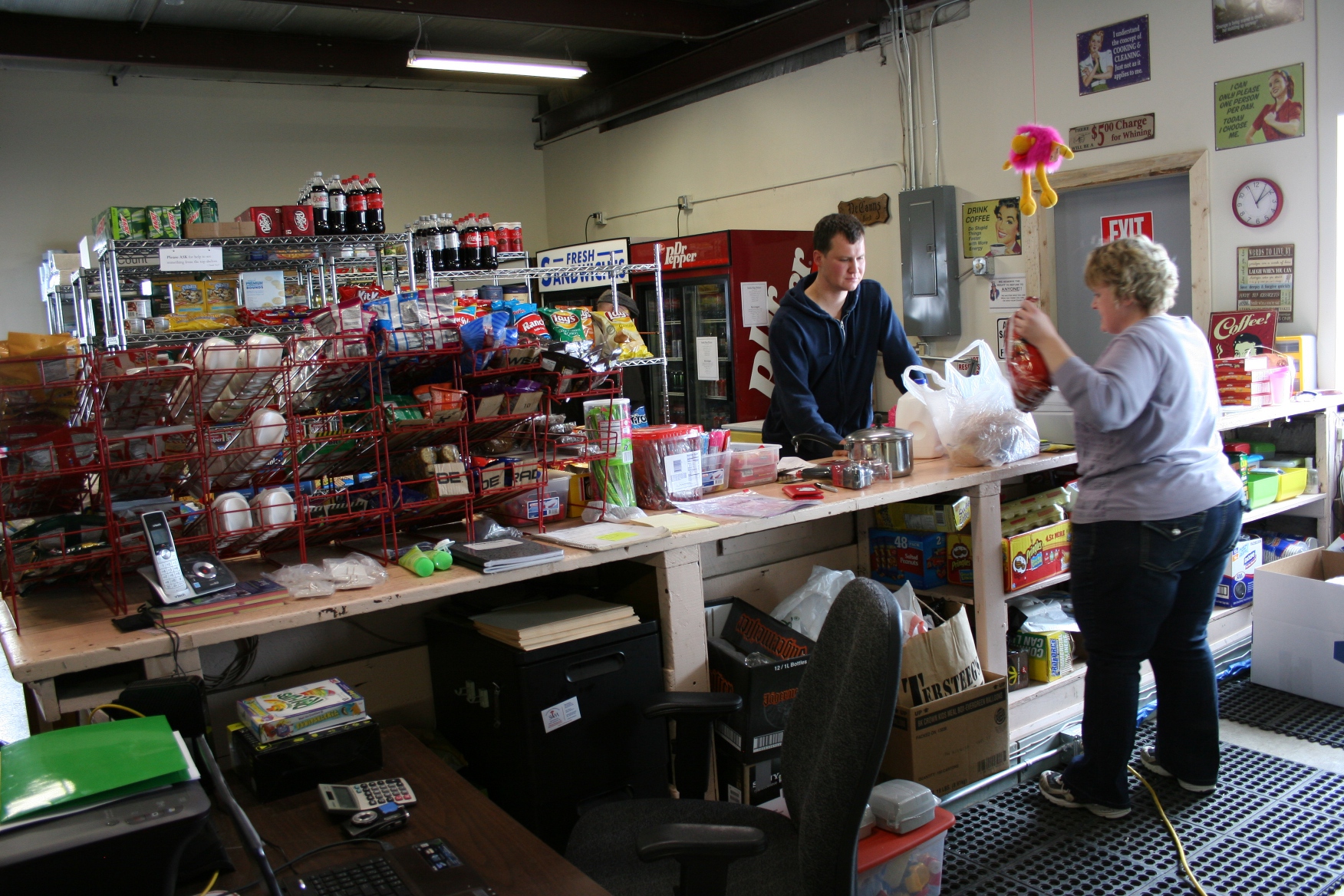
Just another view of the store and Bernadette’s office with Bernadette bagging Jason’s purchases.
In the short time I perused the store and spoke with Bernadette, several others stopped in—two middle schoolers to eye the toy collection and eventually purchase candy, a middle-aged couple scanning thrift items and then Jason for his groceries. I walked out with a kettle for my college-aged son and my husband grabbed packaging tape and a dispenser.
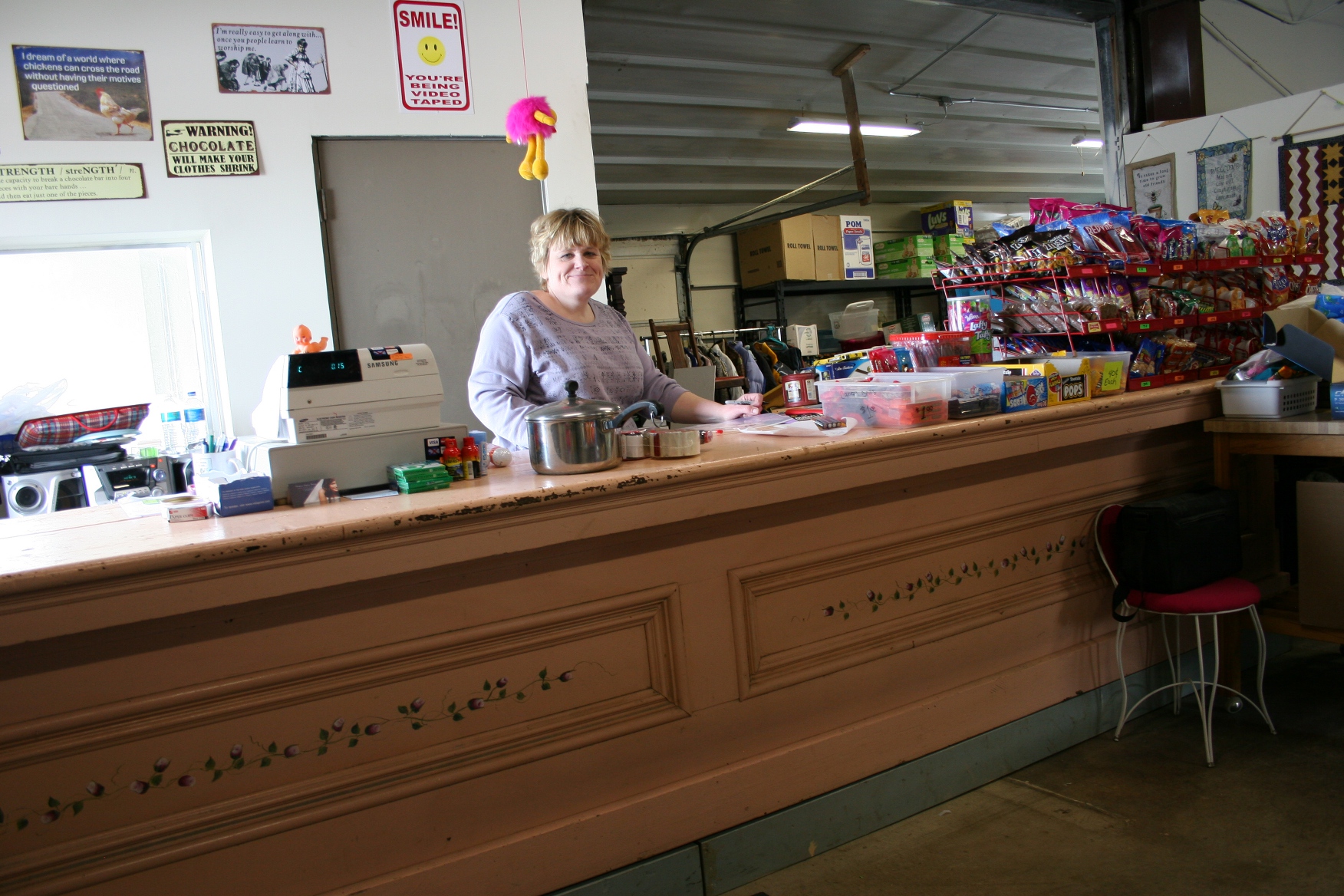
This 1800s general store counter anchors The Store. Those are our purchases on the counter, that kettle and tape.
Bernadette says she’s aiming to recreate a Mom and Pop general store with a little bit of everything. I was delighted to find candy lining the 1800s checkout counter, reminding me of the penny candy I bought at Rasmussen’s Grocery while growing up in Vesta. The vintage counter, purchased from a Lake Benton antique store, originated from a general store between Lake Benton and Brookings, South Dakota. It’s the perfect fit for The Store, lending that historic authenticity reminiscent of yesteryear.
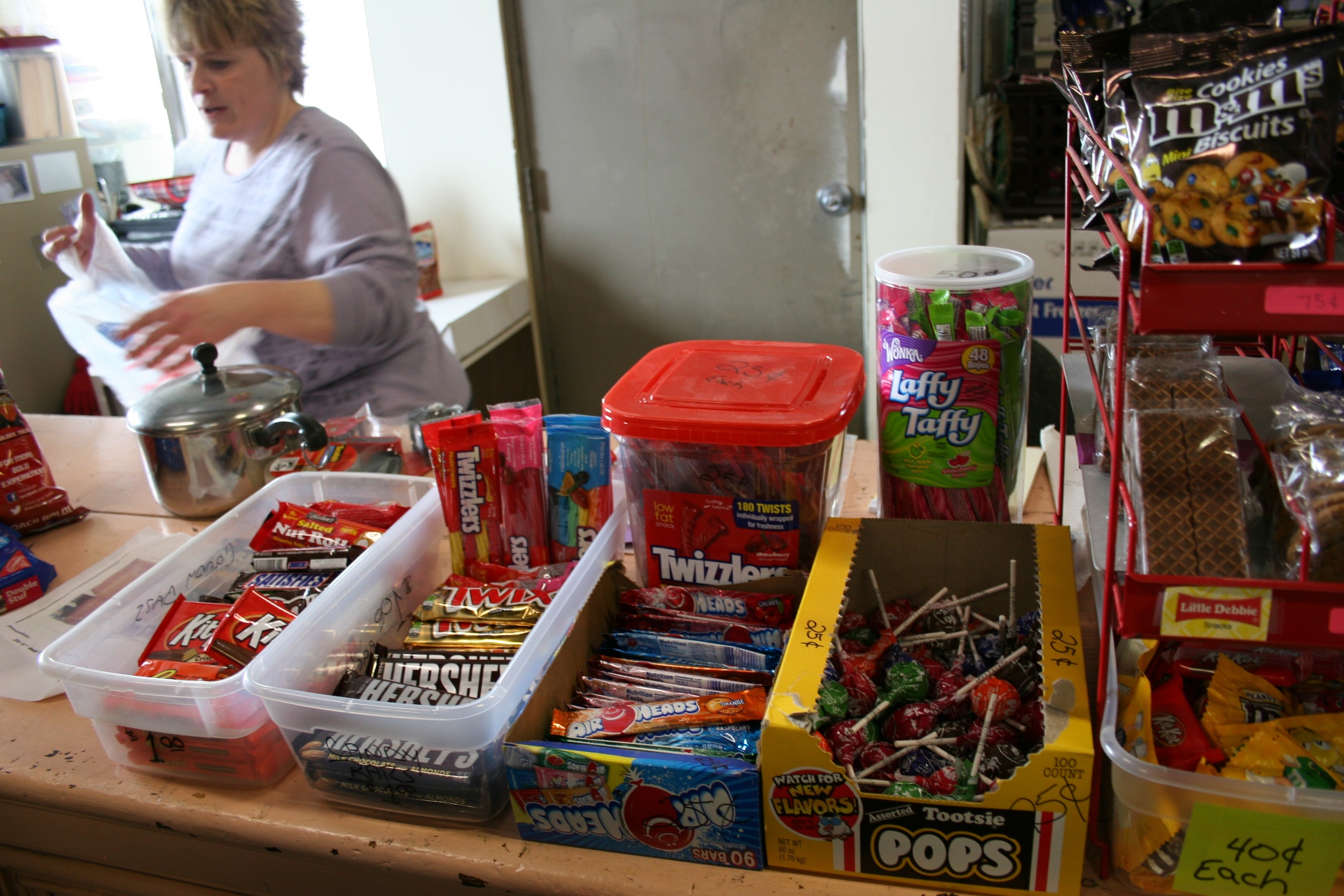
Like the old-fashioned general store, Bernadette has set up a candy display, including my favorite Tootsie Pops.
I can remember when Vesta boasted two hardware stores, several restaurants/bars and a grocery store along with other businesses, in its one-block Main Street.
Rarely does a new business open here. But Bernadette, who lives on a farm near Lucan seven miles to the south, was looking to locate along the highway, conveniently next door to her husband’s business, Matt’s Frame Repair.
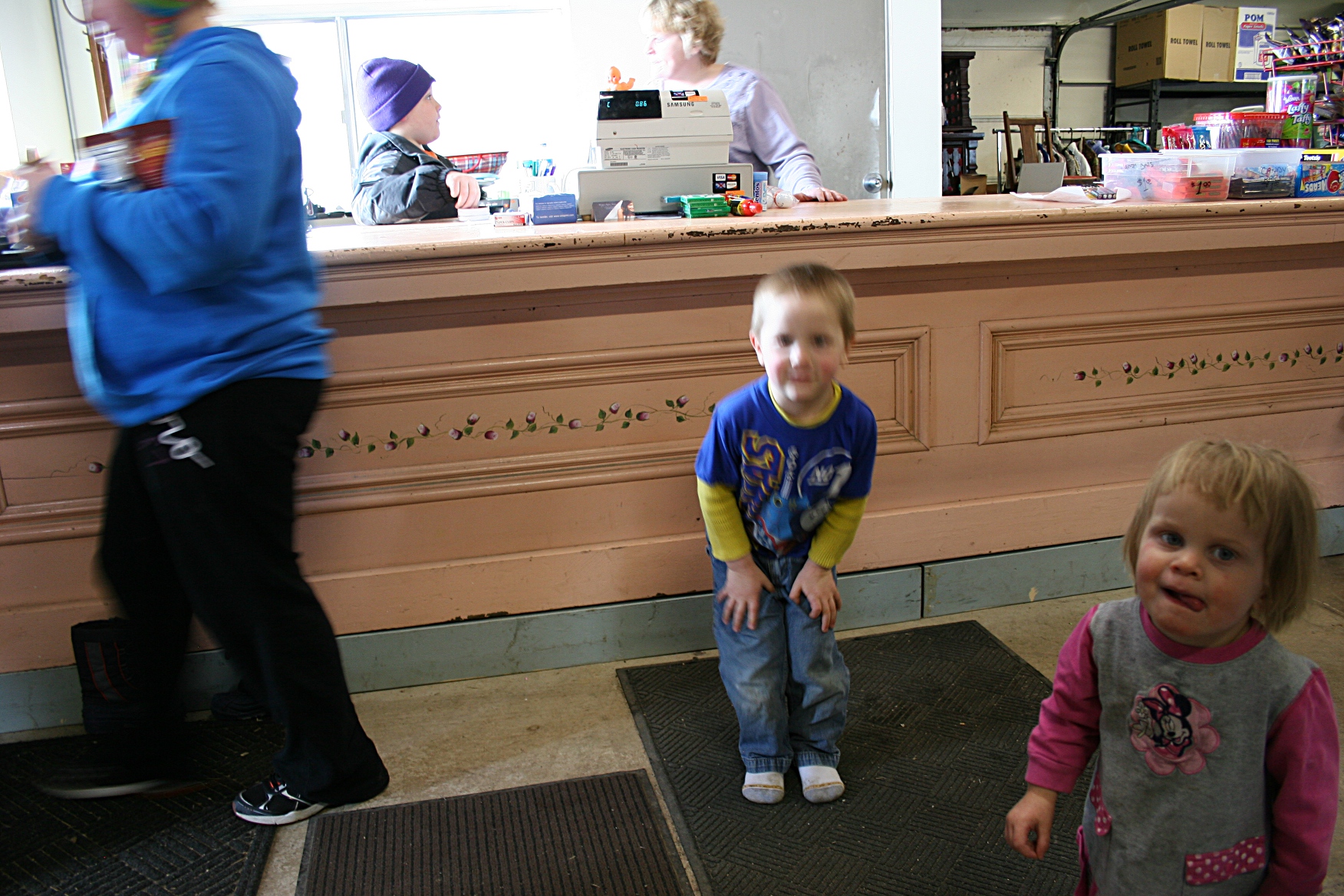
A young customer exits The Store, left, while three of the Thooft kids, including Maxwell, 4, and Beatrice, 21 months, hang out with Mom. The Thooft’s children include an 11-year-old, two 7-year-olds, two 4-year-olds, a 3-year-old and a 21-month-old.
She likes that Matt can walk over for lunch and spend time with her and the kids, ranging in age from 21 months to 11 years. She affectionately calls her seven, five of them birth children, two adopted, “the hoodlums.” The kids hang out in a room built into a corner of the poleshed style building.
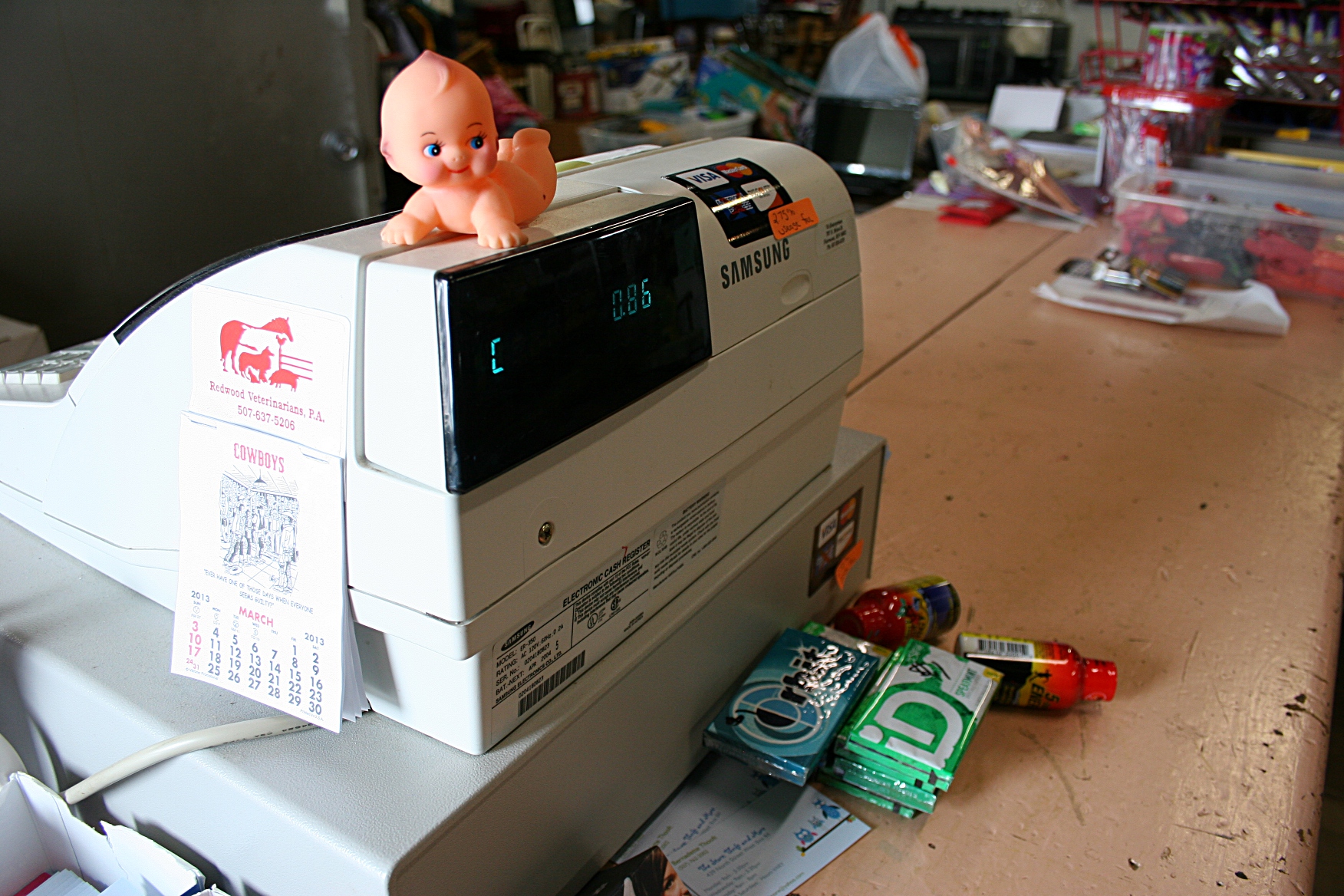
Look around and you’ll see Bernadette’s sense of humor in signage and props like this doll perched upon the cash register.
While the kids play and Matt naps in that corner playroom, Bernadette tends to customers on this Saturday afternoon in March. Her laptop sits open on her desk, her reference source for the thrift merchandise purchased primarily from online auctions and also from garage sales.
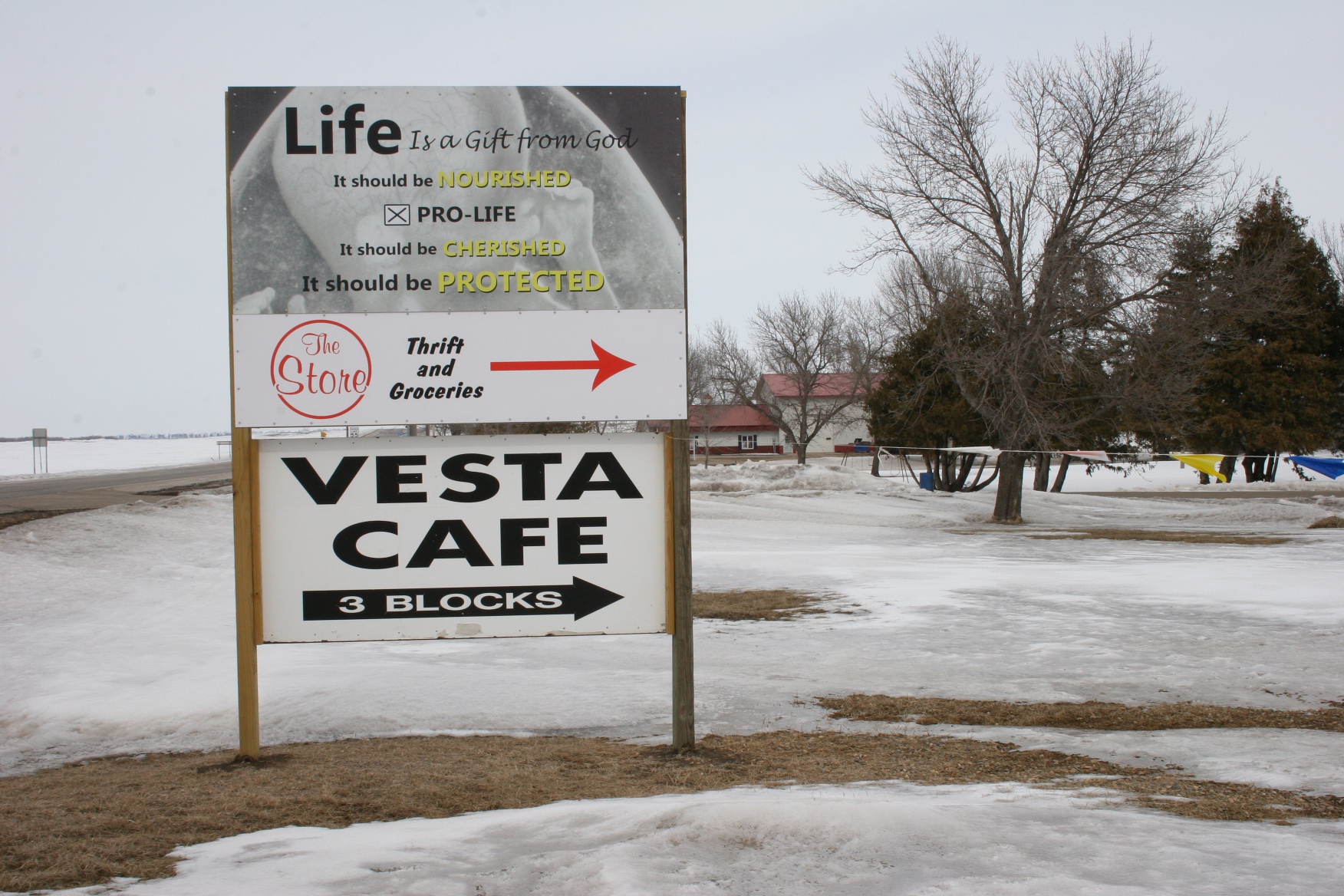
This sign by the thrift store points travelers along Minnesota Highway 19, left, to The Store and the Vesta Cafe.
Bernadette is donating 10 percent of thrift sale proceeds to local charities like the United Way, a crisis nursery, area schools and the broader Minnesota Citizens Concerned for Life. She’s also created a “Believe in the Backpack” charity whereby she fills backpacks for kids in foster care.
In the short time I’ve spent with Bernadette, it’s clear to me that this Osakis native and former daycare provider loves kids and cares about folks in my hometown enough to open her own little general store on the prairie. And for that I am grateful.

This sign graces the front of The Store: Thrift and More.
FYI: The Store: Thrift and More is open from 9 a.m. – 5:30 p.m. Monday and Wednesday; from 9 a.m. – 8 p.m. Thursday; and with varied hours on Friday and Saturday. Closed Sunday and Tuesday.
© Copyright 2013 Audrey Kletscher Helbling
I WANTED TO VISIT his grave, touch the cold stone with my gloved hands, allow my eyes to linger on his name, to remember my dad, dead 10 years now on April 3.
A trip back to my hometown to visit my mom had thrown me into a temporary melancholy mood as I lounged on her loveseat, head crooked into a pillow, legs angled up as we talked about aging and death and funerals (too many recently).
When I mentioned that I’d often thought about the safety layers of generations separating me from death, my husband glanced at me like I was crazy. My 80-year-old mom understood, though.
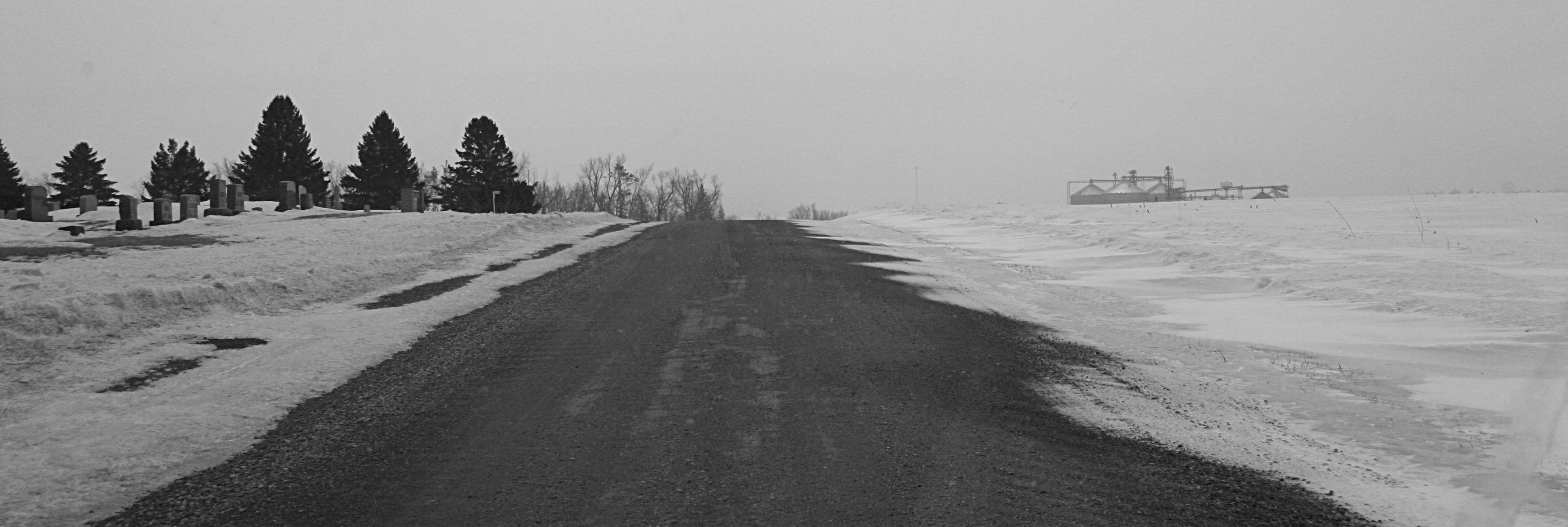
The road past the Vesta Cemetery, left, which sits just outside of this southwestern Minnesota town of some 330. You can see a portion of Vesta’s grain complex to the right.
Later, she stayed back at her house while Randy and I drove out to the cemetery, to honor my dad whose gravesite I do not visit often enough because busyness and blizzards have kept me from the prairie in recent months.
We headed north out of town along Cemetery Road, tires crunching on gravel, toward the cemetery edged by evergreen trees. At my feet, the short black snowboots I’d borrowed from my mom bumped against my legs.
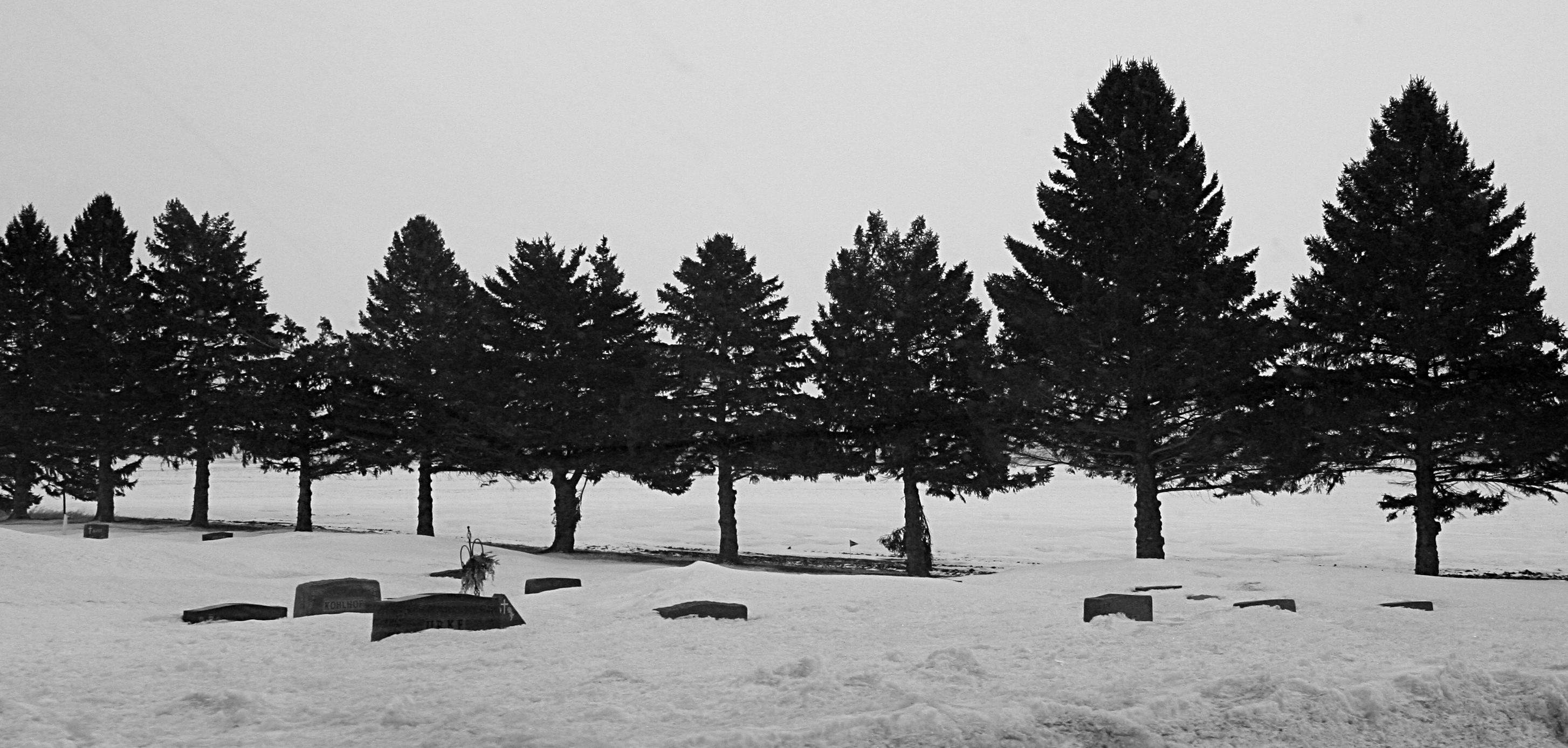
Some of the gravestones are barely peeking out of the snow.
I wondered aloud whether the cemetery roads would be plowed of snow swept in by prairie winds. A few blocks later I spotted waves of snow washing over tombstones and roadways. I could not reach my dad’s grave without snowshoes or a snowmobile.
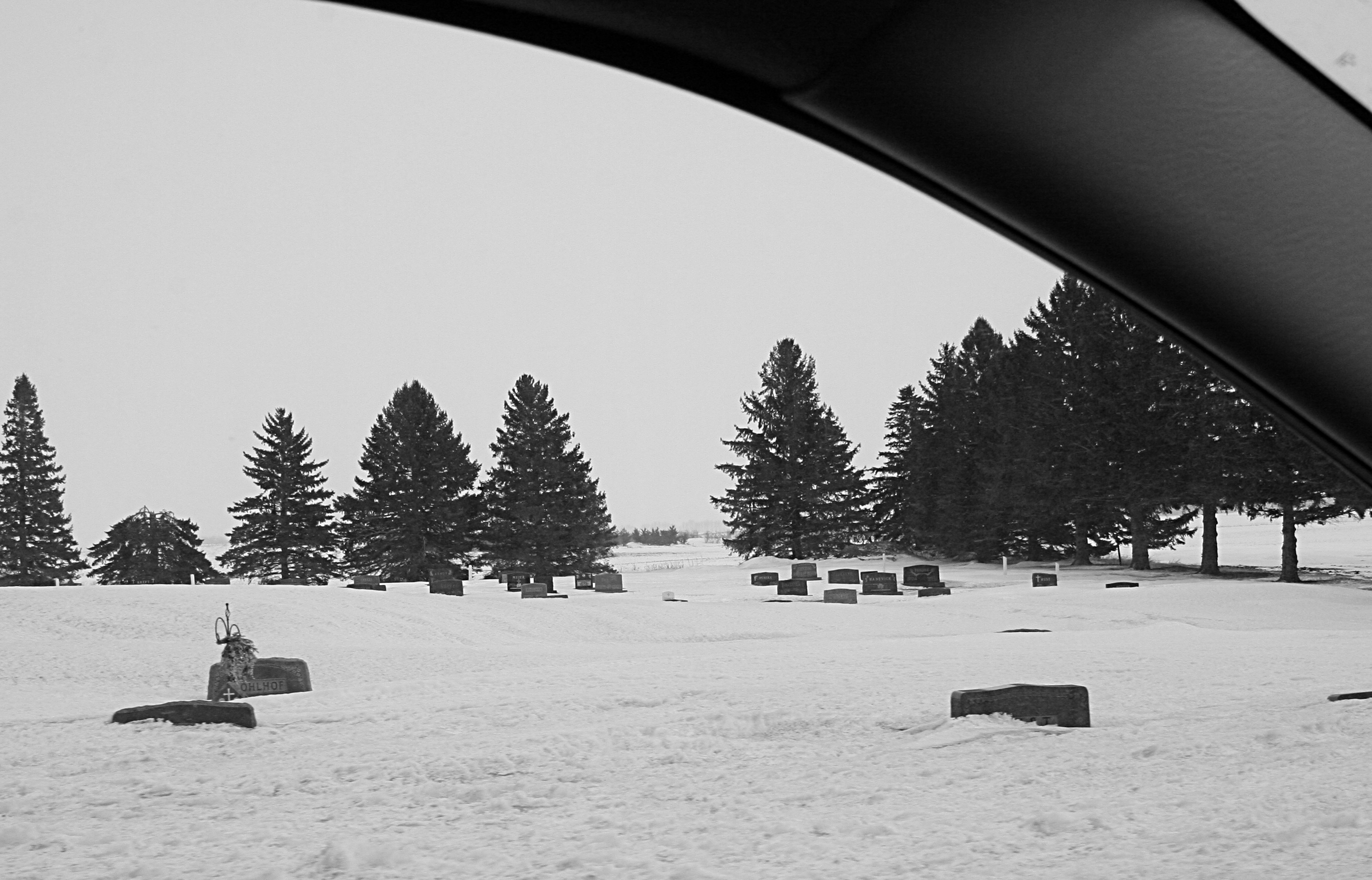
The closest I would get to my dad’s grave was viewing the cemetery through the van windows.
We eased past the cemetery, drove down to the first farm place to the north, turned around in the driveway and crept past the cemetery again, back into town.
I carried my mom’s boots inside, snugged them into a corner of her kitchen, before reclaiming my place on her loveseat.
I told her about the tombstones buried in snow. Then we talked about dad’s funeral—the bitter cold of that April day, the cutting wind.
And I remembered, although I did not speak this, how I’d perched on a hard folding chair in that hilltop cemetery 10 years ago, leaned toward my mother shivering in cold and in grief, and wrapped my arm around her.
© Copyright 2013 Audrey Kletscher Helbling
MY HEART BELONGS to my native prairie. Always has, always will.
Even after three decades away from southwestern Minnesota, I remain connected to the sky and to the land, to the place that shaped me as a person, a writer, a photographer.
In an environment as stark as the prairie, you notice details.
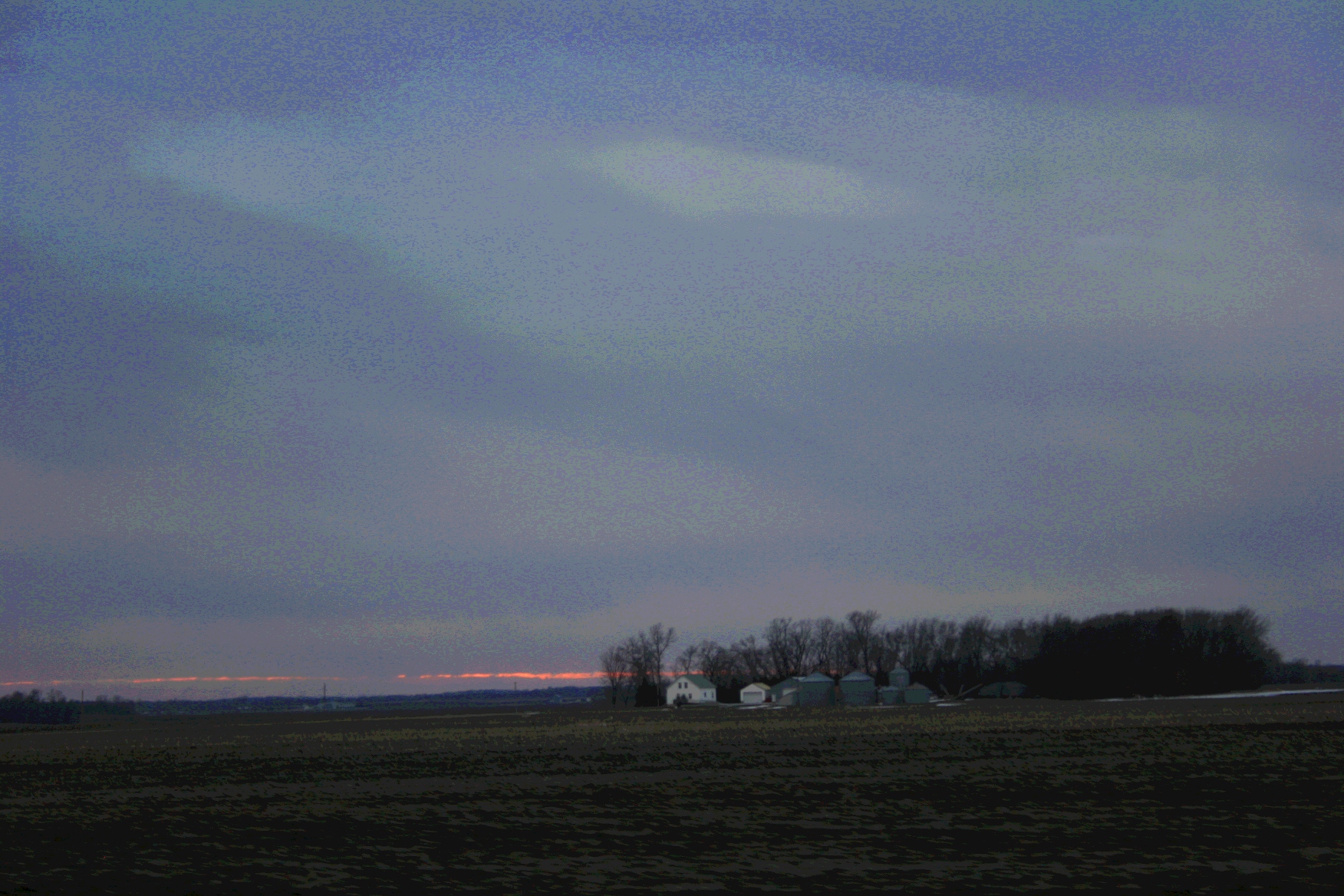
Even in southeastern Minnesota, where I’ve lived for three decades, expanses of prairie exist like this sunset scene.
And so, on a recent Saturday, as my husband and I traveled south and east from Cleveland to Kilkenny (that’s in southeastern Minnesota, not Ohio and Ireland), I observed daylight evolve into evening, the sun slipping in a slim band of rosy peach across the horizon.
In that moment my soul yearned for the land I left at age 17, the prairie, the place of my heart.
© Copyright 2013 Audrey Kletscher Helbling
STUDYING MINNESOTA HISTORY decades ago, I learned about “The Sioux Uprising of 1862” and even wrote a term paper on the topic bearing that title.
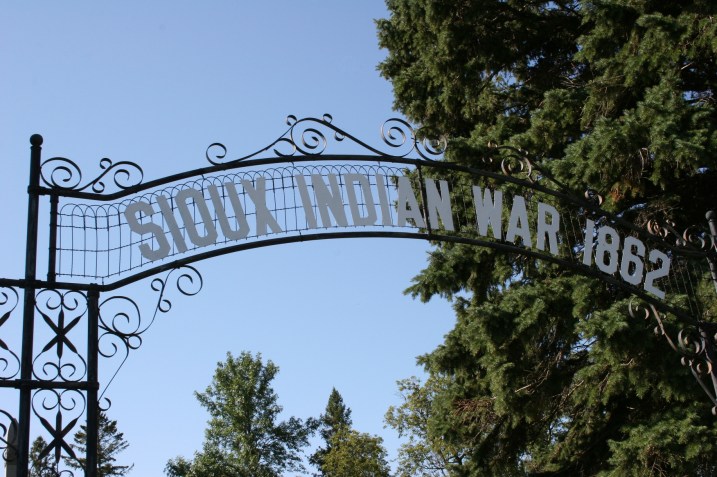
This archway leads to the Wood Lake State Monument, on the site of the battle which ended the U.S.-Dakota Conflict of 1862.
I thought nothing negative of that word, Sioux, which translates to “snake.” The Ojibway, once enemies of the Dakota, gave the tribe that name. I did not know; it was the word I was taught.
That I even studied “The U.S.-Dakota War of 1862,” the proper terminology for the six-week war fought primarily in my native southwestern Minnesota 150 years ago, seems remarkable. So many in Minnesota never knew of this conflict in our state’s history.
I don’t pretend to know every detail of the war between the Dakota and the white settlers and soldiers. But I do remember that I grew up with a fear of “Indians,” reinforced by the television westerns especially popular during my formative years and by the history lessons delivered about The Sioux Uprising of 1862, as it was then called.
Those classroom lessons were decidedly one-sided: The whites were the good guys, the Indians the bad guys. That line of thinking was wrong, oh, so wrong. I realize that now, having reached that conclusion decades ago.
The maltreatment of the Dakota by greedy traders, broken treaty promises, starvation, efforts to convert and transform the Dakota people into Christian farmers, expulsion from their homeland and more contributed to the war.
Yet, even the Dakota disagreed about the need to wage this battle. Some helped settlers escape to safety while others plundered and killed. My own maternal forefathers fled the New Ulm area to St. Peter, making this war a part of my personal family history.
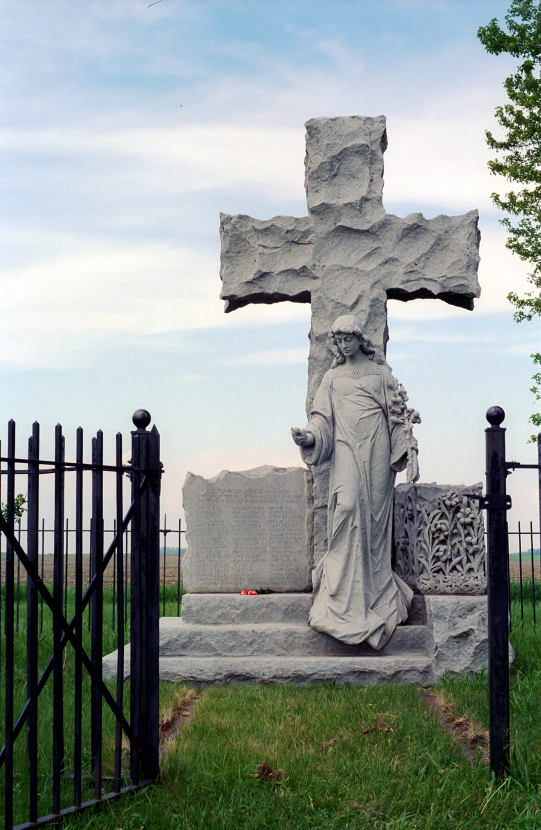
The Milford State Monument along Brown County Road 29 west of New Ulm commemorates the deaths of 52 settlers who were killed in the area. Located along the eastern edge of the Lower Sioux Reservation, Milford had the highest war death rate of any single township.
While I carry no ill will toward the Dakota, I will tell you, unequivocally, that feelings still run deep in southwestern Minnesota. I am also honest enough to admit that perhaps I would feel differently if my family members had been massacred or if I was of Dakota, instead of German, heritage.
Although time can heal, it doesn’t always. Misconceptions and misguided expectations, even after 150 years, exist on multiple sides of the issue. I won’t delve into that here, but I do think the healing is still ongoing, forgiveness (on both sides) still not attained.
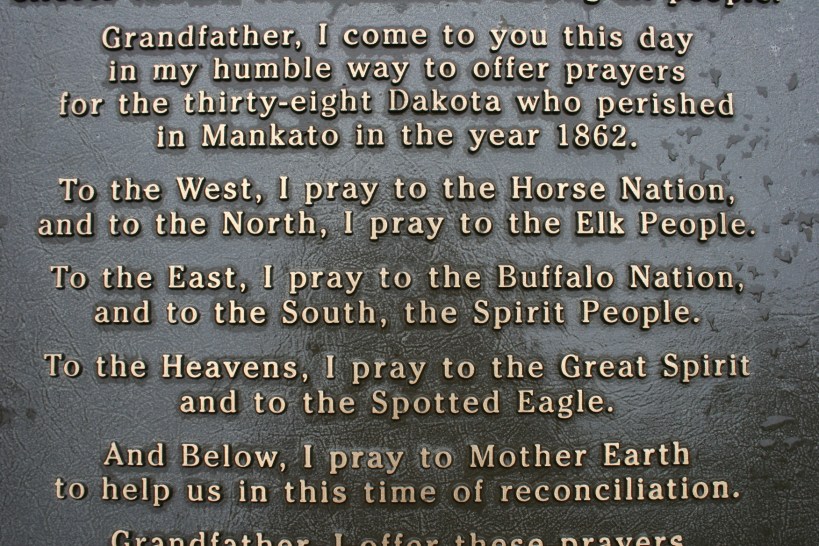
Words on a marker in Reconciliation Park in Mankato where 38 Dakota were hung on Dec. 26, 1862. On Wednesday, a new Dakota 38 Memorial was dedicated listing the names of the 38 men who died here. This file photo was taken of an existing plaque in the park.
In a ceremony in Mankato on Wednesday marking the 150th anniversary of the hanging of 38 Dakota, Mayor Eric Anderson proclaimed this the year of “forgiveness and understanding.”
The Dakota also called upon all to “forgive everyone everything.” Those words will be engraved into Kasota stone benches to be installed next summer at the site of the new Dakota 38 Memorial dedicated in Reconciliation Park on Wednesday.
Strides toward understanding and forgiveness, and education, can perhaps finally heal the still festering wounds of this long ago war.
TO VIEW PHOTOS from the event in Mankato on Wednesday, click to link here to Minnesota Public Radio.
TELL ME, ESPECIALLY if you grew up in Minnesota, did you study The U.S.-Dakota War of 1862? Also, are Minnesota students today being taught about this war?
© Copyright 2012 Audrey Kletscher Helbling
REMINDING MOTORISTS traveling in southwestern Minnesota of the real reason for Christmas is this billboard along U.S. Highway 14 just east of Springfield.
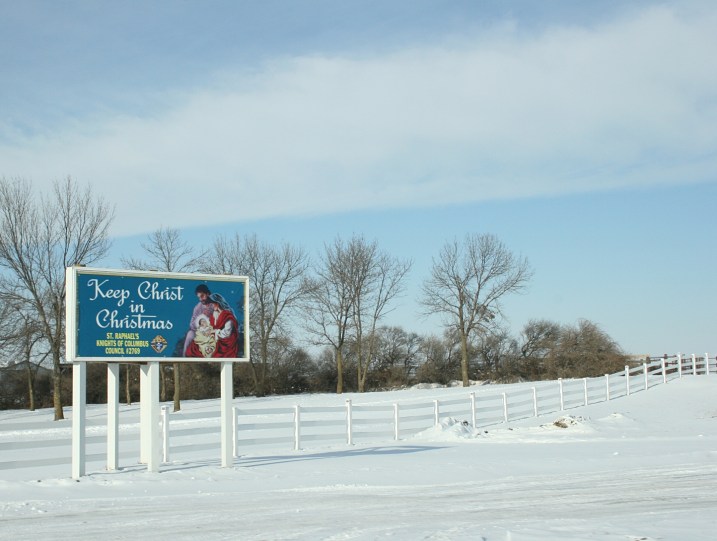
Thank you, St. Raphael’s Knights of Columbus Council #2769 of Springfield for sponsoring this message.
Well done.
Copyright 2012 Audrey Kletscher Helbling


Recent Comments