Minnesota Prairie Roots

Writing and photography by Audrey Kletscher Helbling

An enlightening talk focuses on Minnesota’s “Hooded History” February 21, 2025

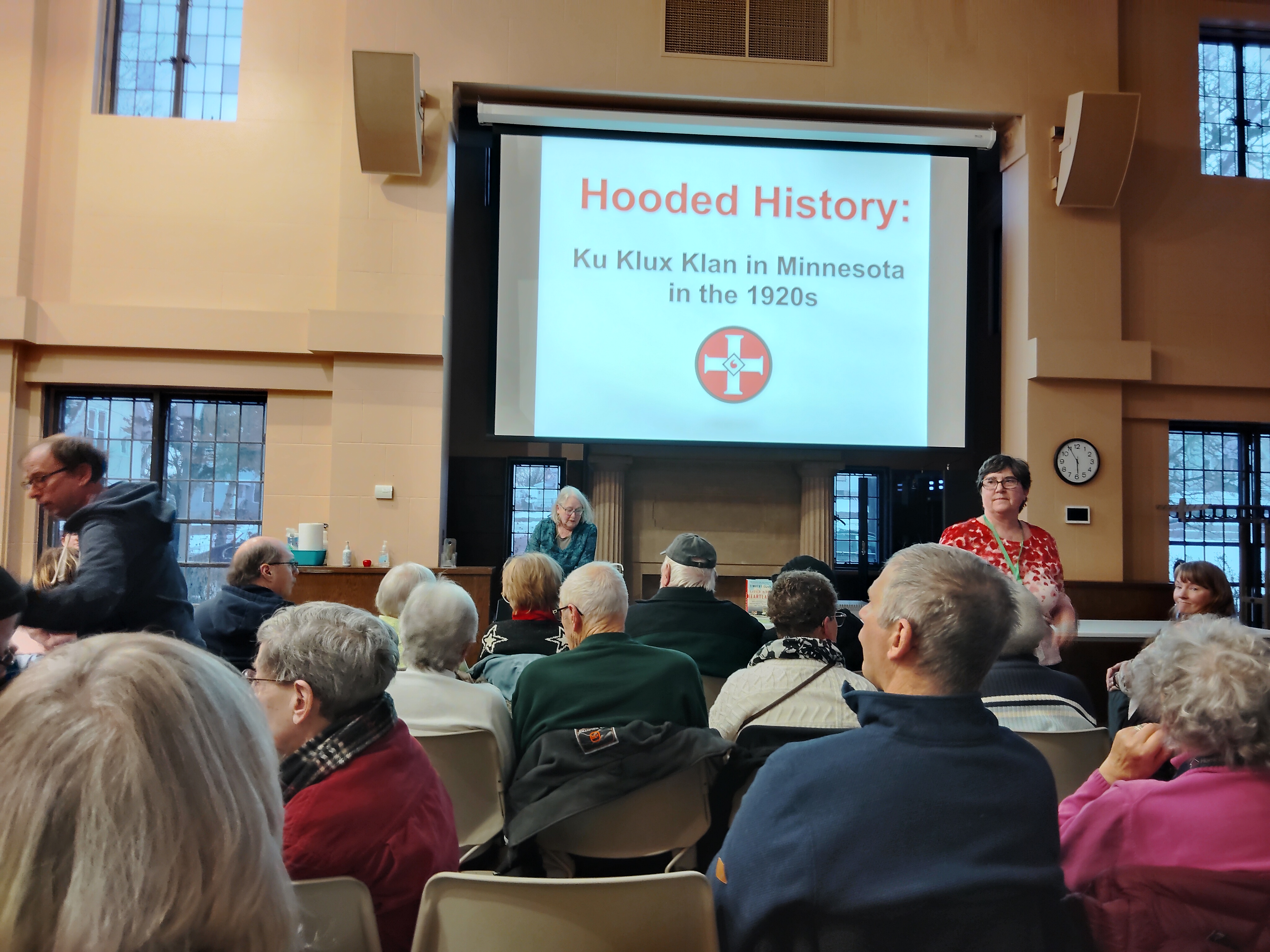
The audience settles in as Nancy Vaillancourt, center, is about to begin her presentation, “Minnesota’s Hooded History.” (Minnesota Prairie Roots copyrighted photo February 2025; all photos taken with my smartphone)

NOT MUCH HAS CHANGED in 100 years. That summarizes my thoughts after attending a talk, “Minnesota’s Hooded History—The Ku Klux Klan in 1920s Minnesota,” followed by a Q & A Thursday evening at my local library. Hate groups still exist in America, just with different names, different targets, different locations, different levels of participation.

But the core ideology of these groups, based on what I heard and what I’ve read, remains unchanged. The same in 1925 as in 2025. Historian and retired librarian Nancy Vaillancourt could have been talking about current day America when she shared her research into the KKK in Minnesota. The KKK professed a strong Christian faith, patriotism, Americanism, American ideals and more as they targeted first Blacks, then Catholics, Jews and others, including immigrants. Sound familiar? Today this hatred and intolerance is coming not only from organized hate groups, but also from individuals and from people in positions of power.
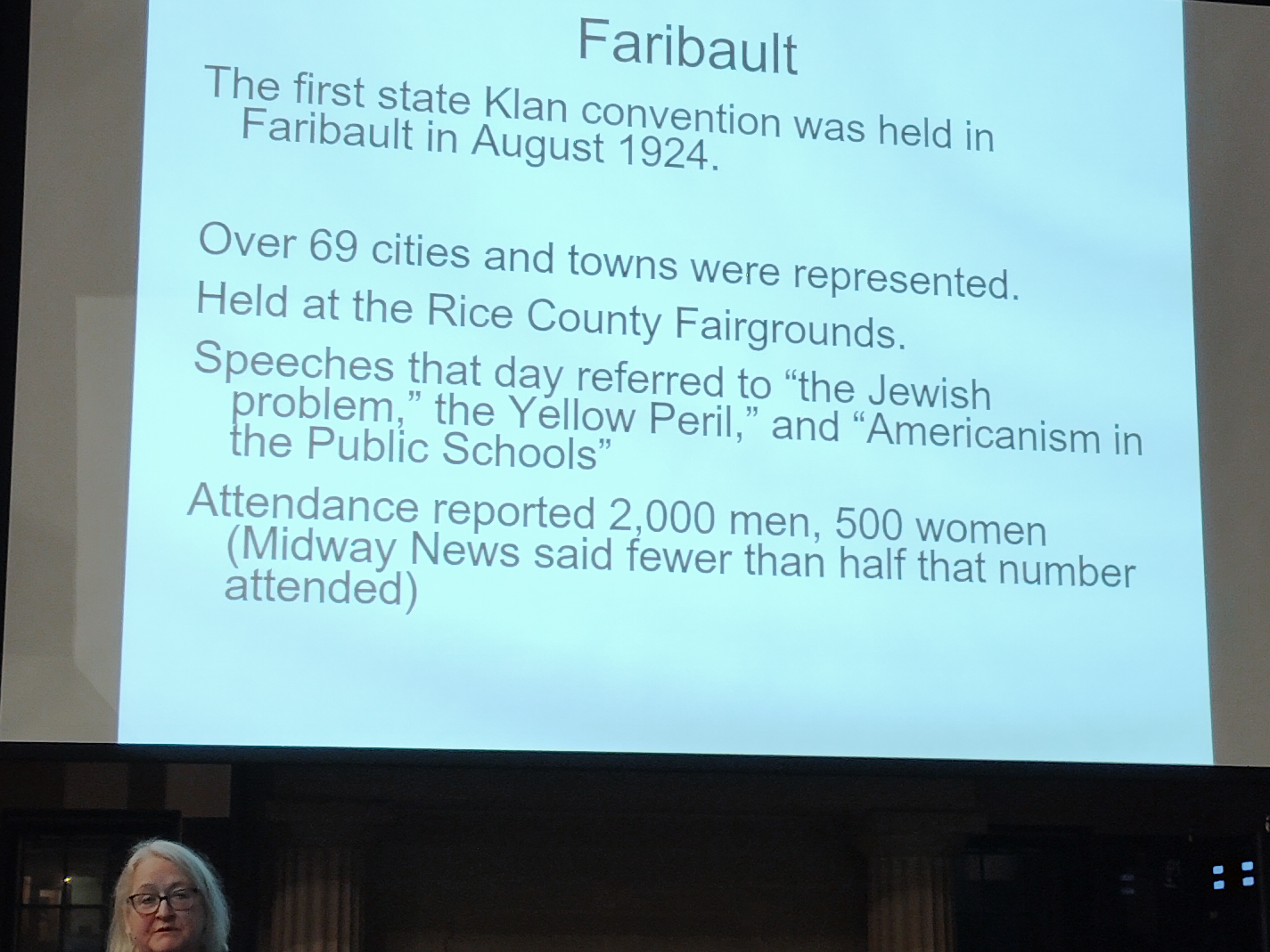
Faribault hosted the first state Klan convention, with details outlined in this slide presented by Nancy Vaillancourt. (Minnesota Prairie Roots copyrighted photo February 2025)

Back to Vaillancourt’s presentation Thursday evening. About 100 attendees packed the Great Hall meeting room at Buckham Memorial Library to capacity in a city which hosted Minnesota’s first state Klan convention in August 1924. Klan members from 69 cities and towns attended the event at the Rice County Fairgrounds in Faribault with the KKK claiming 2,500 in attendance. A publication noted fewer than half that number actually attended. Inflated crowd numbers. Sound familiar?
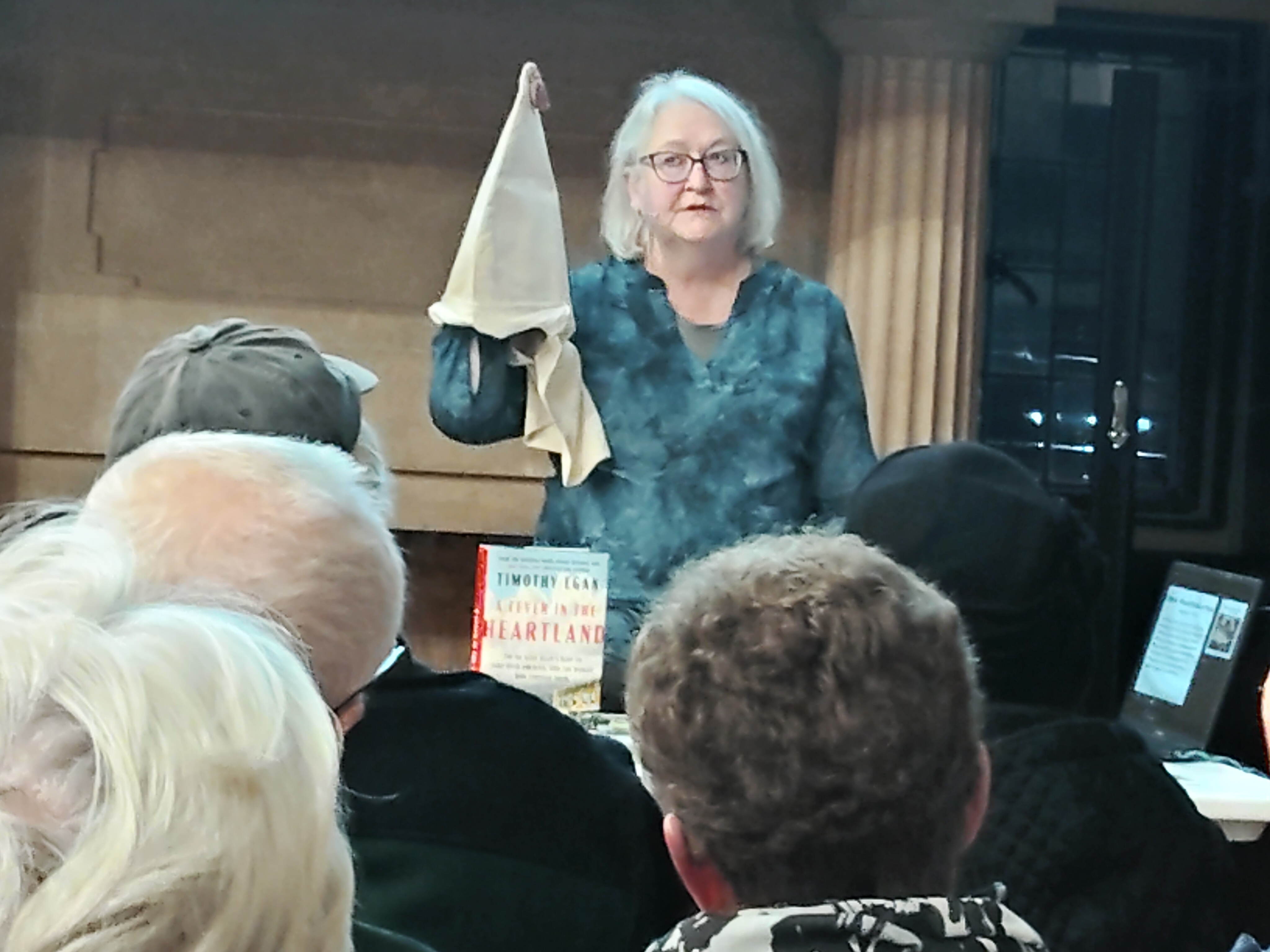
Nancy Vaillancourt displays an authentic Klan hood given to her by a woman from Blooming Prairie. She warned audience members that some items she would be showing may be disturbing and that they could step out if necessary. (Minnesota Prairie Roots copyrighted photo February 2025)

Certainly, hosting a state KKK convention is not a proud moment in a city’s history. But it is history none-the-less and important to know. We cannot deny our past, even if hurtful and painful and awful. And Vaillancourt revealed plenty of hurt and hate as she presented, focusing on the KKK in my region of southern Minnesota. She confirmed the presence of Klan chapters in nearly 60 Minnesota counties at one time. Groups of men, women and sometimes children who, in their hooded coverings, spewed hatred and intolerance while waving American flags and singing “Onward Christian Soldiers.”

Cross burnings occurred in Faribault, (including on the bluffs below St. Mary’s Hall), Stockton, Red Wing, Winona and other locations cited not only by Vaillancourt, but by audience members. Like Teresa, whose husband’s grandmother had a cross burned in her yard near Waterford (outside Northfield) because she was Catholic. Klan hatred toward Catholics was particularly strong in 1920s Minnesota.

A Catholic mother, who had just given birth, watched as the KKK paraded past the Owatonna hospital while en route from the Steele County Fairgrounds to Central Park during the state Klan convention in 1926. Can you imagine the fear she felt? Not unlike the fear targeted groups of people are experiencing today in this country.
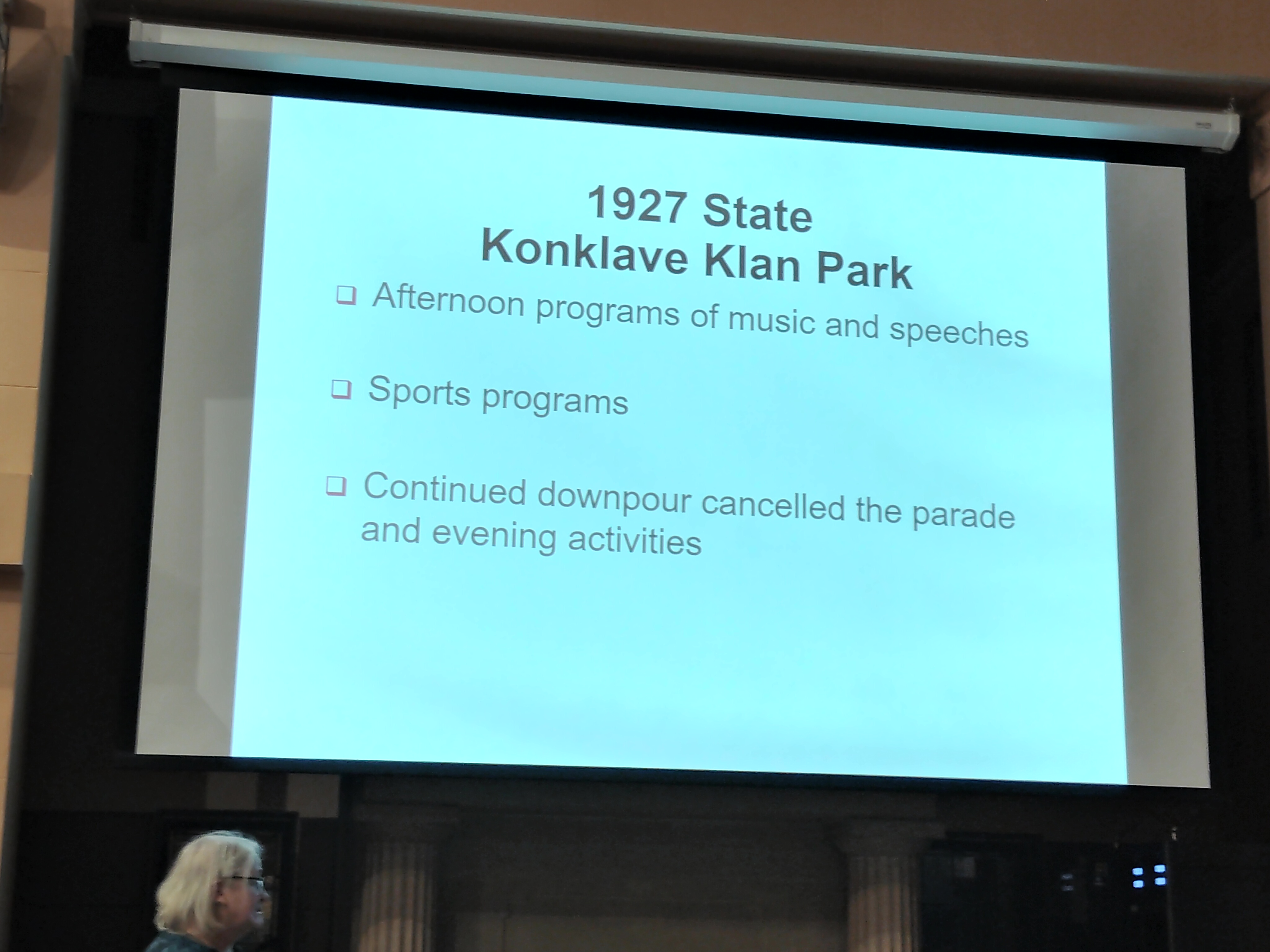
Sounds like a deceptively wholesome gathering at the Klan Park in Owatonna. (Minnesota Prairie Roots copyrighted photo February 2025)

Because Vaillancourt is from Owatonna, much of her talk focused on that community just south of Faribault along Interstate 35. Owatonna, it seems, was a hotbed of Klan activity, hosting local and state gatherings. But the fact that stood out for me was the Klan’s purchase of 20 acres of land east of downtown Owatonna. That land became Klan Park, a place to gather, organize and socialize. The local chapter even constructed a meeting house there. While it is disheartening to hear this, it was uplifting to learn that the land was sold in 1945—to a man whose wife was Catholic. Attendee Bonnie shared that bit of information about her great uncle, who was invited to join the Klan, declined because of his wife’s Catholicism and then eventually bought the land. Today that former KKK park is the site of soccer practice fields, Vaillancourt noted, where a diverse group of youth play.

Vaillancourt covered a whole lot more in her presentation. Like how the Klan recruited from fraternal orders, Protestant churches, via fiery speeches, by invitation. Fear and social and economic pressure were used to draw people into the Klan. Sound familiar? In Virginia, in northern Minnesota, the entire school board claimed Klan membership and made Bible reading in school compulsory. The mayor of St. James was a major grand dragon of the KKK. The Northfield Klan hosted a KKK homecoming Labor Day parade in September 1926. The Klan was big on parades. That makes sense given the intimidation and fear a mass of hooded marchers can instill in the public. And Owatonna residents were afraid, Vaillancourt said.
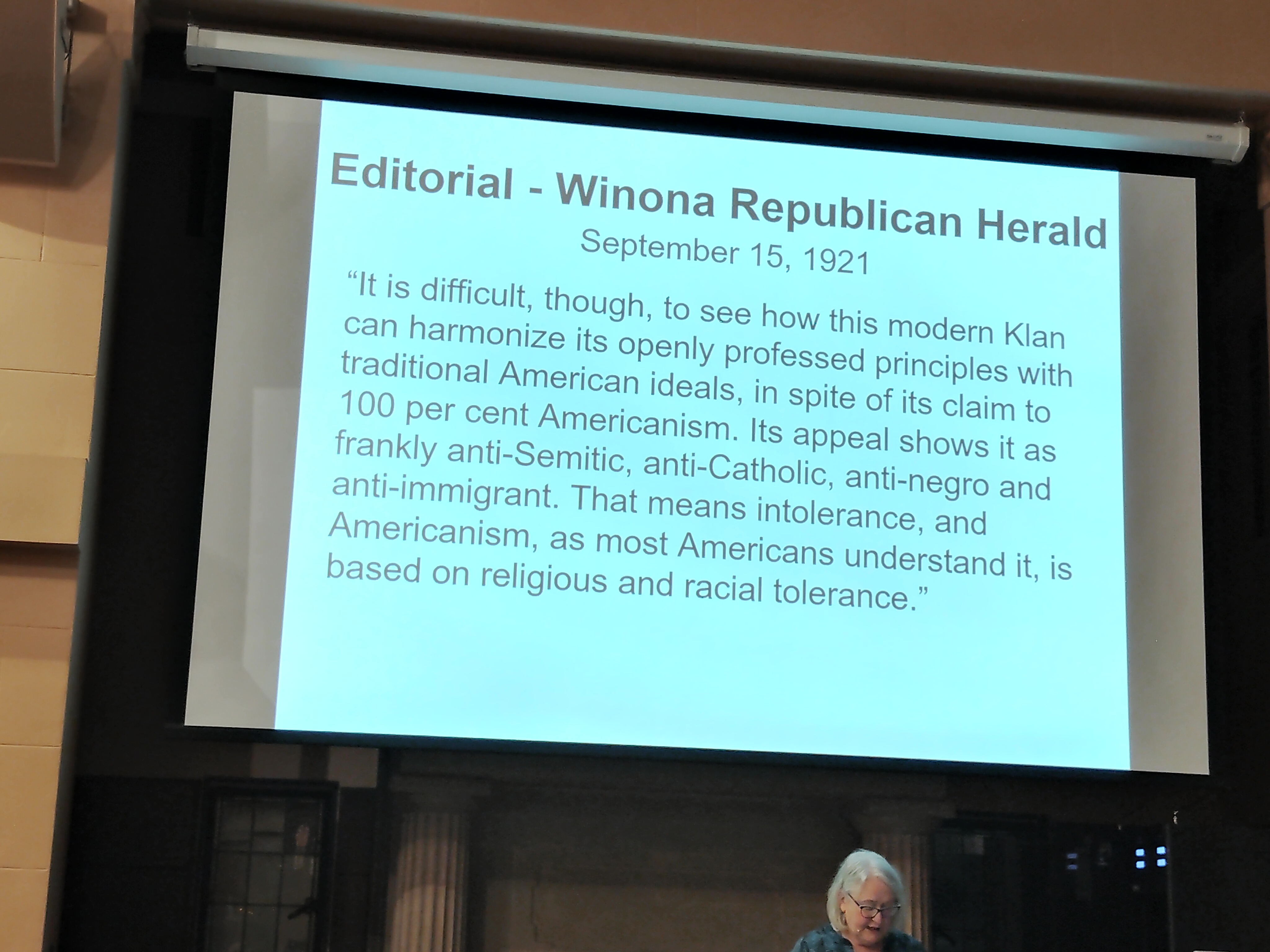
A powerful editorial from a southeastern Minnesota newspaper. (Minnesota Prairie Roots copyrighted file photo February 2025)

Yet, there were individuals—like Bonnie’s great uncle—organizations and media who resisted and challenged the Klan. The NAACP, the National Vigilance Association, the Knights of Columbus… Vaillancourt specifically noted the Catholic-based KC group for effectively exposing Klan members in a community.

This gives me hope, when I hear of media, individuals and organizations that stood up and refused to accept hatred and intolerance. It gives me hope, too, when members of my community turn out in strong numbers to learn about “Minnesota’s Hooded History.” Knowledge is powerful. It gives me hope, too, when someone like Nancy Vaillancourt cares, researches and shares because, she says, she wants “to get the truth out.” Even while some still deny it.

#

FYI: To learn more about the Ku Klux Klan and about other hate groups in America, visit the Southern Poverty Law Center.

A photo gallery exhibit, “Testify—Americana Slavery to Today, The Diane and Alan Page Collection,” will be displayed in the hallway connecting Buckham Memorial Library and the Faribault Community Center from April 1-23. The exhibit will also be at other libraries throughout the Southeastern Libraries Cooperating (SELCO) system.

The “Minnesota’s Hooded History” program was made possible with support from Minnesota’s Arts and Cultural Heritage Library Legacy Fund and SELCO.

© Copyright 2025 Audrey Kletscher Helbling


With gratitude for my southern Minnesota community November 25, 2024

I photographed this tag hanging on The Gratitude Tree in the neighboring city of Northfield in 2019. I love this idea of publicly expressing thankfulness, including for community. (Minnesota Prairie Roots copyrighted file photo July 2019)

WHEN CONSIDERING GRATITUDE, as we do this week, we usually look inward. But I want to look outward and share six reasons why I feel grateful to live in Faribault.

This is my all-time favorite image showing local diversity. Here children gather to break a pinata during an international festival at Faribault’s Central Park. (Minnesota Prairie Roots copyrighted file photo 2012)

PEOPLE make a community. I knew no one when I moved here as a newlywed in 1982. But I was welcomed and have since formed deep friendships in Faribault. I can walk into a business, attend an event, or simply be out and about and run into someone who knows me. Conversation often follows.

Recently I attended a 75th anniversary open house at Burkhartzmeyer Shoes, a third-generation family owned shoe store in downtown Faribault. After purchasing athletic shoes, I headed to a back room for complimentary refreshments. A small group of us sat there talking and laughing, simply enjoying each other’s company. I felt like I was inside a small town cafe drinking coffee and conversing. It felt that down-home comfortable.

But I can feel just as comfortable with strangers, including Adolfo, whom I met in October while walking in Central Park. Adolfo moved to America from Venezuela, a country he fled because of Communism and violence. On this morning, he was pushing his one-year-old grandson in a stroller. It’s part of their daily routine. Darling Milan drew me to his grandpa, where I connected with Adolfo on a personal level and heard his story. I feel grateful for every opportunity I have to meet Faribault’s newest immigrants and hear their stories, stories often laced with hardship and hope. To live in a city as diverse as Faribault is truly a gift.

Kids help at the Faribault CommUnity Thanksgiving Dinner by, among other things, creating festive placemats. (Minnesota Prairie Roots copyrighted file photo November 2017)

Faribault overflows with CARING INDIVIDUALS AND ORGANIZATIONS striving to help others: the Community Action Center, Rice County Habitat for Humanity, St. Vincent de Paul, HOPE Center, Ruth’s House, IRIS (Infants Remembered in Silence), the Salvation Army, Operation: 23 to 0… I’ve received support while dealing with some especially challenging life events. When you experience that community love and care first-hand, you understand the true meaning of community.

Once again this Thanksgiving, volunteers will serve a free CommUnity Thanksgiving Dinner as they have for the past 30 some years. I’ve previously helped deliver those holiday meals. Every Tuesday, a free meal is also available at the Community Cafe. With Christmas approaching, I’m part of a bible study group coordinating the annual Angel Tree (gift giving) at my church. I could go on and on with an endless list of how people are helping people in my community. Hearts are loving, spirits giving.

A 1950s scene along Faribault’s Central Avenue is shown in this downtown mural. (Minnesota Prairie Roots copyrighted file photo)

I am especially grateful to live in a community which values THE ARTS. The Paradise Center for the Arts in downtown Faribault centers our arts scene. Every time I tour a gallery exhibit, attend a play or otherwise engage in the arts, I feel grateful to live here. I’ve even contributed to the local arts scene by publicly reading my poetry. I love attending summer concerts in the park and concerts inside the historic Cathedral of Our Merciful Saviour. I appreciate the history-based murals that color our downtown. I grew up in rural southwestern Minnesota with minimal access to the arts, meaning my gratitude for the arts in Faribault runs deep.

I treasure Buckham Memorial Library, just blocks from my home. (Minnesota Prairie Roots copyrighted file photo 2022)

My thankfulness for BUCKHAM MEMORIAL LIBRARY also runs deep, for the very same reason. I grew up in a small farming town without a library. And I love to read. That we now also have a volunteer run used bookstore, Books on Central (benefitting the Rice County Area United Way), notches my gratitude level even higher.

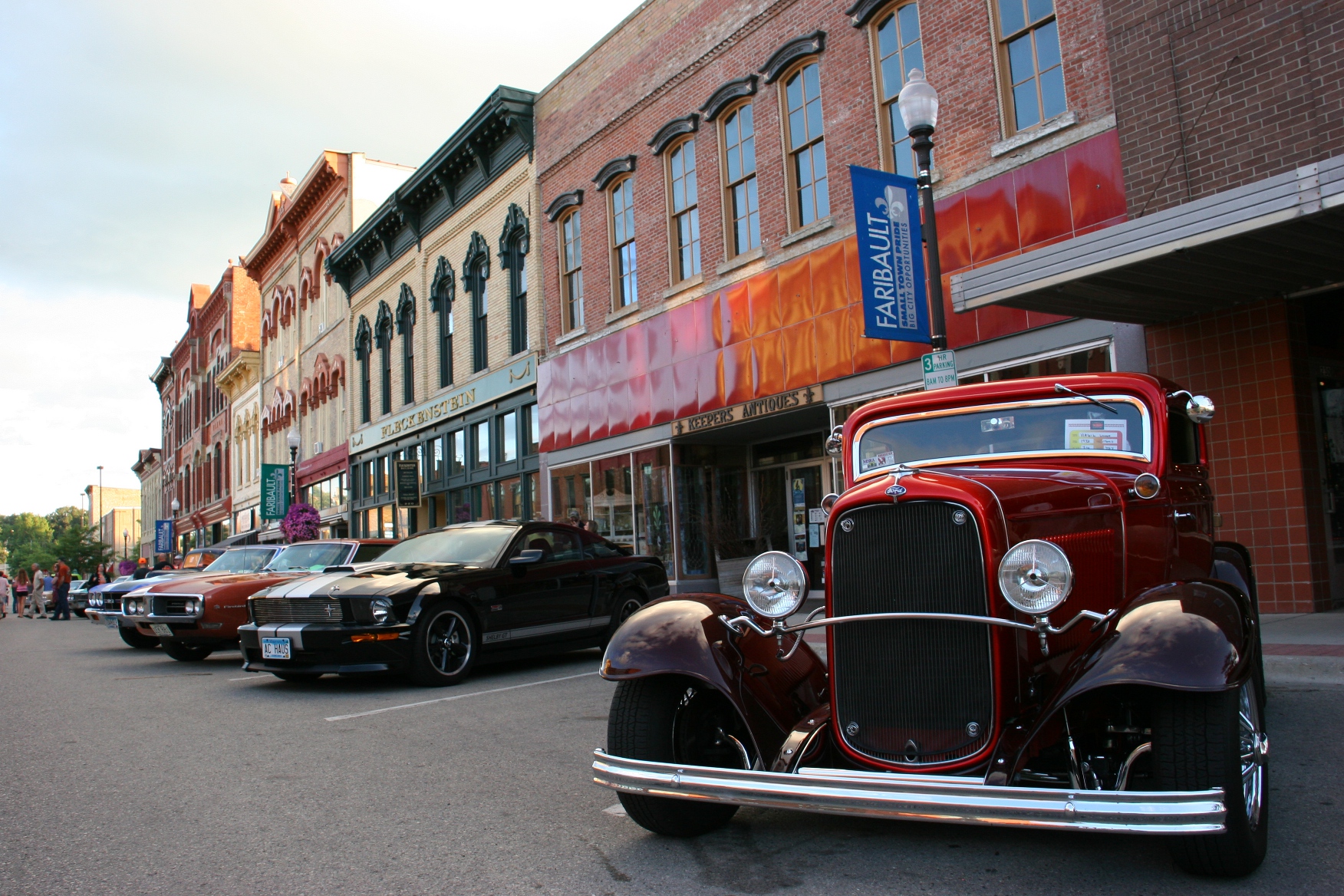
A snippet of Faribault’s historic buildings, photographed during a monthly Car Cruise Night. (Minnesota Prairie Roots copyrighted file photo 2016)

The bookshop is located in the heart of our HISTORIC DOWNTOWN, another reason I feel grateful to live in Faribault. My community cares about preserving historic buildings. I love old architecture. There’s nothing quite like walking among vintage vehicles along Central Avenue during Car Cruise Night as the sun sets at the end of a summer day. Beautiful.

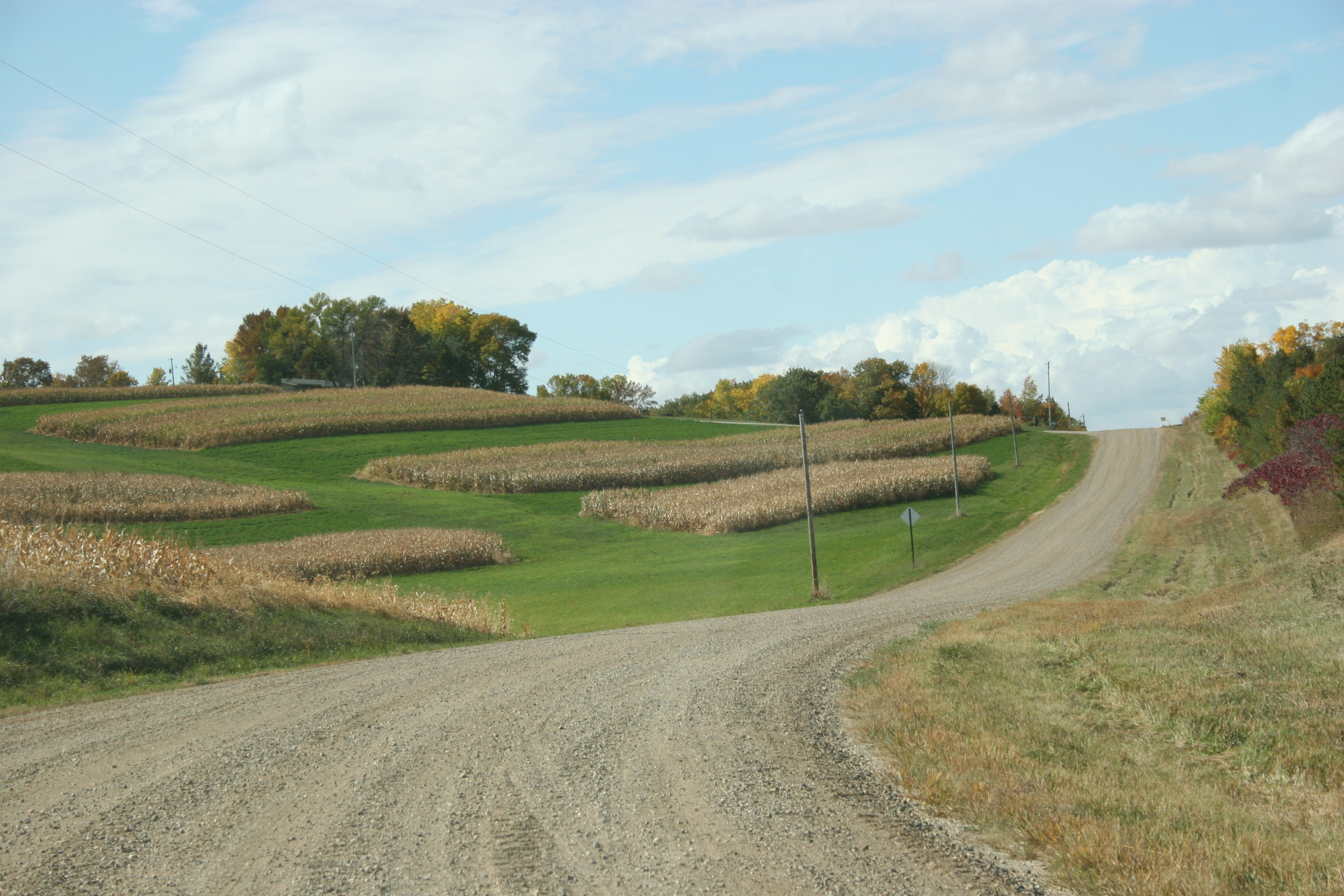
In just minutes, I can reach the countryside, where I love to travel gravel roads. This road winds among the lakes and farm fields west of Faribault. (Minnesota Prairie Roots copyrighted file photo October 2022)

Faribault also offers incredible NATURAL BEAUTY in a diverse landscape of woods and prairie, hills and valleys, ravines and bluffs. It’s so different than my native prairie. Admittedly, it took me a while to “get used to” all the trees when I moved here 42 years ago. I still mostly have no sense of direction on roads and streets that don’t run prairie grid straight. But I love to walk through city parks, along city trails, at River Bend Nature Center, on the campus of the Minnesota State Academy for the Deaf… And within a short drive of my home, I am immersed in the countryside.

A view of The Gratitude Tree outside the Northfield Public Library in 2021. People wrote their reasons for feeling thankful on a blank tag. Those were then hung on the tree. I’d like to see a Gratitude Tree in every community once a year. (Minnesota Prairie Roots copyrighted file photo May 2021)

This list of a half dozen reasons to feel thankful for the place I call home just touches the surface of why I am grateful to live in Faribault. It’s not utopia, certainly. Nowhere is. But today I want to pause, consider and acknowledge specific reasons for feeling thankful that Faribault is my home. I hope you’ll do the same, wherever you live.

© Copyright 2024 Audrey Kletscher Helbling


Two Minnesota authors talk craft, share insights in Faribault November 3, 2023

Buckham Memorial Library, Faribault. (Minnesota Prairie Roots copyrighted file photo December 2022)

I DIDN’T INTEND to write a follow-up about an author event Thursday evening at my local library. So I didn’t take notes initially. I planned to just sit back, listen and maybe ask a few questions. Turns out I asked a lot of questions of Jess Lourey and Nicole Kronzer. About then I decided I best start taking notes.

I found kindred spirits in Jess Lourey and Nicole Kronzer, in the commonality of needing to write. (Minnesota Prairie Roots copyrighted file photo 2012)

What energy, knowledge and passion these writers brought to the Buckham Memorial Library Great Hall. It’s clear they love the craft of writing. I could feel, as much as hear, their passion.

To be in their presence, to recognize that I was among wordsmiths who deeply love the written word, writing and reading, energized me.

The promo for Thursday’s event. Author John Lee Clark was unable to attend.

I actually pulled myself away from Lourey’s riveting crime thriller/mystery The Taken Ones to attend the author event, Moving Words: Writers Across Minnesota. It’s part of The Friends of the Saint Paul Public Library’s program to bring Minnesota Book Award-winning authors to communities like Faribault. I, for one, appreciate this programming, which included a Friends moderator. She asked questions of Lourey and Kronzer and invited the seven audience members to do the same.

Lourey has 28 books to her credit, mostly fiction, but also nonfiction and children’s books. Kronzer has published two young adult novels. I’ve read many of Lourey’s books and will soon read Kronzer’s. She’s a relatively-new author.

Yet, they share similar experiences and didn’t sugarcoat the difficult process to publication, which starts first with an idea, then outlining, then writing and research and rewriting and rewriting some more and editing and… They struggled to find agents, had their queries and manuscripts rejected by publishers, Lourey some 400 times. But she persisted. And today she’s an accomplished award-winning author. Kronzer holds the same determination to get her work in print. Her best work. They both acknowledged some of their writing hasn’t been all that good. Lourey even went so far as to steal her master’s thesis from her university’s library…until her Minnesota guilt kicked in and she returned it.

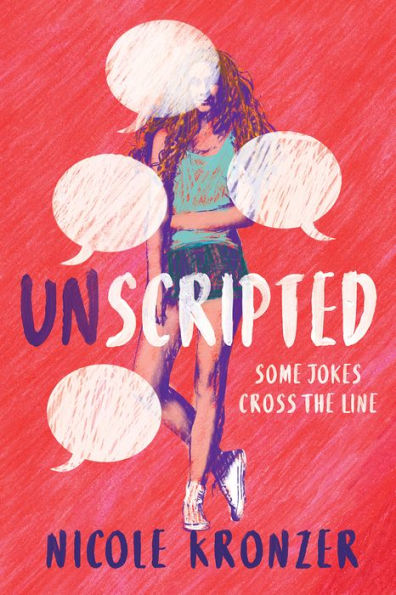
Book cover sourced online. This is Kronzer’s second young adult novel, published in January.

Both have taught/teach writing. Kronzer draws on her interactions with teens as a high school English teacher and her theatrical experience in shaping her books. She enthuses about today’s teens, noting she feels hopeful in this generation. In response to a question, Kronzer said the take-away from her books is a sense of belonging, the theme in Unscripted and The Roof Over Our Heads. She was, she said, bullied. I can relate. We write what we know.

Book cover sourced online. The cover is similar to the real-life scene of abandoned bikes found in a rural road ditch at the site of Jacob Wetterling’s abduction.

Lourey, who is inspired by dark true crime, centers her fictional books on secrets. She grew up in Paynesville in central Minnesota, where eight boys were attacked and assaulted in the late 1980s. (Secrets.) Authorities investigated a suspect who later pled guilty to the 1989 kidnapping, assault and murder of Jacob Wetterling in nearby St. Jospeh. Lourey’s fictional book, Unspeakable Things, is based on what happened in Paynesville. Her experiences as a pre-teen and teen at the time weave into Unspeakable. Write what you know.

Even though her books theme around secrets, Lourey wants readers to take away the importance of community. “Find your people and tell your truth,” she said.

This was posted in a recent display on banned books at my library. (Minnesota Prairie Roots copyrighted photo September 2023)

And for Kronzer, her stand-out statement of the evening, at least for me, was this: “Reading makes you nicer.” In saying that, she referenced the diversity of characters found in books. (Both authors emphasized character development in their writing.) Kronzer’s statement really resonated with me as I thought of a recent banned books display in my library. Not books banned from Buckham Memorial Library, but rather books that have been banned elsewhere. I chose one from the shelf, Lawn Boy by Jonathan Evison, and read it. It’s not a book I would otherwise have chosen. But I needed to read it, to learn, to widen my world, to put myself in the shoes of others.

We can learn so much by reading, by writing, by asking, by listening. And sometimes we are validated. When I asked Lourey and Kronzer whether they eavesdrop (specifically in grocery stores), they admit they do. Some of what they’ve overheard has made it into their books. Just as some of what I’ve overheard has woven into my writing. Write what you know. And sometimes, write what you hear.

Book cover sourced online.

FYI: Lourey and Kronzer suggested two must-read books on the craft of writing: Save the Cat! Writes a Novel—The Last Book on Novel Writing You’ll Ever Need by Jessica Brody and Stephen King’s On Writing—A Memoir of the Craft. I’ve read King’s writing guide and highly-recommend it. I also highly-recommend attending author events, whether you’re a writer, a reader or both.

© Copyright 2023 Audrey Kletscher Helbling


Multi-genre Minnesota authors talking craft & more at Faribault library October 31, 2023

Book cover sourced online

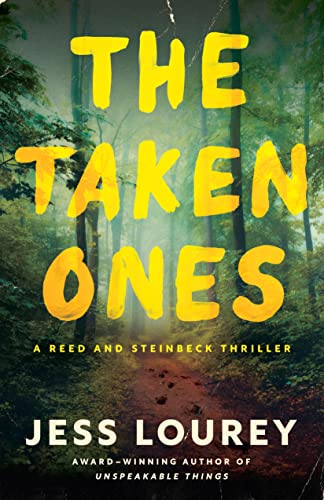
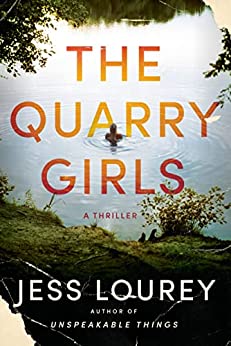
A FEW DAYS AGO, I nabbed Jess Lourey’s The Taken Ones from the LUCKY DAY shelves at my local library. This is a section where new books are placed and, if you’re lucky to get a new release, then lucky you. Already I want to stay up late reading this Minnesota author’s latest thriller. Just as I did when I read The Quarry Girls, a fictional crime story set in 1997 in St. Cloud and winner of the 2023 Minnesota Book Awards in genre fiction.

My familiarity with Lourey’s writing stretches back many years to my time as a freelance writer with Minnesota Moments, a magazine no longer in publication. Back then I reviewed Minnesota-authored books for the magazine, including books in Lourey’s Murder by Month romcom series set in Battle Lake, a real Minnesota community where she lived at the time. I still remember the name of the main character, Mira James, in books like May Day and June Bug.

Book cover sourced online

But since I’m an appreciator of intense mysteries, I’m more drawn to Lourey’s suspenseful crime titles. That’s my go-to genre, reaching as far back as the Nancy Drew detective series.

The library’s promo for Thursday’s event.

All of that aside, Lourey will be at Buckham Memorial Library in Faribault at 6 pm Thursday, November 2, as part of Moving Words: Writers Across Minnesota series. Authors John Lee Clark and Nicole Kronzer will join her. How lucky we are to have three talented, award-winning, multi-genre authors here to talk about their craft.

Book cover sourced online

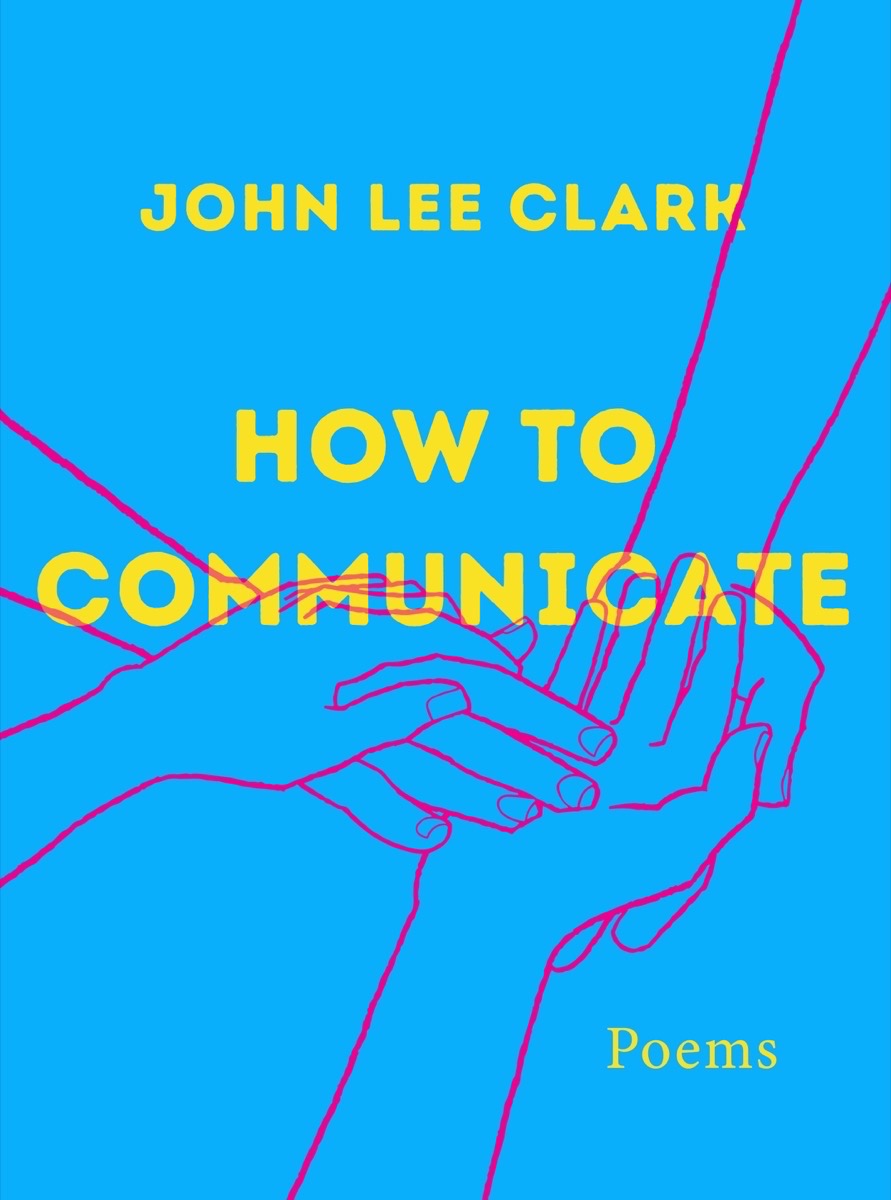
While Clark and Kronzer are unknown to me, their online bios reveal two gifted writers. Clark, a DeafBlind poet, essayist and actor, won the 2023 Minnesota Book Award in poetry for his How to Communicate: Poems. It seems particularly fitting that he is coming to Faribault, home to the Minnesota State Academies for the Deaf and the Blind.

Book cover sourced online

And Kronzer, a high school English teacher and former professional actress, writes young adult novels. In 2021, Unscripted was a Minnesota Book Awards finalist in young adult literature. Her second book, The Roof Over Our Heads, published in January.

I’ve already requested Clark’s poetry book and Kronzer’s Unscripted from the library. If those books were on the Lucky Day shelves, I missed them.

Now, time to take a break from writing to resume reading The Taken Ones. For it is also by reading that writers learn and grow their craft. And Lourey has that covered, too, in Rewrite Your Life: Discover Your Truth Through the Healing Power of Fiction, a book to first read then use as a writing guide.

© Copyright 2023 Audrey Kletscher Helbling
 

Celebrating a Faribault library patron’s $2.7 million legacy September 21, 2023

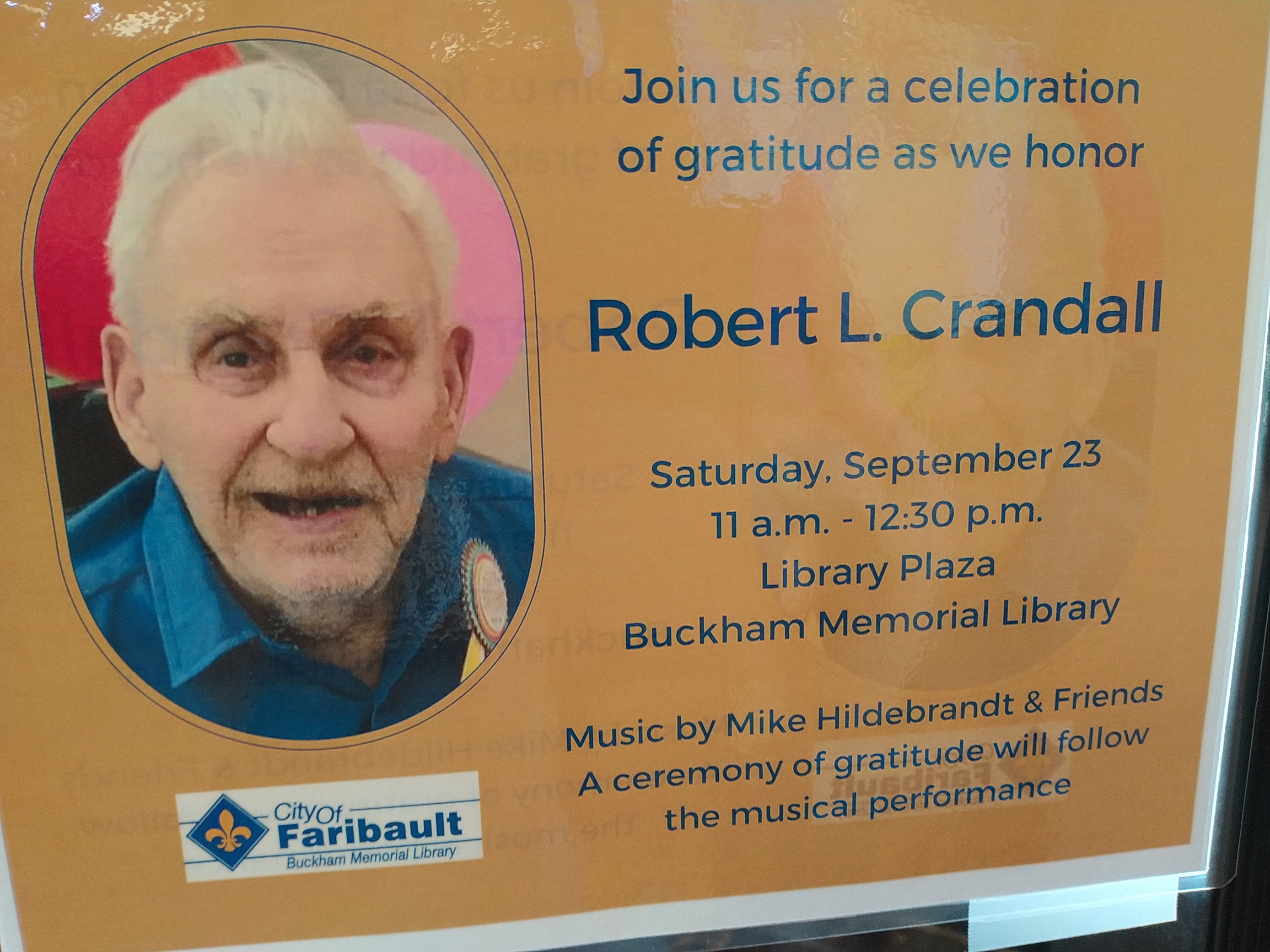
Posted on a door at Buckham Memorial Library, Faribault. (Minnesota Prairie Roots copyrighted photo September 2023)

IN LIFE AND IN DEATH, there are reasons to celebrate. And this Saturday, September 23, from 11 am – 12:30 pm, the City of Faribault will celebrate the legacy of Robert L. “Bob” Crandall.

The 93-year-old Faribault man, who died in January 2021, left $2.7 million to the city, specifying that his gift be used for the benefit of Buckham Memorial Library. Saturday’s gathering in the library’s Great Hall marks a public celebration of gratitude honoring Crandall and his gift.

The celebration has been moved inside to the Great Hall due to an uncompleted renovation project on the Library Plaza steps. (Minnesota Prairie Roots copyrighted file photo 2022)

He held a deep love for his local public library. According to his obituary, Crandall “spent many hours at the Buckham Memorial Library studying and reading books on investing.” He also watched CNBC to stay updated on the stock market. I can only assume that his focused reading and television viewing led to sound and knowledgeable investment strategies. As a result, my community, my library, is benefiting from this avid reader’s generosity.

I expect Saturday’s event, which begins with music by Mike Hildebrandt & Friends followed by a ceremony of gratitude, will reveal how some of Crandall’s legacy money was spent. The Faribault City Council, Library Advisory Board and staff tasked themselves with working together to ensure his gift would “make a positive and lasting impact for the citizens of Faribault.”

Inside a section of Buckham Memorial Library. (Minnesota Prairie Roots copyrighted file photo 2018)

Aside from his interest in investing, Crandall liked John Wayne movies and stamp collecting. And bacon. He also hiked, biked, played cards and vacationed in Mexico. Plus, he spoke fluent Spanish. I bet this nonagenarian shared many an interesting story about his travels, his life experiences, but in a humble and gracious way. He moved to my community decades ago to work at the then Faribault Regional Center.

The obituary for this Anoka-born man lists no surviving family, but many friends at his final home, Milestone Senior Living in Faribault. But he certainly leaves many other friends, people like me who appreciate his multi-million dollar gift to a place I love, too, Buckham Memorial Library.

Story updated at 9 pm Thursday, September 21, to reflect a new location for the celebration inside the library Great Hall rather than outdoors on the front plaza.

© Copyright 2023 Audrey Kletscher Helbling
 

Beyond books: Connecting at the library January 3, 2023

Buckham Memorial Library, Faribault. (Minnesota Prairie Roots copyrighted file photo November 2022)

I MET HER AT BUCKHAM Memorial Library on the final day of 2022 in front of the “Lucky Day” shelves. The two-unit section—one for fiction, one for nonfiction—features newly-released titles immediately available to library patrons. No reserving or waiting, just the luck of finding a new book on the shelves.

As I browsed the fiction, I noticed her approach from the right, pushing a walker. I scooted a tad to the left, giving her more space. I wanted her to feel comfortable as we stood side-by-side.

I don’t recall which of us spoke first, but I think I did. I rarely remain silent in the closeness of strangers. And she was close.

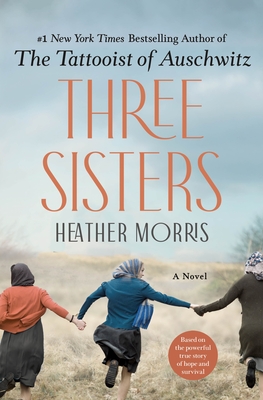
(Photo credit: Goodreads)

“Have you read that book?” I asked, pointing to Three Sisters by Heather Morris. She hadn’t. But she’d read The Tattooist of Auschwitz, also by Morris. I hadn’t. We talked about the books briefly, about the difficulty of reading these fictional stories of concentration camp atrocities. Yet, we agreed reading them was important, perhaps even necessary. She directed me toward the fiction section, strongly suggesting I check out The Tattooist. Now. I’d already learned this woman beside me was opinionated and strong.

I felt her eyes following me to the fiction shelves. “Did you find it?” she asked upon my return. When I shook my head no, my new book-loving friend called out to the reference desk librarian to find the missing book for me. The computer showed the book was lost. He ordered it from another library.

In the meantime, I indulged this older book lover as she handed me two novels pulled from the “Lucky Day” fiction shelves—Joy Fielding’s The Housekeeper and B.A. Paris’ The Prisoner. “Have you read these?” she asked. I hadn’t and accepted her choices. Turns out she likes thrillers and mysteries as much as I do, even referencing Nancy Drew as the books which long ago sparked her interest in mysteries. Those teen mysteries did the same for me. Her recommendation of The Prisoner, a psychological thriller, proved an excellent read. I finished it in three days. She also recommended New York Times bestselling author C.J. Box. I had too many books already, so tucked that name into my memory.

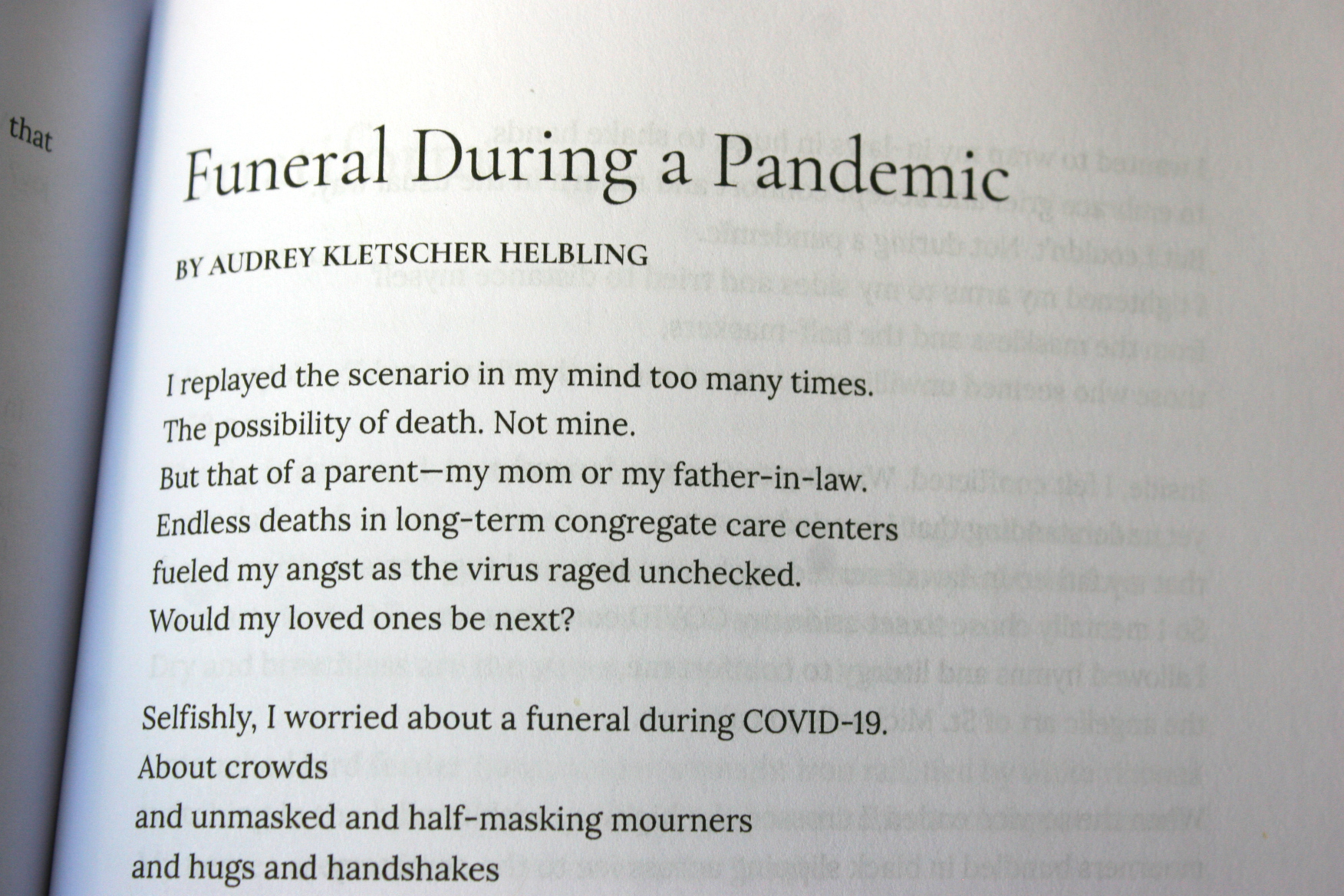
A section of my poem selected for publication in “This Was 2020…” (Minnesota Prairie Roots copyrighted file photo)

Next I’ll move on to The Housekeeper, the other psychological suspense novel she chose for me, ironically with a character named Audrey. I told the book enthusiast that I am a writer and that since she selected two books for me, I wanted her to read an anthology that includes a poem I wrote. I struggled to remember the lengthy name of This Was 2020—Minnesotans Write About Pandemics and Social Justice in a Historic Year, a collection of poems and short stories published by the Ramsey County Library. But I remembered enough for the reference librarian to find the book on his computer and then on the shelves. I thumbed through the pages until I found Funeral During a Pandemic. “That’s me, my poem,” I pointed. We conversed briefly about the difficulties of my father-in-law’s funeral during the COVID-19 pandemic. I didn’t tell her that my mom died in January 2022, at the height of omicron, in a time when most people were no longer masking and large funerals were allowed. I could have penned a sequel poem.

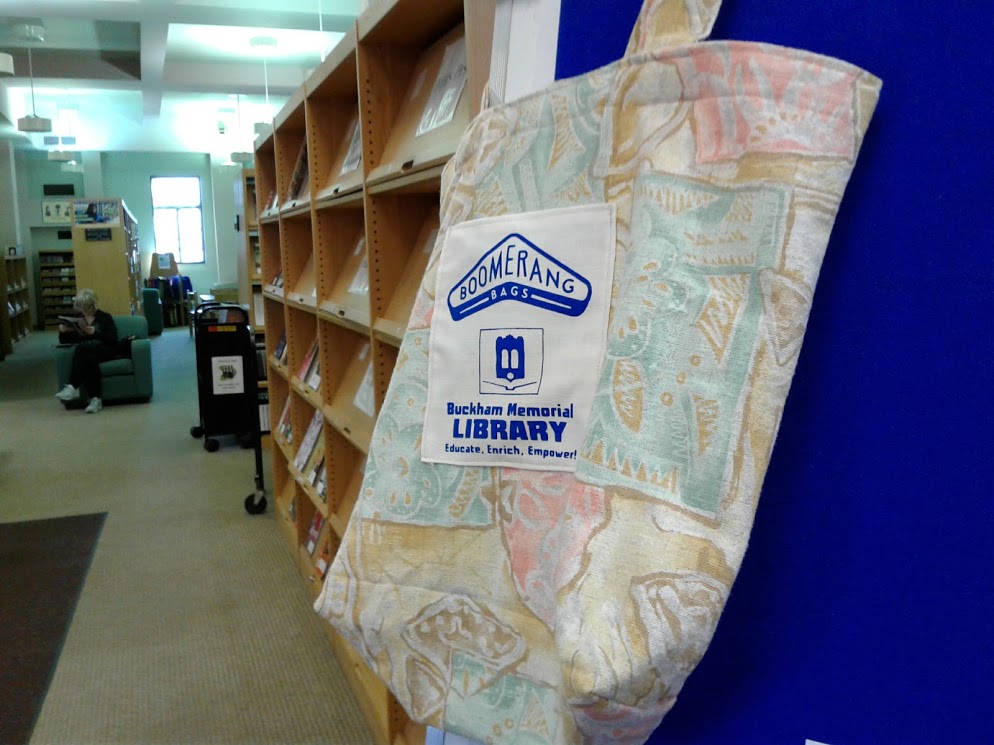
A Boomerang Bag available to patrons at Buckham Memorial Library. (Minnesota Prairie Roots copyrighted file photo May 2018)

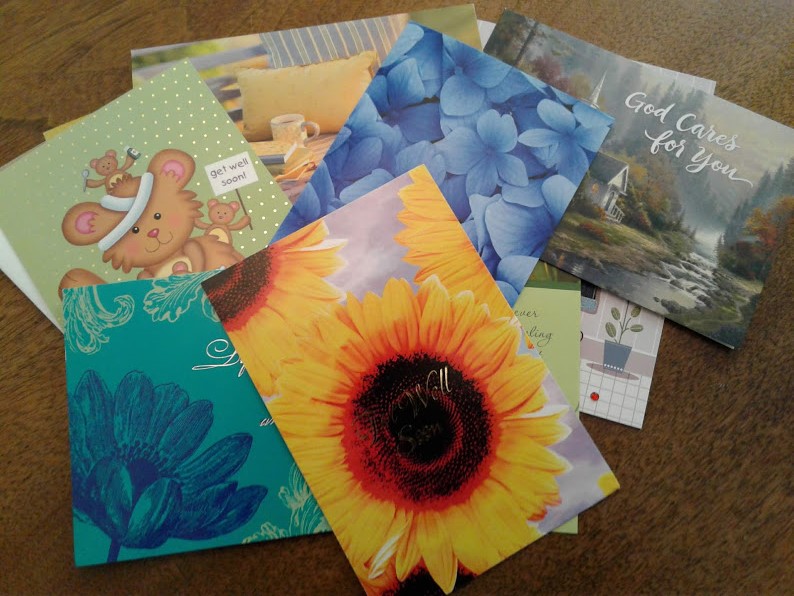
Eventually we parted, me lugging a cloth Boomerang bag weighted by books, she shoving her walker with books inside a plastic bag. When I later aimed back toward the check out desk, she called out, “Can you mail this for me?” She thrust a bright yellow envelope toward my outstretched hand. I agreed to mail the get well card to her niece who’d fallen on the ice.

She left the library and I soon followed with my bag of books. She maneuvered beside a car parked in a handicap space. Even though offered assistance to wrangle her walker into a weathered white late 1980s K car, she refused. She had this. But she did express concern about navigating an icy patch of pavement leading to and next to her car. She feared falling and breaking bones, something that’s happened thrice already. I empathized, sharing that I’d also had a hip replacement and broken bones twice during falls. “We’re sisters,” I laughed. But I meant it. We share a broken bone history, a love of books and a habit of mailing greeting cards to those who are celebrating or grieving or in need of encouragement.

Some of the get well cards I received after a bone break. (Minnesota Prairie Roots copyrighted file photo)

“I love that you’re sending a get well card to your niece,” I said, waving the yellow envelope. I like to send cards, too. I’ll be sure to mail this.”

She replied, “I’m old school. I don’t even have a computer.”

“I need one to do my work—to write.”

“I always wanted to be a writer,” she blurted.

“It’s not too late,” I encouraged. A look flashed across her face, albeit briefly. A flash of possibility.

I had one final question. “What’s your name?”

“Noreen.” (Or maybe it’s Norene; I didn’t ask for the spelling.)

I don’t recall our parting words. But it doesn’t matter. I’d made a new book-loving, opinionated friend who dreamed of becoming a writer. It was, indeed, my lucky day at the library.

© Copyright 2022 Audrey Kletscher Helbling
 

At Buckham Library: Portraits honor Faribault’s founding fathers November 21, 2022

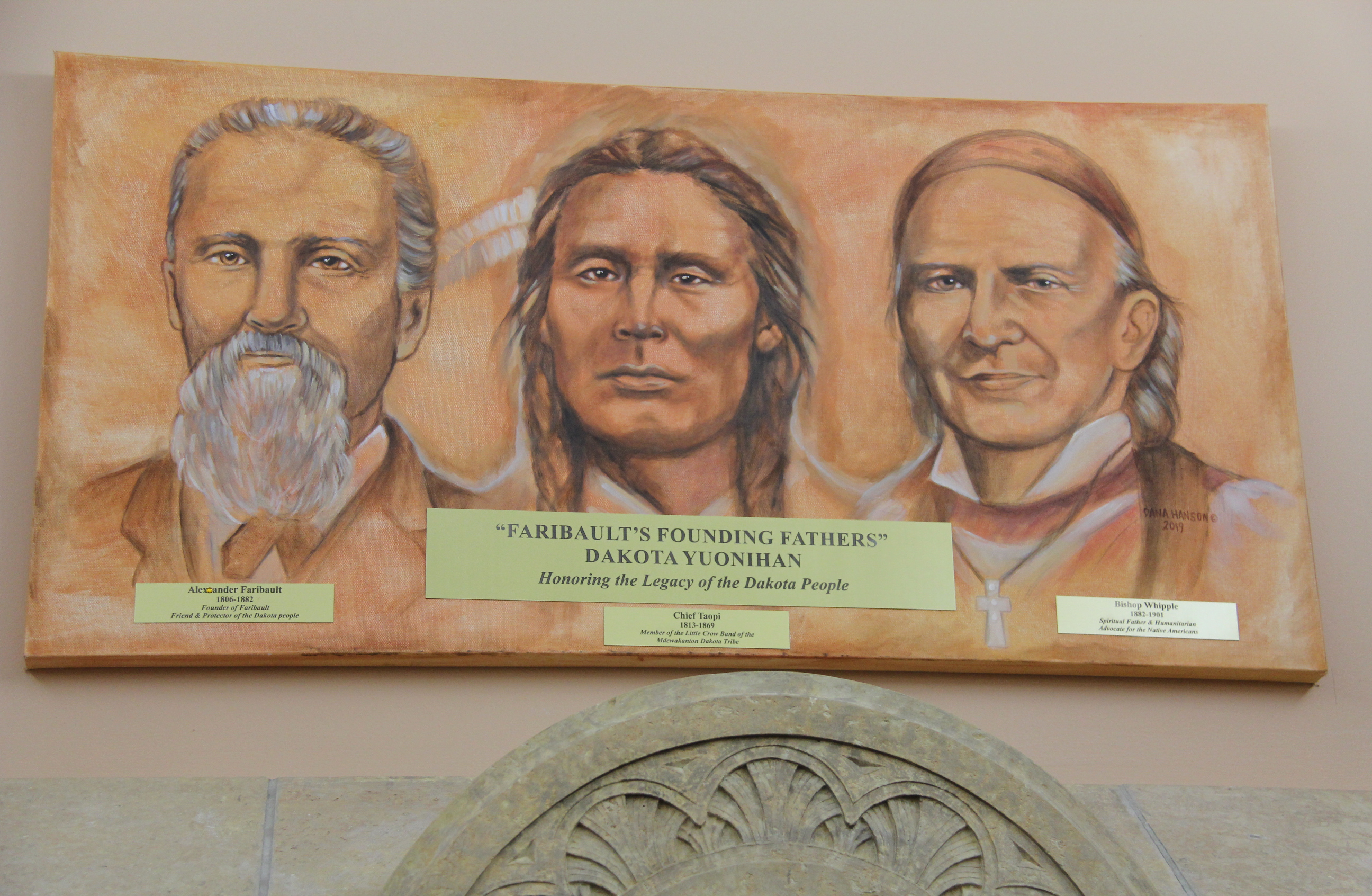
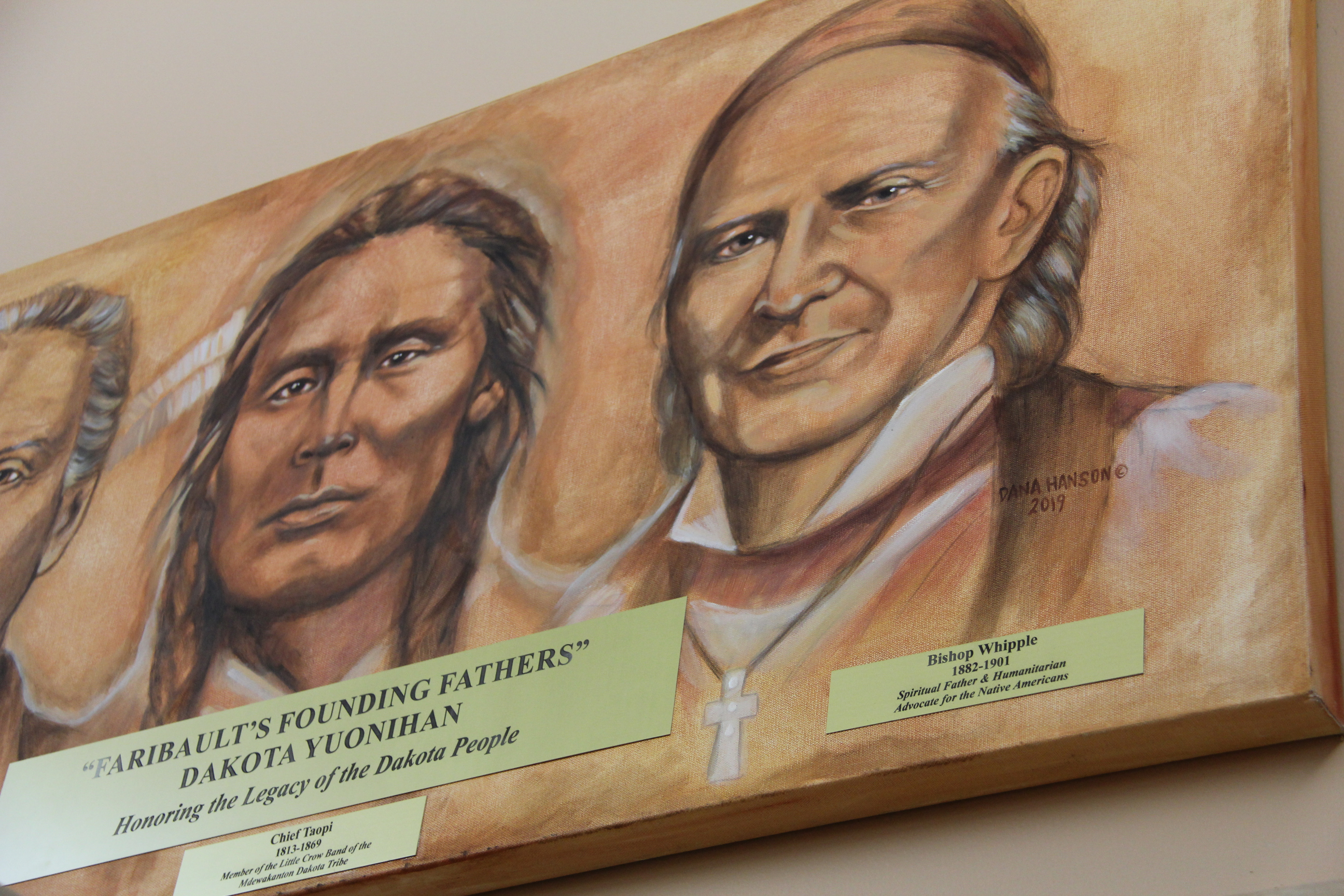
“Faribault’s Founding Fathers,” Alexander Faribault (left to right), Chief Taopi and Bishop Henry Whipple, painted by Dana Hanson. “Yuonihan” means honor or respect. (Minnesota Prairie Roots copyrighted photo November 2022. Art copyrighted by Dana Hanson.)

MY LIBRARY, BUCKHAM MEMORIAL in Faribault, features dozens of art pieces by local artists scattered throughout the building. I’ll admit that I really don’t even notice the art any more in my frequent visits to the library. Like anything, after time, familiarity begets overlooking.

But that all changed recently when I looked across the library to the west by the adult fiction and saw a work of art I hadn’t previously noticed. It’s been there for about a year. Yet, just now, I happened to see Dana Hanson’s original art piece, “Faribault’s Founding Fathers.” I strode across the library toward the high-hanging portrait piece and took pause.

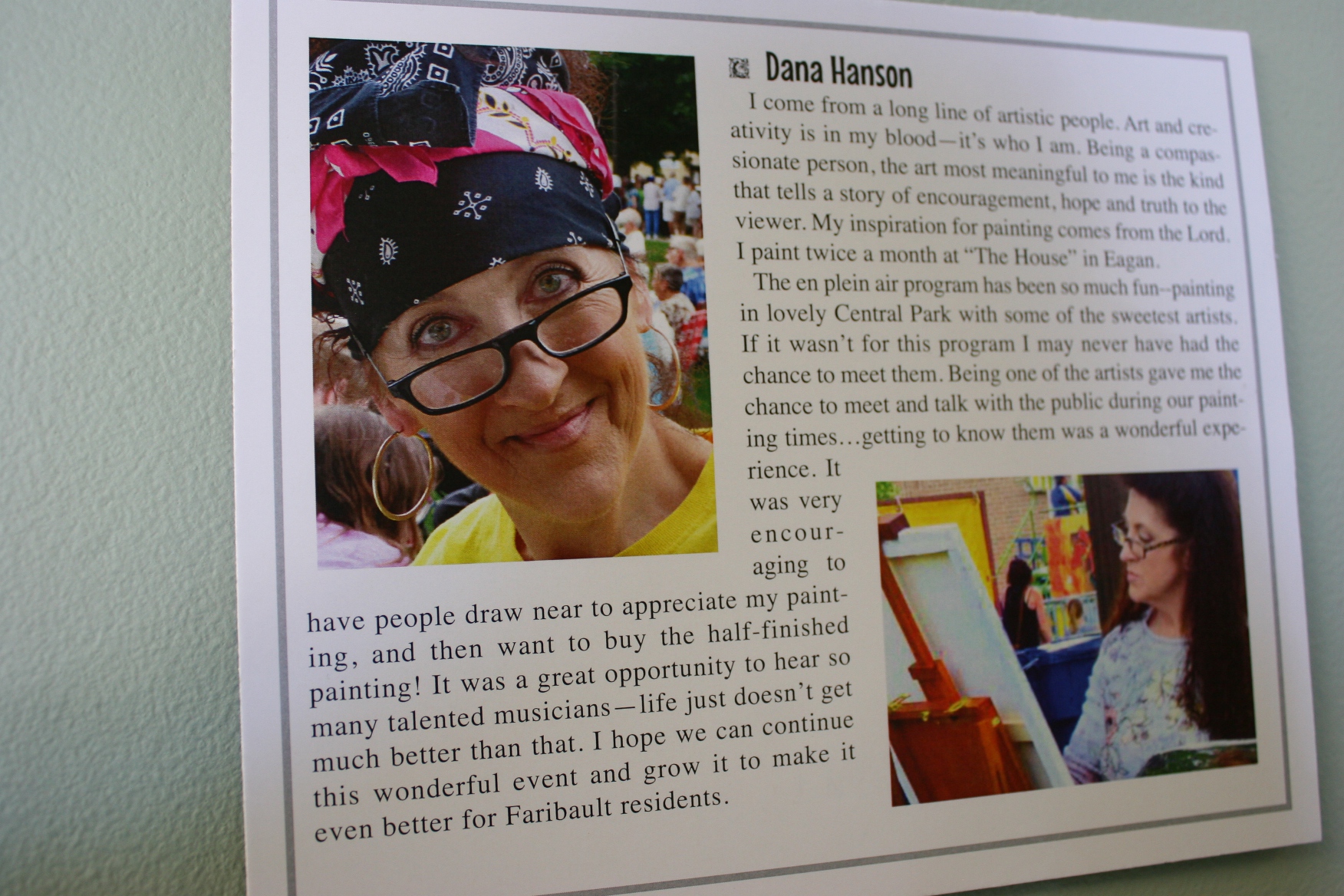
Dana Hanson’s artist statement posted at the 2016 Artgo! art show at Buckham Center. (Minnesota Prairie Roots copyrighted file photo October 2016)

I first met Dana, who specializes in portraits, in 2015 during Faribault’s summer Concerts in the Park weekly outdoor music series at Central Park. Local artists were invited to paint on-site and Dana was among them. She has since moved away from Faribault.

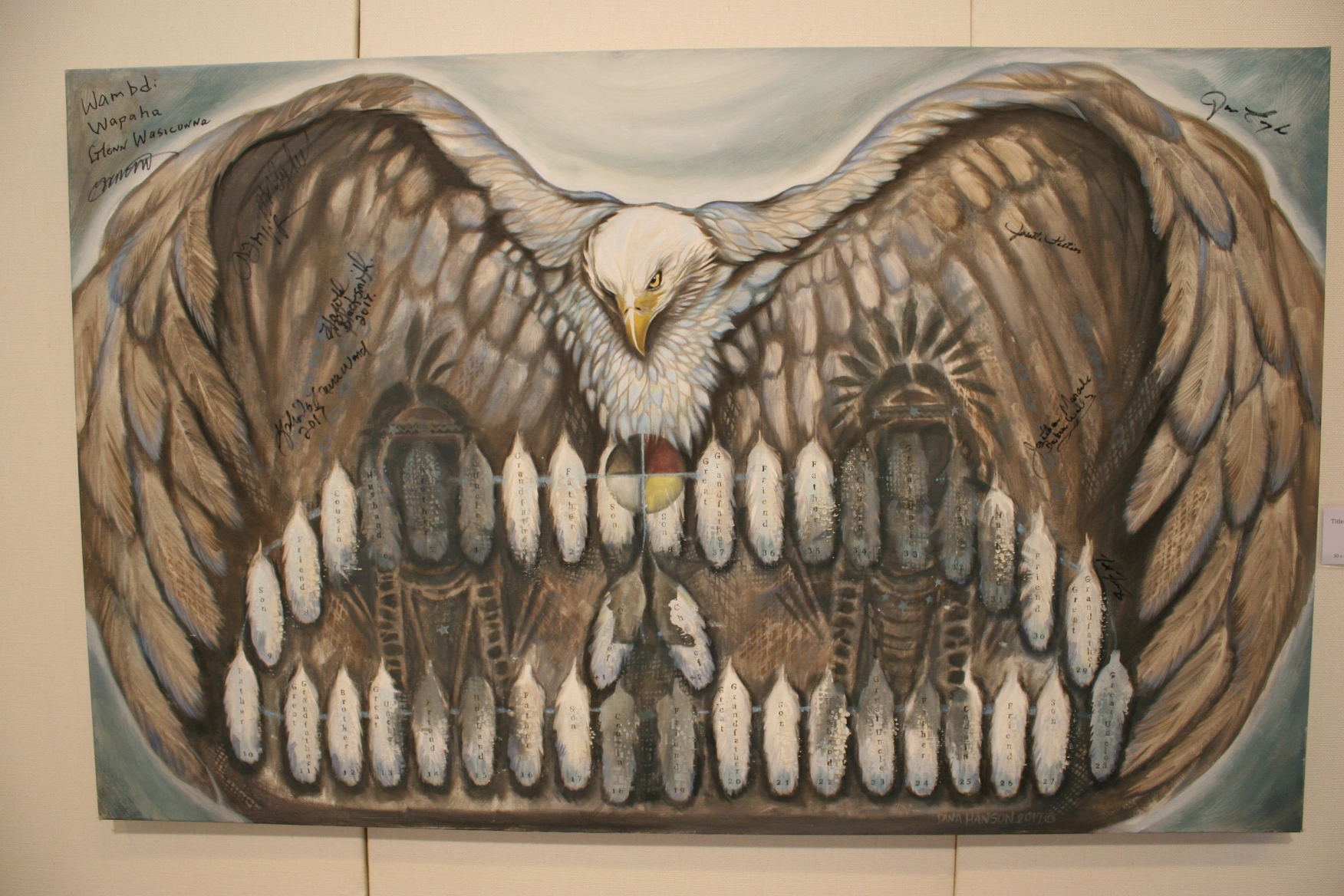
A close-up of Dana’s “The Native Man, His Eagle & His Chanupa,” an oil painting exhibited in Owatonna in 2018. (Minnesota Prairie Roots copyrighted file photo April 2018)

Eventually, her art started showing up in exhibits—at Buckham Center, at the Paradise Center for the Arts and at the Owatonna Arts Center. Her work ranged from faith-inspired to celebrity (like Bob Dylan, Prince and Judy Garland) and Native American portraits and more. In Owatonna, her “Healing the Land” exhibit several years ago focused on the Dakota people.

Up close with Chief Taopi, center, and Bishop Henry Whipple, right. (Minnesota Prairie Roots copyrighted photo November 2022)

So when I saw the recently-donated 2019 painting of Faribault’s founding fathers, I was not at all surprised. Dana holds a heart full of gratitude, love and compassion for Indigenous peoples. That shows in her art, including in these portraits of Chief Taopi, a member of the Little Crow Band of the Mdewakanton Dakota Tribe; town founder Alexander Faribault, “friend and protector” of the Dakota; and Bishop Henry Whipple, “Spiritual Father and Humanitarian” and “Advocate for the Native Americans.”

Another example of Dana’s art, MESSENGERS OF HOPE with the horses subtitled, from left to right, “Light,” “Passion Fire” and “Grace.” These were exhibited at the Paradise Center for the Arts in 2017. (Minnesota Prairie Roots copyrighted file photo March 2017.

Indigenous peoples were the original inhabitants of Faribault, of Rice County, a fact now only beginning to be widely-acknowledged and honored. The Wakpekute, part of the Dakota Nation, placed their dead on scaffolding on the hill just up from my house in today’s current-day Wapacuta (sic) Park, a fact I only learned this fall at an historical presentation. Eventually, they were buried in Peace Park, a triangle of land near the library. There’s so much rich local history I am beginning to learn.

“Protector of the 38 + 2,” an oil on canvas by Dana Hanson and previously displayed in Owatonna. Her art honors the 38 Dakota men who were hung in Mankato following the US-Dakota War of 1862. (Minnesota Prairie Roots copyrighted file photo April 2018)

Chief Taopi, who centers Dana’s portrait trio, was a leader among his people and a member of a Peace Party during the US-Dakota War of 1862. Eventually he landed in Faribault, living on land owned by founder and fur trader Alexander Faribault. Taopi and the Bishop forged a strong friendship also. The Dakota chief died in 1869 and is buried at Maple Lawn Cemetery in Faribault.

Now, to see these three men honored via a painting in a place of learning, a place of connection, a place where history writes onto pages, reminds me of their importance in my community. In the familiarity of the library and during this, Native American Heritage Month, I need to pause, appreciate and respect those who shaped this place I’ve called home for 40 years.

© Copyright 2022 Audrey Kletscher Helbling
 

Fleeting fall thoughts from Faribault November 4, 2022

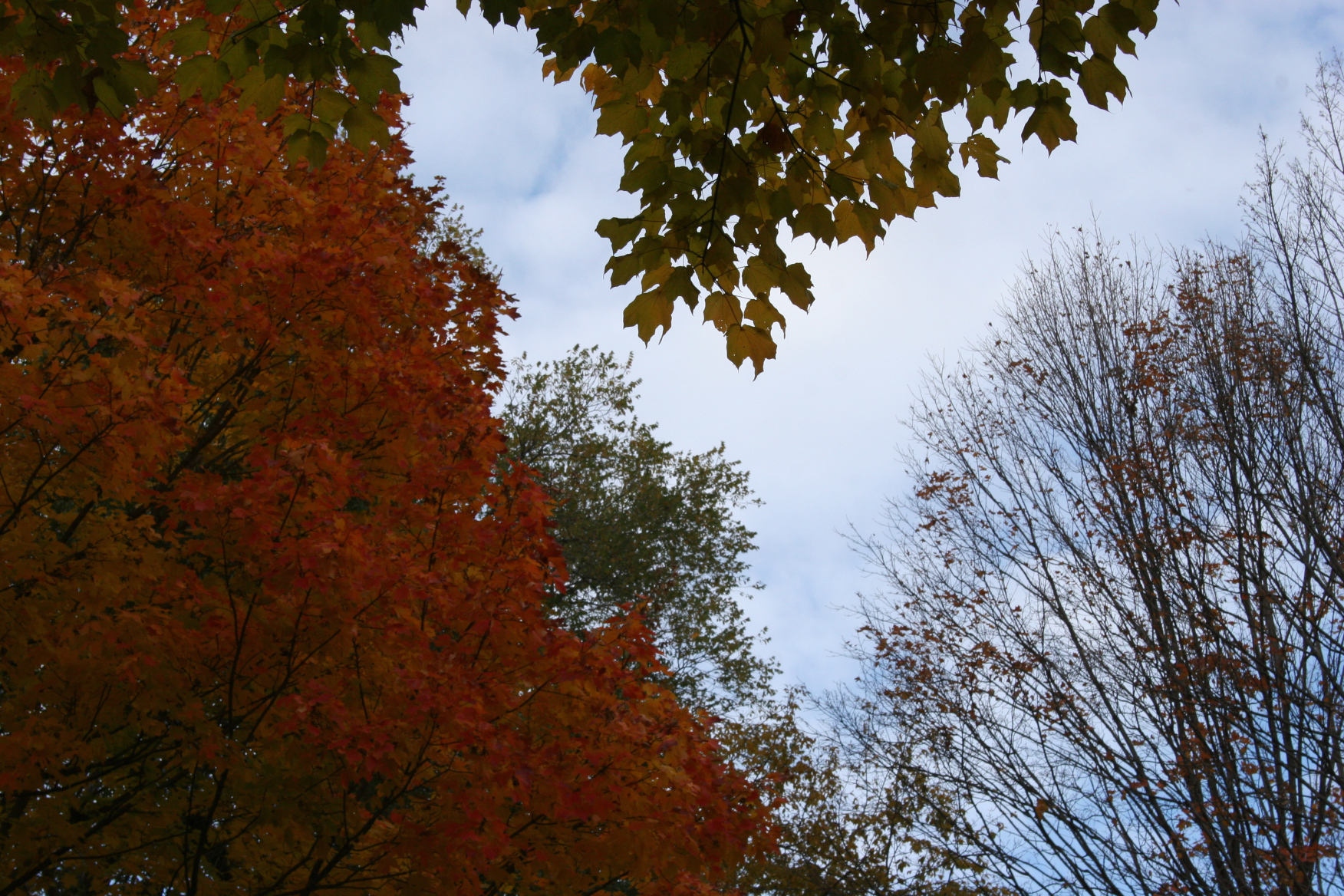
Colorful trees photographed from my backyard. (Minnesota Prairie Roots copyrighted photo mid-October 2022)

WE KNOW IT’S COMING. Winter. Yet, we Minnesotans hope for one more glorious autumn day. One more day of warm temps. One more day of no snow. The reality, though, is that this is November and the weather can shift just like that to cold, grey and, well, seasonal.

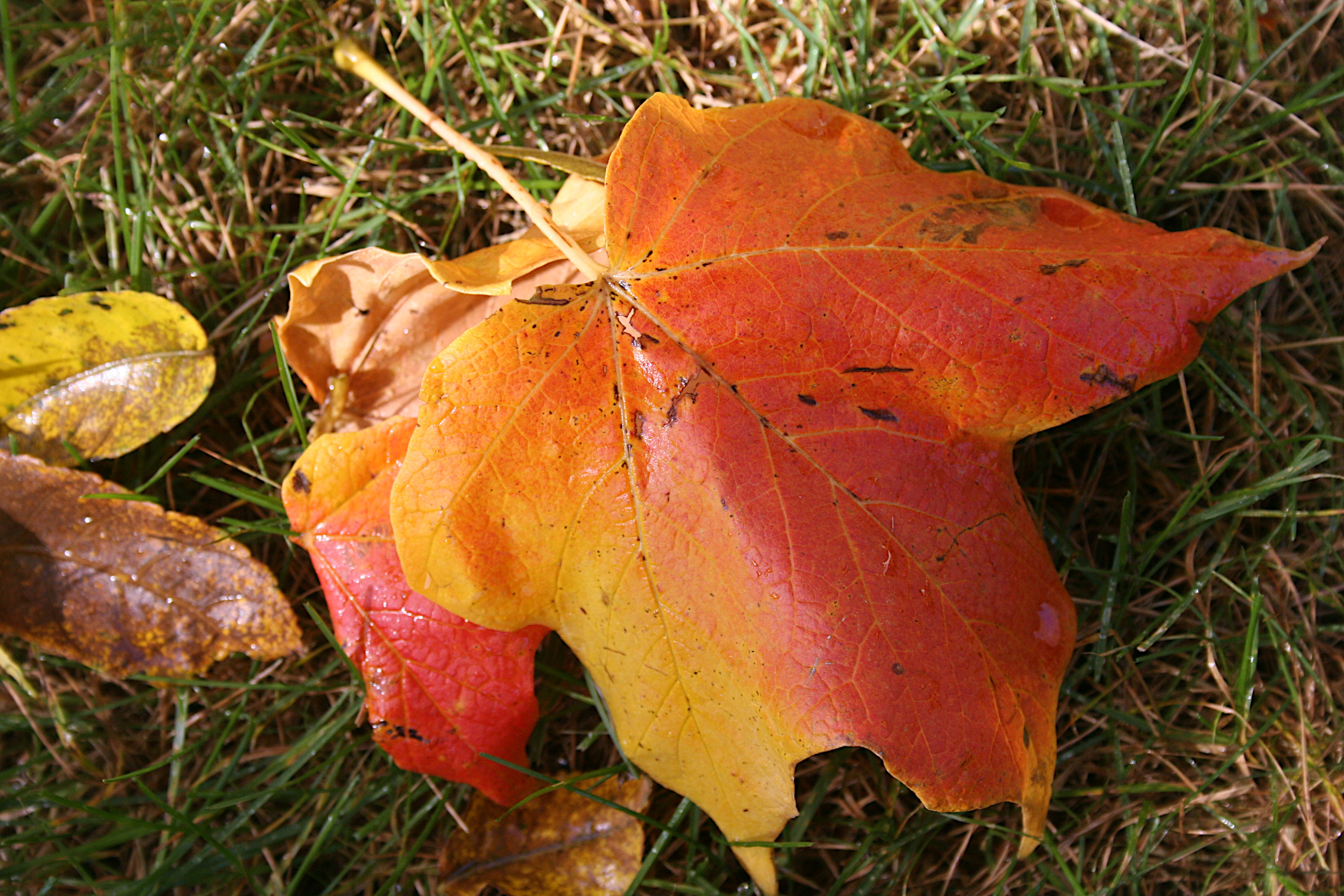
A maple on my lawn in all its fall glory. (Minnesota Prairie Roots copyrighted photo mid-October 2022)

With the exception of minimal rain in an already drought-stricken state, this fall in southern Minnesota has been exceptional with many sunny, warm days and lovely fall colors.

Autumn brings lots of yard work (like raking leaves) in preparation for winter. (Minnesota Prairie Roots copyrighted photo mid-October 2022)

Minnesota fully embraces autumn with unbridled enthusiasm. It’s as if we need to pack in as much as we can, outdoors especially, before we settle mostly inside for the winter.

The restored clock on the historic Security Bank Building in downtown Faribault. (Minnesota Prairie Roots copyrighted file photo September 2015)

The end of daylight savings time this weekend signals that seasonal shift. It will get darker earlier and that, psychologically, triggers an awareness of winter’s impending arrival. I find myself just wanting to stay home in the evening, snuggled under a fleece throw reading a good book.

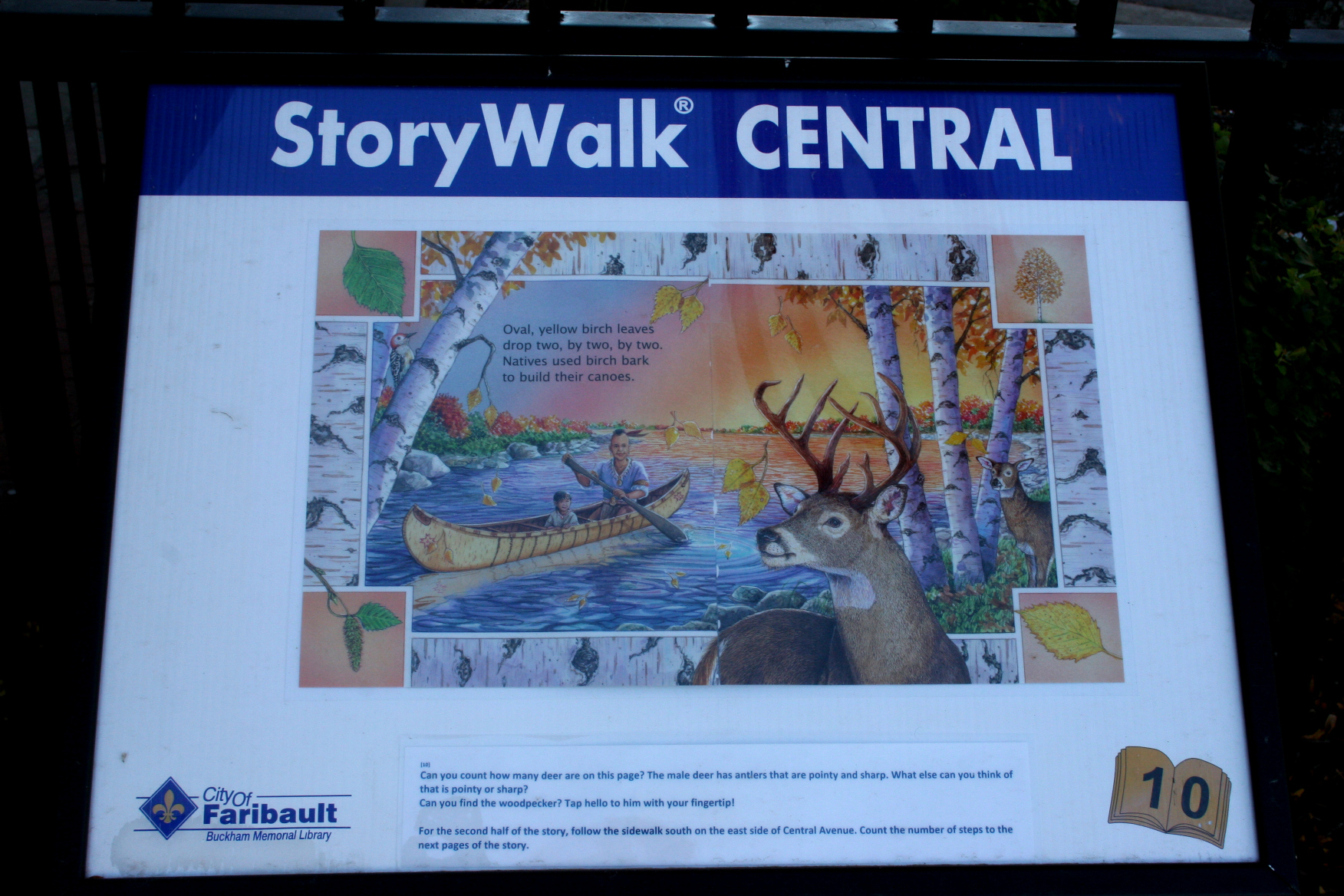
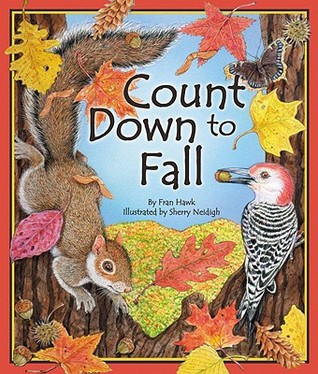
A page from “Count Down to Fall” in the current StoryWalk. (Minnesota Prairie Roots copyrighted photo October 2022)

Sometimes that may be a children’s book. Picture books aren’t just for kids. I find the stories and illustrations therein inspiring, entertaining, informative, poetic. In Faribault, Buckham Memorial Library even brings picture books right into the community via a StoryWalk. Pages from a selected picture book are posted in protective casings along several blocks of Central Avenue to the library. The currently featured book is Count Down to Fall written by Fran Hawk and illustrated by Sherry Neidigh.

Book cover source: Goodreads

Recently I listened to Children’s Librarian Deni Buendorf read the book online. I love her enthusiasm as she reads page after page of this rhyming story focused on different leaves—painted maple, oval birch, craggy oak… It’s a perfect autumn read.

Book cover source: Goodreads

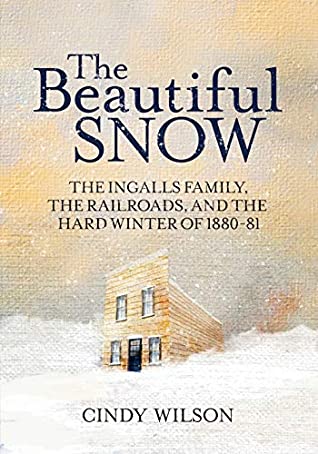
Soon this season ends and we enter the long, hard winter months. Interestingly enough, I am currently reading Cindy Wilson’s award-winning The Beautiful Snow—The Ingalls Family, the Railroads, and the Hard Winter of 1880-81. Lest I think winters now are sometimes difficult, I need only reference this book of nonfiction to understand that I have nothing, absolutely nothing, to complain about in the year 2022. Remind me of that come March.

#

NOTE: In a project similar to Faribault’s StoryWalk, Minneapolis-St. Paul International Airport features a Minnesota-authored children’s picture book on panels placed between gates C18 and C19 in Terminal 1. Each book is in place for two months in this Picture Book Parade.

© Copyright 2022 Audrey Kletscher Helbling
 

Free state park passes available at Minnesota libraries June 8, 2022

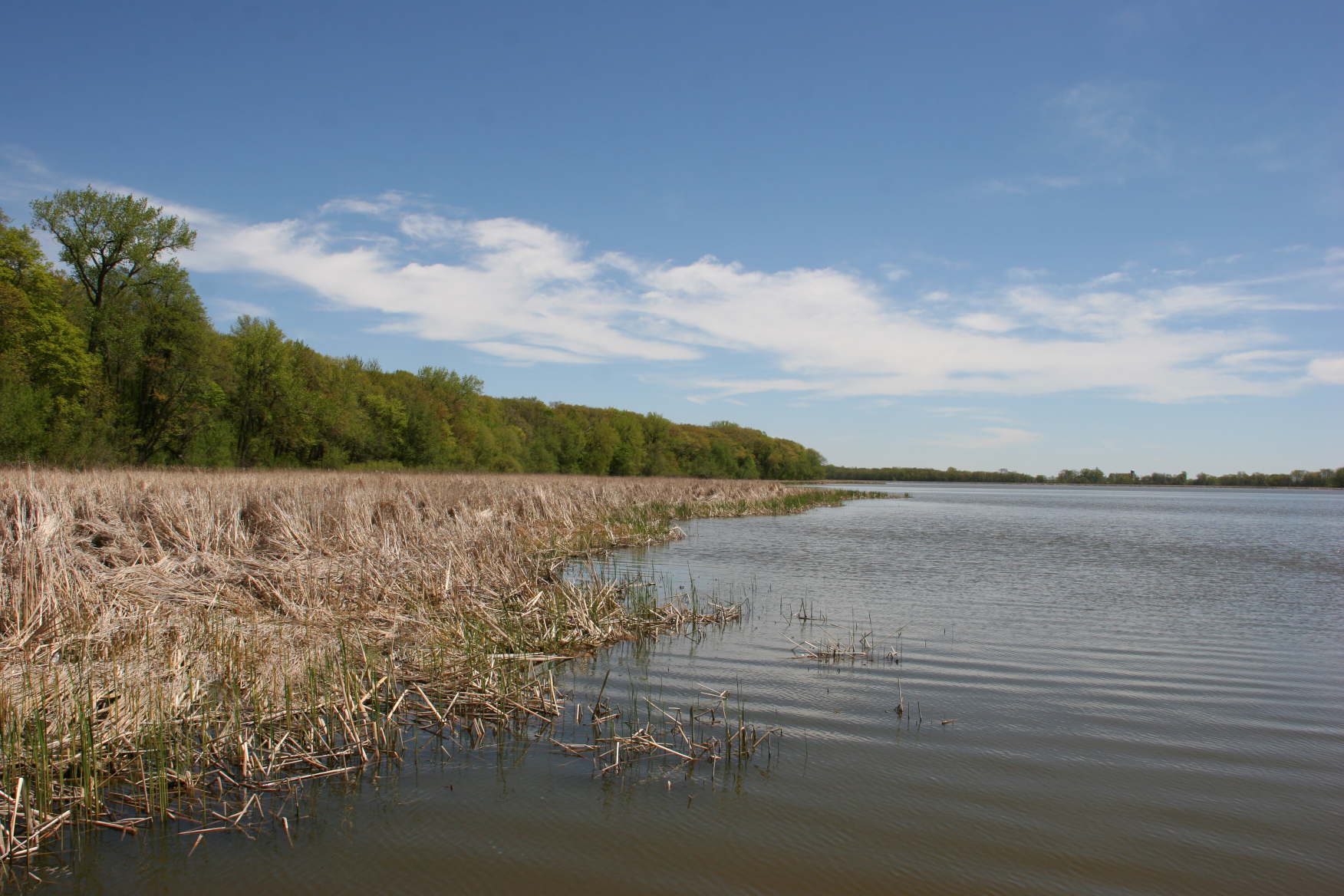
Photographed from the public dock at Rice Lake State Park, rural Owatonna. (Minnesota Prairie Roots copyrighted file photo May 2020)

IT PAYS TO CHECK OUT community bulletin boards, like the one at my local library. While perusing the paper postings at Buckham Memorial Library on Saturday, I discovered information about free passes to Minnesota state parks. Anything free piques my interest, especially as inflation rises and most of us are trying to save money, me included.

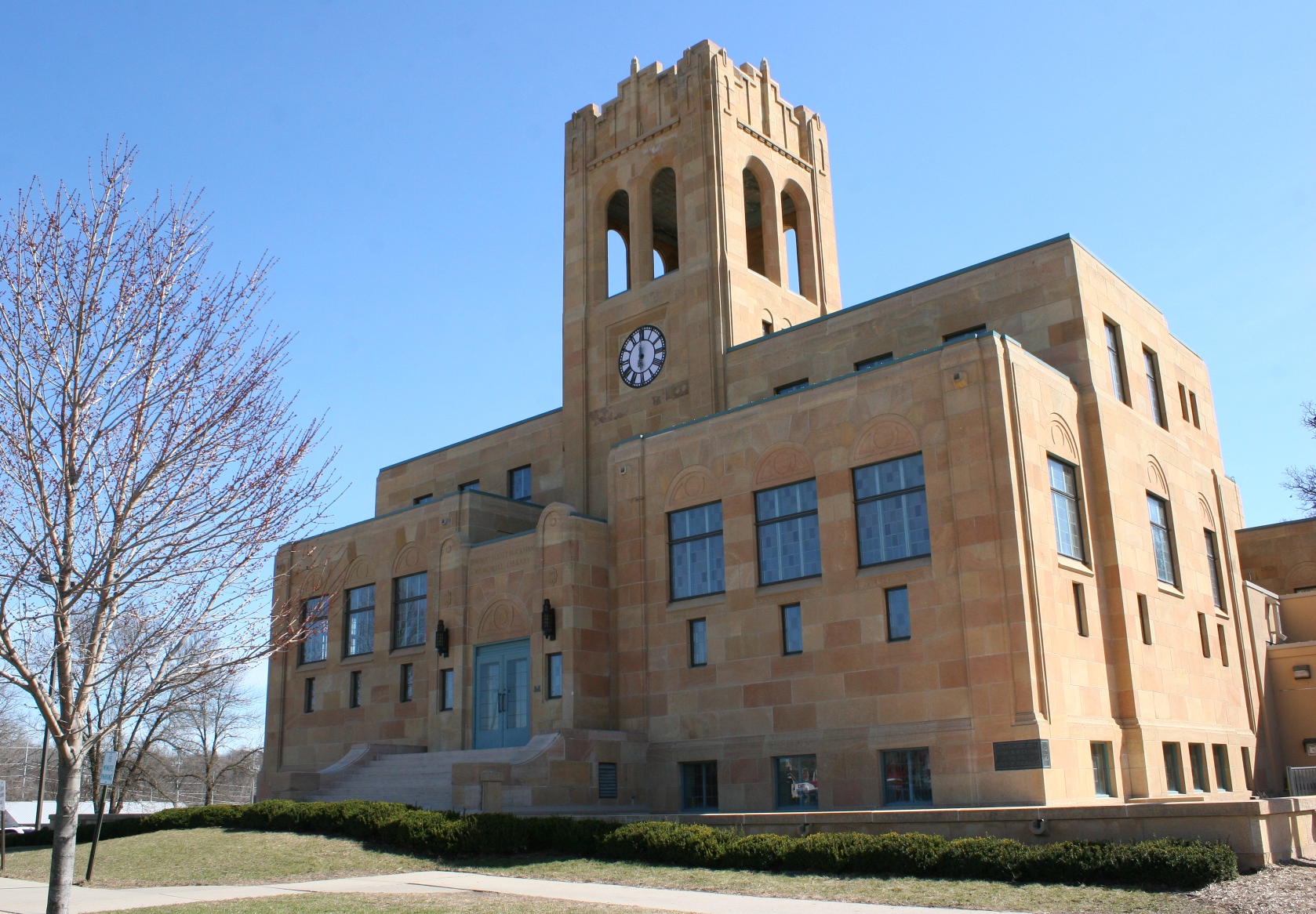
Buckham Memorial Library, Faribault, Minnesota. (Minnesota Prairie Roots copyrighted file photo 2017)

The Minnesota Department of Natural Resources is collaborating with regional public library systems (and two affiliated libraries) across the state to offer free 7-day park passes. Simply go to a participating library (check the DNR website), check out a pass and you can visit a state park for free. Without the pass, entry to a Minnesota state park costs $7 daily or $35 for a year.

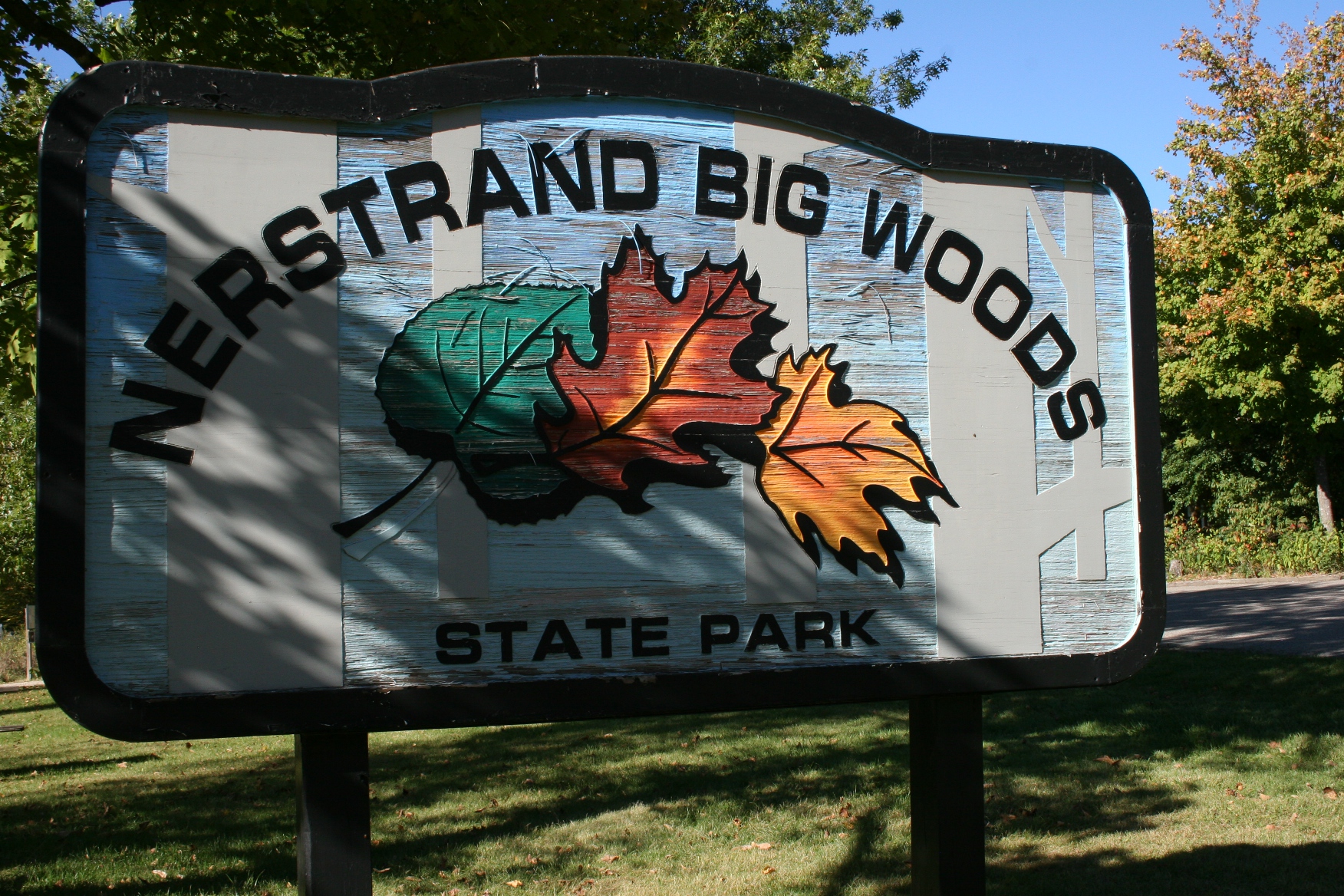
The sign welcoming visitors to Nerstrand Big Woods State Park, known for its beautiful fall colors. (Minnesota Prairie Roots copyrighted file photo September 2013)

My library in Faribault has three park passes, first-come, first-served. The number of passes available at a library ranges from one to four, depending on community size. After seven days the checked out pass expires and cannot be renewed.

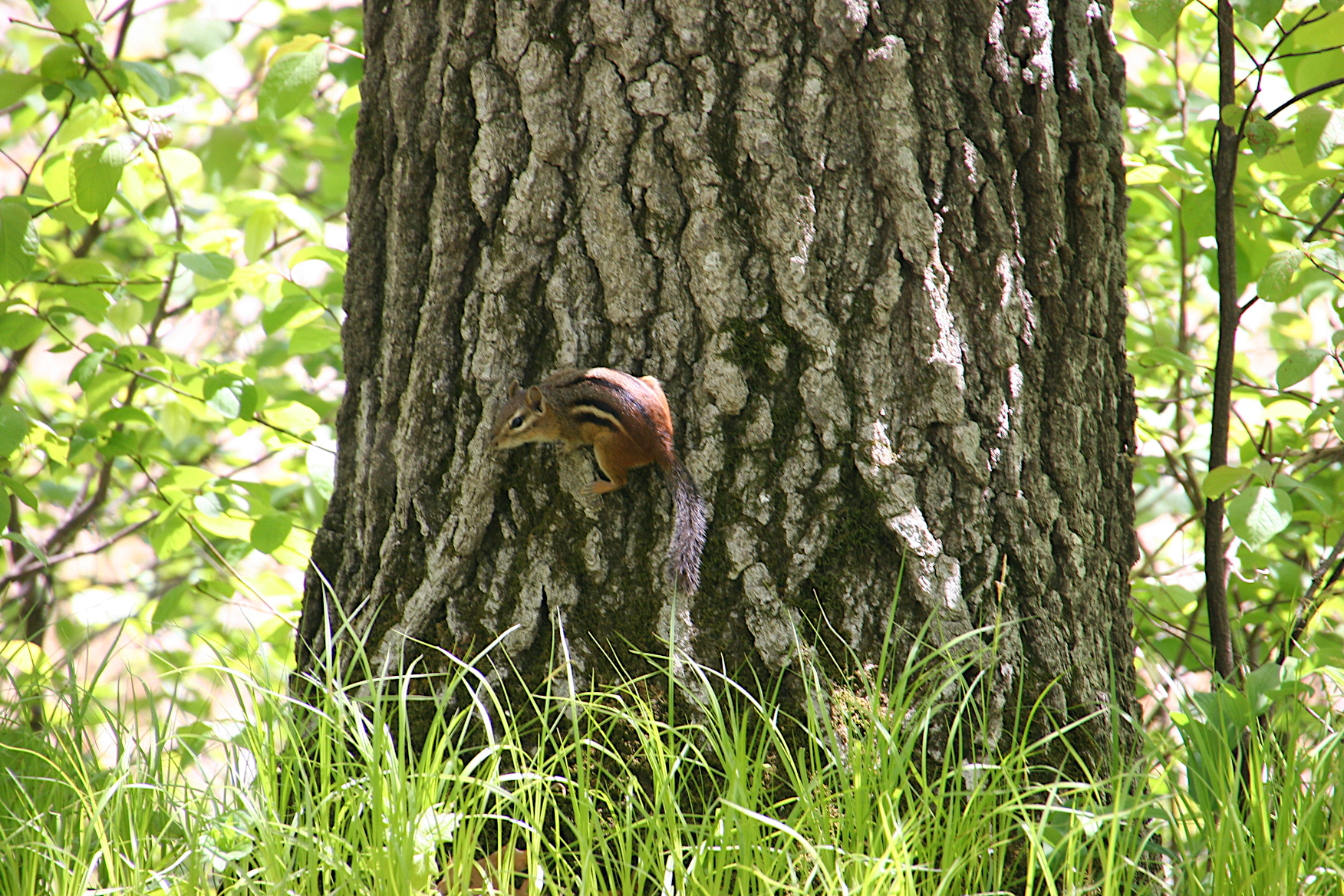
A chipmunk spotted at Rice Lake State Park. (Minnesota Prairie Roots copyrighted file photo May 2020)

So why offer these free passes? According to the DNR website, the goal is “to provide a way for Minnesotans living in low-income communities across the state to visit state parks without the financial burden of an entry fee.” Low income is defined as “where the median annual household income is $58,000 and/or schools nearby the library have more than 40% of students enrolled in the federal free and reduced lunch program.” That definitely fits Faribault. No proof of income is required for anyone checking out a pass.

Maplewood State Park east of Pelican Rapids in northwestern Minnesota is a remarkably beautiful park in the autumn. (Minnesota Prairie Roots copyrighted file photo October 2019)

I am thrilled that the DNR and libraries in qualifying communities are teaming up to offer these free passes. Any program that gets individuals and families exploring the outdoors is a good thing. And to visit a state park at no cost, especially if you are on a tight budget, can make all the difference on whether such an outing is possible.

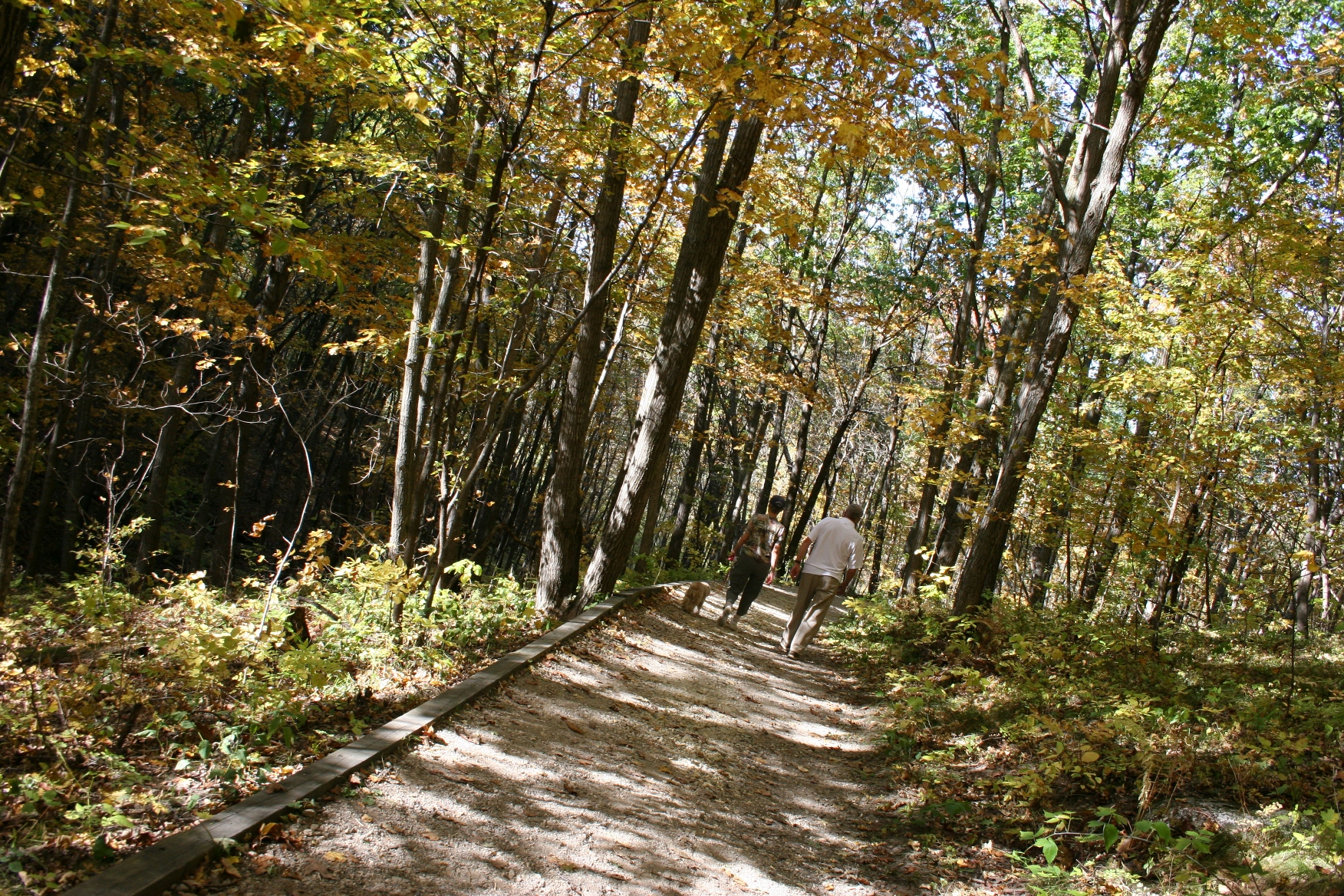
Well-kept and well-traveled paths take hikers deep into Nerstrand Big Woods, a must-see park, especially in autumn. (Minnesota Prairie Roots copyrighted file photo October 2011)

Other participating libraries in my immediate area include those in Owatonna, Waseca and Blooming Prairie. We have several state parks nearby: Nerstrand Big Woods, Sakatah Lake and Rice Lake.

This free park pass program, which just began in June and will continue through June 2025, reminds me of a similar program available to library patrons in the metro. Through Metropolitan Library Service Agency, an alliance of 101 public libraries in the 7-county Twin Cities metro, residents can access free or discounted admission to arts experiences via a smARTpass. The list of participating arts groups is extensive, but includes the Minneapolis Institute of Art, The Saint Paul Chamber Orchestra, the American Swedish Institute and many more, for example.

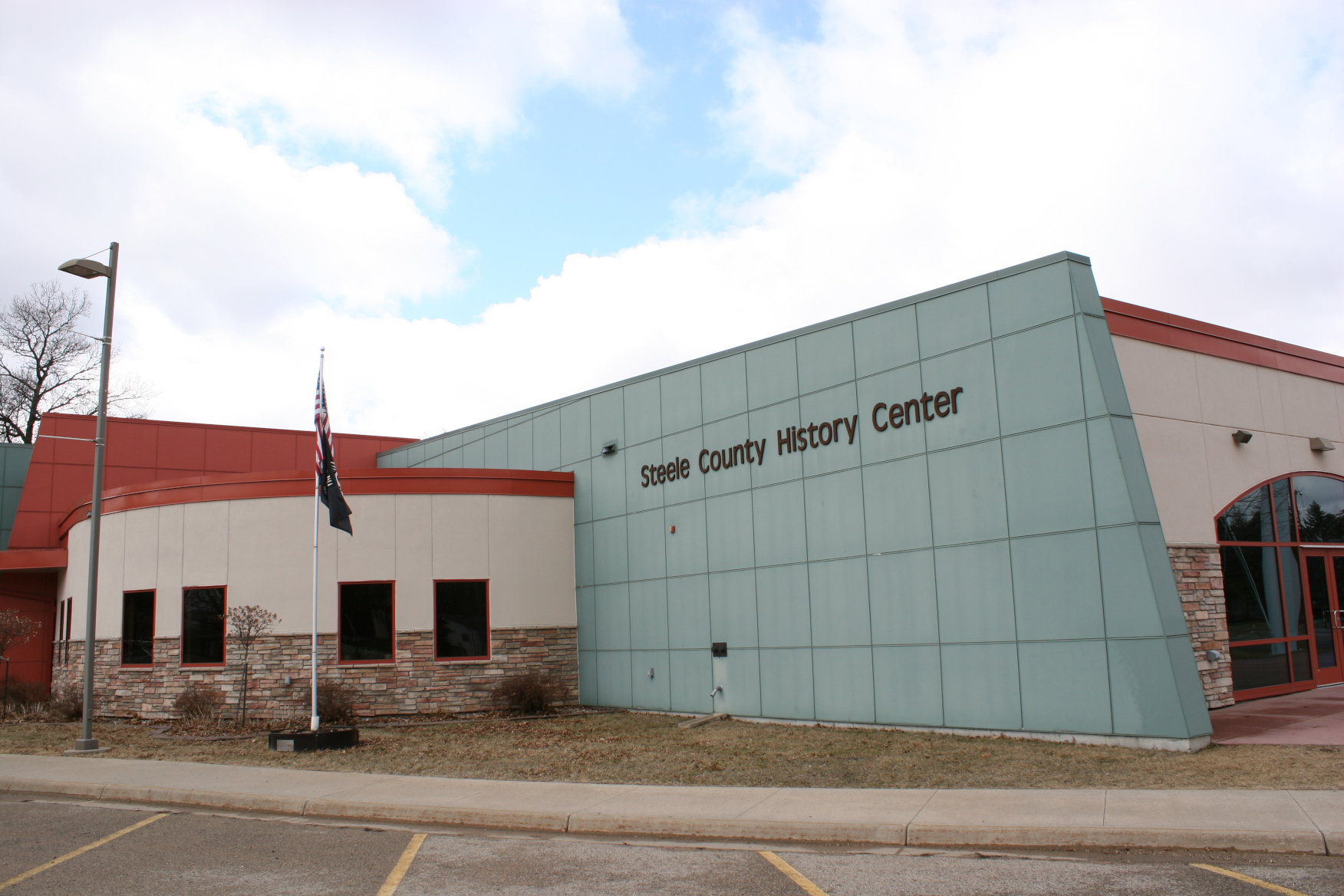
The Steele County History Center in Owatonna, one of my favorite area history centers. (Minnesota Prairie Roots copyrighted file photo 2022)

I’d love to see something like this in rural Minnesota. We have many wonderful museums/history centers, theaters and arts centers that are not necessarily accessible to all because of cost. (Note that most area arts centers offer free admission to their galleries.) Just as getting individuals and families outdoors and into our state parks is important, so is experiencing the arts and learning about area history. Perhaps some day we’ll get there. We’re off to a good start now with the free state park pass program.

FYI: For more information about the Minnesota State Parks Library Program, click here.

© Copyright 2022 Audrey Kletscher Helbling
 

More than just green fried tomatoes November 18, 2021

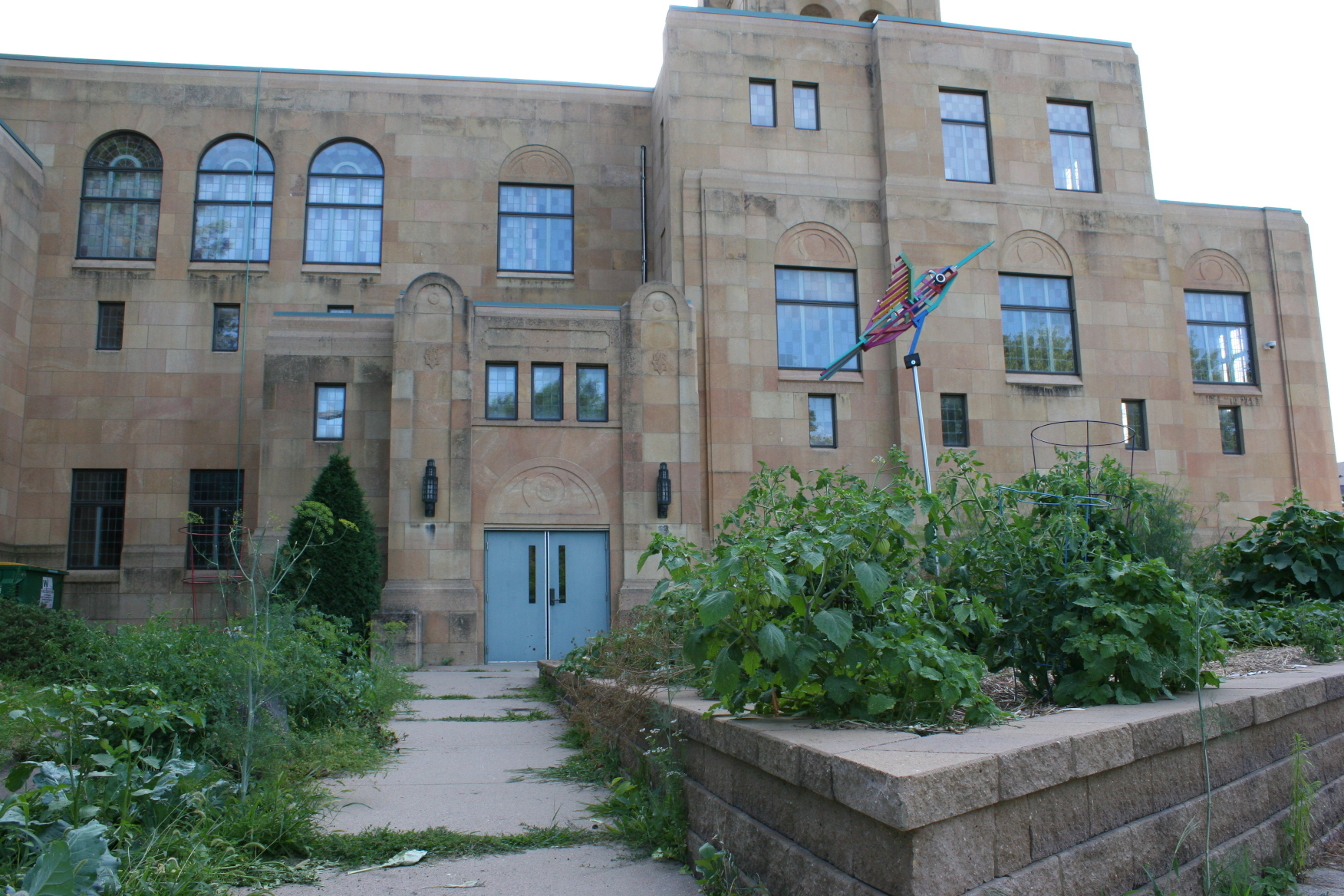
The vegetable garden outside Buckham Memorial Library, Faribault, Minnesota.(Minnesota Prairie Roots copyrighted file photo August 2020)

AT THE END of the growing season a few weeks back, I walked into Buckham Memorial Library and spotted a stash of green tomatoes free for the taking. To say that I reacted with joy might be an understatement.

I felt practically giddy at the thought of preparing green fries, a coveted food I haven’t eaten in years because…I don’t have a garden.

A green tomato in the library garden. (Minnesota Prairie Roots copyrighted photo August 2020)

But, back in the day, my mom planted a sprawling garden, growing vegetables to feed our farm family of eight. Green fries were a summer-time to harvest staple as were the tomatoes left to ripen on the vine.
Items grown in the library garden are free for the taking to the community. (Minnesota Prairie Roots copyrighted file photo August 2020)
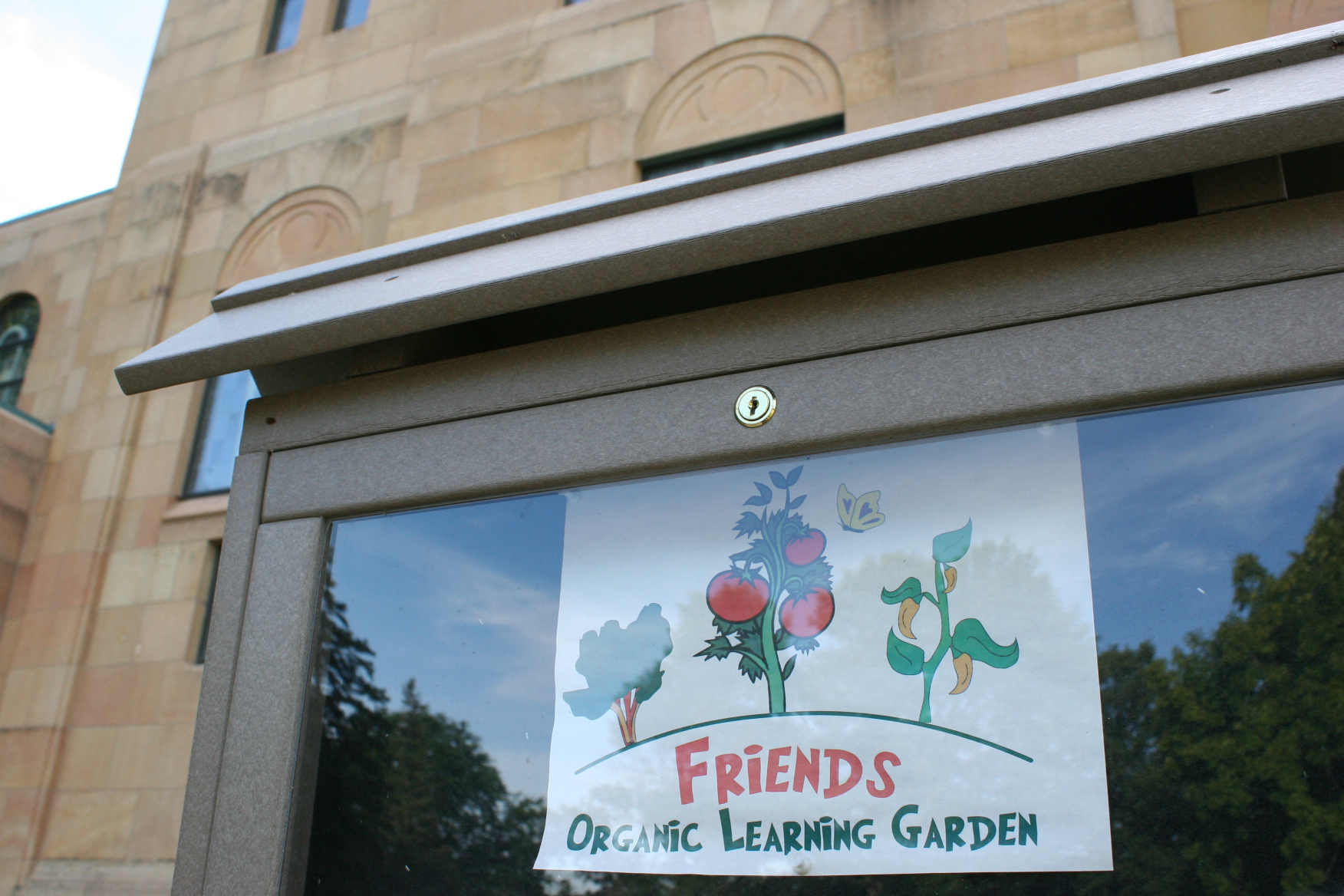
Earlier this summer and fall, when I stopped at The Friends Organic Learning Garden on the library’s east side to look for produce, I noticed choice green tomatoes. I was tempted to pick a few. Who would miss the green orbs? But my conscience prevailed and I walked away empty-handed.
Perfect for making green fries. (Minnesota Prairie Roots copyrighted photo October 2021)

So when those green tomatoes appeared inside the library, I quickly took four, reining in my greedy impulse to grab more.

Step one: Slice the tomatoes. (Minnesota Prairie Roots copyrighted photo October 2021)

The next day, I sliced two of those beautiful green tomatoes, dipped both sides in all-purpose white flour and laid the slices into a hefty cast iron skillet sizzling with butter. Lots of butter. I ground on fresh black pepper, sprinkled on salt and then waited for the slices to brown, flipping and seasoning and adding butter as needed.

Frying the tomatoes to golden brown. (Minnesota Prairie Roots copyrighted photo October 2021)

The result: golden circles of green-fried tomatoes that tasted of sun and sky and earth. And of yesterday’s garden.

As I forked into the savory rounds, I thought of Mom and how she spaced tomato plants evenly in the tilled soil and ringed each with a rusty tin can opened on both ends. The cans protected the tender plants from the prairie wind and cold. I remember pouring water into those cylinder reservoirs, overflow sometimes flooding the surrounding ground. When the plants edged over the cans, Mom removed the weather shields.

To me, green fries rate as much more than a food I enjoy. They are part of my culinary family history. A connection to my now 89-year-old mom who, though no master chef, did her best to feed her family with food sourced from our farm.

TELL ME: Do you have a favorite food tracing to your childhood and that you crave today? I’d like to hear. And, have you ever eaten, or made, green fried tomatoes?

© Copyright 2021 Audrey Kletscher Helbling