Minnesota Prairie Roots

Writing and photography by Audrey Kletscher Helbling

Gather with the Norwegians and the Lutherans this weekend in rural Minnesota June 21, 2013

IF YOU’RE NORWEGIAN (which I’m not), appreciate historic country churches (which I do), rejoice in the preservation of old buildings (which I do) and value worshiping God in a rural setting (which I do), then venture into Monkey Valley this weekend.

If you can’t resist a tasty meal in a church basement (which I can’t), love strawberries (which I do), enjoy good fellowship with the locals (which I do) and delight in a beautiful and historic country church (which I do), drive south of Monkey Valley to Moland on Sunday.

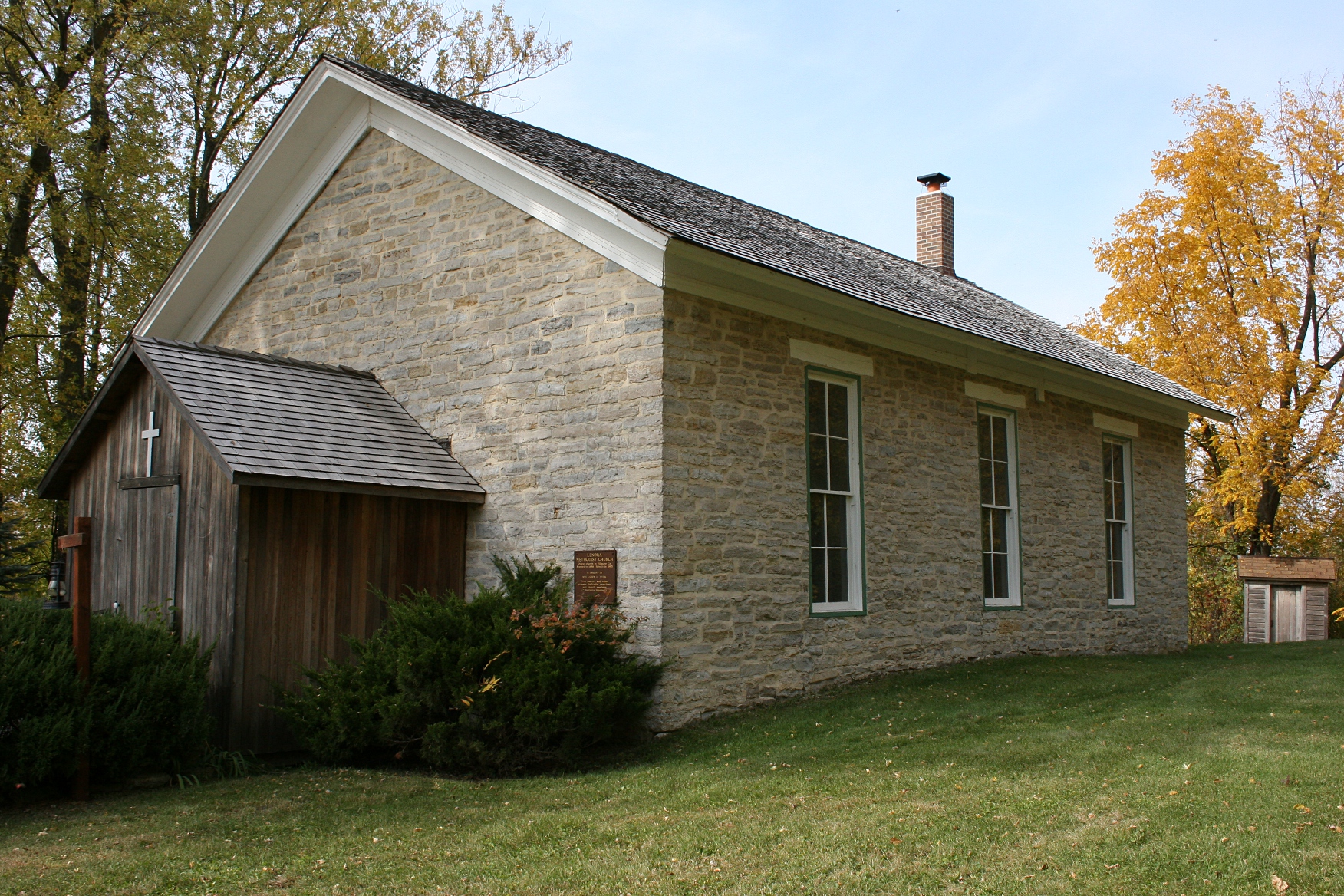
A rear view of the Old Stone Church, a simple structure with three shuttered windows running along each side of the building.

A rear view of the Old Stone Church, a simple structure with three shuttered windows running along each side of the building.

Within miles of each other, two area churches are celebrating this weekend, first with a Norwegian church service in an 1875 limestone church, appropriately called the Old Stone Church and located 2.3 miles south and west of Kenyon along Monkey Valley Road.

A stone's throw from the Old Stone Church, a view of Monkey Valley.

A stone’s throw from the Old Stone Church, a view of Monkey Valley.

The road name alone was enough to draw me to this ethnic worship service three years ago. As one story goes, monkeys escaped here from a traveling circus and fled into the woods. True or not, I’m buying it.

During a worship service filled with music, choir and congregational members sing in Norwegian, "Ja, vi elsker."

During a worship service filled with music, choir and congregational members sing in Norwegian, “Ja, vi elsker.”

To read about the Norwegian worship service I attended in 2010 and to learn more about the Old Stone Church, click here and here and here.

Sunday’s once-a-year worship service begins at 9:30 a.m.

Moland Lutheran Church, a Norwegian Lutheran church south of Kenyon in Steele County, the subject of my post which was Freshly Pressed in July 2010.

Moland Lutheran Church, a Norwegian Lutheran church south of Kenyon in Steele County near Owatonna.

About the time the service wraps up at the Old Stone Church and you’ve finished mingling, you’ll start thinking about lunch, conveniently served at Moland Lutheran Church a few miles to the south and west at 7618 84th Avenue N.E., rural Kenyon, close to where the counties of Rice, Steele, Dodge and Goodhue meet.

From 11 a.m. to 3 p.m., Moland folks will serve pulled pork sandwiches, potato salad, strawberries with angel food cake and/or ice cream, chocolate cake (if the menu is the same as in 2010) and beverages. As church meals go, I’d highly recommend this one for the food, the hospitality and setting.

Be sure to check out the sanctuary and history of this 1884 country church before leaving. Moland reminds me of the Lutheran church I attended growing up in southwestern Minnesota.

The Moland folks serve a generous amount of strawberries with two scoops of ice cream.

The Moland folks serve a generous amount of strawberries with two scoops of ice cream.

To read my 2010 post on the Moland strawberry festival, click here.

My Moland post, “In Praise of Preserving Country Churches,” was featured in WordPress’ “Freshly Pressed” on July 9, 2010. That’s a huge honor for any blogger, to have his/her work selected as among the best of the day from WordPress blogs world-wide. You can read about that honor by clicking here. Last year I was also featured in WordPress and you can read that post about the Faribault Heritage Days Soapbox Derby by clicking here.

The real honors, though, go to all those men and women out there who preserve country churches and serve all those delicious meals in church basements.

FYI: To read about more church dinners/meals, check out the Faribault-based blog, Church Cuisine of Minnesota, by clicking here.

© Copyright 2013 Audrey Kletscher Helbling


A wannabe dairy princess June 20, 2013

The barn where I labored alongside my father while growing up on the southwestern Minnesota prairie. File photo.

The barn where I labored alongside my father and siblings while growing up on the southwestern Minnesota prairie. File photo.

GROWING UP ON A MINNESOTA DAIRY FARM, I’ve always loved dairy products.

Fresh milk from our herd of Holsteins.

Butter and cheese from the bulk truck driver who picked up milk from our farm.

Singing Hills Coffee Shop's delicious maple bacon sundae.

One of my new favorite ice cream treats, a maple bacon sundae from Singing Hills Coffee Shop in Waterville. File photo.

Ice cream from the Schwans man. (My older brother often sneaked the tin can of vanilla ice cream from the freezer and climbed atop the haystack to eat his fill. He failed to remove his spoon, leaving damning evidence connecting him to the ice cream caper. I was too obedient to attempt such thievery.)

Sliced strawberries, cucumbers and Amablu Gorgonzola cheese added to Romaine lettuce made a perfect salad. I topped the salad with lemon poppyseed dressing.

Sliced strawberries, cucumbers and Amablu Gorgonzola cheese added to Romaine lettuce make a perfect salad. I topped the salad with lemon poppyseed dressing. File photo.

My cheese tastes have, thankfully, expanded beyond American and Velveeta, staples of my childhood. I especially favor the blue cheeses made and aged in sandstone caves right here in Faribault and sold under the names Amablu and St. Pete’s Select. If you like blue cheese, this is your cheese.

Cow sculptures outside The Friendly Confines Cheese Shoppe in LeSueur. File photo.

Cow sculptures outside The Friendly Confines Cheese Shoppe in LeSueur. File photo.

I bring up this topic of dairy products because June marks an annual celebration of all things dairy during “June Dairy Month.” This moniker is imprinted upon my brain. I once ran, albeit unsuccessfully, for Redwood County dairy princess.

Krause Feeds & Supplies in Hope advertised the availability of Hope butter and Bongards cheese. File photo.

Krause Feeds & Supplies in Hope advertises the availability of Hope butter and Bongards cheese. File photo.

Steele County, to the south of my Rice County home, is apparently a big dairy county having at one time served as home to more than 20 creameries. One remains, in the unincorporated village of Hope, producing Hope Creamery butter in small batches. The creamy’s organic butter is especially popular in certain Twin Cities metro eateries.

Owatonna, the county seat, once claimed itself to be “The Butter Capital of the World.” That butter capital title will be the subject of an exhibit opening August 1 and running through November 10 at the Steele County History Center in Owatonna. The exhibit will feature the area’s rich dairy history to current day dairy farming in the county. Events will include a roundtable discussion on the dairy industry and, for the kids, butter making and a visit from a real calf.

Notice the cow art on the milkhouse in this image taken this past summer.

Cow art on the milkhouse of my friends Deb and John, who once milked cows in rural Dundas. File photo.

Calves. I love calves. More than any aspect of farming, I loved feeding calves buckets of warm milk replacer or handfuls of pellets. I once named a calf Princess and she became my “pet,” as much as a farm animal can be a pet. Then my older brother—the one who ate ice cream when he wasn’t supposed to—told me one day that my calf had died. I raced upstairs to my bedroom and sobbed and sobbed. Turns out he made up the whole story of Princess’ early demise. She was very much alive.

The vibrant art of Faribault artist Julie Falker of JMF Studio.

The vibrant art of Faribault artist Julie Faklker of JMF Studio. File image.

And so, on this day when I consider June Dairy Month, my mind churns with thoughts of butter and ice cream, of calves and of the dairy princess crown I never wore.

FYI: Faribault area dairy farmers Ron and Diane Wegner are hosting “A Day on the Farm” from 11 a.m. – 2 p.m. this Saturday, June 22. Their farm is located just south of Faribault at 25156 Appleton Avenue. The event includes children’s activities, photos with a baby calf and free cheeseburgers, malts and milk. Event sponsors are the Rice County American Dairy Association and the Minnesota Beef Council. The Wegners’ daughter, Kaylee, is the current Rice County dairy princess.

The Redwood County American Dairy Association in my home county of Redwood in southwestern Minnesota is sponsoring a coloring contest for kids and a trivia contest for adults. Click here for details. 

© Copyright 2013 Audrey Kletscher Helbling
 

Plans underway to repurpose an historic treatment center in Fergus Falls June 19, 2013

Daylight was fading as I snapped this photo of the anchor building on the former Fergus Falls State Hospital campus.

Daylight was fading as I snapped this photo of the anchor building on the former Fergus Falls State Hospital/Regional Treatment Center campus in mid May.

FROM THE EXTERIOR, the sprawling former Fergus Falls State Hospital/Regional Treatment Center presents an impressive and serene presence.

The historic buildings feature some incredible architecture.

The historic buildings feature some incredible architecture.

That marked my initial reaction upon viewing the towering, turreted and massive buildings on this west central Minnesota campus in mid May.

But I expect that the historical use of this place would tell a different story. In 1885, the State of Minnesota commissioned this as the Third State Asylum for the Mentally Ill. The word “asylum,” for me, evokes negativity. Eventually, the complex would also be home to those with developmental disabilities, chemical dependency issues and psychiatric illnesses.

One can only imagine the personal struggles and challenges faced within these walls. In those early days, I imagine treatment was not always the best or the most informed. I do not know this specific to the Fergus Falls center, only from my general knowledge of such large-scale public facilities of decades past.

Eventually, those who lived here were moved into smaller community-based facilities.

Wings connect to the main building.

Wings connect to the main building. These buildings are labeled as Kirkbride buildings after Pennsylvania psychiatrist Dr. Thomas Story Kirkbride who believed in the role of environment in promoting healing among mentally ill individuals.

Today the City of Fergus Falls still owns most of this campus, purchased in 2007. And just last week, according to draft city council minutes published on the city’s website, the Fergus Falls City Council passed a resolution “authorizing the city to enter into a Letter of Intent with Historic Kirkbride LLC as a developer for the Regional Treatment Center, subject to financial disclosure…”  Historic Kirkbride’s estimated $41 million proposal calls for a 120-room first class hotel, several restaurants and 60 market rate apartments.

The planned development is expected to bring temporary construction jobs and an estimated 190 full and part-time positions to Fergus Falls.

Even the individual brick buildings impress.

Even the individual brick buildings impress.

The Kirkbride proposal seems an ambitious undertaking, but one worthy of this beautiful complex of architecturally pleasing buildings and an equally pleasing natural environment. Principals of the Kirkbride team bring experience to the Fergus Falls project with more than two dozen historic renovation projects completed over 33 years, according to presenter Ray Wiley of Georgia-based Historic Properties Inc.

Of course, as in all such projects involving historic buildings and lots of money and government entities and private investors, this isn’t a done deal. If all progresses as planned, though, the 120-room hotel, restaurants, apartments and more are projected to open in December 2015.

From the exterior, I can envision these detailed brick buildings as dorm rooms or housing for a retreat center or even as apartment units.

The complex includes a cluster of two-story brick buildings.

I expect plenty of skepticism exists over whether the planned project presents the best use of the property, will succeed, or will even get off the ground.

The Kirkbride proposal was one of two presented to the council last week. The other, from Twin Cities-based Colonade Design Group, proposed a wellness center serving those dealing with diabetes and obesity (and included a food and nutrition program); a hotel for participants; artisan flats and studios; services for returning veterans; condos; event space; greenhouses; and more.

Click here to read details of the two proposals, public input and more from the June 12 special city council meeting.

Based on my two visits to Fergus Falls in recent years, the Historic Kirkbride project certainly has the potential to succeed. For one, this Otter Tail County seat city sits along Interstate 94, an ideal location to catch travelers in need of a respite. It’s the last sizable town westbound motorists pass before reaching Fargo an hour away. That, though, is not enough.

The community possesses an artsy vibe with galleries and a theatre and historic buildings and arts events in a charming downtown that hugs the Otter Tail River. It’s a college town with Minnesota State Community and Technical College and is also a regional center of commerce and of healthcare.

Developers will need to market those strengths, the historical aspect of the former treatment center, and the natural scenic beauty of this lake region. That’s a given.

Future guests will need to envision Kirkbride’s hotel as a get-away because, otherwise, this will be just one more hotel (albeit an historic one classified as “first class”) in one more town along the interstate.

WHAT ARE YOUR THOUGHTS on Historic Kirkbride’s plans for the former Fergus Falls State Hospital/Regional Treatment Center? Can something like this succeed in Fergus Falls?

The sun sets on this beautiful campus of trees and open space.

The sun sets on this beautiful campus.

FYI: The Fergus Falls complex is open for free public tours on Friday afternoons during the summer. Reservations are required. Phone Maxine and Gene Schmidt at (218) 736-5328. I was, unfortunately, not in Fergus Falls on a Friday afternoon and unaware then of the tours offered.

Click here to read Colliers International listing of the property.

Then click here to read information on the Minnesota Historical Society website.

And click here to find even more info.

© Copyright 2013 Audrey Kletscher Helbling
 

Car stroll June 18, 2013

Filed under: Uncategorized — Audrey Kletscher Helbling @ 7:06 AM
Tags: , , , , , ,

FOR YOU CLASSIC CAR buffs out there and for those of you who, like me, appreciate old cars  for their design, history, color, or whatever, enjoy these photos from the recent Faribault Heritage Days Car Show:

Vintage vehicles line the grassy banks of the Straight River in TeePee Tonka Park, Faribault.

Vintage vehicles line the grassy banks of the Straight River in TeePee Tonka Park, Faribault.

A 1955 Chevy pops with color.

A 1955 Chevy pops with color.

Car art.

Art displayed on a car.

One of two vintage ambulances on display.

One of two vintage ambulances at the show.

One of three young boys who walked down from a church up the hill to view the car show.

One of three young boys who walked from a church up the hill to view the vehicles, including this 1932 Ford Coupe.

The Coupe's license plate.

The Coupe’s license plate.

A 40s Ford.

A 40s Ford.

A car club advertised in a windshield.

A car club advertised in a windshield.

TO VIEW PREVIOUS photos from this car show, click here.

Copyright 2013 Audrey Kletscher Helbling
 

Gathering photos & stories at a Faribault car show June 17, 2013

An idyllic car show setting in Faribault's TeePee Tonka Park.

An idyllic car show setting in Faribault’s TeePee Tonka Park.

SUNDAY MARKED A PERFECT summer-like day here in southeastern Minnesota, ideal for strolling the Faribault Heritage Days Car Show in TeePee Tonka Park.

I love the tree-lined setting along the banks of the Straight River where, on this afternoon, wisps of cottonwood tree seed fluff wafted through the air while I meandered among the vintage vehicles. Fifties music set a period mood.

The truck marking the show.

The truck marking the show.

Although my knowledge of cars is limited, my automotive machinist husband is like a walking encyclopedia of information. He approaches car shows from an automotive perspective. I view them from photographic and storytelling angles.

This ambulance transported patients to the  Tracy Hospital and to other hospitals, including in Sioux Falls, S.D.

This ambulance transported patients to the Tracy Hospital and to other hospitals, including in Sioux Falls, S.D.

For example, why would someone like Kurt Halverson of Owatonna own a 1977 ambulance used by the City of Tracy from 1981-1989 and prior to that, Fergus Falls?

The words that caught my attention on this 1977 ambulance.

The words that caught my attention on this 1977 ambulance. Kurt hopes to drive the ambulance in Tracy’s annual community celebration, Boxcar Days, in September. He recently received an old Tracy ambulance jacket from the Rev. Homer Dobson,pastor at his grandfather’s church.

I was drawn to this particular vehicle by the words “Tracy Ambulance” posted on side windows. (I wrote about Tracy, 25 miles from my hometown, last week on the 45th anniversary of a killer tornado there on June 13, 1968. Click here and then click here to read those posts.)

Kurt, a former EMT, always wanted to own an ambulance. When the Tracy emergency vehicle came up for sale, he jumped at the chance to purchase it. His grandpa lived in the Tracy area, so he knows this small town in southwestern Minnesota well. Owning Tracy’s ambulance is a sentimental connection, he says.

Besides that, this particular ambulance fits into a 7-foot standard garage.

A peek inside Kurt's ambulance. At one time the funeral home in Tracy, like those in many small towns, provided ambulance service.

A peek inside Kurt’s ambulance. At one time the funeral home in Tracy, like those in many small towns, provided ambulance service. Kurt belongs to The Professional Car Society, Northland Chapter.

His geographic familiarity with the Tracy area surprised me. I find few people around here who know towns west of Mankato. We instantly connected as we talked about Tracy and he praised Tracy native Scott Thoma’s book, Out of the Blue, about the killer F5 tornado.

Our connection, though, extended beyond Tracy. Turns out Kurt attended Waseca High School with my niece, Tara, and knows my sister, Lanae. Small world.

For me, these car shows are always more about the stories than about the cars…

BONUS PHOTOS (with more to come in a future post):

a 1930s Ford owned, if I remember correctly, by Kurt's father-in-law.

A 1930s Ford owned, if I remember correctly, by Kurt’s father-in-law.

Because I like to photograph details...

Because I like to photograph details…

On the front of a Road Runner car.

On the front of a Road Runner car.

Lots of trophies to be awarded.

Lots of trophies to be awarded.

© Copyright 2013 Audrey Kletscher Helbling
 

Recycling art in Faribault June 14, 2013

Just a snippet of the art at the Recycled Art Sale, Paradise Center for the Arts, downtown Faribault.

Just a snippet of the art at the Recycled Art Sale, Paradise Center for the Arts, downtown Faribault.

ORIGINAL ART at a fraction of the cost. Check.

One of many pieces of original art for sale.

One of many pieces of original art for sale.

Priced to sell. Check.

A section of the floral painting I purchased.

A section of the floral painting I purchased.

Original painting purchased for $15. Check.

Art of all types is available for purchase.

Art of all types is available for purchase.

If you live anywhere near Faribault and have not checked out the annual Recycled Art Sale at the Paradise Center for the Arts, race down to 321 Central Avenue between noon and 5 p.m. today or Saturday.

I look forward to this sale every year and have found some great pieces, including an original oil on burlap by Mexican artist Jose Maria de Servin and Theodore de Groot LathArt by Austin Productions.

This year I brought home a floral oil painting by P. Willis, whose identity is unknown to me. Pamela? Patricia? Paul? I have no idea. But of one fact I am certain. I love the painting.

Shopping for art.

Shopping for recycled art.

And that’s the type of reaction Gail Kielmeyer, who serves on the Paradise Gallery Committee and the Mural Society of Faribault—sponsors of the Recycled Art Sale—witnesses among many a shopper. “All of a sudden they fall in love with a piece and have to take it home,” she says.

I came very close to purchasing this painting of gladioli. May still buy it.

I came very close to purchasing this painting of gladioli. May still buy it.

I expect that’s exactly what Kielmeyer and co-volunteer Mary Niermann thought as they watched me peruse the Paradise gallery crammed with everything from original pieces to prints to pottery, sculptures, mirrors, ceramics, and even art books. Prices ranged from a quarter for a dish to $400 for four Vietnamese in-laid mother-of-pearl panels which sold on the first day of the sale on Thursday.

Art lovers were waiting in line outside the Paradise for the noon opening of the sixth annual sale. One enthusiast calls the event her “very favorite sale of the year.”

And part of the reason may be the incredibly affordable prices. “A lot of people think original art is expensive and for wealthy people,” Kielmeyer says. Not so at this sale. Prices are kept purposely “priced to sell,” giving art lovers who might not otherwise be able to afford original art (that would be me), the opportunity to own original art.

That de Servin purchased several years ago cost me $7. The de Groot LathArt, $10.

You will find a variety of art from stills to landscapes, abstracts and plenty more priced to sell, many for under $20. Yes. Incredible.

I contemplated buying this barn art.

Lovely rural art.

All of the pieces are donated by people who are downsizing, for example, or remodeling or have had a piece forever. Or the favorite explanation this year heard by Kielmeyer: “We’re pretending we’re moving.”

Some artists come to the sale and buy the art just for the frames.

Some artists come to the sale and buy the art just for the frames. Note the interesting original duo art from Africa, above the frame. Loved it.

So the art some no longer want, need or have space for is now recycled into the hands of happy art lovers like me.

And, as a bonus, the Paradise and the Mural Society make some money. This year organizers hope to bring in $4,000 from the sale, about $1,000 more than last year. The first sale six years ago brought in $800.

Art and more art.

Art and more art.

Interest grows as do the number of donations and the variety of art offered. This year an estimated 1,000 items are for sale. Many had already been sold when I shopped on Thursday evening.  But you could have fooled me. The gallery is still packed with incredible art priced to sell.

BONUS PHOTOS:

For the wildlife lover...

For the wildlife lover…

If you appreciate a still life.

If you appreciate a still life.

For the traveler or the dreamer...

For the traveler or the dreamer…

For those who want to learn more about creating art...books and magazines.

For those who want to learn more about creating art…books and magazines are among the estimated 1,000 items at the sale.

© Copyright 2013 Audrey Kletscher Helbling
 

Dairyland, an old-fashioned drive-in in Fergus Falls June 13, 2013

Filed under: Uncategorized — Audrey Kletscher Helbling @ 7:12 AM
Tags: , , , , , , , , , ,

I’VE SEEN THIS PLACE BEFORE. I just know I have. On my vintage Candy Land board game. Or in a fairy tale perhaps.

The seasonal Dairyland Drive In opened in 1955.

The seasonal Dairyland Drive In opened in 1955. Although I did not ask, I believe the area to the left is the original drive-in, now used for storage and patio dining.

But I haven’t really. Not until this glorious spring evening have I laid eyes on the Dairyland Drive In in Fergus Falls. Now, here I am, photographing this longtime fast food place in the photographer’s golden hour, thrilling in the pop of red against pink-tinged sky, the flash of headlights signaling the end of a Thursday in this west central Minnesota community.

As close as I got to going inside the drive in. I should have gone inside anyway, just to photograph the interior. Photographer's regrets...

This is as close as I got to going inside the drive in. I should have gone inside anyway, just to photograph the interior. Photographer’s regrets…

If I had even a smidgen of space in my tummy for an ice cream treat, I’d be waiting in line at Dairyland for a hot fudge sundae. But my husband and I have just finished a filling meal of sandwiches and fries at Mabel Murphy’s, across Interstate 94, before touring the town. We are not one bit hungry. Too bad.

A vintage menu is propped outside the restaurant.

A vintage menu is propped outside the restaurant.

So on this visit to Fergus Falls, I must content myself with photographing that sweet gingerbread style building which houses Dairyland, established here in 1955 and now in its 58th year of business.

Pat Connelly

Pat Connelly

Soon co-owner Pat Connelly notices me and walks across the street. He first worked at Dairyland at age fourteen, when he started with slicing onions. He and his wife, Jean, bought the place in 1997 from his brother, Chuck, who bought the business in 1982 from Bert Skogmo.

Up until 2001, Dairyland still had car hops. Now it’s drive-through or dining inside or on the patio.

Just another view of Dairyland, with the parking lot to the right.

Just another view of Dairyland, with the parking lot to the right.

The eatery is still known for its homemade onion rings and for broasted chicken, Pat tells me.

Sandwiches are named after locals and those who worked here. Like the K.C. Ham & Cheese after Kelly Chandler. Or the Borstad Burger.

Pat seems especially proud of all the local teens he’s employed—500-plus through the years. When an elementary-aged girl walks by Dairyland, he greets her, tells me she will be coming with Mrs. Johnson’s class on an end-of-the-year class outing for treats. That’s tradition for most Fergus Falls students.

I can’t help but wonder at the memories they’ll cherish of Dairyland… and pass along someday to the next generation.

HAVE YOU EATEN at Dairyland Drive In in Fergus Falls? If so, let’s hear your thoughts. If not, tell us about a similar old-fashioned drive-in you’d recommend. Note that my husband and I were in Fergus Falls in mid May, when these photos were taken and I met Pat Connelly.

© Copyright 2103 Audrey Kletscher Helbling


Memories of the June 13, 1968, Tracy tornado: “Pain, anguish and blood…” June 12, 2013

HE DOESN’T RECALL the details like it was yesterday.

Yesterday, after all, was 45 years ago.

Eric Lantz, 16, of Walnut Grove, shot this award-winning photo of the Tracy tornado as it was leaving town. He often took photos for the Walnut Grove Tribune, owned by his uncle, Everett Lantz. This image by Eric was awarded third place in the 1968 National Newspaper Association contest for best news photo.

Eric Lantz, then 16, of Walnut Grove, shot this award-winning photo of the Tracy tornado as it was leaving town on the evening of June 13, 1968. He often took photos for the Walnut Grove Tribune, owned by his uncle, Everett Lantz. This image by Eric was awarded third place in the 1968 National Newspaper Association contest for best news photo. Copyrighted photo courtesy of Scott Thoma with original copyright retained by Eric Lantz.

But for Mankato resident Steve Ulmen, certain memories of the aftermath of the deadly Tracy tornado of June 13, 1968, stick with him.

He was only 22 then, a college student and a senior member of the Mankato Civil Air Patrol squadron dispatched on a search and rescue mission to Tracy 90 miles away in southwestern Minnesota. They were the first responders, handling crisis management until other local and state officials arrived.

A residential street, once covered in branches and debris, had to be plowed to allow vehicles to pass. Photo by The Tracy Headlight Herald and courtesy of Scott Thoma, Tracy native and author of Out of the Blue, a book about the Tracy tornado.

A residential street, once covered in branches and debris, had to be plowed to allow vehicles to pass. Photo by The Tracy Headlight Herald and courtesy of Scott Thoma, Tracy native and author of Out of the Blue, a book about the Tracy tornado.

Ulmen remembers entering Tracy, feeling overcome by the sheer devastation. The F5 tornado, with wind speeds surpassing 300 mph, killed nine and injured 125. Destruction was massive.

“It looked like we were driving into a dump site, or a burned out slum, or what I would imagine a bombed out city would have looked like after World War II,” Ulmen recalls.

With experience as a hospital orderly, he was assigned to the emergency room at the Tracy hospital—removing victims from ambulances and placing them on gurneys and moving others around.

Some of the injured at the Tracy Hospital. Photo by The Tracy Headlight Herald and courtesy of Scott Thoma.

Some of the injured at the Tracy Hospital. Photo by The Tracy Headlight Herald and courtesy of Scott Thoma.

“There were victims coming in and lying on stretchers even in the hallways, as it was a small hospital,” Ulmen remembers. “Some were suffering from fractures, some from cuts and scratches. All were in one degree of shock or another and needed assistance and someone to talk to them and try and calm them down.

“There was pain, anguish, and blood, that I remember. As long as casualties kept coming in, we stayed on duty.”

The CAP squadron, comprised of cadets (high school age, 18 and under) to supervising senior members, volunteered for several days in the ravaged community. Among other duties, the patrol established a communications system based out of “an old military surplus deuce and a half 4-wheel drive vehicle” equipped with “radios of every description.”

Surveying the destruction at Tracy Elementary School, which was destroyed. Photo by The Tracy Headlight Herald and courtesy of Scott Thoma.

Surveying the destruction at Tracy Elementary School, which was destroyed. Photo by The Tracy Headlight Herald and courtesy of Scott Thoma.

Ulmen remembers the satisfaction he felt in helping those in distress.

Among his memories, Ulmen recalls a particular incident, one he still wonders about now 45 years later. “I was driving either my vehicle or an emergency vehicle, I forget which, and I went through an intersection. The stop sign was bent and twisted from the tornado and wasn’t pointing at the street I was on; it looked like it was pointed at another street. Nevertheless, the local cop saw me run the stop sign, pulled me over, and gave me a ticket,” Ulmen says. “Some thanks for coming all the way from Mankato and volunteering my service to a community in distress. My superiors were not impressed with this either, but I ended up having to pay the ticket as I recall.

“It is funny what you remember from 45 years ago.”

FYI: The community of Tracy is marking the 45-year anniversary of the deadly tornado with special events on Thursday, June 13. Click here to learn more in a post published here several days ago.

To learn more about Steve Ulmen, who served with the CAP for 17 years until he was about 27, click here. Ulmen, who is retired after 34 years of working in the corrections field, is also a published writer. He’s written a western screenplay, later rewritten and published as his first western novel, Toby Ryker. He then published a sequel, Deadwood Days. His most recent works include a book of historical fiction, Blood on the Prairie—A Novel of the Sioux Uprising (actually the first book in the Toby Ryker trilogy), and Bad Moon Arising, a fictional story based on his experiences as the first probation officer in LeSueur County beginning in 1969.

Ulmen and his wife of 42 years, Ida Mae, live in Mankato, his hometown.

© Copyright 2013 Audrey Kletscher Helbling
 

Remembering the June 13, 1968, killer tornado in Tracy, Minnesota June 10, 2013

Eric Lantz, 16, of Walnut Grove, shot this award-winning photo of the Tracy tornado as it was leaving town. He often took photos for the Walnut Grove Tribune, owned by his uncle, Everett Lantz. This image by Eric was awarded third place in the 1968 National Newspaper Association contest for best news photo.

Eric Lantz, then 16, of Walnut Grove, shot this award-winning photo of the Tracy tornado as it was leaving town on June 13, 1968. He often took photos for the Walnut Grove Tribune, owned by his uncle, Everett Lantz. This image by Lantz was awarded third place in the 1968 National Newspaper Association contest for best news photo. Copyrighted photo is courtesy of Scott Thoma with original copyright retained by Lantz.

TORNADO WARNING. Those two weather words, more than any other, cause me to panic. For good reason.

I was not quite twelve when an F5 tornado, with wind speeds surpassing 300 mph, struck the nearby community of Tracy on June 13, 1968. The twister left nine dead, 125 injured and buildings demolished.

I remember, a day or two afterward, our family piling into our Chevy for the 25-mile drive through southwestern Minnesota farm country to view the devastation. Twisted trees. Flattened homes and businesses. Boxcars haphazardly tossed.

This photo by the Tracy Headlight Herald shows a damaged boat and overturned car sitting atop the rubble after the Tracy tornado.

This photo by the Tracy Headlight Herald shows a damaged boat and overturned car sitting atop the rubble after the Tracy tornado. Photo courtesy of Scott Thoma.

A catastrophic scene like that impresses upon a young mind a deep fear and respect for the power of a tornado.

Added to the visual impact was my father’s spotting of the tornado from our farm those many miles to the north and east as he did the evening milking. He thought the twister was much nearer. Decades later, a less severe tornado would hit the farm place, and the community, where I grew up. Two summers ago, severe winds also ravaged my hometown of Vesta.

This Thursday, the residents of Tracy and others will gather to commemorate the 45th anniversary of the Tracy tornado touchdown.

The photo by Eric Lantz illustrates the cover of Scott Thoma's just-published book.

The photo by Eric Lantz illustrates the cover of Scott Thoma’s book.

Tracy native Scott Thoma of Willmar, who wrote Out of the Blue, a book about the Tracy tornado, is among those on the Tracy Tornado Memorial Committee and the coordinator for Thursday’s program. The June 13 event will feature an evening of remembrance and fundraising and a coming together of community.

At 7:03 p.m., the moment the killer twister touched down in Tracy, attendees will honor the nine who died with a moment of silence in Central Park. Thoma will read their names and a bell will toll for each: Ella Haney, 84; Mildred Harnden, 75; Barbara Holbrook, 50; Ellen Morgan, 75; Fred Pilatus, 71; Paul Swanson, 60; Walter Swanson, 47; Nancy Viahos, 2; and Otelia Werner, 75.

Longtime resident, the Rev. Homer Dobson, will “say a few words,” Thoma says.

A photographer for the Tracy Headlight Herald captured this scene at the demolished Tracy Elementary School.

A photographer for the Tracy Headlight Herald captured this scene at the demolished Tracy Elementary School. Photo courtesy of Scott Thoma.

I expect the commemoration will be an emotional event, and rightly so. Even with the passage of nearly five decades, grief lingers. And each time a tornado devastates a community and lives are lost, such as in Moore, Oklahoma (struck, like Tracy, by an F5), memories resurface, fear rises.

Besides remembering the nine, the community will continue raising funds for a new tornado memorial to replace the one falling into disrepair. Over $10,000 have been raised with about $5,000 more needed for the six-foot high black granite monument that will sit along U.S. Highway 14 near the “Tornado Tree” sculpture. That steel tree, built in 1989, replicates the original tornado tree, a gnarled elm that withstood the forces of the twister.

An artist's rendering of the tornado monument. The words on the bench will read "Tracy Tornado Monument" and an engraving of Eric Lantz's tornado photo will be etched below the clock and above the story. Image courtesy of Scott Thoma.

An artist’s rendering of the tornado monument. The words on the bench will read “Tracy Tornado Monument” and an engraving of Eric Lantz’s tornado photo will be etched below the clock and above the story. Image courtesy of Scott Thoma.

The new three-sided marker will feature the story of the tornado and a well-known photo by Eric Lantz etched on the front, according to Thoma. Names and ages of the tornado victims will be listed on another side. And on the back side, visitors will find a stone bench.

On all three sides, a clock will be etched into the stone, stopped at 7:03 p.m., the time the tornado reached the Tracy city limits.

The memorial is expected to be done this summer and unveiled during Boxcar Days, an annual community celebration, on September 2.

In the meantime, there’s still memorial money to be raised and Thoma is doing his part, donating $3 to the monument fund for every book sold. He is selling Out of the Blue from 11 a.m. – 3 p.m. Thursday at the Tornado Tree Memorial along Highway 14. Root beer floats will also be available with all proceeds directed to the memorial.

Thoma will talk about the tornado and his book at 4 p.m. at the Tracy Library. I read and reviewed Out of the Blue a year ago and you can read that review by clicking here.

As is customary with most small town events, there’s a meal involved in the Tracy tornado anniversary. Folks will gather at the fire hall from 5 p.m. – 8 p.m. for a “freewill donation potluck supper,” Thoma says. The Tracy Community Band plays at 7 p.m. across the street in Central Park. And at 8 p.m., somewhere in town, the Tracy Library will show the movie Twister.

If you’re interested in buying a copy of Out of the Blue and/or donating to the Tracy Tornado Memorial fund, email Thoma at scott@thomabooks.com or call (320) 894-6007.

You can also order his book online by clicking here.

If you lived through the Tracy tornado or have any stories to share about the storm, please submit a comment. I’d like to hear from you. Other comments are also welcome.

© Copyright 2013 Audrey Kletscher Helbling


Bringing poetry to recreational trail users in Mankato & I’m in June 9, 2013

NOT EVERYONE EMBRACES POETRY. I get that.

But I appreciate how, in recent years, poetry has become more accessible to Minnesotans. Perhaps, in the process, a few non-poetry lovers have learned to like poetry, to appreciate its value as a form of expression, as an art, as a link to the past, and as a connection to each other and the land and emotions.

These new public poetry forms have surfaced on sidewalks, billboards, and in motionpoems, for example.

My artsy effort to illustrate this post.

My artsy effort to illustrate this post.

And now, in Mankato and North Mankato, poetry will be posted on signs along biking and walking trails as part of the newly-launched Mankato Poetry Walk and Ride.

I am delighted to have two of my poems—“Off to Mankato to ‘get an education’” and “The Thrill of Vertical” selected from among more than 120 submissions for this project supported by business and corporate sponsors and the cities of Mankato and North Mankato.

The contest was open to anyone living within a 45-mile radius of Mankato with suggested themes of CityArt sculptures, Mankato history or culture, nature and/or family and relationships. Lines were limited to sixteen with a maximum of forty characters per line. There were serious and humorous divisions for adults and general poems for several youth brackets.

I tapped into my past, my four years attending college in Mankato—Bethany Lutheran and Minnesota State University, Mankato—to write my winning poems:

Off to Mankato to “get an education”

With typewriter and suitcase
stashed in the trunk of the rusty Impala
alongside my blaze orange backpack,
I plow into Mankato from the farm.

Seventeen years old with barn scent
clinging to clothes, I settle in
with my cheerleader roommate
and her sprawling stereo system.
We share nothing in common,
except a love of art, hers visual,
mine an artful appreciation of words
clacking, line by line, upon paper.

Remember, this was the late 70s, dear readers.

You’ll need to visit Mankato to read my second poem, among the 27 selected during anonymous judging by Doris Stengel, past president of the National Federation of State Poetry Societies, and by Peter Stein, League of Minnesota Poets youth chairperson. The poems are expected to be in place by the end of June.
As a bonus, poets are recording their poems so bikers, walkers and others can pause along the trails and hear the poems read via their phones.

Bonus two, the Southern Minnesota Poets Society, which coordinated the contest, is publishing a chapbook of the winning poems.

I don’t have details yet on where my poetry will be located. But, be assured that when the poems are posted, I’ll head to Mankato to check mine out and some of the twenty-five others like “Everything is Sky Tonight,” “The Sounds of the Red Jacket Trail” and “Night Fishing.”

JUNE 11 UPDATE: My poems will be posted at the intersection of Glenwood Avenue and Division Street and at Hiniker Pond Park in Mankato.

© Copyright 2013 Audrey Kletscher Helbling