A photo I took of a sharing library in Pine River, Minnesota, prompted me to write this essay. (Minnesota Prairie Roots copyrighted photo July 2024)
IF I WAS A REBEL, and I’m not (although a streak of defiance runs through my veins), I’d write a strongly opinionated piece on a controversial topic.
But I don’t like conflict. I prefer status quo to chaos, normalcy to the unexpected. Yet, that is not reality. Life can be easy and hard and good and awful and a whole mix of everything. Sort of like Sideways Arithmetic from Wayside School. I like school. Never liked math.
Nor do I particularly like William Shakespeare’s work with the exception of Romeo and Juliet. Who doesn’t love a love story, even if tragic? Shakespeare’s other writing seems archaic, boring and impossibly unrelatable. I offer no apologies for that view.
I am decidedly a fan of Laura Ingalls Wilder, who certainly has her critics, too. But her detail-rich writing in Little House in the Big Woods, On the Banks of Plum Creek, Little Town on the Prairie and more inspires me as a writer. Plus, I grew up some 25 miles from Walnut Grove, smack dab in the middle of the Minnesota prairie. When you live in a land of wide open spaces, big skies and sweeping winds, you approach writing from a detailed perspective that engages all the senses.
I can’t make much sense of sweeping Absolute Power, which has nothing to do with the senses. Not common sense anyway. Common sense tells me Spider Man is not real. Nor are heroes of the Justice League. Yet, I’d like to call in Superman, Wonder Woman and other superheroes to tackle the threats facing us today, and save the day.
Or perhaps strong-willed orphan Sally Lockhart of The Ruby in the Smoke could clear the smoke obscuring vision. Her experiences dealing with unseemly types qualifies her, in my opinion, to take on anything. Like uncovering lies, aggression, narcissism, manipulation and diversionary tactics. I appoint her to abolish the Department of Government E, or something like that, for starters.
Yes, there’s lots to contemplate. But today I’ve escaped to the sharing library, visually pulled a few books from the shelf to create this essay. And if nothing I’ve written resonates with you, then consider Lunkers Love Nightcrawlers. Head to the lake with a container of nightcrawlers, drop your baited line in the open water or drill a hole in the ice. Fish for answers. Good luck.
#
NOTE: I’ve underlined the titles of books from the sharing library which I’ve incorporated into this essay.This essay is not the piece I wrote for the contest I referenced here last week.
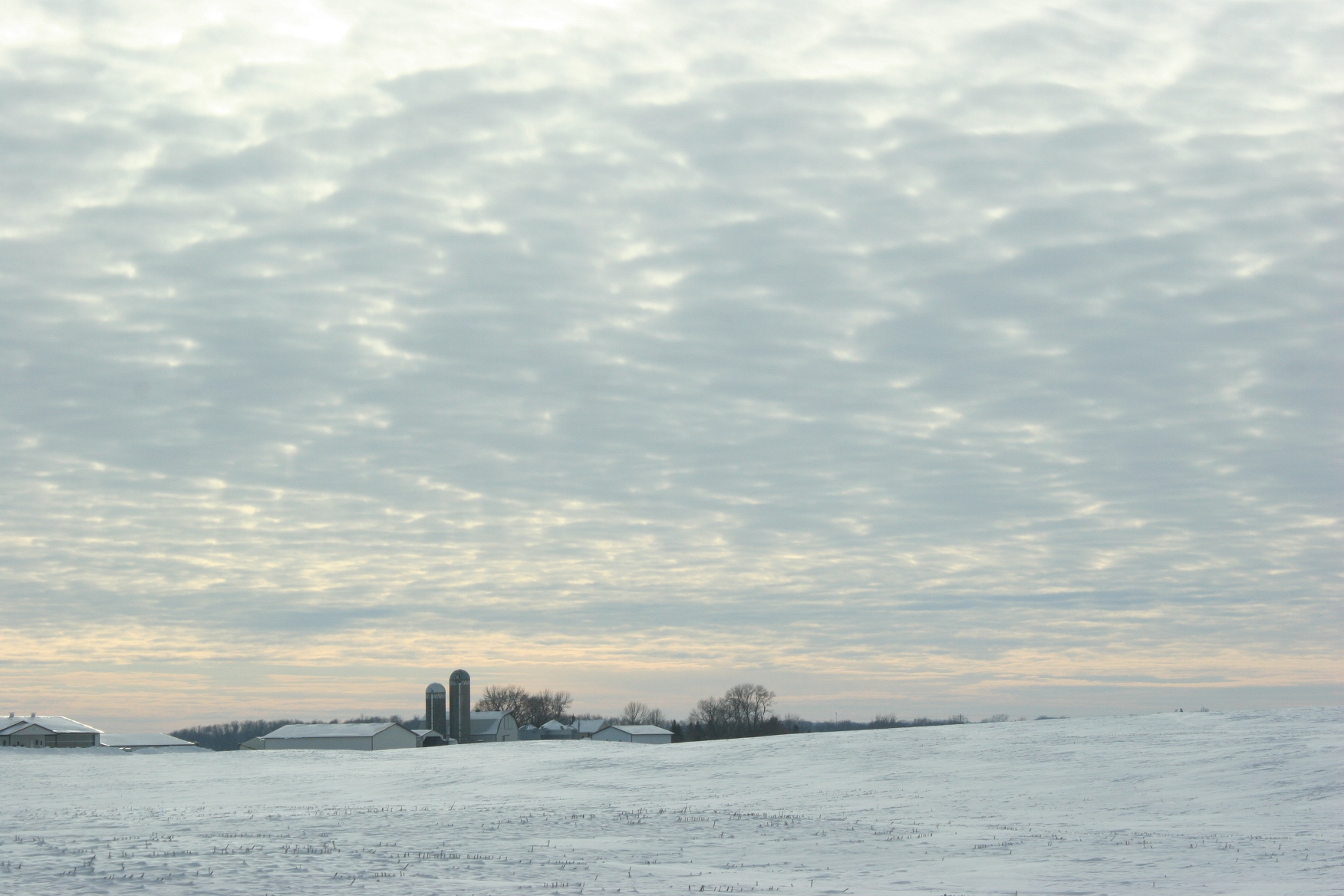
One of my favorite winter photos, of a farm site along Interstate 35 north of Faribault. (Minnesota Prairie Roots copyrighted file photo 2019)
WE MINNESOTANS PRIDE ourselves on our winter hardiness. But this week is testing even the hardiest among us as temps drop into the double digit subzero range. Add the wind and it feels like -30 to -40 degrees outdoors. No wonder extreme cold warnings have been issued for our state. Exposed skin can freeze in minutes. No wonder schools are closing and shifting to e-learning.
A flowering tree, photographed in Faribault in spring. (Minnesota Prairie Roots copyrighted file photo May 2024)
The bright sunshine fools no one. It’s an illusion of warmth. But the sunshine also reminds me that much warmer days are only months away, that winter isn’t forever, that we will get through this cold spell. We always do.
Photographed at the Cathedral of Our Merciful Saviour garden in Faribault. (Minnesota Prairie Roots copyrighted file photo August 2024)
But as I wait and (mostly) shelter indoors, I find myself drawn to floral photos I took during the spring and summer. Images which visually remind me that the snow will melt, the earth will thaw and warm, seeds will grow, flowers will flourish and these frigid days of winter will be only a memory.
Coneflowers, Rice County Master Gardeners’ Teaching Gardens, Faribault. (Minnesota Prairie Roots copyrighted file photo August 2024)
It’s a bit of a psychological endeavor, this convincing myself that spring will be here “before we know it.” Some days, especially during a cold snap, that seems almost laughable. I admit, my appreciation of winter has diminished as I’ve aged. I’m not alone in feeling that way among my Baby Boomer friends, which is likely the reason many flee to warmer climates for a week, or even months, during winter. I say good for them if that’s a feasible option. It’s not for me.
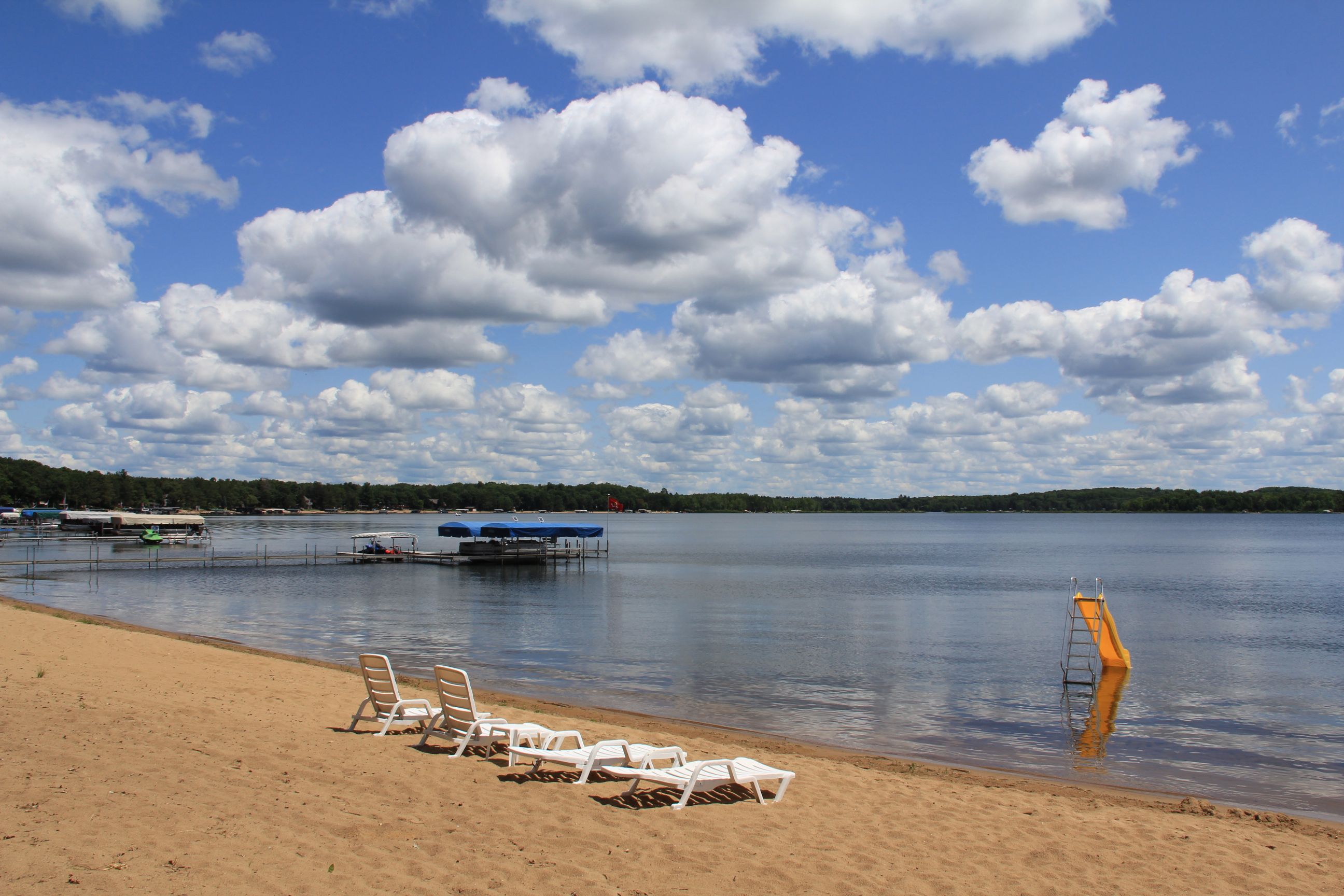
Dreaming of summer days at Horseshoe Lake in the central Minnesota lakes region. (Minnesota Prairie Roots copyrighted file photo July 2023)
So I find ways to cope. Read more. Write more. Walk indoors at the mall instead of outside. And when I do go out, bundle up, clamp a stocking cap on my head without care that it flattens my hair. Eat dark chocolate. Drink tea. Cook soups and chili. Pull out my warmest sweater to layer over a tee and flannel shirt. Connect with friends more. Remember hot summer days Up North at the cabin.
Tulips, one of the first flowers of spring in Minnesota. (Minnesota Prairie Roots copyrighted file photo May 2020)
And never forget that the flowers will unfurl in the sunshine and warmth. Bold, beautiful, vibrant blooms. Lovely. Filling my soul and spirit in a poetically beautiful way that winter can’t.
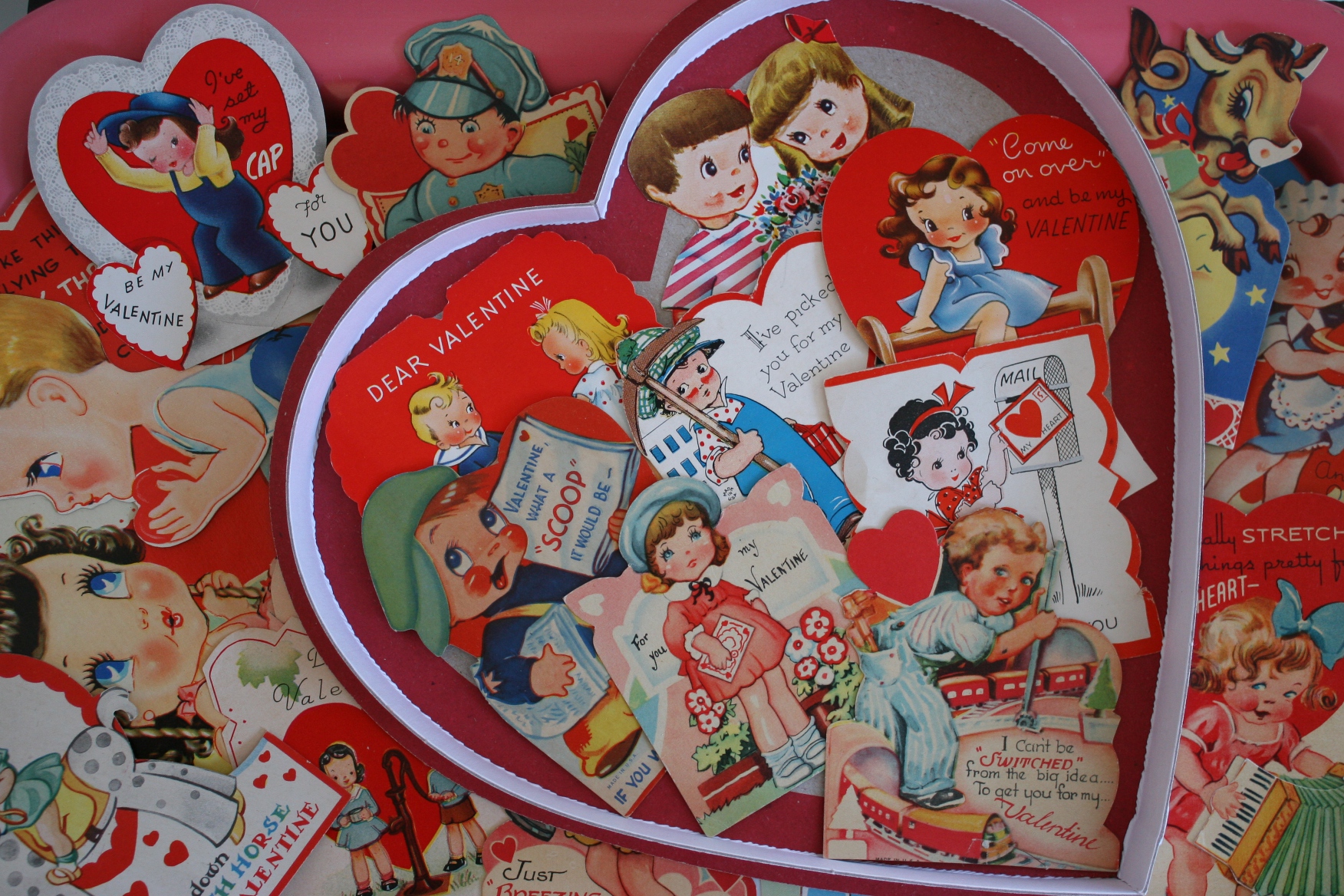
Vintage valentines from my mom’s collection. (Minnesota Prairie Roots copyrighted file photo)
LOVE. It’s today’s buzzword, the reason behind Valentine’s Day, the universal day of love.
But let’s look beyond the romantic version of love connected to this day. Let’s look at who and what we love. Be specific. I’ll start. In the process, I expect you will learn a bit more about me.
First, I love my family. Obvious, right? Specifically, those dearest to me are my core family of Randy, Amber, Miranda, Caleb, Marc, John, Isabelle, Isaac and Everett. I should note here that my grandson Everett was born just a month ago, widening the circle of our family. I am happiest when we are all together. That last happened in August. Distance separates us and I’m talking Minnesota to Wisconsin to Massachusetts.
I also love my friends. I won’t name them. There are too many. But I feel grateful for friendship, including those who have become friends via the blogging world.
A positive message on a SCRABBLE board at LARK Toys, Kellogg, Minnesota. (Minnesota Prairie Roots copyrighted file photo)
TRAITS I LOVE IN PEOPLE
As long as we’re talking people, here are the traits I love, or most value, in individuals. Empathy, compassion and kindness. Honesty. And the ability to listen. I can’t even begin to tell you how often people turn a conversation around to focus on themselves. Just don’t.
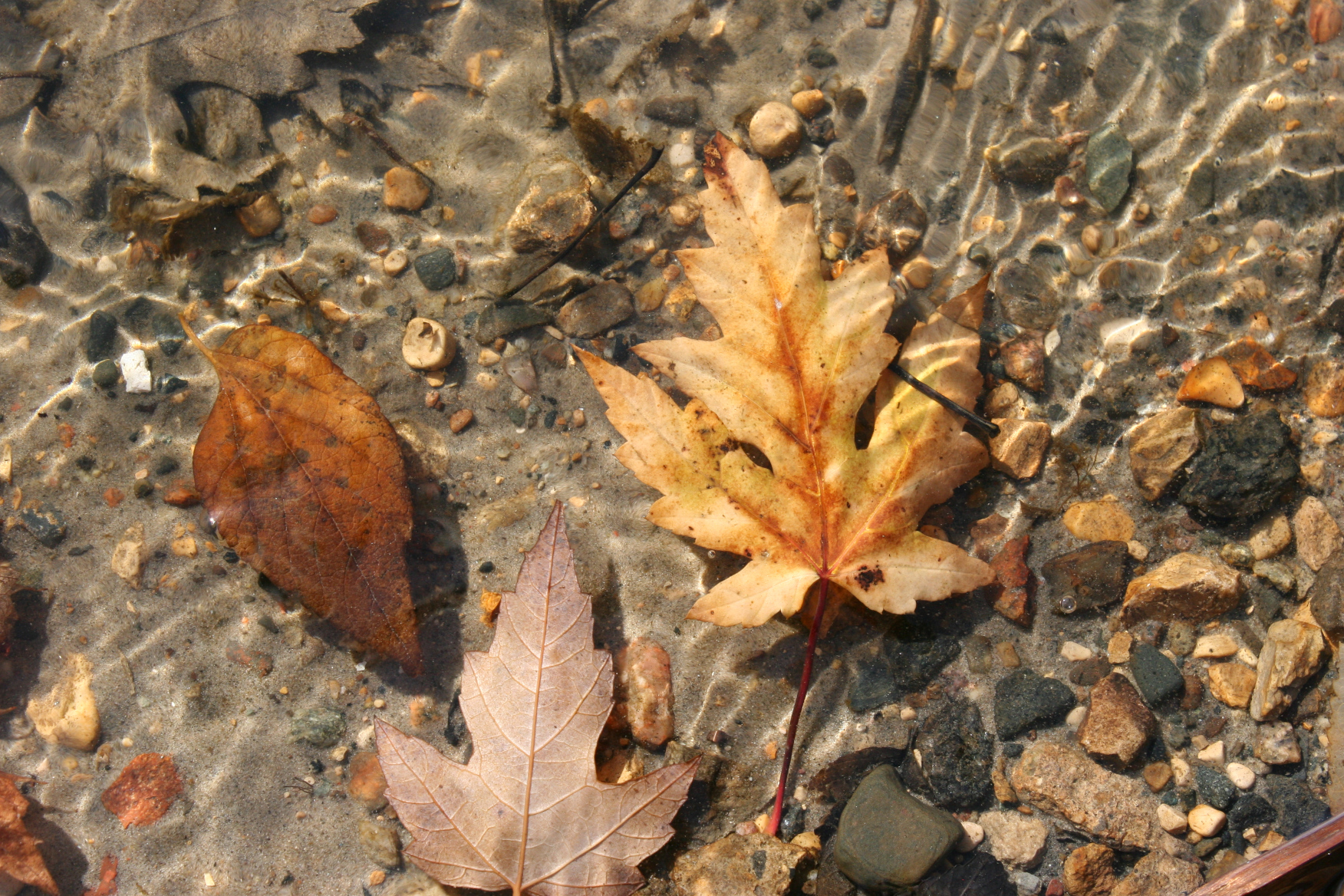
Autumn leaves in the Cannon River at the Cannon River Wilderness Park, Rice County, Minnesota. (Minnesota Prairie Roots copyrighted file photo)
LOVIN’ GREEN, NATURE & MORE
I love the color green. Always have. My eyes are green, a rarity in eye color. Green is also the hue of nature, another reason to like it.
I love when spring pops green in a shade that is indescribably vibrant. But I also love autumn, my favorite season actually, with its flaming treelines, its cobalt skies, its crisp air, its cooler days. I can bring out the flannel shirts then. I love flannel. Fashionista I am not. I could care less if my clothes are “in style” or not. I go for comfort. Flannel and boot-cut blue jeans, which I hear are now back in vogue due to a certain rapper performing during half-time of the Super Bowl. (Did anyone understand what he was saying? I didn’t.)
Rap is definitely not my style. But I love oldies music, oldies meaning songs from the 1970s by groups like Chicago, Bread and the Eagles. I also enjoy listening to contemporary Christian music on Twin Cities-based KTIS radio.
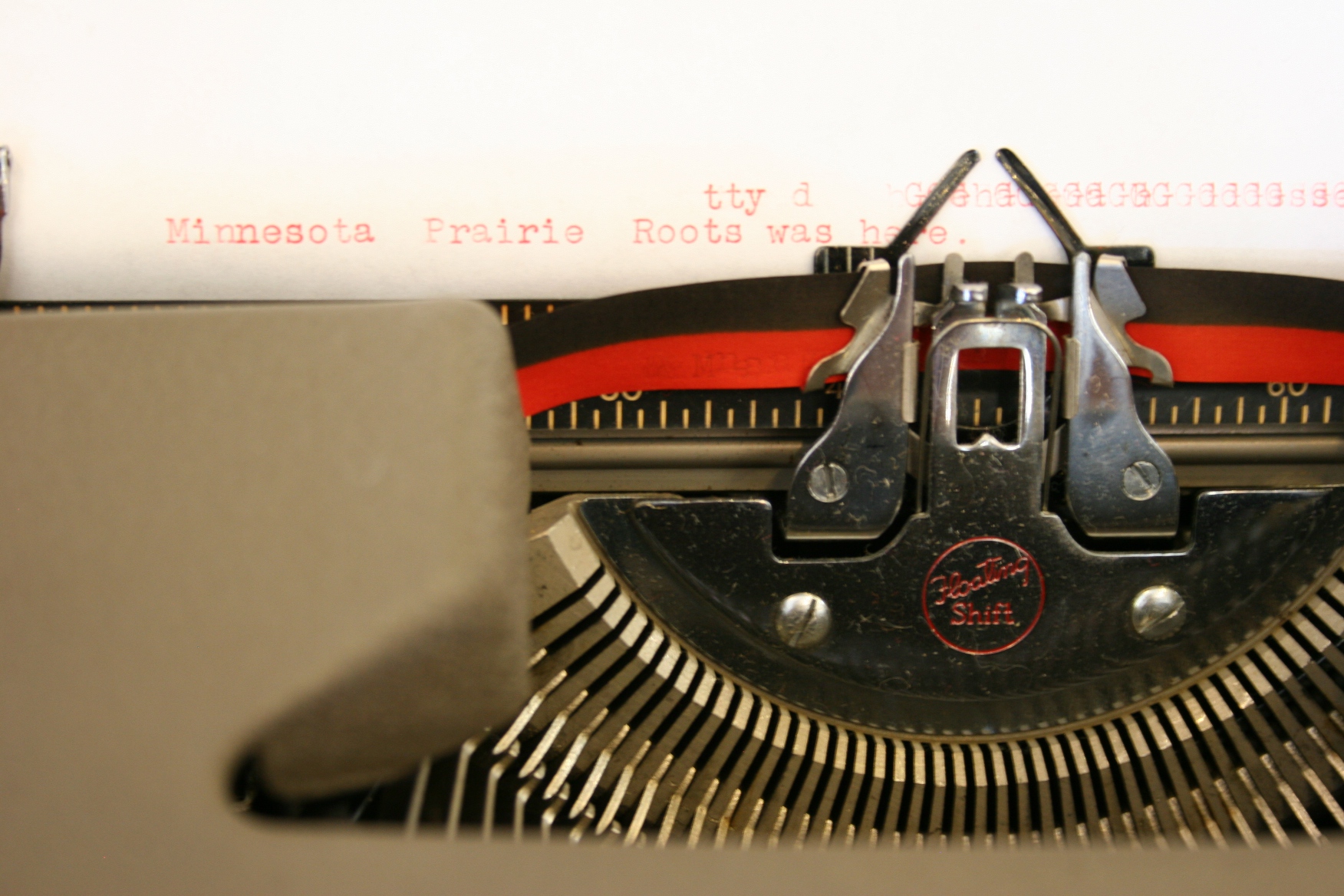
I typed a message on a vintage typewriter in a Hastings, Minnesota, antique shop many years ago. (Minnesota Prairie Roots copyrighted file photo)
FOR THE LOVE OF CREATIVITY
I prefer quiet, though, to music. Quiet allows me to write, which I absolutely love. No surprise there. I love the process, the way words flow and meld into something that becomes something. Something that holds meaning, entertains, fills me with a sense of purpose and accomplishment. I feel the same about photography. I love to read, too, especially mysteries or books that enlighten me.
A serene country scene just north of Lamberton in southern Redwood County in my native southwestern Minnesota. (Minnesota Prairie Roots copyrighted file photo)
LOVIN’ A WHOLE LOT MORE IN LIFE
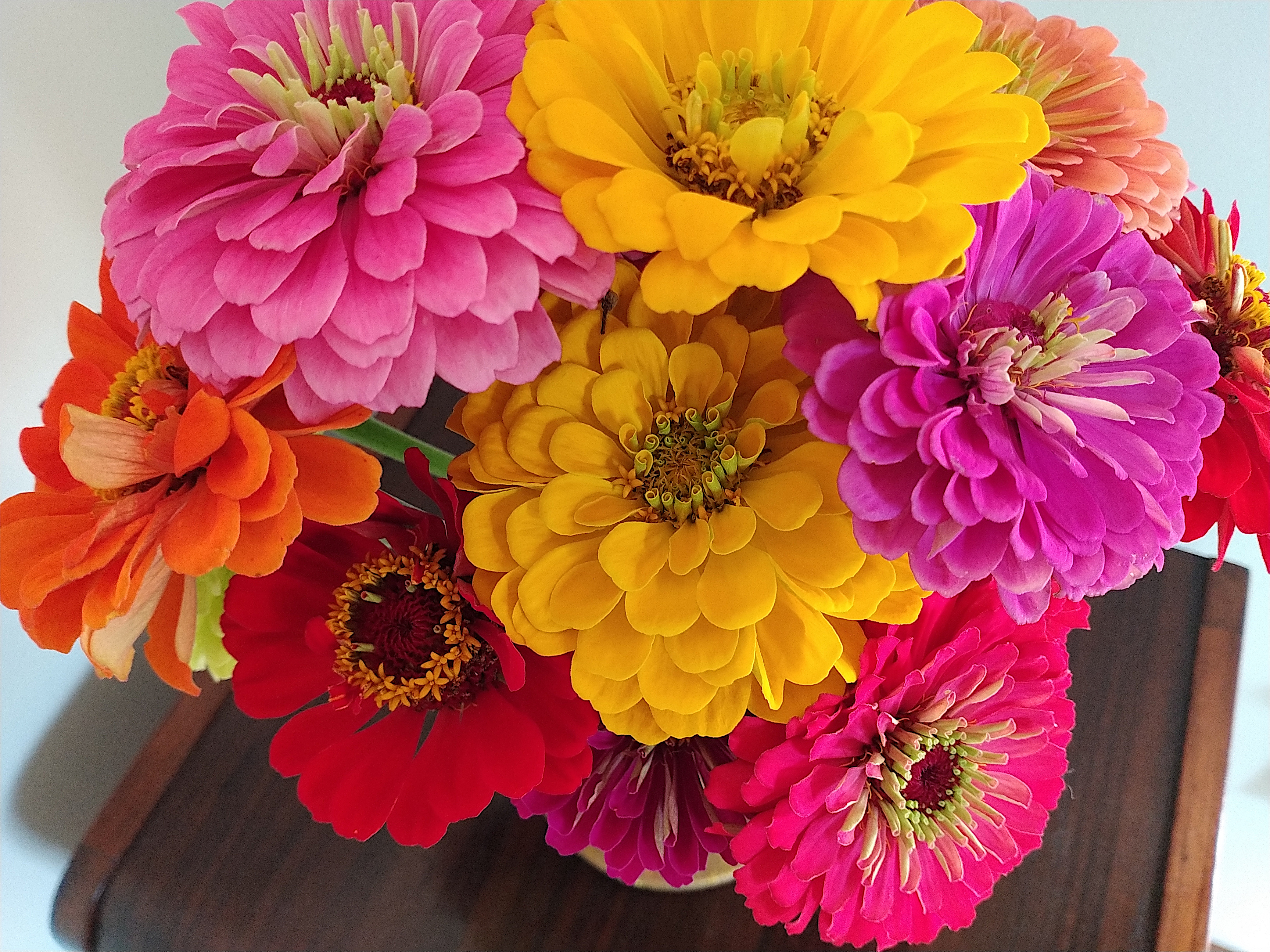
This list of “loves” is getting lengthy, so here are some other random things I love: country drives along back gravel roads, visiting small towns, garage sales and thrift shops, art, time at the Horseshoe Lake cabin (not ours, but belonging to family), campfires, water rushing over rocks, vintage tablecloths and drinking glasses, the prairie, the woods, lilacs and zinnias.
Zinnias, a great cut, easy-to-grow-from-seed colorful flower that reminds me of Mom. (Minnesota Prairie Roots copyrighted file photo)
Whatever and whomever you love (feel free to share a few of your “loves” here), may you feel embraced by love, especially today. Happy Valentine’s Day!
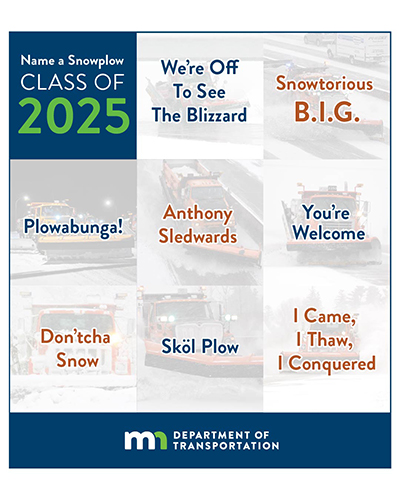
Polls closed last Friday with 23,400 people voting for up to eight names on a list of 50. That was narrowed from some 7,300 submissions.
A snowplow in my native southwestern Minnesota will now bear the name spun off from a line in “The Wizard of Oz” starring native Minnesotan Frances Gumm, aka Judy Garland. Her hometown of Grand Rapids (Minnesota, not Michigan) is located in MnDOT’s District 1 on the northeastern side of our state. A plow in that region will be tagged SKOL Plow, a tribute to the Scandinavian cheer chant for the Minnesota Vikings. That name came in at number seven in the polls.
Here in southeastern Minnesota, Plowbunga! will now mark one of MnDOT’s big orange snowplow trucks. Does that reference Cowabunga! of “The Teenage Mutant Ninja Turtles” fame? I think so. My girls loved those cartoon superheroes, turtles in a half shell. Plowabunga! was the third top vote-getter.
Coming in second was Snowtorious B.I.G., which totally baffled me. So I googled and found connections to snow, drugs and sweaters.
Anthony Sledwards also had me stumped. Turns out Anthony Edwards is a star basketball player for the Minnesota Timberwolves. That explains it. I don’t watch sports. Travel in the Twin Cities metro and you will soon see Anthony Sledwards plowing snow.
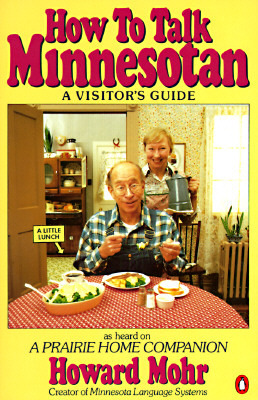
The original version of “How to Talk Minnesotan,” published in the 1980s, is a primer to Minnesota language. (Book cover sourced online)
The fifth and sixth place winners, You’re Welcome and Don’tcha Snow, honor Minnesota Speak, phrases (or versions of) spoken by Minnesotans. Don’tcha know?
Rounding out the top ten is I Came, I Thaw, I Conquered, which will go on a plow in District 7, South Central Minnesota.
So there you go. How did I do with my picks? Three of my eight choices—We’re Off to See the Blizzard, SKOL Plow and Catch My Drift (#9 and which I really really like)—finished in the top ten.
I’m not sayin’ take me to Jackpot Junction, Mystic Lake, Treasure Island or any other casino in Minnesota because I’m not that good at picking winners. But I am sayn’ this annual contest is a whole lot of fun and certainly breaks up a long Minnesota winter.
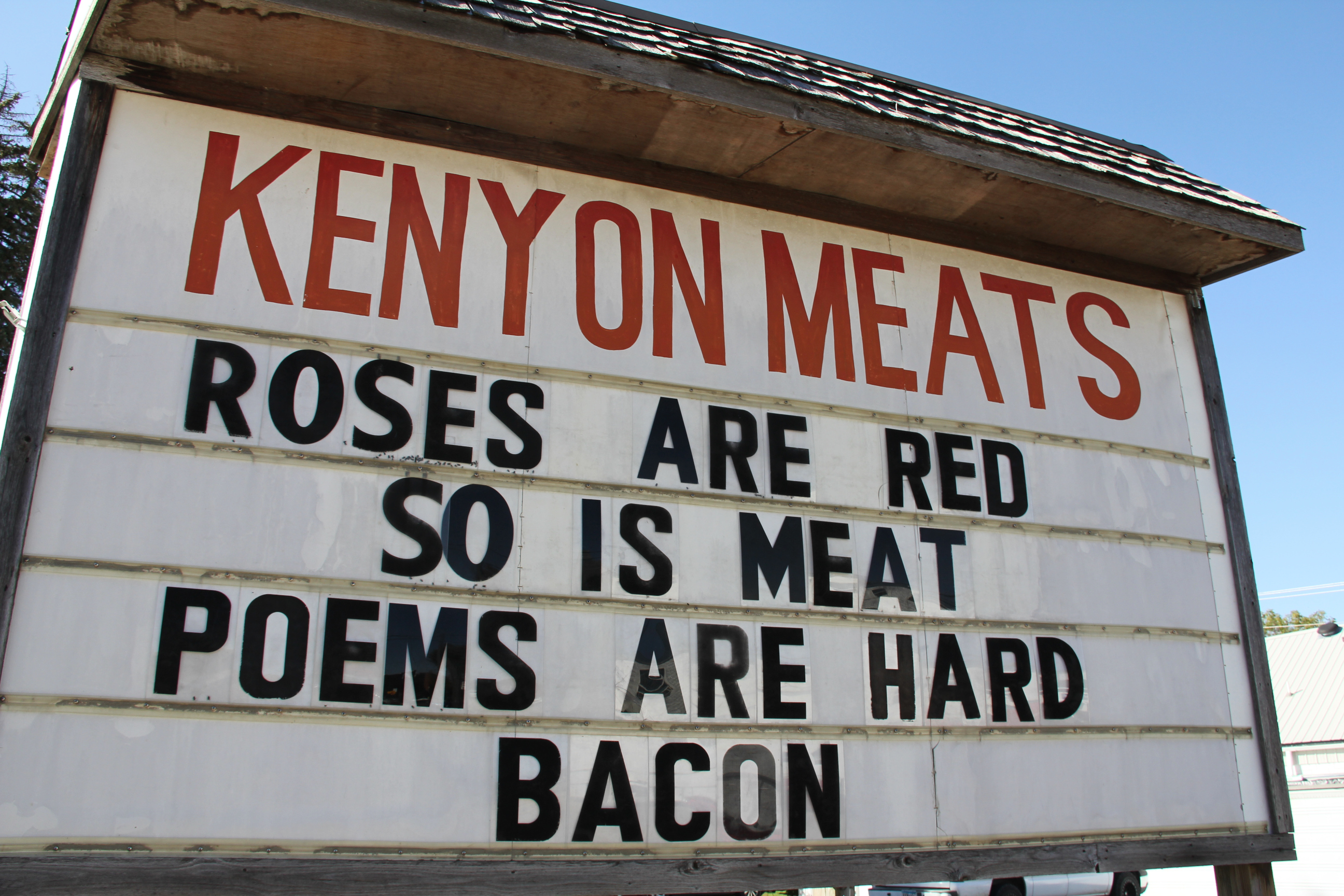
A poem on a sign outside Kenyon Meats. (Minnesota Prairie Roots copyrighted photo September 2024)
ROSES ARE RED/SO IS MEAT/POEMS ARE HARD/BACON.
It’s not exactly the most romantic version of the traditional ROSES ARE RED poem. But it’s certainly one of the most humorous spin-offs I’ve seen. I love this poem spotted last fall outside a small town southern Minnesota Meat Market, Kenyon Meats.
Roses my husband previously gifted to me. (Minnesota Prairie Roots copyrighted file photo)
It seems appropriate to share this poem now, during Valentine’s week. Maybe your sweetheart would welcome a package of jerky from the meat locker. Or your poetic version of ROSES ARE RED with a side of bacon.
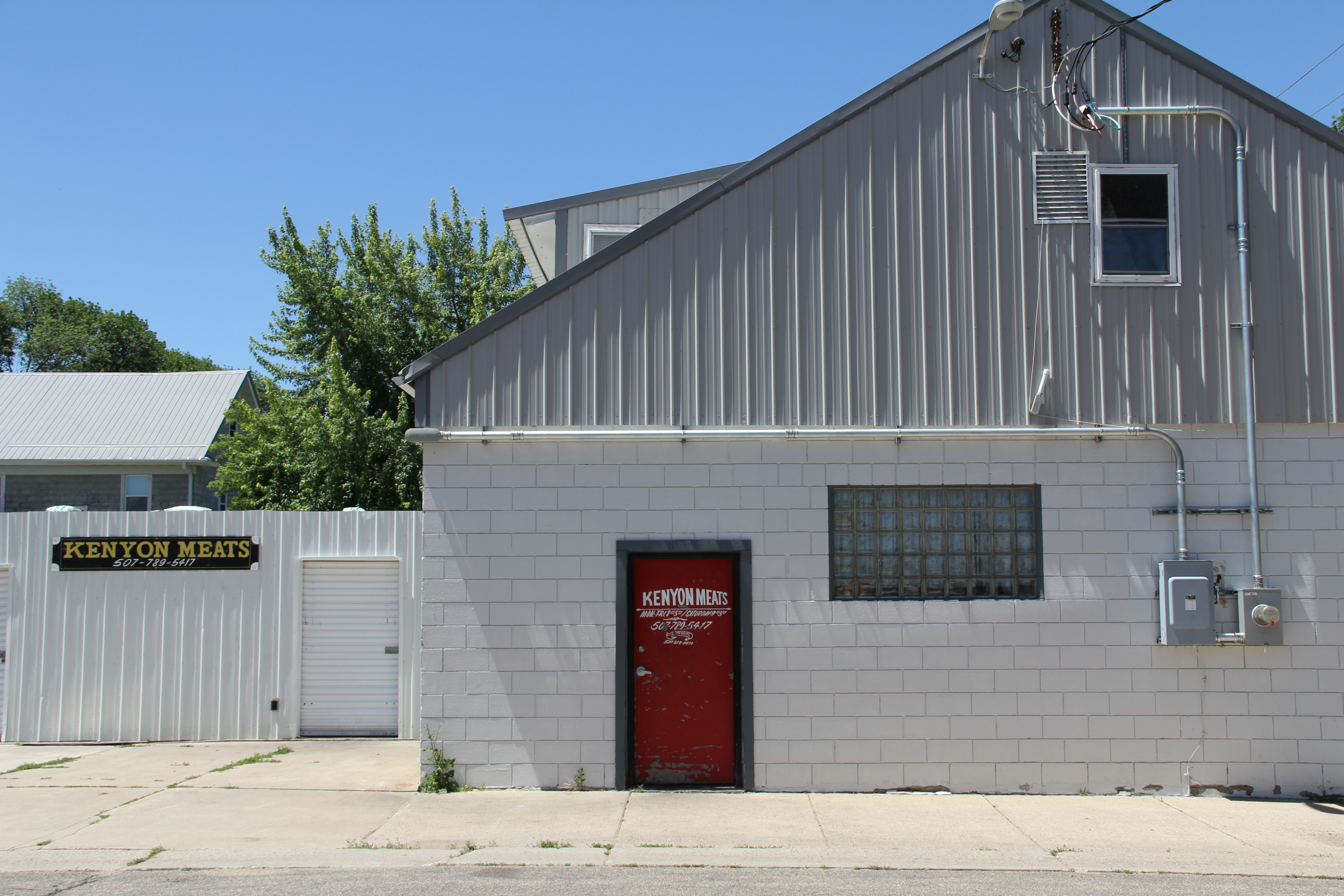
The unassuming building that houses Kenyon Meats. (Minnesota Prairie Roots copyrighted photo June 2024)
The market sits just off Minnesota State Highway 60, a major route running right through the heart of Kenyon’s several-block business district. The roadside messages posted on the meat market sign are enough to turn heads. And elicit laughter.
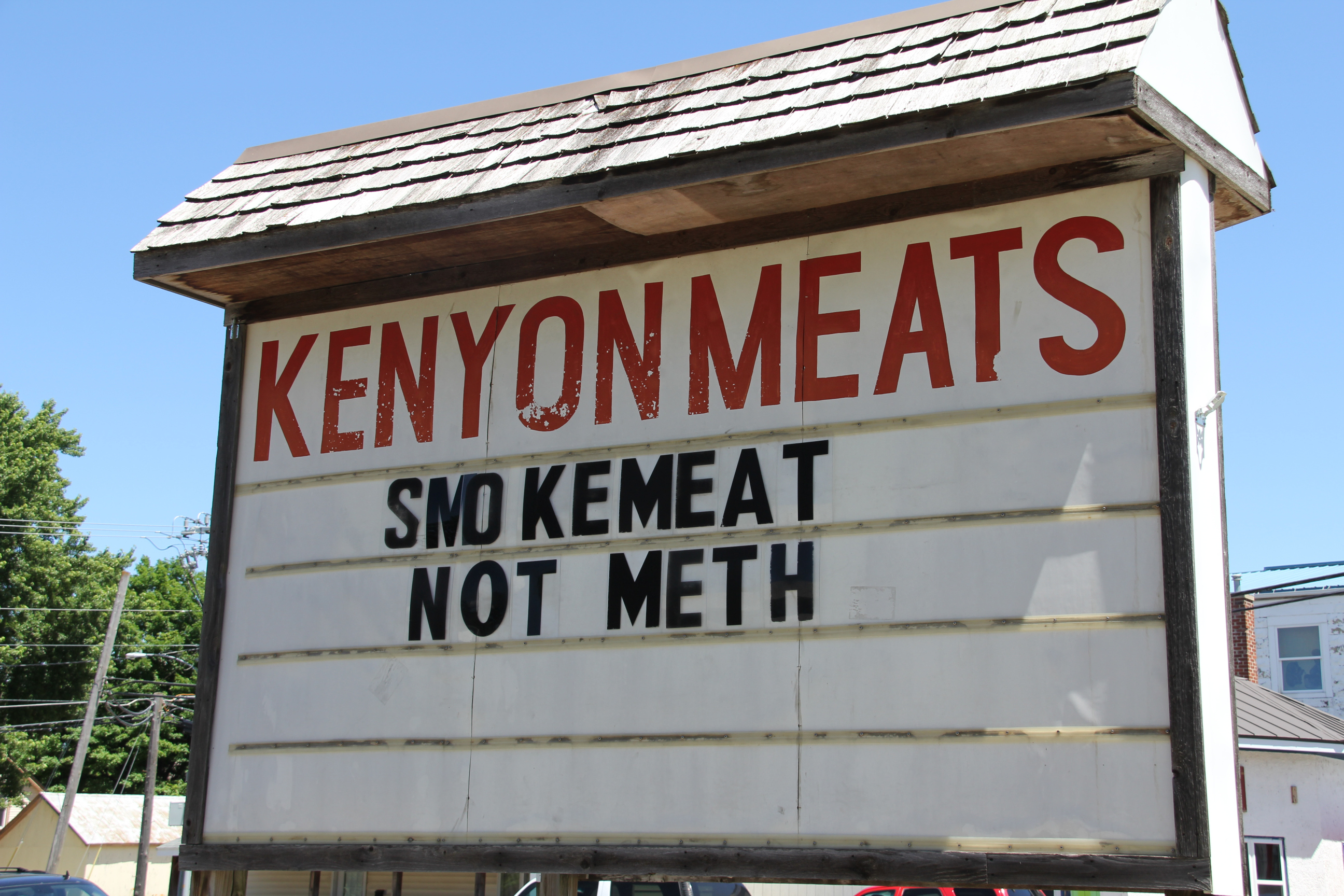
More humorous signage… (Minnesota Prairie Roots copyrighted photo June 2024)
I’ve also read this on the two-sided Kenyon Meats sign: SMOKE MEAT/NOT METH.
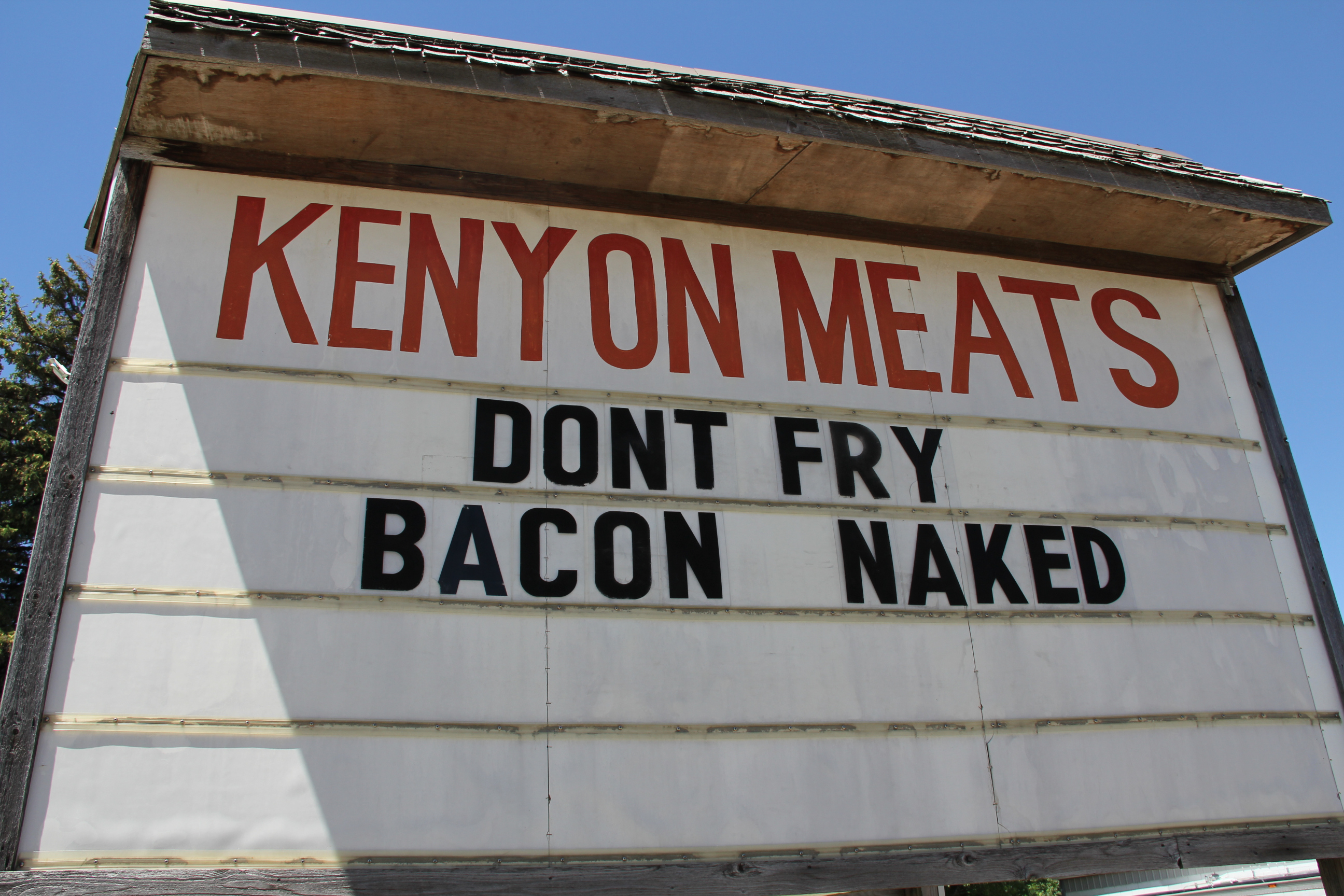
And more words to make you laugh. (Minnesota Prairie Roots copyrighted photo June 2024)
And then there’s this one: DON’T FRY/BACON NAKED.
Obvious good advice aside, I truly appreciate the attention-grabbing humorous writing. Short enough to read while driving by. Clever. Funny. What a great marketing tool, especially with a meat reference included in the wordage.
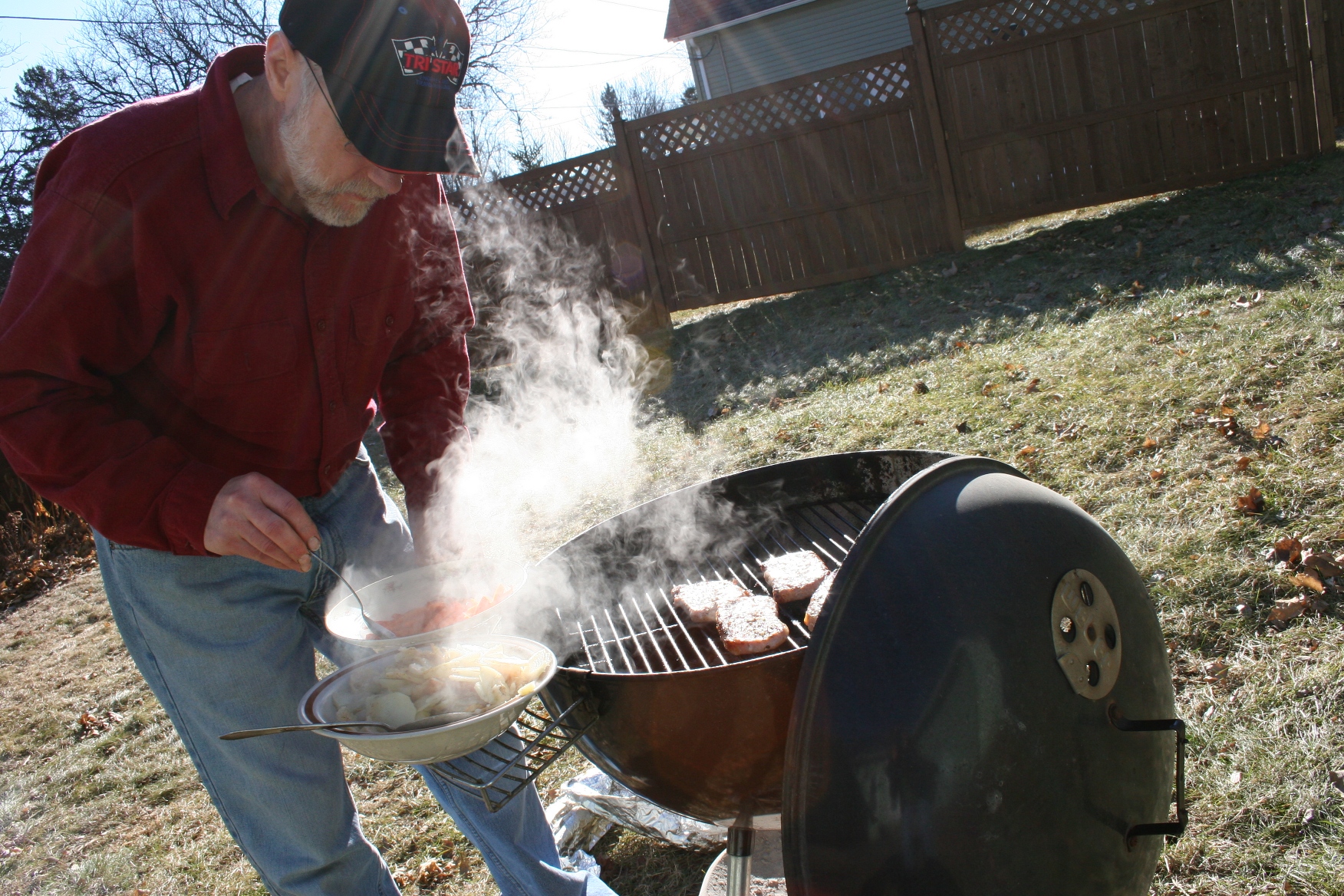
Randy grills meat and vegetables year-round, yes, even in the Minnesota winter. (Minnesota Prairie Roots copyrighted file photo)
The words drew me to photograph the scene while my husband, who likes home-grown meat markets, stepped inside to buy flavored brats. Randy loves meat (and grilling meats) as much as I love vegetables.
(Minnesota Prairie Roots copyrighted file photo)
Ah, love. It’s in the air this week. From poetry to flowers to chocolate to dinner out, love prevails. Even at the meat market.
My fiction, creative nonfiction and poetry has published in all these volumes of The Talking Stick, plus volumes 32 and 33 not pictured here. (Minnesota Prairie Roots copyrighted file photo)
WITH ONLY WEEKS until the deadline for an annual writing contest, I am stretching my mind to come up with short stories and poetry that will please not only me, but also the editors of a Minnesota-based literary anthology. It’s not easy, this creative writing. Yet, I enjoy the challenge.
I can’t always explain from whence my fictional stories spring. I’ve written some really dark stuff that has landed me publication and sometimes prizes. Stories with undertones of darkness and violence. Nothing like I’ve experienced in real life, although certainly I’ve faced plenty of dark and trying days.
When I read my second place winning fictional story, “Dear Mother,” at last fall’s Talking Stick 33—Earth Signsbook launch party in northern Minnesota, I qualified my reading with “I don’t know where this dark story came from.” It was implied that the main character killed her abusive mother. The writer who followed me as the first place winner in fiction also wrote a dark story. I don’t recall if Tara or some other writer explained that, in order to reach the light, we need to go through darkness. That resonated with me.
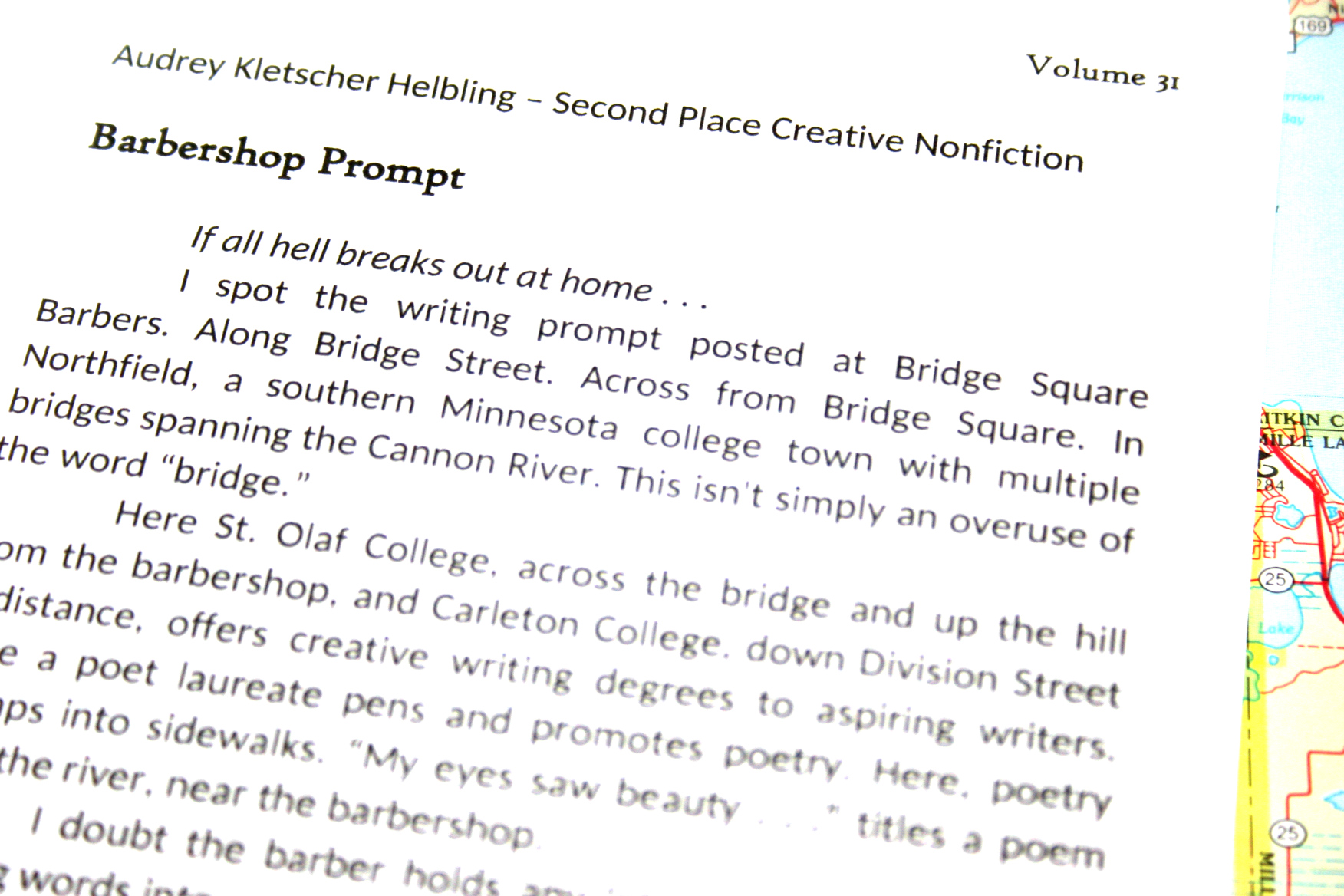
The beginning of “Barbershop Prompt,” published in Talking Stick 31–Escapes. (Minnesota Prairie Roots copyrighted file photo)
I’ve completed the initial draft of my first piece of fiction for this year’s contest. It, too, includes some dark elements. The community calendar in my local newspaper prompted the story, which I realize may seem rather odd. But, hey, inspiration can strike in the most unlikely of places. A previous work prompted by a sign at Bridge Square Barbers in Northfield earned me a second place in creative nonfiction in 2022.
Now three years later, with the printed community calendar of events lying on my office desk, I glanced from newspaper to computer screen as the idea of a story began to take shape. Once I finished the intro, words began to fly (OK, admittedly not always) from my brain to the keyboard to the screen. The draft is saved, awaiting a second look in a few days.
This sharing library in Pine River is inspiring my next creative work. (Minnesota Prairie Roots copyrighted photo July 2024)
Now I’m on to my next piece of writing. A photo I took of a sharing library (like a Little Free Library) in Pine River is serving as my inspiration for a story that has yet to unfold. But I see the possibilities in the many love-themed/titled books shelved inside that library adorned with a Peace/Love/Books sticker.
Romeo and Juliet by Shakespeare. Lunkers Love Nightcrawlers, author unknown to me. Tuesdays with Morrie by Mitch Albom, packed with life lessons, including that of love. Sin Killer by Larry McMurtry, a book of adventure, humor and romance on the American frontier. And then Absolute Power by David Baldacci, about a President “caught” with a billionaire’s wife. That title seems so relatable to today. Absolute power. But writing contest rules call for no political or religious rants, meaning I will need to steer clear of politics.
And so I’ll see where this idea goes. If a plot develops in my mind, if a story flows into something that may, or may not, be dark.
Former Faribault Daily News reporter Pauline Schreiber photographed these Faribault POW camp barracks shortly before they were torn down in 1990. (Photo courtesy of the Rice County Historical Society)
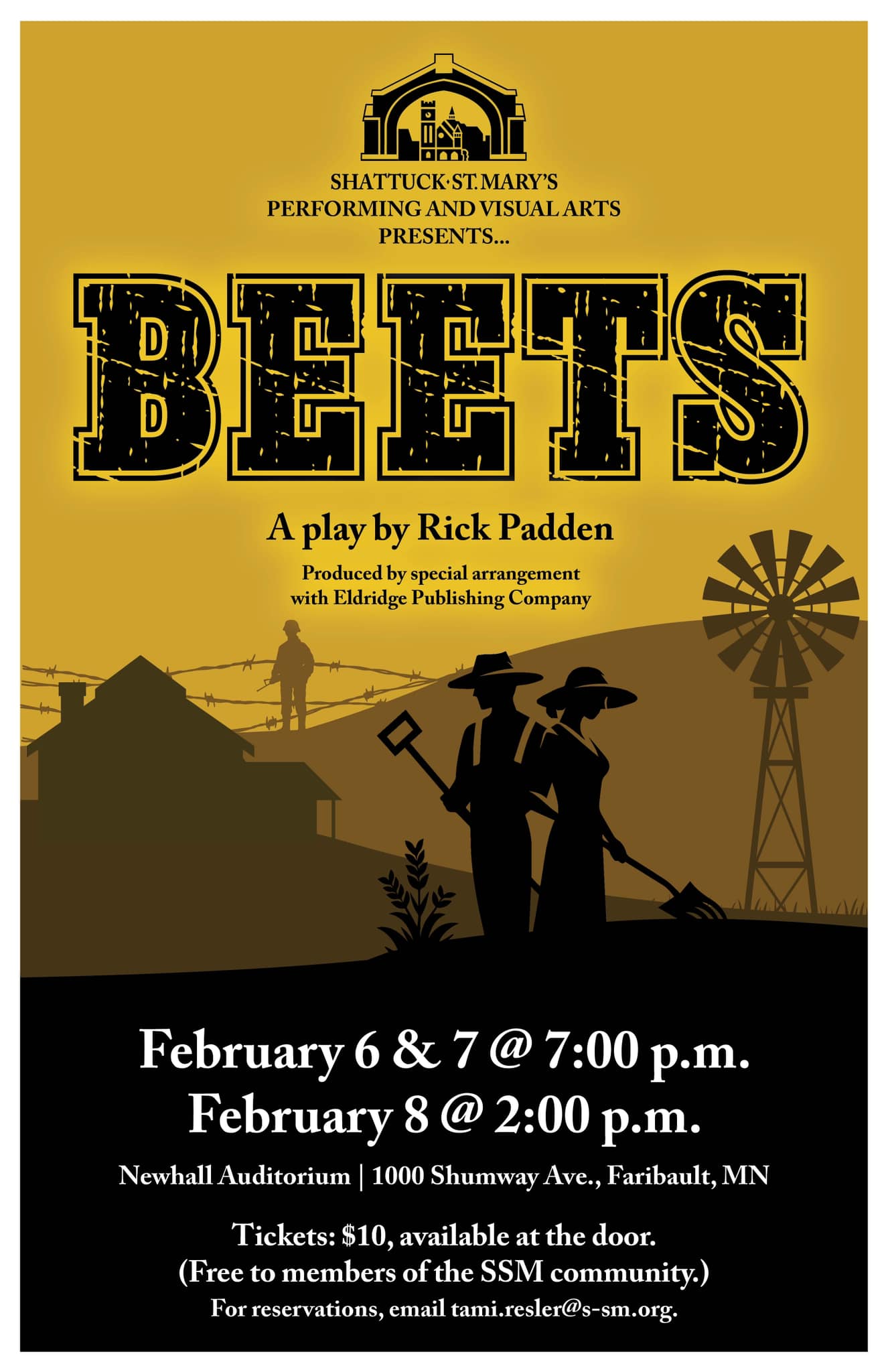
A promo for “Beets.” (Credit: Shattuck-St Mary’s School Facebook page)
Thursday evening, I sat in the sparse audience of the historic Newhall Auditorium on the campus of Shattuck-St. Mary’s School, a private college prep school on Faribault’s east side, watching a story unfold in the theatrical production, “Beets.” An incredibly talented nine-member student cast immersed themselves in the roles of a farm family, German POWs, guards and a family friend to share a bit of history. And much more.
This play about POWs working on the Hunt family’s sugarbeet farm is more than a retelling of history. It is also about relationships, fear, culture and love. It is about the perceived differences that divide us and about the commonalities that unite us.
This is a play for our times. In a nation today divided by politics, by fear, by hatred and animosity, “Beets” is absolutely relatable.
As the storyline evolves, conflicts arise. Farmer Fred Hunt spews his hatred of the Germans. His wife, Isabelle, exudes compassion and love. And their daughter, Anna, settles somewhere in between, leaning initially toward dislike and distrust of the German POWs who have come to work her father’s land. Anna’s thoughts often turn to her brother, Jake, fighting the Germans abroad.
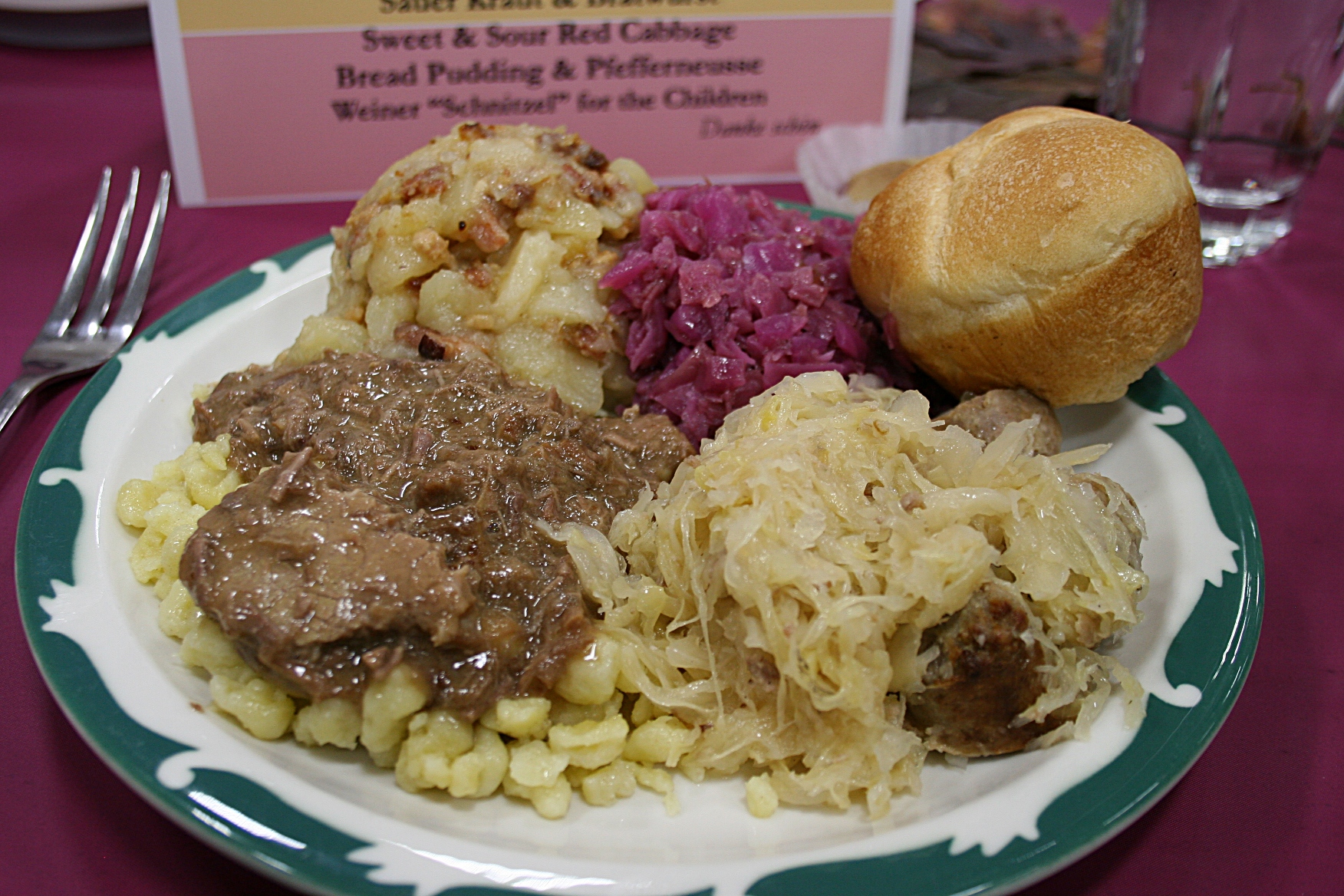
A German meal: sauerbraten and spaetzle on the left, German potato salad, sweet and sour cabbage, dinner roll and sauerkraut and brats. (Minnesota Prairie Roots copyrighted file photo)
Slowly, interaction by interaction, things begin to change. The American farm family and the German prisoners realize they share a love of Bach. (Yes, a German composer.) And while the German POWs profess they will never eat corn, because that’s for pigs and cows—although Anna explains the difference between corn for livestock and sweetcorn—they all understand that they need to eat. The scenes in which Anna and Isabelle serve potatoes and cake to the POWs show how food brings people together. Trust grows. When Fred learns details about POW Dieter Meuhler’s family, he begins to understand the personal side of a man he saw only as an enemy. The walls of distrust, disdain and differences start crumbling, albeit slowly.
It is not lost on me that the Shattuck performers are themselves of diverse backgrounds. That only adds to the performance.
There are differences in beets (these are not sugarbeets), just like in people. (Minnesota Prairie Roots copyrighted file photo)
There are lessons to be learned from “Beets,” written by Rick Padden. First, we are all, at our core, just human beings with the same basic needs. Secondly, to overcome differences, we need to connect on a personal level. We need to open our hearts and minds, to embrace cultural and other differences. We need to show compassion and care, as farm wife Isabelle Hunt did on stage. We need to recognize that love is universal, as Anna and Dieter discovered.
“Beets” is one of those plays I wish everyone could see, especially now in these challenging days. I left the theater at Shattuck-St. Mary’s feeling a sense of hope. The fictional characters in “Beets” changed, for the better. They opened their hearts and minds to each other, despite their differences, or perceived differences. Perhaps we can do the same.
#
FYI: Two performances of “Beets” remain at Shattuck, one at 7 pm Friday, February 7, and the second at 2 pm Saturday, February 8. It’s a two-hour show (includes a 10-minute intermission) I highly recommend to anyone who enjoys well-done theater, history and a play with strong messages relevant to today.
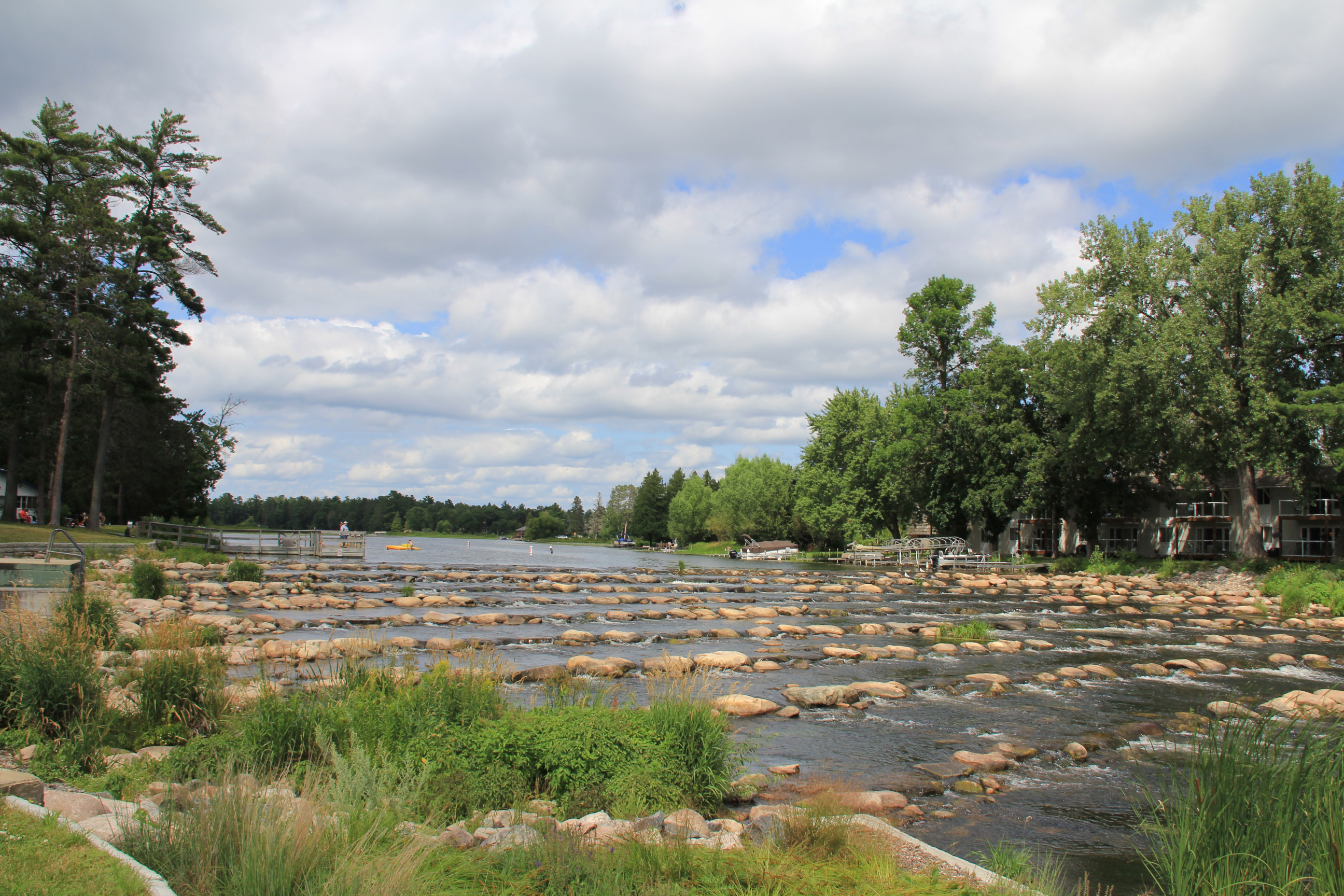
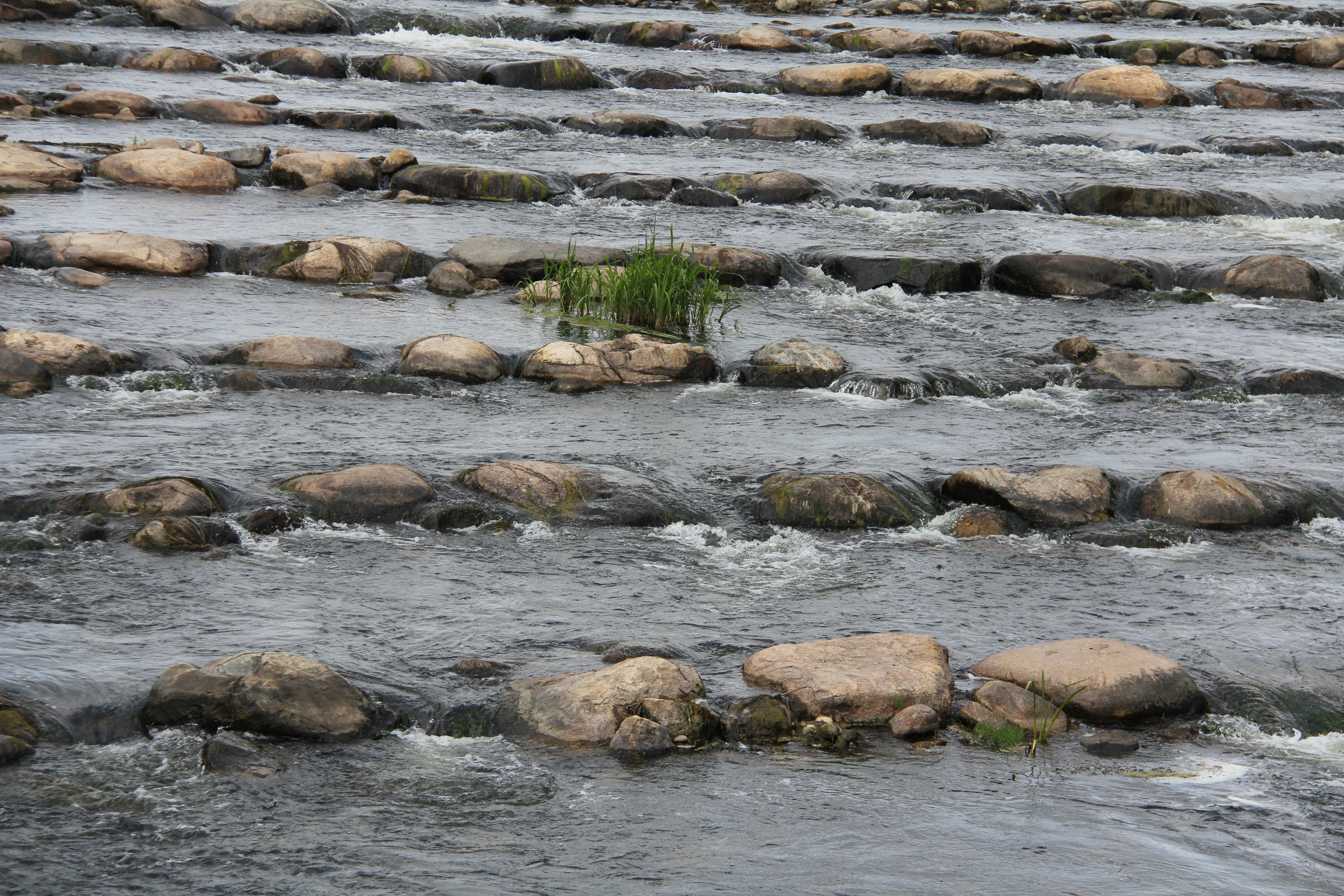
This rock riffle in Pine River replaced a traditional dam built in 1910 to hold back water flowing from Norway Lake into the Pine River. The old dam was designated as “high hazard,” thus in need of replacement. (Minnesota Prairie Roots copyrighted photo July 2024)
WIND AND WATER. Both prove soothing and calming elements of nature. Except when destructive.
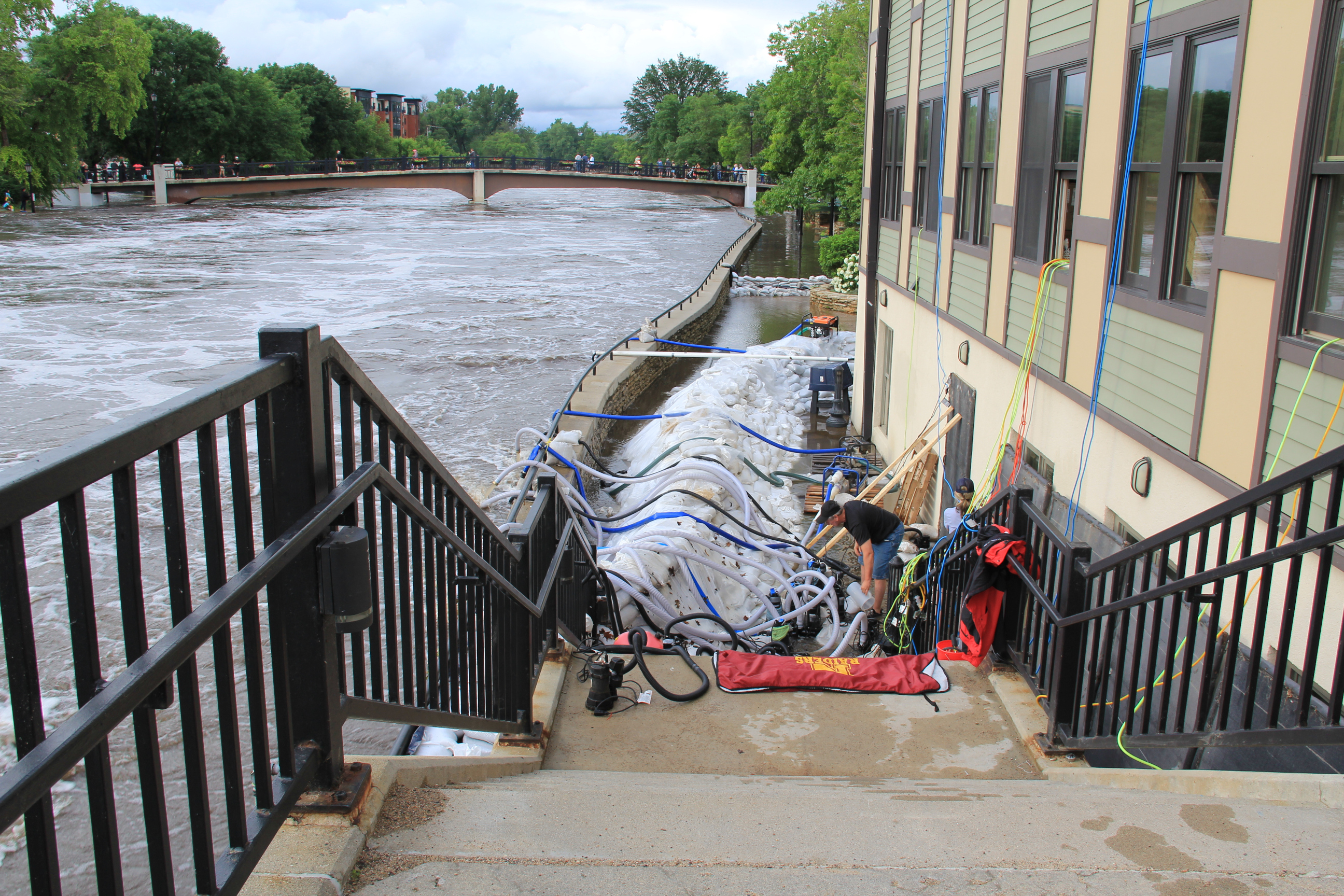
Sandbagging along the flooding Cannon River in downtown Northfield last June. The traditional dam in Northfield was not compromised, unlike in some Minnesota locations. (Minnesota Prairie Roots copyrighted file photo June 2024)
Last June, excessive rainfall led to devastating floods in parts of southern Minnesota, especially in Waterville, a 20-minute drive southwest of Faribault. Farther to the west in Rapidan, the Blue Earth River raged, causing a partial dam collapse and erosion of the land. That led to loss of a house and of the much beloved The Dam Store. In Northfield, 20 minutes from Faribault, the Cannon River flooded the Riverwalk and threatened riverside businesses. In Faribault, the Cannon and Straight Rivers spilled from their banks, flooding parks and several city streets. The powerful river also eroded the shoreline near the Faribault Mill Dam. Boulders were hauled in and placed beside the dam to contain the river and prevent additional erosion.
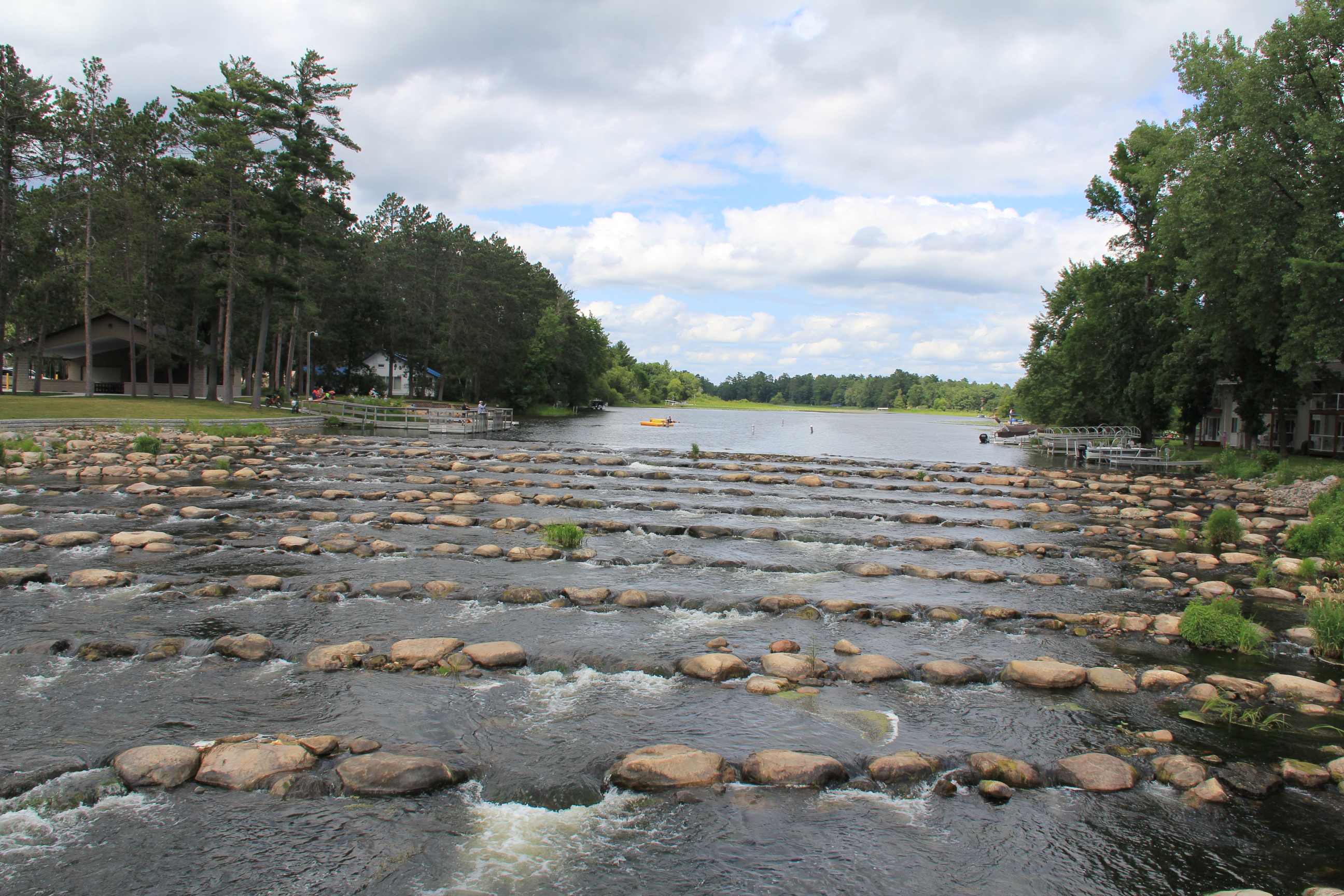
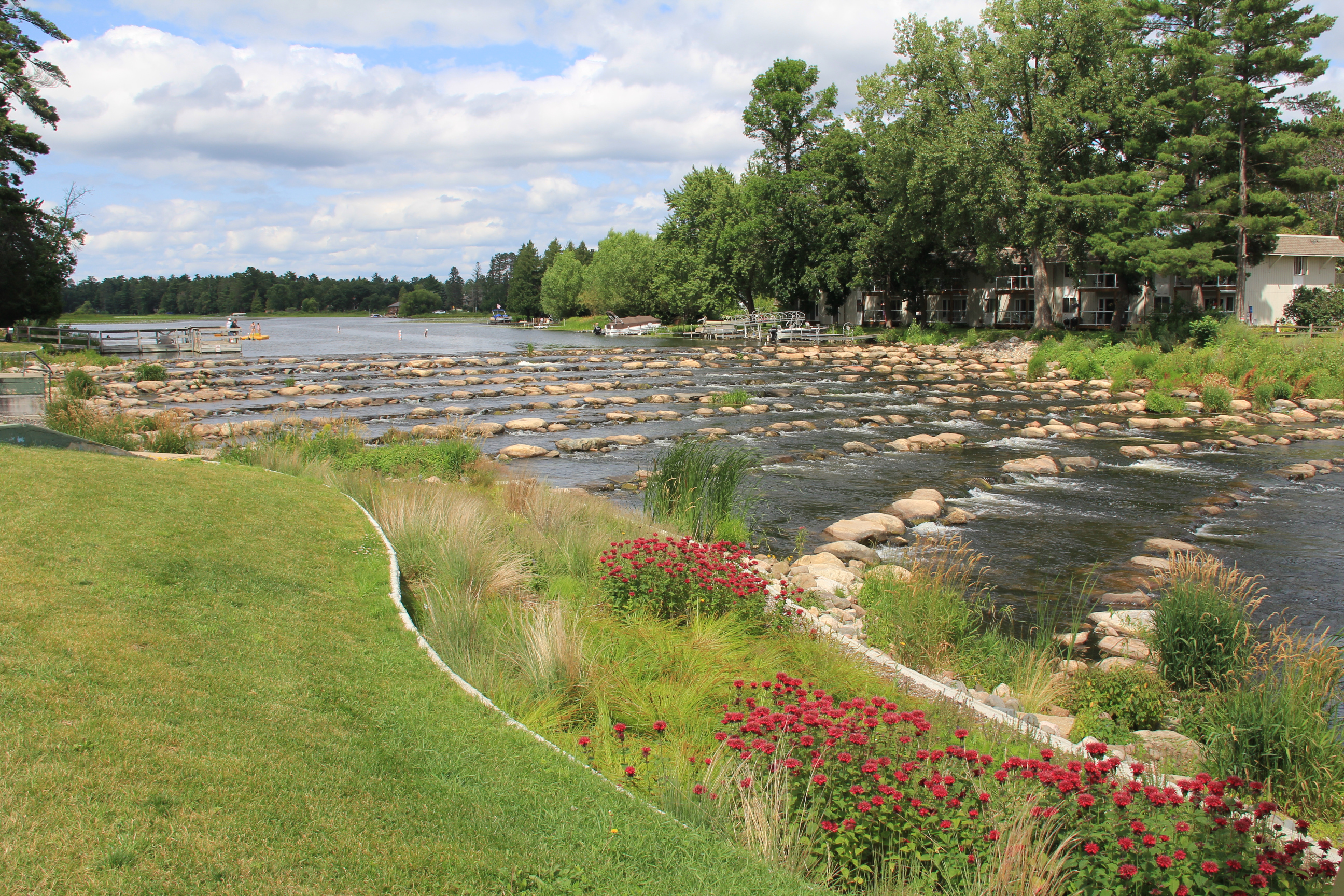
The Dam Park, with a pavilion, is to the left of the tree-edged Pine River in this photo, private homes to the right. (Minnesota Prairie Roots copyrighted photo July 2024)
Now, many months later, Faribault city officials are considering options for the Faribault Mill Dam. And that got me thinking about Pine River. In this north central Minnesota community, a rock riffle/rock arch rapids replaces a 200-foot long by 13-foot high traditional dam built in 1910. The result is nothing short of stunning.
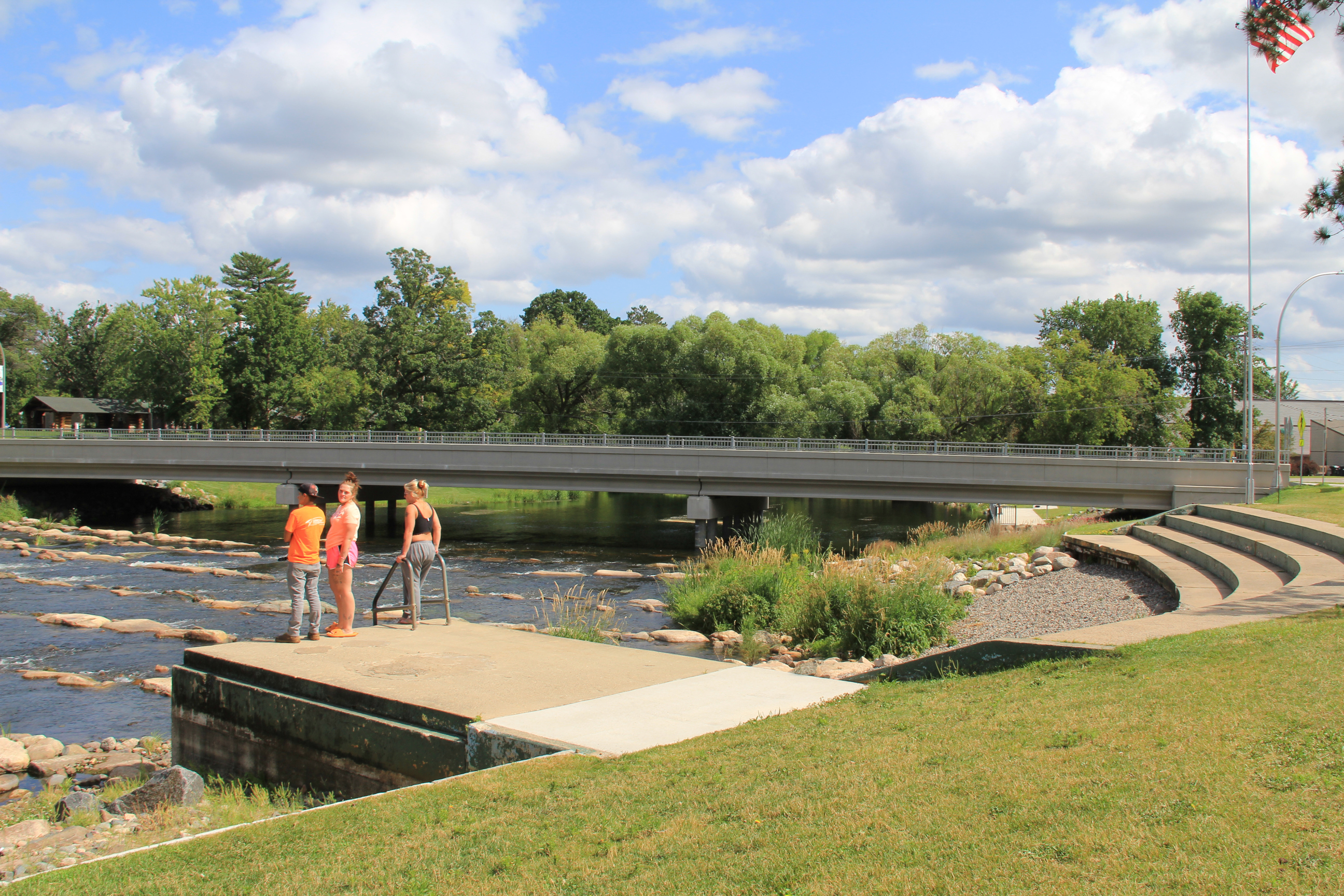
The concrete steps and platform remain from the original dam construction project. This image shows a view of the rock riffle looking downstream. (Minnesota Prairie Roots copyrighted photo July 2024)
Let me explain. Smaller rip-rap rocks, larger rocks and boulders were placed in sloping rows across the Pine River to replace the dam. Water spills over the rocks as the rows descend for several hundred feet. Except for the precise placement of the rock rows, the rapids appear almost natural. And that is much more visually pleasing than a wall of concrete.
It’s mesmerizing to watch and listen to the river spill over the man-made rock riffle in Pine River. (Minnesota Prairie Roots copyrighted photo July 2024)
The sound, too, is pleasing. I have always loved the sound of water rushing over rocks. It’s calming, soothing, mesmerizing. As is watching the water pour over and around rocks.
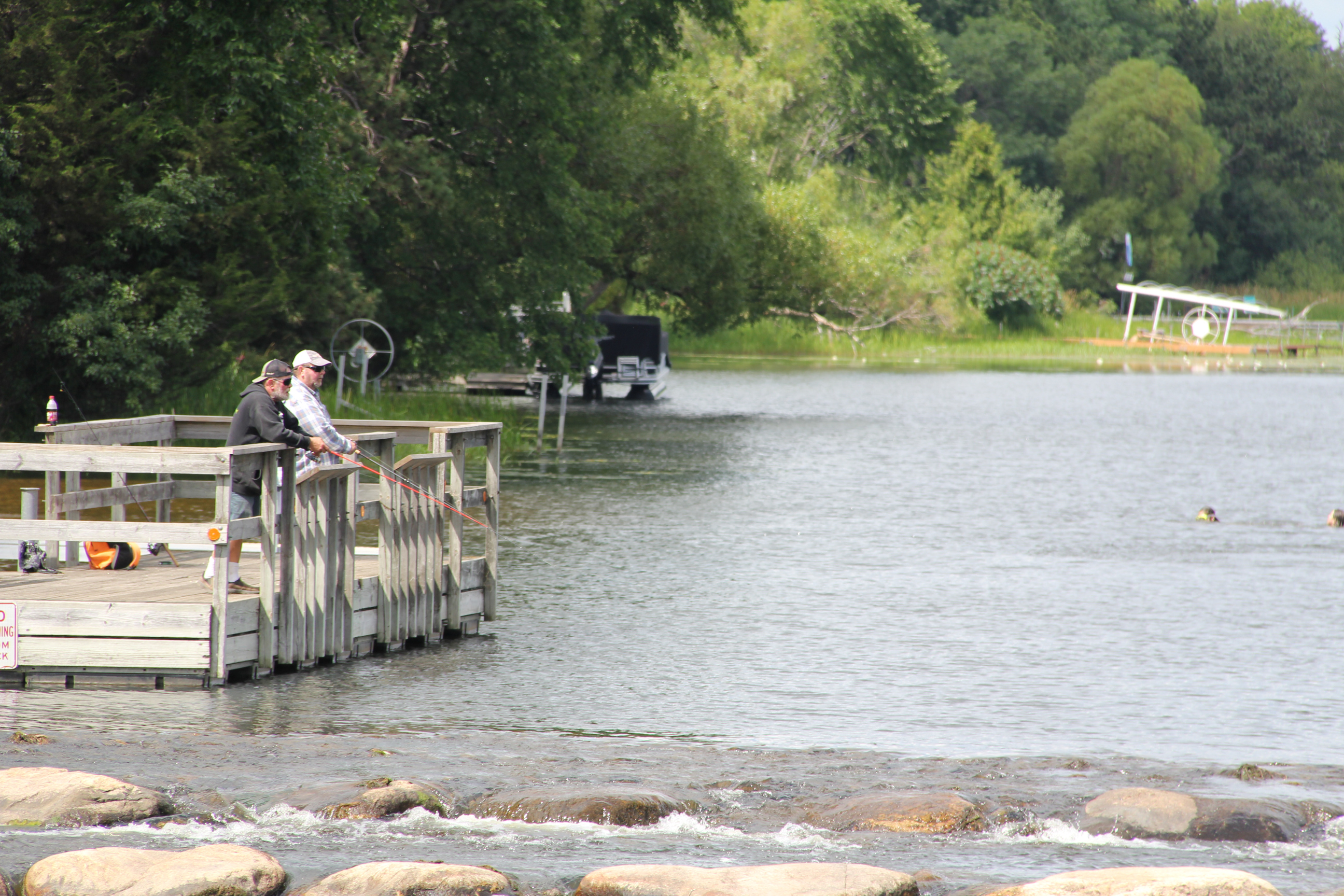
The traditional dam proved a significant fish barrier. Installation of the rock riffle has improved fish habitat in the river, which feeds into the Whitefish Chain of Lakes in north central Minnesota. (Minnesota Prairie Roots copyrighted photo July 2024)
But this award-winning rock riffle dam in Pine River offers much more than a place to sit riverside and relax. It’s also a popular recreational area. During my mid-week July 2024 visit, anglers fished the river from a pier and from shore downstream. Swimmers jumped from floating platforms into the water above the rock riffle. There’s a sandy beach, too. And although I didn’t see any, kayakers can also navigate the rapids. And anyone can cross the river on the rocks, but at their own risk.
On a summer day, swimmers jump off a swimming platform above the rock riffle into the river. Dam Park includes a sandy beach. (Minnesota Prairie Roots copyrighted photo July 2024)
This revamped area, as I viewed it, draws people outside to the river. To recreate. To gather. To enjoy nature. There’s even a playground and a pavilion with a kitchen in Dam Park. What Pine River has created with this rock riffle is a community centerpiece that is beautiful in every way.
Plantings of flowers and grasses protect the river shoreline by the rock riffle. (Minnesota Prairie Roots copyrighted photo July 2024)
Now, whether this will work at the Faribault Mill Dam, I don’t know. I’m no engineer. But rock riffles have been placed in some 75 rivers and lakes across Minnesota. The one in Pine River is the first I’ve seen. I’d like local city officials to consider a rock arch rapids, maybe take a field trip to Pine River or elsewhere and see (and hear) just how inviting and lovely, calming, soothing and mesmerizing a rock riffle is compared to a traditional dam. See how this dam removal and rock riffle replacement in Pine River creates a recreational oasis, a beautiful gathering spot that grows community.
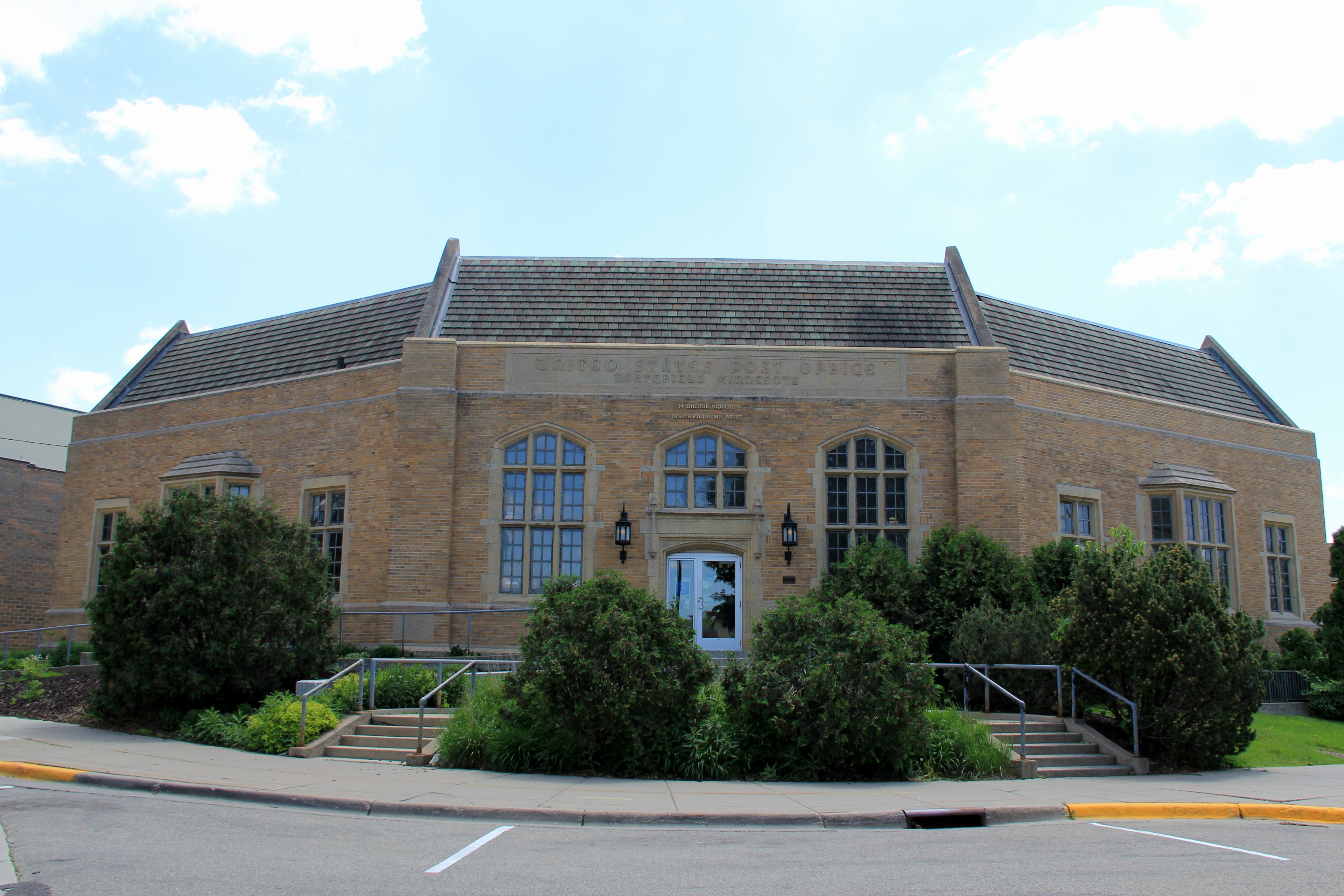
The historic post office in Northfield, Minnesota, holds an art treasure. (Minnesota Prairie Roots copyrighted photo May 2024)
OF ALL THE TIMES I’ve visited neighboring Northfield through the decades, I’d not once stepped inside the downtown Northfield Post Office. Until last May. I’ve frequented Bridge Square across the street, admiring the public art I often find outdoors in this park along the Cannon River. Yet, I never thought to look for art inside the impressive limestone structure angling around a corner of the town center.
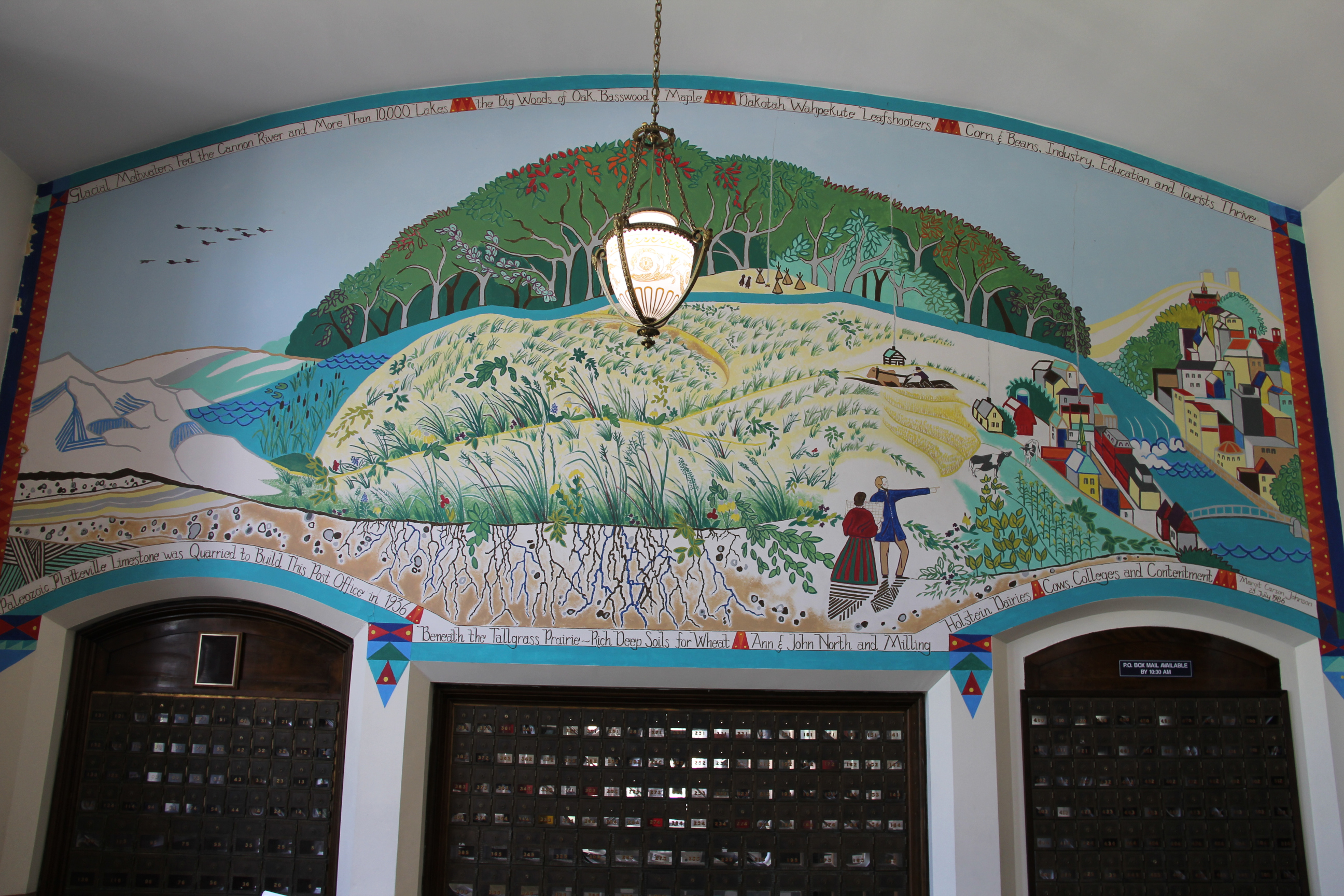
The mural above a row of mailboxes was designed by Margit Carson Johnson. (Minnesota Prairie Roots copyrighted photo May 2024)
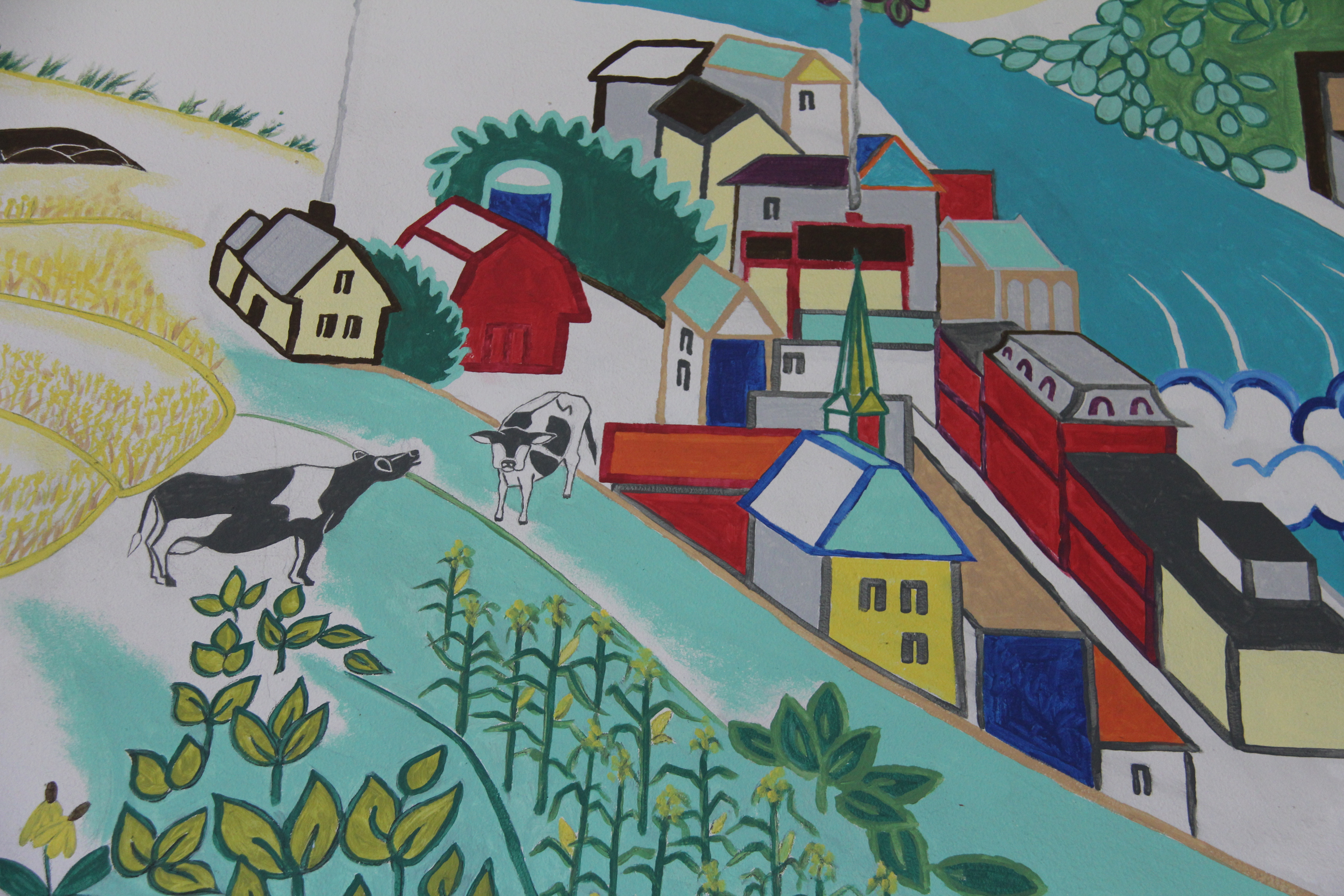
But inside the historic 1936 post office, I found a massive piece of public art designed by Northfielder Margit Carson Johnson. The commissioned work defines the essence of Northfield. The city is perhaps most famously known for the townspeople’s defeat of the James-Younger Gang in September 1876 as the outlaws attempted to rob the First National Bank. Johnson’s 1986 mural, though, doesn’t show that. The entire bank robbery history can be learned a few doors down at the former bank site, now the Northfield History Center.
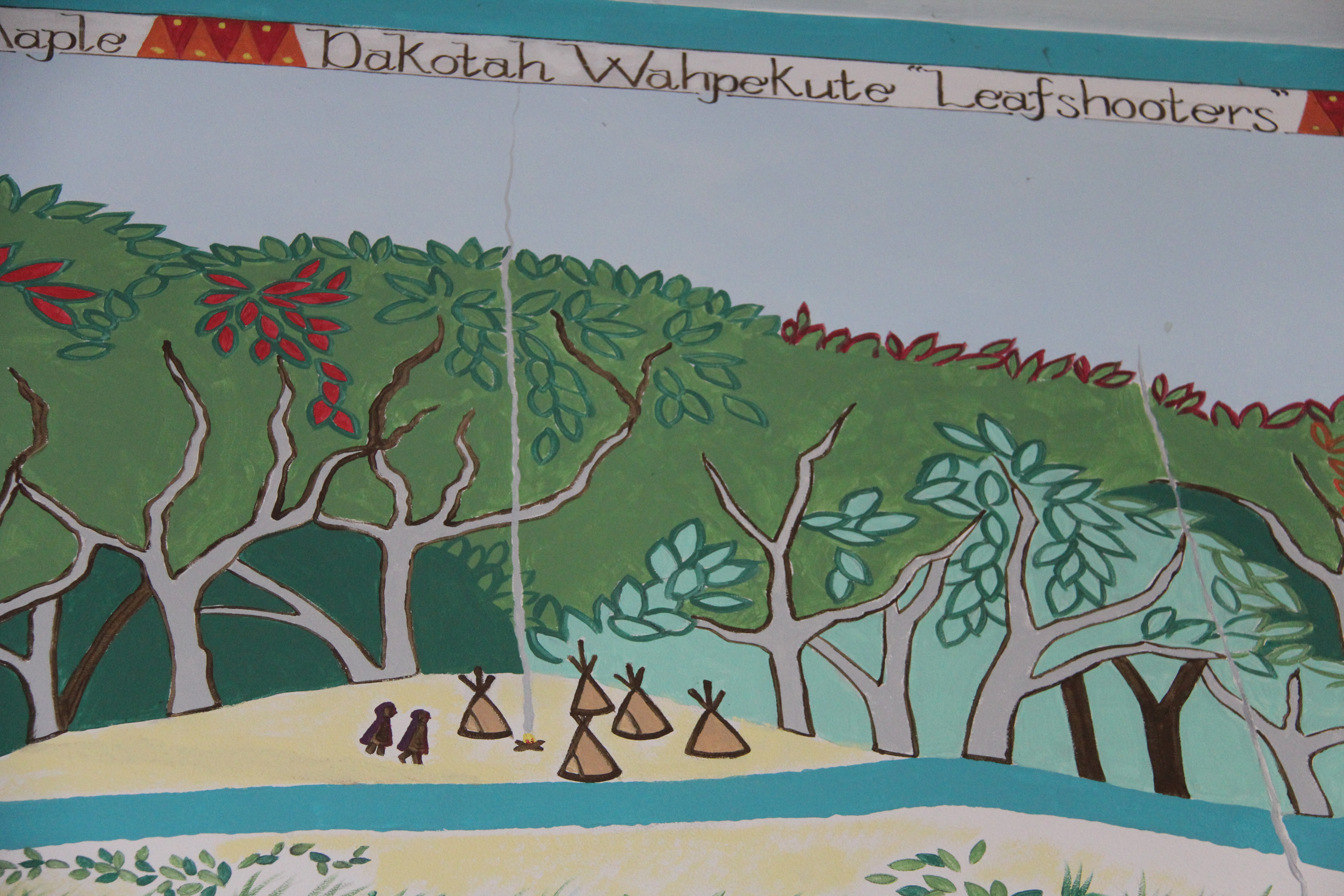
The Dakotah Wahpekute, also known as “Leafshooters,” were the original inhabitants of the land that would become Northfield. (Minnesota Prairie Roots copyrighted photo May 2024)
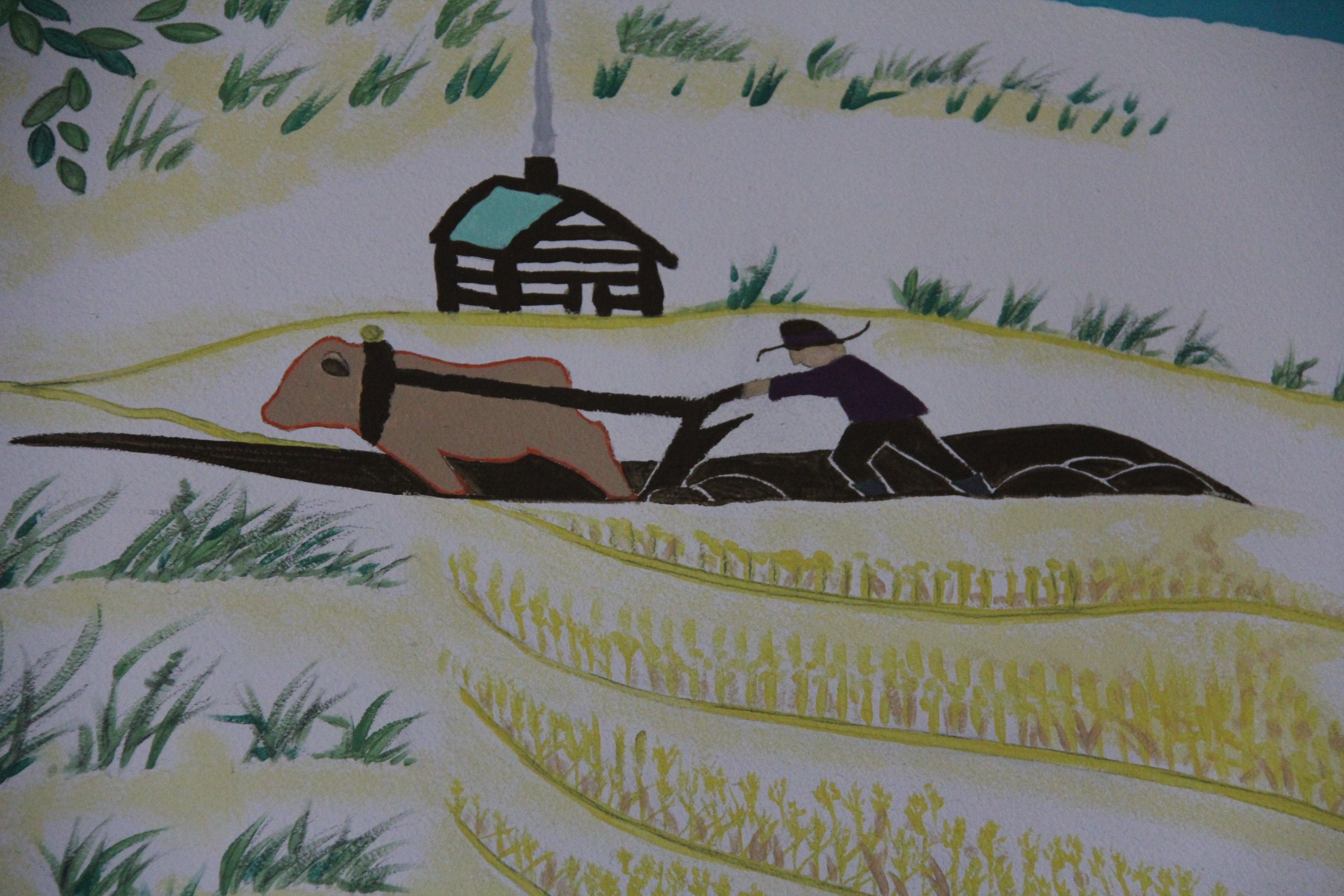
Rather, the mural on the east side of the post office lobby visually summarizes Northfield’s early history as home to the Dakota Wahpekute, then settlement as a farming (dairy and crop) and milling (flour and sawmills) community, followed by growth as a center for education (St. Olaf and Carleton Colleges), industry (including Post Consumer Brands cereal, formerly Malt-O-Meal) and tourism.
Farmers plowed the prairie grass to seed wheat. (Minnesota Prairie Roots copyrighted photo May 2024)
For anyone who knows little to nothing about Northfield, the folk art style painting completed by a team of volunteers is a good starting point to learn the basics about this community. It’s a visual Cliff Notes type of guide.
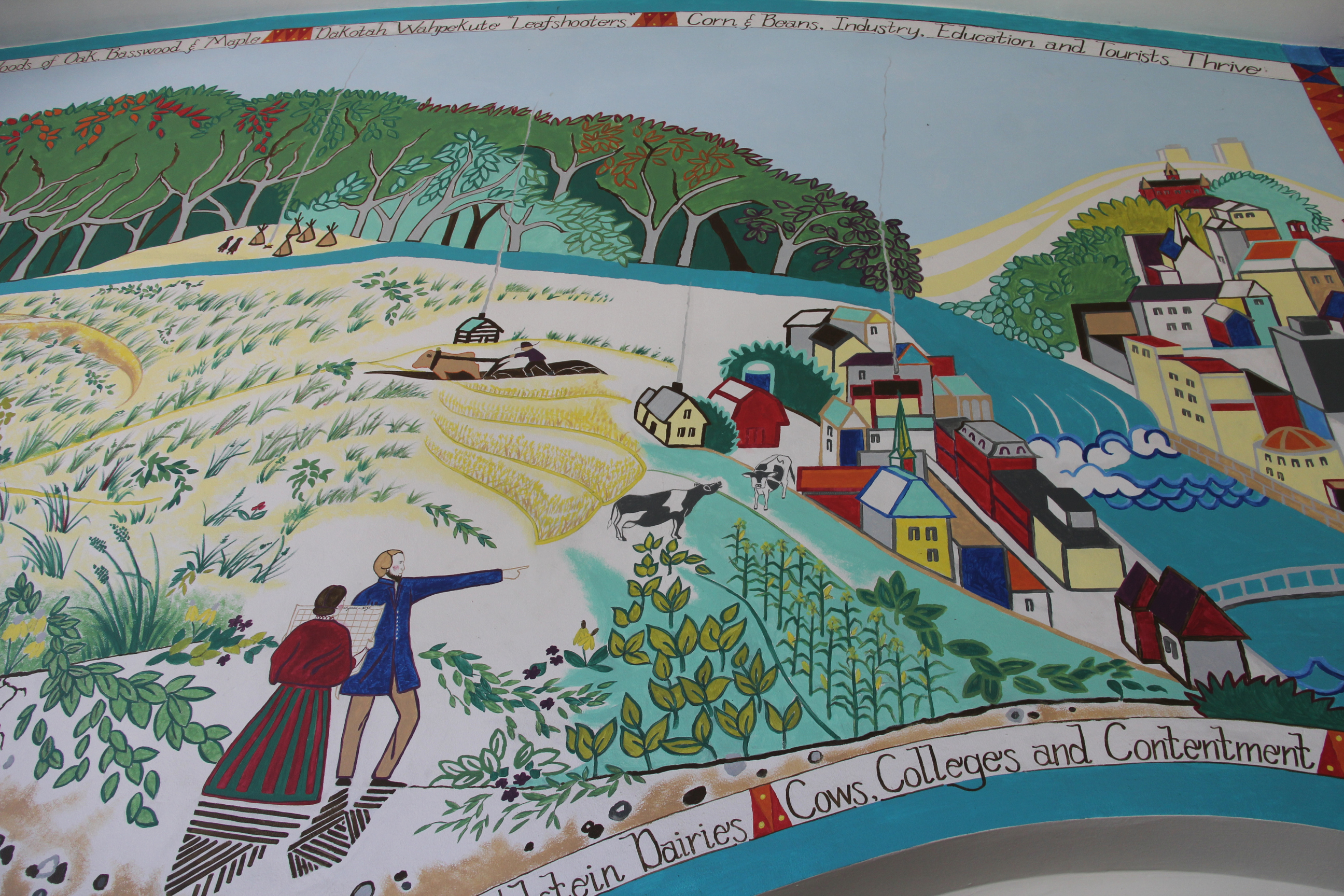
Founders John and Ann North are depicted in the painting of Northfield. (Minnesota Prairie Roots copyrighted photo May 2024)
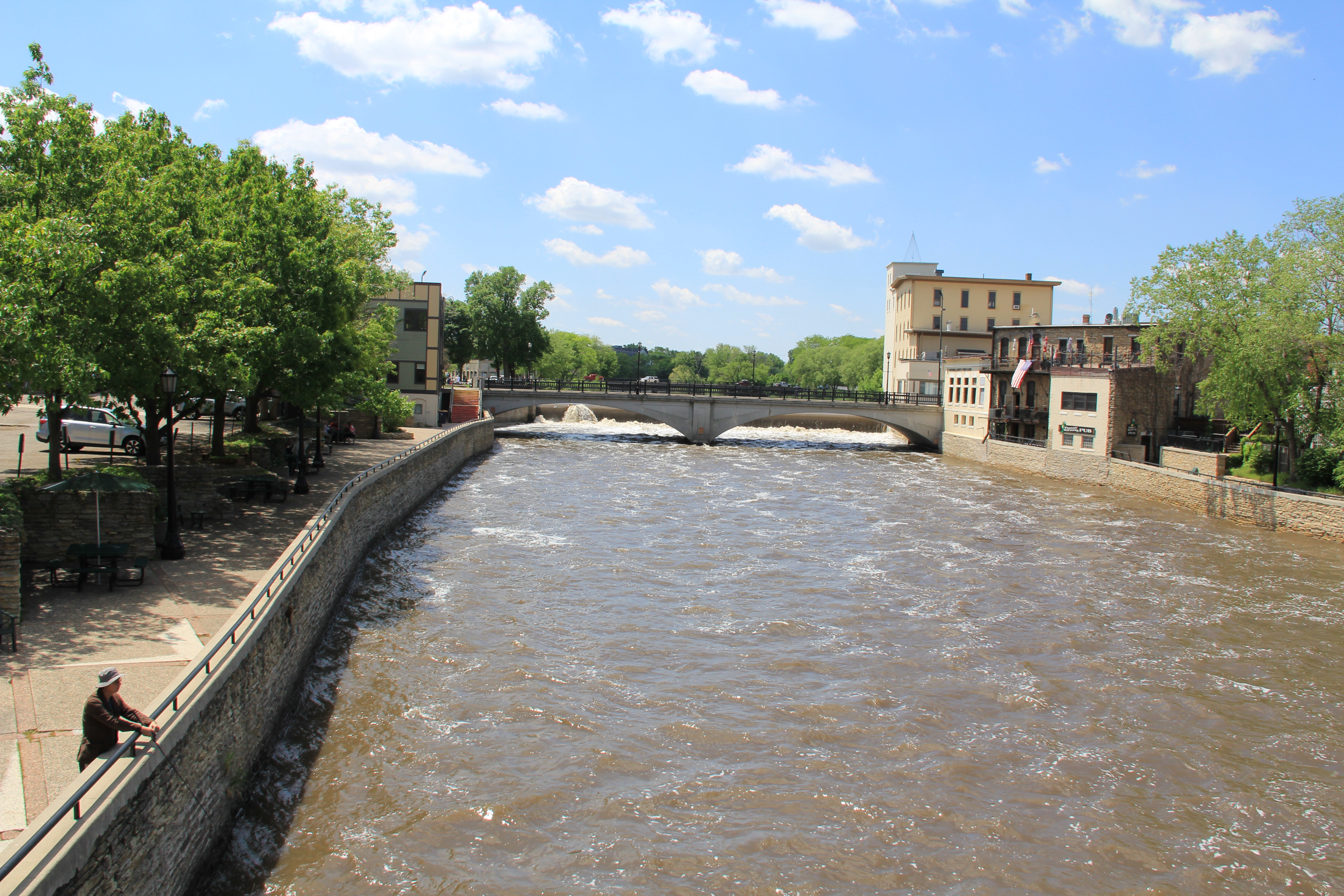
Like many early Minnesota settlements, rivers and railroads determined the location for new towns. Northfield sits along the Cannon River, a source of water power for early milling and a route for trade. Today the river continues to center this community, creating a picturesque and engaging downtown core with businesses along Division Street backing to the river. A River Walk leads locals and visitors riverside to appreciate the natural beauty of water flowing through Northfield.
My favorite part of the mural, probably because I grew up on a dairy farm, shows Holsteins. The buildings are actual buildings in Northfield, including the historic Archer House, destroyed in a fire several years ago. (Minnesota Prairie Roots copyrighted photo May 2024)
I love Northfield, once promoted with the theme of “Cows, Colleges and Contentment.” It’s still that, although with fewer dairies than once defined the area. Today the local tourism website tags Northfield as “Close to Home/Far From Ordinary.” That fits, too.
A view of the River Walk and the historic Ames Mill (to the right in the distance) from the pedestrian bridge spanning the Cannon River in the heart of downtown Northfield. (Minnesota Prairie Roots copyrighted file photo May 2024)
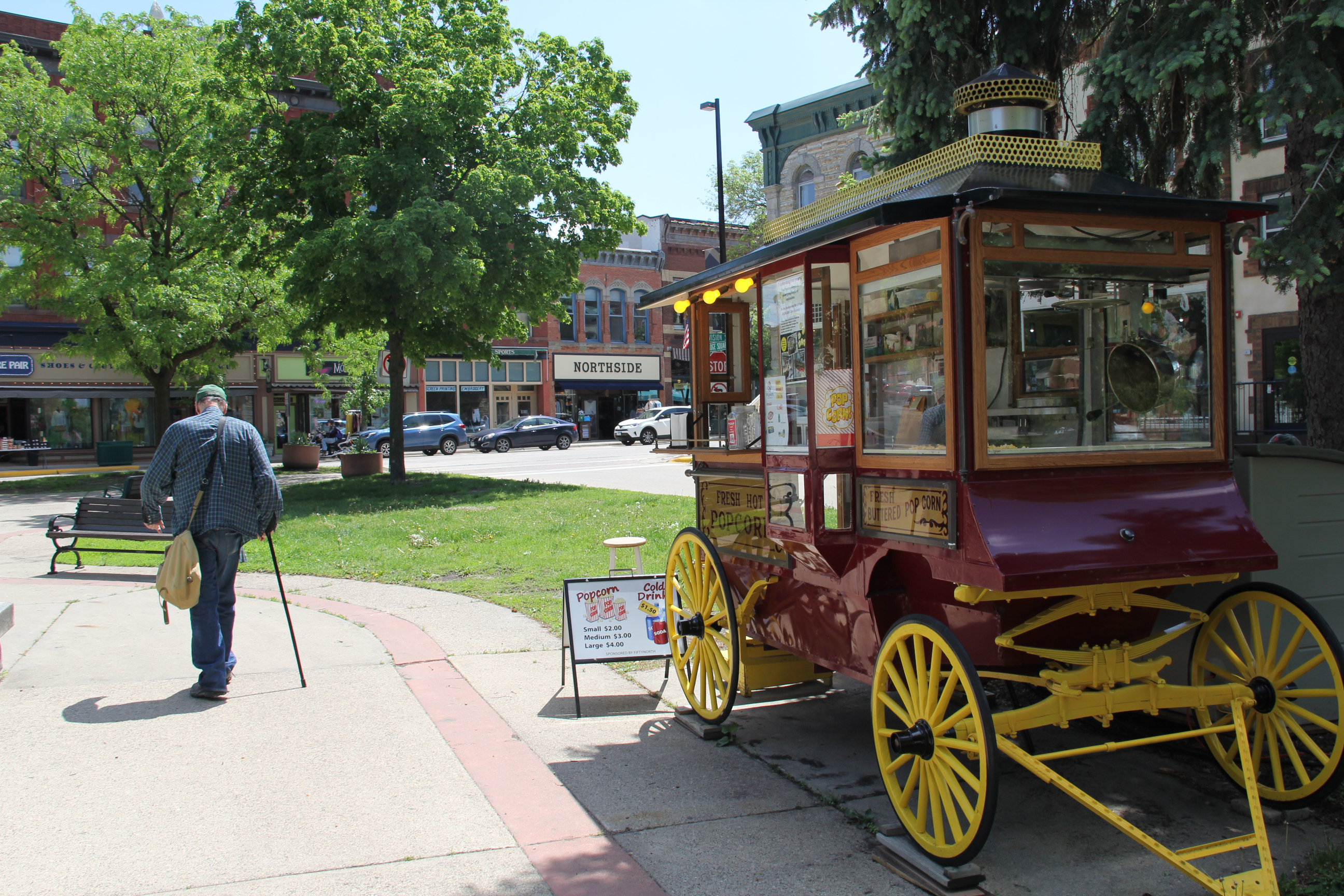
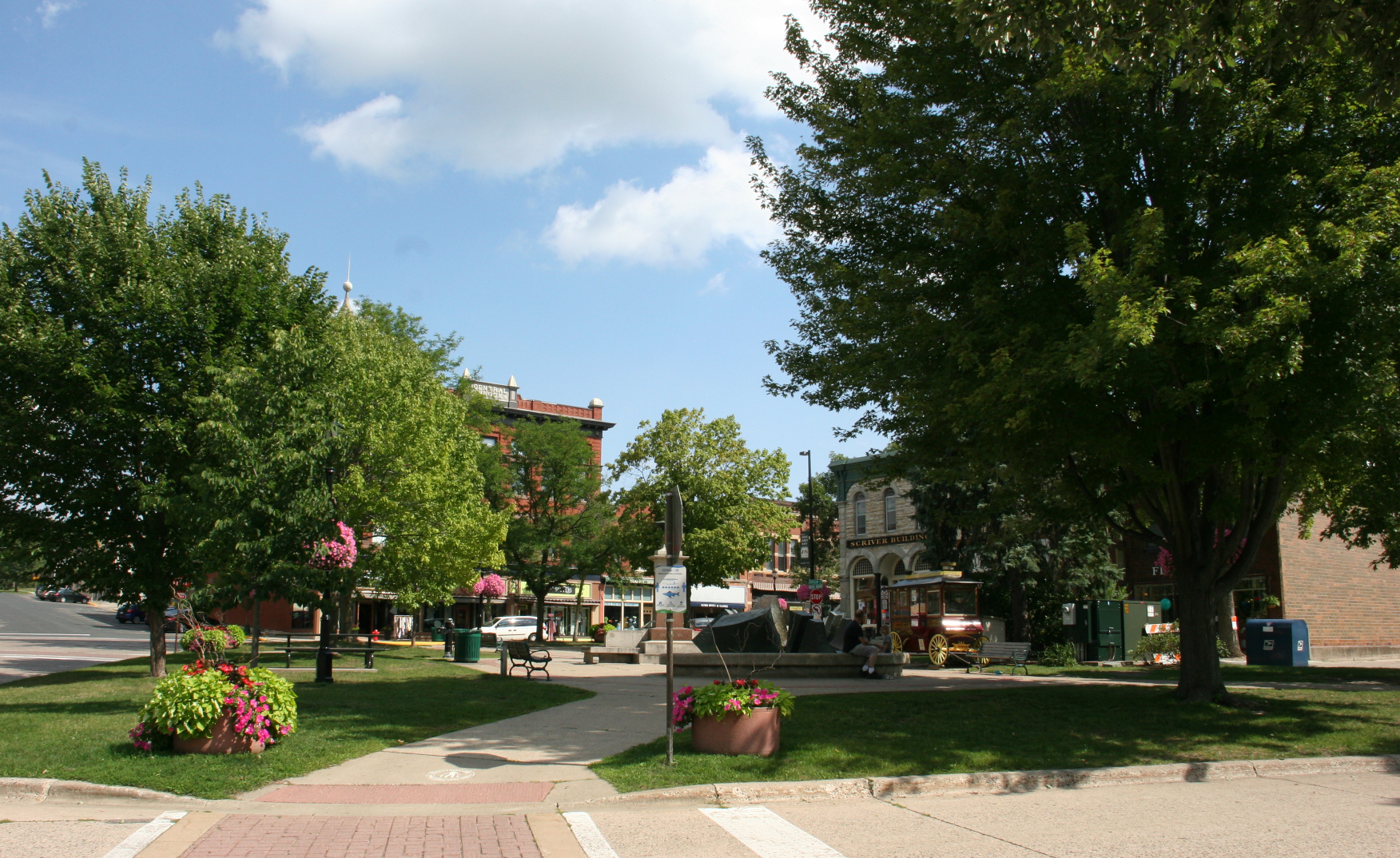
Northfield ranks as a popular tourist destination with its James-Younger connection and its many home-grown shops housed in historic buildings in a downtown that fits the definition of “charming.” The setting is decidedly comfortable and homey and as picturesque as a Norman Rockwell painting. There’s a seasonal popcorn wagon in Bridge Square, anglers fishing along the river, an old-fashioned barbershop with barber pole…
Northfield’s much-beloved seasonal popcorn wagon at Bridge Square. (Minnesota Prairie Roots copyrighted file photo May 2024)
There’s a strong sense of community and of community pride in Northfield. Art matters here. From riverside murals to poetry imprinted upon sidewalks to artwork showcased inside the Northfield Arts Guild to theatre, concerts and much more (including at the two colleges) the arts flourish.
Beautiful Bridge Square, Northfield’s town center. (Minnesota Prairie Roots copyrighted file photo August 2022)
And inside the aged, massive post office, once slated for closing, the folk art mural designed by Margit Carson Johnson stretches above a wall of mailboxes to reveal the core story of Northfield. From the Big Woods to the once glacial meltwater-fed Cannon River, from the Wahpekute to dairy farmers, from tallgrass prairie to the city it is today, Northfield thrives.
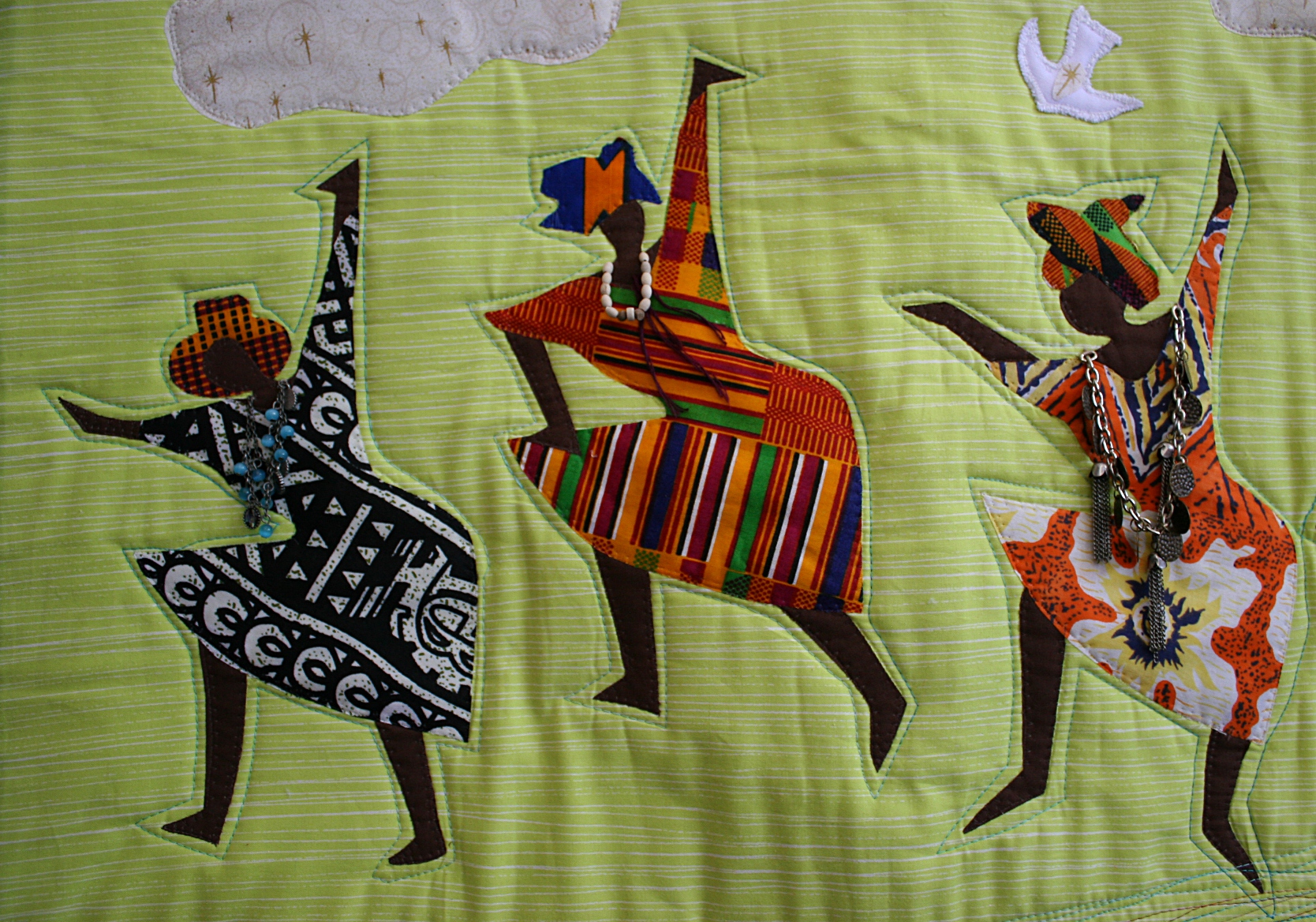
This Nigerian-themed quilt art was created years ago by my friend Susan. The art reflects to me the joy of an African spiritual. The fabric came from Nigeria, where Susan’s father-in-law served as a Lutheran missionary. (Minnesota Prairie Roots copyrighted file photo)
THE SONG WAS UNEXPECTED during Sunday morning worship at the conservative Lutheran church I attend in Faribault. But it was fitting for the day and for my feelings, which have leaned deeply into discouragement recently.
The African American spiritual, “There Is a Balm in Gilead,” proved a temporary balm for my soul. The old school word “balm” holds a healing connotation. The song’s refrain encourages: There is a balm in Gilead to make the wounded whole. There is a balm in Gilead to heal the sin-sick soul.
As I sang the refrain, I wondered, what or where is Gilead? Later research revealed that, during Old Testament days, Gilead was a mountainous region east of the Jordan River and an important source of medicinal herbs. That makes sense as it relates to the lyrics.
Christ’s face in a stained glass window in the sanctuary of my church, Trinity Lutheran, Faribault. (Minnesota Prairie Roots copyrighted file photo)
In the New Testament, “balm of Gilead” refers not to an herb which heals physically, but to Jesus through whom spiritual healing comes. That also makes sense as it relates to lyrics of the song printed on page 749 of the Lutheran Service Book.
Events of recent weeks in this country have me feeling apprehensive, unsettled, worried, in need of a healing balm. I know I am not alone in these feelings as we face economic challenges, upheaval, chaos and uncertainties on endless levels. Each day seems to bring something of new concern. No matter where you stand politically or spiritually, you have to feel the tension and uncertainties in this country.
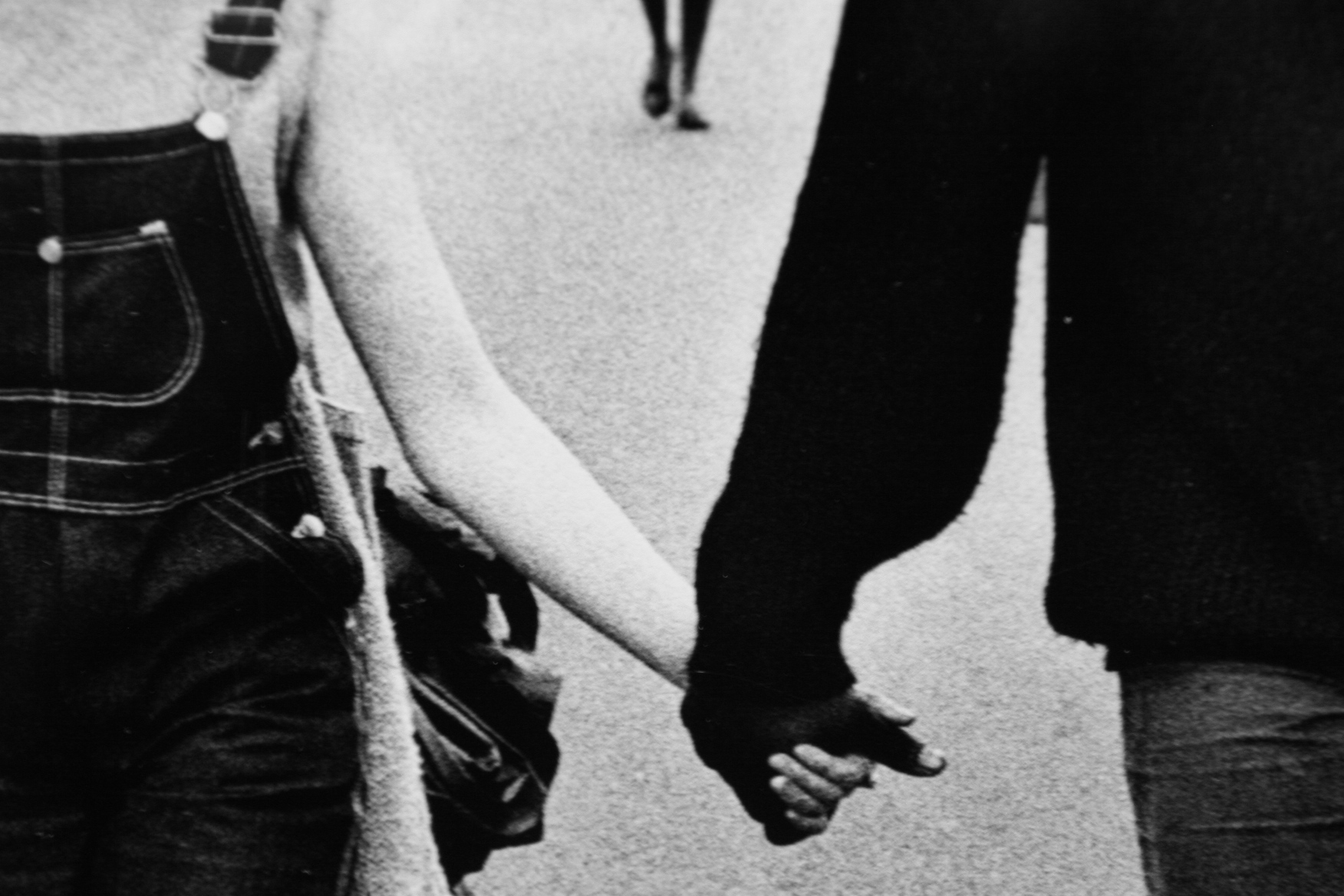
A snippet of a photo by Stephen Somersteinfrom the exhibit, “Selma to Montgomery: Marching Along the Voting Rights Trail,” which I saw at St. Olaf College in Northfield, Minnesota, in 2015. (Minnesota Prairie Roots copyrighted file photo)
On Sunday, as I sang the African American spiritual, I allowed myself to be swept into the healing words of hope and comfort. It was not lost on me that, sitting on the end of my pew, was a family of mixed race—an African American father, White mother and three biracial children, one a darling baby boy of ten months. I thought of my own newborn grandson, who is mixed race. What does the future hold for these two little boys? Will they face challenges simply because of their skin color? I’d like to think not. But…
And I thought, too, of the new calendar month of February, in which we celebrate Black History Month, focusing on Black history, culture and education. I reflect on slavery, on Civil Rights leaders, on racial disparities, diversity, equity and inclusion, wondering how I, personally, can educate myself and make a difference.
A message left by a visitor to the Selma exhibit at St. Olaf College. It’s so applicable to today. (Minnesota Prairie Roots copyrighted file photo)
It truly does start with each of us standing up for what is good and right and decent and not going along with what we know in our hearts, minds and souls to be wrong. And then, maybe then, we’ll find our balm in Gilead.




















An essay inspired by books in a sharing library February 19, 2025
Tags: book titles, books, commentary, essay, Minnesota, opinion, Pine River, sharing library
IF I WAS A REBEL, and I’m not (although a streak of defiance runs through my veins), I’d write a strongly opinionated piece on a controversial topic.
But I don’t like conflict. I prefer status quo to chaos, normalcy to the unexpected. Yet, that is not reality. Life can be easy and hard and good and awful and a whole mix of everything. Sort of like Sideways Arithmetic from Wayside School. I like school. Never liked math.
Nor do I particularly like William Shakespeare’s work with the exception of Romeo and Juliet. Who doesn’t love a love story, even if tragic? Shakespeare’s other writing seems archaic, boring and impossibly unrelatable. I offer no apologies for that view.
I am decidedly a fan of Laura Ingalls Wilder, who certainly has her critics, too. But her detail-rich writing in Little House in the Big Woods, On the Banks of Plum Creek, Little Town on the Prairie and more inspires me as a writer. Plus, I grew up some 25 miles from Walnut Grove, smack dab in the middle of the Minnesota prairie. When you live in a land of wide open spaces, big skies and sweeping winds, you approach writing from a detailed perspective that engages all the senses.
I can’t make much sense of sweeping Absolute Power, which has nothing to do with the senses. Not common sense anyway. Common sense tells me Spider Man is not real. Nor are heroes of the Justice League. Yet, I’d like to call in Superman, Wonder Woman and other superheroes to tackle the threats facing us today, and save the day.
Or perhaps strong-willed orphan Sally Lockhart of The Ruby in the Smoke could clear the smoke obscuring vision. Her experiences dealing with unseemly types qualifies her, in my opinion, to take on anything. Like uncovering lies, aggression, narcissism, manipulation and diversionary tactics. I appoint her to abolish the Department of Government E, or something like that, for starters.
Yes, there’s lots to contemplate. But today I’ve escaped to the sharing library, visually pulled a few books from the shelf to create this essay. And if nothing I’ve written resonates with you, then consider Lunkers Love Nightcrawlers. Head to the lake with a container of nightcrawlers, drop your baited line in the open water or drill a hole in the ice. Fish for answers. Good luck.
#
NOTE: I’ve underlined the titles of books from the sharing library which I’ve incorporated into this essay. This essay is not the piece I wrote for the contest I referenced here last week.
© Copyright 2025 Audrey Kletscher Helbling