Minnesota Prairie Roots

Writing and photography by Audrey Kletscher Helbling

Gathering with family & friends at summer reunions in Minnesota July 30, 2024

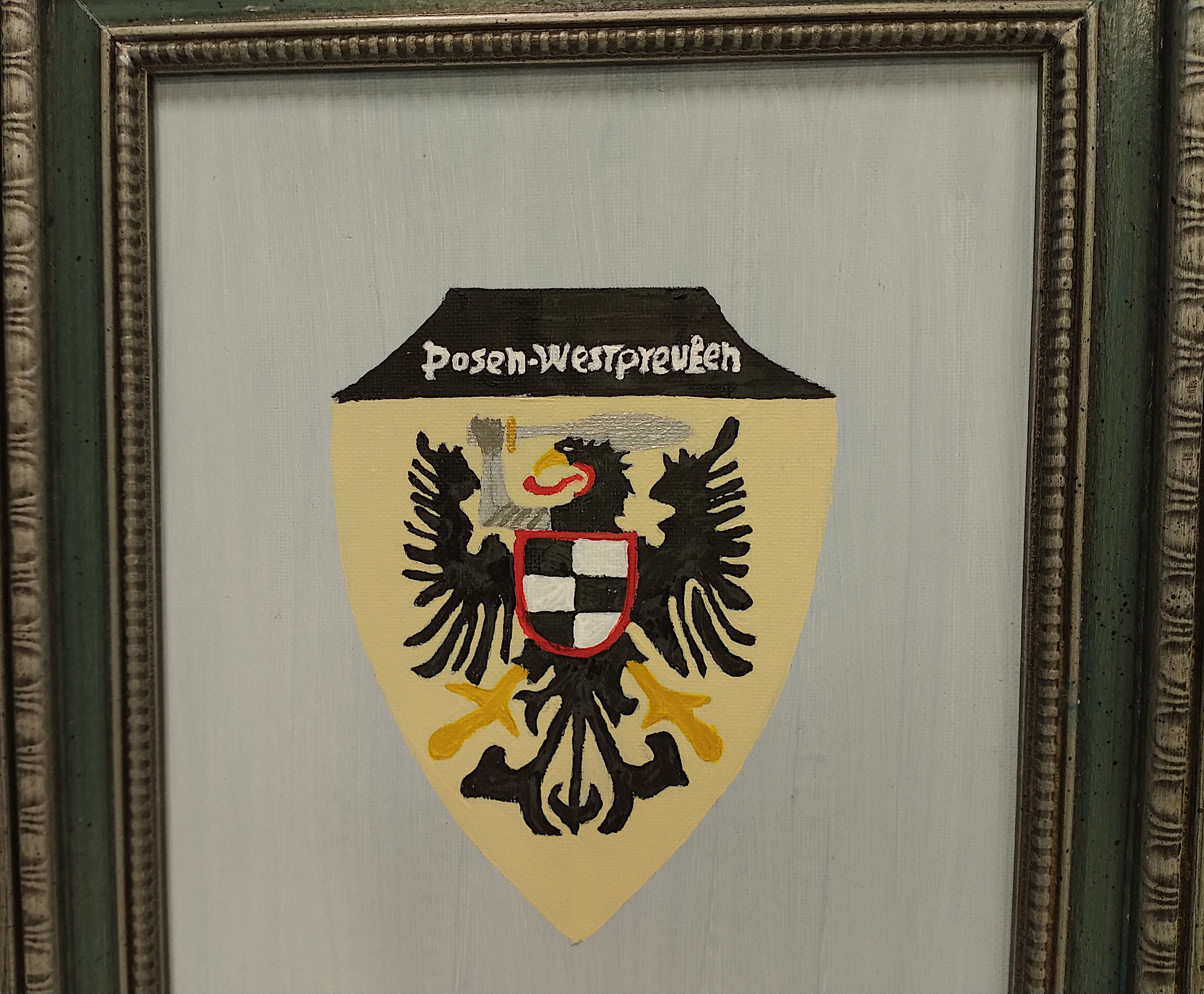
The Kletscher Family Coat of Arms of Posen-West Prussia. (Minnesota Prairie Roots copyrighted photo July 2024)

REUNITING. RECONNECTING. REMEMBERING. Those words define reunions, whether among family or friends. Summer marks prime reunion time in Minnesota, including for me, especially this year.
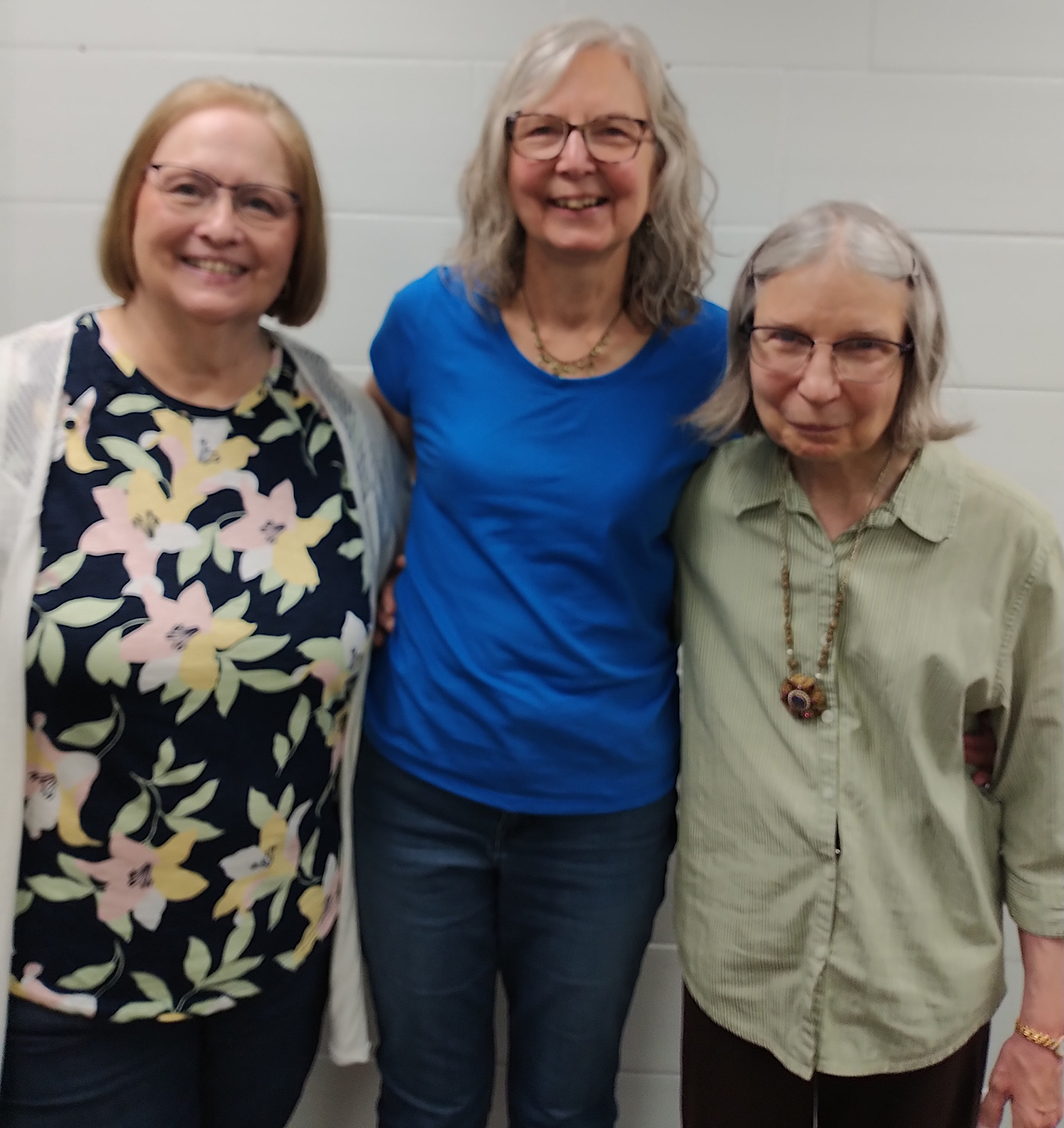
I’m flanked by cousins, Joyce, left, and LeAnn. We were born within months of each other and grew up spending lots of time together at family gatherings. (Photo credit: Kirt Kletscher)

From Pine River in northern Minnesota to Vesta on the southwestern Minnesota prairie to the Twin Cities and elsewhere, I’ve reconnected with people who are important to me, with whom I share roots and/or connections. And it’s been a joy because the older I grow, the more I realize that time is not a given and we need to gather and appreciate one another. With hugs, love and care.
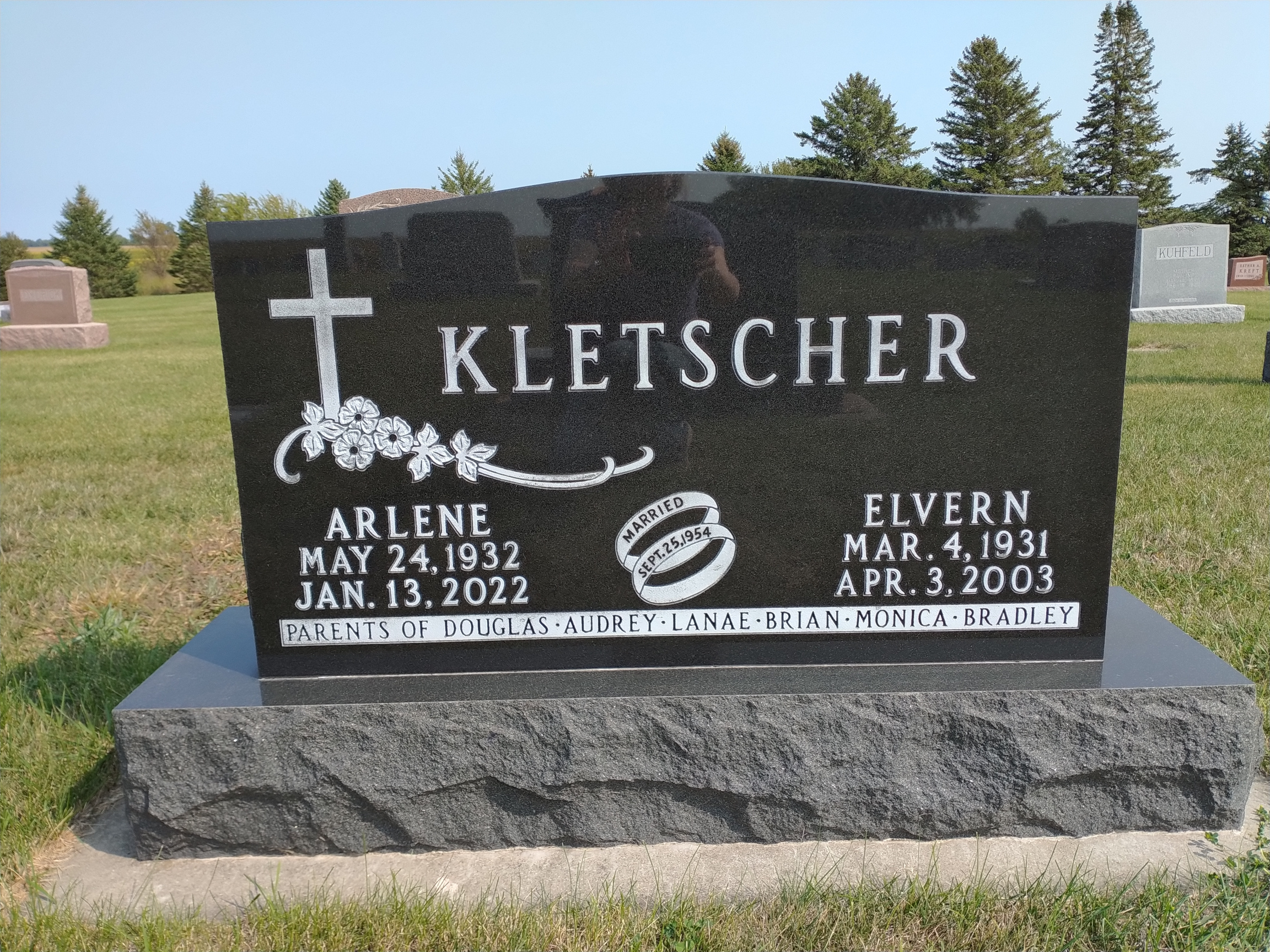
My parents’ tombstone in the Vesta City Cemetery. (Minnesota Prairie Roots copyrighted file photo September 2022)

My most recent reunion happened July 28, when Randy and I traveled 2.5 hours west to my hometown of Vesta in Redwood County for the Kletscher Family Reunion, held annually on the last Sunday in July. First we stopped at the cemetery to visit the gravesites of my parents, grandparents and other family members. I wiped away tears before we followed the gravel road into town, to the reunion site, the former Vesta Elementary School, now turned city hall and community center.
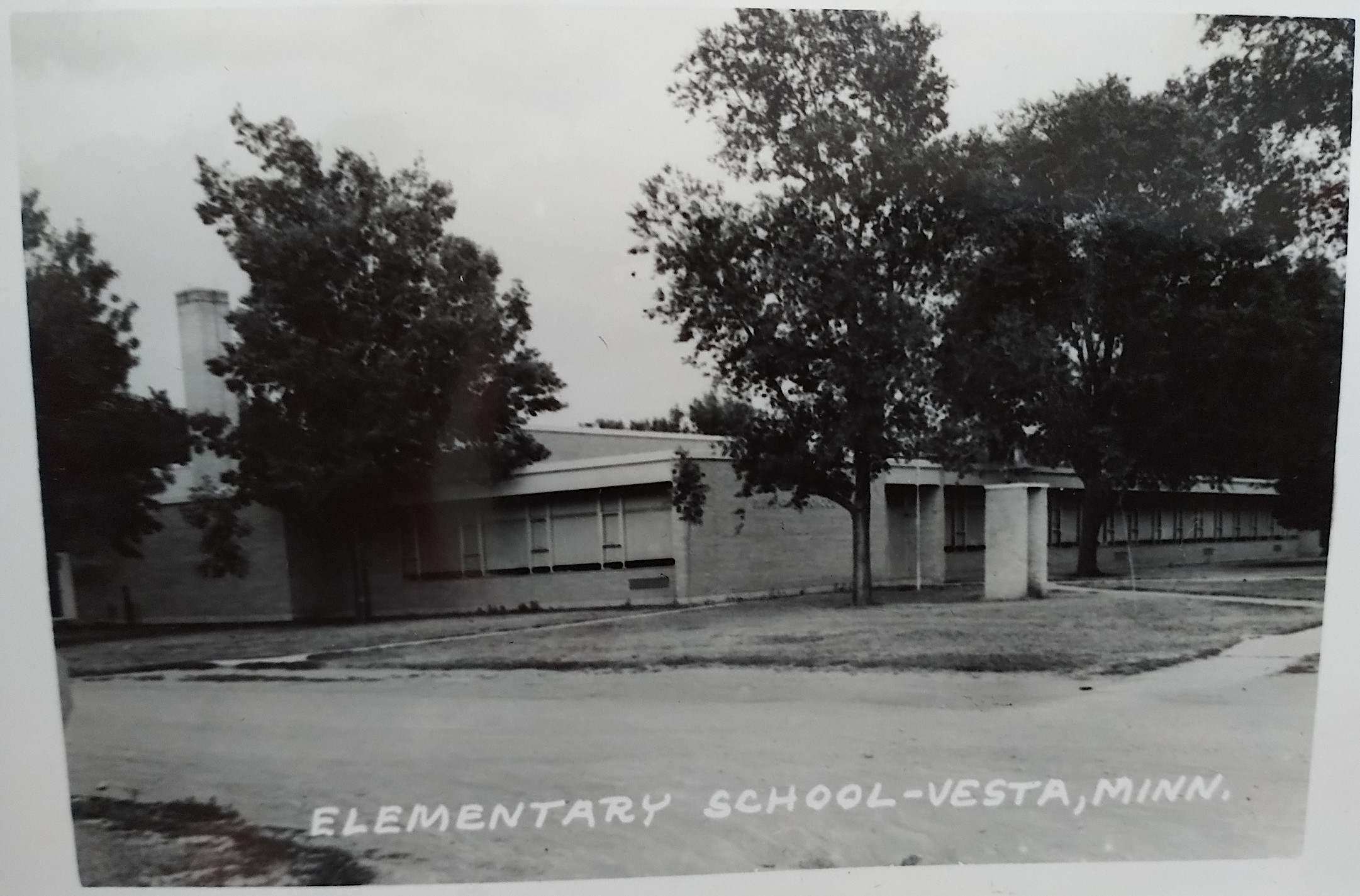
Vesta Elementary School in the 1960s.
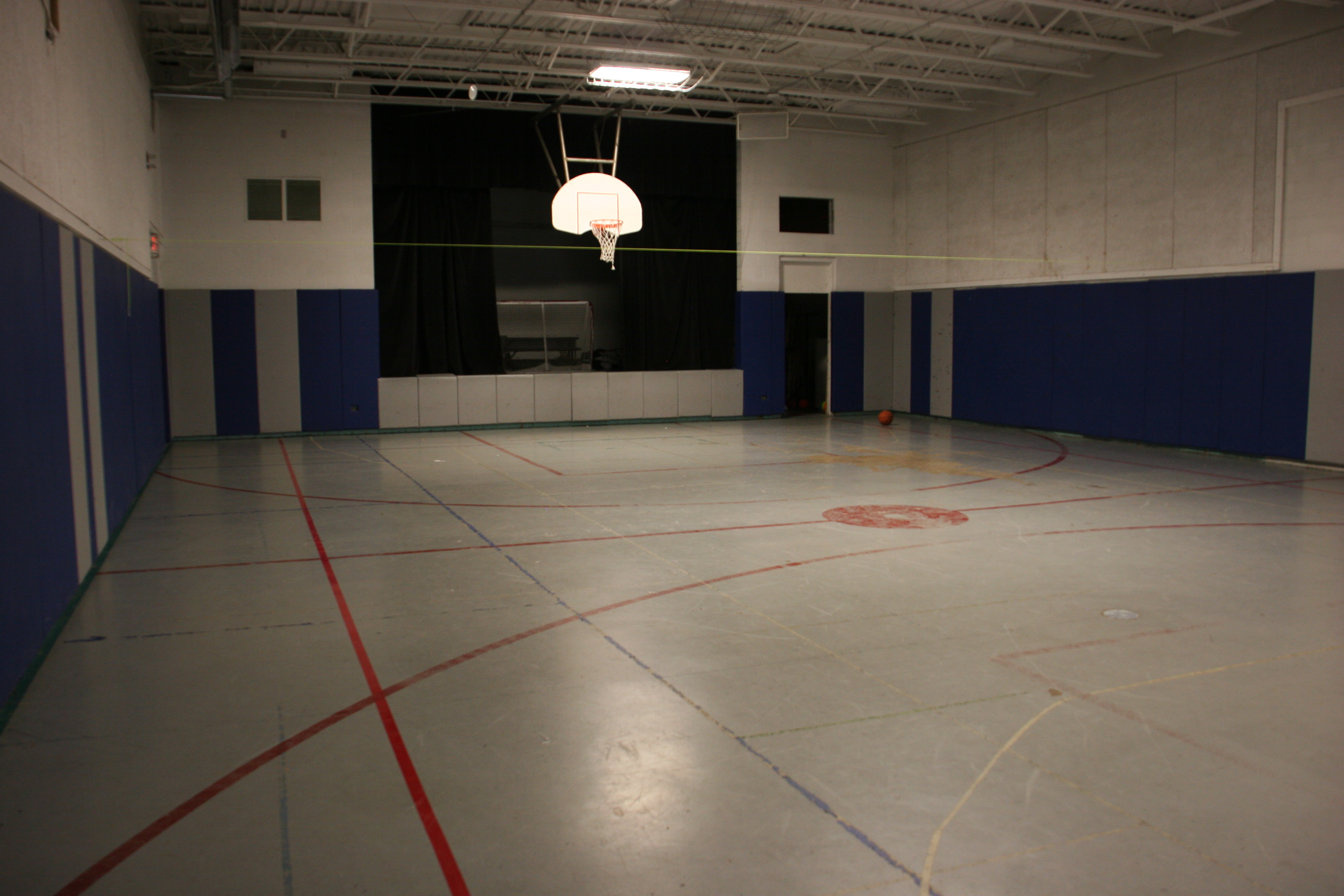
The old school gym, site of the family reunion. (Minnesota Prairie Roots copyrighted file photo September 2022)
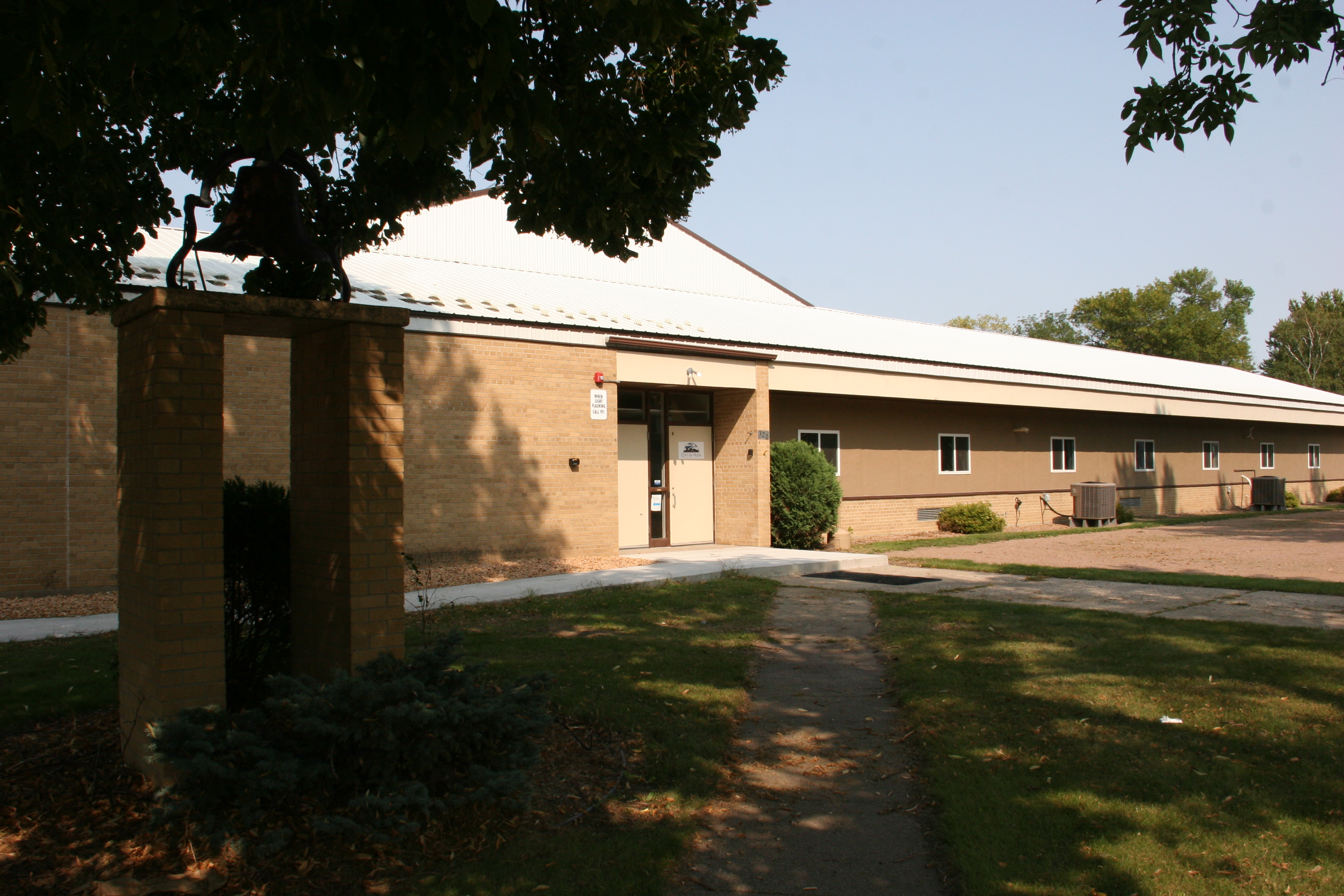
The school today, as a city hall and community center. (Minnesota Prairie Roots copyrighted file photo September 2022)

To walk back into the building where I spent my first six grades learning to read, write, spell, do math and more felt comforting and disconcerting, like stepping back into a school that no longer looks the same, but still holds the same memories. Clapping erasers outside on the east brick wall. Listening to Mrs. Kotval read Laura Ingalls Wilder’s books after lunch. Scrawling letters in a penmanship book. Weaving a rug from rags. Building snowforts. Jumping rope on the front sidewalk. Performing on the stage. So many memories in this space.
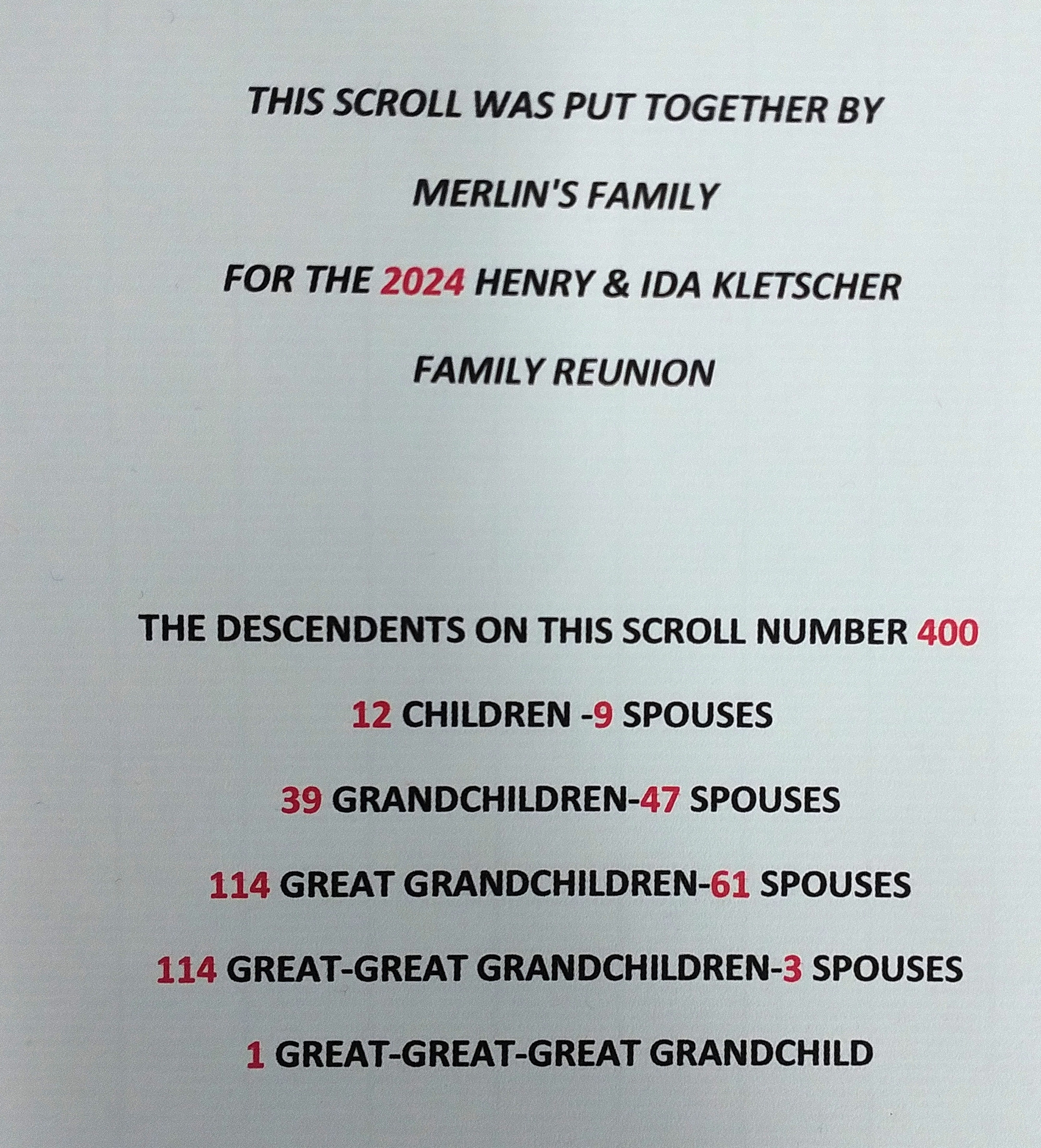
A summary of a 30-page family tree/scroll. (Minnesota Prairie Roots copyrighted photo July 2024)

And on Sunday, that space also held some 60-70 descendants of Henry and Ida Kletscher, parents of twelve, two dead in infancy and only three surviving today. The family tree, printed on 30 pieces of paper, stretched across several tables. I am one of 39 grandchildren, my children among 114 great grandchildren of Henry and Ida in a line that today also includes 114 great great grandchildren and one great great great grandchild. We are a large and prolific bunch that continues to grow. That we still gather annually is a testament to the strength of family bonds. I grew up near my paternal grandparents, aunts, uncles and cousins, spending lots of time together.
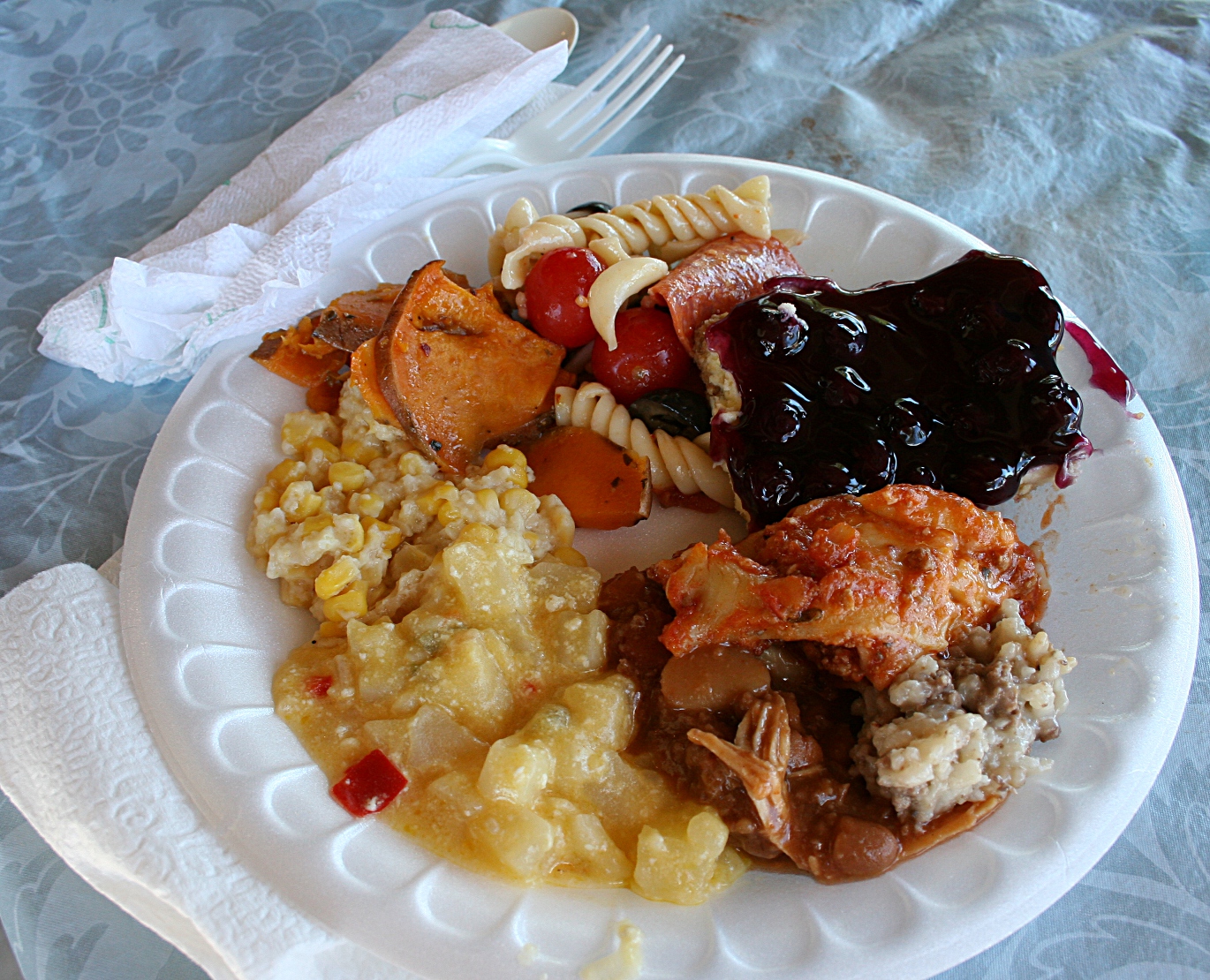
Everyone brings food for the potluck. There’s always blueberry dessert. The spread covers several tables. (Minnesota Prairie Roots copyrighted file photo July 2013)

But my generation and those thereafter have scattered well outside Redwood County. Family arrived from Wisconsin, Iowa, North Dakota and all parts of Minnesota from Blaine to Delano to Alexandria to Owatonna, Faribault, Waseca, and many other communities near and far. Those from even more distant locations like the East Coast did not attend.

As at all reunions, I intentionally circulated, attempting to converse with everyone at some point. This gathering, conversations were not so much about the past as about the present. We talked kids, grandkids, retirement (or not), health challenges, home improvement projects… There was a lot of phone scrolling, too, to show photos of grandchildren.
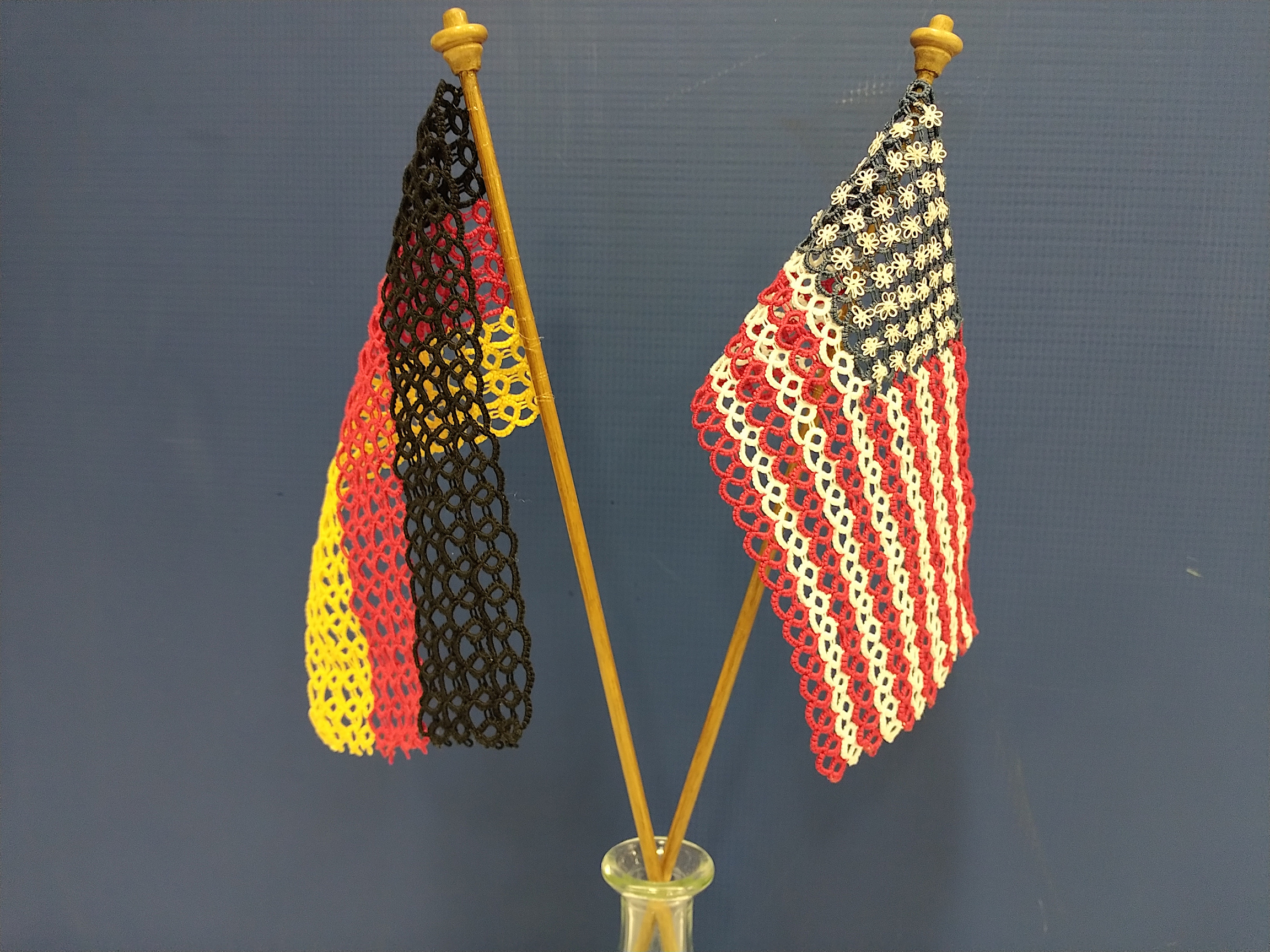
Aunt Iylene tatted these flags celebrating our German heritage and the Kletscher family’s new home in America. (Minnesota Prairie Roots copyrighted photo July 2024)

I cooed over new baby Wren; met Aubrey from West Fargo, going into first grade and whose name was easy for me to remember (and mine for her); saw photos of a wedding dress under construction by bride-to-be Sarah; encouraged Andy, who is in a drug trial study at Mayo Clinic for his debilitating heart condition; listened to Lynn’s recitation of a humorous poem her teacher didn’t appreciate back in the day; admired Aunt Iylene’s tatting projects (which she gave away on Sunday and which honor Grandma Ida, who also tatted); listened to stories of heartaches and challenges and life.
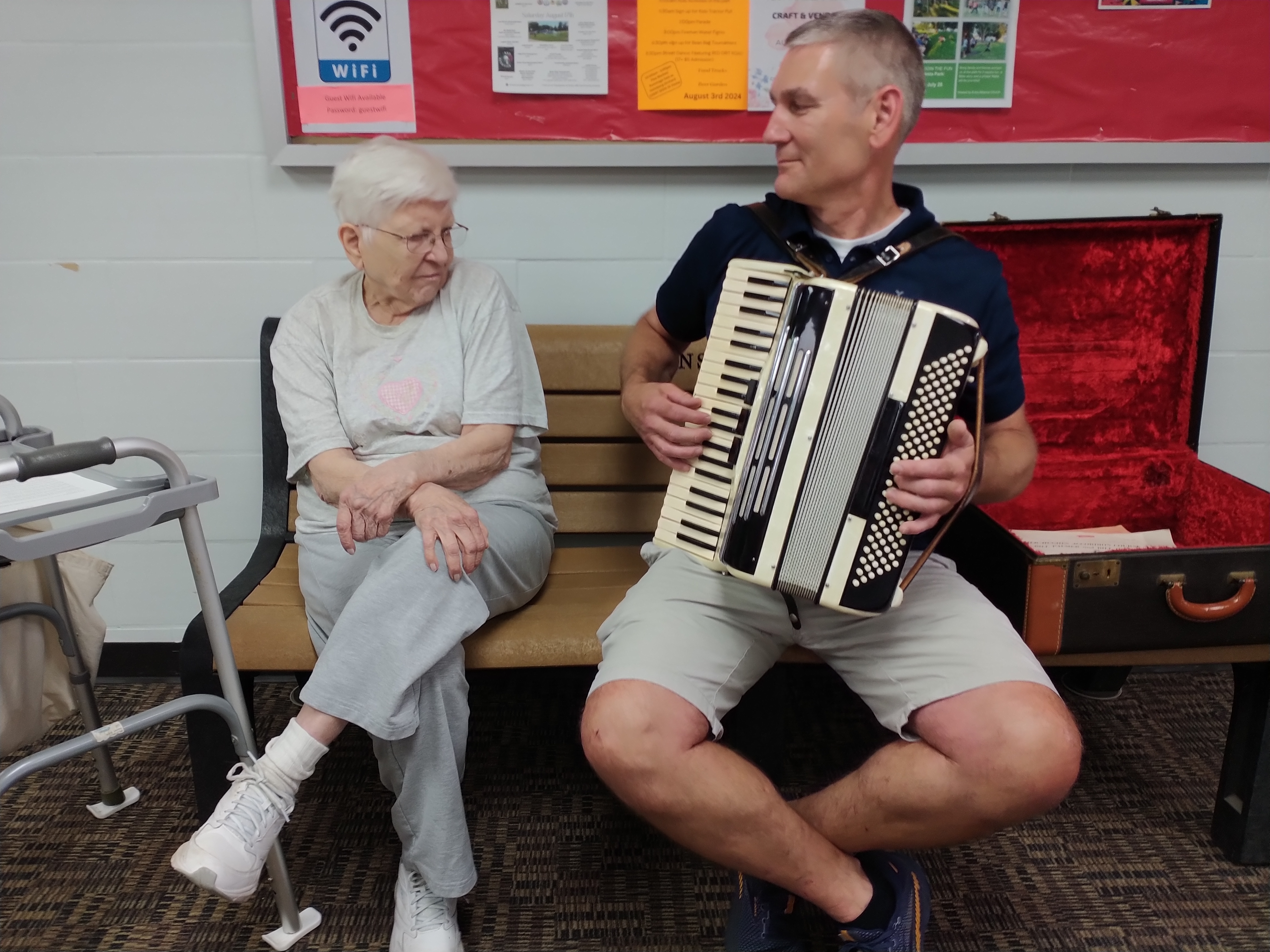
A highlight of the reunion was watching and listening to Kirt play Ardyce’s accordion. (Minnesota Prairie Roots copyrighted photo July 2024)

And then there was the impromptu concert by my cousin Kirt, who plays accordion. He brought his and was also gifted, at the reunion, with Aunt Ardyce’s 73-year-old accordion, a gift to her from her parents when she was only thirteen. She took lessons briefly as did two of her children. But the instrument has mostly sat in its case for seven decades…until Kirt picked it up and commenced to play, but only to a select few of us in the entry hallway. To watch my 86-year-old aunt, seated next to her nephew, listening intently to “her” accordion brought me such joy. I couldn’t help but think how happy this moment would have made my grandparents.
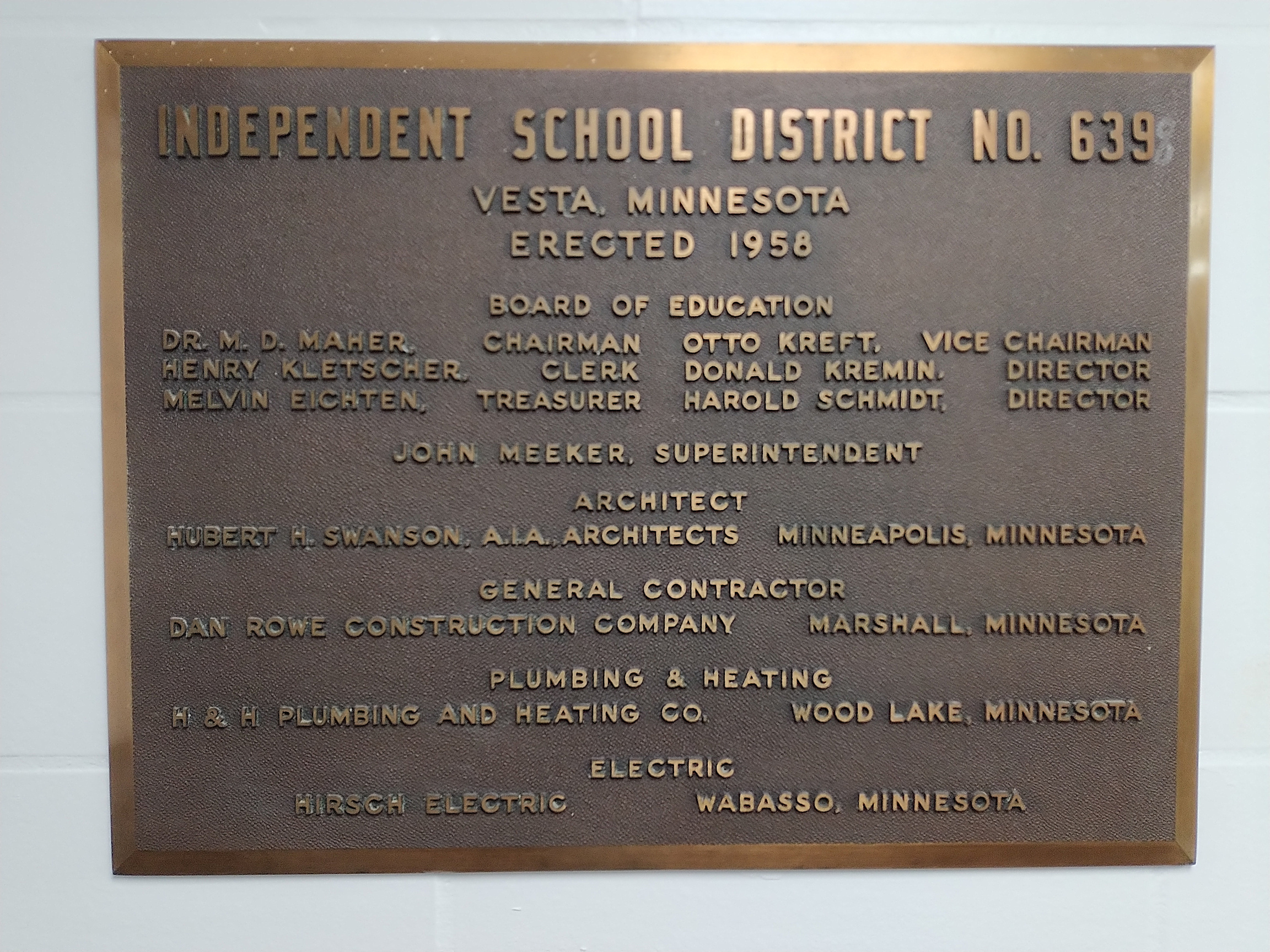
A plaque honors my grandpa and others who were instrumental in construction of Vesta Elementary School. (Minnesota Prairie Roots copyrighted photo July 2024)

We were here, in this place, because of Henry and Ida. Henry served as clerk of Independent School District #639 when the Vesta School was built in 1958. To think that, 66 years later, Grandpa’s descendants would gather here to celebrate family felt incredibly right. Two hours after we ate a potluck lunch (which always includes blueberry dessert), we honored Henry and Ida with 1919 root beer floats. My grandparents were married in November 1919.

Here we were in 2024, a family still going strong—reuniting, reconnecting, remembering and honoring the legacy of Henry and Ida Kletscher. Henry, the 25-year-old farmer, who married Ida just days before her eighteenth birthday 105 years ago.

#

FYI: In addition to the Kletscher Family Reunion, I’ve reconnected in July with Sue, a blogging friend; aunts from New Jersey and Missouri and family from Minneapolis; my son from Boston; and met three of Randy’s cousins originally from North Dakota. There are more gatherings to come with a Helbling Family Reunion in two weeks and 50-year class reunions for Randy and me in September.

© Copyright 2024 Audrey Kletscher Helbling


House of Kahmanns: A story of trauma, family love & resilience May 1, 2024

IT WAS A TUESDAY in January 1964. Wash day in the Kahmann household. Outside, a ground blizzard raged, reducing visibility on the southwestern Minnesota prairie. The events of that morning, of that day, would forever change the lives of siblings Karl, Patsy, Eric, Andy, John, Paul, Kevin, Katy, Karen, Phillip, Jim and Beth, and their parents, Jack and Della.

That sets the scene for House of Kahmanns, a memoir by P.G. (Patsy) Kahmann, oldest daughter, second oldest among 12 children. Sixteen months earlier, the family moved from Kansas City, Missouri, to Minnesota when Jack, a traveling salesman in a farm business, was relocated. They settled near their maternal grandparents, into a rental home by Granite Falls.

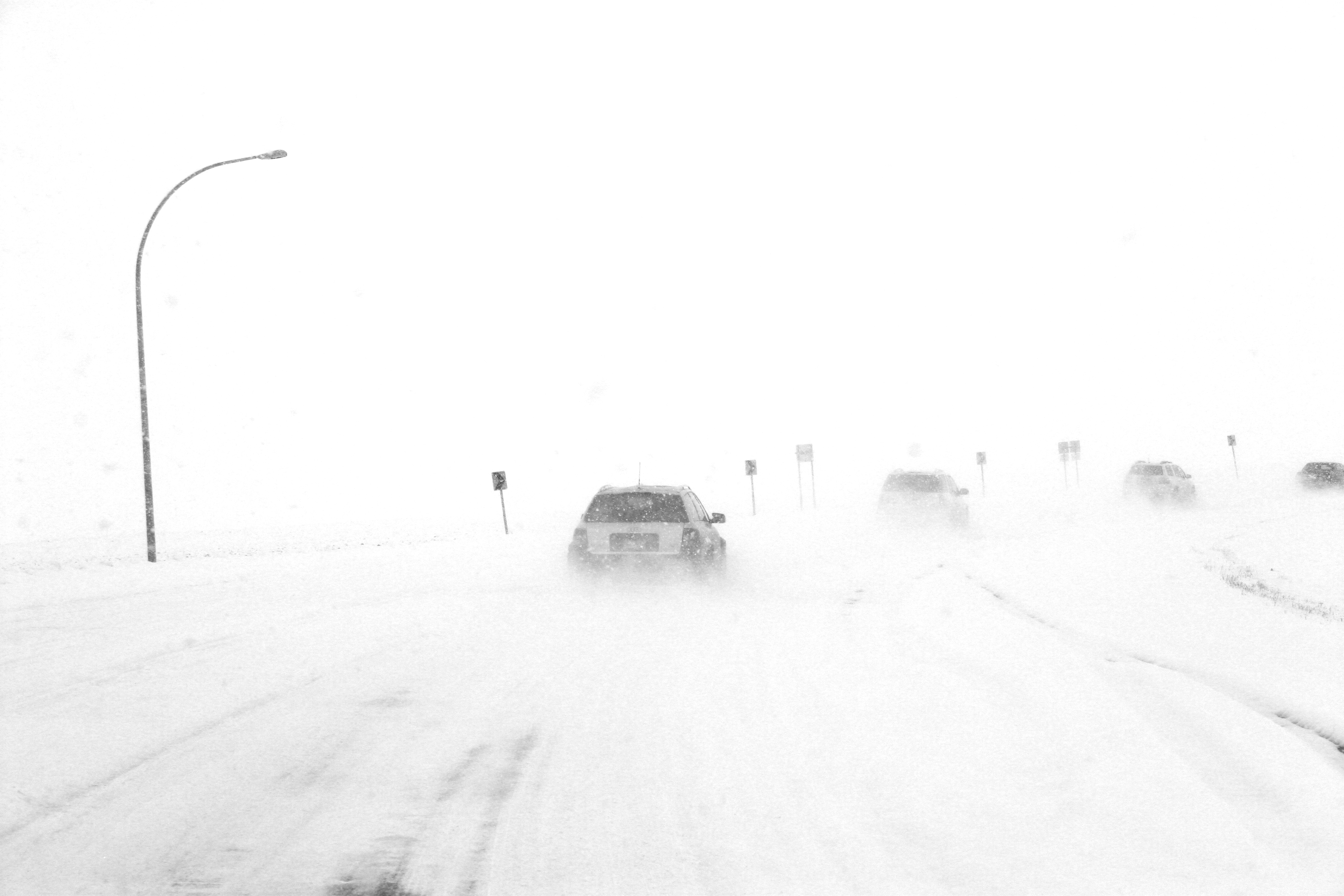
I expect Jack Kahmann was driving in weather and road conditions similar to this. (Minnesota Prairie Roots copyrighted file photo, January 2020, used for illustration only)

This is familiar land to me in a familiar time. I was not quite eight years old in January 1964, living on a farm some 30 minutes away in neighboring Redwood County. I understand full well the fierce prairie wind that whips snow into white-out conditions. On that blustery morning, as Jack and Della and Della’s parents set out for medical and business appointments in Minneapolis, leaving the oldest, Karl, to care for the youngest children, Patsy and her school-age siblings boarded the school bus.

Rosary beads. (Minnesota Prairie Roots copyrighted file photo used for illustration only)

Patsy was in English class when she got the devastating news. There had been a crash. A bread truck driven by an unlicensed 14-year-old ran a stop sign and then a yield sign before slamming into the 1957 Chevy driven by Jack. Della, mother of a dozen, was the most seriously injured. “How many Hail Marys will it take to save my mother’s life?” Patsy asks herself.

An altar in a southern Minnesota Catholic church. (Minnesota Prairie Roots copyrighted file photo used for illustration only)

Faith, a strong Catholic faith, threads through this story. The Kahmanns were devout, prayerful, always in church. The church, or rather the local parish priest, would play the primary role in turning the initial tragedy into even more intense pain, suffering, separation and trauma for the family. Father Buckley demanded that the 12 children be placed with Catholic families while their parents recovered at a hospital 70 miles away. That, even though a Lutheran couple offered to move into the Kahmanns’ farm home and care for the children. Together.

At this point in the book, I felt my anger flashing. Anger over the inhumanity of a man of the cloth who is supposed to exude compassion, care and love. More atrocities by the priest followed. By the time I read the epilogue, I was irate, forgiveness far from my mind.

Love and forgiveness were taught in the Kahmann home. (Minnesota Prairie Roots copyrighted file photo used for illustration only)

But the Kahmanns were a loving and forgiving family. (Not necessarily of that priest.) One evening after they are all reunited, Jack asks his family to pray blessings upon the driver of the bread truck. Three-year-old Phillip mishears. “God bless the red truck!” he shouts. Laughter erupts. I needed that humor in a story weighing heavy upon my soul.

I wanted to step into the pages of the book and hug those kids and make everything better. Just as Millie Bea did when the Kahmanns lived in Kansas City and Jack was traveling around the country and Della needed extra help with the kids. The book flips back and forth in time and place between Missouri and Minnesota, before and after the crash.

The Kahmanns were not unfamiliar with trauma. In June 1955, Andy’s hand was nearly severed in a hand cement mixer. A Kansas City surgeon successfully reattached his limb, even though a priest told Jack that his son’s hand had been amputated. That was untrue.

Family love is such a strong theme in this book. (Minnesota Prairie Roots copyrighted file photo used for illustration only)

Through all of this, themes of love, strength and resilience thread. The Kahmann siblings clearly looked out for and loved one another and got through some pretty awful stuff. Their motto, Patsy writes, was “No one died. We all survived.” They never talked about the accident. I’m not surprised. Who did back then? Eventually the family would relocate to Bird Island, 32 miles directly east of Granite Falls. It was a new start in a new place following their 75 days apart, “75 days of confusion, anxiety and foreboding.”

And now, with publication of House of Kahmanns—A Memoir, A story about family love and shattered bonds, about finding each other in the aftermath, perhaps these siblings are talking about all they endured. For Patsy, it is also about keeping a promise. In the book dedication she writes: To Mom and Dad/I promised you I would write this story. And she did, with honesty, pain and a great deal of strength.

© Copyright 2024 Audrey Kletscher Helbling


“Chick Days,” hatcheries & memories from rural Minnesota April 3, 2024

My friend Joy’s chickens. (Minnesota Prairie Roots copyrighted file photo)

I’M NO CHICKEN farmer. I’m not even particularly fond of roaming chickens (ducks or geese). But this time of year on “Chick Days,” I feel nostalgic, remembering the delivery of newly-hatched chicks. They arrived on my southwestern Minnesota childhood farm via the U.S. Postal Service, cheeping raucously and, I’m certain, desiring to escape their cardboard boxes.

A snippet of a promo for “Chick Days” at a local business.

Today, chicks still ship via mail, but need to be picked up at the post office or at a local supplier on “Chick Days.” That may be at a farm store, a grain elevator, a feed store…

A boarded up hatchery in southwestern Minnesota. (Minnesota Prairie Roots copyrighted file photo)

Gone are the days when chick hatcheries were found in many farming communities. But this is not Mayberry anymore. Rural America has changed significantly since I was growing up in the 1960s and 1970s with businesses now shuttered, buildings vacated.

A 1950s or 1960s era greeting card from a hatchery in Minneota, Minnesota. (Minnesota Prairie Roots copyrighted photo April 2024)

But, if you look closely enough, dig deep enough, ghosts of those businesses remain, including chick hatcheries. Among the vintage greeting cards my mom saved (she saved everything), I found a holiday card from Dr. Kerr’s Hatchery. That was in Minneota; that’s Minnesota minus the “s.”

Minneota sits on the prairie northwest of Marshall in Lyon County. This small town is perhaps best-known as the home of the late Bill Holm, noted writer and English professor at Southwest Minnesota State University. Among his work, Boxelder Bug Variations, a collection of poetry and essays about, yes, boxelder bugs. Minneota celebrates Boxelder Bug Days annually.

But it doesn’t celebrate chicks, as far as I know, or the hatchery with the unusual name of “Dr. Kerr’s Hatchery.” There’s a story behind that moniker. I just don’t know what that may be.

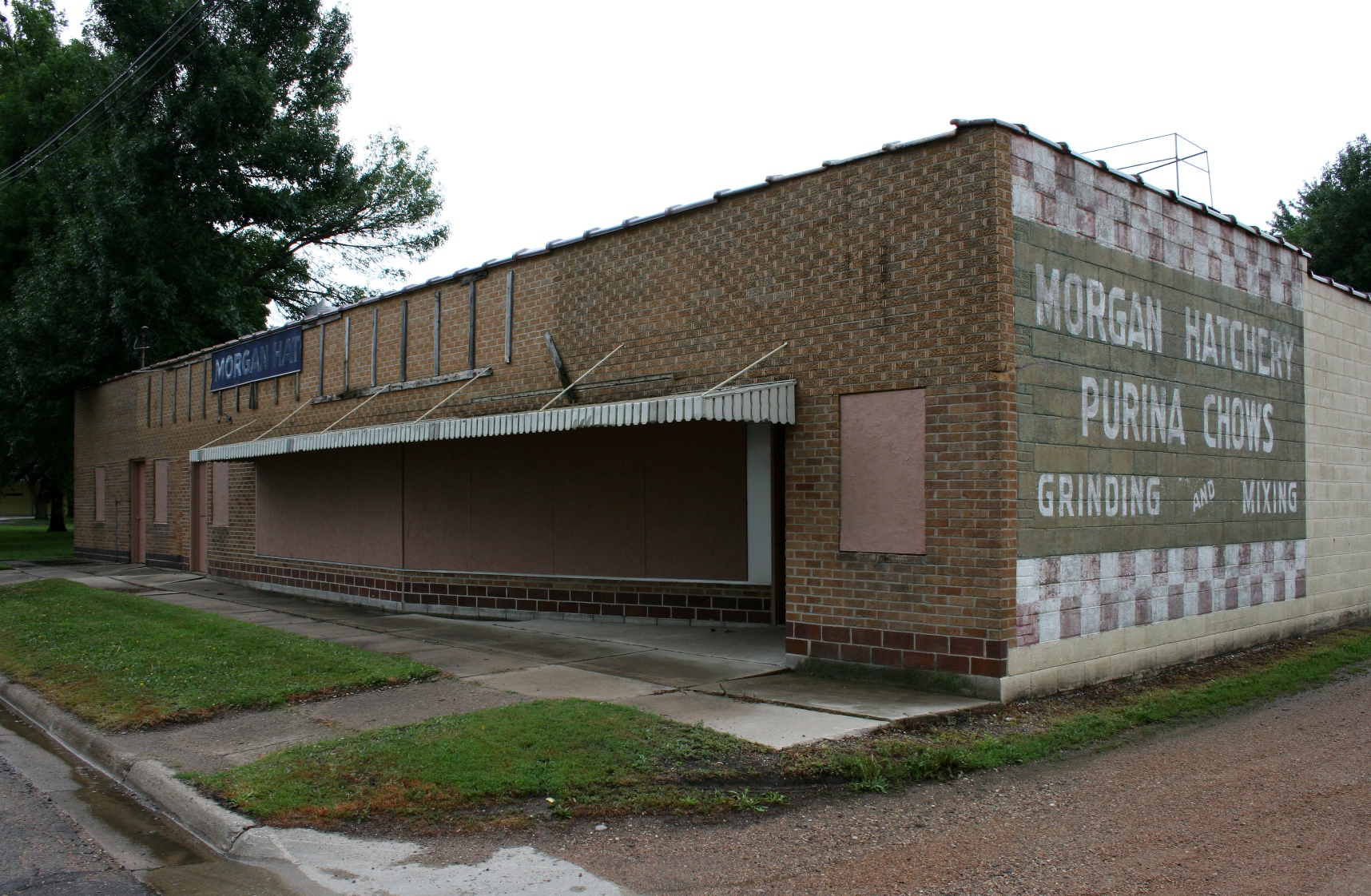
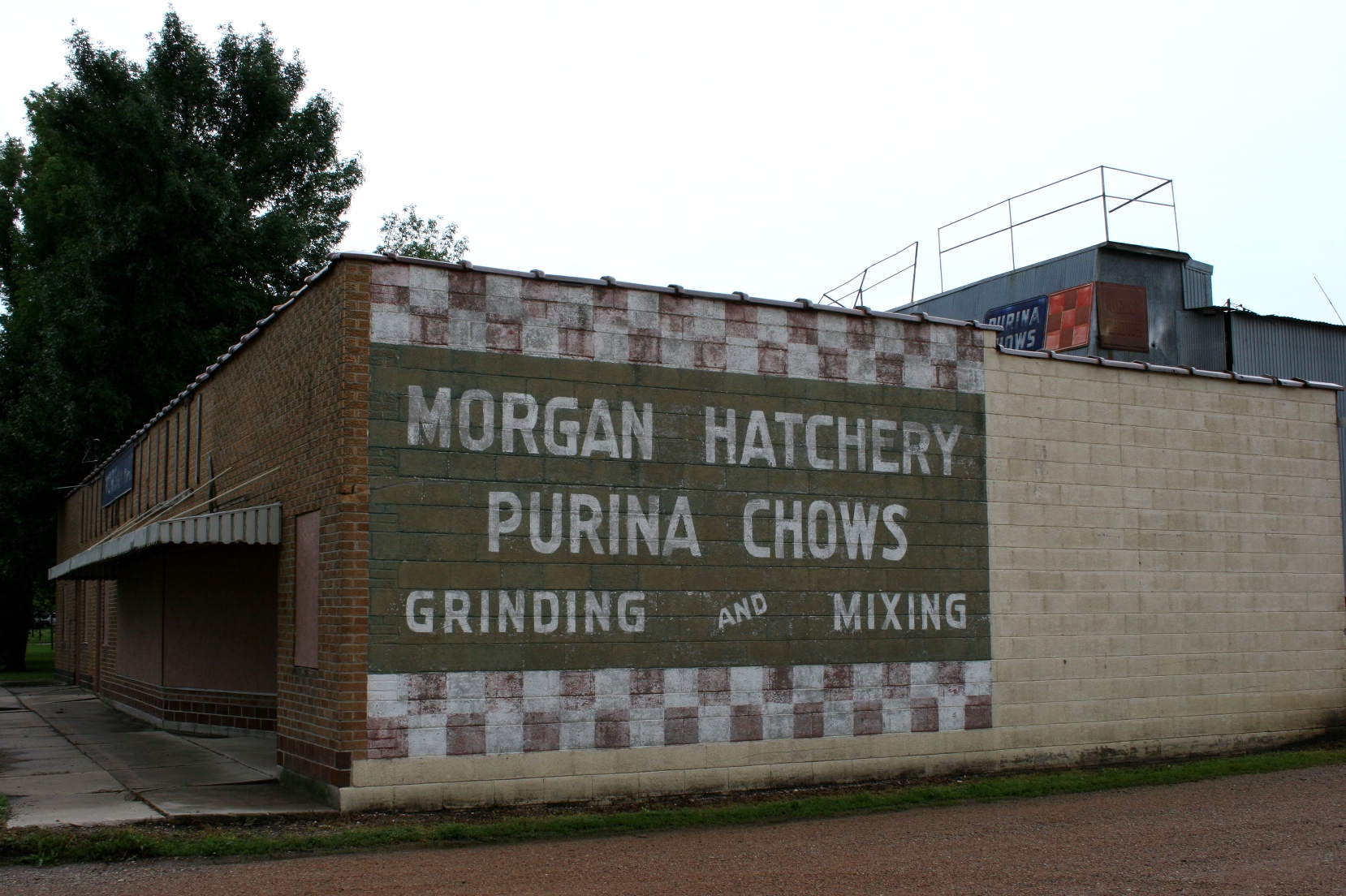
Signage is a reminder that this building once housed a hatchery in Morgan. (Minnesota Prairie Roots copyrighted file photo)

I do know, though, that Morgan, 60 miles to the east of Minneota, also had a hatchery, aptly named Morgan Hatchery. I photographed the exterior of the former hatchery and feed store in 2013 while en route to my hometown of Vesta.

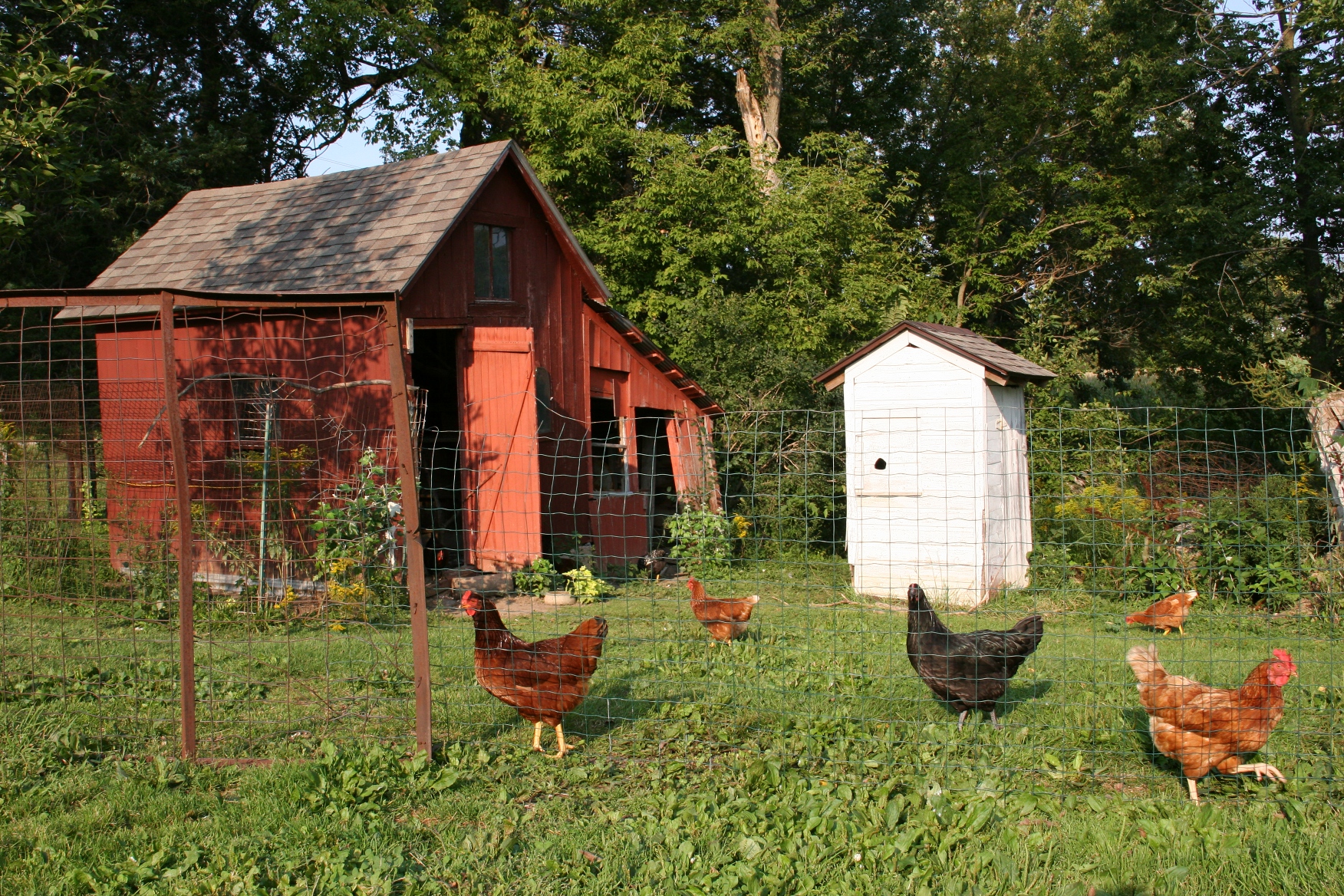
Chickens are fenced next to the red chicken coop on Joy’s rural acreage. Sometimes they also roam free around the yard. (Minnesota Prairie Roots copyrighted file photo)

Thoughts of home take me back to those chicks delivered by the mailman, as we called letter carriers back in the day. After retrieving the box (es) of chicks from aside the roadside mailbox, Mom released them into the chicken coop. There they clustered around shallow water dishes under the warmth of heat lamps. I don’t recall many details other than the fluffy fowl feathering all too soon. For me, the chicks’ transition toward adulthood quickly ended my adoration.

A fenced rooster at my nephew and niece’s rural acreage. (Minnesota Prairie Roots copyrighted file photo)

There’s a reason I dislike being in close proximity to chickens: pecking hens and a vicious rooster. Gathering eggs from angry hens as a young girl proved an unpleasant chore. And avoiding a mean rooster proved impossible. One day Dad had enough of the rooster attacking his children. He grabbed an ax and that quickly ended the hostile encounters. I still hold trauma from that rooster. But I’ve gotten better about being around chickens. However, if I even pick up on a hint of meanness, I flee.

Farm fresh eggs from Nancy and Loren’s chickens. (Minnesota Prairie Roots copyrighted photo April 2024)
The difference in eggs, with the yolk from a store-bought mass-produced egg on the left and a farm fresh egg on the right. (Minnesota Prairie Roots copyrighted photo April 2024)

Given my history, I’ll never own chickens. But I eat chicken. And I eat eggs. I especially like farm fresh eggs from free-range chickens. The dark orangish-yellow yolk hue, the taste, are superior to mass-produced eggs.

A maturing chick. (Minnesota Prairie Roots copyrighted file photo)

And I still think chicks are cute, even if they quickly morph into feathered birds I’d rather not be around.

© Copyright 2024 Audrey Kletscher Helbling


Book review: A collection of short stories & art from the Minnesota prairie by Elizabeth Johanneck July 27, 2023

The cover of Elizabeth Johanneck’s new book features the art of her grandfather, Arnold Kramer. (Minnesota Prairie Roots photo July 2023)

DECADES REMOVED from southwestern Minnesota, Twin Cities writer Elizabeth Johanneck and I remain rooted to the prairie—the land and people and smalls towns which shaped us. We both grew up on Redwood County farms, were Wabasso High School classmates and today hold a deep respect and fondness for the place we once called home.

Beth, as she’s known to me, recently published a book, If You Can’t Make it to Heaven, at Least Get to Seaforth—The Monica Stories and Then Some. This book features short stories and snippet observations in Beth’s humorous storytelling style, plus paintings and photos. These could be my stories, my memories, just with different characters and settings. Any prairie farm kid likely will feel the same.

ABOUT SEAFORTH & MONICA

But where is Seaforth? And who is Monica? Seaforth, population 77, is a farming community located along County Road 7, south of Minnesota State Highway 19 in central Redwood County. It’s near my hometown of Vesta, seven miles to the northwest. Monica Fischer is Beth’s friend, former co-worker and a character. A baby shoe in a pot of egg coffee and pantyhose found clinging inside a pant leg during Catholic Mass are among the many entertaining Monica stories that left me laughing aloud. By the time I’d finished reading this section of the book, I felt like I knew Monica well. Everyone should have a friend like her.

GROWING UP ON THE MINNESOTA PRAIRIE IN THE 1960s

And everyone should be so fortunate to have experienced rural Minnesota life in the 1960s, as Beth and I did. It is Part 2, “Random Nonsense of a MN Country Mouse,” that I find most similar to my childhood. Both farmers’ daughters with many siblings, Beth and I share the commonalities of being raised on the land among aunts and uncles and cousins and grandparents and immediate family who loved us deeply.

As in “The Monica Stories,” Beth writes about her personal experiences in a casual conversational style. It’s as if she and I are chatting over cups of coffee, and Beth does like her coffee. I connect with her stories about “the grove,” jars of pocket gopher feet in the freezer, grab bags, bloodsuckers, The Weekly Reader, hearing corn grow and more.

Her humor-infused short stories stretch into adulthood, into becoming a parent and grandparent. These are not earth-shattering remembrances, but rather observations about everyday life and events that could be mine, could be yours, but are definitively Beth’s.

NIBBLES OF COUNTRY INSIGHTS

In a section titled “Country Mouse Nibbles,” Beth shares her thoughts on topics in a sentence or two, the first being “When You Are Raised Close to the Land.” I fully understand—the smell after autumn harvest, looking to the west for approaching storms, filled fruit jars crowding root cellar shelves… And “Holding onto Memories”—Distant cheers from a local ball game are souvenirs worth saving for winter. Truly poetic words.

FEATURING THE ART OF “MINNESOTA’S GRANDPA MOSES”

There is much to be cherished in this book beyond pages and pages of rural memories and insights. Beth also intersperses photos, most from Seaforth. But it is Part 3, “Paintings by Arnold Kramer, Minnesota’s ‘Grandpa Moses,’” which is an historic agrarian art treasure. Following his retirement, Seaforth farmer Arnold Kramer took up painting, visually documenting early to mid-1900s rural life and scenes. He became well-known for his folk art style paintings done in primary colors. Beth’s book holds the only printed collection of paintings by her grandfather. The self-taught artist created more than 400 works of art and was dubbed “Minnesota’s Grandpa Moses” by the University of Minnesota at the peak of his creativity in the 1960s.

Book signing promo courtesy of Elizabeth Johanneck.

BOOK SIGNING SATURDAY IN SEAFORTH

Like her grandfather before her, Beth is also a visual artist. She illustrated a just-published children’s picture book by her lifelong friend, Cindy Bernardy Lavin, our WHS classmate. Both writers, along with Monica Pistulka Fisher, are doing a book signing from noon to 3 pm this Saturday, July 29, at the C4th Bar during Seaforth’s Hometown Days celebration.

Beth’s book is also available for purchase at Chapter Two Bookstore in Redwood Falls and online at Amazon and Barnes & Noble. Both her book and Cindy’s achieved bestseller status on Amazon following their release.

Julie Kramer, author of bestseller Stalking Susan, praises Beth’s book in her back cover endorsement, calling it “a delightful collection from a farm girl who grew up near the Minnesota home of Laura Ingalls Wilder.” I agree. Fully.

#

Disclaimer: I edited Beth’s book and advised her on the manuscript. She also included my poem, “Her Treasure,” as a companion piece in the “Country Mouse Nibbles” section. For many years, Beth hosted a blog, Minnesota Country Mouse.

© Copyright 2023 Audrey Kletscher Helbling


Mother’s Day gratitude: In her words, my mom’s gift to me May 10, 2023

Filed under: Uncategorized — Audrey Kletscher Helbling @ 5:00 AM

Tags: , , , , , , , , ,
Mom’s journals stacked in a tote. (Minnesota Prairie Roots copyrighted file photo)

DAYS BEFORE MOTHER’S DAY, I slide a clear plastic tote from a closet in the bedroom where my daughters once slept. I unlatch the lid. An overwhelming musty odor rises from the spiral-bound notebooks layered inside.

These are my mom’s journals. The story of her life recorded on paper from 1947 until her final entry on March 4, 2014, with a few years missing.

Mom died in January 2022. She left this handwritten documentation of an ordinary, yet extraordinary, life. As her oldest daughter and as a writer, I cherish the words she penned. They are not flowery poetic or personal entries, but rather a record of life as a farm wife and mother to six. Days that revolved around family, faith and farm life.

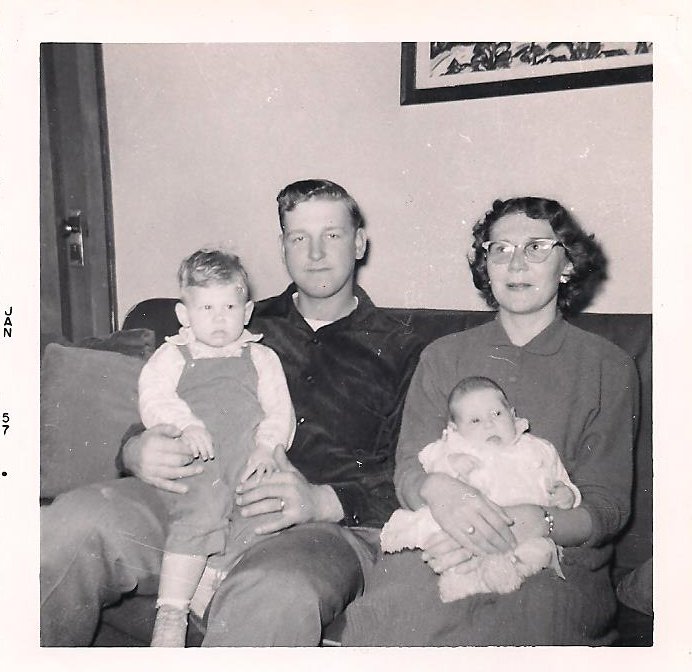
The only photo I have of my mom, Arlene, holding me. My dad is holding my brother, Doug.

With Mother’s Day only days away, I chose Mom’s 1955 journal, the year she became a mother, to begin reading. Mom invited her parents over for a Mother’s Day goose dinner that May, about two months before she gave birth to my oldest brother. I flipped ahead to July, reading her entries in the days right before Doug was born. Even at full-term, she kept working as hard as ever, freezing 24 boxes of green beans, canning a crate of cherries, pulling weeds in the garden and ironing clothes within days of delivering an 8-pound baby.

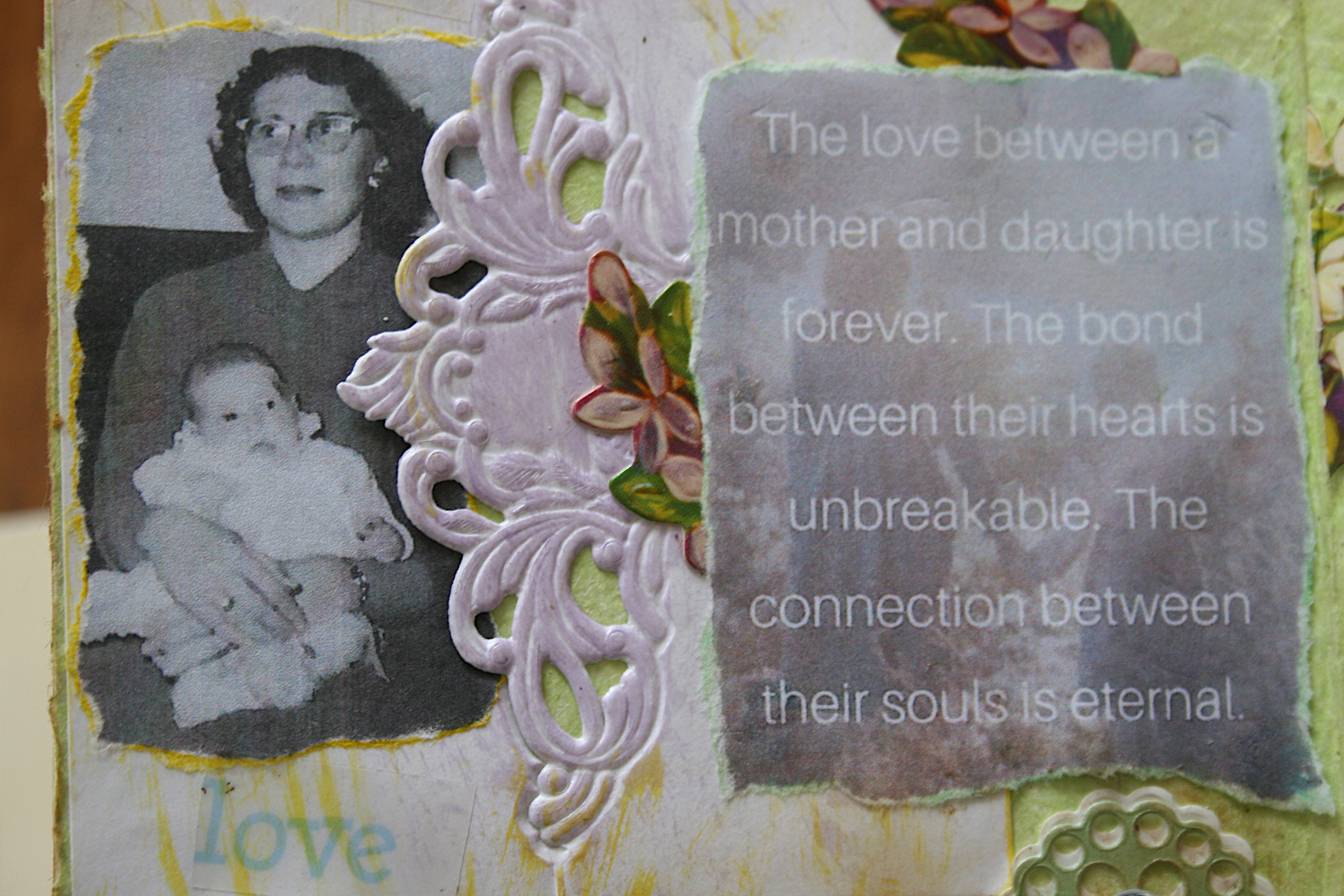
A page in an altered book crafted by my friend Kathleen. This page honors me and my mom. (Minnesota Prairie Roots copyrighted file photo)

Fast forward to May 1956. Mom notes in her Mother’s Day and subsequent entries that her mom went to the “Heart Hospital” on May 10 and came home May 17. Some six months later, Josephine died of a heart attack. She was only 48. And I was only two months old. I cannot imagine the grief my mom felt in the unexpected death of her mother. But she never put those emotions on paper. Rather her diary entries are straight forward, almost of journalistic detachment. Notations of her mom’s December 1 death, a funeral and writing thank yous.

My mom saved everything, including this Mother’s Day card I made for her in elementary school. I cut a flower from a seed catalog to create the front of this card. (Minnesota Prairie Roots copyrighted file photo)

On the next Mother’s Day in May 1957 and through 1961, there are no references to any special way in which my mom was honored. No gifts. No special meal. Only that I had a bad case of the measles as a nine-month-old. In May 1962, my brother had the mumps. But I did give Mom a paper flower at a school Mother’s Day program.

In entries in the years that followed, Mom always wrote of attending the Mother’s Day programs at Vesta Elementary School. I hold vague memories of standing on the stage, reading a poem about lavenders blue dilly dilly in verse that now eludes me.

And although I don’t remember, I gave Mom plants and, in 1967, “a fancy flower,” whatever that means. But most meaningful to me, a writer, was the gift of a writing pad to Mom in 1964. Now, in return, I have the gift of her words written in perfect, flowing penmanship.

In May 1963, Mom got a Whirlpool dishwasher. In May 1968, she redeemed Green Stamps for two lamps. She also got an automatic Maytag washing machine with suds saver for $300 from Quesenberry’s Appliance in Redwood Falls. I can only imagine how these Mother’s Day gifts of dishwasher and automatic washer eased her workload.

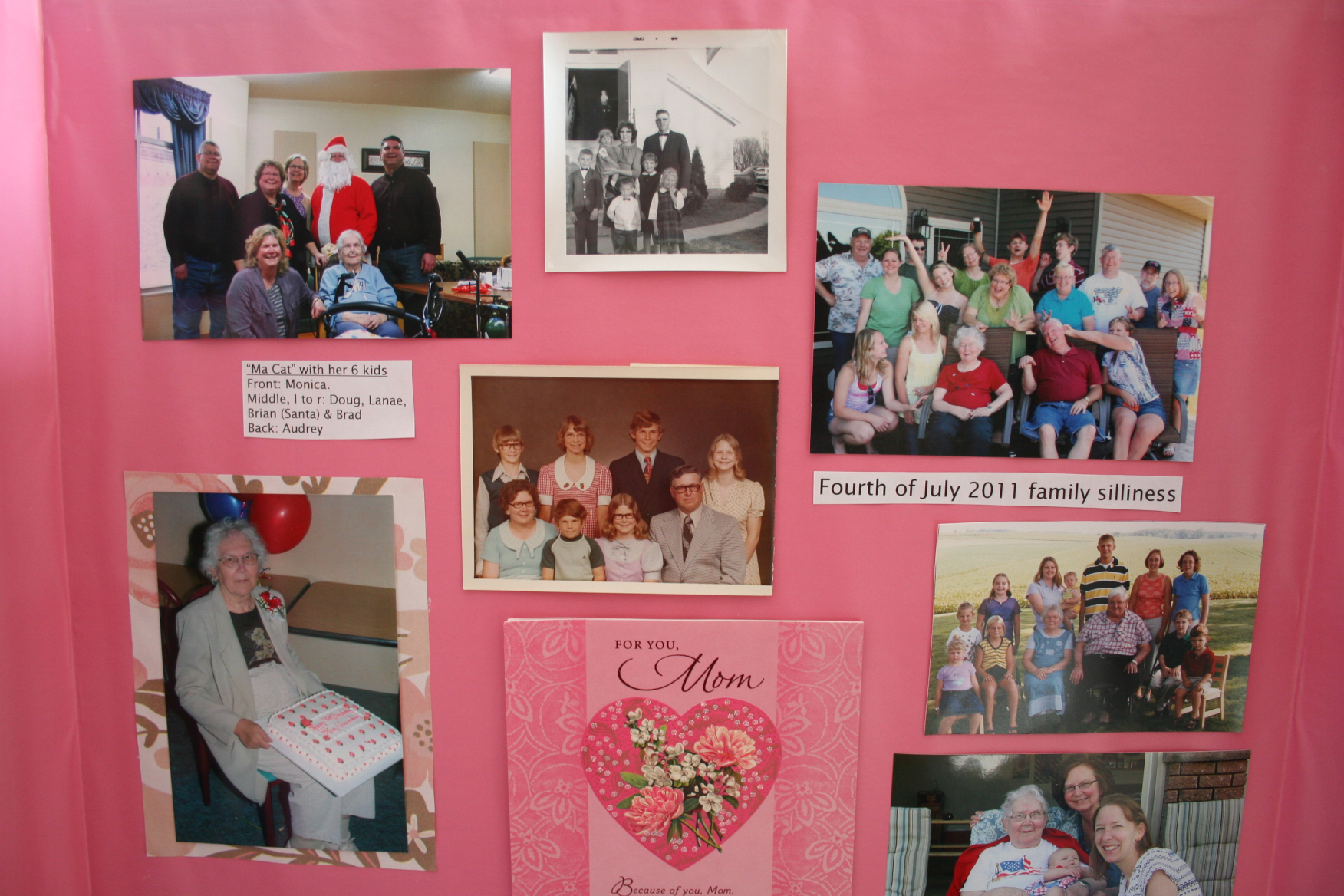
A section of a family-themed photo board I created for Mom’s January 2022 funeral. (Minnesota Prairie Roots copyrighted file photo 2022)

I wish I’d realized while growing up on the farm just how hard my mother worked. That would come later in life, when I became a mom in 1986, raising three kids, not six like her. In her final years, I thanked Mom many times for loving and caring for me, for raising me to be kind, compassionate, caring and a woman of faith. I hugged her and held her hand and cried whenever I left her care center, each time wondering if it would be the last time I would see Mom.

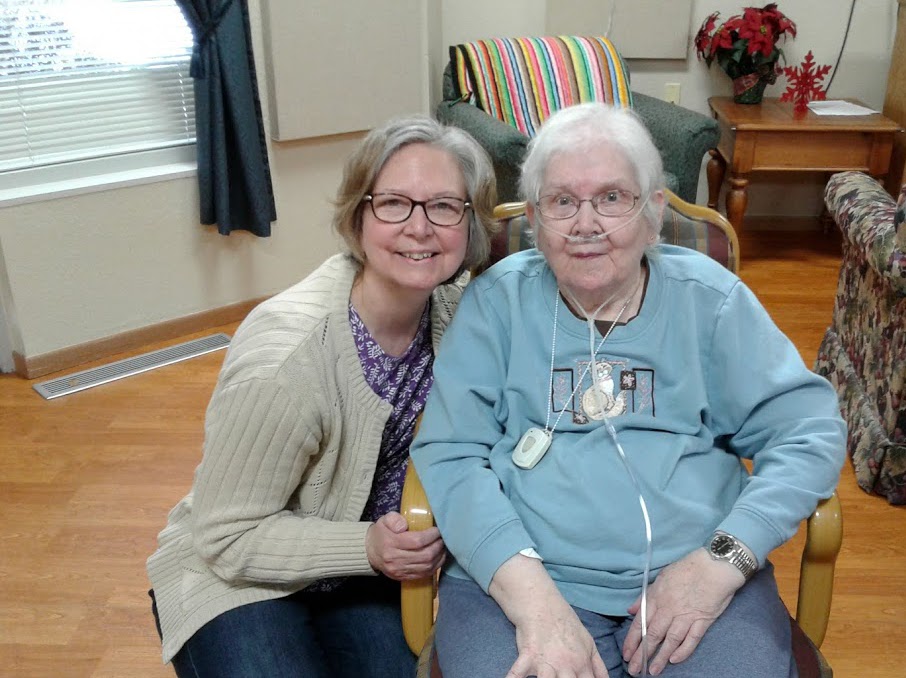
One of my favorite later photos with Mom, taken in 2017. (Photo credit: Randy Helbling)

Now, as I mark my second Mother’s Day without the mom I loved, still love, tears edge my eyes. I read page after page after page of her writing. Gratitude rises for this legacy she’s left, this story of her ordinary life on a southwestern Minnesota farm, this story of a mother who loved, labored, and lived a full and beautiful life.

© Copyright 2023 Audrey Kletscher Helbling


Inspired by an outdoor community gathering spot in Marshall April 13, 2023

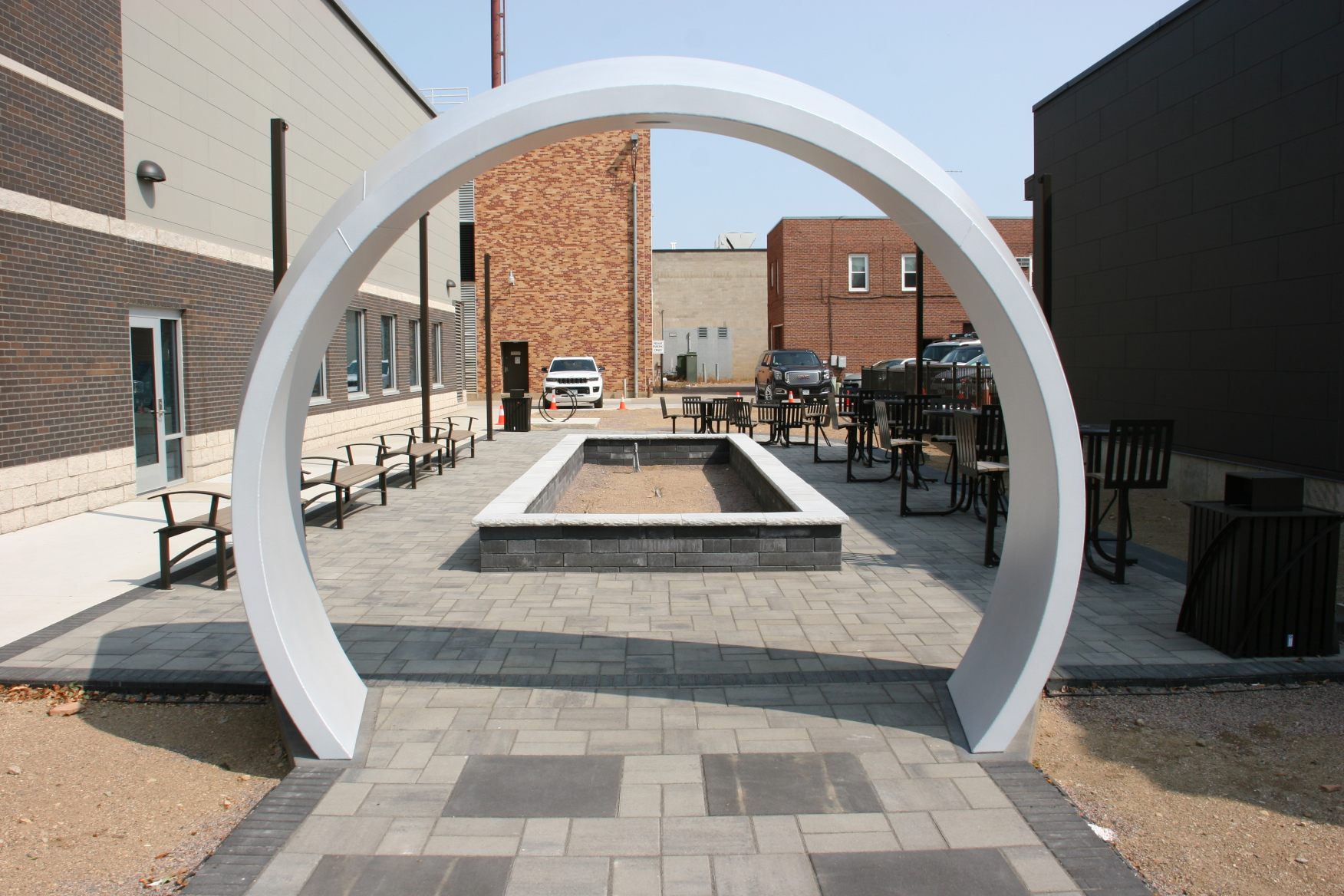
Terrace 1872, under development in September 2022 in downtown Marshall, Minnesota. (Minnesota Prairie Roots copyrighted file photo September 2022)

WHEN I PHOTOGRAPHED an under construction patio while visiting Marshall in mid-September, I wondered exactly what was up with this space. And then I forgot about it…until now.

The Lyon County Historical Society Museum, housed in a former library. (Minnesota Prairie Roots copyrighted photo September 2022)

It was a warm and sunny day when I happened upon the patio project in the heart of Marshall’s downtown business district. This ag-based community and college town sits on the southwestern Minnesota prairie, some 20 miles west of my hometown. I was back in the area to view two of my poems on display in the “Making Lyon County Home” exhibit at the Lyon County Historical Society Museum. After touring the museum, Randy and I did a short walk-about in a downtown that looks nothing like the downtown I remember from my last visit 40 years earlier.

During that brief tour, we came across the developing outdoor area. I was impressed by what I saw—by the well-laid pavers, the strong arched entry, the cluster of patio tables and chairs, and the then-unfilled planter bed. I envisioned plants and flowers adding a calming natural balance to hard surfaces.

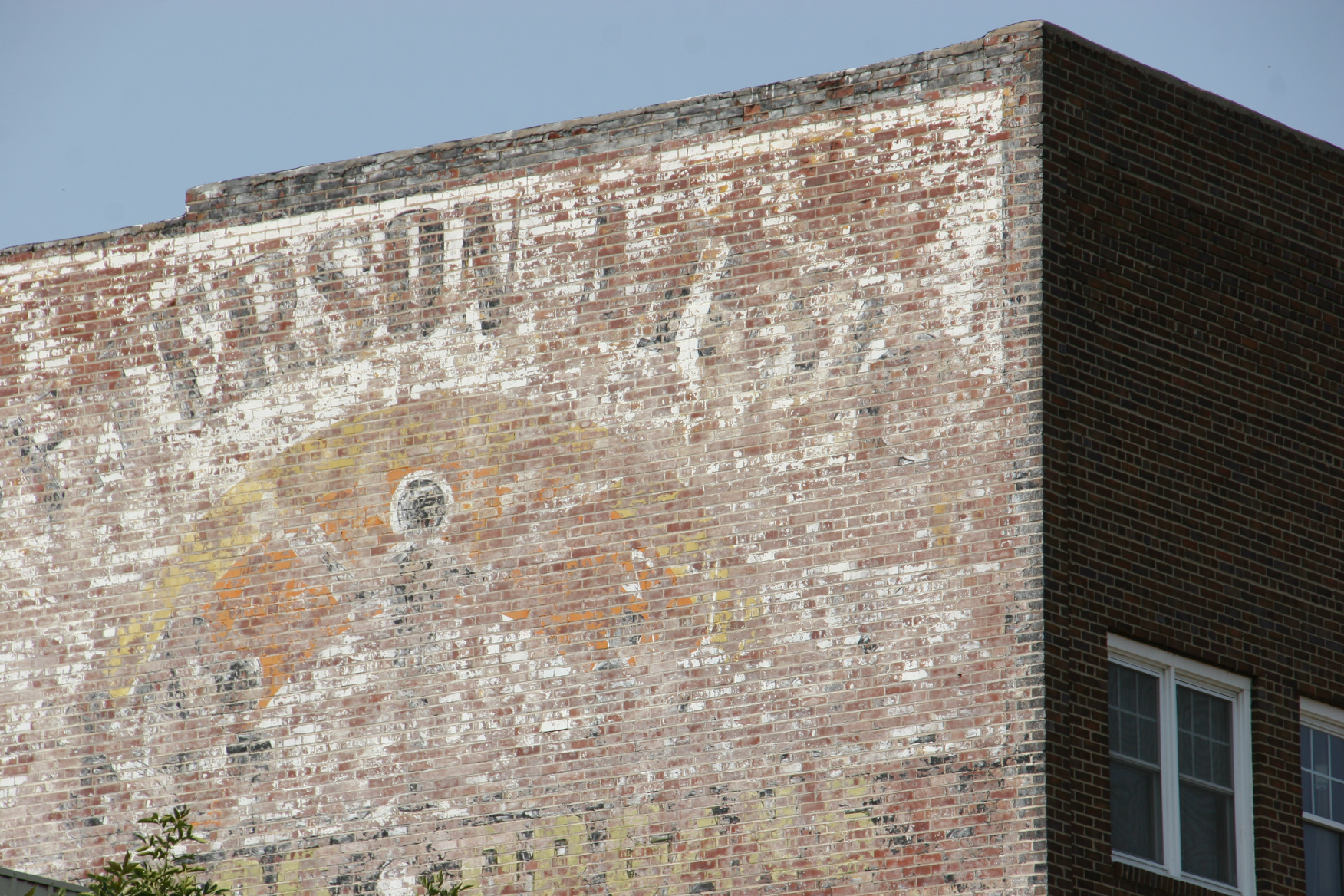
An unreadable (to me) ghost sign speaks to Marshall’s history. (Minnesota Prairie Roots copyrighted photo September 2022)

My eyes saw all of this. But, still, I didn’t know the backstory until now. This is Terrace 1872, a public gathering space next to City Hall. It came to be after the former Marshall Hotel was demolished, leaving a narrow, empty lot. Local visionaries saw this as an opportunity to create a community gathering spot. And so it will be. And the name, well, Terrace is self-explanatory. But 1872 represents the year Marshall became a city.

A mural, “At the Bend of the Redwood,” sprawls across a business in the heart of downtown Marshall. (Minnesota Prairie Roots copyrighted photo September 2022)

I love this concept of an outdoor area downtown where visitors, shoppers and downtown employees can meet, relax, just be. I also envision Terrace 1872 as a site for pop-up events—mini art shows, concerts, poetry readings… The possibilities seem endless for this pocket park.

Plans are to add a sculpture or art piece to the terrace, enhancing a downtown already graced by murals. Online plans also show movable fire pits and patio lights strung between posts. I appreciate the vision of an inviting and welcoming space to gather.

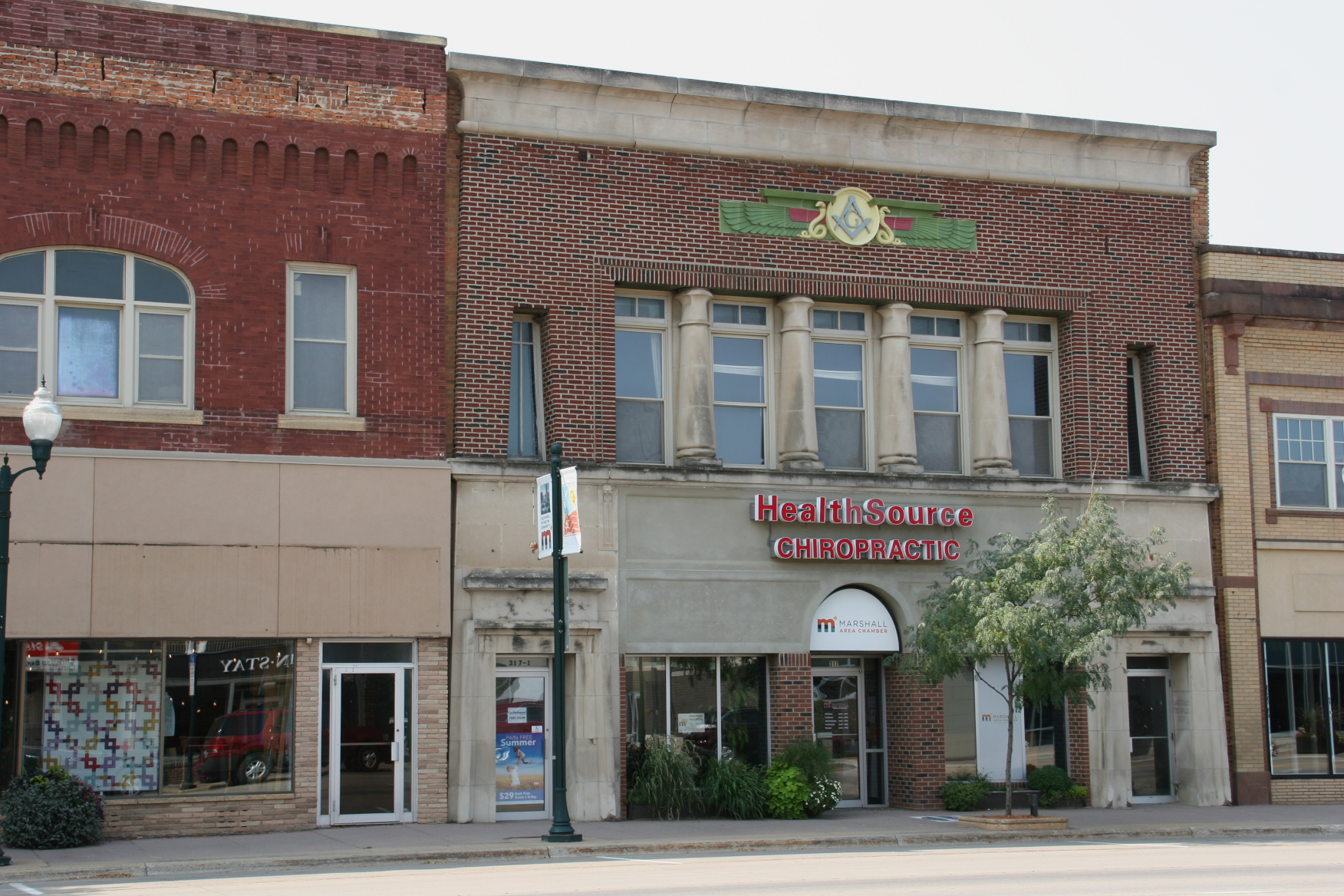
Businesses across the street from Terrace 1872. (Minnesota Prairie Roots copyrighted photo September 2022)

I’d love to see my community of Faribault adopt Marshall’s Terrace 1872 idea and create a similar mini gathering spot in the heart of our downtown. We have many vacant lots left after buildings were demolished. Previously demolished buildings were replaced by parking lots. Faribault now needs some greenery and additional outdoor public art infused into downtown, creating a peaceful place for people to gather, connect, relax, grow a sense of community while outdoors. I hope the visionaries here follow Marshall’s lead…

TELL ME: Do you have a Terrace 1872 in your community or have you seen one in another community? I’d love to hear details.


A heartwarming story from Vesta, my prairie hometown March 28, 2023

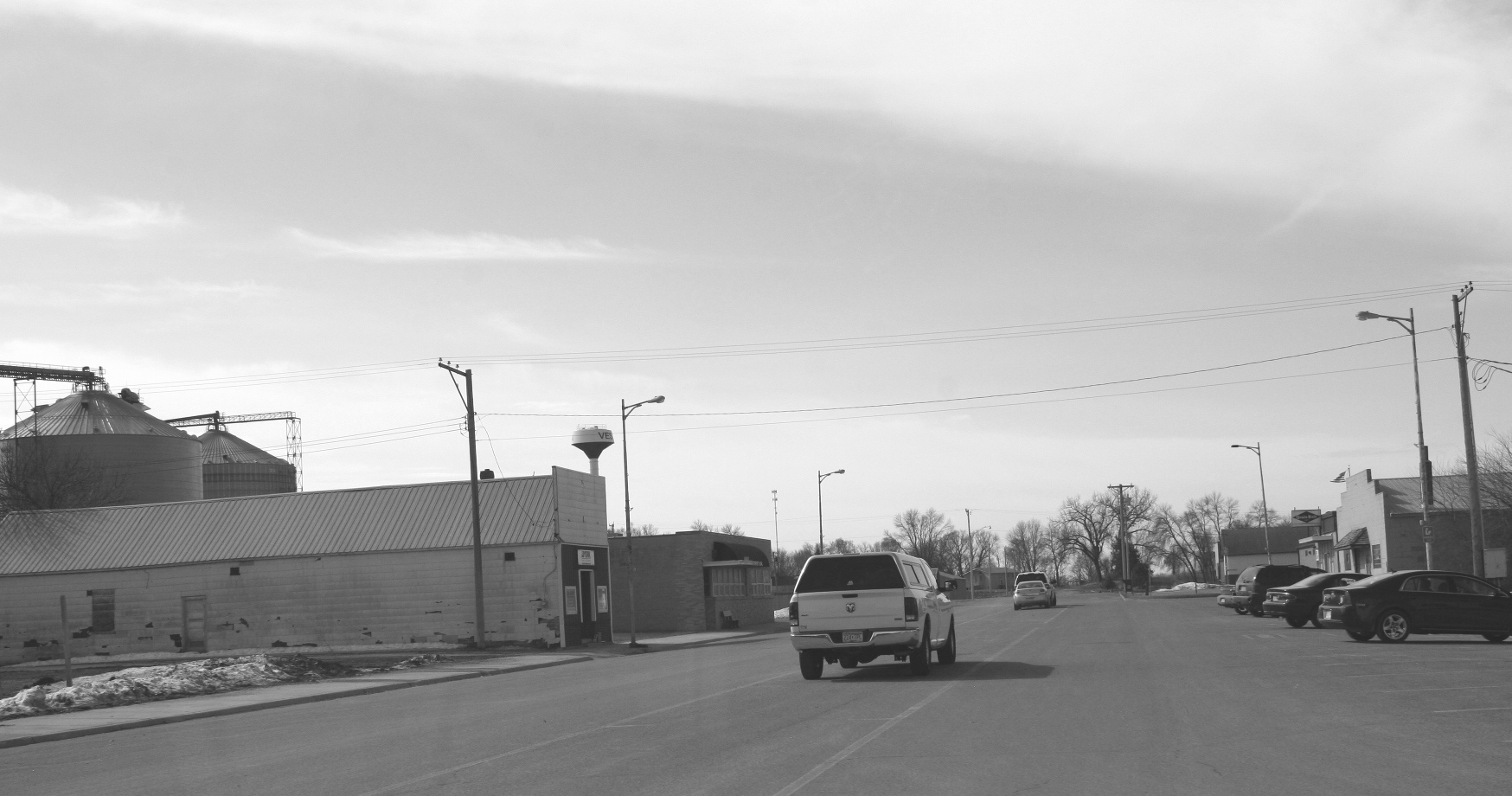
Downtown Vesta, Minnesota, photographed in 2018. (Minnesota Prairie Roots copyrighted file photo April 2018)

WHEN I READ A RECENT POST on the City of Vesta Facebook page, I knew I needed to share this story with you. It is a heartwarming story of kindness and gratitude that renews my faith in the goodness of humanity. And it is, too, a moment in which I feel overwhelming pride in my hometown.

Before I get to the referenced post, I expect many of you are wondering, “Where is Vesta?” I’ve found in my 41 years of living in southeastern Minnesota that most people have no clue. Vesta is west of Mankato, west of New Ulm, west of Redwood Falls. The small Redwood County farming community of around 320 sits along Minnesota State Highway 19 half way between Redwood and Marshall. It is the only town directly aside that highway for the 40 miles between the two larger cities.

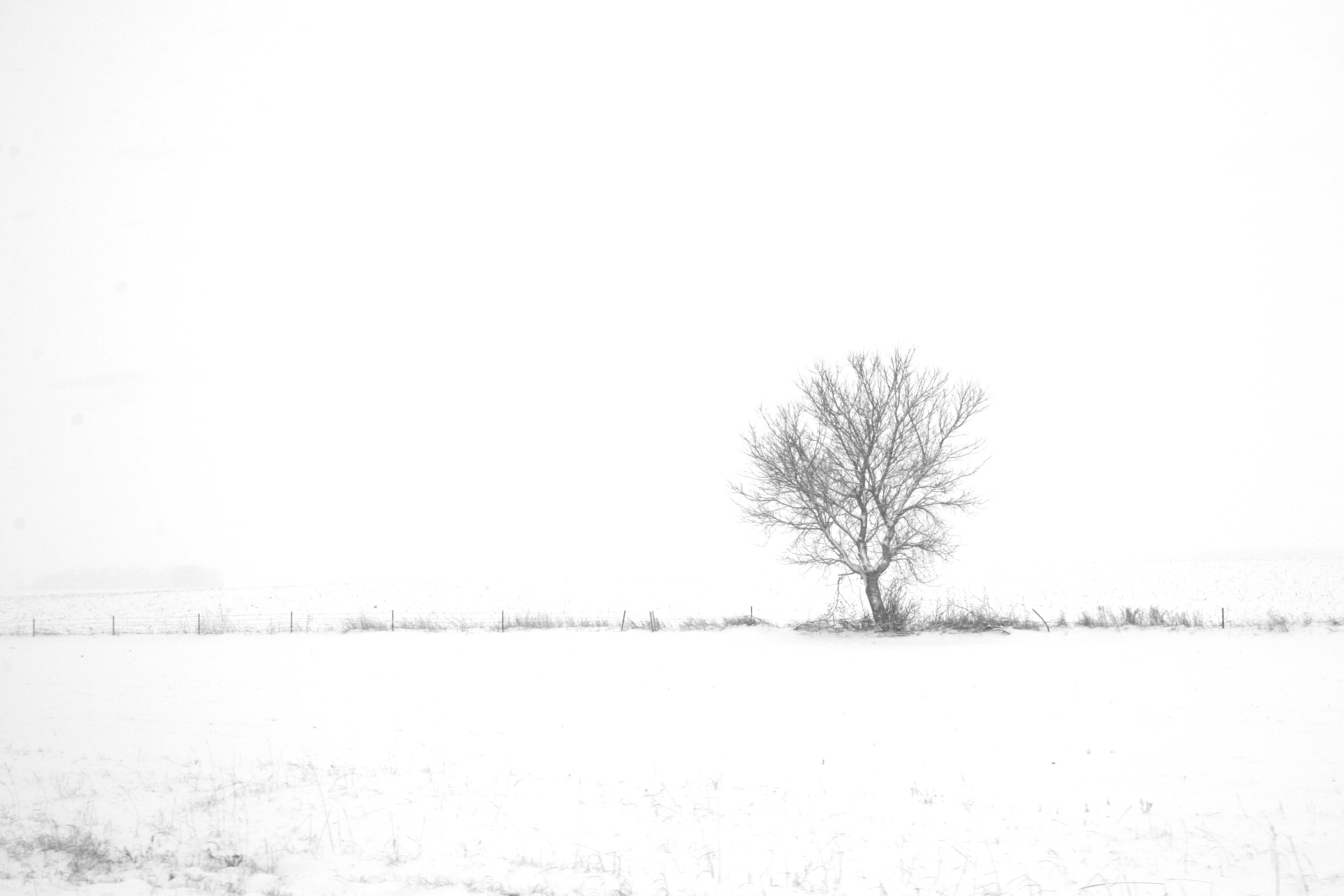
A lone tree along a fence line on the southwestern Minnesota Prairie. (Minnesota Prairie Roots copyrighted file photo March 2012)

Vesta is in the middle of the prairie, the windswept prairie. If a winter storm sweeps in with strong winds, then conditions quickly deteriorate to blizzard status. You don’t want to be caught on the road if that happens. It’s dangerous.

I shot this on the Minnesota Highway 19 curve just north of Vesta in March 2012. The recently-stranded motorist was at about this point on the highway, but in far worse weather conditions. (Minnesota Prairie Roots copyrighted file photo March 2012)

Recently, a motorist found herself in such dire conditions while driving Highway 19 toward Watertown, South Dakota, to visit grandchildren. Forty mph winds, blowing snow and zero visibility—to the point where she had to stop to see if she was still on the road some two miles from Vesta—resulted in a life-saving decision. She got off the highway at Vesta.

And that’s where this story begins to unfold into a story of generosity and kindness in my hometown. The first person she encountered was Dave and his buddy, out on four-wheelers. I knew exactly who she meant. Dave owns an auto body and repair shop in Vesta. He also plows snow for locals. When my mom was alive and still living in Vesta, it was Dave who cleared her snow. It was Dave who answered Mom’s calls for help with car issues. I always felt reassured that he was, in some ways, looking after her and so many other seniors.

I digress. Dave directed the recently-diverted motorist two blocks east to the community center, a designated shelter for stranded travelers. Upon arrival at the former Vesta Elementary School, the grateful traveler found the doors locked. So off she went to find someone, anyone, to let her inside. She noticed two trucks parked outside the grain elevator, which led her inside and directly to Vesta’s emergency coordinator. Jeremy drove home and got the key to open the shelter.

A plate of spaghetti, photo used for illustration purposes only. (Minnesota Prairie Roots copyrighted file photo July 2013)

Now if that was the end of the story, that would be a nice ending. But there’s more. The out-of-town guest got a tour of the community center and was also advised she could help herself to the spaghetti and chicken noodle soup in the fridge, watch TV in the work-out room and then sleep on a cot, pillows provided. She was also given the Wi-Fi password. Later the city clerk’s husband brought an extra blanket after the clerk stopped to ask if the shelter guest needed anything.

Now if that was the end of the story, that would be a nice ending. But there’s more. Soon town kids showed up, per a text sent by Jeremy that they could hang out in the community center during the blizzard. The way-laid motorist soon found herself in rousing games of dodge ball and kickball inside the gym where I played as a grade-schooler.

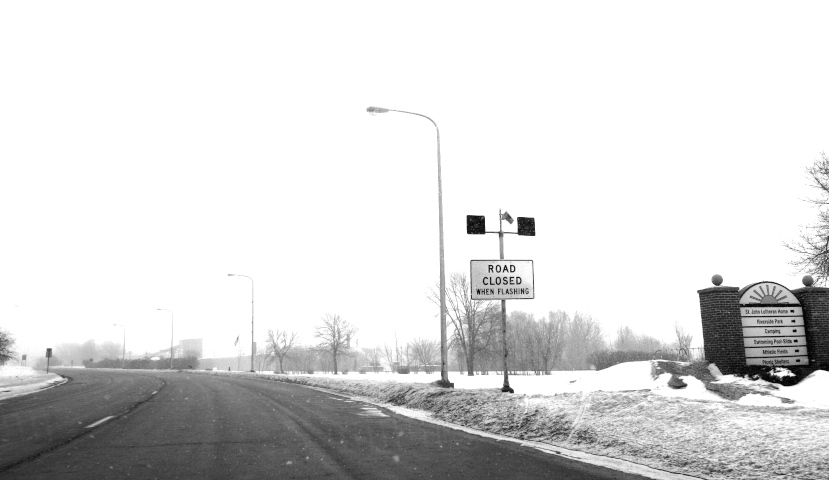
Road closed signs like this one near Springfield can be found along southwestern Minnesota highways, including highway 19. (Minnesota Prairie Roots copyrighted file photo March 2011)

Now if that was the end of the story, that would be a nice ending. But there’s more. Jeremy kept in touch, texting that the local bar was open if she wanted pizza. She was happy with the soup. The next morning the emergency coordinator texted again, notifying the overnight guest that roads had been plowed. He’d also reached out to the Marshall Police Department to assure that roads were open to motorists. Drive on a “closed” road and you risk a $750 fine. Jeremy went that extra mile to assure the woman could resume her journey to Watertown.

Her lengthy post to the City of Vesta Facebook page shows deep gratitude for all those who made her feel welcomed and safe in my hometown. She wrote: It was quite a night in the Vesta Community Center. Everyone’s kindness in this town was so timely and heartfelt that, rather than feeling like a stranded traveler, I felt like a VIP walking down a red carpet.

I am not surprised by the goodness of the folks in Vesta. This is small town southwestern Minnesota at its best. Caring, kind, compassionate, loving, welcoming. I’ve always felt embraced by the place of my roots, even decades after leaving. I understand this place. These will always be my people. My prairie people.

© Copyright 2023 Audrey Kletscher Helbling

Source: City of Vesta Facebook page

Thank you to Minnesota Prairie Roots reader Bill for alerting me to this City of Vesta Facebook post.


Minnesota prairie native Jim Brandenburg wins top photo honor March 25, 2023

A Brandenburg bison photo hangs to the left and the photographer talks about his work in a video, right, inside the Brandenburg Gallery. (Minnesota Prairie Roots copyrighted file photo 2013)

OF ALL THE PHOTOGRAPHY—from general to portrait to sports to nature and wildlife—it is wildlife photography that most impresses me as particularly challenging. And now one of the best wildlife and nature photographers in the world, who happens to be a native of my beloved southwestern Minnesota prairie, has received National Geographic’s Lifetime Achievement Award. Luverne-born and raised Jim Brandenburg, today based in Ely in northern Minnesota, won that top honor. He’s so deserving. His photos are beyond any star rating.

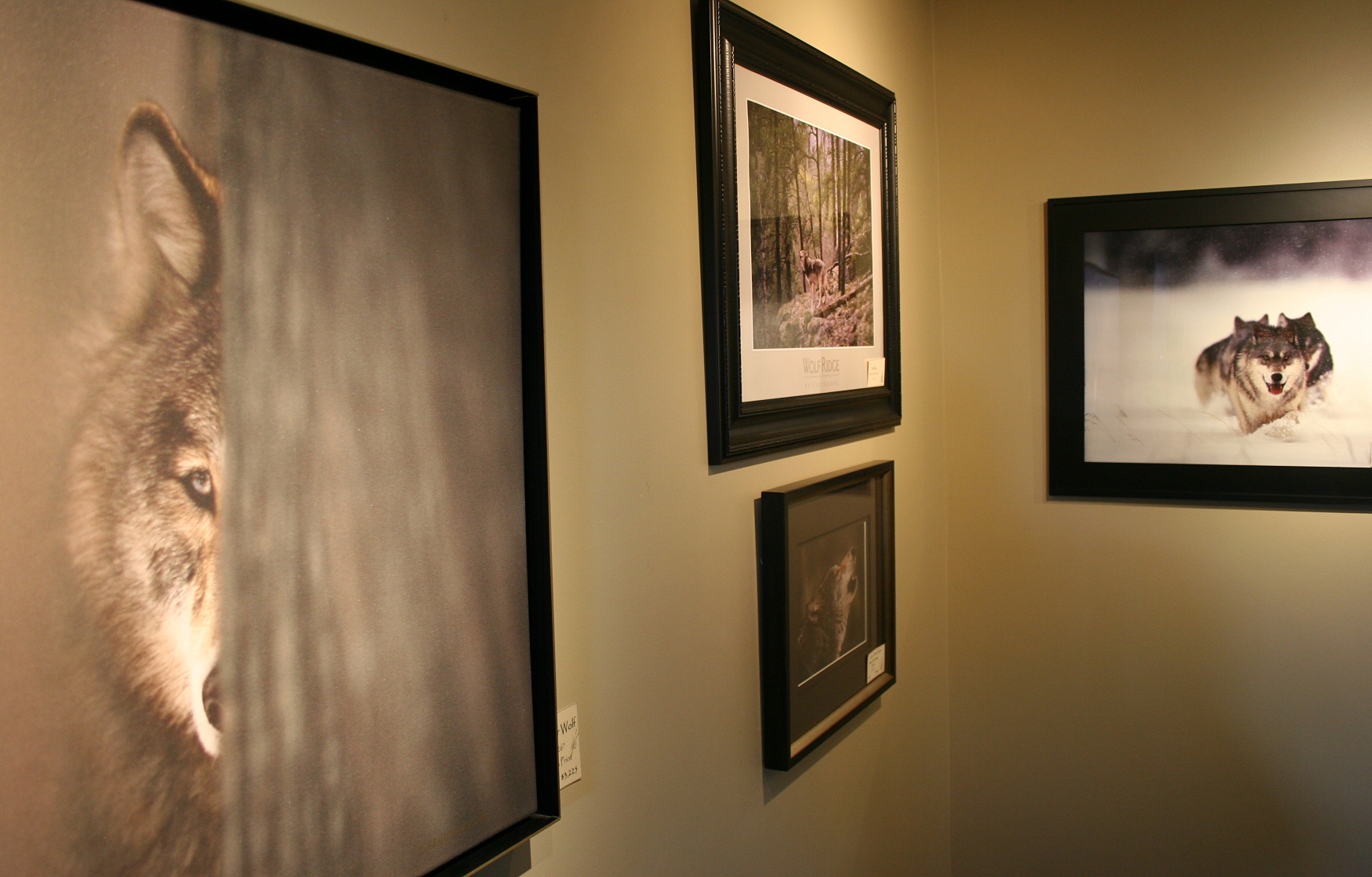
Brandenburg’s published books include “Brother Wolf–A Forgotten Promise.” He is known for his wolf photos, including these displayed in the Luverne gallery. (Minnesota Prairie Roots copyrighted file photo 2013)

Brandenburg joins only five other National Geographic photographers who’ve received this award. That he hails from the prairie, my homeland, makes me especially proud.

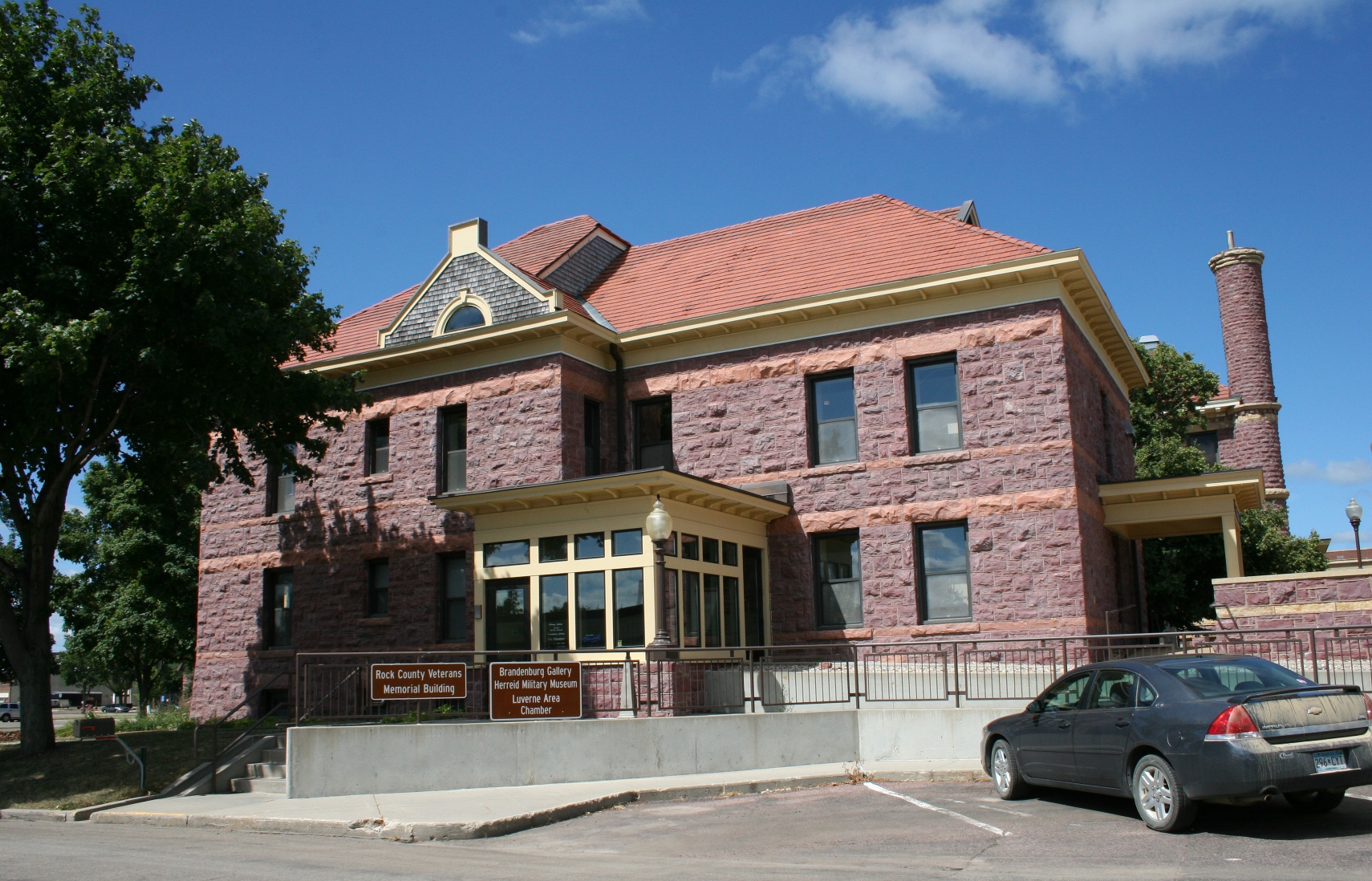
The entry to the gallery, located in the Rock County Courthouse square. (Minnesota Prairie Roots copyrighted file photo 2013)

Ten years ago, I toured the Brandenburg Gallery, owned and operated by the Luverne Area Chamber of Commerce. It was of special interest to me as a photographer. I wanted to study Brandenburg’s images—the light, the perspective, the techniques he uses to draw viewers into scenes.

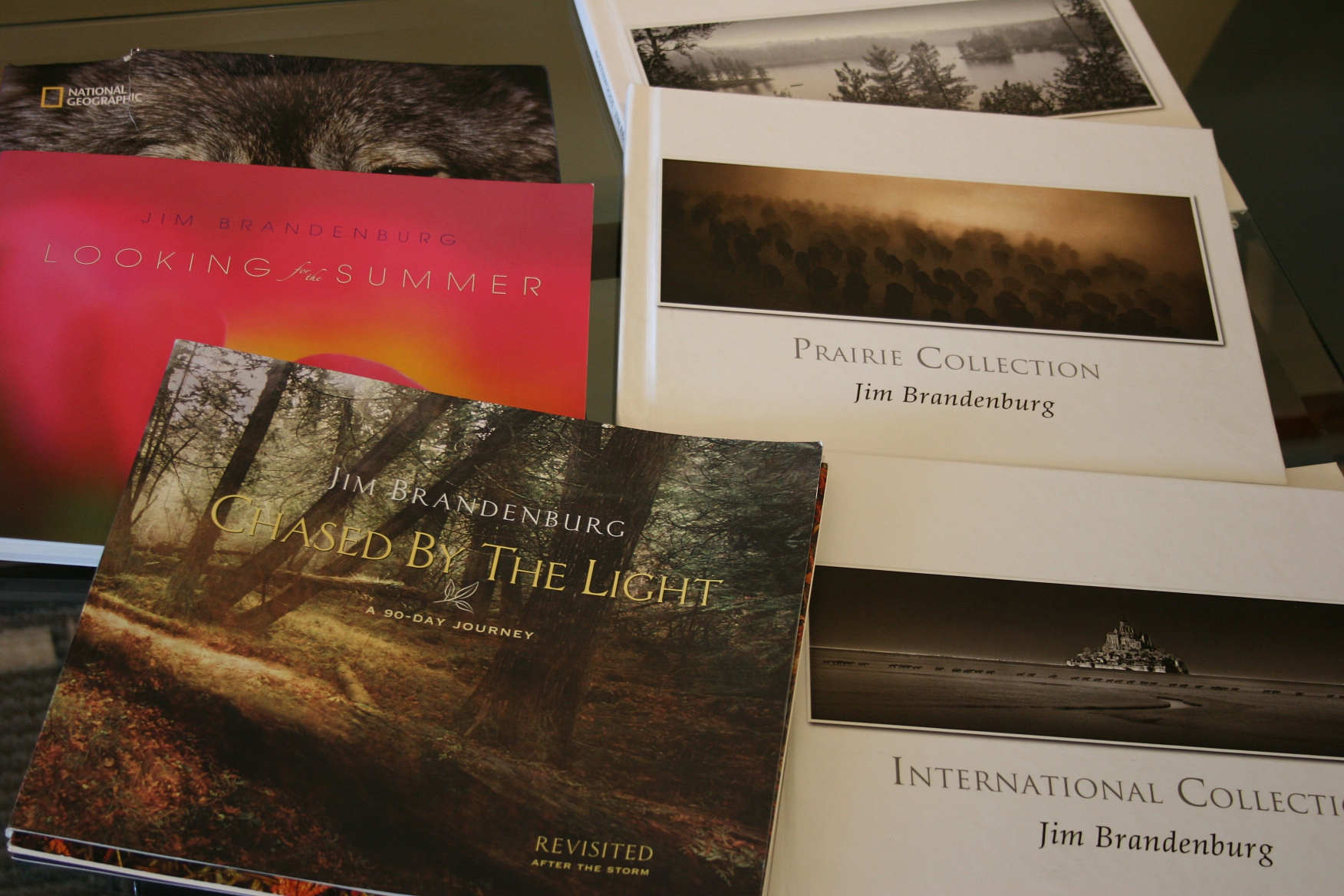
Some of Brandenburg’s photo books displayed in the Luverne gallery. (Minnesota Prairie Roots copyrighted file photo 2013)

I have no ambition to pursue wildlife photography. I don’t have the interest, talent, knowledge of the natural world or patience required for the craft. But I appreciate those who excel in this specialized photography and I can learn from them. Brandenburg has been honing his craft for some 50 years with National Geographic. He’s won countless awards, produced many books filled with his images.

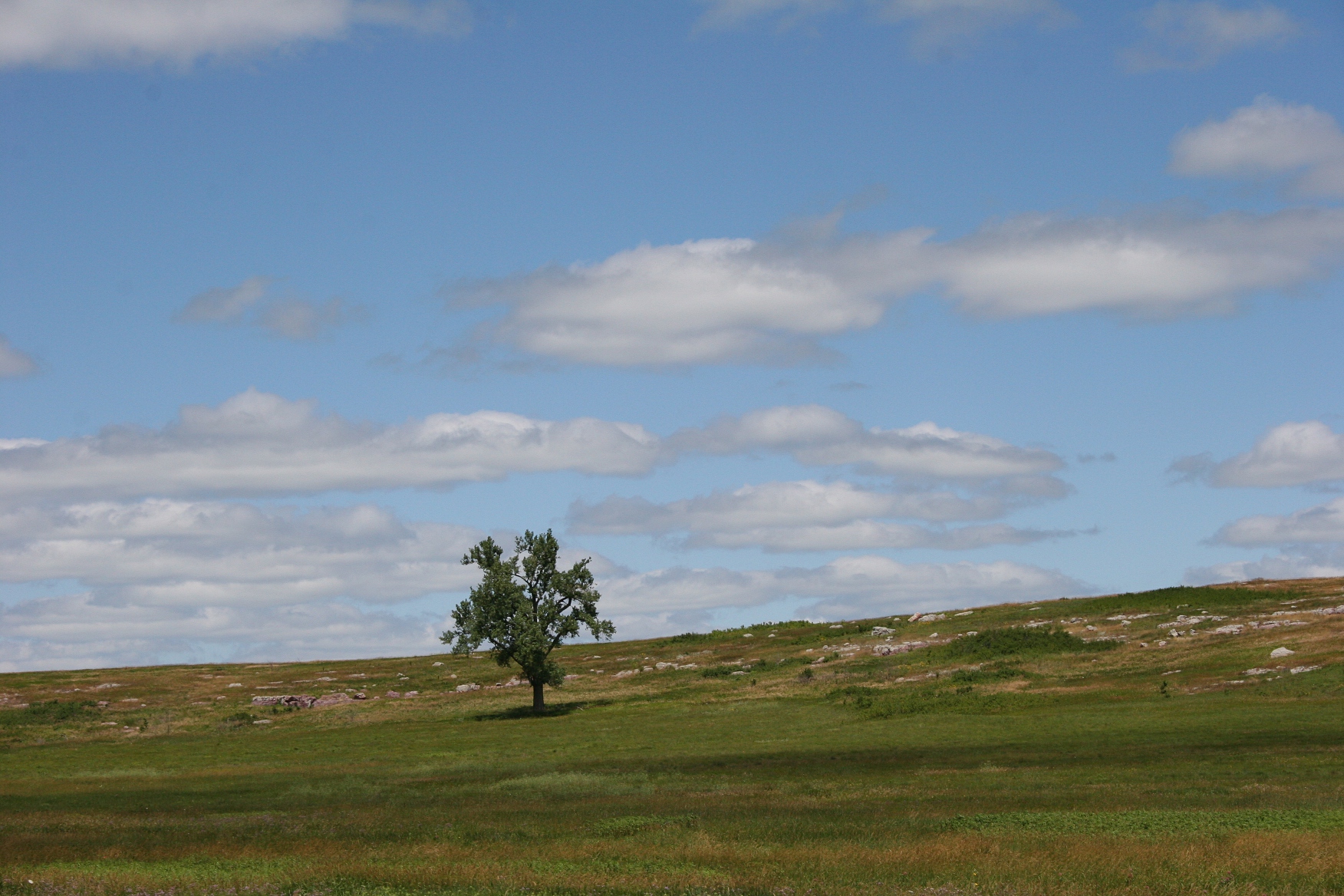
Beautiful rocky landscape of Rock County. (Minnesota Prairie Roots copyrighted file photo 2013)

In all of this, this world travel, this move from southern to northern Minnesota, from prairie to northwoods, he’s remained rooted to his roots. He established the Luverne-based Brandenburg Prairie Foundation with a mission “to educate, preserve and expand native prairie in southwest Minnesota.” Brandenburg’s Foundation and the U.S. Fish and Wildlife Service bought 800 acres of untilled prairie in Rock County some eight miles northwest of Luverne, where visitors can immerse themselves in tallgrass prairie. I regret not walking the Touch the Sky Northern Tallgrass Prairie National Wildlife Refuge during my 2013 visit to this area. I need to return.

Hiking the path up and through the prairie grass at Blue Mounds State Park. (Minnesota Prairie Roots copyrighted file photo 2013)

I recognize that to many, this region of Minnesota seems desolate, lacking in beauty, just a place to get through when traveling. But for prairie natives like me, beauty is everywhere. In the wide sky. In sunsets so profoundly beautiful that they almost defy description. In farm sites set like islands among endless fields. In small towns and acres of corn. In prairie grasses swaying in the breeze. I can forever sing the praises of the prairie in refrains of howling wind and songbird and the silence of quiet.

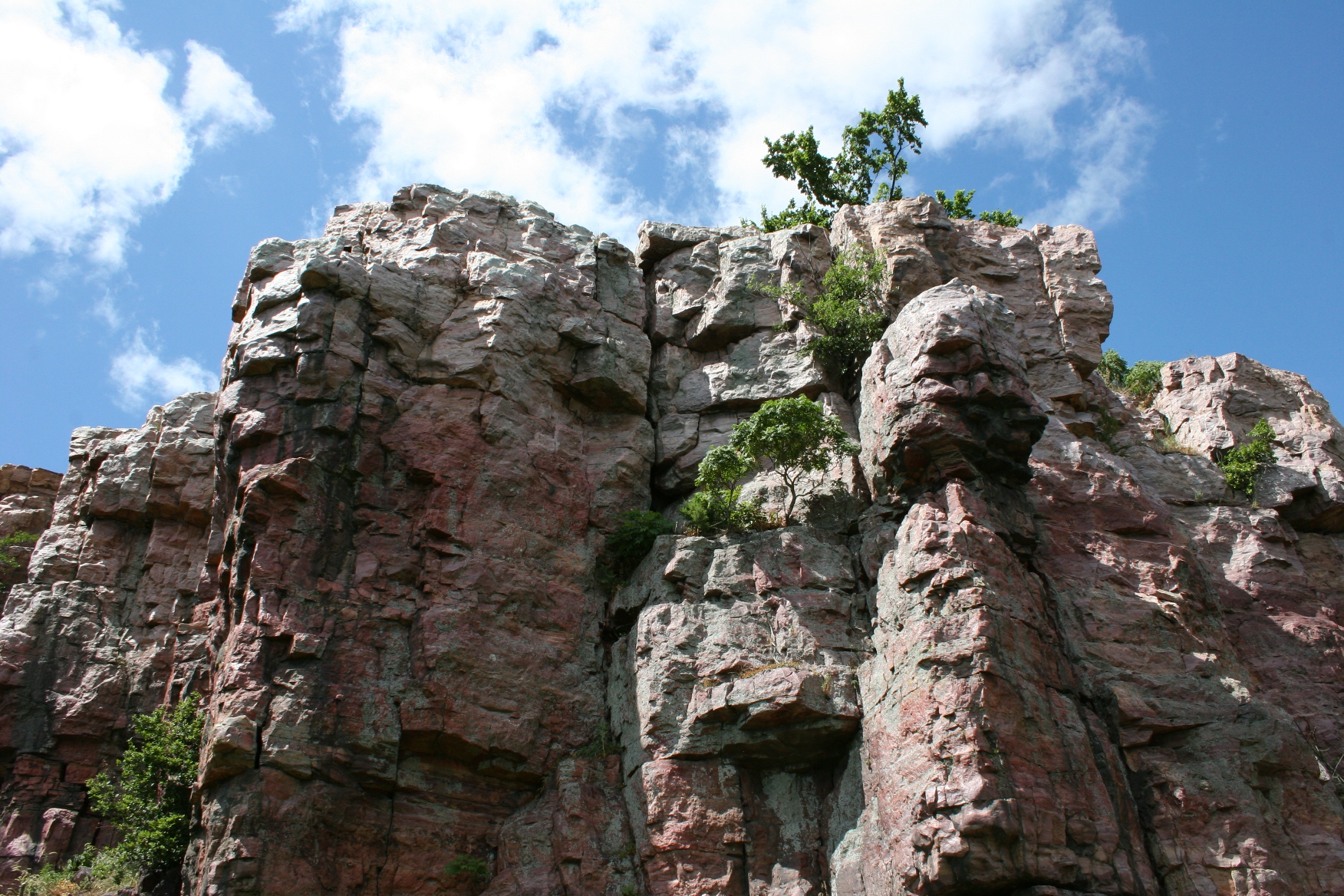
An impressive quarry wall of Sioux quartzite. (Minnesota Prairie Roots copyrighted file photo 2013)

Brandenburg, I expect, experienced all of these, even if his native Rock County differs from my home county of Redwood a bit farther to the north and east. Even on the prairie, landscapes vary. Near Luverne, at Blue Mounds State Park, cliffs of Sioux quartzite rise 100 feet above the plains. It’s amazing, unexpected in this place where prickly pear cacti also grow, where bison graze, where wildflowers bloom.

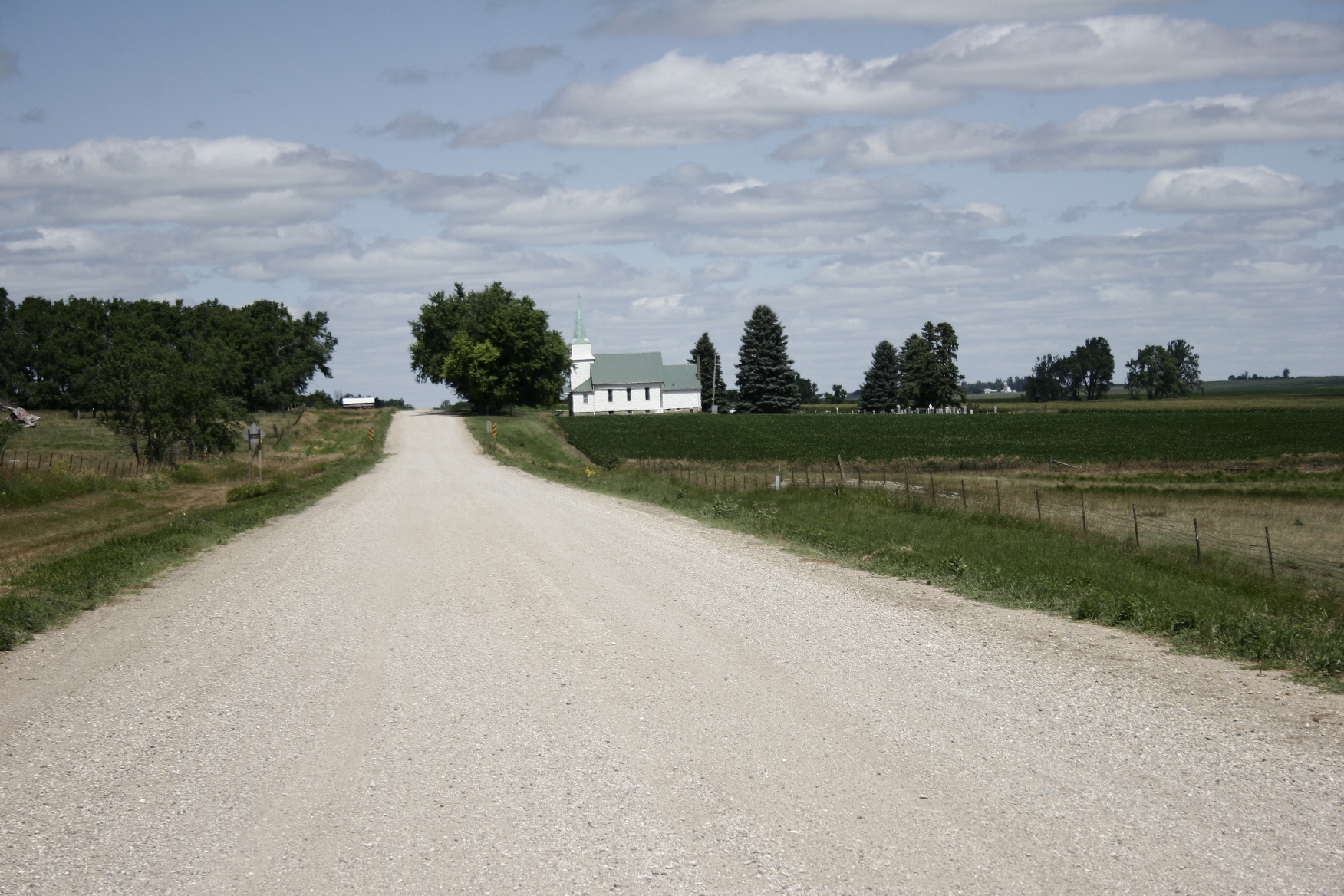
A gravel road around the state park passes a sheep pasture and country church. (Minnesota Prairie Roots copyrighted file photo 2013)

I encourage you, if you’ve never spent time in southwestern Minnesota, to do so this spring or summer. View the landscape through an appreciative lens that takes in every nuance, every detail. Notice the light. Feel the wind. Hear the quiet. Settle into the simplicity of this place that renews the spirit, that a world-class photographer called home. That I, too, once called home.

© Copyright 2023 Audrey Kletscher Helbling


March 1965, a harsh Minnesota prairie winter documented March 13, 2023

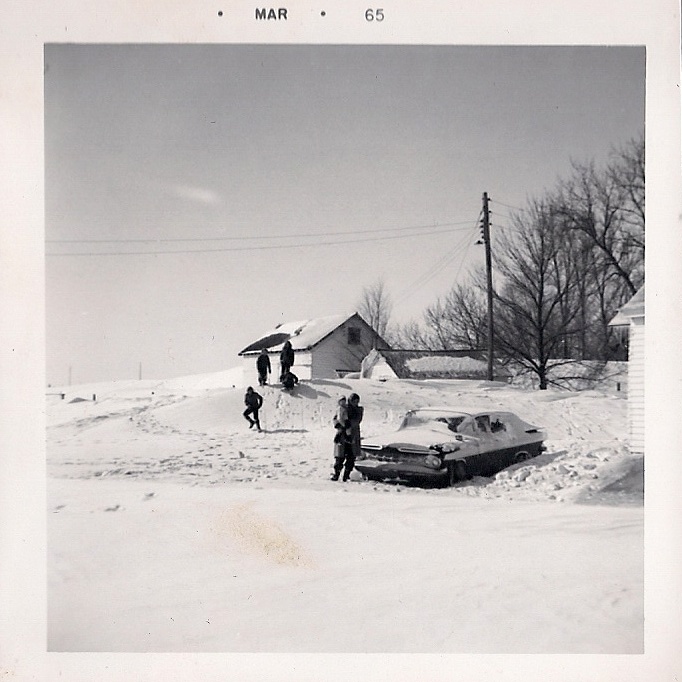
This huge snowdrift blocked my childhood farm driveway in this March 19, 1965, photo. I’m standing next to Mom. (Photo credit: Elvern Kletscher)

SHE WAS NOT QUITE 33 years old, this young mother of five living on a southwestern Minnesota dairy and crop farm in March 1965. It was an especially harsh winter, documented in a spiral bound notebook she kept.

She filled page after page with several-line daily entries about everyday life. She wrote about crops and household chores and kids and food and the most ordinary daily happenings. And, always, she recorded the weather—the wind, the precipitation, sometimes the temperature.

Arlene Kletscher’s journals stacked in a tote. (Minnesota Prairie Roots copyrighted file photo)

This keeper of prairie history in rural Redwood County was my mother, who died in January 2022 at the age of 89. I am the keeper of her journals, which she kept from 1947-2014, from ages 15 to 82. Sixty-seven years of journaling. Several years, when she met and fell in love with my dad, are noticeably missing.

Recently, I pulled the tote holding her collection of writing from the closet. This snowy winter of 2022-2023 in Minnesota prompted me to filter through Mom’s notebooks from 1964 and 1965. That winter season of nearly 60 years ago holds the state record for the longest consecutive number of days—136—with an inch or more of snow on the ground. We are closing in on that, moving into the top ten.

Mom’s journal entries confirm that particularly snowy and harsh winter on the Minnesota prairie. From February into March, especially, many days brought snow and accompanying strong wind. Two photos from March 1965 back up Mom’s words. Her first March entry is one of many that notes the seemingly never-ending snow falling on our family farm a mile south of Vesta. She writes of the weather:

March 1—What a surprise! Snowing & blowing when we got up & kept on all day. No school.

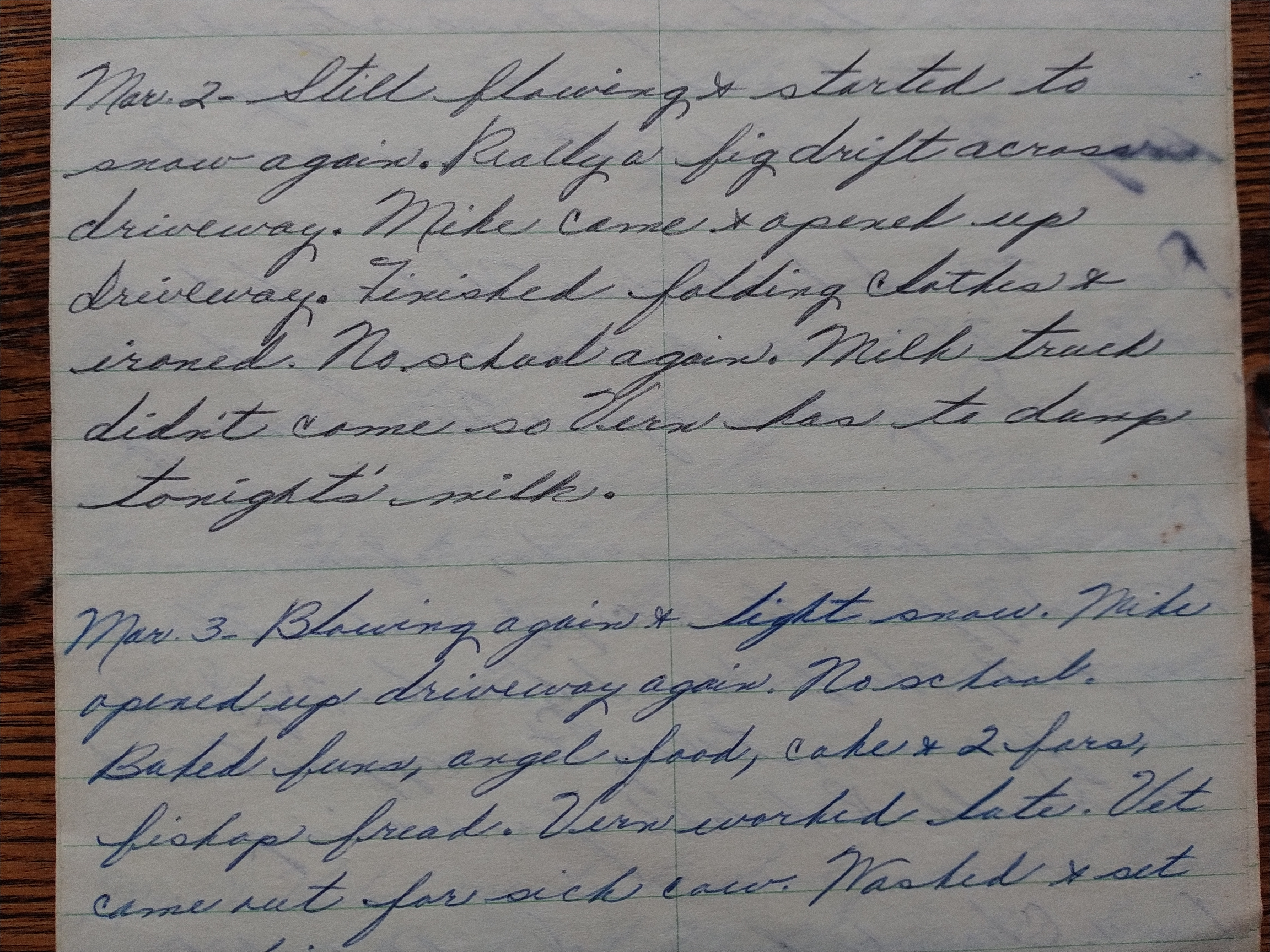
March 2—Still blowing & started to snow again. Really a big drift across the driveway. Mike came & opened up driveway. No school again. Milk truck didn’t come so Vern has to dump tonight’s milk.

Entries from my mom’s March 1965 journal document a harsh Minnesota winter. My Uncle Mike had to drive from his farm a mile-plus away to open our driveway. (Minnesota Prairie Roots copyrighted photo March 2023)

Let me pause here and emphasize the hardship referenced in Mom’s March 2 entry. My dad had to dump the milk from his herd of Holsteins. That was like pouring money down the drain. I can only imagine how emotionally and financially difficult that was to lose a day’s income. But if the milk truck can’t get through on snow-clogged country roads to empty the bulk tank, there’s no choice but to pour away milk.

My dad planted DeKalb seed corn (among other brands). (Minnesota Prairie Roots copyrighted file photo September 2015)

On March 3-5, Mom writes the same—of snow and blowing snow and efforts to keep the driveway open and no school. Then comes a respite from the snow. Dad was even planning ahead to spring, receiving a delivery of DeKalb seed corn on March 15. But then snowfall resumes on St. Patrick’s Day in this land of wide open spaces, where the wind whips fierce across the prairie.

March 17—Snowing & blowing. Got worse all day. Good thing the milk truck came. No school.

March 18—Quit snowing, but is really blowing. Huge drift across driveway & in grove. Almost all roads in Minn are blocked. No school. Cold, about 10 degrees.

Our southwestern Minnesota farmyard is buried in snowdrifts in this March 19, 1965, image. My mom is holding my youngest sister as she stands by the car parked next to the house. My other sister and two brothers and I race down the snowdrifts. (Photo credit: Elvern Kletscher)

March 19—We all went outside & took pictures of the big drifts & all the snow. Mike came over through field by gravel pit & started to clear off yard. Clear & cold.

Mom’s March 19 entry is notable for multiple reasons. First, my parents documented the snowdrifts with their camera. They didn’t take pictures often because it cost money to buy and develop the film. Money they didn’t have. That is why I have few photos from my childhood. That they documented the huge drifts filling our driveway and farmyard reveals how much this snow impacted their daily lives. In the recesses of my memory, I remember those rock-hard drifts that seemed like mountains to a flat-lander farm girl. That my Uncle Mike, who farmed just to the east, had to drive through the field (rather than on the township and county roads) to reach our farm also reveals much about conditions.

In the two days following, Mom writes of a neighbor coming over with his rotary (tractor-mounted snowblower) to finally open the driveway. But when the milk truck arrived at 4:30 am, the driveway was not opened wide enough for the truck to squeeze through the rock hard snow canyon. The driver returned in the afternoon, after Dad somehow carved a wider opening.

The weather got better in the days following, if sunny and zero in the mornings and highs of 12 degrees are better. At least the snow subsided. On March 23, Mom even notes that they watched the space shot on TV. I expect this first crewed mission in NASA’s Gemini Project proved a welcome diversion from the harsh winter.

In her March 27 journal entry, hope rises that winter will end. Mom writes: Sunny & warmer than it has been for days. Got to 45 degrees. Minnetonka beat Fairbault (sic) in basketball tournament. I almost laughed when I read that because Minnesotans often associate blizzards with state basketball tournament time. I also laughed because Faribault would eventually become my home, the place I’ve lived for 41 years now.

So much for optimism. On March 28, snow fell again. All day.

But the next day, Mom writes, the weather was sunny and warm enough to thaw the snow and ice and create a muddy mess. I stopped reading on March 31. I’d had enough snow. I expect Mom had, too.

© Copyright 2023 Audrey Kletscher Helbling


Beata, a strong trailblazing woman in Swedes Forest Township February 16, 2023

Beata Sampson (Photo source: Sunset Funeral Home obituary)

Beata. What a beautiful name, one I’d never heard before scrolling through a recent list of obituaries from my home region of southwestern Minnesota. I wanted, needed, to learn more about this 98-year-old woman with the Latin-derived (beatus) name meaning “blessed.”

A well-written obituary provides not only basic factual information of birth, life and death, but also enough personal details to tell a story. Beata’s obit speaks to a strong woman born 98 years ago in the Sandager family home in Swedes Forest Township in the northern most part of Redwood County.

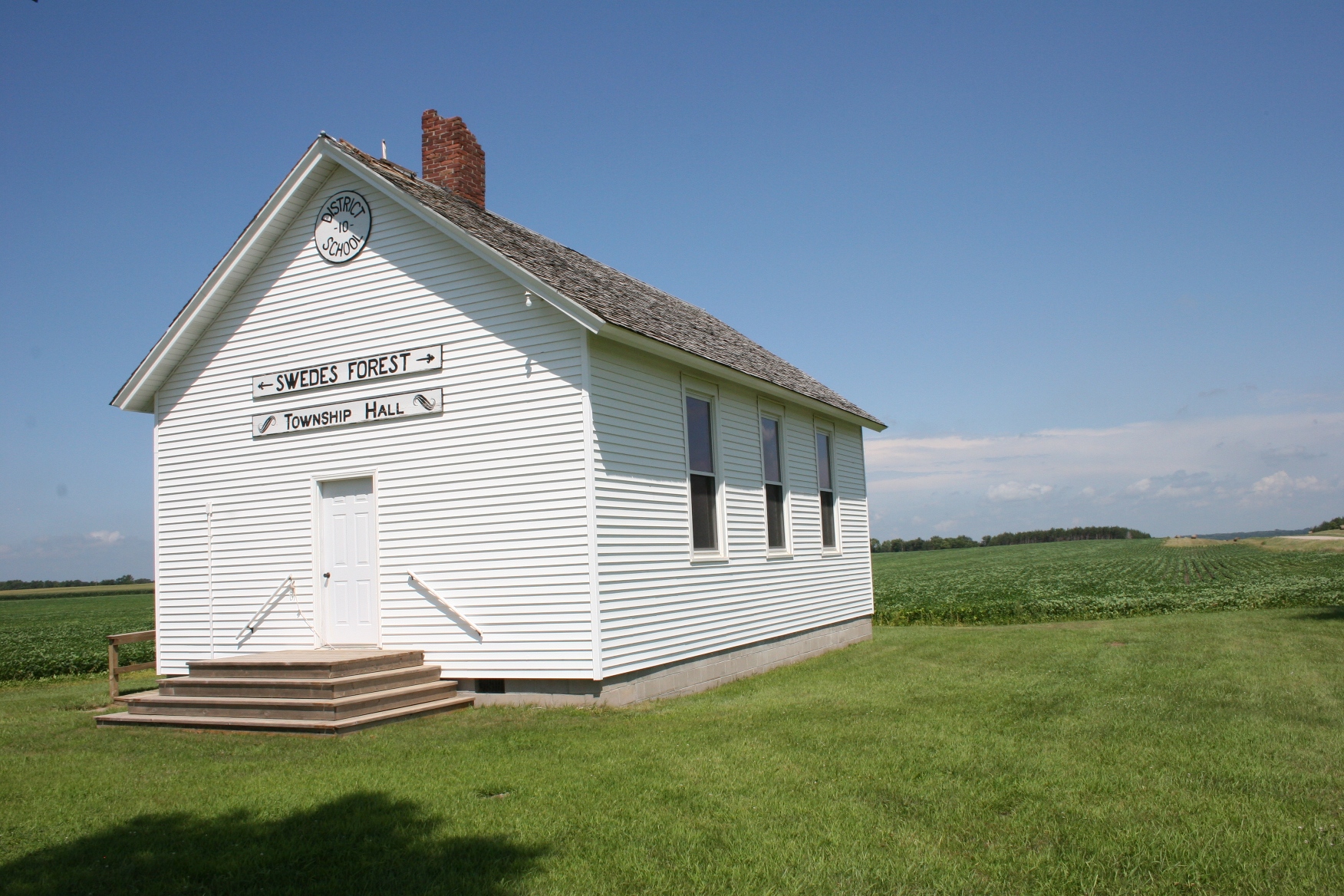
Swedes Forest Township Hall, formerly the District 10 School which Beata attended. (Minnesota Prairie Roots copyrighted file photo August 2011)

Even the township name titles a story—of the Scandinavian immigrants who started settling this area just south of the Minnesota River in 1867. Norwegians, mostly, and Swedes and Danes (like Beata’s Danish-born grandfather, Nils H. Sandager). Knute and Erick and Thor and Ole and Torkel and Turi and Gunhild and Ingeborg… And Beata Ellen’s Norwegian grandmothers, Beret and Ellen, after whom she is named.

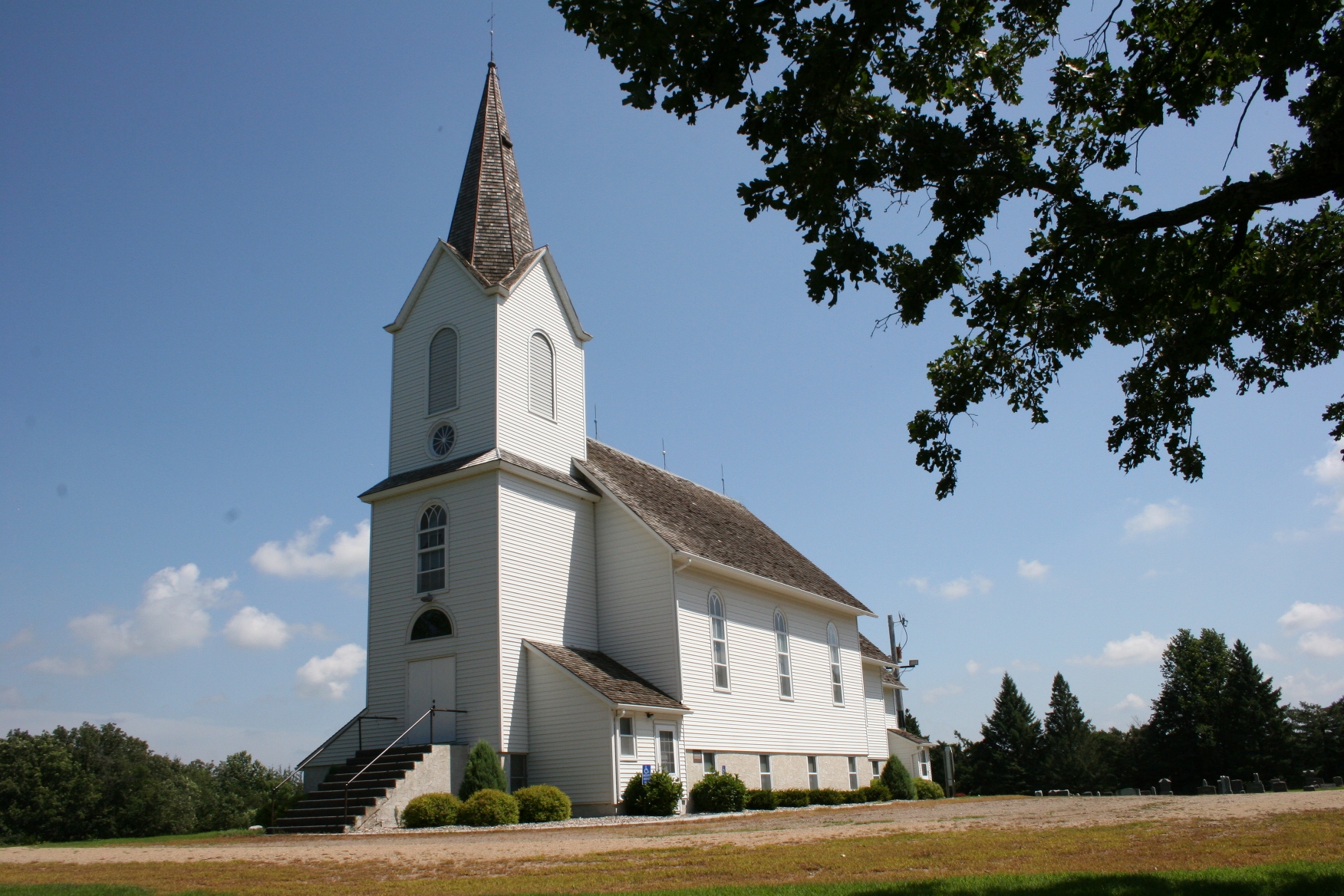
Picturesque Rock Dell Lutheran Church. (Minnesota Prairie Roots copyrighted file photo August 2011)

History runs deep here, all the way back across the ocean. Family history held importance for Beata, who died on February 11 and will be buried today at Rock Dell Cemetery in Swedes Forest Township. This township, this land, this place, it was hers. Beata’s home since her December 27, 1924, birth.

She left only briefly, heading to college in Moorhead in 1942 before returning in 1943 when her father died. Beata was just 18. But her mother, Barbra, and brother Nels needed her help on the family farm. Six years later she would marry Lloyd Sampson, also a farmer. After only 11 years of marriage, Beata was widowed at age 35, her husband dead from cancer.

What strength it must have taken for this young woman and mother of two to endure first the death of her father and then her husband. I’d like to think she had a strong support system of friends and family and neighbors rallying around. A community of people who cared. Knowing rural southwestern Minnesota as I do, I expect that’s true.

Yet, “after a couple years in their big, cold house, Beata and her children (Coral Beth and Joel Loren) moved to live with her mom and brother.” Recognizing the importance of immediate family love and support, of understanding that she needed family near, shows strength, too.

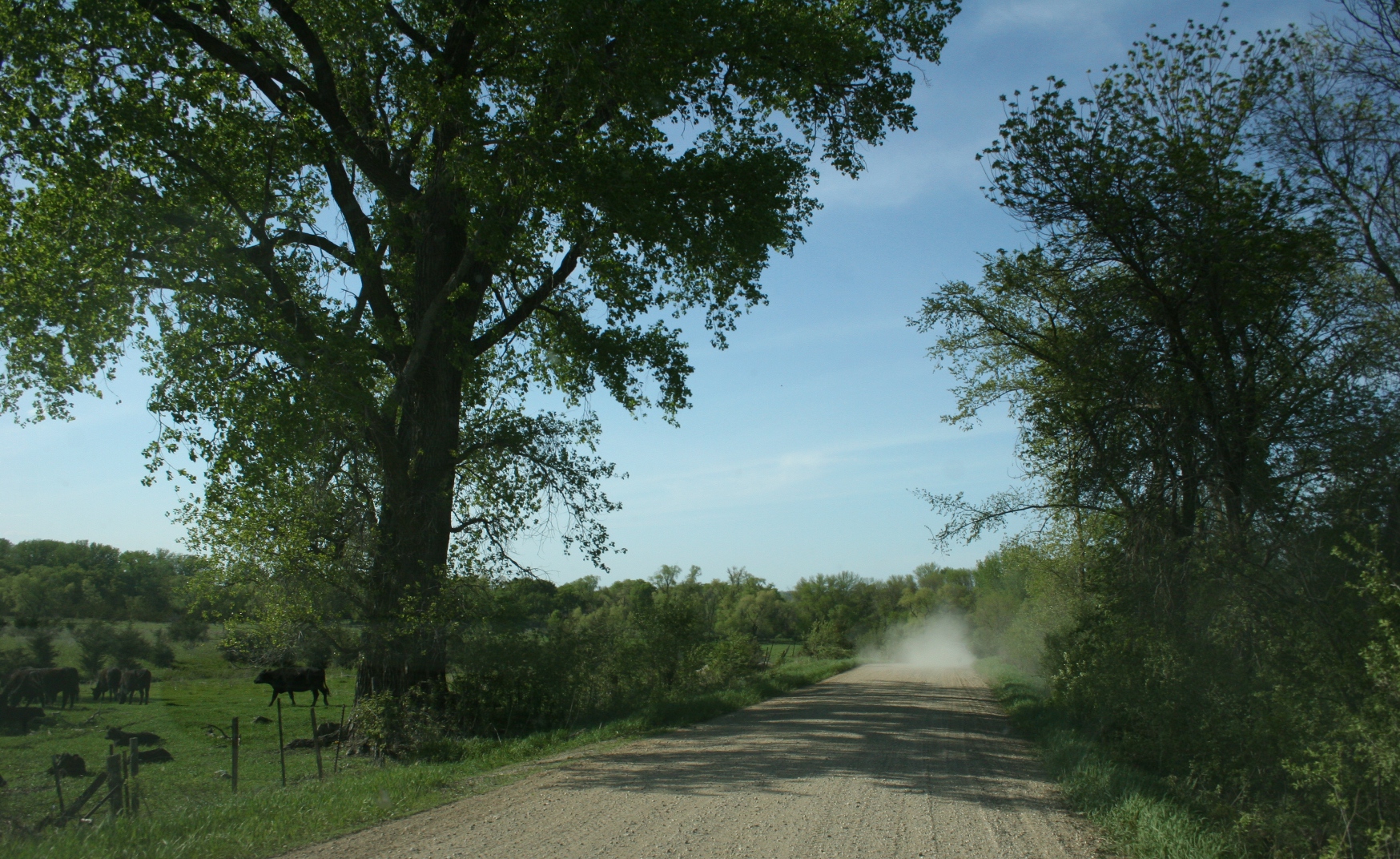
Driving through northern Swedes Forest Township in the summer of 2014. (Minnesota Prairie Roots copyrighted file photo June 2014)

But there’s more, much more, to Beata’s story. In 1979, she became the first woman elected to office in Swedes Forest Township. It took 107 years for a woman to gain an elected seat on the township board. While that seems unfathomable in today’s world, it’s absolutely believable for that time period. Beata served for 24 years as treasurer of Swedes Forest Township.

She followed in the footsteps of her grandfather Nils H. Sandager, who also left a legacy of public service. He was elected township treasurer 12 times and also held the offices of town chair, supervisor and constable for a total of 19 years.

Beata’s local involvement stretches beyond township government. She was active, too, in the Lutheran churches she attended—Rock Dell and Grace. And she found time for the other aspects of life that held her heart—living in the country, the outdoors, flowers, bird watching, family history, family, children, puzzles…and pretty dishes. Yes, this strong strong woman who made history in Swedes Forest Township, who was there for her family, loved pretty dishes. And that, too, says a lot about a woman whose name means “blessed.”

© Copyright 2023 Audrey Kletscher Helbling

Sources: Beata Sampson’s obituary and The History of Redwood County, Minnesota (Volume 1) online