Minnesota Prairie Roots

Writing and photography by Audrey Kletscher Helbling

Inside the colorful Big Woods of Minnesota October 5, 2011

EVERY TIME I HEAR the words “Big Woods,” author Laura Ingalls Wilder and her book, Little House in the Big Woods, pop into my mind. It’s a natural reflex given my deep love for the Little House books. Think grade school teacher reading the series to her students after lunch and me growing up about 20 miles from Walnut Grove, Wilder’s brief childhood home on the southwestern Minnesota prairie.

That all said, Laura was born in 1867 in a log cabin in the Big Woods of Wisconsin some seven miles from Pepin.

I visited the Ingalls’ home site many years ago with my family, when my girls were elementary age and we were deep into reading the Little House series. The Big Woods and cabin are long gone, replaced now by open prairie and a replica cabin.

Yet, only a short drive east of my Faribault home, I can experience the Big Woods at Nerstrand Big Woods State Park. I have no idea if these woods are anything like those in Wisconsin in the late 1800s. But I like to think they are.
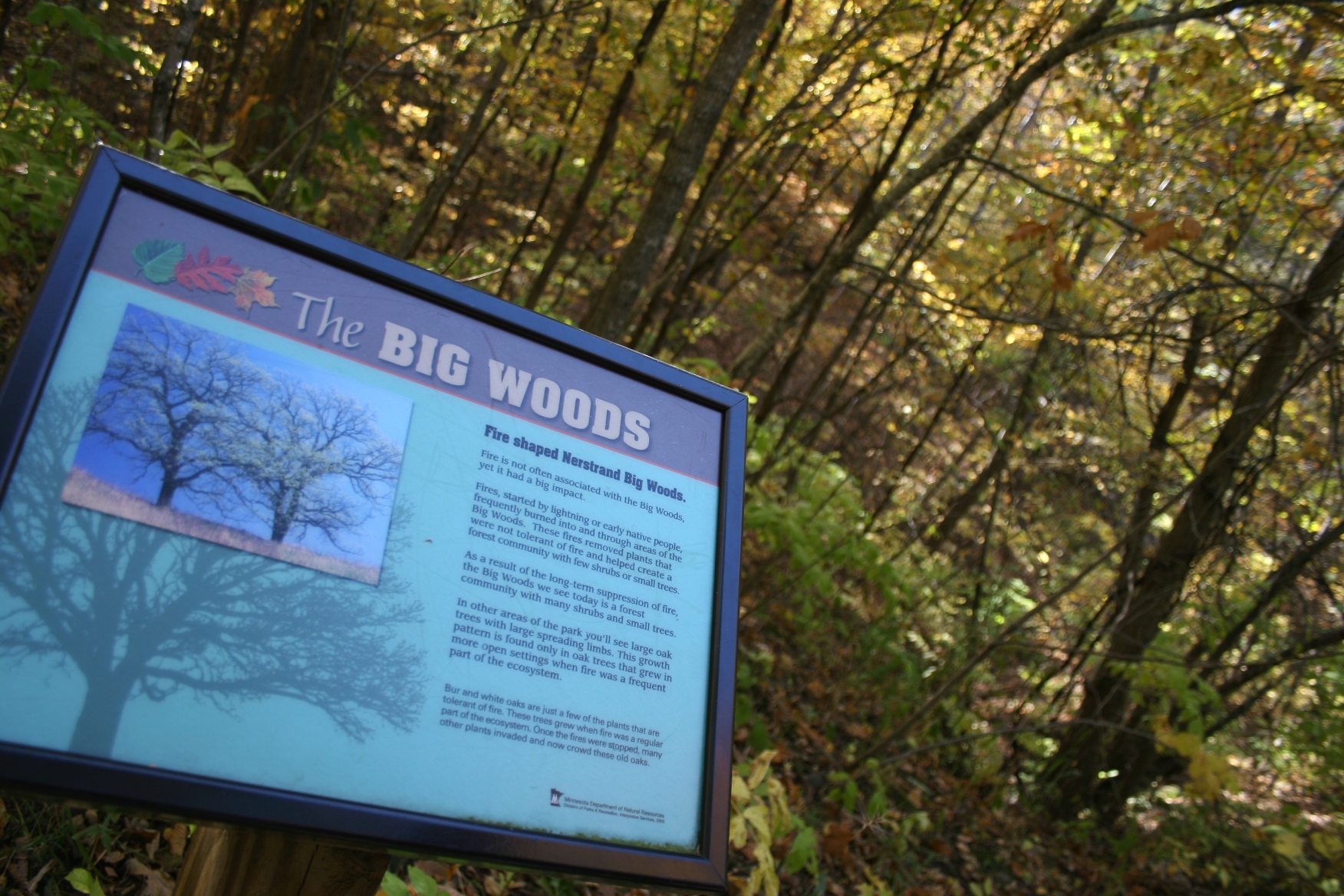
An informational sign along a trail in Nerstrand Big Woods State Park.

Check out the history section of the Minnesota Department of Natural Resources website and you’ll find this information about the Nerstrand woods:

“When the first settlers arrived in 1854, they discovered an island of woods in the vast oak savanna prairie which now makes up Nerstrand Big Woods State Park. Sugar maple, basswood, oak, hickory, aspen, elm, ash, and ironwood trees shade the land.”
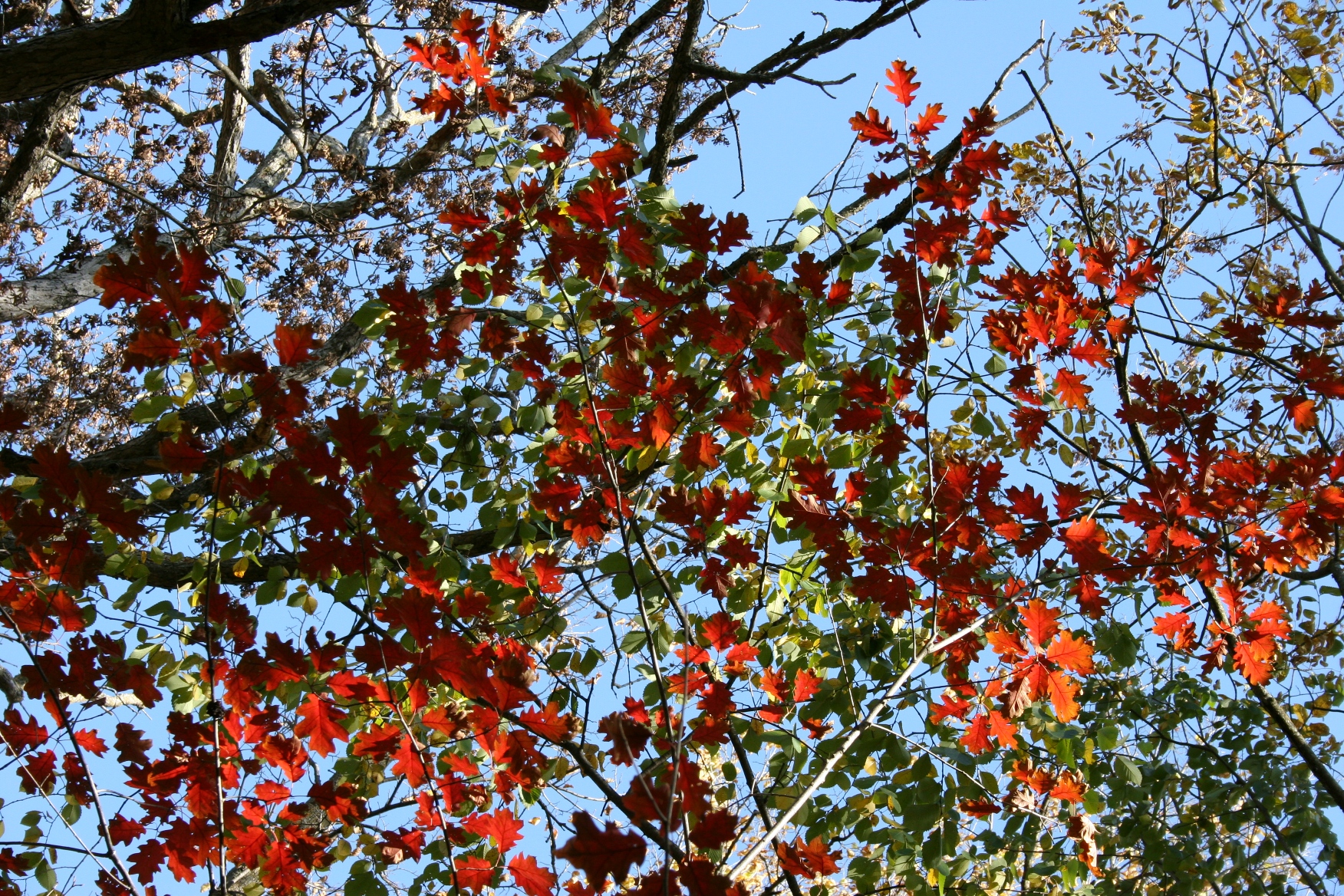
I spent half my time in the Big Woods looking, and aiming, my camera skyward.
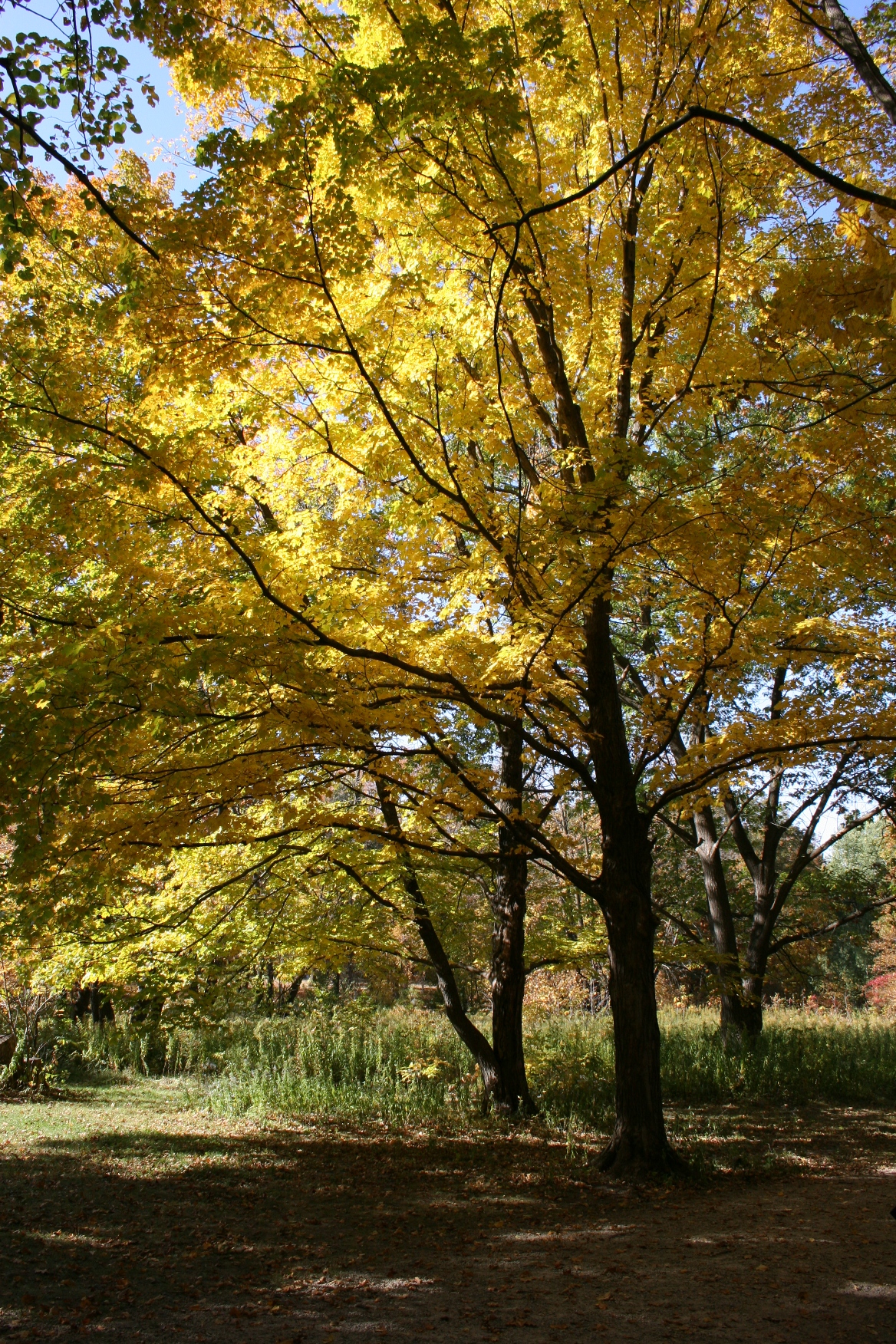
The park boasts a lovely picnic grounds sheltered by trees like this one.
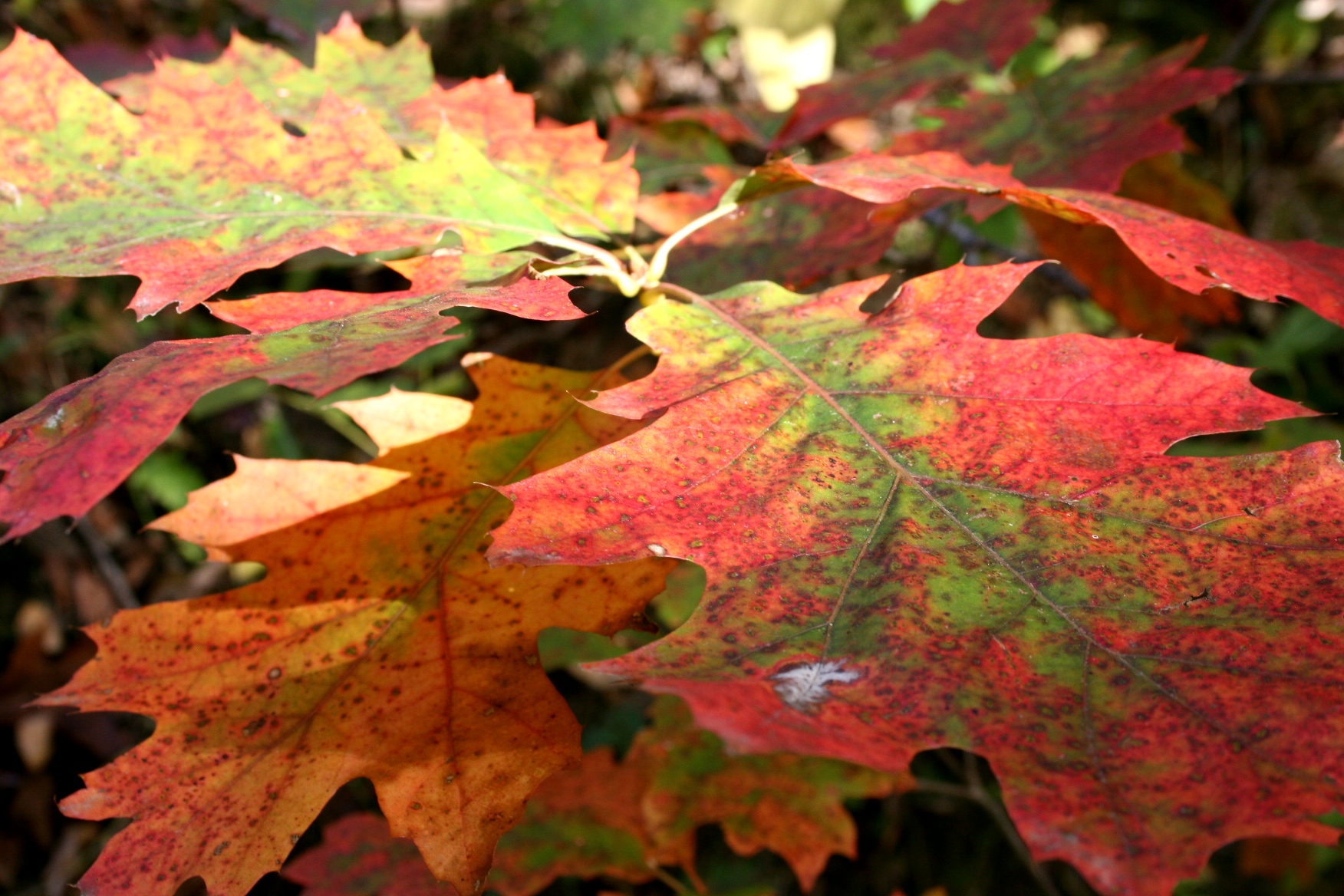
A close-up look at oak leaves changing color.

This time of year those trees flame in fiery hues, making Nerstrand a popular destination for viewing fall colors in Minnesota.

Sunday afternoon, following a fall color drive to the Sogn Valley area in northwestern Goodhue County, my husband and I stopped briefly at this state park just west of Nerstrand. We managed to find a space in a parking lot packed to overflowing in this park teeming with visitors.

If you’re seeking a quiet, people-free escape, you won’t find it here on a weekend.

But you will find a perfect fall experience complete with the earthy scent of decaying leaves; brilliant reds and yellows painted on the cobalt palette of sky; drifts of leaves to plow through; the crisp crunch of leaves beneath feet; a spirit of friendliness among visitors hiking into the Big Woods; a respite from the busyness of life; and an opportunity to savor the fleeting days of autumn in Minnesota.
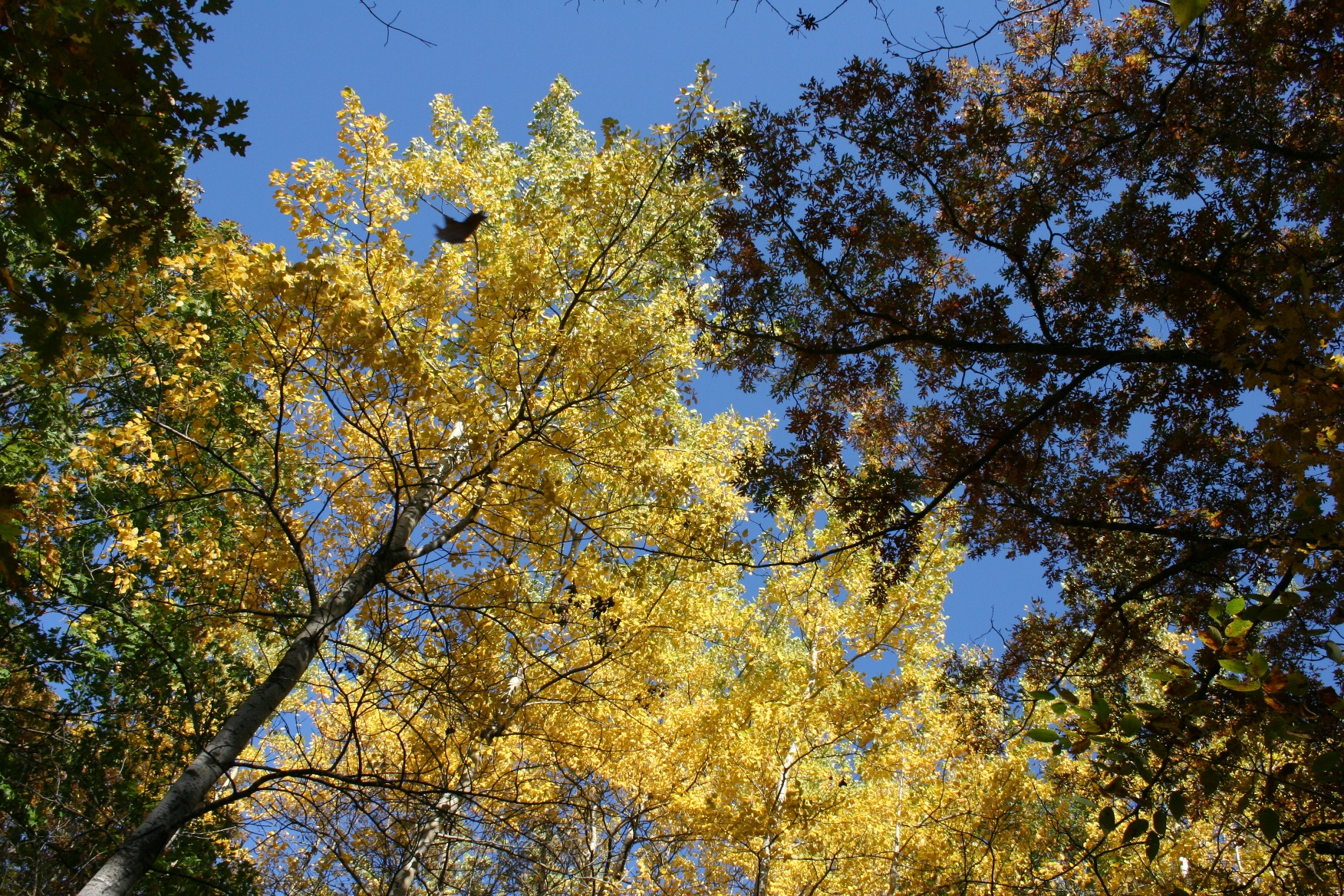
Everywhere trees provided a colorful canopy of color.
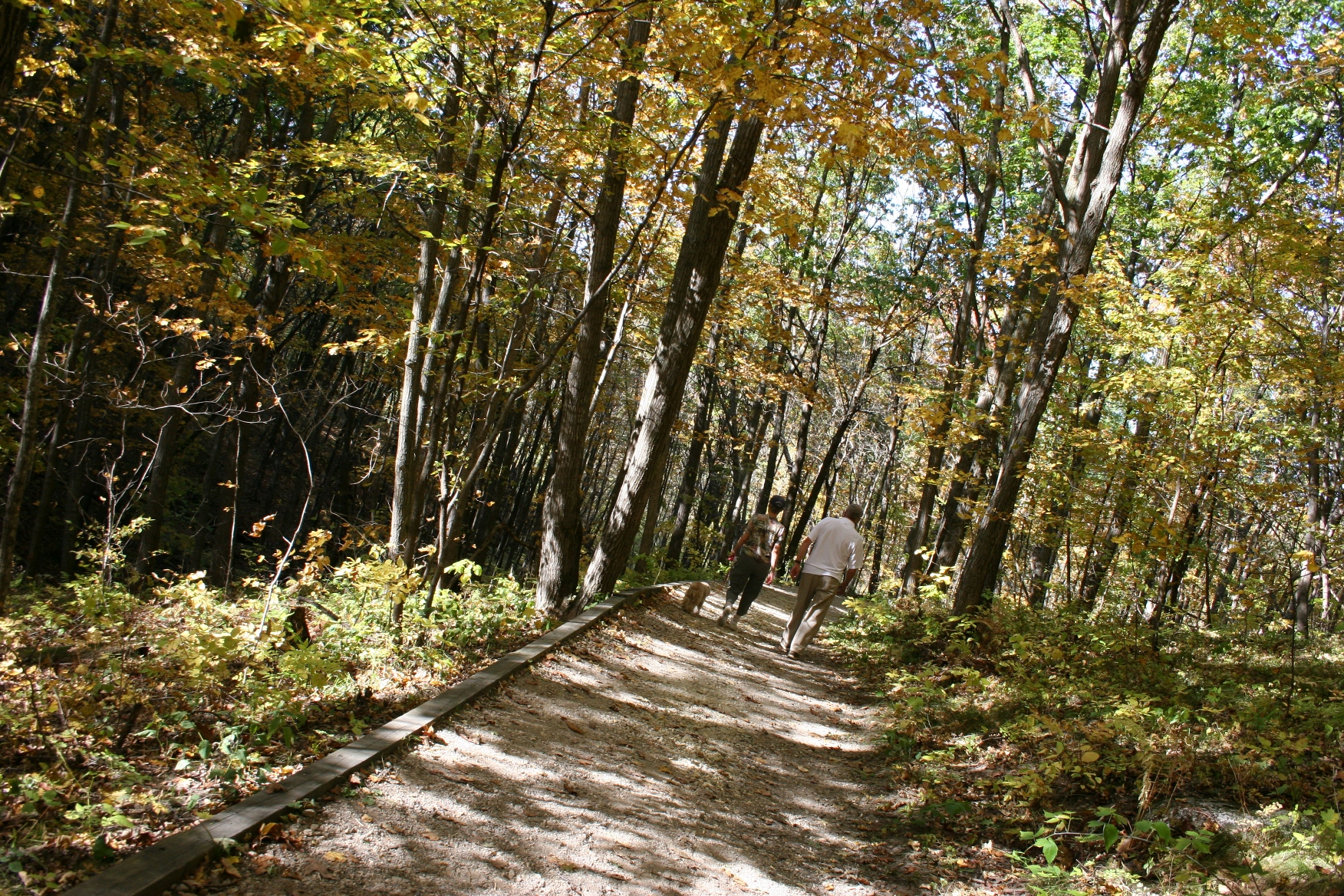
Well-kept and well-traveled paths take hikers deep into the Big Woods.
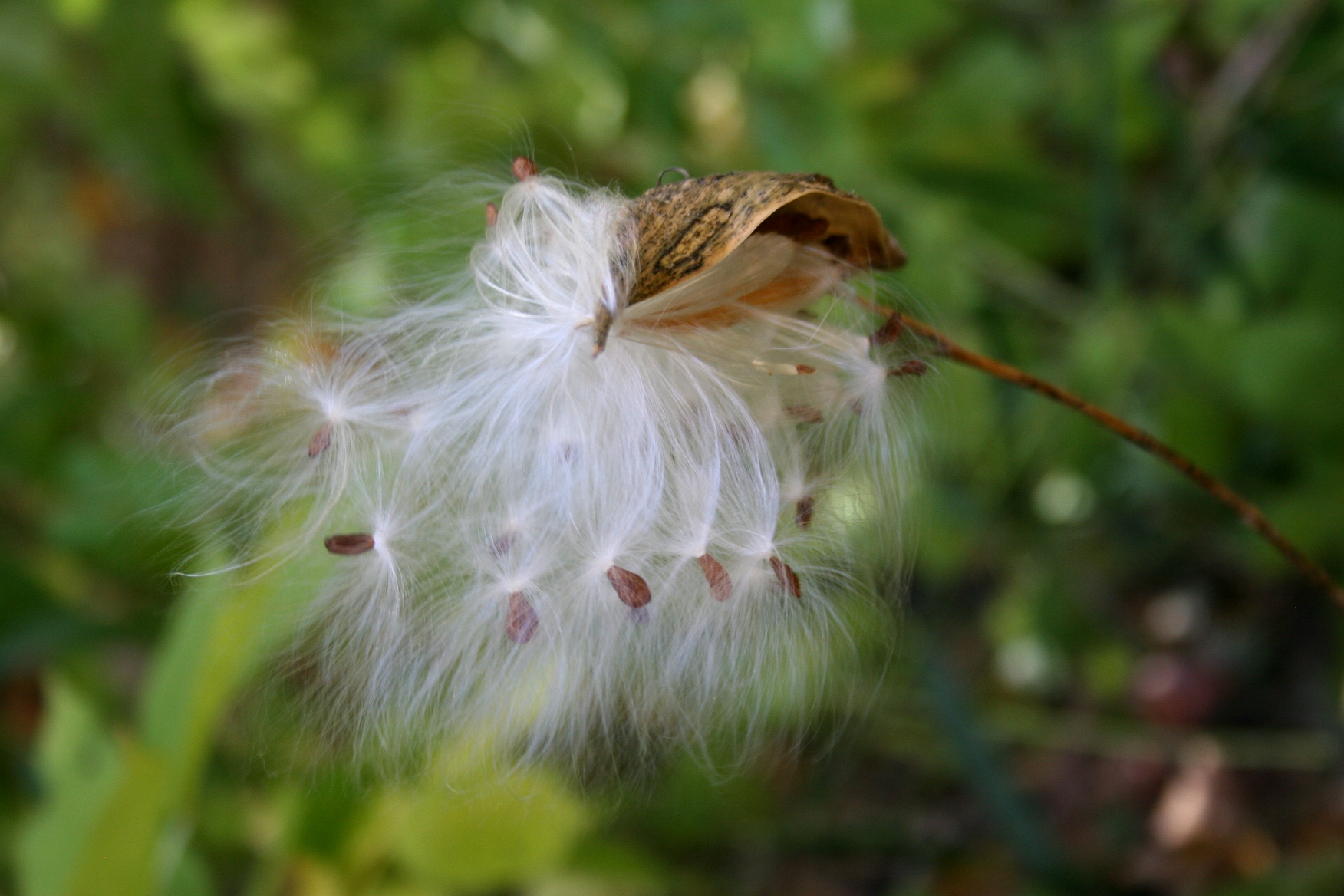
Along the path, a bursting milkweed pod.
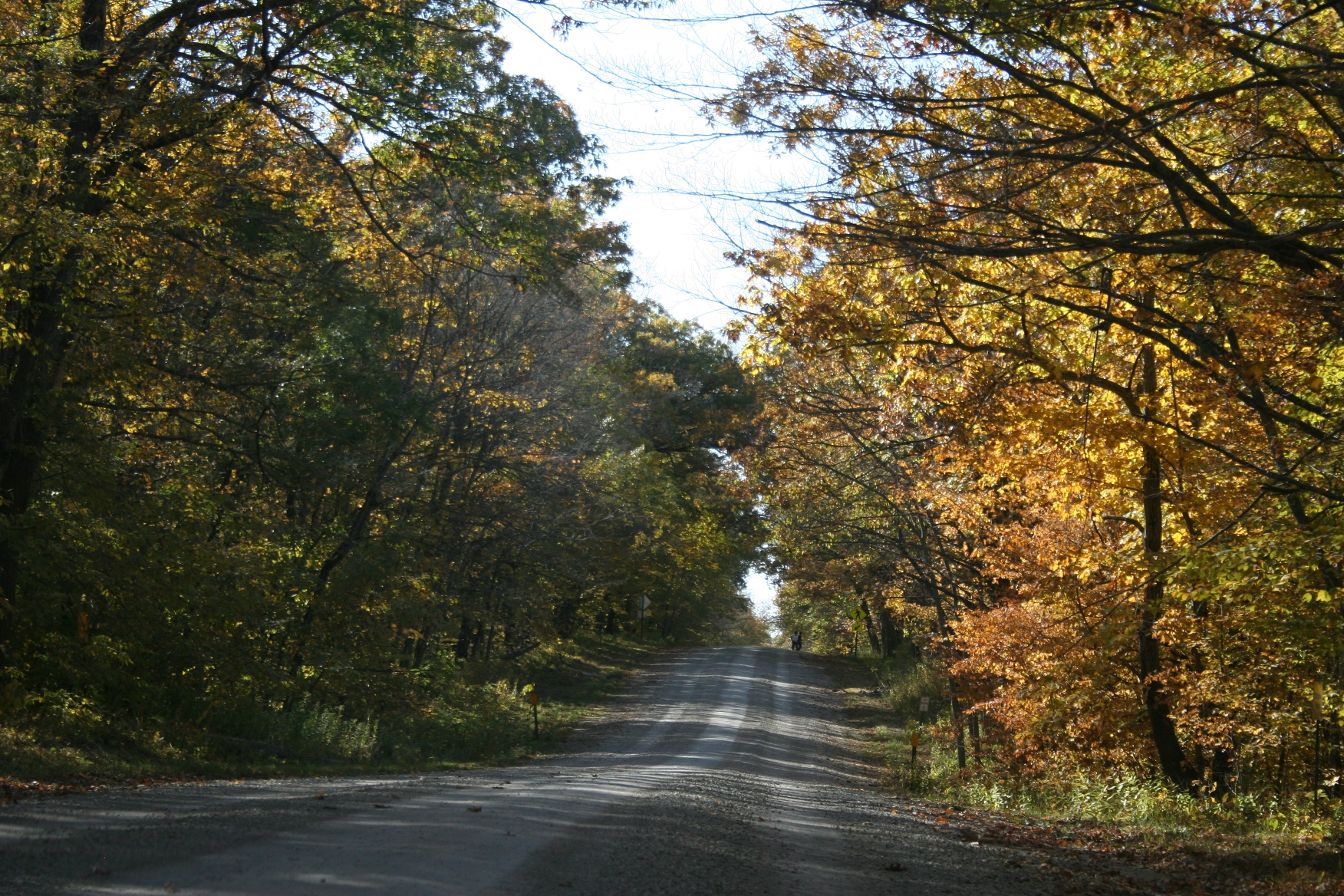
Follow this gravel road west of the park entrance for three miles to Caron Park.

BEYOND THE STATE PARK, there’s more to see at places probably known mostly to the locals:

Follow the gravel road (Rice County Road 88) west of the state park three miles to Caron Park, a 60-acre county park that is a remnant of the Big Woods. You’ll find 1.5 miles of hiking trails here, a lovely waterfall and few people. Late Sunday afternoon we saw a single truck parked in the parking lot.
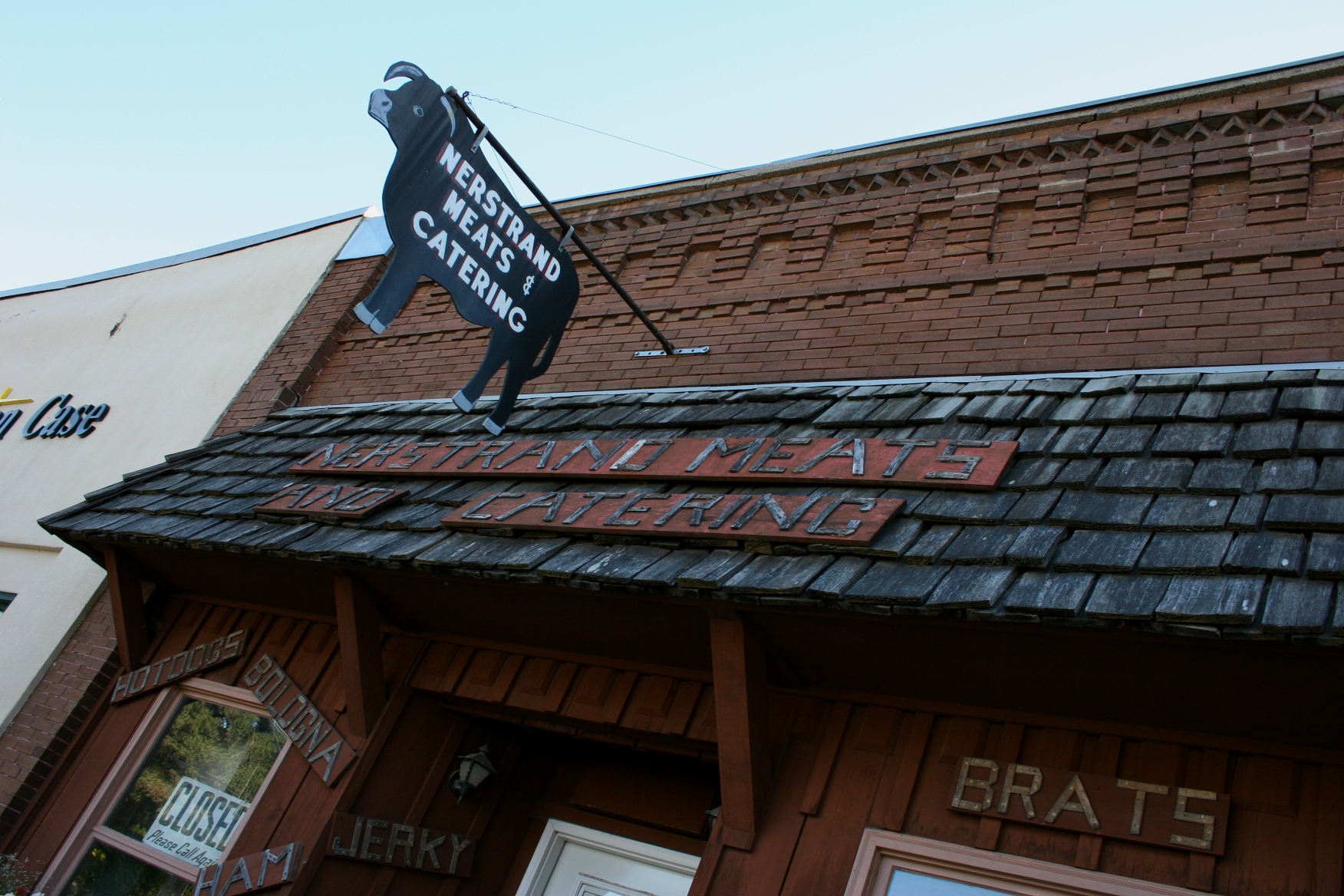
Nerstrand Meats & Catering, a family-owned business since 1890.

To the east of the park lies the small town of Nerstrand, worth a stop to check out Nerstrand Meats (open 8 a.m. – 5:30 p.m. Monday – Friday and from 8 a.m. – 4 p.m. Saturdays), the International Peace Garden at the local charter school, Nerstrand Elementary, and Main Street small-town Minnesota. (Watch for a future post on interesting signage in Nerstrand. Click here to read a previous post about the Peace Garden.)
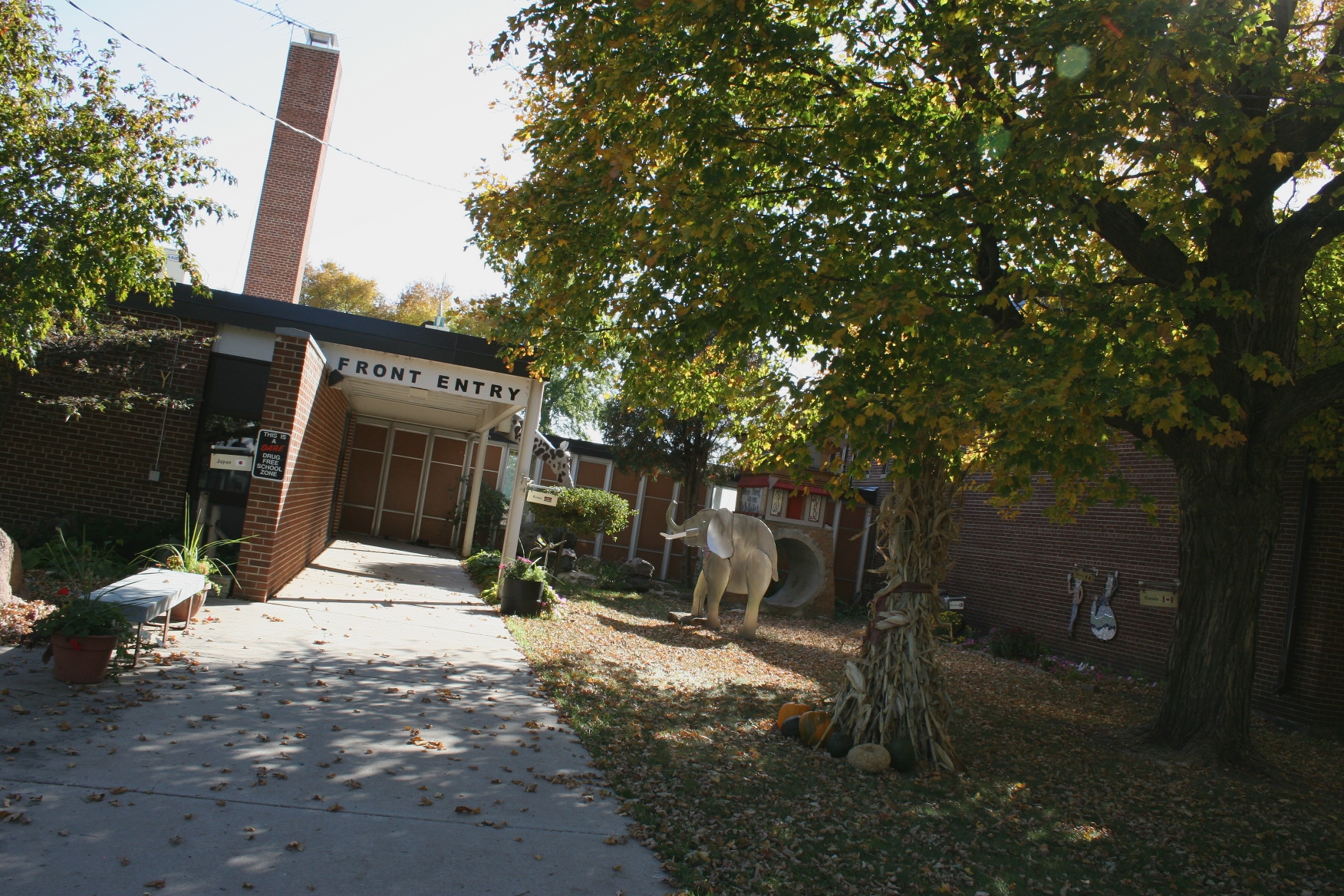
A snippet of Nerstrand Elementary School and its International Peace Garden.

North of Nerstrand Big Woods State Park, along Rice County Road 30, sit the historic and picturesque 1862 and 1894 Valley Grove churches surrounded by 50 acres of rolling prairie grasses and trees. From high atop this hillside location, you’ll get a spectacular view of the fall colors. You can also hike a prairie path here. (Click here to read a previous post I wrote about Valley Grove’s annual fall country social.)
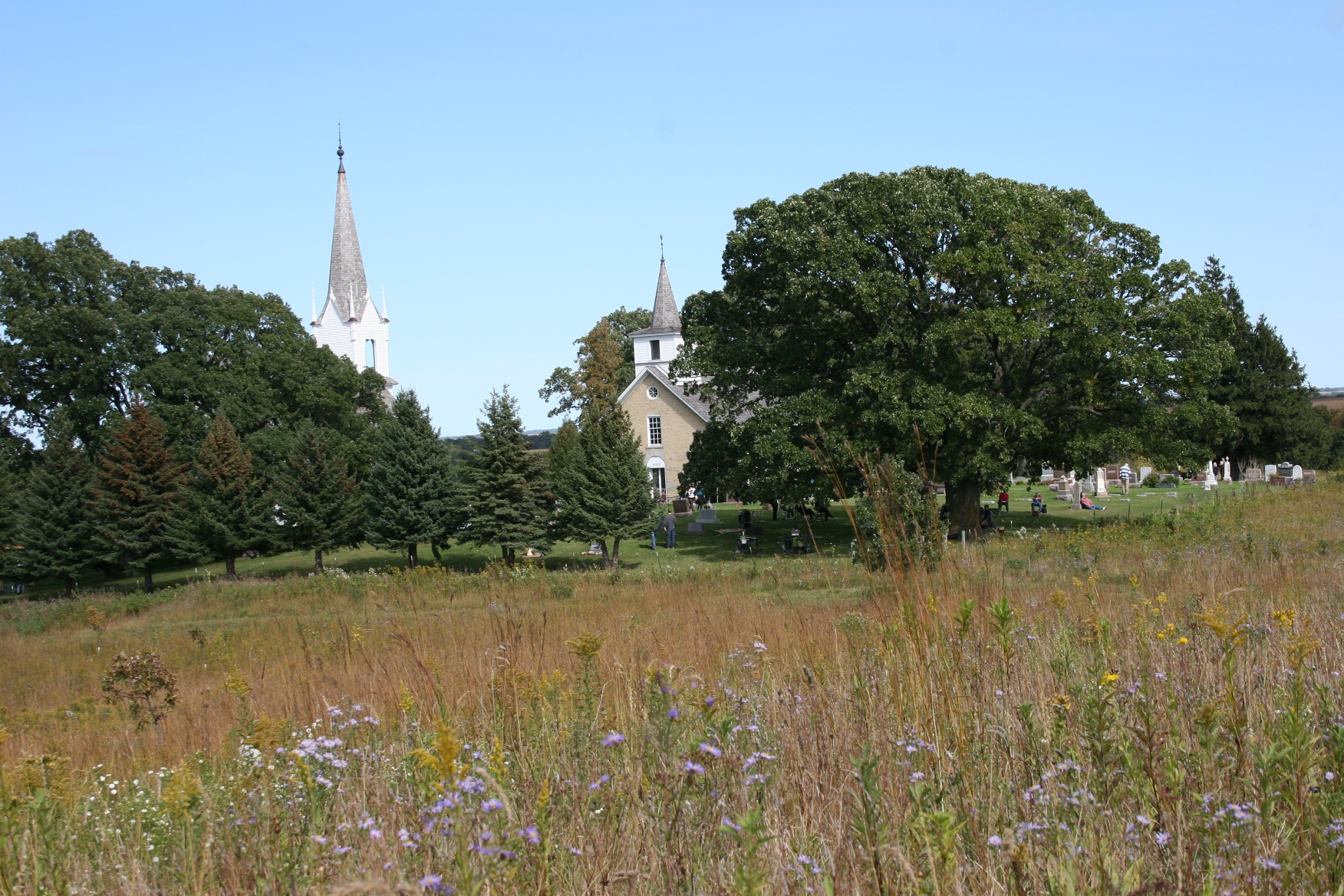
A view of the Valley Grove churches from the prairie that edges the churchyard.

To assure that you don’t miss out on these color viewing opportunities, I’d highly recommend hopping in your vehicle sooner than later. Leaves are changing and falling as I write and we all know these splendid days won’t last forever in Minnesota.

© Copyright 2011 Audrey Kletscher Helbling


A Sunday drive to view the fall colors in Sogn Valley October 4, 2011

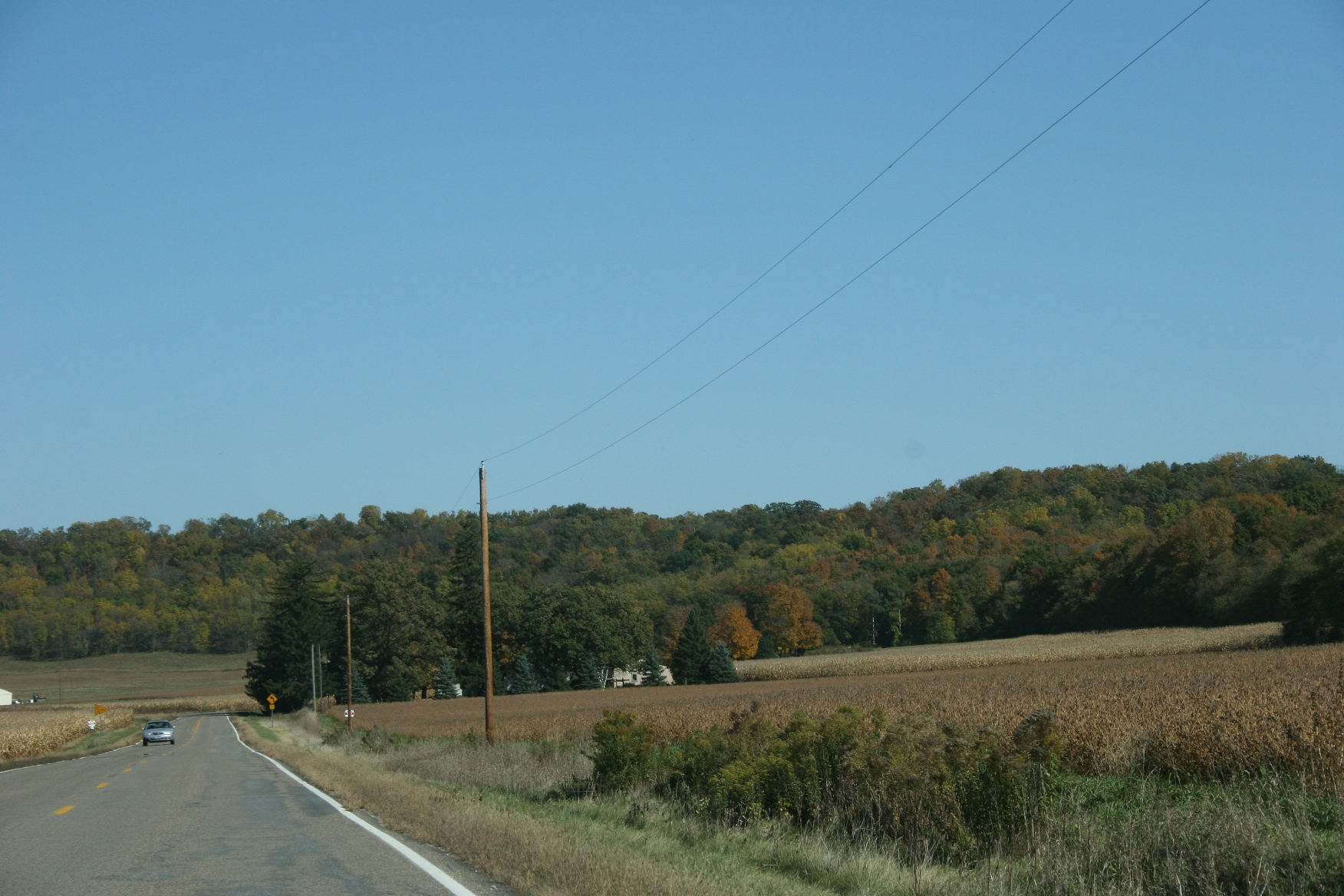
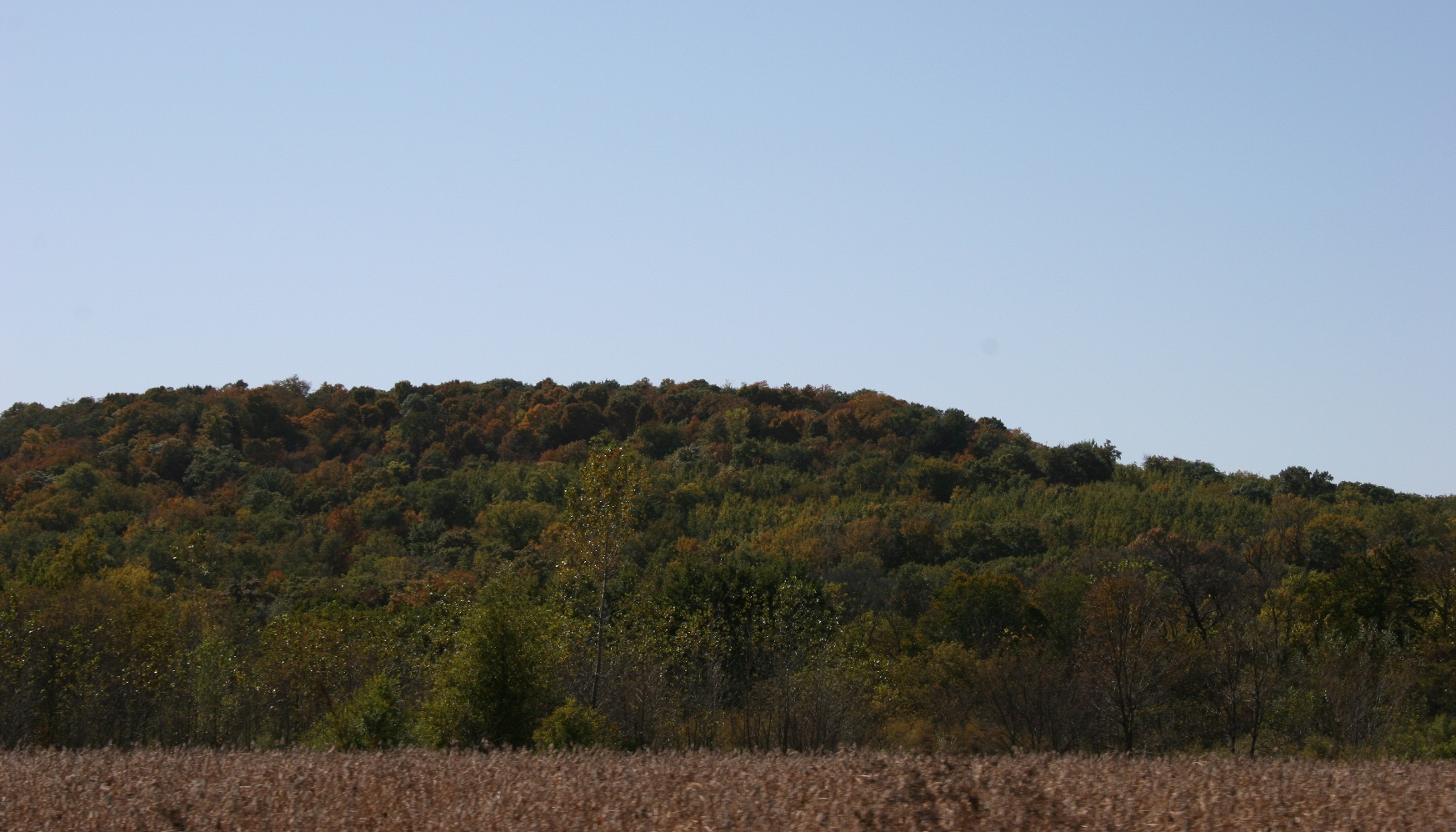
A colorful hillside in the Sogn Valley area of southeastern Minnesota.

MINNESOTANS, THIS is your week.

Get outside. View the fall colors. Experience rural Minnesota at the height of harvest. This could be our best week, weather-wise, until next spring. Not that I’m trying to forecast gray skies and cold and that dreaded word, “snow,” but I’ve lived here long enough—55 years—to realize you should “make hay while the sun shines.”

I took my own advice on Sunday when the husband and I went on a fall color drive to the historic agricultural Sogn Valley area of quaint farms and wooded, rolling hills in northwestern Goodhue County.

We originally planned to paint a bedroom ceiling Sunday afternoon. But then, when a friend asked if the ceiling needed to be painted that day, we decided the project could wait. The afternoon was too beautiful to spend indoors with our eyes focused toward a ceiling instead of upward toward clear blue skies accented by the changing leaves of autumn.

So, just to offer you some visual encouragement to do a fall color drive or go for a walk this week, here are some photos I snapped on that Sunday drive.

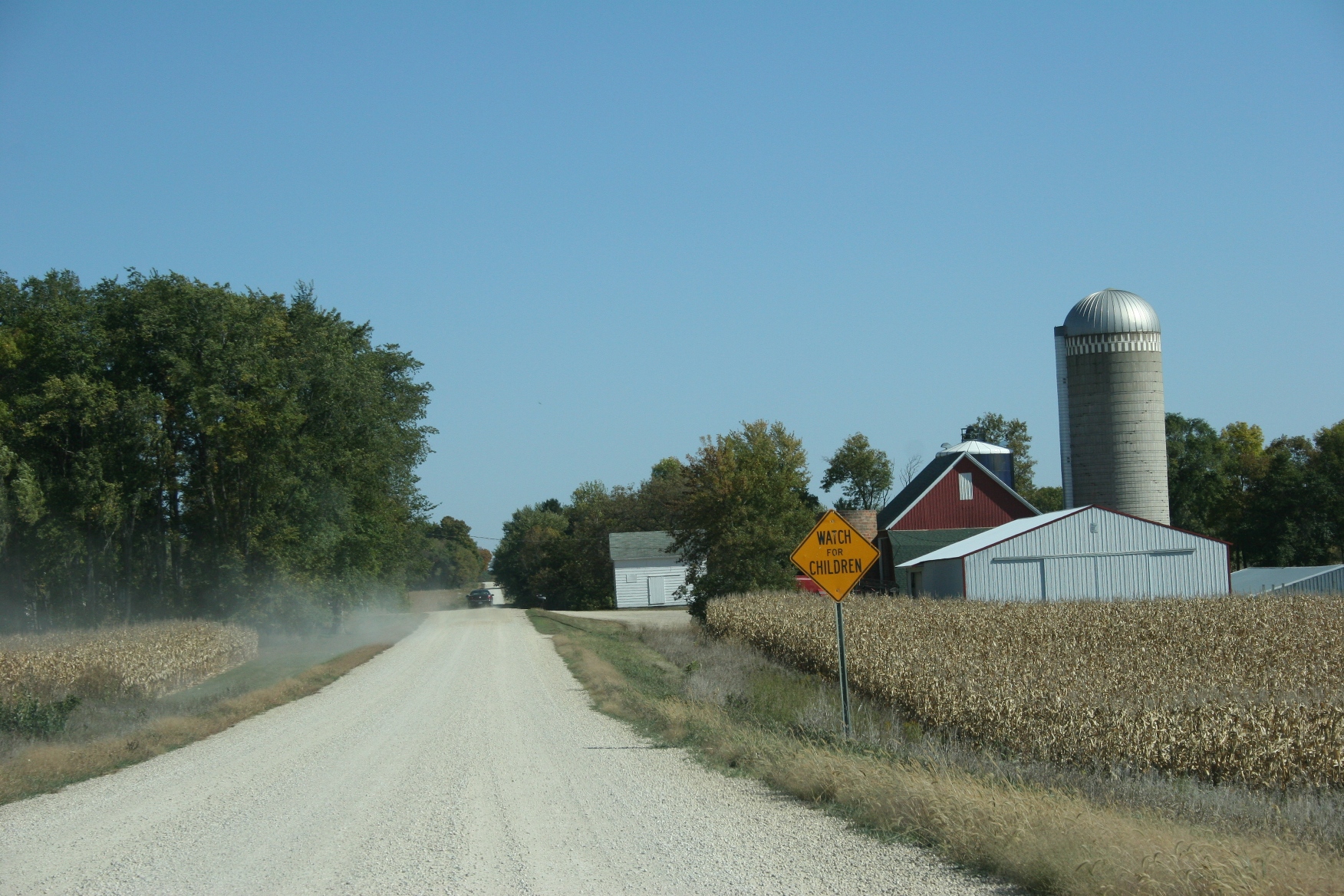
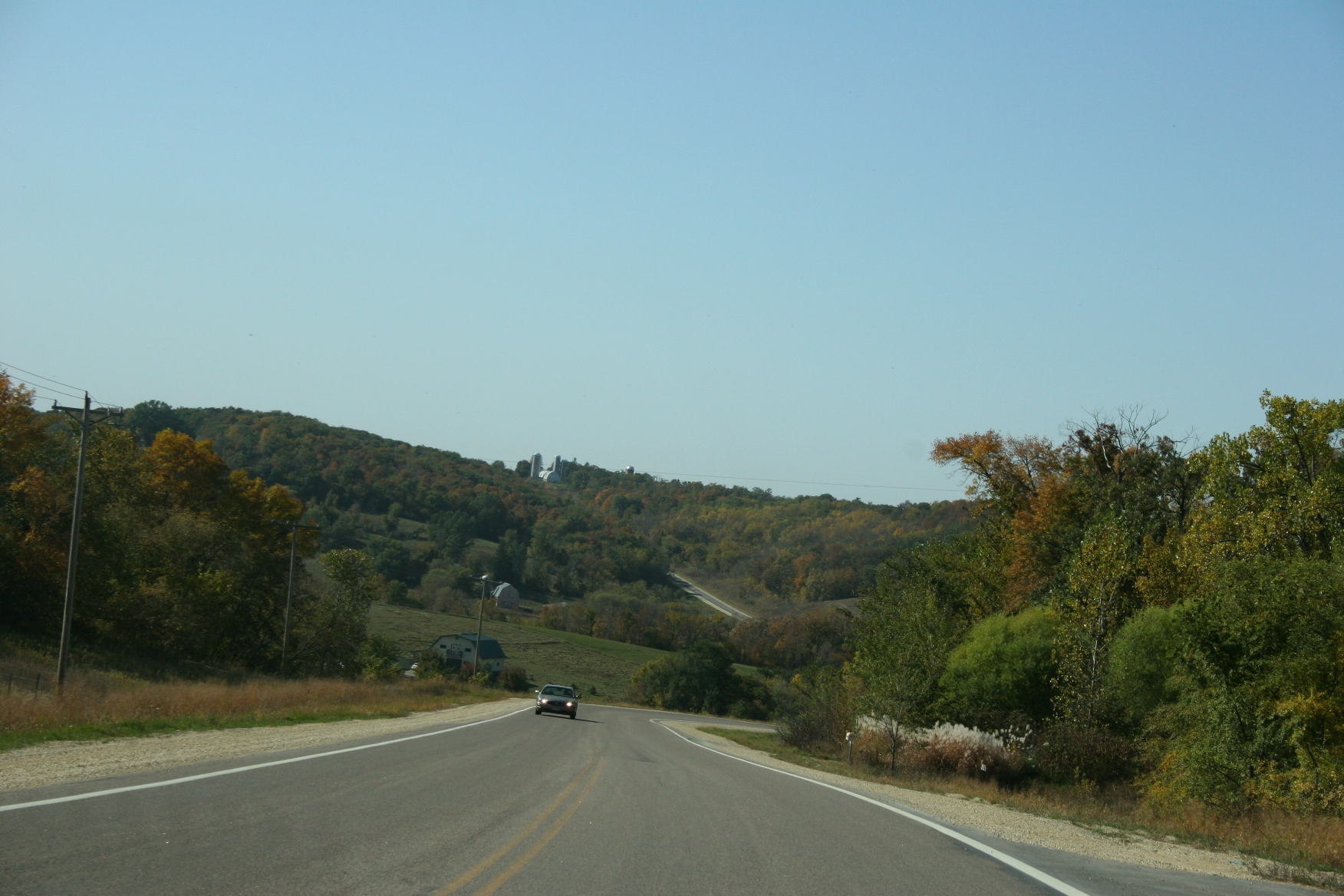
We followed this gravel road, 20th Avenue, between Goodhue County Road 9 and Vang Lutheran Church.

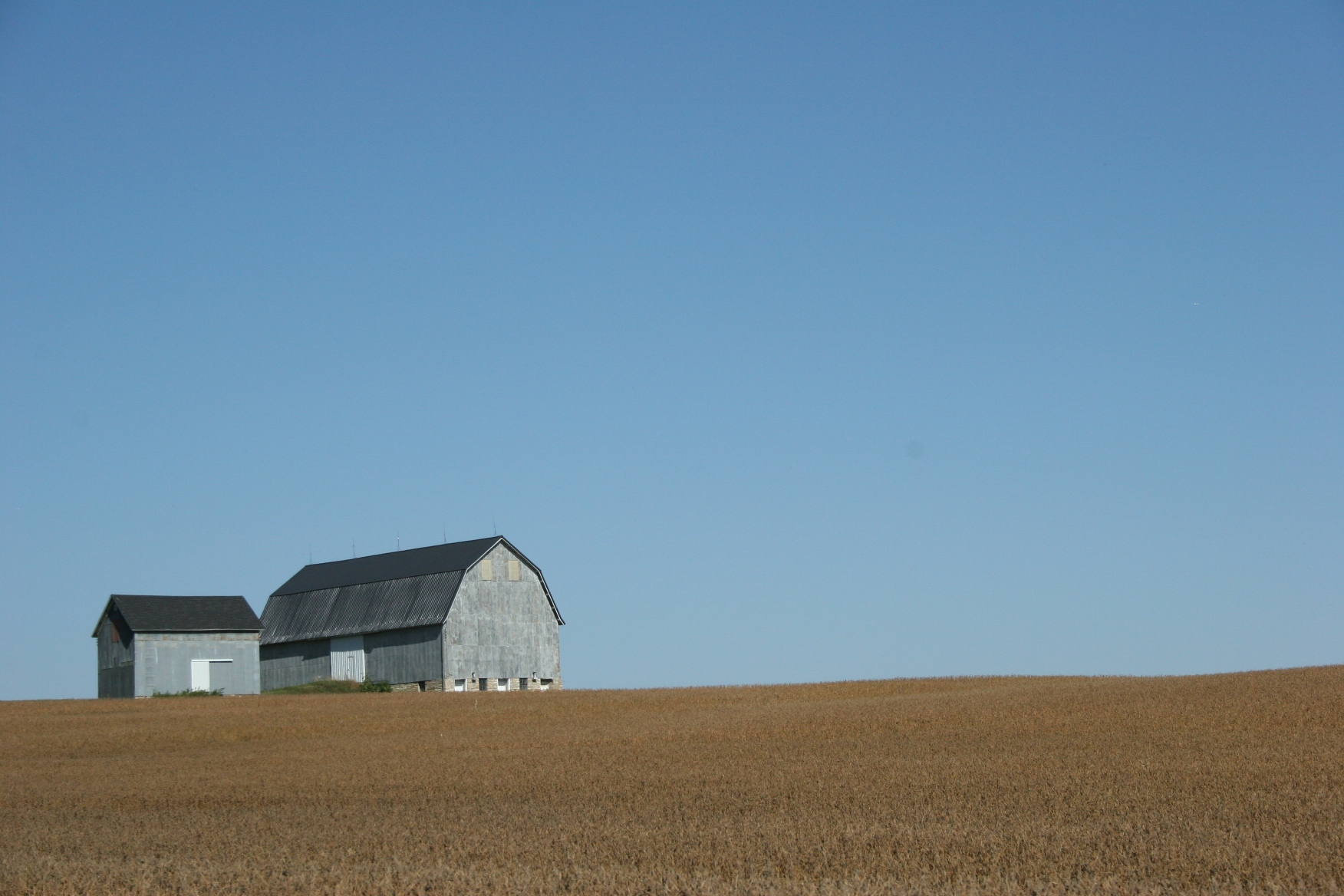
Along 20th Avenue, I spotted these picturesque farm buildings.

I photographed Vang Lutheran Church across the cornfield west of the Potpourri Mill Log Cabin 10 minutes north of Kenyon or 45 minutes south of the Twin Cities.

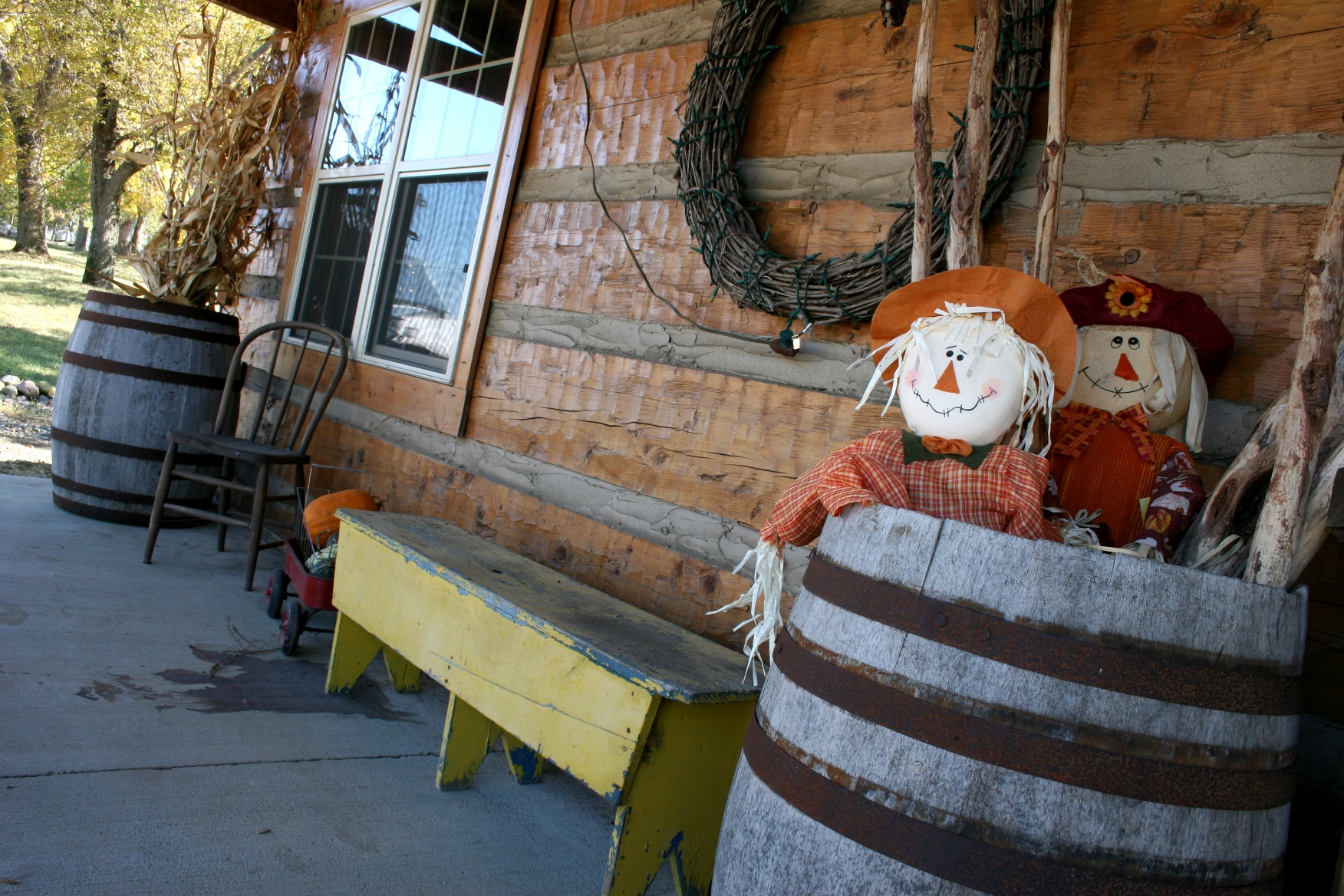
An autumn-themed setting greets shoppers at the seasonal Harvest Thyme Craft Show at the Potpourri Mill Log Cabin, 2290 Goodhue County 49 Boulevard, Dennison. Remaining weekend show hours are 10 a.m. - 6 p.m. October 8-9 and October 15 - 16.

We were driving westbound on Goodhue County Road 9 toward Sogn.

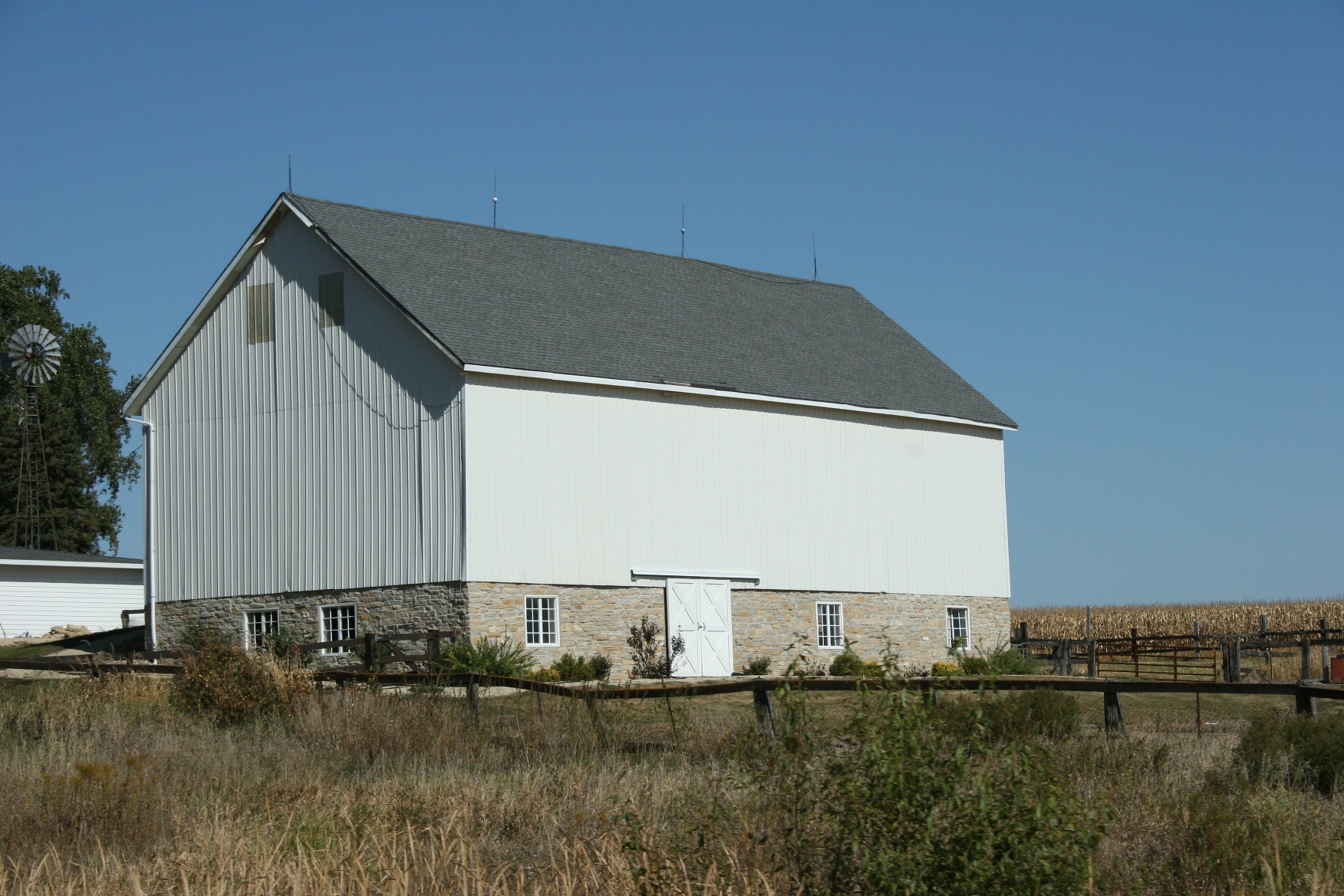
You'll see lots of old barns, like this one along 20th Avenue, in this historic agricultural region.

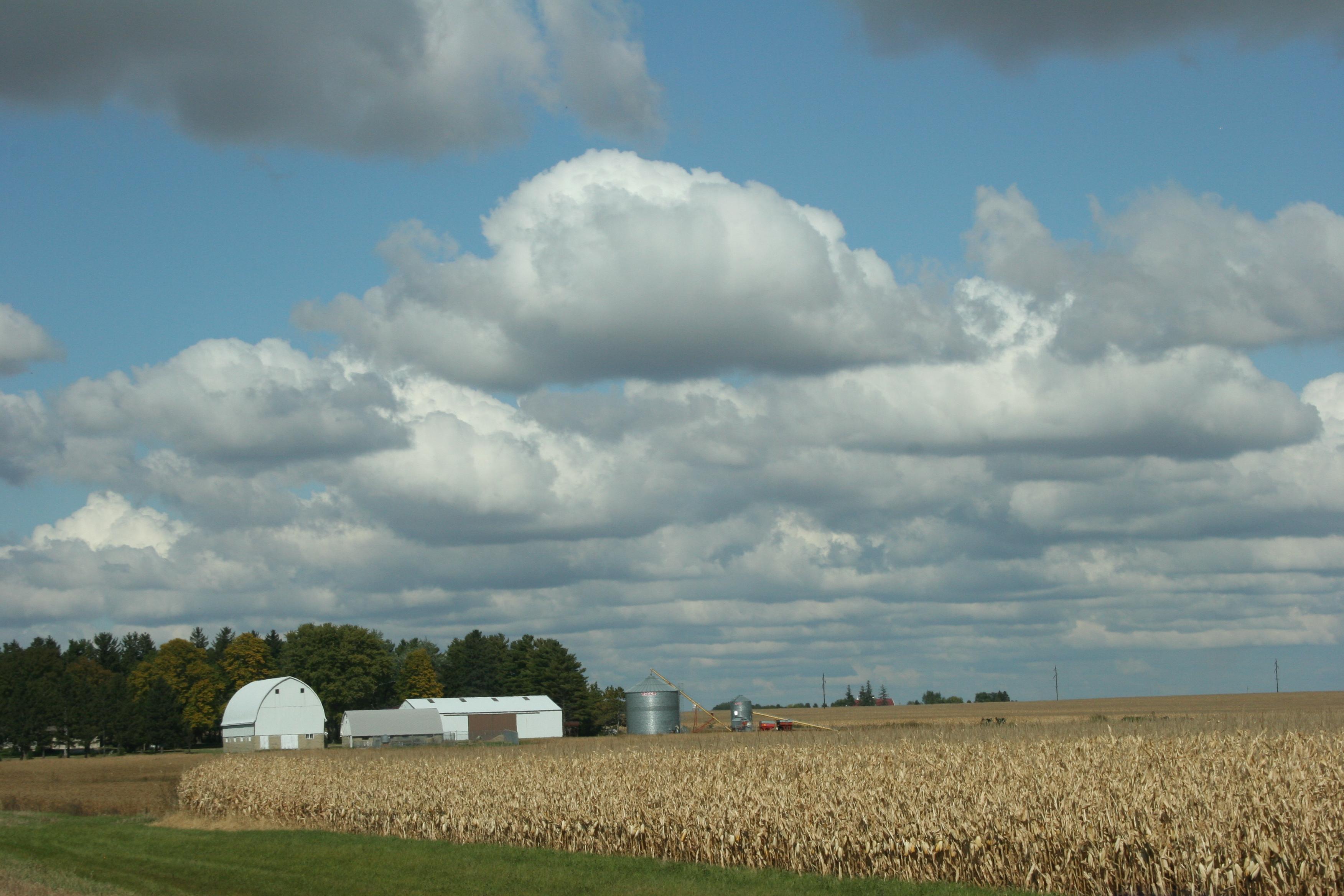
Farmers are in the fields harvesting corn (pictured here) and soybeans.

The Sogn Valley area offers scenic fall color viewing in a rural landscape with little traffic. To truly experience the region, turn off the highway onto back gravel roads. Have a plat book handy and a navigator with a good sense of direction, which would not be me.

CHECK BACK FOR more photos from this autumn drive and for a post on Nerstrand Big Woods State Park, a popular fall color destination. The park parking lot was overflowing on Sunday. Colors were spectacular.

© Copyright 2011 Audrey Kletscher Helbling
 

A closer look at St. John’s Germanfest October 2, 2011

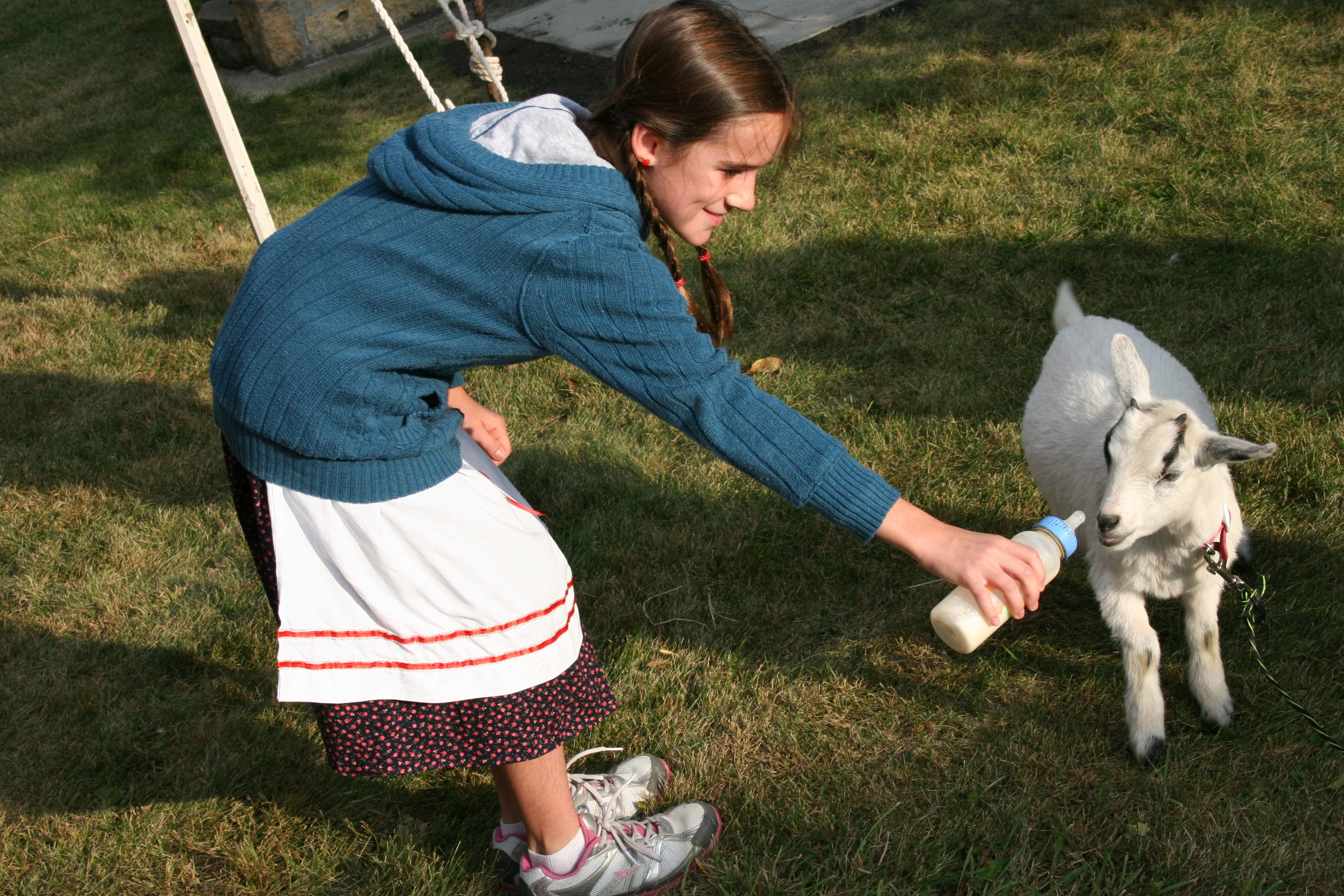
Kassandra and the goat that would soon be hers.

IN MY OPINION, Kim Keller rates as a pretty easy-going mom. I mean, she let her 10-year-old daughter bring a goat home from Germanfest. Honestly, if you were a kid, wouldn’t you want Kim for your mom?

So here’s how I found out about this goat thing. I was wandering the church grounds at St. John’s United Church of Christ, Wheeling Township, last Sunday afternoon during Germanfest searching for photo ops.

I followed a girl leading a wisp of a goat, a kid (not the girl) which seemed a bit stubborn and independent as goats are wont to be. This wasn’t Kim’s daughter and I wasn’t having any luck capturing a photo I liked.

Then along came Kassandra, Kim’s daughter, with a bottle of milk. The goat, which apparently wasn’t all that hungry, didn’t seem too interested in drinking. But Kassandra pursued the goat and I pursued the goat and Kassandra until we both got what we wanted: her the goat, me the photo.

Kim took it all in stride—said it was just another animal to add to the family’s menagerie.

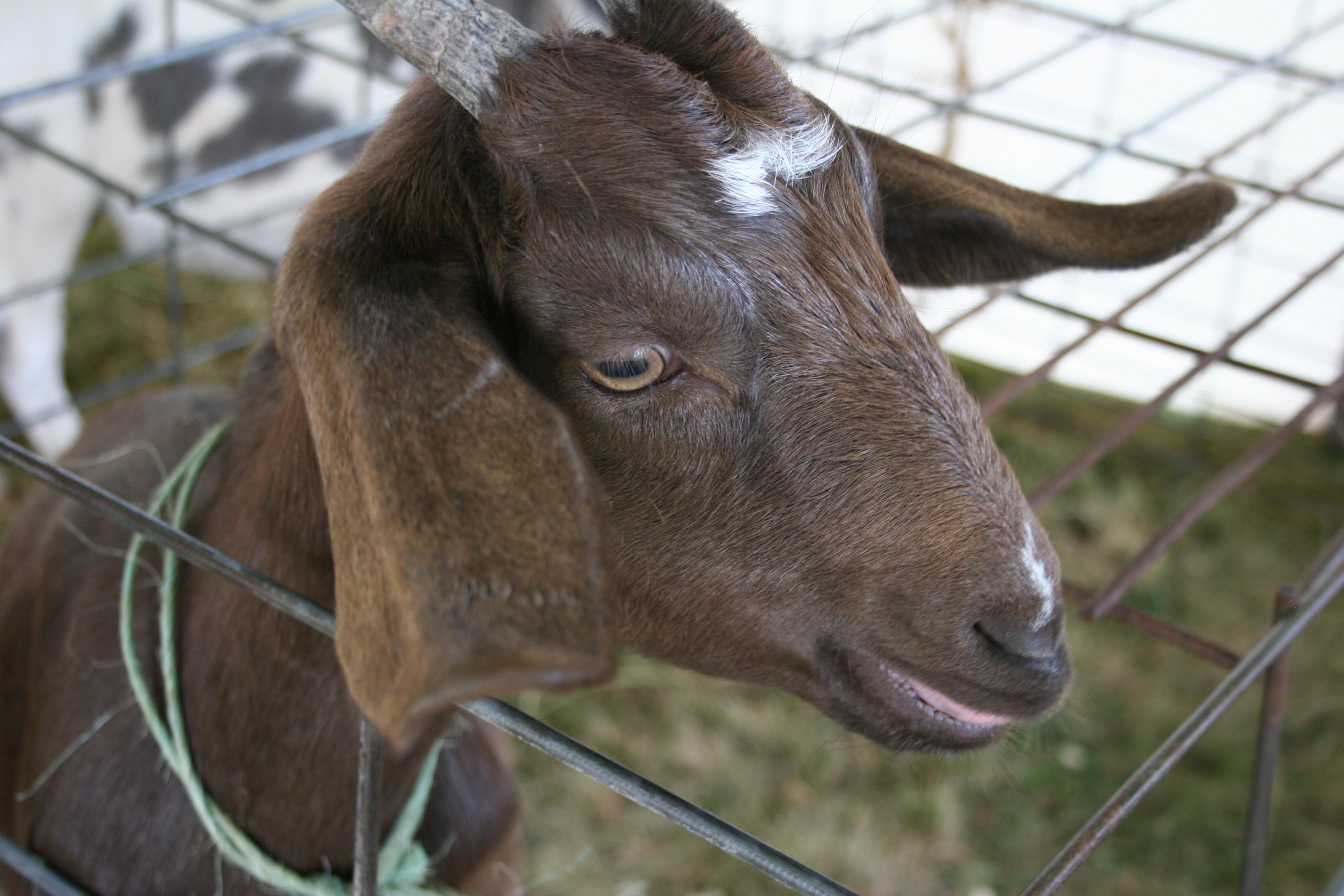
Another goat in the Germanfest petting zoo.

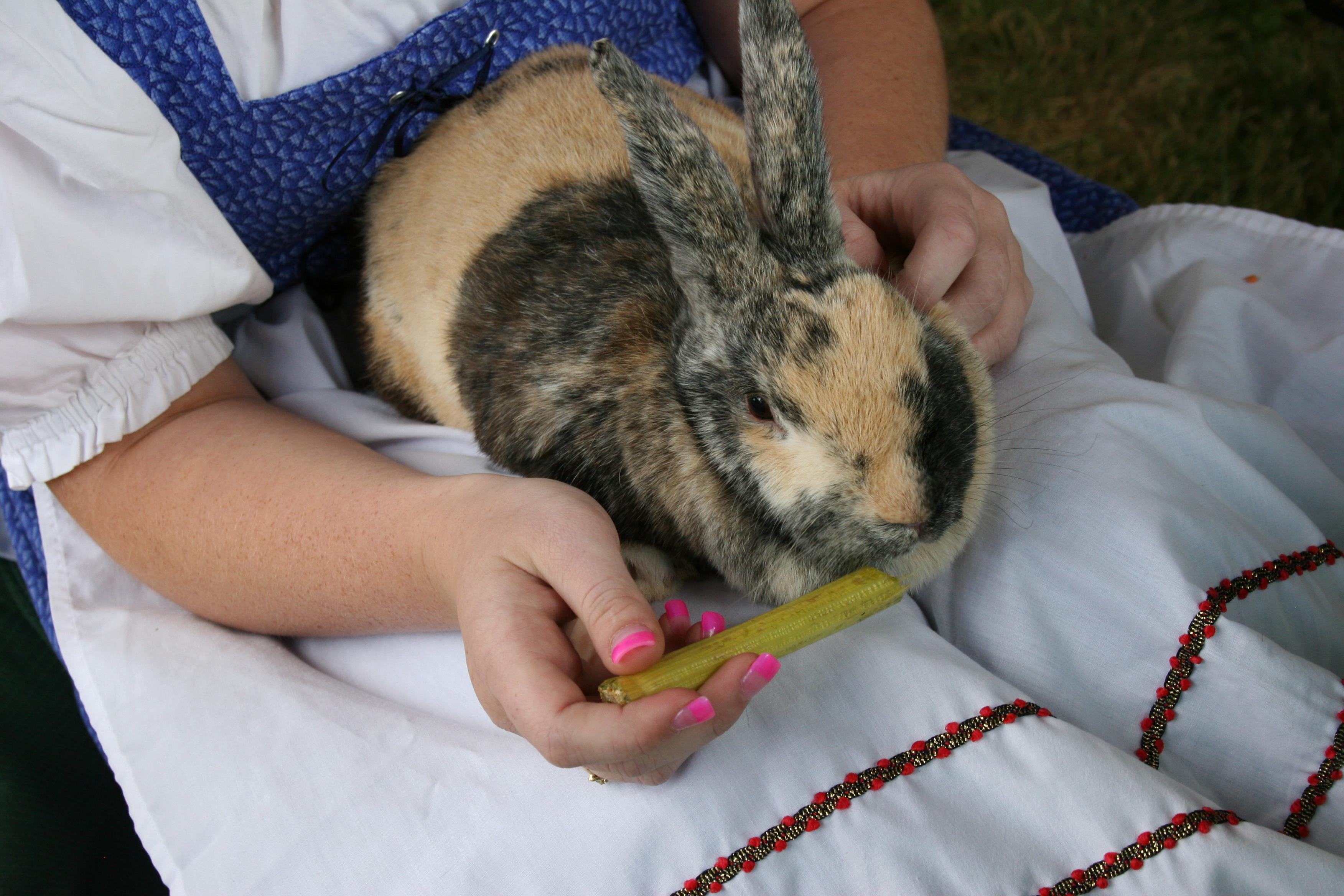
A volunteer dressed in an ethnic German costume tends a petting zoo bunny.

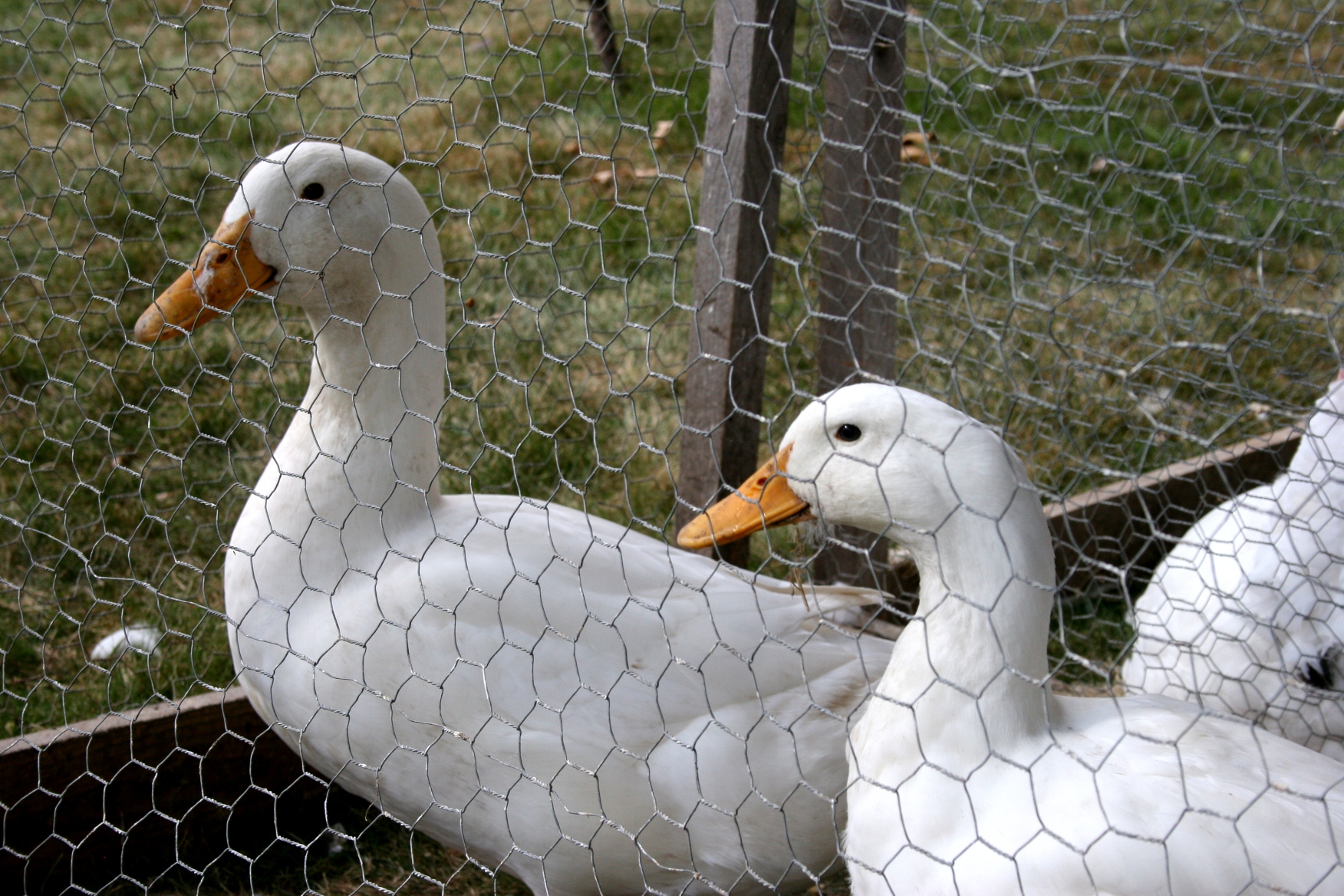
Geese and other fowl were popular petting zoo attractions.

IF YOU’RE A REGULAR FOLLOWER of Minnesota Prairie Roots, you should have figured out by now that I pay attention to detail. You’ll read that in my writing, see it in my photography.

I don’t view situations and scenes like most folks. I’m constantly searching for a new angle from which to shoot a photo or tell a story.

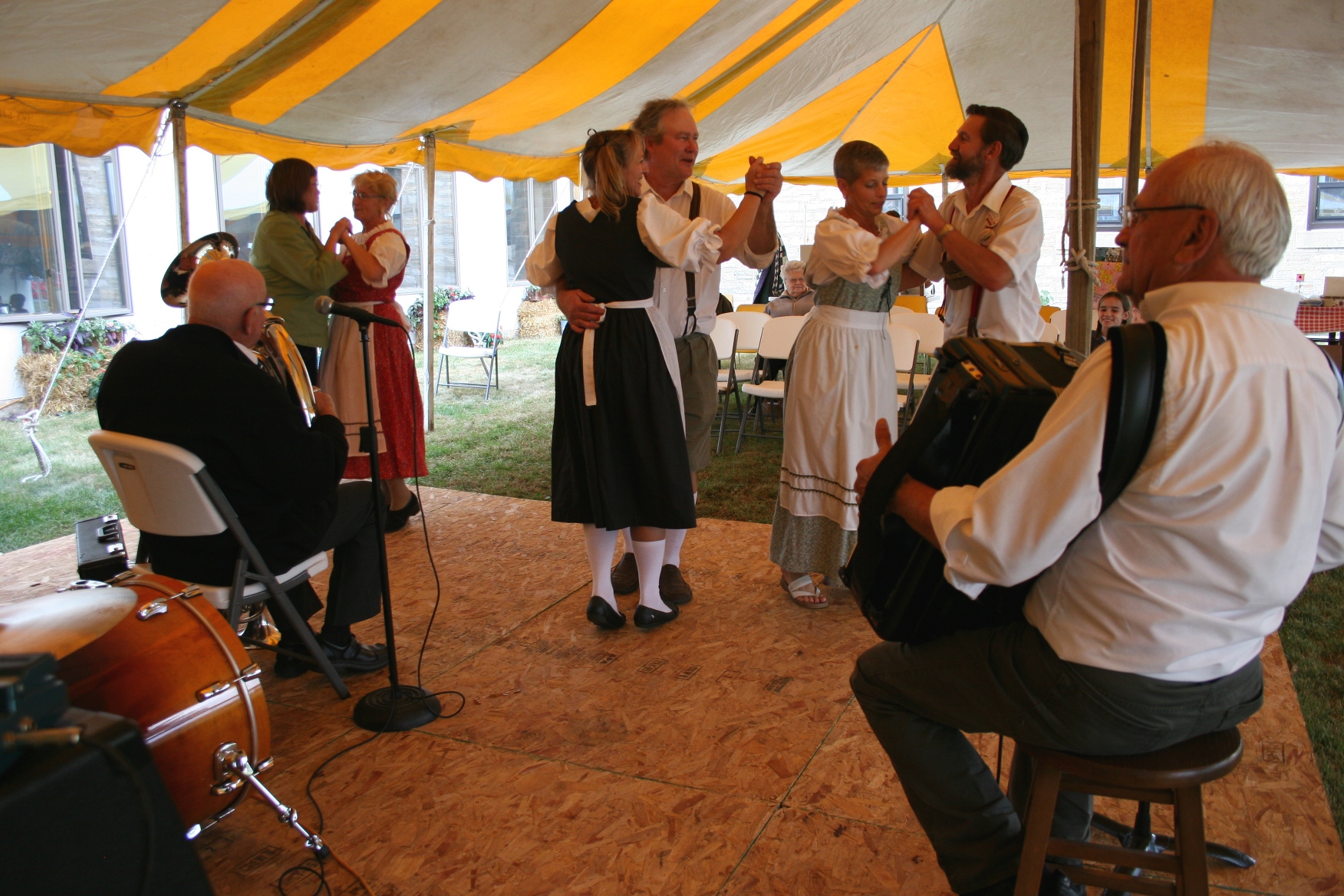
I engage my senses, even though one of them, my hearing, is not what it once was due to sudden sensory hearing loss (and now near-deafness) in my right ear. But I did hear Craig Keller comment from the Germanfest dance floor, as I aimed my camera toward the dancers, that this would be on the internet.

So, Craig, just because you said that, here you are, on the internet.

That's Craig, dressed in his lederhosen, dancing with his partner on the right. On the left is Amy's mom, Annette. The Stuttgart Three is performing.

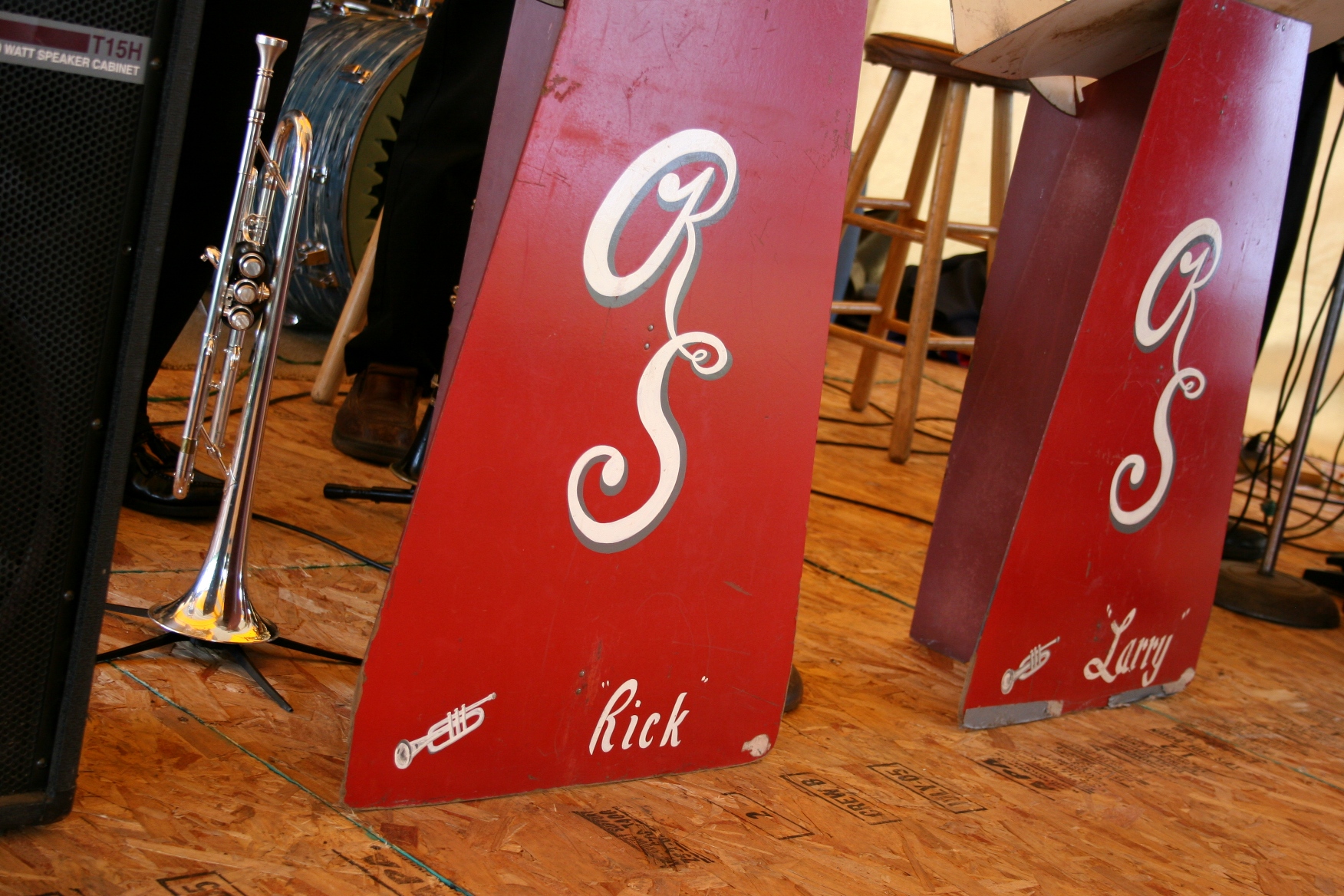
I saw these artsy music stands and thought, “It’s been a long time since I’ve seen something like these.” They jogged my memory of old-time wedding dances in town halls, the chicken dance, dollar dance, polka until you can’t polka any more…

I’VE COORDINATED SOME major public events in my life, namely a school book festival and an art show at my church, several times, not to mention more youth group fundraisers than I care to remember.

But one thing I refuse to do is coordinate anything that involves food. Although I cook and bake, I do not particularly enjoy cooking. I love to bake, but seldom bake because then, you know, I eat the baked goods, which I don’t need.

Now, after that rambling paragraph, let’s get to the point. I am in awe of people like the volunteers at St. John’s United Church of Christ who prepare enough food to feed the multitudes, this year around 700.

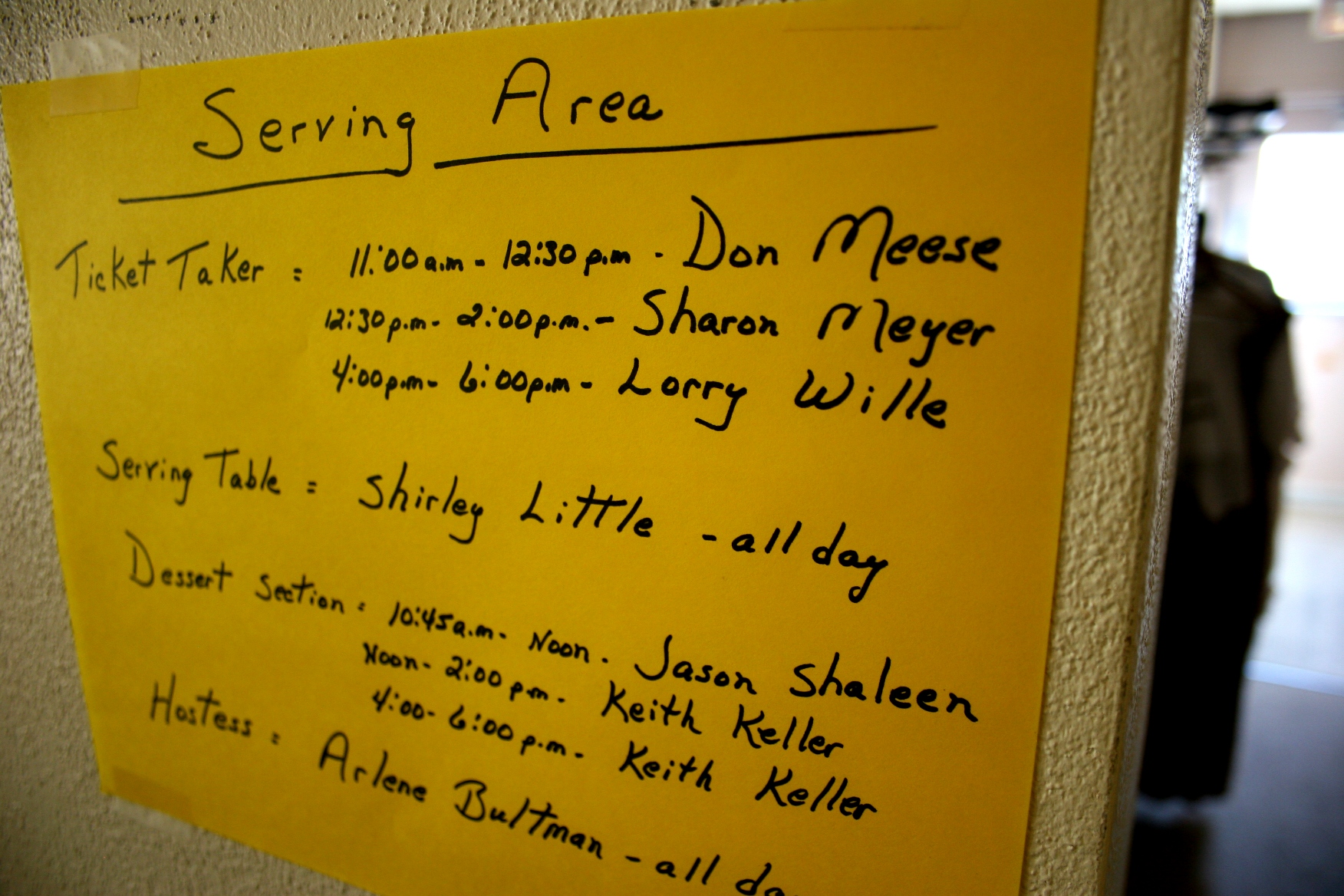
One of the many volunteer worker lists I saw posted in the fellowship hall area.

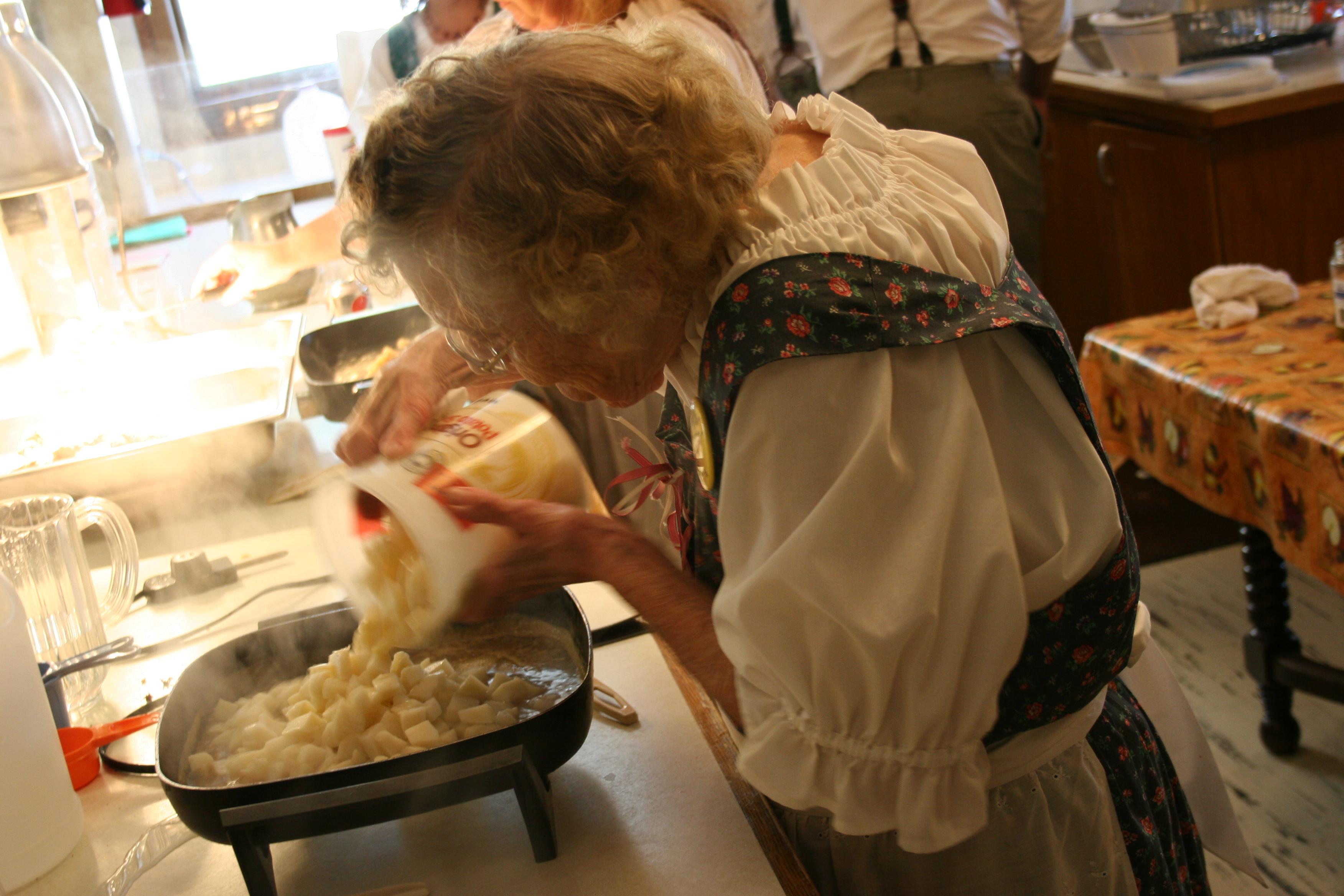
Long-time church member and volunteer Elsie Keller prepares German potato salad.

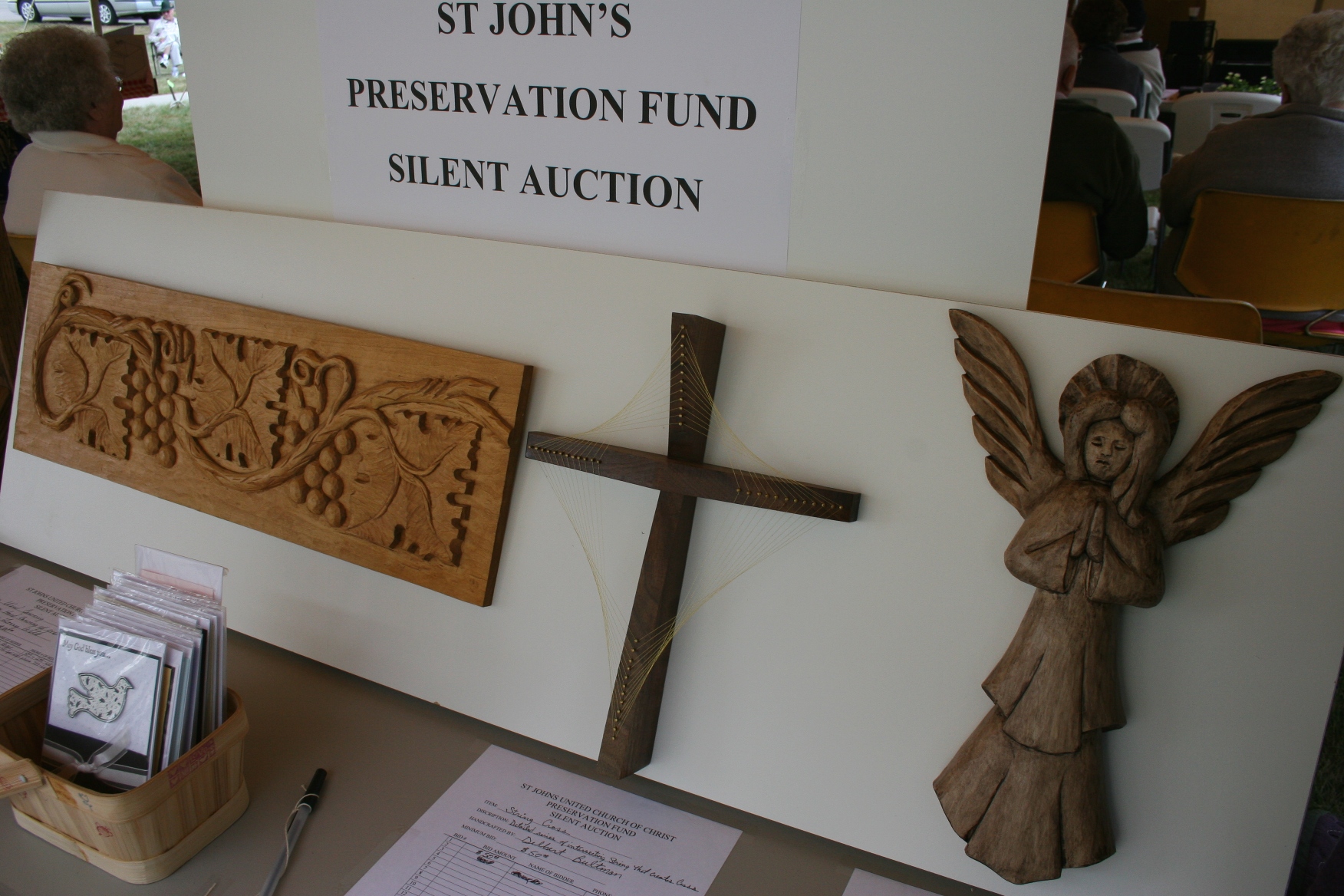
ONE OF THE BEST PLACES to discover artistic talent, I’ve learned, is at silent auctions. Honestly, look what I found at Germanfest.

No words needed.

Woodcarvings for sale at the silent auction.

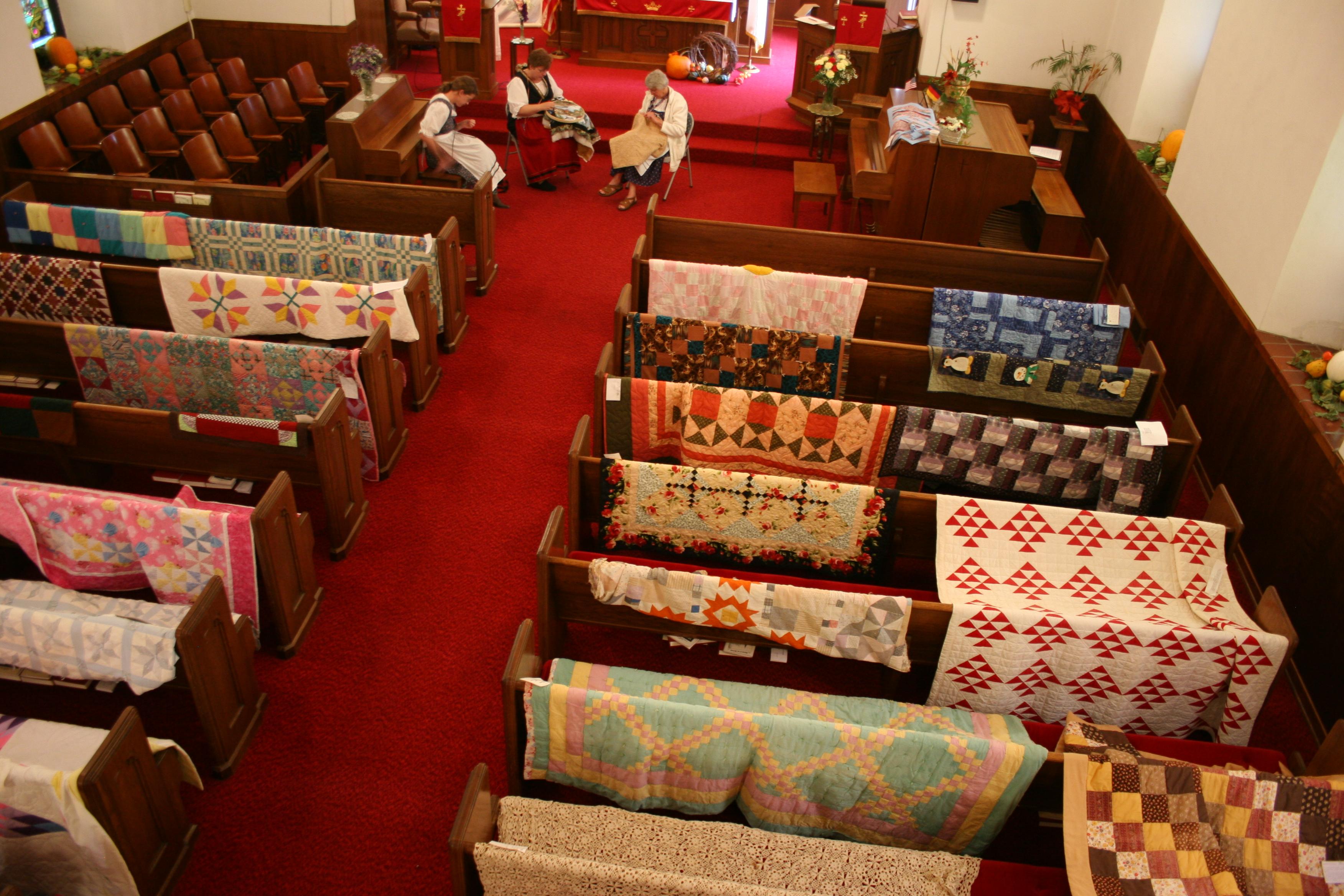
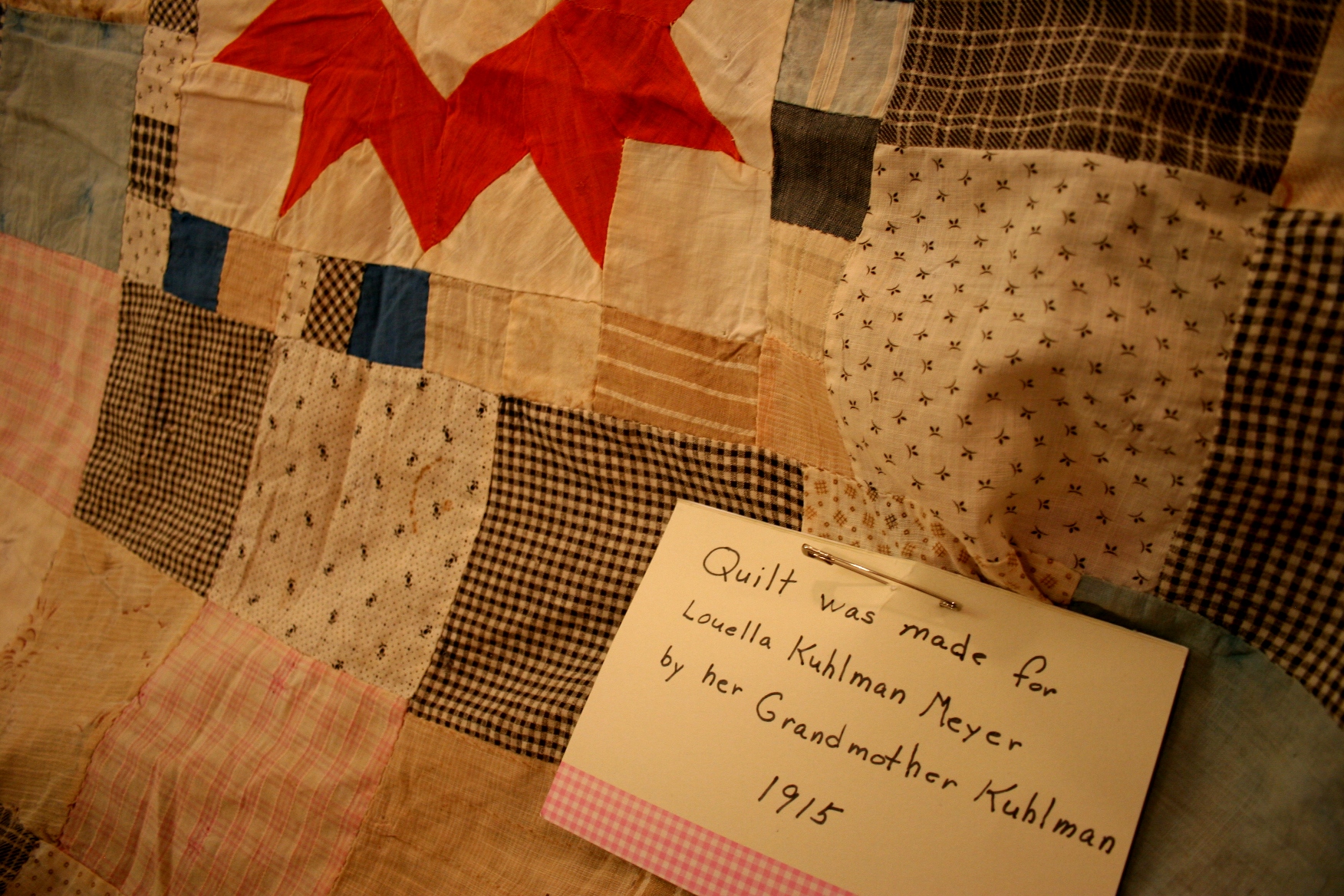
Inside St. John's sanctuary, homemade quilts blanketed the pews. They were not for sale. Each church family was asked to bring a quilt for display along with the story behind it. Up front, three women demonstrated stitching techniques.

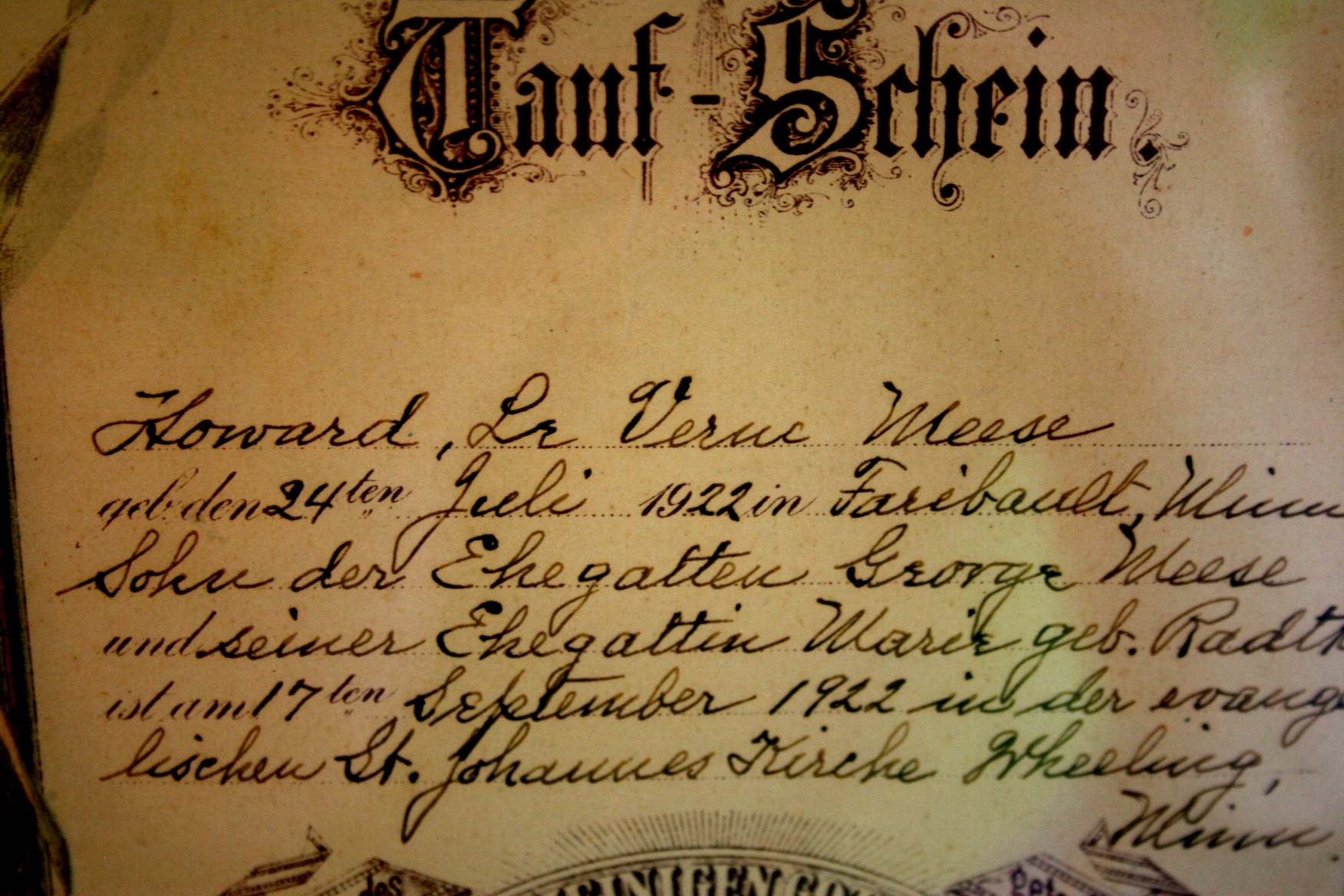
I DON’T KNOW how many Germanfest attendees paused to examine the German books and documents displayed in the church narthex. But I’m always interested in such items because not only am I 100 percent German and interested in “old stuff,” but I once considered majoring in German in college (which means I would not have become a writer; I think I made the right choice).

Sprechen Sie Deutsch?

A Deutsche document from St. John's.

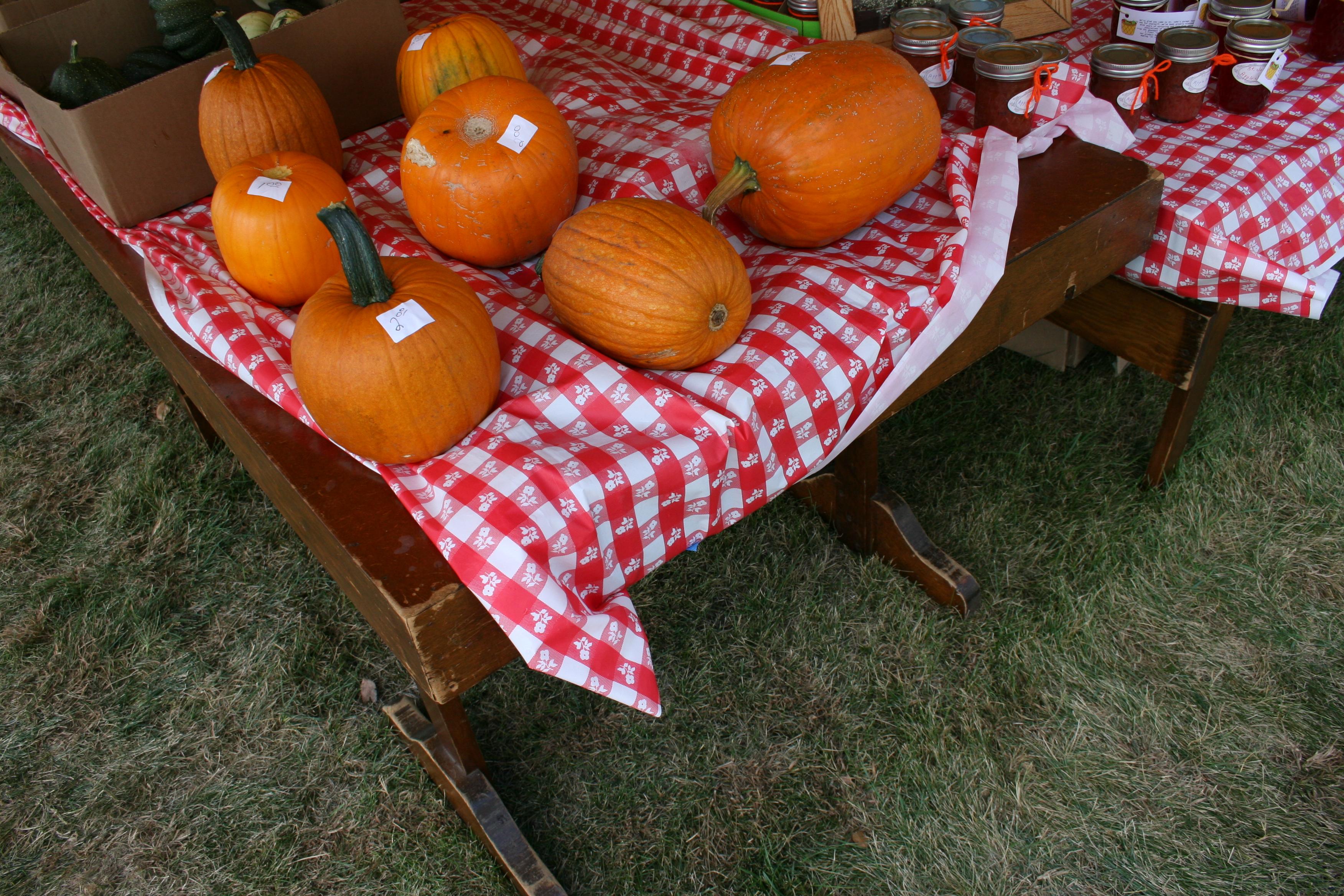
FINALLY, BECAUSE I CAN, I wanted to show you this photo of pumpkins at the farmer’s market section of Germanfest.

To be truthful, though, it wasn’t the pumpkins that interested me as much as the antique table. Those legs caught my eye and I wanted to throw that checkered tablecloth right off the table top and slide my hand across the worn wood.

Country store pumpkins on that old table I noticed.

THE NEXT TIME you’re out and about, I challenge you to notice the details.

© Copyright 2011 Audrey Kletscher Helbling
 

Meander west this weekend September 29, 2011

WEST WOULD BE my destination of choice this weekend.

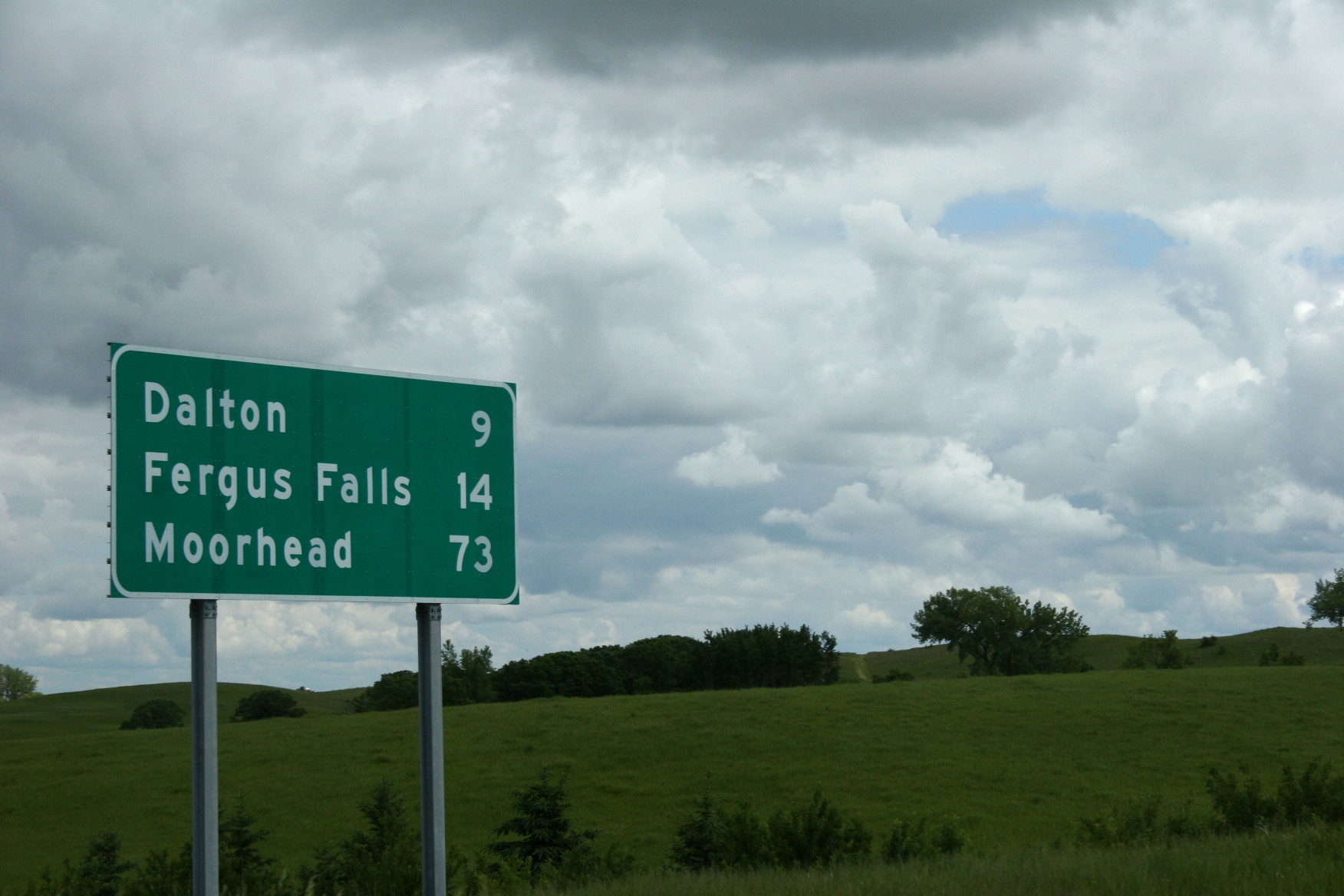
Not west as in West. But west as in Fergus Falls or the Upper Minnesota River Valley.

Two arts events in western Minnesota this weekend will take you nearly into the Dakotas.

I’d like to be at the Lake Region Writers Network Conference at Minnesota State Community and Technical College in Fergus listening to author Leif Enger (of Peace Like a River and So Brave, Young and Handsome) talk about “place” in writing.

I’d like to be there picking up my copy of Lake Region Review, a literary magazine of regional writing. You see, two months ago I received this e-mail:

Dear Ms. Helbling,

The Editorial Board of Lake Region Review 2011, after careful consideration, has finalized selections for Lake Region Writers Network’s first literary magazine. While editors and readers were pleased with the number of submissions, the sheer volume of entries also made their choices much more difficult.

Regardless, the board is pleased to inform you that the work indicated below HAS BEEN ACCEPTED WITH REVISION for publication in Lake Region Review 2011, which will be released at the LRWN Oct. 1 writing conference at M-State in Fergus Falls:…

But I won’t be in Fergus on Saturday at the conference. It’s a long drive there from Faribault and I have this room to paint and…

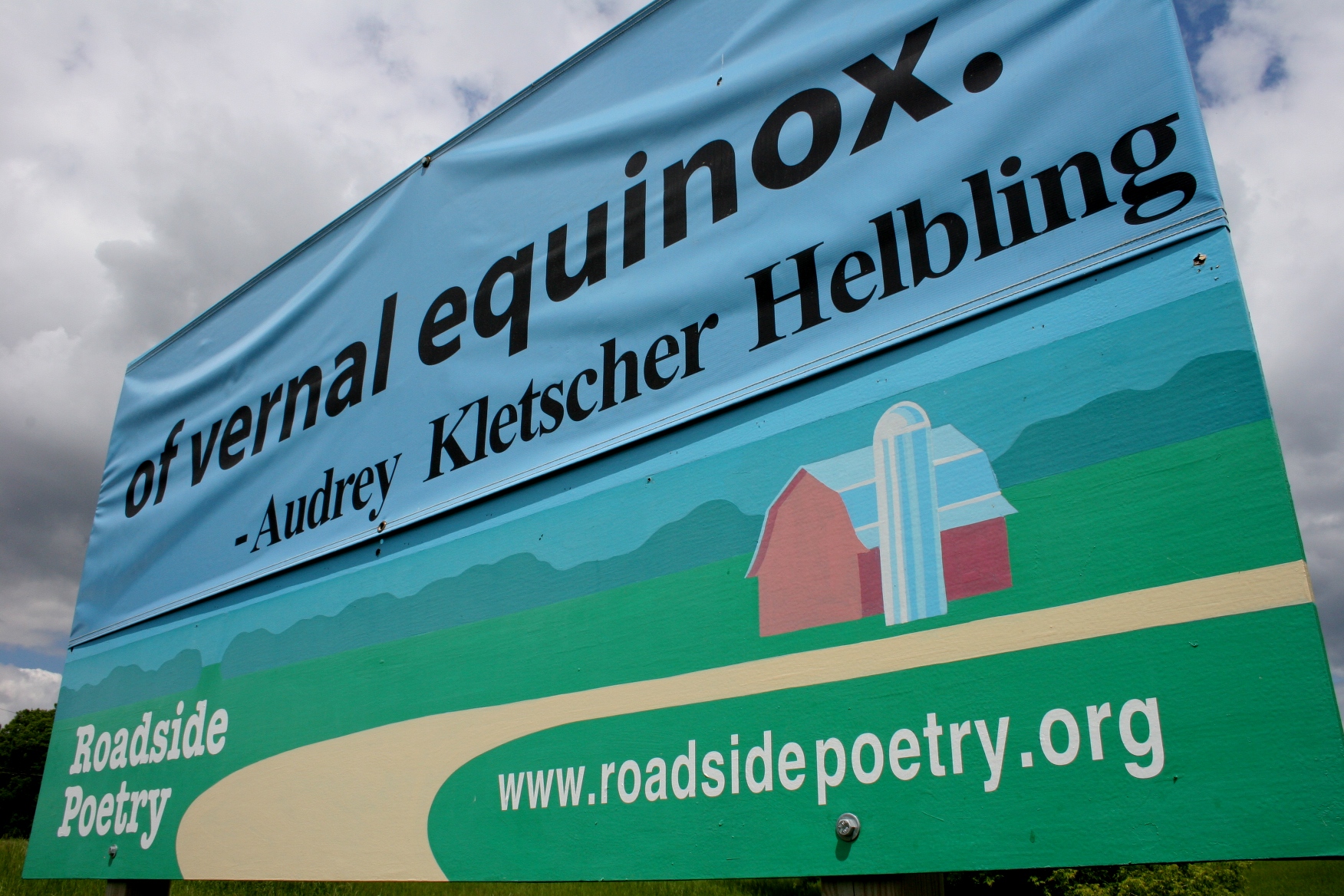
…not only that, but back in June my husband and I traveled the 200 miles to Fergus Falls to see my winning entry in the spring Roadside Poetry competition splashed across four billboards near the college.

The last of four billboards featuring my Roadside Poetry spring poem.

So I’ll wait for the LRWN folks to send me a copy of their literary magazine, which I’m mighty pleased to be a part of because, well, any time you win a highly-competitive contest judged by others of literary talent, it’s an honor.

I’LL HAVE TO WAIT until another year also to attend an arts event that’s long been on my list of “things I want to do.” That’s Meander—Upper Minnesota River Art Crawl. Thirty-three art studios featuring the work of 45 artists will be open during a free self-guided tour that begins Friday (2 p.m. – 6 p.m.), continues into Saturday (9 a.m. – 6 p.m.) and ends Sunday (9 a.m.– 4 p.m.).

This event is happening in the Minnesota River Valley region of western Minnesota near the towns of Ortonville, Appleton, Madison, Milan, Dawson, Montevideo and Granite Falls. It’s beautiful land—prairie and fields, rock and woods, rivers, small towns, farms…

The region seems a mecca for artists, which doesn’t at all surprise me given I’m a southwestern Minnesota native. Something about this land fosters creativity. Remember my earlier mention of Leif Enger and his focus on place? At the writers’ conference in Fergus Falls, he’ll “look at how geography of a tale infuses it with gravity, wit and credibility.”

I suspect place, as much as anything, influences the photography, paintings, pottery, fiber art, woodworking and other art created by those artists featured in the Meander.

Meander featured artist Kerry Kolke-Bonk of Appleton created the painting, "What goes around comes around," to promote this year's art tour.

According to economic impact information I received from Kristi Fernholz, Community Development Planner for the Upper Minnesota Valley Regional Development Commission, the Meander brings in an average of $1,652 in art sales per artist (2010 and 2009 statistics).

Last year, art sales during Meander weekend totaled $69,395. In addition, attendees infuse the area with more money spent on food, lodging and other shopping.

I won’t be one of those shoppers this year. But you could be. If you have an open schedule this weekend, consider a trip west, as in western Minnesota.

#

FYI: Click here for more information about Meander—Upper Minnesota River Art Crawl.

#

Click here for more information about the Lake Region Writers Network. If you would like to purchase a copy of the first-ever Lake Region Review with my poem (sorry, not going to yet divulge its title), send $10 plus $3 for shipping and handling to:

Lake Region Writers Network, P.O. Box 356, Battle Lake, MN. 56515

#

Click here for more information about Roadside Poetry.

© Text and photos copyright 2011 Audrey Kletscher Helbling
 

Reflections on harvest time in southern Minnesota September 27, 2011

Westbound on U.S. Highway 14 between Nicollet and Courtland in southern Minnesota Friday afternoon.

I LOVE THIS LAND, this rural southern Minnesota.

You can take your woods and your lakes and your boats or your big city freeways and skyscrapers and traffic jams.

I will take sky and a land that stretches flat into forever.

I like my space open, not hemmed in by trees packed tight in a forest. I want to see into forever and beyond, the horizon broken only by the occasional grove hugging a building site.

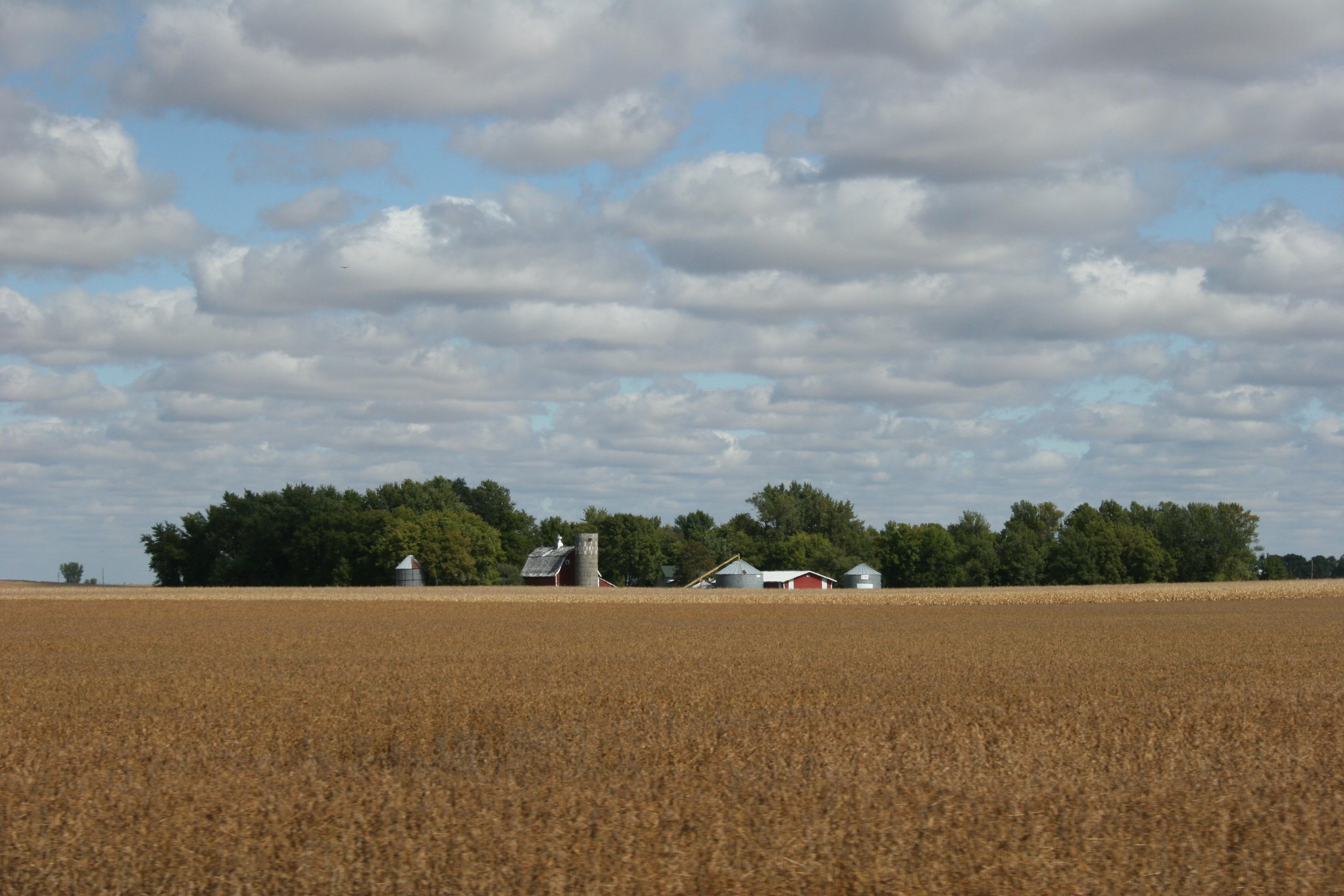
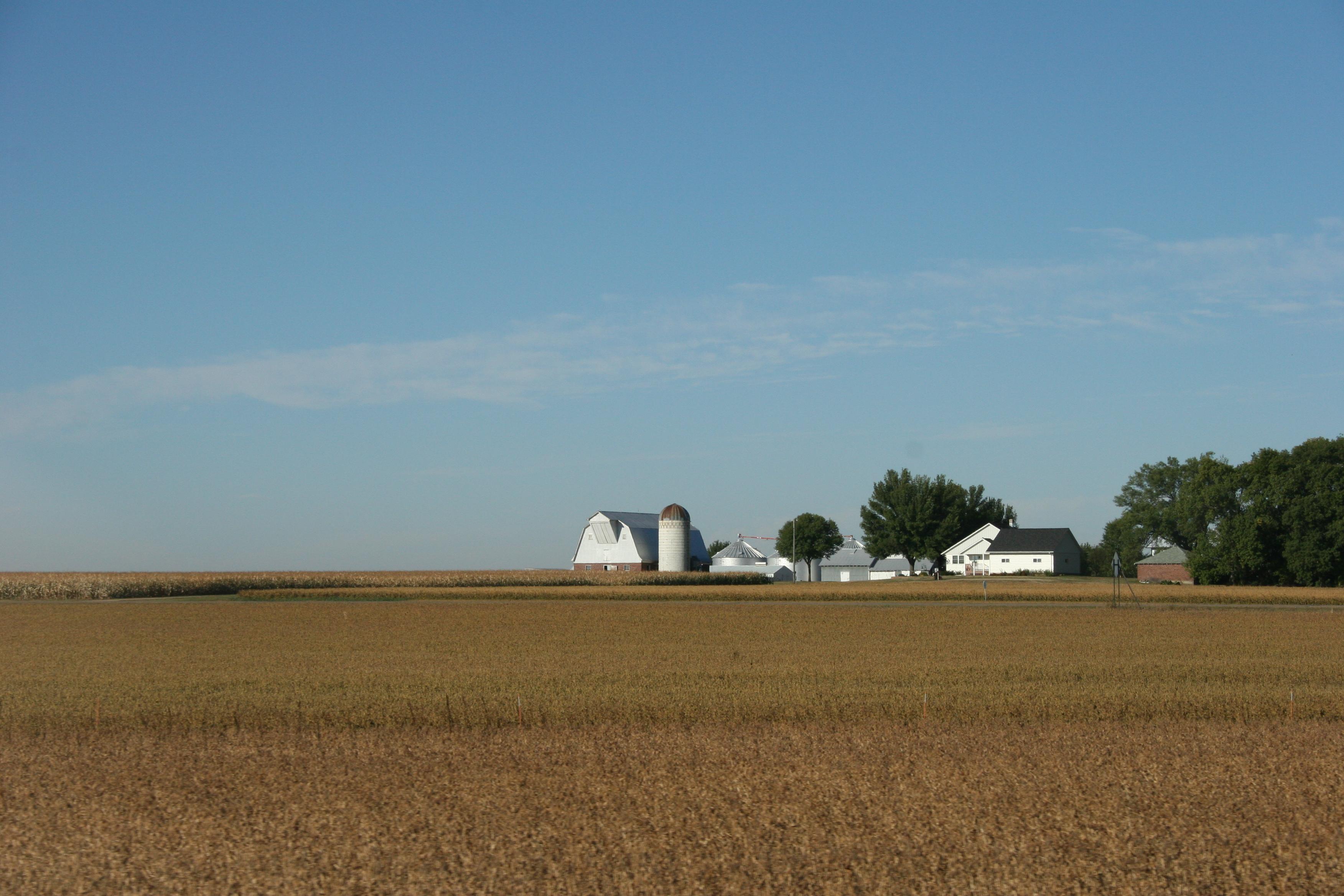
A farm site between Mankato and Nicollet, as seen from U.S. Highway 14.

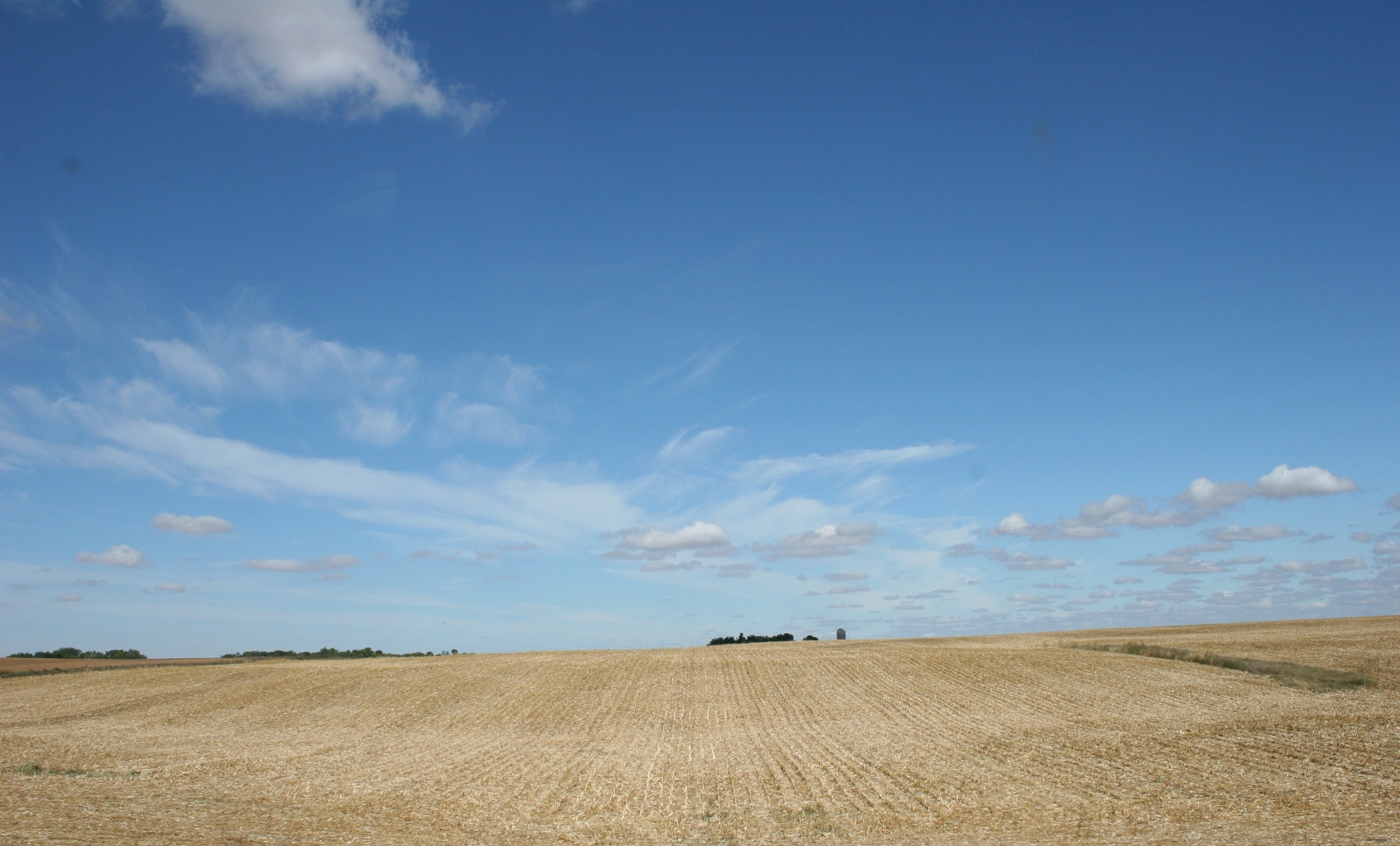
A harvested corn field between Nicollet and Courtland.

I want corn and soybean fields ripening to the earthy hues of harvest. Not gray cement or dark woods.

Give me small-town grain elevators and red barns and tractors, and combines sweeping across the earth.

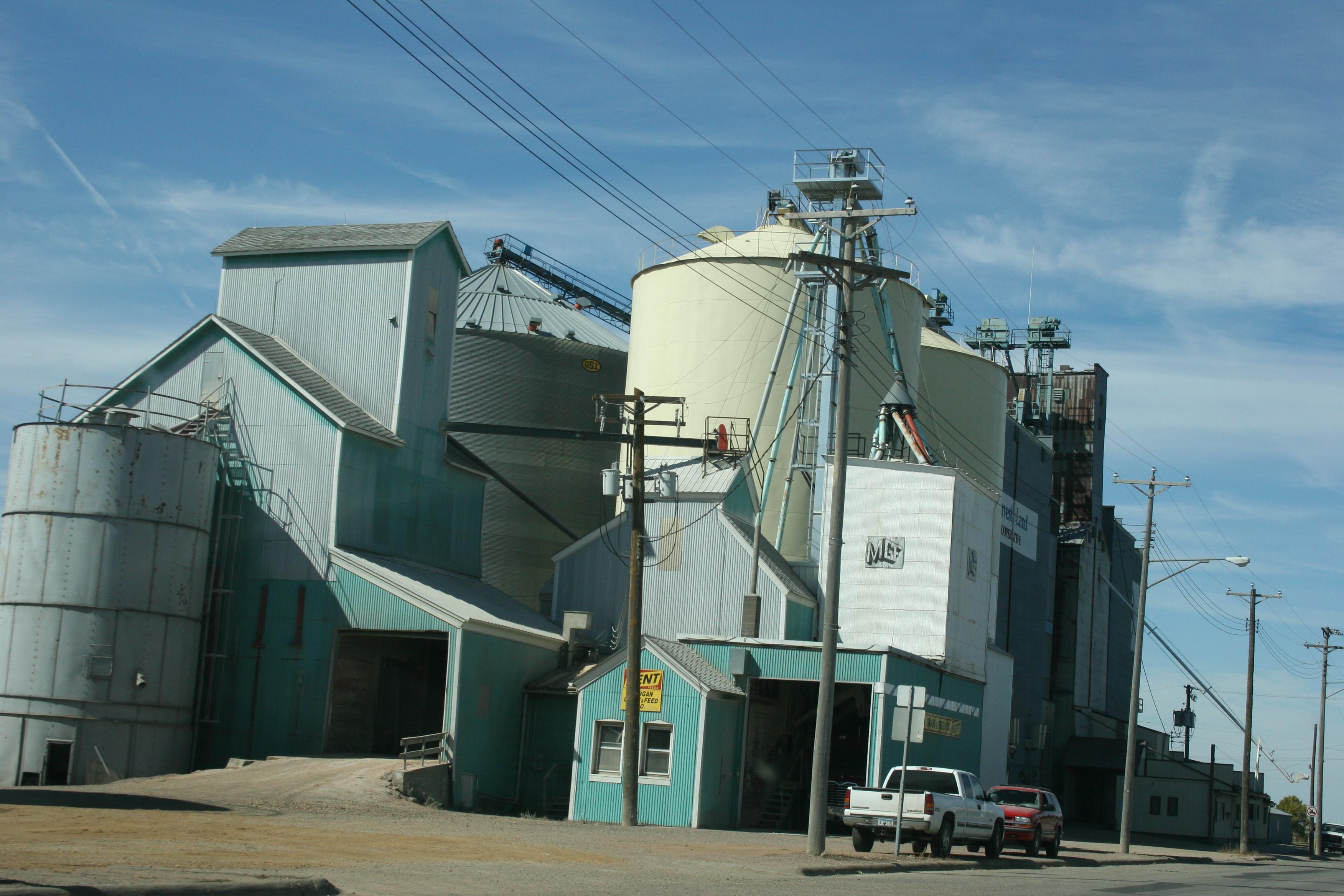
The elevator complex in Morgan in Redwood County.

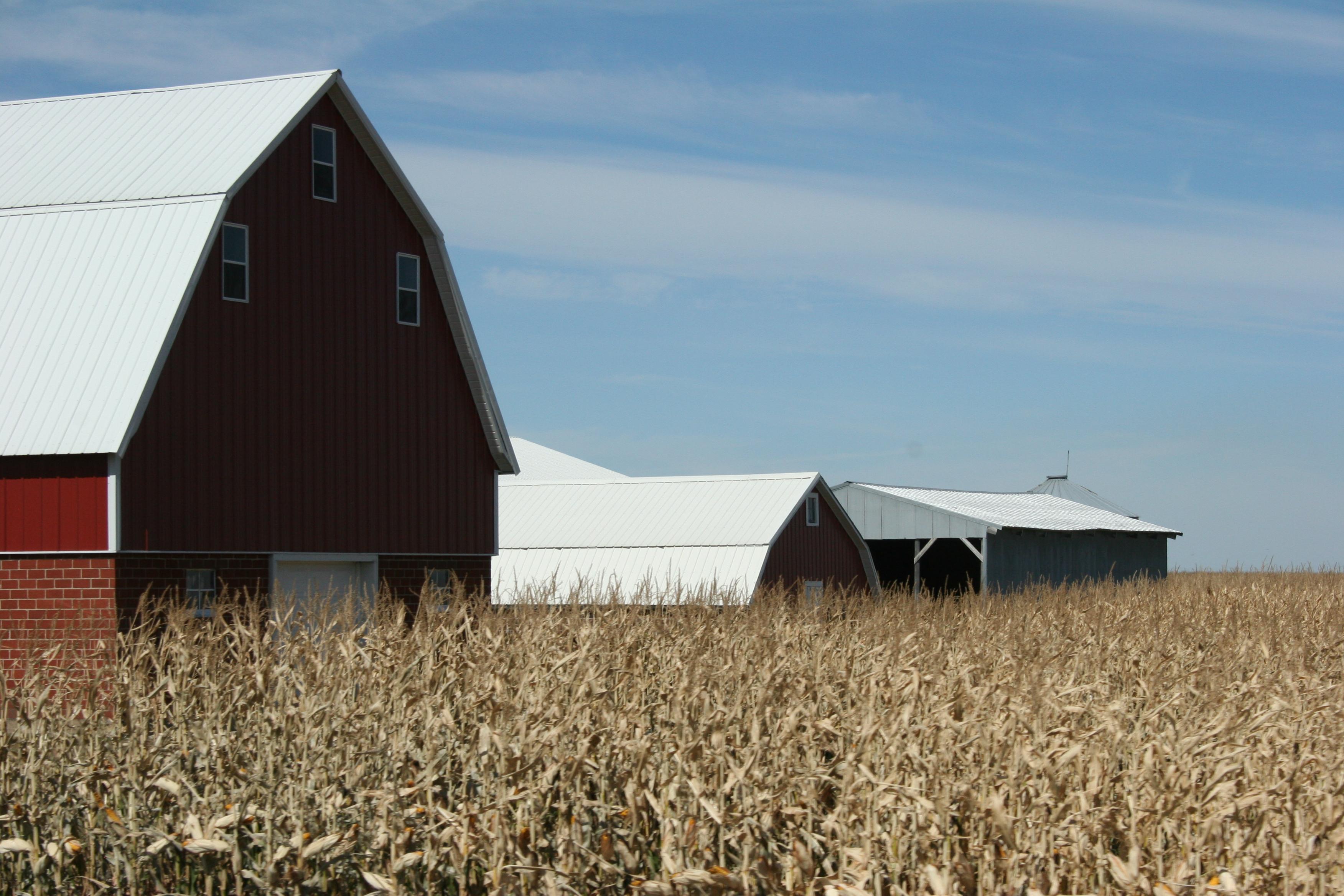
A farm site along the twisting back county road between New Ulm and Morgan.

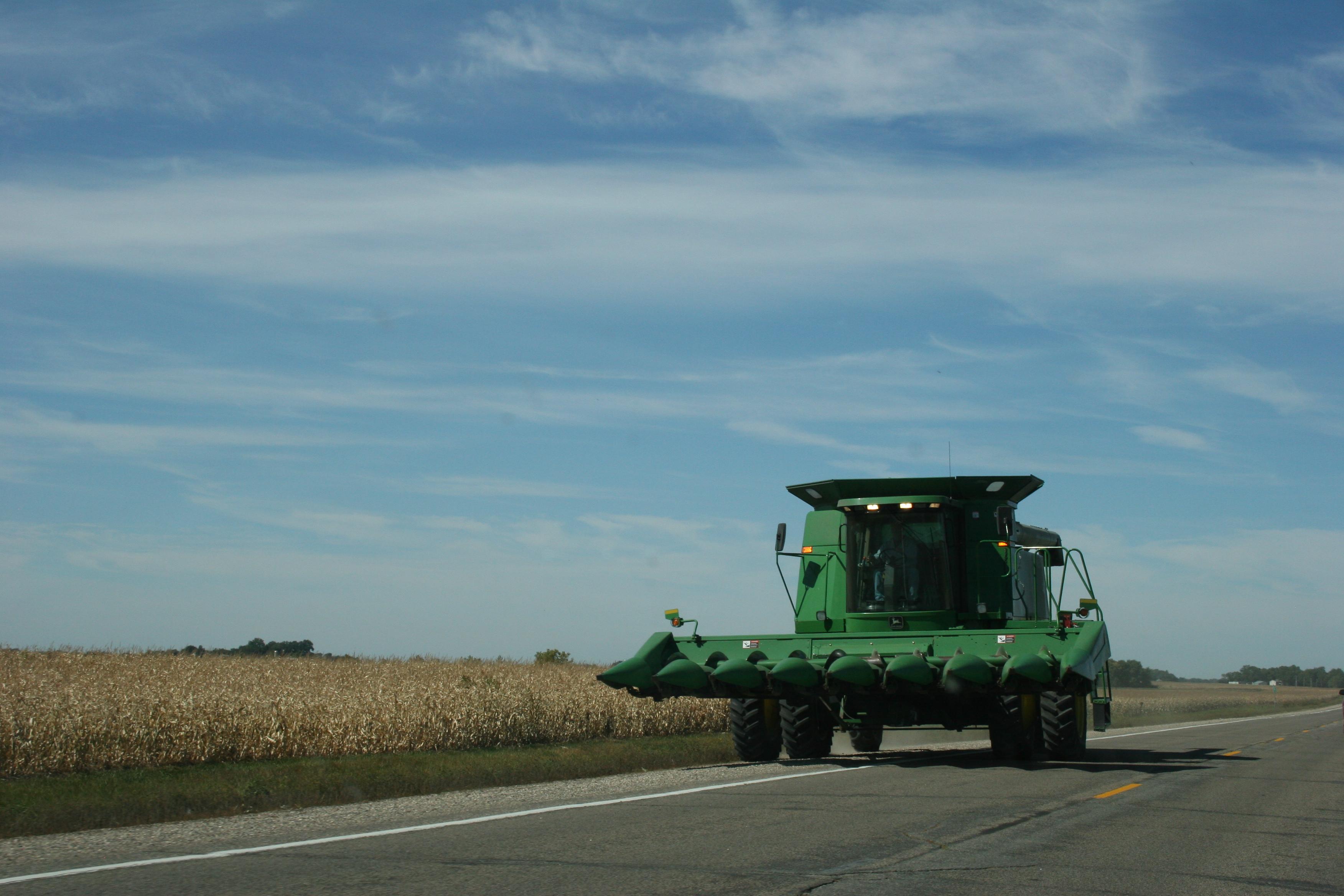
A John Deere combine spotted on the highway just outside of Morgan.

This is my land, the place of my heart.

Although I left the farm decades ago, I still yearn, during autumn, to return there—to immerse myself in the sights and smells and sounds of harvest. The scent of drying corn husks. The roar of combines and tractors. The walk across the farm yard on a crisp autumn night under a moon that casts ghost shadows. Wagons brimming with golden kernels of corn. Stubble and black earth, turned by the blades of a plow.

Today I only glimpse the harvest from afar, as a passerby. Remembering.

A farm site between Morgan and Redwood Falls in southwestern Minnesota.

Harvesting corn on Saturday just outside of Courtland.

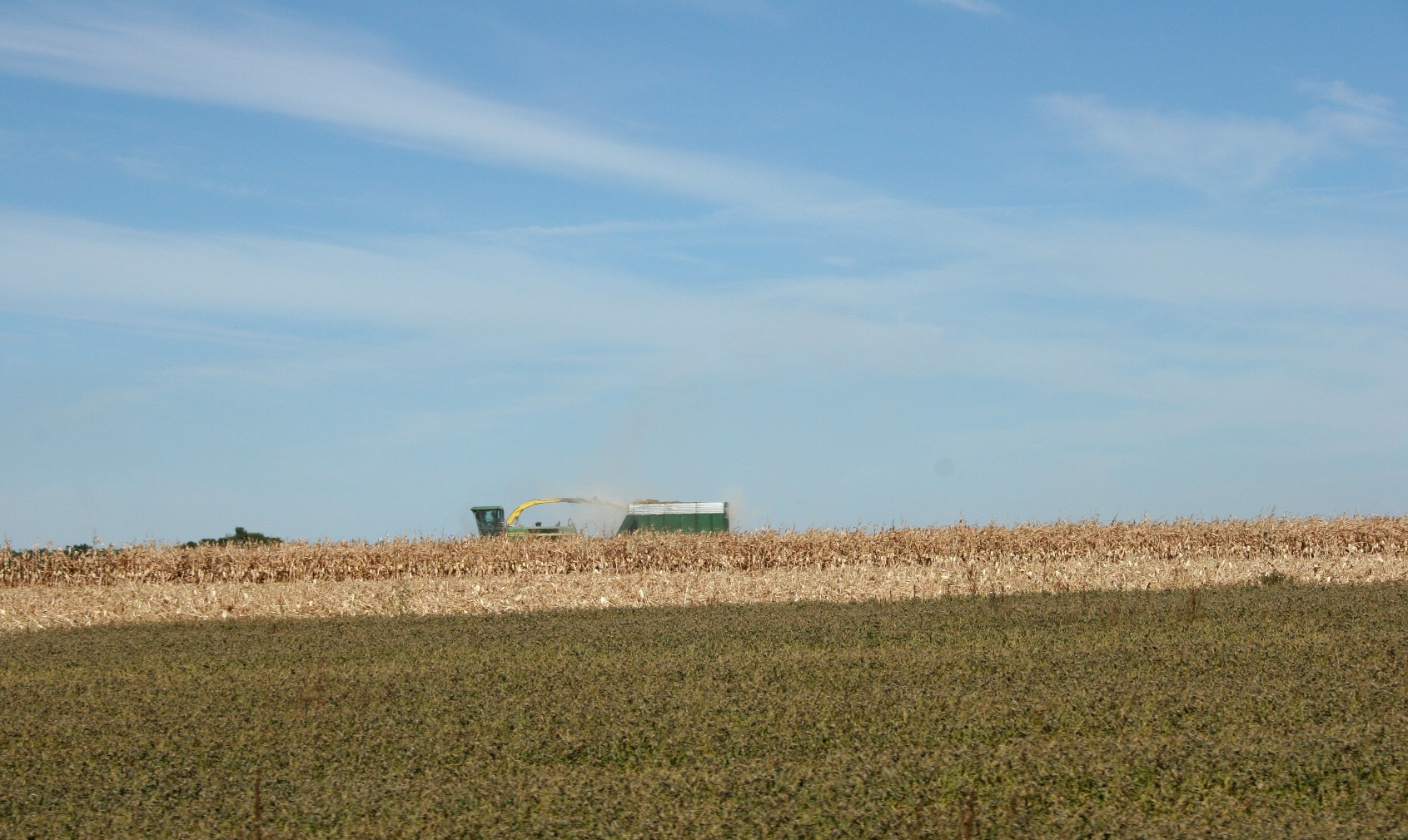
Chopping corn into silage between New Ulm and Morgan.

ALL OF THESE IMAGES (except the elevator) were taken at highway speed from the passenger side of our family car while traveling through southern Minnesota on Friday and Saturday.

© Copyright 2011 Audrey Kletscher Helbling


Praise, polkas and more at St. John’s Germanfest September 26, 2011

The Ray Sands Band played from 1 - 3 p.m. under the tent at Germanfest.

“APPLES, PEACHES, PUMPKIN PIE, who’s afraid to holler I…”

Above the plaintive baaing of a goat in the petting zoo, the old-time band pumped out the polka which isn’t about pie at all, but about love.

And so, under the tent, the bands played—Tim Chlan and Friends, The Ray Sands Band and The Stuttgart Three—at St. John’s United Church of Christ’s annual Germanfest in Wheeling Township near Nerstrand Big Woods State Park.

My husband and I arrived mid-afternoon Sunday to take in this annual celebration of the congregation’s German heritage during a polka praise service and more. As we sang the near-and-dear words of age-old hymns, the tangy scent of vinegar drifted into the sanctuary. “Just as I am, without one plea…Rock of Ages, cleft for me, let me hide myself in thee…”

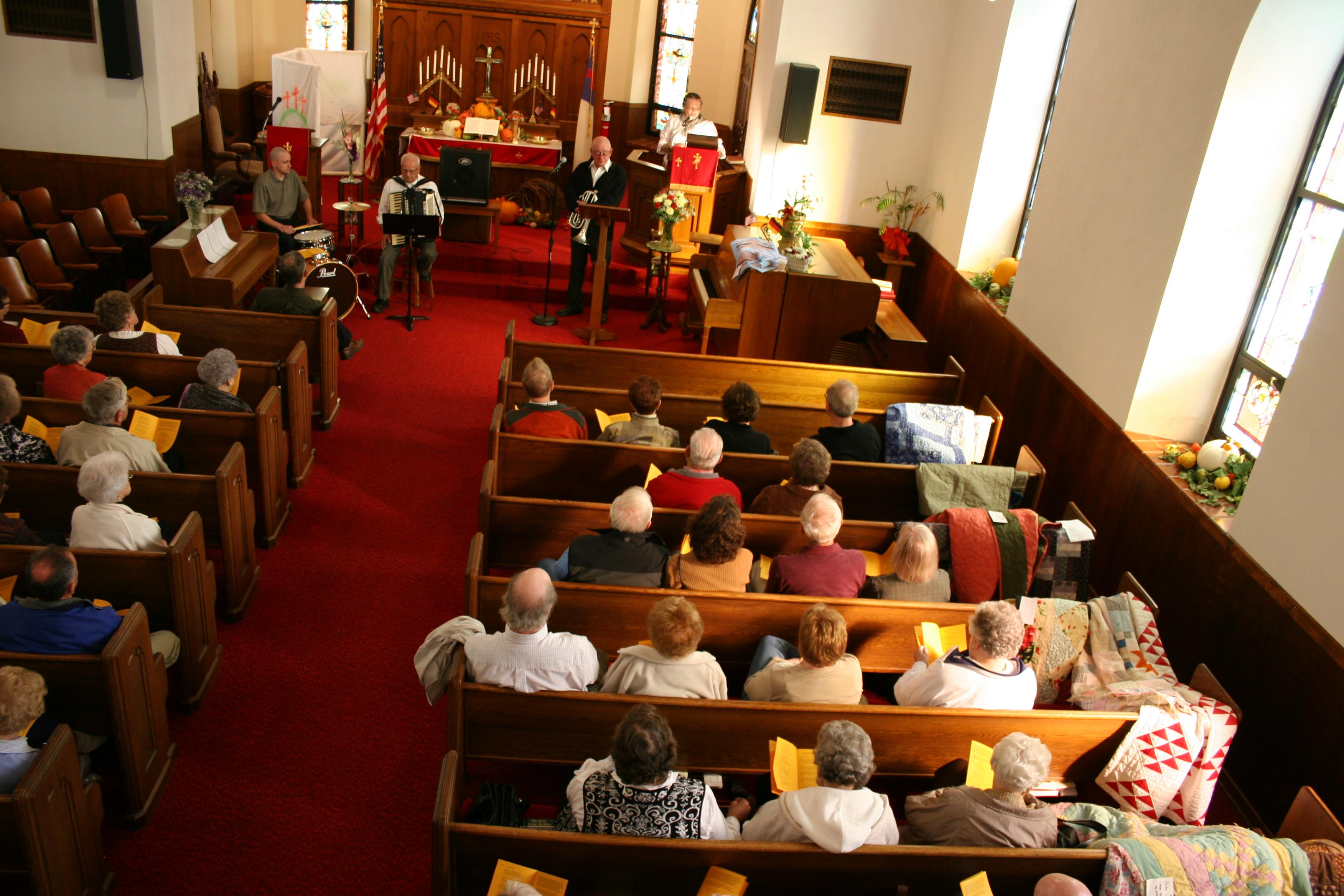
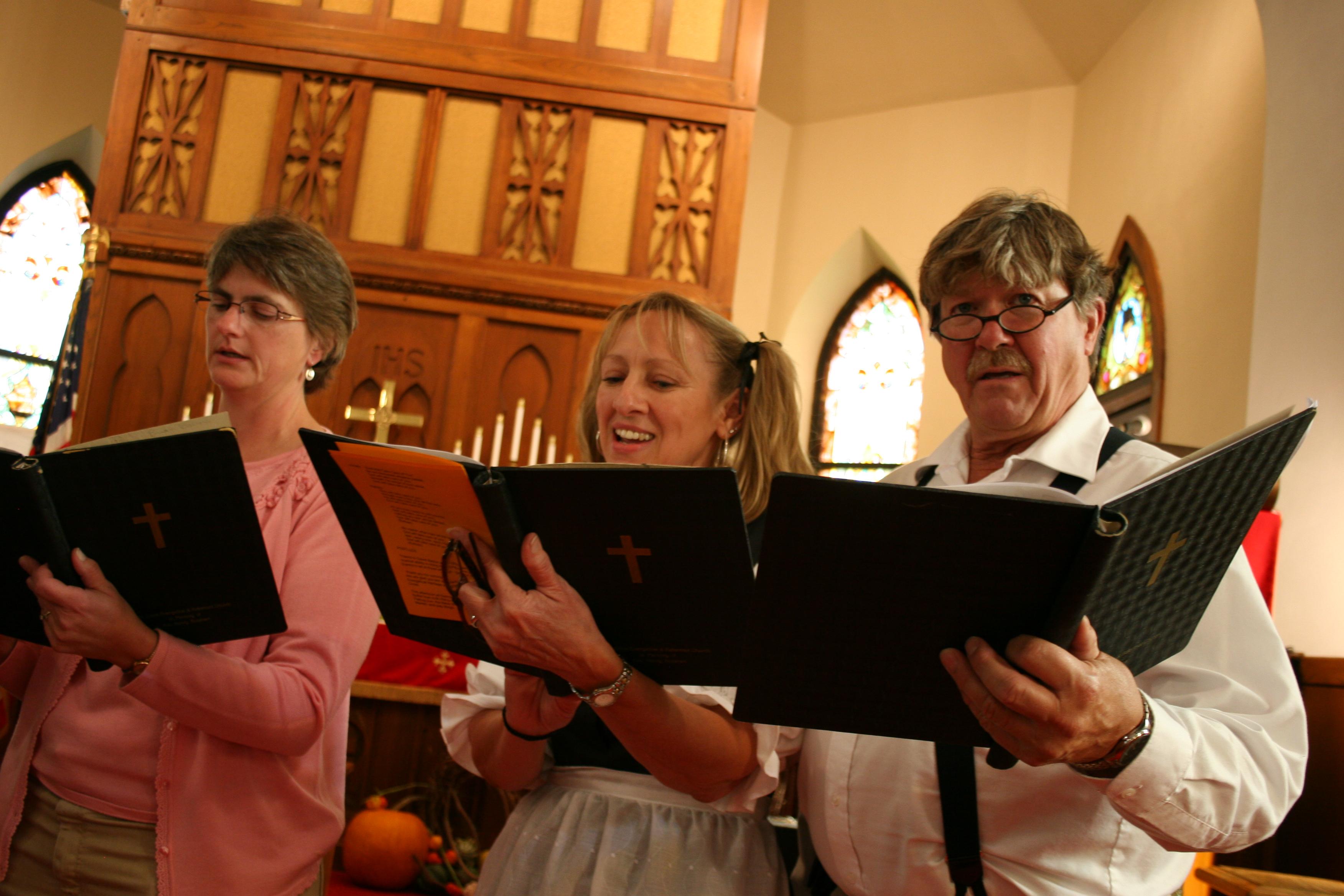
The Stuttgart Three from Rochester led the polka praise service inside St. John's sanctuary.

A musical quartet presented "Cleanse Me" and "Reach Out to Jesus" during the praise service.

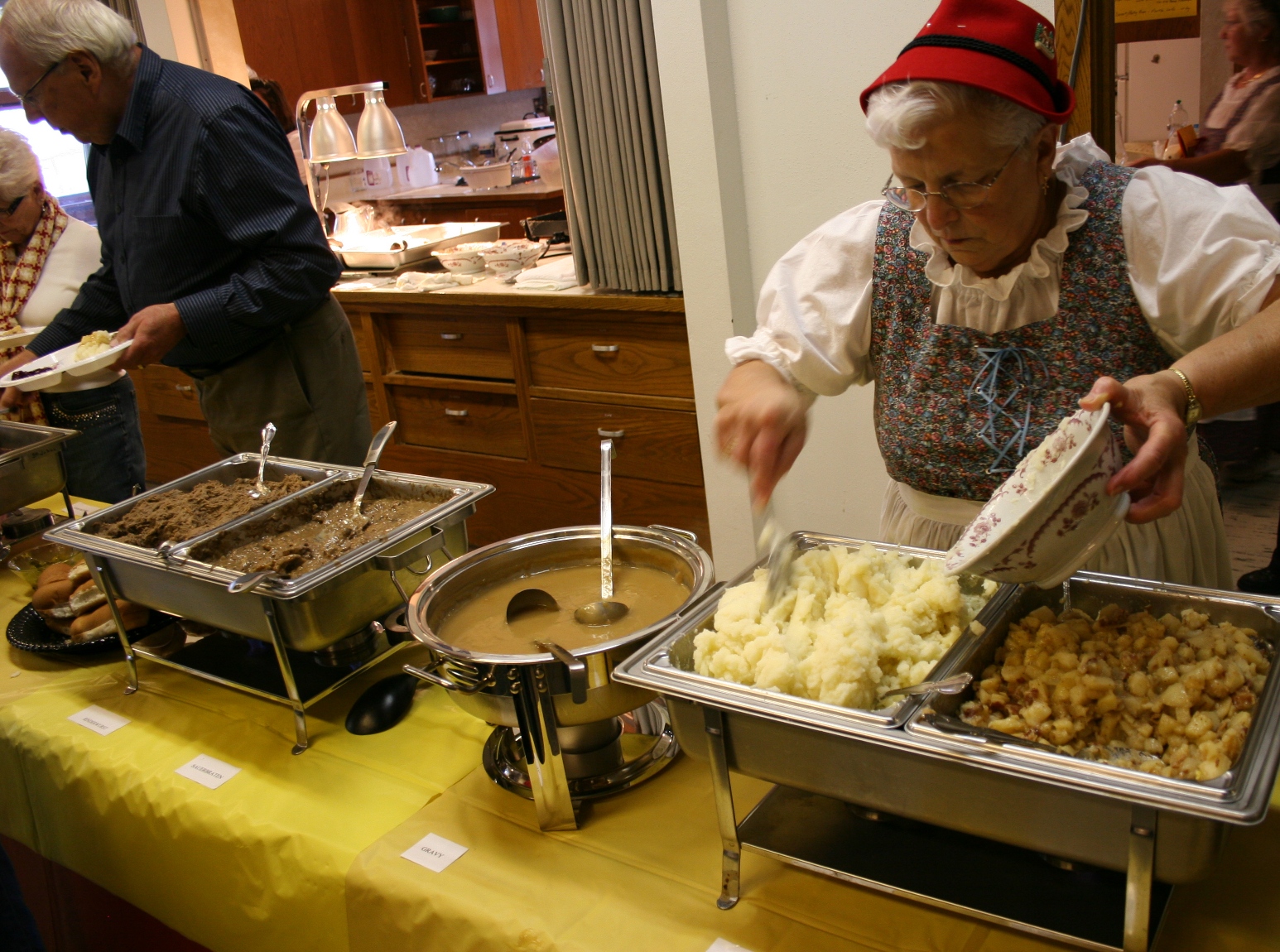
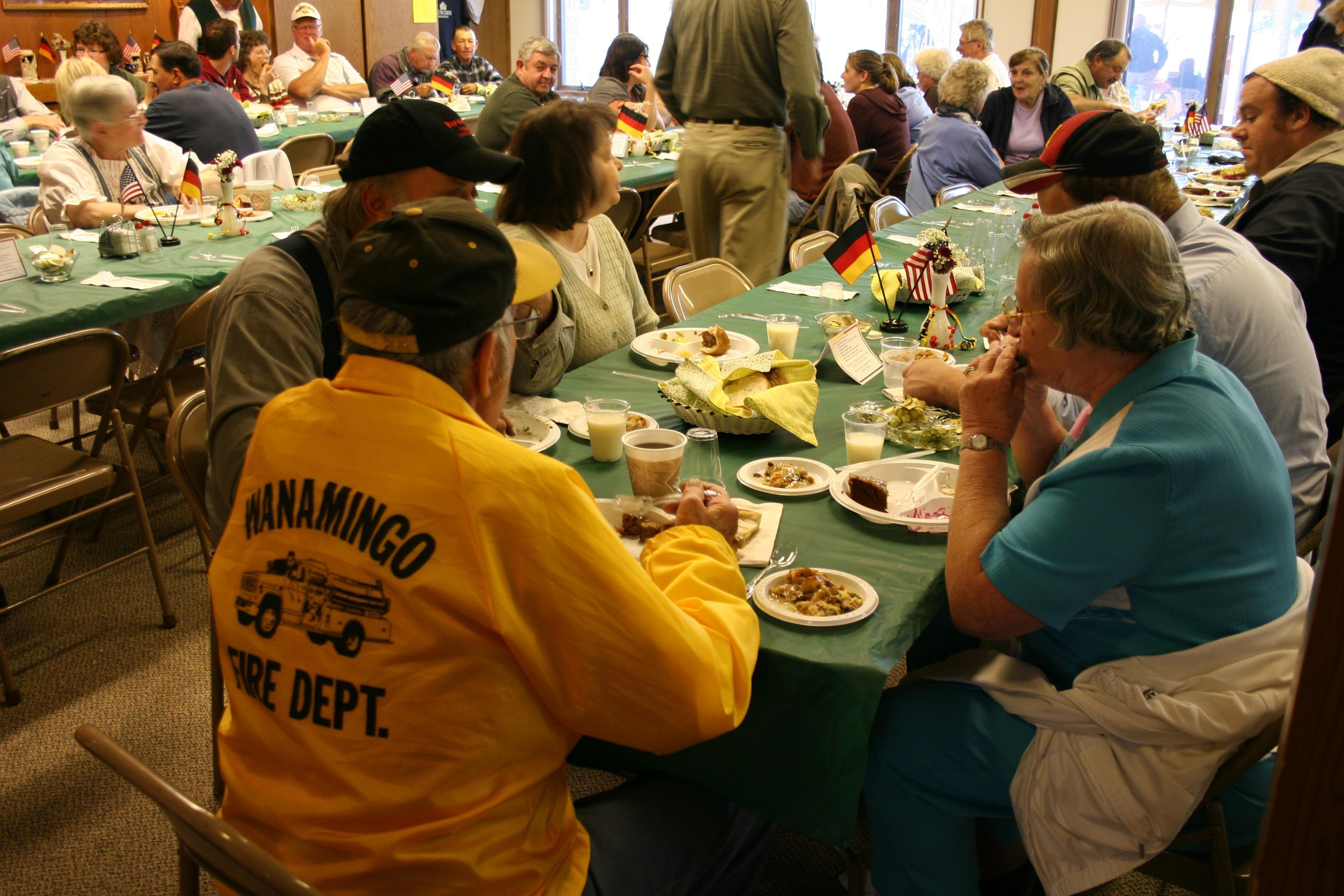
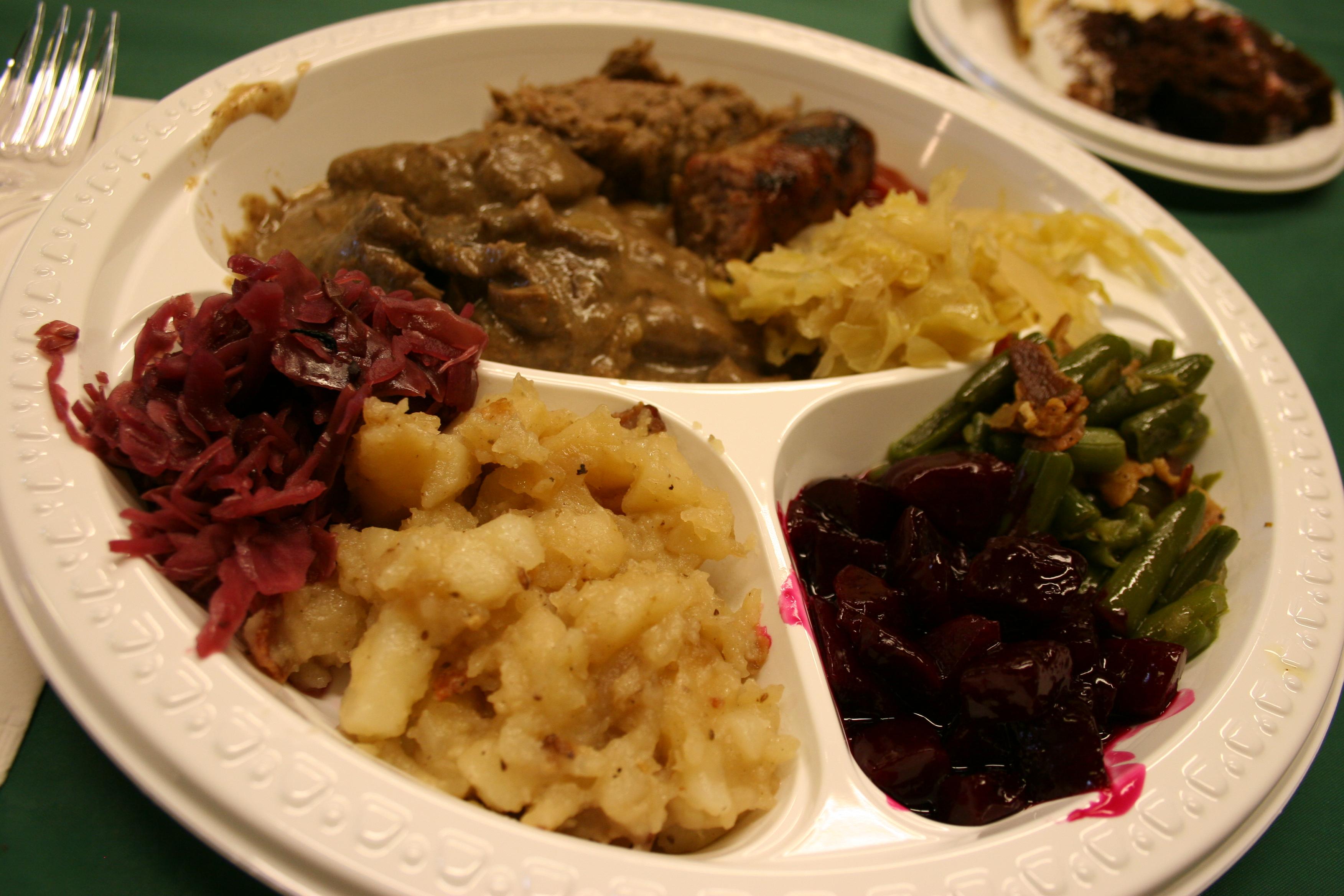
Afterward we broke bread in the fellowship hall over a German buffet. Sauerkraut and sauerbraten. Brats. Rinderwurst and beets and green beans with bacon. Vinegar-laced German potato salad and mashed potatoes and more foods than I can remember. Homemade. Three hundred pounds of potatoes peeled. Nearly 60 dozen brats boiled and grilled. Bread pudding made from grandma’s recipe. Good, hearty food that tasted of the Mother Land.

It didn’t matter whether you were Deutsch or Dutch, Lutheran or Catholic or a long-time church member, whether a first-time attendee from Centerville or Faribault or a faithful former member from Blooming Prairie, you enjoyed, simply enjoyed, the hospitality of this congregation.

Diners enjoyed a German buffet in the fellowship hall before and after the praise service.

Deutsche food: German potato salad, red cabbage, sauerbraten, rinderwurst, a brat, sauerkraut, beets and green beans on my plate.

Volunteers kept the buffet trays filled with delicious homemade German foods.

Bingo and a quilt show. Geese and ponies and goats and birds in a petting zoo. Woodcarvings at the silent auction. Homebaked goods in the country store. Jars of apple jelly, glistening like gems in the sun. All of it, together, creating a memorable afternoon at this country church set among the flat corn and soybean fields of eastern Rice County.

This is the season of church festivals and dinners—of lutefisk and Swedish meatballs and ham and of vegetables dug from the earth.

It is a time to gather close, to remember the homeland from whence we came, to celebrate our heritage, to rejoice in the harvest.

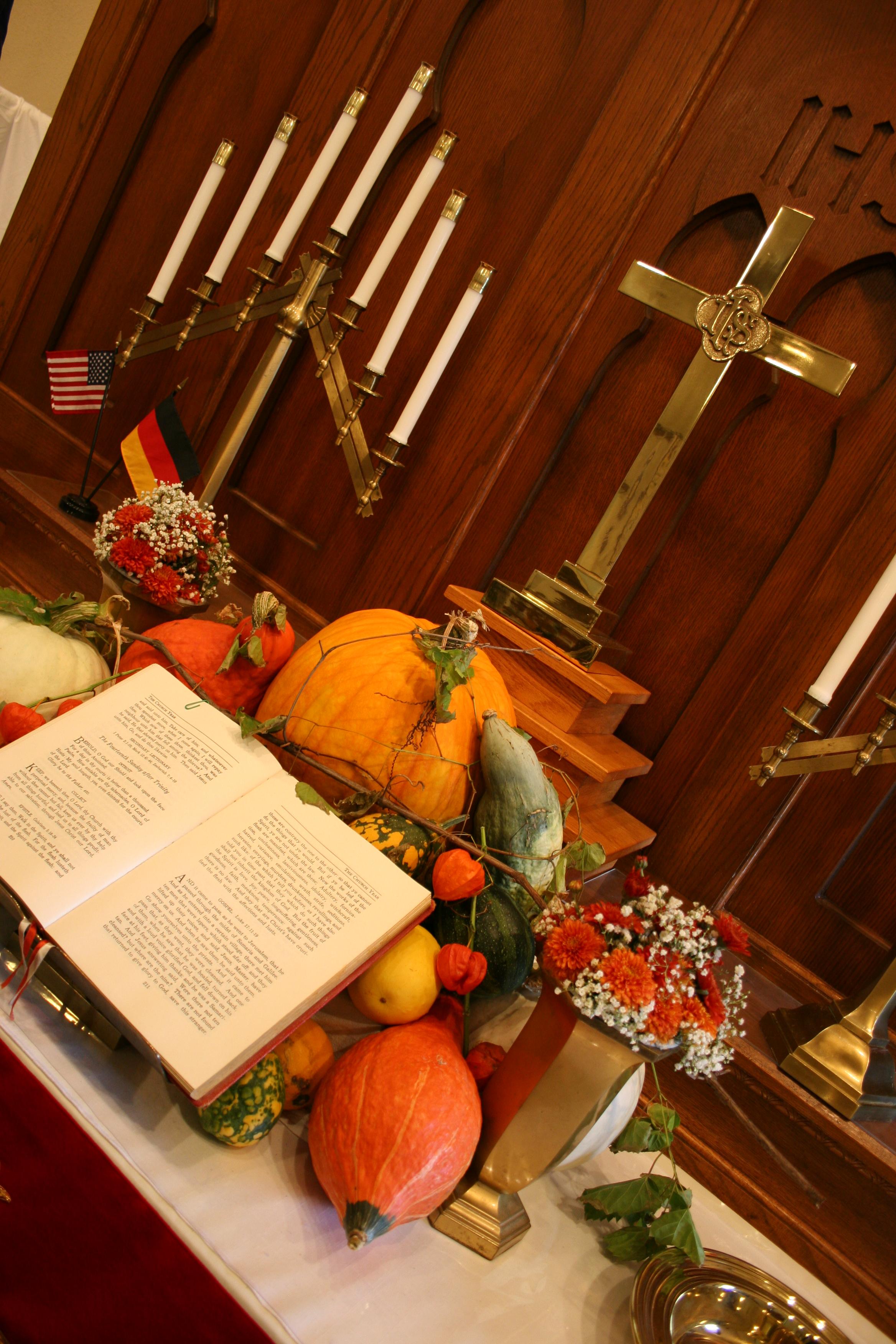
The sanctuary was decorated throughout with harvest vignettes, including this one on the altar.

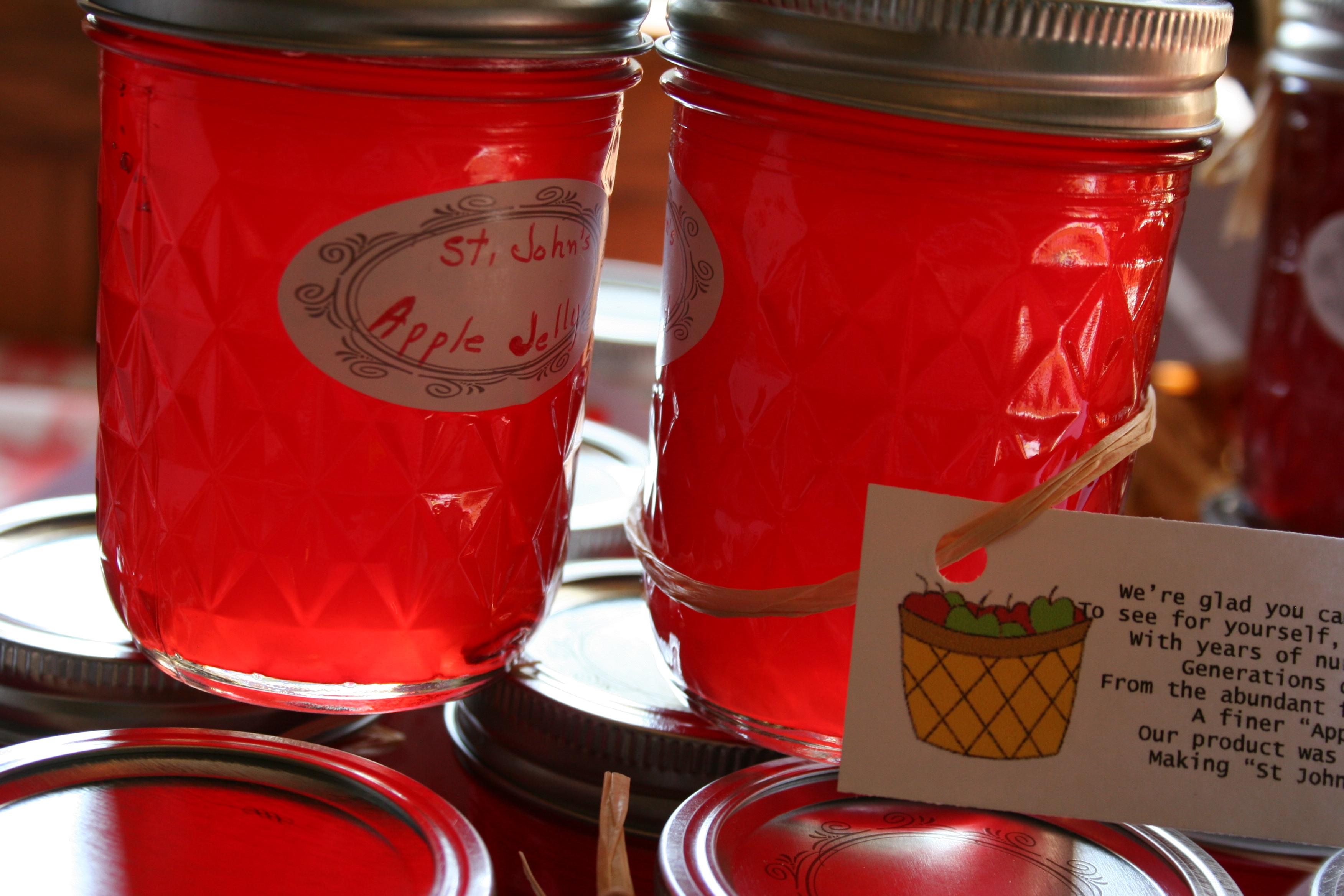
St. John's members make apple jelly and apple butter from fruit growing on an apple tree in the churchyard. The jelly and butter are sold at the festival.

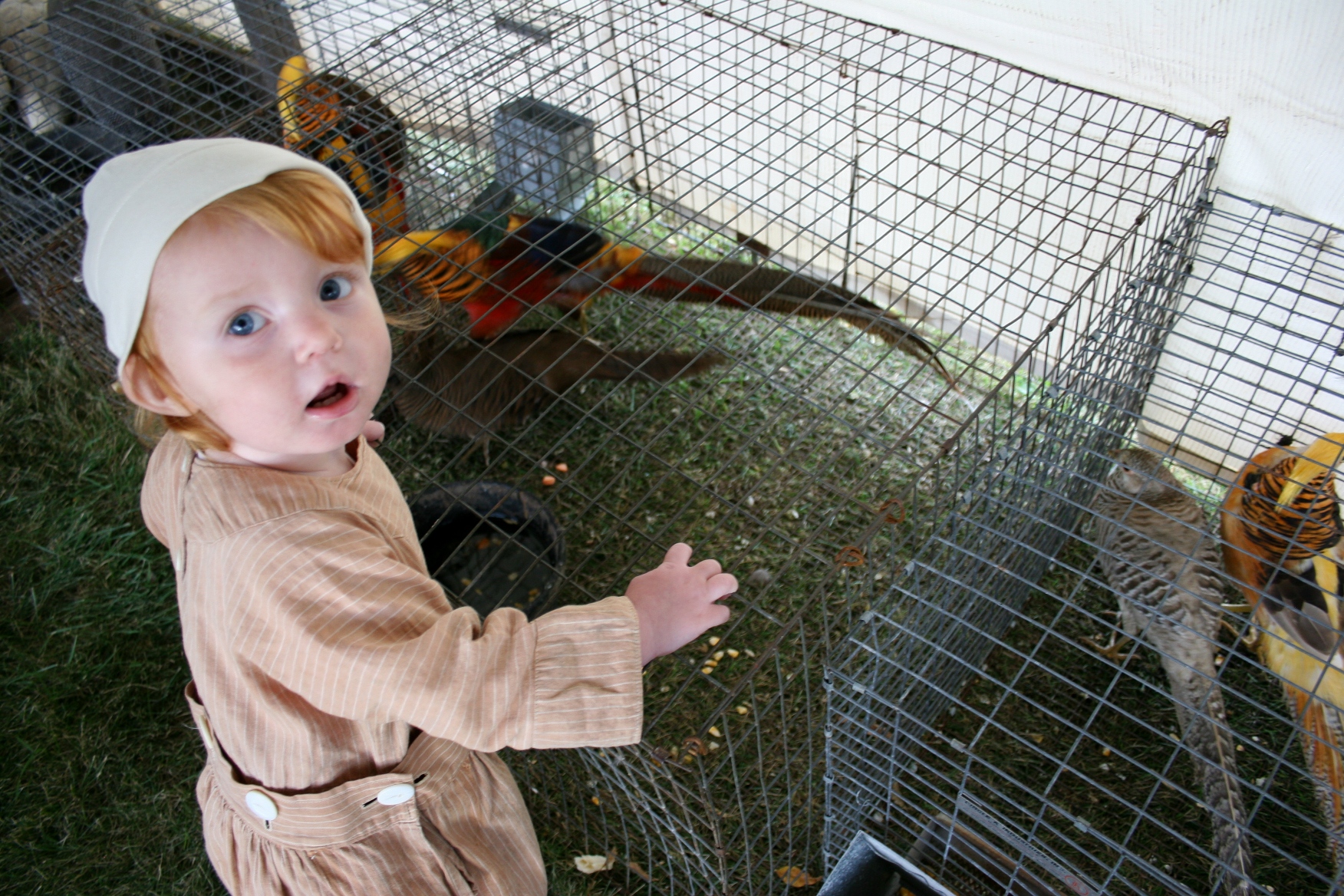
Juniper, 15 months, enjoyed the birds and animals at the petting zoo.

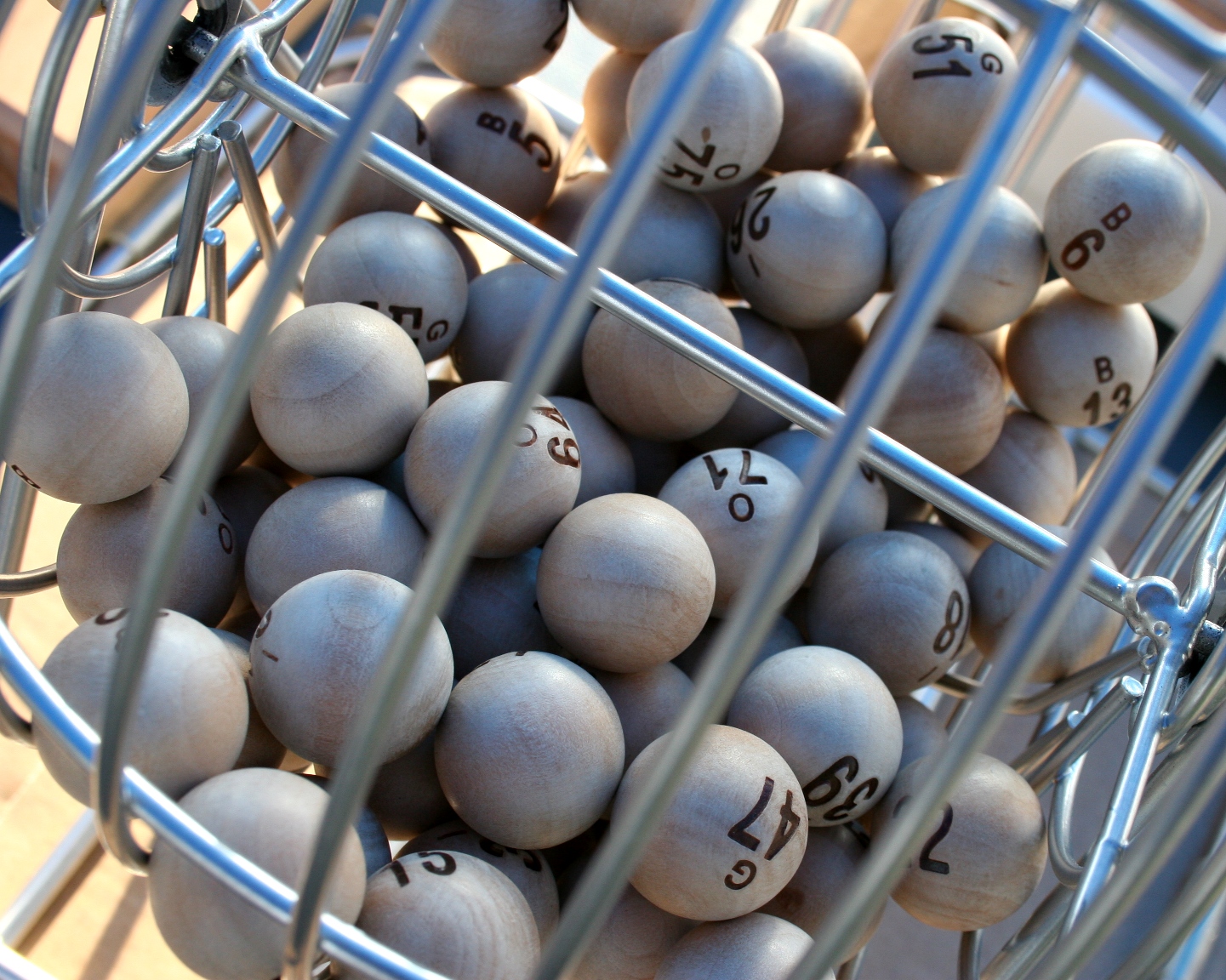
As is typical of most church festivals, attendees could play bingo outside under a tent.

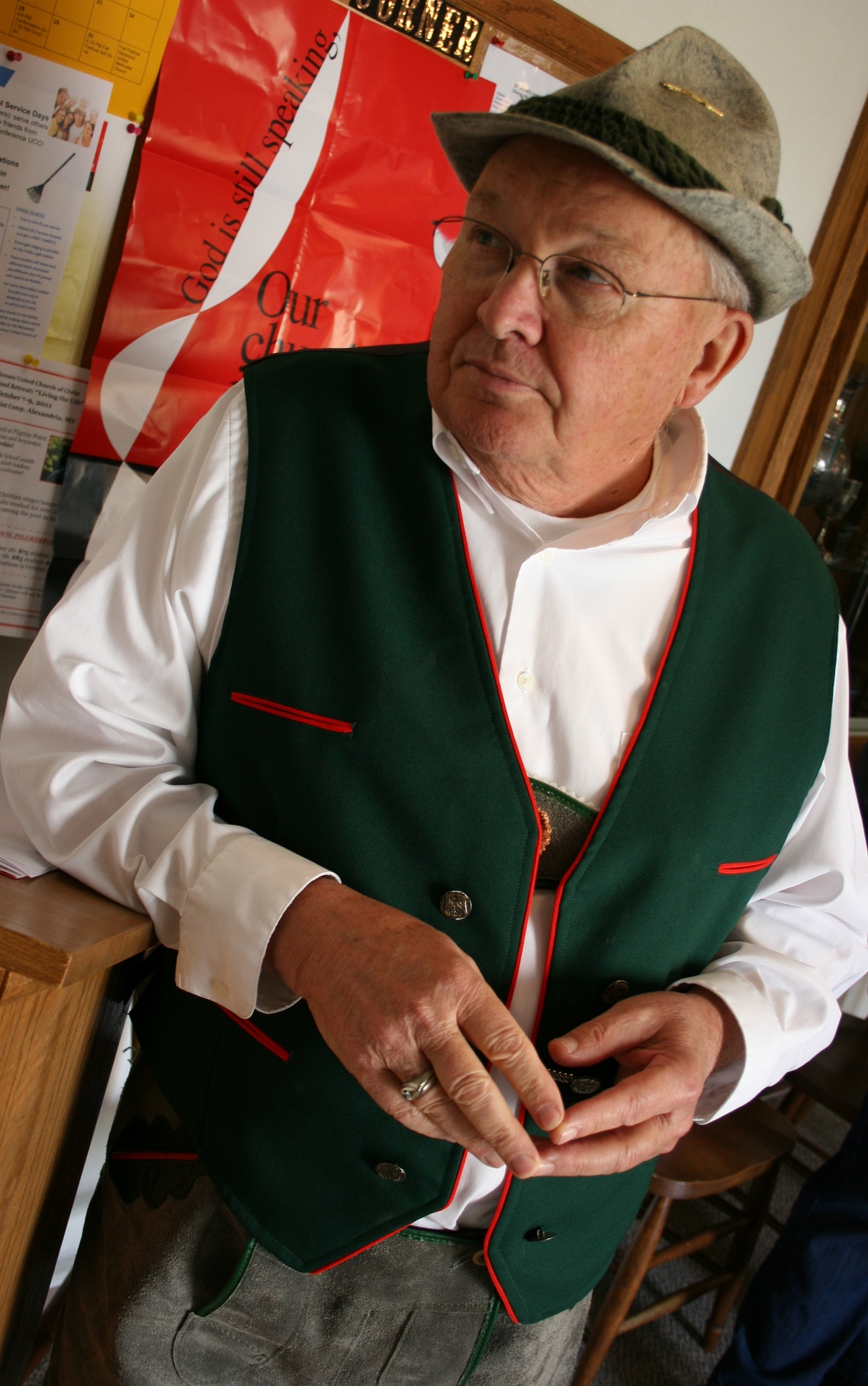
Many of the volunteer workers dressed in German costumes.

Each member of St. John's was asked to bring a quilt for the quilt show in the sanctuary. Quilts were draped over pews with brief information attached to each.

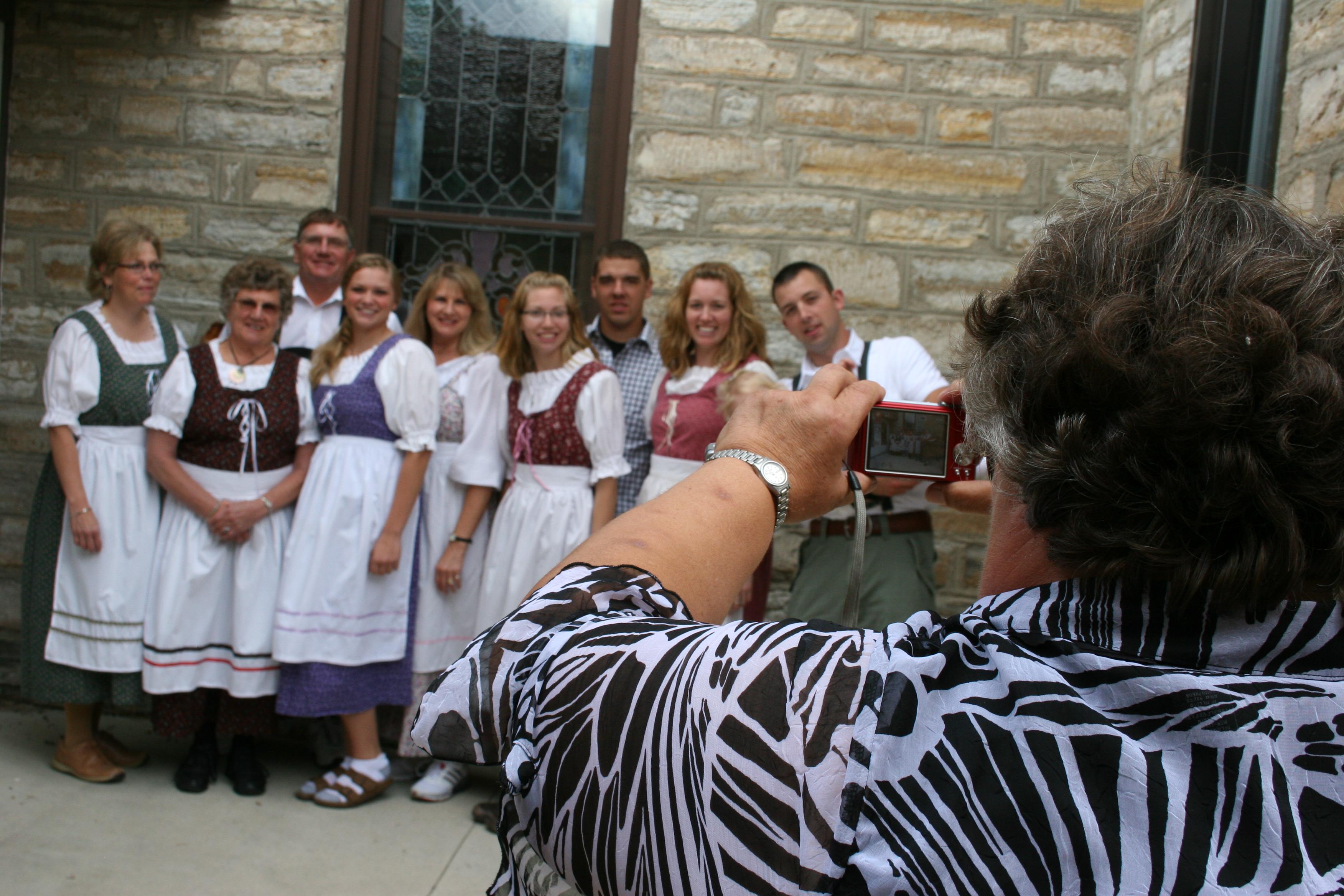
The Bultman family poses for a photo outside the stone church.

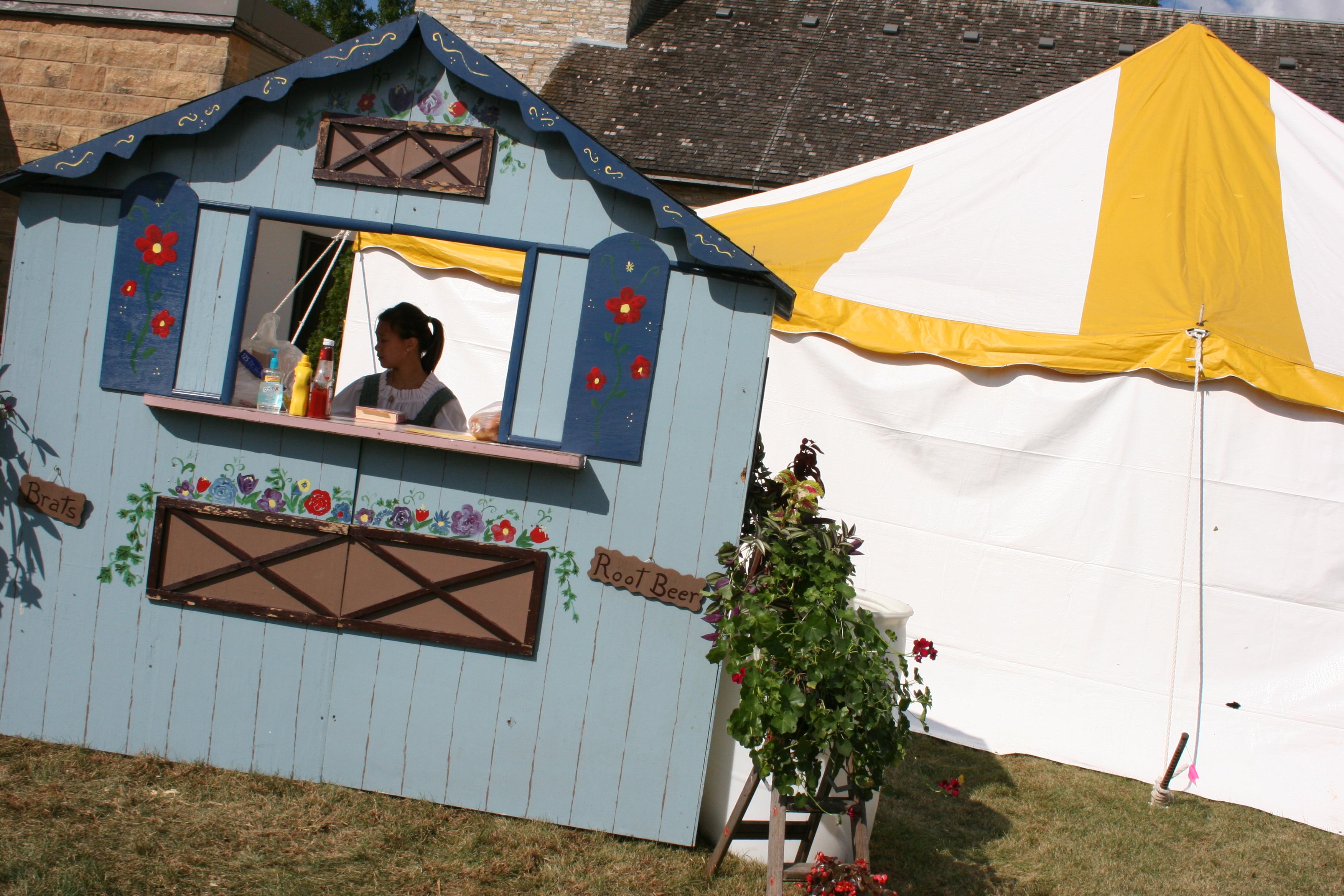
The brat and root beer stand next to the music tent.

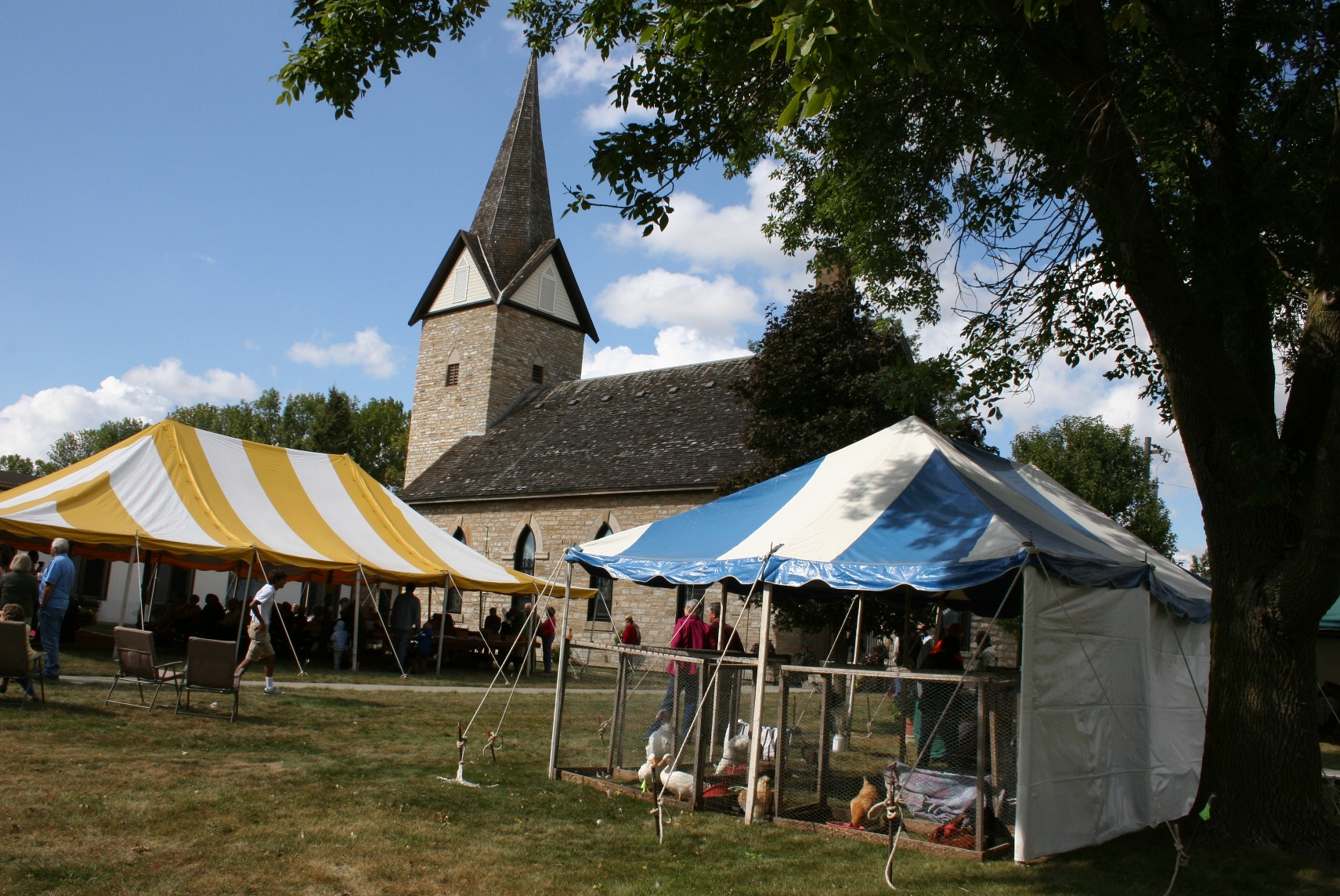
The festival grounds at St. John's U.C.C., Wheeling Township.

St. John's sits among the farm fields along Rice County Road 24

DO YOU ATTEND CHURCH dinners or festivals? If you have or know of an upcoming must-attend dinner, submit a comment. I’d like to hear about it.

ALSO, CHECK BACK for more photos from Germanfest.

© Copyright 2011 Audrey Kletscher Helbling
 

Thanks for the laughs, Wisconsin September 25, 2011

Filed under: Uncategorized — Audrey Kletscher Helbling @ 7:59 PM
Tags: , , , , , , , , , , ,

WISCONSINITES, YOU MAKE me laugh. A cow mooing in the produce department of a grocery store? Honestly. Seriously. How funny is that?

So here’s how this bovine encounter played out. About two months ago my husband, son and I stopped at the StoneRidge Piggly Wiggly in Wautoma in east central Wisconsin to pick up deli meat for a picnic lunch.

This was right after we stopped at The Milty Wilty drive-in for an ice cream treat. But that’s another story for another day.

I walked into the Piggly Wiggly and dawdled in the produce department while my husband headed to the deli counter. Then I heard a cow mooing.

What the heck? I was not in a barn.

But, I was in Wisconsin.

Because I am nearly deaf in one ear, I cannot distinguish the source of sound. So I just stood there for awhile among the apples and lettuce and array of other fruits and vegetables attempting to decipher the source of that bellowing cow.

Then I walked over to the deli counter and told my husband, “I just heard a cow mooing.”

The woman standing next to him started laughing and then explained: “Whenever water sprays onto the vegetables, the cow moos. Makes me laugh every time.” I didn’t even ask her to tell me how that rigged up system works.

But I did think to myself, since this is a Piggly Wiggly store, perhaps a squealing pig would be more appropriate. But then again, maybe not; I was in the Dairyland State, after all.

A few other things you should know about Wautoma’s Piggly Wiggly. The grocery store, which also includes StoneRidge Meat, smells like smoked meat. Some folks might like that smell; I don’t happen to be one of them.

If you need to drop off a deer for processing, follow the signage at the back of the store for deer deposit.

I took this picture of StoneRidge Piggly Wiggly, with that deer out front, last winter.

Signage for deer drop off at the back of the Piggly Wiggly complex.

And just in case you would like a brat, which seems to be another of those Wisconsin “things,” you can stop at Uncle Butch’s Brat Barn right outside the Piggly Wiggly. It wasn’t open when we were there, but I bet my husband wished it had been. He loves brats. Me, not so much.

The brat barn, not to be confused with a dairy or pig barn. You can purchase StoneRidge meats here.

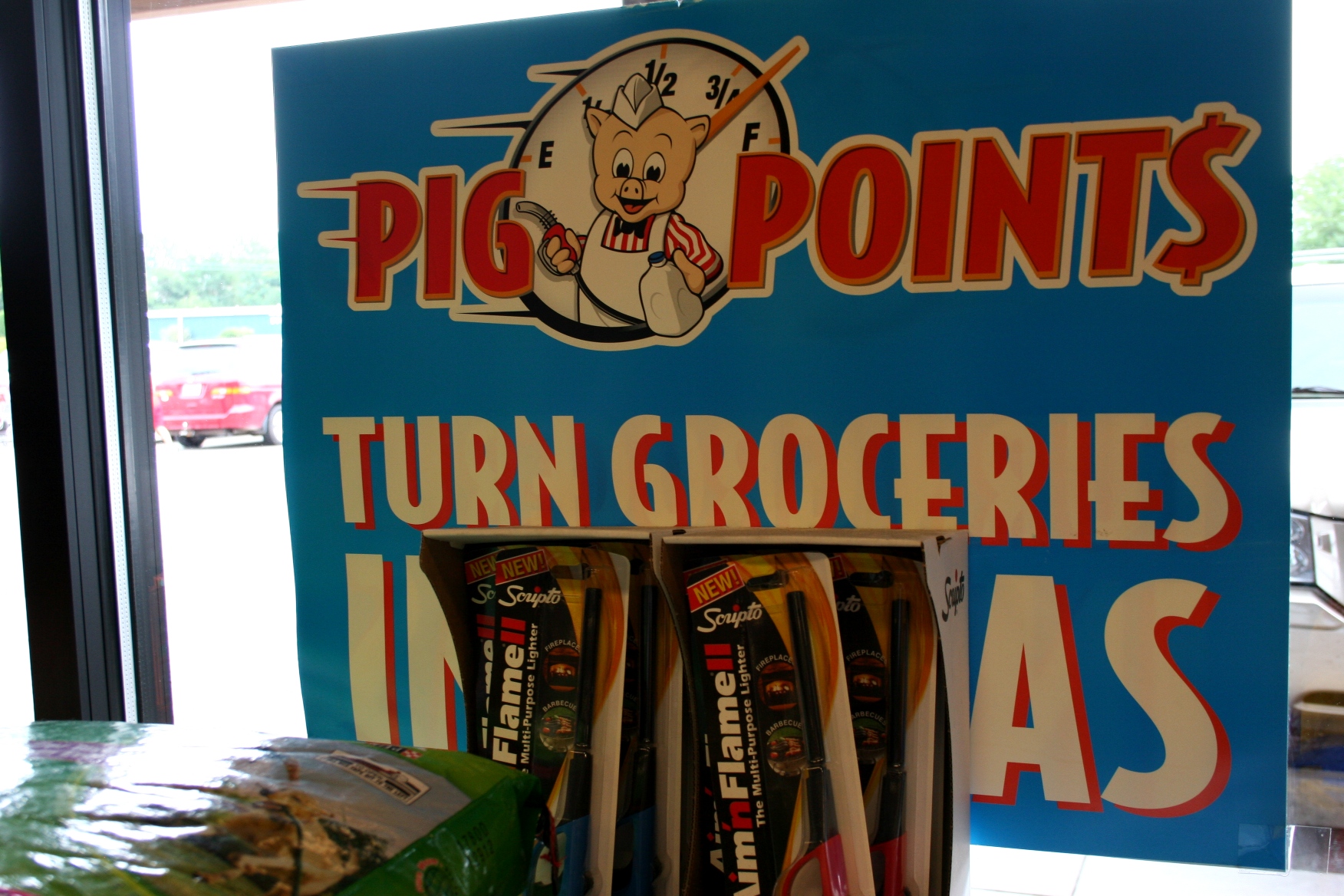
But I sure enjoyed my experience at the Piggly Wiggly, right down to the “Pig Point$” sign I read when I walked out the door.

Thanks for the laughs, Wisconsin neighbors.

Please, may I have some Pig Points? I don't know what they are, but I think I'd like some.

IF YOU ARE A WISCONSIN resident and would like to share some other unique quirks about your state, I’d like to hear. Ditto if you are a traveler and have discovered some interesting finds in the Dairyland State. Oh, and if you are a non-Minnesotan and have found quirks in my home state, share those, too. I’d like to hear how others view Minnesota. Submit a comment.

© Copyright 2011 Audrey Kletscher Helbling
 

Window-shopping in Janesville, Minnesota September 14, 2011

Filed under: Uncategorized — Audrey Kletscher Helbling @ 7:06 AM
Tags: , , , , , , , , ,

I ENJOY WINDOW-SHOPPING. But when I window-shop, I’m not typically perusing merchandise to purchase. Rather, I’m shopping for signs to photograph. It’s cheaper that way; you don’t spend money except on your gas to reach whatever destination you choose.

For me, that is Main Street in Smalltown, Minnesota. Signage regulations are less strict in these rural communities, folks more trusting. I discover the most intriguing/interesting/unusual/creative signs here. Pick your adjective—all three would apply.

So let me take you today to Janesville, population 2,100, located along U.S. Highway 14 only 15 miles east of Mankato. I stopped there several weeks ago on my way to and from (yes, we stopped twice) Indian Island Winery with my husband.

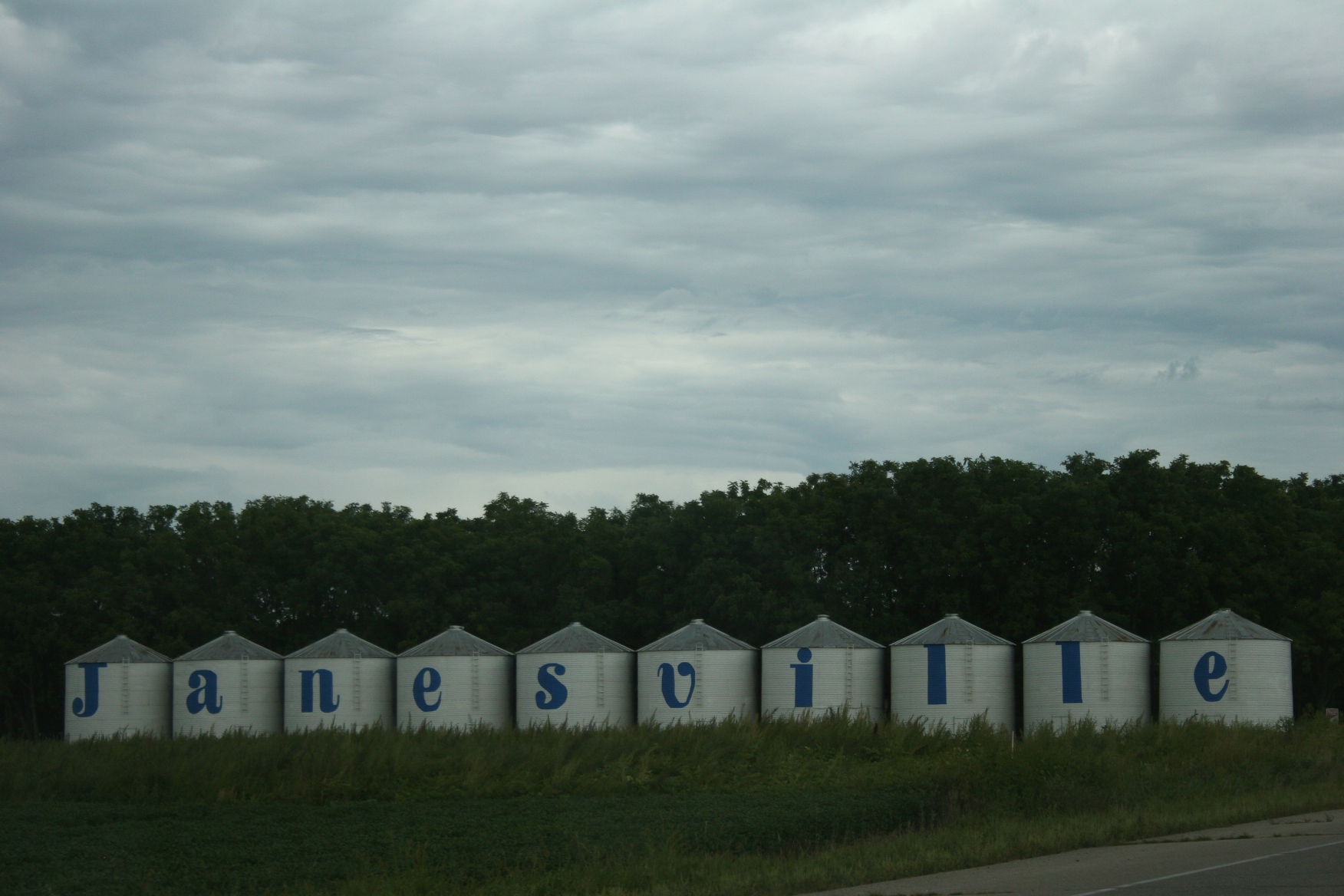
Entering Janesville from the west along old Highway 14, you'll see this grain bin signage welcoming you to town. I've always wondered: Did the farmer specifically build 10 bins to fit the town name? Or did someone come up to him after the fact and say, "You know, J-A-N-E-S-V-I-L-L-E would fit on your bins."

But before I show you my discoveries, here are two interesting tidbits about Janesville: The town has a nine-hole reversible golf course, one of among only a few in the U.S. If you know what that means, you know more than me. I am not a golfer.

Secondly, in a house near downtown Janesville, along old Highway 14, you’ll see a dummy peering through an upstairs attic window. It’s been there for years. Why? No one seems to know the truth. But its placement there has led to all sorts of speculation as imaginative as an imagination allows.

Now, moving along, I’m pleased to present photos of signage from Main Street, Janesville, Minnesota, for your entertainment. Enjoy.

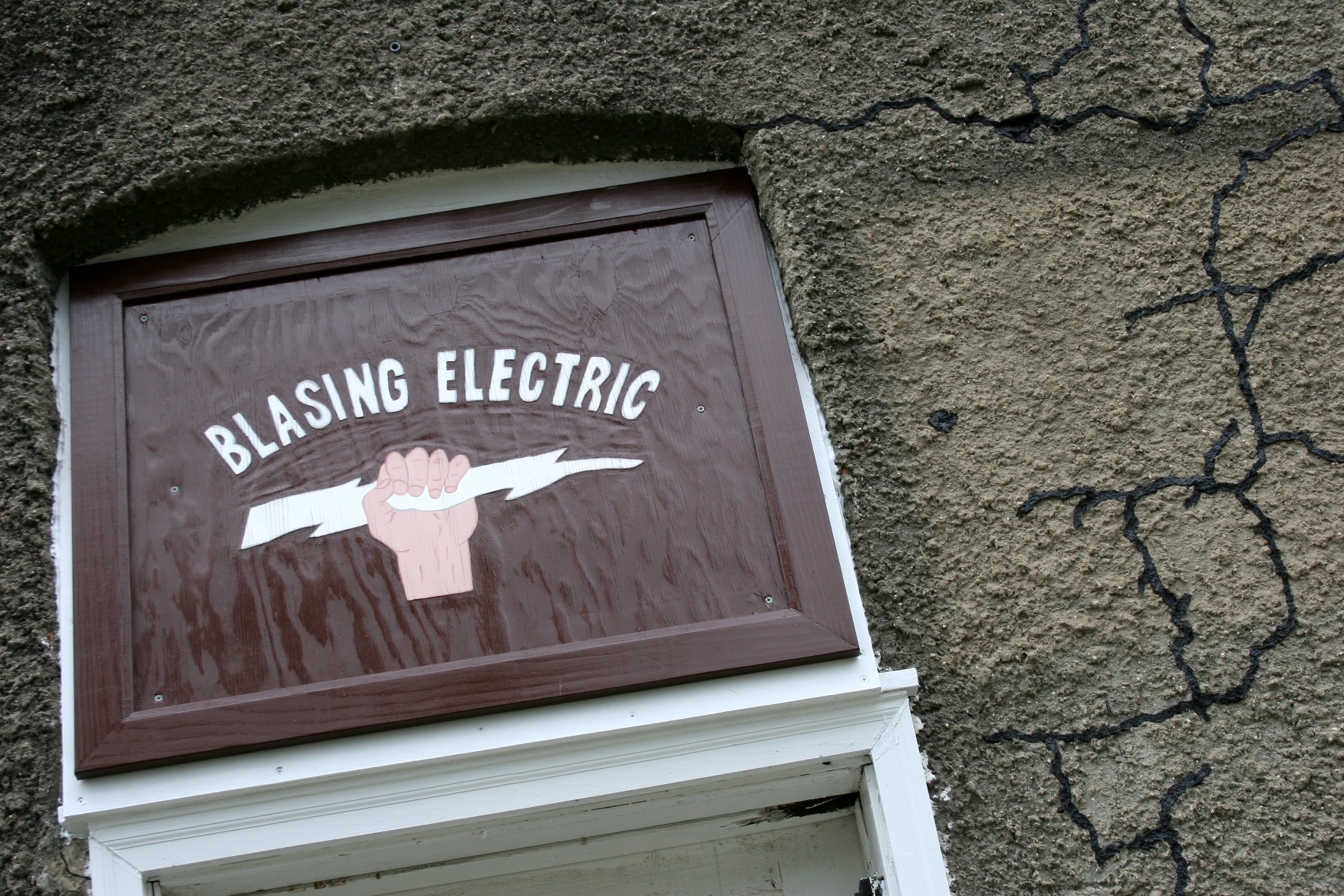
This handcrafted graphic sure makes for a memorable Blasing Electric sign hung on the side of a building across the street from the library.

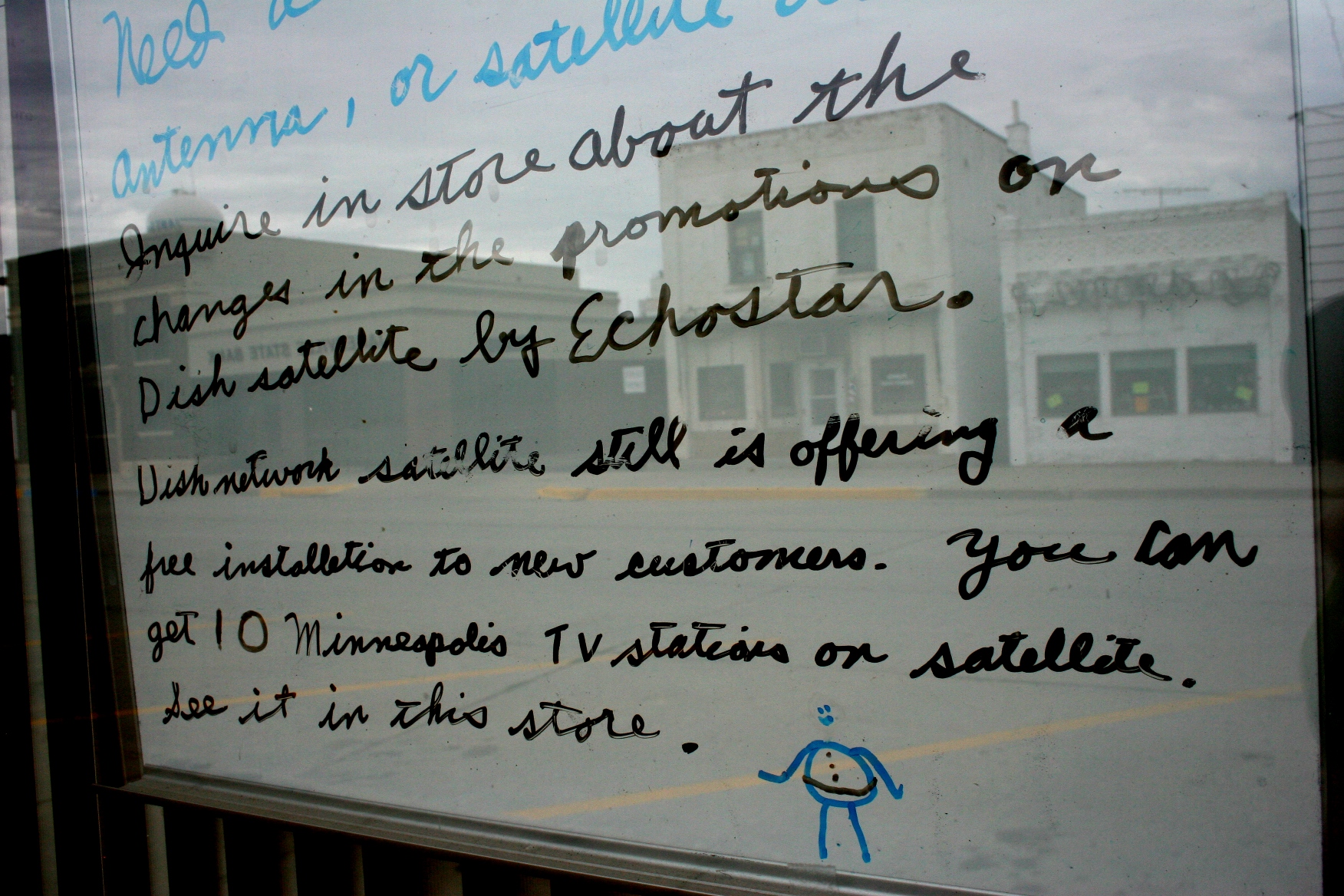
I know you folks in bigger towns, especially in the Twin Cities metro, take your television access for granted. But not so in rural Minnesota. Here's a pitch for better service posted on a window at Will's Radio & TV.

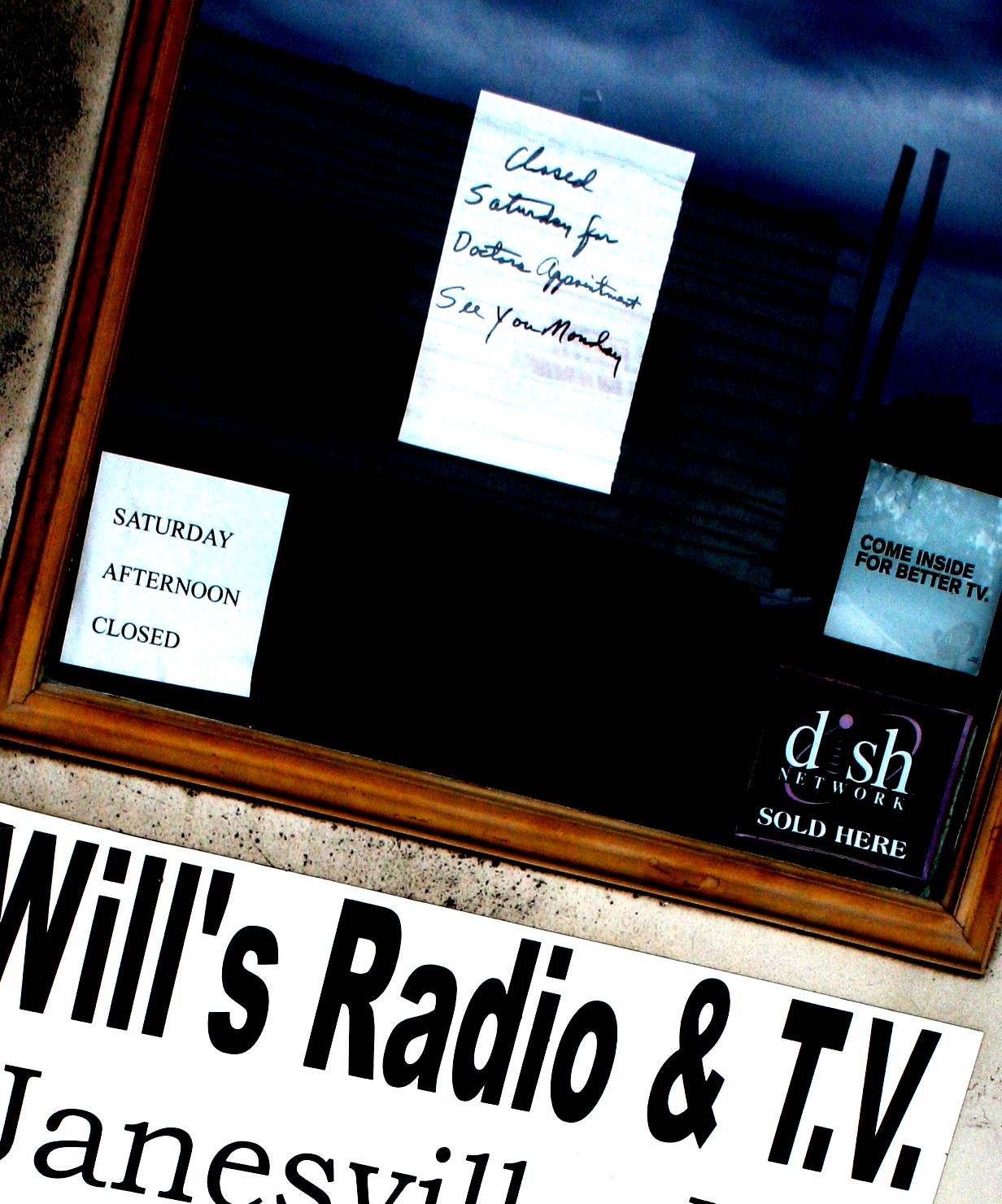
But you might not want to stop and check on that satellite service until Monday, according to this sign posted on Will's front door. Will is at a doctor's appointment.

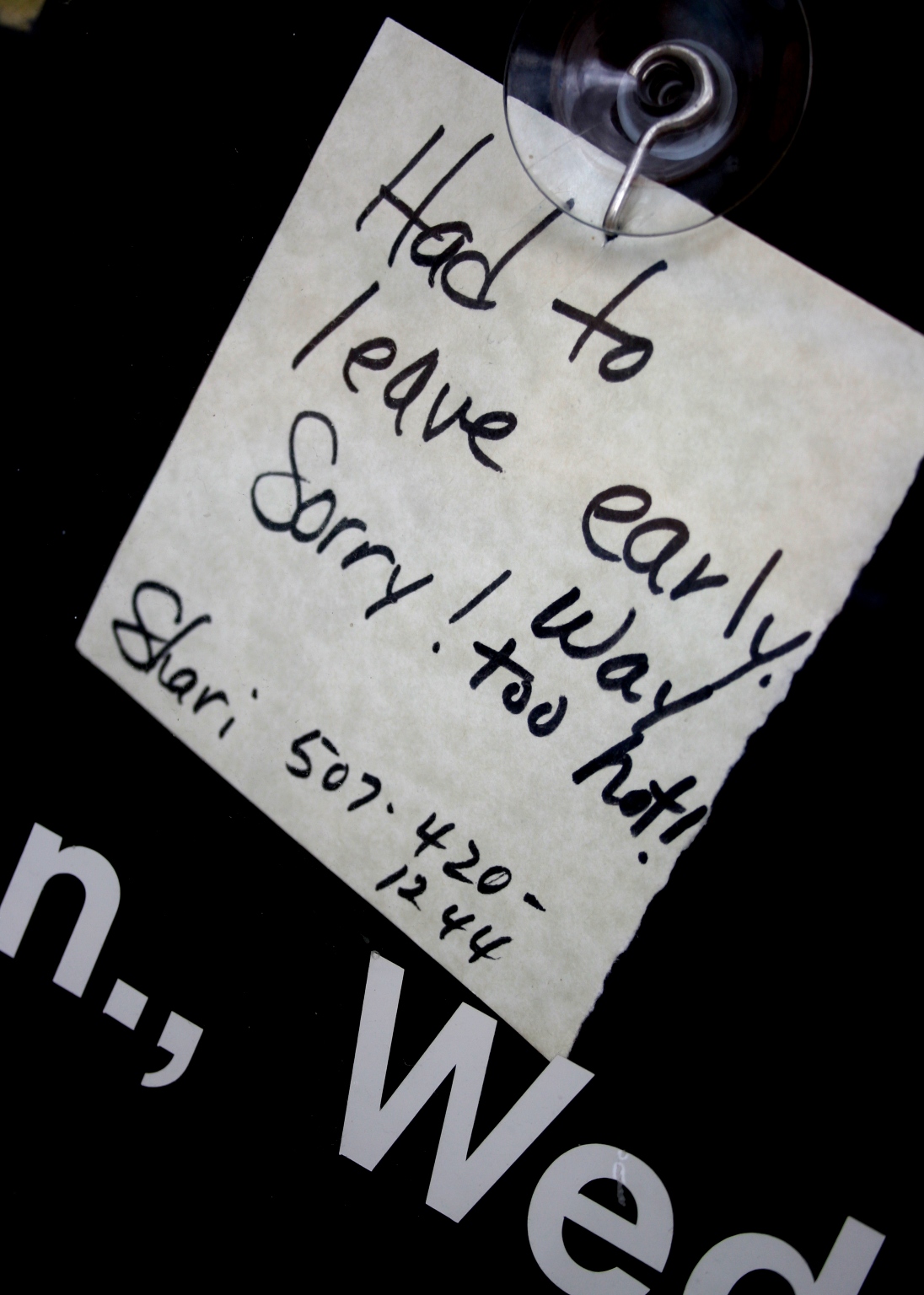
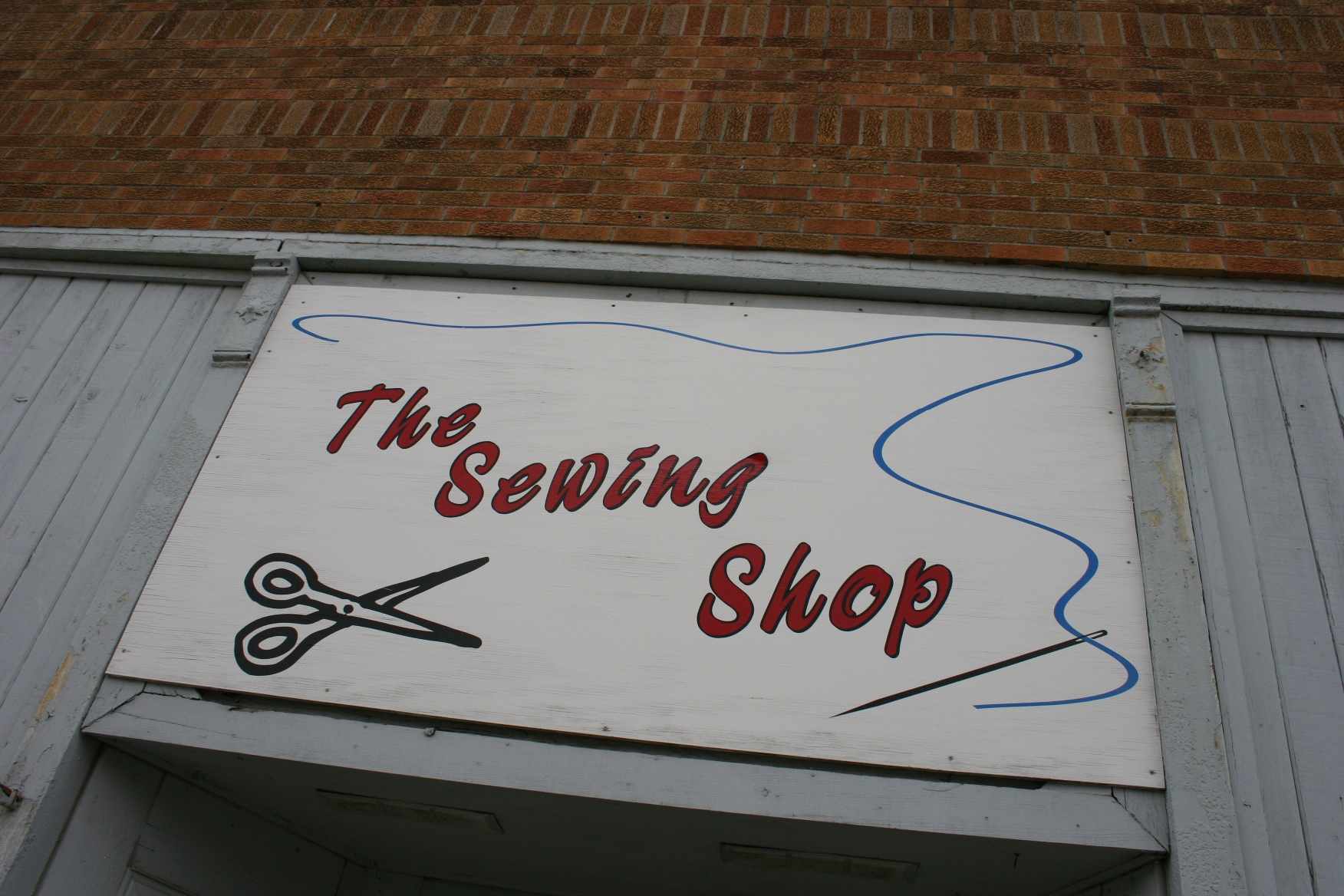
Hot weather also offers a good excuse to close up shop. I can't recall where this note was placed, but either on a beauty or sewing shop door.

Homemade signs like this one are always a bonus find on small-town Main Street.

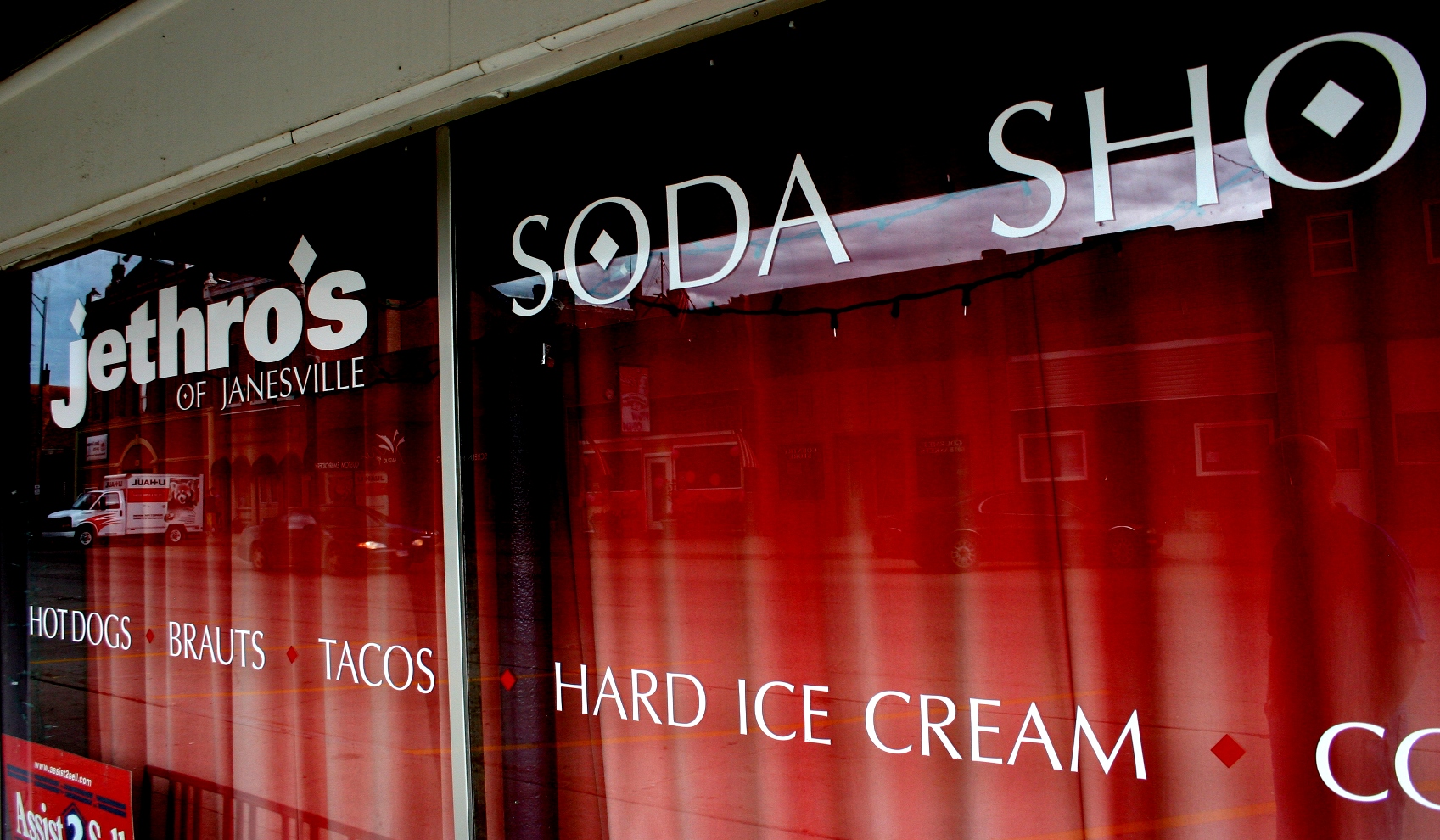
Jethro's Soda Shop, which is no longer open, sports a misspelled word. Can you spot it?

Finally, my last photo, which is not a sign, but merchandise in a window of the corner drugstore. The ruled tablet brought back grade school memories for me. Gotta love it. Main Street in Smalltown, Minnesota.

DID YOU FIND the incorrectly spelled word on the window of the former Jethro’s Malt Shop? That would be “BRAUT.” My husband contends that is the German spelling of “brat.” I contend he is wrong as my research shows that “die braut” in German translates to “bride” in English.

(NOTE: I edited most of the above images to better showcase the words.)

© Copyright 2011 Audrey Kletscher Helbling
 

We’re not hyphenated Americans… September 12, 2011

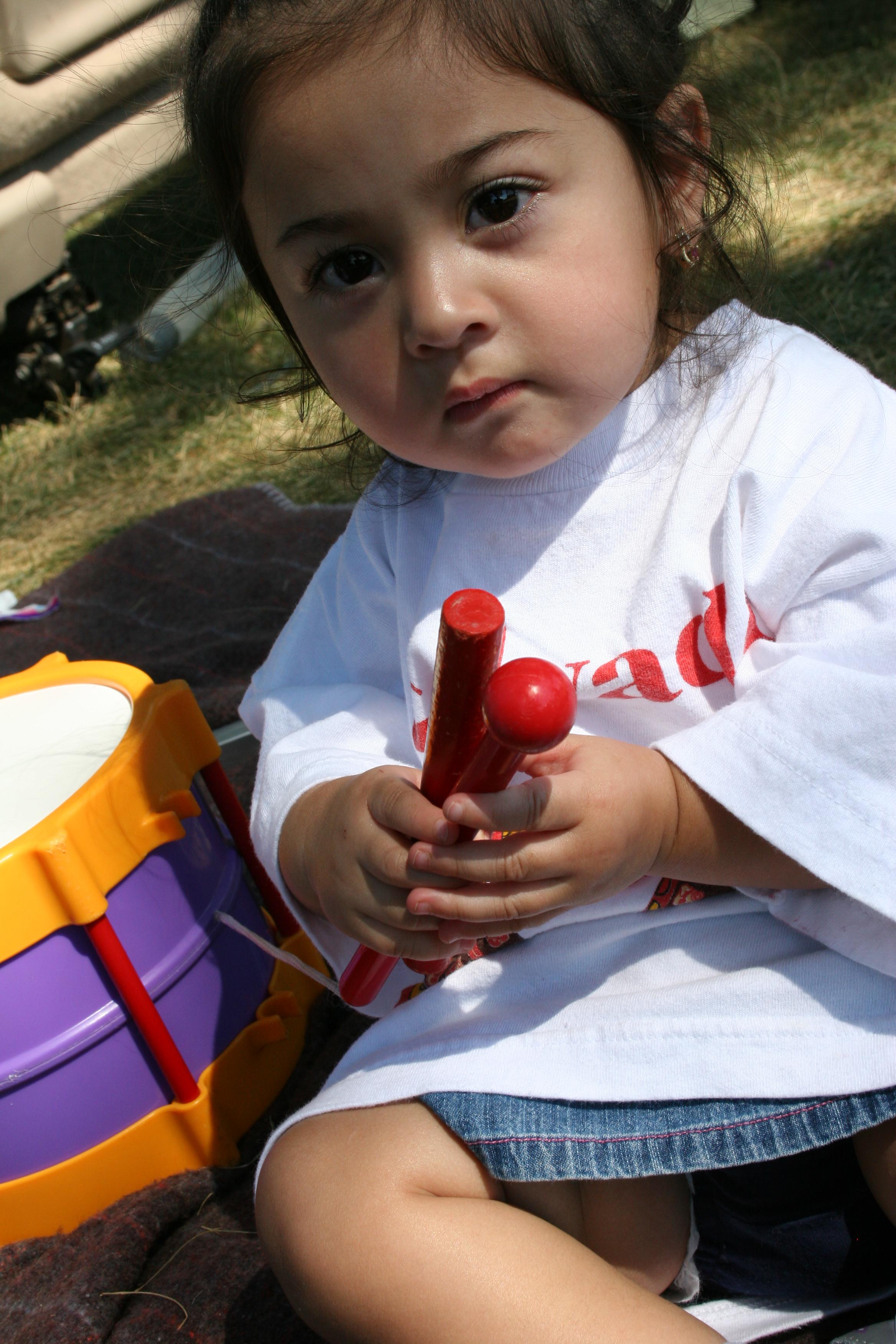
Xafsa, age 5

THEY ARE THE FACES, the hands, the feet, the voices of a new Faribault. Not the community of only French or Germans, Scandinavians or whatever ethnic groups shaped and defined this southeastern Minnesota city for so many years.

Today the face of Faribault is changing with one-fifth of the population identifying itself as non-white in the 2010 U.S. Census. Most of those minorities are Latinos and Somalis, “drawn by the opportunity to live in a small town and work in food processing plants, especially meat-packing plants,” according to a recent research report, “After the Welcome Center: Renewing Conversations about Immigration and Diversity in Faribault,” conducted by students and staff with the St. Olaf College Political Science Department. To read that report, follow this link:

http://www.stolaf.edu/services/cel/students/CURI_Immigration.html

I can’t possibly attempt to summarize the contents of that report here. But it is packed with information that should be a must-read for every member of my community. We can all learn a thing or two or ten or 20 from this research project.

But mostly we can learn from meeting our neighbors at events like the International Festival held Saturday in Faribault’s Central Park. I’ve attended this meld of ethnic cultures several times already and each time enjoyed interacting with my neighbors whose skin color differs from my own.

That all sounds nice, politically-correct, and exactly what you’d expect me to write in a public venue like this blog. But I am sincere in my appreciation to the volunteer organizers of the International Festival and to those who participate. We just need more Caucasians to attend.

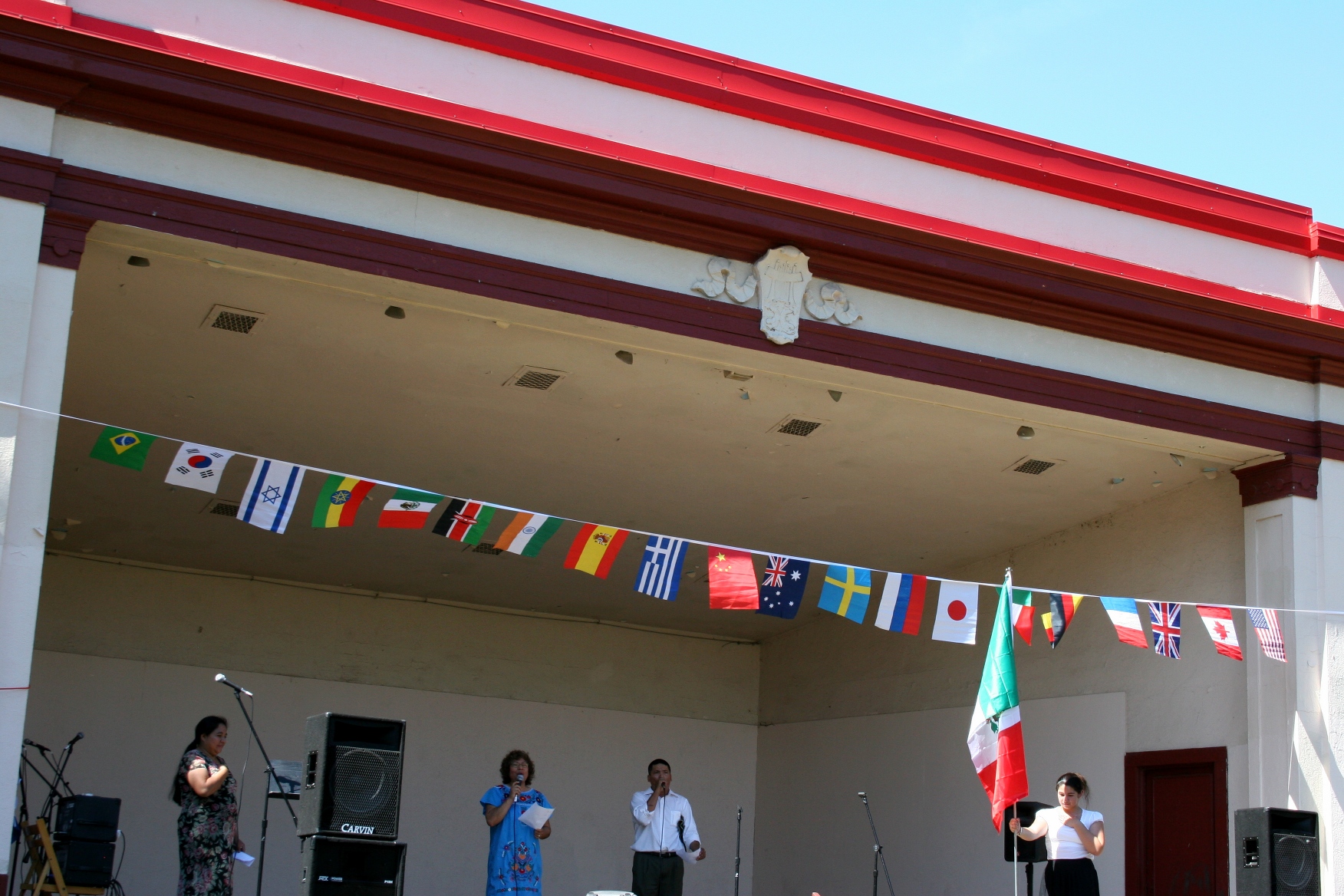
Several Latinos lead in singing of Mexico's national anthem on the band shell stage.

From the food and merchandise vendors to the musicians and everyone in between, I had ample opportunity to educate myself about Mexico, El Salvador, Guatemala, Honduras, Somalia, Holland and Norway. My husband and I sampled ethnic foods from five vendors.

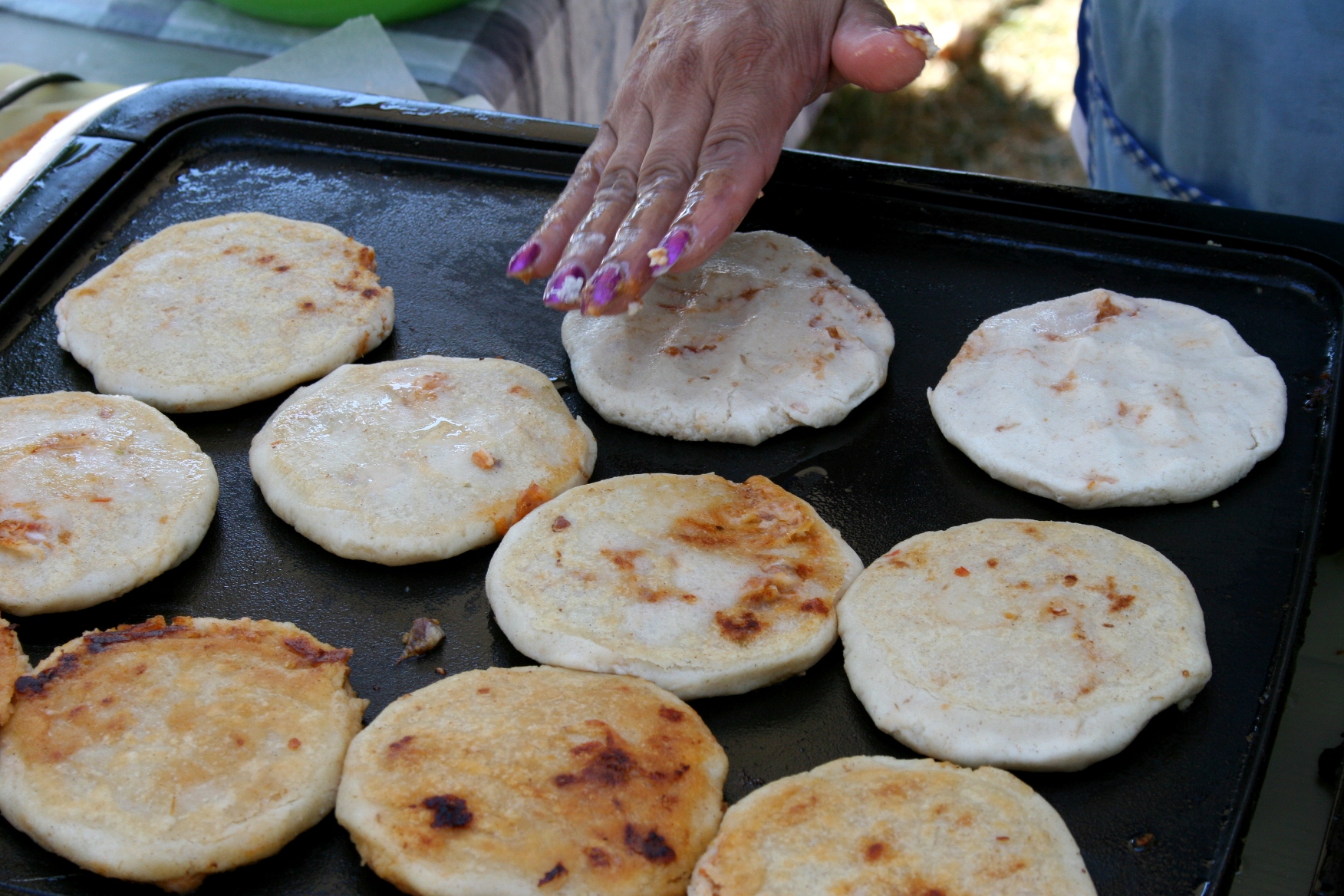
We sampled pupusas right off the griddle.

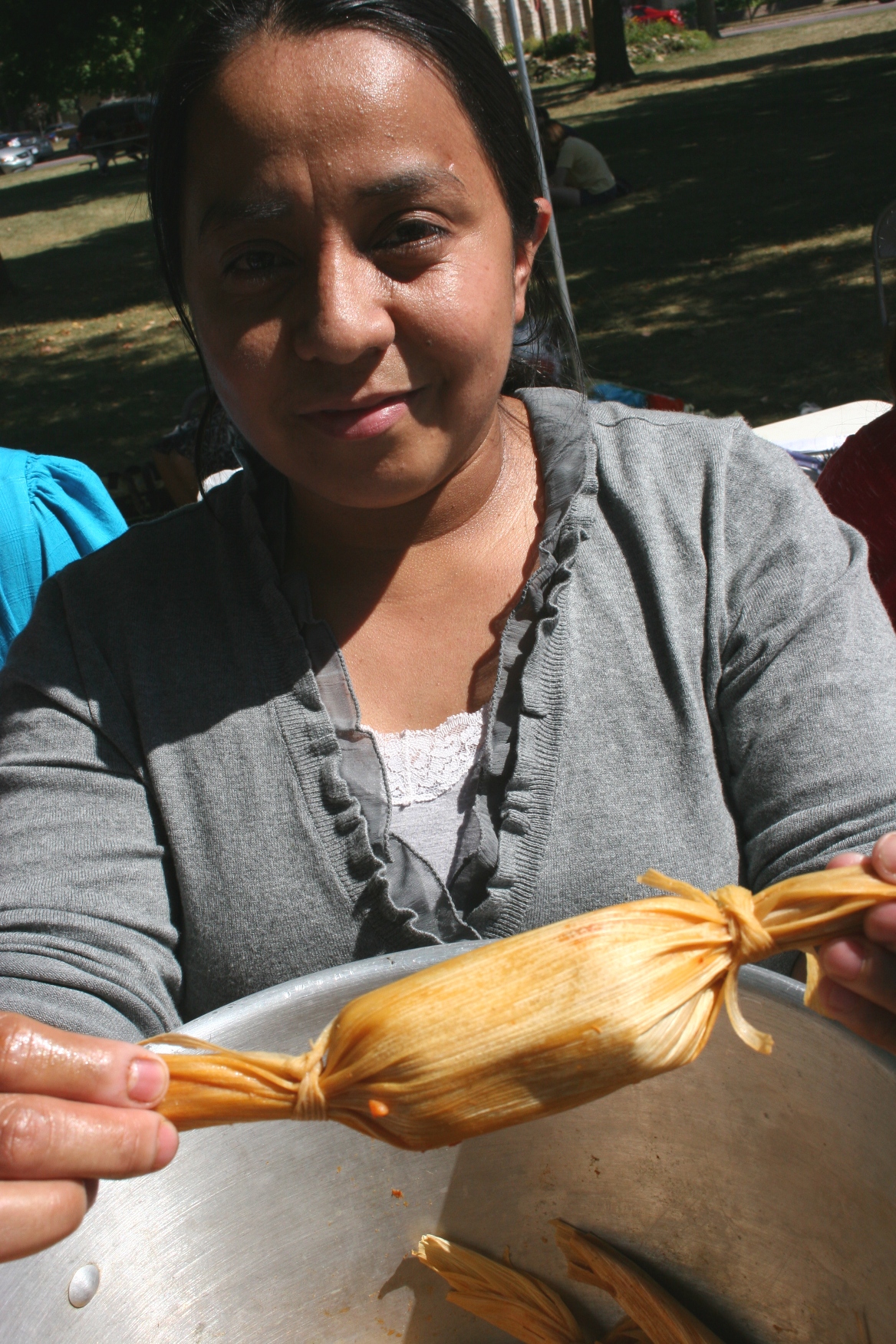
My husband and I tried Guatemalan chuchitos-- chicken, corn and salsa wrapped in a corn husk.

Faribault resident and one of the organizers, Peter van Sluis a Dutch citizen who has lived in the U.S. for 25 years, says the festival offers “a chance to mingle with different cultures.”

For me that mingling was most evident when children gathered under shade trees just south of the Central Park band shell to break piñatas. It didn’t matter if their skin was the beautiful color of sun-baked clay, or a nearly-black deep brown, or pale white. They were all kids, just kids, waiting to whack that swaying treasure-trove apart and then scramble for candy.

After the pinata was broken, the kids shared the candy.

While waiting for the piñata busting, I made a point of scanning the adult faces. I saw smiles—smiles nearly as wide as the brimmed hat worn by the man donning an El Salvador T-shirt. That’s an exaggeration, but you get my point. Viewing kids having fun has no color barriers.

Riyaam, 16

I would be remiss, however, if I didn’t mention my chat with Owatonna High School student Riyaam, a stunning Somali teen who was peddling shoes, skirts and other merchandise at a table. Well-spoken and seemingly mature beyond her 16 years, Riyaam and I talked about clashes between whites and Somalis at OHS which she says has led to a new policy of basically, “you fight, you’re out.”

She told me how the angry voice of a single white student, who declared, “Somalis don’t belong here,” triggered those racial tensions.

As she spoke, her voice became more agitated, edged with emotion. I wanted to reach across the table and hug her and I wish now that I had.

But I didn’t and it is too late for that now, but not too late to encourage Faribault residents to make the effort to meet the Somalis, the Sudanese, the Latinos and other immigrants who now live among us. It is easy to dismiss and stereotype an ethnic group if you’ve never made the effort to personally meet them individually.

A member of the Faribault-based band Circles and Squares, of which two members performed at Saturday’s International Festival, nicely summarized, I thought, the goal of the gathering: “Remember, we’re not hyphenated Americans. We’re friends.”

Well, said.

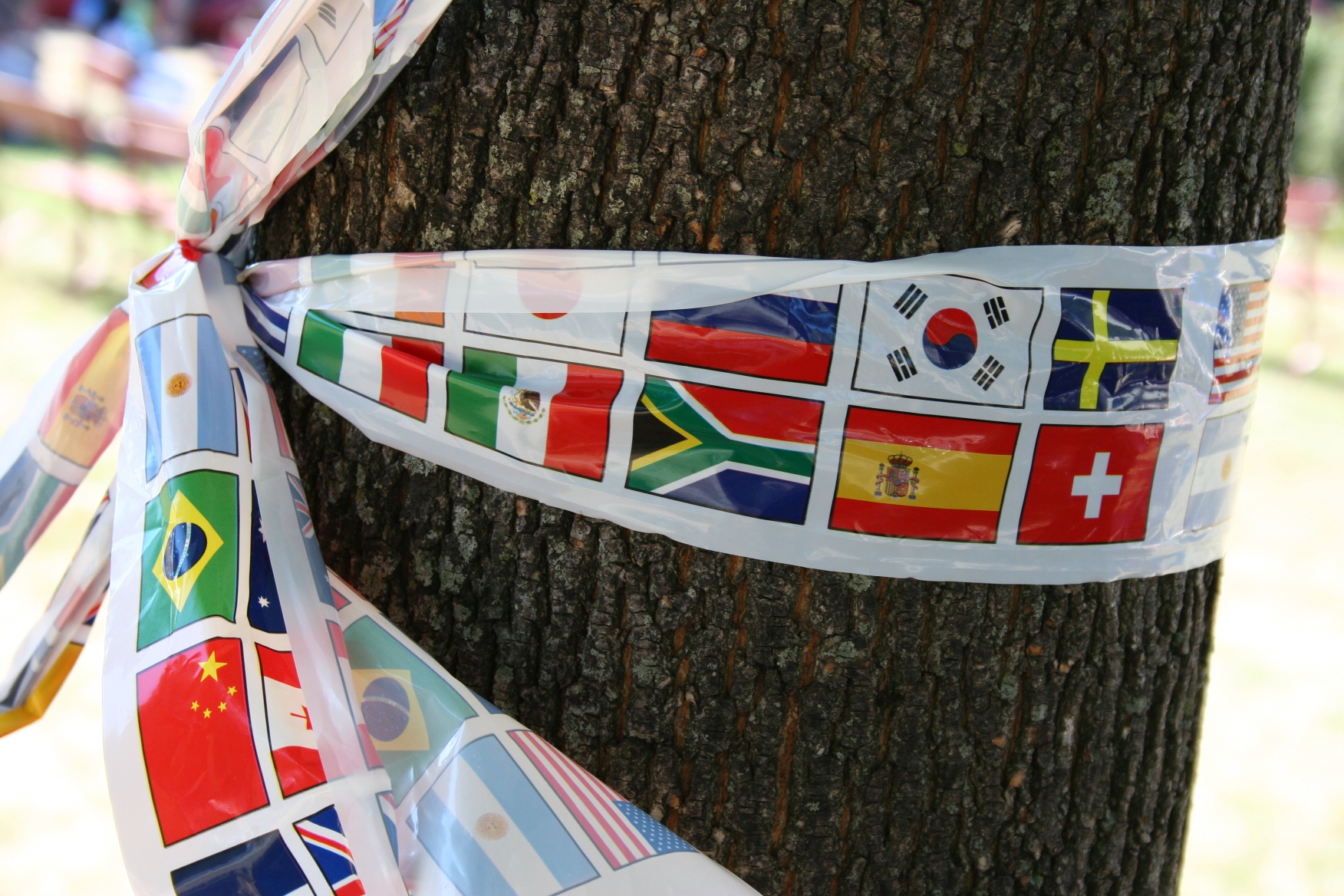
National flag ribbons were tied to trees in Central Park during the celebration.

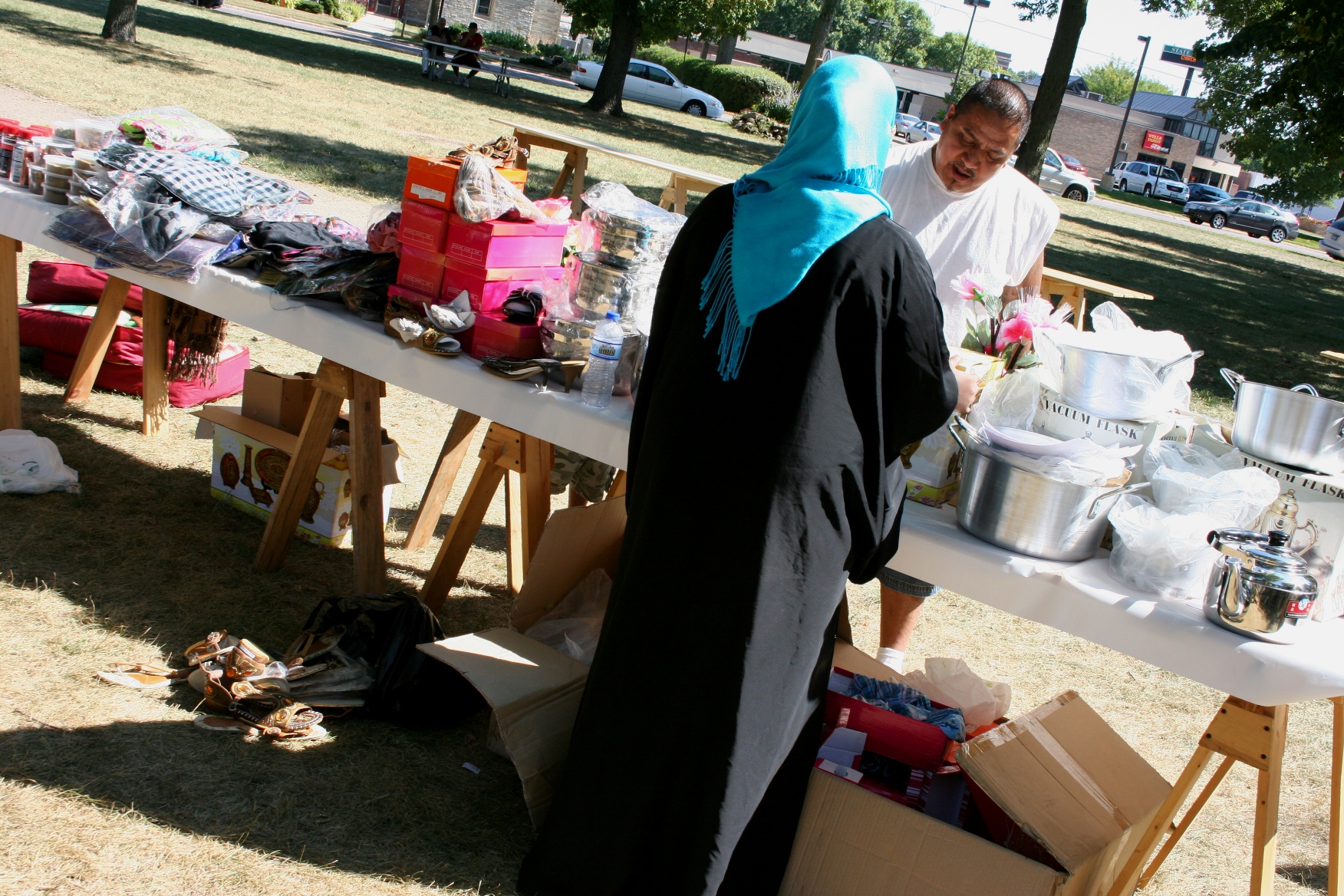
Vendors peddled their wares at the festival.

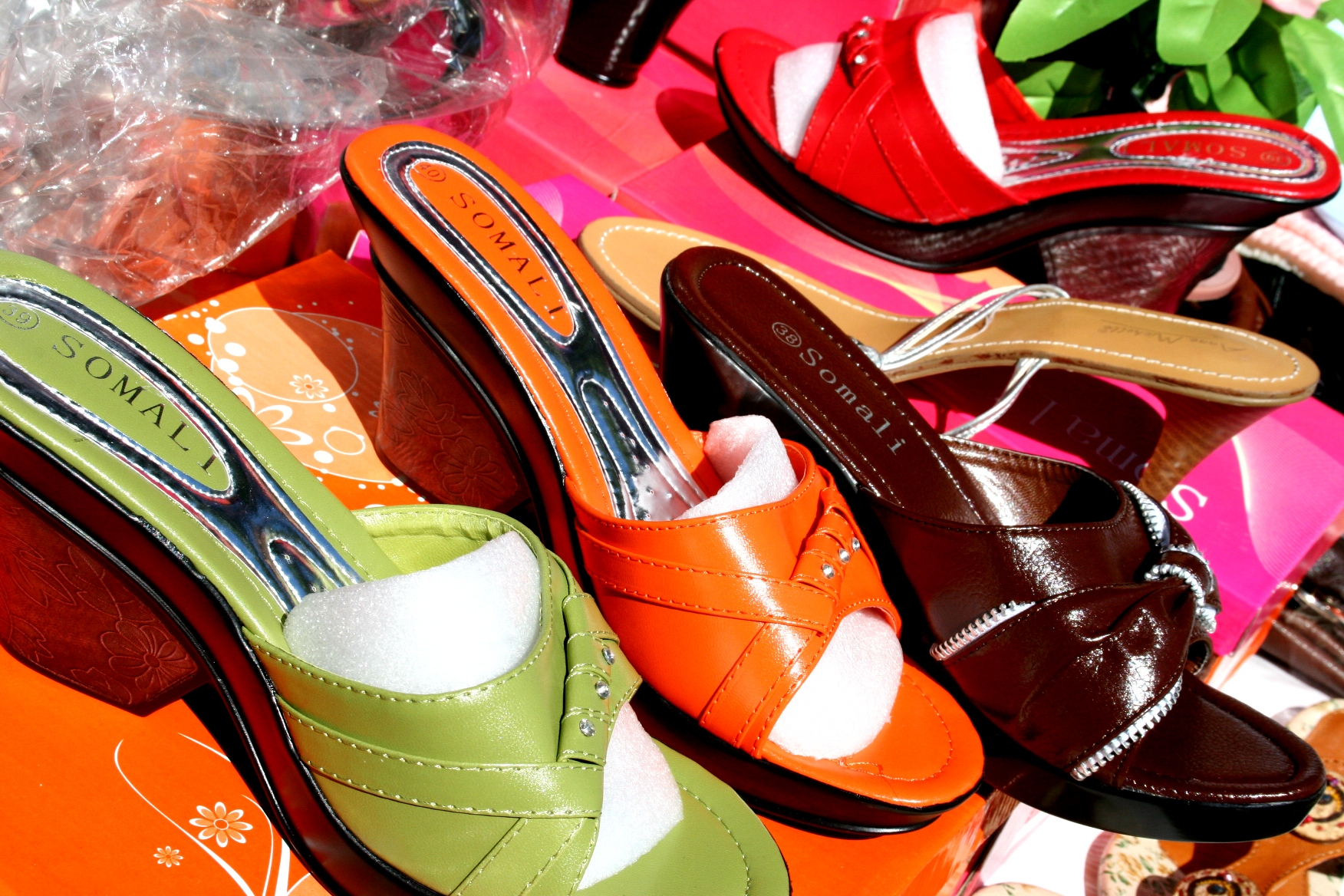
Shoes from Somalia on display at Riyaam's table.

A woman from El Salvador cooked at her food both.

Sanji, 18 months, plays with toys in the kids' activity area of the fest.

Hoop maker, performer and teacher Adrienne Lee teaches a Girl Scout the art of hoop dancing. The Girl Scouts were among the non-profit groups with booths at the festival.

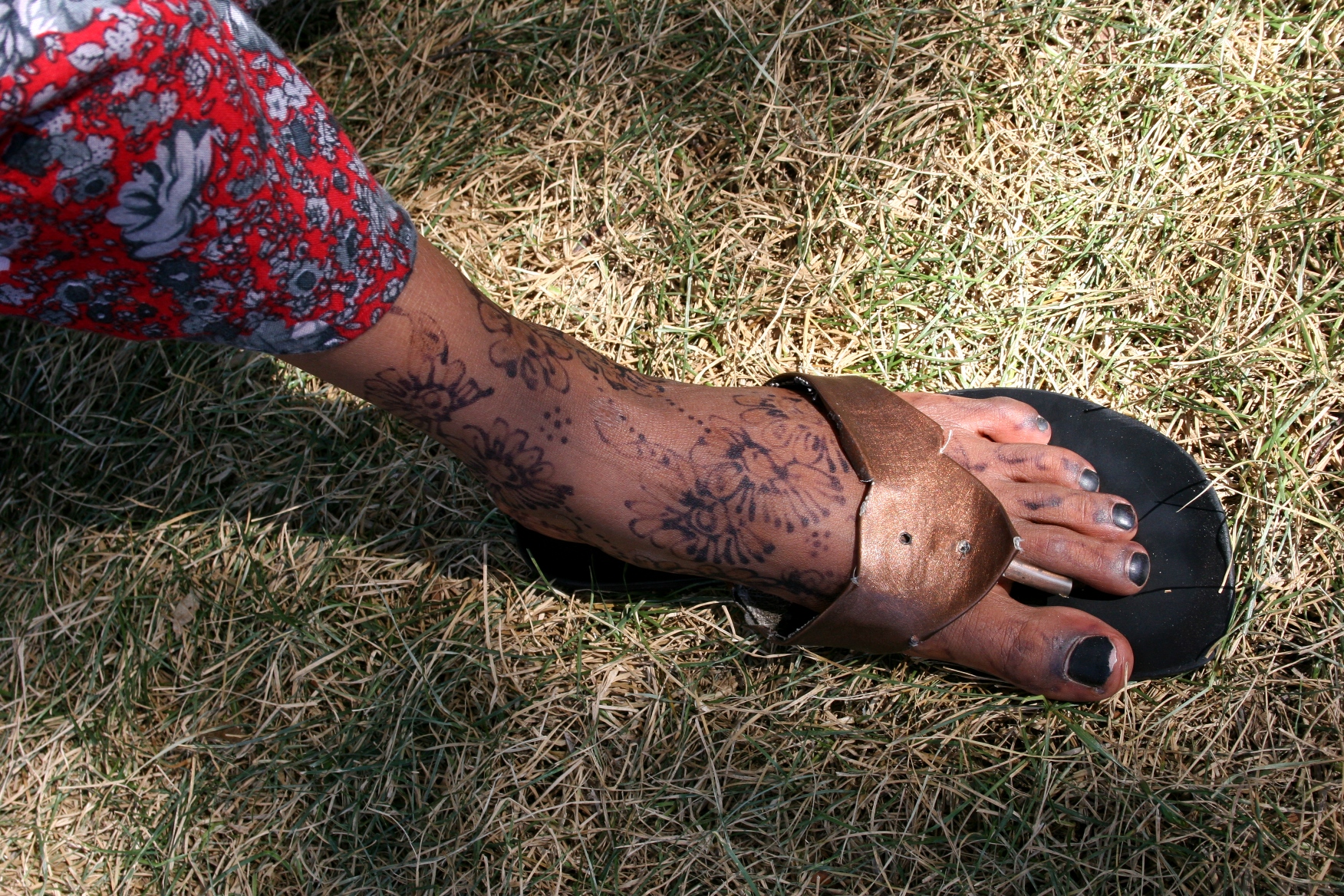
A young girl's henna stained foot.

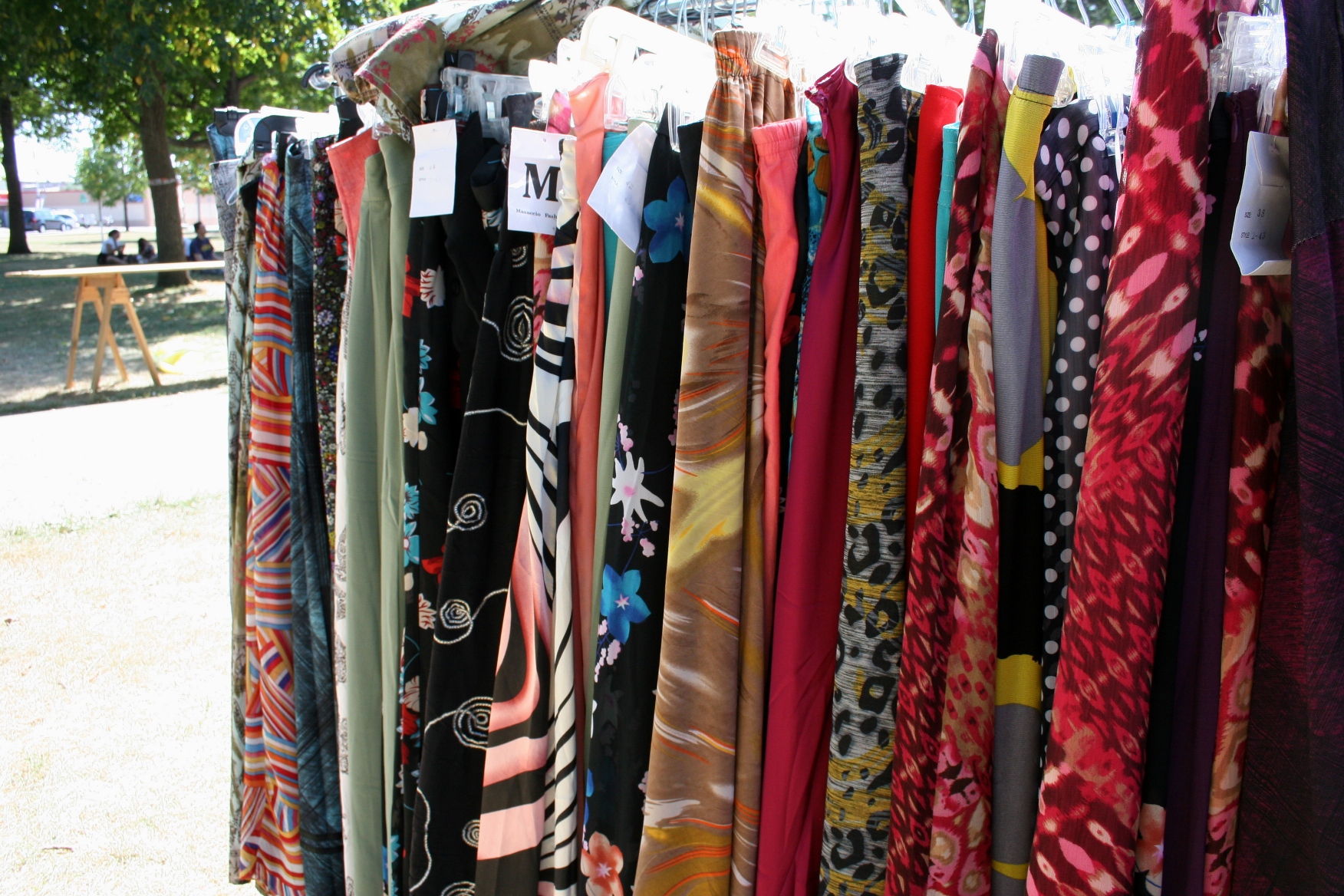
Colorful skirts for sale at Riyaam's booth.

THE ST. OLAF RESEARCH, which included interviews with 39 Faribault community members, states: “Most interviewees agree that Faribault’s immigrant and native-born communities operate alongside each other; coexisting peacefully, but not acting as a single integrated community.”

Exactly.

The report continues: “They do not agree about what should be done to unite these groups.

“We found Faribault leaders thus enmeshed in the long-standing American debate about which people ought to change and how much.”

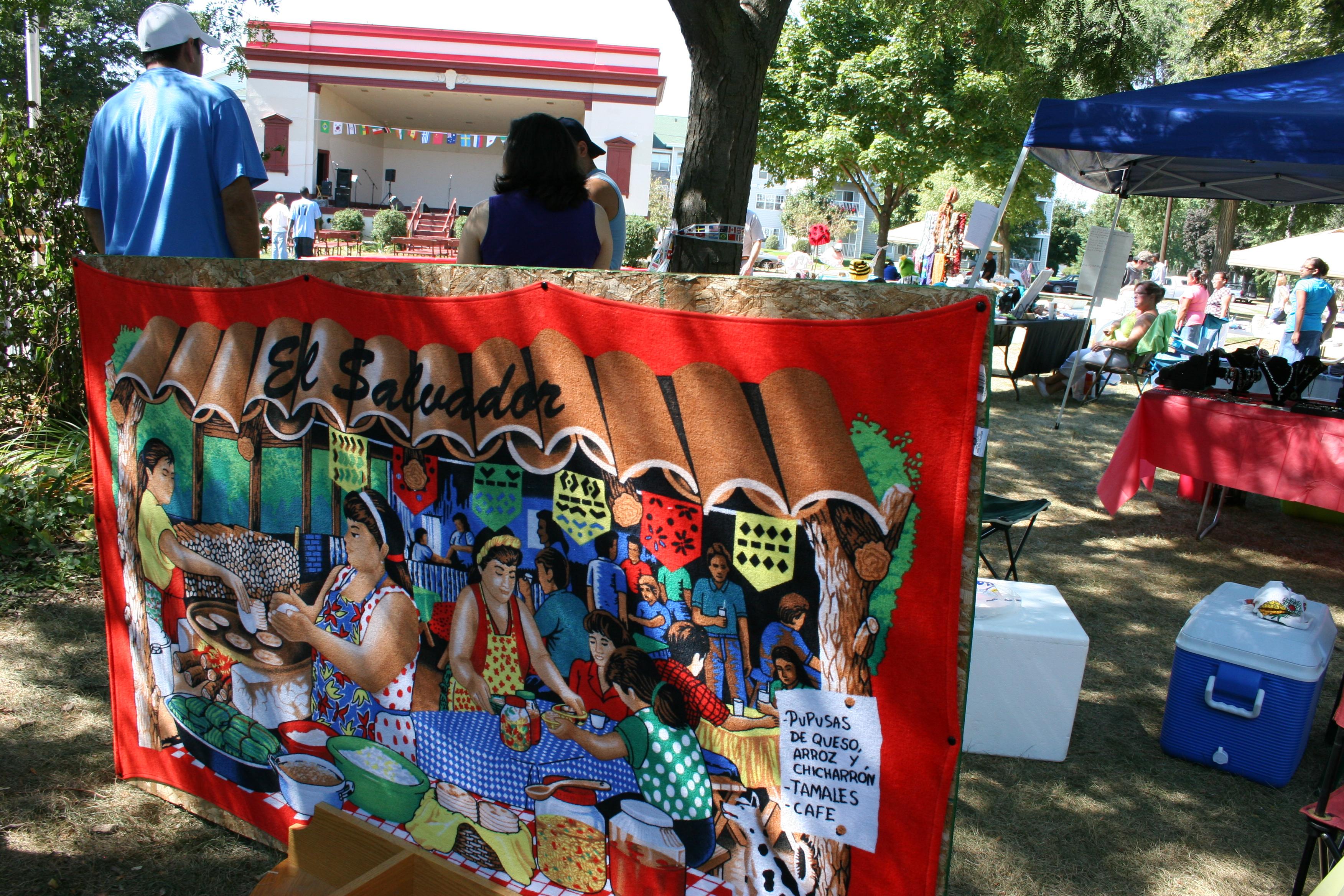
A colorful, detailed wall hanging/blanket represented El Salvador at one booth.

FYI: International Festival, Faribault, a recently-formed non-profit, has set its number one goal “to promote understanding of different cultures by organizing an annual event,” says Peter van Sluis. Secondly, the group wants to raise money and assist other non-profits.

© Copyright 2011 Audrey Kletscher Helbling


Traveling back home to the southwestern Minnesota prairie September 5, 2011

Filed under: Uncategorized — Audrey Kletscher Helbling @ 9:07 PM
Tags: , , , , , , , , , ,

The land and sky stretch out before us as we drive along Minnesota Highway 67 between Morgan and Redwood Falls in southwestern Minnesota at sunset Friday.

MY HUSBAND, SON and I traveled this weekend to my hometown of Vesta in southwestern Minnesota, the place that inspired the name for this blog, Minnesota Prairie Roots.

My roots run deep into this land, into the soil of Redwood County where I grew up on a dairy and crop farm. Although I left the farm 38 years ago at age 17, the fall after graduating from Wabasso High School, I still consider this home. It is the place that shaped who I became as a person and a writer.
It is the land that still inspires me in my writing and my photography.
Most Minnesotans don’t give this area of the state a second thought. In fact, I have discovered in my nearly 30 years of residing in Faribault, in southeastern Minnesota, that many residents of my community don’t know what lies west of Mankato. They think the state ends there.
That frustrates me to no end. In trying to explain the location of  Vesta, I typically say “half way between Redwood Falls and Marshall on Highway 19.” Usually I get a blank stare. What more can I say?

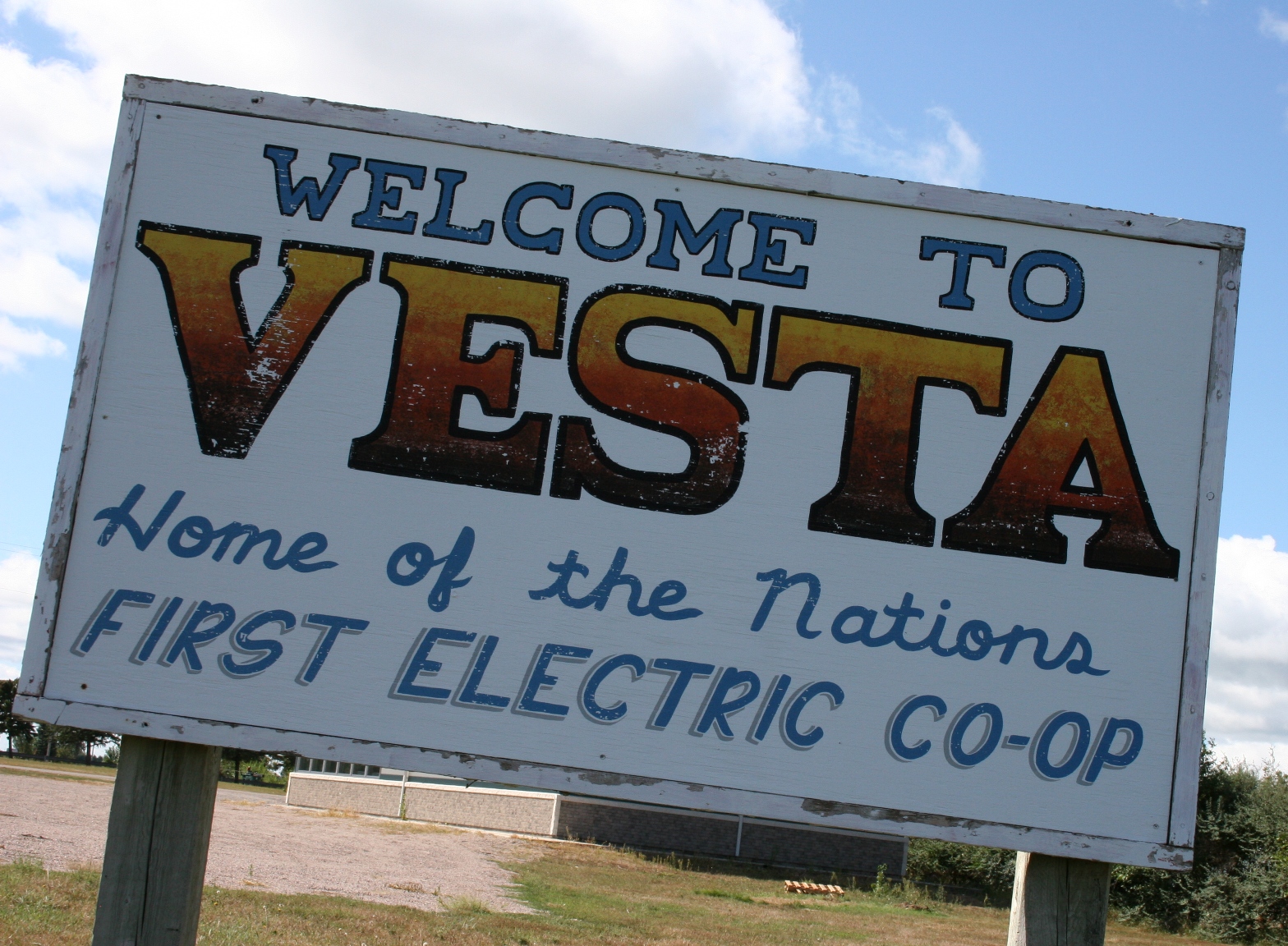
The sign that marks my hometown, population around 350 and home of the nation's first electric co-op.

They consider my hometown in the middle of nowhere. I don’t disagree with that. But I like the middle of nowhere. The prairie possesses a beauty unlike any other. The wind. The sky. The acres and acres of cropland punctuated by farm places and small towns appeal to me. They quiet my soul, uplift my spirit, connect to me in a way that I can’t explain.

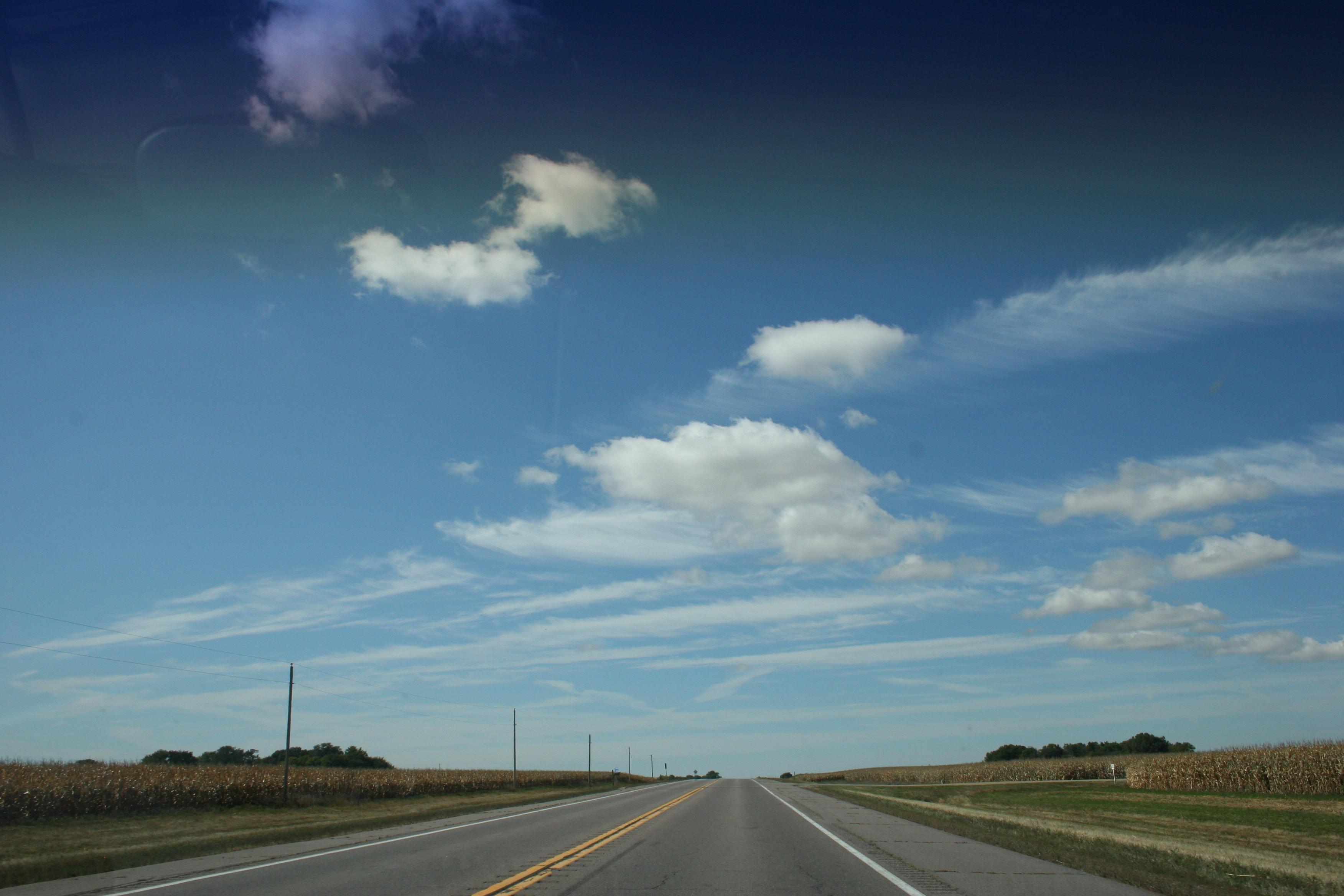
This trip we were driving west in the evening, into the sunset. The ribbon of roadway between Morgan and Redwood Falls stretched into seeming infinity under a sky banded by clouds.

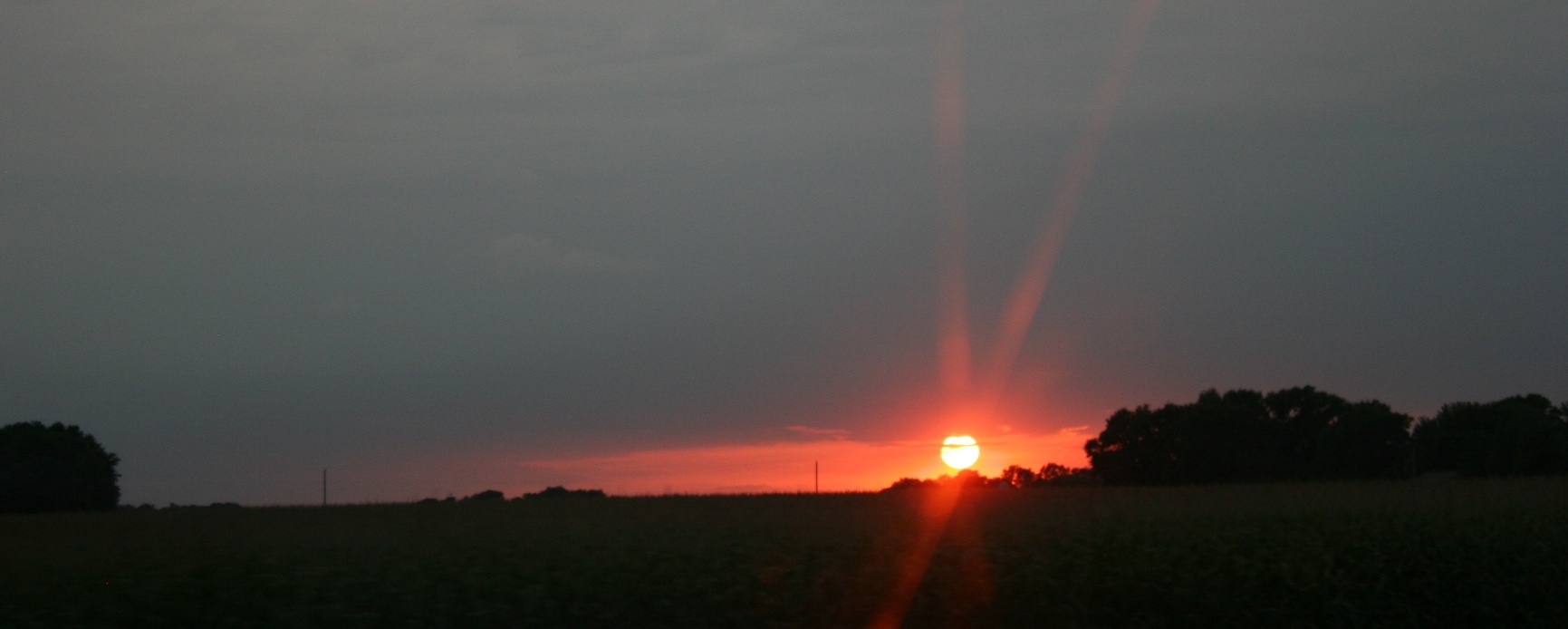
The sun sets as we travel along Minnesota Highway 67 northwest of Morgan toward Redwood Falls.

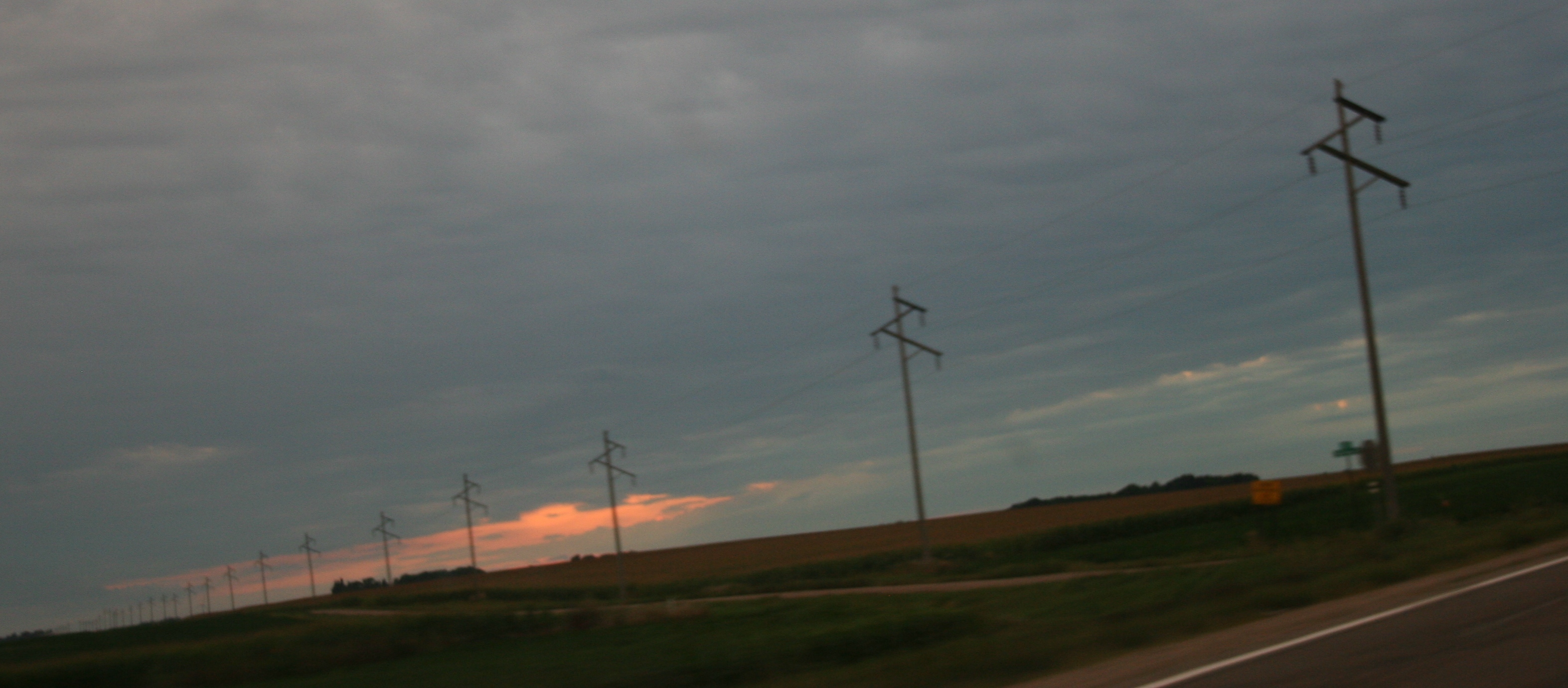
This stretch of highway between Morgan and Redwood Falls seems to go on forever, as do the utility poles.

It was beautiful. Absolutely beautiful.

What more can I say? I love my southwestern Minnesota prairie, the place that will always be my home, no matter where I live.

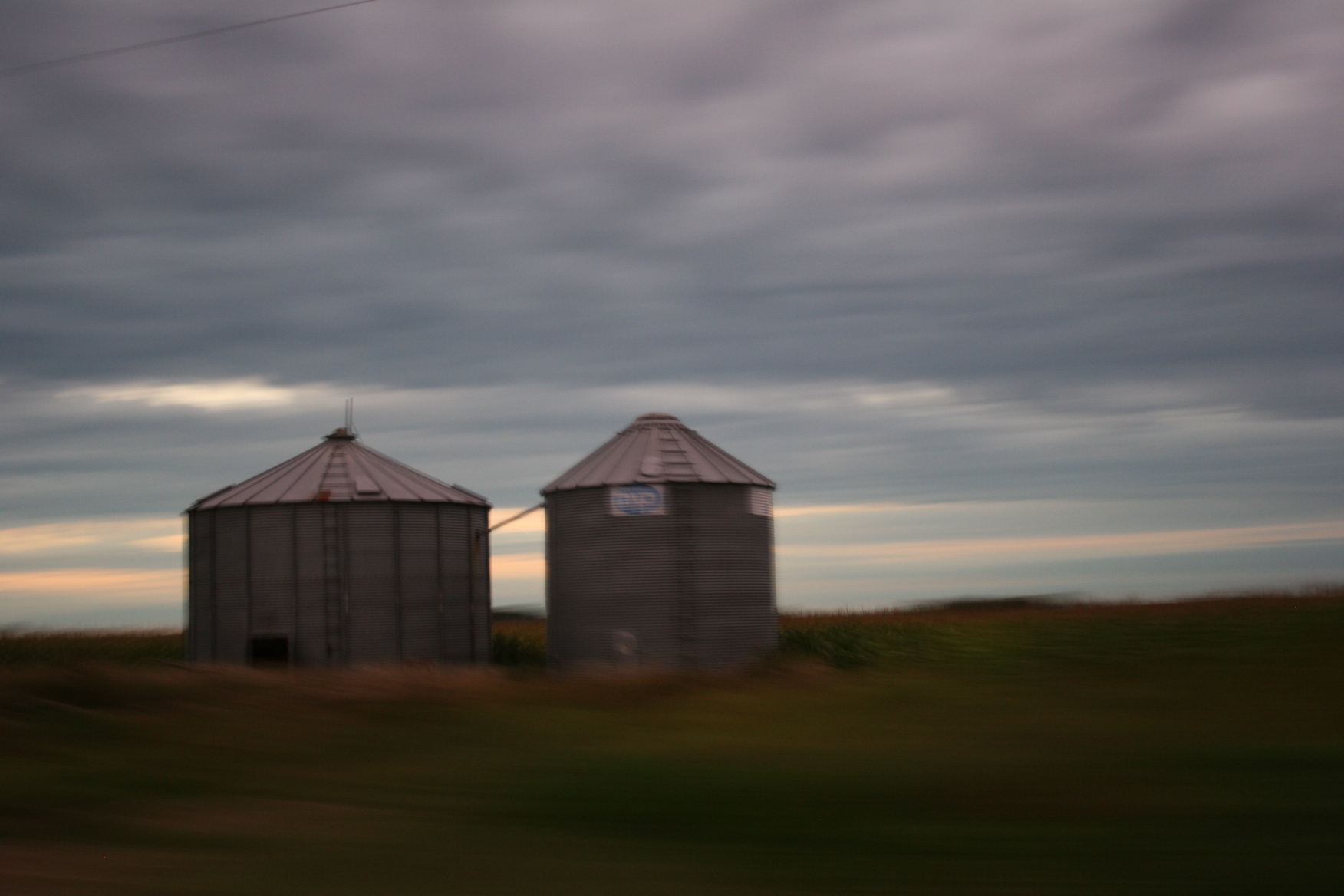
I prefer grain bins to skyscrapers. I shot this image as we traveled northwest of Morgan at sunset Friday.

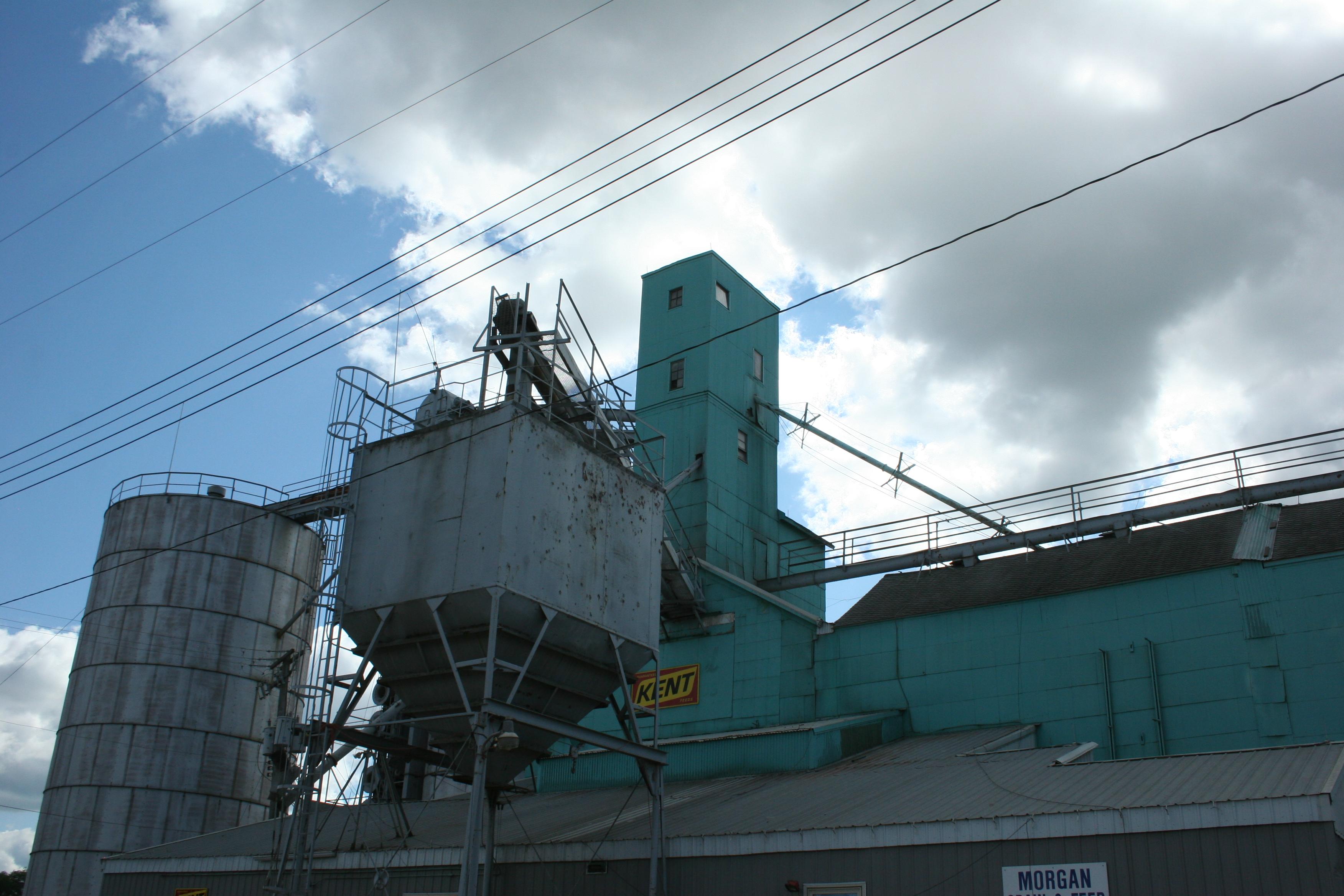
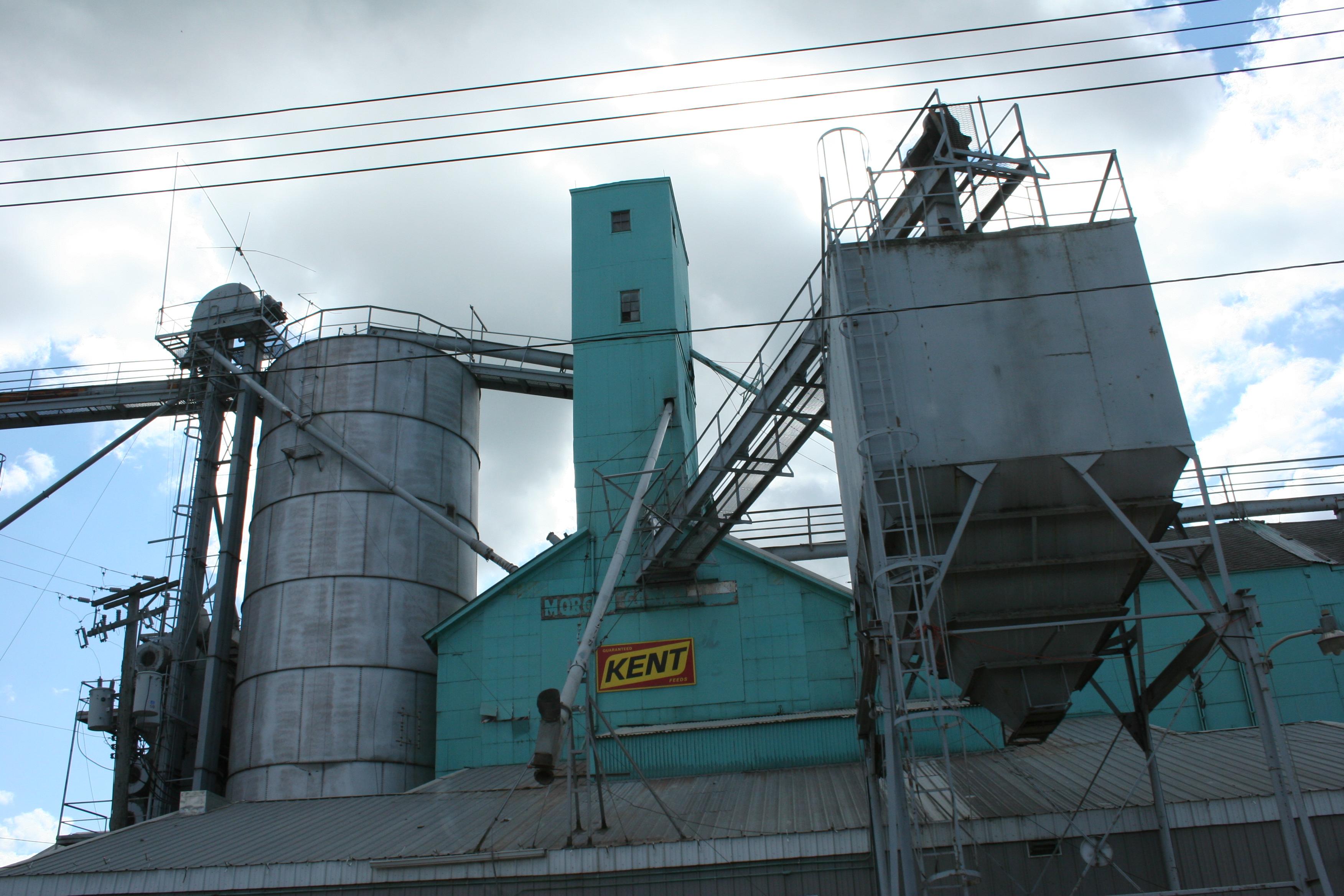
My son told me I take a picture of this grain elevator complex every time we drive through Morgan. He is probably right. But I don't care. I see something different each time, each season, in which I photograph it.

My second shot of the elevator in Morgan, taken from the car while driving back to Faribault Sunday afternoon.

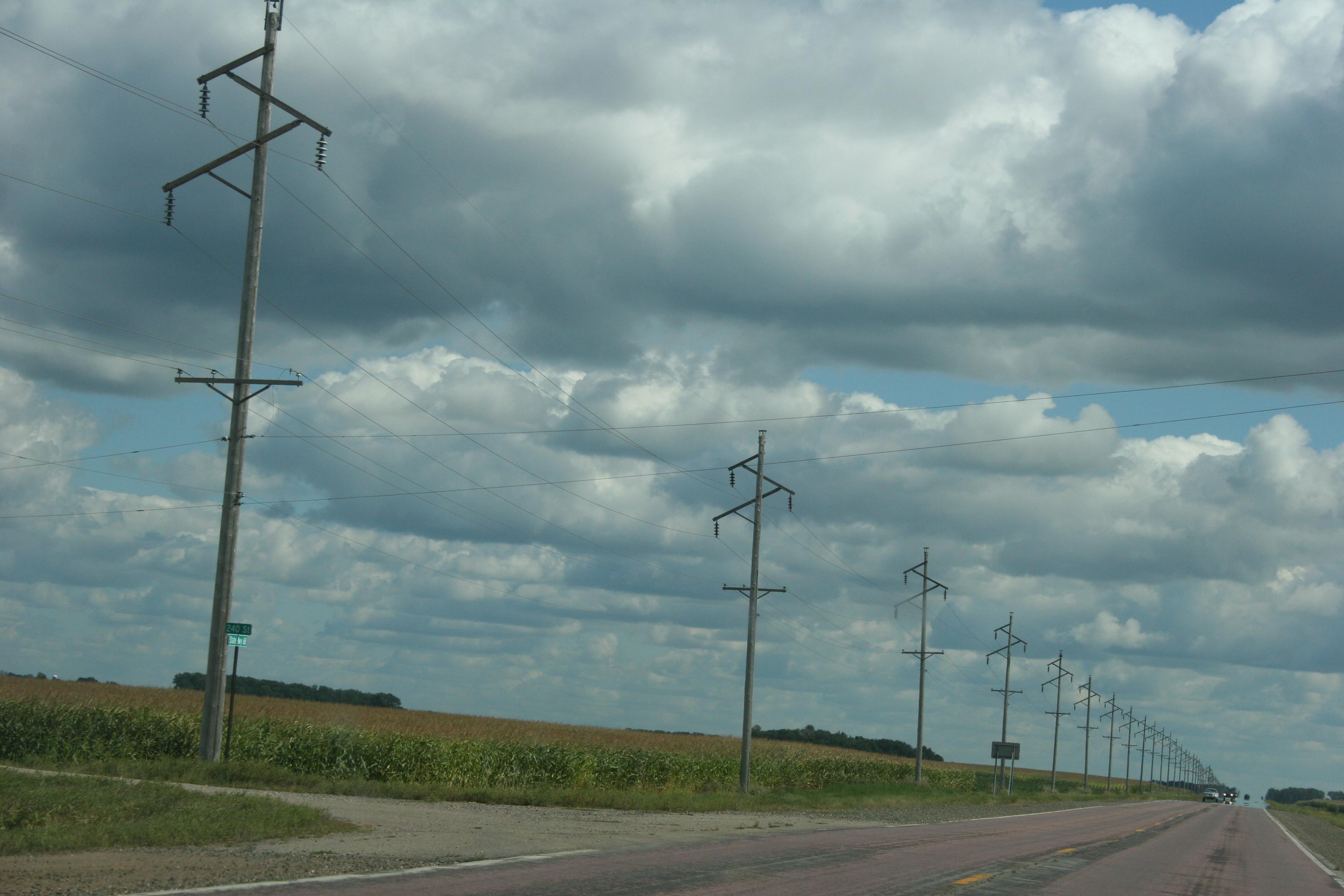
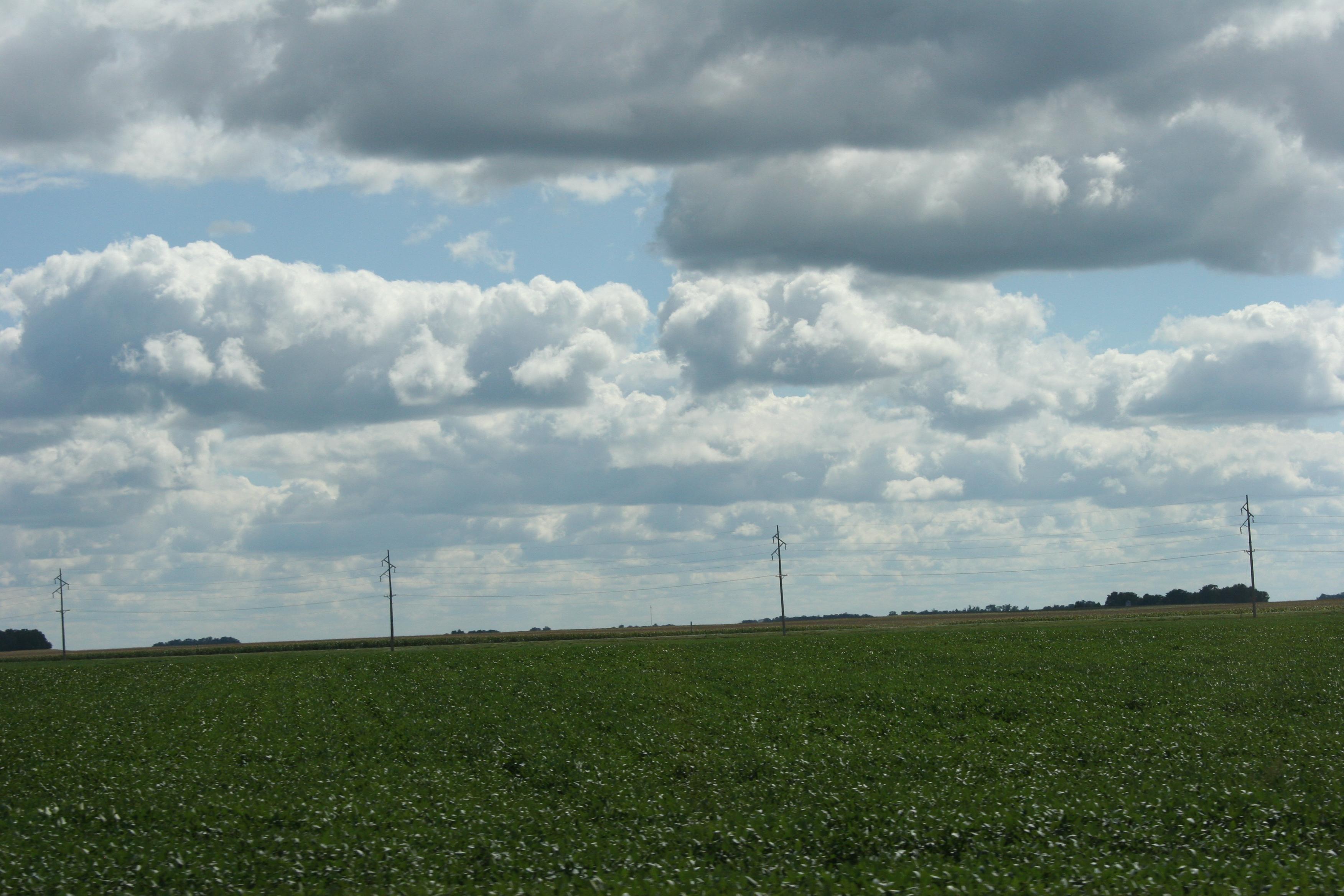
This trip I seemed to focus my camera on utility poles, which go on and on across the flat expanse of the prairie. I find a certain artistic appeal in this scene southeast of Morgan.

Soybean fields, pictured here, and corn fields define this rich farm land.

© Copyright 2011 Audrey Kletscher Helbling