Minnesota Prairie Roots

Writing and photography by Audrey Kletscher Helbling

Growing up with 21 siblings in rural Minnesota, a memoir June 10, 2025

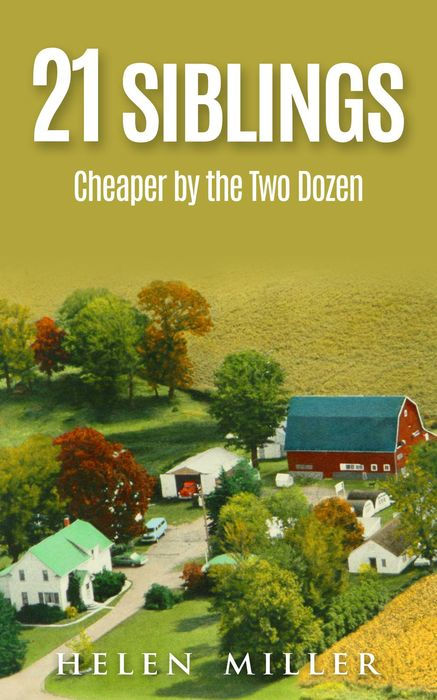
This book is also packed with candid and posed photos of the Miller family, adding to the text. (Book cover sourced online)

THIS COULD BE MY STORY or that of any other Baby Boomer who grew up in rural southern Minnesota. With one primary exception. None of us had 21 siblings. Yes, twenty-one. I had only five—three brothers and two sisters.

But Helen Miller had seven brothers and 14 sisters, all single births, all born to the same parents, Lucille and Alvin Miller of rural Waseca, over a span on 26 years. She’s chronicled the family’s life in a self-published memoir, 21 Siblings—Cheaper by the Two Dozen.

I happened upon this book, printed in 2018, after visiting the Waseca County History Center and seeing an exhibit about this unusually large family. I knew then that I needed to read this story by Helen, 13th in line. She’s just a bit older than me. I expected my farm upbringing during the late 50s through the 60s and into the early 70s would be similar in many ways. I was right.

WHITE RICE & PANCAKES

This book proved a stroll down memory lane. I remember meals of mostly meat and potatoes with a side vegetable given that was the preferred meal of my farmer father. He, like Alvin Miller, was quite content to eat those basics and didn’t care for any deviations. Large gardens were the norm, no matter family size. Lucille Miller canned fruits and vegetables, just like my mom, except a whole lot more. And, when food supplies ran low, both our mothers cooked a meal of white rice and cinnamon. I detested that and to this day still don’t like plain white rice.

I also do not much like pancakes, although I have no particular reason to explain that dislike. Helen Miller should. She writes of the family receiving boxes and boxes of pancake mix following a railroad accident. Except they didn’t get the pancake mix until months later…when weevils had infested the food. The Millers simply sifted out the bugs, prepared and ate the pancakes. They weren’t about to turn down free food.

Specific stories like these point to the challenges of feeding a mega family, even with their own garden produce, chicken, pork and eggs. With that many people to feed and to shelter, you can only imagine the logistics of running the household. Older siblings were responsible for younger siblings. Everyone pitched in with chores. They shared a lot—clothes, shoes, a singular cup for drinking water (same as my family), rooms, a love of music and a strong faith.
This shows part of the Miller family exhibit at the Waseca County History Center. (Minnesota Prairie Roots copyrighted file photo May 2025)

THE IMPORTANCE OF FAITH

The Millers’ Catholic faith centered their lives. Lutheranism centered mine. Faith carried the Millers through an especially tragic event—the deaths of their aunt, Irene Miller Zimmerman, and her six young children in 1959. An unseen train broadsided their station wagon just blocks from Sacred Heart School, the same school Helen and her siblings attended. She writes: It was under this veil of grief that I grew up a rather serious child. She was only four years old.

Amid the difficult moments, Helen documents light-hearted moments, too. One in particular caused me to burst into laughter. As a seven-year-old, Helen went to Confession for the first time, thinking she had not broken any of the Ten Commandments. But she had to confess something to the priest. Helen admitted to disobeying her parents twice, having false gods twice and then, and here’s the kicker, committing adultery three or four times. Now there’s nothing funny about that sin. But when an elementary-aged girl confesses to something she clearly doesn’t understand, well, I wonder how that priest kept from laughing aloud. He didn’t laugh, or correct her, according to Helen, who twice confessed to breaking the Sixth Commandment.

SEWING, FISHING & A WHOLE LOT OF PATIENCE

Story after story reveals a childhood upbringing that many times mimicked my own. Like Helen, I learned to sew because, if I wanted new clothes as a teen, I needed to stitch them. I babysat children for fifty cents an hour, just like Helen. I fished, occasionally, with my family. But the Millers fished often, usually at their rustic cabin along Reeds Lake a short drive from their farm. Vacations and dining out were not part of our youthful experiences. The list of similarities goes on and on among the many differences.

I can never fully relate to having 21 siblings. But this rural Waseca family managed and, by all accounts, well. With a whole lot of organization, love, strength and patience. And, Helen notes, with an eternally optimistic and patient mother. Just like my mom.

© Copyright 2025 Audrey Kletscher Helbling


In honor of Mother’s Day: Stories of 3 strong mothers May 9, 2025

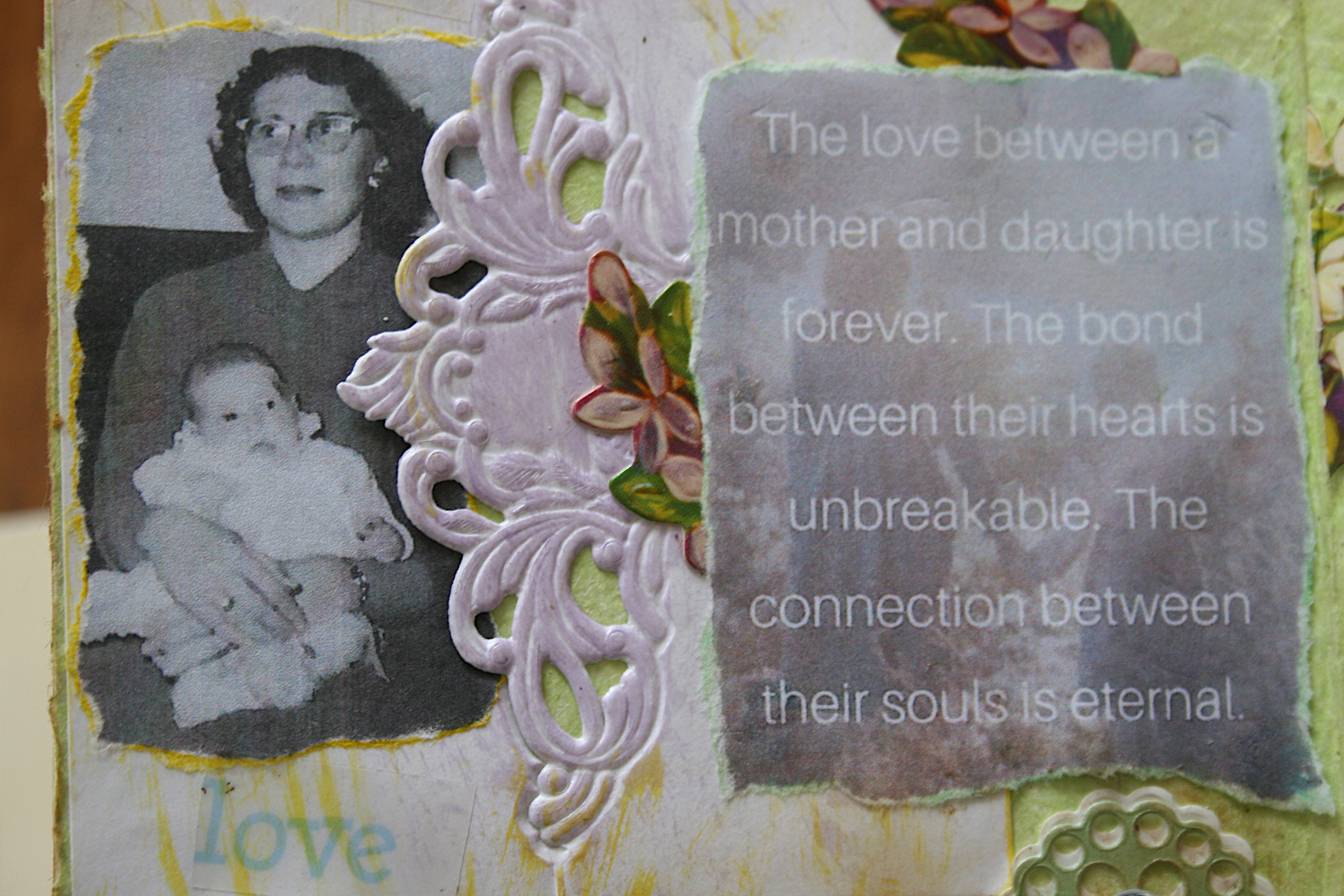
This page from an altered book crafted by my friend Kathleen shows my mom holding me. Mom died in January 2022. I love the quote. (Minnesota Prairie Roots copyrighted file photo)

THREE MOTHERS. Three strong women. Three remarkable experiences. This Mother’s Day I feel compelled to share the stories of a trio of moms. Their stories are decidedly different, yet similar in the common denominators of strength and love.

Photographed in a small southern Minnesota town, a box containing Naloxone used as an emergency treatment for an opioid overdose or suspected overdose. (Minnesota Prairie Roots copyrighted photo May 2025)

MOTHER OF A RECOVERING ADDICT

Let’s start with the woman checking out my clutch of greeting cards recently at a local chain discount store. As I stepped up to the counter, a young man bade her goodbye. “I love you, Mom,” he said while walking toward the exit.

It was one of those moments when I simply had to say something. “That’s so sweet,” I said, looking directly at the clerk.

I don’t remember our entire conversation. But I do recall the highlights. Her son is a recovering addict two years sober. “I almost buried him,” she told me.

“You must be so proud of him,” I replied. And she was and is and I wanted to reach across that check out counter and hug her. But I didn’t. My encouraging words would have to suffice. I walked out of that store feeling grateful for this mom who never gave up on her son and for the son who recognizes the value of her ongoing love and support.

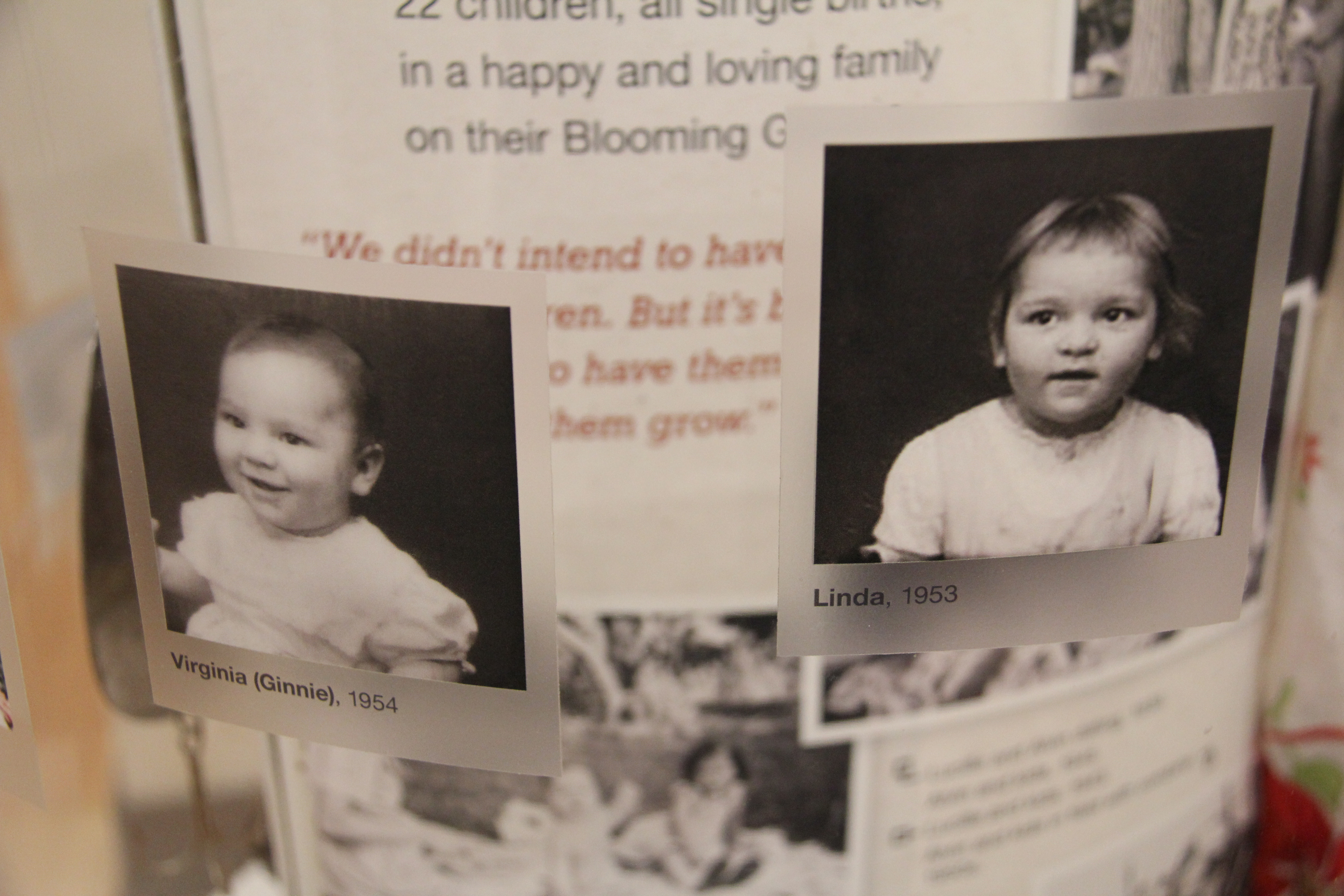
This shows two of the 22 Miller siblings featured in an exhibit at the Waseca County History Center. (Minnesota Prairie Roots copyrighted photo May 2025)

MOTHER OF TWENTY-TWO

Then there’s Lucille Miller of rural Waseca, married to Alvin and mother of their 22 children. Yes, twenty-two, all single births. I learned about the Miller family recently while touring the Waseca County History Center. An entire display focuses on them.

Lucille gave birth to her first child in December 1940 at age 17 and her last in January 1966 at age 43. Fifteen girls and seven boys (oldest to youngest): Ramona, Alvin Jr., Rose, Kathleen, Robert, Patricia, Marylu, Diane, John, Janet, Linda, Virginia, Helen, Art, Dolores, Martin, Pauline, Alice, Angela, Marcia, Gregory and Damien.

I can’t even fathom being pregnant that often, birthing that many children, or coming up with that many names. But Lucille Miller did just that and raised her children on the family’s Blooming Grove Township farm. She died in August 2006, her husband not even a year later. Lucille and Alvin never intended to have 22 kids. But these deeply spiritual parents considered each and every one a blessing.

Information I found online backs that up. This mother of many also “took in” several kids, led two women’s organizations and worked to establish local group homes for the disabled. Three of the Miller children had disabilities.

Helen Miller’s book about growing up in a Minnesota farm family of 22 children.

Helen Miller, 13th in line, calls her mom “a saint.” (I certainly don’t question that assessment.) She’s written a book, 21 Siblings: Cheaper by the Two Dozen, about growing up in this mega family where the Catholic church and school centered life and organization was key in keeping everyday life running smoothly. Chores were listed, then assigned, and siblings used the buddy system. I have not yet read the book, but intend to do so.

I expect the obituary of Lucille’s daughter, Virginia Miller Pelto, 60, who died on May 8, 2014, just days before Mother’s Day, reflects the way in which her mother lived: Of the many things Virginia loved, above all she loved people. As a very spiritual person, she put the world on her shoulders and in her prayers. She donated time to her church, her community and anyone who needed to just talk. Any mother would be proud to have a daughter with such a giving and compassionate spirit.

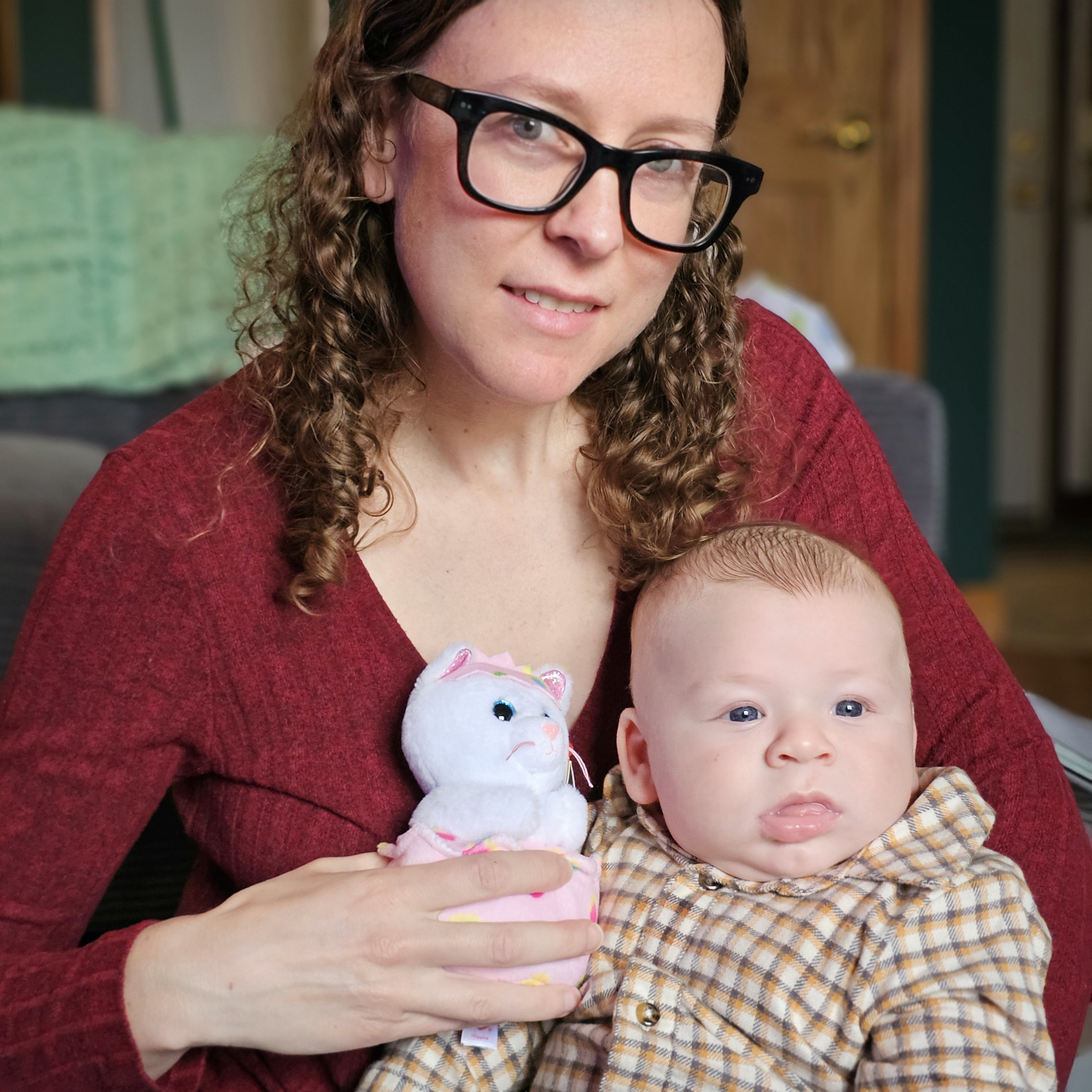
My daughter Miranda and grandson Everett, 3 months old when this photo was taken. (Photo courtesy of Miranda, April 2025)

MOTHER OF EVERETT

Finally, there’s the story of my second daughter. Miranda became a first-time mom in mid-January. Considered a “geriatric mom” given her closing-in-on-forty age, she was closely-monitored throughout her pregnancy. Miranda was in excellent physical condition—she’s a letter carrier. Her pregnancy proved uneventful with labor commencing the day before her due date. But then everything changed. For the worse. Labor was long, delivery difficult with baby’s head and shoulder getting stuck. Once Everett—all 10 pounds of him—was born, Miranda experienced extensive postpartum hemorrhaging requiring the transfusion of three units of blood. A team of doctors and other medical personnel at a Madison, Wisconsin, hospital worked to save her life.

A week later, after Miranda and John were semi-settled at home with Everett, Randy and I traveled to Madison to see all of them. When the new parents recounted harrowing details of that difficult birth, my strong strong daughter said she feared she might die. Before she saw her son.

As Miranda and I stood in the nursery, arms wrapped around each other gazing down at newborn sleeping Everett, I felt overwhelmed with emotion. I still get emotional thinking about how I nearly lost my daughter on the day my second grandson was born. I’ve written about that experience in a short story, “Birthing Everett,” which will publish in late August in The Talking Stick anthology.

We all have mothers. We all have stories, whether we are sons or daughters or mothers ourselves. Today I honor all mothers, especially Miranda, Lucille Miller and the store clerk who nearly buried her son. They are three strong women.

© Copyright 2025 Audrey Kletscher Helbling
 

House of Kahmanns: A story of trauma, family love & resilience May 1, 2024

IT WAS A TUESDAY in January 1964. Wash day in the Kahmann household. Outside, a ground blizzard raged, reducing visibility on the southwestern Minnesota prairie. The events of that morning, of that day, would forever change the lives of siblings Karl, Patsy, Eric, Andy, John, Paul, Kevin, Katy, Karen, Phillip, Jim and Beth, and their parents, Jack and Della.

That sets the scene for House of Kahmanns, a memoir by P.G. (Patsy) Kahmann, oldest daughter, second oldest among 12 children. Sixteen months earlier, the family moved from Kansas City, Missouri, to Minnesota when Jack, a traveling salesman in a farm business, was relocated. They settled near their maternal grandparents, into a rental home by Granite Falls.

I expect Jack Kahmann was driving in weather and road conditions similar to this. (Minnesota Prairie Roots copyrighted file photo, January 2020, used for illustration only)

This is familiar land to me in a familiar time. I was not quite eight years old in January 1964, living on a farm some 30 minutes away in neighboring Redwood County. I understand full well the fierce prairie wind that whips snow into white-out conditions. On that blustery morning, as Jack and Della and Della’s parents set out for medical and business appointments in Minneapolis, leaving the oldest, Karl, to care for the youngest children, Patsy and her school-age siblings boarded the school bus.

Rosary beads. (Minnesota Prairie Roots copyrighted file photo used for illustration only)

Patsy was in English class when she got the devastating news. There had been a crash. A bread truck driven by an unlicensed 14-year-old ran a stop sign and then a yield sign before slamming into the 1957 Chevy driven by Jack. Della, mother of a dozen, was the most seriously injured. “How many Hail Marys will it take to save my mother’s life?” Patsy asks herself.

An altar in a southern Minnesota Catholic church. (Minnesota Prairie Roots copyrighted file photo used for illustration only)

Faith, a strong Catholic faith, threads through this story. The Kahmanns were devout, prayerful, always in church. The church, or rather the local parish priest, would play the primary role in turning the initial tragedy into even more intense pain, suffering, separation and trauma for the family. Father Buckley demanded that the 12 children be placed with Catholic families while their parents recovered at a hospital 70 miles away. That, even though a Lutheran couple offered to move into the Kahmanns’ farm home and care for the children. Together.

At this point in the book, I felt my anger flashing. Anger over the inhumanity of a man of the cloth who is supposed to exude compassion, care and love. More atrocities by the priest followed. By the time I read the epilogue, I was irate, forgiveness far from my mind.

Love and forgiveness were taught in the Kahmann home. (Minnesota Prairie Roots copyrighted file photo used for illustration only)

But the Kahmanns were a loving and forgiving family. (Not necessarily of that priest.) One evening after they are all reunited, Jack asks his family to pray blessings upon the driver of the bread truck. Three-year-old Phillip mishears. “God bless the red truck!” he shouts. Laughter erupts. I needed that humor in a story weighing heavy upon my soul.

I wanted to step into the pages of the book and hug those kids and make everything better. Just as Millie Bea did when the Kahmanns lived in Kansas City and Jack was traveling around the country and Della needed extra help with the kids. The book flips back and forth in time and place between Missouri and Minnesota, before and after the crash.

The Kahmanns were not unfamiliar with trauma. In June 1955, Andy’s hand was nearly severed in a hand cement mixer. A Kansas City surgeon successfully reattached his limb, even though a priest told Jack that his son’s hand had been amputated. That was untrue.

Family love is such a strong theme in this book. (Minnesota Prairie Roots copyrighted file photo used for illustration only)

Through all of this, themes of love, strength and resilience thread. The Kahmann siblings clearly looked out for and loved one another and got through some pretty awful stuff. Their motto, Patsy writes, was “No one died. We all survived.” They never talked about the accident. I’m not surprised. Who did back then? Eventually the family would relocate to Bird Island, 32 miles directly east of Granite Falls. It was a new start in a new place following their 75 days apart, “75 days of confusion, anxiety and foreboding.”

And now, with publication of House of Kahmanns—A Memoir, A story about family love and shattered bonds, about finding each other in the aftermath, perhaps these siblings are talking about all they endured. For Patsy, it is also about keeping a promise. In the book dedication she writes: To Mom and Dad/I promised you I would write this story. And she did, with honesty, pain and a great deal of strength.

© Copyright 2024 Audrey Kletscher Helbling
 

“Everybody just breathe,” a book review July 26, 2022

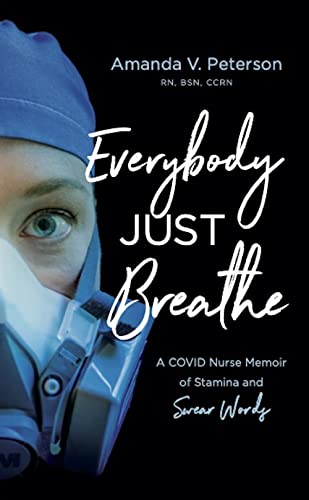
Photo source: Amazon

I’m so freaking tired of people thinking this virus is bullshit, and that only old or unhealthy people are being affected by it. It is so hard to listen to.

I pulled this quote from Everybody Just Breathe: A COVID Nurse Memoir of Stamina and Swear Words by Amanda Peterson, who worked for 11 months in a Minnesota metro hospital’s COVID ICU Unit beginning in March 2020. Her memoir documents her time there, in what she terms the longest shift of her life. This was primarily prior to vaccines.

Hers is a powerful book in so many ways, but mostly because Peterson takes readers into the ICU. She spares no details in patients’ deteriorating conditions, their struggles to survive, or not, how their families are affected and how she’s been impacted.

A early depiction of the coronavirus. Image source: CDC

I challenge anyone to read this book and not come away with a strong visual of how COVID wreaks havoc on the body beyond an inability to breathe. As a non-medical person, I didn’t fully understand how destructive this virus can be. I do now, thanks to Peterson’s stories from the ICU. The ravages of COVID for a critically ill patient are beyond nightmarish.

In her book, Peterson uses the fictional “Jack” as a COVID patient. Privacy laws necessitate this, but “Jack” represents all the patients she cared for during her time in a special COVID unit where an air filtration system roared and medical staff worked tirelessly to save lives while also comforting patients whose loved ones could not be with them.

Raw emotions of anger, fear, frustration and more pack the pages of this book. Often Peterson reminds herself to just breathe, like the patients she prompts to just breathe. Her two young children provide comic relief, noted in interspersed humorous quotes. She escapes into nature. Finds peace in prayer, strength through her faith. Support from her co-workers.

Yet, she reveals how she feels shunned, ignored, silenced, disrespected, even called a liar by the very people she’s trying to help. Her hurt is palpable. Yet, this ICU nurse carries on with caring.

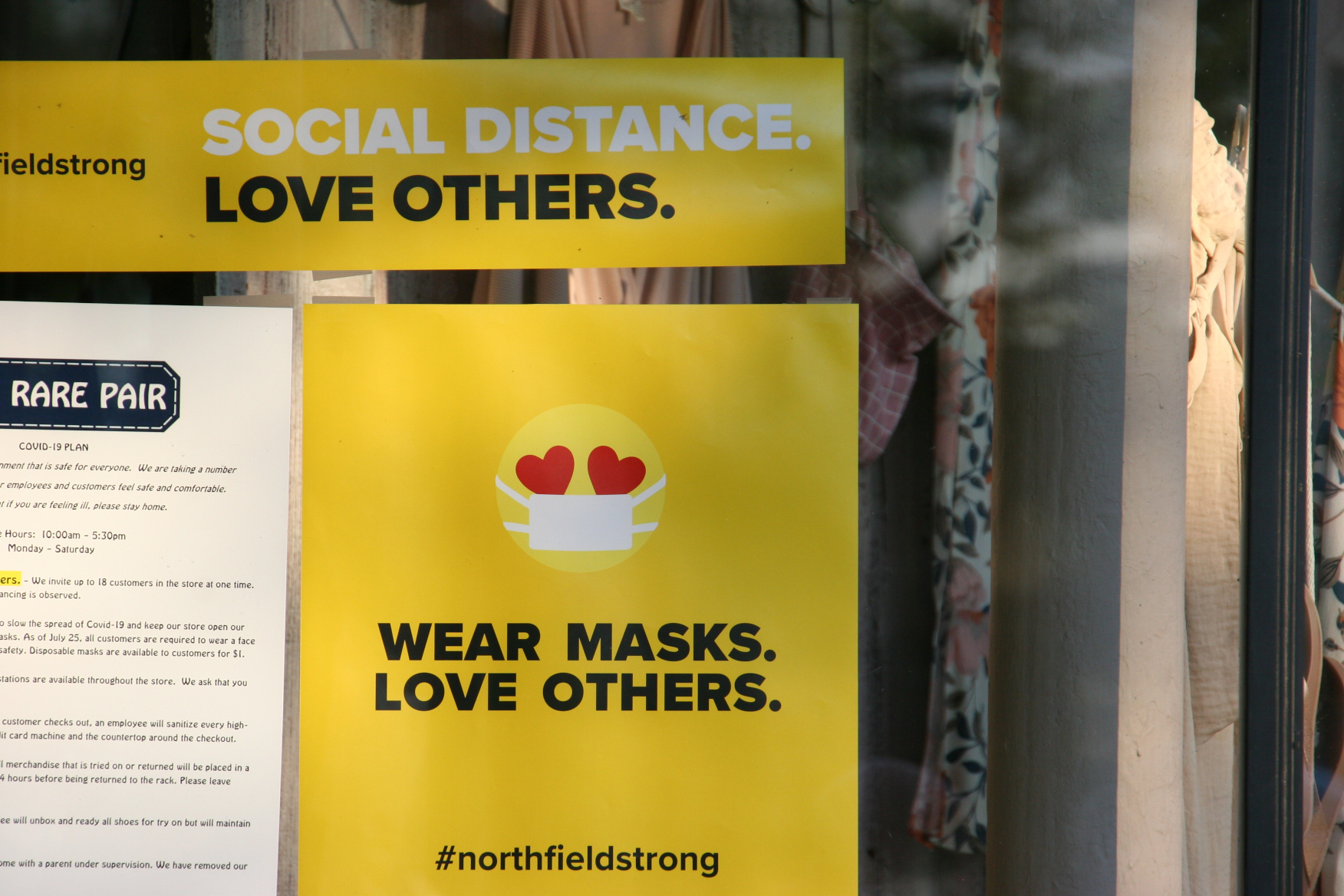
Photographed in the window of The Rare Pair in Northfield early in the pandemic. (Minnesota Prairie Roots copyrighted file photo 2020)

She is, Peterson writes, tired of simultaneously fighting the virus and the public. A public whom she calls selfish in their unwillingness to, for example, wear face masks and/or avoid gathering in crowds. Again, this was in the beginning of the pandemic, but still applicable today as highly-transmissible variants spread, infect, hospitalize and kill. I ask you to wear a mask not out of fear but out of love, she writes. Peterson repeatedly stresses the love perspective, that we ought to think about others. Why, she asks, is love so hard? I wonder the same.

That a pandemic can bring out selfishness and ugliness instead of community and love is horrifying, Peterson writes. She notes how COVID has become politicized but that the virus doesn’t care about politics. She’s right.

I came to this book with hesitancy, not about the content, but wondering whether this would be well-written. Just pages into the memoir, I was hooked. Peterson can write. Her writing style is like a conversation, free flowing (with swear words tossed in the mix), honest, introspective, nothing held back. Her stories, insights, experiences are powerful. Emotional. At times I laughed out loud. Other times I nearly cried at the immense suffering, loss and pain.

I encourage you to read this memoir by a COVID ICU nurse from Hudson, Wisconsin, who is, undeniably, in the right profession. Peterson deserves our respect and thanks for not only the care she’s given to all the “Jacks,” but also for the telling of her experiences in this unforgettable, impactful book.

© Copyright 2022 Audrey Kletscher Helbling
 

From Plainview: Jon Hassler’s “the village in the corn” June 15, 2022

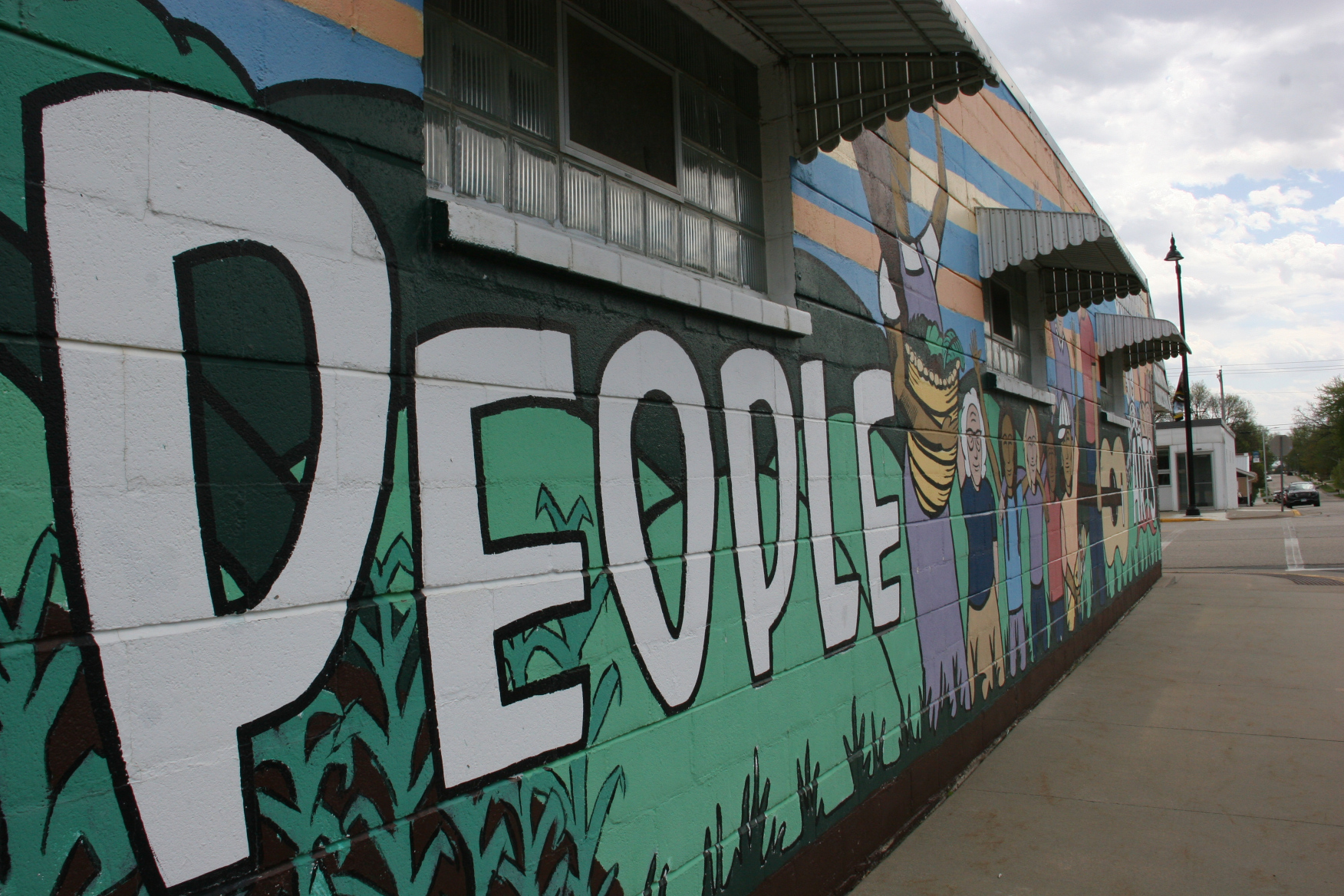
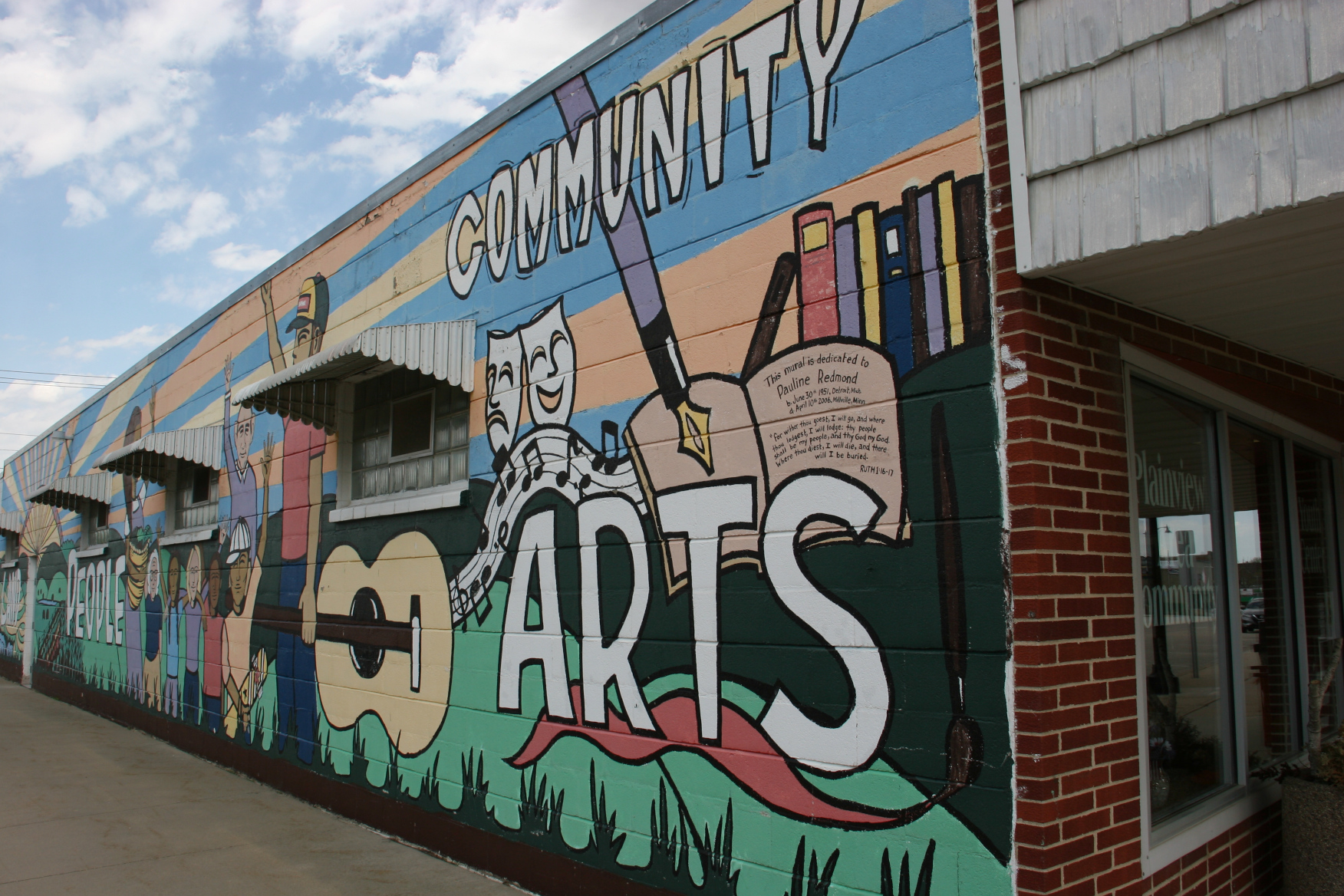
A portion of the Plainview mural. (Minnesota Prairie Roots copyrighted photo May 2022)

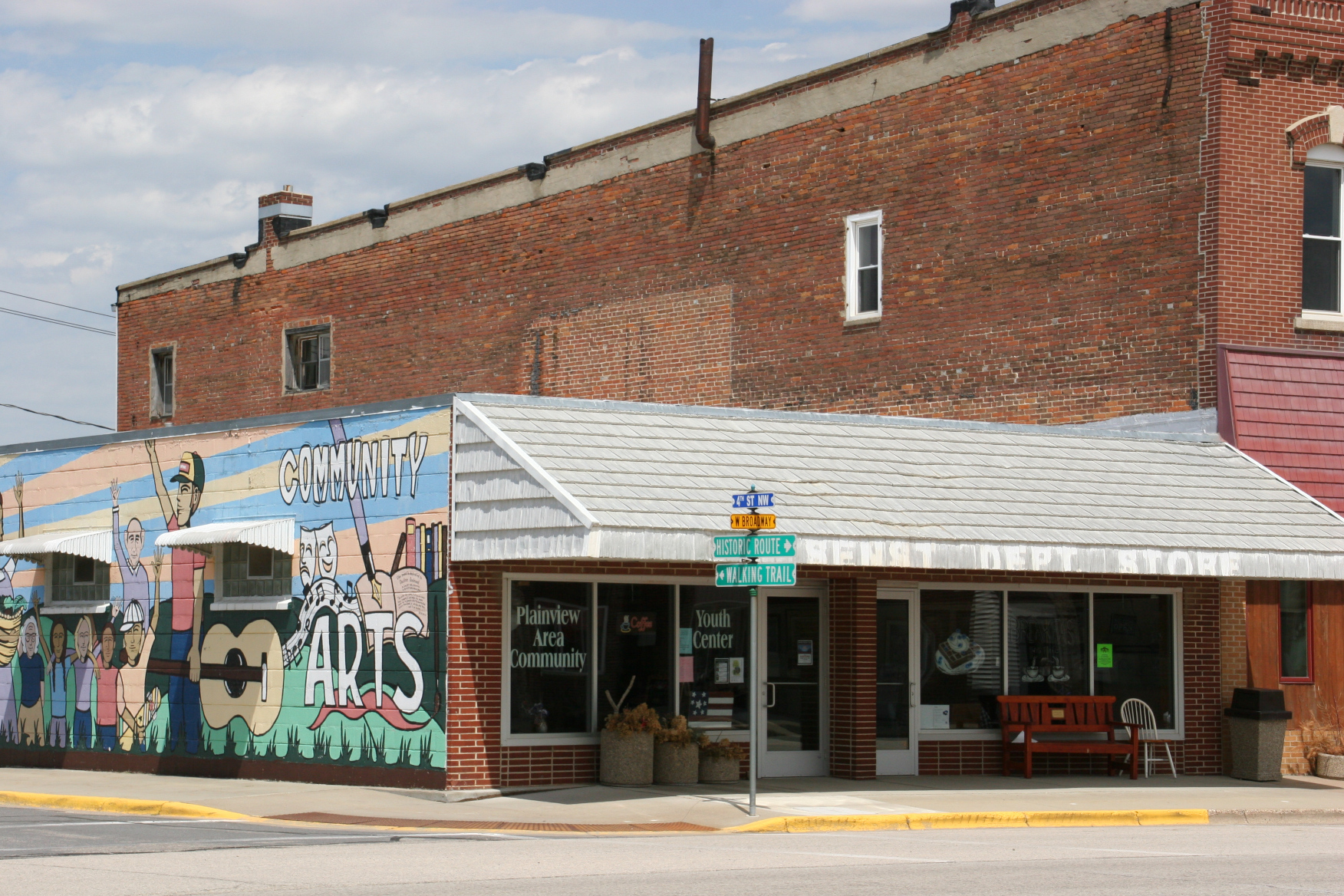
LAND. PEOPLE. ARTS. COMMUNITY. Those words theme a public mural stretching across the Plainview Area Community and Youth Center in the heart of this southeastern Minnesota small town.

The mural graces a wall of the community center, across the street from the former Jon Hassler Theater. (Minnesota Prairie Roots copyrighted photo May 2022)

I remember the mural from my last visit here in 2013. I appreciate this public art now as much as I did then, for art can reveal much about a place.

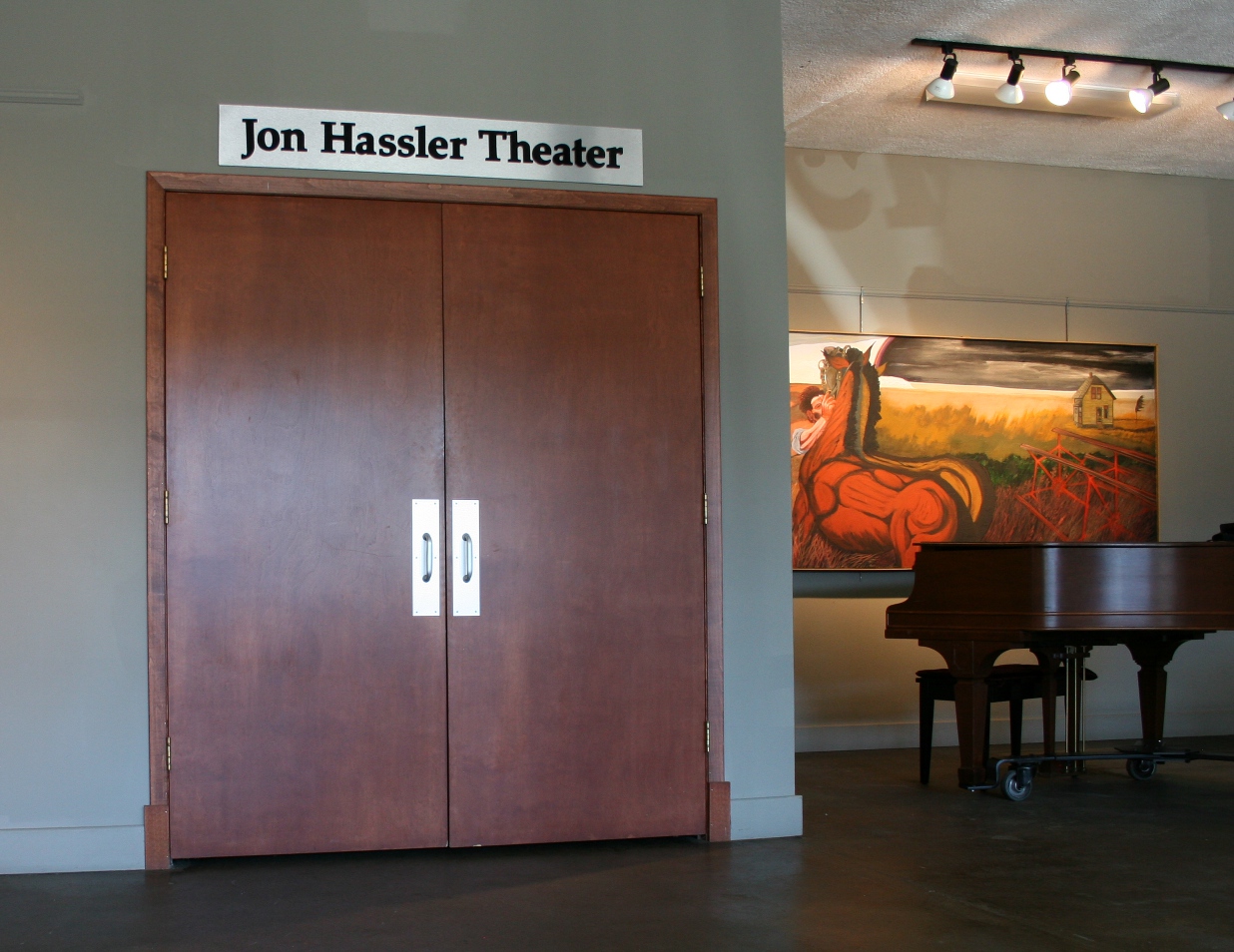
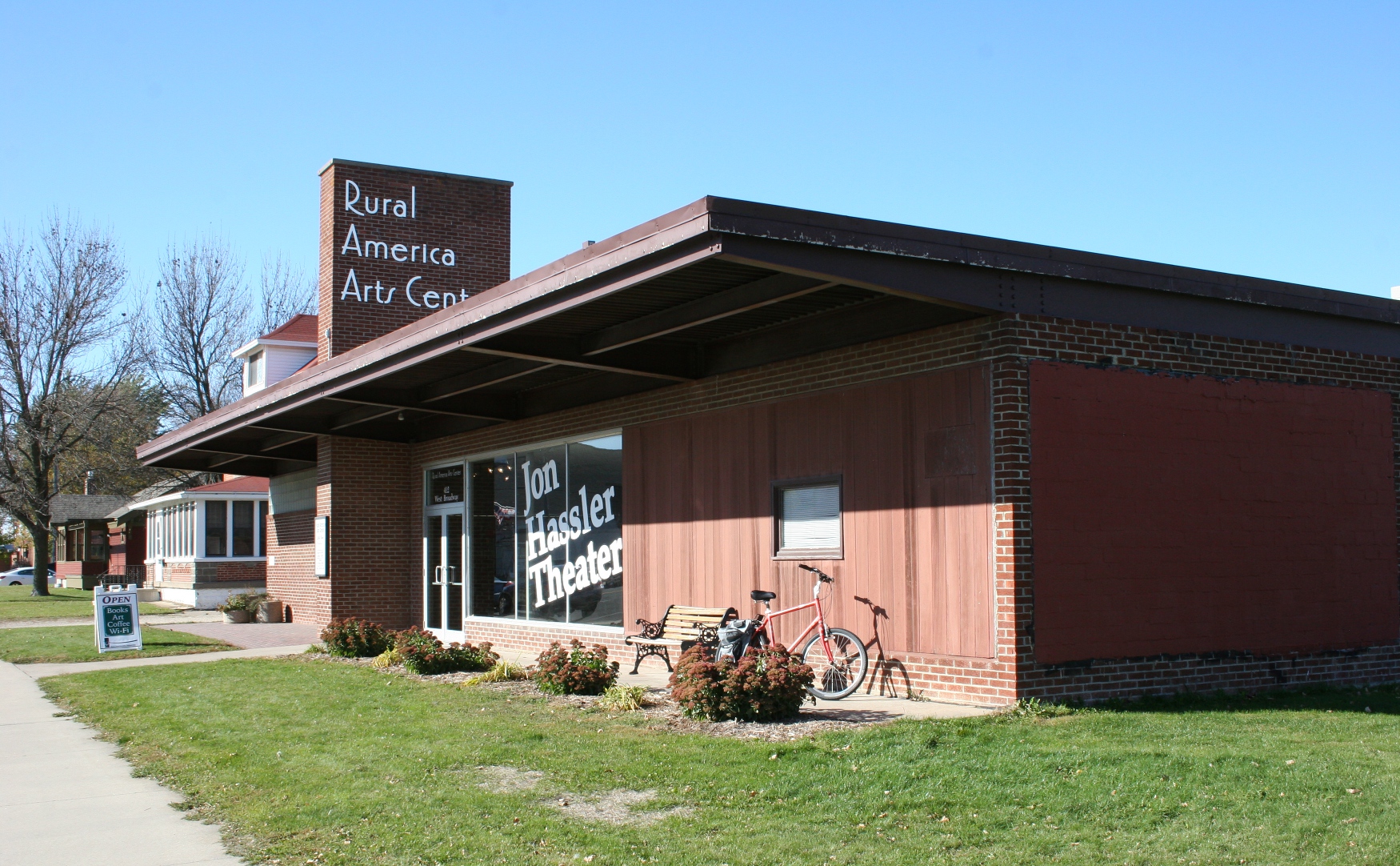
In the heart of the community, the Jon Hassler Theater and Rural America Arts Center, now closed. (Minnesota Prairie Roots copyrighted file photo November 2013)

While Plainview has lost some of its “arts” character with closure of the Jon Hassler Theater and Rural America Arts Center, it will always claim title (along with Staples) as the boyhood home (s) of noted Minnesota writer Jon Hassler. He moved to Plainview with his parents at the age of 10, remaining there until shortly after his 1951 high school graduation.

Hassler’s Grand Opening is based on Plainview.

Hassler, one of Minnesota’s most-beloved authors, focused his fiction on small town life. That includes Grand Opening, a novel based on Plainview. As in real life, the main character’s parents buy a run-down grocery store in rural Minnesota.

Source: Afton Press

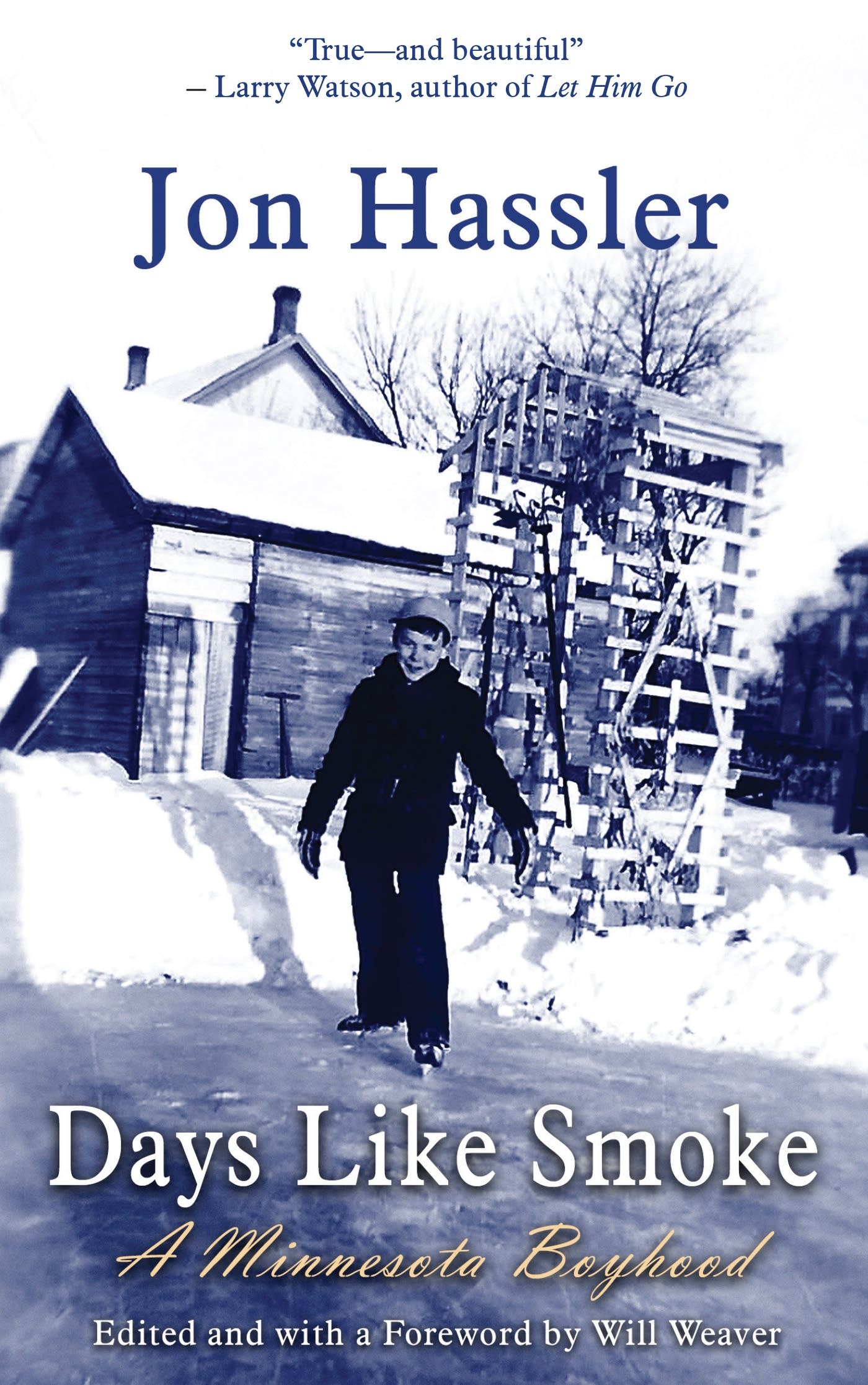
While I have not yet read Grand Opening, I just finished Days Like Smoke, A Minnesota Boyhood. This is Hassler’s memoir, a manuscript published by Afton Press in 2021, many years after the author’s 2008 death. Edited by friend Will Weaver, another well-known Minnesota writer, this slim volume offers insights into Plainview, into Hassler’s experiences there and how that shaped his writing. He credits his parents’ Red Owl Grocery Store as the training grounds for his writing, the place where he acquired the latent qualities necessary to the novelist. In that grocery store, Hassler stocked shelves, ground coffee, interacted with and observed customers, and more.

The land (farming) is integral to the economy of Plainview, which is surrounded by corn and soybean fields. (Minnesota Prairie Roots copyrighted photo May 2022)

This sentence in Hassler’s memoir is so telling of the influence Plainview had on his writing: I see the villagers passing along the checkout counter like the cast of characters they eventually turned out to be in my novel about this village in the corn. I love that phrase, “village in the corn,” for it fits agriculturally-based Plainview. The community is home to food processors, Plainview Milk Products Cooperative and Lakeside Foods, and celebrates Corn on the Cob Days each summer. Farming centers the local economy.

Two of the people featured on the mural. (Minnesota Prairie Roots copyrighted photo May 2022)

It’s the people, though, including the characters, who truly define community. And Hassler shares plenty from Plainview, where he lived across from the stockyards for awhile, tried to derail a train, played high school football for the Gophers, watched endless movies at the Gem Theater, bloodied the nose of a third grader, sat at the bedside of his dying 11-year-old friend, biked to the bluffs along the Whitewater River to camp and fish, served as an altar boy…

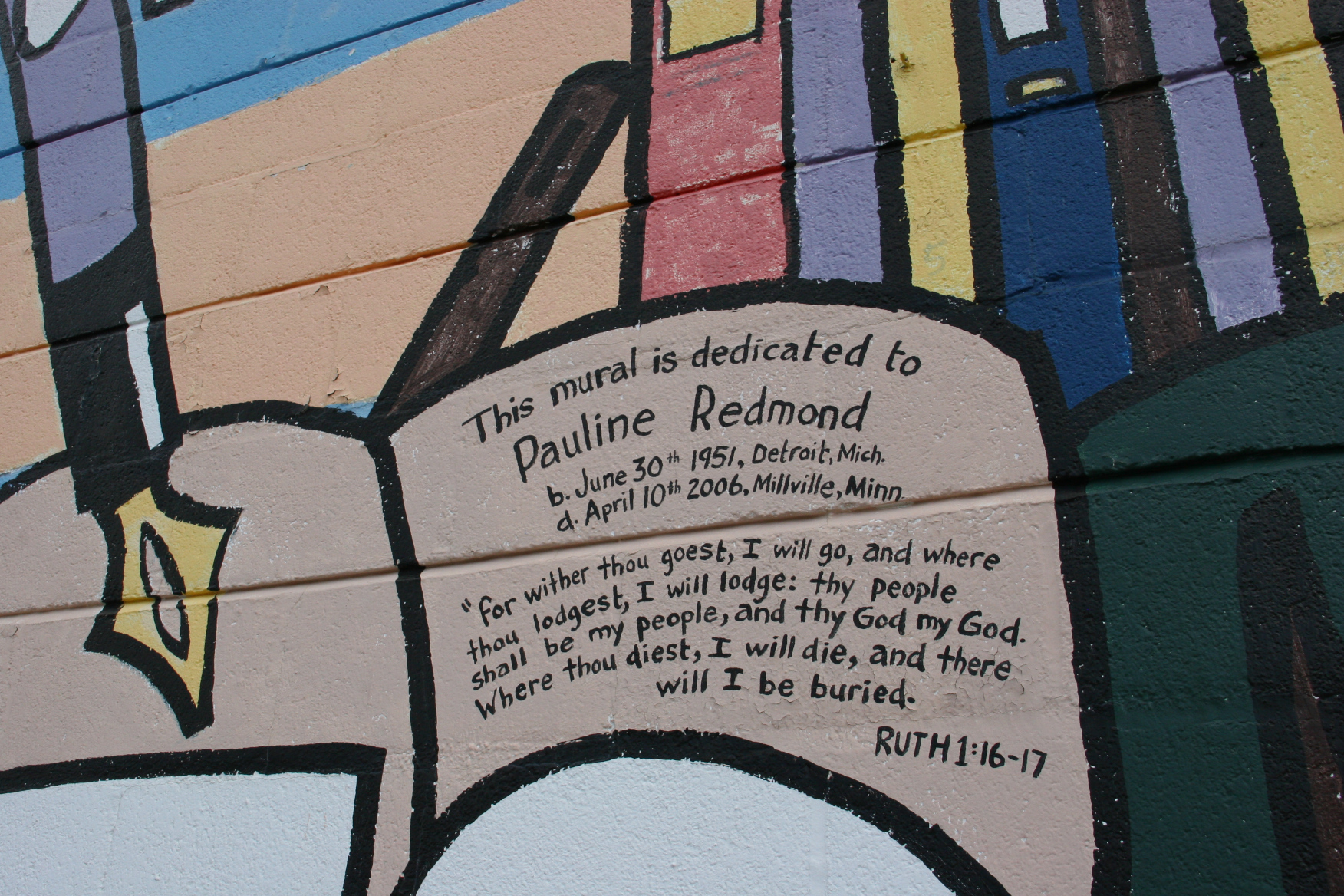
The mural includes a faith-based dedication to Pauline Redmond. She co-owned the North Country Anvil Magazine/Anvil Press with her husband, Jack Miller. (Minnesota Prairie Roots copyrighted photo May 2022)

In his memoir, Hassler remembers St. Joachim’s Catholic Church and Immanuel Lutheran Church standing as sentinels of the soul at opposite ends of Main Street. That’s such an insightful visual. Hassler valued his Catholic upbringing and faith throughout his life. But he also admits in his memoir to the strong current of religious animosity running under the surface of daily life in the village of my youth between Catholics and Lutherans. This comes as no surprise to me, growing up in rural Minnesota with the same denominational tension.

People also define place as noted on the mural. (Minnesota Prairie Roots copyrighted photo May 2022)

It was that undercurrent—specifically the defeat of Hassler’s father in a school board election—which ultimately caused Hassler’s parents to leave Plainview and return to Staples. He writes: I, newly graduated from high school, loved Plainview too dearly to follow them.

The interior entrance to the Jon Hassler Theater, photographed during a 2013 visit to Plainview. (Minnesota Prairie Roots copyrighted file photo November 2013)

Hassler’s love for Plainview endured, long after he left to attend college, then to teach, then to write and then to retire in 1997 after 17 years as writer-in-residence at Saint John’s University. Visit Plainview today and you get a strong sense of the place that shaped this writer. While businesses and people have come and gone, at its core, this remains “the village in the corn.”

TELL ME: Have you read any of Jon Hassler’s 12 novels or his nonfiction? I’d love to hear your take on his writing and what books you recommend.

Please check back for more posts from Plainview next week. Be sure to read my previous posts on Plainview published this week.

© Copyright 2022 Audrey Kletscher Helbling
 

Focus on mental health: A Minnesotan writes about her depression May 20, 2021

ARE YOU STRUGGLING with everyday tasks? Unable to get out of bed? Feeling hopeless? Overwhelmed?

You are not alone. I think all of us have struggled during this past pandemic year. Maybe not to the extent of the challenges listed, but in other ways. It’s been a lot. I’m thankful that, if anything good comes from this pandemic, it’s an increased awareness of mental health issues.

I am grateful for writers like K.J. (Kristine) Joseph for opening up about her clinical depression in her powerful memoir, Simply Because We Are Human. The Minnesota author reveals her life-long struggles with an incurable disease caused by a chemical imbalance in her brain. And that’s important to note—that depression like hers has a physical cause that can be treated, not cured. Clinical depression is much deeper than the typical I’m-feeling-kind-of-down today.

“If only my pain and illness were visible to the world…then people would understand,” Joseph writes. She’s right. Mental illness needs to be viewed through the same lens as any other illness. Except we know it all too often isn’t. The stigma remains. The lack of understanding remains. The misinformation remains. Too many still think you can will yourself, or snap yourself, out of depression or other mental illness. That doesn’t work.

That’s why books like this are so important in changing perceptions, in educating, and in building empathy and understanding.

For Joseph, her first memory of the darkness which would enter her life occurred at age eight. At age 13, feelings of emptiness, non-stop crying, sadness and, for the first time, suicidal thoughts developed. In her 20s, she would once again contemplate suicide as she stood in her kitchen, knife in hand.

It was the death of a 17-year-old friend in high school that propelled Joseph to open up about her depression. I especially appreciate Joseph’s assessment of Matt’s depression-caused suicide: “Matt took his own life because he was sick, and that was how I saw it.” By writing that, she helps ease blame and guilt which often follow a suicide.

In telling her story, Joseph also writes about ways in which she manages her clinical depression. And that is via medication, hard work and taking care of herself. She is a runner, a life-long interest/activity tracing back to childhood. In high school, she ran on the track team, even competed in the state meet. Running helps manage her depression, putting her in a calm, meditative state.

Therein lie the additional strengths of Joseph’s memoir. She offers hope. She reveals how she navigates her depression, what works for her, including taking medication. She acknowledges the reality of her mental illness. And she is open about her struggles. I applaud Joseph for writing about her clinical depression, for her raw honesty, for sharing her stories. For it is through personal stories that we most connect. And begin to understand.

TO PURCHASE Simply Because We Are Human, click here.

FYI: If you or someone you care about is struggling with mental health, please seek help. You are not alone. Here are some resources:

National Suicide Prevention Lifeline. Call 800-273-8255 (free, confidential and available 24/7).

National Alliance on Mental Illness

May marks Mental Health Awareness Month. I pledge to continue my efforts to raise awareness and to reduce the stigma of mental illness. Please read previous reviews I’ve written on books about mental illnesses by clicking here, then here, next, here, and, finally, here.

© Copyright 2021 Audrey Kletscher Helbling

 

The compelling memoir of an escapee from North Korea November 20, 2018

Filed under: Uncategorized — Audrey Kletscher Helbling @ 5:00 AM
Tags: , , , , , ,

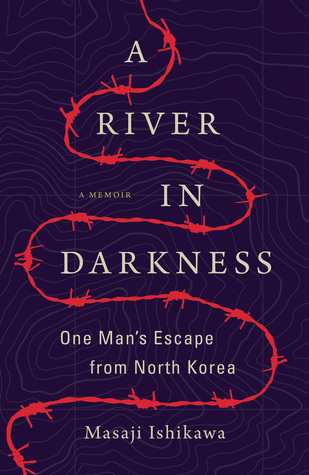
SEVERAL DAYS AGO I STARTED and finished A River in Darkness—One Man’s Escape from North Korea. Masaji Ishikawa’s memoir, written in 2000 and translated in 2017, is a compelling book, the type of story you want to stay up late reading.

It was a fitting read right before Thanksgiving. Why would I say that given the content which is simultaneously revealing and absolutely heartbreaking? It is not easy to read about an oppressive government, corruption, propaganda, starvation, death, discrimination and so many other horrors.

But it is a book that needs to be read by someone like me. Someone who grew up without much but still had enough. Someone like me who is the daughter of a Korean War veteran. Someone like me who pursued a journalism degree. Someone like me who can write and speak freely. Someone like me who lives in a free country.

I needed to read Ishikawa’s statement: “The penalty for thinking was death.” To me, that proved the most powerful line in the memoir. I cannot imagine feeling that you cannot even think freely.

Upon finishing the book, I felt an overwhelming sense of gratitude for the freedoms I have. But I also felt an overwhelming sense of grief for those people who live under oppressive regimes. Still today. This book opened my eyes wide as political rhetoric runs rampant.

TELL ME: Have you read this memoir and, if so, how did you react?

© Copyright 2018 Audrey Kletscher Helbling

 

From Minneapolis neighborhood to prison, one inmate’s life story June 13, 2017


NOT ALL THAT FAR from my home, across the historic viaduct spanning the Straight River, past the hospital and down the road a bit, razor wire tops fences surrounding the Minnesota Correctional Facility, Faribault.

Among the men incarcerated there is Zeke Caligiuri, prisoner and author.

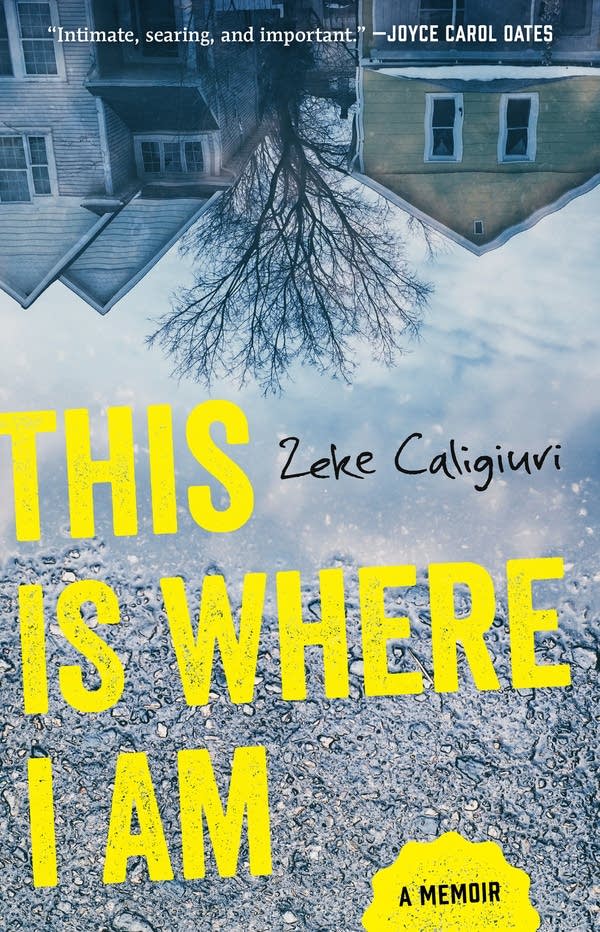
I recently read his book, This Is Where I Am, a memoir that takes the reader from Caligiuri’s growing up years in the Powderhorn Park neighborhood of south Minneapolis to a prison cell. His urban life was marked by school truancy, drug use and dealing, crime, violence, and a lack of purpose. All this despite loving parents and a grandmother who never gave up on him, who wanted and expected so much more. He doesn’t blame them for the choices he made.

I’ve never read a book like this because, well, I’ve never read a book written by an inmate. His story is both revealing and yet not so. I kept waiting for Caligiuri to share information on the crime that landed him a 34-year prison sentence in 1999. He never did. To me, the absence of that presents a gaping hole in an otherwise revealing read. For the record, he is in prison for robbery and second-degree murder with a scheduled release in 2022.

A threading theme throughout Caligiuri’s story seems to be an innate desire to change. Yet, the pull of environment, the pull of long-time friends, the pull of drugs, the pull of darkness overwhelmed him. Depression defined that darkness. Given the recent public shift toward addressing mental health issues, this particular part of the story is especially enlightening in its in-depth details. My heart hurt for the young adult overcome by an illness that is too often not addressed by society (although that seems to be changing).

Caligiuri doesn’t write about daily prison life as much as he writes about his feelings and his struggles to maintain his sanity within the confines of a penal institution. When he throws food out of his cell and when he hides a banned something (which he fails to identify) in his cell during a lockdown, I feel no sympathy for the rebellion, defiance and anger he holds. Perhaps I should. But then my thoughts trace back to his crime.

How you view this book depends, I think, on your experiences. If you have been personally affected by violent crime either directly or indirectly through a family member or friend as I have been, you will probably react differently than a reader who has never been victimized.

I appreciate, though, this honesty in Caligiuri’s book: I looked around and everyone had a story about getting f****d by the system, or by their best friend, or the mother of their kids.

Blame, blame, blame…anyone but themselves for their incarceration. That this inmate-writer recognizes that lack of responsibility and accountability is noteworthy.

The author considers himself a much different person than the young adult who entered prison nearly two decades ago. That is evident through the telling of his story. He’s clearly proven himself as an author with a unique voice. He can write. He’s educated himself. He’s matured. In five years he’ll leave prison, trying to determine his new role in the world away from the men who have become his family and away from the place that’s been home for so long.


© Copyright 2017 Audrey Kletscher Helbling

 

My award-winning water story publishes April 8, 2017


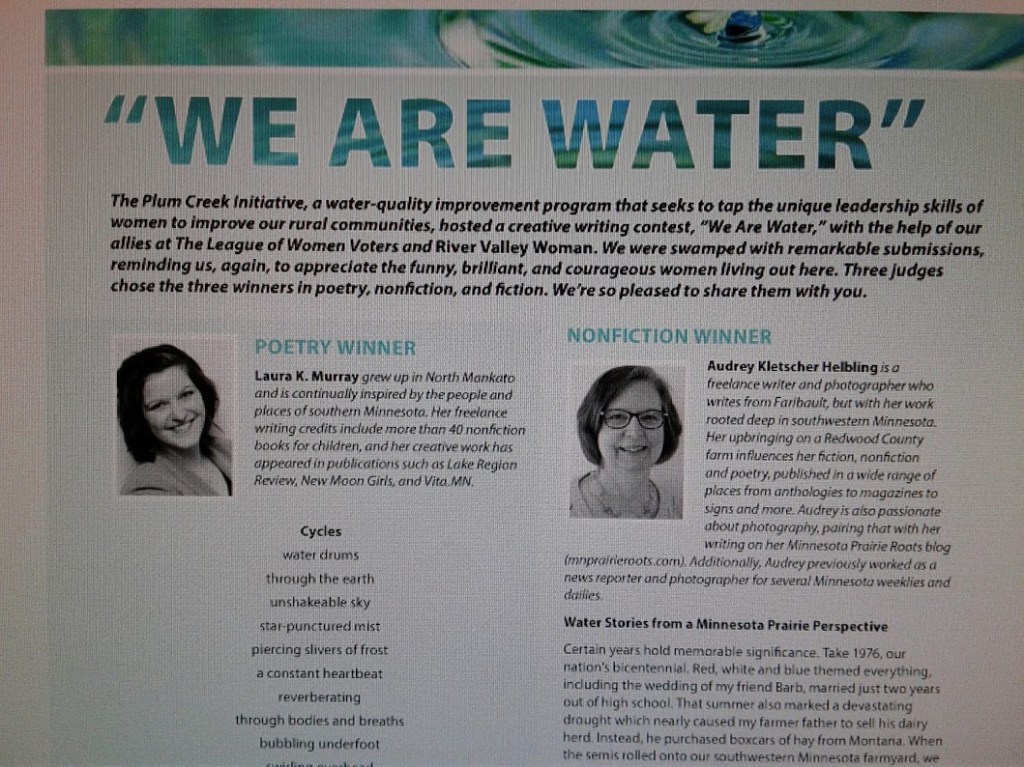
“Water Stories from a Minnesota Prairie Perspective” has published in southern Minnesota based River Valley Woman’s April issue. My story won the nonfiction category in the “We Are Water” writing contest sponsored by Plum Creek Initiative with the support of The League of Women Voters and River Valley Woman. That honor includes a $250 prize.

I don’t have a hard copy yet, but I viewed the story online. And so can you by clicking here and advancing to page 50 of the April issue. The piece is lengthy per submission guidelines requiring 5 – 12 pages of copy.

No matter how many times I’ve been published, I still thrill in seeing my words out there for others to read and perhaps appreciate. You can find print copies of the magazine in many locations like Mankato, St. Peter, New Ulm, Redwood Falls and surrounding smaller communities. Click here for a complete list.

In reading my story, you will learn of my growing up years on a southwestern Minnesota dairy and crop farm, the place that shaped me into the person, writer and photographer I’ve become. Farm life as I remember it from the 1960s – 1970s no longer exists. So this story, while written for a competition, was also written for me and my family. There’s an importance in reclaiming memories through written words, in telling the stories that define a place, in sharing my roots with you, my readers.

FYI: Click here to read my first blog post about winning this writing competition.

© Copyright 2017 Audrey Kletscher Helbling
 

Recommended Minnesota reads December 5, 2016

THIS TIME OF YEAR, when daylight fades too early into evening darkness, when I want nothing more than to stay indoors cozied against the Minnesota cold, I find myself gathering books. Stashing, stacking, sequestering them in my home.

And then I read, snugged into a corner of the reclining sofa that no longer reclines (unless the husband yanks on the redneck handle he’s improvised to replace the broken pull). I tuck into a fleece throw in hues that linger autumn.

Then I read. Of mystery in prose and poetry. Of fictional places. Of memories. Words wrapping stories around me. Writers writing so I can read. Of their experiences. Of their imaginations. Of their struggles and joys and moments.

Often I choose to read local, a subconscious decision tracing to my years writing book reviews for a now-defunct Minnesota magazine. But I am also drawn to Minnesota writers because of the connection I have to them. We are, or were, of this place, of these people.

In honor of Minnesota reads, I direct you to these books:


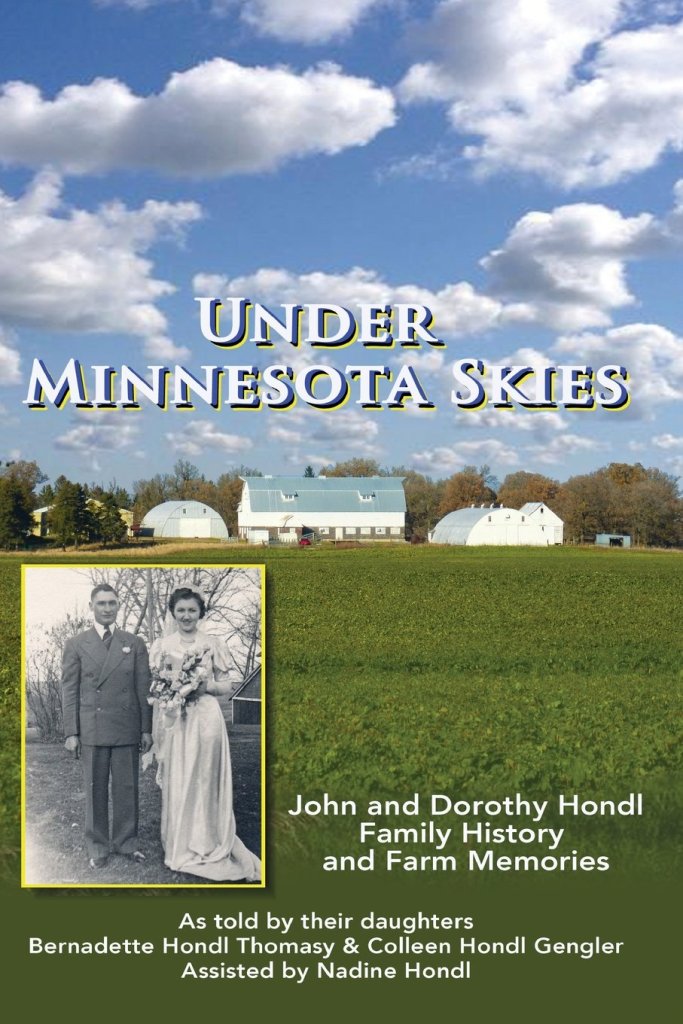
under-minnesota-skies


Under Minnesota Skies: John and Dorothy Hondl Family History and Farm Memories, penned by sisters Bernadette Hondl Thomasy and Colleen Hondl Gengler, is promoted as a family memoir of farm life in the 1940s-1960s that reflects on Czech and German heritage. The farm referenced in the book sits near Owatonna and has been in the Hondl family since 1881.

I can relate to much of the book’s content. The hard work and joys of farm life. Making hay. Filling silo. Tending livestock. This memoir, too, prompts long-forgotten memories of licking Gold Bond Stamps, of the South St. Paul Stockyard, of listening to WCCO 8-3-0, of driving tractor, of yearning for books.

Turning the pages of Under Minnesota Skies is like flipping the pages of a photo album detailing rural life. Except in words. Email the authors at kbthomasy at aol.com or dcgeng at frontiernet.net to purchase an autographed copy. Or buy the book at Little Professor Book Center in Owatonna or online at amazon.


ts-book-cover-2016


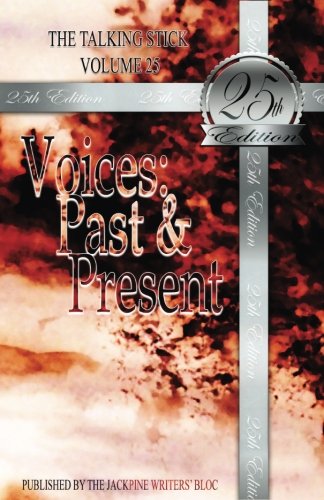
Voices: Past & Present, The Talking Stick Volume 25, is an eclectic collection of writing by Minnesota authors, or those with a strong Minnesota tie. Published by the northern Minnesota Jackpine Writers’ Bloc, this anthology includes 139 poems, 26 pieces of creative nonfiction and 20 works of fiction from 118 writers. So a good sampling of Minnesota talent.

Getting published in this book is a competitive process. Two of my poems, “Confessions in a Grocery Store Parking Lot” and “Prairie Garden Memories” are among the works printed in this 25th anniversary edition. Order on amazon.


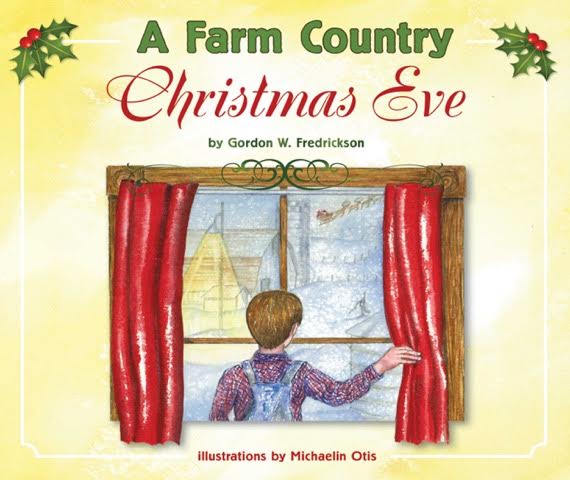
farm-country-christmas


Finally, anyone interested in rural life, should read the books penned by prolific husband and wife team Gordon and Nancy Fredrickson of Lakeville. The pair offer children’s picture books in their “A Farm Country” and “If I Were a Farmer” series. They have also written American Farm Heritage and poetry volumes for adults.

The Fredricksons’ books truly are a tribute to the rural way of life. These books can be purchased on the authors’ website, via amazon or at these Minnesota locations: Secret Attic in Northfield; The Old Hotel, New Market; and Bongards Cheese Shop, Bongards.

TELL ME: What local books have you read? What local books are you purchasing as Christmas gifts?

© Copyright 2016 Audrey Kletscher Helbling