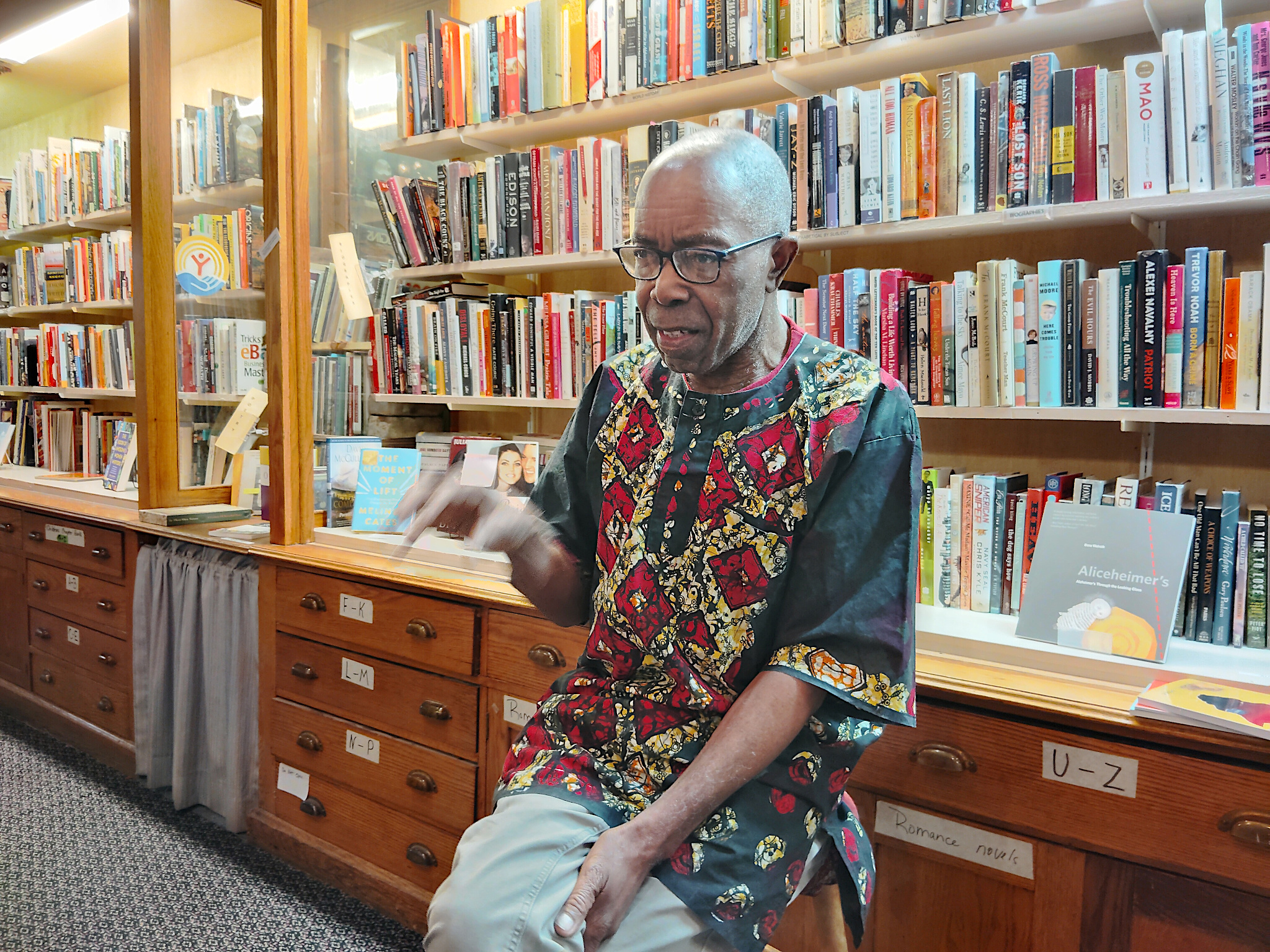
Joseph Mbele shares stories, proverbs and culture on February 11 at Books on Central, Faribault. (Minnesota Prairie Roots copyrighted photo February 2026)
Last Wednesday evening, Joseph Mbele, retired St. Olaf College professor of post-colonial literature, cultural consultant, author and storyteller, shared three African proverbs during a literary event at Books on Central. This man, who calls himself an African and a Tanzanian, held the rapt attention of attendees gathered in the used bookshop in the heart of downtown Faribault, home to many Somalis.
THE CROCODILE
While I enjoyed the two African folktales Mbele told, I really appreciated the proverbs. They are, by nature of a proverb, succinct. A few words carry a whole lot of punch. First up, this proverb: “Before you cross the river, don’t insult the crocodile’s mouth.”
Immediately the image of a crocodile’s sharp teeth popped into my mind. As it should have. This proverb, Mbele explained, is about being respectful to people in our relationships and in life in general. Be anything but respectful and we risk negative consequences. Snap.
THE BLACKSMITH
Second up this African proverb: “It’s because of man that the blacksmith makes weapons.” Thinking in African terms, the weapons would be knives and spears. I thought of guns. Mbele repeated the proverb, letting it sink into our brains. “It’s because of man that the blacksmith makes weapons.” The lesson here, Mbele said, is that we can be better than this—be kind, helpful and supportive—so we don’t need to bear arms/weapons. That’s an oversimplification, of course. But proverbs are not meant to be complex.
THE VISUALLY-IMPAIRED
Third, Mbele recited this proverb: “The one-eyed person only thanked God after he saw a blind person.” As someone with vision issues, that hit home. The proverb is a way of teaching gratitude, Mbele said. The contrast between seeing with only one eye and total blindness put the situation in perspective. The thought that there’s always someone who has it worse probably flitted through the minds of everyone in the bookshop.
THE STORYTELLERS
Mbele talked about the tradition of Africans sitting around telling stories to entertain and teach. Languages like his native Matengo, an indigenous language in Tanzania, are oral, not written. As he spoke, I began to understand the importance of folktales in African life. Stories connect people and, like proverbs, teach lessons.
Applied to my own community, Mbele explained that Somali men gathering on downtown Faribault street corners are simply socializing and sharing stories and are not to be feared. “It’s un-African to be by yourself,” he said of a culture that focuses on family and togetherness.
He even went so far as to say an African could be considered evil or a witch if living alone. That surprised me, but drove home the cultural importance of community and family. Now if only everyone in Faribault could hear these proverbs and insights from this native Tanzanian. Then perhaps they would not fear that which they don’t understand, like the Somali elders gathered on street corners downtown telling stories, sharing news or simply sitting in each other’s presence.
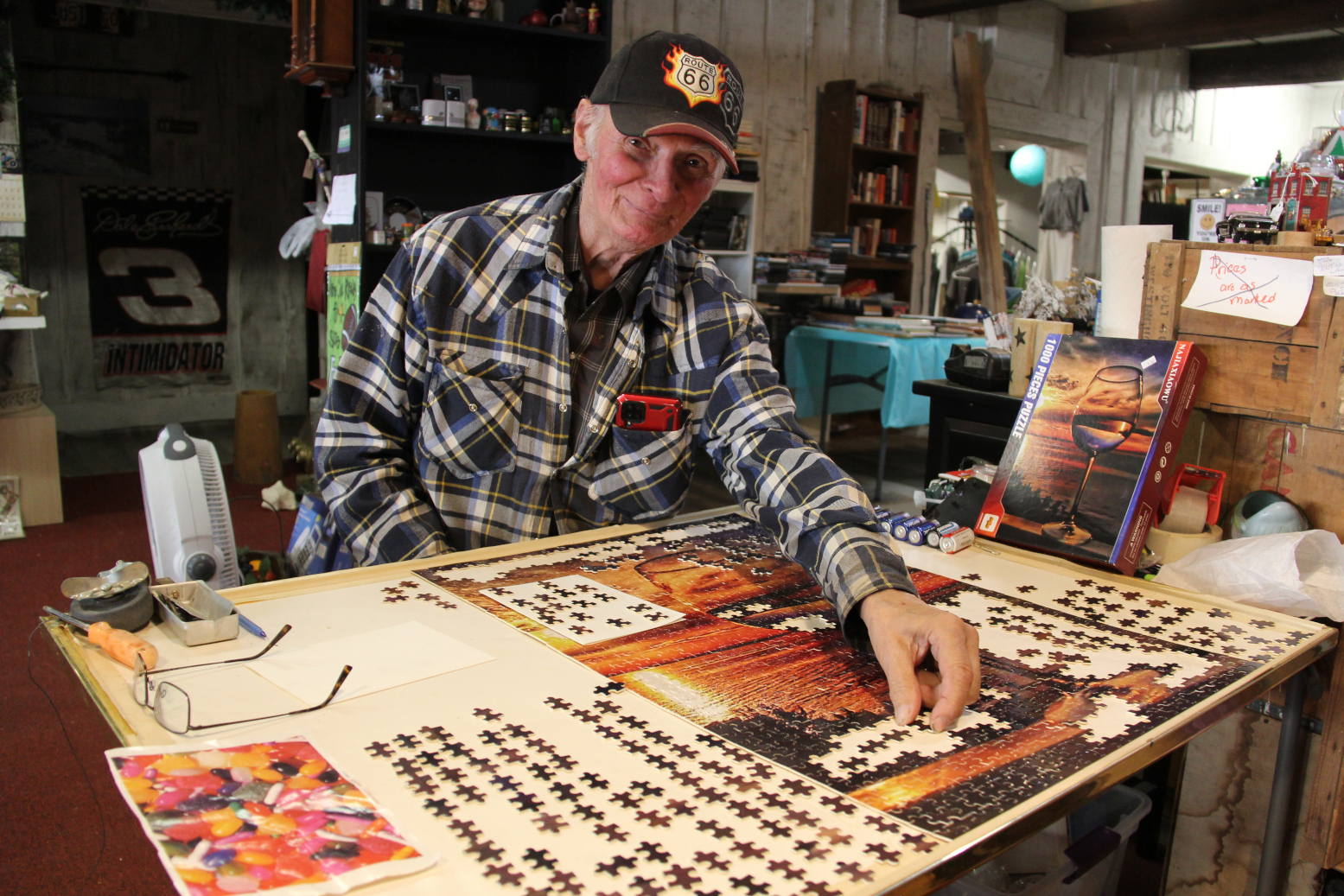
When I walked into Ron’s hodgepodge of a shop in downtown Waterville, I found him working on a puzzle. I asked to take his photo and he agreed. He loves puzzling and that shows. I really like this everyday slice-of-life-in-a-small-town portrait. (Minnesota Prairie Roots copyrighted photo October 2025)
THROUGHOUT THE YEAR, I take thousands of photos, many of them at public events. At these gatherings, whether celebratory or somber, I am drawn to document moments of humanity. Perhaps it’s a look, a reaction, an interaction. I’ve been doing photography long enough to understand when something will make a good photo. And when I say “good,” I mean a well-composed image that tells a story and, hopefully, garners a reaction from anyone who sees it.
I come from a journalism background, earning a degree in mass communications, news-editorial emphasis, in 1978. I was required to take a few photography classes as part of that long ago degree. Those taught me the basics, which I carried with me to every newspaper reporting and freelance job I’ve ever held. I didn’t always have the luxury of a staff photographer. I was the reporter and the photographer.
In the decades since, from film to digital, I’ve gained confidence and skills in photography. And I continue to the love the craft. For me, photography centers on storytelling.
As I’ve been out and about in southern Minnesota during 2025, I’ve used my Canon EOS 60D, an older DSLR camera, to document what I’ve seen. Among the thousands of people photos I took this past year, I chose my top 12 to highlight in this end-of-year post. Only one image, the photo at the top of this post, was not photographed at a public gathering.
Enjoy! And feel free to share your thoughts in the comment section.
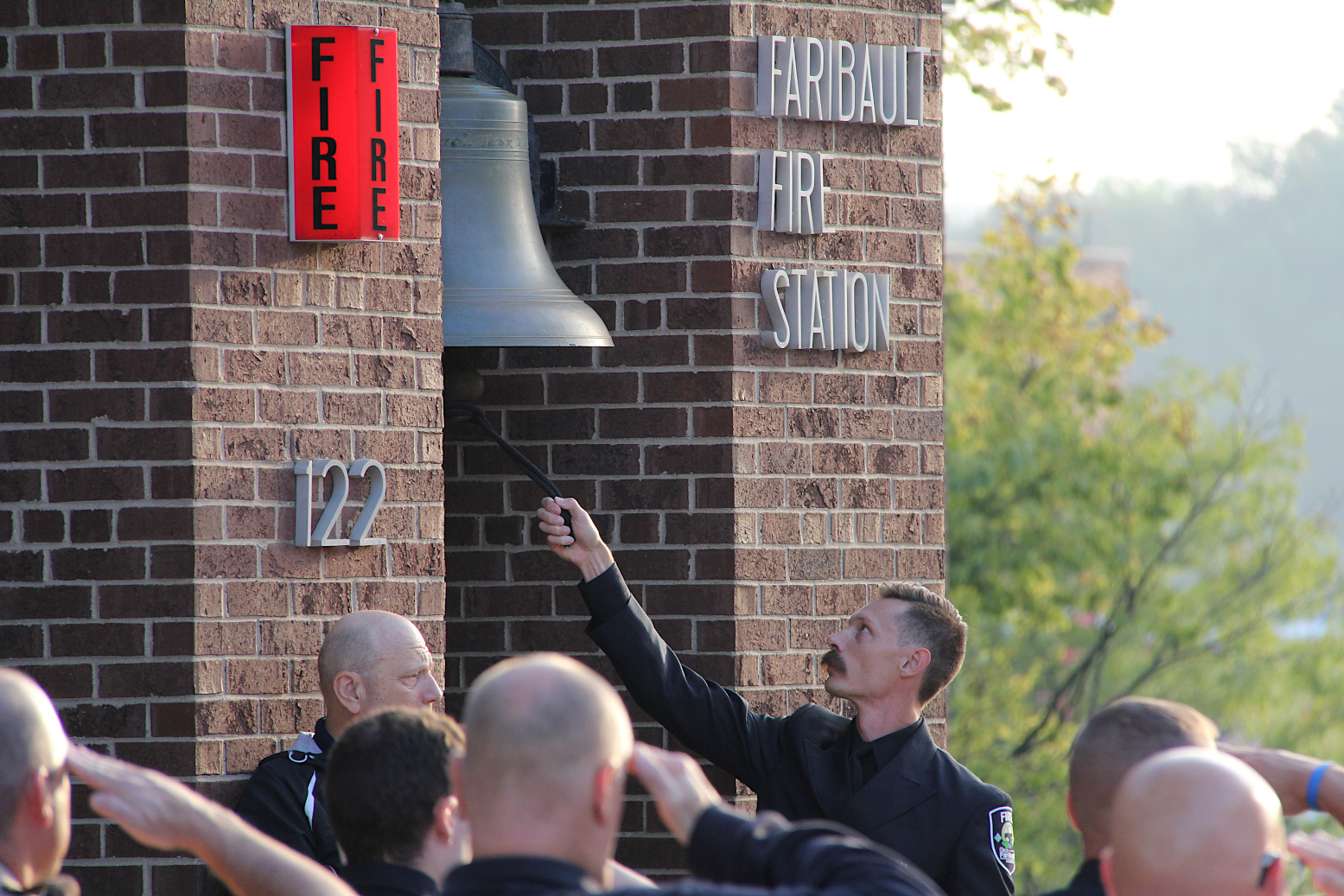
I caught the moment a firefighter rang a bell outside the Faribault fire hall during a 9/11 commemoration. The morning light was perfect and everything fell into place to make this an especially moving photo. (Minnesota Prairie Roots copyrighted photo 2025)
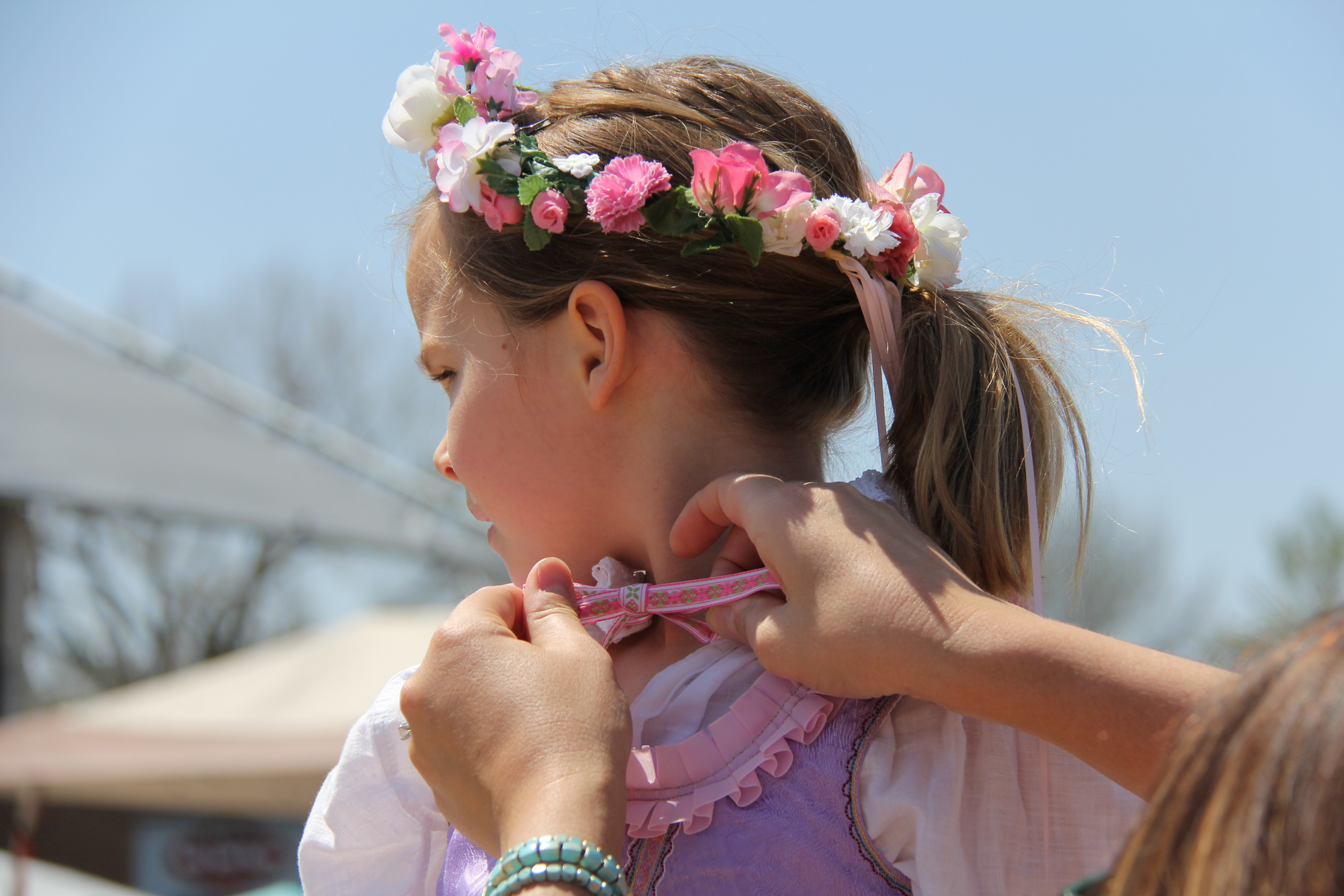
A tender moment when a mom retied a ribbon on her daughter’s Czech costume during a dance at Montgomery’s Czech May Day celebration. (Minnesota Prairie Roots copyrighted photo May 2025)
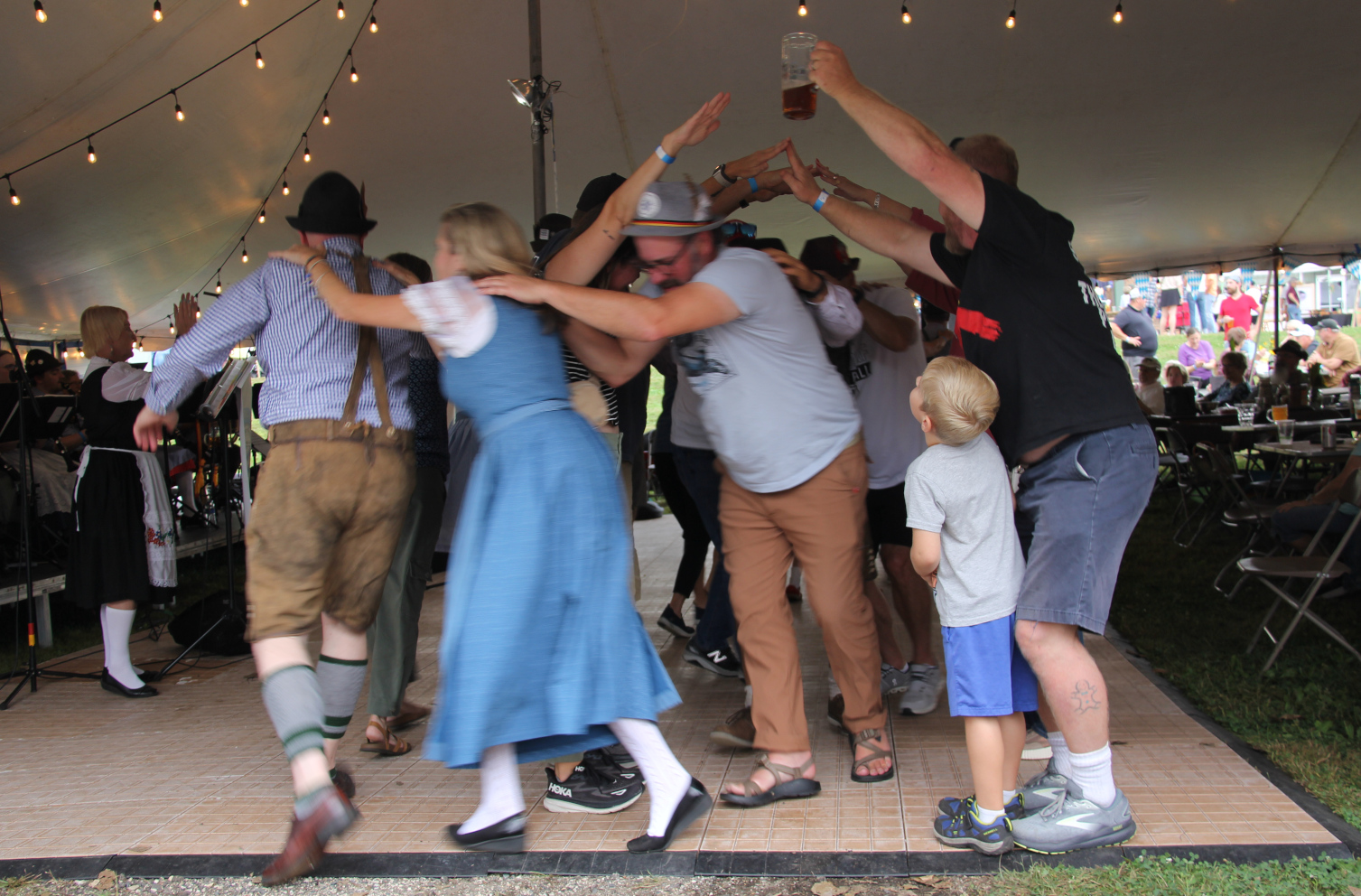
Oktoberfest in Dundas provided plenty of photo ops, including this one where a young boy wanted to join the dancing adults.Or maybe he was just watching, happy to be on the sideline. Whatever, I like the photo a lot. (Minnesota Prairie Roots copyrighted photo October 2025)
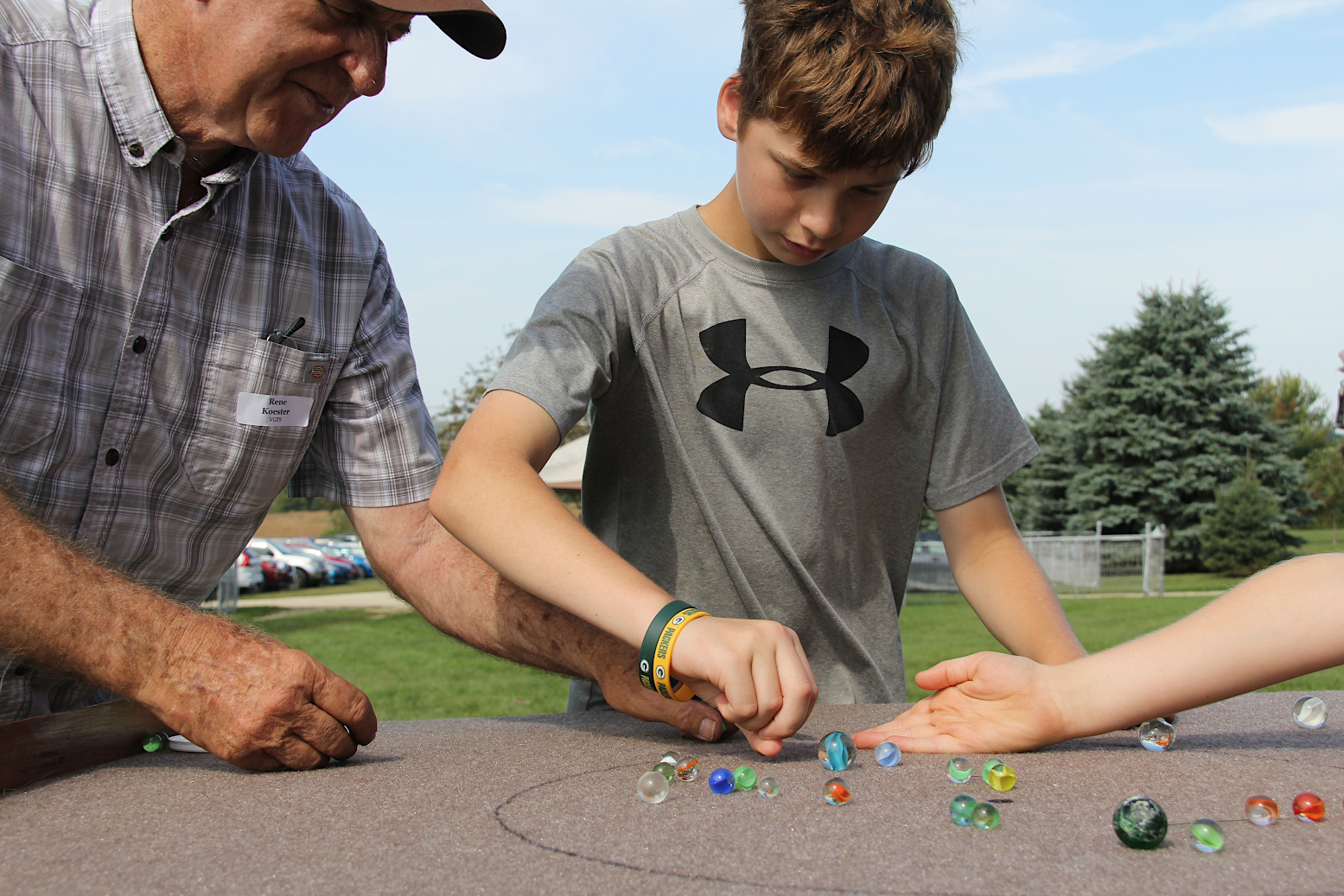
In this inter-generational scene, a grandfather teaches marbles to his grandsons at the Valley Grove Country Social, rural Nerstrand. They were so intent on the game that they paid me no attention, just as I like it. (Minnesota Prairie Roots copyrighted photo September 2025)
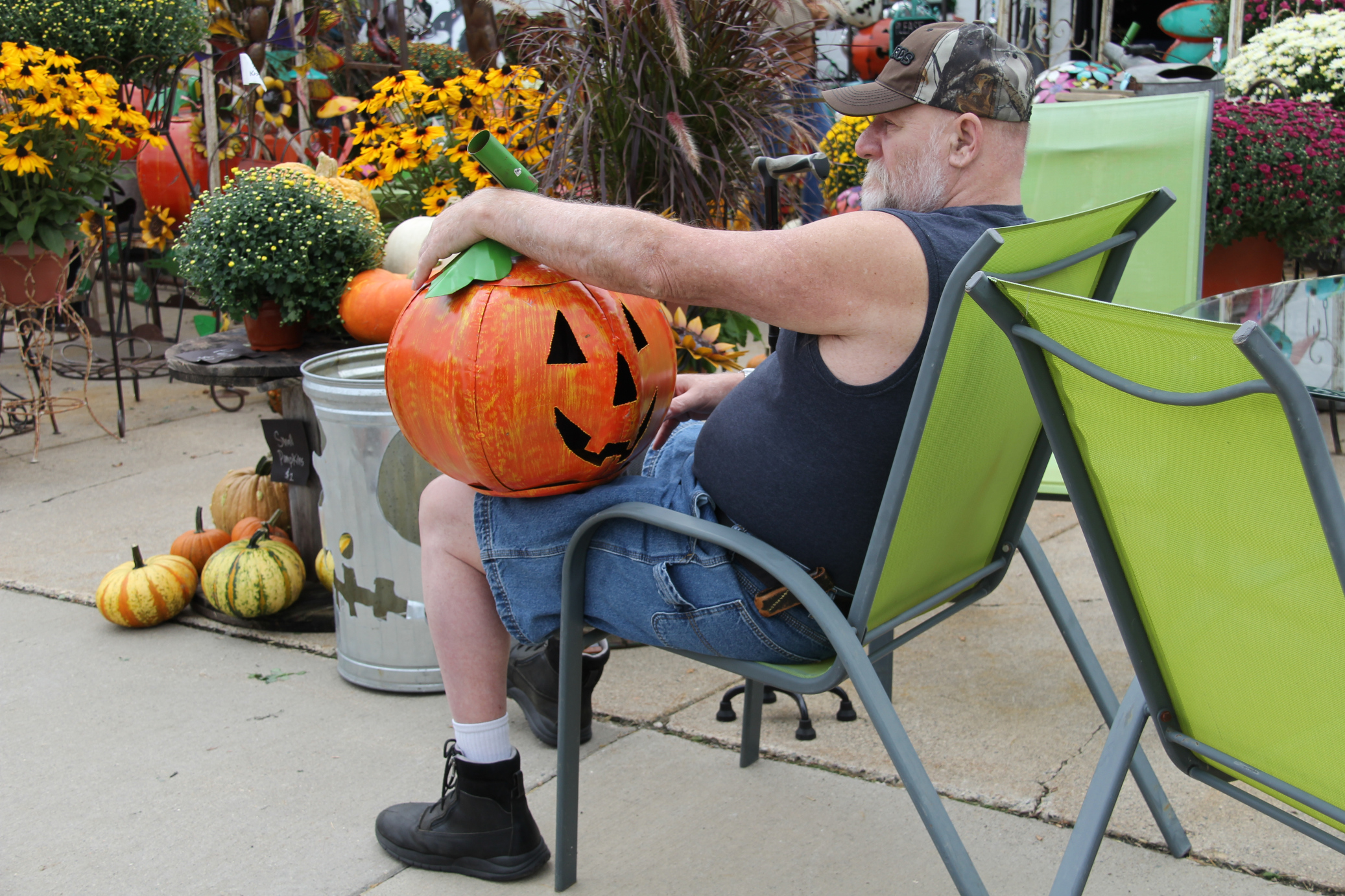
I found this scene humorous and likely relatable for every guy who has ever waited for their partner to finish shopping. I took the image outside RR Revival in Lonsdale during a craft show in that small town. (Minnesota Prairie Roots copyrighted photo September 2025)
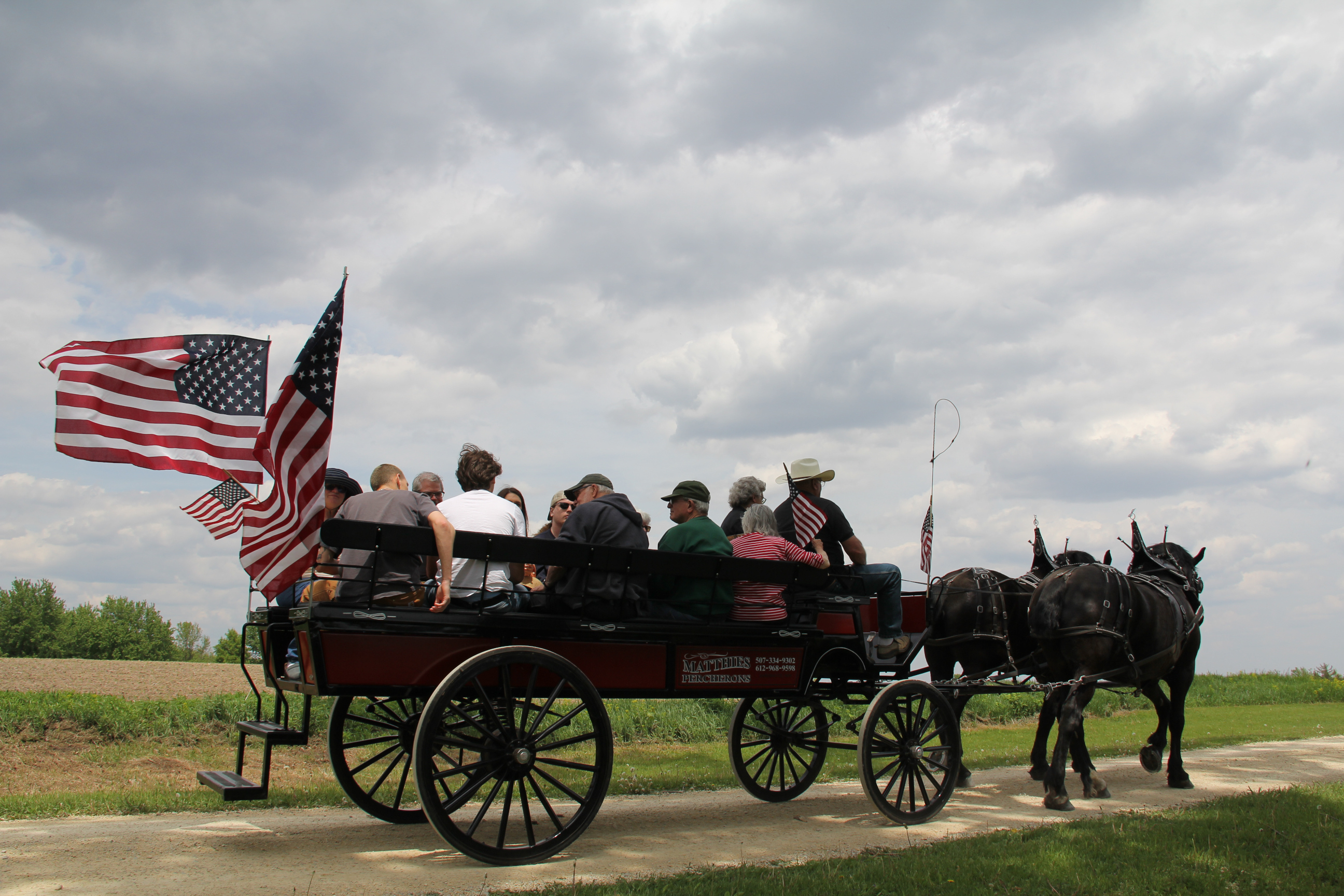
If ever there was a photo that exudes love of country in rural Minnesota, it is this image of a wagonload of people heading to the Memorial Day program at the Cannon City Cemetery. (Minnesota Prairie Roots copyrighted photo May 2025)
In the context of everything happening in America, especially in Minnesota, this photo sends a strong message of American pride. These Somali-American children, U.S. flags in hand, watched the Memorial Day parade in downtown Faribault. (Minnesota Prairie Roots copyrighted photo May 2025)
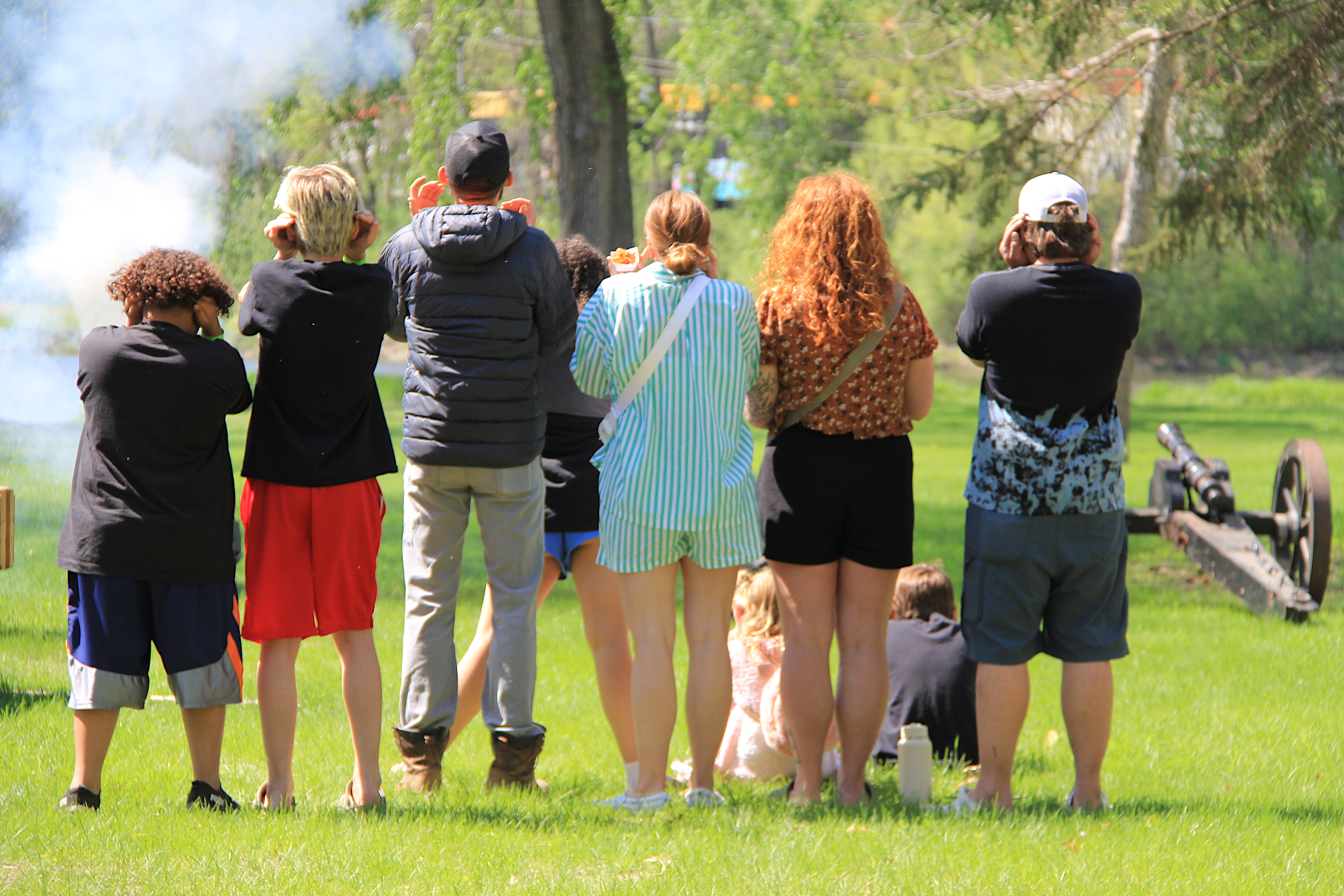
As a cannon shot off during the Riverside Rendezvous & History Festival in Faribault, attendees were told to cover their ears for protection. I framed this scene to tell that story. (Minnesota Prairie Roots copyrighted photo May 2025)
There were no second chances to get this photo of two women greeting each other at a downtown Faribault Car Cruise Night. I love the joy I was able to photograph in one single shot. (Minnesota Prairie Roots copyrighted photo June 2025)
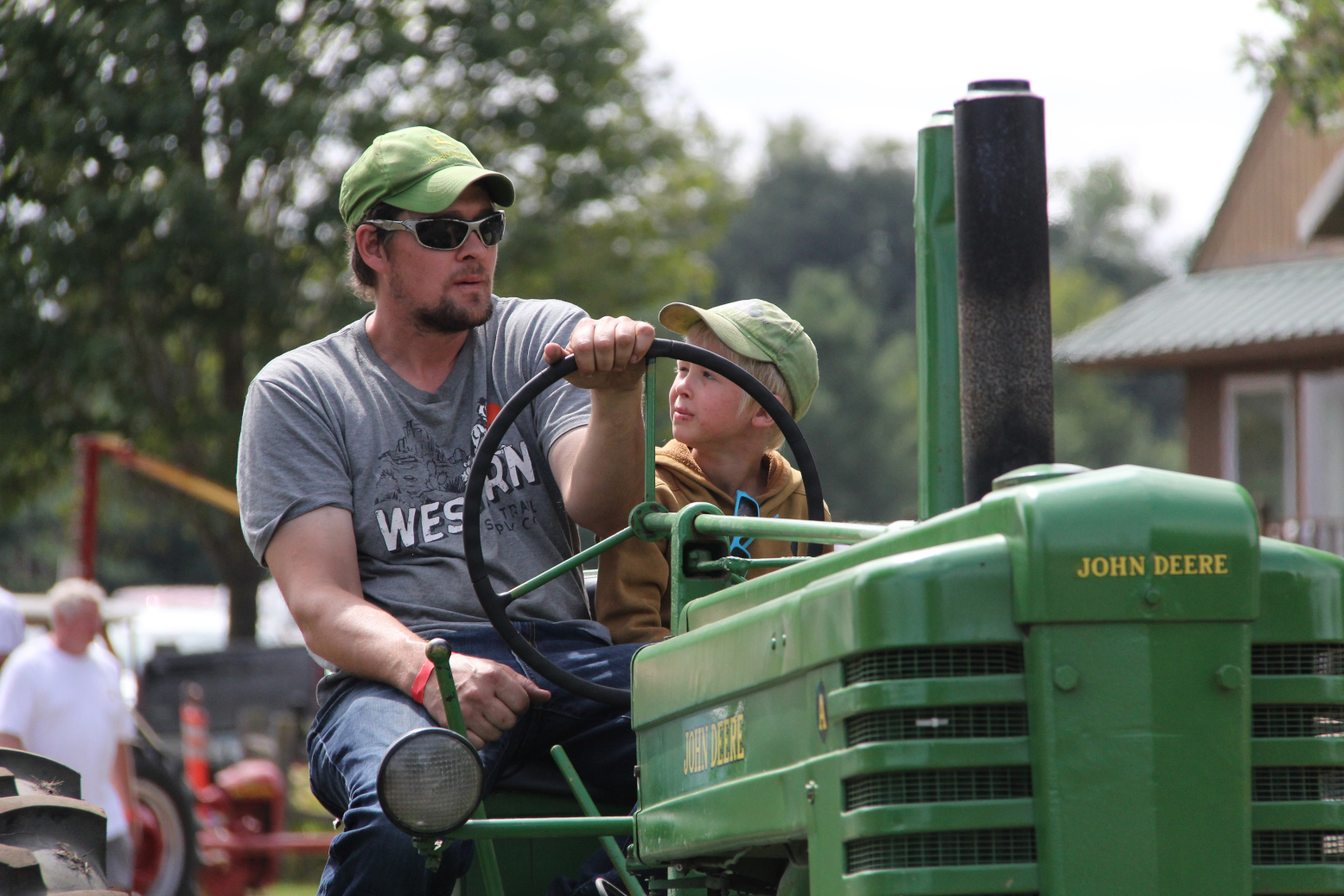
The Rice County Steam & Gas Engines Show tractor parade offers plenty of photo ops. I see total admiration on this young boy’s face and was delighted to photograph that sweet moment. (Minnesota Prairie Roots copyrighted photo August 2025)
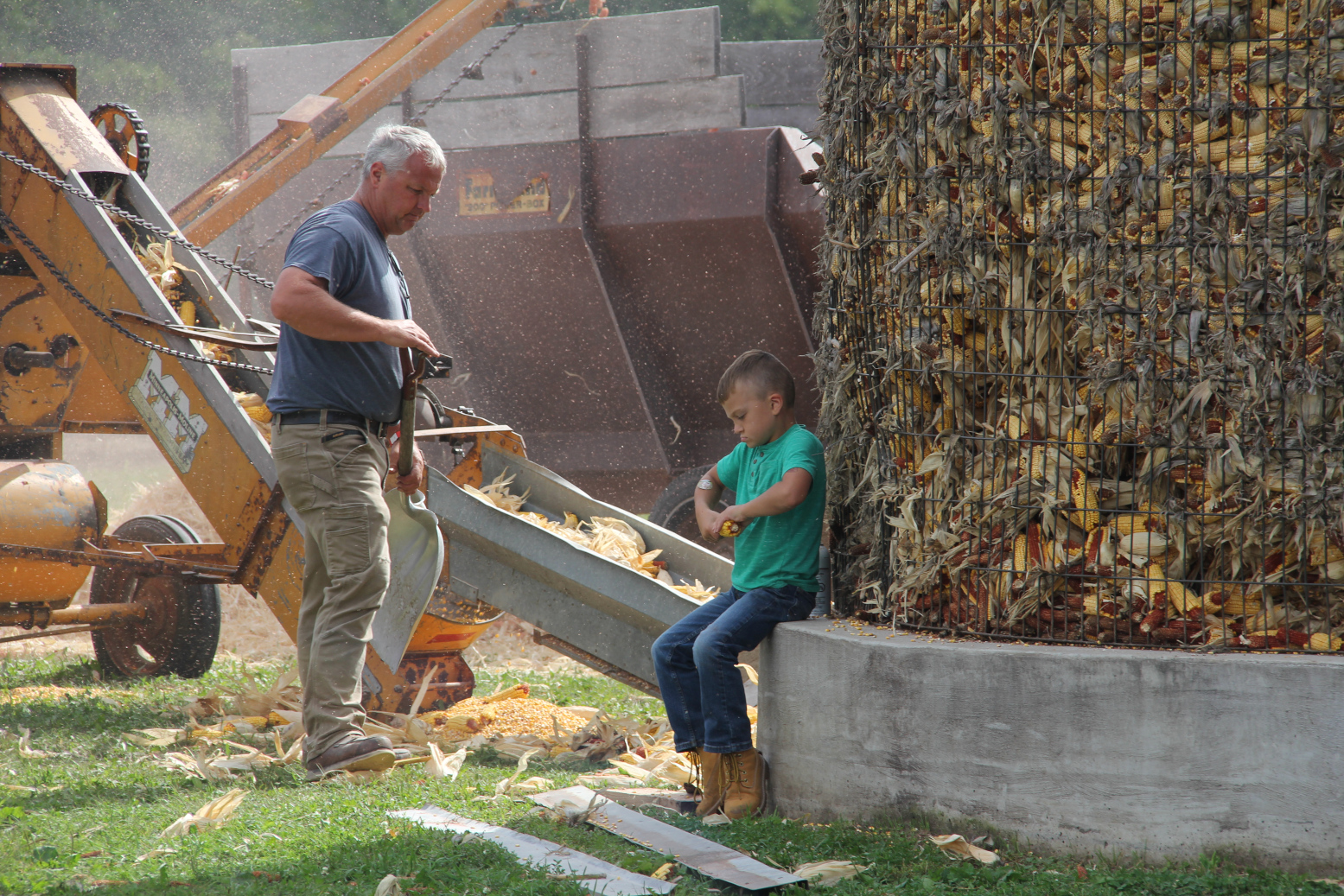
I loved watching and documenting the younger and older generations shelling corn together at the Rice County Steam & Gas Engines Show in a living rural history scene. (Minnesota Prairie Roots copyrighted photo August 2025)
A storefront window display at Books on Central promotes an upcoming holiday reading. (Minnesota Prairie Roots copyrighted photo December 2025)
THE CADENCE AND RHYTHM of a book read aloud or a story told appeals to me. It’s as if the words become living, breathing characters, the setting vivid real-life scenes. Such is the power of the voice in interpreting words.
Wednesday evening, December 17, at 6 pm, two skilled local storytellers, Sam Temple and Tami Resler, will share their talents during a literary event at Books on Central in the heart of downtown Faribault. Holiday stories will focus their storytelling in the cozy bookshop centered by a chandelier inside a former jewelry store.
But the gems for the evening will be the stories that are sure to sparkle with the skills of Temple and Resler. I know both storytellers. They are genuinely kind, caring, joyful individuals who add much to our community.
Sam Temple, as Alexander Faribault, shares local and Minnesota history during the Riverside Rendezvous and History Festival in Faribault earlier this year. (Minnesota Prairie Roots copyrighted file photo May 2025)
Temple, who heads Steamboat Media Company and manages Northfield Public Broadcasting, is big into local history. He’s created documentaries about Faribault history with fellow creative Logan Ledman. He’s portrayed town founder, Alexander Faribault, numerous times. He’s also acted and directed and does improv comedy with Little Fish Improv. I’m sure I’ve missed something. But you get the idea. Temple brings tremendous talent and knowledge to anything he does.
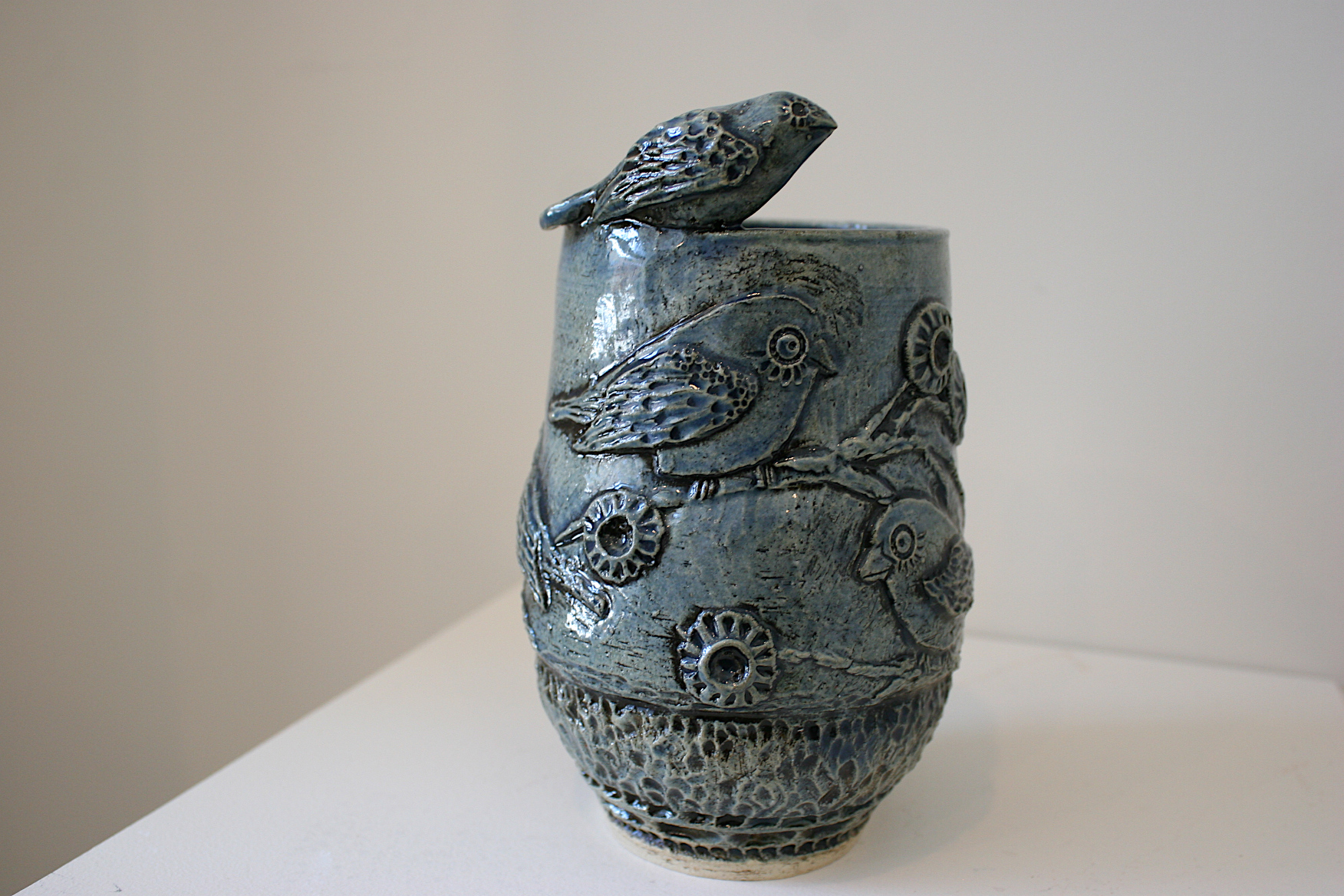
Tami Resler is a multi-talented artist. Here’s some of her pottery showcased in a gallery. (Minnesota Prairie Roots copyrighted file photo March 2021)
Likewise, Resler, a ceramics artist and educator at Shattuck-St. Mary’s School in Faribault, sparkles. I don’t think I’ve ever seen Tami without a smile. Her enthusiasm, I expect, will shine in expressive telling of holiday tales during the reading.
I encourage you, if you live in the area, to take a break from holiday preparations and settle into a chair at Books on Central this Wednesday evening. Relax. Delight in the comforts of a good story. Remember when you were read to as a child or when you read to a child. I hold fond memories of an elementary school teacher reading the “Little House” books by Laura Ingalls Wilder to our class each day after lunch. And I have read countless books to children, still do.
There is joy in books. And there is joy in listening to gifted storytellers who bring words to life with their voices.
FYI: Light refreshments will be served at this event, which is free and open to the public at 227 Central Avenue North, Faribault.
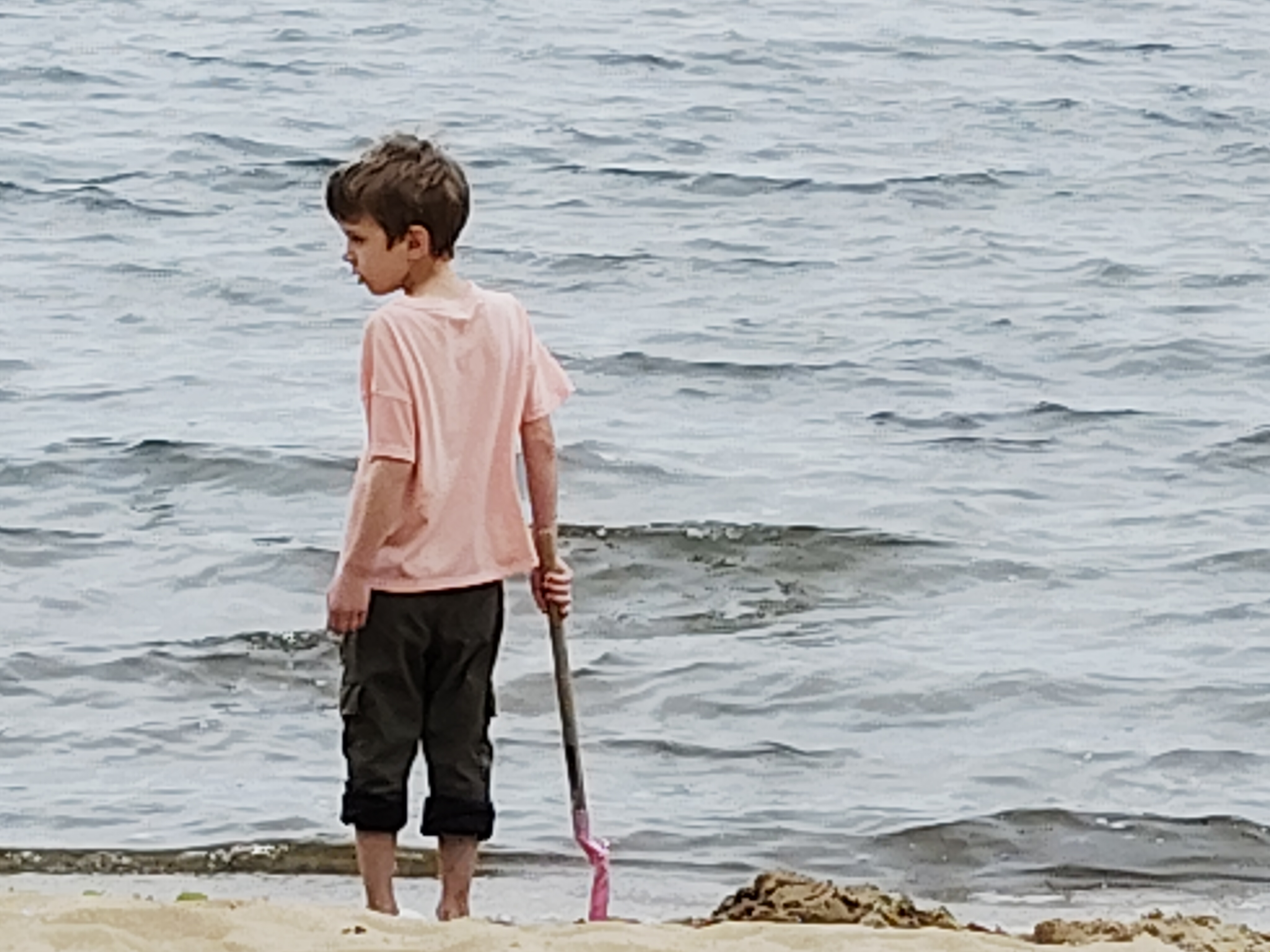
Isaac on the beach at Horseshoe Lake, rural Merrifield, Minnesota. (Minnesota Prairie Roots copyrighted photo August 2025)
SOMETIMES A PHOTO isn’t perfect. And this one certainly isn’t, at least not technically. The image of my 6-year-old grandson is not sharp. And that’s because I was sitting a beach away, zooming in with my cellphone camera.
My 35 mm Canon was inside the cabin. I knew I would either have to shoot with my phone or miss the moment. I opted to click the white circle on my Android.
Why do I love this photo, despite its technical flaws? I love the moment in time I’ve captured of my young grandson. Isaac was busy digging in the sand at lake’s edge when he paused. I don’t recall the reason he stopped shoveling. And that in itself holds appeal as those who view the image can imagine what Isaac is seeing to his left.
I remember the set up of this scene, though. Randy and I were on lakeside grandparent watch while Isaac’s parents headed into Nisswa for coffee. We were all vacationing together at a family member’s Horseshoe Lake cabin in north central Minnesota. Isaac’s older sister was inside the cabin reading.
The day was cold with a strong wind churning the water. Not a day for swimming or for sunbathing. But, for Isaac, it was still a good day for digging in the sand. He kept venturing closer and closer to the lake, water lapping at his pant legs. I asked Randy to roll up Isaac’s pants.
There’s something about a boy by the water, pants legs rolled up, shovel in hand that speaks to carefree days of summer, to youthfulness and to simple child’s play in the great outdoors. I love seeing kids playing outside, away from video games and electronics. I’m all for handing a child a stick (or a shovel) to encourage creative play.
I love this photo also because it tells a story in a simple and uncomplicated scene of water, sand, shovel and boy. Photography, for me, is often about storytelling.
I like the composition of this photo, too, with Isaac off-center, the sand pile on the right side of the frame. And then the wavy lake seemingly takes on a personality of its own like a threatening intruder. But Isaac didn’t let the moody lake, the cold day or the strong wind deter him from his work.
As with any photo, lighting ranks high. I like the lighting in this image. I like the simplicity of the photo.
Even though not technically perfect, this photo holds what’s most important to me—love. Do you see it?
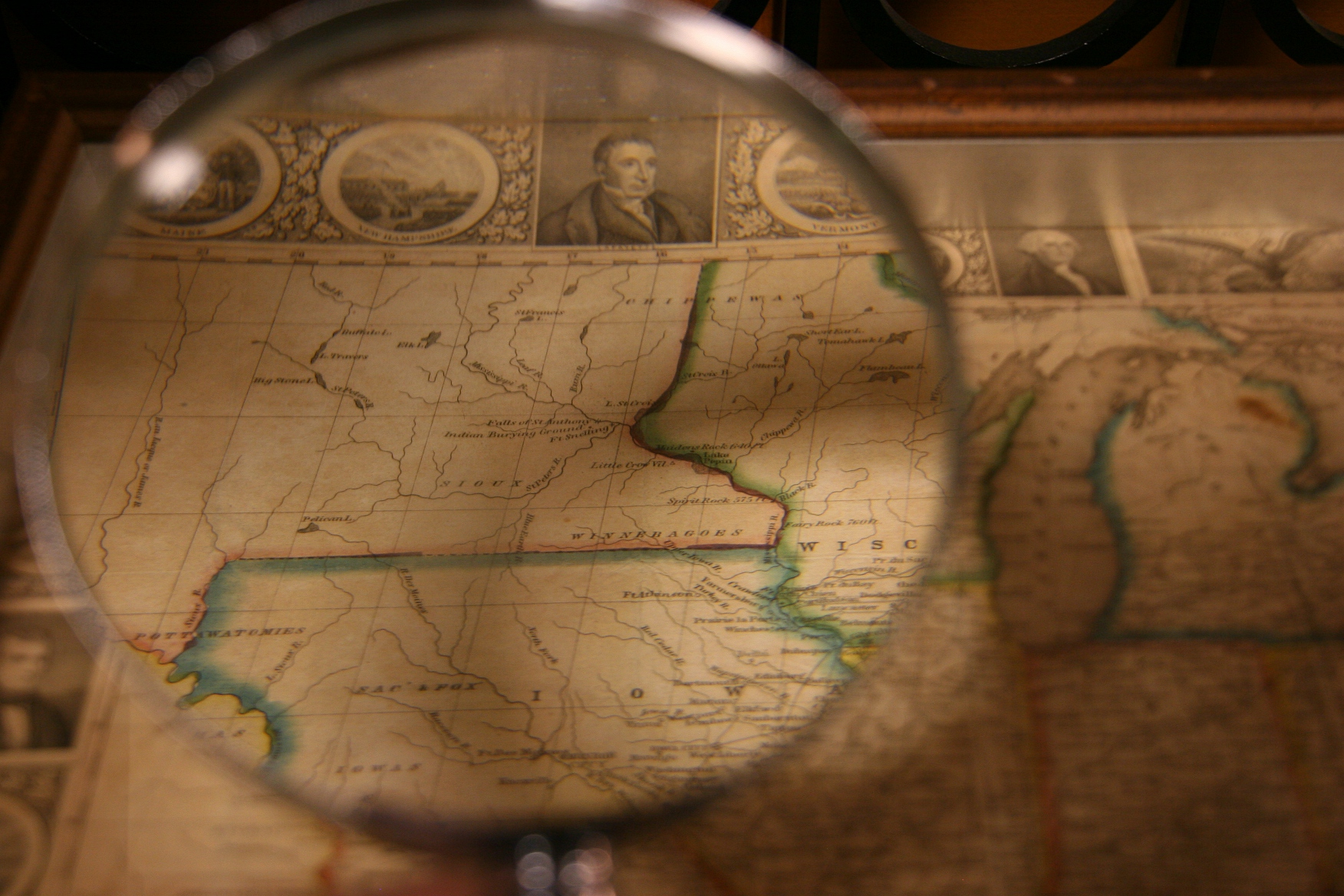
An1849 map of Minnesota Territory and more as seen through a magnifying lens inside the Rice County Historical Society Museum. Minnesota became a state in 1858. (Minnesota Prairie Roots copyrighted file photo)
HISTORY COME TO LIFE appeals to me because of the immersive experience. I learn better, retain more, when I can engage. This weekend offers ample opportunity to get into history at the Rice County Historical Society’s first-ever Riverside Rendezvous and History Festival along the banks of the Cannon River in Faribault’s North Alexander Park.
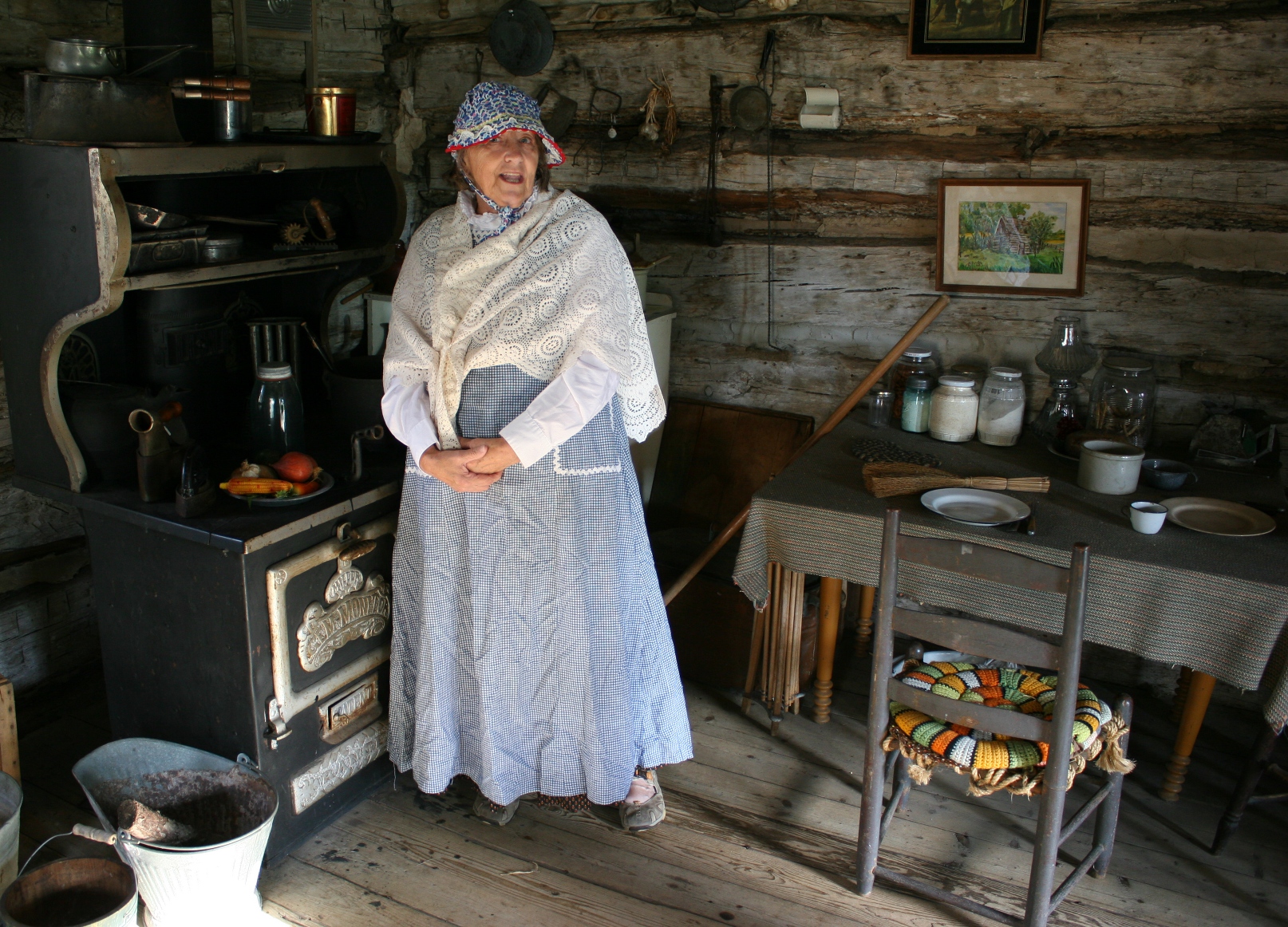
A scene inside an 1856 log cabin during a past living history event at the Rice County Historical Society. This weekend’s festival will be outdoors in a park in an encampment type setting. (Minnesota Prairie Roots copyrighted file photo)
Organizers promise that the trades, traditions and history of the 18th and 19th centuries (1701-1900) will come alive via hands-on activities, demonstrations, workshops, storytelling, music and special events. Hours are 9 a.m.-5 p.m. Saturday, May 10, and Sunday, May 11. Mothers get in free on Mother’s Day. Otherwise ticket prices are $10 for adults, $5 for children 6+ and $30 for a family pass.
Admittance buys you a whole lot of history-based entertainment, knowledge and fun. For example, the hands-on history happening all day both days includes candle making, rope making, tomahawk throwing, historic toys and games, quill making, log cutting and shops at which to shop, not trade.
This sculpture of Alexander Faribault and a Dakota trading partner stands in Faribault’s Heritage Park near the Straight River and site of Faribault’s trading post.(Minnesota Prairie Roots copyrighted file photo)
But you can learn about the fur trade at noon either day as local historian and documentary filmmaker Sam Temple talks about town founder Alexander Faribault and the fur trade. Todd Finney, a descendant of the Wahpekute band of the Dakota (original inhabitants of the land which is now Rice County), will speak at 3 p.m. Saturday and again at 11 a.m. Sunday about the Wahpekute Dakota.
You can learn about hat making, pirates (yes, pirates with MN Jack Sparrow), historic clothing and weapons, things that do and don’t go boom, Civil War medical care and more during workshops and demos.
And then there are four special events, the first a Cane Pole Fishing Tournament starting at 10 a.m. Saturday. Bring your cane pole, not your rod and reel. Some cane poles will be available for participants. Saturday also brings Voyageur Games at 1 p.m. On Sunday, there’s a Tomahawk Throwing Competition at 1 p.m. followed by a Log Cutting Contest at 3 p.m.
I’ve never attended a rendezvous, so I have nothing with which to compare this event. But just reading through the schedule, I’m excited to take in this history festival with my two elementary-aged grandchildren, their parents and my husband. I expect we will all learn a lot and make some great memories.
Vendors will be selling food and beverages. (Minnesota Prairie Roots copyrighted file photo used for illustration only)
One more thing, food and beverages will be available for purchase, the food being cheese curds (no festival is complete without that deep fat fried fair food), hot dogs, corn dogs, assorted frybreads, and candy and fudge.
All in all, the Riverside Rendezvous and History Festival looks to be an interesting, informative and enjoyable event for history lovers, families and anyone who’s looking for something different to do on a beautiful spring weekend in southern Minnesota.
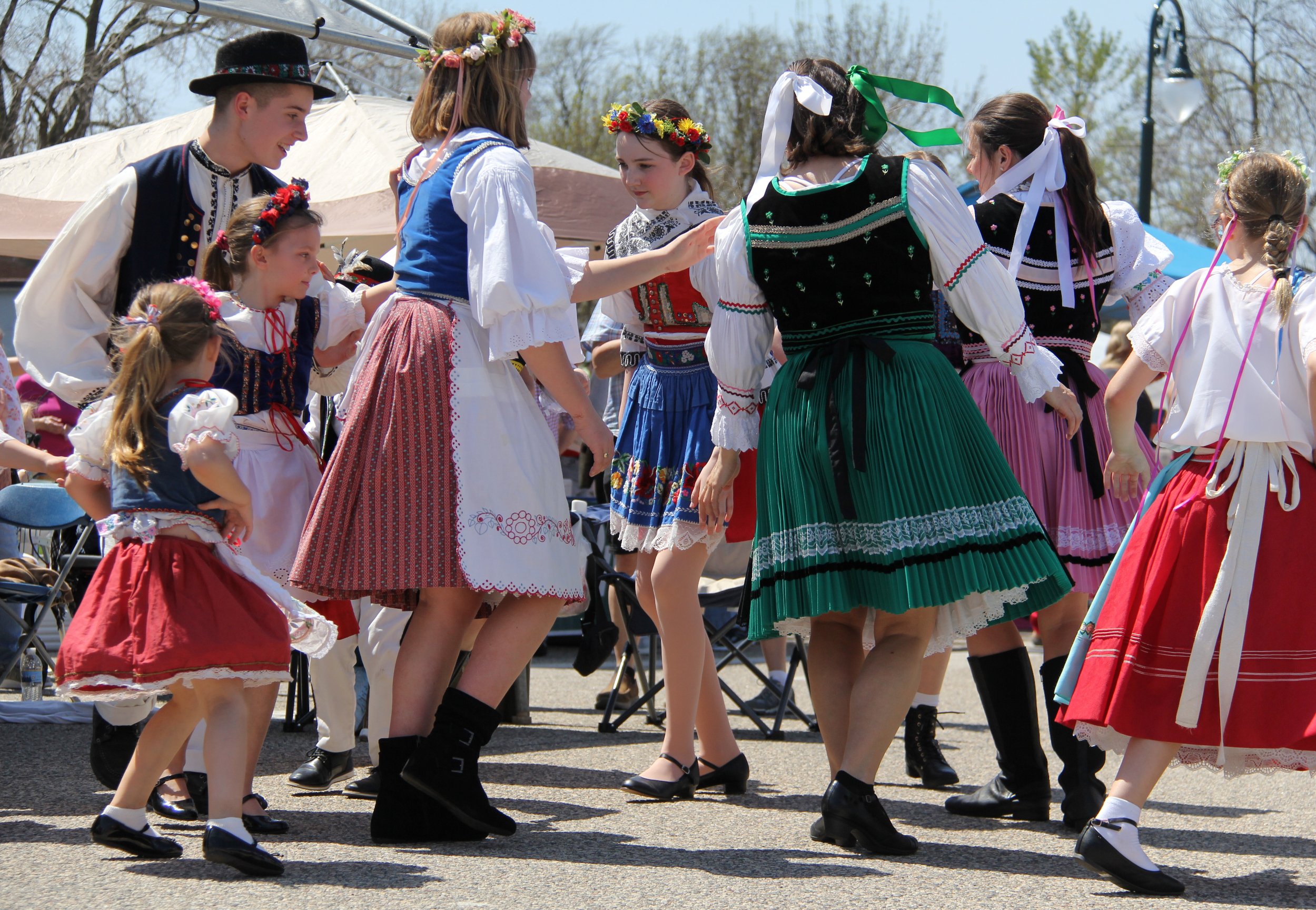
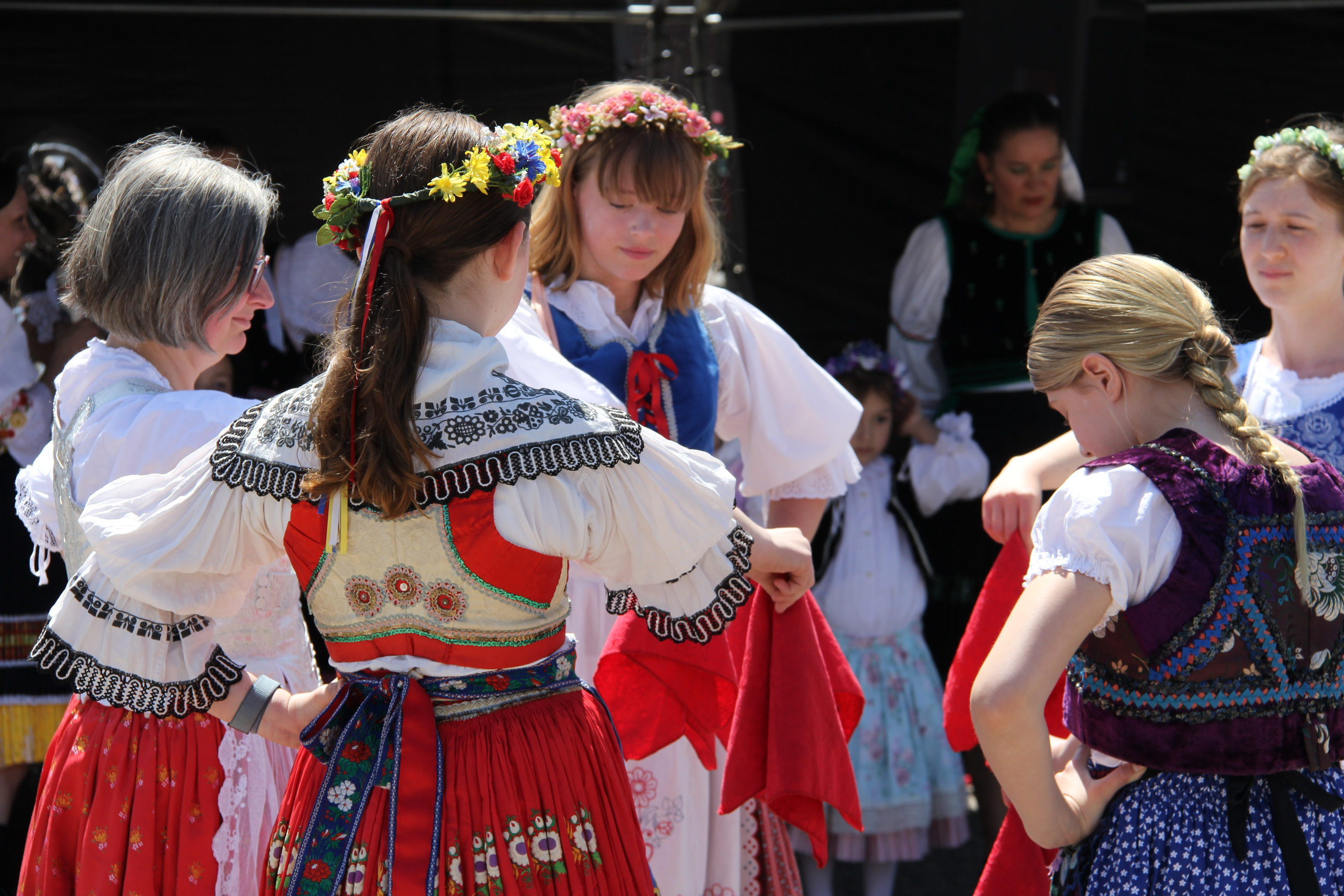
Multiple ages perform traditional Czech and Slovak folk dances in traditional costumes. (Minnesota Prairie Roots copyrighted photo May 2025)
WHENEVER I PHOTOGRAPH an event, a place, a whatever, I use my camera to tell a story. And that means framing not only overall scenes, but also focusing close-ups. It means, too, that I am conscious of moments which convey emotions, feelings, all part of the story.
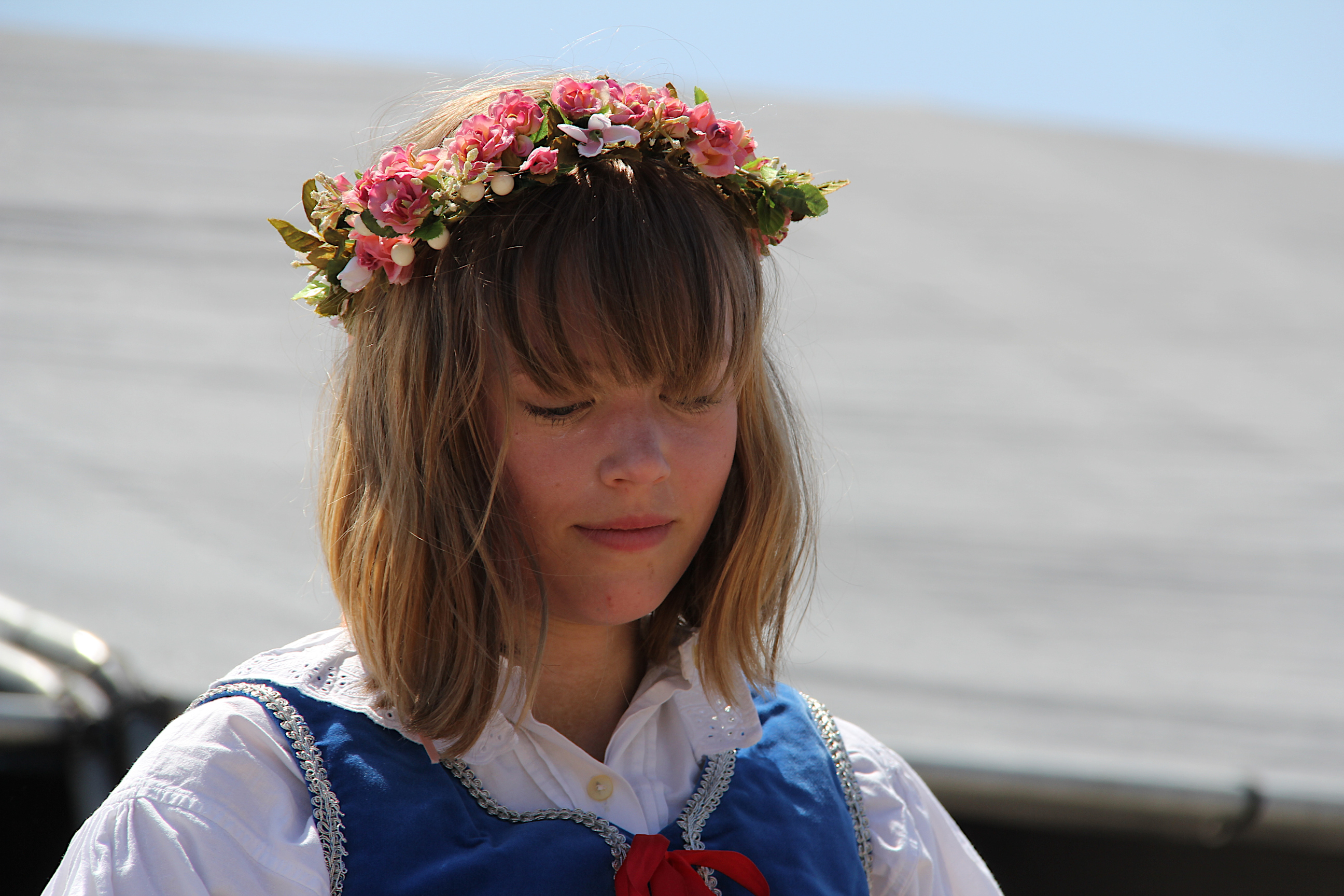
A sweet face conveys serenity during a folk dance. (Minnesota Prairie Roots copyrighted photo May 2025)
The Czech May Day celebration in Montgomery, a small southern Minnesota town, offered an ideal opportunity to create a visual story celebrating the community’s Czech heritage. That event centered on music, dance and traditional costumes.
Colorful traditional Czech attire created a festive scene. (Minnesota Prairie Roots copyrighted photo May 2025)
This was, in many ways, a photographer’s playground. And, by that I mean simply a heckuva lot of fun to photograph with endless photo ops. Colorful, detailed attire and constant movement had me clicking the shutter button of my Canon camera as a story unfolded before my eyes.
My favorite photo from Czech May Day. (Minnesota Prairie Roots copyrighted photo May 2025)
Yet, it was the quiet moments, too, which caught my eye. When a young dancer stepped away from the circle of dancers so her mom, seated next to me, could re-tie the ribbon around her neck, I aimed my camera lens upward and caught the tender moment. It was sweet and loving and profoundly endearing. To be witness to that felt like a gift. It is my favorite photo from Czech May Day.
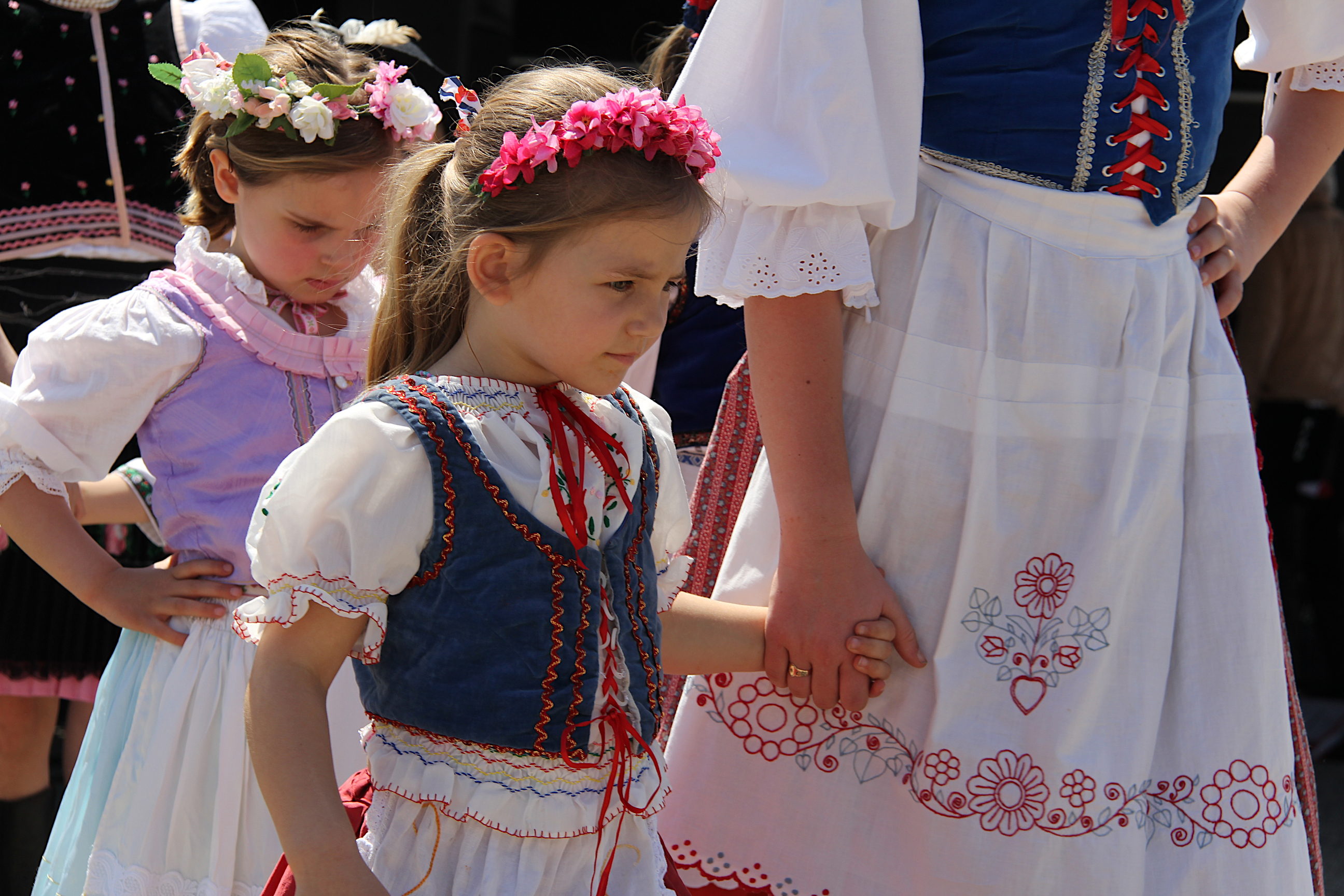
I observed many women holding the hands of girls before, during and after dances. (Minnesota Prairie Roots copyrighted photo May 2025)
Likewise, as I zoomed in on the hands of dancers, I saw a woman’s hand clasping a child’s hand. That, too, speaks of tenderness, love, care and mentoring. We’ve all experienced the protection and guidance of a reassuring hand. This photo shows a truly relatable human moment.
The colors of the Czech and Slovak flags are reflected in these traditional dresses. (Minnesota Prairie Roots copyrighted photo May 2025)
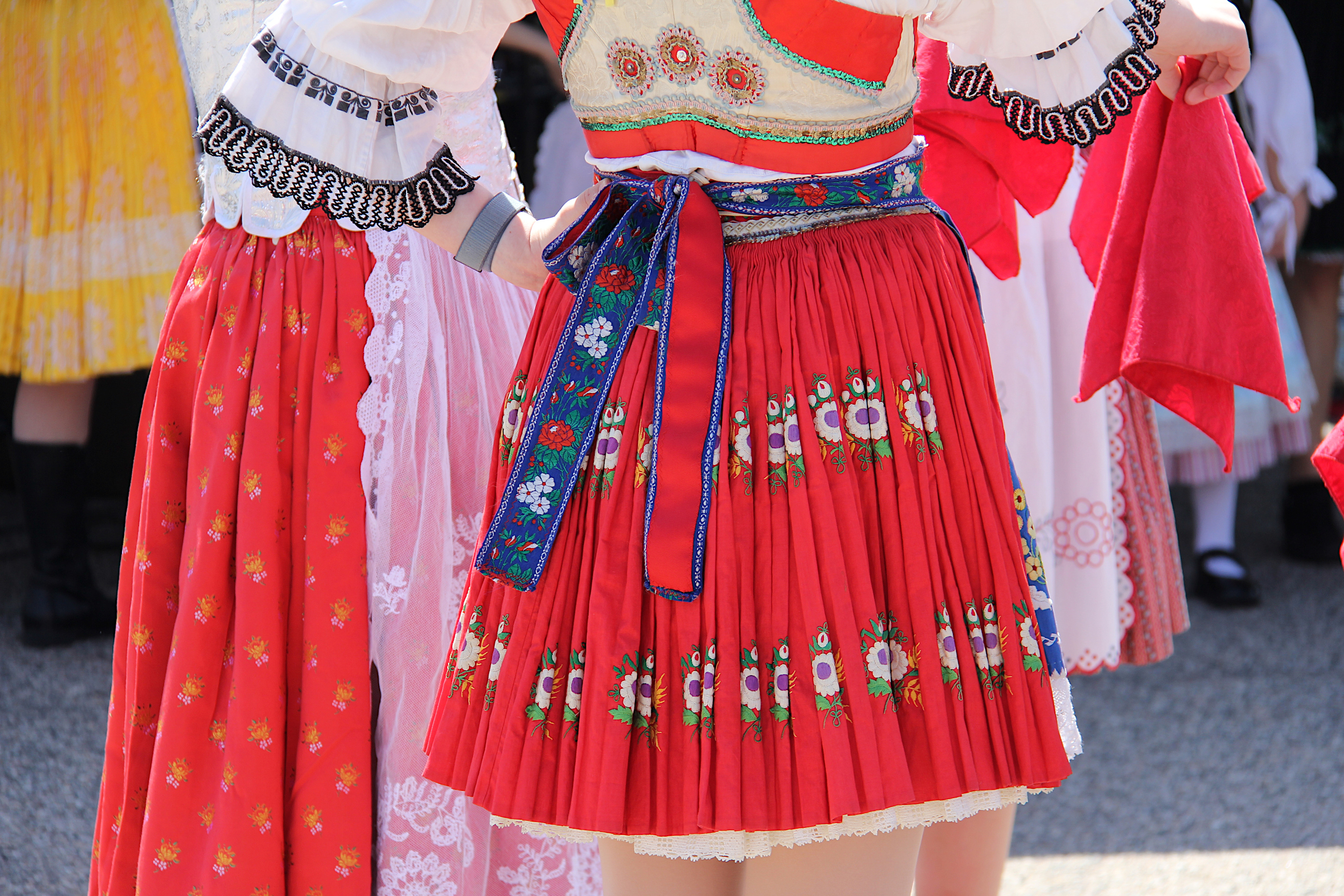
Full skirts flared during the dances. (Minnesota Prairie Roots copyrighted photo May 2025)
So many beautiful Czech dresses… (Minnesota Prairie Roots copyrighted photo May 2025)
As I watched the multi-aged dancers, I was taken by their colorful attire, by detailed embroidery, eyelet lace, aprons tied around waists, crisscrossed lacing, vests, flying ribbons and patterns and floral wreaths. It was like looking through an ever-changing kaleidoscope via my camera lens.
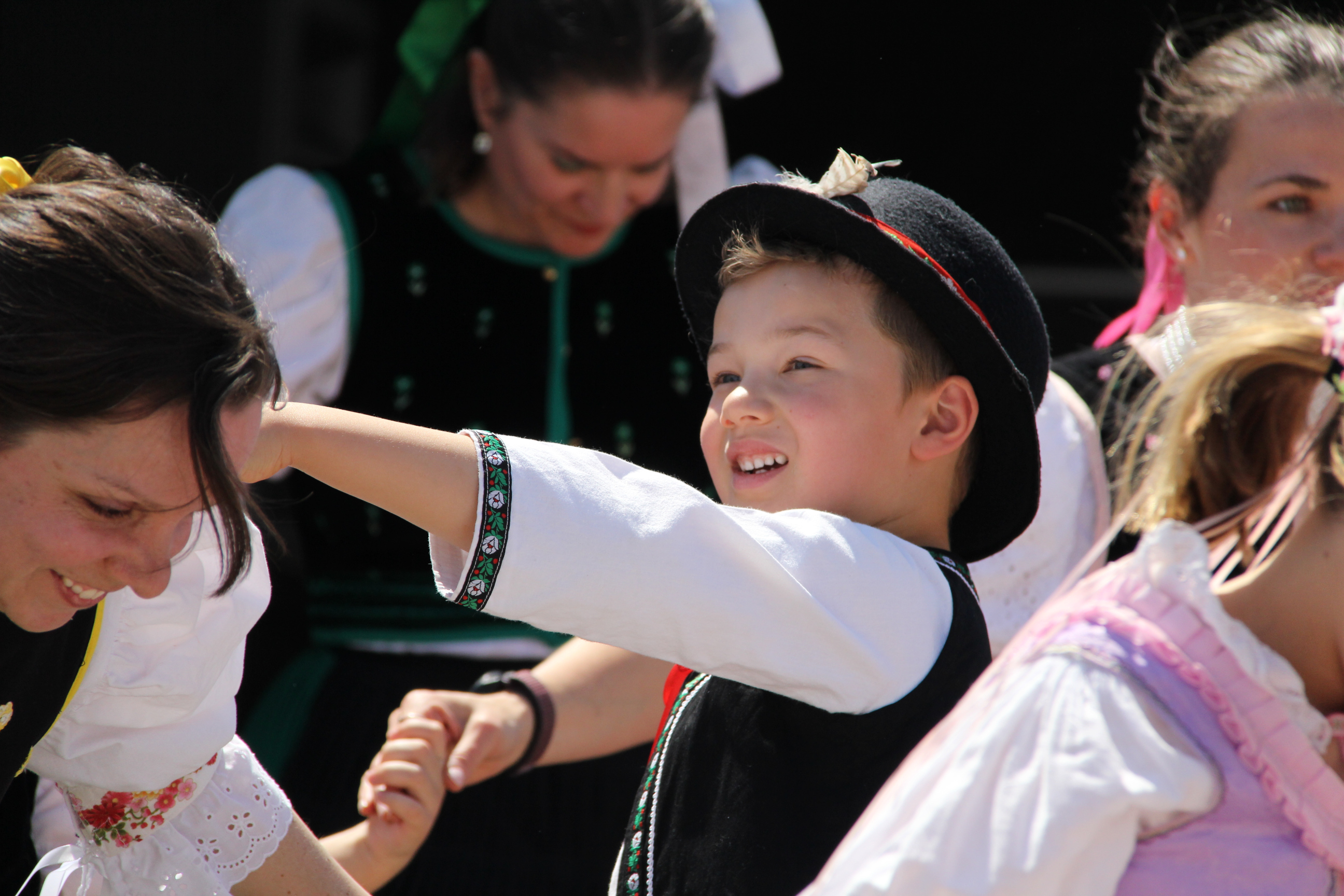
This young boy was among the few males who were part of the folk dancers. (Minnesota Prairie Roots copyrighted photo May 2025)
When I caught a young boy with outstretched arm in a circle of dancers, I caught more than that choreographed movement. I also captured his concentration, his sense of pride in being part of a celebration honoring his heritage.
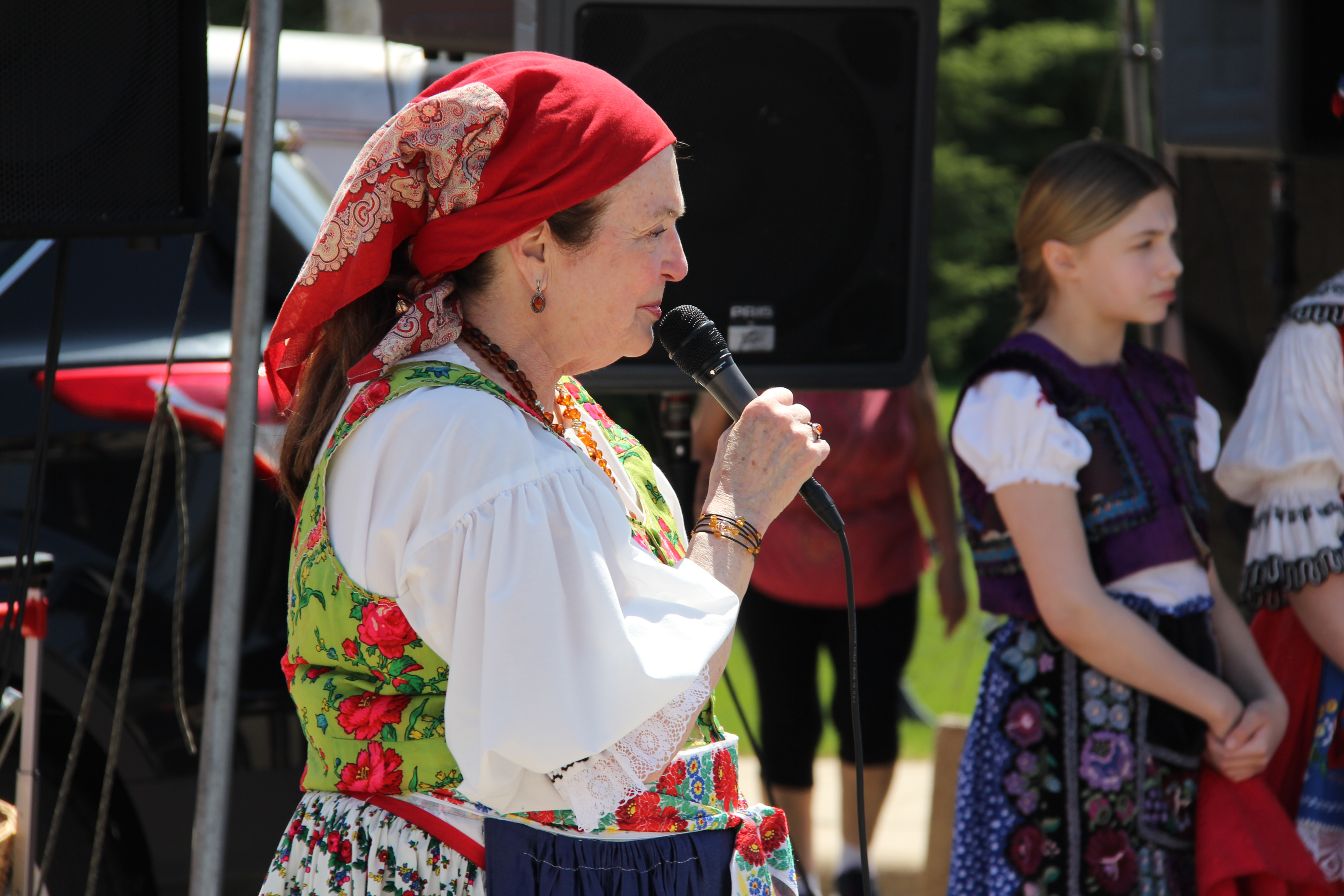
This woman portrays confidence and strength of character in my eyes. (Minnesota Prairie Roots copyrighted photo May 2025)
And when I photographed an emcee in her traditional dress, I saw grace and strength, not just a portrait.
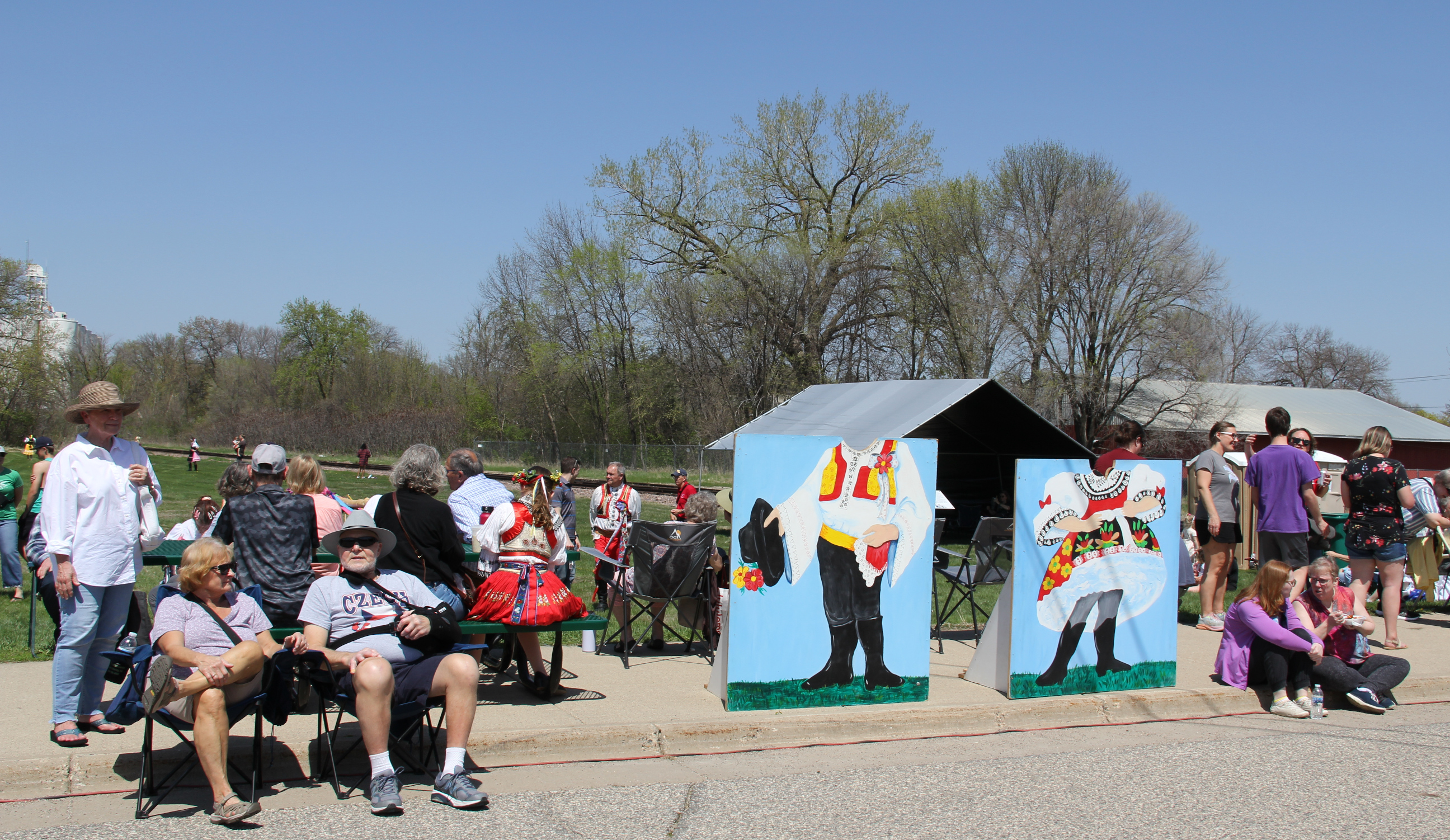
May Day attendees could try on traditional Czech attire at this photo cut-out and a second one. (Minnesota Prairie Roots copyrighted photo May 2025)
The St. Paul Czech and Slovak Folk Dancers and Sokol Children Dancers are only one part of my visual storytelling of Czech May Day in Montgomery. On Tuesday I shared the overall story in images and words. Today I focus on those traditional dancers, on their dress and movement and those stand-alone moments when they connected individually. And with me.
Sunrise on Horseshoe Lake, rural Merrifield, MN. (Minnesota Prairie Roots copyrighted file photo September 2024)
ON THE SATURDAY I should have been in Madison, Wisconsin, cuddling my nearly two-month-old grandson, Everett, I was, instead, home in Minnesota. Sick with a cold. I felt sad and disappointed that our trip was canceled.
But then my son-in-law sent a short video clip of Everett. To the soundtrack of “It’s a Beautiful Morning,” I watched Everett smile. You know the type of smile that widens and grows until it reaches your eyes. It was only a few seconds, but enough to shift my mood to joy.
And who doesn’t need a little joy right now? There’s a lot happening currently on a national and international scale that causes me deep concern, stress and worry. So I must intentionally seek out that which eases some of my angst. A visit with Everett and his parents would have proven a wonderful distraction. Soon, perhaps, Randy and I can do the four-hour drive to Madison.
Meanwhile, back home in Faribault, I connect with friends, go on walks, lift hand weights, hang laundry outside on the line, bake banana bread, take a Sunday afternoon drive, listen to uplifting music (specifically Christian radio station KTIS), pull out my camera, write, read…all simple things that brighten my days.
(Book cover sourced online)
Most of you know that I love to read. I happened upon a collection of short stories which was, in a way, like a short “It’s a Beautiful Morning” video clip. The slim volume, Notes from the Porch—Tiny True Stories to Make You Feel Better about the World by Thomas Christopher Greene, was exactly the book I needed to read on the weekend I was still fighting my cold and couldn’t see Everett.
Greene shared the stories via social media from his home in Vermont during the COVID-19 pandemic. And now he’s compiled those stories, typed into his laptop on his front porch, in this book. Even if you’re not a big reader—and I know a lot of people who don’t read books—this is a breeze of a relatable read.
In his book, Thomas Greene writes about a blue heron in sharing the story of his baby daughter Jane. (Minnesota Prairie Roots copyrighted file photo)
The book title alone, Notes from the Porch, points to the content of short snippets about everyday life. Most are not extraordinary moments, with the exception of the death of the author’s daughter, Jane, at six months. Even that has a positive message of we’re all stronger than we think. I bet nearly all of you can relate to that—the resilience we find in the midst of incredible personal challenges. And if you haven’t faced such challenges, then I’m glad you haven’t.
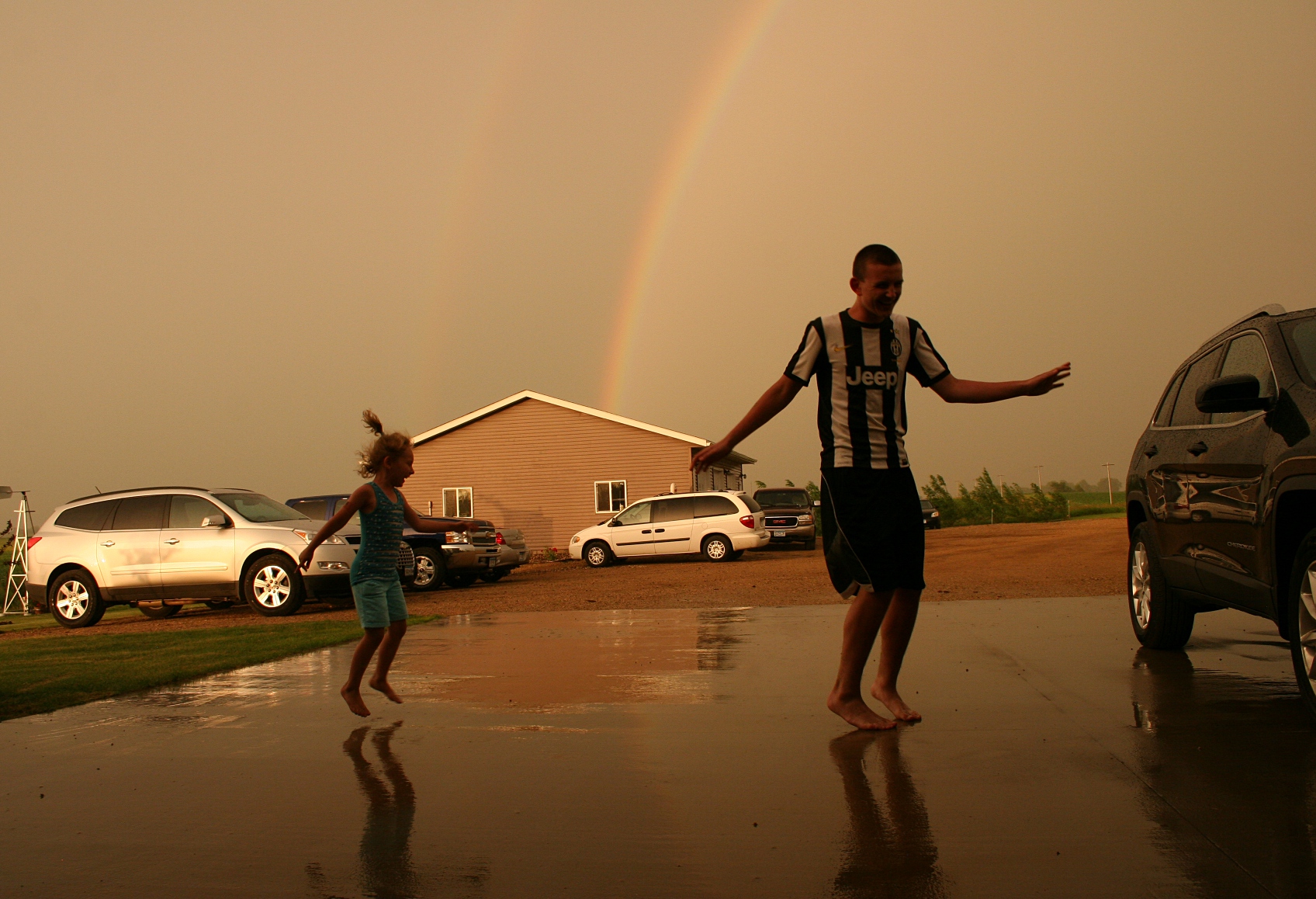
My niece and nephewdance in the rain at a family gathering. (Minnesota Prairie Roots copyrighted file photo)
But back to Greene’s book. He writes several stories about his seven-year-old neighbor boy who races his bike along the street. With wild abandon. Fearless. Occasionally stopping to chat with the front porch writer. I can picture that young boy, who also runs in the rain. Just as I can picture the older couple in another story, on their boat each evening chasing the sun. Rain and sunshine.
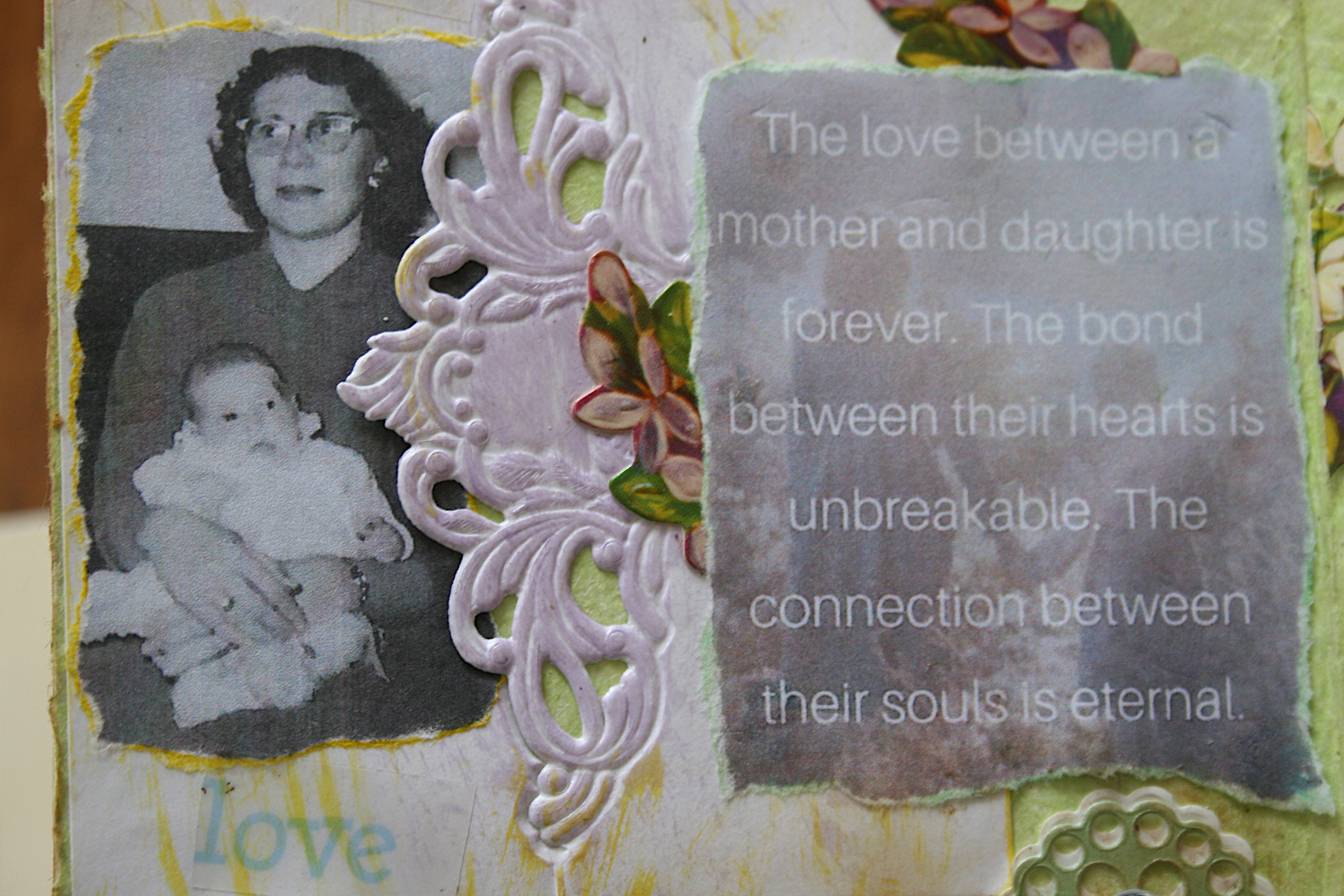
A page in a keepsake book a friend created for me after my mom died. The photo is of my mom holding me. (Minnesota Prairie Roots copyrighted file photo)
Greene’s writing is not only descriptive, but also emotionally touching and insightful. When I read his story, “The Only List I Will Ever Make,” I cried at #11, the final item on his living life list: 11. Call your mom. If your mom is no longer here, call her anyway. No one will root for you more. I used to call my mom every Sunday evening until she could no longer talk on the phone. She’s been gone three years now, dying during the height of Omicron (not of) in a long-term care center. There are days when I wish I could call her, hear her supportive words, tell her I love her. Greene’s writing reminds me that Mom is but a memory away, part of me for the kindness and compassion she taught me, for the unconditional love she gave to me, for the…
This art created by my granddaughter reminds me that we can all be each other other’s sunshine. (Minnesota Prairie Roots copyrighted file photo 2023)
And now Greene has gifted all of us with his kind and compassionate words. He writes of kindness witnessed in a grocery store. He writes about a father joyfully, publicly sharing the news that his straight A daughter has been accepted into an Ivy League school. A Black girl from Vermont, the daughter of an immigrant without any money, going to Harvard because she earned it. That reminds me of my own son getting into an elite East Coast college, because of his smarts, certainly not because we had the money to send him there.
Notes from the Porch uplifts, encourages, teaches. Each story is like “It’s a Beautiful Morning” video clip of my smiling grandbaby. Sure to leave you feeling better.
A row of John Deere tractors at the 2022 Rice County Steam & Gas Engines Show, rural Dundas. (Minnesota Prairie Roots copyrighted file photo September 2022)
AS A WRITER, a storyteller, I read obituaries. Doesn’t matter if the deceased is known to me or not. I find obits interesting for the stories therein.
Stories weren’t always part of obituary writing. Obit style has evolved since I graduated in 1978 with a journalism degree from Minnesota State University, Mankato. And that is a good thing. Today’s death notices are not just summaries of facts, but rather personalized in a way that helps the reader understand the person as a person. That holds value to those who are grieving and to those of us who hold no connection to the individual.
I need to backtrack for a moment and share that writing an obituary was my first writing assignment in Reporting 101. Although I’ve forgotten details about that long ago college course, I remember the professor stressing the importance of spelling names correctly. That carried through to all types of newspaper reporting. First reporting job out of college, I learned a source was Dayle, not Dale.
Emmett Haala (Photo source: Sturm Funeral Home)
That MSU instructor also imprinted upon me the importance of obituaries. As I age, I find myself drawn more and more to reading obits. Too often now, I know the deceased. Recently, I found a gem in the obituary of Emmett Haala, 87, of Springfield (that would be Springfield, Minnesota), who died on February 28. His funeral is today.
Hanging out by a John Deere tractor at the Rice County Steam & Gas Engines Show. (Minnesota Prairie Roots copyrighted file photo September 2022)
It wasn’t the basic facts about Emmett that captivated me, but rather his interest in John Deere tractors. He, according to his obit, “lived and breathed John Deere.” Now to anyone with a rural connection, the idea of fierce tractor brand loyalty is familiar. This retired mechanic began his career at age 14 at Runck Hardware and Implement in Springfield, eventually opening Emmett’s Shop in 1970. He was a trusted mechanic who serviced all machinery brands, but favored John Deere.
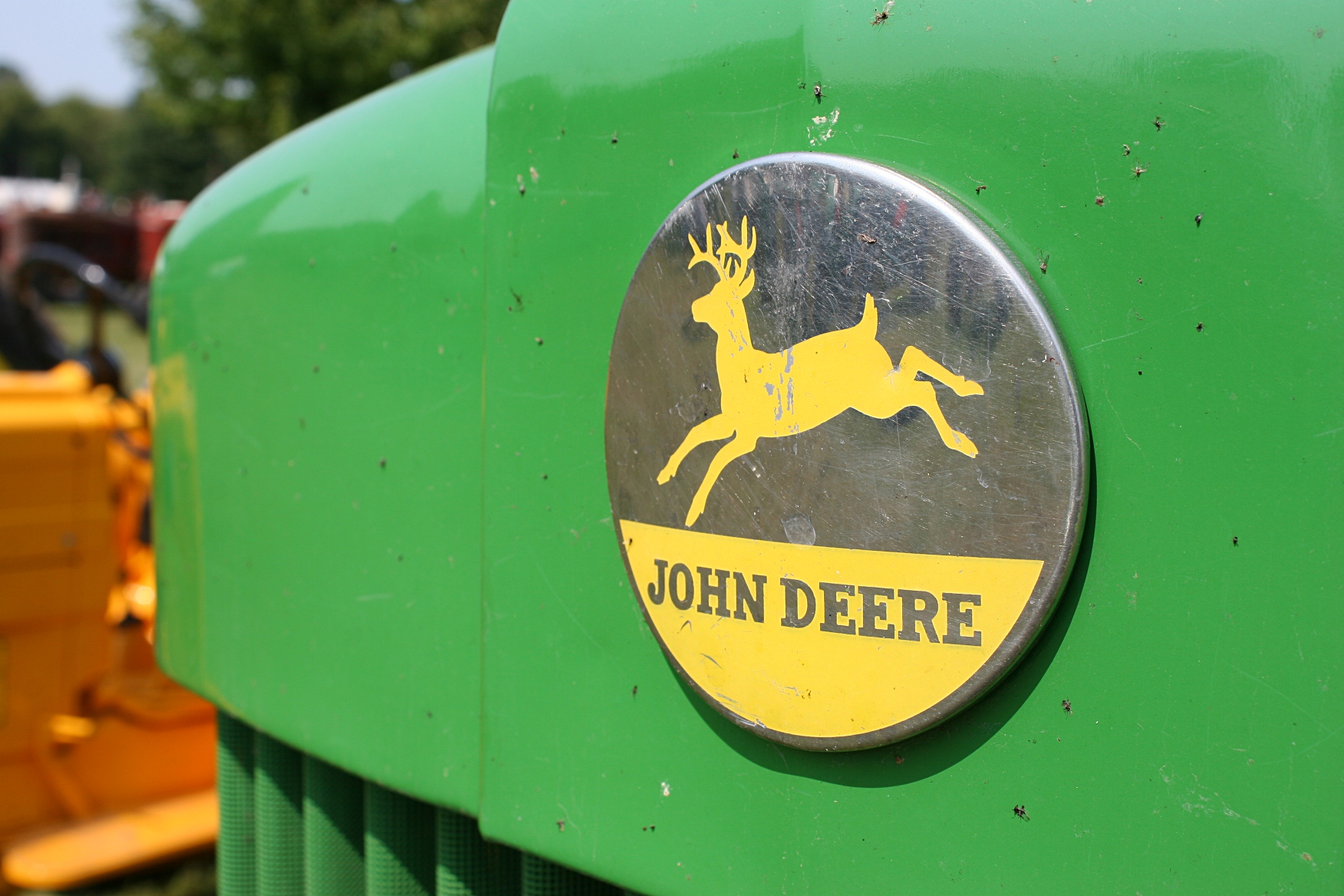
“Nothing runs like a Deere” is the John Deere slogan. (Minnesota Prairie Roots copyrighted file photo September 2017)
That tidbit got me reminiscing and also contemplating the importance of open houses in rural Minnesota. Events that continue today. Emmett, his death notice read, shared many memories of John Deere Days at Runck Hardware and Implement. He “…enjoyed making hot dogs and coffee for the throngs of people attending and showing the newest John Deere movie.”
To this day, I remain a fan of John Deere. Here Randy and I pose aside a vintage John Deere at Bridgewater Farm, rural Northfield in October 2023. (Photo credit: Amber Schmidt)
That was it. I was hooked. I attended John Deere Day at a farm implement dealership while growing up in southwestern Minnesota. While the event was a way for machinery dealers to get farmers inside their shops, the open houses were also a social gathering for rural folks. My siblings and I piled into the Chevy aside Dad and Mom for the 20-mile drive to Redwood Falls and John Deere Day.
Free food—usually BBQs, baked beans, chips and vanilla ice cream packaged in little plastic cups and eaten with a wooden spoon—comprised dinner (not lunch to us farm types). Maybe there were hot dogs, too, like at Emmett’s place of employment. Memories fade over the decades.
A worn vintage John Deere emblem. (Minnesota Prairie Roots copyrighted file photo September 2017)
But I do recall the John Deere movies shown post meal at the theater in Redwood Falls. Sure, they were nothing but advertisements for “the long green line” of farm machinery. But to a kid who seldom set foot in a theater, the promotional films held all the appeal of a box office hit. Plus, there were door prizes like bags of seed corn and silver dollars. I never won anything. A cousin did.
At the Rice County Steam & Gas Engines Show. (Minnesota Prairie Roots copyrighted file photo September 2017)
And so all those John Deere memories and more—including the distinct pop of my dad’s 1950s John Deere tractor—rushed back. Putt, putt, putt. Emmett belonged to the Prairieland Two Cylinder Club. Nostalgia is powerful. So is the art of crafting an obituary. Many of today’s obituaries feature detailed personal stories, not simply superlatives. Stories that reveal something about the individual who lived and breathed and loved. Stories well beyond life-line basics. Stories of life. Stories that resonate, that connect us to each other. Stories like those of Emmett, who “lived and breathed John Deere.”
(Book cover image sourced online)
FYI: I recommend reading this guidebook to obituary writing by retired The Wall Street Journal obit writer James R. Hagerty: Yours Truly: An Obituary Writer’s Guide to Telling Your Story. Hagerty is the son of Marilyn Hagerty, columnist for The Grand Forks Herald. In a March 2012 “Eatbeat” column, Marilyn reviewed her local Olive Garden and gained instant internet fame.
I CAN’T IMAGINE a world without books. From the time I was first read to and then learned to read as a young child, I have loved books. From books, I’ve learned, I’ve escaped, I’ve broadened my world well beyond southern Minnesota.
From reading the writing of others, I’ve grown, too, as a writer. Laura Ingalls Wilder, in her Little House books, taught me the importance of detail, of setting, in writing. I grew up on the prairie, some 20 miles from Walnut Grove, once home to the Ingalls family. A grade school teacher read the entire Little House series to me and my classmates. Books have, in many ways, shaped me.
Book cover image sourced online.
But imagine a world without books. That was a reality for slaves in America, denied access to books and to education. I just finished reading Kin: Rooted in Hope, written by Carole Boston Weatherford and illustrated by her son, Jeffery Boston Weatherford. The young adult book, published by Atheneum Books for Young Readers, was named a Coretta Scott King Author Honor Book 2024. It is a book that ought to be read by everyone not only for its insightful poetry-style storytelling, but also for its haunting scratchboard art.
Looking down on the pages of the book with a mix of black and white paper. (Minnesota Prairie Roots copyrighted photo February 2024)
Adding to the overall subliminal effect is the way in which the book is printed. Black words ink white paper. White words imprint black pages. And the artwork is made by etching away black ink to reveal white. This mixed usage of black and white, reinforces the storyline of slavery and slave owners. Black. White.
As I read Kin, which I pulled from a book display for kids and teens at my local library, I was increasingly horrified by what I read. Sure, I’ve read about slavery in history books. But this approach of historical fiction really brought home the ugliness, the abuse, the violence, the awfulness of slavery in a personal way. Fiction rooted in truth.
Children born into slavery. Whippings. An auctioneer’s gavel. Names written on an inventory list along with commodities. Jemmy. Big Jacob. Lyddia. Tom. Walter. Isaac. Mush ladled into a trough. Swimming banned lest an escape to freedom be attempted. And on and on. Atrocities that seem unfathomable to inflict upon individuals chained in Africa, sailed to Maryland, sold, abused, treated like property by wealthy white families.
Photo used for illustration only. (Minnesota Prairie Roots copyrighted file photo)
But in the all of this, threads of kinship, endurance, strength and hope, even defiance, run. Perhaps my favorite line in the book is that of Prissy, a house servant waiting on a dinner guest. He leers at her, making an inappropriate comment. She wants to tell him that she spit in his soup. At this point half way into the book, I applaud her unstated rebellion. As the chapters unfold, so does the move toward freedom for slaves. The author writes of freedom at last and of current day issues (controversial statues in public places, the murder of George Floyd…), all interspersed with a whole lot of history (including historic figures like Frederick Douglass and Harriet Tubman…).
Even though this book is written for young adults, it should be read by older adults, too, who need to hear Prissy’s defiant voice. Author Carole Boston Weatherford gives voice to those who endured slavery, and to those whose family histories trace to enslavement, including her ancestors. Her son’s detailed scratchboard art reinforces the story, the words which wrench the spirit.
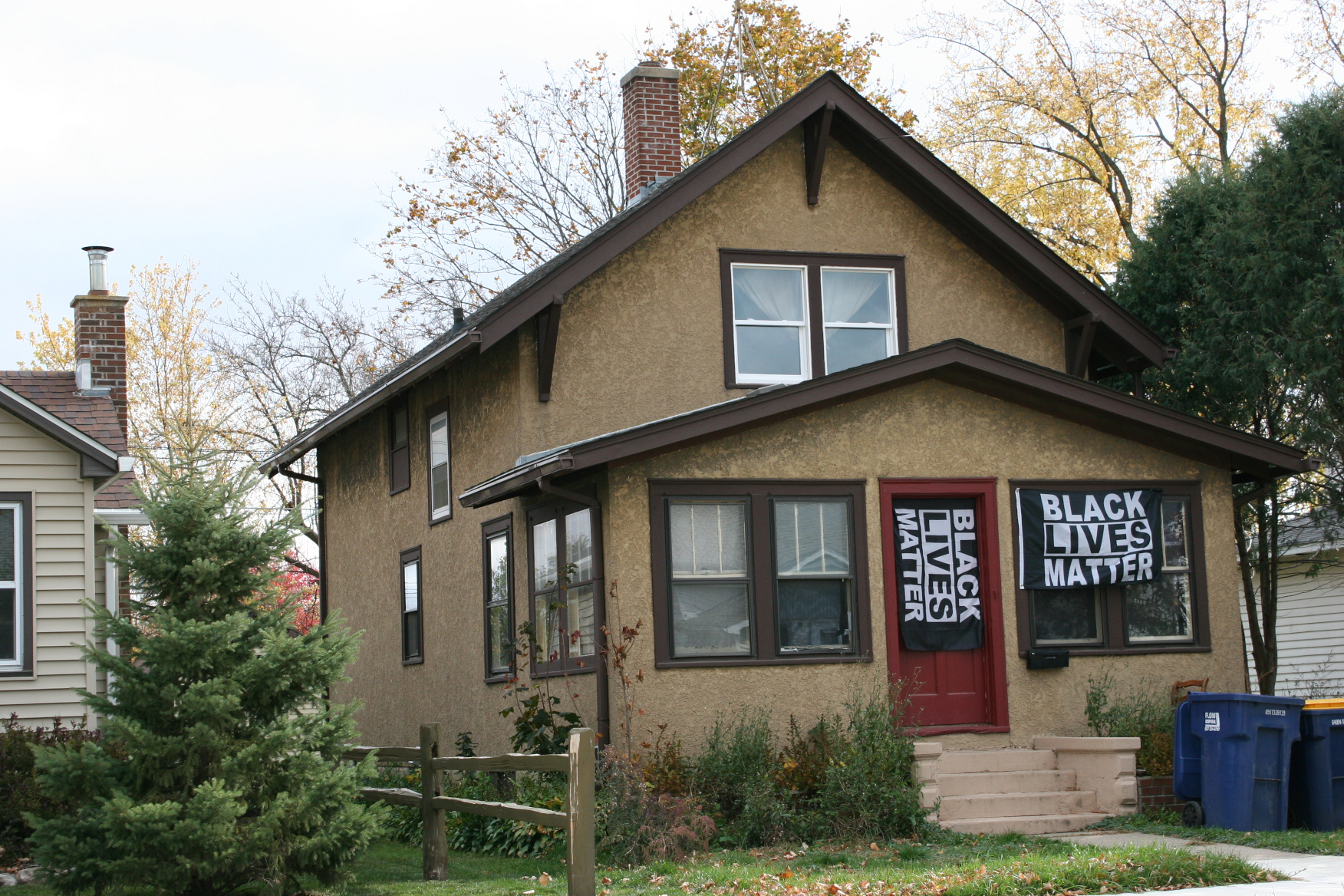
I photographed this scene in 2020 in Kenyon, MN. It remains one of my favorite images of this message given its location in a small town.(Minnesota Prairie Roots copyrighted file photo October 2020)
Kin: Rooted in Hope proves an especially fitting read during February, Black History Month. Through this book of historical fiction, I’ve learned more about a part of U.S. history which is horrendous in every possible way. That humanity can treat humanity so atrociously seems unfathomable…until I consider underlying and outright racist attitudes which continue yet today.
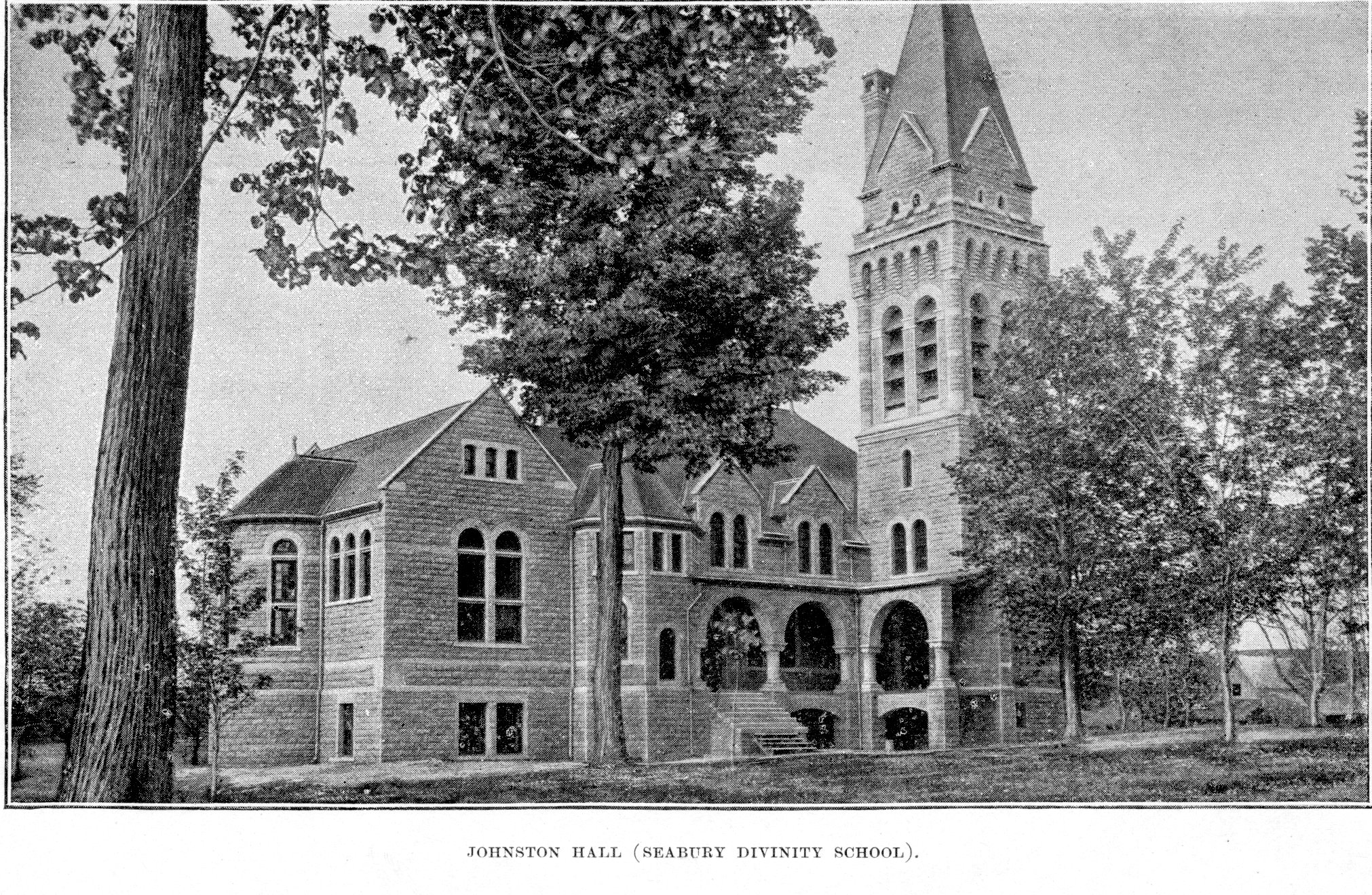
This undated photo of Johnston Hall is courtesy of the Rice County Historical Society.
AS A WRITER AND PHOTOGRAPHER, I understand the power of storytelling. That focuses my work. I strive to connect with readers in a meaningful and personal way via images and words.
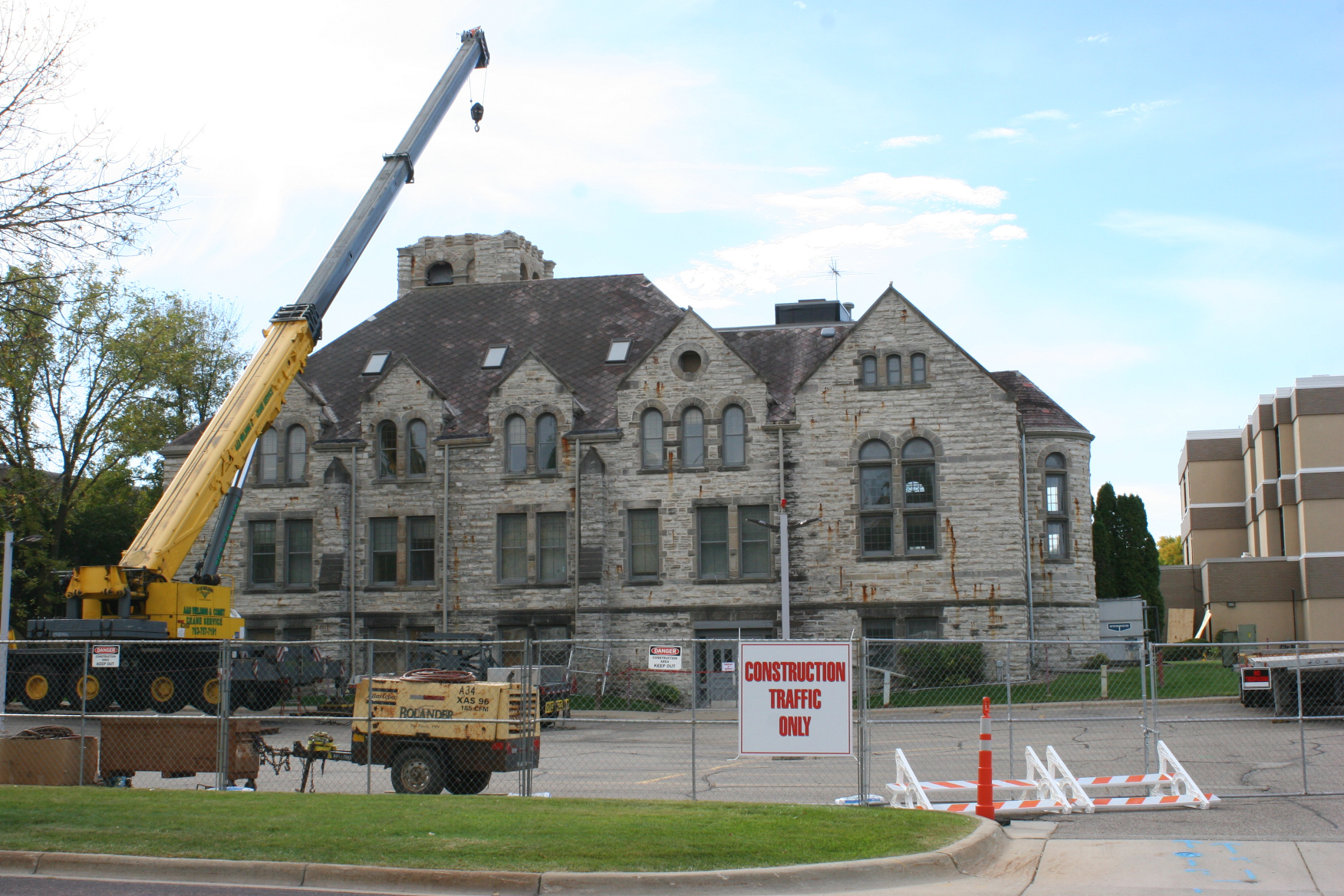
Johnston Hall, photographed shortly before it was demolished. (Minnesota Prairie Roots copyrighted photo September 2021)
And so storytelling is the approach I intended to take in writing about Johnston Hall. A building constructed in 1888 on Faribault’s east side. A building which once centered learning, then healthcare. A building placed on the National Register of Historic Places. A building that did not, physically, withstand the ravages of time and weather. A building which in 2021 was demolished, but not without efforts to save it.
The QR code on the sign links to the new documentary on Johnston Hall. (Minnesota Prairie Roots copyrighted photo August 2023)
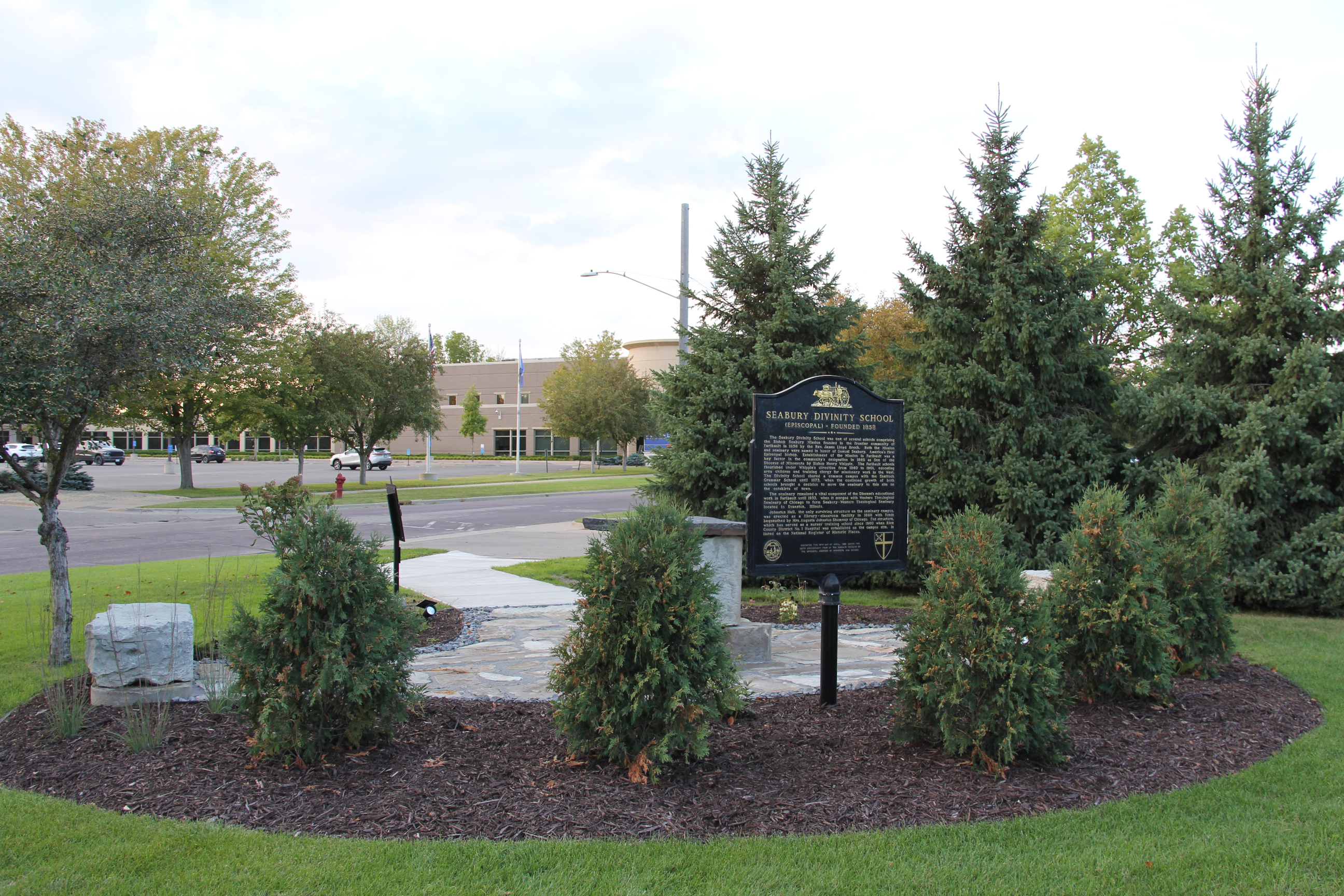
This shows the back of Johnston Hall Memorial Garden, looking toward Allina Health Faribault Medical Center. The garden is next to an employee parking lot. The bronze Seabury Divinity School plaque was saved from the hall and focuses the garden. (Minnesota Prairie Roots copyrighted photo August 2023)
I need to backtrack for a moment, though, to late August, when I photographed Johnston Hall Memorial Garden, located along State Street on the campus of the Allina Health Faribault Medical Center. The recently-completed garden honors the history of Johnston Hall and provides a contemplative space to reflect. For me, that’s remembering the time I spent, along with loved ones, in the aged building that once sat north of the hospital and clinic, northwest of the new garden.
Image credit: 1855 History Team Facebook page
In their Johnston Hall documentary, the filmmakers weave together history, memories, stories. Temple states that “…each soul passing through a building is a part of its memory, its identity and its legacy.” That is the singular line which stands out for me, the line defining Johnston Hall as more than a building that once stood tall, grand and strong, initially as part of Seabury Divinity School. Johnston Hall is part of so many personal stories, including mine.
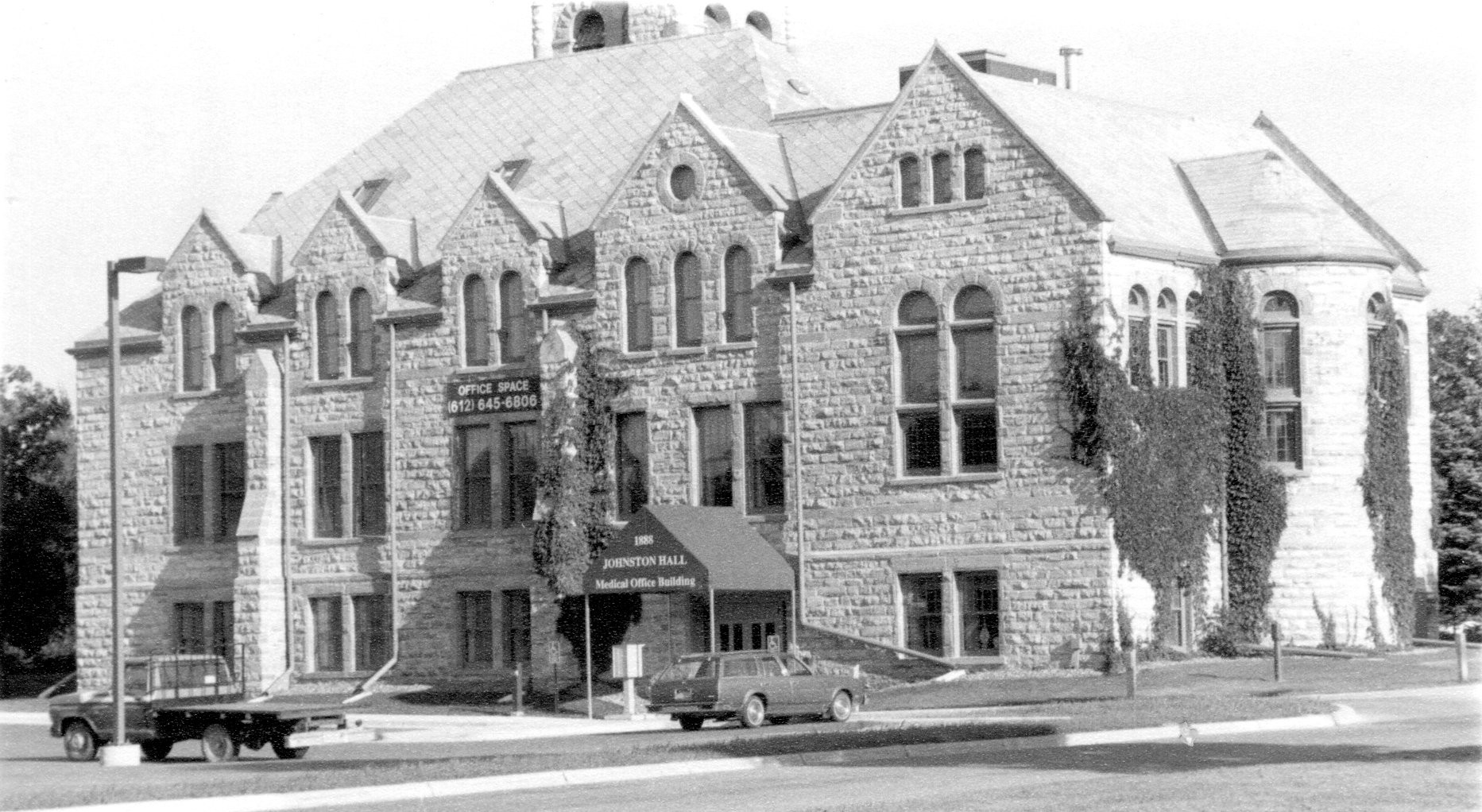
Johnston Hall in a 1990 image, as a Medical Office Building. (Photo courtesy of the Rice County Historical Society)
While I don’t recall the exact year I first walked through the doors of this stately limestone Romanesque architectural style structure, it was after an orthopedic and fracture clinic moved into the building. That followed histories of usage as the divinity school (closed in 1933) library and classrooms, a nurses’ training school and then a vocational-technical school.
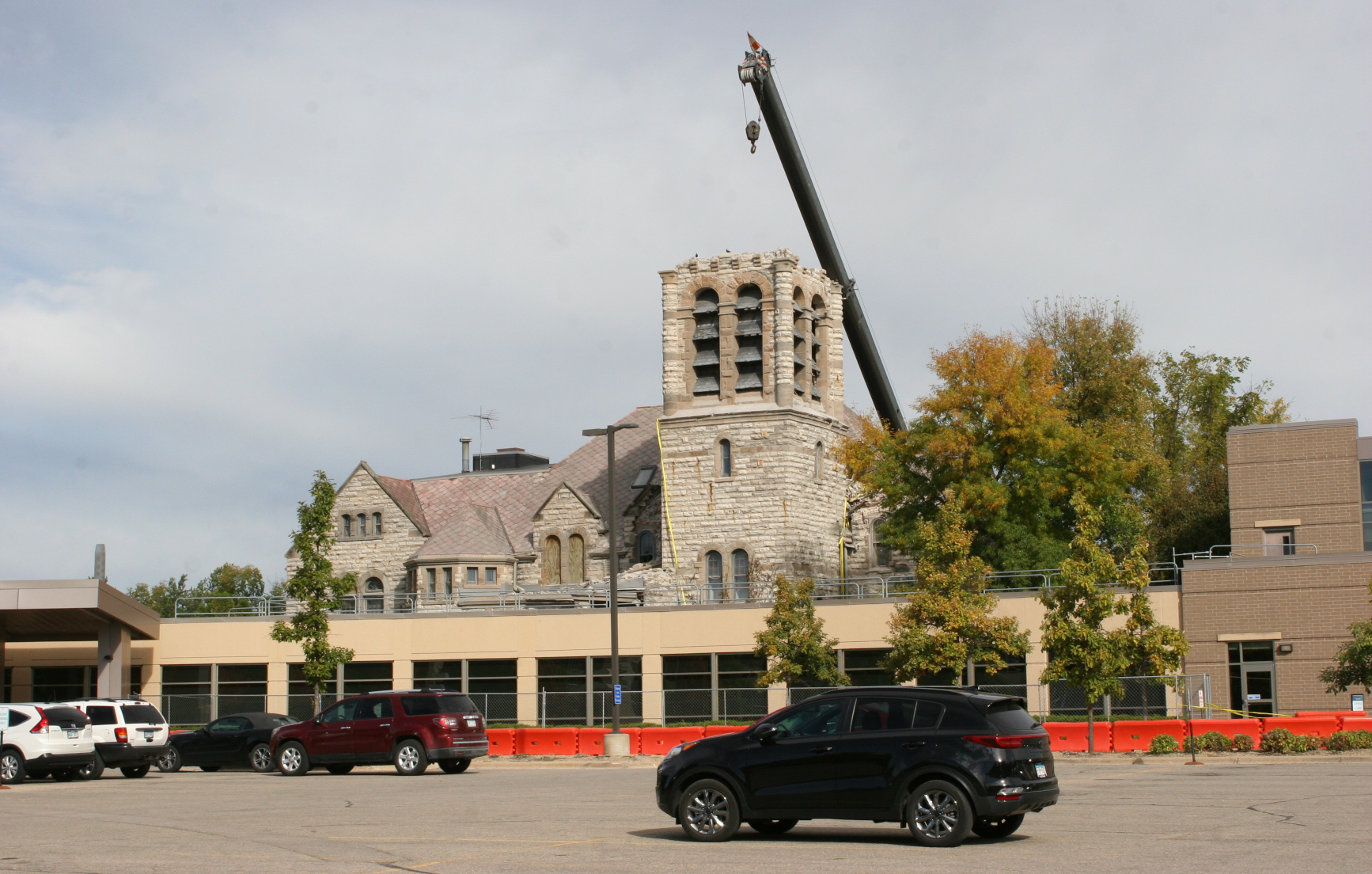
Johnston Hall photographed from the parking lot of the hospital and clinic. (Minnesota Prairie Roots copyrighted photo September 2021)
Broken bones and other health issues landed me and my family inside Johnston Hall. As a grade schooler, my son broke his little finger while unicycling in our driveway. In 2006, he was back at Johnston Hall, this time with a rib fracture and a broken bone in his hand after a hit-and-run driver struck him while he crossed the street to his bus stop. The same morning of that May 2006 scare, while my husband and son were in the hospital emergency room, I wound my way to nearby Johnston Hall for an appointment with an orthopedic doctor. I had waited too long to cancel my appointment, although I desperately wanted to stay by my son’s side in the ER.
On that May morning, I learned that I would eventually need right hip replacement surgery due to osteoarthritis. I delayed that surgery until 2008. The stairway and waiting room and exam rooms of Johnston Hall soon grew all too familiar.
To my second daughter also, who was screened for scoliosis in junior high and then referred to the medical team at Johnston Hall. Eventually her spinal curvature required wearing a customized, full body, hard plastic back brace 24/7 for a year. It was the first time I cried at Johnston Hall.
Stone was saved from Johnston Hall and incorporated into the memorial garden, including stone marking the hall as a gift from Augusta Huntington. (Minnesota Prairie Roots copyrighted photo August 2023)
In many ways, Johnston Hall and tears are intertwined. As the filmmakers share in their documentary, funding for the hall came from Augusta Huntington, formerly Augusta Shumway. Horatio Shumway left tens of thousands of dollars to his grieving widow. She used his gift to fund construction of Good Shepherd Chapel and then Shumway Hall in honor of Horatio. Both sit on the campus of the current-day Shattuck-St. Mary’s School, a private college prep school. In 1888, construction of Johnston Hall was completed, the cornerstone laid. The hall was a final bequeath from Augusta, who died in 1884. The building honors her father, William Johnston.
Up close, historic Johnston Hall shortly before its demolition. (Minnesota Prairie Roots copyrighted photo September 2021)
“Love Inwrought: Johnston Hall and the Memory of a Building” features much more in-depth history, including the connection between Minnesota’s first Episcopal bishop, Bishop Henry Whipple (who called Faribault home), and Augusta Shumway. The filmmakers also highlight Henry St. Clair, a Dakota man who attended Seabury Divinity School, studying inside the library and classrooms of Johnston Hall. He became an ordained deacon and then a pastor. Indigenous peoples are an integral part of Faribault’s history and I appreciate that these filmmakers focus on that, too, in their latest work.
Incorporated into Johnston Hall Memorial Garden, the 1888 cornerstone. (Minnesota Prairie Roots copyrighted photo September 2023)
In their well-researched documentary, Temple and Ledman use historical photos, illustrations, even a building model, actors, original music (composed by Sam Dwyer) and narration to tell the stories of Johnston Hall. Theirs is, indeed, a work of love, revealing how love inwrought takes a building beyond wood and limestone to memories abiding within the souls of those who’ve passed through its doors.

























 Minnesota Prairie Roots
Recent Comments