Minnesota Prairie Roots

Writing and photography by Audrey Kletscher Helbling

Published in Oakwood: My latest rural-rooted poem honors my farm wife mom April 28, 2017

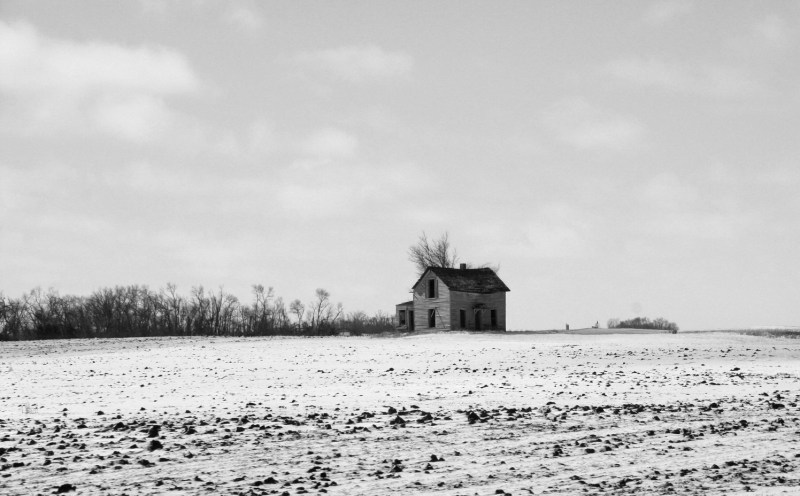
An abandoned farmhouse along Minnesota State Highway 19 east of Vesta, my hometown. The house is no longer standing. This image represents my rural heritage and looks similar to the house I called home for the first 11 years of my life. Minnesota Prairie Roots file photo.


MORE THAN 40 YEARS removed from the farm, my creative voice remains decidedly rural, especially in the poetry I write.

My latest published poem, “Ode to My Farm Wife Mother,” honors the woman who raised me, alongside my father, on a southwestern Minnesota dairy and crop farm. My parents were of good German stock, a hardworking couple who believed in God, in family and in the land. I carry that heritage with me, ever grateful for my rural upbringing.


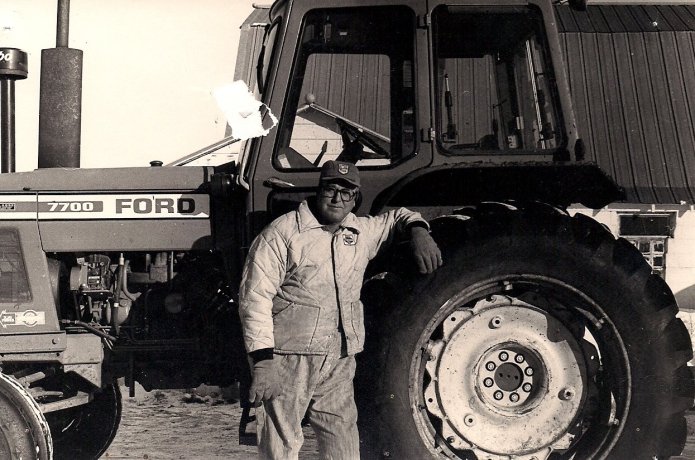
Dad farmed, in the early years with a John Deere and Farmall and IH tractors and later with a Ford. (Photo by Lanae Kletscher Feser)

A photo of my dad, Elvern, taken in 1980.


Life in rural Minnesota in the 1960s and 1970s was hard. I see that now from the perspective of an adult. My dad worked long hard hours in the barn milking cows and equally long hard hours in the fields. Farming was much more labor intensive then.


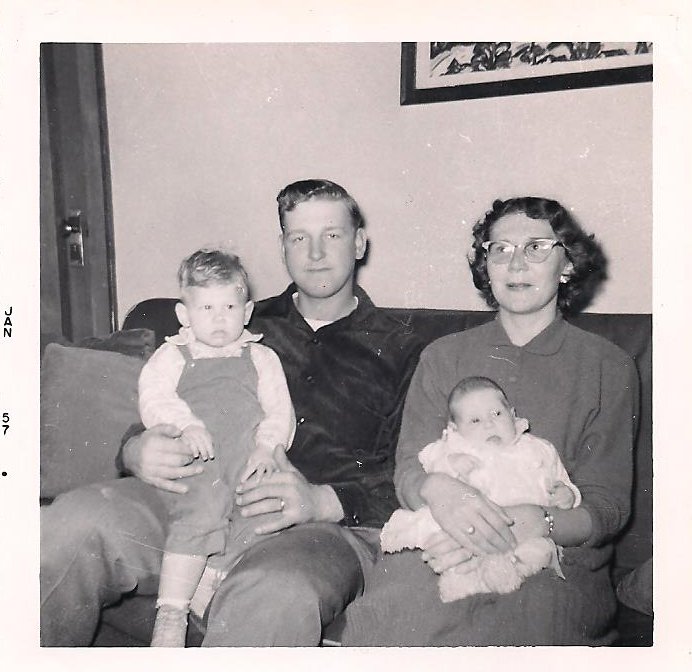
The only photo I have of my mom holding me. My dad is holding my brother, Doug.


Likewise, my mom’s job of caring for our family of eight required long hard hours of labor. She tended a large garden, preserved fruits and vegetables to stock the freezer and cellar shelves, baked bread from scratch, washed clothes with a wringer washer, did without a bathroom or telephone or television for many years, and much more.


My parents, Vern and Arlene, on their September 25, 1954, wedding day.


Sometimes I think how much easier my mother’s life would have been had she not married my dad and stayed at her town job in Marshall.


Our family Christmas tree always sat on the end of the kitchen table, as shown in this Christmas 1964 photo. That’s me in the red jumper with four of my five siblings. I write about this red-and-white checked floor in my poem.


But then I remind myself of how much family means to my mom and I could not imagine her life without any of her six children. She centered us, grounded us, taught us kindness and gratitude, instilled in us a loving and compassionate spirit.


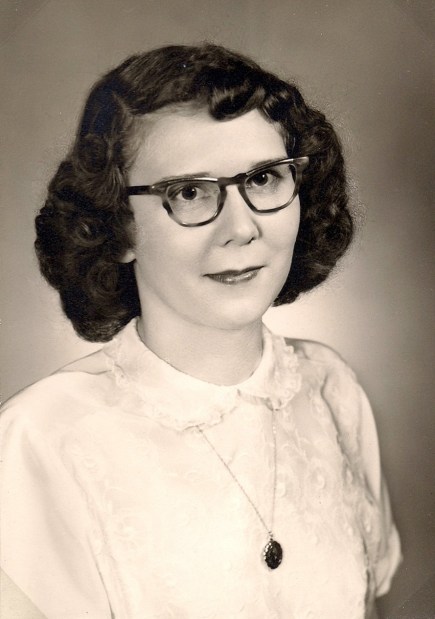
Arlene’s 1951 graduation portrait.


She has always been mom to me, a mother now nearing age 85. But there was a time when she was Arlene, not somebody’s wife, somebody’s mother. There was a time when she and my dad danced away a Saturday night in a southwestern Minnesota dance hall. They met at a dance.


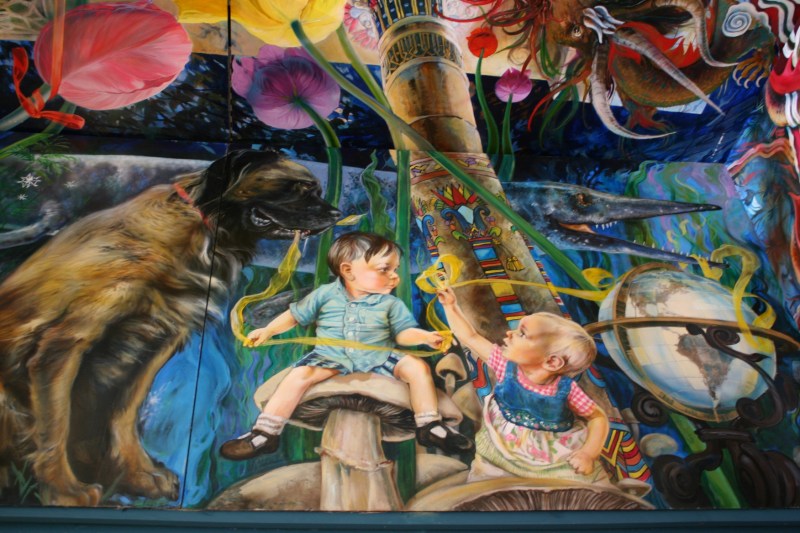
The promo for Oakwood 2017 features “Dancing with Fire,” the art of Samuel T. Krueger. Promo image courtesy of Oakwood.


Those thoughts inspired me to write “Ode to My Farm Wife Mother,” published last week in South Dakota State University’s literary journal, Oakwood. I am honored to have my poem selected for inclusion with the work of other writers and artists from the Northern Great Plains. It’s a quality publication that represents well those of us who call this middle-of-the country, often overlooked place, home.


Ode to My Farm Wife Mother

Before my brother,
you were Saturday nights at the Blue Moon Ballroom—
a bottle of Jim Beam whiskey in a brown paper bag,
Old Spice scenting your dampened curls,
Perry Como crooning love in your ear.

Then motherhood quelled your dancing duet.
Interludes passed between births
until the sixth, and final, baby slipped into your world
in 1967. Thirteen years after you married.
Not at all unlucky.

Life shifted to the thrum of the Maytag,
sing-song nursery rhymes,
sway of Naugahyde rocker on red-and-white checked linoleum.
Your skin smelled of baby and yeasty homemade bread
and your kisses tasted of sweet apple jelly.

In the rhythm of your days, you still danced,
but to the beat of farm life—
laundry tangled on the clothesline,
charred burgers jazzed with ketch-up,
finances rocked by falling corn and soybean prices.

Yet, you showed gratitude in bowed head,
hard work in a sun-baked garden,
sweetness in peanut butter oatmeal bars,
endurance in endless summer days of canning,
goodness in the kindness of silence.

All of this I remember now
as you shove your walker down the halls of Parkview.
in the final set of your life, in a place far removed
from Blue Moon Ballroom memories
and the young woman you once were.

                                         #

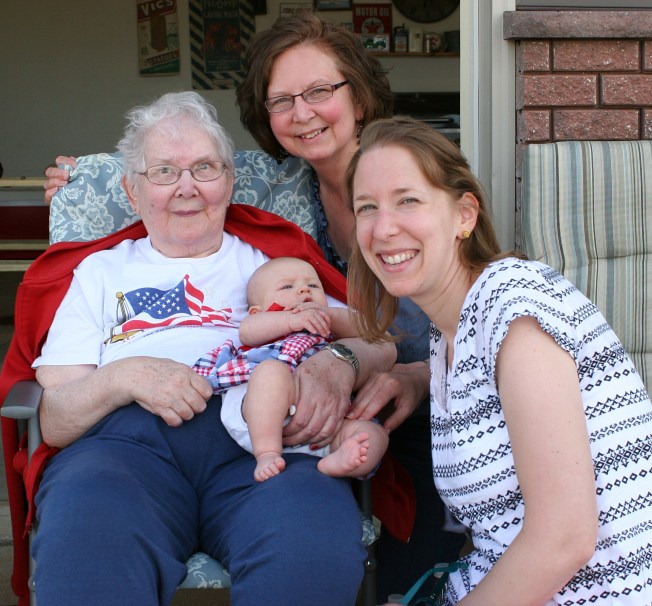
Four generations: Great Grandma Arlene, Grandma Audrey, mother Amber and baby Isabelle, all together for the first time in July 2016 in rural southwestern Minnesota. Minnesota Prairie Roots file photo 2016.


I took some liberties with my poem. I doubt my mom ever drank whiskey. But back in the day, folks brought booze bottles in brown paper bags to dances for set-ups. She didn’t dance in the Blue Moon Ballroom, although one once stood in Marshall. Arlene went to dances in Ghent, in a dance hall whose name eludes me. Blue Moon sounds more poetic. But the rest of the poem is factual right down to the Naugahyde rocker and my mom shoving her walker down the hallways of Parkview.

FYI: You can view my poem on page 78 of Oakwood, found online by clicking here. My bio is published on page 89, listed among the other 40 contributors’ bios. I am grateful to SDSU in Brookings for the opportunity to be part of this magazine which showcases the creative voices of Plains writers and artists. I shall always feel proud of my rural upbringing, the single greatest influence on me as a poet, a writer, a photographer.

Copyright 2017 Audrey Kletscher Helbling


Art of the crucifixion April 14, 2017


ART MOVES IN A WAY sometimes that words cannot.


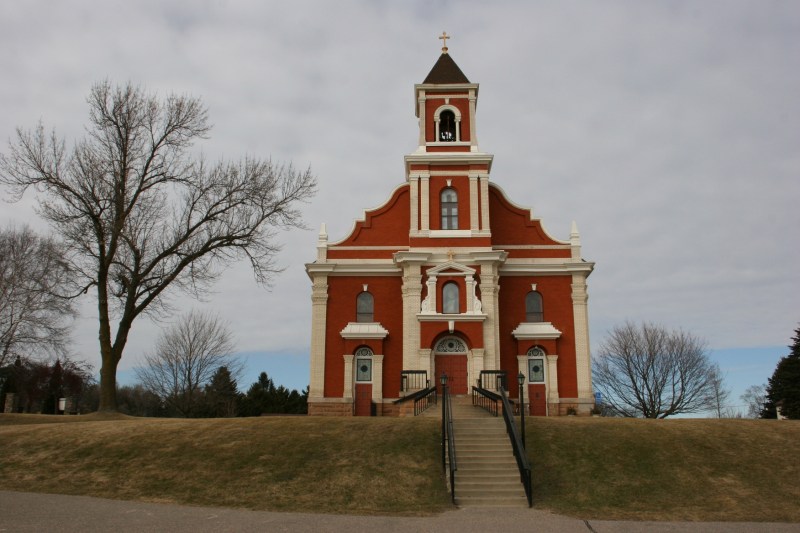
St. Mary’s Catholic Church sits atop a hill in New Trier, a small town north of Cannon Falls.


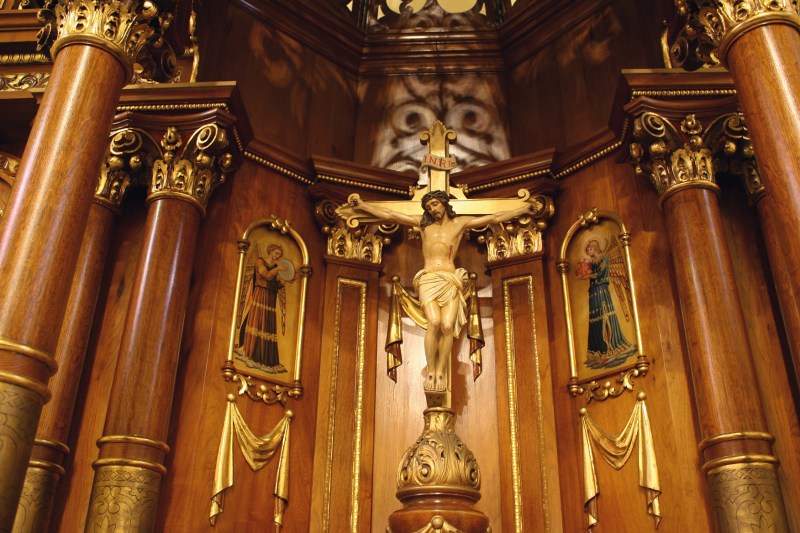
Today I present to you selected art that depicts the crucifixion of Christ. I discovered this collection inside St. Mary’s Catholic Church, New Trier, Minnesota.


Centering the ornate altar is this depiction of Jesus’ crucifixion.


The art ranges from simple to elaborate. I know nothing of the artists. But in viewing each of their works, I experience a wide range of emotions. And with that comes a deep sense of gratitude for those who share their faith through art.


In the face of Mary, I see profound grief in losing her son.


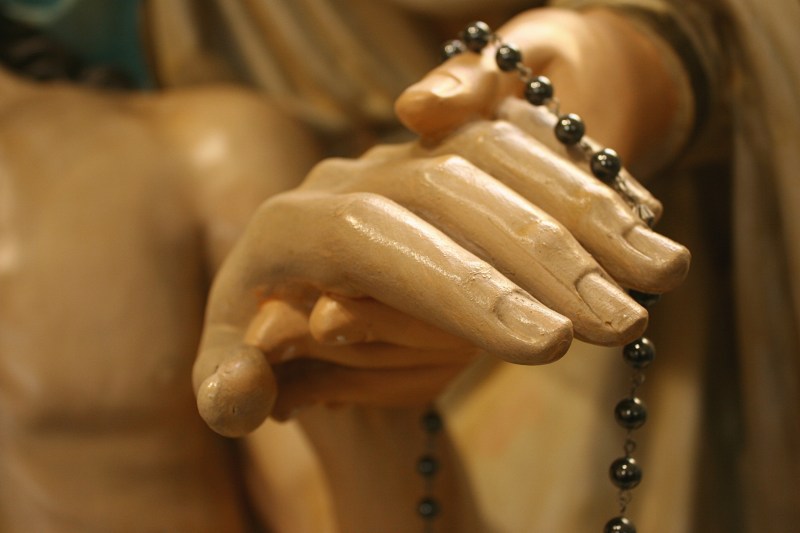
Hands convey so much love; here Mary holds Jesus’ hand.


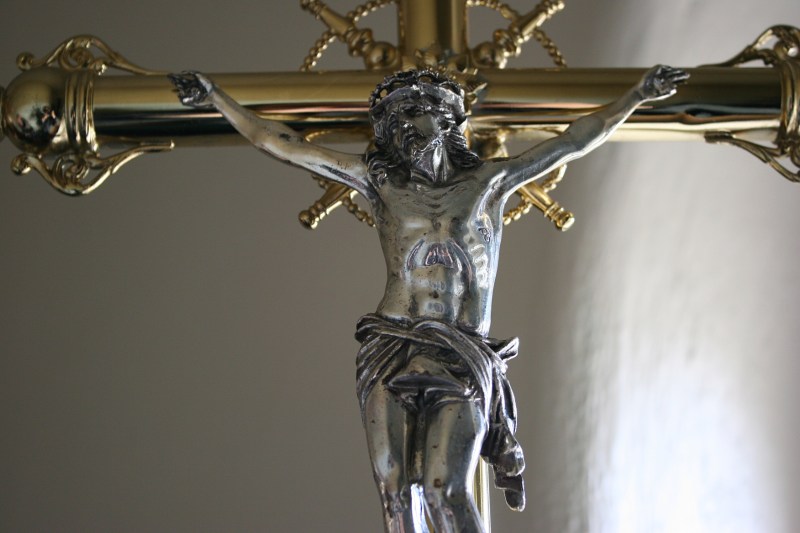
The detail in this work of art presents the visual depth of Christ’s suffering.


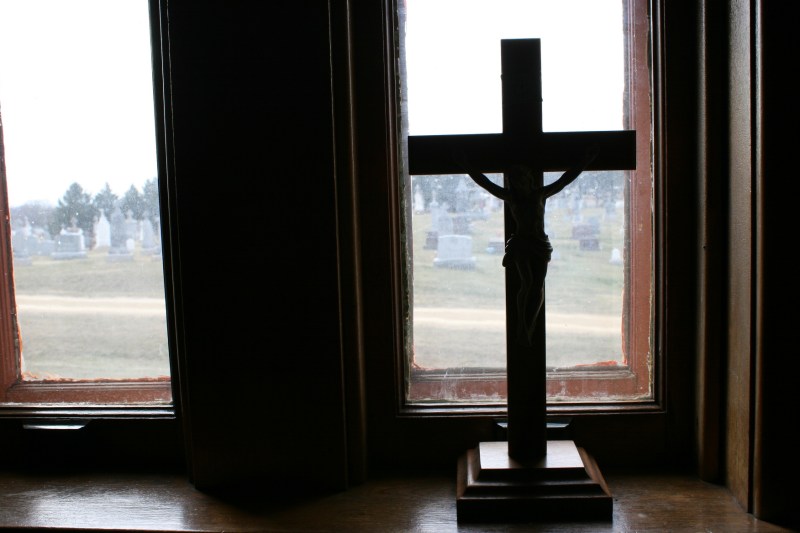
This simple crucifix is set against the window backdrop of St. Mary’s Cemetery.


When I toured St. Mary’s recently, I was overwhelmed by the beauty of this place, just as today I am overwhelmed by gratitude to Christ.

FYI: Please check back for future posts of my visit to St. Mary’s.

© Copyright 2017 Audrey Kletscher Helbling


My award-winning water story publishes April 8, 2017


“Water Stories from a Minnesota Prairie Perspective” has published in southern Minnesota based River Valley Woman’s April issue. My story won the nonfiction category in the “We Are Water” writing contest sponsored by Plum Creek Initiative with the support of The League of Women Voters and River Valley Woman. That honor includes a $250 prize.

I don’t have a hard copy yet, but I viewed the story online. And so can you by clicking here and advancing to page 50 of the April issue. The piece is lengthy per submission guidelines requiring 5 – 12 pages of copy.

No matter how many times I’ve been published, I still thrill in seeing my words out there for others to read and perhaps appreciate. You can find print copies of the magazine in many locations like Mankato, St. Peter, New Ulm, Redwood Falls and surrounding smaller communities. Click here for a complete list.

In reading my story, you will learn of my growing up years on a southwestern Minnesota dairy and crop farm, the place that shaped me into the person, writer and photographer I’ve become. Farm life as I remember it from the 1960s – 1970s no longer exists. So this story, while written for a competition, was also written for me and my family. There’s an importance in reclaiming memories through written words, in telling the stories that define a place, in sharing my roots with you, my readers.

FYI: Click here to read my first blog post about winning this writing competition.

© Copyright 2017 Audrey Kletscher Helbling


Barn memories February 28, 2017

Filed under: Uncategorized — Audrey Kletscher Helbling @ 5:00 AM
Tags: , , , , , , , , , ,

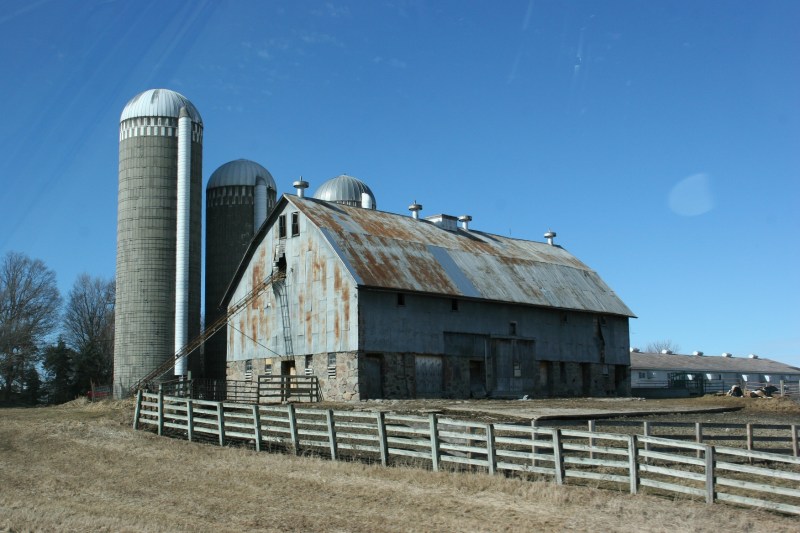
barn-85-barn-fence


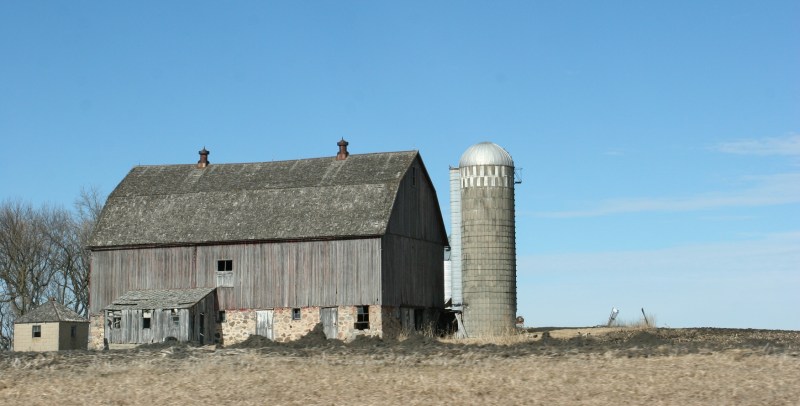
MY APPRECIATION FOR and fascination with aged barns remains strong, steadfast, unwavering. That interest springs from childhood years of laboring in a southwestern Minnesota dairy barn.


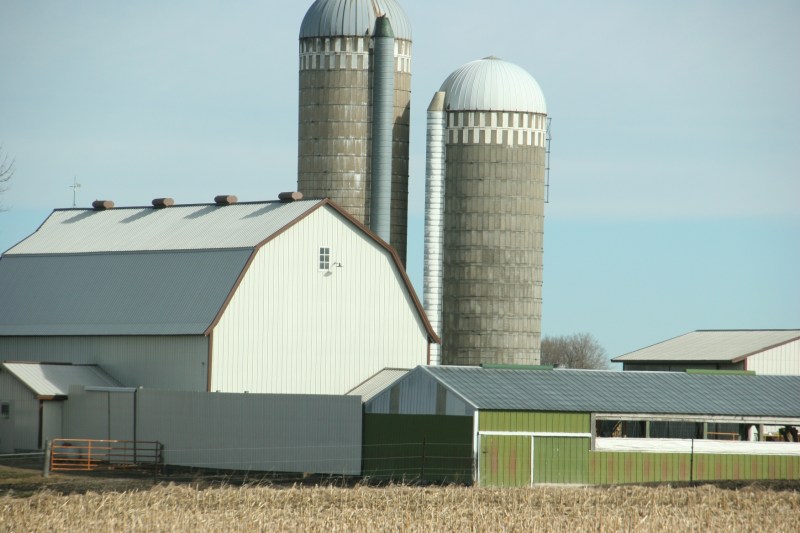
barn-15-barn-2-silos


As the second oldest in a family of six children, I was tasked early on with doing chores alongside my eldest brother. Dad needed the help and I never resented it. I only resented that my brother would steal the silage I’d tossed down from the silo. I suppose I can’t blame him. He had to carry silage across two gutters and a barn aisle to feed cows on the east side of the barn. I had only to step outside the silage room door to distribute chopped and fermented corn on the west side. But still.


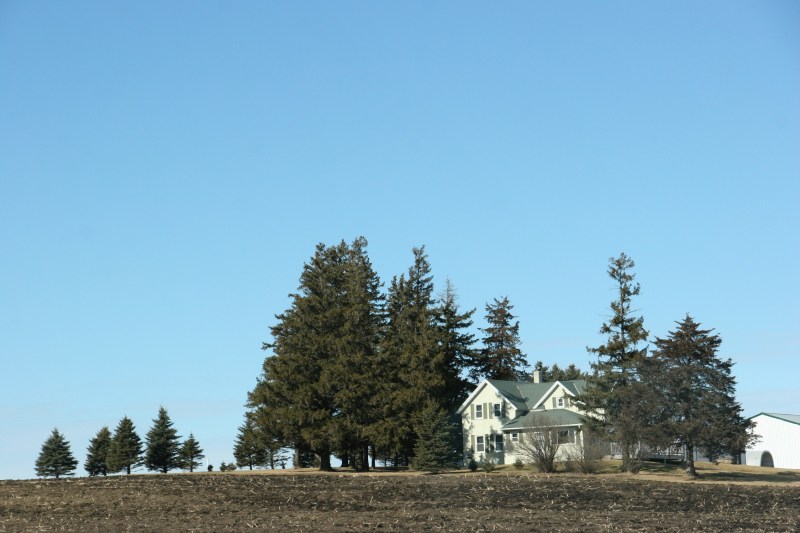
barn-84-farmhouse


Often I told my dad I wanted to be a farmer when I grew up. He never encouraged it. But I loved working in the barn—maybe not the scraping manure part so much. Yet I always preferred farm work to anything Mom wanted me to do in the house.


barn-80-barn-silo


So I pushed a wheelbarrow down the barn aisle, then scooped shovels full of ground feed before stanchions. I hoisted myself into the haymow to throw down bales of hay and straw. I shook apart straw with a pitchfork, separated alfalfa with gloved hands. I carried pails of milk, washed buckets, mixed milk replacer, fed milk and pellets to hungry calves…

I hold memories of Point of Law booming from WCCO, of hot urine splashing from a cow’s behind, of frothy milk poured into the bulk tank, of a yellow jackknife stuffed inside my pants pocket, of cats clustering around a battered hub cap brimming with still warm milk.


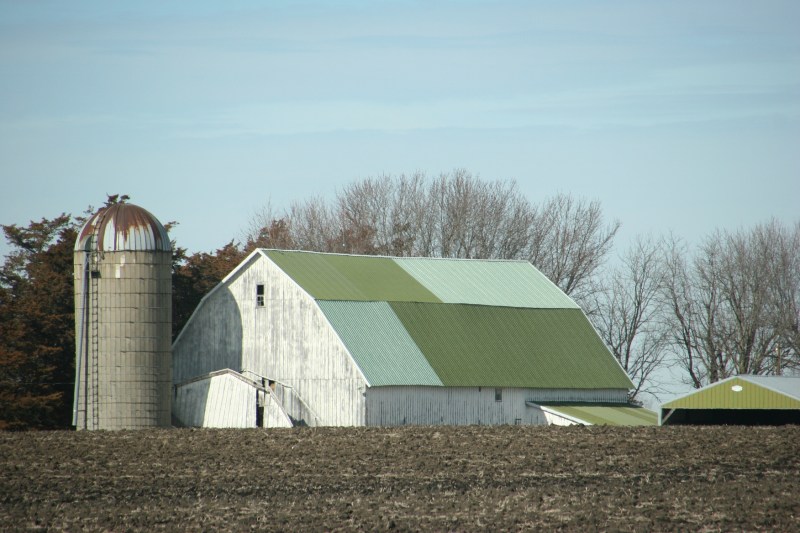
barn-81-barn-w-green-patched-roof


My dad was right. I never became a farmer, pursuing journalism instead. Only one brother farmed for awhile. He’s still in an ag-related industry as is my oldest brother. The rest of us, well, we left the farm. But I like to think that we’ve truly never left in the sense of a deep-rooted attachment to the place that shaped each of us. I write and photograph from a rural perspective. Another sister works as a floral designer. My youngest brother is an attorney in the Twin Cities metro, but maintains his connection to southwestern Minnesota through deer and pheasant hunting.
We were raised as the sons and daughters of a farmer. That remains, as part of our past and as part of who we became.

TELL ME: Did your childhood influence your direction in life, including career choices, where you lived/live, etc.?

FYI: These photos were taken in rural Rice County and in the Jordan/Prior Lake areas, not in my native southwestern Minnesota. This post honors my farmer father, Elvern Kletscher, who would have celebrated his birthday this week. He died 14 years ago in early April 2003.

© Copyright 2017 Audrey Kletscher Helbling


Art shed February 10, 2017

Filed under: Uncategorized — Audrey Kletscher Helbling @ 5:00 AM
Tags: , , , ,

art-shed-in-olmsted-county-mn-117-overview


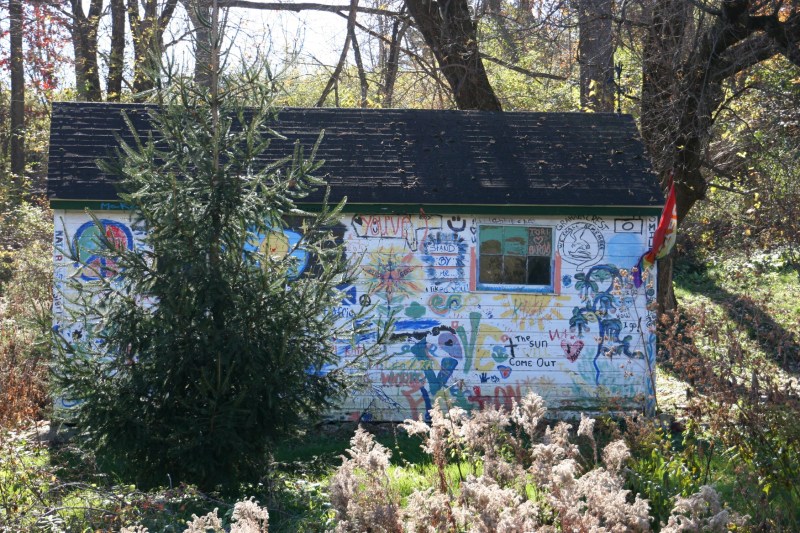
THE AGED SHED STANDS as a canvas along Olmsted County Road 1 for artwork that reminds me of the 1960s.


art-shed-in-olmsted-county-mn-122-close-up


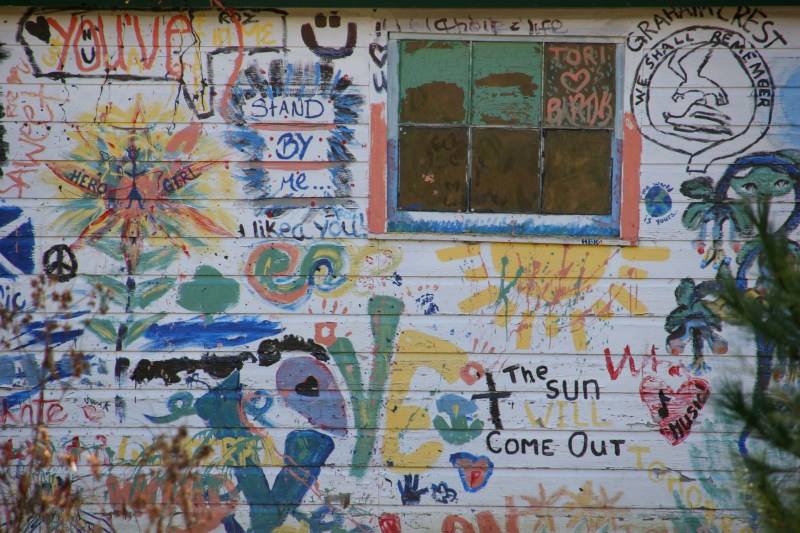
Peace signs and LOVE. Stand by me. The sun will come out.

If I knew the story behind the art, the words, the artists, I’d tell you. But I don’t.

This shed is situated on private property between Pleasant Grove and Simpson, south of Rochester, near Root River County Park. Driving northbound, you’d miss it hidden by trees. Southbound I just barely caught the flash of color through nature’s cover.


art-shed-in-olmsted-county-mn-121-close-up


Whatever the story, I am intrigued. I don’t consider this graffiti. It’s art and poetry, emotions expressed. All those hearts and peace symbols point to soulful individuals who care deeply, live joyfully and love life.

Thoughts?

If you know the story about this art, I’d love to hear from you.

Note: These photos were taken in October, long before winter’s arrival in Minnesota.

© Copyright 2016 Audrey Kletscher Helbling


Part I from Pleasant Grove: About those pioneer women January 24, 2017

pleasant-grove-town-hall-99-historical-marker


I ALMOST CAN’T BELIEVE what I am reading:

The first “real” settlement, with housekeeping and women, in Olmsted County was made in 1853 by Philo S. Curtis in the village of Pleasant Grove, then known as Curtis. The following year Mr. Curtis opened the Pleasant Grove House, a three-story log hotel at the junction of the Pioneeer (Fort Atkinson) Trail and the Territorial Road (St. Paul-Dubuque Road)…


pleasant-grove-town-hall-100-close-up-of-sign


Reread those first words: The first “real” settlement, with housekeeping and women


pleasant-grove-town-hall-98-side-view


What exactly does that mean? The words are posted on a sign erected in 1966 (or maybe it was 1986 at the Pleasant Grove Town Hall; I can’t decipher the decade) by the Olmsted County Historical Society.


pleasant-grove-town-hall-102-ballot


Pleasant Grove, as I understand the historical marker, was the first settlement in this southeastern Minnesota County where women lived. And those women were tasked with housekeeping. (Maybe more?) Now there’s nothing wrong with either sex assuming household duties. But I’m bothered by the wording; as a woman, it just strikes me as wrong. This is, after all, 2017, not the mid 1800s. A woman ran for President. Women ran for office everywhere, even in Olmsted County. We can vote. We can march. Perhaps this could be written in a more positive way to honor the early pioneer women who settled here.


pleasant-grove-town-hall-103-front-of


And why were so many towns named after men? Did you catch that? Philo Curtis established the village, originally called Curtis. Thank goodness someone had the good sense to change the name to the much more pleasing Pleasant Grove.


pleasant-grove-town-hall-101-meeting-notices


Now, if only someone would replace the weathered, nearly unreadable historical marker with something more pleasant.

TELL ME: What are your thoughts on the wording of this sign? Should it be changed? If so, what would you write? Or is it OK given the historical context?

FYI: Please check back as I bring you more discoveries from my stop in Pleasant Grove several months ago, well before winter arrived.

© Copyright 2017 Audrey Kletscher Helbling


A tree January 19, 2017

Filed under: Uncategorized — Audrey Kletscher Helbling @ 5:00 AM
Tags: , , , , , ,

a-tree-in-a-corn-field


WHENEVER I SEE a lone tree in a field, I am grateful.

Grateful to the farmer who chose to leave it there rather than cut it down for a few more crop rows.

I am grateful for the farmer who sees beyond his pocketbook and respects the value of a tree.

Thoughts?

© Copyright 2016 Audrey Kletscher Helbling
Tree photographed on October 7, 2016, western Waseca County, Minnesota


My appreciation for small town hardware stores January 13, 2017

Hardware Hank, photographed in Pine Island in October.

Hardware Hank, photographed in Pine Island in October.

IF YOU GREW UP in rural Minnesota like I did, you likely hold fond memories of the local hardware store.

Two hardware stores once served my hometown of Vesta, a farming community on the southwestern Minnesota prairie. While I remember Joe Engel’s Hardware store as the place to buy rolls of perforated caps for my cap gun, my father shopped there, or a few doors down at Marquardt’s Hardware, for all his hardware needs. Like bulk nails and screws stashed in cubbies, the merchandise weighed and parceled into brown paper bags.

I remember, too, the worn wood floors, the narrow aisles, the old fashioned screen doors that banged shut.

To this day, I find myself drawn to the hardware stores that still exist in many small towns. They represent a connection to my past, to simpler days, to outstanding customer service, to a Main Street necessity. So I photograph them, usually the exteriors.

Nothing says "small town" like a hardware store, including this Hardware Hank in downtown Wabasha.

Nothing says “small town” like a hardware store, including Hill’s Hardware Hank in downtown Wabasha. Minnesota Prairie Roots file photo.

One of my hardware store images—that of Hill’s Hardware Hank in Wabasha—will soon become part of a renovated “Our World” gallery at the Minnesota Children’s Museum in St. Paul. The photo will grace signage for a mini town that includes a hardware store. Hill’s inspired the facade of the replica hardware store in which children can play. The updated exhibit opens this spring.

I am honored to have my photo displayed at the Minnesota Children’s Museum. I hope it inspires others to appreciate the value of hardware stores in rural Minnesota. They are as important today as they were when I was growing up in the 1960s. In Owatonna, Arrow Ace Hardware plans to relocate into a new and much larger space by next Christmas, more than doubling its size to some 11,000 square feet. That’s encouraging. There’s still great value in local hardware stores.

TELL ME: Do you shop in hardware stores? If yes, why? Are they still of value in today’s marketplace?  Or what are your hardware store memories? Let’s talk hardware stores.

© Copyright 2016 Audrey Kletscher Helbling


Abandoned in rural Minnesota January 12, 2017

Filed under: Uncategorized — Audrey Kletscher Helbling @ 5:00 AM
Tags: , , , , , ,

abandoned-house-truck-in-alma-city


SCENES LIKE THIS sadden me.

Why was this house abandoned? Did the owner fall ill or die? Or simply move to a better and more spacious home? Or did lack of finances factor into this abandonment? Or a personal crisis?

I wonder.

This scene in unincorporated Alma City in western Waseca County, rural Minnesota, is all too familiar. Houses that once sheltered families stand deserted, paint peeling, wood softening to a weathered grey.

What stories does this house hold? What memories were made here? Does anyone care that this house is no longer a home?

And what about that rusting truck? What routes did it travel? Back county roads, gravel roads, field drives? Perhaps to the hardware store, the grain elevator, a local cafe.

Who steered the wheel of this GMC? Perhaps a farmer or a retired farmer.

All these things I ask because my mind works that way. Inquisitive, ranging around thoughts, always wondering.

TELL ME: What short story would you write about this scene?

Note: This image was taken in October, well before winter arrived in Minnesota.

© Copyright 2017 Audrey Kletscher Helbling


Southwestern Minnesota: The place of my heart, in images & words December 6, 2016

I shot this rural farmsite/sunset scene while traveling along Minnesota State Highway 67 between Redwood Falls and Morgan.

I shot this rural farmsite/sunset scene while traveling along Minnesota State Highway 67 between Redwood Falls and Morgan.

OFTENTIMES IT TAKES LEAVING a place to appreciate it.

A farmhouse along Minnesota State Highway 19 in Redwood County near my hometown of Vesta.

A farmhouse along Minnesota State Highway 19 in Redwood County near my hometown of Vesta.

There are days when I miss my native southwestern Minnesota prairie with an ache that lingers. I long for wide open space and forever skies,

The grain elevator in Morgan.

The grain elevator in Morgan in eastern Redwood County.

for farm fields and familiar grain elevators,

This gravel road connects to Minnesota State Highway 19 between Vesta and Redwood Falls.

This gravel road connects to Minnesota State Highway 19 between Vesta and Redwood Falls.

for gridded gravel roads

A prairie sunset photographed from Minnesota State Highway 67 between Redwood Falls and Morgan.

A prairie sunset photographed from Minnesota State Highway 67 between Redwood Falls and Morgan.

and flaming sunsets. And quiet.

Sure, I could drive into the country here in southeastern Minnesota and see similar sites. But it’s not the same. This is not my native home, the place that shaped me. Although decades removed, I shall always call the prairie my home.

Minnesota State Highway 67, one of the roadways leading "home."

Minnesota State Highway 67, one of the roadways leading “home.”

With family still living in southwestern Minnesota, I return there occasionally. And that, for now, is enough. I drink in the scenery like gulping a glass of cold well water tasting of iron and earth. I am refreshed, renewed, restored.

This lone tree along Minnesota State Highway 19 near the Belview corner has been here as long as I can remember.

This lone tree along Minnesota State Highway 19 near the Belview corner has been here as long as I can remember.

I need to view the prairie, to walk the soil, to reclaim my roots. I need to see the sunsets, to breathe in the scent of freshly-mown alfalfa, to watch corn swaying in the breeze, to observe snow drifting across rural roadways, to feel the bitter cold bite of a prairie wind.

A farmer guides his John Deere tractor along Minnesota State Highway 67 near Morgan.

A farmer guides his John Deere tractor along Minnesota State Highway 67 near Morgan.

There are those who dismiss this region as the middle-of-nowhere. It’s not. It’s a place of community, of good hardworking people, of Saturday night BINGO and Sunday morning worship services. It’s lines at the grain elevator and fans packing bleachers at a high school basketball game. It’s acres of corn and soybeans in the season of growth and tilled black fields in the time between. This place is somewhere to those who live here. And to those of us who were raised here.

Every trip back along Minnesota State Highway 67, I am drawn to photograph the electrical lines that stretch seemingly into forever.

Every trip back along Minnesota State Highway 67, I am drawn to photograph the electrical lines that stretch seemingly into forever.

For me, this land, this prairie, shall always be home.

© Copyright 2106 Audrey Kletscher Helbling