

WHENEVER AN AUTHOR appears locally to read from and discuss his/her book, I try to attend. I love reading and learning. I enjoy listening to other writers talk about the craft of writing as I read and write nearly every day.
Among authors who will be in my area soon are Dr. Michael Osterholm and Gary Heyn. Let’s start with Osterholm, who will appear at The Grand Event Center in Northfield at 7 pm Monday, November 17, to read from his book, The Big One—How We Must Prepare for Future Deadly Pandemics, co-authored by Mark Olshaker. He will also engage in conversation with Debby Walser-Kuntz, professor of biology at Carleton College in Northfield.
Osterholm, an internationally-renowned epidemiologist and director of the University of Minnesota Center for Infectious Disease Research and Policy, is a familiar name, especially to Minnesotans. During the COVID-19 pandemic, he was tapped as an expert. I, for one, found him to be an invaluable and trusted source of information during the pandemic. His knowledge and research into infectious diseases stretches well beyond COVID, though.
My history with Osterholm goes back decades to the late 1970s when I was just out of college working at a small town Minnesota weekly newspaper, The Gaylord Hub. Osterholm came to Gaylord during a hepatitis outbreak at the local school. While details of that health issue have long faded, I recall that this highly-contagious disease was connected to a band teacher and musical instruments. I remember photographing Osterholm, also starting his career, and writing a news story about what was unfolding at the school.

On November 17, Osterholm will focus on pandemics, sure to be an enlightening talk at this 7-8:30 pm first come first serve seating (doors open at 6 pm.) event at The Grand, 316 Washington Street in Northfield and hosted by local independent bookshop, Content Bookstore.
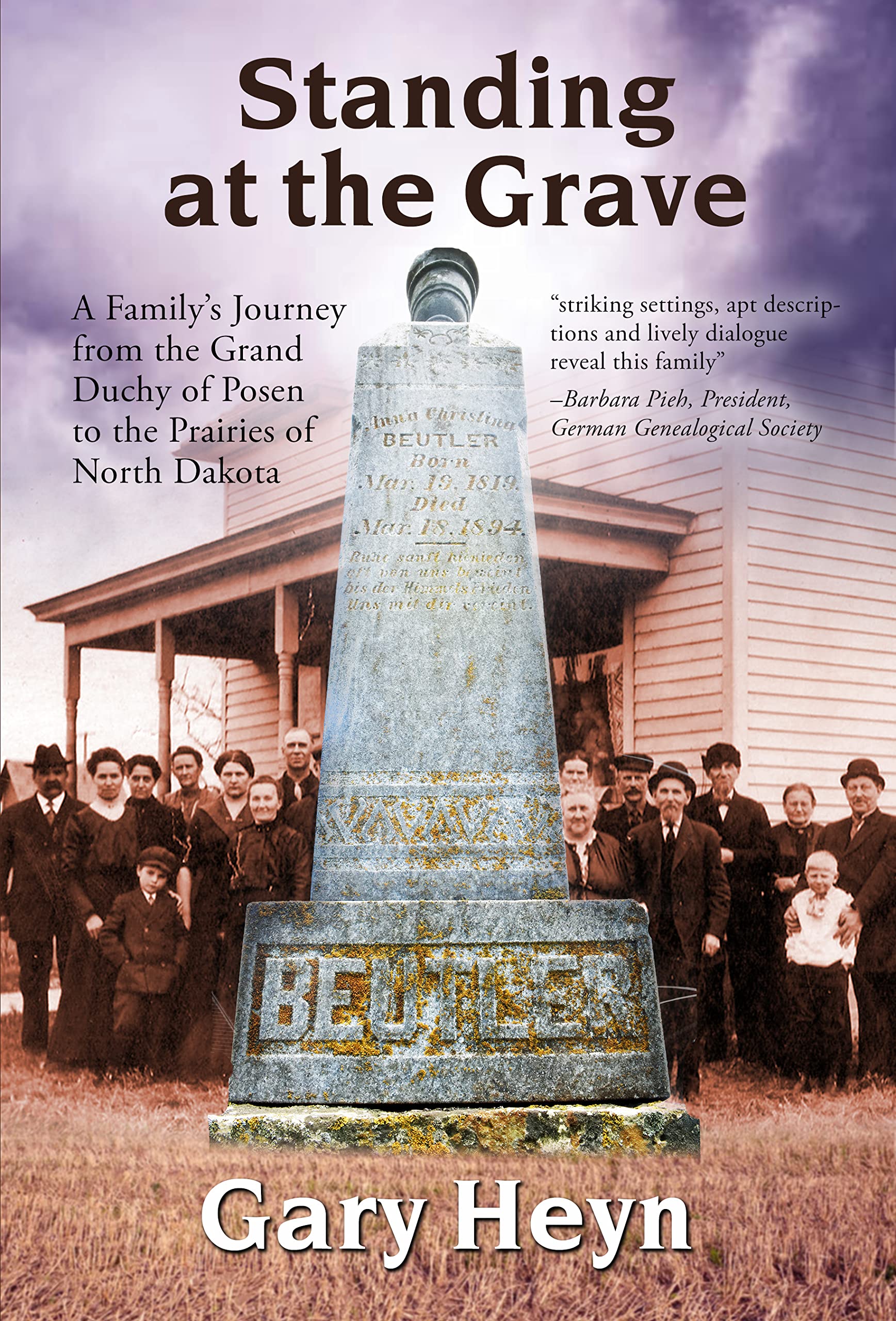
While Osterholm will present in a large venue, author Gary Heyn will appear in a much smaller, intimate setting, the Rice County Area United Way’s Books on Central. The used bookshop is housed in a former jewelry store at 227 Central Avenue North, Faribault. Heyn, a retired corporate executive turned historian, genealogist and writer upon his retirement, will read from and talk about Standing at the Grave: A Family’s Journey from the Grand Duchy of Posen to the Prairies of North Dakota. This free literary event is set for 6 pm Thursday, November 20.
I’m about a third of the way through Heyn’s book and I can attest that it is a captivating read, the kind of book I don’t want to put down. It’s relatable when considering my German immigrant ancestors and also in the context of immigration issues today. Once I’m finished with the book, my husband will also be reading it. His ancestors, the Helblings, moved from Germany to then Russia (current day Ukraine) before journeying to America and a new life in North Dakota.
Insights into immigration, tracing family history and stories are always of interest. Heyn will read from the chapters of his book about three mothers from Gembitz Hauland, an historic German-Polish village, who were reunited in Steele County 18 years after sending their children to America. To type those words is enough to break my heart. I cannot imagine how difficult that must have been for those three mothers. But it happened. Over and over and over again.
I encourage you, if you live in my area, to attend these upcoming author talks. These are opportunities to learn via the expertise and creativity of those inspired to write.
FYI: To view other upcoming author events offered by Content Bookstore, click here.
© Copyright 2025 Audrey Kletscher Helbling










“Love your neighbor,” Part I from Northfield November 17, 2025
Tags: Adan Nunez Gonzalez, Bridge Square, candlelight prayer vigil, commentary, faith, ICE detainee, Immigration and Customs Enforcement, injustice, Minnesota, neighbors, news, Northfield, prayer, Scripture, the bible
MY SUNDAY BEGAN as most Sundays do with morning worship at my church. The sermon highlighted sections of Mark 12, which includes this verse: Love your neighbor as yourself. That would theme the rest of my day.
Hours later I found myself gathered with others for the annual Rice County Salvation Army Red Kettle Campaign Kickoff. Again, the focus was on neighbors, specifically helping our neighbors in need.
Shortly after that event, Randy and I were on the road to neighboring Northfield for a 5 pm candlelight prayer vigil at Bridge Square. That, too, was about loving our neighbors. This time the gathering focused on supporting the family of Adan Nunez Gonzalez, a 41-year-old father of four snatched by masked Immigration and Customs Enforcement agents at gunpoint on November 11 in a residential neighborhood of Northfield. That incident has sparked outrage in this southern Minnesota college town and beyond.
Several family members and others witnessed Nunez Gonzalez being pulled from the passenger side of a vehicle while he was arriving at a job site along Washington Street. He’s a painter, originally from Mexico, with reportedly no criminal record who has been living in the US for 11 years. The entire incident was captured on video by his teenage son, called to the scene, and has been widely-circulated on social media. Nunez Gonzalez is now being held in the Kandiyohi County Jail. That county is among eight in Minnesota assisting with various aspects of ICE enforcement efforts. My county of Rice is not among them.
HEAVY, YET HOPEFUL, HEARTS
The mood at Sunday’s prayer vigil felt heavy, yet hopeful, as some 200 of us gathered in the town square for this event organized by the Northfield faith community. As the sun set, as the nearby Cannon River roared over the dam, candles were distributed, lit and the crowd pressed together around a monument honoring Civil War soldiers. In late September, football players from Carleton College, blocks away, met here to turn the eagle atop the monument toward their college after defeating across-town rival St. Olaf College. It’s an annual celebratory tradition for the winning team.
Bridge Square has long been a community gathering spot, a place to celebrate, to peacefully protest, to meet one another for local events.
On this mid-November evening, it felt right and necessary to be here. To pray. To sing. To hear scripture quoted. To contemplate the gravity of ICE actions that have traumatized, torn families apart, instilled fear in communities across the country, raised the ire and concerns of many Americans like me who care about our neighbors and how they are being unjustly treated. Taken by armed, masked ICE agents and Border Patrol. Confined. Deported. Without due process of law.
A COMMUNITY RESPONDS
I felt the unity of a community determined to raise their voices and to take action. Northfielders have fed the family of their detained neighbor, organized activities for his children, started a GoFundMe to cover legal and other expenses, emailed support, expressed outrage and much more.
Love your neighbor as yourself was emphasized by clergy leading the vigil. One after another they stepped up to the mic, the first pastor leading us in The Lord’s Prayer. One referenced the biblical parable of the mustard seed and how we are to plant seeds of hope, faith, advocacy that will grow sturdy and strong among us. Another spoke of Jesus and his family fleeing to Egypt after his birth following threats from King Herod to find and kill all first-born males. It was fitting.
A BIBLICAL DIRECTIVE
And then there was the well-known scripture from Matthew 25 in which Jesus asks us to care for one another—when hungry or thirsty, in need of clothing, when sick and in prison. It is as strong a directive as any in the bible to love our neighbors and to show that love in kind, caring and compassionate action.
The 25-minute Sunday evening prayer vigil closed with singing of “This Little Light of Mine.” Voices rose clear and strong in the darkness, arms stretched high, each hand grasping a single candle. A light. Many candles shining lights of support, hope, protest, resistance, outrage and more in a community that cares deeply about its neighbors.
#
NOTE: Please check back for a second “Love your neighbor” post, this one on the Salvation Army Red Kettle Campaign Kickoff. Also, note that the vigil images in this post were taken with my smartphone, thus the quality is not great compared with pix I would have taken with my 35 mm Canon. I left that at home, opting to be in the moment.
© Copyright 2025 Audrey Kletscher Helbling