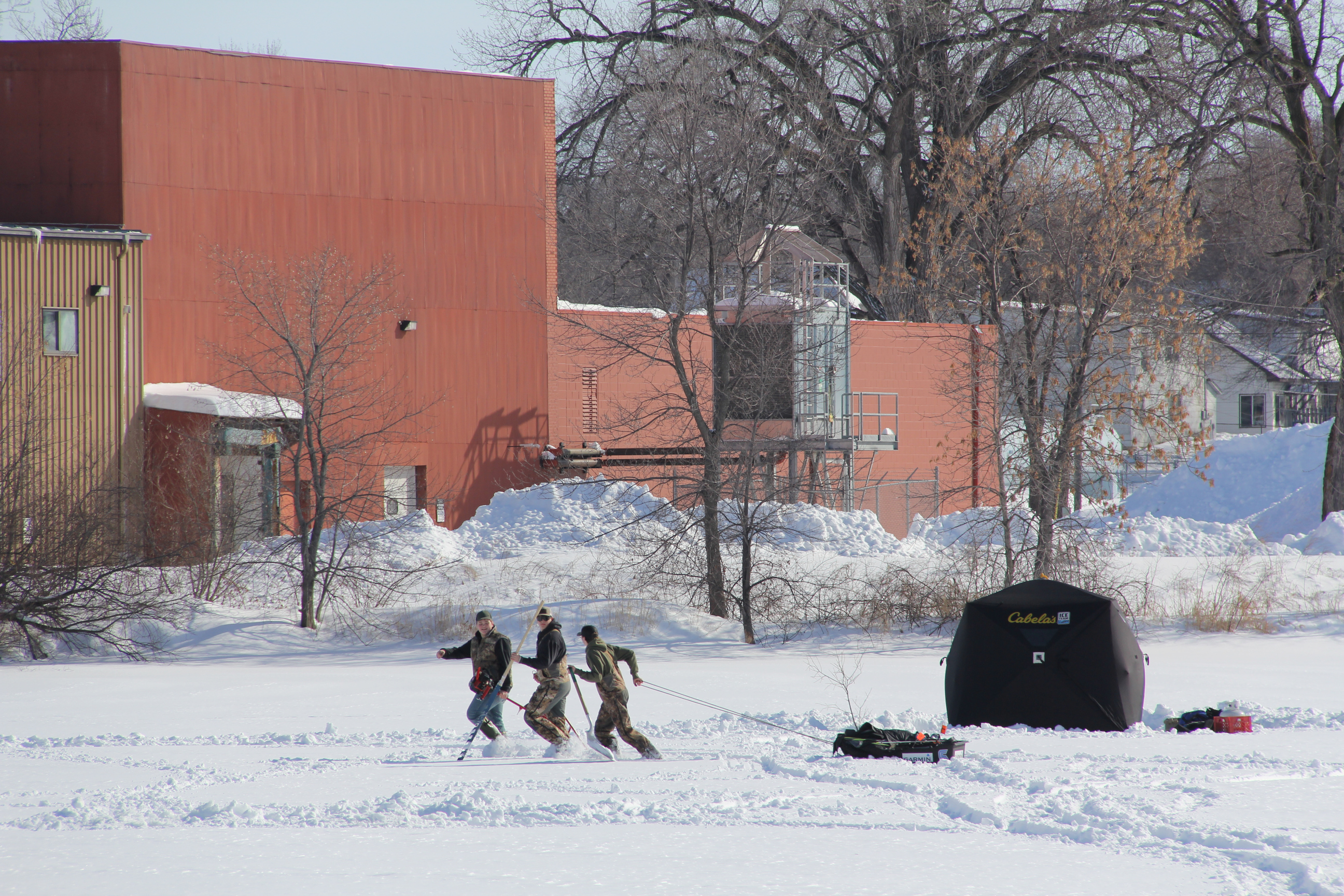
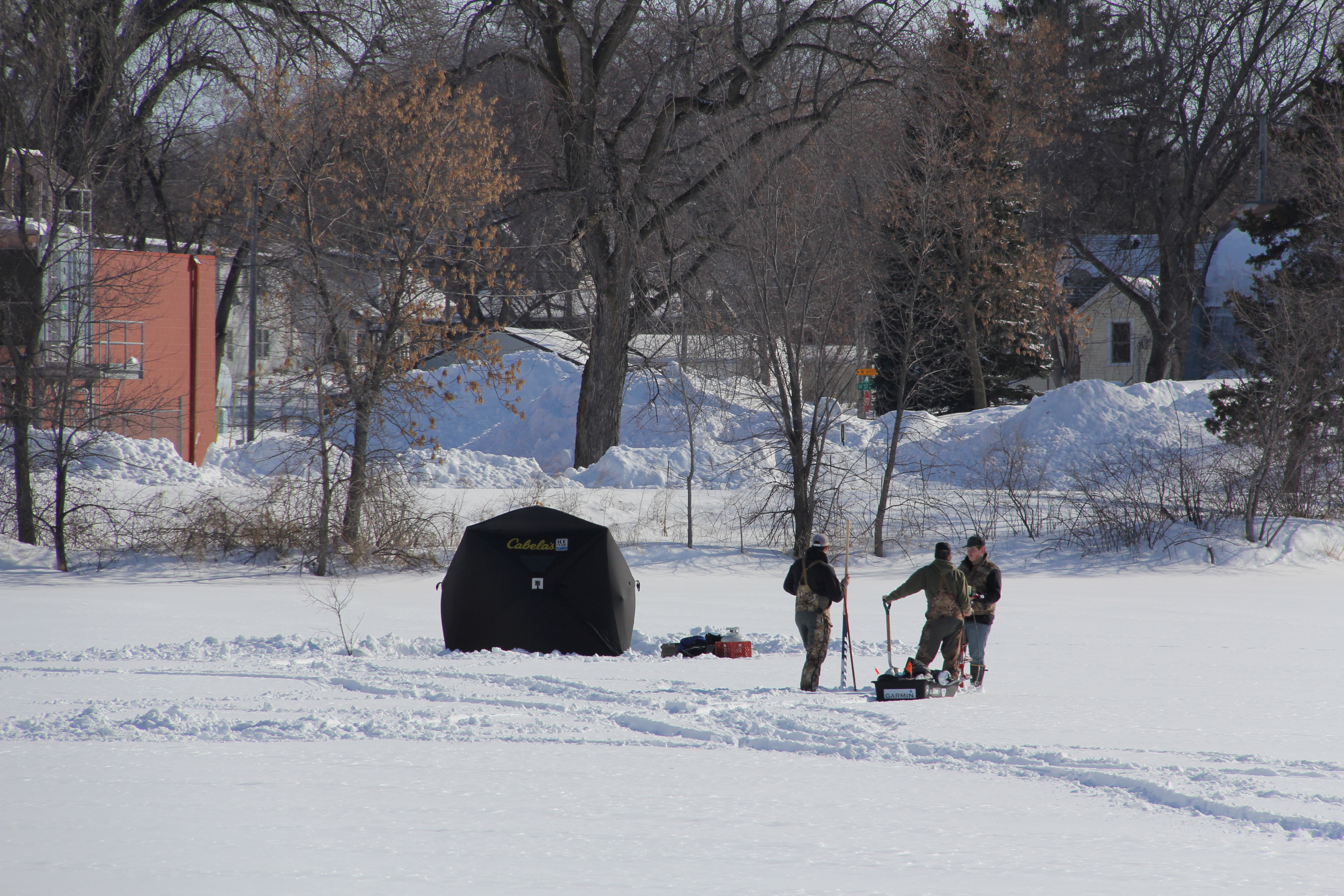
Carting ice fishing gear across the snow-covered Cannon River by the Faribault Mill. (Minnesota Prairie Roots copyrighted photo February 2023)
ICE FISHING RATES AS A SPORT that must seem absurd to anyone living in a warm weather climate.
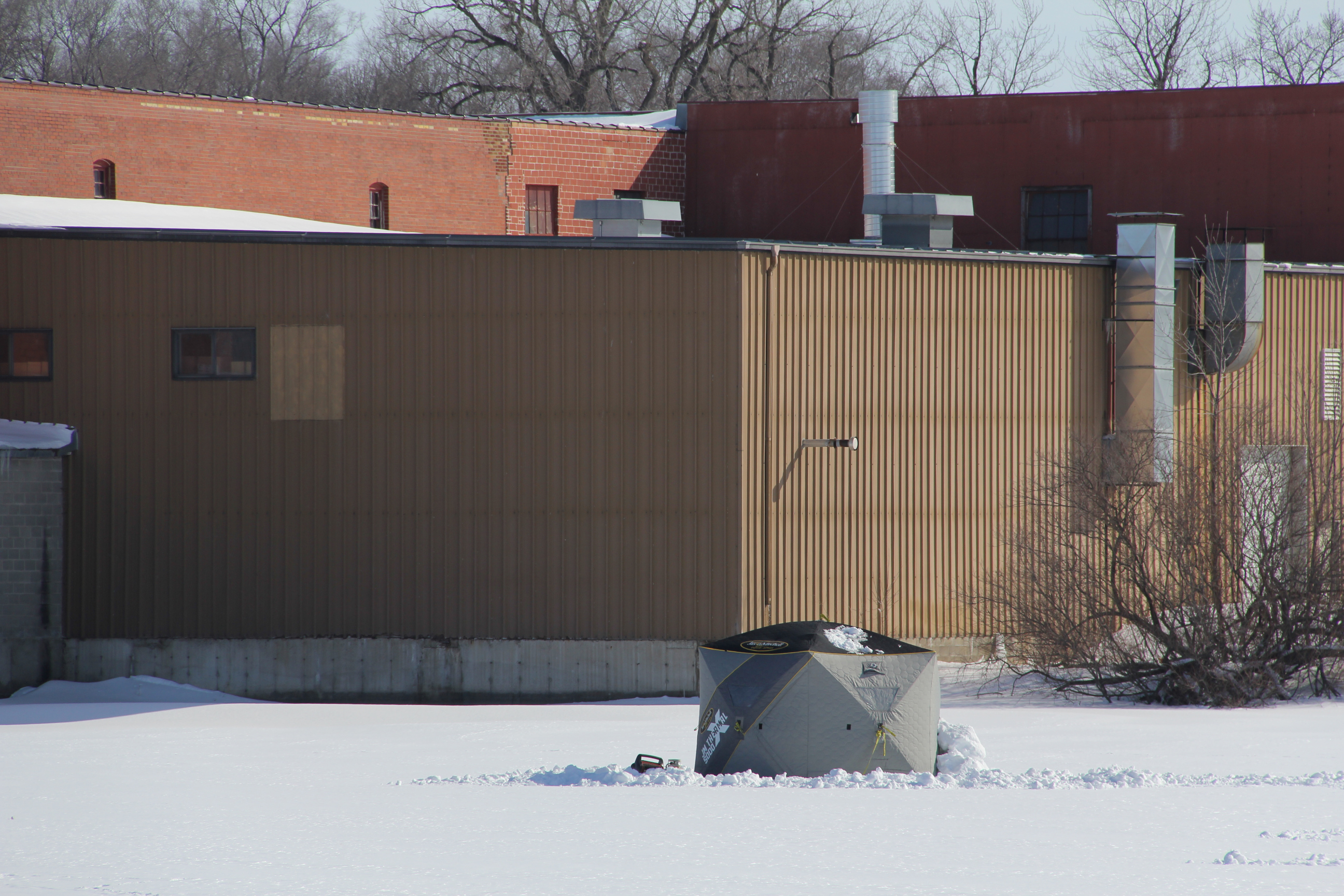
The second portable fish house the anglers set up on the Cannon River near the mill. (Minnesota Prairie Roots copyrighted photo February 2023)
I mean, if you aren’t from a place like Minnesota or Wisconsin, how would you react to anglers driving their vehicles onto a frozen lake, fish houses in tow? That seems reckless and unsafe and dangerous, and it can be. No ice is ever considered 100 percent safe. But, take precautions like knowing your lake (or river) and its ice thickness, driving with windows rolled down and carrying safety equipment, and the sport can be relatively safe.
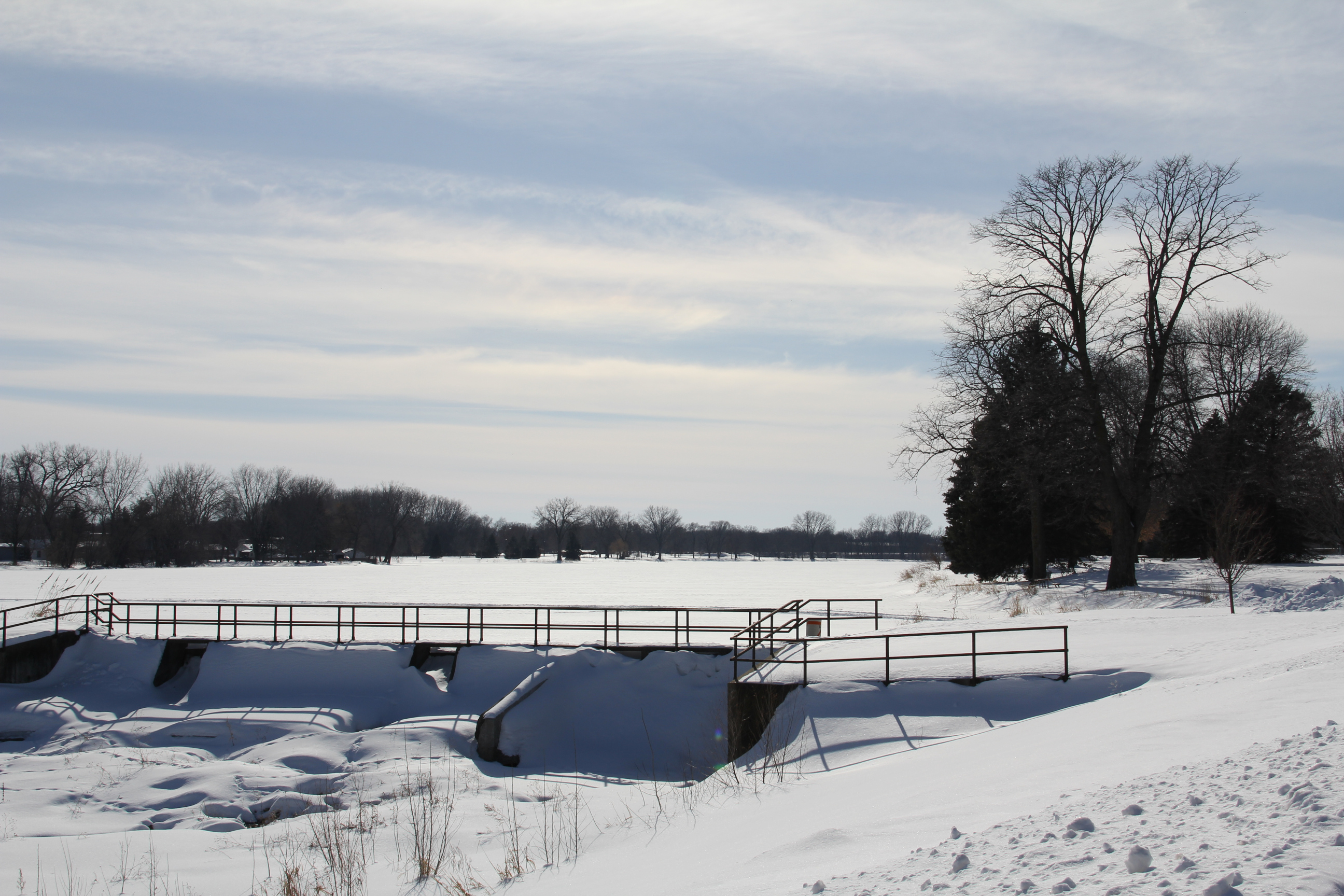
A view of the dam and frozen Cannon River from the recreational trail in North Alexander Park. There are two dams in this location, one next to the woolen mill and then this one. (Minnesota Prairie Roots copyrighted photo February 2023)
Still, this time of year and with the particularly snowy winter we’ve had in Minnesota, ice fishing right now doesn’t seem all that safe to me. Snow acts like a blanket, insulating the ice, resulting in thinner, inconsistent and weaker ice. Decades have passed since I engaged in the sport so I am not writing from current day experience, only from basic knowledge.
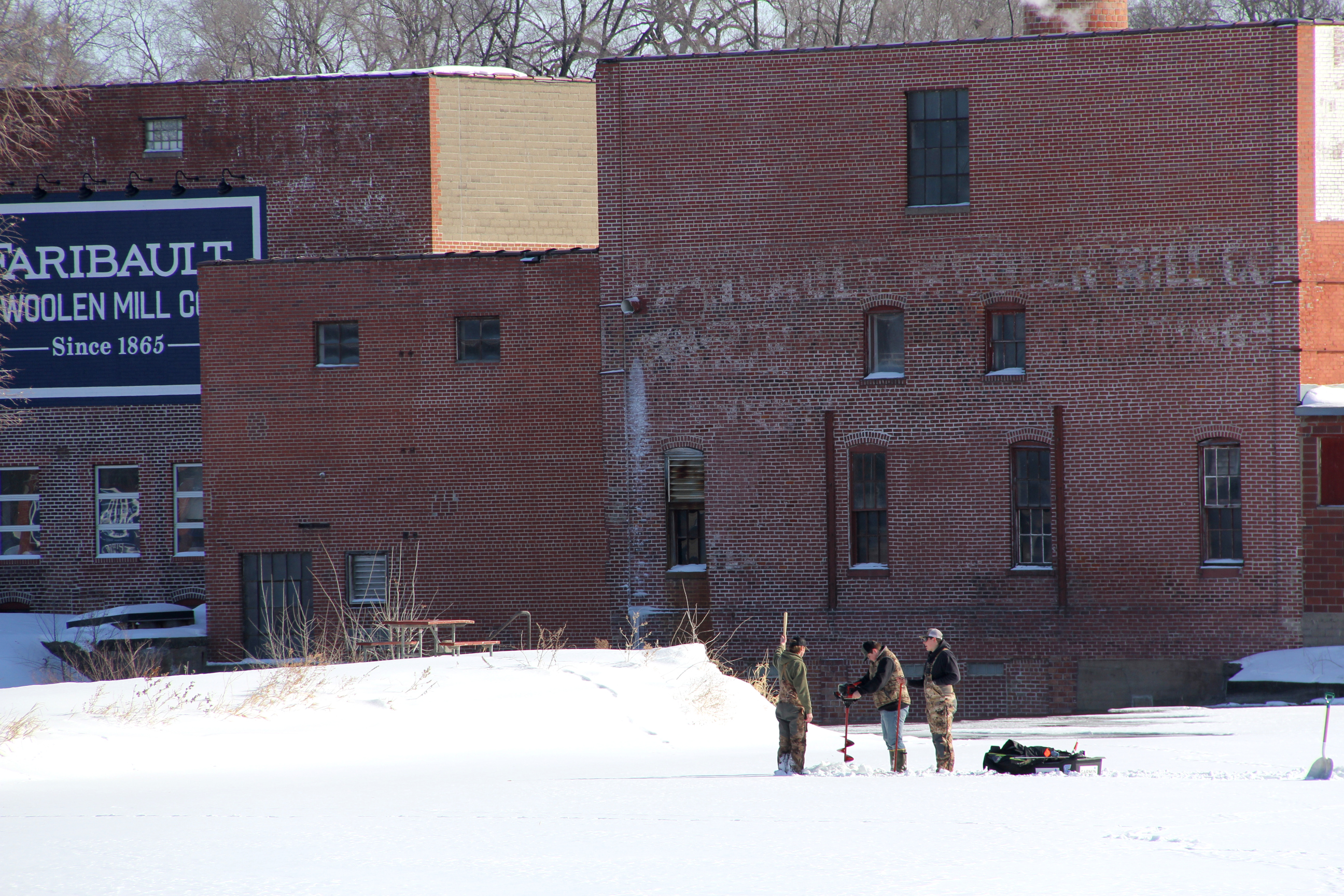
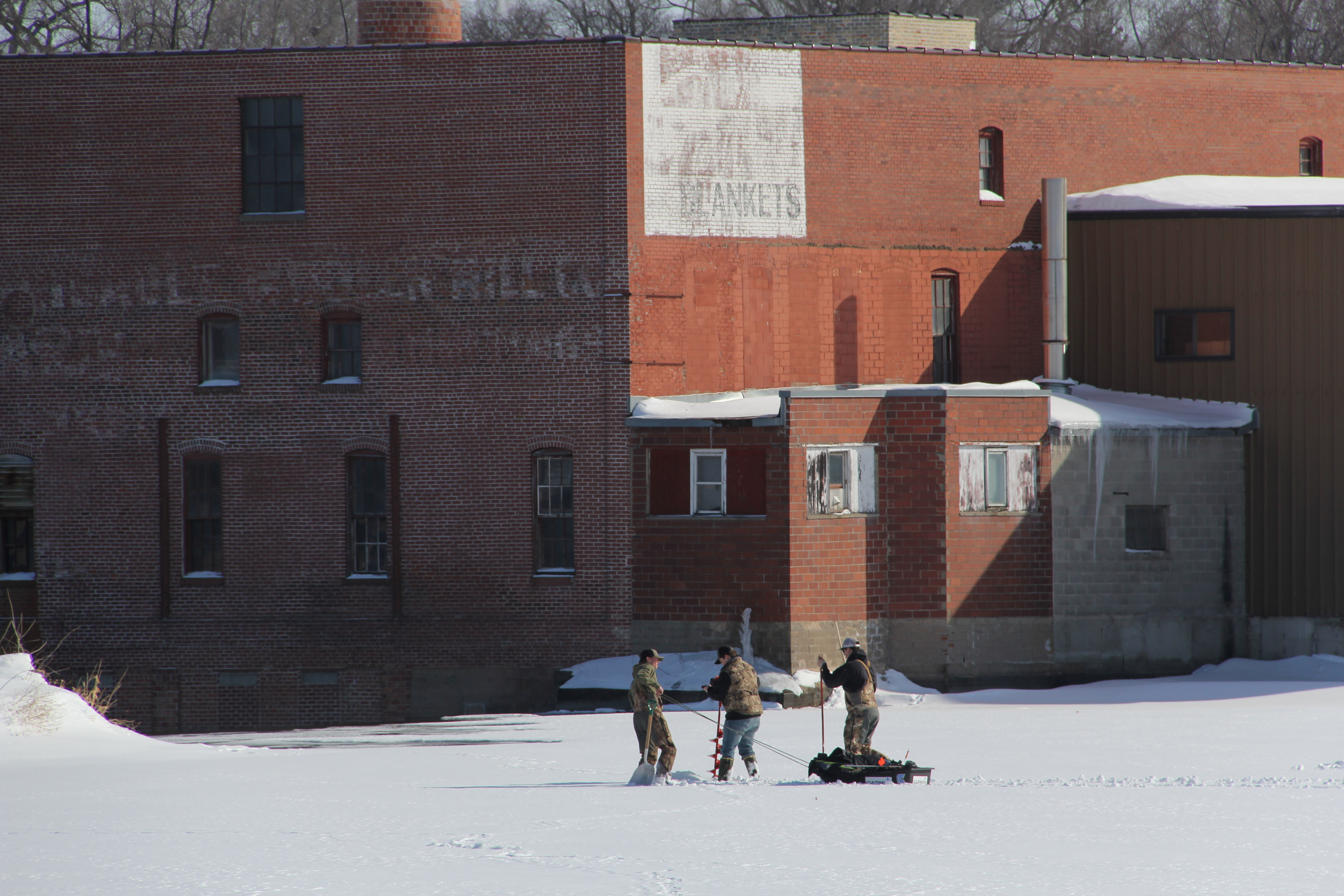
Drilling a hole in the frozen river near the top of the Woolen Mill Dam. (Minnesota Prairie Roots copyrighted photo February 2023)
Sunday afternoon while out and about in Faribault, I came upon three guys with ice fishing equipment on the frozen Cannon River Reservoir by the Woolen Mill Dam. As I watched, I hoped they knew what they were doing because I didn’t feel all that confident in the strength of the river ice with water flowing below.
I can almost hear the discussion about where to drill holes in the ice. (Minnesota Prairie Roots copyrighted photo February 2023)
But I appreciated that they were out enjoying the 30-degree sunny afternoon, warm enough even to shed their gloves and heavy coats. They’d already set up two portable fish houses by the time I arrived at North Alexander Park. I stood there and observed as the trio carried ice auger, ice saw, and scoop shovel and towed a sled with fishing gear across the snow-covered river. I was uncertain whether they were spearing for or simply angling for fish. Turns out neither.
Local avid outdoorsman and columnist Larry Gavin clarified: Those guys were actually netting carp. The net is stretched from one tent to the other using a hook and a series of holes. They were checking to see if the location was a good one. Every year they net Wells Lake and get a semi tanker full of carp that are shipped overnight to Chicago. There is a high demand for carp as a food source in some ethnic dining.
Turning the ice auger into the ice to create a hole. (Minnesota Prairie Roots copyrighted photo February 2023)
It was such an iconic Minnesota winter scene, the fishermen in their camouflage attire, a visual clue that they are year-round sportsmen. I can only imagine the camaraderie, the BS, the anticipation of these friends as they searched for fish.
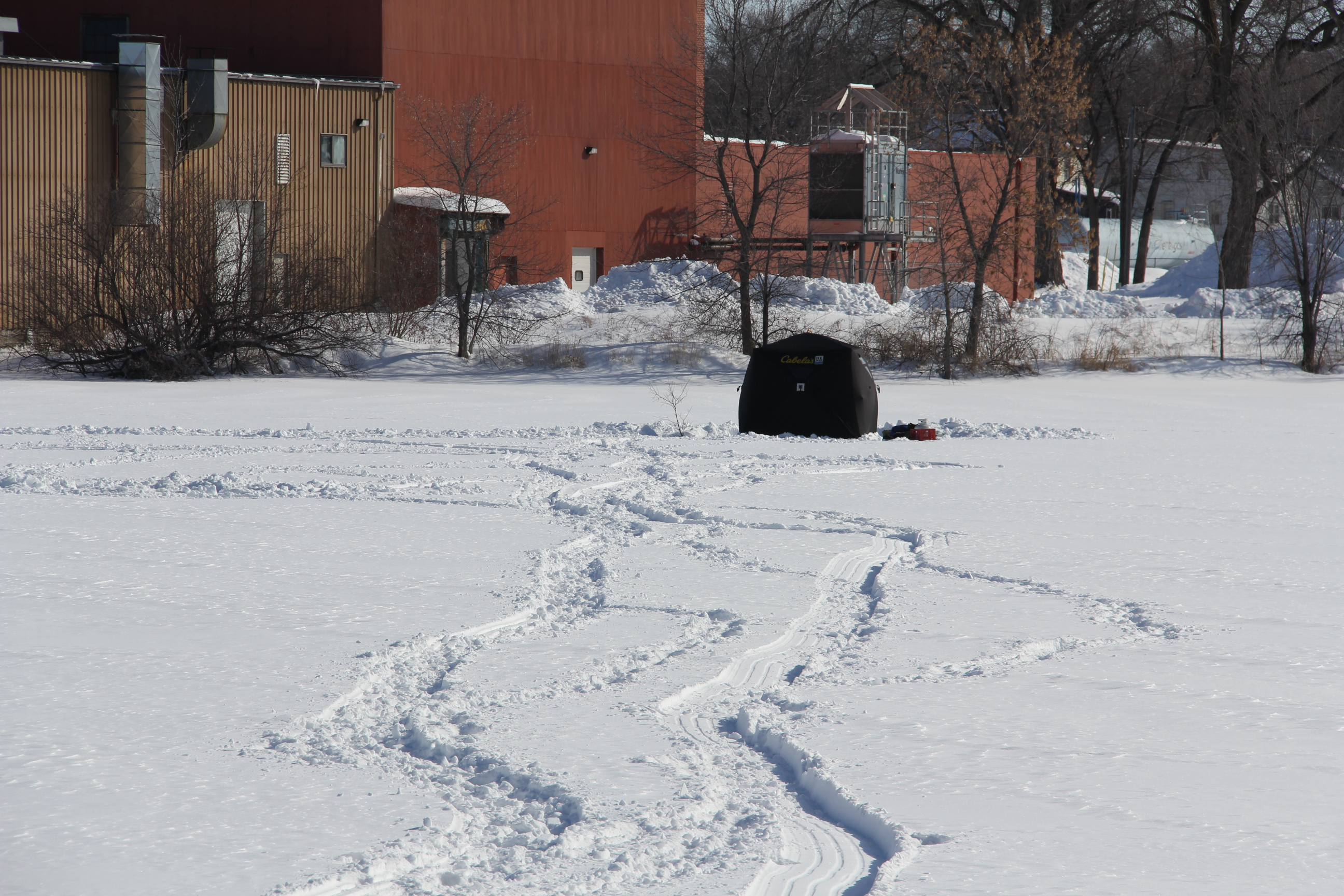
A sled trail across the river to the portable fish house. (Minnesota Prairie Roots copyrighted photo February 2023)
I loved the way their sled left a snaking trail across the Cannon, almost like a line of poetry winding through the snow, writing of winter outdoors, of fish tales, of ice fishing in Minnesota.
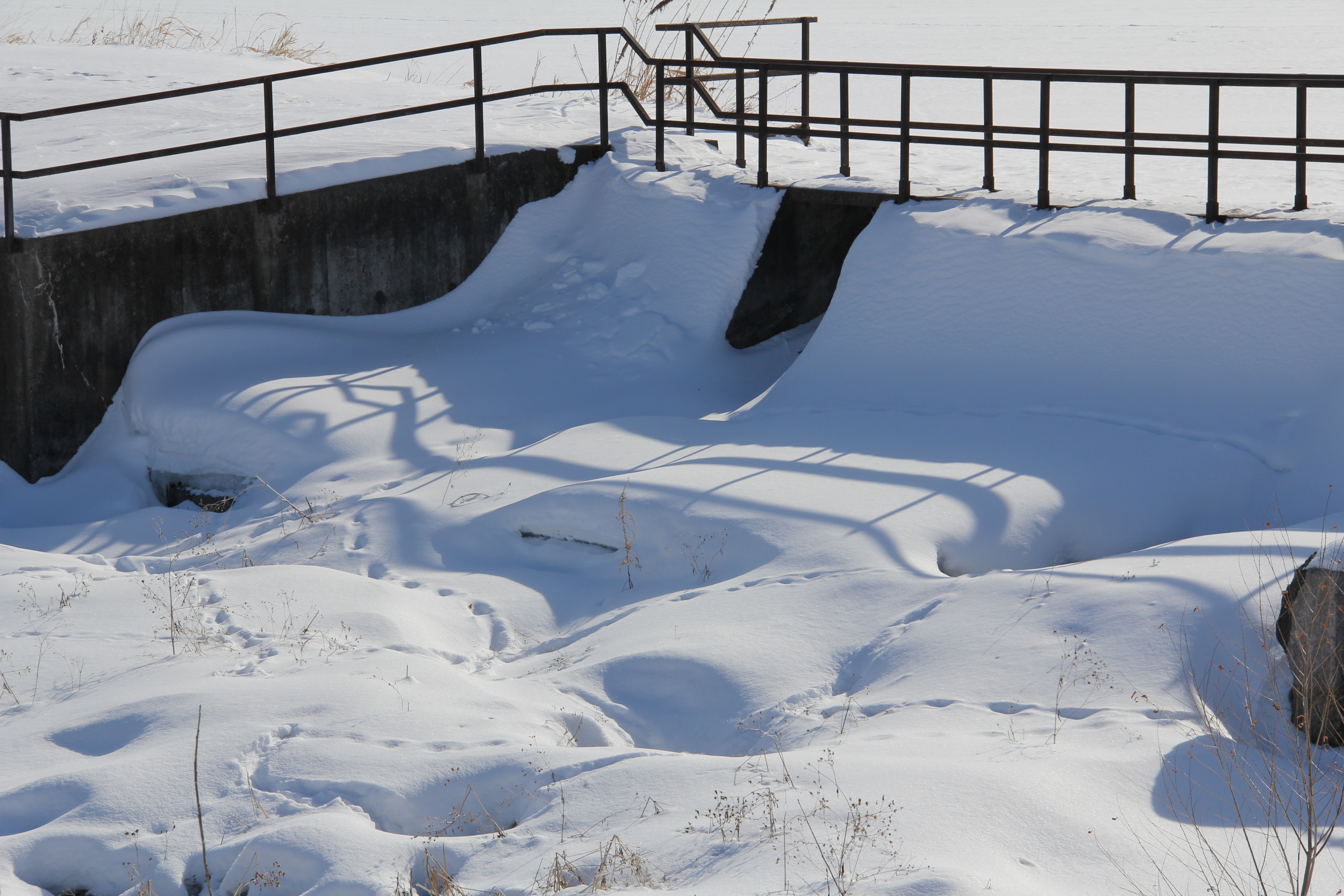
Animal tracks through the snow below the Cannon River dam nearest the recreational trail. (Minnesota Prairie Roots copyrighted photo February 2023)
FYI:The ice fishing season is winding down in Minnesota. All dark houses, fish houses and portables must be off inland lakes by the end of the day beginning on March 6 in the southern two-thirds of the state and by March 20 in the northern third. You can still ice fish, just can’t leave houses unattended. Local officials can set different restrictions if unsafe conditions call for such action.
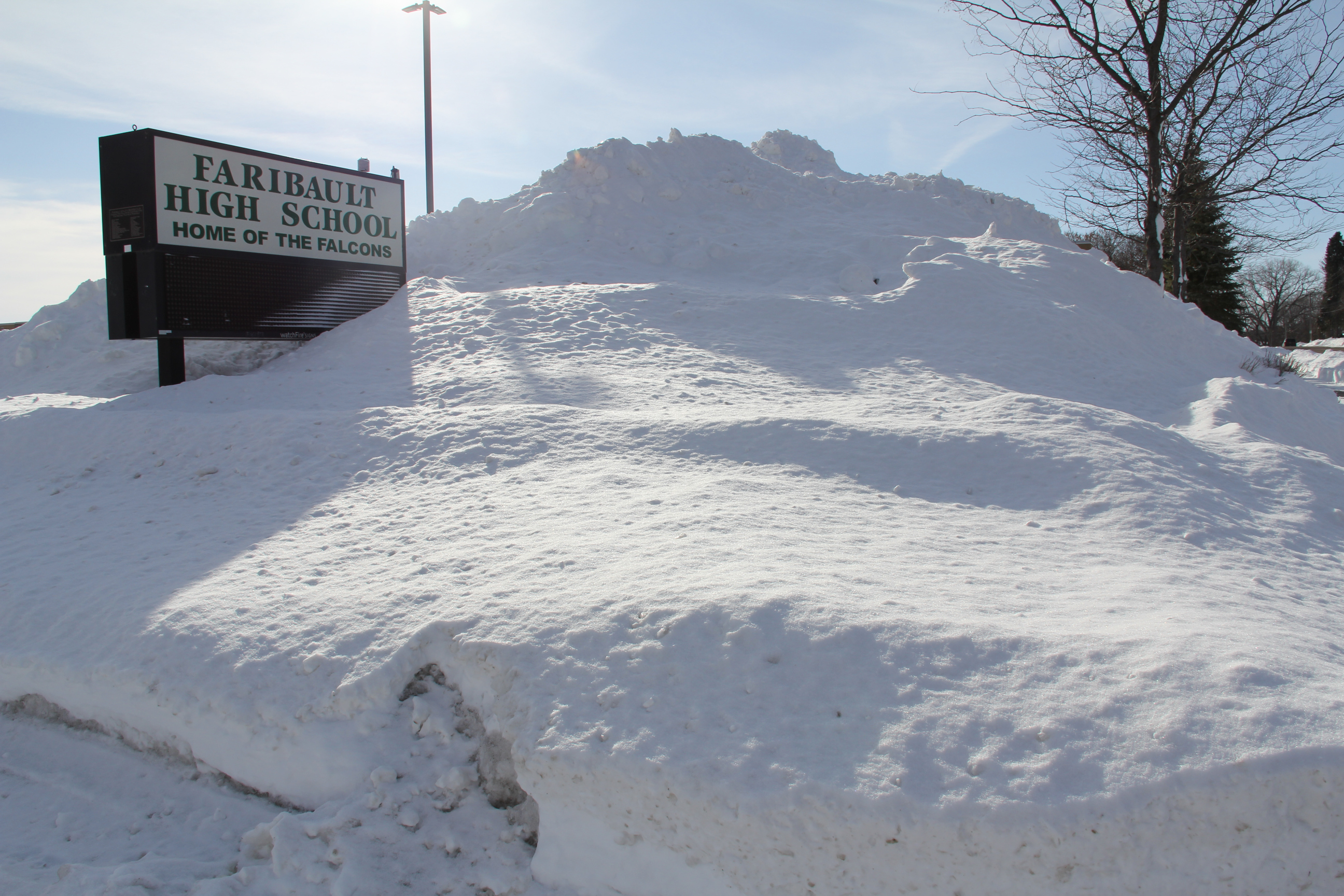
A massive snow pile fills a corner and side of the Faribault High School parking lot. (Minnesota Prairie Roots copyrighted photo February 2023)
BEFORE THE RAIN OF MONDAY, which reduced our significant snow pack, I determined to document the snowy landscape of Faribault. Plus, Randy and I needed to get outdoors, stretch our legs and embrace the 30-some-degree warmth of a sunny Sunday afternoon.
A different view of the FHS snow pile shows the length and height of the mountain in comparison to the vehicle pulling up to the intersection. (Minnesota Prairie Roots copyrighted photo February 2023)
Traveling around town these days requires a bit of extra caution, starting in our driveway. The towering snowbanks flanking the ends necessitate creeping out, all the while trying to see whether any vehicles are approaching. The same goes for many intersections around my community. It’s been a few winters since I’ve seen snow mounded this high. City crews are doing a good job of moving or removing snow to increase visibility. They were on my corner Monday morning to clear snow from the storm sewer drain and intersection.
From behind the massive FHS snow pile, the rambler across the street is barely visible and seems dwarfed in comparison. (Minnesota Prairie Roots copyrighted photo February 2023)
Parking lots hold mountains of snow which take me back to just how much fun I had as a kid playing on the massive piles of snow my dad built with the loader on his John Deere tractor. Up and down the snow hills my siblings and I ran, playing Canadian Mounties or whatever our imaginations decided.
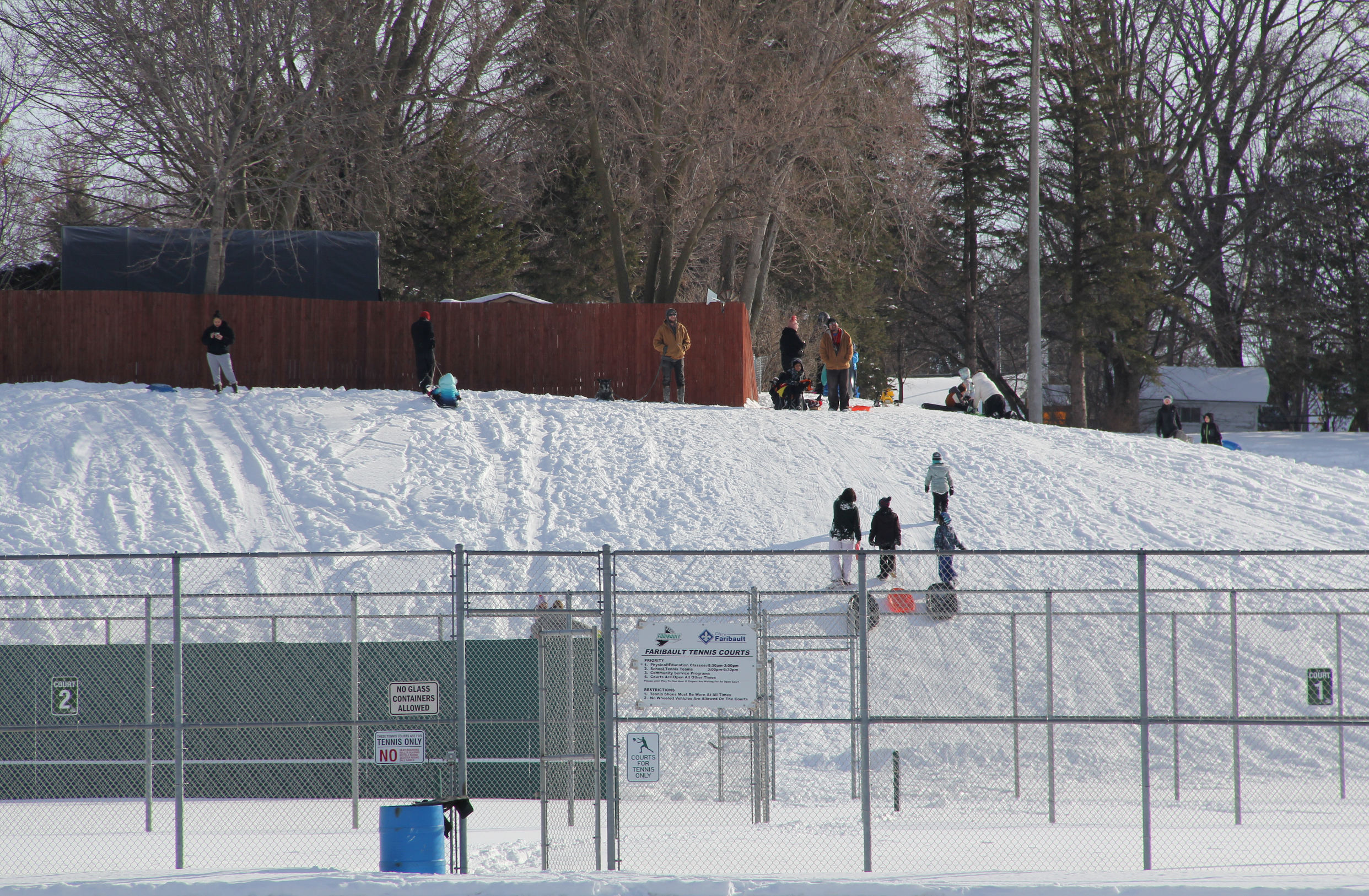
The sledding hill by Faribault High School proved a popular place Sunday afternoon. (Minnesota Prairie Roots copyrighted photo February 2023)
In Faribault on Sunday, I observed families scaling the hill by the high school after sliding down. I love seeing kids enjoying winter outdoors in Minnesota.
Many Minnesota schools, including Faribault Public Schools, have closed during snowstorms and gone to distance and/or e-learning. (Minnesota Prairie Roots copyrighted photo February 2023)
In a corner of the high school parking lot, the snow is pushed so high that I’m clueless as to how it got that high. It’s impressive. I don’t even want to think about how long it will take for that glacier to melt. June?
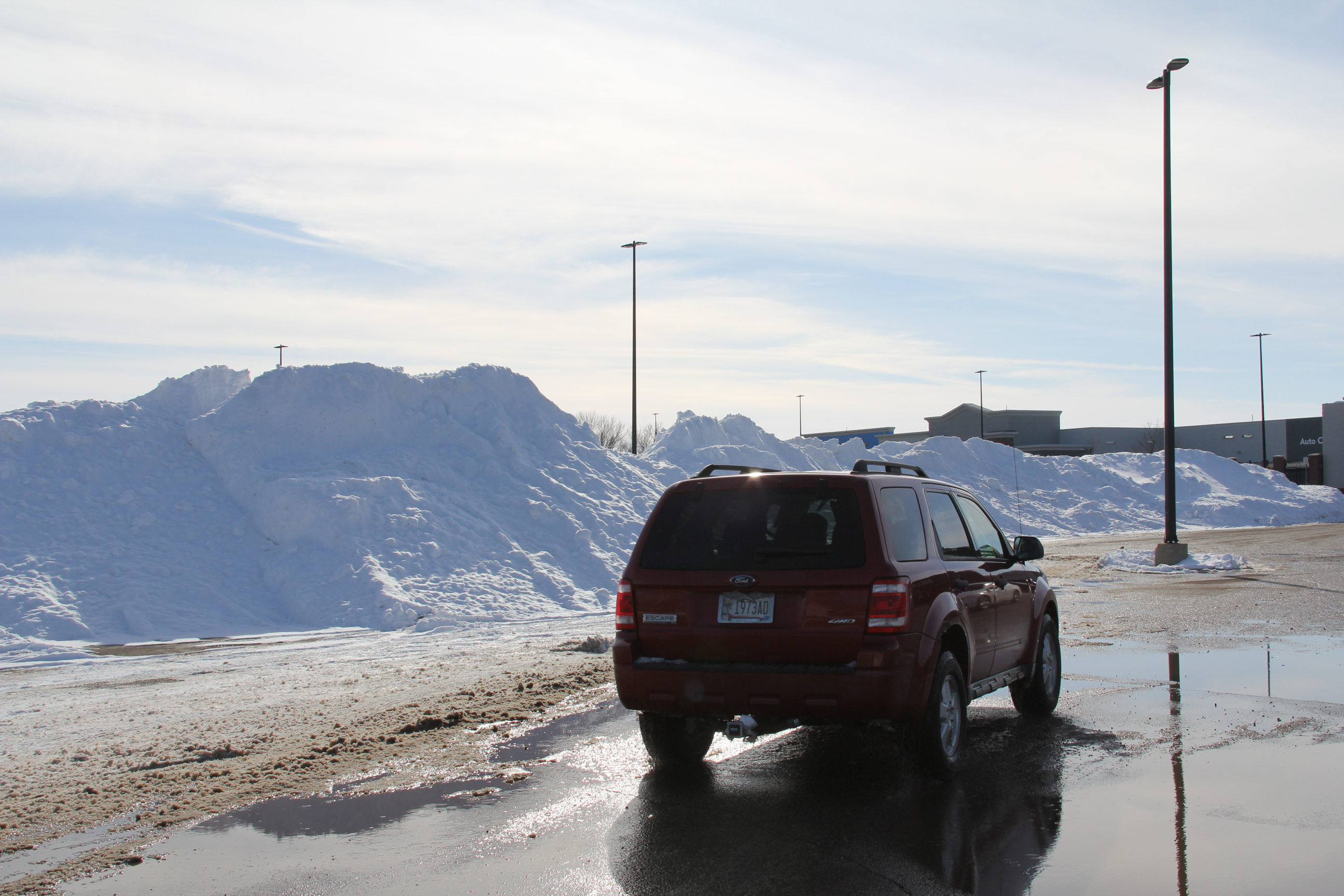
Mountains of snow fill the parking lot at the Faribo West Mall. Walmart is barely visible in the distance. (Minnesota Prairie Roots copyrighted photo February 2023)
The same goes for the snow piled in the Faribo West Mall parking lot. Or maybe it’s the Walmart parking lot. The roofline of the discount retailer is barely visible.
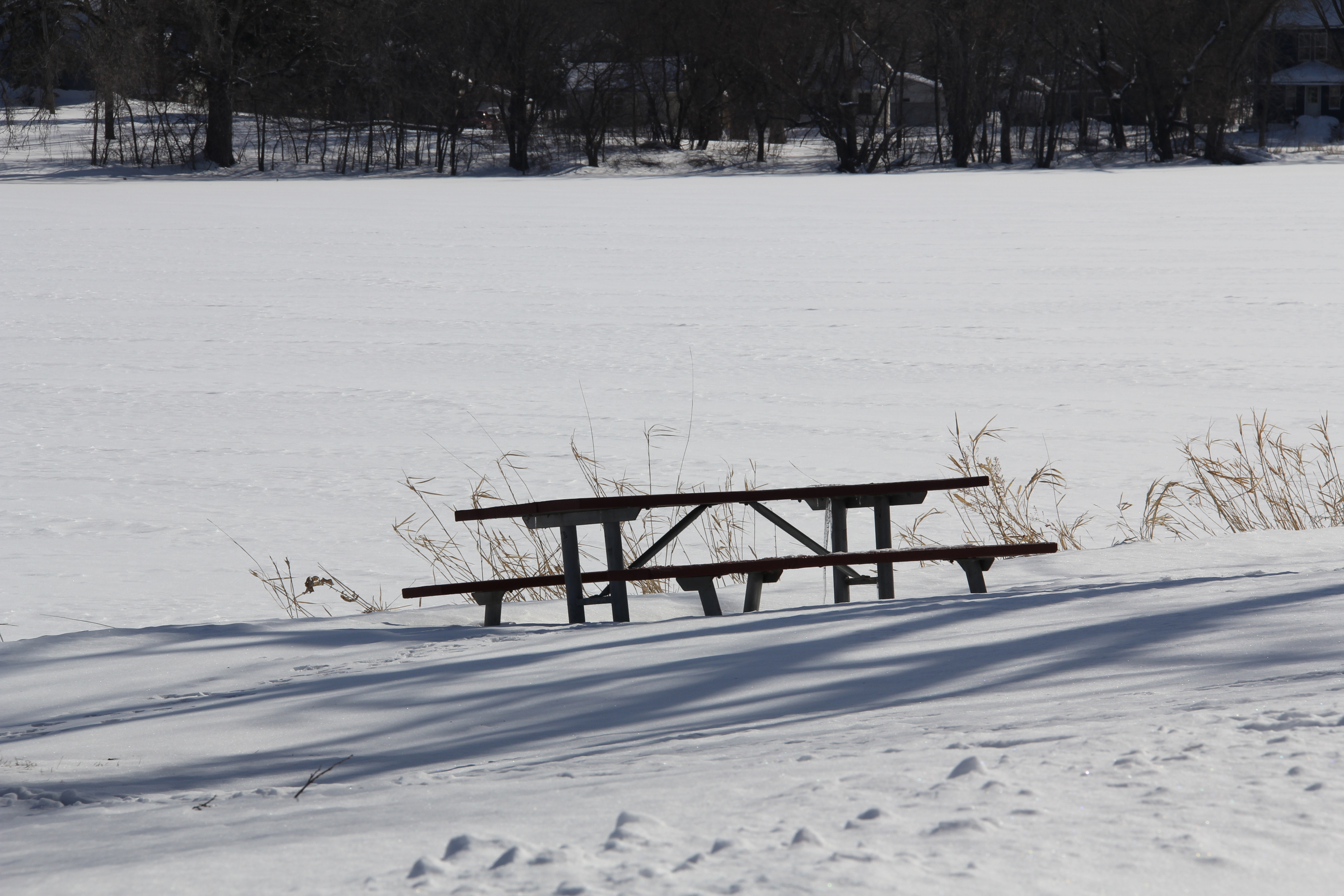
A picnic table sits along the bank of the frozen and snow-covered Cannon River in Faribault’s North Alexander Park. (Minnesota Prairie Roots copyrighted photo February 2023)
Along and near the river in two city parks, picnic tables surrounded by snow remind me that many months will pass before anyone can picnic. Well, I suppose, technically one can picnic in winter, if you are willing to slog through a foot plus of snow to dine.
Carrying ice auger and ice saw and pulling a sled full of gear, this trio of ice fishermen aim toward a spot to fish on the Cannon River by the Woolen Mill Dam. They had set up two portable fish houses. Check back for more images. (Minnesota Prairie Roots copyrighted photo February 2023)
To my photographic delight, though, three ice fishermen slogged through the snow to fish on the Cannon River by the Faribault Woolen Mill Dam. Randy suggested I might want to walk out there for some close-up photos rather than rely on my zoom lens. No, thank you. At this stage in winter, especially, with snow acting as insulation on ice, I don’t trust the ice. These guys, with their portable pop-up fish houses, clearly think differently than me.
My thoughts about right now are those of being ready for winter to end. But, realistically, I understand that we have two months of winter remaining here in Minnesota. As a life-long Minnesotan, I can’t deny that. Onward, into March.
Inside a Rice County dairy barn. (Minnesota Prairie Roots copyrighted file photo)
AS SOMEONE WHO GREW UP on a dairy farm, I understand the hard work and commitment of feeding, caring for and milking cows. Every. Single. Day. Although the process has become easier with automation, the fact remains that dairy farmers can’t just walk away from the barn for a day. The cows still need to be milked.
As a child and teen, I labored in the barn, assisting my dad with feeding, bedding straw, and scooping manure. He did the actual milking. And he was under a time crunch to finish milking our Holsteins before the milk truck arrived to empty the bulk tank and transport our cows’ milk to the Associated Milk Producers plant in New Ulm.
That backstory brings me to today, nearly 50 years removed from the southwestern Minnesota crop and dairy farm where I learned the value of hard work. AMPI in New Ulm is still going strong and recently won several honors at the Wisconsin Cheese Makers Association 2023 U.S. Champion Cheese Contest in Green Bay, Wisconsin. Forty-two judges evaluated entries based on flavor, texture, appearance and taste. There were 2,249 entries from 197 dairy companies and cooperatives in 35 states. Minnesota was well-represented. (Click here to see a full list of the winners by category.)
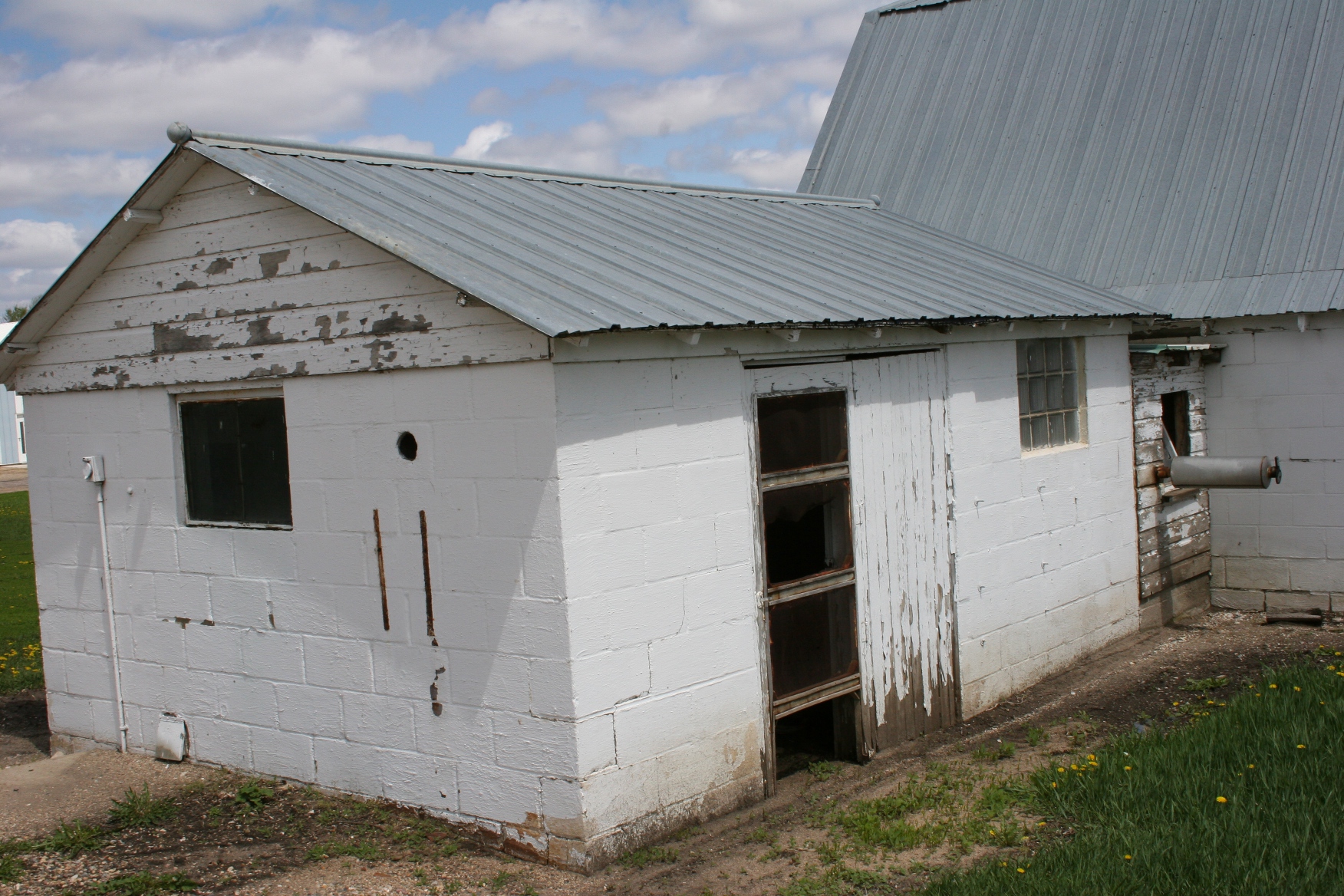
The abandoned milkhouse, attached to the barn on the farm where I grew up outside Vesta. (Minnesota Prairie Roots copyrighted file photo 2009)
AWARD-WINNING BUTTER FROM NEW ULM
The 113 contest divisions include dairy products beyond cheese. And that’s where New Ulm’s AMPI plant scored, earning second place for its unsalted butter and third places for salted butter and flavored butter, specifically chipotle butter. AMPI’s Sea Salted Root Beer Butter which sounds, in Minnesota lingo, “different,” did not place.
I grew up on AMPI salted butter. The milk man—the guy who picked up the milk from our milkhouse—also brought blocks of butter. Dad just left a slip of paper indicating how many pounds we needed and the driver pulled the packages from his truck.
Lucky Linda Cheddar (Photo credit: Redhead Creamery Facebook page)
REDHEAD CREAMERY CHEESE CRAFTS A TOP 20 CHEESE
What I didn’t have back then was access to good quality cheese like that produced in Minnesota today. I love cheese. And yogurt and cottage cheese and ice cream and cheese curds…, well, all things dairy. This year a cheddar cheese produced by a small west central Minnesota cheese maker, Redhead Creamery, was named one of the top 20 cheeses in the country during last week’s national competition. And, yes, the president and CEO of this creamery in rural Brooten, Alise Sjostrom, is a redhead.
Redhead Creamery earned Best of Class in the Natural Rind Cheddar category with its previously award-winning Lucky Linda Clothbound Cheddar, named after Sjostrom’s mom. That top cheese was then chosen to compete against 19 other top cheeses for the honor of U.S. Champion Cheese. An aged Gouda made by the team at Arethusa Farm Dairy in Connecticut won the best cheese in the U.S. title. Two Wisconsin cheeses earned second and third places.
I have yet to try, or even find, Minnesota-made Redhead Creamery cheeses. But I will be looking for them locally, especially Lucky Linda Cheddar. I’d even like to take a road trip to the dairy and cheese operation, which offers tours.
Award-winning Amablu Gorgonzola from Caves of Faribault. (Minnesota Prairie Roots copyrighted file photo)
CAVES OF FARIBAULT EARNS HONORS
My community is also home to award-winning handcrafted cheeses. This year cheesemakers at Prairie Farms’ Caves of Faribault placed second in the Gorgonzola competition with Ama Gorg. In the blue-veined division, Caves of Faribault earned fourth for its AmaBlu. These cheeses have previously won honors and they are well-deserving. I love Caves of Faribault cheeses, aged in sandstone caves along the Straight River. If you like blue cheese, and I realize either you love it or you hate it, then this is your cheese.
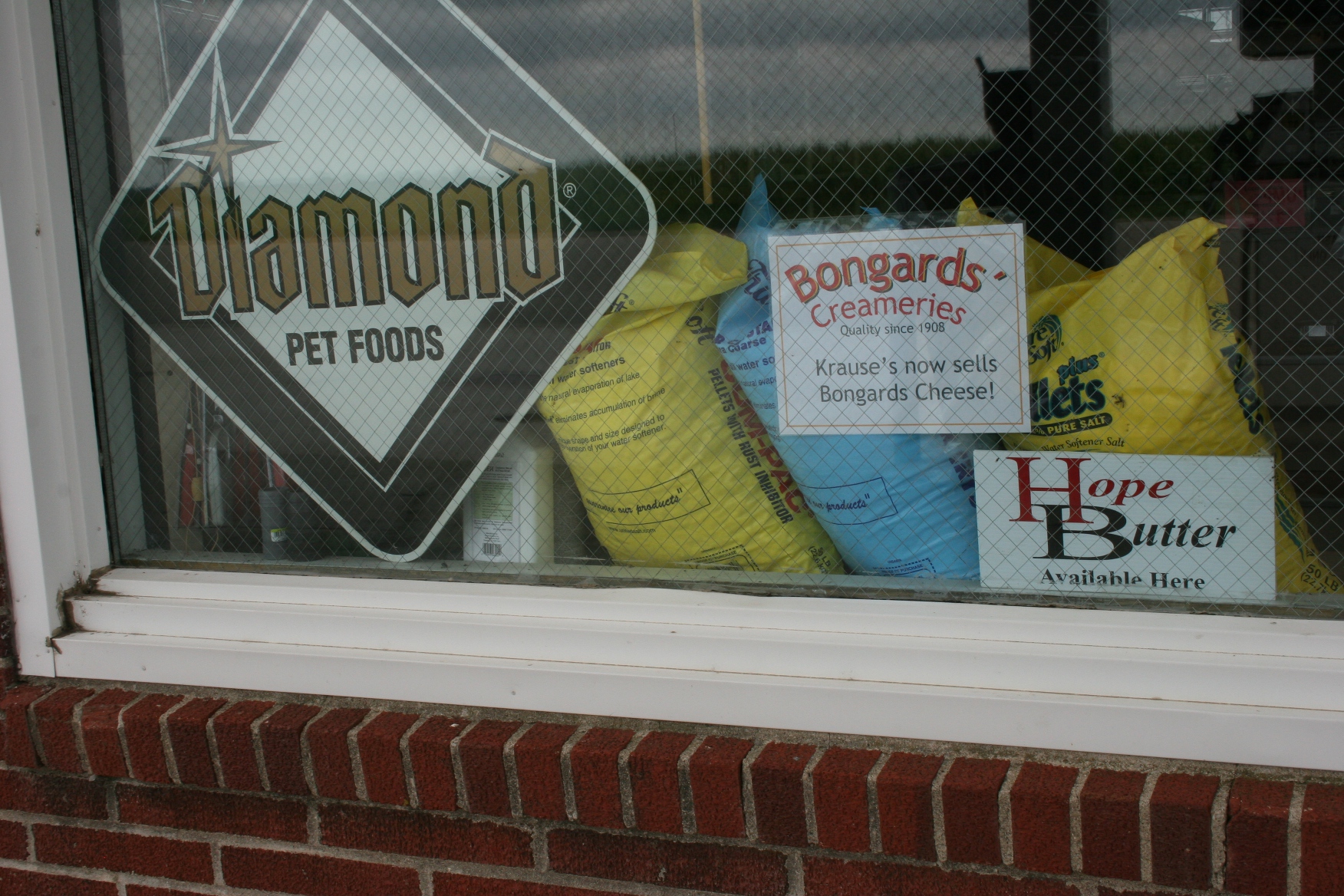
Krause Feeds & Supplies in Hope advertises the availability of Hope butter and Bongards cheese. (Minnesota Prairie Roots copyrighted file photo June 2013)
MORE MINNESOTA WINNERS
Minnesota-based Bongards Creameries in Perham also earned a Best of Class with its Monterey Jack cheese in the national competition. Likewise, Kemps, LLC in Farmington took Best of Class for its pineapple flavored cottage cheese and second for its chive flavored cottage cheese. I didn’t even realize cottage cheese came in such flavors.
If there were other top winners from Minnesota in the 2023 U.S. Cheese Contest, I apologize for missing them. But after scrolling through pages of information, I stopped looking.
What I realized is that small creameries to co-ops to large companies in Minnesota make a lot of dairy products. We may not have as many cheesemakers as the Dairyland State, but certainly enough for anyone who likes cheese and other dairy products to recognize Minnesota’s value in the dairy industry.
I saw Minnesota entries (again, I may have missed some) from Prairie Farms Dairy Cheese Division in Rochester, Bongards in Norwood, Agropur in Le Sueur, Stickney Hill Dairy in Rockville and First District Association in Litchfield. The varieties of cheeses range from pasteurized process American cheese from Prairie Farms to jalapeno and roasted red cheddar from Litchfield-based FDA, “a grassroots cooperative since 1921.”
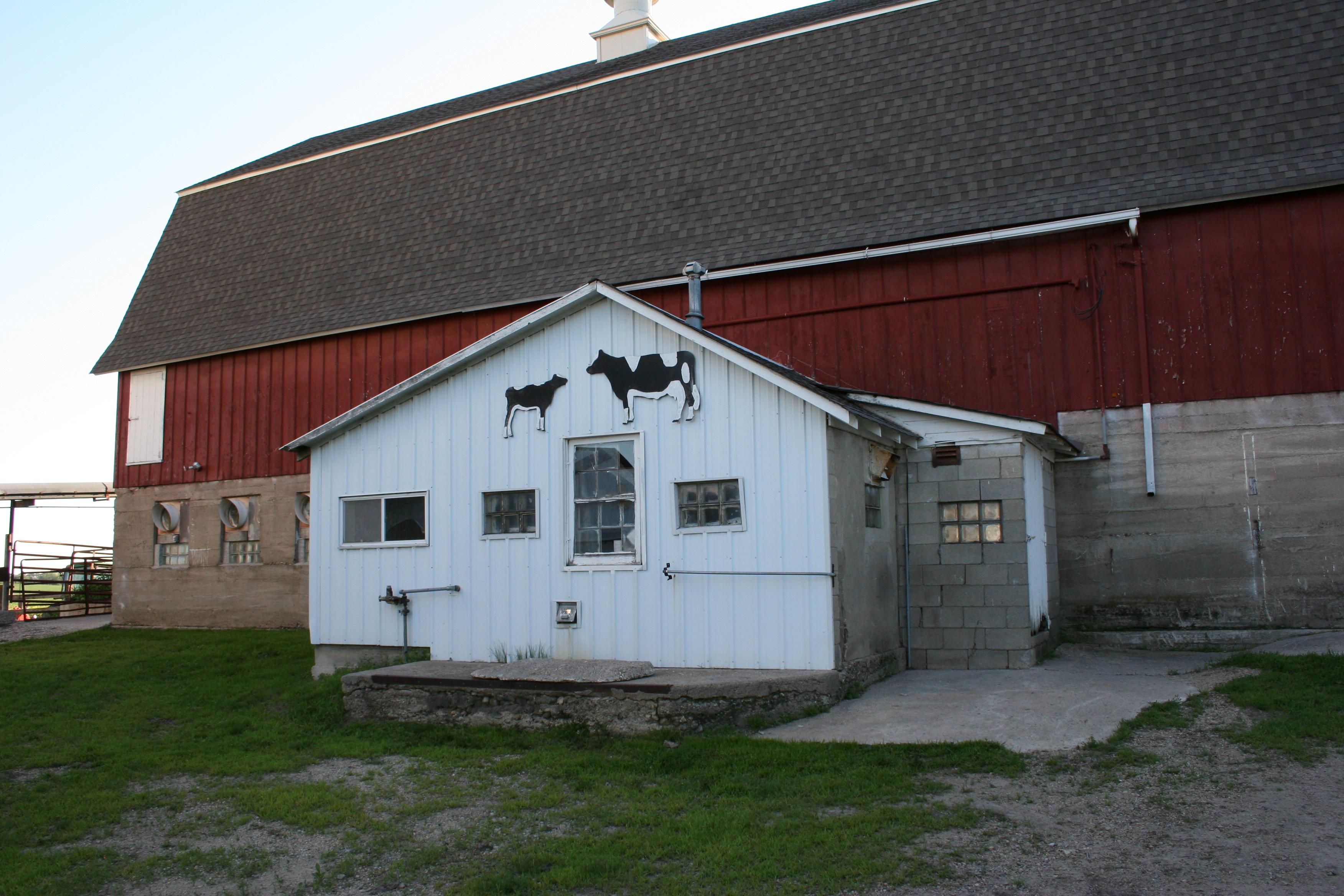
This rural Dundas barn once housed a herd of dairy cows. No more. But the barn has been maintained. (Minnesota Prairie Roots copyrighted file photo September 2011)
CHANGED & UNCHANGED
Much has changed, yet much has not since I left the farm in 1974. Cooperatives remain as strong as ever, yet small scale artisan cheese makers, have also emerged. The demand for basic cheeses remains, yet cheese makers are crafting diverse flavors to meet consumers’ expanding tastes. Small family dairy farms have been mostly replaced by large-scale dairy operations. Change is inevitable. But one thing has not changed for me personally. I love dairy products, especially cheese.
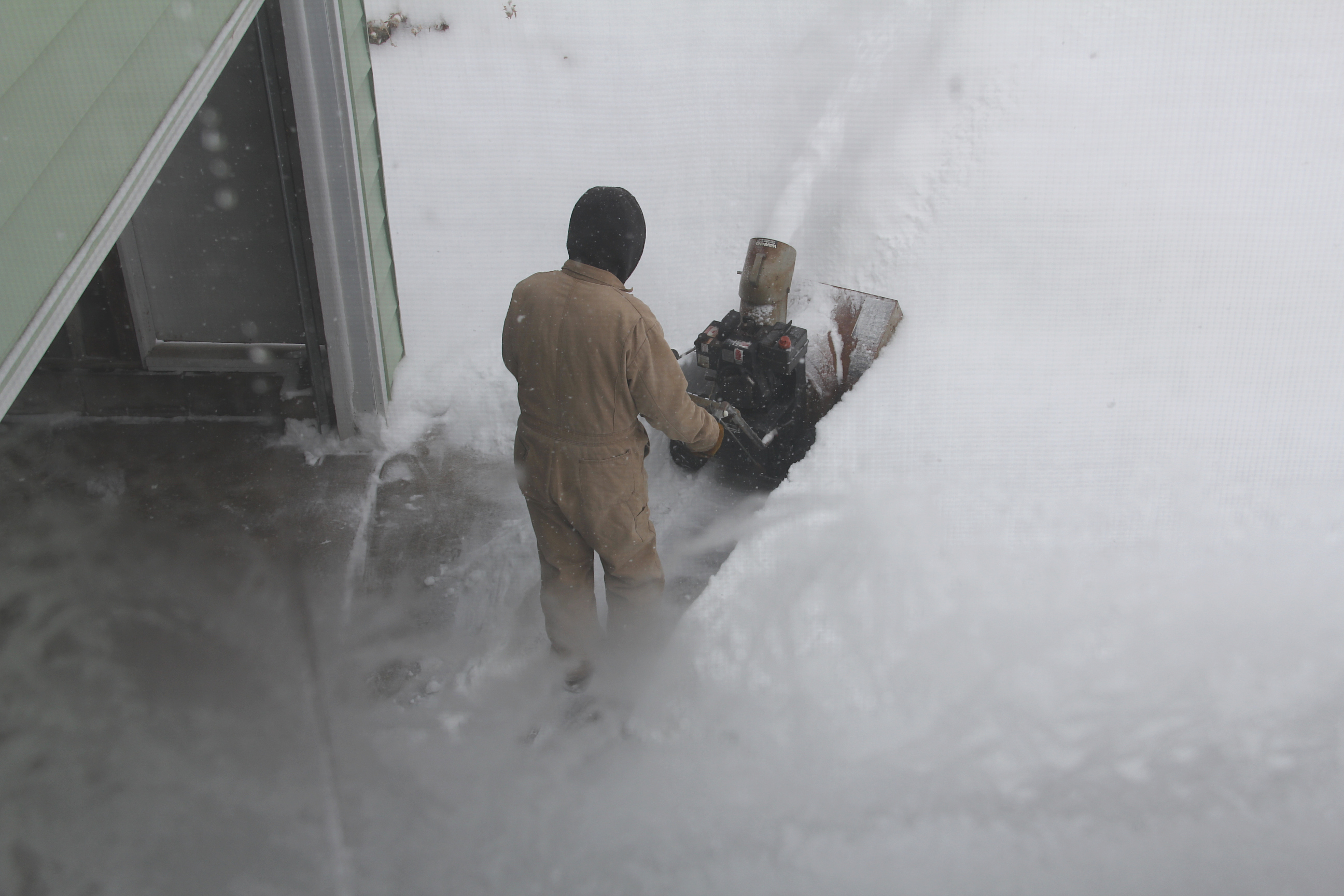
I shot this photo through a partially-frosted upstairs window as Randy began clearing snow from the driveway near the garage. (Minnesota Prairie Roots copyrighted photo February 2023)
THURSDAY MORNING, 10:30 a.m. AND SNOW is still falling here in Faribault. But the sun is breaking through and I am hopeful the snow will soon end. The unofficial yardstick reading on our patio is 14 inches from this three-day weather event.
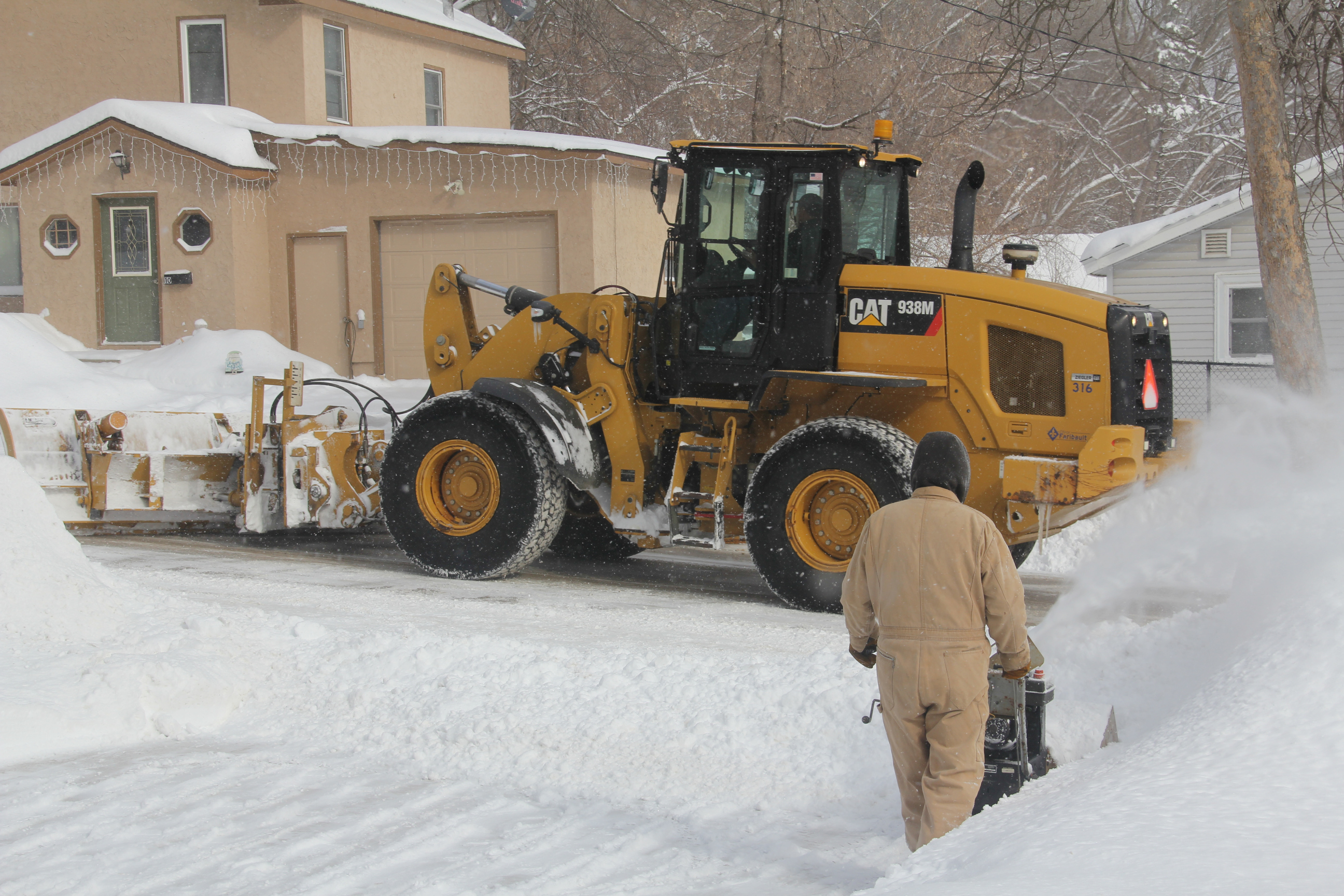
The city snow plow arrives about the same time Randy finishes clearing the driveway, leaving a new ridge of snow. (Minnesota Prairie Roots copyrighted photo February 2023)
Randy is blowing the driveway open as I write. Just as he nearly finished clearing the end, the city plow arrived, blading a windrow of snow back across the driveway. Timing. Now he’s working on removing that ridge. This is not unexpected; we Minnesotans assume this will always happen.
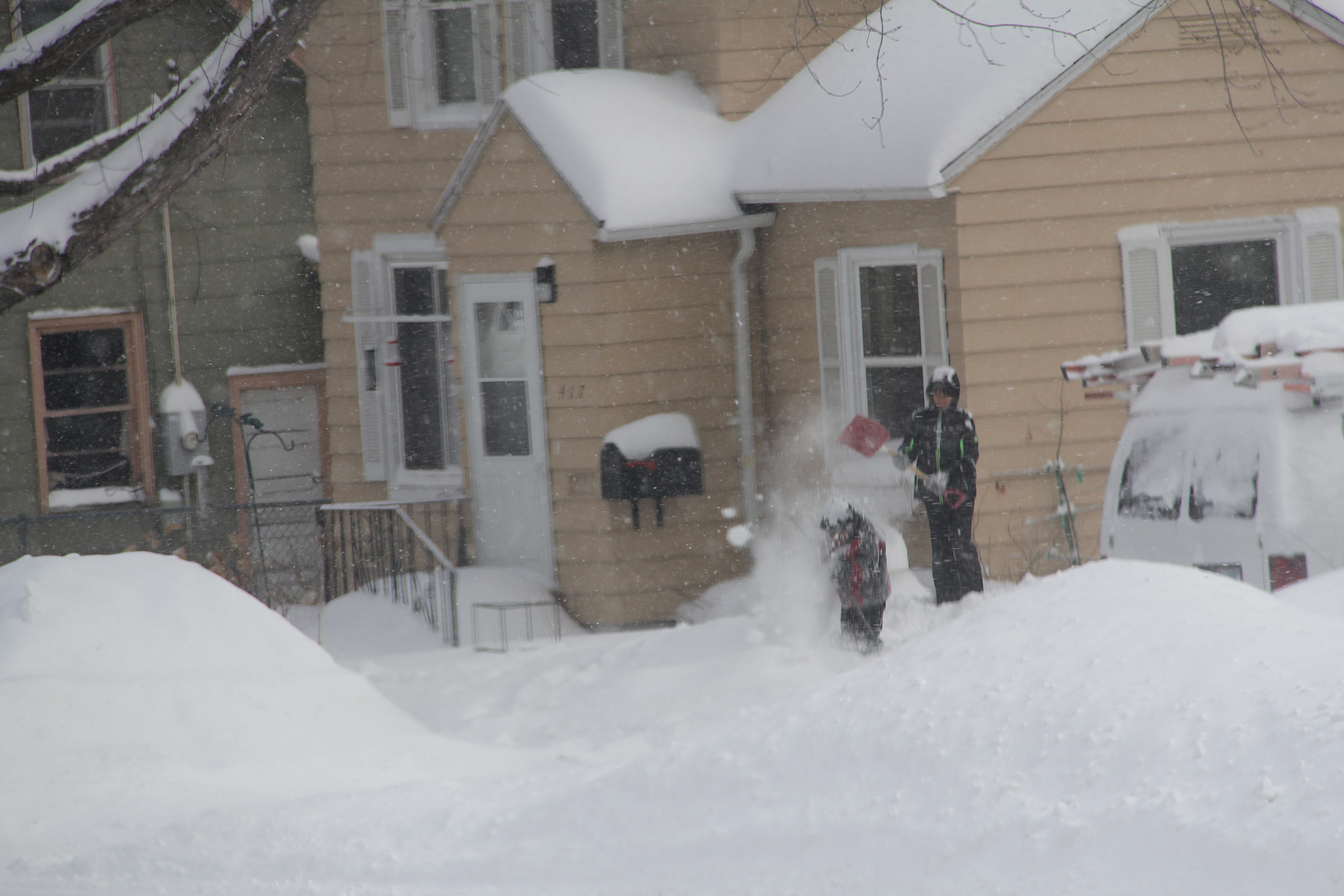
I caught the exact moment one brother dropped snow on the other. (Minnesota Prairie Roots copyrighted photo February 2023)
Neighbors have emerged, too, blowing snow from sidewalks and drives. Across the street, neighbor boys are outside playing. I watched as one scooped snow onto his shovel, waited and then promptly dumped the load onto his brother’s head. Nearby, Dad continued working the snowblower.
A snowy scene in my neighborhood mid-morning Thursday when snow was still falling at a steady pace. (Minnesota Prairie Roots copyrighted photo February 2023)
This is a snow day for Minnesota kids. E-learning and distance learning or maybe no learning at all.
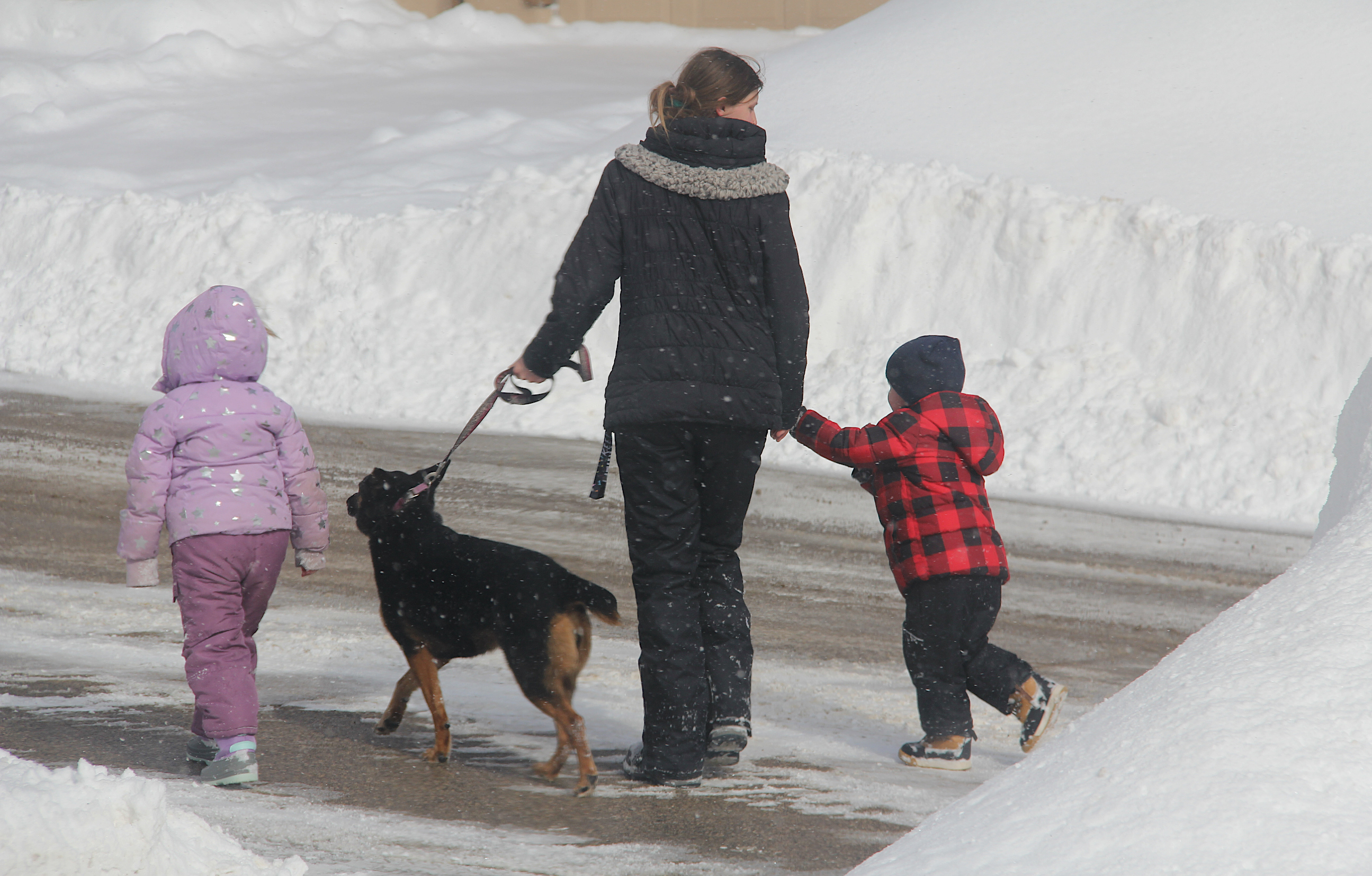
A young family walks their dog late Thursday morning along the snow-banked city street past our driveway. (Minnesota Prairie Roots copyrighted photo February 2023)
A mom and her two little ones are out walking the dog.
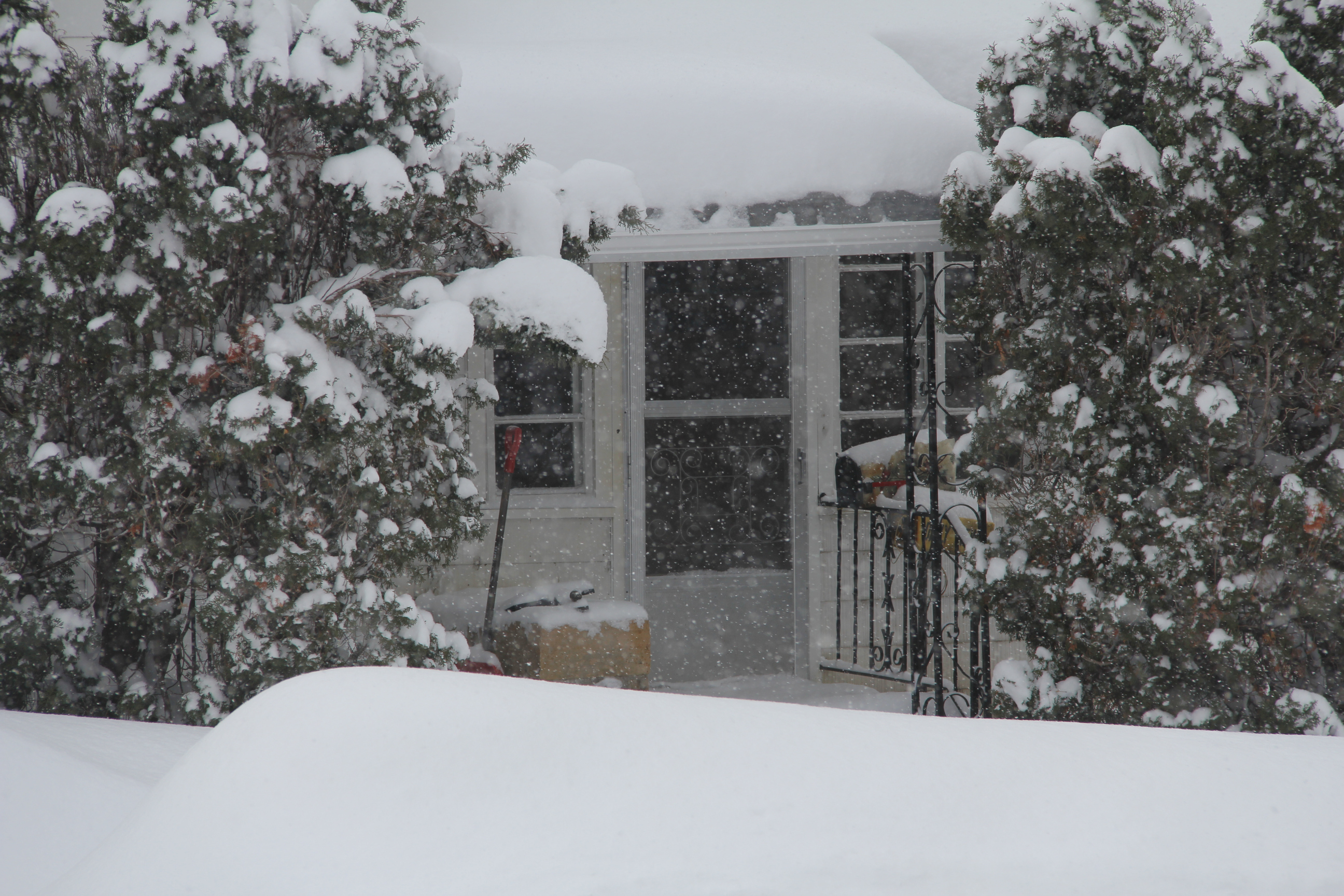
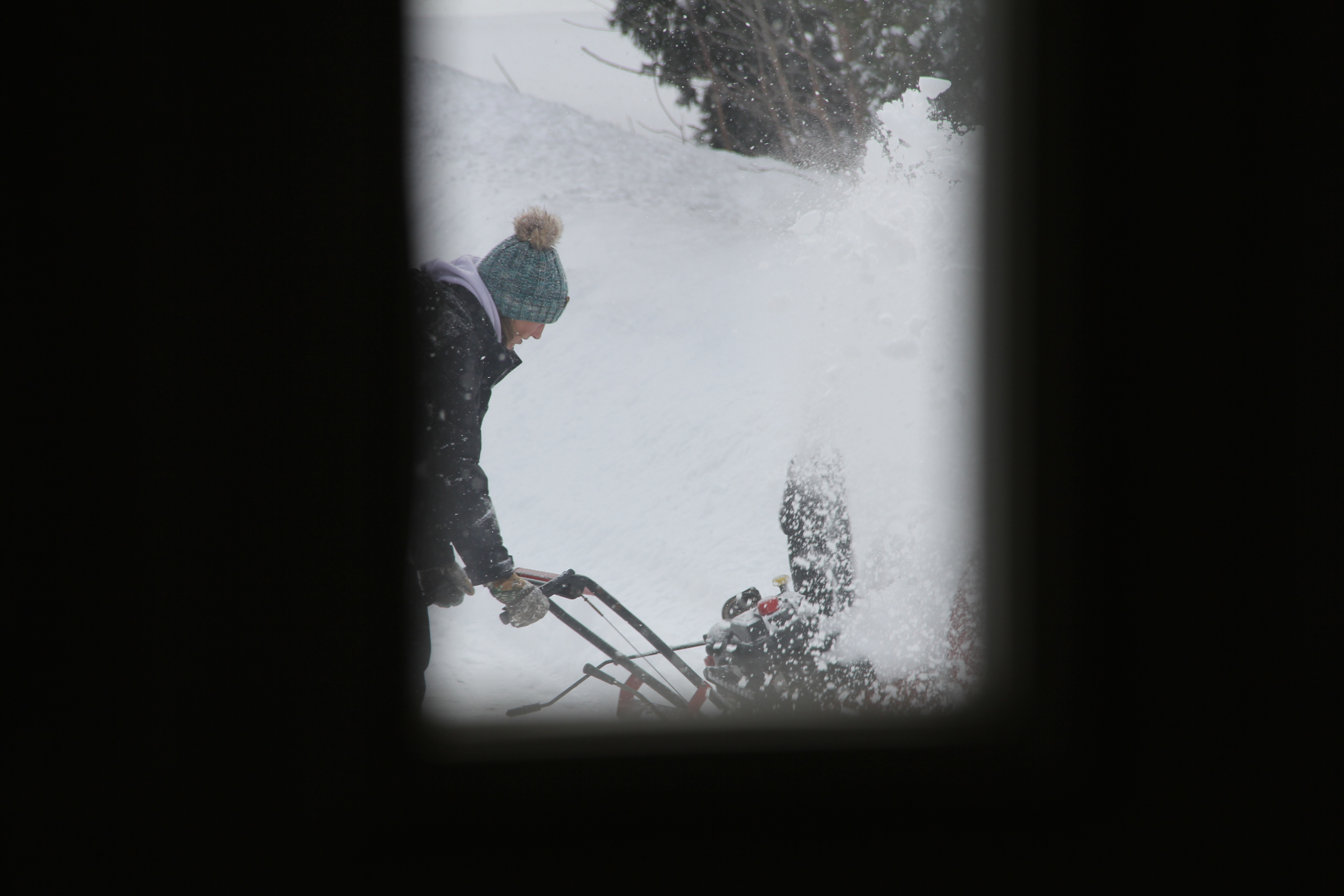
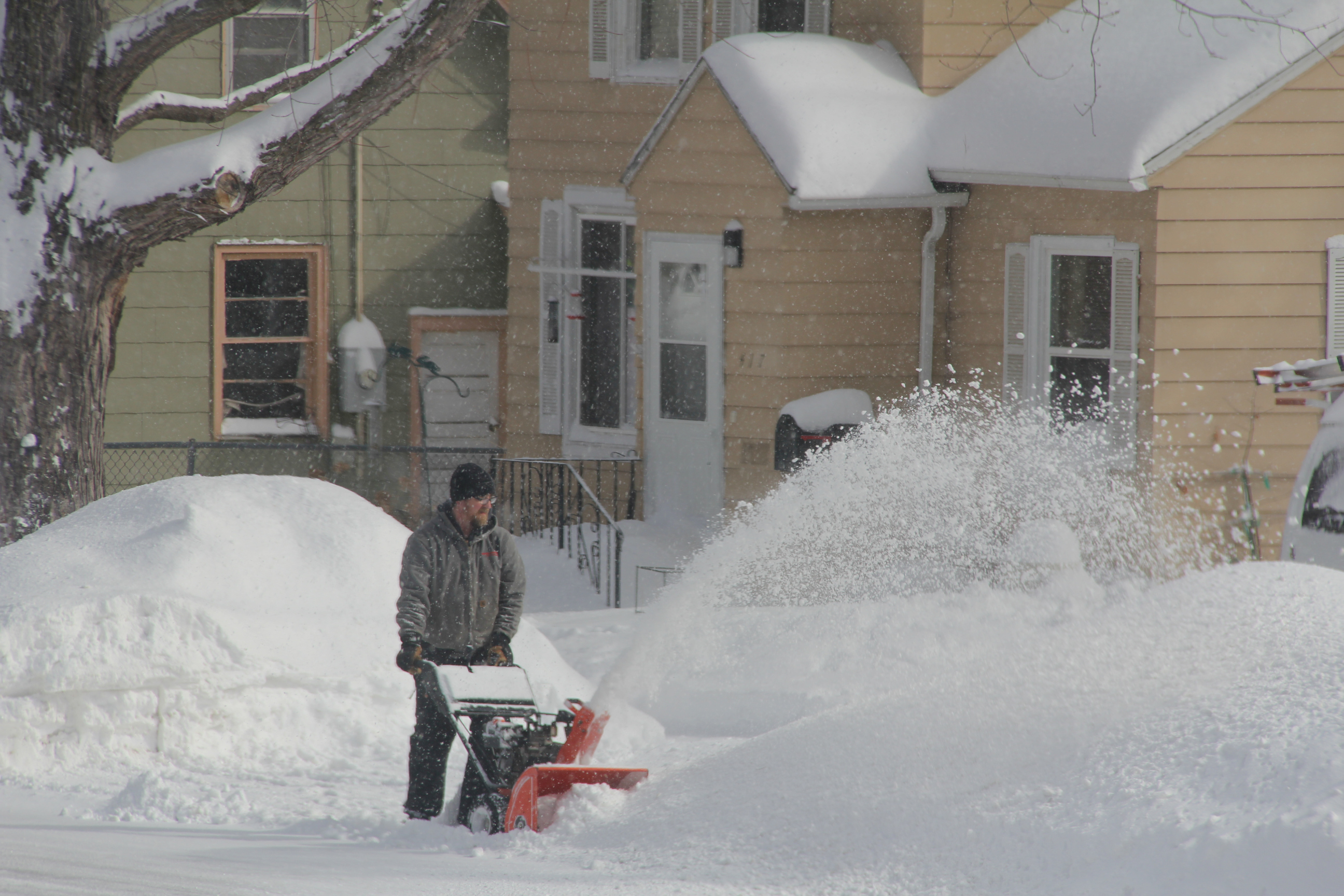
Bent into the task of blowing snow, a neighbor is framed through the window in my front door. (Minnesota Prairie Roots copyrighted photo February 2023)
Businesses and public places—the arts center, the library, the mall, the shoe store—are either closed or opening late. People seem to be heeding the warnings to stay home and off roadways. Even Randy is staying home from work today.
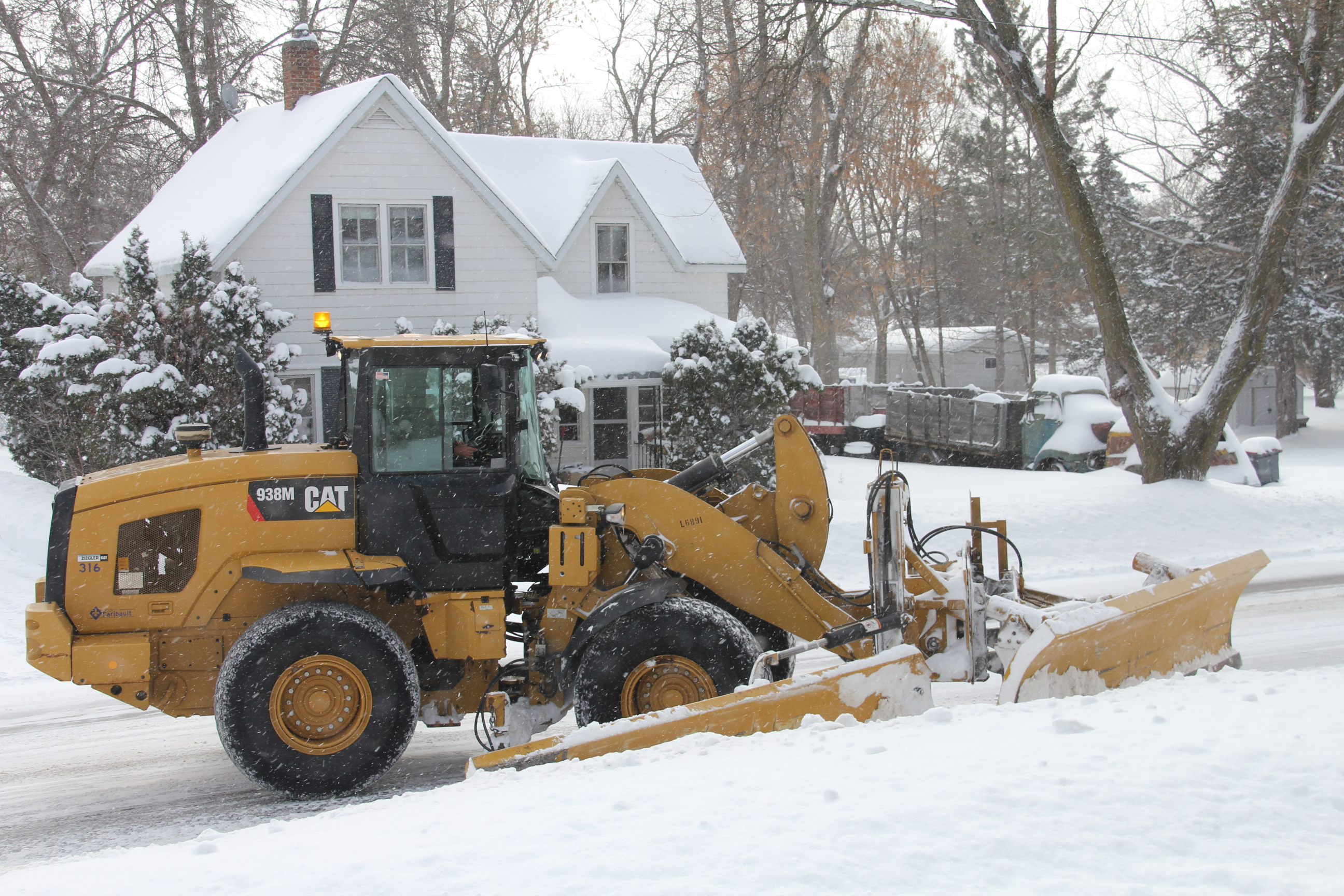
The city plow blades snow from the intersection toward the boulevard in front of our house. (Minnesota Prairie Roots copyrighted photo February 2023)
Traffic, mostly non-existent earlier, is picking up along our main arterial street. Mostly snowplows and pick-up trucks pulling trailers loaded with snow removal equipment.
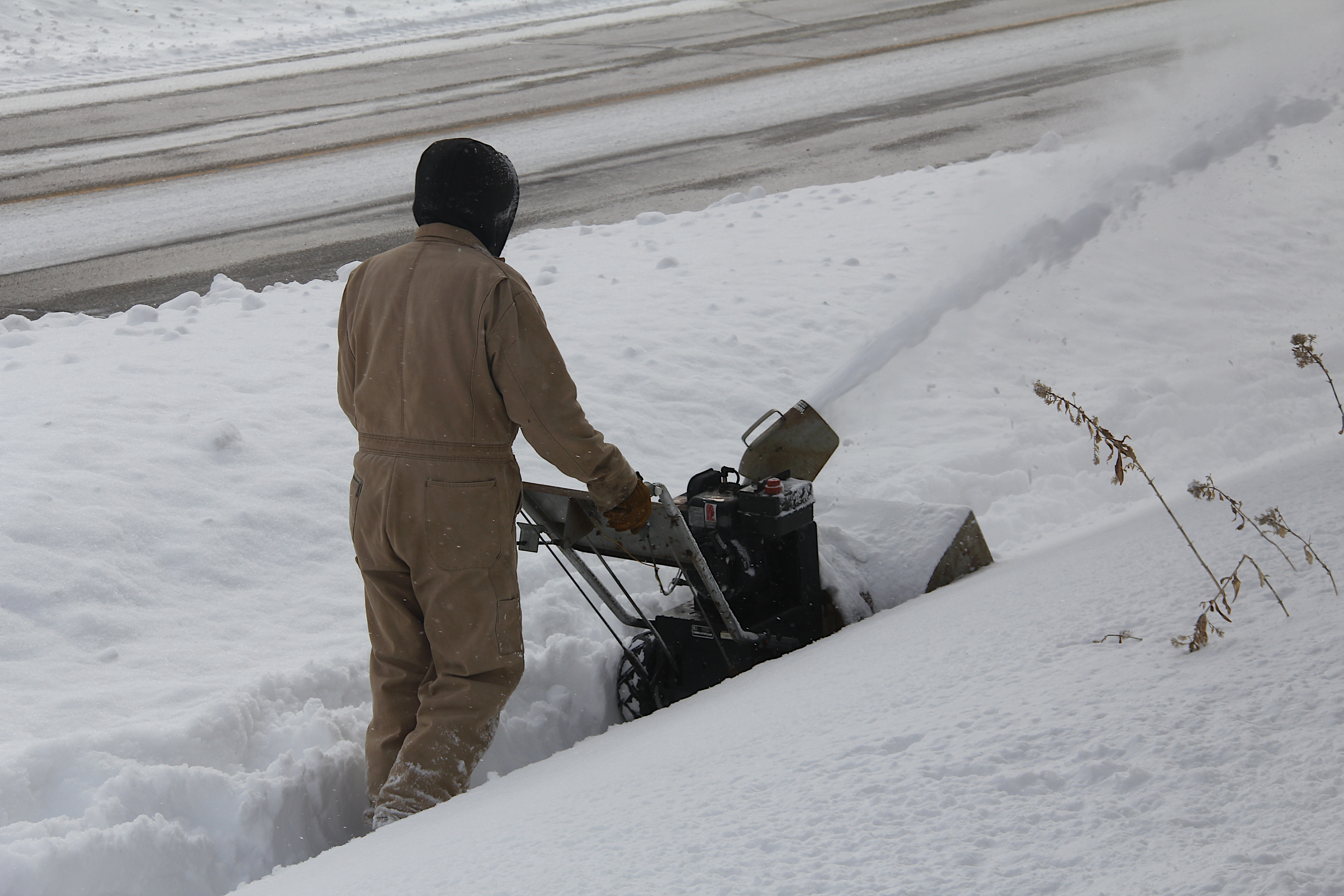
Randy guides the snowblower down the sidewalk past our house and our neighbor’s house. (Minnesota Prairie Roots copyrighted photo February 2023)
In the extreme southwestern corner of Minnesota, my native prairie, a portion of Interstate 90 remains closed along with many state highways. Wind whips this light snow, creating whiteout conditions, snowdrifts feet high and impassable roads. The National Guard is standing by to launch roadside rescues if needed.
A neighbor clears the end of his driveway. (Minnesota Prairie Roots copyrighted photo February 2023)
As snowstorms go, I’ve experienced much worse, especially as a Redwood County farm kid. I respect winter in Minnesota, understand the dangers when a major storm descends. And today, although this storm was not quite the historic storm predicted, I’m good with that. With some 14 inches of total snowfall, that’s enough for me, and Randy.
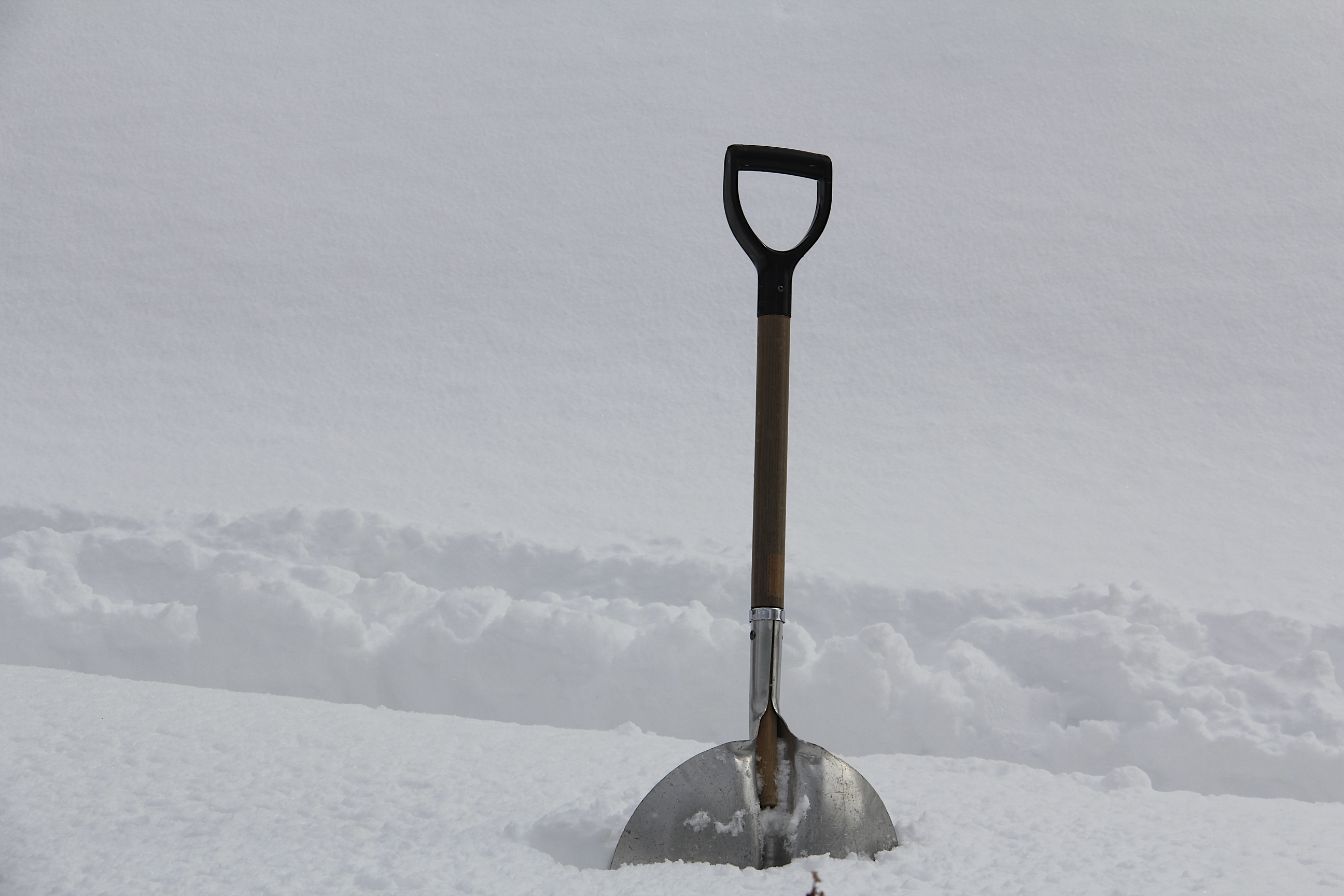
Another snow removal tool, a scoop shovel stuck here in the snow next to the sidewalk. We use it to clear our front steps. (Minnesota Prairie Roots copyrighted photo February 2023)
TELL ME: If you live in Minnesota, how much snow did you get? If you live elsewhere, are you experiencing any bad weather? I’d like to hear your stories.
Blowing snow reduces visibility along Rice County Road 25/197th Street in January 2020. I expect similar or worse conditions in Rice County later today, overnight and into Thursday. (Minnesota Prairie Roots copyrighted file photo January 2020)
AS I WRITE THIS MID-MORNING Wednesday, the view outside my office window is one of a landscape layered in new snow, about five inches. The light snow of earlier has stopped.
All appears calm, until I look closer. I notice snow sweeping off my neighbor’s roof. I see, too, treetops swaying, a trio of exposed squirrel nests nestled among branches. Another neighbor’s political flags extend in the wind, bannering messages I’m weary of seeing long after the 2020 election has ended. Buffeting my front steps, dried hydrangea heads wave in the rhythm of the morning wind.
For days now, we’ve been lectured by weather forecasters and officials alike not to be lured into complacency. This lull in an anticipated historic winter storm here in Minnesota is expected. Southern Minnesota braces for storm’s second punch after overnight snow.That Minnesota Public Radio headline and similar headlines have played across media outlets for days.
I lean into believing the National Weather Service predictions about this multi-day event that could rank among our top five winter storms. It’s not only about the quantity of snow, possibly topping 21 inches, but also about the wind. As a prairie native, I understand how quickly winds of even 25 mph can create white-out blizzard conditions, making travel dangerous and impossible. Winds are expected in some places to top 50 mph. Our governor has already declared a peacetime emergency.
When my husband left for work Wednesday morning, I asked him to remain weather aware, reminding him that this storm is about the wind as much as the snow. He works as an automotive machinist in a rural location, typically a 35-minute commute. Unlike me, Randy leans into believing storm predictions are more hype than reality. Sometimes he’s right. Time will tell. Regardless, I inquired whether his phone was fully-charged and whether a sleeping bag was still in the van. It was and it was. And I asked him to text when he arrived at work and when he leaves later today. He did and I expect he will. Roads this morning were worse in sheltered areas, he reported.
By noon our winter storm warning transitions into a blizzard warning in effect for 24 hours. It’s not often my county of Rice, just south of the Twin Cities metro along Interstate 35, enters blizzard status. I expect this designation in southwestern Minnesota and other primarily open land area parts of the state, but not here.
Whatever happens, we’ve been warned by the National Weather Service, Twin Cities, on their Twitter page Wednesday: There seems to be some confusion this morning because the sun has come out. Does this mean all we got is a measly 3-5” and it’s over? Nope! As we’ve talked about for days, round 2 is on the way and it will pack a punch! Expect an ADDITIONAL 10-15” by tomorrow morning.
This is a photo of an x-ray of my broken right shoulder in 2017. (Minnesota Prairie Roots copyrighted file photo May 2017)
IF MY MOM WAS STILL LIVING, I’d apologize. I’d apologize for dismissing her connections between weather and an aching body. I laughed off that cause-and-effect as one of those ideas passed from generation to generation. More myth than truth. But I’m not laughing any more.
As I’ve aged, I’ve noticed an interplay between changes in weather and how I feel physically. Right now my body is hurting. A lot. I attribute that partially (mostly) to the winter storm. Anytime a storm is approaching, upon us and/or the weather turns bitterly cold, I experience more pain.
I’ve read that fluctuations in barometric pressure (lower in the winter) specifically affect joint pain, stiffness and swelling. Without completely going down the rabbit hole of self-diagnosis, that generality seems to apply to me.
I should provide some backstory here. I have an artificial right hip, implanted in 2008 after I developed osteoarthritis so severe I could barely walk or tolerate the pain. Because I was youngish, I was advised to hold off on surgery as long as possible. Much of the pain I experience now centers on the right implant side of my body and in my lower back. My back is plagued by osteoarthritis and scoliosis. As Randy has noted, my body is crooked and I can visually see and feel that.
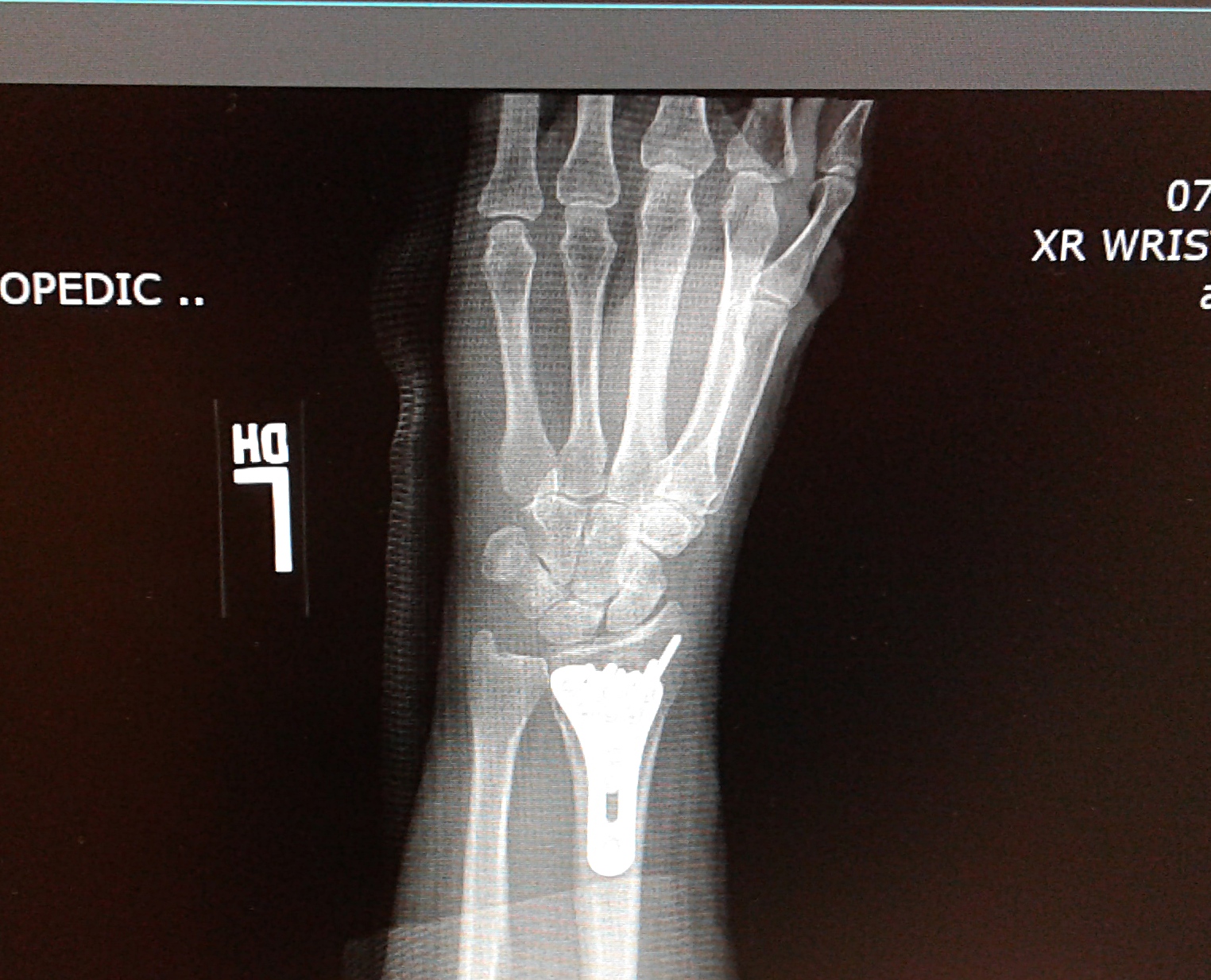
Look on the right side of my wrist to see the plate, shaped like an ice scraper. (Minnesota Prairie Roots copyrighted file photo 2018)
Bear with me. I also have an implant in my left wrist, the result of a 2018 fall which shattered my wrist. Ten screws hold that wrist plate in place. When the weather changes, I notice discomfort in my wrist. Likewise in my right shoulder. I broke that in 2017 after missing the last step on a hospital stairway while on my way to donate blood.
This is a photo snapped with a cellphone of the implant in my wrist, held in place by 10 screws. (Minnesota Prairie Roots copyrighted file photo 2018)
What is my point in sharing all of this? Not to garner sympathy or give the impression of woe-is-Audrey. Rather, I’m interested in learning whether you notice, like me, a connection between weather and body. I recognize this question may be more applicable to those of you who are aging Baby Boomers.
So let’s hear. Share your personal stories and your insights and perhaps we can reach an unscientific conclusion. Was my mom right? Is there a connection between weather and an aching body?
WHEN A MAJOR WINTER STORM is in the forecast for Minnesota, we Minnesotans listen intently. And then we stock up on eggs, milk and bread. Or so the joke goes. But, in reality, grocery stores do experience an uptick in business. Liquor stores, too. And for anyone who owns a snowblower—and that’s most of us—having enough gas to fuel snow removal is a must, not an option.
So here we are, poised to get massive quantities of snow over several days. Faribault is in the 17 to 22-inch snowfall range, according to the National Weather Service forecast on Monday. That bull’s eye target of snow stretches from western to eastern borders across a wide swatch of southern Minnesota from around Mankato in the south to St. Cloud in the north.
And then as if the large amounts of snow aren’t enough, winds are anticipated to rage, blowing around all that light, fluffy snow. The 40-45 mph winds gusting up to 50 mph will create white-out and blizzard conditions in many regions, especially on the prairie.
This looks to be a doozy of a winter storm that begins on Tuesday afternoon, ends on Thursday evening. Forecasters seem quite confident it will play out as predicted. I expect closures of schools, businesses and more. I expect snow gates (yes, there’s such a thing) to be pulled across interstates and other highways. There will be winter storm (our warning starts at 3 pm today) and blizzard warnings, travel advisories, “no travel recommended” and most likely stranded motorists who need rescuing.
Randy and I are prepared. I have a stack of library books to read. We have 2 ½ dozen eggs (thanks to a friend who has free-range chickens), enough milk and nearly a full loaf of bread. The snowblower gas tank is topped. And the mini fridge in the basement is stocked with craft beer. Yup, we’re ready…
“I GOT PLANS! BIG PLANS, I SAY!” shouts the boy standing atop the highest hill in town, the hill he just climbed.
His plans take him to a big city, to a board room filled with MUCKETY-MUCKS, into a helicopter and onto a football field. He becomes mayor and then President. He has, he continues proclaiming, BIG PLANS.
His plans take him into space, flying in a rocket ship built by the state of Pennsylvania and wearing a space suit made of potatoes from Idaho. There is seemingly nothing he cannot do.
My grandkids, Isabelle, 6, and Isaac, 4, loved this easy reader picture book written by Bob Shea and illustrated by Lane Smith. I did, too. It’s funny, empowering and imaginative. And I loved reading it to my grandchildren as we snuggled into the recliner under a fleece throw. I lost count of how many times I read BIG PLANS during their overnight weekend stay.
As a grandma, I hold onto the moments rather than big plans for my young grandchildren. I want them to appreciate who they are now and Isaac as much as stated the same when he said he wanted to remain a kid. For now he is—a little boy whose knowledge of the solar system is not to be challenged. Likewise his sister with dinosaurs.
Saturday into Sunday afternoon, toys and books and puzzles littered the living room turned playroom. Toys pulled from totes in the basement. A Fisher Price school bus, a fire truck, a bulldozer. Matchbox vehicles, including an ambulance with doors that open, Isabelle noted. Small plastic dinosaurs and larger roaring ones. Cootie and BINGO pulled from an upstairs closet. Toys that their mom and their aunt and their uncle and a host of other children have played with through the decades, imaginations unleashed.
Isaac created art with crayons, inspired by another book we read, Jigsaw Mystery in the Mail by Bob Graham. He drew a birthday cake with two flaming candles, asked me to cut out double layers of cake and then staple the two together to form a card. He asked for an envelope, then requested I address it to United States of America. Nothing more. He expects his mom to drop the card in a mailbox, just like in the book.
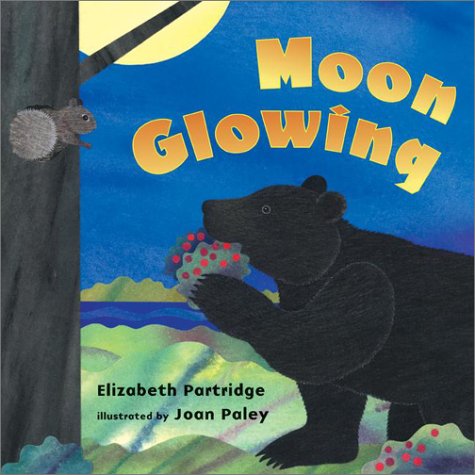
The animal-focused book Moon Glowing written by Elizabeth Partridge and illustrated by Joan Paley brought discussion about hibernating beavers, bats and bears. Maybe a bear lives inside the snow cave we discovered in the backyard, Isabelle and I considered. The snow den into which Izzy and I poked a stick three feet long, the stick easily swallowed. I considered for a moment that an animal might come raging out. Certainly not a bear, but…
So we moved onto fishing (Izzy’s idea). She dropped her line over the limestone wall, hauling in fish after fish after fish. I appreciated how creative her mind, how dry maple leaves topping the snow, mulching flowerbeds, morphed into sunnies and crappies and walleyes caught via her stick fishing pole. And then this first grader mentioned that she wished she really was fishing. And although it’s no longer truly safe to ice fish in Minnesota this season, there’s always next winter. Or fishing from the dock at the cabin this summer.
These were the moments of my weekend. No BIG PLANS. But something far better—time with these dear little ones. Time to hug and hold and hang onto the moments that matter most. Like the moment Isaac declared, “Peanut butter pancakes make me happy!”
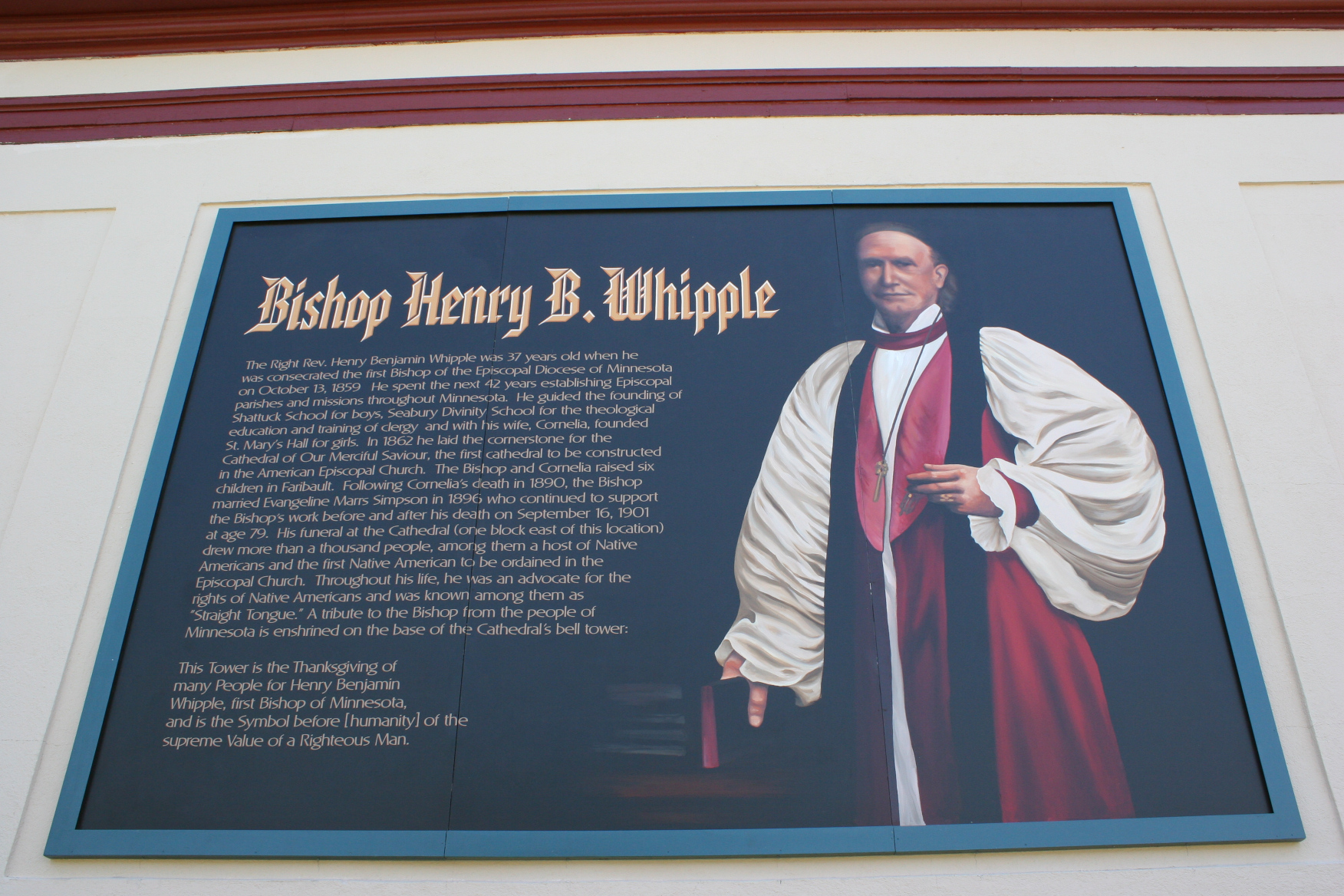
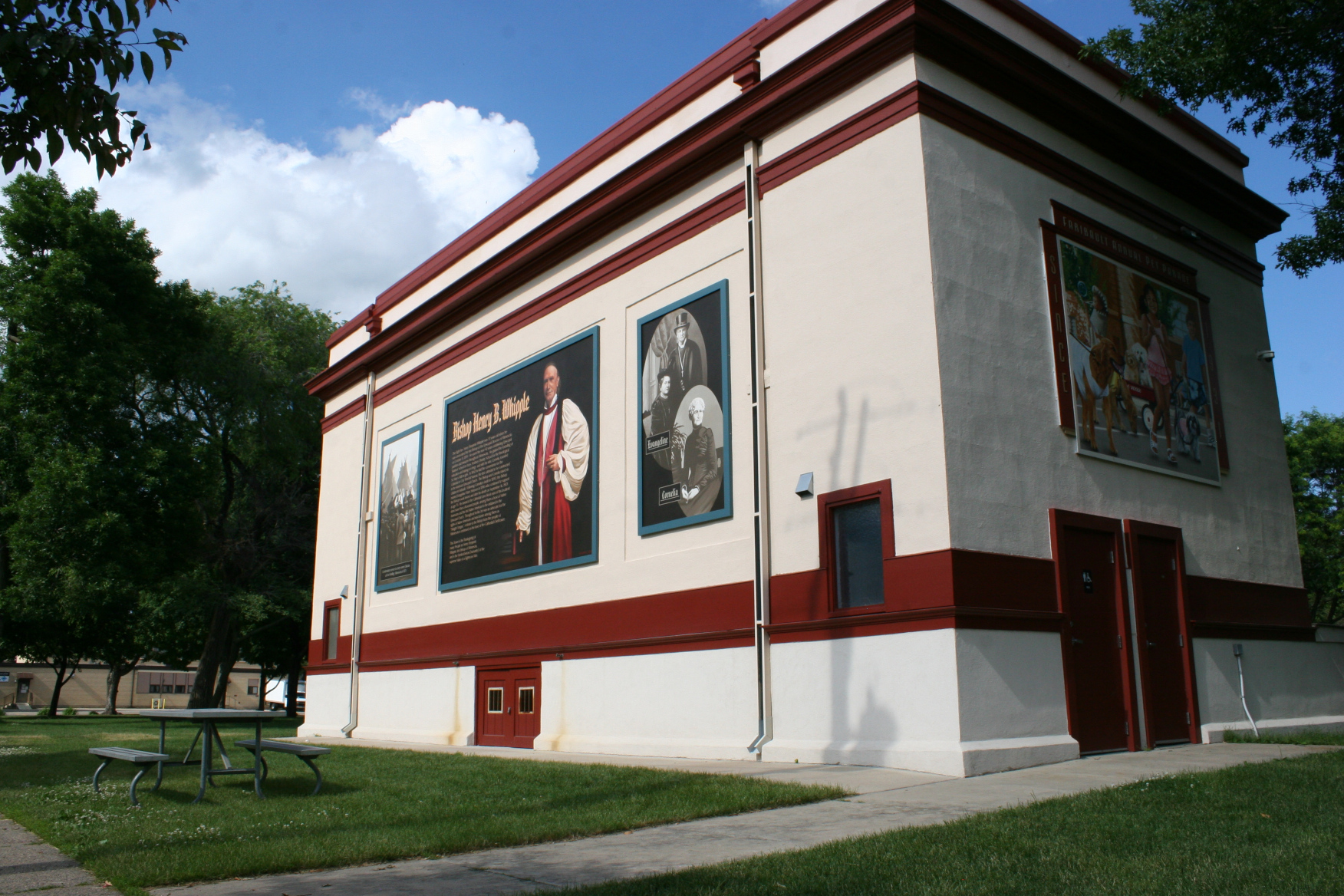
A painting of Bishop Henry Whipple and information about him grace a mural on Faribaults’ Central Park Bandshell. (Minnesota Prairie Roots copyrighted file photo June 2020)
He was known as “Straight Tongue” for his honesty. He was disparagingly called “The Sympathizer” by others for the compassion and care he held for the Dakota. He was Bishop Henry Whipple.
Thursday evening, Rice County Historical Society Executive Director David Nichols spoke to a packed room about this Episcopal priest who played such a pivotal role in Minnesota history, specifically during the time shortly before, and then after, The U.S.-Dakota War of 1862. For me, personally, Nichols’ focused talk connected my home region of Redwood County, the area in which the war centered, to my home of 40 years, Rice County.
I grew up with a limited (white) perspective of the war with no knowledge of Whipple. I only learned of this New York born clergyman upon my move to Faribault in 1982. Nichols broadened my understanding during his presentation and during a question and answer session that followed.
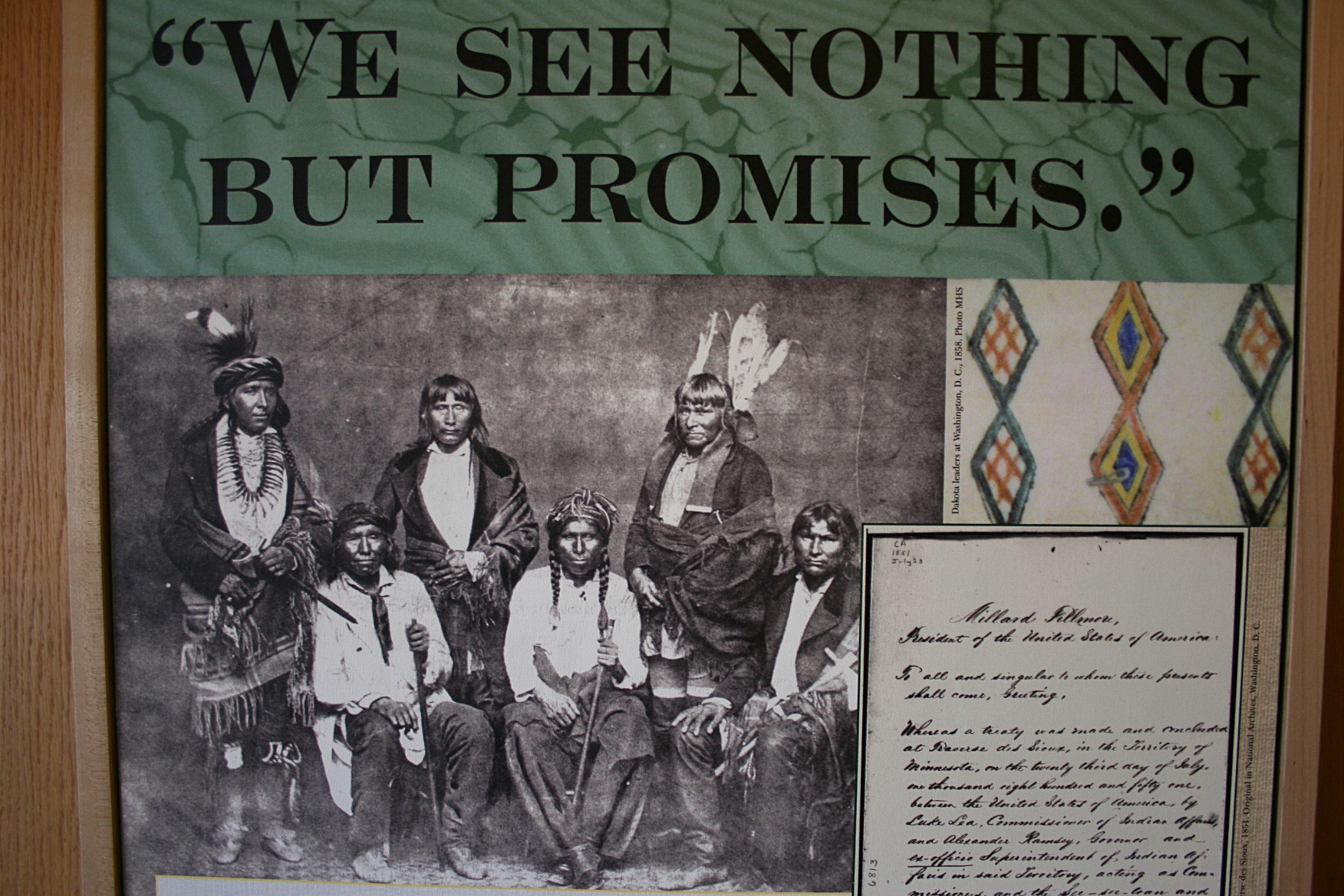
A panel at the Traverse des Sioux Treaty Center in St. Peter shows Dakota leaders photographed in Washington D.C. in 1858. The photo is from the Minnesota Historical Society. It references broken treaty promises and rising tension. (Minnesota Prairie Roots copyrighted file photo)
HIGH TENSIONS
Whipple arrived here in 1860 as the newly-elected Bishop of Minnesota, settling in Faribault. Already at that time, tensions were mounting among settlers and the first peoples of Minnesota, Nichols said. Tensions also existed between the “Farmer Indians” (those who adapted to Euro culture) and “Blanket Indians” (who maintained their Native culture, traditions and lifestyle). Conditions on reservations were terrible with disease, starvation, and dishonest agents failing to provide promised government annuities.
That is the situation Whipple found when he landed in Minnesota. It was a time, noted Nichols, of “tensions about to boil over.” And eventually they did with the outbreak of war in August 1862. It was a decidedly bloody and awful war, as all wars are. Some 600-800 died and the Dakota were eventually displaced from their land.
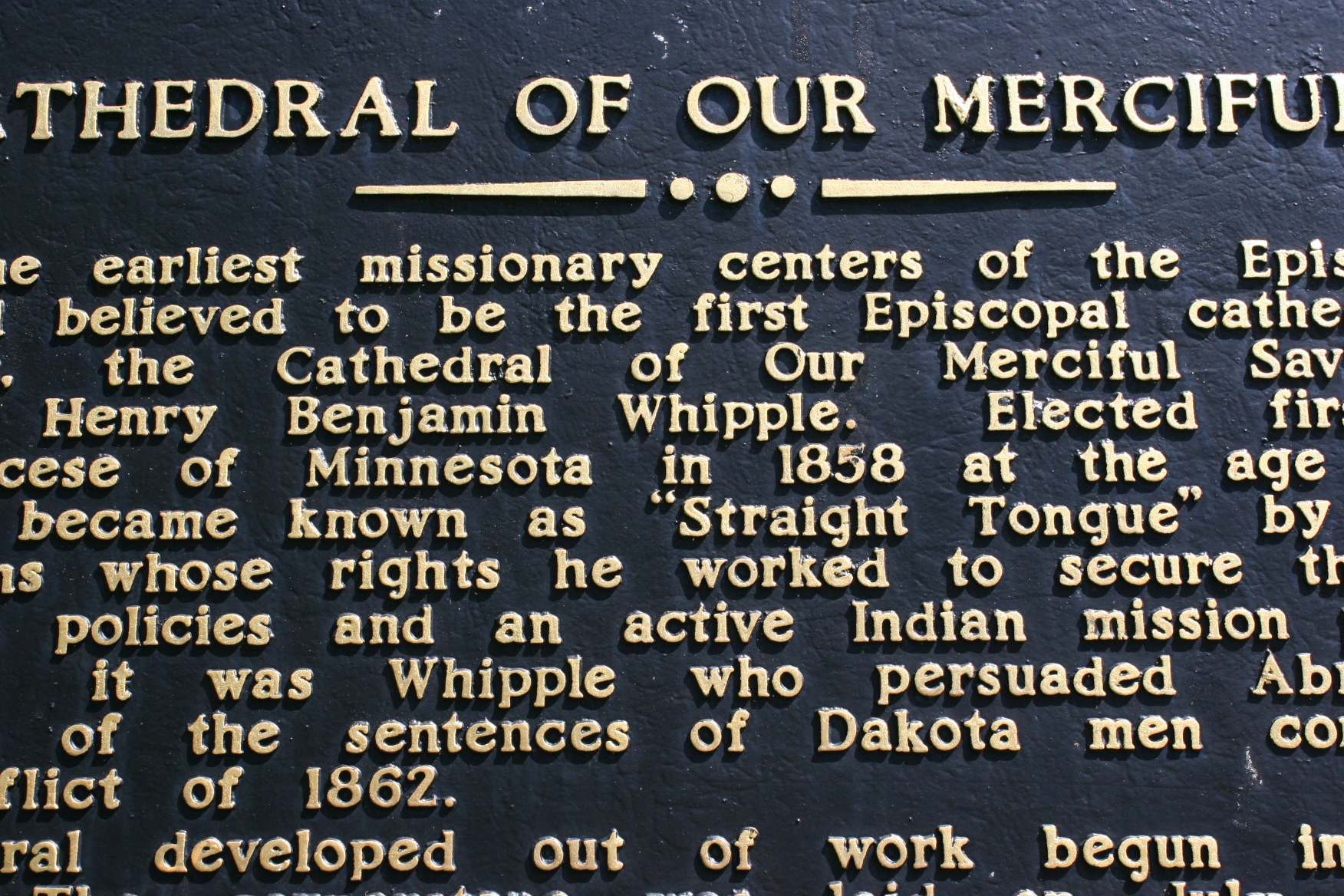
Details on a sign outside The Cathedral of Our Merciful Saviour, Whipple’s church in Faribault. (Minnesota Prairie Roots copyrighted file photo 2020)
THE SHAPING OF A HUMANITARIAN
To understand Whipple’s position and part in this, Nichols provided background. Whipple was involved in New York politics as a “conservative Democrat,” a term which drew laughter from the crowd at Thursday’s presentation. He briefly attended Oberlin College, notable because the college was among the earliest to admit women and African Americans. And Whipple was ordained in 1849, during the so-called “Second Great Awakening” with a focus on civil rights.
Learning this helped me better understand the bishop. All of these experiences shaped a man who spoke with honesty and compassion, advocated for Minnesota’s Indigenous Peoples (both the Dakota and the Ojibwe, natural enemies), called for reform and peace and understanding. Whipple was, said Nichols, a voice for calm, calling for justice, not vengeance, when the short-lived U.S.-Dakota War ended.
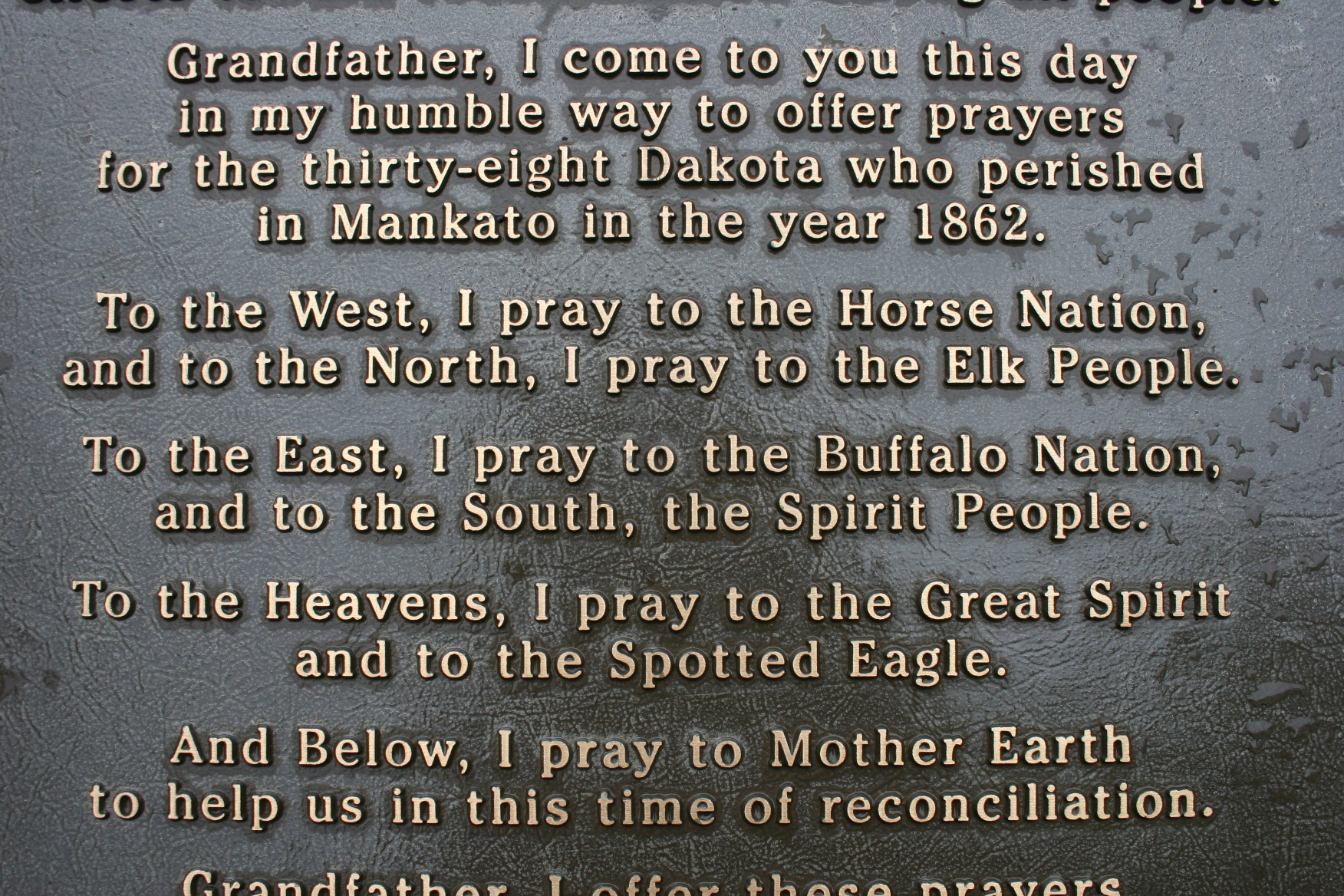
Words on a marker in Reconciliation Park in Mankato where 38 Dakota + 2 were hung on Dec. 26, 1862. (Minnesota Prairie Roots copyrighted file photo May 2012)
ADVOCATING FOR PARDONS
In his many years of missionary work and advocacy, even when his life was threatened by those who viewed him as an “Indian sympathizer,” one singular moment stands out to me. And that is Whipple’s efforts to save the lives of 303 Dakota men sentenced to death after the war. He met with President Abraham Lincoln and was “partly responsible,” Nichols said, for Lincoln’s eventual pardon of all but 38 Dakota. The 38, plus two others, were hung in a public mass execution in Mankato on December 26, 1862. It is a terrible and profoundly awful moment in Minnesota history, especially the history of the Dakota.
A full view of the bandshell mural featuring Bishop Whipple and his first wife, Cornelia, and his second wife, Evangeline. (Minnesota Prairie Roots copyrighted file photo)
ASSIMILATION
While listening to Nichols’ presentation on Whipple, I felt conflicted. Conflicted because the bishop was, he said, “a strong assimilationist.” That label bothered me until I talked further with Nichols. He explained that Whipple did not view himself and Europeans as superior to Native Peoples, but rather observed, in the context of place and time and thinking, the need to adapt versus being driven out. That helped me better understand Whipple’s approach. I recognize, though, and acknowledge the current-day struggles with assimilation, especially as it relates to Indian boarding schools. I appreciate the recognition of, and return to, culture, tradition and heritage today.
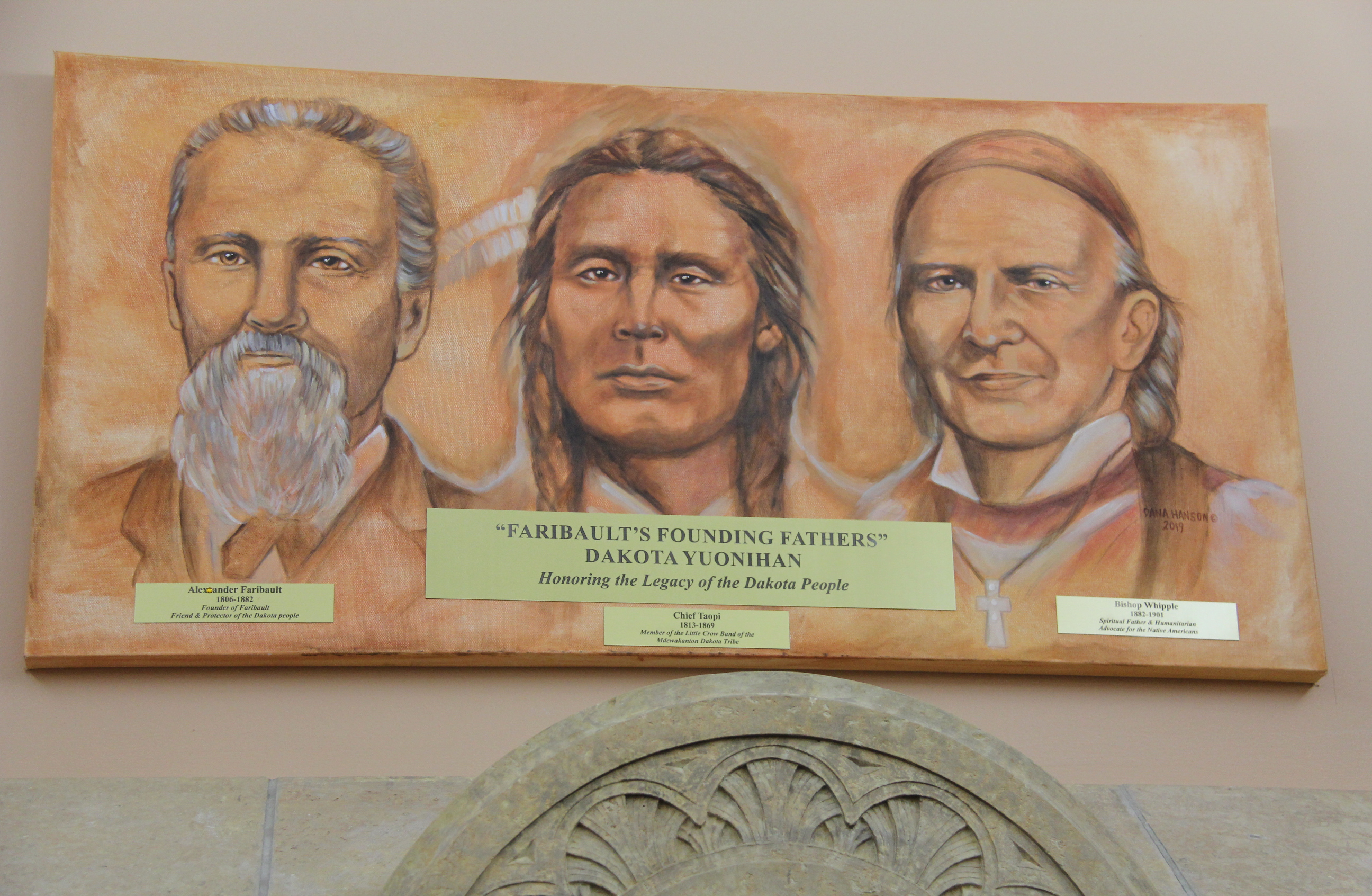
“Faribault’s Founding Fathers,” portraits of Alexander Faribault, left to right, Chief Taopi and Bishop Henry Whipple, by Dana Hanson hangs in Faribault’s Buckham Memorial Library. (Minnesota Prairie Roots copyrighted file photo November 2022)
WELCOMING THE DAKOTA TO FARIBAULT, OR NOT
Whipple, by his words and actions, embraced the Dakota and Ojibwe who called Minnesota home long before white settlers arrived, long before he moved to Faribault. My community, founded by fur trader Alexander Faribault, himself half Dakota, was a safe haven for the Dakota (“you don’t attack family”) during the 1862 war and thereafter, Nichols said. Faribault and Whipple worked together to move 180 Dakota from St. Paul’s Fort Snelling, where they were held following the war, to live on land Alexander owned along the Straight River in Faribault.
I wondered, “Were they welcomed here?” The answer, given by former RCHS Executive Director Susan Garwood, was as I expected. Mixed. While some supported the Dakota’s presence in Faribault, others were vocal in their opposition. In that moment, I thought of our ever-growing immigrant population in my community. Many welcome our newest neighbors and, like Alexander Faribault and Bishop Henry Whipple, support and encourage them. But many also want them gone. History repeats.
An inscription honors Whipple on the Cathedral bell tower. (Minnesota Prairie Roots copyrighted file photo June 2020)
MARKING HISTORY
Walk around Faribault today and you will see many reminders of the work Whipple did not only locally, but across Minnesota. Historical markers and inscriptions about the bishop grace The Cathedral of Our Merciful Saviour, his faith base. He’s buried under the altar there. Across the street at Central Park, Whipple-themed murals cover the west side of the historic bandshell. Downtown, one of many history-focused benches honors Whipple. And across town, at the Chapel of the Good Shepherd on the campus of Shattuck-St. Mary’s School, a marker notes his role in founding Shattuck and other schools in Faribault.
Efforts are underway now locally to recognize the Dakota as well, to publicly mark their place in the history of Faribault. I’d like to think Bishop Henry Whipple, also known as “Straight Tongue” and “The Sympathizer,” would welcome the idea, would even step up to fund raise, just as he did some 160 years ago to support the relocation of 180 Dakota from Fort Snelling to Faribault.
Beata Sampson (Photo source: Sunset Funeral Home obituary)
Beata. What a beautiful name, one I’d never heard before scrolling through a recent list of obituaries from my home region of southwestern Minnesota. I wanted, needed, to learn more about this 98-year-old woman with the Latin-derived (beatus) name meaning “blessed.”
A well-written obituary provides not only basic factual information of birth, life and death, but also enough personal details to tell a story. Beata’s obit speaks to a strong woman born 98 years ago in the Sandager family home in Swedes Forest Township in the northern most part of Redwood County.
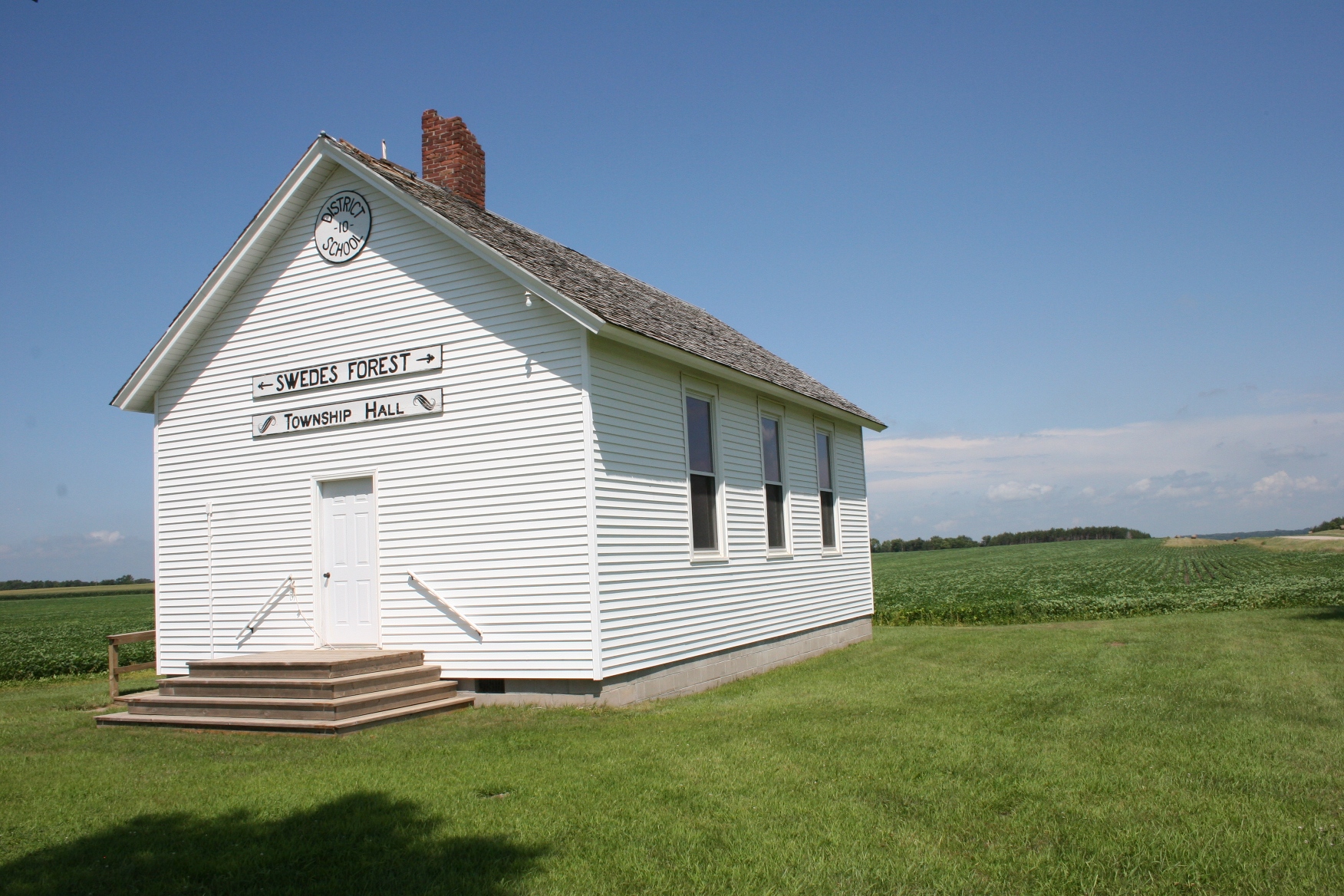
Swedes Forest Township Hall, formerly the District 10 School which Beata attended. (Minnesota Prairie Roots copyrighted file photo August 2011)
Even the township name titles a story—of the Scandinavian immigrants who started settling this area just south of the Minnesota River in 1867. Norwegians, mostly, and Swedes and Danes (like Beata’s Danish-born grandfather, Nils H. Sandager). Knute and Erick and Thor and Ole and Torkel and Turi and Gunhild and Ingeborg… And Beata Ellen’s Norwegian grandmothers, Beret and Ellen, after whom she is named.
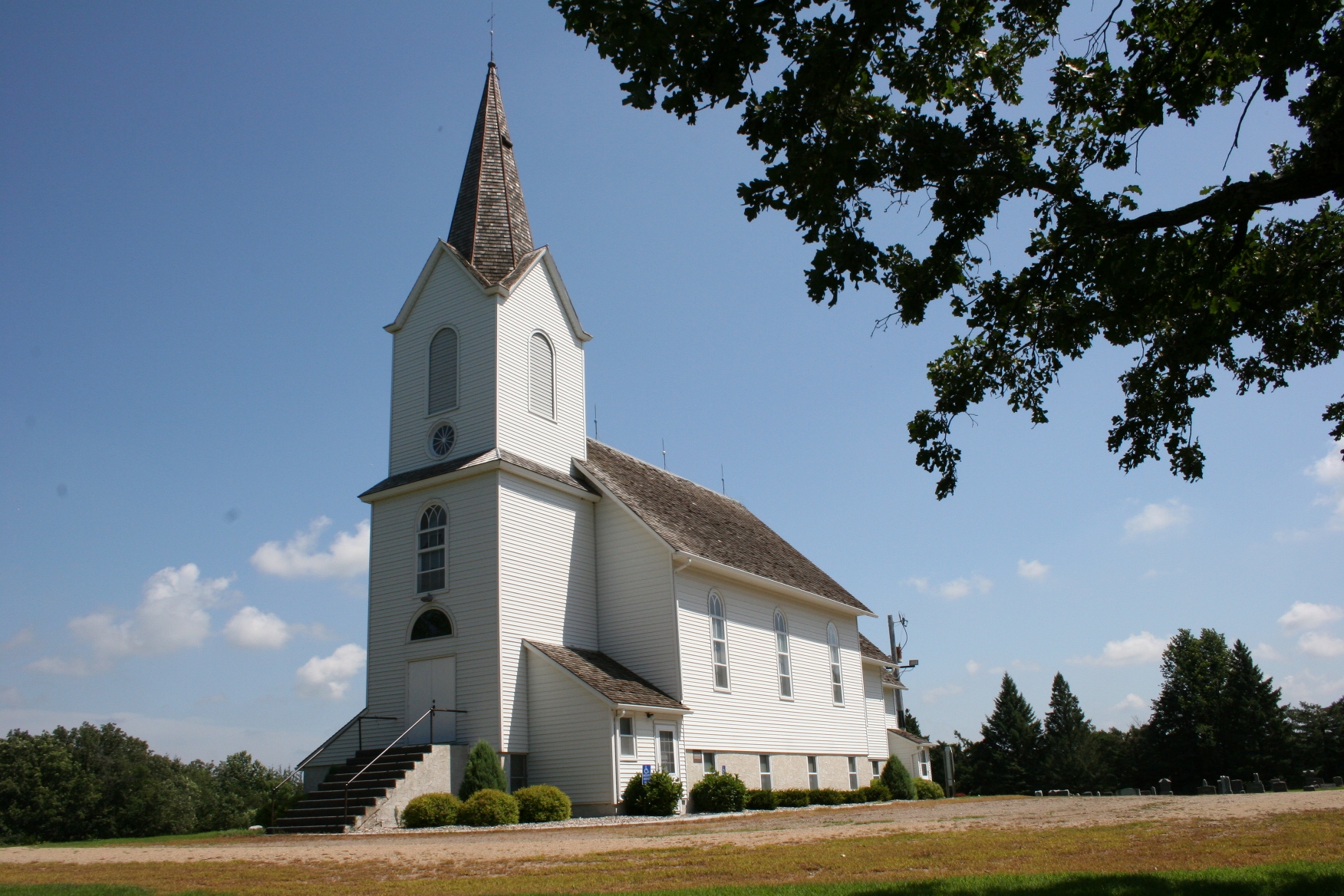
Picturesque Rock Dell Lutheran Church. (Minnesota Prairie Roots copyrighted file photo August 2011)
History runs deep here, all the way back across the ocean. Family history held importance for Beata, who died on February 11 and will be buried today at Rock Dell Cemetery in Swedes Forest Township. This township, this land, this place, it was hers. Beata’s home since her December 27, 1924, birth.
She left only briefly, heading to college in Moorhead in 1942 before returning in 1943 when her father died. Beata was just 18. But her mother, Barbra, and brother Nels needed her help on the family farm. Six years later she would marry Lloyd Sampson, also a farmer. After only 11 years of marriage, Beata was widowed at age 35, her husband dead from cancer.
What strength it must have taken for this young woman and mother of two to endure first the death of her father and then her husband. I’d like to think she had a strong support system of friends and family and neighbors rallying around. A community of people who cared. Knowing rural southwestern Minnesota as I do, I expect that’s true.
Yet, “after a couple years in their big, cold house, Beata and her children (Coral Beth and Joel Loren) moved to live with her mom and brother.” Recognizing the importance of immediate family love and support, of understanding that she needed family near, shows strength, too.
Driving through northern Swedes Forest Township in the summer of 2014. (Minnesota Prairie Roots copyrighted file photo June 2014)
But there’s more, much more, to Beata’s story. In 1979, she became the first woman elected to office in Swedes Forest Township. It took 107 years for a woman to gain an elected seat on the township board. While that seems unfathomable in today’s world, it’s absolutely believable for that time period. Beata served for 24 years as treasurer of Swedes Forest Township.
She followed in the footsteps of her grandfather Nils H. Sandager, who also left a legacy of public service. He was elected township treasurer 12 times and also held the offices of town chair, supervisor and constable for a total of 19 years.
Beata’s local involvement stretches beyond township government. She was active, too, in the Lutheran churches she attended—Rock Dell and Grace. And she found time for the other aspects of life that held her heart—living in the country, the outdoors, flowers, bird watching, family history, family, children, puzzles…and pretty dishes. Yes, this strong strong woman who made history in Swedes Forest Township, who was there for her family, loved pretty dishes. And that, too, says a lot about a woman whose name means “blessed.”

















Recent Comments