Minnesota Prairie Roots

Writing and photography by Audrey Kletscher Helbling

The veterans of Vesta May 30, 2011

A flag placed on a veteran's grave at the Vesta Cemetery in southwestern Minnesota.

EARTH MEETS SKY HERE.

On this Memorial Day weekend, I have come to this hilltop cemetery outside of my hometown of Vesta in southwestern Minnesota to remember.

I walk the rows, between the tombstones, lean in close, read the names, memories only a thought away.

My focus is on my father and the other veterans buried here whose names I know, whose stories of war I will never fully know.

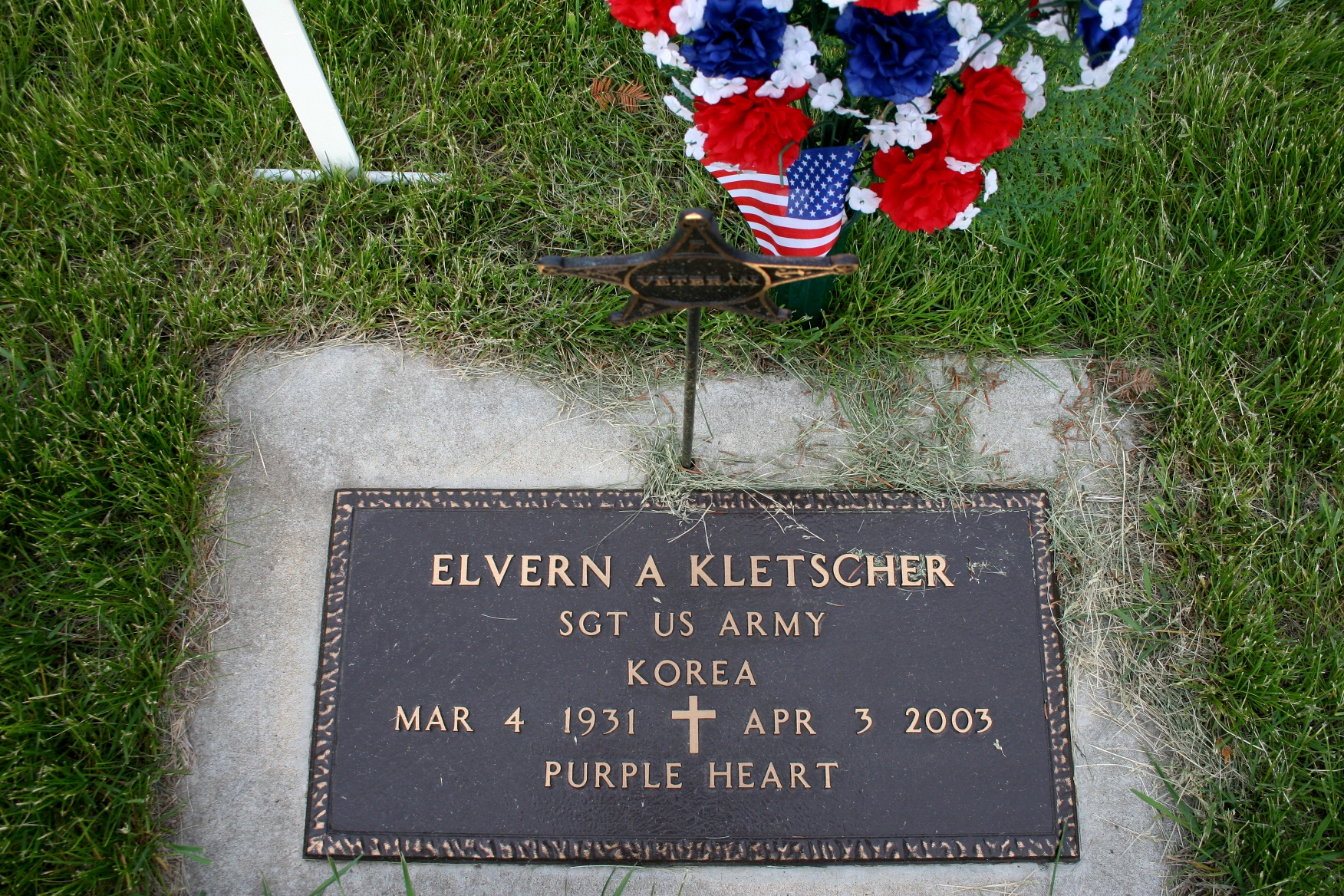
An in-ground marker honors my father, Elvern Kletscher, a Korean War veteran and recipient of the Purple Heart for wounds he suffered at Heartbreak Ridge in Korea.

How did they feel leaving family and farm? Were they scared? Were they honored to serve their country? Did they yearn for home as they shouldered their weapons? Did they leave as boys, come home as men? Were they scarred by war, forever changed?

I wondered as strong prairie winds whipped flags attached to white wooden crosses. So many flags. So many graves of men who’ve served.

If only I’d asked them to tell me their stories, these men whom I’d never thought of as soldiers, until I saw their graves marked by crosses and stars and American flags.

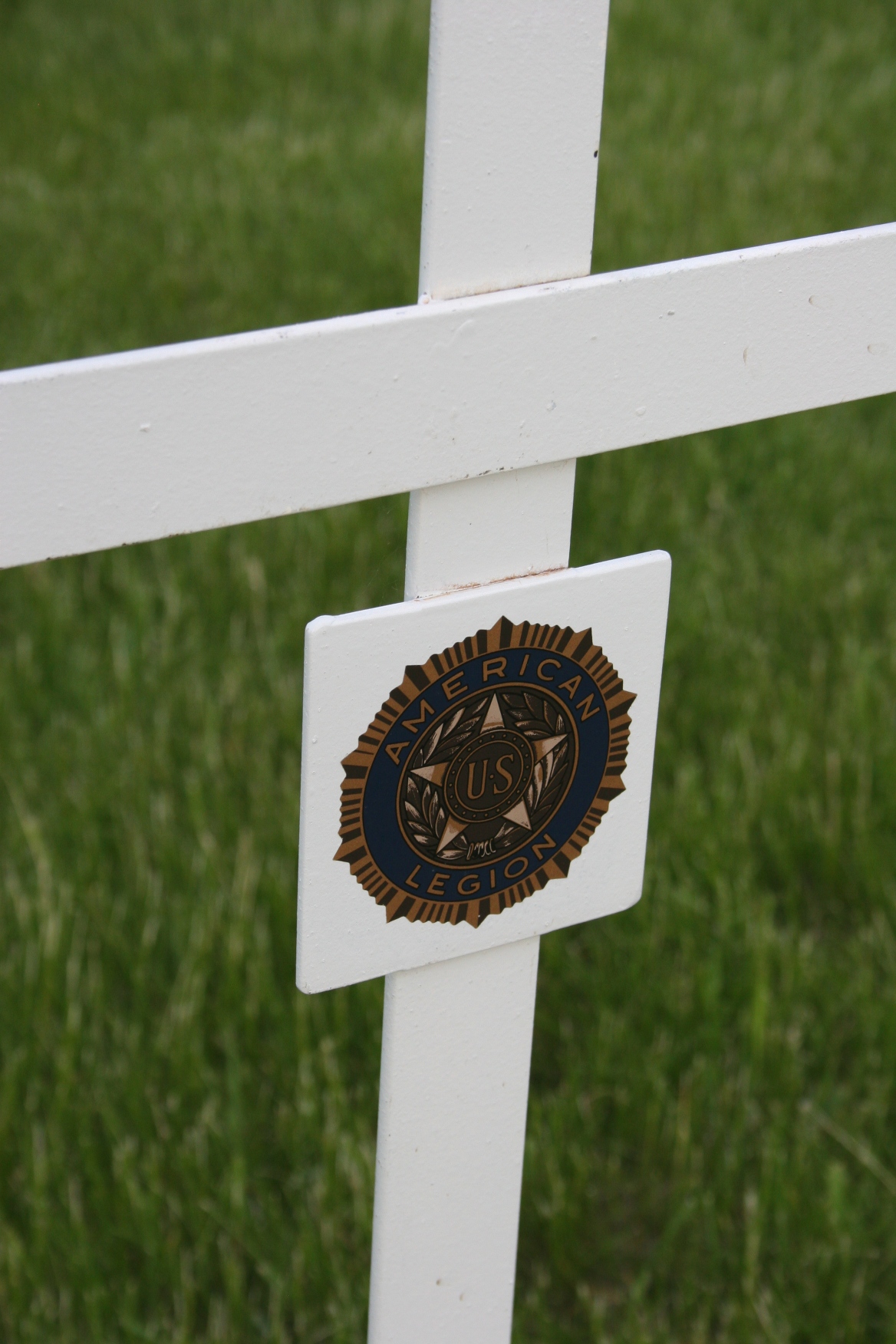
The local American Legion marks veterans' graves with white crosses.

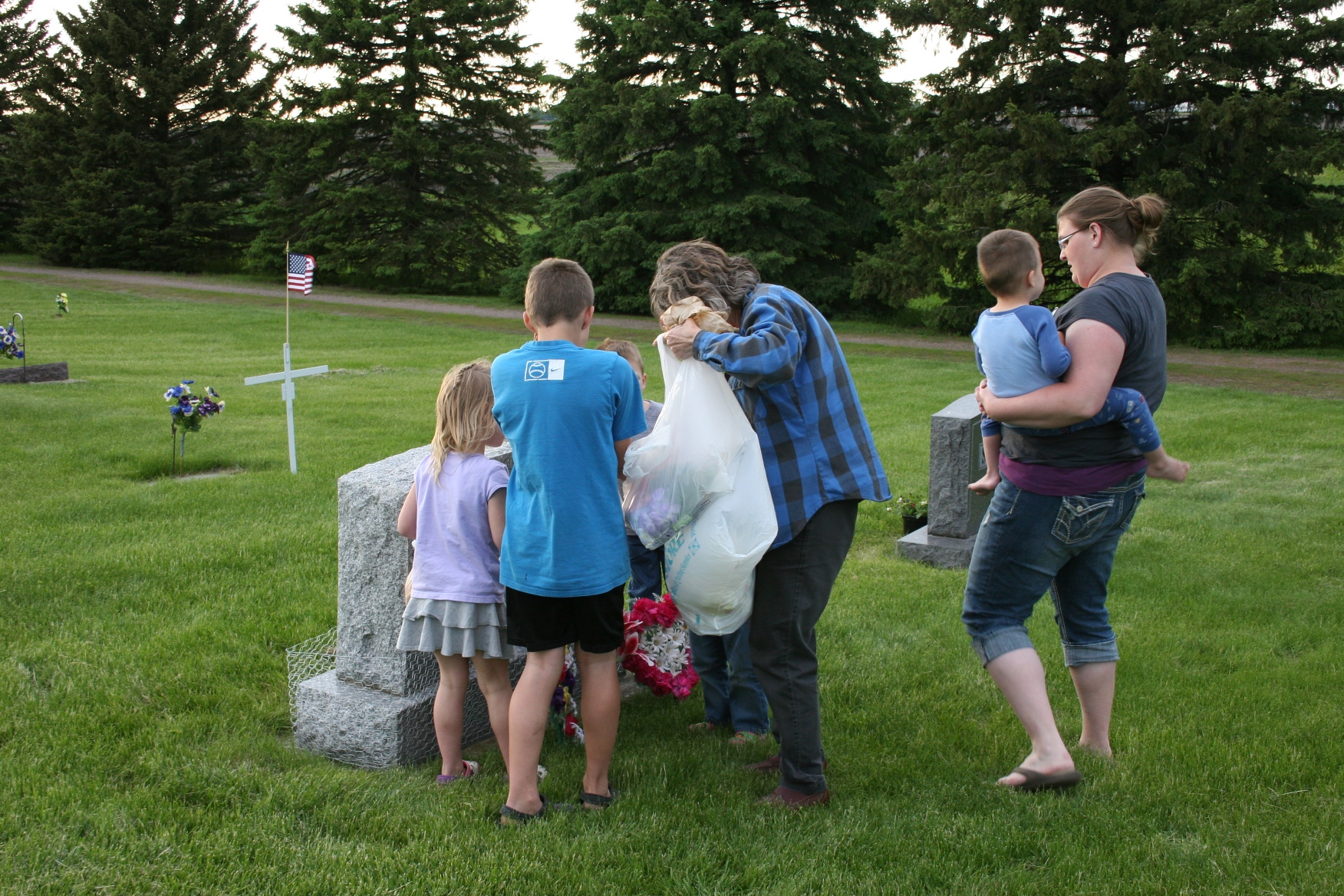
Barb Schmidt teaches her grandchildren about their ancestors as they place flowers on the graves of loved ones Saturday evening at the Vesta Cemetery.

Set atop a hill, the wind catches the flags marking vets' graves.

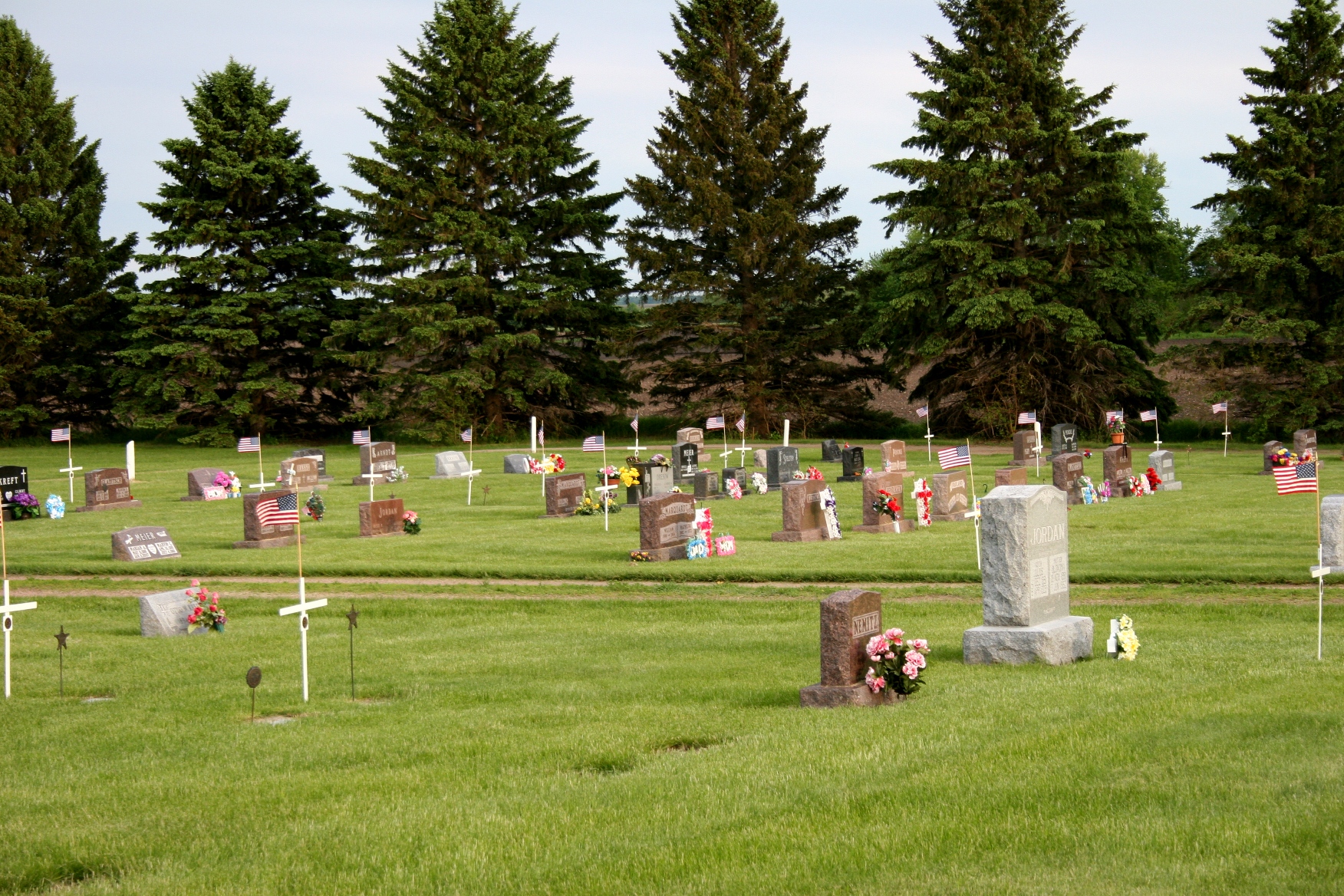
I was surprised by the number of veterans buried in the Vesta Cemetery, their graves marked by small flags attached to white crosses. This photo shows only one small portion of the graveyard.

© Copyright 2011 Audrey Kletscher Helbling


BibleSticks and battle prayers May 28, 2011

A tattered prayer book carried by my father to Korea, where he fought on the front lines during the Korean Conflict. Touching these pages, I feel the faith of my soldier father.

LAST SUNDAY AFTER SERVICES at my church, Trinity Lutheran in Faribault, we watched a brief video about BibleSticks.

Never heard of them? I hadn’t either, until viewing that clip.

“The Military BibleStick is a digital audio player that is pre-loaded with a dramatized recording of the entire New Testament,” according to the Faith Comes by Hearing website. The organization, dedicated to getting the Word of God into the world, “offers 557 Audio Scripture recordings in 553 languages reaching more than 5 billion people in more than 185 countries.”

Part of that outreach includes the U.S. military. Demand is great for the 3 ½-inch long, less than one inch thick, camouflaged, battery-operated BibleSticks, I learned via the video. For whatever reason, the BibleSticks must be processed through military chaplains.

With a $25 donation, we could give a slip-in-the-pocket, portable New Testament to military men and women.

Although I personally don’t know of anyone who has used a BibleStick, I do understand the importance of access to Scripture, especially for our soldiers.

Flashback to February 1952, when my father, Elvern Kletscher of Vesta, was drafted. Less than a year later, he found himself in the mountains of Korea, a U.S. military infantryman fighting on the frontline during the Korean Conflict.
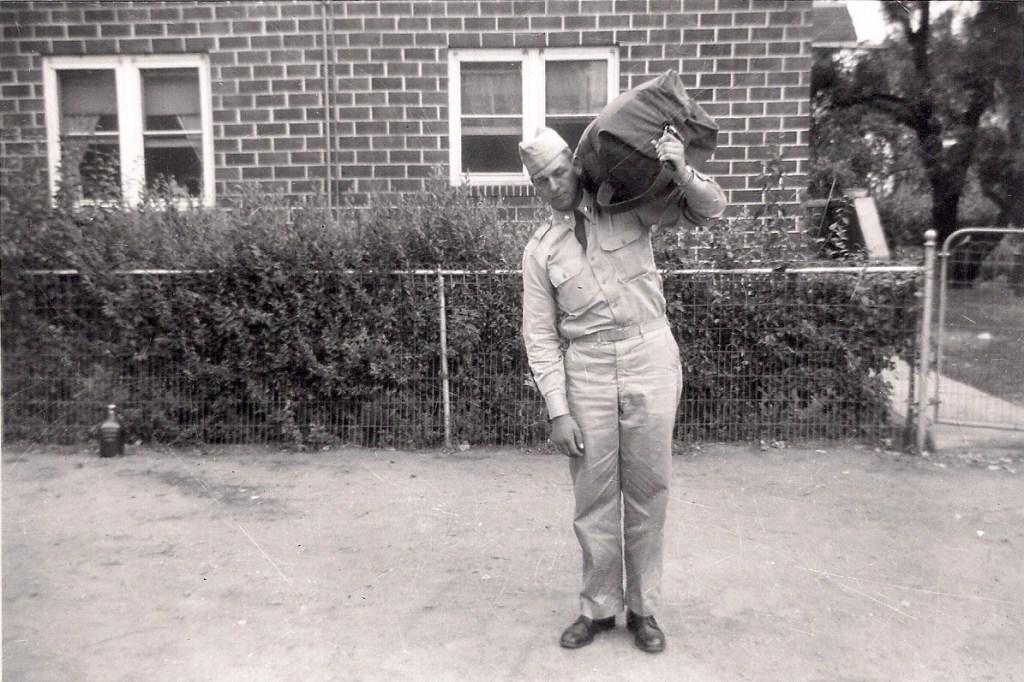
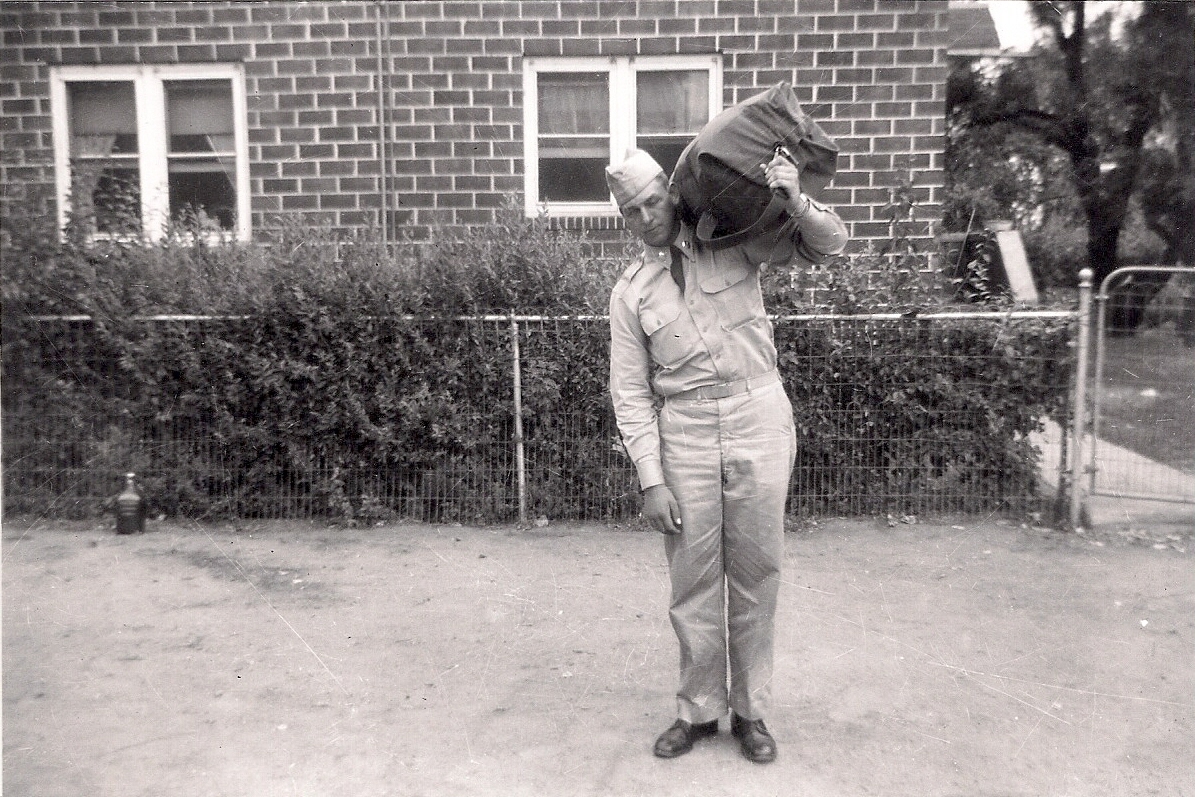
My father, Elvern Kletscher, preparing to leave his Vesta farm home in April 1952, six weeks after he was drafted.

On February 26, 1953, he was struck in the neck by shrapnel at Heartbreak Ridge. Later, he would be awarded the Korean Service Medal with 3 Bronze Service Stars, the National Defense Service Medal, the United Nations Service Medal, the Combat Infantry Badge and the Purple Heart.

During those combat days, when my dad feared for his life, when he was forced to shoot the enemy or die, he relied on his deep faith in God.

My Dad's worn copy of God Our Refuge.

And he carried with him a 3-inch by 4 ½-inch black book, God Our Refuge. A gift from the St. John’s Lutheran Ladies’ Aid of Vesta, the book includes gospel readings, devotions, meditations, prayers, hymns and more.

Within the pages of that volume, my dad found solace, hope and comfort in the face of constant death.

Now eight years after his death, I cradle the tiny book in my palm, brush my fingers against the brittle, black leather covers, open the curled pages that are loosening from the binding. I think of my father, how he carried this book in his pocket, how he flipped and read the 144 pages, how he prayed while trapped inside the cold earth of a foxhole, while engaging in battle, while lying inside his tent at night.
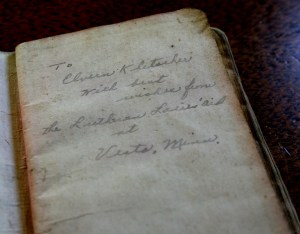
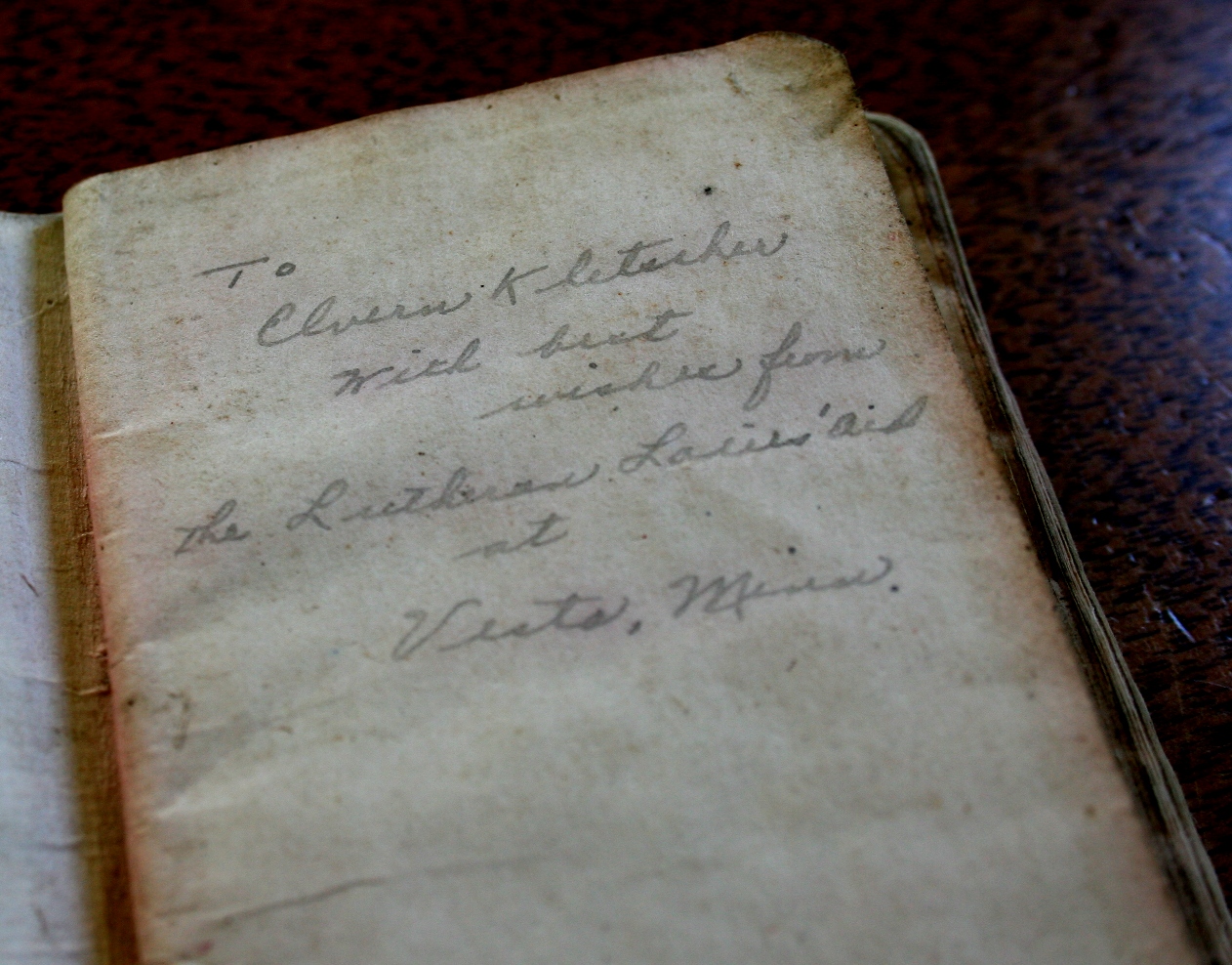
The inscription reads: To Elvern Kletscher with best wishes from the Lutheran Ladies' Aid at Vesta, Minn.

As I turn to page 117 of my dad’s tattered copy of God Our Refuge, I feel forever connected to him, my fingers touching the paper he touched, reading the words he read 58 years ago as a young soldier in battle:

“In Thine arms I rest me;

Foes who would molest me

Cannot reach me here.

Though the earth be shaking,

Every heart be quaking,

Jesus calms my fear.

Lightnings flash and thunders crash;

Yet, though sin and hell assail me,

Jesus will not fail me.”

HAVE YOU OR SOMEONE you know used a BibleStick? If so, I’d like to hear about your experience with this audio version of Scripture and what it meant to you.
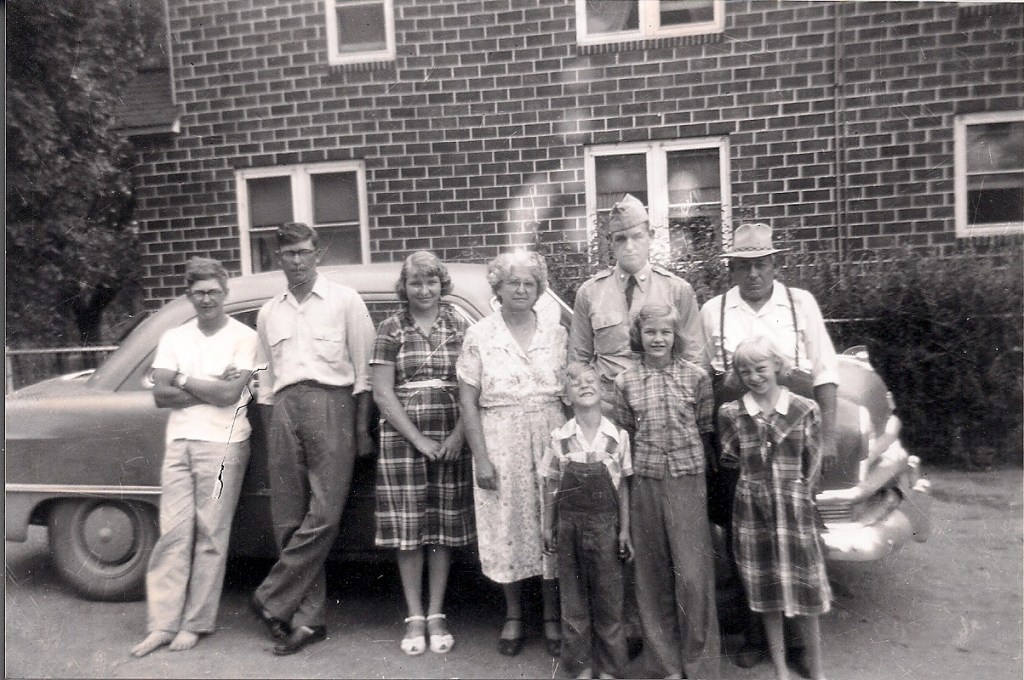
My grandparents, Ida and Henry Kletscher, posing with some of their children, flank my father, Elvern Kletscher, who is about to leave for military service in 1952. My uncle Merlin is the youngest, standing in the front row wearing the bib overalls.

BEHIND EVERY PICTURE, there is a story, including stories about the images of my father and his family, above.

My uncle, Merlin Kletscher, found these two photos in the winter of 2010 while researching for a family reunion. They were tucked inside a worn copy of The Lutheran Hymnal, copyright 1941, published by Concordia Publishing House. That hymnbook belonged to my grandfather, whose name, Henry Kletscher, was inked in gold on the cover. He had taped the edges and binding of the much-used songbook.

The two photos were sandwiched between song 409, “Let Us Ever Walk with Jesus,” and song 410, “Jesus Lead Thou On.”

The latter was one of my Grandpa Henry’s favorite hymns, Uncle Merlin recalls.

“I have not found any other photos or negatives which leads me to think that these pictures were very dear to him,” my uncle says.

Now those photos are also very dear to me. When Merlin handed copies to me last summer, I teared up. Little did my father know then what horrors awaited him on the battlefields of Korea, how his life and death experiences would forever change him.

And my heart ached for my Grandma Ida, standing there beside her soldier son. I wish I had asked her how she felt, how they all felt. Now I have only these photos to show me the close love of a family sending their boy off to war.

© Copyright 2011 Audrey Kletscher Helbling


Reflecting on graduation speeches by three generations of Minnesota women May 27, 2011

Wabasso High School, where my niece will give a speech tonight as class valedictorian. My mom and I also graduated from WHS, although the building looks much different than when we graduated in 1951 and 1974.

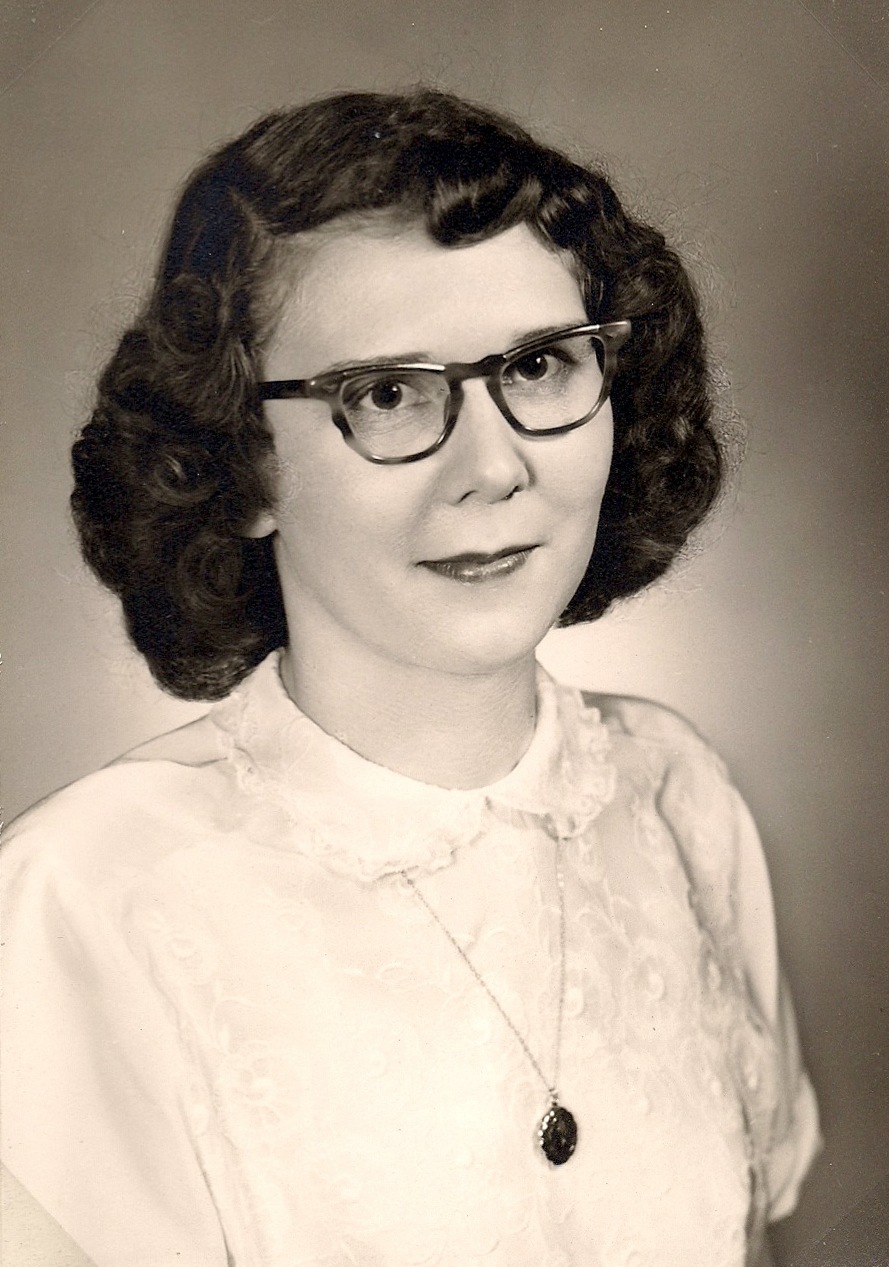
Arlene Bode Kletscher's 1951 graduation portrait.

SIXTY YEARS AGO 18-year-old Arlene Bode stepped onto the stage at Wabasso High School and gave a commencement speech, “Our Part in the Fight Against Communism.”

While that seems an unlikely, unsuitable, topic for an address by the class valedictorian, my mom says you need to remember the time period in which she wrote and gave that speech.

This was 1951, at the height of the Cold War, the era of bomb shelters and fear of the Soviet Union.

My mom espoused patriotism, encouraging her southwestern Minnesota classmates “to be patriotic and vote…so we can keep our freedom,” she recalls. She has a copy of that speech tucked inside her WHS diploma.

She found the speech recently when pulling out her diploma to show her granddaughter, Hillary Kletscher, who graduates tonight, also from Wabasso High.

Hillary, like her 79-year-old grandmother, is the class valedictorian and will speak at commencement. When I texted Hillary early Thursday afternoon, she hadn’t yet titled her speech. But, she said, the “main subject is change and how it’s good but we have to hold onto what we learn from the past.”

I won’t be there to hear my niece’s address. But I intend to ask her for a copy, just like I plan to get a copy of my mom’s speech, which I’ve never seen. These are parts of our family history, words reflecting the time periods in which they were written, words of hope and wisdom and patriotism (at least in my mom’s case).

Hillary will step onto the WHS stage tonight and speak on change, yet remembering the past.

Audrey Kletscher Helbling, 1974 WHS graduate.

That my mom kept her speech through six decades impresses me. I say that specifically because I have no idea where to find the speech I gave at my graduation from Wabasso High School in 1974. It’s packed in a box somewhere in a closet in my home, but I possess neither the time nor energy to dig it out.

I remember only that, as class salutatorian, my farewell address included a poem. What poem and by whom, I do not recall.

In 2006, my daughter Miranda graduated as valedictorian of Faribault High School and gave a commencement speech. Given that occurred only five years ago, I should remember the content. I don’t. I recall only that she held up a test tube to make a point.

I am also making a point here. Thankfully much has changed in the 60 years since my mom spoke on “Our Part in the Fight Against Communism.” While the world today remains in turmoil, at least the intense fear, felt by the Class of 1951 during the Cold War, no longer exists.

We have also moved beyond the turbulent 60s and 70s, a time of rebellion, anti-establishment, and anti-war sentiments and discontent over the Vietnam War experienced by my class, the Class of 1974.

By 2006, when my second daughter graduated, we as a nation were beginning to recover from 9/11, yet we lived in an increasingly security-focused society.

Today my niece graduates in a day of continuing economic uncertainty, when young people are struggling to find jobs and when Baby Boomers like myself worry about our jobs and retirement.

Yet, through it all—the Cold War, Vietnam, September 11 and a challenging economy—we remain four strong women living in a free country where we, individually, spoke freely, representing the classes of 1951, 1974, 2006 and 2011.

© Copyright 2011 Audrey Kletscher Helbling

 

Looking for work in a (still) challenging economy May 24, 2011

Filed under: Uncategorized — Audrey Kletscher Helbling @ 6:44 AM
Tags: , , , , , , , , , ,

Back in the day, transients rode the rails looking for work.

IS THE ECONOMY IMPROVING? Maybe. Maybe not. That depends on whom you ask and on what day.

Several months ago I would have said, “Yeah, I think the economy is starting to look up.” More “Help wanted” ads were publishing in my local daily newspaper. I sensed an overall mood of optimism in the media and among people in general. It simply seemed to me that our economic situation was improving, if ever so slightly.

But then, boom, we were socked with outrageous prices at the gas pump and in the grocery store and I felt like we’d been punched, like we’d all been knocked to the mat. Again.

Yet, even though higher prices are hitting my family’s pocketbook, we aren’t struggling to make ends meet, to put food on the table, to pay the bills.

Not like some many people.

A knock on my door several days ago showed me the personal side of a dire economy. A man in his late 40s asked if he could mow my lawn. I declined his request, explaining that I planned to mow the yard that afternoon.

“Lookin’ for work?” I inquired before he nodded his head and walked away to the next house with an overgrown lawn.

I now regret that ridiculous question. Clearly he was seeking work or he wouldn’t have asked to mow my lawn. I also regret that I didn’t take the time to step outside, sit down on my front steps and listen to his story. I wonder what he would have told me.

Just like I wonder about the carpenter who lives nearby and has twice asked about working for me. When we met in January, I was shoveling snow and he was walking past my house in shirt sleeves. I told him he should be wearing a jacket. He brushed off my motherly concern and said he was headed to my neighbor’s place just up the hill.

We chatted for awhile and he commented on a pile of demolition debris lining the edge of the driveway. We had recently begun a home improvement project. He wondered whether I had any carpentry needs. I told him about a closet I planned for an upstairs bedroom, but I didn’t hire him.

Recently that same unemployed carpenter approached my husband to inquire again about work and that closet project. I admire his determination. Here is a man who needs a job and he’s not afraid to seek it out. (I sometimes wish I had hired him for another home improvement project which is now dragging into its sixth month.)

These two unemployed men remind me of the stories my Grandma Ida told me of hobos riding the rails, looking for work in the farm fields of southwestern Minnesota back in the day. If I recall correctly, these transients occasionally helped on my grandparents’ farm.

These were men down on their luck, in need of good, honest, hard work.

Although I am way too young to have lived through The Great Depression, I have those stories impressed upon me by a grandma who understood the value of hard work and “making do.”

My own parents also worked hard, lived within their means and set an example of being content with whatever you have. I’ve tried to live that way too and pass along to my children that family, faith, love and happiness are more important than material possessions.

Yet, we all need an income to pay the bills. In the 27 years I’ve lived in my Faribault home, I’ve never had local strangers approach me, looking for work. Until this year.

That’s as strong a statement as any about the challenging state of our current economy.

WHAT ABOUT YOU? How are you/your family handling this current challenging economy? Have you changed your lifestyle, your spending? Have you had unemployed individuals come to your door looking for work?

What’s your take on the current state of the economy?

© Copyright 2011 Audrey Kletscher Helbling
 

My need to know about the Minneapolis tornado May 22, 2011

A shot of my television screen, showing KSTP coverage of the May 22 Minneapolis tornado.

YOU’RE A NEWS JUNKIE,” he says.

I don’t deny it, especially on this stormy Sunday when a tornado has swept through north Minneapolis, killing one and injuring around 20 others, according to the latest news reports.

Much of the afternoon, after hearing of the storms, I parked on the sofa, eyes fixed on the television screen. I also texted my oldest daughter, who lives in south Minneapolis.

When she finally replied to my “Are you in a safe place?” text, she asked, “No, why?”

So I clued her in that a tornado was moving through north Minneapolis. She was at a friend’s house after attending a concert and apparently not near the storm’s path.

But how was I, the concerned mother, to know? To me, Minneapolis is Minneapolis and my daughter could be anywhere.

My husband, the one who called me the news junkie, claims south Minneapolis lies 10 miles from north. I have no idea.

Once I knew that my oldest daughter was OK, my thoughts shifted east to Wisconsin, where the second daughter lives. I really wasn’t too worried, until 4:49 p.m. when she sent a text: “Sirens just went off.”

At that time my husband and I were wrapping up a shopping trip to pick up hardware and gardening supplies and a few groceries before filling up with gas and heading home.

The daughter who lives in Appleton on Wisconsin’s eastern side said the area was under a severe thunderstorm warning and flood watch and that she was at her apartment, but not in the basement.

Uh, huh. “Did I not teach you to go to the basement when the sirens sound?” I thought, but did not text.

Her follow-up message mentioned an unconfirmed funnel cloud in a nearby town.

That text reminded me that I really wanted to watch the 5 p.m. news. And that is when my spouse called me a news junkie.

What does he expect from someone who watched the CBS evening news with Walter Cronkite as a child and wanted to emulate the television news anchor? What does he expect from someone with a mass communications degree, emphasis in news editorial? What does he expect from a former newspaper reporter and now freelance writer and blogger? What does he expect from someone who is nosy and curious by nature?

Yes, I am a news junkie.

But I’m also a mom and a Minnesotan—two equally good reasons for staying informed.

© Copyright 2011 Audrey Kletscher Helbling
 

My Minnesota childhood memories of Harmon Killebrew May 18, 2011

“BATTER UP!”

His voice cracked like the whack of wood against leather as I stepped up to the plate, bat handle vise-gripped in my hands, feet planted in packed gravel next to the rusted, cast-off disk from the disk harrow.

As my oldest brother lobbed the ball toward me, I swung, and as was typical of me, missed. I was aiming to hit the ball toward the barn and milkhouse at the edge of the farm yard, our ball field.

Almost every evening, as the sun inched lower in the prairie sky toward the greening fields of early spring and then into the hot, humid days of tasseling corn, my siblings and I traded chore gloves for softball gloves. “Let’s play ball,” we’d yell in unison.

And then the arguing would begin. “I’m Harmon Killebrew,” my oldest brother hollered, the name flying off his tongue with the speed of a fast pitch.

No matter how loudly the rest of us protested his call, we struck out. He was the eldest. If he wanted to be Killebrew, then he would be Killebrew.

We assumed the roles of other 1960s Twins greats like Tony Oliva and Rod Carew.

But we all wanted to emulate Killebrew, to swing the bat, to watch the ball powerhouse toward the barn roof, maybe even sail as far as the silo room or the cow yard beyond, well out of reach of our siblings’ outstretched hands.

Such are my memories of the Twins’ home run slugger.

I’ve never been to a Twins game, never met Killebrew, don’t watch or listen to baseball.

Yet, upon learning of Killebrew’s death, a twinge of melancholy swept across me as I thought of those pick-up farm yard softball games, the baseball cards my brothers collected and the static of my eldest brother’s transistor radio broadcasting a Twins game in the 1960s.

For all the sibling bickering over who would pretend to be Killebrew or Carew or Oliva, those post chores games score among the home runs of my rural Minnesota childhood.

Copyright 2011 Audrey Kletscher Helbling
 

One year short of three decades May 15, 2011

Filed under: Uncategorized — Audrey Kletscher Helbling @ 5:52 PM
Tags: , , , , , , , ,

ON THIS DATE 29 years ago, I married my sweetheart.

And, yes, May 15, 1982, was also opening weekend of fishing. And, yes, several guests did not attend because they chose to go fishing. Others were in the field.

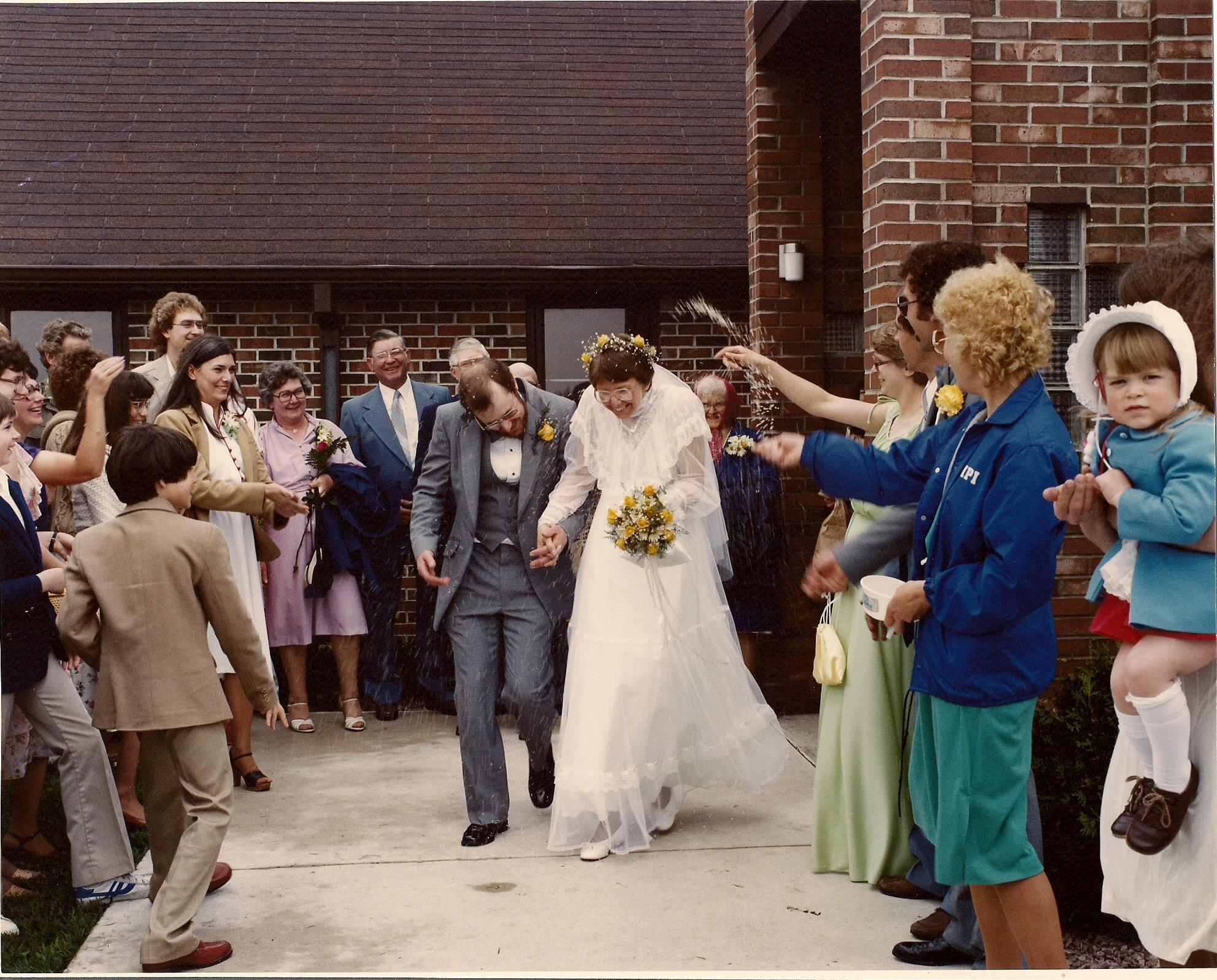
Here our wedding guests are pelting us with rice as we exit St. John’s Lutheran Church in Vesta. (For those of you unfamiliar with Vesta, pull out your Minnesota map, focus on the southwestern corner of the state, zero in on State Highway 19 and you’ll find this small town between Redwood Falls and Marshall.)

In this church congregation (different building) where I was baptized and confirmed, Randy and I exchanged our wedding vows. (My glasses really were that gigantic and we really did look that young and skinny.)

During the reception at the community hall, we were whisked away for awhile to the municipal liquor store across the street. Then, later, after supper, we danced the night away with family and friends.

Today we celebrated by shopping at a home improvement store. Pretty pathetic, huh?

Not too worry, we’re also planning to dine out. And even if we weren’t, the most important part of every anniversary for the past two decades and nine years has been that I am with my husband.

I have one question, though: How did nearly 30 years pass so quickly?

© Text Copyright 2011 Audrey Kletscher Helbling
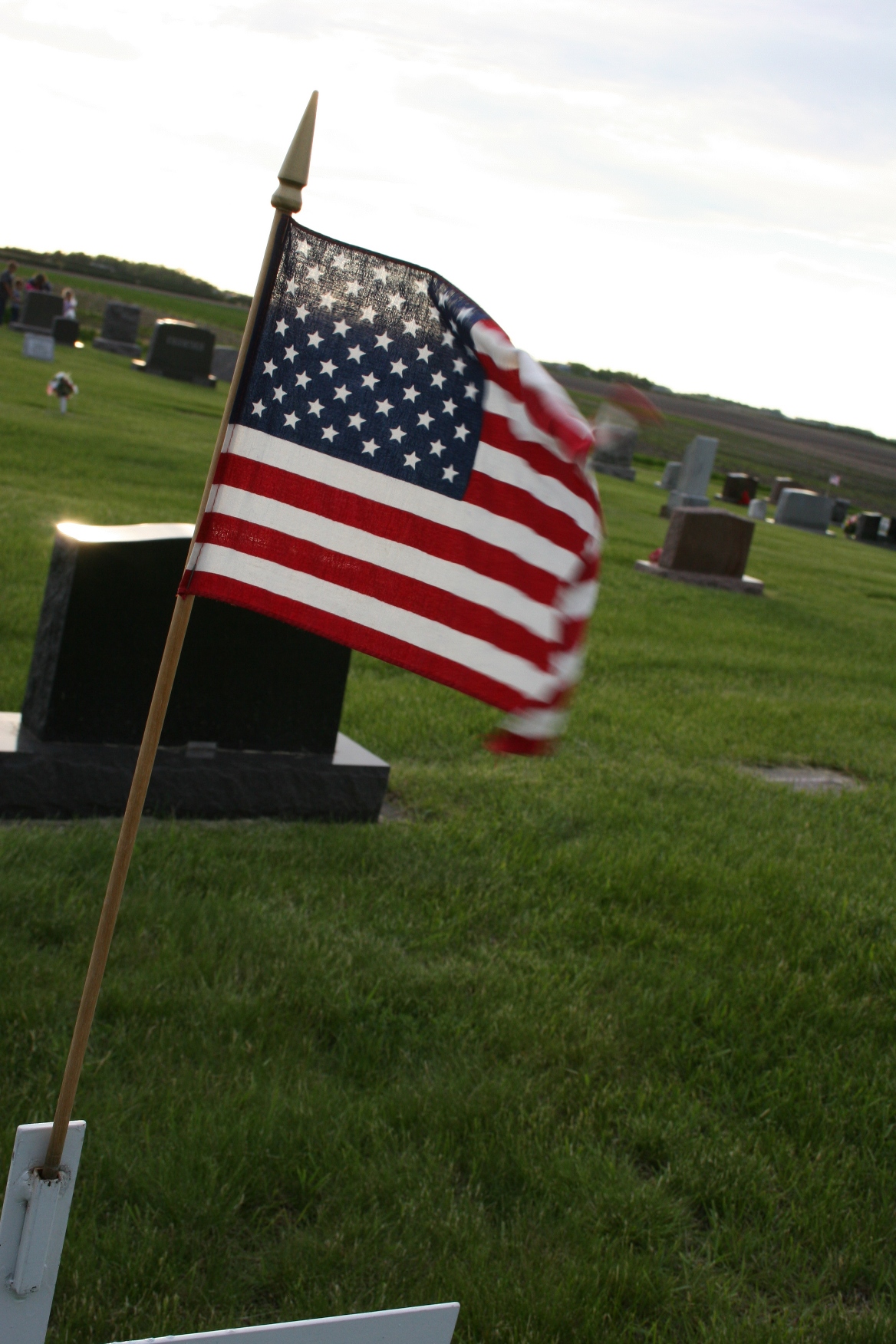
Photo by Williams Studio of RedwoodFalls


Pigs and poetry May 14, 2011

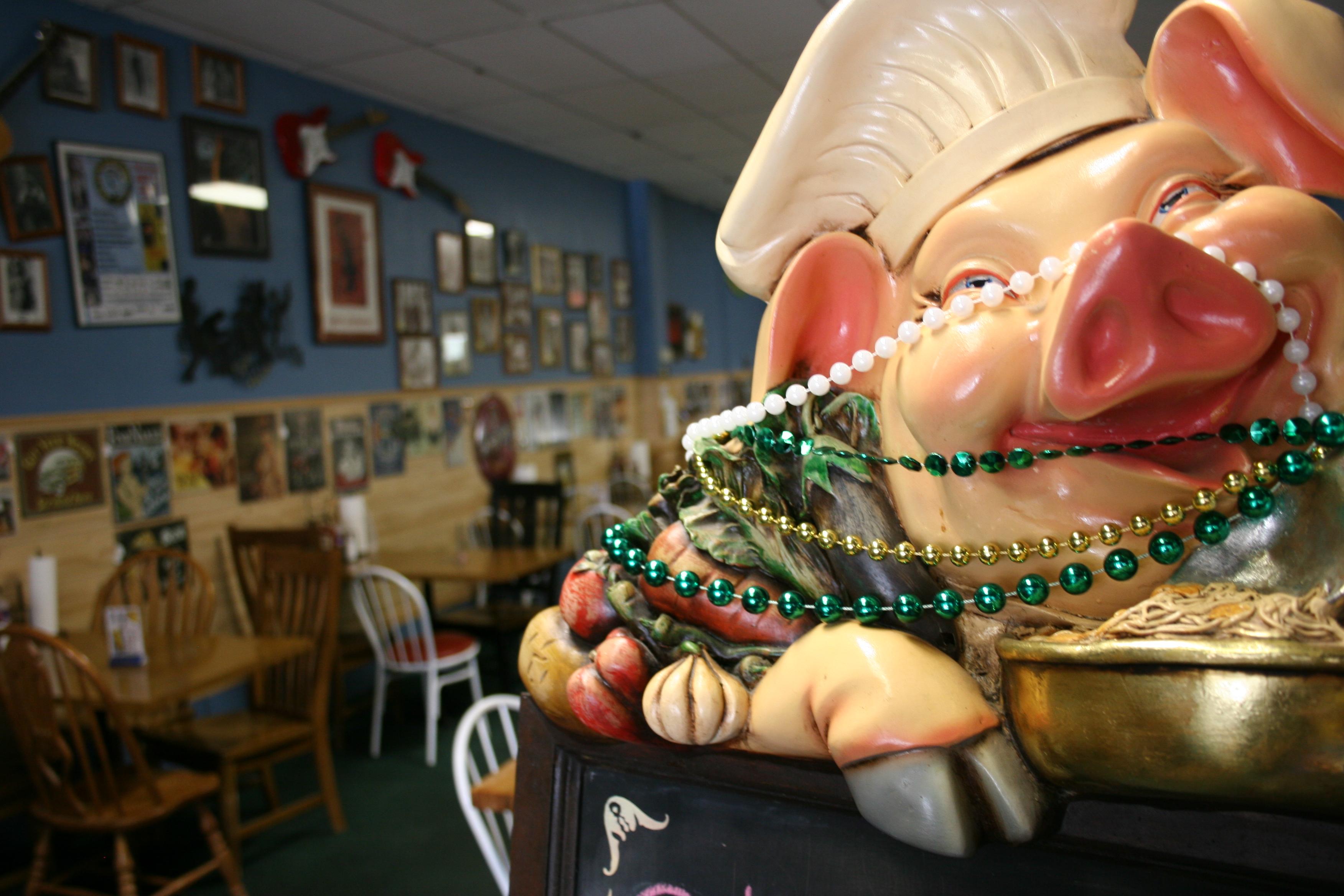
This pig greets diners at Piggy Blue's Bar-B-Que in Austin, Minnesota. This image is posted here for pig illustration purposes only, not because it's specifically related to the following story.

IN A WEEK, my sister-in-law is moving from Minot, North Dakota, to Missouri. In August, my brother-in-law, an Air Force man, will join her and their young son.

She’s leaving early to seed the garden, plant the orchard and ponder the purchase of pigs. This has always been Jamie’s dream, to own a country acreage where she can grow fruits and vegetables and raise an Old McDonald variety of animals.

Chickens, rabbits, goats and a pig or two comprise her animal acquisition list.

But about those pigs…I overheard a man advising her last Saturday to “hold off” on the pigs for awhile. He didn’t give a reason, only suggested she wait.

Her husband, Neil, although supportive of his wife’s plan, also has reservations about the swine. If Jamie wants a pig, Neil says he can shoot one. He would be right. The Missouri Department of Conservation advises residents to “shoot ’em on sight” in an online article about the problem of feral pigs running rampant.

Thankfully we do not have a wild pig problem in Minnesota. Our problem would be an overabundance of deer.

But we do have a book of pig poetry featuring 133 pig poems penned by 103 poets like Robert Bly, Louise Erdrich and Bill Holm. Red Dragonfly Press, a solely poetry not-for-profit literary organization based in Red Wing, published Low Down and Coming On: A Feast of Delicious and Dangerous Poems About Pigs. James P. Lenfestey edited the 232-page anthology printed last October.

Tomorrow (May 15) several of the pig penning poets, including Lenfestey, will read from the book at a “Pig Gig” slated for 2 p.m. at the Litchfield Opera House in Litchfield.

Now if my sister-in-law wasn’t preoccupied with packing for Missouri, I’d propose she check out this pig gig for pig pointers prior to purchasing pigs.

© Text and Piggy Blue’s photo copyright 2011 Audrey Kletscher Helbling
 

Five years after a hit-and-run driver struck my son May 12, 2011

Filed under: Uncategorized — Audrey Kletscher Helbling @ 6:16 AM
Tags: , , , , , , , ,

I live on one of Faribault's busiest residential streets, also a main route for the ambulance.

FIVE YEARS AGO TODAY on May 12, 2006, my then 12-year-old son was struck by a car as he crossed the street to his school bus stop.

Less than a block from home, his slender body slammed against a car and then somersaulted through the air. He landed dazed, shaken and injured along the side of the street.

Fear, unlike any I had ever experienced, gripped my heart and consumed my very being on that cool and drizzly May morning two days before Mother’s Day. In the minutes between my awareness of the accident and the confirmation that my son was OK, I feared the worst—that I had lost my boy.

I had not. He suffered only a broken bone in his hand, a bump on his head, scrapes and a possible rib fracture. Minor injuries, really, compared to what could have been.

For too many parents, the tragic death of a child is reality and I wonder how they cope. Via faith, family and friends? Somehow they manage to go on living.

In my son’s case, I also wonder how the driver copes. He/she fled the scene and has never been found. How can that driver of a blue, 4-door Chevrolet Cavalier or Corsica live with his/her actions?

It is incomprehensible to me that anyone could strike a child with a vehicle and then simply drive away.

Faribault police, early on, suspected the driver had a reason—ie. driving without a license, driving drunk, no insurance, prior record—to leave.

Despite numerous leads, including one which came via an anonymous letter penned by someone with a personal vendetta against a named suspect and another which led investigators to a prison cell, a credible suspect has never been found.

On several occasions police thought they were close to finding the driver. I have not given up hope that the driver can still be found—if conscience finally prevails and/or an individual with knowledge of this too-long-hidden secret chooses to do the right thing and step forward with information.

While the statute of limitations expired three years after the hit-and-run, Neal Pederson of the Faribault Police Department tells me that the case remains open and that his office will follow up on any tips or leads. He noted, however, that if the driver lived out of state for a period of time, the clock stops and the crime could still be investigated and charged.

Anyone with information about the hit-and-run can anonymously call the Faribault Police Department tip line at 507-334-0999 or Crime Stoppers of Minnesota at 1-800-222-8477.

I don’t dwell on finding the driver. A $1,000 reward offered several years ago for information leading to the arrest and conviction of the hit-and-run driver is no longer valid. I always hoped that honesty and decency, not a monetary reward, would be the motivating factors in solving this case.

As five years have passed, many, many times I have thanked God for protecting my son from worse injury.

Sometimes still—when I hear the screaming wail of an ambulance as it passes my house along our busy street or when I read a news story about a hit-and-run or drunk driving death—I think of that May morning when my son was struck.

I try to forget. But a memory like this remains forever.

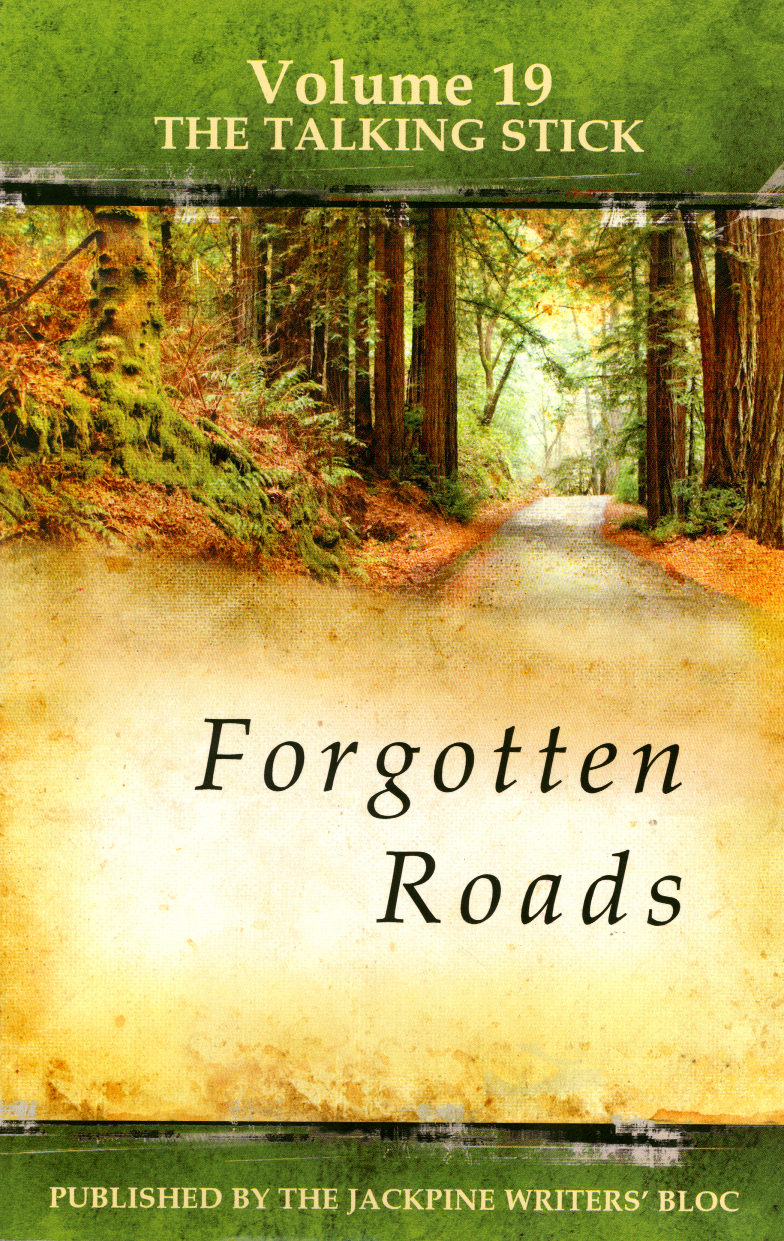
LAST YEAR I WROTE the following poem, which won honorable mention in the poetry division of a state-wide anthology competition. “Hit-and-Run” printed in The Talking Stick, Volume 19, Forgotten Roads, published by The Jackpine Writers’ Bloc.

Hit-and-Run

 In that moment, I know,

as the rivulets of water course down my body,

as I step from the tub

dripping puddles onto the linoleum,

that the sirens wail

for you,

my boy, my only son.

#

You, who tossed your backpack

over your bony shoulders,

then hurried

toward the street,

toward the bus stop.

#

While I showered,

you crossed carelessly,

your fragile body bouncing

off the car

you had not seen,

flailing in a somersault,

landing hard on the pavement.

Sirens scream, and I know.

#

Panic grips,

holds tight my heart,

my very soul,

as I race from the bathroom,

wrapped in a bath towel,

stand immobile,

watching the pulsating red lights

of the police car

angled on the street,

blocking the path to you.

#

Copyright 2011 Audrey Kletscher Helbling


Snapshots of a small-town wedding day May 10, 2011

TWENTY-NINE YEARS ago this coming Sunday, my husband and I were married in my hometown of Vesta, a place marked, like so many other prairie towns, by grain elevators and the water tower and a one-block-long main street.

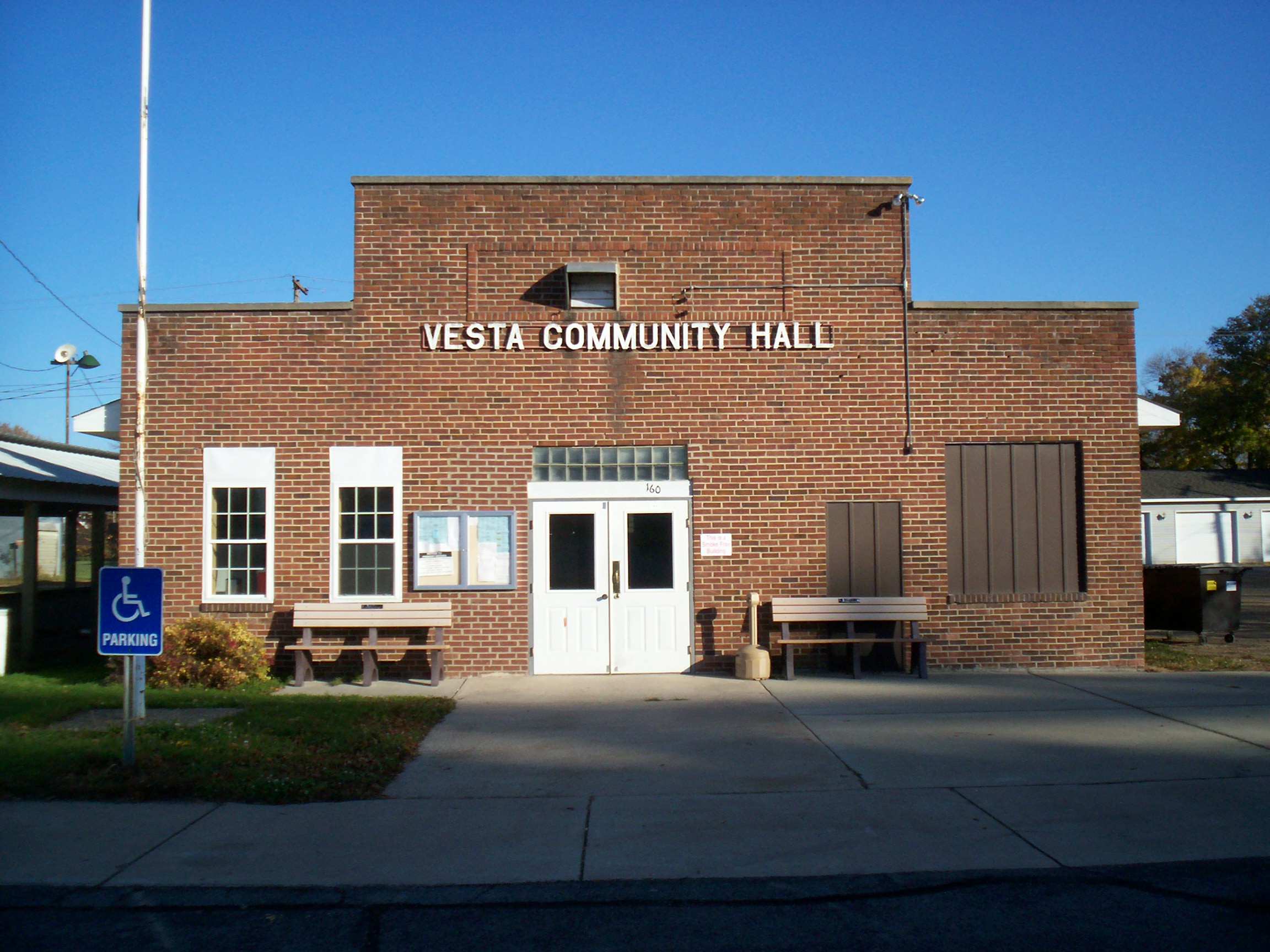
Our wedding reception was held at the community hall, an unassuming, nothing-fancy brick building with a stage, wood floors and military uniforms encased in glass. HyVee in Marshall, 20 miles away, catered a chicken dinner as wedding guests pulled up metal folding chairs to rectangular tables angled under crepe paper streamers and white tissue paper wedding bells.

Thoughts of our small-town wedding lingered this past weekend as our nephew Matt married Amber at Gustavus Adolphus Lutheran Church in Foley. The reception was held in Duelm, a cluster of homes, a church and a restaurant attached to a new event center, smack dab in the middle of the country about 10 miles to the south and west.

There were no crepe paper streamers here or folding chairs or military uniforms. We dined at round tables draped in white cloths and decorated with centerpieces of swimming goldfish and floating candles. (One fish, I should mention here, wiggled between the candle and the vase rim and leaped onto a table.)

While weddings and receptions have gotten much fancier than the simple rural weddings of decades past, some traditions remain unchanged.

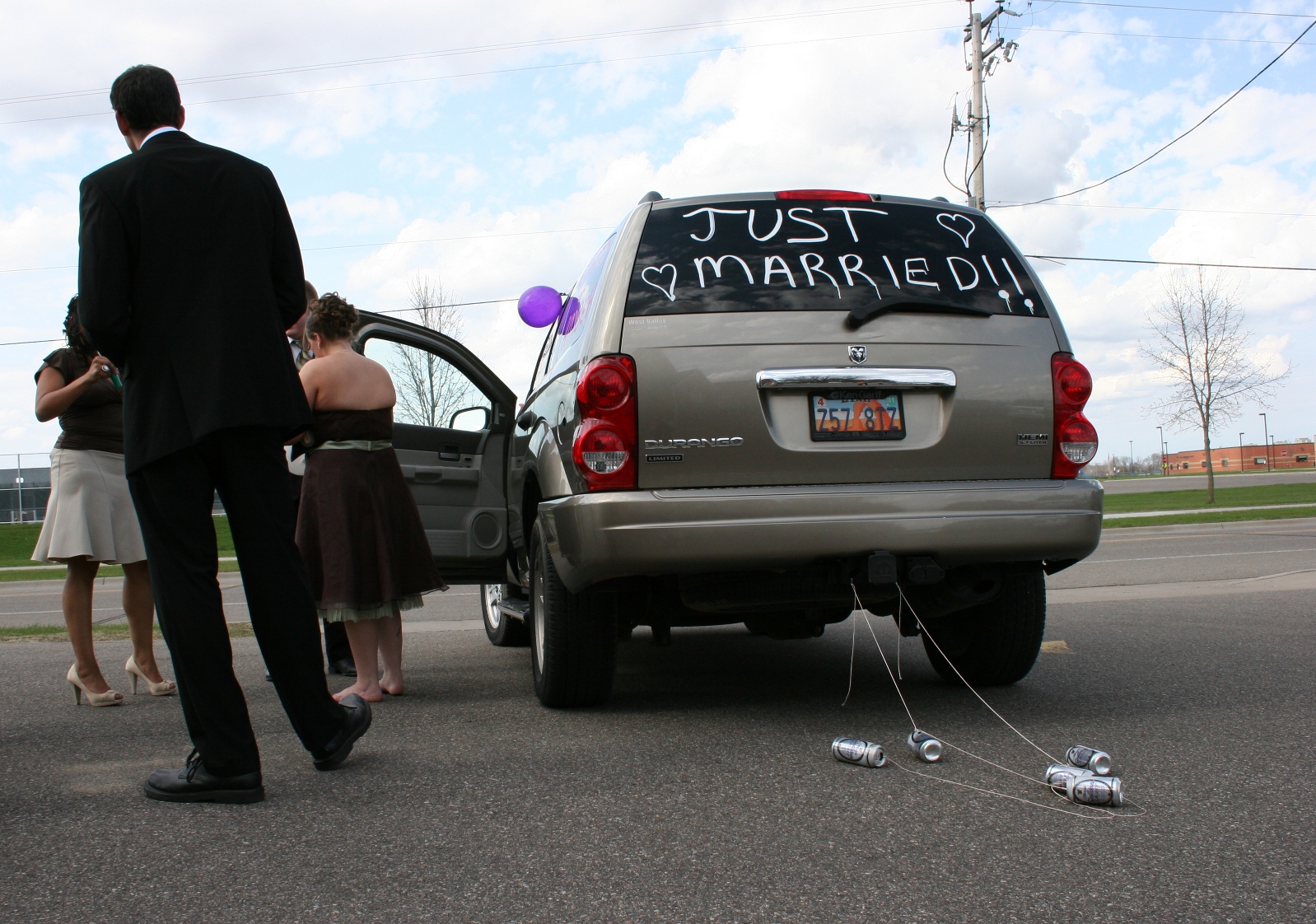
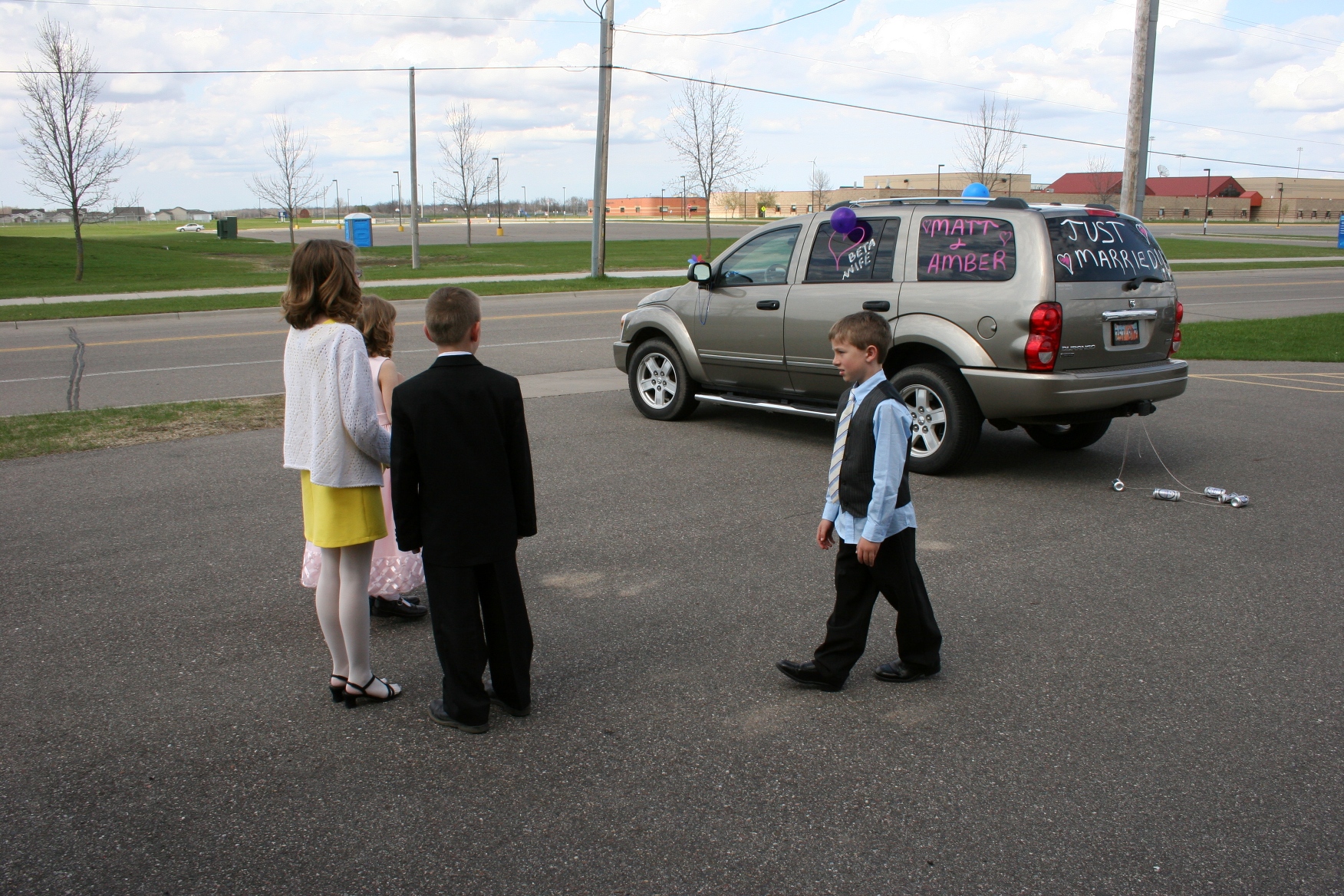
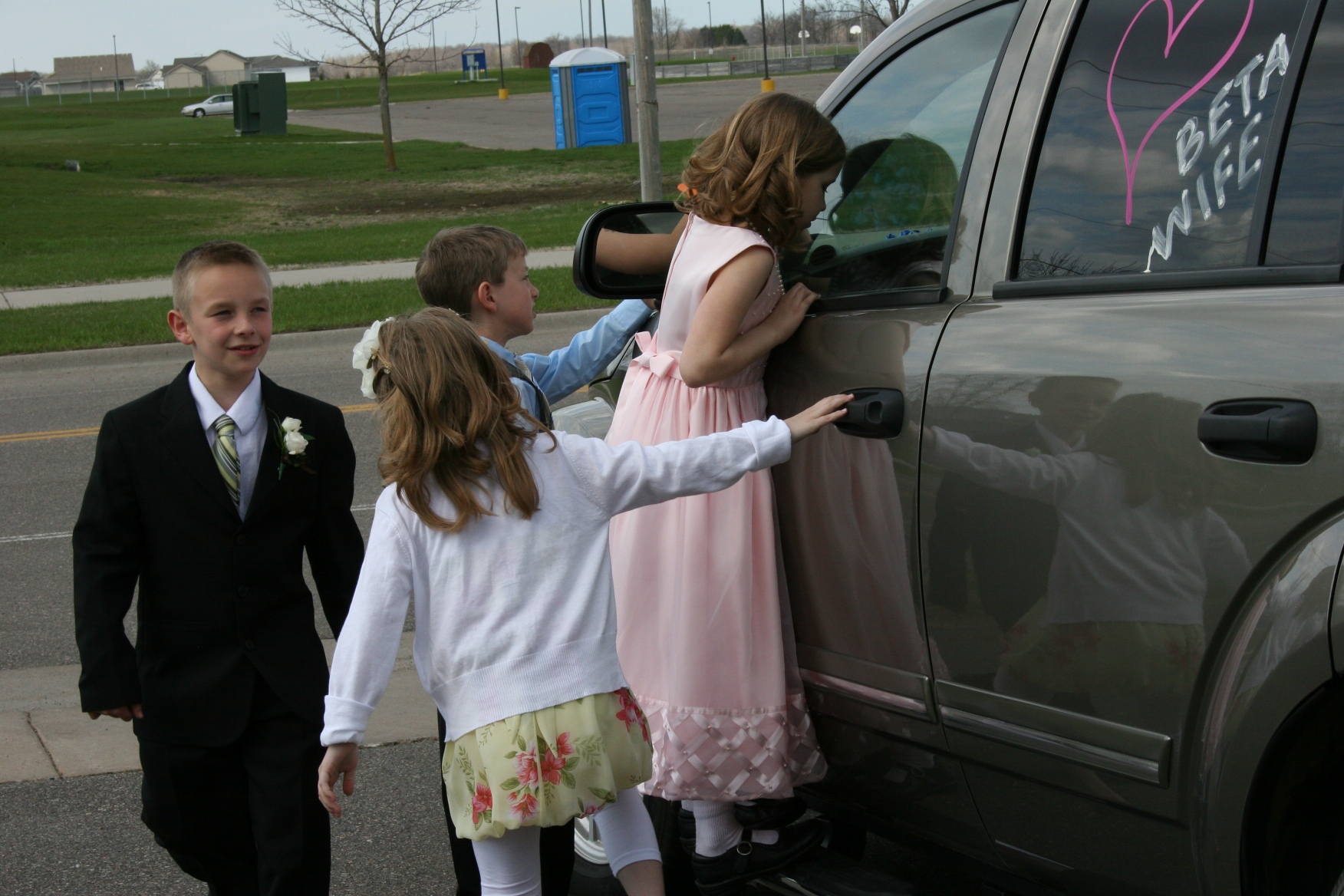
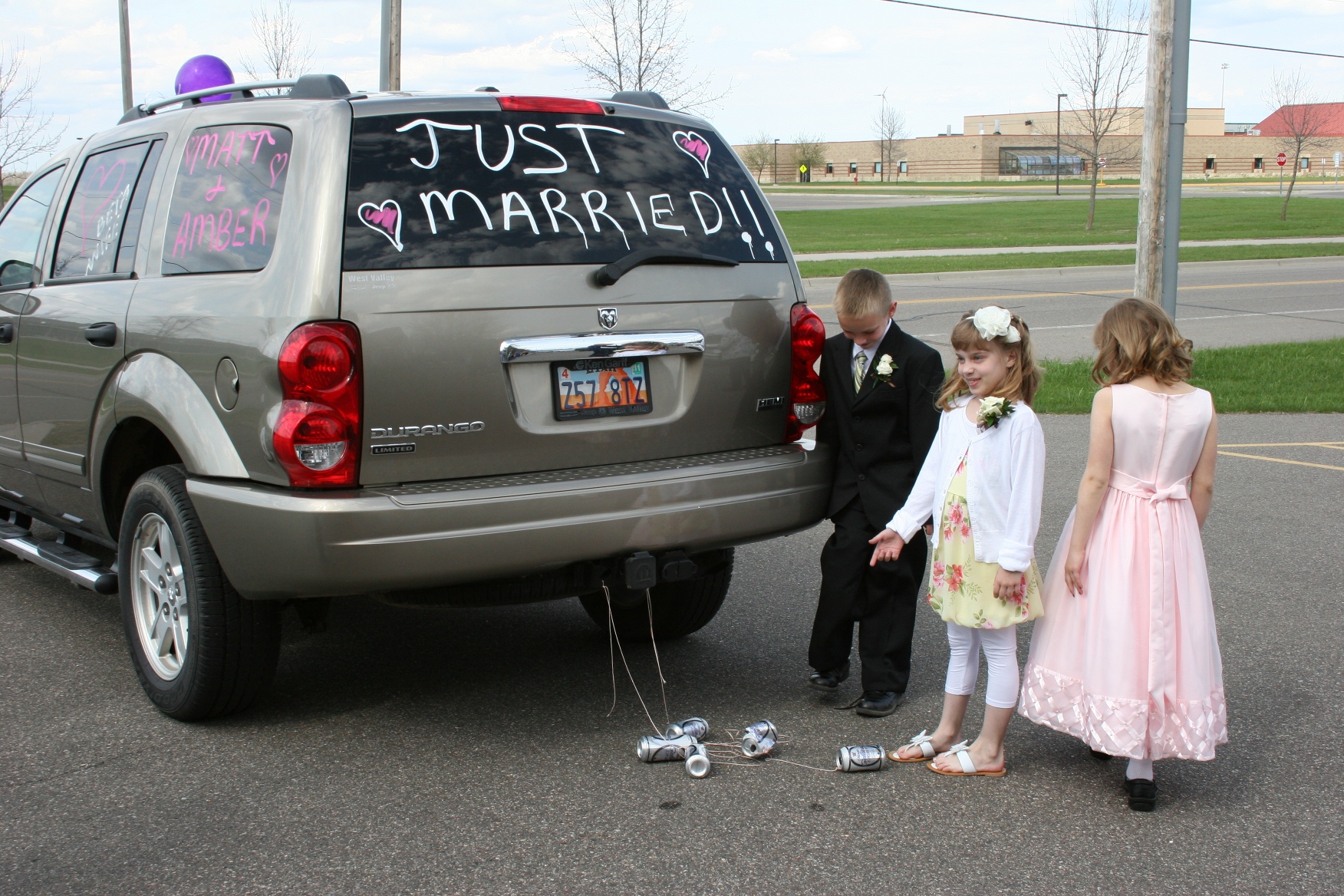
Members of the wedding party and guests still decorate the bridal vehicle. That is where I focused my attention Saturday after the wedding service and before the bridal couple emerged from the church.

First I watched the attendants and others decorate the vehicle with words and balloons and beer cans.

Then I watched the kids check out the Durango from afar…

move in close for a peek inside…

eye the Michelob Golden Draft Light beer cans tied to the vehicle rear…

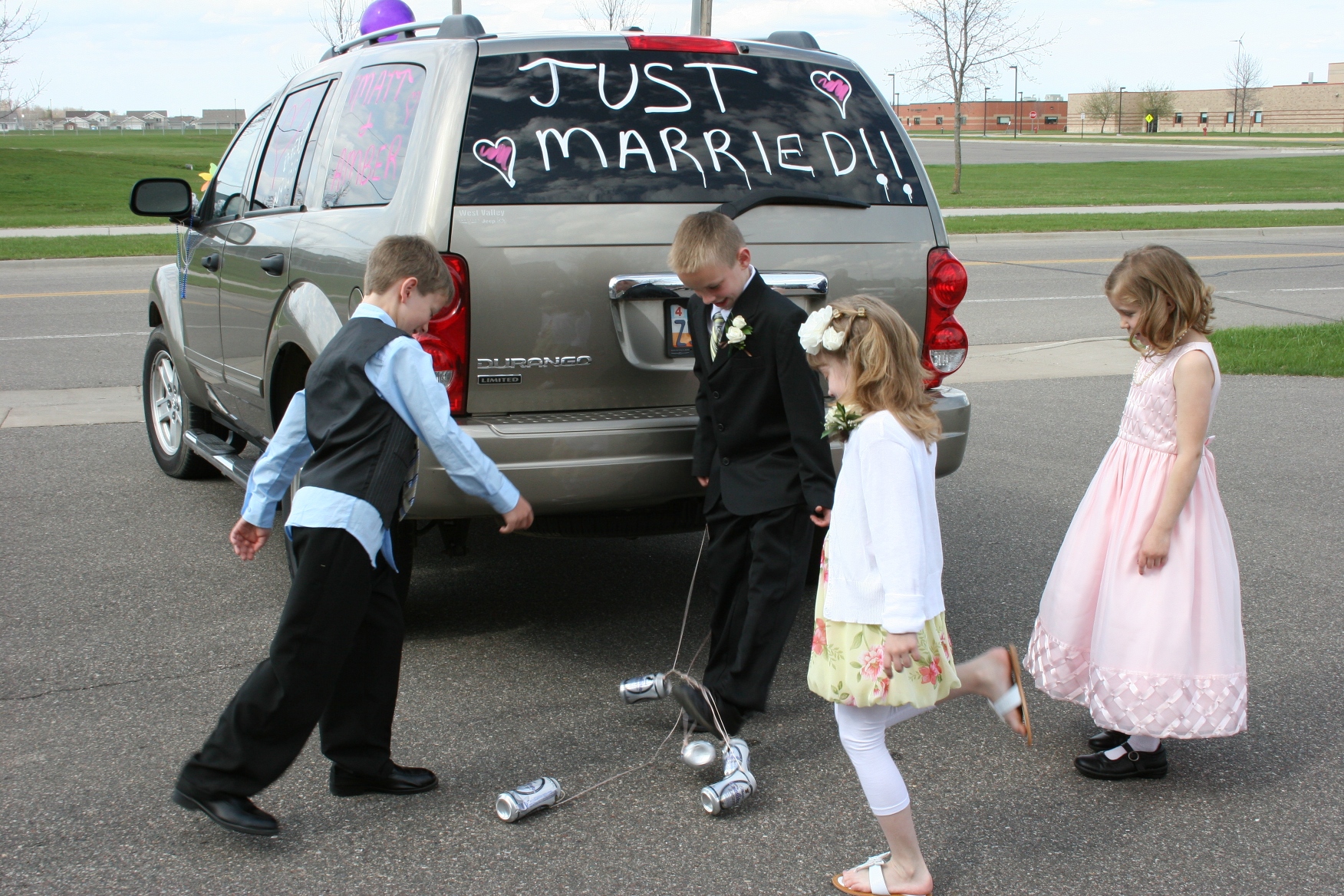
and, finally, enthusiastically, engage in a pick-up game of Kick the (beer) Can.

They had no idea I was photographing them in a perfect moment of childhood play and wedding tradition in a small, central Minnesota town.

© Copyright 2011 Audrey Kletscher Helbling