Minnesota Prairie Roots

Writing and photography by Audrey Kletscher Helbling

Inside Energy Park during the golden hour of sunset June 10, 2026

Oh, how lovely the light on the pond. (Minnesota Prairie Roots copyrighted photo June 2026)

IN THE ETHEREAL LIGHT of the setting sun, Randy and I loop around the ponds at Faribault Energy Park, our shoes crunching on gravel.

There’s an abundance of wildflowers in the park. (Minnesota Prairie Roots copyrighted photo June 2026)

If not for the steady roar of traffic on adjacent Interstate 35, this parcel of parkland would prove especially peaceful.

Trails lead to and around the wind turbine, unmoving on this evening. A portion of the power plant is visible in the distance. (Minnesota Prairie Roots copyrighted photo June 2026)

Despite the drone of vehicles, I still appreciate this 35-acre park that takes visitors past three ponds, a wind turbine and solar panels. Often we are alone here, which makes this park even more appealing. Occasionally, though, a dog runs free, despite rules requiring leashing.

Wild roses along the trail. (Minnesota Prairie Roots copyrighted photo June 2026)

On this visit, I focus on the wildflowers and grasses that flourish here as late spring transitions toward summer. Only steps into our walk, Randy discovers a wild rose bush along the trail. We both step off the path to dip our noses into a five-petaled pink rose, to smell the delicate scent of nature’s perfume. I recall youthful days of biking along country roads, the ditches populated with fragrant wild roses.

More wildflowers. (Minnesota Prairie Roots copyrighted photo June 2026)

I’m no plant expert, thus can’t identify most of the other flowers I see here. But I do know enough to stay away from the invasive wild parsnip. The toxic yellow plant, if touched, burns the skin.

Brome grass catches the beautiful light and sways in the wind. (Minnesota Prairie Roots copyrighted photo June 2026)

Brome, pond-side and other grasses draw my eye as they stretch toward the sky. Or, on this evening, bend in the wind as if dancing a farewell recital to daylight.

Looking through the trees, I see clouds building. (Minnesota Prairie Roots copyrighted photo June 2026)

Clouds build to the west and north, sometimes blocking the sun.

An egret takes flight from a pond, its wings lifting, flapping, long black legs trailing in a straight line. The bird rises high out of camera range.

A red-winged blackbird perches near the power plant pond. (Minnesota Prairie Roots copyrighted photo June 2026)

A chorus of birds, mostly unseen, sing as we walk along the trails, around the ponds. I can only distinguish the unique voice of a red-winged blackbird.

One of several bluebird houses in the park. (Minnesota Prairie Roots copyrighted photo June 2026)

Randy weaves through the tall grass to check a bluebird house, finding only a few feathers and dried grass inside.

Sunlight dapples the landscape. (Minnesota Prairie Roots copyrighted photo June 2026)

Sunlight glints on water, shadows through trees. This time of day—the golden hour before sunset—holds a light-beauty matched only by the hour after sunrise. This is the time I want to be out with my camera composing images, but also simply in the moment. As trite as the word may seem, “beautiful” defines the light.

A trail circles a pond, wind turbine in the distance, a warehouse on the other side of the interstate. (Minnesota Prairie Roots copyrighted photo June 2026)

To hike and take photos at Faribault Energy Park in this hour settles my spirit in a way that only nature can. Wildflowers. Tall grasses. Bird song. Sunlight on water. Clouds rising. The wind touching my face. The scent of a wild rose.

Gravel roadways wind through the park. (Minnesota Prairie Roots copyrighted photo June 2026)

All of this I find here on this parcel of parkland, this place beside the busy interstate where motorists rush by while I walk, shoes crunching on gravel.

The pond next to the power plant is also a fishing spot. (Minnesota Prairie Roots copyrighted photo June 2026)

FYI: Minnesota Municipal Power Agency owns Faribault Energy Park, which includes parkland and a power plant. The park is located at 4100 Park Avenue North on Faribault’s north side and is open from sunrise to sunset. Here visitors can hike, enjoy a picnic and fish in the pond next to the power plant.

© Copyright 2026 Audrey Kletscher Helbling


The gifts of flower power & a hug June 9, 2026

A beautiful floral-themed LOVE mural in Northfield. (Minnesota Prairie Roots copyrighted file photo)

WHEN WE CONNECT, when we give of ourselves, beautiful things happen.

Several months ago, I was the recipient of an unexpected gift. Hours later, I was the giver.

Such moments make life joyful and meaningful, causing us to pause and consider how much our words and our actions matter. For we are, if anything, all alike in our basic humanity. We need each other. We hold the power within ourselves to make a positive difference in the lives of others.

Ann did exactly that for me. I was out protesting, as I am nearly every Saturday morning in Faribault, when Ann showed up with a brown paper gift bag. A little background: Ann lived up the hill from me many decades ago and we’ve since bumped into each other occasionally about town. This winter we reconnected on the protest line.

My friend Ann, center, in her flower power sweater at the March No Kings Day protest in Faribault. Another No Kings Day protest is set for 11 a.m.-noon on Sunday, June 14, outside the Rice County government services building in Faribault. It’s part of a nationwide event on June 14. (Minnesota Prairie Roots copyrighted file photo March 2026)

At the third No Kings Day protest in March, Ann arrived in a vivid 1960s/1970s vintage vibe sweater she’d crocheted. I loved her flower power sweater so much that I blurted, “I need one!” Of course, I really didn’t expect Ann to craft a sweater for me. But she suggested I talk to her again in the fall, when she had more time for crocheting.

The flower power tote Ann crocheted for me. (Minnesota Prairie Roots copyrighted photo April 2026)

Fast forward a month and there was Ann holding that gift bag toward me on the protest line. “I made something for you,” she said. Inside I found not a flower power sweater, but a handcrafted flower power tote bag. Ann’s unexpected gift brought me nearly to tears as I considered the hours she spent crocheting, crafting something she knew I would appreciate and love. And I do.

Ann apologized that it wasn’t a sweater, explaining that she’d made several already and couldn’t tackle another. That didn’t matter to me. I never expected a sweater. So to receive this surprise from Ann, who is an incredibly strong, kind, compassionate and caring woman, meant a great deal to me. I felt enveloped in the warmth of her kindness and love.

Faribault area farm-fresh strawberries. Photo used for illustration only. (Minnesota Prairie Roots copyrighted file photo)

Hours later, I extended kindness to a shopper in the produce section of a local grocery store. When I commented on the price of strawberries, Pam (not her real name) and I commiserated over the high cost of groceries and everything in general. That led to a political discussion and venting from both of us about the current administration, the war in Iran and more. I invited my new friend to protest with me on Saturday mornings.

But Pam can’t. She’s a caregiver for her disabled husband. It’s hard for her to leave him, even to shop for groceries. Pam shared more, which I will keep confidential. But it was enough for me to offer her encouragement and to acknowledge the challenges she faces as a caregiver. Her husband was having an especially difficult day, which weighed heavy on Pam. I could see that she needed affirmation, acknowledgment of her feelings, and support.

Encouragement I received from a friend in a mini card sent years ago. (Minnesota Prairie Roots copyrighted file photo)

I could offer all of that to Pam as I, too, have been a short-term caregiver. I didn’t tell her that. This was Pam’s story, not mine. But I tried to uplift her. “Can I hug you?” I eventually asked. Pam accepted my offer. And then we embraced, not in a superficial pat-pat on the back way, but in a tight hug that held the emotional depth of two women who understand the importance of human connections.

Tears brimmed her eyes and mine when Pam told me we were meant to meet that afternoon in the produce department of a local grocery store. I agreed. The cost of strawberries jump-started our conversation. But humanity and my genuine concern for Pam took us beyond casual conversation to a memorable moment. To a hug. Warm and genuine and real. A gift to both of us.

© Copyright 2026 Audrey Kletscher Helbling
 

Churches connect community at summertime concerts June 5, 2026

Little Prairie United Methodist Church, rural Dundas. (Minnesota Prairie Roots copyrighted file photo)

SET AMONG THE FARM FIELDS of Rice County south of Dundas, Little Prairie United Methodist Church joins several area congregations hosting free family-oriented mid-week summertime concerts aimed at connecting community.

Gathering on the prairie for a 2025 summer concert at Little Prairie with music by The Old Country Boys. (Photo courtesy of Little Prairie UMC)

Little Prairie kicks off its second summer of “Music on the Prairie” concert series from 6-8 p.m. on Wednesday, June 10, with The Old Country Boys performing old country and rock songs. Subsequent concerts also happen on Wednesday evenings with the Over and Back Band on July 22. Minnesota Music Hall of Fame fiddler Dr. Mike Hildebrandt plays with the band, presenting a unique blend of funky rock n roll and gypsy bluegrass. At the season’s final concert on August 19, The Rockin’ Hep Cats will perform roots rock n roll.

The food service area at a 2025 “Music on the Prairie concert. Serving starts at 5:30 p.m. (Photo courtesy of Little Prairie UMC)

Besides listening to music, attendees can purchase affordable $5 meals prepared by Little Prairie church members. Up first on June 10 are grilled burgers crafted from locally-raised beef, Jim’s famous German beans (originally created for Oktoberfest in Dundas), chips, dessert and pop or water. July’s main menu item is locally-made hotdogs from Greg’s Meat Shop. And on August 19, Sloppy Joe’s will be served. Serving begins at 5:30 p.m.

Kids can play with bubbles at Little Prairie, just like they did in this photo from “Holy Smoke” at Christ Lutheran Church in Faribault. (Minnesota Prairie Roots copyrighted file photo)

“Music on the Prairie” also includes activities for kids featuring yard games, big bubbles and several small crafts.

Enjoying the music of The Old Country Boys at “Music on the Prairie” on a beautiful summer evening in 2025. (Photo courtesy of Little Prairie UMC)

While the concerts are free, free will donations are welcome to benefit Little Prairie’s ministries. This is a wonderful opportunity to connect with community and enjoy a variety of music, plus a meal, in a quiet countryside setting.

The “Holy Smoke” pizza baking crew at Christ Lutheran Church, Faribault. (Minnesota Prairie Roots copyrighted file photo)

The same can be said for the Wednesday evening summer concert series at Zwingli United Church of Christ in Berne, located in the country south of Wanamingo or a half hour northeast of Owatonna. This summer marks the 15th year Berne has served up music and its handcrafted wood-fired pizzas. The church grounds open at 5 p.m. every Wednesday, June-August, for the themed events benefiting Zwingli UCC, other churches and area non-profits.

It was Berne’s long-running, successful concert series which inspired the Rev. Penny Bonsell to try a summer mid-week music series at Little Prairie. After a pilot run in 2024, the event really took off in 2025, she said, with a goal of growing community.

Wood-fired brisket pizza crafted at Christ Lutheran’s “Holy Smoke.” (Minnesota Prairie Roots copyrighted file photo)

Wood-fired pizza is also on the menu at Christ Lutheran Church, high atop a hill on Faribault’s east side. The second Wednesday of the month, June-August, “Holy Smoke” pizza and music event runs from 5:30-8 p.m. Proceeds benefit local nonprofits, this summer the Paradise Center for the Arts, Habitat for Humanity and St. Vincent de Paul.

Connecting over music and pizza at “Holy Smoke.” (Minnesota Prairie Roots copyrighted file photo)

I’ve only ever been to “Holy Smoke,” multiple times, but intend to check out the newest of these summer concert series at Little Prairie. Perhaps eventually I’ll make it to the more distant, larger and busier gathering at Berne.

If you opt to attend any of these, remember your lawn chair. Also bring your appetite, your appreciation of music and your enthusiasm for connecting with others. These three concert series build community with music and food, giving us just one more reason to get outside on a summer evening in southern Minnesota.

© Copyright 2026 Audrey Kletscher Helbling
 

An unexpected prairie place: “Little Yellowstone of Minnesota” June 4, 2026

Ramsey Falls in Redwood Falls. (Minnesota Prairie Roots copyrighted photo May 2026)

WATER RUSHES OVER the aged granite rock, roaring into the gorge below. It is a scene so beautiful, so unexpected, that this 256-acre city park has been dubbed the “Little Yellowstone of Minnesota.”

Park signage along the river in the zoo area. (Minnesota Prairie Roots copyrighted photo May 2026)

Recently I revisited Ramsey Park, also known as Cansa’yapi, translated to “where they paint the trees red” from the Dakota language. A Mdewakanton Band of the Dakota live near neighboring Morton and refer to their traditional Minnesota River Valley homeland as Cansa’yapi.

On this day, I come to see Ramsey Falls along Ramsey Creek, which feeds into the Redwood River inside the park. The Redwood then flows into the Minnesota River.

If the creek level is high, water spills over two areas of the rock. (Minnesota Prairie Roots copyrighted photo May 2026)

Ramsey Falls, with its 30-foot drop, is the star attraction in this park founded in 1911 as a state park with ownership transferred to the city of Redwood Falls in 1957. This is a gem in a county marked by farm fields, farm sites, small towns and mostly flat topography.

A side view of the swayback bridge from a previous park visit. (Minnesota Prairie Roots copyrighted file photo)

Here, within this park, narrow roads twist and turn through woods, descending to the river bottom. Creek and river waters flow. Three and a half miles of cemented hiking trails (new since I left the area 50 years ago), run throughout the park. A swayback bridge built in 1938 by workers with the Works Progress Administration Project along the Redwood River adds an historic architectural element to the park.

Zooming in on a buffalo through a fence. (Minnesota Prairie Roots copyrighted photo May 2026)

For anyone who loves the outdoors—fishing, hiking, camping, picnicking—this park offers it all. The park is also of interest to geologists and history buffs. A small zoo with its resident buffalo and other animals has always been an attraction, too.

The Redwood River photographed from the swayback bridge. (Minnesota Prairie Roots copyrighted photo May 2026)

But it is really the land and the water that brings visitors like me here. Hills and gorges. Waterways. Trees thickening into dense woods, vastly different than the shelterbelts protecting farm sites from prairie winds.

Crossing the WPA swayback bridge over the Redwood River. (Minnesota Prairie Roots copyrighted photo May 2026)

I remember coming here as a child and feeling like I’d entered a different world. Yet, I was still in Redwood County, only 20 miles from the flat farm fields of home to the west. I recall the terror I felt when Dad maneuvered the Chevy around a tight hairpin curve in the park, the steep hillside falling below us. I remember standing in awe of Ramsey Falls, and being more than a little afraid of stepping too close to the fence at the falls overlook. I remember the car dipping across the swayback bridge.

Teenage years took me along a steep, narrow dirt path down to the massive rocks beside the falls for a picnic lunch with friends.

A bird sings in a riverside tree. (Minnesota Prairie Roots copyrighted photo May 2026)

On this afternoon, I lean into the sturdy overlook fence, focus my camera on the rushing waterfalls, notice the surrounding greenery, appreciate this Little Yellowstone of Minnesota. I’ve never been to the Wyoming national park, thus have no comparison to make. That really doesn’t matter; this place holds its own Yellowstone beauty.

The small zoo is home to several playful goats, other animals and birds. (Minnesota Prairie Roots copyrighted photo May 2026)

At the Ramsey Park Zoo, I focus on the buffalo, who seem considerably more docile than I remember. Still, I respect them and understand their importance to the Dakota, original inhabitants of this land. Long gone are the caged monkeys that once entertained me with their antics.

Close up with a buffalo in the Ramsey Park Zoo. (Minnesota Prairie Roots copyrighted photo May 2026)

Ramsey/Cansa’yapi Park lies 110 miles to the north and west of my current home in Faribault. Decades removed from Redwood County, I still feel connected to this oasis in the prairie where the water falls and they paint the trees red.

© Copyright 2026 Audrey Kletscher Helbling
 

Author tracks the James-Younger Gang’s escape from Northfield May 29, 2026

An overview of a presentation given by Russ Swanson at the Rice County Historical Society on May 28. The coat lying on the podium is a replica of the inverness capes worn by the James-Younger Gang. (Minnesota Prairie Roots copyrighted photo May 2026)

THEY WERE, HE SAID, masters of deception. And after listening to a well-researched and entertaining presentation about the James-Younger Gang at the Rice County Historical Society in Faribault recently, I agree.

This assessment of the outlaws who attempted to rob the First National Bank of Northfield on September 7, 1876, comes from Russ Swanson of Canton, South Dakota. The ag teacher, farmer, author and researcher shared a wealth of information on the gang, focusing on the outlaws’ efforts to escape capture after the failed robbery.

(Book cover sourced online)

But Swanson, author of A Chase to the Death: The Detailed Pursuit of the James-Younger Gang Following the Northfield Raid, also provided plenty of pre-robbery history that I found especially interesting. The eight-member gang arrived in St. Paul in late August 1876 after a 13-hour train ride from Sioux City, Iowa. I always thought they rode into Minnesota on their horses and headed for Northfield. Not so.

Instead of robbing the bank in Mankato, the gang attempted to rob the Northfield bank, pictured here. (Minnesota Prairie Roots copyrighted file photo)

PLANS TO ROB MANKATO BANK

The gang split upon their arrival in St. Paul with some going to Red Wing, where they stayed at the St. James (National) Hotel. Others went to St. Peter, then to Madelia. By this time, they’d purchased horses. Eventually the eight met in Mankato, intending to rob the First National Bank of Mankato, their original Minnesota target. But they were recognized and ditched the plan.

Swanson threw out a lot of information as he led the audience on the gang’s journey through Minnesota, then back west to Dakota Territory and Iowa. En route to Northfield, they stayed in LeSueur Center (current-day Le Center), Janesville and then Millersburg, imbibing in whiskey purchased there. Swanson spun a detail-rich storyline.

He didn’t spend much time on the actual seven-minute Northfield bank robbery, a point Swanson acknowledged at the beginning of his presentation. The short crime left a bank cashier, a bystander and two of the outlaws dead and others wounded.

This slide created by Russ Swanson shows the eight outlaws with information in red about them and also their horses. To the left are the locals wounded and killed during the attempted robbery.

PURSUIT & ESCAPE

The gang’s efforts to escape capture prompted the largest manhunt in U.S. history with 1,000 men searching for the outlaws. Swanson used maps to show the routes taken by the gang, which eventually split. Frank and Jesse James traveled together while the three Younger brothers and Charlie Pitts stuck together.

The saga is one of stolen horses, the first taken near Dundas. Of gunfights, including south of Shieldsville. Of taking men captive to guide them through the Big Woods near Kilkenny and elsewhere. Of awakening to church bells by Marysburg. Of abandoning horses near German Lake. Of crossing the Cannon, the Blue Earth and other rivers. Of hiding in cornfields.

Russ Swanson points to information specific to Northfield in another slide. (Minnesota Prairie Roots copyrighted photo May 2026)

MASTERS OF DECEPTION & HORSE THIEVES

To hear so many familiar place names took me along the escape route—riding into woods, crossing an unguarded railroad bridge, traversing rivers, stopping at farm sites. Desperate to evade capture, the savvy outlaws pretended to be members of the posse pursuing them. They stayed with farm families under those false pretenses.

That their true identities remained mostly hidden speaks to that “masters of deception” label Swanson tags to the gang. The outlaws stood out in their mannerisms, their talk and even their dress—draping, sleeveless inverness capes concealing their firearms—yet still fooled many.

They stole Percheron draft horses in Garden City. The James brothers stopped for breakfast in Luverne and then were pursued into Dakota Territory, stealing more horses. Blind and partially-blind horses. Eventually, the pair stole a horse at gunpoint north of Canton, South Dakota. Turns out that horse owner, Peter Wahl, homesteaded on land that Russ Swanson now owns. That prompted his 10 years of researching the James-Younger Gang, authoring a book and today presenting on the topic.

“This area is a hotbed of their territory,” Swanson told the audience in Faribault. He backs up that statement with extensive research, tapping into maps, newspaper articles, census records and more from Minnesota into South Dakota and Iowa. He noted the abundance of eyewitness accounts.

The First National Bank is now a museum with tours available. (Minnesota Prairie Roots copyrighted file photo)

DETAIL-RICH STORIES

I found the entire presentation intensely fascinating, rich in details. A lost hat. Nights of impenetrable darkness. Stolen chickens. Too much whiskey. Eleven bullet holes in Cole Younger, whose toenails fell off when he removed his boots after days of riding. A bullet that wounded a pursuer’s horse still in possession of his family generations later.

As Swanson concluded his talk, he shared a quote from Cole Younger, captured in a September 21 shoot-out in Hanska Slough near Madelia that took the life of outlaw Charlie Pitts. “Be true to your friends if the Heavens fall,” Younger said, refusing to give up any information to authorities. The Younger brothers went to prison while the James brothers escaped to Missouri.

Swanson shared more, much more, in his lengthy talk and Q & A. In the all of it, I was surprised to learn of so many locations in this region connected to the failed Northfield bank raid. Had the eight gang members remained incognito while in Mankato, this story would have followed a different plot line, a different path into history.

© Copyright 2026 Audrey Kletscher Helbling
 

Along comes Finn the duck May 27, 2026

Filed under: Uncategorized — Audrey Kletscher Helbling @ 6:00 AM
Tags: , , , , , , , , ,
Finn the duck. (Minnesota Prairie Roots copyrighted photo May 2026)

DUCKS IN THE WATER. Ducks on the river bank. Ducks crossing a street. Ducks in a park, in a front yard, on a courthouse lawn. I’ve spotted ducks in all of these places, but never in a pet stroller.

Yet, early last Saturday afternoon, along came Finn the duck riding in the basket of a stroller pushed by her owner, Korey of West Concord. He was wheeling her past the Rice County government services building, which caused four of us to pause and inquire about the oddity before us.

Seems Finn was the sole duckling in last year’s hatch, leaving Korey with one option, to care for her. He raises over 150 “birds”—ducks, chickens, geese, guinea hens…and sells eggs.

Finn follows him everywhere. She even accompanies him into businesses like Lowe’s Home Improvement, her favorite store, according to Korey. The female duck sits on his shoulder. And if she flies off while at home, she always comes back.

The affectionate connection between the two is obvious. As Korey stroked her back, Finn’s tail wagged. Just like a dog.

He got the stroller recently, partially to protect Finn from dogs and other dangers while they’re out an about. I’m quite certain she’s relatively safe given Korey’s attentive care. Back home Finn has a wading pool for splashing and swimming. Yup, Finn is just a little bit spoiled.

© Copyright 2026 Audrey Kletscher Helbling
 

A plant sale & more at the Merton Town Hall May 26, 2026

The Merton Town Hall, rural Medford. (Minnesota Prairie Roots copyrighted photo May 2026)

INSIDE THE MERTON TOWN HALL, Audrey Klukas, who lives a few miles away in rural Owatonna, is hosting a May plant sale. She’s hauled plants and canned goods, homemade apple pies and woven rugs from her trailer, up the steps into this aged building.

Audrey Klukas, in the background, arranges plants for sale. (Minnesota Prairie Roots copyrighted photo May 2026)

Marigolds, geraniums, petunias, tomatoes, succulents, peppers, hostas, sedum, coneflowers and more cover tables and sections of the old wooden floor. Tree seedlings sit on a painted church pew.

Hanging baskets of petunias. (Minnesota Prairie Roots copyrighted photo May 2026)

Klukas has grown most of the plants in her rural greenhouse. She’s a woman of many talents, an entrepreneur, a student of horticulture. In 1973, she graduated with the first class of horticulture students completing their two-year degree at the University of Minnesota, Waseca. That technical college closed in 1992.

A sign is propped outside the town hall entry. (Minnesota Prairie Roots copyrighted photo May 2026)

It’s clear that Klukas put her education to good use—planting seeds, then watering and nurturing the growing plants. She’s shared the fruits of her labors in this month-long sale, held every Friday through Sunday in May. The final weekend sale is from 9 a.m.-5 p.m. May 29-31.

Looking toward the entrance to the town hall, a view of many plants for sale. (Minnesota Prairie Roots copyrighted photo May 2026)

As I wandered among the plant-filled tables, bright sunshine streamed through the windows, Asian beetles clinging to the warm glass.

Assorted varieties of rhubarb jam. (Minnesota Prairie Roots copyrighted photo May 2026)

I admired the jars of canned goods. The pickles. Jam in assorted varieties like rhubarb with strawberry, raspberry and cherry. And then something I’d never seen, pickled kohlrabi and kohlrabi with pepper flakes and jalapeno. I should have bought a jar.

Blue jean rugs in the foreground woven by Audrey Klukas. (Minnesota Prairie Roots copyrighted photo May 2026)

Instead, I meandered, taking it all in. I stopped to run my hands across the woven rugs crafted by Klukas and displayed on a table below a flyswatter, a clock and an American flag bannered on the wall above a printed copy of “The Pledge of Allegiance.” I noticed a handprinted sign: Needed old jeans for rugs. It takes a lot of jeans to make a rug, Klukas told me.

4-H memorabilia above and in a trophy case. (Minnesota Prairie Roots copyrighted photo May 2026)

I asked some questions about the building, which she probably uses more than anyone, Klukas said. A 4-H club once met here. And when I looked closer, I saw that verified in an over-sized green clover, a discarded banner and more in and above a trophy case.

A trophy awarded to 4-Hers in 1973. (Minnesota Prairie Roots copyrighted photo May 2026)

A trophy caught my eye. Klukas stepped around her plant tables and onto a stage to remove the trophy from the cabinet. A silver horse topped the Steele County 4-H Club Herdsman Award sponsored by the Sheriff’s Mounted Posse and Auxiliary of Steele County, 1975. I admired the 51-year-old trophy, as much a piece of history as a piece of art.

A sign inside a voting booth. (Minnesota Prairie Roots copyrighted photo May 2026)
A township plat shows Merton near the top center. (Minnesota Prairie Roots copyrighted photo May 2026)

Since this is the Merton Town Hall, the center of township government, this is also a meeting and polling place. I wiggled my way to the voting booths, divided and cordoned off with blue fabric for privacy. Here locals exercise their right to vote. This is about as grassroots as it gets in a democracy.

A church pew at the back of the town hall holds tree seedlings. (Minnesota Prairie Roots copyrighted photo May 2026)
A partial listing of the plant inventory and prices. (Minnesota Prairie Roots copyrighted photo May 2026)

Klukas and I didn’t talk much. But she shared that a church once used this building, too, which was originally a school. No more details known. School, church, town hall, 4-H club meeting place and now, in the month of May, this simple structure in the middle of farm fields is a space to sell plants, rugs, homemade preserves, pies…the fruits of Klukas’ labors.

An old outhouse sits near the town hall. (Minnesota Prairie Roots copyrighted photo May 2026)

When I stepped outside the town hall, I considered the feet that have climbed the front steps into this building. To learn. To worship. To discuss township governance. To vote. To commit to the 4 tenets of 4-H: head, heart, hands and health. To gather. And on this May day to shop as farm fields green, as robins tend their young inside an on-site weathered gray outhouse that leans into the land.

© Copyright 2026 Audrey Kletscher Helbling
 

Memorial Day: Honoring those who “gave all” May 21, 2026

An honorary wall at Kenyon Veterans Memorial Park. (Minnesota Prairie Roots copyrighted photo April 2026)

AS THE DAUGHTER of a U.S. Army infantryman who fought on the front lines during the Korean War, I find myself drawn to veterans’ memorials. They seem a sacred space, a place where bravery, service, strength, sacrifice and grief mingle.

“Vietnam Soldier No Man Left Behind” statue, crafted by SVJ Creative Designs of Kellogg from concrete with a brassy bronze painted finish, at the Owatonna Veterans Memorial. (Minnesota Prairie Roots copyrighted photo May 2026)

Every memorial I’ve visited in southern Minnesota differs from the next. Yet the essence remains the same as a site to honor those who have served, some ultimately dying in service to country.

A story about Cpl. Ray W. Scheibe, published in the July 23, 1953, issue of The Wolbach (Nebraska) Messenger.

Memorial Day marks a national holiday to remember those who made the ultimate sacrifice by losing their lives. Whether necessary or unnecessary, war is hard and awful. It claims lives, forever changes people, rewrites history, traumatizes. My dad would tell you that. I saw firsthand the trauma Dad experienced from serving in Korea. He killed the enemy, so close he could see the whites of their eyes. He saw his friend blown apart on the battlefield the day before Ray was to return home to his wife and infant daughter in Nebraska.

My dad carried home this July 31, 1953, memorial service bulletin from Sucham-dong, Korea. In the right column is listed the name of his fallen buddy, Raymond W. Scheibe.

For every story like this, thousands more exist.

This shows a portion of the Owatonna Veterans Memorial with slabs honoring each branch of the military and stone walls listing names of service members. (Minnesota Prairie Roots copyrighted photo May 2026)

And so every veterans’ memorial is a tribute to the men and women who are more than names and dates on plaques, but individuals with loving families, friends and communities. Individuals with stories from their time in service.

The iconic image of the flag raising at Iwo Jima is featured on a stone slab at the Owatonna Veterans Memorial. (Minnesota Prairie Roots copyrighted photo May 2026)

If I let my mind wander while viewing a veterans’ memorial, I can imagine the stories. Inspirational quotes, photos and life-size statues of military members make it easier for me to see beyond the names and dates to real people.

The female soldier at the Owatonna Veterans Memorial. (Minnesota Prairie Roots copyrighted photo May 2026)

At every southern Minnesota veterans’ memorial I’ve visited, and I’ve been to a lot, statues have only portrayed male soldiers. Until recently. The Owatonna Veterans Memorial includes a female soldier. She stands next to a kneeling soldier with a battlefield cross. And on the far side of the memorial site stands a statue of a Vietnam War soldier carrying his fallen comrade draped across his shoulders.

This flag flies at Kenyon Veterans Memorial Park. (Minnesota Prairie Roots copyrighted photo April 2026)

“All gave some, some gave all.” Sgt. 1st Class Nicole Amor of White Bear Lake gave her all on March 1, 2026. She was among four American soldiers who died after a drone strike on a command center in Kuwait during the Iran War. The wife and mother of two was just days from returning home to Minnesota. Just like my dad’s 22-year-old friend Ray, who was killed in Korea 73 years ago on the day before he was to head home to Nebraska.

A wall of service members’ names and dates of service at the Owatonna Veterans Memorial. (Minnesota Prairie Roots copyrighted photo May 2026)

This Memorial Day, as this country is once again engaged in war, I wonder how many more men and women will die. How many more names will be added to memorials around the country with plaques noting KIA (killed in action)?

A veteran scoots past statues at the Owatonna Veterans Memorial. Gary served in the military following the Korean War. (Minnesota Prairie Roots copyrighted photo May 2026)

Monday may mean simply a day off to some or the kick-off to summer for others. But Memorial Day is really about honoring the brave men and women who have died in service to country. It’s important to remember that, to attend a Memorial Day parade or program, to walk among gravestones, to visit a veterans’ memorial. To focus on gratitude. To grieve. To remember and honor those who “gave all.”

The female soldier looks toward the Owatonna Veterans Memorial. (Minnesota Prairie Roots copyrighted photo May 2026)

FYI: The Owatonna Veterans Memorial is located on the northwest corner of 18th Street and Austin Road by the Steele County History Center. The Moonlighters Exchange Club spearheaded the project and fundraising for the memorial dedicated in November 2023.

© Copyright 2026 Audrey Kletscher Helbling
 

Are gas prices fueling your anger? May 20, 2026

Gus’ Station was moved from Ellendale to the Village of Yesteryear, next to the Steele County History Center in Owatonna. It offers a glimpse into the past of a small town Minnesota full service gas station and garage. (Minnesota Prairie Roots copyrighted photo May 2026)

IF YOU WANT GAS at a bargain price, you’ll find it at Gus’ Station in Owatonna. The price is locked in at 38 cents a gallon. “Pull up to the pump,” I urged Randy recently after he parked in the gravel lot near the full service gas station and garage in the Village of Yesteryear. We laughed.

In my imagination, I pictured the station owner bounding out of the 1931 building to pump our gas, check the oil, note the water level in the radiator and wash the windshield. But all of that was simply wishful thinking.

At Gus’ Station, gas is forever 38 cents/gallon. (Minnesota Prairie Roots copyrighted photo May 2026)

The gas nozzle wouldn’t fit our 2008 van. The fuel was leaded. Few stations offer full service anymore. And gas is certainly not selling for 38 cents a gallon.

The price last Friday for unleaded gas at Anhorn’s in small town Medford, between Faribault and Owatonna. No digital signage here. (Minnesota Prairie Roots copyrighted photo May 2026)

Instead, last check of prices in Faribault several days ago, unleaded gas was selling for $4.50 (rounded up a tenth) a gallon and diesel for $5.49.

Are those prices fueling your anger? When Randy and I saw gas prices that high while traveling to and from eastern Wisconsin on May 2 and 3, we were feeling smug that prices were lower in Minnesota. But some two weeks later, here we are with those same ridiculously absurd, sky high prices.

I lay the blame on one person. The president. If not for the war in Iran (which he started) and his blocking of the Strait of Hormuz, gas prices would not be bordering unaffordable.

It’s no secret that I oppose the war, the actions of this president, his cabinet and most Republicans. I could write a lengthy list of everything he’s done to make life worse and less affordable for the average American. But I’ll stay on topic and focus on gas prices.

Once upon a time not all that long ago and 50 years ago, gas prices were much lower, here frozen in time at Gus’ Station. (Minnesota Prairie Roots copyrighted photo May 2026)

If I bought 15 gallons of unleaded gas at $4.50/gallon today, that would cost $67.50. If I bought 15 gallons of leaded gas in 1970 at 38 cents per gallon, the cost would have been only $5.70. I’d like to flash back in time, pull up to Gus’ Station and tell the attendant, “Fill ‘er up.”

TELL ME: What are gas prices in your area? Please specify where you live. How are you feeling about the price of gas and the economy in general?

© Copyright 2026 Audrey Kletscher Helbling
 

Finding oddities, history & community at RCHS Flea Market May 19, 2026
Shoppers peruse flea market goods early Saturday morning. (Minnesota Prairie Roots copyrighted photo May 2026)

WHENEVER I SHOP at a flea market, like the one last Saturday at the Rice County Historical Society, I challenge myself to find the quirky, odd and/or unusual. I’m never disappointed.

A replica spiked metal helmet sold at the flea market. (Minnesota Prairie Roots copyrighted photo May 2026)

Hands down, the most interesting find at the RCHS market was a replica Pickelhaube, a spiked metal helmet worn by an Imperial German Army officer during the 1870s Franco-Prussian War, according to vendor Carson Heselton. He sold the reproduction helmet to a young man who seemed thrilled to get his hands on the unusual piece and learn a bit of history in the process.
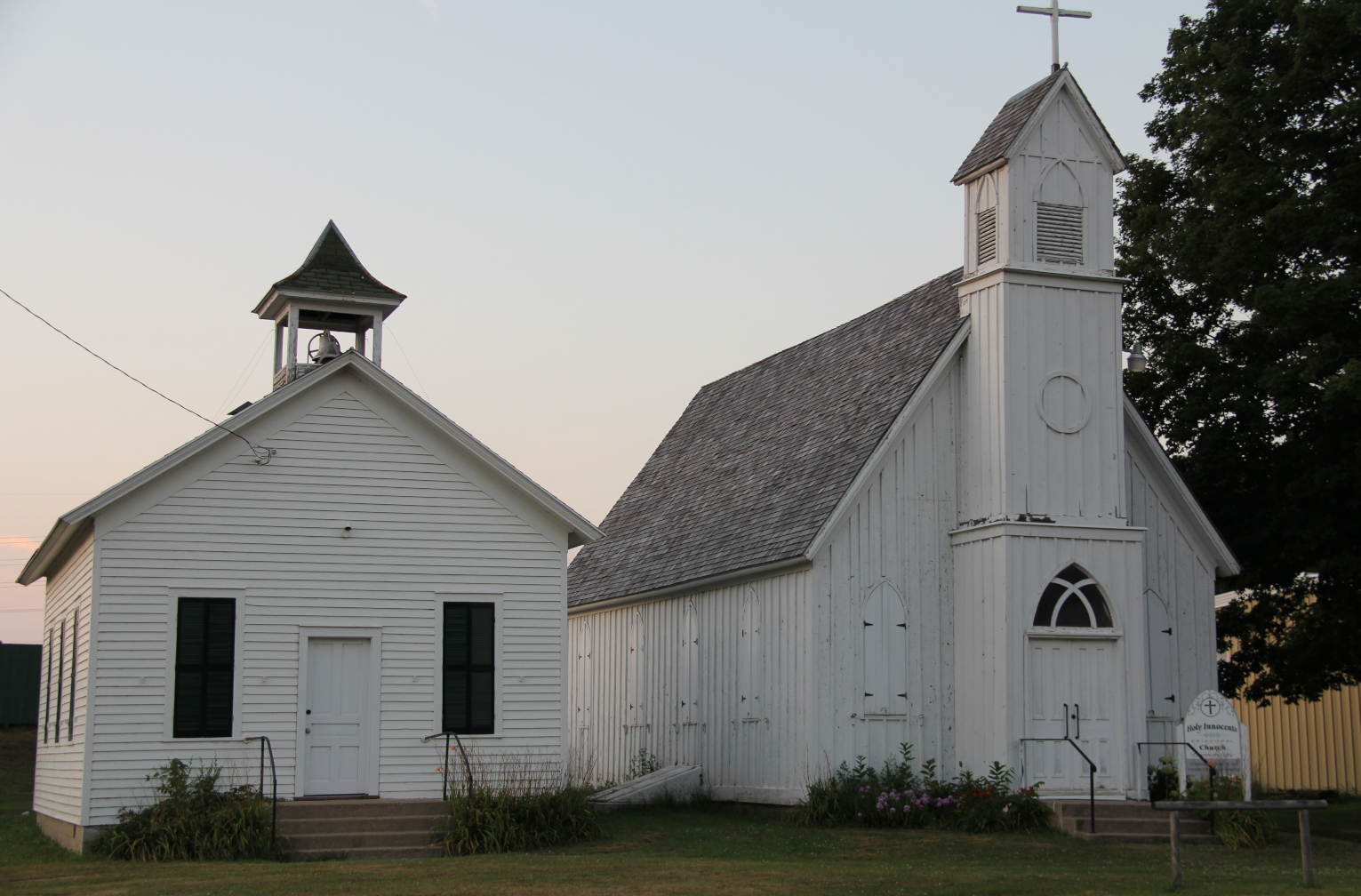
An historic church and school, owned by the historical society, backdrop the flea market. (Minnesota Prairie Roots copyrighted photo May 2026)

Heselton holds a wealth of historical knowledge, which is no surprise given he has a degree in history and is currently in graduate school. Somehow we got on the topic of the Ku Klux Klan’s presence in Rice and Steele counties many decades ago. Heselton wrote a college research paper on the subject with his work now on file with the local historical society. I intend to read it at some point. But he shared a little with me, including that the Klan burned a cross in the yard of his grandmother’s Catholic family when she was just six years old. The KKK targeted Catholics along with African Americans. His grandma never forgot that traumatizing event, the story passed down through the generations.

Timmy Capranos with his The Holy Catch lures. (Minnesota Prairie Roots copyrighted photo May 2026)

Vendor Timmy Capranos of Kilkenny brought an over-sized cross to the RCHS Spring Flea Market. But his had only good intentions—to market his faith-themed fishing lures under the tag “The Holy Catch.” Each lure features a cross with the words GOD LOVES YOU.

A sample Father’s Day card includes the date of the celebration. (Minnesota Prairie Roots copyrighted photo May 2026)

Capranos earns my award for creativity with not only his $4.99 holy lures, but also his Design Your Own Card enterprise of blank card stock offered for 99 cents to, well, design your own card. He even provided a sample Father’s Day greeting card. I love his humor, his entrepreneurship and his overall joyful personality.

Jeremy Struff of JS Woodcrafts brought his handcrafted wood products, including this bowl. (Minnesota Prairie Roots copyrighted photo May 2026)
For the gardener, a vendor sold wildflower seed pods. (Minnesota Prairie Roots copyrighted photo May 2026)
Kenyon vendor Likkle Jamaica Cawna sold her Jamaican Hot Pickle (for fish and meat) and baked goods. Her Jamaican bread was sold out when I stopped by her table. She hopes to sell her homemade foods at local farmers’ markets. (Minnesota Prairie Roots copyrighted photo May 2026)

I saw more creativity in crafted wooden bowls, lemonade stand signs, wildflower seed pods, yard art, beer bottle wind chimes (also by Capranos) and pickled vegetables.

This is the first time I’ve seen a tractor for sale at a flea market. (Minnesota Prairie Roots copyrighted photo May 2026)

You never know what you’ll find at a flea market. A guy even showed up with an early 1950s Super A Farmall tractor.

Collectors could find Fleck’s Beer bottles and related items from the historic Faribault brewery. (Minnesota Prairie Roots copyrighted photo May 2026)

The adage of “One person’s junk is another’s treasure” certainly fits. Since I don’t need more junk or treasures, I try really hard not to buy anything. Mostly I eye the goods, reminisce, talk with people and scout for the quirky, odd and/or unusual.

A Faribault resident’s finds from a long ago local business. (Minnesota Prairie Roots copyrighted photo May 2026)

And sometimes I find history in the process—in a replica Pickelhaube, a thermometer promoting pioneer corn and Hy-Line chicks, and bottles that once held Faribault-brewed Fleck’s Beer.

Vendors set up in front of the RCHS, then wrapped around the side and back. (Minnesota Prairie Roots copyrighted photo May 2026)
The tin man and woman, who once stood outside Lockerby Sheet Metal in Faribault, watch over the flea market as permanent installations at the historical society. (Minnesota Prairie Roots copyrighted photo May 2026)
A Fun Lil’ Band entertains. (Minnesota Prairie Roots copyrighted photo May 2026)

I also find community at flea markets. There’s something about poking around in piles of stuff that feels grassroots connective. I often find myself striking up conversations with vendors and sometimes shoppers. I usually see people I know, which leads to a bit of catching up.

A seller counts his money. (Minnesota Prairie Roots copyrighted photo May 2026)

Another opportunity to shop for unusual finds and handcrafted goods happens Memorial Day weekend in nearby rural Dundas. Rice County Steam & Gas Engines hosts its annual spring event with a flea market and swap meet from 8 a.m.-5 p.m. Saturday, May 23, and Sunday, May 24. A consignment auction is also set for 9 a.m. Saturday and a tractor pull for 9 a.m. Sunday.

Payment signage among tools for sale at the RCHS Flea Market. (Minnesota Prairie Roots copyrighted photo May 2026)

I hope to be there, poking around, looking for the quirky, odd and/or unusual as I connect with community and maybe learn some history in the process.

© Copyright 2026 Audrey Kletscher Helbling