Minnesota Prairie Roots

Writing and photography by Audrey Kletscher Helbling

“Chick Days,” hatcheries & memories from rural Minnesota April 3, 2024

My friend Joy’s chickens. (Minnesota Prairie Roots copyrighted file photo)

I’M NO CHICKEN farmer. I’m not even particularly fond of roaming chickens (ducks or geese). But this time of year on “Chick Days,” I feel nostalgic, remembering the delivery of newly-hatched chicks. They arrived on my southwestern Minnesota childhood farm via the U.S. Postal Service, cheeping raucously and, I’m certain, desiring to escape their cardboard boxes.

A snippet of a promo for “Chick Days” at a local business.

Today, chicks still ship via mail, but need to be picked up at the post office or at a local supplier on “Chick Days.” That may be at a farm store, a grain elevator, a feed store…

A boarded up hatchery in southwestern Minnesota. (Minnesota Prairie Roots copyrighted file photo)

Gone are the days when chick hatcheries were found in many farming communities. But this is not Mayberry anymore. Rural America has changed significantly since I was growing up in the 1960s and 1970s with businesses now shuttered, buildings vacated.

A 1950s or 1960s era greeting card from a hatchery in Minneota, Minnesota. (Minnesota Prairie Roots copyrighted photo April 2024)

But, if you look closely enough, dig deep enough, ghosts of those businesses remain, including chick hatcheries. Among the vintage greeting cards my mom saved (she saved everything), I found a holiday card from Dr. Kerr’s Hatchery. That was in Minneota; that’s Minnesota minus the “s.”

Minneota sits on the prairie northwest of Marshall in Lyon County. This small town is perhaps best-known as the home of the late Bill Holm, noted writer and English professor at Southwest Minnesota State University. Among his work, Boxelder Bug Variations, a collection of poetry and essays about, yes, boxelder bugs. Minneota celebrates Boxelder Bug Days annually.

But it doesn’t celebrate chicks, as far as I know, or the hatchery with the unusual name of “Dr. Kerr’s Hatchery.” There’s a story behind that moniker. I just don’t know what that may be.

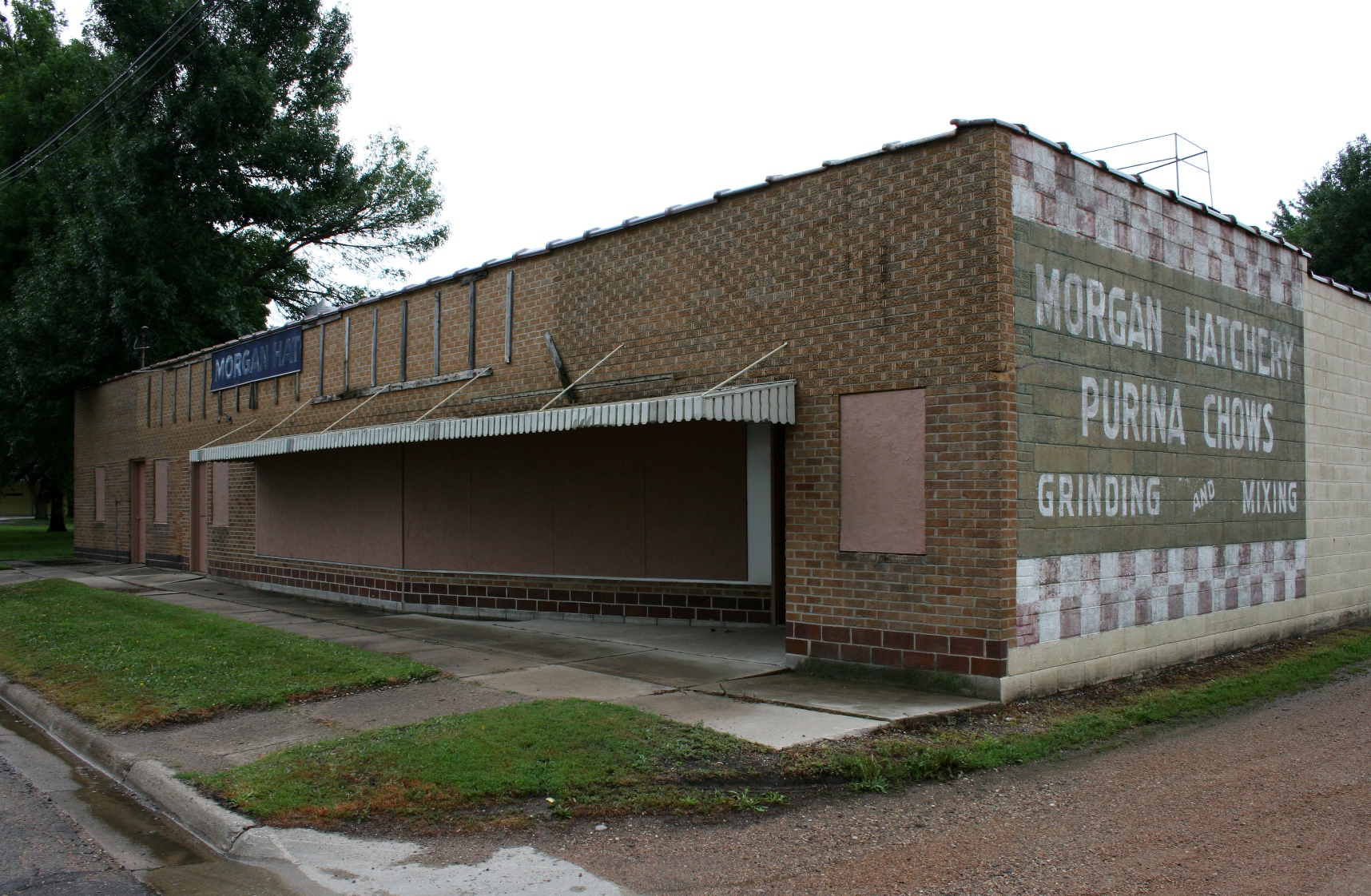
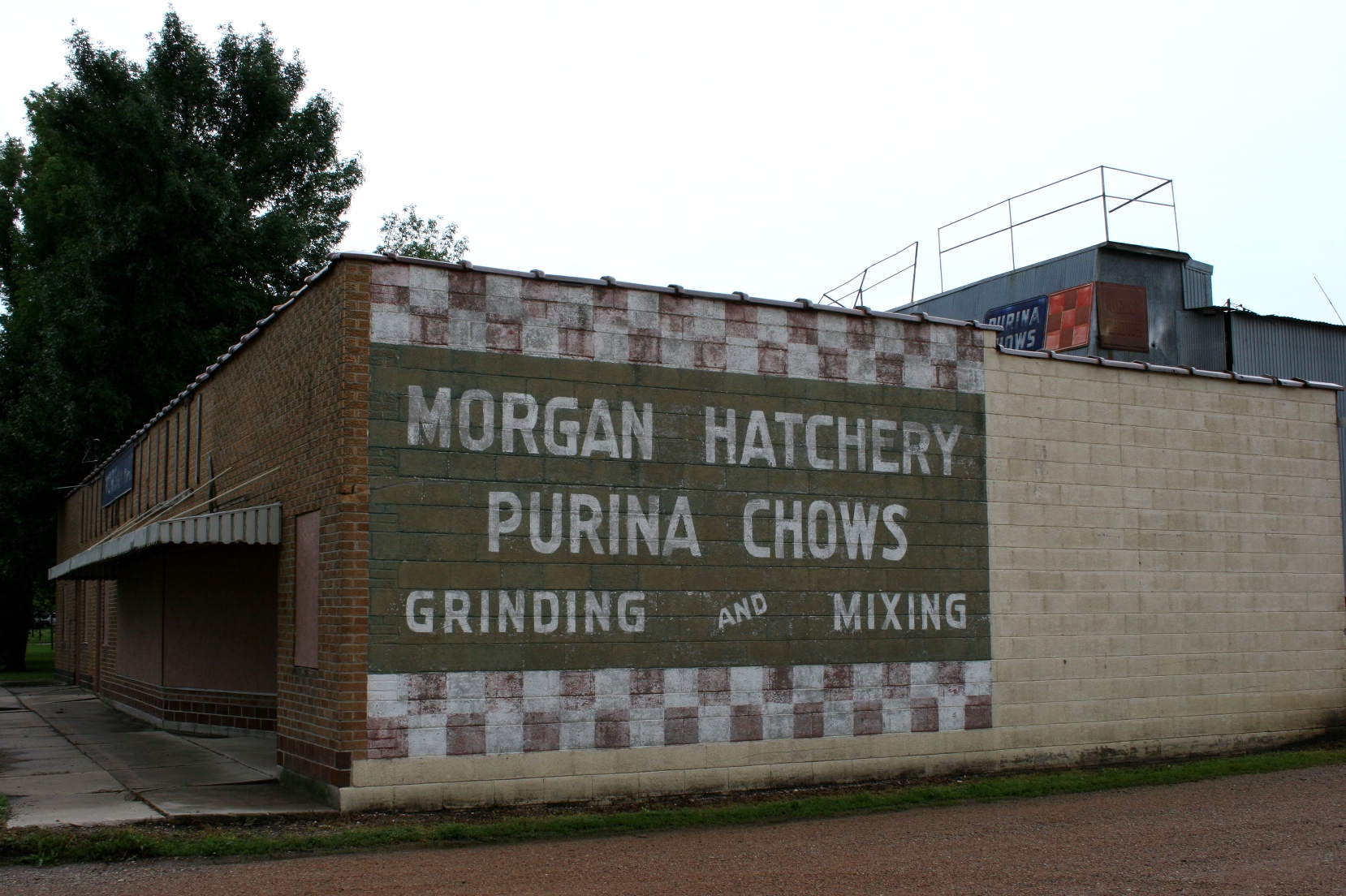
Signage is a reminder that this building once housed a hatchery in Morgan. (Minnesota Prairie Roots copyrighted file photo)

I do know, though, that Morgan, 60 miles to the east of Minneota, also had a hatchery, aptly named Morgan Hatchery. I photographed the exterior of the former hatchery and feed store in 2013 while en route to my hometown of Vesta.

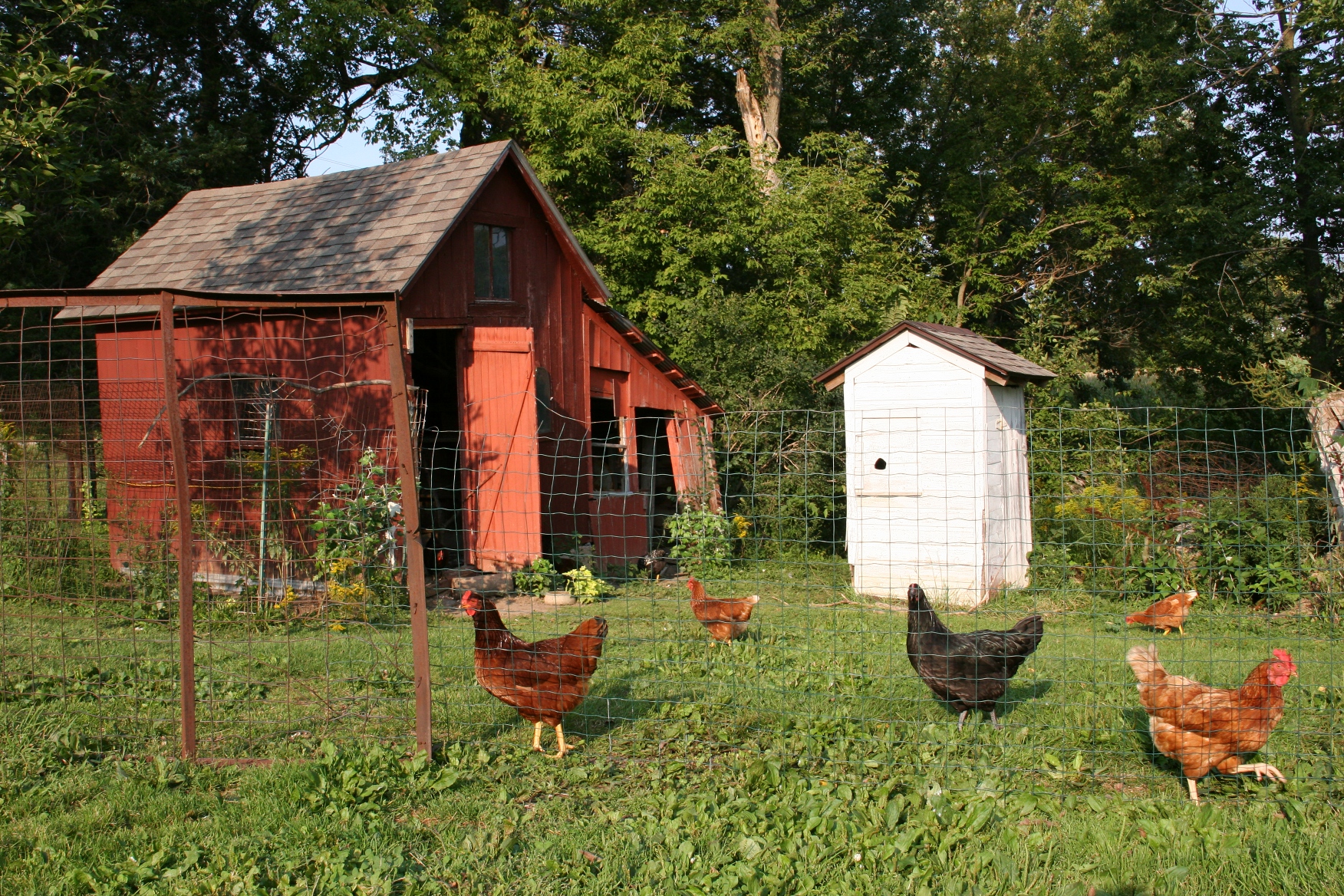
Chickens are fenced next to the red chicken coop on Joy’s rural acreage. Sometimes they also roam free around the yard. (Minnesota Prairie Roots copyrighted file photo)

Thoughts of home take me back to those chicks delivered by the mailman, as we called letter carriers back in the day. After retrieving the box (es) of chicks from aside the roadside mailbox, Mom released them into the chicken coop. There they clustered around shallow water dishes under the warmth of heat lamps. I don’t recall many details other than the fluffy fowl feathering all too soon. For me, the chicks’ transition toward adulthood quickly ended my adoration.

A fenced rooster at my nephew and niece’s rural acreage. (Minnesota Prairie Roots copyrighted file photo)

There’s a reason I dislike being in close proximity to chickens: pecking hens and a vicious rooster. Gathering eggs from angry hens as a young girl proved an unpleasant chore. And avoiding a mean rooster proved impossible. One day Dad had enough of the rooster attacking his children. He grabbed an ax and that quickly ended the hostile encounters. I still hold trauma from that rooster. But I’ve gotten better about being around chickens. However, if I even pick up on a hint of meanness, I flee.

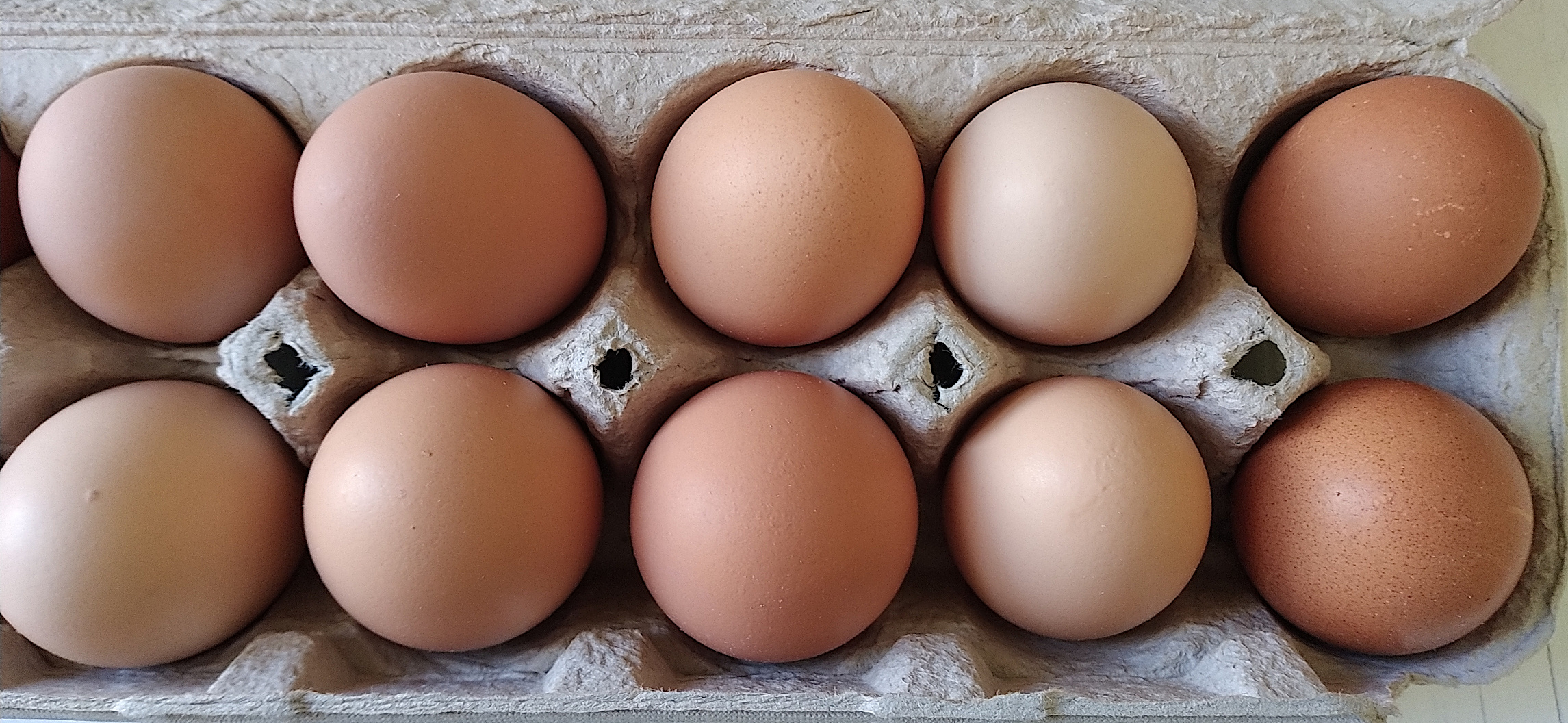
Farm fresh eggs from Nancy and Loren’s chickens. (Minnesota Prairie Roots copyrighted photo April 2024)
The difference in eggs, with the yolk from a store-bought mass-produced egg on the left and a farm fresh egg on the right. (Minnesota Prairie Roots copyrighted photo April 2024)

Given my history, I’ll never own chickens. But I eat chicken. And I eat eggs. I especially like farm fresh eggs from free-range chickens. The dark orangish-yellow yolk hue, the taste, are superior to mass-produced eggs.

A maturing chick. (Minnesota Prairie Roots copyrighted file photo)

And I still think chicks are cute, even if they quickly morph into feathered birds I’d rather not be around.

© Copyright 2024 Audrey Kletscher Helbling


The art of rural Minnesota churches March 28, 2024

Christdala Swedish Lutheran Church, rural Millersburg. (Minnesota Prairie Roots copyrighted file photo August 2020)

IN MY BACKROADS travels around Minnesota, I’ve often stopped at churches, drawn by their history, architecture and art. Churches are, to me, more than houses of worship. They are also galleries, museums, centers of praise and grief and joy.

Inside Vang Lutheran Church, rural Dennison, a depiction of Jesus praying in the Garden of Gethsemane. (Minnesota Prairie Roots copyrighted file photo October 2014)

There’s almost something holy about stepping inside a church, into the quiet of a space graced by colorful stained glass windows, religious sculptures, pews worn by the hands of many.

Trinity Lutheran Church, Wanamingo. (Minnesota Prairie Roots copyrighted file photo March 2016)

I feel a sense of reverence in the light, in the stillness, in the peace that fills an empty sanctuary. I feel centered. Calm. Enveloped by the sheer beauty surrounding me.

Inside St. Michael’s Catholic Church in Buckman in Morrison County, stained glass art shows Jesus carrying His cross. (Minnesota Prairie Roots copyrighted file photo January 2021)

That beauty often emanates from the art. Stained glass windows, designed and built by skilled artisans, add a dimension of sacredness that appears heavenly when sunlight streams through glass.

Jesus’ crucifixion depicted in a stained glass window inside Holden Lutheran Church, rural Kenyon. (Minnesota Prairie Roots copyrighted file photo March 2016)

Themed to history, those windows visually tell stories written within the bible. Many focus on Holy Week: The Last Supper. Jesus praying in the garden of Gethsemane. The crucifixion of Jesus. And then His glorious resurrection on Easter morning.

This statue of Mary grieving the loss of her son shows deep emotion. It’s inside St. Mary’s Catholic Church, New Trier. (Minnesota Prairie Roots copyrighted file photo April 2017)

Sculptures, too, depict the same in life-size statues.

Hands convey so much love in intimate details in this sculpture of Mary holding Jesus’ hand. Photographed at St. Mary’s Catholic Church, New Trier. (Minnesota Prairie Roots copyrighted file photo April 2017)

Sacred and religious art is powerful. It evokes emotions. Inspires. Uplifts. Gives reason to pause and reflect.

This shows a snippet of the center stained glass window in a trio above the altar at Trinity Lutheran Church, Wanamingo. It depicts Christ’s resurrection. (Minnesota Prairie Roots copyrighted file photo March 2016)

This Holy Week, as my thoughts turn more reflective and inward, I feel deep gratitude for the long ago faithful who created the stained glass windows, the sculptures and other art adorning churches. These works of art are worthy of our attention, our appreciation, no matter religious affiliation or not.

A full view of the altar painting by A. Pederson inside Moland Lutheran Church, rural Kenyon. It’s based on Matthew 11: 28 – 30. “Come to me, all you who are weary and burdened…” (Minnesota Prairie Roots copyrighted file photo June 2013)

I can only imagine how many eyes have focused on the art within sanctuary walls. During baptisms. During weddings. During funerals. And during worship services. Joy. Comfort. Peace. Blessings. They’re there, all there, within the art within these sacred spaces.

© Copyright 2024 Audrey Kletscher Helbling


A whole lot of Irish in St. Patrick March 13, 2024

Appropriate signage for a tavern in St. Patrick, Minnesota. (Minnesota Prairie Roots copyrighted file photo June 2015)

BEER, BASEBALL AND BLESSINGS. Those words define St. Patrick, an unincorporated place of bar, baseball field and Catholic church northeast of New Prague. With the approach of St. Patrick’s Day, now seems a fitting time to revisit this southern Minnesota burg, which I photographed in the summer of 2015.

St. Patrick Church of Cedar Lake Township. (Minnesota Prairie Roots copyrighted file photo June 2015)

I never stepped inside St. Patrick’s Tavern or onto Bonin Field, home of the St. Patrick Irish, on that summer day. Rather, I walked around St. Patrick Church of Cedar Lake Township and its adjoining cemetery. Church doors were locked.

St. Patrick’s church and cemetery.
St. Patrick’s Bonin Field, named after Father Leon Bonin, who brought baseball back to St. Patrick in the 1950s. (Minnesota Prairie Roots copyrighted file photo June 2015)
Across the road from the St. Patrick cemetery sits St. Patrick’s Tavern. (Minnesota Prairie Roots copyrighted file photo June 2015)

The stately church sits atop a hill, the ball field at the base on one side, the tavern on the other. Pray. Play. And then congregate over a beer and a burger basket at the tavern. Or, on St. Patrick’s Day weekend, corned beef and cabbage downed with on-tap green beer, while supplies last.

Born in Ireland, buried in the St. Patrick Church of Cedar Lake Township Cemetery in southern Minnesota. (Minnesota Prairie Roots copyrighted file photo June 2015)
Bonin Field, home of the St. Patrick Irish. (Minnesota Prairie Roots copyrighted file photo June 2015)
The bar and restaurant in St. Patrick. (Minnesota Prairie Roots copyrighted file photo June 2015)

Even with the minimal time I spent in St. Patrick, I experienced its Irish heritage. It’s reflected on tombstones, in the very names of the church, ball field and bar. It’s reflected on signage. But mostly, it’s this feeling of sacredness, as if the patron saint of the Irish dwells here. In the pews. On the bleachers. Even, I expect, inside the bar. St. Patrick was, after all, a missionary.

St. Patrick’s steeple rises in the background, behind this cemetery angel. (Minnesota Prairie Roots copyrighted file photo June 2015)

And then there’s the sacred art. Crucifixes. An angel statue. Tombstones that hold names and history.

The Holy Family tucks into a corner of the grotto. (Minnesota Prairie Roots copyrighted file photo June 2015)
The beautiful face of Mary at the St. Patrick’s grotto. (Minnesota Prairie Roots copyrighted file photo June 2015)
The loving hand of Mary rests upon her son, Jesus, in this sculpture at St. Patrick’s. (Minnesota Prairie Roots copyrighted file photo June 2015)

Aside the church, a grotto welcomes with the most hauntingly beautiful sculptures.

St. Patrick may seem like nothing more than a country church, just another rural bar and a baseball diamond to passing motorists. But it’s much more, worth the stop for a close-up look at a place rooted in Irish heritage.

More signage on St. Patrick’s Tavern. (Minnesota Prairie Roots copyrighted file photo June 2015)

Next road trip back here, I’ll pop into the tavern, order a brew and maybe a burger, and raise my mug to the Irish who settled here, claimed this land as theirs. Here in St. Patrick, place of beer, baseball and blessings.

© Copyright 2024 Audrey Kletscher Helbling


Crafting an obituary: Emmett “breathed John Deere” March 5, 2024

A row of John Deere tractors at the 2022 Rice County Steam & Gas Engines Show, rural Dundas. (Minnesota Prairie Roots copyrighted file photo September 2022)

AS A WRITER, a storyteller, I read obituaries. Doesn’t matter if the deceased is known to me or not. I find obits interesting for the stories therein.

Stories weren’t always part of obituary writing. Obit style has evolved since I graduated in 1978 with a journalism degree from Minnesota State University, Mankato. And that is a good thing. Today’s death notices are not just summaries of facts, but rather personalized in a way that helps the reader understand the person as a person. That holds value to those who are grieving and to those of us who hold no connection to the individual.

I need to backtrack for a moment and share that writing an obituary was my first writing assignment in Reporting 101. Although I’ve forgotten details about that long ago college course, I remember the professor stressing the importance of spelling names correctly. That carried through to all types of newspaper reporting. First reporting job out of college, I learned a source was Dayle, not Dale.

Emmett Haala (Photo source: Sturm Funeral Home)

That MSU instructor also imprinted upon me the importance of obituaries. As I age, I find myself drawn more and more to reading obits. Too often now, I know the deceased. Recently, I found a gem in the obituary of Emmett Haala, 87, of Springfield (that would be Springfield, Minnesota), who died on February 28. His funeral is today.

Hanging out by a John Deere tractor at the Rice County Steam & Gas Engines Show. (Minnesota Prairie Roots copyrighted file photo September 2022)

It wasn’t the basic facts about Emmett that captivated me, but rather his interest in John Deere tractors. He, according to his obit, “lived and breathed John Deere.” Now to anyone with a rural connection, the idea of fierce tractor brand loyalty is familiar. This retired mechanic began his career at age 14 at Runck Hardware and Implement in Springfield, eventually opening Emmett’s Shop in 1970. He was a trusted mechanic who serviced all machinery brands, but favored John Deere.

“Nothing runs like a Deere” is the John Deere slogan. (Minnesota Prairie Roots copyrighted file photo September 2017)

That tidbit got me reminiscing and also contemplating the importance of open houses in rural Minnesota. Events that continue today. Emmett, his death notice read, shared many memories of John Deere Days at Runck Hardware and Implement. He “…enjoyed making hot dogs and coffee for the throngs of people attending and showing the newest John Deere movie.”

To this day, I remain a fan of John Deere. Here Randy and I pose aside a vintage John Deere at Bridgewater Farm, rural Northfield in October 2023. (Photo credit: Amber Schmidt)

That was it. I was hooked. I attended John Deere Day at a farm implement dealership while growing up in southwestern Minnesota. While the event was a way for machinery dealers to get farmers inside their shops, the open houses were also a social gathering for rural folks. My siblings and I piled into the Chevy aside Dad and Mom for the 20-mile drive to Redwood Falls and John Deere Day.

Free food—usually BBQs, baked beans, chips and vanilla ice cream packaged in little plastic cups and eaten with a wooden spoon—comprised dinner (not lunch to us farm types). Maybe there were hot dogs, too, like at Emmett’s place of employment. Memories fade over the decades.

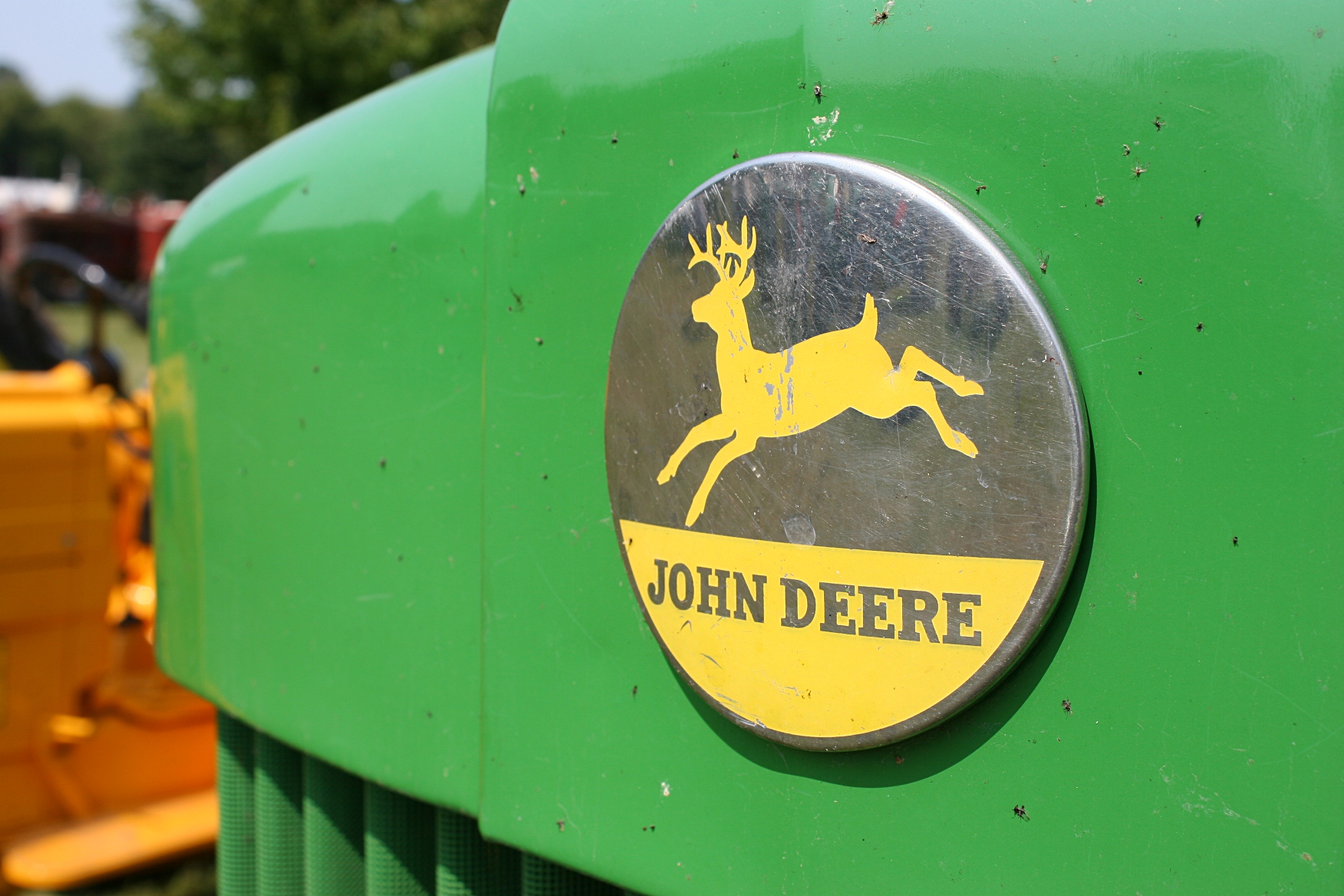
A worn vintage John Deere emblem. (Minnesota Prairie Roots copyrighted file photo September 2017)

But I do recall the John Deere movies shown post meal at the theater in Redwood Falls. Sure, they were nothing but advertisements for “the long green line” of farm machinery. But to a kid who seldom set foot in a theater, the promotional films held all the appeal of a box office hit. Plus, there were door prizes like bags of seed corn and silver dollars. I never won anything. A cousin did.

At the Rice County Steam & Gas Engines Show. (Minnesota Prairie Roots copyrighted file photo September 2017)

And so all those John Deere memories and more—including the distinct pop of my dad’s 1950s John Deere tractor—rushed back. Putt, putt, putt. Emmett belonged to the Prairieland Two Cylinder Club. Nostalgia is powerful. So is the art of crafting an obituary. Many of today’s obituaries feature detailed personal stories, not simply superlatives. Stories that reveal something about the individual who lived and breathed and loved. Stories well beyond life-line basics. Stories of life. Stories that resonate, that connect us to each other. Stories like those of Emmett, who “lived and breathed John Deere.”

(Book cover image sourced online)

FYI: I recommend reading this guidebook to obituary writing by retired The Wall Street Journal obit writer James R. Hagerty: Yours Truly: An Obituary Writer’s Guide to Telling Your Story. Hagerty is the son of Marilyn Hagerty, columnist for The Grand Forks Herald. In a March 2012 “Eatbeat” column, Marilyn reviewed her local Olive Garden and gained instant internet fame.


Foliage, fields & fun in this season of autumn October 23, 2023

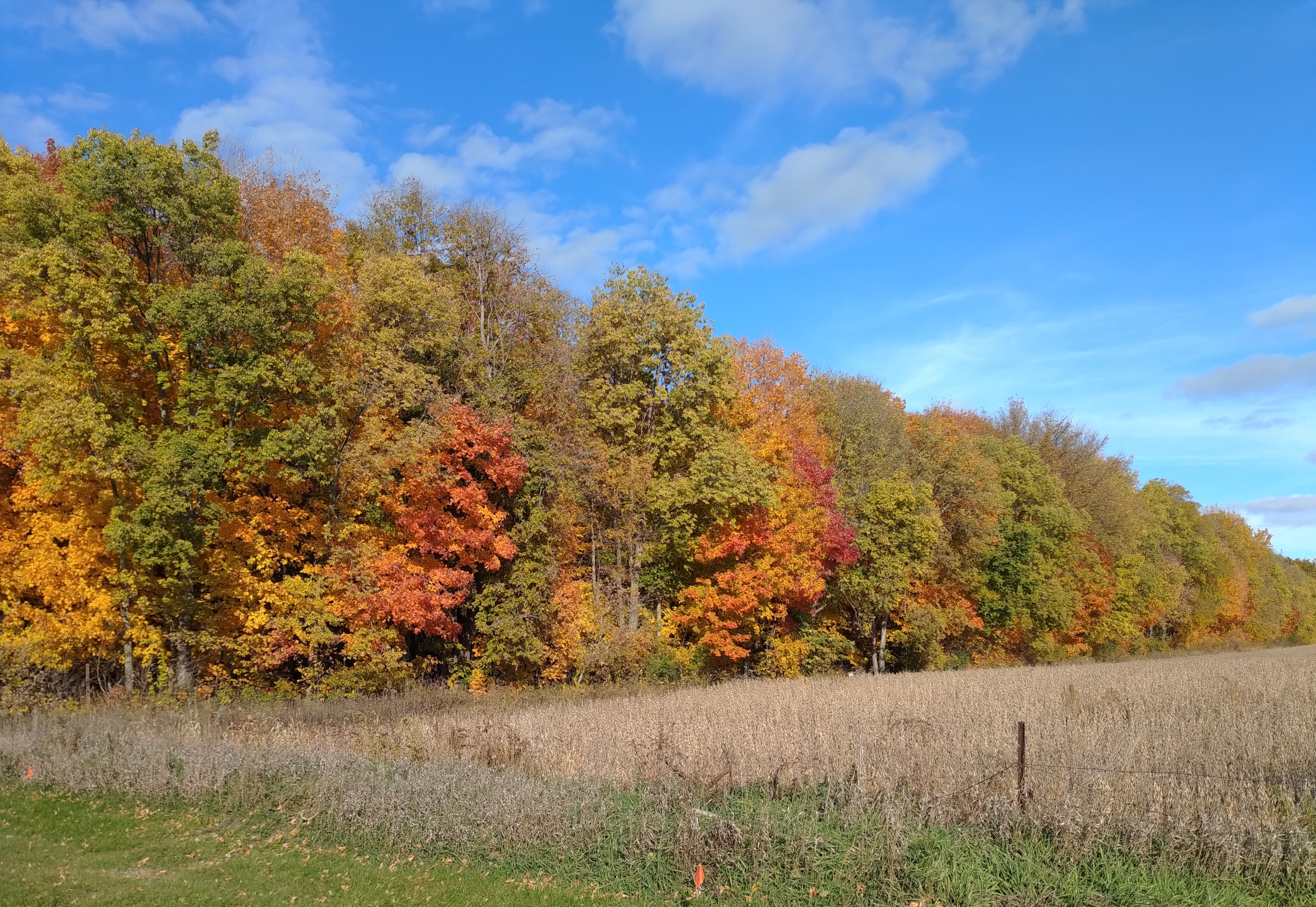
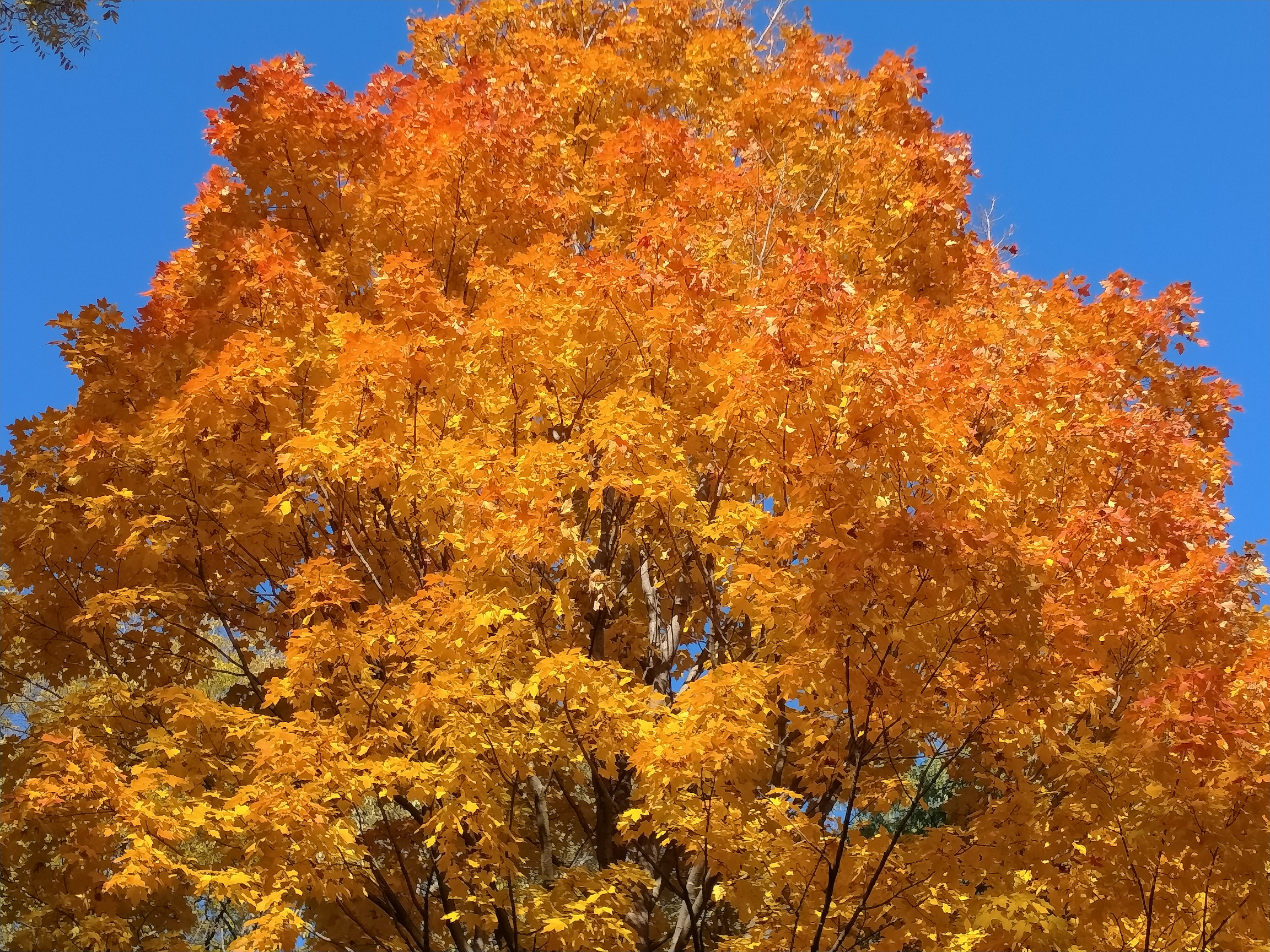
Stunning fall colors along Farwell Avenue north of Warsaw. (Minnesota Prairie Roots copyrighted photo October 2023)

AUTUMN BECKONED US RECENTLY to forgo the yard work, the half-finished interior paint job, the anything that would keep us at home. Rather, we hit the backroads, taking in the glorious fall colors which finally exploded. I can’t recall leaves ever turning this late in the season here.

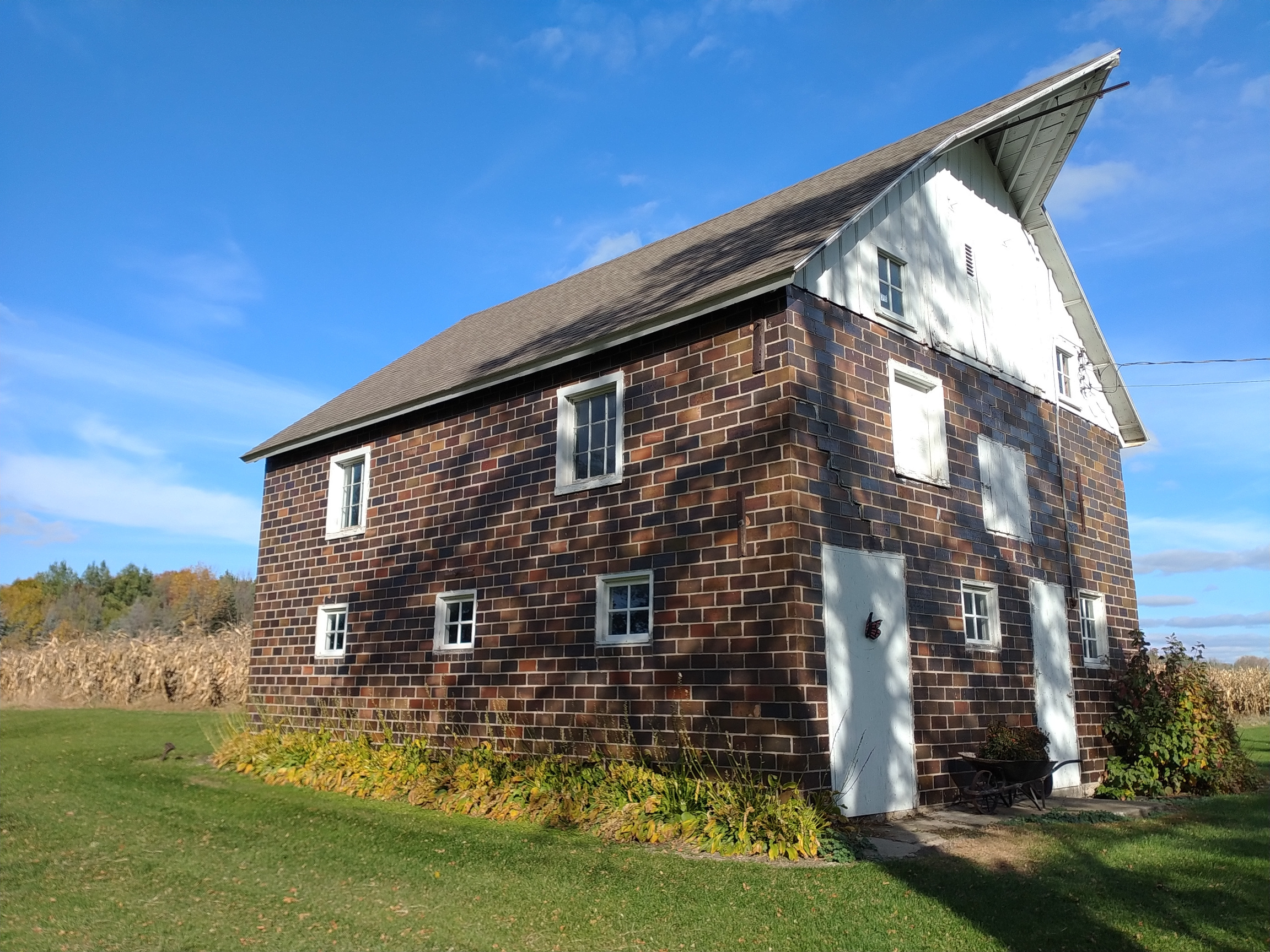
One of my favorite old barns in Rice County, located along Farwell Avenue north of Warsaw. (Minnesota Prairie Roots copyrighted photo October 2023)

This region of Minnesota seems vastly undiscovered as an autumn leaf-peeping destination. But I learned years ago that the Faribault area offers stunning fall foliage, especially along our many area lakes and in stands of trees among rural rolling hills.

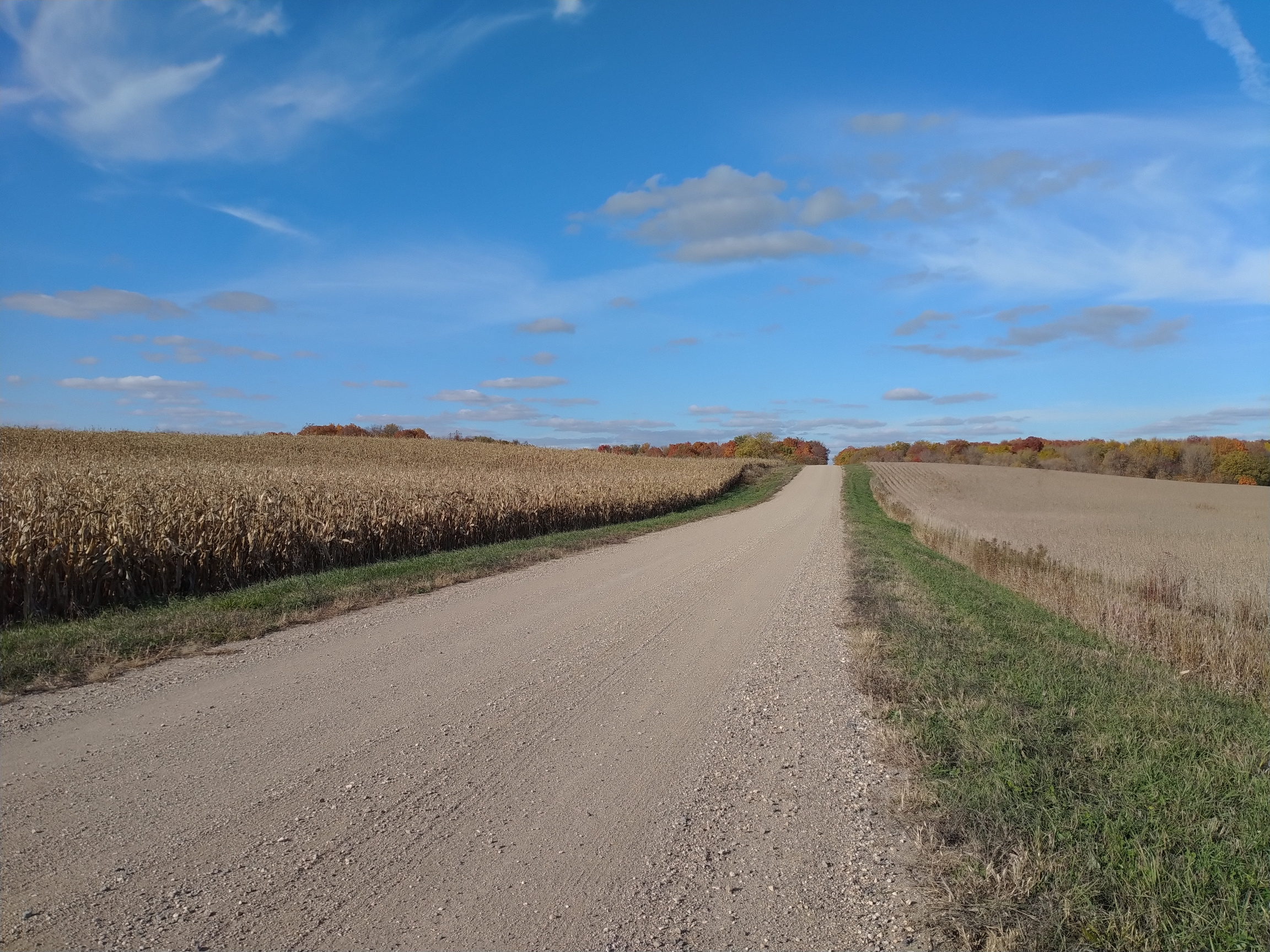
This gravel road, Farwell Avenue, took us past beautiful fall foliage. (Minnesota Prairie Roots copyrighted photo October 2023)

I like nothing better than to follow gravel roads that twist through the countryside. The slower pace connects me to the land, to the lovely scenes unfolding before me. Dust clouds trail vehicles rumbling along sometimes washboard surfaces. Combines kick up dust, too, as farmers harvest corn and soybeans, grain trucks parked nearby to hold the bounty.

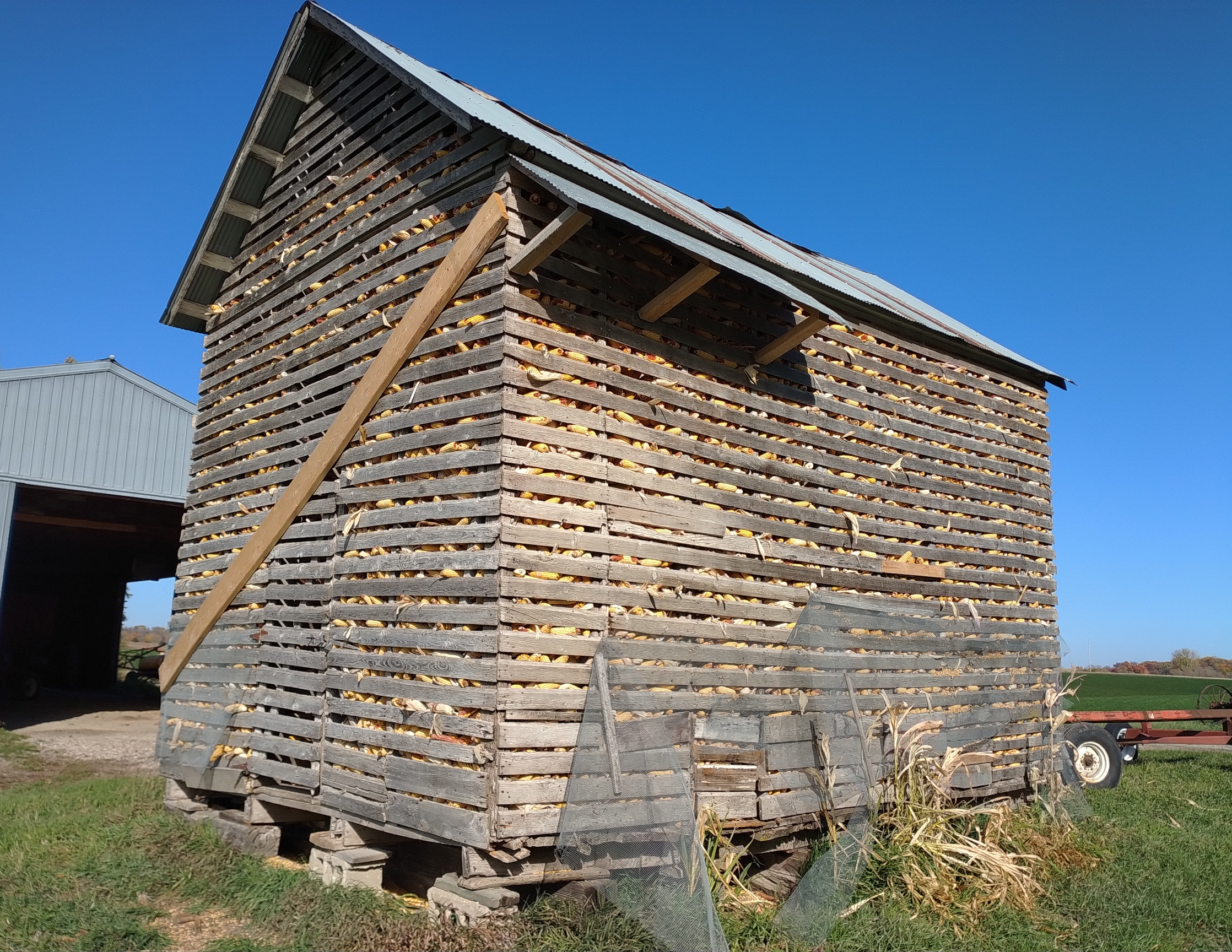
A rare find, a vintage corn crib packed with field corn in northwestern Rice County, in the Lonsdale area. (Minnesota Prairie Roots copyrighted photo October 2023)

Even inside our van, I can smell the scent of earth rising from freshly-tilled fields. Some acreage lies bare while others still hold endless rows of ripened crops awaiting harvest.

The Theis family has created a welcoming outdoor space for Apple Creek Orchard visitors to gather beside a fireplace against a wooded backdrop. (Minnesota Prairie Roots copyrighted photo October 2023)

At Apple Creek Orchard west of Faribault, families gathered on a sunny weekend afternoon to enjoy fun on-site activities like apple picking, bean bag toss, apple slinging, wagon rides, jump pad, corn maze and more. We wandered the grounds, admiring the improvements and expansions made by the Theis family to grow their orchard in to an agri-entertainment destination. They’ve also added an event center to host weddings and other gatherings.

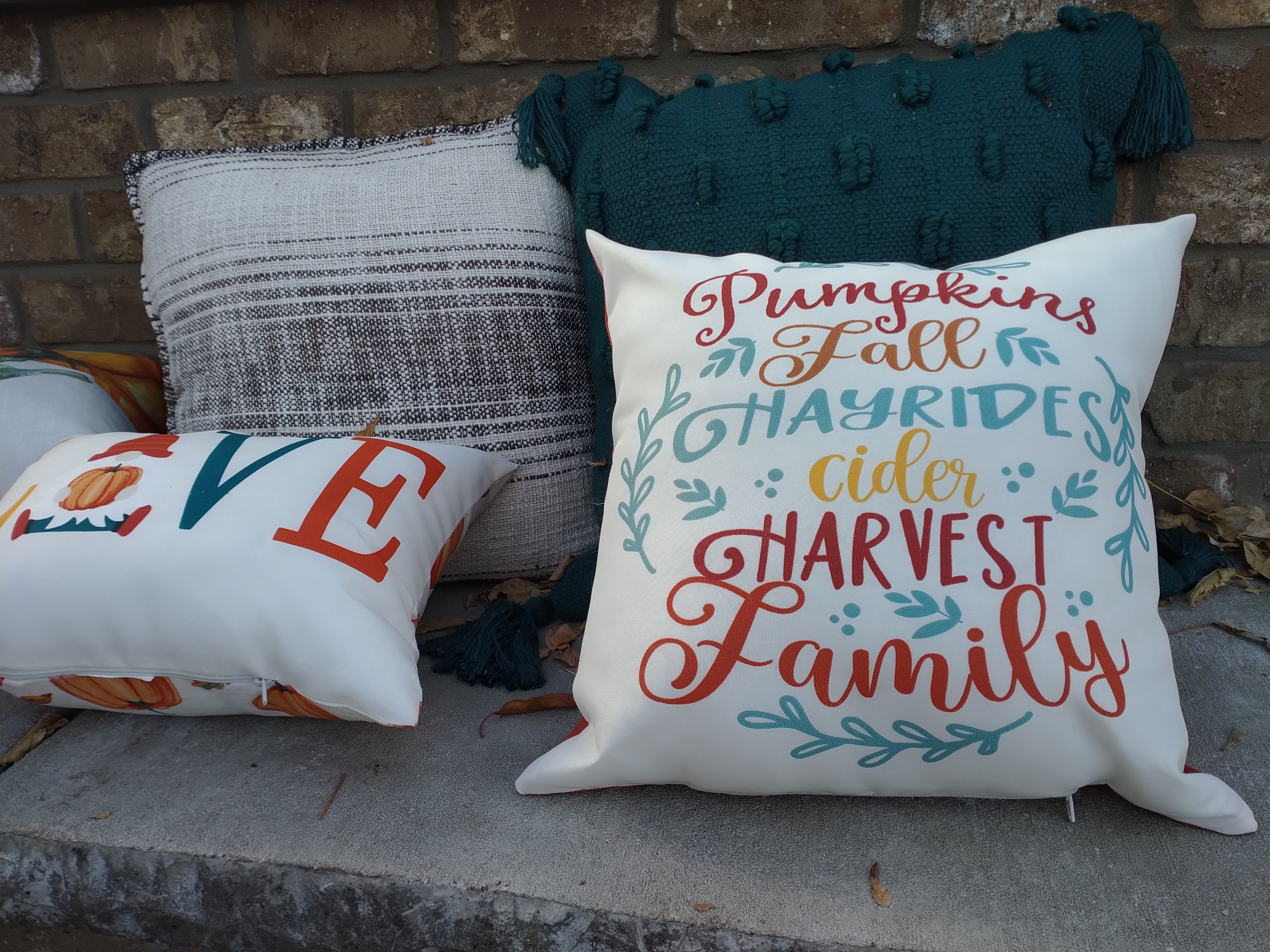
Autumn-themed pillows are propped on the sitting area next to the outdoor fireplace at Apple Creek Orchard. (Minnesota Prairie Roots copyrighted photo October 2023)

As Randy paid for a half-peck of my favorite Minnesota-developed SweeTango pulled from a store cooler, I greeted Tami Theis, congratulated her on their upgrades. She inquired about my family. I got to know Tami and her daughter Amber sometime back while at the orchard. They are a delight— friendly, caring and, oh, so welcoming to everyone. Amber was running the concession stand on this busy afternoon and I gave her a hard time after learning the donut machine wasn’t working and I would get none of the mini donuts I craved.

Dudley Lake, one of my favorite places to see colorful lakeside trees in Rice County. (Minnesota Prairie Roots copyrighted photo October 2023)

No matter my disappointment in the lack of a sweet treat, nothing else about our afternoon outing disappointed. Onward Randy and I went. He turned the van left out of Apple Creek Orchard onto the paved roadway. Eventually we took gravel roads again, meandering past lakes and fields and farm sites, stopping occasionally so I could snap photos.

My next-door neighbor’s flaming maple. (Minnesota Prairie Roots copyrighted photo October 2023)

I love this time of year. The scent of decaying leaves. The sight of trees flaming red, yellow, orange. The muted fields that define the landscape. The apples and pumpkins and gourds. The bold blue sky. The bringing in of the harvest.

Looking up at our backyard maple, the wooded hillside and at our neighbor’s trees on a recent afternoon. (Minnesota Prairie Roots copyrighted photo October 2023)

Back home, the down side of autumn awaited us in outdoor chores—removing leaves from rain gutters, raking/mulching layers of maple leaves in the backyard, washing windows… To everything there is a season. And the season of autumn means taking time to view the colorful fall foliage when the trees are turning. The work can wait.

© Copyright 2023 Audrey Kletscher Helbling


In Seaforth: Celebrating books, art & people October 4, 2023

Promo for Saturday’s event, courtesy of Elizabeth Johanneck.

THEY ARE LONG-TIME FRIENDS. Friends who grew up together, who have a history of experiences and stories and of being there for one another. And they are both authors of books rooted in rural Redwood County, the land which shaped and grew them and their enduring friendship.

On Saturday, October 7, Twin Cities resident Elizabeth “Beth” Johanneck, author of If You Can’t Make it to Heaven, at Least Get to Seaforth—The Monica Stories and Then Some, and Granite Falls resident Cynthia “Cindy” Bernardy Lavin, author of the children’s book I Think I’ll Call You Annie: Based Upon a True Story (which Beth illustrated), return to Seaforth, population 77, for a 1-4 pm event sure to draw lots of interest.

The C4th Bar hosts the afternoon activities, which include a meet-and-greet (1-3 pm) with the authors and Monica Pistulka Fischer, prominently featured in Beth’s collection of short stories and art from the Seaforth and Wabasso areas. Books will be available for purchase.

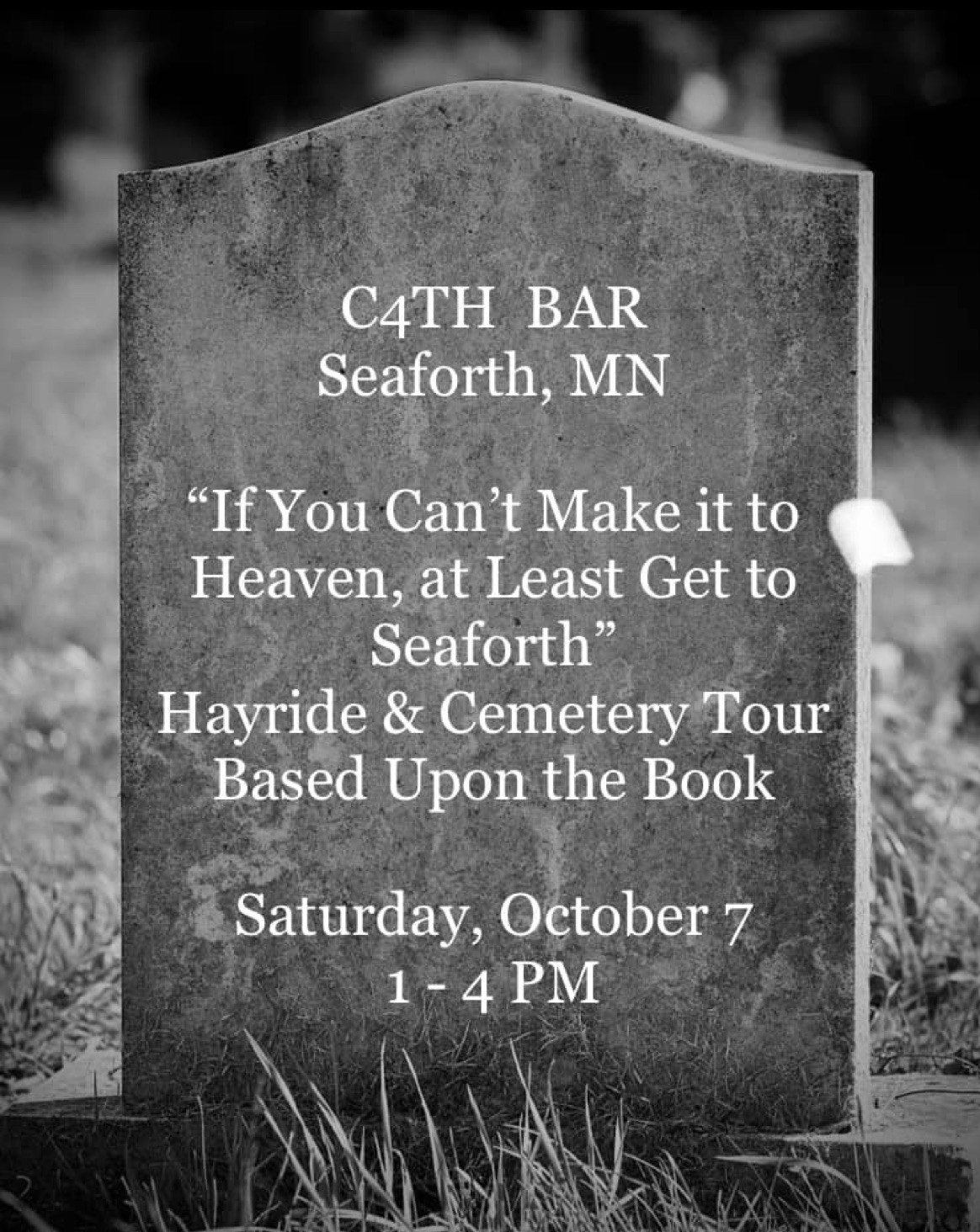
Event promo courtesy of Elizabeth Johanneck.

But there’s much more planned than a book signing and time to chat with the long-time friends. The event also includes a hayride and self-guided tour of St. Mary’s Cemetery just northwest of Seaforth. Attendees can visit the gravesites of locals included in both books.

Image sourced online.

Back at the bar, Cindy, a retired elementary school teacher, will read her book about Seaforth’s most famous pig and offer a pig art project for kids.

The original painting of “Seaforth Main Street,” featured here on the cover of Beth’s book, will be on display at Saturday’s celebration. (Minnesota Prairie Roots copyrighted file photo 2023)

Art is an important part of this celebration as art is an integral part of Beth’s book. Her book includes the only printed collection of selected paintings by her grandfather, Arnold Kramer, dubbed “Minnesota’s Grandpa Moses.” He documented early to mid 1900s rural life and scenes, creating an historical agrarian treasure of some 400 paintings upon his retirement from farming. His original painting, “Seaforth Main Street,” which graces the cover of Beth’s book, will be displayed at Saturday’s celebration.

The C4th Bar is also honoring Kramer and several other Seaforth residents (and one pig) with special drinks: “The Grandpa Moses” for folk artist Arnold Kramer; “The Angie” for business owner Angie Bergen; “The Monica” for Monica Pistulka Fischer; and “The Annie” for Dana and Connie Dittbenner and Annie the Pig. “The Monica” and “The Annie” are non-alcoholic drinks. Hot chocolate and make your own s’mores will also be available.

No event is complete without music. The celebration features the live music of Cowboy Dave Gewerth.

It will be quite an afternoon in Seaforth. I can almost envision the scene of a packed bar, of Beth and Cindy mingling, of glasses raised, of stories shared, of memories made. That’s the thing about small towns, especially—you may leave, but you remain forever connected to the place, the events, the people. Like Beth and Cindy, long-time friends who on Saturday return to their roots to celebrate publication of their books, but, more importantly, Seaforth and its residents.

#

FYI: To purchase If You Can’t Make it to Heaven, at Least Get to Seaforth—The Monica Stories and Then Some, click here. (Also available through Barnes & Noble and independent bookstores, including Chapter Two Bookstore in Redwood Falls.) To read my review of the book, click here.

To purchase I Think I’ll Call You Annie, click here. Also available at independent bookstores and Barnes & Noble.

Disclaimer: I edited and proofed the manuscript for Beth’s book. My poem, “Her Treasure,” is printed in the book as a companion piece. Beth, Cindy and I attended Wabasso High School together, graduating with the class of 1974. Beth and I were also lockermates.

© Copyright 2023 Audrey Kletscher Helbling


A look back, a look ahead: How school shapes us, expands our world September 6, 2023

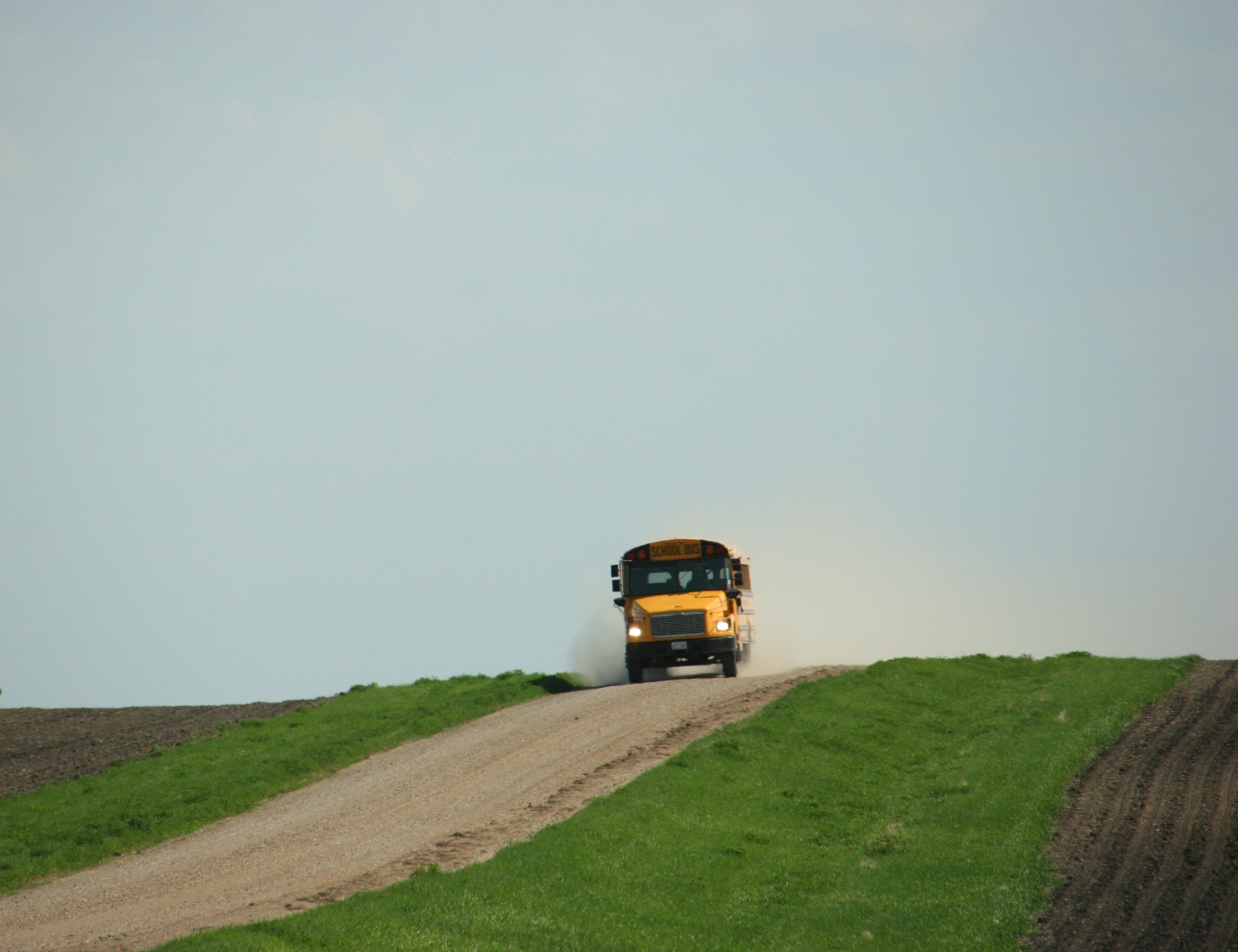
A bus follows a back country road near Morgan in southwestern Minnesota. (Minnesota Prairie Roots copyrighted file photo May 2018)

SHE WANTS TO SAVE the earth. It’s a lofty and noble goal for my granddaughter, who started second grade on Tuesday. Each year, on the first day of school, her mom documents basics about Isabelle on a small chalkboard. That includes a response to “What I want to be when I grow up.” This year Izzy aims to be an environmentalist. As a first grader, her professional goal was becoming a game designer. And on the first day of kindergarten, she wanted to own a toy store and also be a mom.

It’s interesting how Izzy’s interests evolve as she ages, as she grows her world and knowledge and connections with others. The possibilities are endless for her generation. I hold such hope in these young people, just beginning their formal educations.

And I hold hope, too, when I see a photo of Izzy and three neighborhood friends waiting at their urban bus stop. “Smart, Brave, Beautiful” banners Bethel’s tee. What a reaffirming message. For all of them. And how reaffirming that they are of differing ethnicity, their skin tones varied and, indeed, beautiful.

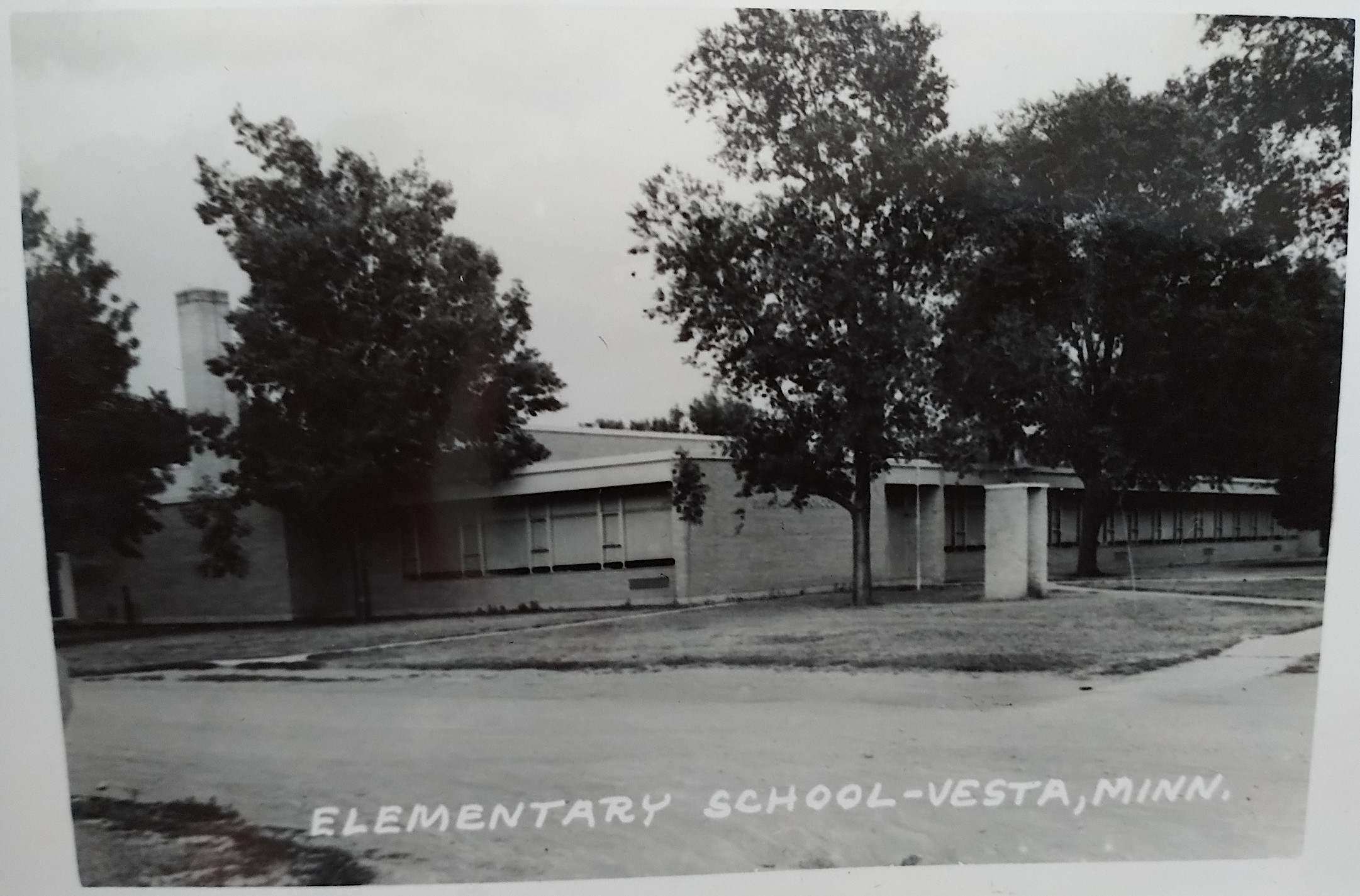
My elementary school, circa 1960s, located in Vesta in Redwood County. The school closed decades ago. (Photographer unknown; photo sourced from my personal photo album)

Sixty years have passed since I was a second grader in a small southwestern Minnesota elementary school, where my paternal grandfather served on the school board. My classmates and I were mostly farm kids, all white. We wrote in “Big Chief” lined tablets which today would not, should not, fly. Attitudes differed in the 1960s. Words like diversity, respect and environmentalist were not part of our everyday vocabulary.

A serene country scene just north of Lamberton in southern Redwood County. (Minnesota Prairie Roots copyrighted file photo September 2013)

But words, overall, held my interest all those decades ago. I have Mrs. Kotval to thank for sparking my love of words, of reading, and eventually of writing. Each day after lunch, she read to her third and fourth graders from “The Little House” and other chapter books. Through the writing of Laura Ingalls Wilder, who lived many years earlier in nearby Walnut Grove, I began to appreciate the nuances of the prairie. And I learned the importance of descriptive, detailed writing. Wilder engaged all of her senses to describe the prairie and life thereon in her series of wildly popular books. With her love of the natural world, this writer unknowingly documented the environment for me, my children and for my second grade granddaughter, today an aspiring environmentalist.

Early on, I aspired to be an elementary school teacher. But that changed as I grew my world, my knowledge, my connections. Words focused my passion. Unlike most of my elementary school classmates, I loved penmanship—letters and words flowing in script across the pages of my penmanship book. I loved spelling. I loved reading, even in a school and town without a library and thus with limited access to books. And by high school, that love of words expanded to writing.

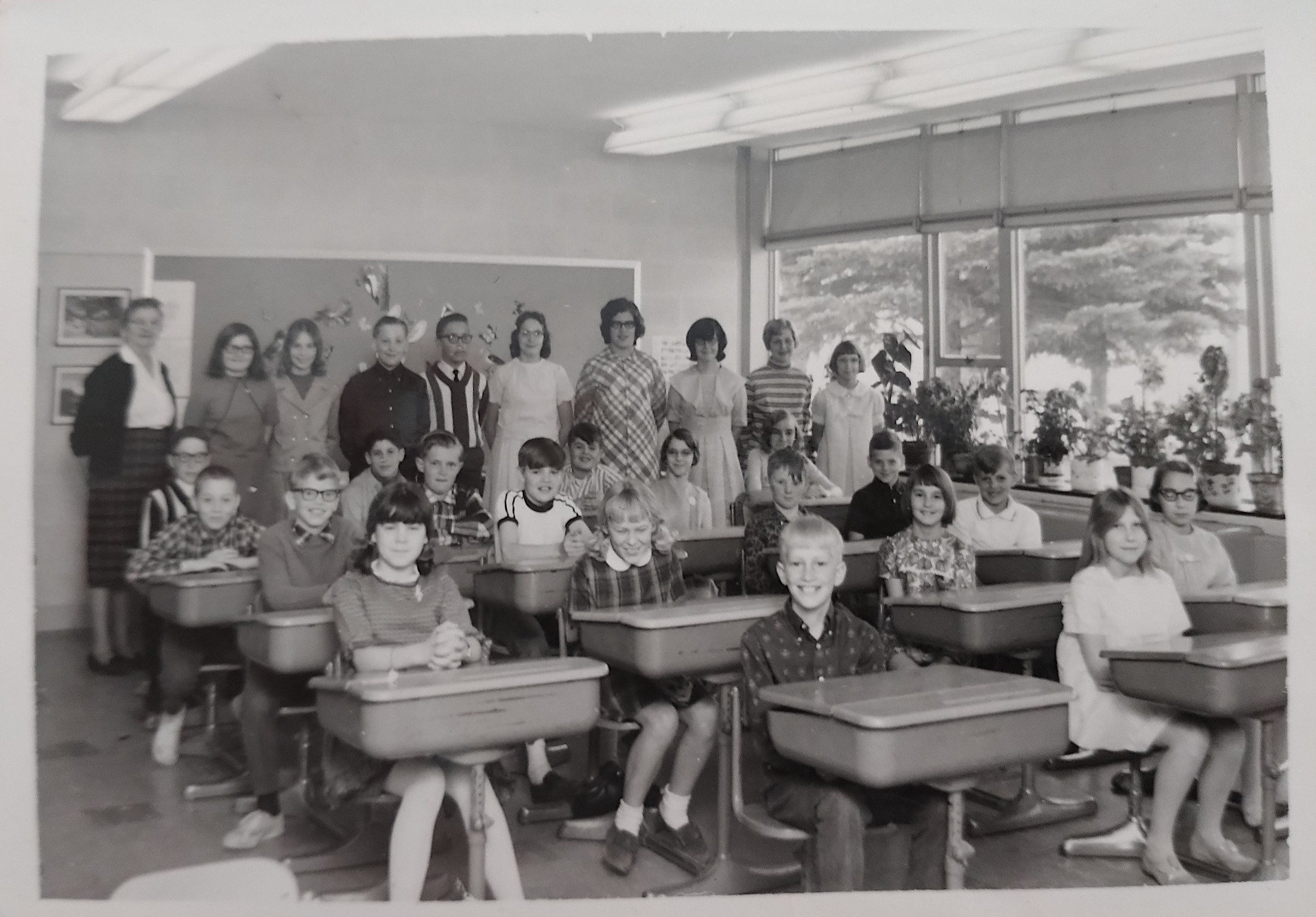
Fifth and sixth graders at Vesta Elementary School in the late 1960s. I’m in the back row, far right, next to the windows. (Photographer unknown; photo sourced from my personal photo album)

I want to pause here and stress the importance of passionate teachers in fostering students’ interests. From Mrs. Kotval reading to her students after lunch to junior high English teacher Mrs. Sales teaching me all the parts of grammar to high school teacher Mr. Skogen requiring students to keep journals, their influence on me and my eventual career was profound. I would go on to earn a college degree in mass communications, leading to a career as a journalist, writer, poet and photographer.

That brings me full circle back to Laura Ingalls Wilder, who early on influenced my detail-rich writing and photographic styles. In 2017, I became professionally connected to the author via “The World of Laura Ingalls Wilder—The Frontier Landscapes That Inspired The Little House Books.” Author Marta McDowell chose three of my photos (including one of prairie grasses at sunset) to illustrate her 396-page book documenting Wilder’s life and relationship to her environment. Perhaps some day my granddaughter will open the pages of McDowell’s book and find the photos taken by her grandmother. Whether Isabelle becomes an environmentalist or something vastly different, I expect she will always care about the earth and her role in saving it.

© Copyright 2023 Audrey Kletscher Helbling
 

Book review: A collection of short stories & art from the Minnesota prairie by Elizabeth Johanneck July 27, 2023

The cover of Elizabeth Johanneck’s new book features the art of her grandfather, Arnold Kramer. (Minnesota Prairie Roots photo July 2023)

DECADES REMOVED from southwestern Minnesota, Twin Cities writer Elizabeth Johanneck and I remain rooted to the prairie—the land and people and smalls towns which shaped us. We both grew up on Redwood County farms, were Wabasso High School classmates and today hold a deep respect and fondness for the place we once called home.

Beth, as she’s known to me, recently published a book, If You Can’t Make it to Heaven, at Least Get to Seaforth—The Monica Stories and Then Some. This book features short stories and snippet observations in Beth’s humorous storytelling style, plus paintings and photos. These could be my stories, my memories, just with different characters and settings. Any prairie farm kid likely will feel the same.

ABOUT SEAFORTH & MONICA

But where is Seaforth? And who is Monica? Seaforth, population 77, is a farming community located along County Road 7, south of Minnesota State Highway 19 in central Redwood County. It’s near my hometown of Vesta, seven miles to the northwest. Monica Fischer is Beth’s friend, former co-worker and a character. A baby shoe in a pot of egg coffee and pantyhose found clinging inside a pant leg during Catholic Mass are among the many entertaining Monica stories that left me laughing aloud. By the time I’d finished reading this section of the book, I felt like I knew Monica well. Everyone should have a friend like her.

GROWING UP ON THE MINNESOTA PRAIRIE IN THE 1960s

And everyone should be so fortunate to have experienced rural Minnesota life in the 1960s, as Beth and I did. It is Part 2, “Random Nonsense of a MN Country Mouse,” that I find most similar to my childhood. Both farmers’ daughters with many siblings, Beth and I share the commonalities of being raised on the land among aunts and uncles and cousins and grandparents and immediate family who loved us deeply.

As in “The Monica Stories,” Beth writes about her personal experiences in a casual conversational style. It’s as if she and I are chatting over cups of coffee, and Beth does like her coffee. I connect with her stories about “the grove,” jars of pocket gopher feet in the freezer, grab bags, bloodsuckers, The Weekly Reader, hearing corn grow and more.

Her humor-infused short stories stretch into adulthood, into becoming a parent and grandparent. These are not earth-shattering remembrances, but rather observations about everyday life and events that could be mine, could be yours, but are definitively Beth’s.

NIBBLES OF COUNTRY INSIGHTS

In a section titled “Country Mouse Nibbles,” Beth shares her thoughts on topics in a sentence or two, the first being “When You Are Raised Close to the Land.” I fully understand—the smell after autumn harvest, looking to the west for approaching storms, filled fruit jars crowding root cellar shelves… And “Holding onto Memories”—Distant cheers from a local ball game are souvenirs worth saving for winter. Truly poetic words.

FEATURING THE ART OF “MINNESOTA’S GRANDPA MOSES”

There is much to be cherished in this book beyond pages and pages of rural memories and insights. Beth also intersperses photos, most from Seaforth. But it is Part 3, “Paintings by Arnold Kramer, Minnesota’s ‘Grandpa Moses,’” which is an historic agrarian art treasure. Following his retirement, Seaforth farmer Arnold Kramer took up painting, visually documenting early to mid-1900s rural life and scenes. He became well-known for his folk art style paintings done in primary colors. Beth’s book holds the only printed collection of paintings by her grandfather. The self-taught artist created more than 400 works of art and was dubbed “Minnesota’s Grandpa Moses” by the University of Minnesota at the peak of his creativity in the 1960s.

Book signing promo courtesy of Elizabeth Johanneck.

BOOK SIGNING SATURDAY IN SEAFORTH

Like her grandfather before her, Beth is also a visual artist. She illustrated a just-published children’s picture book by her lifelong friend, Cindy Bernardy Lavin, our WHS classmate. Both writers, along with Monica Pistulka Fisher, are doing a book signing from noon to 3 pm this Saturday, July 29, at the C4th Bar during Seaforth’s Hometown Days celebration.

Beth’s book is also available for purchase at Chapter Two Bookstore in Redwood Falls and online at Amazon and Barnes & Noble. Both her book and Cindy’s achieved bestseller status on Amazon following their release.

Julie Kramer, author of bestseller Stalking Susan, praises Beth’s book in her back cover endorsement, calling it “a delightful collection from a farm girl who grew up near the Minnesota home of Laura Ingalls Wilder.” I agree. Fully.

#

Disclaimer: I edited Beth’s book and advised her on the manuscript. She also included my poem, “Her Treasure,” as a companion piece in the “Country Mouse Nibbles” section. For many years, Beth hosted a blog, Minnesota Country Mouse.

© Copyright 2023 Audrey Kletscher Helbling
 

Looking for Lucy July 11, 2023

This sculpture of Lucy Van Pelt in Faribault is titled “Land O’Lucy.” (Minnesota Prairie Roots copyrighted photo June 2023)

SHE’S OUTSPOKEN. Loud. Sometimes bossy. Opinionated. Strong. And, in her own unique way, lovable. She is Lucy Van Pelt of the Peanuts cartoon strip.

Lucy stands outside the east wing entry to Noyes Hall at MSAD. (Minnesota Prairie Roots copyrighted photo June 2023)

Lucy and the other characters created by Charles Schulz represent diverse personalities. They are some of us. They are all of us. And that is perhaps what makes this comic strip so endearing, so relatable.

Agricultural-themed “Land O’Lucy” features a farm site. (Minnesota Prairie Roots copyrighted photo June 2023)

In Minnesota, especially, we hold a deep fondness for the Peanuts’ characters. Cartoonist Schulz was born in Minneapolis, raised in St. Paul, moved to Colorado, back to Minnesota, and then eventually to California in 1958 with his wife and their five children. As a high school student, he studied art through a correspondence course at the Art Instruction Schools in Minneapolis and later taught there. His Peanuts cartoon debuted in October 1950 and would eventually include some 70 characters, their stories, trials, triumphs.

Pastured Holsteins detail the rural theme. (Minnesota Prairie Roots copyrighted photo June 2023)

St. Paul honors their native son with bronze sculptures of Peanuts at Landmark Plaza in the heart of the capital city. While I’ve never seen that art, I’ve seen art from an earlier endeavor, “Peanuts on Parade.” After Schulz died in 2000, St. Paul undertook the five-year parade project beginning with Snoopy fiberglass statues painted by artists and then auctioned to fund scholarships for artists and cartoonists and to finance the bronze statues. In subsequent years, “Peanuts on Parade” featured Charlie Brown, Lucy, Linus, and, finally, Snoopy and Woodstock.

“Land O’Lucy” stands outside the east wing of Noyes Hall. (Minnesota Prairie Roots copyrighted photo June 2023)

It is a statue of Lucy which found its way into my community, landing at the Minnesota State Academy for the Deaf. “Land O’Lucy” now stands in a visible spot on campus, moved during a recent construction project from an obscure location outside Quinn Hall to the front of Noyes Hall East Wing. She’s become my silent, if Lucy can be silent, cheerleader as I walk the deaf school campus doing my vestibular rehab therapy exercises. I like to think that Lucy is encouraging me, just as she is encouraging the young deaf and hard of hearing students who attend this specialized residential school. Lucy symbolizes strength with her nothing’s-going-to-stop-me attitude. We can all use a bit of that empowering approach to life’s challenges.

Informational signage at the base of Lucy. (Minnesota Prairie Roots copyrighted photo June 2023)

This particular statue from the 2002 “Looking for Lucy, Peanuts on Parade” project was painted by Dubuque, Iowa, artist Adam Eikamp with Land O’Lakes Inc. the sponsoring company. The dairy plant in Faribault has since closed. But its support of this public art remains forever imprinted in informational signage at the fiberglass statue’s base.

Artwork shows disking the field in preparation for spring planting. (Minnesota Prairie Roots copyrighted photo June 2023)

The agricultural theme of the MSAD Lucy is fitting. Our area of southern Minnesota is a strong agricultural region. The paintings on the statue reflect that with fields, barn, farmhouse, cows and chickens. Lucy banners rural. She is among 105 five-foot tall Lucys painted as part of “Looking for Lucy.”

Extroverted “Land O’Lucy” outside Noyes Hall east wing. (Minnesota Prairie Roots copyrighted photo June 2023)

If you’re looking for this Lucy, travel to MSAD on Faribault’s east side. You can’t miss the domed Noyes Hall, on the National Register of Historic Places and among many beautiful historic limestone buildings on campus. She stands outside Noyes’ east wing, welcoming students and others, arms flung wide. Typical Lucy with body language that reveals her extroverted personality, her loud, strong and encouraging voice.

© Copyright 2023 Audrey Kletscher Helbling


An uplifting surprise in the mail July 3, 2023

(Minnesota Prairie Roots copyrighted photo June 2023)

THE THICK FLORAL WRAPPED PACKAGE arrived unexpectedly in my mailbox today. A sweet surprise from the usual junk mail and bills. As soon as I saw the return address, I knew that whatever I found inside would bring me joy. And it did.

Once I managed to remove the stubborn packaging tape, I discovered a foam sleeve filled with greeting cards from blog reader Roxy of Owatonna. Her selected stash of 27 assorted cards that I can give to whomever I wish is much-appreciated. Roxy, simply by reading my blog posts, knows how much I value sending cards to celebrate, encourage, comfort, thank…

What a kind and thoughtful gift, that also includes stamps on some envelopes and some seals. To receive these cards from Roxy uplifted me in the midst of my ongoing challenging and complex health issues. Many times it’s simply a struggle to manage my symptoms, to get through my days and nights.

But in this moment my focus is one of gratitude for individuals like Roxy, whom I’ve never met. She took the time to put together this collection of greeting cards for me. Her act moved me to tears. And one particular card of birds and vines and florals brought even more tears. It was the scripture gracing the front of the blank card that prompted those emotions. Be still and know that I am God is a Psalm (46:10) I’ve relied on to calm me during challenges. The words remind me of God’s presence even in the chaos of life’s uncertainties, especially now.

Roxy also included seven cards designed by Glencoe artist Bonnie Mohr, who specializes in rural art. Like the Holstein cow wearing a laurel wreath and the fitting message, Wear the flowers. And the quart jar of pale pink roses. A lone tree and a single egg in a nest. Simple. And so me, me who grew up on a dairy farm. Me, rooted in southwestern Minnesota. Me, writer of Minnesota Prairie Roots.

That Roxy understands the essence of me reveals her awareness of who I am via reading my blog. She couldn’t have known, though, that I’ve enjoyed Mohr’s work since her art was featured on the November/December 2013 issue of Minnesota Moments. I freelanced for that magazine many years until it eventually folded. The cover Mohr created is a bucolic winter scene of snow falling on a farm site with Holsteins fenced next to an iconic red barn, aged white farmhouse in the background. That painting speaks to my past, to the family farm, to that which was once the heart and soul of rural America.

The soul of America also exists in good, kind and caring people like Roxy of Owatonna, who penned a personal note expressing her gratitude for the joy I bring into her life and for helping her see the world in a different way via my writing and photography. I am grateful for her generous words and for her well wishes as I work toward reclaiming my health.

I continue to feel grateful for my many readers who have so graciously encouraged me through supportive comments and cards. I feel the love from coast to coast and throughout the heartland. Thank you.

© Copyright 2023 Audrey Kletscher Helbling