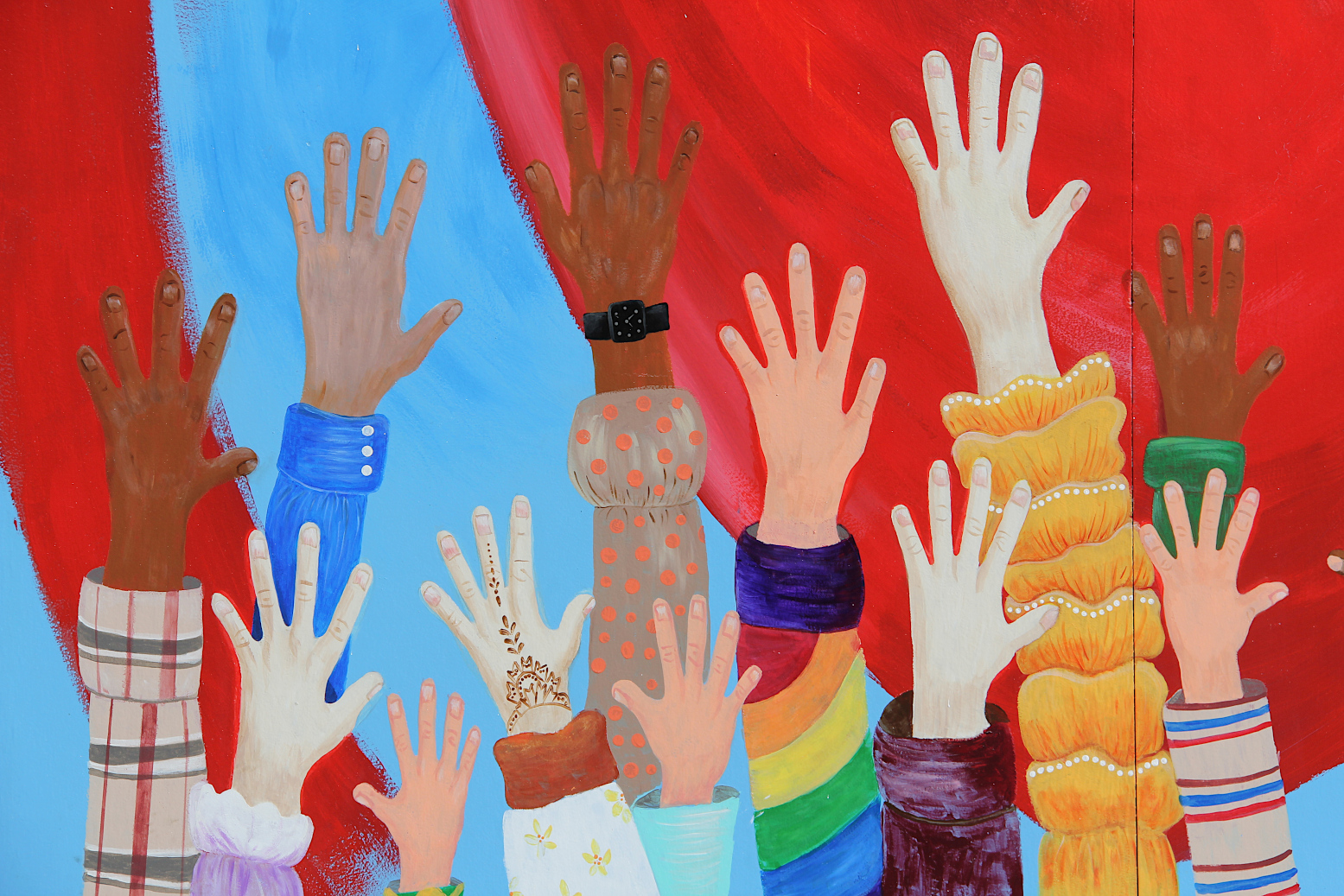
Some places are culturally-diverse, others not. This new mural at the Congregational Church of Faribault United Church of Christ reflects Faribault’s diversity. (Minnesota Prairie Roots copyrighted file photo September 2025)
I GREW UP in southwestern Minnesota, in rural western Redwood County where diversity was absent unless you count religious affiliation or ancestry as diversity. You were either Lutheran or Catholic with a few Methodists, Presbyterians and Brethren thrown in the mix. And you were of German, Irish, Polish or Scandinavian descent, but mostly German. And your skin color was certainly white, unless you were among the Native Americans living on the eastern side of the county.
I left Redwood County for college in the early 1970s. Not much has changed in racial demographics in that rural area, population hovering around 15,000, with the exception of a sizable Hmong population resettling in small town Walnut Grove. Leaving the prairie, a place I loved and still love, broadened my perspectives.
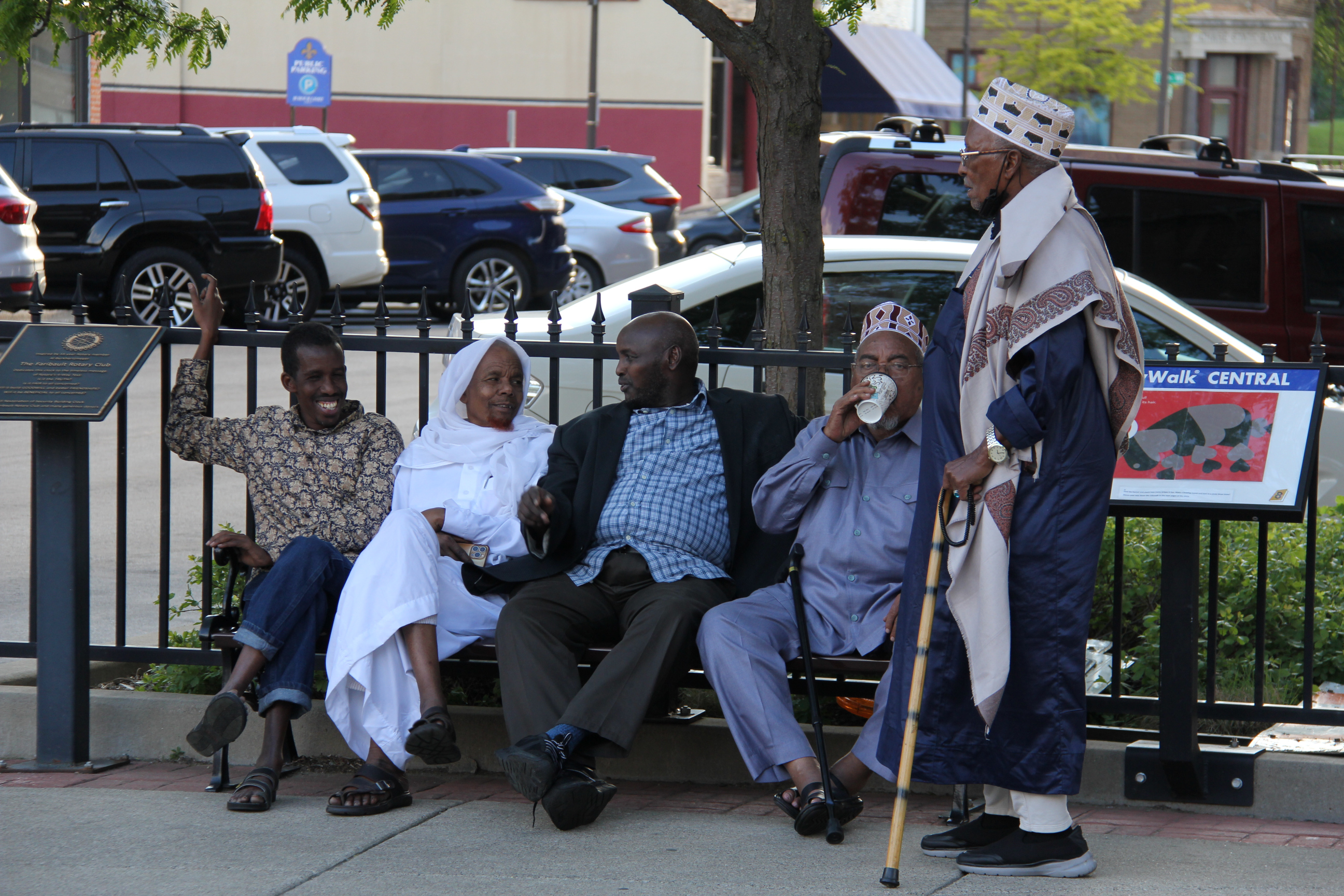
Many Somalis live in downtown Faribault above businesses. They often meet on street corners to visit. (Minnesota Prairie Roots copyrighted file photo May 2024)
Today I live on the eastern side of Minnesota in Faribault, a city of around 25,000 about an hour south of Minneapolis. Mine is a diverse community, home to many Hispanics, Latinos and Somalis. They work here, raise families here, open businesses here and add much color and culture to this city I’ve called home since 1984. Somalis are the newest of Faribault’s immigrants and the group which still struggles with animosity toward them. That makes getting to know them and their stories especially important.
Lul Abdi shows off beautiful wood crafts from Kenya and Somalia at a past International Festival in Faribault (Minnesota Prairie Roots copyrighted file photo)
I’ve attended Somali cultural events, diversity celebrations, talked with local Somalis, photographed them, drank their delicious hot tea, eaten their savory sambusas, walked into their shops, tried to learn about and embrace these residents of Faribault.
I love living in a community with such diversity. Not everyone here feels as I do and would prefer Faribault remain white and non-diverse, as it was when they were growing up. That saddens me. I often think, if only people would take the time to connect one-on-one, to listen, they would begin to see that we are all human, even if different.
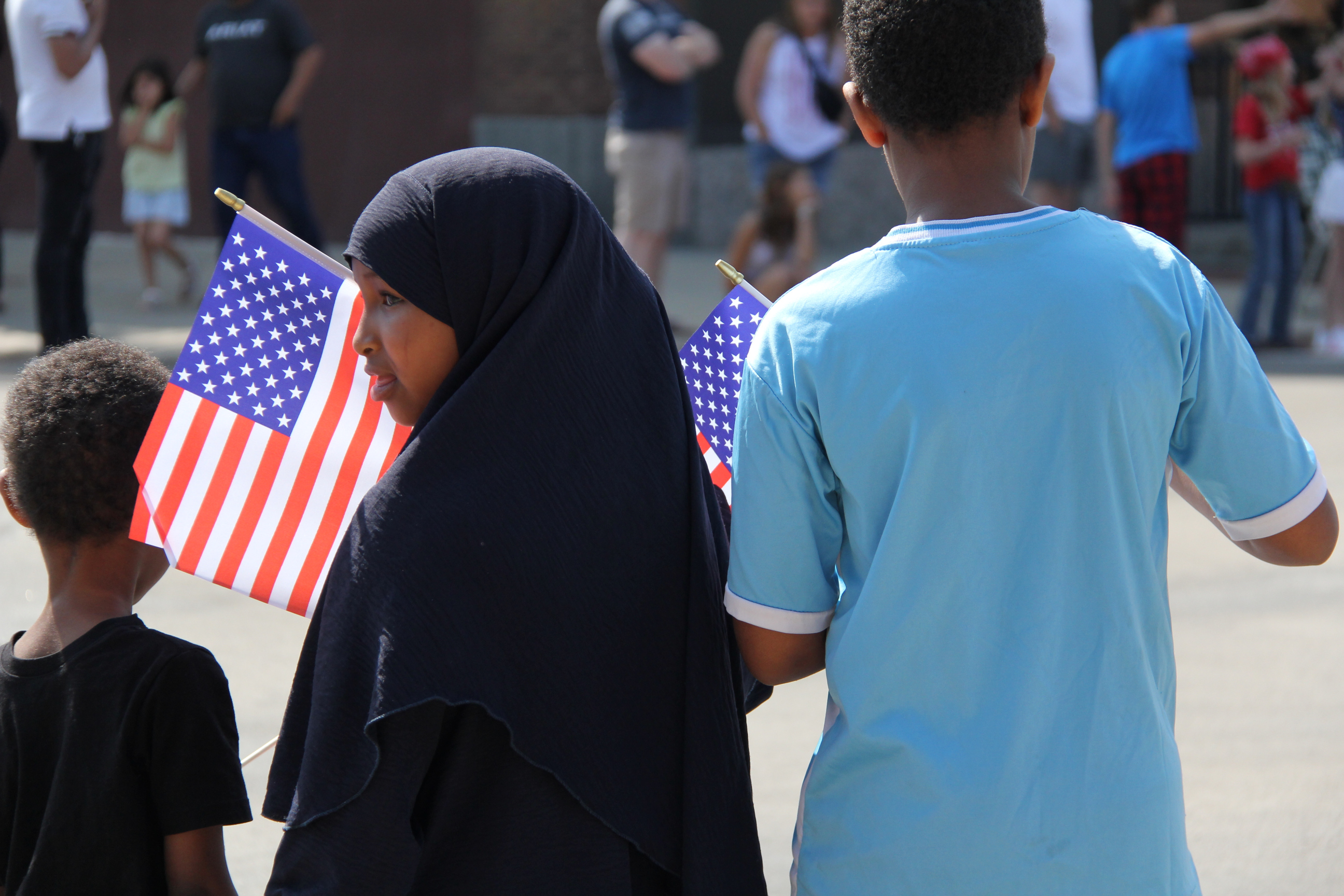
Somali children watch Faribault’s 2025 Memorial Day parade. (Minnesota Prairie Roots copyrighted file photo May 2025)
Instead of fearing others who may not speak the same language, eat the same foods, wear the same clothes, practice the same religion, we can choose to embrace one another. In an ideal world, that would happen. But it takes time, effort and an open heart and mind to get there.
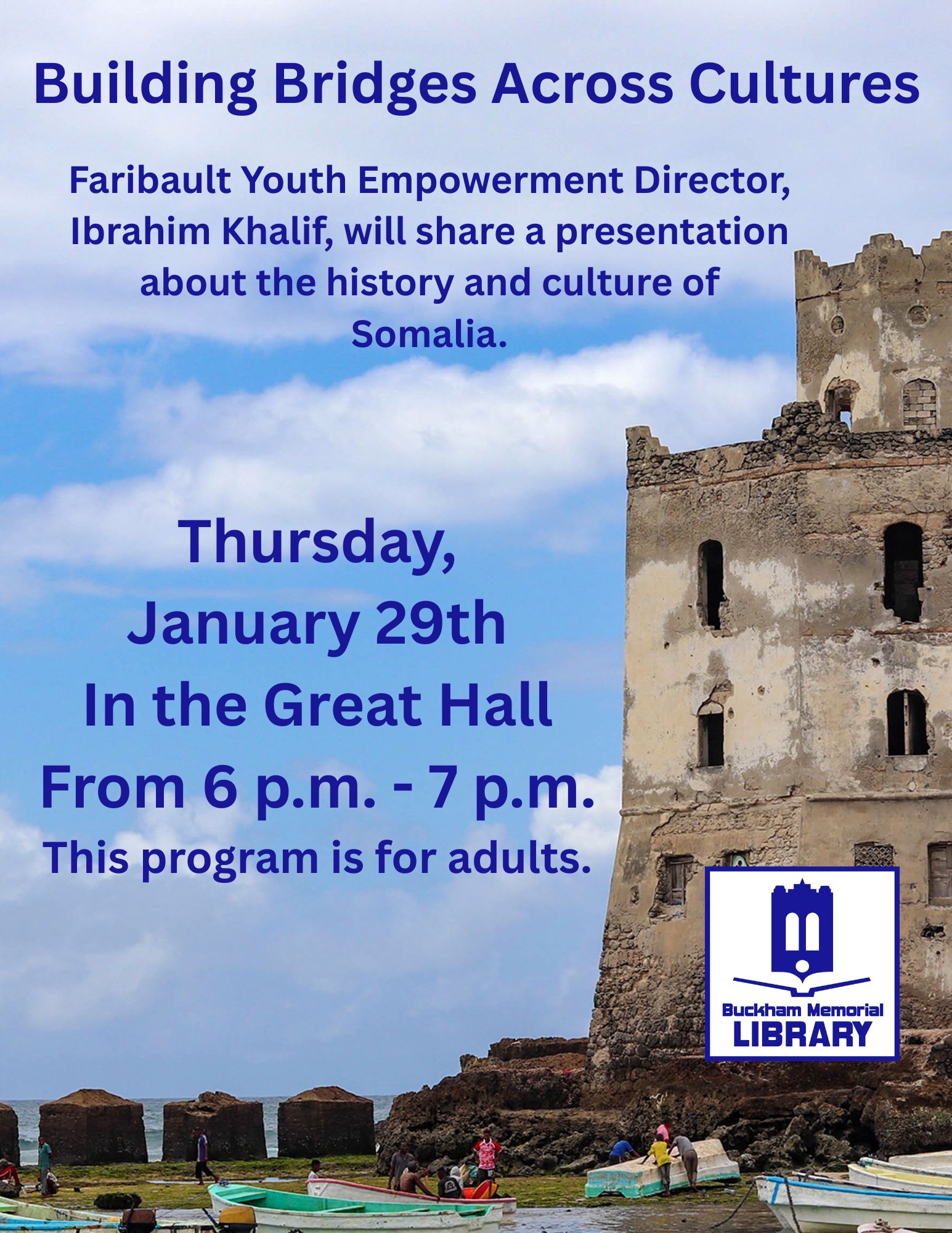
(Promo courtesy of Buckham Memorial Library)
At 6 pm this Thursday, January 29, Buckham Memorial Library is hosting a talk, “Building Bridges Across Cultures,” by Ibrahim Khalif, director of Faribault Youth Empowerment. He will present on the history and culture of Somalia in the library’s Great Hall. The event is part of the library’s adult programming efforts.
This talk is certain to be interesting and informative. The title alone, with the words “building bridges,” reflects my feelings on what needs to happen in my community. A bridge gets you from one side to the other, to a different destination. But to get from one side to the other, you need to first build a bridge together then willingly cross it, not remain firmly planted and divided on a riverbank, unwilling to move.
Among the many hands of the Faribault community, painted in a mural. (Minnesota Prairie Roots copyrighted photo September 2025)
WHAT ARE WE without community? The answer: alone.
We, at our very core, need each other. In times of celebration. In times of challenges. Even in times of great division. Without friends, family, neighbors and others, we are but individuals without community.
This mural was painted for and placed outside the Congregational Church in Faribault. (Minnesota Prairie Roots copyrighted photo September 2025)
And in Faribault, among the many murals adorning public spaces in the downtown area, one piece of art stands out as representing community. That is a free-standing mural placed on the west side of the Congregational Church of Faribault United Church of Christ this past summer. It seems an appropriate focal point to end 2025 and begin the new year.
The artwork, created by Shirley Rainey and her son Jason, features outstretched arms rising from the earth against a backdrop red heart and blue sky. “The mural represents the importance of coming together to share burdens and triumphs, while reaching for our highest selves,” Rainey said in an artist’s statement.
Henna painted on a hand reflects Somali culture. (Minnesota Prairie Roots copyrighted photo September 2025)
I see that in the mural. But I also see a community of diversity. The Raineys show that in assorted skin tones, clothing, hand sizes and even henna painted on a hand. I love that about this art, this intentional, varied depiction of Faribault as it is—gloriously diverse.
That said, I am well aware of the racial tension (and that’s a tamped down word) in my community. I wish it didn’t exist, that we all got along, welcomed and embraced one another. We are, after all, just people who live, love, work, play, laugh, cry… The list of commonalities we share as humans goes on and on. Yes, we are different, too. But differences seen as negative, those we create.
The diverse hands of Faribault, up close, in the new community mural. (Minnesota Prairie Roots copyrighted photo December 2025)
We can learn from that church painting. We can choose to love one another, as portrayed in the over-sized backdrop red heart. We can stand side-by-side and raise our hands to help one another. We can see, in those arms stretched skyward, the possibilities in building community. In that blue sky, we can envision not only our personal dreams, but the dreams of all who call Faribault home.
Faribault is a multi-cultural community, always has been. From early settlement days to today, people have come here from around the world to start anew. Whether French, Irish, German, Scandinavian, Latino, Asian, Sudanese, Somalian or any of many other ethnicities, this place has become home. We can choose to create community or not.
I hope in 2026 that Faribault can build a better, stronger, more unified community which celebrates our commonalities, and our differences.
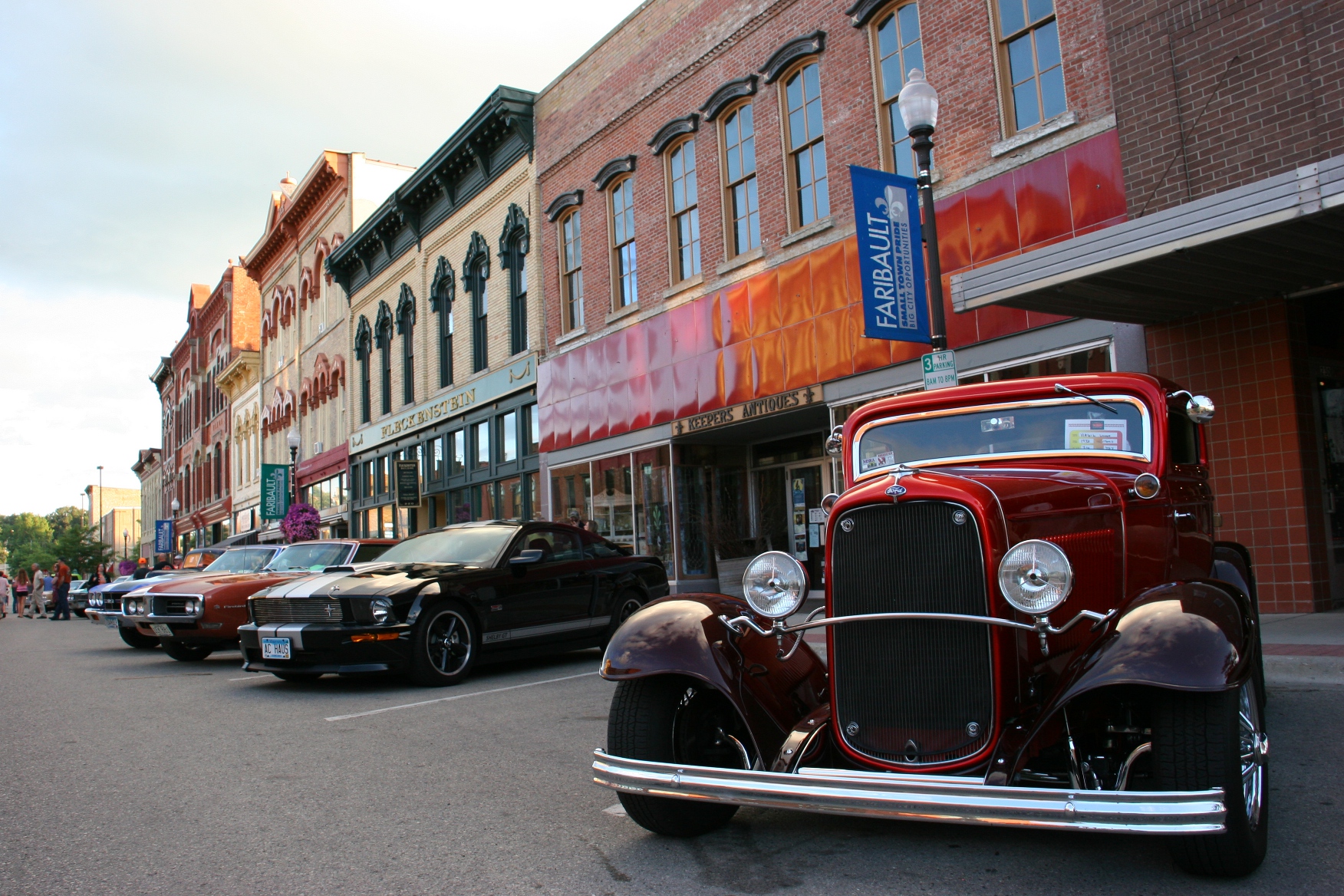
This photo, taken during a car show in downtown Faribault, shows the diversity of my community. (Minnesota Prairie Roots copyrighted file photo)
WALK THROUGH THE HEART of downtown Faribault and you’ll see diversity. Diversity in businesses. Diversity in the people who live here. It’s a beautiful thing, at least to me.
A banner in Faribault’s historic district features a vintage photo outside a local business. (Minnesota Prairie Roots copyrighted file photo)
We need only look back to the founding of Faribault to understand the diversity which existed from the very beginning. Immigrants from around the world settled here, set up shop, engaged in business and grew this community. The shoemakers. The brewers. The furniture builders. The general store proprietors. The barbers. And on and on. They were as diverse as their skills. They shaped this place.
Faribault is the richer for those individuals and families who left their homelands, crossed the ocean, bringing their hopes and dreams to America. With the exception of Indigenous Peoples, we can mostly all trace our ancestry to a land a long ship ride away.
Somali men visit in downtown Faribault. My community is home to a sizeable Somali population, some of whom live downtown. (Minnesota Prairie Roots copyrighted file photo 2024)
Today our newest Faribault residents arrive mostly by plane. From Somalia. From Sudan. From Venezuela. From Mexico. And elsewhere. Many have fled worn-torn countries. Unimaginable atrocities. Their losses, their heartache, their pain is beyond what anyone should have to endure. But they have managed. They settle in, set up shop in our community, work in our local factories gutting turkeys and more, shingle our houses, cook and serve us their delicious cuisine… They work hard to rebuild their lives here in southern Minnesota. And I am glad to have them here as an integral part of my community.
Among the colorful merchandise at Mercado Local. (Minnesota Prairie Roots copyrighted file photo 2024)
In neighboring Northfield, a downtown shop, Mercado Local, vends the art, crafts and more of artisans from Latin America and Hispanic backgrounds. Under the umbrella of Rice County Neighbors United, a nonprofit supporting the immigrant and refugee communities of Northfield, Mercado Local has flourished, serving as a marketplace, arts center (I’ve read poetry here) and community gathering space.
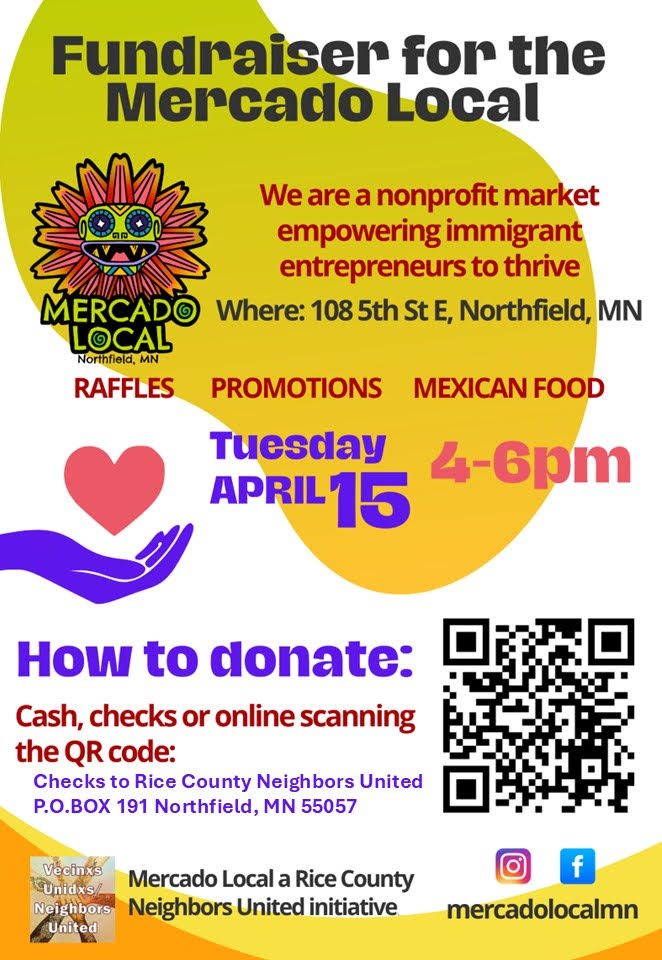
(Promo courtesy of Mercado Local)
From 4-6 p.m. Tuesday, April 15, Mercado Local is hosting a fundraiser for this nonprofit which aims to “empower immigrant entrepreneurs to thrive.” There will be updates, raffles, promotions, Loteria (like BINGO) and, of course, Mexican food. Even if you can’t make the event, I encourage you to pop into the marketplace. Just being inside this small space with all its colorful art and wares makes me happy. That’s one of the things I appreciate about Hispanic and Latino culture—the vivid colors. And I rather like the food, too.
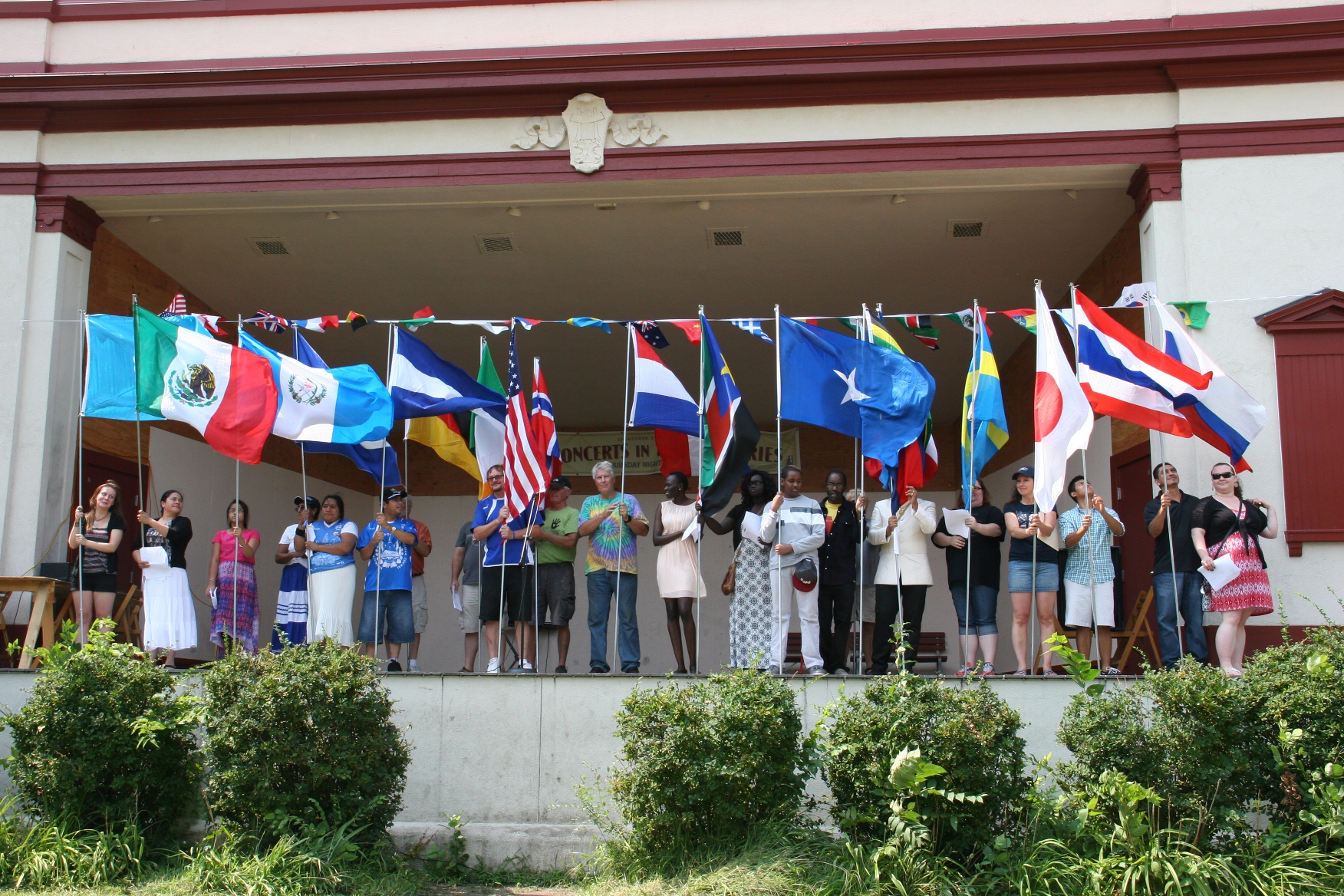
A flag ceremony at a past International Festival in Faribault featured national anthems and information about some of the countries from which Faribault residents have originated. (Minnesota Prairie Roots copyrighted file photo)
To have a diverse community is to experience the world up close, to widen our circle and understanding of others. Yet, no matter our skin color, our language, our customs, our dress, our roots, we are all just people. Individuals who laugh and cry and love and live. Now, together, we are growing our communities in new, exciting and diverse ways, just like those who crossed the ocean all those years ago to settle in America.
Former Faribault Daily News reporter Pauline Schreiber photographed these Faribault POW camp barracks shortly before they were torn down in 1990. (Photo courtesy of the Rice County Historical Society)
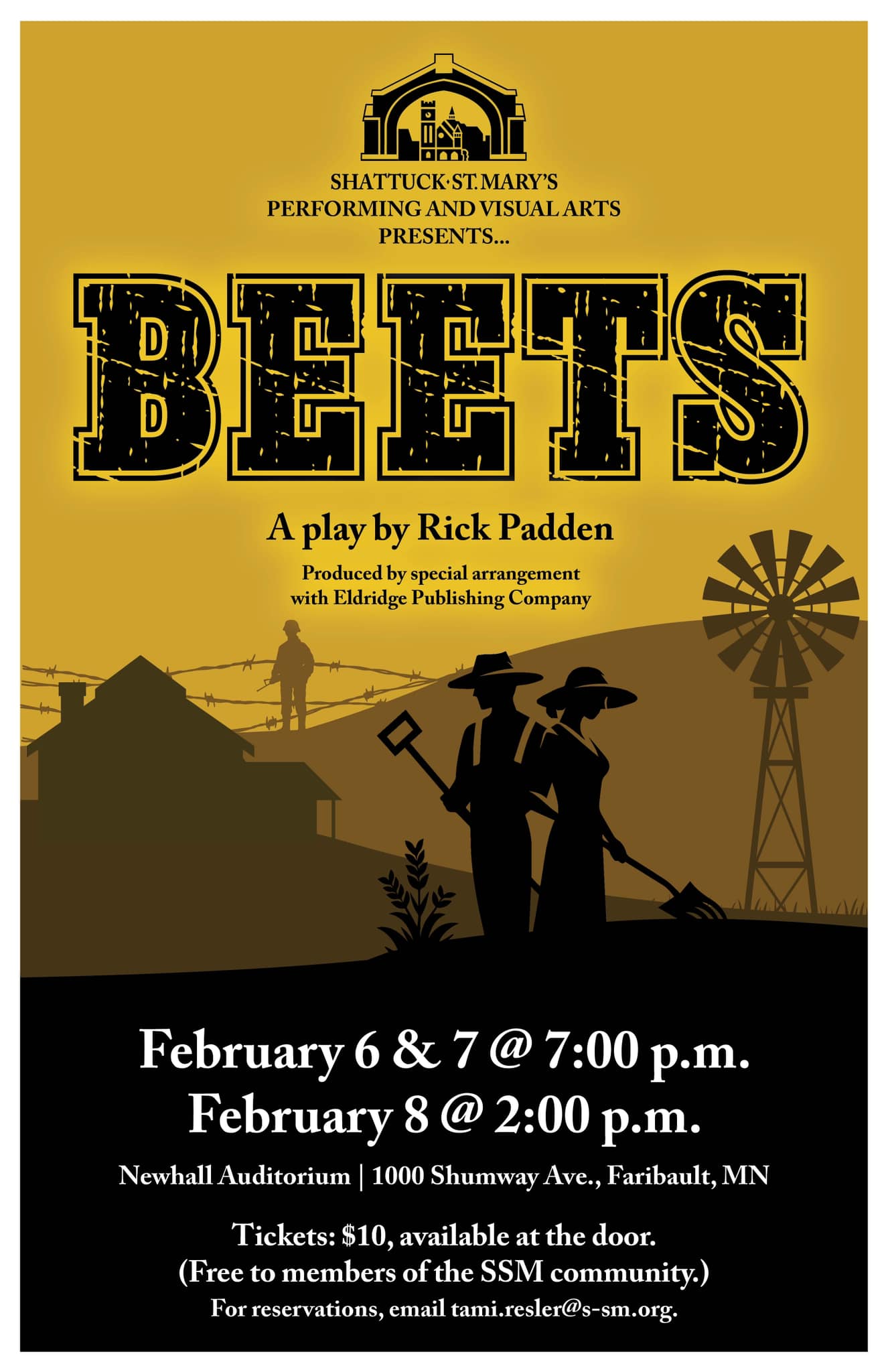
A promo for “Beets.” (Credit: Shattuck-St Mary’s School Facebook page)
Thursday evening, I sat in the sparse audience of the historic Newhall Auditorium on the campus of Shattuck-St. Mary’s School, a private college prep school on Faribault’s east side, watching a story unfold in the theatrical production, “Beets.” An incredibly talented nine-member student cast immersed themselves in the roles of a farm family, German POWs, guards and a family friend to share a bit of history. And much more.
This play about POWs working on the Hunt family’s sugarbeet farm is more than a retelling of history. It is also about relationships, fear, culture and love. It is about the perceived differences that divide us and about the commonalities that unite us.
This is a play for our times. In a nation today divided by politics, by fear, by hatred and animosity, “Beets” is absolutely relatable.
As the storyline evolves, conflicts arise. Farmer Fred Hunt spews his hatred of the Germans. His wife, Isabelle, exudes compassion and love. And their daughter, Anna, settles somewhere in between, leaning initially toward dislike and distrust of the German POWs who have come to work her father’s land. Anna’s thoughts often turn to her brother, Jake, fighting the Germans abroad.
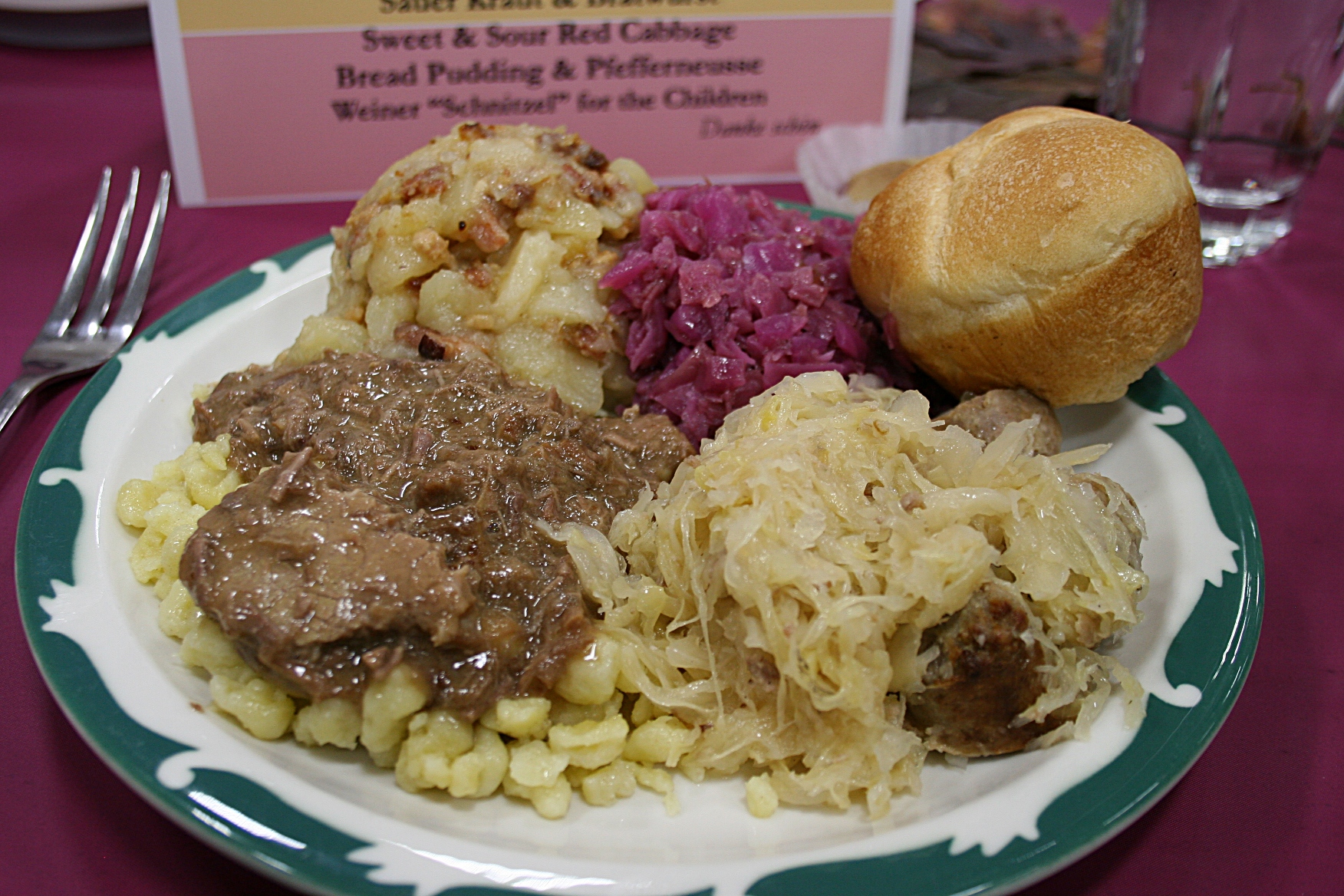
A German meal: sauerbraten and spaetzle on the left, German potato salad, sweet and sour cabbage, dinner roll and sauerkraut and brats. (Minnesota Prairie Roots copyrighted file photo)
Slowly, interaction by interaction, things begin to change. The American farm family and the German prisoners realize they share a love of Bach. (Yes, a German composer.) And while the German POWs profess they will never eat corn, because that’s for pigs and cows—although Anna explains the difference between corn for livestock and sweetcorn—they all understand that they need to eat. The scenes in which Anna and Isabelle serve potatoes and cake to the POWs show how food brings people together. Trust grows. When Fred learns details about POW Dieter Meuhler’s family, he begins to understand the personal side of a man he saw only as an enemy. The walls of distrust, disdain and differences start crumbling, albeit slowly.
It is not lost on me that the Shattuck performers are themselves of diverse backgrounds. That only adds to the performance.
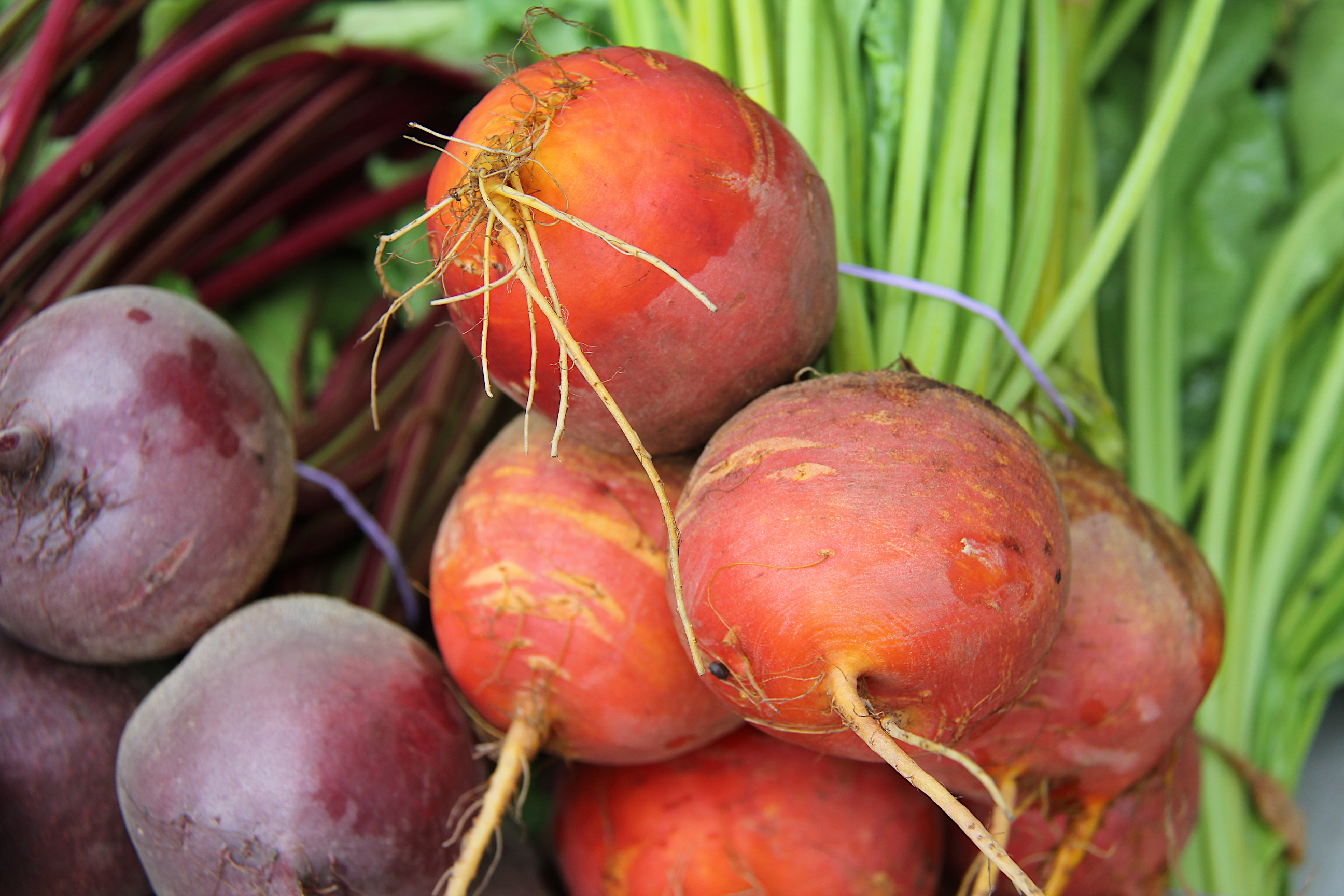
There are differences in beets (these are not sugarbeets), just like in people. (Minnesota Prairie Roots copyrighted file photo)
There are lessons to be learned from “Beets,” written by Rick Padden. First, we are all, at our core, just human beings with the same basic needs. Secondly, to overcome differences, we need to connect on a personal level. We need to open our hearts and minds, to embrace cultural and other differences. We need to show compassion and care, as farm wife Isabelle Hunt did on stage. We need to recognize that love is universal, as Anna and Dieter discovered.
“Beets” is one of those plays I wish everyone could see, especially now in these challenging days. I left the theater at Shattuck-St. Mary’s feeling a sense of hope. The fictional characters in “Beets” changed, for the better. They opened their hearts and minds to each other, despite their differences, or perceived differences. Perhaps we can do the same.
#
FYI: Two performances of “Beets” remain at Shattuck, one at 7 pm Friday, February 7, and the second at 2 pm Saturday, February 8. It’s a two-hour show (includes a 10-minute intermission) I highly recommend to anyone who enjoys well-done theater, history and a play with strong messages relevant to today.
I photographed this tag hanging on The Gratitude Tree in the neighboring city of Northfield in 2019. I love this idea of publicly expressing thankfulness, including for community. (Minnesota Prairie Roots copyrighted file photo July 2019)
WHEN CONSIDERING GRATITUDE, as we do this week, we usually look inward. But I want to look outward and share six reasons why I feel grateful to live in Faribault.
This is my all-time favorite image showing local diversity. Here children gather to break a pinata during an international festival at Faribault’s Central Park. (Minnesota Prairie Roots copyrighted file photo 2012)
PEOPLE make a community. I knew no one when I moved here as a newlywed in 1982. But I was welcomed and have since formed deep friendships in Faribault. I can walk into a business, attend an event, or simply be out and about and run into someone who knows me. Conversation often follows.
Recently I attended a 75th anniversary open house at Burkhartzmeyer Shoes, a third-generation family owned shoe store in downtown Faribault. After purchasing athletic shoes, I headed to a back room for complimentary refreshments. A small group of us sat there talking and laughing, simply enjoying each other’s company. I felt like I was inside a small town cafe drinking coffee and conversing. It felt that down-home comfortable.
But I can feel just as comfortable with strangers, including Adolfo, whom I met in October while walking in Central Park. Adolfo moved to America from Venezuela, a country he fled because of Communism and violence. On this morning, he was pushing his one-year-old grandson in a stroller. It’s part of their daily routine. Darling Milan drew me to his grandpa, where I connected with Adolfo on a personal level and heard his story. I feel grateful for every opportunity I have to meet Faribault’s newest immigrants and hear their stories, stories often laced with hardship and hope. To live in a city as diverse as Faribault is truly a gift.
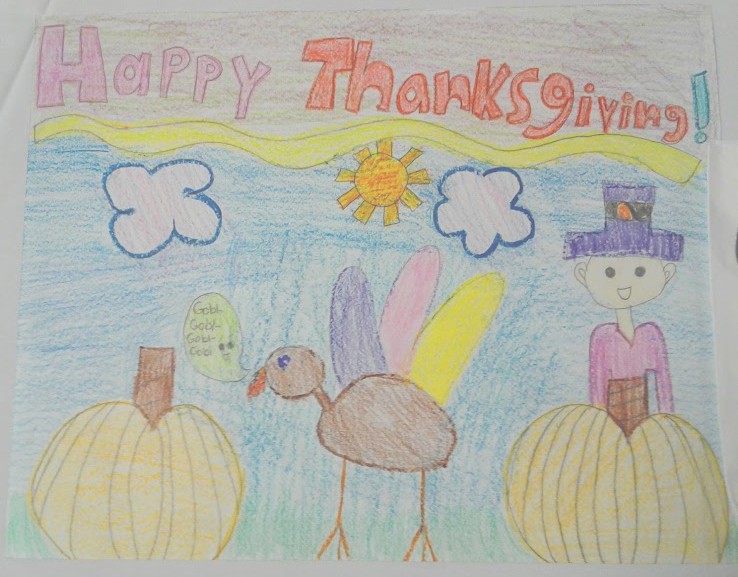
Kids help at the Faribault CommUnity Thanksgiving Dinner by, among other things, creating festive placemats.(Minnesota Prairie Roots copyrighted file photo November 2017)
Faribault overflows with CARING INDIVIDUALS AND ORGANIZATIONS striving to help others: the Community Action Center, Rice County Habitat for Humanity, St. Vincent de Paul, HOPE Center, Ruth’s House, IRIS (Infants Remembered in Silence), the Salvation Army, Operation: 23 to 0… I’ve received support while dealing with some especially challenging life events. When you experience that community love and care first-hand, you understand the true meaning of community.
Once again this Thanksgiving, volunteers will serve a free CommUnity Thanksgiving Dinner as they have for the past 30 some years. I’ve previously helped deliver those holiday meals. Every Tuesday, a free meal is also available at the Community Cafe. With Christmas approaching, I’m part of a bible study group coordinating the annual Angel Tree (gift giving) at my church. I could go on and on with an endless list of how people are helping people in my community. Hearts are loving, spirits giving.
A 1950s scene along Faribault’s Central Avenue is shown in this downtown mural.(Minnesota Prairie Roots copyrighted file photo)
I am especially grateful to live in a community which values THE ARTS. The Paradise Center for the Arts in downtown Faribault centers our arts scene. Every time I tour a gallery exhibit, attend a play or otherwise engage in the arts, I feel grateful to live here. I’ve even contributed to the local arts scene by publicly reading my poetry. I love attending summer concerts in the park and concerts inside the historic Cathedral of Our Merciful Saviour. I appreciate the history-based murals that color our downtown. I grew up in rural southwestern Minnesota with minimal access to the arts, meaning my gratitude for the arts in Faribault runs deep.
I treasure Buckham Memorial Library, just blocks from my home. (Minnesota Prairie Roots copyrighted file photo 2022)
My thankfulness for BUCKHAM MEMORIAL LIBRARYalso runs deep, for the very same reason. I grew up in a small farming town without a library. And I love to read. That we now also have a volunteer run used bookstore, Books on Central (benefitting the Rice County Area United Way), notches my gratitude level even higher.
A snippet of Faribault’s historic buildings, photographed during a monthly Car Cruise Night.(Minnesota Prairie Roots copyrighted file photo 2016)
The bookshop is located in the heart of our HISTORIC DOWNTOWN, another reason I feel grateful to live in Faribault. My community cares about preserving historic buildings. I love old architecture. There’s nothing quite like walking among vintage vehicles along Central Avenue during Car Cruise Night as the sun sets at the end of a summer day. Beautiful.
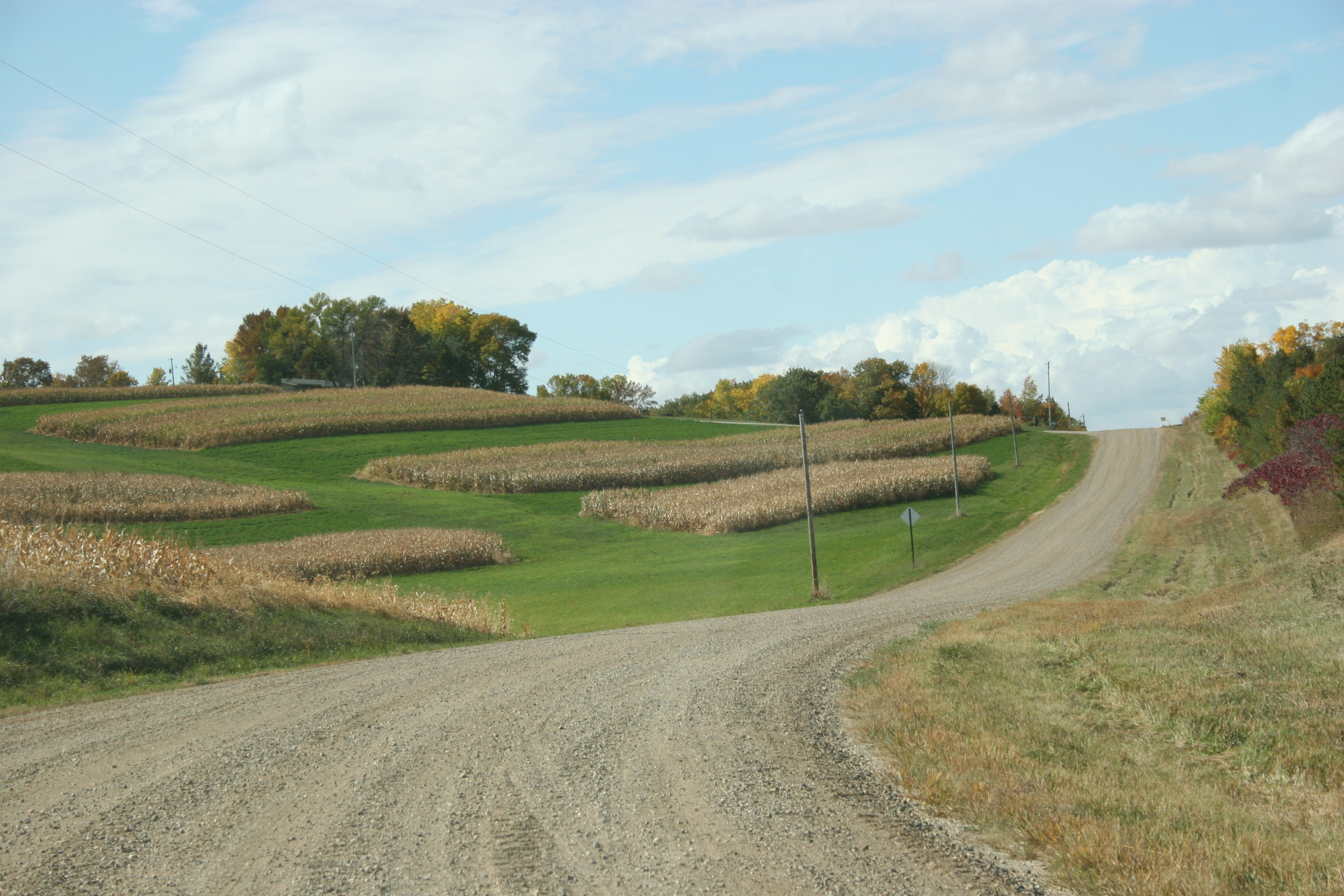
In just minutes, I can reach the countryside, where I love to travel gravel roads. This road winds among the lakes and farm fields west of Faribault. (Minnesota Prairie Roots copyrighted file photo October 2022)
Faribault also offers incredible NATURAL BEAUTY in a diverse landscape of woods and prairie, hills and valleys, ravines and bluffs. It’s so different than my native prairie. Admittedly, it took me a while to “get used to” all the trees when I moved here 42 years ago. I still mostly have no sense of direction on roads and streets that don’t run prairie grid straight. But I love to walk through city parks, along city trails, at River Bend Nature Center, on the campus of the Minnesota State Academy for the Deaf… And within a short drive of my home, I am immersed in the countryside.
A view of The Gratitude Tree outside the Northfield Public Library in 2021. People wrote their reasons for feeling thankful on a blank tag. Those were then hung on the tree. I’d like to see a Gratitude Tree in every community once a year. (Minnesota Prairie Roots copyrighted file photo May 2021)
This list of a half dozen reasons to feel thankful for the place I call home just touches the surface of why I am grateful to live in Faribault. It’s not utopia, certainly. Nowhere is. But today I want to pause, consider and acknowledge specific reasons for feeling thankful that Faribault is my home. I hope you’ll do the same, wherever you live.
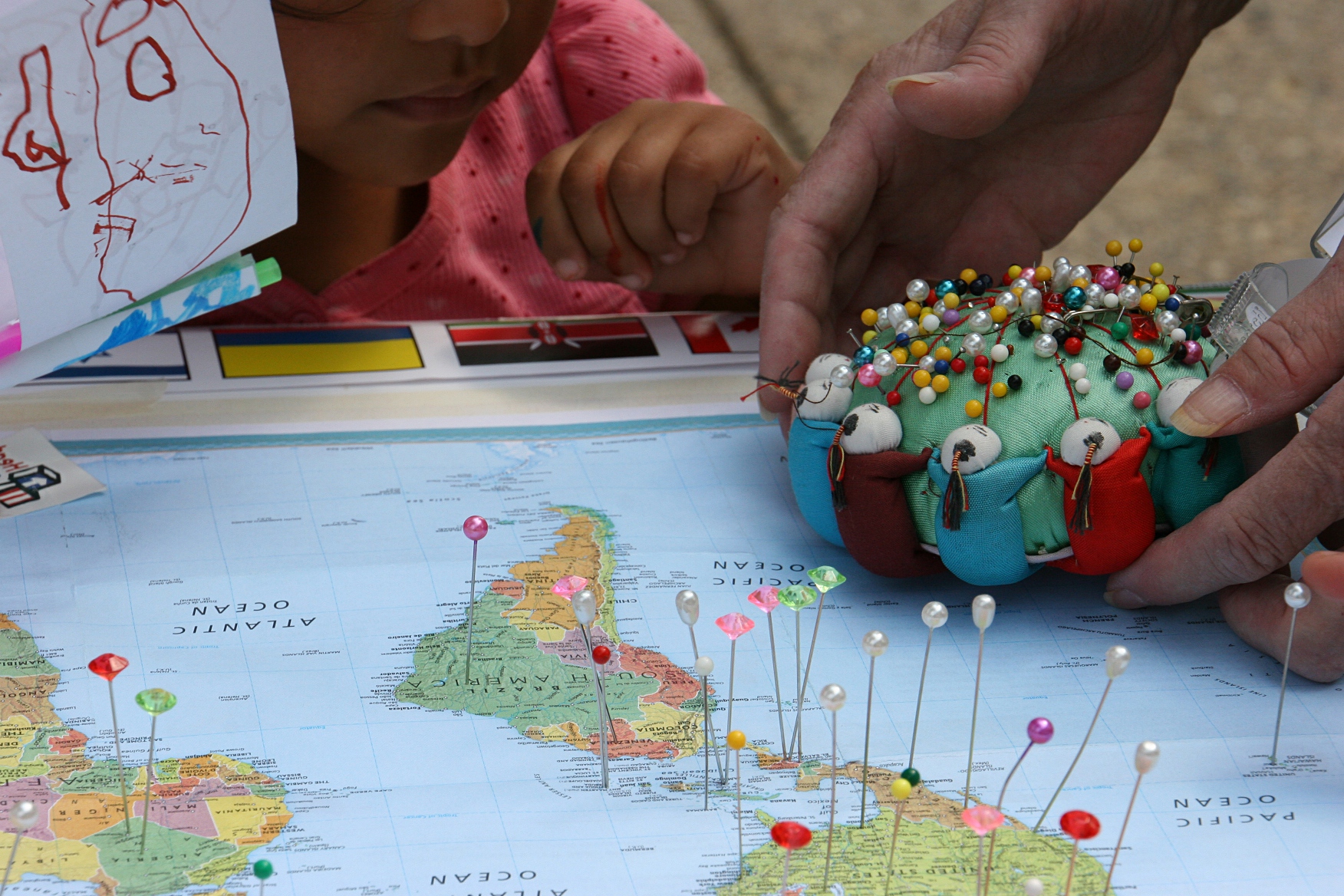
Faribault is home to people from many countries as noted on this interactive map at a past International Festival in Faribault. (Minnesota Prairie Roots copyrighted file photo)
TWO DAYS. TWO CONVERSATIONS. And I am the richer for meeting Adolfo and Jose and hearing their stories.
I should backtrack a bit and state that for me to strike up conversations with people I don’t know is not unusual. Such interactions widen my world, broaden my understanding and simply help me learn more about others.
It was little Milan, Adolfo’s one-year-old grandson, who initially drew me to pause during a morning walk through Faribault’s Central Park. Adolfo was pushing Milan in an umbrella stroller when Randy and I crossed paths with them. Milan, with his big brown eyes, black hair and radiant smile, is the essence of cuteness. Cute babies and kids are always a reason to stop and chat.
The pair walk through the park every morning as Adolfo cares for Milan while his mom is at work. I don’t recall whether Mom is Adolfo’s daughter or daughter-in-law. Doesn’t matter. What matters is the deep love Adolfo has for family and his willingness to care for his grandson before heading to work in the afternoon.
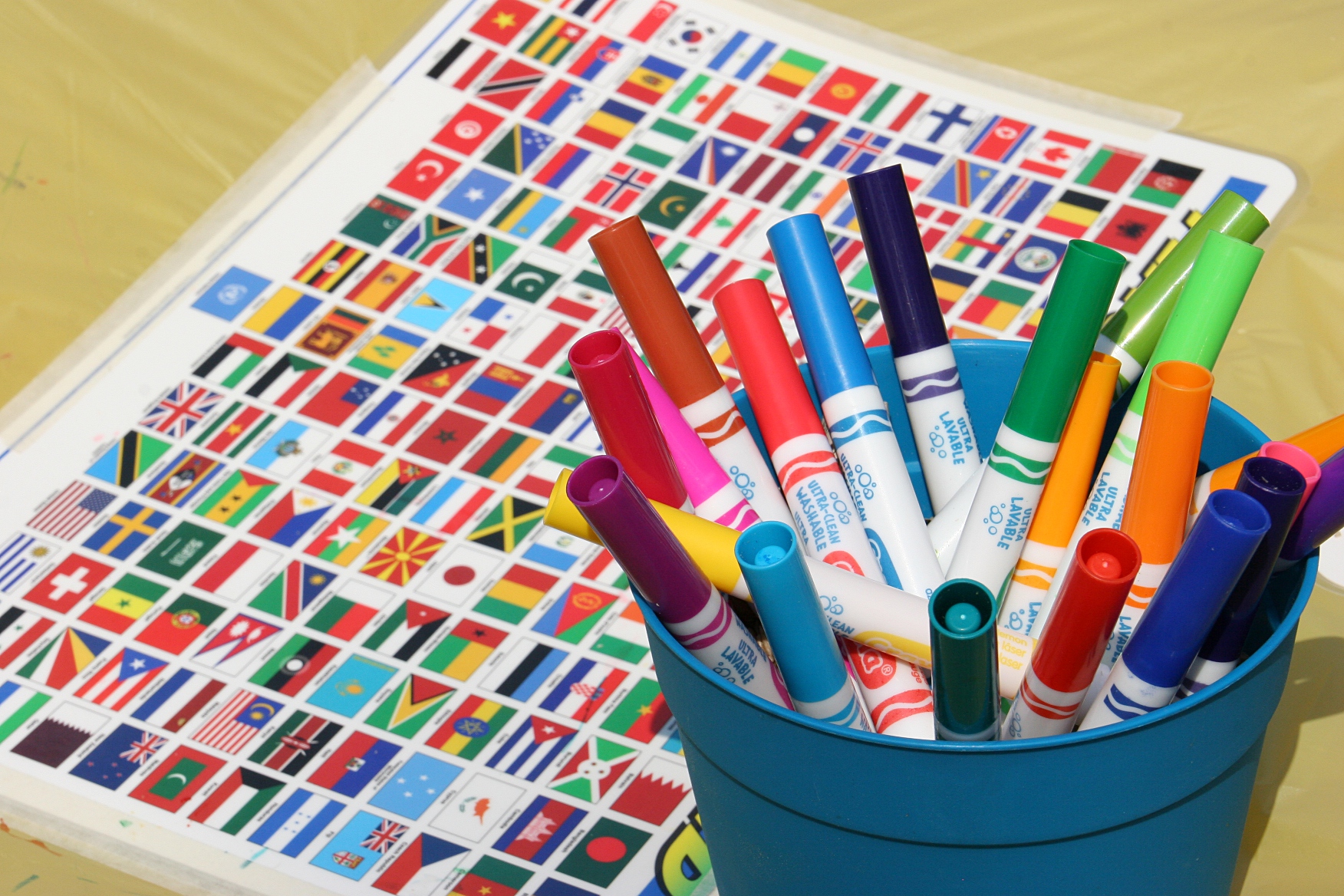
Kids used markers to create flags from their native countries while attending the local International Festival. (Minnesota Prairie Roots copyrighted file photo)
ESCAPING COMMUNIST VENEZUELA
I asked Adolfo about his background, what brought him to Faribault. He moved here from Orlando to be with family. But he’s originally from Venezuela. His home country, he said, is not a good place to live. The reason: Communism and violence. He left family behind and desperately wants them here, safe in America.
By that time, little Milan was out of his stroller, pushing it, then dropping to the ground, his pants covered in bits of dried leaves, his tiny hands clasping two Matchbox cars. He is close to walking alone. Milan proved a distraction from the deep pain Adolfo obviously feels separated from his family still in Venezuela.
“We’re so happy to have you here,” I told my new friend. And I genuinely meant that as my heart hurt for this man who has endured so much already.
“God bless you,” Adolfo said, as he made the sign of the cross, held his hands to his heart.
Adolfo repeated our names several times, clearly an effort on his part to remember them. I repeated his, too, and Milan’s, and wished I knew Spanish. Adolfo spoke Spanish to Milan, who is being raised bilingual. What a gift to that little boy with the big brown eyes, with the loving family, with the Grandpa whom I consider kind, caring, loving and brave.
Children gather at Faribault’s Central Park to break a pinata during an International Festival. This photo placed first in a local photo contest and remains one of my favorite. I love that it reflects the diversity of Faribault and shows kids simply being kids with no thought of ethnicity. (Minnesota Prairie Roots copyrighted file photo)
FINDING A WELCOMING NEW HOME IN RURAL MINNESOTA
A day later I met Jose, a young man taking his lunch break at a park near Montgomery. He was working there for the Le Sueur County park system. Jose moved to nearby Le Center 15 years ago, having lived in California, Texas and Mexico. Like Adolfo, Jose is grateful to be here, with family. I told him how happy I am to have him living in Minnesota.
It didn’t take long before he opened up about how much he feels welcomed here, how he’s learned to love our four seasons, even winter. Jose shared about learning to drive in winter. And then he recounted being “baptized by black ice.” He walked onto the unseen ice and found himself flailing backwards. This part of Jose’s story included theatrical actions that left all of us laughing.
What a delightful young man. He’s hardworking, loves his family and likes living in a rural area. To hear that he’s found Minnesotans to be friendly pleases me. The reality is that not everyone welcomes individuals like Jose and Adolfo. I do.
I am the richer for having met these two men, whose life experiences and stories are vastly different than mine. Yet, we are the same. We have families and heartaches and hopes and dreams. That commonality connects us. And so does our humanity.
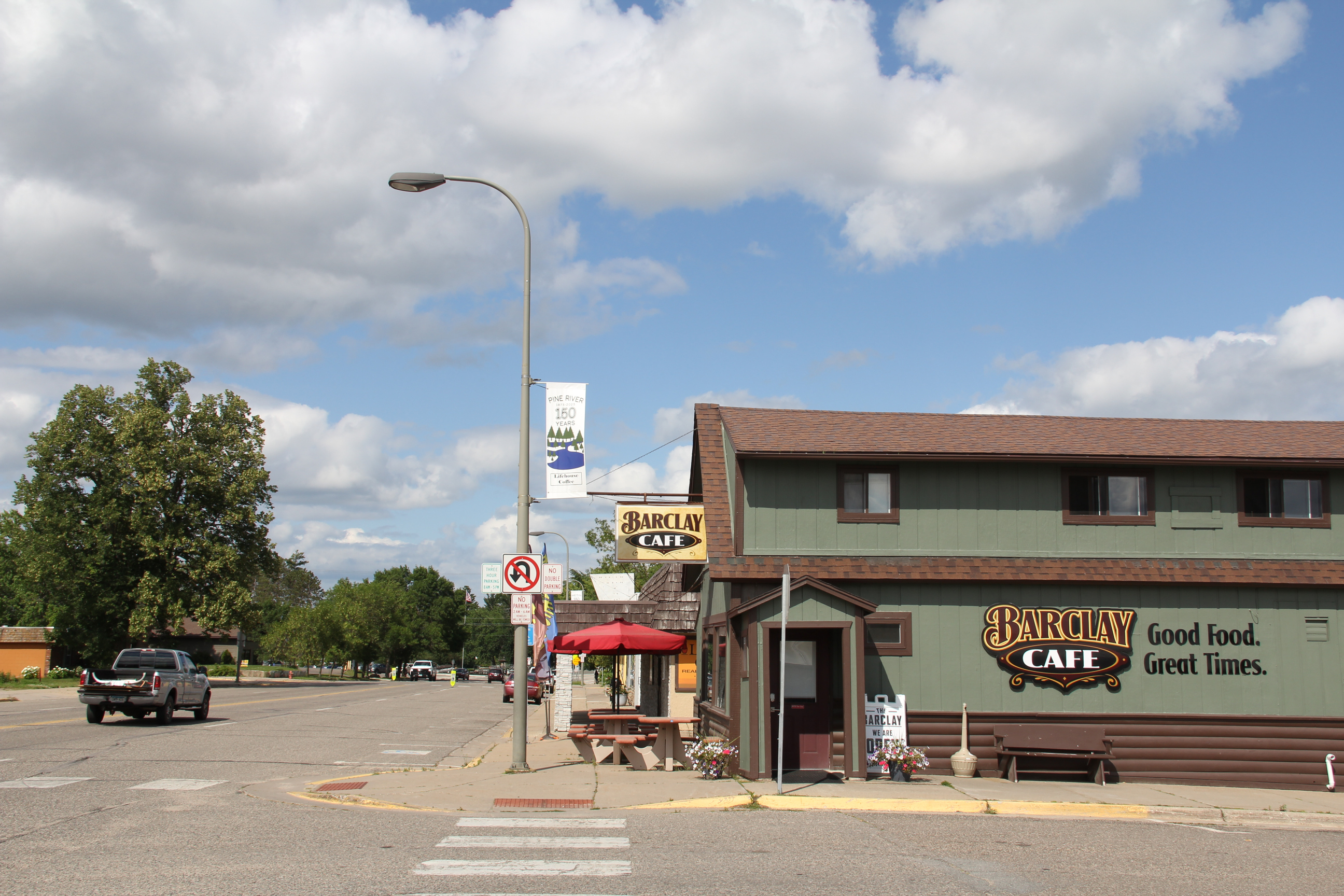
I photographed this scene in Pine River, which calls itself Minnesota’s S’more Capital, Doug Ohman said.From what I read online, the Whitefish Chain of Lakes terms itself “The S’more Capital of the World.” Pine River is on the northwest end of the Whitefish Chain. (Minnesota Prairie Roots copyrighted photo July 2024)
I FELT LIKE A BIT OF A SMARTIE, you know, that kid who raises his/her hand to answer the teacher’s questions. But Doug Ohman told me later, when I apologized to him for my overzealous class participation, that he actually appreciates enthusiastic interaction with audience members. And that I was on Monday evening while attending Ohman’s presentation on Minnesota town names at the Owatonna Public Library. I couldn’t help myself. This presenter is incredibly engaging, energetic, interesting and really good at what he does.
One of many Minnesota books by Doug Ohman. (Cover image sourced online)
Ohman is a prolific presenter, Minnesota author and photographer—he’s written 16 photo-rich books—who travels the state giving talks on 36 subjects. Those range from churches to schoolhouses, courthouses to libraries, state parks to cabins, and, oh, so much more. If you want to learn more about Minnesota, especially its small towns and rural areas, and appreciate history, then Ohman is your guy. I’ve seen him present twice previously, both times on churches.
But Monday evening, it was all about “Name That Town.” Ohman began by telling a room packed with people that he would be doing an interactive game show style presentation. Oh, oh, I thought, when he asked for help from an audience member. Eventually Steve volunteered and the game was on.
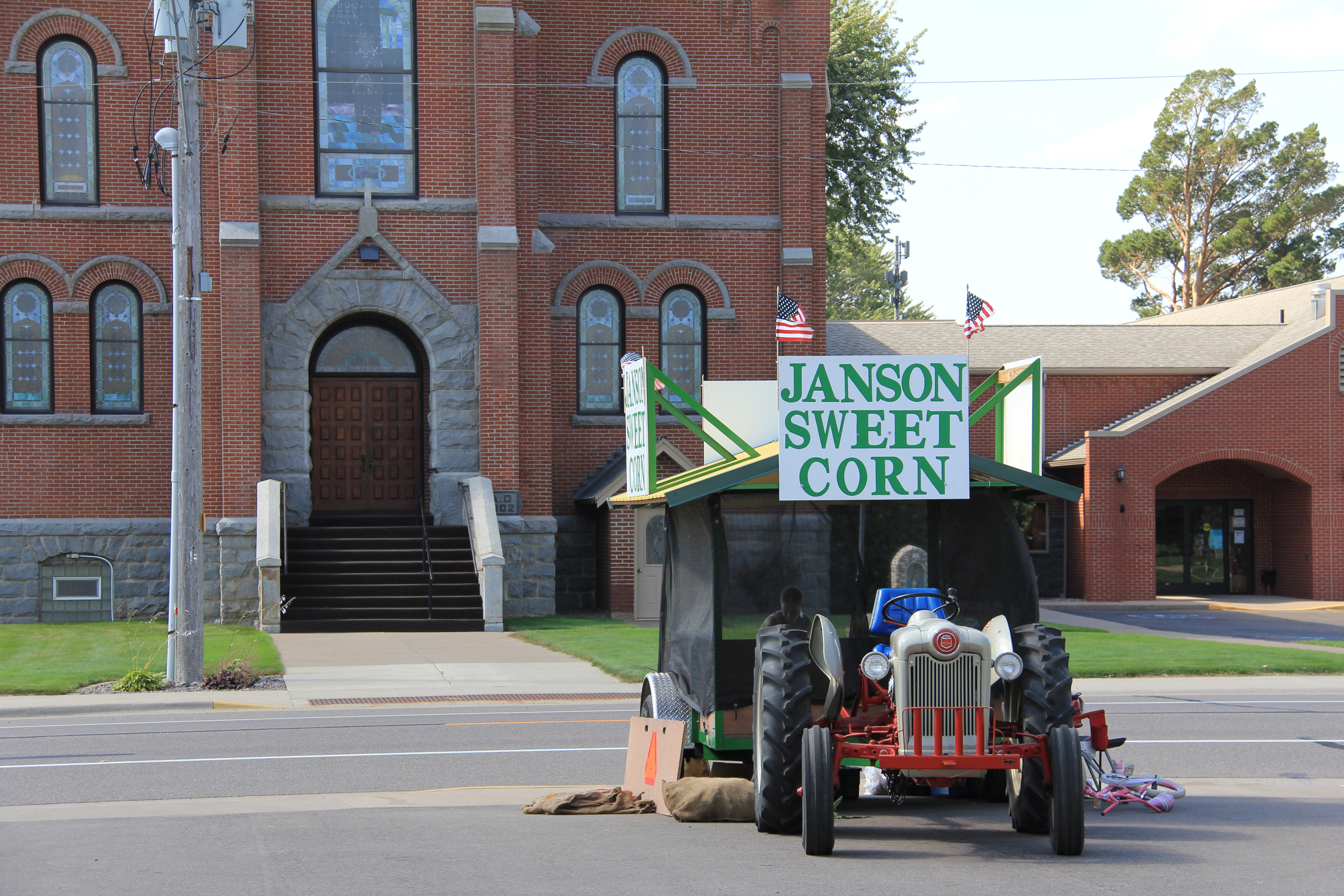
Sweetcorn for sale at a stand across from St. Michael’s Catholic Church in Buckman, my husband’s hometown. Buckman is southeast of Little Falls in Morrison County. (Minnesota Prairie Roots copyrighted photo September 2024)
It didn’t take long before Ohman put the audience at ease with his humor and questions. A lot of questions. About towns. And that’s where I proved my smarts. Like Ohman, I enjoy visiting small towns, stopping to explore and photograph them. He feels like a kindred spirit in that we are both writers and photographers who value rural Minnesota.
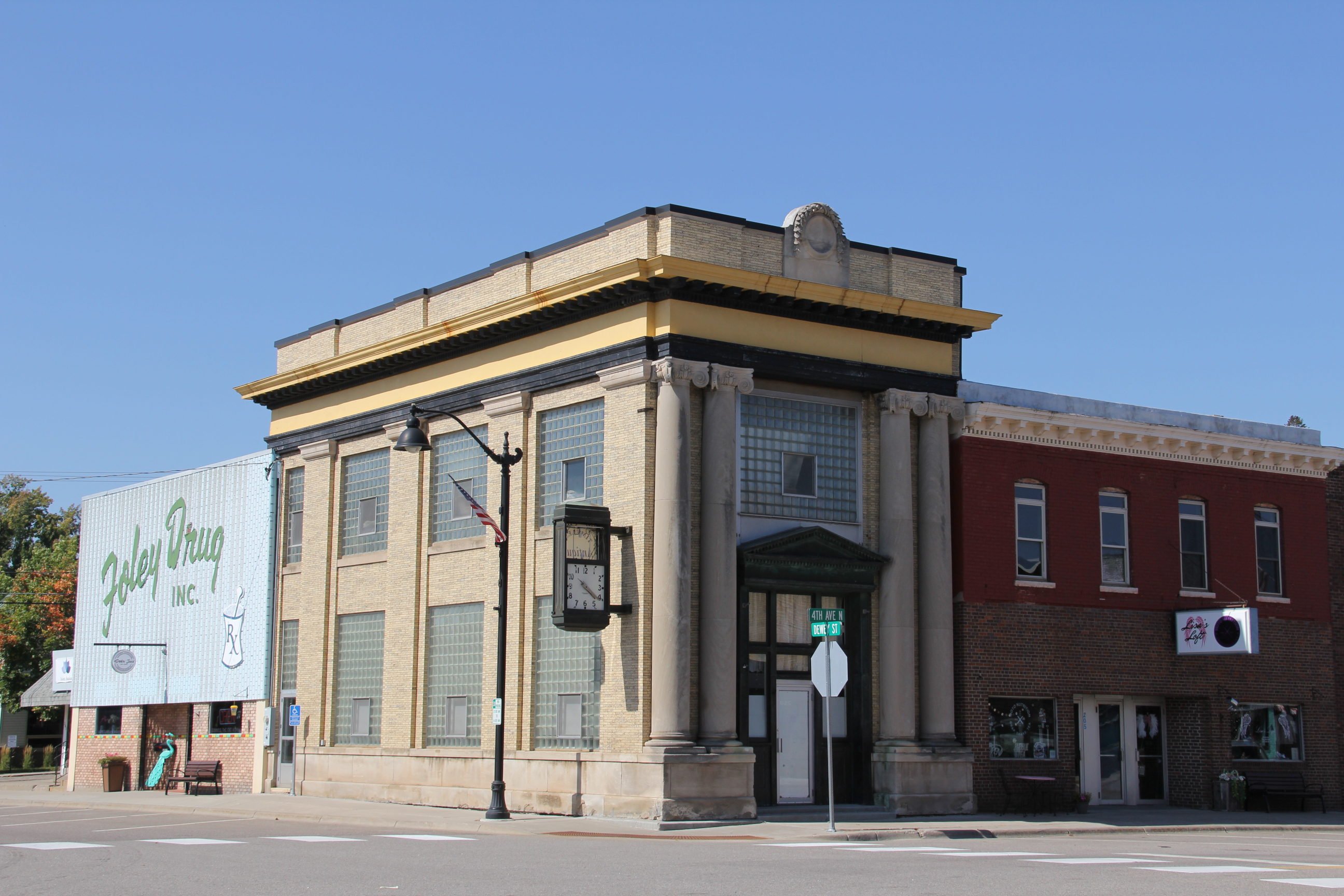
I recently photographed this beautiful old building in downtown Foley, seat of Benton County. (Minnesota Prairie Roots copyrighted photo September 2024)
For 1 ½ hours, Ohman talked about Minnesota towns, going through the alphabet from A-Z, showing selected photos of communities he’s visited. He invited audience members to shout out town names for each letter, often pausing to ask why they named that particular town and occasionally awarding prizes for correctly answered questions.
I found this signage on a building in downtown Kenyon in Goodhue County east of Faribault. (Minnesota Prairie Roots copyrighted file photo August 2024)
There were familiar town names like Duluth, Hastings, Red Wing and Stillwater. But then Ohman threw out towns like Dorothy (south of Thief River Falls), Johnson (the “most Minnesotan name,” he said, and located near Chokio) and Quamba (between Mora and Hinckley). All three were unfamiliar even to me.
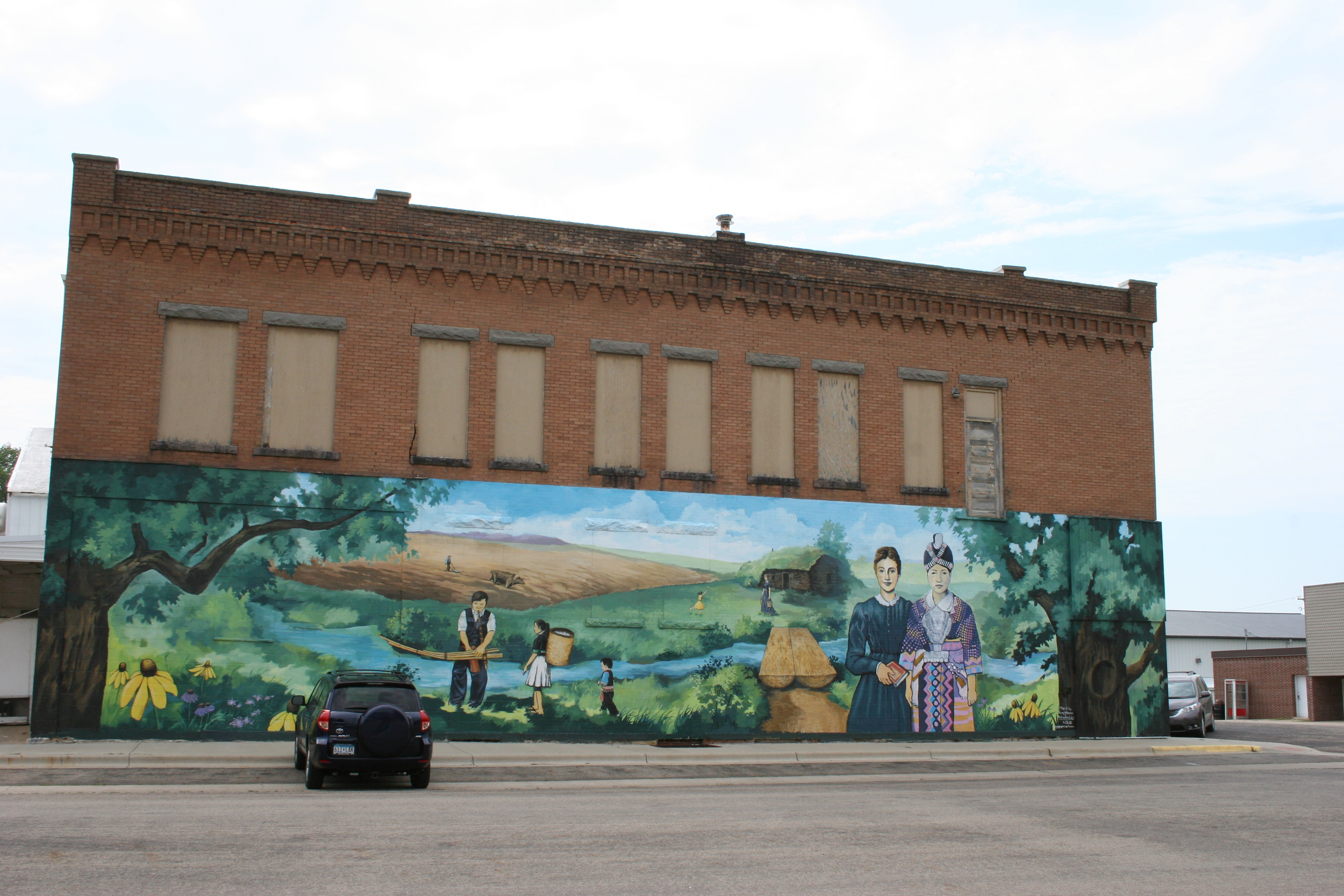
Ohman referenced this multi-cultural mural in Walnut Grove, where Hmong immigrants have settled and embraced the prairie history of author Laura Ingalls Wilder. He also noted that Walnut Grove is the only community where he found a working pay phone. (Minnesota Prairie Roots copyrighted file photo)
Only the letter X lacks a Minnesota town name. Two towns share the name Oslo. No surprise given Minnesota’s rich Scandinavian heritage. Oh, and Osakis is the self-proclaimed “Lefse Capital of Minnesota,” Ohman said, recommending Jacobs Lefse.
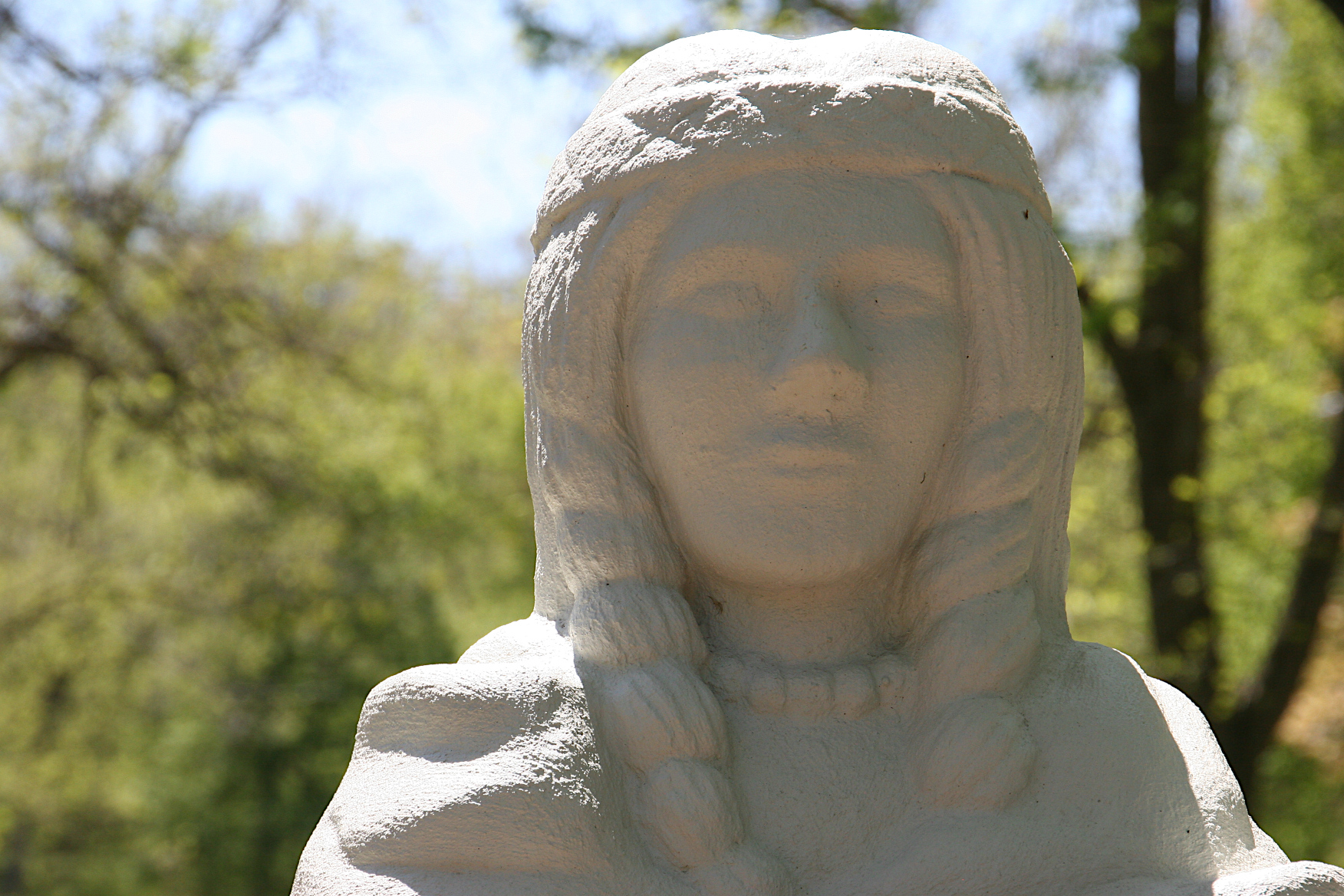
A statue of Princess Owatonna, daughter of Chief Wabena and whom after the city of Owatonna is named, stands in Mineral Springs Park. (Minnesota Prairie Roots copyrighted file photo 2020)
Ohman asked how towns are named and got lots of audience response. The Old Country (New Ulm, New Germany, Fulda…), Native American people and language (Owatonna, Wabasha, Sleepy Eye, Wabasso), animals (Badger and Fox), geographic features (Redwood Falls, International Falls, Thief River Falls, Fergus Falls, but not Hanley Falls, which has no falls), famous (Henry Hastings Sibley) and not so famous people…
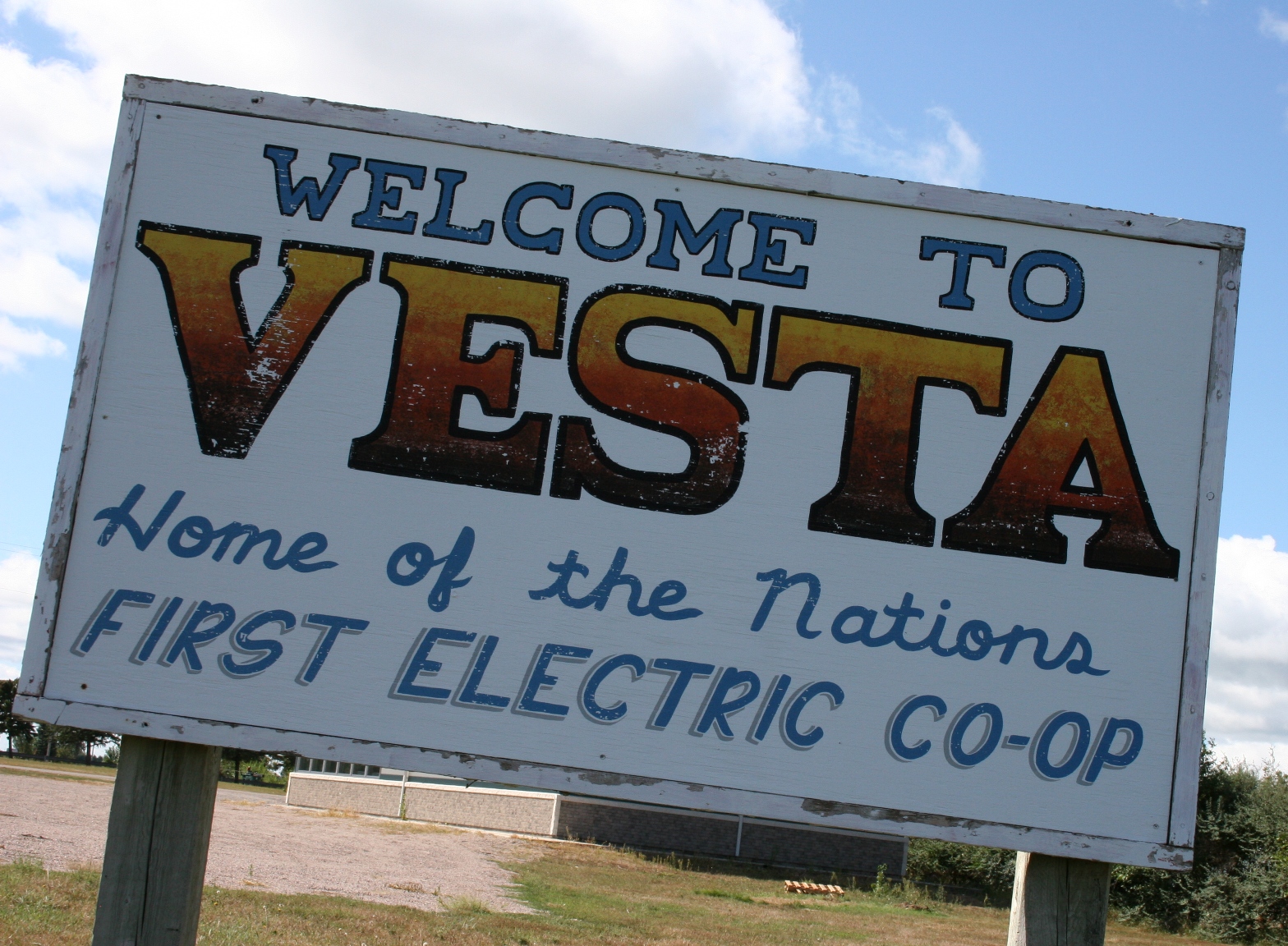
This sign once marked my hometown and its reason for notoriety. The sign was removed and replaced and I wish it was still there, along Minnesota State Highway 19. (Minnesota Prairie Roots copyrighted file photo 2011)
My hometown is named after the postmaster’s daughter, Vesta. I nearly stumped Ohman when I shouted out “Vesta.” But, with some clues and thought, he remembered its location in Redwood County. He’s been to neighboring Belview, Seaforth, Wabasso. Even several audience members were familiar with southwestern Minnesota towns, something I don’t often encounter in southeastern Minnesota.
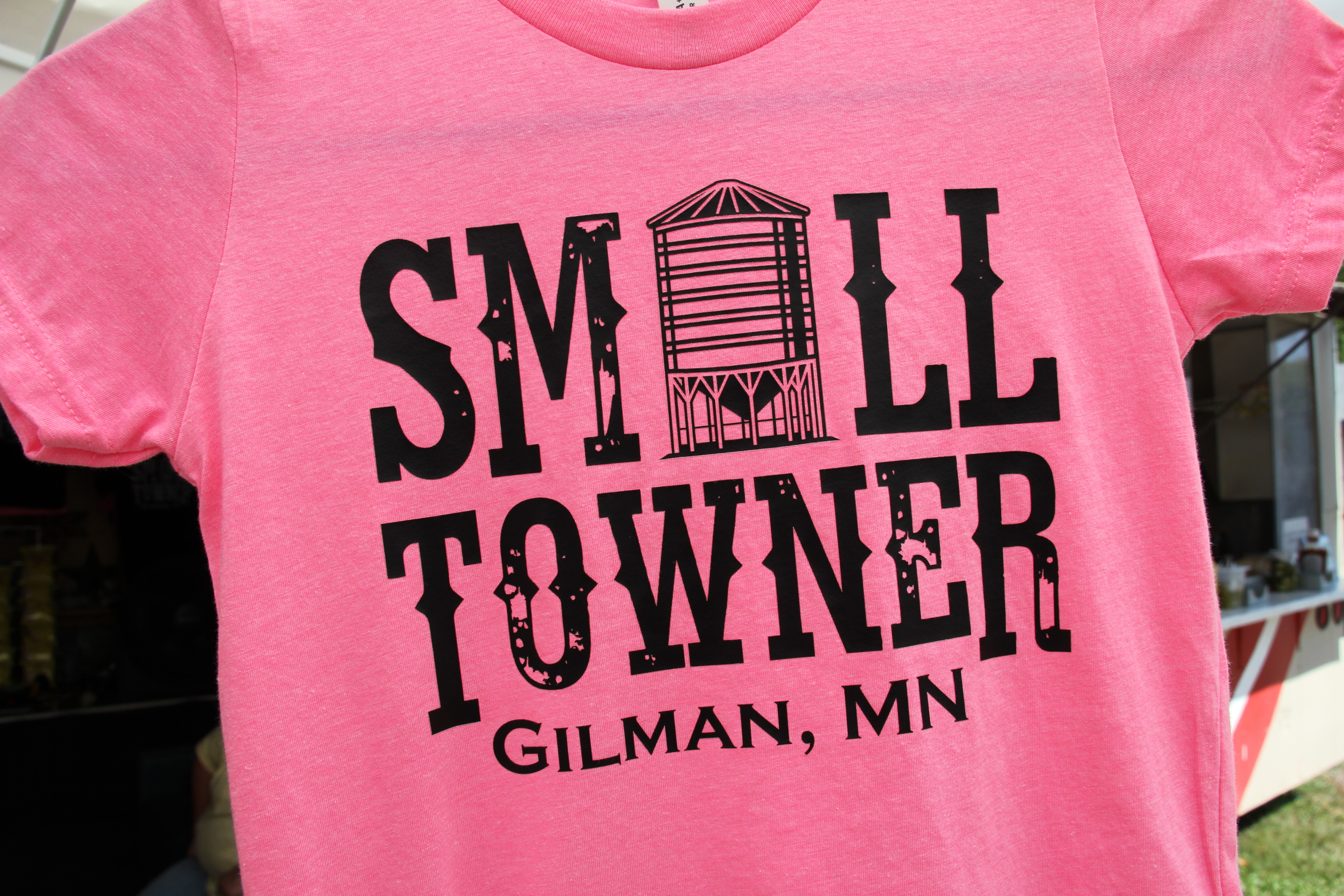
I found this small town proud t-shirt at Kelash’s Corner, a vegetable, fruit and merch stand, in Gilman, population around 220. The town is northeast of St. Cloud in Benton County. (Minnesota Prairie Roots copyrighted photo September 2024)
Towns survive based on location, Ohman said. That makes sense. Towns once located along railroad tracks, later abandoned, have declined. Towns built on lumbering have dwindled in population. Towns located today in resort areas, close to larger cities or along major roadways (like Owatonna on Interstate 35) are growing, thriving. The smallest of Minnesota’s 905 towns, according to Ohman, is Funkley, population five. That’s northeast of Blackduck which is northeast of Bemidji in Beltrami County. I love how that name, Funkley, rolls off the tongue.
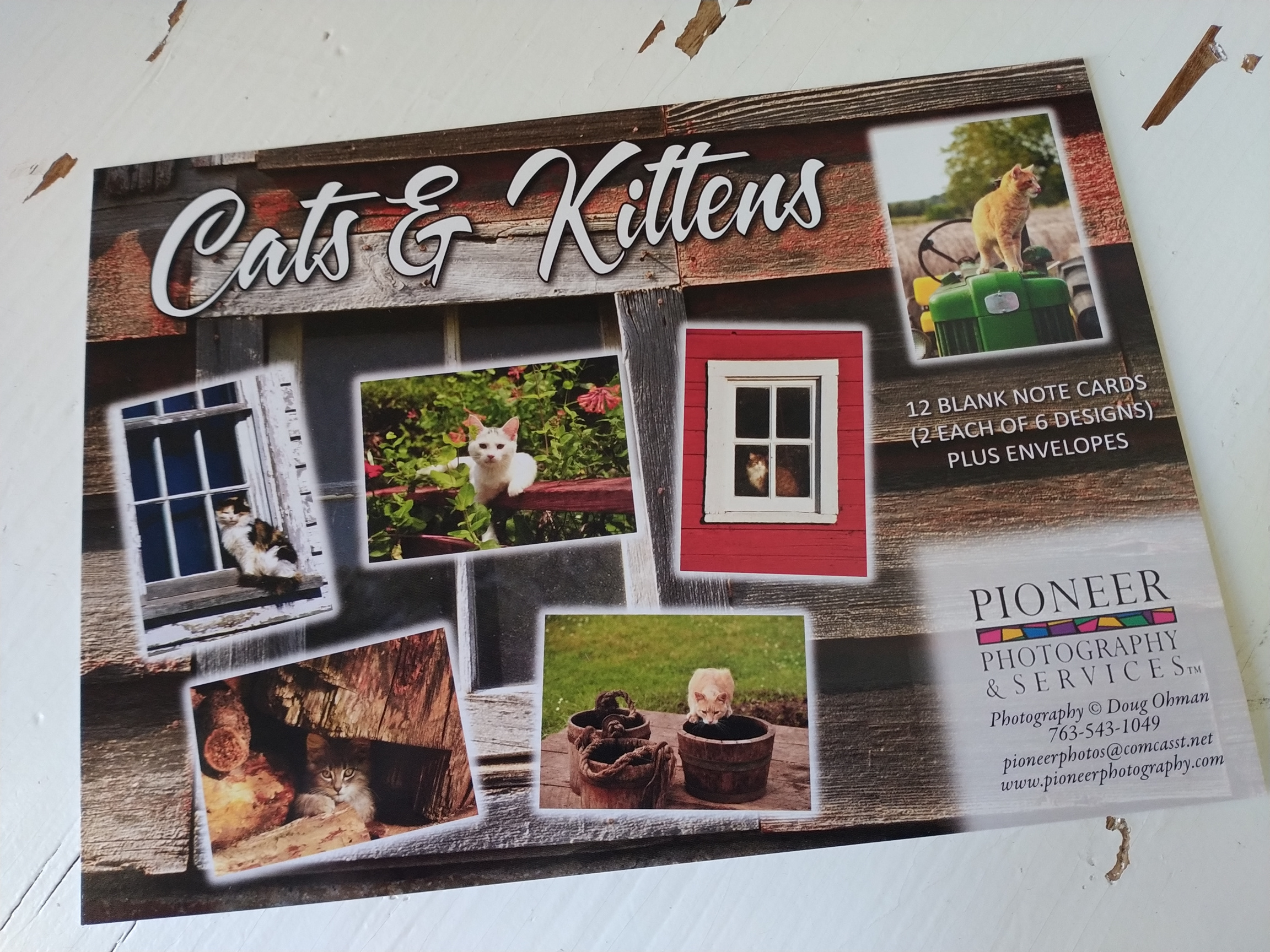
I won this pack of photo cards for correctly answering so many questions throughout Ohman’s presentation. (Minnesota Prairie Roots copyrighted photo September 2024)
Plenty of answers rolled off my tongue Monday evening in Owatonna as Ohman asked endless questions during his Minnesota town themed game show. Who knows the county in which Ivanhoe, named after the book by Sir Walter Scott, is located? “Lincoln,” I shouted. I revealed my book smarts a second time by naming the fictional town in Sinclair Lewis’ novel, Main Street. That would be Gopher Prairie, really Lewis’ hometown of Sauk Centre. That earned me a prize—a pack of feline photo cards by Ohman.
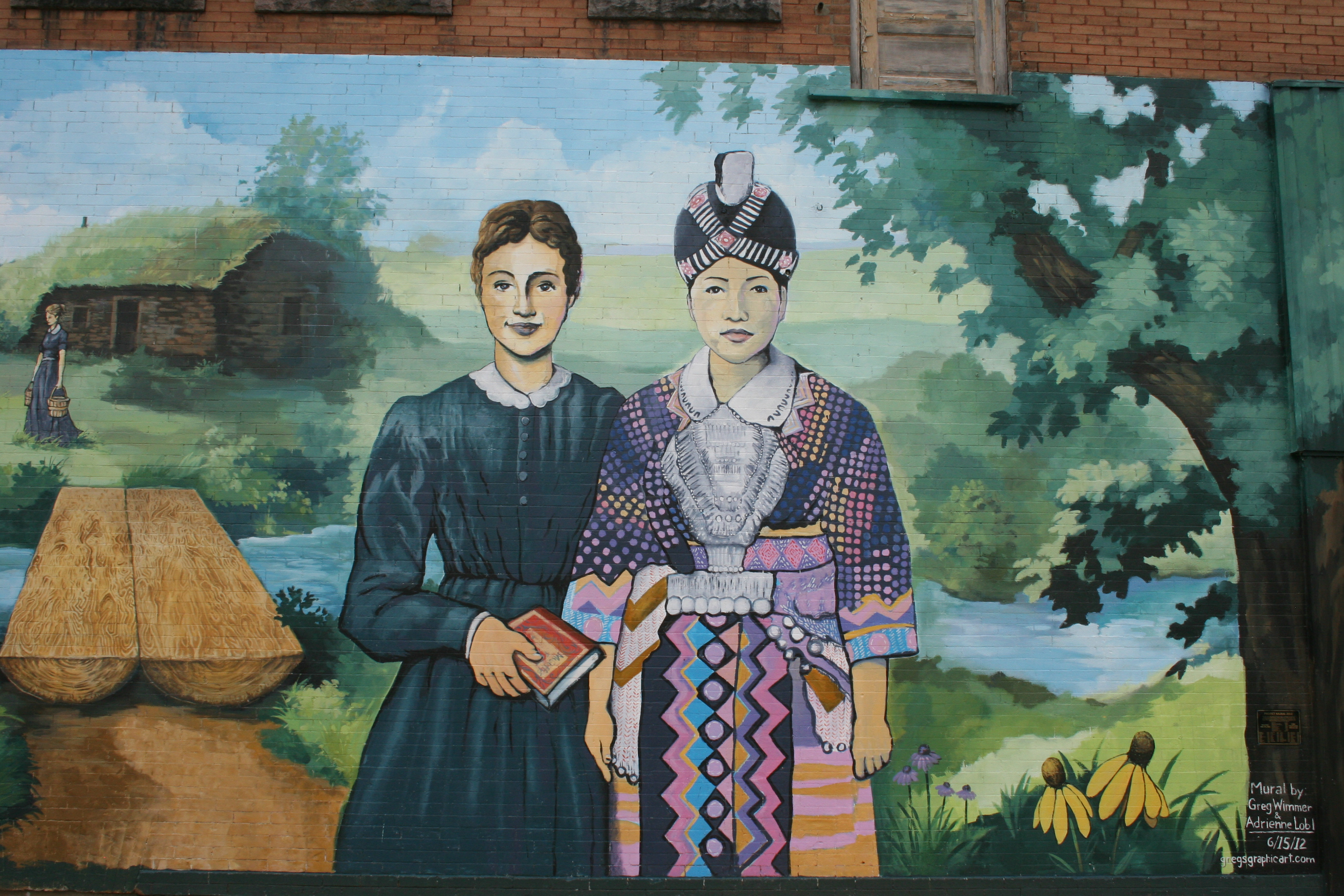
This mural in Walnut Grove shows how past and present connect, from early settlers to present day Hmong immigrants who now call this small town home. A niece, who lives with her family in Walnut Grove, recently told me how happy she is that her children are growing up in a diverse community. (Minnesota Prairie Roots copyrighted file photo)
I could write a whole lot more about all the towns and related information Ohman covered in his talk. But that’s his job, while mine is to highlight a few here. And also to reveal that I did incredibly well on the Ohman game show. I’ll close with one more important revelation. His favorite town name, Ohman shared, is Faith…because it takes a little faith to live (and survive) in Minnesota.
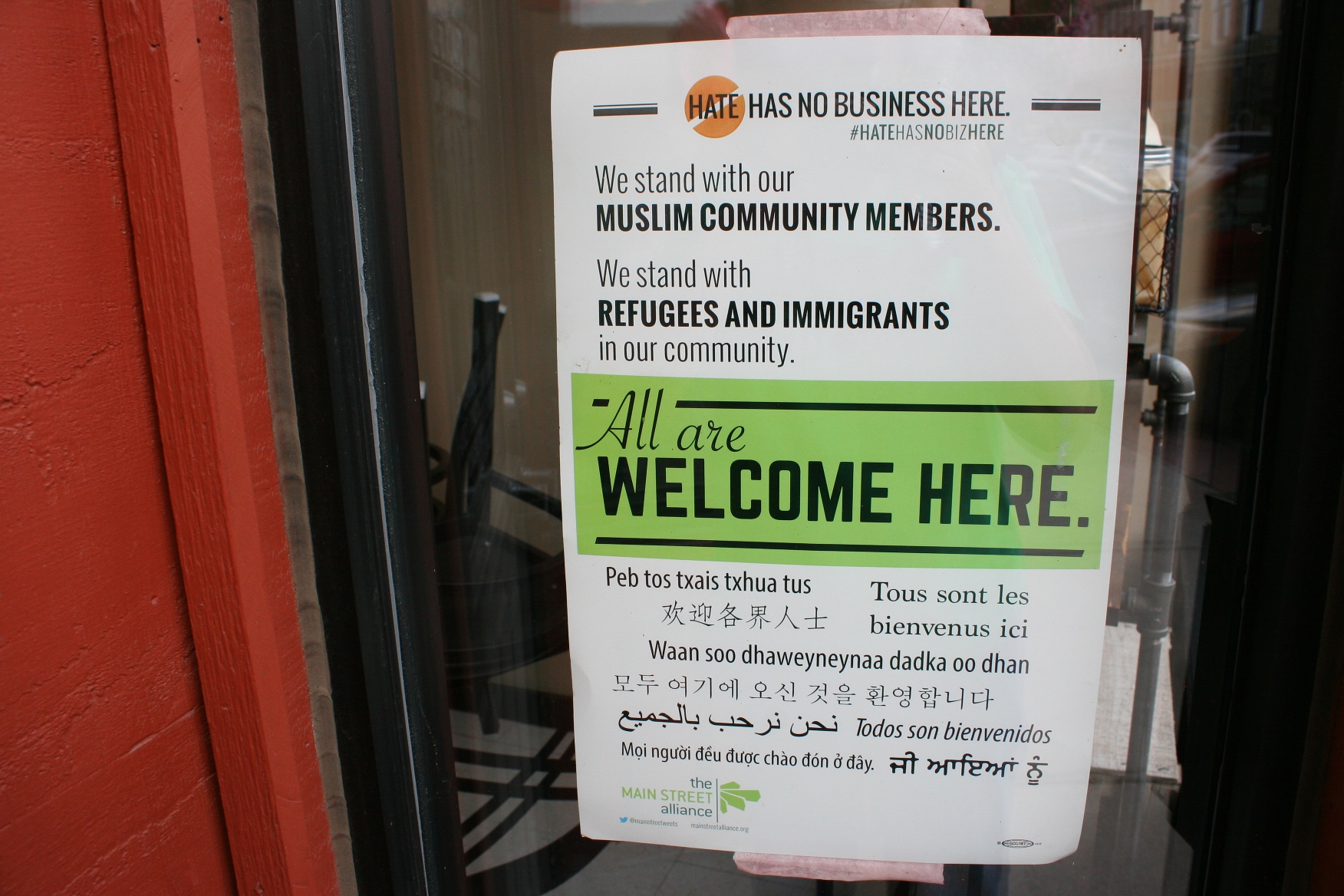
This welcoming sign was posted on the door of a downtown Faribault business in 2018. (Minnesota Prairie Roots copyrighted file photo 2018)
IN A VALENTINE’S DAY post last week, I focused on connecting in everyday life, on hugging all of humanity. Those words proved prophetic for me personally. And I am the better, the richer, for the insights I learned, the connections I made, during a February 15 talk by a Minnesota college professor, cultural consultant and author at Books on Central in Faribault.
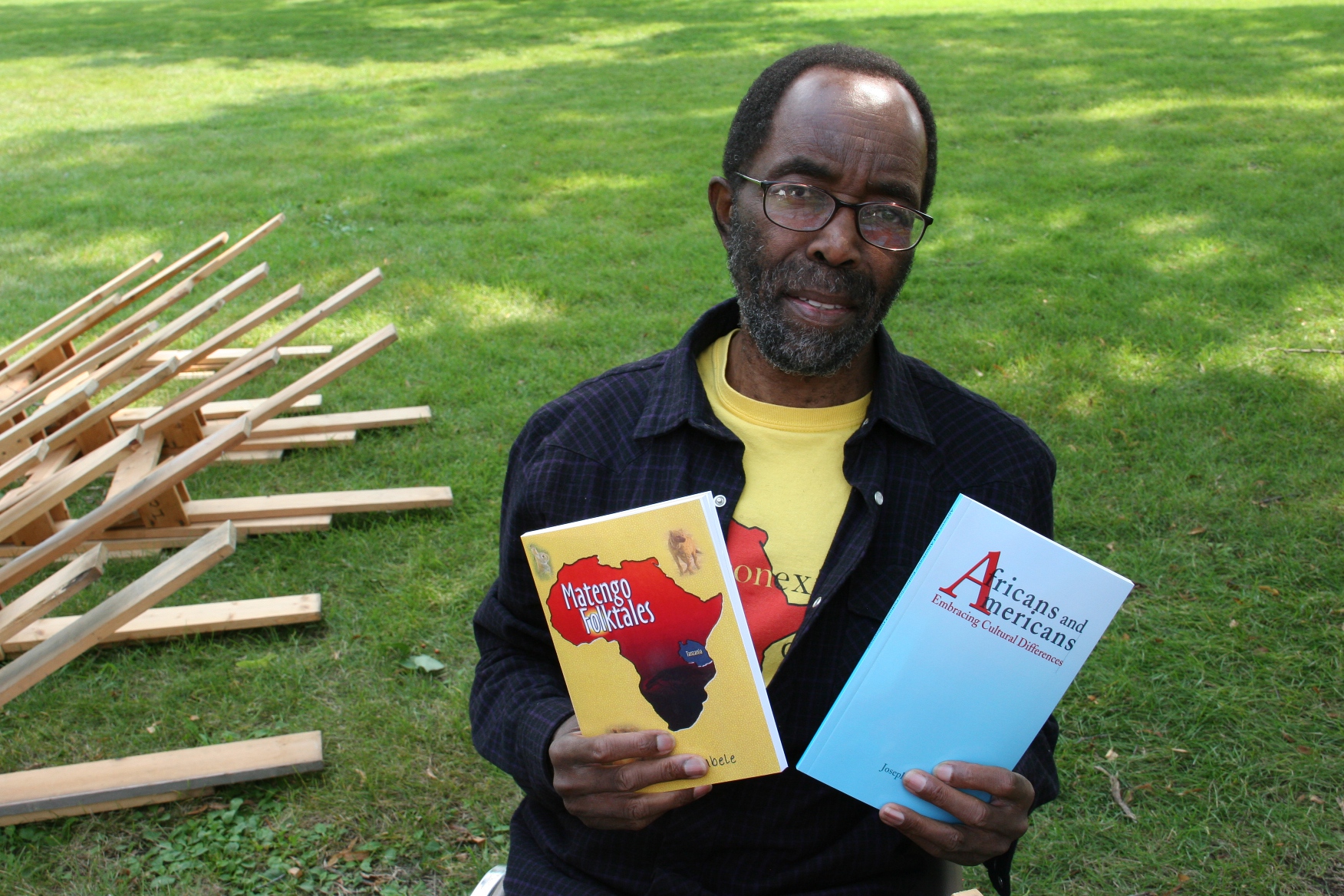
Author Joseph L. Mbele, photographed at the International Festival Faribault in 2015. (Minnesota Prairie Roots copyrighted file photo 2015)
Joseph L. Mbele was the featured speaker at this public event highlighting cultural differences. Faribault is a culturally-diverse community, home to many immigrants, including significant Somali and Hispanic populations. And that has all too often created tension between locals and those who now call my southern Minnesota city home. Mbele recognizes that and has worked with community leaders, business owners and others in Faribault and neighboring cities to raise awareness of cultural differences and bridge the gaps which divide us.
Via storytelling, humor and insightful perspectives as someone who grew up in Tanzania and has lived in the U.S. for 32 years, Mbele riveted the attention of the group gathered in the used bookshop run by Rice County Area United Way. Rather than fully recap Mbele’s presentation, I want to focus on the personal interactions I experienced with two young Somali men in attendance.
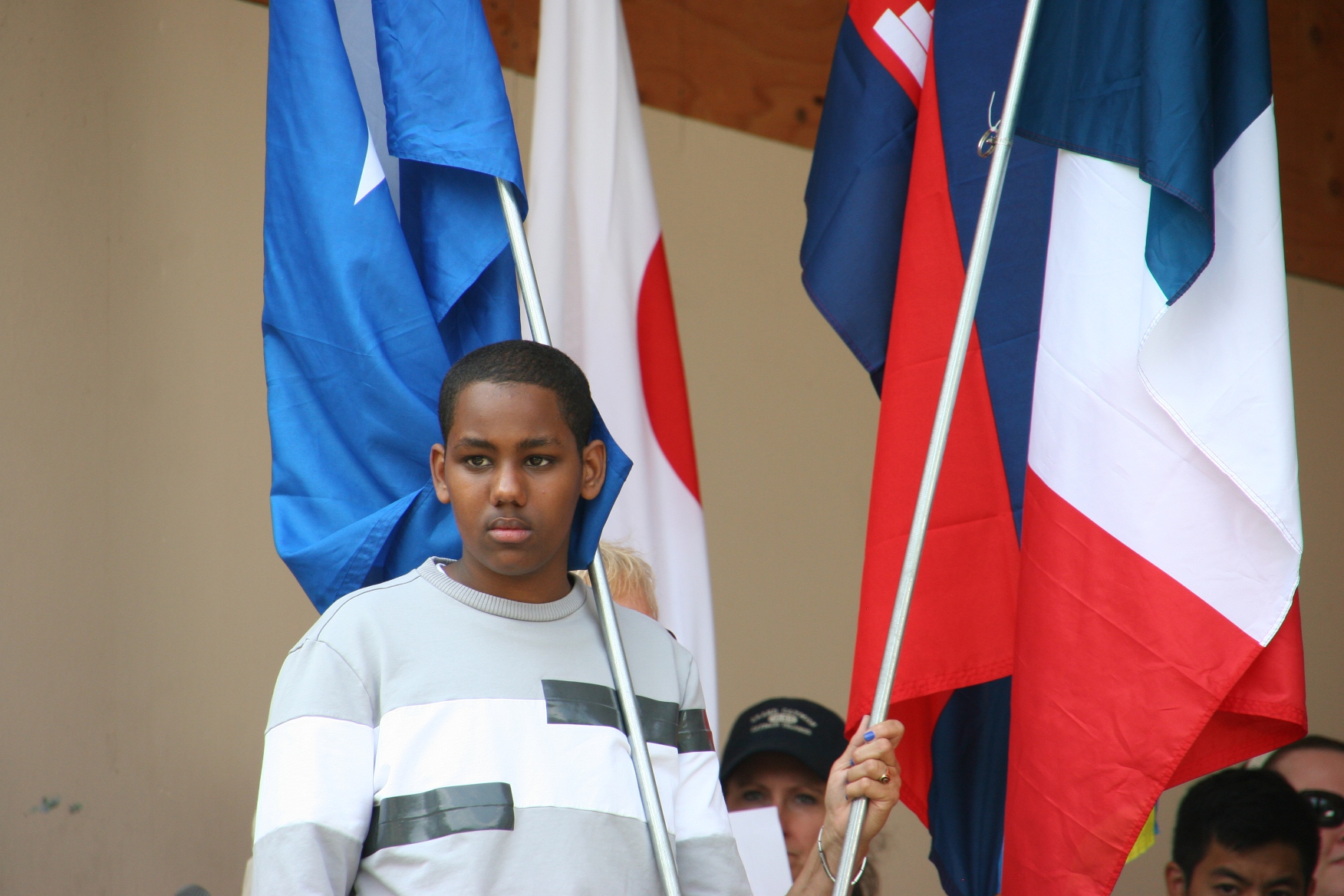
This teen represented Somalia (blue flag with a white star) at the International Festival Faribault in 2015. (Minnesota Prairie Roots copyrighted file photo 2015)
When I arrived at the bookstore, I settled onto a folding chair next to Solomon, as I heard it, (or perhaps correctly Sulaiman/Suleiman; I didn’t ask for the spelling of his name). I can’t sit next to someone and not engage in conversation. I soon learned that Sulaiman, 34, came to the U.S. from Somali at age 14, graduated from Faribault High School, played soccer on the fields by the junior high, has a wife in Somalia (the process is lengthy to bring her to the U.S., he said), works as an over-the-road trucker and has a job interview with a local company this week. Any business would be fortunate to have him on their team. He impressed me with his friendly personality, wide smile and openness. Sulaiman reflected what Joseph Mbele stated earlier about Africans being highly-social, desiring to be around and engage with other people.
I felt thankful to learn from my new friend that he hasn’t faced many challenges as a native Somalian living in Faribault. I didn’t have the heart to share the negative comments I’ve heard about Somalians. I focused instead on getting to know this delightful young man pressed next to me in a row of folding chairs in the cozy bookshop.
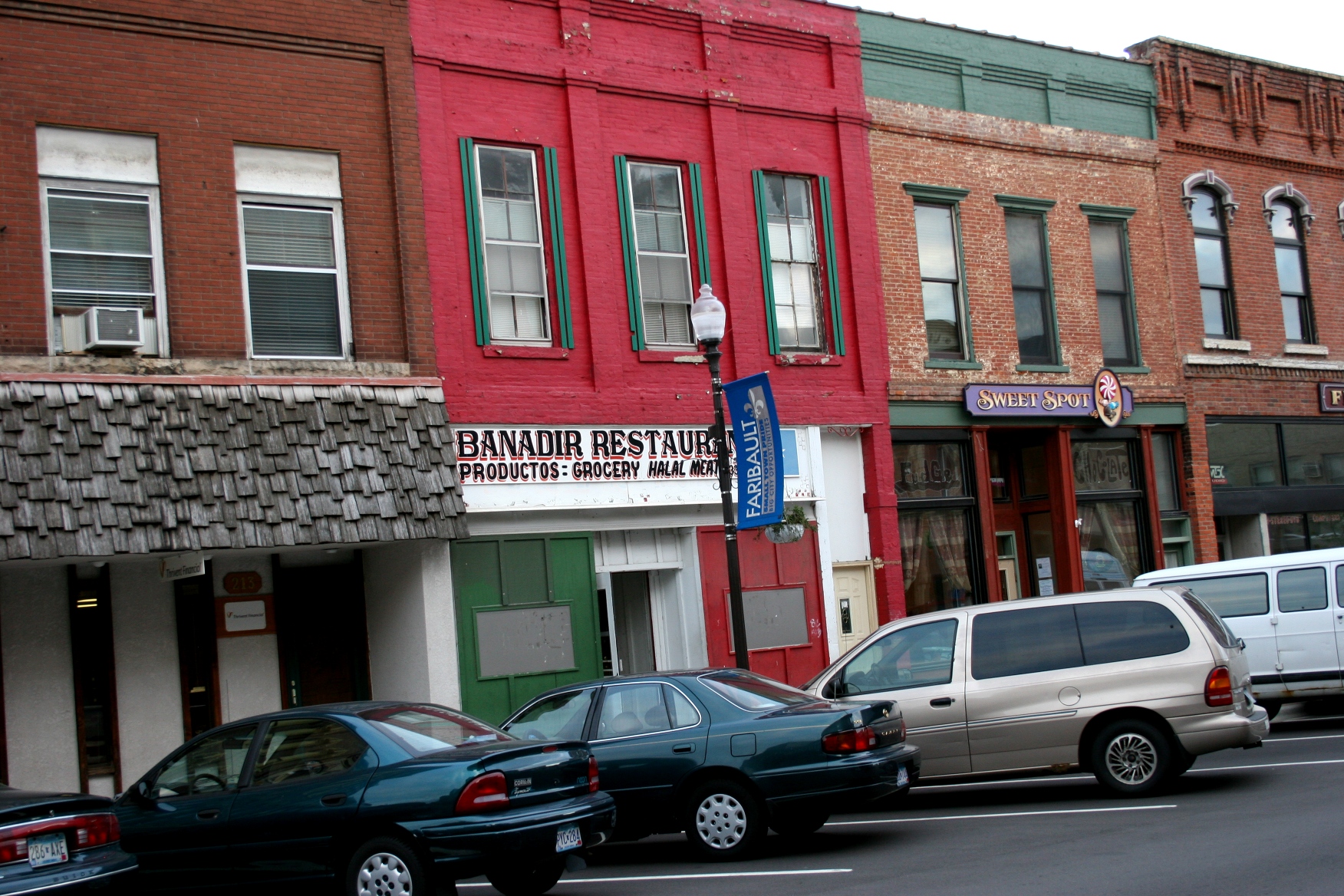
Banadir, a Somali restaurant and grocery, is located in historic downtown Faribault. (Minnesota Prairie Roots copyrighted file photo 2011)
Throughout Mbele’s talk highlighting African culture like African time (versus American time when everyone is on time), sidewalk gatherings to share news and to socialize, the social importance of food and music among Africans, the value of coming together and much more, I felt the sense of understanding unfolding. Laughter erupted often. Heads nodded. Questions surfaced during discussion. It felt good to be part of this gathering, to learn, to connect. I love that Mbele addressed bookstore volunteer Dave Campbell as “brother.” That endearing name shows that Mbele values Campbell and their personal connection. They are friends.
A diverse group attended a past International Festival Faribault, here observing the flag ceremony. (Minnesota Prairie Roots copyrighted file photo 2015)
And I felt, too, that I’d made a new friend in Sulaiman and, afterwards his brother, Ibrahim (again, I’m uncertain on the name spelling), also in attendance. As I retreated to the rear of the bookstore to grab a sweet treat and refill my water glass, Ibrahim approached and we chatted. He extended his hand in a handshake, significant because Muslims typically would not shake a woman’s hand. Mbele explained earlier the separation of men and women is not one of disrespect but faith-based and cultural.
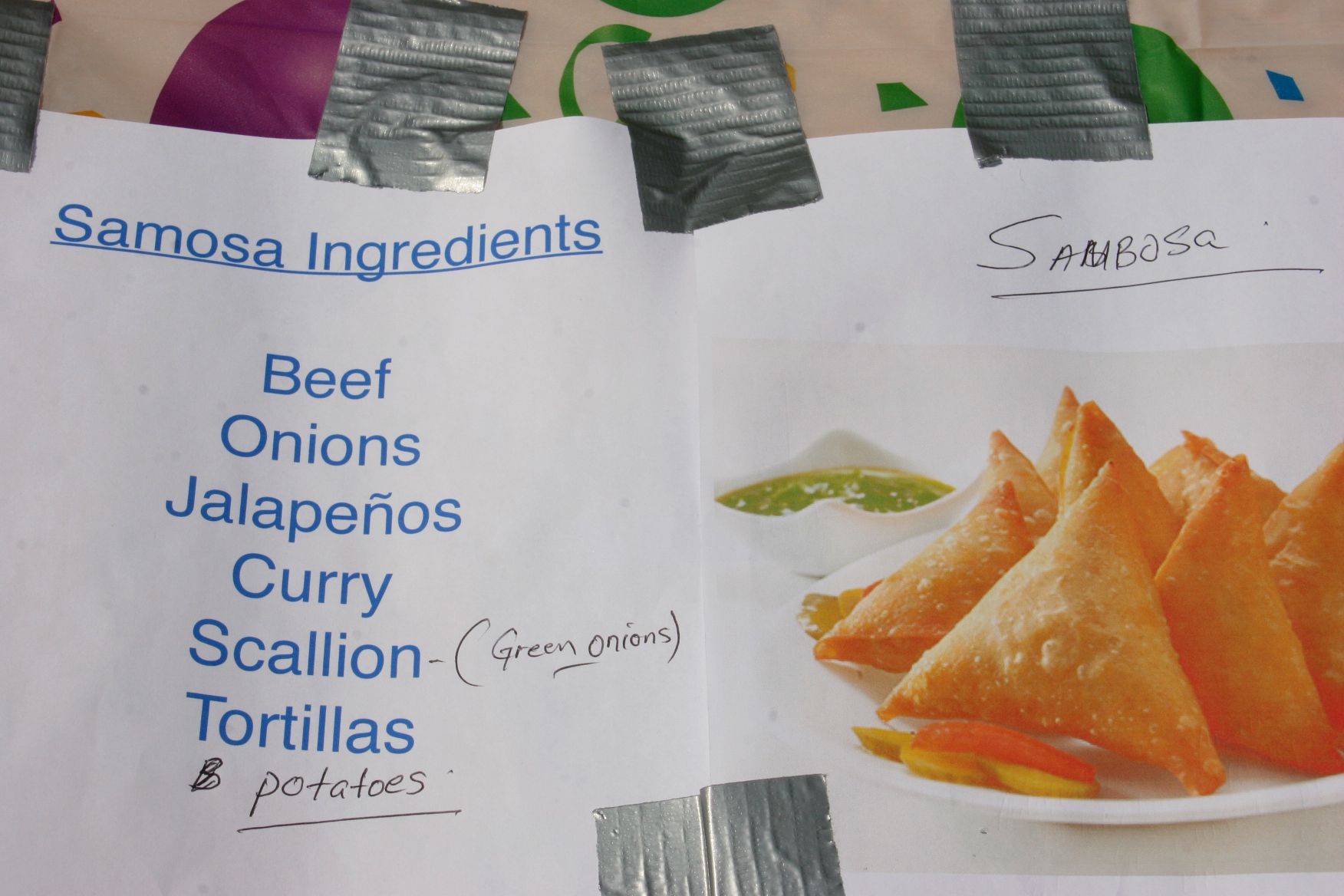
A sign photographed at a past International Festival Faribault, where I first tasted sambusa. (Minnesota Prairie Roots copyrighted file photo)
Ibrahim and I talked only briefly. He was, like his brother, warm, engaging, friendly. I remember him telling me that food brings people together, that he likes pizza. And I replied that I like sambusa, a Somali triangle-shaped pastry stuffed with spicy meat. We laughed. Earlier he invited those attending the bookshop gathering to visit Somali restaurants and shops in downtown Faribault.
And then Ibrahim asked, “Can I hug you?” Of course. We embraced right there in the back of the United Way bookshop. I felt such warmth, such affection, for this young man I’d just met. There were no cultural differences between us. We were simply two individuals who respected and appreciated one another. United by our humanity.
#
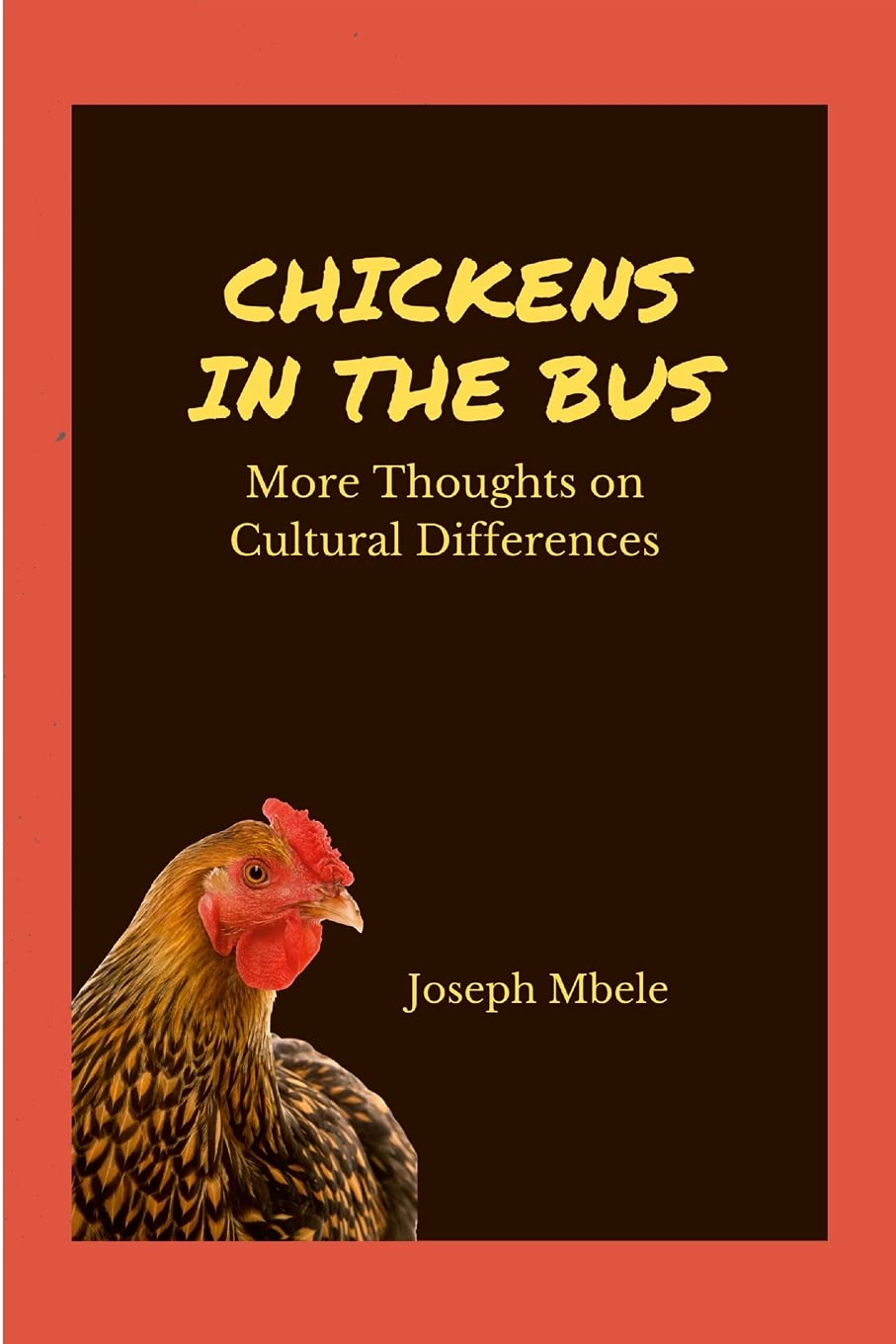
Jospeh Mbele’s latest book, an easy and informative read. (Book cover sourced online)
FYI: I’d encourage you to read any or all of the books written by Joseph L. Mbele: Africans and Americans: Embracing Cultural Differences; Chickens in the Bus: More Thoughts on Cultural Differences; and Matengo Folktales. This professor at St. Olaf College in Northfield is a gifted storyteller and writer. I’d also encourage you, if you live in my area, to shop at Books on Central. All proceeds from book sales go to the Rice County Area United Way and help people and organizations in my area.
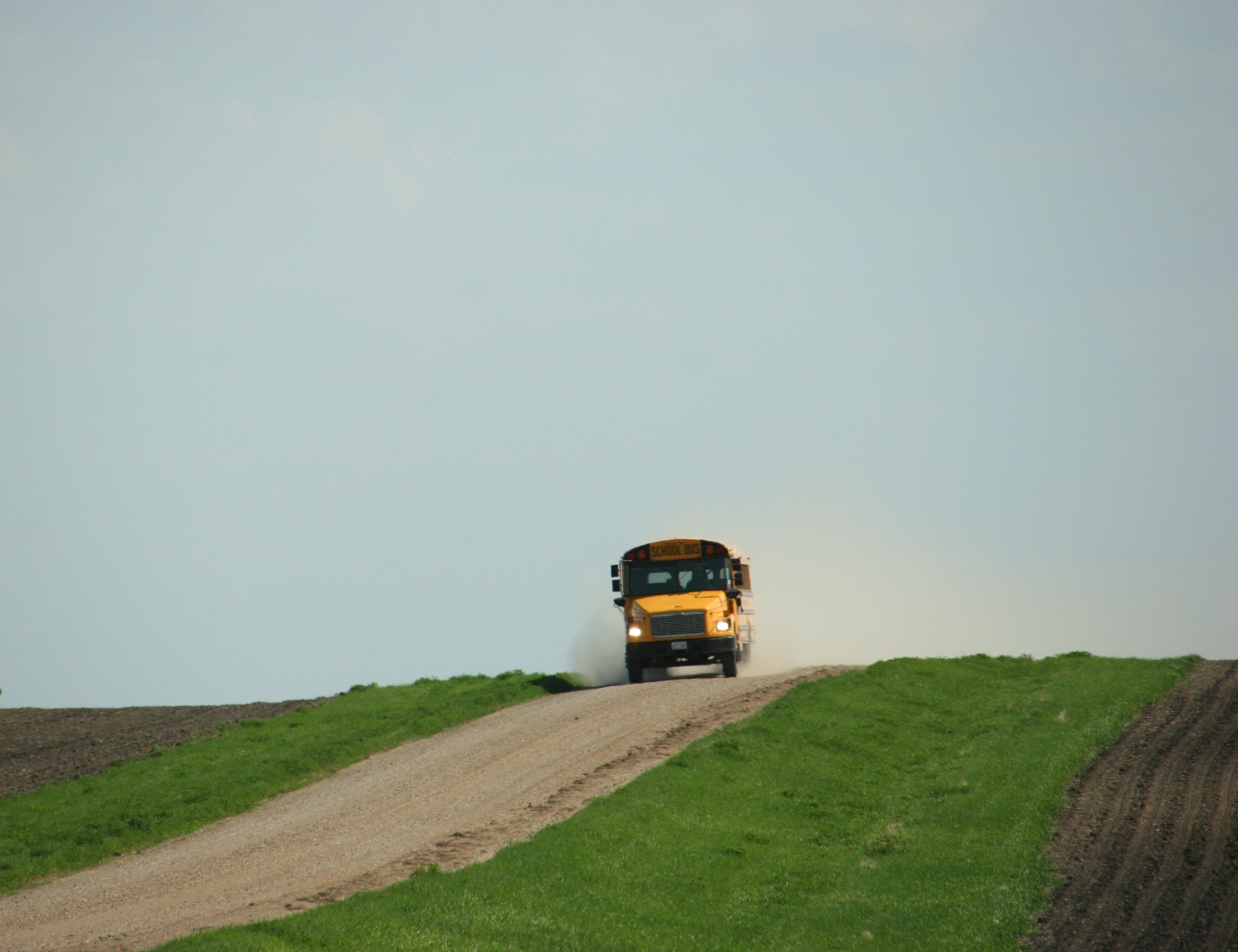
A bus follows a back country road near Morgan in southwestern Minnesota. (Minnesota Prairie Roots copyrighted file photo May 2018)
SHE WANTS TO SAVE the earth. It’s a lofty and noble goal for my granddaughter, who started second grade on Tuesday. Each year, on the first day of school, her mom documents basics about Isabelle on a small chalkboard. That includes a response to “What I want to be when I grow up.” This year Izzy aims to be an environmentalist. As a first grader, her professional goal was becoming a game designer. And on the first day of kindergarten, she wanted to own a toy store and also be a mom.
It’s interesting how Izzy’s interests evolve as she ages, as she grows her world and knowledge and connections with others. The possibilities are endless for her generation. I hold such hope in these young people, just beginning their formal educations.
And I hold hope, too, when I see a photo of Izzy and three neighborhood friends waiting at their urban bus stop. “Smart, Brave, Beautiful” banners Bethel’s tee. What a reaffirming message. For all of them. And how reaffirming that they are of differing ethnicity, their skin tones varied and, indeed, beautiful.
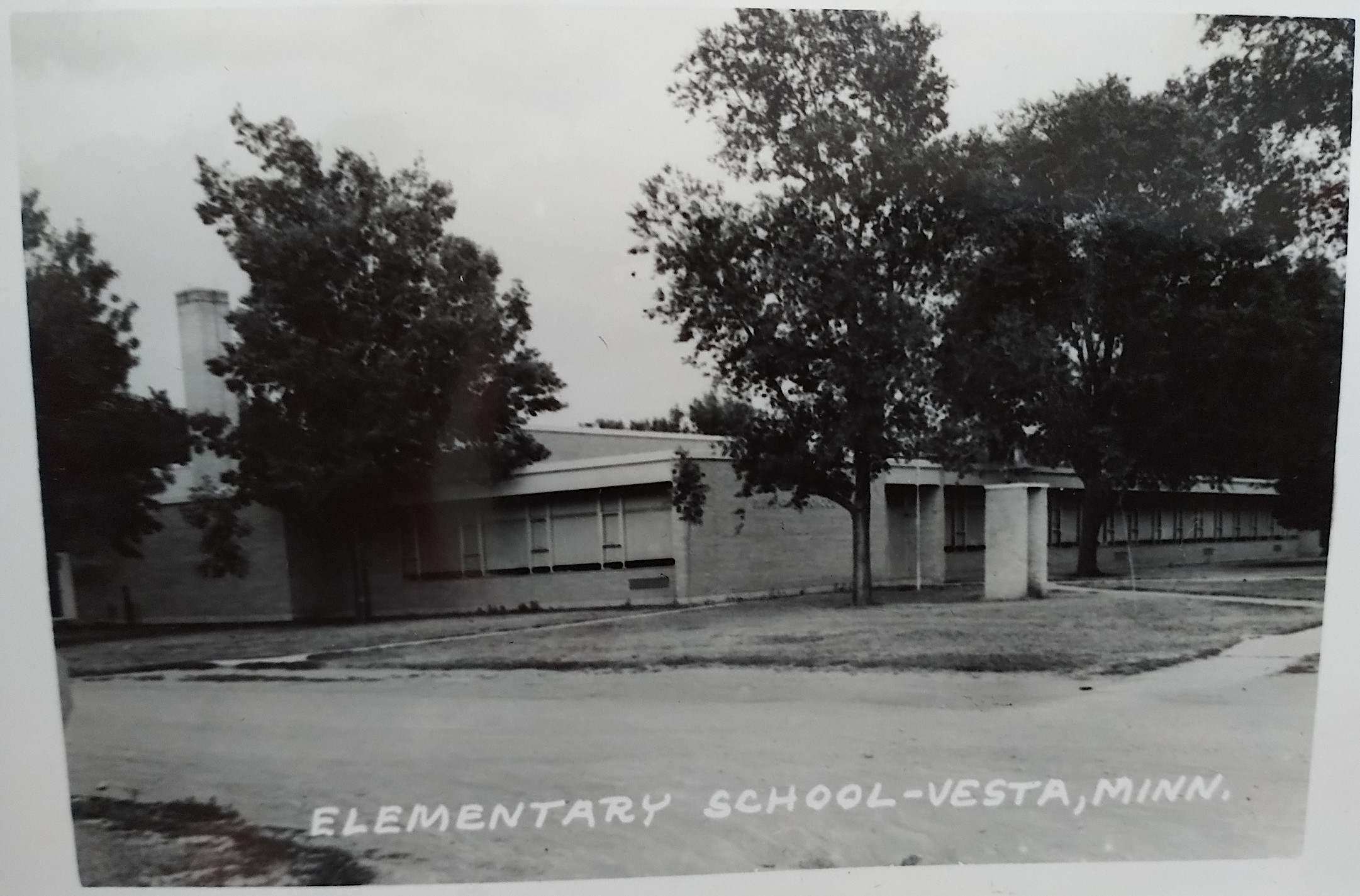
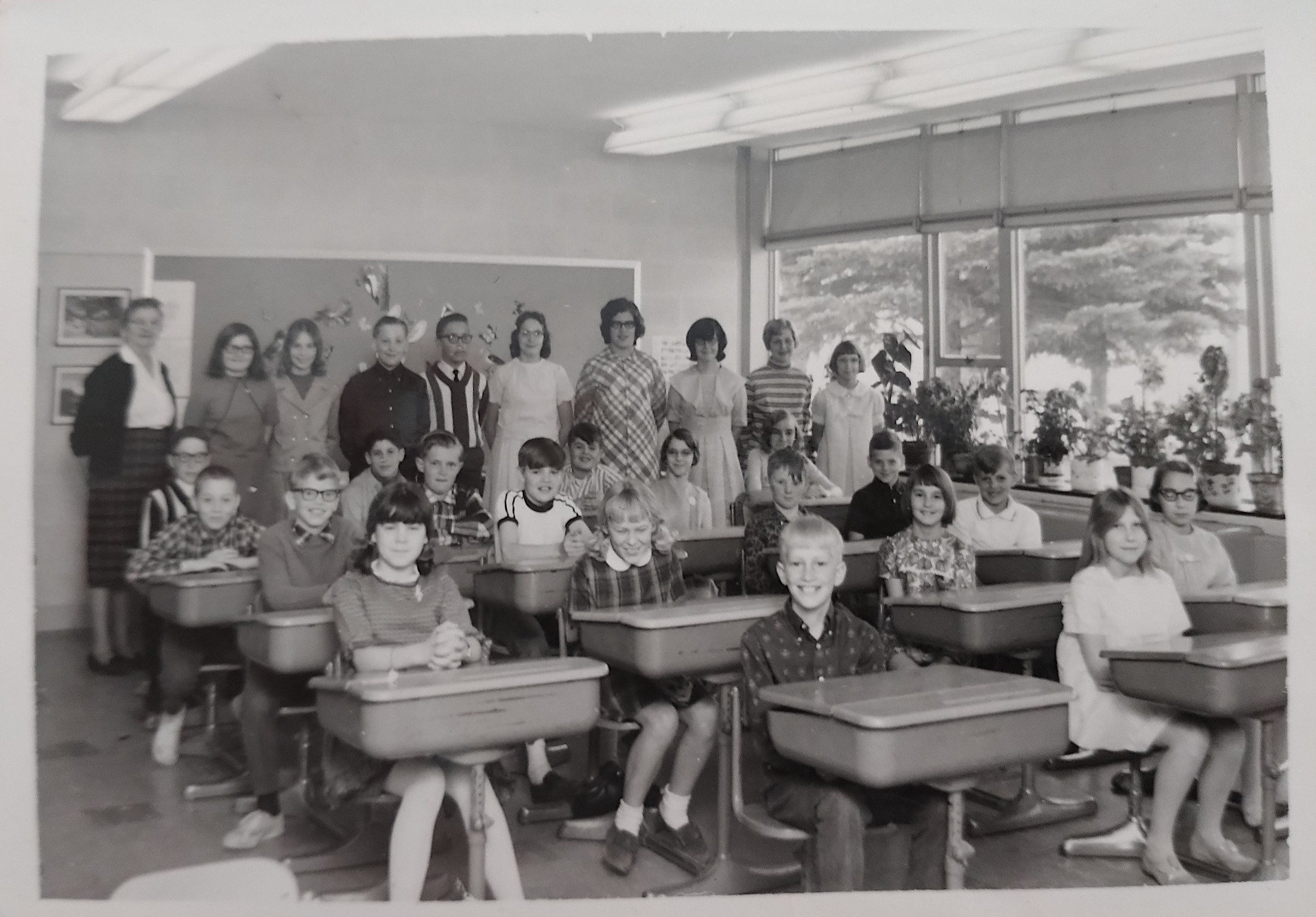
My elementary school, circa 1960s, located in Vesta in Redwood County. The school closed decades ago. (Photographer unknown; photo sourced from my personal photo album)
Sixty years have passed since I was a second grader in a small southwestern Minnesota elementary school, where my paternal grandfather served on the school board. My classmates and I were mostly farm kids, all white. We wrote in “Big Chief” lined tablets which today would not, should not, fly. Attitudes differed in the 1960s. Words like diversity, respect and environmentalist were not part of our everyday vocabulary.
A serene country scene just north of Lamberton in southern Redwood County.(Minnesota Prairie Roots copyrighted file photo September 2013)
But words, overall, held my interest all those decades ago. I have Mrs. Kotval to thank for sparking my love of words, of reading, and eventually of writing. Each day after lunch, she read to her third and fourth graders from “The Little House” and other chapter books. Through the writing of Laura Ingalls Wilder, who lived many years earlier in nearby Walnut Grove, I began to appreciate the nuances of the prairie. And I learned the importance of descriptive, detailed writing. Wilder engaged all of her senses to describe the prairie and life thereon in her series of wildly popular books. With her love of the natural world, this writer unknowingly documented the environment for me, my children and for my second grade granddaughter, today an aspiring environmentalist.
Early on, I aspired to be an elementary school teacher. But that changed as I grew my world, my knowledge, my connections. Words focused my passion. Unlike most of my elementary school classmates, I loved penmanship—letters and words flowing in script across the pages of my penmanship book. I loved spelling. I loved reading, even in a school and town without a library and thus with limited access to books. And by high school, that love of words expanded to writing.
Fifth and sixth graders at Vesta Elementary School in the late 1960s. I’m in the back row, far right, next to the windows. (Photographer unknown; photo sourced from my personal photo album)
I want to pause here and stress the importance of passionate teachers in fostering students’ interests. From Mrs. Kotval reading to her students after lunch to junior high English teacher Mrs. Sales teaching me all the parts of grammar to high school teacher Mr. Skogen requiring students to keep journals, their influence on me and my eventual career was profound. I would go on to earn a college degree in mass communications, leading to a career as a journalist, writer, poet and photographer.
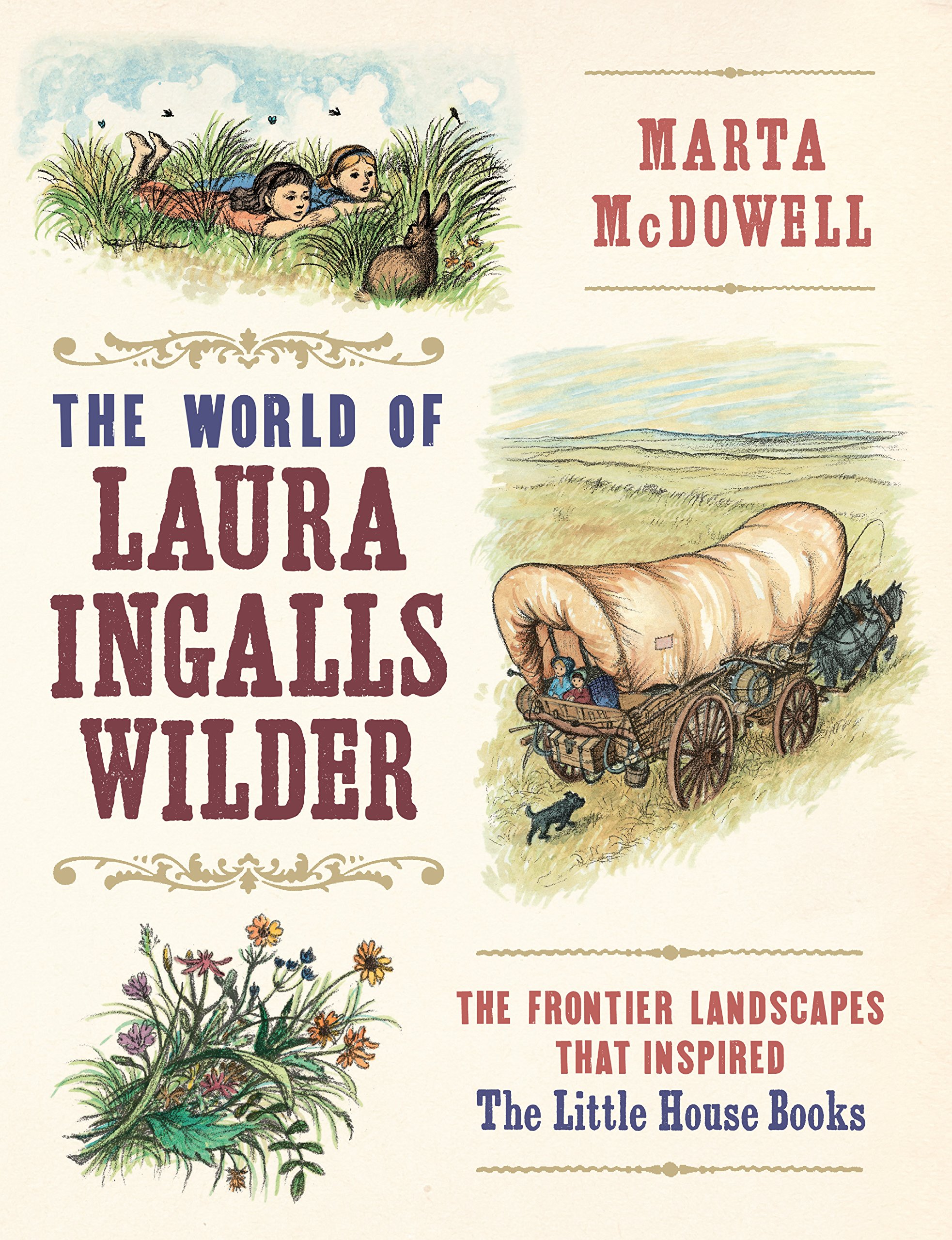
That brings me full circle back to Laura Ingalls Wilder, who early on influenced my detail-rich writing and photographic styles. In 2017, I became professionally connected to the author via “The World of Laura Ingalls Wilder—The Frontier Landscapes That Inspired The Little House Books.” Author Marta McDowell chose three of my photos (including one of prairie grasses at sunset) to illustrate her 396-page book documenting Wilder’s life and relationship to her environment. Perhaps some day my granddaughter will open the pages of McDowell’s book and find the photos taken by her grandmother. Whether Isabelle becomes an environmentalist or something vastly different, I expect she will always care about the earth and her role in saving it.
Somalians are very much a part of the Faribault community, photographed here at a Downtown Car Cruise Night. (Minnesota Prairie Roots copyrighted file photo)
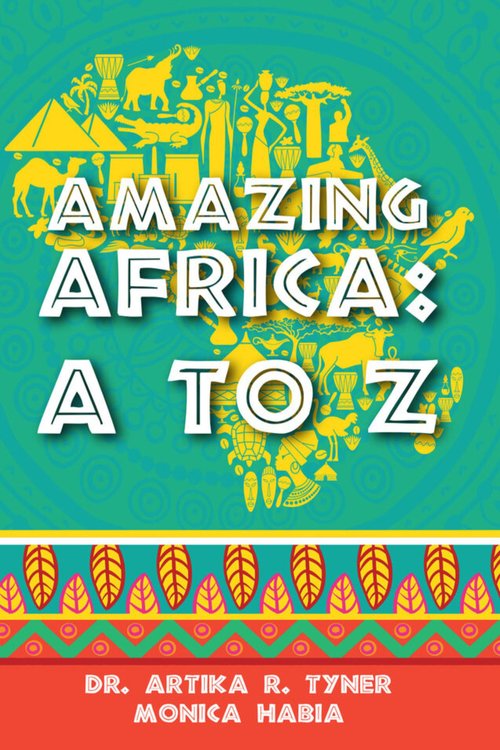
For a community like mine, with a sizable Somali population, this book proves a natural draw. I always appreciate learning more about my new Faribault neighbors from the east African country of Somalia. The more we know about each other, the more comfortable and connected we feel. Disconnect and conflict often arise from lack of knowledge, fear of the unknown and differences. Differences in dress, food, language, culture, faith.
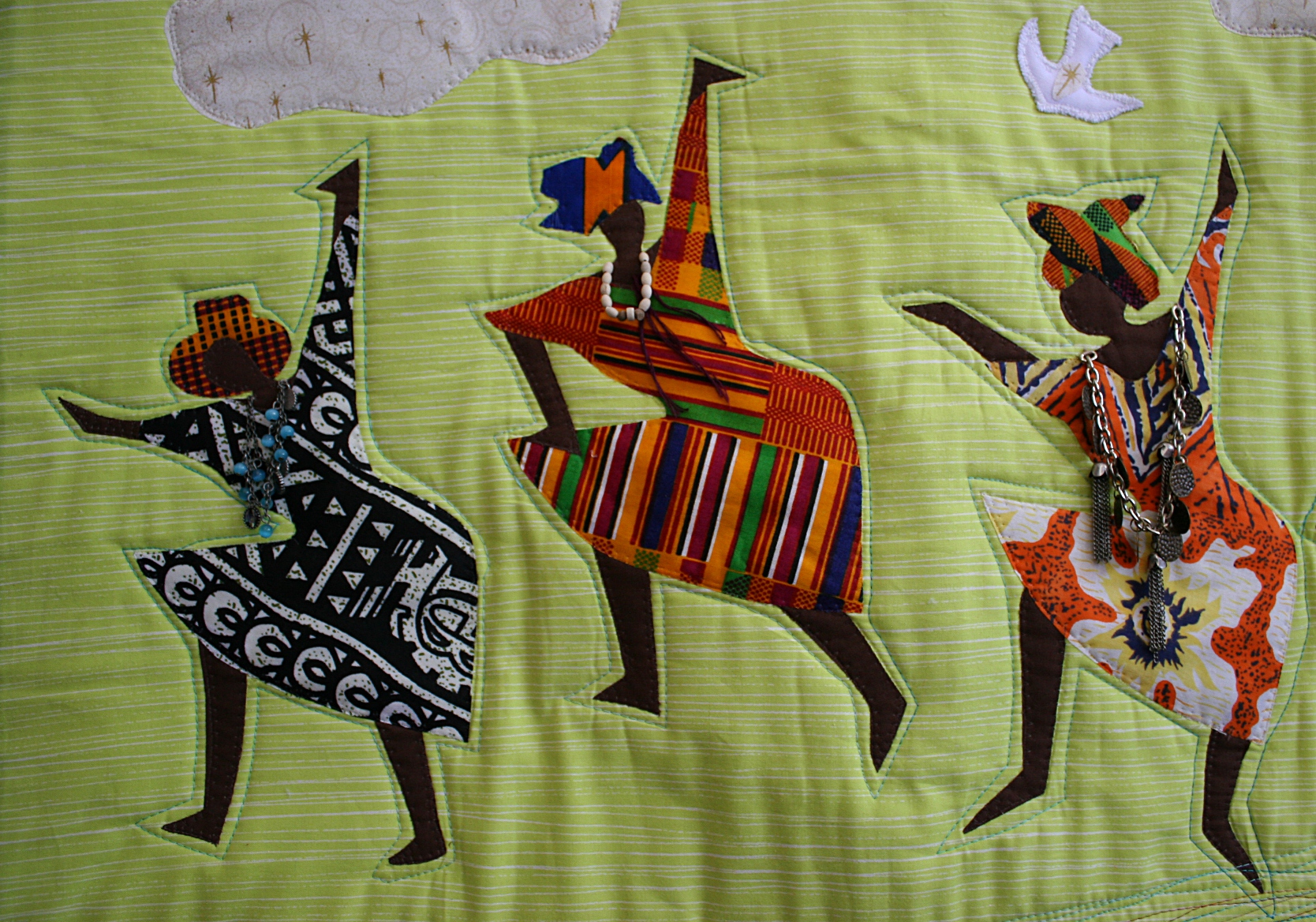
Nigerian-themed quilt art by my friend Susan Griebel. The fabric is from the collection of her mother-in-law, Margaret Griebel. Margaret’s husband was a Lutheran missionary in Nigeria, where the family lived. (Minnesota Prairie Roots copyrighted file photo)
This book bridges differences via facts and art that carries a signature African style of intense patterns and colors. With every new bit of information, with every turn of the page, I feel more and more connected to this continent of 54 countries. For example, the word hospitality, chosen to represent the letter “H” in this alphabet book, strikes me as exactly what I hope for in Faribault. Africans believe no one is an island; rather everyone is part of the community, the text reads in part. Two clasped hands visually reinforce that belief.
Lul Abdi shows off beautiful wood crafts from Kenya and Somalia at a past International Festival Faribault (Minnesota Prairie Roots copyrighted file photo)
Events like the Faribault Diversity Coalition’s summer International Festival Faribault and now occasional public talks by immigrants and others are ways we join hands and grow community. I’ve seen the art of my neighbors from Africa. I’ve heard the music, tasted the sambusa, admired colorful clothing… Faribault’s newest residents add a depth and richness to my southern Minnesota city.
A sign posted in a downtown Faribault business storefront window several years ago. (Minnesota Prairie Roots copyrighted file photo)
Consider African proverbs, chosen in Amazing Africa: A to Z to represent the letter “P.” These wise sayings span cultures. The authors include this powerful Swahili proverb, among several, at the end of the book: “Unity is strength, division is weakness.” If only we all read and take those words to heart. I firmly believe that we, as individuals and as community, need to be here for one another. We truly are stronger when not divided.
A sign lists Somali food sold at a past International Festival Faribault. (Minnesota Prairie Roots copyrighted file photo)
As I read of 1,000 languages spoken throughout Africa, I think of the Somalians now living in my community. Many have overcome war, poverty and other unimaginable challenges to settle in Minnesota. And now they must also overcome language barriers and resentment. If only we would all pause for a moment and remember that, for most of us Minnesotans, English was not the native tongue of our immigrant forefathers. Mine spoke German. Others spoke Norwegian, French, Dutch…
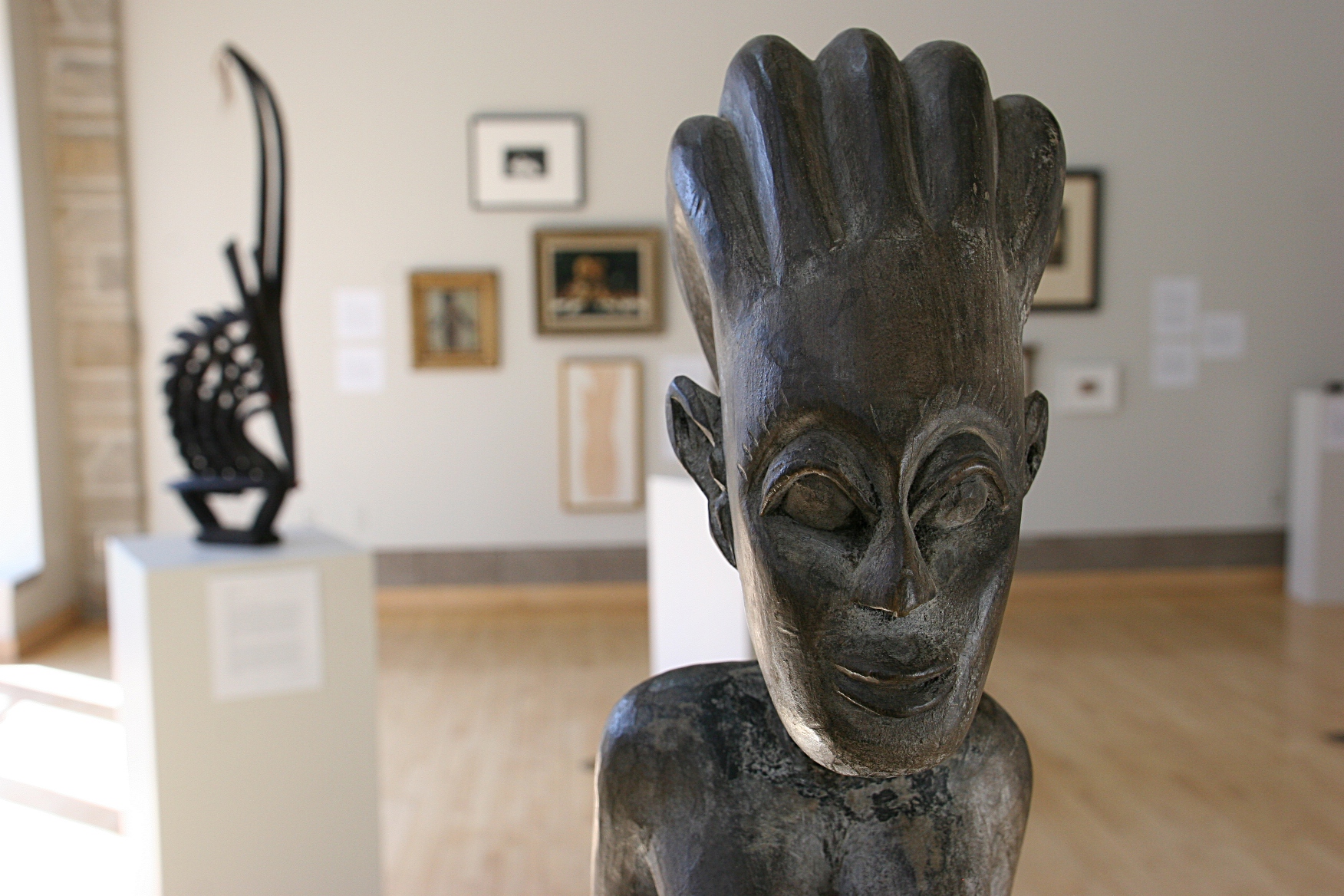
A wood sculpture from Africa, artist unknown, and titled “Seated Maternity Figure.” Exhibited at St. Olaf College, Northfield, in 2015. (Minnesota Prairie Roots copyrighted file photo April 2015)
I certainly can’t pronounce all of the words published in this book about Africa. Words like Uhuru, Yamoussoukro, Ugali and more. But I can appreciate the beauty of language, the way these words speak the rhythm of the continent of Africa.
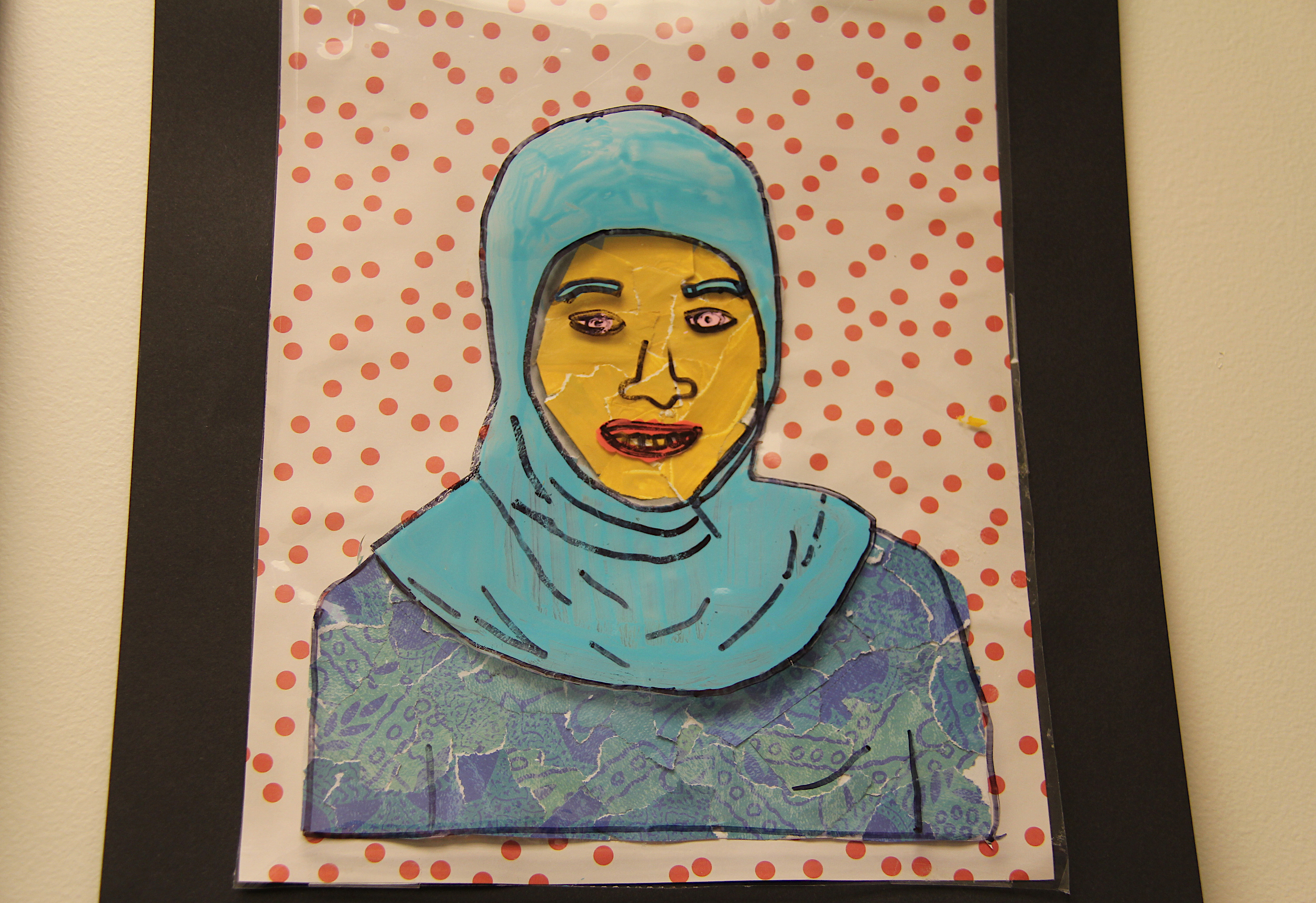
Bisa Butler inspired art created by fourth grader Ilwad and exhibited at a Student Art Show in Faribault. Butler is an award-winning African American textile artist. (Minnesota Prairie Roots copyrighted file photo March 2023)
Africa is the story of slavery, of dancing, of the world’s largest waterfall, of greatness, of so much richness and depth. You’ll find that, see that, read that in Amazing Africa: A to Z.
FYI: Dr. Artika Tyner, co-author of this book (and many others) and also a motivational speaker, educator and attorney, will speak on her journey towards justice from 6-7 pm Tuesday, May 16, at Buckham Memorial Library, Faribault. She is part of the Southeastern Libraries Cooperating 2023 Minnesota Author Tour. In her work, she focuses on racial and economic justice and social change. Tyner founded the nonprofit, Planting People Growing Justice Leadership Institute.
I previously reviewed Tyner’s children’s book, Justice Makes a Difference—The Story of Miss Freedom Fighter, Esquire. To read that book review, click here.















 Minnesota Prairie Roots
Reflections on diversity & growing community in Faribault December 30, 2025
Tags: art, commentary, community, Congregational Church of Faribault United Church of Christ, diversity, Faribault, Jason Rainey, Minnesota, multi-cultural community, mural, painting, reflections, Shirley Rainey
WHAT ARE WE without community? The answer: alone.
We, at our very core, need each other. In times of celebration. In times of challenges. Even in times of great division. Without friends, family, neighbors and others, we are but individuals without community.
And in Faribault, among the many murals adorning public spaces in the downtown area, one piece of art stands out as representing community. That is a free-standing mural placed on the west side of the Congregational Church of Faribault United Church of Christ this past summer. It seems an appropriate focal point to end 2025 and begin the new year.
The artwork, created by Shirley Rainey and her son Jason, features outstretched arms rising from the earth against a backdrop red heart and blue sky. “The mural represents the importance of coming together to share burdens and triumphs, while reaching for our highest selves,” Rainey said in an artist’s statement.
I see that in the mural. But I also see a community of diversity. The Raineys show that in assorted skin tones, clothing, hand sizes and even henna painted on a hand. I love that about this art, this intentional, varied depiction of Faribault as it is—gloriously diverse.
That said, I am well aware of the racial tension (and that’s a tamped down word) in my community. I wish it didn’t exist, that we all got along, welcomed and embraced one another. We are, after all, just people who live, love, work, play, laugh, cry… The list of commonalities we share as humans goes on and on. Yes, we are different, too. But differences seen as negative, those we create.
We can learn from that church painting. We can choose to love one another, as portrayed in the over-sized backdrop red heart. We can stand side-by-side and raise our hands to help one another. We can see, in those arms stretched skyward, the possibilities in building community. In that blue sky, we can envision not only our personal dreams, but the dreams of all who call Faribault home.
Faribault is a multi-cultural community, always has been. From early settlement days to today, people have come here from around the world to start anew. Whether French, Irish, German, Scandinavian, Latino, Asian, Sudanese, Somalian or any of many other ethnicities, this place has become home. We can choose to create community or not.
I hope in 2026 that Faribault can build a better, stronger, more unified community which celebrates our commonalities, and our differences.
© Copyright 2025 Audrey Kletscher Helbling