An honorary wall at Kenyon Veterans Memorial Park. (Minnesota Prairie Roots copyrighted photo April 2026)
AS THE DAUGHTER of a U.S. Army infantryman who fought on the front lines during the Korean War, I find myself drawn to veterans’ memorials. They seem a sacred space, a place where bravery, service, strength, sacrifice and grief mingle.
“Vietnam Soldier No Man Left Behind” statue, crafted by SVJ Creative Designs of Kellogg from concrete with a brassy bronze painted finish, at the Owatonna Veterans Memorial. (Minnesota Prairie Roots copyrighted photo May 2026)
Every memorial I’ve visited in southern Minnesota differs from the next. Yet the essence remains the same as a site to honor those who have served, some ultimately dying in service to country.
A story about Cpl. Ray W. Scheibe, published in the July 23, 1953, issue of The Wolbach (Nebraska) Messenger.
Memorial Day marks a national holiday to remember those who made the ultimate sacrifice by losing their lives. Whether necessary or unnecessary, war is hard and awful. It claims lives, forever changes people, rewrites history, traumatizes. My dad would tell you that. I saw firsthand the trauma Dad experienced from serving in Korea. He killed the enemy, so close he could see the whites of their eyes. He saw his friend blown apart on the battlefield the day before Ray was to return home to his wife and infant daughter in Nebraska.
My dadcarried home this July 31, 1953, memorial service bulletin from Sucham-dong, Korea. In the right column is listed the name of his fallen buddy, Raymond W. Scheibe.
For every story like this, thousands more exist.
This shows a portion of the Owatonna Veterans Memorial with slabs honoring each branch of the military and stone walls listing names of service members. (Minnesota Prairie Roots copyrighted photo May 2026)
And so every veterans’ memorial is a tribute to the men and women who are more than names and dates on plaques, but individuals with loving families, friends and communities. Individuals with stories from their time in service.
The iconic image of the flag raising at Iwo Jima is featured on a stone slab at the Owatonna Veterans Memorial. (Minnesota Prairie Roots copyrighted photo May 2026)
If I let my mind wander while viewing a veterans’ memorial, I can imagine the stories. Inspirational quotes, photos and life-size statues of military members make it easier for me to see beyond the names and dates to real people.
The female soldier at the Owatonna Veterans Memorial. (Minnesota Prairie Roots copyrighted photo May 2026)
At every southern Minnesota veterans’ memorial I’ve visited, and I’ve been to a lot, statues have only portrayed male soldiers. Until recently. The Owatonna Veterans Memorial includes a female soldier. She stands next to a kneeling soldier with a battlefield cross. And on the far side of the memorial site stands a statue of a Vietnam War soldier carrying his fallen comrade draped across his shoulders.
This flag flies at Kenyon Veterans Memorial Park. (Minnesota Prairie Roots copyrighted photo April 2026)
“All gave some, some gave all.” Sgt. 1st Class Nicole Amor of White Bear Lake gave her all on March 1, 2026. She was among four American soldiers who died after a drone strike on a command center in Kuwait during the Iran War. The wife and mother of two was just days from returning home to Minnesota. Just like my dad’s 22-year-old friend Ray, who was killed in Korea 73 years ago on the day before he was to head home to Nebraska.
A wall of service members’ names and dates of service at the Owatonna Veterans Memorial. (Minnesota Prairie Roots copyrighted photo May 2026)
This Memorial Day, as this country is once again engaged in war, I wonder how many more men and women will die. How many more names will be added to memorials around the country with plaques noting KIA (killed in action)?
A veteran scoots past statues at the Owatonna Veterans Memorial. Gary served in the military following the Korean War. (Minnesota Prairie Roots copyrighted photo May 2026)
Monday may mean simply a day off to some or the kick-off to summer for others. But Memorial Day is really about honoring the brave men and women who have died in service to country. It’s important to remember that, to attend a Memorial Day parade or program, to walk among gravestones, to visit a veterans’ memorial. To focus on gratitude. To grieve. To remember and honor those who “gave all.”
The female soldier looks toward the Owatonna Veterans Memorial. (Minnesota Prairie Roots copyrighted photo May 2026)
FYI: The Owatonna Veterans Memorial is located on the northwest corner of 18th Street and Austin Road by the Steele County History Center. The Moonlighters Exchange Club spearheaded the project and fundraising for the memorial dedicated in November 2023.
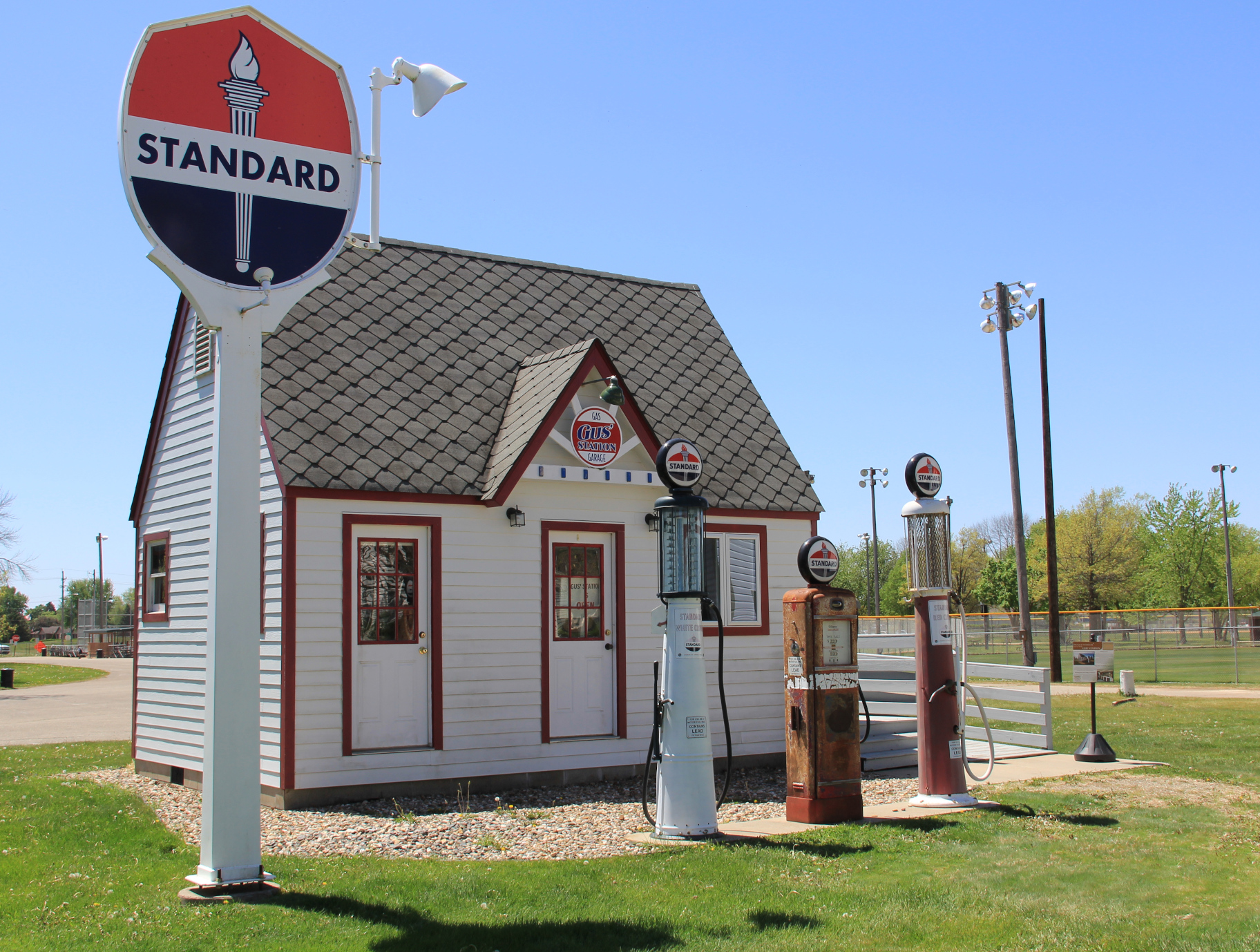
Gus’ Station was moved from Ellendale to the Village of Yesteryear, next to the Steele County History Center in Owatonna. It offers a glimpse into the past of a small town Minnesota full service gas station and garage. (Minnesota Prairie Roots copyrighted photo May 2026)
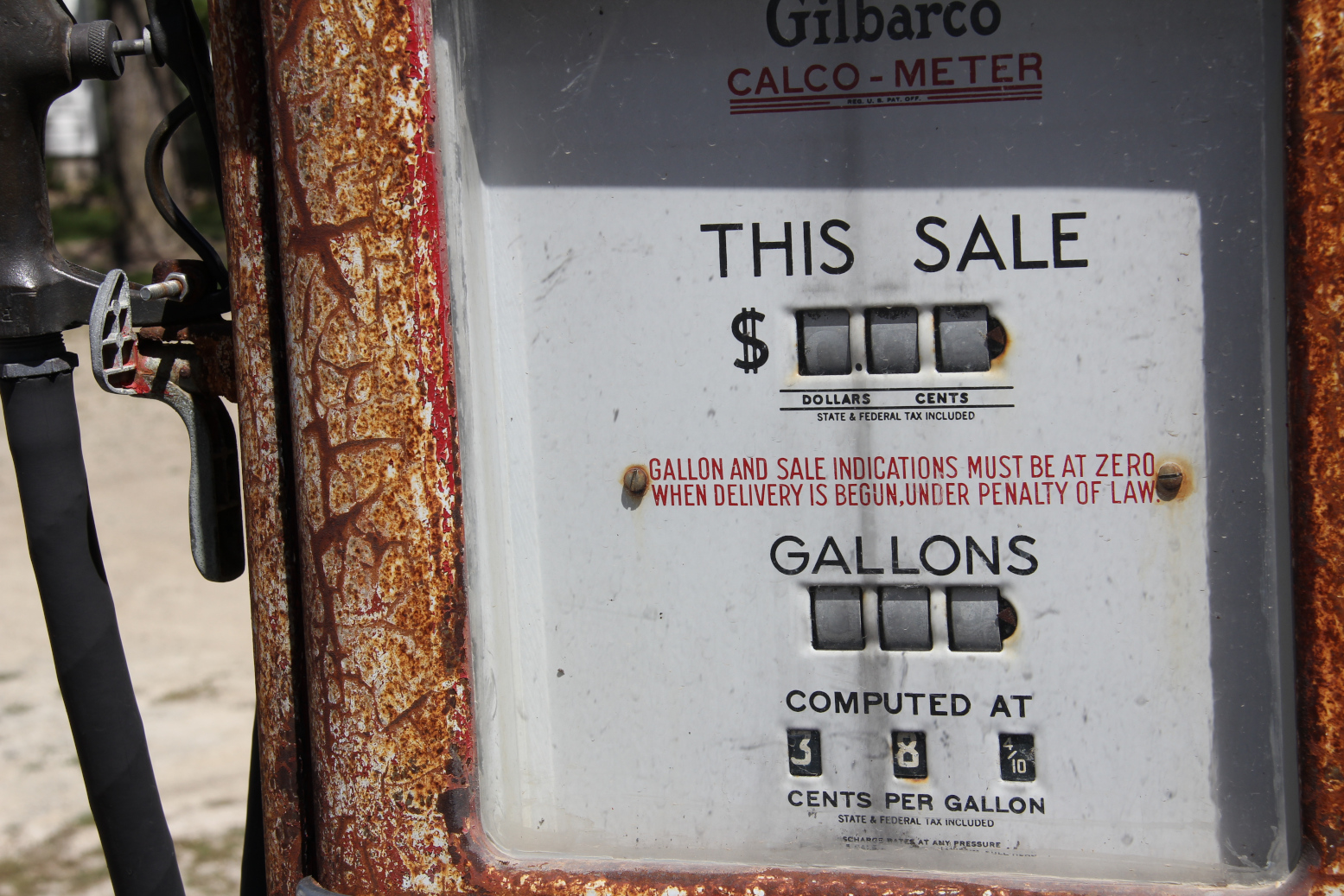
IF YOU WANT GAS at a bargain price, you’ll find it at Gus’ Station in Owatonna. The price is locked in at 38 cents a gallon. “Pull up to the pump,” I urged Randy recently after he parked in the gravel lot near the full service gas station and garage in the Village of Yesteryear. We laughed.
In my imagination, I pictured the station owner bounding out of the 1931 building to pump our gas, check the oil, note the water level in the radiator and wash the windshield. But all of that was simply wishful thinking.
At Gus’ Station, gas is forever 38 cents/gallon. (Minnesota Prairie Roots copyrighted photo May 2026)
The gas nozzle wouldn’t fit our 2008 van. The fuel was leaded. Few stations offer full service anymore. And gas is certainly not selling for 38 cents a gallon.
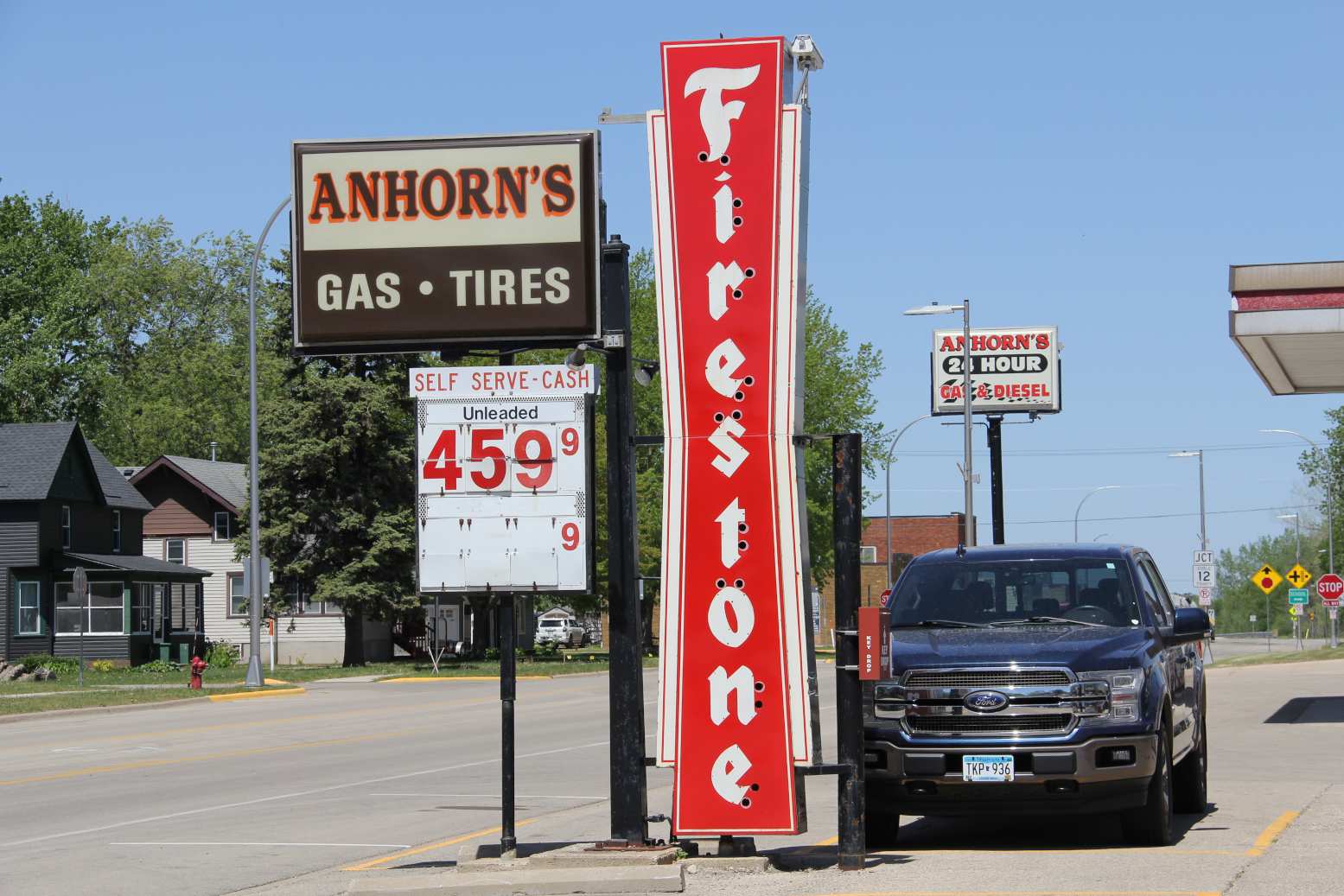
The price last Friday for unleaded gas at Anhorn’s in small town Medford, between Faribault and Owatonna. No digital signage here. (Minnesota Prairie Roots copyrighted photo May 2026)
Instead, last check of prices in Faribault several days ago, unleaded gas was selling for $4.50 (rounded up a tenth) a gallon and diesel for $5.49.
Are those prices fueling your anger? When Randy and I saw gas prices that high while traveling to and from eastern Wisconsin on May 2 and 3, we were feeling smug that prices were lower in Minnesota. But some two weeks later, here we are with those same ridiculously absurd, sky high prices.
I lay the blame on one person. The president. If not for the war in Iran (which he started) and his blocking of the Strait of Hormuz, gas prices would not be bordering unaffordable.
It’s no secret that I oppose the war, the actions of this president, his cabinet and most Republicans. I could write a lengthy list of everything he’s done to make life worse and less affordable for the average American. But I’ll stay on topic and focus on gas prices.
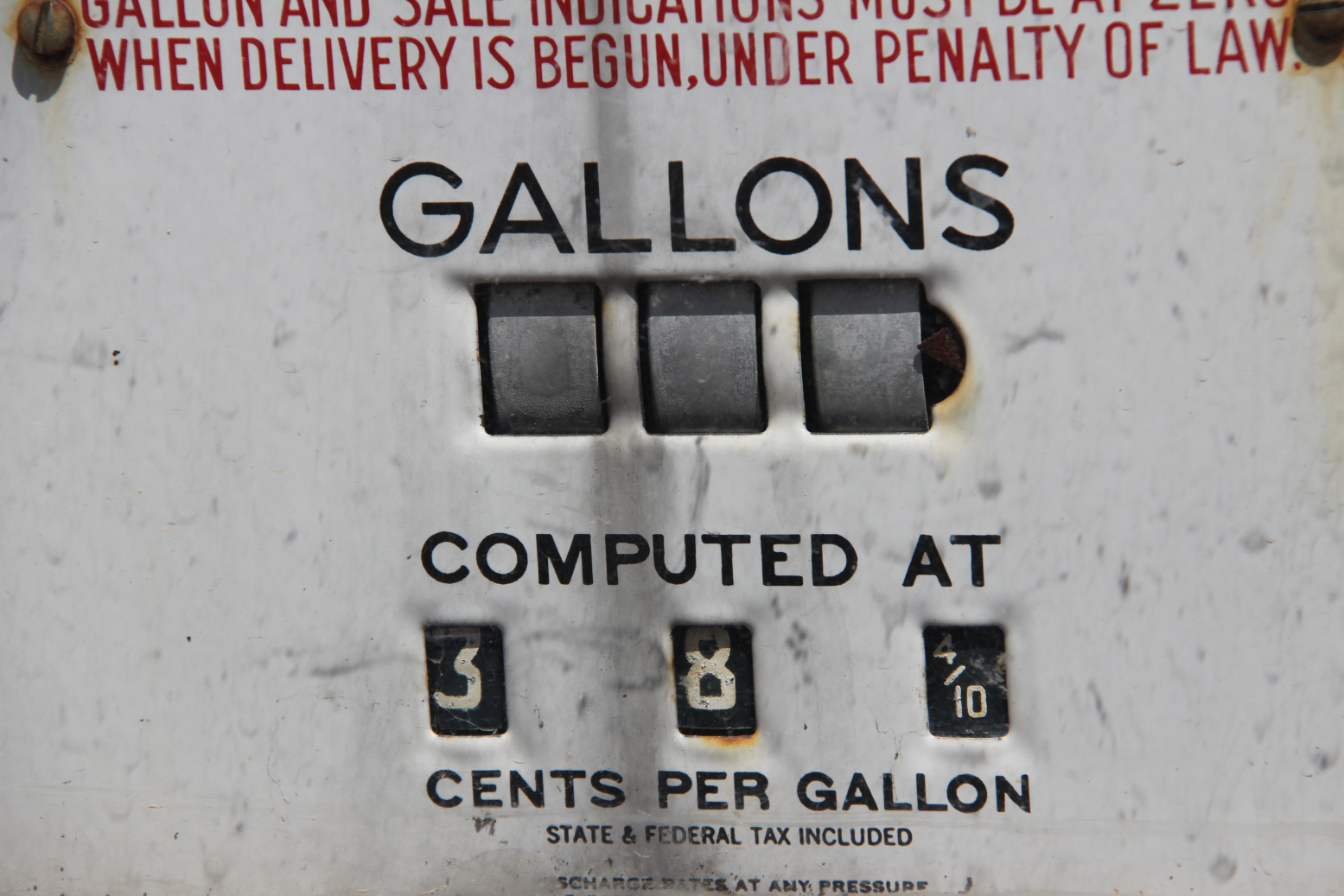
Once upon a time not all that long ago and 50 years ago, gas prices were much lower, here frozen in time at Gus’ Station. (Minnesota Prairie Roots copyrighted photo May 2026)
If I bought 15 gallons of unleaded gas at $4.50/gallon today, that would cost $67.50. If I bought 15 gallons of leaded gas in 1970 at 38 cents per gallon, the cost would have been only $5.70. I’d like to flash back in time, pull up to Gus’ Station and tell the attendant, “Fill ‘er up.”
TELL ME: What are gas prices in your area? Please specify where you live. How are you feeling about the price of gas and the economy in general?
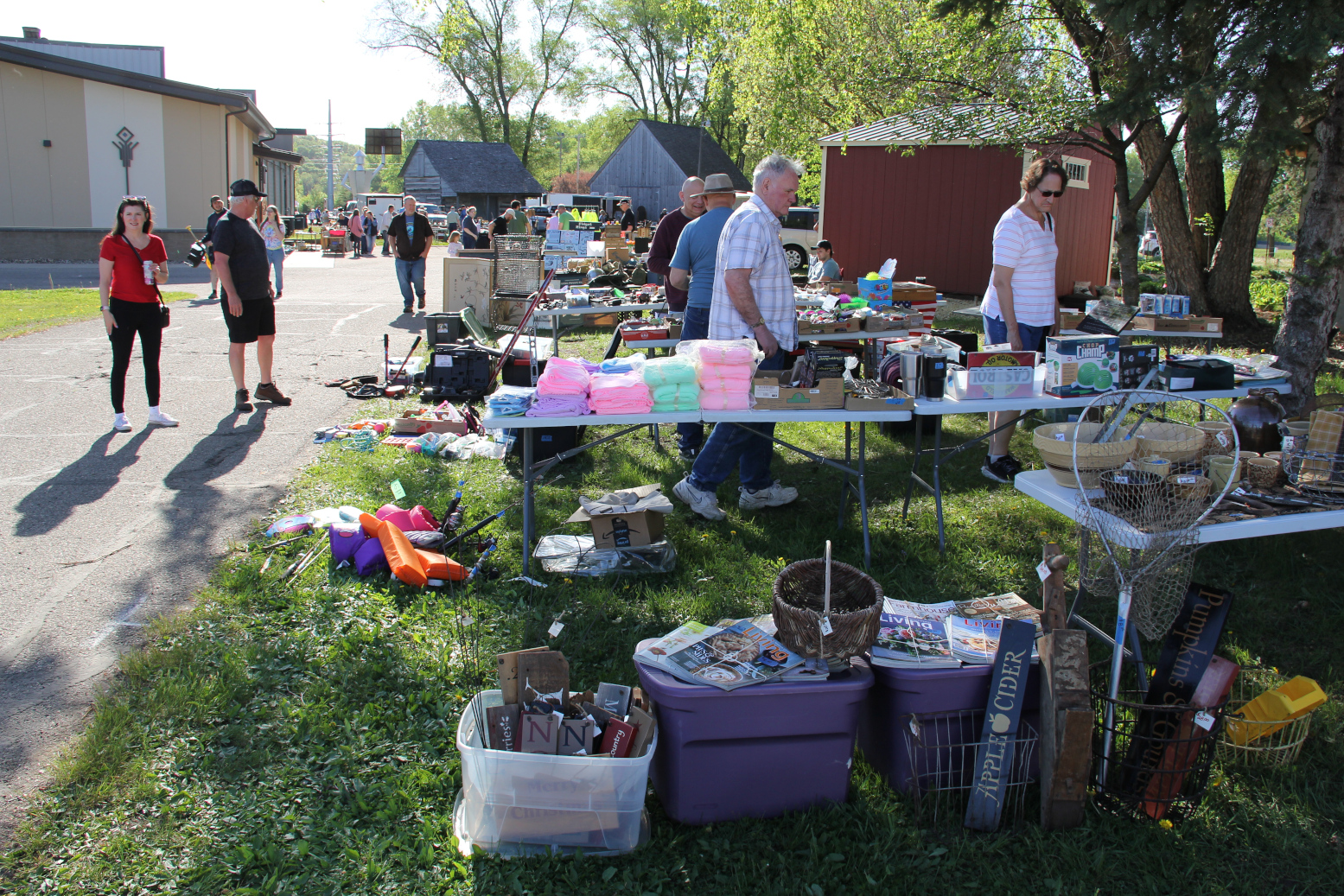
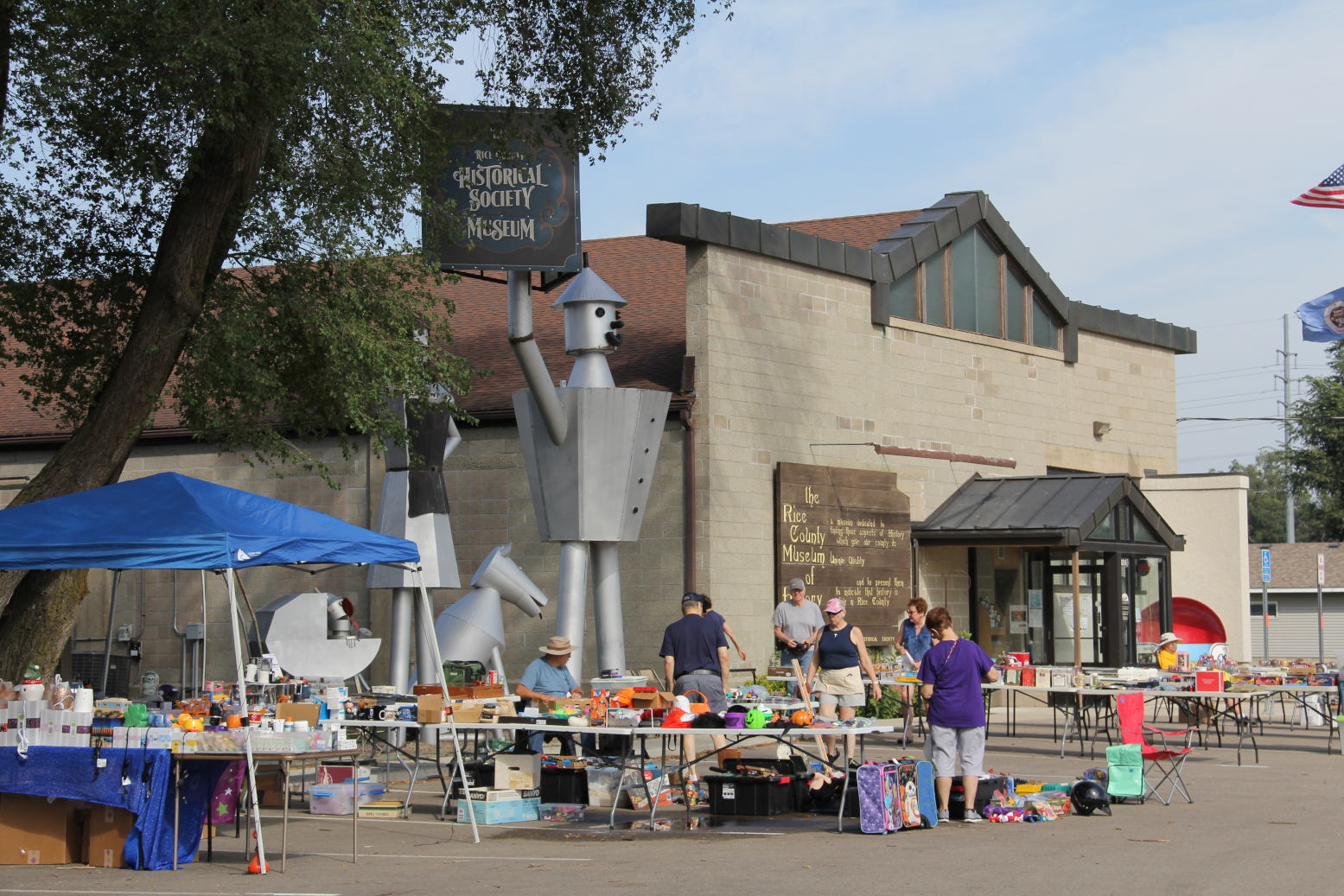
Shoppers peruse flea market goods early Saturday morning. (Minnesota Prairie Roots copyrighted photo May 2026)
WHENEVER I SHOP at a flea market, like the one last Saturday at the Rice County Historical Society, I challenge myself to find the quirky, odd and/or unusual. I’m never disappointed.
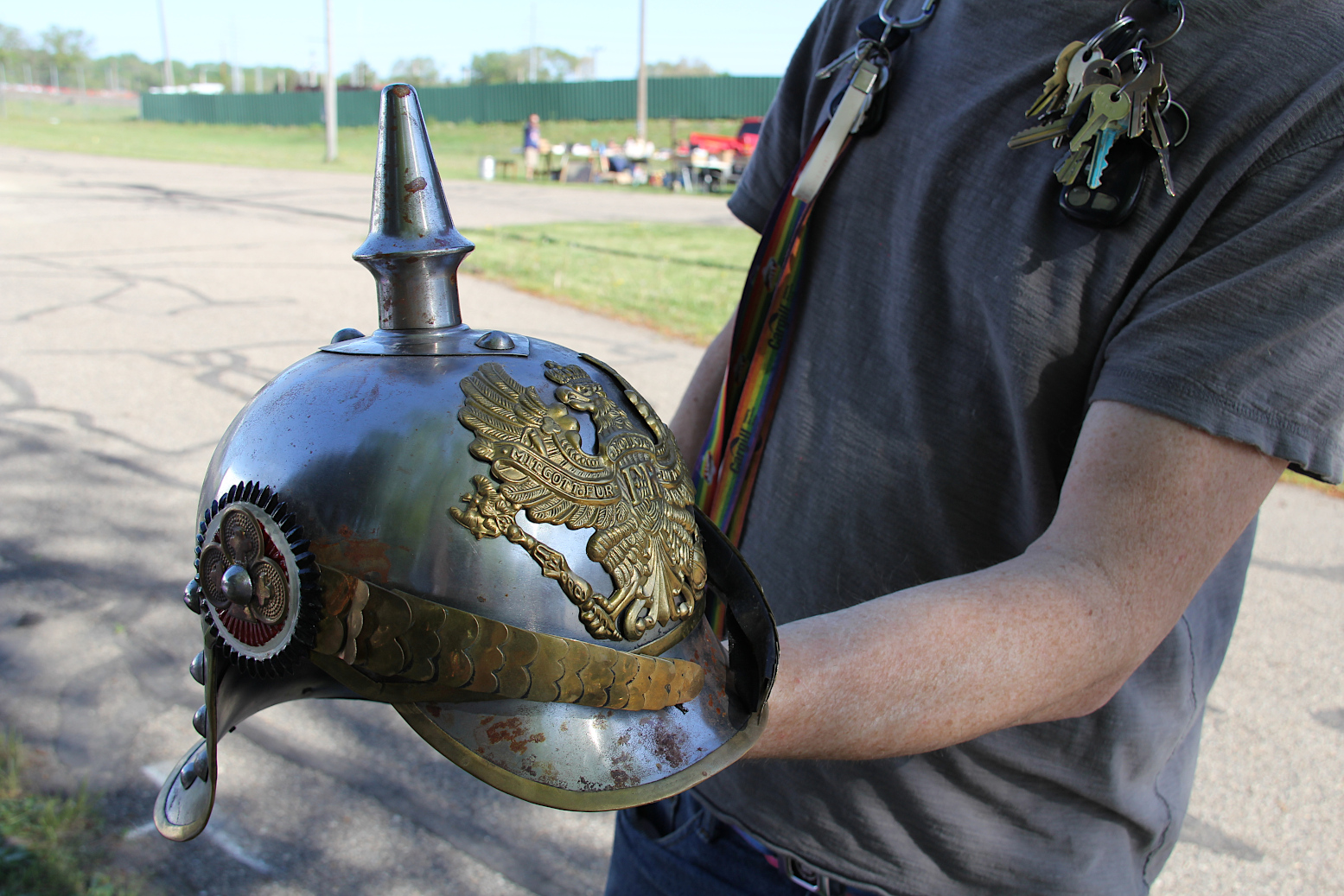
A replica spiked metal helmet sold at the flea market. (Minnesota Prairie Roots copyrighted photo May 2026)
Hands down, the most interesting find at the RCHS market was a replica Pickelhaube, a spiked metal helmet worn by an Imperial German Army officer during the 1870s Franco-Prussian War, according to vendor Carson Heselton. He sold the reproduction helmet to a young man who seemed thrilled to get his hands on the unusual piece and learn a bit of history in the process.
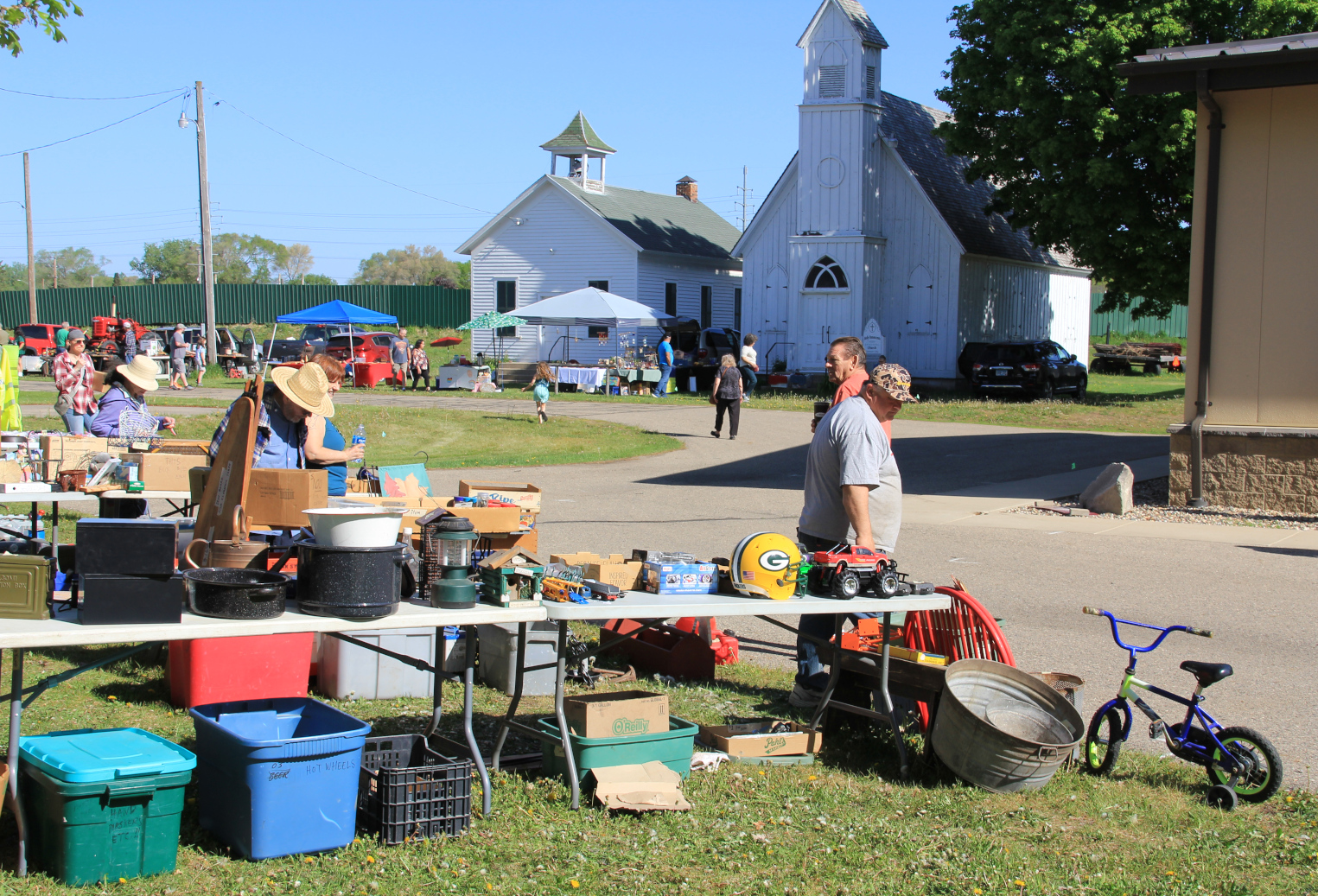
An historic church and school, owned by the historical society, backdrop the flea market. (Minnesota Prairie Roots copyrighted photo May 2026)
Heselton holds a wealth of historical knowledge, which is no surprise given he has a degree in history and is currently in graduate school. Somehow we got on the topic of the Ku Klux Klan’s presence in Rice and Steele counties many decades ago. Heselton wrote a college research paper on the subject with his work now on file with the local historical society. I intend to read it at some point. But he shared a little with me, including that the Klan burned a cross in the yard of his grandmother’s Catholic family when she was just six years old. The KKK targeted Catholics along with African Americans. His grandma never forgot that traumatizing event, the story passed down through the generations.
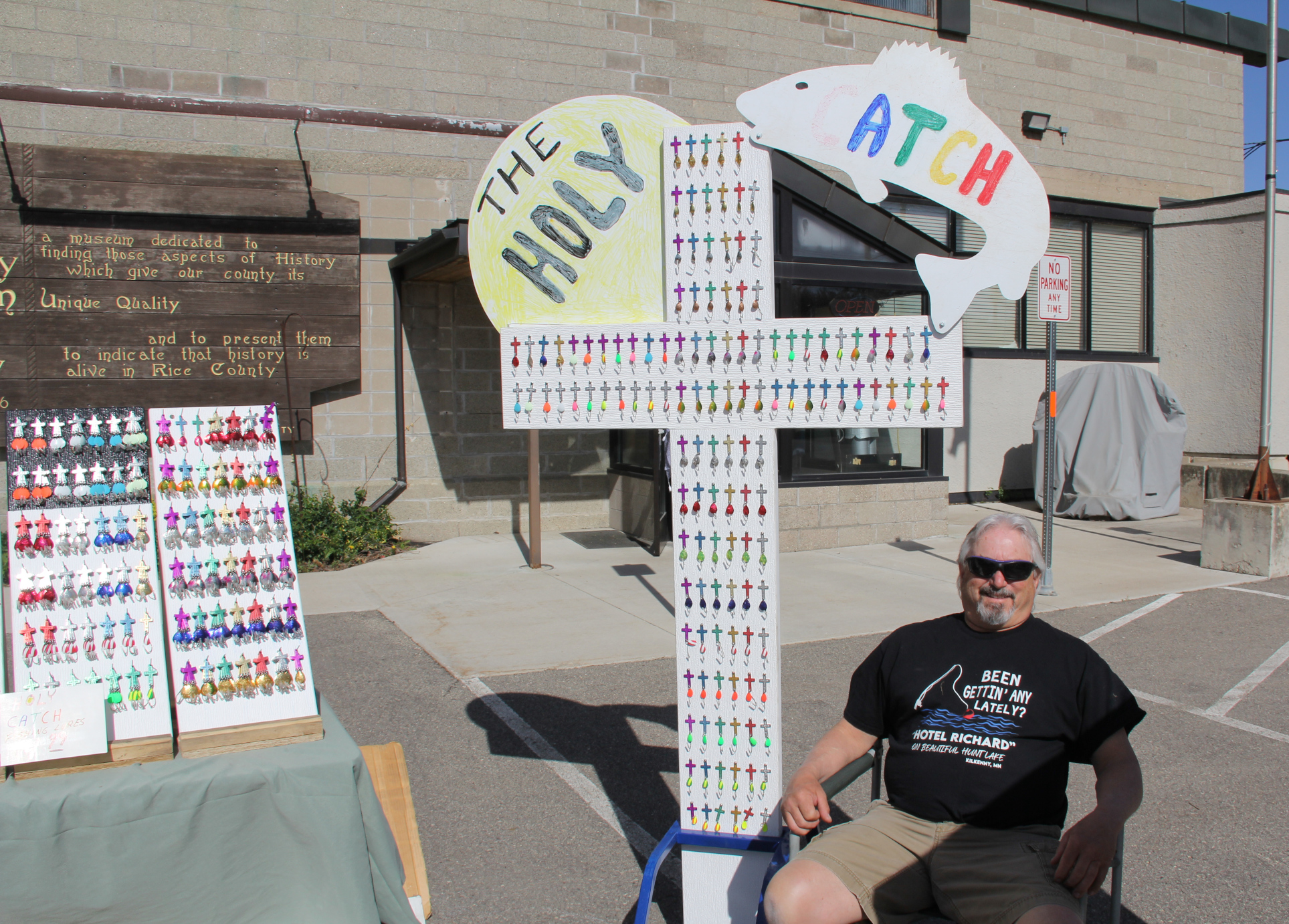
Timmy Capranos with his The Holy Catch lures. (Minnesota Prairie Roots copyrighted photo May 2026)
Vendor Timmy Capranos of Kilkenny brought an over-sized cross to the RCHS Spring Flea Market. But his had only good intentions—to market his faith-themed fishing lures under the tag “The Holy Catch.” Each lure features a cross with the words GOD LOVES YOU.
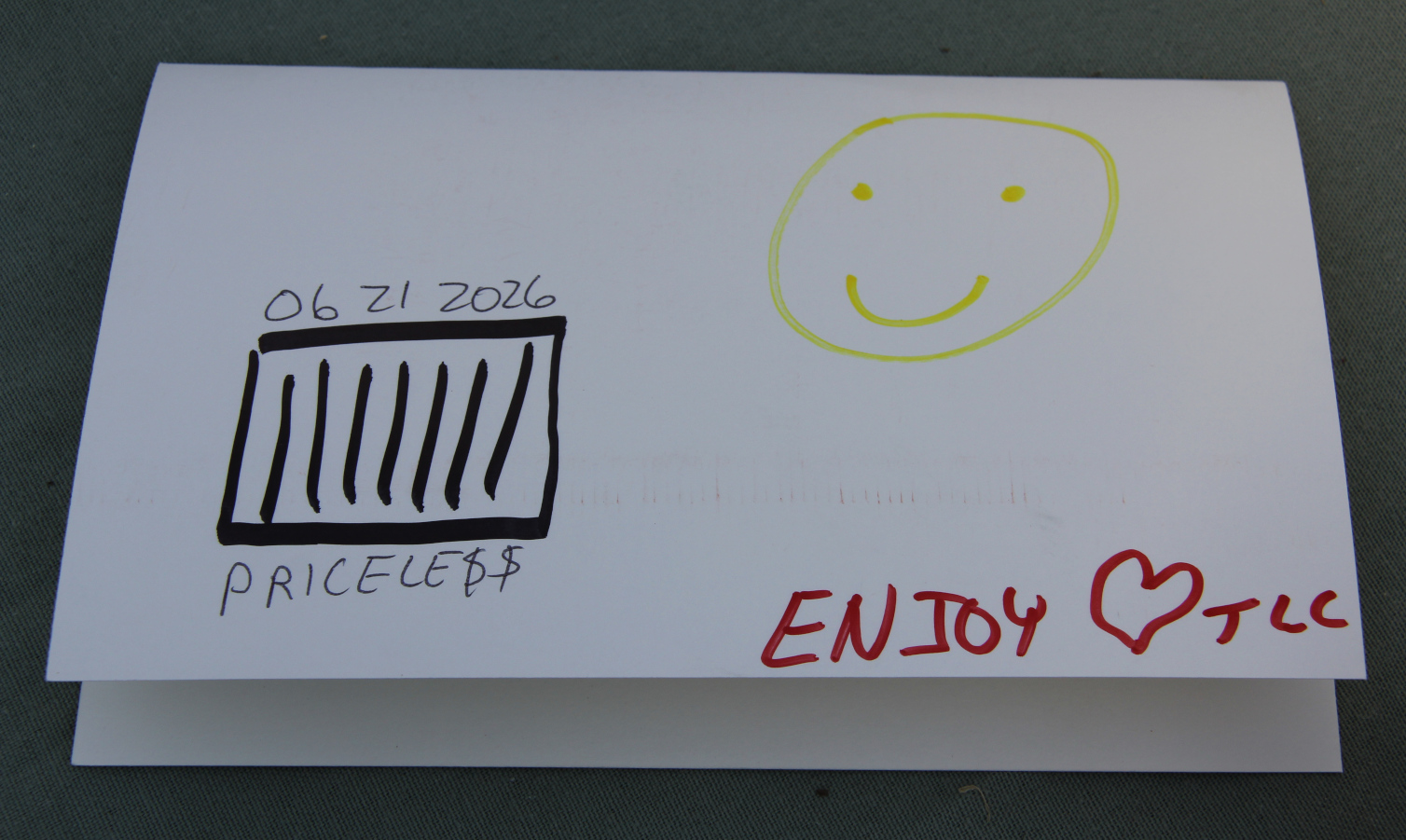
A sample Father’s Day card includes the date of the celebration. (Minnesota Prairie Roots copyrighted photo May 2026)
Capranos earns my award for creativity with not only his $4.99 holy lures, but also his Design Your Own Card enterprise of blank card stock offered for 99 cents to, well, design your own card. He even provided a sample Father’s Day greeting card. I love his humor, his entrepreneurship and his overall joyful personality.
Jeremy Struff of JS Woodcrafts brought his handcrafted wood products, including this bowl. (Minnesota Prairie Roots copyrighted photo May 2026)
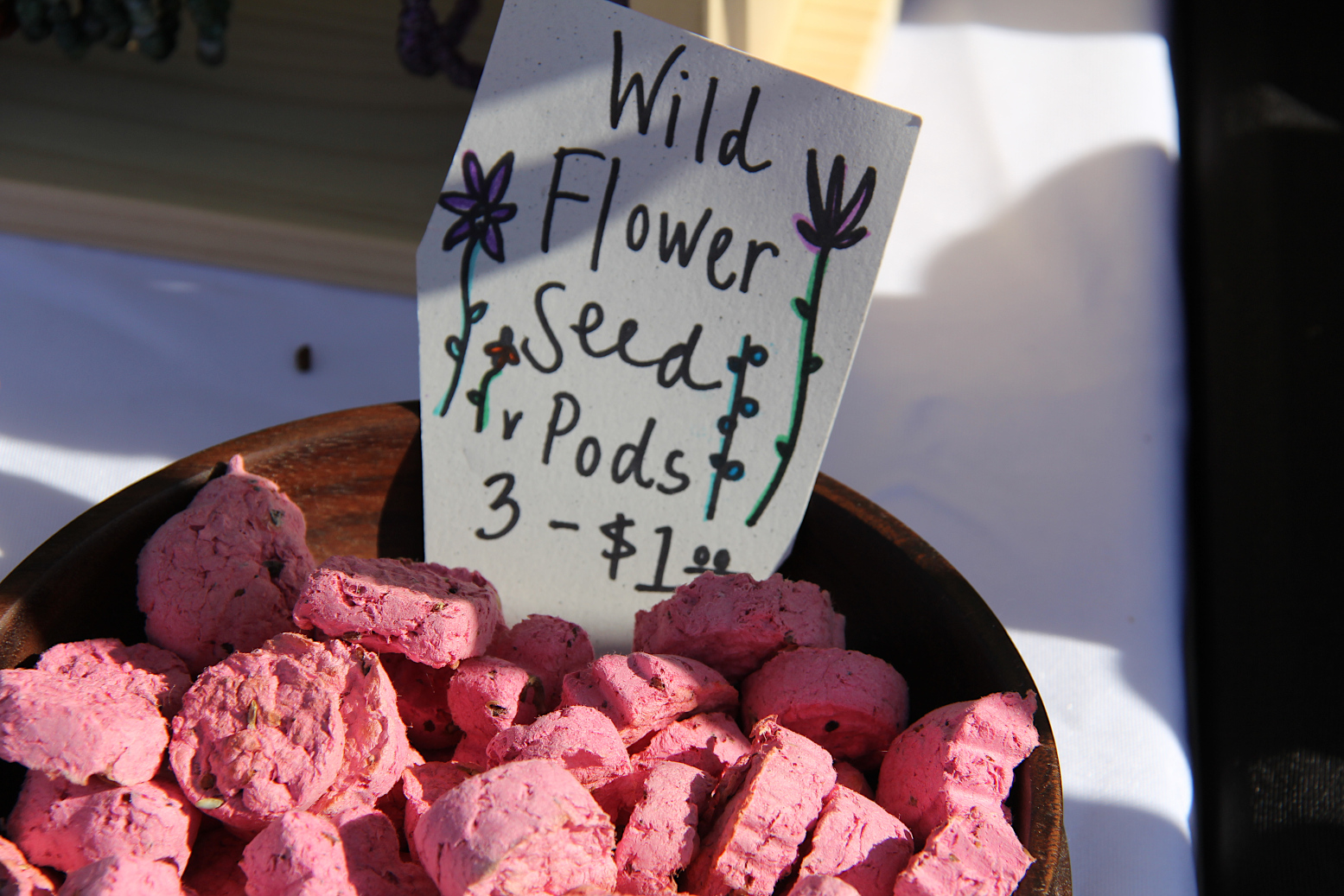
For the gardener, a vendor sold wildflower seed pods. (Minnesota Prairie Roots copyrighted photo May 2026)
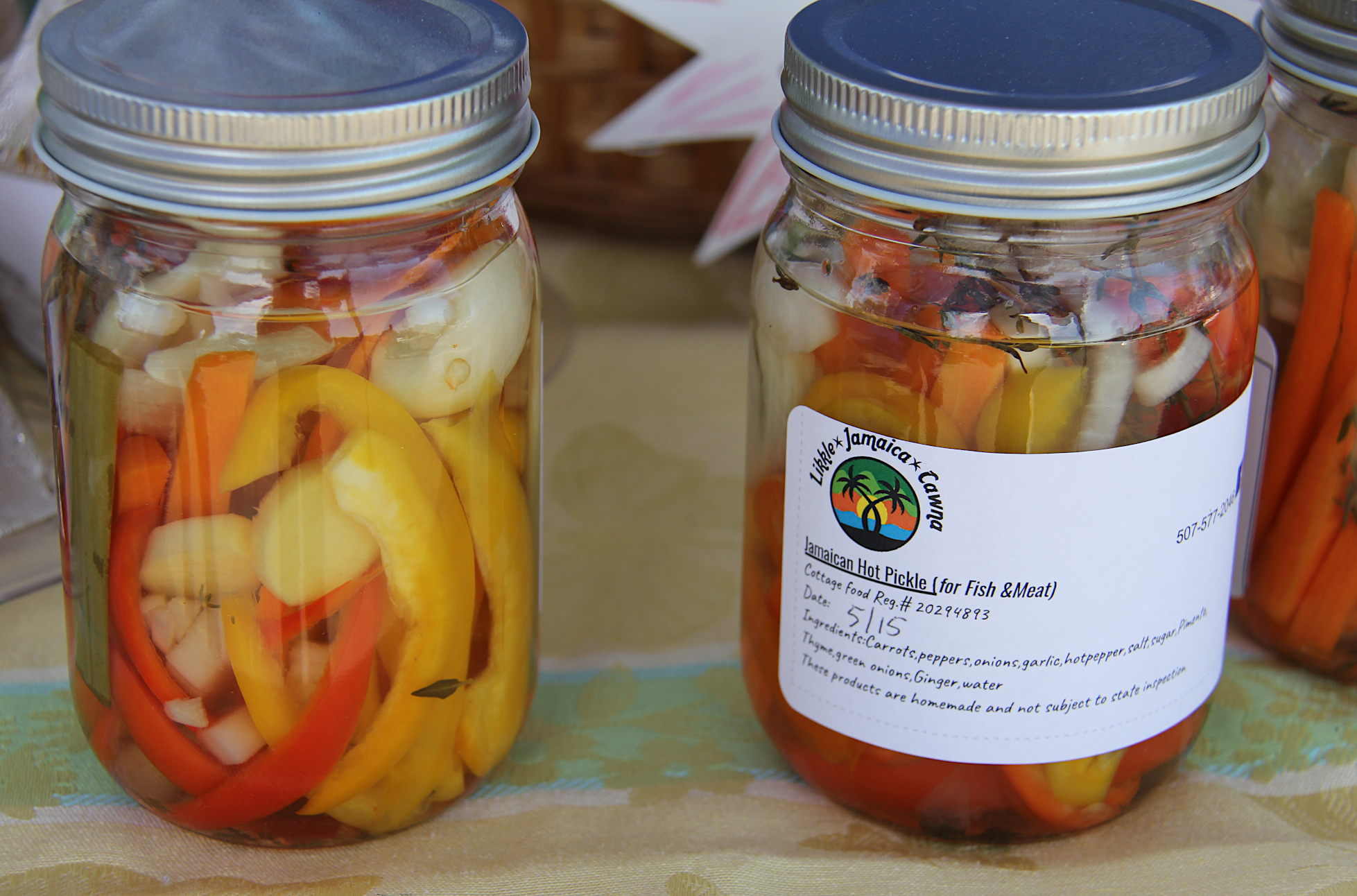
Kenyon vendor Likkle Jamaica Cawna sold her Jamaican Hot Pickle (for fish and meat)and baked goods. Her Jamaican bread was sold out when I stopped by her table. She hopes to sell her homemade foods at local farmers’ markets. (Minnesota Prairie Roots copyrighted photo May 2026)
I saw more creativity in crafted wooden bowls, lemonade stand signs, wildflower seed pods, yard art, beer bottle wind chimes (also by Capranos) and pickled vegetables.
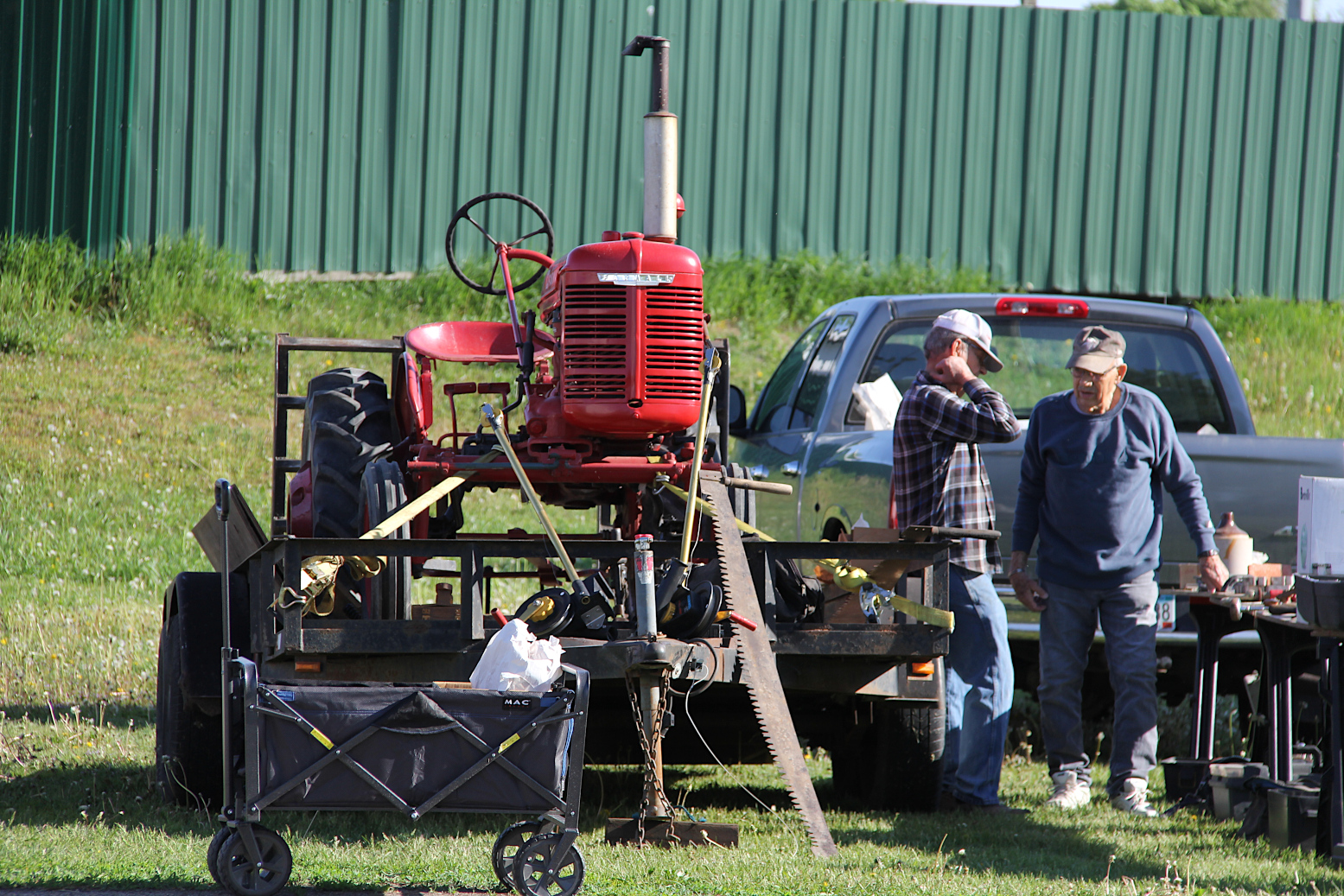
This is the first time I’ve seen a tractor for sale at a flea market. (Minnesota Prairie Roots copyrighted photo May 2026)
You never know what you’ll find at a flea market. A guy even showed up with an early 1950s Super A Farmall tractor.
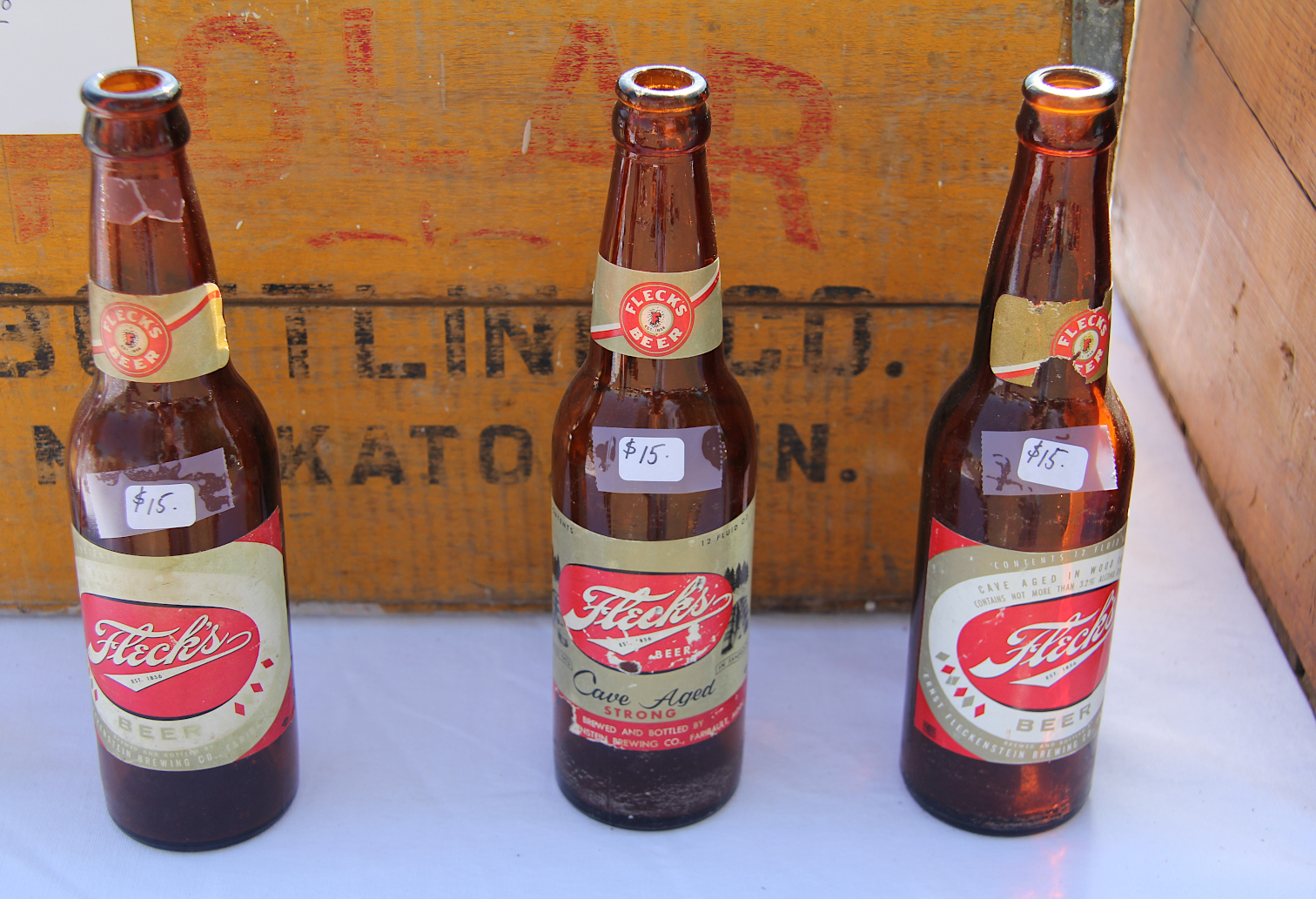
Collectors could find Fleck’s Beer bottles and related items from the historic Faribault brewery.(Minnesota Prairie Roots copyrighted photo May 2026)
The adage of “One person’s junk is another’s treasure” certainly fits. Since I don’t need more junk or treasures, I try really hard not to buy anything. Mostly I eye the goods, reminisce, talk with people and scout for the quirky, odd and/or unusual.
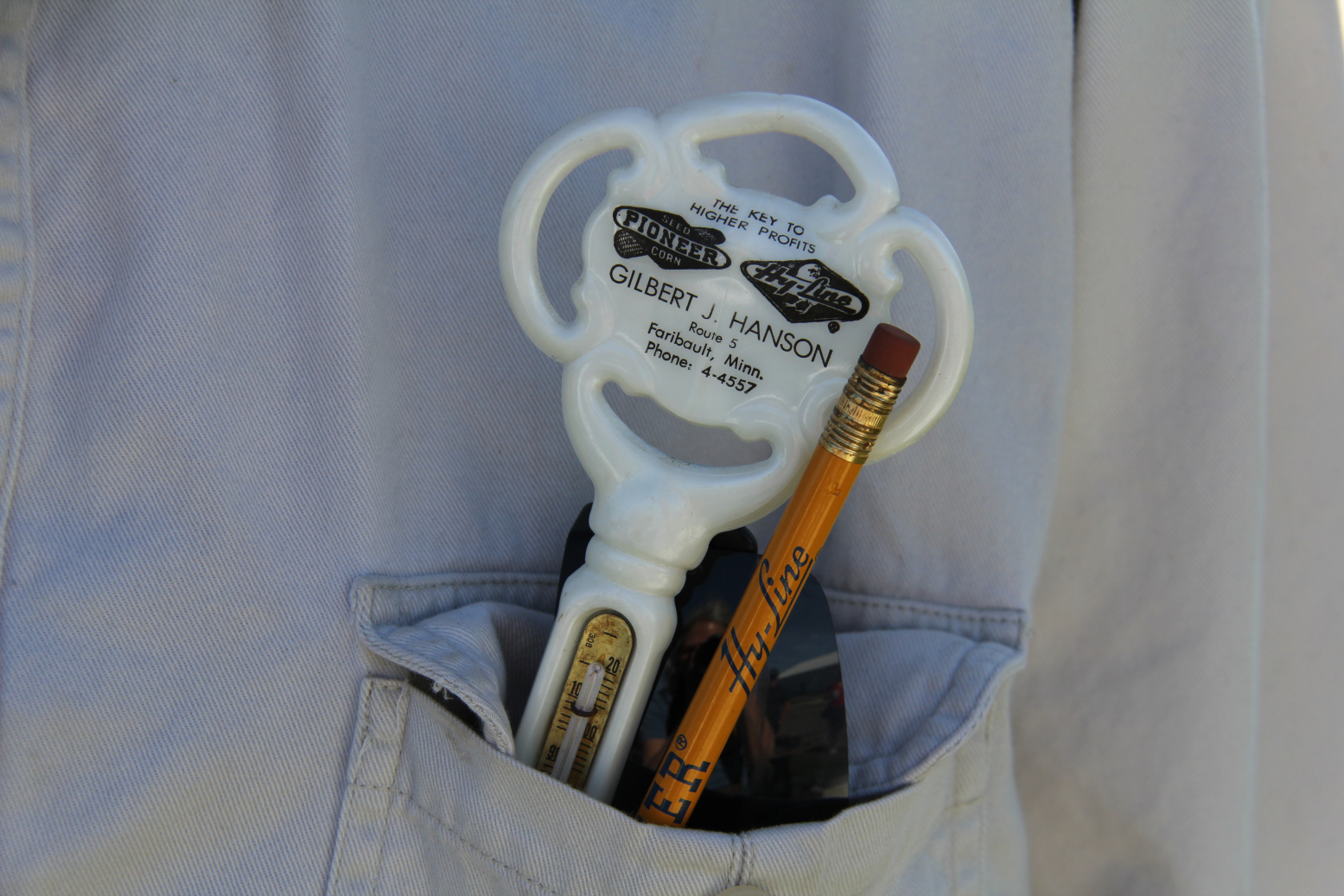
A Faribault resident’s finds from a long ago local business. (Minnesota Prairie Roots copyrighted photo May 2026)
And sometimes I find history in the process—in a replica Pickelhaube, a thermometer promoting pioneer corn and Hy-Line chicks, and bottles that once held Faribault-brewed Fleck’s Beer.
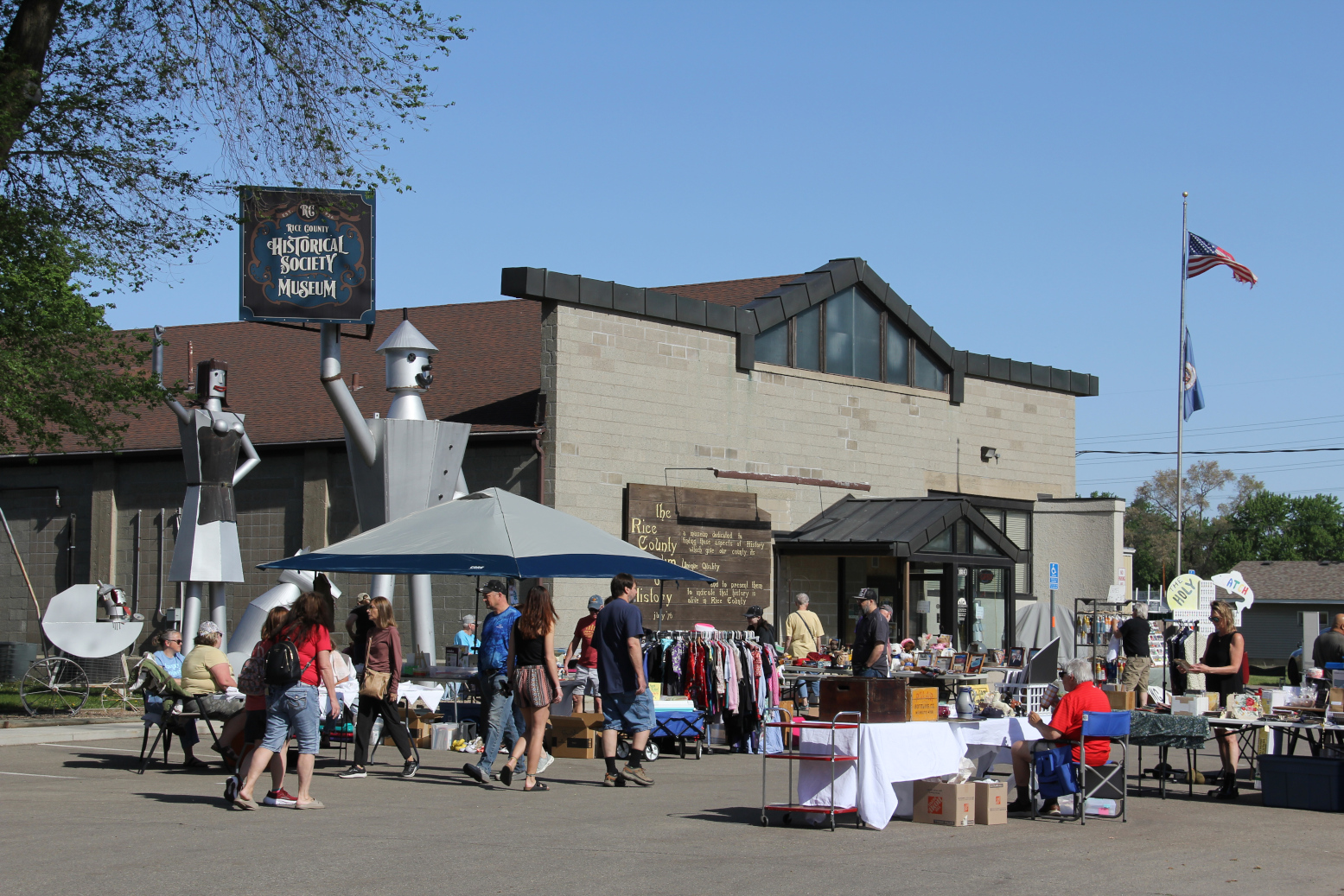
Vendors set up in front of the RCHS, then wrapped around the side and back. (Minnesota Prairie Roots copyrighted photo May 2026)
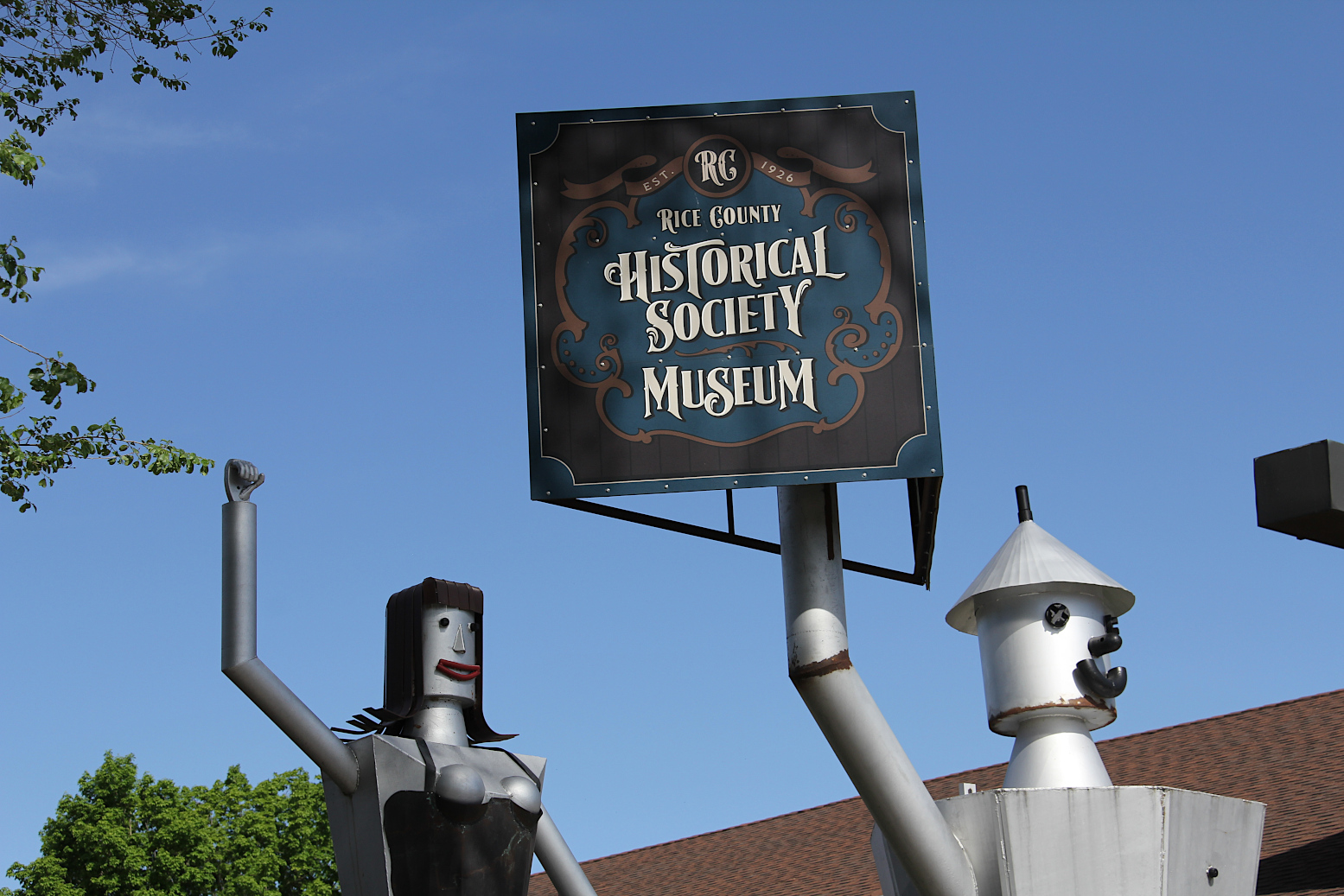
The tin man and woman, who once stood outside Lockerby Sheet Metal in Faribault, watch over the flea market as permanent installations at the historical society. (Minnesota Prairie Roots copyrighted photo May 2026)
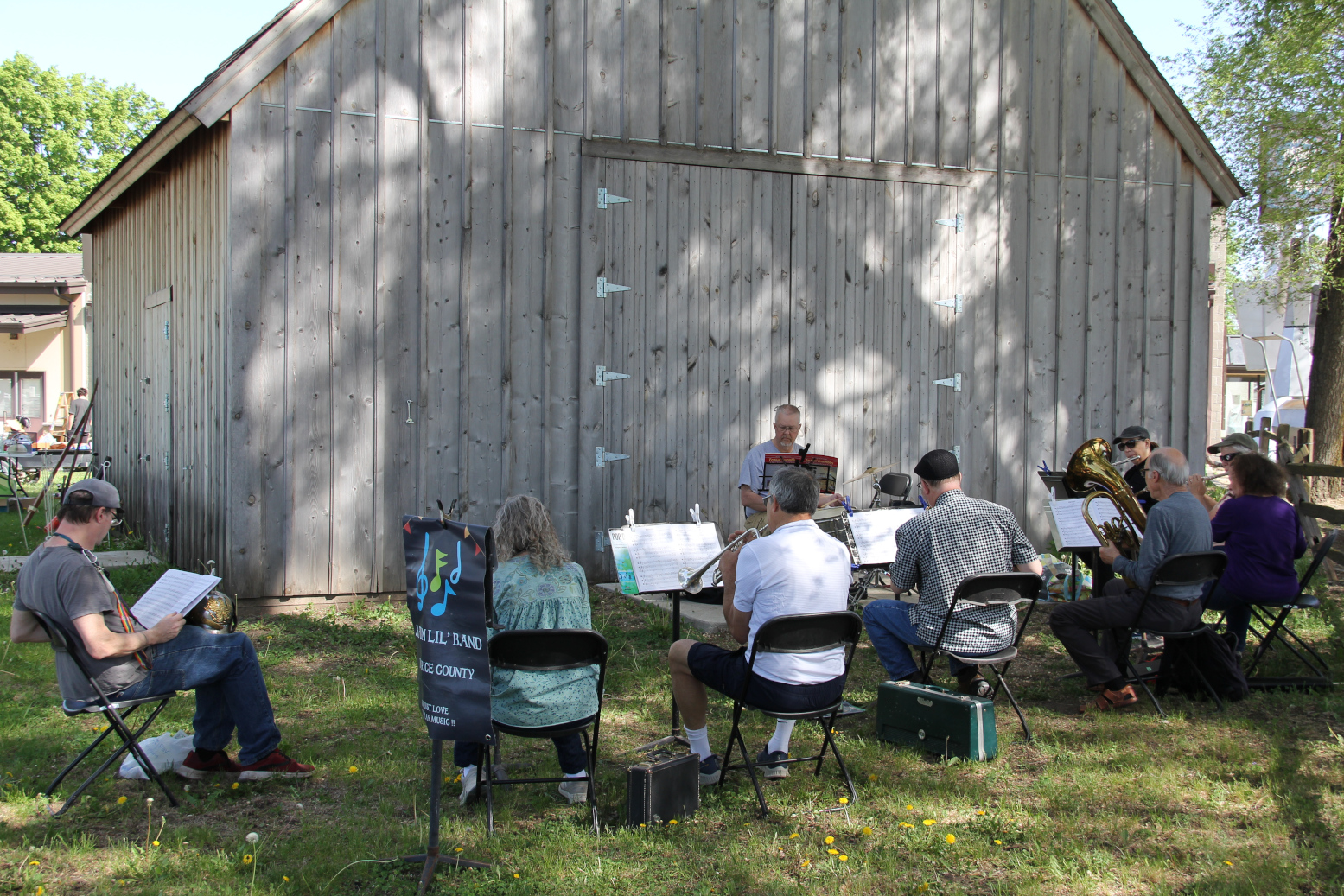
A Fun Lil’ Band entertains. (Minnesota Prairie Roots copyrighted photo May 2026)
I also find community at flea markets. There’s something about poking around in piles of stuff that feels grassroots connective. I often find myself striking up conversations with vendors and sometimes shoppers. I usually see people I know, which leads to a bit of catching up.
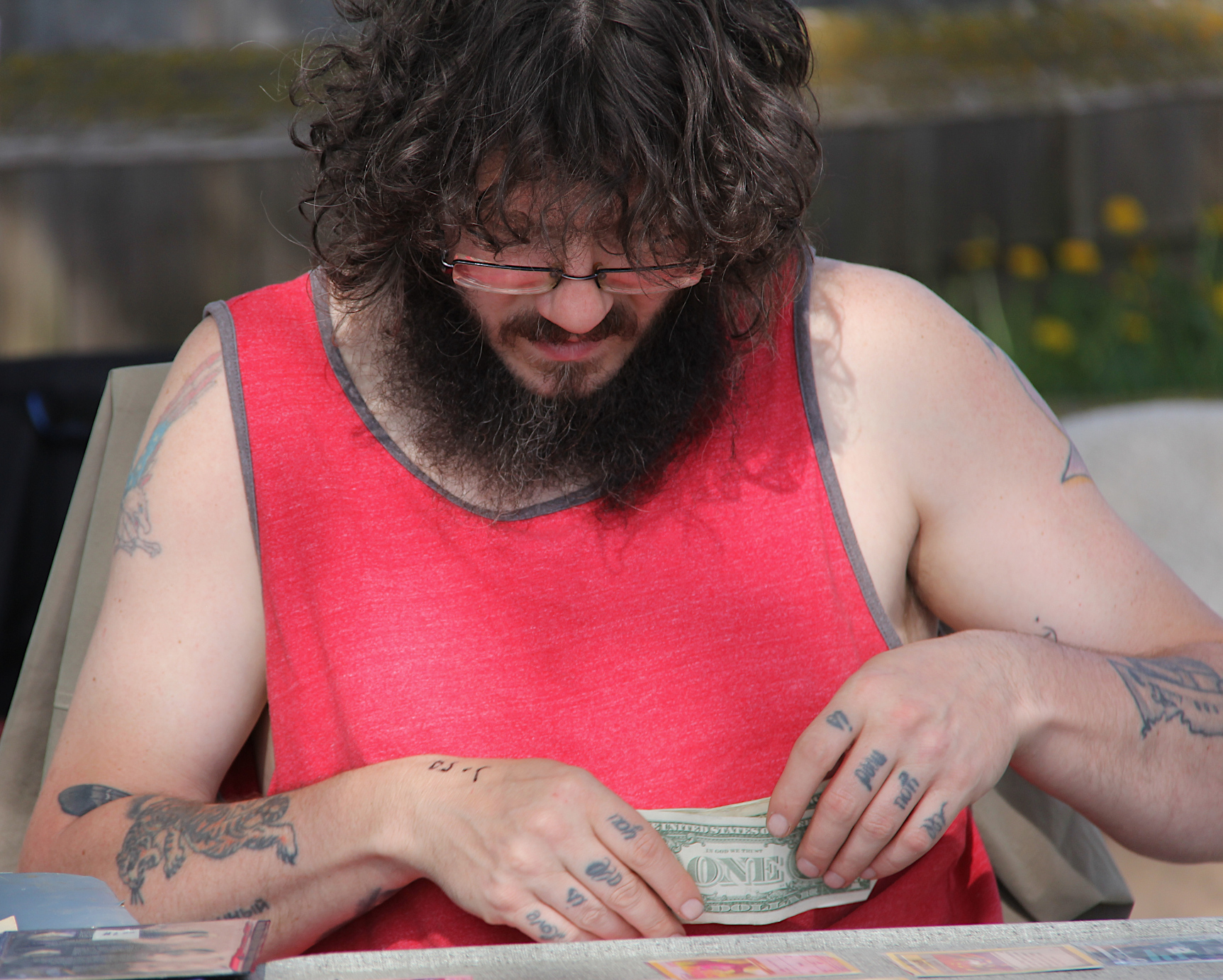
A seller counts his money. (Minnesota Prairie Roots copyrighted photo May 2026)
Another opportunity to shop for unusual finds and handcrafted goods happens Memorial Day weekend in nearby rural Dundas. Rice County Steam & Gas Engines hosts its annual spring event with a flea market and swap meet from 8 a.m.-5 p.m. Saturday, May 23, and Sunday, May 24. A consignment auction is also set for 9 a.m. Saturday and a tractor pull for 9 a.m. Sunday.
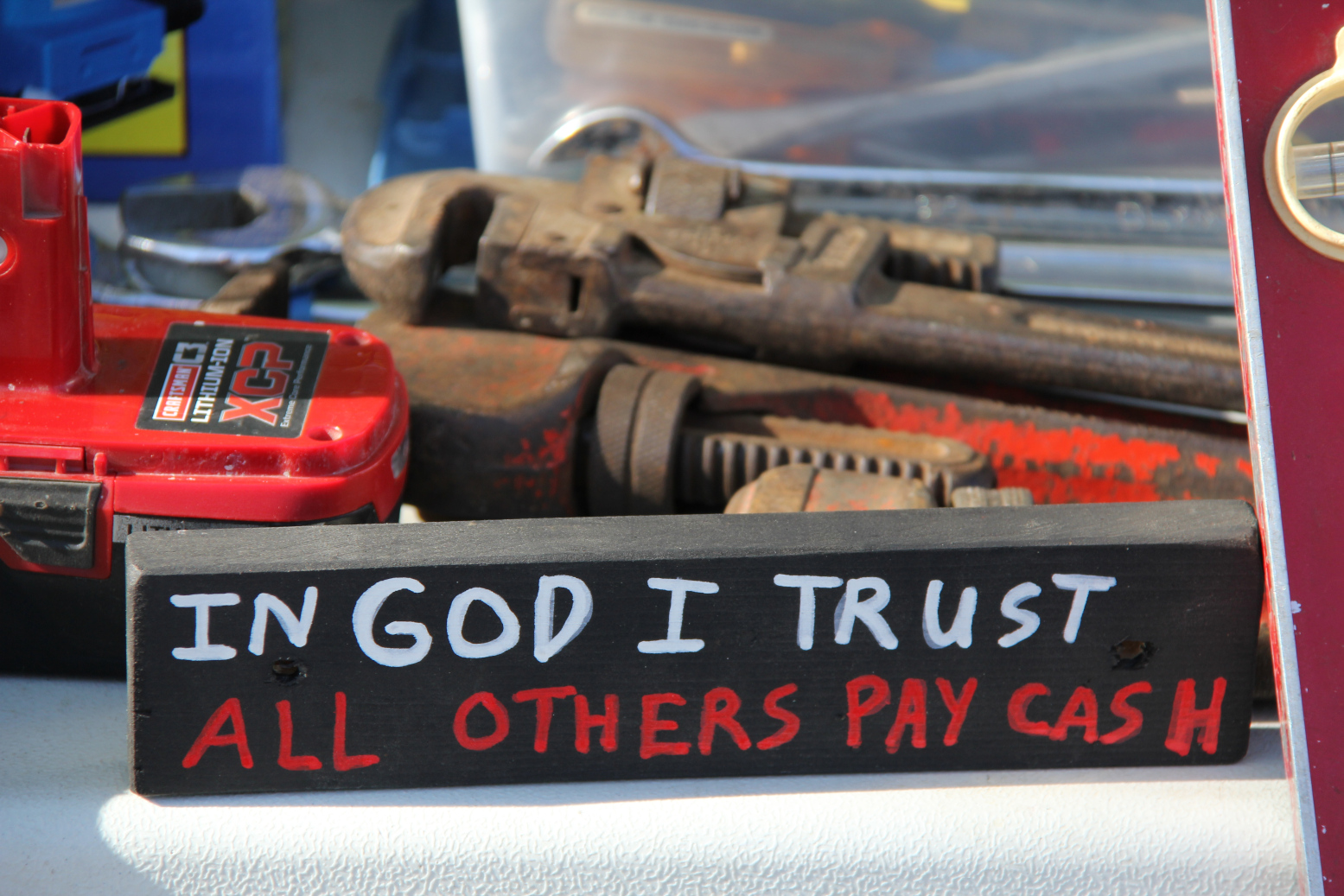
Payment signage among tools for sale at the RCHS Flea Market. (Minnesota Prairie Roots copyrighted photo May 2026)
I hope to be there, poking around, looking for the quirky, odd and/or unusual as I connect with community and maybe learn some history in the process.
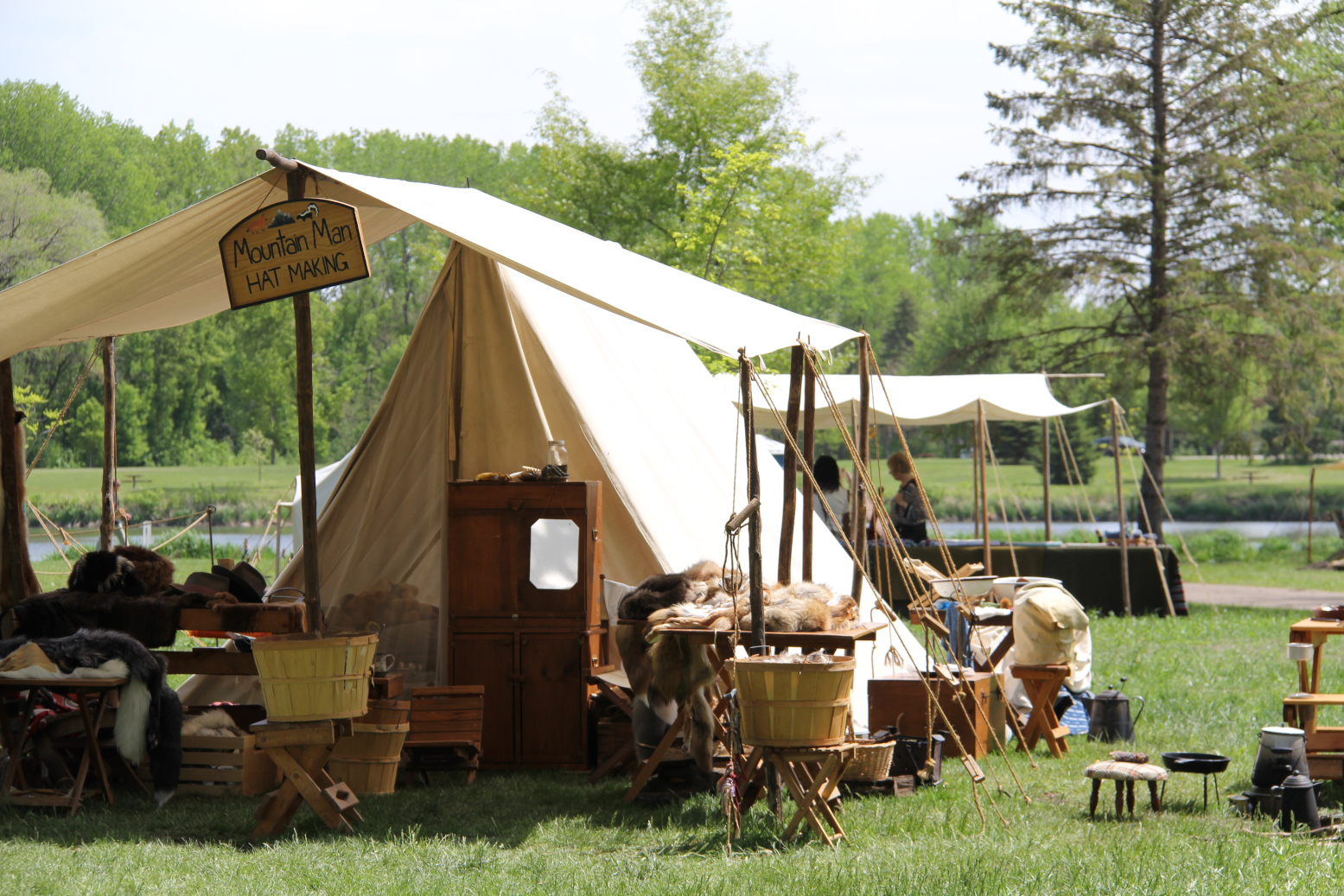
Tents aplenty, including that of a hat maker, were set up by the Cannon River for the Riverside Rendezvous in Faribault. (Minnesota Prairie Roots copyrighted photo May 2026)
ALONG THE BANKS of the Cannon River in Faribault’s North Alexander Park, they set up camp. The fur trappers, the blacksmith, the weaver, the spinner, the tinsmith, the shopkeeper, the hat maker…all of them in a community founded by a fur trader, Alexander Faribault.
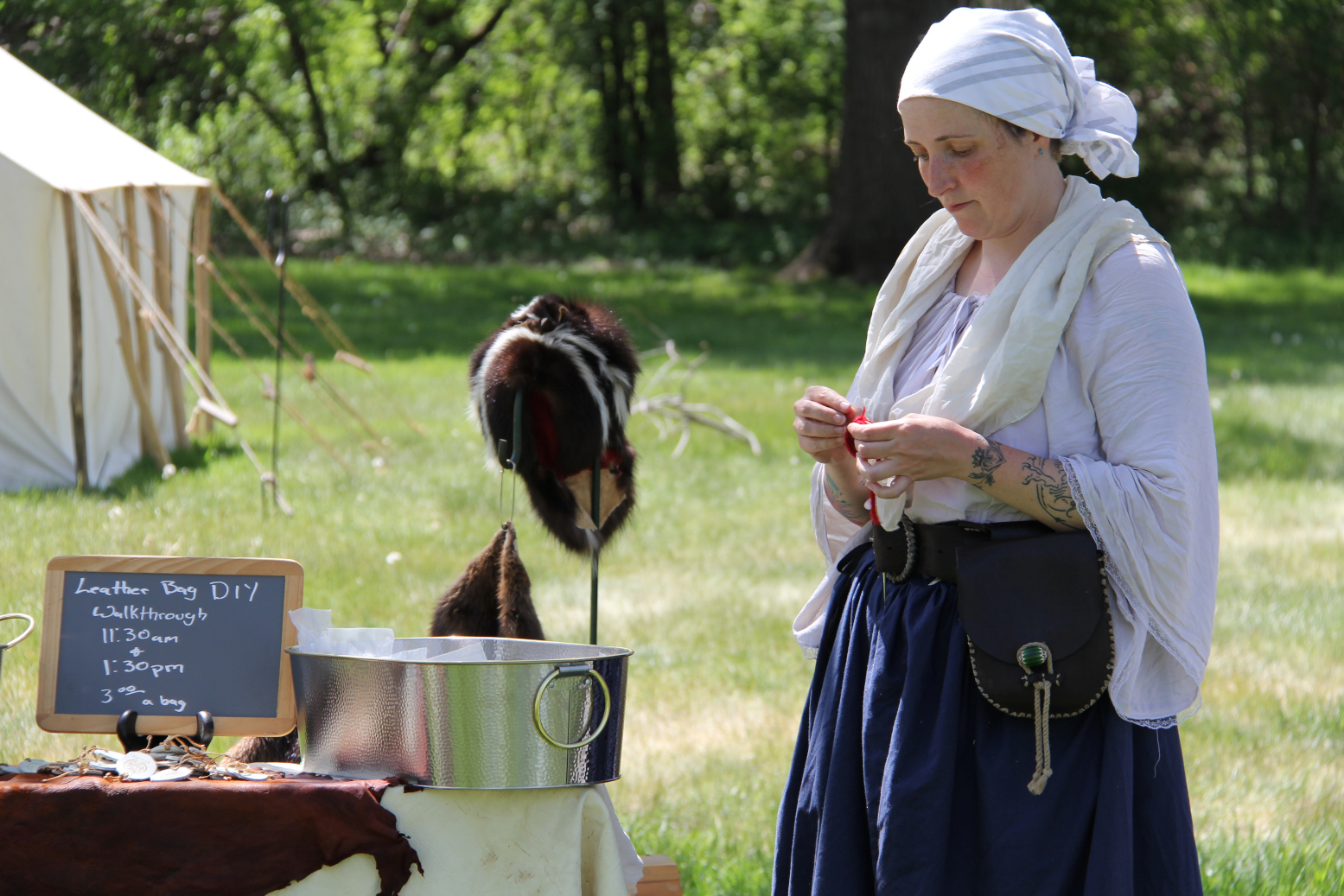
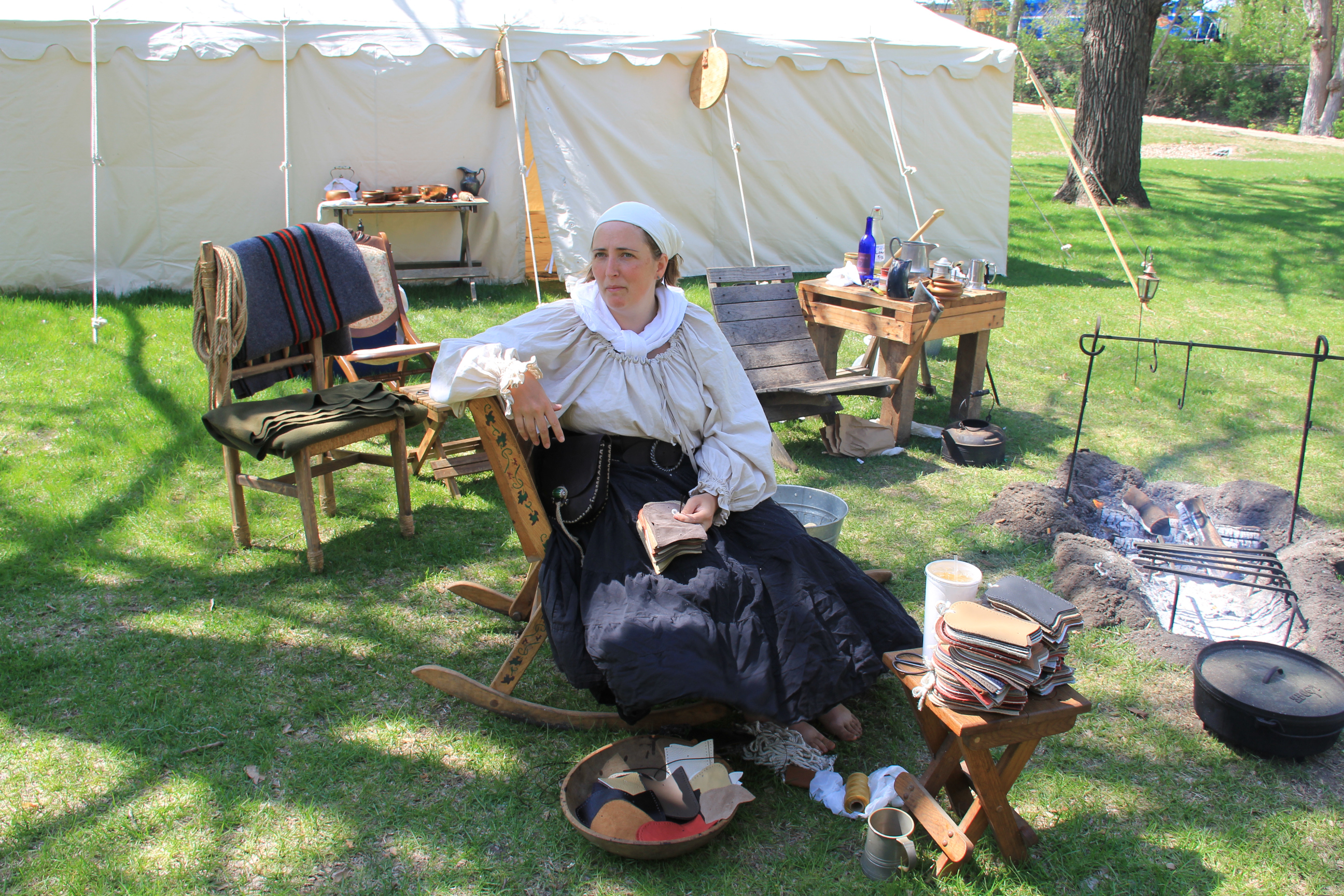
In between stitching leather, this re-enactor weaves a cord. (Minnesota Prairie Roots copyrighted photo May 2026)
History came to life here, at the second annual Riverside Rendezvous and History Festival organized by the Rice County Historical Society. This event is like a step back in time to the 18th and 19th centuries with history enthusiasts in period costume demonstrating long ago hands-on work and talking up their passions.
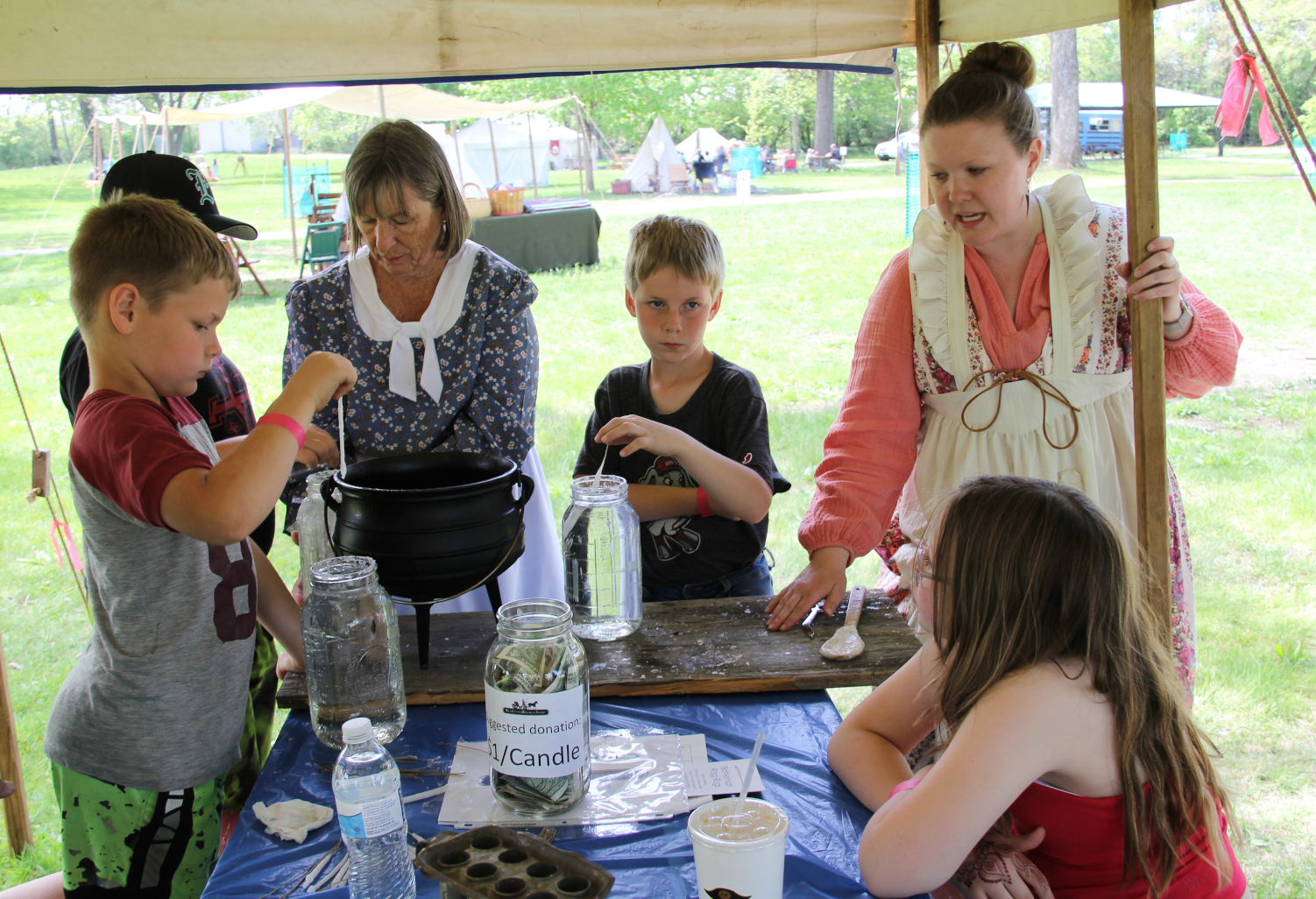
One of the hands-on activities, making candles. (Minnesota Prairie Roots copyrighted photo May 2026)
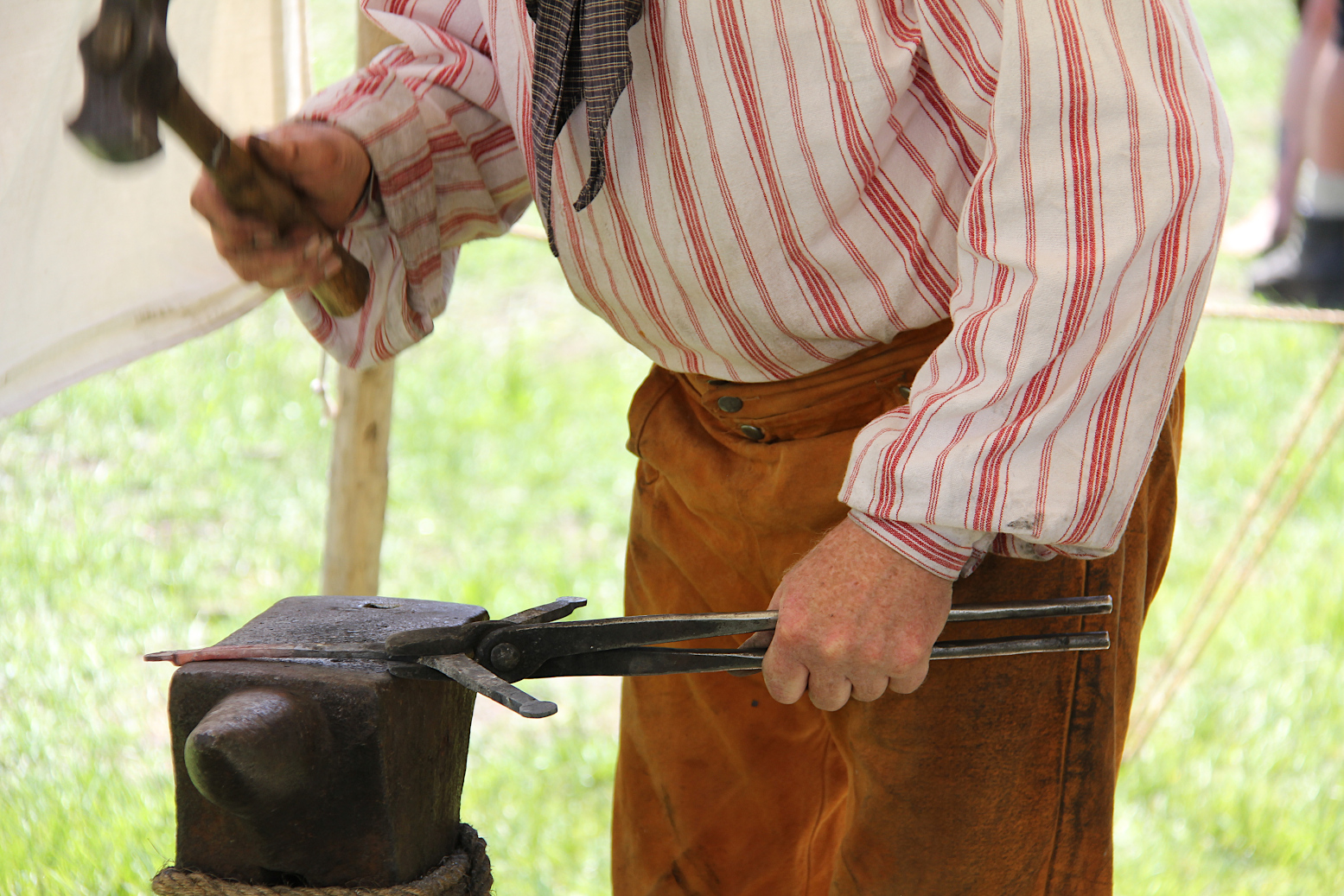
The blacksmith pounds hot metal. (Minnesota Prairie Roots copyrighted photo May 2026)
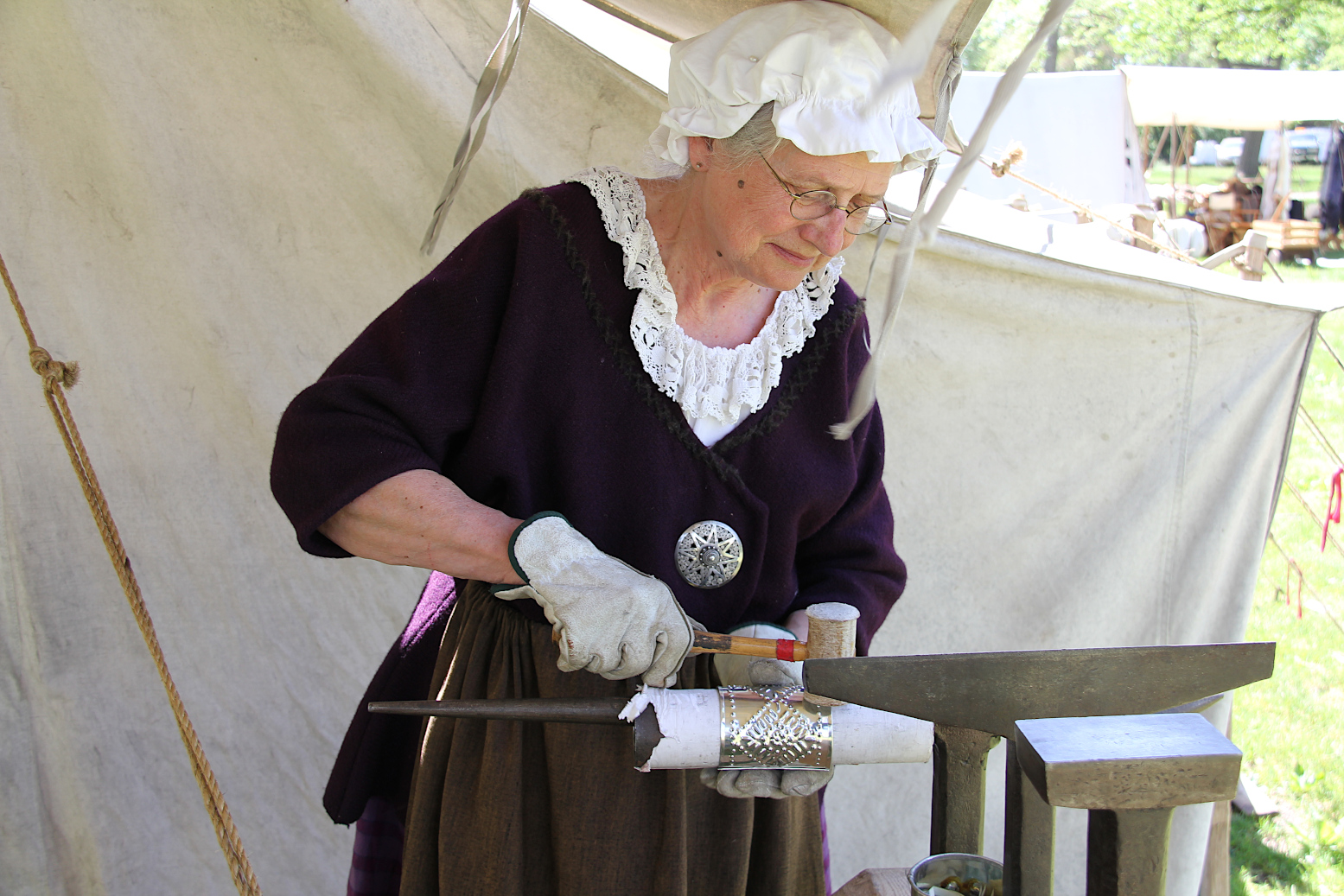
Here I watched candle-making, blacksmithing, rug weaving, spinning of wool into yarn, tinsmithing…
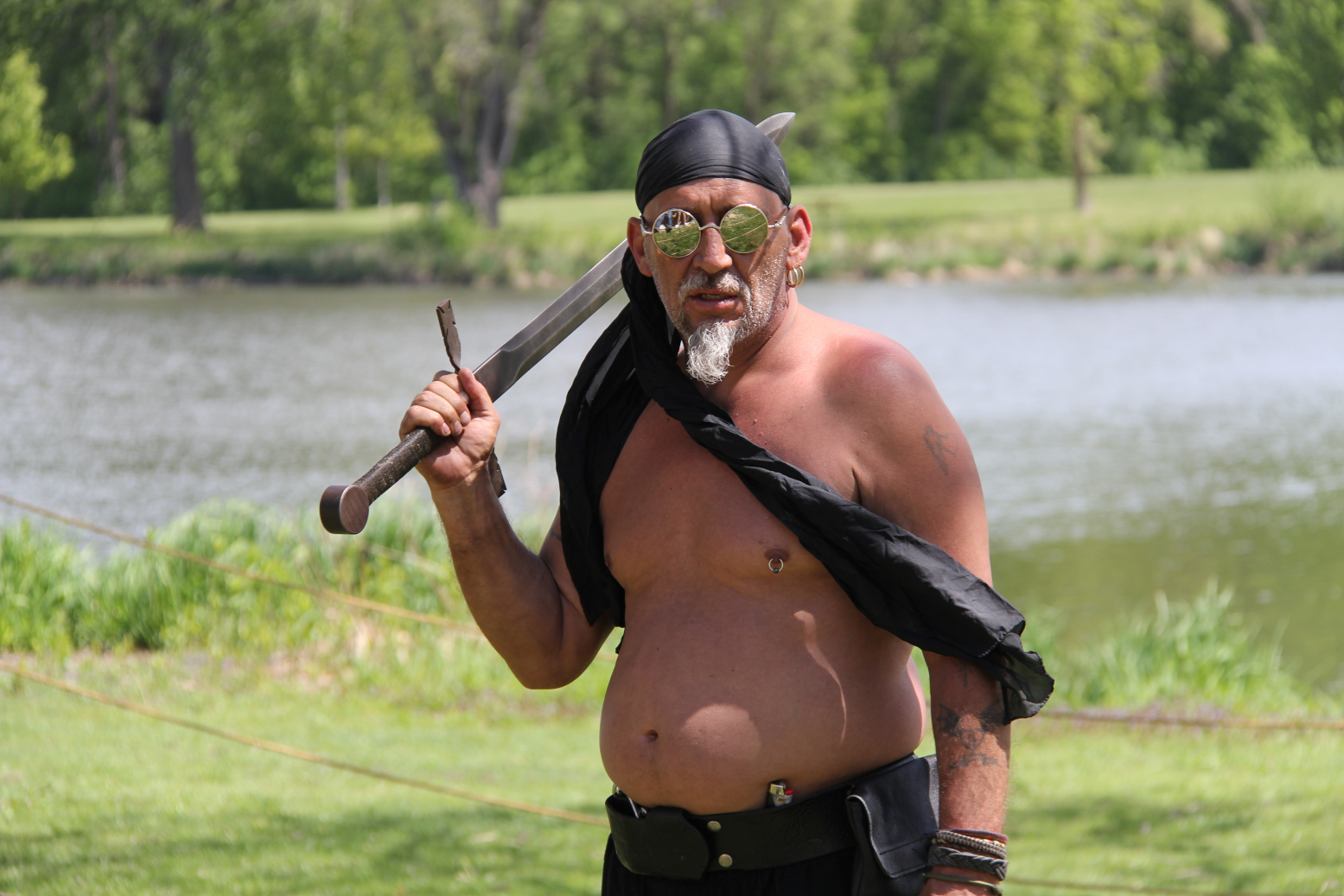
Attendees listened to this participant give a lesson in defense and weaponry. (Minnesota Prairie Roots copyrighted photo May 2026)
I learned about crests and weapons.
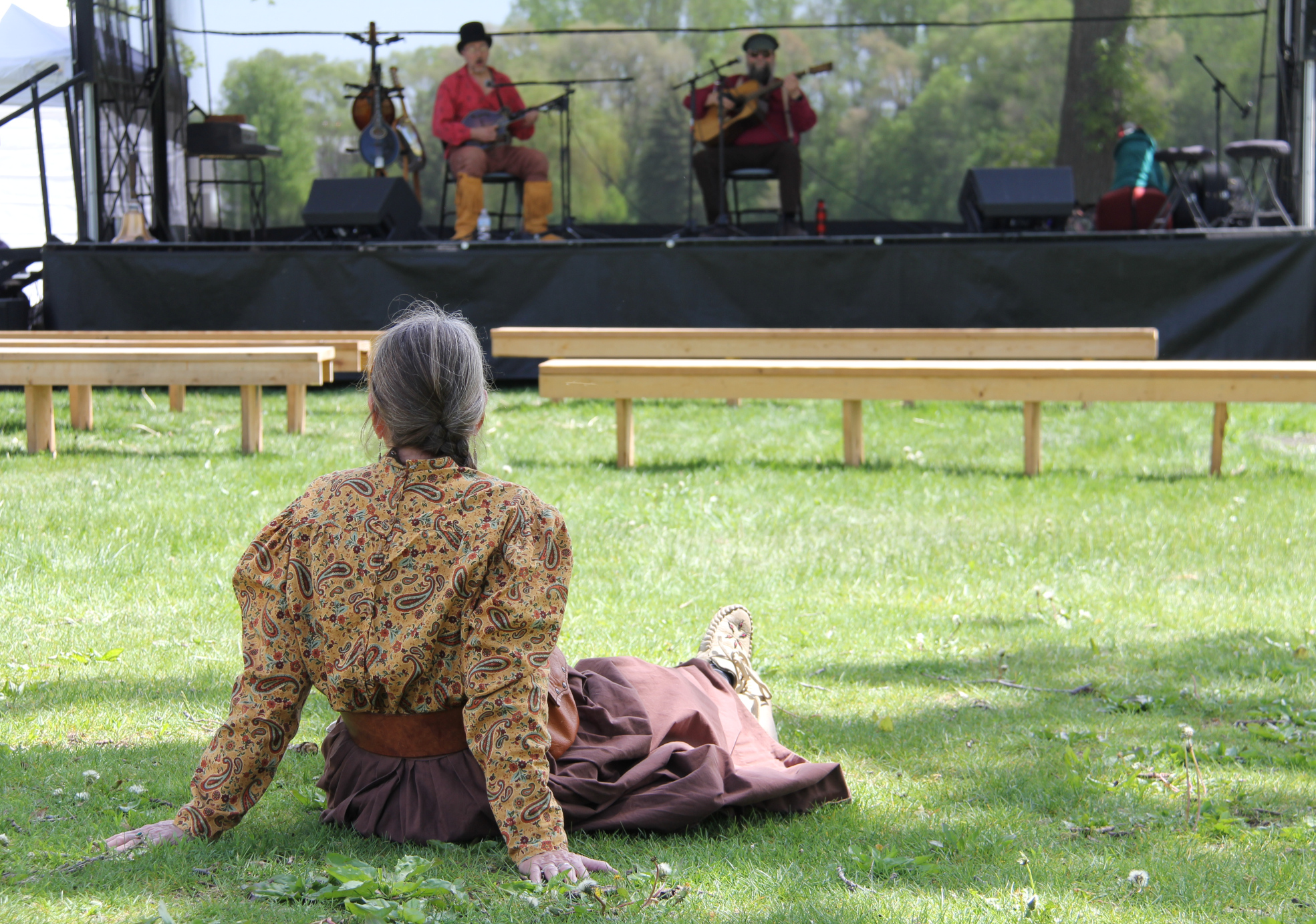
Listening to The Skally Line musicians. (Minnesota Prairie Roots copyrighted photo May 2026)
I listened to musicians on-stage, one group singing about Tator Tot Hotdish, not exactly period appropriate, but entertaining none-the-less.
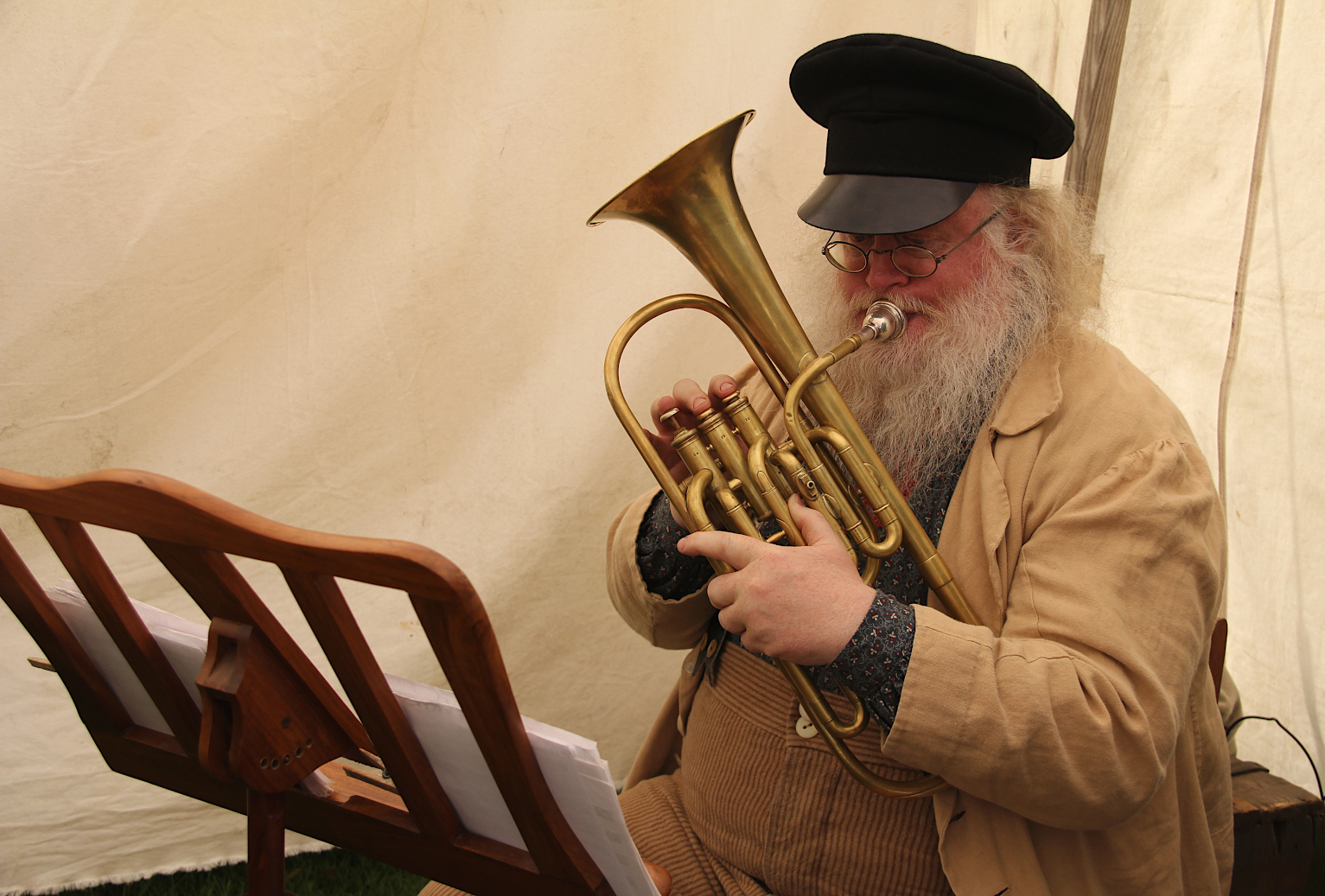
Playing an historic saxhorn inside a dry goods tent. (Minnesota Prairie Roots copyrighted photo May 2026)
History-themed books filled a tent, these appropriate to the event. (Minnesota Prairie Roots copyrighted photo May 2026)
Lots of hats for sale. (Minnesota Prairie Roots copyrighted photo May 2026)
Inside Stick and Stump Dry Goods, a musician blew into an 1873 saxhorn, drawing attendees into the tent to peruse the merchandise. A row of merchants vended goods from tents, selling period weapons, beads, books, belts, soap, hats, knives, clothing and a whole lot more.
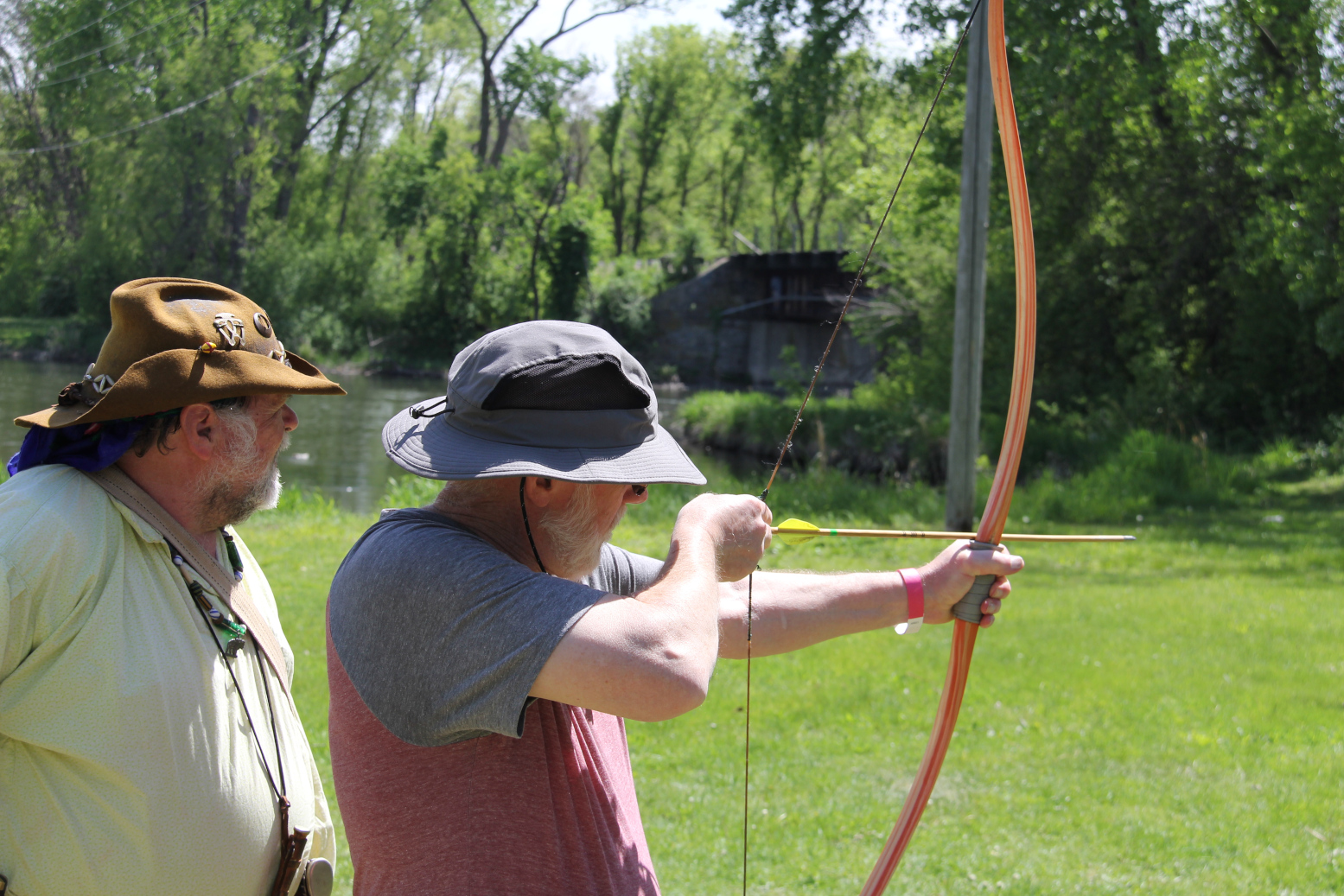
Guided by the archer, Randy aims at the target. (Minnesota Prairie Roots copyrighted photo May 2026)
In a far corner of the park, rendezvous attendees stepped up and tried their skills at archery and tomahawk throwing. I passed given my lack of athleticism. I watched, though, while my husband, Randy, pulled the bowstring and, in one of three attempts, hit the target.
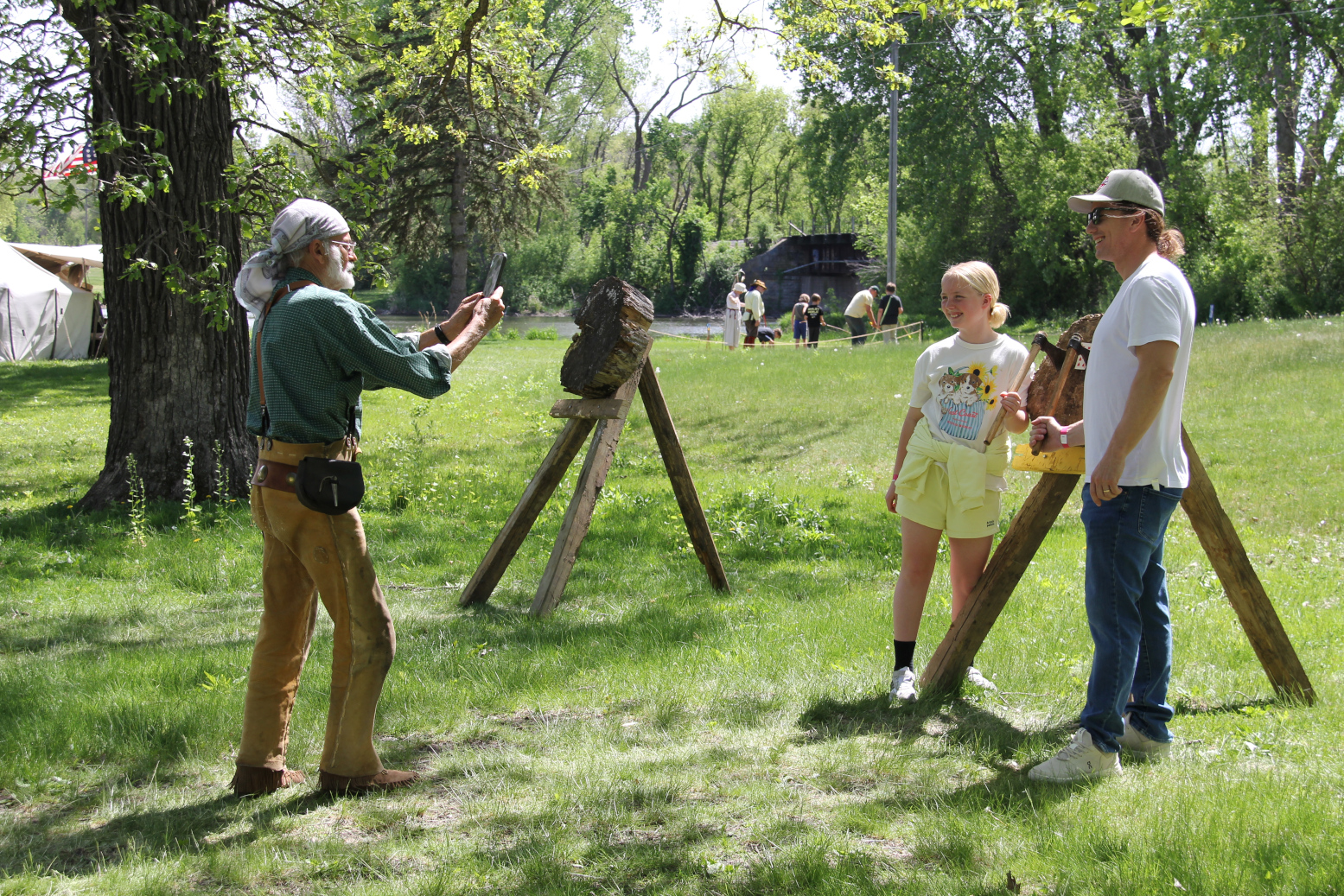
A photo opp after tomahawk throwing. (Minnesota Prairie Roots copyrighted photo May 2026)
I also observed a re-enactor taking a photo of two tomahawk throwers with their smartphone, another example of present day and yesteryear mingling in an almost (at least to me) comical moment. Those long ago dwellers of this land could never have imagined the technology of today.
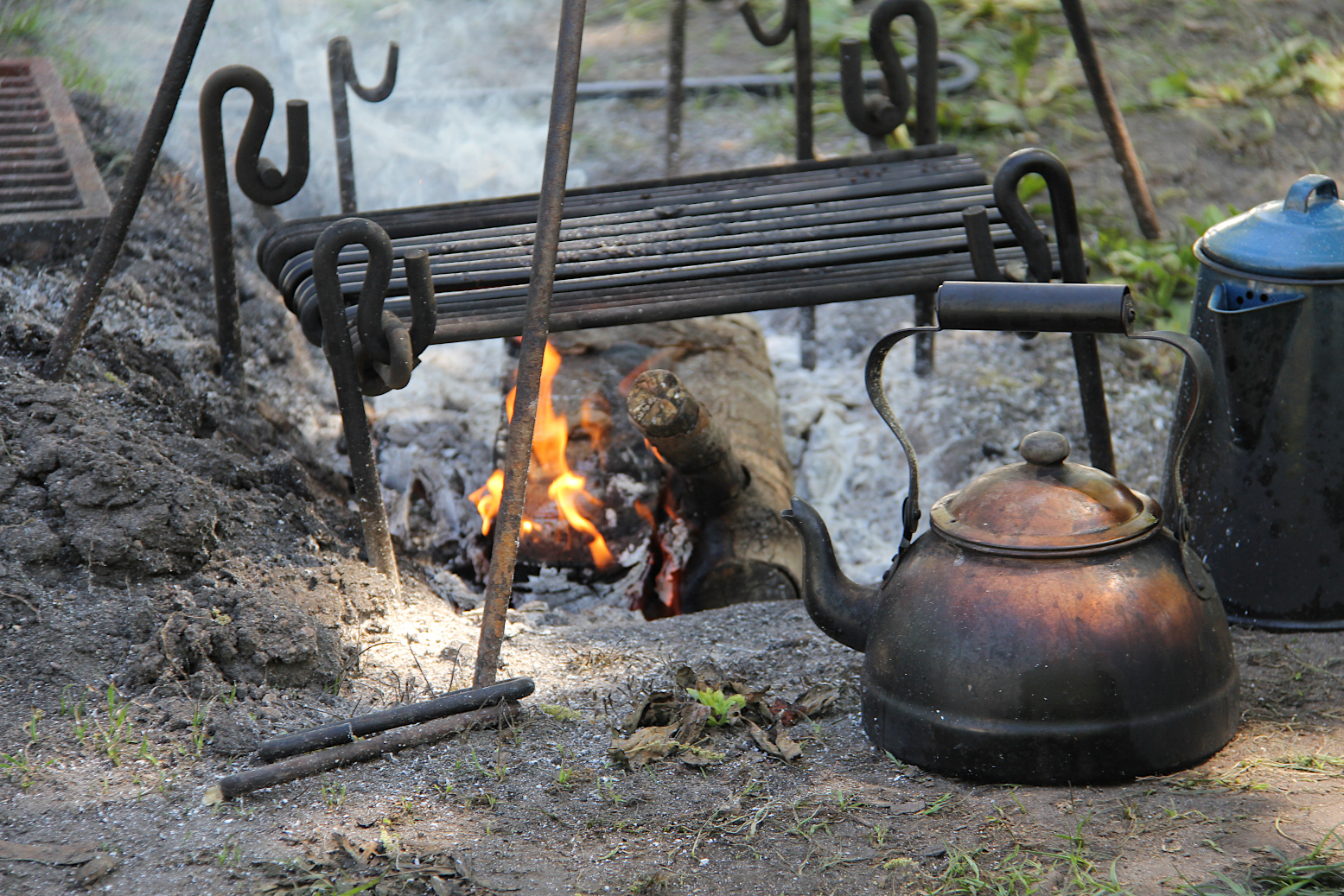
There were many open campfires for cooking on the encampment grounds. (Minnesota Prairie Roots copyrighted photo May 2026)
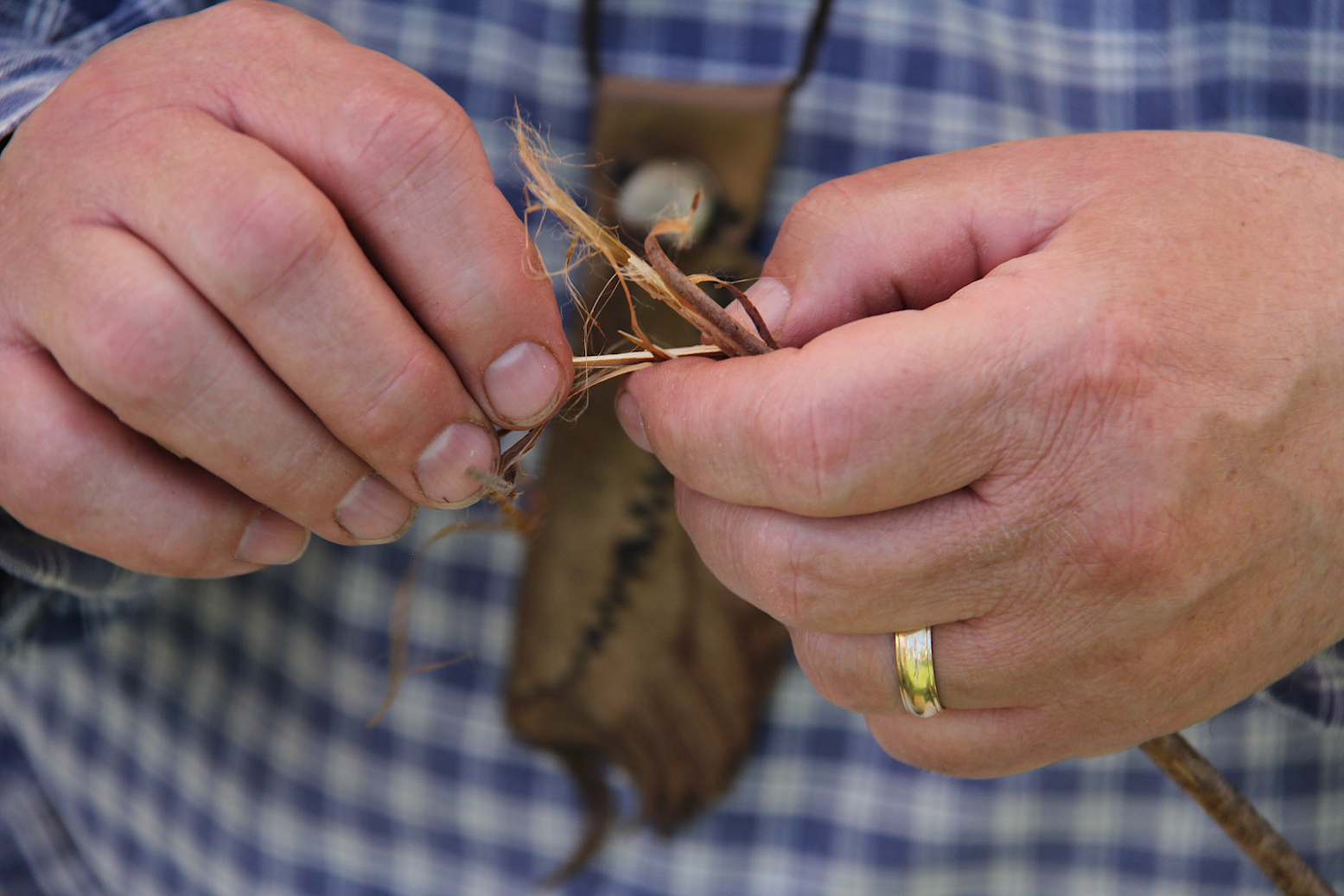
Stripping the plant dogbane to make into a strong thread. (Minnesota Prairie Roots copyrighted photo May 2026)
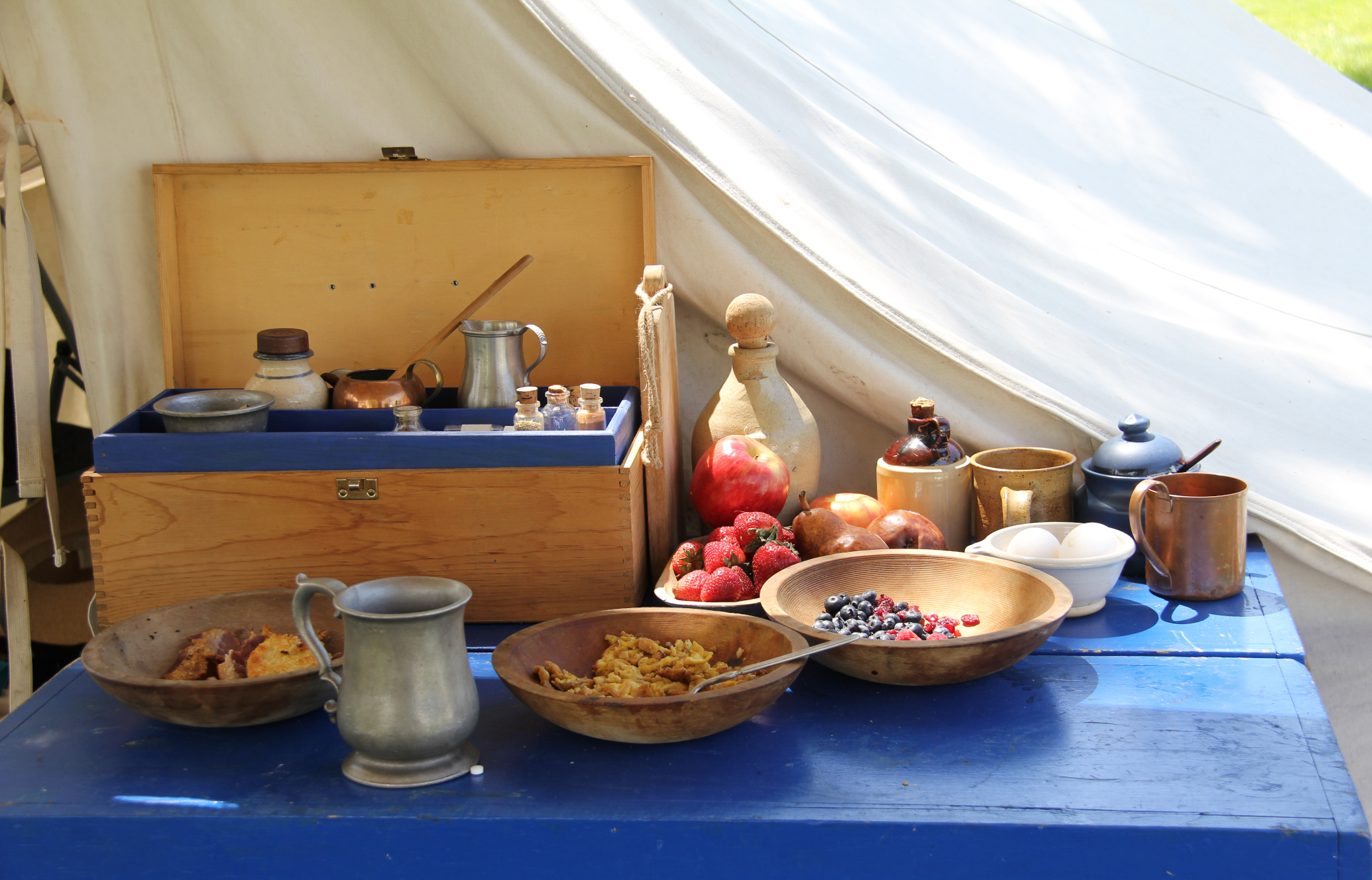
A still life of simple foods and dinnerware. (Minnesota Prairie Roots copyrighted photo May 2026)
Events like this not only preserve and celebrate history, but serve as visual reminders of how much has changed with the passage of time. Progress can often be measured by the past.
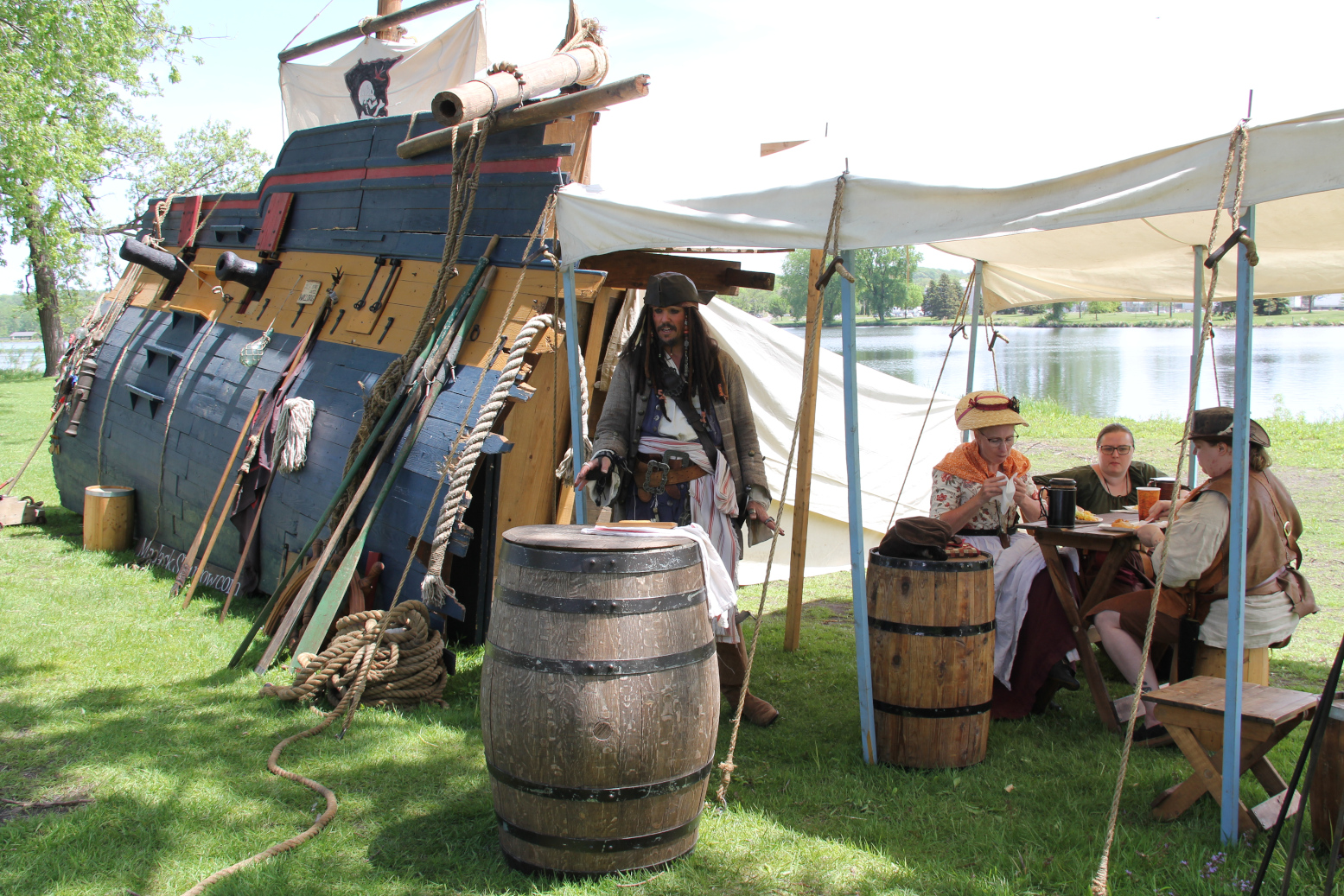
MN Jack Sparrow and his pirate “ship” were a draw, especially for the kids. (Minnesota Prairie Roots copyrighted photo May 2026)
I’m not a history buff. Yet history interests me enough to want to learn more, to attend events like the rendezvous. Before the encampment opened to the public over the weekend, local students came by the hundreds to North Alexander Park for a living history lesson. I would have enjoyed history a whole lot more as a child had I gone to something like this.
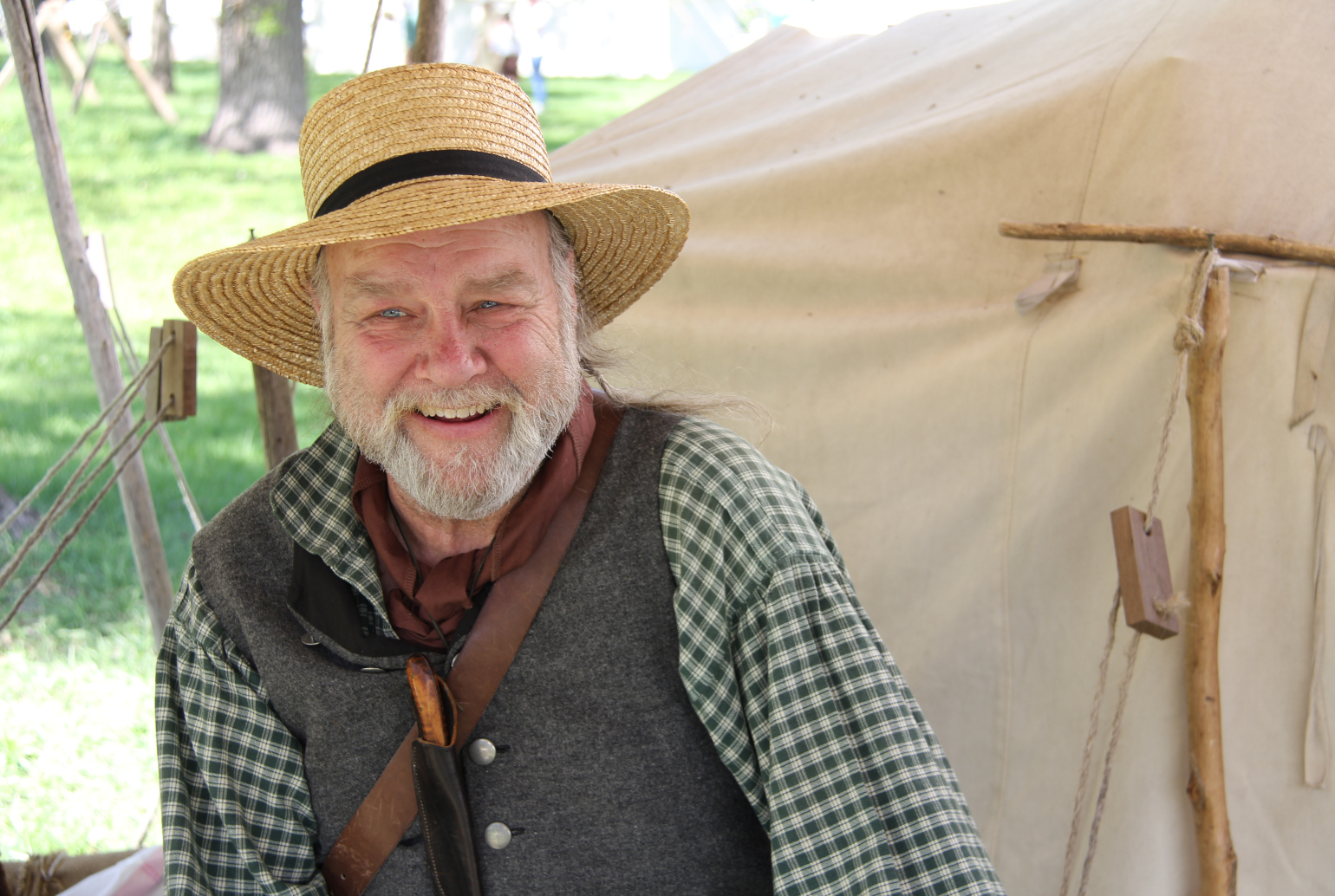
Period dress is an important part of the rendezvous. (Minnesota Prairie Roots copyrighted photo May 2026)
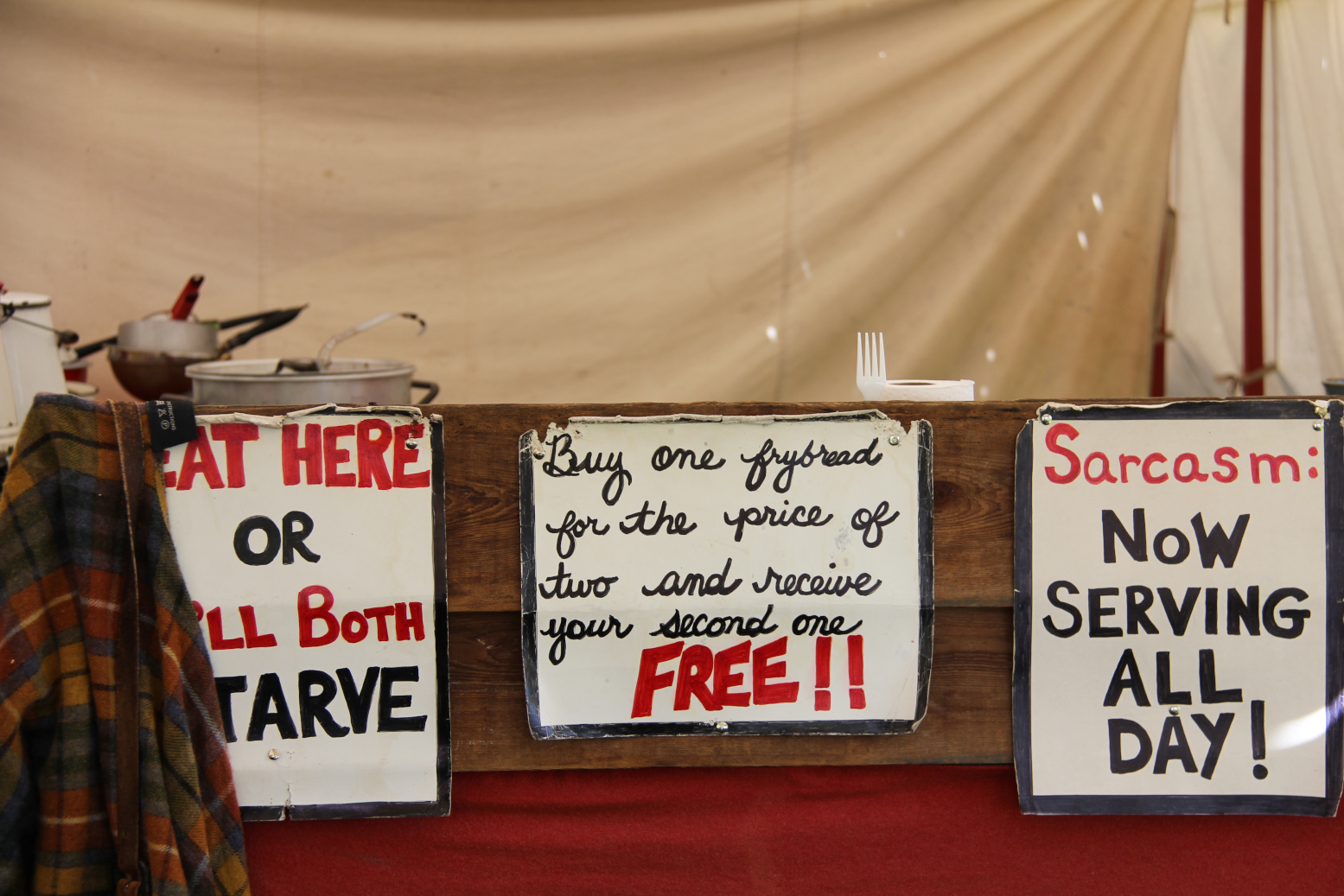
Humorous signs inside the Baby’s Indian Frybread tent. (Minnesota Prairie Roots copyrighted photo May 2026)
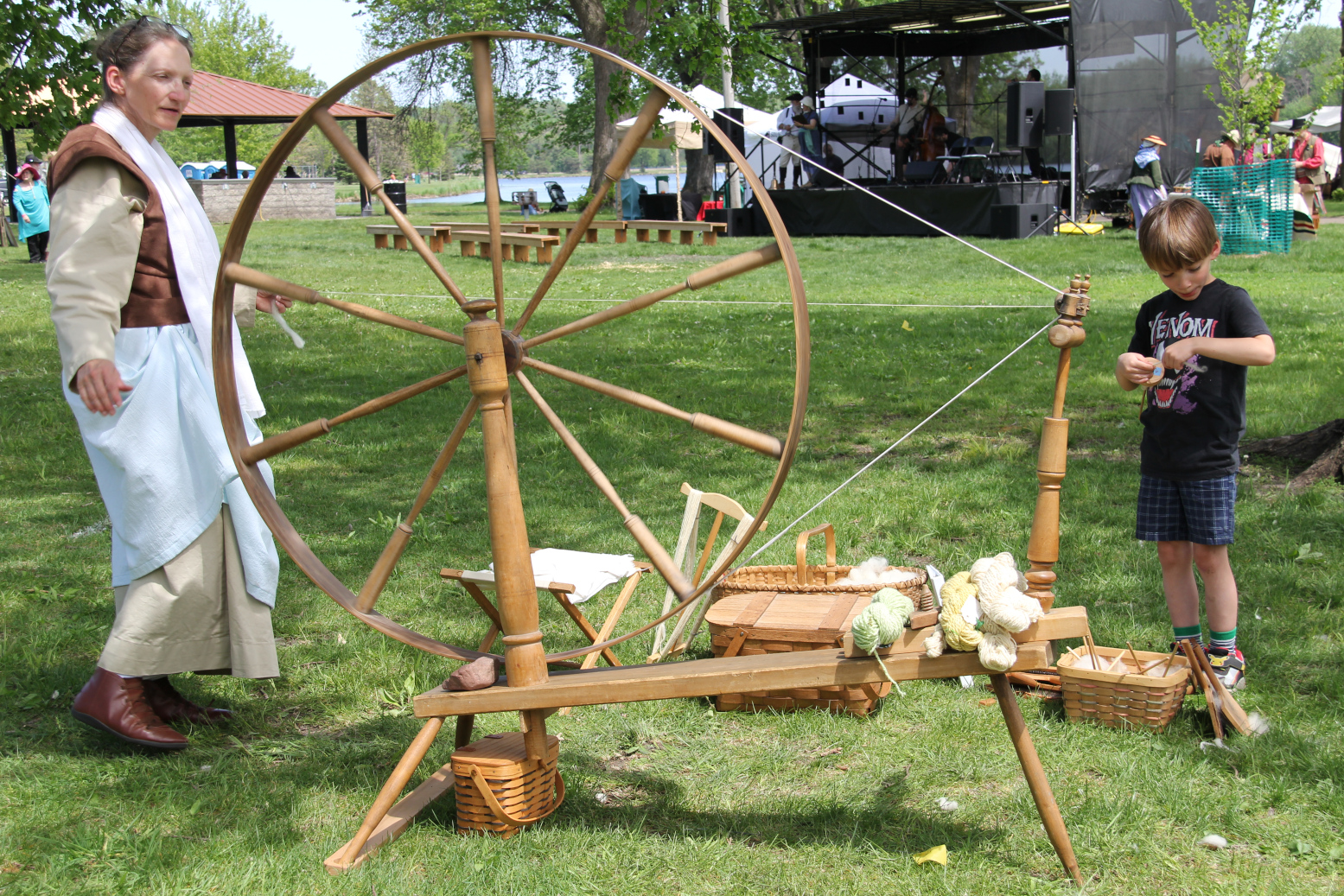
Spinning and playing with a toy spinner. (Minnesota Prairie Roots copyrighted photo May 2026)
As I wandered around the grounds, photographed, listened, conversed, paused to eat first savory, then sweet, Baby’s Indian Frybread, I considered the time, effort and work involved in putting an event like this together. It’s a lot for the organizers, volunteers and participants.
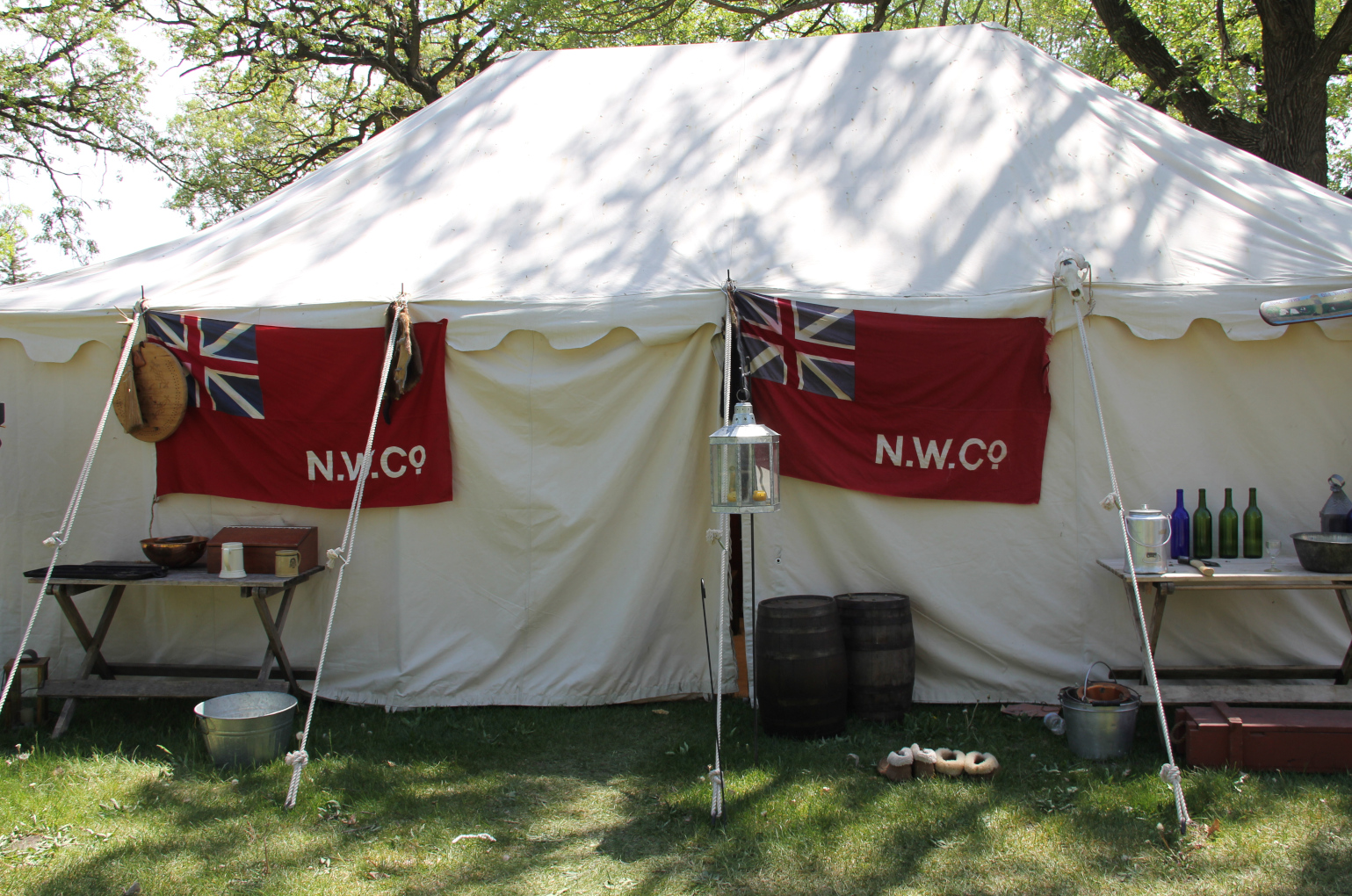
The North West Company was a Canadian fur trading company important in early fur trade in this area. (Minnesota Prairie Roots copyrighted photo May 2026)
I’m grateful for this rendezvous which brings living history to Faribault, a place where the Wahpekute once fished and trapped and traded and dwelt. This place, too, where Alexander Faribault came to trade with the native Dakota, to settle, to establish the town named after him.
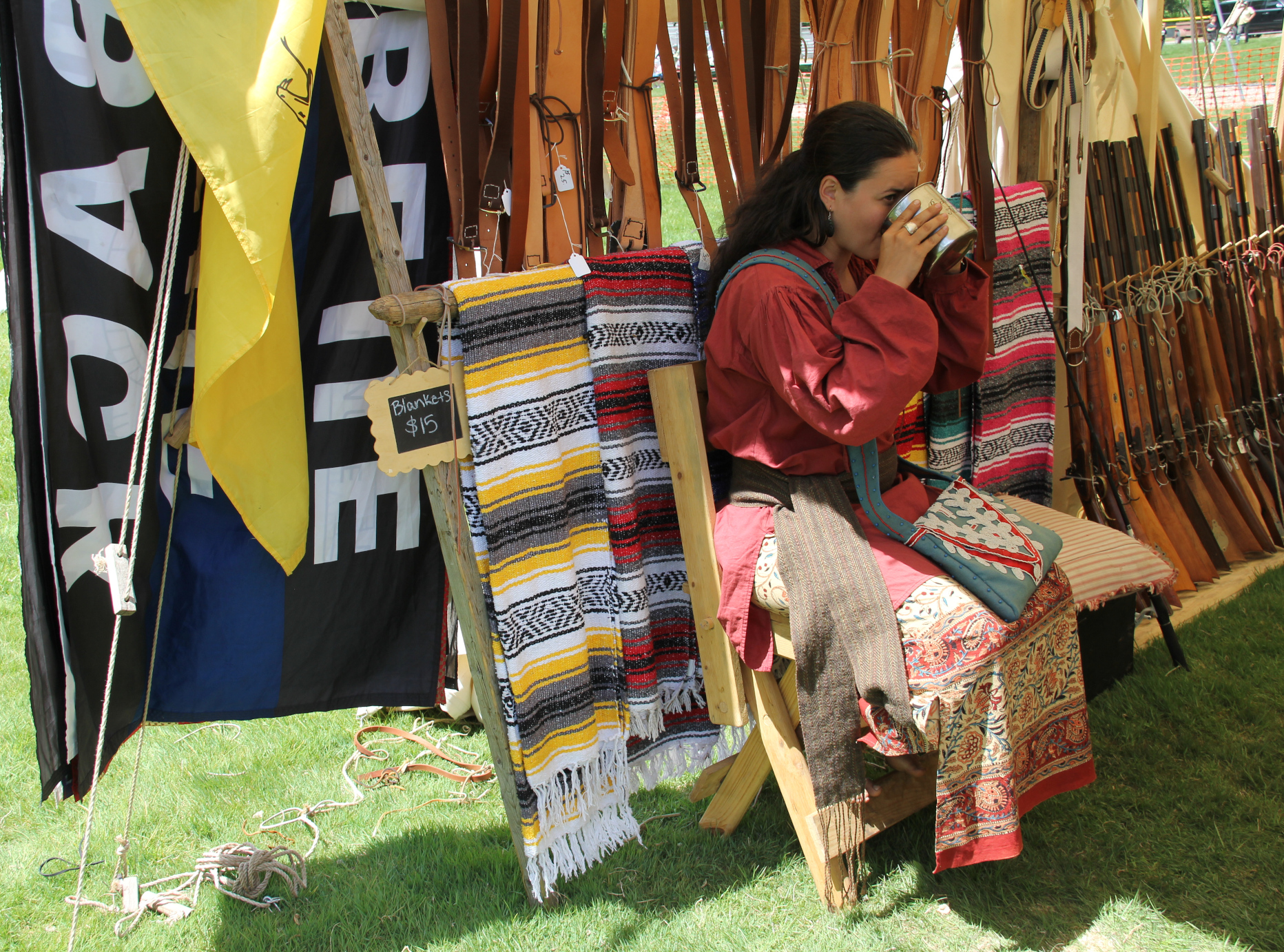
A vendor inside a tent with blankets, weapons and an assortment of goods for sale. (Minnesota Prairie Roots copyrighted photo May 2026)
Faribault is a town rich in history. Rice County is a county rich in history. Minnesota is a state rich in history. And, on Saturday, for a few hours, I glimpsed that history along the banks of the Cannon River, where the water flows into the nearby Straight River, stories carried on the current of the water from the past into the present.
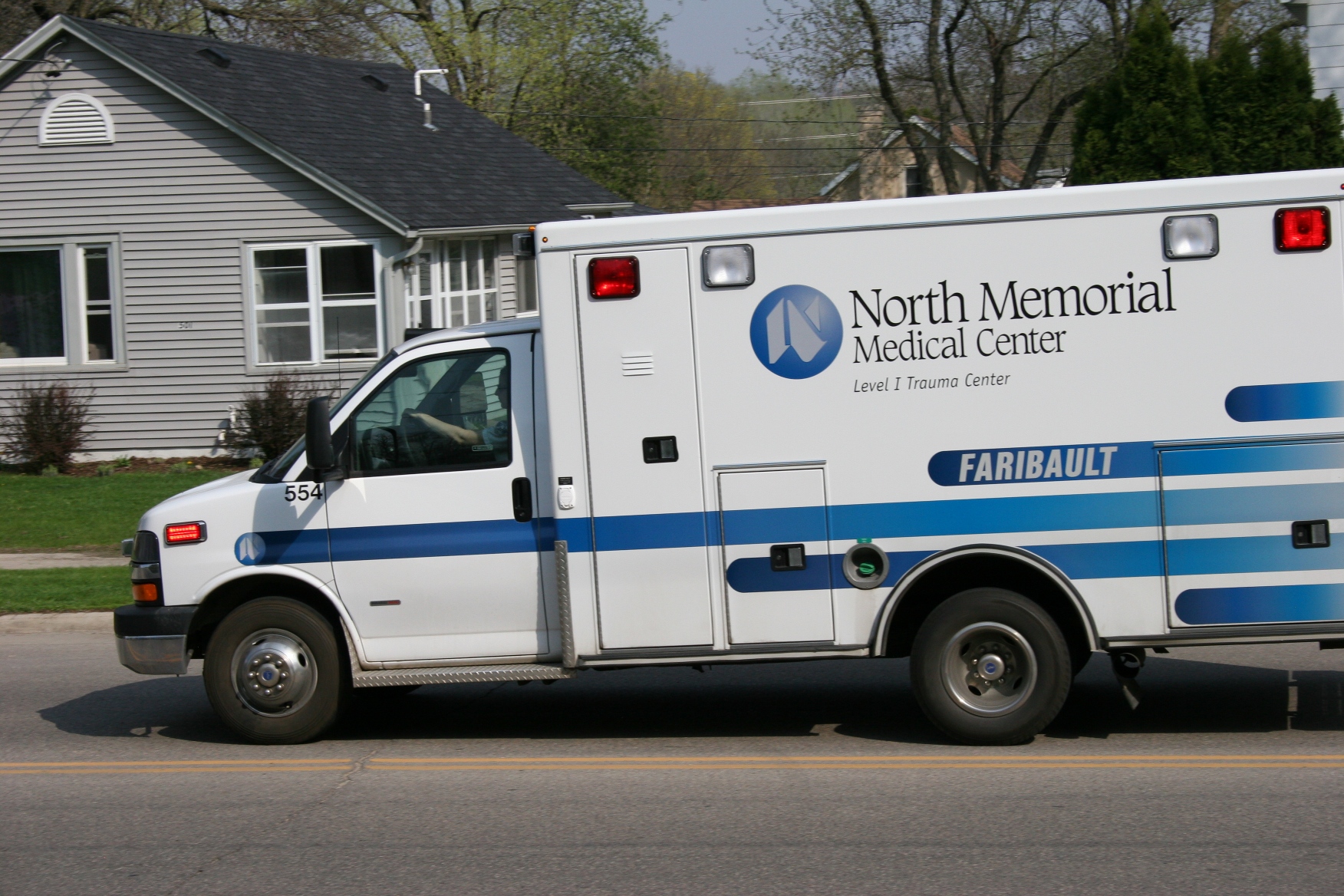
Twenty years ago an ambulance took my son to the Faribault hospital after he was struck by a car while crossing the street. (Minnesota Prairie Roots copyrighted file photo)
SHE DIDN’T UNDERSTAND, the mother said, how anyone could drive away, leaving her son lying in the road. I don’t understand either.
Twenty years ago to the date, May 12, 2006, my then 12-year-old son was also struck by a vehicle while walking to his school bus stop along Willow Street less than a block from our Faribault home. That driver, too, left the scene.
Neither of the boys was seriously injured. My son suffered a broken bone in his hand, bump on his head, possible rib fracture and scrapes. The teen from Fridley suffered scratches and skid marks across his body, according to a media report.
But we all experienced trauma, compounded by the drivers of the vehicles who drove away. Drivers who left our sons lying in the street. Drivers who failed to show the decency and compassion to stop. Drivers who, for whatever reason, decided to continue on their way while our boys, our families, dealt with the fall-out of their actions and decisions.
I understand the anger of the Fridley mom. I felt the same 20 years ago. While time has mostly erased that anger, the questions remain. Who? Why? I would like to ask the driver, “How could you simply drive away, go about your morning, your day, your life as if nothing had happened, as if you had not just hit a child and left him lying on the side of the street?”
Despite a description of the vehicle as a blue 4-door, possibly a Chevy Cavalier or Corsica; a $1,000 reward (which is no longer valid); and investigative efforts by Faribault police, the driver was never found. Twenty years after this crime, I wonder if that driver carries any guilt.
I carry the memory of that day, fully aware that the results could have been much worse. Likewise, the mom in Fridley realizes the same. She is only in the early stages of dealing with her anger, her trauma, her questions. Twenty years removed from the hit-and-run involving my son, all three of those issues remain, although lessened by the passage of time, by the gratitude I feel of still having my son.
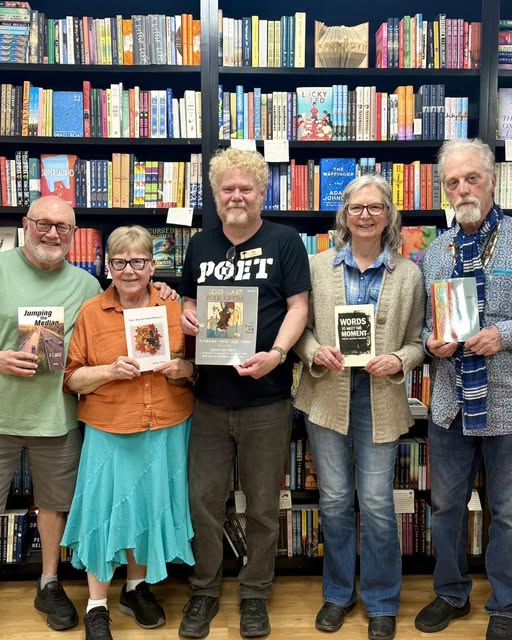
Poets D.E. Green, left to right, Becky Boling, Rob Hardy, Audrey Kletscher Helbling and Dougie Padilla with publications including their poetry. Missing, Larry Gavin. (Photo credit: Content Bookstore)
UNITED WE READ at Content Bookstore in Northfield. Earlier this evening six Rice County poets, including me, shared our poetry. Not just any poetry, but poems we’ve penned mostly themed to what’s unfolded in America with immigration enforcement, the war in Iran, threats to our democracy…
Anger. Frustration. Hope. Truth. Passion. Those topics threaded through poems by Northfield poets Becky Boling. D.E. (Doug) Green, Rob Hardy and Dougie Padilla and Faribault poets Larry Gavin and me. I read two poems on-topic and two off.
I am grateful to this independent bookstore for supporting writers not only through the sale of books, but also through readings. Listening to a poet read adds a depth to a poem that you don’t get simply by reading it in print. Emotion, word emphasis, volume and more factor into that.
To the attentive and appreciative audience, thank you for coming out on a Thursday evening to listen, to encourage the six of us in our poetry and to support your local independent bookstore.
United we write. United we read. United we raise our voices.
A leather stitcher at the May 2025 Riverside Rendezvous & History Festival in Faribault. (Minnesota Prairie Roots copyrighted file photo May 2025)
WHETHER YOU’RE INTO HISTORY, flea markets, music or art, you’ll find a trio of events in the area this weekend covering those options.
Vendors set up shop outside the Rice County Historical Society. (Minnesota Prairie Roots copyrighted file photo September 2025)
First up is the annual Rice County Historical Society Spring Flea Market from 8 a.m.-2 p.m. Saturday, May 16, in Faribault. Vendors offer an array of goods from antiques and collectibles to crafts, art, oddities and assorted merchandise to endless to name. I’ve shopped here many times, enjoying the experience of not only poking around for something I may or may not need, but also socializing.
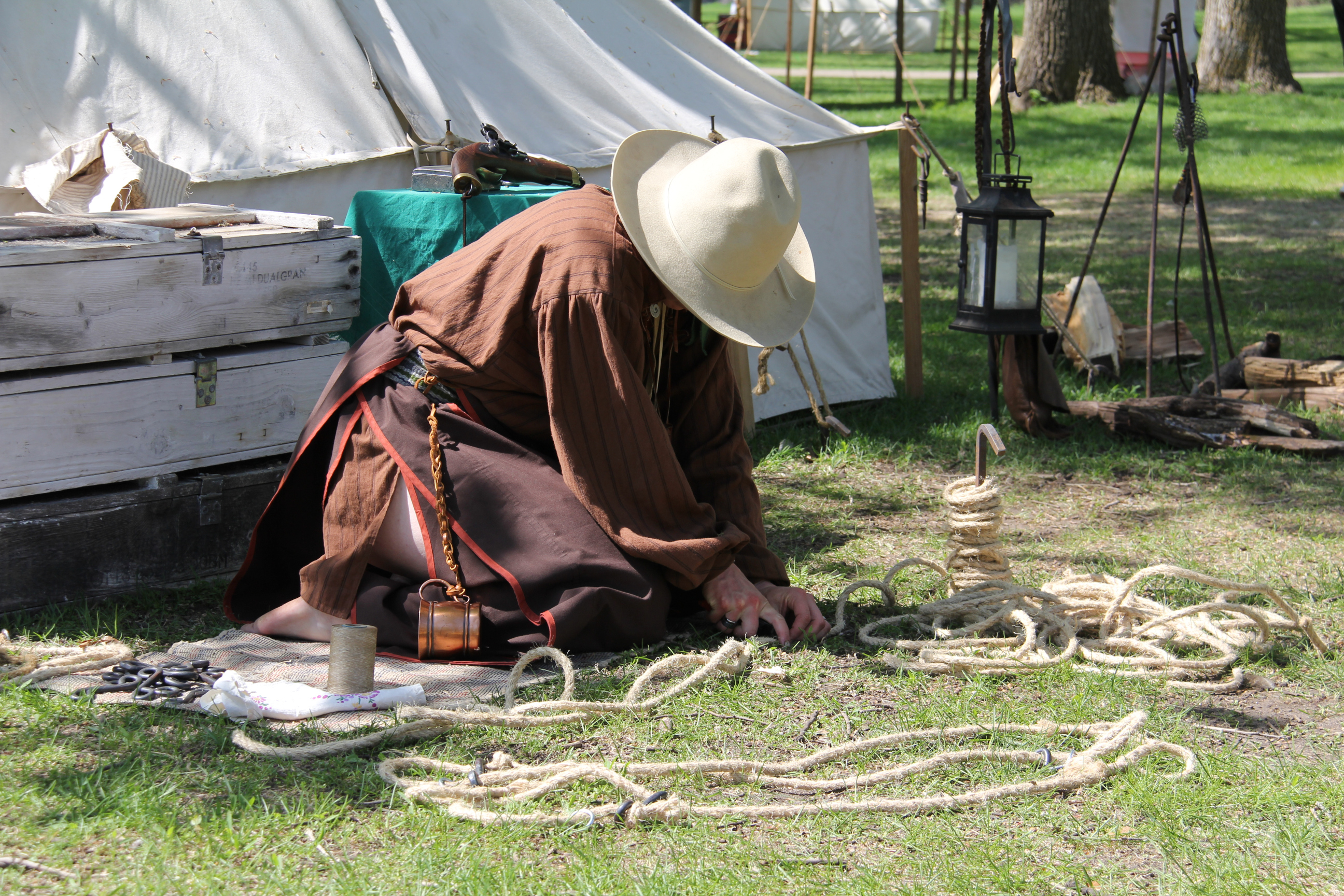
Making ropes at the 2025 Riverside Rendezvous. (Minnesota Prairie Roots copyrighted file photo May 2025)
Just down the road from the RCHS grounds, the historical society is hosting its second annual Riverside Rendezvous and History Festival in North Alexander Park from 9 a.m.-5 p.m. Saturday, May 16, and again from 9 a.m.-4 p.m. on Sunday.
I attended last year and immersed myself in the living history with added music, food (try the frybread) and interaction with re-enactors and others rounding out the festival. The event features the trades, tradition and history of the 18th and 19th centuries via demonstrations of blacksmithing, leatherworking, fur trapping, candlemaking and more plus an appearance by MN Jack Sparrow.
Listen to the music of Curtis & Loretta, The Leather Souls, Bonnie Drunken Lad, the Roe Family Singers and The Skally Line. Try your skills in competitive Voyageur games, tomahawk throwing and archery. Buy goods from vendors, cash only. Admission is $10 for adults and $5 for kids, a bargain considering all the rendezvous offers.
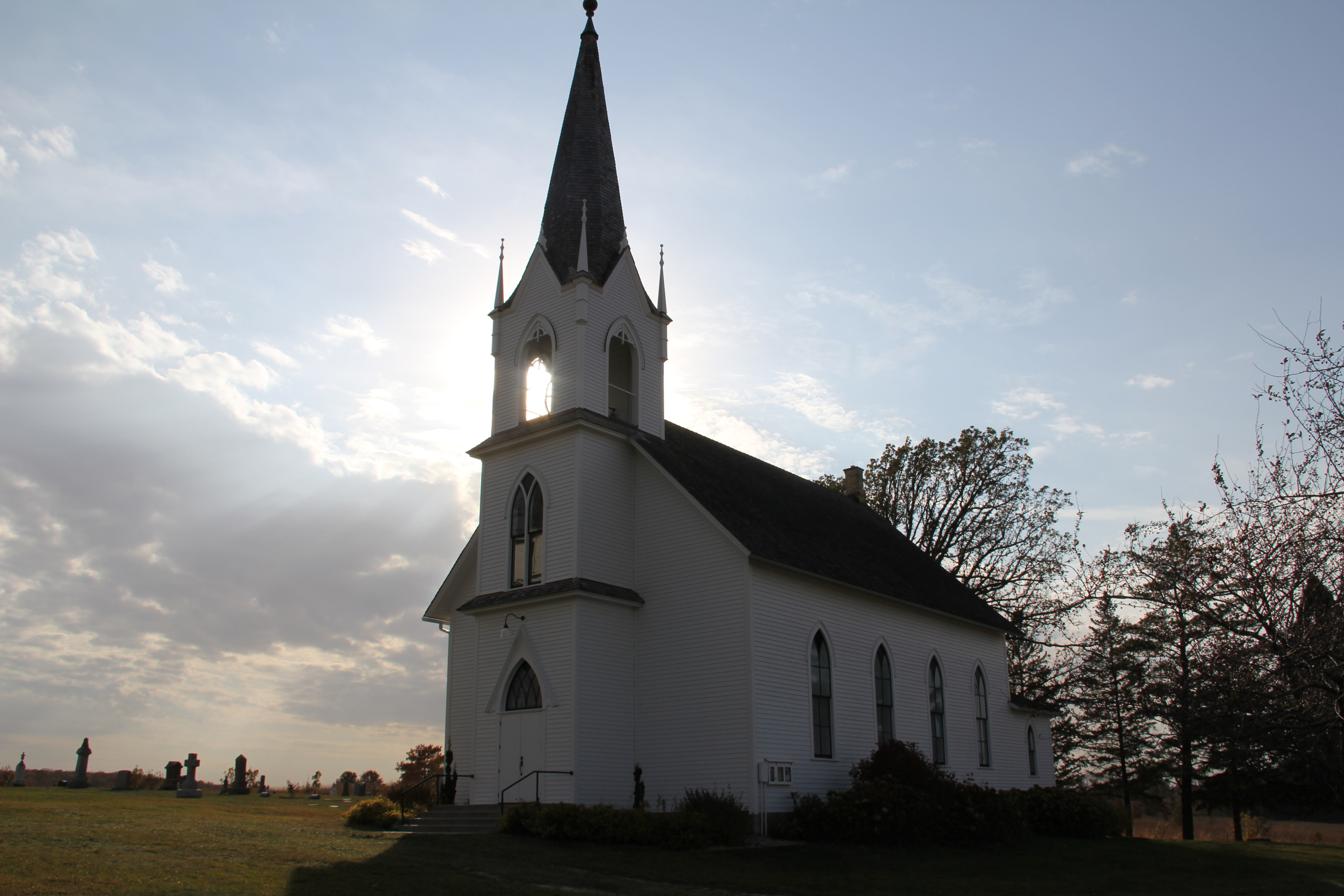
Musicians will perform inside the Valley Grove wooden church. (Minnesota Prairie Roots copyrighted file photo)
Sunday brings more entertainment, this time at the historic Norwegian Valley Grove churches, rural Nerstrand. From 1-3 p.m. May 17, the Valley Grove Preservation Society celebrates Syttende Mai, Norway’s Constitution Day.
Inside the old wooden church, St. Olaf College students will play Norwegian hardanger fiddle music from 1-1:30 p.m. After that, until 3 p.m., the duet Over Yonder, with Martha Larson on cello and Brian Johnson on guitar, will play original compositions from their recent album “Valley Grove.” That includes the title track, “(The Big Oak at) Valley Grove.”
Crosses crafted from Valley Grove burr oaks. (Minnesota Prairie Roots copyrighted file photo)
In honor of the big burr oak that once anchored a corner of the Valley Grove Cemetery until a 2018 storm blew the tree down, a pop-up art exhibit will be featured inside the old stone church. Attendees are invited to share their paintings, drawings, photos and wooden items (made from the 250-year-old burr oak) at the exhibit.
This trio of area happenings gets my recommendations. I can’t make all three. But if you can, go. Every single event promises to be worth your while whether you love history, flea markets, music, art or all four. This is a jam-packed weekend of educational, entertaining and enjoyable events right here in your own backyard.
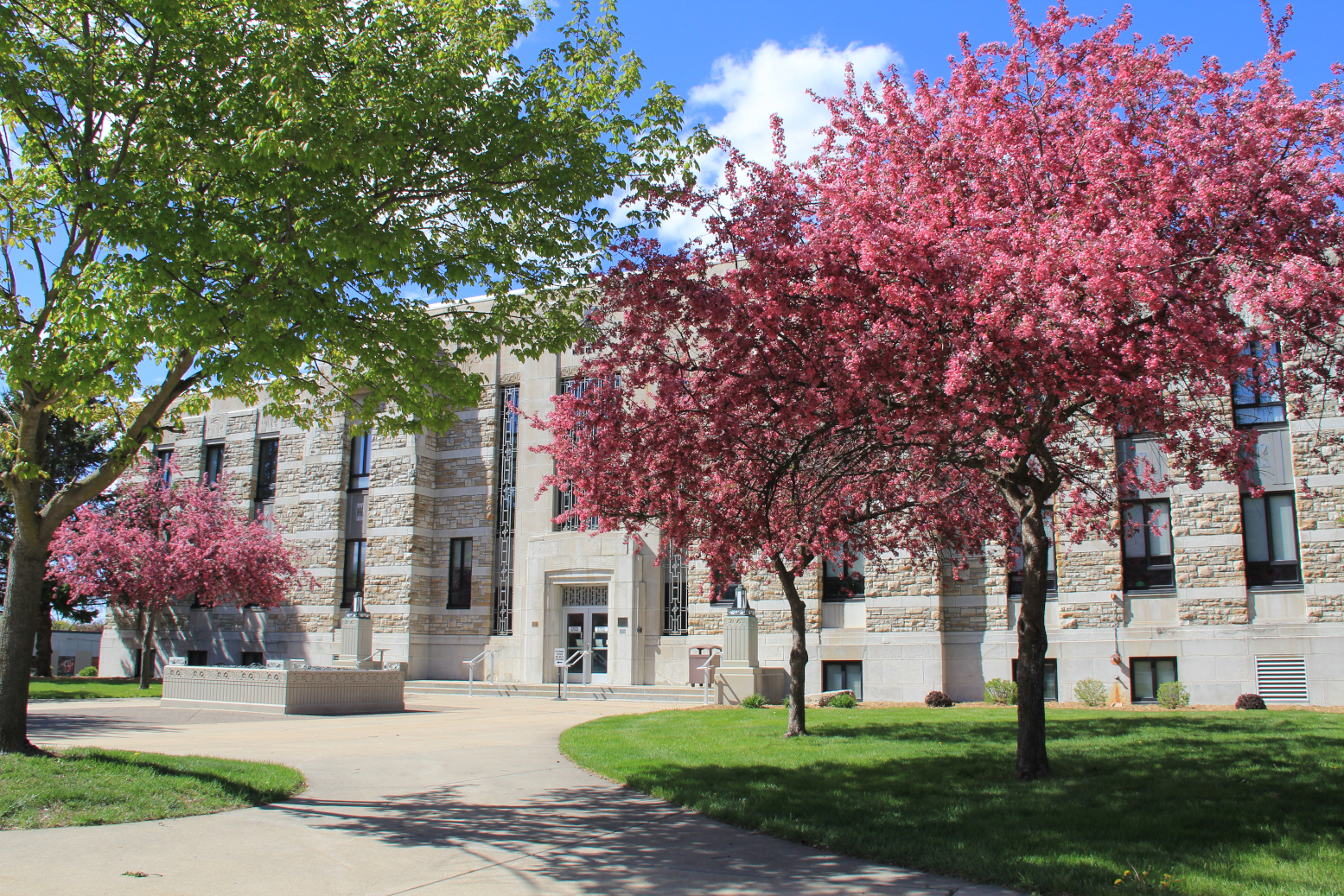
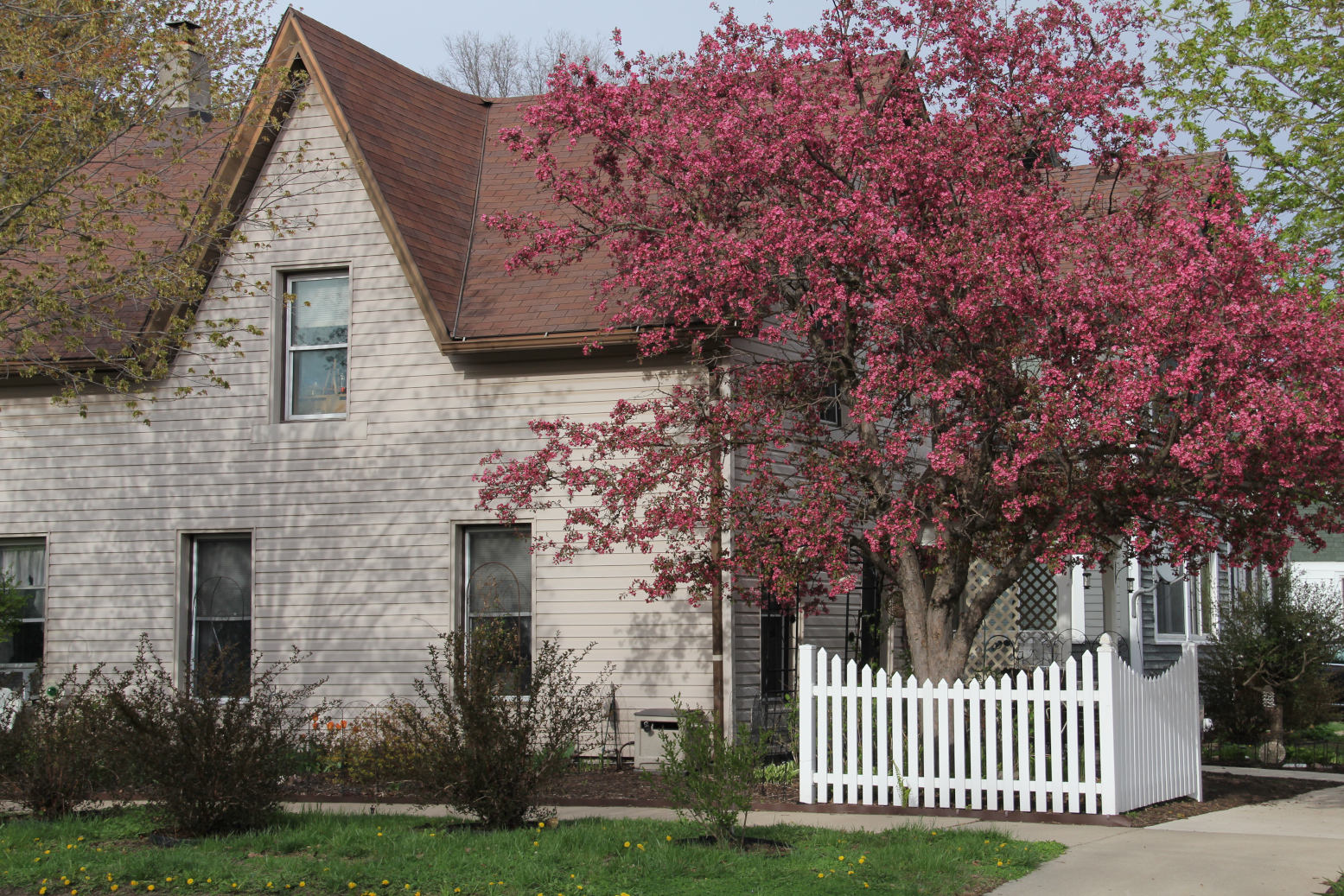
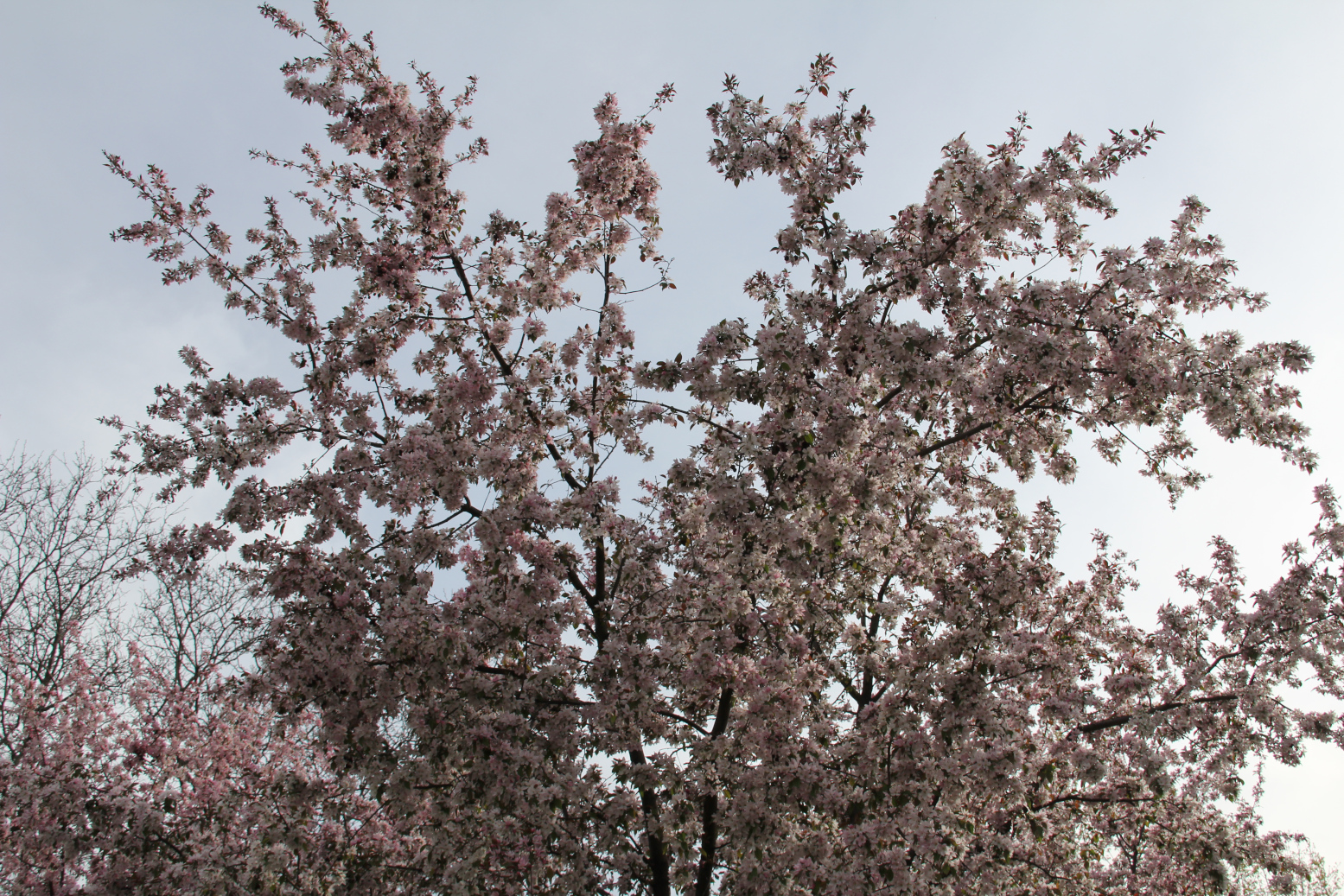
Beautiful flowering trees outside the Rice County courthouse, Faribault. (Minnesota Prairie Roots copyrighted photo May 2026)
I’VE NEVER TRAVELED to Washington, DC, thus never seen the masses of cherry blossoms. I’m quite certain I would love them. Flowering trees began blooming here about two weeks ago and I can’t get enough of their beauty.
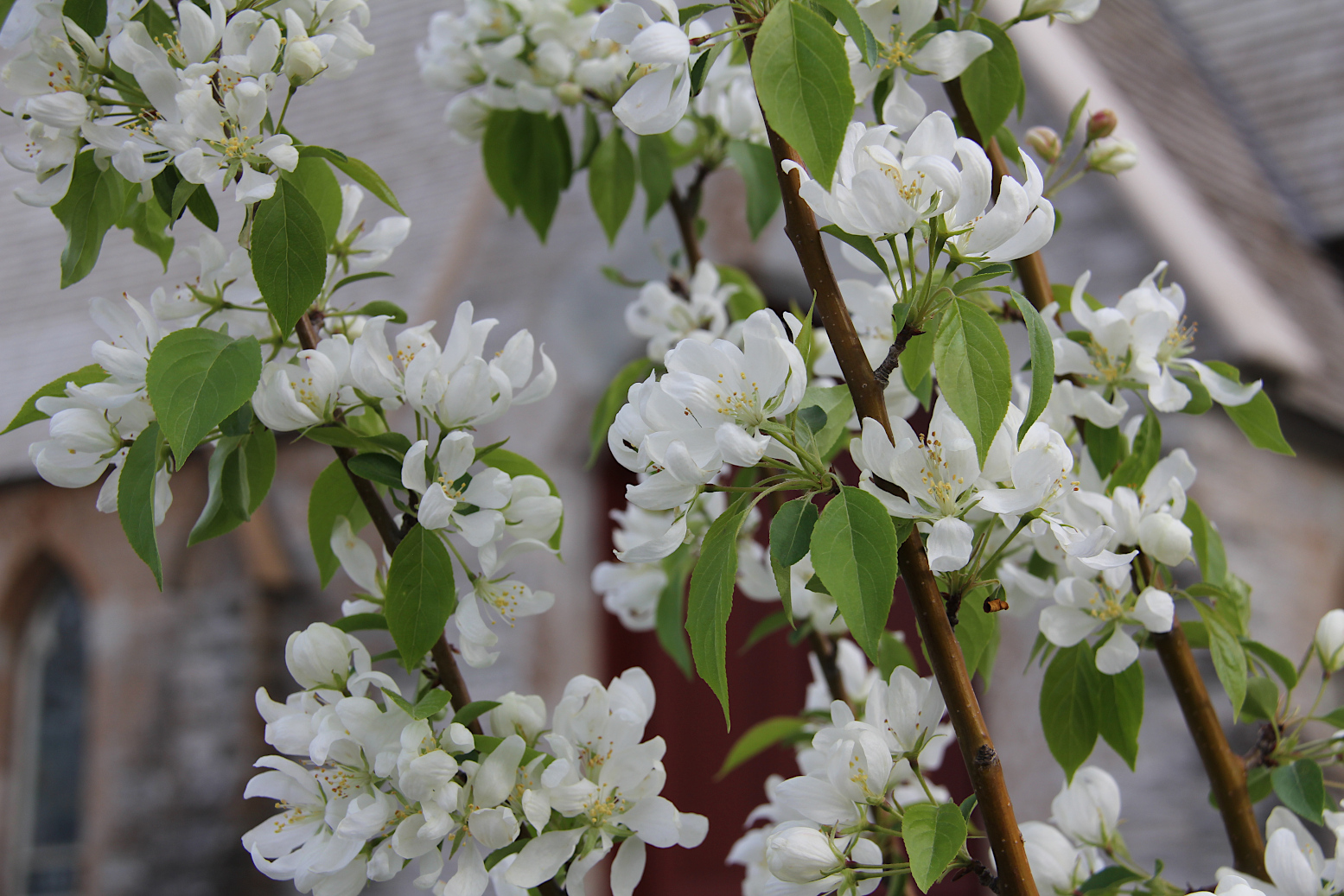
A young tree outside the Cathedral of Our Merciful Saviour in Faribault blooms in late April. (Minnesota Prairie Roots copyrighted photo April 2026)
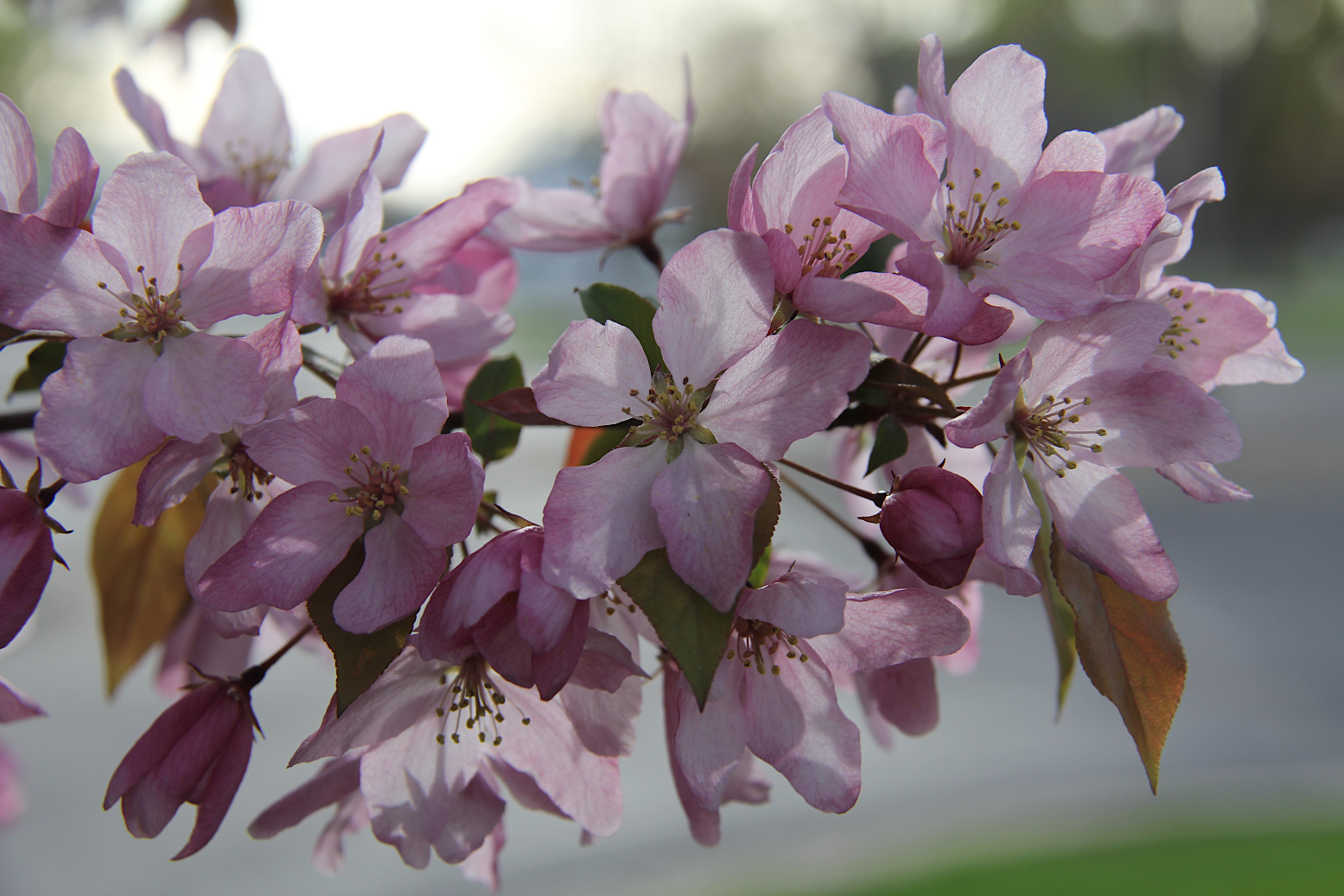
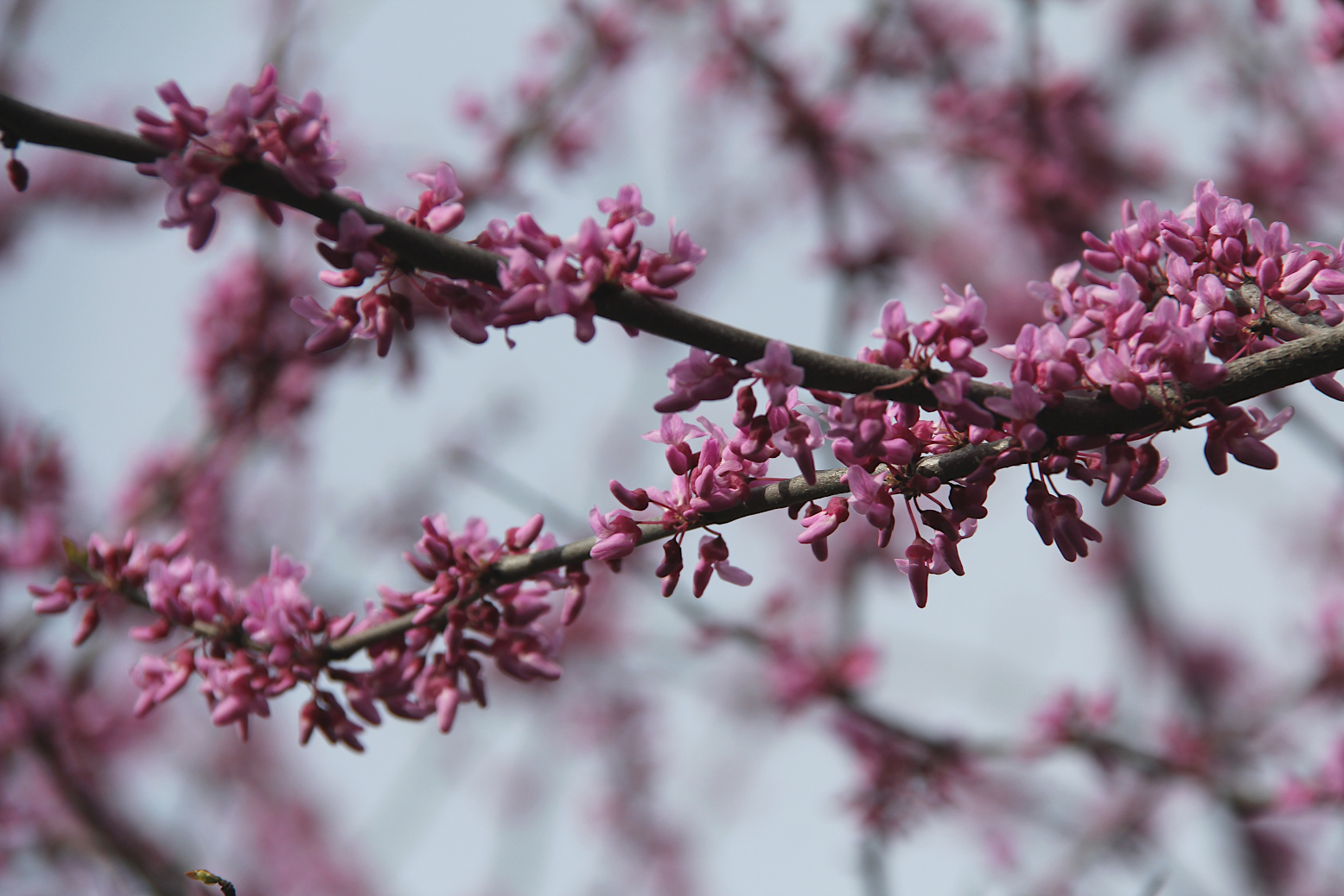
Whether pink or white, the petals add an artistic and poetic touch to the landscape. It’s as if an artist meticulously brushed petals upon a tree. It’s as if a poet wrote lovely words upon apple and ornamental trees, petal by petal.
Against the backdrop of the Guild House at the Cathedral of Our Merciful Saviour, a flowering tree buds and blooms. (Minnesota Prairie Roots copyrighted photo April 2026)
In poetry, every word counts. In art, every brush stroke matters. On a flowering tree, both create a canopy of loveliness.
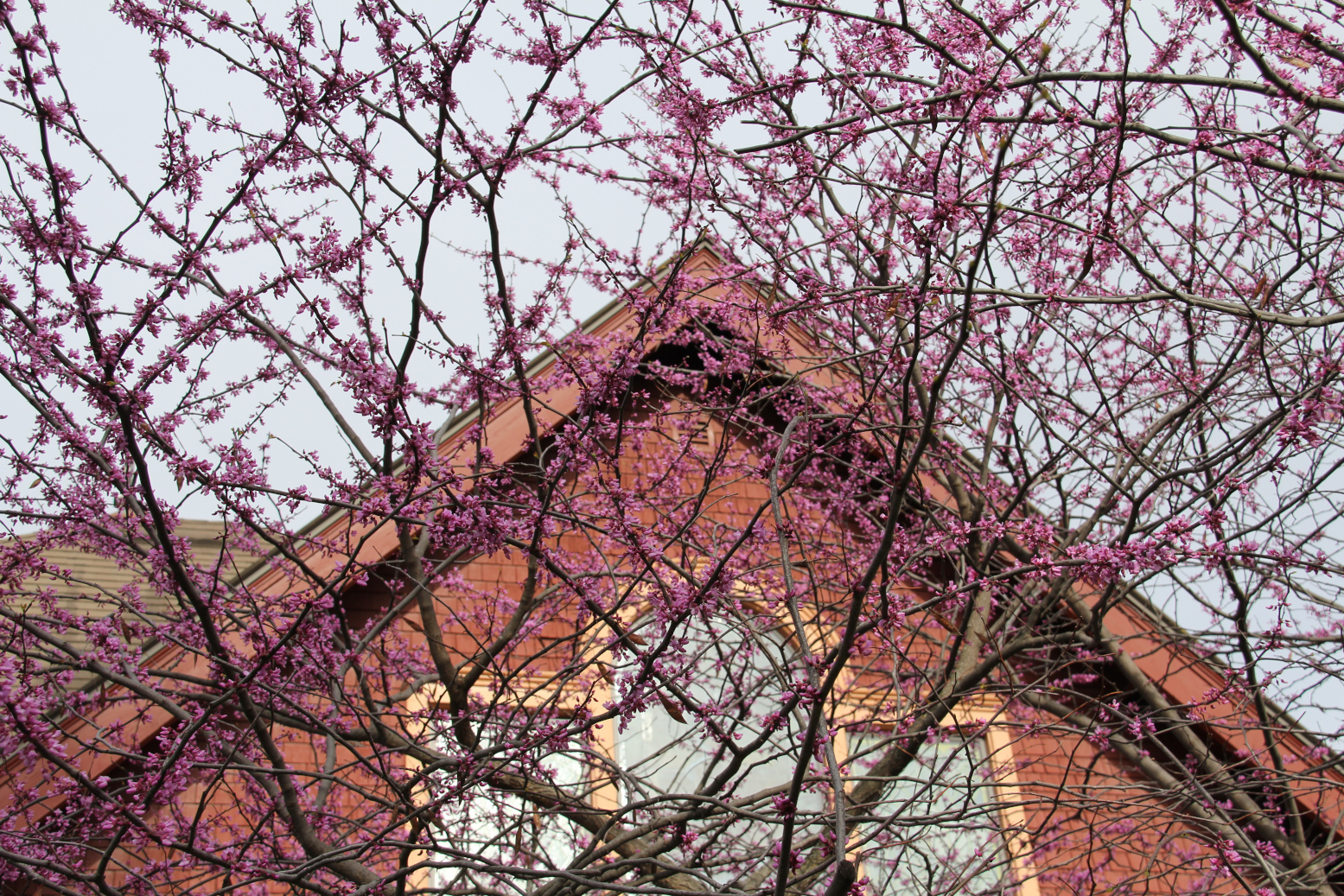
Masses of flowers on a tree at the intersection of Third Avenue NW and Fifth Street NW, Faribault. (Minnesota Prairie Roots copyrighted photo late April 2026)
I don’t paint. But I create with my camera and with words. I write poetry—poetry which has published on the pages of anthologies and literary journals, inspired artists and a musician, graced signs in public places.
At the intersection of First Avenue NW and Sixth Street NW in Faribault, a flowering tree graces a front yard. (Minnesota Prairie Roots copyrighted photo April 28, 2026)
And so I see poetry where others may not. A flowering tree is not simply a tree with flowers. It is a work of literary and visual art. It is a love letter. It is a painting. It is romance. It is a thousand stories. It is more than a tree blushing beauty into the landscape on a spring day.
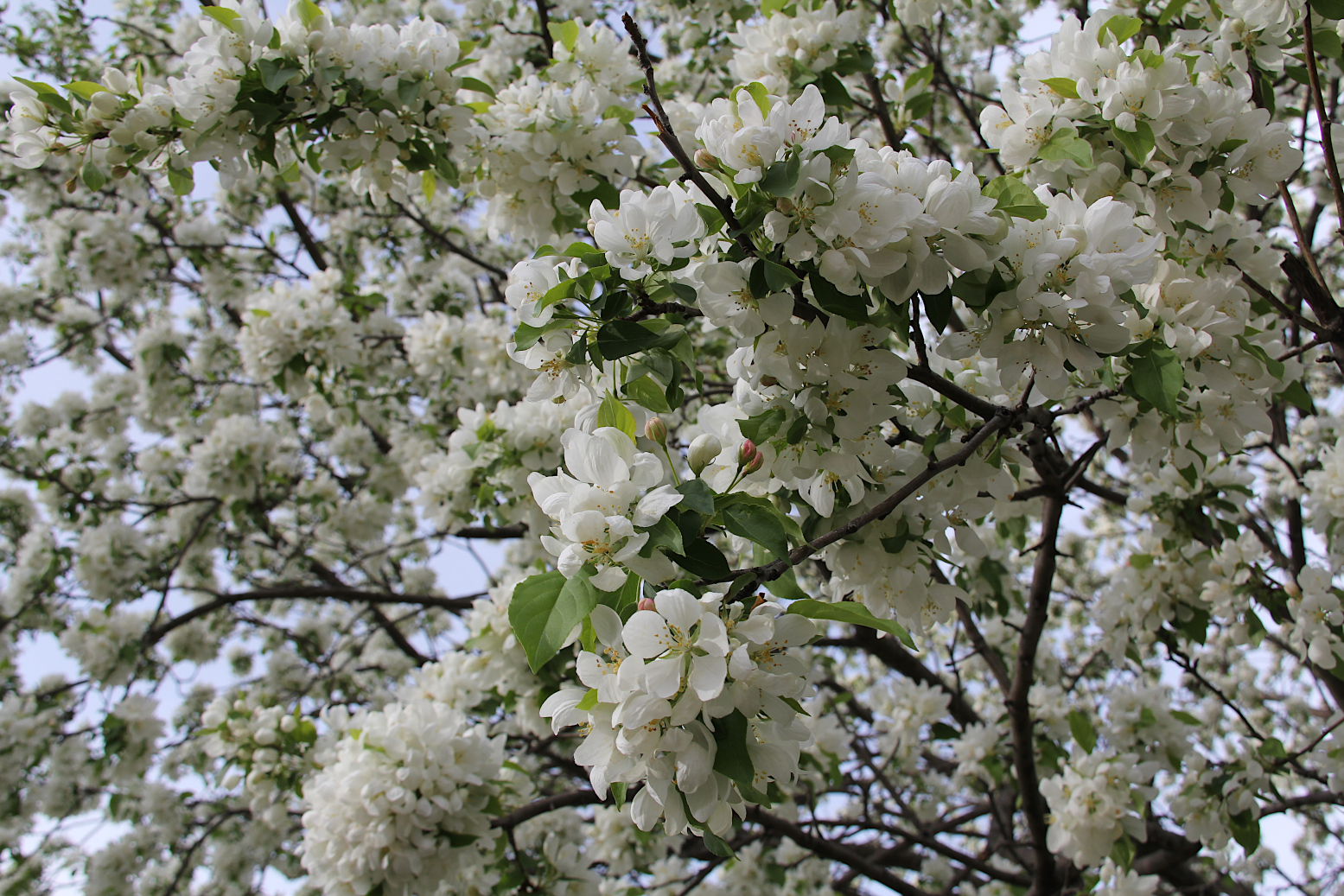
Sunshine dapples a tree along Third Avenue NW, Faribault. (Minnesota Prairie Roots copyrighted photo late April 2026)
In residential neighborhoods, in parks and in other spaces, flowering trees bloom poetic verse. Above. And in a carpet of petals upon the ground. I’m inspired to write: Apple blossoms fall/like kisses from their lips/teasing, tempting, tasting/not of promised, forbidden fruit/but of young love blooming.
The Guild House tree in bud and now bloom. (Minnesota Prairie Roots copyrighted photo April 2026)
And so spring seems a time of young love. Of beginnings. Of feeling the heart beat faster.
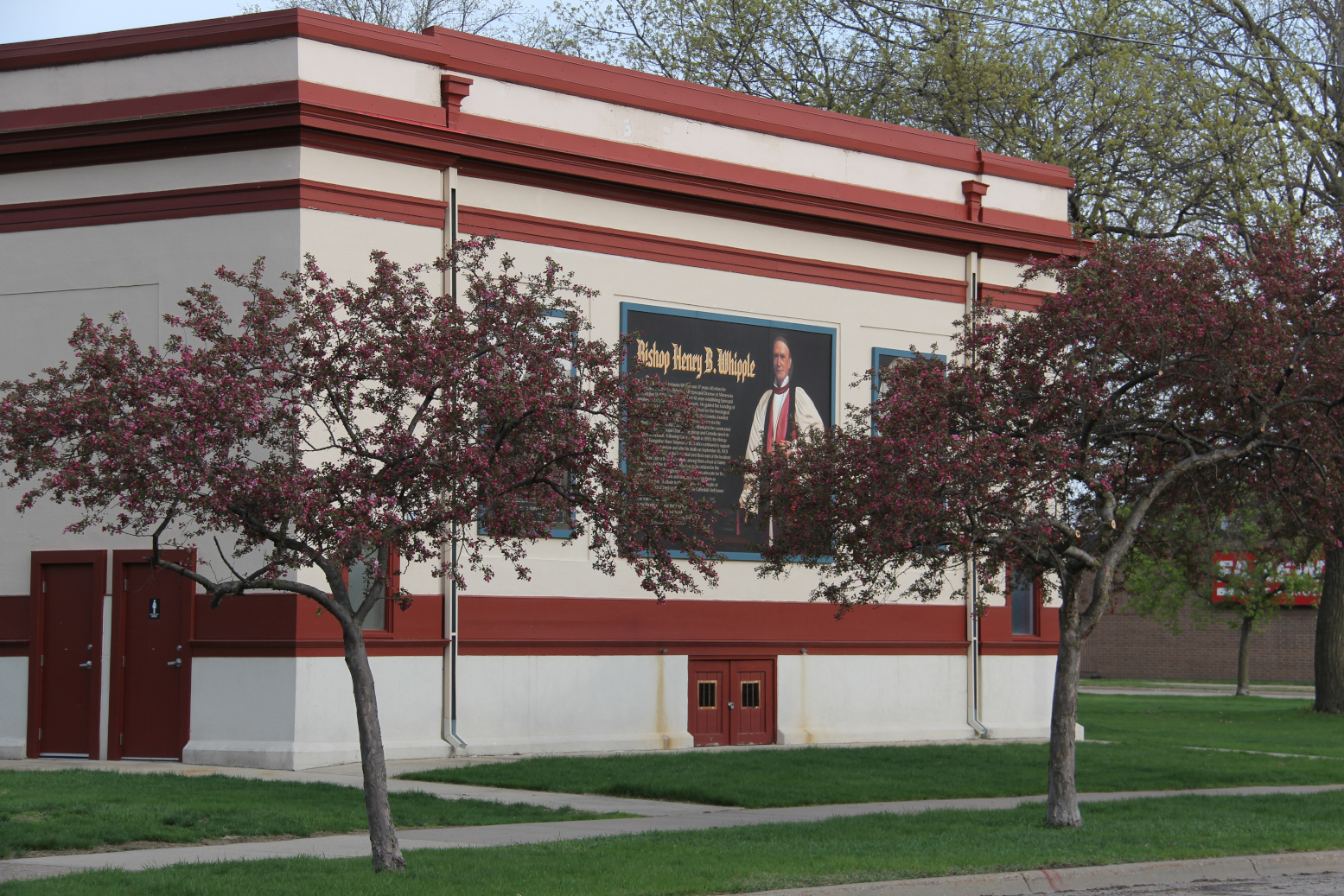
Trees flower on the back side of Faribault’s Central Park bandshell which features murals honoring the life of Bishop Henry Whipple. (Minnesota Prairie Roots copyrighted photo April 2026)
Yet spring also celebrates the seasoned love of many years, even decades, together. Love that has seen countless springs of flowering trees blushing beauty into the landscape. For my husband, Randy, and me, 44 years of married life marked on May 15.
Looking up at flowering treetops outside an office building along Third Avenue NW in Faribault. (Minnesota Prairie Roots copyrighted photo April 2026)
We walk beneath those trees, petals underfoot representing the poetry of days past and those above of poetry yet unwritten.
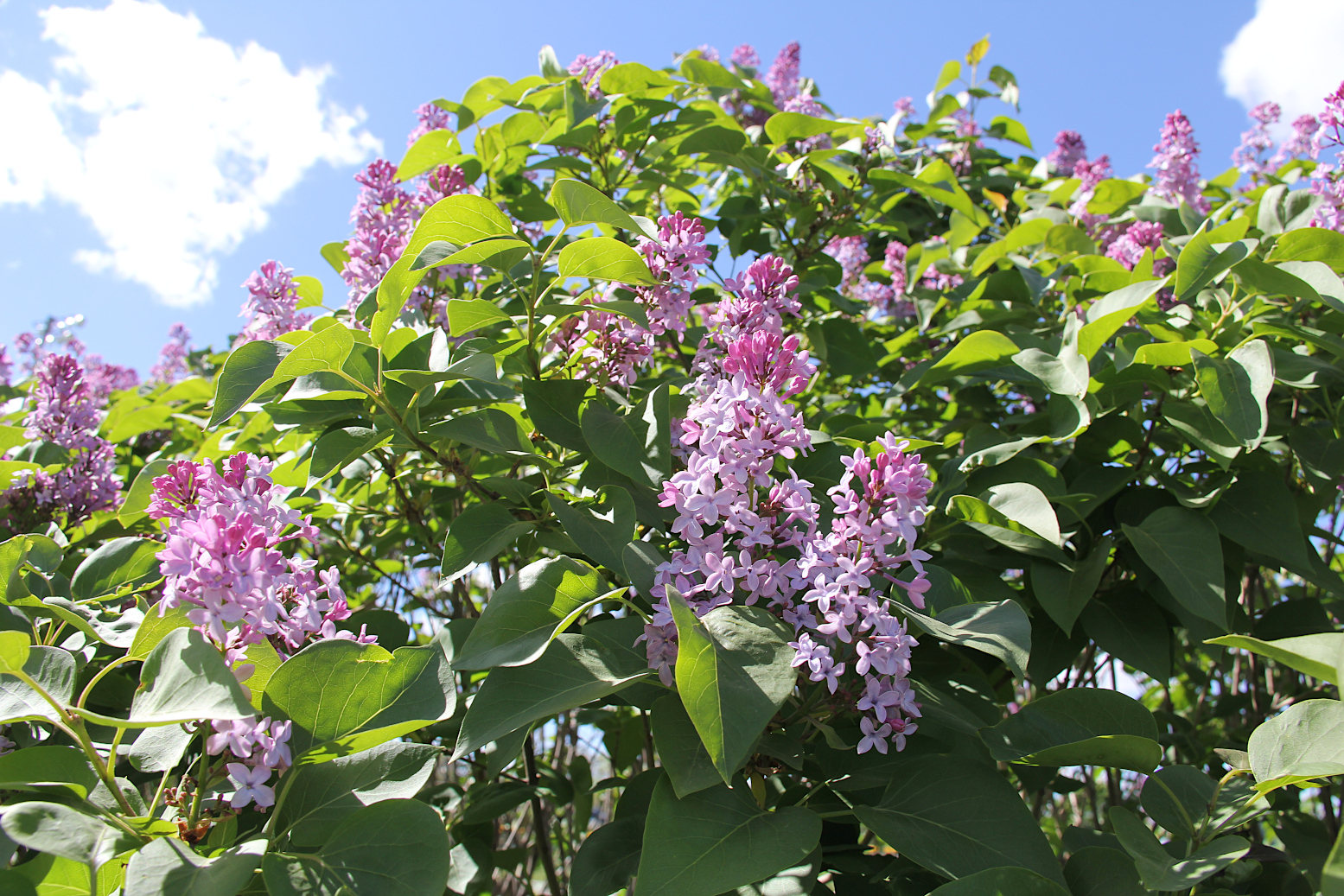
Lilacs bloom in North Alexander Park, Faribault. (Minnesota Prairie Roots copyrighted photo May 2026)
EARLY MAY IN MINNESOTA always appears fresh, vibrant, new.
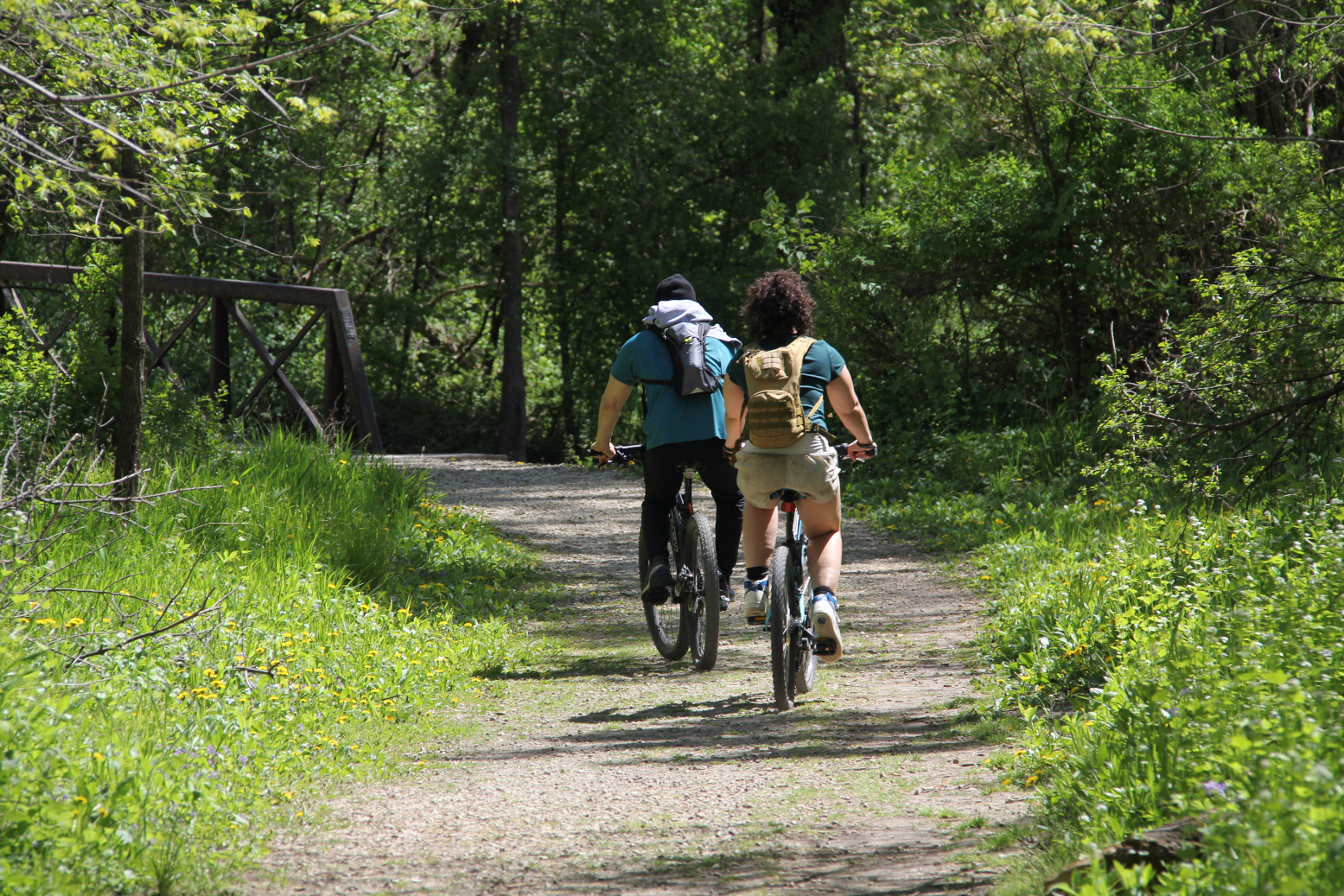
Biking toward the pedestrian bridge across the Straight River in Teepee Tonka Park. (Minnesota Prairie Roots copyrighted photo May 2026)
It’s as if our senses have reawakened from hibernation. The landscape looks especially lush. The sun feels warmer. Birdsong sounds louder. And the desire to get outdoors and take it all in runs strong.
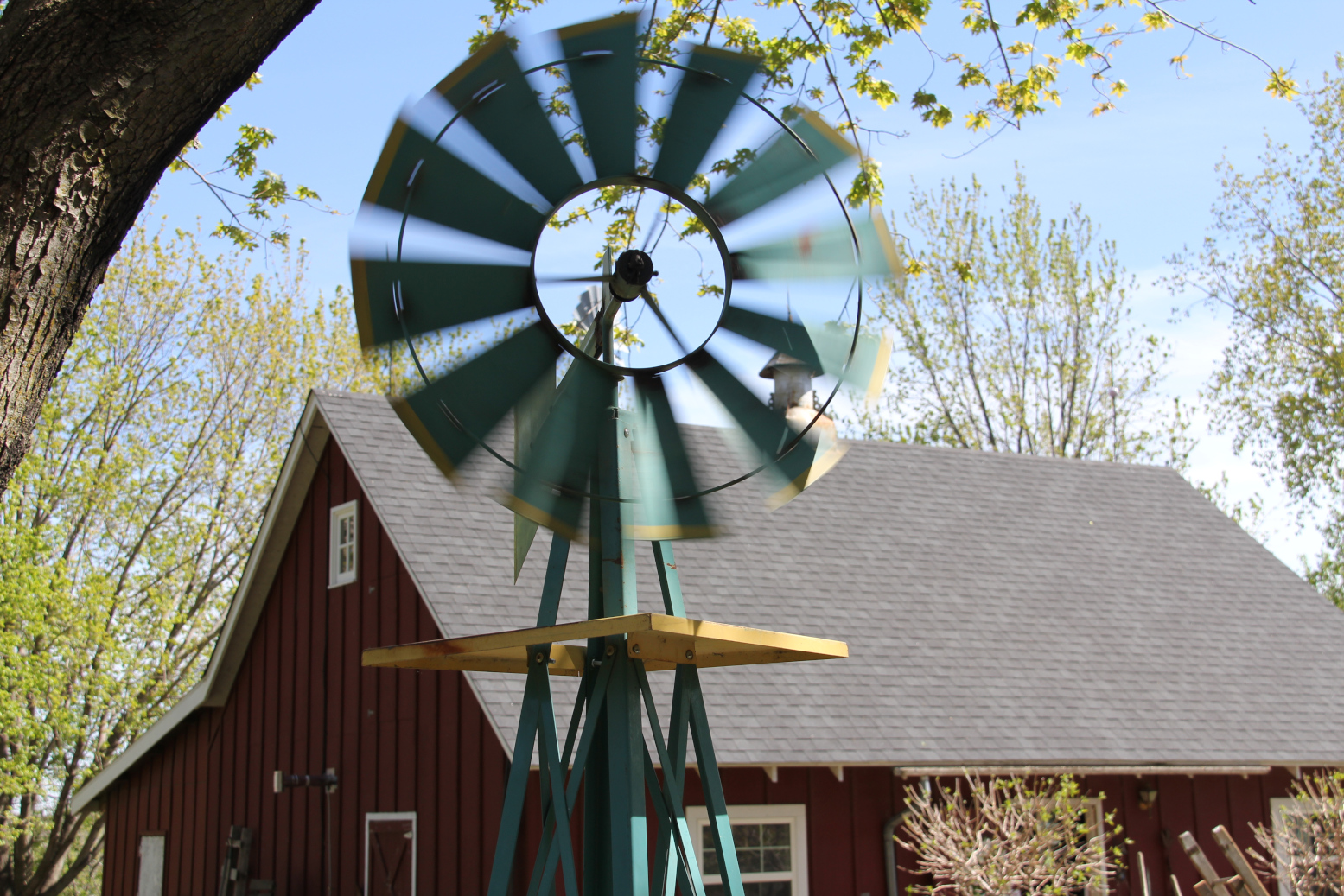
A windmill spins at The Crabby Wren barn sale in Cannon City during a vintage shop hop. (Minnesota Prairie Roots copyrighted photo May 2026)
Mother’s Day weekend brought locals out in droves in the Faribault area, including me. Bikers, hikers, dog walkers, anglers, picnickers, shoppers at a vintage shop hop…
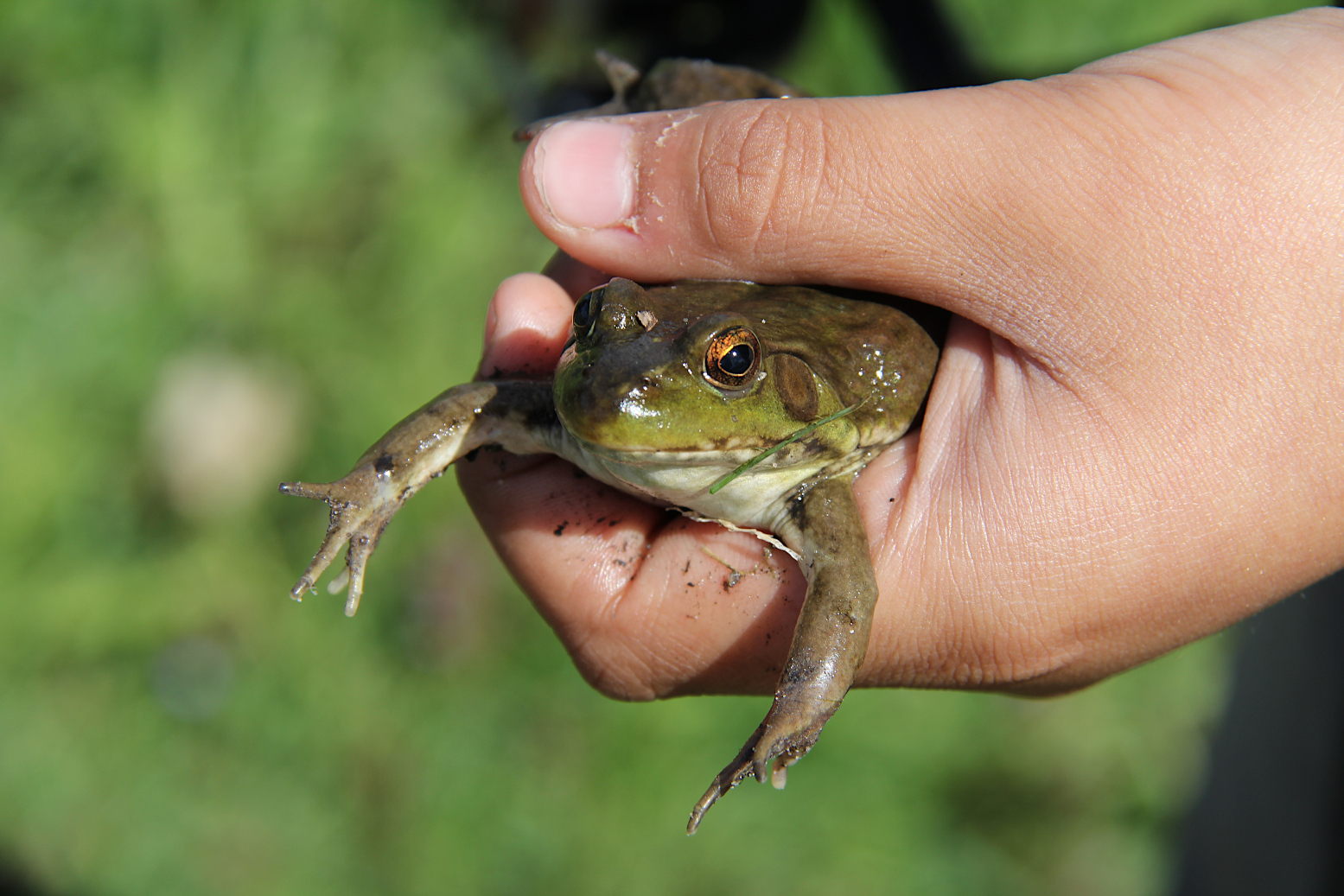
A frog caught along the Cannon River. (Minnesota Prairie Roots copyrighted photo May 2026)
The river drew many. A father and his young son fished at Two Rivers Park, using chicken skin coated in red Kool-Aid as bait. A young boy snagged a frog along the Cannon River in North Alexander Park where he fished with a friend. Anglers lined the river banks by the two dams near the Faribault Mill.
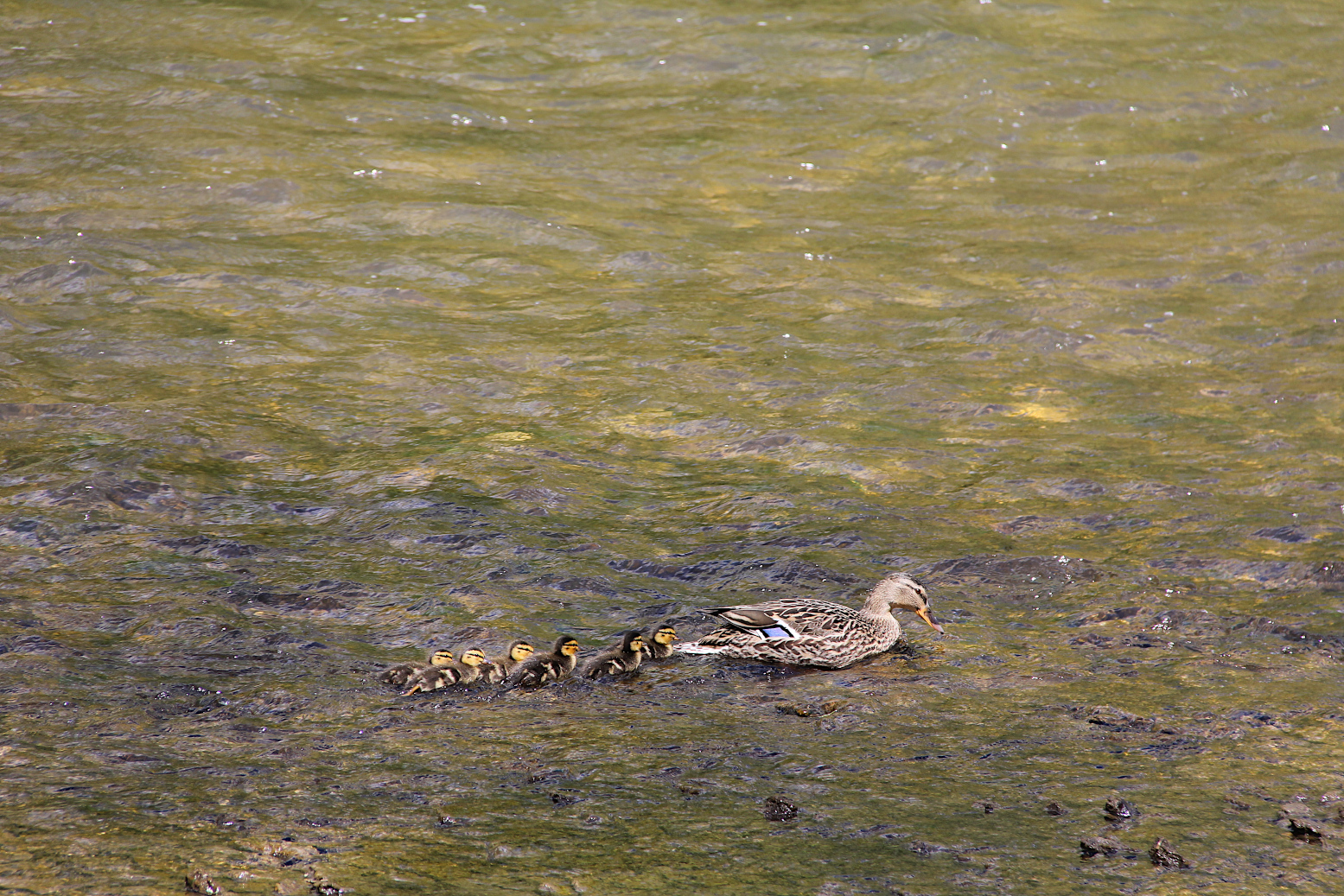
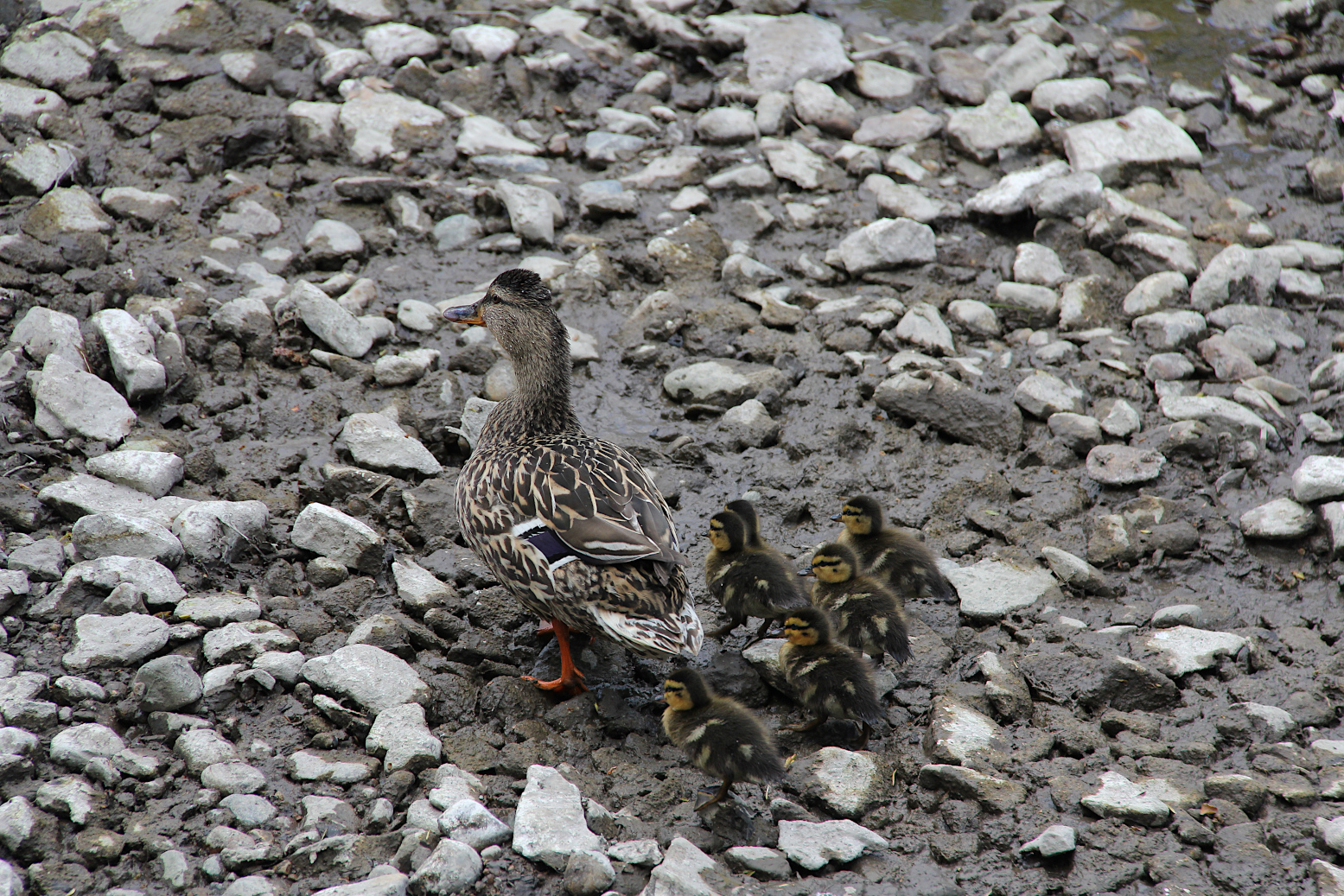
Six ducklings and their mother swim in the shallow water of the Straight River at Teepee Tonka Park. (Minnesota Prairie Roots copyrighted photo May 2026)
And some, like me, watched six fluffy ducklings swim against the current and traverse the rocky bed of the Straight River in Teepee Tonka Park as they tried to keep up with their mother. The word “cute” fit.
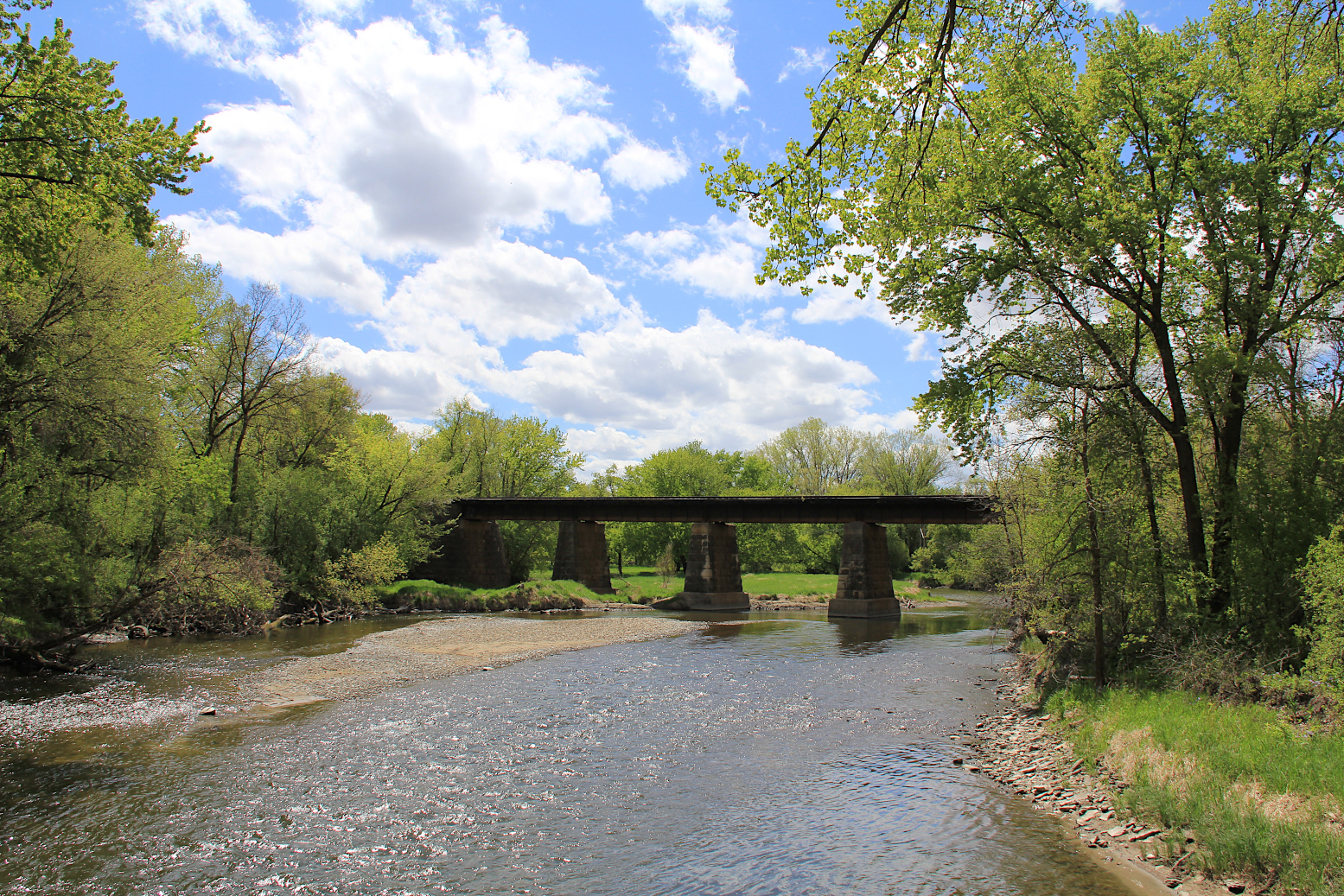
The Straight River and railroad bridge as photographed on a pedestrian bridge linking Teepee Tonka Park to River Bend Nature Center. (Minnesota Prairie Roots copyrighted photo May 2026)
Everywhere Randy and I hiked on this splendid—and, yes, that word fits—Sunday, the essence of spring enveloped us. Wildflowers bloomed. Greenery enveloped us. The water of the Straight River flowed clear below us. Clouds puffed the blue sky.
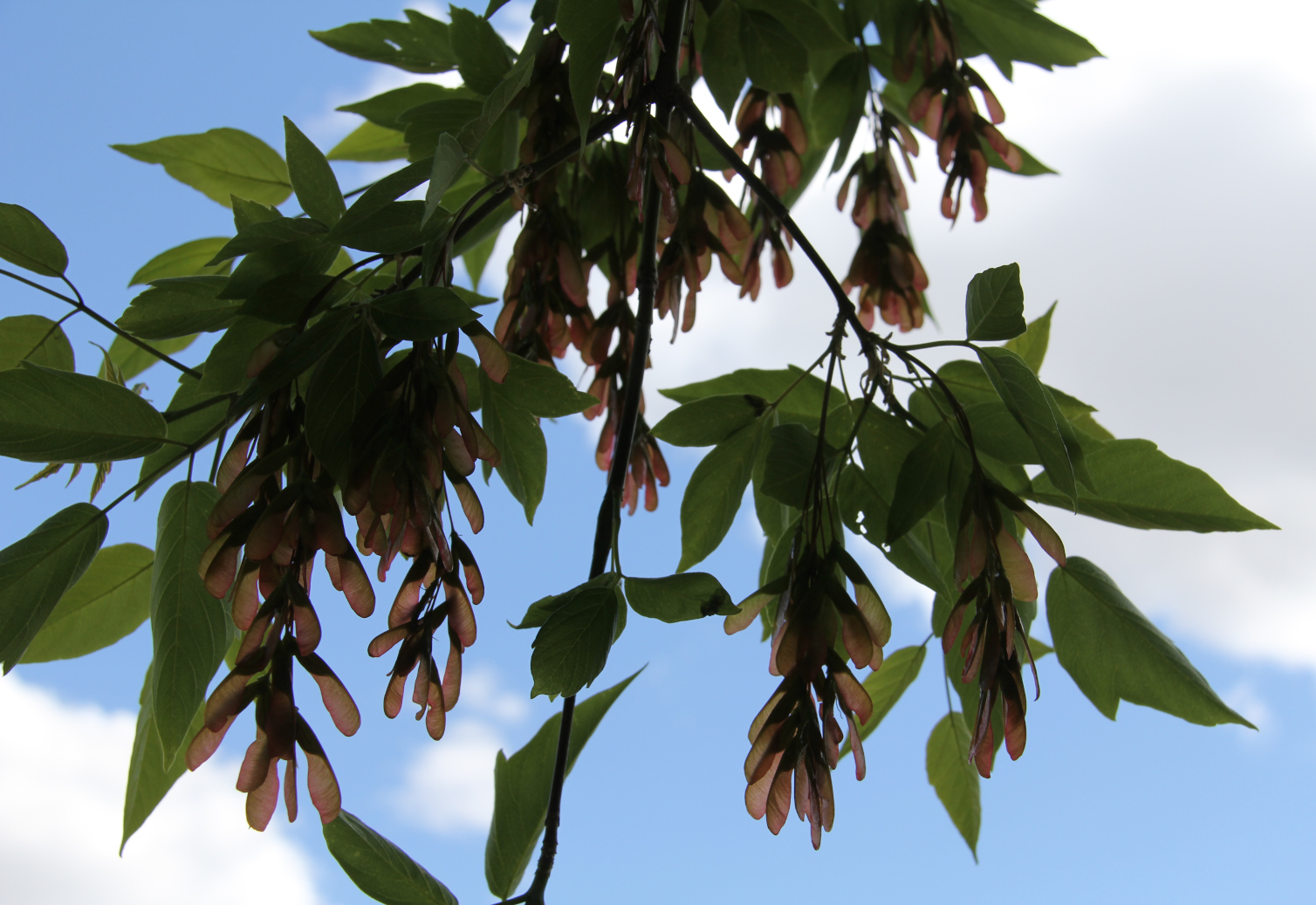
Maple leaf seed pods against the blue May sky. (Minnesota Prairie Roots copyrighted photo May 2026)
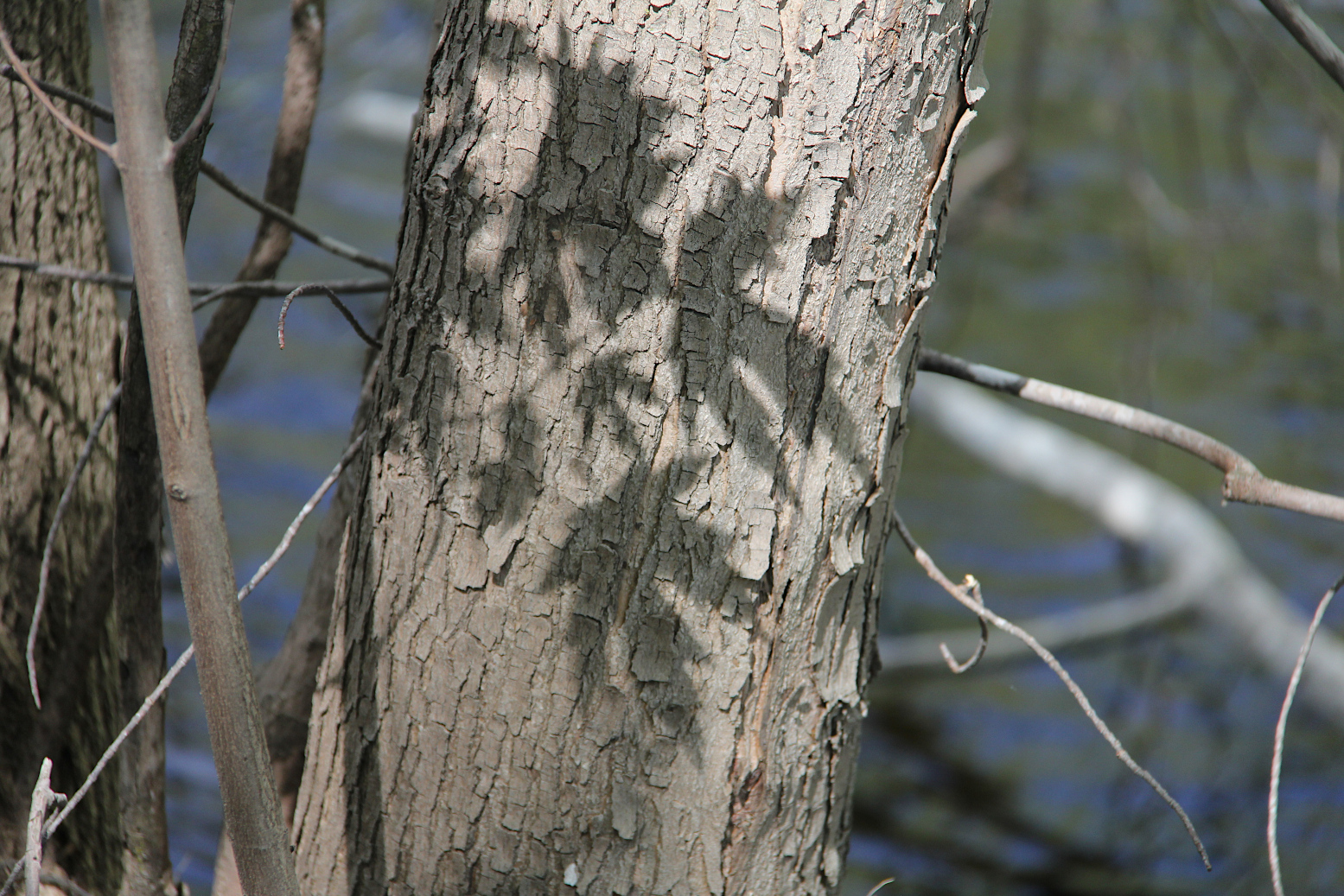
The perfume of lilacs scented the air. Maple leaf seed pods dangled from branches. Maple leaves shadowed a tree trunk.
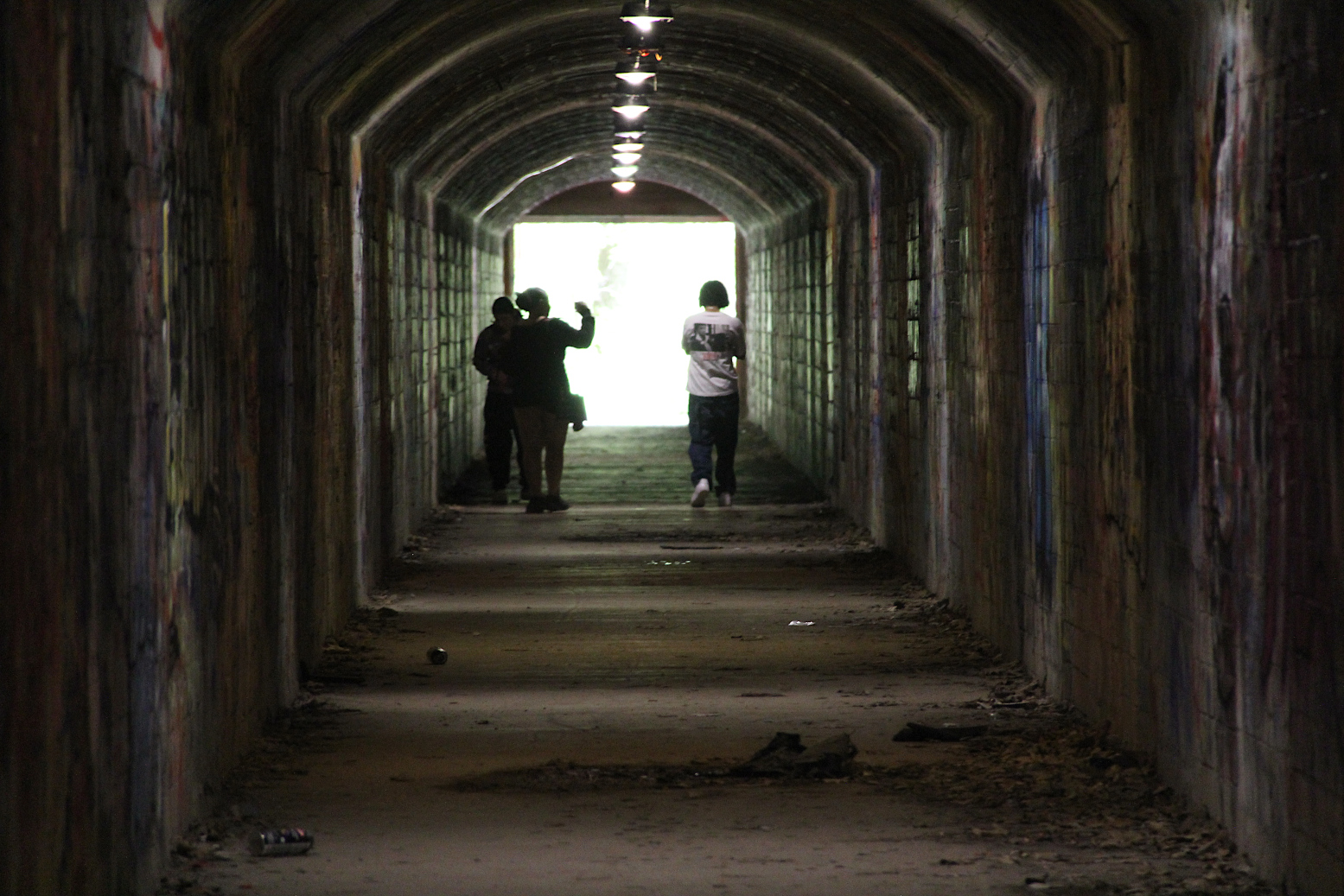
Teens in the tunnel. (Minnesota Prairie Roots copyrighted photo May 2026)
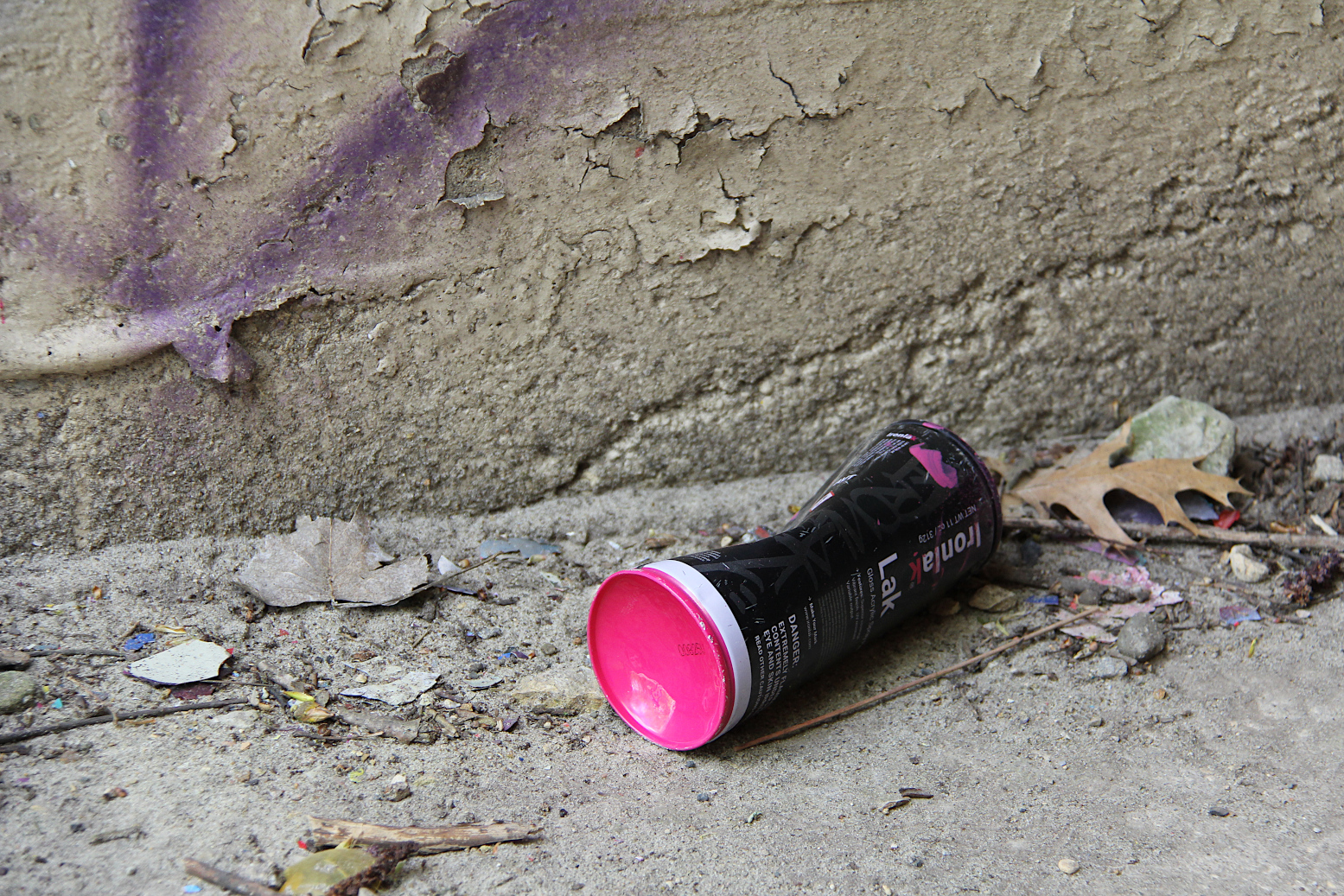
One of several cans of spray paint lying inside the tunnel. (Minnesota Prairie Roots copyrighted photo May 2026)
Tunnel graffiti. (Minnesota Prairie Roots copyrighted photo May 2026)
And in the shadows of a 442-foot long tunnel leading into River Bend Nature Center, several teens clustered, music blaring. We didn’t walk far enough to see what they were doing, but rather scanned the graffiti covering the walls of this 1937 Works Progress Administration project, built as a root cellar for the former Minnesota School and Colony (state hospital). I’m not informed enough to interpret the art, much of which includes obscene language and unidentifiable symbols. Yet, I found a patch of art that seemed devoid of anything offensive.
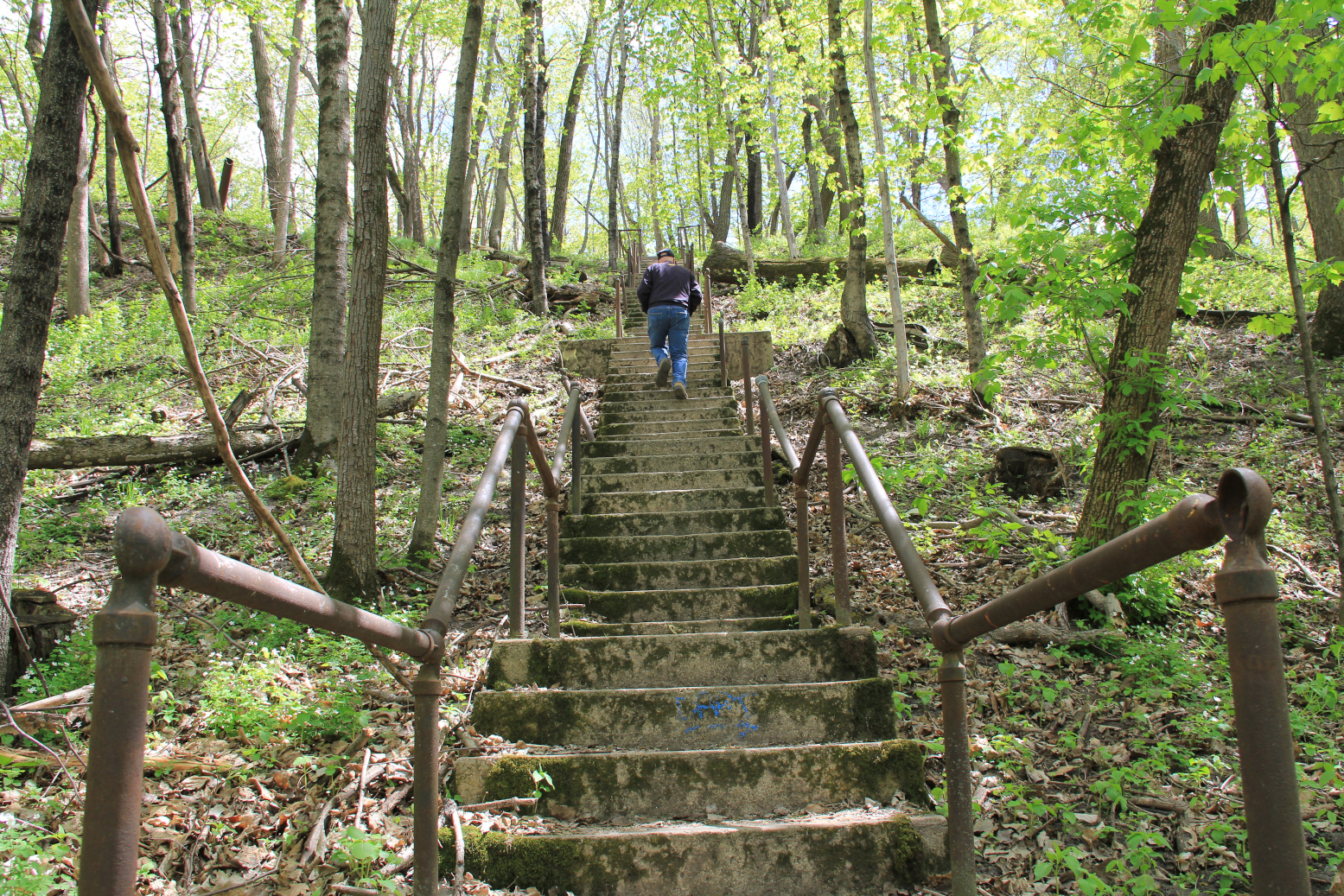
Randy climbs partially up a steep flight of stairs in the woods. (Minnesota Prairie Roots copyrighted photo May 2026)
We emerged from the coolness of the tunnel back into woods hugging a steep hill on one side of the trail, the river bottom on the other. A rail line rises high like a wall along a portion of the path. Only later, in another location, did I hear the blast of a train whistle.
Maple leaf shadows on a tree trunk along the Straight River. (Minnesota Prairie Roots copyrighted photo May 2026)
Even in the quiet of parks and trails, the background of city noise, the presence of people remains. Yet, it’s possible to shut out the distractions, to immerse one’s self in nature.
Nearly camouflaged in the rocky bed of the Straight River, a mama duck and her six babies. (Minnesota Prairie Roots copyrighted photo May 2026)
I deeply appreciate the trail system, many parks and nature center within the city limits of Faribault. For a while on Mother’s Day afternoon, I observed just how much they are used, valued. To see people out and about like the young boys angling for fish and frogs, the families grilling in the park, the bikers pedaling, the dog owners walking their canines and more, reaffirms the importance of the outdoors to all of us, for our physical and mental well-being. To embrace spring after the season of winter feels good, oh, so good.
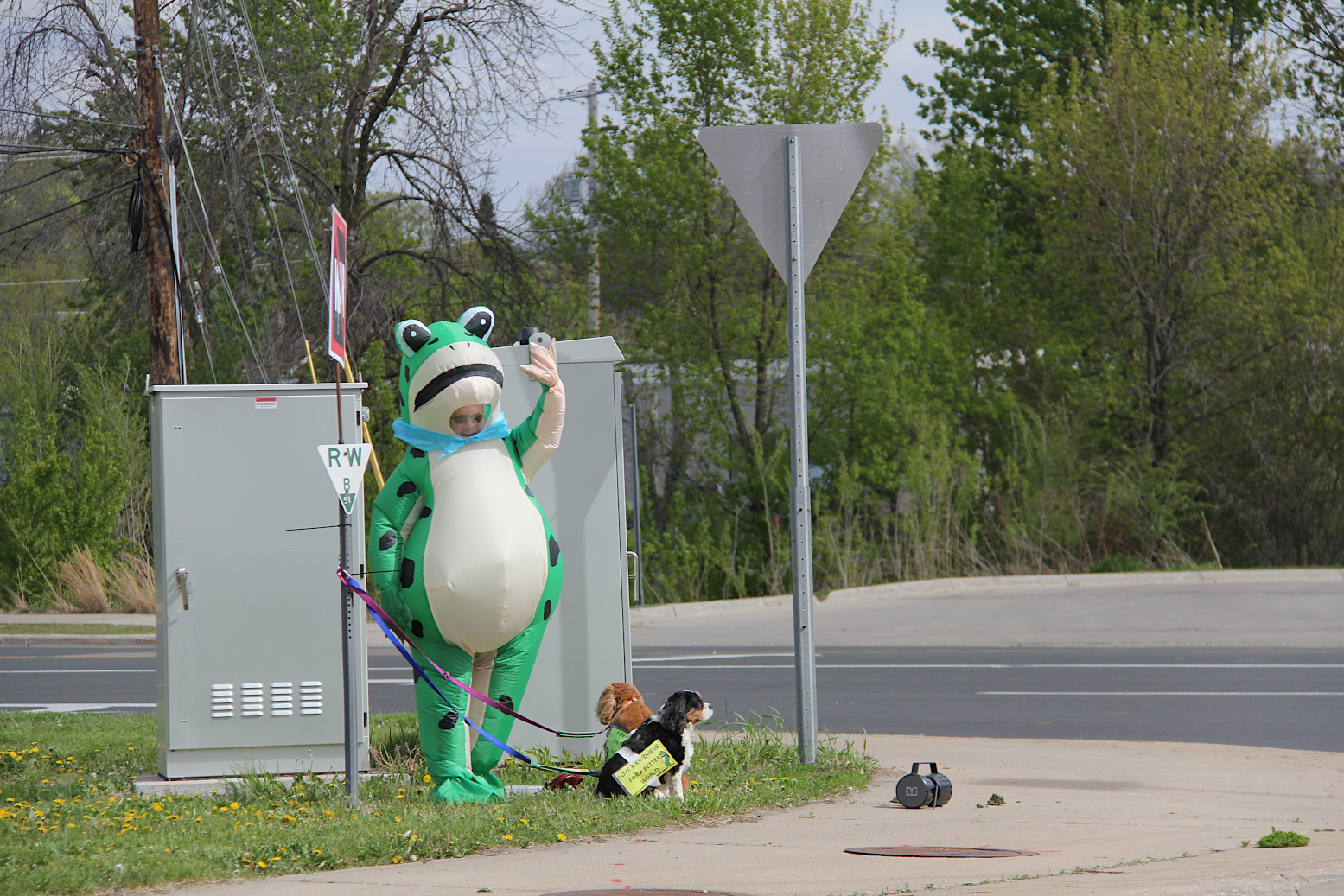
A protester stands at the intersection of Minnesota State highways 3 and 19 in Northfield last Friday afternoon. The inflatable frog costume traces to protests in Portland, Oregon, and signifies a humorous, nonviolent form of creative resistance. The dog’s sign reads, “Love & Kindness for a better world.” (Minnesota Prairie Roots copyrighted photo May 2026)
SIX POETS, me included, will read our poetry beginning at 7 p.m. Thursday, May 14, at Content Bookstore in Northfield.
I am honored to be in the company of prolific and talented poets Becky Boling, D.E. (Doug) Green, Rob Hardy and Dougie Padilla all of Northfield and Larry Gavin of Faribault. I’ve previously read with everyone except Padilla and consider them friends.
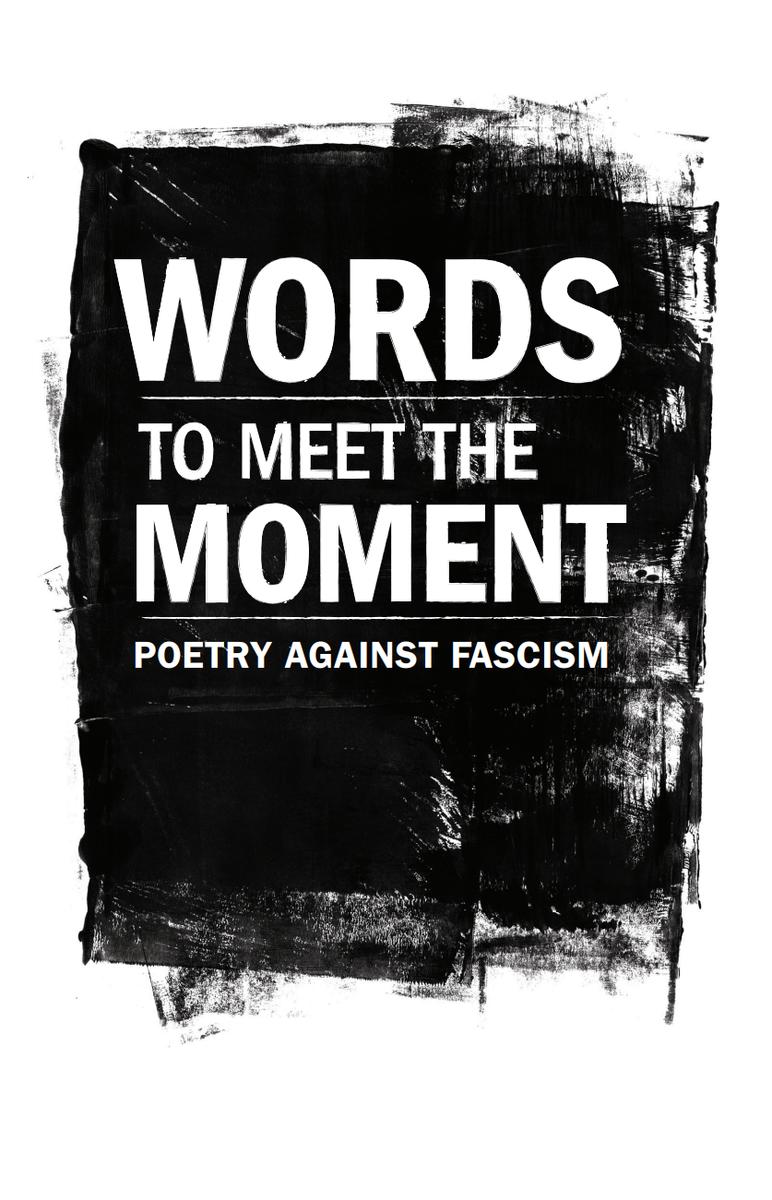
Poets will read from this publication on Thursday evening in Northfield. (Cover sourced online)
I will read two poems from this collection published by Content Bookstore. (Cover sourced online)
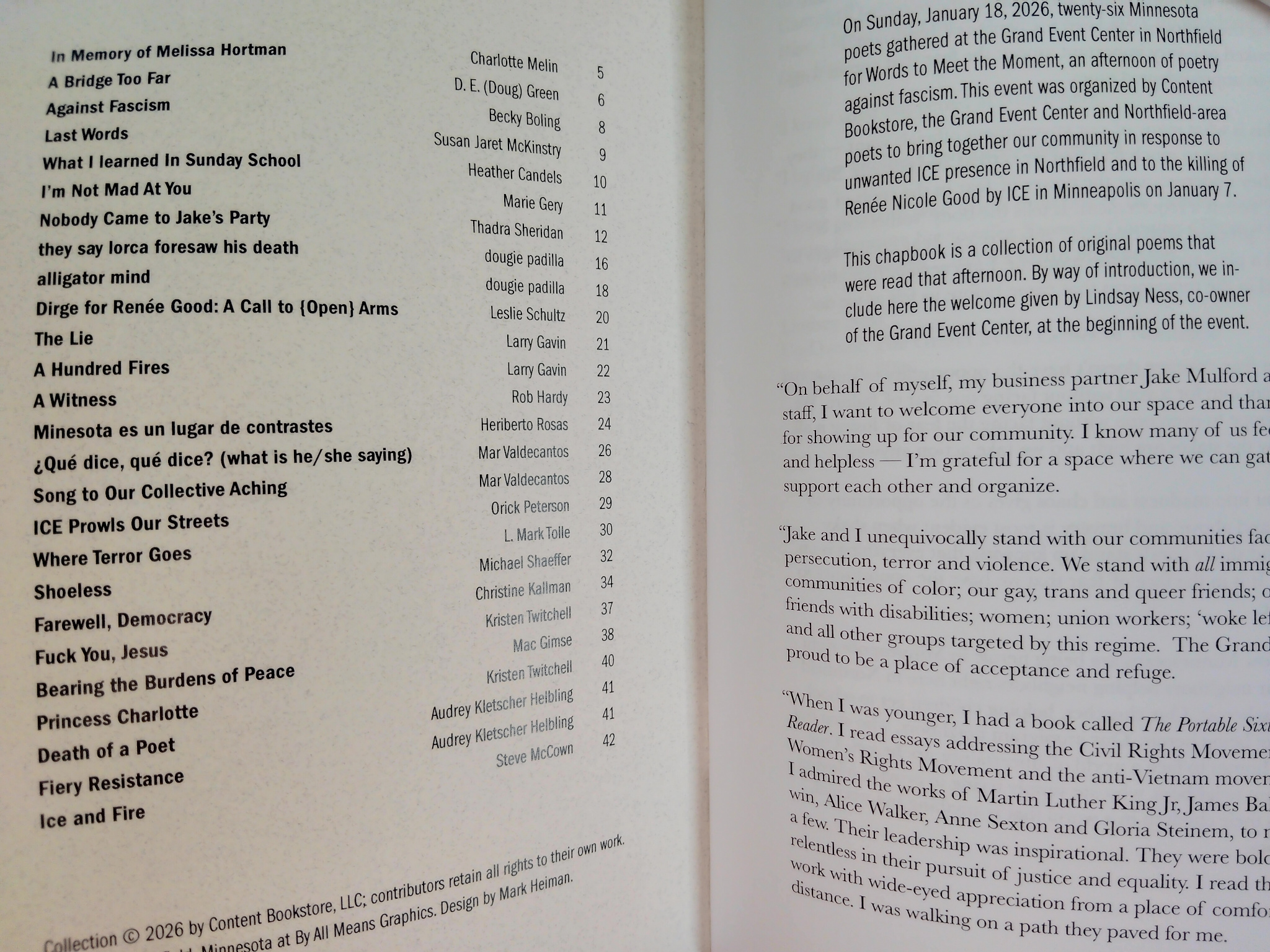
Two of the poems I plan to read—“Death of a Poet” and “Fiery Resistance”—are also anti-ICE. They published in Content Bookstore’s chapbook, Words to Meet the Moment: Poetry Against Fascism.
The years 2025 and 2026 have, indeed, been a time for us to use our words to resist, to rise up, to make a difference. Minnesotans did during Operation Metro Surge and continue to do so. I continue to write. I continue to protest. I continue to speak up, refusing to remain silent.
The table of contents for Words to Meet the Moment. (Minnesota Prairie Roots copyrighted file photo 2026)
Words hold power. When we stand united on issues, like preserving our democracy, supporting our immigrant neighbors, protecting voting rights, opposing an unnecessary war, calling out wrongs and much more, we can collectively make a difference. At some point those who hear, but disagree, may finally begin to understand what’s at stake.
Poetry matters. To step up to the mic in an independent bookstore in a small Minnesota college town to read the passionate anti-ICE poems I crafted may not seem like much. But when I am joined by five other poets who also fired poems that could melt ICE, we become part of a movement, a force. We care about our neighbors, about Minnesota, about our country, about the world enough to pen powerful poetry.
Join us from 7-8:30 p.m. Thursday to hear our poetry. United we write. United we read. United we rise.










Memorial Day: Honoring those who “gave all” May 21, 2026
Tags: commentary, death, holiday, Iran War, Kenyon Veterans Memorial Park, killed in action, Korean War, Memorial Day, Minnesota, Nicole Amor, Owatonna, Owatonna Veterans Memorial, Ray Scheibe, statues, SVJ Creative Designs, veterans, veterans' memorials, war
AS THE DAUGHTER of a U.S. Army infantryman who fought on the front lines during the Korean War, I find myself drawn to veterans’ memorials. They seem a sacred space, a place where bravery, service, strength, sacrifice and grief mingle.
Every memorial I’ve visited in southern Minnesota differs from the next. Yet the essence remains the same as a site to honor those who have served, some ultimately dying in service to country.
Memorial Day marks a national holiday to remember those who made the ultimate sacrifice by losing their lives. Whether necessary or unnecessary, war is hard and awful. It claims lives, forever changes people, rewrites history, traumatizes. My dad would tell you that. I saw firsthand the trauma Dad experienced from serving in Korea. He killed the enemy, so close he could see the whites of their eyes. He saw his friend blown apart on the battlefield the day before Ray was to return home to his wife and infant daughter in Nebraska.
For every story like this, thousands more exist.
And so every veterans’ memorial is a tribute to the men and women who are more than names and dates on plaques, but individuals with loving families, friends and communities. Individuals with stories from their time in service.
If I let my mind wander while viewing a veterans’ memorial, I can imagine the stories. Inspirational quotes, photos and life-size statues of military members make it easier for me to see beyond the names and dates to real people.
At every southern Minnesota veterans’ memorial I’ve visited, and I’ve been to a lot, statues have only portrayed male soldiers. Until recently. The Owatonna Veterans Memorial includes a female soldier. She stands next to a kneeling soldier with a battlefield cross. And on the far side of the memorial site stands a statue of a Vietnam War soldier carrying his fallen comrade draped across his shoulders.
“All gave some, some gave all.” Sgt. 1st Class Nicole Amor of White Bear Lake gave her all on March 1, 2026. She was among four American soldiers who died after a drone strike on a command center in Kuwait during the Iran War. The wife and mother of two was just days from returning home to Minnesota. Just like my dad’s 22-year-old friend Ray, who was killed in Korea 73 years ago on the day before he was to head home to Nebraska.
This Memorial Day, as this country is once again engaged in war, I wonder how many more men and women will die. How many more names will be added to memorials around the country with plaques noting KIA (killed in action)?
Monday may mean simply a day off to some or the kick-off to summer for others. But Memorial Day is really about honoring the brave men and women who have died in service to country. It’s important to remember that, to attend a Memorial Day parade or program, to walk among gravestones, to visit a veterans’ memorial. To focus on gratitude. To grieve. To remember and honor those who “gave all.”
FYI: The Owatonna Veterans Memorial is located on the northwest corner of 18th Street and Austin Road by the Steele County History Center. The Moonlighters Exchange Club spearheaded the project and fundraising for the memorial dedicated in November 2023.
© Copyright 2026 Audrey Kletscher Helbling